WO2024043010A1 - 蛍光体ホイール、光源装置、投写型映像表示装置及び蛍光体ホイールの製造方法 - Google Patents
蛍光体ホイール、光源装置、投写型映像表示装置及び蛍光体ホイールの製造方法 Download PDFInfo
- Publication number
- WO2024043010A1 WO2024043010A1 PCT/JP2023/028006 JP2023028006W WO2024043010A1 WO 2024043010 A1 WO2024043010 A1 WO 2024043010A1 JP 2023028006 W JP2023028006 W JP 2023028006W WO 2024043010 A1 WO2024043010 A1 WO 2024043010A1
- Authority
- WO
- WIPO (PCT)
- Prior art keywords
- wavelength conversion
- layer
- substrate
- wavelength
- light
- Prior art date
- Legal status (The legal status is an assumption and is not a legal conclusion. Google has not performed a legal analysis and makes no representation as to the accuracy of the status listed.)
- Ceased
Links
Images






Classifications
-
- G—PHYSICS
- G03—PHOTOGRAPHY; CINEMATOGRAPHY; ANALOGOUS TECHNIQUES USING WAVES OTHER THAN OPTICAL WAVES; ELECTROGRAPHY; HOLOGRAPHY
- G03B—APPARATUS OR ARRANGEMENTS FOR TAKING PHOTOGRAPHS OR FOR PROJECTING OR VIEWING THEM; APPARATUS OR ARRANGEMENTS EMPLOYING ANALOGOUS TECHNIQUES USING WAVES OTHER THAN OPTICAL WAVES; ACCESSORIES THEREFOR
- G03B21/00—Projectors or projection-type viewers; Accessories therefor
- G03B21/14—Details
- G03B21/20—Lamp housings
- G03B21/2006—Lamp housings characterised by the light source
- G03B21/2033—LED or laser light sources
- G03B21/204—LED or laser light sources using secondary light emission, e.g. luminescence or fluorescence
-
- G—PHYSICS
- G02—OPTICS
- G02B—OPTICAL ELEMENTS, SYSTEMS OR APPARATUS
- G02B26/00—Optical devices or arrangements for the control of light using movable or deformable optical elements
- G02B26/007—Optical devices or arrangements for the control of light using movable or deformable optical elements the movable or deformable optical element controlling the colour, i.e. a spectral characteristic, of the light
- G02B26/008—Optical devices or arrangements for the control of light using movable or deformable optical elements the movable or deformable optical element controlling the colour, i.e. a spectral characteristic, of the light in the form of devices for effecting sequential colour changes, e.g. colour wheels
-
- G—PHYSICS
- G02—OPTICS
- G02B—OPTICAL ELEMENTS, SYSTEMS OR APPARATUS
- G02B5/00—Optical elements other than lenses
- G02B5/20—Filters
-
- G—PHYSICS
- G03—PHOTOGRAPHY; CINEMATOGRAPHY; ANALOGOUS TECHNIQUES USING WAVES OTHER THAN OPTICAL WAVES; ELECTROGRAPHY; HOLOGRAPHY
- G03B—APPARATUS OR ARRANGEMENTS FOR TAKING PHOTOGRAPHS OR FOR PROJECTING OR VIEWING THEM; APPARATUS OR ARRANGEMENTS EMPLOYING ANALOGOUS TECHNIQUES USING WAVES OTHER THAN OPTICAL WAVES; ACCESSORIES THEREFOR
- G03B21/00—Projectors or projection-type viewers; Accessories therefor
-
- G—PHYSICS
- G03—PHOTOGRAPHY; CINEMATOGRAPHY; ANALOGOUS TECHNIQUES USING WAVES OTHER THAN OPTICAL WAVES; ELECTROGRAPHY; HOLOGRAPHY
- G03B—APPARATUS OR ARRANGEMENTS FOR TAKING PHOTOGRAPHS OR FOR PROJECTING OR VIEWING THEM; APPARATUS OR ARRANGEMENTS EMPLOYING ANALOGOUS TECHNIQUES USING WAVES OTHER THAN OPTICAL WAVES; ACCESSORIES THEREFOR
- G03B21/00—Projectors or projection-type viewers; Accessories therefor
- G03B21/14—Details
-
- G—PHYSICS
- G03—PHOTOGRAPHY; CINEMATOGRAPHY; ANALOGOUS TECHNIQUES USING WAVES OTHER THAN OPTICAL WAVES; ELECTROGRAPHY; HOLOGRAPHY
- G03B—APPARATUS OR ARRANGEMENTS FOR TAKING PHOTOGRAPHS OR FOR PROJECTING OR VIEWING THEM; APPARATUS OR ARRANGEMENTS EMPLOYING ANALOGOUS TECHNIQUES USING WAVES OTHER THAN OPTICAL WAVES; ACCESSORIES THEREFOR
- G03B21/00—Projectors or projection-type viewers; Accessories therefor
- G03B21/14—Details
- G03B21/20—Lamp housings
- G03B21/2066—Reflectors in illumination beam
-
- H—ELECTRICITY
- H04—ELECTRIC COMMUNICATION TECHNIQUE
- H04N—PICTORIAL COMMUNICATION, e.g. TELEVISION
- H04N5/00—Details of television systems
- H04N5/74—Projection arrangements for image reproduction, e.g. using eidophor
Definitions
- the present disclosure relates to, for example, a phosphor wheel used in a light source device of a projection type image display device, a light source device, a projection type image display device, and a method for manufacturing the phosphor wheel.
- wavelength conversion layer Conventional phosphor wheels using a phosphor layer (wavelength conversion layer) are available in two types: one is a so-called mixed layer wavelength conversion layer in which phosphor particles are dispersed in a resin paste, and the other is a sintered body of phosphor particles. A system consisting only of a sintered wavelength conversion layer has been used.
- the former phosphor wheel using a mixed layer type wavelength conversion layer has many fluorescent wavelengths to choose from and is cost-effective, but it has problems with conversion efficiency and heat resistance.
- phosphor wheels using a sintered wavelength conversion layer have excellent conversion efficiency and heat resistance, but cost is an issue.
- An object of the present disclosure is to provide a phosphor wheel with an excellent balance between conversion efficiency, heat resistance, and cost.
- a phosphor wheel according to the present disclosure includes a rotatable substrate, a plurality of wavelength conversion layers arranged on the substrate, and an adhesive layer provided between the substrate and the plurality of wavelength conversion layers.
- At least the first wavelength conversion layer of the plurality of wavelength conversion layers is a sintered wavelength conversion layer made of a sintered body of first wavelength conversion particles that converts excitation light into light of a first wavelength. It is a layer.
- At least the second wavelength conversion layer of the plurality of wavelength conversion layers includes a support and a second wavelength conversion layer that converts excitation light into light of a second wavelength different from the first wavelength, which is filled in the support. This is a mixed layer type wavelength conversion layer that is a mixed layer with wavelength conversion particles.
- a method for manufacturing a phosphor wheel according to the present disclosure includes a step of applying an adhesive layer to a substrate, and a sintered body of first wavelength conversion particles that converts excitation light into light of a first wavelength on the substrate. and curing the adhesive layer to form a sintered wavelength conversion layer.
- the phosphor wheel according to the present disclosure has a sintered type wavelength conversion layer and a mixed layer type wavelength conversion layer. This allows a balance between conversion efficiency, heat resistance, and cost to be achieved.
- FIG. 1 is a schematic plan view showing a planar configuration of a phosphor wheel according to Embodiment 1.
- FIG. 3 is a flowchart showing a method for manufacturing a phosphor wheel according to Embodiment 1.
- FIG. 1 is a diagram showing the configuration of a light source device using a phosphor wheel according to Embodiment 1.
- FIG. 1 is a diagram showing the configuration of a projection type image display device equipped with a light source device using a phosphor wheel according to Embodiment 1.
- FIG. FIG. 1 is a diagram showing the configuration of a projection type image display device equipped with a light source device using a phosphor wheel according to Embodiment 1.
- FIG. 3 is a schematic plan view showing a planar configuration of a phosphor wheel according to a second embodiment.
- FIG. 7 is a diagram showing the configuration of a light source device using a phosphor wheel according to a second embodiment.
- FIG. 7 is a diagram showing the configuration of a projection type image display device equipped with a light source device using a phosphor wheel according to a second embodiment.
- FIG. 7 is a schematic plan view showing the planar configuration of a phosphor wheel according to Embodiment 3;
- FIG. 7 is a diagram illustrating alignment of a sintered wavelength conversion layer (with a center angle smaller than a design value) during manufacturing of a phosphor wheel according to Embodiment 3;
- FIG. 7 is a diagram illustrating alignment of a sintered wavelength conversion layer (with a center angle larger than a design value) during manufacturing of a phosphor wheel according to Embodiment 3;
- the phosphor wheel according to the first aspect includes a rotatable substrate, a plurality of wavelength conversion layers arranged on the substrate, and an adhesive layer provided between the substrate and the plurality of wavelength conversion layers.
- At least the first wavelength conversion layer of the plurality of wavelength conversion layers is a sintered wavelength conversion layer made of a sintered body of first wavelength conversion particles that converts excitation light into light of a first wavelength. It is a layer.
- At least the second wavelength conversion layer of the plurality of wavelength conversion layers includes a support and a second wavelength conversion layer that converts excitation light into light of a second wavelength different from the first wavelength, which is filled in the support. This is a mixed layer type wavelength conversion layer that is a mixed layer with wavelength conversion particles.
- the mixed layer type wavelength conversion layer and the sintered type wavelength conversion layer may be arranged adjacent to each other on the substrate.
- the first wavelength conversion layer and the second wavelength conversion layer have at least one of the inner diameter and the outer diameter from the rotation center of the substrate. may be different from each other.
- the first wavelength conversion layer and the second wavelength conversion layer have a width in the radial direction with respect to the rotation center. may be different from each other.
- the inner diameter of the first wavelength conversion layer from the rotation center of the substrate is equal to the second wavelength from the rotation center of the substrate.
- the outer diameter of the first wavelength conversion layer from the rotation center of the substrate may be larger than the inner diameter of the conversion layer and smaller than the outer diameter of the second wavelength conversion layer from the rotation center of the substrate.
- the apertures are provided on the same circumference with respect to the rotation center of the substrate on which the plurality of wavelength conversion layers are arranged. May have.
- the reflective area is provided on the same circumference with respect to the rotation center of the substrate on which the plurality of wavelength conversion layers are arranged. May have.
- a light source device includes the phosphor wheel according to any one of the first to seventh aspects.
- a projection type video display device includes the light source device according to the eighth aspect.
- a method for manufacturing a phosphor wheel according to a tenth aspect includes the steps of applying an adhesive layer to a substrate, and baking first wavelength conversion particles on the substrate to convert excitation light into light of a first wavelength.
- the method includes a step of forming a mixed layer type wavelength conversion layer.
- the first wavelength conversion particles are aligned around the sintered body.
- a guide pin is provided, and the substrate and the sintered body of the first wavelength conversion particles are relatively moved along the guide pin in a direction perpendicular to the adhesive surface, and the first wavelength is applied to the area where the adhesive layer of the substrate is applied.
- a sintered body of conversion particles may be attached.
- the eleventh aspect in the step of forming the mixed layer type wavelength conversion layer, the portion corresponding to the guide pin is removed and the first wavelength conversion layer is placed on the substrate.
- a mixed layer in which the second wavelength conversion particles and the support are mixed may be applied to a portion of the particles adjacent to the sintered body.
- FIG. 1 is a schematic plan view showing the planar configuration of a phosphor wheel 2 according to the first embodiment.
- the phosphor wheel 2 according to the first embodiment includes a rotatable substrate 201, a plurality of wavelength conversion layers 204a, 204b, 205a, 205b, a substrate 201 and a plurality of wavelength conversion layers 204a, 204b. , 205a, and 205b.
- the plurality of wavelength conversion layers 204a, 204b, 205a, and 205b are arranged on the substrate 201 and convert the same excitation light into light of a plurality of different wavelengths. Further, the plurality of wavelength conversion layers 204a, 204b, 205a, and 205b include sintered wavelength conversion layers 204a, 204b, and mixed layer type wavelength conversion layers 205a, 205b.
- the sintered wavelength conversion layers 204a and 204b are composed of sintered bodies of first wavelength conversion particles that convert excitation light into light of a first wavelength.
- the mixed layer type wavelength conversion layers 205a and 205b are mixed layers of a support and second wavelength conversion particles that convert excitation light into light of a second wavelength and are filled in the support.
- this phosphor wheel 2 since it has sintered wavelength conversion layers 204a, 204b and mixed layer type wavelength conversion layers 205a, 205b, it has an excellent balance between conversion efficiency, heat resistance, and cost.
- the substrate 201 may be, for example, an aluminum substrate with excellent heat dissipation. Note that the substrate 201 is not limited to aluminum, and may be made of other metals. Alternatively, a transparent substrate such as glass or sapphire may be used, or a transparent substrate such as glass or sapphire provided with a reflective area may be used.
- the board 201 is provided with a motor attachment hole 208 for attaching a motor for rotation. Also. It may be attached to the motor by a method other than the motor attachment hole 208.
- the wavelength conversion layer includes sintered wavelength conversion layers 204a, 204b and mixed layer wavelength conversion layers 205a, 205b. These wavelength conversion layers 204a, 204b, 205a, and 205b are arranged on the same circumference from the rotation center of the substrate 201 on the substrate 201. Furthermore, openings 206a and 206b may be provided on the same circumference. Alternatively, as shown in Embodiment 2 to be described later, a reflective region may be provided instead of the opening.
- the sintered wavelength conversion layers 204a, 204b and the mixed layer wavelength conversion layers 205a, 205b may be adjacent to each other on the same circumference, or may be adjacent to each other with the openings 206a, 206b in between. Good too. Note that the temperature of the sintered wavelength conversion layers 204a, 204b and the mixed layer type wavelength conversion layers 205a, 205b increases when they overlap, so they may be placed adjacent to each other with a slight gap.
- the mixed layer type wavelength conversion layers 205a, 205b and the sintered type wavelength conversion layers 204a, 204b may be different in at least one of the inner diameters r1, R1 and the outer diameters r2, R2 from the rotation center of the substrate.
- the inner diameter R1 of the sintered wavelength conversion layers 204a and 204b is smaller than the inner diameter r1 of the mixed layer wavelength conversion layers 205a and 205b (R1 ⁇ r1), and the sintered wavelength conversion layer 204a
- the outer diameter R2 of the layer 204b is larger than the outer diameter r2 of the mixed layer type wavelength conversion layers 205a and 205b (R2>r2).
- the mixed layer type wavelength conversion layers 205a, 205b and the sintered type wavelength conversion layers 204a, 204b may have different widths in the radial direction from the rotation center of the substrate 201.
- the radial width (r2-r1) of the mixed layer type wavelength conversion layers 205a, 205b is larger than the radial width (R2-R1) of the sintered type wavelength conversion layers 204a, 204b. is also narrow, and (r2-r1) ⁇ (R2-R1).
- At least one set of radial positions (r1, r2, R1, R2) of the mixed layer type wavelength conversion layers 205a, 205b and the sintered type wavelength conversion layers 204a, 204b are different. Can be done. Accordingly, at the time of manufacturing the phosphor wheel, the guide pin provided around the sintered body of the first wavelength conversion particles can be arranged radially shifted from the location where the mixed layer type wavelength conversion layer is provided. Therefore, alignment when adhering the sintered wavelength conversion layers 204a and 204b to the substrate becomes easy.
- the sintered wavelength conversion layers 204a and 204b are composed of sintered bodies of first wavelength conversion particles that convert excitation light into light of a first wavelength.
- the first wavelength conversion particles are so-called phosphor particles, and may be particles with a garnet structure, for example.
- the chemical formula of the above garnet structure is, for example, Y 3 Al 5 O 12 which converts the wavelength of blue excitation light into yellow fluorescence, or Lu 3 Al 5 O 12 which converts the wavelength of blue excitation light into green fluorescence . It may be. Alternatively, (Y, Lu) 3 Al 5 O 12 , which is a mixture thereof, may be used.
- the activator may be, for example, Ce or Gd.
- particles that convert blue excitation light into fluorescence other than the above-mentioned yellow or green fluorescence may also be used.
- the mixed layer type wavelength conversion layers 205a and 205b are mixed layers of a support and second wavelength conversion particles that convert excitation light into light of a second wavelength and are filled in the support.
- the second wavelength conversion particles are so-called phosphor particles, and for example, like the first wavelength conversion particles, they may be particles with a garnet structure.
- the chemical formula of the above garnet structure is, for example, Y 3 Al 5 O 12 which converts the wavelength of blue excitation light into yellow fluorescence, or Lu 3 Al 5 O 12 which converts the wavelength of blue excitation light into green fluorescence . It may be. Alternatively, (Y, Lu) 3 Al 5 O 12 , which is a mixture thereof, may be used.
- the activator may be, for example, Ce or Gd.
- particles that convert blue excitation light into fluorescence other than the above-mentioned yellow or green fluorescence may also be used.
- the support is a medium in which the second wavelength conversion particles are dispersed, and may be, for example, a heat-resistant transparent resin such as silicone or silsesquioxane, or a glass such as silicon dioxide or silicate glass. good.
- the adhesive layer 202 is provided between the substrate 201 and the sintered wavelength conversion layers 204a, 204b and the mixed layer wavelength conversion layers 205a, 205b.
- the adhesive layer 202 is provided for bonding the sintered wavelength conversion layers 204a, 204b to the substrate 201, and also serves to protect the first light and the mixed layer wavelength generated by wavelength conversion by the sintered wavelength conversion layers 204a, 204b.
- This is a reflective layer that reflects the second light generated by wavelength conversion by the conversion layers 205a and 205b.
- the reflective layer also reflects excitation light that has not been completely absorbed by the sintered wavelength conversion layers 204a, 204b and the mixed layer wavelength conversion layers 205a, 205b.
- the excitation light reflected on the reflective layer is absorbed again in the sintered wavelength conversion layers 204a, 204b or the mixed layer wavelength conversion layers 205a, 205b, and is converted into first light or second light. .
- This improves the efficiency of wavelength conversion in the sintered wavelength conversion layers 204a, 204b and the mixed layer wavelength conversion layers 205a, 205b.
- the inner diameter and outer diameter of the adhesive layer 202 are approximately the same as the inner diameter R1 and outer diameter R2 of the sintered wavelength conversion layers 204a and 204b, respectively. That is, the width of the adhesive layer 202 is approximately the same as the width of the sintered wavelength conversion layers 204a, 204b, and larger than the width of the mixed layer wavelength conversion layers 205a, 205b.
- Opening 206 There may be one or more openings 206.
- the excitation light passes through the opening 206, so blue light is used as the excitation light.
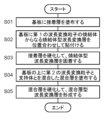
- FIG. 2 is a flowchart showing a method for manufacturing a phosphor wheel according to the first embodiment.
- the method for manufacturing a phosphor wheel according to the first embodiment includes the following steps. (1) Applying an adhesive layer to the substrate (S01).
- the adhesive layer may be a mixed layer of a heat-resistant resin such as silicone or silsesquioxane filled with highly reflective particles. In this case, the layer also functions as a reflective layer.
- it may be a mixed layer in which a heat-resistant resin such as silicone or silsesquioxane is filled with highly thermally conductive particles. In this case, the layer also functions as a reflective layer.
- both high reflectance and high thermal conductivity particles may be mixed, or a heat-resistant resin such as silicone or silsesquioxane without particles may be mixed.
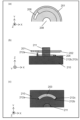
- FIG. 3 is a flowchart showing a method for manufacturing the phosphor wheel of FIG. 2.
- FIG. 3A is a plan view showing details of the process of aligning and pasting a sintered wavelength conversion layer 204 made of a sintered body of first wavelength conversion particles onto a substrate.
- FIG. 3(b) is a front view of FIG. 3(a)
- FIG. 3(c) is a plan view showing the sintered wavelength conversion layer 204 through the substrate.
- guide pins 211, 212a, 212b, and 212c are used to align the sintered wavelength conversion layer 204 to the substrate 201.
- Guide pins 211, 212a, 212b, and 212c are provided on the attachment base 210.
- the guide pin 211 is placed through the motor mounting hole 208 of the board 201.
- the guide pin 212a is located at the tip of the left end of the sintered wavelength conversion layer 204 and is arranged so as to penetrate through the opening 206 of the substrate 201.
- the guide pins 212b and 212c are arranged on both sides of the right end of the sintered wavelength conversion layer 204. Note that, as shown in FIG.
- the heights of the guide pins 212b and 212c are lower than the height of the sintered wavelength conversion layer 204, for example, about several tens of ⁇ m lower.
- the guide pins 211, 212a, 212b, and 212c may be provided by another means that does not use the attachment base 210.
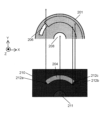
- FIG. 4 shows how guide pins 212a, 212b, and 212c provided adjacent to the sintered wavelength conversion layer 204 are attached to the substrate 201 in the process of aligning the sintered wavelength conversion layer 204 to the substrate 201 in FIG.
- FIG. 3 is a plan view showing the positional relationship with the attachment position.
- FIG. 5 is a front view showing the direction in which the sintered wavelength conversion layer 204 is attached to the substrate 201 in the step of aligning and attaching the sintered wavelength conversion layer 204 to the substrate 201 in FIG.
- the substrate 201 and the sintered wavelength conversion layer 204 are moved relative to each other in the Z direction, and the sintered wavelength conversion layer 204 is attached to the adhesive layer 202 of the substrate 201. This is done by pasting it on.
- the guide pin 212a at the left end of the sintered wavelength conversion layer 204 is arranged to penetrate through the opening 206 of the substrate 201, while the guide pins 212b and 212c at the right end sandwich the location where the mixed layer wavelength conversion layer is provided. It is arranged like this. Further, the height of the guide pins 212b and 212c at the right end is lower than the height of the sintered wavelength conversion layer 204, for example, by several tens of ⁇ m. Therefore, as shown in FIG.
- the guide pins 212b and 212c can be made not to contact the substrate 201. This makes it possible to suppress the subsequent influence on the location where the mixed layer type wavelength conversion layer is provided. Further, according to this method of manufacturing a phosphor wheel, a sintered type wavelength conversion layer and a mixed layer type wavelength conversion layer can be formed. This allows a balance between conversion efficiency, heat resistance, and cost to be achieved.
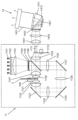
- FIG. 6 is a diagram showing the configuration of a light source device 11 using the phosphor wheel 2 according to the first embodiment.
- the explanation will be given using the phosphor wheel 2 according to the first embodiment shown in FIG. 1.
- Laser light in the blue wavelength range emitted from the plurality of laser light sources 1101 is collimated by a plurality of collimator lenses 1102 provided corresponding to each of the laser light sources 1101.
- the collimated blue light is incident on the subsequent convex lens 1103 to reduce its luminous flux width, and is incident on the following diffuser plate 1104 where it is diffused and improves the uniformity of the light.
- the blue light with improved light uniformity enters the concave lens 1105 at the subsequent stage and is converted into a parallel light beam.
- the blue light that has been made into a parallel beam by the concave lens 1105 enters the color separation/synthesis mirror 1106 arranged at an angle of about 45 degrees with respect to the optical axis, changes the traveling direction of the light by 90 degrees, and enters the subsequent convex lens 1107. do.
- the color separation and synthesis mirror 1106 reflects light in the wavelength range of blue light emitted from the laser light source 1101, and the blue light, which is excitation light emitted from the laser light source 1101, is wavelength-converted by a phosphor wheel 2, which will be described later. It has spectral properties that allow light in the fluorescence wavelength range to pass through.
- the color separation/composition mirror 1106 has spectral characteristics that focus on the wavelength characteristics of the blue light from the laser light source and the wavelength-converted fluorescence; however, the spectral characteristics are not limited to this. It is also possible to give it a particular spectral characteristic. Specifically, focusing on the polarization direction of the laser light source, the polarization direction of blue light from the laser light source may be adjusted to the same direction. This may provide spectral characteristics focused on polarization and wavelength, such as reflecting light in the blue wavelength range and polarization direction from the laser light source and transmitting light in the wavelength-converted fluorescence wavelength range.
- the blue light incident on the convex lens 1107, in combination with the convex lens 1108 at the rear stage, is transmitted to the wavelength conversion layers 204a, 204b, 205a, 205b on the same radius provided on the phosphor wheel 2 at the rear stage and to the openings 206a, 206b. incident.
- the phosphor wheel 2 is provided with a motor 309. Blue excitation light condensed by convex lenses 1107 and 1108 is transmitted from the same rotation center where wavelength conversion layers 204a, 204b, 205a, and 205b and openings 206a and 206b are arranged. It is arranged so that it is incident on a radius area of .
- the blue light focused on the wavelength conversion layers 204a, 204b, 205a, and 205b of the phosphor wheel 2 by the convex lenses 1107 and 1108 is wavelength-converted into fluorescence, and the traveling direction of the light is changed by 180 degrees. , again enters the convex lenses 1108 and 1107 in this order and is converted into a parallel beam.
- the wavelength range of the fluorescent light whose wavelength has been converted by the phosphor wheel 2 is optimized so that it can be combined with the blue light emitted from the laser light source 1101 to form, for example, white light.
- the fluorescent light that is emitted from the convex lens 1107 and converted into a parallel beam enters the color separation and synthesis mirror 1106 again.
- the color separation/combining mirror 1106 has the property of transmitting light in the fluorescent wavelength range, and is arranged at an angle of approximately 45 degrees to the optical axis, so the direction in which the fluorescent light travels cannot be changed. Let it pass through.
- the blue light from the laser light source 1101 focused on the openings 206a and 206b of the phosphor wheel 2 passes through the phosphor wheel 2, and is converted into a parallel beam by the convex lenses 1121 and 1122 at the subsequent stage.
- the light from the laser light source 1101 is transmitted to the color separation and synthesis mirror 1106 by a relay lens system provided at the rear stage, which is composed of three mirrors 1123, 1125, 1127 and three convex lenses 1124, 1126, 1128.
- the light is guided so that it becomes a parallel beam of light and enters from a direction 180 degrees opposite to the direction in which the light is incident.
- the relay optical system was configured with three mirrors and three convex lenses, but other configurations may be used as long as they have similar performance.
- the color separation/composition mirror 1106 Since the color separation/composition mirror 1106 has a characteristic of reflecting the blue light from the laser light source 1101, the blue light incident on the color separation/composition mirror 1106 from the convex lens 1128 changes its traveling direction by 90 degrees. reflected.
- the fluorescence and blue light that are time-divisionally combined by the color separation and combination mirror 1106 are incident on the convex lens 1109, which is the subsequent optical system.
- the time-division fluorescence and blue light that entered the convex lens 1109 from the color separation and synthesis mirror 1106 are focused near the input end of a rod integrator 1111 (described later) by the convex lens 1109.
- the light emitted from the convex lens 1109 enters a wheel with a color filter 1110 before entering a rod integrator 1111.
- the color filter wheel 1110 is synchronized with the phosphor wheel 2 using a synchronization circuit (not shown), and is configured to transmit spectral light that transmits part or all of the wavelength range of blue light and fluorescence, depending on the characteristics of the optical system. It consists of multiple filters with specific characteristics.
- the color filter wheel 1110 has a region that transmits the yellow fluorescence from the phosphor wheel 2 in the wavelength range of the fluorescence as it is, and a region that transmits the wavelength range of the fluorescence as is for the green fluorescence from the phosphor wheel 2.
- the time-divisionally incident light with different wavelength ranges entering the rod integrator 1111 is made uniform by the rod integrator and then emitted from the output end.
- the color filter-equipped wheel 1110 is arranged near the entrance side of the rod integrator, but it may be arranged near the exit side.
- FIG. 7 is a diagram showing the configuration of a projection type image display device 14 that employs a light source device 11 using the phosphor wheel 2 according to the first embodiment.
- the configuration of the light source device 11 using the phosphor wheel 2 according to the first embodiment has been described above, so the explanation will be omitted here. Explain the details.
- the light emitted from the rod integrator 1111 is mapped to a DMD 1421, which will be described later, through a relay lens system consisting of convex lenses 1401, 1402, and 1403.
- the light that passes through the convex lenses 1401, 1402, and 1403 and enters the total reflection prism 1411 enters the minute gap 1412 of the total reflection prism 1411 at an angle equal to or greater than the total reflection angle, and is reflected, thereby changing the traveling direction of the light. and enters the DMD 1421.
- the DMD 1421 changes the direction of the light by changing the direction of the micromirror in synchronization with the colored light emitted by the combination of the phosphor wheel 2 and the color filter wheel 1110, and in response to a signal from an image circuit (not shown). Emits light.
- the light whose traveling direction has changed according to the video signal in the DMD 1421 enters the minute gap 1412 of the total reflection prism 1411 at an angle less than the total reflection angle, passes through the light as it is, enters the projection lens 1431, and is projected onto a screen (not shown). is projected on.
- FIG. 8 is a front view of the phosphor wheel 2a according to the second embodiment.
- new elements in the phosphor wheel 2a according to the second embodiment will be explained, and explanations of the constituent elements explained in FIG. 1 will be omitted.
- the phosphor wheel 2a according to the second embodiment is different from the phosphor wheel according to the first embodiment in that reflective regions 213a and 213b are provided instead of openings.
- the reflective regions 213a and 213b reflect the excitation light as it is.
- the reflective regions 213a and 213b can be configured as regions of the adhesive layer (reflective layer) formed on the substrate 201 where the wavelength conversion layers 204a, 204b, 205a, and 205b are not formed.
- the reflective regions 213a and 213b are provided at substantially the same position as the opening of the phosphor wheel according to Embodiment 1, the present invention is not limited thereto.
- the number of reflective regions 213a and 213b is not limited to two, and there may be two or more.
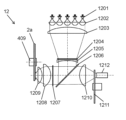
- FIG. 9 is a diagram showing the configuration of a second example of a light source device 12 using a phosphor wheel 2a according to the second embodiment. Hereinafter, description will be given using a phosphor wheel 2a according to the second embodiment shown in FIG. 8.
- Laser light in the blue wavelength range emitted from the plurality of laser light sources 1201 is collimated by a plurality of collimator lenses 1202 provided corresponding to each of the laser light sources 1201.
- the collimated blue light is incident on the subsequent convex lens 1203 to reduce its luminous flux width, and is incident on the following diffuser plate 1204 where it is diffused and improves the uniformity of the light.
- the blue light whose uniformity has been improved by the diffusion plate 1204 enters the concave lens 1205 at the subsequent stage and is converted into a parallel light beam.
- the optical system up to the concave lens 1205 is adjusted so that the polarization direction of the laser beam becomes S-polarized light with respect to a polarization and color separation/synthesis mirror 1206 (described later) when the laser beam is emitted from the concave lens 1205.
- the blue light that has been made into a parallel beam by the concave lens 1205 enters the polarization/color separation/composition mirror 1206 which is arranged at an angle of about 45 degrees with respect to the optical axis, changes the traveling direction of the light by 90 degrees, and converts the light into a parallel light beam at the subsequent stage.
- the light is incident on a four-wavelength plate 1207.
- the polarization and color separation/synthesis mirror 1206 reflects S-polarized light in the blue wavelength range emitted from the laser light source 1201, and also reflects P-polarized light in the blue wavelength range emitted from the laser light source 1201 and fluorescence, which will be described later.
- the body wheel 2a has a spectral characteristic in which blue light, which is excitation light from the laser light source 1201, passes through wavelength-converted light in the fluorescence wavelength range.
- the polarization direction of the blue light from the laser light source 1201 that is incident on the ⁇ /4 wavelength plate 1207 is rotated and changed to circularly polarized light.
- the light emitted from the ⁇ /4 wavelength plate 1207 enters the convex lens 1208, and in combination with the convex lens 1209 at the rear stage, reflects the reflection areas 213a and 213b provided on the phosphor wheel 2a at the rear stage, the wavelength conversion layer 204a, 204b, 205a, and 205b.
- the phosphor wheel 2a is provided with a motor 409, and the blue excitation light focused by the convex lenses 1208 and 1209 is directed around the rotation axis of the motor 409 to the reflection regions 213a and 213b and the wavelength conversion layers 204a and 204b. , 205a, 205b.
- the blue light focused on the wavelength conversion layers 204a, 204b, 205a, and 205b of the phosphor wheel 2a by the convex lenses 1208 and 1209 is converted into fluorescence, and the traveling direction of the light is changed by 180 degrees, and then again. , enter convex lenses 1209 and 1208 in this order, and are converted into a parallel beam.
- the wavelength range of the fluorescent light whose wavelength is converted by the phosphor wheel 2a is optimized so that it can be combined with the blue light emitted from the laser light source 1201 to form white light.
- the fluorescent light that is collimated and emitted by the convex lens 1208 passes through the ⁇ /4 wavelength plate 1207 and enters the polarization and color separation/synthesis mirror 1206 arranged at an angle of 45 degrees with respect to the optical axis.
- the polarization and color separation/combining mirror 1206 has the property of transmitting light in the fluorescent wavelength range, so it passes the fluorescent light without changing the direction of the light, and the fluorescent light passes through the subsequent convex lens. 1210.
- the blue light from the laser light source 1201 focused on the reflective areas 213a, 213b of the phosphor wheel 2a is reflected by the reflective areas 213a, 213b of the phosphor wheel 2a, changing its traveling direction by 180 degrees,
- the light enters convex lenses 1209 and 1208 in this order and is converted into a parallel light beam.
- the blue light that has been collimated by the convex lenses 1209 and 1208 enters the ⁇ /4 wavelength plate 1207 at the subsequent stage, rotates its polarization direction, and is converted into P-polarized light and output.
- the P-polarized light in the blue wavelength range that is emitted from the ⁇ /4 wavelength plate 1207 enters the polarization and color separation/synthesis mirror 1206 arranged at an angle of approximately 45 degrees with respect to the optical axis.
- the polarization and color separation/synthesis mirror 1206 reflects the S-polarized light in the blue wavelength range emitted from the laser light source 1201, and combines the P-polarized light in the blue wavelength range emitted from the laser light source 1201 with the phosphor wheel 2a. It has the property of transmitting light in the fluorescent wavelength range that has been wavelength-converted. Therefore, the P-polarized light in the blue wavelength range that is emitted from the ⁇ /4 wavelength plate 1207 passes through without changing the traveling direction of the light, and enters the convex lens 1210 at the subsequent stage.
- Fluorescence and blue light are incident on the convex lens 1210 in time series according to the rotation of the phosphor wheel 2a, and are focused near the entrance end of a rod integrator 1212, which will be described later.
- the light collected by the convex lens 1210 enters a wheel 1211 with a color filter.
- the color filter equipped wheel 1211 has the same configuration as the color filter equipped wheel 1211 employed in the light source device 11 employing the phosphor wheel according to the first embodiment, and includes the phosphor wheel 2a and the color filter equipped wheel 1211. 1211 rotate synchronously, light having different wavelength ranges is focused in time series near the input end of the rod integrator 1212.
- the time-divisionally incident light with different wavelength ranges entering the rod integrator 1212 is made uniform by the rod integrator and emitted from the output end.
- the wheel with color filter 1211 is arranged near the entrance side of the rod integrator, but it may be arranged near the exit side.
- FIG. 10 is a diagram showing the configuration of a projection type image display device 15 that employs a light source device 12 using a phosphor wheel 2a according to the second embodiment.
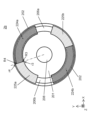
- FIG. 11 is a schematic plan view showing the planar configuration of the phosphor wheel 2b according to the third embodiment.
- the phosphor wheel 2b includes a rotatable substrate 201, a plurality of wavelength conversion layers 224a, 224b, 225a, 225b, and a substrate 201 and a plurality of wavelength conversion layers 224a, 224b, 225a, 225b. and an adhesive layer 202 (reflective layer) provided therebetween.
- the plurality of wavelength conversion layers 224a, 224b, 225a, and 225b are arranged on the substrate 201 and convert the same excitation light into light of a plurality of different wavelengths.
- the plurality of wavelength conversion layers 224a, 224b, 225a, 225b are sintered type wavelength conversion layers 224a, 224b and mixed layer type wavelength conversion layers 225a, 225b.
- the sintered wavelength conversion layers 224a and 224b are composed of sintered bodies of first wavelength conversion particles that convert excitation light into light of a first wavelength.
- the mixed layer type wavelength conversion layers 225a and 225b are a mixed layer of a support and second wavelength conversion particles filled in the support that convert excitation light into light of a second wavelength.
- this phosphor wheel 2b since it has the sintered type wavelength conversion layers 224a, 224b and the mixed layer type wavelength conversion layers 225a, 225b, it has an excellent balance between conversion efficiency, heat resistance, and cost.
- the wavelength conversion layers are sintered wavelength conversion layers 224a, 224b and mixed layer wavelength conversion layers 225a, 225b. These wavelength conversion layers 224a, 224b, 225a, and 225b are arranged on the same circumference from the rotation center of the substrate 201 on the substrate 201. Furthermore, openings 206a and 206b are provided on the same circumference as in the first embodiment. Furthermore, as shown in Embodiment 2, a phosphor wheel can be constructed by providing a reflective region instead of the opening.
- the sintered wavelength conversion layers 224a, 224b and the mixed layer wavelength conversion layers 225a, 225b may be adjacent to each other on the same circumference, or may be adjacent to each other with the openings 206a, 206b in between. good. Note that the temperature of the sintered wavelength conversion layers 224a, 224b and the mixed layer wavelength conversion layers 225a, 225b increases when they overlap, so they may be placed adjacent to each other with a slight gap.
- the mixed layer type wavelength conversion layers 225a, 225b and the sintered type wavelength conversion layers 224a, 224b may be different in at least one of the inner diameters r3, R3 and the outer diameters r4, R4 from the rotation center of the substrate.
- the inner diameter R3 of the sintered wavelength conversion layers 224a and 224b is larger than the inner diameter r3 of the mixed layer wavelength conversion layers 225a and 225b. (R3>r3), and the outer diameter R4 of the sintered wavelength conversion layers 224a, 224b is smaller than the outer diameter r4 of the mixed layer wavelength conversion layers 225a, 225b (R4 ⁇ r4).
- the mixed layer type wavelength conversion layers 225a, 225b and the sintered type wavelength conversion layers 224a, 224b may have different widths in the radial direction from the rotation center of the substrate 201.
- 224b in the radial direction and has a relationship of (r4-r3)>(R4-R3).
- the sintered wavelength conversion layers 224a and 224b are first wavelength conversion particles that convert excitation light into light of a first wavelength. It is composed of a sintered body.
- the mixed layer wavelength conversion layers 225a and 225b include a support and convert the excitation light filled in the support into a second wavelength. This is a mixed layer with second wavelength conversion particles that convert wavelength into light.
- the adhesive layer 202 is provided between the substrate 201 and the sintered wavelength conversion layers 224a, 224b and the mixed layer wavelength conversion layers 225a, 225b.
- the adhesive layer 202 is provided for adhering the sintered wavelength conversion layers 224a, 224b to the substrate 201, and is used to attach the first light and the mixed layer type wavelength generated by wavelength conversion by the sintered wavelength conversion layers 224a, 224b.
- This is a reflective layer that reflects the second light generated by wavelength conversion by the conversion layers 225a and 225b.
- the reflective layer also reflects the excitation light that has not been completely absorbed by the sintered wavelength conversion layers 224a, 224b and the mixed layer wavelength conversion layers 225a, 225b.
- the excitation light reflected on the reflective layer is absorbed again in the sintered wavelength conversion layers 224a, 224b or the mixed layer wavelength conversion layers 225a, 225b, and is converted into first light or second light. .
- This improves the efficiency of wavelength conversion in the sintered wavelength conversion layers 224a, 224b and the mixed layer wavelength conversion layers 225a, 225b.
- the inner diameter and outer diameter of the adhesive layer 202 are approximately the same as the inner diameter r3 and outer diameter r4 of the mixed layer type wavelength conversion layers 225a and 225b, respectively.
- the width of the adhesive layer 202 is approximately the same as the width of the mixed layer type wavelength conversion layers 225a, 225b, and is larger than the width of the sintered type wavelength conversion layers 224a, 224b. Therefore, the adhesive layer 202 is exposed on both sides of the sintered wavelength conversion layers 224a and 224b in the radial direction.
- the method for manufacturing the phosphor wheel 2b according to the third embodiment includes the steps shown in the flowchart of FIG. 2 described in the first embodiment.
- an adhesive paste for forming an adhesive layer is applied from a coating nozzle of a coating machine to a portion of the substrate 201 where the sintered wavelength conversion layers 224a, 224b and the mixed layer wavelength conversion layers 225a, 225b are provided. It is dispensed and applied.
- the coating width of the adhesive layer can be controlled by the diameter of the coating nozzle that discharges the adhesive paste.
- step S02 the sintered wavelength conversion layers 224a and 224b are aligned and attached to the adhesive layer 202 applied to the substrate 201.
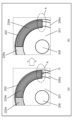
- 12 and 13 are diagrams illustrating the alignment of the sintered wavelength conversion layer during manufacturing of the phosphor wheel according to the third embodiment.
- FIG. 12 shows the case where the center angle of the sintered wavelength conversion layer to be pasted is smaller than the design value
- FIG. 13 shows the case where it is larger than the design value, near the sintered wavelength conversion layer 224a of the phosphor wheel 2b. The same applies to the vicinity of the sintered wavelength conversion layer 224b.
- the center angle of the sintered wavelength conversion layer to be pasted is smaller than the design value, if you try to arrange the sintered wavelength conversion layer 224a at the center of the width of the adhesive layer 202, the angle will be as shown in part A of FIG. 12(a).
- the adhesive layer 202 is placed between the end of the sintered wavelength conversion layer 224a and the boundary.
- a gap G is created in which the is exposed. In this case, since the adhesive layer 202 is exposed in the gap G without the sintered wavelength conversion layer 224a, the excitation light incident on the phosphor wheel 2b is directly reflected.
- the sintered wavelength conversion layer 224a is shifted in the direction of the opening 206a so that a gap G is not generated, and the end of the sintered wavelength conversion layer 224a is connected to the adhesive layer 202 and the opening. 206a, and the sintered wavelength conversion layer 224a is attached.
- the sintered wavelength conversion layer 224a is shifted from the center of the width of the adhesive layer 202 toward the rotation center of the substrate 201, especially on the side of the mixed layer wavelength conversion layer 225a.
- the width of the sintered wavelength conversion layer 224a is wider than that of the sintered wavelength conversion layer 224a, the entire back surface (the surface facing the substrate 201) of the sintered wavelength conversion layer 224a can be reliably bonded to the substrate 201 by the adhesive layer 202.
- the center angle of the sintered wavelength conversion layer to be pasted is larger than the design value, if you try to arrange the sintered wavelength conversion layer 224a at the center of the width of the adhesive layer 202, the part A in (a) of FIG. As shown in FIG. 2, the end of the sintered wavelength conversion layer 224a extends beyond the boundary between the adhesive layer 202 and the opening 206a and protrudes into the opening 206a, creating a protruding portion P.
- the protrusion P occurs, the fluorescence generated in the protrusion P by the excitation light is not reflected by the adhesive layer 202 (reflection layer), resulting in a decrease in reflection efficiency.
- the sintered wavelength conversion layer 224a is likely to peel off from the protruding portion P.
- the sintered wavelength conversion layer 224a is shifted from the opening 206a toward the adhesive layer 202 so that no protruding portion P is generated, and the end portions of the sintered wavelength conversion layer 224a are bonded.
- a case is shown in which a sintered wavelength conversion layer 224a is attached at the boundary between the layer 202 and the opening 206a.
- the sintered wavelength conversion layer 224a is shifted from the center of the width of the adhesive layer 202 toward the outer circumference of the substrate 201, especially on the side of the mixed layer wavelength conversion layer 225a. Since the width is wider than that of the sintered wavelength conversion layer 224a, the entire back surface of the sintered wavelength conversion layer 224a can be reliably bonded to the substrate 201 by the adhesive layer 202.
- the width of the adhesive layer 202 is wider than the width of the sintered wavelength conversion layers 224a, 224b. Even when the dimensions are smaller than or larger than the design values, the sintered wavelength conversion layers are adjusted while aligning the ends of the sintered wavelength conversion layers 224a and 224b with the boundary between the adhesive layer 202 and the opening 206a. The entire back surfaces of 224a and 224b can be reliably bonded to the substrate 201.
- a mixed layer for forming mixed layer wavelength conversion layers 225a and 225b is applied onto the cured adhesive layer 202 on the substrate 201.
- the coating width of the mixed layer can be controlled by the diameter of the coating nozzle that discharges the mixed paste.
- the coating nozzle for applying the mixed layer has the same diameter as that for applying the adhesive layer. It can be used in common with the coating nozzle. If a coating nozzle can be used in common in the adhesive layer coating process (S01) and the mixed layer coating process (S04), mistakes such as using the wrong coating nozzle in the work process can be prevented. Further, since there is no need to prepare separate coating nozzles for each of the adhesive layer coating step (S01) and the mixed layer coating step (S04), the cost for purchasing coating nozzles can be reduced.
- the phosphor wheel 2b according to the third embodiment can be replaced with the phosphor wheel 2 of the light source device 11 (FIG. 6) and the projection type image display device 14 (FIG. 7) described in the first embodiment.
- a projection type video display device can be configured.
- the phosphor wheel 2b according to the third embodiment can be configured as a phosphor wheel in which the openings 206a and 206b are replaced with reflective regions 213a and 213b.
- a phosphor wheel in which the openings 206a and 206b of the phosphor wheel 2b are replaced with reflective regions 213a and 213b is similar to the light source device 12 (FIG.
- a light source device and a projection type image display device can be configured.
- the light source device and the projection display device using the phosphor wheel 2b according to the third embodiment also have the same structure as that of the first embodiment. As with the light source device 11, it is possible to balance conversion efficiency, heat resistance, and cost.
- the phosphor wheel according to the present disclosure has a sintered type wavelength conversion layer and a mixed layer type wavelength conversion layer. This allows a balance between conversion efficiency, heat resistance, and cost to be achieved.
Landscapes
- Physics & Mathematics (AREA)
- General Physics & Mathematics (AREA)
- Optics & Photonics (AREA)
- Engineering & Computer Science (AREA)
- Multimedia (AREA)
- Astronomy & Astrophysics (AREA)
- Spectroscopy & Molecular Physics (AREA)
- Signal Processing (AREA)
- Projection Apparatus (AREA)
Priority Applications (3)
| Application Number | Priority Date | Filing Date | Title |
|---|---|---|---|
| JP2024542704A JPWO2024043010A1 (https=) | 2022-08-23 | 2023-07-31 | |
| CN202380061427.XA CN119731564A (zh) | 2022-08-23 | 2023-07-31 | 荧光体轮、光源装置、投影型影像显示装置以及荧光体轮的制造方法 |
| US19/060,183 US20250189780A1 (en) | 2022-08-23 | 2025-02-21 | Phosphor wheel, light source device, projection type image display device, and method for producing phosphor wheel |
Applications Claiming Priority (2)
| Application Number | Priority Date | Filing Date | Title |
|---|---|---|---|
| JP2022132417 | 2022-08-23 | ||
| JP2022-132417 | 2022-08-23 |
Related Child Applications (1)
| Application Number | Title | Priority Date | Filing Date |
|---|---|---|---|
| US19/060,183 Continuation US20250189780A1 (en) | 2022-08-23 | 2025-02-21 | Phosphor wheel, light source device, projection type image display device, and method for producing phosphor wheel |
Publications (1)
| Publication Number | Publication Date |
|---|---|
| WO2024043010A1 true WO2024043010A1 (ja) | 2024-02-29 |
Family
ID=90013020
Family Applications (1)
| Application Number | Title | Priority Date | Filing Date |
|---|---|---|---|
| PCT/JP2023/028006 Ceased WO2024043010A1 (ja) | 2022-08-23 | 2023-07-31 | 蛍光体ホイール、光源装置、投写型映像表示装置及び蛍光体ホイールの製造方法 |
Country Status (4)
| Country | Link |
|---|---|
| US (1) | US20250189780A1 (https=) |
| JP (1) | JPWO2024043010A1 (https=) |
| CN (1) | CN119731564A (https=) |
| WO (1) | WO2024043010A1 (https=) |
Citations (7)
| Publication number | Priority date | Publication date | Assignee | Title |
|---|---|---|---|---|
| JP2006005367A (ja) * | 2004-06-03 | 2006-01-05 | Lumileds Lighting Us Llc | 発光デバイスのための発光セラミック |
| JP2011243840A (ja) * | 2010-05-20 | 2011-12-01 | Stanley Electric Co Ltd | 光源装置および照明装置 |
| JP2012013897A (ja) * | 2010-06-30 | 2012-01-19 | Jvc Kenwood Corp | 光源装置および投射型表示装置 |
| JP2013073063A (ja) * | 2011-09-28 | 2013-04-22 | Casio Comput Co Ltd | 蛍光体ホイール、光源装置及びプロジェクター |
| JP2016012116A (ja) * | 2014-06-02 | 2016-01-21 | カシオ計算機株式会社 | 光源装置及び投影装置 |
| JP2017167521A (ja) * | 2016-03-15 | 2017-09-21 | パナソニックIpマネジメント株式会社 | 蛍光体ホイール、光源装置及び投写型映像表示装置 |
| WO2020085204A1 (ja) * | 2018-10-22 | 2020-04-30 | シャープ株式会社 | 光学素子および光学装置 |
-
2023
- 2023-07-31 JP JP2024542704A patent/JPWO2024043010A1/ja active Pending
- 2023-07-31 WO PCT/JP2023/028006 patent/WO2024043010A1/ja not_active Ceased
- 2023-07-31 CN CN202380061427.XA patent/CN119731564A/zh active Pending
-
2025
- 2025-02-21 US US19/060,183 patent/US20250189780A1/en active Pending
Patent Citations (7)
| Publication number | Priority date | Publication date | Assignee | Title |
|---|---|---|---|---|
| JP2006005367A (ja) * | 2004-06-03 | 2006-01-05 | Lumileds Lighting Us Llc | 発光デバイスのための発光セラミック |
| JP2011243840A (ja) * | 2010-05-20 | 2011-12-01 | Stanley Electric Co Ltd | 光源装置および照明装置 |
| JP2012013897A (ja) * | 2010-06-30 | 2012-01-19 | Jvc Kenwood Corp | 光源装置および投射型表示装置 |
| JP2013073063A (ja) * | 2011-09-28 | 2013-04-22 | Casio Comput Co Ltd | 蛍光体ホイール、光源装置及びプロジェクター |
| JP2016012116A (ja) * | 2014-06-02 | 2016-01-21 | カシオ計算機株式会社 | 光源装置及び投影装置 |
| JP2017167521A (ja) * | 2016-03-15 | 2017-09-21 | パナソニックIpマネジメント株式会社 | 蛍光体ホイール、光源装置及び投写型映像表示装置 |
| WO2020085204A1 (ja) * | 2018-10-22 | 2020-04-30 | シャープ株式会社 | 光学素子および光学装置 |
Also Published As
| Publication number | Publication date |
|---|---|
| JPWO2024043010A1 (https=) | 2024-02-29 |
| CN119731564A (zh) | 2025-03-28 |
| US20250189780A1 (en) | 2025-06-12 |
Similar Documents
| Publication | Publication Date | Title |
|---|---|---|
| US8894241B2 (en) | Light source device and image display device | |
| JP6874743B2 (ja) | 光源装置およびプロジェクター | |
| JP7107319B2 (ja) | 光源装置および投射型表示装置 | |
| JP2021081733A (ja) | 発光素子および光源装置ならびに投射型表示装置 | |
| US10627712B2 (en) | Wavelength conversion element, method for manufacturing wavelength conversion element, illuminator, and projector | |
| WO2014174560A1 (ja) | 光源装置及び投写型映像表示装置 | |
| JP6796751B2 (ja) | 光源装置、及び投写型映像表示装置 | |
| JP2016061852A (ja) | 波長変換素子、光源装置、およびプロジェクター | |
| US10268111B2 (en) | Phosphor wheel, light source device, and projector-type image display apparatus | |
| CN108572499A (zh) | 波长转换部件、波长转换元件、照明装置以及投影仪 | |
| JP7445840B2 (ja) | 蛍光体ホイール、光源装置および投写型映像表示装置 | |
| EP3771945B1 (en) | Illumination system and projection apparatus | |
| JP7296604B2 (ja) | 蛍光体ホイール装置 | |
| JP2016061853A (ja) | 光源装置、およびプロジェクター | |
| JP6937460B2 (ja) | 蛍光体ホイール、光源装置及び投写型映像表示装置 | |
| US10831090B2 (en) | Wavelength conversion element, illumination device, and projector | |
| US10845691B2 (en) | Light source device and projector | |
| WO2020255785A1 (ja) | 光源装置および投射型表示装置 | |
| WO2024043010A1 (ja) | 蛍光体ホイール、光源装置、投写型映像表示装置及び蛍光体ホイールの製造方法 | |
| JP2025087769A (ja) | 投写型画像表示装置 | |
| JP7684817B2 (ja) | 蛍光体ホイール、光源装置、投写型映像表示装置、及び波長変換デバイスの製造方法 | |
| JP7852064B2 (ja) | 蛍光体ホイール、光源装置、及び投写型映像表示装置 | |
| JP2017223932A (ja) | 投写型映像表示装置 | |
| JP7073168B2 (ja) | 波長変換素子、光源装置および画像投射装置 | |
| JP2017072669A (ja) | 波長変換装置、照明装置およびプロジェクター |
Legal Events
| Date | Code | Title | Description |
|---|---|---|---|
| 121 | Ep: the epo has been informed by wipo that ep was designated in this application |
Ref document number: 23857125 Country of ref document: EP Kind code of ref document: A1 |
|
| WWE | Wipo information: entry into national phase |
Ref document number: 2024542704 Country of ref document: JP |
|
| WWE | Wipo information: entry into national phase |
Ref document number: 202380061427.X Country of ref document: CN |
|
| NENP | Non-entry into the national phase |
Ref country code: DE |
|
| WWP | Wipo information: published in national office |
Ref document number: 202380061427.X Country of ref document: CN |
|
| 122 | Ep: pct application non-entry in european phase |
Ref document number: 23857125 Country of ref document: EP Kind code of ref document: A1 |