WO2024024875A1 - 芳香部材 - Google Patents
芳香部材 Download PDFInfo
- Publication number
- WO2024024875A1 WO2024024875A1 PCT/JP2023/027495 JP2023027495W WO2024024875A1 WO 2024024875 A1 WO2024024875 A1 WO 2024024875A1 JP 2023027495 W JP2023027495 W JP 2023027495W WO 2024024875 A1 WO2024024875 A1 WO 2024024875A1
- Authority
- WO
- WIPO (PCT)
- Prior art keywords
- capsule
- liquid barrier
- adhesive layer
- substrate
- barrier layer
- Prior art date
- Legal status (The legal status is an assumption and is not a legal conclusion. Google has not performed a legal analysis and makes no representation as to the accuracy of the status listed.)
- Ceased
Links
Images




Classifications
-
- A—HUMAN NECESSITIES
- A45—HAND OR TRAVELLING ARTICLES
- A45D—HAIRDRESSING OR SHAVING EQUIPMENT; EQUIPMENT FOR COSMETICS OR COSMETIC TREATMENTS, e.g. FOR MANICURING OR PEDICURING
- A45D34/00—Containers or accessories specially adapted for handling liquid toiletry or cosmetic substances, e.g. perfumes
- A45D34/02—Scent flasks, e.g. with evaporator
-
- B—PERFORMING OPERATIONS; TRANSPORTING
- B65—CONVEYING; PACKING; STORING; HANDLING THIN OR FILAMENTARY MATERIAL
- B65D—CONTAINERS FOR STORAGE OR TRANSPORT OF ARTICLES OR MATERIALS, e.g. BAGS, BARRELS, BOTTLES, BOXES, CANS, CARTONS, CRATES, DRUMS, JARS, TANKS, HOPPERS, FORWARDING CONTAINERS; ACCESSORIES, CLOSURES, OR FITTINGS THEREFOR; PACKAGING ELEMENTS; PACKAGES
- B65D85/00—Containers, packaging elements or packages, specially adapted for particular articles or materials
Definitions
- the present invention relates to an aromatic member.
- aromatic materials containing liquid aromatic agents have been developed in order to provide relaxing effects, refreshing effects, refreshing sensations, etc. anywhere.
- the aromatic member is used, for example, as a portable item such as a spray or a roll-on. These portable items have a large capacity, making it difficult to carry just the amount you want to use, such as a single dose.
- Patent Document 1 describes an invention mainly related to an aromatic member attached to a mask.
- the aromatic member described in Patent Document 1 has a configuration in which a capsule containing an aromatic agent is held in a recess of a base.
- the aromatic agent encapsulated in the capsule flows out and seeps into the mask, and the aromatic agent vaporizes, thereby releasing the aromatic components. It is stated that the scent can be enjoyed by inhaling it into the nasal cavity. Since one capsule is the amount for one use, it is now easier to carry the aromatic material than with previous portable items.
- Patent Document 1 Although it is possible to obtain a relaxing effect due to the aromatic agent, the aromatic agent seeps into the mask (adherent) during use, making it difficult to reuse the adherend. In addition, when the fragrance is colored, the appearance of the adherend may be impaired due to a change in the color of the adherend. In addition, since it is assumed that it will seep into the adherend, its uses may be limited.
- the present invention includes, for example, the following aspects.
- a capsule-containing substrate having a substrate and a collapsible capsule containing a liquid aromatic agent held in the substrate; a first liquid barrier layer disposed on one side of the capsule-containing substrate; a second liquid barrier layer disposed on the other side of the capsule-containing substrate; An aromatic member having.
- a novel aromatic member is provided.
- the liquid fragrance does not seep into the adherend, so the adherend can be reused, and the appearance of the adherend is not impaired, and there are various uses. At least one of the following effects can be obtained.
- FIG. 1 is a schematic diagram of an aromatic member according to an embodiment of the present invention.
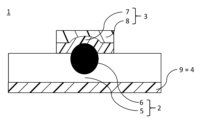
- 2 is a cross-sectional view of the aromatic member of FIG. 1.
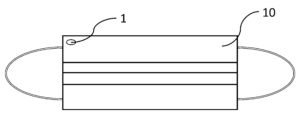
- FIG. FIG. 2 is a schematic diagram when the aromatic member of FIG. 1 is applied to a mask.
- FIG. 2 is a schematic diagram of a capsule-containing substrate.
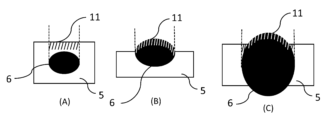
- FIG. 3 shows a collapsible capsule projection area of a capsule-containing substrate.
- FIG. 2 is a schematic diagram showing the configuration of a first liquid barrier layer and a second liquid barrier layer.
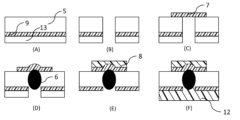
- FIG. 2 is a schematic diagram showing the manufacturing process of the aromatic member of Example 1.
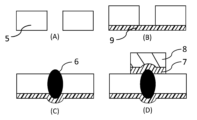
- FIG. 3 is a schematic diagram showing the manufacturing process of the aromatic member of Example 3.
- FIG. 3 is a schematic diagram showing the manufacturing process of the aromatic member of Example 4.
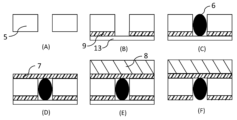
- FIG. 3 is a schematic diagram showing the manufacturing process of an aromatic member of Comparative Example 1.
- Aromatic member The aromatic member according to one aspect of the present invention includes a capsule-containing base having a base and a collapsible capsule containing a liquid aromatic agent held in the base, and disposed on one surface of the capsule-containing base. and a second liquid barrier layer disposed on the other side of the capsule-containing substrate.
- FIG. 1 is a schematic diagram of an aromatic member according to an embodiment of the present invention.
- the aromatic member 1 includes a capsule-containing substrate 2, a first liquid barrier layer 3 formed on the upper surface of the capsule-containing substrate 2, and a second liquid barrier layer 4 formed on the lower surface of the capsule-containing substrate 2.
- FIG. 2 is a sectional view of the aromatic member 1 of FIG. 1.
- the capsule-containing substrate 2 is composed of a substrate 5 having a recess, and a collapsible capsule 6 containing a liquid aromatic agent held in the recess of the substrate 5.
- the collapsible capsule 6 is exposed on the upper surface of the base body 5.
- the first liquid barrier layer 3 is composed of an adhesive layer 7 and a non-adhesive layer 8. Note that the adhesive layer 7 exhibits liquid barrier properties.
- the non-adhesive layer 8 is, for example, a felt sheet, it does not exhibit liquid barrier properties.
- the second liquid barrier layer 4 is composed of an adhesive layer 9. Note that the adhesive layer 9 exhibits liquid barrier properties.
- FIG. 3 is a schematic diagram when the aromatic member 1 of FIG. 1 is applied to a mask.
- the aromatic member 1 is attached to the inside of the mask 10, that is, the side that comes into contact with the nose and mouth. At this time, the aromatic material is attached to the mask 10 via the second liquid barrier layer 2 (adhesive layer 9).
- the collapsible capsule 6 collapses. Thereby, the liquid aromatic agent flows out from the collapsible capsule 6, and the liquid aromatic agent evaporates appropriately, so that the fragrance can be enjoyed.
- the aromatic member 1 since the aromatic member 1 has the first liquid barrier layer 3 and the second liquid barrier layer 4, the liquid aromatic agent that has flowed out is retained inside the base body 5. Since it does not seep out through the first liquid barrier layer 3 and the second liquid barrier layer 4, it is possible to prevent fingers from becoming sticky due to the liquid fragrance that flows out when pressed. Further, since the liquid fragrance does not seep out through the second liquid barrier layer 4, it is possible to prevent the liquid fragrance that flows out when pressed from seeping into the mask 10. As a result, the mask can be reused, and the appearance of the adherend is not impaired.
- the capsule-containing substrate includes a substrate and a collapsible capsule containing a liquid aromatic agent held in the substrate.
- the base has the function of holding the collapsible capsule and retaining the liquid fragrance that flows out from the collapsible capsule when the aromatic member is used.
- the substrate has liquid permeability.
- Examples of the substrate include flexible substrates and non-flexible substrates.
- Raw materials for the flexible substrate include, but are not limited to, wool, cat hair, camel hair, rabbit hair, silk, feathers, carbon fiber, aramid fiber, glass fiber, cellulose fiber, nylon fiber, vinylon fiber, polyester fiber, Examples include polyethylene fibers, polypropylene fibers, polyolefin fibers, and rayon fibers. These raw materials for the flexible substrate may be used alone or in combination of two or more.
- the form of the flexible substrate is not particularly limited, but includes woven fabrics, nonwoven fabrics, felts, and the like.
- non-flexible substrate examples include, but are not particularly limited to, hard paper, cardboard paper, porous plates, and the like.
- the base may have two or more layers laminated.
- the substrates to be laminated may be different from each other or may be the same.
- two or more layers of different flexible substrates may be laminated, two or more layers of the same flexible substrate may be laminated, or two or more flexible substrates and non-flexible substrates may be laminated. It may be formed by laminating more than one layer.
- the shape of the base is not particularly limited, but may be a disc, a cube, or a rectangular parallelepiped.
- the film thickness of the substrate is preferably 2 mm to 12 cm, more preferably 2 to 9 mm, and even more preferably 2 to 5 mm.
- the thickness of the laminated base bodies as a whole falls within the above range.
- the base may have at least one recess and one through hole.
- the substrate preferably has one, two, or three recesses, and more preferably one recess from the viewpoint of manufacturing efficiency.
- the substrate preferably has one, two, or three through holes, and more preferably one through hole from the viewpoint of manufacturing efficiency. Note that, compared to a substrate having a recess, a substrate having a through hole is preferable from the viewpoints that the capsule can be inserted from either side of both surfaces, flexibility in the manufacturing process can be obtained, and the weight of the aromatic member can be reduced. . Further, it is preferable that there are two or three recesses or through holes, since two or three collapsible capsules can be held and a large amount of liquid aromatic agent can be contained in each aromatic member.
- collapsible capsule The collapsible capsule encloses a liquid fragrance.
- the collapsible capsule is held in a substrate and collapses during use, releasing the liquid fragrance.
- the user can enjoy the aroma and obtain a relaxing effect, a refreshing effect, a feeling of exhilaration, etc.
- “collapsible” means that the capsule film can collapse under external pressure and the liquid fragrance can flow out, preferably when the user applies pressure with his or her finger, the capsule film collapses and the liquid fragrance is released. This means that the agent can flow out.
- liquid fragrance means that when 2g is placed in a glass petri dish (diameter 87mm, depth 19mm), the percentage is 80% or more when left standing for 48 hours at a temperature of 25°C and a humidity of 40%, preferably A fragrance that is 90% or more liquid.
- the collapsible capsule includes a capsule shell and contents.
- the contents include a liquid fragrance.
- the capsule film of the collapsible capsule is not particularly limited as long as it can contain a liquid aromatic agent, but it can contain, for example, a polysaccharide.
- polysaccharide examples include, but are not limited to, gellan gum, carrageenan, agar, guar gum, guar gum derivatives, enzymatic decomposition products of guar gum, alginic acid or its salts, starch, and dextrins.
- the polysaccharide preferably contains at least one of gellan gum, carrageenan, starch, and dextrins.
- these polysaccharides may be used individually or in combination of 2 or more types.
- the capsule film may contain at least one of gelatin, a plasticizer, and a colorant.
- the contents include a liquid fragrance.
- Liquid fragrances include, but are not particularly limited to, plant extracts, chemical compounds, mixtures thereof, and the like.
- Plant extracts are not particularly limited, but extracts obtained from plants may be used as they are.
- Plants that can be used as raw materials include orange, neroli, bergamot, cinnamon, hassaku, lemon, grapefruit, yuzu, and sudachi. , raspberry, grape, citronella, basil, pepper, ginger, sage, clary sage, eucalyptus, laurel, almond, anise, rush, fig, ylang-ylang, plum, chamomile, guava, camphor, gardenia, sansho, perilla, jasmine, ginseng , cinnamon, spearmint, apple mint, peppermint, geranium nuts, nutmeg, hibiscus, honey, peppermint, vanilla, rose, coffee, cypress, lavender, rosemary, clove and the like.
- the plant extract may be obtained by refining the components of an extract obtained from plants, such as limonene, sesquiterpene, pinene, furaneol, citronellol, cinnamaldehyde, neral, vanillin, caryophyllene, isobutyl formate, Examples include methyl butyrate, ethyl butyrate, ⁇ -decalactone, ⁇ -nonalactone, and jasmine lactone.
- plants such as limonene, sesquiterpene, pinene, furaneol, citronellol, cinnamaldehyde, neral, vanillin, caryophyllene, isobutyl formate
- Examples include methyl butyrate, ethyl butyrate, ⁇ -decalactone, ⁇ -nonalactone, and jasmine lactone.
- Chemical compounds are not particularly limited as long as they have traditionally been used for the purpose of imparting aromas and flavors; for example, "Synthetic Fragrance Chemistry and Product Knowledge” (author Genichi Indo, Kagaku Kogyo Nippo) Examples include esters, alcohols, aldehydes, ketones, phenols, ethers, lactones, hydrocarbons, nitrogen-containing compounds, sulfur-containing compounds, acids, etc. described in .
- the aromatic components of the above-mentioned plant extracts can also be chemically synthesized and become chemical compounds.
- esters include ethyl acetate, methyl 3-hydroxyhexanoate, ethyl 3-hydroxyhexanoate, methyl octoate, and the like.
- alcohols examples include citronellol, dihydromircenol, rhodinol, geraniol, nerol, linalool, tetrahydrolinalool, dimethyloctanol, hydroxycitronellol, isopulegol, menthol (for example, L-menthol), terpineol, dihydroterpineol, carveol, and the like.
- aldehydes examples include acetaldehyde, n-hexanal, n-heptanal, n-octanal, n-nonanal, ⁇ -methylenecitronellal, citronellyloxyacetaldehyde, myrtenal, and neral.
- ketones examples include 2-pentanone, 3-hexanone, 3-heptanone, 2,3-hexadione, ionone, ⁇ -ionone, methylionone, allylionone, plicatone, cashmeran, l-carvone, menthone, camphor, p-methylacetophenone, etc. can be mentioned.
- phenols include thymol, carvacrol, ⁇ -naphthol isobutyl ether, anethole, ⁇ -naphthol methyl ether, creosole, veratrol, hydroquinone dimethyl ether, 2,6-dimethoxyphenol, 4-ethylguaiacol, eugenol, isoeugenol, etc. It will be done.
- ethers examples include decyl vinyl ether, rosefuran, 1,4-cineole, and nerol oxide.
- lactones examples include ⁇ -undecalactone, ⁇ -dodecalactone, ⁇ -hexalactone, ⁇ -nonalactone, ⁇ -decalactone, dihydrocoumarin, and coumarin.
- hydrocarbons examples include ocimene, limonene, terpinene, 3-carene, bisabolene, valencene, alloocimene, myrcene, farnesene, ⁇ -pinene, ⁇ -pinene, camphene, and the like.
- nitrogen-containing compounds or sulfur-containing compounds include methyl anthranilate, ethyl anthranilate, dodecanenitrile, 2-tridecenenitrile, geranylnitrile, citronellylnitrile, 5-methyl-3-heptanone oxime, limonenethiol, anthranilic acid.
- nitrogen-containing compounds or sulfur-containing compounds include methyl anthranilate, ethyl anthranilate, dodecanenitrile, 2-tridecenenitrile, geranylnitrile, citronellylnitrile, 5-methyl-3-heptanone oxime, limonenethiol, anthranilic acid.
- examples include butyl, cinnamyl anthranilate, and the like.
- Acids include acetic acid, propionic acid, butyric acid, valeric acid, hexanoic acid, octanoic acid, decanoic acid, Examples include phenylacetic acid and cinnamic acid.
- the liquid aromatic agent preferably contains a plant extract, more preferably contains at least one of limonene and caryophyllene, and even more preferably contains caryophyllene.
- the above-mentioned liquid aromatic agents may be used alone or in combination of two or more kinds.
- contents may further include at least one of a lipophilic solvent and a filler.
- the lipophilic solvent is not particularly limited, but is preferably a vegetable oil.
- the vegetable oils include, for example, olive oil, linseed oil, MCT (medium chain fatty acid) oil, soybean oil, rapeseed oil (including canola oil, high erucine rapeseed oil, etc.), palm oil, palm kernel oil, sunflower oil (high oleic sunflower oil). ), corn oil, cottonseed oil, rice oil, etc.
- the vegetable oils include, for example, olive oil, linseed oil, MCT (medium chain fatty acid) oil, soybean oil, rapeseed oil (including canola oil, high erucine rapeseed oil, etc.), palm oil, palm kernel oil, sunflower oil (high oleic sunflower oil). ), corn oil, cottonseed oil, rice oil, etc.
- MCT medium chain fatty acid
- rapeseed oil including canola oil, high erucine rapeseed oil, etc.
- palm oil palm kernel
- the collapsible capsule may further have a coating layer.
- the collapsible capsule has a coating layer, it has the advantage of being able to maintain a hardness that makes it easy to disintegrate with fingers.
- coating agent examples include, but are not limited to, hydroxypropyl methylcellulose, ethylcellulose, methacrylic acid copolymer, shellac, water-soluble shellac, silicone oil, methylcellulose, carnauba wax, zein, and the like. These coating agents may be used alone or in combination of two or more.
- the shape of the collapsible capsule is not particularly limited, and may be spherical, ellipsoidal, cubic, or rectangular.
- the collapsible capsule is preferably a so-called seamless capsule in which there is no seam in the capsule film. It is preferable that the collapsible capsule is a seamless capsule from the viewpoints of suppressing the volatilization of the fragrance, having a spherical shape, and making it easy to break with fingers.
- the capsule-containing substrate has a substrate and a collapsible capsule held by the substrate.
- the holding form of the collapsible capsule is not particularly limited.
- the collapsible capsule is embedded in the substrate.
- a collapsible capsule is exposed on at least one surface of the substrate.
- collapsible capsules are exposed on both sides of the substrate.
- FIG. 4 is a schematic diagram of a capsule-containing substrate.
- the collapsible capsule 6 is embedded in the base body 5.
- the collapsible capsule 6 is exposed on one side of the base body 5.
- the base body 5 has a recess in which the collapsible capsule 6 is held.
- a first liquid barrier layer which will be described later, may be disposed on the exposed collapsible capsule 6, or a second liquid barrier layer, which will be described later, may be disposed.
- the collapsible capsule 6 is exposed on both sides of the base body 5.
- the base body 5 has a through hole in which the collapsible capsule 6 is held.
- the method of holding the collapsible capsule is not particularly limited, and the base and the collapsible capsule may be held by bonding with an adhesive, or the collapsible capsule may be held by bonding the base and the collapsible capsule with a first liquid barrier layer and/or a second liquid barrier layer, which will be described later.
- the capsule-containing substrate may be held using its adhesive strength to the capsule-containing substrate, or a combination thereof may be used. Among these, from the viewpoint of manufacturing efficiency and manufacturing cost, it is preferable to use the adhesive force of the first liquid barrier layer and/or the second liquid barrier layer to the capsule-containing substrate to hold the capsule.
- the first liquid barrier layer is disposed on one side of the capsule-containing substrate. Further, the second liquid barrier layer is disposed on the other surface of the capsule-containing substrate (for example, the surface opposite to the surface on which the first liquid barrier layer is disposed).
- the first liquid barrier layer and the second liquid barrier layer include an adhesive layer and/or a non-adhesive layer.
- the "surface of the capsule-containing substrate” means the surface of the capsule-containing substrate when the substrate and the collapsible capsule are treated as an integral substrate.
- the surface of the capsule-containing substrate means the surface of the substrate.
- the surface of the capsule-containing substrate means the surface of the substrate - the exposed surface of the collapsible capsule - the surface of the substrate. do.
- the "liquid barrier layer” is a layer formed on the surface of the capsule-containing substrate, and is formed to prevent the liquid fragrance that flows out when the collapsible capsule is collapsed from seeping out to the outside of the substrate. It means a layer.
- a layer exhibiting liquid barrier properties for example, an adhesive layer and/or a non-adhesive layer exhibiting liquid barrier properties constituting the liquid barrier layer must be , is preferably formed on the surface of the capsule-containing substrate so as to enclose the collapsible capsule projection area.
- the "collapsible capsule projection area” refers to the collapsible capsules on the surface of the capsule-containing substrate, assuming that the capsule-containing substrate is projected in the direction perpendicular to the surface of the capsule-containing substrate (film thickness direction). means the area where is projected.
- FIG. 5 is a diagram illustrating the collapsible capsule projection area of a capsule-containing substrate. As shown in FIG. 5A, in a capsule-containing substrate in which collapsible capsules 6 are embedded in the substrate 5, if the capsule-containing substrate is projected in the film thickness direction, the collapsible capsules will appear on the surface of the capsule-containing substrate. The area where 6 is projected (collapsible capsule projection area 11) is the surface of the black hatched area.
- the surface of the capsule-containing substrate is The area on which the collapsible capsule 6 is projected (the collapsible capsule projection area 11) is the surface of the white hatched area.
- the surface of the capsule-containing substrate is The area on which the collapsible capsule 6 is projected (the collapsible capsule projection area 11) is the surface of the white hatched part and the surface of the black hatched part. Note that in FIG. 5B, in a capsule-containing substrate in which the collapsible capsules 6 are exposed on one surface of the substrate 5, the surface of the capsule-containing substrate is The area on which the collapsible capsule 6 is projected (the collapsible capsule projection area 11) is the surface of the white hatched part and the surface of the black hatched part. Note that in FIG.
- a liquid barrier layer can be formed by forming a layer exhibiting liquid barrier properties on the surface of the capsule-containing substrate so as to include such a collapsible capsule projection region 11.
- the adhesive layer is usually composed of an adhesive. Since the adhesive layer has a layer structure with few gaps, it usually corresponds to a layer that exhibits liquid barrier properties, and the liquid aromatic agent does not seep out from the inside of the adhesive layer to the outside as a general rule.
- adhesives include, but are not limited to, epoxy resins, acrylic resins, methacrylic resins, silicone resins, urethane resins, polyester resins, rubbers, cyanoacrylates, and the like. These adhesives may be used alone or in combination of two or more.
- the adhesive layer may be formed on a part of the surface of the capsule-containing substrate, or may be formed on the entire surface.
- the surface of the capsule-containing substrate may have two or more adhesive layers.
- the adhesive layer is 1.2-6 times, 1.2-4 times, 1.2-2 times, 1.5-6 times, 1.5-6 times the collapsible capsule projection area. In the area of 4 times, 1.5 to 2 times, 1.8 to 6 times, 1.8 to 4 times, 1.8 to 2 times, 2 to 6 times, 2 to 4 times, or 2 to 3 times, A collapsible capsule is formed to include a projection area.
- the adhesive layer is formed on the entire surface of the capsule-containing substrate.
- the adhesive since the adhesive has high followability, it is possible to suitably form an adhesive layer, for example, even on a capsule-containing substrate (capsule-containing substrate having a convex portion) having a structure in which collapsible capsules are exposed. .
- the thickness of the adhesive layer is preferably less than 10%, more preferably 2 to 5%, of the thickness of the substrate.
- the thickness of the adhesive layer is preferably 10 ⁇ m to 2 mm.
- Non-adhesive layer The non-adhesive layer usually adheres to the capsule-containing substrate via an adhesive layer.
- the non-adhesive layer has the function of imparting design and texture to the aromatic member.
- non-adhesive layer examples include a non-adhesive layer that exhibits liquid barrier properties and a non-adhesive layer that does not exhibit liquid barrier properties.
- the non-adhesive layer exhibiting liquid barrier properties has a dense layer structure.
- the non-adhesive layer exhibiting liquid barrier properties includes a plate-like member.
- the plate-like member is not particularly limited, but includes wood sheets, polyoxymethylene sheets (such as Duracon (registered trademark) sheets), polytetrafluoroethylene (PTFE) sheets, vinyl chloride sheets, polyethylene (PE) sheets, and polypropylene sheets ( PP) sheet, urethane sheet, polyethylene terephthalate (PET) sheet, polycarbonate (PC) sheet, etc.
- a plate-like member that exhibits liquid barrier properties and cannot be bent is particularly referred to as a rigid plate-like member.
- the rigid plate-like member include wood sheets, polyoxymethylene sheets, and the like.
- the non-adhesive layer exhibiting liquid barrier properties is preferably a rigid plate-like member, more preferably a wood sheet or a polyoxymethylene sheet.
- the film thickness of the plate member is not particularly limited, but is preferably 50 ⁇ m to 100 mm.
- non-adhesive layer that does not exhibit liquid barrier properties examples include, but are not particularly limited to, those used for the above-mentioned substrate.
- the thickness of the non-adhesive layer that does not exhibit liquid barrier properties is not particularly limited, but is preferably 0.5 to 5 mm.
- non-adhesive layers may be used alone or in combination of two or more.
- first liquid barrier layer and second liquid barrier layer The configurations of the first liquid barrier layer and the second liquid barrier layer are not particularly limited.
- At least one of the first liquid barrier layer and the second liquid barrier layer is preferably made of an adhesive layer, and one of the first liquid barrier layer and the second liquid barrier layer is made of an adhesive layer. It is more preferable that
- first liquid barrier layer and the second liquid barrier layer consists of an adhesive layer and a non-adhesive layer.
- one of the first liquid barrier layer and the second liquid barrier layer consists of an adhesive layer and a non-adhesive layer.
- both the first liquid barrier layer and the second liquid barrier layer consist of an adhesive layer and a non-adhesive layer.
- the adhesive layer exhibits liquid barrier properties.
- the non-adhesive layer preferably exhibits liquid barrier properties.
- the adhesive layer and the non-adhesive layer exhibit liquid barrier properties.
- the non-adhesive layer when the non-adhesive layer exhibits liquid barrier properties, is a non-adhesive layer that exhibits liquid barrier properties, and is preferably made of a rigid plate-like member, more preferably made of a wooden sheet or a polyoxymethylene sheet. Become.
- FIG. 6 is a schematic diagram showing the configurations of the first liquid barrier layer and the second liquid barrier layer.
- FIG. 6A shows a first liquid barrier layer on a part of the upper surface of a capsule-containing substrate 2, which is composed of a substrate 5 having a through hole and a collapsible capsule 6 held in the through hole of the substrate 5. 3 is formed, and a second liquid barrier layer 4 is formed on the entire lower surface of the capsule-containing substrate 2.
- the first liquid barrier layer 3 consists of an adhesive layer 7 and a non-adhesive layer 8 (a non-adhesive layer that does not exhibit liquid barrier properties, for example, a felt sheet of wool).
- the adhesive layer 7 exhibits liquid barrier properties and is formed on a part of the upper surface of the capsule-containing substrate 2 so as to include the collapsible capsule projection area.
- the second liquid barrier layer 4 consists of an adhesive layer 9.
- the adhesive layer 9 exhibits liquid barrier properties and is formed on the entire lower surface of the capsule-containing substrate 2 so as to include the collapsible capsule projection area.
- the first liquid barrier layer 3 consists of an adhesive layer 7 and a non-adhesive layer 8
- the second liquid barrier layer 4 consists of an adhesive layer 9.
- the adhesive layer 7 exhibits liquid barrier properties
- the adhesive layer 9 exhibits liquid barrier properties. Since the second liquid barrier layer 4 consists of the adhesive layer 9, the aromatic member having such a structure is usually used by being attached to an adherend.
- the adhesive layers (adhesive layer 7 and adhesive layer 9) on both the upper and lower surfaces of the capsule-containing substrate 2 exhibit liquid barrier properties. Since the adhesive layer can prevent the liquid aromatic agent from seeping out regardless of its thickness, the aromatic member can be made thin and compact. Further, when the collapsible capsule is collapsed by pressing the aromatic member shown in FIG. 6(A) with a finger, for example, the force of the finger is directly applied to the collapsible capsule, so that the collapsible capsule can be easily collapsed. Can be done.
- FIG. 6(B) shows the top surface of the capsule-containing substrate 2, which is composed of a substrate 5 having a through hole and a collapsible capsule 6 held in the through hole of the substrate 5.
- a first liquid barrier layer 3 is formed on a portion of the capsule-containing substrate 2, and a second liquid barrier layer 4 is formed on the entire lower surface of the capsule-containing substrate 2.
- the first liquid barrier layer 3 is composed of an adhesive layer 7 and a non-adhesive layer 8 (a non-adhesive layer that does not exhibit liquid barrier properties, for example, a felt sheet of wool) as in FIG. 6(A).
- the adhesive layer 7 exhibits liquid barrier properties and is formed on a part of the upper surface of the capsule-containing substrate 2 so as to include the collapsible capsule projection area.
- the second liquid barrier layer 4 includes an adhesive layer 9 and a non-adhesive layer 12 (a non-adhesive layer exhibiting liquid barrier properties, for example, a wood sheet that is a plate-like member).
- the non-adhesive layer 12 exhibits liquid barrier properties and is formed on the lower surface of the capsule-containing substrate 2 so as to include the collapsible capsule projection area.
- the first liquid barrier layer 3 consists of an adhesive layer 7 and a non-adhesive layer 8
- the second liquid barrier layer 4 consists of an adhesive layer 9 and a non-adhesive layer 12.
- the adhesive layer 7 exhibits liquid barrier properties
- the adhesive layer 9 and the non-adhesive layer 12 exhibit liquid barrier properties. Since both the first liquid barrier layer 3 and the second liquid barrier layer 4 do not have an adhesive layer as their outermost layers, aromatic members having such a structure are usually used as key chains, pendants, earrings, bracelets, etc. Used for purposes such as sachets (scented bags).
- sachets scented bags
- the non-adhesive layer 12 since the non-adhesive layer 12 includes a plate-like member, the aromatic member has a strong structure. Furthermore, the plate member used as the non-adhesive layer 12 can be removed and reused. Furthermore, since the adhesive layer is not exposed in FIG. 6(B), it can be combined with other members.
- FIG. 6(C) shows the upper surface of the capsule-containing substrate 2, which is composed of a substrate 5 having a through hole and a collapsible capsule 6 held in the through hole of the substrate 5.
- a first liquid barrier layer 3 is formed on a portion of the capsule-containing substrate 2, and a second liquid barrier layer 4 is formed on the entire lower surface of the capsule-containing substrate 2.
- the first liquid barrier layer 3 is composed of an adhesive layer 7 and a non-adhesive layer 8 (a non-adhesive layer that does not exhibit liquid barrier properties, for example, a felt sheet of wool) as in FIG. 6(A).
- the adhesive layer 7 exhibits liquid barrier properties and is formed on a part of the upper surface of the capsule-containing substrate 2 so as to include the collapsible capsule projection area.
- the second liquid barrier layer 4 consists of an adhesive layer 9 and a non-adhesive layer 12 (a non-adhesive layer that does not exhibit liquid barrier properties, for example, a felt sheet of wool).
- the adhesive layer 9 exhibits liquid barrier properties and is formed on the entire lower surface of the capsule-containing substrate 2 so as to include the collapsible capsule projection area.
- the first liquid barrier layer 3 consists of an adhesive layer 7 and a non-adhesive layer 8 and the second liquid barrier layer 4 consists of an adhesive layer 9 and a non-adhesive layer 12.
- the adhesive layer 7 exhibits liquid barrier properties
- the adhesive layer 9 exhibits liquid barrier properties.
- both the first liquid barrier layer 3 and the second liquid barrier layer 4 do not have an adhesive layer as their outermost layer, they are usually used as keychains, pendants, earrings, bracelets, etc. Used for purposes such as sachets (scented bags).
- sachets scented bags
- the adhesive layers (adhesive layer 7 and adhesive layer 9) on both the upper and lower surfaces of the capsule-containing substrate 2 exhibit liquid barrier properties. Since the adhesive layer can prevent the liquid aromatic agent from seeping out regardless of its thickness, the aromatic member can be made thin and compact. Furthermore, since the adhesive layer is not exposed in FIG. 6(C), it can be combined with other members.
- FIG. 6(D) shows a capsule-containing substrate 2 having a first liquid barrier layer 3 on a part of the upper surface of the capsule-containing substrate 2, which is composed of a substrate 5 having a recess and a collapsible capsule 6 held in the recess of the substrate 5.
- a second liquid barrier layer 4 is formed on the entire lower surface of the capsule-containing substrate 2.
- the first liquid barrier layer 3 is composed of an adhesive layer 7 and a non-adhesive layer 8 (a non-adhesive layer that does not exhibit liquid barrier properties, for example, a felt sheet of wool) as in FIG. 6(A).
- the adhesive layer 7 exhibits liquid barrier properties and is formed on a part of the upper surface of the capsule-containing substrate 2 so as to include the collapsible capsule projection area.
- the second liquid barrier layer 4 consists of an adhesive layer 9.
- the adhesive layer 9 exhibits liquid barrier properties and is formed on the entire lower surface of the capsule-containing substrate 2 so as to include the collapsible capsule projection area.
- the first liquid barrier layer 3 consists of an adhesive layer 7 and a non-adhesive layer 8
- the second liquid barrier layer 4 consists of an adhesive layer 9.
- the adhesive layer 7 exhibits liquid barrier properties
- the adhesive layer 9 exhibits liquid barrier properties.
- the aromatic member having such a structure is usually used by being attached to an adherend.
- the adhesive layers (adhesive layer 7 and adhesive layer 9) on both the upper and lower surfaces of the capsule-containing substrate 2 exhibit liquid barrier properties. Since the adhesive layer can prevent the liquid aromatic agent from seeping out regardless of its thickness, the aromatic member can be made thin and compact. Furthermore, in order for the liquid aromatic agent flowing out from the collapsible capsule 6 to seep onto the adherend, it must pass not only through the adhesive layer 9 but also through the substrate 5 (for example, a felt sheet). The effect of preventing seepage into the body can be even higher.
- FIGS. 6(A) to 6(D) can be changed as appropriate.
- a capsule-containing substrate 2 used in FIGS. 6(A) to 6(C) a capsule-containing substrate composed of a substrate and a collapsible capsule embedded in the substrate may be used;
- a capsule-containing substrate may be used, which is composed of a substrate having a liquid fragrance and a collapsible capsule containing a liquid fragrance held in a recess of the substrate.
- the non-adhesive layer 8 constituting the first liquid barrier layer 3 in FIGS. 6A to 6D a non-adhesive layer exhibiting liquid barrier properties, such as a wood sheet, may be used.
- first liquid barrier layer 3 may be formed not on a part of the upper surface of the capsule-containing substrate 2 but on the entire surface thereof.
- second liquid barrier layer 4 may be formed not on the entire lower surface of the capsule-containing substrate 2 but on a part of the lower surface so as to include at least the collapsible capsule projection area.
- first liquid barrier layer and/or the second liquid barrier layer are preferably formed on the entire surface of the face of the capsule-containing substrate.
- the first liquid barrier layer and/or the second liquid barrier layer is applied to the entire surface of the plane of the capsule-containing substrate so as to include at least the collapsible capsule projection area.
- the first liquid barrier layer and/or the second liquid barrier layer account for 90% or less, 80% or less of the entire surface of the capsule-containing substrate so as to include at least the collapsible capsule projection area.
- the first liquid barrier layer and/or the second liquid barrier layer covers 30 to 90% of the total surface of the plane of the capsule-containing substrate so as to contain at least the collapsible capsule projection area.
- the aromatic member can be It can promote the volatilization of aromatic liquids.
- the aromatic member may have a mounting paper.
- the mount has a function of preventing contamination of the adhesive layer until the aromatic member is attached to the adherend; It has functions that improve handling.
- the aromatic member is peeled off from the mount and adhered to the adherend.
- a laminate in which a fluororesin layer is formed on a resin base material can be used.
- the aromatic member can be used for various purposes.
- the aromatic member is preferably attached to a mask, skin, clothing, shoes, or bag.
- at least one of the first liquid barrier layer and the second liquid barrier layer of the aromatic member is an adhesive layer, preferably either the first liquid barrier layer or the second liquid barrier layer of the aromatic member is an adhesive layer.
- it can be attached to a mask, skin, clothing, shoes, or bag via the adhesive layer.
- the aromatic member is preferably used as a key chain, pendant, earrings, bracelet, sachet (scented bag), etc.
- both the first liquid barrier layer and the second liquid barrier layer of the aromatic member are composed of an adhesive layer and a non-adhesive layer, since the outermost layer does not have an adhesive layer, when used in the above-mentioned applications, there is no risk of irritation to the skin. It can be used comfortably without stickiness.
- the non-adhesive layer of either the first liquid barrier layer or the second liquid barrier layer is a wooden sheet, a hole is made in the wooden sheet and a string or chain for a pendant, etc. is passed through it. This allows it to be made into a pendant.
- a first liquid barrier layer is formed on a part of the upper surface of the capsule-containing substrate, which is composed of a substrate having a through-hole and a collapsible capsule held in the through-hole of the substrate, and a first liquid barrier layer is formed on the entire lower surface of the capsule-containing substrate.
- An aromatic member was manufactured in which a second liquid barrier layer was formed (see FIG. 6(B)).
- the first liquid barrier layer consists of an adhesive layer and a non-adhesive layer, and the adhesive layer exhibits liquid barrier properties.
- the second liquid barrier layer includes an adhesive layer and a non-adhesive layer, and the adhesive layer and the non-adhesive layer exhibit liquid barrier properties.
- FIG. 7 shows a schematic diagram showing the manufacturing process of the aromatic member of Example 1.
- An adhesive layer (commercially available felt adhesive (mainly composed of vinyl acetate resin)) 9 and a mount 13 were formed on the entire lower surface of the substrate (felt substrate) 5 in this order (FIG. 7(A)).
- a through hole was punched and formed in the center of the base 5 with a diameter matching the collapsible capsule (FIG. 7(B)).
- An adhesive layer (commercially available felt adhesive (mainly composed of vinyl acetate resin)) 7 was formed on a part of the upper surface of the substrate 5 (FIG. 7(C)).
- a collapsible capsule 6 containing a liquid aromatic mixture of orange sweet essential oil and vegetable oil (medium chain fatty acid (MCT)) is placed on the base 5 from below toward the adhesive layer 7.
- a non-adhesive layer (felt sheet) 8 is formed on the adhesive layer 7, and then, after removing the mount 13 (FIG. 7(E)), a non-adhesive layer (felt sheet) having liquid barrier properties is formed on the lower surface of the capsule-containing substrate so as to cover the through holes.
- an aromatic member was manufactured (FIG. 7(F)).
- Example 2 Example 1 except that in addition to the central part of the base body 5, three through holes were punched and formed on the same base body so that they were lined up in a row, and the collapsible capsules 6 were placed in each of the three through holes. An aromatic member was produced in the same manner as above.
- a first liquid barrier layer is formed on a part of the upper surface of the capsule-containing substrate, which is composed of a substrate having a through-hole and a collapsible capsule held in the through-hole of the substrate, and a first liquid barrier layer is formed on the entire lower surface of the capsule-containing substrate.
- An aromatic member was manufactured in which a second liquid barrier layer was formed (see FIG. 6(A)).
- the first liquid barrier layer consists of an adhesive layer and a non-adhesive layer, and the adhesive layer exhibits liquid barrier properties.
- the second liquid barrier layer is composed of an adhesive layer, and the adhesive layer exhibits liquid barrier properties.
- FIG. 8 shows a schematic diagram showing the manufacturing process of the aromatic member of Example 3.
- a through hole was punched and formed in the center of the base (polyester nonwoven fabric base) 5 (FIG. 8(A)).
- an adhesive layer 9 was formed on the entire lower surface of the substrate 5 (FIG. 8(B)).
- a collapsible capsule 6 containing a liquid aromatic mixture of orange sweet essential oil and vegetable oil was placed inside the base 5 from above the base 5 toward the adhesive layer 9 (FIG. 8 (C)).
- An aromatic member was manufactured by forming an adhesive layer 7 having liquid barrier properties and a non-adhesive layer (polyester nonwoven fabric substrate) 8 so as to cover the through holes on a part of the upper surface of the capsule-containing substrate (FIG. 8(D)). .
- a first liquid barrier layer is formed on the upper surface of the capsule-containing substrate, which is composed of a substrate having a recess and a collapsible capsule held in the recess of the substrate, and a second liquid barrier layer is formed on the entire lower surface of the capsule-containing substrate.
- An aromatic member on which a barrier layer was formed was manufactured.
- the first liquid barrier layer consists of an adhesive layer and a non-adhesive layer, and the non-adhesive layer exhibits liquid barrier properties.
- the second liquid barrier layer is composed of an adhesive layer, and the adhesive layer exhibits liquid barrier properties.
- FIG. 9 shows a schematic diagram showing the manufacturing process of the aromatic member of Example 4.
- An adhesive layer 7 and a mount 13 were formed in this order on the upper surface of the base (felt base) 5 (FIG. 9(A)).
- a recess was formed in the center of the base 5 using a ponte with a diameter matching the collapsible capsule (FIG. 9(B)).
- a collapsible capsule 6 containing a mixture of orange sweet essential oil and vegetable oil, which is a liquid aromatic agent was placed inside the base body 5 from above toward the concave portion (FIG. 9(C) )).
- FIG. 9(C) After removing the mount 13 (FIG.
- a non-adhesive layer (wooden sheet) 8 having liquid barrier properties is formed on the upper surface of the capsule-containing substrate so as to cover the concave portion, and an adhesive layer 9 is formed on the entire lower surface of the capsule-containing substrate. was formed to produce an aromatic member (FIG. 9(E)).
- a first liquid barrier layer is formed on a part of the upper surface of the capsule-containing substrate, which is composed of a substrate having a through-hole and a collapsible capsule held in the through-hole of the substrate, and a first liquid barrier layer is formed on the entire lower surface of the capsule-containing substrate.
- An aromatic member was manufactured in which a second liquid barrier layer was formed (see FIG. 6(C)).
- the first liquid barrier layer consists of an adhesive layer and a non-adhesive layer, and the adhesive layer exhibits liquid barrier properties.
- the second liquid barrier layer includes an adhesive layer and a non-adhesive layer, and the adhesive layer exhibits liquid barrier properties.
- the aromatic member of Example 5 was manufactured by forming a non-adhesive layer 12 on the adhesive layer 9 with respect to the aromatic member manufactured in Example 3 (see FIG. 6(A)).
- a first liquid barrier layer is formed on the entire upper surface of the capsule-containing substrate, which is composed of a substrate having a through hole and a collapsible capsule held in the through hole of the substrate, and a first liquid barrier layer is formed on the entire upper surface of the capsule-containing substrate 2.
- An aromatic member having an adhesive layer formed thereon was manufactured. At this time, the adhesive layer is not formed in the through-hole portion of the lower surface of the capsule-containing substrate 2.
- FIG. 10 is a schematic diagram showing the manufacturing process of the aromatic member of Comparative Example 1.
- a through hole was punched and formed in the center of the base (polyester nonwoven fabric base) 5 (FIG. 10(A)).
- an adhesive layer 9 was formed on the lower surface of the base 5 at a portion other than the through holes, and a mount 13 was formed on the adhesive layer. Therefore, the adhesive layer 9 is not formed in the through-hole area on the lower surface of the base 5 (FIG. 10(B)).
- a collapsible capsule 6 containing a liquid aromatic mixture of orange sweet essential oil and vegetable oil was placed inside the base 5 from above the base 5 toward the mount 13 (FIG. 10(C)). .
- An adhesive layer 7 having liquid barrier properties was formed on the top surface of the capsule-containing substrate so as to cover the through holes (FIG. 10(D)), and then a non-adhesive layer (polyester nonwoven fabric substrate) 8 was formed (FIG. 10(E)). . Finally, the mount 13 was removed to produce an aromatic member (FIG. 10(F)).
- the aromatic members of Examples 1, 2, and 5 were placed on a filter paper with the non-adhesive layer 12 as the contact surface, or the aromatic members of Examples 3 to 4 and Comparative Example 1 were placed on the filter paper with the adhesive layer 9 in between. After pasting it on a filter paper, the collapsible capsule 6 was crushed by pressing the surface of the aromatic member with a finger from the non-adhesive layer 8 side. After 3 minutes, the filter paper was turned over to check for seepage, and it was evaluated whether the capsule contents had seeped out into the filter paper.
- Aromatic member 2 Capsule-containing substrate 3 First liquid barrier layer 4 Second liquid barrier layer 5 Substrate 6 Collapsible capsule 7, 9 Adhesive layer 8, 12 Non-adhesive layer 10 Mask 11 Collapsible capsule projection area 13 Mounting paper
Landscapes
- Engineering & Computer Science (AREA)
- Mechanical Engineering (AREA)
- Disinfection, Sterilisation Or Deodorisation Of Air (AREA)
- Laminated Bodies (AREA)
Priority Applications (3)
| Application Number | Priority Date | Filing Date | Title |
|---|---|---|---|
| CN202380055034.8A CN119585180A (zh) | 2022-07-29 | 2023-07-27 | 芳香构件 |
| JP2024534147A JPWO2024024875A1 (https=) | 2022-07-29 | 2023-07-27 | |
| JP2024220923A JP2025063879A (ja) | 2022-07-29 | 2024-12-17 | 芳香部材 |
Applications Claiming Priority (2)
| Application Number | Priority Date | Filing Date | Title |
|---|---|---|---|
| JP2022-121155 | 2022-07-29 | ||
| JP2022121155 | 2022-07-29 |
Publications (1)
| Publication Number | Publication Date |
|---|---|
| WO2024024875A1 true WO2024024875A1 (ja) | 2024-02-01 |
Family
ID=89706561
Family Applications (1)
| Application Number | Title | Priority Date | Filing Date |
|---|---|---|---|
| PCT/JP2023/027495 Ceased WO2024024875A1 (ja) | 2022-07-29 | 2023-07-27 | 芳香部材 |
Country Status (4)
| Country | Link |
|---|---|
| JP (2) | JPWO2024024875A1 (https=) |
| CN (1) | CN119585180A (https=) |
| TW (1) | TW202500051A (https=) |
| WO (1) | WO2024024875A1 (https=) |
Citations (3)
| Publication number | Priority date | Publication date | Assignee | Title |
|---|---|---|---|---|
| JPS5596108A (en) * | 1979-01-19 | 1980-07-22 | Toyoji Hirata | Perfume pad |
| JPS57130637U (https=) * | 1981-02-09 | 1982-08-14 | ||
| JP7054277B1 (ja) * | 2021-05-20 | 2022-04-13 | 株式会社ゼスト・コンサルティング | 芳香部材及びその製造方法 |
-
2023
- 2023-07-27 WO PCT/JP2023/027495 patent/WO2024024875A1/ja not_active Ceased
- 2023-07-27 TW TW112128112A patent/TW202500051A/zh unknown
- 2023-07-27 CN CN202380055034.8A patent/CN119585180A/zh active Pending
- 2023-07-27 JP JP2024534147A patent/JPWO2024024875A1/ja active Pending
-
2024
- 2024-12-17 JP JP2024220923A patent/JP2025063879A/ja active Pending
Patent Citations (3)
| Publication number | Priority date | Publication date | Assignee | Title |
|---|---|---|---|---|
| JPS5596108A (en) * | 1979-01-19 | 1980-07-22 | Toyoji Hirata | Perfume pad |
| JPS57130637U (https=) * | 1981-02-09 | 1982-08-14 | ||
| JP7054277B1 (ja) * | 2021-05-20 | 2022-04-13 | 株式会社ゼスト・コンサルティング | 芳香部材及びその製造方法 |
Also Published As
| Publication number | Publication date |
|---|---|
| CN119585180A (zh) | 2025-03-07 |
| JPWO2024024875A1 (https=) | 2024-02-01 |
| JP2025063879A (ja) | 2025-04-16 |
| TW202500051A (zh) | 2025-01-01 |
Similar Documents
| Publication | Publication Date | Title |
|---|---|---|
| KR101413858B1 (ko) | 네일 스티커 및 그 제조 방법 | |
| US20100139861A1 (en) | Scented tattoo plaster | |
| WO2024024875A1 (ja) | 芳香部材 | |
| JP5813154B2 (ja) | 香り付きティシュペーパー収納体 | |
| JPH08503405A (ja) | 揮発性液体サンプラー及びその製造方法 | |
| KR20030006258A (ko) | 유용성 향 마이크로캡슐을 함유한 향기나는 원단 및 그제조방법 | |
| JP5283906B2 (ja) | 局所製剤に使用するための親水性ビーズ | |
| JPH1189922A (ja) | 芳香・消臭シート | |
| JP2022179266A (ja) | 芳香部材及びその製造方法 | |
| US20020139140A1 (en) | Scented novelty product | |
| JPH0889591A (ja) | マスク及びマスクの芳香調整方法 | |
| JPH0236803A (ja) | 脱臭剤若しくは消臭剤含有マーク材を有する衣類等およびその製造方法 | |
| JP3134457U (ja) | 埃取りシート | |
| CN118891351A (zh) | 用于固体消费品的包含微胶囊的组合物 | |
| CN101066656B (zh) | 带有香味的油画布 | |
| KR200395312Y1 (ko) | 방향 걸레받이. | |
| WO2003097114A1 (fr) | Piece en thermoplastique moulee impregnee d'un principe actif volatil tel qu'un parfum | |
| JPH0241406A (ja) | 香料含有マーク材を有する衣類等およびその製造方法 | |
| TWM673643U (zh) | 具香料微膠囊釋放層之祈福貼片結構 | |
| JP2002345942A (ja) | 芳香貼付製剤 | |
| KR20200141145A (ko) | 일회용 향수 손목밴드 | |
| JP2019514658A (ja) | 吸入流路の中に物質を投与するための装置及び方法 | |
| KR20170082879A (ko) | 피톤치드가 코팅된 커튼용 원단 | |
| JP7182769B2 (ja) | 靴の中敷及び靴の中敷の製造方法 | |
| JP2767653B2 (ja) | 揮発性液体サンプラー及びその製造方法 |
Legal Events
| Date | Code | Title | Description |
|---|---|---|---|
| 121 | Ep: the epo has been informed by wipo that ep was designated in this application |
Ref document number: 23846605 Country of ref document: EP Kind code of ref document: A1 |
|
| WWE | Wipo information: entry into national phase |
Ref document number: 2024534147 Country of ref document: JP |
|
| WWE | Wipo information: entry into national phase |
Ref document number: 202380055034.8 Country of ref document: CN |
|
| WWE | Wipo information: entry into national phase |
Ref document number: 2501000491 Country of ref document: TH |
|
| NENP | Non-entry into the national phase |
Ref country code: DE |
|
| WWP | Wipo information: published in national office |
Ref document number: 202380055034.8 Country of ref document: CN |
|
| 122 | Ep: pct application non-entry in european phase |
Ref document number: 23846605 Country of ref document: EP Kind code of ref document: A1 |