WO2024010077A1 - 硫化物固体電解質の製造方法 - Google Patents
硫化物固体電解質の製造方法 Download PDFInfo
- Publication number
- WO2024010077A1 WO2024010077A1 PCT/JP2023/025216 JP2023025216W WO2024010077A1 WO 2024010077 A1 WO2024010077 A1 WO 2024010077A1 JP 2023025216 W JP2023025216 W JP 2023025216W WO 2024010077 A1 WO2024010077 A1 WO 2024010077A1
- Authority
- WO
- WIPO (PCT)
- Prior art keywords
- solid electrolyte
- solvent
- heating
- sulfide solid
- lithium
- Prior art date
- Legal status (The legal status is an assumption and is not a legal conclusion. Google has not performed a legal analysis and makes no representation as to the accuracy of the status listed.)
- Ceased
Links
Images







Classifications
-
- C—CHEMISTRY; METALLURGY
- C01—INORGANIC CHEMISTRY
- C01B—NON-METALLIC ELEMENTS; COMPOUNDS THEREOF; METALLOIDS OR COMPOUNDS THEREOF NOT COVERED BY SUBCLASS C01C
- C01B25/00—Phosphorus; Compounds thereof
- C01B25/14—Sulfur, selenium, or tellurium compounds of phosphorus
-
- C—CHEMISTRY; METALLURGY
- C01—INORGANIC CHEMISTRY
- C01D—COMPOUNDS OF ALKALI METALS, i.e. LITHIUM, SODIUM, POTASSIUM, RUBIDIUM, CAESIUM, OR FRANCIUM
- C01D15/00—Lithium compounds
-
- H—ELECTRICITY
- H01—ELECTRIC ELEMENTS
- H01M—PROCESSES OR MEANS, e.g. BATTERIES, FOR THE DIRECT CONVERSION OF CHEMICAL ENERGY INTO ELECTRICAL ENERGY
- H01M10/00—Secondary cells; Manufacture thereof
- H01M10/05—Accumulators with non-aqueous electrolyte
- H01M10/052—Li-accumulators
-
- H—ELECTRICITY
- H01—ELECTRIC ELEMENTS
- H01M—PROCESSES OR MEANS, e.g. BATTERIES, FOR THE DIRECT CONVERSION OF CHEMICAL ENERGY INTO ELECTRICAL ENERGY
- H01M10/00—Secondary cells; Manufacture thereof
- H01M10/05—Accumulators with non-aqueous electrolyte
- H01M10/056—Accumulators with non-aqueous electrolyte characterised by the materials used as electrolytes, e.g. mixed inorganic/organic electrolytes
- H01M10/0561—Accumulators with non-aqueous electrolyte characterised by the materials used as electrolytes, e.g. mixed inorganic/organic electrolytes the electrolyte being constituted of inorganic materials only
- H01M10/0562—Solid materials
-
- C—CHEMISTRY; METALLURGY
- C01—INORGANIC CHEMISTRY
- C01P—INDEXING SCHEME RELATING TO STRUCTURAL AND PHYSICAL ASPECTS OF SOLID INORGANIC COMPOUNDS
- C01P2002/00—Crystal-structural characteristics
- C01P2002/30—Three-dimensional structures
-
- C—CHEMISTRY; METALLURGY
- C01—INORGANIC CHEMISTRY
- C01P—INDEXING SCHEME RELATING TO STRUCTURAL AND PHYSICAL ASPECTS OF SOLID INORGANIC COMPOUNDS
- C01P2002/00—Crystal-structural characteristics
- C01P2002/70—Crystal-structural characteristics defined by measured X-ray, neutron or electron diffraction data
- C01P2002/72—Crystal-structural characteristics defined by measured X-ray, neutron or electron diffraction data by d-values or two theta-values, e.g. as X-ray diagram
-
- C—CHEMISTRY; METALLURGY
- C01—INORGANIC CHEMISTRY
- C01P—INDEXING SCHEME RELATING TO STRUCTURAL AND PHYSICAL ASPECTS OF SOLID INORGANIC COMPOUNDS
- C01P2006/00—Physical properties of inorganic compounds
- C01P2006/40—Electric properties
-
- H—ELECTRICITY
- H01—ELECTRIC ELEMENTS
- H01M—PROCESSES OR MEANS, e.g. BATTERIES, FOR THE DIRECT CONVERSION OF CHEMICAL ENERGY INTO ELECTRICAL ENERGY
- H01M2300/00—Electrolytes
- H01M2300/0017—Non-aqueous electrolytes
- H01M2300/0065—Solid electrolytes
- H01M2300/0068—Solid electrolytes inorganic
- H01M2300/008—Halides
-
- Y—GENERAL TAGGING OF NEW TECHNOLOGICAL DEVELOPMENTS; GENERAL TAGGING OF CROSS-SECTIONAL TECHNOLOGIES SPANNING OVER SEVERAL SECTIONS OF THE IPC; TECHNICAL SUBJECTS COVERED BY FORMER USPC CROSS-REFERENCE ART COLLECTIONS [XRACs] AND DIGESTS
- Y02—TECHNOLOGIES OR APPLICATIONS FOR MITIGATION OR ADAPTATION AGAINST CLIMATE CHANGE
- Y02E—REDUCTION OF GREENHOUSE GAS [GHG] EMISSIONS, RELATED TO ENERGY GENERATION, TRANSMISSION OR DISTRIBUTION
- Y02E60/00—Enabling technologies; Technologies with a potential or indirect contribution to GHG emissions mitigation
- Y02E60/10—Energy storage using batteries
Definitions
- the present invention relates to a method for producing a sulfide solid electrolyte.
- liquid phase methods include a homogeneous method in which the solid electrolyte material is completely dissolved in a solvent, and a solid electrolyte method in which the solid electrolyte material is completely dissolved in a solvent.
- a heterogeneous method in which the material is not completely dissolved, but instead undergoes a suspension in which solid and liquid coexist.
- a method in which a solid electrolyte is dissolved in a solvent and reprecipitated is known as a homogeneous method (see, for example, Patent Document 1), and as a heterogeneous method, a method in which a polar aprotic solvent is used is known.
- a method of reacting a solid electrolyte raw material such as lithium sulfide in a solvent containing lithium sulfide for example, see Patent Documents 2 and 3
- a method of manufacturing a solid electrolyte using a specific compound having an amino group as a complexing agent for example, Patent Documents 4 and 5 are also known.
- Non-Patent Document 1 discloses that by preparing a tetrahydrofuran-ethanol precursor solution of Li 6 PS 5 Br using tetrahydrofuran and ethanol, drying this and heating it, argyrodite having the composition of Li 6 PS 5 Br is prepared. It is described that a solid electrolyte having a type crystal structure is made.
- the present invention was made in view of these circumstances, and an object of the present invention is to efficiently provide a sulfide solid electrolyte with improved ionic conductivity.
- the method for producing a sulfide solid electrolyte according to the present invention includes: Mixing in a solvent a material containing a plurality of raw materials containing at least one type of atom selected from lithium atoms, phosphorus atoms, sulfur atoms, and halogen atoms; then heating; including;
- the raw material content includes elemental sulfur and lithium sulfide,
- the amount of the elemental sulfur used is more than 1.0 mol per 1.0 mol of the lithium sulfide.
- this embodiment an embodiment of the present invention (hereinafter sometimes referred to as “this embodiment") will be described.
- the upper and lower limits of numerical ranges of "more than”, “less than”, and “ ⁇ ” can be arbitrarily combined, and the numerical values of Examples are used as the upper and lower limits. You can also do that.
- regulations considered to be preferable can be arbitrarily adopted. That is, one regulation considered to be preferable can be employed in combination with one or more other regulations considered to be preferable. It can be said that a combination of preferable items is more preferable.
- the liquid-phase method has been attracting attention as a method that not only has versatility and applicability, but also is simple and can be synthesized in large quantities.
- the solid-phase method represented by the mechanical milling method, involves pulverizing and mixing solid electrolyte raw materials in a pulverizer and reacting them to obtain a solid electrolyte, but the equipment is expensive and requires a large initial investment. This is because it is difficult to reduce costs.
- Li 2 S and P 2 S 5 (80:20) are mechanically milled for 20 hours, and then N-methylformamide (NMF) A solid electrolyte is obtained by dissolving and drying, which requires 20 hours of mechanical milling.
- the method described in Patent Document 2 involves bringing Li 2 S and P 2 S 5 into contact for 24 hours to react in a mixed solvent of a hydrocarbon solvent (toluene) and a polar aprotic solvent (tetrahydrofuran).
- stirring is performed for about 10 days when producing Li 3 PS 4 .DME (electrolyte precursor; complex) in dimethoxyethane (DME).
- the reaction proceeds by stirring the solid electrolyte raw material together with the complexing agent for 12 to 72 hours, or even longer. Also, in the method described in Non-Patent Document 1, the reaction is carried out overnight, that is, the reaction is carried out for about 12 hours. As described above, since the conventional manufacturing method requires a long reaction time, better production efficiency is required.
- Non-Patent Document 1 drying is performed for 3 hours to remove tetrahydrofuran and ethanol.
- oxides may be generated as impurities due to the reaction between some remaining ethanol and the solid electrolyte.
- Li 2 S which is commonly used as a raw material for solid electrolytes, partially reacts with alcohol solvents such as ethanol to produce lithium alkoxides such as lithium ethoxide. It no longer contributes to the reaction with raw materials such as diphosphorus (P 2 S 5 )). Therefore, the purity of the sulfide solid electrolyte may decrease and the ionic conductivity may decrease, and there is a need for improved quality.
- Non-Patent Documents 2 and 3 a crystalline sulfide solid electrolyte is obtained by stirring for several minutes, drying for 1 hour, and heating for 1 hour, and can be said to have excellent production efficiency. .
- its ionic conductivity is about 0.9 to 1.3 mS/cm, and it cannot be said to be a sulfide solid electrolyte with high ionic conductivity.
- the sulfur radical generation mechanism may be inhibited, and the reaction may not proceed efficiently.
- the conventional techniques have advantages and disadvantages, and there is room for improvement in producing a sulfide solid electrolyte having high ionic conductivity with high production efficiency.
- the present inventors focused on elemental sulfur as a raw material.
- the method for producing a sulfide solid electrolyte according to the first form of the present embodiment includes: Mixing in a solvent a material containing a plurality of raw materials containing at least one type of atom selected from lithium atoms, phosphorus atoms, sulfur atoms, and halogen atoms; then heating; including;
- the raw material content includes elemental sulfur and lithium sulfide,
- the amount of the elemental sulfur used is more than 1.0 mol per 1.0 mol of the lithium sulfide. This is a method for producing a sulfide solid electrolyte.
- the amount of elemental sulfur used is an excessive amount of more than 1.0 mol per 1.0 mol of lithium sulfide. This usage amount will be described in detail later, but it is also an excessive usage amount compared to the sulfur atoms required for the sulfide solid electrolyte to be obtained. In this way, by using an excessive amount of elemental sulfur, the generation of the sulfur radicals is promoted, and as a result, a sulfide solid electrolyte with improved ionic conductivity can be efficiently produced.
- a precursor that produces a sulfide solid electrolyte by further heating an amorphous sulfide solid electrolyte, and further a crystalline sulfide solid electrolyte can be produced.
- a soluble polysulfide which is an electrolyte precursor, is generated, and by heating, the polysulfide decomposes and becomes an amorphous sulfide solid electrolyte or a crystalline sulfide solid electrolyte.
- the degree of crystallinity of the solid sulfide electrolyte is improved. Also, the solvent is removed.
- the method for producing a sulfide solid electrolyte according to the second aspect of the present embodiment includes, in the first aspect,
- the halogen atom is at least one type of atom selected from a chlorine atom, a bromine atom, and an iodine atom, That is what it is.
- the sulfide solid electrolyte contains halogen atoms, it has high ionic conductivity.
- halogen atoms it has high ionic conductivity.
- the method for producing a sulfide solid electrolyte according to the third aspect of the present embodiment includes, in the first or second aspect,
- the solvent is an organic solvent containing at least one type of atom selected from oxygen atoms and nitrogen atoms. Therefore, the method for manufacturing a sulfide solid electrolyte according to the fourth aspect of the present embodiment includes the steps of the first to third aspects described above.
- the solvent is at least one organic solvent selected from alcohol solvents, ether solvents, and nitrile solvents. That is what it is.
- sulfur radicals When a solvent containing a heteroatom is used as a solvent, the generation of sulfur radicals is promoted through the reaction between elemental sulfur and lithium sulfide to form lithium polysulfides. Because sulfur radicals are highly reactive, they act on other raw materials, such as diphosphorus pentasulfide, and other raw materials containing halogen atoms, and react with lithium sulfide or lithium polysulfide to form soluble polysulfides. Promote generation.
- This soluble polysulfide is a precursor of a sulfide solid electrolyte, and when heated, the polysulfide decomposes and quickly becomes an amorphous sulfide solid electrolyte or a crystalline sulfide solid electrolyte.
- the crystallinity of the sulfide solid electrolyte is improved. As a result, a sulfide solid electrolyte with few impurities and high ionic conductivity can be efficiently obtained.
- the solvent containing such a hetero atom it is preferable to use at least one of an alcohol solvent, an ether solvent, and a nitrile solvent.
- an alcohol solvent, an ether solvent, and a nitrile solvent By using these solvents, the effects of using the above-mentioned heteroatom-containing solvents, that is, the generation of sulfur radicals and the formation of electrolyte precursors (polysulfides) are promoted.
- an alcohol solvent, an ether solvent, and a nitrile solvent in combination, the generation of sulfur radicals and the formation of an electrolyte precursor (polysulfide) are promoted in a well-balanced manner. As a result, a sulfide solid electrolyte with few impurities and high ionic conductivity can be efficiently obtained.
- the method for producing a sulfide solid electrolyte according to the fifth aspect of the present embodiment includes the steps of the first to fourth aspects described above.
- the solvent includes an alcohol solvent
- the method for producing a sulfide solid electrolyte according to the sixth embodiment includes, in the first to fifth embodiments,
- the solvent includes an alcohol solvent and at least one organic solvent selected from an ether solvent and a nitrile solvent. That is what it is.
- the above-mentioned alcohol solvents, ether solvents and nitrile solvents are effective in generating sulfur radicals and forming electrolyte precursors (polysulfides). It is a solvent that promotes the generation and formation of electrolyte precursors (polysulfides).
- an alcohol solvent By using an alcohol solvent, a sulfide solid electrolyte with few impurities and high ionic conductivity can be produced more efficiently.
- a method for producing a sulfide solid electrolyte according to a seventh aspect of the present embodiment includes, in the first to sixth aspects,
- the solvent is an organic solvent including an alcohol solvent, an ether solvent, and a nitrile solvent. That is what it is.
- the method for producing a sulfide solid electrolyte according to the eighth aspect of the present embodiment includes the steps of any one of the fifth to seventh aspects above.
- the amount of the alcohol solvent used is 0.005 mol or more and 20.0 mol or less per 1.0 mol of the lithium sulfide. Therefore, the method for producing a sulfide solid electrolyte according to the ninth embodiment includes, in the sixth to eighth embodiments,
- the total amount of the ether solvent and the nitrile solvent used is 2.0 parts by volume or more and 10,000.0 parts by volume or less, based on 1.0 parts by volume of the alcohol solvent used. That is what it is.
- the use of solvents containing heteroatoms promotes the generation of sulfur radicals and the formation of electrolyte precursors (polysulfides), and in particular, the use of alcohol solvents promotes the formation of electrolyte precursors (polysulfides).
- the effectiveness of forming objects) is improved.
- the amount of alcohol solvent used within the above range the generation of sulfur radicals and the formation of electrolyte precursors (polysulfides) are further promoted.
- the total amount of the ether solvent and nitrile solvent are further promoted.
- the method for producing a sulfide solid electrolyte according to the tenth aspect of the present embodiment includes the steps of the first to ninth aspects described above.
- the heating temperature in the heating is 20°C or more and 500°C or less.
- the method for producing a sulfide solid electrolyte according to the eleventh embodiment includes, in the first to tenth embodiments, The heating in the heating is performed by first heating at a heating temperature of 20° C. or higher and lower than 150° C., and second heating at a heating temperature of 150° C. or higher and 500° C. or lower. That is what it is.
- heating is mainly performed to decompose the electrolyte precursor (polysulfide), remove the solvent, and crystallize it.
- the heating temperature is within the above range, it becomes possible to perform crystallization while removing the solvent more efficiently and reliably.
- by performing heating in multiple stages of first heating and second heating it becomes possible to decompose the polysulfide, remove the solvent, and crystallize it more efficiently.
- elemental sulfur produced by decomposition of polysulfides can also be removed. Removal of elemental sulfur is not limited to heating, and other methods such as solvent washing and hydrodesulfurization can also be used.
- the method for producing a sulfide solid electrolyte according to the twelfth aspect of the present embodiment includes, in the first to eleventh aspects, In the mixing, the raw materials are mixed simultaneously;
- the method for producing a sulfide solid electrolyte according to the thirteenth embodiment includes, in the first to eleventh embodiments, In the mixing, after mixing raw material group 1 containing some raw materials selected from the raw materials, mixing raw material group 2 containing raw materials other than the some raw materials, That is what it is.
- the order in which the raw materials are supplied is not particularly limited, but from the viewpoint of making the work easier, it is a preferred embodiment to mix all the raw materials at the same time (which can also be referred to as "batch mixing”). . Furthermore, in order to obtain higher solubility and ionic conductivity of the raw materials, it is preferable to divide the raw materials into two groups described below and mix them in order (this may also be referred to as “divided mixing”). In the manufacturing method of this embodiment, whether to perform batch mixing or divided mixing may be appropriately selected depending on whether ease of operation or ionic conductivity is more important.
- the method for producing a sulfide solid electrolyte according to the fourteenth aspect of the present embodiment includes, in the thirteenth aspect,
- the raw material group 1 contains elemental sulfur
- the method for producing a sulfide solid electrolyte according to the fifteenth embodiment includes, in the thirteenth or fourteenth embodiment,
- the raw material group 1 includes raw materials containing at least one kind of atom selected from lithium atoms, phosphorus atoms, and sulfur atoms, and elemental sulfur and lithium sulfide
- the raw material group 2 includes raw materials containing halogen atoms. That is what it is.
- raw material group 1 contains elemental sulfur, that is, elemental sulfur is mixed first. Since sulfur radicals can be formed first, a sulfide solid electrolyte with improved ionic conductivity can be efficiently produced.
- a raw material group containing a raw material containing at least one type of atom selected from lithium atoms, phosphorus atoms, and sulfur atoms and a raw material containing halogen atoms is used as a raw material group. It is preferable to allocate it to either 1 or 2.
- raw material group 1 is lithium. It is particularly preferable that the raw material group 2 contains a raw material containing at least one kind of atom selected from atoms, phosphorus atoms, and sulfur atoms, and elemental sulfur and lithium sulfide, and that the raw material group 2 contains a raw material containing a halogen atom.
- the method for producing a sulfide solid electrolyte according to the sixteenth aspect of the present embodiment includes, in the first to fifteenth aspects, producing a crystalline sulfide solid electrolyte having an argyrodite type crystal structure or a thiolisicone region II type crystal structure; That is what it is.
- a desired sulfide solid electrolyte by changing the type and blending ratio of the solid electrolyte raw materials contained in the raw material containing material.
- a crystalline sulfide solid electrolyte having an argyrodite type crystal structure and a crystalline sulfide solid electrolyte having a thiolisicone region II type crystal structure are known as sulfide solid electrolytes with extremely high ionic conductivity, and are used in this embodiment. This is preferable as the sulfide solid electrolyte to be obtained by the manufacturing method.
- Solid electrolyte means an electrolyte that remains solid at 25° C. under a nitrogen atmosphere.
- the sulfide solid electrolyte in this embodiment is a solid electrolyte that contains lithium atoms, sulfur atoms, phosphorus atoms, and halogen atoms, and has ionic conductivity due to the lithium atoms.
- the "sulfide solid electrolyte” includes both an amorphous sulfide solid electrolyte and a crystalline sulfide solid electrolyte.
- a crystalline sulfide solid electrolyte is a sulfide solid electrolyte in which a peak derived from the solid electrolyte is observed in an X-ray diffraction pattern in an X-ray diffraction measurement, and in which a peak derived from the solid electrolyte is observed. It does not matter whether there is a peak derived from the raw material or not.
- the crystalline sulfide solid electrolyte includes a crystal structure derived from a solid electrolyte, and even if part of it is a crystal structure derived from the solid electrolyte, the entire crystal structure is not derived from the solid electrolyte. You can. As long as the crystalline sulfide solid electrolyte has the above-mentioned X-ray diffraction pattern, a part of the crystalline sulfide solid electrolyte may include an amorphous sulfide solid electrolyte.
- the crystalline sulfide solid electrolyte includes so-called glass ceramics obtained by heating an amorphous sulfide solid electrolyte to a temperature equal to or higher than the crystallization temperature.
- an amorphous sulfide solid electrolyte is one that has a halo pattern in which substantially no peaks other than material-derived peaks are observed in an X-ray diffraction pattern in an X-ray diffraction measurement, It does not matter whether there is a peak derived from the raw material of the sulfide solid electrolyte.
- the method for manufacturing the sulfide solid electrolyte of this embodiment is as follows: Mixing in a solvent a material containing a plurality of raw materials containing at least one type of atom selected from lithium atoms, phosphorus atoms, sulfur atoms, and halogen atoms; then heating; including; The raw material content includes elemental sulfur and lithium sulfide, The amount of the elemental sulfur used is more than 1.0 mol per 1.0 mol of the lithium sulfide.
- Method for producing sulfide solid electrolyte It is.
- the manufacturing method of the present embodiment includes mixing, in a solvent, a material containing a plurality of raw materials containing at least one type of atom selected from lithium atoms, phosphorus atoms, sulfur atoms, and halogen atoms.
- the manufacturing method of this embodiment will be explained first starting from the raw material content.
- the raw material containing material used in this embodiment is a material containing multiple types of raw materials containing at least one type of atom selected from lithium atoms, sulfur atoms, phosphorus atoms, and halogen atoms, and contains elemental sulfur and lithium sulfide. That is, the raw material containing material contains at least elemental sulfur and lithium sulfide, and further contains a plurality of raw materials containing at least one type of atom selected from lithium atoms, sulfur atoms, phosphorus atoms, and halogen atoms.
- Examples of the raw materials contained in the raw materials include lithium sulfide; lithium halides such as lithium fluoride, lithium chloride, lithium bromide, and lithium iodide; diphosphorus trisulfide (P 2 S 3 ), diphosphorus pentasulfide ( phosphorus sulfide such as P 2 S 5 ); various phosphorus fluorides (PF 3 , PF 5 ), various phosphorus chlorides (PCl 3 , PCl 5 , P 2 Cl 4 ), various phosphorus bromides (PBr 3 , PBr 5 ), Phosphorus halides such as various phosphorus iodides (PI 3 , P 2 I 4 ); thiophosphoryl fluoride (PSF 3 ), thiophosphoryl chloride (PSCl 3 ), thiophosphoryl bromide (PSBr 3 ), thiophosphoryl iodide ( At least two types of atoms selected from the above four types of atoms, such as thio
- Examples of materials that can be used as raw materials other than those mentioned above include raw materials that contain at least one type of atom selected from the above four types of atoms and that also contain atoms other than the four types of atoms, more specifically, lithium oxide, Lithium compounds such as lithium hydroxide and lithium carbonate; alkali metal sulfides such as sodium sulfide, potassium sulfide, rubidium sulfide, and cesium sulfide; silicon sulfide, germanium sulfide, boron sulfide, gallium sulfide, tin sulfide (SnS, SnS 2 ), sulfide Metal sulfides such as aluminum and zinc sulfide; phosphoric acid compounds such as sodium phosphate and lithium phosphate; halogens of alkali metals other than lithium, such as sodium halides such as sodium iodide, sodium fluoride, sodium chloride, and sodium bromide; Metal
- lithium sulfide phosphorus sulfide such as diphosphorus trisulfide (P 2 S 3 ), diphosphorus pentasulfide (P 2 S 5 ), fluorine (F 2 ), chlorine (Cl 2 ), bromine (Br 2 ) , iodine (I 2 ), and lithium halides such as lithium fluoride, lithium chloride, lithium bromide, and lithium iodide are preferable.
- phosphoric acid compounds such as lithium oxide, lithium hydroxide, and lithium phosphate are preferred.
- the halogen atom is preferably a chlorine atom, a bromine atom, or an iodine atom, and preferably at least one selected from these. Therefore, the above-mentioned lithium halide is preferably lithium chloride, lithium bromide, or lithium iodide, and the simple halogen is preferably chlorine (Cl 2 ), bromine (Br 2 ), or iodine (I 2 ). Further, these can be used alone or in combination.
- Preferred combinations of raw materials include, for example, a combination of lithium sulfide, elemental sulfur, diphosphorus pentasulfide, and lithium halide, and a combination of lithium sulfide, elemental sulfur, diphosphorus pentasulfide, and elemental halogen.
- Lithium chloride, lithium bromide, and lithium iodide are preferred, and as the simple halogen, chlorine, bromine, and iodine are preferred.
- Li 3 PS 4 containing a PS 4 structure can also be used as part of the raw material.
- Li 3 PS 4 is prepared by first producing it, and this is used as a raw material.
- the content of Li 3 PS 4 relative to the total raw materials is preferably 60 to 100 mol%, more preferably 65 to 90 mol%, and even more preferably 70 to 80 mol%.
- the content of the simple halogen with respect to Li 3 PS 4 is preferably 1 to 50 mol%, more preferably 10 to 40 mol%, even more preferably 20 to 30 mol%, and 22 -28 mol% is even more preferred.
- the lithium sulfide used in this embodiment is preferably in the form of particles.
- the average particle diameter (D 50 ) of the lithium sulfide particles is preferably 0.1 ⁇ m or more and 1000 ⁇ m or less, more preferably 0.5 ⁇ m or more and 100 ⁇ m or less, and even more preferably 1 ⁇ m or more and 20 ⁇ m or less.
- the average particle diameter (D 50 ) is the particle diameter at which 50% (by volume) of the total particle size is reached when a particle size distribution integration curve is drawn and the particle diameter is accumulated sequentially starting from the smallest particle size.
- the volume distribution is an average particle size that can be measured using, for example, a laser diffraction/scattering particle size distribution measuring device.
- solid raw materials preferably have the same average particle size as the lithium sulfide particles. That is, it is preferable that the average particle diameter is within the same range as the above-mentioned lithium sulfide particles.
- the amount of elemental sulfur used is more than 1.0 mol per 1.0 mol of lithium sulfide.
- the amount of elemental sulfur used is preferably 1.2 mol or more, more preferably 1.5 mol or more, and still more preferably 1.7 mol, from the viewpoint of producing a sulfide solid electrolyte with improved ionic conductivity more efficiently. It is more than a mole.
- the upper limit is not particularly limited, but from the viewpoint of obtaining a sulfide solid electrolyte more efficiently, it may be about 4.0 mol or less, preferably 3.0 mol or less.
- the amount of elemental sulfur used is preferably 140% or more, more preferably 150% or more, based on the sulfur atoms required to form the composition of the sulfide solid electrolyte to be obtained by the manufacturing method of the present embodiment. More preferably it is 160% or more, even more preferably 170% or more.
- the upper limit is not particularly limited, but from the viewpoint of obtaining a sulfide solid electrolyte more efficiently, it may be about 300% or less, preferably 280% or less, more preferably 250% or less, and even more preferably 230%. It is as follows.
- the ratio of lithium sulfide to the total of lithium sulfide and diphosphorus pentasulfide provides higher chemical stability and higher ionic conductivity. From the viewpoint of yield, it is preferably 65 to 85 mol%, more preferably 70 to 82 mol%, and even more preferably 74 to 80 mol%.
- the content of lithium sulfide and diphosphorus pentasulfide relative to the total of these is preferably 50 to 99 mol%. , more preferably 55 to 90 mol%, and still more preferably 60 to 85 mol%.
- the ratio of lithium bromide to the total of lithium bromide and lithium iodide should be 1 to 99 mol% from the viewpoint of improving ionic conductivity. It is preferably 20 to 80 mol%, even more preferably 35 to 80 mol%, and particularly preferably 45 to 70 mol%. Furthermore, when using a combination of lithium bromide and lithium chloride as lithium halides, the proportion of lithium bromide to the total of lithium bromide and lithium chloride should be 1 to 99 mol% from the viewpoint of improving ionic conductivity. It is preferably 15 to 75 mol%, even more preferably 25 to 60 mol%, and particularly preferably 35 to 45 mol%.
- the total mole of lithium sulfide and diphosphorus pentasulfide excluding the same number of moles of lithium sulfide as the number of moles of the elemental halogen is preferably within the range of 60 to 90%, and is within the range of 65 to 85%.
- the content of elemental halogen relative to the total amount of lithium sulfide, diphosphorus pentasulfide, and elemental halogen is 1 to 50 mol. %, more preferably 2 to 40 mol%, even more preferably 3 to 25 mol%, even more preferably 3 to 15 mol%.
- the content of elemental halogen relative to the total amount of lithium sulfide, diphosphorus pentasulfide, elemental halogen, and lithium halide preferably satisfy the following formula (2), more preferably satisfy the following formula (3), even more preferably satisfy the following formula (4), and satisfy the following formula (2). It is even more preferable that formula (5) is satisfied. 2 ⁇ 2 ⁇ + ⁇ 100...(2) 4 ⁇ 2 ⁇ + ⁇ 80...(3) 6 ⁇ 2 ⁇ + ⁇ 50...(4) 6 ⁇ 2 ⁇ + ⁇ 30...(5)
- A1 is the number of moles of one halogen atom in the substance
- A2 is the number of moles of the other halogen atom in the substance
- A1:A2 is 1 to 99:
- the ratio is preferably 99-1, more preferably 10:90-90:10, even more preferably 20:80-80:20, even more preferably 30:70-70:30.
- A1:A2 is 1:99 ⁇
- the ratio is preferably 99:1, more preferably 20:80 to 80:20, even more preferably 35:65 to 80:20, and even more preferably 45:55 to 70:30.
- B1:B2 is preferably 1:99 to 99:1, and 15:85. 75:25 is more preferable, 25:75 to 60:40 is even more preferable, and 35:45 to 65:55 is even more preferable.
- solvent As the solvent used when mixing the above-mentioned raw materials, organic solvents are preferably used, and among them, it is preferable to use a solvent containing a hetero atom.
- Preferred examples of the heteroatom contained in the solvent include an oxygen atom, a nitrogen atom, a sulfur atom, a chlorine atom, a phosphorus atom, and the like, and among them, an oxygen atom and a nitrogen atom are preferred.
- the solvent containing a hetero atom may contain one type of these hetero atoms, or may contain multiple types of these hetero atoms.
- solvents containing heteroatoms include solvents containing oxygen atoms such as alcohol solvents, ether solvents, ester solvents, aldehyde solvents, and ketone solvents; solvents containing nitrogen atoms such as amine solvents and nitrile solvents; amide solvents, etc.
- solvents containing oxygen atoms and nitrogen atoms include solvents containing oxygen atoms and nitrogen atoms.
- alcohol solvents and ether solvents are preferable as solvents containing oxygen atoms
- nitrile solvents are preferable as solvents containing nitrogen atoms.
- solvents may be used alone or in combination, and among the above, it is preferable to include an alcohol solvent.
- an alcohol solvent By using an alcohol solvent, the effect of promoting the generation of sulfur radicals and the formation of electrolyte precursors (polysulfides) is particularly improved. Furthermore, in order to improve the effects of promoting the generation of sulfur radicals and the formation of electrolyte precursors (polysulfide) in a well-balanced manner, it is preferable to use the alcohol solvent in combination with another solvent.
- the other solvent it is preferable to use a type of solvent selected from a solvent having an oxygen atom other than an alcohol solvent and a solvent having a nitrogen atom.
- a solvent having an oxygen atom other than an alcohol solvent an ether solvent is preferable.
- the solvent having atoms nitrile solvents are preferred. That is, the solvent preferably contains an alcohol solvent and at least one organic solvent selected from ether solvents and nitrile solvents. In particular, it is preferable to use a combination of an alcohol solvent, an ether solvent, and a nitrile solvent.
- alcohol solvent examples include aliphatic alcohols, alicyclic alcohols, heterocyclic alcohols, and aromatic alcohols. Alcohols are preferred, and aliphatic alcohols are more preferred.
- aliphatic alcohols include saturated or unsaturated monohydric aliphatic alcohols such as methanol, ethanol, various propanols, allyl alcohols, various butanols, and various butenols; various propanediols, various propenediols, various butanediols, and various butenediols. , various hexanediols, various hexenediols, various butanetriols, saturated or unsaturated polyhydric aliphatic alcohols such as erythritol, pentaerythritol, and dipentaerythritol; and the like are representatively preferred.
- variable refers to all possible isomers, such as 1-butanol, 2-butanol, 2-methyl-1-propanol, and 1,1-dimethylethanol, for example, in the case of various butanols. It means to include. Moreover, even if “various" is not used, all possible isomers are included in compounds described in a format where the substitution position number is not specified.
- the aliphatic hydrocarbon group in the aliphatic alcohol may be linear or branched, and may be saturated or unsaturated.
- the number of carbon atoms in the aliphatic alcohol is preferably 1 or more, more preferably 2 or more, and the upper limit is preferably 12 or less, more preferably 8 or less, and still more preferably 4 or less.
- the aliphatic alcohol may be partially substituted, such as alkanolamines such as ethanolamine, propanolamine, and dimethylethanolamine in which a portion of the aliphatic alcohol is substituted with an amino group, and partially substituted fluoroalcohols.
- alkanolamines such as ethanolamine, propanolamine, and dimethylethanolamine in which a portion of the aliphatic alcohol is substituted with an amino group, and partially substituted fluoroalcohols.
- Preferred examples include alcohols in which is substituted with a halogen atom.
- Examples of the alicyclic alcohol include cyclopropanol, methylcyclopropanol, cyclopropane methanol, cyclobutanol, cyclobutenol, cyclopentanol, cyclopentenol, cyclohexanol, methylcyclohexanol, cyclohexenol, cyclohexanediol, and cyclohexanetriol.
- monovalent or polyvalent saturated or unsaturated monocyclic alicyclic alcohol monovalent or polyvalent polycyclic alicyclic alcohol such as cyclopentylcyclopentanol, cyclohexylcyclohexanol, cyclohexylphenylcyclohexanol, bicyclohexanol; Preferred examples include:
- the number of carbon atoms in the alicyclic alcohol is preferably 3 or more, and the upper limit is preferably 12 or less, more preferably 10 or less, and even more preferably 8 or less.
- Alicyclic alcohols may be partially substituted with saturated or unsaturated hydrocarbon groups (including linear and branched ones) such as alkyl groups and alkenyl groups.
- Preferred examples include those that are partially substituted, for example those that are partially substituted with an amino group such as aminomethylcyclopropanol, and those that are partially substituted with a halogen atom.
- it may be substituted with a substituent such as an amide group or a cyano group.
- heterocyclic alcohols include monocyclic heterocyclic alcohols such as oxetaneol, oxetane methanol, furfuryl alcohol, tetrahydrofurfuryl alcohol, tetrahydropyran methanol, morpholine ethanol, and pyridine methanol; polycyclic alcohols such as benzofuran methanol and dihydrobenzofuran methanol; Representative and preferred examples include fused heterocyclic alcohols; and the like.
- monocyclic heterocyclic alcohols such as oxetaneol, oxetane methanol, furfuryl alcohol, tetrahydrofurfuryl alcohol, tetrahydropyran methanol, morpholine ethanol, and pyridine methanol
- polycyclic alcohols such as benzofuran methanol and dihydrobenzofuran methanol
- Representative and preferred examples include fused heterocyclic alcohols; and the like.
- the number of carbon atoms in the heterocyclic alcohol is preferably 3 or more, and the upper limit is preferably 24 or less, more preferably 18 or less, and even more preferably 12 or less.
- the heterocyclic alcohol may be partially substituted like the alicyclic alcohol described above.
- aromatic alcohols include monocyclic aromatic alcohols such as benzyl alcohol, salicyl alcohol, benzenedimethanol, methoxyphenylmethanol, trimethoxyphenylmethanol, and phenethyl alcohol; polycyclic aromatic alcohols such as diphenylmethanol and triphenylmethanol; Preferred representative examples include condensed polycyclic aromatic alcohols such as naphthalene methanol, anthracene methanol, benzofuran methanol, and dihydrobenzofuran methanol.
- the number of carbon atoms in the aromatic alcohol is preferably 7 or more, and the upper limit is preferably 24 or less, more preferably 20 or less, and even more preferably 16 or less.
- the aromatic alcohol may be partially substituted like the alicyclic alcohol described above.
- the alcohol solvent may be any of primary alcohol, secondary alcohol, and tertiary alcohol, preferably primary alcohol. Further, the alcohol solvent may be a monohydric alcohol having one hydroxyl group, or a polyhydric alcohol having two or more hydroxyl groups, and is preferably a monohydric alcohol.
- ether solvent examples include aliphatic ethers, alicyclic ethers, heterocyclic ethers, aromatic ethers, etc. Considering ease of availability and cost, aliphatic ethers, alicyclic ethers, aromatic Group ethers are preferred, aliphatic ethers and alicyclic ethers are more preferred, and alicyclic ethers are even more preferred.
- aliphatic ethers examples include monoethers such as dimethyl ether, diethyl ether, diisopropyl ether, dibutyl ether, and tert-butyl methyl ether; diethers such as dimethoxymethane, dimethoxyethane, diethoxymethane, and diethoxyethane; diethylene glycol dimethyl ether (diglyme); Typical preferred examples include polyethers having three or more ether groups such as triethylene oxide glycol dimethyl ether (triglyme); and ethers containing hydroxyl groups such as diethylene glycol and triethylene glycol.
- the number of carbon atoms in the aliphatic ether is preferably 2 or more, more preferably 3 or more, even more preferably 4 or more, and the upper limit is preferably 10 or less, more preferably 8 or less, and even more preferably 6 or less.
- the aliphatic alcohol may be linear or branched.
- alicyclic ethers include monocyclic alicyclic ethers such as ethylene oxide, propylene oxide, furan, tetrahydrofuran, pyran, tetrahydropyran, dimethoxytetrahydrofuran, cyclopentyl methyl ether, dioxane, dioxene, dioxine, and dioxolane; dicyclopentyl ether, dicyclohexyl ether Preferred representative examples include polycyclic alicyclic ethers such as .
- heterocyclic ether examples include monocyclic heterocyclic ethers such as morpholine and hydroxymethyldimethoxypyridine; polycyclic fused heterocyclic ethers such as benzofuran, benzopyran, dibenzofuran, and methoxyindole; and the like.
- the number of carbon atoms in the alicyclic ether and heterocyclic ether is preferably 3 or more, and the upper limit is preferably 16 or less, more preferably 14 or less, still more preferably 10 or less.
- aromatic ethers monocyclic aromatic ethers such as methyl phenyl ether (anisole) and ethyl phenyl ether; polycyclic aromatic ethers such as dibenzyl ether, diphenyl ether, and benzylphenyl ether; benzyl naphthyl ether, bisnaphthyl Preferred examples include fused polycyclic aromatic ethers such as ether.
- the number of carbon atoms in the aromatic ether is preferably 7 or more, more preferably 8 or more, and the upper limit is preferably 16 or less, more preferably 14 or less, and still more preferably 12 or less.
- the ether compound used in this embodiment includes a linear or branched hydrocarbon group such as an alkyl group or an alkenyl group, an alkoxyl group (the alkyl group may be either linear or branched), It may be substituted with a substituent such as a hydroxyl group, an amino group, an amide group, a cyano group, or a halogen atom.
- alicyclic ethers are preferred, monocyclic alicyclic ethers are more preferred, and tetrahydrofuran is particularly preferred.
- nitrile solvent examples include aliphatic nitrile, alicyclic nitrile, heterocyclic nitrile, aromatic nitrile, and the like, and aliphatic nitrile is preferable from the viewpoint of availability and cost.
- Aliphatic nitriles include saturated or unsaturated aliphatic nitriles having one nitrile group such as acetonitrile, acrylonitrile, methoxyacetonitrile, propionitrile, methoxypropionitrile, butyronitrile; propane dinitrile, propanetricarbonitrile, butane; Saturated or Unsaturated aliphatic nitriles are typically preferred.
- the number of carbon atoms in the aliphatic nitrile is preferably 2 or more, and the upper limit is preferably 10 or less, more preferably 8 or less, and still more preferably 4 or less.
- the number of carbon atoms in the aliphatic hydrocarbon group in the aliphatic nitrile is preferably 1 or more, and the upper limit is preferably 8 or less, more preferably 6 or less, and even more preferably 2 or less.
- the aliphatic hydrocarbon group in the aliphatic nitrile may be linear or branched.
- alicyclic nitriles examples include cyanocyclopropane, cyclobutanecarbonitrile, hydroxycyclobutanecarbonitrile, oxocyclobutanecarbonitrile, cyclopentanecarbonitrile, furancarbonitrile, tetrahydropyrancarbonitrile, cyclohexanecarbonitrile, bicyclobutanecarbonitrile, etc.
- Representative and preferred examples include alicyclic nitriles; and the like.
- heterocyclic nitriles include monocyclic heteros having one or more nitrile groups, such as morpholine carbonitrile, tetrahydrofurfuryl carbonitrile, cyanopyridine, pyridine dicarbonitrile, pyridine tricarbonitrile, and furfurylmalononitrile. Cyclic nitriles; polycyclic or polycyclic condensed heterocyclic nitriles having one or more nitrile groups such as benzofuran carbonitrile, dibenzofurandicarbonitrile, and dicyanobipyridine; and the like are typically preferred.
- the number of carbon atoms in the alicyclic nitrile and heterocyclic nitrile is preferably 3 or more, and the upper limit is preferably 16 or less, more preferably 14 or less, and still more preferably 10 or less.
- aromatic nitriles include monocyclic aromatic nitriles having one or more nitrile groups such as phenylacetonitrile, cyanotoluene, benzonitrile, benzenedicarbonitrile, benzenetricarbonitrile; biphenyldicarbonitrile, phenylcyclobutane; A polycyclic or fused polycyclic aromatic nitrile having one or more nitrile groups such as carbonitrile, naphthalenecarbonitrile, naphthalene dicarbonitrile, naphthalene tricarbonitrile, anthracenecarbonitrile, cyclopentylbenzonitrile; Preferred examples include:
- the number of carbon atoms in the aromatic nitrile is preferably 7 or more, more preferably 8 or more, and the upper limit is preferably 16 or less, more preferably 14 or less, and still more preferably 12 or less.
- the ether compound used in this embodiment includes a linear or branched hydrocarbon group such as an alkyl group or an alkenyl group, an alkoxyl group (the alkyl group may be either linear or branched), It may be substituted with a substituent such as a hydroxyl group, an amino group, an amide group, a cyano group, or a halogen atom.
- amine solvents and amide solvents which are exemplified as solvents having heteroatoms other than the alcohol solvents, ether solvents, and nitrile solvents mentioned above, include heteroaromatic amine solvents such as pyridine; dimethylformamide, dimethylacetamide, hexane, etc. Amide solvents such as methylphosphoramide and N-methylpyrrolidone; and the like are also preferably mentioned.
- solvents other than the above-mentioned solvents include, for example, aliphatic hydrocarbon solvents such as hexane, pentane, 2-ethylhexane, heptane, octane, decane, undecane, dodecane, and tridecane; cyclohexane; Alicyclic hydrocarbon solvents such as methylcyclohexane; aromatic hydrocarbon solvents such as benzene, toluene, xylene, mesitylene, ethylbenzene, and tert-butylbenzene may also be used.
- aliphatic hydrocarbon solvents such as hexane, pentane, 2-ethylhexane, heptane, octane, decane, undecane, dodecane, and tridecane
- cyclohexane Alicyclic hydrocarbon solvents such as methylcyclohexane
- the amount of other solvent used is preferably as small as possible; for example, it is preferably 50.0 parts by volume or less with respect to 100.0 parts by volume of the above solvent (that is, a solvent containing a hetero atom), and It is preferably 30.0 parts by volume or less, more preferably 15.0 parts by volume or less. It goes without saying that it is preferable to use only the above-mentioned solvent (that is, a solvent containing a hetero atom) without using any other solvent.
- the amount of alcohol solvent used is preferably 0.005 mol or more, more preferably 0.010 mol or more, per 1.0 mol of lithium sulfide used as a raw material. , more preferably 0.015 mol or more, even more preferably 0.020 mol or more, and the upper limit is preferably 20.0 mol or less, more preferably 16.0 mol or less, still more preferably 10.0 mol or less. be.
- the total amount of the ether solvent and the nitrile solvent used is 1.0 parts by volume of the alcohol solvent.
- the upper limit is preferably 10,000.0 parts by volume or less, more preferably 9,000.0 parts by volume or less, still more preferably 8,000.0 parts by volume, even more preferably 7,800.0 parts by volume or less.
- raw material containing materials including raw materials are mixed in the above-mentioned solvent.
- the generation of sulfur radicals and the formation of an electrolyte precursor are promoted, and a sulfide solid electrolyte with few impurities and high ionic conductivity can be efficiently obtained.
- the solvent and the raw material containing material may be put into an apparatus capable of mixing the raw material containing material in a solvent and mixed.
- an apparatus capable of mixing the raw material containing material in a solvent and mixed For example, after supplying the solvent into the tank and operating the stirring blade, it is preferable to gradually add the raw material containing material. It is also preferable to gradually add the solvent after supplying the raw material containing material into the tank and operating the stirring blade. Since a good mixing state of the raw materials contained is obtained, the dispersibility of the raw materials is improved, and the generation of sulfur radicals and the formation of electrolyte precursors (polysulfides) are promoted. However, when a simple halogen is used as a raw material, the raw material may not be solid.
- fluorine and chlorine are gaseous, and bromine is liquid.
- bromine is liquid.
- the raw material is a liquid, it is sufficient to feed it into the tank together with the solvent separately from other solid raw materials, or if the raw material is a gas, it can be fed into the tank with the solid raw material added to the solvent. Just supply it by blowing it in.
- raw material group 1 containing raw materials containing halogen atoms, elemental sulfur, and lithium sulfide
- raw material group 2 containing raw materials containing phosphorus atoms and sulfur atoms is also preferable.
- the order of adding and mixing the raw materials may be selected depending on whether work efficiency or ionic conductivity of the sulfide solid electrolyte is important.
- Li 3 PS 4 containing a PS 4 structure can be prepared by first manufacturing and used as a raw material contained in the raw material containing material.
- Li 3 PS 4 can be produced, for example, by blending lithium sulfide and diphosphorus pentasulfide in a molar ratio of 75:25.
- raw material group 1 contains lithium sulfide and diphosphorus pentasulfide at a predetermined molar ratio such as 75:25, and A raw material group containing sulfur is mixed in a solvent, and then a raw material containing a halogen atom such as lithium halide as raw material group 2, and other remaining raw materials necessary for producing the desired sulfide solid electrolyte, such as a shortage of lithium sulfide. It is also possible to add and mix a raw material group containing.
- the predetermined molar ratio of lithium sulfide and diphosphorus pentasulfide is preferably 55 to 85:15 to 45, more preferably 60 to 80:20 to 40, still more preferably 65 to 75:25. ⁇ 35.
- the manufacturing method of this embodiment is characterized in that it includes mixing raw materials contained in a solvent.
- a pulverizer which is used for the purpose of pulverizing solid electrolyte raw materials, such as a media-type pulverizer such as a ball mill or bead mill. It can also be manufactured using other methods.
- a pulverizer which is used for the purpose of pulverizing solid electrolyte raw materials, such as a media-type pulverizer such as a ball mill or bead mill. It can also be manufactured using other methods.
- a polysulfide which is an electrolyte precursor is generated, and when this is decomposed by heating etc.
- Amorphous sulfide solid electrolytes can be formed as well as crystalline sulfide solid electrolytes.
- the mixture of raw materials in the solvent may be pulverized by a pulverizer, but as mentioned above, a pulverizer is not used. It is preferable.
- An example of a device for mixing raw materials contained in a solvent is a mechanical stirring type mixer equipped with stirring blades in a tank.
- Mechanical stirring type mixers include high-speed stirring type mixers, double-arm type mixers, etc., and high-speed stirring is recommended from the viewpoint of improving the uniformity of raw materials and obtaining higher ionic conductivity in a mixture of raw materials.
- a mold mixer is preferably used.
- examples of the high-speed stirring type mixer include a vertical axis rotation type mixer and a horizontal axis rotation type mixer, and either type of mixer may be used.
- the installation location of the circulation line is not particularly limited, but it is preferably installed at a location where the circulation line is discharged from the bottom of the mixer and returned to the top of the mixer. This makes it easier to uniformly stir the solid electrolyte raw material, which tends to settle, by placing it on the convection caused by circulation. Furthermore, it is preferable that the return port is located below the surface of the liquid to be stirred. By doing so, it is possible to suppress the liquid to be stirred from splashing and adhering to the wall surface inside the mixer.
- the manufacturing method of the present embodiment includes heating the raw materials after mixing them. By heating, it is possible to decompose the produced polysulfide, remove the solvent, and remove and crystallize elemental sulfur produced by the decomposition of the polysulfide. Although elemental sulfur can also be removed by heating, different methods such as solvent washing and hydrodesulfurization may be used to remove elemental sulfur.
- the heating temperature is not particularly limited as long as it is room temperature or higher, and cannot be generalized since room temperature can vary, but it is usually preferably 20°C or higher, and preferably 500°C or lower as an upper limit. If the heating temperature is within the above range, it is possible to more efficiently decompose the polysulfide, remove the solvent, remove elemental sulfur, and perform crystallization.
- the heating temperature in the first heating may be 20°C or more and less than 150°C. For example, it may be heated at a lower temperature and then heated at a higher temperature. In other words, the first heating may be performed by further heating in multiple stages. Good too. Usually, solvent removal starts at 20°C or higher, polysulfide decomposition starts at 60°C or higher, and sulfur removal starts at 100°C or higher. By performing multi-step heating at heating temperatures that correspond to these purposes, each purpose can be achieved more efficiently, making it easier to obtain a sulfide solid electrolyte with improved ionic conductivity. In particular, by reliably removing elemental sulfur, it is possible to further suppress the generation of impurities due to residual elemental sulfur, making it easier to obtain a sulfide solid electrolyte with improved ionic conductivity.
- the heating temperature when heating at a lower temperature (first heating-1), the heating temperature is preferably 20°C or higher, and the upper limit is preferably lower than 60°C, more preferably 50°C or lower. By setting the temperature within such a range, it becomes possible to remove the solvent.
- the heating temperature in the case of heating at a higher temperature (first heating-2) is preferably 60°C or higher, more preferably 65°C or higher, even more preferably 75°C or higher, even more preferably 95°C or higher, particularly preferably is 110°C or higher, and the upper limit is lower than 150°C, more preferably 145°C or lower, still more preferably 135°C or lower, even more preferably 130°C or lower. By setting the temperature within such a range, it becomes possible to mainly decompose polysulfides and remove sulfur.
- first heating depending on the heating temperature, it is possible to remove the solvent, decompose the polysulfide, or remove sulfur, so various aspects can be achieved by adjusting the heating temperature. can be taken.
- the heating temperature of the first heating is set to 60°C or more (less than 100°C)
- the first heating -1 it becomes possible to remove the solvent and decompose the polysulfide
- the first heating -2 By heating at 100°C or higher (less than 150°C), it becomes possible to remove sulfur.
- first heating-2 is not performed, and as mentioned above, sulfur can be removed by a method other than heating, such as solvent washing or hydrodesulfurization, and then the second heating is performed. You can. Note that methods for removing sulfur, such as solvent washing and hydrodesulfurization, will be described later.
- the heating temperature of the first heating is set to 20°C or higher (less than 60°C)
- the solvent can be removed, so this will be referred to as the first heating -1
- the first heating -2 will be set to 60°C or higher (lower than 60°C).
- Heating at a temperature of 100°C or higher (less than 150°C) enables the decomposition of polysulfides, and then heating at 100°C or higher (less than 150°C) as the first heating-3 to remove sulfur. You can also do this.
- sulfur can be removed by a method other than heating as described above, or the heating temperature of the first heating-2 can be set to 100°C or higher (less than 150°C). By doing so, decomposition of polysulfides and removal of sulfur can be performed simultaneously.
- the first heating is performed in multiple stages. For example, if the heating temperature of the first heating is 100°C or higher, it is possible to remove the solvent, decompose polysulfides, and remove sulfur. This eliminates the need for multi-step heating.
- the heating time of the first heating is not particularly limited as long as it is long enough to at least remove the solvent, but for example, it is preferably 10 minutes or more, more preferably 30 minutes or more, and even more preferably 45 minutes or more. One hour or more is even more preferred. Further, the upper limit of the heating time is not particularly limited, but is preferably 24 hours or less, more preferably 10 hours or less, even more preferably 5 hours or less, and even more preferably 3 hours or less.
- the pressure conditions during the first heating are preferably normal pressure or reduced pressure, and in the case of reduced pressure, specifically, preferably 85 kPa or less, more preferably 80 kPa or less, still more preferably 70 kPa or less.
- the lower limit may be a vacuum (0 kPa), and considering ease of pressure adjustment, it is preferably 1 kPa or more, more preferably 2 kPa or more, and even more preferably 3 kPa or more.
- the heating is preferably performed in an inert gas atmosphere (for example, nitrogen atmosphere, argon atmosphere) or a reduced pressure atmosphere (particularly in a vacuum).
- an inert gas atmosphere containing a certain concentration of hydrogen may be used. This is because deterioration (for example, oxidation) of the sulfide solid electrolyte can be prevented.
- the heating temperature in the second heating can vary depending on the sulfide solid electrolyte to be manufactured, so it cannot be generalized, but considering the relationship with the first heating, it should be between 150°C and 500°C.
- the temperature is preferably 160°C or higher, more preferably 200°C or higher, even more preferably 240°C or higher, and the upper limit is preferably 480°C or lower, more preferably 460°C or lower, and still more preferably 440°C or lower.
- the second heating may also be performed in multiple stages, similar to the first heating. By performing multi-stage heating as the second heating, more reliable crystallization can be achieved.
- the heating temperature is 150°C or higher and lower than 270°C; In the case of 2), the heating temperature is preferably 270°C or more and 500°C or less.
- the lower limit of the second heating-1 is preferably the lower limit temperature of the second heating, and the upper limit is preferably 265°C or lower, more preferably 255°C or lower.
- the upper limit of the second heating-2 is preferably the upper limit temperature of the second heating, and the lower limit is preferably 290°C or higher, more preferably 340°C or higher, and still more preferably 375°C or higher. .
- the heating time and pressure conditions in the second heating are the same as the heating time and pressure conditions in the first heating. Moreover, it is also preferable to carry out the process in an inert gas atmosphere.
- the heating method is not particularly limited, and examples thereof include methods using various heating devices such as a hot plate, a vacuum heating device, an argon gas atmosphere furnace, a firing furnace, and a vacuum firing furnace. Further, industrially, a horizontal dryer having a heating means and a feeding mechanism, a horizontal vibrating fluidized dryer, etc. can be used, and the selection may be made depending on the processing amount to be heated.
- sulfur may be removed by a method other than heating as described above.
- a method other than heating For example, when performing the first heating at a temperature of less than 100° C., it is preferable to remove sulfur by a method other than heating.
- methods for removing sulfur include methods such as solvent washing and hydrodesulfurization.
- the powder after the first heating is washed using a solvent that dissolves sulfur, such as an aromatic hydrocarbon solvent such as benzene, toluene, or xylene; or a sulfur-containing organic solvent such as carbon disulfide; This is a method to remove sulfur.
- a solvent that dissolves sulfur such as an aromatic hydrocarbon solvent such as benzene, toluene, or xylene; or a sulfur-containing organic solvent such as carbon disulfide; This is a method to remove sulfur.
- the hydrodesulfurization method involves mixing the first heated powder with a hydrodesulfurization catalyst, heating it at 300 to 450°C while passing hydrogen through it, and removing sulfur through a hydrodesulfurization reaction.
- the hydrodesulfurization catalyst is preferably a porous catalyst containing nickel, molybdenum, cobalt, tungsten, etc. as an active metal element, such as a NiMo catalyst, a CoMo catalyst, or a NiW catalyst.
- an amorphous sulfide solid electrolyte is produced by mixing the above-mentioned raw material contents or by performing the above-mentioned first heating mainly for removing the solvent.
- the amorphous sulfide solid electrolyte produced in the manufacturing method of this embodiment contains lithium atoms, sulfur atoms, phosphorus atoms, and halogen atoms, and typical examples include, for example, Li 2 SP 2 Lithium sulfide, phosphorus sulfide, and halides, such as S 5 -LiI, Li 2 SP 2 S 5 -LiCl, Li 2 SP 2 S 5 -LiBr, Li 2 SP 2 S 5 -LiI-LiBr, etc.
- Solid electrolyte consisting of lithium; further containing other atoms such as oxygen atoms and silicon atoms, for example, Li 2 S-P 2 S 5 -Li 2 O-LiI, Li 2 S-SiS 2 -P 2 S Preferred examples include solid electrolytes such as 5 -LiI. From the viewpoint of obtaining higher ionic conductivity, Li 2 S-P 2 S 5 -LiI, Li 2 S-P 2 S 5 -LiCl, Li 2 S-P 2 S 5 -LiBr, Li 2 S-P 2 S A solid electrolyte composed of lithium sulfide, phosphorus sulfide, and lithium halide, such as 5 -LiI-LiBr, is preferred. The types of atoms constituting the amorphous sulfide solid electrolyte can be confirmed using, for example, an ICP emission spectrometer.
- the amorphous sulfide solid electrolyte produced in the manufacturing method of the present embodiment has at least Li 2 SP 2 S 5 , the molar ratio of Li 2 S and P 2 S 5 is higher. From the viewpoint of obtaining ionic conductivity, 65-85: 15-35 is preferable, 70-82: 18-30 is more preferable, and 74-80: 20-26 is still more preferable.
- the total content of lithium sulfide and diphosphorus pentasulfide is: It is preferably 60 to 95 mol%, more preferably 65 to 90 mol%, even more preferably 70 to 85 mol%. Further, the ratio of lithium bromide to the total of lithium bromide and lithium iodide is preferably 1 to 99 mol%, more preferably 20 to 90 mol%, even more preferably 40 to 75 mol%, and even more preferably 45 to 60 mol%. % is particularly preferred.
- the total content of lithium sulfide and diphosphorus pentasulfide is preferably 45 to 80 mol%, more preferably 50 to 75 mol%, even more preferably 55 to 70 mol%.
- the ratio of lithium bromide to the total of lithium bromide and lithium chloride is preferably 1 to 99 mol%, more preferably 15 to 75 mol%, even more preferably 25 to 60 mol%, and even more preferably 35 to 45 mol%. is particularly preferred.
- the shape of the amorphous sulfide solid electrolyte is not particularly limited, but may be, for example, particulate.
- the average particle diameter (D 50 ) of the particulate amorphous sulfide solid electrolyte is, for example, 0.01 ⁇ m or more, further 0.03 ⁇ m or more, 0.05 ⁇ m or more, 0.1 ⁇ m or more, and the upper limit is It is 200.0 ⁇ m or less, further 100.0 ⁇ m or less, 10.0 ⁇ m or less, 1.0 ⁇ m or less, or 0.5 ⁇ m or less.
- crystal structure for example, Japanese Patent Application Laid-Open No. 2013-16423.
- Li 4-x Ge 1-x P x S 4 -based thio-LISICON Region II crystal structure Examples include a crystal structure similar to the Li 4-x Ge 1-x P x S 4 -based thio-LISICON Region II (see Solid State Ionics, 177 (2006), 2721-2725).
- the crystal structure of the crystalline sulfide solid electrolyte obtained by the manufacturing method of the present embodiment is preferably a thiolisicone region II crystal structure among the above, since higher ionic conductivity can be obtained.
- thio-LISICON Region II type crystal structure refers to Li 4-x Ge 1-x P x S 4 -based thio-LISICON Region II (thio-LISICON Region II) type crystal structure, Li 4-x Ge 1-x Indicates that it has a crystal structure similar to P x S 4 -based thio-LISICON Region II (thio-LISICON Region II) type.
- the crystalline sulfide solid electrolyte obtained by the manufacturing method of this embodiment may contain the above-mentioned thiolisicone region II type crystal structure, or may contain it as a main crystal, but it may contain higher ion From the viewpoint of obtaining conductivity, it is preferably contained as the main crystal.
- "contained as a main crystal” means that the ratio of the target crystal structure to the crystal structure is 80% or more, preferably 90% or more, and 95% or more. It is more preferable.
- the crystalline sulfide solid electrolyte obtained by the manufacturing method of this embodiment should not contain crystalline Li 3 PS 4 ( ⁇ -Li 3 PS 4 ) from the viewpoint of obtaining higher ionic conductivity. is preferred.
- Li 4-x Ge 1-x P x S 4- based thiolysicone region II The diffraction peaks of the (thio-LISICON Region II ) type crystal structure
- a crystalline sulfide solid electrolyte having the structural skeleton of Li 7 PS 6 described above and having an argyrodite crystal structure in which a portion of P is replaced with Si is also preferably mentioned.
- the compositional formula of the argyrodite crystal structure is Li 7-x P 1-y Si y S 6 and Li 7+x P 1-y Si y S 6 (x is -0.6 to 0.6, y is 0.1 to 0.6).
- compositional formula of the argyrodite crystal structure the compositional formula Li 7-x-2y PS 6-x-y Cl x (0.8 ⁇ x ⁇ 1.7, 0 ⁇ y ⁇ -0.25x+0.5) is also listed. It will be done.
- examples of the compositional formula of the argyrodite crystal structure include the compositional formula Li 7-x PS 6-x Ha x (Ha is Cl or Br, and x is preferably 0.2 to 1.8).
- the shape of the crystalline sulfide solid electrolyte is not particularly limited, but may be, for example, particulate.
- the average particle diameter (D 50 ) of the particulate crystalline sulfide solid electrolyte is, for example, 0.01 ⁇ m or more, further 0.03 ⁇ m or more, 0.05 ⁇ m or more, 0.1 ⁇ m or more, and the upper limit is 200 ⁇ m or more. .0 ⁇ m or less, further 100.0 ⁇ m or less, 10.0 ⁇ m or less, 1.0 ⁇ m or less, and 0.5 ⁇ m or less.
- the sulfide solid electrolyte obtained by the manufacturing method of this embodiment has high ionic conductivity and excellent battery performance, and is therefore suitably used in batteries.
- the sulfide solid electrolyte obtained by the manufacturing method of this embodiment may be used for a positive electrode layer, a negative electrode layer, or an electrolyte layer. Note that each layer can be manufactured by a known method.
- a current collector in addition to the positive electrode layer, electrolyte layer, and negative electrode layer, and a known current collector can be used.
- a layer can be used in which a material such as Au, Pt, Al, Ti, or Cu that reacts with the solid electrolyte is coated with Au or the like.
- Powder X-ray diffraction (XRD) measurement was carried out as follows.
- the sulfide solid electrolyte powder obtained in the Examples and Comparative Examples was filled into a groove with a diameter of 20 mm and a depth of 0.2 mm, and was leveled with a glass to prepare a sample. This sample was sealed with a Kapton film for XRD and measured under the following conditions without exposing it to air.
- Measuring device D2 PHASER, manufactured by Bruker Co., Ltd.
- Tube voltage 30kV
- Tube current 10mA
- X-ray wavelength Cu-K ⁇ ray (1.5418 ⁇ )
- Optical system Concentration method Slit configuration: Solar slit 4°, diverging slit 1mm, K ⁇ filter (Ni plate) used
- the ionic conductivity was measured as follows. Samples were prepared by molding circular pellets with a diameter of 10 mm (cross-sectional area S: 0.785 cm 2 ) and a height (L) of 0.1 to 0.3 cm from the crystalline sulfide solid electrolytes obtained in Examples and Comparative Examples. And so. Electrode terminals were taken from the top and bottom of the sample, and measurements were taken at 25° C. by the AC impedance method (frequency range: 5 MHz to 0.5 Hz, amplitude: 10 mV) to obtain a Cole-Cole plot.
- AC impedance method frequency range: 5 MHz to 0.5 Hz, amplitude: 10 mV
- Example 1 In a glove box under an argon atmosphere, 0.2546 g of lithium sulfide, 0.3241 g of diphosphorus pentasulfide, and 0.3554 g of elemental sulfur were mixed using a mortar and introduced into a 100 ml reaction tank together with a stirrer (reaction Tank 1). Similarly, 0.1236 g of lithium chloride and 0.1520 g of lithium bromide were mixed using a mortar and introduced together with a stirrer into a 100 ml reaction tank different from the above (reaction tank 2).
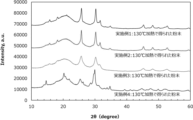
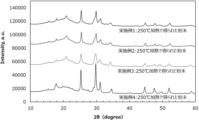
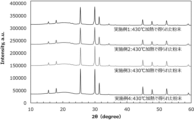
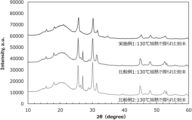
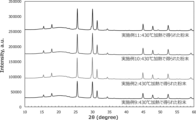
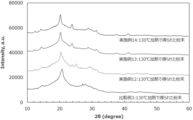
- Powder XRD diffraction measurements were performed on the powders obtained at room temperature (20° C.) and 130° C. in the first heating and at 250° C. and 430° C. in the second heating.
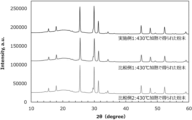
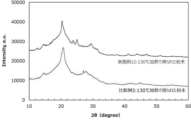
- Figures 1 and 4 show the X-ray diffraction spectra of the powder obtained by heating to 130°C
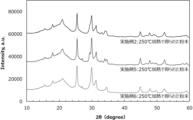
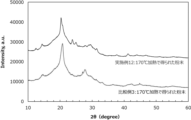
- Figures 2 and 5 show the X-ray diffraction spectra of the powder obtained by heating to 250°C
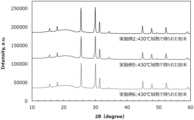
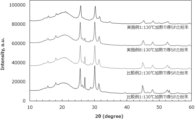
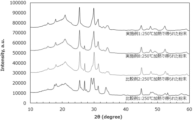
- the X-ray diffraction spectra of the powder are shown in FIGS. 3 and 6. Further, when the ionic conductivity of the powder obtained by heating at 430° C. in Example 1 was measured, it was found to be 4.8 mS/cm.
- Examples 2, 3, 4 and 7 Powders of Examples 2, 3, 4, and 7 were obtained in the same manner as in Example 1, except that the composition ratio and supply amount of the solvent were as shown in Table 1A.
- the powders obtained in Examples 2, 3, 4, and 7 were subjected to powder XRD diffraction measurements.
- Figure 1 shows the X-ray diffraction spectra of the powders obtained by heating at 130°C in Examples 2, 3, and 4, and the X-ray diffraction spectra of the powders obtained by heating at 250°C in Examples 2, 3, and 4.
- Figure 2 shows the X-ray diffraction spectra of the powders obtained by heating at 430°C in Examples 2, 3, and 4.
- the X-ray diffraction spectra of the obtained powder are shown in FIGS. 10, 11, and 12, respectively. Further, the ionic conductivity of the powders obtained by heating at 430° C. in Examples 2, 3, 4, and 7 was measured. The results are shown in Table 1A.
- Example 5 a powder was obtained in the same manner as in Example 2, except that all the raw materials were mixed in a mortar at the same time, introduced into the reaction tank, and mixed with the solvent by stirring for 10 minutes.
- Example 6 In Example 2, 0.1236 g of lithium chloride, 0.1520 g of lithium bromide, 0.2546 g of lithium sulfide, and 0.3554 g of sulfur were introduced into the reaction tank, and mixed with the solvent by stirring for 10 minutes (reaction tank 1). ), then the solution in reaction tank 1 was added to reaction tank 2 into which 0.3241 g of diphosphorus pentasulfide was introduced, and a powder was obtained in the same manner as in Example 2, except that the solution was mixed by stirring for 10 minutes. .
- Figure 7 shows the X-ray diffraction spectra of the powders obtained by heating at 130°C in Examples 2, 5, and 6, and the X-ray diffraction spectra of the powders obtained by heating at 250°C in Examples 2, 5, and 6.
- FIG. 8 shows the X-ray diffraction spectra of the powders obtained by heating at 430° C. in Examples 2, 5, and 6. Further, the ionic conductivity of the powders obtained by heating at 430° C. in Examples 5 and 6 was measured. The results are shown in Table 1A.
- Comparative Examples 1 and 2 Powders of Comparative Examples 1 and 2 were obtained in the same manner as in Example 1, except that the amount of elemental sulfur used in Example 1 was changed from 0.3544 g to 0.1269 g and 0.1777 g.
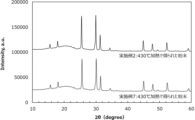
- the X-ray diffraction spectra of the powders obtained by heating at 130 °C in Comparative Examples 1 and 2 are shown in Figure 4, and the X-ray diffraction spectra of the powders obtained by heating at 250 °C in Comparative Examples 1 and 2 are shown in Figure 5.
- the X-ray diffraction spectra of the powders obtained by heating at 430° C. in Comparative Examples 1 and 2 are shown in FIG. Further, the ionic conductivity of the powders obtained by heating at 430° C. in Comparative Examples 1 and 2 was measured. The results are shown in Table 1A.
- Raw material supply methods A to C are as follows. A: After mixing lithium sulfide, diphosphorus pentasulfide, and elemental sulfur, lithium chloride and lithium bromide were mixed. B: Lithium sulfide, diphosphorus pentasulfide, elemental sulfur, lithium chloride, and lithium bromide were mixed at the same time. C: After mixing lithium chloride, lithium bromide, lithium sulfide, and elemental sulfur, diphosphorus pentasulfide was mixed.
- Example 8 to 11 Powder of Example 8 was obtained in the same manner as in Example 1, except that the amount of sulfur atoms used, the composition ratio of the solvent, and the amount supplied were as shown in Table 1B. Further, powders of Examples 9 to 11 were obtained in the same manner as in Example 1, except that the composition ratio and supply amount of the solvent were set to the conditions shown in Table 1B. Powder XRD diffraction measurements were performed on the powders obtained in Examples 8 to 11. The X-ray diffraction spectra of the powder obtained by heating at 130° C., 250° C. and 430° C. of Example 8 are shown in FIGS. and 2 are also listed).
- FIGS. The powders obtained by heating at 130°C in Examples 1 to 7 and the powders obtained by heating at 130°C in Examples 8 to 11 are shown in FIGS.
- Figure 18 Although some impurity peaks are seen, a peak due to the above-mentioned argyrodite crystal structure has been confirmed, confirming that the electrolyte is a crystalline sulfide solid electrolyte having an argyrodite crystal structure.
- the peak intensity resulting from O 5 is small, and the peak intensity resulting from the argyrodite crystal structure is large.
- alcohol solvent ethanol
- the ionic conductivities of the powders of Examples 1, 2, 3, and 4 were 4.8 mS/cm, 5.3 mS/cm, 6.7 mS/cm, and 8.4 mS/cm, respectively, and the amount of ethanol in the solvent was small.
- raw material group 1 and Split supply to be supplied in two parts, particularly a raw material containing at least one kind of atom selected from lithium atoms, phosphorus atoms, and sulfur atoms, raw material group 1 containing elemental sulfur and lithium sulfide, and raw material containing a raw material containing halogen atoms. It was confirmed that it is effective to supply the drugs separately to Group 2.
- the ionic conductivities of the powders of Example 1 and Comparative Examples 1 and 2 were 4.8 mS/cm, 3.5 mS/cm, and 3.6 mS/cm, respectively, which were lower than those of the powder of Example 1. It became. Further, in Example 8, the amount of sulfur atoms used was 1.5 mol per 1.0 mol of lithium sulfide, and the ionic conductivity was 3.8 mS/cm, so 2.0 It was confirmed that, similar to the examples in which molar amounts of powder were used, higher ionic conductivity was obtained compared to the ionic conductivity of the powder of the comparative example.
- Example 12 In a glove box under a nitrogen atmosphere, 0.2590 g of lithium sulfide, 0.4177 g of diphosphorus pentasulfide, and 0.3616 g of elemental sulfur were mixed using a mortar and introduced into a 100 ml reaction tank together with a stirrer (reaction Tank 1). Similarly, 0.1776 g of lithium iodide was weighed and introduced together with a stirrer into a 100 ml reaction tank different from the above (reaction tank 2).
- Powder XRD diffraction was measured for the powder obtained by heating at 130° C. in the first heating and heating at 170° C. in the second heating.
- the X-ray diffraction spectra of the powder obtained by heating at 130° C. are shown in FIGS. 13 and 21, and the X-ray diffraction spectra of the powder obtained by heating at 170° C. are shown in FIGS. 14 and 22.
- Powder XRD diffraction was measured for the powder obtained by heating at 130° C. in the first heating and heating at 200° C. in the second heating.
- the X-ray diffraction spectrum of the powder obtained by heating at 130° C. is shown in FIG. 21, and the X-ray diffraction spectrum of the powder obtained by heating at 200° C. is shown in FIG. 22. 12 and Comparative Example 3 are also listed.) Further, the ionic conductivity of the powder obtained by heating at 200° C. in Example 13 was measured. The results are shown in Table 2.
- Example 14 Powder was obtained in the same manner as in Example 13, except that the amount of solvent used was as shown in Table 2. Powder XRD diffraction was measured for the powder obtained by heating at 130° C. in the first heating and heating at 200° C. in the second heating. The X-ray diffraction spectrum of the powder obtained by heating at 130° C. is shown in FIG. 21, and the X-ray diffraction spectrum of the powder obtained by heating at 200° C. is shown in FIG. 22. 12 and Comparative Example 3 are also listed.) Further, the ionic conductivity of the powder obtained by heating at 200° C. in Example 14 was measured. The results are shown in Table 2.
- Comparative example 3 A powder of Comparative Example 3 was obtained in the same manner as in Example 12, except that the amount of elemental sulfur used in Example 12 was changed from 0.3616 g to 0.1808 g.
- the X-ray diffraction spectrum of the powder obtained by heating at 130° C. in Comparative Example 3 is shown in FIGS. 13 and 21, and the X-ray diffraction spectrum of the powder obtained by heating at 170° C. is shown in FIGS. 14 and 22.
- Example 12 and Comparative Example 3 the raw materials and solvents used, as well as the amount of elemental sulfur used, are summarized in Table 2 below.
- D and E of raw material supply methods are as follows.
- D After mixing lithium sulfide, diphosphorus pentasulfide, and elemental sulfur, lithium iodide was mixed.
- E Lithium sulfide, diphosphorus pentasulfide, elemental sulfur, lithium iodide, and lithium bromide were mixed at the same time.
- the sulfide solid electrolyte having a thiolisicone region II type crystal structure is known to be a sulfide solid electrolyte having high ionic conductivity similar to the sulfide solid electrolyte having the above-mentioned argyrodite type crystal structure.
- the powder obtained in step 12 is considered to be a sulfide solid electrolyte with high ionic conductivity.
- Examples 13 and 14 are examples in which alcohol solvents and ether solvents are used as solvents.
- a sulfide solid electrolyte with improved ionic conductivity can be efficiently provided.
- the sulfide solid electrolyte obtained by the manufacturing method of this embodiment is suitably used for batteries, particularly for batteries used in information-related equipment and communication equipment such as personal computers, video cameras, and mobile phones.
Landscapes
- Chemical & Material Sciences (AREA)
- Organic Chemistry (AREA)
- Inorganic Chemistry (AREA)
- Engineering & Computer Science (AREA)
- Manufacturing & Machinery (AREA)
- Chemical Kinetics & Catalysis (AREA)
- Electrochemistry (AREA)
- General Chemical & Material Sciences (AREA)
- General Physics & Mathematics (AREA)
- Physics & Mathematics (AREA)
- Condensed Matter Physics & Semiconductors (AREA)
- Materials Engineering (AREA)
- Conductive Materials (AREA)
- Glass Compositions (AREA)
Priority Applications (5)
| Application Number | Priority Date | Filing Date | Title |
|---|---|---|---|
| JP2024532639A JPWO2024010077A1 (cg-RX-API-DMAC7.html) | 2022-07-07 | 2023-07-07 | |
| CN202380050875.XA CN119487586A (zh) | 2022-07-07 | 2023-07-07 | 硫化物固体电解质的制造方法 |
| KR1020247043339A KR20250034042A (ko) | 2022-07-07 | 2023-07-07 | 황화물 고체 전해질의 제조 방법 |
| US18/880,590 US20250388468A1 (en) | 2022-07-07 | 2023-07-07 | Method for producing sulfide solid electrolyte |
| EP23835608.3A EP4553860A4 (en) | 2022-07-07 | 2023-07-07 | PROCESS FOR THE PRODUCTION OF A SOLID SULPHIDE ELECTROLYTE |
Applications Claiming Priority (4)
| Application Number | Priority Date | Filing Date | Title |
|---|---|---|---|
| JP2022-109696 | 2022-07-07 | ||
| JP2022109696 | 2022-07-07 | ||
| JP2023-037187 | 2023-03-10 | ||
| JP2023037187 | 2023-03-10 |
Publications (1)
| Publication Number | Publication Date |
|---|---|
| WO2024010077A1 true WO2024010077A1 (ja) | 2024-01-11 |
Family
ID=89453593
Family Applications (1)
| Application Number | Title | Priority Date | Filing Date |
|---|---|---|---|
| PCT/JP2023/025216 Ceased WO2024010077A1 (ja) | 2022-07-07 | 2023-07-07 | 硫化物固体電解質の製造方法 |
Country Status (6)
| Country | Link |
|---|---|
| US (1) | US20250388468A1 (cg-RX-API-DMAC7.html) |
| EP (1) | EP4553860A4 (cg-RX-API-DMAC7.html) |
| JP (1) | JPWO2024010077A1 (cg-RX-API-DMAC7.html) |
| KR (1) | KR20250034042A (cg-RX-API-DMAC7.html) |
| CN (1) | CN119487586A (cg-RX-API-DMAC7.html) |
| WO (1) | WO2024010077A1 (cg-RX-API-DMAC7.html) |
Cited By (1)
| Publication number | Priority date | Publication date | Assignee | Title |
|---|---|---|---|---|
| WO2025205658A1 (ja) * | 2024-03-28 | 2025-10-02 | 三井金属鉱業株式会社 | 硫化物固体電解質及びそれを含む電池 |
Citations (5)
| Publication number | Priority date | Publication date | Assignee | Title |
|---|---|---|---|---|
| WO2003059810A1 (fr) * | 2002-01-15 | 2003-07-24 | Idemitsu Petrochemical Co., Ltd. | Procede de production de verre de sulfure ou de vitroceramique de sulfure capable de conduire un ion lithium, et cellule de type solide totale utilisant ladite vitroceramique |
| WO2005119706A1 (ja) * | 2004-06-04 | 2005-12-15 | Idemitsu Kosan Co., Ltd. | 高性能全固体リチウム電池 |
| JP2013016423A (ja) | 2011-07-06 | 2013-01-24 | Toyota Motor Corp | 硫化物固体電解質材料、リチウム固体電池、および、硫化物固体電解質材料の製造方法 |
| JP2018045997A (ja) * | 2016-09-08 | 2018-03-22 | 出光興産株式会社 | 硫化物固体電解質 |
| WO2018225526A1 (ja) * | 2017-06-09 | 2018-12-13 | 出光興産株式会社 | 硫化物固体電解質の製造方法 |
Family Cites Families (5)
| Publication number | Priority date | Publication date | Assignee | Title |
|---|---|---|---|---|
| JP6095218B2 (ja) | 2013-03-26 | 2017-03-15 | 公立大学法人大阪府立大学 | 固体電解質で被覆された活物質の製造方法、全固体リチウム二次電池の固体電解質を含む層の形成用溶液、全固体リチウム二次電池及びその製造方法 |
| EP3007181A4 (en) | 2013-05-31 | 2017-02-01 | Idemitsu Kosan Co., Ltd | Production method of solid electrolyte |
| WO2018054709A1 (en) | 2016-09-20 | 2018-03-29 | Basf Se | Solid lithium electrolytes and process of production |
| EP3886122A4 (en) | 2018-11-22 | 2022-08-10 | Idemitsu Kosan Co.,Ltd. | PROCESS FOR PREPARING A SOLID ELECTROLYTE AND ELECTROLYTE PRECURSOR |
| JP7681581B2 (ja) | 2020-05-13 | 2025-05-22 | 出光興産株式会社 | 固体電解質の製造方法 |
-
2023
- 2023-07-07 CN CN202380050875.XA patent/CN119487586A/zh active Pending
- 2023-07-07 US US18/880,590 patent/US20250388468A1/en active Pending
- 2023-07-07 KR KR1020247043339A patent/KR20250034042A/ko active Pending
- 2023-07-07 EP EP23835608.3A patent/EP4553860A4/en active Pending
- 2023-07-07 JP JP2024532639A patent/JPWO2024010077A1/ja active Pending
- 2023-07-07 WO PCT/JP2023/025216 patent/WO2024010077A1/ja not_active Ceased
Patent Citations (5)
| Publication number | Priority date | Publication date | Assignee | Title |
|---|---|---|---|---|
| WO2003059810A1 (fr) * | 2002-01-15 | 2003-07-24 | Idemitsu Petrochemical Co., Ltd. | Procede de production de verre de sulfure ou de vitroceramique de sulfure capable de conduire un ion lithium, et cellule de type solide totale utilisant ladite vitroceramique |
| WO2005119706A1 (ja) * | 2004-06-04 | 2005-12-15 | Idemitsu Kosan Co., Ltd. | 高性能全固体リチウム電池 |
| JP2013016423A (ja) | 2011-07-06 | 2013-01-24 | Toyota Motor Corp | 硫化物固体電解質材料、リチウム固体電池、および、硫化物固体電解質材料の製造方法 |
| JP2018045997A (ja) * | 2016-09-08 | 2018-03-22 | 出光興産株式会社 | 硫化物固体電解質 |
| WO2018225526A1 (ja) * | 2017-06-09 | 2018-12-13 | 出光興産株式会社 | 硫化物固体電解質の製造方法 |
Non-Patent Citations (5)
| Title |
|---|
| ADV. ENERGY SUSTAINABILITY RES., vol. 3, 2022, pages 2200019 |
| J. MATER. CHEM. A, vol. 7, 2019, pages 558 - 566 |
| KANNO ET AL., JOURNAL OF THE ELECTROCHEMICAL SOCIETY, vol. 148, no. 7, 2001, pages 742 - 746 |
| See also references of EP4553860A4 |
| SOLID STATE IONICS, vol. 177, 2006, pages 2721 - 2725 |
Cited By (1)
| Publication number | Priority date | Publication date | Assignee | Title |
|---|---|---|---|---|
| WO2025205658A1 (ja) * | 2024-03-28 | 2025-10-02 | 三井金属鉱業株式会社 | 硫化物固体電解質及びそれを含む電池 |
Also Published As
| Publication number | Publication date |
|---|---|
| CN119487586A (zh) | 2025-02-18 |
| EP4553860A4 (en) | 2026-06-17 |
| US20250388468A1 (en) | 2025-12-25 |
| JPWO2024010077A1 (cg-RX-API-DMAC7.html) | 2024-01-11 |
| KR20250034042A (ko) | 2025-03-10 |
| EP4553860A1 (en) | 2025-05-14 |
Similar Documents
| Publication | Publication Date | Title |
|---|---|---|
| KR102743515B1 (ko) | 고체 전해질의 제조 방법 및 전해질 전구체 | |
| WO2024010079A1 (ja) | 硫化物固体電解質の製造方法 | |
| JP7667146B2 (ja) | 固体電解質の製造方法 | |
| KR102957363B1 (ko) | 전극 합재 및 그 제조 방법 | |
| US20250201909A1 (en) | Method for manufacturing sulfide solid electrolyte | |
| JP7744337B2 (ja) | ハロゲン化リチウム化合物の製造方法 | |
| US20250079507A1 (en) | Method for producing sulfide solid electrolyte | |
| US20250388468A1 (en) | Method for producing sulfide solid electrolyte | |
| JP2023152966A (ja) | 硫化物固体電解質、その製造方法、電極合材及びリチウムイオン電池 | |
| US20240083761A1 (en) | Method for manufacturing halogenated lithium and method for manufacturing sulfide solid electrolyte | |
| US20240079648A1 (en) | Modified sulfide solid electrolyte and manufacturing method therefor | |
| JP2024006101A (ja) | 硫化物固体電解質の製造方法 | |
| US20250100879A1 (en) | Method for producing sulfide solid electrolyte | |
| WO2024010078A1 (ja) | 硫化物固体電解質の製造方法 | |
| US20240332603A1 (en) | Sulfide solid electrolyte | |
| WO2024158030A1 (ja) | 硫化物固体電解質の製造方法 | |
| WO2024253009A1 (ja) | 結晶性硫化物固体電解質 | |
| JP2024007439A (ja) | 硫化物固体電解質の製造方法 | |
| WO2024253019A1 (ja) | 結晶性硫化物固体電解質 | |
| JP2025079064A (ja) | 硫化物固体電解質の製造方法 |
Legal Events
| Date | Code | Title | Description |
|---|---|---|---|
| 121 | Ep: the epo has been informed by wipo that ep was designated in this application |
Ref document number: 23835608 Country of ref document: EP Kind code of ref document: A1 |
|
| WWE | Wipo information: entry into national phase |
Ref document number: 2024532639 Country of ref document: JP |
|
| WWE | Wipo information: entry into national phase |
Ref document number: 202380050875.X Country of ref document: CN |
|
| WWE | Wipo information: entry into national phase |
Ref document number: 18880590 Country of ref document: US |
|
| WWE | Wipo information: entry into national phase |
Ref document number: 2023835608 Country of ref document: EP |
|
| NENP | Non-entry into the national phase |
Ref country code: DE |
|
| ENP | Entry into the national phase |
Ref document number: 2023835608 Country of ref document: EP Effective date: 20250207 |
|
| WWP | Wipo information: published in national office |
Ref document number: 202380050875.X Country of ref document: CN |
|
| WWP | Wipo information: published in national office |
Ref document number: 1020247043339 Country of ref document: KR |
|
| WWP | Wipo information: published in national office |
Ref document number: 2023835608 Country of ref document: EP |