WO2024009641A1 - 熱可塑性ポリエステル樹脂組成物およびそれを用いた成形品 - Google Patents
熱可塑性ポリエステル樹脂組成物およびそれを用いた成形品 Download PDFInfo
- Publication number
- WO2024009641A1 WO2024009641A1 PCT/JP2023/019638 JP2023019638W WO2024009641A1 WO 2024009641 A1 WO2024009641 A1 WO 2024009641A1 JP 2023019638 W JP2023019638 W JP 2023019638W WO 2024009641 A1 WO2024009641 A1 WO 2024009641A1
- Authority
- WO
- WIPO (PCT)
- Prior art keywords
- weight
- parts
- component
- group
- thermoplastic polyester
- Prior art date
- Legal status (The legal status is an assumption and is not a legal conclusion. Google has not performed a legal analysis and makes no representation as to the accuracy of the status listed.)
- Ceased
Links
Images
Classifications
-
- B—PERFORMING OPERATIONS; TRANSPORTING
- B29—WORKING OF PLASTICS; WORKING OF SUBSTANCES IN A PLASTIC STATE IN GENERAL
- B29B—PREPARATION OR PRETREATMENT OF THE MATERIAL TO BE SHAPED; MAKING GRANULES OR PREFORMS; RECOVERY OF PLASTICS OR OTHER CONSTITUENTS OF WASTE MATERIAL CONTAINING PLASTICS
- B29B9/00—Making granules
- B29B9/02—Making granules by dividing preformed material
- B29B9/06—Making granules by dividing preformed material in the form of filamentary material, e.g. combined with extrusion
-
- C—CHEMISTRY; METALLURGY
- C08—ORGANIC MACROMOLECULAR COMPOUNDS; THEIR PREPARATION OR CHEMICAL WORKING-UP; COMPOSITIONS BASED THEREON
- C08G—MACROMOLECULAR COMPOUNDS OBTAINED OTHERWISE THAN BY REACTIONS ONLY INVOLVING UNSATURATED CARBON-TO-CARBON BONDS
- C08G64/00—Macromolecular compounds obtained by reactions forming a carbonic ester link in the main chain of the macromolecule
-
- C—CHEMISTRY; METALLURGY
- C08—ORGANIC MACROMOLECULAR COMPOUNDS; THEIR PREPARATION OR CHEMICAL WORKING-UP; COMPOSITIONS BASED THEREON
- C08K—Use of inorganic or non-macromolecular organic substances as compounding ingredients
- C08K3/00—Use of inorganic substances as compounding ingredients
- C08K3/40—Glass
-
- C—CHEMISTRY; METALLURGY
- C08—ORGANIC MACROMOLECULAR COMPOUNDS; THEIR PREPARATION OR CHEMICAL WORKING-UP; COMPOSITIONS BASED THEREON
- C08K—Use of inorganic or non-macromolecular organic substances as compounding ingredients
- C08K7/00—Use of ingredients characterised by shape
- C08K7/02—Fibres or whiskers
- C08K7/04—Fibres or whiskers inorganic
- C08K7/14—Glass
-
- C—CHEMISTRY; METALLURGY
- C08—ORGANIC MACROMOLECULAR COMPOUNDS; THEIR PREPARATION OR CHEMICAL WORKING-UP; COMPOSITIONS BASED THEREON
- C08L—COMPOSITIONS OF MACROMOLECULAR COMPOUNDS
- C08L63/00—Compositions of epoxy resins; Compositions of derivatives of epoxy resins
-
- C—CHEMISTRY; METALLURGY
- C08—ORGANIC MACROMOLECULAR COMPOUNDS; THEIR PREPARATION OR CHEMICAL WORKING-UP; COMPOSITIONS BASED THEREON
- C08L—COMPOSITIONS OF MACROMOLECULAR COMPOUNDS
- C08L67/00—Compositions of polyesters obtained by reactions forming a carboxylic ester link in the main chain; Compositions of derivatives of such polymers
- C08L67/02—Polyesters derived from dicarboxylic acids and dihydroxy compounds
-
- C—CHEMISTRY; METALLURGY
- C08—ORGANIC MACROMOLECULAR COMPOUNDS; THEIR PREPARATION OR CHEMICAL WORKING-UP; COMPOSITIONS BASED THEREON
- C08L—COMPOSITIONS OF MACROMOLECULAR COMPOUNDS
- C08L69/00—Compositions of polycarbonates; Compositions of derivatives of polycarbonates
Definitions
- the present invention relates to a thermoplastic polyester resin composition and a molded article formed from the same.
- Thermoplastic polyester resins are used in a wide range of fields such as mechanical parts, electrical/electronic parts, and automobile parts, taking advantage of their excellent injection moldability and mechanical properties.
- the relative dielectric constant and dielectric loss tangent have been reduced for application to high-frequency transmission components such as mobile communication terminals and automotive millimeter-wave sensors based on high-speed communication standards that use high-frequency waves of 1 GHz band or higher. Materials are needed. If the material used for high-frequency transmission components has a particularly high dielectric loss tangent, when a high-frequency signal comes into contact with the material, the high frequency will be converted to heat, resulting in a phenomenon in which communication accuracy such as communication distance decreases due to a decrease in signal strength. ,It has become a challenge.
- thermoplastic polyester resin As a method for improving the dielectric properties of a thermoplastic polyester resin, a method uses a thermoplastic polyester resin in which an aliphatic group having 10 to 50 carbon atoms is introduced and the terminal concentration of hydroxyl groups is below a specific range (Patent Document 1) etc. are disclosed.
- polybutylene terephthalate resin has high dimensional stability and molding stability due to its high crystallinity, but due to its high crystallinity, laser transparency tends to be low and adhesive strength tends to decrease. There is. Therefore, when using polybutylene terephthalate resin as a molded product on the laser beam transmission side and applying the laser welding method, it is necessary to reduce the thickness of the molded product in order to improve laser transparency. The restrictions were very strict, and there was little freedom in product design.
- thermoplastic polyester resin compositions containing polycarbonate resin which is an amorphous resin and has excellent laser transparency, have been disclosed (for example, Patent Documents 2 to 4). .
- thermoplastic polyester resin composition disclosed in Patent Document 1 is further blended with a polycarbonate resin to improve laser transmittance, a certain degree of low dielectric property and improved laser transmittance can be obtained.
- welding strength was reduced during laser welding due to the generation of gas when processed at high temperatures and the deformation of the molded product due to decreased mold releasability during injection molding.
- Patent Documents 2 to 4 contain polycarbonate resin in order to improve laser transmittance, and exhibit excellent laser transmittance.
- polycarbonate resin which is an amorphous resin
- the amount of gas generated increases when the mold is removed, and the molded product sticks to the mold during injection molding, resulting in decreased mold releasability and deformation of the molded product during demolding. in some cases.
- the low dielectric properties of the obtained thermoplastic polyester resin composition are insufficient, and when a large amount of polycarbonate resin is blended to improve this, the low gas properties and mold release properties of the obtained molded products may be further reduced. There was a problem with the decline.
- An object of the present invention is to provide a thermoplastic polyester resin composition that has excellent laser transmittance, low gas properties, and mold releasability, and further suppresses variations in laser transmittance, and molded products thereof.
- the present inventors have developed a polybutylene terephthalate resin and polycarbonate resin that are combined with a specific amount of aliphatic alcohol component, and a resin that is blended with glass fiber of a specific composition. It was discovered that the above-mentioned problems could be solved by creating a composition, and the present invention was achieved. That is, the present invention has the following configuration.
- Polybutylene terephthalate resin (A) in which 0.1 to 2.0 mol% of a monovalent aliphatic alcohol having 10 to 50 carbon atoms is combined with respect to 100 mol% of structural units derived from terephthalic acid.
- thermoplastic polyester resin composition blended with 10 to 100 parts by weight of glass fiber (C) having a content of 15 to 25% by weight.
- an epoxy compound (D) which is a cresol novolac type epoxy resin or a dicyclopentadiene type epoxy resin is further blended with 100 parts by weight of the polybutylene terephthalate resin (A).
- the thermoplastic polyester resin composition according to [1].
- thermoplastic polyester resin composition and a molded article that have excellent laser transmittance, mold releasability, and low gas properties, and further suppress variations in laser transmittance.
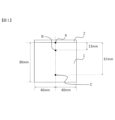
- FIG. 2 is a schematic top view showing a test piece for evaluating laser transmittance and a measurement site for evaluating variations in laser transmittance.
- thermoplastic polyester resin composition of the present invention will be explained in detail.
- thermoplastic polyester resin composition of the present invention a monohydric aliphatic alcohol having 10 to 50 carbon atoms is compounded in an amount of 0.1 to 2.0 mol% based on 100 mol% of structural units derived from terephthalic acid.
- Polybutylene terephthalate resin obtained from terephthalic acid and 1,4-butanediol suffers from dielectric loss under high frequencies due to the mobility of the hydroxyl group end derived from 1,4-butanediol, resulting in poor dielectric properties. It may get worse.
- monohydric aliphatic alcohol having 10 to 50 carbon atoms is added at 0.0% to 100% by mole of the structural unit derived from terephthalic acid (i.e., terephthaloyl group).
- the dielectric properties can be improved by applying 1 to 2.0 mol% compounded polybutylene terephthalate resin.
- thermoplastic polyester resin composition By blending a specific amount of polycarbonate resin and a specific amount of glass fiber with a specific composition into such polybutylene terephthalate resin, the crystal properties of the resulting thermoplastic polyester resin composition are controlled, and injection It has been newly discovered that since variations in solidification rate during molding are suppressed, in addition to low dielectric properties, laser transmission properties, mold releasability, and low gas properties are further improved.
- Component (A) used in the present invention has terephthalic acid residues and 1,4-butanediol residues as main structural units, and further contains residues of monohydric aliphatic alcohol having 10 to 50 carbon atoms. It is a polymer with
- the term "residue” refers to a group that includes a structural moiety that provides an ester structure, that is, the hydroxyl group in the carboxyl group that is removed during dehydration condensation, and the remaining group after removing the hydrogen in the hydroxyl group.
- the term "main structural unit" refers to having the above-mentioned residues in 50 mol% or more of the total structural units, and it is a preferable embodiment to have 80 mol% or more of these residues; It is more preferable to have 90 mol% or more of residues.
- the polybutylene terephthalate resin may be a copolymer of terephthalic acid and a monomer other than 1,4-butanediol.
- Examples of monomers that can be used in copolymerization include isophthalic acid, phthalic acid, 2,6-naphthalene dicarboxylic acid, 1,5-naphthalene dicarboxylic acid, bis(p-carboxyphenyl)methane, 1,4-anthracene dicarboxylic acid, 1,5-anthracene dicarboxylic acid, 1,8-anthracene dicarboxylic acid, 2,6-anthracene dicarboxylic acid, 9,10-anthracene dicarboxylic acid, 4,4'-diphenyl ether dicarboxylic acid, 5-tetrabutylphosphonium isophthalic acid, 5 - Aromatic dicarboxylic acids such as sodium sulfoisophthalic acid and their ester-forming derivatives, ethylene glycol, 1,3-propylene glycol, neopentyl glycol, 1,5-pentanediol, 1,6-hexanedi
- Component (A) used in the present invention is a monohydric aliphatic alcohol having 10 to 50 carbon atoms combined in an amount of 0.1 to 2.0 mol% based on 100 mol% of structural units derived from terephthalic acid. It is characterized by being a polybutylene terephthalate resin. By applying such a polybutylene terephthalate resin, in addition to improving the low dielectric properties of the resulting thermoplastic polyester resin composition, when component (B) and component (C) are blended, By controlling the solidification characteristics during processing, laser transparency, mold releasability, and low gas properties can be improved.
- the amount of aliphatic alcohol combined is preferably 0.5 mol% or more, more preferably 0.7 mol% or more, based on 100 mol% of the structural unit derived from terephthalic acid, from the viewpoint of improving laser transparency. . Further, the upper limit thereof is preferably 1.8 mol% or less, more preferably 1.6 mol% or less.
- the monohydric aliphatic alcohol having 10 to 50 carbon atoms used in the present invention is a monofunctional alcohol having a hydrocarbon main skeleton consisting of carbon atoms and hydrogen atoms and one hydroxyl group.
- the chain structure may have a linear or branched or cyclic structure. Examples include decyl group (C10), undecyl group (C11), dodecyl group (C12), tridecyl group (C13), tetradecyl group (C14), pentadecyl group (C15), hexadecyl group (C16), heptadecyl group (C17).
- the number after "C” represents the number of carbon atoms (synonymous with the number of carbon atoms) contained in the group.
- alcohols in which a hydroxyl group is bonded to a linear or branched saturated aliphatic hydrocarbon group are preferred from the viewpoint of color tone, and alcohols in which a hydroxyl group is bonded to a branched saturated aliphatic hydrocarbon group are preferred from the viewpoint of fluidity. It is preferable that it is a group.
- the carbon number of the aliphatic group is 10 or more and 50 or less, excellent effects of low dielectricity and laser transparency can be obtained, and these can be further improved, so the lower limit of the carbon number is preferably 16 or more, and 20 It is more preferable that it is above.
- the upper limit of the number of carbon atoms is preferably 36 or less, more preferably 30 or less.
- component (A) is preferably a polybutylene terephthalate resin having a branched saturated aliphatic group having 16 or more and 36 or less carbon atoms at the molecular end, and a functional group of the saturated aliphatic group. It is preferable that the concentration is 0.005 mmol/g or more and 0.20 mmol/g or less. It is preferable that the concentration of the functional group of the saturated aliphatic group is 0.005 mmol/g or more, since fluidity and dielectric properties can be improved. It is more preferably 0.010 mmol/g or more, still more preferably 0.020 mmol/g or more, particularly preferably 0.040 mmol/g or more.
- the functional group concentration of the saturated aliphatic group is 0.20 mmol/g or less, since mechanical properties and heat resistance can be improved. More preferably it is 0.18 mmol/g or less, and still more preferably 0.15 mmol/g or less.
- the functional group concentration of the aliphatic group present at the end of the molecule is a value determined from the integral ratio of the peak derived from the end group measured by 1 H-NMR using deuterated hexafluoroisopropanol as a solvent.
- the functional group concentration of hydroxyl groups is 0.050 mmol/g or less.
- the functional group concentration of the hydroxyl group is more preferably 0.040 mmol/g or less, and even more preferably 0.030 mmol/g or less, since it can further reduce the dielectric loss tangent.
- the lower limit of the functional group concentration of hydroxyl group is 0 mmol/g.
- the functional group concentration of the hydroxyl group in component (A) is a value determined from the integral ratio of peaks derived from end groups measured by 1 H-NMR using deuterated hexafluoroisopropanol as a solvent.
- the carboxyl group concentration is preferably 0.070 mmol/g or less from the viewpoint of excellent hydrolysis resistance.
- the carboxyl group concentration is preferably 0.060 mmol/g or less, more preferably 0.050 mmol/g or less.
- the lower limit of carboxyl group concentration is 0 mmol/g.
- the carboxyl group concentration of component (A) is a value measured by dissolving component (A) in an o-cresol/chloroform solvent and then titrating with ethanolic potassium hydroxide.
- the melting point of component (A) is preferably 180°C or higher. By having a melting point of 180° C. or higher, the heat resistance of the thermoplastic polyester resin composition can be improved. From the viewpoint of heat resistance, the melting point is preferably 190°C or higher, more preferably 200°C or higher.
- the melting point of component (A) is the value of the peak temperature of the endothermic melting peak obtained when the temperature is raised from 25° C. to 20° C./min in DSC (differential scanning calorimetry).
- Component (A) preferably has a weight average molecular weight (Mw) of 8,000 or more in order to further improve mechanical properties.
- the weight average molecular weight (Mw) is more preferably 9,000 or more, still more preferably 10,000 or more. Further, it is preferable that the weight average molecular weight (Mw) is 500,000 or less because fluidity can be improved.
- the weight average molecular weight (Mw) is more preferably 300,000 or less, still more preferably 250,000 or less.
- the weight average molecular weight (Mw) of component (A) is a value in terms of polymethyl methacrylate (PMMA) measured by gel permeation chromatography (GPC) using hexafluoroisopropanol as a solvent.
- Component (A) preferably has an intrinsic viscosity (IV) of 0.60 dl/g or more in order to further improve mechanical properties.
- the intrinsic viscosity is more preferably 0.65 dl/g or more, still more preferably 0.70 dl/g or more.
- the intrinsic viscosity is more preferably 1.7 dl/g or less, even more preferably 1.4 dl/g or less.
- the intrinsic viscosity of component (A) is a value determined by measurement at 25° C. using orthochlorophenol as a solvent.
- Component (A) used in the present invention can be produced by polymerizing a polybutylene terephthalate resin using a known polycondensation method or ring-opening polymerization method, or by solid-phase polymerizing a polybutylene terephthalate resin.
- the production method using polycondensation reaction may be either batch polymerization or continuous polymerization, and either transesterification reaction, direct polymerization reaction, or direct polymerization reaction can be applied, but from the viewpoint of reducing hydroxyl groups. Batch polymerization is preferred, and direct polymerization is more preferred.
- component (A) used in the present invention is obtained by subjecting an aromatic dicarboxylic acid or an ester-forming derivative thereof to a diol or an ester-forming derivative thereof to an esterification reaction or transesterification reaction,
- component (A) used in the present invention is obtained by subjecting an aromatic dicarboxylic acid or an ester-forming derivative thereof to a diol or an ester-forming derivative thereof to an esterification reaction or transesterification reaction
- a monohydric aliphatic alcohol having 10 to 50 carbon atoms at any stage selected from esterification reaction, transesterification reaction, and polycondensation reaction. be able to. They can be added at any stage of the transesterification or polycondensation reaction.
- it is preferable to produce the resin by adding a monohydric aliphatic alcohol having 10 to 50 carbon atoms at any stage of the esterification reaction or the transesterification reaction, since a resin with excellent dielectric properties can be obtained.
- a polymerization reaction catalyst In order to effectively advance the esterification reaction or transesterification reaction and polycondensation reaction of component (A), it is preferable to add a polymerization reaction catalyst during these reactions.
- the polymerization reaction catalyst include titanic acid methyl ester, tetra-n-propyl ester, tetra-n-butyl ester, tetraisopropyl ester, tetraisobutyl ester, tetra-tert-butyl ester, cyclohexyl ester, phenyl ester, Organic titanium compounds such as benzyl ester, tolyl ester or mixed esters thereof, dibutyltin oxide, methylphenyltin oxide, tetraethyltin, hexaethyldistin oxide, cyclohexahexyldistin oxide, didodecyltin oxide, triethyltin hydroxide, Triphenyltin hydrox
- organic titanium compounds and tin compounds are preferred, and tetra-n-butyl ester of titanic acid is more preferably used.
- the amount of the polymerization reaction catalyst added is preferably in the range of 0.01 to 0.2 parts by weight based on 100 parts by weight of the polybutylene terephthalate resin obtained.
- thermoplastic polyester resin composition of the present invention a monohydric aliphatic alcohol having 10 to 50 carbon atoms is compounded in an amount of 0.1 to 2.0 mol% based on 100 mol% of structural units derived from terephthalic acid.
- 100 parts by weight of the polybutylene terephthalate resin (A), and 10 to 80 parts by weight of the polycarbonate resin (B) are blended to 100 parts by weight of the polybutylene terephthalate resin (A).
- polycarbonate resin (B) with component (C) the crystal properties of the resulting thermoplastic polyester resin composition are controlled and variations in solidification rate during injection molding are suppressed, resulting in excellent laser performance. It is possible to achieve both transparency and suppression of variations in laser transmittance. Furthermore, deformation of the molded product due to mold release during injection molding can be suppressed.
- Component (B) used in the present invention can be easily obtained, for example, by reacting an aromatic dihydroxy compound with a carbonate precursor such as phosgene or diester carbonate.
- a carbonate precursor such as phosgene or diester carbonate.
- known methods are used, such as interfacial polymerization, melt transesterification, solid phase transesterification of carbonate prepolymers, and ring-opening polymerization of cyclic carbonate compounds.
- a typical aromatic dihydroxy compound is 2,2-bis(4-hydroxyphenyl)propane [bisphenol A].
- Others such as bis(4-hydroxyphenyl)methane, 1,1-bis(4-hydroxyphenyl)ethane, 2,2-bis(4-hydroxyphenyl)butane, 2,2-bis(4-hydroxyphenyl) Octane, bis(4-hydroxyphenyl)phenylmethane, 2,2-bis(4-hydroxy-3-methylphenyl)propane, 1,1-bis(4-hydroxy-3-t-butylphenyl)propane, 2, 2-bis(4-hydroxy-3-bromophenyl)propane, 2,2-bis(4-hydroxy-3,5-dibromophenyl)propane, 2,2-bis(4-hydroxy-3,5-dichlorophenyl) Bis(hydroxyaryl)alkanes such as propane; bis(hydroxyaryl)cycloalkanes such as 1,1-bis(4-hydroxyphenyl)cyclopentan
- Examples of the carbonate precursor to be reacted with the aromatic dihydroxy compound include phosgene, carbonic diester, and the like.
- Examples of carbonic acid diesters include diaryl carbonates such as diphenyl carbonate and ditolyl carbonate, and dialkyl carbonates such as dimethyl carbonate and diethyl carbonate.
- Component (B) may be a copolymer of an aromatic dihydroxy compound, a carbonate precursor, and other compounds such as piperazine, dipiperidylhydroquinone, resorcinol, and 4,4'-dihydroxydiphenyls.
- a branched polycarbonate resin can be obtained by copolymerizing a polyfunctional compound such as phloroglucin.
- the molecular weight of component (B) is a viscosity average molecular weight calculated from the solution viscosity measured at a temperature of 25°C using methylene chloride as a solvent, and is preferably 10,000 to 50,000, more preferably 15,000. 40,000, most preferably 18,000 to 30,000.
- known methods such as a method using a terminal capper or a molecular weight regulator, a method of selecting polymerization reaction conditions, and the like are employed.
- Component (B) preferably has a structure having a 4- ⁇ -cumylphenoxy group at the end of the molecular chain.
- the terminals of the polycarbonate resin are blocked by a p-cumylphenol structure (4- ⁇ -cumylphenoxy group) rather than a t-butylphenol structure (t-butylphenoxy group) or a phenol structure (phenoxy group). Since the generation of gas due to the terminal structure is suppressed, the resulting thermoplastic polyester resin composition is particularly excellent in low gas properties and mold releasability, and is preferable because variations in laser transmittance are suppressed.
- the terminal structure of polycarbonate resin can be analyzed by GC-MS analysis of gas components generated by thermal decomposition. Further, a polycarbonate resin having such a terminal structure can be obtained, for example, by a melt transesterification method between an aromatic dihydroxy compound and a carbonic acid diester.
- the amount of component (B) used in the present invention is 10 to 80 parts by weight per 100 parts by weight of component (A).
- the blending amount of component (B) is preferably 20 parts by weight or more, more preferably 30 parts by weight or more, based on 100 parts by weight of component (A).
- the blending amount of the polycarbonate resin (B) exceeds 80 parts by weight per 100 parts by weight of component (A)
- laser light scattering on the surface of the molded product occurs due to deterioration of fluidity, resulting in a decrease in laser transmittance.
- the blending amount of component (B) is preferably 70 parts by weight or less, more preferably 60 parts by weight or less, per 100 parts by weight of component (A).
- thermoplastic polyester resin composition of the present invention a monohydric aliphatic alcohol having 10 to 50 carbon atoms is compounded in an amount of 0.1 to 2.0 mol% based on 100 mol% of structural units derived from terephthalic acid.
- 10 to 10% of the glass fiber (C) has a content of B 2 O 3 in terms of oxide of 15 to 25% by weight based on the total composition of the glass fiber. It is characterized by containing 100 parts by weight.
- the resulting thermoplastic polyester resin composition suppresses laser refraction between the interface between component (A) and component (C). As a result, it has excellent laser transparency, and it also helps suppress variations in the solidification rate of components (A) and (B) during injection molding, resulting in excellent mold release properties and low gas properties. .
- Component (C) used in the present invention is characterized by containing 15 to 25% by weight of B 2 O 3 in terms of oxide, based on the total amount of the glass fiber composition. If the content of B 2 O 3 is less than 15% by weight, the resulting thermoplastic polyester resin composition will have insufficient laser transparency.
- the content of B 2 O 3 is preferably 16% by weight or more from the viewpoint of laser transparency and low dielectric property. On the other hand, if the content of B 2 O 3 exceeds 25% by weight, the resulting thermoplastic polyester resin composition will have insufficient mechanical strength.
- the content of B 2 O 3 is preferably 23% by weight or less, more preferably 21% by weight or less in terms of oxide, from the viewpoint of mechanical strength and productivity of glass fibers.
- the atomic concentration of each component obtained is calculated by converting it into the weight of the oxide. That is, the content of each component is determined by assuming that the total amount of the glass fiber composition is 100% by weight in terms of oxides.
- Component (C) can be chopped strand type or roving type glass fiber in the state before blending, and its surface is coated with a silane coupling agent such as an aminosilane compound or an epoxysilane compound, or urethane, acrylic acid, etc.
- a silane coupling agent such as an aminosilane compound or an epoxysilane compound, or urethane, acrylic acid, etc.
- Copolymers made of acrylic acid such as styrene copolymers, copolymers made of maleic anhydride such as methyl acrylate/methyl methacrylate/maleic anhydride copolymers, vinyl acetate, bisphenol A diglycidyl ether, and novolak-based copolymers Glass fibers treated with a sizing agent containing one or more epoxy compounds, such as epoxy compounds, are preferably used.
- component (C) is a glass fiber treated with a sizing agent containing an epoxy compound, etc., it will have excellent reactivity with component (A) and will improve the mechanical properties and heat resistance of the resulting thermoplastic polyester resin composition. It is even more preferable because it is excellent.
- the silane coupling agent and/or the sizing agent may be used by being mixed with the emulsion liquid.
- the fiber diameter (circle average equivalent diameter) of component (C) is preferably in the range of 1 to 30 ⁇ m. From the viewpoint of dispersibility of glass fibers in the thermoplastic polyester resin composition, the lower limit thereof is preferably 5 ⁇ m or more. From the viewpoint of mechanical strength, the upper limit is preferably 15 ⁇ m or less.
- the cross-sectional shape of the fiber of component (C) is usually circular, but it can also be any cross-sectional shape such as an ellipse, a flattened shape, or a cocoon-shaped shape with an arbitrary aspect ratio.
- the amount of component (C) used in the present invention is 10 to 100 parts by weight per 100 parts by weight of component (A). If the amount of component (C) is less than 10 parts by weight, mechanical strength and heat resistance will be insufficient, and mold releasability and low gas properties will decrease.
- the blending amount of component (C) is preferably 15 parts by weight or more, more preferably 20 parts by weight or more, and even more preferably 25 parts by weight or more, based on 100 parts by weight of component (A).
- component (C) exceeds 100 parts by weight, moldability deteriorates due to a decrease in fluidity, and laser transmittance deteriorates.
- the blending amount of component (C) is preferably 90 parts by weight or less, more preferably 80 parts by weight or less, and even more preferably 70 parts by weight or less, based on 100 parts by weight of component (A).
- thermoplastic polyester resin composition of the present invention may contain other inorganic fillers in addition to the component (C).
- examples include fibrous, whisker-like, needle-like, granular, powdered, or layered inorganic fillers, including PAN-based or pitch-based carbon fibers, stainless steel fibers, and metal fibers such as aluminum fibers and brass fibers.
- organic fibers such as aromatic polyamide fibers and liquid crystal polyester fibers, gypsum fibers, ceramic fibers, asbestos fibers, zirconia fibers, alumina fibers, silica fibers, titanium oxide fibers, silicon carbide fibers, rock wool, potassium titanate whiskers, titanium Acid barium whiskers, silicon nitride whiskers, calcium sulfate whiskers, acicular titanium oxide, glass beads, milled fibers, glass flakes, wollastenite, silica, kaolin, talc, calcium carbonate, zinc oxide, magnesium oxide, aluminum oxide, magnesium oxide and Examples include mixtures of aluminum oxide, finely divided silicic acid, aluminum silicate, silicon oxide, smectite clay minerals (montmorillonite, hectorite), vermiculite, mica, fluorine teniolite, zirconium phosphate, titanium phosphate, and dolomite.
- organic fibers such as aromatic polyamide fibers and liquid crystal polyester fibers, gypsum fiber
- the surface of the above-mentioned inorganic filler may be treated with a known coupling agent (for example, a silane coupling agent, a titanate coupling agent, etc.) or other surface treatment agent. Furthermore, two or more of the above inorganic fillers may be used in combination.
- a known coupling agent for example, a silane coupling agent, a titanate coupling agent, etc.
- two or more of the above inorganic fillers may be used in combination.
- talc is further blended as another inorganic filler used in the present invention, from the viewpoint of reducing variations in laser transmittance.
- the blending amount of talc is preferably 0.01 parts by weight or more, and 0.08 parts by weight based on 100 parts by weight of component (A), since it can further reduce variations in laser transmittance and improve heat resistance. Part or more is more preferable. On the other hand, from the viewpoint of improving laser transmittance, the amount is preferably 0.8 parts by weight or less, more preferably 0.5 parts by weight or less, based on 100 parts by weight of component (A).
- the average particle diameter of talc is preferably 10 ⁇ m or less, more preferably 5 ⁇ m or less, and even more preferably 4 ⁇ m or less, in terms of improving laser transparency.
- the lower limit is not particularly limited, but from the viewpoint of productivity, it is preferably 0.1 ⁇ m or more.
- the average particle diameter is the particle diameter value at 50% accumulation in the volume-based cumulative distribution determined by particle diameter measurement using a laser particle size distribution analyzer SALD-2000 manufactured by Shimadzu Corporation.
- thermoplastic polyester resin composition of the present invention further contains a bifunctional or more functional epoxy compound from the viewpoint of improving hydrolysis resistance and laser transparency.
- difunctional or higher-functional epoxy compounds examples include glycidyl ether type epoxy resins, glycidyl ester type epoxy resins, glycidylamine type epoxy resins, alicyclic epoxy resins, heterocyclic epoxy resins, glycidyl group-containing vinyl polymers, etc. Can be mentioned.
- Glycidyl ether type epoxy resins include epoxy resins manufactured from epichlorohydrin and bisphenol A, epoxy resins manufactured from epichlorohydrin and bisphenol F, and phenol novolac types made by reacting epichlorohydrin with novolac resins. Examples include epoxy resin, cresol novolak type epoxy resin, naphthol novolac type resin, glycerol triglycidyl ether, trimethylolpropane triglycidyl ether, pentaerythritol polyglycidyl ether, dicyclopentadiene type epoxy resin, biphenyl dimethylene type epoxy resin, etc. .
- Examples of the glycidyl ester type epoxy resin include epoxy resins manufactured from epichlorohydrin and any one selected from phthalic acid, tetrahydrophthalic acid, p-oxybenzoic acid, and dimer acid, trimesic acid triglycidyl ester, tri- Examples include mellitic acid triglycidyl ester and pyromellitic acid tetraglycidyl ester.
- the glycidylamine type epoxy resin is produced from epichlorohydrin and one selected from aniline, diaminodiphenylmethane, p-aminophenol, metaxylylene diamine, and 1,3-bis(aminomethyl)cyclohexane.
- Examples include epoxy resin, tetraglycidyl amino diphenylmethane, triglycidyl-para-aminophenol, triglycidyl-methaminophenol, tetraglycidyl metaxylene diamine, tetraglycidyl bisaminomethylcyclohexane, triglycidyl cyanurate, triglycidyl isocyanurate, naphthalene, etc. .
- Examples of the alicyclic epoxy resin include compounds having a cyclohexene oxide group, a tricyclodecene oxide group, and a cyclopentene oxide group.
- heterocyclic epoxy resin examples include epoxy resins produced from epichlorohydrin and hydantoin or isocyanuric acid.
- Examples of the glycidyl group-containing vinyl polymer include those obtained by radical polymerization of raw material monomers that form glycidyl group-containing vinyl units.
- Specific examples of raw material monomers forming glycidyl group-containing vinyl units include glycidyl esters of unsaturated monocarboxylic acids such as glycidyl (meth)acrylate and glycidyl p-styrylcarboxylate, and unsaturated monomers such as maleic acid and itaconic acid.
- Examples thereof include monoglycidyl esters or polyglycidyl esters of polycarboxylic acids, unsaturated glycidyl ethers such as allyl glycidyl ether, 2-methylallyl glycidyl ether, and styrene-4-glycidyl ether.
- glycidyl ether compounds are preferred because they can suppress reactions between epoxy groups and efficiently react with the terminal groups of component (A), and among them, cresol novolac type epoxy resins or dicyclopentadiene type epoxy resins (epoxy resins such as cresol novolac type epoxy resins or dicyclopentadiene type epoxy resins are sometimes referred to as "epoxy compounds (D)"), and di-type epoxy resins are more preferable because they can further improve hydrolysis resistance. Cyclopentadiene type epoxy resin is more preferred.
- the blending amount of the bifunctional or higher-functional epoxy compound is preferably 0.1 part by weight or more, and 0.5 part by weight or more based on 100 parts by weight of component (A), since it can improve laser transparency and hydrolysis resistance. is more preferable, and even more preferably 1 part by weight or more.
- the amount of the bifunctional or higher functional epoxy compound is preferably 5 parts by weight or less, more preferably 3 parts by weight or less, based on component (A).
- thermoplastic polyester resin composition of the present invention further contains a phosphorus stabilizer.
- Phosphorus-based stabilizers are preferably used because they can suppress the transesterification reaction between components (A) and (B) and improve mold releasability and low gas properties.
- phosphorus stabilizer examples include phosphate compounds and phosphite compounds. Two or more types of these may be used. Among these, phosphate stabilizers are preferred, such as monostearyl acid phosphate, distearyl acid phosphate, methyl acid phosphate, isopropyl acid phosphate, butyl acid phosphate, octyl acid phosphate, and isodecyl acid phosphate.
- the blending amount of the phosphorus stabilizer is preferably 0.01 to 0.5 parts by weight per 100 parts by weight of component (A). From the viewpoint of mold releasability, the amount is more preferably 0.02 parts by weight or more. On the other hand, from the viewpoint of low gas properties, the blending amount of the phosphorus stabilizer is more preferably 0.3 parts by weight or less per 100 parts by weight of component (A).
- thermoplastic polyester resin composition of the present invention further contains a mold release agent.
- a mold release agent By adding a mold release agent, it is possible to improve the mold release properties from the mold during melt processing.
- the mold release agent examples include higher fatty acid ester waxes such as montanic acid and stearic acid, polyolefin waxes, and ethylene bisstearamide waxes.
- higher fatty acid ester waxes such as montanic acid and stearic acid
- polyolefin waxes such as polyolefin waxes
- ethylene bisstearamide waxes such as stearic acid
- waxes based on higher fatty acid esters of stearic acid are preferred from the viewpoint of not only releasing properties but also suppressing a decrease in laser transmittance.
- the blending amount of the mold release agent is preferably 0.01 to 1 part by weight per 100 parts by weight of component (A).
- the lower limit of the blending amount is more preferably 0.03 parts by weight or more from the viewpoint of mold releasability, and the upper limit is more preferably 0.6 parts by weight or less from the viewpoint of heat resistance.
- thermoplastic polyester resin composition of the present invention may contain thermoplastic resins other than the components (A) and (B) as long as the object of the present invention is not impaired.
- thermoplastic resins other than component (A) and component (B) include thermoplastic polyester resins, polyolefin resins, polystyrene resins, vinyl resins, polyamide resins, and polyacetal resins that do not fall under component (A) of the present invention.
- thermoplastic polyester resin examples include cellulose resin, polyvinyl alcohol resin, and liquid crystal polymer. Two or more of these may be blended.
- thermoplastic polyester resin may be blended with a compatibilizer, if necessary.
- the compatibilizer preferably has a reactive functional group such as an epoxy group, an acid anhydride group, an oxazoline group, an isocyanate group, or a carbodiimide group from the viewpoint of improving compatibility. It is preferable to have the following.
- a reaction catalyst When using a compatibilizer, a reaction catalyst may be used if necessary. It is preferable to use a reaction catalyst because the reaction of the compatibilizer is promoted and the compatibility between the components (A) and (B) is further improved.
- the reaction catalyst include tertiary amines, amidine compounds, organic phosphines and their salts, imidazole, and boron compounds. Two or more types of these may be used.
- thermoplastic polyester resin composition of the present invention may contain optional additives such as antioxidants, ultraviolet absorbers, light stabilizers, plasticizers, flame retardants, pigments, dyes, and antistatic agents to the extent that the effects of the present invention are not impaired. Additives can be added.
- thermoplastic polyester resin composition of the present invention for example, components (A), (B), and (C) are premixed with various additives as needed, and then mixed with a melt kneader.
- a method of supplying a predetermined amount of each component to a melt-kneading machine using a quantitative feeder such as a weight feeder and melt-kneading for example, a single screw extruder equipped with a "unimelt" or "dalmage" type screw, a twin screw extruder, a triple screw extruder, a conical extruder, a kneader type kneader, etc. can be used. .
- premixing examples include dry blending and mixing using a mechanical mixing device such as a tumbler, ribbon mixer, and Henschel mixer.
- the component (C) may be added by installing a side feeder between the charging part and the vent part of a multi-screw extruder such as a twin-screw extruder.
- a liquid addition nozzle is installed between the pre-filling part and the vent part of a multi-screw extruder such as a twin-screw extruder, and the additive is added using a plunger pump.
- a method may be used in which the amount of water is supplied from a metering pump using a metering pump.
- thermoplastic polyester resin composition of the present invention is preferably pelletized and subjected to molding.
- pelletizing method include a method in which a thermoplastic polyester resin composition melt-kneaded using a melt-kneader or the like is discharged in the form of a strand, and then cut with a strand cutter.
- thermoplastic polyester resin composition of the present invention By melt-molding the thermoplastic polyester resin composition of the present invention, molded products in various shapes such as films, fibers, and others can be obtained.
- melt molding methods include injection molding, extrusion molding, and blow molding, with injection molding being particularly preferably used.
- injection molding methods include gas assisted molding, two-color molding, sandwich molding, in-mold molding, insert molding, and injection press molding, but any of these molding methods can be applied. can.
- the molded article of the present invention is a molded article obtained by melt-molding the thermoplastic polyester resin composition of the present invention, and takes advantage of its characteristics of low dielectricity and excellent laser transparency to produce mechanical parts, electrical parts, electronic parts, etc. It can be suitably used as a molded article selected from parts and automobile parts.
- the molded product of the present invention can be laser welded due to its high laser transmittance, and is therefore suitable for laser welding of automobile parts and electrical/electronic parts.Since it has excellent dielectric properties in high frequency bands, it is particularly suitable for laser welding. It is useful for high frequency transmission parts to which laser welding methods are applied.
- mechanical parts, electrical parts, electronic parts, and automobile parts include breakers, electromagnetic switches, focus cases, flyback transformers, molded products for fusers of copiers and printers, general home appliances, and OA.
- home appliance parts such as copy machine parts, facsimile parts, optical equipment parts, automobile ignition system parts, automobile connectors, and various automobile electrical parts.
- high-frequency transmission components include antenna base materials, connectors, housings, antenna covers, and sensor covers for electrical and electronic components used in mobile communication terminals, communication base stations, millimeter wave sensors, in-vehicle communication equipment, etc. can be mentioned.
- thermoplastic polyester resin composition of the present invention will be specifically explained using Examples.
- the present invention is not interpreted as being limited to the examples listed here.
- % and parts represent weight % and parts by weight, respectively.
- a sample resin composition was molded using a NEX1000 injection molding machine manufactured by Nissei Jushi Kogyo Co., Ltd. and a mold consisting of a 0.8 mm thick film gate and a cavity of 80 mm width x 80 mm length x 1 mm thickness.
- the molding temperature was 280°C
- the mold temperature was 80°C
- the injection speed was 50mm/s
- the injection time and holding time were 10 seconds in total
- the cooling time was 10 seconds.
- a test piece with a length of 80 mm and a thickness of 1 mm was molded.
- UV-3150 ultraviolet and near-infrared spectrophotometer manufactured by Shimadzu Corporation, as shown in Figure 1, the center part of the gate side of the side of the test piece 1 in contact with the gate part 2 is set as point A, and the gate part and The point moved by 13 mm in the opposite direction was defined as point B, and the point moved by 67 mm was defined as point C.
- the laser transmittance at a wavelength of 940 nm, which is near infrared rays was measured.
- the magnitude of the variation in laser transmittance was expressed by the absolute value of the difference in transmittance between points B and C, and the magnitude of laser transmittance was evaluated by the average value of the transmittance between points B and C. Transmittance is expressed as a percentage of the amount of transmitted light and the amount of incident light. It was determined that the smaller the variation in laser transmittance, the better the laser transmittance, and the larger the laser transmittance, the better the laser transmittance.
- Mold releasability (number of mold release failures)
- the sample resin composition was molded into 80 mm x 80 mm square plates with a test piece thickness of 1 mm for 200 shots under the same conditions as those for obtaining the test pieces used in the laser transmittance test in Section 1 above.
- the number of mold release failures was determined as dents on the surface of the molded product caused by the ejector pin, sticking of the molded product to the mold, and sprue tearing. It was determined that the smaller the number of mold release failures, the better the mold releasability.
- Polybutylene terephthalate resin Polybutylene terephthalate resin was obtained according to Production Examples 1 to 4 below.
- the polycondensation reaction was carried out at a temperature of 100 Pa and a pressure of 100 Pa. The completion of the polycondensation reaction was confirmed by checking the viscosity of the reactants, etc., and the reaction time for the polycondensation reaction to obtain the thermoplastic resin was set to 140 minutes, and the reaction was carried out for a total of 360 minutes. I got it.
- the resulting resin (A-1) had a melting point of 228° C., a functional group concentration of hydroxyl groups of 0.025 mmol/g, and a functional group concentration of aliphatic groups of 0.064 mmol/g.
- the completion of the polycondensation reaction was confirmed by checking the viscosity of the reactants, etc., and the reaction time for the polycondensation reaction to obtain the thermoplastic resin was set to 150 minutes, and the reaction was carried out for a total of 330 minutes. I got it.
- the resulting resin (A-4) had a melting point of 225°C, a functional group concentration of hydroxyl groups of 0.095 mmol/g, and a functional group concentration of aliphatic groups that was below the detection limit and could not be calculated.
- Polycarbonate resin (B-1) Polycarbonate resin: “Lexan” 101, manufactured by GE Plastics, whose terminal end was blocked with 4- ⁇ -cumylphenoxy group was used.
- Glass fiber (C-1) Glass fiber: B 2 O 3 content in terms of oxide 19% by weight, cross-sectional diameter 13 ⁇ m, fiber length 3 mm, treated with an epoxy sizing agent.
- C-2 Glass fiber A product treated with an epoxy sizing agent was used, with a B 2 O 3 content of 16% by weight in terms of oxide, a cross-sectional diameter of 13 ⁇ m, and a fiber length of 3 mm.
- Epoxy compound (D-1) Epoxy compound: HP7200H, manufactured by DIC Corporation, dicyclopentadiene type epoxy resin was used.
- D-2) Epoxy compound: EOCN104S, manufactured by Nippon Gunpowder Co., Ltd., a cresol novolak type epoxy resin was used.
- E-1 Talc P talc, manufactured by Takehara Chemical Industry Co., Ltd., with an average particle size of 9 ⁇ m was used.
- the obtained pellets were dried in a hot air dryer at a temperature of 110° C. for 6 hours and then evaluated using the method described above, and the results are shown in Table 1.
- thermoplastic resin composition using a polybutylene terephthalate resin (A) compounded with 0 mol% and blending a specific amount of a polycarbonate resin (B) and glass fiber (C) with a B 2 O 3 content of 15 to 25% by weight. It was found that the product has excellent laser transmittance, as well as excellent mold releasability and low gas properties.
- thermoplastic polyester resin composition in which 10 to 80 parts by weight of component (B) was blended with 100 parts by weight of component (A) had a laser transmittance of 100 parts by weight. It was found that a high balance of properties such as flexibility, mold releasability, and low gas properties can be obtained.
- thermoplastic polyester resin composition in which 10 to 100 parts by weight of component (C) was blended with 100 parts by weight of component (A) had a high laser transmittance. It was found that a high balance of properties such as flexibility, mold releasability, and low gas properties can be obtained.
Landscapes
- Chemical & Material Sciences (AREA)
- Health & Medical Sciences (AREA)
- Chemical Kinetics & Catalysis (AREA)
- Medicinal Chemistry (AREA)
- Polymers & Plastics (AREA)
- Organic Chemistry (AREA)
- Engineering & Computer Science (AREA)
- Mechanical Engineering (AREA)
- Compositions Of Macromolecular Compounds (AREA)
- Injection Moulding Of Plastics Or The Like (AREA)
Abstract
本発明は優れたレーザー透過性、離型性、低ガス性を有し、さらに、レーザー透過率のばらつきを低減する成形品を得ることを課題とし、
炭素数が10以上50以下の一価の脂肪族アルコールが、テレフタル酸由来の構造単位100モル%に対して、0.1~2.0モル%化合したポリブチレンテレフタレート樹脂(A)100重量部、および、該ポリブチレンテレフタレート樹脂(A)100重量部に対して、ポリカーボネート樹脂(B)10~80重量部と、ガラス繊維の組成の全量に対して酸化物換算でB2O3の含有率が15~25重量%であるガラス繊維(C)10~100重量部とを配合してなる熱可塑性ポリエステル樹脂組成物とすることを本旨とする。
Description
本発明は、熱可塑性ポリエステル樹脂組成物およびそれを成形してなる成形品に関する。
熱可塑性ポリエステル樹脂は、その優れた射出成形性や機械物性などの諸特性を生かし、機械機構部品、電気・電子部品および自動車部品などの幅広い分野に利用されている。
さらに近年、周波数が1GHz帯以上の高周波を利用した高速通信規格に基づいた携帯用通信末端や自動車用ミリ波センサーなどの高周波伝送部品への適用に対して、比誘電率や誘電正接を低減した材料が求められている。高周波伝送部品の材料において、特に誘電正接が高いと、高周波信号と材料が接した場合に高周波が熱に変換されてしまうため、信号強度の低下により通信距離などの通信精度が低下する現象が起こり、課題となっている。
熱可塑性ポリエステル樹脂の誘電特性を改善する方法として、炭素数が10以上50以下の脂肪族基を導入し、水酸基末端濃度を特定の範囲以下とした熱可塑性ポリエスエル樹脂を用いる方法(特許文献1)などが開示されている。
また、誘電特性が要求される高周波伝送部品では、製品形状の複雑化に伴い複数のパーツの接合が行われる場合がある。その接合工法の中でも、重ね合わせた樹脂成形体にレーザー光を照射し、一方の成形体を透過させてもう一方で吸収させることで樹脂を溶融、融着させるレーザー溶着工法がある。これは、接合面が三次元的に複雑な形状であっても接合が可能であること、非接触加工が可能であること、バリ発生が無い等の利点を活かして、適用が拡大しつつある接合工法である。
しかしながら、ポリエステル樹脂の中でも高い結晶性に起因して高い寸法安定性や成形安定性を有するポリブチレンテレフタレート樹脂は、その結晶性の高さのためレーザー透過性が低くなり、接着強度が低下する傾向がある。そのため、ポリブチレンテレフタレート樹脂をレーザー光線透過側の成形品として用い、レーザー溶着工法を適用する際には、レーザー透過性の向上のために、成形品の薄肉化が必要であり、成形品の厚みの制限が非常に厳しく、製品設計の自由度が小さかった。
熱可塑性ポリエステル樹脂組成物のレーザー透過性を改善するため、非晶性の樹脂でありレーザー透過性に優れるポリカーボネート樹脂を配合してなる樹脂組成物が開示されている(例えば特許文献2~4)。
しかしながら、特許文献1に開示された熱可塑性ポリエステル樹脂組成物は、レーザー透過性を向上させるためにさらにポリカーボネート樹脂を配合した場合には、ある程度の低誘電性、レーザー透過性の向上が得られるものの、高温で処理した時にガスが発生することや、射出成形時の離型性が低下して成形品が変形することにより、レーザー溶着時に溶着強度を低下させる課題があった。
また特許文献2~4に開示された発明は、レーザー透過性を向上させるためにポリカーボネート樹脂を配合しており、優れたレーザー透過率を発現させている。しかしながら、非晶性の樹脂であるポリカーボネート樹脂が配合されたことで射出成形品において結晶化が不十分である領域が存在することでレーザー透過率のばらつきが増大する場合があり、また高温で処理した時のガスの発生量が増大することや、射出成形時の成形品の金型への貼り付きが発生し、離型性が低下して脱型時に成形品が変形することによりレーザー溶着性を低下させる場合があった。また、得られる熱可塑性ポリエスエル樹脂組成物の低誘電化が不十分であり、その改善のためにポリカーボネート樹脂を多量に配合する場合には、得られる成形品の低ガス性、離型性がさらに低下するという課題があった。
本発明は、優れたレーザー透過性、低ガス性、および離型性を有し、さらにレーザー透過率のばらつきを抑制した熱可塑性ポリエステル樹脂組成物およびその成形品を提供することを課題とする。
本発明者らは、上記した課題を解決するために検討を重ねた結果、特定量の脂肪族アルコール成分が化合されたポリブチレンテレフタレート樹脂とポリカーボネート樹脂、特定の組成のガラス繊維が配合された樹脂組成物とすることによって、上記した課題を解決できることを見出し、本発明に達した。すなわち本発明は、以下の構成を有する。
[1]炭素数が10以上50以下の一価の脂肪族アルコールが、テレフタル酸由来の構造単位100モル%に対して、0.1~2.0モル%化合したポリブチレンテレフタレート樹脂(A)100重量部、および、該ポリブチレンテレフタレート樹脂(A)100重量部に対して、ポリカーボネート樹脂(B)10~80重量部と、ガラス繊維組成の全量に対して酸化物換算でB2O3の含有率が15~25重量%であるガラス繊維(C)10~100重量部とを配合してなる熱可塑性ポリエステル樹脂組成物。
[2]前記ポリブチレンテレフタレート樹脂(A)100重量部に対し、さらにクレゾールノボラック型エポキシ樹脂、またはジシクロペンタジエン型エポキシ樹脂であるエポキシ化合物(D)を0.1~5重量部配合してなる[1]に記載の熱可塑性ポリエステル樹脂組成物。
[3]前記ポリカーボネート樹脂(B)が、4-α-クミルフェノキシ基を分子末端に持つ構造を有していることを特徴とする[1]または[2]に記載の熱可塑性ポリエステル樹脂組成物。
[4][1]~[3]のいずれかに記載の熱可塑性ポリエステル樹脂組成物を溶融成形してなる成形品。
[5]レーザー溶着用成形品である、[4]に記載の成形品。
本発明によれば、優れたレーザー透過性、離型性、および低ガス性を有し、さらにレーザー透過率のばらつきが抑制された熱可塑性ポリエステル樹脂組成物、および成形品を得ることができる。
本発明の熱可塑性ポリエステル樹脂組成物について、詳細に説明する。
本発明の熱可塑性ポリエステル樹脂組成物は、炭素数が10以上50以下の一価の脂肪族アルコールが、テレフタル酸由来の構造単位100モル%に対して、0.1~2.0モル%化合したポリブチレンテレフタレート樹脂(A)(以下、「(A)成分」ということがある)100重量部、および、(A)成分100重量部に対して、ポリカーボネート樹脂(B)(以下、「(B)成分」ということがある)10~80重量部と、ガラス繊維の組成の全量に対して酸化物換算でB2O3の含有率が15~25重量%であるガラス繊維(C)(以下、「(C)成分」ということがある)10~100重量部とを配合してなる熱可塑性ポリエステル樹脂組成物である。
テレフタル酸と1,4-ブタンジオールとから得られるポリブチレンテレフタレート樹脂は、その1,4-ブタンジオール由来の水酸基末端の運動性に起因して、高周波下での誘電損失が生じて誘電特性が悪化することがある。水酸基末端に由来する誘電特性の悪化に対して、炭素数が10以上50以下の一価の脂肪族アルコールが、テレフタル酸由来の構造単位(すなわち、テレフタロイル基)100モル%に対して、0.1~2.0モル%化合したポリブチレンテレフタレート樹脂を適用することによって誘電特性を改善することができる。そのようなポリブチレンテレフタレート樹脂に特定量のポリカーボネート樹脂、および、特定の組成をもった特定量のガラス繊維が配合されることで、得られる熱可塑性ポリエステル樹脂組成物の結晶特性が制御され、射出成形時の固化速度のばらつきが抑制されるため、低誘電特性に加えて、さらにレーザー透過特性、離型性、低ガス性が向上することを新たに見出した。
本発明に用いる(A)成分は、テレフタル酸の残基と1,4-ブタンジオールの残基を主構造単位とし、さらに炭素数が10以上50以下の一価の脂肪族アルコールの残基を有する重合体である。ここで「残基」とは、エステル構造を与える構造部分までを含んだ基をいい、すなわち、脱水縮合時に取り除かれるカルボキシル基中の水酸基、水酸基中の水素を除いた残りの基を意味する。また、「主構造単位とする」とは、上記の残基を全構造単位中の50モル%以上有することを指し、それらの残基を80モル%以上有することが好ましい態様であり、それらの残基を90モル%以上有することがさらに好ましい。上記の限りにおいて、ポリブチレンテレフタレート樹脂は、テレフタル酸と1,4-ブタンジオール以外のモノマーが共重合された共重合体であってもよい。
共重合に用いうるモノマーとしては、例えば、イソフタル酸、フタル酸、2,6-ナフタレンジカルボン酸、1,5-ナフタレンジカルボン酸、ビス(p-カルボキシフェニル)メタン、1,4-アントラセンジカルボン酸、1,5-アントラセンジカルボン酸、1,8-アントラセンジカルボン酸、2,6-アントラセンジカルボン酸、9,10-アントラセンジカルボン酸、4,4’-ジフェニルエーテルジカルボン酸、5-テトラブチルホスホニウムイソフタル酸、5-ナトリウムスルホイソフタル酸などの芳香族ジカルボン酸およびこれらのエステル形成性誘導体や、エチレングリコール、1,3-プロピレングリコール、ネオペンチルグリコール、1,5-ペンタンジオール、1,6-ヘキサンジオール、デカメチレングリコール、シクロヘキサンジメタノール、シクロヘキサンジオール、ダイマージオールなどの炭素数2~20の脂肪族または脂環式グリコールおよびこれらのエステル形成性誘導体などジオール化合物が挙げられる。これらを2種以上用いてもよい。
本発明に用いる(A)成分は、炭素数が10以上50以下の一価の脂肪族アルコールが、テレフタル酸由来の構造単位100モル%に対して、0.1~2.0モル%化合したポリブチレンテレフタレート樹脂であることを特徴とする。このようなポリブチレンテレフタレート樹脂を適用することで、得られる熱可塑性ポリエステル樹脂組成物の低誘電性が向上することに加えて、(B)成分および(C)成分が配合された際に、溶融加工時の固化特性が制御されることで、レーザー透過性、離型性、低ガス性が向上することができる。脂肪族アルコールが化合される量は、レーザー透過性が向上する観点から、テレフタル酸由来の構造単位100モル%に対して、0.5モル%以上が好ましく、0.7モル%以上がより好ましい。また、その上限としては、1.8モル%以下が好ましく、1.6モル%以下がより好ましい。
本発明に用いられる炭素数が10以上50以下の一価の脂肪族アルコールは、炭素原子および水素原子からなる炭化水素を主骨格とし、水酸基を一つ有する単官能のアルコールであり、炭素原子が鎖状につながった構造において直鎖もしくは分岐、環状構造を有していてもよい。その例として、デシル基(C10)、ウンデシル基(C11)、ドデシル基(C12)、トリデシル基(C13)、テトラデシル基(C14)、ペンタデシル基(C15)、ヘキサデシル基(C16)、ヘプタデシル基(C17)、オクタデシル基(C18)、ノナデシル基(C19)、イコシル基(C20)、ヘンイコシル基(C21)、ドコシル基(C22)、トリコシル基(C23)、テトラコシル基(C24)、ペンタコシル基(C25)、ヘキサコシル基(C26)、ヘプタコシル基(C27)、オクタコシル基(C28)、トリアコンチル基(C30)、テトラコンチル基(C40)などの直鎖の飽和脂肪族基を有するアルコール化合物、ブチルヘキシル基(C10)、ブチルオクチル基(C12)、ヘキシルオクチル基(C14)、ヘキシルデシル基(C16)、オクチルデシル基(C18)、ヘキシルドデシル基(C18)、トリメチルブチルトリメチルオクチル基(C18)、ブチルテトラデシル基(C18)、ヘキシルテトラデシル基(C20)、オクチルテトラデシル基(C22)、オクチルヘキサデシル基(C24)、デシルテトラデシル基(C24)、ドデシルテトラデシル基(C26)、ドデシルヘキサデシル基(C28)、ドデシルヘキサデシル基(C28)、テトラデシルオクタデシル基(C32)、ヘキサデシルイコサシル基(C36)などの分岐を有する飽和脂肪族基を有するアルコール、パルミトレイル基(C16)、オレイル基(C18)、リノレイル基(C18)、エルシル基(C22)などの不飽和脂肪族基を有するアルコールが挙げられる。なお、上記説明において「C」の後の数字はその基に含まれる炭素原子の数(炭素数と同義)を表す。これらの中で、色調の点から直鎖や分岐を有する飽和脂肪族炭化水素基に水酸基が結合したアルコールが好ましく、さらに流動性の点から分岐を有する飽和脂肪族炭化水素に水酸基が結合したアルコール基であることが好ましい。脂肪族基の炭素数は10以上50以下であれば低誘電性、レーザー透過性に優れる効果が得られ、さらにこれらを向上できる点で、炭素数の下限は16以上であることが好ましく、20以上であることがさらに好ましい。炭素数の上限は36以下であることが好ましく、30以下であることがさらに好ましい。
(A)成分は、前記のなかでも炭素数が16以上36以下の分岐を有する飽和脂肪族基を分子末端に有しているポリブチレンテレフタレート樹脂であることが好ましく、飽和脂肪族基の官能基濃度が0.005mmol/g以上0.20mmol/g以下であることが好ましい。飽和脂肪族基の官能基濃度が0.005mmol/g以上であれば流動性および誘電特性を向上できるため好ましい。より好ましくは0.010mmol/g以上、さらに好ましくは0.020mmol/g以上、特に好ましくは0.040mmol/g以上である。一方、飽和脂肪族基の官能基濃度が0.20mmol/g以下であれば、機械物性や耐熱性を向上することができるため好ましい。より好ましくは0.18mmol/g以下であり、さらに好ましくは0.15mmol/g以下である。本発明において、分子末端に存在する脂肪族基の官能基濃度は、重ヘキサフルオロイソプロパノールを溶媒として1H-NMRによって測定した末端基由来のピークの積分比により求めた値である。
(A)成分においては、水酸基の官能基濃度が0.050mmol/g以下であることが好ましい。水酸基の官能基濃度は、さらに誘電正接を低減できる点で、より好ましくは0.040mmol/g以下、さらに好ましくは0.030mmol/g以下である。なお、水酸基の官能基濃度の下限は0mmol/gである。(A)成分の水酸基の官能基濃度は、重ヘキサフルオロイソプロパノールを溶媒として1H-NMRによって測定した末端基由来のピークの積分比により求めた値である。
(A)成分においては、耐加水分解性に優れる観点からカルボキシル基濃度が0.070mmol/g以下であることが好ましい。カルボキシル基濃度は、好ましくは0.060mmol/g以下であり、より好ましくは0.050mmol/g以下である。カルボキシル基濃度の下限値は、0mmol/gである。ここで、(A)成分のカルボキシル基濃度は、(A)成分をo-クレゾール/クロロホルム溶媒に溶解させた後、エタノール性水酸化カリウムで滴定し、測定した値である。
(A)成分の融点は180℃以上であることが好ましい。融点が180℃以上であることで、熱可塑性ポリエステル樹脂組成物の耐熱性を向上させることができる。融点は耐熱性の点で、好ましくは190℃以上であり、より好ましくは200℃以上である。(A)成分の融点は、DSC(示差走査熱量測定)にて、25℃から20℃/minで昇温した時に得られる吸熱融解ピークのピーク温度の値である。
(A)成分は、機械物性をより向上させる点で、重量平均分子量(Mw)が8,000以上であることが好ましい。重量平均分子量(Mw)は、より好ましくは9,000以上、さらに好ましくは10,000以上である。また、重量平均分子量(Mw)が500,000以下の場合、流動性が向上できるため、好ましい。重量平均分子量(Mw)は、より好ましくは300,000以下であり、さらに好ましくは250,000以下である。本発明において、(A)成分の重量平均分子量(Mw)は、溶媒としてヘキサフルオロイソプロパノールを用いてゲルパーミエーションクロマトグラフィー(GPC)で測定したポリメチルメタクリレート(PMMA)換算の値である。
(A)成分は、機械物性をより向上させる点で、固有粘度(IV)が0.60dl/g以上であることが好ましい。固有粘度は、より好ましくは0.65dl/g以上、さらに好ましくは0.70dl/g以上である。また、固有粘度が2dl/g以下の場合、流動性が向上できるため、好ましい。固有粘度は、より好ましくは1.7dl/g以下であり、さらに好ましくは1.4dl/g以下である。本発明において、(A)成分の固有粘度は、オルトクロロフェノールを溶媒にし、25℃における測定により求められる値である。
本発明に用いる(A)成分は、公知の重縮合法や開環重合法でポリブチレンテレフタレート樹脂を重合する方法や、ポリブチレンテレフタレート樹脂を固相重合する方法により製造することができる。重縮合反応による製造方法としてはバッチ重合および連続重合のいずれでもよく、また、エステル交換反応および直接重合による反応、ならびに直接重合による反応のいずれでも適用することができるが、水酸基を低減する観点からはバッチ重合が好ましく、また、直接重合がより好ましく用いられる。
本発明に用いる(A)成分は、重縮合反応による製造方法の場合は、芳香族ジカルボン酸またはそのエステル形成性誘導体とジオールまたはそのエステル形成性誘導体とを、エステル化反応またはエステル交換反応し、次いで重縮合反応する過程において、炭素数10以上50以下の一価の脂肪族アルコールをエステル化反応、エステル交換反応、および重縮合反応から選択されるいずれかの任意の段階で加えることにより製造することができる。それらはエステル交換反応、もしくは重縮合反応の任意の段階で加えることができる。特に誘電特性に優れる樹脂が得られる点で、炭素数10以上50以下の一価の脂肪族アルコールをエステル化反応、エステル交換反応のいずれかの任意の段階で加えることにより製造することが好ましい。
(A)成分のエステル化反応またはエステル交換反応および重縮合反応を効果的に進めるために、これらの反応時に重合反応触媒を添加することが好ましい。重合反応触媒の具体例としては、チタン酸のメチルエステル、テトラ-n-プロピルエステル、テトラ-n-ブチルエステル、テトライソプロピルエステル、テトライソブチルエステル、テトラ-tert-ブチルエステル、シクロヘキシルエステル、フェニルエステル、ベンジルエステル、トリルエステルあるいはこれらの混合エステルなどの有機チタン化合物、ジブチルスズオキシド、メチルフェニルスズオキシド、テトラエチルスズ、ヘキサエチルジスズオキシド、シクロヘキサヘキシルジスズオキシド、ジドデシルスズオキシド、トリエチルスズハイドロオキシド、トリフェニルスズハイドロオキシド、トリイソブチルスズアセテート、ジブチルスズジアセテート、ジフェニルスズジラウレート、モノブチルスズトリクロライド、ジブチルスズジクロライド、トリブチルスズクロライド、ジブチルスズサルファイド、ブチルヒドロキシスズオキシド、メチルスタンノン酸、エチルスタンノン酸、ブチルスタンノン酸などのアルキルスタンノン酸などのスズ化合物、ジルコニウムテトラ-n-ブトキシドなどのジルコニア化合物、三酸化アンチモンおよび酢酸アンチモンなどのアンチモン化合物などが挙げられる。これらを2種以上用いてもよい。
これらの重合反応触媒の中でも、有機チタン化合物およびスズ化合物が好ましく、チタン酸のテトラ-n-ブチルエステルがさらに好ましく用いられる。重合反応触媒の添加量は、得られるポリブチレンテレフタレート樹脂100重量部に対して、0.01~0.2重量部の範囲が好ましい。
本発明の熱可塑性ポリエステル樹脂組成物は、炭素数が10以上50以下の一価の脂肪族アルコールが、テレフタル酸由来の構造単位100モル%に対して、0.1~2.0モル%化合したポリブチレンテレフタレート樹脂(A)100重量部、および、該ポリブチレンテレフタレート樹脂(A)100重量部に対して、ポリカーボネート樹脂(B)10~80重量部が配合されていることを特徴とする。ポリカーボネート樹脂(B)が(C)成分とともに配合されていることで、得られる熱可塑性ポリエステル樹脂組成物の結晶特性が制御され、射出成形時の固化速度のばらつきが抑制されるため、優れたレーザー透過性と、レーザー透過率のばらつき抑制を両立することができる。さらに、射出成形時の離型による成形品の変形を抑制することができる。
本発明に用いる(B)成分は、例えば、芳香族ジヒドロキシ化合物をホスゲン、炭酸ジエステル等のカーボネート前駆体と反応させることにより容易に得ることができる。反応方法としては公知の方法が用いられ、例えば、界面重合法、溶融エステル交換法、カーボネートプレポリマーの固相エステル交換法、および環状カーボネート化合物の開環重合法などを挙げることができる。
芳香族ジヒドロキシ化合物としては、2,2-ビス(4-ヒドロキシフェニル)プロパン[ビスフェノールA]が代表的である。その他、例えば、ビス(4-ヒドロキシフェニル)メタン、1,1-ビス(4-ヒドロキシフェニル)エタン、2,2-ビス(4-ヒドロキシフェニル)ブタン、2,2-ビス(4-ヒドロキシフェニル)オクタン、ビス(4-ヒドロキシフェニル)フェニルメタン、2,2-ビス(4-ヒドロキシ-3-メチルフェニル)プロパン、1,1-ビス(4-ヒドロキシ-3-t-ブチルフェニル)プロパン、2,2-ビス(4-ヒドロキシ-3-ブロモフェニル)プロパン、2,2-ビス(4-ヒドロキシ-3,5-ジブロモフェニル)プロパン、2,2-ビス(4-ヒドロキシ-3,5-ジクロロフェニル)プロパンなどのビス(ヒドロキシアリール)アルカン類;1,1-ビス(4-ヒドロキシフェニル)シクロペンタン、1,1-ビス(4-ヒドロキシフェニル)シクロヘキサンなどのビス(ヒドロキシアリール)シクロアルカン類;4,4’-ジヒドロキシジフェニルエーテル、4,4’-ジヒドロキシ-3,3’-ジメチルジフェニルエーテルなどのジヒドロキシジアリールエーテル類;4,4’-ジヒドロキシジフェニルスルフィド、4,4’-ジヒドロキシ-3,3’-ジメチルジフェニルスルフィドなどのジヒドロキシジアリールスルフィド類;4,4’-ジヒドロキシジフェニルスルホキシド、4,4’-ジヒドロキシ-3,3’-ジメチルジフェニルスルホキシドなどのジヒドロキシジアリールスルホキシド類;4,4’-ジヒドロキシジフェニルスルホン、4,4’-ジヒドロキシ-3,3’-ジメチルジフェニルスルホンなどのジヒドロキシジアリールスルホン類等が挙げられる。これらを2種以上使用してもよい。
芳香族ジヒドロキシ化合物と反応させるカーボネート前駆体としては、ホスゲン、炭酸ジエステルなどが挙げられる。炭酸ジエステルとしては、例えば、ジフェニルカーボネート、ジトリルカーボネート等のジアリールカーボネート類、ジメチルカーボネート、ジエチルカーボネート等のジアルキルカーボネート類などが挙げられる。
(B)成分は、芳香族ジヒドロキシ化合物、カーボネート前駆体と、その他の化合物、例えば、ピペラジン、ジピペリジルハイドロキノン、レゾルシン、4,4’-ジヒドロキシジフェニル類との共重合体であってもよい。フロログルシン等の多官能性化合物を共重合することにより、分岐を有するポリカーボネート樹脂を得ることができる。
(B)成分の分子量は、溶媒としてメチレンクロライドを用い、温度25℃で測定された溶液粘度より換算した粘度平均分子量で、好ましくは10,000~50,000であり、より好ましくは15,000~40,000であり、最も好ましくは18,000~30,000である。所望の分子量のポリカーボネート樹脂を得る方法としては、例えば、末端停止剤または分子量調節剤を用いる方法や、重合反応条件を選択する方法等、公知の方法が採用される。
(B)成分は、4-α-クミルフェノキシ基を分子鎖の末端に持つ構造であることが好ましい。ポリカーボネート樹脂の末端が、t-ブチルフェノール構造(t-ブチルフェノキシ基)やフェノール構造(フェノキシ基)ではなく、p-クミルフェノール構造(4-α-クミルフェノキシ基)により封鎖されていることで、その末端構造に起因するガスの発生が抑制されるため、得られる熱可塑性ポリエステル樹脂組成物は特に低ガス性、離型性に優れるとともに、レーザー透過率のばらつきが抑制されるため好ましい。ポリカーボネート樹脂の末端構造は、熱分解により生じるガス成分のGC-MS解析により分析することができる。また、このような末端構造を有するポリカーボネート樹脂は、例えば、芳香族ジヒドロキシ化合物と炭酸ジエステルとの溶融エステル交換法により得ることができる。
本発明に用いる(B)成分の配合量は、(A)成分100重量部に対して10~80重量部である。(B)成分の配合量が10重量部未満であると、(A)成分の結晶成分の増大に起因するレーザー透過性の低下、レーザー透過率のばらつきの増大が生じる。(B)成分の配合量は、(A)成分100重量部に対して、好ましくは20重量部以上であり、より好ましくは30重量部以上である。一方、ポリカーボネート樹脂(B)の配合量が(A)成分100重量部に対して80重量部を超えると、流動性の悪化による成形品表面のレーザーの散乱が生じてレーザー透過性が低下する。また、固化速度の低下に起因する離型性、低ガス性の悪化が生じる。(B)成分の配合量は、(A)成分100重量部に対して、好ましくは70重量部以下であり、より好ましくは60重量部以下である。
本発明の熱可塑性ポリエステル樹脂組成物は、炭素数が10以上50以下の一価の脂肪族アルコールが、テレフタル酸由来の構造単位100モル%に対して、0.1~2.0モル%化合したポリブチレンテレフタレート樹脂(A)100重量部に対して、ガラス繊維の組成の全量に対して酸化物換算でB2O3の含有率が15~25重量%であるガラス繊維(C)10~100重量部が配合されていることを特徴とする。このような組成のガラス繊維が(B)成分とともに配合されていることで、得られる熱可塑性ポリエステル樹脂組成物は、(A)成分と(C)成分との界面間でのレーザーの屈折が抑制されるためレーザー透過性に優れるとともに、射出成形時の(A)成分と(B)成分の固化速度のばらつき抑制が促進されるため、優れた離型性、低ガス性を発現することができる。
本発明に用いる(C)成分は、ガラス繊維の組成の全量に対して、酸化物換算でB2O3を15~25重量%含有していることを特徴とする。B2O3の含有率が15重量%未満である場合は、得られる熱可塑性ポリエステル樹脂組成物のレーザー透過性が不十分である。B2O3の含有率は、レーザー透過性、および低誘電性の観点から16重量%以上が好ましい。一方、B2O3の含有率が25重量%を超える場合は、得られる熱可塑性ポリエステル樹脂組成物の機械強度が不十分である。B2O3の含有率は、機械強度および、ガラス繊維の生産性の観点から酸化物換算で23重量%以下が好ましく、21%重量以下がより好ましい。なお、定量的なガラス繊維の組成の測定方法としては、蛍光X線分析を用い、得られた各成分の原子濃度を酸化物の重量に換算して求める。すなわち、ガラス繊維の組成の全量としては酸化物換算での総和を100重量%として、各成分の含有率は求められる。
(C)成分は、配合前の状態として、チョップドストランドタイプやロービングタイプのガラス繊維であることができ、その表面をアミノシラン化合物やエポキシシラン化合物などのシランカップリング剤および/またはウレタン、アクリル酸/スチレン共重合体などのアクリル酸からなる共重合体、アクリル酸メチル/メタクリル酸メチル/無水マレイン酸共重合体などの無水マレイン酸からなる共重合体、酢酸ビニル、ビスフェノールAジグリシジルエーテルやノボラック系エポキシ化合物などの1種以上のエポキシ化合物などを含有した集束剤で処理されたガラス繊維が好ましく用いられる。
(C)成分は、エポキシ化合物などを含有した集束剤で処理されたガラス繊維であれば、(A)成分との反応性に優れ、得られる熱可塑性ポリエステル樹脂組成物の機械特性、耐熱性に優れることからさらに好ましい。シランカップリング剤および/または集束剤はエマルジョン液に混合されて使用されていてもよい。また、(C)成分の繊維径(円平均相当径)は1~30μmの範囲が好ましい。ガラス繊維の熱可塑性ポリエステル樹脂組成物中での分散性の観点から、その下限値については、5μm以上とすることが好ましい。機械強度の観点からその上限値については、15μm以下とすることが好ましい。また、(C)成分の繊維断面の形状は通常は円形状であるが、任意の縦横比の楕円形状、扁平形状、および、まゆ型形状など任意な断面形状とすることもできる。
本発明に用いる(C)成分の配合量は、(A)成分100重量部に対し10~100重量部である。(C)成分が10重量部未満であると、機械強度、耐熱性が不十分であり、離型性、低ガス性が低下する。(C)成分の配合量は、(A)成分100重量部に対して、15重量部以上が好ましく、20重量部以上がより好ましく、25重量部以上がさらに好ましい。一方、(C)成分が100重量部を超えると、流動性の低下により成形性が悪化し、レーザー透過性が悪化する。(C)成分の配合量は、(A)成分100重量部に対して、90重量部以下が好ましく、80重量部以下がより好ましく、70重量部以下がさらに好ましい。
本発明の熱可塑性ポリエステル樹脂組成物には、前記の(C)成分以外に、その他の無機充填材を配合することができる。例えば、繊維状、ウィスカー状、針状、粒状、粉末状または層状の無機充填材が挙げられ、具体的にはPAN系やピッチ系の炭素繊維、ステンレス繊維、アルミニウム繊維や黄銅繊維などの金属繊維、芳香族ポリアミド繊維や液晶性ポリエステル繊維などの有機繊維、石膏繊維、セラミック繊維、アスベスト繊維、ジルコニア繊維、アルミナ繊維、シリカ繊維、酸化チタン繊維、炭化ケイ素繊維、ロックウール、チタン酸カリウムウィスカー、チタン酸バリウムウィスカー、窒化ケイ素ウィスカー、硫酸カルシウムウィスカー、針状酸化チタン、ガラスビーズ、ミルドファイバー、ガラスフレーク、ワラステナイト、シリカ、カオリン、タルク、炭酸カルシウム、酸化亜鉛、酸化マグネシウム、酸化アルミニウム、酸化マグネシウムと酸化アルミニウムの混合物、微粉ケイ酸、ケイ酸アルミニウム、酸化ケイ素、スメクタイト系粘土鉱物(モンモリロナイト、ヘクトライト)、バーミキュライト、マイカ、フッ素テニオライト、燐酸ジルコニウム、燐酸チタニウム、およびドロマイトなどが挙げられる。上記の無機充填材は、その表面が公知のカップリング剤(例えば、シラン系カップリング剤、チタネート系カップリング剤など)、その他の表面処理剤で処理されていてもよい。また、上記の無機充填材は、2種以上を併用してもよい。
また、上記の(C)成分以外に、本発明で用いるその他の無機充填材として、レーザー透過率のばらつきを低減できる観点から、さらにタルクが配合されていることが好ましい。
タルクの配合量は、レーザー透過率のばらつきをより低減し、耐熱性を向上できる点で、(A)成分100重量部に対して0.01重量部以上とすることが好ましく、0.08重量部以上がより好ましい。一方、レーザー透過性を向上できる点から、(A)成分100重量部に対して0.8重量部以下とすることが好ましく、0.5重量部以下がより好ましい。
タルクの平均粒子径は、レーザー透過性を向上できる点で、10μm以下が好ましく、5μm以下がより好ましく、4μm以下がさらに好ましい。下限値については特に限定しないが、生産性の点から0.1μm以上が好ましい。なお、平均粒子径は(株)島津製作所製レーザー粒度分布計SALD-2000による粒子径測定により求めた体積基準の累積分布における50%累積時の粒径値である。
本発明の熱可塑性ポリエステル樹脂組成物には、耐加水分解性を向上させるとともに、レーザー透過性を向上させる観点から、さらに二官能以上のエポキシ化合物が配合されていることが好ましい。
二官能以上のエポキシ化合物としては、例えばグリシジルエーテル型エポキシ樹脂、グリシジルエステル型エポキシ樹脂、グリシジルアミン型エポキシ樹脂、脂環式エポキシ樹脂、複素環式エポキシ樹脂、グリシジル基含有ビニル系重合体等などが挙げられる。
グリシジルエーテル型エポキシ樹脂としては、エピクロロヒドリンとビスフェノールAから製造されるエポキシ樹脂、エピクロロヒドリンとビスフェノールFから製造されるエポキシ樹脂、ノボラック樹脂にエピクロロヒドリンを反応させたフェノールノボラック型エポキシ樹脂、クレゾールノボラック型エポキシ樹脂、ナフトールノボラック型樹脂、グリセロールトリグリシジルエーテル、トリメチロールプロパントリグリシジルエーテル、ペンタエリスリトールポリグリシジルエーテル、ジシクロペンタジエン型エポキシ樹脂、ビフェニルジメチレン型エポキシ樹脂等が例示される。
グリシジルエステル型エポキシ樹脂としては、エピクロロヒドリンと、フタル酸、テトラヒドロフタル酸、p-オキシ安息香酸およびダイマー酸から選択されるいずれか、から製造されるエポキシ樹脂、トリメシン酸トリグリシジルエステル、トリメリット酸トリグリシジルエステル、ピロメリット酸テトラグリシジルエステル等が例示される。
グリシジルアミン型エポキシ樹脂としては、エピクロロヒドリンと、アニリン、ジアミノジフェニルメタン、p-アミノフェノール、メタキシリレンジアミンおよび1,3-ビス(アミノメチル)シクロヘキサンから選択されるいずれか、から製造されるエポキシ樹脂、テトラグリシジルアミノジフェニルメタン、トリグリシジル-パラアミノフェノール、トリグリシジル-メタアミノフェノール、テトラグリシジルメタキシレンジアミン、テトラグリシジルビスアミノメチルシクロヘキサン、トリグリシジルシアヌレート、トリグリシジルイソシアヌレート、ナフタレン等が例示される。
脂環式エポキシ樹脂としては、シクロヘキセンオキサイド基、トリシクロデセンオキサイド基、シクロペンテンオキサイド基を有する化合物等が例示される。
複素環式エポキシ樹脂としては、エピクロロヒドリンと、ヒダントインまたはイソシアヌル酸から製造されるエポキシ樹脂等が例示される。
グリシジル基含有ビニル系重合体としては、グリシジル基含有ビニル系単位を形成する原料モノマーをラジカル重合したものが挙げられる。グリシジル基含有ビニル系単位を形成する原料モノマーの具体例としては、(メタ)アクリル酸グリシジル、p-スチリルカルボン酸グリシジル等の不飽和モノカルボン酸のグリシジルエステル、マレイン酸、イタコン酸等の不飽和ポリカルボン酸のモノグリシジルエステルまたはポリグリシジルエステル、アリルグリシジルエーテル、2-メチルアリルグリシジルエーテル、スチレン-4-グリシジルエーテル等の不飽和グリシジルエーテル等が挙げられる。
なかでも、エポキシ基同士の反応を抑制し、効率的に(A)成分の末端基と反応することができる点で、グリシジルエーテル系化合物が好ましく、中でもクレゾールノボラック型エポキシ樹脂、または、ジシクロペンタジエン型エポキシ樹脂(クレゾールノボラック型エポキシ樹脂、または、ジシクロペンタジエン型エポキシ樹脂であるエポキシ樹脂を「エポキシ化合物(D)」ということがある)がより好ましく、さらに耐加水分解性を向上できる点でジシクロペンタジエン型エポキシ樹脂がさらに好ましい。
二官能以上のエポキシ化合物の配合量は、レーザー透過性、耐加水分解性を向上できる点で、(A)成分100重量部に対して0.1重量部以上が好ましく、0.5重量部以上がより好ましく、1重量部以上がさらに好ましい。一方、流動性、成形加工性の観点から、二官能以上のエポキシ化合物の配合量は(A)成分に対して5重量部以下が好ましく、3重量部以下がより好ましい。
本発明の熱可塑性ポリエステル樹脂組成物は、さらにリン系安定剤が配合されていることが好ましい。リン系安定剤は、(A)成分と(B)成分のエステル交換反応を抑制し、離型性、低ガス性を向上させることができるので好ましく用いられる。
リン系安定剤としては、例えば、ホスフェート化合物、ホスファイト化合物が挙げられる。これらを2種以上用いてもよい。なかでも、ホスフェート系安定剤が好ましく、例えば、モノステアリルアシッドホスフェート、ジステアリルアシッドホスフェート、メチルアシッドホスフェート、イソプロピルアシッドホスフェート、ブチルアシッドホスフェート、オクチルアシッドホスフェート、イソデシルアシッドホスフェートなどが挙げられる。
リン系安定剤の配合量は、(A)成分100重量部に対して、0.01~0.5重量部が好ましい。離型性の観点から0.02重量部以上がさらに好ましい。一方、低ガス性の観点からリン系安定剤の配合量は、(A)成分100重量部に対して、0.3重量部以下がより好ましい。
本発明の熱可塑性ポリエステル樹脂組成物は、さらに離型剤が配合されていることが好ましい。離型剤を配合することで溶融加工時に金型からの離型性を向上させることができる。
離型剤としては、例えばモンタン酸やステアリン酸などの高級脂肪酸エステル系ワックス、ポリオレフィン系ワックス、エチレンビスステアロアマイド系ワックスなどが挙げられる。なかでも、離型性に加えて、レーザー透過性の低下を抑制する観点から、ステアリン酸の高級脂肪酸エステル系ワックスが好ましい。
離型剤の配合量は、(A)成分100重量部に対し、0.01~1重量部が好ましい。その配合量は、離型性の観点から下限としては0.03重量部以上とすることがより好ましく、耐熱性の観点から上限としては0.6重量部以下とすることがより好ましい。
本発明の熱可塑性ポリエステル樹脂組成物には、本発明の目的を損なわない範囲で、(A)成分および(B)成分以外の他の熱可塑性樹脂を配合してもよい。(A)成分および(B)成分以外の熱可塑性樹脂としては、例えば、本発明の(A)成分には該当しない熱可塑性ポリエステル樹脂、ポリオレフィン樹脂、ポリスチレン樹脂、ビニル系樹脂、ポリアミド樹脂、ポリアセタール樹脂、ポリウレタン樹脂、芳香族または脂肪族ポリケトン樹脂、ポリエーテルエーテルケトン樹脂、ポリイミド樹脂、熱可塑性澱粉樹脂、ポリウレタン樹脂、ポリアリレート樹脂、ポリスルホン樹脂、ポリエーテルスルホン樹脂、フェノキシ樹脂、ポリエーテルイミド樹脂、酢酸セルロース樹脂、ポリビニルアルコール樹脂、液晶ポリマーなどを挙げることができる。これらを2種以上配合してもよい。なお、(A)成分および(B)成分以外の熱可塑性樹脂を配合する場合、熱可塑性ポリエステル樹脂組成物中の樹脂種の中で、(A)成分の割合が最も多いことが好ましい
本発明の熱可塑性ポリエステル樹脂は、必要に応じて相溶化剤を配合してもよい。相溶化剤を配合することで(A)成分と(B)成分との相溶性が向上し、得られる熱可塑性ポリエステル樹脂組成物の機械特性、耐熱性に優れるため好ましい。相溶化剤は、エポキシ基、酸無水物基、オキサゾリン基、イソシアネート基、カルボジイミド基などの反応性官能基を有していることが相溶性向上の点から好ましく、反応性制御の点からエポキシ基を有していることが好ましい。
本発明の熱可塑性ポリエステル樹脂は、必要に応じて相溶化剤を配合してもよい。相溶化剤を配合することで(A)成分と(B)成分との相溶性が向上し、得られる熱可塑性ポリエステル樹脂組成物の機械特性、耐熱性に優れるため好ましい。相溶化剤は、エポキシ基、酸無水物基、オキサゾリン基、イソシアネート基、カルボジイミド基などの反応性官能基を有していることが相溶性向上の点から好ましく、反応性制御の点からエポキシ基を有していることが好ましい。
相溶化剤を使用する場合は、必要に応じて反応触媒を使用してもよい。反応触媒を使用することで相溶化剤の反応が促進され、(A)成分と(B)成分との相溶性がより向上するため好ましい。反応触媒は、第3級アミン、アミジン化合物、有機ホスフィンおよびその塩、イミダゾール、およびホウ素化合物などが挙げられる。これらを2種以上使用してもよい。
本発明の熱可塑性ポリエステル樹脂組成物には、本発明の効果を損なわない範囲で、酸化防止剤、紫外線吸収剤、光安定剤、可塑剤、難燃剤、顔料、染料および帯電防止剤などの任意の添加剤を配合することができる。
本発明の熱可塑性ポリエステル樹脂組成物を製造する方法としては、例えば、(A)成分、(B)成分および(C)成分と、必要に応じて各種添加剤を予備混合して、溶融混練機に供給して溶融混練する方法、あるいは、重量フィダーなどの定量フィダーを用いて所定量の各成分を溶融混練機に供給して溶融混練する方法などが挙げられる。溶融混練機としては、例えば“ユニメルト”あるいは“ダルメージ”タイプのスクリューを備えた単軸押出機、二軸押出機、三軸押出機、コニカル押出機およびニーダータイプの混練機などを用いることができる。
上記の予備混合の例として、ドライブレンドする方法や、タンブラー、リボンミキサーおよびヘンシェルミキサー等の機械的な混合装置を用いて混合する方法などが挙げられる。また、(C)成分は、二軸押出機などの多軸押出機の元込め部とベント部の途中にサイドフィーダーを設置して添加してもよい。また、液体の添加剤の場合は、二軸押出機などの多軸押出機の元込め部とベント部の途中に液添ノズルを設置してプランジャーポンプを用いて添加する方法や、元込め部などから定量ポンプで供給する方法などを用いてもよい。
本発明の熱可塑性ポリエステル樹脂組成物は、ペレット化して、成形加工に供することが好ましい。ペレット化の方法として、溶融混練機などを用いて溶融混練された熱可塑性ポリエステル樹脂組成物を、ストランド状に吐出し、ストランドカッターでカッティングする方法が挙げられる。
本発明の熱可塑性ポリエステル樹脂組成物を溶融成形することにより、フィルム、繊維およびその他各種形状の成形品を得ることができる。溶融成形方法としては、例えば、射出成形、押出成形およびブロー成形などが挙げられ、射出成形が特に好ましく用いられる。
射出成形の方法としては、通常の射出成形法以外にもガスアシスト成形、2色成形、サンドイッチ成形、インモールド成形、インサート成形およびインジェクションプレス成形などが知られているが、いずれの成形方法も適用できる。
本発明の成形品は、本発明の熱可塑性ポリエステル樹脂組成物を溶融成形して得られる成形品であり、低誘電性、レーザー透過性に優れる特徴を活かして、機械機構部品、電気部品、電子部品および自動車部品から選ばれる成形品として好適に用いることができる。本発明の成形品は、高いレーザー透過性によりレーザー溶着が可能であることから、レーザー溶着をする自動車用部品、電気・電子部品として好適であり、高周波帯での誘電特性に優れることから、特にレーザー溶着工法が適用される高周波伝送部品に有用である。
機械機構部品、電気部品、電子部品および自動車部品の具体的な例としては、ブレーカー、電磁開閉器、フォーカスケース、フライバックトランス、複写機やプリンターの定着機用成形品、一般家庭電化製品、OA機器などのハウジング、バリコンケース部品、各種端子板、変成器、プリント配線板、ハウジング、端子ブロック、コイルボビン、コネクター、リレー、ディスクドライブシャーシー、スイッチ部品、コンセント部品、モーター部品、ソケット、プラグ、コンデンサー、各種ケース類、抵抗器、金属端子や導線が組み込まれる電気・電子部品、コンピューター関連部品、音響部品などの音声部品、照明部品、電信機器関連部品、電話機器関連部品、エアコン部品、VTRやテレビなどの家電部品、複写機用部品、ファクシミリ用部品、光学機器用部品、自動車点火装置部品、自動車用コネクター、および各種自動車用電装部品などが挙げられる。
さらに高周波伝送部品の具体的な例としては、携帯通信端末や通信基地局、ミリ波センサー、車載通信機器などに使われる電気・電子部品のアンテナ基材、コネクター、筐体、アンテナカバー、センサーカバーが挙げられる。
次に、実施例により本発明の熱可塑性ポリエステル樹脂組成物について具体的に説明する。ただし、本発明はここに挙げた例に限定して解釈されるものではない。ここで%および部とは、それぞれ、重量%および重量部を表す。
[各特性の測定方法]
各実施例および比較例においては、次に記載する測定方法によって、その特性を評価した。
各実施例および比較例においては、次に記載する測定方法によって、その特性を評価した。
1.レーザー透過率およびそのばらつき
試料の樹脂組成物を、日精樹脂工業(株)製NEX1000射出成形機と0.8mmtフィルムゲートおよび幅80mm×長さ80mm×厚さ1mmtキャビティからなる金型を用いて、成形温度を280℃、金型温度80℃の温度条件、50mm/sの射出速度条件で、射出時間と保圧時間は合わせて10秒、冷却時間10秒の成形サイクル条件で、幅80mm×長さ80mm×厚さ1mmtの試験片を成形した。(株)島津製作所製の紫外近赤外分光光度計(UV-3150)を用い、図1に示すとおり試験片1のゲート部2に接する辺のゲート側中央部をA点として、ゲート部とは反対方向に13mm移動した点をB点、67mm移動した点をC点とした。B点およびC点において、近赤外線である波長940nmのレーザー透過率をそれぞれ測定した。レーザー透過率のばらつきの大きさはB点とC点の透過率の差の絶対値で示し、レーザー透過率の大きさはB点とC点の透過率の平均値で評価した。透過率は透過光量と入射光量の比を百分率で表した。レーザー透過率のばらつきの大きさは小さいほど優れていると判断し、また、レーザー透過率は大きいほどレーザー透過性に優れていると判断した。
試料の樹脂組成物を、日精樹脂工業(株)製NEX1000射出成形機と0.8mmtフィルムゲートおよび幅80mm×長さ80mm×厚さ1mmtキャビティからなる金型を用いて、成形温度を280℃、金型温度80℃の温度条件、50mm/sの射出速度条件で、射出時間と保圧時間は合わせて10秒、冷却時間10秒の成形サイクル条件で、幅80mm×長さ80mm×厚さ1mmtの試験片を成形した。(株)島津製作所製の紫外近赤外分光光度計(UV-3150)を用い、図1に示すとおり試験片1のゲート部2に接する辺のゲート側中央部をA点として、ゲート部とは反対方向に13mm移動した点をB点、67mm移動した点をC点とした。B点およびC点において、近赤外線である波長940nmのレーザー透過率をそれぞれ測定した。レーザー透過率のばらつきの大きさはB点とC点の透過率の差の絶対値で示し、レーザー透過率の大きさはB点とC点の透過率の平均値で評価した。透過率は透過光量と入射光量の比を百分率で表した。レーザー透過率のばらつきの大きさは小さいほど優れていると判断し、また、レーザー透過率は大きいほどレーザー透過性に優れていると判断した。
2.離型性(離型不良発生数)
試料の樹脂組成物を、上記1項のレーザー透過率試験に用いる試験片を得る条件と同一の条件で、試験片厚み1mmの80mm×80mm角板を200ショット成形した。その際に、エジェクタピンによる成形品表面のへこみ、成形品の金型への貼り付き、およびスプルーのちぎれを離型不良として発生数を求めた。離型不良発生数が少ないほど、離型性に優れると判断した。
試料の樹脂組成物を、上記1項のレーザー透過率試験に用いる試験片を得る条件と同一の条件で、試験片厚み1mmの80mm×80mm角板を200ショット成形した。その際に、エジェクタピンによる成形品表面のへこみ、成形品の金型への貼り付き、およびスプルーのちぎれを離型不良として発生数を求めた。離型不良発生数が少ないほど、離型性に優れると判断した。
3.低ガス性(ガス発生量)
試料の樹脂組成物を、アルミカップに10g計量(計量した重量をW0(g)とする)し、ESPEC製熱風オーブンPHH202を用いて、270℃の大気圧下の熱風オーブン中に置き、30分加熱処理を行った後の重量(計量した重量をW1(g)とする)を求めた。加熱処理前の試料の樹脂組成物の重量に対する加熱処理前後の試料の樹脂組成物の重量の差の割合(ガス発生量(重量%):(W0-W1)/W0×100)を求めた。発生ガス量が小さいほど低ガス性に優れると判断した。
試料の樹脂組成物を、アルミカップに10g計量(計量した重量をW0(g)とする)し、ESPEC製熱風オーブンPHH202を用いて、270℃の大気圧下の熱風オーブン中に置き、30分加熱処理を行った後の重量(計量した重量をW1(g)とする)を求めた。加熱処理前の試料の樹脂組成物の重量に対する加熱処理前後の試料の樹脂組成物の重量の差の割合(ガス発生量(重量%):(W0-W1)/W0×100)を求めた。発生ガス量が小さいほど低ガス性に優れると判断した。
実施例および比較例に用いられる原料を次に示す。
ポリブチレンテレフタレート樹脂
以下の製造例1~4によりポリブチレンテレフタレート樹脂を得た。
以下の製造例1~4によりポリブチレンテレフタレート樹脂を得た。
[製造例1]
エステル化反応におけるジオール成分とジカルボン酸成分のモル比(ジオール成分/ジカルボン酸成分)を1.5とし、ジカルボン酸成分としてテレフタル酸:2000g、ジオール成分として1,4-ブタンジオール:1627g、分岐を有する飽和脂肪族アルコールとして2-ヘキシル-1-ドデカノール:49g(テレフタル酸100モル%に対して1.5モル%)、重合反応触媒としてTBT(テトラ-n-ブチルチタネート):生成するポリエステル樹脂100gに対して7.5×10-5モル(ポリエステル樹脂100重量部に対して0.025重量部)を、精留塔の付いた反応器に仕込み、温度160℃、窒素気流下にてエステル化反応を開始した。その後、徐々に昇温し、最終的に温度225℃の条件下でエステル化反応を行った。留出液の状態などによりエステル化反応の終了を確認し、エステル化反応の反応時間を220分間とした。得られた反応物に、重合反応触媒としてTBT:生成するポリエステル樹脂100gに対して7.5×10-5モル(ポリエステル樹脂100重量部に対して0.025重量部)を添加し、温度260℃、圧力100Paの条件で重縮合反応を行った。反応物の粘度などにより重縮合反応の終了を確認し、熱可塑性樹脂を得るための重縮合反応の反応時間を140分間とし、合計360分間反応を実施し、(A-1)ポリブチレンテレフタレート樹脂を得た。得られた(A-1)の樹脂の融点は228℃、水酸基の官能基濃度は0.025mmol/g、脂肪族基の官能基濃度は0.064mmol/gであった。
エステル化反応におけるジオール成分とジカルボン酸成分のモル比(ジオール成分/ジカルボン酸成分)を1.5とし、ジカルボン酸成分としてテレフタル酸:2000g、ジオール成分として1,4-ブタンジオール:1627g、分岐を有する飽和脂肪族アルコールとして2-ヘキシル-1-ドデカノール:49g(テレフタル酸100モル%に対して1.5モル%)、重合反応触媒としてTBT(テトラ-n-ブチルチタネート):生成するポリエステル樹脂100gに対して7.5×10-5モル(ポリエステル樹脂100重量部に対して0.025重量部)を、精留塔の付いた反応器に仕込み、温度160℃、窒素気流下にてエステル化反応を開始した。その後、徐々に昇温し、最終的に温度225℃の条件下でエステル化反応を行った。留出液の状態などによりエステル化反応の終了を確認し、エステル化反応の反応時間を220分間とした。得られた反応物に、重合反応触媒としてTBT:生成するポリエステル樹脂100gに対して7.5×10-5モル(ポリエステル樹脂100重量部に対して0.025重量部)を添加し、温度260℃、圧力100Paの条件で重縮合反応を行った。反応物の粘度などにより重縮合反応の終了を確認し、熱可塑性樹脂を得るための重縮合反応の反応時間を140分間とし、合計360分間反応を実施し、(A-1)ポリブチレンテレフタレート樹脂を得た。得られた(A-1)の樹脂の融点は228℃、水酸基の官能基濃度は0.025mmol/g、脂肪族基の官能基濃度は0.064mmol/gであった。
[製造例2]
分岐を有する飽和脂肪族アルコールとして2-デシル-1-テトラデカノール:64g(テレフタル酸100モル%に対して1.5モル%)を用いる以外は、製造例1と同様に反応を実施し、(A-2)ポリブチレンテレフタレート樹脂を得た。得られた(A-2)の樹脂の融点は229℃、水酸基の官能基濃度は0.017mmol/g、脂肪族基の官能基濃度は0.068mmol/gであった。
分岐を有する飽和脂肪族アルコールとして2-デシル-1-テトラデカノール:64g(テレフタル酸100モル%に対して1.5モル%)を用いる以外は、製造例1と同様に反応を実施し、(A-2)ポリブチレンテレフタレート樹脂を得た。得られた(A-2)の樹脂の融点は229℃、水酸基の官能基濃度は0.017mmol/g、脂肪族基の官能基濃度は0.068mmol/gであった。
[製造例3]
分岐を有する飽和脂肪族アルコールとして2-テトラデシル-1-オクタデカノール:84g(テレフタル酸100モル%に対して1.5モル%)を用いる以外は、製造例1と同様に反応を実施し、(A-3)ポリブチレンテレフタレート樹脂を得た。得られた(A-3)の樹脂の融点は228℃、水酸基の官能基濃度は0.014mmol/g、脂肪族基の官能基濃度は0.070mmol/gであった。
分岐を有する飽和脂肪族アルコールとして2-テトラデシル-1-オクタデカノール:84g(テレフタル酸100モル%に対して1.5モル%)を用いる以外は、製造例1と同様に反応を実施し、(A-3)ポリブチレンテレフタレート樹脂を得た。得られた(A-3)の樹脂の融点は228℃、水酸基の官能基濃度は0.014mmol/g、脂肪族基の官能基濃度は0.070mmol/gであった。
[製造例4]
エステル化反応におけるジオール成分とジカルボン酸成分のモル比(ジオール成分/ジカルボン酸成分)を1.7とし、ジカルボン酸成分としてテレフタル酸:2000g、ジオール成分として1,4-ブタンジオール:1840g、重合反応触媒としてTBT:生成するポリエステル樹脂100gに対して7.5×10-5モル(ポリエステル樹脂100重量部に対して0.025重量部)を、精留塔の付いた反応器に仕込み、温度160℃、圧力90kPaの減圧下にてエステル化反応を開始した。その後、徐々に昇温し、最終的に温度225℃の条件下でエステル化反応を行った。留出液の状態などによりエステル化反応の終了を確認し、エステル化反応の反応時間を180分間とした。得られた反応物に、重合反応触媒としてTBT:生成するポリエステル樹脂100gに対して7.5×10-5モル(ポリエステル樹脂100重量部に対して0.025重量部)を添加し、温度245℃、圧力100Paの条件で重縮合反応を行った。反応物の粘度などにより重縮合反応の終了を確認し、熱可塑性樹脂を得るための重縮合反応の反応時間を150分間とし、合計330分間反応を実施し、(A-4)ポリブチレンテレフタレート樹脂を得た。得られた(A-4)の樹脂の融点は225℃、水酸基の官能基濃度は0.095mmol/g、脂肪族基の官能基濃度は検出限界以下で算出不可であった。
エステル化反応におけるジオール成分とジカルボン酸成分のモル比(ジオール成分/ジカルボン酸成分)を1.7とし、ジカルボン酸成分としてテレフタル酸:2000g、ジオール成分として1,4-ブタンジオール:1840g、重合反応触媒としてTBT:生成するポリエステル樹脂100gに対して7.5×10-5モル(ポリエステル樹脂100重量部に対して0.025重量部)を、精留塔の付いた反応器に仕込み、温度160℃、圧力90kPaの減圧下にてエステル化反応を開始した。その後、徐々に昇温し、最終的に温度225℃の条件下でエステル化反応を行った。留出液の状態などによりエステル化反応の終了を確認し、エステル化反応の反応時間を180分間とした。得られた反応物に、重合反応触媒としてTBT:生成するポリエステル樹脂100gに対して7.5×10-5モル(ポリエステル樹脂100重量部に対して0.025重量部)を添加し、温度245℃、圧力100Paの条件で重縮合反応を行った。反応物の粘度などにより重縮合反応の終了を確認し、熱可塑性樹脂を得るための重縮合反応の反応時間を150分間とし、合計330分間反応を実施し、(A-4)ポリブチレンテレフタレート樹脂を得た。得られた(A-4)の樹脂の融点は225℃、水酸基の官能基濃度は0.095mmol/g、脂肪族基の官能基濃度は検出限界以下で算出不可であった。
ポリカーボネート樹脂
(B-1)ポリカーボネート樹脂:“レキサン”101、GE Plastics製、4-α-クミルフェノキシ基で末端が封鎖されたものを用いた。
(B-2) ポリカーボネート樹脂:“ノバレックス”7027A、三菱エンジニアリングプラスチックス(株)製、4-t-ブチルフェノキシ基で末端が封鎖されたものを用いた。
(B-1)ポリカーボネート樹脂:“レキサン”101、GE Plastics製、4-α-クミルフェノキシ基で末端が封鎖されたものを用いた。
(B-2) ポリカーボネート樹脂:“ノバレックス”7027A、三菱エンジニアリングプラスチックス(株)製、4-t-ブチルフェノキシ基で末端が封鎖されたものを用いた。
ガラス繊維
(C-1)ガラス繊維:酸化物換算でのB2O3含有率19重量%、断面の直径13μm、繊維長3mm、エポキシ系集束剤処理品を用いた。
(C-2)ガラス繊維:酸化物換算でのB2O3含有率16重量%、断面の直径13μm、繊維長3mm、エポキシ系集束剤処理品を用いた。
(C-3)ガラス繊維:酸化物換算でのB2O3含有率23重量%、断面の直径13μm、繊維長3mm、エポキシ系集束剤処理品を用いた。
(C-4)ガラス繊維:酸化物換算でのB2O3含有率6重量%、断面の直径13μm、繊維長3mm、エポキシ系集束剤処理品を用いた。
(C-1)ガラス繊維:酸化物換算でのB2O3含有率19重量%、断面の直径13μm、繊維長3mm、エポキシ系集束剤処理品を用いた。
(C-2)ガラス繊維:酸化物換算でのB2O3含有率16重量%、断面の直径13μm、繊維長3mm、エポキシ系集束剤処理品を用いた。
(C-3)ガラス繊維:酸化物換算でのB2O3含有率23重量%、断面の直径13μm、繊維長3mm、エポキシ系集束剤処理品を用いた。
(C-4)ガラス繊維:酸化物換算でのB2O3含有率6重量%、断面の直径13μm、繊維長3mm、エポキシ系集束剤処理品を用いた。
エポキシ化合物
(D-1)エポキシ化合物:HP7200H、DIC(株)製、ジシクロペンタジエン型エポキシ樹脂を用いた。
(D-2)エポキシ化合物:EOCN104S、日本火薬(株)製、クレゾールノボラック型エポキシ樹脂を用いた。
(D-1)エポキシ化合物:HP7200H、DIC(株)製、ジシクロペンタジエン型エポキシ樹脂を用いた。
(D-2)エポキシ化合物:EOCN104S、日本火薬(株)製、クレゾールノボラック型エポキシ樹脂を用いた。
その他添加剤
(E-1)タルク:Pタルク、竹原化学工業(株)製、平均粒子径9μmを用いた。
(E-1)タルク:Pタルク、竹原化学工業(株)製、平均粒子径9μmを用いた。
[実施例1~13、比較例1~6]
スクリュー径30mm、L/D35の同方向回転ベント付き二軸押出機(日本製鋼所製、TEX-30α)を用いて、ポリブチレンテレフタレート樹脂、ポリカーボネート樹脂、エポキシ化合物およびその他添加剤を表1に示した組成で混合した後、二軸押出機の元込め部から添加した。なお、ガラス繊維は、元込め部とベント部の途中にサイドフィーダーを設置して添加した。混練温度260℃、スクリュー回転150rpmの押出条件で溶融混合を行い、得られた樹脂組成物をストランド状に吐出し、冷却バスを通して固化させた後、ストランドカッターによりペレット化した。
スクリュー径30mm、L/D35の同方向回転ベント付き二軸押出機(日本製鋼所製、TEX-30α)を用いて、ポリブチレンテレフタレート樹脂、ポリカーボネート樹脂、エポキシ化合物およびその他添加剤を表1に示した組成で混合した後、二軸押出機の元込め部から添加した。なお、ガラス繊維は、元込め部とベント部の途中にサイドフィーダーを設置して添加した。混練温度260℃、スクリュー回転150rpmの押出条件で溶融混合を行い、得られた樹脂組成物をストランド状に吐出し、冷却バスを通して固化させた後、ストランドカッターによりペレット化した。
得られたペレットを110℃の温度の熱風乾燥機で6時間乾燥後、前記方法で評価し、表1にその結果を示した。

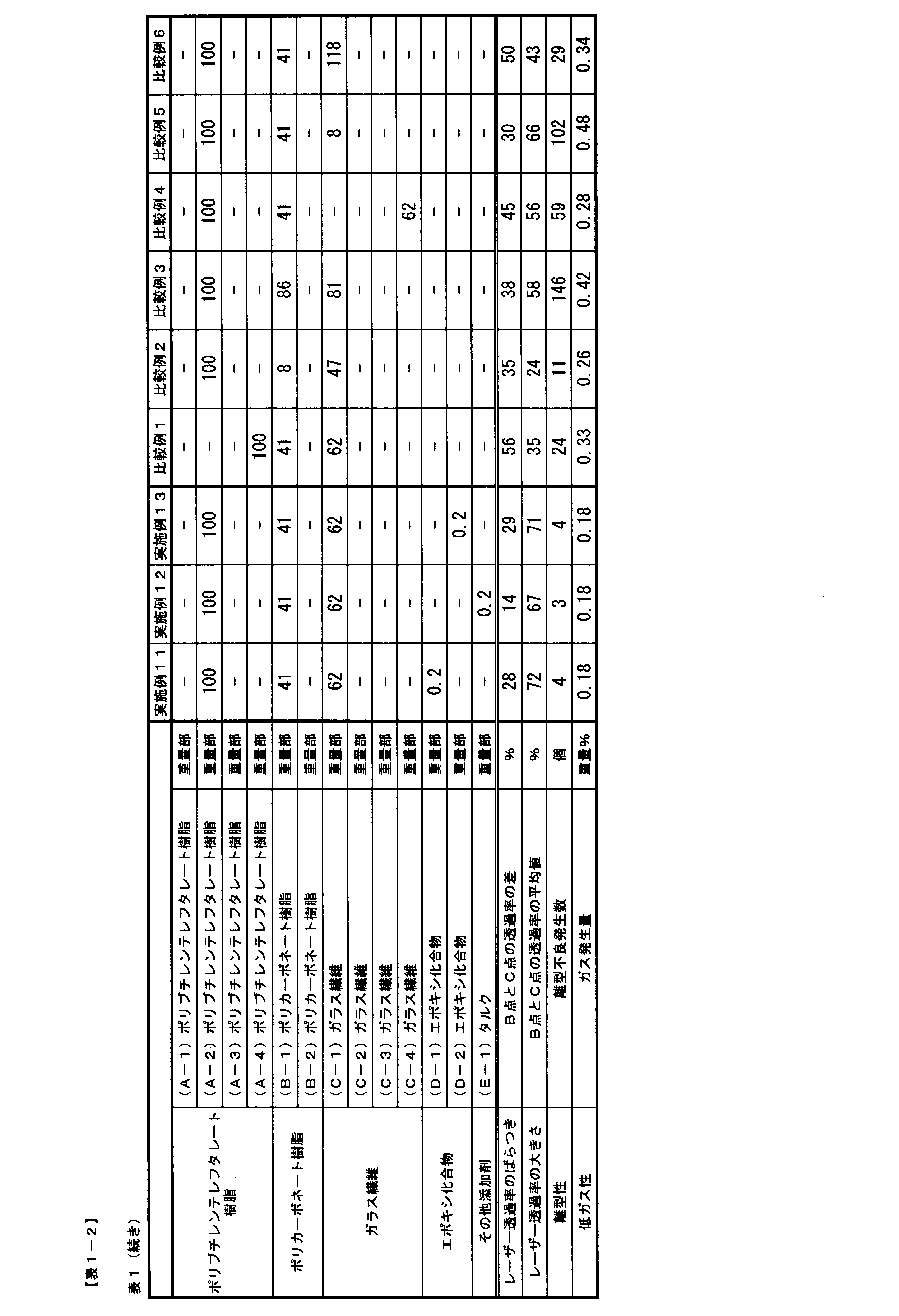
実施例1~3、9、10と比較例1、4の比較より、炭素数が10以上50以下の一価の脂肪族アルコールが、テレフタル酸100モル%に対して、0.1~2.0モル%化合したポリブチレンテレフタレート樹脂(A)を用い、ポリカーボネート樹脂(B)およびB2O3の含有率が15~25重量%であるガラス繊維(C)を特定量配合した熱可塑性樹脂組成物が、レーザー透過性に優れるとともに、離型性、低ガス性にも優れることがわかった。
実施例2、5、6と比較例2、3の比較より、(A)成分100重量部に対して(B)成分10~80重量部が配合された熱可塑性ポリエステル樹脂組成物は、レーザー透過性、離型性、低ガス性を高いバランスで得られることがわかった。
実施例2、7、8と比較例4~6の比較より、(A)成分100重量部に対して(C)成分10~100重量部が配合された熱可塑性ポリエステル樹脂組成物は、レーザー透過性、離型性、低ガス性を高いバランスで得られることがわかった。
また、実施例11および実施例13は、実施例2との対比において、さらに耐加水分解性の向上が認められた。
Claims (5)
- 炭素数が10以上50以下の一価の脂肪族アルコールが、テレフタル酸由来の構造単位100モル%に対して、0.1~2.0モル%化合したポリブチレンテレフタレート樹脂(A)100重量部、および、該ポリブチレンテレフタレート樹脂(A)100重量部に対して、ポリカーボネート樹脂(B)10~80重量部と、ガラス繊維の組成の全量に対して酸化物換算でB2O3の含有率が15~25重量%であるガラス繊維(C)10~100重量部とを配合してなる熱可塑性ポリエステル樹脂組成物。
- 前記ポリブチレンテレフタレート樹脂(A)100重量部に対し、さらにクレゾールノボラック型エポキシ樹脂、または、ジシクロペンタジエン型エポキシ樹脂であるエポキシ化合物(D)を0.1~5重量部配合してなる請求項1に記載の熱可塑性ポリエステル樹脂組成物。
- 前記ポリカーボネート樹脂(B)が、4-α-クミルフェノキシ基を分子末端に持つ構造を有していることを特徴とする請求項1または2に記載の熱可塑性ポリエステル樹脂組成物。
- 請求項1~3のいずれかに記載の熱可塑性ポリエステル樹脂組成物を溶融成形してなる成形品。
- レーザー溶着用成形品である、請求項4に記載の成形品。
Priority Applications (1)
| Application Number | Priority Date | Filing Date | Title |
|---|---|---|---|
| JP2023532678A JP7444336B1 (ja) | 2022-07-04 | 2023-05-26 | 熱可塑性ポリエステル樹脂組成物およびそれを用いた成形品 |
Applications Claiming Priority (2)
| Application Number | Priority Date | Filing Date | Title |
|---|---|---|---|
| JP2022-107531 | 2022-07-04 | ||
| JP2022107531 | 2022-07-04 |
Publications (1)
| Publication Number | Publication Date |
|---|---|
| WO2024009641A1 true WO2024009641A1 (ja) | 2024-01-11 |
Family
ID=89453091
Family Applications (1)
| Application Number | Title | Priority Date | Filing Date |
|---|---|---|---|
| PCT/JP2023/019638 Ceased WO2024009641A1 (ja) | 2022-07-04 | 2023-05-26 | 熱可塑性ポリエステル樹脂組成物およびそれを用いた成形品 |
Country Status (2)
| Country | Link |
|---|---|
| JP (1) | JP7444336B1 (ja) |
| WO (1) | WO2024009641A1 (ja) |
Citations (5)
| Publication number | Priority date | Publication date | Assignee | Title |
|---|---|---|---|---|
| JP2003292752A (ja) * | 2002-01-29 | 2003-10-15 | Toray Ind Inc | レーザ溶着用樹脂組成物およびそれを用いた複合成形体 |
| JP2018538402A (ja) * | 2015-12-08 | 2018-12-27 | サビック グローバル テクノロジーズ ベスローテン フェンノートシャップ | 半透明のレーザ溶着可能熱可塑性組成物、及びレーザ溶着製品 |
| WO2020235472A1 (ja) * | 2019-05-20 | 2020-11-26 | 三菱エンジニアリングプラスチックス株式会社 | ミリ波レーダー部材用熱可塑性樹脂組成物、成形体並びに樹脂組成物の製造方法 |
| WO2021020208A1 (ja) * | 2019-07-31 | 2021-02-04 | 東レ株式会社 | 熱可塑性ポリエステル樹脂、熱可塑ポリエステル樹脂組成物、および成形品 |
| WO2021125205A1 (ja) * | 2019-12-17 | 2021-06-24 | ポリプラスチックス株式会社 | レーザー溶着用成形品、レーザー溶着用成形品のレーザー透過率のばらつき抑制剤 |
-
2023
- 2023-05-26 WO PCT/JP2023/019638 patent/WO2024009641A1/ja not_active Ceased
- 2023-05-26 JP JP2023532678A patent/JP7444336B1/ja active Active
Patent Citations (5)
| Publication number | Priority date | Publication date | Assignee | Title |
|---|---|---|---|---|
| JP2003292752A (ja) * | 2002-01-29 | 2003-10-15 | Toray Ind Inc | レーザ溶着用樹脂組成物およびそれを用いた複合成形体 |
| JP2018538402A (ja) * | 2015-12-08 | 2018-12-27 | サビック グローバル テクノロジーズ ベスローテン フェンノートシャップ | 半透明のレーザ溶着可能熱可塑性組成物、及びレーザ溶着製品 |
| WO2020235472A1 (ja) * | 2019-05-20 | 2020-11-26 | 三菱エンジニアリングプラスチックス株式会社 | ミリ波レーダー部材用熱可塑性樹脂組成物、成形体並びに樹脂組成物の製造方法 |
| WO2021020208A1 (ja) * | 2019-07-31 | 2021-02-04 | 東レ株式会社 | 熱可塑性ポリエステル樹脂、熱可塑ポリエステル樹脂組成物、および成形品 |
| WO2021125205A1 (ja) * | 2019-12-17 | 2021-06-24 | ポリプラスチックス株式会社 | レーザー溶着用成形品、レーザー溶着用成形品のレーザー透過率のばらつき抑制剤 |
Also Published As
| Publication number | Publication date |
|---|---|
| JPWO2024009641A1 (ja) | 2024-01-11 |
| JP7444336B1 (ja) | 2024-03-06 |
Similar Documents
| Publication | Publication Date | Title |
|---|---|---|
| JP7548009B2 (ja) | 熱可塑性ポリエステル樹脂、熱可塑ポリエステル樹脂組成物、および成形品 | |
| US11584850B2 (en) | Liquid crystal polyester resin composition and molded body | |
| US11485851B2 (en) | Liquid crystal polyester resin composition and molded body | |
| CN116426096B (zh) | 毫米波雷达构件用热塑性树脂组合物、成形体、和树脂组合物的制造方法 | |
| JP2009019134A (ja) | レーザー溶着用ポリエステル樹脂組成物及びそれを用いた成形品 | |
| CN1239611C (zh) | 阻燃性聚酯树脂组合物、其成型品及其成型方法 | |
| JP7444336B1 (ja) | 熱可塑性ポリエステル樹脂組成物およびそれを用いた成形品 | |
| JP3650557B2 (ja) | 難燃性ポリエステル樹脂組成物、その成形品およびその製造方法 | |
| JP7401027B1 (ja) | ポリブチレンテレフタレート樹脂組成物および成形品 | |
| JP2009019135A (ja) | レーザー溶着用ポリエステル樹脂組成物及びそれを用いた成形品 | |
| JP2002128998A (ja) | 難燃性ポリエステル樹脂組成物 | |
| JP7347694B1 (ja) | 熱可塑性ポリエステル樹脂組成物、熱可塑性ポリエステル樹脂組成物の製造方法、および成形品 | |
| JP2022098607A (ja) | ポリエステル樹脂組成物および成形品 | |
| JP3334956B2 (ja) | ポリエステル樹脂組成物 | |
| JP2024042437A (ja) | 樹脂組成物、ペレット、および、成形品 | |
| JP2024003891A (ja) | ポリブチレンテレフタレート樹脂組成物および成形品、金属複合部品 | |
| TWI897587B (zh) | 熱塑性樹脂組成物、其製備方法以及包括其之模塑物 | |
| JP5223254B2 (ja) | レーザー溶着用ポリエステル樹脂組成物及びそれを用いた成形品 | |
| CN118434807A (zh) | 热塑性聚酯树脂组合物、热塑性聚酯树脂组合物的制造方法及成型品 | |
| JPH0212983B2 (ja) | ||
| JP3334955B2 (ja) | ポリエステル樹脂組成物 | |
| KR830000973B1 (ko) | 폴리 에스테르 조성물 | |
| JP2025025568A (ja) | 樹脂組成物、ペレット、および、成形品 | |
| JPH06172625A (ja) | 難燃性成形用ポリエステル樹脂組成物 | |
| JP2021006599A (ja) | 末端変性熱可塑性ポリエステル樹脂および成形品 |
Legal Events
| Date | Code | Title | Description |
|---|---|---|---|
| WWE | Wipo information: entry into national phase |
Ref document number: 2023532678 Country of ref document: JP |
|
| 121 | Ep: the epo has been informed by wipo that ep was designated in this application |
Ref document number: 23835177 Country of ref document: EP Kind code of ref document: A1 |
|
| NENP | Non-entry into the national phase |
Ref country code: DE |
|
| 122 | Ep: pct application non-entry in european phase |
Ref document number: 23835177 Country of ref document: EP Kind code of ref document: A1 |