WO2023282174A1 - 硬化性組成物及び硬化物 - Google Patents
硬化性組成物及び硬化物 Download PDFInfo
- Publication number
- WO2023282174A1 WO2023282174A1 PCT/JP2022/026246 JP2022026246W WO2023282174A1 WO 2023282174 A1 WO2023282174 A1 WO 2023282174A1 JP 2022026246 W JP2022026246 W JP 2022026246W WO 2023282174 A1 WO2023282174 A1 WO 2023282174A1
- Authority
- WO
- WIPO (PCT)
- Prior art keywords
- meth
- curable composition
- group
- acrylate
- mass
- Prior art date
- Legal status (The legal status is an assumption and is not a legal conclusion. Google has not performed a legal analysis and makes no representation as to the accuracy of the status listed.)
- Ceased
Links
Classifications
-
- C—CHEMISTRY; METALLURGY
- C08—ORGANIC MACROMOLECULAR COMPOUNDS; THEIR PREPARATION OR CHEMICAL WORKING-UP; COMPOSITIONS BASED THEREON
- C08F—MACROMOLECULAR COMPOUNDS OBTAINED BY REACTIONS ONLY INVOLVING CARBON-TO-CARBON UNSATURATED BONDS
- C08F122/00—Homopolymers of compounds having one or more unsaturated aliphatic radicals each having only one carbon-to-carbon double bond, and at least one being terminated by a carboxyl radical and containing at least one other carboxyl radical in the molecule; Salts, anhydrides, esters, amides, imides or nitriles thereof
- C08F122/10—Esters
- C08F122/12—Esters of phenols or saturated alcohols
- C08F122/14—Esters having no free carboxylic acid groups
-
- C—CHEMISTRY; METALLURGY
- C08—ORGANIC MACROMOLECULAR COMPOUNDS; THEIR PREPARATION OR CHEMICAL WORKING-UP; COMPOSITIONS BASED THEREON
- C08F—MACROMOLECULAR COMPOUNDS OBTAINED BY REACTIONS ONLY INVOLVING CARBON-TO-CARBON UNSATURATED BONDS
- C08F2/00—Processes of polymerisation
- C08F2/12—Polymerisation in non-solvents
- C08F2/16—Aqueous medium
- C08F2/22—Emulsion polymerisation
- C08F2/24—Emulsion polymerisation with the aid of emulsifying agents
-
- C—CHEMISTRY; METALLURGY
- C08—ORGANIC MACROMOLECULAR COMPOUNDS; THEIR PREPARATION OR CHEMICAL WORKING-UP; COMPOSITIONS BASED THEREON
- C08F—MACROMOLECULAR COMPOUNDS OBTAINED BY REACTIONS ONLY INVOLVING CARBON-TO-CARBON UNSATURATED BONDS
- C08F120/00—Homopolymers of compounds having one or more unsaturated aliphatic radicals, each having only one carbon-to-carbon double bond, and only one being terminated by only one carboxyl radical or a salt, anhydride, ester, amide, imide or nitrile thereof
- C08F120/02—Monocarboxylic acids having less than ten carbon atoms; Derivatives thereof
- C08F120/10—Esters
- C08F120/12—Esters of monohydric alcohols or phenols
- C08F120/16—Esters of monohydric alcohols or phenols of phenols or of alcohols containing two or more carbon atoms
- C08F120/18—Esters of monohydric alcohols or phenols of phenols or of alcohols containing two or more carbon atoms with acrylic or methacrylic acids
-
- C—CHEMISTRY; METALLURGY
- C08—ORGANIC MACROMOLECULAR COMPOUNDS; THEIR PREPARATION OR CHEMICAL WORKING-UP; COMPOSITIONS BASED THEREON
- C08F—MACROMOLECULAR COMPOUNDS OBTAINED BY REACTIONS ONLY INVOLVING CARBON-TO-CARBON UNSATURATED BONDS
- C08F120/00—Homopolymers of compounds having one or more unsaturated aliphatic radicals, each having only one carbon-to-carbon double bond, and only one being terminated by only one carboxyl radical or a salt, anhydride, ester, amide, imide or nitrile thereof
- C08F120/62—Monocarboxylic acids having ten or more carbon atoms; Derivatives thereof
- C08F120/68—Esters
-
- C—CHEMISTRY; METALLURGY
- C08—ORGANIC MACROMOLECULAR COMPOUNDS; THEIR PREPARATION OR CHEMICAL WORKING-UP; COMPOSITIONS BASED THEREON
- C08F—MACROMOLECULAR COMPOUNDS OBTAINED BY REACTIONS ONLY INVOLVING CARBON-TO-CARBON UNSATURATED BONDS
- C08F122/00—Homopolymers of compounds having one or more unsaturated aliphatic radicals each having only one carbon-to-carbon double bond, and at least one being terminated by a carboxyl radical and containing at least one other carboxyl radical in the molecule; Salts, anhydrides, esters, amides, imides or nitriles thereof
- C08F122/10—Esters
- C08F122/1006—Esters of polyhydric alcohols or polyhydric phenols, e.g. ethylene glycol dimethacrylate
-
- C—CHEMISTRY; METALLURGY
- C08—ORGANIC MACROMOLECULAR COMPOUNDS; THEIR PREPARATION OR CHEMICAL WORKING-UP; COMPOSITIONS BASED THEREON
- C08F—MACROMOLECULAR COMPOUNDS OBTAINED BY REACTIONS ONLY INVOLVING CARBON-TO-CARBON UNSATURATED BONDS
- C08F2/00—Processes of polymerisation
- C08F2/44—Polymerisation in the presence of compounding ingredients, e.g. plasticisers, dyestuffs, fillers
-
- C—CHEMISTRY; METALLURGY
- C08—ORGANIC MACROMOLECULAR COMPOUNDS; THEIR PREPARATION OR CHEMICAL WORKING-UP; COMPOSITIONS BASED THEREON
- C08F—MACROMOLECULAR COMPOUNDS OBTAINED BY REACTIONS ONLY INVOLVING CARBON-TO-CARBON UNSATURATED BONDS
- C08F220/00—Copolymers of compounds having one or more unsaturated aliphatic radicals, each having only one carbon-to-carbon double bond, and only one being terminated by only one carboxyl radical or a salt, anhydride ester, amide, imide or nitrile thereof
- C08F220/02—Monocarboxylic acids having less than ten carbon atoms; Derivatives thereof
- C08F220/10—Esters
- C08F220/12—Esters of monohydric alcohols or phenols
- C08F220/16—Esters of monohydric alcohols or phenols of phenols or of alcohols containing two or more carbon atoms
- C08F220/18—Esters of monohydric alcohols or phenols of phenols or of alcohols containing two or more carbon atoms with acrylic or methacrylic acids
- C08F220/1811—C10or C11-(Meth)acrylate, e.g. isodecyl (meth)acrylate, isobornyl (meth)acrylate or 2-naphthyl (meth)acrylate
-
- C—CHEMISTRY; METALLURGY
- C08—ORGANIC MACROMOLECULAR COMPOUNDS; THEIR PREPARATION OR CHEMICAL WORKING-UP; COMPOSITIONS BASED THEREON
- C08F—MACROMOLECULAR COMPOUNDS OBTAINED BY REACTIONS ONLY INVOLVING CARBON-TO-CARBON UNSATURATED BONDS
- C08F222/00—Copolymers of compounds having one or more unsaturated aliphatic radicals, each having only one carbon-to-carbon double bond, and at least one being terminated by a carboxyl radical and containing at least one other carboxyl radical in the molecule; Salts, anhydrides, esters, amides, imides, or nitriles thereof
- C08F222/10—Esters
- C08F222/1006—Esters of polyhydric alcohols or polyhydric phenols
-
- C—CHEMISTRY; METALLURGY
- C08—ORGANIC MACROMOLECULAR COMPOUNDS; THEIR PREPARATION OR CHEMICAL WORKING-UP; COMPOSITIONS BASED THEREON
- C08F—MACROMOLECULAR COMPOUNDS OBTAINED BY REACTIONS ONLY INVOLVING CARBON-TO-CARBON UNSATURATED BONDS
- C08F222/00—Copolymers of compounds having one or more unsaturated aliphatic radicals, each having only one carbon-to-carbon double bond, and at least one being terminated by a carboxyl radical and containing at least one other carboxyl radical in the molecule; Salts, anhydrides, esters, amides, imides, or nitriles thereof
- C08F222/10—Esters
- C08F222/1006—Esters of polyhydric alcohols or polyhydric phenols
- C08F222/102—Esters of polyhydric alcohols or polyhydric phenols of dialcohols, e.g. ethylene glycol di(meth)acrylate or 1,4-butanediol dimethacrylate
-
- C—CHEMISTRY; METALLURGY
- C08—ORGANIC MACROMOLECULAR COMPOUNDS; THEIR PREPARATION OR CHEMICAL WORKING-UP; COMPOSITIONS BASED THEREON
- C08F—MACROMOLECULAR COMPOUNDS OBTAINED BY REACTIONS ONLY INVOLVING CARBON-TO-CARBON UNSATURATED BONDS
- C08F222/00—Copolymers of compounds having one or more unsaturated aliphatic radicals, each having only one carbon-to-carbon double bond, and at least one being terminated by a carboxyl radical and containing at least one other carboxyl radical in the molecule; Salts, anhydrides, esters, amides, imides, or nitriles thereof
- C08F222/10—Esters
- C08F222/1006—Esters of polyhydric alcohols or polyhydric phenols
- C08F222/103—Esters of polyhydric alcohols or polyhydric phenols of trialcohols, e.g. trimethylolpropane tri(meth)acrylate
-
- C—CHEMISTRY; METALLURGY
- C08—ORGANIC MACROMOLECULAR COMPOUNDS; THEIR PREPARATION OR CHEMICAL WORKING-UP; COMPOSITIONS BASED THEREON
- C08K—Use of inorganic or non-macromolecular organic substances as compounding ingredients
- C08K5/00—Use of organic ingredients
- C08K5/0091—Complexes with metal-heteroatom-bonds
-
- C—CHEMISTRY; METALLURGY
- C08—ORGANIC MACROMOLECULAR COMPOUNDS; THEIR PREPARATION OR CHEMICAL WORKING-UP; COMPOSITIONS BASED THEREON
- C08K—Use of inorganic or non-macromolecular organic substances as compounding ingredients
- C08K5/00—Use of organic ingredients
- C08K5/54—Silicon-containing compounds
- C08K5/541—Silicon-containing compounds containing oxygen
- C08K5/5415—Silicon-containing compounds containing oxygen containing at least one Si—O bond
-
- C—CHEMISTRY; METALLURGY
- C08—ORGANIC MACROMOLECULAR COMPOUNDS; THEIR PREPARATION OR CHEMICAL WORKING-UP; COMPOSITIONS BASED THEREON
- C08K—Use of inorganic or non-macromolecular organic substances as compounding ingredients
- C08K9/00—Use of pretreated ingredients
- C08K9/08—Ingredients agglomerated by treatment with a binding agent
-
- C—CHEMISTRY; METALLURGY
- C08—ORGANIC MACROMOLECULAR COMPOUNDS; THEIR PREPARATION OR CHEMICAL WORKING-UP; COMPOSITIONS BASED THEREON
- C08L—COMPOSITIONS OF MACROMOLECULAR COMPOUNDS
- C08L101/00—Compositions of unspecified macromolecular compounds
-
- C—CHEMISTRY; METALLURGY
- C08—ORGANIC MACROMOLECULAR COMPOUNDS; THEIR PREPARATION OR CHEMICAL WORKING-UP; COMPOSITIONS BASED THEREON
- C08L—COMPOSITIONS OF MACROMOLECULAR COMPOUNDS
- C08L35/00—Compositions of homopolymers or copolymers of compounds having one or more unsaturated aliphatic radicals, each having only one carbon-to-carbon double bond, and at least one being terminated by a carboxyl radical, and containing at least one other carboxyl radical in the molecule, or of salts, anhydrides, esters, amides, imides or nitriles thereof; Compositions of derivatives of such polymers
-
- C—CHEMISTRY; METALLURGY
- C08—ORGANIC MACROMOLECULAR COMPOUNDS; THEIR PREPARATION OR CHEMICAL WORKING-UP; COMPOSITIONS BASED THEREON
- C08F—MACROMOLECULAR COMPOUNDS OBTAINED BY REACTIONS ONLY INVOLVING CARBON-TO-CARBON UNSATURATED BONDS
- C08F2/00—Processes of polymerisation
- C08F2/12—Polymerisation in non-solvents
- C08F2/16—Aqueous medium
- C08F2/22—Emulsion polymerisation
- C08F2/24—Emulsion polymerisation with the aid of emulsifying agents
- C08F2/30—Emulsion polymerisation with the aid of emulsifying agents non-ionic
-
- C—CHEMISTRY; METALLURGY
- C08—ORGANIC MACROMOLECULAR COMPOUNDS; THEIR PREPARATION OR CHEMICAL WORKING-UP; COMPOSITIONS BASED THEREON
- C08K—Use of inorganic or non-macromolecular organic substances as compounding ingredients
- C08K2201/00—Specific properties of additives
- C08K2201/013—Additives applied to the surface of polymers or polymer particles
-
- C—CHEMISTRY; METALLURGY
- C08—ORGANIC MACROMOLECULAR COMPOUNDS; THEIR PREPARATION OR CHEMICAL WORKING-UP; COMPOSITIONS BASED THEREON
- C08K—Use of inorganic or non-macromolecular organic substances as compounding ingredients
- C08K5/00—Use of organic ingredients
- C08K5/54—Silicon-containing compounds
- C08K5/541—Silicon-containing compounds containing oxygen
- C08K5/5415—Silicon-containing compounds containing oxygen containing at least one Si—O bond
- C08K5/5419—Silicon-containing compounds containing oxygen containing at least one Si—O bond containing at least one Si—C bond
-
- C—CHEMISTRY; METALLURGY
- C08—ORGANIC MACROMOLECULAR COMPOUNDS; THEIR PREPARATION OR CHEMICAL WORKING-UP; COMPOSITIONS BASED THEREON
- C08K—Use of inorganic or non-macromolecular organic substances as compounding ingredients
- C08K5/00—Use of organic ingredients
- C08K5/55—Boron-containing compounds
-
- C—CHEMISTRY; METALLURGY
- C08—ORGANIC MACROMOLECULAR COMPOUNDS; THEIR PREPARATION OR CHEMICAL WORKING-UP; COMPOSITIONS BASED THEREON
- C08K—Use of inorganic or non-macromolecular organic substances as compounding ingredients
- C08K9/00—Use of pretreated ingredients
- C08K9/04—Ingredients treated with organic substances
-
- C—CHEMISTRY; METALLURGY
- C08—ORGANIC MACROMOLECULAR COMPOUNDS; THEIR PREPARATION OR CHEMICAL WORKING-UP; COMPOSITIONS BASED THEREON
- C08L—COMPOSITIONS OF MACROMOLECULAR COMPOUNDS
- C08L2205/00—Polymer mixtures characterised by other features
- C08L2205/22—Mixtures comprising a continuous polymer matrix in which are dispersed crosslinked particles of another polymer
Definitions
- the present invention relates to curable compositions and cured products.
- curable compositions containing polymerizable monomers have been widely used, for example, in applications such as paints or adhesives, and the resulting cured products have excellent properties such as scratch resistance, adhesion, and weather resistance.
- a curable composition for example, a thermosetting composition containing a cationic curing component, a specific ammonium salt, and a radical generator has been proposed. It is disclosed that a peroxide is used to generate an acid, and that the acid cures a cationic curing component such as an epoxy resin (see, for example, Patent Document 1).
- an adhesive composition containing a cationic polymerizable compound, an aluminum chelate-silanol curing catalyst, and an episulfide compound has been proposed.
- the aluminum chelate-silanol curing catalyst is a cation as an active species. It is disclosed that a species and an anion species work together to cationic polymerize a cationically polymerizable compound (see, for example, Patent Document 2).
- JP 2016-166306 A Japanese Patent Application Laid-Open No. 2021-4363
- the object of the present invention is to solve the above-mentioned problems in the past and to achieve the following objects. That is, the present invention relates to a curable composition excellent in curability by heating and a cured product using the same.
- a curable composition comprising a polymerizable monomer, an aluminum chelate compound, a silanol compound, and a quaternary boron onium salt.
- the polymerizable monomer is a radically polymerizable monomer having a carbon-carbon double bond in its molecule.
- the polymerizable monomer is (meth)acrylate.
- the aluminum chelate compound is held in porous particles.
- ⁇ 5> The curable composition according to ⁇ 4>, wherein the porous particles are composed of a polyurea resin.
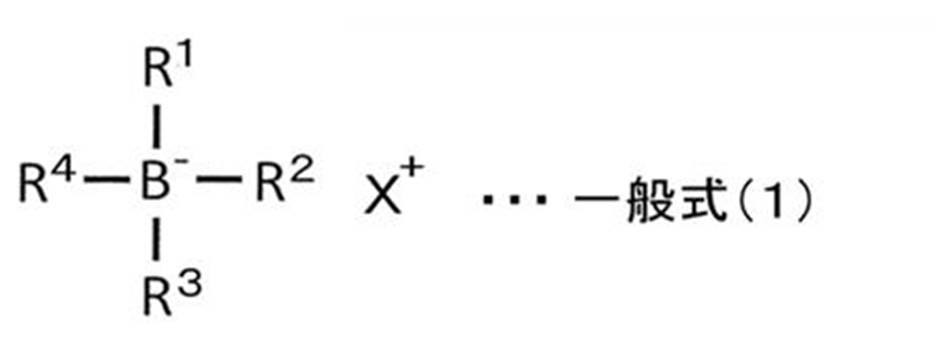
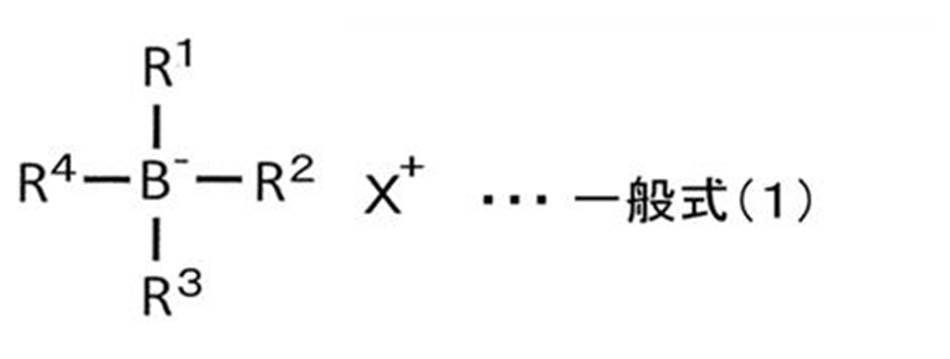
- ⁇ 6> The curable composition according to any one of ⁇ 1> to ⁇ 5>, wherein the quaternary boron onium salt is represented by the following general formula (1).
- R 1 to R 4 is an optionally substituted phenyl group or naphthyl group, and the rest are optionally substituted alkyl group, or a phenyl group or naphthyl group optionally having a substituent.
- X + denotes an ammonium cation, a sulfonium cation, a pyridinium cation, a phosphonium cation, an oxonium cation or an iodonium cation.
- ⁇ 7> The curable composition according to any one of ⁇ 1> to ⁇ 6>, wherein the silanol compound is an arylsilanol compound represented by the following general formula (6). However, in said general formula (6), m is 2 or 3, and the sum of m and n is 4.
- Ar is an aryl group optionally having a substituent.
- ⁇ 8> The curable composition according to any one of ⁇ 1> to ⁇ 7>, wherein the content of the polymerizable monomer is 80% by mass or more and 97% by mass or less.
- ⁇ 9> The curable composition according to any one of ⁇ 1> to ⁇ 8>, wherein the content of the aluminum chelate compound is 0.1% by mass or more and 10% by mass or less.
- ⁇ 10> The curable composition according to any one of ⁇ 1> to ⁇ 9>, wherein the content of the silanol compound is 0.1% by mass or more and 10% by mass or less.
- ⁇ 11> The curable composition according to any one of ⁇ 1> to ⁇ 10>, wherein the content of the quaternary boron onium salt is 0.1% by mass or more and 5% by mass or less.
- ⁇ 12> A cured product obtained by curing the curable composition according to any one of ⁇ 1> to ⁇ 11> by heating.
- the curable composition of the present invention contains a polymerizable monomer, an aluminum chelate compound, a silanol compound, and a quaternary boron onium salt, and optionally other components.
- heating causes the aluminum chelate compound and the silanol compound to react to generate an acid.
- the generated acid reacts with the quaternary boron onium salt, whereby the phenyl group or naphthyl group bonded to B + of the quaternary boron onium salt is removed to generate a radical.
- the generated radicals polymerize the polymerizable monomer to form a polymer, which improves the curability by heating. It is possible to solve the problem of being defective or difficult to cure.
- porous particles holding an aluminum chelate compound instead of the aluminum chelate compound, the curable composition does not react instantaneously, and a good pot life can be maintained.
- the polymerizable monomer is not particularly limited and can be appropriately selected depending on the intended purpose, but a radically polymerizable monomer having a carbon-carbon double bond in the molecule is preferred.
- a radically polymerizable monomer a monofunctional radically polymerizable monomer, a polyfunctional radically polymerizable monomer, or a combination thereof is used.
- examples of such radically polymerizable monomers include (meth)acrylates, styrene-based monomers, vinyl ethers, vinylamides, maleimide-based monomers, and the like. Among these, (meth)acrylates are particularly preferred.
- a monofunctional (meth)acrylic monomer or a polyfunctional (meth)acrylic monomer is used as the (meth)acrylate.
- Examples of the monofunctional (meth)acrylic monomer include (meth)acrylic acid or a (meth)acrylic monomer having one (meth)acrylic group.
- Examples include phenoxyethyl (meth)acrylate, tetrahydrofurfuryl ( meth)acrylate, 2-hydroxyethyl (meth)acrylate, 4-hydroxybutyl (meth)acrylate, isobutyl (meth)acrylate, t-butyl (meth)acrylate, isooctyl (meth)acrylate, 2-methoxyethyl (meth)acrylate , methoxytriethylene glycol (meth) acrylate, 2-ethoxyethyl (meth) acrylate, 3-methoxybutyl (meth) acrylate, ethoxyethyl (meth) acrylate, butoxyethyl (meth) acrylate, ethoxy-diethylene glycol (meth) acrylate, Methoxydixylethyl (meth)acrylate, ethyl diglycol (meth)acrylate, cyclic trimethylolpropane formal mono(meth
- polyfunctional (meth)acrylic monomers include (meth)acrylic monomers having two (meth)acrylic groups, trifunctional (meth)acrylic monomers, and the like.
- di(meth)acrylic monomer having two (meth)acrylic groups include 1,3-butylene glycol di(meth)acrylate, 1,4-butanediol di(meth)acrylate, diethylene glycol di(meth) Acrylates, 1,6-hexanediol di(meth)acrylate, polyethylene glycol (200) di(meth)acrylate, tetraethylene glycol di(meth)acrylate, triethylene glycol di(meth)acrylate, tripropylene glycol di(meth) Acrylates, polyethylene glycol (400) di(meth)acrylate, ethoxylated (3) bisphenol A di(meth)acrylate, dipropylene glycol di(meth)acrylate, alkoxylated hexanediol di(me)
- trifunctional or higher (meth)acrylic monomer examples include, for example, trimethylolpropane tri(meth)acrylate, trimethylolpropane hydroxypivalate tri(meth)acrylate, ethoxylated phosphoric acid tri(meth)acrylate, pentaerythritol tri( meth)acrylate, tetramethylolpropane tri(meth)acrylate, tetramethylolmethane tri(meth)acrylate, pentaerythritol tetra(meth)acrylate, caprolactone-modified trimethylolpropane tri(meth)acrylate, propoxylate glyceryl tri(meth)acrylate, Tetramethylolmethane tetra(meth)acrylate, pentaerythritol tetra(meth)acrylate, ditrimethylolpropane tetra(meth)acrylate, ethoxylated pentaerythri
- styrene-based monomer a monofunctional styrene-based monomer or a polyfunctional styrene-based monomer is used.
- monofunctional styrene monomer include styrene derivatives substituted with groups that do not participate in radical reactions.
- Examples include styrene; halogen-substituted styrenes such as p-chlorostyrene and p-bromostyrene; alkyl-substituted styrenes such as 4-methylstyrene and 4-ethylstyrene; alkoxy-substituted styrenes such as p-methoxystyrene (alkyl , the carbon number of alkoxy is preferably 1 to 12, more preferably 1 to 4); styrene-polyoxyalkylene adducts such as vinylbenzyl- ⁇ -methylpolyoxyethylene oxide; hydroxyl group substitution such as hydroxystyrene styrene and the like. These may be used individually by 1 type, and may use 2 or more types together.
- polyfunctional styrene monomer examples include vinyl group-substituted styrenes such as 1,3-divinylbenzene and 1,4-divinylbenzene.
- -vinyl ether- A monofunctional vinyl ether or a polyfunctional vinyl ether is used as the vinyl ether.
- the monofunctional vinyl ether include methyl vinyl ether, ethyl vinyl ether, trifluoroethyl vinyl ether, n-propyl vinyl ether, isopropyl vinyl ether, n-butyl vinyl ether, isobutyl vinyl ether, t-butyl vinyl ether, 2-methoxyethyl vinyl ether, and diethylene glycol ethyl.
- linear vinyl ethers such as vinyl ethers; aliphatic ring-containing vinyl ethers such as cyclohexyl vinyl ether and 2-(vinyloxy)tetrahydropyran; aromatic ring-containing vinyl ethers such as phenyl vinyl ether, benzyl vinyl ether and 4-methoxybenzyl vinyl ether. These may be used individually by 1 type, and may use 2 or more types together.
- polyfunctional vinyl ether examples include diethylene glycol divinyl ether, divinyl ether, 1,4-butanediol divinyl ether, 1,6-hexanediol divinyl ether, triethylene glycol divinyl ether, bis(vinyloxybutyl) succinate, and the like.
- monofunctional vinylamides that are monofunctional radically polymerizable monomers include linear vinylamides such as N-vinylformamide, N-vinylacetamide, N-methyl-N-vinylformamide and N-methyl-N-vinylacetamide. and aliphatic ring-containing vinylamides such as N-vinylpyrrolidone, N-vinyl- ⁇ -caprolactam and 5-methyl-3-vinyloxazolidin-2-one. These may be used individually by 1 type, and may use 2 or more types together.
- maleimide-based monomer a monofunctional maleimide-based monomer having one maleimide group or a polyfunctional maleimide-based monomer having two or more maleimide groups is used.
- monofunctional maleimide-based monomers include, for example, maleimides; aromatic ring-containing maleimide such as maleimide; These may be used individually by 1 type, and may use 2 or more types together.
- polyfunctional maleimide-based monomer examples include aliphatic Aromatic ring-containing such as hydrocarbon group-containing maleimide, N,N'-m-phenylenebismaleimide, N,N'-p-phenylenebismaleimide, 1,1'-(methylenedi-4,4'-phenylene)bismaleimide maleimide and the like. These may be used individually by 1 type, and may use 2 or more types together.
- polymerizable monomers include fluorine-containing vinyl monomers such as perfluoroethylene, perfluoropropylene and vinylidene fluoride; silicon-containing vinyl monomers such as vinyltrimethoxysilane and vinyltriethoxysilane; maleic anhydride, maleic acid and maleic acid; mono- and di-alkyl esters such as mono- and di-alkyl esters of acids; fumaric acid and mono- and dialkyl esters of fumaric acid; nitrile-containing vinyl monomers such as acrylonitrile, methacrylonitrile; vinyl esters such as vinyl acetate, propion Amide-containing vinyl monomers such as vinyl acid, vinyl pivalate, vinyl benzoate and vinyl cinnamate; alkenes such as ethylene and propylene; vinyl chloride, vinylidene chloride, allyl chloride and allyl alcohol. These may be used individually by 1 type, and may use 2 or more types together.
- the content of the polymerizable monomer is preferably 80% by mass or more and 97% by mass or less, more preferably 85% by mass or more and 95% by mass or less, relative to the total amount of the curable composition.
- the quaternary boron onium salt is composed of an organic boron anion and a cation represented by the following general formula (1).
- R 1 to R 4 is an optionally substituted phenyl group or naphthyl group, and the rest are optionally substituted alkyl group, or a phenyl group or naphthyl group optionally having a substituent.
- X + represents an ammonium cation, a sulfonium cation, a pyridinium cation, a phosphonium cation, an oxonium cation, or an iodonium cation.
- the alkyl group preferably has 1 to 18 carbon atoms, and examples thereof include methyl group, ethyl group, propyl group, isopropyl group, butyl group, isobutyl group, sec-butyl group, tert-butyl group, pentyl group, Examples include hexyl group, octyl group, decyl group, stearyl group and the like.
- An alkyl group, a phenyl group, or a naphthyl group may be substituted with, for example, a halogen atom, a cyano group, an acyloxy group, an acyl group, an alkoxy group, or a hydroxy group.
- organic boron anions examples include triarylmonoalkyl boron anions.
- Triarylmonoalkylboron compounds include, for example, triphenylmethylborate, triphenylethylborate, triphenylpropylborate, triphenylisopropylborate, triphenylbutylborate, triphenylisobutylborate, triphenyl-sec-butylborate, tri Phenyl-tert-butylborate, Tris(p-tolyl)butylborate, Trimesitylbutylborate, Tris(p-anisyl)butylborate, Tris(2,4,5-trifluorophenyl)butylborate, Tris(pentafluorophenyl ) butyl borate and the like. These may be used individually by 1 type, and may use 2 or more types together.
- the X + represents an ammonium cation, a sulfonium cation, a pyridinium cation, a phosphonium cation, an oxonium cation, or an iodonium cation.
- substituent of the cation there is no structural specification for the substituent of the cation, and examples thereof include an alkyl group, an alkoxy group, and a phenyl group.
- Each of the ammonium cation, sulfonium cation, pyridinium cation, phosphonium cation, oxonium cation, and iodonium cation may have a substituent or may be linked to form a ring.
- ammonium cation examples include tetramethylammonium, tetraethylammonium, tetrapropylammonium, tetraisopropylammonium, tetrabutylammonium, tetra-sec-butylammonium, tetra-tert-butylammonium, tetrapentylammonium, tetraisopentylammonium, Alkyl group-containing ammonium cations such as tetraneopentylammonium and tetra-tert-pentylammonium; , tripentylhydrogenammonium and other hydrogen-containing ammonium cations; Benzyl group-containing ammonium cations such as ammonium and phenyltripentylammonium; vinyl group-containing ammonium cations such as trimethylvinylammonium, triethylvinylammonium, tripropylviny
- sulfonium cation examples include trimethylsulfonium cation, triphenylsulfonium cation, diphenyl[4-(phenylthio)phenyl]sulfonium cation, and the like. These may be used individually by 1 type, and may use 2 or more types together.
- pyridinium cations examples include methylpyridinium cations and phenylpyridinium cations. These may be used individually by 1 type, and may use 2 or more types together.
- Examples of the phosphonium cation include tetramethylphosphonium cation, tetraethylphosphonium cation, tetra-n-propylphosphonium cation, tetra-n-butylphosphonium cation, and tetraphenylphosphonium cation. These may be used individually by 1 type, and may use 2 or more types together.
- oxonium cations examples include trimethyloxonium cations and phenyldimethyloxonium cations. These may be used individually by 1 type, and may use 2 or more types together.
- iodonium cations examples include diphenyliodonium cations, 4-isopropyl-4'-methyldiphenyliodonium cations, bis(4-t-butylphenyl)iodonium cations, and diphenyleneiodonium cations. These may be used individually by 1 type, and may use 2 or more types together.
- quaternary boron onium salt an appropriately synthesized one may be used, or a commercially available product may be used.
- the commercially available products include P3B and N3B (both manufactured by Showa Denko KK) and tetraphenylphosphonium tetraphenylborate (manufactured by Tokyo Chemical Industry Co., Ltd.).
- the content of the quaternary boron onium salt is preferably 0.1% by mass or more and 5% by mass or less, more preferably 1% by mass or more and 5% by mass or less, relative to the total amount of the curable composition.
- Alkoxy group is not directly bonded to aluminum. This is because direct bonding is likely to hydrolyze and is not suitable for emulsification.
- R 1 , R 2 and R 3 each independently represent an alkyl group or an alkoxy group.
- the alkyl group include a methyl group and an ethyl group.
- the alkoxy group include a methoxy group, an ethoxy group and an oleyloxy group.
- Examples of the complex compound represented by the general formula (2) include aluminum tris(acetylacetonate), aluminum tris(ethylacetoacetate), aluminum monoacetylacetonate bis(ethylacetoacetate), and aluminum monoacetylacetonate. bis(oleylacetoacetate) and the like.
- the content of the aluminum chelate compound is preferably 0.1% by mass or more and 10% by mass or less, more preferably 1% by mass or more and 5% by mass or less, relative to the total amount of the curable composition.
- the aluminum chelate compound is preferably retained in porous particles (porous particles retaining the aluminum chelate compound) in order to maintain a good pot life.
- the porous particles are composed of polyurea resin.
- the porous particles hold the aluminum chelate compound in their pores, for example.
- the aluminum chelate compound is taken in and held in fine pores present in the porous particle matrix composed of the polyurea resin.
- the polyurea resin is a resin having a urea bond therein.
- the polyurea resin constituting the porous particles can be obtained, for example, by polymerizing a polyfunctional isocyanate compound in an emulsion. The details will be described later.
- the polyurea resin may have a bond derived from an isocyanate group other than the urea bond, such as a urethane bond, in the resin.
- it when it contains a urethane bond, it may be referred to as a polyureaurethane resin.
- the content of the aluminum chelate compound in the porous particles is not particularly limited, and can be appropriately selected according to the purpose.
- the average pore diameter of the pores of the porous particles is not particularly limited, and can be appropriately selected according to the purpose.
- the content of the porous particles holding the aluminum chelate compound is preferably 0.1% by mass or more and 10% by mass or less, more preferably 1% by mass or more and 5% by mass or less, relative to the total amount of the curable composition.
- the method for producing the porous particles holding the aluminum compound includes a porous particle preparation step, a coating step, and, if necessary, other steps.
- the porous particle-producing step includes at least an emulsified solution-producing process and a polymerization process, preferably an additional filling process, and, if necessary, other processes.
- Emulsion preparation process is not particularly limited as long as it is a process to obtain an emulsion by emulsifying a liquid obtained by mixing an aluminum chelate compound, a polyfunctional isocyanate compound, and preferably an organic solvent. can be appropriately selected depending on the conditions, and can be performed, for example, using a homogenizer.
- the size of the oil droplets in the emulsified liquid is not particularly limited and can be appropriately selected according to the purpose, but is preferably 0.5 ⁇ m or more and 100 ⁇ m or less.
- the polyfunctional isocyanate compound is a compound having two or more isocyanate groups, preferably three isocyanate groups, in one molecule. More preferred examples of such a trifunctional isocyanate compound include a TMP adduct of the following general formula (3) obtained by reacting 1 mol of trimethylolpropane with 3 mol of a diisocyanate compound; Examples include the isocyanurate compound of formula (4) and the biuret compound of the following general formula (5), which is obtained by condensing 2 mol of diisocyanate urea obtained from 3 mol of the diisocyanate compound with the remaining 1 mol of diisocyanate.
- the substituent R is the portion of the diisocyanate compound excluding the isocyanate group.
- diisocyanate compounds include toluene 2,4-diisocyanate, toluene 2,6-diisocyanate, m-xylylene diisocyanate, hexamethylene diisocyanate, hexahydro-m-xylylene diisocyanate, isophorone diisocyanate, methylene diphenyl-4 , 4′-diisocyanate, and the like.
- the mixing ratio of the aluminum chelate compound and the polyfunctional isocyanate compound is not particularly limited and can be appropriately selected according to the purpose. If the amount is too high, the latent curing agent obtained will have a lower curability.
- the aluminum chelate is preferably 10 parts by mass or more and 500 parts by mass or less, more preferably 10 parts by mass or more and 300 parts by mass or less, relative to 100 parts by mass of the polyfunctional isocyanate compound.
- the organic solvent is not particularly limited and can be appropriately selected depending on the purpose, but volatile organic solvents are preferred.
- the organic solvent is a good solvent for each of the aluminum chelate compound and the polyfunctional isocyanate compound (the solubility of each is preferably 0.1 g/ml (organic solvent) or more), and substantially (Water solubility is 0.5 g/ml (organic solvent) or less) and boiling point under atmospheric pressure is 100°C or less.
- Specific examples of such volatile organic solvents include alcohols, acetic esters, ketones and the like. Among these, ethyl acetate is preferred in terms of high polarity, low boiling point, and poor water solubility.
- the amount of the organic solvent used is not particularly limited, and can be appropriately selected according to the purpose.
- the polymerization treatment is not particularly limited as long as it is a treatment for obtaining porous particles by polymerizing the polyfunctional isocyanate compound in the emulsion, and can be appropriately selected depending on the purpose.
- part of the isocyanate groups of the polyfunctional isocyanate compound is hydrolyzed to become amino groups, and the amino groups react with the isocyanate groups of the polyfunctional isocyanate compound to form urea bonds. , a polyurea resin is obtained.
- the polyfunctional isocyanate compound has a urethane bond
- the resulting polyurea resin also has a urethane bond
- the polyurea resin produced can also be referred to as a polyureaurethane resin. .
- the polymerization time in the polymerization treatment is not particularly limited and can be appropriately selected depending on the intended purpose.
- the polymerization temperature in the polymerization treatment is not particularly limited and can be appropriately selected depending on the intended purpose.
- the obtained porous particles retaining the aluminum compound can be optionally filtered, washed and dried, and then pulverized into primary particles by a known pulverizer.
- silanol compound examples include triethylsilanol, dimethylphenylsilanol, trifluoromethylphenylsilanol, and arylsilanol compounds represented by the following general formula (6).
- the arylsilanol compound represented by the general formula (6) is preferable.
- m is 2 or 3, preferably 3, and the sum of m and n is 4.
- Ar is an aryl group optionally having a substituent.
- the arylsilanol compound represented by the general formula (6) is a monool or diol.
- Ar in the general formula (6) is an aryl group which may have a substituent.
- the aryl group include a phenyl group, a naphthyl group (e.g., 1-naphthyl group, 2-naphthyl group, etc.), an anthracenyl group (e.g., 1-anthracenyl group, 2-anthracenyl group, 9-anthracenyl group, benz [ a]-9-anthracenyl group, etc.), phenylyl group (e.g., 3-phenyl group, 9-phenylyl group, etc.), pyrenyl group (e.g., 1-pyrenyl group, etc.), azulenyl group, fluorenyl group, biphenyl group (e.g., 2-biphenyl group, 3-biphenyl group, 4-biphenyl group, etc.), thienyl group, furyl group, pyrrol
- a phenyl group is preferable from the viewpoint of availability and cost.
- the m Ars may be the same or different, but are preferably the same from the viewpoint of availability.
- aryl groups can have, for example, 1 to 3 substituents.
- substituents include an electron withdrawing group and an electron donating group.
- electron-withdrawing group include halogen groups (e.g., chloro group, bromo group, etc.), trifluoromethyl group, nitro group, sulfo group, carboxyl group, alkoxycarbonyl group (e.g., methoxycarbonyl group, ethoxycarbonyl group, etc.). ), formyl group, and the like.
- Examples of the electron-donating group include alkyl groups (e.g., methyl group, ethyl group, propyl group, etc.), alkoxy groups (e.g., methoxy group, ethoxy group, etc.), hydroxy groups, amino groups, monoalkylamino groups (e.g., , monomethylamino group, etc.), dialkylamino groups (eg, dimethylamino group, etc.), and the like.
- alkyl groups e.g., methyl group, ethyl group, propyl group, etc.
- alkoxy groups e.g., methoxy group, ethoxy group, etc.
- hydroxy groups amino groups
- monoalkylamino groups e.g., monomethylamino group, etc.
- dialkylamino groups eg, dimethylamino group, etc.
- phenyl group having a substituent examples include, for example, 2-methylphenyl group, 3-methylphenyl group, 4-methylphenyl group, 2,6-dimethylphenyl group, 3,5-dimethylphenyl group, 2, 4-dimethylphenyl group, 2,3-dimethylphenyl group, 2,5-dimethylphenyl group, 3,4-dimethylphenyl group, 2,4,6-trimethylphenyl group, 2-ethylphenyl group, 4-ethylphenyl and the like.
- the acidity of the hydroxyl group of the silanol group can be increased.
- an electron donating group as a substituent, the acidity of the hydroxyl group of the silanol group can be lowered.
- the substituent may be different for every m Ars, but it is preferable that the m Ars have the same substituent from the viewpoint of availability. Alternatively, only some Ar may have a substituent, and other Ar may not have a substituent.
- triphenylsilanol and diphenylsilanediol are preferred, and triphenylsilanol is particularly preferred.
- the content of the silanol compound is preferably 0.1% by mass or more and 10% by mass or less, more preferably 1% by mass or more and 5% by mass or less, relative to the total amount of the curable composition.
- the other components are not particularly limited and can be appropriately selected depending on the purpose. Examples include pigments, dyes, organic or inorganic fillers, antistatic agents, antifoaming agents, viscosity modifiers, light stabilizers, Weather stabilizers, heat stabilizers, ultraviolet absorbers, antioxidants, leveling agents, pigment dispersants, waxes and the like.
- the cured product of the present invention is obtained by curing the curable composition of the present invention by heating.
- the heating conditions are not particularly limited and can be appropriately selected according to the purpose.
- the temperature is 60° C. to 150° C., 5 minutes to 15 minutes in an oven, and 1 minute to 5 minutes in a hot plate. .
- the polymer (cured product) obtained by heating the curable composition of the present invention may be any form of polymer, and may include homopolymers, copolymers other than block copolymers, or block polymers. , preferably a homopolymer or a copolymer that is not a block copolymer.
- copolymer that is not a block copolymer includes random copolymers, alternating copolymers, and all other copolymers obtained by simultaneously polymerizing a plurality of types of monomers.
- the curable composition of the present invention is excellent in curability by heating, it can be used for coatings, adhesives for optical members, sealing agents for electronic parts, various plastic bases such as automobiles, home electric appliances, and mobile phones. It can be widely used in various fields such as hard coating agents for materials, overcoating agents for paper, binders for printing inks, and solder resists.
- Preparation Example 1 ⁇ Preparation of Porous Particles Supporting Aluminum Chelate Compound> -Preparation of aqueous phase- 800 parts by mass of distilled water, 0.05 parts by mass of a surfactant (Newex RT, manufactured by NOF Corporation), and 4 parts by mass of polyvinyl alcohol (PVA-205, manufactured by Kuraray Co., Ltd.) as a dispersant. , into a 3-liter interfacial polymerization vessel equipped with a thermometer and mixed uniformly to prepare an aqueous phase.
- a surfactant Newex RT, manufactured by NOF Corporation
- PVA-205 polyvinyl alcohol
- the prepared emulsion was polymerized at 80° C. for 6 hours while being stirred at 200 rpm. After completion of the reaction, the polymerization reaction solution was allowed to cool to room temperature (25°C), and the polymerized resin particles (porous particles) formed were separated by filtration, filtered and washed with distilled water, and allowed to cool naturally at room temperature (25°C). By drying, massive porous particles were obtained.
- the aggregated porous particles were pulverized into primary particles using a pulverizer (AO Jet Mill, manufactured by Seishin Enterprise Co., Ltd.) to obtain porous particles supporting the aluminum chelate compound of Preparation Example 1. Obtained.
- Examples 1 to 16 and Comparative Examples 1 to 5 The compositions shown in Tables 1 to 3 were mixed to prepare curable compositions of Examples 1 to 16 and Comparative Examples 1 to 5.
- ⁇ Exothermic peak temperature> For each curable composition obtained, a differential scanning calorimeter (DSC7000X, manufactured by Hitachi High-Tech Science Co., Ltd.) was used to determine that the sample exhibiting exothermic behavior was cured at a temperature increase rate of 10 ° C./min. For samples that exhibited exothermic behavior, the exothermic peak temperature was measured and described.
- the reaction start temperature means the curing start temperature
- the exothermic peak temperature means the temperature at which curing is most active
- the reaction end temperature means the curing end temperature
- the peak area means the calorific value. do.
- the curable composition of the present invention is excellent in curability by heating, it is used for various plastic substrates such as paints, adhesives for optical members, sealants for electronic parts, automobiles, home electric appliances, and mobile phones. It can be suitably used in various fields such as hard coating agents.
Landscapes
- Chemical & Material Sciences (AREA)
- Health & Medical Sciences (AREA)
- Chemical Kinetics & Catalysis (AREA)
- Medicinal Chemistry (AREA)
- Polymers & Plastics (AREA)
- Organic Chemistry (AREA)
- Addition Polymer Or Copolymer, Post-Treatments, Or Chemical Modifications (AREA)
- Compositions Of Macromolecular Compounds (AREA)
- Polymerisation Methods In General (AREA)
- Polymerization Catalysts (AREA)
- Polyurethanes Or Polyureas (AREA)
Abstract
Description
このような硬化性組成物としては、例えば、カチオン硬化成分と、特定のアンモニウム塩と、ラジカル発生剤とを含有する熱硬化性組成物が提案されており、この提案ではラジカル発生剤としての有機過酸化物により酸を発生させ、この酸によりエポキシ樹脂等のカチオン硬化成分が硬化することが開示されている(例えば、特許文献1参照)。
また、ラジカル重合性モノマーを含有する硬化性組成物は、光学部材の接着などの用途において紫外線(UV)硬化を行う際に、光照射が届かず硬化不良となったり、硬化が困難であるという問題がある。
<1> 重合性モノマー、アルミニウムキレート化合物、シラノール化合物、及び4級ホウ素オニウム塩を含有することを特徴とする硬化性組成物である。
<2> 前記重合性モノマーが炭素-炭素二重結合を分子内に有するラジカル重合性モノマーである、前記<1>に記載の硬化性組成物である。
<3> 前記重合性モノマーが(メタ)アクリレートである、前記<1>から<2>のいずれかに記載の硬化性組成物である。
<4> 前記アルミニウムキレート化合物が多孔質粒子に保持されている、前記<1>から<3>のいずれかに記載の硬化性組成物である。
<5> 前記多孔質粒子がポリウレア樹脂で構成される、前記<4>に記載の硬化性組成物である。
<6> 前記4級ホウ素オニウム塩が下記一般式(1)で表される、前記<1>から<5>のいずれかに記載の硬化性組成物である。
<7> 前記シラノール化合物が下記一般式(6)で表されるアリールシラノール化合物である、前記<1>から<6>のいずれかに記載の硬化性組成物である。

<8> 前記重合性モノマーの含有量が80質量%以上97質量%以下である、前記<1>から<7>のいずれかに記載の硬化性組成物である。
<9> 前記アルミニウムキレート化合物の含有量が0.1質量%以上10質量%以下である、前記<1>から<8>のいずれかに記載の硬化性組成物である。
<10> 前記シラノール化合物の含有量が0.1質量%以上10質量%以下である、前記<1>から<9>のいずれかに記載の硬化性組成物である。
<11> 前記4級ホウ素オニウム塩の含有量が0.1質量%以上5質量%以下である、前記<1>から<10>のいずれかに記載の硬化性組成物である。
<12> 前記<1>から<11>のいずれかに記載の硬化性組成物を加熱することにより硬化させてなる硬化物である。
本発明の硬化性組成物は、重合性モノマー、アルミニウムキレート化合物、シラノール化合物、及び4級ホウ素オニウム塩を含有し、更に必要に応じてその他の成分を含有する。
更に、アルミニウムキレート化合物の代わりにアルミニウムキレート化合物を保持する多孔質粒子を用いることによって、硬化性組成物が瞬時に反応することなく、良好なポットライフを保持することができる。
重合性モノマーとしては、特に制限はなく、目的に応じて適宜選択することができるが炭素-炭素二重結合を分子内に有するラジカル重合性モノマーが好ましい。
前記ラジカル重合性モノマーとしては、単官能のラジカル重合性モノマー、多官能のラジカル重合性モノマー、又はこれらの組み合わせが用いられる。
このようなラジカル重合性モノマーとしては、例えば、(メタ)アクリレート、スチレン系モノマー、ビニルエーテル、ビニルアミド、マレイミド系モノマーなどが挙げられる。これらの中でも、(メタ)アクリレートが特に好ましい。
(メタ)アクリレートとしては、単官能(メタ)アクリルモノマー、又は多官能(メタ)アクリルモノマーが用いられる。
前記単官能(メタ)アクリルモノマーとしては、(メタ)アクリル酸又は(メタ)アクリル基を1つ有する(メタ)アクリルモノマーを挙げることができ、例えば、フェノキシエチル(メタ)アクリレート、テトラヒドロフルフリル(メタ)アクリレート、2-ヒドロキシエチル(メタ)アクリレート、4-ヒドロキシブチル(メタ)アクリレート、イソブチル(メタ)アクリレート、t-ブチル(メタ)アクリレート、イソオクチル(メタ)アクリレート、2-メトキシエチル(メタ)アクリレート、メトキシトリエチレングリコール(メタ)アクリレート、2-エトキシエチル(メタ)アクリレート、3-メトキシブチル(メタ)アクリレート、エトキシエチル(メタ)アクリレート、ブトキシエチル(メタ)アクリレート、エトキシ-ジエチレングリコール(メタ)アクリレート、メトキシジキシルエチル(メタ)アクリレート、エチルジグリコール(メタ)アクリレート、環状トリメチロールプロパンフォルマルモノ(メタ)アクリレート、イミド(メタ)アクリレート、イソアミル(メタ)アクリレート、エトキシ化コハク酸(メタ)アクリレート、トリフルオロエチル(メタ)アクリレート、ω-カルボキシポリカプロラクトンモノ(メタ)アクリレート、N-ビニルホルムアミド、シクロヘキシル(メタ)アクリレート、ベンジル(メタ)アクリレート、メチルフェノキシエチル(メタ)アクリレート、4-t-ブチルシクロヘキシル(メタ)アクリレート、カプロラクトン変性テトラヒドロフルフリル(メタ)アクリレート、トリブロモフェニル(メタ)アクリレート、エトキシ化トリブロモフェニル(メタ)アクリレート、2-フェノキシエチル(メタ)アクリレート、(メタ)アクリロイルモルホリン、フェノキシジエチレングリコール(メタ)アクリレート、2-ヒドロキシ-3-フェノキシプロピル(メタ)アクリレート、1,4-シクロヘキサンジメタノールモノ(メタ)アクリレート、2-(2-エトキシエトキシ)エチル(メタ)アクリレート、ステアリル(メタ)アクリレート、ジエチレングリコールモノブチルエーテル(メタ)アクリレート、ラウリル(メタ)アクリレート、イソデシル(メタ)アクリレート、3,3,5-トリメチルシクロヘキサノール(メタ)アクリレート、イソオクチル(メタ)アクリレート、オクチル/デシル(メタ)アクリレート、トリデシル(メタ)アクリレート、カプロラクトン(メタ)アクリレート、エトキシ化(4)ノニルフェノール(メタ)アクリレート、メトキシポリエチレングリコール(350)モノ(メタ)アクリレート、メトキシポリエチレングリコール(550)モノ(メタ)アクリレート、ステアリル(メタ)アクリレート、エトキシ-ジエチレングリコール(メタ)アクリレート、2-エチルヘキシル-ジグルコール(メタ)アクリレート、フェノキシエチル(メタ)アクリレート、イソボルニル(メタ)アクリレート、2-ヒドロキシブチル(メタ)アクリレート、などが挙げられる。これらは、1種単独で使用してもよいし、2種以上を併用してもよい。
前記(メタ)アクリル基を2つ有するジ(メタ)アクリルモノマーとしては、例えば、1,3-ブチレングリコールジ(メタ)アクリレート、1,4-ブタンジオールジ(メタ)アクリレート、ジエチレングリコールジ(メタ)アクリレート、1,6-ヘキサンジオールジ(メタ)アクリレート、ポリエチレングリコール(200)ジ(メタ)アクリレート、テトラエチレングリコールジ(メタ)アクリレート、トリエチレングリコールジ(メタ)アクリレート、トリプロピレングリコールジ(メタ)アクリレート、ポリエチレングリコール(400)ジ(メタ)アクリレート、エトキシ化(3)ビスフェノールAジ(メタ)アクリレート、ジプロピレングリコールジ(メタ)アクリレート、アルコキシ化ヘキサンジオールジ(メタ)アクリレート、エトキシ化(4)ビスフェノールAジ(メタ)アクリレート、エトキシ化(10)ビスフェノールAジ(メタ)アクリレート、ポリエチレングリコール(600)ジ(メタ)アクリレート、トリシクロデカンジメタノールジ(メタ)アクリレート、1,9-ノナンジオールジ(メタ)アクリレート、1,10-デカンジオールジ(メタ)アクリレート、ネオペンチルグリコールジ(メタ)アクリレート、ポリテトラメチレングリコールジ(メタ)アクリレート、3-メチル-1,5-ペンタンジオールジ(メタ)アクリレート、ジメチロール-トリシクロデカンジ(メタ)アクリレート、ネオペンチルグリコール変性トリメチロールプロパンジ(メタ)アクリレート、ステアリン酸変性ペンタエリスリトールジ(メタ)アクリレート、エトキシ化トリプロピレングリコールジ(メタ)アクリレート、エトキシ化ネオペンチルグリコールジ(メタ)アクリレート、プロポキシ化ネオペンチルグリコールジ(メタ)アクリレート、トリプロピレングリコールジ(メタ)アクリレート、ジメチロール-トリシクロデカンジ(メタ)アクリレートなどが挙げられる。これらは、1種単独で使用してもよいし、2種以上を併用してもよい。
スチレン系モノマーとしては、単官能スチレン系モノマー、又は多官能スチレン系モノマーが用いられる。
前記単官能スチレン系モノマーとしては、ラジカル反応に関与しない基で置換されたスチレン誘導体等などを挙げることができ、例えば、スチレン;α-メチルスチレン等のα-アルキルスチレン(アルキルの炭素数は、好ましくは1~4である);p-クロロスチレン、p-ブロモスチレン等のハロゲン置換スチレン;4-メチルスチレン、4-エチルスチレン等のアルキル置換スチレン;p-メトキシスチレン等のアルコキシ置換スチレン(アルキル、アルコキシの炭素数は、好ましくは1~12、より好ましくは1~4である);ビニルベンジル-ω-メチルポリオキシエチレンオキサイド等のスチレン-ポリオキシアルキレン付加体;ヒドロキシスチレン等のヒドロキシル基置換スチレンなどが挙げられる。これらは、1種単独で使用してもよいし、2種以上を併用してもよい。
ビニルエーテルとしては、単官能のビニルエーテル、又は多官能のビニルエーテルが用いられる。
前記単官能のビニルエーテルとしては、例えば、メチルビニルエーテル、エチルビニルエーテル、トリフルオロエチルビニルエーテル、n-プロピルビニルエーテル、イソプロピルビニルエーテル、n-ブチルビニルエーテル、イソブチルビニルエーテル、t-ブチルビニルエーテル、2-メトキシエチルビニルエーテル、ジエチレングリコールエチルビニルエーテル等の鎖状ビニルエーテル;シクロヘキシルビニルエーテル、2-(ビニルオキシ)テトラヒドロピラン等の脂肪族環含有ビニルエーテル;フェニルビニルエーテル、ベンジルビニルエーテル、4-メトキシベンジルビニルエーテル等の芳香族環含有ビニルエーテルなどが挙げられる。これらは、1種単独で使用してもよいし、2種以上を併用してもよい。
単官能のラジカル重合性モノマーである単官能のビニルアミドとしては、例えば、N-ビニルホルムアミド、N-ビニルアセトアミド、N-メチル-N-ビニルホルムアミド、N-メチル-N-ビニルアセトアミド等の鎖状ビニルアミド;N-ビニルピロリドン、N-ビニル-ε-カプロラクタム、5-メチル-3-ビニルオキサゾリジン-2-オン等の脂肪族環含有ビニルアミドなどが挙げられる。これらは、1種単独で使用してもよいし、2種以上を併用してもよい。
マレイミド系モノマーとしては、マレイミド基を1つ有する単官能マレイミド系モノマー、又はマレイミド基を2つ以上有する多官能マレイミド系モノマーが用いられる。
前記単官能マレイミド系モノマーとしては、例えば、マレイミド;メチルマレイミド、エチルマレイミド、プロピルマレイミド、ブチルマレイミド、ヘキシルマレイミド、オクチルマレイミド、ドデシルマレイミド、ステアリルマレイミド、シクロヘキシルマレイミド等の脂肪族炭化水素基含有マレイミド、フェニルマレイミド等の芳香環含有マレイミドなどが挙げられる。これらは、1種単独で使用してもよいし、2種以上を併用してもよい。
その他の重合性モノマーとしては、例えば、ペルフルオロエチレン、ペルフルオロプロピレン、ビニリデンフルオリド等のフッ素含有ビニルモノマー;ビニルトリメトキシシラン、ビニルトリエトキシシラン等のケイ素含有ビニルモノマー;無水マレイン酸、マレイン酸、マレイン酸のモノアルキルエステル及びジアルキルエステル等のモノアルキルエステル及びジアルキルエステル;フマル酸、ならびにフマル酸のモノアルキルエステル及びジアルキルエステル;アクリロニトリル、メタアクリロニトリル等のニトリル含有ビニルモノマー;ビニルエステル、例えば酢酸ビニル、プロピオン酸ビニル、ピバル酸ビニル、安息香酸ビニル、ケイ皮酸ビニル等のアミド含有ビニルモノマー;エチレン、プロピレン等のアルケン;塩化ビニル、塩化ビニリデン、塩化アリル、アリルアルコールなどが挙げられる。これらは、1種単独で使用してもよいし、2種以上を併用してもよい。
前記4級ホウ素オニウム塩は、下記一般式(1)で表される有機ホウ素アニオンとカチオンとから構成される。
なお、アルキル基、フェニル基、又はナフチル基は、例えば、ハロゲン原子、シアノ基、アシルオキシ基、アシル基、アルコキシ基、又はヒドロキシ基で置換されていてもよい。
前記アンモニウムカチオン、スルホニウムカチオン、ピリジニウムカチオン、ホスホニウムカチオン、オキソニウムカチオン、及びヨードニウムカチオンは、いずれも置換基を有していてもよく、連結して環状になっていてもよい。
前記アルミニウムキレート化合物としては、例えば、下記一般式(2)で表される、3つのβ-ケトエノラート陰イオンがアルミニウムに配位した錯体化合物が挙げられる。ここで、アルミニウムにはアルコキシ基は直接結合していない。直接結合していると加水分解し易く、乳化処理に適さないからである。
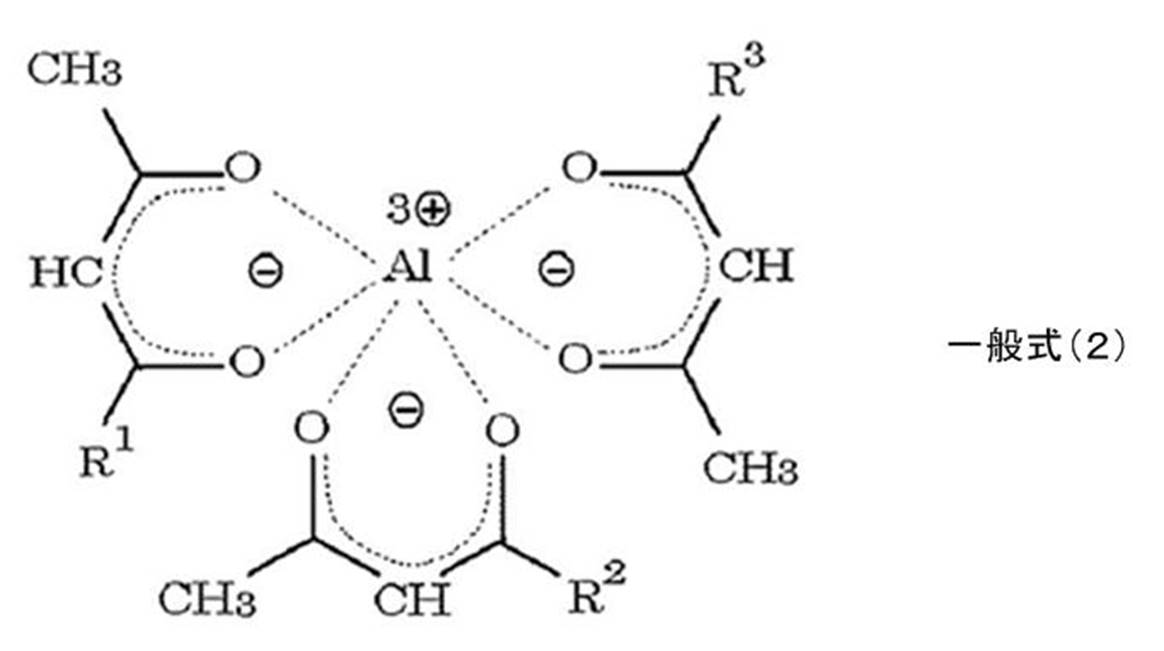
前記アルキル基としては、例えば、メチル基、エチル基などが挙げられる。
前記アルコキシ基としては、例えば、メトキシ基、エトキシ基、オレイルオキシ基などが挙げられる。
前記多孔質粒子は、ポリウレア樹脂で構成される。
前記多孔質粒子は、例えば、その細孔内に前記アルミニウムキレート化合物を保持する。言い換えれば、ポリウレア樹脂で構成された多孔質粒子マトリックス中に存在する微細な孔に、アルミニウムキレート化合物が取り込まれて保持されている。
前記多孔質粒子を構成する前記ポリウレア樹脂は、例えば、多官能イソシアネート化合物を乳化液中で重合させることにより得られる。その詳細は後述する。前記ポリウレア樹脂は、樹脂中に、イソシアネート基に由来する結合であって、ウレア結合以外の結合、例えば、ウレタン結合などを有していてもよい。なお、ウレタン結合を含む場合には、ポリウレアウレタン樹脂と称することもある。
前記多孔質粒子作製工程は、乳化液作製処理と、重合処理とを少なくとも含み、好ましくは、追加充填処理を含み、更に必要に応じて、その他の処理を含む。
前記乳化液作製処理は、アルミニウムキレート化合物と、多官能イソシアネート化合物と、好ましくは有機溶剤とを混合して得られる液を乳化処理して乳化液を得る処理であれば、特に制限はなく、目的に応じて適宜選択することができ、例えば、ホモジナイザーを用いて行うことができる。

前記有機溶剤は、前記アルミニウムキレート化合物、及び前記多官能イソシアネート化合物のそれぞれの良溶媒(それぞれの溶解度が好ましくは0.1g/ml(有機溶剤)以上)であって、水に対しては実質的に溶解せず(水の溶解度が0.5g/ml(有機溶剤)以下)、大気圧下での沸点が100℃以下のものが好ましい。このような揮発性有機溶剤の具体例としては、アルコール類、酢酸エステル類、ケトン類などが挙げられる。これらの中でも、高極性、低沸点、貧水溶性の点で酢酸エチルが好ましい。
前記重合処理としては、前記乳化液中で前記多官能イソシアネート化合物を重合させて多孔質粒子を得る処理であれば、特に制限はなく、目的に応じて適宜選択することができる。
前記重合処理における重合温度としては、特に制限はなく、目的に応じて適宜選択することができるが、30℃以上90℃以下が好ましく、50℃以上80℃以下がより好ましい。
得られたアルミニウム化合物を保持する多孔質粒子は、必要に応じて濾別し、洗浄し乾燥した後、公知の解砕装置で一次粒子に解砕することができる。
前記シラノール化合物としては、例えば、トリエチルシラノール、ジメチルフェニルシラノール、トリフルオロメチルフェニルシラノール、下記一般式(6)で表されるアリールシラノール化合物などが挙げられる。これらの中でも、前記一般式(6)で表されるアリールシラノール化合物が好ましい。

前記一般式(6)で表されるアリールシラノール化合物は、モノオール体又はジオール体である。
前記アリール基としては、例えば、フェニル基、ナフチル基(例えば、1-ナフチル基、2-ナフチル基等)、アントラセニル基(例えば、1-アントラセニル基、2-アントラセニル基、9-アントラセニル基、ベンズ[a]-9-アントラセニル基等)、フェナリル基(例えば、3-フェナリル基、9-フェナリル基等)、ピレニル基(例えば、1-ピレニル基等)、アズレニル基、フロオレニル基、ビフェニル基(例えば、2-ビフェニル基、3-ビフェニル基、4-ビフェニル基等)、チエニル基、フリル基、ピロリル基、イミダゾリル基、ピリジル基などが挙げられる。これらは、1種単独で使用してもよいし、2種以上を併用してもよい。これらの中でも、入手容易性、入手コストの観点から、フェニル基が好ましい。m個のArは、いずれも同一でもよく異なっていてもよいが、入手容易性の点から同一であることが好ましい。
前記置換基としては、例えば、電子吸引基、電子供与基などが挙げられる。
前記電子吸引基としては、例えば、ハロゲン基(例えば、クロロ基、ブロモ基等)、トリフルオロメチル基、ニトロ基、スルホ基、カルボキシル基、アルコキシカルボニル基(例えば、メトキシカルボニル基、エトキシカルボニル基等)、ホルミル基などが挙げられる。
前記電子供与基としては、例えば、アルキル基(例えば、メチル基、エチル基、プロピル基等)、アルコキシ基(例えば、メトキシ基、エトキシ基等)、ヒドロキシ基、アミノ基、モノアルキルアミノ基(例えば、モノメチルアミノ基等)、ジアルキルアミノ基(例えば、ジメチルアミノ基等)などが挙げられる。
ここで、m個のAr毎に、置換基が異なっていてもよいが、m個のArについて入手容易性の点から置換基は同一であることが好ましい。また、一部のArだけに置換基があり、他のArに置換基が無くてもよい。
前記その他の成分としては、特に制限はなく、目的に応じて適宜選択することができ、例えば、顔料、染料、有機又は無機フィラー、帯電防止剤、消泡剤、粘度調整剤、耐光安定剤、耐候安定剤、耐熱安定剤、紫外線吸収剤、酸化防止剤、レベリング剤、顔料分散剤、ワックスなどが挙げられる。
本発明の硬化物は、本発明の硬化性組成物を加熱することにより硬化させてなる。加熱条件としては、特に制限はなく、目的に応じて適宜選択することができ、例えば、60℃~150℃の温度で、オーブンなら5分間~15分間、ホットプレートなら1分間~5分間である。
本発明の硬化性組成物は、加熱することによる硬化性に優れているので、例えば、塗料、光学部材の接着剤、電子部品の封止剤、自動車、家電製品、携帯電話等の各種プラスチック基材用ハードコート剤、紙等のオーバーコート剤、印刷インキ用バインダー、ソルダーレジストなどの様々な分野で幅広く使用することができる。
<アルミニウムキレート化合物を担持した多孔質粒子の調製>
-水相の調製-
蒸留水800質量部と、界面活性剤(ニューレックスR-T、日油株式会社製)0.05質量部と、分散剤としてポリビニルアルコール(PVA-205、株式会社クラレ製)4質量部とを、温度計を備えた3リットルの界面重合容器に入れ、均一に混合し、水相を調製した。
次に、アルミニウムモノアセチルアセトネートビス(エチルアセトアセテート)の24質量%イソプロパノール溶液(アルミキレートD、川研ファインケミカル株式会社製)100質量部と、メチレンジフェニル-4,4’-ジイソシアネート(3モル)のトリメチロールプロパン(1モル)付加物(多官能イソシアネート化合物、D-109、三井化学株式会社製)70質量部とを、酢酸エチル130質量部に溶解し、油相を調製した。
調製した前記油相を、先に調製した前記水相に投入し、ホモジナイザー(10,000rpm/5分:T-50、IKAジャパン株式会社製)で混合、乳化し、乳化液を得た。
調製した前記乳化液を、80℃で6時間、200rpmで撹拌しながら重合を行った。反応終了後、重合反応液を室温(25℃)まで放冷し、生成した重合樹脂粒子(多孔質粒子)を濾過により濾別し、蒸留水で濾過洗浄し、室温(25℃)下で自然乾燥することにより、塊状の多孔質粒子を得た。この塊状の多孔質粒子を、解砕装置(A-Oジェットミル、株式会社セイシン企業製)を用いて一次粒子に解砕することにより、調製例1のアルミニウムキレート化合物を担持した多孔質粒子を得た。
表1~表3に示す組成を混合して、実施例1~16及び比較例1~5の硬化性組成物を調製した。
得られた各硬化性組成物について、示差走査熱量計(DSC7000X、日立ハイテクサイエンス株式会社製)を用いて、昇温速度10℃/minにより、発熱挙動を示したサンプルを硬化したと判断し、発熱挙動を示したサンプルについては発熱ピーク温度を測定し記載した。
なお、DSCにおける反応開始温度は硬化開始温度を意味し、発熱ピーク温度は最も硬化が活性となる温度を意味しており、反応終了温度は硬化終了温度を意味し、ピーク面積は発熱量を意味する。
得られた各硬化性組成物について、表1~表3に示す各成分を添加した初期の発熱量、及び、各硬化性組成物を23℃にて72時間放置したときの発熱量を、示差走査熱量計(DSC7000X、日立ハイテクサイエンス株式会社製)を用いて測定した。初期の発熱量に比べて23℃にて72時間放置したときの発熱量が20%以上減少した場合をポットライフが不良であるとして「×」と評価し、15%以上20%未満減少した場合をポットライフが通常であるとして「△」、15%未満減少した場合をポットライフが良好であるとして「〇」と評価した。
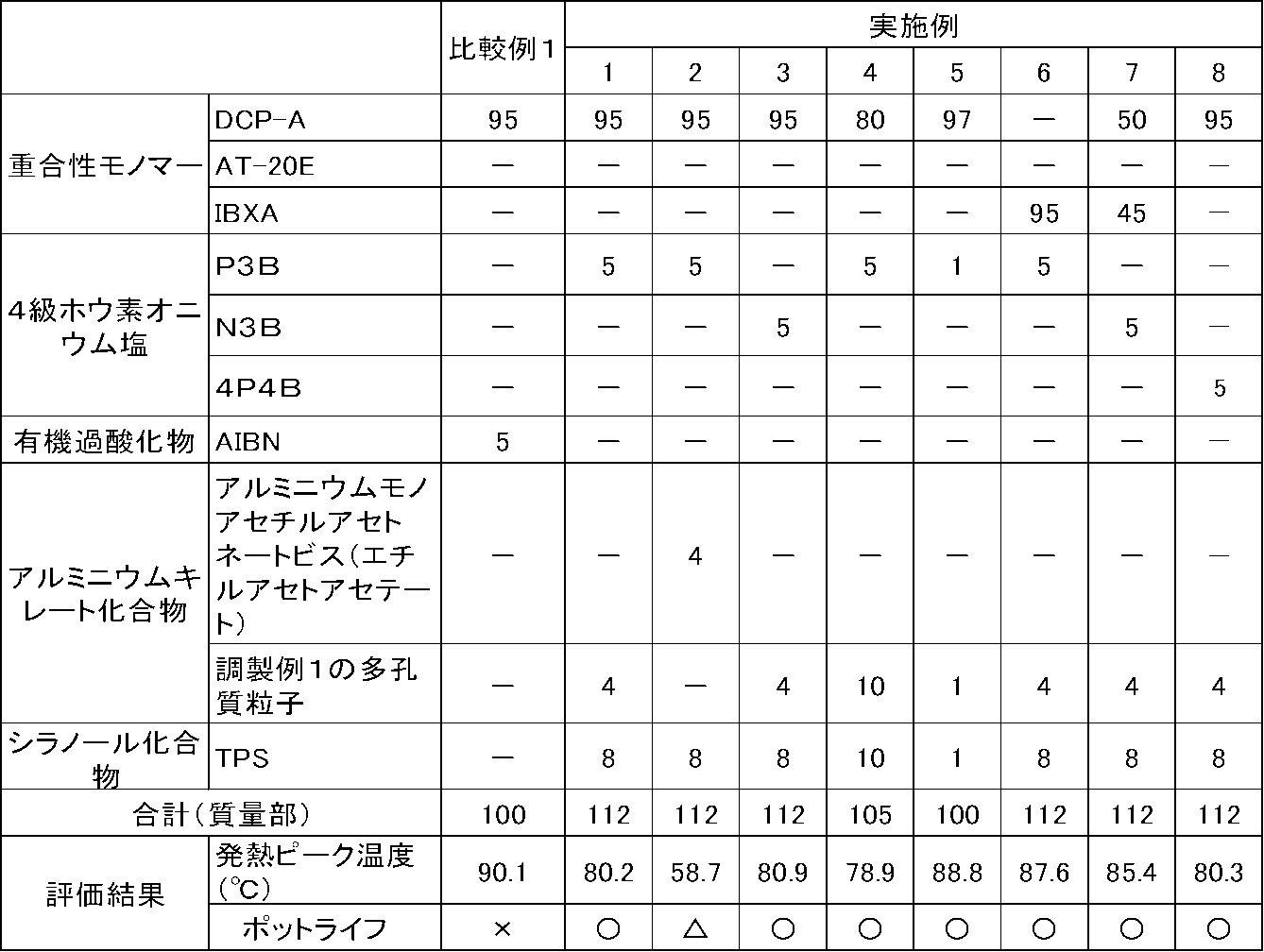

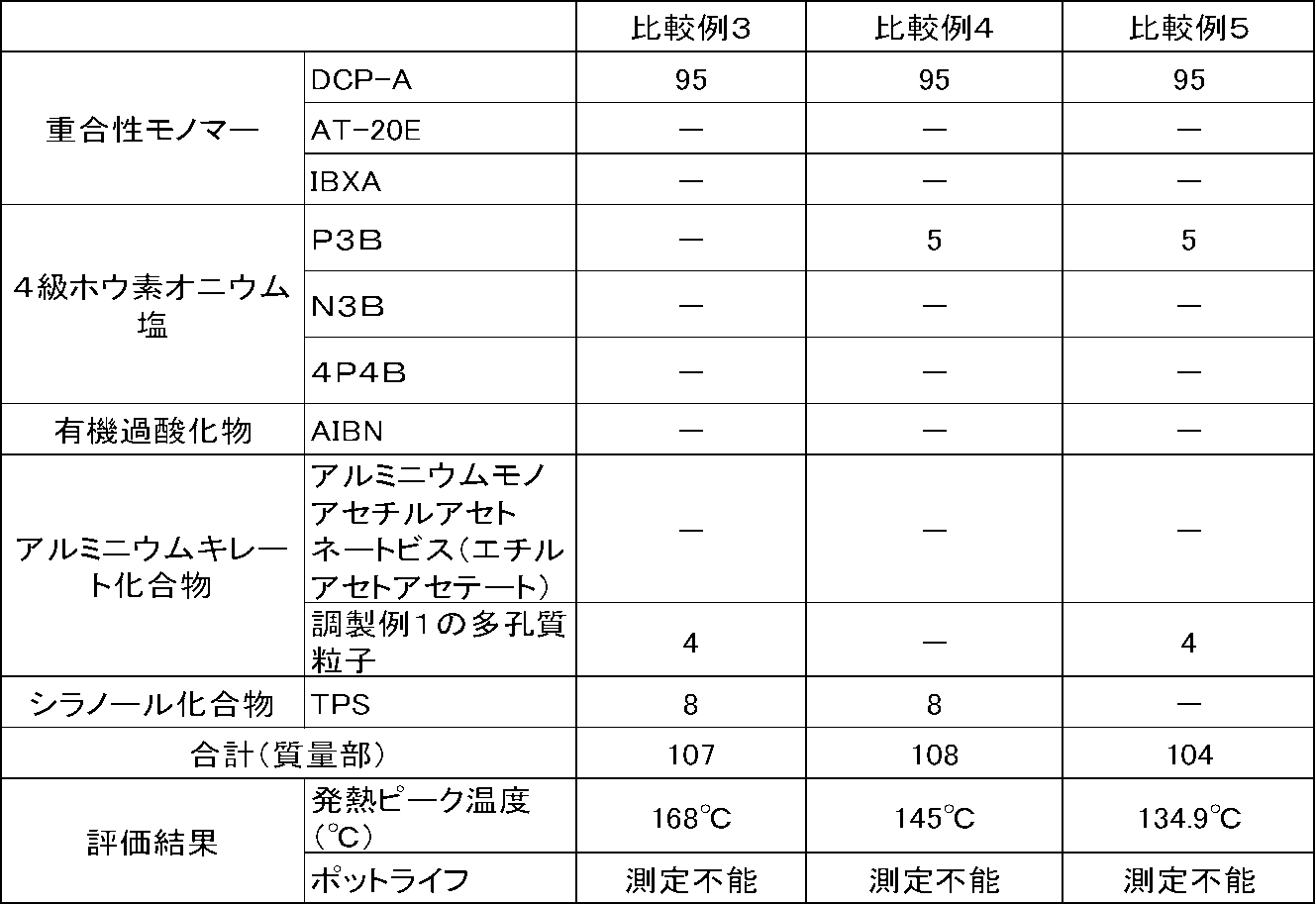
*DCP-A:ジメチロールトリシクロデカンジアクリレート、共栄社化学株式会社製
*AT-20E:エトキシ化トリメチロールプロパントリアクリレート、新中村化学工業株式会社製
*IBXA:イソボルニルアクリレート、共栄社化学株式会社製
*P3B:テトラブチルアンモニウムブチルトリフェニルボラート、昭和電工株式会社製
*N3B:テトラブチルアンモニウムブチルトリナフチルボラート、昭和電工株式会社製
*4P4B:テトラフェニルホスホニウムテトラフェニルボラート、東京化成工業株式会社製
*TPS:トリフェニルシラノール、東京化成工業株式会社製
*AIBN:アゾビスイソブチロニトリル、東京化成工業株式会社製
Claims (12)
- 重合性モノマー、アルミニウムキレート化合物、シラノール化合物、及び4級ホウ素オニウム塩を含有することを特徴とする硬化性組成物。
- 前記重合性モノマーが炭素-炭素二重結合を分子内に有するラジカル重合性モノマーである、請求項1に記載の硬化性組成物。
- 前記重合性モノマーが(メタ)アクリレートである、請求項1から2のいずれかに記載の硬化性組成物。
- 前記アルミニウムキレート化合物が多孔質粒子に保持されている、請求項1から3のいずれかに記載の硬化性組成物。
- 前記多孔質粒子がポリウレア樹脂で構成される、請求項4に記載の硬化性組成物。
- 前記4級ホウ素オニウム塩が下記一般式(1)で表される、請求項1から5のいずれかに記載の硬化性組成物。

- 前記シラノール化合物が下記一般式(6)で表されるアリールシラノール化合物である、請求項1から6のいずれかに記載の硬化性組成物。

- 前記重合性モノマーの含有量が80質量%以上97質量%以下である、請求項1から7のいずれかに記載の硬化性組成物。
- 前記アルミニウムキレート化合物の含有量が0.1質量%以上10質量%以下である、請求項1から8のいずれかに記載の硬化性組成物。
- 前記シラノール化合物の含有量が0.1質量%以上10質量%以下である、請求項1から9のいずれかに記載の硬化性組成物。
- 前記4級ホウ素オニウム塩の含有量が0.1質量%以上5質量%以下である、請求項1から10のいずれかに記載の硬化性組成物。
- 請求項1から11のいずれかに記載の硬化性組成物を加熱することにより硬化させてなる硬化物。
Priority Applications (3)
| Application Number | Priority Date | Filing Date | Title |
|---|---|---|---|
| CN202280047497.5A CN117597368A (zh) | 2021-07-09 | 2022-06-30 | 固化性组合物和固化物 |
| KR1020247003187A KR102952125B1 (ko) | 2021-07-09 | 2022-06-30 | 경화성 조성물 및 경화물 |
| US18/574,456 US20250122316A1 (en) | 2021-07-09 | 2022-06-30 | Curable composition and cured product |
Applications Claiming Priority (2)
| Application Number | Priority Date | Filing Date | Title |
|---|---|---|---|
| JP2021-113966 | 2021-07-09 | ||
| JP2021113966A JP7721991B2 (ja) | 2021-07-09 | 2021-07-09 | 硬化性組成物及び硬化物 |
Publications (1)
| Publication Number | Publication Date |
|---|---|
| WO2023282174A1 true WO2023282174A1 (ja) | 2023-01-12 |
Family
ID=84801638
Family Applications (1)
| Application Number | Title | Priority Date | Filing Date |
|---|---|---|---|
| PCT/JP2022/026246 Ceased WO2023282174A1 (ja) | 2021-07-09 | 2022-06-30 | 硬化性組成物及び硬化物 |
Country Status (5)
| Country | Link |
|---|---|
| US (1) | US20250122316A1 (ja) |
| JP (1) | JP7721991B2 (ja) |
| KR (1) | KR102952125B1 (ja) |
| CN (1) | CN117597368A (ja) |
| WO (1) | WO2023282174A1 (ja) |
Citations (7)
| Publication number | Priority date | Publication date | Assignee | Title |
|---|---|---|---|---|
| JP2006291073A (ja) * | 2005-04-12 | 2006-10-26 | Kaneka Corp | 硬化性組成物およびその硬化物 |
| JP2011043620A (ja) * | 2009-08-20 | 2011-03-03 | Toshiba Corp | ホログラム記録媒体 |
| JP2017171804A (ja) * | 2016-03-24 | 2017-09-28 | ナミックス株式会社 | 樹脂組成物、接着剤、硬化物、半導体装置 |
| WO2017217276A1 (ja) * | 2016-06-15 | 2017-12-21 | デクセリアルズ株式会社 | 熱硬化型エポキシ樹脂組成物、及びその製造方法 |
| JP2019214675A (ja) * | 2018-06-13 | 2019-12-19 | デクセリアルズ株式会社 | カチオン硬化性組成物、及び硬化物の製造方法 |
| JP2021004363A (ja) * | 2015-06-02 | 2021-01-14 | デクセリアルズ株式会社 | 接着剤組成物 |
| WO2021095400A1 (ja) * | 2019-11-11 | 2021-05-20 | ソニー株式会社 | ホログラム記録用組成物、ホログラム記録媒体、ホログラム、及びこれを用いた光学装置、光学部品 |
Family Cites Families (3)
| Publication number | Priority date | Publication date | Assignee | Title |
|---|---|---|---|---|
| US7192991B2 (en) * | 2003-11-26 | 2007-03-20 | 3M Innovative Properties Company | Cationically curable composition |
| JP6285164B2 (ja) * | 2013-12-05 | 2018-02-28 | デクセリアルズ株式会社 | 化合物、熱硬化性樹脂組成物、及び熱硬化性シート |
| JP6397784B2 (ja) | 2015-03-10 | 2018-09-26 | デクセリアルズ株式会社 | 熱硬化性樹脂組成物、及び熱硬化性シート |
-
2021
- 2021-07-09 JP JP2021113966A patent/JP7721991B2/ja active Active
-
2022
- 2022-06-30 KR KR1020247003187A patent/KR102952125B1/ko active Active
- 2022-06-30 WO PCT/JP2022/026246 patent/WO2023282174A1/ja not_active Ceased
- 2022-06-30 CN CN202280047497.5A patent/CN117597368A/zh active Pending
- 2022-06-30 US US18/574,456 patent/US20250122316A1/en active Pending
Patent Citations (7)
| Publication number | Priority date | Publication date | Assignee | Title |
|---|---|---|---|---|
| JP2006291073A (ja) * | 2005-04-12 | 2006-10-26 | Kaneka Corp | 硬化性組成物およびその硬化物 |
| JP2011043620A (ja) * | 2009-08-20 | 2011-03-03 | Toshiba Corp | ホログラム記録媒体 |
| JP2021004363A (ja) * | 2015-06-02 | 2021-01-14 | デクセリアルズ株式会社 | 接着剤組成物 |
| JP2017171804A (ja) * | 2016-03-24 | 2017-09-28 | ナミックス株式会社 | 樹脂組成物、接着剤、硬化物、半導体装置 |
| WO2017217276A1 (ja) * | 2016-06-15 | 2017-12-21 | デクセリアルズ株式会社 | 熱硬化型エポキシ樹脂組成物、及びその製造方法 |
| JP2019214675A (ja) * | 2018-06-13 | 2019-12-19 | デクセリアルズ株式会社 | カチオン硬化性組成物、及び硬化物の製造方法 |
| WO2021095400A1 (ja) * | 2019-11-11 | 2021-05-20 | ソニー株式会社 | ホログラム記録用組成物、ホログラム記録媒体、ホログラム、及びこれを用いた光学装置、光学部品 |
Also Published As
| Publication number | Publication date |
|---|---|
| KR102952125B1 (ko) | 2026-04-13 |
| US20250122316A1 (en) | 2025-04-17 |
| JP7721991B2 (ja) | 2025-08-13 |
| JP2023010105A (ja) | 2023-01-20 |
| CN117597368A (zh) | 2024-02-23 |
| KR20240025017A (ko) | 2024-02-26 |
Similar Documents
| Publication | Publication Date | Title |
|---|---|---|
| JP5968530B2 (ja) | イオン性結合基を有する櫛形コポリマー | |
| MXPA02006782A (es) | Polimeros tipo peine a partir de macromonomeros de polimerizacion de radicales por transferencia atomica (atrp). | |
| US11879032B2 (en) | Reaction products containing urethane groups and urea groups | |
| EP2184303A1 (en) | Copolymer | |
| TW201008961A (en) | Pigment dispersants with modified copolymers | |
| CA2637767C (en) | Hyperdispersant for use in fluorocarbon coating compositions | |
| JP2004156043A (ja) | 原子移動ラジカル重合によって調製されるエポキシ官能性ポリマーを含む熱硬化性組成物 | |
| JP2011094112A (ja) | 顔料分散物及びそれを用いたインク組成物 | |
| JP4774780B2 (ja) | 酸性アクリルブロック樹脂 | |
| JP2011505453A (ja) | 立体安定化ラテックス粒子 | |
| JP7721991B2 (ja) | 硬化性組成物及び硬化物 | |
| CN101111578B (zh) | 包含由离子芳族单体组成的嵌段共聚物的稳定的颜料分散体 | |
| CA2478719A1 (en) | Photopolymerizable composition and photopolymerizable film prepared therefrom | |
| US10557045B2 (en) | Pigment dispersant with hindered light amine stabilizer and pigment dispersions and coating compositions based thereon | |
| JPH1030010A (ja) | ノニオン系高分子界面活性剤、その製造方法、及びその顔料分散体 | |
| JP7716215B2 (ja) | ブロック共重合体、分散剤、および、着色組成物 | |
| TWI374896B (ja) | ||
| JP2010526170A (ja) | 架橋ラテックス微粒子 | |
| JP2008528783A (ja) | イオン性芳香族モノマーから成るブロックコポリマーを含んでなる安定な顔料分散系 | |
| WO2007070724A2 (en) | Pigment dispersions containing aminated acrylic macromonomer dispersant | |
| WO2012160842A1 (ja) | (メタ)アクリル酸エステル共重合体およびこれを含んでなる粘着剤組成物ならびに(メタ)アクリル酸エステル共重合体の製造方法 | |
| JP2022158616A (ja) | 着色組成物、および、塗膜 | |
| JP7695096B2 (ja) | 着色組成物、および、塗膜 | |
| MX2008010844A (es) | Metodos para lograr bienestar sexual aumentado usando composiciones anhidras. | |
| JP2012503062A (ja) | 水および有機溶剤に可溶および/または分散可能な剛性マトリックス組成−勾配コポリマー |
Legal Events
| Date | Code | Title | Description |
|---|---|---|---|
| 121 | Ep: the epo has been informed by wipo that ep was designated in this application |
Ref document number: 22837590 Country of ref document: EP Kind code of ref document: A1 |
|
| WWE | Wipo information: entry into national phase |
Ref document number: 18574456 Country of ref document: US |
|
| WWE | Wipo information: entry into national phase |
Ref document number: 202280047497.5 Country of ref document: CN |
|
| ENP | Entry into the national phase |
Ref document number: 20247003187 Country of ref document: KR Kind code of ref document: A |
|
| WWE | Wipo information: entry into national phase |
Ref document number: 1020247003187 Country of ref document: KR |
|
| NENP | Non-entry into the national phase |
Ref country code: DE |
|
| 122 | Ep: pct application non-entry in european phase |
Ref document number: 22837590 Country of ref document: EP Kind code of ref document: A1 |
|
| WWP | Wipo information: published in national office |
Ref document number: 18574456 Country of ref document: US |