WO2023275937A1 - 電力変換装置 - Google Patents
電力変換装置 Download PDFInfo
- Publication number
- WO2023275937A1 WO2023275937A1 PCT/JP2021/024372 JP2021024372W WO2023275937A1 WO 2023275937 A1 WO2023275937 A1 WO 2023275937A1 JP 2021024372 W JP2021024372 W JP 2021024372W WO 2023275937 A1 WO2023275937 A1 WO 2023275937A1
- Authority
- WO
- WIPO (PCT)
- Prior art keywords
- voltage
- value
- control unit
- inverter
- frequency
- Prior art date
- Legal status (The legal status is an assumption and is not a legal conclusion. Google has not performed a legal analysis and makes no representation as to the accuracy of the status listed.)
- Ceased
Links
Images




Classifications
-
- H—ELECTRICITY
- H02—GENERATION; CONVERSION OR DISTRIBUTION OF ELECTRIC POWER
- H02J—ELECTRIC POWER NETWORKS; CIRCUIT ARRANGEMENTS OR SYSTEMS FOR SUPPLYING OR DISTRIBUTING ELECTRIC POWER; SYSTEMS FOR STORING ELECTRIC ENERGY
- H02J3/00—Circuit arrangements for AC mains or AC distribution networks
- H02J3/38—Arrangements for feeding a single network from two or more generators or sources in parallel; Arrangements for feeding already energised networks from additional generators or sources in parallel
- H02J3/388—Arrangements for the handling of islanding, e.g. for disconnection or for avoiding the disconnection of power
-
- H—ELECTRICITY
- H02—GENERATION; CONVERSION OR DISTRIBUTION OF ELECTRIC POWER
- H02J—ELECTRIC POWER NETWORKS; CIRCUIT ARRANGEMENTS OR SYSTEMS FOR SUPPLYING OR DISTRIBUTING ELECTRIC POWER; SYSTEMS FOR STORING ELECTRIC ENERGY
- H02J3/00—Circuit arrangements for AC mains or AC distribution networks
- H02J3/38—Arrangements for feeding a single network from two or more generators or sources in parallel; Arrangements for feeding already energised networks from additional generators or sources in parallel
-
- H—ELECTRICITY
- H02—GENERATION; CONVERSION OR DISTRIBUTION OF ELECTRIC POWER
- H02J—ELECTRIC POWER NETWORKS; CIRCUIT ARRANGEMENTS OR SYSTEMS FOR SUPPLYING OR DISTRIBUTING ELECTRIC POWER; SYSTEMS FOR STORING ELECTRIC ENERGY
- H02J3/00—Circuit arrangements for AC mains or AC distribution networks
- H02J3/38—Arrangements for feeding a single network from two or more generators or sources in parallel; Arrangements for feeding already energised networks from additional generators or sources in parallel
- H02J3/381—Dispersed generators
-
- H—ELECTRICITY
- H02—GENERATION; CONVERSION OR DISTRIBUTION OF ELECTRIC POWER
- H02J—ELECTRIC POWER NETWORKS; CIRCUIT ARRANGEMENTS OR SYSTEMS FOR SUPPLYING OR DISTRIBUTING ELECTRIC POWER; SYSTEMS FOR STORING ELECTRIC ENERGY
- H02J3/00—Circuit arrangements for AC mains or AC distribution networks
- H02J3/38—Arrangements for feeding a single network from two or more generators or sources in parallel; Arrangements for feeding already energised networks from additional generators or sources in parallel
- H02J3/40—Synchronisation of generators for connection to a network or to another generator
-
- H—ELECTRICITY
- H02—GENERATION; CONVERSION OR DISTRIBUTION OF ELECTRIC POWER
- H02J—ELECTRIC POWER NETWORKS; CIRCUIT ARRANGEMENTS OR SYSTEMS FOR SUPPLYING OR DISTRIBUTING ELECTRIC POWER; SYSTEMS FOR STORING ELECTRIC ENERGY
- H02J3/00—Circuit arrangements for AC mains or AC distribution networks
- H02J3/38—Arrangements for feeding a single network from two or more generators or sources in parallel; Arrangements for feeding already energised networks from additional generators or sources in parallel
- H02J3/40—Synchronisation of generators for connection to a network or to another generator
- H02J3/42—Synchronisation of generators for connection to a network or to another generator with automatic parallel connection when synchronisation is achieved
-
- H—ELECTRICITY
- H02—GENERATION; CONVERSION OR DISTRIBUTION OF ELECTRIC POWER
- H02M—APPARATUS FOR CONVERSION BETWEEN AC AND AC, BETWEEN AC AND DC, OR BETWEEN DC AND DC, AND FOR USE WITH MAINS OR SIMILAR POWER SUPPLY SYSTEMS; CONVERSION OF DC OR AC INPUT POWER INTO SURGE OUTPUT POWER; CONTROL OR REGULATION THEREOF
- H02M7/00—Conversion of AC power input into DC power output; Conversion of DC power input into AC power output
- H02M7/42—Conversion of DC power input into AC power output without possibility of reversal
- H02M7/44—Conversion of DC power input into AC power output without possibility of reversal by static converters
- H02M7/48—Conversion of DC power input into AC power output without possibility of reversal by static converters using discharge tubes with control electrode or semiconductor devices with control electrode
-
- H—ELECTRICITY
- H02—GENERATION; CONVERSION OR DISTRIBUTION OF ELECTRIC POWER
- H02J—ELECTRIC POWER NETWORKS; CIRCUIT ARRANGEMENTS OR SYSTEMS FOR SUPPLYING OR DISTRIBUTING ELECTRIC POWER; SYSTEMS FOR STORING ELECTRIC ENERGY
- H02J2103/00—Details of circuit arrangements for mains or AC distribution networks
- H02J2103/30—Simulating, planning, modelling, reliability check or computer assisted design [CAD] of electric power networks
Definitions
- the present disclosure relates to a power converter configured to be interconnected with an AC power system.
- Patent Document 1 discloses a system that includes an inverter that converts DC power into AC power and an LC filter that removes harmonic components from the output of the inverter, and supplies AC power to a commercial system.
- a grid-connected inverter device is disclosed.
- the amplitude, phase, and frequency of the isolated system voltage are adjusted to match the amplitude, phase, and frequency of the commercial system voltage after the isolated operation is performed. , and switched to grid-connected operation control while maintaining the matching state.
- interconnection with the commercial system can be performed while suppressing the inrush current to the capacitors forming the LC filter without providing an inrush current prevention circuit.
- the present disclosure has been made to solve the above-described problems, and its purpose is to reduce the voltage of the AC power system while suppressing the inrush current when the power converter is linked to the AC power system. to maintain stability.
- a power converter converts a DC voltage from a DC power supply into an AC voltage for an AC power system.
- a power conversion device includes an inverter, a relay, and a control unit.
- the inverter converts the DC voltage into the AC voltage.
- the relay selectively switches the state of connection between the inverter and the AC power system between a conducting state and a non-conducting state.
- the controller provides a first measurement of a first voltage between the relay and the AC power system, a second measurement of a second voltage between the relay and the inverter, and a second voltage flowing between the inverter and the AC power system. It receives current measurements and controls inverters and relays.
- the control unit includes a voltage control unit, an active power calculation unit, a virtual synchronous generator control unit, a detection unit, and a determination unit.
- the voltage control unit controls the amplitude of the second voltage so as to approach the voltage amplitude target value.
- the active power calculator calculates an active power value to be output to the AC power system using the first measurement value and the current measurement value.
- the virtual synchronous generator control unit simulates the operation of the synchronous generator by associating the active power value and the active power target value with the electrical energy and mechanical energy of the equation of motion of the rotor of the synchronous generator, respectively.
- a first command value for the frequency of the second voltage and a second command value for the phase of the second voltage are generated.
- the detector detects the phase of the first voltage from the first measured value.
- the determination unit controls the relay to switch the connection state from the non-conducting state to the conducting state when the closing condition is satisfied.
- the input conditions are the first condition that the amplitude difference between the absolute value of the first measured value and the absolute value of the second measured value is included in the first allowable range, and the phase of the first voltage and the position of the second command value.
- a second condition is included that the phase difference is within a second tolerance.
- the virtual synchronous generator control unit and the determination unit can stably maintain the voltage of the AC power system while suppressing the inrush current when the power conversion device is linked to the AC power system. can.
- FIG. 1 is a block diagram showing the overall configuration of a power converter according to Embodiment 1;
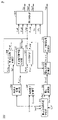
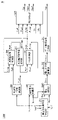
- FIG. FIG. 2 is a block diagram showing an example of an internal configuration of a controller in FIG. 1;
- FIG. FIG. 3 is a control block diagram showing an example of specific configurations of a frequency synchronization control section, a VSG control section, and an active power command value switching section shown in FIG. 2;
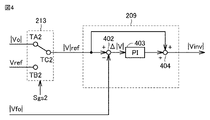
- 3 is a control block diagram showing an example of internal configurations of a voltage control unit and a voltage amplitude command value switching unit shown in FIG. 2;
- FIG. 3 is a flowchart for explaining the flow of throwing determination processing (throwing determination sequence) performed by the throwing determination unit of FIG. 2;
- FIG. 7 is a block diagram showing an example of the internal configuration of a control section of the power converter according to Embodiment 2;
- FIG. 7 is a control block diagram showing an example of an internal configuration of a voltage control unit in FIG. 6;
- FIG. 1 is a block diagram showing the overall configuration of a power conversion device 100 according to Embodiment 1. As shown in FIG. Although FIG. 1 shows a block diagram corresponding to a circuit of only one phase, the block diagram may be applied to a three-phase grid-connected inverter or a single-phase grid-connected inverter. In Embodiment 1, a grid-connected inverter to a three-phase system will be described as an example.
- power converter 100 includes input terminal Tmi, output terminal Tmo, inverter 102, LC filter 120, closing relay 105, system voltage measuring section 106, and inverter voltage measuring section 107. , a current measurement unit 108 , and a control unit 110 .
- the power conversion device 100 directs the DC voltage from the DC power supply 800 to the AC power system 900 and converts it into AC voltage.
- a DC voltage is input from the DC power supply 800 to the input terminal Tmi.
- a DC power supply 800 is a power supply device that generates a DC voltage.
- DC power supply 800 includes, for example, a solar power generator, a DC link wind power generator, or a storage battery.
- the inverter 102 receives a DC voltage from the input terminal Tmi. Inverter 102 performs a switching operation according to gate drive signal Sgg from control unit 110 to convert the DC voltage into an AC voltage.
- the circuit system or the type of switching elements applied to inverter 102 is not limited to the circuit system or the type of switching elements.
- the LC filter 120 is connected between the inverter 102 and the current measuring section 108.
- LC filter 120 includes reactor 103 and capacitor 104 .
- Reactor 103 is connected between inverter 102 and current measuring section 108 .
- Capacitor 104 is connected between the ground point and the connection point between reactor 103 and current measuring section 108 .
- LC filter 120 suppresses (filters) a ripple component of current that occurs with switching in inverter 102 .
- the closing relay 105 is connected between the current measuring section 108 and the output terminal Tmo.
- the closing relay 105 determines the connection state between the inverter 102 and the output terminal Tmo. That is, the closing relay 105 selectively switches the connection state between a non-conducting (blocking or open) state (open) and a conducting state (closed) in accordance with the closing relay control signal Sgr from the control unit 110.
- the connection state is the conducting state
- the non-conducting state is also referred to as the closing state of the closing relay 105.
- An AC power system 900 is connected to the output terminal Tmo.
- An AC voltage is supplied to the AC power system 900 from the power converter 100 .
- the AC power system 900 is a power system with which the power conversion device 100 is interconnected.
- the AC power system 900 includes, for example, a normal commercial power system managed by an electric power company, a microgrid independently managed on a town-by-town basis, or an independent system independently operated on a building-by-building basis.
- the AC voltage of the AC power system 900 is maintained by a power source element other than the power converter 100 even when the on-relay 105 is in the cutoff state and the AC voltage is not supplied from the power converter 100. It is assumed that there is
- the configuration between the closing relay 105 and the inverter 102 is also referred to as the inverter side, and the configuration between the closing relay 105 and the output terminal Tmo is also referred to as the system side.
- the system voltage measurement unit 106 measures the voltage (first voltage) of the output terminal Tmo and outputs a system voltage measurement value Vo (first measurement value), which is the measured value of the voltage, to the control unit 110 .
- Inverter voltage measurement unit 107 measures the voltage (second voltage) input to closing relay 105 and outputs inverter voltage measurement value Vfo (second measurement value), which is the measured value of the voltage, to control unit 110 .
- Current measurement unit 108 measures the current input to on-relay 105 and outputs current measurement value Io, which is the measured value of the current, to control unit 110 .
- the control unit 110 uses the measured values Vo, Vfo, and Io to control the drive of the inverter 102 and the opening/closing of the closing relay 105 .
- Control unit 110 outputs gate drive signal Sgg to inverter 102 .
- Control unit 110 outputs a closing relay control signal Sgr to closing relay 105 .
- It includes a processing circuit including a CPU (Central Processing Unit), etc., and a memory in which various programs are stored.
- the functions of the control unit 110 are realized by dedicated hardware or a processing circuit that executes a program (software).
- Information input to control unit 110 is not limited to system voltage measurement value Vo, inverter voltage measurement value Vfo, and current measurement value Io.
- FIG. 2 is a block diagram showing an example of the internal configuration of the control unit 110 of FIG.
- the control unit 110 includes a frequency/phase detection unit 204 (detection unit), an active power calculation unit 205, a VSG (Virtual Synchronous Generator) control unit 207 (virtual synchronous generator control unit), and , a frequency synchronization control unit 206, an input determination unit 208 (determination unit), a voltage control unit 209, a voltage command value calculation unit 210, a gate drive signal generation unit 211, an active power command value switching unit 212, and a voltage Amplitude command value switching unit 213 is included.
- the frequency/phase detection unit 204 sequentially calculates the system voltage frequency f_pll and the system voltage phase ⁇ _pll of the system voltage measurement value Vo (system voltage).
- Vo system voltage
- dq conversion is performed on the system voltage measurement value Vo
- the system voltage measurement is performed using proportional integral control.
- a configuration that controls the system voltage measurement value Vo so that the q-axis component of the value Vo approaches zero can be given.
- a method using zero-crossing point detection or the like may be performed.
- the active power calculation unit 205 calculates the active power value Pout output to the AC power system 900 (consumed in the AC power system 900) using the system voltage measurement value Vo and the current measurement value Io.
- a method of calculating the active power value Pout for example, each of the system voltage measurement value Vo and the current measurement value Io is subjected to dq conversion, and the d-axis voltage of the system voltage measurement value Vo and the d-axis current of the current measurement value Io are calculated. and the product of the q-axis voltage of the system voltage measurement value Vo and the q-axis current of the current measurement value Io.
- the frequency synchronization control unit 206 compares the system voltage frequency f_pll of the system voltage measurement value Vo calculated by the frequency/phase detection unit 204 with the inverter voltage frequency f_vsg determined by the VSG control unit 207 to determine the inverter voltage frequency.
- the inverter voltage frequency f_vsg is controlled so that f_vsg approaches the system voltage frequency f_pll. More specifically, frequency synchronization control section 206 increases active power command value Pref (active power target value) used in VSG control section 207 according to the frequency difference between system voltage frequency f_pll and inverter voltage frequency f_vsg.
- Pref active power target value
- the inverter voltage frequency f_vsg is adjusted indirectly via the VSG control unit 207 by decreasing it.
- the active power command value switching unit 212 receives a switching signal Sgs1 from the closing determination unit 208, which indicates whether the closing relay 105 is in the closing state or the non-closing state. Active power command value switching portion 212 outputs active power command value Pref from frequency synchronization control portion 206 to VSG control portion 207 when closing relay 105 is in the non-throwing state. When the closing relay 105 is in the non-on state, the active power command value switching unit 212 sets a predetermined value or a value specified from outside the control unit 110 by communication or the like as the active power command value Pref to the VSG control unit 207. output to
- VSG control unit 207 uses active power value Pout and active power command value Pref to determine inverter voltage frequency f_vsg (first command value) and inverter voltage phase ⁇ _vsg (second command value) of the output voltage command value of inverter 102. Generate.
- the voltage amplitude command value switching unit 213 receives a switching signal Sgs2 from the closing determination unit 208, which indicates whether the closing relay 105 is in the closing state or the non-closing state. Voltage amplitude command value switching unit 213 sets amplitude
- Voltage control unit 209 receives voltage amplitude command value
- As a method of calculating the amplitude of the inverter voltage measurement value Vfo for example, there is a method of performing dq conversion on the inverter voltage measurement value Vfo and using the d-axis voltage of the inverter voltage measurement value Vfo. Further, control may be performed using a voltage effective value instead of the amplitude of the inverter voltage measurement value Vfo.
- Voltage command value calculation unit 210 calculates inverter voltage command value Vinvref for inverter 102 using inverter voltage amplitude
- the amplitude of the inverter voltage command value Vinvref is equal to the inverter voltage amplitude
- the phase of the inverter voltage command value Vinvref is equal to the inverter voltage phase ⁇ _vsg. That is, the inverter voltage command value Vinvref becomes a sine wave signal having inverter voltage amplitude
- Gate drive signal generation unit 211 determines a drive pattern for a plurality of switching elements included in inverter 102 by PWM (Pulse Width Modulation) control using inverter voltage command value Vinvref, and generates gate drive signal Sgg corresponding to the pattern. is output to the inverter 102 .
- PWM Pulse Width Modulation
- closing determination unit 208 satisfies the closing condition for closing relay 105. determine whether or not The closing determination unit 208 outputs the closing relay control signal Sgr to the closing relay 105 according to the result of the closing condition determination processing of the closing relay 105 .
- the closing determination unit 208 outputs switching signals Sgs1 and Sgs2 corresponding to the closing relay control signal Sgr to the active power command value switching unit 212 and the voltage amplitude command value switching unit 213, respectively.
- inverter power sources such as the power conversion device 100 to the total power supply of the power system
- current control also called grid interconnection mode
- the voltage at the grid connection of the inverter power supply is often maintained by another power supply in the system (eg, a synchronous generator).
- the inverter power supply supplies a desired current based on the phase of the voltage of the generator. That is, when the inverter power supply is operated by current control, the stability of the system voltage may decrease as the ratio of the inverter power supply increases because the inverter power supply does not have system voltage maintenance capability (inertia).
- the virtual synchronous generator control by giving the inverter power supply the ability to synchronize with other voltage sources (synchronization power) by simulating the operating characteristics of the synchronous generator to the inverter power supply, Interconnected operation with the AC power supply system is possible while contributing to maintaining the system voltage (providing inertial force).
- the VSG control unit 207 that performs such virtual synchronous generator control will be described in detail.
- the VSG control unit 207 simulates the operating characteristics of the synchronous generator to the inverter 102, thereby providing the inverter 102 with the inertial force, the synchronizing force, and the braking force of the synchronous generator. implement the method. Since the capacity of a synchronous generator is derived from the structure and operating principle of the synchronous generator, first, the structure and operating principle of the actual synchronous generator will be briefly described.
- Synchronous generators are widely used for thermal power generation, nuclear power generation, or hydroelectric power generation.
- a synchronous generator uses the kinetic energy of steam generated by burning fuel or the potential energy of water to rotate a huge rotor.
- a field winding is wound around the rotor.
- the rotor By passing a field current through the rotor, the rotor functions as an electromagnet.
- a rotating magnetic field is generated by the rotor and a voltage is induced in the stator coils arranged around the rotor by electromagnetic induction.
- the induced voltage bears the voltage of the power system. Therefore, the frequency of the induced voltage corresponds to the rotation speed of the rotor.
- Inertia force is the ability to maintain the output voltage at constant amplitude and constant frequency. It can be explained from the operating principle of the synchronous generator that the inertia of the rotational motion of the rotor of the synchronous generator is related to the ability to maintain the induced voltage.
- the synchronizing force synchronizes the frequency and phase of the voltage of the other voltage source connected in parallel to the same system as the generator with the frequency and phase of the voltage of the same generator with the other voltage source. is the ability to eliminate cross currents between the same generator and the other voltage source.
- a synchronizing force is also realized by accelerating or decelerating the rotational motion of the rotor.
- braking power is the ability to dampen oscillatory phenomena in system voltage or current.
- the braking force is caused by friction, resistance, heat loss, or the like against the rotational motion of the rotor.
- the rotational motion of the synchronous generator rotor is strongly related to the inertia force, synchronization force, and braking force capability. Therefore, in the VSG control unit 207, it is important to simulate the rotational motion characteristics of the rotor of the synchronous generator.
- the equation of motion governing the rotational motion of the rotor of the synchronous generator is expressed as an oscillation equation as shown in Equation (1) below.
- Pm is the mechanical input energy received by the rotor.
- Pe is the electrical output energy that is output as power to the grid.
- ⁇ is the rotational speed of the rotor.
- ⁇ 0 is the rated rotational speed of the rotor.
- M is the inertia constant.
- D is the damping factor. That is, when the mechanical input energy Pm and the electrical output energy Pe are equal, the rotational speed of the rotor is kept constant. If the mechanical input energy Pm is greater than the electrical output energy Pe, the rotor will accelerate. If the mechanical input energy Pm is less than the electrical output energy Pe, the rotor will decelerate.
- FIG. 3 is a control block diagram showing an example of specific configurations of the frequency synchronization control section 206, the VSG control section 207, and the active power command value switching section 212 of FIG.
- the VSG control section 207 includes subtractors 304, 305, 306, an integrator 307, a feedback gain block 308, a first-order lag block 309, an adder 310, and a scaled gain block 311. , and an integrator 312 . Both sides of the Laplace-transformed perturbation equation (equation (1)) are simulated by the control blocks integrator 307 and feedback gain block 308 .
- the integrator 307 outputs to the adder 310 the frequency difference ⁇ f calculated by integrating the difference ⁇ P2.
- the coefficient M written in the integrator 307 in FIG. 3 corresponds to the inertia constant M of the synchronous generator.
- the inertia constant M determines the response speed of the VSG control section 207 . That is, the larger the inertia constant M is, the slower the response speed of the VSG control unit 207 is, and the smaller the inertia constant M is, the faster the response speed of the VSG control unit 207 is.
- the adder 310 outputs the sum of the frequency difference ⁇ f and the reference frequency f0 to the outside of the conversion gain block 311 and the VSG control section 207 as the inverter voltage frequency f_vsg.
- the integrator 312 outputs the inverter voltage phase ⁇ _vsg calculated by integrating the angular frequency ⁇ _vsg.
- the feedback gain block 308 outputs the product D ⁇ f of the frequency difference ⁇ f and the feedback gain D to the subtractor 306 .
- First-order lag block 309 outputs command value correction term Pgov corresponding to frequency difference ⁇ f to subtractor 305 .
- the active power value Pout of the power converter 100 corresponds to the electrical output energy Pe.
- power converter 100 does not have an energy element corresponding to mechanical input energy Pm.
- the mechanical input energy Pm is almost equal to the electrical output energy Pe.
- the mechanical input energy Pm can be interpreted as a command value (target value) of the electrical output energy Pe. Therefore, in power converter 100, active power command value Pref can be made to correspond to mechanical input energy Pm.
- the inverter voltage frequency f_vsg becomes the reference frequency f0 (rated frequency).
- VSG control unit 207 increases inverter voltage frequency f_vsg from the current value to bring active power value Pout closer to active power command value Pref.
- active power value Pout is greater than active power command value Pref, VSG control unit 207 reduces inverter voltage frequency f_vsg from the current value to bring active power value Pout closer to active power command value Pref.
- the power conversion device 100 By the VSG control unit 207 thus performing control that simulates the operating characteristics of the actual synchronous generator, the power conversion device 100 exhibits the capabilities of the synchronous generator, namely inertial force, synchronizing force, and braking force. be. As a result, the stability of the AC power system 900 to which the power electronics device 100 supplies AC power can be improved.
- the synchronous generator is equipped with a mechanical mechanism called a governor to maintain the rotor's rotational speed at the rated speed.
- the governor adjusts the magnitude of the mechanical input energy Pm according to the deviation of the rotational speed of the rotor from the rated rotational speed in the synchronous generator.
- the first-order lag block 309 simulates the rotational speed adjustment function of the governor as the inverter voltage frequency f_vsg adjustment function.
- a first-order lag block 309 determines a command value correction term Pgov according to the frequency difference ⁇ f of the inverter voltage frequency f_vsg from the reference frequency f0.
- Command value correction term Pgov is subtracted from active power command value Pref in subtractor 305 . Control that simulates the governor can reduce the frequency difference ⁇ f of the inverter voltage frequency f_vsg from the reference frequency f0 even when the active power command value Pref and the active power value Pout are significantly different.
- Frequency synchronization control section 206 includes subtractor 301 and PI (Proportional-Integral) controller 302 .
- Subtractor 301 outputs frequency difference ⁇ f10 between system voltage frequency f_pll and inverter voltage frequency f_vsg to PI controller 302 .
- PI controller 302 outputs active power command value Pref calculated by integrating frequency difference ⁇ f10 to active power command value switching section 212 .
- the frequency synchronization control unit 206 operates when the closing relay 105 is in the non-closing state.
- the purpose of the frequency synchronization control unit 206 is to control the active power command value Pref so that the inverter voltage frequency f_vsg determined by the VSG control unit 207 approaches the system voltage frequency f_pll detected by the frequency/phase detection unit 204. is. That is, the purpose is to eliminate the frequency difference between the voltage on the inverter side and the voltage on the system side. In the configuration shown in FIG.
- the difference ⁇ f10 between the system voltage frequency f_pll and the inverter voltage frequency f_vsg is input to the PI controller 302, and the integral value of the difference ⁇ f10 calculated by the PI controller 302 is the virtual synchronous generator control.
- the active power command value switching unit 212 includes nodes TA1, TB1, and TC1. Active power command value switching unit 212 changes the connection state of nodes TA1 to TC1 according to switching signal Sgs1. That is, active power command value switching unit 212 connects nodes TC1 and TA1 when closing relay 105 is in the non-closing state. Active power command value switching unit 212 connects node C1 and TB1 when closing relay 105 is in the closed state. Active power command value Pref, which is a predetermined value or a value specified from outside control unit 110 through communication or the like, is input to node TB1.
- active power command value Pref which is the output of frequency synchronization control unit 206
- the power conversion device 100 is not connected to the AC power system 900, and the active power value Pout is 0V because the closing relay 105 is in the cut-off state (non-on state) before turning on.
- the difference ⁇ P between the active power command value Pref and the active power value Pout that are inputs to the VSG control unit 207 is the active power command value Pref (>0). Since the output voltage frequency f_vsg increases due to the effect of virtual synchronous generator control, the difference ⁇ f10 decreases. Similarly, when the system voltage frequency f_pll is lower than the inverter voltage frequency f_vsg, the inverter voltage frequency f_vsg decreases and the difference ⁇ f10 decreases. Since the PI controller 302 includes integration, the steady-state deviation of the difference ⁇ f10 disappears after sufficient time has passed, and the system voltage frequency f_pll and the inverter voltage frequency f_vsg are synchronized.
- the VSG control unit 207 and the frequency synchronization control unit 206 cause the inverter voltage frequency f_vsg to follow the system voltage frequency f_pll. Further, by controlling the inverter voltage frequency f_vsg via the VSG control unit 207 before closing the closing relay 105, the method of determining the voltage frequency before and after closing the closing relay 105 becomes common. As a result, it is possible to prevent the inverter-side voltage frequency f_vsg from changing discontinuously at the moment when the closing relay 105 is closed.
- the value calculated by the frequency synchronization control unit 206 is used while the closing relay 105 is not closed.
- a frequency synchronization effect can be obtained while the turn-on relay 105 is not turned on. While the relay 105 is closed, the voltage of the AC power system 900 can be stabilized by the virtual synchronous generator control.
- FIG. 4 is a control block diagram showing an example of the internal configuration of the voltage control section 209 and the voltage amplitude command value switching section 213 of FIG.
- active power command value switching unit 212 includes nodes TA2, TB2, and TC2.
- of the system voltage measurement value Vo is input to the node TA2.
- Amplitude command value Vref is input to node TB2.
- Active power command value switching unit 212 changes the connection state of nodes TA2 to TC2 according to switching signal Sgs2. That is, active power command value switching unit 212 connects node TC2 and TA2 when closing relay 105 is in the non-closing state.
- Active power command value switching unit 212 connects node C2 and TB2 when closing relay 105 is in the closing state. Active power command value switching unit 212 outputs voltage amplitude command value
- the voltage control section 209 includes a subtractor 402 , a PI controller 403 and an adder 404 .
- Subtractor 402 outputs amplitude difference ⁇
- PI controller 403 outputs to adder 404 an integrated value calculated by integrating the amplitude difference ⁇
- Adder 404 outputs the sum of the integrated value and voltage amplitude command value
- the voltage control unit 209 controls the inverter voltage measurement value Vfo so that the amplitude
- Voltage control unit 209 uses amplitude
- Vref which is a predetermined value or a value specified from outside control unit 110 through communication or the like
- the amplitude of the voltage on the inverter side of the closing relay 105 and the amplitude of the voltage on the system side can be brought close to the same magnitude, so that the closing condition of the closing relay 105 can be easily satisfied. Further, while the closing relay 105 is closed, the amplitude of the voltage output from the inverter 102 can be maintained at a desired voltage amplitude.
- FIG. 5 is a flowchart for explaining the flow of the throwing determination process (throwing determination sequence) performed by the throwing determination unit 208 of FIG.
- the input determination process shown in FIG. 5 is repeatedly executed at each predetermined time period (sampling time) in the control unit 110 .
- the switching frequency of the inverter 102 is 20 kHz and the carrier comparison PWM is used to generate the gate drive signal Sgg
- the turn-on determination unit A throwing determination process is performed by 208 .
- a step is simply described as S.
- the closing determination unit 208 determines whether or not the closing relay 105 is in the non-closing state in S501. If the on relay 105 is in the on state (NO in S501), the on determination unit 208 ends the on determination process. If closing relay 105 is in the non-closing state (YES in S501), closing determination unit 208 advances the process to S502.
- the closing determination unit 208 determines in advance the amplitude difference ⁇
- (
- the permissible range can be appropriately determined by actual machine experiments or simulations.
- the permissible range is defined as a range within which the amplitude difference ⁇
- the threshold value (maximum value and minimum value) of the allowable range can be, for example, ⁇ 1% of the rated voltage ratio.
- the closing determining unit 208 If the amplitude difference ⁇
- the switchable state continuation counter is a counter for recording how long the switchable state of the switch-on relay 105 continues. If the amplitude difference ⁇
- the permissible range can be appropriately determined by actual machine experiments or simulations.
- the permissible range is set from the viewpoint of whether the inrush current generated when the closing relay 105 is turned on when the frequency difference ⁇ f1 falls within the range is within the operable current range of the inverter 102.
- the allowable range of the frequency difference ⁇ f1 can be ⁇ 0.01 Hz, for example.
- the closing determination unit 208 If the frequency difference ⁇ f1 is not within the allowable range (NO in S504), the closing determination unit 208 resets the closing possible state continuation counter to 0 in S505, and ends the process. If frequency difference ⁇ f1 is within the allowable range (YES in S504), input determination unit 208 advances the process to S506.
- the closing determination unit 208 determines that the phase difference ⁇ 1 between the system voltage phase ⁇ _pll detected by the frequency/phase detection unit 204 and the inverter voltage phase ⁇ _vsg generated by the VSG control unit 207 falls within a predetermined allowable range ( It is determined whether or not the condition (second condition) of being included in the second allowable range is satisfied.
- the permissible range of the phase difference ⁇ 1 can be appropriately determined by actual machine experiments or simulations.
- the permissible range of the phase difference ⁇ 1 is determined from the viewpoint of whether the inrush current generated when the closing relay 105 is turned on is included in the operable current range of the inverter 102 when the closing relay 105 is turned on when the phase difference ⁇ 1 is within a certain range. It is desirable to be set from The allowable range of the phase difference ⁇ 1 can be within ⁇ 5°, for example.
- the closing determination unit 208 If the phase difference ⁇ 1 is not within the allowable range (NO in S506), the closing determination unit 208 resets the closing possible state continuation counter to 0 in S507, and advances the process to S508. In S508, the closing determination unit 208 sets the inverter voltage phase ⁇ _vsg to the system voltage phase ⁇ _pll, and ends the process. If phase difference ⁇ 1 is within the allowable range (YES in S506), input determination unit 208 advances the process to S509.
- , the frequency difference ⁇ f1, and the phase difference ⁇ 1 is within the corresponding allowable range, so the closing relay 105 is ready to be closed.
- the input determination unit 208 increases the input possible state continuation counter by one cycle (one calculation time) of the execution cycle of the input determination sequence, and advances the process to S510.
- the input determining unit 208 determines in S510 whether or not the input possible state continuation counter exceeds a predetermined reference time interval.
- the reference time interval can be appropriately determined by actual machine experiments or simulations.
- the reference time interval is desirably set to a sufficiently long time with respect to the delay time from when the closing command (ON command) is output to the closing relay 105 until the relay is actually turned on.
- the reference time interval can be, for example, 5 seconds. The reason why S510 is performed will be described later.
- the closing determination unit 208 If the processing by the closing determination unit 208 reaches S511, the state in which the closing relay 105 can be closed continues longer than the reference time interval. In S510, the closing determination unit 208 outputs a closing command as the closing relay control signal Sgr to the closing relay 105, and advances the process to S512. In S512, closing determination unit 208 outputs switching signal Sgs2 for instructing switching of voltage amplitude command value
- the supply determination unit 208 outputs a switching signal Sgs1 instructing switching of the active power command value Pref to a predetermined value or a value designated from outside the control unit 110 by communication or the like. 212 to terminate the process.
- the voltage control and the virtual synchronous generator control are continued even after the closing relay 105 is closed.
- , the voltage frequency difference ⁇ f1, and the voltage phase difference ⁇ 1 is within the corresponding allowable range.
- the time from when the on-relay control signal Sgr is output to the on-relay 105 to when the on-relay 105 is actually turned on is sufficiently short, and whether or not the on-relay 105 is closed can be determined based on the instantaneous value of the voltage.
- may be used to determine whether the closing relay 105 can be closed.
- a closing command is output to the closing relay 105 after it is confirmed in S510 that the closing possible state continues for a certain period of time.
- S510 all three conditions are established that the amplitude difference ⁇
- , the frequency difference ⁇ f1, and the phase difference ⁇ 1 of the voltage across the closing relay 105 is continuously included in the corresponding allowable range for a certain period of time.
- the closing relay 105 is turned on.
- the rush current is suppressed when the closing relay 105 is turned on, and the power conversion device 100 can be additionally connected to the AC power system 900 without excessive impact.
- voltage control using virtual synchronous generator control can be performed, so the stability of the AC power system 900 can be improved.
- Embodiment 2 In the first embodiment, the configuration in which the amplitude of the inverter voltage command value is determined by integrating the amplitude difference between the output voltage amplitude command value and the amplitude of the measured inverter voltage value in the voltage control unit has been described. In a second embodiment, a configuration will be described in which the voltage control section determines the amplitude of the inverter voltage command value through current control.
- FIG. 6 is a block diagram showing an example of the internal configuration of the control section 110B of the power converter according to the second embodiment.
- the configuration of the control section 110B is a configuration in which the voltage control section 209 of FIG. 2 is replaced with 209B. Since the configuration of control unit 110B other than this is the same as that of control unit 110, the description of the similar configuration will not be repeated.
- current measurement value Io is input to voltage control unit 209B.
- FIG. 7 is a control block diagram showing an example of the internal configuration of the voltage control section 209B of FIG.
- the configuration of voltage control section 209B is a configuration in which PI controller 403 in FIG. 4 is replaced with PI controller 601 and current control section 610 .
- the configuration of voltage control unit 209B is the same as that of voltage control unit 209, and thus the description of the similar configuration will not be repeated.
- PI controller 601 sends current amplitude command value
- the PI controller 601 determines the inverter-side current value required to bring the inverter voltage measurement value Vfo closer to the command value.
- a current control unit 610 includes a subtractor 602 and a gain block 603 .
- Subtractor 602 outputs amplitude difference ⁇
- the gain block 603 multiplies the amplitude difference ⁇
- the voltage control unit 209B controls the inverter voltage amplitude
- voltage control is performed as a whole.
Landscapes
- Engineering & Computer Science (AREA)
- Power Engineering (AREA)
- Inverter Devices (AREA)
- Tests Of Circuit Breakers, Generators, And Electric Motors (AREA)
- Amplifiers (AREA)
- Polarising Elements (AREA)
Priority Applications (4)
| Application Number | Priority Date | Filing Date | Title |
|---|---|---|---|
| PCT/JP2021/024372 WO2023275937A1 (ja) | 2021-06-28 | 2021-06-28 | 電力変換装置 |
| JP2023531154A JP7561990B2 (ja) | 2021-06-28 | 2021-06-28 | 電力変換装置 |
| US18/572,789 US12328006B2 (en) | 2021-06-28 | 2021-06-28 | Power convertor |
| TW111102377A TWI810790B (zh) | 2021-06-28 | 2022-01-20 | 電力轉換裝置 |
Applications Claiming Priority (1)
| Application Number | Priority Date | Filing Date | Title |
|---|---|---|---|
| PCT/JP2021/024372 WO2023275937A1 (ja) | 2021-06-28 | 2021-06-28 | 電力変換装置 |
Publications (1)
| Publication Number | Publication Date |
|---|---|
| WO2023275937A1 true WO2023275937A1 (ja) | 2023-01-05 |
Family
ID=84691012
Family Applications (1)
| Application Number | Title | Priority Date | Filing Date |
|---|---|---|---|
| PCT/JP2021/024372 Ceased WO2023275937A1 (ja) | 2021-06-28 | 2021-06-28 | 電力変換装置 |
Country Status (4)
| Country | Link |
|---|---|
| US (1) | US12328006B2 (https=) |
| JP (1) | JP7561990B2 (https=) |
| TW (1) | TWI810790B (https=) |
| WO (1) | WO2023275937A1 (https=) |
Families Citing this family (4)
| Publication number | Priority date | Publication date | Assignee | Title |
|---|---|---|---|---|
| JP7615295B2 (ja) * | 2021-02-19 | 2025-01-16 | 株式会社東芝 | マイクログリッドの起動方法及び起動プログラム |
| JP7490166B1 (ja) * | 2023-10-20 | 2024-05-24 | 三菱電機株式会社 | 制御装置、及び制御方法 |
| TWI887905B (zh) * | 2023-12-15 | 2025-06-21 | 財團法人工業技術研究院 | 電力轉換系統並聯架構及其同步控制方法 |
| US12374888B1 (en) * | 2024-01-17 | 2025-07-29 | Caterpillar Inc. | Voltage source inverter control for unbalanced and nonlinear loads |
Citations (3)
| Publication number | Priority date | Publication date | Assignee | Title |
|---|---|---|---|---|
| JP2014128178A (ja) * | 2012-12-27 | 2014-07-07 | Kawasaki Heavy Ind Ltd | 電力変換制御装置 |
| JP2015100234A (ja) * | 2013-11-20 | 2015-05-28 | 川崎重工業株式会社 | 電力変換装置 |
| JP2019080476A (ja) * | 2017-10-27 | 2019-05-23 | 東京電力ホールディングス株式会社 | 交直変換器制御装置 |
Family Cites Families (17)
| Publication number | Priority date | Publication date | Assignee | Title |
|---|---|---|---|---|
| JP2004187422A (ja) | 2002-12-04 | 2004-07-02 | Central Japan Railway Co | 電力供給システム |
| JP2005295648A (ja) | 2004-03-31 | 2005-10-20 | Nissin Electric Co Ltd | 系統連系システム |
| JP5410379B2 (ja) * | 2010-07-22 | 2014-02-05 | 東芝三菱電機産業システム株式会社 | 電力変換装置 |
| EP2667476B1 (en) | 2011-01-20 | 2020-07-08 | Kabushiki Kaisha Toshiba | Photovoltaic system and power supply system |
| JP5762757B2 (ja) | 2011-01-20 | 2015-08-12 | 株式会社東芝 | 太陽光発電システム |
| WO2012169013A1 (ja) | 2011-06-07 | 2012-12-13 | 東芝三菱電機産業システム株式会社 | 太陽光発電システムの運転制御装置 |
| JP2013046503A (ja) * | 2011-08-25 | 2013-03-04 | Waseda Univ | 蓄電システム及びその制御方法 |
| JP6084863B2 (ja) | 2013-02-28 | 2017-02-22 | 川崎重工業株式会社 | 系統連系する電力変換装置 |
| JP6265826B2 (ja) | 2014-04-30 | 2018-01-24 | 川崎重工業株式会社 | 単相系統に接続される電力変換装置 |
| JP5969094B1 (ja) | 2015-06-24 | 2016-08-10 | 田淵電機株式会社 | 系統連系インバータ装置及び系統連系インバータ装置の系統連系運転起動方法 |
| JP6700102B2 (ja) | 2016-05-18 | 2020-05-27 | 川重テクノロジー株式会社 | 電力変換装置 |
| JP6105788B1 (ja) * | 2016-05-27 | 2017-03-29 | 田淵電機株式会社 | 系統連系用電力変換装置、及びその起動制御方法 |
| JP6796029B2 (ja) * | 2017-06-13 | 2020-12-02 | 株式会社日立製作所 | 新エネルギー源統合電力変換装置 |
| JP7083687B2 (ja) * | 2018-04-18 | 2022-06-13 | 株式会社日立製作所 | 電力変換装置及び電力変換制方法 |
| EP3832831A4 (en) | 2018-07-27 | 2022-03-30 | Nissin Electric Co., Ltd. | POWER SUPPLY SYSTEM |
| JP7038327B2 (ja) | 2018-10-22 | 2022-03-18 | パナソニックIpマネジメント株式会社 | 電力変換装置 |
| JP7345644B2 (ja) | 2020-04-30 | 2023-09-15 | 三菱電機株式会社 | 電力変換装置 |
-
2021
- 2021-06-28 WO PCT/JP2021/024372 patent/WO2023275937A1/ja not_active Ceased
- 2021-06-28 JP JP2023531154A patent/JP7561990B2/ja active Active
- 2021-06-28 US US18/572,789 patent/US12328006B2/en active Active
-
2022
- 2022-01-20 TW TW111102377A patent/TWI810790B/zh active
Patent Citations (3)
| Publication number | Priority date | Publication date | Assignee | Title |
|---|---|---|---|---|
| JP2014128178A (ja) * | 2012-12-27 | 2014-07-07 | Kawasaki Heavy Ind Ltd | 電力変換制御装置 |
| JP2015100234A (ja) * | 2013-11-20 | 2015-05-28 | 川崎重工業株式会社 | 電力変換装置 |
| JP2019080476A (ja) * | 2017-10-27 | 2019-05-23 | 東京電力ホールディングス株式会社 | 交直変換器制御装置 |
Also Published As
| Publication number | Publication date |
|---|---|
| JP7561990B2 (ja) | 2024-10-04 |
| US12328006B2 (en) | 2025-06-10 |
| US20240297505A1 (en) | 2024-09-05 |
| JPWO2023275937A1 (https=) | 2023-01-05 |
| TWI810790B (zh) | 2023-08-01 |
| TW202301791A (zh) | 2023-01-01 |
Similar Documents
| Publication | Publication Date | Title |
|---|---|---|
| JP7561990B2 (ja) | 電力変換装置 | |
| Zhang et al. | Power-synchronization control of grid-connected voltage-source converters | |
| Gao et al. | A comparative study of grid-following and grid-forming control schemes in power electronic-based power systems | |
| CN104049157B (zh) | 用于并网转换器的孤岛效应检测的方法和设备 | |
| Ramezani et al. | Seamless transition of synchronous inverters using synchronizing virtual torque and flux linkage | |
| CN110476315A (zh) | 用于将电功率馈入供电网中的方法 | |
| US9548690B2 (en) | System and method for adjusting current regulator gains applied within a power generation system | |
| CN107221955B (zh) | 虚拟同步发电机的离并网平滑切换方法 | |
| CN117081138A (zh) | 用于电网形成基于逆变器的资源的虚拟阻抗电流限制控制 | |
| CN102222937A (zh) | 一种光伏并网逆变器及其并网控制方法 | |
| CN110962666A (zh) | 基于负荷虚拟同步机技术的电动汽车充电装备及控制方法 | |
| US12081162B2 (en) | System and method for operating a renewable energy source in grid-forming mode (GFM) as a virtual synchronous machine (VSM) with damper winding emulation | |
| Narula et al. | Tuning and evaluation of grid-forming converters for grid-support | |
| Arricibita et al. | Virtual synchronous generators classification and common trends | |
| Kamel et al. | Sliding mode control of grid‐connected wind energy system driven by 2 five‐phase permanent magnet synchronous generators controlled by a new fifteen‐switch converter | |
| Mehdi et al. | Direct active and reactive power control of DFIG based wind energy conversion system | |
| CN107069828B (zh) | 基于相差实时调整的虚拟同步发电机自同步控制方法 | |
| JP6629077B2 (ja) | 擬似同期化力電圧型コンバータおよびそのコントローラ | |
| Alsaif et al. | Comparison of islanding and synchronization for a microgrid with different converter control | |
| Roy et al. | Control of DFIG-SPV-BES microgrid with CBF prefiltered SOGI-FLL based synchronization | |
| EP3968484A1 (en) | Control for electrical converters | |
| Encarnação et al. | Virtual inertia for power converter control | |
| CN120380675A (zh) | 用于在电网形成模式(gfm)下操作基于逆变器的资源以增强稳定性的系统和方法 | |
| Olloqui et al. | Indirect power control of a DFIG using model-based predictive rotor current control with an indirect matrix converter | |
| Thommessen et al. | Combining virtual synchronous machine and feedforward torque control for doubly-fed induction machine based wind energy conversion systems |
Legal Events
| Date | Code | Title | Description |
|---|---|---|---|
| 121 | Ep: the epo has been informed by wipo that ep was designated in this application |
Ref document number: 21948249 Country of ref document: EP Kind code of ref document: A1 |
|
| WWE | Wipo information: entry into national phase |
Ref document number: 2023531154 Country of ref document: JP |
|
| WWE | Wipo information: entry into national phase |
Ref document number: 12023553424 Country of ref document: PH |
|
| WWE | Wipo information: entry into national phase |
Ref document number: 18572789 Country of ref document: US |
|
| NENP | Non-entry into the national phase |
Ref country code: DE |
|
| WWE | Wipo information: entry into national phase |
Ref document number: 11202309862V Country of ref document: SG |
|
| 122 | Ep: pct application non-entry in european phase |
Ref document number: 21948249 Country of ref document: EP Kind code of ref document: A1 |
|
| WWG | Wipo information: grant in national office |
Ref document number: 18572789 Country of ref document: US |