WO2023249125A1 - 二重ロープ構造体 - Google Patents
二重ロープ構造体 Download PDFInfo
- Publication number
- WO2023249125A1 WO2023249125A1 PCT/JP2023/023581 JP2023023581W WO2023249125A1 WO 2023249125 A1 WO2023249125 A1 WO 2023249125A1 JP 2023023581 W JP2023023581 W JP 2023023581W WO 2023249125 A1 WO2023249125 A1 WO 2023249125A1
- Authority
- WO
- WIPO (PCT)
- Prior art keywords
- rope structure
- inner core
- double rope
- strength
- yarn
- Prior art date
- Legal status (The legal status is an assumption and is not a legal conclusion. Google has not performed a legal analysis and makes no representation as to the accuracy of the status listed.)
- Ceased
Links
Images
Classifications
-
- D—TEXTILES; PAPER
- D07—ROPES; CABLES OTHER THAN ELECTRIC
- D07B—ROPES OR CABLES IN GENERAL
- D07B1/00—Constructional features of ropes or cables
- D07B1/02—Ropes built-up from fibrous or filamentary material, e.g. of vegetable origin, of animal origin, regenerated cellulose, plastics
-
- D—TEXTILES; PAPER
- D07—ROPES; CABLES OTHER THAN ELECTRIC
- D07B—ROPES OR CABLES IN GENERAL
- D07B1/00—Constructional features of ropes or cables
- D07B1/02—Ropes built-up from fibrous or filamentary material, e.g. of vegetable origin, of animal origin, regenerated cellulose, plastics
- D07B1/025—Ropes built-up from fibrous or filamentary material, e.g. of vegetable origin, of animal origin, regenerated cellulose, plastics comprising high modulus, or high tenacity, polymer filaments or fibres, e.g. liquid-crystal polymers
-
- D—TEXTILES; PAPER
- D04—BRAIDING; LACE-MAKING; KNITTING; TRIMMINGS; NON-WOVEN FABRICS
- D04C—BRAIDING OR MANUFACTURE OF LACE, INCLUDING BOBBIN-NET OR CARBONISED LACE; BRAIDING MACHINES; BRAID; LACE
- D04C1/00—Braid or lace, e.g. pillow-lace; Processes for the manufacture thereof
- D04C1/02—Braid or lace, e.g. pillow-lace; Processes for the manufacture thereof made from particular materials
-
- D—TEXTILES; PAPER
- D04—BRAIDING; LACE-MAKING; KNITTING; TRIMMINGS; NON-WOVEN FABRICS
- D04C—BRAIDING OR MANUFACTURE OF LACE, INCLUDING BOBBIN-NET OR CARBONISED LACE; BRAIDING MACHINES; BRAID; LACE
- D04C1/00—Braid or lace, e.g. pillow-lace; Processes for the manufacture thereof
- D04C1/06—Braid or lace serving particular purposes
- D04C1/12—Cords, lines, or tows
-
- D—TEXTILES; PAPER
- D07—ROPES; CABLES OTHER THAN ELECTRIC
- D07B—ROPES OR CABLES IN GENERAL
- D07B2201/00—Ropes or cables
- D07B2201/10—Rope or cable structures
- D07B2201/1012—Rope or cable structures characterised by their internal structure
- D07B2201/102—Rope or cable structures characterised by their internal structure including a core
-
- D—TEXTILES; PAPER
- D07—ROPES; CABLES OTHER THAN ELECTRIC
- D07B—ROPES OR CABLES IN GENERAL
- D07B2201/00—Ropes or cables
- D07B2201/10—Rope or cable structures
- D07B2201/1096—Rope or cable structures braided
-
- D—TEXTILES; PAPER
- D07—ROPES; CABLES OTHER THAN ELECTRIC
- D07B—ROPES OR CABLES IN GENERAL
- D07B2201/00—Ropes or cables
- D07B2201/20—Rope or cable components
- D07B2201/2015—Strands
- D07B2201/2041—Strands characterised by the materials used
-
- D—TEXTILES; PAPER
- D07—ROPES; CABLES OTHER THAN ELECTRIC
- D07B—ROPES OR CABLES IN GENERAL
- D07B2201/00—Ropes or cables
- D07B2201/20—Rope or cable components
- D07B2201/2047—Cores
- D07B2201/2066—Cores characterised by the materials used
-
- D—TEXTILES; PAPER
- D07—ROPES; CABLES OTHER THAN ELECTRIC
- D07B—ROPES OR CABLES IN GENERAL
- D07B2201/00—Ropes or cables
- D07B2201/20—Rope or cable components
- D07B2201/2083—Jackets or coverings
- D07B2201/209—Jackets or coverings comprising braided structures
-
- D—TEXTILES; PAPER
- D07—ROPES; CABLES OTHER THAN ELECTRIC
- D07B—ROPES OR CABLES IN GENERAL
- D07B2205/00—Rope or cable materials
- D07B2205/20—Organic high polymers
- D07B2205/201—Polyolefins
-
- D—TEXTILES; PAPER
- D07—ROPES; CABLES OTHER THAN ELECTRIC
- D07B—ROPES OR CABLES IN GENERAL
- D07B2205/00—Rope or cable materials
- D07B2205/20—Organic high polymers
- D07B2205/2039—Polyesters
- D07B2205/2042—High performance polyesters, e.g. Vectran
-
- D—TEXTILES; PAPER
- D07—ROPES; CABLES OTHER THAN ELECTRIC
- D07B—ROPES OR CABLES IN GENERAL
- D07B2401/00—Aspects related to the problem to be solved or advantage
- D07B2401/20—Aspects related to the problem to be solved or advantage related to ropes or cables
- D07B2401/2055—Improving load capacity
-
- D—TEXTILES; PAPER
- D10—INDEXING SCHEME ASSOCIATED WITH SUBLASSES OF SECTION D, RELATING TO TEXTILES
- D10B—INDEXING SCHEME ASSOCIATED WITH SUBLASSES OF SECTION D, RELATING TO TEXTILES
- D10B2321/00—Fibres made from polymers obtained by reactions only involving carbon-to-carbon unsaturated bonds
- D10B2321/02—Fibres made from polymers obtained by reactions only involving carbon-to-carbon unsaturated bonds polyolefins
- D10B2321/021—Fibres made from polymers obtained by reactions only involving carbon-to-carbon unsaturated bonds polyolefins polyethylene
- D10B2321/0211—Fibres made from polymers obtained by reactions only involving carbon-to-carbon unsaturated bonds polyolefins polyethylene high-strength or high-molecular-weight polyethylene, e.g. ultra-high molecular weight polyethylene [UHMWPE]
-
- D—TEXTILES; PAPER
- D10—INDEXING SCHEME ASSOCIATED WITH SUBLASSES OF SECTION D, RELATING TO TEXTILES
- D10B—INDEXING SCHEME ASSOCIATED WITH SUBLASSES OF SECTION D, RELATING TO TEXTILES
- D10B2331/00—Fibres made from polymers obtained otherwise than by reactions only involving carbon-to-carbon unsaturated bonds, e.g. polycondensation products
- D10B2331/04—Fibres made from polymers obtained otherwise than by reactions only involving carbon-to-carbon unsaturated bonds, e.g. polycondensation products polyesters, e.g. polyethylene terephthalate [PET]
- D10B2331/042—Fibres made from polymers obtained otherwise than by reactions only involving carbon-to-carbon unsaturated bonds, e.g. polycondensation products polyesters, e.g. polyethylene terephthalate [PET] aromatic polyesters, e.g. vectran
Definitions
- the present invention relates to a double rope structure composed of an inner core (inner layer) and an outer skin (outer layer).
- a rope is made by twisting or braiding a large number of strands to form a rope or string, and is used in water applications such as mooring ships and edge lines for fishing nets, and land applications such as towing lines and cargo lines.
- the strand is composed of a plurality of yarns, and the yarn is formed using a plurality of single filaments as yarns.
- ropes include double-layer rope structures.
- a double-structured rope structure is formed by arranging twisted or braided strands on the inner core and the outer skin, respectively.
- Patent Document 1 Utility Model Registration No. 3199266 describes A fiber rope with a double structure of outer rope covering the outside, the core material is made of high strength, high elastic modulus fiber, and the outer rope is made of yarn that is a mixture of high strength, high elastic modulus fiber and general purpose fiber.
- a fiber rope is disclosed which is a braided rope and is characterized in that the outer sheath rope contains more high-strength and high-modulus fibers than general-purpose fibers.
- Patent Document 1 proposes that "rubbing" be counteracted by using general-purpose fibers and high-strength/high-modulus fibers in a specific ratio in the outer skin, which improves the fit between the core material and the outer skin. While it is stated that the rope as a whole is less likely to lose its shape, it is also stated that if the core material is not twisted too much and is too soft, it will be susceptible to bending and twisting.
- an object of the present invention is to provide a double rope structure with excellent bending resistance and strength per cross-sectional area.
- the inventors of the present invention have made extensive studies and found that when high-strength, high-modulus fibers are used as the inner core of a double rope structure, the strength characteristics of high-strength, high-modulus fibers It was confirmed that the strength of the rope structure can be improved due to the above, but on the other hand, it was found that there is room for improvement in the flexibility of the rope structure. As a result of further research, we found that, surprisingly, the flexibility of the entire rope structure can be improved if there is an appropriate gap between the inner core and the outer skin. The present invention was completed based on the discovery that the strength per cross-sectional area can be improved.
- a double rope structure consisting of an inner core and an outer skin, wherein the inner core is made of high strength and high elastic modulus fibers having a yarn strength of 20 cN/dtex or more and a yarn elastic modulus of 400 cN/dtex or more.
- a double rope structure whose inner and outer layer suitability expressed by the following formula (1) is 0.70 to 1.20 (preferably 0.80 to 1.15, more preferably 0.85 to 1.10) body.
- a represents the diameter of the outer periphery of the inner core
- b represents the diameter of the outer periphery of the outer skin
- Vf represents the volume ratio (%) of the inner core to the total volume of the inner core and the outer skin.
- a volume ratio Vf of the inner core to the total volume of the inner core and the outer skin is 10% or more (preferably 15% or more, more preferably 20% or more, and more preferably 25% or more, for example, 75% or less, preferably 70% or less, more preferably 65% or less, even more preferably 60% or less).
- the ratio is 1.005 to 1.400 (preferably 1.005 to 1.200, more preferably 1.006 to 1.180, even more preferably 1.007 to 1.150) as yarn length/rope length.
- the high strength and high modulus fibers are liquid crystal polyester fibers, ultra-high molecular weight polyethylene fibers, aramid fibers, and poly(paraphenylene benzobis).
- the double rope structure uses high-strength, high-modulus fiber yarn for the inner core, and the outer skin is formed so that there is an appropriate gap between the inner core and the outer skin. It is possible to simultaneously improve the bending resistance of the structure and the strength per cross-sectional area.
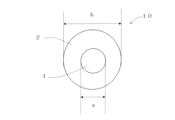
- FIG. 1 is a conceptual cross-sectional view for explaining a double rope structure according to an embodiment of the present invention.
- FIG. 1 is a schematic exploded side view of a double rope structure according to an embodiment of the present invention.
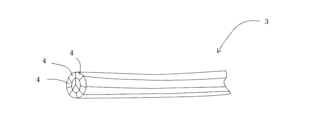
- FIG. 3 is a partially enlarged schematic perspective view of the strands forming the inner core of the double rope structure of FIG. 2;
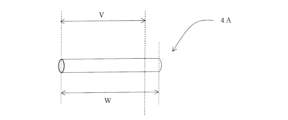
- FIG. 3 is a schematic perspective view for explaining the relationship between the length of one of the yarns forming the strand of the cut portion of the double rope structure and the length of the cut portion.
- FIG. 7 is a schematic exploded side view of a double rope structure according to another embodiment of the present invention.
- the double rope structure is a double rope structure composed of an inner core and an outer skin, and uses high strength and high modulus fiber yarn for the inner core.
- the double rope structure there is an appropriate gap between the inner core high-strength, high-modulus fiber yarn and the outer skin, so the rope structure as a whole is flexible and has improved bending resistance. Not only this, but also the strength per cross-sectional area of the rope structure can be improved.
- a is the diameter of the outer circumference of the inner core (mm)
- b is the diameter of the outer circumference of the outer skin (mm)
- Vf is the volume ratio (%) of the inner core to the total volume of the inner core and the outer skin.
- the diameter b of the outer circumference of the outer skin is a value measured by holding the double rope structure 10 between the outer measuring jaws of an electronic caliper.
- the diameter a of the outer circumference of the inner core is a value measured by holding the inner core obtained by removing the outer skin from the double rope structure between the outer measuring jaws of an electronic caliper. Specifically, these diameters are measured by the method described in Examples below.
- the suitability of the inner and outer layers is 0.70 to 1.20. If the inner/outer layer adequacy is less than 0.70, the rope of the inner core cannot be tightened by the outer skin, and a large number of gaps occur between the inner core and the outer skin. If there are many such gaps, the outer sheath will collapse due to the hollow portions that occur inside the rope, making it impossible to maintain the strength of the outer sheath and reducing the strength of the rope as a whole. On the other hand, if the adequacy of the inner and outer layers exceeds 1.20, the tightness of the inner core by the outer skin becomes too high, resulting in a rope that is very hard as a whole and has poor flexibility.
- the suitability of the inner and outer layers may be preferably 0.80 to 1.15, more preferably 0.85 to 1.10.
- the volume ratio Vf of the inner core to the total volume of the inner core and the outer skin is the total volume occupied by the fibers of the double rope structure in a sample of the double rope structure cut to a predetermined length (1.000 m). It is the ratio (%) of the total volume occupied by the fibers of the inner core.
- volume ratio Vf (i) After measuring the weight of the sample, divide it into an outer skin and an inner core, and measure the weight (g) of each fiber group for each fiber type that constitutes each, (ii) Calculate the volume of each fiber group by dividing the weight of each fiber group by the specific gravity (g/cm 3 ) specific to the fiber type, (iii) Calculate the volume Vo as the sum of the volumes of each fiber group that makes up the outer skin, and the volume Vi as the sum of the volumes of each fiber group that makes up the inner core, (iv) Volume ratio Vf can be obtained according to the following formula.
- the weight of the fiber group that makes up the outer skin is calculated by subtracting the weight of the fiber group that makes up the inner core (Wi) from the weight of the sample (Wo + Wi). (Wo) may also be used.
- the volume ratio Vf of the inner core to the total volume of the inner core and the outer skin may be, for example, 10% or more, preferably 15% or more, more preferably 20% or more, and even more preferably 25% or more. Good too.
- the upper limit of the volume ratio Vf of the inner core is not particularly limited, but from the viewpoint of improving the coverage with the outer skin, the upper limit of the volume ratio Vf of the inner core may be, for example, 75% or less, preferably 70% or less. , more preferably 65% or less, even more preferably 60% or less.
- the double rope structure has excellent bending resistance, so a bending test was conducted in which the bending radius was set to 7.5 mm and the rope was bent 10,000 times under a load of 1% of the rope's tensile strength at bending angle of 240°.
- the ratio of the tensile strength of the double rope structure after the bending test to the tensile strength of the double rope structure before the bending test, that is, the flexibility retention rate (%) may be 90% or more, preferably It may be 93% or more, more preferably 95% or more.
- the flexibility retention rate is a value measured by the method described in the Examples below. The upper limit of the flexibility retention rate is usually 100%.
- the strength per cross-sectional area of the rope structure can be improved, so the double rope structure measured based on JIS L 1013:2021 per cross-sectional area of the double rope structure
- the tensile strength per cross-sectional area of the body may be 180 N/mm 2 or more, preferably 200 N/mm 2 or more, more preferably 220 N/mm 2 or more.
- the upper limit is not particularly limited, but may be, for example, 2000 N/mm 2 .
- FIG. 1 is a conceptual cross-sectional view for explaining a double rope structure.
- the double rope structure 10 includes an inner core 1 whose outer circumference has a diameter a, and an outer sheath 2 which is braided to the inner core 1 and whose outer circumference has a diameter b. have. Note that the gap existing between the inner core 1 and the outer skin 2 is omitted in the figure, and the diameter b of the outer circumference of the outer skin is also the diameter of the double rope structure 10.
- the yarn fineness, number of strokes, and pitch of the outer skin 2 are controlled according to the diameter of the target inner core 1, the weight and specific gravity of the inner core, etc., so that the suitability of the inner and outer layers is adjusted to a predetermined value.
- braiding in the range of it is possible to improve the bending resistance and strength per cross-sectional area of the double rope structure.
- FIG. 2 is a schematic exploded side view of a double rope structure according to an embodiment of the present invention
- FIG. 3 is a partially enlarged view of the strands 3 forming the inner core of the double rope structure of FIG. It is a schematic perspective view.
- the double rope structure 10 includes an inner core 1 and an outer skin 2 that covers the inner core.
- the outer skin 2 is a braided body, and is integrated with the inner core 1 to double Form a rope structure.
- part of the outer skin 2 is omitted to show the state of the inner core 1.
- the inner core 1 and the outer skin 2 have a structure in which a plurality of strands are twisted and/or braided, each strand is composed of a plurality of yarns, and each yarn is composed of a plurality of single yarns, which are combined in a specific range. It is twisted.
- Each single yarn may be a monofilament or a multifilament.
- the strands 3 forming the inner core 1 of the double rope structure 10 of FIG. 2 are composed of a plurality of yarns 4, as shown in FIG. It is a twisted body in which a plurality of filaments (especially preferably multifilaments) are twisted together.
- FIG. 2 shows a cut portion 1A that constitutes a predetermined length V in the inner core 1.
- the cut portion 1A indicates the inner core portion when the double rope structure 10 is cut at a predetermined length V.
- a plurality of strands forming the cut portion 1A are obtained, and in FIG. 2, one of the strands 3A is shown as a dot.
- the strand 3A is composed of a plurality of yarns (not shown).
- FIG. 4 is a schematic perspective view for explaining the relationship between the length W of one yarn 4A of the plurality of yarns forming the strand 3A of the cut portion 1A and the length V of the cut portion 1A.
- the length W of the yarn 4A forming the strand 3A is, for example, 1.005 or more and 1.400 or less as yarn length/rope length (W/V). may exist within the range of
- the rope longitudinal direction Z passing through the center of the double rope structure (hereinafter simply referred to as the rope longitudinal direction Z), for example, as shown in FIG. It intersects at an intersection angle ⁇ (0° ⁇ 90°).
- the crossing angle ⁇ can be measured using an image taken of the side surface of the fiber with the outer skin 1 removed and the inner core 2 exposed.
- strands 3A that intersect with the rope longitudinal direction Z of the double rope structure 10 are randomly selected, and the angle formed by the rope longitudinal direction Z and the side of the strand 3A on the rope longitudinal direction Z side Let ⁇ be the intersection angle.
- FIG. 5 is a schematic exploded side view of a double rope structure according to another embodiment of the present invention.
- the double rope structure 20 includes an inner core 6 and an outer skin 2 covering the inner core.
- the outer skin 2 is a braided body and is integrated with the inner core 6 to form a double rope structure. Note that the same reference numerals are used for the same parts as in FIG. 2, and the description thereof will be omitted.
- the double rope structure when braiding the outer skin 2, the double rope The structure can have increased bending resistance and strength per cross-sectional area.
- the inner core 6 has a twisted structure in which a plurality of strands 7 are twisted together, each strand is composed of a plurality of yarns, and each yarn is composed of a plurality of single yarns.
- the strand 7 forming the inner core 6 of the double rope structure 20 in FIG. 5 is composed of a plurality of yarns 4, similar to the strand 3 shown in FIG. (preferably monofilaments or multifilaments, particularly preferably multifilaments).
- FIG. 5 shows a cut portion 6A that constitutes a predetermined length V in the inner core 6.
- the cut portion 6A indicates the inner core portion when the double rope structure 20 is cut at a predetermined length V.
- a plurality of strands forming the cut portion 6A are obtained, and in FIG. 5, one of the strands 7A is shown as a dot.
- the strand 7A is composed of a plurality of yarns (not shown), and the length W of the yarn forming the strand 7A is, for example, yarn length/rope length (with respect to the length V of the cut portion 6A).
- W/V may be present in a range of, for example, 1.005 or more and 1.400 or less.
- the strands 7A forming the inner core intersect with the longitudinal direction Z of the rope at a crossing angle ⁇ (0° ⁇ 90°).
- a strand 7A that intersects with the rope longitudinal direction Z passing through the center of the double rope structure 20 is randomly selected, and is formed by the rope longitudinal direction Z and the side of the strand 7A on the rope longitudinal direction Z side.
- the angle ⁇ is taken as the intersection angle.
- the outer skin 2 is formed of a braided body of strands.
- the strand is further composed of a plurality of yarns, as shown in FIG.
- Each yarn is a stranded body in which a plurality of yarns (preferably monofilaments or multifilaments, particularly preferably multifilaments) are twisted together.
- the diameter of the inner core can be set appropriately depending on the intended use, and may be, for example, 0.5 to 100 mm, preferably 1.0 to 80 mm, more preferably 1.5 to 60 mm. You can.
- the diameter of the inner core is a value measured by the method described in Examples below.
- the number of twists of each yarn may be, for example, from 150 to 0.1 T/m, preferably from 100 to 2 T/m, and more. It may preferably be 80 to 3 T/m, even more preferably 70 to 5 T/m, particularly preferably 60 to 6 T/m.
- the number of twists is small, it is possible to improve the strength of the rope, but when there is no twist, the handleability when forming a strand is reduced.
- the plurality of strands that make up the inner core may be twisted as necessary.
- the number of twists in the strands can be determined as necessary within the range that satisfies the yarn length of the inner core/rope length. Twisting may be applied as required. Furthermore, the plurality of strands may be further twisted together as required.
- the fineness of the yarn can be appropriately set depending on the fineness required for the double rope structure, but may be, for example, 30 to 5000 dtex, preferably 200 to 4000 dtex, more preferably 400 to 2500 dtex, More preferably, it may be 1000 to 2000 dtex. It is preferable that the yarn fineness is within the above range from the viewpoint of handleability such as strand convergence.
- the yarn length of the yarn constituting the inner core of the cut portion is determined by the rope length of the cut portion cut at a length of 1 m (precisely 1.000 m).
- the yarn length/rope length (W/V) may be in the range of 1.005 to 1.400, and is preferably may be 1.005 to 1.200, more preferably 1.006 to 1.180, even more preferably 1.007 to 1.150. Note that the yarn length and rope length are values measured by the method described in Examples described later.
- the inner core of the double rope structure of the present invention may be a twisted body or a braided body.
- stranded bodies they are often 3-strand or 4-strand, while braided bodies have 4-strand, 6-strand, 8-strand, 12-strand, 16-strand, 32-strand, 64-strand, etc. Good too.
- braided bodies are preferred, and particularly preferred are braided bodies with 4 strands, 6 strands, 8 strands, 12 strands, 16 strands, and 32 strands.
- the pitch may be adjusted to, for example, 2.5 to 25, preferably 2.5 to 20, more preferably 3 to 18, and even more preferably It may be 3.3 to 15.
- the pitch represents the number of yarns per inch in the longitudinal direction of the rope, and can be confirmed by measuring, for example, using a digital microscope VHX-2000 manufactured by Keyence Corporation.
- the crossing angle ⁇ of the strands with respect to the longitudinal direction of the rope may be, for example, 50° or less, preferably 40° or less, more preferably 35° or less, still more preferably 33° or less, and even more preferably 30°. Hereinafter, it may be particularly preferably 27° or less.
- the lower limit of the intersection angle may be, for example, 2° or more, preferably 3° or more, more preferably 6° or more, and even more preferably 10° or more. Good too. It is preferable in terms of strength that the crossing angle of the strands is below the above-mentioned upper limit, and it is preferable in terms of bending durability that it is above the above-mentioned lower limit.
- the high-strength, high-elastic modulus fiber constituting the inner core is not particularly limited as long as it is a high-strength, high-elastic modulus fiber that can achieve a yarn strength of 20 cN/dtex or higher and a yarn elastic modulus of 400 cN/dtex or higher.
- liquid crystal polyester fibers (Vectran (trademark), Sciberas (trademark), Zexion (trademark), etc.), ultra-high molecular weight polyethylene fibers (Izanas (trademark), Dyneema (trademark), etc.), aramid fibers ( Kevlar (trademark), Twaron (trademark), Technora (trademark), etc.), poly(paraphenylenebenzobisoxazole) fiber (Zylon (trademark), etc.), and the like.
- the yarn strength of the high strength/high modulus fiber is 20 cN/dtex or more, preferably 22 cN/dtex or more.
- the upper limit is not particularly limited, it may be, for example, 40 cN/dtex.
- the yarn elastic modulus of the high strength/high elastic modulus fiber is 400 cN/dtex or more, preferably 450 cN/dtex or more.
- the upper limit is not particularly limited, but may be, for example, 600 cN/dtex.
- the yarn elongation of the high strength/high modulus fiber may be, for example, 1 to 6%, preferably 2 to 5.5%.
- Yarn strength, yarn elastic modulus, and yarn elongation are values measured by the method described in the Examples below. By using such high-strength, high-modulus fibers, it is possible to achieve high strength per cross-sectional area in a double rope structure.
- liquid crystal polyester fibers liquid crystal polyester fibers, ultra-high molecular weight polyethylene fibers, or aramid fibers are preferred.
- Liquid crystal polyester fibers can be produced, for example, by melt-spinning liquid crystal polyester and solid-phase polymerizing the spun yarn.
- Liquid crystal polyester multifilament is a fiber made up of two or more liquid crystal polyester monofilaments.
- Liquid crystalline polyester is a polyester that exhibits optical anisotropy (liquid crystallinity) in its molten phase, and can be identified by, for example, placing a sample on a hot stage and heating it in a nitrogen atmosphere, and observing the transmitted light of the sample with a polarizing microscope. .
- the liquid crystal polyester is composed of repeating structural units derived from, for example, aromatic diols, aromatic dicarboxylic acids, aromatic hydroxycarboxylic acids, etc., and the structural units are Not particularly limited.
- the liquid crystal polyester may also contain a structural unit derived from an aromatic diamine, an aromatic hydroxyamine, or an aromatic aminocarboxylic acid within a range that does not impede the effects of the present invention.
- examples of preferred structural units include those shown in Table 1.
- Y exists in a number ranging from 1 to the maximum number that can be substituted in the aromatic ring, and each independently represents a hydrogen atom, a halogen atom (for example, a fluorine atom, a chlorine atom, a bromine atom, an iodine atom, etc.), Alkyl groups (for example, alkyl groups having 1 to 4 carbon atoms such as methyl group, ethyl group, isopropyl group, t-butyl group, etc.), alkoxy groups (for example, methoxy group, ethoxy group, isopropoxy group, n-butoxy group) etc.), aryl groups (e.g., phenyl group, naphthyl group, etc.), aralkyl groups [benzyl group (phenylmethyl group), phenethyl group (phenylethyl group), etc.], aryloxy groups (e.g.,
- More preferable structural units include the structural units described in Examples (1) to (18) shown in Tables 2, 3, and 4 below.
- the structural unit in the formula is a structural unit that can exhibit a plurality of structures, a combination of two or more types of such structural units may be used as the structural unit constituting the polymer.
- n is an integer of 1 or 2
- Y 1 and Y 2 are , each independently the number of carbon atoms in a hydrogen atom, a halogen atom (e.g., a fluorine atom, a chlorine atom, a bromine atom, an iodine atom, etc.), an alkyl group (e.g., a methyl group, an ethyl group, an isopropyl group, a t-butyl group, etc.) 1 to 4 alkyl groups, etc.), alkoxy groups (e.g., methoxy group, ethoxy group, isopropoxy group, n-butoxy group, etc.), aryl groups (e.g., phenyl group, naphthyl group, etc.), aralkyl groups [benzyl group ( phenylmethyl group),
- examples of Z include substituents represented by the following formulas.
- a preferred liquid crystal polyester preferably has two or more types of naphthalene skeletons as structural units.
- the liquid crystalline polyester contains both a structural unit (A) derived from hydroxybenzoic acid and a structural unit (B) derived from hydroxynaphthoic acid.
- the structural unit (A) may be the following formula (A)
- the structural unit (B) may be the following formula (B).
- the ratio of the structural unit (B) may be preferably in the range of 9/1 to 1/1, more preferably 7/1 to 1/1, even more preferably 5/1 to 1/1.
- the total of the structural units of (A) and the structural units of (B) may be, for example, 65 mol% or more, more preferably 70 mol% or more, and still more preferably 80 mol% based on the total structural units. It may be more than that.
- the polymers liquid crystal polyesters containing 4 to 45 mol% of the structural unit (B) are particularly preferred.
- the melting point of the liquid crystal polyester suitably used in the present invention is preferably 250 to 360°C, more preferably 260 to 320°C.
- the melting point is the main absorption peak temperature measured and observed with a differential scanning calorimeter (DSC; "TA3000” manufactured by Mettler) in accordance with the JIS K7121:2012 test method. Specifically, 10 to 20 mg of the sample was taken into the DSC device, sealed in an aluminum pan, nitrogen was passed through as a carrier gas at 100 cc/min, and the endothermic peak was measured when the temperature was raised at 20°C/min. Measure.
- thermoplastic polymers such as polyethylene terephthalate, modified polyethylene terephthalate, polyolefin, polycarbonate, polyamide, polyphenylene sulfide, polyether ether ketone, and fluororesin may be added to the liquid crystal polyester to the extent that the effects of the present invention are not impaired. You can.
- various additives such as inorganic substances such as titanium oxide, kaolin, silica, and barium oxide, colorants such as carbon black, dyes, and pigments, antioxidants, ultraviolet absorbers, and light stabilizers may be added.
- the outer skin is composed of a wrapped or braided body of strands that covers the inner core.
- the yarns constituting the strands may be monofilament or multifilament, but multifilament is preferred.
- the wrapped twisted body can be formed by spirally winding the strands around the inner core, and the braided body can be formed by winding the strands around the inner core in a manner of 8 strokes, 12 strokes, 16 strokes, 24 strokes, 32 strokes, and 40 strokes. It can be formed by braiding with 48 strokes, 64 strokes, etc.
- braided bodies with 12 threads, 16 threads, 24 threads, 32 threads, 40 threads, and 48 threads are preferred, and braided bodies with 12 threads, 16 threads, 24 threads, 32 threads, or 40 threads are more preferred.
- the strands constituting the outer skin may be formed of the above-mentioned high strength/high elastic modulus fibers, or may be formed of non-high strength/non-high elastic modulus fibers.
- Non-high strength/non-high modulus fibers may have a yarn strength of, for example, less than 20 cN/dtex, typically about 1 cN/dtex to 15 cN/dtex.
- the yarn elastic modulus may be less than 400 cN/dtex, and typically may be about 10 cN/dtex to 200 cN/dtex.
- the yarn elongation may be, for example, between 3 and 20%, preferably between 7 and 20%.
- the non-high strength/non-high elastic modulus fiber has a ratio of the strength of the fiber used for the outer skin to the strength of the fiber used for the inner core, for example, 0.10 to 0. 40, preferably in the range of 0.12 to 0.35.
- Specific non-high strength/non-high modulus fibers include general-purpose synthetic fibers, such as general-purpose polyester fibers (e.g., polyethylene terephthalate fibers), polyolefin fibers (e.g., polyethylene fibers, polypropylene fibers), and polyamide fibers (e.g., nylon fibers). 6 fiber, nylon 6,6 fiber), polyvinyl alcohol fiber (eg, Vinylon (trademark), etc.).
- general-purpose synthetic fibers such as general-purpose polyester fibers (e.g., polyethylene terephthalate fibers), polyolefin fibers (e.g., polyethylene fibers, polypropylene fibers), and polyamide fibers (e.g., nylon fibers).
- 6 fiber, nylon 6,6 fiber polyvinyl alcohol fiber (eg, Vinylon (trademark), etc.).
- the outer skin may be substantially composed of non-high strength and non-high modulus fibers.
- substantially means that the proportion of non-high strength/non-high elastic modulus fibers in the outer skin is 80% by weight or more, preferably 90% by weight or more (90 to 100% by weight). good.
- the fineness of the yarn forming the strands of the outer skin can be set as appropriate depending on the diameter required for the double rope structure, but may be, for example, 50 to 100,000 dtex, preferably 100 to 50,000 dtex, or more. It is preferably 200 to 40,000 dtex, more preferably 200 to 10,000 dtex, even more preferably 200 to 1,000 dtex.
- the fineness of the yarn forming the strands of the outer skin is within the above range, it becomes easy to adjust the suitability of the inner and outer layers.
- the diameter of the double rope structure that is, the diameter b of the outer circumference of the outer skin
- the diameter b can be set appropriately depending on the intended use, and may be, for example, 1.0 to 250 mm, preferably 1.5 mm. ⁇ 200mm, more preferably 1.8 ⁇ 100mm.
- the diameter b is the diameter of the outer periphery of the outer skin 2, and is a value measured by holding the double rope structure 10 between the outer measuring jaws of an electronic caliper.
- the diameters of the double rope structure and the inner core were calculated from the average value of the five points after removing the maximum value and minimum value after randomly measuring seven points by holding them between the outer measuring jaws of an electronic caliper.
- the diameter of the double rope structure is used as the diameter of the outer circumference of the skin.
- When measuring the diameter of the inner core carefully remove the outer skin from the surface layer while keeping the inner core in a stretched state so as not to affect the structure of the inner core of the double rope structure. The part was measured by holding it between the outer measuring jaws of an electronic caliper.
- the cross-sectional area of the double rope structure was calculated using the diameter of the double rope structure as (diameter/2) 2 ⁇ 3.14.
- the double rope structure was randomly selected and cut to a length of 1.000 m, and its weight (weight of the double rope structure: Wi+Wo) was measured using an electronic precision balance. After the above measurement, carefully remove the outer skin while keeping the inner core pulled, and measure the weight of the outer skin (outer skin weight: Wo) and the weight of the inner core (inner core weight: Wi) using an electronic precision balance. did. Thereafter, the volume ratio Vf (%) of the inner core to the total volume of the inner core and outer skin was calculated from the following formula.
- Vf (Wi/ ⁇ i)/(Wi/ ⁇ i+Wo/ ⁇ o) ⁇ 100
- Wi is the weight of the inner core (g)
- ⁇ i is the specific gravity of the inner core (g/cm 3 )
- Wo is the weight of the outer skin (g)
- ⁇ o is the specific gravity of the outer skin (g/cm 3 ).
- the specific gravity of the inner core and the outer skin is determined by using the specific gravity of the polymer that constitutes the yarn that constitutes the inner core and the outer skin.
- Example 1 Liquid crystalline polyester multifilament (manufactured by Kuraray Co., Ltd., "Vectran", fineness 1670 dtex) was used as the high-strength, high-modulus fiber, and the pitch was 8.6 using an EL type 6-stroke stringing machine (manufactured by Kokubun Limited Co., Ltd.).
- the inner core rope was manufactured by adjusting the number of rotations of the braider and the take-up speed so that the rope had a diameter of 1/4 inch.
- polyethylene terephthalate multifilament manufactured by Toray Industries, Inc., fineness 280 dtex, yarn strength 7.2 cN/dtex, yarn elastic modulus 88 cN/dtex, yarn elongation 15.1%
- a medium-sized A double rope was manufactured using a 32-stroke cord making machine (manufactured by Kokubun Limited) by adjusting the rotation speed and take-up speed of the braider so that the pitch was 50 stitches/inch.
- Example 2 A double rope structure was manufactured in the same manner as in Example 1, except that the number of strokes and pitch of the inner core of the double rope structure and the fineness and pitch of the outer skin were changed as shown in Table 5. The results are shown in Table 5.
- Example 3 The high-strength, high-modulus fiber in the inner core of the double rope structure was changed to ultra-high molecular weight polyethylene multifilament (manufactured by Toyobo Co., Ltd., "Izanas", fineness 1760 dtex), and the pitch of the inner core was 8.5.
- a double rope structure was manufactured in the same manner as in Example 1, except that the pitch of the outer skin was changed to 49. The results are shown in Table 5.
- Example 4 A double rope structure was manufactured in the same manner as in Example 3, except that the number and pitch of the inner core and the fineness, number of strokes, and pitch of the outer skin were changed as shown in Table 5. The results are shown in Table 5.
- Liquid crystal polyester multifilament (manufactured by Kuraray Co., Ltd., "Vectran", fineness 1670 dtex) is used as a high-strength, high-modulus fiber, and 38 strands are wound onto a bobbin with a winding machine under constant tension, and 38 strands are bundled. This bundled yarn is further wound around a bobbin with a winder under constant tension to obtain a strand for string making (fineness: 2,411,480 dtex). Then, the strand for string making is put into a 6-stroke string making machine, and the rotational speed and take-up speed of the braider are adjusted so that the pitch is 0.45 stitches/inch to produce an inner core rope.
- polyethylene terephthalate multifilament manufactured by Toray Industries, Ltd., fineness 1100 dtex, yarn strength 6.8 cN/dtex, yarn elasticity modulus 88 cN/dtex, yarn elongation 14%), 20 pieces were wound on a winder under constant tension. 20 bundled yarns are manufactured by winding them around a bobbin, and these 4 bundled yarns are twisted 10 times/meter in the Z direction using a twisting machine under constant tension, and then wound around the bobbin to create twisted yarn for string making (fineness 456, 000dtex).
- Example 1 A double rope structure was manufactured in the same manner as in Example 1, except that the number of strokes and pitch of the inner core and the pitch of the outer skin of the double rope structure were changed as shown in Table 5. The results are shown in Table 5.
- the inner core fiber of the double rope structure was changed to polyethylene terephthalate multifilament (manufactured by Toray Industries, Inc., fineness 1670 dtex, yarn strength 8.0 cN/dtex, yarn elastic modulus 143 cN/dtex, yarn elongation 12.6%).
- a double rope structure was manufactured in the same manner as in Example 1, except that the pitch of the inner core was changed to 9.6, the number of strokes was changed to 12, and the pitch of the outer skin was changed to 55. The results are shown in Table 5.
- Comparative Examples 1 and 2 the suitability of the inner and outer layers in the double rope structure exceeds 1.20, and the strength retention rate after the bending test is inferior to that of the example. Further, in Comparative Examples 3 and 4, the suitability of the inner and outer layers in the double rope structure was less than 0.70, and the tensile strength per cross-sectional area was inferior to that of the example. In Comparative Example 5, since the fibers constituting the inner core are non-high strength and non-high elastic modulus fibers, the strength of the entire rope structure is halved compared to Example 1 having a similar diameter.
- the double rope structure of the present invention can be used for mooring ships, rim lines for fishing nets, mooring floating water equipment set up floating on the water, floating marine structures used for exploration of marine resources, etc. It is extremely useful for water applications such as marine ropes for mooring, water applications such as tow lines, cargo lines, wind power generation equipment, and power substation equipment, land applications such as tow lines and cargo lines, and sports and leisure applications. It can be used preferably.
Landscapes
- Engineering & Computer Science (AREA)
- Manufacturing & Machinery (AREA)
- Textile Engineering (AREA)
- Chemical & Material Sciences (AREA)
- Crystallography & Structural Chemistry (AREA)
- Ropes Or Cables (AREA)
Priority Applications (6)
| Application Number | Priority Date | Filing Date | Title |
|---|---|---|---|
| US18/878,399 US20260035857A1 (en) | 2022-06-24 | 2023-06-26 | Double-rope structure |
| JP2024529104A JPWO2023249125A1 (https=) | 2022-06-24 | 2023-06-26 | |
| EP23827305.6A EP4545703A1 (en) | 2022-06-24 | 2023-06-26 | Double-rope structure |
| CN202380048192.0A CN119403975A (zh) | 2022-06-24 | 2023-06-26 | 双重绳索结构体 |
| CA3260236A CA3260236A1 (en) | 2022-06-24 | 2023-06-26 | DOUBLE CABLE STRUCTURE |
| KR1020247042175A KR20250026773A (ko) | 2022-06-24 | 2023-06-26 | 이중 로프 구조체 |
Applications Claiming Priority (2)
| Application Number | Priority Date | Filing Date | Title |
|---|---|---|---|
| JP2022101743 | 2022-06-24 | ||
| JP2022-101743 | 2022-06-24 |
Publications (1)
| Publication Number | Publication Date |
|---|---|
| WO2023249125A1 true WO2023249125A1 (ja) | 2023-12-28 |
Family
ID=89380109
Family Applications (1)
| Application Number | Title | Priority Date | Filing Date |
|---|---|---|---|
| PCT/JP2023/023581 Ceased WO2023249125A1 (ja) | 2022-06-24 | 2023-06-26 | 二重ロープ構造体 |
Country Status (7)
| Country | Link |
|---|---|
| US (1) | US20260035857A1 (https=) |
| EP (1) | EP4545703A1 (https=) |
| JP (1) | JPWO2023249125A1 (https=) |
| KR (1) | KR20250026773A (https=) |
| CN (1) | CN119403975A (https=) |
| CA (1) | CA3260236A1 (https=) |
| WO (1) | WO2023249125A1 (https=) |
Citations (4)
| Publication number | Priority date | Publication date | Assignee | Title |
|---|---|---|---|---|
| JPH07165164A (ja) * | 1993-12-13 | 1995-06-27 | Toyobo Co Ltd | 係船索 |
| JP2002105878A (ja) * | 2000-09-25 | 2002-04-10 | Kurisansemamu Kk | 操作用ワイヤロープ |
| JP2011111692A (ja) * | 2009-11-26 | 2011-06-09 | Seiwa:Kk | 繊維ロープ |
| JP3199266U (ja) | 2015-06-03 | 2015-08-13 | ナロック株式会社 | 繊維ロープ |
Family Cites Families (24)
| Publication number | Priority date | Publication date | Assignee | Title |
|---|---|---|---|---|
| US91995A (en) * | 1869-06-29 | Improvement in ropes, cord | ||
| US2438864A (en) * | 1945-01-10 | 1948-03-30 | Plymouth Cordage Co | Rope |
| US3078755A (en) * | 1961-01-27 | 1963-02-26 | Samson Cordage Works | Braided cordage |
| US4195549A (en) * | 1970-10-30 | 1980-04-01 | Filztuchverwaltungs-Gmbh | Pintle wire for high load hinge connections |
| US4563869A (en) * | 1982-05-17 | 1986-01-14 | American Manufacturing Company, Inc. | Rope with reduced lash-back construction |
| JPS6128092A (ja) * | 1984-07-11 | 1986-02-07 | 東京製綱繊維ロ−プ株式会社 | 複合線条体およびその製造方法 |
| US4777784A (en) * | 1986-11-12 | 1988-10-18 | Ferguson Thomas B | Horse tethering device |
| JPH0431072Y2 (https=) * | 1988-03-14 | 1992-07-27 | ||
| DE29608971U1 (de) * | 1996-05-20 | 1996-08-22 | Teufelberger Ges.M.B.H., Wels | Seil für die Mitnahme und Weitergabe von Papierbahnen bei der Herstellung von Papier und Kartonagen auf Papiermaschinen |
| CN1152388C (zh) * | 1996-11-04 | 2004-06-02 | 埃里克·怀特 | 编织电篱笆 |
| MXPA02006360A (es) * | 1999-12-30 | 2003-02-12 | Michelin Rech Tech | Cable de acero de varias capas para carcasa de neumatico. |
| US7331269B2 (en) * | 2001-07-02 | 2008-02-19 | Delphi Technologies, Inc. | Apparatus and method for interconnecting items with a flexible member |
| US7168231B1 (en) * | 2002-09-05 | 2007-01-30 | Samson Rope Technologies | High temperature resistant rope systems and methods |
| US7175908B2 (en) * | 2003-06-30 | 2007-02-13 | Connolly Jr Thomas J | High temperature search line |
| US7127878B1 (en) * | 2003-12-16 | 2006-10-31 | Samson Rope Technologies | Controlled failure rope systems and methods |
| US7329271B2 (en) * | 2003-12-18 | 2008-02-12 | Ethicon, Inc. | High strength suture with absorbable core |
| US20080051835A1 (en) * | 2006-08-28 | 2008-02-28 | Mazzocca Augustus D | High strength suture coated with rgd peptide |
| EP2210971A1 (en) * | 2009-01-26 | 2010-07-28 | Politecnico Di Milano | Silk fibroin textile structures as biomimetic prosthetics for the regeneration of tissues and ligaments |
| US9163341B2 (en) * | 2010-04-29 | 2015-10-20 | Dsm Ip Assets B.V. | Multifilament yarn construction |
| US20170356132A1 (en) * | 2016-06-10 | 2017-12-14 | Wirerope Works, Inc. | Braided Polyester Fiber Core in Steel Wire Rope |
| CN111164251A (zh) * | 2017-10-06 | 2020-05-15 | 株式会社可乐丽 | 编带 |
| EP3743557B1 (en) * | 2018-01-23 | 2024-03-06 | Kuraray Co., Ltd. | Small diameter fiber braid with central core member |
| US11278758B2 (en) * | 2019-03-15 | 2022-03-22 | Hyper Wear, Inc. | Weighted triple-braided exercise rope |
| US20240352669A1 (en) * | 2021-09-14 | 2024-10-24 | Lankhorst Euronete Portugal, S.A. | Cut resistant jacket |
-
2023
- 2023-06-26 CA CA3260236A patent/CA3260236A1/en active Pending
- 2023-06-26 WO PCT/JP2023/023581 patent/WO2023249125A1/ja not_active Ceased
- 2023-06-26 EP EP23827305.6A patent/EP4545703A1/en active Pending
- 2023-06-26 CN CN202380048192.0A patent/CN119403975A/zh active Pending
- 2023-06-26 KR KR1020247042175A patent/KR20250026773A/ko active Pending
- 2023-06-26 US US18/878,399 patent/US20260035857A1/en active Pending
- 2023-06-26 JP JP2024529104A patent/JPWO2023249125A1/ja active Pending
Patent Citations (4)
| Publication number | Priority date | Publication date | Assignee | Title |
|---|---|---|---|---|
| JPH07165164A (ja) * | 1993-12-13 | 1995-06-27 | Toyobo Co Ltd | 係船索 |
| JP2002105878A (ja) * | 2000-09-25 | 2002-04-10 | Kurisansemamu Kk | 操作用ワイヤロープ |
| JP2011111692A (ja) * | 2009-11-26 | 2011-06-09 | Seiwa:Kk | 繊維ロープ |
| JP3199266U (ja) | 2015-06-03 | 2015-08-13 | ナロック株式会社 | 繊維ロープ |
Also Published As
| Publication number | Publication date |
|---|---|
| KR20250026773A (ko) | 2025-02-25 |
| CN119403975A (zh) | 2025-02-07 |
| CA3260236A1 (en) | 2025-03-24 |
| US20260035857A1 (en) | 2026-02-05 |
| JPWO2023249125A1 (https=) | 2023-12-28 |
| EP4545703A1 (en) | 2025-04-30 |
Similar Documents
| Publication | Publication Date | Title |
|---|---|---|
| KR101321194B1 (ko) | 고성능 폴리에틸렌 섬유를 함유하는 로프 | |
| JP7362657B2 (ja) | 中央コア部材を伴った小径繊維編組 | |
| JP2023075309A (ja) | 二重ロープ構造体 | |
| JP7249569B2 (ja) | 撚糸及びそれを用いた撚糸構造体 | |
| CN110485186B (zh) | 一种用于码头停靠的弹性系泊绳缆及其制备方法 | |
| JPH08140538A (ja) | 釣 糸 | |
| JP4851486B2 (ja) | 糸条と該糸条からなる釣糸 | |
| WO2023249125A1 (ja) | 二重ロープ構造体 | |
| JP7788274B2 (ja) | 二重ロープ構造体 | |
| JP7672855B2 (ja) | 複合カバリング糸およびそれからなるロープ | |
| US20230399773A1 (en) | Core-sheath composite fiber, production method therefor, and fiber structure | |
| CA3202915C (en) | Double rope structure | |
| CN116194627A (zh) | 横截面积变化的编织绳及其制造方法 | |
| KR20250121323A (ko) | 고 표면적 브레이드 | |
| JP3851983B2 (ja) | 新規なロープ |
Legal Events
| Date | Code | Title | Description |
|---|---|---|---|
| 121 | Ep: the epo has been informed by wipo that ep was designated in this application |
Ref document number: 23827305 Country of ref document: EP Kind code of ref document: A1 |
|
| WWE | Wipo information: entry into national phase |
Ref document number: 2024529104 Country of ref document: JP |
|
| WWE | Wipo information: entry into national phase |
Ref document number: 202380048192.0 Country of ref document: CN |
|
| WWE | Wipo information: entry into national phase |
Ref document number: 202547004420 Country of ref document: IN |
|
| WWE | Wipo information: entry into national phase |
Ref document number: 2023827305 Country of ref document: EP |
|
| NENP | Non-entry into the national phase |
Ref country code: DE |
|
| ENP | Entry into the national phase |
Ref document number: 2023827305 Country of ref document: EP Effective date: 20250124 |
|
| REG | Reference to national code |
Ref country code: BR Ref legal event code: B01A Ref document number: 112024026724 Country of ref document: BR |
|
| WWP | Wipo information: published in national office |
Ref document number: 202380048192.0 Country of ref document: CN |
|
| WWP | Wipo information: published in national office |
Ref document number: 1020247042175 Country of ref document: KR |
|
| REG | Reference to national code |
Ref country code: BR Ref legal event code: B01E Ref document number: 112024026724 Country of ref document: BR Free format text: 1) APRESENTE NOVO RELATORIO DESCRITIVO ADAPTADO AO ART. 26 INCISO I DA PORTARIA/INPI NO 14/2024, UMA VEZ QUE O CONTEUDO ENVIADO NA PETICAO NO 870240108508 DE 19/12/2024 ENCONTRA-SE FORA DA NORMA EM RELACAO AO TITULO, CONTENDO TEXTO DIFERENTE DO TITULO INCIANDO A PAGINA. 2) APRESENTE NOVO RESUMO ADAPTADO AO ART. 40 INCISO I DA PORTARIA/INPI NO 14/2024, UMA VEZ QUE O CONTEUDO ENVIADO NA PETICAO NO 870240108508 DE 19/12/2024 ENCONTRA-SE FORA DA NORMA EM RELACAO AO TITULO, CONTENDO TEXTO DIFERENTE DO TITULO INCIANDO A PAGINA. A EXIGENCIA DEVE SER RESPONDIDA EM ATE 60 (SESSENTA) DIAS DE SUA PUBLICACAO E DEVE SER REALIZADA POR MEIO DA PETICAO GRU CODIGO DE SERVICO 207. |
|
| WWP | Wipo information: published in national office |
Ref document number: 2023827305 Country of ref document: EP |
|
| ENP | Entry into the national phase |
Ref document number: 112024026724 Country of ref document: BR Kind code of ref document: A2 Effective date: 20241219 |