EP4545703A1 - Double-rope structure - Google Patents
Double-rope structure Download PDFInfo
- Publication number
- EP4545703A1 EP4545703A1 EP23827305.6A EP23827305A EP4545703A1 EP 4545703 A1 EP4545703 A1 EP 4545703A1 EP 23827305 A EP23827305 A EP 23827305A EP 4545703 A1 EP4545703 A1 EP 4545703A1
- Authority
- EP
- European Patent Office
- Prior art keywords
- rope structure
- inner core
- double rope
- outer cover
- fibers
- Prior art date
- Legal status (The legal status is an assumption and is not a legal conclusion. Google has not performed a legal analysis and makes no representation as to the accuracy of the status listed.)
- Pending
Links
Images

Classifications
-
- D—TEXTILES; PAPER
- D07—ROPES; CABLES OTHER THAN ELECTRIC
- D07B—ROPES OR CABLES IN GENERAL
- D07B1/00—Constructional features of ropes or cables
- D07B1/02—Ropes built-up from fibrous or filamentary material, e.g. of vegetable origin, of animal origin, regenerated cellulose, plastics
-
- D—TEXTILES; PAPER
- D07—ROPES; CABLES OTHER THAN ELECTRIC
- D07B—ROPES OR CABLES IN GENERAL
- D07B1/00—Constructional features of ropes or cables
- D07B1/02—Ropes built-up from fibrous or filamentary material, e.g. of vegetable origin, of animal origin, regenerated cellulose, plastics
- D07B1/025—Ropes built-up from fibrous or filamentary material, e.g. of vegetable origin, of animal origin, regenerated cellulose, plastics comprising high modulus, or high tenacity, polymer filaments or fibres, e.g. liquid-crystal polymers
-
- D—TEXTILES; PAPER
- D04—BRAIDING; LACE-MAKING; KNITTING; TRIMMINGS; NON-WOVEN FABRICS
- D04C—BRAIDING OR MANUFACTURE OF LACE, INCLUDING BOBBIN-NET OR CARBONISED LACE; BRAIDING MACHINES; BRAID; LACE
- D04C1/00—Braid or lace, e.g. pillow-lace; Processes for the manufacture thereof
- D04C1/02—Braid or lace, e.g. pillow-lace; Processes for the manufacture thereof made from particular materials
-
- D—TEXTILES; PAPER
- D04—BRAIDING; LACE-MAKING; KNITTING; TRIMMINGS; NON-WOVEN FABRICS
- D04C—BRAIDING OR MANUFACTURE OF LACE, INCLUDING BOBBIN-NET OR CARBONISED LACE; BRAIDING MACHINES; BRAID; LACE
- D04C1/00—Braid or lace, e.g. pillow-lace; Processes for the manufacture thereof
- D04C1/06—Braid or lace serving particular purposes
- D04C1/12—Cords, lines, or tows
-
- D—TEXTILES; PAPER
- D07—ROPES; CABLES OTHER THAN ELECTRIC
- D07B—ROPES OR CABLES IN GENERAL
- D07B2201/00—Ropes or cables
- D07B2201/10—Rope or cable structures
- D07B2201/1012—Rope or cable structures characterised by their internal structure
- D07B2201/102—Rope or cable structures characterised by their internal structure including a core
-
- D—TEXTILES; PAPER
- D07—ROPES; CABLES OTHER THAN ELECTRIC
- D07B—ROPES OR CABLES IN GENERAL
- D07B2201/00—Ropes or cables
- D07B2201/10—Rope or cable structures
- D07B2201/1096—Rope or cable structures braided
-
- D—TEXTILES; PAPER
- D07—ROPES; CABLES OTHER THAN ELECTRIC
- D07B—ROPES OR CABLES IN GENERAL
- D07B2201/00—Ropes or cables
- D07B2201/20—Rope or cable components
- D07B2201/2015—Strands
- D07B2201/2041—Strands characterised by the materials used
-
- D—TEXTILES; PAPER
- D07—ROPES; CABLES OTHER THAN ELECTRIC
- D07B—ROPES OR CABLES IN GENERAL
- D07B2201/00—Ropes or cables
- D07B2201/20—Rope or cable components
- D07B2201/2047—Cores
- D07B2201/2066—Cores characterised by the materials used
-
- D—TEXTILES; PAPER
- D07—ROPES; CABLES OTHER THAN ELECTRIC
- D07B—ROPES OR CABLES IN GENERAL
- D07B2201/00—Ropes or cables
- D07B2201/20—Rope or cable components
- D07B2201/2083—Jackets or coverings
- D07B2201/209—Jackets or coverings comprising braided structures
-
- D—TEXTILES; PAPER
- D07—ROPES; CABLES OTHER THAN ELECTRIC
- D07B—ROPES OR CABLES IN GENERAL
- D07B2205/00—Rope or cable materials
- D07B2205/20—Organic high polymers
- D07B2205/201—Polyolefins
-
- D—TEXTILES; PAPER
- D07—ROPES; CABLES OTHER THAN ELECTRIC
- D07B—ROPES OR CABLES IN GENERAL
- D07B2205/00—Rope or cable materials
- D07B2205/20—Organic high polymers
- D07B2205/2039—Polyesters
- D07B2205/2042—High performance polyesters, e.g. Vectran
-
- D—TEXTILES; PAPER
- D07—ROPES; CABLES OTHER THAN ELECTRIC
- D07B—ROPES OR CABLES IN GENERAL
- D07B2401/00—Aspects related to the problem to be solved or advantage
- D07B2401/20—Aspects related to the problem to be solved or advantage related to ropes or cables
- D07B2401/2055—Improving load capacity
-
- D—TEXTILES; PAPER
- D10—INDEXING SCHEME ASSOCIATED WITH SUBLASSES OF SECTION D, RELATING TO TEXTILES
- D10B—INDEXING SCHEME ASSOCIATED WITH SUBLASSES OF SECTION D, RELATING TO TEXTILES
- D10B2321/00—Fibres made from polymers obtained by reactions only involving carbon-to-carbon unsaturated bonds
- D10B2321/02—Fibres made from polymers obtained by reactions only involving carbon-to-carbon unsaturated bonds polyolefins
- D10B2321/021—Fibres made from polymers obtained by reactions only involving carbon-to-carbon unsaturated bonds polyolefins polyethylene
- D10B2321/0211—Fibres made from polymers obtained by reactions only involving carbon-to-carbon unsaturated bonds polyolefins polyethylene high-strength or high-molecular-weight polyethylene, e.g. ultra-high molecular weight polyethylene [UHMWPE]
-
- D—TEXTILES; PAPER
- D10—INDEXING SCHEME ASSOCIATED WITH SUBLASSES OF SECTION D, RELATING TO TEXTILES
- D10B—INDEXING SCHEME ASSOCIATED WITH SUBLASSES OF SECTION D, RELATING TO TEXTILES
- D10B2331/00—Fibres made from polymers obtained otherwise than by reactions only involving carbon-to-carbon unsaturated bonds, e.g. polycondensation products
- D10B2331/04—Fibres made from polymers obtained otherwise than by reactions only involving carbon-to-carbon unsaturated bonds, e.g. polycondensation products polyesters, e.g. polyethylene terephthalate [PET]
- D10B2331/042—Fibres made from polymers obtained otherwise than by reactions only involving carbon-to-carbon unsaturated bonds, e.g. polycondensation products polyesters, e.g. polyethylene terephthalate [PET] aromatic polyesters, e.g. vectran
Definitions
- the present invention relates to a double rope structure which comprises an inner core (inner layer) and an outer cover (outer layer).
- Ropes are produced from a plurality of strands by twisting or braiding them to obtain structures of cords or strings, and used for applications in water such as mooring ropes for vessels and bolt ropes for fishing nets, and applications on land such as traction ropes and load ropes.
- a strand comprises a plurality of yarns, and a yarn comprises a plurality of single fibers as raw fibers.
- the rope structures include rope structures with a double structure, in addition to rope structures with a single structure.
- the double rope structure is formed from an inner core and an outer cover, in which the inner core and the outer cover are each formed from strands, either twisted or braided.
- Patent document 1 Japanese Utility Model Gazette No. 3199266 ) discloses a fiber rope having a double structure which comprises a core material and an outer cover rope covering the outside of the core material, wherein the core material is made of high strength and high modulus fibers, and the outer cover rope is a braided rope formed from mixed yarns of high strength and high modulus fibers and general-purpose fibers, in which the proportion of the high strength and high modulus fibers is higher than that of the general-purpose fibers.
- Patent Document 1 Japanese Utility Model Gazette No. 3199266
- Patent Document 1 proposes that the general-purpose fibers and the high strength and high modulus fibers are used at a specific ratio for the outer cover to cope with "friction", and describes that the core material and the outer cover fit well with each other so that the entire rope hardly loses its shape.
- Patent Document 1 also describes that a rope having the core material which is not twisted adequately and which is too soft is vulnerable to bending or torsion.
- an object of the present invention is to provide a double rope structure excellent in bending durability and strength per cross-sectional area.
- the present invention may include the following aspects.
- a double rope structure comprising an inner core and an outer cover, wherein the inner core comprises high strength and high modulus fibers with a yarn tenacity of 20 cN/dtex or more and a yarn elastic modulus of 400 cN/dtex or more, and an inner-and-outer-layer suitability represented by the following formula (1) is 0.70 to 1.20 (preferably 0.80 to 1.15, and more preferably 0.85 to 1.10).
- a a diameter of an outer periphery of the inner core
- b a diameter of an outer periphery of the outer cover
- Vf a volume ratio (%) of a volume of the inner core to a total volume of the inner core and the outer cover.
- volume ratio Vf of the volume of the inner core to the total volume of the inner core and the outer cover is 10% or larger (preferably 15% or larger, more preferably 20% or larger, and further preferably 25% or larger, and for example, 75% or less, preferably 70% or less, more preferably 65% or less, and further preferably 60% or less).
- a tensile strength per cross-sectional area of the double rope structure is 180 N/mm 2 or more (preferably 200 N/mm 2 or more, and more preferably 220 N/mm 2 or more), the tensile strength being measured in accordance with JIS L 1013:2021.
- the double rope structure according to any one of aspects 1 to 4, wherein the high strength and high modulus fibers have a yarn elongation of 1 to 6% (preferably 2 to 5.5%).
- the high strength and high modulus fibers are at least one selected from the group consisting of liquid crystal polyester fibers, ultra-high molecular weight polyethylene fibers, aramid fibers, and poly(para-phenylene benzobisoxazole) fibers.
- a ratio of a tenacity of fibers used for the outer cover to a tenacity of fibers used for the inner core is 0.10 to 0.40 (preferably 0.12 to 0.35).
- the double rope structure according to any one of aspects 1 to 8, wherein the outer cover includes multifilaments.
- a ratio of a tensile strength of the double rope structure after a bending test to a tensile strength of the double rope structure before the bending test is 90% or more, in which the bending test, the double rope structure is subjected to repeated bending of 10,000 times under a load of 1% of a tensile break strength of the double rope structure at a bending angle of 240° with a bending R of 7.5 mm.
- the double rope structure comprises an inner core comprising yarns of high strength and high modulus fibers, and an outer cover formed such that a suitable gap exists between the inner core and the outer cover, both improved bending durability and improved strength per cross-sectional area can be achieved in the rope structure.
- a double rope structure comprises an inner core and an outer cover, and the inner core comprises yarns of high strength and high modulus fibers.
- the double rope structure since a suitable gap exists between the outer cover and the inner core comprising the yarns of the high strength and high modulus fibers, the entire rope structure is flexible, and not only the bending durability but also the strength per cross-sectional area of the rope structure can be improved.
- an inner-and-outer-layer suitability represented by the following formula (1) is controlled to be in a predetermined range. a 2 / b 2 / Vf ⁇ 100
- a represents a diameter (mm) of an outer periphery of the inner core
- b represents a diameter (mm) of an outer periphery of the outer cover
- Vf represents a volume ratio (%) of a volume of the inner core to a total volume of the inner core and the outer cover.
- the diameter b of the outer periphery of the outer cover is a value measured by placing a double rope structure 10 between external measurement jaws of an electronic slide caliper.
- the diameter a of the outer periphery of the inner core is a value measured by placing the inner core, which is obtained by removing the outer cover from the double rope structure, between the external measurement jaws of the electronic slide caliper.
- these diameters are measured according to the method described in Examples below.
- the inner-and-outer-layer suitability is 0.70 to 1.20.
- the inner-and-outer-layer suitability is less than 0.70, the inner core rope cannot be tightened by the outer cover, so that a larger gap is produced between the inner core and the outer cover.
- the outer cover collapses due to hollow parts generated inside the rope and the strength of the outer cover cannot be maintained, so that the strength of the entire rope is reduced.
- the inner-and-outer-layer suitability may be preferably 0.80 to 1.15, and more preferably 0.85 to 1.10.
- a suitable gap exists between the inner core and the outer cover, and thus the entire rope structure is flexible and bending durability can be improved.
- the volume ratio Vf of the volume of the inner core to the total volume of the inner core and the outer cover is the ratio (%) of the total sum of the volumes occupied by fibers of the inner core to the total sum of the volumes occupied by fibers of the double rope structure, determined by using a sample of the double rope structure cut to a predetermined length (1.000 m).
- the weight obtained by subtracting the weight (Wi) of the fiber groups constituting the inner core from the weight (Wo + Wi) of the sample may be regarded as the weight (Wo) of the fiber group constituting the outer cover.
- the volume ratio Vf of the volume of the inner core to the total volume of the inner core and the outer cover may be, for example, 10% or larger, preferably 15% or larger, more preferably 20% or larger, and further more preferably 25% or larger. In the case where the volume ratio of the inner core is large, the strength of the double rope structure can be improved by the yarns of the high strength and high modulus fibers.
- the upper limit of the volume ratio Vf of the inner core is not particularly limited, and from the viewpoint of enhancing covering performance by the outer cover, the upper limit of the volume ratio Vf of the inner core may be, for example, 75% or less, preferably 70% or less, more preferably 65% or less, and further more preferably 60% or less.
- the double rope structure is excellent in bending durability.
- a bending test is carried out in which the double rope structure is subjected to repeated bending of 10,000 times under a load of 1% of the tensile break strength of the double rope structure at a bending angle of 240° with a bending R of 7.5 mm
- a ratio of a tensile strength of the double rope structure after the bending test to a tensile strength of the double rope structure before the bending test that is, a bendability retention (%)
- the bendability retention is a value measured according to the method described in the Examples below.
- the upper limit of the bendability retention is usually 100%.
- the tensile strength per cross-sectional area of the double rope structure measured in accordance with JIS L 1013:2021, may be 180 N/mm 2 or more, preferably 200 N/mm 2 or more, and more preferably 220 N/mm 2 or more.
- the upper limit is not particularly limited, and for example, may be 2000 N/mm 2 .
- Fig. 1 is a conceptual cross-sectional view for explaining the double rope structure.
- a double rope structure 10 comprises an inner core 1 having an outer periphery with the diameter a, and an outer cover 2 having an outer periphery with the diameter b and braided so as to cover the inner core 1.
- a gap that exists between the inner core 1 and the outer cover 2 is omitted in the drawings, and the diameter b of the outer periphery of the outer cover is also the diameter of the double rope structure 10.
- the outer cover 2 is braided such that the inner-and-outer-layer suitability is in a predetermined range by controlling the yarn fineness, the number of strands, and a pitch for the outer cover 2 according to the diameter, the weight, and the density of the targeted inner core 1, or the like, whereby bending durability and strength per cross-sectional area can be improved.
- Fig. 2 is an exploded schematic side view of the double rope structure according to one embodiment of the present invention
- Fig. 3 is an enlarged schematic perspective view of a part of a strand 3 which forms the inner core of the double rope structure in Fig. 2
- the double rope structure 10 comprises the inner core 1 and the outer cover 2 covering the inner core
- the outer cover 2 is a braided body and is unified with the inner core 1 to constitute the double rope structure.
- a part of the outer cover 2 is not shown in order to show the state of the inner core 1.
- the inner core 1 and the outer cover 2 have structures in which a plurality of strands are twisted and/or braided.
- Each strand comprises a plurality of yarns, and each yarn comprises a plurality of single fibers which are twisted in a specific range.
- Each single fiber may be a monofilament or a multifilament.
- a strand 3 constituting the inner core 1 of the double rope structure 10 in Fig. 2 comprises a plurality of yarns 4 as shown in Fig. 3 , and each yarn 4 is a twisted body in which a plurality of raw fibers (preferably monofilaments or multifilaments, and particularly preferably multifilaments) are twisted together.
- a plurality of raw fibers preferably monofilaments or multifilaments, and particularly preferably multifilaments
- Fig. 2 shows a cut section 1A which has a predetermined length V in the inner core 1.
- the cut section 1A represents an inner core portion of the double rope structure 10 which is cut to the predetermined length V.
- the cut section 1A can be disassembled into a plurality of strands which constitute the cut section 1A.
- one strand 3A of the plurality of strands is shown with dots.
- the strand 3A comprises a plurality of yarns (not shown).
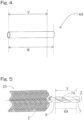
- Fig. 4 is a schematic perspective view for explaining the relationship between the length V of the cut section 1A and the length W of one yarn 4A which is one of the plurality of yarns constituting the strand 3A in the cut section 1A.
- the double rope structure 10 is cut to the predetermined length V to obtain the cut section 1A which contains the strand 3A. Then, the strand 3A is disassembled into yarns 4A to measure the length W of the yarn 4A.
- the strand 3A in the cut section 1A comprises the yarns 4A having the length W, and a ratio of yarn length/rope length (W/V) may be, for example, within a range of 1.005 or more and 1.400 or less.
- the strand 3A constituting the inner core crosses a longitudinal direction Z passing through the center of the double rope structure (hereafter, simply referred to as the rope longitudinal direction Z) at a crossing angle ⁇ (0° ⁇ ⁇ ⁇ 90°) relative to the rope longitudinal direction Z.
- the crossing angle ⁇ can be measured using a photo image of the side surface of the fibers in a state where the outer cover 2 is removed to expose the inner core 1.
- the strand 3A which crosses the rope longitudinal direction Z of the double rope structure 10 is randomly selected, and the angle ⁇ formed by the rope longitudinal direction Z and an outline of the strand 3A which is close to the rope longitudinal direction Z is regarded as the crossing angle.
- Fig. 5 is an exploded schematic side view of the double rope structure according to another embodiment of the present invention.
- a double rope structure 20 comprises an inner core 6 and an outer cover 2 covering the inner core.
- the outer cover 2 is a braided body and is unified with the inner core 6 to constitute the double rope structure.
- the same constituting elements as those in Fig. 2 are denoted with the same reference signs, and the description thereof will be omitted.
- the outer cover 2 is braided such that the inner-and-outer-layer suitability, represented by the above-described formula (1), for the inner core 6 and the outer cover 2 is in a predetermined range, whereby bending durability and strength per cross-sectional area can be improved in the double rope structure.
- the inner core 6 has a twisted structure in which a plurality of strands 7 are twisted together.
- Each strand comprises a plurality of yarns, and each yarn comprises a plurality of single fibers.
- a strand 7 constituting the inner core 6 of the double rope structure 20 in Fig. 5 comprises a plurality of yarns 4 as with the strand 3 shown in Fig. 3
- each yarn 4 is a twisted body of two or more raw fibers (preferably monofilaments or multifilaments, and particularly preferably multifilaments).
- Fig. 5 shows a cut section 6A which has a predetermined length V in the inner core 6.
- the cut section 6A represents an inner core portion of the double rope structure 20 which is cut to the predetermined length V.
- the cut section 6A can be disassembled into a plurality of strands which constitute the cut section 6A.
- one strand 7A of the plurality of strands is shown with dots.
- the strand 7A comprises a plurality of yarns (not shown).
- the ratio of the length W of the yarns constituting the strand 7A relative to the length V of the cut section 6A, expressed as the ratio of yarn length/rope length (W/V), may be, for example, within a range of 1.005 or more and 1.400 or less.
- the strand 7A constituting the inner core crosses a rope longitudinal direction Z at a crossing angle ⁇ (0° ⁇ ⁇ ⁇ 90°).
- the strand 7A which crosses the rope longitudinal direction Z passing through the center of the double rope structure 20 is randomly selected, and the angle ⁇ formed by the rope longitudinal direction Z and an outline of the strand 7A which is close to the rope longitudinal direction Z is regarded as the crossing angle.
- each strand comprises a plurality of yarns.
- Each yarn is a twisted body in which a plurality of raw fibers (preferably monofilaments or multifilaments, and particularly preferably multifilaments) are twisted together.
- the diameter of the inner core can be suitably determined depending on the intended use, and may be, for example, 0.5 to 100 mm, preferably 1.0 to 80 mm, and more preferably 1.5 to 60 mm.
- the diameter of the inner core is a value measured according to the method described in the Examples below.
- the number of twists of each yarn may be, for example, 150 to 0.1 T/m, preferably 100 to 2 T/m, more preferably 80 to 3 T/m, further preferably 70 to 5 T/m, and particularly preferably 60 to 6 T/m.
- a smaller number of twists can enhance the strength of a rope, untwisted yarns may deteriorate handleability for forming a strand.
- the strands may be twisted if necessary.
- the strands may be twisted as appropriate in a range that the yarn length/rope length of the inner core is satisfied. Further, a plurality of strands may be twisted together if necessary.
- the fineness of the yarn can be suitably determined depending on the desirable fineness of the double rope structure, or the like.
- the yarn may have a fineness of 30 to 5000 dtex, preferably 200 to 4000 dtex, more preferably 400 to 2500 dtex, and further preferably 1000 to 2000 dtex.
- the fineness of the yarn within the above range is preferable in terms of handleability such as convergence of the strands.
- the ratio of yarn length/rope length (W/V), which is calculated as the ratio of the average yarn length of the yarns constituting the inner core of the cut section to the rope length of the cut section cut to 1 m (correctly 1.000 m) in length, may be in a range of 1.005 to 1.400, preferably 1.005 to 1.200, more preferably 1.006 to 1.180, and further preferably 1.007 to 1.150.
- the yarn length and the rope length are values measured according to the method described in the Examples below.
- the inner core of the double rope structure of the present invention may be a twisted body or a braided body.
- a twisted body may usually have 3 strands or 4 strands, while a braided body may have 4 strands, 6 strands, 8 strands, 12 strands, 16 strands, 32 strands, 64 strands, or others.
- the inner core may be preferably a braided body.
- the inner core may be a braided body having 4 strands, 6 strands, 8 strands, 12 strands, 16 strands, or 32 strands.
- the pitch (counts/inch) may be, for example, adjusted to be 2.5 to 25, preferably 2.5 to 20, more preferably 3 to 18, and further preferably 3.3 to 15.
- the pitch denotes the number of yarns per inch along the longitudinal direction in a rope.
- the pitch can be determined by measurement using a digital microscope VHX-2000 available from KEYENCE CORPORATION.
- the high strength and high modulus fibers which constitute the inner core may be any fibers which can achieve a yarn tenacity of 20 cN/dtex or more and a yarn elastic modulus of 400 cN/dtex or more.
- Such high strength and high modulus fibers may be exemplified as: liquid crystal polyester fibers such as Vectran (trademark), Siveras (trademark), Zxion (trademark), etc.; ultra-high molecular weight polyethylene fibers such as Isanas (trademark), Dyneema (trademark), etc.; aramid fibers such as Kevlar (trademark), Twaron (trademark), Technora (trademark), etc.; poly(para-phenylene benzobisoxazole) fibers such as Zylon (trademark), etc.; and other fibers with high strength and high modulus.
- the high strength and high modulus fiber has a yarn tenacity of 20 cN/dtex or more, and may have a yarn tenacity of preferably 22 cN/dtex or more.
- the upper limit is not particularly limited, and may be, for example, 40 cN/dtex.
- the high strength and high modulus fiber has a yarn elastic modulus of 400 cN/dtex or more, and may have a yarn elastic modulus of preferably 450 cN/dtex or more.
- the upper limit is not particularly limited, and may be, for example, 600 cN/dtex.
- the high strength and high modulus fiber may have a yarn elongation of, for example, 1 to 6%, and preferably 2 to 5.5%.
- the yarn tenacity, the yarn elastic modulus, and the yarn elongation are values measured according to the method described in the Examples below.
- the liquid crystal polyester fibers As these high strength and high modulus fibers, the liquid crystal polyester fibers, the ultra-high molecular weight polyethylene fibers, and the aramid fibers are preferable.
- Liquid crystal polyester fibers can be produced, for example, by melt-spinning a liquid crystal polyester to obtain as-spun fibers, and subjecting the as-spun fibers to solid phase polymerization.
- a liquid crystal polyester multifilament includes two or more liquid crystal polyester monofilaments.
- Liquid crystal polyester is a polyester capable of forming an optically anisotropic melt phase (liquid crystallinity), and can be recognized, for example, by placing a sample on a hot stage to heat under a nitrogen atmosphere and observing penetration light through the sample using a polarization microscope.
- the liquid crystal polyester comprises repeating structural units originating from, for example, aromatic diols, aromatic dicarboxylic acids, aromatic hydroxycarboxylic acids, etc. As long as the effect of the present invention is not impaired, the repeating structural unit is not limited to a specific chemical composition.
- the liquid crystal polyester may include the structural units originating from aromatic diamines, aromatic hydroxy amines, or aromatic aminocarboxylic acids in the range which does not impair the effect of the present invention.
- the preferable structural units may include units shown in Table 1.
- Table 1 In the formula, X is selected from the following structures.
- m is an integer from 0 to 2
- Y is a substituent selected from hydrogen atom, halogen atoms, alkyl groups, aryl groups, aralkyl groups, alkoxy groups, aryloxy groups, aralkyloxy groups.
- Y may represent one substituent or any number of substituents up to the maximum number of substitutable positions in the aromatic ring, and each substituent of Y can be independently selected from the group consisting of a hydrogen atom, a halogen atom (for example, fluorine atom, chlorine atom, bromine atom, iodine atom, etc.), an alkyl group (for example, an alkyl group having 1 to 4 carbon atoms such as methyl group, ethyl group, isopropyl group, t-butyl group, etc.), an alkoxy group (for example, methoxy group, ethoxy group, isopropoxy group, n-butoxy group, etc.), an aryl group (for example, phenyl group, naphthyl group, etc.), an aralkyl group [benzyl group (phenylmethyl group), phenethyl group (phenylethyl group), etc.], an aryloxy group (for example, phenoxy
- structural units there may be structural units as described in Examples (1) to (18) shown in the following Tables 2, 3, and 4. It should be noted that where the structural unit in the formula is a structural unit which can show a plurality of structures, combination of two or more units may be used as structural units for a polymer.
- Z may include substituents denoted by the following formulae.
- the total proportion of the structural units of (A) and (B) may be, based on all the structural units, for example, 65 mol% or more, more preferably 70 mol% or more, and still more preferably 80 mol% or more.
- the liquid crystal polyester has the structural unit (B) at a proportion of from 4 to 45 mol% in the polymer.
- the liquid crystal polyester suitably used in the present invention preferably has a melting point in the range from 250 to 360°C, and more preferably from 260 to 320°C.
- the melting point here means a temperature at which a main endothermic peak is observed in measurement in accordance with JIS K7121: 2012 test method using a differential scanning calorimeter (DSC: "TA3000" produced by Mettler). More concretely, 10 to 20 mg of a sample is encapsulated in an aluminum pan and taken into the above-mentioned DSC. Then, the sample is heated at a heating rate of 20°C/minute with nitrogen as a carrier gas introduced at a flow rate of 100 cc/minute to measure a position of an endothermic peak.
- the sample is heated to a temperature higher by 50°C than the expected flow temperature at a heating rate of 50°C/minute and is kept at the temperature for 3 minutes to be completely molten, and then the sample is cooled to 50°C at a cooling rate of -80°C/minute. Subsequently, the sample is reheated at a heating rate of 20°C/minute to measure the position of the endothermic peak.
- the liquid crystal polyester may be used with a thermoplastic polymer such as a polyethylene terephthalate, a modified polyethylene terephthalate, a polyolefin, a polycarbonate, a polyamide, a polyphenylene sulfide, a polyether ether ketone, and a fluoro-resin, and others to the extent that the effect of the present invention is not impaired.
- various additives may also be added, including an inorganic material such as titanium oxide, kaolin, silica, and barium oxide; a colorant such as a carbon black, a dye, and a pigment; an antioxidant; a UV absorber; and a light stabilizer.
- the outer cover comprises a twisted-covering body comprising strands to cover the inner core or a braided body comprising strands to cover the inner core.
- the yarns constituting the strand may be monofilaments or multifilaments, and are preferably multifilaments.
- the twisted-covering body can be formed by twisting strands helically around the inner core.
- the braided body can be formed by braiding strands to cover the inner core as a core with 8 strands, 12 strands, 16 strands, 24 strands, 32 strands, 40 strands, 48 strands, 64 strands, or others.
- the braided body preferably has 12 strands, 16 strands, 24 strands, 32 strands, 40 strands, or 48 strands
- the braided body more preferably has 12 strands, 16 strands, 24 strands, 32 strands, or 40 strands.
- the strands constituting the outer cover may be formed from the high strength and high modulus fibers, or non-high strength and non-high modulus fibers.
- the non-high strength and non-high modulus fiber may, for example, have a yarn tenacity of less than 20 cN/dtex, and usually about 1 cN/dtex to 15 cN/dtex.
- the non-high strength and non-high modulus fiber may have a yarn elastic modulus of less than 400 cN/dtex, and usually about 10 cN/dtex to 200 cN/dtex.
- the non-high strength and non-high modulus fiber may have a yarn elongation of, for example, 3 to 20%, and preferably 7 to 20%.
- the non-high strength and non-high modulus fibers may be such fibers that have a ratio of the tenacity of fibers used for the outer cover to the tenacity of fibers used for the inner core, for example, in a range of 0.10 to 0.40 and preferably 0.12 to 0.35.
- non-high strength and non-high modulus fibers include general-purpose synthetic fibers, such as general-purpose polyester fibers (e.g., polyethylene terephthalate fibers), polyolefin fibers (e.g., polyethylene fibers, polypropylene fibers), polyamide fibers (e.g., nylon 6 fibers, nylon 6,6 fibers), polyvinyl alcohol fibers (e.g., vinylon (trademark) fibers), and others.
- general-purpose synthetic fibers such as general-purpose polyester fibers (e.g., polyethylene terephthalate fibers), polyolefin fibers (e.g., polyethylene fibers, polypropylene fibers), polyamide fibers (e.g., nylon 6 fibers, nylon 6,6 fibers), polyvinyl alcohol fibers (e.g., vinylon (trademark) fibers), and others.
- general-purpose polyester fibers e.g., polyethylene terephthalate fibers
- polyolefin fibers e.g
- the outer cover may substantially comprise non-high strength and non-high modulus fibers.
- substantially means that a proportion of the non-high strength and non-high modulus fibers in the outer cover is 80 wt% or more.
- the proportion of the non-high strength and non-high modulus fibers in the outer cover may preferably be 90 wt% or more (90 to 100 wt%).
- the fineness of the yarn constituting the strand of the outer cover can be suitably determined depending on the desired diameter of the double rope structure, or the like.
- the fineness of yarn may be, for example, 50 to 100000 dtex, preferably 100 to 50000 dtex, more preferably 200 to 40000 dtex, further preferably 200 to 10000 dtex, and still more preferably 200 to 1000 dtex.
- the inner-and-outer-layer suitability can be easily adjusted.
- the diameter of the double rope structure that is, the diameter b of the outer periphery of the outer cover
- the diameter b is the diameter of the outer periphery of the outer cover 2, and is the value measured by placing the double rope structure 10 between external measurement jaws of an electronic slide caliper.
- the diameter of each of the double rope structure and the inner core was measured at seven random points by placing each of the double rope structure and the inner core between external measurement jaws of an electronic slide caliper, and then an average value was calculated from the obtained five values by excluding the maximum value and the minimum value.
- the diameter of the double rope structure was used as the diameter of the outer periphery of the outer cover.
- the outer cover was carefully removed starting from the surface layer while the inner core was held in a taut state so as not to affect the structure of the inner core of the double rope structure, and measurement was performed by placing only the inner core portion between the external measurement jaws of the electronic slide caliper.
- the cross-sectional area of the double rope structure was calculated using the diameter of the double rope structure according to the formula, (diameter / 2) 2 ⁇ 3.14.
- Vf Wi / ⁇ i / Wi / ⁇ i + Wo / ⁇ o ⁇ 100 wherein Wi represents the weight (g) of the inner core, ⁇ i represents the density (g/cm 3 ) of the inner core, Wo represents the weight (g) of the outer cover, and ⁇ o represents the density (g/cm 3 ) of the outer cover.
- the densities of polymers forming yarns constituting each of the inner core and the outer cover were used as the densities of the inner core and the outer cover.
- a randomly selected section was cut to a length of 1.000 m to be regarded as a rope length.
- the strands in the cut section were disassembled to take out the inner core.
- one strand was randomly selected and disassembled into yarns constituting the inner core, then lengths of all of the obtained yarns from the inner core were measured in a taut state in accordance with JIS L 1013:2021, and the average of the lengths was regarded as a yarn length.
- Strands constituting the inner core and strands constituting the outer cover in the rope structure were disassembled into yarns.
- the yarn fineness values of thus-obtained yarns from the inner core and the outer cover were measured in accordance with JIS L 1013:2021.
- Yarn Strength (N), Yarn Tenacity (cN/dtex), Yarn Elongation (%), and Yarn Elastic Modulus (cN/dtex) Strands constituting the inner core of the rope structure were disassembled into yarns, and the tensile strength as the yarn strength (N) of thus-obtained yarn was measured in accordance with JIS L 1013:2021. In addition, the yarn elongation and the yarn elastic modulus were also measured. The yarn tenacity (cN/dtex) was calculated by dividing the yarn strength (cN) by the yarn fineness (dtex).
- the number of yarns which existed in 1 inch in the rope was counted using a digital microscope VHX-2000 available from KEYENCE CORPORATION to obtain a pitch.
- the double rope structure was wound into a groove of the swirl part so that the rope was fixed by surface frictional resistance, and the tensile strength of the double rope structure was measured in accordance with JIS L 1013:2021.
- the diameter of the double rope structure was measured to calculate the cross-sectional area. The value obtained by dividing the obtained tensile strength by the cross-sectional area was regarded as the tensile strength per cross-sectional area of the rope.
- Bending Durability Strength Retention (%) After Bending Test Using a bending test machine (TC111L / available from YUASA SYSTEM Co., Ltd.) employing a tension-free bending test jig (DX-TFB / available from YUASA SYSTEM Co., Ltd.), a bending test was carried out in which the double rope structure was subjected to repeated bending of 10,000 times under a load of 1% of the tensile break strength of the double rope structure at a bending angle of 240° with a bending R of 7.5 mm so as to measure the tensile strength of the double rope structure before and after the bending test. The ratio of the tensile strength of the double rope structure after the bending test relative to the tensile strength of the double rope structure before the bending test was calculated as the strength retention after the bending test and was expressed as a percentage.
- Liquid crystal polyester multifilaments produced by KURARAY CO., LTD., fineness: 1670 dtex
- EL-type 6-strand braider manufactured by KOKUBUN LTD.
- the obtained inner core rope was used as a core material, and polyethylene terephthalate multifilaments (fineness: 280 dtex, yarn tenacity: 7.2 cN/dtex, yarn elastic modulus: 88 cN/dtex, yarn elongation: 15.1%, available from Toray Industries, Inc.) were braided using a middle-type 32-strand braider (manufactured by KOKUBUN LTD.), by adjusting the number of rotations and the taken-up speed of the braider, so as to obtain a double rope structure with an outer cover rope a pitch of 50 counts/inch.
- a double rope structure was produced in the same manner as Example 1 except that the number of strands and a pitch for the inner core and fineness and a pitch for the outer cover in the double rope structure were changed as shown in Table 5. The results are shown in Table 5.
- a double rope structure was produced in the same manner as Example 1 except that ultra-high-molecular-weight-polyethylene multifilaments ("Isanas" produced by Toyobo Co., Ltd., fineness: 1760 dtex) were used as high strength and high modulus fibers for the inner core of the double rope structure, and a pitch for the inner core was changed to 8.5 and a pitch for the outer cover was changed to 49.
- Isanas ultra-high-molecular-weight-polyethylene multifilaments
- a double rope structure was produced in the same manner as Example 3 except that the number of strands and a pitch for the inner core and fineness, the number of strands, and a pitch for the outer cover of the double rope structure were changed as shown in Table 5. The results are shown in Table 5.
- polyethylene terephthalate multifilaments (fineness: 1100 dtex, yarn tenacity: 6.8 cN/dtex, yarn elastic modulus: 88 cN/dtex, yarn elongation: 14%, available from Toray Industries, Inc.) are wound onto a bobbin under a certain tension to produce a bundled yarn, and 20 bundled yarns are produced.
- the bundled yarns are wound onto a bobbin while the bundled yarns are being twisted 10 turns/meter in a Z direction by using a yarn twister under a certain tension to obtain a twisted strand for braiding (fineness: 456,000 dtex).
- a double rope structure (diameter a of outer periphery of inner core: 48 mm, and diameter b of outer periphery of outer cover: 76 mm) with the inner-and-outer-layer suitability of 1.00 can be produced using the inner core rope as a core material by using a 32-strand braider, by adjusting the number of rotations and the taken-up speed of the braider, so as to have a pitch of 3.1 counts/inch.
- a double rope structure was produced in the same manner as Example 1 except that the number of strands and a pitch for the inner core and a pitch for the outer cover of the double rope structure were changed as shown in Table 5. The results are shown in Table 5.
- a double rope structure was produced in the same manner as Example 2 except that a pitch for the inner core and fineness and the number of strands for the outer cover of the double rope structure were changed as shown in Table 5. The results are shown in Table 5.
- a double rope structure was produced in the same manner as Example 3 except that the number of strands and a pitch for the inner core and fineness and a pitch for the outer cover of the double rope structure were changed as shown in Table 5. The results are shown in Table 5.
- a double rope structure was produced in the same manner as Example 4 except that a pitch for the inner core and fineness and the number of strands for the outer cover of the double rope structure were changed as shown in Table 5. The results are shown in Table 5.
- a double rope structure was produced in the same manner as Example 1 except that fibers for the inner core of the double rope structure were changed to polyethylene terephthalate multifilaments (fineness: 1670 dtex, yarn tenacity: 8.0 cN/dtex, yarn elastic modulus: 143 cN/dtex, yarn elongation: 12.6%, available from Toray Industries, Inc.), a pitch for the inner core was changed to 9.6, the number of strands for the inner core was changed to 12, and a pitch for the outer cover was changed to 55.
- Table 5 Ex. 1 Ex. 2 Ex. 3 Ex. 4 Comp. Ex. 1 Comp. Ex. 2 Comp. Ex. 3 Comp. Ex. 4 Comp. Ex.
- the inner-and-outer-layer suitability of the double rope structure is in a range of 0.70 to 1.20, the strength retention (%) after the bending test is 90% or more, and the tensile strength per cross-sectional area is 180 N/mm 2 or more in the double rope structure.
- Comparative Examples 1 and 2 the inner-and-outer-layer suitability of the double rope structure exceeds 1.20 and the strength retention after the bending test is poor compared to those of Examples.
- Comparative Examples 3 and 4 the inner-and-outer-layer suitability of the double rope structure is less than 0.70, and the tensile strength per cross-sectional area is poor compared to those of Examples. Since fibers constituting the inner core are non-high strength and non-high modulus fibers in Comparative Example 5, the strength of the entire rope structure is halved compared to the rope structure of Example 1 having almost the same diameter.
- the double rope structure according to the present invention can be advantageously used in the field such as: applications in water for mooring ropes for vessels, bolt ropes for fishing nets, ropes for mooring floating waterborne facilities on the surface of water, and marine ropes for mooring floating marine structures used for exploration of marine resources to the ocean floor; applications in water such as traction ropes and load ropes, as well as ropes for wind power station and transforming equipment; applications on land such as traction ropes and load ropes; and further applications for sports and leisure, and others.
Landscapes
- Engineering & Computer Science (AREA)
- Manufacturing & Machinery (AREA)
- Textile Engineering (AREA)
- Chemical & Material Sciences (AREA)
- Crystallography & Structural Chemistry (AREA)
- Ropes Or Cables (AREA)
Applications Claiming Priority (2)
| Application Number | Priority Date | Filing Date | Title |
|---|---|---|---|
| JP2022101743 | 2022-06-24 | ||
| PCT/JP2023/023581 WO2023249125A1 (ja) | 2022-06-24 | 2023-06-26 | 二重ロープ構造体 |
Publications (1)
| Publication Number | Publication Date |
|---|---|
| EP4545703A1 true EP4545703A1 (en) | 2025-04-30 |
Family
ID=89380109
Family Applications (1)
| Application Number | Title | Priority Date | Filing Date |
|---|---|---|---|
| EP23827305.6A Pending EP4545703A1 (en) | 2022-06-24 | 2023-06-26 | Double-rope structure |
Country Status (7)
| Country | Link |
|---|---|
| US (1) | US20260035857A1 (https=) |
| EP (1) | EP4545703A1 (https=) |
| JP (1) | JPWO2023249125A1 (https=) |
| KR (1) | KR20250026773A (https=) |
| CN (1) | CN119403975A (https=) |
| CA (1) | CA3260236A1 (https=) |
| WO (1) | WO2023249125A1 (https=) |
Family Cites Families (28)
| Publication number | Priority date | Publication date | Assignee | Title |
|---|---|---|---|---|
| US91995A (en) * | 1869-06-29 | Improvement in ropes, cord | ||
| US2438864A (en) * | 1945-01-10 | 1948-03-30 | Plymouth Cordage Co | Rope |
| US3078755A (en) * | 1961-01-27 | 1963-02-26 | Samson Cordage Works | Braided cordage |
| US4195549A (en) * | 1970-10-30 | 1980-04-01 | Filztuchverwaltungs-Gmbh | Pintle wire for high load hinge connections |
| US4563869A (en) * | 1982-05-17 | 1986-01-14 | American Manufacturing Company, Inc. | Rope with reduced lash-back construction |
| JPS6128092A (ja) * | 1984-07-11 | 1986-02-07 | 東京製綱繊維ロ−プ株式会社 | 複合線条体およびその製造方法 |
| US4777784A (en) * | 1986-11-12 | 1988-10-18 | Ferguson Thomas B | Horse tethering device |
| JPH0431072Y2 (https=) * | 1988-03-14 | 1992-07-27 | ||
| JP3518617B2 (ja) * | 1993-12-13 | 2004-04-12 | 東洋紡績株式会社 | 係船索 |
| DE29608971U1 (de) * | 1996-05-20 | 1996-08-22 | Teufelberger Ges.M.B.H., Wels | Seil für die Mitnahme und Weitergabe von Papierbahnen bei der Herstellung von Papier und Kartonagen auf Papiermaschinen |
| CN1152388C (zh) * | 1996-11-04 | 2004-06-02 | 埃里克·怀特 | 编织电篱笆 |
| MXPA02006360A (es) * | 1999-12-30 | 2003-02-12 | Michelin Rech Tech | Cable de acero de varias capas para carcasa de neumatico. |
| JP2002105878A (ja) * | 2000-09-25 | 2002-04-10 | Kurisansemamu Kk | 操作用ワイヤロープ |
| US7331269B2 (en) * | 2001-07-02 | 2008-02-19 | Delphi Technologies, Inc. | Apparatus and method for interconnecting items with a flexible member |
| US7168231B1 (en) * | 2002-09-05 | 2007-01-30 | Samson Rope Technologies | High temperature resistant rope systems and methods |
| US7175908B2 (en) * | 2003-06-30 | 2007-02-13 | Connolly Jr Thomas J | High temperature search line |
| US7127878B1 (en) * | 2003-12-16 | 2006-10-31 | Samson Rope Technologies | Controlled failure rope systems and methods |
| US7329271B2 (en) * | 2003-12-18 | 2008-02-12 | Ethicon, Inc. | High strength suture with absorbable core |
| US20080051835A1 (en) * | 2006-08-28 | 2008-02-28 | Mazzocca Augustus D | High strength suture coated with rgd peptide |
| EP2210971A1 (en) * | 2009-01-26 | 2010-07-28 | Politecnico Di Milano | Silk fibroin textile structures as biomimetic prosthetics for the regeneration of tissues and ligaments |
| JP5454891B2 (ja) * | 2009-11-26 | 2014-03-26 | 株式会社誠和 | 繊維ロープ |
| US9163341B2 (en) * | 2010-04-29 | 2015-10-20 | Dsm Ip Assets B.V. | Multifilament yarn construction |
| JP3199266U (ja) | 2015-06-03 | 2015-08-13 | ナロック株式会社 | 繊維ロープ |
| US20170356132A1 (en) * | 2016-06-10 | 2017-12-14 | Wirerope Works, Inc. | Braided Polyester Fiber Core in Steel Wire Rope |
| CN111164251A (zh) * | 2017-10-06 | 2020-05-15 | 株式会社可乐丽 | 编带 |
| EP3743557B1 (en) * | 2018-01-23 | 2024-03-06 | Kuraray Co., Ltd. | Small diameter fiber braid with central core member |
| US11278758B2 (en) * | 2019-03-15 | 2022-03-22 | Hyper Wear, Inc. | Weighted triple-braided exercise rope |
| US20240352669A1 (en) * | 2021-09-14 | 2024-10-24 | Lankhorst Euronete Portugal, S.A. | Cut resistant jacket |
-
2023
- 2023-06-26 CA CA3260236A patent/CA3260236A1/en active Pending
- 2023-06-26 WO PCT/JP2023/023581 patent/WO2023249125A1/ja not_active Ceased
- 2023-06-26 EP EP23827305.6A patent/EP4545703A1/en active Pending
- 2023-06-26 CN CN202380048192.0A patent/CN119403975A/zh active Pending
- 2023-06-26 KR KR1020247042175A patent/KR20250026773A/ko active Pending
- 2023-06-26 US US18/878,399 patent/US20260035857A1/en active Pending
- 2023-06-26 JP JP2024529104A patent/JPWO2023249125A1/ja active Pending
Also Published As
| Publication number | Publication date |
|---|---|
| KR20250026773A (ko) | 2025-02-25 |
| CN119403975A (zh) | 2025-02-07 |
| CA3260236A1 (en) | 2025-03-24 |
| US20260035857A1 (en) | 2026-02-05 |
| WO2023249125A1 (ja) | 2023-12-28 |
| JPWO2023249125A1 (https=) | 2023-12-28 |
Similar Documents
| Publication | Publication Date | Title |
|---|---|---|
| EP4317563B1 (en) | Small diameter fiber braid with central core member | |
| EP4265838B1 (en) | Double rope structure | |
| CA2643049C (en) | Ropes having improved cyclic bend over sheave performance | |
| EP4172394B1 (en) | Braided sheath with low thickness | |
| WO2019111830A1 (ja) | 撚糸及びそれを用いた撚糸構造体 | |
| EP4545703A1 (en) | Double-rope structure | |
| EP4185747B1 (en) | Rope and method for pulling or lifting an object | |
| CA3202915C (en) | Double rope structure | |
| JP7788274B2 (ja) | 二重ロープ構造体 | |
| US20230399773A1 (en) | Core-sheath composite fiber, production method therefor, and fiber structure | |
| JP2022154120A (ja) | 複合カバリング糸およびそれからなるロープ | |
| US20060046053A1 (en) | Serving for archery bowstring |
Legal Events
| Date | Code | Title | Description |
|---|---|---|---|
| STAA | Information on the status of an ep patent application or granted ep patent |
Free format text: STATUS: THE INTERNATIONAL PUBLICATION HAS BEEN MADE |
|
| PUAI | Public reference made under article 153(3) epc to a published international application that has entered the european phase |
Free format text: ORIGINAL CODE: 0009012 |
|
| STAA | Information on the status of an ep patent application or granted ep patent |
Free format text: STATUS: REQUEST FOR EXAMINATION WAS MADE |
|
| 17P | Request for examination filed |
Effective date: 20250116 |
|
| AK | Designated contracting states |
Kind code of ref document: A1 Designated state(s): AL AT BE BG CH CY CZ DE DK EE ES FI FR GB GR HR HU IE IS IT LI LT LU LV MC ME MK MT NL NO PL PT RO RS SE SI SK SM TR |
|
| DAV | Request for validation of the european patent (deleted) | ||
| DAX | Request for extension of the european patent (deleted) |