WO2023233510A1 - 保護装置 - Google Patents
保護装置 Download PDFInfo
- Publication number
- WO2023233510A1 WO2023233510A1 PCT/JP2022/022093 JP2022022093W WO2023233510A1 WO 2023233510 A1 WO2023233510 A1 WO 2023233510A1 JP 2022022093 W JP2022022093 W JP 2022022093W WO 2023233510 A1 WO2023233510 A1 WO 2023233510A1
- Authority
- WO
- WIPO (PCT)
- Prior art keywords
- path
- section
- conductive path
- circuit
- power
- Prior art date
- Legal status (The legal status is an assumption and is not a legal conclusion. Google has not performed a legal analysis and makes no representation as to the accuracy of the status listed.)
- Ceased
Links
Images



Classifications
-
- H—ELECTRICITY
- H01—ELECTRIC ELEMENTS
- H01H—ELECTRIC SWITCHES; RELAYS; SELECTORS; EMERGENCY PROTECTIVE DEVICES
- H01H39/00—Switching devices actuated by an explosion produced within the device and initiated by an electric current
- H01H39/006—Opening by severing a conductor
-
- H—ELECTRICITY
- H01—ELECTRIC ELEMENTS
- H01H—ELECTRIC SWITCHES; RELAYS; SELECTORS; EMERGENCY PROTECTIVE DEVICES
- H01H39/00—Switching devices actuated by an explosion produced within the device and initiated by an electric current
Definitions
- the present disclosure relates to a protection device.
- Patent Document 1 discloses a drive circuit that drives a power MOSFET via a pulse transformer.
- This device has a configuration in which a power MOSFET side and a drive side to which a PWM signal for controlling the power MOSFET is input are separated by a pulse transformer. According to this configuration, for example, even if a surge voltage occurs on the power MOSFET side, the pulse transformer can prevent the surge voltage from entering the drive side.
- Patent Document 1 Since the device disclosed in Patent Document 1 uses a pulse transformer, it is difficult to miniaturize the circuit. Therefore, there is a need for a technology that can reduce the size of the circuit and prevent surge voltage from entering the drive side.
- the present disclosure has been made based on the above-mentioned circumstances, and aims to provide a protection device that protects the circuit from surge voltage while reducing the size of the circuit.
- the protective device of the present disclosure includes: a first circuit having a power path that is a path through which power is transmitted; a circuit breaker having a circuit breaker provided to be capable of interrupting the power path; and a metal casing housing at least a portion of the circuit breaker; a second circuit that provides a cutoff signal to the cutoff section; A protective device used in a shutoff system comprising: A conductive part forming a conductive path between the target part including either the first circuit or the ground part and the metal casing, or a parasitic capacitance larger than the parasitic capacitance between the metal casing and the second circuit.
- the protective path section includes a parasitic capacitance section that generates capacitance.
- FIG. 1 is a block diagram illustrating an in-vehicle system according to a first embodiment.
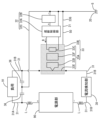
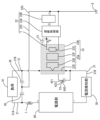
- FIG. 2 is a block diagram illustrating details of the circuit breaker according to the first embodiment.
- FIG. 3 is a block diagram illustrating details of the circuit breaker according to the second embodiment.
- FIG. 4 is a block diagram illustrating details of the circuit breaker according to the third embodiment.
- FIG. 5 is a block diagram illustrating details of the circuit breaker according to the fourth embodiment.
- FIG. 6 is a block diagram illustrating details of a circuit breaker according to another embodiment.
- the protection device of the present disclosure is used in a cutoff system including a first circuit, a circuit breaker, and a second circuit.
- the first circuit has a power path that is a path through which power is transmitted.
- the circuit breaker includes a cutoff section that is provided to be able to cut off the power path, and a metal casing that houses at least a portion of the cutoff section.
- the second circuit provides a cutoff signal to the cutoff section.
- This protective device is larger than the conductive part forming the conductive path between the target part and the metal casing, including either the first circuit or the ground part, or the parasitic capacitance between the metal casing and the second circuit.
- the protective path section includes a parasitic capacitance section that generates parasitic capacitance.
- the protection device described in [1] above prevents the bias in the charge distribution inside the metal casing from occurring in the target part by the protective path section, even if the surge voltage generated in the first circuit causes an imbalance in the charge distribution inside the metal casing. It can be quickly released and resolved. Therefore, while reducing the size of the circuit, it is possible to prevent the surge voltage generated in the first circuit from affecting the second circuit via the metal casing.
- the protection path section has a conduction section, and the conduction section can short-circuit the metal casing and the target section.
- the target part includes a ground part, and the protection path part can configure a conduction path between the metal casing and the ground part.
- the protection device [3] above easily stabilizes the potential of the metal casing.
- the power path includes a high potential conductive path provided on the high potential side with respect to the circuit breaker, and a low potential conductive path provided on the low potential side with respect to the circuit breaker. and a potential conductive path.
- the circuit breaker is provided to be able to interrupt the high potential conductive path and the low potential conductive path, and the target portion may include the low potential conductive path.
- the protective device [4] above protects the metal from the metal in a completed manner within the first circuit even if the charge distribution within the metal casing becomes uneven due to the surge voltage generated based on the inductance component of the high potential conductive path. Unbalanced charge distribution between the casing and the low potential conductive path can be eliminated. Therefore, the influence of surge voltage on the second circuit can be suppressed.
- the power path includes a high potential conductive path provided on the high potential side with respect to the circuit breaker, and a low potential conductive path provided on the low potential side with respect to the circuit breaker.
- the circuit breaker is provided to be able to interrupt the high potential conductive path and the low potential conductive path, and the target portion may include the high potential conductive path.
- the protective device in [5] above protects the metal in a completed manner within the first circuit even if the charge distribution within the metal casing is uneven due to a surge voltage generated based on the inductance component of the low potential conductive path. Unbalanced charge distribution between the casing and the high-potential conductive path can be eliminated. Therefore, the influence of surge voltage on the second circuit can be suppressed.
- the second circuit may include a reference conductive path that is a ground portion and a second conductive path that is a different conductive path from the reference conductive path.
- the target portion may include a reference conductive path.
- the second parasitic capacitance which is the parasitic capacitance between the metal casing and the reference conductive path, can be made larger than the first parasitic capacitance, which is the parasitic capacitance between the metal casing and the second conductive path.
- the second parasitic capacitor which has a larger capacitance than the first parasitic capacitor, has a larger charge distribution. It is easy to offset the bias of Therefore, it is possible to make it difficult for the second circuit to be affected by the surge voltage generated in the first circuit via the metal casing.
- the cut-off part includes an ignition part that performs an explosive operation in response to a cut-off signal, and an ignition part that is installed in the power path and that disables the power when the cut-off part is cut off. It may have a cut portion that blocks the path, and a displacement portion that is displaced in response to the force generated by the explosive operation.
- the cutoff section may be a fuse device that cuts the section to be cut by displacing the displacement section in response to the explosion operation.
- the displacement portion rapidly displaces in response to the force generated by the explosive operation of the ignition portion, so that the power path can be interrupted in an extremely short time.
- the in-vehicle system 100 shown in FIG. 1 is a system mounted on a vehicle.
- the in-vehicle system 100 includes a power supply section 90, a load 91, and a cutoff system 30.
- a lead battery, a lithium ion battery, or the like is used for the power supply section 90.
- the load 91 is an electronic device provided in the vehicle.
- the cutoff system 30 includes a first circuit 31, a second circuit 32, a circuit breaker 33, and a protection device 50.
- the first circuit 31 includes a first power path 31A, which is a power path electrically connected to a terminal on the high potential side of the power supply section 90, and a power path electrically connected to a terminal on the low potential side of the power supply section 90. and a second power path 31B.
- the first power path 31A and the second power path 31B are paths through which power is transmitted.
- a contactor 35 is provided in each of the first power path 31A and the second power path 31B.
- Each contactor 35 has a function of switching each of the first power path 31A and the second power path 31B between a conductive state and a non-conductive state.
- Each of the first power path 31A and the second power path 31B has an inductance component L.
- the inductance component L is a parasitic component that each of the first power path 31A and the second power path 31B has.
- a capacitor 36 is electrically connected to the load 91 side of the contactor 35 in each of the first power path 31A and the second power path 31B.
- Each of the first power path 31A and the second power path 31B is electrically connected to the ground portion G via a capacitor 36 and a reference conductive path 32C, which will be described later.
- the ground portion G is, for example, a chassis that constitutes a vehicle body.
- the ground portion G is included in the configuration of the target portion 20.
- to be electrically connected desirably refers to a configuration in which they are connected in a mutually conductive state (a state in which current can flow) so that the potentials of both objects to be connected are equalized.
- the configuration is not limited to this.
- “to be electrically connected” may refer to a configuration in which both connection objects are connected in a state where they can be electrically conductive, with an electrical component interposed between the two connection objects.
- a current detection unit 38 is provided closer to the power supply unit 90 than the contactor 35.
- the current detection unit 38 includes, for example, a resistor and a differential amplifier, and detects a value indicating the current flowing through the second power path 31B (specifically, an analog voltage corresponding to the value of the current flowing through the second power path 31B). ) can be output as a current value A.
- the current detection unit 38 detects the state of the current flowing through the second power path 31B.
- the second circuit 32 includes a cutoff control section 32A, a low voltage power supply section 32B, and a reference conductive path 32C.
- the cutoff control unit 32A is mainly composed of, for example, a microcomputer, and includes an arithmetic unit such as a CPU (Central Processing Unit), a memory such as a ROM (Read Only Memory) or a RAM (Random Access Memory), and an A/D converter. etc.
- the current value A output from the current detection section 38 is input to the cutoff control section 32A.
- the cutoff control unit 32A is configured such that a signal S (SOC (State Of Charge), etc.) indicating the state of the power supply unit 90 can be input from an external device such as a battery management system (BMS) (not shown).
- BMS battery management system
- the cutoff control section 32A of the second circuit 32 sends a cutoff signal to the ignition section 33C of the cutoff section 33A of the circuit breaker 33, which will be described later, based on the current value A and signal S input from the current detection section 38 and external equipment.
- the configuration is such that it gives B.
- the low voltage power supply section 32B For example, a lead battery, a lithium ion battery, or the like is used for the low voltage power supply section 32B.
- the voltage generated between the high potential side terminal and the low potential side terminal of the low voltage power supply section 32B is lower than that of the power supply section 90.
- the low voltage power supply section 32B is configured to be able to supply power to the cutoff control section 32A.
- the reference conductive path 32C is a conductive path that is maintained at a constant low voltage in the second circuit 32, and is electrically connected to the ground G in the first embodiment.
- the reference conductive path 32C is electrically connected to the low potential side terminal of the low voltage power supply section 32B and the cutoff control section 32A.
- the reference conductive path 32C is also the ground section G.
- the circuit breaker 33 for example, a pyrofuse (PYROFUSE (registered trademark)) is used. As shown in FIG. 2, the circuit breaker 33 includes a cutoff section 33A and a metal housing 33B.
- the cutoff section 33A includes an ignition section 33C, a gunpowder 33F, a displacement section 33D, and a section to be cut 33E.
- the ignition section 33C is configured to generate heat when the cutoff signal B is given from the cutoff control section 32A.
- Gunpowder 33F is provided adjacent to ignition section 33C.
- the gunpowder 33F explodes when it receives the heat generated at the ignition part 33C, producing explosive force. That is, the ignition unit 33C performs an explosion operation to ignite the gunpowder 33F in response to the cutoff signal B. gives rise to explosive force.
- the displacement portion 33D is provided adjacent to the gunpowder 33F. The displacement portion 33D is rapidly displaced when it receives the explosive force generated from the exploded gunpowder 33F.
- the portion to be cut 33E is formed of, for example, a band-shaped metal having conductivity.
- the section to be cut 33E is provided interposed in the second power path 31B.
- the section to be cut 33E is provided in the power path.
- the portion to be cut 33E is arranged on the opposite side of the explosive 33F with the displacement portion 33D interposed therebetween.
- the portion to be cut 33E is physically cut in an extremely short period of time by the displacement portion 33D, which is rapidly displaced in response to the explosive force generated by the explosive action. Thereby, the section to be cut 33E cuts off the second power path 31B, which is the power path, when the section to be cut 33E is cut off.
- the cutoff section 33A cuts off the second power path 31B, which is the power path. That is, the cutoff section 33A is provided to be able to cut off the second power path 31B. The cut portion 33E that has been cut will not be connected again. That is, the second power path 31B cut off by the cutoff section 33A does not switch to a conductive state that allows current to flow.
- the cutoff section 33A is a fuse device that cuts the section to be cut 33E by displacing the displacement section 33D in accordance with the explosion operation.
- the metal casing 33B is, for example, formed into a box shape by pressing a sheet metal.
- the metal casing 33B accommodates the blocking section 33A.
- both ends of the portion to be cut 33E are configured to protrude outside from the metal housing 33B. That is, the metal housing 33B accommodates a part of the blocking section 33A.
- the protection device 50 is used in the isolation system 30.
- the protection device 50 has a protection path section 21.
- the protection path section 21 has a conductive section 33G.
- the conductive portion 33G is made of conductive metal. One end of the conductive portion 33G is electrically connected to the metal casing 33B. The other end of the conductive portion 33G is electrically connected to the reference conductive path 32C.
- the conductive portion 33G is interposed between the metal housing 33B and the ground portion G. That is, the metal housing 33B is electrically connected to the ground part G via the conductive part 33G and the reference conductive path 32C.
- the conductive portion 33G connects the metal casing 33B and the ground portion G to short-circuit them.
- the conductive portion 33G of the protection path portion 21 forms a conductive path between the ground portion G of the target portion 20 and the metal casing 33B.
- the protection path section 21 functions to release electric charges to the ground section G through itself when a surge voltage is applied to the metal housing 33B.
- the cutoff control section 32A outputs a cutoff signal B to the ignition section 33C of the cutoff section 33A of the circuit breaker 33 based on signals input from the current detection section 38 and external equipment. Then, the ignition part 33C of the cutoff part 33A generates heat, and the gunpowder 33F explodes upon receiving this heat. Then, with the explosion of the gunpowder 33F, the displacement portion 33D is suddenly displaced and the portion to be cut 33E is cut. Then, the current that was flowing in the second power path 31B suddenly changes to a state where it does not flow. With this change in current flow, a surge voltage is generated at one end or the other end of the section to be cut 33E based on the inductance component L of the first circuit 31.
- the distribution of charges within the metal housing 33B is biased due to being induced by the surge voltage.
- the metal housing 33B is electrically connected to the ground portion G through a conductive portion 33G. Therefore, even if a bias in the distribution of electric charges occurs in the metal housing 33B, the electric charge is immediately exchanged with the ground part G, so that the influence of the surge voltage can cut off the second circuit 32 through the metal housing 33B. It is possible to prevent this from reaching the control unit 32A.
- the protection device 50 is used in a disconnection system 30 that includes a first circuit 31 , a circuit breaker 33 , and a second circuit 32 .
- the first circuit 31 has a first power path 31A and a second power path 31B, which are paths through which power is transmitted.
- the circuit breaker 33 includes a cutoff section 33A that is provided to be able to cut off the second power path 31B, and a metal housing 33B that accommodates at least a portion of the cutoff section 33A.
- the second circuit 32 provides a cutoff signal B to the cutoff section 33A.
- the protection device 50 has a protection path portion 21 including a conductive portion 33G that forms a conductive path between the target portion 20 including the ground portion G and the metal casing 33B. According to this configuration, even if the surge voltage generated in the first circuit 31 causes an imbalance in the distribution of charges in the metal housing 33B, the electrical conduction portion 33G of the protection path portion 21 causes the surge voltage generated in the metal housing 33B to be biased. Unbalanced charge distribution can be quickly diffused to the ground portion G of the target portion 20 and eliminated. Therefore, while reducing the size of the circuit, it is possible to prevent the surge voltage generated in the first circuit 31 from affecting the second circuit 32 via the metal casing 33B.
- the protection path section 21 has a conduction section 33G, and the conduction section 33G short-circuits the metal casing 33B and the ground section G of the target section 20. According to this configuration, since electric charges can be transferred between the metal housing 33B and the ground part G of the target section 20 by the conductive portion 33G, the bias in the distribution of electric charges inside the metal housing 33B can be reduced. It is easy to escape to the ground part G.
- the target section 20 includes a ground section G, and the conductive section 33G of the protection path section 21 forms a conductive path between the metal casing 33B and the ground section G. According to this configuration, it is easy to stabilize the potential of the metal housing 33B.
- the cutoff section 33A includes an ignition section 33C that performs an explosive operation in response to a cutoff signal B, a cut section 33E that is provided in the power path and cuts off the second power path 31B when itself is cut off, and a disconnection section 33E that performs an explosive operation in response to a cutoff signal B. It has a displacement portion 33D that is displaced in response to a generated force.
- the cutoff section 33A is a fuse device that cuts the section to be cut 33E by displacing the displacement section 33D in accordance with the explosion operation. According to this configuration, the displacement portion 33D is rapidly displaced in response to the force generated by the explosive operation of the ignition portion 33C, so that the second power path 31B can be interrupted in an extremely short time.
- Embodiment 2 differs from Embodiment 1 in the configuration of the first circuit 31 and in that the metal casing 33B is electrically connected to the low potential conductive path CL via the conductive portion 133G.
- the same components as in Embodiment 1 are given the same reference numerals, and descriptions of the same functions and effects as in Embodiment 1 are omitted.
- the first power path 31A has an inductance component L.
- the inductance component L is a parasitic component that the first power path 31A has.
- the inductance component in the second power path 31B is extremely small compared to the first power path 31A, and has a size that can be ignored.
- a portion of the second power path 31B closer to the load 91 than the circuit breaker 33 is a high potential conductive path CH provided on the high potential side with respect to the circuit breaker 33.
- a portion of the second power path 31B closer to the current detection unit 38 than the circuit breaker 33 is a low potential conductive path CL provided on the low potential side with respect to the circuit breaker 33. That is, the circuit breaker 33 is provided to be able to interrupt the high potential conductive path CH and the low potential conductive path CL.
- the protection device 150 has a protection path section 121.
- the protection path section 121 has a conductive section 133G.
- the conductive portion 133G is made of conductive metal. One end of the conductive portion 133G is electrically connected to the metal casing 33B. The other end of the conductive portion 133G is electrically connected to the low potential conductive path CL. That is, the low potential conductive path CL is included in the configuration of the target section 120.
- the conductive portion 133G is interposed between the metal casing 33B and the low potential conductive path CL of the second power path 31B, and connects the metal casing 33B and the low potential conductive path CL of the second power path 31B. short circuit.
- the metal housing 33B is electrically connected to the low potential conductive path CL of the second power path 31B via the conductive portion 133G.
- the conduction portion 133G is a conduction path that connects the metal casing 33B and the second power path 31B (first circuit 31).
- the distribution of charges within the metal housing 33B becomes uneven due to the surge voltage.
- the metal housing 33B is electrically connected to the low potential conductive path CL of the second power path 31B through a conductive portion 133G. Therefore, even if a bias in the charge distribution occurs in the metal housing 33B, the charge is immediately exchanged with the low potential conductive path CL, so that the influence of the surge voltage is transferred to the second circuit 32 through the metal housing 33B. can be prevented from reaching the cutoff control unit 32A.
- the power path includes a high potential conductive path CH provided on the high potential side with respect to the circuit breaker 33, and a low potential conductive path CL provided on the low potential side with respect to the circuit breaker 33.
- the circuit breaker 33 is provided to be able to interrupt the high potential conductive path CH and the low potential conductive path CL, and the target section 120 includes the low potential conductive path CL. According to this configuration, even if a surge voltage generated based on the inductance component L of the first power path 31A causes a bias in the distribution of electric charges in the metal housing 33B, a form that is completed within the first circuit 31 can be maintained. This can eliminate the bias in the charge distribution between the metal housing 33B and the low potential conductive path CL. Therefore, the influence of surge voltage on the second circuit 32 can be suppressed.
- the second power path 31B has an inductance component L
- the inductance component of the first power path 31A is extremely smaller than that of the second power path 31B and can be ignored
- the metal casing 33B has a conductive portion 233G.
- This embodiment differs from the second embodiment in that it is electrically connected to the high potential conductive path CH through the conductive path CH.
- the same configurations as in the second embodiment are denoted by the same reference numerals, and descriptions of the same functions and effects as in the second embodiment will be omitted.
- the second power path 31B has an inductance component L.
- the inductance component L is a parasitic component that the second power path 31B has.
- the inductance component in the first power path 31A is extremely small and negligible compared to the second power path 31B.
- the circuit breaker 33 is provided to be able to interrupt the high potential conductive path CH and the low potential conductive path CL.
- the protection device 250 has a protection path section 221.
- the protection path section 221 has a conductive section 233G.
- One end of the conductive portion 233G is electrically connected to the metal casing 33B.
- the other end of the conductive portion 233G is electrically connected to the high potential conductive path CH.
- the high potential conductive path CH is included in the configuration of the target section 220.
- the conductive portion 233G is interposed between the metal casing 33B and the high potential conductive path CH of the second power path 31B, and connects the metal casing 33B and the high potential conductive path CH of the second power path 31B. short circuit.
- the metal housing 33B is electrically connected to the high potential conductive path CH of the second power path 31B via the conductive portion 233G.
- the conduction portion 233G is a conduction path that connects the metal housing 33B and the second power path 31B (first circuit 31).
- the distribution of charges within the metal housing 33B becomes uneven due to the surge voltage.
- the metal housing 33B is electrically connected to the high potential conductive path CH of the second power path 31B through a conductive portion 233G. Therefore, even if a bias in the charge distribution occurs within the metal housing 33B, the charge is immediately exchanged with the high potential conductive path CH, so that the influence of the surge voltage is transferred to the second circuit 32 through the metal housing 33B. can be prevented from reaching the cutoff control unit 32A.
- the power path includes a high potential conductive path CH provided on the high potential side with respect to the circuit breaker 33, and a low potential conductive path CL provided on the low potential side with respect to the circuit breaker 33.
- the circuit breaker 33 is provided to be able to interrupt the high potential conductive path CH and the low potential conductive path CL, and the target section 220 includes the high potential conductive path CH. According to this configuration, even if a surge voltage generated based on the inductance component L of the second power path 31B causes a bias in the distribution of electric charges in the metal housing 33B, a form that is completed within the first circuit 31 can be maintained. This can eliminate the bias in charge distribution between the metal housing 33B and the high potential conductive path CH. Therefore, the influence of surge voltage on the second circuit 32 can be suppressed.
- Embodiment 4 is characterized in that the protection path portion 321 included in the protection device 350 includes the parasitic capacitance portion 23, the first parasitic capacitance C1 is interposed between the metal casing 33B and the second circuit 32, and the metal casing
- This embodiment differs from the first to third embodiments in that a second parasitic capacitance C2 having a larger capacitance than the first parasitic capacitance C1 is interposed between the reference conductive path 33B and the reference conductive path 32C.
- the same components as in the first to third embodiments are given the same reference numerals, and the explanations of the same functions and effects as in the first to third embodiments are omitted.
- the protection device 350 has a protection path section 321.
- the protection path section 321 includes the parasitic capacitance section 23.
- the parasitic capacitance section 23 is arranged between the metal casing 33B and the reference conductive path 32C.
- the parasitic capacitance section 23 is, for example, a space in which an insulating material such as synthetic resin or air exists. Both of these may exist as the parasitic capacitance section 23.
- the parasitic capacitance section 23 generates a second parasitic capacitance C2 as a parasitic capacitance between the metal housing 33B and the reference conductive path 32C.
- the parasitic capacitance section 23 may have any structure as long as it insulates the metal housing 33B and the reference conductive path 32C.
- the capacitance of the second parasitic capacitance C2 can be adjusted as desired by changing the material, size, etc. of the parasitic capacitance section 23, or by changing the distance between the metal housing 33B and the reference conductive path 32C. can be adjusted to the size of
- the second circuit 32 includes a reference conductive path 32C, which is a ground portion G, and a signal line T, which is a second conductive path different from the reference conductive path 32C.
- the reference conductive path 32C is included in the configuration of the target section 320.
- the signal line T has a function of outputting a cutoff signal B from the cutoff control section 32A to the ignition section 33C.
- the metal casing 33B and the signal line T (second circuit 32) are close to each other, so that a first parasitic capacitance C1 exists between the metal casing 33B and the signal line T. ing.
- the signal line T is provided on the high potential side with respect to the ignition section 33C.
- the cutoff signal B output by the cutoff control section 32A is a current signal that enables the ignition section 33C to ignite the gunpowder 33F, and specifically, is a current of a predetermined value or more.
- the reference conductive path 32C is provided on the low potential side with respect to the ignition section 33C, and is electrically connected to the ground section G.
- the size of the first parasitic capacitance C1 can be adjusted to a desired size by changing the distance between the metal housing 33B and the signal line T, or by interposing a dielectric between them.
- the second parasitic capacitance C2 has a larger capacitance than the first parasitic capacitance C1. That is, the parasitic capacitance section 23 generates a second parasitic capacitance C2 between the metal housing 33B and the second circuit 32, which is larger than the first parasitic capacitance C1.
- the distribution of charges within the metal casing 33B is uneven due to the surge voltage generated in the first circuit 31. Since the second parasitic capacitance C2 has a larger capacitance than the first parasitic capacitance C1, the parasitic capacitance portion 23 is designed to cancel out the bias in the charge distribution in the metal housing 33B more quickly than the first parasitic capacitance C1.
- the charges in the reference conductive path 32C also move. Therefore, it is possible to make it difficult for the second circuit 32 to be affected by the surge voltage generated in the first circuit 31 via the metal housing 33B. In other words, even if the charge distribution is uneven in the metal casing 33B, the influence of the surge voltage can be prevented from reaching the cutoff control section 32A of the second circuit 32 due to the second parasitic capacitance C2.
- the parasitic capacitance section 23 does not directly move the charge in the metal casing 33B to the reference conductive path 32C (target section 320). Since the charges in the parasitic capacitance section 23 move in accordance with the bias in the distribution of charges in the metal casing 33B, it can be assumed that the charges are apparently moving from the metal casing 33B to the reference conductive path 32C. can. In other words, the parasitic capacitance section 23 is apparently a conduction path that moves charges from the metal housing 33B to the reference conductive path 32C.
- a protection device 450 having a protection path section 421 may be configured as shown in FIG. Specifically, by arranging the parasitic capacitance section 423 included in the protection path section 421 between the metal casing 33B and the second power path 31B, a A second parasitic capacitance C3 larger than the first parasitic capacitance C1 may be generated.
- the first power path 31A in the configuration shown in FIG. 6 has an inductance component L that is a parasitic component.
- the inductance component in the second power path 31B is extremely small compared to the first power path 31A, and has a size that can be ignored.
- a comparator may be used as the current detection section.
- a predetermined high-level signal is output when the current value in the power path is greater than or equal to a predetermined threshold
- a predetermined low-level signal is output when the current value is less than the predetermined threshold.
- a configuration using a current transformer or the like may be used.
- Embodiment 1 a configuration may be adopted in which all of the blocking portions are housed in a metal casing.
- the conductive portion may be configured to short-circuit the target portion and the metal casing, or may be configured to allow charge to be transferred via any one or more of a resistance component, a capacitance component, and an inductance component.
- the protection path portion may have a configuration in which both a conduction portion and a parasitic capacitance portion exist.
Landscapes
- Emergency Protection Circuit Devices (AREA)
Priority Applications (4)
| Application Number | Priority Date | Filing Date | Title |
|---|---|---|---|
| PCT/JP2022/022093 WO2023233510A1 (ja) | 2022-05-31 | 2022-05-31 | 保護装置 |
| US18/867,880 US20250316430A1 (en) | 2022-05-31 | 2022-05-31 | Protection device |
| JP2024524561A JP7747198B2 (ja) | 2022-05-31 | 2022-05-31 | 保護装置 |
| CN202280096468.8A CN119213519A (zh) | 2022-05-31 | 2022-05-31 | 保护装置 |
Applications Claiming Priority (1)
| Application Number | Priority Date | Filing Date | Title |
|---|---|---|---|
| PCT/JP2022/022093 WO2023233510A1 (ja) | 2022-05-31 | 2022-05-31 | 保護装置 |
Publications (1)
| Publication Number | Publication Date |
|---|---|
| WO2023233510A1 true WO2023233510A1 (ja) | 2023-12-07 |
Family
ID=89025967
Family Applications (1)
| Application Number | Title | Priority Date | Filing Date |
|---|---|---|---|
| PCT/JP2022/022093 Ceased WO2023233510A1 (ja) | 2022-05-31 | 2022-05-31 | 保護装置 |
Country Status (4)
| Country | Link |
|---|---|
| US (1) | US20250316430A1 (https=) |
| JP (1) | JP7747198B2 (https=) |
| CN (1) | CN119213519A (https=) |
| WO (1) | WO2023233510A1 (https=) |
Cited By (1)
| Publication number | Priority date | Publication date | Assignee | Title |
|---|---|---|---|---|
| WO2025249041A1 (ja) * | 2024-05-27 | 2025-12-04 | パナソニックIpマネジメント株式会社 | 電気回路遮断装置 |
Citations (5)
| Publication number | Priority date | Publication date | Assignee | Title |
|---|---|---|---|---|
| JP2018198205A (ja) * | 2017-05-24 | 2018-12-13 | ドクター エンジニール ハー ツェー エフ ポルシェ アクチエンゲゼルシャフトDr. Ing. h.c. F. Porsche Aktiengesellschaft | 自己発動式爆発ヒューズ |
| JP2020506515A (ja) * | 2017-02-01 | 2020-02-27 | デーン エスエー プルス ツェオー カーゲー | 低電圧アプリケーション用トリガ式ヒューズ |
| WO2020137452A1 (ja) * | 2018-12-25 | 2020-07-02 | サンコール株式会社 | 保護システム |
| WO2020193375A1 (de) * | 2019-03-25 | 2020-10-01 | Volkswagen Aktiengesellschaft | Elektrische sicherung, verfahren zum betreiben einer elektrischen sicherung und elektrisches traktionsnetz |
| WO2022009639A1 (ja) * | 2020-07-08 | 2022-01-13 | 株式会社オートネットワーク技術研究所 | 配電モジュール |
-
2022
- 2022-05-31 JP JP2024524561A patent/JP7747198B2/ja active Active
- 2022-05-31 US US18/867,880 patent/US20250316430A1/en active Pending
- 2022-05-31 WO PCT/JP2022/022093 patent/WO2023233510A1/ja not_active Ceased
- 2022-05-31 CN CN202280096468.8A patent/CN119213519A/zh active Pending
Patent Citations (5)
| Publication number | Priority date | Publication date | Assignee | Title |
|---|---|---|---|---|
| JP2020506515A (ja) * | 2017-02-01 | 2020-02-27 | デーン エスエー プルス ツェオー カーゲー | 低電圧アプリケーション用トリガ式ヒューズ |
| JP2018198205A (ja) * | 2017-05-24 | 2018-12-13 | ドクター エンジニール ハー ツェー エフ ポルシェ アクチエンゲゼルシャフトDr. Ing. h.c. F. Porsche Aktiengesellschaft | 自己発動式爆発ヒューズ |
| WO2020137452A1 (ja) * | 2018-12-25 | 2020-07-02 | サンコール株式会社 | 保護システム |
| WO2020193375A1 (de) * | 2019-03-25 | 2020-10-01 | Volkswagen Aktiengesellschaft | Elektrische sicherung, verfahren zum betreiben einer elektrischen sicherung und elektrisches traktionsnetz |
| WO2022009639A1 (ja) * | 2020-07-08 | 2022-01-13 | 株式会社オートネットワーク技術研究所 | 配電モジュール |
Cited By (1)
| Publication number | Priority date | Publication date | Assignee | Title |
|---|---|---|---|---|
| WO2025249041A1 (ja) * | 2024-05-27 | 2025-12-04 | パナソニックIpマネジメント株式会社 | 電気回路遮断装置 |
Also Published As
| Publication number | Publication date |
|---|---|
| JPWO2023233510A1 (https=) | 2023-12-07 |
| CN119213519A (zh) | 2024-12-27 |
| JP7747198B2 (ja) | 2025-10-01 |
| US20250316430A1 (en) | 2025-10-09 |
Similar Documents
| Publication | Publication Date | Title |
|---|---|---|
| US11387061B2 (en) | Passive triggering mechanisms for use with switching devices incorporating pyrotechnic features | |
| US12040145B2 (en) | Contact levitation triggering mechanisms for use with switching devices incorporating pyrotechnic features | |
| KR101891687B1 (ko) | 배터리 모듈 분리 장치 | |
| KR101412679B1 (ko) | 마그네틱 커넥터를 구비한 전원공급시스템 | |
| EP2023460B1 (en) | Mems based battery monitoring | |
| US10580601B2 (en) | DC overcurrent protection apparatus | |
| CN103518240A (zh) | 包括至少一个过压放电器的过压保护装置 | |
| JP2002272002A (ja) | 再充電可能バッテリ用の充電/放電保護回路 | |
| WO2023233510A1 (ja) | 保護装置 | |
| JP2022170763A (ja) | 車載用切替装置 | |
| US9088155B2 (en) | Surge protection device | |
| US12327701B2 (en) | Pyrotechnic circuit breaker assembly for an aircraft, and an aircraft comprising such an assembly | |
| KR20140097803A (ko) | 배터리 팩, 이에 적용되는 전력차단 모듈 및 배터리 전력차단 방법 | |
| CN103109079B (zh) | 内燃机用点火装置 | |
| JP4088558B2 (ja) | 過電流保護回路 | |
| WO2024219224A1 (ja) | 電気回路遮断装置 | |
| CN217036747U (zh) | 过电流保护装置和集成有该过电流保护装置的防爆电磁阀 | |
| JPS61116922A (ja) | 高速限流遮断器 | |
| JP2013165631A (ja) | スイッチ回路及びパック電池 | |
| WO2025249041A1 (ja) | 電気回路遮断装置 | |
| CN114465218A (zh) | 过电流保护装置和集成有该过电流保护装置的防爆电磁阀 | |
| KR20180090117A (ko) | 배터리 팩 및 배터리 팩의 데이터 송신 방법 | |
| US20250246895A1 (en) | Multi-channel trigger sensor for pyrotechnic fuses | |
| CN121359230A (zh) | 具有电结构元件的电路以及电结构元件 | |
| WO2025037551A1 (ja) | 短絡保護装置 |
Legal Events
| Date | Code | Title | Description |
|---|---|---|---|
| 121 | Ep: the epo has been informed by wipo that ep was designated in this application |
Ref document number: 22944798 Country of ref document: EP Kind code of ref document: A1 |
|
| ENP | Entry into the national phase |
Ref document number: 2024524561 Country of ref document: JP Kind code of ref document: A |
|
| WWE | Wipo information: entry into national phase |
Ref document number: 18867880 Country of ref document: US |
|
| WWE | Wipo information: entry into national phase |
Ref document number: 202280096468.8 Country of ref document: CN |
|
| WWP | Wipo information: published in national office |
Ref document number: 202280096468.8 Country of ref document: CN |
|
| NENP | Non-entry into the national phase |
Ref country code: DE |
|
| 122 | Ep: pct application non-entry in european phase |
Ref document number: 22944798 Country of ref document: EP Kind code of ref document: A1 |
|
| WWP | Wipo information: published in national office |
Ref document number: 18867880 Country of ref document: US |