WO2023203756A1 - 表示制御装置、制御方法、及び制御プログラム - Google Patents
表示制御装置、制御方法、及び制御プログラム Download PDFInfo
- Publication number
- WO2023203756A1 WO2023203756A1 PCT/JP2022/018558 JP2022018558W WO2023203756A1 WO 2023203756 A1 WO2023203756 A1 WO 2023203756A1 JP 2022018558 W JP2022018558 W JP 2022018558W WO 2023203756 A1 WO2023203756 A1 WO 2023203756A1
- Authority
- WO
- WIPO (PCT)
- Prior art keywords
- signal
- sound
- coordinates
- coordinate
- predicted
- Prior art date
- Legal status (The legal status is an assumption and is not a legal conclusion. Google has not performed a legal analysis and makes no representation as to the accuracy of the status listed.)
- Ceased
Links
Images






Classifications
-
- H—ELECTRICITY
- H04—ELECTRIC COMMUNICATION TECHNIQUE
- H04R—LOUDSPEAKERS, MICROPHONES, GRAMOPHONE PICK-UPS OR LIKE ACOUSTIC ELECTROMECHANICAL TRANSDUCERS; ELECTRIC HEARING AIDS; PUBLIC ADDRESS SYSTEMS
- H04R1/00—Details of transducers, loudspeakers or microphones
- H04R1/02—Casings; Cabinets ; Supports therefor; Mountings therein
-
- H—ELECTRICITY
- H04—ELECTRIC COMMUNICATION TECHNIQUE
- H04R—LOUDSPEAKERS, MICROPHONES, GRAMOPHONE PICK-UPS OR LIKE ACOUSTIC ELECTROMECHANICAL TRANSDUCERS; ELECTRIC HEARING AIDS; PUBLIC ADDRESS SYSTEMS
- H04R1/00—Details of transducers, loudspeakers or microphones
- H04R1/20—Arrangements for obtaining desired frequency or directional characteristics
- H04R1/32—Arrangements for obtaining desired frequency or directional characteristics for obtaining desired directional characteristic only
- H04R1/40—Arrangements for obtaining desired frequency or directional characteristics for obtaining desired directional characteristic only by combining a number of identical transducers
-
- H—ELECTRICITY
- H04—ELECTRIC COMMUNICATION TECHNIQUE
- H04R—LOUDSPEAKERS, MICROPHONES, GRAMOPHONE PICK-UPS OR LIKE ACOUSTIC ELECTROMECHANICAL TRANSDUCERS; ELECTRIC HEARING AIDS; PUBLIC ADDRESS SYSTEMS
- H04R3/00—Circuits for transducers
-
- H—ELECTRICITY
- H04—ELECTRIC COMMUNICATION TECHNIQUE
- H04R—LOUDSPEAKERS, MICROPHONES, GRAMOPHONE PICK-UPS OR LIKE ACOUSTIC ELECTROMECHANICAL TRANSDUCERS; ELECTRIC HEARING AIDS; PUBLIC ADDRESS SYSTEMS
- H04R7/00—Diaphragms for electromechanical transducers; Cones
- H04R7/02—Diaphragms for electromechanical transducers; Cones characterised by the construction
- H04R7/04—Plane diaphragms
Definitions
- the present disclosure relates to a display control device, a control method, and a control program.
- Patent Document 1 A technique for outputting sound from a display is known (see Patent Document 1).
- the sounds may overlap. If the sounds overlap, it will not be stereo.
- the purpose of this disclosure is to separate sounds.
- a display control device includes a display, a plurality of actuators that vibrate the display, a transmission characteristic, a first sound signal, first coordinates indicating a position to output the sound, a second sound signal, and outputs the sound.
- a third sound signal is generated using the first sound signal and a high-pass filter; and a third sound signal is generated using the second sound signal and the high-pass filter.
- a filter section that generates a fourth sound signal; a first signal for producing sound from the first coordinates based on the transfer characteristic and the first coordinate; a first signal generation unit that generates a second signal for producing a sound from the second coordinates based on the third sound signal and the first signal; generate a first drive signal for driving an actuator to emit sound from the first coordinates based on the fourth sound signal and the second signal, and drive the actuator based on the fourth sound signal and the second signal.
- a sound drive signal generation unit that generates a second drive signal for producing sound from the second coordinate; and a sound drive signal generation unit that generates a second drive signal for producing sound from the second coordinate; predicting first predicted coordinates that are coordinates at which sound is predicted to be output from a location other than the second coordinate, and based on the second coordinate and the second signal, whether sound is output from a location other than the second coordinate; a coordinate prediction unit that predicts second predicted coordinates, which are coordinates predicted to be a second signal generation unit that generates a fourth signal for producing a sound from the second predicted coordinates based on the transfer characteristic and the second predicted coordinates; a third drive signal for driving an actuator to emit a sound from the first predicted coordinates based on a signal having an opposite phase of the sound signal of No.
- a sound canceling drive for driving an actuator to generate a fourth drive signal for producing sound from the second predicted coordinates based on a signal having an opposite phase of the sound signal of No. 4 and the fourth signal; a signal generating section; and a driving section that drives the plurality of actuators based on the first drive signal, the second drive signal, the third drive signal, and the fourth drive signal.
- sounds can be separated.
- FIG. 1 is a diagram illustrating an example of the appearance of a display control device according to a first embodiment
- FIG. (A) and (B) are diagrams showing a case where two sounds are output from the display.
- FIG. 3 is a diagram illustrating an example of a case where the canceling sound of Embodiment 1 is output.
- FIG. 2 is a block diagram showing the functions of the display control device according to the first embodiment.
- FIG. 3 is a block diagram showing functions of a display control device according to a modification of the first embodiment.
- FIG. 7 is a diagram showing an example of a case where three or more sounds are output according to the second embodiment.
- FIG. 7 is a diagram showing a practical example of Embodiment 3.
- 12 is a diagram showing an example of sound output according to the ear height according to the third embodiment.
- FIG. FIG. 7 is a block diagram showing the functions of a display control device according to a third embodiment.
- FIG. 7 is a diagram showing a practical example of Embodiment 4.
- FIG. 7 is a diagram showing a practical example of Embodiment 5.
- 12 is a block diagram showing the functions of a display control device according to a fifth embodiment.
- FIG. FIG. 7 is a diagram showing a practical example of the sixth embodiment.
- FIG. 7 is a block diagram showing functions of a display control device according to a sixth embodiment.
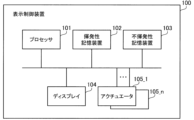
- FIG. 1 is a diagram showing hardware included in a display control device according to the first embodiment.
- the display control device 100 is a device that executes a control method.
- the display control device 100 includes a processor 101, a volatile storage device 102, a nonvolatile storage device 103, a display 104, and actuators 105_1, . . . , 105_n (n is a positive integer).
- the processor 101 controls the entire display control device 100.
- the processor 101 is a CPU (Central Processing Unit), an FPGA (Field Programmable Gate Array), or the like.
- Processor 101 may be a multiprocessor.
- the display control device 100 may include a processing circuit.
- the volatile storage device 102 is the main storage device of the display control device 100.
- the volatile storage device 102 is a RAM (Random Access Memory).
- the nonvolatile storage device 103 is an auxiliary storage device of the display control device 100.
- the nonvolatile storage device 103 is a HDD (Hard Disk Drive) or an SSD (Solid State Drive).
- the storage area secured in the volatile storage device 102 or the nonvolatile storage device 103 is called a storage section.
- the display 104 displays information.
- the actuators 105_1, . . . , 105_n are driven.
- the actuators 105_1, . . . , 105_n are collectively referred to as the actuator 105.
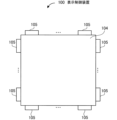
- FIG. 2 is a diagram illustrating an example of the appearance of the display control device according to the first embodiment.
- An actuator 105 is installed on the side of the display 104 of the display control device 100.
- the actuator 105 may be installed on the back surface of the display 104, as shown in FIG. 21 of Patent Document 1.
- Actuator 105 gives vibration to display 104.
- FIGS. 3A and 3B are diagrams showing a case where two sounds are output from the display.
- An actuator 202 is installed on the side of the display 201.
- FIG. 3(A) shows that two sounds are being output from the display 201.
- the two sounds are the Lch sound and the Rch sound.
- the Lch sound is output from the display 201 by driving the plurality of actuators 202 .
- the Rch sound is output from the display 201.
- stereo is achieved when the sounds are separated.
- Figure 3(B) shows that two sounds overlap. In this way, when the Lch sound and the Rch sound overlap, stereo cannot be obtained.
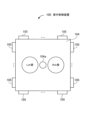
- the display control device 100 outputs a canceling sound that cancels out the Lch sound and the Rch sound at a position between the position where the Lch sound is output and the position where the Rch sound is output. This will be explained specifically using figures.
- FIG. 4 is a diagram illustrating an example where the canceling sound of Embodiment 1 is output.
- FIG. 4 shows that a canceling sound that cancels the Lch sound and the Rch sound is output from the position 104a. Thereby, the display control device 100 can separate the two sounds. Therefore, stereo is realized.
- stereo is realized by the display control device 100. Further, it is assumed that Lch sound is output from the left side of the display 104. It is assumed that Rch sound is output from the right side of the display 104.
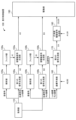
- FIG. 5 is a block diagram showing the functions of the display control device according to the first embodiment.
- the display control device 100 includes an acquisition unit 110, analysis units 120a and 120b, filter units 130a and 130b, first signal generation units 140a and 140b, sound drive signal generation units 150a and 150b, coordinate prediction units 160a and 160b, and second , signal generating sections 170a and 170b, noise canceling drive signal generating sections 180a and 180b, and a driving section 190.
- Acquisition unit 110 analysis units 120a, 120b, filter units 130a, 130b, first signal generation units 140a, 140b, sound drive signal generation units 150a, 150b, coordinate prediction units 160a, 160b, second signal generation unit 170a, 170b, the noise canceling drive signal generation sections 180a and 180b, and some or all of the drive section 190 may be realized by a processing circuit.
- the acquisition unit 110, the analysis units 120a, 120b, the filter units 130a, 130b, the first signal generation units 140a, 140b, the sound drive signal generation units 150a, 150b, the coordinate prediction units 160a, 160b, the second signal generation unit 170a, 170b, the noise canceling drive signal generation units 180a, 180b, and a part or all of the drive unit 190 may be realized as a module of a program executed by the processor 101.
- the program executed by processor 101 is also referred to as a control program.
- the control program is recorded on a recording medium.
- the acquisition unit 110 acquires the transfer characteristics. For example, the acquisition unit 110 acquires the transfer characteristic from the storage unit. Further, for example, the acquisition unit 110 acquires the transfer characteristic from an external device.
- the external device is a server. Illustrations of external devices are omitted. Further, for example, the transfer characteristic is an impulse response.
- the acquisition unit 110 acquires the Lch sound signal.
- the acquisition unit 110 acquires an Lch sound signal from a storage unit or an external device.
- the Lch sound signal is also referred to as a first sound signal.
- the acquisition unit 110 acquires Lch coordinates.
- the acquisition unit 110 acquires Lch coordinates from a storage unit or an external device.
- the Lch coordinates are two-dimensional coordinates.
- the Lch coordinate indicates the position where the sound is output.
- the Lch coordinates are also referred to as first coordinates.
- the analysis unit 120a analyzes the Lch sound signal.
- the filter unit 130a generates the sound signal A1 using the Lch sound signal and a high-pass filter.
- the sound signal A1 is a signal obtained by removing the low frequencies of the Lch sound signal.
- the sound signal A1 is also referred to as a third sound signal.
- the first signal generation unit 140a generates a signal A2 for producing sound from the Lch coordinate based on the transfer characteristic and the Lch coordinate. Further, the signal A2 is also referred to as a first signal.
- the sound drive signal generation unit 150a drives the actuator 105 based on the sound signal A1 and the signal A2, and generates a drive signal A3 for producing sound from the Lch coordinate. Further, the drive signal A3 is also referred to as a first drive signal.
- the analysis section 120a, the filter section 130a, the first signal generation section 140a, and the sound drive signal generation section 150a execute processing in order to generate sound from the Lch coordinate.
- the analysis section 120a, the filter section 130a, the first signal generation section 140a, and the sound drive signal generation section 150a can generate sound from the Lch coordinate by using the conventional technology.
- the technique described in Patent Document 2 is used as a conventional technique.
- the technology is related to intra-casing crosstalk.
- the coordinate prediction unit 160a executes the following process.
- the coordinate prediction unit 160a predicts coordinates (hereinafter referred to as first predicted coordinates) at which sound is predicted to be output from other than the Lch coordinates, based on the Lch coordinates and the signal A2. Note that the first predicted coordinates are not limited to one coordinate.
- the second signal generation unit 170a generates a signal A4 for producing sound from the first predicted coordinates based on the transfer characteristic and the first predicted coordinates. Further, the signal A4 is also referred to as a third signal.
- the canceling sound drive signal generation unit 180a drives the actuator 105 based on a signal with the opposite phase of the sound signal A1 and the signal A4, and generates a drive signal A5 for producing sound from the first predicted coordinate. . Further, the drive signal A5 is also referred to as a third drive signal.
- the acquisition unit 110 acquires the Rch sound signal.
- the acquisition unit 110 acquires the Rch sound signal from a storage unit or an external device.
- the Rch sound signal is also referred to as a second sound signal.
- the acquisition unit 110 acquires Rch coordinates.
- the acquisition unit 110 acquires Rch coordinates from a storage unit or an external device.
- the Rch coordinates are two-dimensional coordinates.
- the Rch coordinate indicates the position where the sound is output.
- the Rch coordinates are also referred to as second coordinates.
- the analysis unit 120b analyzes the Rch sound signal.
- the filter unit 130b generates the sound signal B1 using the Rch sound signal and a high-pass filter.
- the sound signal B1 is a signal obtained by removing the low frequencies of the Rch sound signal.
- the sound signal B1 is also referred to as a fourth sound signal.
- the first signal generation unit 140b generates a signal B2 for producing sound from the Rch coordinate based on the transfer characteristic and the Rch coordinate. Further, the signal B2 is also referred to as a second signal.
- the sound drive signal generation unit 150b drives the actuator 105 based on the sound signal B1 and the signal B2, and generates a drive signal B3 for producing sound from the Rch coordinate. Further, the drive signal B3 is also referred to as a second drive signal.
- the analysis section 120b, the filter section 130b, the first signal generation section 140b, and the sound drive signal generation section 150b execute processing in order to generate sound from the Rch coordinate.
- the analysis section 120b, the filter section 130b, the first signal generation section 140b, and the sound drive signal generation section 150b can generate sound from the Rch coordinate by using the conventional technology.
- the technique described in Patent Document 2 is used as a conventional technique.
- the technology is related to intra-casing crosstalk.
- the coordinate prediction unit 160b executes the following process.
- the coordinate prediction unit 160b predicts coordinates (hereinafter referred to as second predicted coordinates) where sound is predicted to be output from a location other than the Rch coordinates, based on the Rch coordinates and the signal B2.
- second predicted coordinates are not limited to one coordinate.
- the first predicted coordinates and the second predicted coordinates may be the same.
- the second signal generation unit 170b generates a signal B4 for producing sound from the second predicted coordinates based on the transfer characteristic and the second predicted coordinates. Further, the signal B4 is also referred to as a fourth signal.
- the canceling sound drive signal generation unit 180b drives the actuator 105 based on a signal with the opposite phase of the sound signal B1 and the signal B4, and generates a drive signal B5 for producing sound from the second predicted coordinate. . Further, the drive signal B5 is also referred to as a fourth drive signal.
- the drive unit 190 drives the plurality of actuators 105 based on the drive signal A3, the drive signal A5, the drive signal B3, and the drive signal B5.
- the Lch sound and the Rch sound are output from the display 104, and the cancellation sound is created between the position where the Lch sound is output and the position where the Rch sound is output. is output from the position. This separates the two sounds.
- the display control device 100 can separate the two sounds.
- Embodiment 1 Modification of Embodiment 1.
- the display control device 100 includes two coordinate prediction units, two second signal generation units, and two sound cancellation drive signal generation units.
- the two functional units may be realized by one functional unit.
- FIG. 6 is a block diagram showing the functions of a display control device according to a modification of the first embodiment.
- the display control device 100 includes a coordinate prediction section 160, a second signal generation section 170, and a sound cancellation drive signal generation section 180.
- the coordinate prediction unit 160 predicts predicted coordinates, which are positions where the sound output from the Lch coordinate and the sound output from the Rch coordinate overlap, based on the Lch coordinate, the Rch coordinate, the signal A2, and the signal B2. Note that the predicted coordinates are not limited to one coordinate.
- the second signal generation unit 170 generates a signal C4 for producing sound from the predicted coordinates based on the transfer characteristics and the predicted coordinates. Further, the signal C4 is also referred to as a fifth signal.
- the noise canceling drive signal generation unit 180 drives the actuator 105 based on a signal with the opposite phase of the sound signal A1 and the signal C4, and generates a drive signal C5 for producing sound from the predicted coordinates.
- the drive signal C5 is also referred to as a fifth drive signal.
- the noise canceling drive signal generation unit 180 drives the actuator 105 based on a signal with the opposite phase of the sound signal B1 and the signal C4, and generates a drive signal D5 for producing sound from the predicted coordinates.
- the drive signal D5 is also referred to as a sixth drive signal.
- the drive unit 190 drives the plurality of actuators 105 based on the drive signal A3, drive signal B3, drive signal C5, and drive signal D5.
- the coordinate prediction unit 160 predicts predicted coordinates based on the Lch coordinate, the Rch coordinate, the signal A2, and the signal B2. That is, the predicted coordinates are predicted based on a lot of information. Therefore, as in the first embodiment, when one coordinate prediction unit predicts coordinates, predicted coordinates can be predicted with higher accuracy than when two coordinate prediction units each predict coordinates.
- the display control device 100 has two analysis units, two filter units, two first signal generation units, and two sound drive signal generation units.
- the two functional units may be realized by one functional unit.
- Embodiment 2 Next, a second embodiment will be described. In the second embodiment, matters that are different from the first embodiment will be mainly explained. In the second embodiment, explanations of matters common to the first embodiment will be omitted. In the first embodiment, the case where two sounds are output from the display 104 has been described. In the second embodiment, a case will be described in which three or more sounds are output from the display 104.
- FIG. 7 is a diagram showing an example where three or more sounds are output according to the second embodiment.
- FIG. 7 shows a case where three or more sounds are output from the display 104 by the display control device 100 controlling the plurality of actuators 105.
- sounds of 1ch, 2ch, . . . , Nch, N+1ch, N+2ch, . . . , 2Nch are output from the display 104.
- the display control device 100 outputs a canceling sound between the positions where each of the three or more sounds is output. Specifically, the display control device 100 outputs the canceling sound from a position between the positions where the two sounds are output. For example, the display control device 100 outputs the canceling sound from a position between the position where the 1ch sound is output and the position where the 2ch sound is output. Furthermore, the display control device 100 outputs a canceling sound from a position between the position where the 2ch sound is output and the position where the 3ch sound is output. Thereby, a speaker array is realized on the display 104.
- a speaker array is realized on the display 104. That is, a speaker array is realized with one display. Therefore, the user does not have to purchase multiple speakers. Therefore, costs are suppressed.
- Embodiment 3 Next, Embodiment 3 will be described. In the third embodiment, matters that are different from the first embodiment will be mainly explained. In the third embodiment, explanations of matters common to the first embodiment will be omitted.
- FIG. 8 is a diagram showing a practical example of the third embodiment.
- FIG. 8 shows a case where the display control device 100 is installed in a car.
- a technique is known in which a user can hear sound as if he were wearing headphones using two or more speakers. This technique requires two or more speakers. Also, two or more speakers are fixed. For example, since two or more speakers are fixed, the technique will not be implemented if the driver changes. That is, since the height of the ears changes, this technique cannot be realized.
- the display control device 100 can realize this technology. The display control device 100 will be explained below.
- the display control device 100 acquires information indicating the height of the user's ears. For example, the display control device 100 acquires information indicating the height of the user's ears from a DMS (Driver Monitoring System) 300. Further, for example, when the user touches the height of his/her own ear on the display control device 100, the display control device 100 acquires information indicating the height of the user's ear.
- DMS Driver Monitoring System
- FIG. 9 is a diagram showing an example of sound output according to the ear height according to the third embodiment.
- the display control device 100 controls the sound to be output from the height 106_1. Furthermore, the display control device 100 controls so that a canceling sound is output from the position 107_1.
- the display control device 100 controls so that the sound is output from the height 106_2. Furthermore, the display control device 100 controls so that a canceling sound is output from the position 107_2. Further, for example, when the information indicating the height of the user's ears indicates the height 106_3, the display control device 100 controls so that the sound is output from the height 106_3. Furthermore, the display control device 100 controls so that a canceling sound is output from the position 107_3. In this way, the display control device 100 can implement the technology according to the height of the user's ears. Next, the functions of the display control device 100 according to the third embodiment will be explained.
- FIG. 10 is a block diagram showing the functions of the display control device according to the third embodiment. Components in FIG. 10 that are the same as those shown in FIG. 6 are designated by the same reference numerals as those shown in FIG. FIG. 10 explains the functions of the display control device 100 using FIG. 6. However, similar functions can be explained using FIG. 5 as well.
- the display control device 100 further includes a position determining section 191.
- a part or all of the position determination unit 191 may be realized by a processing circuit. Further, part or all of the position determination unit 191 may be realized as a module of a program executed by the processor 101.
- the acquisition unit 110 acquires information indicating the height of the user's ears.
- the position determining unit 191 determines the position at which the sound is output based on information indicating the height of the user's ears. For example, the position determining unit 191 determines the Rch coordinate and the Lch coordinate based on information indicating the height of the user's ears. Other functions are the same as those in Embodiment 1, so explanations will be omitted. According to Embodiment 3, the display control device 100 can implement the technology according to the height of the user's ears.
- Embodiment 4 Next, Embodiment 4 will be described. In the fourth embodiment, matters that are different from the first embodiment will be mainly explained. In the fourth embodiment, explanations of matters common to the first embodiment will be omitted.
- FIG. 11 is a diagram showing a practical example of the fourth embodiment.
- FIG. 11 shows a case where the display control device 100 is installed in a car.
- DMS 300 can detect driver distraction. Note that, for example, distraction occurs when the driver is drowsy.
- the display control device 100 acquires information indicating that the driver is distracted from the DMS 300.
- the display control device 100 performs control so that the display 104 outputs a warning sound.
- the acquisition unit 110 acquires information indicating that the driver is in a distracted state. Further, the acquisition unit 110 may acquire the information from a device other than the DMS 300. When acquiring the information, the acquisition unit 110 acquires a sound signal that calls attention. For example, the acquisition unit 110 acquires an Lch sound signal and an Rch sound signal, which are sound signals that call for attention. Other functions are the same as those in Embodiment 1, so explanations will be omitted. As a result, a sound that calls for attention is output from the display 104.
- the display control device 100 can output a sound that calls for attention. Furthermore, if the display 104 can implement a speaker array, the display control device 100 may perform control so that only the driver hears the sound that calls for attention. That is, the display control device 100 adjusts the direction in which the sound is output to the direction in which the driver is present.
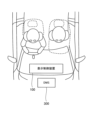
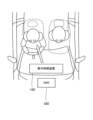
- FIG. 12 is a diagram showing a practical example of the fifth embodiment.
- FIG. 12 shows a case where the display control device 100 is installed in a car.
- the DMS 300 can detect that the user in the passenger seat is sleeping.
- the display control device 100 acquires information indicating that the user in the passenger seat is in a sleeping state from the DMS 300.
- the display control device 100 also acquires the driver's position information from the DMS 300.
- the display control device 100 adjusts the output direction of the sound to the direction in which the driver is present. That is, the display control device 100 adjusts the directivity of the sound to the direction in which the driver is present. As a result, the user in the passenger seat cannot hear the sound. Therefore, the display control device 100 can control the sound so as not to disturb the sleep of the user in the passenger seat.
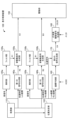
- FIG. 13 is a block diagram showing the functions of the display control device according to the fifth embodiment. Components in FIG. 13 that are the same as those shown in FIG. 6 are designated by the same reference numerals as those shown in FIG.
- the display control device 100 further includes a directivity control section 192.
- Part or all of the directivity control section 192 may be realized by a processing circuit. Further, part or all of the directivity control unit 192 may be realized as a module of a program executed by the processor 101.
- the acquisition unit 110 acquires information indicating that the user in the passenger seat is in a sleeping state from the DMS 300.
- the acquisition unit 110 may acquire the information from a device other than the DMS 300. Further, the acquisition unit 110 acquires the driver's position information from the DMS 300.
- the acquisition unit 110 may acquire position information from a device other than the DMS 300.
- the directivity control unit 192 controls the directionality of the sound to match the direction in which the driver is located, based on the driver's position information. Generate control signals.
- the drive unit 190 drives the plurality of actuators 105 based on the control signal, drive signal A3, drive signal B3, drive signal C5, and drive signal D5. This directs the sound towards the driver.
- FIG. 13 describes the functions of the display control device 100 using FIG. 6. However, similar functions can be explained using FIG. 5 as well.
- the drive unit 190 drives the plurality of actuators 105 based on the control signal, drive signal A3, drive signal B3, drive signal A5, and drive signal B5. This directs the sound towards the driver.
- the display control device 100 can control the sound so as not to disturb the sleep of the user in the passenger seat.
- Embodiment 6 Next, a sixth embodiment will be described. In the sixth embodiment, matters that are different from the first embodiment will be mainly explained. In the sixth embodiment, explanations of matters common to the first embodiment will be omitted.
- FIG. 14 is a diagram showing a practical example of the sixth embodiment.
- the display control device 100 in FIG. 14 is a signage.
- a user moves a finger from position 108_1 to position 108_2 while touching display 104.
- another user moves his or her finger from position 109_1 to position 109_2 while touching display 104.
- the display control device 100 outputs sound from the touched position.
- the display control device 100 outputs sound from positions 108_1 and 109_1.
- the display control device 100 outputs a canceling sound from a position between the position 108_1 and the position 109_1.
- the functions of display control device 100 according to the sixth embodiment will be explained.
- FIG. 15 is a block diagram showing the functions of the display control device according to the sixth embodiment.
- the configuration in FIG. 15 that is the same as the configuration shown in FIG. 6 is given the same reference numeral as that shown in FIG. FIG. 15 explains the functions of the display control device 100 using FIG. 6. However, similar functions can be explained using FIG. 5 as well.
- the display control device 100 further includes a position determining section 193.
- a part or all of the position determination unit 193 may be realized by a processing circuit. Further, part or all of the position determination unit 193 may be realized as a program module executed by the processor 101.
- the acquisition unit 110 acquires a plurality of pieces of position information indicating positions where the display 104 is being touched at the same time. For example, if the display control device 100 has a touch panel, the acquisition unit 110 acquires a plurality of pieces of position information from the touch panel.
- the position determining unit 193 determines a plurality of pieces of position information as a position to output sound. For example, the position determining unit 191 determines a plurality of pieces of position information as Rch coordinates and Lch coordinates. Other functions are the same as those in Embodiment 1, so explanations will be omitted.
- the display control device 100 when the displays 104 are touched at the same time, the display control device 100 can output sound from the touched positions.
- 100 display control device 101 processor, 102 volatile storage device, 103 non-volatile storage device, 104 display, 104a position, 105, 105_1,..., 105_n actuator, 106_1, 106_2, 106 _3 Height, 107_1, 107_2, 107_3 Position, 108_1, 108_2 Position, 109_1, 109_2 Position, 110 Acquisition unit, 120a, 120b Analysis unit, 130a, 130b Filter unit, 140a, 140b First signal generation unit, 150a, 150 b Sound drive signal generation unit, 160 coordinate prediction part, 160a, 160b coordinate prediction unit, 170 second signal generation unit, 170a, 170b second signal generation unit, 180 cancellation sound drive signal generation unit, 180a, 180b cancellation sound drive signal generation unit, 190 drive unit, 191 Position determination unit, 192 Directivity control unit, 193 Position determination unit, 201 Display, 202 Actuator, 300 DMS.
Landscapes
- Engineering & Computer Science (AREA)
- Physics & Mathematics (AREA)
- Acoustics & Sound (AREA)
- Signal Processing (AREA)
- Health & Medical Sciences (AREA)
- Otolaryngology (AREA)
- Multimedia (AREA)
- Circuit For Audible Band Transducer (AREA)
Priority Applications (2)
| Application Number | Priority Date | Filing Date | Title |
|---|---|---|---|
| PCT/JP2022/018558 WO2023203756A1 (ja) | 2022-04-22 | 2022-04-22 | 表示制御装置、制御方法、及び制御プログラム |
| JP2024501252A JPWO2023203756A1 (https=) | 2022-04-22 | 2022-04-22 |
Applications Claiming Priority (1)
| Application Number | Priority Date | Filing Date | Title |
|---|---|---|---|
| PCT/JP2022/018558 WO2023203756A1 (ja) | 2022-04-22 | 2022-04-22 | 表示制御装置、制御方法、及び制御プログラム |
Publications (1)
| Publication Number | Publication Date |
|---|---|
| WO2023203756A1 true WO2023203756A1 (ja) | 2023-10-26 |
Family
ID=88419458
Family Applications (1)
| Application Number | Title | Priority Date | Filing Date |
|---|---|---|---|
| PCT/JP2022/018558 Ceased WO2023203756A1 (ja) | 2022-04-22 | 2022-04-22 | 表示制御装置、制御方法、及び制御プログラム |
Country Status (2)
| Country | Link |
|---|---|
| JP (1) | JPWO2023203756A1 (https=) |
| WO (1) | WO2023203756A1 (https=) |
Citations (6)
| Publication number | Priority date | Publication date | Assignee | Title |
|---|---|---|---|---|
| JPH1066198A (ja) * | 1996-08-20 | 1998-03-06 | Kawai Musical Instr Mfg Co Ltd | ステレオ音像拡大装置及び音像制御装置 |
| WO2005062672A1 (ja) * | 2003-12-24 | 2005-07-07 | Mitsubishi Denki Kabushiki Kaisha | 音響信号再生方法 |
| JP2007121439A (ja) * | 2005-10-25 | 2007-05-17 | Toshiba Corp | 音響信号再生装置 |
| JP2008011253A (ja) * | 2006-06-29 | 2008-01-17 | Toshiba Corp | 放送受信装置 |
| JP2008103851A (ja) * | 2006-10-17 | 2008-05-01 | Yamaha Corp | 音声出力装置 |
| JP2019504531A (ja) * | 2015-11-25 | 2019-02-14 | ザ ユニバーシティ オブ ロチェスター | パネルの振動を空間的および時間的に制御することによってオーディオシーンを生成するためのシステムおよび方法 |
-
2022
- 2022-04-22 JP JP2024501252A patent/JPWO2023203756A1/ja active Pending
- 2022-04-22 WO PCT/JP2022/018558 patent/WO2023203756A1/ja not_active Ceased
Patent Citations (6)
| Publication number | Priority date | Publication date | Assignee | Title |
|---|---|---|---|---|
| JPH1066198A (ja) * | 1996-08-20 | 1998-03-06 | Kawai Musical Instr Mfg Co Ltd | ステレオ音像拡大装置及び音像制御装置 |
| WO2005062672A1 (ja) * | 2003-12-24 | 2005-07-07 | Mitsubishi Denki Kabushiki Kaisha | 音響信号再生方法 |
| JP2007121439A (ja) * | 2005-10-25 | 2007-05-17 | Toshiba Corp | 音響信号再生装置 |
| JP2008011253A (ja) * | 2006-06-29 | 2008-01-17 | Toshiba Corp | 放送受信装置 |
| JP2008103851A (ja) * | 2006-10-17 | 2008-05-01 | Yamaha Corp | 音声出力装置 |
| JP2019504531A (ja) * | 2015-11-25 | 2019-02-14 | ザ ユニバーシティ オブ ロチェスター | パネルの振動を空間的および時間的に制御することによってオーディオシーンを生成するためのシステムおよび方法 |
Also Published As
| Publication number | Publication date |
|---|---|
| JPWO2023203756A1 (https=) | 2023-10-26 |
Similar Documents
| Publication | Publication Date | Title |
|---|---|---|
| KR101797804B1 (ko) | 사운드 필드의 제스처 조종을 위한 시스템들, 방법들, 장치들, 및 컴퓨터 판독가능 매체들 | |
| CN103517185B (zh) | 对在嘈杂环境中操作的多话筒音频设备的声信号降噪的方法 | |
| EP2251860B1 (en) | System and Method for Active Noise Control with Adaptive Speaker Selection | |
| EP3441965A1 (en) | Signal processing device, signal processing method, and program | |
| EP2200338A2 (en) | Apparatus and method for generating directional sound | |
| WO2012061151A1 (en) | Systems, methods, apparatus, and computer-readable media for orientation-sensitive recording control | |
| CN105247892A (zh) | 用于空间选择性音频播放的设备和方法 | |
| CN108886651B (zh) | 声音再现装置和方法以及程序 | |
| KR102724156B1 (ko) | 오디오 줌 | |
| Xiao et al. | Spatially selective active noise control systems | |
| KR20220091146A (ko) | 차량용 음향 제어 장치 및 그 제어 방법 | |
| JP2018195143A (ja) | 制御装置、入力システムおよび制御方法 | |
| JP7036008B2 (ja) | 局所消音音場形成装置および方法、並びにプログラム | |
| WO2023203756A1 (ja) | 表示制御装置、制御方法、及び制御プログラム | |
| JP2019083408A (ja) | 音再生システム、移動体、音再生方法及びプログラム | |
| JP7037305B2 (ja) | 信号遅延調整装置、信号遅延調整方法及び信号処理装置 | |
| JP7248048B2 (ja) | 収音装置、収音プログラム及び収音方法、並びに、キーボード | |
| US9949032B1 (en) | Directivity speaker array | |
| KR20160118156A (ko) | 능동 소음 제어를 이용한 소음 저감 장치 및 방법 | |
| CN109982197B (zh) | 区域再生方法、计算机可读取的记录介质及区域再生系统 | |
| US10536795B2 (en) | Vehicle audio system with reverberant content presentation | |
| JP6303519B2 (ja) | 音響再生装置および音場補正プログラム | |
| CN114642004B (zh) | 扬声器系统 | |
| JP2019068398A (ja) | スピーカシステム、及び、信号処理方法 | |
| US20230336913A1 (en) | Acoustic processing device, method, and program |
Legal Events
| Date | Code | Title | Description |
|---|---|---|---|
| 121 | Ep: the epo has been informed by wipo that ep was designated in this application |
Ref document number: 22938555 Country of ref document: EP Kind code of ref document: A1 |
|
| WWE | Wipo information: entry into national phase |
Ref document number: 2024501252 Country of ref document: JP |
|
| NENP | Non-entry into the national phase |
Ref country code: DE |
|
| 122 | Ep: pct application non-entry in european phase |
Ref document number: 22938555 Country of ref document: EP Kind code of ref document: A1 |