WO2023200000A1 - 軟性内視鏡下手術用縫合糸 - Google Patents
軟性内視鏡下手術用縫合糸 Download PDFInfo
- Publication number
- WO2023200000A1 WO2023200000A1 PCT/JP2023/015127 JP2023015127W WO2023200000A1 WO 2023200000 A1 WO2023200000 A1 WO 2023200000A1 JP 2023015127 W JP2023015127 W JP 2023015127W WO 2023200000 A1 WO2023200000 A1 WO 2023200000A1
- Authority
- WO
- WIPO (PCT)
- Prior art keywords
- suture
- endoscopic surgical
- opening
- flexible endoscopic
- main body
- Prior art date
- Legal status (The legal status is an assumption and is not a legal conclusion. Google has not performed a legal analysis and makes no representation as to the accuracy of the status listed.)
- Ceased
Links
Images



Classifications
-
- A—HUMAN NECESSITIES
- A61—MEDICAL OR VETERINARY SCIENCE; HYGIENE
- A61B—DIAGNOSIS; SURGERY; IDENTIFICATION
- A61B17/00—Surgical instruments, devices or methods
- A61B17/04—Surgical instruments, devices or methods for suturing wounds; Holders or packages for needles or suture materials
- A61B17/06—Needles ; Sutures; Needle-suture combinations; Holders or packages for needles or suture materials
- A61B17/06166—Sutures
-
- A—HUMAN NECESSITIES
- A61—MEDICAL OR VETERINARY SCIENCE; HYGIENE
- A61B—DIAGNOSIS; SURGERY; IDENTIFICATION
- A61B17/00—Surgical instruments, devices or methods
- A61B17/04—Surgical instruments, devices or methods for suturing wounds; Holders or packages for needles or suture materials
- A61B17/0401—Suture anchors, buttons or pledgets, i.e. means for attaching sutures to bone, cartilage or soft tissue; Instruments for applying or removing suture anchors
-
- A—HUMAN NECESSITIES
- A61—MEDICAL OR VETERINARY SCIENCE; HYGIENE
- A61B—DIAGNOSIS; SURGERY; IDENTIFICATION
- A61B17/00—Surgical instruments, devices or methods
- A61B17/04—Surgical instruments, devices or methods for suturing wounds; Holders or packages for needles or suture materials
- A61B17/0487—Suture clamps, clips or locks, e.g. for replacing suture knots; Instruments for applying or removing suture clamps, clips or locks
-
- A—HUMAN NECESSITIES
- A61—MEDICAL OR VETERINARY SCIENCE; HYGIENE
- A61B—DIAGNOSIS; SURGERY; IDENTIFICATION
- A61B17/00—Surgical instruments, devices or methods
- A61B2017/00004—(bio)absorbable, (bio)resorbable or resorptive
-
- A—HUMAN NECESSITIES
- A61—MEDICAL OR VETERINARY SCIENCE; HYGIENE
- A61B—DIAGNOSIS; SURGERY; IDENTIFICATION
- A61B17/00—Surgical instruments, devices or methods
- A61B17/04—Surgical instruments, devices or methods for suturing wounds; Holders or packages for needles or suture materials
- A61B17/0401—Suture anchors, buttons or pledgets, i.e. means for attaching sutures to bone, cartilage or soft tissue; Instruments for applying or removing suture anchors
- A61B2017/0406—Pledgets
-
- A—HUMAN NECESSITIES
- A61—MEDICAL OR VETERINARY SCIENCE; HYGIENE
- A61B—DIAGNOSIS; SURGERY; IDENTIFICATION
- A61B17/00—Surgical instruments, devices or methods
- A61B17/04—Surgical instruments, devices or methods for suturing wounds; Holders or packages for needles or suture materials
- A61B17/0401—Suture anchors, buttons or pledgets, i.e. means for attaching sutures to bone, cartilage or soft tissue; Instruments for applying or removing suture anchors
- A61B2017/0417—T-fasteners
-
- A—HUMAN NECESSITIES
- A61—MEDICAL OR VETERINARY SCIENCE; HYGIENE
- A61B—DIAGNOSIS; SURGERY; IDENTIFICATION
- A61B17/00—Surgical instruments, devices or methods
- A61B17/04—Surgical instruments, devices or methods for suturing wounds; Holders or packages for needles or suture materials
- A61B17/0401—Suture anchors, buttons or pledgets, i.e. means for attaching sutures to bone, cartilage or soft tissue; Instruments for applying or removing suture anchors
- A61B2017/0464—Suture anchors, buttons or pledgets, i.e. means for attaching sutures to bone, cartilage or soft tissue; Instruments for applying or removing suture anchors for soft tissue
-
- A—HUMAN NECESSITIES
- A61—MEDICAL OR VETERINARY SCIENCE; HYGIENE
- A61B—DIAGNOSIS; SURGERY; IDENTIFICATION
- A61B17/00—Surgical instruments, devices or methods
- A61B17/04—Surgical instruments, devices or methods for suturing wounds; Holders or packages for needles or suture materials
- A61B17/06—Needles ; Sutures; Needle-suture combinations; Holders or packages for needles or suture materials
- A61B2017/06057—Double-armed sutures, i.e. sutures having a needle attached to each end
-
- A—HUMAN NECESSITIES
- A61—MEDICAL OR VETERINARY SCIENCE; HYGIENE
- A61B—DIAGNOSIS; SURGERY; IDENTIFICATION
- A61B17/00—Surgical instruments, devices or methods
- A61B17/04—Surgical instruments, devices or methods for suturing wounds; Holders or packages for needles or suture materials
- A61B17/06—Needles ; Sutures; Needle-suture combinations; Holders or packages for needles or suture materials
- A61B17/06166—Sutures
- A61B2017/06176—Sutures with protrusions, e.g. barbs
Definitions
- the present invention relates to a flexible endoscopic surgical suture.
- Endoscopic surgery is a surgery that is performed inside a human or animal body while viewing images of the inside of the body captured by a lens placed at the tip of an endoscope and displayed on a monitor. Compared to conventional surgeries performed through laparotomy, endoscopic surgery tends to have a smaller opening area, so it has advantages such as less post-operative pain and faster recovery for the patient.
- An elongated core comprising a first leg and a second leg is an object of the present invention to provide a suturing system that is able to pass through tissues and suture rings more easily without causing damage. and a stop projecting from the elongate core between the first leg and the second leg. It is noted that the stop is preferably incorporated to limit the mobility of the cotton suture and/or to improve suture performance.
- endoscopic surgery includes rigid endoscopic surgery and flexible endoscopic surgery.
- Rigid endoscopic surgery involves making multiple small holes in the patient's body surface, inserting a rigid endoscope, multiple instruments, etc. through the holes, and performing surgery inside the patient's body.
- Flexible endoscopic surgery uses instruments that are inserted and removed through the forceps hole placed at the tip of the flexible endoscope while checking images taken with a lens placed at the tip of the flexible endoscope. It performs surgery inside the patient's body.
- Patent Document 2 describes a suture thread for endoscopic surgery, which includes a first part extending a predetermined length from one end, and the first part.
- a suture thread comprising: a second part excluding the first part; the first part and the second part have different colors; the suture thread is configured to facilitate suturing in endoscopic surgery; It is described that sutures can be provided that can be performed to
- the surgical suture described in Patent Document 1 is not for performing surgery inside a patient's body (for example, intestinal tract, etc.) using a rigid or flexible endoscope, nor is it optimized for that purpose. do not have. Furthermore, in flexible endoscopic surgery, surgery is performed on the affected area of a patient using only instruments that are inserted and removed from forceps holes placed at the tip of a flexible endoscope. Conventional sutures (for example, the sutures described in Patent Document 2) used in flexible endoscopic surgery are generally for suturing only the superficial layer such as the mucosal layer of the gastrointestinal tract, etc. Met.
- the problem to be solved by the present invention is to provide a flexible suture for endoscopic surgery that can easily and completely close an opening in a human or animal tissue and shorten the suturing time. It is in.
- the present inventor has discovered that the above problem can be solved by adopting the following configuration, and has completed the invention.
- a flexible endoscopic surgical suture for suturing an opening in a human or animal tissue comprising: a suture body; , comprising one stopper member that prevents the suture main body from coming off, and a plurality of protrusions that protrude obliquely toward a side opposite to the insertion direction of the suture main body, the plurality of protrusions are arranged on one side in the length direction of the suture body with the stop member as a reference, and a plurality of eyes projecting obliquely toward the outside and on the other side of the suture body.
- a flexible endoscopic surgical suture comprising: a plurality of second protrusions.
- ⁇ 3> One end of the suture main body is inserted from the outer wall side to the inner wall side of the tissue near the opening, where the opening diameter of the opening is the largest, and the other end of the suture main body is , the soft endoscope according to ⁇ 1> or ⁇ 2> above, which is inserted from an outer wall side to an inner wall side into a tissue located on the opposite side of the tissue of the opening into which one end of the suture main body is inserted.
- the stopper member is a flexible member according to any one of ⁇ 1> to ⁇ 3> above, which cooperates with the plurality of protrusions to hold the opening in a closed state on the outer wall side. Sutures for endoscopic surgery.
- the suture body portion includes a first suture piece having the plurality of protrusions, and a second suture piece having the plurality of protrusions, the first suture piece and the second suture piece having the plurality of protrusions.
- ⁇ 6> The flexible endoscopic surgical suture according to any one of ⁇ 1> to ⁇ 5> above, wherein the stop member has a spherical shape.
- ⁇ 7> The flexible endoscopic surgical suture according to any one of ⁇ 1> to ⁇ 5> above, wherein the stopper member is plate-shaped.
- ⁇ 8> The flexible endoscopic surgical suture according to any one of ⁇ 1> to ⁇ 5> above, wherein the stop member has a coil shape.
- ⁇ 9> The flexible suture for endoscopic surgery according to any of ⁇ 1> to ⁇ 5> above, wherein the stop member is a knot tied to the suture main body.
- the stop member is a clip capable of holding the suture main body.
- ⁇ 11> The flexible endoscopic surgical suture according to any one of ⁇ 1> to ⁇ 10> above, which is made of a bioabsorbable material.
- ⁇ 12> A flexible endoscopic surgical suture using the suture for flexible endoscopic surgery according to any one of ⁇ 1> to ⁇ 11> above, in which needles are provided at both ends of the suture main body. Surgical suturing unit.
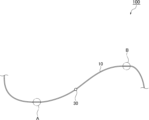
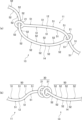
- FIG. 3 is a diagram for explaining a configuration example of a flexible endoscopic surgical suture according to the first embodiment.
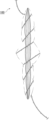
- 2 is a partially enlarged view of the flexible endoscopic surgical suture according to the first embodiment, and the partial view (a) in the figure is a partially enlarged view of the location indicated by the symbol A in FIG.
- the middle diagram (b) is a partially enlarged view of the part indicated by the symbol B in FIG.
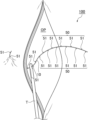
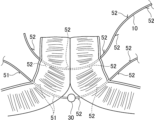
- FIG. 2 is a diagram illustrating a state in which one end of the flexible endoscopic surgical suture according to the first embodiment is inserted from the outer wall side to the inner wall side of the tissue near the opening.
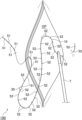
- FIG. 6 is a diagram illustrating a state in which the other end of the flexible endoscopic surgical suture is inserted into tissue located on the opposite side of the tissue from the outer wall side to the inner wall side.
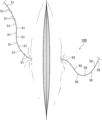
- FIG. 6 is a diagram for explaining a state after both ends of the flexible endoscopic surgical suture according to the first embodiment are inserted from the outer wall side to the inner wall side of the tissue near the opening.
- FIG. 3 is a cross-sectional view for explaining a state in which one end of the suture thread is inserted.
- FIG. 3 is a diagram for explaining a state in which the opening has been sutured using the flexible endoscopic surgical suture according to the first embodiment.
- FIG. 3 is a diagram illustrating a state in which a first suture piece and a second suture piece are joined.
- FIG. 6 is a diagram showing an example of another method for manufacturing a suture for flexible endoscopic surgery according to the second embodiment, and a partial view (a) in the diagram shows a first suture piece having a large diameter portion.
- FIG. 2 is a diagram illustrating a state in which the second suture piece is inserted and the first suture thread is inserted into the large diameter part of the second suture piece; It is a figure which illustrates the state where the large diameter part and the large diameter part of a 2nd suture piece are joined. It is a diagram for explaining a stop member according to a modified example, and a partial view (a) in the figure is a diagram for explaining a configuration example of a stop member according to a modified example. ) is a sectional view for explaining a state in which tension is further applied from one side of the suture body after both ends of the suture body are inserted from the outer wall side to the inner wall side of the tissue near the opening. It is a figure for explaining the example of composition of the stopping member concerning a modification. It is a figure for explaining the example of composition of the 1st suture piece and the 2nd suture piece concerning a modification.
- FIG. 1 is a diagram for explaining a configuration example of a flexible endoscopic surgical suture according to the first embodiment.
- FIG. 2 is a partially enlarged view of the flexible endoscopic surgical suture according to the first embodiment, and the partial view (a) in FIG. 2 is a partially enlarged view of the part indicated by the symbol A in FIG.
- FIG. 2B is a partially enlarged view of a portion indicated by the symbol B in FIG. 1.
- the flexible endoscopic surgical suture 100 according to the first embodiment is for suturing an opening in human or animal tissue, and has a suture main body. 10, one stopper member 30 that is arranged at the center in the length direction of the suture body 10 and prevents the suture body 10 from coming off, and a stopper member 30 on the opposite side to the insertion direction of the suture body 10 ( a plurality of protrusions 50 that protrude obliquely toward the anti-insertion direction), and the plurality of protrusions 50 are arranged on one side with respect to the stop member 30 in the length direction of the suture body 10.
- a plurality of first protrusions 51 are arranged and protrude obliquely toward the other side and outside of the suture body 10, and in the length direction of the suture body 10, with the stop member 30 as a reference,
- a plurality of second protrusions 52 are disposed on the other side and protrude obliquely toward the outside on one side of the suture thread main body 10.
- an opening in a human or animal tissue refers to a part of a tissue in the human or animal body that is open and that is a target for stitching. , its shape, size, etc. are not particularly limited, but generally, under a flexible endoscope, it often refers to the opening in the inner wall of the gastrointestinal tract.
- the suture body portion 10 is the main body portion of a flexible endoscopic surgical suture 100.
- the suture body 10 may be composed of one thread, or may be composed of a combination of two threads as described below. Further, the suture main body 10 may be a plurality of overlapping threads, such as a double thread.
- the flexible endoscopic surgical suture 100 is preferably made of a bioabsorbable material that does not require suture removal and does not leave any foreign matter behind. Examples of bioabsorbable materials include polyglycolic acid, polylactic acid, polydioxane, polycaprolactone, glycolic acid/lactic acid polyester, and the like.
- the length of the suture body 10 can be changed as appropriate depending on the size of the opening, etc., and is not particularly limited, but may be, for example, 10 cm or more.
- the length can be 13 cm or more, 15 cm or more, and 25 cm or less.
- the thickness of the suture body 10 can also be changed as appropriate depending on the thickness of the tissue near the opening, and is not particularly limited, but can be, for example, 0.15 mm or more, and 0.20 mm or more. It can be 0.30 mm or more, 0.35 mm or more, and 0.70 mm or less.
- the thickness of the suture main body 10 may or may not be constant. If the thickness of the suture body 10 is not constant, for example, in the vicinity of the stop member 30 (described later) and in the center of the suture body 10 in the length direction, the thickness may be smaller than other parts of the suture body 10. You can also increase the thickness. Such a configuration makes it easier to prevent the suture body 10 (soft endoscopic surgical suture 100) from loosening.
- one stopper member 30 that prevents the suture main body 10 from coming off is arranged at the center of the suture main body 10 in the length direction.
- the center in the length direction of the suture body 10 is not only a position at 1/2 of the length of the suture body 10 but also a position between 2/5 and 3/5 of the length of the suture body 10. including areas located in
- the stopper member 30 stops at the outer wall side of the tissue. It functions to prevent the suture main body 10 (soft endoscopic surgery suture 100) from coming off.
- suture threads for endoscopic surgery have been tied with a knot or the like at one end to prevent the suture thread from coming off.
- the ends of the sutures for endoscopic surgery which are not provided with a knot or other retainer, are first tied to the serosa or adventitia side, which is the outer wall side of the gastrointestinal tract. Even if the device is inserted into the inner wall of the gastrointestinal tract, it is necessary to insert it from the inner wall of the gastrointestinal tract to the outer wall of the serosa or adventitia.
- one stopper member 30 is disposed at the center of the suture body 10 in the length direction, so that the suture body 10 (soft Both ends of the endoscopic surgical suture 100) can be inserted from the serosa or adventitia side, which is the outer wall of the gastrointestinal tract, into the inner wall of the gastrointestinal tract, etc., near the opening, so that they can be inserted into the inner wall of the gastrointestinal tract, etc.
- the flexible endoscopic surgical suture 100 according to the present embodiment can shorten the suturing time of the opening.
- the suture body 10 when inserting each of both ends of the suture body 10 (suture thread 100 for flexible endoscopic surgery), an image is captured by a lens disposed at the tip of the flexible endoscope. Since the ends of both ends of the suture body 10 (soft endoscopic surgical suture 100) can be confirmed, safety is excellent.
- the stopper member 30 is not particularly limited as long as it is thicker than the suture body 10 and functions to prevent the suture body 10 from coming off; for example, it is three times the thickness of the suture body 10. It can have a size (thickness) greater than or equal to the size (thickness).
- the shape of the stopper member 30 is not particularly limited as long as the stopper member 30 functions to prevent the suture thread main body 10 from coming off, and may have a spherical shape, an elliptical shape, a hemispherical shape, etc. It may have a semi-elliptical shape, it may have a polygonal shape, it may have a cylindrical shape, it may have a polygonal columnar shape, it may have a cylindrical shape. It may have a polygonal cylindrical shape. Further, as will be described later, the stopper member 30 may have a loop shape, a plate shape, a coil shape, or a knot formed by tying the suture body 10. Alternatively, it may be a clip that can hold the suture thread main body 10. Furthermore, as will be described later, when the suture main body portion 10 is composed of two suture pieces, the stop member 30 may be a portion where the two suture pieces are joined.
- the stop member 30 is not particularly limited, but for example, the maximum width perpendicular to the length direction of the suture body 10 is the maximum width parallel to the length direction of the suture body 10. can be made larger than. With such a configuration, it is easy to enter between the serosa or adventitia of the tissue near the opening and the serosa or adventitia, and the opening is held in a narrowed state, and the tissue near the opening is side) can be easily raised to a raised state.
- the maximum value of the width perpendicular to the width: the maximum value of the width parallel to the length direction can be 1:1, 2:1, and 3:1, for example. 4:1, 5:1, 6:1, 7:1, 8:1, 9 :1, 10:1, 12:1, 15:1, 20:1, 25:1 It can be 30:1, it can be 40:1, it can be 50:1, it can be 60:1, it can be 70:1.
- the ratio of the maximum width perpendicular to the length direction of the suture body 10 to the maximum width parallel to the length direction of the suture body 10 is:
- the ratio can be 1:1 to 70:1, 2:1 to 60:1, and 3:1 to 50:1.
- the stop member 30 is perpendicular to the longitudinal direction of the suture body 10.
- the maximum value of the width is appropriately selected depending on the thickness of the suture main body 10, and can be, for example, 0.15 mm or more, 0.2 mm or more, and 0.3 mm or more. It can be 0.4 mm or more, it can be 0.45 mm or more, it can be 3 mm or less, it can be 2.5 mm or less, and it can be 2 mm or less. It can be set to 1.5 mm or less, and it can be set to 1 mm or less.
- the maximum width of the stopper member 30 parallel to the length direction of the suture thread main body 10 is not particularly limited, but may be, for example, 0.15 mm or more, and 0.15 mm or more. It can be 2 mm or more, it can be 0.3 mm or more, it can be 0.4 mm or more, it can be 0.45 mm or more, and it can be 10 mm or less, and it can be 9 mm or less. It can be 8 mm or less, it can be 7 mm or less, it can be 6 mm or less, it can be 5 mm or less, it can be 4 mm or less, and it can be 3 mm or less. It can be 2.5 mm or less, it can be 2 mm or less, it can be 1.5 mm or less, and it can be 1 mm or less.
- the above configuration allows the stop member 30 to close the tissue near the opening of the gastrointestinal tract. It is easy to get between the serosa or adventitia and the serosa or adventitia, to keep the opening in a narrowed state, and to make it easier for the tissue near the opening to bulge inward (inner wall side).
- the suture main body 10 can be inserted into a portion of the tissue that has been removed, making it possible to easily and completely close the opening of the gastrointestinal tract over the entire thickness in a short period of time.
- the stopper is formed such that the maximum width of the suture body 10 perpendicular to the length direction is larger than the maximum width parallel to the length direction of the suture body 10.
- the member 30 for example, a plate-like member described later
- the tissue near the opening is placed on the inside (inner wall side) along a surface of the stopper member 30 that is substantially orthogonal to the length direction of the suture body 10. ) to make it easier to warp (make it easier to keep it in a raised state), which leads to a reduction in suturing time.
- the stop member 30 has a spherical shape.
- the stopper member 30 allows each of both ends of the suture body 10 (soft endoscopic surgical suture) to be inserted from the outer wall side to the inner wall side of the tissue near the opening, as described later. After that, when further tension is applied from one side of the suture body 10 (soft endoscopic surgical suture 100), the suture thread tends to enter between the serosa or adventitia of the tissue near the opening and the serosa or adventitia.
- the stopper member 30 has no corners and is difficult to catch on other flexible endoscopic surgical sutures. As a result, the plurality of flexible endoscopic surgical suture threads 100 are less likely to become entangled with each other.
- the suture body 10 has a plurality of protrusions that protrude diagonally toward the opposite side to the insertion direction of the suture body 10 (soft endoscopic surgical suture 100). 50.
- the suture body 10 By providing a plurality of protrusions 50 that protrude obliquely toward the side opposite to the insertion direction of the suture body 10 (soft endoscopic surgical suture 100), sutures inserted into the tissue near the opening are provided. It is possible to suppress the thread main body portion 10 (the flexible endoscopic surgical suture thread 100) from moving or coming out in the counter-insertion direction, which is the opposite side to the insertion direction.
- the number of the plurality of protrusions 50 is particularly limited as long as it can prevent the suture main body 10 (soft endoscopic surgery suture 100) inserted into the tissue near the opening from moving in the opposite insertion direction or coming out. It can be changed as appropriate.
- the plurality of protrusions 50 may be arranged at equal intervals or may be arranged at non-equal intervals.
- the arrangement interval can be narrower than in other parts of the suture thread main body 10. Such a configuration makes it easier to prevent the suture body 10 (soft endoscopic surgical suture 100) from loosening.
- the inclination angle of the plurality of protrusions 50 can also be adjusted particularly if it can prevent the suture body 10 (soft endoscopic surgery suture 100) inserted into the tissue near the opening from moving in the opposite insertion direction or coming out.
- the angle is not limited and can be changed as appropriate depending on the thickness of the tissue near the opening, for example, the angle can be set to 15° or less with respect to the suture body 10.
- the length of the plurality of protrusions 50 is also particularly limited as long as it can prevent the suture main body 10 (soft endoscopic surgical suture 100) inserted into the tissue near the opening from moving in the opposite insertion direction or coming out. Although it can be changed as appropriate depending on the thickness of the tissue near the opening, for example, it can be set to 1/3 or more of the thickness of the suture body 10.
- the thickness of the plurality of protrusions 50 is also particularly limited as long as it can prevent the suture main body 10 (soft endoscopic surgery suture 100) inserted into the tissue near the opening from moving in the opposite insertion direction or coming out. However, it can be changed as appropriate depending on the thickness of the tissue near the opening.
- the plurality of protrusions 50 are arranged on one side in the longitudinal direction of the suture body 10 with the stop member 30 as a reference, and are arranged on the other side of the suture body 10 at an angle toward the outside.
- a plurality of protruding first protrusions 51 are disposed on the other side with respect to the stop member 30 in the longitudinal direction of the suture body 10, and are arranged on one side and outside of the suture body 10.
- a plurality of second protrusions 52 that protrude diagonally toward the main body (see FIGS. 1 and 2).
- the plurality of first protrusions 51 arranged on the left side of the paper in FIG. It is configured to protrude obliquely in the anti-insertion direction (to the right in the paper of FIG. 1) and toward the outside of the suture thread main body 10 (towards the top or bottom of the paper in FIGS. 1 and 2) (see FIG. 1).
- the plurality of second protrusions 52 arranged on the right side of the paper in FIG. It is configured to protrude obliquely in the anti-insertion direction (left side in the paper of FIG. 1) and toward the outside of the suture thread main body 10 (upper side or lower side of the paper in FIGS. 1 and 2) (see FIG. 1).
- the flexible endoscopic surgery suture 100 includes the first protrusion 51 and the second protrusion 52, each of both ends of the suture main body 10 (soft endoscopic surgery suture 100)
- the suture body 10 (soft endoscopic surgical suture 100) can be smoothly inserted from the outer wall side to the inner wall side of the tissue in the vicinity of the opening, and the suture thread main body 10 (soft endoscopic surgery suture thread 100) can move in the opposite insertion direction or come out. can be prevented.
- one end of the suture main body 10 can be smoothly inserted from the outer wall side to the inner wall side into the tissue near the location where the opening diameter of the opening is the largest. (See FIG. 3), and the other end of the suture body 10 (soft endoscopic surgery suture 100) is connected to the point where the opening diameter is the maximum, and the suture body 10 ( One end of the soft endoscopic surgical suture 100) can be smoothly inserted from the outer wall side to the inner wall side of the tissue near the opening located on the opposite side to the insertion point (see FIG. 4).
- the inserted suture body 10 (soft endoscopic surgical suture 100) can be prevented from moving in the opposite insertion direction or coming out.
- the flexible endoscopic surgical suture 100 according to the present embodiment can shorten the time for suturing the opening.
- the tip of one end and the other end of the suture main body 10 suture thread 100 for flexible endoscopic surgery
- suture thread 100 for flexible endoscopic surgery can be confirmed in the image taken with the lens placed at the tip of the flexible endoscope. Therefore, it has excellent safety.
- FIG. 3 is a diagram illustrating a state in which one end of the flexible endoscopic surgical suture according to the first embodiment is inserted from the outer wall side to the inner wall side of the tissue near the opening.
- FIG. 4 shows one end of the flexible endoscopic surgical suture according to the first embodiment inserted from the outer wall side to the inner wall side of the tissue near the opening.
- FIG. 4 is a diagram illustrating a state in which the other end of the soft endoscopic surgical suture is inserted from the outer wall side to the inner wall side near the tissue located on the opposite side of the tissue of the opening into which the soft endoscopic surgical suture is inserted.
- FIG. 5 is a diagram for explaining a state after both ends of the flexible endoscopic surgical suture according to the first embodiment are inserted from the outer wall side to the inner wall side of the tissue near the opening.
- FIG. 6 shows one side of the flexible endoscopic surgical suture after inserting both ends of the flexible endoscopic surgical suture according to the first embodiment from the outer wall side to the inner wall side of the tissue near the opening.
- FIG. 3 is a cross-sectional view for explaining a state in which tension is further applied.
- FIG. 7 shows a diagram in which both ends of the soft endoscopic surgical suture according to the first embodiment are inserted from the outer wall side to the inner wall side of the tissue near the opening, and tension is applied from one side to the raised tissue.
- FIG. 2 is a cross-sectional view for explaining a state in which one end of a suture thread for endoscopic surgery is inserted.
- FIG. 8 is a diagram for explaining a state in which the opening has been sutured using the flexible endoscopic surgical suture according to the first embodiment. Note that in FIGS. 3 to 8, the sizes of the plurality of protrusions 50 (51, 52) are enlarged for convenience of explanation.
- the grasper T can be inserted into and taken out from a forceps hole arranged at the tip of the flexible endoscope, and can be attached to a suture thread 100 for flexible endoscopic surgery (or a needle included in a suture unit for flexible endoscopic surgery described later). ) is not particularly limited as long as it can be held.
- the suture is Inserting one end of the main body 10 (flexible endoscopic surgical suture 100), for example, into the tissue near the location where the opening diameter of the opening OP is the largest, from the outer wall side of the gastrointestinal tract, etc. to the inner wall side. (See Figure 3).
- a plurality of protrusions 50 are arranged on the suture body 10 (soft endoscopic surgical suture 100) on one side with respect to the stop member 30.
- the suture main body portion 10 (soft endoscopic surgery suture thread 100) can be prevented from moving in the anti-insertion direction or coming out. Therefore, according to the present invention, it is possible to smoothly insert the suture main body 10 (soft endoscopic surgical suture 100) into the tissue near the opening OP, leading to a reduction in suturing time. That will happen. Insertion of the suture body 10 (soft endoscopic surgery suture 100) is started from the tissue near the opening OP on the left side of the paper in FIG. The endoscopic surgical suture 100) may be inserted starting from the tissue near the opening OP on the right side of the paper in FIG. 3, and the order is not particularly limited.
- the suture main body 10 (flexible endoscopic surgical suture 100) on the other side with respect to the stop member 30 is attached. While grasping with the grasper T, hold the other end of the suture body 10 (soft endoscopic surgical suture 100) so that one end of the suture main body 10 (soft endoscopic surgical suture 100) is It can be inserted into a tissue located on the opposite side of the inserted opening OP from the outer wall side of the gastrointestinal tract or the like to the inner wall side.
- the suture body 10 (soft endoscopic surgery suture 100) on the other side with respect to the stop member 30 is configured with a plurality of protrusions 50 (52) arranged, so that the suture When inserting the main body 10 (soft endoscopic surgical suture 100) into the tissue near the opening OP, the suture main body 10 (flexible endoscopic surgical suture 100) moves in the opposite insertion direction. Or, it is possible to prevent it from slipping out. Therefore, according to the present invention, it is possible to smoothly insert the suture main body 10 (soft endoscopic surgical suture 100) into the tissue near the opening OP, leading to a reduction in suturing time. That will happen.
- both ends of the suture main body 10 are inserted from the outer wall side to the inner wall side of the gastrointestinal tract, etc.
- the stop member 30 and the plurality of protrusions 50 (51, 52) work together to tighten the inserted suture. Movement of the thread main body 10 (soft endoscopic surgical suture 100) in the opposite insertion direction or the inserted suture main body 10 (flexible endoscopic surgical suture 100) coming out. In order to restrict this, the opening OP can be held in a closed state, as shown in FIG.
- the part 50 cooperates with the outer wall to hold the opening OP in a narrowed state, and the tissue near the opening OP is It can be raised in a visible direction.
- both ends of the suture main body 10 (soft endoscopic surgical suture 100) are inserted into the tissue near the opening OP and the tissue near the opening OP becomes swollen, the state shown in FIG. As shown, both ends of the suture body 10 (soft endoscopic surgical suture 100) can be inserted into the raised tissue. More specifically, when inserting the suture main body 10 (soft endoscopic surgical suture 100) into a raised area of tissue near the opening OP, there is a low possibility of damaging other organs, etc.
- the suture body 10 (soft endoscopic surgical suture 100) can be inserted all at once (or all at once) from the inner wall of the gastrointestinal tract, etc., through the outer wall and into the opposite inner wall. Therefore, the suture main body 10 (soft endoscopic surgical suture 100) can be easily inserted into all layers constituting the gastrointestinal tract and the like.
- the flexible endoscopic surgical suture 100 has one end of the suture main body 10 in the vicinity of the opening OP in human or animal tissue, and for example, the opening diameter of the opening OP is
- the suture body 10 is inserted from the outer wall side to the inner wall side of the tissue near the opening OP, which is the largest, and the other end of the suture body 10 is inserted into the opposite side of the tissue from the opening OP into which one end of the suture body 10 is inserted.
- the stopper member 30 After being inserted into the tissue located at the outer wall from the inner wall, the stopper member 30 cooperates with the plurality of protrusions 50 (51, 52) to close the opening on the outer wall by applying tension.
- the suture body 10 is held in a state in which the tissue near the opening OP is raised inward (inner wall side, that is, in a direction normally visible through the lens of a flexible endoscope).
- Each of the two ends of the can be inserted successively (full-thickness continuous suture). Therefore, the suture thread 100 for flexible endoscopic surgery according to the present embodiment is suitably used in a suturing method for flexible endoscopic surgery.
- This suturing method for flexible endoscopic surgery can more easily prevent damage to other external organs, etc., and as a result, it is possible to shorten the time for suturing the opening. .
- suture thread 100 for flexible endoscopic surgery the tip of one end and the other end of the suture main body 10 (suture thread 100 for flexible endoscopic surgery) can be confirmed in the image taken with the lens placed at the tip of the flexible endoscope. Therefore, it has excellent safety. That is, according to the present invention, there is also provided a suturing method in flexible endoscopic surgery using a suture thread for flexible endoscopic surgery or a suturing unit for flexible endoscopic surgery described below.
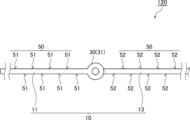
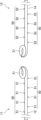
- FIG. 9 is a diagram for explaining a configuration example of a suture thread for flexible endoscopic surgery according to the second embodiment.
- FIG. 10 is a diagram illustrating an example of a method for manufacturing a flexible endoscopic surgical suture according to the second embodiment, and a partial view (a) in FIG. 10 shows a first suture piece and a second suture piece. It is a figure which illustrates the structure of a suture piece, and a partial view (b) in FIG. 10 is a figure which illustrates the state which joined the 1st suture piece and the 2nd suture piece.
- FIG. 10 is a diagram illustrating an example of a method for manufacturing a flexible endoscopic surgical suture according to the second embodiment, and a partial view (a) in FIG. 10 shows a first suture piece and a second suture piece. It is a figure which illustrates the structure of a suture piece, and a partial view (b) in FIG. 10 is a figure which illustrates the state which joined the 1st suture piece and the
- FIG. 11 is a diagram showing an example of another method for manufacturing the flexible endoscopic surgical suture according to the second embodiment, and the partial view (a) in FIG. 11 shows the first suture piece.
- 12 is a diagram illustrating a state in which the second suture piece is inserted into the large diameter portion and the first suture thread is inserted into the large diameter portion of the second suture piece
- the partial view (b) in FIG. 11 is It is a figure which illustrates the state where the large diameter part of a 1st suture piece and the large diameter part of a 2nd suture piece are joined. Note that configurations that are the same as or similar to those of the above-described embodiments may be given the same reference numerals and descriptions thereof may be omitted.
- the suture body 10 includes a first suture piece 11 having a plurality of protrusions 50 and a plurality of The second suture piece 13 has a protrusion 50, and the stopper member 30 can be disposed at the joint between the first suture piece 11 and the second suture piece 13.
- the suture main body 10 can be composed of a first suture piece 11 and a second suture piece 13.
- the method of joining the first suture piece 11 and the second suture piece 13 is not particularly limited.
- the first suture piece 11 includes a first suture piece body 12, a plurality of protrusions 50 (51), and one end thereof
- the first suture thread piece main body part 12 has a large diameter part 21 that is larger in thickness or size than the first suture thread piece main body part 12.
- the large diameter portion 21 of the first suture piece 11 has a loop shape
- the shape is not particularly limited, and may have the shape exemplified as the shape of the stop member 30 described above.
- the thickness or size of the large diameter portion 21 of the first suture piece 11 is also larger than the first suture piece main body portion 12, and when it is joined to the second suture piece 13 to form the joint portion 31. It is not particularly limited as long as it prevents the suture main body 10 (soft endoscopic surgical suture 120) from coming off.
- the second suture piece 13 includes a second suture piece body 14, a plurality of protrusions 50 (52), and one end thereof. It is configured to have a large diameter portion 21 that is larger in thickness or size than the second suture piece main body portion 14.
- the shape, thickness, size, etc. of the large diameter portion 21 of the second suture piece 13 are similar to the large diameter portion 21 of the first suture piece 11. It is not particularly limited as long as it prevents the suture main body portion 10 (soft endoscopic surgical suture 120) from coming off when .
- the large diameter portions 21 and 21 are joined by joining the large diameter portion 21 of the first suture piece 11 and the large diameter portion 21 of the second suture piece 13.
- a portion 31 and a stop member 30 are used.
- the method of joining the first suture piece 11 and the second suture piece 13 is not particularly limited, and they may be joined using an adhesive or the like.
- the large diameter portion 21 has a loop shape, as shown in FIG.
- the thread piece 13 may be joined to form a stopper member 30 as shown in FIG. 11(b).
- the stop member 30 according to the present embodiment has a loop shape, but as described above, the shape is not particularly limited.
- the flexible endoscopic surgical suture 120 is formed by combining the two suture pieces 11 and 13.
- the plurality of protrusions 50 are arranged so as to protrude obliquely toward the side opposite to the insertion direction.
- the flexible endoscopic surgical suture threads 100 and 120 can be made into a flexible endoscopic surgical suture unit that includes needles at both ends of the suture main body 10.
- the suture unit for flexible endoscopic surgery uses suture threads 100 and 120 for flexible endoscopic surgery, each of which has needles at both ends of the suture main body 10 .
- the needles disposed at both ends of the suture body 10 may be those used in flexible endoscopic surgery, and may have a curved shape, for example.
- the diameter of the needle can be changed as appropriate depending on the thickness of the tissue near the opening, for example, and can be set to be twice or more the thickness of the tissue near the opening.
- the stop member 30 is configured to have a spherical or loop shape, but it may be plate-like.
- the plate-shaped stopper member 30 includes, for example, a through hole in the center of the plate-like member, through which the suture body 10 is passed, and the suture body 10 can be passed through the through hole, or the suture body 10 can be connected to the suture body 10. It can be manufactured by integrally molding the member 30.
- the plate shape may be formed so as to be larger than the maximum value of the width parallel to the opposite side.
- the plate-shaped stopper member 30 easily enters between the serosa or adventitia of the opening and the serosa or adventitia, and the plurality of protrusions 50 (51, 52) to easily function to prevent the suture thread main body 10 from slipping out.
- the tissue near the opening is easily warped (easily raised) inwardly (toward the inner wall) along the wall surface, the suturing time can be shortened.
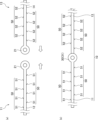
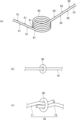
- the stop member 30 can have a coil shape, as shown in FIG. 13 (a).
- the stop member 30 having a coil shape is, for example, wound around the suture body 10 multiple times at a central portion in the length direction of the suture body 10.
- it can be formed by joining the coil-shaped (stopping member 30) portions with adhesive or the like.
- it can be manufactured by passing the suture main body 10 through a member having a coil shape and made of a bioabsorbable material, and joining the suture thread main body 10 with an adhesive or the like.
- another suture body 10 may be wound around the suture body 10 multiple times to form a coil shape. Can be joined.
- the stopper member 30 may be a knot that ties the suture body 10.
- the stop member 30 may be a clip that can hold the suture thread main body 10, as shown in FIG. 13 (b).
- a stopper member 30 may be formed by holding one suture thread main body 10 with a clip, or as shown in FIG. 13 (c).
- the stop member 30 may be formed by simultaneously holding the two suture thread pieces 11 and 13.
- the clip that holds the suture body portion 10 suture pieces 11, 13
- the large diameter portion 21 of the first suture piece 11 and the large diameter portion 21 of the second suture piece 13 are configured to have a single loop shape.
- the large diameter portion 21 includes a human or an animal in the first suture piece 11 (first suture piece main body part 12) and the second suture piece 13 (second suture piece main body part 14). It may be constructed by winding the end portion, which is not the side to be inserted into the tissue, into a loop shape (coil shape). In this case, the ends of the first suture piece 11 (first suture piece main body part 12) and the second suture piece 13 (second suture piece main body part 14) are arranged in a loop-shaped (coil-shaped) part.
- first suture piece 11 first suture piece main body part 12
- second suture piece 13 second suture piece main body part 14
- the protrusion part 50 51, 52
- Such a first suture piece 11 and a second suture piece 13 similar to the embodiment described above, have a large diameter portion 21 of the first suture piece 11 and a large diameter portion 21 of the second suture piece.
- the stop member 30 may be formed by using the large diameter portions 21, 21 as a joint portion and joining them using an adhesive or the like, for example (see FIG. 10). Further, the second suture piece 13 is inserted into the loop of the large diameter part 21 of the first suture piece 11, and the first suture piece 11 is inserted into the loop of the large diameter part 21 of the second suture piece 13. By inserting the first suture thread piece 11 and the second suture thread piece 13, the large diameter portions 21 and 21 may be used as the joint portion to form the stop member 30 (see FIG. 11).
- first suture piece main body part 12 and the second suture piece main body part 14 may be composed of a single thread, like the suture thread main body part 10, or may be composed of a plurality of overlapping threads, such as a double thread. It may be.
Landscapes
- Health & Medical Sciences (AREA)
- Surgery (AREA)
- Life Sciences & Earth Sciences (AREA)
- Biomedical Technology (AREA)
- Nuclear Medicine, Radiotherapy & Molecular Imaging (AREA)
- Engineering & Computer Science (AREA)
- Heart & Thoracic Surgery (AREA)
- Medical Informatics (AREA)
- Molecular Biology (AREA)
- Animal Behavior & Ethology (AREA)
- General Health & Medical Sciences (AREA)
- Public Health (AREA)
- Veterinary Medicine (AREA)
- Rheumatology (AREA)
- Surgical Instruments (AREA)
Priority Applications (3)
| Application Number | Priority Date | Filing Date | Title |
|---|---|---|---|
| US18/855,971 US20250318826A1 (en) | 2022-04-14 | 2023-04-14 | Suture for use in flexible endoscopic surgeries |
| EP23788417.6A EP4509063A4 (en) | 2022-04-14 | 2023-04-14 | SUTURE INTENDED FOR USE IN FLEXIBLE ENDOSCOPIC SURGERIES |
| JP2024515012A JPWO2023200000A1 (cg-RX-API-DMAC7.html) | 2022-04-14 | 2023-04-14 |
Applications Claiming Priority (2)
| Application Number | Priority Date | Filing Date | Title |
|---|---|---|---|
| JP2022-067190 | 2022-04-14 | ||
| JP2022067190 | 2022-04-14 |
Publications (1)
| Publication Number | Publication Date |
|---|---|
| WO2023200000A1 true WO2023200000A1 (ja) | 2023-10-19 |
Family
ID=88329610
Family Applications (1)
| Application Number | Title | Priority Date | Filing Date |
|---|---|---|---|
| PCT/JP2023/015127 Ceased WO2023200000A1 (ja) | 2022-04-14 | 2023-04-14 | 軟性内視鏡下手術用縫合糸 |
Country Status (4)
| Country | Link |
|---|---|
| US (1) | US20250318826A1 (cg-RX-API-DMAC7.html) |
| EP (1) | EP4509063A4 (cg-RX-API-DMAC7.html) |
| JP (1) | JPWO2023200000A1 (cg-RX-API-DMAC7.html) |
| WO (1) | WO2023200000A1 (cg-RX-API-DMAC7.html) |
Citations (3)
| Publication number | Priority date | Publication date | Assignee | Title |
|---|---|---|---|---|
| JP2011520529A (ja) * | 2008-05-16 | 2011-07-21 | アンジオテック ファーマシューチカルズ インコーポレイテッド | コード化された異種機能性縫合糸及び方法 |
| JP2013502990A (ja) * | 2009-08-27 | 2013-01-31 | エシコン・インコーポレイテッド | 綿撒糸ストッパを有する有棘縫合糸とそのための方法 |
| US20200405300A1 (en) * | 2019-06-28 | 2020-12-31 | Ethicon Llc | Bi-directional barbed suture with tailored suture segments |
Family Cites Families (7)
| Publication number | Priority date | Publication date | Assignee | Title |
|---|---|---|---|---|
| US6783524B2 (en) * | 2001-04-19 | 2004-08-31 | Intuitive Surgical, Inc. | Robotic surgical tool with ultrasound cauterizing and cutting instrument |
| US20070224237A1 (en) * | 2006-03-24 | 2007-09-27 | Julia Hwang | Barbed sutures having a therapeutic agent thereon |
| US9358002B2 (en) * | 2008-04-01 | 2016-06-07 | Covidien Lp | Anchoring device |
| EP3138506B1 (en) * | 2010-11-09 | 2020-08-26 | Ethicon, LLC | Emergency self-retaining sutures |
| KR101185583B1 (ko) * | 2011-12-27 | 2012-09-24 | 김영재 | 매듭짓는 작업이 필요 없는 봉합사 및 이를 포함하는 키트 |
| US10470759B2 (en) * | 2015-03-16 | 2019-11-12 | Edwards Lifesciences Corporation | Suture securement devices |
| EP3355804B1 (en) * | 2015-10-02 | 2020-07-15 | Harpoon Medical, Inc. | Distal anchor apparatus for mitral valve repair |
-
2023
- 2023-04-14 EP EP23788417.6A patent/EP4509063A4/en active Pending
- 2023-04-14 WO PCT/JP2023/015127 patent/WO2023200000A1/ja not_active Ceased
- 2023-04-14 JP JP2024515012A patent/JPWO2023200000A1/ja active Pending
- 2023-04-14 US US18/855,971 patent/US20250318826A1/en active Pending
Patent Citations (3)
| Publication number | Priority date | Publication date | Assignee | Title |
|---|---|---|---|---|
| JP2011520529A (ja) * | 2008-05-16 | 2011-07-21 | アンジオテック ファーマシューチカルズ インコーポレイテッド | コード化された異種機能性縫合糸及び方法 |
| JP2013502990A (ja) * | 2009-08-27 | 2013-01-31 | エシコン・インコーポレイテッド | 綿撒糸ストッパを有する有棘縫合糸とそのための方法 |
| US20200405300A1 (en) * | 2019-06-28 | 2020-12-31 | Ethicon Llc | Bi-directional barbed suture with tailored suture segments |
Non-Patent Citations (1)
| Title |
|---|
| See also references of EP4509063A4 * |
Also Published As
| Publication number | Publication date |
|---|---|
| EP4509063A1 (en) | 2025-02-19 |
| JPWO2023200000A1 (cg-RX-API-DMAC7.html) | 2023-10-19 |
| EP4509063A4 (en) | 2026-01-07 |
| US20250318826A1 (en) | 2025-10-16 |
Similar Documents
| Publication | Publication Date | Title |
|---|---|---|
| JP6396047B2 (ja) | 圧潰する縫合糸ループを有する外科的構造体及び組織を固定する方法 | |
| US12336700B2 (en) | Systems, devices, and methods for securing tissue | |
| JP4781689B2 (ja) | 組織修復のための装置及び方法 | |
| US8795295B2 (en) | Multiple loop device for passing suture tails through a surgical pledget | |
| RU2535616C2 (ru) | Шовные нити с зазубринами и стопорами для тампонов и способы их применения | |
| JP4790285B2 (ja) | 三角線維軟骨複合体の裂傷を修復するための方法及び装置 | |
| EP2662031B1 (en) | Systems and devices for securing tissue using a suture having one or more protrusions | |
| US6652562B2 (en) | Suture anchoring and tensioning device | |
| US7335221B2 (en) | Suture anchoring and tensioning device and method for using same | |
| JP6239324B2 (ja) | 縫合糸リーダー | |
| US9943303B2 (en) | Method of passing suture tails through a surgical pledget | |
| JP2017517376A (ja) | 組織を縫合する器具および方法 | |
| EP2900148B1 (en) | Device for approximating tissue | |
| JP7754385B2 (ja) | 二列折り畳み式縫合糸構造体 | |
| JP5977490B2 (ja) | 組織結紮デバイス | |
| EP4509063A1 (en) | Suture for use in flexible endoscopic surgeries | |
| JP2025523926A (ja) | 低侵襲内視鏡縫合デバイス | |
| JP3327073B2 (ja) | 結紮装置 | |
| JPH0674146U (ja) | 手術用縫合糸 | |
| JP6132944B2 (ja) | 組織結紮デバイス | |
| JPWO2023200000A5 (cg-RX-API-DMAC7.html) | ||
| JP2012165880A (ja) | 縫合デバイス | |
| WO2019133516A1 (en) | Absorbable clip/staple and applicator for deployment |
Legal Events
| Date | Code | Title | Description |
|---|---|---|---|
| 121 | Ep: the epo has been informed by wipo that ep was designated in this application |
Ref document number: 23788417 Country of ref document: EP Kind code of ref document: A1 |
|
| DPE1 | Request for preliminary examination filed after expiration of 19th month from priority date (pct application filed from 20040101) | ||
| WWE | Wipo information: entry into national phase |
Ref document number: 2024515012 Country of ref document: JP |
|
| WWE | Wipo information: entry into national phase |
Ref document number: 18855971 Country of ref document: US |
|
| WWE | Wipo information: entry into national phase |
Ref document number: 2023788417 Country of ref document: EP |
|
| NENP | Non-entry into the national phase |
Ref country code: DE |
|
| ENP | Entry into the national phase |
Ref document number: 2023788417 Country of ref document: EP Effective date: 20241114 |
|
| WWP | Wipo information: published in national office |
Ref document number: 18855971 Country of ref document: US |