WO2023199751A1 - 積層体、及び包装材 - Google Patents
積層体、及び包装材 Download PDFInfo
- Publication number
- WO2023199751A1 WO2023199751A1 PCT/JP2023/013052 JP2023013052W WO2023199751A1 WO 2023199751 A1 WO2023199751 A1 WO 2023199751A1 JP 2023013052 W JP2023013052 W JP 2023013052W WO 2023199751 A1 WO2023199751 A1 WO 2023199751A1
- Authority
- WO
- WIPO (PCT)
- Prior art keywords
- layer
- resin layer
- olefin resin
- heat
- laminate
- Prior art date
- Legal status (The legal status is an assumption and is not a legal conclusion. Google has not performed a legal analysis and makes no representation as to the accuracy of the status listed.)
- Ceased
Links
Classifications
-
- B—PERFORMING OPERATIONS; TRANSPORTING
- B32—LAYERED PRODUCTS
- B32B—LAYERED PRODUCTS, i.e. PRODUCTS BUILT-UP OF STRATA OF FLAT OR NON-FLAT, e.g. CELLULAR OR HONEYCOMB, FORM
- B32B27/00—Layered products comprising a layer of synthetic resin
- B32B27/32—Layered products comprising a layer of synthetic resin comprising polyolefins
-
- B—PERFORMING OPERATIONS; TRANSPORTING
- B32—LAYERED PRODUCTS
- B32B—LAYERED PRODUCTS, i.e. PRODUCTS BUILT-UP OF STRATA OF FLAT OR NON-FLAT, e.g. CELLULAR OR HONEYCOMB, FORM
- B32B7/00—Layered products characterised by the relation between layers; Layered products characterised by the relative orientation of features between layers, or by the relative values of a measurable parameter between layers, i.e. products comprising layers having different physical, chemical or physicochemical properties; Layered products characterised by the interconnection of layers
- B32B7/02—Physical, chemical or physicochemical properties
- B32B7/027—Thermal properties
-
- B—PERFORMING OPERATIONS; TRANSPORTING
- B65—CONVEYING; PACKING; STORING; HANDLING THIN OR FILAMENTARY MATERIAL
- B65D—CONTAINERS FOR STORAGE OR TRANSPORT OF ARTICLES OR MATERIALS, e.g. BAGS, BARRELS, BOTTLES, BOXES, CANS, CARTONS, CRATES, DRUMS, JARS, TANKS, HOPPERS, FORWARDING CONTAINERS; ACCESSORIES, CLOSURES, OR FITTINGS THEREFOR; PACKAGING ELEMENTS; PACKAGES
- B65D65/00—Wrappers or flexible covers; Packaging materials of special type or form
- B65D65/38—Packaging materials of special type or form
- B65D65/40—Applications of laminates for particular packaging purposes
Definitions
- the present invention relates to a film-like laminate that can be applied to packaging materials, and relates to a film-like laminate that has good packaging machine suitability and is recyclable, and a packaging material made of the laminate.
- laminated films manufactured by the lamination method using adhesives are not only used for packaging purposes, but also have various high functions such as barrier properties, moisture proofing properties, and retort resistance.
- barrier properties such as barrier properties, moisture proofing properties, and retort resistance.
- retort resistance various high functions
- laminate films made of different resins In order to meet the needs of packaging materials, it has been developed and evolved to laminate films made of different resins.
- these laminated films of different resin types degrade the quality of recycled plastics, and there is a desire for packaging materials that are highly functional and recyclable.
- Patent Document 1 discloses a polyethylene laminate including a base material layer and a heat seal layer, the base material layer containing polyethylene having a density of 0.930 g/cm 3 or more, and the heat seal layer comprises polyethylene with a density of less than 0.930 g/cm 3 , and the base layer and the heat seal layer contain polyethylene with a density of 0.930 g/cm 3 or more and polyethylene with a density of less than 0.930 g/cm 3 .
- the base material layer is a polyethylene laminate that has been subjected to electron beam irradiation treatment.
- the problem of shrinkage of the polyethylene layer is less likely to occur in a laminated film of different resin types, for example, a laminated film that has a polyethylene layer as a heat seal layer and uses nylon or polyethylene terephthalate (PET) for the layer in contact with the heat seal layer.
- PET polyethylene terephthalate
- it is a monomaterial film composed only of polyolefin film, and the set temperature of the heat seal bar is slightly higher than the temperature at which the polyethylene layer in contact with the heat seal bar softens and fuses.
- a monomaterial film that is less likely to cause problems such as shrinkage and wrinkles is desired even at temperatures that are about 10 to 20 degrees Celsius higher than the actual temperature.
- An object of the present invention is to provide a film-like laminate that is resistant to shrinkage or wrinkles due to heating, has excellent sealing strength, and is recyclable, and a packaging material using the same.
- the present invention provides a laminate having a heat-resistant coating layer (A) and an olefin resin layer (B1) containing an olefin resin (b1) as a main component, comprising (1) and (2), or ( A laminate that satisfies 1) and (3) is provided.
- the difference between the dynamic viscoelasticity measurement (DMA) value E'2 (MPa) of only the olefin resin layer (B1) at temperature T1 (° C.) is 1 (MPa) or more.
- T1 (°C) melting point of olefin resin layer (B1) (°C) - 35 (°C)
- the value of the linear expansion coefficient (CTE1) of the thermomechanical analysis at temperature T1 (°C) of the laminate in which the heat-resistant coating layer (A) is provided on one or both sides of the olefin resin layer (B1) is The percentage of the value (CTE2) divided by the value of the linear expansion coefficient of the thermomechanical analysis at the temperature T1 (° C.) of only the resin layer (B1) is 10% to 100%.
- the present invention also provides a packaging material using the laminate described above.
- the laminate of the present invention is less likely to shrink or wrinkle due to heating, and has excellent sealing strength. Furthermore, since it can be made into a monomaterial, it is possible to provide packaging materials that can be recycled.
- the laminate of the present invention includes a heat-resistant coating layer (A) and an olefin resin layer (B1) whose main component is an olefin resin (b1) (hereinafter sometimes simply referred to as an olefin resin layer (B1)).
- This is a laminate characterized by satisfying (1) and (2), or (1) and (3).
- the difference between the dynamic viscoelasticity measurement (DMA) value E'2 (MPa) of only the olefin resin layer (B1) at temperature T1 (° C.) is 1 (MPa) or more.
- T1 (°C) melting point of olefin resin layer (B1) (°C) - 35 (°C)
- the value of the linear expansion coefficient (CTE1) of the thermomechanical analysis at temperature T1 (°C) of the laminate in which the heat-resistant coating layer (A) is provided on one or both sides of the olefin resin layer (B1) is The percentage of the value (CTE2) divided by the value of the linear expansion coefficient of the thermomechanical analysis at the temperature T1 (° C.) of only the resin layer (B1) is 10% to 100%.
- the temperature T1 (°C) is the value obtained by subtracting 35 (°C) from the melting point (°C) of the olefin resin layer (B1).
- the temperature T2 (°C) is the sum of the temperature T1 (°C) and 20 (°C), that is, 15% from the melting point (°C) of the olefin resin layer (B1). (°C) minus the value.
- both E'1 (MPa) and E'2 (MPa) are values measured using the following dynamic viscoelasticity measuring device and conditions.
- Dynamic viscoelasticity measuring device RSA-G2 (manufactured by TA Instruments) Measurement mode: tensile measurement frequency: 1 Hz Amplitude: 0.1% Sample measurement direction: MD direction Sample size (distance between clamps x width): 10 mm x 5 mm Measurement temperature: -40 °C ⁇ 170 °C Temperature increase rate: 3°C/min
- the value defined in (1) above is 1 (MPa) or more.
- the upper limit of the value defined in (1) above is not particularly limited, but considering the currently available raw materials, it is appropriate that it is 500 (MPa) or less.
- the value defined in (1) above is more preferably a lower limit of 50 (MPa) or more, and more preferably an upper limit of 500 (MPa) or less.
- linear expansion coefficient values (CTE1) and (CTE2) in the thermomechanical analysis in (2) above, and the linear expansion coefficient values (CTE3) and (CTE4) in the thermomechanical analysis in (3) above, are both , is a value measured using the following thermomechanical analyzer and conditions.
- Thermomechanical analyzer TMA-60 (manufactured by Shimadzu Corporation) Measurement method: Tensile sample dimensions (sample length x sample width): 20 mm x 5 mm Measurement direction of sample: MD direction
- Initial load 12 g (for olefin resin layer (B1): OPE1, OPE4), 2 g (for olefin resin layer (B1): OPE2, OPE3, OPP)
- Temperature increase rate 3°C/min
- the value defined in (2) or (3) above is preferably 10% or more and 100% or less, and more preferably 10% or more and 60% or less.
- a laminated layer that is resistant to shrinkage or wrinkles due to heating which is a problem of the present invention, and has excellent sealing strength.
- the reason for this is estimated as follows. Wrinkles due to shrinkage of the olefin resin layer (B1) occur because the shrinkage stress generated when oriented polymer chains try to recover to an unoriented state exceeds the strength that can be maintained by the elasticity of the olefin resin layer (B1).
- the storage modulus of a stretched film in the stretching direction is higher than that of an unstretched film due to the orientation of the molecular chains, but it gradually decreases as the number of unoriented polymer chains increases as the temperature rises.
- the present invention is based on the hypothesis that reinforcement with a heat-resistant coating layer (A) having higher elasticity than the olefin resin layer (B1) imparts an elastic modulus that can withstand shrinkage stress and improves heat resistance. .
- the present inventors investigated the relationship between shrinkage behavior and storage modulus of various films, and determined the temperature T1 (°C), which is the value obtained by subtracting 35 (°C) from the melting point (°C) of the olefin resin layer (B1).
- the shrinkage stress of the olefin resin layer (B1) is considered to be correlated with the value of the linear expansion coefficient in thermomechanical analysis. Therefore, when the above (2) is satisfied, the shrinkage stress of the laminate of the heat-resistant coating layer (A) and the olefin resin layer (B1) is estimated to be smaller than the shrinkage stress of only the olefin resin layer (B1). Ru.
- the laminate of the present invention may be a laminate having a heat-resistant coating layer (A) and an olefin resin layer (B1) containing an olefin resin (b1) as a main component, or may include other layers. It may also be a laminate having. Other layers include, for example, an adhesive layer (C) made of an adhesive (c1), a resin layer (D) having barrier properties, or an olefin resin layer (b2) containing an olefin resin (b2) as a main component. B2), a printed layer (E), a seal layer (F), a vapor deposited layer (G), etc., but are not limited to these.
- the lamination order of the layer (C), the layer (D), the layer (B2), the layer (E), the layer (F), the layer (G), etc. is not particularly limited, but the printed layer (E) Since the purpose is to impart cosmetic properties, various information regarding the contents, and functionality to the packaging material for which the laminate of the present invention is used, the printed layer (E) is made of an olefin resin. (b1) is preferably in contact with an olefin resin layer (B1) containing olefin resin (b1) as a main component. Specifically, the printed layer (E) is an olefin resin layer containing olefin resin (b1) as a main component. (B1) is preferably printed.
- the printing surface is provided on the side in contact with the heat-resistant coating layer (A)
- the printing surface on the side in contact with the heat-resistant coating layer (A) is the back side.
- the sealing layer (F) is preferably located at the outermost layer of the laminate in order to seal the contents of the package.
- the heat-resistant coating layer (A) used in the present invention is provided on the olefin resin layer (B1 described later) or via the printed layer (E) described later.
- the laminate When the laminate is made into a bag, it is located at the outermost layer when viewed from the contents, and is the layer that the heat seal bar comes into contact with during bag making.
- the heat-resistant coating layer (A) and the olefin resin layer (B1) described below needs to satisfy the above (1) and (2), the heat-resistant coating layer (A) and It is preferable that at least a part or all of the surface of the layer is in contact with the olefin resin layer (B1) described below.
- a case where the heat-resistant coating layer (A) and the olefin resin layer (B1) partially contact means that there is a printed layer (E) between the heat-resistant coating layer (A) and the olefin resin layer (B1).
- the printing layer is usually not printed on the entire surface of the olefin resin layer (B1), but always has a portion that is in contact with the olefin resin layer (B1), so the effect of the present application can be achieved even when the layer is in partial contact with the olefin resin layer (B1).
- the heat-resistant coating layer (A) needs to be provided on at least one side of the olefin resin layer (B1) described below, but it may be provided on both sides. By providing it on both sides, the effects of the present invention can be more effectively exhibited.
- the heat-resistant coating layer (A) is a coating layer of a heat-resistant coating agent (A) (hereinafter sometimes simply referred to as a coating agent (A)).
- a coating agent (A) for example, a compound having a cellulose skeleton, a benzene ring skeleton, an isocyanuric ring skeleton, or an alicyclic skeleton whose homopolymer glass transition temperature (hereinafter sometimes referred to as Tg) is 100 ° C. or higher is used. It is preferable to contain.
- the resin composition includes, for example, nitrified cotton, cellulose derivatives such as cellulose acetate, cellulose propionate, and cellulose butyrate, phthalic acid, naphthalene dicarboxylic acid, and ethylene oxide of bisphenol A (hereinafter sometimes referred to as EO).
- EO ethylene oxide of bisphenol A
- Polyester resins having benzene rings such as adducts and/or alicyclic skeletons such as cyclopentanediol and dimethyloltricyclodecane, or aromatic isocyanates such as diphenylmethane diisocyanate, toluene diisocyanate, xylene diisocyanate, and naphthalene diisocyanate;
- aromatic isocyanates such as diphenylmethane diisocyanate, toluene diisocyanate, xylene diisocyanate, and naphthalene diisocyanate
- Examples include urethane resins in which alicyclic isocyanates such as isophorone diisocyanate and norbornene diisocyanate, and/or isocyanuric triisocyanate are combined with polyols and/or tris(2-hydroxyethyl)isocyanurate.
- a polyisocyanate using the above-mentioned isocyanate may be used as a curing agent.
- compounds having a benzene ring and an unsaturated double bond such as styrene and phenoxydiethylene glycol acrylate, and/or compounds having an alicyclic structure and an unsaturated double bond such as isobornyl acrylate and dicyclopentanyl acrylate, Radical copolymers such as (meth)acrylate and the like can also be preferably used.
- a resin having a low Tg may be used in combination.
- the total of the cellulose skeleton, benzene ring skeleton, isocyanuric ring skeleton, and alicyclic skeleton of the above-mentioned compound is preferably 20 to 90% by mass based on the solid content of the heat-resistant coating layer (A). It is preferably 30 to 80% by mass.
- the coating agent (A) may be colored.
- the colorant is not particularly limited, and examples include inorganic pigments, organic pigments, and dyes that are used in general inks, paints, recording agents, etc., such as those used in the printing layer (E) described below. can. Among them, pigments are preferred.
- organic pigments include soluble azo, insoluble azo, azo, phthalocyanine, halogenated phthalocyanine, anthraquinone, anthanthrone, dianthraquinonyl, anthrapyrimidine, perylene, perinone, quinacridone, Examples include thioindigo-based, dioxazine-based, isoindolinone-based, quinophthalone-based, azomethineazo-based, flavanthrone-based, diketopyrrolopyrrole-based, isoindoline-based, indanthrone-based, and carbon black-based pigments.
- Examples include lon blue, pyrimidine yellow, thioindigo bordeaux, thioindigo magenta, perylene red, perinone orange, isoindolinone yellow, aniline black, diketopyrrolopyrrole red, and daylight fluorescent pigments.
- both non-acid treated pigments and acid treated pigments can be used.
- inorganic pigments examples include white inorganic pigments such as titanium oxide, zinc oxide, zinc sulfide, barium sulfate, calcium carbonate, chromium oxide, silica, lithobon, antimony white, and gypsum.
- white inorganic pigments such as titanium oxide, zinc oxide, zinc sulfide, barium sulfate, calcium carbonate, chromium oxide, silica, lithobon, antimony white, and gypsum.
- titanium oxide is particularly preferred. Titanium oxide is white and is preferred from the viewpoint of coloring power, hiding power, chemical resistance, and weather resistance. From the viewpoint of printing performance, the titanium oxide is preferably treated with silica and/or alumina.
- inorganic pigments other than white examples include aluminum particles, mica (mica), bronze powder, chrome vermilion, yellow lead, cadmium yellow, cadmium red, ultramarine blue, deep blue, red iron oxide, yellow iron oxide, iron black, and zircon.
- Aluminum is in the form of powder or paste, but it is preferable to use it in paste form from the viewpoint of handling and safety, and whether to use leafing or non-leafing is selected as appropriate from the viewpoint of brightness and density.
- the coating agent (A) may also contain alumina, magnesia, titania, zirconia, silica (quartz, fumed silica, precipitated silica, silicic anhydride, fused silica, crystalline silica, ultrafine amorphous silica) as aggregate. It is preferable to use inorganic fine particles such as ) because they have excellent heat resistance. Alternatively, boron nitride, aluminum nitride, alumina oxide, titanium oxide, magnesium oxide, zinc oxide, silicon oxide, etc. are preferable because they have excellent thermal conductivity. The inorganic fine particles may be used alone or in combination.
- the shape of the silica fine particles is not particularly limited, and spherical, hollow, porous, rod-like, plate-like, fibrous, or irregularly shaped particles can be used.
- spherical, hollow, porous, rod-like, plate-like, fibrous, or irregularly shaped particles can be used.
- Silinax manufactured by Nippon Steel Mining Co., Ltd., etc. can be used as commercially available hollow silica fine particles.
- the primary particle diameter of the inorganic fine particles is preferably in the range of 5 to 200 nm. If the diameter is 5 nm or more, the inorganic fine particles in the dispersion will be well dispersed, and if the diameter is 200 nm or less, the strength of the cured product will be good. More preferably it is 10 nm to 100 nm.
- the inorganic fine particles can be blended in a proportion of 5 to 90% by weight based on the total solid content of the coating agent (A) and the inorganic fine particles, and the blending amount may be changed as appropriate depending on the purpose. Among these, it is preferably 20% by mass or more.
- the coating agent (A) contains wax, silicone additives, and organic beads in order to prevent damage to the coated film, prevent blocking during laminate formation, and provide processability during bag making after laminate formation. can do.
- waxes such as amide wax, polypropylene wax, polyethylene wax, paraffin wax, carnauba wax, and rice wax, ethylene oxide (EO) adducts of dimethylsiloxane, silicone additives of silicone modified products, acrylic, nylon, and urethane.
- EO ethylene oxide
- organic beads made of epoxy can be added.
- the solvent used in the coating agent (A) is not particularly limited, but includes, for example, water, toluene, xylene, aromatic hydrocarbon organic solvents such as Solvesso #100 and Solvesso #150, hexane, methylcyclohexane, heptane, Examples include aliphatic hydrocarbon organic solvents such as octane and decane, and various ester organic solvents such as methyl acetate, ethyl acetate, isopropyl acetate, n-propyl acetate, butyl acetate, amyl acetate, ethyl formate, and butyl propionate.
- water-miscible organic solvents include alcohols such as methanol, ethanol, propanol, butanol, and isopropyl alcohol, ketones such as acetone, methyl ethyl ketone, and cyclohaxanone, ethylene glycol (mono, di) methyl ether, and ethylene glycol (mono, di) ethyl.
- Ether ethylene glycol monopropyl ether, ethylene glycol monoisopropyl ether, monobutyl ether, diethylene glycol (mono, di) methyl ether, diethylene glycol (mono, di) ethyl ether, diethylene glycol monoisopropyl ether, diethylene glycol monobutyl ether, triethylene glycol (mono, di)
- examples include various glycol ether-based organic solvents such as di)methyl ether, propylene glycol (mono,di)methyl ether, propylene glycol monopropyl ether, propylene glycol monobutyl ether, and dipropylene glycol (mono,di)methyl ether. These can be used alone or in combination of two or more. Moreover, in order to carry out coating more effectively, an antifoaming agent and a leveling agent may be used.
- Olefin resin layer (B1) whose main component is olefin resin (b1)
- olefin resin layer (B1) used in the present invention polyethylene resins, polypropylene resins, and copolymers thereof can be used.
- Polyethylene resins include very low density polyethylene (VLDPE), linear low density polyethylene (LLDPE), linear medium density polyethylene (LMDPE), low density polyethylene (LDPE), medium density polyethylene (MDPE), high Polyethylene resin such as density polyethylene (HDPE), ethylene-vinyl acetate copolymer (EVA), ethylene-methyl methacrylate copolymer (EMMA), ethylene-ethyl acrylate copolymer (EEA), ethylene-methyl acrylate (EMA) ) copolymer, ethylene-ethyl acrylate-maleic anhydride copolymer (E-EA-MAH), ethylene-acrylic acid copolymer (EAA), ethylene-methacrylic acid copolymer (EMAA), etc.
- VLDPE very low density polyethylene
- LLDPE linear low density polyethylene
- LLDPE linear medium density polyethylene
- LDPE low density polyethylene
- MDPE medium density polyethylene
- High Polyethylene resin such as density polyethylene (HDPE
- Polymers further examples include ionomers of ethylene-acrylic acid copolymers and ionomers of ethylene-methacrylic acid copolymers, which may be used alone or in combination of two or more.
- heat-sealing measures such as suppressing the volatilization of transdermal absorption components and deterioration of the patch's application performance (hereinafter sometimes referred to as content volatilization, etc.), wide temperature range suitable for heat sealing, and suitable adhesion.
- LLDPE can be preferably used because it is easy to achieve good sealing performance.
- the LDPE may be branched low-density polyethylene obtained by high-pressure radical polymerization, and preferably branched low-density polyethylene obtained by homopolymerizing ethylene by high-pressure radical polymerization.
- LLDPE and LMDPE are produced by a low-pressure radical polymerization method using a single-site catalyst, with ethylene monomer as the main component, and comonomers such as butene-1, hexene-1, octene-1, 4-methylpentene, etc.
- -It is a copolymer of olefins.
- the comonomer content is preferably in the range of 0.5 to 20 mol%, more preferably in the range of 1 to 18 mol%.
- the single-site catalyst examples include various single-site catalysts, such as a metallocene catalyst system such as a combination of a metallocene compound of a group IV or V transition metal of the periodic table, and an organoaluminium compound and/or an ionic compound.
- a metallocene catalyst system such as a combination of a metallocene compound of a group IV or V transition metal of the periodic table, and an organoaluminium compound and/or an ionic compound.
- the MFR (190° C., 21.18N) of the polyethylene resin is preferably 2 to 20 g/10 minutes, more preferably 3 to 10 g/10 minutes. If the MFR is within this range, the extrusion moldability of the film will improve.
- the density of LLDPE is preferably 0.905 g/cm 3 to 0.925 g/cm 3 from the viewpoint of packaging suitability, contaminant sealing property, and pinhole resistance. Particularly preferred is 915 g/cm 3 to 0.925 g/cm 3 .
- polypropylene resin examples include propylene homopolymer, propylene/ ⁇ -olefin random copolymer, propylene-ethylene copolymer, propylene-butene-1 copolymer, propylene-ethylene-butene-1 copolymer, etc. and metallocene catalyst-based polypropylene. These may be used alone or in combination.
- Preferred is a propylene- ⁇ -olefin random copolymer, particularly a propylene/ ⁇ -olefin random polymer polymerized using a metallocene catalyst.
- the heat resistance of the film is improved and the softening temperature can be increased, so boiling at 100°C or less, hot filling, or above 100°C It can be suitably used as a laminating film for packaging materials, which has excellent steam and high-pressure heat sterilization properties such as retort sterilization.
- these polypropylene resins preferably have an MFR (230°C) of 0.5 to 30.0 g/10 minutes and a melting point of 110 to 165°C, more preferably an MFR (230°C) of 2 0 to 15.0 g/10 minutes and a melting point of 115 to 162°C. If the MFR and melting point are within this range, the film formability of the film will improve.
- the olefin resin layer (B1) preferably contains an olefin resin as a main component since it is easy to achieve suitable adhesion, and the olefin resin layer (B1) preferably contains 80% by mass or more of the resin components constituting the olefin resin layer (B1). is preferably an olefin resin, more preferably 90% by mass or more, and particularly preferably 100% by mass. Further, it is preferable that 80% by mass of the olefinic resin contained in the olefinic resin layer (B1) is an olefinic resin having a density of 0.9 g/cm 3 or more because it is particularly easy to obtain adhesion, and 90% by mass It is more preferable that it is above. In particular, it is preferable that 80% by mass of the olefin resin contained in the olefin resin layer (B1) is linear low density polyethylene resin, and more preferably 90% by mass or more.
- the thickness of the olefin resin layer (B1) may be adjusted as appropriate depending on the usage mode, but it should have a good balance between mechanical strength and processability, and also have suitable heat sealability while suitably suppressing volatilization of the contents etc.
- the thickness is preferably from 5 to 300 ⁇ m, and more preferably from 7 to 200 ⁇ m, because it is easy to ensure that.
- the olefin resin layer (B1) is usually in the form of a film or sheet because it is easy to provide the heat-resistant coating layer (A). It is preferable that the film or sheet be subjected to a stretching treatment, since this can maximize the effects of the present invention.
- a stretching treatment method it is common to melt and extrude a resin to form a sheet using an extrusion film forming method or the like, and then perform uniaxial stretching, simultaneous biaxial stretching, or sequential biaxial stretching.
- sequential biaxial stretching it is common to perform longitudinal stretching first and then perform transverse stretching. Specifically, a method that combines longitudinal stretching using a speed difference between rolls and transverse stretching using a tenter is often used.
- the olefin resin layer (B1) applied to the conditions of the laminate satisfying the above (1) and (2) is uniaxially stretched or biaxially stretched and has a density of less than 0.94 g/cm 3
- Examples include polyethylene or polypropylene films.
- the olefin resin layer (B1) which is particularly applied to the conditions of the laminate satisfying the above (1) and (3), is specifically uniaxially stretched or biaxially stretched with a density of 0.94 g/cm 3 Examples include the above polyethylene films.
- the surface of the film or sheet may be subjected to various surface treatments, such as flame treatment or corona discharge treatment, as necessary, so that an adhesive layer free from defects such as film breakage and repellency is formed.
- the simplest structure of the laminate of the present invention is a laminate consisting of a heat-resistant coating layer (A) and an olefin resin layer (B1), but in this case, the layer in contact with the heat seal bar is the heat-resistant coating layer ( A), and the heat seal layer becomes an olefin resin layer (B1).
- the olefin resin layer (B1) has the function of a heat sealing layer
- the olefin resin layer (B1) is made of unstretched very low density polyethylene (VLDPE), straight, which can impart heat sealability.
- VLDPE very low density polyethylene
- It may be a resin layer mainly composed of polyethylene resin or polypropylene resin of medium density polyethylene (MDPE), such as chain low density polyethylene (LLDPE), linear medium density polyethylene (LMDPE), and low density polyethylene (LDPE). preferable.
- an adhesive layer (C) consisting of a heat-resistant coating layer (A), an olefin resin layer (B1), and an adhesive (c1), or a resin layer (D) having barrier properties, Or, a laminate having an olefin resin layer (B2), a printing layer (E), a sealing layer (F), a vapor deposition layer (G), etc. mainly composed of an olefin resin (b2) is made of an olefin resin. Since the layer (B1) is not the outermost layer, a resin may be appropriately selected depending on the use of the laminate without regard to heat sealability.
- a biaxially stretched olefin resin film is often used as the olefin resin layer (B1).
- an adhesive layer (C) may be included.
- the adhesive (c1) used for the adhesive layer (C) may be any adhesive that can be used in general-purpose lamination methods.
- the lamination method include methods such as dry lamination, wet lamination, non-solvent lamination, and extrusion lamination.
- adhesives used in the dry lamination include one-component or two-component curing or non-curing vinyl-based, (meth)acrylic-based, polyamide-based, polyester-based, polyether-based, polyurethane-based, and epoxy-based adhesives. , rubber-based adhesives, solvent-based adhesives, water-based adhesives, or emulsion-based adhesives can be used.
- a two-component curable adhesive containing a polyol and an isocyanate compound can be used as the two-component curable adhesive.
- the coating method for the laminating adhesive include direct gravure roll coating, gravure offset roll coating, kiss coating, reverse roll coating, Fontaine method, transfer roll coating, and other methods.
- the Dick Dry series manufactured by DIC Corporation can be preferably used.
- various adhesives can be used, and it is preferable to use a pressure-sensitive adhesive.
- the pressure-sensitive adhesive include polyisobutylene rubber, butyl rubber, a rubber adhesive prepared by dissolving a mixture thereof in an organic solvent such as benzene, toluene, xylene, or hexane, or a rubber adhesive prepared by adding abiethylene rosin to these rubber adhesives.
- tackifiers such as ester, terpene/phenol copolymer, terpene/indene copolymer, or 2-ethylhexyl acrylate/n-butyl acrylate copolymer, 2-ethylhexyl acrylate/ethyl acrylate, etc.
- examples include acrylic pressure-sensitive adhesives in which an acrylic copolymer having a glass transition point of -20° C. or lower, such as a methyl methacrylate copolymer, is dissolved in an organic solvent.
- a functional adhesive may be used.
- the adhesive having barrier properties it is possible to use the oxygen barrier adhesive PASLIM series manufactured by DIC Corporation, which is a two-component reactive adhesive made of polyester polyol and an isocyanate compound.
- a specific embodiment of the laminate of the present invention in which a barrier adhesive is used is, for example, the above-mentioned "heat-resistant coating layer (A)/printed layer (E)/olefin resin layer (B1)/adhesive layer".
- (C)/olefin resin layer (B2)" adhesive layer (C) can be replaced with a barrier adhesive.
- the laminate of the present invention may have a resin layer (D) having barrier properties.
- the resin layer (D) having barrier properties include a method of laminating films having barrier properties and a method of creating a coating layer by coating a barrier coating agent.
- a method for creating a coating layer is preferred because it is simple.
- Barrier coatings include polyvinyl alcohol (PVOH), ethylene vinyl alcohol (EVOH), polysaccharides, acrylic or methacrylic acid based polymers, starch or starch derivatives, cellulose nanofibers (CNF), nanocrystalline cellulose (NCC).
- PVDC polyvinylidene chloride
- salts (phyllosilicate minerals, etc.), kaolinite-serpentinite clay minerals (halloysite, kaolinite, endellite, dickite, nacrite, etc., antigorite, chrysotile, etc.), pyrophyllite-talc group (pyrophyllite, talc) , kerolai, etc.), smectite group clay minerals (montmorillonite, beidellite, nontronite, saponite, hectorite, sauconite, stevensite, etc.), vermiculite group clay minerals (vermiculite, etc.), mica or mica group clay minerals (muscovite, phlogopite, etc.) mica, margarite, tetrasilylic mica, teniolite, etc.), chlorite group (cookeite, sudoite, clinochlore, chamosite, nimite, etc.), hydrotalcite, platy
- Coating agents containing inorganic compounds are known.
- known barrier coating agents can be used without particular limitation.
- the "Sunbar” series manufactured by Sun Chemical Co., Ltd. and the polyester barrier coating agent described in Japanese Patent No. 5,617,831 can be used.
- a film laminated with a vapor-deposited layer of a metal such as aluminum, a metal oxide such as silica or alumina, or a barrier film made of polyvinyl alcohol, ethylene/vinyl alcohol copolymer, vinylidene chloride, etc. may be used. good.
- the olefin resin layer (B2) (hereinafter sometimes simply referred to as olefin resin layer (B2)) containing the olefin resin (b2) used in the present invention is different from the olefin resin layer (B1).
- the same resin layer may be used, and the olefin resin (b2) as the main component may be the same resin as the olefin resin (b1) used for the olefin resin layer (B1).
- the polyethylene resin or the polypropylene resin is preferred.
- the olefin resin layer (B2) when the olefin resin layer (B2) has the function of a heat seal layer, the olefin resin layer (B2) also has the function of a heat seal layer.
- MDPE Medium density polyethylene
- VLDPE very low density polyethylene
- LLDPE linear low density polyethylene
- LLDPE linear medium density polyethylene
- LDPE low density polyethylene
- the resin layer is mainly composed of polyethylene resin or polypropylene resin.
- the olefin resin layer (B2) is preferably the outermost layer of the laminate.
- a resin may be appropriately selected depending on the use of the laminate, regardless of heat sealability.
- the laminate of the present invention may have a printed layer (E).
- the printing layer (E) used in the present invention is a layer in which a desired pattern is formed using liquid printing ink in order to impart cosmetic properties, various information regarding the contents, and functionality to the printed material.
- the printing layer is formed by printing a gravure printing ink or a flexographic printing ink (hereinafter referred to as liquid printing ink) containing a binder resin and a colorant.
- the printed layer (E) used in the present invention may be a single layer or may have multiple printed layers.
- the liquid printing ink used for each printing layer may be the same, the same composition with different colorants, or the liquid printing ink with different compositions. Also good.
- liquid printing ink used as a gravure printing ink or a flexographic printing ink, and is roughly divided into organic solvent-based liquid printing ink that uses an organic solvent as its main solvent, and water-based liquid printing ink that uses water as its main solvent. However, either one may be used in the present invention. Further, there are so-called front printing ink and back printing ink which is intended for lamination, but either one may be used in the present invention. Here, we will explain the mainstream organic solvent-based liquid printing ink.
- Binder resins (A) used in the liquid printing ink used in the present invention include nitrified cotton, cellulose resins such as cellulose acetate propionate (CAP) and cellulose acetate butyronate (CAB), Vinyl chloride resins such as polyamide resins, urethane resins, acrylic resins, vinyl chloride-vinyl acetate copolymer resins, chlorinated polypropylene resins, ethylene-vinyl acetate copolymer resins, vinyl acetate resins, polyvinyl chloride resins, Examples include polyester resin, alkyd resin, rosin resin, rosin-modified maleic acid resin, ketone resin, cyclized rubber, chlorinated rubber, butyral, petroleum resin, and the like.
- CAP cellulose acetate propionate
- CAB cellulose acetate butyronate
- Vinyl chloride resins such as polyamide resins, urethane resins, acrylic resins, vinyl chloride-vinyl acetate
- a curing agent may be used in combination with the binder resin (A).
- the curing agent any general-purpose curing agent for organic solvent-based gravure printing inks may be used, but isocyanate-based curing agents are most commonly used.
- the amount of the isocyanate compound added is preferably in the range of 0.3% by mass to 10.0% by mass based on the solid content of the liquid printing ink from the viewpoint of curing efficiency, and if it is 1.0% by mass to 7.0% by mass. More preferred.
- the binder resin (A) is preferably used in an amount of 0.15 to 50% by weight, most preferably 1 to 40% by weight, based on the liquid printing ink.
- solvent there are no particular limitations on the solvent used in the liquid printing ink used in the present invention, but examples include water, toluene, xylene, aromatic hydrocarbon organic solvents such as Solvesso #100 and Solvesso #150, hexane, methylcyclohexane, Examples include aliphatic hydrocarbon organic solvents such as heptane, octane, and decane, and various ester organic solvents such as methyl acetate, ethyl acetate, isopropyl acetate, n-propyl acetate, butyl acetate, amyl acetate, ethyl formate, and butyl propionate. It will be done.
- water-miscible organic solvents include alcohols such as methanol, ethanol, propanol, butanol, and isopropyl alcohol, ketones such as acetone, methyl ethyl ketone, and cyclohaxanone, ethylene glycol (mono, di) methyl ether, and ethylene glycol (mono, di) ethyl.
- Ether ethylene glycol monopropyl ether, ethylene glycol monoisopropyl ether, monobutyl ether, diethylene glycol (mono, di) methyl ether, diethylene glycol (mono, di) ethyl ether, diethylene glycol monoisopropyl ether, diethylene glycol monobutyl ether, triethylene glycol (mono, di)
- examples include various glycol ether-based organic solvents such as di)methyl ether, propylene glycol (mono,di)methyl ether, propylene glycol monopropyl ether, propylene glycol monobutyl ether, and dipropylene glycol (mono,di)methyl ether. These can be used alone or in combination of two or more.
- the liquid printing ink used in the present invention contains a colorant, and can be used as a liquid printing ink containing a colorant used for design printing and the like for the purpose of imparting cosmetic properties.
- the colorant include inorganic pigments, organic pigments, and dyes used in general inks, paints, recording materials, etc., with pigments being preferred.
- organic pigments include soluble azo, insoluble azo, azo, phthalocyanine, halogenated phthalocyanine, anthraquinone, anthanthrone, dianthraquinonyl, anthrapyrimidine, perylene, perinone, quinacridone, Examples include thioindigo-based, dioxazine-based, isoindolinone-based, quinophthalone-based, azomethineazo-based, flavanthrone-based, diketopyrrolopyrrole-based, isoindoline-based, indanthrone-based, and carbon black-based pigments.
- Examples include lon blue, pyrimidine yellow, thioindigo bordeaux, thioindigo magenta, perylene red, perinone orange, isoindolinone yellow, aniline black, diketopyrrolopyrrole red, and daylight fluorescent pigments.
- both non-acid-treated pigments and acid-treated pigments can be used.
- inorganic pigments examples include white inorganic pigments such as titanium oxide, zinc oxide, zinc sulfide, barium sulfate, calcium carbonate, chromium oxide, silica, lithobon, antimony white, and gypsum.
- white inorganic pigments such as titanium oxide, zinc oxide, zinc sulfide, barium sulfate, calcium carbonate, chromium oxide, silica, lithobon, antimony white, and gypsum.
- titanium oxide is particularly preferred. Titanium oxide is white and is preferred from the viewpoint of coloring power, hiding power, chemical resistance, and weather resistance. From the viewpoint of printing performance, the titanium oxide is preferably treated with silica and/or alumina.
- inorganic pigments other than white examples include aluminum particles, mica (mica), bronze powder, chrome vermilion, yellow lead, cadmium yellow, cadmium red, ultramarine blue, deep blue, red iron oxide, yellow iron oxide, iron black, and zircon.
- Aluminum is in the form of powder or paste, but it is preferable to use it in paste form from the viewpoint of handling and safety, and whether to use leafing or non-leafing is selected as appropriate from the viewpoint of brightness and density.
- the above pigment is used in an amount sufficient to ensure the concentration and coloring power of the liquid printing ink, that is, 1 to 60% by weight based on the total weight of the liquid printing ink, and 10 to 90% by weight of the solid content in the liquid printing ink. It is preferable that it is contained in a proportion of %. Further, these pigments can be used alone or in combination of two or more.
- Organic solvent-based liquid printing inks may also contain wax, chelate crosslinking agents, extender pigments, leveling agents, antifoaming agents, plasticizers, infrared absorbers, ultraviolet absorbers, fragrances, flame retardants, etc., as necessary. You can also do it.
- liquid printing ink In the liquid printing ink used in the present invention, it is preferable to use a liquid printing ink that uses plant-derived raw materials, taking into consideration the construction of a recycling-oriented society that should be continuously developed (sustainability).
- plant-derived raw materials include cellulose resins such as cellulose acetate propionate resin and nitrified cotton, and polyamides using dimer acids or polymerized fatty acids derived from natural oils such as soybean oil, palm oil, and rice bran oil.
- Resins polycarboxylic acids such as succinic acid, succinic anhydride, adipic acid, azelaic acid, sebacic acid, dimer acid, glutaric acid, malic acid, etc.; polyols such as ethylene glycol, 1,2-propanediol, 1,3 - Propanediol, 1,4-butanediol, neopentyl glycol, pentylene glycol, 1,10-dodecanediol, dimer diol, isosorbide, etc.; as a polyisocyanate, plant-derived polyisocyanates such as 1,5-pentamethylene diisocyanate, dimer diisocyanate, etc. Examples include biomass polyurethane synthesized from raw materials and rosin resin.
- UV cut ink In the liquid printing ink used in the present invention, it is also preferable to use a UV cut ink that has an ultraviolet shielding effect.
- the UV cut ink is not particularly limited as long as it contains zinc oxide or the like and has a high ultraviolet shielding effect, and any commercially available UV cut ink can be used.
- the outermost layer of the laminate of the present invention may be provided with a coating layer that imparts sealing properties (sometimes simply referred to as a sealing layer).
- the coating layer that provides sealing properties is a seal made by dispersing or dissolving thermoplastic elastomer polyester resin, vinyl chloride vinyl acetate resin, ethylene vinyl alcohol (EVOH), acrylic resin, polyolefin resin, rubber resin, etc. in a solvent. It can be provided by coating an agent.
- the thickness of the sealing layer is not particularly limited, but is often 1 to 5 ⁇ m. As such a sealant, a commercially available hot melt sealant can also be used.
- the sealant can be applied entirely or partially to the desired outermost surface of the laminate, and is convenient, for example, when the laminate of the present invention is used as a lid material for containers for pudding, yogurt, etc. .
- the vapor deposition layer (G) is an inorganic vapor deposition layer that can be provided mainly for the purpose of imparting gas barrier properties.
- Inorganic substances, inorganic oxides, various metals, metal oxides, metal hydroxides, metal salts, etc. can be used.
- aluminum, alumina, silica, zinc oxide, magnesium oxide, calcium oxide, manganese oxide, iron oxide, cobalt oxide, nickel oxide, etc. may be used alone, or they may be used in combination, such as in binary vapor deposition of silica and alumina. More than one species can be used together.
- Two or more inorganic vapor deposited layers may be provided. When two or more inorganic vapor deposition layers are provided, they may have the same composition or different compositions. From the viewpoint of gas barrier properties, it is preferable to use aluminum.
- the vapor deposition layer (G) can be provided on each of the above-mentioned layers or separately on a base material by a conventionally known method.
- methods for forming the inorganic vapor deposition layer include physical vapor deposition methods (PVD methods) such as vacuum evaporation methods, sputtering methods, and ion plating methods, plasma chemical vapor deposition methods, and thermal vapor deposition methods.
- PVD methods physical vapor deposition methods
- CVD methods chemical vapor deposition methods
- photochemical vapor deposition methods such as chemical vapor deposition methods and photochemical vapor deposition methods.
- the thickness of the inorganic vapor deposited layer is preferably 1 to 200 nm.
- the film thickness is more preferably 1 to 100 nm, more preferably 15 to 60 nm, and even more preferably 10 to 40 nm.
- the film thickness is preferably 1 to 100 nm, more preferably 10 to 50 nm, and even more preferably 20 to 30 nm.
- the laminate of the present invention may further contain other films and base materials.
- other base materials in addition to the above-mentioned stretched film, unstretched film, and transparent vapor-deposited film, porous base materials such as paper, wood, and leather, which will be described later, can also be used.
- the adhesive used when bonding other base materials may or may not be the adhesive of the present invention.
- the laminate of the present invention when applied as a monomaterial film, it is preferable that most of the constituent layers be made of olefin resin.
- the laminate of the present invention can suitably suppress volatilization of contents, can easily obtain suitable heat-sealability and unsealability, and can be easily laminated with other base materials. is preferably in the range of 15 to 200 ⁇ m, more preferably in the range of 10 to 100 ⁇ m, and more preferably in the range of 20 to 60 ⁇ m.
- the laminate of the present invention can be obtained by a known method.
- the heat-resistant coating layer (A) is preferably provided on the olefin resin layer (B1) by a known coating method.
- the coating method is not particularly limited, and may include a spray method, a spin coat method, a dip method, a roll coat method, a blade coat method, a doctor roll method, a doctor blade method, a curtain coat method, a slit coat method, a screen printing method, An inkjet method, a dispense method, a die coating method, a direct gravure method, a reverse gravure method, a flexo method, a knife coat method, a dot coat method, etc. can be used.
- the printing layer (E) can be provided on the olefin resin layer (B1) by a known printing method.
- a known printing method such as gravure printing using a gravure printing plate such as an electronic engraving intaglio or flexographic printing using a flexographic printing plate such as a resin plate.
- the laminate of the present invention has secondary functions in order to impart functions such as mechanical function, chemical function, electric function, magnetic function, sliding function to control friction/wear/lubrication, optical function, thermal function, and biocompatibility. It can also be processed. Examples of secondary processing include surface treatment (corona discharge treatment, antistatic treatment, plasma treatment, photochromism treatment, physical vapor deposition, chemical vapor deposition, coating, etc.), embossing, painting, adhesion, printing, metallization (plating, etc.) , machining, etc. Moreover, a molded product can also be manufactured by subjecting the laminate of the present invention to lamination processing (dry lamination or extrusion lamination), bag making processing, and other post-processing processing.
- lamination processing dry lamination or extrusion lamination
- bag making processing bag making processing
- other post-processing processing other post-processing processing.
- the packaging material of the present invention can be obtained by using the olefin resin layer (B1) or the olefin resin layer (B2) of the laminate of the present invention as a heat seal layer, and stacking and heat sealing the seal layers. .
- the olefin resin layer (B1) or the olefin resin layer (B2) of the laminate of the present invention and another heat-sealable resin layer and the olefin resin layer (B1) may be stacked and heat-sealed.
- Other heat-sealable resin layers include LDPE, EVA, and the like, which have relatively low mechanical strength.
- a laminate film made by laminating a film such as LDPE or EVA with a stretched film with relatively good tearability, such as biaxially oriented polyethylene terephthalate film (OPET) or biaxially oriented polypropylene film (OPP), and heat sealing. It can also be used as a packaging material.
- a film such as LDPE or EVA
- a stretched film with relatively good tearability such as biaxially oriented polyethylene terephthalate film (OPET) or biaxially oriented polypropylene film (OPP)
- OPET biaxially oriented polyethylene terephthalate film
- OPP biaxially oriented polypropylene film
- arbitrary tear initiation parts such as V-notches, I-notches, perforations, micropores, etc. are formed in the sealing part in order to weaken the initial tear strength and improve the ease of opening. It is preferable to do so.
- Coating agents (A1) to (A20) and (AH1) to (AH2) used in Examples and Comparative Examples were prepared with the formulations shown in Tables 1-1 to 1-3.
- the abbreviations in Tables 1-1 to 1-3 are as follows. A blank column indicates no compounding.
- CAP-504-0.2 Cellulose acetate propionate manufactured by Eastman Chemical Company
- CAB-1000 Cellulose acetate butyrate manufactured by Eastman Chemical Company
- CAP-482-0.5 Cellulose acetate propionate manufactured by Eastman Chemical Company
- Pionate CAB-381-0.1: Cellulose acetate butyrate manufactured by Eastman Chemical Co., Ltd.
- Polyurethane polyol Surkopak 5323 Polyurethane T5652 manufactured by BIP: Polycarbonate diol manufactured by Asahi Kasei T4692: Polycarbonate diol manufactured by Asahi Kasei Acrit 6KW-032: Acrylic polyol Hakuenka manufactured by Taisei Fine Chemicals TDD: Calcium carbonate manufactured by Shiraishi Kogyo Burgess No.
- the coating agent (A) was applied onto the olefin resin layer (B1) to form a 70°C coating layer (A). Further aging was performed at 40° C. for 3 days to obtain the laminates of Examples 1 to 3.
- Table 2 shows the combinations of coating agent (A) and olefin resin layer (B1) used.
- Dynamic viscoelasticity measuring device RSA-G2 (manufactured by TA Instruments) Measurement mode: tensile measurement frequency: 1 Hz Amplitude: 0.1% Sample measurement direction: MD direction Sample size (distance between clamps x width): 10 mm x 5 mm Measurement temperature: -40 °C ⁇ 170 °C Temperature increase rate: 3°C/min
- Thermomechanical analyzer TMA-60 (manufactured by Shimadzu Corporation) Measurement method: Tensile sample dimensions (sample length x sample width): 20 mm x 5 mm Measurement direction of sample: MD direction
- Initial load 12 g (for olefin resin layer (B1): OPE1) 2g (for olefin resin layer (B1): OPE2, OPE3, OPP)
- Measurement temperature 30°C ⁇ 170°C
- Temperature increase rate 3°C/min
- Heat seal strength The laminates of Examples and Comparative Examples were tested using a thermal gradient heat seal tester (manufactured by Tester Sangyo Co., Ltd.) at a sealing temperature of 120°C to 160°C, a pressure of 3 kg/cm 2 and a time of 1 second, which corresponds to the sealing layer. The layers were heat sealed so that they were in contact with each other. The sample width was 15 mm, and the 90° peel strength was measured at a tensile speed of 300 mm/min, which was defined as the heat seal strength.
- OPE1 Uniaxially stretched polyethylene film with a film thickness of 25 ⁇ m (density: 0.92 g/m 2 , melting point: 125° C.)
- OPE2 Biaxially stretched polyethylene film with a film thickness of 40 ⁇ m (density: 0.91 g/m 2 , melting point: 125° C.)
- OPE3 OPE1: Uniaxially stretched polyethylene film with a film thickness of 25 ⁇ m (density: 0.94 g/m 2 , melting point: 135° C.)
- OPP P2161 manufactured by Toyobo Co., Ltd. (density: 0.91 g/m 2 , melting point: 165°C)
- Method for manufacturing laminate (2) This is a method for manufacturing a laminate shown in Table 3.
- the former coating agent (A) was applied to the side opposite to the printing ink side of the olefin resin layer (B1) on which the printing layer (E) was provided with the printing ink, and the mixture was dried in a hot air dryer set at 70°C. It was dried for 1 minute to form a heat-resistant coating layer (A) with a dry thickness of 2.0 ⁇ m.
- the film thickness after coating the barrier coating agent (D) is 0.3 to Next, the adhesive (C) is applied onto the resin layer (D) having barrier properties so that the coating amount becomes 3.0 g/m2 in solid content, and after drying, the adhesive of the film is (C) The coated surface was laminated with the olefin resin layer (B2) to obtain a laminate.
- Method for manufacturing laminate (3) This is a method for manufacturing a laminate shown in Table 4.
- the first coating is applied to the surface opposite to the resin layer (D) having barrier properties and the printed layer (E) of the olefin resin layer (B1) provided with the resin layer (D) having barrier properties and the printed layer (E).
- Agent (A) was applied and dried for 1 minute in a hot air dryer set at 70°C to form a heat-resistant coating layer (A) with a dry film thickness of 2.0 ⁇ m.
- the adhesive (C) is applied onto the printing layer (E) at a coating amount of 3.0 g/m2 in solid content, and after drying, the adhesive (C) is applied to the film using a laminator.
- the surface was laminated with the olefin resin layer (B2) to obtain a laminate.
- Method for manufacturing laminate (4) This is a method for manufacturing a laminate shown in Table 5.
- the first coating agent (A) is applied to the printing ink surface of the olefin resin layer (B1) on which the printing layer (E) is provided with printing ink, and dried for 1 minute in a hot air dryer set at 70°C to form a dry film.
- a heat-resistant coating layer (A) having a thickness of 2.0 ⁇ m was formed.
- the film thickness after coating the barrier coating agent (D) on the side opposite to the printed layer of the olefin resin layer (B1) is 0.3 to Furthermore, when providing an olefin resin layer (B2), if the olefin resin layer (B2) is a film, an adhesive (C) is applied on the olefin resin layer (B1) or the resin layer having barrier properties (D). was applied so that the coating amount was 3.0 g/m2 in solid content, and the adhesive (C) coated surface of the film was laminated with the olefin resin layer (B2) using a laminator to obtain a laminate. On the other hand, when the olefin resin layer (B2) was a seal coating agent, the seal coating agent was applied directly onto the olefin resin layer (B1) or the barrier coating agent (D) and dried to obtain a laminate.
- Tables 3 to 5-2 are laminates of the present application that satisfy (1) and (2) above (the value of CTE1/CTE2*100 (%) is within the range of 10 to 100%) is a laminate. Further, Table 6 shows the laminates of the present application that satisfy the above (1) and (3) (the value of CTE3/CTE4*100 (%) is within the range of 10 to 100%). . It is clear that all of these laminates satisfy heat resistance and substrate adhesion.
Landscapes
- Physics & Mathematics (AREA)
- Thermal Sciences (AREA)
- Engineering & Computer Science (AREA)
- Mechanical Engineering (AREA)
- Laminated Bodies (AREA)
- Wrappers (AREA)
- Coating Of Shaped Articles Made Of Macromolecular Substances (AREA)
Abstract
Description
しかしながら当該積層体をピローパウチやスタンディングパウチ等の包装材として適用する場合、時として、包装機械適性、特に自動包装に使用するヒートシールバーに接するポリエチレン層が、よれたり収縮するという問題があった。
特に積層フィルムの膜厚が厚い場合、熱がヒートシール層に到達しにくいため、ヒートシールバーの設定温度を、ヒートシール層が軟化融着する温度よりもある程度高めに設定するが、この高めの温度により、ヒートシールバーに接するポリエチレン層の収縮はより顕著となってしまう。このポリエチレン層の収縮の問題は、製袋時のシール温度を下げ、シール速度を落とすことで解決するものの、生産性に問題がある。
即ち、ポリオレフィンフィルムのみで構成されたモノマテリアルフィルムであって、ヒートシールバーの設定温度が、ヒートシールバーに接するポリエチレン層が軟化融着する温度よりもやや高めの温度(通常、軟化融着する温度よりもプラス10-20℃程度高い温度が望まれる)であっても、収縮や皺等の問題が生じにくいモノマテリアルフィルムが望まれている。
測定モード:引張
測定周波数:1 Hz
振幅:0.1 %
試料の測定方向:MD方向
試料寸法(クランプ間距離×幅):10 mm × 5 mm
測定温度:-40 ℃ ~ 170 ℃
昇温速度:3 ℃/min
測定方式:引張
試料寸法(サンプル長×サンプル幅):20 mm × 5 mm
試料の測定方向:MD方向
初期荷重:12g(オレフィン系樹脂層(B1):OPE1、OPE4の場合)、2g(オレフィン系樹脂層(B1):OPE2、OPE3、OPPの場合)
測定温度:30℃~170℃
昇温速度:3 ℃/min
オレフィン系樹脂層(B1)の収縮によるシワは、配向したポリマー鎖が未配向状態に回復しようとする際に生じる収縮応力が、オレフィン系樹脂層(B1)の弾性により保持可能な強度を上回ることで発生すると考えられる。一般に延伸したフィルムの延伸方向の貯蔵弾性率は、分子鎖の配向により未延伸状態と比べ高いが、昇温により未配向状態のポリマー鎖が増えていく過程で徐々に低下していく。本発明は、オレフィン系樹脂層(B1)よりも高弾性を有する耐熱性コーティング層(A)により補強することで、収縮応力に耐えうる弾性率を付与し、耐熱性を向上させるという仮説に基づく。本発明者らは、種々のフィルムの収縮挙動と貯蔵弾性率の関係を精査し、オレフィン系樹脂層(B1)の融点(℃)から35(℃)を引いた値である温度T1(℃)付近で、収縮挙動が観察され始めることを見出した。従って、耐熱性コーティング層(A)を積層したオレフィン系樹脂層(B1)の温度T1(℃)における貯蔵弾性率E’1(MPa)と、オレフィン系樹脂層(B1)そのものの温度T1(℃)における貯蔵弾性率E’2(MPa)とが前記(1)を満たす場合に、補強効果が発現すると考えられる。
本発明の積層体は、耐熱性コーティング層(A)と、オレフィン系樹脂(b1)を主成分とするオレフィン系樹脂層(B1)とを有する積層体であってもいいし、その他の層を有する積層体であってもいい。その他の層としては、例えば、接着剤(c1)からなる接着剤層(C)、又はバリア性を有する樹脂層(D)、又はオレフィン系樹脂(b2)を主成分とするオレフィン樹樹脂層(B2)、又は印刷層(E)、又はシール層(F)、又は蒸着層(G)等が挙げられるが、これらに限られるものではない。
前記層(C)、前記層(D)、前記層(B2)、前記層(E)、前記層(F)、前記層(G)等の積層順は特に限定されないが、印刷層(E)は、本発明の積層体の用途である包装材において、美粧性、内容物に関する様々な情報、及び機能性を付与するのが目的であることから、前記印刷層(E)を、オレフィン系樹脂(b1)を主成分とするオレフィン系樹脂層(B1)に接して有することが好ましく、具体的には、前記印刷層(E)はオレフィン系樹脂(b1)を主成分とするオレフィン系樹脂層(B1)に印刷されていることが好ましい。印刷面を耐熱性コーティング層(A)に接する側に設ける場合は、印刷インキは表刷りに適したインキを使用することが好ましく、印刷面を耐熱性コーティング層(A)に接する側とは裏側の面に設ける場合は、印刷インキはラミネート専用のインキを使用することが、美観や耐久性等の面から好ましい。
また、前記シール層(F)は、包装体の内容物を封止するために当該積層体の最外層にあることが好ましい。
具体的態様の一例をあげる。なお「/」は、層と層とが接することを示す。
・耐熱性コーティング層(A)/印刷層(E)/オレフィン系樹脂層(B1))/シール層(F)
・耐熱性コーティング層(A)/印刷層(E)/オレフィン系樹脂層(B1)/接着剤層(C)/オレフィン系樹脂層(B2))
・耐熱性コーティング層(A)/印刷層(E)/オレフィン系樹脂層(B1)/蒸着層(G)/接着剤層(C)/オレフィン系樹脂層(B2)
・耐熱性コーティング層(A)/印刷層(E)/オレフィン系樹脂層(B1)/接着剤層(C)/蒸着層(G)/オレフィン系樹脂層(B2)
・耐熱性コーティング層(A)/印刷層(E)/オレフィン系樹脂層(B1)/接着剤層(C)/バリア性を有する樹脂層(D)/オレフィン系樹脂層(B2)
・耐熱性コーティング層(A)/印刷層(E)/オレフィン系樹脂層(B1)/蒸着層(G)/接着剤層(C)/バリア性を有する樹脂層(D)/オレフィン系樹脂層(B2)
・耐熱性コーティング層(A)/印刷層(E)/オレフィン系樹脂層(B1)/接着剤層(C)/バリア性を有する樹脂層(D)/蒸着層(G)/オレフィン系樹脂層(B2)/シール層(F)
・耐熱性コーティング層(A)/オレフィン系樹脂層(B1)/耐熱性コーティング層(A)/シール層(F)
・耐熱性コーティング層(A)/印刷層(E)/オレフィン系樹脂層(B1)/耐熱性コーティング層(A)/シール層(F)
・耐熱性コーティング層(A)/オレフィン系樹脂層(B1)/蒸着層(G)/耐熱性コーティング層(A)/シール層(F)
・耐熱性コーティング層(A)/印刷層(E)/オレフィン系樹脂層(B1)/蒸着層(G)/耐熱性コーティング層(A)/シール層(F)
・耐熱性コーティング層(A)/オレフィン系樹脂層(B1)/バリア性を有する樹脂層(D)/シール層(F)
・耐熱性コーティング層(A)/印刷層(E)/オレフィン系樹脂層(B1)/バリア性を有する樹脂層(D)/シール層(F)
・耐熱性コーティング層(A)/オレフィン系樹脂層(B1)/蒸着層(G)/バリア性を有する樹脂層(D)/シール層(F)
・耐熱性コーティング層(A)/印刷層(E)/オレフィン系樹脂層(B1)/蒸着層(G)/バリア性を有する樹脂層(D)/シール層(F)
・耐熱性コーティング層(A)/印刷層(E)/オレフィン系樹脂層(B1)/バリア性を有する樹脂層(D)/オレフィン系樹脂層(B2)
・耐熱性コーティング層(A)/印刷層(E)/オレフィン系樹脂層(B1)/蒸着層(G)/バリア性を有する樹脂層(D)/オレフィン系樹脂層(B2)
・耐熱性コーティング層(A)/印刷層(E)/オレフィン系樹脂層(B1)/バリア性を有する樹脂層(D)/蒸着層(G)/オレフィン系樹脂層(B2)
・耐熱性コーティング層(A)/印刷層(E)/オレフィン系樹脂層(B1)/バリア性を有する樹脂層(D)/接着剤層(C)/オレフィン系樹脂層(B2)
・耐熱性コーティング層(A)/印刷層(E)/オレフィン系樹脂層(B1)/バリア性を有する樹脂層(D)/接着剤層(C)/バリア性を有する樹脂層(D)/オレフィン系樹脂層(B2)
・耐熱性コーティング層(A)/印刷層(E)/オレフィン系樹脂層(B1)/蒸着層(G)/バリア性を有する樹脂層(D)/接着剤層(C)/オレフィン系樹脂層(B2)
・耐熱性コーティング層(A)/印刷層(E)/オレフィン系樹脂層(B1)/バリア性を有する樹脂層(D)/接着剤層(C)/蒸着層(G)/バリア性を有する樹脂層(D)/オレフィン系樹脂層(B2)
・耐熱性コーティング層(A)/オレフィン系樹脂層(B1)/印刷層(E)/接着剤層(C)/オレフィン系樹脂層(B2)
・耐熱性コーティング層(A)/オレフィン系樹脂層(B1)/印刷層(E)/バリア性を有する樹脂層(D)/接着剤層(C)/オレフィン系樹脂層(B2)
・耐熱性コーティング層(A)/オレフィン系樹脂層(B1)/印刷層(E)/接着剤層(C)/バリア性を有する樹脂層(D)/オレフィン系樹脂層(B2)
・耐熱性コーティング層(A)/オレフィン系樹脂層(B1)/バリア性を有する樹脂層(D)/印刷層(E)/接着剤層(C)/オレフィン系樹脂層(B2)
・耐熱性コーティング層(A)/オレフィン系樹脂層(B1)/蒸着層(G)/印刷層(E)/オレフィン系樹脂層(B2)
・耐熱性コーティング層(A)/オレフィン系樹脂層(B1)/蒸着層(G)/印刷層(E)/接着剤層(C)/オレフィン系樹脂層(B2)
・耐熱性コーティング層(A)/オレフィン系樹脂層(B1)/印刷層(E)/バリア性を有する樹脂層(D)/接着剤層(C)/オレフィン系樹脂層(B2)/シール層(F)
・耐熱性コーティング層(A)/オレフィン系樹脂層(B1)/蒸着層(G)/印刷層(E)/バリア性を有する樹脂層(D)/接着剤層(C)/オレフィン系樹脂層(B2)
・耐熱性コーティング層(A)/オレフィン系樹脂層(B1)/印刷層(E)/接着剤層(C)/バリア性を有する樹脂層(D)/蒸着層(G)/オレフィン系樹脂層(B2)
・耐熱性コーティング層(A)/オレフィン系樹脂層(B1)/蒸着層(G)/バリア性を有する樹脂層(D)/印刷層(E)/接着剤層(C)/オレフィン系樹脂層(B2)
・耐熱性コーティング層(A)/オレフィン系樹脂層(B1)/バリア性を有する樹脂層(D)/印刷層(E)/接着剤層(C)/蒸着層(G)/オレフィン系樹脂層(B2)
本発明で使用する耐熱性コーティング層(A)は、後述のオレフィン系樹脂層(B1上に、または後述する印刷層(E)を介して設けられる。耐熱性コーティング層(A)は本発明の積層体を製袋した際には内容物から見て最外層に位置し、製袋時にヒートシールバーが接触する層である。
前述の化合物のセルロース骨格、ベンゼン環骨格、イソシアヌル環骨格、脂環式骨格の合計は前記耐熱性コーティング層(A)の固形分中20~90質量%が好ましい。望ましくは30~80質量%でである。
白色以外の無機顔料としては、例えば、アルミニウム粒子、マイカ(雲母)、ブロンズ粉、クロムバーミリオン、黄鉛、カドミウムイエロー、カドミウムレッド、群青、紺青、ベンガラ、黄色酸化鉄、鉄黒、ジルコンが挙げられ、アルミニウムは粉末又はペースト状であるが、取扱い性及び安全性の面からペースト状で使用するのが好ましく、リーフィング又はノンリーフィングを使用するかは輝度感及び濃度の点から適宜選択される。
シリカ微粒子の形状は特に限定はなく、球状、中空状、多孔質状、棒状、板状、繊維状、または不定形状のものを用いることができる。例えば、市販の中空状シリカ微粒子としては、日鉄鉱業(株)製のシリナックス等を用いることができる。
前記無機微粒子は、前記コーティング剤(A)と前記無機微粒子との固形分総量に対して5~90重量%の割合で配合でき、目的に応じて配合量を適時変更すればよい。中でも20質量%以上であることが好ましい。
本発明で使用するオレフィン系樹脂層(B1)に使用するオレフィン系樹脂としては、ポリエチレン系樹脂やポリプロピレン系樹脂、これらのコポリマーを使用できる。
ポリエチレン系樹脂としては、超低密度ポリエチレン(VLDPE)、直鎖状低密度ポリエチレン(LLDPE)、直鎖状中密度ポリエチレン(LMDPE)、低密度ポリエチレン(LDPE)等、中密度ポリエチレン(MDPE)、高密度ポリエチレン(HDPE)のポリエチレン樹脂や、エチレン-酢酸ビニル共重合体(EVA)、エチレン-メチルメタアクリレート共重合体(EMMA)、エチレン-エチルアクリレート共重合体(EEA)、エチレン-メチルアクリレート(EMA)共重合体、エチレン-エチルアクリレート-無水マレイン酸共重合体(E-EA-MAH)、エチレン-アクリル酸共重合体(EAA)、エチレン-メタクリル酸共重合体(EMAA)等のエチレン系共重合体;更にはエチレン-アクリル酸共重合体のアイオノマー、エチレン-メタクリル酸共重合体のアイオノマー等が挙げられ、単独でも、2種以上を混合して使用しても良い。なかでも、経皮吸収成分の揮散や貼付剤の貼付性能の低下(以下、内容物の揮散等と称する場合がある)の抑制や、広範なヒートシール適性温度範囲や好適な密着性等のヒートシール性を好適に実現しやすいが可能なことから、LLDPEを好ましく使用できる。
オレフィン系樹脂層(B1)は、耐熱性コーティング層(A)のコーティング層を設けることが容易であることから、通常フィルムやシート形状のものを使用する。
このフィルムやシートは、延伸処理を施されたものであることが、本発明の効果を最大限に発揮することができ好ましい。延伸処理方法としては、押出製膜法等で樹脂を溶融押出してシート状にした後、一軸延伸、同時二軸延伸、あるいは逐次二軸延伸を行うことが一般的である。また逐次二軸延伸の場合は、はじめに縦延伸処理を行い、次に横延伸を行うことが一般的である。具体的には、ロール間の速度差を利用した縦延伸とテンターを用いた横延伸を組み合わせる方法が多く用いられる。
・耐熱性コーティング層(A)/オレフィン系樹脂層(B1)/印刷層(E)/接着剤層(C)/オレフィン系樹脂層(B2)
・耐熱性コーティング層(A)/印刷層(E)/オレフィン系樹脂層(B1)/バリア性を有する樹脂層(D)/オレフィン系樹脂層(B2)
本発明においては、接着剤層(C)を有していてもよい。接着剤層(C)に使用する接着剤(c1)は、汎用のラミネート法に使用可能な接着剤であればよい。ラミネート法としては、例えば、ドライラミネーション、ウェットラミネーション、ノンソルベントラミネーション、押出ラミネーション等の方法が挙げられる。
前記ドライラミネーションで用いる接着剤としては、例えば、1液型あるいは2液型の硬化ないし非硬化タイプのビニル系、(メタ)アクリル系、ポリアミド系、ポリエステル系、ポリエーテル系、ポリウレタン系、エポキシ系、ゴム系、その他などの溶剤型、水性型、あるいは、エマルジョン型などの接着剤を用いることができる。2液硬化型の接着剤としては、ポリオールとイソシアネート化合物との2液硬化型接着剤を用いることができる。前記のラミネート用接着剤のコーティング方法としては、例えば、ダイレクトグラビアロールコート法、グラビアオフセットロールコート法、キスコート法、リバースロールコート法、フォンテン法、トランスファーロールコート法、その他の方法で塗布することができる。例えばDIC株式会社製のディックドライのシリーズ等を好ましく使用することができる。
・耐熱性コーティング層(A)/印刷層(E)/オレフィン系樹脂層(B1)/バリア性接着剤層(C)/オレフィン系樹脂層(B2)
・耐熱性コーティング層(A)/印刷層(E)/オレフィン系樹脂層(B1)/バリア性接着剤層(C)/バリア性を有する樹脂層(D)/オレフィン系樹脂層(B2)
・耐熱性コーティング層(A)/印刷層(E)/オレフィン系樹脂層(B1)/耐熱性コーティング層(A)/バリア性接着剤層(C)/オレフィン系樹脂層(B2)
・耐熱性コーティング層(A)/印刷層(E)/オレフィン系樹脂層(B1)/耐熱性コーティング層(A)/バリア性接着剤層(C)/バリア性を有する樹脂層(D)/オレフィン系樹脂層(B2)
・耐熱性コーティング層(A)/印刷層(E)/オレフィン系樹脂層(B1)/バリア性を有する樹脂層(D)/バリア性接着剤層(C)/オレフィン系樹脂層(B2)
・耐熱性コーティング層(A)/印刷層(E)/オレフィン系樹脂層(B1)/バリア性を有する樹脂層(D)/バリア性接着剤層(C)/バリア性を有する樹脂層(D)/オレフィン系樹脂層(B2)
・耐熱性コーティング層(A)/オレフィン系樹脂層(B1)/バリア性を有する樹脂層(D)/印刷層(E)/バリア性接着剤層(C)/オレフィン系樹脂層(B2)
等の構成が挙げられる。
本発明の積層体は、バリア性を有する樹脂層(D)を有していてもよい。バリア性を有する樹脂層(D)としては、バリア性を有するフィルムを積層する方法とバリア性コーティング剤を塗工して塗膜層を作成する方法が挙げられるが、バリア性コーティング剤を塗工した塗膜層を作成する方法が簡便であり好ましい。
バリア性コーティング剤としては、ポリビニルアルコール(PVOH)、エチレンビニルアルコール(EVOH)、ポリサッカライド、アクリル酸若しくはメタクリル酸ベースのポリマ、でんぷん若しくはでんぷん派生物、セルロースナノファイバ(CNF)、ナノ結晶セルロース(NCC)、キトサン、又は他のセルロース派生物、ヘミセルロース、ポリビニリデンクロライド(PVDC)等のポリマーを含有するコーティング剤、あるいはこれらポリマーに無機微粒子、例えばシリカ、アルミナ、アルミニウムフレーク、ガラスフレークや、含水ケイ酸塩(フィロケイ酸塩鉱物等)、カオリナイト-蛇紋族粘土鉱物(ハロイサイト、カオリナイト、エンデライト、ディッカイト、ナクライト等、アンチゴライト、クリソタイル等)、パイロフィライト-タルク族(パイロフィライト、タルク、ケロライ等)、スメクタイト族粘土鉱物(モンモリロナイト、バイデライト、ノントロナイト、サポナイト、ヘクトライト、ソーコナイト、スチブンサイト等)、バーミキュライト族粘土鉱物(バーミキュライト等)、雲母又はマイカ族粘土鉱物(白雲母、金雲母等の雲母、マーガライト、テトラシリリックマイカ、テニオライト等)、緑泥石族(クッケアイト、スドーアイト、クリノクロア、シャモサイト、ニマイト等)、ハイドロタルサイト、板状硫酸バリウム、ベーマイト、ポリリン酸アルミニウム等の板状無機化合物を含むコーティング剤が知られている。
本発明においては特に限定なく公知のバリア性コーティング剤を使用することができる。公知のバリア性コーティング剤としては、サンケミカル社製の「Sunbar」シリーズ等や、特許5617831に記載されたポリエステル系のバリアコーティング剤を用いることができる。
本発明で使用するオレフィン系樹脂(b2)を主成分とするオレフィン系樹脂層(B2)(以下単にオレフィン系樹脂層(B2)と称する場合がある)は、前記オレフィン系樹脂層(B1)と同様の樹脂層であればよく、主成分であるオレフィン系樹脂(b2)も、前記オレフィン系樹脂層(B1)に使用するオレフィン系樹脂(b1)と同様の樹脂であればよい。
中でも、前記ポリエチレン系樹脂又は前記ポリプロピレン系樹脂が好ましい。
一方、オレフィン系樹脂層(B2)が最外層にならない層構成を有する積層体の場合は、ヒートシール性にこだわらず、積層体の用途に応じた樹脂を適宜選択すればよい。
本発明の積層体は、印刷層(E)を有していてもよい。本発明に使用する印刷層(E)は、被印刷体に美粧性、内容物に関する様々な情報、及び機能性を付与するために、リキッド印刷インキにより所望の図柄を形成する層である。当該印刷層は、バインダー樹脂と着色剤とを含有グラビア印刷インキやフレキソ印刷インキ(以後リキッド印刷インキと称する)を印刷してなる。
本発明に使用するリキッド印刷インキは、グラビア印刷インキやフレキソ印刷インキとして使用され、有機溶剤を主溶媒とする有機溶剤型リキッド印刷インキと、水を主溶媒とする水性リキッド印刷インキとに大別されるが、本発明においてはどちらを使用しても構わない。また、いわゆる表刷りインキと、ラミネートが前提の裏刷りインキとがあるが、本発明においてはどちらを使用しても構わない。
ここでは主流である有機溶剤型リキッド印刷インキについて説明する。
イソシアネート化合物の添加量としては、硬化効率の観点からリキッド印刷インキ固形分に対し0.3質量%~10.0質量%の範囲が好ましく、1.0質量%~7.0質量%であればより好ましい。
バインダー樹脂(A)は、リキッド印刷インキに対して0.15~50質量%の範囲であることが好ましく、1~40質量%の範囲で使用することが最も好ましい。
本発明に使用するリキッド印刷インキに使用する溶媒としては、特に制限はないが、たとえば水、トルエン、キシレン、ソルベッソ#100、ソルベッソ#150等の芳香族炭化水素系有機溶剤、ヘキサン、メチルシクロヘキサン、ヘプタン、オクタン、デカン等の脂肪族炭化水素系有機溶剤、酢酸メチル、酢酸エチル、酢酸イソプロピル、酢酸ノルマルプロピル、酢酸ブチル、酢酸アミル、ギ酸エチル、プロピオン酸ブチル等のエステル系の各種有機溶剤が挙げられる。また水混和性有機溶剤としてメタノール、エタノール、プロパノール、ブタノール、イソプロピルアルコール等のアルコール系、アセトン、メチルエチルケトン、シクロハキサノン等のケトン系、エチレングリコール(モノ,ジ)メチルエーテル、エチレングリコール(モノ,ジ)エチルエーテル、エチレングリコールモノプロピルエーテル、エチレングリコールモノイソプロピルエーテル、モノブチルエーテル、ジエチレングリコール(モノ,ジ)メチルエーテル、ジエチレングリコール(モノ,ジ)エチルエーテル、ジエチレングリコールモノイソプロピルエーテル、ジエチレングリコールモノブチルエーテル、トリエチレングリコール(モノ,ジ)メチルエーテル、プロピレングリコール(モノ,ジ)メチルエーテル、プロピレングリコールモノプロピルエーテル、プロピレングリコールモノブチルエーテル、ジプロピレングリコール(モノ,ジ)メチルエーテル等のグリコールエーテル系の各種有機溶剤が挙げられる。これらを単独又は2種以上を混合しても用いることができる。
本発明に使用するリキッド印刷インキは着色剤を含み、美粧性等を付与する目的でデザイン印刷等に用いる着色剤を含むリキッド印刷インキとして使用することができる。着色剤としては、一般のインキ、塗料、及び記録剤等に使用されている無機顔料、有機顔料及び染料を挙げることができ、顔料が好ましい。有機顔料としては、溶性アゾ系、不溶性アゾ系、アゾ系、フタロシアニン系、ハロゲン化フタロシアニン系、アントラキノン系、アンサンスロン系、ジアンスラキノニル系、アンスラピリミジン系、ペリレン系、ペリノン系、キナクリドン系、チオインジゴ系、ジオキサジン系、イソインドリノン系、キノフタロン系、アゾメチンアゾ系、フラバンスロン系、ジケトピロロピロール系、イソインドリン系、インダンスロン系、カーボンブラック系等の顔料が挙げられる。また、例えば、カーミン6B、レーキレッドC、パーマネントレッド2B、ジスアゾイエロー、ピラゾロンオレンジ、カーミンFB、クロモフタルイエロー、クロモフタルレッド、フタロシアニンブルー、フタロシアニングリーン、ジオキサジンバイオレット、キナクリドンマゼンタ、キナクリドンレッド、インダンスロンブルー、ピリミジンイエロー、チオインジゴボルドー、チオインジゴマゼンタ、ペリレンレッド、ペリノンオレンジ、イソインドリノンイエロー、アニリンブラック、ジケトピロロピロールレッド、昼光蛍光顔料等が挙げられる。また未酸性処理顔料、酸性処理顔料のいずれも使用することができる。
無機顔料としては、酸化チタン、酸化亜鉛、硫化亜鉛、硫酸バリウム、炭酸カルシウム、酸化クロム、シリカ、リトボン、アンチモンホワイト、石膏等の白色無機顔料が挙げられる。無機顔料の中では酸化チタンの使用が特に好ましい。酸化チタンは白色を呈し、着色力、隠ぺい力、耐薬品性、耐候性の点から好ましく、印刷性能の観点から該酸化チタンはシリカ及び/又はアルミナ処理を施されているものが好ましい。
白色以外の無機顔料としては、例えば、アルミニウム粒子、マイカ(雲母)、ブロンズ粉、クロムバーミリオン、黄鉛、カドミウムイエロー、カドミウムレッド、群青、紺青、ベンガラ、黄色酸化鉄、鉄黒、ジルコンが挙げられ、アルミニウムは粉末又はペースト状であるが、取扱い性及び安全性の面からペースト状で使用するのが好ましく、リーフィング又はノンリーフィングを使用するかは輝度感及び濃度の点から適宜選択される。
本発明に使用するリキッド印刷インキにおいて、持続的に発展すべき循環型社会の構築(サステナビリティ)を考慮し、植物由来原料を使用したリキッド印刷インキを使用することが好ましい。
植物由来原料としては例えば、セルロースアセテートプロピオネート樹脂や硝化綿等の繊維素系樹脂や、大豆油由来、パーム油由来、米糠油由来等天然油に由来するダイマー酸あるいは重合脂肪酸を使用したポリアミド樹脂や、ポリカルボン酸として、コハク酸、無水コハク酸、アジピン酸、アゼライン酸、セバシン酸、ダイマー酸、グルタル酸、リンゴ酸等、ポリオールとして、エチレングリコール、1,2-プロパンジオール、1,3-プロパンジオール、1,4-ブタンジオール、ネオペンチルグリコール、ペンチレングリコール、1,10-ドデカンジオール、ダイマージオール、イソソルビド等、ポリイソシアネートとして、1,5-ペンタメチレンジイソシアネート、ダイマージイソシアネート等の植物由来原料から合成したバイオマスポリウレタンや、ロジン樹脂等が挙げられる。
本発明に使用するリキッド印刷インキにおいて、紫外線遮蔽効果を有するUVカットインキを使用することも好ましい。UVカットインキとしては、酸化亜鉛等を含有する紫外線遮蔽効果の高いインキであれば特に限定されず市販のUVカットインキを使用することができる。
本発明の積層体の最外層には、シール性を付与する塗工層(単にシール層と称する場合がある)を設けてもよい。シール性を付与する塗工層は、熱可塑性エレストマーのポリエステル樹脂、塩化ビニル酢酸ビニル樹脂、エチレンビニルアルコール(EVOH)、アクリル系樹脂、ポリオレフィン系樹脂、ゴム系樹脂等を溶媒に分散または溶解したシール剤を塗工して設けることができる。シール層の膜厚は特に限定はないが1~5μmであることが多い。
このようなシール剤は市販品のホットメルトシール剤を使用することもできる。シール剤は、積層体の最外面の所望の面に全面あるいは部分的に塗工することができ、例えば本発明の積層体をプリンやヨーグルト等の容器の蓋材として使用する場合に便利である。
蒸着層(G)は主にガスバリア性を付与する目的で設けることができる無機蒸着層である。無機物や無機酸化物、各種金属、金属酸化物、金属水酸化物、金属塩等を使用することができる。例えば、アルミニウム、アルミナ、シリカ、酸化亜鉛、酸化マグネシウム、酸化カルシウム、酸化マンガン、酸化鉄、酸化コバルト、酸化ニッケル等を、単独で用いてもよいし、シリカとアルミナの二元蒸着のように2種以上を併用することができる。無機蒸着層は2層以上設けられていてもよい。無機蒸着層が2層以上設けられている場合、それぞれは同一の組成であってもよいし、異なる組成であってもよい。ガスバリア性の観点からは、アルミニウムを用いることが好ましい。
本発明の積層体は、内容物の揮散等を好適に抑制し、かつ好適なヒートシール性や開封性を得やすく、また、他の基材とのラミネートが容易となることから、その全厚が15 ~ 200μmの範囲であることが好ましく、10~100μmの範囲であることがなお好ましく、20~60μmの範囲であることがより好ましい。
本発明の積層体は公知の方法で得ることができる。例えば、耐熱性コーティング層(A)をオレフィン系樹脂層(B1)上に設ける方法は、公知のコーティング方法により設けることが好ましい。前記コーティング方法としてはとしては特に限定されず、スプレー法、スピンコート法、ディップ法、ロールコート法、ブレードコート法、ドクターロール法、ドクターブレード法、カーテンコート法、スリットコート法、スクリーン印刷法、インクジェット法、ディスペンス法、ダイコート(ダイコーティング)法、ダイレクトグラビア法、リバースグラビア法、フレキソ法、ナイフコート法、ドットコーコート法等を用いることができる。
(包装材)
本発明の包装材は、本発明の積層体のオレフィン系樹脂層(B1)あるいはオレフィン系樹脂層(B2)をヒートシール層として、当該シール層同士を重ねてヒートシールすることにより得ることができる。また、本発明の積層体のオレフィン系樹脂層(B1)あるいはオレフィン系樹脂層(B2)と、他のヒートシール可能な樹脂層とオレフィン系樹脂層(B1)とを重ね合わせてヒートシールしてもよい。他のヒートシール可能な樹脂層としては、比較的機械強度の弱いLDPE、EVA等が挙げられる。また、LDPE、EVA等のフィルムと、比較的引き裂き性の良い延伸フィルム、例えば、二軸延伸ポリエチレンテレフタレートフィルム(OPET)、二軸延伸ポリプロピレンフィルム(OPP)等とを貼り合わせたラミネートフィルムとヒートシールして包装材としてもよい。
表1-1~表1-3に示す配合で実施例、比較例で使用するコーティング剤(A1)~(A20)、(AH1)~(AH2)を調整した。なお表1-1~表1-3に中における略語等は次の通りである。空欄は未配合を表す。

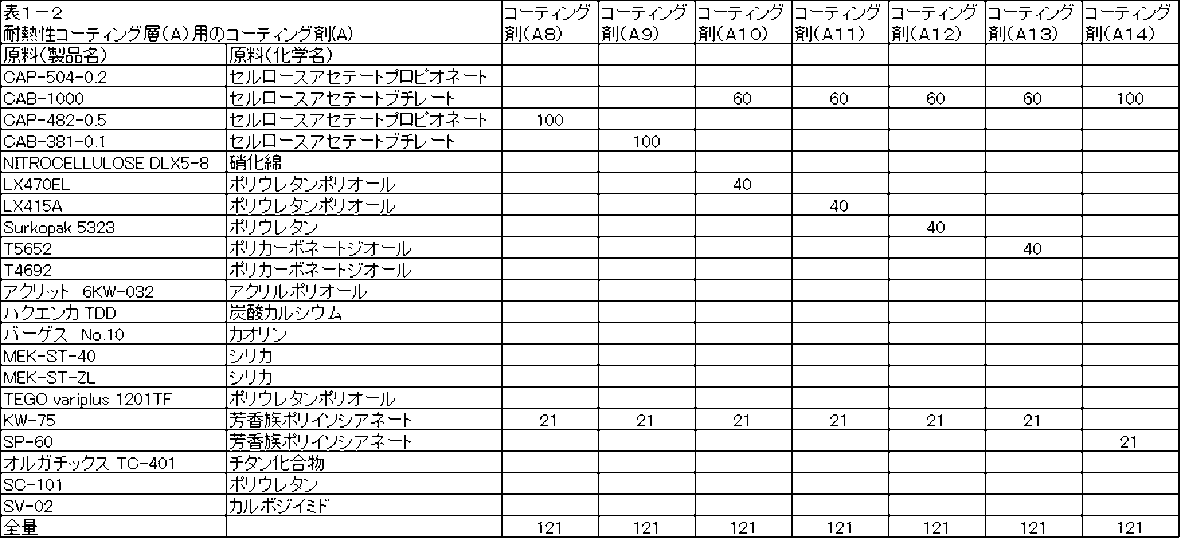
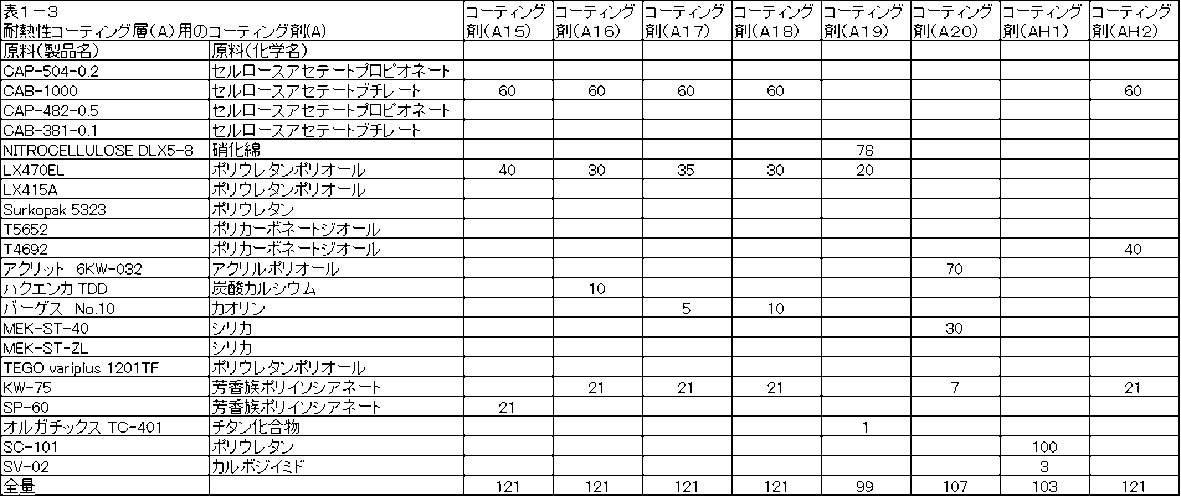

CAP-504-0.2:イーストマンケミカル社製のセルロースアセテートプロピオネート
CAB-1000:イーストマンケミカル社製のセルロースアセテートブチレート
CAP-482-0.5:イーストマンケミカル社製のセルロースアセテートプロピオネート
CAB-381-0.1:イーストマンケミカル社製のセルロースアセテートブチレート
NITROCELLULOSE DLX5-8:Nobel NC社製の硝化綿
LX-470EL:DIC社製のポリウレタンポリオール
LX-415A:DIC社製のポリウレタンポリオール
Surkopak 5323:BIP社製のポリウレタン
T5652:旭化成社製のポリカーボネートジオール
T4692:旭化成社製のポリカーボネートジオール
アクリット 6KW-032:大成ファインケミカル社製のアクリルポリオール
ハクエンカ TDD:白石工業社製の炭酸カルシウム
バーゲス No.10:Burgess Pigment社製のカオリン
MEK-ST-40:日産化学社製のシリカ
MEK-ST-ZL:日産化学社製のシリカ
TEGO variplus 1201TF:エボニック社製のポリウレタンポリオール
KW-75:DIC社製の芳香族ポリイソシアネート
SP-60:DIC社製の芳香族ポリイソシアネート
オルガチックス TC-401:マツモトファインケミカル社製のチタン化合物
SC-101:DIC社製のポリウレタン
SV-02:日清紡ケミカル社製のカルボジイミド
オレフィン系樹脂層(B1)上に前記コーティング剤(A)を塗工し、70℃ーティング層(A)を成形した。さらに40℃で3日間のエージングを行い、実施例1~ の積層体を得た。
使用するコーティング剤(A)とオレフィン系樹脂層(B1)との組み合わせは表2に示した。
前記方法で得た実施例、比較例の積層体は、次に示す動的粘弾性測定装置及び熱機械分析装置を使用し、次の条件で、T1、T2、CTE1、及びCTE2を測定した。計算式は次の通りである。
測定モード:引張
測定周波数:1 Hz
振幅:0.1 %
試料の測定方向:MD方向
試料寸法(クランプ間距離×幅):10 mm × 5 mm
測定温度:-40 ℃ ~ 170 ℃
昇温速度:3 ℃/min
測定方式:引張
試料寸法(サンプル長×サンプル幅):20 mm × 5 mm
試料の測定方向:MD方向
初期荷重:12g(オレフィン系樹脂層(B1):OPE1の場合)
2g(オレフィン系樹脂層(B1):OPE2、OPE3、OPPの場合)
測定温度:30℃~170℃
昇温速度:3 ℃/min
(耐熱性(フィルム収縮発生の有無評価))
実施例、比較例の積層体を、熱傾斜式ヒートシールテスター(テスター産業(株)製)を用い、シール温度100℃~160℃、圧力3kg/cm2 、時間1秒で、耐熱性コーティング層(A)に直接触れるようヒートシールバーを接触させた。ヒートシールバーを接触させた後の積層体の状態を、目視にて2段階で評価した。
〇:ヒートシールバーを接触させたシール部周辺の積層体の収縮が発生していない
×:ヒートシールバーを接触させたシール部周辺全体に積層体の収縮を確認できる
実施例、比較例の積層体の、耐熱性コーティング層(A)にセロハンテープ(ニチバン社製TF-12)を圧着し、テープを一気に剥がした時の剥がれの程度を目視で判断し、3段階にて評価した。なお参考例1~4はコート層の形成を行わなかったため密着性は評価していない。
〇:剥がれ無し
△:一部剥がれた
×:全て剥がれた
実施例、比較例の積層体を、熱傾斜式ヒートシールテスター(テスター産業(株)製)を用い、シール温度120℃~160℃で圧力3kg/cm2 、時間1秒で、シール層に相当する層同士が接するようヒートシールした。サンプル幅を15mmとし、引張り速度300mm/minで90°剥離強度を測定し、ヒートシール強度とした。
実施例、比較例の積層体を、10cm×10cmのサイズに調整し、OX-TRAN2/21(モコン社製:酸素透過率測定装置)を用い、JIS-K7126(等圧法)に準じ、23℃0%RH、23℃50%RH、又は23℃90%RHの雰囲気下で酸素透過率を測定した(単位はcc/m2/day/atm)。なおRHとは、湿度を表す。

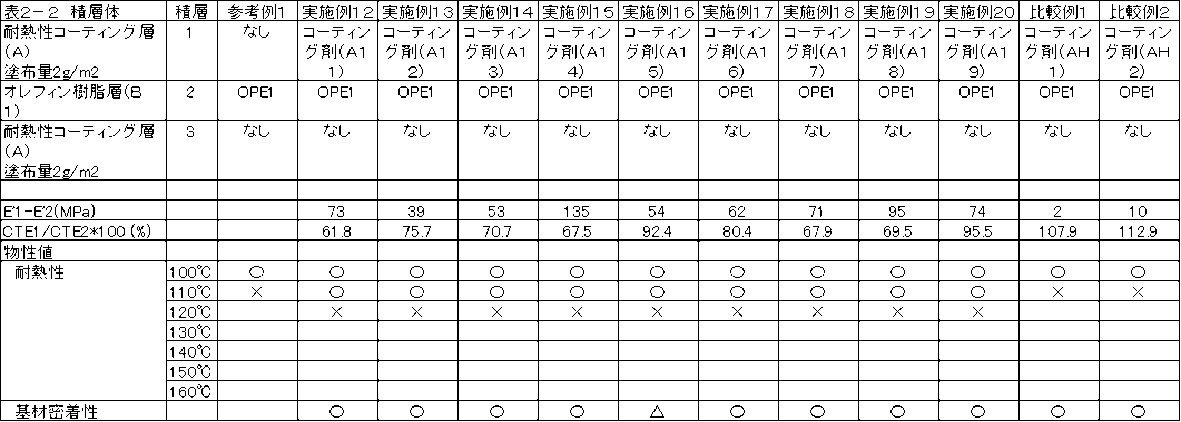
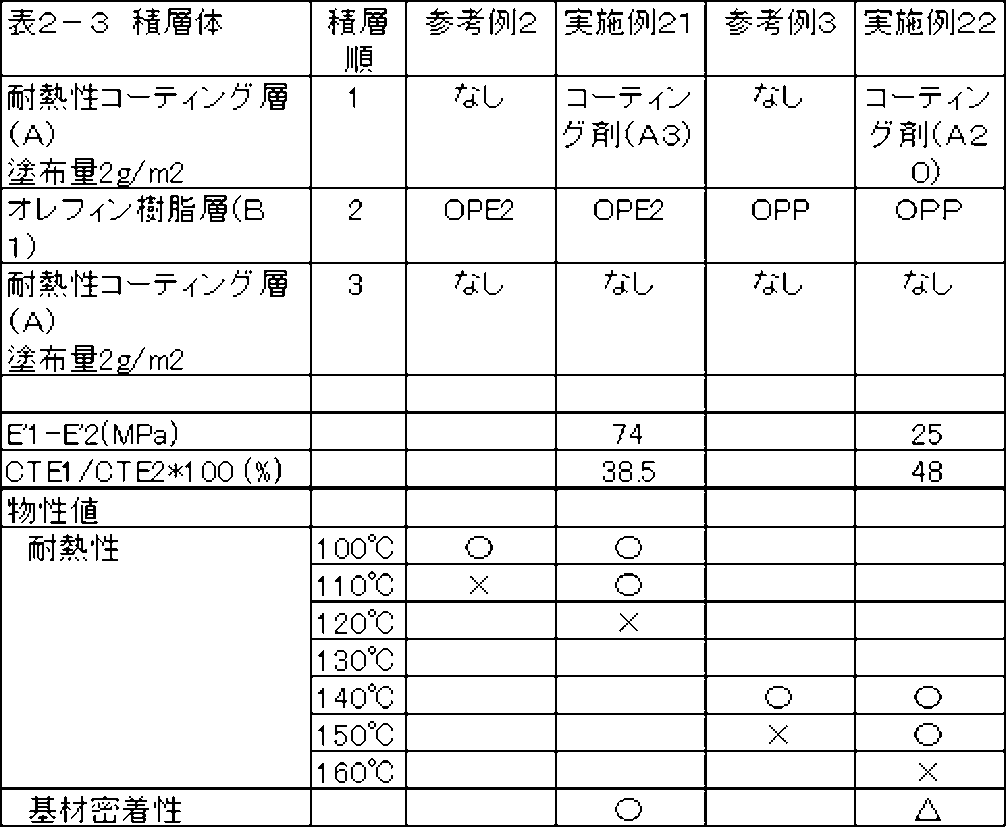
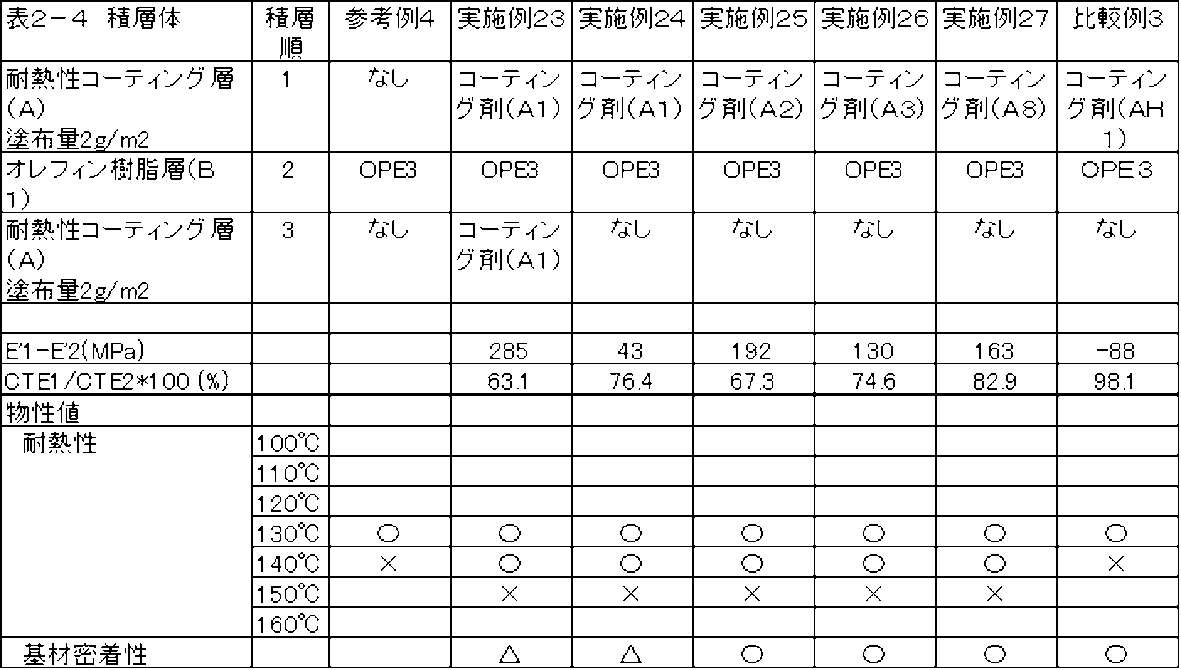
OPE1:膜厚25μmの1軸延伸ポリエチレンフィルム(密度:0.92g/m2、融点:125℃)
OPE2:膜厚40μmの2軸延伸ポリエチレンフィルム(密度:0.91g/m2、融点:125℃)
OPE3:OPE1:膜厚25μmの1軸延伸ポリエチレンフィルム(密度:0.94g/m2、融点:135℃)
OPP:東洋紡株式会社製のP2161(密度:0.91g/m2、融点:165℃)
表3~表5-1、表5-2に記載する積層構造を有する積層体を得た。
表3に示す積層体の製造方法である。
印刷インキで印刷層(E)を設けたオレフィン系樹脂層(B1)の印刷インキ面とは反対側の面に前期コーティング剤(A)を塗工し、70℃にセットした熱風乾燥機中で1分間乾燥させ乾燥膜厚が2.0μmの耐熱性コーティング層(A)を形成した。その後、バリア性を有する樹脂層(D)を設ける場合は、バリアコーティング剤(D)を塗布後の膜厚が0.3~
次に、バリア性を有する樹脂層(D)上に、接着剤(C)を塗布量が固形分3.0g/m2となるように塗布し乾燥させた後、ラミネーターで、該フィルムの接着剤(C)塗布面とオレフィン系樹脂層(B2)と貼合し、積層体を得た。
表4に示す積層体の製造方法である。
バリア性を有する樹脂層(D)及び印刷層(E)を設けたオレフィン系樹脂層(B1)のバリア性を有する樹脂層(D)及び印刷層(E)とは反対側の面に前期コーティング剤(A)を塗工し、70℃にセットした熱風乾燥機中で1分間乾燥させ乾燥膜厚が2.0μmの耐熱性コーティング層(A)を形成した。
次に、印刷層(E)上に、接着剤(C)を塗布量が固形分3.0g/m2となるように塗布し乾燥させた後、ラミネーターで、該フィルムの接着剤(C)塗布面とオレフィン系樹脂層(B2)と貼合し、積層体を得た。
表5に示す積層体の製造方法である。
印刷インキで印刷層(E)を設けたオレフィン系樹脂層(B1)の印刷インキ面に前期コーティング剤(A)を塗工し、70℃にセットした熱風乾燥機中で1分間乾燥させ乾燥膜厚が2.0μmの耐熱性コーティング層(A)を形成した。
その後、バリア性を有する樹脂層(D)を設ける場合は、オレフィン系樹脂層(B1)の印刷層とは反対の面にバリアコーティング剤(D)を塗布後の膜厚が0.3~
更に、オレフィン系樹脂層(B2)を設ける場合は、オレフィン系樹脂層(B2)がフィルムならば、オレフィン系樹脂層(B1)又はバリア性を有する樹脂層(D)上に接着剤(C)を塗布量が固形分3.0g/m2となるように塗布し、ラミネーターで、当該フィルムの接着剤(C)塗布面とオレフィン系樹脂層(B2)と貼合し、積層体を得た。
一方、オレフィン系樹脂層(B2)がシールコーティング剤ならば、オレフィン系樹脂層(B1)又はバリアコーティング剤(D)上に直接シールコーティング剤を塗布乾燥させ、積層体を得た。

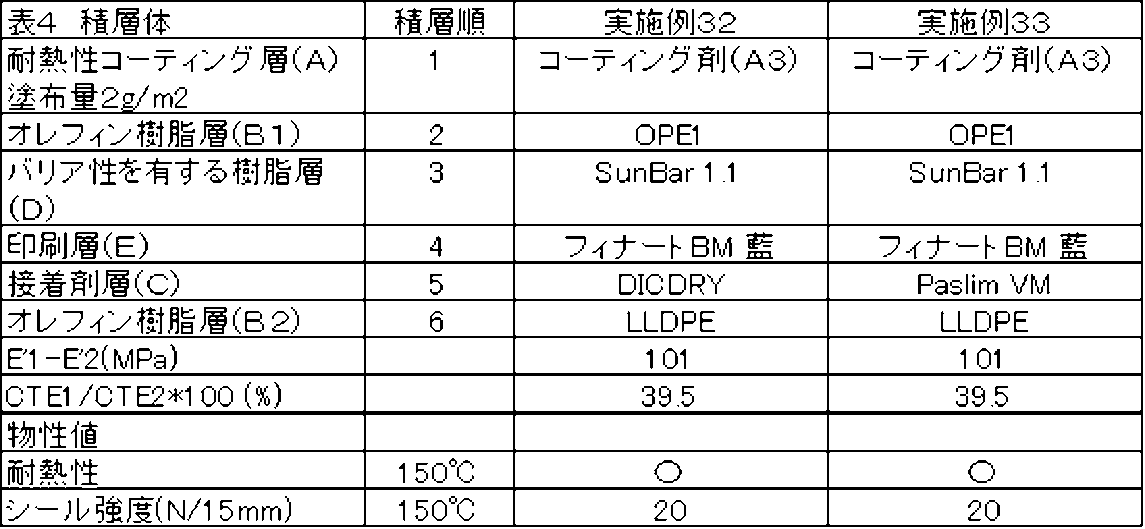


フィナートBM藍:DICグラフィックス社製のリキッド印刷インキ(裏刷り用)
グロッサBM藍:DICグラフィックス社製のリキッド印刷インキ(表刷り用)
SunBar AEROBLOCK 1.1:サンケミカル社製のバリアコーティング剤
SunBar AEROBLOCK ENHANCE BARX 221/222:サンケミカル社製のバリアコーティング剤
SunBar AEROBLOCK INLINE BARX698:サンケミカル社製のバリアコーティング剤
SB-503/SA-201:DIC株式会社製のバリアコーティング剤
DICDRY:DIC株式会社製の反応性接着剤
Paslim VM:DIC株式会社製のバリア接着剤
Paslim MB:DIC株式会社製のバリア接着剤
CPP:東洋紡株式会社製のP1128 (厚み:
OPP:東洋紡株式会社製のP2161 (厚み:
A-815P:DIC株式会社製のシール剤
OPE1:膜厚25μmの1軸延伸ポリエチレンフィルム(密度:0.92g/m2、融点:125℃)
LLDPE:三井化学東セロ株式会社製のT.U.X HC (厚み:
OPE4:膜厚25μmの1軸延伸ポリエチレンフィルム(密度:0.94g/m2、融点:130℃)
Claims (6)
- 耐熱性コーティング層(A)と、オレフィン系樹脂(b1)を主成分とするオレフィン系樹脂層(B1)を有する積層体であって、(1)及び(2)、又は(1)及び(3)を満たすことを特徴とする積層体。
(1)オレフィン系樹脂層(B1)の片面または両面に耐熱性コーティング層(A)を設けた積層体の、温度T1(℃)における動的粘弾性測定(DMA)値E’1(MPa)と、オレフィン系樹脂層(B1)のみの温度T1(℃)における動的粘弾性測定(DMA)値E’2(MPa)との差が、1(MPa)以上である。


(2)オレフィン系樹脂層(B1)の片面または両面に耐熱性コーティング層(A)を設けた積層体の、温度T1(℃)における熱機械分析の線膨張係数の値(CTE1)を、オレフィン系樹脂層(B1)のみの温度T1(℃)における熱機械分析の線膨張係数の値で除した値(CTE2)の100分率が、10%~100%である。

(3)オレフィン系樹脂層(B1)の片面または両面に耐熱性コーティング層(A)を設けた積層体の、温度T1(℃)と20(℃)との和であるT2(℃)における熱機械分析の線膨張係数の値(CTE3)を、オレフィン系樹脂層(B1)のみの温度T2(℃)における熱機械分析の線膨張係数の値で除した値(CTE4)の100分率が、10%~100%である。

- 前記オレフィン系樹脂層(B1)が、延伸されたオレフィン系樹脂層である請求項1に記載の積層体。
- 耐熱性コーティング層(A)と、オレフィン系樹脂(b1)を主成分とするオレフィン系樹脂層(B1)と、接着剤(c1)からなる接着剤層(C)、又はバリア性を有する樹脂層(D)、又はオレフィン系樹脂(b2)を主成分とするオレフィン系樹脂層(B2)、又は印刷層(E)、又はシール層(F)、又は蒸着層(G)を有する請求項1に記載の積層体。
- 前記印刷層(E)を、オレフィン系樹脂(b1)を主成分とするオレフィン系樹脂層(B1)に接して有する請求項3に記載の積層体。
- 前記積層体の全厚が15~200μmである請求項1に記載の積層体。
- 請求項1に記載の積層体を用いてなることを特徴とする包装材。
Priority Applications (2)
| Application Number | Priority Date | Filing Date | Title |
|---|---|---|---|
| JP2023541316A JP7435918B1 (ja) | 2022-04-12 | 2023-03-30 | 積層体、及び包装材 |
| CN202380029254.3A CN118946460A (zh) | 2022-04-12 | 2023-03-30 | 层叠体和包装材料 |
Applications Claiming Priority (2)
| Application Number | Priority Date | Filing Date | Title |
|---|---|---|---|
| JP2022065649 | 2022-04-12 | ||
| JP2022-065649 | 2022-04-12 |
Publications (1)
| Publication Number | Publication Date |
|---|---|
| WO2023199751A1 true WO2023199751A1 (ja) | 2023-10-19 |
Family
ID=88329524
Family Applications (1)
| Application Number | Title | Priority Date | Filing Date |
|---|---|---|---|
| PCT/JP2023/013052 Ceased WO2023199751A1 (ja) | 2022-04-12 | 2023-03-30 | 積層体、及び包装材 |
Country Status (3)
| Country | Link |
|---|---|
| JP (1) | JP7435918B1 (ja) |
| CN (1) | CN118946460A (ja) |
| WO (1) | WO2023199751A1 (ja) |
Cited By (1)
| Publication number | Priority date | Publication date | Assignee | Title |
|---|---|---|---|---|
| JPWO2025126849A1 (ja) * | 2023-12-14 | 2025-06-19 |
Citations (3)
| Publication number | Priority date | Publication date | Assignee | Title |
|---|---|---|---|---|
| WO2013002176A1 (ja) * | 2011-06-27 | 2013-01-03 | Dic株式会社 | 耐熱性オレフィン系多層フィルム、その製造方法及びこれを用いる包装材 |
| JP2016055537A (ja) * | 2014-09-10 | 2016-04-21 | Dic株式会社 | 積層フィルム及び包装材 |
| JP2019521877A (ja) * | 2016-05-31 | 2019-08-08 | ダウ グローバル テクノロジーズ エルエルシー | コーティングされたフィルムおよびそれから形成されるパッケージ |
Family Cites Families (2)
| Publication number | Priority date | Publication date | Assignee | Title |
|---|---|---|---|---|
| CN100506934C (zh) * | 2005-12-27 | 2009-07-01 | 财团法人工业技术研究院 | 高温隔热涂料 |
| JP6316212B2 (ja) * | 2013-03-06 | 2018-04-25 | Dic株式会社 | 積層フィルム及び包装材 |
-
2023
- 2023-03-30 CN CN202380029254.3A patent/CN118946460A/zh active Pending
- 2023-03-30 WO PCT/JP2023/013052 patent/WO2023199751A1/ja not_active Ceased
- 2023-03-30 JP JP2023541316A patent/JP7435918B1/ja active Active
Patent Citations (3)
| Publication number | Priority date | Publication date | Assignee | Title |
|---|---|---|---|---|
| WO2013002176A1 (ja) * | 2011-06-27 | 2013-01-03 | Dic株式会社 | 耐熱性オレフィン系多層フィルム、その製造方法及びこれを用いる包装材 |
| JP2016055537A (ja) * | 2014-09-10 | 2016-04-21 | Dic株式会社 | 積層フィルム及び包装材 |
| JP2019521877A (ja) * | 2016-05-31 | 2019-08-08 | ダウ グローバル テクノロジーズ エルエルシー | コーティングされたフィルムおよびそれから形成されるパッケージ |
Cited By (1)
| Publication number | Priority date | Publication date | Assignee | Title |
|---|---|---|---|---|
| JPWO2025126849A1 (ja) * | 2023-12-14 | 2025-06-19 |
Also Published As
| Publication number | Publication date |
|---|---|
| CN118946460A (zh) | 2024-11-12 |
| JPWO2023199751A1 (ja) | 2023-10-19 |
| JP7435918B1 (ja) | 2024-02-21 |
Similar Documents
| Publication | Publication Date | Title |
|---|---|---|
| EP1839835B1 (en) | Decorative sheets | |
| JP2024056967A (ja) | パウチ | |
| JP7435918B1 (ja) | 積層体、及び包装材 | |
| JP7358728B2 (ja) | ポリエチレン積層体およびこれを用いた包装材料 | |
| JP2000263727A (ja) | 積層材およびそれを使用した包装用容器 | |
| JP4803441B2 (ja) | 化粧シート | |
| EP4458579A1 (en) | Packaging material | |
| EP4566816A1 (en) | Frangible film and packaging material | |
| KR20260025772A (ko) | 방담성 다층 필름, 이것을 사용하는 적층체, 및 포장재 | |
| WO2024058167A1 (ja) | 包装材料 | |
| JP4213988B2 (ja) | ガスバリヤ性複合フィルム及びそれを用いて得られる包装袋 | |
| JP2023126271A (ja) | ポリエチレン積層体およびこれを用いた包装材料 | |
| JP2026071254A (ja) | 印刷物、印刷媒体、及び包装体 | |
| WO2025249481A1 (ja) | 印刷物、印刷媒体、及び包装体 | |
| JP7545609B1 (ja) | 積層体、包装袋、蓋材、および積層体の製造方法 | |
| JP7849668B1 (ja) | 防曇性多層フィルム、これを用いる積層体、及び包装材 | |
| JP7831536B1 (ja) | 積層体、包装材、包装袋及び包装体 | |
| JP2024043721A (ja) | 積層体、包装体、及びヒートシール組成物 | |
| JP2023157156A (ja) | 紫外線遮蔽フィルム及び該フィルムを用いたラミネート積層体 | |
| JP2025047197A (ja) | インキ組成物、印刷物及び積層体 | |
| JP2024154093A (ja) | 短波長光遮蔽インキ、該インキを用いた短波長光遮蔽フィルム、ラミネート積層体及び包装材 | |
| JP2025130683A (ja) | アンカーコート層形成用組成物、及びアンカーコート層を有する積層体 | |
| JP2026028591A (ja) | 積層フィルム、及び包装体 | |
| WO2025155500A1 (en) | Opaque white oxygen barrier ink | |
| JP2025170920A (ja) | スタンディングパウチ及び包装物品 |
Legal Events
| Date | Code | Title | Description |
|---|---|---|---|
| WWE | Wipo information: entry into national phase |
Ref document number: 2023541316 Country of ref document: JP |
|
| 121 | Ep: the epo has been informed by wipo that ep was designated in this application |
Ref document number: 23788171 Country of ref document: EP Kind code of ref document: A1 |
|
| WWE | Wipo information: entry into national phase |
Ref document number: 202380029254.3 Country of ref document: CN |
|
| NENP | Non-entry into the national phase |
Ref country code: DE |
|
| 122 | Ep: pct application non-entry in european phase |
Ref document number: 23788171 Country of ref document: EP Kind code of ref document: A1 |