WO2023189188A1 - 接合体及びその製造方法 - Google Patents
接合体及びその製造方法 Download PDFInfo
- Publication number
- WO2023189188A1 WO2023189188A1 PCT/JP2023/007911 JP2023007911W WO2023189188A1 WO 2023189188 A1 WO2023189188 A1 WO 2023189188A1 JP 2023007911 W JP2023007911 W JP 2023007911W WO 2023189188 A1 WO2023189188 A1 WO 2023189188A1
- Authority
- WO
- WIPO (PCT)
- Prior art keywords
- bonding layer
- bonding
- cyclic olefin
- bonded body
- molded
- Prior art date
- Legal status (The legal status is an assumption and is not a legal conclusion. Google has not performed a legal analysis and makes no representation as to the accuracy of the status listed.)
- Ceased
Links
Images

Classifications
-
- B—PERFORMING OPERATIONS; TRANSPORTING
- B32—LAYERED PRODUCTS
- B32B—LAYERED PRODUCTS, i.e. PRODUCTS BUILT-UP OF STRATA OF FLAT OR NON-FLAT, e.g. CELLULAR OR HONEYCOMB, FORM
- B32B7/00—Layered products characterised by the relation between layers; Layered products characterised by the relative orientation of features between layers, or by the relative values of a measurable parameter between layers, i.e. products comprising layers having different physical, chemical or physicochemical properties; Layered products characterised by the interconnection of layers
- B32B7/04—Interconnection of layers
- B32B7/12—Interconnection of layers using interposed adhesives or interposed materials with bonding properties
-
- B—PERFORMING OPERATIONS; TRANSPORTING
- B29—WORKING OF PLASTICS; WORKING OF SUBSTANCES IN A PLASTIC STATE IN GENERAL
- B29C—SHAPING OR JOINING OF PLASTICS; SHAPING OF MATERIAL IN A PLASTIC STATE, NOT OTHERWISE PROVIDED FOR; AFTER-TREATMENT OF THE SHAPED PRODUCTS, e.g. REPAIRING
- B29C65/00—Joining or sealing of preformed parts, e.g. welding of plastics materials; Apparatus therefor
- B29C65/48—Joining or sealing of preformed parts, e.g. welding of plastics materials; Apparatus therefor using adhesives, i.e. using supplementary joining material; solvent bonding
- B29C65/4805—Joining or sealing of preformed parts, e.g. welding of plastics materials; Apparatus therefor using adhesives, i.e. using supplementary joining material; solvent bonding characterised by the type of adhesives
- B29C65/481—Non-reactive adhesives, e.g. physically hardening adhesives
- B29C65/4815—Hot melt adhesives, e.g. thermoplastic adhesives
-
- B—PERFORMING OPERATIONS; TRANSPORTING
- B29—WORKING OF PLASTICS; WORKING OF SUBSTANCES IN A PLASTIC STATE IN GENERAL
- B29C—SHAPING OR JOINING OF PLASTICS; SHAPING OF MATERIAL IN A PLASTIC STATE, NOT OTHERWISE PROVIDED FOR; AFTER-TREATMENT OF THE SHAPED PRODUCTS, e.g. REPAIRING
- B29C65/00—Joining or sealing of preformed parts, e.g. welding of plastics materials; Apparatus therefor
- B29C65/48—Joining or sealing of preformed parts, e.g. welding of plastics materials; Apparatus therefor using adhesives, i.e. using supplementary joining material; solvent bonding
- B29C65/4895—Solvent bonding, i.e. the surfaces of the parts to be joined being treated with solvents, swelling or softening agents, without adhesives
-
- B—PERFORMING OPERATIONS; TRANSPORTING
- B29—WORKING OF PLASTICS; WORKING OF SUBSTANCES IN A PLASTIC STATE IN GENERAL
- B29C—SHAPING OR JOINING OF PLASTICS; SHAPING OF MATERIAL IN A PLASTIC STATE, NOT OTHERWISE PROVIDED FOR; AFTER-TREATMENT OF THE SHAPED PRODUCTS, e.g. REPAIRING
- B29C65/00—Joining or sealing of preformed parts, e.g. welding of plastics materials; Apparatus therefor
- B29C65/48—Joining or sealing of preformed parts, e.g. welding of plastics materials; Apparatus therefor using adhesives, i.e. using supplementary joining material; solvent bonding
- B29C65/50—Joining or sealing of preformed parts, e.g. welding of plastics materials; Apparatus therefor using adhesives, i.e. using supplementary joining material; solvent bonding using adhesive tape, e.g. thermoplastic tape; using threads or the like
- B29C65/5057—Joining or sealing of preformed parts, e.g. welding of plastics materials; Apparatus therefor using adhesives, i.e. using supplementary joining material; solvent bonding using adhesive tape, e.g. thermoplastic tape; using threads or the like positioned between the surfaces to be joined
-
- B—PERFORMING OPERATIONS; TRANSPORTING
- B29—WORKING OF PLASTICS; WORKING OF SUBSTANCES IN A PLASTIC STATE IN GENERAL
- B29C—SHAPING OR JOINING OF PLASTICS; SHAPING OF MATERIAL IN A PLASTIC STATE, NOT OTHERWISE PROVIDED FOR; AFTER-TREATMENT OF THE SHAPED PRODUCTS, e.g. REPAIRING
- B29C65/00—Joining or sealing of preformed parts, e.g. welding of plastics materials; Apparatus therefor
- B29C65/82—Testing the joint
- B29C65/8207—Testing the joint by mechanical methods
- B29C65/823—Bend tests
-
- B—PERFORMING OPERATIONS; TRANSPORTING
- B29—WORKING OF PLASTICS; WORKING OF SUBSTANCES IN A PLASTIC STATE IN GENERAL
- B29C—SHAPING OR JOINING OF PLASTICS; SHAPING OF MATERIAL IN A PLASTIC STATE, NOT OTHERWISE PROVIDED FOR; AFTER-TREATMENT OF THE SHAPED PRODUCTS, e.g. REPAIRING
- B29C66/00—General aspects of processes or apparatus for joining preformed parts
- B29C66/01—General aspects dealing with the joint area or with the area to be joined
- B29C66/05—Particular design of joint configurations
- B29C66/10—Particular design of joint configurations particular design of the joint cross-sections
- B29C66/11—Joint cross-sections comprising a single joint-segment, i.e. one of the parts to be joined comprising a single joint-segment in the joint cross-section
- B29C66/112—Single lapped joints
- B29C66/1122—Single lap to lap joints, i.e. overlap joints
-
- B—PERFORMING OPERATIONS; TRANSPORTING
- B29—WORKING OF PLASTICS; WORKING OF SUBSTANCES IN A PLASTIC STATE IN GENERAL
- B29C—SHAPING OR JOINING OF PLASTICS; SHAPING OF MATERIAL IN A PLASTIC STATE, NOT OTHERWISE PROVIDED FOR; AFTER-TREATMENT OF THE SHAPED PRODUCTS, e.g. REPAIRING
- B29C66/00—General aspects of processes or apparatus for joining preformed parts
- B29C66/40—General aspects of joining substantially flat articles, e.g. plates, sheets or web-like materials; Making flat seams in tubular or hollow articles; Joining single elements to substantially flat surfaces
- B29C66/41—Joining substantially flat articles ; Making flat seams in tubular or hollow articles
- B29C66/43—Joining a relatively small portion of the surface of said articles
-
- B—PERFORMING OPERATIONS; TRANSPORTING
- B29—WORKING OF PLASTICS; WORKING OF SUBSTANCES IN A PLASTIC STATE IN GENERAL
- B29C—SHAPING OR JOINING OF PLASTICS; SHAPING OF MATERIAL IN A PLASTIC STATE, NOT OTHERWISE PROVIDED FOR; AFTER-TREATMENT OF THE SHAPED PRODUCTS, e.g. REPAIRING
- B29C66/00—General aspects of processes or apparatus for joining preformed parts
- B29C66/40—General aspects of joining substantially flat articles, e.g. plates, sheets or web-like materials; Making flat seams in tubular or hollow articles; Joining single elements to substantially flat surfaces
- B29C66/41—Joining substantially flat articles ; Making flat seams in tubular or hollow articles
- B29C66/45—Joining of substantially the whole surface of the articles
-
- B—PERFORMING OPERATIONS; TRANSPORTING
- B29—WORKING OF PLASTICS; WORKING OF SUBSTANCES IN A PLASTIC STATE IN GENERAL
- B29C—SHAPING OR JOINING OF PLASTICS; SHAPING OF MATERIAL IN A PLASTIC STATE, NOT OTHERWISE PROVIDED FOR; AFTER-TREATMENT OF THE SHAPED PRODUCTS, e.g. REPAIRING
- B29C66/00—General aspects of processes or apparatus for joining preformed parts
- B29C66/70—General aspects of processes or apparatus for joining preformed parts characterised by the composition, physical properties or the structure of the material of the parts to be joined; Joining with non-plastics material
- B29C66/73—General aspects of processes or apparatus for joining preformed parts characterised by the composition, physical properties or the structure of the material of the parts to be joined; Joining with non-plastics material characterised by the intensive physical properties of the material of the parts to be joined, by the optical properties of the material of the parts to be joined, by the extensive physical properties of the parts to be joined, by the state of the material of the parts to be joined or by the material of the parts to be joined being a thermoplastic or a thermoset
- B29C66/739—General aspects of processes or apparatus for joining preformed parts characterised by the composition, physical properties or the structure of the material of the parts to be joined; Joining with non-plastics material characterised by the intensive physical properties of the material of the parts to be joined, by the optical properties of the material of the parts to be joined, by the extensive physical properties of the parts to be joined, by the state of the material of the parts to be joined or by the material of the parts to be joined being a thermoplastic or a thermoset characterised by the material of the parts to be joined being a thermoplastic or a thermoset
- B29C66/7392—General aspects of processes or apparatus for joining preformed parts characterised by the composition, physical properties or the structure of the material of the parts to be joined; Joining with non-plastics material characterised by the intensive physical properties of the material of the parts to be joined, by the optical properties of the material of the parts to be joined, by the extensive physical properties of the parts to be joined, by the state of the material of the parts to be joined or by the material of the parts to be joined being a thermoplastic or a thermoset characterised by the material of the parts to be joined being a thermoplastic or a thermoset characterised by the material of at least one of the parts being a thermoplastic
- B29C66/73921—General aspects of processes or apparatus for joining preformed parts characterised by the composition, physical properties or the structure of the material of the parts to be joined; Joining with non-plastics material characterised by the intensive physical properties of the material of the parts to be joined, by the optical properties of the material of the parts to be joined, by the extensive physical properties of the parts to be joined, by the state of the material of the parts to be joined or by the material of the parts to be joined being a thermoplastic or a thermoset characterised by the material of the parts to be joined being a thermoplastic or a thermoset characterised by the material of at least one of the parts being a thermoplastic characterised by the materials of both parts being thermoplastics
-
- B—PERFORMING OPERATIONS; TRANSPORTING
- B32—LAYERED PRODUCTS
- B32B—LAYERED PRODUCTS, i.e. PRODUCTS BUILT-UP OF STRATA OF FLAT OR NON-FLAT, e.g. CELLULAR OR HONEYCOMB, FORM
- B32B27/00—Layered products comprising a layer of synthetic resin
- B32B27/06—Layered products comprising a layer of synthetic resin as the main or only constituent of a layer, which is next to another layer of the same or of a different material
- B32B27/08—Layered products comprising a layer of synthetic resin as the main or only constituent of a layer, which is next to another layer of the same or of a different material of synthetic resin
-
- B—PERFORMING OPERATIONS; TRANSPORTING
- B32—LAYERED PRODUCTS
- B32B—LAYERED PRODUCTS, i.e. PRODUCTS BUILT-UP OF STRATA OF FLAT OR NON-FLAT, e.g. CELLULAR OR HONEYCOMB, FORM
- B32B37/00—Methods or apparatus for laminating, e.g. by curing or by ultrasonic bonding
- B32B37/12—Methods or apparatus for laminating, e.g. by curing or by ultrasonic bonding characterised by using adhesives
- B32B37/1284—Application of adhesive
-
- C—CHEMISTRY; METALLURGY
- C08—ORGANIC MACROMOLECULAR COMPOUNDS; THEIR PREPARATION OR CHEMICAL WORKING-UP; COMPOSITIONS BASED THEREON
- C08F—MACROMOLECULAR COMPOUNDS OBTAINED BY REACTIONS ONLY INVOLVING CARBON-TO-CARBON UNSATURATED BONDS
- C08F232/00—Copolymers of cyclic compounds containing no unsaturated aliphatic radicals in a side chain, and having one or more carbon-to-carbon double bonds in a carbocyclic ring system
- C08F232/08—Copolymers of cyclic compounds containing no unsaturated aliphatic radicals in a side chain, and having one or more carbon-to-carbon double bonds in a carbocyclic ring system having condensed rings
-
- C—CHEMISTRY; METALLURGY
- C08—ORGANIC MACROMOLECULAR COMPOUNDS; THEIR PREPARATION OR CHEMICAL WORKING-UP; COMPOSITIONS BASED THEREON
- C08G—MACROMOLECULAR COMPOUNDS OBTAINED OTHERWISE THAN BY REACTIONS ONLY INVOLVING UNSATURATED CARBON-TO-CARBON BONDS
- C08G61/00—Macromolecular compounds obtained by reactions forming a carbon-to-carbon link in the main chain of the macromolecule
- C08G61/02—Macromolecular compounds containing only carbon atoms in the main chain of the macromolecule, e.g. polyxylylenes
- C08G61/04—Macromolecular compounds containing only carbon atoms in the main chain of the macromolecule, e.g. polyxylylenes only aliphatic carbon atoms
- C08G61/06—Macromolecular compounds containing only carbon atoms in the main chain of the macromolecule, e.g. polyxylylenes only aliphatic carbon atoms prepared by ring-opening of carbocyclic compounds
- C08G61/08—Macromolecular compounds containing only carbon atoms in the main chain of the macromolecule, e.g. polyxylylenes only aliphatic carbon atoms prepared by ring-opening of carbocyclic compounds of carbocyclic compounds containing one or more carbon-to-carbon double bonds in the ring
-
- C—CHEMISTRY; METALLURGY
- C08—ORGANIC MACROMOLECULAR COMPOUNDS; THEIR PREPARATION OR CHEMICAL WORKING-UP; COMPOSITIONS BASED THEREON
- C08L—COMPOSITIONS OF MACROMOLECULAR COMPOUNDS
- C08L65/00—Compositions of macromolecular compounds obtained by reactions forming a carbon-to-carbon link in the main chain; Compositions of derivatives of such polymers
-
- C—CHEMISTRY; METALLURGY
- C09—DYES; PAINTS; POLISHES; NATURAL RESINS; ADHESIVES; COMPOSITIONS NOT OTHERWISE PROVIDED FOR; APPLICATIONS OF MATERIALS NOT OTHERWISE PROVIDED FOR
- C09D—COATING COMPOSITIONS, e.g. PAINTS, VARNISHES OR LACQUERS; FILLING PASTES; CHEMICAL PAINT OR INK REMOVERS; INKS; CORRECTING FLUIDS; WOODSTAINS; PASTES OR SOLIDS FOR COLOURING OR PRINTING; USE OF MATERIALS THEREFOR
- C09D165/00—Coating compositions based on macromolecular compounds obtained by reactions forming a carbon-to-carbon link in the main chain; Coating compositions based on derivatives of such polymers
-
- B—PERFORMING OPERATIONS; TRANSPORTING
- B32—LAYERED PRODUCTS
- B32B—LAYERED PRODUCTS, i.e. PRODUCTS BUILT-UP OF STRATA OF FLAT OR NON-FLAT, e.g. CELLULAR OR HONEYCOMB, FORM
- B32B37/00—Methods or apparatus for laminating, e.g. by curing or by ultrasonic bonding
- B32B37/12—Methods or apparatus for laminating, e.g. by curing or by ultrasonic bonding characterised by using adhesives
- B32B2037/1269—Methods or apparatus for laminating, e.g. by curing or by ultrasonic bonding characterised by using adhesives multi-component adhesive
-
- B—PERFORMING OPERATIONS; TRANSPORTING
- B32—LAYERED PRODUCTS
- B32B—LAYERED PRODUCTS, i.e. PRODUCTS BUILT-UP OF STRATA OF FLAT OR NON-FLAT, e.g. CELLULAR OR HONEYCOMB, FORM
- B32B2255/00—Coating on the layer surface
- B32B2255/10—Coating on the layer surface on synthetic resin layer or on natural or synthetic rubber layer
-
- B—PERFORMING OPERATIONS; TRANSPORTING
- B32—LAYERED PRODUCTS
- B32B—LAYERED PRODUCTS, i.e. PRODUCTS BUILT-UP OF STRATA OF FLAT OR NON-FLAT, e.g. CELLULAR OR HONEYCOMB, FORM
- B32B2255/00—Coating on the layer surface
- B32B2255/26—Polymeric coating
-
- C—CHEMISTRY; METALLURGY
- C08—ORGANIC MACROMOLECULAR COMPOUNDS; THEIR PREPARATION OR CHEMICAL WORKING-UP; COMPOSITIONS BASED THEREON
- C08G—MACROMOLECULAR COMPOUNDS OBTAINED OTHERWISE THAN BY REACTIONS ONLY INVOLVING UNSATURATED CARBON-TO-CARBON BONDS
- C08G2261/00—Macromolecular compounds obtained by reactions forming a carbon-to-carbon link in the main chain of the macromolecule
- C08G2261/30—Monomer units or repeat units incorporating structural elements in the main chain
- C08G2261/33—Monomer units or repeat units incorporating structural elements in the main chain incorporating non-aromatic structural elements in the main chain
- C08G2261/332—Monomer units or repeat units incorporating structural elements in the main chain incorporating non-aromatic structural elements in the main chain containing only carbon atoms
-
- C—CHEMISTRY; METALLURGY
- C08—ORGANIC MACROMOLECULAR COMPOUNDS; THEIR PREPARATION OR CHEMICAL WORKING-UP; COMPOSITIONS BASED THEREON
- C08G—MACROMOLECULAR COMPOUNDS OBTAINED OTHERWISE THAN BY REACTIONS ONLY INVOLVING UNSATURATED CARBON-TO-CARBON BONDS
- C08G2261/00—Macromolecular compounds obtained by reactions forming a carbon-to-carbon link in the main chain of the macromolecule
- C08G2261/40—Polymerisation processes
- C08G2261/41—Organometallic coupling reactions
- C08G2261/418—Ring opening metathesis polymerisation [ROMP]
Definitions
- the present invention relates to a joined body and a method for manufacturing the same.
- a bonding layer is interposed between a resin substrate on which fine channels are formed and a lid substrate, as a microchannel chip used for analysis and testing of biological substances such as DNA, RNA, and proteins, and chemical substances. It has been described that a resin bonded body is produced by bonding by heating (for example, see Patent Documents 1 and 2).
- the technology for manufacturing resin bonded bodies made by bonding multiple resin molded bodies through bonding layers is highly applicable not only to microchannel chips but also to the production of multiwell plates and other resin parts or members in general. Sex is expected.
- Such resin bonded bodies are required to have excellent mechanical properties such as flexural modulus and bonding strength. Additionally, when using a bonded product after sterilizing it in an autoclave, water vapor generated in the autoclave may accumulate in the resin, increasing haze and reducing the transparency of the bonded product. It is also required to suppress a decrease in transparency.
- an object of the present invention is to provide a bonded body that has excellent bending elastic modulus and bonding strength and suppresses a decrease in transparency due to an increase in haze under the generation of water vapor, and a method for manufacturing the same.
- the object of the present invention is to advantageously solve the above problems, and the joined body of the present invention comprises a plurality of molded bodies made of thermoplastic resin and a joint for joining the molded bodies to each other.
- the bonding layer includes at least one type of cyclic olefin polymer and a solvent component having a boiling point of 70°C or more and 150°C or less, and the bonding layer contains a boiling point of 70°C or more and 150°C or less.
- the zygote is characterized by containing the following solvent component in an amount of 100 mass ppm or more and 800 mass ppm or less based on the total mass of the zygote.
- the bonding layer contains at least one type of cyclic olefin polymer and the content of the solvent component in the bonded body is within a predetermined range, it has excellent bonding strength and flexural modulus, and after the bonded body is sterilized in an autoclave. It is possible to provide a bonded body with excellent transparency.
- the content rate of the solvent component can be measured, for example, by the method described in Examples.
- the thickness of the bonding layer is preferably 0.1 ⁇ m or more and 5 ⁇ m or less. If the thickness of the bonding layer does not exceed the above upper limit, the thickness of the bonding layer will be thinner and the bonding layer will become a thin film, which will reduce the chance of haze occurring in the bonding layer and improve the transparency of the bonded product.
- the conjugate is used as a device for biological or chemical analysis such as a microchannel chip or a multiwell plate
- the channel of the microchannel chip after steam sterilization is Deformation of the wells of a multi-well plate, etc. is suppressed.
- the thickness of the bonding layer is not less than the above lower limit, the effect of the bonding strength by the bonding layer is exhibited.
- the thickness of the bonding layer can be measured, for example, by the method described in Examples.
- the thermoplastic resin is a resin containing a cyclic olefin polymer.
- a cyclic olefin polymer resin as a thermoplastic resin, it is possible to impart excellent properties such as heat resistance and dimensional stability to the bonded body, and it is also in the same category as the cyclic olefin polymer that is the material of the bonding layer. Since the two polymers are of the same type, they are easily fused together, and it is possible to impart even better bonding strength to the bonded body.
- the solvent component contains at least one of cyclohexane, methylcyclohexane, ethylcyclohexane, xylene, and toluene. Since these solvent components have high solubility of the cyclic olefin polymer, it is possible to obtain a bonding layer with excellent uniformity.
- the type of solvent component can be identified, for example, by the method described in the Examples.
- the method for producing a bonded body of the present invention includes at least one type of cyclic olefin and a solvent component having a boiling point of 70°C or higher and 150°C or lower on at least one surface of a first molded body made of a thermoplastic resin.
- the first molded body and the second molded body are formed by arranging the second molded body made of thermoplastic resin so as to be in contact with the bonding layer and performing heating and pressure treatment.
- a bonding layer using a bonding agent containing at least one type of cyclic olefin and a solvent component having a boiling point of 70° C. or higher and 150° C. or lower, and controlling the content of the solvent component in the bonded body within a predetermined range. , it is possible to produce a bonded body that has excellent bonding strength and flexural modulus, and has excellent transparency after being sterilized in an autoclave.
- a bonded body that has excellent bending elastic modulus and bonding strength and suppresses a decrease in transparency due to an increase in haze under the generation of water vapor, and a method for manufacturing the same.
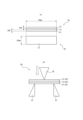
- FIG. 1a shows a fully bonded assembly 30 used for flexural modulus measurements, with a side view shown on the top and a top view on the bottom.
- Figure 1b shows a schematic diagram of flexural modulus measurements.
- FIG. 2a shows a bonding strength measuring joint 20 used for bonding strength measurement, with a side view shown on the upper side and a top view shown on the lower side.
- Figure 2b shows a schematic diagram of the bond strength measurement.
- the joined body of the present invention includes a plurality of molded bodies made of thermoplastic resin and a bonding layer that joins the molded bodies together. Further, the bonding layer contains at least one type of cyclic olefin and a solvent component having a boiling point within a predetermined range, and the bonding layer contains the solvent component having a boiling point within a predetermined range in a predetermined trace concentration range.
- the boiling point within the predetermined range needs to be 70°C or higher and 150°C or lower.
- the predetermined trace concentration range needs to be 100 mass ppm or more and 800 mass ppm or less based on the entire mass of the zygote.
- the bonding layer contains at least one type of cyclic olefin polymer and the content of the solvent component in the bonded body is within a predetermined range, it has excellent bonding strength and flexural modulus, and after the bonded body is sterilized in an autoclave. It is possible to provide a bonded body with excellent transparency.
- joint body refers to products, parts, and members in general (especially those made of resin) formed by bonding a plurality of molded bodies through a bonding layer.
- zygotes include biological materials (e.g. DNA, RNA, proteins, etc.), chemical substances (low molecular compounds, high molecular compounds, etc.) for analysis, testing, reactions, etc., or living organisms or life-like objects.
- Devices used for analysis, testing, and cultivation of (bacteria, cultured cells, viruses, etc.), resin products, parts, and members (e.g., resin caster wheels, Examples include, but are not limited to, resin screws, resin casings, resin packings, etc.).
- the conjugate is particularly preferably used in devices for analysis, testing, etc., such as microchannel chips and multiwell plates, which require good transparency.
- molded body refers to a plurality of resin members that are joined together to form a joined body.
- the shape of the molded body may be determined by the type, function, and shape of the joined body.
- the molded body may be a combination of a channel-equipped substrate and a lid substrate.
- the conjugate is a multi-well plate
- the molded body may be a combination of a well-equipped substrate and a lid substrate.
- the lid substrate may be a flat plate or a flat plate with holes.
- the molded body can be formed, for example, by injection molding of resin. Formation of concave structures or opening structures formed on the bonding surface, such as channels, wells, and through holes that can be formed in the substrate, can be performed using microfabrication techniques such as photolithography, thermal imprint, cutting, injection molding, etc. It can be done using Further, the formation of the recess structure or the opening structure may be performed on a molded body on which no bonding layer is formed, or may be formed on a molded body after the bonding layer is formed.
- Formation of a recess structure or an opening structure in a molded body on which a bonding layer is not formed can be performed using, for example, microfabrication techniques such as photolithography and thermal imprinting, cutting, injection molding, and the like.
- the formation of a recess structure or an opening structure in the molded body can be done by applying microfabrication techniques such as photolithography, thermal imprint, cutting, etc. to the surface of the molded body on which the bonding layer is formed. This can be done by applying it.
- thermoplastic resin>> The molded body is made of thermoplastic resin.
- the plurality of molded bodies may be made of the same thermoplastic resin, or may be made of different thermoplastic resins.
- thermoplastic resins include, but are not limited to, resins containing cyclic olefin polymers, polystyrene, polycarbonate, acrylic polymers, polyethylene terephthalate, and the like.
- cyclic olefin polymer examples include those described below.
- Acrylic polymers are polymers containing repeating units (polymerized units) obtained by polymerizing acrylates or methacrylates (hereinafter sometimes abbreviated as "(meth)acrylates") and derivatives thereof. Examples include (meth)acrylate homopolymers, (meth)acrylate copolymers, and copolymers of (meth)acrylate and other monomers copolymerizable with the (meth)acrylate.
- the above-mentioned (meth)acrylates include acrylics such as methyl acrylate, ethyl acrylate, n-propyl acrylate, isopropyl acrylate, n-butyl acrylate, t-butyl acrylate, and 2-ethylhexyl acrylate.
- Acid alkyl esters acrylic acid alkoxyalkyl esters such as 2-methoxyethyl acrylate and 2-ethoxyethyl acrylate; 2-(perfluorobutyl)ethyl acrylate and 2-(perfluoropentyl)ethyl acrylate; 2-(Perfluoroalkyl)ethyl acrylate; methyl methacrylate, ethyl methacrylate, n-propyl methacrylate, isopropyl methacrylate, n-butyl methacrylate, t-butyl methacrylate, 2-ethylhexyl methacrylate, methacrylic acid Methacrylic acid alkyl esters such as lauryl, tridecyl methacrylate, and stearyl methacrylate; 2-(perfluoroalkyl)ethyl methacrylate such as 2-(perfluorobutyl)ethyl methacrylate and 2-(perflu
- a cyclic olefin polymer is used as the thermoplastic resin, it will be in the same category as the cyclic olefin polymer that is the material for the bonding layer, so it will be easier to fuse with each other, and the bonded product will have even better bonding strength. can be granted.
- the cyclic olefin polymer is a resin with excellent heat resistance, dimensional stability, acid resistance, alkali resistance, hydrolysis resistance, light weight, and ease of resin molding, so it imparts excellent properties to the joined body. can do.
- cyclic olefin polymers are suitable as materials for molded bodies that provide excellent durability to bonded bodies because they exhibit little decrease in bonding strength over time and dimensional changes due to moisture absorption.
- the cyclic olefin polymer is a transparent material with low autofluorescence, it is suitable for use in the conjugate for optical signal detection devices such as microchannel chips and multiwell plates. Furthermore, in order to increase the bonding strength, a molded body whose bonding surface has been subjected to corona discharge treatment may be used. Note that the glass transition temperature (Tg 1 ) of the molded product will be described later.
- the thickness of the molded body is not particularly limited, but is, for example, 0.5 mm or more, preferably 1 mm or more, more preferably 1.5 mm or more. It may be 5 mm or more, for example, 100 mm or less, preferably 50 mm or less, more preferably 20 mm or less.
- the "joining layer” is a layered member that is interposed between the molded bodies and joins the molded bodies to each other.
- the bonding layer is characterized in that it contains at least one type of cyclic olefin polymer and also contains a solvent component having a boiling point within a predetermined range such that the content of the solvent component in the bonded body is within a predetermined trace concentration range. shall be.
- the boiling point within the predetermined range needs to be 70°C or higher and 150°C or lower.
- the predetermined trace concentration range needs to be 100 mass ppm or more and 800 mass ppm or less based on the entire mass of the zygote.
- the bonding layer contains at least one type of cyclic olefin polymer and also contains a solvent component having a boiling point within a predetermined range such that the content of the solvent component in the bonded body is within a predetermined trace concentration range. It is possible to provide a bonded body that has excellent strength and flexural modulus, and has excellent transparency after being sterilized in an autoclave.
- the bonding layer contains at least 50% by mass or more, preferably 80% by mass or more, more preferably 90% by mass or more, still more preferably 95% by mass or more of the entire bonding layer as a main material.
- the cyclic olefin polymer is a resin with excellent heat resistance, dimensional stability, acid resistance, alkali resistance, hydrolysis resistance, light weight, and ease of resin molding, so it imparts excellent properties to the joined body. can do.
- a cyclic olefin polymer is suitable as a bonding layer material that imparts excellent durability to a bonded body because it exhibits little decrease in bonding strength over time and dimensional change due to moisture absorption.
- the cyclic olefin polymer is a transparent material with low autofluorescence, it is suitable for use in the conjugate for optical signal detection devices such as microchannel chips and multiwell plates. Note that the glass transition temperature (Tg 2 ) of the bonding layer will be described later.
- cyclic olefin polymer for bonding layer ⁇ Other properties of the cyclic olefin polymer for bonding layer>>
- Other properties of the cyclic olefin polymer used as the main material of the bonding layer include, for example, a water absorption rate of 0.01% by mass or less, from the viewpoint of suppressing haze generation due to water vapor absorption and durability degradation due to moisture absorption. preferable.
- the thickness of the bonding layer may be the minimum thickness that can ensure the adhesion between the bonding surfaces of the molded bodies with the bonding layer interposed therebetween, for example, 0.1 ⁇ m or more, preferably 0.12 ⁇ m or more, more preferably It may be 0.15 ⁇ m or more, more preferably 0.2 ⁇ m or more. Further, the thickness of the bonding layer may be, for example, 5 ⁇ m or less, preferably 4.5 ⁇ m or less, more preferably 4.2 ⁇ m or less, still more preferably 4 ⁇ m or less.
- the thickness of the bonding layer does not exceed the above upper limit.
- the microchannel chip becomes more stable when subjected to steam sterilization. Deformation of channels, wells of multiwell plates, etc. is suppressed.
- the thickness of the bonding layer is thinner than the above lower limit, the effect of the bonding layer on the bonding strength will be reduced.
- the bonded body includes a plurality of bonding layers
- at least one bonding layer may fall within the above range, and it is preferable that all bonding layers fall within the above range.
- the thickness of the bonding layer is determined by the cyclic olefin content in the bonding agent containing the cyclic olefin and solvent component used to form the bonding layer, the amount of bonding agent applied and other coating conditions, and the removal of the solvent component when forming the bonding layer. This can be controlled by adjusting the drying conditions (eg, temperature, time, etc.).
- the thickness of the bonding layer can be measured, for example, by the method described in Examples.
- the cyclic olefin polymer that can be the material for the molded body and the cyclic olefin polymer that is the main material for the bonding layer is, for example, a polymer or copolymer obtained by polymerizing monomers as described below (hereinafter collectively referred to as ) or their hydrides.
- the cyclic olefin polymer may be crystalline or amorphous, but is preferably amorphous.
- As the monomer of the cyclic olefin polymer preferably a norbornene monomer is mentioned.
- a norbornene monomer is a monomer containing a norbornene ring.
- norbornene monomers examples include bicyclo[2.2.1]hept-2-ene (common name: norbornene), 5-ethylidene-bicyclo[2.2.1]hept-2-ene (common name: : ethylidenenorbornene) and their derivatives (those having a substituent on the ring); tricyclo[5.2.1.0 2,6 ]deca-3,8-diene (commonly used Tricyclic monomers such as dicyclopentadiene) and its derivatives; tetracyclo[7.4.0.0 2,7 .
- the substituent examples include an alkyl group, an alkylene group, a vinyl group, an alkoxycarbonyl group, and an alkylidene group, and the norbornene monomer may have two or more of these.
- the derivative includes 8-methoxycarbonyl-tetracyclo[4.4.0.1 2,5 . 1 7,10 ] dodec-3-ene, 8-methyl-8-methoxycarbonyl-tetracyclo[4.4.0.1 2,5 . 1 7,10 ] dodec-3-ene, 8-ethylidene-tetracyclo[4.4.0.1 2,5 . 1 7,10 ] dodec-3-ene and the like.
- cyclic olefin polymer may be an addition polymer, a ring-opening polymer, or a hydride thereof; Preferably, it is a compound.
- the ring-opening polymer described above can be produced by a method using a ring-opening polymerization catalyst.
- a ring-opening polymerization catalyst for example, a catalyst consisting of a metal halide such as ruthenium or osmium, a nitrate or an acetylacetone compound, and a reducing agent, or a metal halide or acetylacetone such as titanium, zirconium, tungsten, or molybdenum.
- a catalyst consisting of a compound and an organoaluminum compound can be used.
- the ring-opening polymer can be produced using, for example, a method using a metathesis reaction catalyst (ring-opening polymerization catalyst) such as a ruthenium carbene complex catalyst described in International Publication No. 2010/110323, and a method using tungsten described in JP-A No. 2015-54885. It can be produced by a method using a ring-opening polymerization catalyst such as a (phenylimide)tetrachloride/tetrahydrofuran complex or tungsten hexachloride.
- a metathesis reaction catalyst ring-opening polymerization catalyst
- a ruthenium carbene complex catalyst described in International Publication No. 2010/110323
- tungsten described in JP-A No. 2015-54885. It can be produced by a method using a ring-opening polymerization catalyst such as a (phenylimide)tetrachloride/tetrahydrofuran complex or tungsten hexachloride.
- the above-mentioned addition polymer can be obtained by polymerizing monomers using a known addition polymerization catalyst, for example, a catalyst consisting of a titanium, zirconium or vanadium compound and an organoaluminum compound.
- a known addition polymerization catalyst for example, a catalyst consisting of a titanium, zirconium or vanadium compound and an organoaluminum compound.
- the addition polymer is produced by adding a monomer of a cyclic olefin polymer and, if necessary, an addition copolymerizable monomer (other monomers) in the presence of a metallocene catalyst described in International Publication No. 2017/199980. mer) can be produced by addition copolymerization.
- Other monomers capable of ring-opening copolymerization with the norbornene monomer include monocyclic olefin monomers such as cyclohexene, cycloheptene, and cyclooctene. These other monomers capable of ring-opening copolymerization with the norbornene monomer can be used alone or in combination of two or more.
- ring-opening copolymerization is performed with a norbornene monomer and other monomers that can be copolymerized with ring-opening
- ring-opening copolymerization is possible with the structural unit derived from the norbornene monomer in the ring-opening polymer.
- the weight ratio of structural units derived from other monomers is usually in the range of 70:30 to 99:1, preferably 80:20 to 99:1, more preferably 90:10 to 99:1. be selected as appropriate.
- Examples of other monomers that can be addition-copolymerized with the norbornene monomer include ⁇ -olefins having 2 to 20 carbon atoms such as ethylene, propylene, 1-butene, 1-pentene, and 1-hexene; derivatives; cycloolefins such as cyclobutene, cyclopentene, cyclohexene, cyclooctene, 3a,5,6,7a-tetrahydro-4,7-methano-1H-indene, and derivatives thereof; 1,4-hexadiene, 4-methyl Examples include non-conjugated dienes such as -1,4-hexadiene, 5-methyl-1,4-hexadiene, and 1,7-octadiene.
- ⁇ -olefins are preferred, and ethylene is particularly preferred.
- these other monomers capable of addition copolymerizing with the norbornene monomer can be used alone or in combination of two or more.
- the structural unit derived from the norbornene monomer in the addition polymer and the other monomer that can be added copolymerized are as appropriate so that the ratio with the structural unit derived from the polymer is usually in the range of 30:70 to 99:1, preferably 50:50 to 97:3, more preferably 70:30 to 95:5. selected.
- examples of the method for hydrogenating the ring-opening polymer to produce a hydrogenated cyclic olefin polymer include a method using a hydrogenation catalyst described in International Publication No. 2010/110323.
- the ruthenium carbene catalyst is directly used as a hydrogenation catalyst to hydrogenate the cyclic olefin polymer. Hydrogenated cyclic olefin polymers can also be produced.
- the weight average molecular weight (Mw) of the cyclic olefin polymer that can be a material for the molded body and the bonding layer is preferably 1000 or more, more preferably 10000 or more, even more preferably 20000 or more, preferably 1000000 or less, more preferably 500000 or less, More preferably, it is 200,000 or less.
- the number average molecular weight (Mn) of the cyclic olefin polymer that can be used as a material for the molded body is preferably 1,000 or more, more preferably 3,000 or more, even more preferably 5,000 or more, preferably 1,000,000 or less, more preferably 500,000 or less, and 100,000 or less. More preferred.
- the weight average molecular weight (Mw) and number average molecular weight (Mn) of the cyclic olefin polymer can be measured by the method described in the Examples.
- Tg 1 the glass transition temperature of the resin component constituting the molded body
- Tg 2 the glass transition temperature of the resin component constituting the bonding layer
- Tg 1 is preferably 125°C or higher, more preferably 130°C or higher. By setting Tg 1 within such a range, it is possible to suppress softening, deformation, and deterioration of the molded body due to heating (eg, autoclaving) during production of the bonded body and optional sterilization. Moreover, Tg 1 is preferably 180°C or less, more preferably 160°C or less.
- the difference between Tg 1 and Tg 2 is preferably 10°C or more (i.e., Tg 1 ⁇ Tg 2 +10°C), more preferably 15°C or more (i.e., Tg 1 ⁇ Tg 2 +15°C), More preferably, the temperature is 20°C or higher (ie, Tg 1 ⁇ Tg 2 +20°C).
- Tg 1 ⁇ Tg 2 +10°C the difference between Tg 1 and Tg 2
- the temperature is 20°C or higher (ie, Tg 1 ⁇ Tg 2 +20°C).
- the difference between Tg 1 and Tg 2 is preferably 100°C or less, more preferably 90°C or less, and even more preferably 80°C or less.
- the smaller the difference between Tg 1 and Tg 2 the better the temperature stability of the bonding layer.
- Tg 2 is preferably 50°C or higher, more preferably 65°C or higher. When Tg 2 is within this range, the bonding layer has good temperature stability. Moreover, Tg 2 is preferably 130°C or less, more preferably 110°C or less, and even more preferably 100°C or less. When Tg 2 is within such a range, it becomes easy to set the heating temperature to soften only the bonding layer in manufacturing the bonded body.
- the glass transition temperature can be measured by differential scanning calorimetry (DSC) based on JIS-K7121.
- the glass transition temperature (Tg) of thermoplastic resins and cyclic olefin polymers is determined by the type and blending ratio of monomers used in polymerization, the average molecular weight and molecular weight distribution of the polymer, and the glass of each polymer in the case of a mixture of polymers. It can be adjusted as appropriate depending on the transition temperature (Tg), mixing ratio, etc.
- At least one of the bonded body and the bonding layer may be composed of two or more layers having different Tg.
- the conjugate contains, as a minor component, a solvable component with a boiling point within a predetermined range.
- the bonding layer of a bonded body is usually formed by applying a bonding agent prepared by dissolving a cyclic olefin polymer, which is the main material of the bonding layer, in a solvent onto the surface of the molded body during production of the bonded body. It is formed by performing a drying process on the binder to remove most of the solvent from the binder.
- the "solvent component” corresponds to a solvent that remains as a trace component in the bonding layer etc. after most of the solvent is removed from the bonding agent.
- the “solvent component” is a substance used as a solvent for the cyclic olefin polymer that is the main material of the bonding layer, and is not particularly limited as long as it has a boiling point within a predetermined range.
- the solvent serving as the "solvent component” may be a single solvent or a mixed solvent.
- boiling point refers to the boiling point of the mixed solvent. The boiling point of the mixed solvent can be adjusted based on the boiling point and blending ratio of each solvent component.
- the solvent used as a single solvent or a component of a mixed solvent includes commonly used organic solvents, such as toluene (boiling point 111°C), xylene (boiling point 144°C), tetrahydrofuran (THF) (boiling point 66°C), Examples include, but are not limited to, cyclohexane (boiling point: 80.3°C), methylcyclohexane (boiling point: 100.9°C), and ethylcyclohexane (boiling point: 132°C). Further, among these solvents, a solvent having a boiling point within a predetermined range can be used as a sole solvent.
- the predetermined boiling point range is 70°C or higher and 150°C or lower. In order to have solubility as a solvent, it is usually necessary that the boiling point is higher than the above lower limit. Further, in order to facilitate the removal of the solvent by evaporation during production of the conjugate, it is usually necessary that the boiling point be below the above upper limit.
- the solvent serving as the "solvent component" preferably contains at least one of cyclohexane, methylcyclohexane, ethylcyclohexane, xylene, and toluene.
- the bonding layer will contain the solvent component as a trace component, and it is thought that a certain level of fluidity will be imparted to the bonding layer. Therefore, compared to the case where the entire bonded body including the bonding layer is composed only of resin components, the bonding layer is given superior flexibility and maintains its integrity with the molded body even when the bonded body is bent. be done. Moreover, superior elasticity is imparted to the bonding layer compared to a case where the bonding layer is composed only of a resin component. By maintaining the integrity with the molded body and the excellent elasticity of the bonding layer itself, it is possible to impart excellent flexural modulus to the entire bonded body.
- the bonding layer has a certain fluidity, it has superior adhesion to the bonding layer compared to a case where the bonding layer is composed only of a resin component. Bonding strength can be imparted. Furthermore, when the conjugate is used after being sterilized in an autoclave, the water vapor generated during the autoclave sterilization process is likely to be taken into the resin, and the water vapor taken into the resin will not diffuse inside the resin and will remain as it is and condense. However, the haze increases and the transparency of the bonded product tends to decrease.
- the conjugate includes a solvable component in a predetermined trace concentration range.
- the predetermined trace concentration range is 100 mass ppm or more, preferably 1050 mass ppm or more, and more preferably 110 mass ppm or more as a content ratio of the solvent component to the total mass of the zygote. Further, the predetermined trace concentration range is 800 mass ppm or less, preferably 750 mass ppm or less, and more preferably 700 mass ppm or less as a content ratio of the solvent component to the entire bonding layer mass.
- the content ratio of the solvent-based component to the total mass of the bonded body is less than the above lower limit, the content ratio of the solvent-based component to the total mass of the bonding layer will also be extremely small, resulting in the bonding layer becoming hard and brittle and causing peeling during bending measurements. occurs, the flexural modulus decreases, and the fluidity of the bonding layer is lost, making it easier for water vapor captured in the resin during autoclave sterilization to remain without escaping to the outside, resulting in an increase in haze. However, the transparency of the zygote is impaired.
- the content ratio of the solvent component to the total mass of the bonded body exceeds the above upper limit, the content ratio of the solvent component to the total mass of the bonding layer will also be excessive, resulting in excessive softening of the bonding layer. , the bending elastic modulus of the entire joined body tends to decrease.
- the content ratio of the solvent component can be set within a predetermined trace concentration range, a bonded body with excellent bonding strength and flexural modulus and excellent transparency after autoclave sterilization can be obtained.
- the content rate of the solvent component can be measured, for example, by the method described in Examples.
- the thickness of the bonded body is not particularly limited, but is, for example, 1 mm or more, preferably 2 mm or more, more preferably 3 mm or more. For example, it may be 201 mm or less, preferably 101 mm or less, more preferably 41 mm or less.
- the joined body of the present invention can be manufactured, for example, by the method for manufacturing the joined body of the present invention described below.
- the method for manufacturing a joined body of the present invention includes the following steps: (i) A step of applying a binder containing at least one type of cyclic olefin and a solvent component having a boiling point within a predetermined range on at least one surface of a first molded body made of a thermoplastic resin (binder coating process) and (ii) Drying the applied bonding agent to remove most of the solvent components from the bonding agent and forming a bonding layer on the surface of the first molded body (bonding layer forming process) and (iii) A second molded body made of a thermoplastic resin is placed in contact with the bonding layer, and heat and pressure treatment is performed to bond the first molded body and the second molded body.
- the present invention is characterized by comprising a step (joining step) of joining via a joining layer to obtain a joined body containing a solvent component in a predetermined trace concentration range.
- the boiling point within the predetermined range needs to be 70°C or higher and 150°C or lower.
- the predetermined trace concentration range is required to be 100 mass ppm or more and 800 mass ppm or less with respect to the entire mass of the zygote.
- a bonding layer is formed using a bonding agent containing at least one type of cyclic olefin and a solvent component with a boiling point of 70° C. or higher and 150° C. or lower, and the content of the solvent component in the bonded body is set to a predetermined trace concentration range.
- the joined body obtained by the method for manufacturing a joined body of the present invention has a structure in which a first molded body and a second molded body are joined via a bonding layer.
- a bonded body in which three or more molded bodies are laminated forming an additional bonding layer on at least one of the first molded body and the second molded body and laminating the additional molded body and bonding may be performed one or more times.
- step (i) binder application step
- at least one type of cyclic olefin and a solvent component having a boiling point within a predetermined range are applied on at least one surface of the first molded body made of a thermoplastic resin. Applying a bonding agent containing the adhesive is performed.
- the "bonding agent” is a coating liquid that is applied onto the first molded body in step (i) to form a bonding layer.
- the binder contains at least one type of cyclic olefin and a solvent component having a boiling point within a predetermined range.
- the cyclic olefin and the solvent component which are the components of the bonding agent are used, respectively.
- the content ratio of the cyclic olefin in the bonding agent is such that the content ratio of the solvent component in the bonded body obtained by this production method falls within the above-mentioned predetermined trace concentration range (i.e., 100 mass ppm or more and 800 mass ppm or less). If so, there are no particular limitations.
- a content ratio that forms a bonding layer having a thickness in the above-mentioned suitable range (for example, 0.1 ⁇ m or more and 5 ⁇ m or less) in step (ii) is preferable.
- the content of cyclic olefin in the binder is preferably 0.5% by mass or more, more preferably 1% by mass or more, even more preferably 2% by mass or more, and preferably 50% by mass or less, and 40% by mass or less. is more preferable, and even more preferably 30% by mass or less.
- the content of cyclic olefin in the binder is not too low. Further, in order to impart sufficient solubility to the binder and improve uniformity and ease of application, it is preferable that the content of the cyclic olefin in the binder is not too high.
- the method for applying the bonding agent is not particularly limited, and examples thereof include bar coating, silk screen, spin coating, spray coating, wet coating, and gravure.
- the applied bonding agent is subjected to a drying treatment to remove most of the solvent components from the bonding agent, and the bonding layer is formed on the surface of the first molded body. Forming a bonding layer is performed.
- the conditions for the drying treatment are particularly as long as the content ratio of the solvent component in the bonded body obtained by this production method falls within the above-mentioned predetermined trace concentration range (i.e., 100 mass ppm or more and 800 mass ppm or less). Not limited. Furthermore, among the conditions for such drying treatment, the content ratio is preferably such that a bonding layer having a thickness within the above-mentioned suitable range (for example, 0.1 ⁇ m or more and 5 ⁇ m or less) is formed.
- the drying treatment is performed, for example, by drying at a temperature lower than the glass transition temperature of the cyclic olefin polymer that is the material of the bonding layer (e.g., heating drying, room temperature drying), heating vacuum (reduced pressure) drying, or a combination thereof. It's okay.
- the apparatus for performing the drying process is not particularly limited, and examples thereof include an oven (eg, inert gas hot air oven), a vacuum dryer, a hot air drying oven, and the like.
- the temperature at which the drying process is performed is preferably 10° C. or more lower than the glass transition temperature (Tg 1 ) of the first molded body.
- the temperature at which the drying process is performed is, for example, preferably 60°C or higher, more preferably 65°C or higher, even more preferably 70°C or higher, and preferably 128°C or lower, more preferably 125°C or lower, and even more preferably 122°C or lower. preferable.
- the time for drying is not particularly limited as long as sufficient drying is possible; however, if it is too long, it will increase industrial costs, and the oxidation of the resin will progress, resulting in yellowing in extreme cases.
- the atmosphere in which the drying treatment is carried out include the presence of air, the presence of an inert gas, and a vacuum.
- the presence of an inert gas is preferred from the viewpoint of suppressing the deterioration of the components of the first molded body and the bonding layer due to the drying treatment and gently removing the solvent to suppress the generation of cavities in the bonding layer.
- the inert gas include rare gases (eg, helium, neon, argon, krypton, xenon), nitrogen gas, and the like.
- step (iii) Joint step
- a second molded body made of a thermoplastic resin is placed in contact with the bonding layer and heated and pressurized to bond it to the first molded body.
- the second molded body is bonded (thermal fused) via a bonding layer.
- the first molded body and the second molded body may be temporarily fixed so as to be disposed with a bonding layer interposed therebetween to form a temporarily fixed joined body. After the heat and pressure treatment, the bonded body can be obtained by cooling to room temperature.
- the means for performing thermal fusion by heating and pressure treatment is not particularly limited, and examples thereof include an autoclave, a hot press, a roll press, and the like. Further, when an autoclave is used, a vacuum-packed body obtained by vacuum-packaging the temporary bonded body may be processed in the autoclave. Examples of vacuum packaging include vacuum packaging using a retort packaging material. Note that before heating and pressurizing, it is preferable to remove trapped air from the temporary bonded assembly and perform crimping, but small amounts of air bubbles will diffuse during autoclaving, so large amounts of air must be trapped. There is no problem.
- the conditions for performing the heating and pressure treatment are not particularly limited as long as the molded body and the bonding layer are bonded (thermal fused).
- the temperature at which the heating and pressure treatment is performed is preferably higher than the glass transition temperature (Tg 2 ) of the bonding layer and lower than both the glass transition temperature (Tg 1 ) of the first and second molded bodies.
- the temperature at which the heating and pressure treatment is performed is preferably Tg 2 +5°C or higher, more preferably Tg 2 +10°C or higher.
- the temperature at which thermal fusion is performed is preferably Tg 2 +50°C or lower, more preferably Tg 2 +40°C or lower.
- the temperature at which the heating and pressure treatment is performed is, for example, preferably 100°C or higher, more preferably 105°C or higher, even more preferably 110°C or higher, and preferably 140°C or lower, more preferably 135°C or lower, and 130°C or lower. More preferred.
- the pressure to perform the heating and pressure treatment is, for example, preferably 0.4 MPa or higher, more preferably 0.5 MPa or higher, even more preferably 0.6 MPa or higher, and preferably 1.2 MPa or lower, and 1.1 MPa or lower. is more preferable, and even more preferably 1.0 MPa or less.
- the time for performing the heating and pressure treatment is, for example, preferably 10 minutes or more, more preferably 15 minutes or more, even more preferably 18 minutes or more, and preferably 60 minutes or less, more preferably 50 minutes or less, and 40 minutes or less. is even more preferable.
- the amount of solvent in the bonded body finally obtained by this manufacturing method can be adjusted by the drying conditions in step (ii) and the heating and pressure treatment conditions in (iii).
- Measurement and evaluation method of physical properties Measurement and evaluation of various physical properties were performed according to the following methods.
- ⁇ Method for measuring weight average molecular weight (Mw) and number average molecular weight (Mn) of COP The weight average molecular weight (Mw) and number average molecular weight (Mn) of a cyclic olefin polymer (COP) are measured by gel permeation chromatography (GPC) using cyclohexane as an eluent, and calculated as standard polyisoprene equivalent values. Ta.
- GPC gel permeation chromatography
- Ta standard polyisoprene, standard polyisoprene manufactured by Tosoh Corporation was used.
- Tg glass transition temperature of the cyclic olefin polymer
- DSC6220SII differential scanning calorimeter
- TurboMatrix 40 Trap manufactured by PerkinElmer
- GCMS-QP2020 manufactured by Shimadzu Corporation
- column TC-BOND Q (0.25 mm I.D. x 30 m, 8 ⁇ m) (manufactured by GL Science)
- the column temperature was 40. C. (4 min) ⁇ 240 C. (26 min), a temperature increase rate of 10.degree. C./min, carrier gas: helium.
- the thickness of the bonding layer was measured using a fully bonded bonded body (FIG. 1a). If the thickness is 0.5 ⁇ m or more, the thickness of the bonding layer (dry film thickness) is measured using a thickness measuring device (HKT-Lite 0.1; Fuji Works Co., Ltd.) at the same location on the molded body before and after coating. The dry thickness of the bonding layer was measured by subtracting the thickness before application from the thickness after application. When the thickness of the bonding layer (dry film thickness) was less than 0.5 ⁇ m, a cross section was cut out from the molded product after drying using a microtome. Platinum sputtering was performed on the obtained cross-sectional section, and the cross-section was observed using a scanning electron microscope (S-3400N; manufactured by Hitachi High-Tech Corporation) to measure the thickness of the bonding layer.
- S-3400N scanning electron microscope
- ⁇ Bending elastic modulus 3-point bending measurement> Using a tensile compression load cell (capacity ⁇ 100 kN) in a universal material testing machine (Instron 5582, manufactured by Instron), a three-point bending jig was installed, and the width (b) and thickness (h) of the joint were measured as shown in Figure 1a. As shown in FIG. 1b, the entire surface bonding type bonded body 30 is installed on the two fulcrums 41 of the material testing machine 40, and the center part of the full surface bonding type bonded body 30 is pushed in from above using the jig 42 (between the fulcrums).
- the bending elastic modulus was calculated from the initial slope of the straight part of the bending load-deflection curve (distance (L): 55 mm, pushing speed: 5 mm/min).
- ⁇ F amount of change in bending load
- ⁇ s amount of change in deflection The amount of change is determined by taking two arbitrary points from close matches.
- ⁇ Joining strength 3-point bending measurement> Using a tensile compression load cell (capacity ⁇ 100 kN) in a universal material testing machine (Instron 5582, manufactured by Instron), a three-point bending jig was installed, and the joined body 20 for joint strength measurement, which was joined as shown in Figure 2a, was As shown in FIG. 2b, the material testing machine 40 is placed on the two fulcrums 41, and the center part (overlapping white 22) of the joined body 20 for joint strength measurement is pushed in from above using a pushing jig 42 (distance between the fulcrums is 38 mm, The strength at break was determined at a pushing speed of 10 mm/min).
- Humid heat pressurized autoclave>> The fully bonded sample was placed against a fixture made of SUS, inserted into an autoclave (SX-700; manufactured by Tomy Seiko Co., Ltd.), and sterilized at 121° C. and 1.2 atm for 15 minutes. When the temperature inside the autoclave reached 40°C or lower, it was taken out and air-dried at room temperature.
- COP cyclic olefin polymer
- the obtained solution was filtered under pressure at a pressure of 0.25 MPa using Radiolite #500 as a filtration bed ("Fundabac Filter” manufactured by Ishikawajima-Harima Heavy Industries, Ltd.) to remove the hydrogenation catalyst. A colorless and transparent solution was obtained.
- the obtained solution was poured into a large amount of isopropanol to precipitate a norbornene-based cyclic olefin polymer (COP-1) as a hydrogenated ring-opening polymer.
- COP-1 norbornene-based cyclic olefin polymer
- the precipitated norbornene-based cyclic olefin polymer (COP-1) was collected by filtration and then dried in a vacuum dryer (220° C., 1 Torr) for 6 hours to obtain a norbornene-based cyclic olefin polymer (COP-1).
- the weight average molecular weight (Mw) of the norbornene-based cyclic olefin polymer (COP-1) was 41,500, and the number average molecular weight (Mn) was 13,500.
- the glass transition temperature (Tg) of the obtained norbornene-based cyclic olefin polymer (COP-1) was 68°C.
- thermoplastic norbornene resin pellets The norbornene-based cyclic olefin polymer (COP-1) obtained above was charged into a twin-screw extruder and molded into a strand-shaped body by hot melt extrusion molding. This molded body was cut into pieces using a strand cutter to obtain pellets of a thermoplastic norbornene resin containing a norbornene cyclic olefin polymer (COP-1).
- COP-2 Production of COP-1 except that 38.2 parts by mass of dicyclopentadiene (DCPD), 26.8 parts by mass of methanotetrahydrofluorene (MTF), and 35 parts by mass of tetracyclododecene (TCD) were used as monomers.
- DCPD dicyclopentadiene
- MTF methanotetrahydrofluorene
- TCD tetracyclododecene
- COP-2 a norbornene-based cyclic olefin polymer
- COP-2 had a weight average molecular weight (Mw) of 33,000 and a number average molecular weight (Mn) of 15,500.
- the glass transition temperature Tg of COP-2 was 138°C.
- COP-3 Norbornene-based cyclic olefin polymer
- COP-3 was synthesized to obtain thermoplastic norbornene resin pellets containing COP-3.
- COP-3 had a weight average molecular weight (Mw) of 32,000 and a number average molecular weight (Mn) of 19,000.
- Mw weight average molecular weight
- Mn number average molecular weight
- Tg of COP-3 was 159°C.
- COP-4 A norbornene-based cyclic olefin polymer (COP-4) was synthesized in the same manner as in the production of COP-1 except that 100 parts by mass of ethylidenetetracyclododecene (ETD) was used as a monomer. Pellets of thermoplastic norbornene resin were obtained.
- COP-4 had a weight average molecular weight (Mw) of 40,000 and a number average molecular weight (Mn) of 19,500. Further, the glass transition temperature Tg of COP-4 was 138°C.
- injection molded plates (injection molded plate A, injection molded plate B) made of the resins for molded bodies shown in Table 1 were used in an injection molding machine (FANUC).
- FANUC injection molding machine
- a mold for flat plate molding of 2 mm thick x 25 mm wide x 75 mm long was attached to a ROBOSHOT S2000i100A (manufactured by ROBOSHOT Co., Ltd.), and injection molding was performed at a mold temperature of 80°C and a barrel temperature of 270°C.
- the injection molded plate had a flat plate shape with a thickness of 2 mm x width of 25 mm x length of 75 mm.
- Injection molded plates A and B were prepared for the production of a fully bonded type assembly and for the measurement of bonding strength, respectively.
- injection molded plate A and injection molded plate B were made of the same type of resin.
- COP COP-2, COP-3
- resin pellets dried at a temperature of Tg-20°C for 5 hours were used as the resin for the molded article.
- PMMA polymethyl methacrylate
- an injection molded plate was used which was subjected to corona discharge treatment after molding.
- the injection molded plate B made of PMMA used in Example 10 was subjected to corona discharge treatment as follows. Using a table-type corona discharge treatment device (CTW-0212; manufactured by Wedge Co., Ltd.), the molded body was placed on a working table, and corona discharge treatment was performed at an output of 0.3 kW, a processing speed of 3 m/min, and a distance between electrodes of 12 mm. I went one round trip. After the corona discharge treatment, the molded body was taken out and subjected to static elimination treatment using an ionizer.
- CCW-0212 table-type corona discharge treatment device
- Bonding agents used in Examples 1 to 10 and Comparative Examples 1 to 10 were prepared as follows. Weigh the solvent and resin (COP) pellets shown in Table 1 in a sealed container, and after sealing the container, shake at 100 rpm for 4 hours at 25°C with a shaker (MMS-1020; manufactured by Tokyo Rikakiki) to dissolve the resin in the solvent. It was dissolved in After dissolution, filtration was performed and the filtrate was collected and used as a binder (coating solution).
- COP solvent and resin
- the bonding agent prepared above was applied to the entire surface of one side (25 mm wide x 75 mm long, hereinafter also referred to as the "applied surface") of injection molded plate A. Coated.
- the bonding agent prepared above was applied to an area up to 5 mm from the end of the short side of one side of the injection molded plate A (hereinafter referred to as "overlap margin").
- the bonding agent was applied by one of the bar coating method, silk screen method, and spin coating method, as shown in Table 1.
- the bonding agent was scraped off using a Mayer bar (wire bar; manufactured by Marukyo Giken Co., Ltd.), and the coating surface of the injection molded plate A was coated.
- the injection molded plate A coated with the bonding agent was taken out, placed in a drying oven, and dried at a predetermined temperature and time as described below.
- -Silkscreen method Attach a SUS screen mesh (500 mesh - wire diameter 18 ⁇ m ⁇ - opening 29 ⁇ m; manufactured by Sonocom Co., Ltd.) to a tabletop screen printing machine (HP-320; manufactured by Newlong Seimitsu Kogyo Co., Ltd.), and place the injection molding plate A on the suction fixing table. It was installed and fixed with suction. A predetermined amount of the bonding agent was applied to the coated surface of the injection molded plate A by dropping the bonding agent onto the SUS screen mesh and scraping it off with a squeegee. After application, the suction mounting was stopped, the injection molded plate coated with the bonding agent was taken out, placed in a drying oven, and dried at a predetermined temperature and time as described below.
- ⁇ Drying process> The sample after coating was placed in a small inert gas oven (KLO-30NH; manufactured by Koyo Thermo Systems Co., Ltd.) and dried at the specified temperature and time listed in Table 1 to remove the solvent from the bonding agent after coating. Then, a bonding layer was formed on the coated surface of the injection molded plate A (on the entire surface for creating a fully bonded type bonded body, and in the overlapping area for bonding strength measurement).
- KLO-30NH manufactured by Koyo Thermo Systems Co., Ltd.
- Injection molded plate B was bonded to injection molded plate A on which a bonding layer was formed, to create a bonded body test piece in which injection molded plate A and injection molded plate B were bonded via the bonding layer.
- bonded body test pieces a fully bonded type bonded body (FIG. 1a) and a bonded body for bonding strength measurement (FIG. 2a) were prepared.
- the joining was performed by autoclave (air heating and pressurizing) treatment.
- the temporarily bonded assembly was vacuum packaged using a retort packaging material using a vacuum packaging machine (T100 manufactured by Nippon Packaging Machinery Co., Ltd.).
- This vacuum packaged body was placed in an autoclave (Dandelion DL-2010 manufactured by Hanyuta Iron Works), heated and pressurized at a temperature of 120°C, a pressure of 0.8 MPa, and a pressurizing time of 30 minutes.
- the molded plate B was bonded to the molded plate B via a bonding layer to form a bonded body test piece. After the autoclaving was completed, the bonded body (full surface bonded type bonded body or bonded body for bonding strength measurement) was taken out after being cooled to room temperature.
- an injection molded plate A (21) and an injection molded plate B (21) are joined via a bonding layer 13 at a position where the injection molded plates overlap on the entire surface. It was a zygote.
- the bonded body 20 for bonding strength measurement consists of an injection molded plate A (21) and an injection molded plate B (21) with an overlap of up to 5 mm from the end of the short side via the bonding layer 13. It was a joined body joined with a margin of 22 (an overlapping margin in which injection molded plates overlap).
- a bonded body that has excellent bending elastic modulus and bonding strength and suppresses a decrease in transparency due to an increase in haze under the generation of water vapor, and a method for manufacturing the same.
- Bonding agent 20 Bonded body for bonding strength measurement 21 Molded body 22 Overlapping white 30 Fully bonded type bonded body 40 Material testing machine 41 Fulcrum 42 Pushing jig
Landscapes
- Engineering & Computer Science (AREA)
- Chemical & Material Sciences (AREA)
- Mechanical Engineering (AREA)
- Chemical Kinetics & Catalysis (AREA)
- Organic Chemistry (AREA)
- Health & Medical Sciences (AREA)
- Medicinal Chemistry (AREA)
- Polymers & Plastics (AREA)
- Life Sciences & Earth Sciences (AREA)
- Materials Engineering (AREA)
- Wood Science & Technology (AREA)
- Laminated Bodies (AREA)
Priority Applications (4)
| Application Number | Priority Date | Filing Date | Title |
|---|---|---|---|
| CN202380015525.XA CN118434566A (zh) | 2022-03-31 | 2023-03-02 | 接合体及其制造方法 |
| US18/843,410 US20250187304A1 (en) | 2022-03-31 | 2023-03-02 | Assembly and method for manufacturing same |
| JP2024511551A JPWO2023189188A1 (https=) | 2022-03-31 | 2023-03-02 | |
| EP23779217.1A EP4501628A1 (en) | 2022-03-31 | 2023-03-02 | Bonded body and method for manufacturing same |
Applications Claiming Priority (2)
| Application Number | Priority Date | Filing Date | Title |
|---|---|---|---|
| JP2022061261 | 2022-03-31 | ||
| JP2022-061261 | 2022-03-31 |
Publications (1)
| Publication Number | Publication Date |
|---|---|
| WO2023189188A1 true WO2023189188A1 (ja) | 2023-10-05 |
Family
ID=88201179
Family Applications (1)
| Application Number | Title | Priority Date | Filing Date |
|---|---|---|---|
| PCT/JP2023/007911 Ceased WO2023189188A1 (ja) | 2022-03-31 | 2023-03-02 | 接合体及びその製造方法 |
Country Status (5)
| Country | Link |
|---|---|
| US (1) | US20250187304A1 (https=) |
| EP (1) | EP4501628A1 (https=) |
| JP (1) | JPWO2023189188A1 (https=) |
| CN (1) | CN118434566A (https=) |
| WO (1) | WO2023189188A1 (https=) |
Cited By (1)
| Publication number | Priority date | Publication date | Assignee | Title |
|---|---|---|---|---|
| WO2025197861A1 (ja) * | 2024-03-19 | 2025-09-25 | 日本ゼオン株式会社 | 接合体及びその製造方法 |
Citations (8)
| Publication number | Priority date | Publication date | Assignee | Title |
|---|---|---|---|---|
| JPH10286911A (ja) * | 1997-04-14 | 1998-10-27 | Nippon Zeon Co Ltd | 積層体 |
| JP2004058339A (ja) * | 2002-07-26 | 2004-02-26 | Jsr Corp | 環状オレフィン系付加重合体を含むコーティング材で被覆された基材、および積層材 |
| JP2005080569A (ja) * | 2003-09-09 | 2005-03-31 | Sumitomo Bakelite Co Ltd | マイクロチップ基板の接合方法及びマイクロチップ |
| WO2009131070A1 (ja) * | 2008-04-22 | 2009-10-29 | アルプス電気株式会社 | 接合部材及びその製造方法 |
| WO2010110323A1 (ja) | 2009-03-26 | 2010-09-30 | 日本ゼオン株式会社 | 重合体、水素添加物、樹脂組成物、樹脂膜及び電子部品 |
| JP2015054885A (ja) | 2013-09-11 | 2015-03-23 | 日本ゼオン株式会社 | 結晶性樹脂組成物 |
| JP2017156531A (ja) * | 2016-03-02 | 2017-09-07 | コニカミノルタ株式会社 | 偏光板保護フィルム |
| WO2017199980A1 (ja) | 2016-05-16 | 2017-11-23 | 日本ゼオン株式会社 | 水素化重合体、成形材料および樹脂成形体 |
Family Cites Families (1)
| Publication number | Priority date | Publication date | Assignee | Title |
|---|---|---|---|---|
| US20090221750A1 (en) * | 2005-03-22 | 2009-09-03 | Zeon Corporation | Thermoplastic Resin, Method for Producing Same and Molding Material |
-
2023
- 2023-03-02 CN CN202380015525.XA patent/CN118434566A/zh active Pending
- 2023-03-02 US US18/843,410 patent/US20250187304A1/en active Pending
- 2023-03-02 JP JP2024511551A patent/JPWO2023189188A1/ja active Pending
- 2023-03-02 WO PCT/JP2023/007911 patent/WO2023189188A1/ja not_active Ceased
- 2023-03-02 EP EP23779217.1A patent/EP4501628A1/en active Pending
Patent Citations (8)
| Publication number | Priority date | Publication date | Assignee | Title |
|---|---|---|---|---|
| JPH10286911A (ja) * | 1997-04-14 | 1998-10-27 | Nippon Zeon Co Ltd | 積層体 |
| JP2004058339A (ja) * | 2002-07-26 | 2004-02-26 | Jsr Corp | 環状オレフィン系付加重合体を含むコーティング材で被覆された基材、および積層材 |
| JP2005080569A (ja) * | 2003-09-09 | 2005-03-31 | Sumitomo Bakelite Co Ltd | マイクロチップ基板の接合方法及びマイクロチップ |
| WO2009131070A1 (ja) * | 2008-04-22 | 2009-10-29 | アルプス電気株式会社 | 接合部材及びその製造方法 |
| WO2010110323A1 (ja) | 2009-03-26 | 2010-09-30 | 日本ゼオン株式会社 | 重合体、水素添加物、樹脂組成物、樹脂膜及び電子部品 |
| JP2015054885A (ja) | 2013-09-11 | 2015-03-23 | 日本ゼオン株式会社 | 結晶性樹脂組成物 |
| JP2017156531A (ja) * | 2016-03-02 | 2017-09-07 | コニカミノルタ株式会社 | 偏光板保護フィルム |
| WO2017199980A1 (ja) | 2016-05-16 | 2017-11-23 | 日本ゼオン株式会社 | 水素化重合体、成形材料および樹脂成形体 |
Cited By (1)
| Publication number | Priority date | Publication date | Assignee | Title |
|---|---|---|---|---|
| WO2025197861A1 (ja) * | 2024-03-19 | 2025-09-25 | 日本ゼオン株式会社 | 接合体及びその製造方法 |
Also Published As
| Publication number | Publication date |
|---|---|
| CN118434566A (zh) | 2024-08-02 |
| EP4501628A1 (en) | 2025-02-05 |
| US20250187304A1 (en) | 2025-06-12 |
| JPWO2023189188A1 (https=) | 2023-10-05 |
Similar Documents
| Publication | Publication Date | Title |
|---|---|---|
| EP2305729B1 (en) | Hydrogenated norbornene-based ring-opening polymerization polymer, resin composition, and molded object | |
| JP3991471B2 (ja) | 成形体の製造方法 | |
| CN1220076C (zh) | 导光板及照明单元 | |
| WO2023189188A1 (ja) | 接合体及びその製造方法 | |
| CN107407763A (zh) | 光学层叠体、偏振片及液晶显示装置 | |
| JP7389576B2 (ja) | 表面保護フィルム | |
| WO2020137710A1 (ja) | 医療用器具用環状オレフィン共重合体、医療用器具用環状オレフィン共重合体組成物、および成形体 | |
| WO2025197861A1 (ja) | 接合体及びその製造方法 | |
| CN115666944B (zh) | 接合体及其制造方法 | |
| JP7636753B2 (ja) | 癌細胞接着用組成物、癌細胞捕集フィルター、及び癌細胞の検出方法 | |
| JP7593400B2 (ja) | マイクロ流路チップ及びその製造方法 | |
| US12311613B2 (en) | Method of joining resin members | |
| EP4411385A1 (en) | Laminate and method for manufacturing same | |
| JP6013398B2 (ja) | 樹脂フィルム、積層体及びその製造方法並びに燃料電池の製造方法 | |
| EP4653388A1 (en) | Method for manufacturing cyclic-olefin-resin flow path device | |
| WO2024009636A1 (ja) | ウェルプレートおよび培養方法 | |
| JP2018097033A (ja) | 光学フィルム | |
| JP4292405B2 (ja) | 検査素子用のチップ基板およびその製造方法 | |
| JP7509549B2 (ja) | 医療用器具用環状オレフィン共重合体組成物および成形体 | |
| JP2003062943A (ja) | 樹脂積層体 | |
| CN118732136A (zh) | 偏振板 | |
| Li et al. | SILICONE HYDROGELS WITH INTERPENETRATING NETWORK STRUCTURE PREPARED BY SIMULTANEOUS FREE-RADICAL/CATIONIC HYBRID POLYMERIZATIONS | |
| JPS62106432A (ja) | コンタクトレンズ材料 |
Legal Events
| Date | Code | Title | Description |
|---|---|---|---|
| 121 | Ep: the epo has been informed by wipo that ep was designated in this application |
Ref document number: 23779217 Country of ref document: EP Kind code of ref document: A1 |
|
| WWE | Wipo information: entry into national phase |
Ref document number: 202380015525.X Country of ref document: CN |
|
| ENP | Entry into the national phase |
Ref document number: 2024511551 Country of ref document: JP Kind code of ref document: A |
|
| WWE | Wipo information: entry into national phase |
Ref document number: 18843410 Country of ref document: US |
|
| WWE | Wipo information: entry into national phase |
Ref document number: 2023779217 Country of ref document: EP |
|
| ENP | Entry into the national phase |
Ref document number: 2023779217 Country of ref document: EP Effective date: 20241031 |
|
| NENP | Non-entry into the national phase |
Ref country code: DE |
|
| WWP | Wipo information: published in national office |
Ref document number: 18843410 Country of ref document: US |