WO2023188017A1 - 学習用データ生成装置、学習用データ生成方法及びプログラム - Google Patents
学習用データ生成装置、学習用データ生成方法及びプログラム Download PDFInfo
- Publication number
- WO2023188017A1 WO2023188017A1 PCT/JP2022/015591 JP2022015591W WO2023188017A1 WO 2023188017 A1 WO2023188017 A1 WO 2023188017A1 JP 2022015591 W JP2022015591 W JP 2022015591W WO 2023188017 A1 WO2023188017 A1 WO 2023188017A1
- Authority
- WO
- WIPO (PCT)
- Prior art keywords
- learning
- data
- generator
- vector
- abnormal
- Prior art date
- Legal status (The legal status is an assumption and is not a legal conclusion. Google has not performed a legal analysis and makes no representation as to the accuracy of the status listed.)
- Ceased
Links
Images



Classifications
-
- G—PHYSICS
- G06—COMPUTING OR CALCULATING; COUNTING
- G06N—COMPUTING ARRANGEMENTS BASED ON SPECIFIC COMPUTATIONAL MODELS
- G06N3/00—Computing arrangements based on biological models
- G06N3/02—Neural networks
- G06N3/08—Learning methods
- G06N3/094—Adversarial learning
-
- G—PHYSICS
- G06—COMPUTING OR CALCULATING; COUNTING
- G06N—COMPUTING ARRANGEMENTS BASED ON SPECIFIC COMPUTATIONAL MODELS
- G06N20/00—Machine learning
-
- G—PHYSICS
- G06—COMPUTING OR CALCULATING; COUNTING
- G06N—COMPUTING ARRANGEMENTS BASED ON SPECIFIC COMPUTATIONAL MODELS
- G06N3/00—Computing arrangements based on biological models
- G06N3/02—Neural networks
- G06N3/04—Architecture, e.g. interconnection topology
- G06N3/047—Probabilistic or stochastic networks
-
- G—PHYSICS
- G06—COMPUTING OR CALCULATING; COUNTING
- G06N—COMPUTING ARRANGEMENTS BASED ON SPECIFIC COMPUTATIONAL MODELS
- G06N3/00—Computing arrangements based on biological models
- G06N3/02—Neural networks
- G06N3/04—Architecture, e.g. interconnection topology
- G06N3/0475—Generative networks
-
- G—PHYSICS
- G06—COMPUTING OR CALCULATING; COUNTING
- G06N—COMPUTING ARRANGEMENTS BASED ON SPECIFIC COMPUTATIONAL MODELS
- G06N3/00—Computing arrangements based on biological models
- G06N3/02—Neural networks
- G06N3/08—Learning methods
-
- G—PHYSICS
- G06—COMPUTING OR CALCULATING; COUNTING
- G06N—COMPUTING ARRANGEMENTS BASED ON SPECIFIC COMPUTATIONAL MODELS
- G06N7/00—Computing arrangements based on specific mathematical models
- G06N7/01—Probabilistic graphical models, e.g. probabilistic networks
Definitions
- the present disclosure relates to a learning data generation device, a learning data generation method, and a program.
- Non-Patent Documents 1 and 2 As a method for estimating an abnormal location, for example, the method described in Non-Patent Document 3, the method described in Non-Patent Document 4, etc. have been proposed.
- Non-Patent Document 3 describes a method that uses a Bayesian network to model the relationship between an abnormal location and the resulting change in data in an ICT system as a causal model, and estimates the abnormal location from data observed at the time of an abnormality. Proposed.
- Non-Patent Document 4 proposes an abnormality factor identification method using failure data generation by chaos engineering.
- the first method is to define and model rules for abnormal locations and changes in data within the ICT system caused by the abnormal locations based on the knowledge of expert operators (for example, Non-Patent Document 3).
- the second method is to construct a causal model from abnormal locations and data from past abnormal times. In conventional research, a causal model is constructed using one of these two methods, and abnormal locations are estimated.
- the two methods of constructing causal models in conventional research each have their own issues.
- the first method has a problem in that when an abnormality other than the prescribed rules occurs, the abnormality location cannot be correctly estimated.
- the second method has a problem in that it is difficult to collect sufficient data on abnormalities necessary for constructing a causal model.
- abnormalities rarely occur in ICT systems, and even if they do occur, recurrence prevention measures are implemented to prevent the same abnormality from occurring again.
- the second method has the problem that since a causal model is constructed based only on abnormalities that have occurred in the past, the causal model cannot deal with unknown abnormalities, and the location of the abnormality cannot be estimated.
- chaos engineering has the potential to partially solve the problem of difficulty in collecting sufficient data during abnormalities necessary to build causal models, it is not sufficient. While there are a wide variety of abnormalities that occur in ICT systems, chaos engineering is a method of intentionally inserting failures, so it can only obtain data on abnormalities that are within the range that humans can imagine.
- the present disclosure has been made in view of the above points, and provides a technology for generating data used for constructing a model for estimating abnormal locations.
- a learning data generation device is a learning data generation device that generates learning data used for learning a model that estimates abnormalities in an ICT system, and the learning data generation device generates learning data used for learning a model that estimates abnormalities in an ICT system.
- a learning unit configured to learn parameters of a generator and a discriminator constituting a conditional generative adversarial network, respectively, and a generator set with learned parameters, and a generation unit configured to generate learning data.
- a technology is provided to generate data used to construct a model for estimating abnormal locations.
- FIG. 1 is a diagram illustrating an example of a hardware configuration of a learning data generation device according to the present embodiment.
- FIG. 1 is a diagram illustrating an example of a functional configuration of a learning data generation device according to the present embodiment. It is a flowchart which shows an example of the flow of processing performed by the data generation device for learning concerning this embodiment.
- training data is generated using a conditional generative adversarial network (CGAN) that generates abnormal data (Reference 1).
- CGAN conditional generative adversarial network
- Reference 1 abnormal data is generated by inputting random data to a generator, so that a wide variety of abnormal data can be generated. Therefore, for example, it is possible to generate abnormal data that is difficult to obtain using chaos engineering.
- CGAN training data is generated by CGAN
- any other generation model can be used as long as it is possible to specify where an abnormality is assumed to occur regarding abnormal data. It is also possible to implement this model.
- x i is a k-dimensional vector representing past abnormal data.
- k is the number of types of data such as traffic volume and CPU (Central Processing Unit) usage rate collected from the ICT system.
- each x i represents various states such as the traffic volume and CPU usage rate when the ICT system is abnormal.
- N is the number of abnormal data.
- each x i may have as an element a data value at a certain time, or may have as an element a statistical value such as an average of data values over a certain time width.
- y i be the data representing the abnormal location when the abnormality occurs with respect to the abnormal data x i
- y i is an l (where l is a lowercase letter L) dimensional vector.
- l is the number of devices in the ICT system. It is assumed that each element of y i corresponds to each device in the ICT system. However, the present invention is not limited to this. For example, each element of y i may correspond to an I/F of a device or a device built into the device.
- each element of yi corresponds to the I/F of the device, it is possible to estimate the abnormality location on an I/F basis, and if it corresponds to the device built into the device, the It becomes possible to estimate the abnormal location in units of units.
- y i is a one-hot vector in which only the j ⁇ 1, . . . , j ⁇ -th element corresponding to the abnormal location is 1, and the other elements are 0.
- datasets X and Y are composed of data observed during an abnormality in an actual ICT system, but are not limited to this.
- the data may be composed of data that has been observed, or may be a mixture of data observed during an abnormality in an actual ICT system and data generated by chaos engineering.
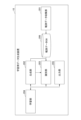
- a CGAN as shown in FIG. 1 is learned using datasets X and Y.
- the CGAN is composed of a generator G ( ⁇ ; ⁇ G ) and a discriminator D ( ⁇ ; ⁇ D ) realized by a neural network.
- ⁇ G and ⁇ D are parameters.
- the generator G receives as input an m+l-dimensional vector that is a combination of a randomly generated m-dimensional vector and an l-dimensional vector, and generates a k-dimensional vector.
- the generator G ( ⁇ ; ⁇ G ) when inputting an m+l-dimensional vector that is a combination of a randomly generated m-dimensional vector and an l-dimensional vector y i in which only the j-th element is 1, the output is The parameter ⁇ G is learned so that the m-dimensional vector ⁇ x i is similar to x i . That is, the generator G ( ⁇ ; ⁇ G ) learns the parameter ⁇ G so that it can generate data similar to abnormal data actually collected by the ICT system. In other words, this means that the parameter ⁇ G is learned so as to cause an erroneous determination in the determination of the discriminator D ( ⁇ ; ⁇ D ), which will be described later.
- the discriminator D ( ⁇ ; ⁇ D ) receives the k-dimensional vector as input and outputs a scalar value of 0 or 1. Either the abnormal data x i actually collected from the ICT system or the data ⁇ x i generated by the generator G is input to the discriminator D ( ⁇ ; ⁇ D ), and either x i or ⁇ x i It is determined whether the input has been made. Then, the discriminator D ( ⁇ ; ⁇ D ) outputs 1 when it determines that x i has been input, and outputs 1 when it determines that ⁇ x i has been input. In the learning of the classifier D ( ⁇ ; ⁇ D ), the parameter ⁇ D is learned so that the discrimination performance becomes high.
- the generator G ( ⁇ ; ⁇ G ) is able to recognize abnormal data actually collected by the ICT system. It will be possible to generate more accurate data.
- the loss function L of the CGAN composed of the generator G ( ⁇ ; ⁇ G ) and the discriminator D ( ⁇ ; ⁇ D ) described above is shown in the following equation (1).
- E( ⁇ ) is an expected value
- z is a randomly generated m-dimensional vector.
- z is also called noise.
- x ⁇ X, and y ⁇ Y is abnormal location data when the abnormality occurs with respect to the abnormal data x ⁇ X.
- cot (z, y) is an operation that combines z and y to create an m+l dimensional vector.
- the parameters ⁇ G and ⁇ D are learned so as to minimize the loss function shown in equation (1) above. Specifically, the parameters ⁇ G and ⁇ D are learned using the following equation (2).
- learning data is generated by a generator G ( ⁇ ; ⁇ G ) having a parameter ⁇ G after learning.
- an m+l-dimensional vector that is a combination of a randomly generated m-dimensional vector z and a randomly generated l-dimensional vector y is input to the trained generator G ( ⁇ ; ⁇ G ).
- a k-dimensional vector ⁇ x is obtained as the output.
- learning data ( ⁇ x, y) for constructing a model for example, a causal model modeled by a Bayesian network or the like, or a machine learning model such as SVM
- the l-dimensional vector y is, for example, a one-hot vector in which only the j-th vector is randomly set to 1 using a uniform distribution or the like.
- FIG. 2 shows an example of the hardware configuration of the learning data generation device 10 according to this embodiment.
- the learning data generation device 10 includes an input device 101, a display device 102, an external I/F 103, a communication I/F 104, and a RAM (Random Access Memory) 105. , a ROM (Read Only Memory) 106, an auxiliary storage device 107, and a processor 108.
- Each of these pieces of hardware is communicably connected via a bus 109.
- the input device 101 is, for example, a keyboard, a mouse, a touch panel, a physical button, or the like.
- the display device 102 is, for example, a display, a display panel, or the like. Note that the learning data generation device 10 may not include at least one of the input device 101 and the display device 102, for example.
- the external I/F 103 is an interface with an external device such as the recording medium 103a.
- the learning data generation device 10 can read and write data on the recording medium 103a via the external I/F 103.
- Examples of the recording medium 103a include a flexible disk, a CD (Compact Disc), a DVD (Digital Versatile Disk), an SD memory card (Secure Digital memory card), and a USB (Universal Serial Bus) memory card.
- the communication I/F 104 is an interface for connecting the learning data generation device 10 to a communication network.
- the RAM 105 is a volatile semiconductor memory (storage device) that temporarily holds programs and data.
- the ROM 106 is a nonvolatile semiconductor memory (storage device) that can retain programs and data even when the power is turned off.
- the auxiliary storage device 107 is, for example, a storage device such as an HDD (Hard Disk Drive) or an SSD (Solid State Drive).
- the processor 108 is, for example, an arithmetic device such as a CPU or a GPU (Graphics Processing Unit).
- the learning data generation device 10 has the hardware configuration shown in FIG. 2, thereby being able to implement various processes described below.
- the hardware configuration shown in FIG. 2 is an example, and the hardware configuration of the learning data generation device 10 is not limited to this.
- the learning data generation device 10 may include multiple auxiliary storage devices 107 and multiple processors 108, or may include various hardware other than the illustrated hardware.
- FIG. 3 shows an example of the functional configuration of the learning data generation device 10 according to this embodiment.
- the learning data generation device 10 includes an observation data collection section 201, a generation section 202, an identification section 203, a learning section 204, and an output section 205. Each of these units is realized, for example, by one or more programs installed in the learning data generation device 10 causing the processor 108 or the like to execute the process.
- the learning data generation device 10 includes an observation data DB 206.
- the observation data DB 206 is realized by, for example, the auxiliary storage device 107.
- the observation data DB 206 may be realized by, for example, a storage device or the like that is connected to the learning data generation device 10 via a communication network.
- the observation data collection unit 201 collects abnormality data x of the ICT system and abnormal location data y when the abnormality occurs. These abnormal data x and abnormal location data y are stored in the observation data DB 206. As a result, the observation data DB 206 stores a data set X made up of abnormal data x and a data set Y made up of abnormal location data y.
- the generation unit 202 is realized by a generator G ( ⁇ ; ⁇ G ), and receives an m+l-dimensional vector as an input and outputs a k-dimensional vector.
- the discriminator 203 is realized by a discriminator D ( ⁇ ; ⁇ D ), receives the k-dimensional vector as input, and outputs a scalar value that takes either 0 or 1.
- the learning unit 204 learns the parameters ⁇ G and ⁇ D using the above equation (2).
- the output unit 205 outputs various information to a predetermined output destination. For example, the output unit 205 outputs the k-dimensional vector output by the generation unit 202 and the scalar value output by the identification unit 203 to the display device 102 or to the auxiliary storage device 107. Further, for example, the output unit 205 outputs a set ( ⁇ x, y) is output to the auxiliary storage device 107 or the like as learning data.
- the learning data generation device 10 has a "learning phase” which is a phase in which the parameters ⁇ G and ⁇ D are learned, and a phase in which learning data is generated by the trained generator G ( ⁇ ; ⁇ G ). There is a "data generation phase”. The learning phase is executed before the data generation phase. Furthermore, in the case of generating a plurality of learning data, steps S102 to S103 of the data generation phase may be repeatedly executed. In the following, it is assumed that the observation data DB 206 stores data sets X and Y.
- Step S101 The learning unit 204 uses the data sets X and Y to learn the parameters ⁇ G and ⁇ D using the above equation (2).
- Step S102 The generation unit 202 randomly generates an m-dimensional vector z, randomly generates an l-dimensional vector y (however, y is a one-hot vector in which only the j-th element is 1), and then The m+l-dimensional vector combining and y is input to a trained generator G ( ⁇ ; ⁇ G ), and a k-dimensional vector ⁇ x is generated as its output. As a result, learning data ( ⁇ x, y) is obtained.
- Step S103 The output unit 205 outputs the learning data ( ⁇ x, y) obtained in step S102 above to a predetermined output destination (for example, the auxiliary storage device 107, etc.).
- a predetermined output destination for example, the auxiliary storage device 107, etc.
- the learning data generation device 10 learns a CGAN using observation data (x, y) during an abnormality of the ICT system, and uses the generator G included in the CGAN to generate an ICT It is possible to generate learning data ( ⁇ x, y) for building a model that estimates abnormalities in the system. This makes it possible to obtain a sufficient amount of learning data necessary for model construction.
- the generator G generates abnormal data ⁇ x by inputting a vector that is a combination of a randomly generated vector z and a randomly generated one-hot vector y. Therefore, for example, it is possible to generate abnormal data that is difficult to obtain using chaos engineering. Therefore, by using the learning data generated by the learning data generating device 10 according to the present embodiment, it is possible to construct a model that can estimate abnormal locations with high accuracy.
Landscapes
- Engineering & Computer Science (AREA)
- Physics & Mathematics (AREA)
- Theoretical Computer Science (AREA)
- General Physics & Mathematics (AREA)
- Software Systems (AREA)
- Computing Systems (AREA)
- Evolutionary Computation (AREA)
- Artificial Intelligence (AREA)
- General Engineering & Computer Science (AREA)
- Mathematical Physics (AREA)
- Data Mining & Analysis (AREA)
- Life Sciences & Earth Sciences (AREA)
- Molecular Biology (AREA)
- General Health & Medical Sciences (AREA)
- Computational Linguistics (AREA)
- Biophysics (AREA)
- Biomedical Technology (AREA)
- Health & Medical Sciences (AREA)
- Probability & Statistics with Applications (AREA)
- Algebra (AREA)
- Pure & Applied Mathematics (AREA)
- Mathematical Optimization (AREA)
- Mathematical Analysis (AREA)
- Computational Mathematics (AREA)
- Computer Vision & Pattern Recognition (AREA)
- Medical Informatics (AREA)
- Testing And Monitoring For Control Systems (AREA)
Priority Applications (3)
| Application Number | Priority Date | Filing Date | Title |
|---|---|---|---|
| PCT/JP2022/015591 WO2023188017A1 (ja) | 2022-03-29 | 2022-03-29 | 学習用データ生成装置、学習用データ生成方法及びプログラム |
| US18/840,569 US20250165799A1 (en) | 2022-03-29 | 2022-03-29 | Training data generation apparatus, training data generation method and program |
| JP2024510813A JPWO2023188017A1 (https=) | 2022-03-29 | 2022-03-29 |
Applications Claiming Priority (1)
| Application Number | Priority Date | Filing Date | Title |
|---|---|---|---|
| PCT/JP2022/015591 WO2023188017A1 (ja) | 2022-03-29 | 2022-03-29 | 学習用データ生成装置、学習用データ生成方法及びプログラム |
Publications (1)
| Publication Number | Publication Date |
|---|---|
| WO2023188017A1 true WO2023188017A1 (ja) | 2023-10-05 |
Family
ID=88200134
Family Applications (1)
| Application Number | Title | Priority Date | Filing Date |
|---|---|---|---|
| PCT/JP2022/015591 Ceased WO2023188017A1 (ja) | 2022-03-29 | 2022-03-29 | 学習用データ生成装置、学習用データ生成方法及びプログラム |
Country Status (3)
| Country | Link |
|---|---|
| US (1) | US20250165799A1 (https=) |
| JP (1) | JPWO2023188017A1 (https=) |
| WO (1) | WO2023188017A1 (https=) |
Citations (3)
| Publication number | Priority date | Publication date | Assignee | Title |
|---|---|---|---|---|
| WO2021095101A1 (ja) * | 2019-11-11 | 2021-05-20 | 日本電信電話株式会社 | 学習装置、検知装置、学習方法、及び異常検知方法 |
| WO2021161405A1 (ja) * | 2020-02-12 | 2021-08-19 | 日本電信電話株式会社 | 異常データ生成装置、異常データ生成モデル学習装置、異常データ生成方法、異常データ生成モデル学習方法、プログラム |
| JP2022067639A (ja) * | 2020-10-20 | 2022-05-06 | インターナショナル・ビジネス・マシーンズ・コーポレーション | プロセッサを備えるシステム、コンピュータ実装方法、プログラム(合成システム障害生成) |
-
2022
- 2022-03-29 JP JP2024510813A patent/JPWO2023188017A1/ja active Pending
- 2022-03-29 WO PCT/JP2022/015591 patent/WO2023188017A1/ja not_active Ceased
- 2022-03-29 US US18/840,569 patent/US20250165799A1/en active Pending
Patent Citations (3)
| Publication number | Priority date | Publication date | Assignee | Title |
|---|---|---|---|---|
| WO2021095101A1 (ja) * | 2019-11-11 | 2021-05-20 | 日本電信電話株式会社 | 学習装置、検知装置、学習方法、及び異常検知方法 |
| WO2021161405A1 (ja) * | 2020-02-12 | 2021-08-19 | 日本電信電話株式会社 | 異常データ生成装置、異常データ生成モデル学習装置、異常データ生成方法、異常データ生成モデル学習方法、プログラム |
| JP2022067639A (ja) * | 2020-10-20 | 2022-05-06 | インターナショナル・ビジネス・マシーンズ・コーポレーション | プロセッサを備えるシステム、コンピュータ実装方法、プログラム(合成システム障害生成) |
Non-Patent Citations (1)
| Title |
|---|
| MITSUKI IKEUCHI, YOSHIFUMI KUZU, YOICHI MATSUO, KEISHIRO WATANABE: "B-7-32 A study of factor identification method based on failure data generation", IEICE 2020 GENERAL CONFERENCE PROCEEDINGS COMMUNICATION 2; 2020.03.17-20, IEICE, JP, 1 March 2020 (2020-03-01) - 20 March 2020 (2020-03-20), JP, pages 130, XP009549155 * |
Also Published As
| Publication number | Publication date |
|---|---|
| US20250165799A1 (en) | 2025-05-22 |
| JPWO2023188017A1 (https=) | 2023-10-05 |
Similar Documents
| Publication | Publication Date | Title |
|---|---|---|
| US11615343B2 (en) | Anomaly detection apparatus, anomaly detection method, and program | |
| Li et al. | Constraint-based causal structure learning with consistent separating sets | |
| US8181133B2 (en) | Combinational equivalence checking for threshold logic circuits | |
| JP7632613B2 (ja) | 異常原因推定装置、異常原因推定方法、及びプログラム | |
| JP6988304B2 (ja) | 運用管理システム、監視サーバ、方法およびプログラム | |
| CN111045939A (zh) | Weibull分布的故障检测开源软件可靠性建模方法 | |
| Khorasgani et al. | A methodology for monitoring smart buildings with incomplete models | |
| JP6835702B2 (ja) | 異常推定装置、異常推定方法及びプログラム | |
| JP7414135B2 (ja) | モデル構築装置、推定装置、モデル構築方法、推定方法及びプログラム | |
| WO2018142694A1 (ja) | 特徴量生成装置、特徴量生成方法及びプログラム | |
| KR102132077B1 (ko) | 설비 데이터의 이상 정도 평가 방법 | |
| WO2023188017A1 (ja) | 学習用データ生成装置、学習用データ生成方法及びプログラム | |
| JP6787873B2 (ja) | 異常種別判定装置、異常種別判定方法及びプログラム | |
| JP7147495B2 (ja) | 復旧支援装置、復旧支援方法及びプログラム | |
| JP7517482B2 (ja) | 学習装置、異常検知装置、学習方法、異常検知方法、及びプログラム | |
| WO2022130556A1 (ja) | 障害復旧支援装置、障害復旧支援方法及びプログラム | |
| EP4358070B1 (en) | Cumulative calculation device, cumulative calculation method, and program | |
| JP7761155B2 (ja) | 因果モデル構築装置、因果モデル構築方法、及びプログラム | |
| Wang et al. | SaaS software performance issue identification using HMRF‐MAP framework | |
| JP6831307B2 (ja) | 解算出装置、解算出方法及び解算出プログラム | |
| US11973658B2 (en) | Model construction apparatus, estimation apparatus, model construction method, estimation method and program | |
| JP7571898B2 (ja) | 外れ値検知装置、外れ値検知方法、及びプログラム | |
| JP7747205B2 (ja) | データ生成装置、データ生成方法、プログラム、および機械学習システム | |
| JP7647916B2 (ja) | 学習装置、学習方法、及びプログラム | |
| Gross et al. | Round-robin staggered-imputation (RRSI) algorithm for enhanced real-time prognostics for dense-sensor IoT applications |
Legal Events
| Date | Code | Title | Description |
|---|---|---|---|
| 121 | Ep: the epo has been informed by wipo that ep was designated in this application |
Ref document number: 22935165 Country of ref document: EP Kind code of ref document: A1 |
|
| WWE | Wipo information: entry into national phase |
Ref document number: 2024510813 Country of ref document: JP |
|
| WWE | Wipo information: entry into national phase |
Ref document number: 18840569 Country of ref document: US |
|
| NENP | Non-entry into the national phase |
Ref country code: DE |
|
| 122 | Ep: pct application non-entry in european phase |
Ref document number: 22935165 Country of ref document: EP Kind code of ref document: A1 |
|
| WWP | Wipo information: published in national office |
Ref document number: 18840569 Country of ref document: US |