WO2023176899A1 - 感光性樹脂組成物、顔料分散液、硬化物、ブラックマトリックス及び画像表示装置 - Google Patents
感光性樹脂組成物、顔料分散液、硬化物、ブラックマトリックス及び画像表示装置 Download PDFInfo
- Publication number
- WO2023176899A1 WO2023176899A1 PCT/JP2023/010154 JP2023010154W WO2023176899A1 WO 2023176899 A1 WO2023176899 A1 WO 2023176899A1 JP 2023010154 W JP2023010154 W JP 2023010154W WO 2023176899 A1 WO2023176899 A1 WO 2023176899A1
- Authority
- WO
- WIPO (PCT)
- Prior art keywords
- group
- pigment
- less
- ring
- resin composition
- Prior art date
- Legal status (The legal status is an assumption and is not a legal conclusion. Google has not performed a legal analysis and makes no representation as to the accuracy of the status listed.)
- Ceased
Links
Images
Classifications
-
- G—PHYSICS
- G03—PHOTOGRAPHY; CINEMATOGRAPHY; ANALOGOUS TECHNIQUES USING WAVES OTHER THAN OPTICAL WAVES; ELECTROGRAPHY; HOLOGRAPHY
- G03F—PHOTOMECHANICAL PRODUCTION OF TEXTURED OR PATTERNED SURFACES, e.g. FOR PRINTING, FOR PROCESSING OF SEMICONDUCTOR DEVICES; MATERIALS THEREFOR; ORIGINALS THEREFOR; APPARATUS SPECIALLY ADAPTED THEREFOR
- G03F7/00—Photomechanical, e.g. photolithographic, production of textured or patterned surfaces, e.g. printing surfaces; Materials therefor, e.g. comprising photoresists; Apparatus specially adapted therefor
- G03F7/004—Photosensitive materials
-
- G—PHYSICS
- G02—OPTICS
- G02B—OPTICAL ELEMENTS, SYSTEMS OR APPARATUS
- G02B5/00—Optical elements other than lenses
- G02B5/20—Filters
-
- G—PHYSICS
- G02—OPTICS
- G02F—OPTICAL DEVICES OR ARRANGEMENTS FOR THE CONTROL OF LIGHT BY MODIFICATION OF THE OPTICAL PROPERTIES OF THE MEDIA OF THE ELEMENTS INVOLVED THEREIN; NON-LINEAR OPTICS; FREQUENCY-CHANGING OF LIGHT; OPTICAL LOGIC ELEMENTS; OPTICAL ANALOGUE/DIGITAL CONVERTERS
- G02F1/00—Devices or arrangements for the control of the intensity, colour, phase, polarisation or direction of light arriving from an independent light source, e.g. switching, gating or modulating; Non-linear optics
- G02F1/01—Devices or arrangements for the control of the intensity, colour, phase, polarisation or direction of light arriving from an independent light source, e.g. switching, gating or modulating; Non-linear optics for the control of the intensity, phase, polarisation or colour
- G02F1/13—Devices or arrangements for the control of the intensity, colour, phase, polarisation or direction of light arriving from an independent light source, e.g. switching, gating or modulating; Non-linear optics for the control of the intensity, phase, polarisation or colour based on liquid crystals, e.g. single liquid crystal display cells
- G02F1/133—Constructional arrangements; Operation of liquid crystal cells; Circuit arrangements
- G02F1/1333—Constructional arrangements; Manufacturing methods
- G02F1/1335—Structural association of cells with optical devices, e.g. polarisers or reflectors
-
- G—PHYSICS
- G02—OPTICS
- G02F—OPTICAL DEVICES OR ARRANGEMENTS FOR THE CONTROL OF LIGHT BY MODIFICATION OF THE OPTICAL PROPERTIES OF THE MEDIA OF THE ELEMENTS INVOLVED THEREIN; NON-LINEAR OPTICS; FREQUENCY-CHANGING OF LIGHT; OPTICAL LOGIC ELEMENTS; OPTICAL ANALOGUE/DIGITAL CONVERTERS
- G02F1/00—Devices or arrangements for the control of the intensity, colour, phase, polarisation or direction of light arriving from an independent light source, e.g. switching, gating or modulating; Non-linear optics
- G02F1/01—Devices or arrangements for the control of the intensity, colour, phase, polarisation or direction of light arriving from an independent light source, e.g. switching, gating or modulating; Non-linear optics for the control of the intensity, phase, polarisation or colour
- G02F1/13—Devices or arrangements for the control of the intensity, colour, phase, polarisation or direction of light arriving from an independent light source, e.g. switching, gating or modulating; Non-linear optics for the control of the intensity, phase, polarisation or colour based on liquid crystals, e.g. single liquid crystal display cells
- G02F1/133—Constructional arrangements; Operation of liquid crystal cells; Circuit arrangements
- G02F1/1333—Constructional arrangements; Manufacturing methods
- G02F1/1335—Structural association of cells with optical devices, e.g. polarisers or reflectors
- G02F1/133509—Filters, e.g. light shielding masks
- G02F1/133514—Colour filters
-
- G—PHYSICS
- G03—PHOTOGRAPHY; CINEMATOGRAPHY; ANALOGOUS TECHNIQUES USING WAVES OTHER THAN OPTICAL WAVES; ELECTROGRAPHY; HOLOGRAPHY
- G03F—PHOTOMECHANICAL PRODUCTION OF TEXTURED OR PATTERNED SURFACES, e.g. FOR PRINTING, FOR PROCESSING OF SEMICONDUCTOR DEVICES; MATERIALS THEREFOR; ORIGINALS THEREFOR; APPARATUS SPECIALLY ADAPTED THEREFOR
- G03F7/00—Photomechanical, e.g. photolithographic, production of textured or patterned surfaces, e.g. printing surfaces; Materials therefor, e.g. comprising photoresists; Apparatus specially adapted therefor
- G03F7/0005—Production of optical devices or components in so far as characterised by the lithographic processes or materials used therefor
- G03F7/0007—Filters, e.g. additive colour filters; Components for display devices
-
- G—PHYSICS
- G03—PHOTOGRAPHY; CINEMATOGRAPHY; ANALOGOUS TECHNIQUES USING WAVES OTHER THAN OPTICAL WAVES; ELECTROGRAPHY; HOLOGRAPHY
- G03F—PHOTOMECHANICAL PRODUCTION OF TEXTURED OR PATTERNED SURFACES, e.g. FOR PRINTING, FOR PROCESSING OF SEMICONDUCTOR DEVICES; MATERIALS THEREFOR; ORIGINALS THEREFOR; APPARATUS SPECIALLY ADAPTED THEREFOR
- G03F7/00—Photomechanical, e.g. photolithographic, production of textured or patterned surfaces, e.g. printing surfaces; Materials therefor, e.g. comprising photoresists; Apparatus specially adapted therefor
- G03F7/004—Photosensitive materials
- G03F7/027—Non-macromolecular photopolymerisable compounds having carbon-to-carbon double bonds, e.g. ethylenic compounds
-
- G—PHYSICS
- G03—PHOTOGRAPHY; CINEMATOGRAPHY; ANALOGOUS TECHNIQUES USING WAVES OTHER THAN OPTICAL WAVES; ELECTROGRAPHY; HOLOGRAPHY
- G03F—PHOTOMECHANICAL PRODUCTION OF TEXTURED OR PATTERNED SURFACES, e.g. FOR PRINTING, FOR PROCESSING OF SEMICONDUCTOR DEVICES; MATERIALS THEREFOR; ORIGINALS THEREFOR; APPARATUS SPECIALLY ADAPTED THEREFOR
- G03F7/00—Photomechanical, e.g. photolithographic, production of textured or patterned surfaces, e.g. printing surfaces; Materials therefor, e.g. comprising photoresists; Apparatus specially adapted therefor
- G03F7/004—Photosensitive materials
- G03F7/027—Non-macromolecular photopolymerisable compounds having carbon-to-carbon double bonds, e.g. ethylenic compounds
- G03F7/028—Non-macromolecular photopolymerisable compounds having carbon-to-carbon double bonds, e.g. ethylenic compounds with photosensitivity-increasing substances, e.g. photoinitiators
-
- G—PHYSICS
- G03—PHOTOGRAPHY; CINEMATOGRAPHY; ANALOGOUS TECHNIQUES USING WAVES OTHER THAN OPTICAL WAVES; ELECTROGRAPHY; HOLOGRAPHY
- G03F—PHOTOMECHANICAL PRODUCTION OF TEXTURED OR PATTERNED SURFACES, e.g. FOR PRINTING, FOR PROCESSING OF SEMICONDUCTOR DEVICES; MATERIALS THEREFOR; ORIGINALS THEREFOR; APPARATUS SPECIALLY ADAPTED THEREFOR
- G03F7/00—Photomechanical, e.g. photolithographic, production of textured or patterned surfaces, e.g. printing surfaces; Materials therefor, e.g. comprising photoresists; Apparatus specially adapted therefor
- G03F7/004—Photosensitive materials
- G03F7/09—Photosensitive materials characterised by structural details, e.g. supports, auxiliary layers
- G03F7/105—Photosensitive materials characterised by structural details, e.g. supports, auxiliary layers having substances, e.g. indicators, for forming visible images
Definitions
- the present invention relates to a photosensitive resin composition, a pigment dispersion, a cured product, a black matrix, and an image display device.
- Color filters usually form a black matrix on the surface of a transparent substrate such as glass or plastic, and then sequentially form pixels of three or more different colors, such as red, green, and blue, in a grid pattern or stripes. It is formed in a pattern such as a shape or a mosaic shape.
- the pattern size varies depending on the use of the color filter and each color, but is usually about 5 to 700 ⁇ m.
- a photolithography method using a photosensitive resin composition is currently known as a typical manufacturing method for color filters.
- a photosensitive resin composition containing an alkali-soluble resin is applied onto a transparent substrate, dried to form a photosensitive resin film, the photosensitive resin film is exposed in a predetermined pattern, and then developed with an alkali. After developing with a liquid, a pattern is formed by curing by high-temperature treatment at 200° C. or higher.
- the photosensitive resin composition contains a coloring material when used for forming pixels of color filters, black matrices, etc.
- the coloring material pigments and dyes such as carbon black are used (Patent Document 1).
- the application of the photosensitive resin composition may be repeated using the same application device.
- foreign matter including aggregates of the pigment may be generated on the nozzle surface of the coating device during repeated coating. Such foreign matter may peel off from the nozzle and adhere to the photosensitive resin film or pattern, causing defects, and may adversely affect the linearity, fine line characteristics, etc. of the formed pattern.
- the present invention provides a photosensitive resin composition that has excellent linearity and fine line characteristics in the formed pattern and suppresses the generation of pigment-derived foreign substances, a cured product using the same, a black matrix, and an image display device, and a pigment-based photosensitive resin composition. It is an object of the present invention to provide a pigment dispersion liquid from which a photosensitive resin composition can be obtained in which the generation of foreign substances derived from pigments is suppressed.
- the present inventors found that the above problem could be solved by incorporating carbon black having a specific average primary particle size and dibutyl phthalate absorption amount into the pigment. That is, the gist of the present invention is as follows.
- a photosensitive resin composition containing (A) a pigment, (B) a dispersant, (D) an alkali-soluble resin, (E) a photopolymerizable compound, and (F) a photoinitiator,
- the pigment (A) contains carbon black (a1) having an average primary particle diameter of 15 nm or more and 28 nm or less, and a dibutyl phthalate absorption amount of 55 mL/100 g or more and 100 mL/100 g or less,
- the carbon black (a1) has a specific surface area of 105 m 2 /g or less according to the BET method, Photosensitivity, where Z derived from the following formula (1) is 15 or more, where X is the average primary particle diameter (nm) of the carbon black (a1) and Y is the dibutyl phthalate absorption amount (mL/100g).
- Resin composition. Y-1.6X Z...(1)
- the content ratio of the (A) pigment and the (B) dispersant on a mass basis (the (A) pigment/the (B) dispersant) in the photosensitive resin composition is 4 or more;
- the content ratio of the (A) pigment and the (C) dispersion aid on a mass basis (the (A) pigment/the (C) dispersion aid) in the photosensitive resin composition is 10 or more.
- the pigment (A) contains carbon black (a1) having an average primary particle diameter of 15 nm or more and 28 nm or less, and a dibutyl phthalate absorption amount of 55 mL/100 g or more and 100 mL/100 g or less,
- the carbon black (a1) has a specific surface area of 105 m 2 /g or less according to the BET method
- a pigment dispersion in which Z derived from the following formula (1) is 15 or more, where X is the average primary particle diameter (nm) of the carbon black (a1) and Y is the dibutyl phthalate absorption amount (mL/100g). liquid.
- the content ratio of the (A) pigment and the (B) dispersant on a mass basis (the (A) pigment/the (B) dispersant) in the pigment dispersion is 4 or more, [9 ] to [13].
- the content ratio of the (A) pigment and the (C) dispersion aid on a mass basis (the (A) pigment/the (C) dispersion aid) in the pigment dispersion is 10 or more; Pigment dispersion liquid of [15].
- An image display device comprising the cured product of [18].
- a photosensitive resin composition that has excellent linearity and fine line characteristics in the formed pattern and suppresses the generation of foreign matter derived from pigments, a cured product using the same, a black matrix, and an image display device, and A pigment dispersion can be provided that yields a photosensitive resin composition in which the generation of pigment-derived foreign substances is suppressed.
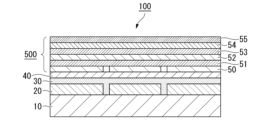
- 1 is a schematic cross-sectional view showing an example of an organic EL element in the present invention.
- 1 is a photograph showing the results of a peel test for the photosensitive resin compositions of Examples 1 to 5 and Comparative Examples 1 to 3.
- (meth)acrylic means “acrylic and/or methacryl", and the same applies to "(meth)acrylate” and "(meth)acryloyl".
- the "photosensitive resin composition” may be referred to as "resist”.
- total solid content means all components other than the organic solvent and water contained in the pigment dispersion or the photosensitive resin composition, and the components other than the organic solvent and water are liquid at room temperature. However, those components are not included in organic solvents and water, but are included in total solids.
- the "average primary particle diameter" of carbon black is determined by a method of directly measuring the size of primary particles from an electron micrograph. Specifically, carbon black is observed with an electron microscope, and the microscopic spherical parts constituting the primary aggregate are regarded as single particles (primary particles), and 10 or more of the microscopic spherical parts are The diameter is measured using a perfect circle approximation, and the average value is taken as the average primary particle diameter. Note that the same results can be obtained using either a transmission electron microscope (TEM) or a scanning electron microscope (SEM). In the present invention, the "dibutyl phthalate absorption amount" of carbon black is measured according to the standard of JIS K 6217-4.
- dibutyl phthalate will also be referred to as "DBP".
- DBP dibutyl phthalate
- the "specific surface area by BET method” of carbon black is measured according to the standard of JIS K 6217-7. The details are as described in the Examples described later.
- weight average molecular weight refers to the weight average molecular weight (Mw) in terms of polystyrene measured by GPC (gel permeation chromatography).
- the "amine value” refers to the amine value in terms of effective solid content, unless otherwise specified, and is a value expressed by the amount of base and the mass of KOH equivalent to 1 g of solid content of the dispersant. Note that the measurement method will be described later.
- the photosensitive resin composition of the present invention contains (A) a pigment, (B) a dispersant, (D) an alkali-soluble resin, (E) a photopolymerizable compound, and (F) a photopolymerization initiator.
- the pigment contains carbon black (a1).
- the average primary particle diameter of carbon black (a1) is 28 nm or less, preferably 27 nm or less, more preferably 26 nm or less, and 15 nm or more, preferably 18 nm or more, and more preferably 20 nm or more.
- the average primary particle diameter is below the upper limit, the effect of suppressing the generation of pigment-derived foreign matter, the linearity of the formed pattern, and the fine line characteristics tend to improve.
- the average primary particle diameter is equal to or larger than the lower limit, the viscosity stability of the dispersion over time tends to be good.
- the above upper and lower limits can be arbitrarily combined.
- the thickness may be 15 nm or more and 28 nm or less, 18 nm or more and 28 nm or less, or 20 nm or more and 27 nm or less.
- the DBP absorption amount of carbon black (a1) is 55 mL/100 g or more, preferably 56 mL/100 g or more, more preferably 57 mL/100 g or more, and 100 mL/100 g or less, preferably 80 mL/100 g or less, 70 mL /100g or less is more preferable. If the DBP absorption amount is equal to or greater than the lower limit, the effect of suppressing the generation of pigment-derived foreign matter, the linearity of the formed pattern, and the fine line characteristics tend to improve. If the DBP absorption amount is below the above-mentioned upper limit, the light-shielding properties and curability of the coating film tend to be good. The above upper and lower limits can be arbitrarily combined.
- it may be 55 mL/100 g or more and 100 mL/100 g or less, 56 mL/100 g or more and 80 mL/100 g or less, and 57 mL/100 g or more and 70 mL/100 g or less.
- Z derived from the following formula (1) is 15 or more, and 16 or more. is preferable, and 18 or more is more preferable.
- the specific surface area of carbon black (a1) by the BET method is 105 m 2 /g or less, more preferably 100 m 2 /g or less, even more preferably 95 m 2 /g or less, and preferably 50 m 2 /g or more, 60 m 2 /g or less. 2 /g or more is more preferable, and 70 m 2 /g or more is even more preferable. If the specific surface area is below the upper limit, the amount of dispersant required will be appropriate, and the balance between dispersion stability, light-shielding properties of the coating film, curability, and pattern linearity will tend to be good.
- the specific surface area is equal to or larger than the lower limit, the generation of foreign substances derived from carbon black can be suppressed, and the formed pattern tends to have good linearity and fine line characteristics.
- the above upper and lower limits can be arbitrarily combined. For example, it is preferably 50 to 105 m 2 /g, more preferably 60 to 100 m 2 /g, and even more preferably 70 to 95 m 2 /g.
- the volume resistivity of carbon black (a1) is preferably 10 ⁇ cm or less, more preferably 5 ⁇ cm or less, and even more preferably less than 3 ⁇ cm.
- the lower limit is not particularly limited, but is 1 ⁇ 10 ⁇ 20 ⁇ cm or more. If the volume resistivity is less than or equal to the above upper limit, it tends to be less susceptible to the influence of electric fields from transistors in the display.
- the above upper and lower limits can be arbitrarily combined. For example, it is preferably 1 ⁇ 10 ⁇ 20 to 10 ⁇ cm, more preferably 1 ⁇ 10 ⁇ 20 to 5 ⁇ cm, and even more preferably 1 ⁇ 10 ⁇ 20 to 3 ⁇ cm.
- Examples of the carbon black (a1) include the following carbon blacks.
- the carbon black (a1) may be a mixture of multiple types of carbon black.
- the average primary particle diameter of the carbon black (a1) as a whole is 15 nm or more and 28 nm or less
- the DBP absorption amount is 55 mL/100 g or more and 100 mL/100 g or less
- the specific surface area by BET method is 105 m 2 /g or less.
- the pigment (A) may further contain pigments other than carbon black (a1), if necessary.
- pigments for example, pigments of various colors used as coloring materials for coloring photosensitive resin compositions and the like can be used. Examples of such pigments include blue pigments, green pigments, red pigments, yellow pigments, purple pigments, orange pigments, brown pigments, and black pigments (excluding carbon black (a1)). These pigments may be organic or inorganic pigments.
- the structure of the organic pigment is not particularly limited, but examples include azo, phthalocyanine, quinacridone, benzimidazolone, isoindolinone, dioxazine, indanthrene, and perylene.
- red pigments include C.I. I. Pigment Red 1, 2, 3, 4, 5, 6, 7, 8, 9, 12, 14, 15, 16, 17, 21, 22, 23, 31, 32, 37, 38, 41, 47, 48, 48:1, 48:2, 48:3, 48:4, 49, 49:1, 49:2, 50:1, 52:1, 52:2, 53, 53:1, 53:2, 53: 3, 57, 57:1, 57:2, 58:4, 60, 63, 63:1, 63:2, 64, 64:1, 68, 69, 81, 81:1, 81:2, 81: 3, 81:4, 83, 88, 90:1, 101, 101:1, 104, 108, 108:1, 109, 112, 113, 114, 122, 123, 144, 146, 147, 149, 151, 166, 168, 169, 170, 172, 173,
- blue pigments examples include C.I. I. Pigment Blue 1, 1:2, 9, 14, 15, 15:1, 15:2, 15:3, 15:4, 15:6, 16, 17, 19, 25, 27, 28, 29, 33, 35, 36, 56, 56:1, 60, 61, 61:1, 62, 63, 66, 67, 68, 71, 72, 73, 74, 75, 76, 78, 79.
- C. I. Pigment Blue 15, 15:1, 15:2, 15:3, 15:4, 15:6, 60 more preferably C.I. I. Pigment Blue 15:6, 60.
- green pigments examples include C.I. I. Pigment Green 1, 2, 4, 7, 8, 10, 13, 14, 15, 17, 18, 19, 26, 36, 45, 48, 50, 51, 54, 55, 58.
- C. I. Pigment Green 7, 36, and 58 are mentioned.
- yellow pigments examples include C.I. I. Pigment Yellow 1, 1:1, 2, 3, 4, 5, 6, 9, 10, 12, 13, 14, 16, 17, 24, 31, 32, 34, 35, 35: 1, 36, 36: 1, 37, 37:1, 40, 41, 42, 43, 48, 53, 55, 61, 62, 62: 1, 63, 65, 73, 74, 75, 81, 83, 87, 93, 94, 95, 97, 100, 101, 104, 105, 108, 109, 110, 111, 116, 117, 119, 120, 126, 127, 127:1, 128, 129, 133, 134, 136, 138, 139, 142, 147, 148, 150, 151, 153, 154, 155, 157, 158, 159, 160, 161, 162, 163, 164, 165, 166, 167, 168, 169, 170, 172, 173, 174, 175, 176, 180, 181, 182, 183, 184
- orange pigments examples include C.I. I. Pigment Orange 1, 2, 5, 13, 16, 17, 19, 20, 21, 22, 23, 24, 34, 36, 38, 39, 43, 46, 48, 49, 61, 62, 64, 65, 67, 68, 69, 70, 71, 72, 73, 74, 75, 77, 78, 79.
- C. I. Pigment Orange 38, 64, and 71 Preferably C. I. Pigment Orange 38, 64, and 71.
- C.I. I. Pigment Violet 1 1:1, 2, 2:2, 3, 3:1, 3:3, 5, 5:1, 14, 15, 16, 19, 23, 25, 27, 29, 31, 32, 37, 39, 42, 44, 47, 49, and 50.
- C. I. Pigment Violet 19, 23, 29, more preferably C.I. I. Pigment Violet 23 and 29 are mentioned.
- the black pigment a pigment that exhibits a black color by mixing multiple colored pigments (for example, three colors of red, green, and blue) may be used, or a pigment that exhibits a black color may be used alone. May be used together.
- Pigments that can be mixed to prepare black pigments include, for example, Victoria Pure Blue (42595), Auramine O (41000), Cathylone Brilliant Flavin (Basic 13), Rhodamine 6GCP (45160), Rhodamine B (45170). , Safranin OK70:100 (50240), Erioglaucine X (42080), No.
- black pigments examples include lamp black, bone black, graphite, iron oxide black pigments (iron black, etc.), aniline black, cyanine black, titanium black, perylene black, and lactam black.
- pigments for example, barium sulfate, lead sulfate, titanium oxide, yellow lead, red iron oxide, and chromium oxide can also be used.
- pigments can also be used in combination.
- a green pigment and a yellow pigment can be used together, or a blue pigment and a violet pigment can be used together.
- the content ratio of the pigment (A) to the total solid content of the photosensitive resin composition of the present invention is preferably 30% by mass or more, more preferably 35% by mass or more, even more preferably 40% by mass or more, and 75% by mass.
- the content is preferably at most 70% by mass, more preferably at most 65% by mass. If the content ratio of the pigment (A) is at least the above-mentioned lower limit, the resulting cured product tends to have better light blocking properties, and when it is below the above-mentioned upper limit, the cured product tends to have better formability.
- the above upper and lower limits can be arbitrarily combined. For example, it may be 30-75% by weight, it may be 35-70% by weight, it may be 40-65% by weight.
- the content ratio of carbon black (a1) to the total mass of the pigment (A) is preferably 90% by mass or more, more preferably 95% by mass or more, even more preferably 99% by mass or more, and may be 100% by mass.
- the dispersant finely disperses the pigment (A) and stabilizes the dispersion state.
- a polymer dispersant having a functional group is preferable, and from the viewpoint of dispersion stability, a carboxy group; a phosphoric acid group; a sulfonic acid group; or a base thereof; primary, secondary or tertiary Polymer dispersants having functional groups such as a quaternary amino group; a quaternary ammonium base; a group derived from a nitrogen-containing heterocycle such as pyridine, pyrimidine, and pyrazine are preferred.
- polymeric dispersants having basic functional groups such as primary, secondary or tertiary amino groups; quaternary ammonium bases; groups derived from nitrogen-containing heterocycles such as pyridine, pyrimidine and pyrazine are particularly preferred.
- basic functional groups such as primary, secondary or tertiary amino groups; quaternary ammonium bases; groups derived from nitrogen-containing heterocycles such as pyridine, pyrimidine and pyrazine are particularly preferred.
- polymeric dispersants include urethane dispersants, acrylic dispersants, polyethyleneimine dispersants, polyallylamine dispersants, dispersants made of monomers and macromonomers having amino groups, and polyoxyethylene alkyl ether dispersants.
- examples include polyoxyethylene diester dispersants, polyether phosphate dispersants, polyester phosphate dispersants, sorbitan aliphatic ester dispersants, and aliphatic modified polyester dispersants.
- dispersants include, for example, the trade names EFKA (registered trademark, manufactured by EFKA), DISPERBYK (registered trademark, manufactured by BYK Chemie Co., Ltd.), DISPARBYK (registered trademark, manufactured by Kusumoto Kasei Co., Ltd.), and SOLSPERSE (registered trademark, manufactured by Kusumoto Kasei Co., Ltd.).
- EFKA registered trademark, manufactured by EFKA
- DISPERBYK registered trademark, manufactured by BYK Chemie Co., Ltd.
- DISPARBYK registered trademark, manufactured by Kusumoto Kasei Co., Ltd.
- SOLSPERSE registered trademark, manufactured by Kusumoto Kasei Co., Ltd.
- the dispersant contains a urethane polymer dispersant and/or an acrylic polymer dispersant having a basic functional group. More preferable in terms of gender. Further, from the viewpoint of dispersibility and storage stability, a polymer dispersant having a basic functional group and a polyester and/or polyether bond is preferable.
- the weight average molecular weight (Mw) of the polymer dispersant is preferably 700 or more, more preferably 1,000 or more, and preferably 100,000 or less, more preferably 50,000 or less, and even more preferably 30,000 or less.
- Mw weight average molecular weight
- the above upper and lower limits can be arbitrarily combined. For example, it may be between 700 and 100,000, between 700 and 50,000, and between 1,000 and 30,000.
- urethane-based or acrylic-based polymer dispersants examples include DISPERBYK 160 to 167, 182 series (all urethane-based), DISPERBYK 2000, 2001 (all acrylic-based) (all manufactured by BYK Chemie).
- DISPERBYK167 and DISPERBYK182 are particularly preferable among the urethane-based polymer dispersants having the above-mentioned basic functional groups and polyester and/or polyether bonds and having a weight average molecular weight of 30,000 or less.
- urethane-based polymer dispersants include polyisocyanate compounds, compounds with a number average molecular weight of 300 to 10,000 having one or two hydroxyl groups in the molecule, and active hydrogen and tertiary amino groups in the same molecule.
- examples include dispersion resins having a weight average molecular weight of 1,000 to 200,000, which are obtained by reacting with a compound.
- polyisocyanate compound examples include aromatic diisocyanates such as paraphenylene diisocyanate, 2,4-tolylene diisocyanate, 2,6-tolylene diisocyanate, 4,4'-diphenylmethane diisocyanate, naphthalene-1,5-diisocyanate, and toridine diisocyanate; Aliphatic diisocyanates such as hexamethylene diisocyanate, lysine methyl ester diisocyanate, 2,4,4-trimethylhexamethylene diisocyanate, dimer acid diisocyanate, isophorone diisocyanate, 4,4'-methylenebis(cyclohexyl isocyanate), ⁇ , ⁇ '-diisocyanate, alicyclic diisocyanates such as dimethylcyclohexane, xylylene diisocyanate, aliphatic diisocyanates with aromatic rings such as ⁇ , ⁇ , ⁇ ', ⁇
- the method for producing isocyanate trimers involves converting the polyisocyanates into isocyanate groups using a suitable trimerization catalyst such as tertiary amines, phosphines, alkoxides, metal oxides, carboxylic acid salts, etc.
- a suitable trimerization catalyst such as tertiary amines, phosphines, alkoxides, metal oxides, carboxylic acid salts, etc.
- One method is to perform partial trimerization, stop the trimerization by adding a catalyst poison, and then remove unreacted polyisocyanate by solvent extraction and thin film distillation to obtain the desired isocyanurate group-containing polyisocyanate. .
- Compounds having a number average molecular weight of 300 to 10,000 and having one or two hydroxyl groups in the same molecule include polyether glycol, polyester glycol, polycarbonate glycol, polyolefin glycol, etc., and compounds in which one terminal hydroxyl group of these compounds has 1 to 1 carbon atoms. Examples include those alkoxylated with 25 alkyl groups and mixtures of two or more of these.
- polyether glycols include polyether diols, polyether ester diols, and mixtures of two or more of these.
- polyether diols include those obtained by copolymerizing alkylene oxides alone or by copolymerizing them, such as polyethylene glycol, polypropylene glycol, polyethylene-propylene glycol, polyoxytetramethylene glycol, polyoxyhexamethylene glycol, polyoxyoctamethylene glycol, and the like. Examples include mixtures of two or more of these.
- Polyether ester diols include those obtained by reacting ether group-containing diols or mixtures with other glycols with dicarboxylic acids or their anhydrides, or by reacting polyester glycols with alkylene oxides, such as poly(polyester diols). oxytetramethylene) adipate.
- the most preferred polyether glycols are polyethylene glycol, polypropylene glycol, polyoxytetramethylene glycol, or compounds in which one terminal hydroxyl group of these compounds is alkoxylated with an alkyl group having 1 to 25 carbon atoms.
- polyester glycols examples include dicarboxylic acids (succinic acid, glutaric acid, adipic acid, sebacic acid, fumaric acid, maleic acid, phthalic acid, etc.) or their anhydrides and glycols (ethylene glycol, diethylene glycol, triethylene glycol, propylene glycol, etc.).
- dicarboxylic acids succinic acid, glutaric acid, adipic acid, sebacic acid, fumaric acid, maleic acid, phthalic acid, etc.
- glycols ethylene glycol, diethylene glycol, triethylene glycol, propylene glycol, etc.
- Glycol dipropylene glycol, tripropylene glycol, 1,2-butanediol, 1,3-butanediol, 1,4-butanediol, 2,3-butanediol, 3-methyl-1,5-pentanediol, neo Pentyl glycol, 2-methyl-1,3-propanediol, 2-methyl-2-propyl-1,3-propanediol, 2-butyl-2-ethyl-1,3-propanediol, 1,5-pentanediol , 1,6-hexanediol, 2-methyl-2,4-pentanediol, 2,2,4-trimethyl-1,3-pentanediol, 2-ethyl-1,3-hexanediol, 2,5-dimethyl Aliphatic glycols such as -2,5-hexanediol, 1,8-octamethylene glyco
- polycarbonate glycols include poly(1,6-hexylene) carbonate and poly(3-methyl-1,5-pentylene) carbonate
- polyolefin glycols include polybutadiene glycol, hydrogenated polybutadiene glycol, and hydrogenated polyisoprene glycol. can be mentioned. These may be used alone or in combination of two or more.
- the number average molecular weight of the compound having one or two hydroxyl groups in the same molecule is preferably 300 to 10,000, more preferably 500 to 6,000, even more preferably 1,000 to 4,000.
- Active hydrogen that is, a hydrogen atom directly bonded to an oxygen atom, a nitrogen atom, or a sulfur atom, includes hydrogen atoms in functional groups such as hydroxyl groups, amino groups, and thiol groups, and among them, amino groups, especially primary The hydrogen atom of the amino group is preferred.
- the tertiary amino group is not particularly limited, but includes, for example, an amino group having an alkyl group having 1 to 4 carbon atoms, or a heterocyclic structure, such as an imidazole ring or a triazole ring.
- Examples of compounds having active hydrogen and a tertiary amino group in the same molecule include N,N-dimethyl-1,3-propanediamine, N,N-diethyl-1,3-propanediamine, and N,N-dipropyl.
- N,N-dibutyl-1,3-propanediamine N,N-dibutyl-1,3-propanediamine, N,N-dimethylethylenediamine, N,N-diethylethylenediamine, N,N-dipropylethylenediamine, N,N-dibutylethylenediamine, N,N-dimethyl-1,4-butanediamine, N,N-diethyl-1,4-butanediamine, N,N-dipropyl-1,4-butanediamine, N,N-dibutyl-1,4-butane
- Examples include diamines.
- examples of the nitrogen-containing heterocycle include a pyrazole ring, an imidazole ring, a triazole ring, a tetrazole ring, an indole ring, a carbazole ring, an indazole ring, a benzimidazole ring, and a benzotriazole ring.
- N-containing hetero 5-membered rings such as benzoxazole ring, benzothiazole ring, benzothiadiazole ring, etc.
- nitrogen-containing hetero 6-membered rings such as pyridine ring, pyridazine ring, pyrimidine ring, triazine ring, quinoline ring, acridine ring, isoquinoline ring, etc. are mentioned, with imidazole rings and triazole rings being preferred.
- Examples of compounds having an imidazole ring and an amino group include 1-(3-aminopropyl)imidazole, histidine, 2-aminoimidazole, and 1-(2-aminoethyl)imidazole.
- Examples of compounds having a triazole ring and an amino group include 3-amino-1,2,4-triazole, 5-(2-amino-5-chlorophenyl)-3-phenyl-1H-1,2,4-triazole , 4-amino-4H-1,2,4-triazole-3,5-diol, 3-amino-5-phenyl-1H-1,3,4-triazole, 5-amino-1,4-diphenyl-1 , 2,3-triazole, and 3-amino-1-benzyl-1H-2,4-triazole.
- N,N-dimethyl-1,3-propanediamine N,N-diethyl-1,3-propanediamine, 1-(3-aminopropyl)imidazole, and 3-amino-1,2,4-triazole. These may be used alone or in combination of two or more.
- the preferred blending ratio of raw materials when producing a urethane polymer dispersant is 10 to 200 parts of a compound with a number average molecular weight of 300 to 10,000 having one or two hydroxyl groups in the same molecule to 100 parts by mass of the polyisocyanate compound. parts by weight, preferably 20 to 190 parts by weight, more preferably 30 to 180 parts by weight, and 0.2 to 25 parts by weight, preferably 0.3 to 24 parts by weight of a compound having active hydrogen and a tertiary amino group in the same molecule. Part by mass.
- the urethane polymer dispersant is produced according to a known method for producing polyurethane resins.
- solvents used during production include ketones such as acetone, methyl ethyl ketone, methyl isobutyl ketone, cyclopentanone, cyclohexanone, and isophorone, esters such as ethyl acetate, butyl acetate, and cellosolve acetate, benzene, toluene, xylene, Hydrocarbons such as hexane, some alcohols such as diacetone alcohol, isopropanol, sec-butanol and tertiary-butanol, chlorides such as methylene chloride and chloroform, ethers such as tetrahydrofuran and diethyl ether, dimethylformamide, N- Aprotic polar solvents such as methylpyrrolidone and dimethylsulfoxide are used. These may be used alone or in combination of two
- a urethanization reaction catalyst may be used.
- this catalyst include tin-based catalysts such as dibutyltin dilaurate, dioctyltin dilaurate, dibutyltin dioctoate, stannath octoate, iron-based catalysts such as iron acetylacetonate and ferric chloride, triethylamine, triethylenediamine, etc. Examples include grade amines. These may be used alone or in combination of two or more.
- the amount of the compound having active hydrogen and a tertiary amino group introduced in the same molecule is preferably controlled within the range of 1 to 100 mgKOH/g based on the amine value after reaction. More preferably, it is in the range of 5 to 95 mgKOH/g.
- the amine value is equal to or higher than the lower limit value, the dispersibility tends to be improved. Furthermore, when the content is below the upper limit, developability tends to be improved.
- the amine value is expressed by the amount of base per 1 g of solid content excluding the solvent in the sample and the mass of KOH equivalent to the amount of base, and can be measured by the following method. Accurately weigh 0.5 to 1.5 g of the sample into a 100 mL beaker and dissolve it in 50 mL of acetic acid. Using an automatic titrator equipped with a pH electrode, this solution is subjected to neutralization titration with a 0.1 mol/L HClO 4 (perchloric acid) acetic acid solution. The inflection point of the titration pH curve is taken as the titration end point, and the amine value is determined by the following formula.
- Amine value [mgKOH/g] (561 ⁇ V)/(W ⁇ S) [However, W: weighed amount of dispersant sample [g], V: titration amount at titration end point [mL], S: solid content concentration of dispersant sample [mass %]. ]
- the weight average molecular weight (Mw) of the urethane polymer dispersant is preferably 1,000 to 200,000, more preferably 2,000 to 100,000, and even more preferably 3,000 to 50,000. In particular, it is preferably 30,000 or less. If Mw is equal to or greater than the lower limit, the dispersibility and dispersion stability tend to be good, and if it is equal to or less than the upper limit, the solubility tends to be good.
- the above upper and lower limits can be arbitrarily combined. For example, it may be 1000 to 30000, 2000 to 30000, or 3000 to 30000. In particular, when Mw is 30,000 or less, alkali developability tends to be good even when the pigment concentration is particularly high. Examples of such particularly preferred commercially available urethane dispersants include DISPERBYK 167 and 182 (manufactured by BYK Chemie).
- the amine value of the dispersant is preferably 1 mgKOH/g or more, more preferably 5 mgKOH/g or more, even more preferably 10 mgKOH/g or more, and preferably 100 mgKOH/g or less, more preferably 50 mgKOH/g. Below, it is more preferably less than 30 mgKOH/g.
- the amine value is at least the above lower limit, the stability of the dispersion over time tends to improve, and when it is at most the above upper limit, the development solubility tends to improve.
- the above upper and lower limits can be arbitrarily combined. For example, it may be 1-100 mgKOH/g, it may be 5-50 mgKOH/g, it may be 10-30 mgKOH/g.
- the content ratio ((A) pigment/(B) dispersant) of the (A) pigment and (B) dispersant on a mass basis in the photosensitive resin composition of the present invention is preferably 1 or more, and 3 or more. is more preferable, 4 or more is even more preferable, 50 or less is preferable, 30 or less is more preferable, and 15 or less is even more preferable. If the (A) pigment/(B) dispersant is equal to or higher than the lower limit value, the development solubility tends to be better, and if it is lower than the upper limit value, it is easy to ensure sufficient dispersibility of the (A) pigment. Tend.
- the above upper and lower limits can be arbitrarily combined. For example, it may be 1 to 50, 3 to 30, or 4 to 15.
- the content ratio of carbon black (a1) and (B) dispersant in the photosensitive resin composition of the present invention on a mass basis is preferably 1 or more, It is more preferably 3 or more, further preferably 4 or more, preferably 50 or less, more preferably 30 or less, and even more preferably 15 or less. If the carbon black (a1)/(B) dispersant is equal to or greater than the lower limit value, development solubility tends to be better, and if it is equal to or less than the upper limit value, sufficient dispersibility of carbon black (a1) is ensured. It tends to be easy.
- the above upper and lower limits can be arbitrarily combined. For example, it may be 1 to 50, 3 to 30, or 4 to 15.
- the photosensitive resin composition of the present invention preferably contains (C) a dispersion aid in order to improve the dispersion stability of (A) the pigment.
- the dispersion aid include pigment derivatives.
- pigment derivatives include azo, phthalocyanine, quinacridone, benzimidazolone, quinophthalone, isoindolinone, dioxazine, anthraquinone, indanthrene, perylene, perinone, and diketopyrrolopyrrole. and dioxazine derivatives, with phthalocyanine derivatives and quinophthalone derivatives being preferred.
- Substituents for the pigment derivative include sulfonic acid groups, sulfonamide groups and quaternary salts thereof, phthalimidomethyl groups, dialkylaminoalkyl groups, hydroxyl groups, carboxy groups, amide groups, etc. directly on the pigment skeleton, or alkyl groups, aryl groups, Examples include those bonded via a heterocyclic group, and preferably a sulfonic acid group. Moreover, a plurality of these substituents may be substituted on one pigment skeleton.
- pigment derivatives include sulfonic acid derivatives of phthalocyanine, sulfonic acid derivatives of quinophthalone, sulfonic acid derivatives of anthraquinone, sulfonic acid derivatives of quinacridone, sulfonic acid derivatives of diketopyrrolopyrrole, and sulfonic acid derivatives of dioxazine. These may be used alone or in combination of two or more.
- the content ratio ((A) pigment/(C) dispersion aid) of the (A) pigment and (C) dispersion aid on a mass basis agent) is preferably 10 or more, more preferably 30 or more, even more preferably 50 or more, and preferably 200 or less, more preferably 150 or less, and even more preferably 100 or less. If (A) pigment/(C) dispersion aid is equal to or higher than the above lower limit value, developability tends to be stable and substrate adhesion is more excellent, and if it is equal to or less than the above upper limit value, dispersion stability is better. Tend.
- the above upper and lower limits can be arbitrarily combined. For example, it may be 10-200, 30-150, or 50-100.
- the dispersion aid is preferably 10 or more, more preferably 30 or more, even more preferably 50 or more, and preferably 200 or less, more preferably 150 or less, and even more preferably 100 or less. If the carbon black (a1)/(C) dispersion aid is equal to or higher than the lower limit, the developability tends to be stable and the adhesion to the substrate tends to be better, and if it is lower than the upper limit, the dispersion stability is more stable. It tends to be better.
- the above upper and lower limits can be arbitrarily combined. For example, it may be 10-200, 30-150, or 50-100.
- the alkali-soluble resin is not particularly limited as long as it is a resin that exhibits alkali solubility, and includes, for example, a resin containing a carboxyl group or a hydroxyl group. More specifically, examples thereof include epoxy (meth)acrylate resins, acrylic resins, carboxyl group-containing epoxy resins, carboxyl group-containing urethane resins, novolak resins, and polyvinylphenol resins. especially, (D1) Epoxy (meth)acrylate resin (D2) Acrylic copolymer resin is preferably used from the viewpoint of excellent plate-making properties. These can be used alone or in combination of two or more.
- Epoxy (meth)acrylate resin is a combination of an epoxy compound (epoxy resin) and an ⁇ , ⁇ -unsaturated monocarboxylic acid and/or an ⁇ , ⁇ -unsaturated monocarboxylic acid ester having a carboxyl group in the ester moiety. It is a resin obtained by reacting the hydroxyl group generated by the reaction with a compound having two or more substituents capable of reacting with the hydroxyl group, such as a polybasic acid and/or its anhydride.
- a compound having two or more substituents that can react with a hydroxyl group is reacted, and then the polybasic acid and/or its anhydride is reacted.
- the resin obtained by is also included in (D1) epoxy (meth)acrylate resin.
- a resin obtained by reacting a compound having a functional group that can further react with the carboxy group of the resin obtained by the above reaction is also included in the epoxy (meth)acrylate resin (D1).
- Epoxy (meth)acrylate resin has a chemical structure that substantially does not have an epoxy group, and is not limited to “(meth)acrylate,” but it uses an epoxy compound (epoxy resin) as a raw material, and , "(meth)acrylate” is a typical example, so it is named this way according to common usage.
- epoxy (meth)acrylate resin epoxy (meth)acrylate resin (D1-1) and/or epoxy (meth)acrylate resin (D1-2) (hereinafter referred to as "carboxy group-containing epoxy (meth) (sometimes referred to as "acrylate resin”) is preferably used from the viewpoint of developability and reliability.
- epoxy (meth)acrylate resin one having an aromatic ring in the main chain can be more preferably used from the viewpoint of outgassing.
- the epoxy resin includes a raw material compound before forming a resin by thermosetting, and the epoxy resin can be appropriately selected from known epoxy resins. Further, as the epoxy resin, a compound obtained by reacting a phenolic compound and epihalohydrin can be used.
- the phenolic compound is preferably a compound having a divalent or more than divalent phenolic hydroxyl group, and may be a monomer or a polymer. Examples of the types of epoxy resins used as raw materials include cresol novolak epoxy resin, phenol novolac epoxy resin, bisphenol A epoxy resin, bisphenol F epoxy resin, trisphenolmethane epoxy resin, biphenyl novolac epoxy resin, and naphthalene.
- Novolak-type epoxy resins epoxy resins that are reaction products of polyaddition products of dicyclopentadiene and phenol or cresol, and epihalohydrin, adamantyl group-containing epoxy resins, and fluorene-type epoxy resins can be suitably used. Those having an aromatic ring can be more preferably used.
- epoxy resins examples include bisphenol A type epoxy resins (for example, "jER (registered trademark, the same applies hereinafter) 828", “jER1001", “jER1002", “jER1004", etc. manufactured by Mitsubishi Chemical Corporation), bisphenol A type epoxy resins, etc. Epoxy resins obtained by the reaction of alcoholic hydroxyl groups of epoxy resins with epichlorohydrin (for example, "NER-1302” manufactured by Nippon Kayaku Co., Ltd. (epoxy equivalent: 323, softening point 76°C)), bisphenol F type resins (for example, manufactured by Mitsubishi Chemical Co., Ltd.) "JER807", “EP-4001”, “EP-4002", “EP-4004", etc.
- bisphenol A type epoxy resins for example, "jER (registered trademark, the same applies hereinafter) 828", “jER1001", “jER1002", “jER1004", etc. manufactured by Mitsubishi Chemical Corporation
- Resins for example, "EXA-7200” manufactured by DIC, "NC-7300” manufactured by Nippon Kayaku Co., Ltd.
- epoxy resins represented by the following general formulas (B1) to (B4) can be suitably used.
- B1 epoxy resin represented by the following general formula (B1)
- B2 epoxy resin represented by the following general formula (B2)
- B3 epoxy resin represented by Osaka Organic Chemical Industry Co., Ltd.
- E-201 manufactured by Osaka Organic Chemical Industry Co., Ltd.
- An example of this is the "ESF-300" manufactured by Manufacturer.
- a is an average value and represents a number from 0 to 10
- R 111 each independently represents a hydrogen atom, a halogen atom, an alkyl group having 1 to 8 carbon atoms, or a cycloalkyl group having 3 to 10 carbon atoms. group, phenyl group, naphthyl group, or biphenyl group. Note that the plurality of R 111s present in one molecule may be the same or different.
- b1 and b2 are each independently an average value and represent a number from 0 to 10
- R 121 is each independently a hydrogen atom, a halogen atom, an alkyl group having 1 to 8 carbon atoms, or 3 carbon atoms. ⁇ 10 cycloalkyl, phenyl, naphthyl, or biphenyl groups. Note that the plurality of R 121s present in one molecule may be the same or different.
- X represents a linking group represented by the following general formula (B3-1) or (B3-2).
- the molecular structure contains one or more adamantane structures.
- c represents 2 or 3.
- R 131 to R 134 and R 135 to R 137 each independently represent an adamantyl group that may have a substituent, a hydrogen atom, or an adamantyl group that has a substituent. represents an optionally substituted alkyl group having 1 to 12 carbon atoms, or a phenyl group optionally having a substituent, and * represents a bond.
- R 141 and R 142 each independently represent an alkyl group having 1 to 4 carbon atoms or a halogen atom
- R 143 and R 144 are Each independently represents an alkylene group having 1 to 4 carbon atoms
- x and y each independently represents an integer of 0 or more.
- epoxy resin it is preferable to use an epoxy resin represented by any of formulas (B1) to (B4).
- Examples of the ⁇ , ⁇ -unsaturated monocarboxylic acid or the ⁇ , ⁇ -unsaturated monocarboxylic acid ester having a carboxy group include (meth)acrylic acid, crotonic acid, o-, m- or p-vinylbenzoic acid, Monocarboxylic acids such as ⁇ -position haloalkyl, alkoxyl, halogen, nitro, and cyano substituted products of (meth)acrylic acid; 2-(meth)acryloyloxyethylsuccinic acid, 2-(meth)acryloyloxyethyladipic acid, 2 -(meth)acryloyloxyethyl phthalic acid, 2-(meth)acryloyloxyethyl hexahydrophthalic acid, 2-(meth)acryloyloxyethylmaleic acid, 2-(meth)acryloyloxypropyl succinic acid, 2 -(meth)acryloyl
- a method for adding an ⁇ , ⁇ -unsaturated monocarboxylic acid or an ⁇ , ⁇ -unsaturated monocarboxylic acid ester having a carboxyl group to an epoxy resin a known method can be used. For example, it is possible to react an ⁇ , ⁇ -unsaturated monocarboxylic acid or an ⁇ , ⁇ -unsaturated monocarboxylic acid ester having a carboxyl group with an epoxy resin at a temperature of 50 to 150°C in the presence of an esterification catalyst. can.
- esterification catalyst for example, tertiary amines such as triethylamine, trimethylamine, benzyldimethylamine, and benzyldiethylamine, and quaternary ammonium salts such as tetramethylammonium chloride, tetraethylammonium chloride, and dodecyltrimethylammonium chloride can be used.
- tertiary amines such as triethylamine, trimethylamine, benzyldimethylamine, and benzyldiethylamine
- quaternary ammonium salts such as tetramethylammonium chloride, tetraethylammonium chloride, and dodecyltrimethylammonium chloride
- Each component of the epoxy resin, ⁇ , ⁇ -unsaturated monocarboxylic acid or ⁇ , ⁇ -unsaturated monocarboxylic acid ester having a carboxyl group, and esterification catalyst may be selected one by one and used. , two or more types may be used in combination.
- the amount of ⁇ , ⁇ -unsaturated monocarboxylic acid or ⁇ , ⁇ -unsaturated monocarboxylic acid ester having a carboxyl group is preferably 0.5 to 1.2 equivalents per equivalent of epoxy group in the epoxy resin, and Preferably it is 0.7 to 1.1 equivalent.
- polybasic acids and/or anhydrides examples include maleic acid, succinic acid, itaconic acid, phthalic acid, tetrahydrophthalic acid, hexahydrophthalic acid, pyromellitic acid, trimellitic acid, benzophenonetetracarboxylic acid, and methylhexahydrophthalic acid.
- examples include hydrophthalic acid, endomethylenetetrahydrophthalic acid, chlorendic acid, methyltetrahydrophthalic acid, biphenyltetracarboxylic acid, and anhydrides thereof.
- maleic acid succinic acid, itaconic acid, phthalic acid, tetrahydrophthalic acid, hexahydrophthalic acid, pyromellitic acid, trimellitic acid, biphenyltetracarboxylic acid, or anhydrides thereof.
- Particularly preferred are tetrahydrophthalic acid, biphenyltetracarboxylic acid, tetrahydrophthalic anhydride, or biphenyltetracarboxylic dianhydride.
- the addition reaction of a polybasic acid and/or its anhydride can be carried out using a known method.
- the desired product can be obtained by continuing the reaction under the same conditions as the addition reaction of carboxylic acid esters.
- the amount of polybasic acid and/or its anhydride component added is preferably such that the acid value of the resulting carboxyl group-containing epoxy (meth)acrylate resin is 10 to 150 mgKOH/g, and more preferably 20 to 150 mgKOH/g.
- the amount is 140 mgKOH/g.
- polyfunctional alcohols such as trimethylolpropane, ditrimethylolpropane, pentaerythritol, dipentaerythritol, trimethylolethane, 1,2,3-propanetriol, etc.
- polyfunctional alcohols such as trimethylolpropane, ditrimethylolpropane, pentaerythritol, dipentaerythritol, trimethylolethane, 1,2,3-propanetriol, etc.
- any hydroxyl group present in the mixture of the epoxy resin and the reaction product of ⁇ , ⁇ -unsaturated monocarboxylic acid or ⁇ , ⁇ -unsaturated monocarboxylic acid ester having a carboxyl group and polyfunctional alcohol is removed.
- a polybasic acid and/or its anhydride undergoes an addition reaction.
- carboxyl group-containing epoxy (meth)acrylate resin in addition to the above-mentioned ones, examples include those described in Korean Patent Publication No. 10-2013-0022955.
- the weight average molecular weight (Mw) of the carboxyl group-containing epoxy (meth)acrylate resin in terms of polystyrene measured by gel permeation chromatography (GPC) is preferably 1000 or more, more preferably 1500 or more, even more preferably 2000 or more, It is even more preferably 3,000 or more, particularly preferably 4,000 or more, particularly preferably 5,000 or more. Further, it is preferably 30,000 or less, more preferably 20,000 or less, and even more preferably 15,000 or less.
- the above upper and lower limits can be arbitrarily combined. For example, it may be 1000 to 30000, 1500 to 20000, 1500 to 15000, or 2000 to 15000.
- the acid value of the carboxyl group-containing epoxy (meth)acrylate resin is not particularly limited, but is preferably 20 mgKOH/g or more, more preferably 40 mgKOH/g or more, even more preferably 60 mgKOH/g or more, even more preferably 80 mgKOH/g or more. , 100 mgKOH/g or more is particularly preferred. Moreover, 200 mgKOH/g or less is preferable, 150 mgKOH/g or less is more preferable, 130 mgKOH/g or less is still more preferable, and 120 mgKOH/g or less is particularly preferable. When the amount is at least the lower limit, development solubility tends to improve and resolution tends to improve.
- the residual film rate of the photosensitive coloring composition tends to be good.
- the above upper and lower limits can be arbitrarily combined. For example, it may be 20-200 mgKOH/g, it may be 60-150 mgKOH/g, it may be 80-130 mgKOH/g, it may be 100-130 mgKOH/g.
- the chemical structure of the epoxy (meth)acrylate resin is not particularly limited, but from the viewpoint of developability and reliability, the epoxy (meth)acrylate resin (hereinafter referred to as , may be abbreviated as "(d1-I) epoxy (meth)acrylate resin") and/or epoxy (meth)acrylate resin having a partial structure represented by the following general formula (d1-II) ( Hereinafter, it may be abbreviated as "(d1-II) epoxy (meth)acrylate resin”).
- R 11 represents a hydrogen atom or a methyl group
- R 12 represents a divalent hydrocarbon group that may have a substituent
- k represents 1 or 2
- the benzene ring in formula (d1-I) may be further substituted with any substituent.
- R 13 each independently represents a hydrogen atom or a methyl group
- R 14 represents a divalent hydrocarbon group having a cyclic hydrocarbon group as a side chain
- R 15 and R 16 each independently represents a divalent aliphatic group which may have a substituent
- m and n each independently represent an integer of 0 to 2
- * represents a bond.
- R 11 represents a hydrogen atom or a methyl group
- R 12 represents a divalent hydrocarbon group that may have a substituent
- k represents 1 or 2
- the benzene ring in formula (d1-I) may be further substituted with any substituent.
- R 12 represents a divalent hydrocarbon group which may have a substituent.
- divalent hydrocarbon groups include divalent aliphatic groups, divalent aromatic ring groups, and groups in which one or more divalent aliphatic groups and one or more divalent aromatic ring groups are connected. Can be mentioned.
- divalent aliphatic groups examples include linear, branched, and cyclic aliphatic groups. From the viewpoint of development solubility, linear aliphatic groups are preferred. On the other hand, a cyclic aliphatic group is preferable from the viewpoint of reducing permeation of the developer into the exposed area.
- the number of carbon atoms is preferably 1 or more, more preferably 3 or more, and even more preferably 6 or more. Further, it is preferably 20 or less, more preferably 15 or less, and even more preferably 10 or less. When the amount is at least the lower limit, a strong film is easily obtained, the surface roughness that occurs during development is less likely to occur, and the adhesion to the substrate tends to be good.
- the above upper and lower limits can be arbitrarily combined. For example, it may be from 1 to 20, it may be from 1 to 15, it may be from 1 to 10.
- divalent linear aliphatic group examples include methylene group, ethylene group, n-propylene group, n-butylene group, n-pentylene group, n-hexylene group, and n-heptylene group. From the viewpoint of the rigidity of the skeleton, a methylene group is preferred.
- the divalent branched aliphatic group includes, for example, a methyl group, ethyl group, n-propyl group, isopropyl group, n-butyl group as a side chain in addition to the above-mentioned divalent linear aliphatic group.
- Examples include structures having a group, an isobutyl group, a sec-butyl group, and a tert-butyl group.
- the number of rings that the divalent cyclic aliphatic group has is not particularly limited, but is preferably 1 or more, and more preferably 2 or more. Moreover, 12 or less is preferable, and 10 or less is more preferable.
- the amount is equal to or more than the lower limit, the film tends to be strong and have good adhesion to the substrate.
- By setting it below the above-mentioned upper limit deterioration of sensitivity and film thinning during development can be easily suppressed, and resolution tends to improve.
- the above upper and lower limits can be arbitrarily combined.
- divalent cyclic aliphatic groups include hydrogen atoms removed from rings such as cyclohexane ring, cycloheptane ring, cyclodecane ring, cyclododecane ring, norbornane ring, isobornane ring, adamantane ring, dicyclopentadiene, and dicyclopentane.
- groups divided by two From the viewpoint of rigidity of the skeleton, a group obtained by removing two hydrogen atoms from a dicyclopentadiene ring, a dicyclopentane ring, or an adamantane ring is preferable.
- Examples of the substituent that the divalent aliphatic group may have include an alkoxy group having 1 to 5 carbon atoms such as a methoxy group and an ethoxy group; a hydroxyl group; a nitro group; a cyano group; and a carboxy group. From the viewpoint of ease of synthesis, it is preferable that it is unsubstituted.
- divalent aromatic ring group examples include a divalent aromatic hydrocarbon ring group and a divalent aromatic heterocyclic group.
- the number of carbon atoms is not particularly limited, but is preferably 4 or more, more preferably 5 or more, and even more preferably 6 or more. Further, it is preferably 20 or less, more preferably 15 or less, and even more preferably 10 or less.
- the amount is at least the lower limit, a strong film is easily obtained, the surface roughness that occurs during development is less likely to occur, and the adhesion to the substrate tends to be good.
- the above upper and lower limits can be arbitrarily combined. For example, it may be between 4 and 20, between 5 and 15, and between 6 and 10.
- the aromatic hydrocarbon ring in the divalent aromatic hydrocarbon ring group may be a single ring or a fused ring.
- Examples of the divalent aromatic hydrocarbon ring group include benzene ring, naphthalene ring, anthracene ring, phenanthrene ring, perylene ring, tetracene ring, pyrene ring, benzpyrene ring, chrysene ring, which have two free valences, Examples include triphenylene ring, acenaphthene ring, fluoranthene ring, and fluorene ring.
- the aromatic heterocycle in the divalent aromatic heterocyclic group may be a single ring or a condensed ring.
- divalent aromatic heterocyclic groups include furan ring, benzofuran ring, thiophene ring, benzothiophene ring, pyrrole ring, pyrazole ring, imidazole ring, oxadiazole ring, and indole ring, each having two free valences.
- benzene ring or a naphthalene ring having two free valences include pyrazine ring, pyridazine ring, pyrimidine ring, triazine ring, quinoline ring, isoquinoline ring, shinoline ring, quinoxaline ring, phenanthridine ring, perimidine ring, quinazoline ring, quinazolinone ring, and azulene ring.
- a benzene ring or a naphthalene ring having two free valences include pyrazine ring, pyridazine ring, pyrimidine ring, triazine ring, quinoline ring, isoquinoline ring, shinoline ring, quinoxaline ring, phenanthridine ring, perimidine ring, quinazoline ring, quinazolinone ring, and azulene ring.
- Examples of the substituents that the divalent aromatic ring group may have include a hydroxy group, a methyl group, a methoxy group, an ethyl group, an ethoxy group, a propyl group, and a propoxy group. From the viewpoint of development solubility, non-substitution is preferred.
- the group linking one or more divalent aliphatic groups and one or more divalent aromatic ring groups includes one or more of the above-mentioned divalent aliphatic groups and the above-mentioned divalent aromatic ring group. Examples include groups in which one or more are linked.
- the number of divalent aliphatic groups is not particularly limited, but is preferably 1 or more, more preferably 2 or more, and is preferably 10 or less, more preferably 5 or less, and even more preferably 3 or less. When the amount is at least the lower limit, a strong film is easily obtained, the surface roughness that occurs during development is less likely to occur, and the adhesion to the substrate tends to be good.
- the above upper and lower limits can be arbitrarily combined. For example, it may be from 1 to 10, it may be from 1 to 5, it may be from 1 to 3, it may be from 2 to 3.
- the number of divalent aromatic ring groups is not particularly limited, but is preferably 1 or more, more preferably 2 or more, and is preferably 10 or less, more preferably 5 or less, and even more preferably 3 or less.
- the amount is at least the lower limit, a strong film is easily obtained, the surface roughness that occurs during development is less likely to occur, and the adhesion to the substrate tends to be good.
- the above upper and lower limits can be arbitrarily combined. For example, it may be from 1 to 10, it may be from 1 to 5, it may be from 1 to 3, it may be from 2 to 3.
- Examples of groups connecting one or more divalent aliphatic groups and one or more divalent aromatic ring groups include those represented by the following general formulas (d1-I-A) to (d1-IF). The following groups are mentioned. From the viewpoint of rigidity of the skeleton and hydrophobicization of the membrane, a group represented by the following formula (d1-IA) is preferable.
- k represents 1 or 2. From the viewpoint of adhesion and patterning properties, k is preferably 1. From the viewpoint of NMP resistance, k is preferably 2. Furthermore, both a partial structure in which k is 1 and a partial structure in which k is 2 may be contained in the epoxy (meth)acrylate (d1-I).
- the benzene ring in formula (d1-I) may be further substituted with any substituent.
- substituents include a hydroxy group, a methyl group, a methoxy group, an ethyl group, an ethoxy group, a propyl group, and a propoxy group.
- the number of substituents is not particularly limited either, and may be one or two or more. From the viewpoint of patterning properties, it is preferable that no substitution be made.
- the partial structure represented by formula (d1-I) is preferably a partial structure represented by the following general formula (d1-I-1) from the viewpoint of ease of synthesis.
- R 11 , R 12 and k have the same meanings as in formula (d1-I), R X represents a hydrogen atom or a polybasic acid residue, and * represents a bond. .
- the benzene ring in formula (d1-I-1) may be further substituted with any substituent.
- the polybasic acid residue means a monovalent group obtained by removing one OH group from a polybasic acid.
- polybasic acids include maleic acid, succinic acid, itaconic acid, phthalic acid, tetrahydrophthalic acid, hexahydrophthalic acid, pyromellitic acid, trimellitic acid, benzophenonetetracarboxylic acid, methylhexahydrophthalic acid, and endomethylene.
- examples include tetrahydrophthalic acid, chlorendic acid, methyltetrahydrophthalic acid, and biphenyltetracarboxylic acid.
- maleic acid, succinic acid, itaconic acid, phthalic acid, tetrahydrophthalic acid, hexahydrophthalic acid, pyromellitic acid, trimellitic acid, biphenyltetracarboxylic acid are preferred, and tetrahydrophthalic acid is more preferred.
- phthalic acid, biphenyltetracarboxylic acid, and biphenyltetracarboxylic acid are preferred.
- the benzene ring in formula (d1-I-1) may be further substituted with any substituent.
- substituent those listed for the benzene ring in formula (d1-I) can be preferably employed.
- the partial structure represented by formula (d1-I-1) contained in one molecule of epoxy (meth)acrylate resin may be one type or two or more types, for example, when R There may be a mixture of atoms and those in which R X is a polybasic acid residue.
- the number of partial structures represented by formula (d1-I) contained in one molecule of the epoxy (meth)acrylate resin is not particularly limited, but is preferably 1 or more, more preferably 3 or more. Moreover, 20 or less is preferable, and 15 or less is more preferable.
- the amount is equal to or more than the lower limit, a strong film can be easily obtained, and surface roughness that occurs during development tends to be less likely to occur.
- the above upper and lower limits can be arbitrarily combined. For example, it may be 1 to 20, 1 to 15, or 3 to 15.
- the weight average molecular weight (Mw) of the epoxy (meth)acrylate resin measured by gel permeation chromatography (GPC) in terms of polystyrene is not particularly limited, but is preferably 1000 or more, more preferably 1500 or more. , more preferably 2,000 or more, even more preferably 3,000 or more, particularly preferably 4,000 or more, most preferably 5,000 or more, and preferably 30,000 or less, more preferably 20,000 or less, and even more preferably 15,000 or less.
- the amount is equal to or more than the lower limit, the remaining film rate of the photosensitive coloring composition tends to be good.
- the solubility in the developer tends to be improved.
- the above upper and lower limits can be arbitrarily combined. For example, it may be 1000-30000, 1500-2000, 1500-15000, or 2000-1500.
- the acid value of the epoxy (meth)acrylate resin is not particularly limited, but is preferably 20 mgKOH/g or more, more preferably 40 mgKOH/g or more, even more preferably 60 mgKOH/g or more, and 80 mgKOH/g or more. It is even more preferable, and particularly preferably 100 mgKOH/g or more. Moreover, 200 mgKOH/g or less is preferable, 150 mgKOH/g or less is more preferable, 130 mgKOH/g or less is even more preferable, and 120 mgKOH/g or less is particularly preferable. When the amount is at least the lower limit, development solubility tends to improve and resolution tends to improve.
- the residual film rate of the photosensitive coloring composition tends to be good.
- the above upper and lower limits can be arbitrarily combined. For example, it may be 20-200 mgKOH/g, it may be 60-150 mgKOH/g, it may be 80-130 mgKOH/g, it may be 100-130 mgKOH/g.
- R 13 each independently represents a hydrogen atom or a methyl group
- R 14 represents a divalent hydrocarbon group having a cyclic hydrocarbon group as a side chain
- R 15 and R 16 each independently represents a divalent aliphatic group which may have a substituent
- m and n each independently represent an integer of 0 to 2
- * represents a bond.
- R 14 represents a divalent hydrocarbon group having a cyclic hydrocarbon group as a side chain.
- the cyclic hydrocarbon group include an aliphatic ring group and an aromatic ring group.
- the number of rings that the aliphatic cyclic group has is not particularly limited, but is preferably one or more, and more preferably two or more. Further, it is preferably 10 or less, more preferably 5 or less, and even more preferably 3 or less.
- the amount is at least the lower limit, a strong film can be easily obtained, and surface roughness that occurs during development tends to be less likely to occur.
- the above upper and lower limits can be arbitrarily combined. For example, it may be from 1 to 10, it may be from 1 to 5, it may be from 1 to 3, it may be from 2 to 3.
- the number of carbon atoms in the aliphatic cyclic group is not particularly limited, but is preferably 4 or more, more preferably 6 or more, and even more preferably 8 or more. Further, it is preferably 40 or less, more preferably 30 or less, even more preferably 20 or less, and particularly preferably 15 or less.
- the amount is at least the lower limit, a strong film can be easily obtained, and surface roughness that occurs during development tends to be less likely to occur.
- By setting it below the above-mentioned upper limit deterioration of sensitivity and film thinning during development can be easily suppressed, and resolution tends to improve.
- the above upper and lower limits can be arbitrarily combined.
- aliphatic ring in the aliphatic ring group examples include a cyclohexane ring, a cycloheptane ring, a cyclodecane ring, a norbornane ring, an isobornane ring, an adamantane ring, and a cyclododecane ring. From the viewpoint of the residual film rate and resolution of the photosensitive coloring composition, an adamantane ring is preferred.
- the number of rings that the aromatic ring group has is not particularly limited, but is preferably 1 or more, more preferably 2 or more, and even more preferably 3 or more. Further, it is preferably 10 or less, more preferably 5 or less, and even more preferably 4 or less.
- the above upper and lower limits can be arbitrarily combined.
- the number is preferably 1 to 10, more preferably 1 to 5, even more preferably 1 to 4, even more preferably 2 to 4, and particularly preferably 3 to 4.
- the amount is equal to or more than the lower limit, a strong film can be easily obtained, and surface roughness that occurs during development tends to be less likely to occur.
- the aromatic ring group examples include an aromatic hydrocarbon ring group and an aromatic heterocyclic group.
- the number of carbon atoms in the aromatic ring group is not particularly limited, but is preferably 4 or more, more preferably 6 or more, even more preferably 8 or more, even more preferably 10 or more, and particularly preferably 12 or more. Further, it is preferably 40 or less, more preferably 30 or less, even more preferably 20 or less, and particularly preferably 15 or less.
- the amount When the amount is equal to or more than the lower limit, a strong film can be easily obtained, and surface roughness that occurs during development tends to be less likely to occur.
- the above upper and lower limits can be arbitrarily combined. For example, it may be from 4 to 40, from 6 to 40, from 8 to 30, from 10 to 20, and from 12 to 15.
- Examples of the aromatic ring in the aromatic ring group include a benzene ring, a naphthalene ring, an anthracene ring, a phenanthrene ring, a perylene ring, a tetracene ring, a pyrene ring, a benzpyrene ring, a chrysene ring, a triphenylene ring, an acenaphthene ring, a fluoranthene ring, and a fluorene ring.
- Examples include rings. From the viewpoint of patterning properties, a fluorene ring is preferred.
- the divalent hydrocarbon group in the divalent hydrocarbon group having a cyclic hydrocarbon group as a side chain is not particularly limited, but includes, for example, a divalent aliphatic group, a divalent aromatic ring group, and one or more divalent hydrocarbon groups. Examples include groups in which a valent aliphatic group and one or more divalent aromatic ring groups are connected.
- divalent aliphatic groups examples include linear, branched, and cyclic aliphatic groups.
- a linear aliphatic group is preferred from the viewpoint of development solubility, while a cyclic aliphatic group is preferred from the viewpoint of reducing permeation of the developer into the exposed area.
- the number of carbon atoms is not particularly limited, but is preferably 1 or more, more preferably 3 or more, and even more preferably 6 or more. Further, it is preferably 25 or less, more preferably 20 or less, and even more preferably 15 or less. When the amount is at least the lower limit, a strong film is easily obtained, the surface roughness that occurs during development is less likely to occur, and the adhesion to the substrate tends to be good.
- the above upper and lower limits can be arbitrarily combined. For example, it may be between 1 and 25, between 3 and 20, and between 6 and 15.
- Examples of the divalent linear aliphatic group include methylene group, ethylene group, n-propylene group, n-butylene group, n-pentylene group, n-hexylene group, and n-heptylene group. From the viewpoint of the rigidity of the skeleton, a methylene group is preferred.
- Examples of the divalent branched aliphatic group include a methyl group, ethyl group, n-propyl group, isopropyl group, n-butyl group as a side chain in addition to the above-mentioned divalent linear aliphatic group. , an isobutyl group, a sec-butyl group, and a tert-butyl group.
- the number of rings that the divalent cyclic aliphatic group has is not particularly limited, but is preferably 1 or more, and more preferably 2 or more. Further, it is preferably 10 or less, more preferably 5 or less, and even more preferably 3 or less.
- the content is equal to or more than the lower limit, the film tends to be strong and have good adhesion to the substrate. Further, by setting the amount to be less than or equal to the upper limit value, deterioration of sensitivity and film thinning during development can be easily suppressed, and resolution tends to be improved.
- the above upper and lower limits can be arbitrarily combined. For example, it may be from 1 to 10, it may be from 1 to 5, it may be from 1 to 3, it may be from 2 to 3.
- Examples of the divalent cyclic aliphatic group include groups obtained by removing two hydrogen atoms from a ring such as a cyclohexane ring, a cycloheptane ring, a cyclodecane ring, a norbornane ring, an isobornane ring, an adamantane ring, and a cyclododecane ring. From the viewpoint of skeleton rigidity, a group obtained by removing two hydrogen atoms from an adamantane ring is preferable.
- Examples of the substituent that the divalent aliphatic group may have include an alkoxy group having 1 to 5 carbon atoms such as a methoxy group and an ethoxy group; a hydroxyl group; a nitro group; a cyano group; and a carboxy group. From the viewpoint of ease of synthesis, it is preferable that it is unsubstituted.
- divalent aromatic ring group examples include a divalent aromatic hydrocarbon ring group and a divalent aromatic heterocyclic group.
- the number of carbon atoms is not particularly limited, but is preferably 4 or more, more preferably 5 or more, and even more preferably 6 or more. Further, it is preferably 30 or less, more preferably 20 or less, and even more preferably 15 or less.
- the amount is at least the lower limit, a strong film is easily obtained, the surface roughness that occurs during development is less likely to occur, and the adhesion to the substrate tends to be good.
- the above upper and lower limits can be arbitrarily combined. For example, it may be between 4 and 30, between 5 and 20, and between 6 and 15.
- the aromatic hydrocarbon ring in the divalent aromatic hydrocarbon ring group may be a single ring or a fused ring.
- Examples of the divalent aromatic hydrocarbon ring group include benzene ring, naphthalene ring, anthracene ring, phenanthrene ring, perylene ring, tetracene ring, pyrene ring, benzpyrene ring, chrysene ring, which have two free valences, Examples include triphenylene ring, acenaphthene ring, fluoranthene ring, and fluorene ring.
- the aromatic heterocycle in the divalent aromatic heterocyclic group may be a single ring or a condensed ring.
- divalent aromatic heterocyclic group examples include furan ring, benzofuran ring, thiophene ring, benzothiophene ring, pyrrole ring, pyrazole ring, imidazole ring, oxadiazole ring, and indole ring having two free valences.
- benzene ring or a naphthalene ring having two free valence examples include pyrazine ring, pyridazine ring, pyrimidine ring, triazine ring, quinoline ring, isoquinoline ring, shinoline ring, quinoxaline ring, phenanthridine ring, perimidine ring, quinazoline ring, quinazolinone ring, and azulene ring.
- a benzene ring or a naphthalene ring having two free valence examples include pyrazine ring, pyridazine ring, pyrimidine ring, triazine ring, quinoline ring, isoquinoline ring, shinoline ring, quinoxaline ring, phenanthridine ring, perimidine ring, quinazoline ring, quinazolinone ring, and azulene ring.
- Examples of the substituents that the divalent aromatic ring group may have include a hydroxy group, a methyl group, a methoxy group, an ethyl group, an ethoxy group, a propyl group, and a propoxy group. From the viewpoint of development solubility, non-substitution is preferred.
- the group linking one or more divalent aliphatic groups and one or more divalent aromatic ring groups includes one or more of the above-mentioned divalent aliphatic groups and the above-mentioned divalent aromatic ring group. Examples include groups in which one or more are linked.
- the number of divalent aliphatic groups is not particularly limited, but is preferably 1 or more, more preferably 2 or more, also preferably 10 or less, more preferably 5 or less, and even more preferably 3 or less. When the amount is at least the lower limit, a strong film is easily obtained, the surface roughness that occurs during development is less likely to occur, and the adhesion to the substrate tends to be good.
- the above upper and lower limits can be arbitrarily combined. For example, it may be from 1 to 10, it may be from 1 to 5, it may be from 1 to 3, it may be from 2 to 3.
- the number of divalent aromatic ring groups is not particularly limited, but is preferably 1 or more, more preferably 2 or more, and is preferably 10 or less, more preferably 5 or less, and even more preferably 3 or less.
- the amount is at least the lower limit, a strong film is easily obtained, the surface roughness that occurs during development is less likely to occur, and the adhesion to the substrate tends to be good.
- the above upper and lower limits can be arbitrarily combined. For example, it may be from 1 to 10, it may be from 1 to 5, it may be from 1 to 3, it may be from 2 to 3.
- Examples of groups linking one or more divalent aliphatic groups and one or more divalent aromatic ring groups include those represented by the above-mentioned formulas (d1-I-A) to (d1-IF). The following groups are mentioned. From the viewpoint of skeleton rigidity and membrane hydrophobization, a group represented by formula (d1-IC) is preferred.
- the bonding mode of the cyclic hydrocarbon group as a side chain to these divalent hydrocarbon groups is not particularly limited, but for example, if one hydrogen atom of an aliphatic group or an aromatic ring group is Examples include an embodiment in which the aliphatic group is substituted with a hydrocarbon group, and an embodiment in which a cyclic hydrocarbon group that is a side chain includes one of the carbon atoms of the aliphatic group.
- R 15 and R 16 each independently represent a divalent aliphatic group which may have a substituent.
- divalent aliphatic groups examples include linear, branched, and cyclic aliphatic groups.
- a linear aliphatic group is preferred from the viewpoint of development solubility, while a cyclic aliphatic group is preferred from the viewpoint of reducing permeation of the developer into the exposed area.
- the number of carbon atoms is not particularly limited, but is preferably 1 or more, more preferably 3 or more, and even more preferably 6 or more. Further, it is preferably 20 or less, more preferably 15 or less, and even more preferably 10 or less. When the amount is at least the lower limit, a strong film is easily obtained, the surface roughness that occurs during development is less likely to occur, and the adhesion to the substrate tends to be good.
- the above upper and lower limits can be arbitrarily combined. For example, it may be between 1 and 20, between 3 and 15, and between 6 and 10.
- divalent linear aliphatic group examples include methylene group, ethylene group, n-propylene group, n-butylene group, n-pentylene group, n-hexylene group, and n-heptylene group. From the viewpoint of the rigidity of the skeleton, a methylene group is preferred.
- the divalent branched aliphatic group includes, for example, a methyl group, ethyl group, n-propyl group, isopropyl group, n-butyl group as a side chain in addition to the above-mentioned divalent linear aliphatic group.
- Examples include structures having a group, an isobutyl group, a sec-butyl group, and a tert-butyl group.
- the number of rings that the divalent cyclic aliphatic group has is not particularly limited, but is preferably 1 or more, and more preferably 2 or more. Moreover, 12 or less is preferable, and 10 or less is more preferable.
- the amount is equal to or more than the lower limit, the film tends to be strong and have good adhesion to the substrate.
- By setting it below the above-mentioned upper limit deterioration of sensitivity and film thinning during development can be easily suppressed, and resolution tends to improve.
- the above upper and lower limits can be arbitrarily combined.
- divalent cyclic aliphatic groups include groups obtained by removing two hydrogen atoms from a cyclohexane ring, cycloheptane ring, cyclodecane ring, cyclododecane ring, norbornane ring, isobornane ring, adamantane ring, and dicyclopentadiene ring. Can be mentioned. From the viewpoint of skeleton rigidity, a group obtained by removing two hydrogen atoms from a dicyclopentadiene ring or an adamantane ring is preferable.
- Examples of the substituent that the divalent aliphatic group may have include an alkoxy group having 1 to 5 carbon atoms such as a methoxy group and an ethoxy group; a hydroxyl group; a nitro group; a cyano group; and a carboxy group. From the viewpoint of ease of synthesis, it is preferable that it is unsubstituted.
- m and n each independently represent an integer of 0 to 2.
- the amount is at least the lower limit, patterning becomes more appropriate and surface roughness that occurs during development tends to be less likely to occur, and when the amount is at most the upper limit, the developability tends to be good.
- m and n are preferably 0.
- m and n are preferably 1 or more.
- the partial structure represented by formula (d1-II) is preferably a partial structure represented by the following general formula (d1-II-1) from the viewpoint of adhesion to the substrate.
- R 13 , R 15 , R 16 , m and n have the same meanings as in formula (d1-II), and R ⁇ is a monovalent group that may have a substituent. It represents a cyclic hydrocarbon group, p represents an integer of 1 or more, and * represents a bond.
- the benzene ring in formula (d1-II-1) may be further substituted with any substituent.
- R ⁇ represents a monovalent cyclic hydrocarbon group which may have a substituent.
- the cyclic hydrocarbon group include an aliphatic ring group and an aromatic ring group.
- the number of rings that the aliphatic cyclic group has is not particularly limited, but is preferably one or more, and more preferably two or more. Further, it is preferably 6 or less, more preferably 4 or less, and even more preferably 3 or less.
- the amount is at least the lower limit, a strong film can be easily obtained, and surface roughness that occurs during development tends to be less likely to occur.
- patterning characteristics tend to be improved.
- the above upper and lower limits can be arbitrarily combined. For example, it may be from 1 to 6, it may be from 1 to 4, it may be from 1 to 3, it may be from 2 to 3.
- the number of carbon atoms in the aliphatic cyclic group is not particularly limited, but is preferably 4 or more, more preferably 6 or more, and even more preferably 8 or more. Further, it is preferably 40 or less, more preferably 30 or less, even more preferably 20 or less, and particularly preferably 15 or less.
- the amount is at least the lower limit, a strong film can be easily obtained, and surface roughness that occurs during development tends to be less likely to occur. By setting it below the above-mentioned upper limit, patterning characteristics tend to be improved.
- the above upper and lower limits can be arbitrarily combined. For example, it may be between 4 and 40, between 4 and 30, between 6 and 20, and between 8 and 15.
- Examples of the aliphatic ring in the aliphatic ring group include a cyclohexane ring, a cycloheptane ring, a cyclodecane ring, a norbornane ring, an isobornane ring, an adamantane ring, and a cyclododecane ring. From the viewpoint of strong film properties, an adamantane ring is preferred.
- the number of rings that the aromatic ring group has is not particularly limited, but is preferably 1 or more, preferably 2 or more, and more preferably 3 or more. Moreover, 10 or less is preferable, and 5 or less is more preferable.
- the amount is at least the lower limit, a strong film can be easily obtained, and surface roughness that occurs during development tends to be less likely to occur. By setting it below the above-mentioned upper limit, patterning characteristics tend to be improved.
- the above upper and lower limits can be arbitrarily combined. For example, it may be from 1 to 10, it may be from 1 to 5, it may be from 2 to 5, it may be from 3 to 5.
- the aromatic ring group include an aromatic hydrocarbon ring group and an aromatic heterocyclic group.
- the number of carbon atoms in the aromatic ring group is not particularly limited, but is preferably 4 or more, more preferably 5 or more, and even more preferably 6 or more. Further, it is preferably 30 or less, more preferably 20 or less, and even more preferably 15 or less.
- the amount is at least the lower limit, a strong film can be easily obtained, and surface roughness that occurs during development tends to be less likely to occur.
- the above upper and lower limits can be arbitrarily combined. For example, it may be between 4 and 30, between 5 and 20, and between 6 and 15.
- Examples of the aromatic ring in the aromatic ring group include a benzene ring, a naphthalene ring, an anthracene ring, a phenanthrene ring, and a fluorene ring. From the viewpoint of development solubility, a fluorene ring is preferred.
- substituents that the cyclic hydrocarbon group may have include methyl group, ethyl group, n-propyl group, isopropyl group, n-butyl group, sec-butyl group, tert-butyl group, amyl group, Examples include alkyl groups having 1 to 5 carbon atoms such as isoamyl group; alkoxy groups having 1 to 5 carbon atoms such as methoxy group and ethoxy group; hydroxyl group; nitro group; cyano group; and carboxy group. From the viewpoint of ease of synthesis, no substitution is preferred.
- p represents an integer of 1 or more, preferably 2 or more. Moreover, 3 or less is preferable. For example, 1 to 3 are preferable, and 2 to 3 are more preferable.
- the amount is equal to or more than the lower limit, the degree of film curing and the remaining film rate tend to be good.
- the amount is below the upper limit, developability tends to be improved.
- R ⁇ is preferably a monovalent aliphatic cyclic group, and more preferably an adamantyl group.
- the benzene ring in formula (d1-II-1) may be further substituted with any substituent.
- substituents include a hydroxy group, a methyl group, a methoxy group, an ethyl group, an ethoxy group, a propyl group, and a propoxy group.
- the number of substituents is not particularly limited either, and may be one or two or more. From the viewpoint of patterning properties, it is preferable that no substitution be made.
- the partial structure represented by the formula (d1-II) is preferably a partial structure represented by the following general formula (d1-II-2) from the viewpoint of skeleton rigidity and membrane hydrophobization.
- R 13 , R 15 , R 16 , m and n have the same meanings as in formula (d1-II), and R ⁇ is a divalent group which may have a substituent. represents a cyclic hydrocarbon group, and * represents a bond.
- the benzene ring in formula (d1-II-2) may be further substituted with any substituent.
- R ⁇ represents a divalent cyclic hydrocarbon group which may have a substituent.
- the cyclic hydrocarbon group include an aliphatic ring group and an aromatic ring group.
- the number of rings that the aliphatic cyclic group has is not particularly limited, but is preferably one or more, and more preferably two or more. Moreover, 10 or less is preferable, and 5 or less is more preferable.
- the amount is at least the lower limit, a strong film can be easily obtained, and surface roughness that occurs during development tends to be less likely to occur.
- the above upper and lower limits can be arbitrarily combined. For example, it may be from 1 to 10, or from 2 to 5.
- the number of carbon atoms in the aliphatic cyclic group is preferably 4 or more, more preferably 6 or more, and even more preferably 8 or more. Further, it is preferably 40 or less, more preferably 35 or less, and even more preferably 30 or less.
- the above upper and lower limits can be arbitrarily combined. For example, it may be 4-40, 6-35, or 8-30.
- Examples of the aliphatic ring in the aliphatic ring group include a cyclohexane ring, a cycloheptane ring, a cyclodecane ring, a norbornane ring, an isobornane ring, an adamantane ring, and a cyclododecane ring. From the viewpoint of film loss during development and resolution, an adamantane ring is preferred.
- the number of rings that the aromatic ring group has is not particularly limited, but is preferably 1 or more, more preferably 2 or more, and even more preferably 3 or more. Moreover, 10 or less is preferable, and 5 or less is more preferable.
- the amount is equal to or more than the lower limit, a strong film can be easily obtained, and surface roughness that occurs during development tends to be less likely to occur.
- the above upper and lower limits can be arbitrarily combined. For example, it may be from 1 to 10, it may be from 1 to 5, it may be from 2 to 5, it may be from 3 to 5.
- the aromatic ring group examples include an aromatic hydrocarbon ring group and an aromatic heterocyclic group.
- the number of carbon atoms in the aromatic ring group is preferably 4 or more, more preferably 6 or more, even more preferably 8 or more, and even more preferably 10 or more. Further, it is preferably 40 or less, more preferably 30 or less, even more preferably 20 or less, and particularly preferably 15 or less.
- the amount is equal to or more than the lower limit, a strong film can be easily obtained, and surface roughness that occurs during development tends to be less likely to occur. By setting it below the above-mentioned upper limit value, deterioration of sensitivity and film thinning can be easily suppressed, and resolution tends to improve.
- the above upper and lower limits can be arbitrarily combined. For example, it may be 4-40, 6-30, 8-20, or 10-15.
- the aromatic ring in the aromatic ring group include a benzene ring, a naphthalene ring, an anthracene ring, a phenanthrene ring, and a fluorene ring. From the viewpoint of developability, a fluorene ring is preferred.
- substituents that the cyclic hydrocarbon group may have include methyl group, ethyl group, n-propyl group, isopropyl group, n-butyl group, sec-butyl group, tert-butyl group, amyl group, Examples include alkyl groups having 1 to 5 carbon atoms such as isoamyl group; alkoxy groups having 1 to 5 carbon atoms such as methoxy group and ethoxy group; hydroxyl group; nitro group; cyano group; and carboxy group. From the viewpoint of ease of synthesis, no substitution is preferred.
- R ⁇ is preferably a divalent aliphatic cyclic group, and more preferably a divalent adamantane cyclic group.
- R ⁇ is preferably a divalent aromatic ring group, and more preferably a divalent fluorene ring group.
- the benzene ring in formula (d1-II-2) may be further substituted with any substituent.
- substituents include a hydroxy group, a methyl group, a methoxy group, an ethyl group, an ethoxy group, a propyl group, and a propoxy group.
- the number of substituents is not particularly limited either, and may be one or two or more.
- the two benzene rings in formula (d1-II-2) are connected via R ⁇ , and may be further connected via a substituent to form a tricyclic structure.
- substituent in this case include divalent groups such as -O-, -S-, -NH-, and -CH 2 -.
- linking via -O- to form a tricyclic structure means that carbon atoms at the ortho position of the carbon atom bonded to R ⁇ on each benzene ring are linked via -O-, It means forming a xanthene skeleton. From the viewpoint of patterning properties, it is preferable that no substitution be made. Furthermore, from the viewpoint of making film thinning less likely to occur, methyl group substitution is preferable.
- the partial structure represented by the formula (d1-II) is preferably a partial structure represented by the following general formula (d1-II-3) from the viewpoint of coating film remaining rate and patterning characteristics.
- R 13 , R 14 , R 15 , R 16 , m and n have the same meanings as in formula (d1-II), and R Z represents a hydrogen atom or a polybasic acid residue. represent.
- the polybasic acid residue means a monovalent group obtained by removing one OH group from a polybasic acid. Note that one more OH group may be removed and shared with R Z in another molecule represented by formula (d1-II-3). That is, a plurality of formulas (d1-II-3) may be connected via R Z.
- polybasic acids include maleic acid, succinic acid, itaconic acid, phthalic acid, tetrahydrophthalic acid, hexahydrophthalic acid, pyromellitic acid, trimellitic acid, benzophenonetetracarboxylic acid, methylhexahydrophthalic acid, and endomethylene.
- Examples include tetrahydrophthalic acid, chlorendic acid, methyltetrahydrophthalic acid, and biphenyltetracarboxylic acid.
- maleic acid, succinic acid, itaconic acid, phthalic acid, tetrahydrophthalic acid, hexahydrophthalic acid, pyromellitic acid, trimellitic acid, biphenyltetracarboxylic acid are preferred, and tetrahydrophthalic acid is more preferred. They are phthalic acid, biphenyltetracarboxylic acid, and biphenyltetracarboxylic acid.
- the partial structure represented by formula (d1-II) contained in one molecule of epoxy (meth)acrylate resin may be one type or two or more types.
- R Z is hydrogen
- R Z is a mixture of atoms and those in which R Z is a polybasic acid residue.
- the number of partial structures represented by formula (d1-II) contained in one molecule of the epoxy (meth)acrylate resin is not particularly limited, but is preferably 1 or more, more preferably 3 or more. Further, it is preferably 20 or less, more preferably 15 or less, and even more preferably 10 or less.
- the amount is equal to or more than the lower limit, a strong film can be easily obtained, and surface roughness that occurs during development tends to be less likely to occur.
- the above upper and lower limits can be arbitrarily combined. For example, it may be from 1 to 20, it may be from 1 to 15, it may be from 3 to 10.
- the weight average molecular weight (Mw) of the epoxy (meth)acrylate resin measured by gel permeation chromatography (GPC) in terms of polystyrene is not particularly limited, but is preferably 1000 or more, more preferably 1500 or more. , more preferably 2000 or more, even more preferably 3000 or more, even more preferably 4000 or more, particularly preferably 5000 or more. Further, it is preferably 10,000 or less, more preferably 8,000 or less, and even more preferably 7,000 or less. When the amount is equal to or more than the lower limit, the remaining film rate of the photosensitive coloring composition tends to be good. When the content is below the upper limit, the solubility in the developer tends to be improved.
- the above upper and lower limits can be arbitrarily combined. For example, it may be 1000-10000, 1500-10000, 1500-8000, 2000-8000, 2000-7000.
- the acid value of the epoxy (meth)acrylate resin is not particularly limited, but is preferably 20 mgKOH/g or more, more preferably 40 mgKOH/g or more, even more preferably 60 mgKOH/g or more, and even more preferably 80 mgKOH/g or more. More preferably, 100 mgKOH/g or more is particularly preferable. Moreover, 200 mgKOH/g or less is preferable, 150 mgKOH/g or less is more preferable, 130 mgKOH/g or less is even more preferable, and 120 mgKOH/g or less is particularly preferable. When the amount is at least the lower limit, development solubility tends to improve and resolution tends to improve.
- the residual film rate of the photosensitive coloring composition tends to be good.
- the above upper and lower limits can be arbitrarily combined. For example, it may be 20 mgKOH/g to 200 mgKOH/g, it may be 60 mgKOH/g to 150 mgKOH/g, it may be 80 mgKOH/g to 130 mgKOH/g, it may be 100 mgKOH/g to 130 mgKOH/g.
- the carboxyl group-containing epoxy (meth)acrylate resin may be used alone or in combination of two or more. Further, a part of the above-mentioned carboxyl group-containing epoxy (meth)acrylate resin may be replaced with another binder resin. That is, a carboxyl group-containing epoxy (meth)acrylate resin and another binder resin may be used in combination.
- the proportion of the carboxyl group-containing epoxy (meth)acrylate resin in the alkali-soluble resin (b) is preferably 50% by mass or more, more preferably 60% by mass or more, and 70% by mass or more. The content is more preferably 80% by mass or more, and may be 100% by mass or less.
- (D2) Acrylic copolymer resin As the alkali-soluble resin, from the viewpoint of compatibility with pigments, dispersants, etc., it is preferable to use (D2) acrylic copolymer resin, and those described in Japanese Patent Application Publication No. 2014-137466 are preferably used. be able to.
- (D2) As the acrylic copolymer resin, for example, an ethylenically unsaturated monomer having one or more carboxyl groups (hereinafter referred to as “unsaturated monomer (d2-1)”) and other copolymers Examples include copolymers with possible ethylenically unsaturated monomers (hereinafter referred to as “unsaturated monomers (d2-2)").
- Examples of the unsaturated monomer (d2-1) include unsaturated monocarboxylic acids such as (meth)acrylic acid, crotonic acid, ⁇ -chloroacrylic acid, and cinnamic acid; maleic acid, maleic anhydride, and fumaric acid.
- unsaturated monocarboxylic acids such as (meth)acrylic acid, crotonic acid, ⁇ -chloroacrylic acid, and cinnamic acid
- maleic acid, maleic anhydride, and fumaric acid include unsaturated monocarboxylic acids such as (meth)acrylic acid, crotonic acid, ⁇ -chloroacrylic acid, and cinnamic acid.
- These unsaturated monomers (d2-1) can be used alone or in combination of two or more.
- Examples of the unsaturated monomer (d2-2) include: N-substituted maleimides such as N-phenylmaleimide and N-cyclohexylmaleimide; Aromatic vinyl compounds such as styrene, ⁇ -methylstyrene, p-hydroxystyrene, p-hydroxy- ⁇ -methylstyrene, p-vinylbenzyl glycidyl ether, acenaphthylene; Methyl (meth)acrylate, n-butyl (meth)acrylate, 2-ethylhexyl (meth)acrylate, 2-hydroxyethyl (meth)acrylate, allyl (meth)acrylate, benzyl (meth)acrylate, polyethylene glycol (polymerization degree 2 ⁇ 10) Methyl ether (meth)acrylate, polypropylene glycol (degree of polymerization 2-10) Methyl ether (meth)acrylate, polyethylene glycol
- Examples include macromonomers having a mono(meth)acryloyl group at the end of a polymer molecular chain such as polystyrene, polymethyl(meth)acrylate, poly-n-butyl(meth)acrylate, and polysiloxane. These unsaturated monomers (d2-2) can be used alone or in combination of two or more.
- the copolymerization ratio of unsaturated monomer (d2-1) is preferably 5 to 50% by mass. , more preferably 10 to 40% by mass.
- Examples of the copolymer of the unsaturated monomer (d2-1) and the unsaturated monomer (d2-2) include Japanese Patent Application Publication No. 7-140654, Japanese Patent Application Publication No. 8-259876, Japanese Unexamined Patent Publication No. 10-31308, Japanese Unexamined Patent Publication No. 10-300922, Unexamined Japanese Patent Application No. 11-174224, Unexamined Japanese Patent Application No. 11-258415, Unexamined Japanese Patent Application No. 2000-56118, Copolymers disclosed in Japanese Patent Application Publication No. 2004-101728 can be mentioned.
- the copolymer of the unsaturated monomer (d2-1) and the unsaturated monomer (d2-2) can be produced by a known method, for example, Japanese Patent Application Publication No. 2003-222717,
- the structure, Mw, and Mw/Mn (Mn is the number average molecular weight) can also be controlled by the methods disclosed in Japanese Patent Application Publication No. 2006-259680 and International Publication No. 2007/0298
- the photosensitive resin composition of the present invention contains (E) a photopolymerizable compound from the viewpoint of sensitivity and the like.
- the photopolymerizable compound include compounds having at least one ethylenically unsaturated group in the molecule (hereinafter sometimes referred to as "ethylenic monomers"). Specific examples include (meth)acrylic acid, (meth)acrylic acid alkyl esters, acrylonitrile, styrene, and esters of carboxylic acids having one ethylenically unsaturated bond and polyhydric or monohydric alcohols. .
- a polyfunctional ethylenic monomer having two or more ethylenically unsaturated groups in one molecule.
- the number of ethylenically unsaturated groups in the polyfunctional ethylenic monomer is preferably 3 or more, more preferably 4 or more, even more preferably 5 or more, particularly preferably 6 or more, and preferably 10. The number is more preferably 8 or less.
- the photosensitive resin composition tends to have high sensitivity, and when it is equal to or less than the upper limit, curing shrinkage during polymerization tends to be reduced.
- the above upper and lower limits can be arbitrarily combined.
- the number may be 2 to 10, 3 to 10, 4 to 10, 5 to 8, or 6 to 8.
- polyfunctional ethylenic monomers include, for example, esters of aliphatic polyhydroxy compounds and unsaturated carboxylic acids; esters of aromatic polyhydroxy compounds and unsaturated carboxylic acids; aliphatic polyhydroxy compounds, aromatic Examples include esters obtained by an esterification reaction between a polyhydric hydroxy compound such as a polyhydroxy compound, and an unsaturated carboxylic acid and a polybasic carboxylic acid.
- esters of aliphatic polyhydroxy compounds and unsaturated carboxylic acids include ethylene glycol diacrylate, triethylene glycol diacrylate, trimethylolpropane triacrylate, trimethylolethane triacrylate, pentaerythritol diacrylate, and pentaerythritol triacrylate.
- acrylic acid esters of aliphatic polyhydroxy compounds such as pentaerythritol tetraacrylate, dipentaerythritol tetraacrylate, dipentaerythritol pentaacrylate, dipentaerythritol hexaacrylate, glycerol acrylate, and methacrylic acid obtained by replacing the acrylate of these exemplary compounds with methacrylate.
- esters such as itaconic esters in place of itaconate, crotonic esters in place of cronate or maleic esters in place of maleate.
- esters of aromatic polyhydroxy compounds and unsaturated carboxylic acids include acrylic esters and methacrylates of aromatic polyhydroxy compounds such as hydroquinone diacrylate, hydroquinone dimethacrylate, resorcin diacrylate, resorcin dimethacrylate, and pyrogallol triacrylate.
- esters of aromatic polyhydroxy compounds and unsaturated carboxylic acids include acrylic esters and methacrylates of aromatic polyhydroxy compounds such as hydroquinone diacrylate, hydroquinone dimethacrylate, resorcin diacrylate, resorcin dimethacrylate, and pyrogallol triacrylate.
- acid esters include acid esters.
- Esters obtained by the esterification reaction of polybasic carboxylic acids and unsaturated carboxylic acids with polyhydric hydroxy compounds are not necessarily single, but typical examples include acrylic acid, phthalic acid, and Examples include condensates of ethylene glycol, acrylic acid, maleic acid, and diethylene glycol, condensates of methacrylic acid, terephthalic acid, and pentaerythritol, and condensates of acrylic acid, adipic acid, butanediol, and glycerin.
- polyfunctional ethylenic monomers used in the present invention include, for example, reacting a polyisocyanate compound with a hydroxyl group-containing (meth)acrylic ester or a polyisocyanate compound with a polyol and a hydroxyl group-containing (meth)acrylic ester.
- urethane (meth)acrylates such as those obtained by oxidation
- epoxy acrylates such as addition reaction products of polyvalent epoxy compounds and hydroxy (meth)acrylate or (meth)acrylic acid
- acrylamides such as ethylene bisacrylamide
- phthal Allyl esters such as acid diallyl
- vinyl group-containing compounds such as divinyl phthalate are useful. These may be used alone or in combination of two or more.
- the content ratio of the photopolymerizable compound is not particularly limited, but is preferably 90% by mass or less, more preferably 70% by mass or less, and 50% by mass or less based on the total solid content of the photosensitive resin composition. It is more preferably 30% by mass or less, even more preferably 20% by mass or less, most preferably 10% by mass or less, further preferably 1% by mass or more, and more preferably 5% by mass or more.
- the content of the photopolymerizable compound is at most the above-mentioned upper limit, the permeability of the developer into the exposed area becomes appropriate, and a good image tends to be obtained.
- the above upper and lower limits can be arbitrarily combined. For example, it may be 1 to 90% by weight, 1 to 70% by weight, 1 to 50% by weight, 5 to 30% by weight, 5 to 20% by weight. It may well be between 5 and 10% by weight.
- the photosensitive resin composition of the present invention contains (F) a photopolymerization initiator.
- the photopolymerization initiator is a component that directly absorbs light, causes a decomposition reaction or a hydrogen abstraction reaction, and has the function of generating polymerization-active radicals. If necessary, an additive such as a sensitizing dye may be added.
- Photopolymerization initiators include, for example, metallocene compounds containing titanocene compounds described in Japanese Patent Application Laid-open No. 59-152396 and Japanese Patent Application Publication No. 61-151197; Hexaarylbiimidazole derivatives described in Japanese Patent Publication No. 56118; N-aryl- ⁇ -amino acids such as halomethylated oxadiazole derivatives, halomethyl-s-triazine derivatives, and N-phenylglycine described in Japanese Patent Publication No.
- radical activators such as N-aryl- ⁇ -amino acid salts, N-aryl- ⁇ -amino acid esters, ⁇ -aminoalkylphenone derivatives; Examples thereof include oxime ester derivatives described in Japanese Patent Publication No.
- titanocene derivatives include dicyclopentadienyl titanium dichloride, dicyclopentadienyl titanium bisphenyl, and dicyclopentadienyl titanium bis(2,3,4,5,6-pentafluorophenyl-1-yl).
- biimidazole derivatives examples include 2-(2'-chlorophenyl)-4,5-diphenylimidazole dimer, 2-(2'-chlorophenyl)-4,5-bis(3'-methoxyphenyl)imidazole dimer, 2-(2'-fluorophenyl)-4,5-diphenylimidazole dimer, 2-(2'-methoxyphenyl)-4,5-diphenylimidazole dimer, (4'-methoxyphenyl) )-4,5-diphenylimidazole dimer.
- halomethylated oxadiazole derivatives examples include 2-trichloromethyl-5-(2'-benzofuryl)-1,3,4-oxadiazole, 2-trichloromethyl-5-[ ⁇ -(2'- benzofuryl)vinyl]-1,3,4-oxadiazole, 2-trichloromethyl-5-[ ⁇ -(2'-(6''-benzofuryl)vinyl)]-1,3,4-oxadiazole, Examples include 2-trichloromethyl-5-furyl-1,3,4-oxadiazole.
- halomethyl-s-triazine derivatives examples include 2-(4-methoxyphenyl)-4,6-bis(trichloromethyl)-s-triazine, 2-(4-methoxynaphthyl)-4,6-bis( trichloromethyl)-s-triazine, 2-(4-ethoxynaphthyl)-4,6-bis(trichloromethyl)-s-triazine, 2-(4-ethoxycarbonylnaphthyl)-4,6-bis(trichloromethyl) -s-triazine is mentioned.
- ⁇ -aminoalkylphenone derivatives include 2-methyl-1[4-(methylthio)phenyl]-2-morpholinopropan-1-one, 2-benzyl-2-dimethylamino-1-(4- Morpholinophenyl)butan-1-one, 4-dimethylaminoethylbenzoate, 4-dimethylaminoisoamylbenzoate, 4-diethylaminoacetophenone, 4-dimethylaminopropiophenone, 2-ethylhexyl-1,4-dimethylaminobenzoate, 2 , 5-bis(4-diethylaminobenzal)cyclohexanone, 7-diethylamino-3-(4-diethylaminobenzoyl)coumarin, and 4-(diethylamino)chalcone.
- oxime derivatives (oxime ester compounds and ketooxime ester compounds) are preferable from the viewpoint of sensitivity.
- oxime ester compounds are preferred from the viewpoint of adhesion to the substrate.
- an alkali-soluble resin containing a phenolic hydroxyl group there may be a disadvantage in terms of sensitivity.
- the oxime ester compound photopolymerization initiator has a structure that absorbs ultraviolet rays, a structure that transmits light energy, and a structure that generates radicals, so it is highly sensitive even in small amounts, and is highly sensitive to thermal reactions. It is stable against light, and it is possible to design a highly sensitive photosensitive resin composition in a small amount.
- oxime ester compounds include compounds containing a structural moiety represented by the following general formula (22), and preferably oxime ester compounds represented by the following general formula (23).
- R 22 is an alkanoyl group having 2 to 12 carbon atoms, a heteroarylalkanoyl group having 1 to 20 carbon atoms, an alkenoyl group having 3 to 25 carbon atoms, or an alkanoyl group having 3 to 25 carbon atoms, each of which may be substituted.
- -8 cycloalkanoyl group, C3-20 alkoxycarbonylalkanoyl group, C8-20 phenoxycarbonylalkanoyl group, C3-20 heteroaryloxycarbonylalkanoyl group, C2-10 amino It represents an alkylcarbonyl group, an aryloyl group having 7 to 20 carbon atoms, a heteroaryloyl group having 1 to 20 carbon atoms, an alkoxycarbonyl group having 2 to 10 carbon atoms, or an aryloxycarbonyl group having 7 to 20 carbon atoms.
- R 21a is hydrogen, or an alkyl group having 1 to 20 carbon atoms, an alkenyl group having 2 to 25 carbon atoms, a heteroarylalkyl group having 1 to 20 carbon atoms, each of which may be substituted; Alkoxycarbonylalkyl group having 3 to 20 carbon atoms, phenoxycarbonylalkyl group having 8 to 20 carbon atoms, heteroaryloxycarbonylalkyl group or heteroarylthioalkyl group having 1 to 20 carbon atoms, aminoalkyl group having 1 to 20 carbon atoms , alkanoyl group having 2 to 12 carbon atoms, alkenoyl group having 3 to 25 carbon atoms, cycloalkanoyl group having 3 to 8 carbon atoms, aryloyl group having 7 to 20 carbon atoms, heteroaryloyl group having 1 to 20 carbon atoms, carbon It represents an alkoxycarbonyl group having 2 to 10 carbon atoms, an aryloxycarbonyl group
- R 22a represents the same group as R 22 in formula (22).
- R 22 in formula (22) and R 22a in formula (23) are preferably an alkanoyl group having 2 to 12 carbon atoms, a heteroarylalkanoyl group having 1 to 20 carbon atoms, or a cycloalkanoyl group having 3 to 8 carbon atoms. can be mentioned.
- R 21a in formula (23) is preferably an unsubstituted linear alkyl group such as a methyl group, ethyl group, or propyl group or a cycloalkylalkyl group, or propyl substituted with an N-acetyl-N-acetoxyamino group. Examples include groups. Further, R 21b in formula (23) preferably includes an optionally substituted carbazolyl group, an optionally substituted thioxanthonyl group, and an optionally substituted phenyl sulfide group.
- R 21b in formula (23) is an optionally substituted carbazolyl group
- R 21b in formula (23) is an optionally substituted carbazolyl group
- a carbazolyl group having at least one group selected from the group consisting of a benzoyl group, a toluoyl group, a naphthoyl group, a thienylcarbonyl group, and a nitro group. Further, these groups are desirably bonded to the 3-position of the carbazolyl group.
- photopolymerization initiators for such oxime ester compounds include OXE-02 manufactured by BASF, TR-PBG-304 and TR-PBG-314 manufactured by Changzhou Power Electronics Co., Ltd.
- ketooxime ester compounds include compounds containing a structural moiety represented by the following general formula (24), preferably ketoxime ester compounds represented by the following general formula (25).
- R 24 has the same meaning as R 22 in formula (22).
- R 23a is a phenyl group, an alkyl group having 1 to 20 carbon atoms, an alkenyl group having 2 to 25 carbon atoms, a heteroarylalkyl group having 1 to 20 carbon atoms, each of which may be substituted; Alkoxycarbonylalkyl group having 3 to 20 carbon atoms, phenoxycarbonylalkyl group having 8 to 20 carbon atoms, alkylthioalkyl group having 2 to 20 carbon atoms, heteroaryloxycarbonylalkyl group or heteroarylthioalkyl group having 1 to 20 carbon atoms , an aminoalkyl group having 1 to 20 carbon atoms, an alkanoyl group having 2 to 12 carbon atoms, an alkenoyl group having 3 to 25 carbon atoms, a cycloalkanoyl group having 3 to 8 carbon atoms, an aryloyl group having 7 to 20 carbon atoms, and an aryloyl group having 7 to
- R 23b represents an arbitrary substituent containing an aromatic ring or a heteroaromatic ring.
- R 23a may form a ring together with R 23b
- R 24a is an alkanoyl group having 2 to 12 carbon atoms, an alkenoyl group having 3 to 25 carbon atoms, a cycloalkanoyl group having 4 to 8 carbon atoms, a benzoyl group having 7 to 20 carbon atoms, each of which may be substituted; Heteroaryloyl group having 3 to 20 carbon atoms, alkoxycarbonyl group having 2 to 10 carbon atoms, aryloxycarbonyl group having 7 to 20 carbon atoms, heteroaryl group having 2 to 20 carbon atoms, or alkylamino having 2 to 20 carbon atoms Represents a carbonyl group.
- R 24 in formula (24) and R 24a in formula (25) are preferably an alkanoyl group having 2 to 12 carbon atoms, a heteroarylalkanoyl group having 1 to 20 carbon atoms, or a cycloalkanoyl group having 3 to 8 carbon atoms. , an aryloyl group having 7 to 20 carbon atoms.
- R 23a in formula (25) includes an unsubstituted ethyl group, propyl group, butyl group, and an ethyl group or propyl group substituted with a methoxycarbonyl group.
- R 23b in formula (25) preferably includes an optionally substituted carbazoyl group and an optionally substituted phenyl sulfide group.
- ketooxime ester compounds suitable for the present invention include the following compounds, but the present invention is not limited to these compounds.
- Examples of commercially available photopolymerization initiators of ketooxime ester compounds include OXE-01 manufactured by BASF and TR-PBG-305 manufactured by Changzhou Power Electronics Co., Ltd.
- oxime and ketooxime ester compounds are known per se, and for example, a series of compounds described in Japanese Unexamined Patent Publication No. 2000-80068 and Japanese Unexamined Patent Publication No. 2006-36750. It is one of a kind.
- One type of photopolymerization initiator may be used alone, or two or more types may be used in combination.
- benzoin alkyl ethers such as benzoin methyl ether, benzoin phenyl ether, benzoin isobutyl ether, and benzoin isopropyl ether; 2-methylanthraquinone, 2-ethylanthraquinone, 2-t-butylanthraquinone, 1-chloroanthraquinone, Anthraquinone derivatives; benzophenone derivatives such as benzophenone, Michler's ketone, 2-methylbenzophenone, 3-methylbenzophenone, 4-methylbenzophenone, 2-chlorobenzophenone, 4-bromobenzophenone, 2-carboxybenzophenone; 2,2-dimethoxy-2 -Phenylacetophenone, 2,2-diethoxyacetophenone, 1-hydroxycyclohexylphenyl ketone, ⁇ -hydroxy-2-methylphenylpropanone, 1-hydroxy-1-methylethyl-(p-isopropyl
- acetophenone derivatives thioxanthone derivatives such as thioxanthone, 2-ethylthioxanthone, 2-isopropylthioxanthone, 2-chlorothioxanthone, 2,4-dimethylthioxanthone, 2,4-diethylthioxanthone, 2,4-diisopropylthioxanthone; p- Benzoic acid ester derivatives such as ethyl dimethylaminobenzoate and ethyl p-diethylaminobenzoate; acridine derivatives such as 9-phenylacridine and 9-(p-methoxyphenyl)acridine; phenazine such as 9,10-dimethylbenzphenazine Derivatives: Anthrone derivatives such as benzanthrone are included. Among these photopolymerization initiators, oxime ester derivatives are particularly preferred for the reasons mentioned above.
- the content ratio of the photopolymerization initiator is not particularly limited, but is preferably 1% by mass or more, more preferably 2% by mass or more, and further preferably 3% by mass or more based on the total solid content of the photosensitive resin composition. It is preferably 4% by mass or more, particularly preferably 30% by mass or less, more preferably 20% by mass or less, even more preferably 15% by mass or less, particularly preferably 10% by mass or less, and most preferably 8% by mass or less. .
- the content ratio of the photopolymerization initiator is equal to or higher than the lower limit value, the sensitivity tends to improve, and if the content ratio is lower than the upper limit value, the solubility of the unexposed area in the developer tends to improve.
- the above upper and lower limits can be arbitrarily combined. For example, it may be 1-30% by weight, it may be 1-20% by weight, it may be 2-15% by weight, it may be 3-10% by weight, it may be 4-8% by weight. good.
- a sensitizing dye corresponding to the wavelength of the image exposure light source can be used in combination with the photopolymerization initiator (F), if necessary, for the purpose of increasing the sensitivity.
- the sensitizing dye include xanthene dyes described in Japanese Patent Application Laid-Open No. 4-221958 and Japanese Patent Application Publication No. 4-219756, Japanese Patent Application Publication No. 3-239703, and Japanese Patent Application Publication No. 5-289335.
- amino group-containing sensitizing dyes are preferred, and compounds having an amino group and a phenyl group in the same molecule are more preferred.
- amino group-containing sensitizing dyes are preferred, and compounds having an amino group and a phenyl group in the same molecule are more preferred.
- Benzophenone compounds such as benzophenone; 2-(p-dimethylaminophenyl)benzoxazole, 2-(p-diethylaminophenyl)benzoxazole, 2-(p-dimethylaminophenyl)benzo[4,5]benzoxazole, 2- (p-dimethylaminophenyl
- the content ratio of the sensitizing dye is not particularly limited, but is preferably 0 to 20% by mass, more preferably 0 to 15% by mass, and further preferably 0 to 10% by mass, based on the total solid content of the photosensitive resin composition. preferable.
- the photosensitive resin composition of the present invention typically contains an organic solvent.
- an organic solvent having a boiling point of 100 to 300°C is preferable, and an organic solvent having a boiling point of 120 to 280°C is more preferable.
- the boiling point is a value at a pressure of 1013.25 hPa.
- all boiling points are the same.
- organic solvents having a boiling point of 100 to 300°C include the following.
- Ethylene glycol monomethyl ether ethylene glycol monoethyl ether, ethylene glycol monopropyl ether, ethylene glycol monobutyl ether, propylene glycol monomethyl ether, propylene glycol monoethyl ether, propylene glycol mono-n-butyl ether, propylene glycol-t-butyl ether, diethylene glycol monomethyl Ether, diethylene glycol monoethyl ether, diethylene glycol mono-n-butyl ether, methoxymethylpentanol, dipropylene glycol monoethyl ether, dipropylene glycol monomethyl ether, 3-methyl-3-methoxybutanol, triethylene glycol monomethyl ether, triethylene glycol Glycol monoalkyl ethers such as monoethyl ether and tripropylene glycol methyl ether;
- Glycol dialkyl ethers such as ethylene glycol dimethyl ether, ethylene glycol diethyl ether, diethylene glycol dimethyl ether, diethylene glycol diethyl ether, diethylene glycol dipropyl ether, diethylene glycol dibutyl ether, dipropylene glycol dimethyl ether; Ethylene glycol monomethyl ether acetate, ethylene glycol monoethyl ether acetate, ethylene glycol mono-n-butyl ether acetate, propylene glycol monomethyl ether acetate, propylene glycol monoethyl ether acetate, propylene glycol monopropyl ether acetate, propylene glycol monobutyl ether acetate, methoxybutyl Acetate, 3-methoxybutyl acetate, methoxypentyl acetate, diethylene glycol monomethyl ether acetate, diethylene glycol monoethyl ether acetate, diethylene glycol mono-n
- Glycol diacetates such as ethylene glycol diacetate, 1,3-butylene glycol diacetate, 1,6-hexanol diacetate; Alkyl acetates such as cyclohexanol acetate; Ethers such as amyl ether, diethyl ether, dipropyl ether, diisopropyl ether, dibutyl ether, diamyl ether, ethyl isobutyl ether, dihexyl ether; Such as acetone, methyl ethyl ketone, methyl amyl ketone, methyl isopropyl ketone, methyl isoamyl ketone, diisopropyl ketone, diisobutyl ketone, methyl isobutyl ketone, cyclohexanone, ethyl amyl ketone, methyl butyl ketone, methyl hexyl ketone, methyl nony
- Aromatic hydrocarbons such as benzene, toluene, xylene, and cumene; Amyl formate, ethyl formate, ethyl acetate, butyl acetate, propyl acetate, amyl acetate, methyl isobutyrate, ethylene glycol acetate, ethyl propionate, propyl propionate, butyl butyrate, isobutyl butyrate, methyl isobutyrate, ethyl Caprylate, butyl stearate, ethyl benzoate, methyl 3-ethoxypropionate, ethyl 3-ethoxypropionate, methyl 3-methoxypropionate, ethyl 3-methoxypropionate, propyl 3-methoxypropionate, 3-methoxypropionate linear or cyclic esters such as butyl, ⁇ -butyrolactone; Alkoxycarboxylic acids such as 3-methoxyprop
- organic solvents include, for example, Mineral Spirit, Valsol #2, Apco #18 Solvent, Apco Thinner, Socal Solvent No. 1 and no. 2.
- Solvesso #150 Shell TS28 Solvent, carbitol, ethyl carbitol, butyl carbitol, methyl cellosolve (“Cellosolve” is a registered trademark. The same applies hereinafter), ethyl cellosolve, ethyl cellosolve acetate, methyl cellosolve acetate, diglyme (all product name).
- One type of organic solvent may be used alone, or two or more types may be used in combination.
- the organic solvent preferably has a boiling point of 100 to 250°C, and preferably has a boiling point of 120 to 230°C. It is more preferable to have
- glycol alkyl ether acetates are preferable because they have a good balance in coating properties, surface tension, etc., and have relatively high solubility of constituent components in the photosensitive resin composition.
- One type of glycol alkyl ether acetate may be used alone, or two or more types may be used in combination. Although glycol alkyl ether acetates may be used alone, other organic solvents may also be used in combination.
- glycol monoalkyl ethers are preferred. Propylene glycol monomethyl ether is preferred from the viewpoint of solubility of the constituent components in the photosensitive resin composition.
- Glycol monoalkyl ethers have high polarity, and if the amount added is too large, the pigment (A) tends to aggregate, which tends to increase the viscosity of the photosensitive resin composition obtained later, resulting in a decrease in storage stability. . Therefore, when the organic solvent contains glycol monoalkyl ethers, the content of the glycol monoalkyl ethers is preferably 5 to 30% by mass, more preferably 5 to 20% by mass, based on the total mass of the organic solvent.
- glycol alkyl ether acetates and an organic solvent having a boiling point of 200°C or higher hereinafter sometimes referred to as a "high boiling point solvent”
- a high boiling point solvent an organic solvent having a boiling point of 200°C or higher
- the upper limit of the boiling point of the high boiling point solvent is not particularly limited, but is, for example, 300° C. or lower.
- high-boiling point solvents dipropylene glycol methyl ether acetate, diethylene glycol mono-n-butyl ether acetate, diethylene glycol monoethyl ether acetate, 1,4-butanediol diacetate, 1,3 -Butylene glycol diacetate, triacetin, and 1,6-hexanediol diacetate are preferred. These high boiling point solvents may be used alone or in combination of two or more.
- the content ratio of the high boiling point solvent is preferably 0 to 50% by mass, more preferably 0.5 to 40% by mass, and even more preferably 1 to 30% by mass, based on the total mass of the organic solvent. If the content ratio of the high boiling point solvent is below the above upper limit, the drying temperature of the composition will be slow, which tends to suppress the occurrence of problems such as poor tact in the vacuum drying process and pin marks in pre-baking in the color filter manufacturing process. There is. If the content of the high boiling point solvent is 0.5% by mass or more, it tends to be possible to suppress precipitation and solidification of pigments and the like at the tip of the slit nozzle, causing foreign matter defects, for example.
- the content of the organic solvent can be appropriately selected in consideration of the total solid content in the photosensitive resin composition.
- the total solid content in the photosensitive resin composition is preferably 5% by mass or more, and 8% by mass or more based on the total mass of the photosensitive resin composition, from the viewpoint of adjusting the film thickness after coating and drying.
- the content is more preferably 10% by mass or more, further preferably 10% by mass or more, and from the viewpoint of stability of the photosensitive resin composition over time, 40% by mass or less is preferred, more preferably 30% by mass or less, and even more preferably 25% by mass or less.
- the above upper and lower limits can be arbitrarily combined. For example, it may be 5 to 40% by weight, 8 to 30% by weight, or 10 to 25% by weight.
- the photosensitive resin composition of the present invention includes (A) coloring materials other than pigments, thiols, adhesion improvers, coating properties improvers, development improvers, ultraviolet absorbers, and antioxidants. Agents, etc. can be blended as appropriate.
- coloring materials other than pigments include dyes.
- the dye include azo dyes, anthraquinone dyes, phthalocyanine dyes, quinone imine dyes, quinoline dyes, nitro dyes, carbonyl dyes, and methine dyes.
- azo dyes examples include C.I. I. Acid Yellow 11, C. I. Acid Orange 7, C. I. Acid Red 37, C. I. Acid Red 180, C. I. Acid Blue 29, C. I. Direct Red 28, C. I. Direct Red 83, C. I. Direct Yellow 12, C. I. Direct Orange 26, C. I. Direct Green 28, C. I. Direct Green 59, C. I. Reactive Yellow 2, C. I. Reactive Red 17, C. I. Reactive Red 120, C. I. Reactive Black 5, C. I. Disperse Orange 5, C. I. Dispersed Red 58, C. I. Disperse Blue 165, C. I. Basic Blue 41, C. I. Basic Red 18, C. I. Mordant Red 7, C. I. Mordant Yellow 5, C. I. Mordant Black 7 is mentioned.
- anthraquinone dyes examples include C.I. I. Bat Blue 4, C. I. Acid Blue 40, C. I. Acid Green 25, C. I. Reactive Blue 19, C. I. Reactive Blue 49, C. I. Dispersed Red 60, C. I. Disperse Blue 56, C. I. An example is Disperse Blue 60.
- examples of phthalocyanine dyes include C.I. I. Pad Blue 5 etc. are quinone imine dyes such as C.I. I. Basic Blue 3, C. I. Basic Blue 9 etc. are used as quinoline dyes such as C.I. I. Solvent Yellow 33, C. I. Acid Yellow 3, C. I. Disperse Yellow 64 and the like are used as nitro dyes such as C.I. I. Acid Yellow 1, C. I. Acid Orange 3, C. I. An example is Disperse Yellow 42.
- the content ratio of other coloring materials is preferably 0 to 10% by mass, more preferably 0 to 5% by mass, based on the total solid content of the photosensitive resin composition of the present invention.
- the photosensitive resin composition of the present invention may contain thiols in order to increase sensitivity and improve adhesion to a substrate.
- thiols include hexanedithiol, decanedithiol, 1,4-dimethylmercaptobenzene, butanediol bisthiopropionate, butanediol bisthioglycolate, ethylene glycol bisthioglycolate, trimethylolpropane tristhioglycolate.
- butanediol bisthiopropionate trimethylolpropane tristhiopropionate, trimethylolpropane tristhioglycolate, pentaerythritol tetrakisthiopropionate, pentaerythritol tetrakisthioglycolate, trishydroxyethyl tristhiopropionate, Ethylene glycol bis(3-mercaptobutyrate), propylene glycol bis(3-mercaptobutyrate) (PGMB), butanediol bis(3-mercaptobutyrate), 1,4-bis(3-mercaptobutyryloxy)butane (Product name: Karenz MT BD1, manufactured by Showa Denko K.K.), Butanedioltrimethylolpropane tris (3-mercaptobutyrate), Pentaerythritol tetrakis (3-mercaptobutyrate); (Product name:
- thiols polyfunctional thiol compounds such as PGMB, TPMB, TPMIB, Karenz MT BD1, Karenz MT PE1, and Karenz MT NR1 are preferred, and among these, Karenz MT BD1, Karenz MT PE1, and Karenz MT NR1 are more preferred, and Karenz MT PE1 is particularly preferred.
- the content of thiols is preferably 0.1% by mass or more, and 0.3% by mass based on the total solid content of the photosensitive resin composition.
- the content is more preferably 0.5% by mass or more, further preferably 10% by mass or less, and more preferably 5% by mass or less. If the content ratio of thiols is at least the above lower limit value, there is a tendency to suppress a decrease in sensitivity, and if it is below the above upper limit value, there is a tendency that storage stability tends to be good.
- the above upper and lower limits can be arbitrarily combined. For example, it may be 0.1 to 10% by weight, 0.3 to 10% by weight, or 0.5 to 5% by weight.
- the photosensitive resin composition of the present invention may contain an adhesion improver in order to improve the adhesion to the substrate.
- the adhesion improver include silane coupling agents and titanium coupling agents, with silane coupling agents being particularly preferred.
- examples of the silane coupling agent include KBM-402, KBM-403, KBM-502, KBM-5103, KBE-9007, X-12-1048, X-12-1050 (manufactured by Shin-Etsu Silicone Co., Ltd.), and Z-6040. , Z-6043, and Z-6062 (manufactured by Dow Corning Toray Industries).
- One type of silane coupling agent may be used alone, or two or more types may be used in combination in any combination and ratio.
- the photosensitive resin composition of the present invention may contain adhesion improvers other than the silane coupling agent and the titanium coupling agent.
- adhesion improvers other than silane coupling agents and titanium coupling agents include phosphoric acid-based adhesion improvers and other adhesion improvers.
- phosphoric acid-based adhesion improver (meth)acryloyloxy group-containing phosphates are preferred, and among them, those represented by the following general formulas (g1), (g2), and (g3) are preferred.
- R 51 each independently represents a hydrogen atom or a methyl group
- l and l' each independently represent an integer of 1 to 10
- m each independently represents 1 or 2.
- Other adhesion improvers include TEGO*Add Bond LTH (manufactured by Evonik). These phosphoric acid group-containing compounds and other adhesives may be used alone or in combination of two or more.
- the content ratio of the adhesion improver in the photosensitive resin composition is not particularly limited, but is 0.5% relative to the total solid content of the photosensitive resin composition. 01% by mass or more, more preferably 0.1% by mass or more, even more preferably 0.5% by mass or more, and preferably 5% by mass or less, more preferably 3% by mass or less, and even more preferably 2% by mass or less. It is preferably 1.5% by mass or less, particularly preferably 1.5% by mass or less. If the content of the adhesion improver is at least the lower limit, the adhesion will tend to improve, and if the content is at most the upper limit, the developability will tend to improve. The above upper and lower limits can be arbitrarily combined. For example, it may be 0.01 to 5% by weight, it may be 0.01 to 3% by weight, it may be 0.1 to 2% by weight, and it may be 0.5 to 1.5% by weight. good.
- the photosensitive resin composition of the present invention may contain a coating properties improver to improve coating properties.
- the coating property improver include surfactants.
- the surfactant for example, anionic, cationic, nonionic, and amphoteric surfactants can be used.
- nonionic surfactants are preferred since they are less likely to adversely affect various properties, and among them, fluorine-based or silicone-based surfactants are effective in terms of coating properties.
- surfactants examples include TSF4460 (manufactured by Momentive Performance Materials), DFX-18 (manufactured by Neos), BYK-300, BYK-325, BYK-330 (BYK-Chemie). ), KP340 (manufactured by Shin-Etsu Silicone), F-470, F-475, F-478, F-554, F-559 (manufactured by DIC), SH7PA (manufactured by Dow Corning Toray), DS-401 (manufactured by Daikin), L-77 (manufactured by Nippon Unicar), and FC4430 (manufactured by 3M Japan).
- the coating properties improver may be used alone or in combination of two or more in any combination and ratio.
- the content ratio of the coating property improving agent in the photosensitive resin composition is not particularly limited, but is based on the total solid content of the photosensitive resin composition. It is preferably at least 0.01% by mass, more preferably at least 0.05% by mass, and preferably at most 1.0% by mass, more preferably at most 0.7% by mass, and even more preferably at most 0.5% by mass. Particularly preferred is 0.3% by mass or less. If the content ratio of the coating property improver is equal to or greater than the lower limit value, coating uniformity tends to improve, and if the content ratio is equal to or less than the upper limit value, resist sensitivity tends not to decrease. The above upper and lower limits can be arbitrarily combined. For example, it may be 0.01-1.0% by weight, it may be 0.01-0.7% by weight, it may be 0.05-0.5% by weight, it may be 0.05-0. It may be 3% by mass.
- the photosensitive resin composition of the present invention can be suitably used for forming a black matrix, and from this point of view, it is preferable that the photosensitive resin composition exhibits a black color.
- the optical density (OD) per 1 ⁇ m of film thickness of the coating film is preferably 1.0 or more, more preferably 2.0 or more, even more preferably 2.5 or more, even more preferably 3.0 or more, and 4 A value of .0 or more is particularly preferred, and a value of 4.5 or more is most preferred. If the OD is greater than or equal to the lower limit, sufficient light-shielding properties tend to be ensured.
- the upper limit of OD is not particularly limited, but is, for example, 6.0.
- the OD may be 1.0 to 6.0, 2.0 to 6.0, 2.5 to 6.0, 3.0 to 6.0, 4 It may be between .0 and 6.0, and between 4.5 and 6.0.
- the photosensitive resin composition of the present invention includes, for example, the pigment dispersion of the present invention, (D) an alkali-soluble resin, (E) a photopolymerizable compound, and (F) a photopolymerization initiator, an organic solvent as necessary, and others. It can be produced by a method of mixing arbitrary components such as the compounded components.
- the pigment dispersion of the present invention contains (A) a pigment, (B) a dispersant, and an organic solvent. The pigment dispersion of the present invention will be explained in detail later.
- the temperature during mixing of each component is, for example, 20 to 30°C. After mixing, the resulting photosensitive resin composition may be filtered using a filter or the like, if necessary.
- the pigment dispersion of the present invention contains (A) a pigment, (B) a dispersant, and an organic solvent.
- the content ratio of the pigment (A) to the total solid content in the pigment dispersion of the present invention is preferably 50% by mass or more, more preferably 60% by mass or more, even more preferably 70% by mass or more, and 99% by mass or less. is preferable, 95% by mass or less is more preferable, and even more preferably 90% by weight or less. If the content ratio of the pigment (A) is at least the above lower limit, the obtained cured product tends to have better light-shielding properties, and when it is below the above upper limit, the dispersibility tends to be better.
- the above upper and lower limits can be arbitrarily combined. For example, it may be 50 to 99% by weight, 60 to 95% by weight, or 70 to 90% by weight.
- the content ratio ((A) pigment/(B) dispersant) of the (A) pigment and (B) dispersant in the pigment dispersion of the present invention on a mass basis is the content ratio ((A) pigment/(B) dispersant) in the photosensitive resin composition of the present invention. ) It is the same as the content ratio of the pigment and (B) the dispersant on a mass basis.
- the content of the organic solvent can be appropriately selected in consideration of the total solid content in the pigment dispersion.
- the total solid content in the pigment dispersion of the present invention is preferably 10% by mass or more, more preferably 20% by mass or more, and 30% by mass or more, based on the total mass of the pigment dispersion. is more preferable, and from the viewpoint of viscosity stability, it is preferably 60% by mass or less, more preferably 50% by mass or less, and even more preferably 40% by mass or less.
- the above upper and lower limits can be arbitrarily combined. For example, it may be 10 to 60% by weight, 20 to 50% by weight, or 30 to 40% by weight.
- the pigment dispersion of the present invention preferably contains (C) a dispersion aid in order to improve the dispersion stability of (A) the pigment.
- the content of the dispersion aid (C) based on the total solid content of the pigment dispersion is preferably 0.1% by mass or more, and 0.5% by mass. % or more, more preferably 1.0% by mass or more, further preferably 10% by mass or less, more preferably 5% by mass or less, even more preferably 3% by mass or less.
- C If the content ratio of the dispersion aid is equal to or higher than the lower limit value, the dispersion stability tends to be better, and if it is lower than the upper limit value, the developability tends to be stable and the adhesion to the substrate tends to be better. be.
- the above upper and lower limits can be arbitrarily combined. For example, it may be 0.1 to 10% by weight, 0.5 to 5% by weight, or 1.0 to 3% by weight.
- the pigment dispersion of the present invention may further contain components other than (A) pigment, (B) dispersant, (C) dispersion aid, and organic solvent, if necessary.
- examples of other components include other components in the photosensitive resin composition of the present invention.
- the content ratio of other components to the total solid content of the pigment dispersion of the present invention is preferably 5% by mass or less, more preferably 1% by mass or less, and may be 0% by mass.
- the pigment dispersion of the present invention can be prepared by, for example, mixing optional components such as (A) pigment, (B) dispersant and organic solvent, and optionally (C) dispersion aid, and dispersing the resulting mixture. It can be manufactured by a method of applying.
- the coating properties and light blocking ability of the pigment dispersion and the photosensitive resin composition containing the same are improved.
- a polymeric dispersant is used as the dispersant (B)
- the resulting pigment dispersion and the photosensitive resin composition containing the same are inhibited from increasing in viscosity over time (excellent dispersion stability).
- the dispersion treatment can be carried out using a known dispersion treatment device such as a paint conditioner, sand grinder, ball mill, roll mill, stone mill, jet mill, or homogenizer.
- a known dispersion treatment device such as a paint conditioner, sand grinder, ball mill, roll mill, stone mill, jet mill, or homogenizer.
- glass beads or zirconia beads having a diameter of about 0.1 to 8 mm are preferably used.
- Dispersion treatment conditions are not particularly limited, but the temperature is, for example, in the range of 0°C to 100°C, preferably in the range of room temperature to 80°C.
- the appropriate dispersion time varies depending on the composition of the liquid, the size of the dispersion processing apparatus, etc., and is therefore adjusted as appropriate.
- a guideline for dispersion is to control the dispersion state of the pigment (A) so that the 20 degree specular gloss (JIS Z8741) of the coating film of the photosensitive resin composition is in the range of 100 to 200.
- the dispersion treatment is often insufficient and rough pigment particles remain, which may result in insufficient developability, adhesion, resolution, etc. There is sex.
- the dispersion treatment is performed until the gloss value exceeds the above range, the pigment will be crushed and a large number of ultrafine particles will be produced, which tends to impair the dispersion stability.
- the obtained dispersion treated product can be filtered using a filter or the like, if necessary, for example, in order to separate the beads used in the dispersion treatment and the pigment dispersion liquid.
- the photosensitive resin composition of the present invention can be used as a resist for members constituting color filters, such as pixels and black matrices.
- the photosensitive resin composition of the present invention contains a black coloring material such as a black pigment.
- the photosensitive resin composition of the present invention can also be used as a resist for colored spacers.
- the photosensitive resin composition of the present invention can also be used to form partition walls, particularly partition walls for partitioning organic layers of an organic electroluminescent device. Examples of the organic layer of the organic electroluminescent device include a hole injection layer, a hole transport layer, or a hole transport layer on the hole injection layer, as described in Japanese Patent Application Publication No. 2016-165396. An example is an organic layer.
- the cured product of the present invention is obtained by curing the photosensitive resin composition of the present invention.
- the cured product of the present invention can be suitably used as a member constituting a color filter, such as a pixel or a black matrix.
- the cured product of the present invention can also be used as a colored spacer.
- the cured product of the present invention can also be used as a partition wall, particularly a partition wall for partitioning an organic layer of an organic electroluminescent device.
- the black matrix made of the cured product of the present invention will be explained according to its manufacturing method.
- the black matrix made of the cured product of the present invention can be obtained by, for example, applying the photosensitive resin composition of the present invention on a support on which the black matrix is to be provided, drying it, and applying a photomask on the dried coating film. It can be formed by a method of placing the film, exposing it to light through a photomask (image exposure), developing it, and carrying out a curing treatment if necessary.
- the material is not particularly limited as long as it has appropriate strength, but a transparent substrate is mainly used.
- the material for the transparent substrate include polyester resins such as polyethylene terephthalate, polyolefin resins such as polypropylene and polyethylene, thermoplastic resin sheets such as polycarbonate, polymethyl methacrylate, and polysulfone, epoxy resins, unsaturated polyester resins, Examples include thermosetting resin sheets such as poly(meth)acrylic resins and various types of glasses. Among these, glass and heat-resistant resin are preferred from the viewpoint of heat resistance. Further, a transparent electrode such as ITO or IZO may be formed on the surface of the transparent substrate.
- the support may be treated with corona discharge treatment, ozone treatment, atmospheric pressure plasma treatment, silane coupling agent, or thin film formation treatment of various resins such as urethane resins, as necessary. You may go.
- the thickness of the transparent substrate is preferably in the range of 0.05 to 10 mm, more preferably 0.1 to 7 mm. Further, when performing a thin film formation treatment of various resins, the film thickness is preferably in the range of 0.01 to 10 ⁇ m, more preferably 0.05 to 5 ⁇ m.
- the photosensitive resin composition for black matrix can be applied onto the support by spinner method, wire bar method, flow coating method, die coating method. , a roll coating method, a spray coating method, or the like.
- the die coating method significantly reduces the amount of coating liquid used, has no influence from the mist that adheres when using the spin coating method, and suppresses the generation of foreign matter, from a comprehensive perspective. preferred.
- the thickness of the coating film after drying is preferably 0.2 to 10 ⁇ m, more preferably 0.5 to 6 ⁇ m, and even more preferably 1 to 4 ⁇ m.
- the thickness of the coating film after drying is preferably 0.2 to 10 ⁇ m, more preferably 0.5 to 6 ⁇ m, and even more preferably 1 to 4 ⁇ m.
- the coating film after coating the photosensitive resin composition on the support is preferably dried by a drying method using a hot plate, an IR oven, or a convection oven. Drying conditions can be appropriately selected depending on the type of liquid medium (organic solvent, water) contained in the photosensitive resin composition, the performance of the dryer used, etc. For example, the time is selected in the range of 15 seconds to 5 minutes at a temperature of 40 to 200°C, preferably in the range of 30 seconds to 3 minutes at a temperature of 50 to 130°C.
- the drying process of this coating film may be a reduced pressure drying method in which drying is performed within a reduced pressure chamber without increasing the temperature.
- Exposure Image exposure is performed by overlaying a photomask on the coating film of the photosensitive resin composition and irradiating light with a wavelength ranging from the ultraviolet region to the visible region through this photomask.
- a negative mask pattern is typically used as a photomask.
- exposure may be performed after forming an oxygen barrier layer such as a polyvinyl alcohol layer on the coating film.
- the light source used for image exposure is not particularly limited.
- the light source examples include lamp light sources such as a xenon lamp, a halogen lamp, a tungsten lamp, a high-pressure mercury lamp, an ultra-high-pressure mercury lamp, a metal halide lamp, a medium-pressure mercury lamp, a low-pressure mercury lamp, and a carbon arc.
- lamp light sources such as a xenon lamp, a halogen lamp, a tungsten lamp, a high-pressure mercury lamp, an ultra-high-pressure mercury lamp, a metal halide lamp, a medium-pressure mercury lamp, a low-pressure mercury lamp, and a carbon arc.
- an optical filter can also be used.
- This aqueous solution may further contain an organic solvent, a buffer, a complexing agent, a dye or a pigment.
- alkaline compounds include sodium hydroxide, potassium hydroxide, lithium hydroxide, sodium carbonate, potassium carbonate, sodium hydrogen carbonate, potassium hydrogen carbonate, sodium silicate, potassium silicate, sodium metasilicate, sodium phosphate, and phosphorus.
- Inorganic alkaline compounds such as acid potassium, sodium hydrogen phosphate, potassium hydrogen phosphate, sodium dihydrogen phosphate, potassium dihydrogen phosphate, ammonium hydroxide, mono-, di- or triethanolamine, mono-, di- or trimethylamine, mono-, di- or triethylamine, mono- or di-isopropylamine, n-butylamine, mono-, di- or triisopropanolamine, ethyleneimine, ethylenediimine, tetramethylammonium hydroxide (TMAH), choline, etc.
- Examples include organic alkaline compounds. These alkaline compounds may be used alone or in a mixture of two or more.
- surfactant examples include nonionic surfactants such as polyoxyethylene alkyl ethers, polyoxyethylene alkylaryl ethers, polyoxyethylene alkyl esters, sorbitan alkyl esters, and monoglyceride alkyl esters, and alkylbenzene sulfonic acids.
- nonionic surfactants such as polyoxyethylene alkyl ethers, polyoxyethylene alkylaryl ethers, polyoxyethylene alkyl esters, sorbitan alkyl esters, and monoglyceride alkyl esters, and alkylbenzene sulfonic acids.
- anionic surfactants such as salts, alkylnaphthalene sulfonates, alkyl sulfates, alkyl sulfonates, and sulfosuccinic acid ester salts
- amphoteric surfactants such as alkyl betaines and amino acids.
- organic solvent examples include isopropyl alcohol, benzyl alcohol, ethyl cellosolve, butyl cellosolve, phenyl cellosolve, propylene glycol, and diacetone alcohol.
- the organic solvent may be used alone or in combination with an aqueous solution.
- the developing temperature is preferably 10 to 50°C, more preferably 15 to 45°C, even more preferably 20 to 40°C.
- the developing method can be any method such as an immersion developing method, a spray developing method, a brush developing method, an ultrasonic developing method, or the like.
- thermosetting treatment examples include thermosetting treatment and photocuring treatment, with thermosetting treatment being preferred.
- the temperature of the heat curing treatment is selected in the range of 100 to 280°C, preferably in the range of 150 to 250°C.
- the time for the heat curing treatment is selected within the range of 5 to 60 minutes.
- the height of the black matrix formed as described above is preferably 0.5 to 5 ⁇ m, more preferably 0.8 to 4 ⁇ m.
- the optical density (OD) per 1 ⁇ m of thickness is preferably 2.0 or more, more preferably 2.5 or more, even more preferably 3.0 or more, and particularly preferably 3.2 or more.
- [Color filter] Containing a color material of one color among red (R), green (G), and blue (B) on a transparent substrate provided with a black matrix using the same process as in (2-1) to (2-5) above.
- a photomask is placed on the coating film, and a pixel image is formed by image exposure and development through this photomask, and if necessary, thermal curing or photocuring, Create a colored layer.
- a color filter can be formed.
- the color filter can be used as a part of components of color displays, liquid crystal display devices, etc. by forming transparent electrodes such as ITO on the image as it is.
- transparent electrodes such as ITO
- a top coat layer of polyamide, polyimide, etc. can be provided on the image, if necessary.
- IPS mode planar alignment drive system
- a transparent electrode may not be formed.
- the partition wall made of the cured product of the present invention will be explained according to its manufacturing method.
- the partition wall made of the cured product of the present invention can be obtained, for example, by applying the photosensitive resin composition of the present invention onto a support on which the partition wall is to be provided, drying it, and placing a photomask on the dried coating film. It can be formed by exposing through a photomask (image exposure), developing, and, if necessary, curing.
- the size, shape, etc. of the partition walls are appropriately adjusted depending on the specifications of the organic electroluminescent device to which they are applied, but the height of the partition walls formed from the photosensitive resin composition is preferably about 0.5 to 10 ⁇ m.
- Organic electroluminescent device Various organic electroluminescent devices are manufactured using a support provided with partition walls manufactured by the method described above.
- the method for forming an organic electroluminescent device is not particularly limited, but preferably, the organic electroluminescent device is manufactured by forming partition walls on a support by the method described above, and then forming an organic layer such as a pixel. be done.
- Methods for forming the organic layer include vapor deposition, in which a functional material is sublimated in a vacuum, and deposited within an area surrounded by partition walls on a substrate, and wet methods, such as casting, spin coating, and inkjet printing.
- wet methods such as casting, spin coating, and inkjet printing.
- Types of organic electroluminescent devices include bottom emission type and top emission type.
- partition walls are formed on a glass substrate laminated with transparent electrodes, and a hole transport layer, a light emitting layer, an electron transport layer, and a metal electrode layer are stacked in the opening surrounded by the partition walls. Ru.
- the top emission type for example, partition walls are formed on a glass substrate laminated with a metal electrode layer, and an electron transport layer, a light emitting layer, a hole transport layer, and a transparent electrode layer are stacked in the opening surrounded by the partition walls.
- the light-emitting layer include organic electroluminescent layers as described in Japanese Patent Application Publication No. 2009-146691 and Japanese Patent No. 5734681.
- quantum dots such as those described in Japanese Patent No. 5653387 and Japanese Patent No. 5653101 may be used.
- each layer of the hole transport layer and the electron transport layer may have a laminated structure consisting of two or more layers from the viewpoint of luminous efficiency.
- the thickness of each layer is not particularly limited, but from the viewpoint of luminous efficiency and brightness, it is preferably 1 to 500 nm.
- the organic electroluminescent element may be formed with RGB colors separated for each opening, or two or more colors may be stacked in one opening.
- the organic electroluminescent device may include a sealing layer from the viewpoint of improving reliability.
- the sealing layer has a function of preventing moisture in the air from adsorbing to the organic electroluminescent element and reducing luminous efficiency.
- the organic electroluminescent device may include a low-reflection film at the interface with air from the viewpoint of improving light extraction efficiency. By arranging a low-reflection film at the interface between air and the element, it is expected that the gap in refractive index will be reduced and reflection at the interface will be suppressed. For example, a moth-eye structure or a super multilayer film technique can be applied to such a low reflection film.
- an organic electroluminescent device When using an organic electroluminescent device as a pixel in an image display device, it is necessary to prevent light from the light-emitting layer of one pixel from leaking to other pixels, and to prevent the reflection of external light if the electrodes are made of metal. In order to prevent the image quality from deteriorating due to this, it is preferable to impart light-shielding properties to the partition walls constituting the organic electroluminescent device.
- the partition walls since electrodes are provided on the upper and lower surfaces of the partition walls, from the viewpoint of insulation, the partition walls preferably have high resistance and low dielectric constant. Therefore, when using a coloring agent to impart light-shielding properties to the partition walls, it is preferable to use the organic pigment that has high resistance and low dielectric constant.
- the image display device of the present invention includes the cured product of the present invention.
- Examples of the image display device of the present invention include the image display device provided with the above-mentioned black matrix or partition wall.
- the image display device is not particularly limited as long as it is a device that displays images or videos, and includes liquid crystal display devices and organic EL displays, which will be described later.
- liquid crystal display device The liquid crystal display device according to the present invention can be manufactured using, for example, the color filter having the black matrix described above. Note that there are no particular restrictions on the formation order or formation position of color pixels and black matrices.
- a liquid crystal display device forms an alignment film on a color filter, scatters spacers on this alignment film, and then attaches it to a counter substrate to form a liquid crystal cell. Liquid crystal is injected into the formed liquid crystal cell. Complete by connecting to the counter electrode.
- a resin film such as polyimide is suitable. Gravure printing and/or flexographic printing are usually used to form the alignment film, and the thickness of the alignment film is several tens of nanometers. After the alignment film is hardened by thermal baking, the surface is treated by irradiation with ultraviolet rays or treatment with a rubbing cloth to obtain a surface condition that allows adjustment of the tilt of the liquid crystal.
- the spacer used has a size that corresponds to the gap with the opposing substrate, and is preferably 2 to 8 ⁇ m. It is also possible to form a photospacer (PS) of a transparent resin film on the color filter substrate by photolithography and use this instead of the spacer.
- PS photospacer
- As the counter substrate an array substrate is usually used, and a TFT (thin film transistor) substrate is particularly suitable.
- the bonding gap with the counter substrate varies depending on the use of the liquid crystal display device, but is preferably in the range of 2 to 8 ⁇ m.
- parts other than the liquid crystal injection port are sealed with a sealing material such as epoxy resin.
- the sealing material is cured by UV irradiation and/or heating, and the periphery of the liquid crystal cell is sealed.
- the liquid crystal cell whose periphery is sealed is cut into panel units, the pressure is reduced in a vacuum chamber, the liquid crystal injection port is immersed in the liquid crystal, and the liquid crystal is injected into the liquid crystal cell by leaking the inside of the chamber. .
- the degree of reduced pressure within the liquid crystal cell is preferably 1 ⁇ 10 ⁇ 7 to 1 ⁇ 10 ⁇ 2 Pa, more preferably 1 ⁇ 10 ⁇ 6 to 1 ⁇ 10 ⁇ 3 Pa. Further, it is preferable to heat the liquid crystal cell when the pressure is reduced, and the heating temperature is preferably 30 to 100°C, more preferably 50 to 90°C. It is preferable to keep the temperature under reduced pressure for 10 to 60 minutes. It is then immersed in liquid crystal. A liquid crystal display device (panel) is completed by curing the liquid crystal injection port of the liquid crystal cell into which the liquid crystal is injected and sealing it with a UV curing resin.
- liquid crystal is not particularly limited, and it may be any conventionally known liquid crystal such as aromatic, aliphatic, polycyclic compounds, etc., such as lyotropic liquid crystal, thermotropic liquid crystal, etc.
- liquid crystals such as aromatic, aliphatic, polycyclic compounds, etc.
- lyotropic liquid crystal such as lyotropic liquid crystal, thermotropic liquid crystal, etc.
- Nematic liquid crystals, smectic liquid crystals, cholesteric liquid crystals, etc. are known as thermotropic liquid crystals, but any of them may be used.
- Organic EL display of the present invention can be produced using, for example, the color filter having the black matrix described above or the organic electroluminescent element having the partition walls described above.
- a color filter is prepared in which a black matrix (not shown) is provided between pixels 20, and an organic light emitter 500 is formed on the color filter via an organic protective layer 30 and an inorganic oxide film 40.
- the organic EL element 100 can be manufactured. Note that at least one of the pixels 20 and the black matrix was produced using the photosensitive resin composition of the present invention.
- the organic light emitter 500 can be laminated by sequentially forming a transparent anode 50, a hole injection layer 51, a hole transport layer 52, a light emitting layer 53, an electron injection layer 54, and a cathode 55 on the top surface of the color filter.
- a method of bonding the organic light emitter 500 formed on a separate substrate onto the inorganic oxide film 40, and the like Using the organic EL element 100 produced in this way, for example, the method described in "Organic EL Display” (Ohmsha, August 20, 2004, Luminescence, written by Shizushi Tokito, Chinaya Adachi, and Hideyuki Murata), etc. An organic EL display can be manufactured using this method.
- color filter in the present invention is applicable to both passive drive type organic EL displays and active drive type organic EL displays.
- NEROX555 carbon black
- NEROX505 carbon black
- NEROX505 carbon black
- NEROX5 carbon black
- NEROX5 carbon black
- NEROX305 carbon black
- MA-100 carbon black
- Average primary particle diameter Observe the pigment with a TEM, consider the micro spherical parts that make up the primary aggregate as a single particle (primary particle), and measure the diameters of 10 or more micro granular parts by approximating a perfect circle. The average value was taken as the average primary particle diameter.
- DBP absorption amount Dibutyl phthalate (DBP) was dropped in stages onto the pigment being stirred by a rotor, and the amount of DBP absorbed was measured from the relationship between the amount of DBP dropped and the torque applied to the rotor. The amount of DBP dripped at 70% of the maximum torque was calculated according to the JIS K 6217-4 standard.
- the pigment was allowed to adsorb nitrogen, and the specific surface area was calculated from the amount of nitrogen adsorbed. BET measurement was performed according to the standard of JIS K 6217-7, and the specific surface area of the pigment was calculated.
- TMP trimethylolpropane
- BPDA biphenyltetracarboxylic dianhydride
- THPA tetrahydrophthalic anhydride
- Pigments-1 to 6, dispersant-1, dispersion aid-1, and PGMEA listed in Table 2 were mixed at the mass ratio listed in Table 2 to obtain a mixed solution.
- the blending ratio of PGMEA in Table 2 also includes the amount of the solvent derived from the dispersant and the solvent derived from the dispersion aid.
- Beads were added to this mixed solution and dispersed in a paint shaker at a temperature of 25 to 45° C. for 6 hours. Zirconia beads with a diameter of 0.5 mm were used as beads, and 2.5 times the mass of the dispersion was added. After the dispersion was completed, the beads and the dispersion liquid were separated using a filter to prepare dispersion liquids 1 to 8.
- the tip of the glass test piece (the part immersed in the photosensitive resin composition) was observed at four locations in total, including both widthwise ends (ridgeline areas) on the front and back sides, and no deposits were observed.
- the following criteria were used to evaluate the number of ridgeline areas.
- the results are shown in Table 3.
- the ridgeline portion of the glass test piece of each example is shown in FIG. In FIG. 2, optical microscope images of two ridgeline sites are shown side by side for each of Examples 1 to 5 and Comparative Examples 1 to 3.
- a line extending vertically near the center of each of the two side-by-side optical microscope images is a ridgeline portion, and the area inside each ridgeline portion (center side in the figure) is the tip of the glass test piece.
- a photosensitive resin composition (resist) was applied onto a glass substrate using a spin coater so that the film thickness after heat curing would be 1.2 ⁇ m, and after drying under reduced pressure at 100 Pa for 60 seconds, it was heated to 100 ° C. with a hot plate. and dried for 120 seconds.
- the obtained coating film was exposed to ultraviolet light with an intensity of 60 mW/cm 2 at a wavelength of 365 nm using a photomask having openings with a line width of 1 to 20 ⁇ m in 1 ⁇ m increments. Exposure treatment was performed so that the amount of light was 40 mJ/cm 2 . Subsequently, shower development was performed at 23° C.
- the photosensitive resin compositions of Comparative Examples 1 to 3 using carbon black with a Z value of less than 15 or carbon black with a specific surface area of 110 m 2 /g had poor peel test results.
- the linearity of the pattern was low.
- Comparative Example 3 it is presumed that the dispersion stability was lowered due to the large specific surface area, and fine aggregation occurred, resulting in poor pattern linearity and peel test results.
- the linearity of the pattern was good.
Landscapes
- Physics & Mathematics (AREA)
- General Physics & Mathematics (AREA)
- Optics & Photonics (AREA)
- Nonlinear Science (AREA)
- Spectroscopy & Molecular Physics (AREA)
- Crystallography & Structural Chemistry (AREA)
- Chemical & Material Sciences (AREA)
- Mathematical Physics (AREA)
- Engineering & Computer Science (AREA)
- Architecture (AREA)
- Structural Engineering (AREA)
- Materials For Photolithography (AREA)
- Pigments, Carbon Blacks, Or Wood Stains (AREA)
Priority Applications (3)
| Application Number | Priority Date | Filing Date | Title |
|---|---|---|---|
| CN202380026802.7A CN118843833A (zh) | 2022-03-18 | 2023-03-15 | 感光性树脂组合物、颜料分散液、固化物、黑色矩阵和图像显示装置 |
| JP2024508230A JPWO2023176899A1 (https=) | 2022-03-18 | 2023-03-15 | |
| KR1020247029933A KR20240164889A (ko) | 2022-03-18 | 2023-03-15 | 감광성 수지 조성물, 안료 분산액, 경화물, 블랙 매트릭스 및 화상 표시 장치 |
Applications Claiming Priority (2)
| Application Number | Priority Date | Filing Date | Title |
|---|---|---|---|
| JP2022-044594 | 2022-03-18 | ||
| JP2022044594 | 2022-03-18 |
Publications (1)
| Publication Number | Publication Date |
|---|---|
| WO2023176899A1 true WO2023176899A1 (ja) | 2023-09-21 |
Family
ID=88023911
Family Applications (1)
| Application Number | Title | Priority Date | Filing Date |
|---|---|---|---|
| PCT/JP2023/010154 Ceased WO2023176899A1 (ja) | 2022-03-18 | 2023-03-15 | 感光性樹脂組成物、顔料分散液、硬化物、ブラックマトリックス及び画像表示装置 |
Country Status (5)
| Country | Link |
|---|---|
| JP (1) | JPWO2023176899A1 (https=) |
| KR (1) | KR20240164889A (https=) |
| CN (1) | CN118843833A (https=) |
| TW (1) | TW202402819A (https=) |
| WO (1) | WO2023176899A1 (https=) |
Citations (4)
| Publication number | Priority date | Publication date | Assignee | Title |
|---|---|---|---|---|
| JP2014102346A (ja) * | 2012-11-19 | 2014-06-05 | Sakata Corp | ブラックマトリックス用顔料分散組成物及びそれを含有するブラックマトリックス用顔料分散レジスト組成物 |
| JP2019082533A (ja) * | 2017-10-30 | 2019-05-30 | サカタインクス株式会社 | ブラックマトリックス用顔料分散組成物及びそれを含有するブラックマトリックス用顔料分散レジスト組成物 |
| WO2020162270A1 (ja) * | 2019-02-06 | 2020-08-13 | 日本化薬株式会社 | インク、インクジェット記録方法及び記録メディア |
| JP2021177204A (ja) * | 2020-05-07 | 2021-11-11 | サカタインクス株式会社 | ブラックマトリックス用顔料分散組成物、およびブラックマトリックス用顔料分散レジスト組成物 |
Family Cites Families (1)
| Publication number | Priority date | Publication date | Assignee | Title |
|---|---|---|---|---|
| JP5741141B2 (ja) | 2010-08-27 | 2015-07-01 | 東洋インキScホールディングス株式会社 | 黒色樹脂組成物及びブラックマトリクス |
-
2023
- 2023-03-15 WO PCT/JP2023/010154 patent/WO2023176899A1/ja not_active Ceased
- 2023-03-15 TW TW112109509A patent/TW202402819A/zh unknown
- 2023-03-15 JP JP2024508230A patent/JPWO2023176899A1/ja active Pending
- 2023-03-15 CN CN202380026802.7A patent/CN118843833A/zh active Pending
- 2023-03-15 KR KR1020247029933A patent/KR20240164889A/ko active Pending
Patent Citations (4)
| Publication number | Priority date | Publication date | Assignee | Title |
|---|---|---|---|---|
| JP2014102346A (ja) * | 2012-11-19 | 2014-06-05 | Sakata Corp | ブラックマトリックス用顔料分散組成物及びそれを含有するブラックマトリックス用顔料分散レジスト組成物 |
| JP2019082533A (ja) * | 2017-10-30 | 2019-05-30 | サカタインクス株式会社 | ブラックマトリックス用顔料分散組成物及びそれを含有するブラックマトリックス用顔料分散レジスト組成物 |
| WO2020162270A1 (ja) * | 2019-02-06 | 2020-08-13 | 日本化薬株式会社 | インク、インクジェット記録方法及び記録メディア |
| JP2021177204A (ja) * | 2020-05-07 | 2021-11-11 | サカタインクス株式会社 | ブラックマトリックス用顔料分散組成物、およびブラックマトリックス用顔料分散レジスト組成物 |
Also Published As
| Publication number | Publication date |
|---|---|
| JPWO2023176899A1 (https=) | 2023-09-21 |
| TW202402819A (zh) | 2024-01-16 |
| KR20240164889A (ko) | 2024-11-21 |
| CN118843833A (zh) | 2024-10-25 |
Similar Documents
| Publication | Publication Date | Title |
|---|---|---|
| JP6361838B2 (ja) | 感光性着色組成物、硬化物、ブラックマトリクス、着色スペーサー及び画像表示装置 | |
| JP7283519B2 (ja) | 感光性樹脂組成物、硬化物及び画像表示装置 | |
| KR101477981B1 (ko) | 컬러 필터용 감광성 착색 수지 조성물, 컬러 필터, 액정 표시 장치 및 유기 el 디스플레이 | |
| JP5957952B2 (ja) | 感光性着色樹脂組成物、及びカラーフィルタ、及び液晶表示装置 | |
| JP2013011845A (ja) | カラーフィルタ用感光性着色樹脂組成物、カラーフィルタ、液晶表示装置及び有機elディスプレイ | |
| JP7120234B2 (ja) | 感光性樹脂組成物、硬化物、ブラックマトリックス及び画像表示装置 | |
| JP2012083549A (ja) | カラーフィルタ用感光性着色樹脂組成物、カラーフィルタ、液晶表示装置及び有機elディスプレイ | |
| JP2020003819A (ja) | 感光性樹脂組成物、これを硬化させてなる硬化物、ブラックマトリックス及び画像表示装置 | |
| WO2023176899A1 (ja) | 感光性樹脂組成物、顔料分散液、硬化物、ブラックマトリックス及び画像表示装置 | |
| JP7743949B1 (ja) | 感光性樹脂組成物、硬化物、ブラックマトリックス及び画像表示装置 | |
| WO2023204314A1 (ja) | 顔料分散液、感光性樹脂組成物、硬化物、ブラックマトリックス及び画像表示装置 | |
| KR102954488B1 (ko) | 감광성 수지 조성물, 경화물, 블랙 매트릭스 및 화상 표시 장치 | |
| WO2023176898A1 (ja) | 感光性樹脂組成物、硬化物、ブラックマトリックス及び画像表示装置 | |
| CN118843832A (zh) | 感光性树脂组合物、固化物、黑色矩阵及图像显示装置 | |
| TW202449083A (zh) | 顏料分散液、感光性樹脂組合物、硬化物、黑矩陣及圖像顯示裝置 | |
| WO2023182350A1 (ja) | 顔料分散液、感光性樹脂組成物、硬化物、ブラックマトリックス、画像表示装置、及び顔料分散液の製造方法 |
Legal Events
| Date | Code | Title | Description |
|---|---|---|---|
| 121 | Ep: the epo has been informed by wipo that ep was designated in this application |
Ref document number: 23770852 Country of ref document: EP Kind code of ref document: A1 |
|
| WWE | Wipo information: entry into national phase |
Ref document number: 202380026802.7 Country of ref document: CN |
|
| ENP | Entry into the national phase |
Ref document number: 2024508230 Country of ref document: JP Kind code of ref document: A |
|
| NENP | Non-entry into the national phase |
Ref country code: DE |
|
| 122 | Ep: pct application non-entry in european phase |
Ref document number: 23770852 Country of ref document: EP Kind code of ref document: A1 |