WO2023176053A1 - 光変調器 - Google Patents
光変調器 Download PDFInfo
- Publication number
- WO2023176053A1 WO2023176053A1 PCT/JP2022/043688 JP2022043688W WO2023176053A1 WO 2023176053 A1 WO2023176053 A1 WO 2023176053A1 JP 2022043688 W JP2022043688 W JP 2022043688W WO 2023176053 A1 WO2023176053 A1 WO 2023176053A1
- Authority
- WO
- WIPO (PCT)
- Prior art keywords
- electrode
- optical modulator
- optical waveguide
- optical
- dielectric constant
- Prior art date
- Legal status (The legal status is an assumption and is not a legal conclusion. Google has not performed a legal analysis and makes no representation as to the accuracy of the status listed.)
- Ceased
Links
Images









Classifications
-
- G—PHYSICS
- G02—OPTICS
- G02F—OPTICAL DEVICES OR ARRANGEMENTS FOR THE CONTROL OF LIGHT BY MODIFICATION OF THE OPTICAL PROPERTIES OF THE MEDIA OF THE ELEMENTS INVOLVED THEREIN; NON-LINEAR OPTICS; FREQUENCY-CHANGING OF LIGHT; OPTICAL LOGIC ELEMENTS; OPTICAL ANALOGUE/DIGITAL CONVERTERS
- G02F1/00—Devices or arrangements for the control of the intensity, colour, phase, polarisation or direction of light arriving from an independent light source, e.g. switching, gating or modulating; Non-linear optics
- G02F1/01—Devices or arrangements for the control of the intensity, colour, phase, polarisation or direction of light arriving from an independent light source, e.g. switching, gating or modulating; Non-linear optics for the control of the intensity, phase, polarisation or colour
- G02F1/21—Devices or arrangements for the control of the intensity, colour, phase, polarisation or direction of light arriving from an independent light source, e.g. switching, gating or modulating; Non-linear optics for the control of the intensity, phase, polarisation or colour by interference
- G02F1/225—Devices or arrangements for the control of the intensity, colour, phase, polarisation or direction of light arriving from an independent light source, e.g. switching, gating or modulating; Non-linear optics for the control of the intensity, phase, polarisation or colour by interference in an optical waveguide structure
-
- G—PHYSICS
- G02—OPTICS
- G02F—OPTICAL DEVICES OR ARRANGEMENTS FOR THE CONTROL OF LIGHT BY MODIFICATION OF THE OPTICAL PROPERTIES OF THE MEDIA OF THE ELEMENTS INVOLVED THEREIN; NON-LINEAR OPTICS; FREQUENCY-CHANGING OF LIGHT; OPTICAL LOGIC ELEMENTS; OPTICAL ANALOGUE/DIGITAL CONVERTERS
- G02F1/00—Devices or arrangements for the control of the intensity, colour, phase, polarisation or direction of light arriving from an independent light source, e.g. switching, gating or modulating; Non-linear optics
- G02F1/01—Devices or arrangements for the control of the intensity, colour, phase, polarisation or direction of light arriving from an independent light source, e.g. switching, gating or modulating; Non-linear optics for the control of the intensity, phase, polarisation or colour
- G02F1/03—Devices or arrangements for the control of the intensity, colour, phase, polarisation or direction of light arriving from an independent light source, e.g. switching, gating or modulating; Non-linear optics for the control of the intensity, phase, polarisation or colour based on ceramics or electro-optical crystals, e.g. exhibiting Pockels effect or Kerr effect
- G02F1/035—Devices or arrangements for the control of the intensity, colour, phase, polarisation or direction of light arriving from an independent light source, e.g. switching, gating or modulating; Non-linear optics for the control of the intensity, phase, polarisation or colour based on ceramics or electro-optical crystals, e.g. exhibiting Pockels effect or Kerr effect in an optical waveguide structure
-
- G—PHYSICS
- G02—OPTICS
- G02F—OPTICAL DEVICES OR ARRANGEMENTS FOR THE CONTROL OF LIGHT BY MODIFICATION OF THE OPTICAL PROPERTIES OF THE MEDIA OF THE ELEMENTS INVOLVED THEREIN; NON-LINEAR OPTICS; FREQUENCY-CHANGING OF LIGHT; OPTICAL LOGIC ELEMENTS; OPTICAL ANALOGUE/DIGITAL CONVERTERS
- G02F1/00—Devices or arrangements for the control of the intensity, colour, phase, polarisation or direction of light arriving from an independent light source, e.g. switching, gating or modulating; Non-linear optics
- G02F1/01—Devices or arrangements for the control of the intensity, colour, phase, polarisation or direction of light arriving from an independent light source, e.g. switching, gating or modulating; Non-linear optics for the control of the intensity, phase, polarisation or colour
- G02F1/21—Devices or arrangements for the control of the intensity, colour, phase, polarisation or direction of light arriving from an independent light source, e.g. switching, gating or modulating; Non-linear optics for the control of the intensity, phase, polarisation or colour by interference
- G02F1/212—Mach-Zehnder type
-
- G—PHYSICS
- G02—OPTICS
- G02F—OPTICAL DEVICES OR ARRANGEMENTS FOR THE CONTROL OF LIGHT BY MODIFICATION OF THE OPTICAL PROPERTIES OF THE MEDIA OF THE ELEMENTS INVOLVED THEREIN; NON-LINEAR OPTICS; FREQUENCY-CHANGING OF LIGHT; OPTICAL LOGIC ELEMENTS; OPTICAL ANALOGUE/DIGITAL CONVERTERS
- G02F2202/00—Materials and properties
- G02F2202/20—LiNbO3, LiTaO3
Definitions
- the present disclosure relates to an optical modulator.
- An optical transceiver includes an optical modulator as a main component.
- An optical modulator is responsible for converting electrical signals into optical signals.
- Patent Document 1 A conventional optical modulator is disclosed in, for example, Japanese Patent Laid-Open No. 2008-250081 (Patent Document 1).
- the optical modulator of Patent Document 1 includes a thin plate having an electro-optic effect, an optical waveguide formed in the thin plate, and a control electrode for controlling light passing through the optical waveguide.
- the control electrode includes a first electrode and a second electrode, and the first electrode and the second electrode are arranged to sandwich a thin plate.
- the first electrode has a coplanar electrode including at least a first signal electrode and a ground electrode.
- the second electrode has at least a second signal electrode. Modulation signals whose phases are inverted with each other are input to the first signal electrode and the second signal electrode, and they cooperate with each other to apply an electric field to the optical waveguide.
- An object of the present disclosure is to provide an optical modulator that can improve the ratio of electric field applied to an optical waveguide.
- An optical modulator includes an optical waveguide made of a material having an electro-optic effect and a control electrode for controlling light passing through the optical waveguide.
- the control electrode includes a first electrode, two second electrodes, and a third electrode that forms a potential difference with the group of the first and second electrodes. A voltage having the same phase as that of the first electrode is applied to each of the second electrodes.
- the first electrode is provided on one side in the thickness direction of the optical waveguide.
- one second electrode is provided at one side in the width direction of the optical waveguide with respect to the first electrode, and the other second electrode is provided at a distance from the first electrode. is provided on the other side of the optical waveguide in the width direction with respect to the first electrode, with a space therebetween.
- the third electrode is provided on the other side of the optical waveguide in the thickness direction.
- optical modulator it is possible to improve the ratio of the electric field applied to the optical waveguide.
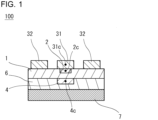
- FIG. 1 is a schematic diagram showing a cross section of an optical modulator according to a first embodiment.
- FIG. 2 is a schematic diagram showing a cross section of an optical modulator of Modification Example 1.
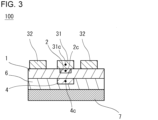
- FIG. 3 is a schematic diagram showing a cross section of an optical modulator of Modification Example 1.
- FIG. 4 is a schematic diagram showing a cross section of an optical modulator of Modification 1.
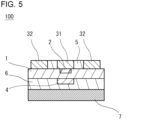
- FIG. 5 is a schematic diagram showing a cross section of an optical modulator according to the second embodiment.
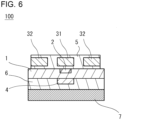
- FIG. 6 is a schematic diagram showing a cross section of an optical modulator according to a third embodiment.
- FIG. 7 is a schematic diagram showing a cross section of an optical modulator of Modification 2.
- FIG. 8 is a schematic diagram showing a cross section of an optical modulator of Modification 2.
- FIG. 8 is a schematic diagram showing a cross section of an optical modulator of Modification 2.
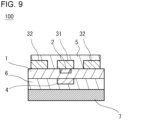
- FIG. 9 is a schematic diagram showing a cross section of an optical modulator according to modification 2.
- FIG. 10 is a schematic diagram showing a cross section of an optical modulator according to modification 3.
- FIG. 11 is a schematic diagram showing a cross section of an optical modulator according to modification 3.
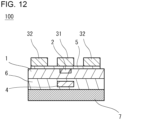
- FIG. 12 is a schematic diagram showing a cross section of an optical modulator according to modification 3.
- FIG. 13 is a schematic diagram showing a cross section of an optical modulator according to modification 3.
- FIG. 14 is a schematic diagram showing a cross section of an optical modulator according to modification 3.
- FIG. 15 is a schematic diagram showing a cross section of an optical modulator according to a fourth embodiment.
- FIG. 16 is a schematic diagram showing a cross section of the optical modulator according to the fifth embodiment.
- FIG. 10 is a schematic diagram showing a cross section of an optical modulator according to modification 3.
- FIG. 11 is a schematic diagram showing a cross section of an optical modulator according to modification 3.
- FIG. 12 is a schematic diagram showing
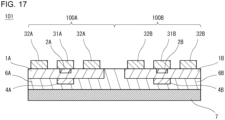
- FIG. 17 is a schematic diagram showing a cross section of an optical modulator according to a sixth embodiment.
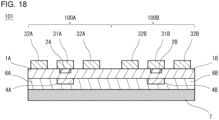
- FIG. 18 is a schematic diagram showing a cross section of an optical modulator according to a seventh embodiment.
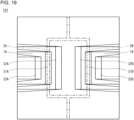
- FIG. 19 is a schematic plan view of the optical modulator according to the seventh embodiment.
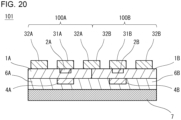
- FIG. 20 is a schematic diagram showing a cross section of an optical modulator according to the eighth embodiment.
- FIG. 21 is a schematic plan view of the optical modulator according to the eighth embodiment.
- the optical modulator includes an optical waveguide made of a material having an electro-optic effect and a control electrode for controlling light passing through the optical waveguide.
- the control electrode includes a first electrode, two second electrodes, and a third electrode that forms a potential difference with the group of the first and second electrodes. A voltage having the same phase as that of the first electrode is applied to each of the second electrodes.
- the first electrode is provided on one side in the thickness direction of the optical waveguide.
- one second electrode is provided at one side in the width direction of the optical waveguide with respect to the first electrode, and the other second electrode is provided at a distance from the first electrode. is provided on the other side of the optical waveguide in the width direction with respect to the first electrode, with a space therebetween.
- the third electrode is provided on the other side in the thickness direction of the optical waveguide (first configuration).
- the first electrode and the third electrode are arranged to sandwich the optical waveguide in the thickness direction. Furthermore, two second electrodes are arranged near the first electrode, spaced apart from the first electrode, and sandwiching the first electrode in the width direction of the optical waveguide.
- voltages having the same phase are applied to the first electrode and the two second electrodes. As a result, an electric field acts from the first electrode and the second electrode individually toward the third electrode, and the electric field is applied to the optical waveguide.
- the optical modulator of the first configuration preferably has the following configuration.
- the widthwise center position of the first electrode is located at the widthwise center of the optical waveguide
- the widthwise center position of the third electrode is located at the widthwise center of the optical waveguide.
- the electric field intensity directed from the first electrode to the third electrode can be increased, and the electric field application efficiency regarding the optical waveguide can be increased.
- the optical modulator described above preferably has the following configuration.
- the two second electrodes are arranged symmetrically with respect to the first electrode in the width direction of the optical waveguide (third configuration). In this case, deviation in the effective refractive index can be suppressed and optical loss can be suppressed.
- the optical modulator described above preferably has the following configuration. In the width direction of the optical waveguide, one second electrode is spaced apart from one end of the optical waveguide, and the other second electrode is spaced apart from the other end of the optical waveguide. ing.
- the optical modulator further includes a low dielectric constant layer having a dielectric constant lower than that of the optical waveguide. The low dielectric constant layer covers at least a portion of the surface of the second electrode so as to be interposed between the second electrode and the third electrode (fourth configuration).
- the optical modulator of the fourth configuration preferably has the following configuration.
- the low dielectric constant layer covers at least a portion of the surface of the first electrode so as to be interposed between the first electrode and the third electrode (fifth configuration).
- the electric field directed from the second electrode to the optical waveguide passes through the low dielectric constant layer. Furthermore, in the optical modulator with the fifth configuration, the electric field directed from the first electrode toward the optical waveguide passes through the low dielectric constant layer. As a result, the effective refractive index felt by electrical signals is lowered compared to the case where the low dielectric constant layer is not provided. Usually, the effective refractive index felt by electrical signals is larger than the effective refractive index felt by light waves. Therefore, the difference between the effective refractive index felt by the electric signal and the effective refractive index felt by the light wave becomes small. Therefore, the modulation frequency can be increased.
- the optical modulator described above preferably includes an auxiliary low dielectric constant layer having a dielectric constant lower than that of the optical waveguide.
- the auxiliary low dielectric constant layer covers at least a portion of the surface of the third electrode so as to be interposed between the second electrode and the third electrode (sixth configuration).
- the electric field directed from the second electrode toward the optical waveguide passes through the auxiliary low dielectric constant layer.
- the effective refractive index felt by electrical signals is lowered compared to the case where the auxiliary low dielectric constant layer is not provided. Therefore, the difference between the effective refractive index felt by the electric signal and the effective refractive index felt by the light wave becomes small. Therefore, the modulation frequency can be increased.
- the optical modulator described above preferably has the following configuration.
- the material of the optical waveguide is LiNbO 3 (seventh configuration). LiNbO 3 (lithium niobate) has a particularly high electro-optic effect. In this specification, LiNbO 3 may be referred to as LN.
- the material of the optical waveguide is not particularly limited as long as it has an electro-optic effect.
- the material of the optical waveguide may be LiTaO 3 (lithium tantalate), PLZT (lead lanthanum zirconate titanate), KTN (potassium tantalate niobate), BaTiO 3 (barium titanate), etc. It may be.
- the optical modulator described above may further include a substrate provided with an optical waveguide (eighth configuration).
- the optical modulator with the eighth configuration may include the following configuration.
- the substrate is made of the same material as the optical waveguide, and the optical waveguide is ridge-shaped (ninth configuration). In this case, light can be further confined within the optical waveguide. Furthermore, it becomes possible to cover the periphery of the optical waveguide except for the boundary with the substrate with a low dielectric constant layer. Therefore, adjustment of the effective refractive index is easy.
- an optical waveguide can also be formed by diffusing titanium (Ti) into the substrate.
- Optical waveguides can also be formed by proton exchange methods.
- the optical modulator in any one of the first to seventh configurations may include two optical modulator units arranged in parallel.
- the two optical modulator units each include an optical waveguide and a control electrode (tenth configuration).
- the optical modulator of the tenth configuration constitutes a Mach-Zehnder type optical modulator.
- intensity modulation is also possible in addition to phase modulation. This allows multilevel modulation to be performed and increases transmission capacity.
- the optical modulator of the tenth configuration provides the same effects as the first to seventh configurations.
- the optical modulator with the tenth configuration may include the following configuration.
- Each of the optical modulator units further includes a substrate provided with an optical waveguide.
- the substrate of one of the two optical modulator units is arranged in parallel with the substrate of the other optical modulator unit (eleventh configuration).
- the optical modulator with the eleventh configuration may include the following configuration.
- the substrate is made of the same material as the optical waveguide, and the optical waveguide is ridge-shaped (twelfth configuration).
- the optical modulator of the twelfth configuration corresponds to the ninth configuration. Therefore, similarly to the ninth configuration, light can be further confined within the optical waveguide, and furthermore, the effective refractive index can be easily adjusted.
- the optical modulator of the eleventh configuration or the twelfth configuration may have the following configuration.
- the substrate of one of the two optical modulator units is integrated with the substrate of the other optical modulator unit.
- a voltage having a phase opposite to that of the first electrode and second electrode of the other optical modulator unit is applied to the first electrode and second electrode of one optical modulator unit (13th configuration).
- the substrate of one optical modulator unit and the substrate of the other optical modulator unit can be shared. Therefore, the distance between the optical waveguide of one optical modulator unit and the optical waveguide of the other optical modulator unit can be reduced. In this case, the width of the entire optical modulator can be reduced.
- the optical modulator of the eleventh configuration or the twelfth configuration may have the following configuration.
- the substrate of one optical modulator unit is integrated with the substrate of the other optical modulator unit, and the optical waveguide of one optical modulator unit and the optical waveguide of the other optical modulator unit are connected to each other.
- the direction of spontaneous polarization is opposite to that of the optical waveguide.
- One of the two second electrodes of one optical modulator unit is formed integrally with one of the two second electrodes of the other optical modulator unit.
- a voltage having the same phase as that of the first electrode and second electrode of the other optical modulator unit is applied to the first electrode and the second electrode of one optical modulator unit (fourteenth configuration).
- the second electrodes located close to each other are integrally formed and shared. Therefore, the distance between the optical waveguide of one optical modulator unit and the optical waveguide of the other optical modulator unit can be made smaller. In this case, the width of the entire optical modulator can be further narrowed.
- FIG. 1 is a schematic diagram showing a cross section of an optical modulator 100 according to the first embodiment.
- FIG. 1 shows a cross section perpendicular to the direction in which the optical waveguide 2 extends.
- the direction in which the optical waveguide 2 extends can also be said to be a direction along the optical waveguide 2.
- a cross section means a cross section perpendicular to the direction in which the optical waveguide 2 or optical waveguides 2A and 2B described below extend.
- the support plate 7 that supports the whole is located at the bottom, the thickness direction of the optical modulator 100 corresponds to the up-down direction, and the width direction of the optical modulator 100 corresponds to the left-right direction.
- upper, lower, left, and right are defined for convenience of explanation, and do not limit the actual posture of the optical modulator 100.
- the optical modulator 100 includes a substrate 1, an optical waveguide 2, a first electrode 31, two second electrodes 32, and a third electrode 4.
- the first electrode 31 , the two second electrodes 32 , and the third electrode 4 are included in control electrodes for controlling light passing through the optical waveguide 2 .
- the first electrode 31 and the two second electrodes 32 are each arranged on the substrate 1. A voltage having the same phase as that of the first electrode 31 is applied to each of the second electrodes 32 .
- the third electrode 4 forms a potential difference with the group of the first electrode 31 and the second electrode 32.
- the first electrode 31 and the second electrode 32 are, for example, signal electrodes.
- the third electrode 4 is, for example, a ground electrode.
- the third electrode 4 may be a reverse signal electrode that applies a voltage having an opposite phase to the voltages of the first electrode 31 and the second electrode 32.
- the third electrode 4 is arranged at a position below the substrate 1.
- the optical modulator 100 of this embodiment further includes an auxiliary low dielectric constant layer 6.
- the substrate 1 , the optical waveguide 2 , the first electrode 31 , the second electrode 32 , the third electrode 4 , and the auxiliary low dielectric constant layer 6 are supported by a support plate 7 .
- the support plate 7 is arranged at the bottom.
- the optical waveguide 2 is made of a material that has an electro-optic effect.
- the material of the optical waveguide 2 is, for example, LN.
- the optical waveguide 2 is formed on the substrate 1. Specifically, an optical waveguide 2 is formed on the top of the substrate 1. This optical waveguide 2 is formed by diffusing Ti into the substrate 1. The portion of the substrate 1 where Ti is diffused has a high refractive index and can confine light, so it can be used as the optical waveguide 2.
- the optical waveguide 2 can have a cross-sectional shape in which the width (the horizontal dimension) is larger than the thickness (the vertical dimension).
- the cross-sectional shape of the optical waveguide 2 is substantially wide and generally rectangular.
- the cross-sectional shape of the optical waveguide 2 includes a first side extending in the width direction and a second side arranged parallel to the first side and extending in the width direction.
- the cross-sectional shape of the optical waveguide 2 further includes a third side and a fourth side, each extending in the thickness direction.
- the first side and the second side are a pair of long sides
- the third side and the fourth side are a pair of short sides.
- the cross-sectional shape of the optical waveguide 2 is a wide rectangle, one of the pair of long sides (the upper first side) is on the surface of the substrate 1, and the other long side (the lower first side) is on the surface of the substrate 1. 2 sides) are inside the substrate 1.
- the first and second long sides are connected by the third and fourth short sides.
- the third side and the fourth side of the optical waveguide 2 are linear in a cross-sectional view of the optical modulator 100, and are parallel to the thickness direction of the optical waveguide 2.
- the third side and the fourth side may be inclined with respect to the thickness direction of the optical waveguide 2, and do not necessarily need to be linear.
- the third side and the fourth side of the optical waveguide 2 may have a curved shape, or may have a shape that is a combination of a straight line and a curved line.
- the length of the third side may be the same as the length of the fourth side, or may be different.
- the length of the first side may be the same as the length of the second side, or may be different.
- the cross-sectional shape of the optical waveguide 2 may be a wide semi-ellipse.
- the cross-sectional shape of the optical waveguide 2 includes a base serving as a long axis extending in the width direction, and an elliptical arc-shaped side extending in the width direction.
- the base is on the surface of the substrate 1 and the elliptical arc-shaped sides are inside the substrate 1.
- the first electrode 31, the second electrode 32, and the third electrode 4 are made of a metal material, and each has a rectangular cross-sectional shape.
- the first electrode 31 is provided on one side of the optical waveguide 2 in the thickness direction.
- the third electrode 4 is provided on the other side of the optical waveguide 2 in the thickness direction.
- the first electrode 31 is stacked on top of the optical waveguide 2 . In this case, the first electrode 31 is placed almost directly above the optical waveguide 2 .
- the third electrode 4 is stacked below the optical waveguide 2 . In this case, the third electrode 4 is arranged approximately directly below the optical waveguide 2.
- one of the second electrodes 32 is provided with an interval from the first electrode 31 on one side in the width direction of the optical waveguide 2 with respect to the first electrode 31;
- the two electrodes 32 are provided on the other side of the first electrode 31 in the width direction of the optical waveguide 2 and are spaced apart from the first electrode 31 . Therefore, the first electrode 31 is arranged between the second electrodes 32.
- one second electrode 32 is arranged to be spaced apart from one end of the optical waveguide 2
- the other second electrode 32 is arranged at the other end of the optical waveguide 2. It is located separated from the section.
- the first electrode 31 and the third electrode 4 are arranged to sandwich the optical waveguide 2 in the vertical direction (thickness direction). Further, with respect to the optical waveguide 2, two second electrodes 32 are arranged near the first electrode 31 with a space between them and the first electrode 31 in the left-right direction (width direction). be done.
- the center 31c of the first electrode 31 in the width direction is located at the center of the optical waveguide 2 in the width direction.
- the center 31c of the first electrode 31 is arranged, for example, in the width direction of the optical waveguide 2 within a region located at the center when the optical waveguide 2 is divided into three equal parts.
- the position of the center 31c of the first electrode 31 in the width direction may coincide with the position of the center 2c of the optical waveguide 2 in the width direction.
- the center 4c of the third electrode 4 in the width direction is located at the center of the optical waveguide 2 in the width direction.
- the center 4c of the third electrode 4 is arranged, for example, in the width direction of the optical waveguide 2 within a region located at the center when the optical waveguide 2 is divided into three equal parts.
- the position of the center 4c of the third electrode 4 in the width direction may coincide with the position of the center 2c of the optical waveguide 2 in the width direction.
- the position of the center 31c of the first electrode 31, the position of the center 4c of the third electrode 4, and the position of the center 2c of the optical waveguide 2 are aligned in the width direction and are not shifted from each other.
- the first electrode 31 is arranged substantially or almost directly above the third electrode 4
- the optical waveguide 2 is arranged between the first electrode 31 and the third electrode 4 .
- the two second electrodes 32 are arranged symmetrically with respect to the first electrode 31 in the width direction of the optical waveguide 2 .
- an auxiliary low dielectric constant layer 6 is laminated under the substrate 1.
- the support plate 7 is laminated under the auxiliary low dielectric constant layer 6.
- the third electrode 4 is disposed inside the auxiliary low dielectric constant layer 6 and laminated under the substrate 1.
- the auxiliary low dielectric constant layer 6 covers at least a portion of the surface of the third electrode 4 so as to be interposed between the second electrode 32 and the third electrode 4.
- the auxiliary low dielectric constant layer 6 directly covers the side and bottom surfaces of the third electrode 4.
- a portion of the auxiliary low dielectric constant layer 6 that covers the side surface of the third electrode 4 is interposed between the second electrode 32 and the third electrode 4.
- the dielectric constant of the auxiliary low dielectric constant layer 6 is lower than that of the optical waveguide 2.
- the material of the auxiliary low dielectric constant layer 6 is not particularly limited as long as the dielectric constant is lower than the dielectric constant of the optical waveguide 2.
- the material of the auxiliary low dielectric constant layer 6 is, for example, SiO 2 .
- an oxide eg, Al 2 O 3 , SiO 2 , LaAlO 3 , LaYO 3 , ZnO, HfO 2 , MgO, Y 2 O 3
- a polymer eg, BCB (benzocyclobutene), PI (polyimide)
- BCB benzocyclobutene
- PI polyimide
- the auxiliary low dielectric constant layer 6 may not be provided. If the auxiliary low dielectric constant layer 6 is not provided, the third electrode 4 may be disposed at the bottom of the substrate 1. From another point of view, the third electrode 4 may be buried in the lower part of the substrate 1.
- the first electrode 31 and the third electrode 4 are arranged to sandwich the optical waveguide 2 in the thickness direction. Further, on the same side in the thickness direction with respect to the optical waveguide 2, two second electrodes 32 are arranged near the first electrode 31 with a space between them and sandwich the first electrode 31 in the width direction. will be placed in That is, a first electrode 31 and two second electrodes 32 that form a potential difference with the third electrode 4 are separately present. Furthermore, a space exists between the first electrode 31 and the second electrode 32.
- the first electrode 31 and the two second electrodes 32 disposed on the same side in the thickness direction with respect to the optical waveguide 2 are connected to each other. Voltages of the same phase are applied.
- the third electrode 4 forms a potential difference with the group of the first electrode 31 and the second electrode 32.
- an electric field acts from the first electrode 31 and the second electrode 32 individually toward the third electrode 4, and the electric field is applied to the optical waveguide 2.
- all the electric field from the first electrode 31 passes through the optical waveguide 2.
- Most of the electric field from the second electrode 32 passes through the optical waveguide 2.
- a single signal electrode and a single signal electrode are placed on the same side in the thickness direction with respect to the optical waveguide 2. Compared to the case where a ground electrode is arranged, the efficiency of applying an electric field to the optical waveguide 2 can be improved.
- the auxiliary low dielectric constant layer 6 is interposed between the second electrode 32 and the third electrode 4, the electric field from the second electrode 32 passes through the auxiliary low dielectric constant layer 6. .
- a first electrode 31 and two second electrodes 32 are arranged on the same side in the thickness direction with respect to the optical waveguide 2, and the first electrode 31 and the third electrode 4 are arranged so as to sandwich the optical waveguide 2 in the thickness direction. If so, an electric field can be applied to the optical waveguide 2 from each of the first electrode 31 and the two second electrodes 32. Therefore, compared to the case where a single signal electrode and ground electrode are arranged to sandwich the optical waveguide in the thickness direction, it is easier to apply an electric field to the optical waveguide 2, and it is easier to adjust the effective refractive index. As a result, the degree of freedom in structural design of the optical modulator can be increased.
- the impedance of the signal electrode that forms a potential difference with the third electrode 4 is 50 ⁇ .
- a first electrode 31 and two second electrodes 32 are separately present as signal electrodes that form a potential difference with the third electrode 4.
- the signal electrode that forms a potential difference with the third electrode 4 is divided into three.
- the impedance of the first electrode 31 and the second electrode 32 can be reduced to the ideal 50 ⁇ while applying an electric field to a wide range of auxiliary low dielectric constant layer 6 or low dielectric constant layer 5, which will be described later. can be approached.
- the applied voltages can be set individually. Thereby, it is possible to adjust the electric field strength distribution to be suitable according to the cross-sectional area of the auxiliary low dielectric constant layer 6 or the low dielectric constant layer 5 described later and the shape of the optical waveguide.
- three signal electrodes, a first electrode 31 and two second electrodes 32, are provided as signal electrodes that form a potential difference with the third electrode 4.
- the first electrode 31 plays the role of applying an electric field to the optical waveguide 2, and the two second electrodes 32 play the role of adjusting the effective refractive index.
- the first electrode 31 is preferably installed near directly above the optical waveguide 2 in order to efficiently and uniformly apply an electric field to the optical waveguide 2.
- second electrodes 32 By arranging the second electrodes 32 next to the first electrodes 31, an electric field having a horizontal component can be applied from the second electrodes 32 to the third electrode 4. Thereby, the electric field component passing through the auxiliary low dielectric constant layer 6 can be increased. If there is only one second electrode 32, the refractive index perceived by the optical waveguide 2 in the horizontal direction will be unbalanced. Therefore, in order to adjust the balance of the effective refractive index in the horizontal direction, second electrodes 32 are installed on each side of the first electrode 31 to cooperate with each other.
- two second electrodes 32 be provided for one first electrode 31. This is because installing three or more second electrodes 32 cannot achieve any greater effect than installing two second electrodes 32, and increases the size of the device (light modulator 100). Therefore, the configuration of the first electrode 31 and two second electrodes 32 is most preferable.
- the position of the widthwise center 31c of the first electrode 31 is located at the widthwise center of the optical waveguide 2, and the position of the widthwise center 4c of the third electrode 4 is located at the widthwise center of the optical waveguide 2.
- the first electrode 31 is arranged substantially or almost directly above the third electrode 4, and the optical waveguide 2 is arranged between the first electrode 31 and the third electrode 4. Therefore, the strength of the electric field directed from the first electrode 31 to the third electrode 4 can be increased, and the efficiency of applying the electric field to the optical waveguide 2 can be increased.
- the two second electrodes 32 are arranged symmetrically with respect to the first electrode 31 in the width direction of the optical waveguide 2.
- the second electrodes 32 By having the second electrodes 32 in symmetrical positions, it is possible to apply an electric field from the second electrodes 32 in a well-balanced manner. Therefore, deviation in the effective refractive index can be suppressed and optical loss can be suppressed.
- the third electrode is not provided on the side of the optical waveguide 2 where the first electrode 31 and the second electrode 32 are provided.
- the third electrode is an electrode that forms a potential difference with the group of the first electrode 31 and the second electrode 32. If a third electrode is provided on the side of the optical waveguide 2 where the first electrode 31 and the second electrode 32 are provided, part of the electric field from the first electrode 31 and the second electrode 32 However, it is undeniable that it leaks to the third electrode. Therefore, it is difficult to say that the electric field application efficiency regarding the optical waveguide 2 is high.
- the third electrode since the third electrode is not provided on the side of the optical waveguide 2 where the first electrode 31 and the second electrode 32 are provided, the electric field related to the optical waveguide 2 is Application efficiency can be improved.
- the widthwise dimension of the third electrode 4 is preferably the same as or smaller than the width of the optical waveguide 2. This is because the electric field application efficiency increases.
- the widthwise dimension of the first electrode 31 is preferably the same as or smaller than the width of the optical waveguide 2. This is because the electric field application efficiency increases.
- the widthwise dimension of each second electrode 32 is preferably the same as or larger than the widthwise dimension of the first electrode 31. However, the widthwise dimension of each second electrode 32 may be smaller than the widthwise dimension of the first electrode 31.
- the widthwise interval (gap) between the first electrode 31 and the second electrode 32 is preferably the same as or larger than the widthwise dimension of the first electrode 31 .
- the dimension in the width direction of the first electrode 31 and the dimension in the width direction of each second electrode 32 may be designed so that the impedance of each of the first electrode 31 and the second electrode 32 is approximately the same, and the modulation speed is From the viewpoint of suppressing the decrease, the resistance may be set within a range of 50 ⁇ 10 ⁇ , for example, with a target value of 50 ⁇ .
- the distance between the first electrode 31 and the second electrode 32 may be set so that the effective refractive index felt by the electric signal does not fall below the refractive index of the optical waveguide 2.
- the widthwise dimension of the first electrode 31 may be larger than the width of the optical waveguide 2.
- the widthwise dimension of the third electrode 4 may be larger than the width of the optical waveguide 2, but is preferably smaller than the widthwise dimension of the first electrode 31. If the dimension in the width direction of the first electrode 31 is larger than the width of the optical waveguide 2, a part of the electric field from the first electrode 31 passes through the auxiliary low dielectric constant layer 6 in the process of reaching the third electrode 4. . Thereby, the effective refractive index felt by the electric signal can be further reduced. Therefore, the difference between the effective refractive index felt by the electric signal and the effective refractive index felt by the light wave becomes smaller, and the modulation frequency can be increased.
- a substrate 1 made of a material having an electro-optic effect is prepared.
- a third electrode 4 is formed on the substrate 1.
- the third electrode 4 can be formed by patterning using photolithography, vapor deposition, lift-off, or the like.
- the third electrode 4 may be formed by photolithography or plating.
- the third electrode 4 may be formed by forming a film by vapor deposition, sputtering, CVD, etc., patterning it by photolithography, and then etching it.
- An auxiliary low dielectric constant layer 6 is formed on the surface of the substrate 1 on which the third electrode 4 is formed.
- the auxiliary low dielectric constant layer 6 has a dielectric constant lower than that of the substrate 1.
- the thickness of the auxiliary low dielectric constant layer 6 is greater than the thickness of the third electrode 4.
- the substrate 1 is joined to the support plate 7.
- the bonding surface of the substrate 1 is the surface on which the third electrode 4 and the auxiliary low dielectric constant layer 6 are formed.
- the bonding method is, for example, surface activated bonding or atomic diffusion bonding.
- the surface of the substrate 1 opposite to the bonding surface is processed to thin the substrate 1 to a desired thickness.
- a method for thinning the substrate 1 is, for example, grinding or polishing by CMP.
- the substrate 1 may be thinned by providing a peeling layer with a desired thickness by implanting ions into the substrate 1 in advance, peeling it off after bonding, and finishing with grinding or CMP. good.
- the thickness of the substrate 1 after thinning is 10 ⁇ m or less.
- the optical waveguide 2 is formed on the substrate 1 by Ti diffusion, proton exchange method, or the like.
- a first electrode 31 and two second electrodes 32 are formed on the surface of the substrate 1 on which the optical waveguide 2 is formed.
- the thickness of each electrode 31 and 32 is preferably thicker because the thicker the electrode, the more the signal loss is reduced.
- the width and thickness of the second electrodes 32 arranged on the left and right sides are preferably equal to or larger than that of the first electrode 31 arranged in the center.
- each electrode 31 and 32 can be formed by patterning using photolithography, vapor deposition, lift-off, or the like.
- the electrodes 31 and 32 may be formed by photolithography or plating.
- the electrodes 31 and 32 may be formed by forming a film by vapor deposition, sputtering, CVD, etc., patterning it by photolithography, and then etching it.
- Modification 1 of the first embodiment] 2 to 4 are schematic diagrams showing a first modification of the optical modulator 100 according to the first embodiment.
- a cross section of the optical modulator 100 is shown in FIGS. 2-4.
- modification example 1 the configurations of the first electrode 31, second electrode 32, and third electrode 4 relative to the optical waveguide 2 from the optical modulator 100 shown in FIG. 1 are changed.
- the first electrode 31 is shifted to one side (to the right in FIG. 2) of both sides of the optical waveguide 2 in the width direction
- the third electrode 31 is shifted to the right side in FIG. is shifted to the other side (to the left in FIG. 2) of both sides of the optical waveguide 2 in the width direction.
- the position of the center 31c of the first electrode 31 in the width direction does not match the position of the center 2c of the optical waveguide 2 in the width direction.
- the position of the center 4c of the third electrode 4 in the width direction does not match the position of the center 2c of the optical waveguide 2 in the width direction. That is, the position of the center 31c of the first electrode 31, the position of the center 4c of the third electrode 4, and the position of the center 2c of the optical waveguide 2 are not aligned in the width direction and are shifted from each other.
- the distance between the second electrode 32 and the first electrode 31 on the right side is smaller than the distance between the second electrode 32 and the first electrode 31 on the left side. That is, the two second electrodes 32 are arranged asymmetrically with respect to the first electrode 31 in the width direction of the optical waveguide 2.
- the position of the center 31c of the first electrode 31 in the width direction coincides with the position of the center 2c of the optical waveguide 2 in the width direction.
- the position of the center 4c of the third electrode 4 in the width direction coincides with the position of the center 2c of the optical waveguide 2 in the width direction. That is, similarly to the optical modulator 100 shown in FIG. 1, the position of the center 31c of the first electrode 31, the position of the center 4c of the third electrode 4, and the position of the center 2c of the optical waveguide 2 are aligned in the width direction. and are not shifted from each other.
- the distance between the second electrode 32 and the first electrode 31 on the right side is smaller than the distance between the second electrode 32 and the first electrode 31 on the left side. That is, similarly to the optical modulator 100 of Modification 1 shown in FIG. 2, the two second electrodes 32 are arranged asymmetrically with respect to the first electrode 31 in the width direction of the optical waveguide 2.
- the first electrode 31 is shifted to one side (to the right in FIG. 4) of both sides of the optical waveguide 2 in the width direction
- the third electrode 31 is shifted to the right side in FIG. is shifted to the other side (to the left in FIG. 4) of both sides of the optical waveguide 2 in the width direction.
- the position of the widthwise center 31c of the first electrode 31 does not match the position of the widthwise center 2c of the optical waveguide 2.
- the position of the center 4c of the third electrode 4 in the width direction does not match the position of the center 2c of the optical waveguide 2 in the width direction.
- the distance between the second electrode 32 and the first electrode 31 on the right side is the same as the distance between the second electrode 32 and the first electrode 31 on the left side. That is, similarly to the optical modulator 100 shown in FIG. 1, the two second electrodes 32 are arranged symmetrically with respect to the first electrode 31 in the width direction of the optical waveguide 2.
- only one of the first electrode 31 and the third electrode 4 may be shifted in the width direction with respect to the optical waveguide 2.
- the position of the widthwise center 31c of the first electrode 31 does not match the widthwise center 2c of the optical waveguide 2
- the position of the widthwise center 4c of the third electrode 4 does not match the widthwise center 2c of the optical waveguide 2. It may coincide with the position of the directional center 2c.
- the position of the widthwise center 4c of the third electrode 4 does not match the widthwise center 2c of the optical waveguide 2
- the position of the widthwise center 31c of the first electrode 31 does not match the widthwise center 2c of the optical waveguide 2. It may coincide with the position of the center 2c.
- FIG. 5 is a schematic diagram showing a cross section of the optical modulator 100 according to the second embodiment.
- the optical modulator 100 of this embodiment is a modification of the optical modulator 100 of the first embodiment.
- the optical modulator 100 further includes a low dielectric constant layer 5.
- a low dielectric constant layer 5 is laminated on the substrate 1.
- the low dielectric constant layer 5 covers at least a portion of the surface of each second electrode 32 so as to be interposed between the second electrode 32 and the third electrode 4 .
- the low dielectric constant layer 5 is provided between the first electrode 31 and the second electrode 32. That is, the low dielectric constant layer 5 directly covers each side surface of the first electrode 31 and the second electrode 32. As a result, a part of the low dielectric constant layer 5 is interposed between the second electrode 32 and the third electrode 4.
- the dielectric constant of the low dielectric constant layer 5 is lower than that of the optical waveguide 2, similarly to the auxiliary low dielectric constant layer 6.
- the material of the low dielectric constant layer 5 is not particularly limited as long as the dielectric constant is lower than the dielectric constant of the optical waveguide 2.
- the material of the low dielectric constant layer 5 may be the same as the material of the auxiliary low dielectric constant layer 6, or may be different.
- the modulation frequency can be increased.
- the low dielectric constant layer 5 is provided between the first electrode 31 and the second electrode 32.
- the second electrode 32 is a ground electrode, a large potential difference will occur between the first electrode 31 and the ground electrode.
- some member is provided between the first electrode 31 and the ground electrode, there is a high risk that a short circuit will occur between the first electrode 31 and the ground electrode.
- the electric field directed from the first electrode 31 toward the optical waveguide 2 will weaken. Therefore, if the second electrode 32 is a ground electrode, it is difficult to imagine providing any member between the first electrode 31 and the ground electrode.
- the distance between the first electrode 31 and the second electrode 32 may be set so that the effective refractive index felt by the electric signal is close to the effective refractive index felt by the light wave passing through the optical waveguide 2.
- FIG. 6 is a schematic diagram showing a cross section of the optical modulator 100 according to the third embodiment.
- the optical modulator 100 of this embodiment is a modification of the optical modulator 100 of the second embodiment.
- the first electrode 31 and the second electrode 32 are arranged above the substrate 1.
- the first electrode 31 and the second electrode 32 are arranged inside the low dielectric constant layer 5 laminated on the substrate 1 .
- the low dielectric constant layer 5 directly covers the lower surface, side surfaces, and upper surface of the first electrode 31.
- the low dielectric constant layer 5 directly covers the lower surface of each second electrode 32, the side surface on the first electrode 31 side, and the upper surface. That is, the low dielectric constant layer 5 covers at least a portion of the surface of the second electrode 32 so as to be interposed between the second electrode 32 and the third electrode 4.
- the low dielectric constant layer 5 covers at least a portion of the surface of the first electrode 31 so as to be interposed between the first electrode 31 and the third electrode 4 . From another point of view, the low dielectric constant layer 5 covers the entire upper surface of the optical waveguide 2 and the upper surface of the substrate 1 around it.
- the low dielectric constant layer 5 covers at least a portion of the surface of the second electrode 32 so as to be interposed between the second electrode 32 and the third electrode 4. Therefore, the same effects as in the second embodiment can be obtained. Furthermore, the low dielectric constant layer 5 covers at least a portion of the surface of the first electrode 31 so as to be interposed between the first electrode 31 and the third electrode 4 . In particular, in the example shown in FIG. 6, the low dielectric constant layer 5 covers the entire upper surface of the optical waveguide 2 and the upper surface of the substrate 1 around it, and the low dielectric constant layer 5 is provided between the first electrode 31 and the optical waveguide 2. Layer 5 is interposed.
- a low dielectric constant layer 5 is interposed between the second electrode 32 and the optical waveguide 2.
- an electric field directed from the second electrode 32 toward the optical waveguide 2 passes through the low dielectric constant layer 5
- an electric field directed from the first electrode 31 toward the optical waveguide 2 passes through the low dielectric constant layer 5 .
- the effective refractive index felt by the electric signal can be further reduced. Therefore, the difference between the effective refractive index felt by the electric signal and the effective refractive index felt by the light wave becomes smaller. Therefore, the effect of increasing the modulation frequency is high.
- Modification 2 of the second and third embodiments] 7 to 9 are schematic diagrams showing a second modification of the optical modulator 100 according to the second and third embodiments. 7 to 9, cross sections of the optical modulator 100 are shown.
- modification example 2 the form of the low dielectric constant layer 5 is changed from the optical modulator 100 shown in FIGS. 5 and 6.
- the low dielectric constant layer 5 directly covers the lower surface of the first electrode 31.
- the low dielectric constant layer 5 directly covers the lower surface of each second electrode 32 .
- the low dielectric constant layer 5 directly covers the lower surface and side surfaces of the first electrode 31.
- the low dielectric constant layer 5 directly covers the lower and side surfaces of each second electrode 32 .
- the low dielectric constant layer 5 directly covers the side and top surfaces of the first electrode 31.
- the low dielectric constant layer 5 directly covers the side and top surfaces of each second electrode 32 .
- [Modification 3 of the second and third embodiments] 10 to 14 are schematic diagrams showing a third modification of the optical modulator 100 according to the second and third embodiments. 10 to 14 show cross sections of the optical modulator 100.
- modification 3 the form of the auxiliary low dielectric constant layer 6 is changed from the optical modulator 100 shown in FIGS. 5 to 9.
- the optical modulator 100 shown in FIG. 10 corresponds to the optical modulator 100 shown in FIG. 5.
- the optical modulator 100 shown in FIG. 11 corresponds to the optical modulator 100 shown in FIG.
- the optical modulator 100 shown in FIG. 12 corresponds to the optical modulator 100 shown in FIG. 7.
- the optical modulator 100 shown in FIG. 13 corresponds to the optical modulator 100 shown in FIG. 8.
- the optical modulator 100 shown in FIG. 14 corresponds to the optical modulator 100 shown in FIG. 9.
- the third electrode 4 is arranged below the substrate 1.
- the third electrode 4 is arranged inside the auxiliary low dielectric constant layer 6 laminated under the substrate 1 . Therefore, the auxiliary low dielectric constant layer 6 directly covers the lower surface, side surfaces, and upper surface of the third electrode 4. That is, the auxiliary low dielectric constant layer 6 covers at least a part of the surface of the third electrode 4 so as to be interposed between the second electrode 32 and the third electrode 4, and covers the surface of the third electrode 4 between the first electrode 31 and the third electrode 4. At least a portion of the surface of the third electrode 4 is covered so as to be interposed therebetween.
- the electric field directed from the second electrode 32 toward the optical waveguide 2 passes through the auxiliary low dielectric constant layer 6, and the electric field directed from the first electrode 31 toward the optical waveguide 2 passes through the auxiliary low dielectric constant layer. Pass 6.
- the effective refractive index felt by the electric signal can be further reduced. Therefore, the difference between the effective refractive index felt by the electric signal and the effective refractive index felt by the light wave becomes smaller. Therefore, the effect of increasing the modulation frequency is high.
- FIG. 15 is a schematic diagram showing a cross section of the optical modulator 100 according to the fourth embodiment.
- the optical modulator 100 of this embodiment is a modification of the optical modulator 100 of the first embodiment.
- substrate 1 has a ridge-shaped optical waveguide 2. That is, the substrate 1 has a protrusion on its upper part, and this protrusion functions as the optical waveguide 2.
- Protrusions are formed on the substrate 1 by processing a wafer as a raw material. The protrusions can confine light in the thickness direction and width direction.
- the cross-sectional shape of the ridge-type optical waveguide 2 is approximately rectangular. Strictly speaking, the cross-sectional shape of the ridge-type optical waveguide 2 is often trapezoidal.
- the substrate 1 is made of the same material as the optical waveguide 2. However, the material of the substrate 1 may be different from the material of the optical waveguide 2. In this case, the material of the substrate 1 is, for example, Si.
- the optical modulator 100 of this embodiment has the same effects as the first embodiment.
- the optical waveguide 2 is ridge-shaped, light can be further confined within the optical waveguide 2.
- the low dielectric constant layer 5 covers a wide area around the optical waveguide 2. Therefore, adjustment of the effective refractive index is easy.
- the configuration of this embodiment may be applied to the optical modulator 100 of the second and third embodiments.
- the substrate 1 has a ridge-shaped optical waveguide 2. Therefore, the method of manufacturing the optical modulator 100 of the fourth embodiment is different from the method of manufacturing the optical modulator 100 of the first embodiment in the method of forming the optical waveguide 2, and the method of manufacturing the optical modulator 100 of the first embodiment is different from that in the method of forming the optical waveguide 2. This is common to the method of manufacturing the optical modulator 100 of the present invention. Below, only the differences will be described.
- the thinned substrate 1 is processed to form protrusions by using photolithography and etching. This ridge becomes the optical waveguide 2.
- FIG. 16 is a schematic diagram showing a cross section of the optical modulator 100 according to the fifth embodiment.
- the optical modulator 100 of this embodiment is a modification of the optical modulator 100 of the first to third embodiments.
- the low dielectric constant layer 5 and the auxiliary low dielectric constant layer 6 are integrated.
- the optical waveguide 2 is arranged inside the low dielectric constant layer 5 and the auxiliary low dielectric constant layer 6, which are integrated.
- the low dielectric constant layers 5 and 6 directly cover the lower surface and side surfaces of the optical waveguide 2. In the example shown in FIG. Therefore, more electric fields pass through the low dielectric constant layers 5 and 6, making it easier to adjust the effective refractive index.
- the integrated low dielectric constant layers 5 and 6 may further cover the upper surface of the optical waveguide 2.
- FIG. 17 is a schematic diagram showing a cross section of the optical modulator 101 according to the sixth embodiment.
- the optical modulator 101 of this embodiment constitutes a Mach-Zehnder type optical modulator.
- the optical modulator 101 of this embodiment is a modification of the optical modulator 100 of the first embodiment, and each element of the optical modulator 100 of the first embodiment is arranged in parallel.
- the optical modulator 101 of this embodiment includes two optical modulator units 100A and 100B.
- One optical modulator unit 100A includes a substrate 1A, an optical waveguide 2A, a first electrode 31A, two second electrodes 32A, a third electrode 4A, and an auxiliary low dielectric constant layer 6A.
- the other optical modulator unit 100B includes a substrate 1B, an optical waveguide 2B, a first electrode 31B, two second electrodes 32B, a third electrode 4B, and an auxiliary low dielectric constant layer 6B.
- the optical modulator unit 100A and the optical modulator unit 100B are supported by a support plate 7.
- the substrates 1A and 1B correspond to the substrate 1 described above.
- the optical waveguides 2A and 2B correspond to the optical waveguide 2 described above.
- the first electrodes 31A and 31B correspond to the first electrode 31 described above.
- the second electrodes 32A and 32B correspond to the second electrode 32 described above.
- the third electrodes 4A and 4B correspond to the third electrode 4 described above.
- the auxiliary low dielectric constant layers 6A and 6B correspond to the auxiliary low dielectric constant layer 6 described above.
- the substrate 1A provided with the optical waveguide 2A is arranged in parallel with the substrate 1B provided with the optical waveguide 2B. That is, the optical waveguide 2A and the optical waveguide 2B are arranged side by side. Upstream of the optical waveguide 2A and the optical waveguide 2B, one input optical waveguide branches into the optical waveguide 2A and the optical waveguide 2B. At the downstream of the optical waveguide 2A and the optical waveguide 2B, the optical waveguide 2A and the optical waveguide 2B merge into one output optical waveguide.
- optical modulator 101 of this embodiment Even with the optical modulator 101 of this embodiment, effects similar to those of the first embodiment described above can be obtained. Furthermore, since the optical modulator 101 of this embodiment constitutes a Mach-Zehnder type optical modulator, intensity modulation is also possible in addition to phase modulation. This allows multilevel modulation to be performed and increases transmission capacity.
- the auxiliary low dielectric constant layers 6A and 6B may not be provided. Further, in the optical modulator units 100A and 100B, a low dielectric constant layer corresponding to the low dielectric constant layer 5 as in the second and third embodiments may be provided. Further, in the optical modulator 101 of this embodiment, the substrates 1A and 1B may not be provided as in the fifth embodiment.
- the optical waveguides 2A and 2B are formed by Ti diffusion.
- the optical waveguides 2A and 2B may be ridge-type. In this case, effects similar to those of the fourth embodiment can be obtained.
- FIGSeventh embodiment> 18 and 19 are schematic diagrams showing an optical modulator 101 according to the seventh embodiment.
- FIG. 18 shows a cross section of the optical modulator 101.
- FIG. 19 shows a plane when the optical modulator 101 is viewed from above.
- the optical modulator 101 of this embodiment is a modification of the optical modulator 101 of the sixth embodiment.
- the substrate 1A of the optical modulator unit 100A is integrated with the substrate 1B of the optical modulator unit 100B.
- a voltage having a phase opposite to that of the first electrode 31A and the two second electrodes 32A is applied to the first electrode 31B and the two second electrodes 32B.
- the substrate 1A and the substrate 1B can be used in common.
- the optical waveguide 2A and the optical waveguide 2B are provided on shared substrates 1A and 1B. Therefore, the distance between the optical waveguide 2A and the optical waveguide 2B can be reduced. In this case, the width of the entire optical modulator 101 can be reduced, and the optical modulator 101 can be made smaller.
- FIG. 20 and 21 are schematic diagrams showing an optical modulator 101 according to the eighth embodiment.
- FIG. 20 shows a cross section of the optical modulator 101.
- FIG. 21 shows a plane when the optical modulator 101 is viewed from above.
- the optical modulator 101 of this embodiment is a modification of the optical modulator 101 of the sixth embodiment.
- the substrate 1A of the optical modulator unit 100A is integrated with the substrate 1B of the optical modulator unit 100B.
- the optical waveguide 2A and the optical waveguide 2B have opposite directions of spontaneous polarization.
- the material of the substrate 1A and the substrate 1B is a ferroelectric crystal such as LN or LiTaO3
- the direction of spontaneous polarization cannot be reversed by applying a high voltage to the ferroelectric crystal material. be.
- the location where the polarization is reversed can be recognized by observation using an atomic force microscope or an electron microscope. In this case, when the optical modulator 101 is operated, voltages having the same phase are applied to the first electrode 31A, the second electrode 32A, the first electrode 31B, and the second electrode 32B.
- the substrate 1A and the substrate 1B can be used in common, as in the seventh embodiment.
- the optical waveguide 2A and the optical waveguide 2B are provided on shared substrates 1A and 1B.
- One of the two second electrodes 32B is formed integrally with one of the two second electrodes 32A.
- the second electrode 32A and the second electrode 32B, which are located close to each other, are electrically integrated.
- one of the two second electrodes 32B can be shared with one of the two second electrodes 32A. Therefore, the distance between the optical waveguide 2A and the optical waveguide 2B can be made smaller. In this case, the width of the entire optical modulator 101 can be further reduced, and the optical modulator 101 can be made more compact.
- Optical modulator 1 Substrate 2: Optical waveguide 31: First electrode 32: Second electrode 4: Third electrode 5: Low dielectric constant layer 6: Auxiliary low dielectric constant layer 7: Support plate
Landscapes
- Physics & Mathematics (AREA)
- Nonlinear Science (AREA)
- General Physics & Mathematics (AREA)
- Optics & Photonics (AREA)
- Chemical & Material Sciences (AREA)
- Engineering & Computer Science (AREA)
- Ceramic Engineering (AREA)
- Crystallography & Structural Chemistry (AREA)
- Optical Modulation, Optical Deflection, Nonlinear Optics, Optical Demodulation, Optical Logic Elements (AREA)
Priority Applications (4)
| Application Number | Priority Date | Filing Date | Title |
|---|---|---|---|
| JP2024507506A JP7768348B2 (ja) | 2022-03-17 | 2022-11-28 | 光変調器 |
| CN202280089434.6A CN118575123A (zh) | 2022-03-17 | 2022-11-28 | 光调制器 |
| US18/765,419 US20240361662A1 (en) | 2022-03-17 | 2024-07-08 | Optical modulator |
| JP2025182433A JP2026010217A (ja) | 2022-03-17 | 2025-10-29 | 光変調器 |
Applications Claiming Priority (2)
| Application Number | Priority Date | Filing Date | Title |
|---|---|---|---|
| JP2022042072 | 2022-03-17 | ||
| JP2022-042072 | 2022-03-17 |
Related Child Applications (1)
| Application Number | Title | Priority Date | Filing Date |
|---|---|---|---|
| US18/765,419 Continuation US20240361662A1 (en) | 2022-03-17 | 2024-07-08 | Optical modulator |
Publications (1)
| Publication Number | Publication Date |
|---|---|
| WO2023176053A1 true WO2023176053A1 (ja) | 2023-09-21 |
Family
ID=88023207
Family Applications (1)
| Application Number | Title | Priority Date | Filing Date |
|---|---|---|---|
| PCT/JP2022/043688 Ceased WO2023176053A1 (ja) | 2022-03-17 | 2022-11-28 | 光変調器 |
Country Status (4)
| Country | Link |
|---|---|
| US (1) | US20240361662A1 (https=) |
| JP (2) | JP7768348B2 (https=) |
| CN (1) | CN118575123A (https=) |
| WO (1) | WO2023176053A1 (https=) |
Families Citing this family (1)
| Publication number | Priority date | Publication date | Assignee | Title |
|---|---|---|---|---|
| CN120178544A (zh) * | 2025-04-01 | 2025-06-20 | 哈尔滨工业大学 | 一种基于钛扩散钽铌酸钾波导二次电光效应的强度调制器件及其制备方法 |
Citations (3)
| Publication number | Priority date | Publication date | Assignee | Title |
|---|---|---|---|---|
| US20030068111A1 (en) * | 2001-10-09 | 2003-04-10 | Codeon Corporation | Optical modulator with programmable chirp |
| JP2004062158A (ja) * | 2002-06-03 | 2004-02-26 | Matsushita Electric Ind Co Ltd | 光変調素子及び通信システム |
| JP2008250081A (ja) * | 2007-03-30 | 2008-10-16 | Sumitomo Osaka Cement Co Ltd | 光制御素子 |
Family Cites Families (3)
| Publication number | Priority date | Publication date | Assignee | Title |
|---|---|---|---|---|
| JP2002244168A (ja) * | 2001-02-21 | 2002-08-28 | Fuji Xerox Co Ltd | 光スイッチの設計方法及び光スイッチ |
| JP2004325536A (ja) * | 2003-04-22 | 2004-11-18 | Sun Tec Kk | 非線形光デバイス |
| US9020306B2 (en) * | 2013-03-14 | 2015-04-28 | The Aerospace Corporation | Stable lithium niobate waveguide devices, and methods of making and using same |
-
2022
- 2022-11-28 WO PCT/JP2022/043688 patent/WO2023176053A1/ja not_active Ceased
- 2022-11-28 CN CN202280089434.6A patent/CN118575123A/zh active Pending
- 2022-11-28 JP JP2024507506A patent/JP7768348B2/ja active Active
-
2024
- 2024-07-08 US US18/765,419 patent/US20240361662A1/en active Pending
-
2025
- 2025-10-29 JP JP2025182433A patent/JP2026010217A/ja active Pending
Patent Citations (3)
| Publication number | Priority date | Publication date | Assignee | Title |
|---|---|---|---|---|
| US20030068111A1 (en) * | 2001-10-09 | 2003-04-10 | Codeon Corporation | Optical modulator with programmable chirp |
| JP2004062158A (ja) * | 2002-06-03 | 2004-02-26 | Matsushita Electric Ind Co Ltd | 光変調素子及び通信システム |
| JP2008250081A (ja) * | 2007-03-30 | 2008-10-16 | Sumitomo Osaka Cement Co Ltd | 光制御素子 |
Also Published As
| Publication number | Publication date |
|---|---|
| CN118575123A (zh) | 2024-08-30 |
| JPWO2023176053A1 (https=) | 2023-09-21 |
| JP7768348B2 (ja) | 2025-11-12 |
| JP2026010217A (ja) | 2026-01-21 |
| US20240361662A1 (en) | 2024-10-31 |
Similar Documents
| Publication | Publication Date | Title |
|---|---|---|
| US7088875B2 (en) | Optical modulator | |
| EP0444959B1 (en) | Optical waveguide device | |
| US8600197B2 (en) | Optical control device | |
| US6842569B2 (en) | Polarization independent broad wavelength band optical switches/modulators | |
| JP2008250258A (ja) | 光制御素子 | |
| JP2020134874A (ja) | 光変調器 | |
| US20230152660A1 (en) | Optical control element, optical modulation device using same, and optical transmission apparatus | |
| JP2026010217A (ja) | 光変調器 | |
| US20240319558A1 (en) | Optical waveguide element, optical modulator, optical modulation module, and optical transmission device | |
| CN114730105B (zh) | 光调制器 | |
| US20030016896A1 (en) | Electro-optic waveguide devices | |
| JP6394244B2 (ja) | 光制御素子 | |
| CN115903283B (zh) | 折叠型电光调制器 | |
| JPH09304745A (ja) | 導波型光デバイス | |
| CN115087914B (zh) | 光调制元件 | |
| US20020131745A1 (en) | Electro-optic waveguide devices | |
| JP2023075444A (ja) | 光デバイス | |
| JP2023030675A (ja) | 光デバイス及び光通信装置 | |
| JP7155848B2 (ja) | 光導波路素子および光変調器 | |
| US7035488B2 (en) | Optical waveguide element | |
| JP7729468B2 (ja) | 光変調器 | |
| CN115004086B (zh) | 光调制元件 | |
| JP2836568B2 (ja) | 光制御素子及びその製造方法 | |
| JPH09297289A (ja) | 光制御デバイスとその動作方法 | |
| JPS63261219A (ja) | 光変調素子 |
Legal Events
| Date | Code | Title | Description |
|---|---|---|---|
| 121 | Ep: the epo has been informed by wipo that ep was designated in this application |
Ref document number: 22932316 Country of ref document: EP Kind code of ref document: A1 |
|
| ENP | Entry into the national phase |
Ref document number: 2024507506 Country of ref document: JP Kind code of ref document: A |
|
| WWE | Wipo information: entry into national phase |
Ref document number: 202280089434.6 Country of ref document: CN |
|
| NENP | Non-entry into the national phase |
Ref country code: DE |
|
| 122 | Ep: pct application non-entry in european phase |
Ref document number: 22932316 Country of ref document: EP Kind code of ref document: A1 |