WO2023171661A1 - レンズ制御装置、眼用レンズ装置、眼鏡、制御方法 - Google Patents
レンズ制御装置、眼用レンズ装置、眼鏡、制御方法 Download PDFInfo
- Publication number
- WO2023171661A1 WO2023171661A1 PCT/JP2023/008541 JP2023008541W WO2023171661A1 WO 2023171661 A1 WO2023171661 A1 WO 2023171661A1 JP 2023008541 W JP2023008541 W JP 2023008541W WO 2023171661 A1 WO2023171661 A1 WO 2023171661A1
- Authority
- WO
- WIPO (PCT)
- Prior art keywords
- focal length
- distance
- lens
- variable focus
- user
- Prior art date
- Legal status (The legal status is an assumption and is not a legal conclusion. Google has not performed a legal analysis and makes no representation as to the accuracy of the status listed.)
- Ceased
Links
Images







Classifications
-
- G—PHYSICS
- G02—OPTICS
- G02C—SPECTACLES; SUNGLASSES OR GOGGLES INSOFAR AS THEY HAVE THE SAME FEATURES AS SPECTACLES; CONTACT LENSES
- G02C7/00—Optical parts
- G02C7/02—Lenses; Lens systems ; Methods of designing lenses
- G02C7/08—Auxiliary lenses; Arrangements for varying focal length
- G02C7/081—Ophthalmic lenses with variable focal length
- G02C7/085—Fluid-filled lenses, e.g. electro-wetting lenses
-
- G—PHYSICS
- G02—OPTICS
- G02C—SPECTACLES; SUNGLASSES OR GOGGLES INSOFAR AS THEY HAVE THE SAME FEATURES AS SPECTACLES; CONTACT LENSES
- G02C7/00—Optical parts
- G02C7/02—Lenses; Lens systems ; Methods of designing lenses
- G02C7/08—Auxiliary lenses; Arrangements for varying focal length
- G02C7/081—Ophthalmic lenses with variable focal length
-
- G—PHYSICS
- G02—OPTICS
- G02B—OPTICAL ELEMENTS, SYSTEMS OR APPARATUS
- G02B26/00—Optical devices or arrangements for the control of light using movable or deformable optical elements
- G02B26/004—Optical devices or arrangements for the control of light using movable or deformable optical elements based on a displacement or a deformation of a fluid
- G02B26/005—Optical devices or arrangements for the control of light using movable or deformable optical elements based on a displacement or a deformation of a fluid based on electrowetting
-
- G—PHYSICS
- G02—OPTICS
- G02B—OPTICAL ELEMENTS, SYSTEMS OR APPARATUS
- G02B3/00—Simple or compound lenses
- G02B3/12—Fluid-filled or evacuated lenses
- G02B3/14—Fluid-filled or evacuated lenses of variable focal length
-
- G—PHYSICS
- G02—OPTICS
- G02B—OPTICAL ELEMENTS, SYSTEMS OR APPARATUS
- G02B2207/00—Coding scheme for general features or characteristics of optical elements and systems of subclass G02B, but not including elements and systems which would be classified in G02B6/00 and subgroups
- G02B2207/115—Electrowetting
Definitions
- the present invention relates to a lens control device, an ophthalmic lens device, eyeglasses, and a control method including an ophthalmic variable focus lens.
- Patent Document 1 discloses glasses in which a nosepiece (glasses frame) holds two variable focus lenses used for each eye when viewing an object with both eyes of a user.
- a nosepiece glasses frame
- each arm piece that is hung on each ear of the user is provided with a wheel (operating section).
- the focal length of the varifocal lens for the right eye changes
- the focal length of the varifocal lens for the left eye changes.
- a first aspect of the present invention is a lens control device for controlling the focal length of a variable focus lens for eyes, the focal length for specifying the focal length of the variable focus lens according to the distance to a visible object.
- a storage unit that stores specific information;
- a control unit that controls the focal length of the variable focus lens based on a detection result of a distance detection unit that detects a distance to a visible object and focal length specific information in the storage unit;
- the distance to each setting visible object when the user of the variable focus lens visually recognizes each setting visible object located at a plurality of different distances from each other, and the distance to each setting visible object located at a plurality of different distances from each other.
- the apparatus further includes a setting processing section that executes a setting process for storing the focal length specifying information, which is generated based on each focal length of the variable focus lens that is in focus on the user, in the storage section.
- focal length specifying information for specifying a focal length of a variable focus lens suitable for a user (suitable focal length) according to a distance to a visible object is stored in the storage unit.
- the focal length of the variable focus lens is automatically changed so that the visible object is in focus. matches.
- the present inventors found that both users who do not need to correct refractive error with glasses, etc., and users who have sufficient visual acuity to correct refractive error with glasses, etc. It has been found that the outlines of the graphs showing the relationship between and the compatible focal length are approximately the same.
- focal length specific information when viewing an object at a predetermined distance differs for each user depending on the user's refractive error and visual acuity. It was discovered that there is little difference in the outline (focal length specific information) from user to user. Therefore, even if predetermined fixed information (information used by all users) is used for information on the outline of changes in the adaptive focal length depending on the distance among the focal length specific information, each user On the other hand, it is possible to adjust the focal length of the variable focus lens to match the focus of each user depending on the distance to the visible object.
- the setting processing section executes setting processing for storing focal length specifying information suitable for each user in the storage section.
- the focal length specifying information stored in the storage unit in this setting process is the visibility target for each setting when the user of the variable focus lens views each of the visible targets for setting located at a plurality of different distances from each other. It is generated based on the distance to the object and each focal length of the variable focus lens that allows the user to focus on each setting visual object.
- focal length specific information suitable for each user is generated, including an outline of the change in the suitable focal length according to the distance, so the focal length of the variable focus lens can be adjusted according to the distance to the visible object. It can be adjusted with high precision to match the focus of each individual user.
- the setting processing section may execute the setting process using the detection result of the distance detecting section as distance information to each of the setting visual objects. If the distance to each setting visible object is known in advance, such as when each setting visible object is placed at a predetermined distance, you can input that distance to start the setting process. can be executed. However, if the distance to each visual recognition target for setting is not known in advance, it is necessary to know the distance to each visual recognition target for setting using another method.
- This lens control device uses the detection results of the distance detection unit, which is used to automatically control the focal length of the variable focus lens during use by the user, to grasp the distance to the visible object for each setting and process the settings. Execute. Therefore, even if the distance to each setting visible object is not known in advance, the distance to each setting visible object can be easily acquired and the setting process can be executed.
- a third aspect of the present invention is a lens control device for controlling the focal length of a variable focal length lens for eyes, the lens controlling device controlling the focal length of the variable focal length lens for use in eyes, the focal length for specifying the focal length of the variable focal length lens according to the distance to a visible object.
- a storage unit that stores distance specification information; a control unit that controls the focal length of the variable focus lens based on the detection result of the distance detection unit that detects the distance to the visible object and the focal length specification information in the storage unit; , the distance to the setting visible object when the user of the variable focus lens visually recognizes the setting visible object, and the distance of the variable focus lens in which the user focuses on the setting visible object.
- a focal length is acquired, and the acquired focal length is reduced by a correction value that reduces the difference between the acquired focal length and the focal length corresponding to the acquired distance of the focal length specific information stored in the storage unit.
- a processing unit is provided. In this lens control device, focal length specifying information for specifying the focal length of the variable focus lens (suitable focal length) suitable for the user according to the distance to the visible object (visible distance) is stored in the storage unit. Ru.
- the focal length of the variable focus lens is determined based on the detection result and the focal length specific information in the storage unit. is automatically controlled so that it becomes the user's compatible focal length.
- the focal length of the variable focus lens is automatically changed so that the visible object is in focus. matches.
- the focal length specific information stored in the storage unit needs to be suitable for each individual user.
- the distance to the visible object should be changed for each user, and the user's suitable focal length at each visible distance should be determined, and the visible distance and the suitable focal length should be determined over a predetermined distance range. It is necessary to identify the relationship between
- such a task involves determining a focal length suitable for the user for each of a large number of viewing distances, so there is a problem in that it is extremely troublesome for the user.
- the present inventors found that both users who do not need to correct their refractive error with glasses, etc., and users who have sufficient visual acuity to correct their refractive error with glasses, etc. ) and the compatible focal length have roughly the same shape.
- each suitable focal length corresponding to each viewing distance differs from user to user depending on the user's refractive error and visual acuity
- the general shape of the change in the suitable focal length according to the viewing distance over a predetermined distance range is different for each user. It was found that there were few differences. Therefore, once a user's suitable focal length corresponding to at least one viewing distance is determined, focal length specific information suitable for each user can be obtained by using the outline of the change that is common among users. It is possible to obtain.
- the present lens control device updates the focal length specifying information stored in the storage unit to one suitable for each user as follows.
- the update processing unit first obtains the distance to the visible object for setting (visible distance) and the user's compatible focal length, and then uses the obtained focal length and the focal length specific information stored in the storage unit to perform the corresponding visual confirmation.
- a correction value that reduces the difference between the distance and the corresponding focal length (including a correction value that reduces this difference to zero) is obtained.
- new focal length specifying information is obtained in which not only the focal length corresponding to the visible distance but also the focal lengths corresponding to other visible distances are corrected by this correction value.
- This new focal length specifying information is based on the focal length specifying information stored in the storage unit, within a predetermined distance range that includes the visible distance and the other visible distance, an appropriate focal length according to the visible distance.
- each focal length corresponding to each visible distance within the predetermined distance range may be shifted by the correction value.
- new focal length specific information suitable for the user can be obtained.
- Focal length specific information in the storage unit can be updated. Therefore, according to this lens control device, focal length identification information suitable for each user can be obtained without forcing the user to perform complicated tasks, and the focal length of the variable focus lens can be adjusted according to the distance to the visible object. It can be adjusted with high precision to match the focus of each individual user.
- the new focal length specific information uniformly corrects the focal length corresponding to the acquired distance and the focal length corresponding to the other distance with the same correction value. It may be something.
- the obtained new focal length specifying information is within a predetermined distance range including the visible distance and the other visible distance, with respect to the focal length specifying information stored in the storage unit. It is possible to assume that the change in the adaptive focal length according to the visible distance has the same outline, and that each focal length corresponding to each visible distance within the predetermined distance range is shifted by the same correction value.
- the update processing unit executes the update process using the detection result of the distance detection unit as distance information to the setting visible object. You may. If the distance to the setting visible object is known in advance, such as when the setting visible object is placed at a predetermined distance, update processing is executed by inputting that distance. be able to. However, if the distance to the visual recognition target for setting is not known in advance, it is necessary to know the distance to the visual recognition target for setting using another method. This lens control device uses the detection results of the distance detection unit, which is used to automatically control the focal length of the variable focus lens during use by the user, to grasp the distance to the visible object for setting and perform the update process. Execute. Therefore, even if the distance to the setting visual recognition target is not known in advance, the distance to the setting visual recognition target can be easily acquired and the update process can be executed.
- the other distance is all distances other than the acquired distance that are included in the focal length specific information stored in the storage unit. There may be.
- this lens control device it is possible to obtain new focal length specifying information in which each focal length corresponding to each visible distance is shifted by the correction value over the entire distance range included in the focal length specifying information. can.
- the focal length over the entire distance range is stored in the memory as new focal length specific information suitable for the user. focal length specific information can be updated.
- the update processing unit may detect the setting visual recognition target located within a distance range in which a change rate of focal length with respect to distance is equal to or less than a predetermined threshold value.
- the update process may be performed by acquiring the distance to the destination.
- a distance range where the rate of change of the suitable focal length with respect to the visible distance is relatively large for example, a range where the visible distance is short
- the difference in the suitable focal length due to the error in the visible distance of the setting visual recognition target is large. In this case, since the error in the correction value increases, it becomes difficult to obtain new focal length specifying information suitable for the user.
- the correction value is obtained based on the compatible focal length for the distance to the setting visual object located within a distance range in which the change rate of the focal length with respect to the distance is equal to or less than a predetermined threshold value. . Therefore, it is possible to obtain a correction value with a small error, and it is easy to obtain new focal length specific information suitable for the user.
- An eighth aspect of the present invention is an ophthalmic lens device including a variable focus lens for eyes and a lens control device for controlling the variable focus lens, the distance detection unit detecting a distance to a visible object.
- the lens control device according to any one of the first to seventh aspects is used as the lens control device.
- ophthalmic lens devices include those used as articles worn by users, such as eyeglasses and contact lenses. In this way, the ophthalmic lens device is used as an article worn by the user, and the user wears the article in daily life (for example, watching TV, playing game consoles, using a computer, etc.). (e.g. while using a tablet or reading a book), the focal length of the variable focus lens is automatically controlled. As a result, when viewing objects located at various distances in daily life, the user can view any object in focus.
- the lens control device may be the lens control device of the first or second aspect, and the user of the variable focus lens visually recognizes the visibility target for each setting.
- the variable focus lens may include a focal length determination unit that determines each focal length of the variable focus lens that is in focus when You may. If the focal lengths (compatible focal lengths) of the variable focal length lens that the user focuses on for each setting visual object are known in advance, the setting process can be performed by inputting these compatible focal lengths. can be executed. However, if these suitable focal lengths are not known in advance, it is necessary to know these suitable focal lengths by another method.
- the ophthalmic lens device includes a focal length determination unit that determines each focal length (adapted focal length) of the varifocal lens that is in focus when the user of the varifocal lens visually recognizes the visual target for each setting. There is. Then, using the determination result of the focal length determination unit, the user's suitable focal length for each setting visual object is determined, and the setting process is executed. Therefore, even if these compatible focal lengths are not known in advance, the setting process can be executed.
- the lens control device may be any one of the third to seventh lens control devices, and the user of the variable focus lens selects the setting visual object.
- the variable focus lens may include a focal length determining section that determines a focal length of the variable focus lens that is in focus when visually recognized, and the updating processing section executes the updating process using the determination result of the focal length determining section. You may. If the focal length (compatible focal length) of the variable focus lens that the user focuses on with respect to the visible object for setting is known in advance, update processing is executed by inputting these compatible focal lengths. be able to. However, if these suitable focal lengths are not known in advance, it is necessary to know these suitable focal lengths by another method.
- the eye lens device includes a focal length determination unit that determines the focal length (compatible focal length) of the variable focus lens that is in focus when the user of the variable focus lens visually recognizes the setting visual recognition target. Then, using the determination result of the focal length determination unit, the user's suitable focal length for the setting visual recognition object is grasped, and an update process is executed. Therefore, even if these compatible focal lengths are not known in advance, the update process can be executed.
- the operation section may include an operation section that accepts a user operation for changing the focal length of the variable focus lens, and the focal length determination section is configured to control the operation section of the operation section.
- the focal length may be determined based on the operation result. According to the lens device for the main eye, the focal length determining unit determines the user's suitable focal length for the visual object for setting based on the operation result of the operation unit that accepts the user's operation for changing the focal length of the variable focus lens. can be easily understood.
- a twelfth aspect of the present invention is a pair of eyeglasses, which includes the ophthalmic lens device, and the variable focus lens is held in an eyeglass frame. If the usage mode of the ophthalmic lens device is glasses, as described above, the user wears the glasses in daily life so that the focal length of the variable focus lens is automatically controlled and adapted to the user. Can be adjusted.
- a thirteenth aspect of the present invention is a control method for controlling the focal length of a variable focus lens for eyes, which includes a detection result of a distance detection unit that detects a distance to a visible object and a distance to the visible object. a control step of controlling the focal length of the variable focus lens based on focal length specifying information in a storage unit that stores focal length specifying information for specifying the focal length of the variable focus lens according to the When the user of the variable focus lens visually recognizes each setting visible object located at a plurality of distances, the distance to each setting visible object and the user's distance to each setting visible object and a setting process step of executing a setting process of storing in the storage unit the focal length specifying information generated based on each focal length of the variable focus lens that is in focus. According to this control method, as in the case of the lens control device described above, the focal length of the variable focus lens can be adjusted with high precision to match the focus of each user according to the distance to the visible object. .
- a fourteenth aspect of the present invention is a control method for controlling the focal length of a variable focus lens for eyes, which includes a detection result of a distance detection section that detects a distance to a visible object, and a detection result of a distance to a visible object.
- the focal length of the variable focus lens can be adjusted to the focus of each user according to the distance to the visible object without forcing the user to perform complicated operations. It can be adjusted with high precision.
- the focal length of the variable focus lens can be adjusted with high precision to match the focus of each user according to the distance to the visible object.
- FIG. 1 is a front view schematically showing the configuration of eyeglasses according to the first embodiment.
- FIG. 2 is a plan view schematically showing the configuration of the eyeglasses.
- FIG. 3 is a cross-sectional view showing a schematic configuration of a variable focus lens in the eyeglasses.
- FIG. 4 is a plan view showing a schematic configuration of a variable focus lens in the eyeglasses.
- FIG. 5 is a block diagram showing the configuration of a control device in the same eyeglasses.
- FIG. 6 is an explanatory diagram showing an example of table data that is focal length specifying information stored in the storage unit of the control device.
- FIG. 7 is a flowchart illustrating an example of a setting mode for focal length control in the first embodiment.
- FIG. 8 is a flowchart illustrating an example of a usage mode of focal length control in the first embodiment.
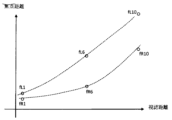
- FIG. 9 is a graph for explaining the approximate expression calculated from the table data.
- FIG. 10A is an explanatory diagram showing an example of data stored in temporary memory.
- FIG. 10B is an explanatory diagram illustrating an example of table data that is focal length specifying information updated by data stored in a temporary memory.
- FIG. 10C is a graph for explaining the approximate expression calculated from the table data.
- FIG. 11 is a front view schematically showing another configuration of the glasses according to the first embodiment.
- FIG. 12 is an explanatory diagram showing an example of table data that is focal length specifying information stored in the storage unit of the control device in the glasses according to the second embodiment.
- FIG. 13 is a flowchart illustrating an example of a focal length control setting mode in the second embodiment.
- Embodiment 1 Hereinafter, this embodiment will be referred to as "Embodiment 1" in which the present invention is applied to eyeglasses as an ophthalmic lens device equipped with a lens control device will be described.
- the ophthalmic lens device to which the present invention is applicable is not limited to eyeglasses, but may be other articles worn by a wearer (hereinafter referred to as a "user").
- FIG. 1 is a front view schematically showing the configuration of glasses 1 according to the first embodiment
- FIG. 2 is a plan view schematically showing the structure of the glasses 1 according to the first embodiment.
- Eyeglasses 1 according to the first embodiment include an eyeglass frame 2, a pair of left and right variable focus lenses 3, 3, and a control device 10 as a lens control device that controls the focal length of the variable focus lenses 3, 3. There is.
- the eyeglass frame 2 includes a bridge portion 4, a pair of left and right lens holding portions 6, 6, a nose rest portion 7, a pair of left and right endpieces 8, 8, and a pair of left and right temple portions 9, 9. There is.
- the bridge portion 4 is a member that is disposed at a position upwardly removed from the wearer's field of vision when worn, and supports left and right lens holding portions 6, 6 that hold the variable focus lenses 3, 3.
- the bridge portion 4 extends in the left-right direction between the left and right end pieces 8, 8, and the end pieces 8, 8 are attached to both ends of the bridge portion 4 in the left-right direction.
- the bridge part 4 connects the lens holding part 6 so that the lens holding part 6 can move in the left-right direction, and the lens distance D in the left-right direction of the pair of left and right variable focus lenses 3 held by the lens holding part 6 is determined. It is preferable to include an inter-lens distance adjusting section that can adjust the distance between the lenses.
- the inter-lens distance D can be defined, for example, by the distance between the reference positions on the variable focus lenses 3, 3 (for example, the center positions of the variable focus lenses 3, 3).
- the reference position of the variable focus lenses 3, 3 is equal to, for example, the optical center position of the variable focus lenses 3, 3
- the inter-lens distance D is equal to the distance between the optical centers of each variable focus lens 3, 3.
- the lens holding parts 6, 6 are members that hold the variable focus lenses 3, 3, and have an elongated shape (linear).
- the lens holding parts 6, 6 of the first embodiment are formed of plastically deformable wire members.
- the lens holding part 6 in the first embodiment extends from the bridge part 4 of the eyeglass frame 2, and holds the variable focus lens 3 by connecting its tip to the connected position 3a of the outer edge portion of the variable focus lens 3.
- the lens holding section 6 is supported by the bridge section 4 via a sliding section 4a, and the sliding section 4a constitutes an inter-lens distance adjusting section.
- the slide portion 4a is a member that holds the lens holding portion 6 slidably in the left-right direction with respect to the bridge portion 4.
- the slide portion 4a in the first embodiment is a hollow member, and the bridge portion 4 is inserted into the hollow portion and is attached to the bridge portion 4 so as to be slidable along the longitudinal direction of the bridge portion 4.
- the inter-lens distance D of the variable focus lenses 3 can be adjusted in accordance with the inter-pupillary distance PD of the user in a emmetropic state.
- the inter-lens distance D of the variable focus lenses 3, 3 is adjusted for each user according to the interpupillary distance PD of the user. It is beneficial to be able to adjust.
- the connected positions 3a of the varifocal lenses 3, 3 to which the lens holders 6, 6 are connected are connected to the optical axes of the varifocal lenses 3, 3, respectively, as shown in FIG. It is located on the outside (on the side far from the nose, that is, on the ear side) of the vertical imaginary line that passes through it, and above the horizontal imaginary line that passes through the optical axis of the variable focus lenses 3, 3.
- the connected position 3a of the variable focus lenses 3, 3 to which the lens holding parts 6, 6 are connected is not limited to the position of the first embodiment, and for example, as shown in FIG. It may be placed inside (on the nose side) of a vertical imaginary line passing through the optical axis of the lens.
- the nose rest part 7 is a member that is held by the bridge part 4 and comes into contact with the user's nose to determine the position of the glasses 1 when the user wears the glasses 1.
- the armor parts 8, 8 are members that connect the bridge part 4 and the temple parts 9, 9.
- the armor parts 8, 8 in the first embodiment include a mounting part 8a that is attached to the end of the bridge part 4, and a hinge part 8b that rotatably supports the temple part 9.
- the temple parts 9, 9 are members that are hung on the user's ears when the user wears the glasses 1.
- the left and right temple parts 9, 9 in the first embodiment are configured so that they can be folded toward the center in the left-right direction of the eyeglasses 1 by hinge parts 8b provided in the endpiece parts 8, 8, respectively.
- variable focus lenses 3, 3 in the first embodiment are not limited to this configuration as long as they have an electrically controllable focal length changing function.
- the variable focus lenses 3, 3 are variable shape lenses in which the focal length changes by changing the shape of the refractive surface.
- variable-shape lenses liquid lenses that use the interface between two types of liquid as a refractive surface and change the focal length by electrically controlling the wettability of the liquid and changing the shape of the interface (electrowetting device) ) is preferable. With a liquid lens, the focal length can be controlled at high speed and with a high degree of freedom.
- variable focus lenses 3, 3 of the first embodiment employ, for example, a liquid lens whose lens portion has a diameter of about 5 mm to 12 mm. Note that by using a larger varifocal lens, the range of the user's line of sight that can be covered by the varifocal lens is expanded, and user convenience can be improved.
- FIG. 3 is a sectional view showing a schematic configuration of the variable focus lens 3 in the first embodiment.
- FIG. 4 is a plan view showing a schematic configuration of the variable focus lens 3 in the first embodiment.
- an insulating liquid 311 and a conductive liquid 312 which are in contact with each other in an unmixed state at an interface I, are connected to an annular first electrode 301 and a first electrode It has a configuration in which it is enclosed by two transparent window members 303 and 304 that close the upper and lower ends of 301.
- the insulating liquid 311 is, for example, an oil-based liquid
- the conductive liquid 312 is, for example, an aqueous liquid with relatively low conductivity.
- variable focus lens 3 of the first embodiment a plurality of pairs of second electrodes 302A, 302B, . . . are arranged at symmetrical positions with respect to the axis O of the first electrode 301.
- four pairs of second electrodes 302A to 302H are arranged on a circumference centered on the axis O, and a total of eight second electrodes 302A to 302H are provided. There is.
- the second electrodes 302A to 302H are arranged at positions in contact with the conductive liquid 312, as shown in FIG.
- voltages VA to VH are applied to each of the second electrodes 302A to 302H
- a potential difference is generated between each of the second electrodes 302A to 302H and the first electrode 301, and due to the electrowetting effect, the end Ia of the insulating liquid 311 (interface The end Ia) of I can be displaced along the insulating layer portion 301b on the first electrode 301.
- the shape of the insulating liquid 311 changes and the curvature of the interface I changes. Therefore, by controlling the voltages VA to VH applied to the second electrodes 302A to 302H, it is possible to change the focal length of the variable focus lens 3 whose refractive surface is the interface I.
- the glasses 1 of the first embodiment can be used as glasses for myopic users by making the variable focus lens 3 a diffusing lens (concave lens), and by making the variable focus lens 3 a condensing lens (convex lens). It can be used as glasses for farsighted users.
- variable focus lens 3 of the first embodiment can change the focal length within a range of -15D or more and +15D or less in diopter conversion (reciprocal of focal length).
- variable focal length lens 3 having such a wide range of change in focal length, it is possible to accommodate users with low visual acuity such as amblyopia, for example.
- the optical axis of the variable focus lens 3 is The focal length can be changed while keeping it aligned with the axis O.
- the variable focus lens 3 of the first embodiment can change either or both the position and direction of the optical axis by controlling the applied voltages VA to VH.
- control device 10 is provided, together with the battery 20, on one of the left and right endpieces 8, 8 (the right endpiece (left side in the figure) 8).
- the control device 10 can control the focal length of the variable focus lens 3 by controlling the voltage applied from the battery 20 to each second electrode 302A to 302H of the variable focus lens 3.
- FIG. 5 is a block diagram showing the configuration of the control device 10 in the first embodiment.
- the control device 10 in the first embodiment includes a main control section 11, a voltage change section 12, an operation section 13, and a storage section 14.
- the control device 10 controls the second electrodes 302A to 302H of the two variable focus lenses 3, 3, the battery 20 as a power source for supplying voltage, and the distance to the visible object that the user views through the variable focus lenses 3, 3.
- a distance detection section 21 that detects the distance is connected.
- the main control unit 11 is configured by a control board (computer) on which a CPU, RAM, ROM, etc. are mounted, and the main control unit 11 is configured to control eyeglasses, which are an ophthalmic lens device, by executing a predetermined control program stored in the ROM. 1 overall control.
- the main control unit 11 causes the focal length of the variable focus lenses 3, 3 to change based on the visible distance (detection result) to the visible object detected by the distance detection unit 21.
- it functions as a control unit (control means) that controls the variable focus lenses 3, 3.
- the voltage change unit 12 changes the voltage applied from the battery 20 to each of the second electrodes 302A to 302H of the variable focus lens 3 under the control of the main control unit 11.
- the voltage changing unit 12 can individually change the voltage applied to each of the second electrodes 302A to 302H. However, the voltage changing unit 12 may be able to partially change only some of the second electrodes 302A to 302H (for example, only one pair of second electrodes).
- the operation unit 13 When operated by the user, the operation unit 13 outputs an operation signal indicating the content of the user's operation to the main control unit 11. Examples of user operations accepted by the operation unit 13 include power on/off operations, execution instructions for the main control unit 11, and changes in control content of the main control unit 11.
- the operation unit 13 in the first embodiment accepts a user operation for changing the focal length of the two variable focus lenses 3, 3.
- the operating unit 13 is configured with a type of operating device (such as a mechanical or electrostatic touch button, a rotary operating unit such as a dial, etc.) suitable for the content of the user operation to be accepted.
- the operation section 13 of the first embodiment is composed of two rotary operation type dial sections 13a, 13a and a button operation type button section 13b.
- the rotary operation type dial parts 13a, 13a are provided on the sides of the left and right endpiece parts 8, 8, respectively, and are configured to be rotatable around a rotation axis extending in the left-right direction. ing.
- the dial section 13a provided on the left armrest 8 is turned counterclockwise, it accepts an instruction operation to shorten the focal length of the variable focus lens 3 for the left eye, and when it is turned clockwise, it accepts an instruction operation to shorten the focal length of the variable focus lens 3 for the left eye.
- An instruction operation for increasing the focal length of a variable focus lens 3 for eyes is accepted.
- dial portion 13a provided on the right armrest 8 when turned clockwise, it accepts an instruction operation to shorten the focal length of the variable focus lens 3 for the right eye, and when turned counterclockwise, the dial portion 13a receives an instruction to shorten the focal length of the variable focus lens 3 for the right eye. , accepts an instruction operation to lengthen the focal length of the variable focus lens 3 for the right eye.
- the button operation type button part 13b is provided on the rotation axis of the dial part 13a provided in the right armouring part 8, and pushes the dial part 13a along the rotation axis in the direction of arrow A in FIGS. 1 and 2. By doing so, it accepts instructions from the user.
- the button section 13b receives a switching operation for switching the operation mode of the main control section 11, an instruction operation determined by the user, and the like.
- the switching operation using the button section 13b in the first embodiment is an operation for switching between a setting mode and a usage mode.
- the setting mode is an operation mode for setting focal length specifying information used in an automatic control mode, which will be described later, and sets the user's suitable focal length according to the visible distance detected by the distance detection unit 21.
- the use mode is an operation mode in which the focal length of the variable focus lenses 3, 3 is controlled by an automatic control mode or a manual control mode, which will be described later.
- the user-determined instruction operation using the button section 13b is performed by, for example, changing the focal length of each variable focus lens 3 by operating the dial sections 13a, 13a, and searching for a focal length that suits the user. (by measuring), and when the appropriate focal length is determined, perform the determination operation.
- the storage unit 14 stores programs and data used by the control device 10.
- the focal length of the variable focus lenses 3, 3 is specified according to the distance to the visible object, as data used to control the focal length of the variable focus lenses 3, 3 in the automatic control mode.
- the focal length specific information is, for example, the relationship between the visible distance to the visible object (detection result of the distance detection unit 21) and each compatible focal length of the user in the two variable focus lenses 3, 3 (corresponding to each visible distance).
- This information indicates the focal length suitable for the user.
- such information can be stored in the storage unit 14 as table data that describes the correspondence between the viewing distance and the focal lengths of the two variable focus lenses 3, 3. can.
- the distance to each setting visible object when the user views each setting visible object located at a plurality of different distances from each other, and each setting visible object The respective focal lengths (compatible focal lengths) of the variable focus lenses 3, 3 at which the user focuses on the object are acquired, and focal length specific information is generated based on these distances and the compatible focal lengths. According to this, it is possible to generate focal length specific information suitable for each user, so the focal length of the two variable focus lenses 3, 3 can be adjusted to an appropriate value for each user by using the automatic control mode in the usage mode. The focal length can be adjusted.
- the battery 20 functions as a power source for the control device 10 and outputs a voltage to be supplied to the second electrodes 302A to 302H of the variable focus lens 3.
- the battery 20 may be a primary battery or a secondary battery. Alternatively, it may be equipped with a power generation function such as a solar panel.
- the distance detection unit 21 is not limited in its configuration as long as it can detect the distance to the visible object existing in the area in front of the variable focus lenses 3 (visual area), but it can be placed on the eyeglass frame 2. It is preferable that the lens be arranged in the vicinity of the variable focus lenses 3, 3, in particular. As shown in FIG. 1, the distance detecting section 21 of the first embodiment is arranged on the nose piece 7, but it may also be arranged on the bridge part 4, the endpieces 8, 8, etc. However, it is preferable that the distance detection unit 21 be located at a position where the distance detection unit 21 is unlikely to be covered by hair (bangs) when the user wears the glasses 1. It is preferable to set the position (nose pad 7).
- the distance measuring method in the distance detecting section 21 is not particularly limited, and a wide range of existing distance measuring methods such as a laser method and a sound wave method can be adopted. In addition, if it is difficult to cover the visible distance range (range from short distance to long distance) that you want to detect by the distance detection unit 21 with one distance detection unit, the effective detection distance range (high accuracy detection A plurality of distance detection units having different possible distance ranges may be arranged.
- FIG. 7 and 8 are flowcharts showing the flow of focal length control in the first embodiment.
- FIG. 7 shows the control contents in the setting mode
- FIG. 8 shows the control contents in the use mode.
- the main controller 11 that executes a predetermined control program controls the voltage changer 12 to control the visible distance (detection result) to the visible object detected by the distance detector 21.
- the automatic control mode in which the focal length of the variable focus lenses 3, 3 is controlled based on the focal length specifying information in the storage unit 14, and the variable focus lens 3 is controlled based on instruction operations on the dial units 13a, 13a of the operation unit 13. , and a manual control mode to control the focal length of 3.
- the operation unit 13 when the operation unit 13 receives a power-on operation from the user (S1), it first receives a switching operation to switch the operating mode of the main control unit 11 to a setting mode or a usage mode (S2). Specifically, after the power is turned on, if the button portion 13b is pressed within a predetermined time, the device shifts to the setting mode (Yes in S2), and if the button portion 13b is not pressed within the predetermined time, the device shifts to the use mode. (No of S2).
- focal length control may be started by detecting that the user wears the glasses 1.
- the main control unit 11 When transitioning to the setting mode (Yes in S2), the main control unit 11 functions as a setting processing unit, executes a program for operating in the setting mode, and starts the setting process.
- the user first turns the left dial portion 13a while viewing a visible object (visible object for setting) located at a reference viewing distance (eg, long distance) (Yes in S3).
- the operation signal is sent from the operation section 13 as a focal length determining section to the main control section 11, and the main control section 11 transmits the voltage corresponding to the operation signal to the second lens of the variable focus lens 3 for the left eye.
- the voltage changing section 12 is controlled so that the voltage is applied to the electrodes 302A to 302H.
- the curvature of the interface I is changed due to the shape change of the interface I between the insulating liquid 311 and the conductive liquid 312 in the variable focus lens 3 for the left eye, and the focal length of the variable focus lens 3 for the left eye changes. It is changed according to the user's operation on the dial section 13a (S4).
- the user After turning the left dial part 13a to adjust the focal length of the variable focus lens 3 for the left eye so that the visual object at the reference distance (the visual object for setting) is in focus, the user then: Turn the right dial part 13a while visually recognizing the visible object at the same reference distance (Yes in S5).
- the operation signal is sent from the operation section 13 as a focal length determining section to the main control section 11, and the main control section 11 transmits the voltage corresponding to the operation signal to the second one of the variable focus lens 3 for the right eye.
- the voltage changing section 12 is controlled so that the voltage is applied to the electrodes 302A to 302H.
- the curvature of the interface I is changed due to a change in the shape of the interface I between the insulating liquid 311 and the conductive liquid 312 in the variable focus lens 3 for the right eye, and the focal length of the variable focus lens 3 for the right eye is changed to It is changed according to the user's operation on the dial section 13a (S6).
- the main control unit 11 receives this button operation signal from the operating unit 13 serving as a focal length determining unit, and detects the visible distance detected by the distance detection unit 21 for the visual target object at the reference distance described above (visible target for setting). Obtain the results (S8). Then, the main control unit 11 stores the focal lengths of the left and right variable focus lenses 3, 3 at the time when the button unit 13b is pressed and the acquired visual recognition distance detection results in the storage unit 14 as focal length specific information. (S9).
- the main control unit 11 adds d10 as the visible distance data in the table data shown in FIG.
- the main control unit 11 then stores fL10 and fR10, which are focal lengths adjusted by the user (compatible focal lengths), as the focal lengths of the left and right variable focus lenses 3, 3 corresponding to the viewing distance d10, respectively.
- the user When executing the automatic control mode, it is desirable for the user to set the compatible focal length for more viewing distances. By repeating the task of changing the visible distance to the visible object and performing the above-mentioned setting mode, the user can adjust the user's adaptation for multiple visible distances (three points d1, d6, and d10 in Figure 6).
- the focal length (in FIG. 6, fL1, fL6, fL10, fR1, fR6, fR10) can be set.
- the usage mode will be explained. If the button portion 13b is not pressed within a predetermined time after the power is turned on, or if the setting mode ends, the mode shifts to the usage mode shown in FIG. 8 (S10).
- the main control unit 11 When shifting to the use mode, the main control unit 11 first calculates an approximation as shown in the graph shown in FIG. 9 from the focal length specific information (for example, the table data shown in FIG. 6) stored in the storage unit A formula is calculated (S11).
- This approximate expression is an expression indicating the relationship between the visible distance detected by the distance detection section 21 and the user's suitable focal length at that visible distance, and is stored in the storage section 14 as shown in FIG.
- This is a formula representing an approximate line when focal length specific information (table data) is plotted.
- the least squares method or Hough transform can be used to calculate the approximate expression.
- the table data used to calculate the approximate formula is stored in the storage unit 14 as focal length specific information, but it is also possible to store this approximate formula in the storage unit 14 as focal length specific information. good.
- the main control unit 11 After calculating the approximate expression in this way, the main control unit 11 acquires the detection result of the visible distance to the visible object from the distance detection unit 21 (S12). Thereafter, the main control unit 11 derives an appropriate focal length corresponding to the acquired visual recognition distance (detection result) using the approximate expression calculated in processing step S11 (S13). Then, the main control unit 11 controls the voltage changing unit 12 so that the focal length of the left and right variable focus lenses 3, 3 becomes the derived compatible focal length, and The voltage applied to the two electrodes 302A to 302H is changed. As a result, the focal lengths of the left and right variable focus lenses 3, 3 are changed to a focal length suitable for the user (S14), and the visual object is automatically brought into focus.
- the focal length of the left and right variable focus lenses 3, 3 is automatically adjusted to focus on the nearby visible object.
- a distant visual object such as a video from a distant place (such as a movie), an object to appreciate such as a work of art, or a landscape
- the user may move the left and right sides so that the distant visual object is in focus.
- the focal length of the variable focus lenses 3, 3 is automatically changed. For example, when the user sees an object at a medium distance, such as when driving a car, the focal lengths of the left and right variable focus lenses 3, 3 are automatically adjusted to focus on the object at a medium distance. will be changed.
- the condition of the eye (visual acuity, refractive power adjustment function, etc.) that is related to the user's ability to focus on the visual object may be affected by, for example, the progression or improvement of refractive error in the eye. Change. Furthermore, the condition of the eyes can also change depending on, for example, the illuminance (brightness) of the viewing area. Therefore, the focal length (adapted focal length) of the variable focus lens that the user can focus on is not uniformly determined depending on the viewing distance to the visible object, but can change depending on the condition of the user's eyes.
- the condition of the user's eyes may change from the state in the setting mode described above, and in this case, in the automatic control mode, the focal length of the variable focus lenses 3, 3 is adjusted according to the visible distance to the visible object. It can no longer be adjusted to fit the wearer.
- the first embodiment it is possible to execute not only the automatic control mode but also the manual control mode in which the focal length of the variable focus lens can be adjusted by user operation. Specifically, when the user turns the dial parts 13a, 13a of the operation unit 13 when the visual target is out of focus during the automatic control mode (Yes in S15), the operation signal is sent to the main control unit 11. The main control unit 11 shifts to manual control mode.
- the main control section 11 controls the voltage change section 12 according to the operation signal of the operated dial sections 13a, 13a, and changes the voltage to the dial sections 13a, 13a.
- the voltage applied to the second electrodes 302A to 302H of the corresponding variable focus lenses 3, 3 is changed.
- the focal lengths of the variable focus lenses 3, 3 are changed according to the user's operation on the operated dial parts 13a, 13a (S16).
- the automatic control described above Depending on the mode, the focal length of the variable focus lenses 3, 3 can be adjusted again to suit the user. However, if the user's eye condition continues to change (e.g., the refractive error of the eye progresses or improves), the user's eye condition may be the same as in the setting mode described above. I won't go back. Therefore, in the automatic control mode as it is, it becomes impossible to adjust the focal length of the variable focus lenses 3, 3 to suit the user.
- the automatic control mode allows the focal length of the variable focus lenses 3, 3 to be adjusted to suit the user.
- processing is performed to update the focal length specifying information (table data) stored in the storage unit 14.
- the control result in the manual control mode is (control result of the focal length of the variable focus lens) and the detection result of the distance detection unit 21 at this time (distance to the visible object (visible object for setting)) are stored in the storage unit 14.
- Update focal length specific information (table data). The focal length specific information that is updated by this is updated with the adapted focal length after the user's eye condition changes, so in the subsequent automatic control mode, the variable focus according to the user's eye condition after the change. The focal lengths of the lenses 3, 3 are controlled. Therefore, even after the user's eye condition continues to change, the automatic control mode allows the focal length of the variable focus lenses 3, 3 to be adjusted to suit the user.
- the detection result of the visible distance to the visible object is acquired (S17).
- the main control unit 11 then stores the visual recognition distance corresponding to the acquired detection result of the distance detection unit 21 for the variable focus lenses 3, 3 whose focal lengths have been changed, in the temporary storage area (temporary memory) of the storage unit 14.
- the control result in the manual control mode (focal length after change of the variable focus lenses 3, 3) is temporarily stored in association with (S18).
- the main control unit 11 starts a timer corresponding to the variable focus lenses 3, 3 whose focal lengths have been changed (S19).
- the main control unit 11 If the user operates the dial units 13a, 13a for the corresponding variable focus lenses 3, 3 before T seconds elapse on the timer (No in S21), the main control unit 11 resets the timer. At the same time, the data in the temporary memory is also reset, and the focal length of the variable focus lenses 3, 3 is changed according to the user's operation (S16). Thereafter, the main control unit 11 again obtains the detection result of the visible distance to the visible object detected by the distance detection unit 21 (S17), and manually stores the detection result in the temporary storage area (temporary memory) of the storage unit 14. The control result in the control mode (focal length after change of the variable focus lenses 3, 3) is temporarily stored (S18). Then, the main control unit 11 starts the timer again corresponding to the variable focus lenses 3, 3 whose focal lengths have been changed (S19).
- the main control unit 11 temporarily stores the The focal length specifying information (table data) stored in the storage unit 14 is updated using the stored visual recognition distance and the control result in the manual control mode (S22).
- the main control unit 11 As shown in the figure, the focal length A is stored as the focal length fL1 corresponding to the visible distance d1 in the focal length specifying information (table data) stored in the storage unit 14. At this time, if the focal length fL1 corresponding to the visible distance d1 is already stored as the focal length specifying information (table data) stored in the storage unit 14, the focal length A is overwritten.
- the main control unit 11 switches to the automatic control mode, returns to process step S11, and uses the updated focal length specific information (table data) stored in the storage unit 14. Then, as shown in FIG. 10C, a new approximate expression indicated by a dotted line (the approximate expression before update is indicated by a two-dot chain line) is calculated (S11). Thereafter, the main controller 11 executes the automatic control mode using this new approximation formula, and adjusts the focal length of the left and right variable focus lenses 3, 3 to the user according to the detection result (visual distance) of the distance detector 21. (S12 to S14).
- the focal length of the variable focus lenses 3, 3 is controlled according to the user's eye condition after the change, so even after the user's eye condition continues to change, the automatic control mode will not change.
- the focal length of the variable focus lenses 3, 3 can be adjusted to suit the user.
- the main control unit 11 ends the focal length control. At this time, the voltage supply to each second electrode 302A to 302H of the variable focus lens 3 may be turned off or turned on. By turning off the voltage supply to each of the second electrodes 302A to 302H of the variable focus lens 3, power consumption of the battery 20 can be saved.
- the visual object when the focal length of the variable focus lenses 3, 3 can be adjusted to suit the user in the automatic control mode, the visual object can be automatically brought into focus without any particular operation. Become.
- the focal lengths of the variable focus lenses 3, 3 cannot be adjusted to suit the user in the automatic control mode, the user can manually focus on the visual object by operating the dial parts 13a, 13a.
- the update process (setting process) for updating the focal length specific information stored in the storage unit 14 using the control result of the manual control mode
- the user's The automatic control mode allows the focal length of the variable focus lenses 3, 3 to be adjusted to suit the user even after the eye condition continues to change.
- the focal length specifying information in the storage unit 14 is overwritten using the control result in the latest manual control mode
- the control results obtained in the manual control mode may not be overwritten, but may be stored as history information in the storage unit 14 as a history storage unit together with past information.
- focal length data A corresponding to the visible distance d1 stored in the temporary memory and past data corresponding to the visible distance d1 already stored in the storage unit 14 From this, the focal length fL1 corresponding to the visible distance d1 may be calculated.
- the average value of the most recent five focal length data corresponding to the visible distance d1 may be set as the focal length fL1 corresponding to the visible distance d1 stored in the storage unit 14. Furthermore, if the latest data is significantly different from previous historical data, the latest data may be treated as an abnormal value.
- the control result in the manual control mode (the control result of the focal length of the variable focus lens) is stored in the storage unit 14 until the timer reaches T seconds after the user's operation on the dial unit 13a.
- the control results obtained when no user operation is performed on the dial portions 13a, 13a are used, the present invention is not limited thereto.
- the user when the user operates the dial part 13a to adjust the focal length of the variable focus lens 3 in manual control mode, the user operates to lengthen or shorten the focal length, and after the focal length that is in focus has passed, On the other hand, the focal length is often shortened or returned to a longer focal length to finally reach a focal length that is in focus.
- control result is used when a user operation to shorten or lengthen the focal length is performed on the dial portion 13a after a user operation to lengthen or shorten the focal length is performed. Good too. According to this, operations unrelated to the focusing operation such as erroneous operations on the dial section 13a are eliminated, and the focal length adjusted by the focusing instruction operation on the dial section 13a is stored in the storage section 14 with high accuracy. It can be used as a stored control result in manual control mode.
- a setting process is executed in which focal length specific information is stored in the storage unit 14 by using any visible object around the user as a setting visible object. It is not limited to this.
- the setting process may be executed at a place where the glasses 1 according to the first embodiment are sold or at a medical institution such as an ophthalmology clinic, using a setting visible object placed at a predetermined distance. .
- a previously known distance to the visible object for setting is input to the control device 10 of the glasses 1, and the setting process is executed using the input value. You may.
- the focal length specifying information that the main control unit 11 stores in the storage unit 14 in the setting process is generated in the main control unit 11 of the control device 10 installed in the eyeglasses 1. It may also be generated in an external device. That is, a setting process may be executed in which focal length specifying information generated by an external device is input to the control device 10 mounted on the glasses 1, and the input focal length specifying information is stored in the storage unit 14.
- Embodiment 2 Next, another embodiment (hereinafter, this embodiment will be referred to as "Embodiment 2") in which the present invention is applied to eyeglasses as an ophthalmic lens device including a lens control device will be described.
- the basic structure of the glasses 1 of this Embodiment 2 is the same as that of Embodiment 1 mentioned above, the control method of the control apparatus 10 is different from Embodiment 1 mentioned above.
- differences from the first embodiment described above will be mainly explained, and overlapping explanations will be omitted as appropriate.
- FIG. 12 is an explanatory diagram showing an example of table data that is focal length specific information stored in the storage unit 14 of the control device 10 in the eyeglasses 1 of the second embodiment.
- the focal length specific information of the second embodiment also includes, for example, the relationship between the visible distance to the visible object (detection result of the distance detection unit 21) and each compatible focal length of the user in the two variable focus lenses 3, 3 ( This information indicates the focal length suitable for the user corresponding to each viewing distance.
- such information can be stored in the storage unit 14 as table data that describes the correspondence between the viewing distance and the focal lengths of the two variable focus lenses 3, 3. can.
- the distance to the setting visible object when the user visually recognizes the setting visible object, and the variable focal point at which the user focuses on the setting visible object The focal lengths of lenses 3 and 3 are obtained. Then, a correction value that reduces the difference between the acquired focal length and the focal length corresponding to the acquired distance in the focal length specifying information stored in the storage unit 14 is calculated. After that, new focal length specifying information is generated by correcting not only the focal length corresponding to the acquired distance but also the focal lengths corresponding to other distances by this correction value, and using this new focal length specifying information, The focal length specific information stored in the storage unit 14 is updated.
- the new focal length specific information updated in this way is based on the visible distance within a predetermined distance range that includes the acquired distance and the other distance, with respect to the focal length specific information stored in the storage unit.
- the outline of the change in the adapted focal length in response to this change is approximately the same, each focal length corresponding to each visible distance within the predetermined distance range is shifted by the correction value.
- the outline of the change in the adapted focal length according to the visible distance will be exactly the same, and It may be assumed that each corresponding focal length is shifted by the same correction value.
- the outline of the change in the compatible focal length according to the visible distance is, for example, with the horizontal axis representing the visible distance to the visible target for setting, and the focal length of the variable focus lenses 3, 3 where the user is in focus (compatible focal length). It can be expressed by a graph in which the vertical axis is the value converted into the unit of lens refractive power.
- the illuminance conditions for the measurement data of the subject to be plotted on this graph are, for example, the illuminance at a visual distance of 0 cm is 685Lx, the illuminance at a visual distance of around 180cm is 744Lx, and the illuminance at a visual distance of around 300cm. is 726Lx.
- the appropriate focal length (lens refractive power) at each viewing distance is measured for multiple subjects with different degrees of visual acuity or refractive error while changing the viewing distance to the setting visual target. .
- the data of the subject shows the measurement data of one subject as is, and the data of the remaining subjects are shown within the visible distance range (where the visible distance is long) where the compatible focal length (lens refractive power) is approximately constant.
- the measurement data of each of the remaining subjects is vertically divided so that the average value of the adapted focal length (lens refractive power) of each subject in the distance range) matches the average value of the one subject. Plot by shifting in the axial direction.
- the present inventors have found that both users who do not need to correct their refractive error with glasses, etc., and users whose visual acuity is good enough to correct their refractive error with glasses, etc. It has been found that the outline of the graph showing the relationship between the distance to the visible object (visible distance) and the compatible focal length (the outline of the change in the compatible focal length according to the visible distance) is roughly the same. Based on this knowledge, if the user's compatible focal length corresponding to at least one viewing distance (preferably a distance range in which the rate of change in the compatible focal length is small) is determined, the change in the relevant focal length that is common to all users can be summarized. By using the shape, it is possible to obtain focal length specific information suitable for each individual user.
- focal length specific information suitable for the user is stored in the focal length in the storage unit 14. Specific information can be updated. Therefore, according to the present lens control device, focal length specifying information suitable for each user can be obtained without forcing the user to perform complicated work in determining the user's suitable focal length corresponding to the viewing distance. As a result, it is possible to generate focal length specific information suitable for each individual user, so the automatic control mode in use mode allows the focal lengths of the two variable focus lenses 3, 3 to be adjusted to the appropriate focal length for each user. can be adjusted to
- the focal length specifying information stored in the storage unit 14 before being updated may be the focal length specifying information that has been previously stored in the storage unit 14 from the time of shipment, or may be the focal length specifying information that has been previously updated by another user. It may be later focal length specifying information, or it may be focal length specifying information updated by the same user in the past.
- the focal length specific information stored in the storage unit 14 in advance from the time of shipment determines the appropriate focal length for each visible distance over the distance range of the focal length specific information for one or more subjects (persons other than the user). It may be created from the measured results.
- the subjects to be measured may be one or more people with standard visual acuity, or multiple people with different visual acuities or different degrees of refractive error.
- FIG. 13 is a flowchart showing control details in the setting mode of the focal length control in the second embodiment. Note that the control details in the use mode are the same as in the first embodiment described above, so FIG. 8 is referred to.
- the main control section 11 that executes a predetermined control program controls the voltage change section 12, so that the visible distance to the visible object detected by the distance detection section 21 (detection result ) and the automatic control mode in which the focal length of the variable focus lenses 3, 3 is controlled based on the focal length specifying information in the storage unit 14, and the variable focus lens 3 is controlled based on instruction operations on the dial units 13a, 13a of the operation unit 13. , and a manual control mode to control the focal length of 3.
- the operation unit 13 when the operation unit 13 receives a power-on operation from the user (S1), it first accepts a switching operation to switch the operating mode of the main control unit 11 to a setting mode or a usage mode (S2). Specifically, after the power is turned on, if the button portion 13b is pressed within a predetermined time, the device shifts to the setting mode (Yes in S2), and if the button portion 13b is not pressed within the predetermined time, the device shifts to the use mode. (No of S2).
- the main control unit 11 When transitioning to the setting mode (Yes in S2), the main control unit 11 functions as an update processing unit, executes a program for operating in the setting mode, and starts update processing.
- the setting mode the user first turns the left dial portion 13a while viewing a visible object (visible object for setting) located at a reference viewing distance (eg, long distance) (Yes in S3).
- the operation signal is sent from the operation section 13 as a focal length determining section to the main control section 11, and the main control section 11 transmits the voltage corresponding to the operation signal to the second lens of the variable focus lens 3 for the left eye.
- the voltage changing section 12 is controlled so that the voltage is applied to the electrodes 302A to 302H.
- the curvature of the interface I is changed due to the shape change of the interface I between the insulating liquid 311 and the conductive liquid 312 in the variable focus lens 3 for the left eye, and the focal length of the variable focus lens 3 for the left eye changes. It is changed according to the user's operation on the dial section 13a (S4).
- the user After turning the left dial part 13a to adjust the focal length of the variable focus lens 3 for the left eye so that the visual object at the reference distance (the visual object for setting) is in focus, the user then: Turn the right dial part 13a while visually recognizing the visible object at the same reference distance (Yes in S5).
- the operation signal is sent from the operation section 13 as a focal length determining section to the main control section 11, and the main control section 11 transmits the voltage corresponding to the operation signal to the second one of the variable focus lens 3 for the right eye.
- the voltage changing section 12 is controlled so that the voltage is applied to the electrodes 302A to 302H.
- the curvature of the interface I is changed due to a change in the shape of the interface I between the insulating liquid 311 and the conductive liquid 312 in the variable focus lens 3 for the right eye, and the focal length of the variable focus lens 3 for the right eye is changed to It is changed according to the user's operation on the dial section 13a (S6).
- the main control unit 11 receives this button operation signal from the operating unit 13 serving as a focal length determining unit, and detects the visible distance detected by the distance detection unit 21 for the visual target object at the reference distance described above (visible target for setting). Obtain the results (S8).
- the main control unit 11 stores the focal lengths of the left and right variable focus lenses 3, 3 at the time when the button unit 13b is pressed and the acquired visibility distance detection results in the storage unit 14.
- a correction value for updating the stored focal length specific information is calculated (S30). Specifically, a correction value that reduces the difference between the focal lengths of the left and right variable focus lenses 3, 3 and the focal length corresponding to the visible distance of the focal length specific information stored in the storage unit 14, for example, A correction value that makes the difference zero is calculated.
- each focal length fL1 to fL10 corresponds to a predetermined distance range including the visible distance and other visible distances (for example, the entire distance range from d1 to d10 included in the focal length specification information).
- the table data in the storage unit 14 is overwritten with focal lengths fL1' to fL10' and fR1' to fR10', which are obtained by adding (or subtracting) a correction value to these focal lengths.
- the new focal length specifying information updated in this way is the compatible focal length fL1 to fL10, fR1 corresponding to each visible distance d1 to d10, with respect to the focal length specifying information before update stored in the storage unit 14.
- fR10 the outline of the change in fR10 is the same, each focal length fL1' to fL10' and fR1' to fR10' corresponding to each visible distance d1 to d10 is shifted by the above correction value. .
- the usage mode will be explained. If the button portion 13b is not pressed within a predetermined time after the power is turned on, or if the setting mode ends, the mode shifts to the usage mode shown in FIG. 8 (S10).
- the main control unit 11 When shifting to the use mode, the main control unit 11 first obtains an outline of the change in the suitable focal length according to the viewing distance from the focal length specifying information (for example, the table data shown in FIG. 12) stored in the storage unit 14.
- An approximate expression represented by a graph showing the shape is calculated (S11). Note that if the focal length specific information has been updated in the setting mode described above, the approximate formula is calculated using the updated focal length specific information (focal lengths fL1' to fL10', fR1' to fR10'). do.
- this approximate expression is an expression indicating the relationship between the visible distance detected by the distance detection section 21 and the user's suitable focal length at that visible distance, and is stored in the storage section 14.
- This is a formula that represents an approximate line when the focal length specific information (table data) is plotted.
- the least squares method or Hough transform can be used to calculate the approximate expression.
- the table data used to calculate the approximate formula is stored in the storage unit 14 as focal length specifying information, but it is also possible to store this approximate formula in the storage unit 14 as focal length specifying information. good.
- the second embodiment it is possible to execute not only the automatic control mode but also the manual control mode in which the focal length of the variable focus lens can be adjusted by user operation.
- the control contents of the manual control mode are also the same as those of the first embodiment described above, but the process of updating the focal length specific information (table data) stored in the storage unit 14 using the results of the manual control mode is different. .
- the control result in the manual control mode (the focal length of the variable focus lenses) control result) and the detection result of the distance detection unit 21 at this time (distance to the visible object (visible object for setting)) to update the focal length specific information stored in the storage unit 14.
- the correction value is calculated in the same way as the update process in the setting mode described above.
- the focal lengths fL1 to fL10 and fR1 to fR10 corresponding to each visible distance in the focal length specifying information in the storage unit 14 are shifted by the calculated correction value to obtain values fL1' to fL10' and fR1' to Update with fR10'.
- the main control part 11 calculates a correction value using the visual recognition distance stored in the temporary memory and the control result in the manual control mode, and uses this correction value to calculate the focal length specific information (table data) stored in the storage unit 14. ) is updated (S22).
- the control result in the manual control mode (the control result of the focal length of the variable focus lens) stored in the storage unit 14 is that the timer indicates that T seconds have elapsed after the user's operation on the dial unit 13a.
- the control results obtained when no user operation is performed on the dial units 13a, 13a are used up to this point, the present invention is not limited to this.
- the user when the user operates the dial part 13a to adjust the focal length of the variable focus lens 3 in manual control mode, the user operates to lengthen or shorten the focal length, and after the focal length that is in focus has passed,
- the focal length is often shortened or returned to a long focal length to finally adjust to a focal length that is in focus (compatible focal length).
- control result is used when a user operation to shorten or lengthen the focal length is performed on the dial portion 13a after a user operation to lengthen or shorten the focal length is performed.
- operations unrelated to the focusing operation such as erroneous operations on the dial section 13a are eliminated, and the focal length adjusted by the focusing instruction operation on the dial section 13a is stored in the storage section 14 with high accuracy.
- a method for determining an appropriate focal length that takes such adjustments into account may be applied to update processing in the setting mode.
- an arbitrary visible object around the user is used as a setting visible object to perform an update process to update the focal length specific information in the storage unit 14.
- the update process may be executed using a setting visual object placed at a predetermined distance at a place where the glasses 1 according to the second embodiment are sold or at a medical institution such as an ophthalmology clinic. .
- the distance to the setting visible object that is known in advance is input to the control device 10 of the glasses 1, and the update process is executed using the input value. You may.
- new focal length specifying information used by the main control unit 11 in the update process is generated in the main control unit 11 of the control device 10 installed in the eyeglasses 1. May be generated. That is, an update process of inputting new focal length specifying information generated by an external device to the control device 10 mounted on the glasses 1 and updating the focal length specifying information in the storage unit 14 with the input new focal length specifying information. may be executed.
- processing steps described herein as well as the components of the ophthalmic lens device, such as the eyeglasses 1, can be implemented by various means.
- these steps and components may be implemented in hardware, firmware, software, or a combination thereof.
- processing units and other means used to implement the steps and components described above may include one or more application specific integrated circuits (ASICs), digital signal processors (DSPs), digital signal processors, etc. device (DSPD), programmable logic device (PLD), field programmable gate array (FPGA), processor, controller, microcontroller, microprocessor, electronic device for performing the functions described herein. It may also be implemented in other designed electronic units, computers, or combinations thereof.
- ASICs application specific integrated circuits
- DSPs digital signal processors
- DSPD digital signal processors
- PLD programmable logic device
- FPGA field programmable gate array
- processor controller, microcontroller, microprocessor, electronic device for performing the functions described herein. It may also be implemented in other designed electronic units, computers, or combinations thereof.
- the means used to implement the components may include programs (e.g., procedures, functions, modules, instructions) that perform the functions described herein. , etc.).
- any computer/processor readable medium tangibly embodying firmware and/or software code may be used to implement the steps and components described herein. It may be used for implementation.
- the firmware and/or software code may be stored in memory and executed by a computer or processor, eg, in a controller.
- the memory may be implemented within the computer or processor, or external to the processor.
- the firmware and/or software code may also be stored in, for example, random access memory (RAM), read-only memory (ROM), non-volatile random access memory (NVRAM), programmable read-only memory (PROM), electrically erasable PROM (EEPROM), etc. ), flash memory, floppy disks, compact disks (CDs), digital versatile disks (DVDs), magnetic or optical data storage devices, etc. good.
- RAM random access memory
- ROM read-only memory
- NVRAM non-volatile random access memory
- PROM programmable read-only memory
- EEPROM electrically erasable PROM
- flash memory floppy disks
- CDs compact disks
- DVDs digital versatile disks
- magnetic or optical data storage devices etc. good.
- the code may be executed by one or more computers or processors and may cause the computers or processors to perform certain aspects of the functionality described herein.
- the medium may be a non-temporary recording medium.
- the code of the program may be read and executed by a computer, processor, or other device or apparatus, and its format is not limited to a specific format.
- the code of the program may be a source code, an object code, or a binary code, or may be a mixture of two or more of these codes.
Landscapes
- Physics & Mathematics (AREA)
- Health & Medical Sciences (AREA)
- Ophthalmology & Optometry (AREA)
- General Physics & Mathematics (AREA)
- Optics & Photonics (AREA)
- General Health & Medical Sciences (AREA)
- Liquid Crystal (AREA)
Priority Applications (4)
| Application Number | Priority Date | Filing Date | Title |
|---|---|---|---|
| EP23766837.1A EP4492129A4 (en) | 2022-03-07 | 2023-03-07 | LENS CONTROL DEVICE, OCULAR LENS DEVICE, EYEGLASSES AND CONTROL METHOD |
| CN202380026167.2A CN118871847A (zh) | 2022-03-07 | 2023-03-07 | 透镜控制装置、眼用透镜装置、眼镜、控制方法 |
| US18/844,918 US20250189823A1 (en) | 2022-03-07 | 2023-03-07 | Lens control apparatus, ophthalmic lens apparatus, spectacles, and control method |
| JP2024506342A JPWO2023171661A1 (https=) | 2022-03-07 | 2023-03-07 |
Applications Claiming Priority (4)
| Application Number | Priority Date | Filing Date | Title |
|---|---|---|---|
| JP2022-034552 | 2022-03-07 | ||
| JP2022034552 | 2022-03-07 | ||
| JP2022-034578 | 2022-03-07 | ||
| JP2022034578 | 2022-03-07 |
Publications (1)
| Publication Number | Publication Date |
|---|---|
| WO2023171661A1 true WO2023171661A1 (ja) | 2023-09-14 |
Family
ID=87935105
Family Applications (1)
| Application Number | Title | Priority Date | Filing Date |
|---|---|---|---|
| PCT/JP2023/008541 Ceased WO2023171661A1 (ja) | 2022-03-07 | 2023-03-07 | レンズ制御装置、眼用レンズ装置、眼鏡、制御方法 |
Country Status (4)
| Country | Link |
|---|---|
| US (1) | US20250189823A1 (https=) |
| EP (1) | EP4492129A4 (https=) |
| JP (1) | JPWO2023171661A1 (https=) |
| WO (1) | WO2023171661A1 (https=) |
Cited By (1)
| Publication number | Priority date | Publication date | Assignee | Title |
|---|---|---|---|---|
| WO2025089427A1 (ja) * | 2023-10-27 | 2025-05-01 | ViXion株式会社 | レンズ制御装置、眼鏡、アイウエア、レンズ制御方法、レンズ制御プログラム |
Citations (7)
| Publication number | Priority date | Publication date | Assignee | Title |
|---|---|---|---|---|
| JP2003255278A (ja) * | 2002-02-28 | 2003-09-10 | Campus Create Co Ltd | 自動焦点調節眼鏡およびそのキャリブレーション方法 |
| JP2008537608A (ja) * | 2005-04-04 | 2008-09-18 | マサチューセッツ・アイ・アンド・イア・インファーマリー | 適応合焦する眼球外視力人工器官 |
| JP2014228690A (ja) * | 2013-05-22 | 2014-12-08 | パナソニック株式会社 | 多焦点レンズを有するビューア、および、ビューアの焦点距離変更方法 |
| WO2016067433A1 (ja) * | 2014-10-30 | 2016-05-06 | 株式会社ニコン | レンズシステム及びコンタクトレンズ |
| JP2016528523A (ja) * | 2013-06-14 | 2016-09-15 | アドレンズ リミテッドAdlens Limited | 焦点距離の調節 |
| JP2022123612A (ja) * | 2021-02-12 | 2022-08-24 | コニカミノルタ株式会社 | オートフォーカス眼鏡およびその制御方法 |
| JP2023006148A (ja) * | 2021-06-30 | 2023-01-18 | ViXion株式会社 | 制御装置、眼鏡レンズ装置、眼鏡、制御方法、プログラム |
Family Cites Families (3)
| Publication number | Priority date | Publication date | Assignee | Title |
|---|---|---|---|---|
| JP2011145358A (ja) * | 2010-01-13 | 2011-07-28 | Panasonic Corp | 多焦点電子眼鏡 |
| BR112017028279A2 (pt) * | 2015-06-30 | 2018-09-11 | Ericsson Telefon Ab L M | dispositivo e método para controlar pelo menos uma lente, programa de computador, e, produto de programa de computador |
| JP7419980B2 (ja) * | 2020-06-09 | 2024-01-23 | コニカミノルタ株式会社 | オートフォーカス眼鏡、その度数調節の方法およびプログラム |
-
2023
- 2023-03-07 WO PCT/JP2023/008541 patent/WO2023171661A1/ja not_active Ceased
- 2023-03-07 US US18/844,918 patent/US20250189823A1/en active Pending
- 2023-03-07 EP EP23766837.1A patent/EP4492129A4/en active Pending
- 2023-03-07 JP JP2024506342A patent/JPWO2023171661A1/ja active Pending
Patent Citations (7)
| Publication number | Priority date | Publication date | Assignee | Title |
|---|---|---|---|---|
| JP2003255278A (ja) * | 2002-02-28 | 2003-09-10 | Campus Create Co Ltd | 自動焦点調節眼鏡およびそのキャリブレーション方法 |
| JP2008537608A (ja) * | 2005-04-04 | 2008-09-18 | マサチューセッツ・アイ・アンド・イア・インファーマリー | 適応合焦する眼球外視力人工器官 |
| JP2014228690A (ja) * | 2013-05-22 | 2014-12-08 | パナソニック株式会社 | 多焦点レンズを有するビューア、および、ビューアの焦点距離変更方法 |
| JP2016528523A (ja) * | 2013-06-14 | 2016-09-15 | アドレンズ リミテッドAdlens Limited | 焦点距離の調節 |
| WO2016067433A1 (ja) * | 2014-10-30 | 2016-05-06 | 株式会社ニコン | レンズシステム及びコンタクトレンズ |
| JP2022123612A (ja) * | 2021-02-12 | 2022-08-24 | コニカミノルタ株式会社 | オートフォーカス眼鏡およびその制御方法 |
| JP2023006148A (ja) * | 2021-06-30 | 2023-01-18 | ViXion株式会社 | 制御装置、眼鏡レンズ装置、眼鏡、制御方法、プログラム |
Non-Patent Citations (1)
| Title |
|---|
| See also references of EP4492129A4 |
Cited By (1)
| Publication number | Priority date | Publication date | Assignee | Title |
|---|---|---|---|---|
| WO2025089427A1 (ja) * | 2023-10-27 | 2025-05-01 | ViXion株式会社 | レンズ制御装置、眼鏡、アイウエア、レンズ制御方法、レンズ制御プログラム |
Also Published As
| Publication number | Publication date |
|---|---|
| EP4492129A4 (en) | 2026-03-18 |
| US20250189823A1 (en) | 2025-06-12 |
| JPWO2023171661A1 (https=) | 2023-09-14 |
| EP4492129A1 (en) | 2025-01-15 |
Similar Documents
| Publication | Publication Date | Title |
|---|---|---|
| JP6422954B2 (ja) | 焦点距離の調節 | |
| CN107850793A (zh) | 控制用于可调节视力矫正的镜片 | |
| WO2016115285A1 (en) | Variable lens system for refractive measurement | |
| MX2007011599A (es) | Pupilometro para desviacion del centro de la pupila y mediciones del tamano de la pupila en diferentes distancias de visualizacion. | |
| JP2022529893A (ja) | リーディンググラスの眼屈折誤差や加入度及び度数をインタラクティブに測定するためのコンピュータ実装式方法及びシステム | |
| JP7230365B2 (ja) | 自覚式検眼装置 | |
| WO2023171661A1 (ja) | レンズ制御装置、眼用レンズ装置、眼鏡、制御方法 | |
| JP2023040850A (ja) | レンズ制御装置、眼用レンズ装置、眼鏡、制御方法、プログラム | |
| US8851677B2 (en) | Arrangement with a spectacle lens having a changeable effect and method for setting the effect of a spectacle lens | |
| CN119667974A (zh) | 眼镜的自动调节方法、智能眼镜及系统 | |
| JP7784105B2 (ja) | 制御装置、眼鏡レンズ装置、眼鏡、制御方法、プログラム | |
| CN118871847A (zh) | 透镜控制装置、眼用透镜装置、眼镜、控制方法 | |
| CN119365809A (zh) | 眼睛跟踪系统 | |
| JP7695738B1 (ja) | 拡大鏡装置 | |
| JP7825816B2 (ja) | 眼鏡及び眼鏡の製造方法 | |
| JP2023040844A (ja) | レンズ制御装置、眼用レンズ装置、眼鏡、制御方法、プログラム | |
| JP2025073755A (ja) | レンズ制御装置、眼用レンズ装置、眼鏡、制御方法、プログラム | |
| JP2025073759A (ja) | レンズ制御装置、眼用レンズ装置、眼鏡、制御方法、プログラム | |
| JP2023006126A (ja) | レンズ制御装置、眼鏡レンズ装置、眼鏡、制御方法、プログラム | |
| JP2023040833A (ja) | レンズ制御装置、眼用レンズ装置、眼鏡、制御方法、プログラム | |
| US12458531B2 (en) | Actively adaptive optical apparatuses for amblyopia treatment | |
| JP2023040800A (ja) | 可変焦点レンズ制御装置、眼用レンズ装置、眼鏡、制御方法、プログラム | |
| US20250284038A1 (en) | Variable-focus-lens control apparatus, ophthalmic lens apparatus, spectacles, and control method | |
| KR102910729B1 (ko) | 알바레즈 렌즈 타입의 자동초점안경 및 그 제어방법 | |
| CN109407343A (zh) | 一种可调焦眼镜 |
Legal Events
| Date | Code | Title | Description |
|---|---|---|---|
| 121 | Ep: the epo has been informed by wipo that ep was designated in this application |
Ref document number: 23766837 Country of ref document: EP Kind code of ref document: A1 |
|
| ENP | Entry into the national phase |
Ref document number: 2024506342 Country of ref document: JP Kind code of ref document: A |
|
| WWE | Wipo information: entry into national phase |
Ref document number: 18844918 Country of ref document: US Ref document number: 202380026167.2 Country of ref document: CN |
|
| WWE | Wipo information: entry into national phase |
Ref document number: 2023766837 Country of ref document: EP |
|
| NENP | Non-entry into the national phase |
Ref country code: DE |
|
| ENP | Entry into the national phase |
Ref document number: 2023766837 Country of ref document: EP Effective date: 20241007 |
|
| WWP | Wipo information: published in national office |
Ref document number: 18844918 Country of ref document: US |