WO2023162119A1 - 情報処理端末、情報処理方法、情報処理プログラム - Google Patents
情報処理端末、情報処理方法、情報処理プログラム Download PDFInfo
- Publication number
- WO2023162119A1 WO2023162119A1 PCT/JP2022/007830 JP2022007830W WO2023162119A1 WO 2023162119 A1 WO2023162119 A1 WO 2023162119A1 JP 2022007830 W JP2022007830 W JP 2022007830W WO 2023162119 A1 WO2023162119 A1 WO 2023162119A1
- Authority
- WO
- WIPO (PCT)
- Prior art keywords
- data
- unit
- information processing
- voice data
- posting
- Prior art date
- Legal status (The legal status is an assumption and is not a legal conclusion. Google has not performed a legal analysis and makes no representation as to the accuracy of the status listed.)
- Ceased
Links
Images






Classifications
-
- H—ELECTRICITY
- H04—ELECTRIC COMMUNICATION TECHNIQUE
- H04L—TRANSMISSION OF DIGITAL INFORMATION, e.g. TELEGRAPHIC COMMUNICATION
- H04L51/00—User-to-user messaging in packet-switching networks, transmitted according to store-and-forward or real-time protocols, e.g. e-mail
- H04L51/07—User-to-user messaging in packet-switching networks, transmitted according to store-and-forward or real-time protocols, e.g. e-mail characterised by the inclusion of specific contents
- H04L51/10—Multimedia information
-
- G—PHYSICS
- G10—MUSICAL INSTRUMENTS; ACOUSTICS
- G10L—SPEECH ANALYSIS TECHNIQUES OR SPEECH SYNTHESIS; SPEECH RECOGNITION; SPEECH OR VOICE PROCESSING TECHNIQUES; SPEECH OR AUDIO CODING OR DECODING
- G10L17/00—Speaker identification or verification techniques
- G10L17/22—Interactive procedures; Man-machine interfaces
-
- G—PHYSICS
- G06—COMPUTING OR CALCULATING; COUNTING
- G06F—ELECTRIC DIGITAL DATA PROCESSING
- G06F3/00—Input arrangements for transferring data to be processed into a form capable of being handled by the computer; Output arrangements for transferring data from processing unit to output unit, e.g. interface arrangements
- G06F3/16—Sound input; Sound output
- G06F3/167—Audio in a user interface, e.g. using voice commands for navigating, audio feedback
-
- G—PHYSICS
- G06—COMPUTING OR CALCULATING; COUNTING
- G06Q—INFORMATION AND COMMUNICATION TECHNOLOGY [ICT] SPECIALLY ADAPTED FOR ADMINISTRATIVE, COMMERCIAL, FINANCIAL, MANAGERIAL OR SUPERVISORY PURPOSES; SYSTEMS OR METHODS SPECIALLY ADAPTED FOR ADMINISTRATIVE, COMMERCIAL, FINANCIAL, MANAGERIAL OR SUPERVISORY PURPOSES, NOT OTHERWISE PROVIDED FOR
- G06Q10/00—Administration; Management
- G06Q10/40—Business processes related to social networking or social networking services
-
- G—PHYSICS
- G10—MUSICAL INSTRUMENTS; ACOUSTICS
- G10L—SPEECH ANALYSIS TECHNIQUES OR SPEECH SYNTHESIS; SPEECH RECOGNITION; SPEECH OR VOICE PROCESSING TECHNIQUES; SPEECH OR AUDIO CODING OR DECODING
- G10L17/00—Speaker identification or verification techniques
- G10L17/02—Preprocessing operations, e.g. segment selection; Pattern representation or modelling, e.g. based on linear discriminant analysis [LDA] or principal components; Feature selection or extraction
-
- G—PHYSICS
- G10—MUSICAL INSTRUMENTS; ACOUSTICS
- G10L—SPEECH ANALYSIS TECHNIQUES OR SPEECH SYNTHESIS; SPEECH RECOGNITION; SPEECH OR VOICE PROCESSING TECHNIQUES; SPEECH OR AUDIO CODING OR DECODING
- G10L17/00—Speaker identification or verification techniques
- G10L17/04—Training, enrolment or model building
-
- G—PHYSICS
- G10—MUSICAL INSTRUMENTS; ACOUSTICS
- G10L—SPEECH ANALYSIS TECHNIQUES OR SPEECH SYNTHESIS; SPEECH RECOGNITION; SPEECH OR VOICE PROCESSING TECHNIQUES; SPEECH OR AUDIO CODING OR DECODING
- G10L17/00—Speaker identification or verification techniques
- G10L17/06—Decision making techniques; Pattern matching strategies
-
- H—ELECTRICITY
- H04—ELECTRIC COMMUNICATION TECHNIQUE
- H04L—TRANSMISSION OF DIGITAL INFORMATION, e.g. TELEGRAPHIC COMMUNICATION
- H04L51/00—User-to-user messaging in packet-switching networks, transmitted according to store-and-forward or real-time protocols, e.g. e-mail
- H04L51/52—User-to-user messaging in packet-switching networks, transmitted according to store-and-forward or real-time protocols, e.g. e-mail for supporting social networking services
-
- G—PHYSICS
- G10—MUSICAL INSTRUMENTS; ACOUSTICS
- G10L—SPEECH ANALYSIS TECHNIQUES OR SPEECH SYNTHESIS; SPEECH RECOGNITION; SPEECH OR VOICE PROCESSING TECHNIQUES; SPEECH OR AUDIO CODING OR DECODING
- G10L15/00—Speech recognition
- G10L15/26—Speech to text systems
-
- G—PHYSICS
- G10—MUSICAL INSTRUMENTS; ACOUSTICS
- G10L—SPEECH ANALYSIS TECHNIQUES OR SPEECH SYNTHESIS; SPEECH RECOGNITION; SPEECH OR VOICE PROCESSING TECHNIQUES; SPEECH OR AUDIO CODING OR DECODING
- G10L17/00—Speaker identification or verification techniques
-
- H—ELECTRICITY
- H04—ELECTRIC COMMUNICATION TECHNIQUE
- H04L—TRANSMISSION OF DIGITAL INFORMATION, e.g. TELEGRAPHIC COMMUNICATION
- H04L51/00—User-to-user messaging in packet-switching networks, transmitted according to store-and-forward or real-time protocols, e.g. e-mail
- H04L51/21—Monitoring or handling of messages
- H04L51/212—Monitoring or handling of messages using filtering or selective blocking
Definitions
- the present invention relates to an information processing terminal capable of posting data, an information processing method, and an information processing program.
- SNS Social Networking Services
- Patent Document 1 when posting voice data to an SNS, a call between users is recorded, and the recorded call data is posted on the SNS.
- An information handling system is described that allows a non-participating third user to listen to the content of the call.
- the present invention has been made in view of the above problems, and aims to provide an information processing terminal, an information processing method, and an information processing program that are highly convenient for posting data.
- an information processing terminal includes: a first acquisition unit that acquires first designation information that designates voice data to be posted from one or more voice data; and a posting unit for posting the voice data specified by the first specifying information.
- 4 is a flowchart showing an example of processing by the information processing system according to the embodiment; 4 is a flowchart showing an example of processing by the information processing system according to the embodiment; 4 is a flowchart showing an example of processing by the information processing system according to the embodiment; 4 is a flowchart showing an example of processing by the information processing system according to the embodiment; 4 is a flowchart showing an example of processing by the information processing system according to the embodiment;
- the information processing system 1 is a so-called monitoring system, in which a portable second user terminal 4 carried by a person being watched over (for example, a child) monitors, for example, every 1.5 minutes.
- the position of the second user terminal 4 is determined from the information uploaded to the server 2 at regular intervals, and the determined position is sent from the server 2 to the watcher (for example, a family member such as a parent or grandparent) who carries it, or It is notified to the first user terminal 3 to be used.
- the watcher for example, a family member such as a parent or grandparent
- the first user terminal 3 and the second user terminal 4 are provided with microphones and speakers so that they can transmit and receive voice messages (hereinafter also referred to as voice) to and from each other.
- voice voice
- the watcher is configured to be able to select an arbitrary message from the conversation with the watched person and post it on an SNS or the like.
- the watcher is also referred to as the first user.
- the person being watched over is also called a second user.
- an information processing system 1 includes a server 2 and one or more first user terminals 3 and second user terminals 4 connected to the server 2 via a network 5 .
- the first user terminal 3 stores voice data, character data, image data, and moving image data (in the following description, image data and moving image data are stored on an external SNS server (not shown) via the network 5). (at least one of which is also referred to as image data, etc.), position data, time data, etc., can be posted.
- the information processing system 1 is configured to include one each of the server 2, the first user terminal 3, and the second user terminal 4.
- the numbers of the one-user terminals 3 and the number of the second user terminals 4 are arbitrary.
- FIG. 2 shows the main hardware configuration of the server 2, and the server 2 includes a communication IF 200A, a storage device 200B, a CPU 200C, and the like.
- the server 2 includes input devices (for example, mouse, keyboard, touch panel, etc.) and display devices (CRT (Cathode Ray Tube), liquid crystal display, organic EL display, etc.).
- input devices for example, mouse, keyboard, touch panel, etc.
- display devices CRT (Cathode Ray Tube), liquid crystal display, organic EL display, etc.).
- the communication IF 200A is an interface for communicating with other devices (eg, first user terminal 3, second user terminal 4, etc.).
- the storage device 200B is, for example, an HDD (Hard Disk Drive) or a semiconductor storage device (SSD (Solid State Drive)).
- Various data and information processing programs are stored in the storage device 200B.
- Some or all of the various data stored in the storage device 200B may be stored in an external storage device such as a USB (Universal Serial Bus) memory, an external HDD, or another information processing device connected via the network 5.
- the server 2 refers to or acquires various data stored in an external storage device or a storage device of another information processing device.
- the account information of the first user terminal 3 for example, the identification number, name, contact information (e-mail address, telephone number) of the first user terminal 3, second user (for example, own child), etc.
- the identification number of the owned second user terminal 4 is stored.
- the storage device 200B also stores account information of the second user terminal 4, such as the identification number and name of the second user terminal 4, the first The identification number of the user terminal 3 is stored. Further, in the storage device 200B, logs including data transmitted and received by the first user terminal 3 and the second user terminal 4 are stored in association with accounts.
- the CPU 200C controls the server 2 according to this embodiment, and includes a ROM and a RAM (not shown).
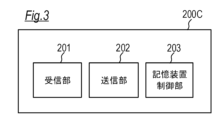
- FIG. 3 is a functional block diagram of the server 2.
- the server 2 has functions such as a receiving section 201, a transmitting section 202, a storage device control section 203, and the like. Note that the functions shown in FIG. 3 are implemented by the CPU 200C executing an information processing program stored in the storage device 200B.
- the receiving unit 201 receives data transmitted from the first user terminal 3 or the second user terminal 4, such as voice data.
- the transmission unit 202 transmits data received from the first user terminal 3, such as voice data, to the second user terminal 4.
- the transmitting unit 202 also transmits data received from the second user terminal 4 , such as voice data, to the first user terminal 3 .
- the storage device control unit 203 stores the data transmitted/received by the first user terminal 3 and the second user terminal 4 in the storage device 200B in association with the identification number of the account or user terminal that transmitted/received the data.
- the first user terminal 3 is a terminal possessed by the first user, for example, a smartphone installed with application software for functioning the first user terminal 3 as a terminal having each function shown in the present embodiment. be.
- the first user terminal 3 can communicate with the second user (for example, his or her child) by voice.
- FIG. 4 shows the main hardware configuration of the first user terminal 3, which includes a communication IF 300A, storage device 300B, input device 300C, display device 300D, CPU 300E, microphone 300F, speaker 300G, and the like.
- the communication IF 300A is an interface for communicating with another device (the server 2 in this embodiment).
- the storage device 300B is, for example, an HDD (Hard Disk Drive) or a semiconductor storage device (SSD (Solid State Drive)).
- the storage device 300B stores terminal identification numbers, information processing programs (application software), dictionaries in which words and phrases prohibited from being posted are registered, and the like.
- Data transmitted and received between the first user terminal 3 and the second user terminal 4 is stored in the storage device 300B.
- the storage device 300B stores voice data transmitted and received between the first user terminal 3 and the second user terminal 4 in association with character data obtained by converting the voice data into characters.
- the terminal identification number is a number for identifying the first user terminal 3 .
- the server 2 can determine from which first user terminal 3 the received data is transmitted.
- the terminal identification number may be an IP (Internet Protocol) address, a MAC (Media Access Control) address, or the like, or may be assigned to the first user terminal 3 by the server 2 .
- the input device 300C is, for example, an input device such as a keyboard, mouse, or touch panel, but may be other devices or devices as long as they can be input. Also, it may be a voice input device.
- the display device 300D is, for example, a liquid crystal display, a plasma display, an organic EL display, or the like, but may be another device or device (eg, CRT: Cathode Ray Tube) as long as it can display.
- CRT Cathode Ray Tube
- the CPU 300E controls the first user terminal 3 according to this embodiment, and includes ROM and RAM (not shown).
- the microphone 300F is an acoustic device that converts sound into electrical signals.
- the user of the first user terminal 3 can input voice using the microphone 300F.
- the input voice is transmitted to the server 2 by the transmission unit 302, which will be described later.
- the speaker 300G is an acoustic device that converts electrical signals into sound.
- the speaker 300G for example, reproduces audio data transmitted from the second user terminal 4 via the server 2 and stored in the storage device 300B.
- FIG. 5 shows a functional block diagram of the first user terminal 3.
- the first user terminal 3 includes a receiving unit 301, a transmitting unit 302, a storage device control unit 303, an input receiving unit 304 (receiving unit), and a display device. It has functions of a control unit 305, an acquisition unit 306 (first to third acquisition units), a posting unit 307, a generation unit 308, a conversion unit 309, a recognition unit 310, a notification unit 311, a registration unit 312, and the like.
- the functions shown in FIG. 5 are implemented by CPU 300E executing an information processing program stored in storage device 300B.
- the receiving unit 301 receives data transmitted from the server 2, for example.
- the transmission unit 302 transmits data to the server 2 according to the input operation received by the input reception unit 304, for example.
- the storage device control unit 303 controls the storage device 300B.
- the storage device control unit 303 stores the data transmitted/received by the first user terminal 3 and the second user terminal 4 in the storage device 300B in association with the identification number of the account or user terminal that transmitted/received the data.
- the storage device control unit 303 associates, for example, voice data transmitted and received between the first user terminal 3 and the second user terminal 4 with character data obtained by converting the voice data into characters, and stores the data in the storage device 300B. memorize to
- the input reception unit 304 receives input operations from the input device 300C. For example, the input receiving unit 304 receives a selection as to whether or not to post the audio data notified by the notification unit 311 .
- the display device control unit 305 controls the display device 300D and displays the data received by the receiving unit 301 on the display device 300D.
- the acquisition unit 306 acquires first designation information that designates voice data to be posted from one or more voice data received by the input reception unit 304 .
- the acquisition unit 306 may acquire information designating character data in units of two or more sentences or in units of voice data.
- the acquisition unit 306 may acquire the first designation information based on the character data converted by the conversion unit 309 .
- the acquisition unit 306 also acquires second designation information that designates image data to be posted (at least one of image data and video data).
- the image data or the like may be image data or the like automatically specified by the generation unit 308 of the first user terminal 3, or may be image data or the like accepted by the input acceptance unit 304 and specified by the user.
- the posting unit 307 posts the voice data specified by the first specifying information acquired by the acquiring unit 306 to SNS or the like. Also, the posting unit 307 posts the reproduction data generated by the generating unit 308 to an SNS or the like. Further, the posting unit 307 may post character data to an SNS or the like together with voice data designated to be posted. Note that the character data is data obtained by converting voice data designated to be posted into characters. In addition, the posting unit 307 may post the information of the speaker of the voice data along with the voice data designated to be posted to the SNS or the like. Further, the posting unit 307 refers to a dictionary in which words and phrases that are prohibited from being posted are registered, and restricts posting of voice data including the words and phrases registered in the dictionary to SNS or the like.
- the posting unit 307 posts the voice data notified by the notification unit 311 to an SNS or the like based on the selection of permission to post received by the input receiving unit 304 .
- Posting here refers to the process of uploading data to be posted to a platform such as an SNS or website where posted data can be viewed or downloaded by a third party's terminal, and enabling the third party's terminal to view or download the posted data.
- the platform exchanges data, etc. with the terminals of the unspecified majority of recipients, as well as a specific large number or single person whose recipients of the unspecified majority are limited. It also includes those that function as a communication tool between two parties, such as exchanging data with other terminals.
- the process of uploading data to be viewed or downloaded by a single recipient through such communication tools also constitutes posting.
- the form of posting for the recipient's terminal to browse or download data is not limited to the case where the poster uploads the data itself, as already mentioned, but alternatively, for example, the terminal of the poster or the posting It also includes a form in which information for downloading data, such as a URL link, created by a server or the like that has received data for downloading from the recipient's terminal is transmitted to the recipient's terminal.
- the receiver terminal can download the data associated with the URL link or the like by selecting the URL link or the like.
- the generation unit 308 combines the audio data designated by the first designation information acquired by the acquisition unit 306 with image data and the like to generate reproduction data to be reproduced.
- the image data or the like may be image data or the like automatically acquired by the generation unit 308 of the first user terminal 3, or may be image data or the like specified by the user.
- the playback data may be configured such that the speaker of the voice data being played back (recognized by the recognition unit 310) or the character data of the voice data converted by the conversion unit 309 are presented along with the playback of the voice data.
- the conversion unit 309 converts the voice data acquired by the acquisition unit 306 into character data.
- the recognition unit 310 recognizes the speaker of voice data.
- the speaker of the voice data may be recognized from the identification number given to the voice data, or the voice data is analyzed to extract the feature amount, and the feature amount of the voice of the speaker registered in advance is used. You may make it recognize by comparing.
- the notification unit 311 notifies that the voice has been received. This notification is performed, for example, by push notification (for example, notification sound or display on display device 300D) by application software. In addition, the notification unit 311 notifies the presence of voice data including the words registered in the dictionary. The content of the notification by the notification unit 311 is displayed on the display device 300D by the display device control unit 305. FIG. Further, the contents of the notification by the notification unit 311 may be notified as voice from the speaker 300G.
- the registration unit 312 registers (stores) the words acquired by the acquisition unit 306 in the dictionary. Further, the registration unit 312 registers (stores) the word/phrase acquired by the acquisition unit 306 in the dictionary as a word/phrase to be excluded from posting prohibited words/phrases (postable word/phrase).
- the words registered in the dictionary by the registration unit 312 are stored in the storage device 200B by the storage device control unit 303 .
- a second user terminal 4 is a terminal used by a second user of the information processing system 1 .
- the second user can exchange voice data with the first user (for example, his/her family) by transmitting/receiving voice data to/from the registered first user terminal 3 using the second user terminal 4.
- FIG. 6 shows the main hardware configuration of the second user terminal 4.
- the second user terminal 4 includes a communication IF 400A, a storage device 400B, an input device 400C, a display device 400D, a CPU 400E, a microphone 400F, a speaker 400G, and a GPS.
- a sensor 400H and the like are provided.
- the communication IF 400A is an interface for communicating with another device (server 2 in this embodiment).
- the storage device 400B is, for example, a HDD (Hard Disk Drive) or a semiconductor storage device (SSD (Solid State Drive)).
- the storage device 400B stores terminal identification numbers, information processing programs, audio data transmitted from the first user terminal 3, and the like.
- the terminal identification number is a number for identifying the second user terminal 4 .
- the server 2 can determine from which second user terminal 4 the received data is transmitted.
- the terminal identification number may be an IP (Internet Protocol) address, a MAC (Media Access Control) address, or the like, or may be assigned to the second user terminal 4 by the server 2 .
- the input device 400C is, for example, an input device such as a keyboard, mouse, or touch panel, but may be other devices or devices as long as they can be input. Also, it may be a voice input device.
- the second user can operate the input device 400 ⁇ /b>C to input voice and transmit it to the first user terminal 3 or reproduce voice data transmitted from the first user terminal 3 .
- the display device 400D is, for example, an LED.
- the display device 400D notifies that the voice has been received by lighting or blinking in a predetermined pattern.
- the CPU 400E controls the second user terminal 4 according to this embodiment, and includes ROM and RAM (not shown).
- the microphone 400F is an acoustic device that converts sound into electrical signals.
- the user of the second user terminal 4 can input voice using the microphone 400F.
- the input voice is transmitted to the server 2 by the transmission unit 402, which will be described later.
- the speaker 400G is an acoustic device that converts electrical signals into sound.
- the speaker 400G for example, reproduces audio data transmitted from the first user terminal 3 via the server 2 and stored in the storage device 400B. Also, the speaker 400G notifies that the voice has been received by generating sounds in a predetermined pattern.
- the GPS sensor 400H receives signals from GPS satellites that include time data of an atomic clock mounted on the satellite and data such as the ephemeris (orbit) of the satellite, and calculates the transmission time and reception time of the received signal. Based on the difference, the distance from the satellite is calculated to specify the current position. Also, the GPS sensor 400H outputs the specified current position.
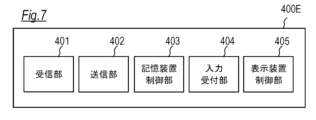
- FIG. 7 shows a functional block diagram of the second user terminal 4.
- the second user terminal 4 includes a receiving unit 401, a transmitting unit 402, a storage device control unit 403, an input reception unit 404, a display device control unit 405, and the like. has the function of Note that the functions shown in FIG. 7 are implemented by the CPU 400E executing an information processing program stored in the storage device 400B.
- the receiving unit 401 receives, for example, data transmitted from the server 2, such as voice data.
- the transmission unit 402 transmits data, such as voice data, to the server 2 according to the input operation received by the input reception unit 304, for example.
- the storage device control unit 403 controls the storage device 400B.
- the storage device control unit 403 controls the storage device 400B to write and read data.
- the input reception unit 404 receives input operations from the input device 400C.
- the input reception unit 404 receives, for example, an operation to reproduce audio data stored in the storage device 400B.
- the display device control unit 405 controls the display device 400D. For example, when the reception unit 401 receives audio data, the display device control unit 405 lights or blinks the display device 400D (LED) in a predetermined pattern.
- the display device control unit 405 lights or blinks the display device 400D (LED) in a predetermined pattern.
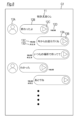
- FIG. 8 is a diagram showing an example of a screen G1 displayed on the display device 300D of the first user terminal 3. As shown in FIG. An example of the screen G1 displayed on the display device 300D of the first user terminal 3 will be described below with reference to FIG. The same components as those described with reference to FIGS. 1 to 7 are denoted by the same reference numerals, and overlapping descriptions are omitted.
- character data obtained by converting voice data transmitted and received between the first user terminal 3 and the second user terminal 4 are displayed in chronological order for each voice data file. (hereinafter also referred to as timeline display).
- the second user's name 11 (or handle name) is displayed at the top of the screen G1.
- a time 12D (using time stamp information) at which text data 12B obtained by converting voice data (voice file of the second user) transmitted from the second user terminal 4 is transmitted, and an icon 12A.
- voice data (voice file) corresponding to the displayed character data 12B is played so that the voice can be heard.
- character data 13A converted from voice data (voice file of the first user) transmitted from the first user terminal 3 is displayed together with the time 13C (using time stamp information) of transmission. be done.
- each character data transmitted from the first user terminal 3 is accompanied by a status 13D (for example, whether or not the second user terminal 4 has reproduced the voice data). Also, when the play button 13B is selected, voice data (voice file) corresponding to the displayed character data 13A is played so that the voice can be heard.
- the first user When posting voice data to an SNS or the like, the first user specifies voice data to be posted to the SNS or the like by operating the input device 300C such as a touch panel to specify character data obtained by converting the voice data to be posted.
- character data obtained by converting voice data to be posted is specified by operating the input device 300C such as a touch panel, the voice data before conversion is posted to an SNS or the like by the posting unit 307 .
- the audio data may be specified for each audio data file, or may be specified collectively for a plurality of audio data files. In the case of collective specification, if the first audio data and the last audio data are specified on the timeline shown in FIG. 8, the first audio data including the intermediate audio data and the last audio data are specified. You may
- the character data obtained by converting the voice data are displayed in chronological order in file units of the audio data, but the character data 12B obtained by converting the voice data may not be displayed. .
- the reproduction time of the voice data may be displayed, but the present invention is not limited to this example.
- FIGS. 9 to 13 are flowcharts showing an example of information processing of the information processing system 1.
- FIG. Information processing of the information processing system 1 will be described below with reference to FIGS. 9 to 13.
- FIG. The same components as those described with reference to FIGS. 1 to 8 are denoted by the same reference numerals, and overlapping descriptions are omitted.
- FIG. 9 is a flowchart showing an example of call processing of the information processing system 1. As shown in FIG. An example of call processing of the information processing system 1 will be described below with reference to FIG. In addition, FIG. 9 describes a case where voice data is transmitted from the second user terminal 4 to the first user terminal 3 .
- Step S101 The second user operates the input device 400C of the second user terminal 4 to input voice.
- Step S102 The input voice is converted into an electric signal by the microphone 400F and then transmitted from the transmission unit 402 to the server 2 as voice data.
- the data transmitted from the second user terminal 4 is provided with data such as the identification number of the second user terminal 4 and a time stamp.
- Step S103 The receiving unit 201 of the server 2 receives voice data transmitted from the second user terminal 4 .
- Step S104 The storage device control unit 203 stores the voice data transmitted by the second user terminal 4 in the storage device 200B in association with the account or the identification number of the user terminal that transmitted/received the data.
- Step S105 The transmitting unit 202 of the server 2 refers to the storage device 200B, identifies the identification number of the first user terminal 3 associated with the identification number assigned to the voice data received by the receiving unit 201, and identifies the identified first user terminal 3.
- the voice data transmitted from the second user terminal 4 is transmitted to the user terminal 3 .
- Step S106 The receiving unit 301 of the first user terminal 3 receives the voice data transmitted from the server 2 .
- Step S107 The converting unit 309 of the first user terminal 3 converts the voice data received by the receiving unit 301 into character data.
- Step S108 The storage device control unit 303 of the first user terminal 3 associates the voice data received from the second user terminal 4 with the character data obtained by converting the voice data into characters, and stores them in the storage device 300B.
- Step S109 The notification unit 311 of the first user terminal 3 notifies that the voice has been received.
- FIG. 10 is a flowchart showing an example of call processing of the information processing system 1. As shown in FIG. An example of call processing of the information processing system 1 will be described below with reference to FIG. 10 . Note that FIG. 10 describes a case where voice data is transmitted from the first user terminal 3 to the second user terminal 4 .
- Step S201 The first user operates the input device 300C of the first user terminal 3 to input voice.
- the input voice is converted into an electric signal by the microphone 400F.
- Step S202 The conversion unit 309 of the first user terminal 3 converts the input voice data into character data.
- Step S203 The storage device control unit 303 of the first user terminal 3 associates the input voice data with the character data obtained by converting the voice data into characters, and stores them in the storage device 300B.
- Step S204 The transmission unit 302 of the first user terminal 3 transmits the input voice data to the server 2 .
- Data transmitted from the first user terminal 3 is provided with data such as the identification number of the first user terminal 3 and a time stamp.
- Step S205 The receiving unit 201 of the server 2 receives voice data transmitted from the first user terminal 3 .
- Step S206 The storage device control unit 203 stores the voice data transmitted by the first user terminal 3 in the storage device 200B in association with the identification number of the account or user terminal that transmitted/received the data.
- the transmission unit 202 of the server 2 refers to the storage device 200B, identifies the identification number of the second user terminal 4 associated with the identification number assigned to the voice data received by the reception unit 201, and identifies the identified second user terminal 4.
- the voice data transmitted from the first user terminal 3 is transmitted to the user terminal 4 .
- Step S208 The receiving unit 401 of the second user terminal 4 receives the voice data transmitted from the server 2 .
- Step S209 The LED of the second user terminal 4 notifies that the voice has been received by lighting the LED or making a sound.
- FIG. 11 is a flowchart showing an example of posting processing of the information processing system 1. As shown in FIG. An example of the posting process of the information processing system 1 will be described below with reference to FIG. 11 .
- the first user operates the input device 300C of the first user terminal 3 to specify voice data to be posted to SNS or the like.
- the audio data may be specified for each audio data file, or may be specified collectively or selectively for a plurality of audio data files.
- the obtaining unit 306 of the first user terminal 3 obtains first designation information designating voice data to be posted from one or more voice data received by the input receiving unit 304 .
- the corresponding voice data is posted to SNS, etc., but by directly specifying voice data (voice data file), voice data to be posted to SNS, etc. It may be configured to be
- the notification unit 311 of the first user terminal 3 refers to the dictionary and determines whether or not the voice data designated by the first designation information includes a forbidden phrase.
- the notification unit 311 may analyze the voice data to determine whether or not a forbidden phrase is included, or may determine whether or not a forbidden phrase is included based on the character data converted by the conversion unit 309. good too. If the voice data contains forbidden phrases (YES), the first user terminal 3 executes the process of step S303. If the voice data does not contain a forbidden phrase (NO), the first user terminal 3 executes the process of step S305.
- Step S303 The notification unit 311 notifies the presence of voice data containing the words registered in the dictionary.
- the content of the notification by the notification unit 311 is displayed on the display device 300D by the display device control unit 305.
- FIG. Further, the contents of the notification by the notification unit 311 may be notified as voice from the speaker 300G.
- Step S304 The input receiving unit 304 receives a selection as to whether or not to post the audio data notified by the notification unit 311 . If the selection of whether to post is accepted (YES), the first user terminal 3 executes the process of step S305. If the selection of whether or not to post is accepted (NO), the first user terminal 3 ends the process (the first user starts again from specifying voice data in step S301 or ends the posting itself).
- Step S305 The recognition unit 310 of the first user terminal 3 recognizes the speaker of the selected voice data.
- the speaker of the voice data may be recognized from the identification number given to the voice data, or the voice data is analyzed to extract the feature amount, and the feature amount of the voice of the speaker registered in advance is used. You may make it recognize by comparing.
- Step S306 The first user operates the input device 300C of the first user terminal 3 to specify image data or the like to be posted to the SNS or the like as necessary.
- the acquisition unit 306 of the first user terminal 3 acquires second designation information designating image data etc., and the first user terminal 3
- the process of step S307 is executed. Note that, as described above, the image data and the like may be automatically designated by the generation unit 308 of the first user terminal 3 . If the input reception unit 304 has not received the designation of image data or the like (NO), the first user terminal 3 executes the process of step S308. Note that the first user may post only the audio data without going through the process of designating the image data and the like in step S306.
- Step S307 The generation unit 308 of the first user terminal 3 combines the audio data designated by the first designation information acquired by the acquisition unit 306 with image data and the like to generate reproduction data to be reproduced.
- the image data or the like may be image data or the like automatically acquired by the generation unit 308 of the first user terminal 3, or may be image data or the like specified by the user.
- Step S308 The posting unit 307 of the first user terminal 3 posts the audio data specified by the first specifying information acquired by the acquiring unit 306 to SNS or the like when the image data or the like is not specified (NO in step S306). Further, if image data or the like is designated (YES in step S306), the posting unit 307 posts the reproduction data generated by the generating unit 308 to an SNS or the like.
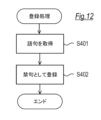
- FIG. 12 is a flow chart showing an example of registration processing of the information processing system 1 . An example of registration processing of the information processing system 1 will be described below with reference to FIG. 12 .
- Step S401 The first user operates the input device 300C of the first user terminal 3 to input a word or phrase for prohibiting posting.
- the acquisition unit 306 of the first user terminal 3 acquires the phrase accepted by the input acceptance unit 304 .
- Step S402 The registration unit 312 of the first user terminal 3 registers (stores) the phrase acquired by the acquisition unit 306 in the dictionary as a phrase prohibited from being posted.
- the words registered in the dictionary by the registration unit 312 are stored in the storage device 200B by the storage device control unit 303 .
- the first user operates the input device 300C of the first user terminal 3 to input words and phrases for prohibiting posting.
- the first user terminal 3 may automatically determine words and phrases prohibited from posting and register them in a dictionary as words and phrases prohibited from posting, or may recommend words and phrases prohibited from posting to the first user.
- the first user may learn words and phrases registered in the past that are prohibited from being posted, and based on the learning result, the first user terminal 3 may automatically determine words and phrases that are prohibited from being posted.
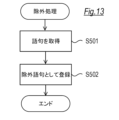
- FIG. 13 is a flowchart showing an example of exclusion processing of the information processing system 1. As shown in FIG. An example of exclusion processing of the information processing system 1 will be described below with reference to FIG. 13 .
- Step S501 The first user operates the input device 300C of the first user terminal 3 to input words/phrases to be excluded from the words/phrases prohibited from being posted.
- the acquisition unit 306 of the first user terminal 3 acquires the phrase accepted by the input acceptance unit 304 .
- Step S502 The registration unit 312 of the first user terminal 3 registers (stores) the word/phrase acquired by the acquisition unit 306 in the dictionary as a word/phrase (postable word/phrase) excluded from posting prohibited words/phrases.
- the words registered in the dictionary by the registration unit 312 are stored in the storage device 200B by the storage device control unit 303 .
- the first user terminal 3 (information processing terminal) according to the embodiment includes the acquisition unit 306 that acquires the first designation information that designates voice data to be posted from among one or more voice data, and the acquisition unit 306 and a posting unit 307 for posting the voice data designated by the first designation information acquired by the. Since it is possible to specify voice data and post it to an SNS or the like in this manner, convenience is high.
- the first user terminal 3 includes a generation unit 308 that generates reproduction data to be reproduced by combining audio data designated by the first designation information acquired by the acquisition unit 306, image data, etc.; Prepare.
- Posting unit 307 posts the reproduction data generated by generating unit 308 .
- reproduction data can be generated by combining audio data, image data, and the like, and can be posted to an SNS or the like, thereby improving convenience.
- the first user terminal 3 includes an acquisition unit 306 that acquires second designation information that designates image data or the like to be posted.
- the specified audio data and the image data specified by the second specifying information acquired by the acquisition unit 306 are combined to generate playback data to be played back. In this way, it is possible to specify image data and the like to generate reproduction data, thereby improving convenience.
- the first user terminal 3 includes a conversion unit 309 that converts voice data acquired by the acquisition unit 306 into character data. Acquire the first designation information. In this way, it is possible to specify the voice data to be posted to the SNS or the like by looking at the character data obtained by converting the voice data into characters, so that the contents to be posted can be grasped at a glance, and the convenience is improved.
- the acquisition unit 306 of the first user terminal 3 acquires information designating character data in units of sentences or in units of voice data.
- voice data to be posted to SNS or the like can be designated in units of sentences or voice data, which improves convenience.
- the acquisition unit 306 of the first user terminal 3 acquires information designating character data in units of two or more sentences or in units of voice data. In this way, it is possible to collectively designate a plurality of pieces of voice data to be posted to SNS, etc., thereby improving convenience.
- the posting unit 307 of the first user terminal 3 posts text data to an SNS or the like together with voice data designated to be posted. In this way, not only voice data but also character data can be posted, thus improving convenience.
- Character data is character data obtained by converting voice data designated to be posted to SNS or the like. Character data obtained by converting voice data in this manner can be posted to an SNS or the like, thereby improving convenience.
- the first user terminal 3 includes a recognition unit 310 that recognizes the speaker of voice data, and the posting unit 307 posts information about the speaker of the voice data together with the voice data designated to be posted. do. Therefore, it is possible to present who is speaking to SNS and the like, thereby improving convenience.
- the posting unit 307 of the first user terminal 3 refers to a dictionary in which words and phrases prohibited from being posted are registered, and restricts posting of voice data including the words and phrases registered in the dictionary. In this manner, the user is prohibited from posting voice data containing pre-registered phrases (for example, phrases that can identify personal information such as school names, place names, names, etc.) to SNS, etc., thereby improving convenience.
- pre-registered phrases for example, phrases that can identify personal information such as school names, place names, names, etc.
- the first user terminal 3 includes a notification unit 311 that notifies the presence of voice data including words registered in the dictionary.
- a notification unit 311 that notifies the presence of voice data including words registered in the dictionary.
- the first user terminal 3 includes a reception unit 304 that receives a selection as to whether or not to post the audio data notified by the notification unit 311 . Then, the posting unit 307 posts the voice data notified by the notification unit 311 based on the selection as to whether or not to allow posting received by the receiving unit 304 . In this way, when voice data containing words registered in the dictionary exists, it is possible to select whether or not to post the voice data to an SNS or the like, thereby improving convenience.
- the first user terminal 3 includes an acquisition unit 306 that acquires words and phrases for which posting is prohibited, and a registration unit 312 that registers the words and phrases acquired by the acquisition unit 306 in a dictionary. In this way, it is possible to register words and phrases that prohibit posting to SNS, etc., thereby improving convenience.
- the server 2 may have at least part of the functions of the first user terminal 3 shown in FIG. For example, among the functions of the first user terminal 3 shown in FIG.
- the server 2 may have some or all of the functions.
- the server 2 executes the processes of steps S301 to S307 described with reference to FIG. At least one of steps S401 and S402 and steps S501 and S502 described with reference to FIGS. 12 and 13 is executed.
Landscapes
- Engineering & Computer Science (AREA)
- Multimedia (AREA)
- Physics & Mathematics (AREA)
- Audiology, Speech & Language Pathology (AREA)
- Human Computer Interaction (AREA)
- Health & Medical Sciences (AREA)
- Acoustics & Sound (AREA)
- Business, Economics & Management (AREA)
- Theoretical Computer Science (AREA)
- Computer Vision & Pattern Recognition (AREA)
- Signal Processing (AREA)
- Computer Networks & Wireless Communication (AREA)
- General Physics & Mathematics (AREA)
- Game Theory and Decision Science (AREA)
- Computing Systems (AREA)
- General Engineering & Computer Science (AREA)
- General Health & Medical Sciences (AREA)
- Economics (AREA)
- Entrepreneurship & Innovation (AREA)
- Human Resources & Organizations (AREA)
- Marketing (AREA)
- Operations Research (AREA)
- Quality & Reliability (AREA)
- Strategic Management (AREA)
- Tourism & Hospitality (AREA)
- General Business, Economics & Management (AREA)
- Telephonic Communication Services (AREA)
- Information Retrieval, Db Structures And Fs Structures Therefor (AREA)
Priority Applications (6)
| Application Number | Priority Date | Filing Date | Title |
|---|---|---|---|
| EP22928646.3A EP4485897A4 (en) | 2022-02-25 | 2022-02-25 | INFORMATION PROCESSING DEVICE, INFORMATION PROCESSING METHOD AND INFORMATION PROCESSING PROGRAM |
| JP2023577840A JP7508156B2 (ja) | 2022-02-25 | 2022-02-25 | 情報処理端末、情報処理方法、情報処理プログラム |
| PCT/JP2022/007830 WO2023162119A1 (ja) | 2022-02-25 | 2022-02-25 | 情報処理端末、情報処理方法、情報処理プログラム |
| US18/840,665 US20250182766A1 (en) | 2022-02-25 | 2022-02-25 | Information processing terminal, information processing method, and information processing program |
| CN202280091805.4A CN118696531A (zh) | 2022-02-25 | 2022-02-25 | 信息处理终端、信息处理方法、信息处理程序 |
| JP2024094100A JP2024113163A (ja) | 2022-02-25 | 2024-06-11 | 情報処理端末、情報処理方法、情報処理プログラム |
Applications Claiming Priority (1)
| Application Number | Priority Date | Filing Date | Title |
|---|---|---|---|
| PCT/JP2022/007830 WO2023162119A1 (ja) | 2022-02-25 | 2022-02-25 | 情報処理端末、情報処理方法、情報処理プログラム |
Publications (1)
| Publication Number | Publication Date |
|---|---|
| WO2023162119A1 true WO2023162119A1 (ja) | 2023-08-31 |
Family
ID=87765000
Family Applications (1)
| Application Number | Title | Priority Date | Filing Date |
|---|---|---|---|
| PCT/JP2022/007830 Ceased WO2023162119A1 (ja) | 2022-02-25 | 2022-02-25 | 情報処理端末、情報処理方法、情報処理プログラム |
Country Status (5)
| Country | Link |
|---|---|
| US (1) | US20250182766A1 (https=) |
| EP (1) | EP4485897A4 (https=) |
| JP (2) | JP7508156B2 (https=) |
| CN (1) | CN118696531A (https=) |
| WO (1) | WO2023162119A1 (https=) |
Cited By (2)
| Publication number | Priority date | Publication date | Assignee | Title |
|---|---|---|---|---|
| JP2023179884A (ja) * | 2022-06-08 | 2023-12-20 | シャープ株式会社 | ネットワークシステム、情報処理方法、およびサーバ |
| JP2025051731A (ja) * | 2023-09-22 | 2025-04-04 | ソフトバンクグループ株式会社 | システム |
Citations (6)
| Publication number | Priority date | Publication date | Assignee | Title |
|---|---|---|---|---|
| JP2009140240A (ja) * | 2007-12-06 | 2009-06-25 | Yahoo Japan Corp | ページサービス提供装置 |
| JP2015191161A (ja) * | 2014-03-28 | 2015-11-02 | 株式会社エクシング | プログラム及び情報処理装置 |
| JP6455848B1 (ja) | 2018-09-27 | 2019-01-23 | Meetscom株式会社 | 情報処理システム |
| JP2021135426A (ja) * | 2020-02-28 | 2021-09-13 | ホロアッシュインク | オンライン会話支援方法 |
| JP6955724B1 (ja) * | 2020-10-22 | 2021-10-27 | 株式会社日本デジタル研究所 | 会計業務支援システム |
| WO2021225104A1 (ja) * | 2020-05-08 | 2021-11-11 | Line株式会社 | プログラム、表示方法、端末 |
Family Cites Families (7)
| Publication number | Priority date | Publication date | Assignee | Title |
|---|---|---|---|---|
| JP5872183B2 (ja) * | 2011-04-08 | 2016-03-01 | 株式会社ユニバーサルエンターテインメント | 情報処理システム、嗜好可視化システム及び検閲システム並びに嗜好可視化方法 |
| JP2014134923A (ja) * | 2013-01-09 | 2014-07-24 | Sony Corp | 情報処理装置、情報処理方法、プログラム及び端末装置 |
| JP7155546B2 (ja) * | 2018-03-05 | 2022-10-19 | 富士フイルムビジネスイノベーション株式会社 | 情報処理装置、情報処理方法、及び情報処理プログラム |
| JP2020024585A (ja) * | 2018-08-07 | 2020-02-13 | 出光興産株式会社 | 情報処理装置、システム、情報処理装置の制御方法、及びプログラム |
| JP6498350B1 (ja) * | 2018-12-03 | 2019-04-10 | Line株式会社 | 情報処理方法、プログラム、端末 |
| JP6832971B2 (ja) * | 2019-03-19 | 2021-02-24 | Line株式会社 | プログラム、情報処理方法、端末 |
| US11798388B2 (en) * | 2020-05-11 | 2023-10-24 | Otta Inc. | Location positioning system |
-
2022
- 2022-02-25 JP JP2023577840A patent/JP7508156B2/ja active Active
- 2022-02-25 US US18/840,665 patent/US20250182766A1/en active Pending
- 2022-02-25 WO PCT/JP2022/007830 patent/WO2023162119A1/ja not_active Ceased
- 2022-02-25 CN CN202280091805.4A patent/CN118696531A/zh active Pending
- 2022-02-25 EP EP22928646.3A patent/EP4485897A4/en active Pending
-
2024
- 2024-06-11 JP JP2024094100A patent/JP2024113163A/ja active Pending
Patent Citations (6)
| Publication number | Priority date | Publication date | Assignee | Title |
|---|---|---|---|---|
| JP2009140240A (ja) * | 2007-12-06 | 2009-06-25 | Yahoo Japan Corp | ページサービス提供装置 |
| JP2015191161A (ja) * | 2014-03-28 | 2015-11-02 | 株式会社エクシング | プログラム及び情報処理装置 |
| JP6455848B1 (ja) | 2018-09-27 | 2019-01-23 | Meetscom株式会社 | 情報処理システム |
| JP2021135426A (ja) * | 2020-02-28 | 2021-09-13 | ホロアッシュインク | オンライン会話支援方法 |
| WO2021225104A1 (ja) * | 2020-05-08 | 2021-11-11 | Line株式会社 | プログラム、表示方法、端末 |
| JP6955724B1 (ja) * | 2020-10-22 | 2021-10-27 | 株式会社日本デジタル研究所 | 会計業務支援システム |
Non-Patent Citations (1)
| Title |
|---|
| See also references of EP4485897A4 |
Cited By (3)
| Publication number | Priority date | Publication date | Assignee | Title |
|---|---|---|---|---|
| JP2023179884A (ja) * | 2022-06-08 | 2023-12-20 | シャープ株式会社 | ネットワークシステム、情報処理方法、およびサーバ |
| JP7817089B2 (ja) | 2022-06-08 | 2026-02-18 | シャープ株式会社 | ネットワークシステム、情報処理方法、およびサーバ |
| JP2025051731A (ja) * | 2023-09-22 | 2025-04-04 | ソフトバンクグループ株式会社 | システム |
Also Published As
| Publication number | Publication date |
|---|---|
| US20250182766A1 (en) | 2025-06-05 |
| EP4485897A4 (en) | 2025-12-17 |
| JP7508156B2 (ja) | 2024-07-01 |
| JP2024113163A (ja) | 2024-08-21 |
| EP4485897A1 (en) | 2025-01-01 |
| JPWO2023162119A1 (https=) | 2023-08-31 |
| CN118696531A (zh) | 2024-09-24 |
Similar Documents
| Publication | Publication Date | Title |
|---|---|---|
| CN105915436B (zh) | 基于主题的即时消息隔离的系统和方法 | |
| US20080126491A1 (en) | Method for Transmitting Messages from a Sender to a Recipient, a Messaging System and Message Converting Means | |
| JP2012518309A (ja) | メッセージ処理装置及び方法 | |
| JP2024113163A (ja) | 情報処理端末、情報処理方法、情報処理プログラム | |
| US8417768B2 (en) | Communication terminal communicating via communication network | |
| JP2015515643A (ja) | インスタントコミュニケーション音声認識方法および端末 | |
| TW200846922A (en) | Simplified electronic messaging system | |
| US7269622B2 (en) | Watermarking messaging sessions | |
| CN106847256A (zh) | 一种语音转化聊天方法 | |
| JP7705688B1 (ja) | 情報処理端末、情報処理装置、情報処理方法、情報処理プログラム | |
| JP2006203548A (ja) | 複数話者の音声信号を処理する音声信号処理装置およびプログラム | |
| JP4779475B2 (ja) | 電子掲示板情報通知装置 | |
| JP7671096B1 (ja) | 情報処理装置、情報処理端末、情報処理方法、情報処理プログラム | |
| KR20020028438A (ko) | 음성과 문자 데이터를 통합한 채팅 서비스 방법 및 그기록 매체 | |
| JP2022179354A (ja) | 情報処理装置およびプログラム | |
| KR20090010359A (ko) | 이동 통신망을 통한 사용자 제작 컨텐츠 제공 시스템 및 그방법 | |
| JP2023072720A (ja) | 会議サーバ、及び会議サーバの制御方法 | |
| JP2005210393A (ja) | ネットワーク通信電話システム | |
| KR20010065110A (ko) | 인터넷과 전화를 동시에 이용한 음성 메시지 서비스 방법 |
Legal Events
| Date | Code | Title | Description |
|---|---|---|---|
| 121 | Ep: the epo has been informed by wipo that ep was designated in this application |
Ref document number: 22928646 Country of ref document: EP Kind code of ref document: A1 |
|
| WWE | Wipo information: entry into national phase |
Ref document number: 2023577840 Country of ref document: JP |
|
| WWE | Wipo information: entry into national phase |
Ref document number: 202280091805.4 Country of ref document: CN |
|
| WWE | Wipo information: entry into national phase |
Ref document number: 18840665 Country of ref document: US |
|
| WWE | Wipo information: entry into national phase |
Ref document number: 2022928646 Country of ref document: EP |
|
| NENP | Non-entry into the national phase |
Ref country code: DE |
|
| ENP | Entry into the national phase |
Ref document number: 2022928646 Country of ref document: EP Effective date: 20240925 |
|
| WWP | Wipo information: published in national office |
Ref document number: 18840665 Country of ref document: US |