WO2023157587A1 - 照明装置 - Google Patents
照明装置 Download PDFInfo
- Publication number
- WO2023157587A1 WO2023157587A1 PCT/JP2023/002230 JP2023002230W WO2023157587A1 WO 2023157587 A1 WO2023157587 A1 WO 2023157587A1 JP 2023002230 W JP2023002230 W JP 2023002230W WO 2023157587 A1 WO2023157587 A1 WO 2023157587A1
- Authority
- WO
- WIPO (PCT)
- Prior art keywords
- light distribution
- light
- distribution range
- light source
- range
- Prior art date
- Legal status (The legal status is an assumption and is not a legal conclusion. Google has not performed a legal analysis and makes no representation as to the accuracy of the status listed.)
- Ceased
Links
Images











Classifications
-
- F—MECHANICAL ENGINEERING; LIGHTING; HEATING; WEAPONS; BLASTING
- F21—LIGHTING
- F21S—NON-PORTABLE LIGHTING DEVICES; SYSTEMS THEREOF; VEHICLE LIGHTING DEVICES SPECIALLY ADAPTED FOR VEHICLE EXTERIORS
- F21S8/00—Lighting devices intended for fixed installation
- F21S8/04—Lighting devices intended for fixed installation intended only for mounting on a ceiling or the like overhead structures
-
- F—MECHANICAL ENGINEERING; LIGHTING; HEATING; WEAPONS; BLASTING
- F21—LIGHTING
- F21S—NON-PORTABLE LIGHTING DEVICES; SYSTEMS THEREOF; VEHICLE LIGHTING DEVICES SPECIALLY ADAPTED FOR VEHICLE EXTERIORS
- F21S2/00—Systems of lighting devices, not provided for in main groups F21S4/00 - F21S10/00 or F21S19/00, e.g. of modular construction
-
- G—PHYSICS
- G02—OPTICS
- G02F—OPTICAL DEVICES OR ARRANGEMENTS FOR THE CONTROL OF LIGHT BY MODIFICATION OF THE OPTICAL PROPERTIES OF THE MEDIA OF THE ELEMENTS INVOLVED THEREIN; NON-LINEAR OPTICS; FREQUENCY-CHANGING OF LIGHT; OPTICAL LOGIC ELEMENTS; OPTICAL ANALOGUE/DIGITAL CONVERTERS
- G02F1/00—Devices or arrangements for the control of the intensity, colour, phase, polarisation or direction of light arriving from an independent light source, e.g. switching, gating or modulating; Non-linear optics
- G02F1/01—Devices or arrangements for the control of the intensity, colour, phase, polarisation or direction of light arriving from an independent light source, e.g. switching, gating or modulating; Non-linear optics for the control of the intensity, phase, polarisation or colour
- G02F1/13—Devices or arrangements for the control of the intensity, colour, phase, polarisation or direction of light arriving from an independent light source, e.g. switching, gating or modulating; Non-linear optics for the control of the intensity, phase, polarisation or colour based on liquid crystals, e.g. single liquid crystal display cells
- G02F1/133—Constructional arrangements; Operation of liquid crystal cells; Circuit arrangements
- G02F1/1333—Constructional arrangements; Manufacturing methods
- G02F1/133368—Cells having two substrates with different characteristics, e.g. different thickness or material
-
- H—ELECTRICITY
- H05—ELECTRIC TECHNIQUES NOT OTHERWISE PROVIDED FOR
- H05B—ELECTRIC HEATING; ELECTRIC LIGHT SOURCES NOT OTHERWISE PROVIDED FOR; CIRCUIT ARRANGEMENTS FOR ELECTRIC LIGHT SOURCES, IN GENERAL
- H05B47/00—Circuit arrangements for operating light sources in general, i.e. where the type of light source is not relevant
- H05B47/10—Controlling the light source
- H05B47/155—Coordinated control of two or more light sources
-
- H—ELECTRICITY
- H05—ELECTRIC TECHNIQUES NOT OTHERWISE PROVIDED FOR
- H05B—ELECTRIC HEATING; ELECTRIC LIGHT SOURCES NOT OTHERWISE PROVIDED FOR; CIRCUIT ARRANGEMENTS FOR ELECTRIC LIGHT SOURCES, IN GENERAL
- H05B47/00—Circuit arrangements for operating light sources in general, i.e. where the type of light source is not relevant
- H05B47/10—Controlling the light source
- H05B47/16—Controlling the light source by timing means
-
- H—ELECTRICITY
- H05—ELECTRIC TECHNIQUES NOT OTHERWISE PROVIDED FOR
- H05B—ELECTRIC HEATING; ELECTRIC LIGHT SOURCES NOT OTHERWISE PROVIDED FOR; CIRCUIT ARRANGEMENTS FOR ELECTRIC LIGHT SOURCES, IN GENERAL
- H05B47/00—Circuit arrangements for operating light sources in general, i.e. where the type of light source is not relevant
- H05B47/10—Controlling the light source
- H05B47/165—Controlling the light source following a pre-assigned programmed sequence; Logic control [LC]
-
- Y—GENERAL TAGGING OF NEW TECHNOLOGICAL DEVELOPMENTS; GENERAL TAGGING OF CROSS-SECTIONAL TECHNOLOGIES SPANNING OVER SEVERAL SECTIONS OF THE IPC; TECHNICAL SUBJECTS COVERED BY FORMER USPC CROSS-REFERENCE ART COLLECTIONS [XRACs] AND DIGESTS
- Y02—TECHNOLOGIES OR APPLICATIONS FOR MITIGATION OR ADAPTATION AGAINST CLIMATE CHANGE
- Y02B—CLIMATE CHANGE MITIGATION TECHNOLOGIES RELATED TO BUILDINGS, e.g. HOUSING, HOUSE APPLIANCES OR RELATED END-USER APPLICATIONS
- Y02B20/00—Energy efficient lighting technologies, e.g. halogen lamps or gas discharge lamps
- Y02B20/40—Control techniques providing energy savings, e.g. smart controller or presence detection
Definitions
- the present disclosure relates to lighting devices.
- a lighting fixture having a liquid crystal dimming element is disclosed in Patent Document 1.
- dimming is performed by applying an electric signal to the liquid crystal dimming element.
- dimming can be performed by changing the set value of the electrical signal given to the liquid crystal dimming element.
- the present invention has been made in view of the above, and an object thereof is to provide a lighting device that can irradiate light even to positions away from directly below the lighting device, such as four corners of a room. .
- a lighting device includes a light source unit that emits light toward a floor surface of a room, and a light distribution range of the light from the light source unit is defined as a first light distribution range or the first light distribution range.
- a light distribution range setting unit for setting a different second light distribution range; and the light distribution range setting unit so that the first light distribution range and the second light distribution range are irradiated with light in a time division manner. wherein the second light distribution range set by the light distribution range setting section has a portion closer to the corner of the floor surface than the first light distribution range.
- FIG. 1 is a diagram showing an example of an irradiation range by a lighting device of a comparative example.
- FIG. 2 is a diagram showing an example of an irradiation range by a lighting device of another comparative example.
- FIG. 3 is a diagram showing the functional configuration of the lighting device according to the first embodiment of the present disclosure;
- FIG. 4 is a conceptual diagram showing an example of contents stored in a first storage unit.
- FIG. 5 is a conceptual diagram showing a first example of contents stored in the second storage unit.
- FIG. 6 is a conceptual diagram showing a second example of the contents stored in the second storage unit.
- FIG. 7 is a conceptual diagram showing a third example of contents stored in the second storage unit.
- FIG. 1 is a diagram showing an example of an irradiation range by a lighting device of a comparative example.
- FIG. 2 is a diagram showing an example of an irradiation range by a lighting device of another comparative example.
- FIG. 3 is
- FIG. 8 is a diagram showing an example of setting similar light distribution ranges having different sizes.
- FIG. 9 is a plan view showing an example of the light distribution range on the floor in FIG.
- FIG. 10 is a diagram showing an example of changes in the light distribution range by the illumination device of FIGS. 8 and 9.
- FIG. 11 is a diagram showing an example of setting light distribution ranges with different shapes.
- 12 is a plan view showing an example of the light distribution range on the floor surface of FIG. 11.
- FIG. 13 is a diagram showing an example of changes in the light distribution range for realizing the light distribution ranges shown in FIGS. 11 and 12.
- FIG. 14 is a plan view showing another example of the light distribution range to the floor surface of FIG. 11.
- FIG. 15 is a diagram showing an example of changes in the light distribution range for realizing the light distribution range shown in FIG.
- FIG. 16 is a diagram showing the functional configuration of the lighting device according to the second embodiment of the present disclosure
- FIG. 17 is a diagram showing changes in the light distribution range according to the second embodiment.
- FIG. 18 is a diagram showing changes in the light distribution range according to the second embodiment.
- FIG. 19 is a diagram showing changes in the light distribution range according to the third embodiment.
- FIG. 20 is a diagram showing changes in the light distribution range according to the third embodiment.
- FIG. 21 is a diagram showing changes in the light distribution range according to the fourth embodiment.
- FIG. 22 is a diagram showing changes in the light distribution range according to the fifth embodiment.
- FIG. 23 is a diagram showing an example of contents stored in a storage unit when different times are set for each light distribution range.
- FIG. 24 is a diagram showing an example of contents stored in a storage unit when different times are set for each light distribution range.
- FIG. 25 is a diagram showing an example of contents stored in a storage unit when different times are set for each light distribution range.
- 26 is a flowchart illustrating an example of processing by a control unit of the lighting device;
- FIG. 29 is a plan view showing the wiring of the counter substrate of the liquid crystal light distribution panel according to the embodiment;
- FIG. 30 is a plan view showing wiring of the liquid crystal light distribution panel according to the embodiment.
- FIG. 31 is a cross-sectional view taken along line IV-IV of FIG. 30.
- FIG. 32 is a schematic diagram showing the configuration of the liquid crystal light distribution section.
- FIG. 33 is a schematic diagram showing an example of light distribution control by light distribution control regions.
- FIG. 1 is a diagram showing an example of an irradiation range by a lighting device of a comparative example.
- a room R1 is provided with a lighting device 11 and lighting devices 12a and 12b.
- the lighting device 11 is suspended from the ceiling.
- Lighting devices 12a and 12b are attached directly to the ceiling.
- the illumination device 11 and the illumination devices 12a and 12b irradiate the floor surface F with light.
- the illumination device 11 irradiates the irradiation range H1 with light.
- the lighting device 12a irradiates the irradiation range H2a with light.
- the lighting device 12b irradiates the irradiation range H2b with light.
- the corner CN of the floor surface F of the room R1 and the vicinity of the corner CN are not irradiated with light, which is not preferable.
- the light from the illumination device 12a is shadowed by the portion of the illumination device 11 indicated by the dashed line HHa.
- the light from the illumination device 12b is shadowed by the portion of the illumination device 11 indicated by the dashed line HHb. Using the lighting device 11 suspended from the ceiling in this manner is not preferable because the lighting device 11 casts a shadow.
- FIG. 1 clearly shows the boundaries of the light distribution range. However, since the light source includes light other than parallel light, the boundary of the light distribution range is blurred. The same applies to each subsequent figure.
- FIG. 2 is a diagram showing an example of an irradiation range by a lighting device of another comparative example.
- the room R2 is provided with a lighting device 11b and lighting devices 13a, 13b, 13c and 13d. All lighting devices 11b, 13a, 13b, 13c and 13d are mounted directly on the ceiling.
- the lighting device 11b irradiates the irradiation range H1b with light.
- the illumination device 13a irradiates the irradiation range H3a with light.
- the illumination device 13b irradiates the irradiation range H3b with light.
- the illumination device 13c irradiates the irradiation range H3c with light.
- the illumination device 13d irradiates the irradiation range H3d with light.
- room R2 does not have a lighting device suspended from the ceiling. Therefore, the lighting device suspended from the ceiling does not cast a shadow. Then, the light is irradiated to the corner CN of the floor surface F of the room R2 and the vicinity of the corner CN.
- the light is irradiated to the corner CN of the floor surface F of the room R2 and the vicinity of the corner CN.
- Using a plurality of lighting devices poses problems such as an increase in cost and the need for a space necessary for installing the lighting devices.
- Ceiling-embedded downlights require multiple holes in the ceiling, which is undesirable.
- FIG. 3 is a diagram showing the functional configuration of the lighting device 100 according to the first embodiment of the present disclosure.
- lighting device 100 includes light source section 80 , liquid crystal light distribution section 700 , and control section 60 .
- the light source section 80 includes a light source 800 .
- Liquid crystal light distribution section 700 includes a plurality of liquid crystal light distribution panels 1-1 to 1-4.
- the illuminating device 100 is an illuminating device in which the irradiation range (light distribution range) of light from each of the light sources 800 can be individually controlled using the liquid crystal light distribution section 700 .
- the liquid crystal light distribution section 700 functions as a light distribution range setting section for setting a light distribution range.
- the liquid crystal light distribution unit 700 can realize a light distribution range H11 in which the light from the light source 800 is widely diffused and a light distribution range H12 in which the light from the light source 800 is narrowly diffused.
- the liquid crystal light distribution unit 700 includes a liquid crystal light distribution panel for p-wave polarization and a liquid crystal light distribution panel for s-wave polarization. A detailed configuration of the liquid crystal light distribution panel included in the liquid crystal light distribution unit 700 will be described later.
- the control unit 60 includes storage units 61a and 61b, an MCU (Micro Controller Unit) 62, an FPGA (Field Programmable Gate Array) 63, a D (Digital)/A (Analog) conversion unit 64, and a light source driving unit 65. , have
- the MCU 62 outputs various signals to the FPGA 63 and the light source driving section 65 according to commands regarding the operation of the lighting device 100 . That is, the MCU 62 controls each part of the lighting device 100 .
- the FPGA 63 performs information processing for controlling the operation of the liquid crystal light distribution section 700 under the control of the MCU 62 and outputs a signal indicating the result of the information processing to the D/A conversion section 64 .
- the D/A conversion unit 64 outputs analog signals for operating the plurality of liquid crystal light distribution panels 1-1 to 1-4 included in the liquid crystal light distribution unit 700 based on the digital signals from the FPGA 63. do.
- the configuration may consist of one circuit or may include multiple circuits.
- the light source drive unit 65 is a controller that performs ON/OFF control of the light source 800 included in the light source unit 80 and light emission intensity control when the light source unit 80 is ON under the control of the MCU 62 .
- the controller may be a single circuit or may include multiple circuits.
- the storage unit 61a which is the first storage unit, stores data corresponding to multiple types of light distribution ranges.
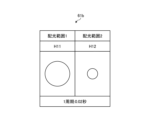
- FIG. 4 is a conceptual diagram showing an example of contents stored in the storage unit 61a. As shown in FIG. 4, the storage unit 61a stores data on the shape and size of the light distribution ranges H11, H12, H22, and H23, for example.
- the storage unit 61b which is the second storage unit, stores the light distribution range determined by the MCU62. That is, the storage unit 61b stores a light distribution range pattern in which a plurality of types of light distribution ranges are combined.
- FIG. 5 is a conceptual diagram showing a first example of the contents stored in the storage unit 61b.
- the storage unit 61b stores the light distribution range determined by the MCU 62 among the contents stored in the storage unit 61a.
- the light distribution range H11 is stored as "light distribution range 1”
- the light distribution range H12 is stored as "light distribution range 2". That is, the storage unit 61b stores a light distribution range pattern obtained by combining a plurality of types of light distribution ranges. In this example, a light distribution range pattern combining the light distribution range H11 and the light distribution range H12 is stored.
- the MCU 62 sequentially reads the light distribution range H11 and the light distribution range H12 of the light distribution range pattern stored in the storage unit 61b.
- the MCU 62 controls the liquid crystal light distribution section 700 based on the read shape and size of the light distribution range H11 and the light distribution range H12. That is, the light distribution range H11 and the light distribution range H12 are sequentially set in the liquid crystal light distribution section 700 .
- a light distribution range H11 is set.
- the light distribution range H11 and the light distribution range H12 are repeatedly set in a time division manner. That is, the liquid crystal light distribution section 700, which is a light distribution range setting section, is controlled so that the light distribution range H11 and the light distribution range H12 are irradiated in a time division manner.
- the storage unit 61b also stores one cycle of time-division control (hereinafter referred to as a change cycle).
- the change period is "0.02 seconds", which corresponds to 50 Hz.
- the change period may be set in advance, or may be determined by the MCU 62 and stored in the storage section 61b. The same applies to the following description. In this example, it is 0.01 seconds for "light distribution range 1" and 0.01 seconds for "light distribution range 2", and the same time is set for each light distribution range, that is, the time is set at equal intervals.
- the liquid crystal light distribution unit 700 is controlled so that the time during which light is irradiated to "light distribution range 1" is the same as the time during which light is irradiated to "light distribution range 2".
- the change period should be such that people in the room cannot perceive changes in the light with their eyes. For example, 50 Hz or more and 60 Hz or less. That is, it is preferable that it is 50 times or more per second. Moreover, it is preferable that the change cycle is set to 100 Hz or more and 120 Hz or less. The same applies to the following description.
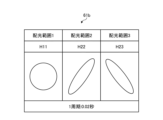
- FIG. 6 is a conceptual diagram showing a second example of the contents stored in the storage unit 61b.
- the storage unit 61b stores the light distribution range determined by the MCU 62 among the contents stored in the storage unit 61a.
- the light distribution range H11 is the "light distribution range 1”
- the light distribution range H22 is the “light distribution range 2”
- the light distribution range H11 is the "light distribution range 3”
- the light distribution range H23 is the "light distribution range 4".
- the storage unit 61b stores a light distribution range pattern obtained by combining a plurality of types of light distribution ranges.
- a light distribution range pattern combining the light distribution range H11, the light distribution range H22, and the light distribution range H11 and the light distribution range H23 is stored.
- the MCU 62 sequentially reads the light distribution range H11, the light distribution range H22, the light distribution range H11, and the light distribution range H23 of the light distribution range pattern stored in the storage unit 61b.
- the MCU 62 time-divisionally controls the liquid crystal light distribution section 700 based on the light distribution range pattern stored in the storage section 61b. That is, the MCU 62 controls the liquid crystal light distribution section 700 based on the shape and size of the read light distribution range H11, light distribution range H22, light distribution range H11, and light distribution range H23. That is, the light distribution range H11, the light distribution range H22, the light distribution range H11, and the light distribution range H23 are sequentially set in the liquid crystal light distribution section 700.
- the storage unit 61b also stores a change period.
- the change period is "0.02 seconds", which corresponds to 50 Hz.
- 005 seconds, and the same time is set for each light distribution range.
- the time during which "light distribution range 1" is irradiated with light the time during which "light distribution range 2" is irradiated with light, the time during which "light distribution range 3” is irradiated with light, and the "light distribution range 4"
- the liquid crystal light distribution unit 700 is controlled so that the time during which the light is applied to the .
- FIG. 7 is a conceptual diagram showing a third example of the contents stored in the storage unit 61b.
- the storage unit 61b stores a light distribution range H11, a light distribution range H22, and a light distribution range H23 determined by the MCU 62 among the contents stored in the storage unit 61a. do.
- the light distribution range H11 is stored as "light distribution range 1”
- the light distribution range H12 is stored as "light distribution range 2”
- the light distribution range H23 is stored as "light distribution range 3". That is, the storage unit 61b stores a light distribution range pattern obtained by combining a plurality of types of light distribution ranges.
- a light distribution range pattern that combines the light distribution range H11, the light distribution range H22, and the light distribution range H23 is stored.
- the MCU 62 sequentially reads the light distribution range H11, the light distribution range H22, and the light distribution range H23 of the light distribution range pattern stored in the storage unit 61b.
- the MCU 62 controls the liquid crystal light distribution section 700 based on the shape and size of the read light distribution range H11, light distribution range H22, and light distribution range H23. That is, the light distribution range H11, the light distribution range H22, and the light distribution range H23 are sequentially set in the liquid crystal light distribution section 700.
- the storage unit 61b also stores a change period.
- the change period is "0.02 seconds", which corresponds to 50 Hz. In this example, it is about 0.0067 seconds for "light distribution range 1", 0.0067 seconds for "light distribution range 2", and 0.0067 seconds for "light distribution range 3". set in time. In other words, the time that light is irradiated to "light distribution range 1", the time that light is irradiated to "light distribution range 2", and the time that light is irradiated to "light distribution range 3" are all the same. , controls the liquid crystal light distribution unit 700 .
- FIG. 8 is a diagram showing an example of setting similar light distribution ranges having different sizes.
- lighting device 100 is installed on the ceiling of room R.
- the illumination device 100 can set a light distribution range H11 and a light distribution range H12 for the light to irradiate the floor surface F.
- FIG. The light distribution range H11 and the light distribution range H12 have similar shapes with different sizes.
- the light distribution range H11 is relatively wide, and the light distribution range H12 is relatively narrow.
- the storage contents of the storage unit 61b described with reference to FIG. 5 are used.
- the light distribution range H11 and the light distribution range H12 are similar. In other words, both the light distribution range H11 and the light distribution range H12 are circular and have different sizes. The circle of the light distribution range H11 and the circle of the light distribution range H12 have the same center point (not shown).
- FIG. 9 is a plan view showing an example of the light distribution range on the floor surface F in FIG.
- the light distribution range H11 is relatively wide and the light distribution range H12 is relatively narrow. Therefore, the wide light distribution range H11 has a portion D closer to the corner CN of the floor surface F than the narrow light distribution range H12. Therefore, the portion D near the corner CN of the floor surface F can also be irradiated with light.
- a light distribution range H10 can be realized by superimposing a wide light distribution range H11 and a narrow light distribution range H12.
- a portion corresponding to the light distribution range H12 is also included in the light distribution range H11. Therefore, the portion corresponding to the light distribution range H12 is always illuminated with light.
- a portion of the light distribution range H11 that is not included in the light distribution range H12 has a period during which light is not irradiated. Therefore, the portion corresponding to the light distribution range H12 is brighter than the portion of the light distribution range H10 other than the light distribution range H12.
- FIG. 10 is a diagram showing an example of changes in the light distribution range by the illumination device 100 of FIGS. 8 and 9.
- FIG. 10 time elapses in the direction of the arrow in the figure.
- the light distribution ranges change in the order of light distribution ranges H11, H12, H11, H12, .
- the light distribution range of one cycle is "light distribution ranges H11 and H12", and the setting of the light distribution range of this one cycle is repeated. That is, the time-division control alternates the time during which the light distribution range H11 is irradiated with the light and the time during which the light distribution range H12 is irradiated with the light.
- FIG. 11 is a diagram showing an example of setting light distribution ranges with different shapes.
- lighting device 100 is installed on the ceiling of room R.
- the illumination device 100 can set a light distribution range H11, a light distribution range H22, and a light distribution range H23 for the light to be applied to the floor surface F.
- FIG. The light distribution range H11 is circular.
- the light distribution range H22 and the light distribution range H23 are elliptical.
- the storage contents of the storage unit 61b described with reference to FIG. 6 are used.
- FIG. 12 is a plan view showing an example of the light distribution range on the floor surface F in FIG.
- the light from the light source section 80 is changed so that both ends of the long diameter LD of the elliptical shape of the light distribution range H22 and the light distribution range H23 are directed to the corner CN of the floor surface F.
- FIG. The major axis LD of the ellipse in the light distribution range H22 and the light distribution range H23 is longer than the circular diameter 2R of the light distribution range H11. Therefore, both end portions D of the light distribution range H22 and both end portions D of the light distribution range H23 are closer to the corner CN of the floor surface F than the light distribution range H11. Therefore, the light distribution range H22 and the light distribution range H23 have a portion D closer to the corner CN of the floor surface F than the light distribution range H11. Therefore, the light can be applied to a portion of the floor surface F near the corner CN.
- the light distribution range H20 can be realized by superimposing the light distribution range H11, the light distribution range H22, and the light distribution range H23 in a time division manner.
- the overlapping portion of the light distribution range H11 and the light distribution range H22 is brighter than the non-overlapping portion of the light distribution range H11.
- the overlapping portion of the light distribution range H11 and the light distribution range H23 is brighter than the non-overlapping portion of the light distribution range H11. A portion where the three light distribution ranges H11, H22 and H23 are overlapped becomes brighter than the other portions.
- FIG. 13 is a diagram showing an example of changes in the light distribution range for realizing the light distribution ranges shown in FIGS. 11 and 12.
- FIG. 13 time elapses in the direction of the arrow in the figure.
- the light distribution ranges change in order of light distribution ranges H11, H22, H11, H23, H11, H22, .
- the light distribution range of one cycle is "light distribution ranges H11, H22, H11, H23", and the setting of the light distribution range of this one cycle is repeated. That is, the light distribution ranges H11, H22, H11, and H23 are set in order by time-division control.
- the time during which the circular light distribution range H11 is irradiated with light alternates with the time during which the elliptical light distribution range H22 or H23 is irradiated with light.
- FIG. 14 is a plan view showing another example of the light distribution range on the floor surface F in FIG.
- the light from the light source section 80 is changed so that both ends of the long diameter LD of the elliptical shape of the light distribution range H22 and the light distribution range H23 are directed to the corner CN of the floor surface F.
- FIG. The major axis LD of the ellipse in the light distribution range H22 and the light distribution range H23 is longer than the circular diameter 2R of the light distribution range H11. Therefore, the light distribution range H22 and the light distribution range H23 have a portion D closer to the corner CN of the floor surface F than the light distribution range H11. Therefore, the light can be applied to a portion of the floor surface F near the corner CN.
- the storage contents of the storage unit 61b described with reference to FIG. 7 are used.
- the light distribution range H20 can be realized by overlapping the light distribution range H11, the light distribution range H22, and the light distribution range H23 in a time division manner.
- the overlapping portion of the light distribution range H11 and the light distribution range H22 is brighter than the non-overlapping portion of the light distribution range H11.
- the overlapping portion of the light distribution range H11 and the light distribution range H23 is brighter than the non-overlapping portion of the light distribution range H11. A portion where the three light distribution ranges H11, H22 and H23 are overlapped becomes brighter than the other portions.
- FIG. 15 is a diagram showing an example of changes in the light distribution range for realizing the light distribution range shown in FIG. In FIG. 15, time elapses in the direction of the arrow in the figure. As shown in FIG. 15, the light distribution ranges change in order of light distribution ranges H11, H22, H23, H11, H22, H23, .
- the light distribution range of one cycle is "light distribution ranges H11, H22, H11, H23", and the setting of the light distribution range of this one cycle is repeated. That is, the light distribution ranges H11, H22, H11, and H23 are set in order by time-division control.
- the time during which the circular light distribution range H11, the elliptical light distribution range H22 is irradiated with light, and the time during which the elliptical light distribution range H23 is irradiated with light are equal. Occurs in proportion. For this reason, the frequency of irradiating light on the portion near the corner CN of the floor surface F is higher than in the case of FIG. Therefore, according to the light distribution ranges of FIGS. 14 and 15, the corner CN of the floor surface F is brighter than in the case of FIG.
- FIG. 16 is a diagram showing the functional configuration of a lighting device 100a according to the second embodiment of the present disclosure.
- the illumination device 100 has a light source section 80 a , a liquid crystal light distribution section 700 and a control section 60 .
- Light source section 80 a includes light sources 801 and 802 .
- Other configurations of the lighting device 100a are the same as those of the lighting device 100 described with reference to FIGS. 3 to 15 .
- 17 and 18 are diagrams showing changes in the light distribution range according to the second embodiment.
- 17 and 18 are diagrams showing examples of control patterns for light sources when a plurality of light sources having the same color temperature are used.
- the shape and size of each light distribution range H11 and H12 are the same as the light distribution ranges described with reference to FIGS.
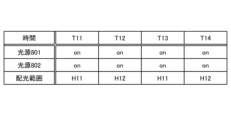
- FIG. 17 shows a light source control pattern when the light distribution range H11 and the light distribution range H12 shown in FIG. 9 are illuminated with the same color temperature, and the light distribution range H12 is illuminated brighter than the light distribution range H11.
- light sources 801 and 802 are turned on at times T11, T12, T13 and T14, respectively, and light distribution range H11 and light distribution range H12 are alternately set.
- the light distribution range H11 is set at times T11 and T13
- the light distribution range H12 is set at times T12 and T14.
- the outer portion of the light distribution range H11 that does not overlap with the light distribution range H12 is irradiated with light at times T11 and T13.
- the inner portion where the light distribution range H11 and the light distribution range H12 overlap is irradiated with light from time T11 to time T14.
- FIG. 18 shows a control pattern for the light source when making the light distribution range H12 brighter under the conditions of FIG.
- light sources 801 and 802 are turned ON at times T11, T12a, T12b, T13, T14a and T14b, respectively. After the light distribution range H11 is set once, the light distribution range H12 is set twice, and the same setting is repeated thereafter.
- the light distribution range H11 is set at times T11 and T13, and the light distribution range H12 is set at times T12a, T12b, T14b. Therefore, the time set for the light distribution range H12 is longer than the time set for the light distribution range H11.
- the outer portion of the light distribution range H11 that does not overlap with the light distribution range H12 is irradiated with light at time T11 and time T14.
- the inner portion where the light distribution range H11 and the light distribution range H12 overlap is irradiated with light at all times T11, T12a, T12b, T13, T14a, and T14b.
- 19 and 20 are diagrams showing changes in the light distribution range according to the third embodiment.
- 19 and 20 are diagrams showing control patterns for light sources when using a plurality of light sources having different color temperatures. That is, when the light source 801 is turned on, it emits light with a predetermined color temperature, and when the light source 802 is turned on, it emits light with a color temperature different from the color temperature of the light from the light source 801. do.
- the shape and size of each light distribution range H11 and H12 are the same as the light distribution ranges described with reference to FIGS.
- FIG. 19 is a control pattern for the light source when the color temperature of the light applied to the light distribution range H11 shown in FIG. 9 is different from the color temperature of the light applied to the light distribution range H12.
- a light range H12 is set. That is, the light sources 801 and 802 are turned on (ON) or off (OFF) so that the light emission time of the light source 801 and the light emission time of the light source 802 do not overlap.
- the light emitted by the light source 801 is set to either the light distribution range H11 or the light distribution range H12, and the light emitted by the light source 802 is set to the other of the light distribution range H11 and the light distribution range H12. set.
- FIG. 20 shows another control pattern for the light source when the color temperature of the light applied to the light distribution range H11 shown in FIG. 9 is different from the color temperature of the light applied to the light distribution range H12.
- the light distribution range H12 is set at time T32 and time T34. That is, the light sources 801 and 802 are turned on or off so that at least part of the light emission time of the light source 801 overlaps with the light emission time of the light source 802 .
- the outer portion of the light distribution range H11 that does not overlap with the light distribution range H12 is irradiated with light from the light source 801 at times T31 and T33.
- Light is emitted from the light source 801 at times T31, T32, T33 and T34 and from the light source 802 at times T32 and T34 for the inner portion where the light distribution range H11 and the light distribution range H12 overlap.
- the brightness of the inner portion is higher than that of the outer portion as compared with the case of FIG.
- the difference in color temperature is smaller than in the case of FIG.
- FIG. 21 is a diagram showing changes in the light distribution range according to the fourth embodiment.
- FIG. 21 is a diagram showing a control pattern when the light distribution ranges H11, H22, and H23 shown in FIG. 12 are made to have the same color temperature.
- Light range H22 is set, and light distribution range H23 is set at time T44 when light sources 801 and 802 are turned on. That is, the light sources 801 and 802 are turned on or off so that at least part of the light emission time of the light source 801 overlaps with the light emission time of the light source 802 .
- the light distribution range H11 has a portion including the light distribution range H22 and a portion including the light distribution range H23. is irradiated with light.
- the light irradiation time for the light distribution range H2 and the light distribution range H3 is longer than the light irradiation time for the light distribution range H11, the brightness unevenness in the light irradiation plane for the light distribution range H11 is increased. can be done.
- the light irradiation time in the light distribution range H11 should be made longer than in the light distribution ranges H22 and H23 so that unevenness in brightness cannot be recognized.
- FIG. 22 is a diagram showing changes in the light distribution range according to the fifth embodiment.
- FIG. 22 is a diagram showing a control pattern when the light distribution range H22 and the light distribution range H23 shown in FIG. 12 are light of different color temperatures, and the light distribution range H11 is light of both these different temperatures. .
- Light range H22 is set, and light distribution range H23 is set at time T54 when only light source 802 is turned on. That is, the light sources 801 and 802 are turned on or off so that at least part of the light emission time of the light source 801 overlaps with the light emission time of the light source 802 .
- the light distribution range H11 has a portion including the light distribution range H22 and a portion including the light distribution range H23. is irradiated with light. Portions D (see FIG. 12) at both ends of the light distribution range H22 are irradiated with light at time T52 when only the light source 801 is turned on. Portions D (see FIG. 12) at both ends of the light distribution range H23 are irradiated with light at time T54 when only the light source 802 is turned on.
- the ratio of the light from the light source 801 and the light from the light source 802 differs depending on the location, resulting in color change.
- the irradiation time of the light distribution range H11 should be made longer than the light distribution ranges H22 and H23 so that the color unevenness cannot be recognized.
- the change period is set for each light distribution range at the same time, but different times may be set for each light distribution range.
- 23 to 25 are diagrams showing examples of contents stored in the storage unit 61b when different times are set for each light distribution range.
- the "light distribution range H11" of the light distribution range 1 is 0.005 seconds
- the “light distribution range H12” of the light distribution range 2 is 0.015 seconds. That is, the liquid crystal light distribution unit 700 is time-divisionally controlled so that the time for irradiating the light distribution range H11 with light is different from the time for irradiating the light distribution range H12 with light. By setting the change cycle in this manner, the vicinity of the center of the floor surface F can be irradiated with a large amount of light.
- liquid crystal light distribution section 700 is time-divisionally controlled so that the time for irradiating the light distribution range H11 is different from the time for irradiating the light distribution ranges H22 and H23. By setting the change cycle in this manner, the corner CN of the floor surface F can also be illuminated with light.
- 0.01 seconds for "light distribution range H11" of light distribution range 1, 0.005 seconds for "light distribution range H22” of light distribution range 2, and 0.005 seconds for "light distribution range H23” of light distribution range 3. is 0.005 seconds. That is, the liquid crystal light distribution section 700 is time-divisionally controlled so that the time for irradiating the light distribution range H11 is different from the time for irradiating the light distribution ranges H22 and H23. By setting the change cycle in this way, the vicinity of the center of the floor surface F and the corners CN can be irradiated with light in a well-balanced manner.
- FIG. 26 is a flowchart showing an example of processing by the control unit 60 of the lighting device 100. As shown in FIG. FIG. 26 mainly shows the contents of processing by the MCU 62 .
- the MCU 62 reads the light distribution range pre-stored in the storage unit 61a and determines a combination of light distribution range patterns (step S101).
- step S102 the change cycle of the light distribution range pattern is determined (step S102).
- Data on the combination of light distribution range patterns and data on the change cycle are stored by the MCU 62 in the storage unit 61b.
- the processing from step S101 to step S103 is performed when the lighting device 100 is installed.
- the MCU 62 After the installation of the lighting device 100 is completed, the MCU 62 performs the processing from step S104 onward.
- the MCU 62 reads out the light distribution shape and size of the light distribution range N from the storage unit 61b (step S104).
- the MCU 62 calculates the voltage to be applied to the liquid crystal light distribution panel (that is, the panel voltage) based on the light distribution shape and size of the light distribution range N (step S105).
- the MCU 62 applies a panel voltage to control the liquid crystal light distribution panel (step S106).
- the MCU 62 determines whether a certain period of time has passed (step S109).
- step S111 If the result of determination in step S109 is that the predetermined time has not passed (No in step S109), it is determined whether or not to end the process (step S111). As a result of the determination in step S111, if the process is not to be terminated (No in step S111), the process returns to step S109 to continue the process. Thereby, the same light distribution range is maintained until a certain period of time elapses. That is, the light distribution shape and size are maintained until a certain period of time elapses.
- step S111 If the result of the determination in step S111 is to end the process (Yes in step S111), the process by the control unit 60 ends.
- the light distribution range is controlled using the liquid crystal light distribution unit, and a plurality of light distribution ranges are switched by time division control, thereby overlapping the irradiation range of the light.
- liquid crystal light distribution panel Next, the liquid crystal light distribution panels 1-1 to 1-4 included in the liquid crystal light distribution section 700 will be described with reference to FIGS. 27 to 31.
- FIG. 1 liquid crystal light distribution panel
- FIG. 27 is a perspective view of the liquid crystal light distribution panel according to the embodiment.
- FIG. 28 is a plan view showing the wiring of the array substrate of the liquid crystal light distribution panel according to the embodiment, and is a view of the array substrate viewed from above.
- FIG. 29 is a plan view showing the wiring of the counter substrate of the liquid crystal light distribution panel according to the embodiment, and is a view of the counter substrate viewed from above.
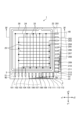
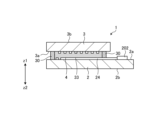
- FIG. 30 is a plan view showing the wiring of the liquid crystal light distribution panel according to the embodiment, and is a view of the liquid crystal light distribution panel viewed from above. 31 is a cross-sectional view taken along line IV-IV of FIG. 30.
- the direction along the x1 direction and the x2 direction is called the x direction.
- the x1 direction and the x2 direction are opposite.
- a direction along the y1 direction and the y2 direction is called a y direction.
- the y1 direction and the y2 direction are opposite.
- a direction along the z1 direction and the z2 direction is referred to as the z direction.
- the z1 direction and the z2 direction are opposite.
- the x-direction and the y-direction are orthogonal.
- a plane along which the x-direction and the y-direction extend is orthogonal to the z-direction.
- the liquid crystal light distribution panel 1 has an array substrate 2, a counter substrate 3, a liquid crystal layer 4, and a sealing material 30.
- the array substrate (first substrate) 2 is larger than the opposing substrate (second substrate) 3. That is, the area of the counter substrate (second substrate) 3 is smaller than the area of the array substrate (first substrate) 2 .
- the array substrate 2 has transparent glass 23 (see FIG. 28).
- the counter substrate 3 has a transparent glass 31 (see FIG. 29).
- the array substrate 2 and the counter substrate 3 are square when viewed from above, but the shape of the substrate according to the present invention is not limited to square.
- a first terminal group area 21 and a second terminal group area 22 are provided on the surface 2 a of the array substrate 2 .
- the first terminal group area 21 is located at the end on the y1 side of the surface 2a of the array substrate 2 .
- the second terminal group area 22 is located at the end of the surface 2a of the array substrate 2 on the x2 side.
- the first terminal group area 21 and the second terminal group area 22 have an L shape when viewed from above.
- the first terminal group 10 is arranged in the first terminal group area 21
- the second terminal group 20 is arranged in the second terminal group area 22 . Since the area of the counter substrate 3 is smaller than that of the array substrate 2, the first terminal group 10 and the second terminal group 20 are exposed. Further, the first terminal group 10 and the second terminal group 20 are also simply referred to as terminal portions.
- the first terminal group 10 includes a first terminal 101, a second terminal 102, a third terminal 103, a fourth terminal 104, a first pad 105, and a second terminal.
- Pad 106 , third pad 107 , fourth pad 108 , fifth pad 109 , sixth pad 110 , seventh pad 111 and eighth pad 112 are included.
- the second terminal group 20 includes a fifth terminal 201, a sixth terminal 202, a seventh terminal 203, an eighth terminal 204, a ninth pad 205, and a tenth terminal. It includes a pad 206 , an eleventh pad 207 , a twelfth pad 208 , a thirteenth pad 209 , a fourteenth pad 210 , a fifteenth pad 211 and a sixteenth pad 212 .
- the fifteenth pad 211 and the sixteenth pad 212 are arranged side by side in order in the front-rear direction from the y2 side to the y1 side.
- the ninth pad 205 and the sixteenth pad 212 are electrically connected via a lead wire 213 .
- the tenth pad 206 and fifteenth pad 211 are electrically connected via a lead wire 213 .
- the eleventh pad 207 and the fourteenth pad 210 are electrically connected via a lead wire 213 .
- the twelfth pad 208 and the thirteenth pad 209 are electrically connected via a lead wire 213 .
- the counter substrate 3 is arranged above the array substrate 2 (on the z1 side).
- a sealing material 30 and a liquid crystal layer 4 are provided between the opposing substrate 3 and the array substrate 2 .
- the sealing material 30 is annularly provided along the outer periphery of the opposing substrate 3 , and the inside of the sealing material 30 is filled with the liquid crystal layer 4 .
- the area where the liquid crystal layer 4 is provided is the active area, the outside of the liquid crystal layer 4 is the frame area, and the first terminal group area 21 and the second terminal group area 22 are terminal areas.
- the wiring of the array substrate 2 and the counter substrate 3 will be described.
- the wiring is provided on the front surface of the substrate and the back surface. That is, the surface on which the wiring is provided is defined as the front surface, and the surface opposite to the front surface is defined as the back surface.
- wiring is provided on the upper surface 2a of the front surface 2a and the rear surface 2b of the array substrate 2, and wiring is provided on the lower surface 3a of the front surface 3a and the rear surface 3b of the counter substrate 3. is provided.
- the surface 2a of the array substrate 2 and the surface 3a of the counter substrate 3 are arranged to face each other with the liquid crystal layer 4 interposed therebetween.
- the wiring 24 and the first electrode 25 are provided on the surface 2a of the transparent glass 23 of the array substrate 2.
- the first terminal 101 and the fifth terminal 201 are electrically connected via the wiring 24 .
- the second terminal 102 and the sixth terminal 202 are electrically connected via the wiring 24 .
- the third terminal 103 and the seventh terminal 203 are electrically connected via the wiring 24 .
- the fourth terminal 104 and the eighth terminal 204 are electrically connected via the wiring 24 .
- a plurality of first electrodes 25 are connected to the wiring 24 that connects the second terminal 102 and the sixth terminal 202 .
- a plurality of first electrodes 25 are connected to the wiring 24 that connects the third terminal 103 and the seventh terminal 203 .
- the wiring 24 is provided with connecting portions C1 and C2.
- the wiring 32 and the second electrode 33 are provided on the surface 3a of the opposing substrate 3. As shown in FIG. Specifically, wirings 32 are provided on the y1 side and the y2 side, respectively. The wiring 32 extends in the x direction. A second electrode 33 is electrically connected to the wiring 32 . The second electrodes 33 extend in the y direction. The wiring 32 is provided with connection portions C3 and C4. Although the number of the first electrodes 25 and the number of the second electrodes 33 are eight in the examples shown in FIGS. It does not indicate the number of two electrodes 33 . The number of the first electrodes 25 and the number of the second electrodes 33 may be two or more, and naturally may be nine or more.
- the opposing substrate 3 is arranged above the array substrate 2 with a space therebetween.
- a liquid crystal layer 4 is filled between the array substrate 2 and the counter substrate 3 .
- the connection portion C1 of the array substrate 2 and the connection portion C3 of the counter substrate 3 are electrically connected via a conductive column (not shown).
- the connection portion C2 of the array substrate 2 and the connection portion C4 of the counter substrate 3 are electrically connected via a conductive column (not shown).
- the first terminal 101, the second terminal 102, the third terminal 103, the fourth terminal 104, the first pad 105, the second pad 106, the third pad 107, and the fourth pad 108 are , can be electrically connected to an FPC (Flexible Printed Circuits) 40 indicated by a two-dot chain line.
- the plurality of liquid crystal light distribution panels 1-1 to 1-4 are connected to the D/A converter 64 via, for example, FPCs 40 individually provided.
- FIG. 32 is a schematic diagram showing the configuration of the liquid crystal light distribution section 700.
- the liquid crystal light distribution section 700 has, for example, four liquid crystal light distribution panels 1-1 to 1-4 stacked in the z direction.
- the four liquid crystal light distribution panels 1-1 to 1-4 are the liquid crystal light distribution panels 1-1 to 1-4 described with reference to FIGS.
- the four liquid crystal light distribution panels 1-1 to 1-4 are laminated so that the respective liquid crystal layers 4 are overlapped and the arrangement of the plurality of first electrodes 25 and the plurality of second electrodes 33 of each are overlapped in a plan view. be done.
- a planar viewpoint is a viewpoint that views a plane along the x-direction and the y-direction from the front.
- a region in which the plurality of first electrodes 25 and the plurality of second electrodes 33 are arranged functions as a light distribution control region LDA shown in FIG. 33 and the like, which will be described later.
- FIG. 33 is a schematic diagram showing an example of light distribution control by the light distribution control area LDA.
- the light distribution control area LDA is an area in which the plurality of first electrodes 25 and the plurality of second electrodes 33 are arranged in plan view. That is, the light distribution control area LDA includes a plurality of electrodes extending in the x direction and arranged in the y direction, and a plurality of electrodes extending in the y direction and arranged in the x direction.
- the electrodes extending in the x direction and arranged in the y direction are, for example, the first electrodes 25 .
- the electrodes extending in the y direction and arranged in the x direction are, for example, the second electrodes 33 .
- the liquid crystal light distribution unit 700 has four liquid crystal light distribution panels 1-1 to 1-4 that overlap in the z direction, there are a plurality of electrodes extending in the x direction and arranged in the y direction, and a plurality of electrodes extending in the y direction and arranged in the x direction. A plurality of electrodes arranged in the direction are quadruple in the z direction.
- the light distribution control area LDA can be set to the liquid crystal light distribution section 700 as shown in examples E1, E2, E3, and E4 of the "example of light distribution pattern" shown in FIG. It is possible to control the transmission range and the degree of transmission of light from one side to the other side.
- Example E1 in FIG. 33 shows the light source when all the potentials of the plurality of electrodes extending in the x direction and aligned in the y direction and the plurality of electrodes extending in the y direction and aligned in the x direction are 0 volts (V).
- FIG. 4 is a schematic diagram showing a state in which the light distribution control area LDA is viewed from the opposite side of (for example, the light source 800) from a planar viewpoint. In example E1, the light from the light source is transmitted through the light distribution control area LDA almost as it is.
- FIG. 10 is a schematic diagram showing a state in which the light distribution control area LDA is seen from the opposite side of the light source (for example, the light source 800) from a planar viewpoint when the potential exceeds the potential.
- the light distribution control area LDA in the state of controlling .
- the potential of a plurality of electrodes extending in the x direction and arranged in the y direction exceeds 0 volt (V), and the potential of the plurality of electrodes extending in the y direction and arranged in the x direction is 0 volt ( V)
- the light distribution control area LDA is viewed from the opposite side of the light source (for example, the light source 800) from a plan view.
- the light from the light source spreads relatively greatly in the y direction, but does not spread so much in the x direction. , shows the light distribution control area LDA in the state of controlling .
- Example E4 is a light source when all the potentials of the plurality of electrodes extending in the x-direction and aligned in the y-direction and the plurality of electrodes extending in the y-direction and aligned in the x-direction are potentials exceeding 0 volts (V).
- FIG. 4 is a schematic diagram showing a state in which the light distribution control area LDA is viewed from the opposite side of (for example, the light source 800) from a planar viewpoint.
- the light from the light source is largely blocked by the light distribution control area LDA, so that when viewed from the opposite side of the light source across the light distribution control area LDA, the overall state is dark.
- a light distribution control area LDA is shown.
- the light distribution control area LDA has two or more electrodes extending in the x direction and aligned in the y direction and two or more electrodes extending in the y direction and aligned in the x direction from a plan view. It is good if there is Here, one light distribution control area LDA has m electrodes extending in the x direction and arranged in the y direction, and n electrodes extending in the y direction and arranged in the x direction. This is the first condition. In one liquid crystal light distribution panel 1-1 to 1-4, the number of electrodes (eg, first electrodes 25) extending in the x direction and arranged in the y direction is m ⁇ p.
- a second condition is that the number of electrodes (for example, second electrodes 33) arranged in the x direction is n ⁇ q.
- the liquid crystal light distribution section 700 can set p light distribution control areas LDA in the x direction and q light distribution control areas LDA in the y direction in a matrix.
- m, n, p, and q are natural numbers of 2 or more.
- the entire active area (the area where the liquid crystal layer 4 is provided) of one liquid crystal light distribution panel from a planar viewpoint may be set as one light distribution control area LDA.
- Examples E1, E2, E3, and E4 shown in FIG. 33 particularly show the difference in the shape of the light distribution range due to potential control from a planar viewpoint.
- the relationship between the potential applied to the first electrode 25 and the potential applied to the second electrode 33 determines the shape of the light transmission range and the size of the light transmission range. can be controlled more flexibly. With this control, the shape and size of the emitted light can be changed.
- a light source unit that emits light toward the floor surface of the room; a light distribution range setting unit for setting a light distribution range of light from the light source unit to a first light distribution range or a second light distribution range different from the first light distribution range; a control unit that controls the light distribution range setting unit so that the first light distribution range and the second light distribution range are irradiated with light in a time division manner;
- the lighting device wherein the second light distribution range set by the light distribution range setting unit has a portion closer to the corner of the floor surface than the first light distribution range.
- the light distribution range setting unit includes a liquid crystal light distribution panel for p-wave polarization and a liquid crystal light distribution panel for s-wave polarization,
- the p-wave polarized liquid crystal light distribution panel and the s-wave polarized liquid crystal light distribution panel are laminated, applying a signal based on the light to be irradiated to the p-wave polarized liquid crystal light distribution panel and the s-wave polarized light control panel;
- By irradiating the light emitted from the light source unit through the liquid crystal light distribution panel for p-wave polarization and the liquid crystal light distribution panel for s-wave polarization By irradiating the light emitted from the light source unit through the liquid crystal light distribution panel for p-wave polarization and the liquid crystal light distribution panel for s-wave polarization,
- the illumination device according to ⁇ 1>, wherein the light distribution range of the light from the light source unit is changed to the first light distribution range or the second light distribution range.
- ⁇ 3> The illumination device according to ⁇ 1> or ⁇ 2>, wherein the first light distribution range is similar in shape to the second light distribution range but different in size.
- ⁇ 4> The illumination device according to ⁇ 1> or ⁇ 2>, wherein the first light distribution range is circular and the second light distribution range is elliptical.
- ⁇ 5> The illumination device according to ⁇ 4>, wherein the major axis of the elliptical shape of the second light distribution range is longer than the diameter of the circular shape of the first light distribution range.
- the light distribution range setting unit changes the light from the light source unit such that both ends of the major axis of the elliptical shape of the second light distribution range face the corners of the floor surface. lighting system.
- the control unit controls the light distribution range setting unit such that the time during which the first light distribution range is irradiated with light is the same as the time during which the second light distribution range is irradiated with light ⁇ 1 > to ⁇ 6>.
- the control unit controls the light distribution range setting unit such that the time during which the first light distribution range is irradiated with light differs from the time during which the second light distribution range is irradiated with light.
- the lighting device includes a first light source that emits light of a predetermined color temperature when turned on, and a light source that emits light of a color temperature different from the color temperature of the light of the first light source when turned on. and a second light source that The control unit turns on or off the first light source and the second light source so that at least part of the time during which the first light source emits light overlaps with the time during which the second light source emits light.
- the lighting device according to any one of ⁇ 1> to ⁇ 8>.
- the light source unit includes a first light source that emits light of a predetermined color temperature when turned on, and a light source that emits light of a color temperature different from the color temperature of the light of the first light source when turned on. and a second light source that The control unit turns on or off the first light source and the second light source so that the time for emitting light from the first light source and the time for emitting light from the second light source do not overlap.
- the lighting device according to any one of ⁇ 1> to ⁇ 8>.
- the control unit sets the light emitted from the first light source to one of the first light distribution range and the second light distribution range, and sets the light emitted from the second light source to the first light distribution range.
- the lighting device which controls the light distribution range setting unit to set the other of the range and the second light distribution range.
- ⁇ 12> The lighting device according to any one of ⁇ 1> to ⁇ 11>, wherein one cycle of control by the control unit is 50 times or more per second.
- a first storage unit storing light distribution range data corresponding to a plurality of types of light distribution ranges including the first light distribution range and the second light distribution range; and a light distribution range combining the plurality of types of light distribution ranges.
- the control unit A plurality of types of light distribution ranges stored in the first storage unit are combined and stored as the light distribution range pattern in the second storage unit, and the light distribution ranges stored in the second storage unit.
- the lighting device according to any one of ⁇ 1> to ⁇ 12>, which controls the light distribution range setting unit based on a pattern.
- liquid crystal light distribution panel 60 control units 61a and 61b storage unit 62 MCU 63 FPGAs 64 D/A conversion unit 65 light source driving units 80, 80a light source units 100, 100a lighting device 700 liquid crystal light distribution units 800, 801, 802 light source CN corner F floor surface H11, H12, H22, H23 light distribution range
Landscapes
- Physics & Mathematics (AREA)
- Nonlinear Science (AREA)
- Engineering & Computer Science (AREA)
- General Engineering & Computer Science (AREA)
- Mathematical Physics (AREA)
- Chemical & Material Sciences (AREA)
- Crystallography & Structural Chemistry (AREA)
- General Physics & Mathematics (AREA)
- Optics & Photonics (AREA)
- Circuit Arrangement For Electric Light Sources In General (AREA)
Priority Applications (3)
| Application Number | Priority Date | Filing Date | Title |
|---|---|---|---|
| CN202380021472.2A CN118679856A (zh) | 2022-02-21 | 2023-01-25 | 照明装置 |
| JP2024501049A JP7599057B2 (ja) | 2022-02-21 | 2023-01-25 | 照明装置 |
| US18/798,175 US20240397600A1 (en) | 2022-02-21 | 2024-08-08 | Illumination device |
Applications Claiming Priority (2)
| Application Number | Priority Date | Filing Date | Title |
|---|---|---|---|
| JP2022-024833 | 2022-02-21 | ||
| JP2022024833 | 2022-02-21 |
Related Child Applications (1)
| Application Number | Title | Priority Date | Filing Date |
|---|---|---|---|
| US18/798,175 Continuation US20240397600A1 (en) | 2022-02-21 | 2024-08-08 | Illumination device |
Publications (1)
| Publication Number | Publication Date |
|---|---|
| WO2023157587A1 true WO2023157587A1 (ja) | 2023-08-24 |
Family
ID=87578314
Family Applications (1)
| Application Number | Title | Priority Date | Filing Date |
|---|---|---|---|
| PCT/JP2023/002230 Ceased WO2023157587A1 (ja) | 2022-02-21 | 2023-01-25 | 照明装置 |
Country Status (4)
| Country | Link |
|---|---|
| US (1) | US20240397600A1 (https=) |
| JP (1) | JP7599057B2 (https=) |
| CN (1) | CN118679856A (https=) |
| WO (1) | WO2023157587A1 (https=) |
Cited By (1)
| Publication number | Priority date | Publication date | Assignee | Title |
|---|---|---|---|---|
| TWI903377B (zh) * | 2024-02-05 | 2025-11-01 | 佳世達科技股份有限公司 | 照明系統 |
Citations (3)
| Publication number | Priority date | Publication date | Assignee | Title |
|---|---|---|---|---|
| JP2014053163A (ja) * | 2012-09-07 | 2014-03-20 | Sharp Corp | Led照明装置 |
| JP2016126902A (ja) * | 2014-12-26 | 2016-07-11 | パナソニックIpマネジメント株式会社 | 照明器具及び可視光通信システム |
| US20170018215A1 (en) * | 2015-07-17 | 2017-01-19 | Abl Ip Holding Llc | Arrangements for a software configurable lighting device |
Family Cites Families (8)
| Publication number | Priority date | Publication date | Assignee | Title |
|---|---|---|---|---|
| EP4009032A1 (en) * | 2014-04-21 | 2022-06-08 | Aber Instruments, Inc. | Particle sensor with interferent discrimination |
| JP2015225821A (ja) | 2014-05-29 | 2015-12-14 | 丸茂電機株式会社 | 照明装置 |
| JP6432342B2 (ja) | 2014-12-26 | 2018-12-05 | 富士ゼロックス株式会社 | 循環機構、画像形成装置 |
| US20190196263A1 (en) * | 2017-12-26 | 2019-06-27 | Huizhou China Star Optoelectronics Technology Co., Ltd. | Display panel and display device |
| TWI737284B (zh) * | 2020-04-30 | 2021-08-21 | 瑞軒科技股份有限公司 | 具紫外線消毒功能的顯示裝置及其控制方法 |
| CN112162423B (zh) * | 2020-09-14 | 2022-02-18 | 惠科股份有限公司 | 一种双层显示模组和显示装置 |
| JP7565180B2 (ja) * | 2020-09-18 | 2024-10-10 | 株式会社ジャパンディスプレイ | 表示装置及び殺菌装置 |
| JPWO2023157602A1 (https=) | 2022-02-18 | 2023-08-24 |
-
2023
- 2023-01-25 WO PCT/JP2023/002230 patent/WO2023157587A1/ja not_active Ceased
- 2023-01-25 CN CN202380021472.2A patent/CN118679856A/zh active Pending
- 2023-01-25 JP JP2024501049A patent/JP7599057B2/ja active Active
-
2024
- 2024-08-08 US US18/798,175 patent/US20240397600A1/en active Pending
Patent Citations (3)
| Publication number | Priority date | Publication date | Assignee | Title |
|---|---|---|---|---|
| JP2014053163A (ja) * | 2012-09-07 | 2014-03-20 | Sharp Corp | Led照明装置 |
| JP2016126902A (ja) * | 2014-12-26 | 2016-07-11 | パナソニックIpマネジメント株式会社 | 照明器具及び可視光通信システム |
| US20170018215A1 (en) * | 2015-07-17 | 2017-01-19 | Abl Ip Holding Llc | Arrangements for a software configurable lighting device |
Cited By (1)
| Publication number | Priority date | Publication date | Assignee | Title |
|---|---|---|---|---|
| TWI903377B (zh) * | 2024-02-05 | 2025-11-01 | 佳世達科技股份有限公司 | 照明系統 |
Also Published As
| Publication number | Publication date |
|---|---|
| US20240397600A1 (en) | 2024-11-28 |
| JPWO2023157587A1 (https=) | 2023-08-24 |
| JP7599057B2 (ja) | 2024-12-12 |
| CN118679856A (zh) | 2024-09-20 |
Similar Documents
| Publication | Publication Date | Title |
|---|---|---|
| JP7603194B2 (ja) | 照明装置 | |
| US7591568B2 (en) | Point light source, backlight assembly having the same and display apparatus having the same | |
| JP6646816B2 (ja) | 画像表示装置 | |
| US10643556B2 (en) | Video display device | |
| CN102483196A (zh) | 照明装置和显示装置 | |
| CN102782743B (zh) | 改进型透镜照明装置 | |
| US20180231838A1 (en) | Image display device | |
| WO2012120794A1 (ja) | 面光源装置および液晶表示装置 | |
| WO2016174917A1 (ja) | 装飾シート | |
| WO2023157587A1 (ja) | 照明装置 | |
| CN109154424A (zh) | 照明装置和显示装置 | |
| CN116009325B (zh) | 显示面板 | |
| JP2011503816A (ja) | バックライトシステム及び表示装置 | |
| JP2009224030A (ja) | Ledバックライトユニットおよび液晶表示装置 | |
| US12607888B2 (en) | Illumination control device | |
| US20100214510A1 (en) | Backlight unit and liquid crystal display device | |
| JP2009181883A (ja) | バックライト装置 | |
| KR102544266B1 (ko) | 액자형 조명 장치 | |
| JP2000111910A (ja) | カラーバックライトおよびそれを用いたフィールドシーケンシャル液晶表示素子 | |
| US11745650B2 (en) | Dynamic lamp unit and control method therefor | |
| CN107191893B (zh) | 一种led光源用透镜及显示面板 | |
| JP2017091996A (ja) | 照明装置および照明制御システム | |
| CN115071557B (zh) | 一种车辆 | |
| JP5631226B2 (ja) | 照明装置 | |
| JP2009104197A (ja) | 内照式掲示器の光源構造 |
Legal Events
| Date | Code | Title | Description |
|---|---|---|---|
| 121 | Ep: the epo has been informed by wipo that ep was designated in this application |
Ref document number: 23756115 Country of ref document: EP Kind code of ref document: A1 |
|
| ENP | Entry into the national phase |
Ref document number: 2024501049 Country of ref document: JP Kind code of ref document: A |
|
| WWE | Wipo information: entry into national phase |
Ref document number: 202380021472.2 Country of ref document: CN |
|
| NENP | Non-entry into the national phase |
Ref country code: DE |
|
| 122 | Ep: pct application non-entry in european phase |
Ref document number: 23756115 Country of ref document: EP Kind code of ref document: A1 |