WO2023149497A1 - センサ装置、及びセンサ装置の判定方法 - Google Patents
センサ装置、及びセンサ装置の判定方法 Download PDFInfo
- Publication number
- WO2023149497A1 WO2023149497A1 PCT/JP2023/003364 JP2023003364W WO2023149497A1 WO 2023149497 A1 WO2023149497 A1 WO 2023149497A1 JP 2023003364 W JP2023003364 W JP 2023003364W WO 2023149497 A1 WO2023149497 A1 WO 2023149497A1
- Authority
- WO
- WIPO (PCT)
- Prior art keywords
- signal
- monitoring
- thermal noise
- sensor device
- unit
- Prior art date
- Legal status (The legal status is an assumption and is not a legal conclusion. Google has not performed a legal analysis and makes no representation as to the accuracy of the status listed.)
- Ceased
Links
Images


Classifications
-
- G—PHYSICS
- G01—MEASURING; TESTING
- G01C—MEASURING DISTANCES, LEVELS OR BEARINGS; SURVEYING; NAVIGATION; GYROSCOPIC INSTRUMENTS; PHOTOGRAMMETRY OR VIDEOGRAMMETRY
- G01C19/00—Gyroscopes; Turn-sensitive devices using vibrating masses; Turn-sensitive devices without moving masses; Measuring angular rate using gyroscopic effects
- G01C19/56—Turn-sensitive devices using vibrating masses, e.g. vibratory angular rate sensors based on Coriolis forces
- G01C19/5776—Signal processing not specific to any of the devices covered by groups G01C19/5607 - G01C19/5719
Definitions
- the present disclosure generally relates to sensor devices and methods for determining sensor devices. More particularly, the present disclosure relates to a sensor device that includes a sensing element that detects stress, and a determination method for the sensor device.
- US 2004/0010001 discloses an acceleration sensor with at least one micromechanical sensor element for detecting acceleration and an electronic evaluation unit with redundant signal paths with an A/D converter each for each sensor element.
- a sensor is disclosed.
- the acceleration sensor is provided with monitoring means for monitoring parameters relating to the functionality of the A/D converter of the electronic evaluation unit.
- the monitoring means comprise an equivalent circuit for the sensor elements integrated in the electronic evaluation unit and redundant further A/D converters.
- a redundant further A/D converter of the monitoring means responds with the same characteristics as the A/D converter of the electronic evaluation unit with respect to the parameters relating to the functionality of the A/D converter of the electronic evaluation unit.
- the monitoring means combine the values of the output signals of the redundant further A/D converters of the monitoring means with predetermined fixed limit values in order to determine changes in parameters relating to the functionality of the A/D converters of the electronic evaluation unit. The comparison is used to determine whether the A/D converter of the electronic evaluation unit is faulty.
- An object of the present disclosure is to provide a sensor device capable of self-diagnosing failures that lead to an increase in thermal noise while suppressing an increase in size, and a determination method for the sensor device.
- a sensor device includes a detection element, a signal converter, a first filter, and a monitor.
- the detection element outputs a detection signal according to the stress.
- the signal conversion section converts the detection signal.
- the first filter passes a target frequency band, which is a frequency band to be processed in the signal output from the signal conversion unit.
- the monitoring unit monitors thermal noise contained in a monitoring signal, which is a signal before passing through the first filter.
- the monitoring unit has a second filter and a determination unit.
- the second filter extracts a thermal noise signal from the monitor signal by passing a frequency band of the monitor signal excluding the target frequency band.
- the judging section detects the magnitude of the thermal noise signal, and judges abnormality of at least one of the detecting element and the signal converting section based on the magnitude of the thermal noise signal.
- a determination method for a sensor device is a determination method for a sensor device that includes a detection element and a signal conversion unit.
- the detection element outputs a detection signal according to the stress.
- the signal conversion section converts the detection signal.
- the method for determining the sensor device includes a first filtering step and a monitoring step.
- the first filtering step passes a target frequency band, which is a frequency band to be processed, among the signals output from the signal conversion unit.
- the monitoring step monitors thermal noise contained in a monitoring signal, which is a signal before performing the first filtering step.
- the monitoring step includes a second filtering step and a determining step.
- the second filtering step extracts a thermal noise signal from the monitor signal by passing a frequency band of the monitor signal excluding the target frequency band.
- the determination step detects the magnitude of the thermal noise signal, and determines an abnormality in at least one of the detection element and the signal conversion unit based on the magnitude of the thermal noise signal.
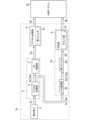
- FIG. 1 is a block diagram showing a schematic configuration of the sensor device of this embodiment.
- FIG. 2 is an explanatory diagram for explaining a thermal noise signal of the same sensor device.
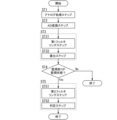
- FIG. 3 is a flow chart showing the operation of the determination method of the same sensor device.
- FIG. 4 is a block diagram showing a schematic configuration of a sensor device according to a first modified example of the same.
- the sensor device 1 includes a detection element 2, a signal converter 3, a first filter 61, and a monitor 7, as shown in FIG.
- the detection element 2 outputs a detection signal S1 according to the stress.
- the signal converter 3 converts the detection signal S1.
- the first filter 61 passes a target frequency band, which is a frequency band to be processed in the signal output from the signal conversion unit 3 .
- the monitoring unit 7 monitors thermal noise contained in the monitoring signal Sa, which is the signal before passing through the first filter 61 .
- "Thermal noise" as used in this disclosure is frequency-independent noise caused, for example, by random thermal oscillations of free electrons. In this embodiment, thermal noise always occurs over the entire frequency band of the supervisory signal Sa.
- the monitoring unit 7 has a second filter 8 and a determination unit 9 .
- the second filter 8 extracts the thermal noise signal S5 from the supervisory signal Sa by passing the frequency band of the supervisory signal Sa excluding the target frequency band.
- the determination unit 9 detects the magnitude of the thermal noise signal S5 and determines whether at least one of the detection element 2 and the signal conversion unit 3 is abnormal based on the magnitude of the thermal noise signal S5.
- the sensor device 1 of the present embodiment directly monitors the thermal noise generated in the frequency band excluding the target frequency band in the monitor signal Sa, thereby increasing the thermal noise generated in the target frequency band. It is possible to determine the abnormality of at least one of the detection element 2 and the signal conversion unit 3 leading to . That is, the sensor device 1 of the present embodiment has the effect of eliminating the need to further implement a redundant circuit in order to self-diagnose a failure leading to an increase in thermal noise.
- the sensor device 1 of the present embodiment has the advantage of being able to self-diagnose failures that lead to an increase in thermal noise while suppressing an increase in size.
- Self-diagnosis as used in the present disclosure means that the sensor device 1 automatically determines whether or not at least one of the detection element 2 and the signal conversion section 3 is abnormal.
- the sensor device 1 for example, the external device B1 may be a home appliance, a mobile terminal, a camera, a wearable terminal, a game machine, or various mobile objects such as vehicles (including automobiles and two-wheeled vehicles), drones, aircraft, and ships. equipment.
- vehicles including automobiles and two-wheeled vehicles
- drones aircraft, and ships. equipment.
- the sensor device 1 includes a detection element 2, a signal conversion section 3, a digital processing section 6, and a monitoring section 7, as shown in FIG.
- the signal converter 3, the digital processor 6, and the monitor 7 are, for example, a single ASIC (Application Specific Integrated Circuit).
- the signal conversion unit 3, the digital processing unit 6, and the monitoring unit 7 are not limited to a single ASIC, and may be a circuit including one or more ICs, or may be a microcomputer.
- the detection element 2 outputs a detection signal S1 according to the stress. More specifically, the detection element 2 detects stress and outputs a detection signal S1 corresponding to the magnitude of the stress.
- the detecting element 2 of this embodiment detects the Coriolis force generated inside the detecting element 2 due to the circular motion of the sensor device 1, and outputs a detection signal S1 according to the Coriolis force.
- the detection element 2 of this embodiment is a gyro element that converts physical quantities such as rotational angular velocity, rotational angle, and angular acceleration into the detection signal S1, which is a charge signal.
- the detection element 2 includes a microelectromechanical system.
- the detection element 2 is a resonator configured by so-called MEMS (Micro Electro Mechanical Systems).
- the detection element 2 is, for example, a uniaxial gyro element, and detects angular velocity around the detection axis.
- the detection element 2 has a vibration electrode and a detection electrode.
- the vibrating electrode vibrates in a first direction orthogonal to the detection axis.
- the sensing electrode senses movement of the vibrating electrode in a second direction orthogonal to both the sensing axis and the first direction using capacitance.
- the structure of the detection element 2 is not limited to the structure described above, and may have any structure as long as it can detect the angular velocity around the detection axis.
- the detection method may be, for example, a piezoelectric method.
- the signal converter 3 has an analog processor 4 and an AD converter 5, as shown in FIG.
- the analog processing unit 4 receives the detection signal S1 and outputs the first conversion signal S2. More specifically, the analog processing unit 4 receives the detection signal S1, converts the detection signal S1, which is a charge signal, into a first conversion signal S2, which is an analog voltage signal, and outputs the first conversion signal S2.
- the AD converter 5 converts the first converted signal S2 into a second converted signal S3, and outputs the second converted signal S3 to the digital processor 6. More specifically, the AD conversion unit 5 converts the analog first conversion signal S2 into a digital second conversion signal S3 and outputs the second conversion signal S3 to the digital processing unit 6 .
- the digital processing unit 6 is configured to generate an output signal S4 from the second converted signal S3 and output the output signal S4 to the external device B1.
- the digital processing unit 6 has a first filter 61, as shown in FIG.
- the first filter 61 passes a target frequency band, which is a frequency band to be processed in the signal output from the signal conversion unit 3 . More specifically, the first filter 61 of this embodiment passes the target frequency band of the second converted signal S3 output from the AD converter 5 .
- the digital processing section 6 extracts the signal of the target frequency band from the second converted signal S3 through the first filter 61 .
- the first filter 61 of the present embodiment is a low-pass filter that hardly attenuates frequency components lower than the cutoff frequency and gradually reduces frequency components higher than the cutoff frequency in the second converted signal S3. Specifically, the first filter 61 is a digital low-pass filter because the digital second converted signal S3 passes through the first filter 61 .
- the digital processing unit 6 performs gain adjustment or offset adjustment on the extracted target frequency band signal, calculates the stress detected by the detection element 2, and outputs information about the calculated stress as an output signal S4.
- the digital processing unit 6 of the present embodiment calculates the Coriolis force based on the extracted signal of the target frequency band, and outputs information on the calculated Coriolis force as an output signal S4.
- the digital processing unit 6 of the present embodiment may further calculate physical quantities such as rotational angular velocity, rotational angle and angular acceleration from the calculated Coriolis force and output them as the output signal S4.
- the external device B1 is a device having a function of receiving the output signal S4 and performing treatment and action using the output signal S4.
- the monitoring unit 7 monitors thermal noise contained in the monitoring signal Sa. More specifically, the monitoring unit 7 monitors thermal noise occurring in frequency bands other than the target frequency band in the monitoring signal Sa.
- the monitoring unit 7 of the present embodiment performs intermittent driving for switching between a monitoring state in which thermal noise is monitored and a stop state in which thermal noise monitoring is stopped.
- the monitoring unit 7 switches from the monitoring state to the stop state when an event (for example, external disturbance such as vibration or impact) occurs. Also, the monitoring unit 7 may switch between the monitoring state and the stop state at regular time intervals.
- the monitoring unit 7 includes a second filter 8 and a determination unit 9, as shown in FIG.
- the second filter 8 extracts the thermal noise signal S5 from the monitoring signal Sa by passing the frequency band of the monitoring signal Sa excluding the target frequency band passed by the first filter 61 .
- the second filter 8 of the present embodiment extracts the thermal noise signal S5 using the second converted signal S3 as the monitoring signal Sa. In other words, the second filter 8 of the present embodiment passes the frequency band of the second converted signal S3 output from the AD converter 5, excluding the target frequency band passed by the first filter 61. 2.
- a thermal noise signal S5 is extracted from the converted signal S3.
- the thermal noise signal S5 is a digital signal.
- the second filter 8 of the present embodiment is a high-pass filter that hardly attenuates the frequency components higher than the cutoff frequency and gradually reduces the frequency components lower than the cutoff frequency in the second converted signal S3.
- the cut-off frequency of the high-pass filter that is the second filter 8 is equal to or higher than the cut-off frequency of the low-pass filter that is the first filter 61 .
- the second filter 8 is a digital high-pass filter because the second converted signal S3 in digital form passes through the second filter 8 .
- the second conversion signal S3 is input to the second filter 8 when the monitoring unit 7 is in the monitoring state, and the second conversion signal S3 is input to the second filter 8 when the monitoring unit 7 is in the stopped state. It is configured so that the conversion signal S3 is not input. That is, the monitoring unit 7 of this embodiment controls whether the monitoring unit 7 is in the monitoring state or in the stopped state depending on whether or not the second conversion signal S3 is input to the second filter 8 .
- the determination unit 9 detects the magnitude of the thermal noise signal S5, and determines whether at least one of the detection element 2 and the signal conversion unit 3 is abnormal based on the magnitude of the thermal noise signal S5.
- the magnitude of the thermal noise signal S5 is the energy or amplitude of the thermal noise signal S5.
- FIG. 2 shows the thermal noise signal S5 with the energy of the thermal noise signal S5 on the vertical axis and the time on the horizontal axis.
- the determination unit 9 of the present embodiment has a counting unit 91 that counts the number of times the magnitude of the thermal noise signal S5 exceeds the preset range R1.
- the counting unit 91 counts the number of times the instantaneous value of the magnitude of the thermal noise signal S5 exceeds the predetermined range R1.
- the count number is the number of times the magnitude of the thermal noise signal S5 exceeds the upper limit value L1 of the predetermined range R1 and the number of times the magnitude of the thermal noise signal S5 falls below the lower limit value L2 of the predetermined range R1.
- the total value of The predetermined range R1 is set in advance so that the magnitude of the thermal noise signal S5 when both the detection element 2 and the signal converter 3 are normal is included in the predetermined range R1.
- the counting unit 91 counts the thermal noise signal S5 shown in FIG. 2 as an example.
- the energy of the thermal noise signal S5 shown in FIG. 2 exceeds the predetermined range R1 three times. More specifically, the energy of the thermal noise signal S5 shown in FIG. 2 is below the lower limit value L2 of the predetermined range R1 at time t1, and exceeds the upper limit value L1 of the predetermined range R1 at times t2 and t3. ing. Therefore, the counting unit 91 counts 3 as the count number.
- the count number counted by the counting unit 91 is reset at regular intervals. In this embodiment, since the monitoring unit 7 performs intermittent driving, the count number counted by the counting unit 91 is reset at the timing when the monitoring unit 7 is stopped.
- the timing at which the count number of the counting section 91 is reset may be the timing at which the monitoring section 7 is in the stop state for a predetermined number of times.
- the determination unit 9 determines that at least one of the detection element 2 and the signal conversion unit 3 is abnormal when the count number counted by the counting unit 91 exceeds a predetermined number of times.
- the predetermined number of times is preferably two or more. That is, it is preferable that the predetermined number of times is set in advance to two or more times.
- the determination section 9 When determining that at least one of the detection element 2 and the signal conversion section 3 is abnormal, the determination section 9 outputs an error signal S6 that notifies at least one of the detection element 2 and the signal conversion section 3 is abnormal. More specifically, the determining unit 9 determines that at least one of the detecting element 2 and the signal converting unit 3 is abnormal when the number of counts counted by the counting unit 91 exceeds a predetermined number of times, An error signal S6 for notifying of an abnormality in at least one of the detection element 2 and the signal conversion unit 3 is output to the external device B1.
- the determination method of the sensor device 1 of the present embodiment includes, as shown in FIG. 3, an analog processing step ST1, an AD conversion step ST2, a digital processing step ST3, and a monitoring step ST5.
- the analog processing section 4 receives the detection signal S1 and outputs the first conversion signal S2. More specifically, in the analog processing step ST1, the analog processing unit 4 receives the detection signal S1, converts the detection signal S1, which is a charge signal, into a first conversion signal S2, which is a voltage signal, and outputs the first conversion signal S2.
- the AD converter 5 converts the first converted signal S2 into the second converted signal S3. More specifically, in the AD conversion step ST2, the AD conversion unit 5 converts the first converted signal S2 in analog format into a second converted signal S3 in digital format, and transmits the second converted signal S3 to the digital processing unit 6. Output.
- the digital processing step ST3 includes a first filtering step ST31 and a calculation step ST32.
- the first filter 61 passes the target frequency band, which is the frequency band to be processed in the second converted signal S3 output from the AD converter 5 in the AD conversion step ST2. That is, in the first filtering step ST31, the digital processing section 6 passes through the first filter 61 and extracts the signal of the target frequency band from the second converted signal S3. Then, in the calculation step ST32, the digital processing unit 6 performs gain adjustment or offset adjustment on the extracted target frequency band signal, calculates the stress detected by the detection element 2, and outputs information on the calculated stress as an output signal. Output as S4.
- the monitoring unit 7 uses the second converted signal S3 as the monitoring signal Sa to monitor thermal noise contained in the monitoring signal Sa.
- the monitoring step ST5 includes a second filtering step ST51 and a determination step ST52.
- the second filter 8 extracts the thermal noise signal S5 from the supervisory signal Sa by passing the frequency band of the supervisory signal Sa excluding the target frequency band passed in the first filtering step ST31. do.
- the second filter 8 passes the frequency band of the second converted signal S3 output in the AD conversion step ST2, excluding the target frequency band passed by the first filter 61.
- the thermal noise signal S5 is extracted from the second converted signal S3.
- the determination section 9 detects the magnitude of the thermal noise signal S5, and determines whether at least one of the detection element 2 and the signal conversion section 3 is abnormal based on the magnitude of the thermal noise signal S5.
- the determination step ST52 will be described in more detail.
- the counting section 91 counts the number of times the magnitude of the thermal noise signal S5 exceeds a preset range R1 as a count number. After that, when the number of counts counted by the counting unit 91 exceeds a predetermined number of times, the determining unit 9 determines that at least one of the detecting element 2 and the signal converting unit 3 is abnormal. and output an error signal S6 notifying of an abnormality in at least one of the signal converters 3 to the external device B1.
- the sensor device 1 does not perform the monitoring step ST5.
- the flowchart of FIG. 3 is merely an example of the determination method of the sensor device 1 of the present embodiment, and the order of the processing may be changed as appropriate, or any processing may be omitted as appropriate.
- the monitoring step ST5 is performed after the digital processing step ST3, but the monitoring step ST5 may be performed before the analog processing step ST1. Also, the monitoring step ST5 may be performed at the same timing as the analog processing step ST1, the AD conversion step ST2, and the digital processing step ST3.
- monitoring step ST5 may be performed at a timing independent of the timing of performing the analog processing step ST1, the AD conversion step ST2, and the digital processing step ST3.
- the sensor device 1 includes a detection element 2, a signal converter 3, a first filter 61, and a monitor .
- the detection element 2 outputs a detection signal S1 according to the stress.
- the signal converter 3 converts the detection signal S1.
- the first filter 61 passes a target frequency band, which is a frequency band to be processed in the signal output from the signal conversion unit 3 .
- the monitoring unit 7 monitors thermal noise contained in the monitoring signal Sa, which is the signal before passing through the first filter 61 .
- the monitoring unit 7 has a second filter 8 and a determination unit 9 .
- the second filter 8 extracts the thermal noise signal S5 from the supervisory signal Sa by passing the frequency band of the supervisory signal Sa excluding the target frequency band.
- the determination unit 9 detects the magnitude of the thermal noise signal S5 and determines whether at least one of the detection element 2 and the signal conversion unit 3 is abnormal based on the magnitude of the thermal noise signal S5.
- the sensor device 1 directly monitors the thermal noise generated in the frequency band excluding the target frequency band in the monitor signal Sa, which leads to an increase in the thermal noise generated in the target frequency band.
- the abnormality of at least one of the detection element 2 and the signal conversion unit 3 can be determined. More specifically, the sensor device 1 directly monitors the thermal noise generated in the frequency bands other than the target frequency band in the monitor signal Sa, which leads to an increase in the thermal noise generated in the target frequency band.
- the detection element 2 , the analog processing unit 4 , and the AD conversion unit 5 . That is, the sensor device 1 has the effect of eliminating the need to further implement a redundant circuit in order to self-diagnose a failure leading to an increase in thermal noise. Therefore, the sensor device 1 of the present embodiment has the advantage of being able to self-diagnose failures that lead to an increase in thermal noise while suppressing an increase in size.
- the determination unit 9 determines that at least one of the detection element 2 and the signal conversion unit 3 is abnormal when the number of counts counted by the counting unit 91 exceeds a predetermined number of times, and The predetermined number of times is set in advance to two or more times.
- the determination unit 9 when the thermal noise signal S5 suddenly rises, the determination unit 9 does not determine that at least one of the detection element 2 and the signal conversion unit 3 is abnormal. That is, the sensor device 1 of the present embodiment has the advantage of being able to suppress erroneous diagnosis of failures that lead to an increase in thermal noise.
- the monitoring unit 7 performs intermittent driving to switch between a monitoring state in which thermal noise is monitored and a stop state in which thermal noise monitoring is stopped.
- the determination unit 9 determines that at least one of the detection element 2 and the signal conversion unit 3 is abnormal due to the influence of the disturbance. Misjudgment can be suppressed. That is, there is an advantage that the influence of disturbance can be suppressed. Moreover, when the monitoring unit 7 switches between the monitoring state and the stop state at regular time intervals, there is an advantage that power consumption can be reduced.
- the determination section 9 when determining that at least one of the detection element 2 and the signal conversion section 3 is abnormal, the determination section 9 outputs an error signal S6 that notifies of a failure of at least one of the detection element 2 and the signal conversion section 3. Output.
- the sensing element 2 includes a microelectromechanical system.
- the sensor device 1 can be miniaturized.
- FIG. 4 shows the configuration of the sensor device 1a of the first modification.
- the monitoring unit 7 of the sensor device 1 monitors the thermal noise contained in the second converted signal S3, but the monitoring unit 7a of the sensor device 1a detects the thermal noise contained in the first converted signal S2. may be monitored.
- the second filter 8 uses the second converted signal S3 as the monitoring signal Sa to extract the thermal noise signal S5. , the thermal noise signal S5 is extracted.
- the monitoring unit 7a has an AD conversion unit 92 and a second filter 8a, as shown in FIG.
- the AD conversion section 92 is arranged between the analog processing section 4 and the second filter 8a.
- the AD conversion section 92 converts the analog first converted signal S2 output from the analog processing section 4 into a digital form, and outputs the converted signal as a third converted signal S21 to the second filter 8a.
- the second filter 8a passes the frequency band of the third converted signal S21 output from the AD conversion unit 92, excluding the target frequency band passed by the first filter 61, thereby reducing the thermal noise from the third converted signal S21. Extract the signal S5. Since the third conversion signal S21 is obtained by converting the first conversion signal S2 into a digital form, the thermal noise included in the third conversion signal S21 corresponds to the thermal noise included in the first conversion signal S2. Therefore, substantially, the second filter 8a uses the first converted signal S2 as the supervisory signal Sa, and passes the frequency band of the first converted signal S2 excluding the target frequency band passed by the first filter 61. , the thermal noise signal S5 is extracted from the first converted signal S2.
- the second filter 8a is a digital high-pass filter because the third converted signal S21 in digital form passes through the second filter 8a.
- the AD conversion section 92 shown in FIG. 4 is arranged between the analog processing section 4 and the second filter 8a, but may be arranged between the second filter 8a and the determination section 9.
- the second filter 8a uses the first converted signal S2 as the monitor signal Sa, and the first filter
- the thermal noise signal S5 is extracted from the first converted signal S2 by passing a frequency band excluding the target frequency band passed by 61 .
- the second filter 8a is an analog high-pass filter because the analog first converted signal S2 passes through the second filter 8a.
- the AD converter 92 converts the analog thermal noise signal S5 output from the second filter 8a into a digital format and outputs it to the determination unit 9 .
- the detection element 2 in the above-described embodiment is a gyro sensor, but may be an acceleration sensor.
- the detection element 2 of the present embodiment is a uniaxial gyro sensor, but may be a biaxial or triaxial gyro sensor. That is, the detection element 2 may be a multi-axis integrated gyro sensor.
- the first filter 61 in the above embodiment is a low-pass filter, it may be a high-pass filter. If the first filter 61 is a high pass filter, the second filter 8 is a low pass filter. At this time, the cutoff frequency of the low-pass filter that is the second filter 8 is lower than the cutoff frequency of the high-pass filter that is the first filter 61 .
- the second filter 8 in the above embodiment is a high pass filter.
- the second filter 8 may be a bandpass filter that passes a specific frequency band out of the frequency bands excluding the target frequency band that the first filter 61 passes.
- the monitoring unit 7 of the above-described embodiment performs intermittent driving to switch between a monitoring state in which thermal noise is monitored and a stop state in which thermal noise monitoring is stopped.
- the monitoring unit 7 may be in a constant monitoring state without performing intermittent driving.
- the second conversion signal S3 is input to the second filter 8 when the monitoring unit 7 is in the monitoring state, and the second filter 8 is input when the monitoring unit 7 is in the stopped state. is configured so that the second conversion signal S3 is not input to the .
- the monitoring unit 7 inputs the thermal noise signal S5 to the determination unit 9 when the monitoring unit 7 is in the monitoring state, and does not input the thermal noise signal S5 to the determination unit 9 when the monitoring unit 7 is in the stopped state. It may be configured as That is, the monitoring unit 7 of the above-described embodiment controls whether the monitoring unit 7 is in the monitoring state or in the stopped state depending on whether or not the second conversion signal S3 is input to the second filter 8. may be controlled by determining whether or not the thermal noise signal S5 is input to the determination unit 9.
- the counting unit 91 of the above-described embodiment counts the number of times the instantaneous value of the magnitude of the thermal noise signal S5 exceeds the predetermined range R1 set in advance. Further, the counting unit 91 may count the number of times the average value of the magnitude of the thermal noise signal S5 per unit time exceeds the predetermined range R1. The shorter the unit time, the higher the accuracy with which the determination unit 9 determines whether there is an abnormality. Considering the accuracy with which the determination unit 9 determines whether or not there is an abnormality, it is desirable that the unit time be shorter than the period of the thermal noise.
- the count number of the counting unit 91 in the above embodiment is reset at the timing when the monitoring unit 7 is stopped.
- the timing at which the count number of the counting unit 91 is reset does not have to be linked with the timing at which the monitoring unit 7 performs intermittent driving.
- the sensor device 1 assumes that the detection element 2, the signal conversion section 3, the digital processing section 6, and the monitoring section 7 are integrally packaged.
- the sensor device 1 at least part of the signal converter 3 , the digital processor 6 , and the monitor 7 may be provided separately from the detection element 2 .
- the signal conversion unit 3, the digital processing unit 6, and the monitoring unit 7 may be provided separately from the detection element 2, or only the monitoring unit 7 may It may be provided separately from the detection element 2 , the signal conversion section 3 and the digital processing section 6 .
- a sensor device (1, 1a) of a first aspect includes a detection element (2), a signal converter (3), a first filter (61), a monitor (7, 7a), Prepare.
- the detection element (2) outputs a detection signal (S1) according to the stress.
- a signal converter (3) converts the detection signal (S1).
- a first filter (61) passes a target frequency band, which is a frequency band to be processed in the signal output from the signal converter (3).
- the monitoring units (7, 7a) monitor thermal noise contained in the monitoring signal (Sa), which is the signal before passing through the first filter (61).
- the monitoring section (7, 7a) has a second filter (8, 8a) and a determining section (9).
- the second filter (8, 8a) extracts the thermal noise signal (S5) from the supervisory signal (Sa) by passing the frequency band of the supervisory signal (Sa) excluding the target frequency band.
- a judging section (9) detects the magnitude of the thermal noise signal (S5) and detects an abnormality in at least one of the detecting element (2) and the signal converting section (3) based on the magnitude of the thermal noise signal (S5). judge.
- the signal converter (3) has an analog processor (4) and an AD converter (5).
- the analog processing section (4) receives the detection signal (S1) and outputs a first conversion signal (S2).
- the AD converter (5) converts the first converted signal (S2) into a second converted signal (S3).
- a second filter (8) extracts a thermal noise signal (S5) using the second converted signal (S3) as a supervisory signal (Sa).
- the signal converter (3) has an analog processor (4) and an AD converter (5).
- the analog processing section (4) receives the detection signal (S1) and outputs a first conversion signal (S2).
- the AD converter (5) converts the first converted signal (S2) into a second converted signal (S3).
- a second filter (8a) extracts a thermal noise signal (S5) using the first converted signal (S2) as a supervisory signal (Sa).
- the determination section (9) is configured such that the magnitude of the thermal noise signal (S5) is preset. It has a counting section (91) that counts the number of times that the predetermined range (R1) is exceeded as the number of counts.
- the determination unit (9) detects the detection element (2 ) and signal converter (3) is determined to be abnormal.
- the predetermined number of times is 2 or more.
- the detection element (2) includes a microelectromechanical system.
- the sensor device (1) can be made more compact.
- the monitoring unit (7) monitors a thermal noise monitoring state and a thermal noise monitoring state. Intermittent drive is performed to switch between a stop state in which monitoring is stopped and a state in which monitoring is stopped.
- the determination unit (9) comprises the detection element (2) and the signal conversion unit (3). If it is determined that at least one of them is abnormal, it outputs an error signal (S6) that reports that at least one of the detection element (2) and the signal converter (3) is abnormal.
- the user and administrator of the sensor device (1, 1a) can know the abnormality of at least one of the detection element (2) and the signal conversion section (3).
- a determination method for a sensor device (1, 1a) is a determination method for a sensor device (1, 1a) including a detection element (2) and a signal conversion section (3).
- the detection element (2) outputs a detection signal (S1) according to the stress.
- a signal converter (3) converts the detection signal.
- the determination method of the sensor device (1, 1a) includes a first filtering step (ST31) and a monitoring step (ST5).
- the first filtering step (ST31) passes the target frequency band, which is the frequency band to be processed, among the signals output from the signal converter (3).
- the monitoring step (ST5) monitors thermal noise contained in the monitoring signal (Sa), which is the signal before performing the first filtering step (ST31).
- the monitoring step (ST5) includes a second filtering step (ST51) and a determining step (ST52).
- the second filtering step (ST51) extracts the thermal noise signal (S5) from the supervisory signal (Sa) by passing the frequency band of the supervisory signal (Sa) excluding the target frequency band.
- a determination step (ST52) detects the magnitude of the thermal noise signal (S5), and detects an abnormality in at least one of the detection element (2) and the signal converter (3) based on the magnitude of the thermal noise signal (S5). judge.
- Reference Signs List 1 1a sensor device 2 detection element 3 signal conversion unit 4 analog processing unit 5 AD conversion unit 61 first filter 7, 7a monitoring unit 8, 8a second filter 9 determination unit 91 counting unit R1 predetermined range S1 detection signal S2 first Conversion signal S3 Second conversion signal S5 Thermal noise signal S6 Error signal Sa Monitoring signal ST31 First filtering step ST5 Monitoring step ST51 Second filtering step ST52 Judgment step
Landscapes
- Engineering & Computer Science (AREA)
- Signal Processing (AREA)
- Physics & Mathematics (AREA)
- General Physics & Mathematics (AREA)
- Radar, Positioning & Navigation (AREA)
- Remote Sensing (AREA)
- Testing Or Calibration Of Command Recording Devices (AREA)
Priority Applications (1)
| Application Number | Priority Date | Filing Date | Title |
|---|---|---|---|
| JP2023578613A JPWO2023149497A1 (https=) | 2022-02-07 | 2023-02-02 |
Applications Claiming Priority (2)
| Application Number | Priority Date | Filing Date | Title |
|---|---|---|---|
| JP2022017359 | 2022-02-07 | ||
| JP2022-017359 | 2022-02-07 |
Publications (1)
| Publication Number | Publication Date |
|---|---|
| WO2023149497A1 true WO2023149497A1 (ja) | 2023-08-10 |
Family
ID=87552532
Family Applications (1)
| Application Number | Title | Priority Date | Filing Date |
|---|---|---|---|
| PCT/JP2023/003364 Ceased WO2023149497A1 (ja) | 2022-02-07 | 2023-02-02 | センサ装置、及びセンサ装置の判定方法 |
Country Status (2)
| Country | Link |
|---|---|
| JP (1) | JPWO2023149497A1 (https=) |
| WO (1) | WO2023149497A1 (https=) |
Citations (5)
| Publication number | Priority date | Publication date | Assignee | Title |
|---|---|---|---|---|
| JP2003291842A (ja) * | 2002-03-29 | 2003-10-15 | Toyoda Mach Works Ltd | 電動パワーステアリング装置 |
| JP2014185936A (ja) * | 2013-03-22 | 2014-10-02 | Seiko Epson Corp | 検出装置、センサー、電子機器及び移動体 |
| JP2015515616A (ja) * | 2012-03-20 | 2015-05-28 | ローベルト ボツシユ ゲゼルシヤフト ミツト ベシユレンクテル ハフツングRobert Bosch Gmbh | 車両における乗員保護システムのための少なくとも1つのマイクロメカニカルセンサ素子を備えた加速度センサ |
| JP2017156088A (ja) * | 2016-02-29 | 2017-09-07 | 日立オートモティブシステムズ株式会社 | 慣性力検出装置 |
| JP2018205007A (ja) * | 2017-05-31 | 2018-12-27 | セイコーエプソン株式会社 | 回路装置、物理量測定装置、電子機器及び移動体 |
-
2023
- 2023-02-02 WO PCT/JP2023/003364 patent/WO2023149497A1/ja not_active Ceased
- 2023-02-02 JP JP2023578613A patent/JPWO2023149497A1/ja not_active Withdrawn
Patent Citations (5)
| Publication number | Priority date | Publication date | Assignee | Title |
|---|---|---|---|---|
| JP2003291842A (ja) * | 2002-03-29 | 2003-10-15 | Toyoda Mach Works Ltd | 電動パワーステアリング装置 |
| JP2015515616A (ja) * | 2012-03-20 | 2015-05-28 | ローベルト ボツシユ ゲゼルシヤフト ミツト ベシユレンクテル ハフツングRobert Bosch Gmbh | 車両における乗員保護システムのための少なくとも1つのマイクロメカニカルセンサ素子を備えた加速度センサ |
| JP2014185936A (ja) * | 2013-03-22 | 2014-10-02 | Seiko Epson Corp | 検出装置、センサー、電子機器及び移動体 |
| JP2017156088A (ja) * | 2016-02-29 | 2017-09-07 | 日立オートモティブシステムズ株式会社 | 慣性力検出装置 |
| JP2018205007A (ja) * | 2017-05-31 | 2018-12-27 | セイコーエプソン株式会社 | 回路装置、物理量測定装置、電子機器及び移動体 |
Also Published As
| Publication number | Publication date |
|---|---|
| JPWO2023149497A1 (https=) | 2023-08-10 |
Similar Documents
| Publication | Publication Date | Title |
|---|---|---|
| EP3391061B1 (en) | Accelerometer sense path self-test | |
| AU2008200126B2 (en) | Combined accelerometer and gyroscope system | |
| EP3387449B1 (en) | Accelerometer common mode self-test | |
| EP3387450B1 (en) | Mems sensor with compensation of residual voltage | |
| US20090241634A1 (en) | Micromachined accelerometer and method with continuous self-testing | |
| CN107206399A (zh) | 离心机和用于检测离心机不平衡的方法 | |
| CN104034920A (zh) | 监视加速计的系统及方法 | |
| JP5512507B2 (ja) | センサモジュール、およびセンサシステム | |
| JP6144692B2 (ja) | スキュートランスデューサを用いる故障検出 | |
| JP3937334B2 (ja) | 振動型角速度センサの異常検出装置、異常検出方法、異常検出用プログラム並びに車両制御システム | |
| WO2023149497A1 (ja) | センサ装置、及びセンサ装置の判定方法 | |
| CN104204816B (zh) | 具有至少一个微机械传感器元件的用于车辆中的乘员保护系统的加速度传感器 | |
| JP7150450B2 (ja) | 加速度検出装置およびそれを備える軸受装置 | |
| JP4289439B1 (ja) | センサ装置 | |
| CN104569626A (zh) | 静电场传感器、基于静电场传感器的静电报警系统及方法 | |
| WO2009122739A1 (ja) | センサ装置 | |
| JP5668212B2 (ja) | 自己診断機能を有する角速度センサ | |
| JP2020010425A (ja) | 異常検出装置および電力変換装置 | |
| CN118633013A (zh) | 陀螺仪传感器 | |
| WO2025115346A1 (ja) | センサシステム | |
| JP2008256582A (ja) | 物理量センサの故障検出方法、及び物理量センサ | |
| WO2011030541A1 (ja) | 角速度センサ |
Legal Events
| Date | Code | Title | Description |
|---|---|---|---|
| 121 | Ep: the epo has been informed by wipo that ep was designated in this application |
Ref document number: 23749813 Country of ref document: EP Kind code of ref document: A1 |
|
| ENP | Entry into the national phase |
Ref document number: 2023578613 Country of ref document: JP Kind code of ref document: A |
|
| NENP | Non-entry into the national phase |
Ref country code: DE |
|
| 122 | Ep: pct application non-entry in european phase |
Ref document number: 23749813 Country of ref document: EP Kind code of ref document: A1 |