WO2023148829A1 - 無線通信方法及び無線通信システム - Google Patents
無線通信方法及び無線通信システム Download PDFInfo
- Publication number
- WO2023148829A1 WO2023148829A1 PCT/JP2022/003881 JP2022003881W WO2023148829A1 WO 2023148829 A1 WO2023148829 A1 WO 2023148829A1 JP 2022003881 W JP2022003881 W JP 2022003881W WO 2023148829 A1 WO2023148829 A1 WO 2023148829A1
- Authority
- WO
- WIPO (PCT)
- Prior art keywords
- communication
- wireless communication
- node
- data
- unit
- Prior art date
- Legal status (The legal status is an assumption and is not a legal conclusion. Google has not performed a legal analysis and makes no representation as to the accuracy of the status listed.)
- Ceased
Links
Images




Classifications
-
- H—ELECTRICITY
- H04—ELECTRIC COMMUNICATION TECHNIQUE
- H04W—WIRELESS COMMUNICATION NETWORKS
- H04W40/00—Communication routing or communication path finding
- H04W40/24—Connectivity information management, e.g. connectivity discovery or connectivity update
- H04W40/248—Connectivity information update
-
- H—ELECTRICITY
- H04—ELECTRIC COMMUNICATION TECHNIQUE
- H04W—WIRELESS COMMUNICATION NETWORKS
- H04W40/00—Communication routing or communication path finding
- H04W40/02—Communication route or path selection, e.g. power-based or shortest path routing
-
- H—ELECTRICITY
- H04—ELECTRIC COMMUNICATION TECHNIQUE
- H04W—WIRELESS COMMUNICATION NETWORKS
- H04W40/00—Communication routing or communication path finding
- H04W40/02—Communication route or path selection, e.g. power-based or shortest path routing
- H04W40/12—Communication route or path selection, e.g. power-based or shortest path routing based on transmission quality or channel quality
-
- H—ELECTRICITY
- H04—ELECTRIC COMMUNICATION TECHNIQUE
- H04W—WIRELESS COMMUNICATION NETWORKS
- H04W40/00—Communication routing or communication path finding
- H04W40/34—Modification of an existing route
-
- H—ELECTRICITY
- H04—ELECTRIC COMMUNICATION TECHNIQUE
- H04W—WIRELESS COMMUNICATION NETWORKS
- H04W84/00—Network topologies
- H04W84/02—Hierarchically pre-organised networks, e.g. paging networks, cellular networks, WLAN [Wireless Local Area Network] or WLL [Wireless Local Loop]
- H04W84/04—Large scale networks; Deep hierarchical networks
- H04W84/06—Airborne or Satellite Networks
-
- Y—GENERAL TAGGING OF NEW TECHNOLOGICAL DEVELOPMENTS; GENERAL TAGGING OF CROSS-SECTIONAL TECHNOLOGIES SPANNING OVER SEVERAL SECTIONS OF THE IPC; TECHNICAL SUBJECTS COVERED BY FORMER USPC CROSS-REFERENCE ART COLLECTIONS [XRACs] AND DIGESTS
- Y02—TECHNOLOGIES OR APPLICATIONS FOR MITIGATION OR ADAPTATION AGAINST CLIMATE CHANGE
- Y02D—CLIMATE CHANGE MITIGATION TECHNOLOGIES IN INFORMATION AND COMMUNICATION TECHNOLOGIES [ICT], I.E. INFORMATION AND COMMUNICATION TECHNOLOGIES AIMING AT THE REDUCTION OF THEIR OWN ENERGY USE
- Y02D30/00—Reducing energy consumption in communication networks
- Y02D30/70—Reducing energy consumption in communication networks in wireless communication networks
Definitions
- the present invention relates to a wireless communication method and a wireless communication system.
- Super coverage means expanding the service area to places where the cost of laying existing base stations is high, such as mountains, seas, and air, or where it is difficult to lay base stations.
- there is a need for national resilience against natural disasters, etc. and there is a demand for a communication system that is resistant to terrestrial disasters.
- Non-Patent Document 1 In order to realize such a wireless communication system, geostationary satellites, medium earth orbit (MEO), low earth orbit (LEO), high altitude pseudosatellites (HAPS), Unmanned Aerial Vehicles (UAVs) and non-terrestrial networks (NTNs) using drones and the like are attracting attention (see, for example, Non-Patent Document 1).
- MEO medium earth orbit
- LEO low earth orbit
- HAPS high altitude pseudosatellites
- UAVs Unmanned Aerial Vehicles
- NTNs non-terrestrial networks
- Satellites and HAPS connect communication links to form a network, and are connected to terrestrial mobile networks via terrestrial base stations. Satellites and HAPS carry mobile base station functionality.
- the traffic packets sent by the terminal station are transferred to the satellite and HAPS connected to the ground base station by the routing function, and sent to the Internet network. Packets transmitted from the Internet network to other terminal stations are similarly processed by the routing function.
- a method of determining the route by calculating the cost value for each link is being studied. For example, when determining a communication route in NTN, the route with the smallest sum of cost values calculated for each communication link is selected as the communication route.
- An object of the present invention is to provide a wireless communication method and a wireless communication system capable of performing communication.
- a wireless communication method is a wireless communication method for transmitting data via a wireless communication path switchable by a plurality of moving node stations equipped with transmission buffers, wherein each of the node stations transmits data.
- a radio communication system is a radio communication system in which a plurality of moving node stations having transmission buffers transmit data via switchable radio communication paths, wherein each of the node stations an acquisition unit that acquires correspondence information corresponding to the amount of data transmitted by each time a communication situation fluctuates, and based on each of the correspondence information acquired by the acquisition unit, per unit link speed between the plurality of nodes a changing unit for changing the cost value of the above; a calculating unit for calculating the cost value between the plurality of node stations using the cost value changed by the changing unit; and a determination unit that determines the route as the communication route.
- wireless communication can be performed efficiently while reducing the concentration of traffic on a specific communication path.
- FIG. 1 is a diagram illustrating a configuration example of a wireless communication system according to an embodiment
- FIG. FIG. 4 is a diagram showing a configuration example of a node station; It is a figure which shows the structural example of a route control part.
- 4 is a flow chart showing a first operation example of the wireless communication system according to one embodiment; It is a figure which shows the 1st operation example of the radio
- 9 is a flow chart showing a second operation example of the wireless communication system according to one embodiment
- FIG. 7 is a diagram showing a second operation example of the wireless communication system according to one embodiment
- 9 is a flowchart showing a third operation example of the wireless communication system according to one embodiment;
- FIG. 11 is a flow chart showing a fourth operation example of the wireless communication system according to one embodiment
- FIG. FIG. 12 is a diagram showing a fourth operation example of the wireless communication system according to one embodiment
- FIG. 5 is a diagram illustrating a configuration of a modification of the network control device in the wireless communication system according to one embodiment
- It is a figure which shows the structural example of a radio
- FIG. 12 is a diagram showing a configuration example of the radio communication system 1.
- a wireless communication system 1 includes, for example, base stations (terrestrial base stations) 2-1 to 2-5 and node stations 3-1 to 3-5, and a plurality of terminal stations (terrestrial terminals). stations) 4-1 to 4-4 are each connectable.
- the node stations 3-1 to 3-5 are wireless communication devices such as unmanned aerial vehicles or satellites that move on the ground, each having a mobile base station function, for example, connecting communication links a to f to transmit NTN. Configure.
- the wireless communication system 1 selects the route that minimizes the sum of the cost values calculated for each communication link as the communication route.
- the cost value is calculated by the following formula (1).
- the link speed and link delay are fixed values set by the user.
- the wireless communication system 1 selects a faster communication link.
- the radio communication system 1 selects a communication link with a lower delay.
- the wireless communication system 1 is configured so that the cost value is calculated using the above equation (1), and a high-speed and low-delay communication link can be easily selected as a communication route.
- the cost value of communication link a is "1"
- the cost value of communication link b is "2”
- the cost value of communication link c is "4"
- the cost value of communication link d is "4". 1”
- the cost value of communication link e is "30”
- the cost value of communication link f is "30”.
- the radio communication system 1 has a communication link (feeder link) between the base station 2-1 and the node station 3-1 and a communication link (feeder link) between the base station 2-2 and the node station 3-2.
- the traffic (data) is transferred to a node station having a feeder link capable of communicating with the base station (terrestrial base station).
- the wireless communication system 1 selects the communication route with the smallest total cost value.
- the terminal station 4-2 is connected to the base station 2-4 via the communication link b whose total cost value is 2, which is the smallest.
- the traffic from the terminal station 4-1 and the traffic from the terminal station 4-2 are concentrated on the communication link b, and congestion may occur.
- a wireless communication system 1a reduces concentration of traffic on a specific communication path and efficiently It is configured to be able to perform wireless communication.
- FIG. 1 is a diagram showing a configuration example of a wireless communication system 1a according to one embodiment.
- a wireless communication system 1a includes, for example, a plurality of base stations (terrestrial base stations) 5 and a plurality of node stations 6, and a plurality of terminal stations (terrestrial terminal stations) 7 each Connectable.
- the node station 6 is a geostationary satellite (GEO), a medium orbit satellite (MEO), a low earth orbit satellite (LEO), a high altitude pseudo satellite (HAPS), a drone, an unmanned aerial vehicle (UAV), an aircraft, or the like.
- GEO geostationary satellite
- MEO medium orbit satellite
- LEO low earth orbit satellite
- HAPS high altitude pseudo satellite
- UAV unmanned aerial vehicle
- Each node station 6 connects a communication link to each other, connects a communication link to the base station 5, and forms a network for each type of node station.
- node station network A includes multiple node stations 6 that are geostationary satellites
- node station network B includes multiple node stations 6 that are unmanned air vehicles.
- each of the plurality of base stations 5 is connected to the network control device 8 and the Internet network 12 via the mobile network 10 .
- the network control device 8 acquires information from each node station 6 and the like via the mobile network 10 .
- the network control device 8 may acquire information periodically, or may receive information from the node station 6 when an event such as feeder link disconnection occurs.
- Each node station 6 is a wireless communication device that moves on the ground, such as an unmanned air vehicle or a satellite that has a transmission buffer, and each has a mobile base station function including a routing function to connect communication links. constitutes NTN.
- the wireless communication system 1a uses the path that minimizes the sum of the cost values calculated for each communication link as the communication path. select.
- FIG. 2 is a diagram showing a configuration example of the node station 6.
- the node station 6 includes, for example, a plurality of inter-node communication units 60, inter-terminal communication units 61, inter-base station communication units 62, traffic monitors 63, feeder link monitoring units 64, and route control units. 65.
- the node-to-station communication unit 60 establishes a communication link with another nearby node station 6 to perform wireless communication.
- the inter-terminal-station communication unit 61 performs wireless communication by connecting a communication link with the terminal station 7 within a predetermined communication area.
- the inter-base-station communication unit 62 connects a communication link with the base station 5 within a predetermined communication area to perform wireless communication.
- the traffic monitor 63 detects, for example, the traffic volume of each node interstation communication unit 60, the terminal interstation communication unit 61, and the interbase station communication unit 62, and sends each of the detected traffic volumes to the route control unit 65. Output. Also, the traffic monitor 63 measures the usage status of the transmission buffer of the node station 6 .
- the feeder link monitoring unit 64 monitors the feeder link performed by the inter-base station communication unit 62 and outputs the monitored feeder link result to the route control unit 65 .
- the route control unit 65 determines the plurality of routes of the wireless communication system 1a. A cost value for each communication link is calculated, and a communication path (route) of a packet (data) to be transmitted in the wireless communication system 1a is determined and controlled.
- the route control unit 65 calculates cost values, exchanges cost values with other adjacent node stations 6, and determines traffic communication routes.
- FIG. 3 is a diagram showing a configuration example of the route control unit 65.
- the route control unit 65 has a storage unit 650, an acquisition unit 652, a calculation unit 654, a determination unit 656, and a change unit 658, for example.
- the storage unit 650 is a memory or the like, and stores, for example, data necessary for the route control unit 65 to calculate cost values for each of a plurality of communication links and control communication paths. Output according to access from the calculation unit 654 and the determination unit 656 .
- the acquisition unit 652 acquires the traffic volume and transmission buffer usage status output by the traffic monitor 63 and the feeder link results output by the feeder link monitoring unit 64, and outputs them to the calculation unit 654 and the change unit 658. do.
- the acquisition unit 652 acquires correspondence information corresponding to the amount of data transmitted by each node station 6 each time the communication status changes, and outputs the correspondence information to the calculation unit 654 and the change unit 658 .
- the acquisition unit 652 acquires the usage rate of the transmission buffer of each node station 6 as corresponding information.
- the acquisition unit 652 uses the amount of data obtained by subtracting the amount of data newly input to the node station 6 due to the switching of the communication path from the amount of data transmitted by the node station 6 as the correspondence information. You can get each.
- the acquisition unit 652 may also acquire the C/N (carrier-to-noise ratio) of data received by each node station 6 as corresponding information.
- the calculation unit 654 calculates a cost value using each of the data stored in the storage unit 650 and the correspondence information (traffic volume, etc.) acquired by the acquisition unit 652, and uses the calculated cost value to calculate a plurality of A cost value between node stations 6 is calculated. Then, the calculation unit 654 outputs the calculated cost values among the plurality of node stations 6 to the storage unit 650 and the determination unit 656 .
- the calculation unit 654 uses the cost value changed by the change unit 658 to calculate the cost value between the plurality of node stations 6 .
- the determination unit 656 determines the path that minimizes the sum of the data stored in the storage unit 650 and the cost value calculated by the calculation unit 654 as the communication path, and transmits information indicating the determined communication path to the node station. 6 is output to each part constituting the .
- the determination unit 656 may determine a predetermined specific communication route as the communication route for the specific data. good.
- the changing unit 658 changes the cost value per unit link speed between the plurality of node stations 6 based on each piece of correspondence information acquired by the acquiring unit 652 and outputs the changed cost value to the calculating unit 654 .
- the calculation unit 654 calculates the cost values between the plurality of node stations 6 using the cost values changed by the change unit 658 according to the communication status. do. Then, the determination unit 656 performs adaptive control to determine a communication route in the wireless communication system 1a according to fluctuations in the communication status of the communication link.
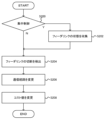
- FIG. 4 is a flowchart showing a first operation example of the wireless communication system 1a according to one embodiment.
- step 100 the wireless communication system 1a determines whether or not the node station 6, for example, performs centralized control of communication path determination.
- the node station 6 proceeds to the processing of S102 if centralized control is to be performed (S100: Yes), and proceeds to the processing of S104 if centralized control is not to be performed (S100: No).
- the node station 6 collects the usage rate of the transmission buffer from each node station 6.
- the node station 6 confirms the usage rate of the transmission buffer of each node station 6. For example, the node station 6 uses the usage rate of the transmission buffer of each node station 6 to confirm whether or not there is a change in the communication status that requires a change in the cost value.
- the node station 6 changes the cost value of each communication link according to the usage rate of the transmission buffer.
- the node station 6 uses the changed cost value to calculate the communication route that minimizes the total cost value of the communication links.
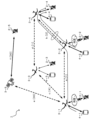
- FIG. 5 is a diagram showing a first operation example of the wireless communication system 1a according to one embodiment.
- the node station 6-1 transmits 1 Gbps data to the node station 6-2 via the communication link a, and transmits the data to the node station 6-3 via the node station 6-2. .
- the node station 6 changes the cost value of the communication link according to the usage rate of the transmission buffer.
- the transmission buffer usage rate is calculated by the following formula (2).
- the cost value at this time is calculated by the following formula (3).
- the number of input links to the node station 6-2 is 1 and the buffer usage rate is 75%.
- the node station 6-2 changes the cost value by setting the link speed of the communication link a to 0.25 Gbps.
- FIG. 6 is a flowchart showing a second operation example of the wireless communication system 1a according to one embodiment.
- the wireless communication system 1a determines whether or not the node station 6, for example, performs centralized control of communication route determination. If the node station 6 performs centralized control (S200: Yes), it proceeds to the processing of S202, and if it does not perform centralized control (S200: No), it proceeds to the processing of S204.
- the node station 6 collects the state of the feeder link from each node station 6.
- the node station 6 detects disconnection of the feeder link.
- the node station 6 calculates the communication route with the smallest total cost value and changes the communication route.
- the node station 6 changes the cost value of the communication route included in the new communication route.
- FIG. 7 is a diagram showing a second operation example of the wireless communication system 1a according to one embodiment.
- the terminal station 7-1 attempts to transmit 1 Gbps data to the base station 5-1 via communication links a and b.
- the wireless communication system 1a establishes a new feeder link via the communication links a, c, and e.
- the cost value of the communication route included in the new communication path is changed.
- the terminal station 7-1 transmits data to another base station (base station 5-2) via the node stations 6-1 and 6-2.
- the node station 6 calculates the cost value using the following formula (4).
- FIG. 8 is a flowchart showing a third operation example of the wireless communication system 1a according to one embodiment. As shown in FIG. 8, at step 300 (S300), the wireless communication system 1a detects a drop in reception C/N of the feeder link.
- the node station 6 changes the feeder link speed according to the reception C/N
- the node station 6 changes the cost value according to the changed feeder link speed.
- the node station 6 uses the changed cost value to calculate the communication route with the minimum total cost value.
- the wireless communication system 1a adaptively controls the link speed according to the reception C/N of the feeder link (when the reception C/N is reduced due to rainfall, etc., the link speed is reduced for communication). ) and calculate the cost value according to the changed link speed.
- FIG. 9 is a flowchart showing a fourth operation example of the wireless communication system 1a according to one embodiment. As shown in FIG. 9, at step 400 (400), the wireless communication system 1a calculates the communication route with the minimum total cost value.
- the node station 6 determines whether or not the minimum total cost value is equal to or greater than a predetermined threshold.
- the node station 6 proceeds to the process of S404 when the minimum value of the total cost value is equal to or greater than the predetermined threshold value (S402: Yes), and when the minimum value of the total cost value is less than the predetermined threshold value (S402: No ), the process proceeds to S408.
- step 404 the node station 6 determines whether or not the data to be routed through the communication path whose minimum total cost value is equal to or greater than a predetermined threshold corresponds to predetermined specific traffic. .
- the node station 6 proceeds to the processing of S406 if the data corresponds to the specific traffic (S404: Yes), and proceeds to the processing of S408 if the data does not correspond to the specific traffic (S404: No).
- the node station 6 determines a predetermined fixed communication path as the communication path for transmitting data corresponding to the specific traffic regardless of the cost value.
- the node station 6 determines the communication path for transmitting data that does not correspond to specific traffic as the communication path with the lowest cost value.
- FIG. 10 is a diagram showing a fourth operation example of the wireless communication system 1a according to one embodiment.
- the wireless communication system 1a sets a threshold value for the total cost value, and assumes that all communication routes are congested when the total cost value is equal to or greater than a predetermined threshold value for any communication route. Then, the wireless communication system 1a communicates the specific traffic using a predetermined fixed communication path regardless of the cost value.
- the communication link between the node station 6-1 and the base station 5-1, the communication link between the node station 6-2 and the base station 5-2, and the communication link between the node station 6-3 and the base station 5-3 communication link is disabled due to rain clouds or the like.
- the wireless communication system 1a transfers the data to either the base station 5-4 or the base station 5-5 with which the terminal station 7-1 can transmit the data.
- communication path X using communication links a and b, communication path Y using communication links c and d, and communication path Z using communication links e and f are available for data transfer.
- the threshold value of the total cost value for the communication path is 15.
- the wireless communication system 1a determines that the total cost value 18 of the communication path Y having the smallest total cost value exceeds the threshold value 15. Therefore, regardless of the total cost value, the predetermined fixed communication route Z is determined as the communication route for the data transmitted by the terminal station 7-1.
- the node station 6 determines whether or not the traffic is specific traffic using QCI (QoS Class Identifier) from the terminal station 7 or the like.
- the wireless communication system 1a may be configured to operate by combining the operations of the first to fourth operation examples described above.
- FIG. 11 is a diagram illustrating a configuration of a modified example (network control device 8a) of the network control device 8 in the wireless communication system 1a according to one embodiment.
- the network control device 8a has a collection unit 80 and a route control unit 65, for example.
- Collection unit 80 collects data transmitted via mobile network 10 and outputs the data to route control unit 65 .
- the data collected by the collection unit 80 is the same as the data acquired by the node station 6 described above.
- the collection unit 80 collects the transmission buffer usage status and feeder link status acquired by each node station 6 .
- the network control device 8a also has the same function as the route control unit 65 provided in the node station 6 (see FIG. 3), and adaptively controls the communication path in the wireless communication system 1a. Therefore, in the radio communication system 1a, each node station 6 need not have the function of adaptively controlling the communication path, as long as the network control device 8a has the function of adaptively controlling the communication path.
- the wireless communication system 1a acquires correspondence information corresponding to the amount of data transmitted by each of the node stations 6 each time the communication situation changes, and based on each of the acquired correspondence information, the plurality of node stations 6 Since the cost value per unit link speed between multiple base stations 5, node stations 6, and terminal stations 7 fluctuates in communication conditions between wireless communication devices, traffic on a specific communication route can be maintained. Wireless communication can be performed efficiently while reducing concentration.
- the functions of the base station 5, the node station 6, the terminal station 7, and the network control devices 8 and 8a are partially or wholly implemented by PLD (Programmable Logic Device), FPGA (Field Programmable Gate Array), or the like. It may be configured by hardware, or may be configured as a program executed by a processor such as a CPU.
- PLD Processable Logic Device
- FPGA Field Programmable Gate Array
- the wireless communication system 1a can be implemented using a computer and a program, and the program can be recorded on a storage medium or provided through a network.
Landscapes
- Engineering & Computer Science (AREA)
- Computer Networks & Wireless Communication (AREA)
- Signal Processing (AREA)
- Physics & Mathematics (AREA)
- Astronomy & Astrophysics (AREA)
- General Physics & Mathematics (AREA)
- Mobile Radio Communication Systems (AREA)
Priority Applications (3)
| Application Number | Priority Date | Filing Date | Title |
|---|---|---|---|
| US18/834,351 US20250159580A1 (en) | 2022-02-01 | 2022-02-01 | Wireless communication method and wireless communication system |
| PCT/JP2022/003881 WO2023148829A1 (ja) | 2022-02-01 | 2022-02-01 | 無線通信方法及び無線通信システム |
| JP2023578232A JP7697540B2 (ja) | 2022-02-01 | 2022-02-01 | 無線通信方法及び無線通信システム |
Applications Claiming Priority (1)
| Application Number | Priority Date | Filing Date | Title |
|---|---|---|---|
| PCT/JP2022/003881 WO2023148829A1 (ja) | 2022-02-01 | 2022-02-01 | 無線通信方法及び無線通信システム |
Publications (1)
| Publication Number | Publication Date |
|---|---|
| WO2023148829A1 true WO2023148829A1 (ja) | 2023-08-10 |
Family
ID=87553343
Family Applications (1)
| Application Number | Title | Priority Date | Filing Date |
|---|---|---|---|
| PCT/JP2022/003881 Ceased WO2023148829A1 (ja) | 2022-02-01 | 2022-02-01 | 無線通信方法及び無線通信システム |
Country Status (3)
| Country | Link |
|---|---|
| US (1) | US20250159580A1 (https=) |
| JP (1) | JP7697540B2 (https=) |
| WO (1) | WO2023148829A1 (https=) |
Cited By (2)
| Publication number | Priority date | Publication date | Assignee | Title |
|---|---|---|---|---|
| CN119071947A (zh) * | 2024-08-27 | 2024-12-03 | 南京交通职业技术学院 | 无人机集群自组网通信方法及系统 |
| WO2025169347A1 (ja) * | 2024-02-07 | 2025-08-14 | Ntt株式会社 | 無線通信方法および集中管理装置 |
Citations (2)
| Publication number | Priority date | Publication date | Assignee | Title |
|---|---|---|---|---|
| JP2002064550A (ja) * | 2000-08-17 | 2002-02-28 | Nippon Telegr & Teleph Corp <Ntt> | 衛星/地上経路選択装置 |
| JP2010178145A (ja) * | 2009-01-30 | 2010-08-12 | Oki Electric Ind Co Ltd | パケット中継システム及び無線ノード |
-
2022
- 2022-02-01 JP JP2023578232A patent/JP7697540B2/ja active Active
- 2022-02-01 US US18/834,351 patent/US20250159580A1/en active Pending
- 2022-02-01 WO PCT/JP2022/003881 patent/WO2023148829A1/ja not_active Ceased
Patent Citations (2)
| Publication number | Priority date | Publication date | Assignee | Title |
|---|---|---|---|---|
| JP2002064550A (ja) * | 2000-08-17 | 2002-02-28 | Nippon Telegr & Teleph Corp <Ntt> | 衛星/地上経路選択装置 |
| JP2010178145A (ja) * | 2009-01-30 | 2010-08-12 | Oki Electric Ind Co Ltd | パケット中継システム及び無線ノード |
Non-Patent Citations (1)
| Title |
|---|
| KAZUMA YOSHIDA, HIROKI NISHIYAMA, NEI KATO, NAOKO YOSHIMURA, MORIO TOYOSHIMA, NAOTO KADOWAKI: "A Study on a Route Control Method to Avoid Congestion in the Destination Area for Two-Layered Satellite Networks", IEICE TECHNICAL REPORT, SAT, IEICE, JP, vol. 112, no. 51 (SAT2012-5), 17 May 2012 (2012-05-17), JP, pages 23 - 28, XP009548312 * |
Cited By (2)
| Publication number | Priority date | Publication date | Assignee | Title |
|---|---|---|---|---|
| WO2025169347A1 (ja) * | 2024-02-07 | 2025-08-14 | Ntt株式会社 | 無線通信方法および集中管理装置 |
| CN119071947A (zh) * | 2024-08-27 | 2024-12-03 | 南京交通职业技术学院 | 无人机集群自组网通信方法及系统 |
Also Published As
| Publication number | Publication date |
|---|---|
| US20250159580A1 (en) | 2025-05-15 |
| JPWO2023148829A1 (https=) | 2023-08-10 |
| JP7697540B2 (ja) | 2025-06-24 |
Similar Documents
| Publication | Publication Date | Title |
|---|---|---|
| US9425985B1 (en) | Protection switching in radio networks | |
| US10027508B2 (en) | Extended ring-like communication architecture | |
| US8385921B1 (en) | Backhaul aware radio access networks | |
| CN110290066B (zh) | 基于队列监测与拥塞预测的卫星网络动态路由方法 | |
| CN111294108B (zh) | 一种面向正交圆轨道构型卫星星座的高效路由方法 | |
| CN107453801A (zh) | 一种面向卫星网络的分层多路径路由方法 | |
| CN112311441B (zh) | 低轨星座网络中的拥塞避免路由方法 | |
| CN106656302A (zh) | 面向leo卫星网络的分布式节点自适应路由算法 | |
| JP7809815B2 (ja) | 無線通信システム、通信経路制御装置、通信経路制御方法および通信経路制御用プログラム | |
| CN109714270B (zh) | 基于事件触发的卫星路由负载均衡方法 | |
| JP5071165B2 (ja) | 経路多重化通信システム、通信ノード及び通信方法 | |
| JP7697540B2 (ja) | 無線通信方法及び無線通信システム | |
| CN109672625A (zh) | 一种优化时延的低轨卫星馈电负载均衡方法及系统 | |
| CN118473503A (zh) | 一种卫星网络局域感知的多路径可靠传输方法和系统 | |
| Ning et al. | Load-balancing routing algorithm against inter-satellite link congestion in LEO satellite optical networks | |
| JP7632652B2 (ja) | 無線通信システム、無線通信方法、ネットワークコントローラ、及びネットワーク制御プログラム | |
| Yang et al. | Routing protocol design for drone-cell communication networks | |
| CN114125987B (zh) | 空天地一体化网络的路由方法和装置 | |
| CN119010998B (zh) | 一种基于卫星通信网络均衡负载路由的方法及系统 | |
| CN114513241B (zh) | 一种基于SDN的高性能QoS保证低轨卫星星间路由方法 | |
| WO2023162256A1 (ja) | 通信システムおよび通信方法 | |
| CN107517483B (zh) | 一种密集部署的无线异构网络的中继分配方法 | |
| WO2022219818A1 (ja) | 無線通信システム、無線通信方法、及び通信経路決定装置 | |
| Jiang et al. | Fast Recovery Routing Algorithm for Software Defined Network based Operationally Responsive Space Satellite Networks. | |
| US8830906B1 (en) | Integrated quality of service interface for ethernet radio |
Legal Events
| Date | Code | Title | Description |
|---|---|---|---|
| 121 | Ep: the epo has been informed by wipo that ep was designated in this application |
Ref document number: 22924742 Country of ref document: EP Kind code of ref document: A1 |
|
| ENP | Entry into the national phase |
Ref document number: 2023578232 Country of ref document: JP Kind code of ref document: A |
|
| WWE | Wipo information: entry into national phase |
Ref document number: 18834351 Country of ref document: US |
|
| NENP | Non-entry into the national phase |
Ref country code: DE |
|
| 122 | Ep: pct application non-entry in european phase |
Ref document number: 22924742 Country of ref document: EP Kind code of ref document: A1 |
|
| WWP | Wipo information: published in national office |
Ref document number: 18834351 Country of ref document: US |