WO2023140293A1 - 感光性樹脂組成物、感光性エレメント、プリント配線板、及びプリント配線板の製造方法 - Google Patents
感光性樹脂組成物、感光性エレメント、プリント配線板、及びプリント配線板の製造方法 Download PDFInfo
- Publication number
- WO2023140293A1 WO2023140293A1 PCT/JP2023/001385 JP2023001385W WO2023140293A1 WO 2023140293 A1 WO2023140293 A1 WO 2023140293A1 JP 2023001385 W JP2023001385 W JP 2023001385W WO 2023140293 A1 WO2023140293 A1 WO 2023140293A1
- Authority
- WO
- WIPO (PCT)
- Prior art keywords
- resin composition
- photosensitive resin
- photosensitive
- filler
- composition according
- Prior art date
- Legal status (The legal status is an assumption and is not a legal conclusion. Google has not performed a legal analysis and makes no representation as to the accuracy of the status listed.)
- Ceased
Links
Images
Classifications
-
- G—PHYSICS
- G03—PHOTOGRAPHY; CINEMATOGRAPHY; ANALOGOUS TECHNIQUES USING WAVES OTHER THAN OPTICAL WAVES; ELECTROGRAPHY; HOLOGRAPHY
- G03F—PHOTOMECHANICAL PRODUCTION OF TEXTURED OR PATTERNED SURFACES, e.g. FOR PRINTING, FOR PROCESSING OF SEMICONDUCTOR DEVICES; MATERIALS THEREFOR; ORIGINALS THEREFOR; APPARATUS SPECIALLY ADAPTED THEREFOR
- G03F7/00—Photomechanical, e.g. photolithographic, production of textured or patterned surfaces, e.g. printing surfaces; Materials therefor, e.g. comprising photoresists; Apparatus specially adapted therefor
- G03F7/004—Photosensitive materials
- G03F7/075—Silicon-containing compounds
- G03F7/0752—Silicon-containing compounds in non photosensitive layers or as additives, e.g. for dry lithography
-
- G—PHYSICS
- G03—PHOTOGRAPHY; CINEMATOGRAPHY; ANALOGOUS TECHNIQUES USING WAVES OTHER THAN OPTICAL WAVES; ELECTROGRAPHY; HOLOGRAPHY
- G03F—PHOTOMECHANICAL PRODUCTION OF TEXTURED OR PATTERNED SURFACES, e.g. FOR PRINTING, FOR PROCESSING OF SEMICONDUCTOR DEVICES; MATERIALS THEREFOR; ORIGINALS THEREFOR; APPARATUS SPECIALLY ADAPTED THEREFOR
- G03F7/00—Photomechanical, e.g. photolithographic, production of textured or patterned surfaces, e.g. printing surfaces; Materials therefor, e.g. comprising photoresists; Apparatus specially adapted therefor
- G03F7/004—Photosensitive materials
- G03F7/027—Non-macromolecular photopolymerisable compounds having carbon-to-carbon double bonds, e.g. ethylenic compounds
- G03F7/032—Non-macromolecular photopolymerisable compounds having carbon-to-carbon double bonds, e.g. ethylenic compounds with binders
- G03F7/033—Non-macromolecular photopolymerisable compounds having carbon-to-carbon double bonds, e.g. ethylenic compounds with binders the binders being polymers obtained by reactions only involving carbon-to-carbon unsaturated bonds, e.g. vinyl polymers
-
- C—CHEMISTRY; METALLURGY
- C08—ORGANIC MACROMOLECULAR COMPOUNDS; THEIR PREPARATION OR CHEMICAL WORKING-UP; COMPOSITIONS BASED THEREON
- C08K—Use of inorganic or non-macromolecular organic substances as compounding ingredients
- C08K3/00—Use of inorganic substances as compounding ingredients
- C08K3/30—Sulfur-, selenium- or tellurium-containing compounds
-
- C—CHEMISTRY; METALLURGY
- C08—ORGANIC MACROMOLECULAR COMPOUNDS; THEIR PREPARATION OR CHEMICAL WORKING-UP; COMPOSITIONS BASED THEREON
- C08K—Use of inorganic or non-macromolecular organic substances as compounding ingredients
- C08K3/00—Use of inorganic substances as compounding ingredients
- C08K3/34—Silicon-containing compounds
- C08K3/36—Silica
-
- C—CHEMISTRY; METALLURGY
- C08—ORGANIC MACROMOLECULAR COMPOUNDS; THEIR PREPARATION OR CHEMICAL WORKING-UP; COMPOSITIONS BASED THEREON
- C08K—Use of inorganic or non-macromolecular organic substances as compounding ingredients
- C08K9/00—Use of pretreated ingredients
- C08K9/04—Ingredients treated with organic substances
-
- G—PHYSICS
- G03—PHOTOGRAPHY; CINEMATOGRAPHY; ANALOGOUS TECHNIQUES USING WAVES OTHER THAN OPTICAL WAVES; ELECTROGRAPHY; HOLOGRAPHY
- G03F—PHOTOMECHANICAL PRODUCTION OF TEXTURED OR PATTERNED SURFACES, e.g. FOR PRINTING, FOR PROCESSING OF SEMICONDUCTOR DEVICES; MATERIALS THEREFOR; ORIGINALS THEREFOR; APPARATUS SPECIALLY ADAPTED THEREFOR
- G03F7/00—Photomechanical, e.g. photolithographic, production of textured or patterned surfaces, e.g. printing surfaces; Materials therefor, e.g. comprising photoresists; Apparatus specially adapted therefor
- G03F7/004—Photosensitive materials
-
- G—PHYSICS
- G03—PHOTOGRAPHY; CINEMATOGRAPHY; ANALOGOUS TECHNIQUES USING WAVES OTHER THAN OPTICAL WAVES; ELECTROGRAPHY; HOLOGRAPHY
- G03F—PHOTOMECHANICAL PRODUCTION OF TEXTURED OR PATTERNED SURFACES, e.g. FOR PRINTING, FOR PROCESSING OF SEMICONDUCTOR DEVICES; MATERIALS THEREFOR; ORIGINALS THEREFOR; APPARATUS SPECIALLY ADAPTED THEREFOR
- G03F7/00—Photomechanical, e.g. photolithographic, production of textured or patterned surfaces, e.g. printing surfaces; Materials therefor, e.g. comprising photoresists; Apparatus specially adapted therefor
- G03F7/004—Photosensitive materials
- G03F7/0047—Photosensitive materials characterised by additives for obtaining a metallic or ceramic pattern, e.g. by firing
-
- G—PHYSICS
- G03—PHOTOGRAPHY; CINEMATOGRAPHY; ANALOGOUS TECHNIQUES USING WAVES OTHER THAN OPTICAL WAVES; ELECTROGRAPHY; HOLOGRAPHY
- G03F—PHOTOMECHANICAL PRODUCTION OF TEXTURED OR PATTERNED SURFACES, e.g. FOR PRINTING, FOR PROCESSING OF SEMICONDUCTOR DEVICES; MATERIALS THEREFOR; ORIGINALS THEREFOR; APPARATUS SPECIALLY ADAPTED THEREFOR
- G03F7/00—Photomechanical, e.g. photolithographic, production of textured or patterned surfaces, e.g. printing surfaces; Materials therefor, e.g. comprising photoresists; Apparatus specially adapted therefor
- G03F7/004—Photosensitive materials
- G03F7/027—Non-macromolecular photopolymerisable compounds having carbon-to-carbon double bonds, e.g. ethylenic compounds
-
- G—PHYSICS
- G03—PHOTOGRAPHY; CINEMATOGRAPHY; ANALOGOUS TECHNIQUES USING WAVES OTHER THAN OPTICAL WAVES; ELECTROGRAPHY; HOLOGRAPHY
- G03F—PHOTOMECHANICAL PRODUCTION OF TEXTURED OR PATTERNED SURFACES, e.g. FOR PRINTING, FOR PROCESSING OF SEMICONDUCTOR DEVICES; MATERIALS THEREFOR; ORIGINALS THEREFOR; APPARATUS SPECIALLY ADAPTED THEREFOR
- G03F7/00—Photomechanical, e.g. photolithographic, production of textured or patterned surfaces, e.g. printing surfaces; Materials therefor, e.g. comprising photoresists; Apparatus specially adapted therefor
- G03F7/004—Photosensitive materials
- G03F7/027—Non-macromolecular photopolymerisable compounds having carbon-to-carbon double bonds, e.g. ethylenic compounds
- G03F7/032—Non-macromolecular photopolymerisable compounds having carbon-to-carbon double bonds, e.g. ethylenic compounds with binders
-
- G—PHYSICS
- G03—PHOTOGRAPHY; CINEMATOGRAPHY; ANALOGOUS TECHNIQUES USING WAVES OTHER THAN OPTICAL WAVES; ELECTROGRAPHY; HOLOGRAPHY
- G03F—PHOTOMECHANICAL PRODUCTION OF TEXTURED OR PATTERNED SURFACES, e.g. FOR PRINTING, FOR PROCESSING OF SEMICONDUCTOR DEVICES; MATERIALS THEREFOR; ORIGINALS THEREFOR; APPARATUS SPECIALLY ADAPTED THEREFOR
- G03F7/00—Photomechanical, e.g. photolithographic, production of textured or patterned surfaces, e.g. printing surfaces; Materials therefor, e.g. comprising photoresists; Apparatus specially adapted therefor
- G03F7/004—Photosensitive materials
- G03F7/038—Macromolecular compounds which are rendered insoluble or differentially wettable
-
- H—ELECTRICITY
- H05—ELECTRIC TECHNIQUES NOT OTHERWISE PROVIDED FOR
- H05K—PRINTED CIRCUITS; CASINGS OR CONSTRUCTIONAL DETAILS OF ELECTRIC APPARATUS; MANUFACTURE OF ASSEMBLAGES OF ELECTRICAL COMPONENTS
- H05K3/00—Apparatus or processes for manufacturing printed circuits
- H05K3/02—Apparatus or processes for manufacturing printed circuits in which the conductive material is applied to the surface of the insulating support and is thereafter removed from such areas of the surface which are not intended for current conducting or shielding
- H05K3/06—Apparatus or processes for manufacturing printed circuits in which the conductive material is applied to the surface of the insulating support and is thereafter removed from such areas of the surface which are not intended for current conducting or shielding the conductive material being removed chemically or electrolytically, e.g. by photo-etch process
- H05K3/061—Etching masks
- H05K3/064—Photoresists
Definitions
- the present disclosure relates to a photosensitive resin composition for permanent resist, a photosensitive element, a printed wiring board, and a method for manufacturing a printed wiring board.
- a photosensitive resin composition used for forming a permanent resist for example, a photocurable resin composition containing an acid-modified vinyl group-containing epoxy resin, an elastomer, a photopolymerization initiator, a diluent, and a curing agent as essential components is known (see Patent Document 1).
- TCT resistance thermal shock resistance
- HAST resistance highly accelerated stress tests
- the present disclosure aims to provide a photosensitive resin composition capable of forming a permanent resist with excellent TCT resistance and HAST resistance, a photosensitive element using the photosensitive resin composition, a printed wiring board, and a method for manufacturing a printed wiring board.
- One aspect of the present disclosure relates to a photosensitive resin composition for a permanent resist containing (A) an acid-modified vinyl group-containing resin, (B) an elastomer, (C) a photopolymerization initiator, (D) a curing agent, and (E) an inorganic filler, the inorganic filler including a surface-treated filler.
- Another aspect of the present disclosure relates to a photosensitive element comprising a support film and a photosensitive layer formed on the support film, the photosensitive layer containing the photosensitive resin composition described above.
- Another aspect of the present disclosure relates to a printed wiring board comprising a permanent resist containing a cured product of the photosensitive resin composition described above.
- Another aspect of the present disclosure relates to a method for manufacturing a printed wiring board, comprising the steps of forming a photosensitive layer on a substrate using the photosensitive resin composition or photosensitive element described above, exposing and developing the photosensitive layer to form a resist pattern, and curing the resist pattern to form a permanent resist.
- a photosensitive resin composition capable of forming a permanent resist having excellent TCT resistance and HAST resistance, a photosensitive element using the photosensitive resin composition, a printed wiring board, and a method for manufacturing a printed wiring board.
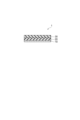
- FIG. 1 is a cross-sectional view schematically showing a photosensitive element according to this embodiment
- a photosensitive resin composition for a permanent resist comprising (A) an acid-modified vinyl group-containing resin, (B) an elastomer, (C) a photopolymerization initiator, (D) a curing agent, and (E) an inorganic filler, wherein the inorganic filler contains a surface treatment filler.
- a printed wiring board comprising a permanent resist containing a cured product of the photosensitive resin composition according to any one of [1] to [8] above.
- a method for producing a printed wiring board comprising: forming a photosensitive layer on a substrate using the photosensitive resin composition according to any one of [1] to [8] or the photosensitive element according to [9]; exposing and developing the photosensitive layer to form a resist pattern; and curing the resist pattern to form a permanent resist.
- step includes not only independent steps, but also steps that are indistinguishable from other steps, as long as the intended action of that step is achieved.
- layer includes not only a shape structure formed over the entire surface but also a shape structure formed partially when viewed as a plan view.
- a numerical range indicated using "-" indicates a range including the numerical values before and after "-" as the minimum and maximum values, respectively.
- the upper limit value or lower limit value of the numerical range at one step may be replaced with the upper limit value or lower limit value of the numerical range at another step.
- the upper or lower limits of the numerical ranges may be replaced with the values shown in the examples.
- each component in the composition when referring to the amount of each component in the composition in this specification, if there are multiple substances corresponding to each component in the composition, it means the total amount of the multiple substances present in the composition unless otherwise specified.
- (meth)acrylate means at least one of “acrylate” and its corresponding “methacrylate”, and the same applies to other similar expressions such as (meth)acrylic acid and (meth)acryloyl.
- solid content refers to the non-volatile content excluding volatile substances (water, solvents, etc.) contained in the photosensitive resin composition, and includes liquid, syrup-like, or wax-like components at room temperature (around 25° C.).
- the photosensitive resin composition for a permanent resist contains (A) an acid-modified vinyl group-containing resin, (B) an elastomer, (C) a photopolymerization initiator, (D) a curing agent, and (E) an inorganic filler, and the inorganic filler includes a surface treatment filler.
- the photosensitive resin composition according to the present embodiment is a negative photosensitive resin composition, and a cured film of the photosensitive resin composition can be used as a permanent resist excellent in TCT resistance and HAST resistance. Each component used in the photosensitive resin composition of the present embodiment will be described in more detail below.
- the photosensitive resin composition according to this embodiment contains an acid-modified vinyl group-containing resin as component (A).
- the acid-modified vinyl group-containing resin is not particularly limited as long as it has a vinyl group that is a photopolymerizable ethylenically unsaturated bond and an alkali-soluble acidic group.
- Examples of the acidic group possessed by the acid-modified vinyl group-containing resin include a carboxy group, a sulfo group, and a phenolic hydroxyl group. Among these, a carboxy group is preferable from the viewpoint of resolution.
- acid-modified vinyl group-containing resins examples include acid-modified epoxy (meth)acrylates.
- Acid-modified epoxy (meth)acrylate is a resin obtained by acid-modifying epoxy (meth)acrylate, which is a reaction product of an epoxy resin and an organic acid having a vinyl group.
- As the acid-modified epoxy (meth)acrylate for example, an addition reaction product obtained by adding a saturated or unsaturated polybasic acid anhydride (c) to an esterified product obtained by reacting an epoxy resin (a) and a vinyl group-containing monocarboxylic acid (b) can be used.
- epoxy resin (a) examples include bisphenol novolak-type epoxy resin, novolac-type epoxy resin, bisphenol A-type epoxy resin, bisphenol F-type epoxy resin, triphenolmethane-type epoxy resin, biphenyl-type epoxy resin, naphthalene-type epoxy resin, and dicyclopentadiene-type epoxy resin.
- vinyl group-containing monocarboxylic acids (b) include acrylic acid, acrylic acid dimers, methacrylic acid, ⁇ -furfuryl acrylic acid, ⁇ -styryl acrylic acid, cinnamic acid, crotonic acid, ⁇ -cyanocinnamic acid and other acrylic acid derivatives, semi-ester compounds that are reaction products of hydroxyl group-containing (meth)acrylates and dibasic acid anhydrides, and reaction products of vinyl group-containing monoglycidyl ethers or vinyl group-containing monoglycidyl esters and dibasic acid anhydrides. Certain half-ester compounds are mentioned.
- hydroxyl group-containing (meth)acrylates, vinyl group-containing monoglycidyl ethers and vinyl group-containing monoglycidyl esters include hydroxyethyl acrylate, hydroxyethyl methacrylate, hydroxypropyl acrylate, hydroxypropyl methacrylate, hydroxybutyl acrylate, hydroxybutyl methacrylate, polyethylene glycol monoacrylate, polyethylene glycol monomethacrylate, trimethylolpropane diacrylate, trimethylolpropane dimethacrylate, pentaerythritol triacrylate, pentaerythritol trimethacrylate, dipentaerythritol pentaacrylate, penta Erythritol pentamethacrylate, glycidyl acrylate, and glycidyl methacrylate.
- dibasic acid anhydrides examples include succinic anhydride, maleic anhydride, tetrahydrophthalic anhydride, phthalic anhydride, methyltetrahydrophthalic anhydride, ethyltetrahydrophthalic anhydride, hexahydrophthalic anhydride, methylhexahydrophthalic anhydride, ethylhexahydrophthalic anhydride, and itaconic anhydride.
- saturated or unsaturated polybasic acid anhydrides include succinic anhydride, maleic anhydride, tetrahydrophthalic anhydride, phthalic anhydride, methyltetrahydrophthalic anhydride, ethyltetrahydrophthalic anhydride, hexahydrophthalic anhydride, methylhexahydrophthalic anhydride, ethylhexahydrophthalic anhydride, and itaconic anhydride.
- tetrahydrophthalic anhydride may be used from the viewpoint of obtaining a photosensitive resin composition capable of forming a pattern with excellent resolution.
- the acid value of component (A) is not particularly limited.
- the acid value of component (A) may be 30 mgKOH/g or more, 40 mgKOH/g or more, or 50 mgKOH/g or more from the viewpoint of improving the solubility of the unexposed area in an alkaline aqueous solution.
- the acid value of component (A) may be 150 mgKOH/g or less, 120 mgKOH/g or less, or 100 mgKOH/g or less from the viewpoint of improving the electrical properties of the cured film.
- the weight average molecular weight (Mw) of component (A) is not particularly limited.
- the Mw of component (A) may be 3000 or more, 4000 or more, or 5000 or more from the viewpoint of improving the adhesiveness of the cured film.
- the Mw of component (A) may be 30,000 or less, 25,000 or less, or 18,000 or less from the viewpoint of improving the resolution of the photosensitive layer. Mw can be measured by a gel permeation chromatography (GPC) method.
- the content of component (A) in the photosensitive resin composition may be 20 to 70% by mass, 25 to 60% by mass, 30 to 50% by mass, or 32 to 45% by mass, based on the total solid content of the photosensitive resin composition, from the viewpoint of improving the heat resistance, electrical properties and chemical resistance of the permanent resist.
- the photosensitive resin composition according to the present embodiment contains an elastomer as the component (B), thereby suppressing deterioration in flexibility and adhesive strength caused by distortion (internal stress) inside the resin due to cure shrinkage of the component (A).
- component (B) examples include styrene elastomers, olefin elastomers, urethane elastomers, polyester elastomers, polyamide elastomers, acrylic elastomers, and silicone elastomers. These elastomers are composed of a hard segment component that contributes to heat resistance and strength, and a soft segment component that contributes to flexibility and toughness.
- Styrenic elastomers include, for example, styrene-butadiene-styrene block copolymers, styrene-isoprene-styrene block copolymers, styrene-ethylene-butylene-styrene block copolymers, and styrene-ethylene-propylene-styrene block copolymers.
- styrene derivatives such as ⁇ -methylstyrene, 3-methylstyrene, 4-propylstyrene and 4-cyclohexylstyrene can be used as components constituting the styrene-based elastomer.
- olefinic elastomers include ethylene-propylene copolymers, ethylene- ⁇ -olefin copolymers, ethylene- ⁇ -olefin-nonconjugated diene copolymers, propylene- ⁇ -olefin copolymers, butene- ⁇ -olefin copolymers, ethylene-propylene-diene copolymers, non-conjugated dienes such as dicyclopentadiene, 1,4-hexadiene, cyclooctadiene, methylenenorbornene, ethylidenenorbornene, butadiene, and isoprene, and ⁇ -olefins. and a carboxylic acid-modified butadiene-acrylonitrile copolymer.
- urethane-based elastomer a compound composed of a hard segment composed of a low-molecular-weight (short-chain) diol and diisocyanate and a soft segment composed of a high-molecular-weight (long-chain) diol and diisocyanate can be used.
- short-chain diols examples include ethylene glycol, propylene glycol, 1,4-butanediol, and bisphenol A.
- the number average molecular weight of the short-chain diol is preferably 48-500.
- long-chain diols examples include polypropylene glycol, polytetramethylene oxide, poly(1,4-butylene adipate), poly(ethylene-1,4-butylene adipate), polycaprolactone, poly(1,6-hexylene carbonate), and poly(1,6-hexylene-neopentylene adipate).
- the number average molecular weight of the long-chain diol is preferably 500-10,000.
- polyester-based elastomer a compound obtained by polycondensing a dicarboxylic acid or its derivative and a diol compound or its derivative can be used.
- dicarboxylic acids examples include aromatic dicarboxylic acids such as terephthalic acid, isophthalic acid and naphthalenedicarboxylic acid; aliphatic dicarboxylic acids having 2 to 20 carbon atoms such as adipic acid, sebacic acid and dodecanedicarboxylic acid; and alicyclic dicarboxylic acids such as cyclohexanedicarboxylic acid.
- Dicarboxylic acid can be used individually by 1 type or in combination of 2 or more types.
- diol compounds include aliphatic diols such as ethylene glycol, 1,3-propanediol, 1,4-butanediol, 1,6-hexanediol, and 1,10-decanediol; alicyclic diols such as 1,4-cyclohexanediol; and aromatic diols such as bisphenol A, bis-(4-hydroxyphenyl)methane, bis-(4-hydroxy-3-methylphenyl)propane, and resorcinol.
- aliphatic diols such as ethylene glycol, 1,3-propanediol, 1,4-butanediol, 1,6-hexanediol, and 1,10-decanediol
- alicyclic diols such as 1,4-cyclohexanediol
- aromatic diols such as bisphenol A, bis-(4-hydroxyphenyl)methane
- polyester-based elastomer it is possible to use a multi-block copolymer having an aromatic polyester (eg, polybutylene terephthalate) as a hard segment component and an aliphatic polyester (eg, polytetramethylene glycol) as a soft segment component.
- aromatic polyester eg, polybutylene terephthalate
- aliphatic polyester eg, polytetramethylene glycol
- polyester-based elastomers There are various grades of polyester-based elastomers depending on the types, ratios, and molecular weights of hard segments and soft segments.
- Polyamide-based elastomers are roughly divided into two types: polyether block amide type and polyether ester block amide type, which use polyamide for the hard segment and polyether or polyester for the soft segment.
- Polyamides include, for example, polyamide-6, polyamide-11, and polyamide-12.
- Polyethers include, for example, polyoxyethylene glycol, polyoxypropylene glycol, and polytetramethylene glycol.
- (Meth)acrylic acid esters include, for example, methyl (meth)acrylate, ethyl (meth)acrylate, butyl (meth)acrylate, methoxyethyl (meth)acrylate, and ethoxyethyl (meth)acrylate.
- the acrylic elastomer may be a compound obtained by copolymerizing (meth)acrylic acid ester and acrylonitrile, or may be a compound obtained by further copolymerizing a monomer having a functional group serving as a cross-linking point.
- Monomers with functional groups include, for example, methyl methacrylate, glycidyl methacrylate, and allyl glycidyl ether.
- acrylic elastomers examples include acrylonitrile-butyl acrylate copolymer, acrylonitrile-butyl acrylate-ethyl acrylate copolymer, methyl methacrylate-butyl acrylate-methacrylic acid copolymer, and acrylonitrile-butyl acrylate-glycidyl methacrylate copolymer.
- acrylic elastomer acrylonitrile-butyl acrylate-glycidyl methacrylate copolymer or methyl methacrylate-butyl acrylate-methacrylic acid copolymer is preferable, and methyl methacrylate-butyl acrylate-methacrylic acid copolymer is more preferable.
- a silicone elastomer is a compound whose main component is organopolysiloxane.
- Organopolysiloxanes include, for example, polydimethylsiloxane, polymethylphenylsiloxane, and polydiphenylsiloxane.
- the silicone-based elastomer may be a compound obtained by partially modifying an organopolysiloxane with a vinyl group, an alkoxy group, or the like.
- the component (B) may contain a carboxylic acid-modified butadiene-acrylonitrile copolymer or a hydroxyl group-containing polyester elastomer from the viewpoint of improving the adhesion of the cured film.
- the content of component (B) may be 2 to 50 parts by mass, 4 to 45 parts by mass, 6 to 40 parts by mass, or 10 to 35 parts by mass with respect to 100 parts by mass of component (A).
- the content of the component (B) is within the above range, the elastic modulus of the cured film in the high temperature region becomes low, and the unexposed areas are more easily eluted with the developer.
- ((C) component photopolymerization initiator
- the photopolymerization initiator that is the component (C) is not particularly limited as long as it can polymerize the component (A).
- (C) component may be used individually by 1 type or in combination of 2 or more types.
- Component (C) includes, for example, benzoin compounds such as benzoin, benzoin methyl ether, and benzoin isopropyl ether; Acetophenone compounds such as phenyl]-2-morpholino-1-propane and N,N-dimethylaminoacetophenone; Anthraquinone compounds such as 2-methylanthraquinone, 2-ethylanthraquinone, 2-tert-butylanthraquinone, 1-chloroanthraquinone, 2-amylanthraquinone, and 2-aminoanthraquinone; 2,4-dimethylthioxanthone, 2,4-diethylthioxanthone, 2-chlorothioxanthone, 2,4-diisopropyl Thioxanthone compounds such as thioxanthone; Ketal compounds such as acetophenone dimethyl ketal and benzyl dimethyl ketal; Benzoph
- the content of component (C) in the photosensitive resin composition is not particularly limited, but may be 0.2 to 15% by mass, 0.5 to 10% by mass, or 1 to 5% by mass based on the total solid content of the photosensitive resin composition.
- component (D) component: curing agent As the curing agent as component (D), a compound that itself cures with heat, ultraviolet rays, etc., or a compound that cures by reacting with the acidic group of component (A) with heat, ultraviolet rays, etc. can be used. By using the component (D), the heat resistance, adhesiveness, chemical resistance, etc. of the cured film (permanent resist) formed from the photosensitive resin composition can be improved.
- thermosetting compounds such as epoxy compounds, melamine compounds, urea compounds, oxazoline compounds, and blocked isocyanates.
- Component may be used individually by 1 type or in combination of 2 or more types.
- epoxy compounds include bisphenol A type epoxy resin, bisphenol F type epoxy resin, hydrogenated bisphenol A type epoxy resin, brominated bisphenol A type epoxy resin, novolak type epoxy resin, bisphenol S type epoxy resin, biphenyl type epoxy resin, naphthalene type epoxy resin, dicyclo type epoxy resin, hydantoin type epoxy resin, triglycidyl isocyanurate, and bixylenol type epoxy resin.
- Melamine compounds include, for example, triaminotriazine, hexamethoxymelamine, and hexabutoxylated melamine.
- Urea compounds include, for example, dimethylol urea.
- the content of component (D) may be 2 to 30% by mass, 5 to 25% by mass, or 10 to 20% by mass based on the total solid content of the photosensitive resin composition.
- the photosensitive resin composition according to this embodiment contains an inorganic filler containing a surface-treated filler as the component (E).
- a surface-treated filler can be obtained by treating the surface of an inorganic filler with a surface treatment agent such as an organic silane compound.
- a surface treatment agent such as an organic silane compound.
- inorganic fillers examples include silica, alumina, titania, tantalum oxide, zirconia, silicon nitride, gallium oxide, and boron nitride.
- organic silane compounds such as epoxysilane compounds, aminosilane compounds, (meth)acrylsilane compounds, and vinylsilane compounds may be used from the viewpoint of further improving TCT resistance.
- organic silane compounds include 3-aminopropyltrimethoxysilane, 3-aminopropyltriethoxysilane, 3-(2-aminoethyl)aminopropyltrimethoxysilane, 3-(2-aminoethyl)aminopropylmethyldimethoxysilane, 3-phenylaminopropyltrimethoxysilane, 3-glycidoxypropyltrimethoxysilane, 3-glycidoxypropylmethyldimethoxysilane, 3-glycidoxypropyltriethoxysilane, 3-glycidoxypropylmethyldiethoxysilane, vinyltriacetoxysilane, vinyltrimethoxysilane, vinyltriethoxysilane, vinyltriisopropoxysilane, allyltrimethoxysilane, diallyldimethylsilane, 3-methacryloxypropyltrimethoxysilane, 3-methacryloxypropylmethyldimeth
- the surface-treated filler preferably has a photoreactive functional group or a thermally reactive functional group.
- a surface-treated filler having a photoreactive functional group or a thermally reactive functional group By using a surface-treated filler having a photoreactive functional group or a thermally reactive functional group, the adhesive strength between the component (A) and the component (E) can be enhanced.
- photoreactive functional groups examples include (meth)acryloyl groups and vinyl groups.
- Thermally reactive functional groups include, for example, epoxy groups, amino groups, phenylamino groups, isocyanate groups, and mercapto groups.
- the surface-treated filler according to this embodiment preferably has at least one group selected from the group consisting of (meth)acryloyl groups, vinyl groups, epoxy groups, and phenylamino groups.
- the surface-treated filler is preferably a filler surface-treated with silica, alumina, titania, or boron nitride, more preferably a filler surface-treated with silica, alumina, or boron nitride, and even more preferably a surface-treated silica filler.
- Component (E) preferably contains a surface-treated silica filler from the viewpoint of improving low expansion and heat resistance, more preferably a silica filler having at least one group selected from the group consisting of a (meth)acryloyl group, a vinyl group, an epoxy group, and a phenylamino group, more preferably a surface-treated silica filler having a (meth)acryloyl group, an epoxy group, or a phenylamino group, and even more preferably a surface-treated silica filler having a (meth)acryloyl group.
- a silica filler having at least one group selected from the group consisting of a (meth)acryloyl group, a vinyl group, an epoxy group, and a phenylamino group more preferably a surface-treated silica filler having a (meth)acryloyl group, an epoxy group, or a phenylamino group, and even more preferably a surface-
- the content of the surface treatment filler may be 5% by mass or more, 6% by mass or more, 7% by mass or more, 8% by mass or more, 9% by mass or more, or 10% by mass or more, or may be 35% by mass or less, 30% by mass or less, 28% by mass or less, 25% by mass or less, 20% by mass or less, or 15% by mass or less based on the total solid content of the photosensitive resin composition.
- the content of the surface-treated filler is 5 to 35% by mass, 6 to 30% by mass, 7 to 28% by mass, based on the total solid content of the photosensitive resin composition, 8 to 25% by mass, 9 to 20% by mass, or 10 to 15% by mass.
- the content of the surface treatment filler is within the above range, the low coefficient of thermal expansion, heat resistance, insulation reliability, thermal shock resistance, resolution, film strength, etc. can be further improved.
- the average particle size of the surface-treated filler may be 0.01 ⁇ m or more, 0.1 ⁇ m or more, or 0.2 ⁇ m or more, and may be 5.0 ⁇ m or less, 4.0 ⁇ m or less, or 3.0 ⁇ m or less.
- the (E) component may further contain an inorganic filler other than the surface-treated filler described above.
- inorganic fillers include barium titanate, barium carbonate, magnesium carbonate, aluminum hydroxide, magnesium hydroxide, lead titanate, lead zirconate titanate, lead lanthanum zirconate titanate, gallium oxide, spinel, mullite, cordierite, talc, aluminum titanate, yttria-containing zirconia, barium sulfate, barium silicate, calcium carbonate, calcium sulfate, zinc oxide, and magnesium titanate.
- the inorganic filler may be surface-treated.
- the (E) component may further contain barium sulfate from the viewpoint of improving resolution.
- the component (E) may contain a surface-treated silica filler and barium sulfate from the viewpoint of improving photosensitivity, preferably contains a surface-treated silica filler having a (meth)acryloyl group, an epoxy group, or a phenylamino group and barium sulfate, and more preferably contains a surface-treated silica filler having a (meth)acryloyl group and barium sulfate.
- Barium sulfate may be surface-treated.
- the content of barium sulfate may be 5 to 30% by mass, 10 to 25% by mass, 12 to 20% by mass, or 14 to 18% by mass based on the total solid content of the photosensitive resin composition.
- the photosensitive resin composition according to the present embodiment may further contain a photopolymerizable compound having no acidic group as the component (F).
- Component (F) may be used singly or in combination of two or more.
- Component (F) includes, for example, hydroxyalkyl (meth)acrylates such as 2-hydroxyethyl (meth)acrylate and 2-hydroxypropyl (meth)acrylate; mono- or di(meth)acrylates of glycols such as ethylene glycol, methoxytetraethylene glycol and polyethylene glycol; (meth)acrylamide compounds such as N,N-dimethyl (meth)acrylamide and N-methylol (meth)acrylamide; aminoalkyl (meth)acrylates such as N,N-dimethylaminoethyl (meth)acrylate; Polyhydric alcohols such as thritol, ditrimethylolpropane, dipentaerythritol, tris-hydroxyethyl isocyanurate, or polyhydric (meth)acrylates of these ethylene oxide or propylene oxide adducts; (meth)acrylate compounds of ethylene oxide or propylene oxide adducts of phenolic compounds such as
- the component (F) may contain a photopolymerizable compound having 3 or more ethylenically unsaturated groups.
- photopolymerizable compounds having 3 or more ethylenically unsaturated groups include trimethylolpropane tri(meth)acrylate, dipentaerythritol tri(meth)acrylate, tetramethylolmethane tri(meth)acrylate, EO-modified trimethylolpropane tri(meth)acrylate, PO-modified trimethylolpropane tri(meth)acrylate, EO, PO-modified trimethylolpropane tri(meth)acrylate, dipentaerythritol penta(meth)acrylate, and tetramethylolmethane tetra(meth)acrylate. , and dipentaerythritol hexaacrylate.
- the photosensitive resin composition of the present embodiment may further contain a pigment as the component (G) from the viewpoint of improving the identifiability or appearance of the manufacturing apparatus.
- a coloring agent that develops a desired color can be used when, for example, wiring is hidden.
- Examples of component (G) include phthalocyanine blue, phthalocyanine green, iodine green, diazo yellow, crystal violet, titanium oxide, carbon black, and naphthalene black.
- the content of component (G) may be 0.1 to 10% by mass, 0.5 to 8% by mass, or 1 to 5% by mass, based on the total solid content in the photosensitive resin composition, from the viewpoint of better hiding the wiring.
- the photosensitive resin composition according to the present embodiment may further contain various additives as necessary.
- Additives include, for example, polymerization inhibitors such as hydroquinone, methylhydroquinone, hydroquinone monomethyl ether, catechol, and pyrogallol; thickeners such as bentone and montmorillonite; silicone-based, fluorine-based, and vinyl resin-based defoaming agents; silane coupling agents;
- the photosensitive resin composition according to the present embodiment can be easily applied onto a substrate and can form a coating film with a uniform thickness.
- solvents examples include ketones such as methyl ethyl ketone and cyclohexanone; aromatic hydrocarbons such as toluene, xylene, and tetramethylbenzene; glycol ethers such as methyl cellosolve, butyl cellosolve, methyl carbitol, butyl carbitol, propylene glycol monomethyl ether, dipropylene glycol monoethyl ether, dipropylene glycol diethyl ether, and triethylene glycol monoethyl ether; esters such as ethyl acetate, butyl acetate, butyl cellosolve acetate, and carbitol acetate; and petroleum solvents such as petroleum ether, petroleum naphtha, hydrogenated petroleum naphtha and solvent naphtha.
- a solvent may be used individually by 1 type or in combination of 2 or more types.
- the blending amount of the solvent is not particularly limited, but the ratio of the solvent in the photosensitive resin composition may be 10 to 50% by mass, 20 to 40% by mass, or 25 to 35% by mass.
- the photosensitive resin composition of the present embodiment can be prepared by uniformly mixing each of the above components with a roll mill, bead mill, or the like.
- the photosensitive element according to this embodiment includes a support film and a photosensitive layer containing the photosensitive resin composition described above.
- FIG. 1 is a cross-sectional view schematically showing a photosensitive element according to this embodiment. As shown in FIG. 1, the photosensitive element 1 comprises a support film 10 and a photosensitive layer 20 formed on the support film 10. As shown in FIG. 1,
- the photosensitive element 1 can be produced by applying the photosensitive resin composition according to the present embodiment onto the support film 10 by a known method such as reverse roll coating, gravure roll coating, comma coating, or curtain coating, and then drying the coating to form the photosensitive layer 20.
- the support film examples include polyester films such as polyethylene terephthalate and polybutylene terephthalate; and polyolefin films such as polypropylene and polyethylene.
- the thickness of the support film may be, for example, 5-100 ⁇ m.
- the thickness of the photosensitive layer may be, for example, 5-50 ⁇ m, 5-40 ⁇ m, or 10-30 ⁇ m.
- the surface roughness of the support film is not particularly limited, but the arithmetic mean roughness (Ra) may be 1000 nm or less, 500 nm or less, or 250 nm or less.
- the drying temperature may be 60-120°C, 70-110°C, or 80-100°C.
- the drying time may be 1-60 minutes, 2-30 minutes, or 5-20 minutes.
- a protective film 30 covering the photosensitive layer 20 may be further provided on the photosensitive layer 20 .
- the photosensitive element 1 can also have a protective film 30 laminated on the surface of the photosensitive layer 20 opposite to the surface in contact with the support film 10 .
- a polymer film such as polyethylene or polypropylene may be used.
- a printed wiring board according to the present embodiment comprises a permanent resist containing a cured product of the photosensitive resin composition according to the present embodiment. Thereby, HAST resistance and TCT resistance can be improved.
- the method for manufacturing a printed wiring board comprises a step of forming a photosensitive layer on a substrate using the photosensitive resin composition or photosensitive element described above, a step of exposing and developing the photosensitive layer to form a resist pattern, and a step of curing the resist pattern to form a permanent resist.
- a step of forming a photosensitive layer on a substrate using the photosensitive resin composition or photosensitive element described above a step of exposing and developing the photosensitive layer to form a resist pattern
- a step of curing the resist pattern to form a permanent resist An example of each step will be described below.
- a substrate such as a copper clad laminate is prepared, and a photosensitive layer is formed on the substrate.
- the photosensitive layer may be formed by applying a photosensitive resin composition onto a substrate and drying the composition. Examples of methods for applying the photosensitive resin composition include screen printing, spraying, roll coating, curtain coating, and electrostatic coating.
- the drying temperature may be 60-120°C, 70-110°C, or 80-100°C.
- the drying time may be 1-7 minutes, 1-6 minutes, or 2-5 minutes.
- the photosensitive layer may be formed on the substrate by peeling off the protective film from the photosensitive element and laminating the photosensitive layer.
- a method of laminating the photosensitive layer for example, there is a method of thermal lamination using a laminator.
- Actinic rays include, for example, electron beams, ultraviolet rays, and X-rays, preferably ultraviolet rays.
- Low-pressure mercury lamps, high-pressure mercury lamps, extra-high pressure mercury lamps, halogen lamps, and the like can be used as the light source.
- the exposure dose may be 10-2000 mJ/cm 2 , 100-1500 mJ/cm 2 , or 300-1000 mJ/cm 2 .
- the developing method includes, for example, a dipping method and a spray method.
- alkaline aqueous solutions such as potassium hydroxide, sodium hydroxide, sodium carbonate, potassium carbonate, and tetramethylammonium hydroxide can be used.
- a pattern cured film can be formed by subjecting the resist pattern to at least one of post-exposure and post-heating.
- the exposure dose of the post-exposure may be 100-5000 mJ/cm 2 , 500-2000 mJ/cm 2 , or 700-1500 J/cm 2 .
- the heating temperature for post-heating may be 100 to 200°C, 120 to 180°C, or 135 to 165°C.
- the heating time for post-heating may be 5 minutes to 12 hours, 10 minutes to 6 hours, or 30 minutes to 2 hours.
- the permanent resist according to this embodiment can be used as an interlayer insulating layer or a surface protective layer of a semiconductor device.
- a semiconductor element provided with an interlayer insulating layer or a surface protective layer formed from a cured film of the above photosensitive resin composition, and an electronic device including the semiconductor element can be produced.
- the semiconductor element may be, for example, a memory, a package, or the like having a multilayer wiring structure, a rewiring structure, or the like.
- Examples of electronic devices include mobile phones, smart phones, tablet terminals, personal computers, and hard disk suspensions.
- B-1 Polyester-based elastomer having a hydroxyl group (manufactured by Showa Denko Materials Co., Ltd., trade name “Espel 1612”)
- B-2 Polyester-based elastomer having a hydroxyl group (manufactured by Showa Denko Materials Co., Ltd., trade name “Espel 1620”)
- B-3 Carboxylic acid-modified butadiene-acrylonitrile copolymer (manufactured by JSR Corporation, trade name “XER-91”)
- C-1 2-methyl-[4-(methylthio)phenyl]-2-morpholino-1-propane (manufactured by IGM Resins BV, trade name "Omirad 907”)
- C-2 2,4-diethylthioxanthone (manufactured by Nippon Kayaku Co., Ltd., trade name “DETX-S”)
- D-1 Bisphenol A type epoxy resin (manufactured by Showa Denko Materials
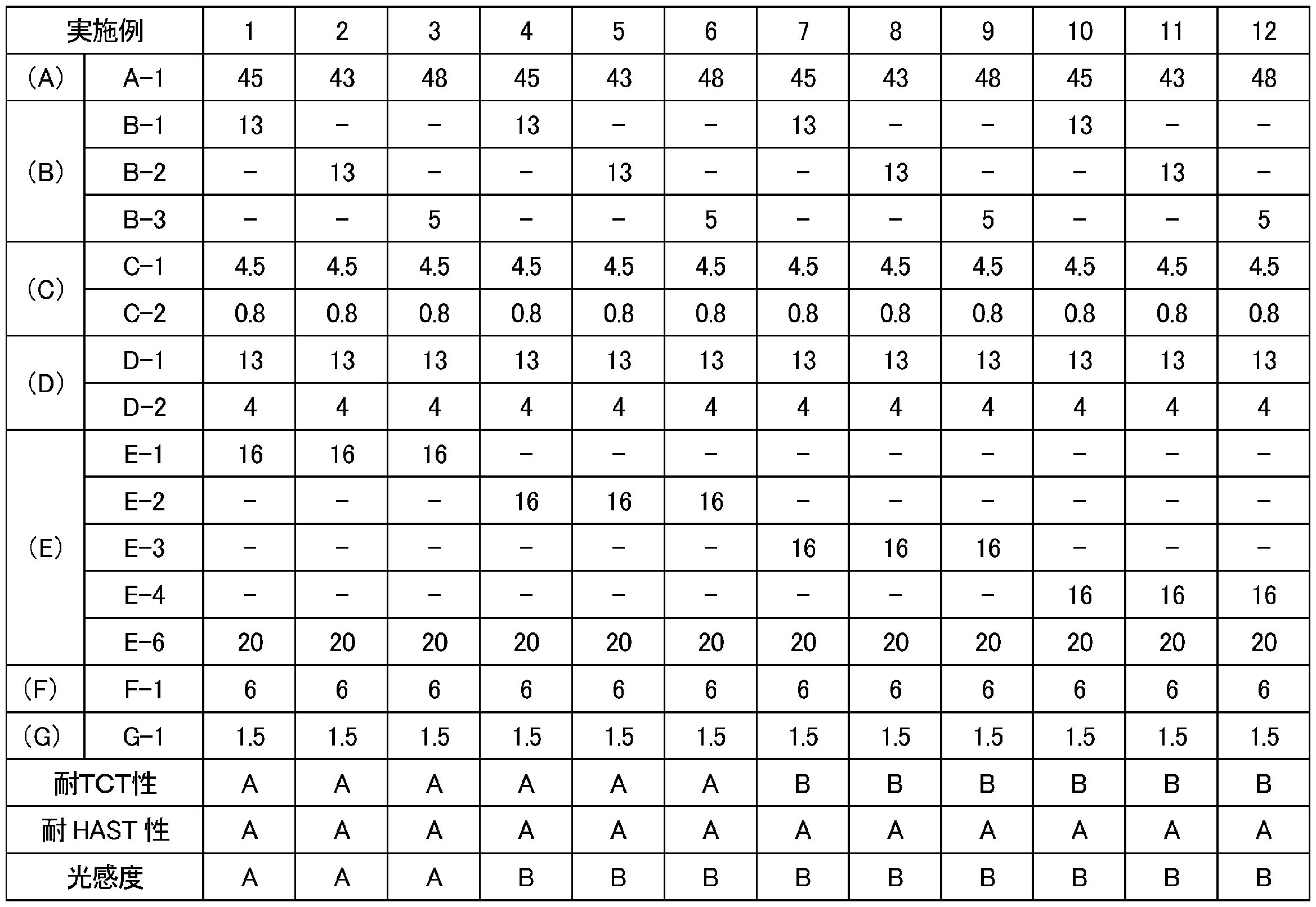
- Photosensitive resin composition Each component was blended in the amounts shown in Table 1 or Table 2 (parts by weight, equivalent to solid content) and kneaded in a three-roll mill. After that, carbitol acetate was added so that the solid content concentration was 60% by mass to prepare a photosensitive resin composition.
- the photosensitive resin composition was applied onto a copper-clad laminate using a 120-mesh Tetron screen and dried at 80° C. for 30 minutes in a hot air circulating dryer to form a photosensitive layer having a thickness of about 30 ⁇ m.
- a 21-stage step tablet manufactured by Stoffer was brought into close contact with the photosensitive layer and irradiated with ultraviolet light at an integrated exposure amount of 500 mJ/cm 2 .
- spray development was performed for 60 seconds at a pressure of 1.8 kgf/cm 2 to dissolve and develop the unexposed areas.
- the number of stages of the photosensitive layer remaining without being developed was checked and evaluated according to the following criteria.
- B The number of steps of the photosensitive layer remaining without being developed was 5 to 7 steps.
- C The number of steps of the photosensitive layer remaining without being developed was 4 steps or less.
- TCT resistance After development, the film was heated at 150° C. for 1 hour to prepare a test plate having a permanent mask resist with an opening pattern formed on the copper-clad laminate. A temperature cycle test was performed on the test piece with 30 minutes at ⁇ 55° C. and 30 minutes at 125° C. as one cycle. A: No cracks were observed after 2000 cycles. B: No cracks were observed after 1500 cycles, but cracks were observed after 2000 cycles. C: Generation of cracks was confirmed at 1500 cycles.
- the copper surface of a printed wiring board substrate (manufactured by Showa Denko Materials Co., Ltd., trade name “MCL-E-679”) in which a copper foil having a thickness of 12 ⁇ m is laminated on a glass epoxy base material was etched to form a comb-shaped electrode having a line/space of 28 ⁇ m/32 ⁇ m.
- the photosensitive resin composition was applied on the substrate using a 120-mesh Tetron screen on a copper-clad laminate, and dried at 80° C. for 30 minutes in a hot air circulating dryer to form a photosensitive layer having a thickness of about 30 ⁇ m.
- An evaluation substrate was prepared on which a cured film of the photosensitive element was formed as described above.
- the resistance value was measured and evaluated according to the following criteria.
- Photosensitive element 10
- Support film 20
- Photosensitive layer 30
- Protective film
Landscapes
- Physics & Mathematics (AREA)
- Chemical & Material Sciences (AREA)
- General Physics & Mathematics (AREA)
- Chemical Kinetics & Catalysis (AREA)
- Spectroscopy & Molecular Physics (AREA)
- Health & Medical Sciences (AREA)
- Medicinal Chemistry (AREA)
- Polymers & Plastics (AREA)
- Organic Chemistry (AREA)
- Engineering & Computer Science (AREA)
- Microelectronics & Electronic Packaging (AREA)
- Manufacturing & Machinery (AREA)
- Ceramic Engineering (AREA)
- Materials For Photolithography (AREA)
- Non-Metallic Protective Coatings For Printed Circuits (AREA)
- Polymerisation Methods In General (AREA)
- Exposure And Positioning Against Photoresist Photosensitive Materials (AREA)
- Graft Or Block Polymers (AREA)
- Macromonomer-Based Addition Polymer (AREA)
Abstract
Description
[1](A)酸変性ビニル基含有樹脂、(B)エラストマー、(C)光重合開始剤、(D)硬化剤、及び(E)無機フィラーを含有し、前記無機フィラーが、表面処理フィラーを含む、永久レジスト用の感光性樹脂組成物。
[2]前記表面処理フィラーが、光反応性の官能基又は熱反応性の官能基を有する、上記[1]に記載の感光性樹脂組成物。
[3]前記表面処理フィラーが、(メタ)アクリロイル基、ビニル基、エポキシ基、及びフェニルアミノ基からなる群より選ばれる少なくとも1種の基を有する、上記[1]又は[2]に記載の感光性樹脂組成物。
[4]前記表面処理フィラーが、表面処理シリカフィラーである、上記[1]~[3]のいずれかに記載の感光性樹脂組成物。
[5]前記表面処理フィラーの含有量が、前記感光性樹脂組成物の固形分全量を基準として7~28質量%である、上記[1]~[4]のいずれかに記載の感光性樹脂組成物。
[6]前記無機フィラーが、前記表面処理シリカフィラーと、硫酸バリウムとを含む、上記[4]又は[5]に記載の感光性樹脂組成物。
[7]前記表面処理シリカフィラーが、(メタ)アクリロイル基、エポキシ基、又はフェニルアミノ基を有する、上記[6]に記載の感光性樹脂組成物。
[8]前記表面処理シリカフィラーが、(メタ)アクリロイル基を有する、上記[6]に記載の感光性樹脂組成物。
[9]支持フィルムと、前記支持フィルム上に形成された感光層とを備え、前記感光層が、上記[1]~[8]のいずれかに記載の感光性樹脂組成物を含む、感光性エレメント。
[10]上記[1]~[8]のいずれかに記載の感光性樹脂組成物の硬化物を含む永久レジストを具備する、プリント配線板。
[11]基板上に、上記[1]~[8]のいずれかに記載の感光性樹脂組成物又は上記[9]に記載の感光性エレメントを用いて感光層を形成する工程と、前記感光層を露光及び現像してレジストパターンを形成する工程と、前記レジストパターンを硬化して永久レジストを形成する工程と、を備える、プリント配線板の製造方法。
本実施形態に係る永久レジスト用の感光性樹脂組成物は、(A)酸変性ビニル基含有樹脂、(B)エラストマー、(C)光重合開始剤、(D)硬化剤、及び(E)無機フィラーを含有し、無機フィラーは、表面処理フィラーを含む。本実施形態に係る感光性樹脂組成物は、ネガ型の感光性樹脂組成物であり、感光性樹脂組成物の硬化膜は、耐TCT性及び耐HAST性に優れる永久レジストとして用いることができる。以下、本実施形態の感光性樹脂組成物で用いられる各成分についてより詳細に説明する。
本実施形態に係る感光性樹脂組成物は、(A)成分として酸変性ビニル基含有樹脂を含有する。酸変性ビニル基含有樹脂は、光重合性のエチレン性不飽和結合であるビニル基と、アルカリ可溶性の酸性基を有していれば特に限定されない。酸変性ビニル基含有樹脂が有する酸性基としては、例えば、カルボキシ基、スルホ基、及びフェノール性水酸基が挙げられる。これらの中でも、解像性の観点から、カルボキシ基が好ましい。
本実施形態に係る感光性樹脂組成物は、(B)成分としてエラストマーを含有することにより、(A)成分の硬化収縮による樹脂内部の歪み(内部応力)に起因する可とう性及び接着強度の低下を抑えることができる。
(C)成分である光重合開始剤としては、(A)成分を重合させることができれば、特に限定されない。(C)成分は、1種を単独で又は2種以上を組み合わせて用いてよい。
(D)成分である硬化剤としては、それ自体が熱、紫外線等で硬化する化合物、又は、(A)成分の酸性基と、熱、紫外線等で反応して硬化する化合物を用いることができる。(D)成分を用いることで、感光性樹脂組成物から形成される硬化膜(永久レジスト)の耐熱性、接着性、耐薬品性等を向上させることができる。
本実施形態に係る感光性樹脂組成物は、(E)成分として、表面処理フィラーを含む無機フィラーを含有する。表面処理フィラーは、無機フィラーの表面を有機シラン化合物等の表面処理剤で処理することで得ることができる。無機フィラーの表面を処理することで、フィラー界面での(A)成分との接着力が向上して、感光性樹脂組成物の硬化膜のTCT耐性及びHAST耐性を向上することができる。表面処理フィラーは、1種を単独で又は2種以上を組み合わせて用いてよい。
本実施形態に係る感光性樹脂組成物は、感度及び解像性を向上する観点から、(F)成分として、酸性基を有しない光重合性化合物を更に含有してもよい。(F)成分は、1種を単独で又は2種以上を組み合わせて用いてよい。
本実施形態の感光性樹脂組成物は、製造装置の識別性又は外観を向上させる観点から、(G)成分として顔料を更に含有してもよい。(G)成分としては、配線を隠蔽する等の際に所望の色を発色する着色剤を用いることができる。(G)成分としては、例えば、フタロシアニンブルー、フタロシアニングリーン、アイオディングリーン、ジアゾイエロー、クリスタルバイオレット、酸化チタン、カーボンブラック、及びナフタレンブラックが挙げられる。
本実施形態に係る感光性樹脂組成物には、必要に応じて、各種添加剤を更に含有してもよい。添加剤としては、例えば、ハイドロキノン、メチルハイドロキノン、ハイドロキノンモノメチルエーテル、カテコール、ピロガロール等の重合禁止剤;ベントン、モンモリロナイト等の増粘剤;シリコーン系、フッ素系、ビニル樹脂系の消泡剤;シランカップリング剤;及び臭素化エポキシ化合物、酸変性臭素化エポキシ化合物、アンチモン化合物、ホスフェート化合物、芳香族縮合リン酸エステル、含ハロゲン縮合リン酸エステル等の難燃剤が挙げられる。
本実施形態に係る感光性樹脂組成物は、各成分を溶解・分散させるための溶剤を含有することにより、基板上への塗布を容易にし、均一な厚さの塗膜を形成できる。
本実施形態に係る感光性エレメントは、支持フィルムと、上述した感光性樹脂組成物を含む感光層とを備える。図1は、本実施形態に係る感光性エレメントを模式的に示す断面図である。図1に示されるように、感光性エレメント1は、支持フィルム10と、支持フィルム10上に形成された感光層20とを備えている。
本実施形態に係るプリント配線板は、本実施形態に係る感光性樹脂組成物の硬化物を含む永久レジストを具備する。これにより、耐HAST性及び耐TCT性を向上することができる。
ビスフェノールFノボラック型エポキシ樹脂(DIC株式会社製、商品名「EXA-7376」)350質量部、アクリル酸70質量部、メチルハイドロキノン0.5質量部、及びカルビトールアセテート120質量部を90℃で撹拌しながら混合した。混合液を60℃に冷却し、トリフェニルホスフィン2質量部を加え、100℃で溶液の酸価が1mgKOH/g以下になるまで反応させた。反応液に、テトラヒドロ無水フタル酸98質量部及びカルビトールアセテート85質量部を加え、80℃に加熱して6時間反応させた。その後、反応液を室温(25℃)に冷却し、(A)成分としての酸変性エポキシアクリレート(A-1)の溶液(固形分濃度:73質量%)を得た。
B-1:水酸基を有するポリエステル系エラストマー(昭和電工マテリアルズ株式会社製、商品名「エスペル1612」)
B-2:水酸基を有するポリエステル系エラストマー(昭和電工マテリアルズ株式会社製、商品名「エスペル1620」)
B-3:カルボン酸変性ブタジエン-アクリロニトリル共重合体(JSR株式会社製、商品名「XER-91」)
C-1:2-メチル-[4-(メチルチオ)フェニル]-2-モルフォリノ-1-プロパン(IGM Resins B.V.製、商品名「Omirad 907」)
C-2:2,4-ジエチルチオキサントン(日本化薬株式会社製、商品名「DETX-S」)
D-1:ビスフェノールA型エポキシ樹脂(三菱ケミカル株式会社製、商品名「jER 828」)
D-2:メラミン(三井化学株式会社製)
E-1:メタクリロイル基を有するシリカフィラー(平均粒径0.5μm)(株式会社アドマテックス製)
E-2:ビニル基を有するシリカフィラー(平均粒径0.5μm)(株式会社アドマテックス製)
E-3:エポキシ基を有するシリカフィラー(平均粒径0.5μm)(株式会社アドマテックス製)
E-4:フェニルアミノ基を有するシリカフィラー(平均粒径0.5μm)(株式会社アドマテックス製)
E-5:未処理のシリカフィラー(平均粒径0.5μm)(株式会社アドマテックス製、商品名「SO-C2」)
E-6:硫酸バリウム(平均粒径1.0μm)(日本ソルベイ株式会社製、商品名「ASA」)
F-1:ジペンタエリスリトールヘキサアクリレート(日本化薬株式会社製、商品名「DPHA)
G-1:フタロシアニングリーン
表1又は表2に示す配合量(質量部、固形分換算量)で各成分を配合し、3本ロールミルで混練した。その後、固形分濃度が60質量%になるようにカルビトールアセテートを加えて、感光性樹脂組成物を調製した。
感光性樹脂組成物を120メッシュのテトロンスクリーンを用いて銅張り積層板上に塗布し、熱風循環式乾燥機で、80℃で30分間乾燥して厚さ約30μmの感光層を形成した。感光層にステップタブレット21段(ストファー社製)を密着させ、積算露光量500mJ/cm2の紫外線を照射した。次いで、1質量%の炭酸ナトリウム水溶液を用いて、60秒間、1.8kgf/cm2の圧力でスプレー現像し、未露光部を溶解現像した。現像後、現像されずに残った感光層の段数を確認し、以下の基準で評価した。
A:現像されずに残った感光層の段数が8段以上であった。
B:現像されずに残った感光層の段数が5~7段であった。
C:現像されずに残った感光層の段数が4段以下であった。
現像後、150℃で1時間加熱して、銅張積層基板上に開口パターンが形成された永久マスクレジストを有する試験板を作製した。試験片に対して、-55℃で30分間及び125℃で30分間を1サイクルとして温度サイクル試験を実施し、1500サイクル及び2000サイクルの時点で試験片を目視及び光学顕微鏡で観察し、以下の基準で評価した。
A:2000サイクルでクラックの発生が確認されなかった。
B:1500サイクルでクラックの発生が確認されなかったが、2000サイクルでクラックの発生が確認された。
C:1500サイクルでクラックの発生が確認された。
厚さ12μmの銅箔をガラスエポキシ基材に積層したプリント配線板用基板(昭和電工マテリアルズ株式会社製、商品名「MCL-E-679」)の銅表面を、エッチングによりライン/スペースが28μm/32μmのくし型電極を形成した基板を準備した。この基板上に感光性樹脂組成物を120メッシュのテトロンスクリーンを用いて銅張り積層板上に塗布し、熱風循環式乾燥機で、80℃で30分間乾燥して厚さ約30μmの感光層を形成した。上述のように感光性エレメントの硬化膜を形成した評価基板を作製した。評価基板を135℃、85%RHの条件下、DC5Vの電圧を印加した状態で200時間晒した後、抵抗値を測定し、以下の基準で評価した。
A:抵抗値が1×10⁷Ω以上であった。
B:抵抗値が1×10⁶Ω以上1×10⁷Ω未満であった。
C:抵抗値が1×10⁶Ω未満であった。

Claims (12)
- (A)酸変性ビニル基含有樹脂、(B)エラストマー、(C)光重合開始剤、(D)硬化剤、及び(E)無機フィラーを含有し、
前記無機フィラーが、表面処理フィラーを含む、永久レジスト用の感光性樹脂組成物。 - 前記表面処理フィラーが、光反応性の官能基又は熱反応性の官能基を有する、請求項1に記載の感光性樹脂組成物。
- 前記表面処理フィラーが、(メタ)アクリロイル基、ビニル基、エポキシ基、及びフェニルアミノ基からなる群より選ばれる少なくとも1種の基を有する、請求項1に記載の感光性樹脂組成物。
- 前記表面処理フィラーが、表面処理シリカフィラーである、請求項1に記載の感光性樹脂組成物。
- 前記表面処理フィラーの含有量が、前記感光性樹脂組成物の固形分全量を基準として7~28質量%である、請求項1に記載の感光性樹脂組成物。
- 前記無機フィラーが、前記表面処理シリカフィラーと、硫酸バリウムとを含む、請求項4に記載の感光性樹脂組成物。
- 前記表面処理シリカフィラーが、(メタ)アクリロイル基、エポキシ基、又はフェニルアミノ基を有する、請求項6に記載の感光性樹脂組成物。
- 前記表面処理シリカフィラーが、(メタ)アクリロイル基を有する、請求項6に記載の感光性樹脂組成物。
- 支持フィルムと、前記支持フィルム上に形成された感光層とを備え、
前記感光層が、請求項1~8のいずれか一項に記載の感光性樹脂組成物を含む、感光性エレメント。 - 請求項1~8のいずれか一項に記載の感光性樹脂組成物の硬化物を含む永久レジストを具備する、プリント配線板。
- 基板上に、請求項1~8のいずれか一項に記載の感光性樹脂組成物を用いて感光層を形成する工程と、
前記感光層を露光及び現像してレジストパターンを形成する工程と、
前記レジストパターンを硬化して永久レジストを形成する工程と、
を備える、プリント配線板の製造方法。 - 基板上に、請求項9に記載の感光性エレメントを用いて感光層を形成する工程と、
前記感光層を露光及び現像してレジストパターンを形成する工程と、
前記レジストパターンを硬化して永久レジストを形成する工程と、
を備える、プリント配線板の製造方法。
Priority Applications (6)
| Application Number | Priority Date | Filing Date | Title |
|---|---|---|---|
| CN202380010625.3A CN116997857A (zh) | 2022-01-19 | 2023-01-18 | 感光性树脂组合物、感光性元件、印刷线路板及印刷线路板的制造方法 |
| JP2023575279A JPWO2023140293A1 (ja) | 2022-01-19 | 2023-01-18 | |
| US18/550,826 US20240160103A1 (en) | 2022-01-19 | 2023-01-18 | Photosensitive resin composition, photosensitive element, printed wiring board, and method for manufacturing printed wiring board |
| KR1020257019434A KR20250093415A (ko) | 2022-01-19 | 2023-01-18 | 감광성 수지 조성물, 감광성 엘리먼트, 프린트 배선판, 및 프린트 배선판의 제조 방법 |
| KR1020237031382A KR102821567B1 (ko) | 2022-01-19 | 2023-01-18 | 감광성 수지 조성물, 감광성 엘리먼트, 프린트 배선판, 및 프린트 배선판의 제조 방법 |
| JP2025115813A JP2025142001A (ja) | 2022-01-19 | 2025-07-09 | 感光性樹脂組成物、感光性エレメント、プリント配線板、及びプリント配線板の製造方法 |
Applications Claiming Priority (2)
| Application Number | Priority Date | Filing Date | Title |
|---|---|---|---|
| JPPCT/JP2022/001765 | 2022-01-19 | ||
| PCT/JP2022/001765 WO2023139682A1 (ja) | 2022-01-19 | 2022-01-19 | 感光性樹脂組成物、感光性エレメント、プリント配線板、及びプリント配線板の製造方法 |
Publications (1)
| Publication Number | Publication Date |
|---|---|
| WO2023140293A1 true WO2023140293A1 (ja) | 2023-07-27 |
Family
ID=87348167
Family Applications (2)
| Application Number | Title | Priority Date | Filing Date |
|---|---|---|---|
| PCT/JP2022/001765 Ceased WO2023139682A1 (ja) | 2022-01-19 | 2022-01-19 | 感光性樹脂組成物、感光性エレメント、プリント配線板、及びプリント配線板の製造方法 |
| PCT/JP2023/001385 Ceased WO2023140293A1 (ja) | 2022-01-19 | 2023-01-18 | 感光性樹脂組成物、感光性エレメント、プリント配線板、及びプリント配線板の製造方法 |
Family Applications Before (1)
| Application Number | Title | Priority Date | Filing Date |
|---|---|---|---|
| PCT/JP2022/001765 Ceased WO2023139682A1 (ja) | 2022-01-19 | 2022-01-19 | 感光性樹脂組成物、感光性エレメント、プリント配線板、及びプリント配線板の製造方法 |
Country Status (6)
| Country | Link |
|---|---|
| US (1) | US20240160103A1 (ja) |
| JP (2) | JPWO2023140293A1 (ja) |
| KR (2) | KR20250093415A (ja) |
| CN (1) | CN116997857A (ja) |
| TW (1) | TW202330645A (ja) |
| WO (2) | WO2023139682A1 (ja) |
Families Citing this family (1)
| Publication number | Priority date | Publication date | Assignee | Title |
|---|---|---|---|---|
| US20240134277A1 (en) * | 2021-12-22 | 2024-04-25 | Resonac Corporation | Photosensitive resin composition, photosensitive element, printed wiring board, and method for manufacturing printed wiring board |
Citations (6)
| Publication number | Priority date | Publication date | Assignee | Title |
|---|---|---|---|---|
| JP2011095731A (ja) * | 2009-09-29 | 2011-05-12 | Fujifilm Corp | 感光性組成物、感光性積層体、永久パターン形成方法、及びプリント基板 |
| JP2011215392A (ja) * | 2010-03-31 | 2011-10-27 | Fujifilm Corp | 感光性組成物、並びに、感光性積層体、永久パターン形成方法、及びプリント基板 |
| JP2018097140A (ja) * | 2016-12-13 | 2018-06-21 | 日立化成株式会社 | 感光性樹脂組成物、感光性エレメントとその製造方法及び半導体装置 |
| WO2019230616A1 (ja) * | 2018-06-01 | 2019-12-05 | 互応化学工業株式会社 | 感光性樹脂組成物、ドライフィルム、及びプリント配線板 |
| JP2020197603A (ja) * | 2019-05-31 | 2020-12-10 | 昭和電工マテリアルズ株式会社 | 感光性樹脂組成物、感光性樹脂フィルム、多層プリント配線板、半導体パッケージ、及び多層プリント配線板の製造方法 |
| WO2021157282A1 (ja) * | 2020-02-03 | 2021-08-12 | 太陽インキ製造株式会社 | 硬化性組成物、そのドライフィルムおよび硬化物 |
Family Cites Families (1)
| Publication number | Priority date | Publication date | Assignee | Title |
|---|---|---|---|---|
| JP2011240930A (ja) | 2010-05-14 | 2011-12-01 | Three M Innovative Properties Co | 包装袋 |
-
2022
- 2022-01-19 WO PCT/JP2022/001765 patent/WO2023139682A1/ja not_active Ceased
-
2023
- 2023-01-18 WO PCT/JP2023/001385 patent/WO2023140293A1/ja not_active Ceased
- 2023-01-18 KR KR1020257019434A patent/KR20250093415A/ko active Pending
- 2023-01-18 CN CN202380010625.3A patent/CN116997857A/zh active Pending
- 2023-01-18 JP JP2023575279A patent/JPWO2023140293A1/ja active Pending
- 2023-01-18 KR KR1020237031382A patent/KR102821567B1/ko active Active
- 2023-01-18 US US18/550,826 patent/US20240160103A1/en active Pending
- 2023-01-19 TW TW112102611A patent/TW202330645A/zh unknown
-
2025
- 2025-07-09 JP JP2025115813A patent/JP2025142001A/ja active Pending
Patent Citations (6)
| Publication number | Priority date | Publication date | Assignee | Title |
|---|---|---|---|---|
| JP2011095731A (ja) * | 2009-09-29 | 2011-05-12 | Fujifilm Corp | 感光性組成物、感光性積層体、永久パターン形成方法、及びプリント基板 |
| JP2011215392A (ja) * | 2010-03-31 | 2011-10-27 | Fujifilm Corp | 感光性組成物、並びに、感光性積層体、永久パターン形成方法、及びプリント基板 |
| JP2018097140A (ja) * | 2016-12-13 | 2018-06-21 | 日立化成株式会社 | 感光性樹脂組成物、感光性エレメントとその製造方法及び半導体装置 |
| WO2019230616A1 (ja) * | 2018-06-01 | 2019-12-05 | 互応化学工業株式会社 | 感光性樹脂組成物、ドライフィルム、及びプリント配線板 |
| JP2020197603A (ja) * | 2019-05-31 | 2020-12-10 | 昭和電工マテリアルズ株式会社 | 感光性樹脂組成物、感光性樹脂フィルム、多層プリント配線板、半導体パッケージ、及び多層プリント配線板の製造方法 |
| WO2021157282A1 (ja) * | 2020-02-03 | 2021-08-12 | 太陽インキ製造株式会社 | 硬化性組成物、そのドライフィルムおよび硬化物 |
Also Published As
| Publication number | Publication date |
|---|---|
| JP2025142001A (ja) | 2025-09-29 |
| KR20230146063A (ko) | 2023-10-18 |
| WO2023139682A1 (ja) | 2023-07-27 |
| KR102821567B1 (ko) | 2025-06-19 |
| JPWO2023140293A1 (ja) | 2023-07-27 |
| TW202330645A (zh) | 2023-08-01 |
| CN116997857A (zh) | 2023-11-03 |
| KR20250093415A (ko) | 2025-06-24 |
| US20240160103A1 (en) | 2024-05-16 |
Similar Documents
| Publication | Publication Date | Title |
|---|---|---|
| JP2025175070A (ja) | 感光性樹脂組成物、感光性エレメント、プリント配線板、及びプリント配線板の製造方法 | |
| JP2025124702A (ja) | 感光性樹脂組成物、感光性樹脂フィルム、多層プリント配線板及び半導体パッケージ、並びに多層プリント配線板の製造方法 | |
| JP2025142001A (ja) | 感光性樹脂組成物、感光性エレメント、プリント配線板、及びプリント配線板の製造方法 | |
| JP7582379B2 (ja) | 感光性樹脂組成物、並びにこれを用いた感光性フィルム、レジストパターンの形成方法及びプリント配線板 | |
| JP5556990B2 (ja) | 感光性樹脂組成物及び感光性エレメント | |
| WO2023214540A1 (ja) | 感光性樹脂組成物、感光性エレメント、プリント配線板、及びプリント配線板の製造方法 | |
| JP7035304B2 (ja) | 感光性樹脂組成物、並びにこれを用いた感光性フィルム、レジストパターンの形成方法及びプリント配線板 | |
| JP7729386B2 (ja) | 感光性樹脂組成物、感光性エレメント、プリント配線板、及びプリント配線板の製造方法 | |
| JP6175829B2 (ja) | 液状光硬化性樹脂組成物の塗膜を基板上で平坦化する方法、プリント配線板の製造方法、及びプリント配線板 | |
| JP7856125B2 (ja) | 感光性樹脂組成物、感光性エレメント、プリント配線板、及びプリント配線板の製造方法 | |
| WO2023140289A1 (ja) | 感光性樹脂組成物、感光性エレメント、プリント配線板、及びプリント配線板の製造方法 | |
| WO2024209640A1 (ja) | 感光性樹脂組成物、感光性エレメント、プリント配線板、及びプリント配線板の製造方法 | |
| WO2024135741A1 (ja) | 感光性樹脂組成物、感光性エレメント、プリント配線板、及びプリント配線板の製造方法 | |
| WO2023153103A1 (ja) | 感光性樹脂組成物、感光性エレメント、プリント配線板、及びプリント配線板の製造方法 | |
| JP2025115654A (ja) | 感光性樹脂組成物、感光性エレメント、プリント配線板、及びプリント配線板の製造方法 | |
| WO2025262762A1 (ja) | 感光性樹脂組成物、感光性エレメント、及びプリント配線板 | |
| WO2024166766A1 (ja) | 感光性樹脂組成物、感光性エレメント、プリント配線板、及びプリント配線板の製造方法 | |
| JP2025098756A (ja) | 感光性樹脂組成物、感光性エレメント、プリント配線板及びその製造方法、並びに、酸変性ビニル基含有樹脂 | |
| JP6175828B2 (ja) | 液状光硬化性樹脂組成物の塗膜を基板上で平坦化する方法、プリント配線板の製造方法、及びプリント配線板 | |
| JP6175827B2 (ja) | 液状光硬化性樹脂組成物の塗膜を基板上で平坦化する方法、プリント配線板の製造方法、及びプリント配線板 |
Legal Events
| Date | Code | Title | Description |
|---|---|---|---|
| 121 | Ep: the epo has been informed by wipo that ep was designated in this application |
Ref document number: 23743286 Country of ref document: EP Kind code of ref document: A1 |
|
| WWE | Wipo information: entry into national phase |
Ref document number: 2023575279 Country of ref document: JP |
|
| WWE | Wipo information: entry into national phase |
Ref document number: 202380010625.3 Country of ref document: CN |
|
| ENP | Entry into the national phase |
Ref document number: 20237031382 Country of ref document: KR Kind code of ref document: A |
|
| WWE | Wipo information: entry into national phase |
Ref document number: 1020237031382 Country of ref document: KR |
|
| WWE | Wipo information: entry into national phase |
Ref document number: 18550826 Country of ref document: US |
|
| NENP | Non-entry into the national phase |
Ref country code: DE |
|
| 122 | Ep: pct application non-entry in european phase |
Ref document number: 23743286 Country of ref document: EP Kind code of ref document: A1 |
|
| WWD | Wipo information: divisional of initial pct application |
Ref document number: 1020257019434 Country of ref document: KR |
|
| WWP | Wipo information: published in national office |
Ref document number: 1020257019434 Country of ref document: KR |