WO2023127914A1 - ポリプロピレン系樹脂押出発泡粒子の製造方法 - Google Patents
ポリプロピレン系樹脂押出発泡粒子の製造方法 Download PDFInfo
- Publication number
- WO2023127914A1 WO2023127914A1 PCT/JP2022/048373 JP2022048373W WO2023127914A1 WO 2023127914 A1 WO2023127914 A1 WO 2023127914A1 JP 2022048373 W JP2022048373 W JP 2022048373W WO 2023127914 A1 WO2023127914 A1 WO 2023127914A1
- Authority
- WO
- WIPO (PCT)
- Prior art keywords
- resin
- polypropylene
- extruded
- die
- polypropylene resin
- Prior art date
- Legal status (The legal status is an assumption and is not a legal conclusion. Google has not performed a legal analysis and makes no representation as to the accuracy of the status listed.)
- Ceased
Links
Images

Classifications
-
- B—PERFORMING OPERATIONS; TRANSPORTING
- B29—WORKING OF PLASTICS; WORKING OF SUBSTANCES IN A PLASTIC STATE IN GENERAL
- B29B—PREPARATION OR PRETREATMENT OF THE MATERIAL TO BE SHAPED; MAKING GRANULES OR PREFORMS; RECOVERY OF PLASTICS OR OTHER CONSTITUENTS OF WASTE MATERIAL CONTAINING PLASTICS
- B29B9/00—Making granules
- B29B9/02—Making granules by dividing preformed material
- B29B9/06—Making granules by dividing preformed material in the form of filamentary material, e.g. combined with extrusion
- B29B9/065—Making granules by dividing preformed material in the form of filamentary material, e.g. combined with extrusion under-water, e.g. underwater pelletizers
-
- B—PERFORMING OPERATIONS; TRANSPORTING
- B29—WORKING OF PLASTICS; WORKING OF SUBSTANCES IN A PLASTIC STATE IN GENERAL
- B29B—PREPARATION OR PRETREATMENT OF THE MATERIAL TO BE SHAPED; MAKING GRANULES OR PREFORMS; RECOVERY OF PLASTICS OR OTHER CONSTITUENTS OF WASTE MATERIAL CONTAINING PLASTICS
- B29B7/00—Mixing; Kneading
- B29B7/30—Mixing; Kneading continuous, with mechanical mixing or kneading devices
- B29B7/34—Mixing; Kneading continuous, with mechanical mixing or kneading devices with movable mixing or kneading devices
- B29B7/38—Mixing; Kneading continuous, with mechanical mixing or kneading devices with movable mixing or kneading devices rotary
- B29B7/46—Mixing; Kneading continuous, with mechanical mixing or kneading devices with movable mixing or kneading devices rotary with more than one shaft
- B29B7/48—Mixing; Kneading continuous, with mechanical mixing or kneading devices with movable mixing or kneading devices rotary with more than one shaft with intermeshing devices, e.g. screws
-
- B—PERFORMING OPERATIONS; TRANSPORTING
- B29—WORKING OF PLASTICS; WORKING OF SUBSTANCES IN A PLASTIC STATE IN GENERAL
- B29B—PREPARATION OR PRETREATMENT OF THE MATERIAL TO BE SHAPED; MAKING GRANULES OR PREFORMS; RECOVERY OF PLASTICS OR OTHER CONSTITUENTS OF WASTE MATERIAL CONTAINING PLASTICS
- B29B9/00—Making granules
- B29B9/12—Making granules characterised by structure or composition
-
- B—PERFORMING OPERATIONS; TRANSPORTING
- B29—WORKING OF PLASTICS; WORKING OF SUBSTANCES IN A PLASTIC STATE IN GENERAL
- B29C—SHAPING OR JOINING OF PLASTICS; SHAPING OF MATERIAL IN A PLASTIC STATE, NOT OTHERWISE PROVIDED FOR; AFTER-TREATMENT OF THE SHAPED PRODUCTS, e.g. REPAIRING
- B29C44/00—Shaping by internal pressure generated in the material, e.g. swelling or foaming ; Producing porous or cellular expanded plastics articles
- B29C44/34—Auxiliary operations
- B29C44/3442—Mixing, kneading or conveying the foamable material
-
- B—PERFORMING OPERATIONS; TRANSPORTING
- B29—WORKING OF PLASTICS; WORKING OF SUBSTANCES IN A PLASTIC STATE IN GENERAL
- B29C—SHAPING OR JOINING OF PLASTICS; SHAPING OF MATERIAL IN A PLASTIC STATE, NOT OTHERWISE PROVIDED FOR; AFTER-TREATMENT OF THE SHAPED PRODUCTS, e.g. REPAIRING
- B29C44/00—Shaping by internal pressure generated in the material, e.g. swelling or foaming ; Producing porous or cellular expanded plastics articles
- B29C44/34—Auxiliary operations
- B29C44/3442—Mixing, kneading or conveying the foamable material
- B29C44/3446—Feeding the blowing agent
-
- B—PERFORMING OPERATIONS; TRANSPORTING
- B29—WORKING OF PLASTICS; WORKING OF SUBSTANCES IN A PLASTIC STATE IN GENERAL
- B29C—SHAPING OR JOINING OF PLASTICS; SHAPING OF MATERIAL IN A PLASTIC STATE, NOT OTHERWISE PROVIDED FOR; AFTER-TREATMENT OF THE SHAPED PRODUCTS, e.g. REPAIRING
- B29C44/00—Shaping by internal pressure generated in the material, e.g. swelling or foaming ; Producing porous or cellular expanded plastics articles
- B29C44/34—Auxiliary operations
- B29C44/3461—Making or treating expandable particles
-
- B—PERFORMING OPERATIONS; TRANSPORTING
- B29—WORKING OF PLASTICS; WORKING OF SUBSTANCES IN A PLASTIC STATE IN GENERAL
- B29C—SHAPING OR JOINING OF PLASTICS; SHAPING OF MATERIAL IN A PLASTIC STATE, NOT OTHERWISE PROVIDED FOR; AFTER-TREATMENT OF THE SHAPED PRODUCTS, e.g. REPAIRING
- B29C48/00—Extrusion moulding, i.e. expressing the moulding material through a die or nozzle which imparts the desired form; Apparatus therefor
- B29C48/001—Combinations of extrusion moulding with other shaping operations
- B29C48/0022—Combinations of extrusion moulding with other shaping operations combined with cutting
-
- B—PERFORMING OPERATIONS; TRANSPORTING
- B29—WORKING OF PLASTICS; WORKING OF SUBSTANCES IN A PLASTIC STATE IN GENERAL
- B29C—SHAPING OR JOINING OF PLASTICS; SHAPING OF MATERIAL IN A PLASTIC STATE, NOT OTHERWISE PROVIDED FOR; AFTER-TREATMENT OF THE SHAPED PRODUCTS, e.g. REPAIRING
- B29C48/00—Extrusion moulding, i.e. expressing the moulding material through a die or nozzle which imparts the desired form; Apparatus therefor
- B29C48/03—Extrusion moulding, i.e. expressing the moulding material through a die or nozzle which imparts the desired form; Apparatus therefor characterised by the shape of the extruded material at extrusion
- B29C48/05—Filamentary, e.g. strands
-
- B—PERFORMING OPERATIONS; TRANSPORTING
- B29—WORKING OF PLASTICS; WORKING OF SUBSTANCES IN A PLASTIC STATE IN GENERAL
- B29C—SHAPING OR JOINING OF PLASTICS; SHAPING OF MATERIAL IN A PLASTIC STATE, NOT OTHERWISE PROVIDED FOR; AFTER-TREATMENT OF THE SHAPED PRODUCTS, e.g. REPAIRING
- B29C48/00—Extrusion moulding, i.e. expressing the moulding material through a die or nozzle which imparts the desired form; Apparatus therefor
- B29C48/25—Component parts, details or accessories; Auxiliary operations
- B29C48/30—Extrusion nozzles or dies
- B29C48/345—Extrusion nozzles comprising two or more adjacently arranged ports, for simultaneously extruding multiple strands, e.g. for pelletising
-
- B—PERFORMING OPERATIONS; TRANSPORTING
- B29—WORKING OF PLASTICS; WORKING OF SUBSTANCES IN A PLASTIC STATE IN GENERAL
- B29C—SHAPING OR JOINING OF PLASTICS; SHAPING OF MATERIAL IN A PLASTIC STATE, NOT OTHERWISE PROVIDED FOR; AFTER-TREATMENT OF THE SHAPED PRODUCTS, e.g. REPAIRING
- B29C48/00—Extrusion moulding, i.e. expressing the moulding material through a die or nozzle which imparts the desired form; Apparatus therefor
- B29C48/25—Component parts, details or accessories; Auxiliary operations
- B29C48/78—Thermal treatment of the extrusion moulding material or of preformed parts or layers, e.g. by heating or cooling
- B29C48/86—Thermal treatment of the extrusion moulding material or of preformed parts or layers, e.g. by heating or cooling at the nozzle zone
- B29C48/87—Cooling
-
- B—PERFORMING OPERATIONS; TRANSPORTING
- B29—WORKING OF PLASTICS; WORKING OF SUBSTANCES IN A PLASTIC STATE IN GENERAL
- B29C—SHAPING OR JOINING OF PLASTICS; SHAPING OF MATERIAL IN A PLASTIC STATE, NOT OTHERWISE PROVIDED FOR; AFTER-TREATMENT OF THE SHAPED PRODUCTS, e.g. REPAIRING
- B29C48/00—Extrusion moulding, i.e. expressing the moulding material through a die or nozzle which imparts the desired form; Apparatus therefor
- B29C48/25—Component parts, details or accessories; Auxiliary operations
- B29C48/92—Measuring, controlling or regulating
-
- C—CHEMISTRY; METALLURGY
- C08—ORGANIC MACROMOLECULAR COMPOUNDS; THEIR PREPARATION OR CHEMICAL WORKING-UP; COMPOSITIONS BASED THEREON
- C08J—WORKING-UP; GENERAL PROCESSES OF COMPOUNDING; AFTER-TREATMENT NOT COVERED BY SUBCLASSES C08B, C08C, C08F, C08G or C08H
- C08J9/00—Working-up of macromolecular substances to porous or cellular articles or materials; After-treatment thereof
- C08J9/16—Making expandable particles
-
- B—PERFORMING OPERATIONS; TRANSPORTING
- B29—WORKING OF PLASTICS; WORKING OF SUBSTANCES IN A PLASTIC STATE IN GENERAL
- B29C—SHAPING OR JOINING OF PLASTICS; SHAPING OF MATERIAL IN A PLASTIC STATE, NOT OTHERWISE PROVIDED FOR; AFTER-TREATMENT OF THE SHAPED PRODUCTS, e.g. REPAIRING
- B29C48/00—Extrusion moulding, i.e. expressing the moulding material through a die or nozzle which imparts the desired form; Apparatus therefor
- B29C48/25—Component parts, details or accessories; Auxiliary operations
- B29C48/275—Recovery or reuse of energy or materials
- B29C48/277—Recovery or reuse of energy or materials of materials
- B29C48/278—Recovery or reuse of energy or materials of materials of additives or processing aids
-
- B—PERFORMING OPERATIONS; TRANSPORTING
- B29—WORKING OF PLASTICS; WORKING OF SUBSTANCES IN A PLASTIC STATE IN GENERAL
- B29K—INDEXING SCHEME ASSOCIATED WITH SUBCLASSES B29B, B29C OR B29D, RELATING TO MOULDING MATERIALS OR TO MATERIALS FOR MOULDS, REINFORCEMENTS, FILLERS OR PREFORMED PARTS, e.g. INSERTS
- B29K2023/00—Use of polyalkenes or derivatives thereof as moulding material
- B29K2023/10—Polymers of propylene
- B29K2023/12—PP, i.e. polypropylene
-
- B—PERFORMING OPERATIONS; TRANSPORTING
- B29—WORKING OF PLASTICS; WORKING OF SUBSTANCES IN A PLASTIC STATE IN GENERAL
- B29K—INDEXING SCHEME ASSOCIATED WITH SUBCLASSES B29B, B29C OR B29D, RELATING TO MOULDING MATERIALS OR TO MATERIALS FOR MOULDS, REINFORCEMENTS, FILLERS OR PREFORMED PARTS, e.g. INSERTS
- B29K2105/00—Condition, form or state of moulded material or of the material to be shaped
- B29K2105/04—Condition, form or state of moulded material or of the material to be shaped cellular or porous
-
- C—CHEMISTRY; METALLURGY
- C08—ORGANIC MACROMOLECULAR COMPOUNDS; THEIR PREPARATION OR CHEMICAL WORKING-UP; COMPOSITIONS BASED THEREON
- C08J—WORKING-UP; GENERAL PROCESSES OF COMPOUNDING; AFTER-TREATMENT NOT COVERED BY SUBCLASSES C08B, C08C, C08F, C08G or C08H
- C08J2201/00—Foams characterised by the foaming process
- C08J2201/02—Foams characterised by the foaming process characterised by mechanical pre- or post-treatments
- C08J2201/03—Extrusion of the foamable blend
-
- C—CHEMISTRY; METALLURGY
- C08—ORGANIC MACROMOLECULAR COMPOUNDS; THEIR PREPARATION OR CHEMICAL WORKING-UP; COMPOSITIONS BASED THEREON
- C08J—WORKING-UP; GENERAL PROCESSES OF COMPOUNDING; AFTER-TREATMENT NOT COVERED BY SUBCLASSES C08B, C08C, C08F, C08G or C08H
- C08J2203/00—Foams characterized by the expanding agent
- C08J2203/06—CO2, N2 or noble gases
-
- C—CHEMISTRY; METALLURGY
- C08—ORGANIC MACROMOLECULAR COMPOUNDS; THEIR PREPARATION OR CHEMICAL WORKING-UP; COMPOSITIONS BASED THEREON
- C08J—WORKING-UP; GENERAL PROCESSES OF COMPOUNDING; AFTER-TREATMENT NOT COVERED BY SUBCLASSES C08B, C08C, C08F, C08G or C08H
- C08J2351/00—Characterised by the use of graft polymers in which the grafted component is obtained by reactions only involving carbon-to-carbon unsaturated bonds; Derivatives of such polymers
- C08J2351/06—Characterised by the use of graft polymers in which the grafted component is obtained by reactions only involving carbon-to-carbon unsaturated bonds; Derivatives of such polymers grafted on to homopolymers or copolymers of aliphatic hydrocarbons containing only one carbon-to-carbon double bond
-
- C—CHEMISTRY; METALLURGY
- C08—ORGANIC MACROMOLECULAR COMPOUNDS; THEIR PREPARATION OR CHEMICAL WORKING-UP; COMPOSITIONS BASED THEREON
- C08J—WORKING-UP; GENERAL PROCESSES OF COMPOUNDING; AFTER-TREATMENT NOT COVERED BY SUBCLASSES C08B, C08C, C08F, C08G or C08H
- C08J9/00—Working-up of macromolecular substances to porous or cellular articles or materials; After-treatment thereof
- C08J9/04—Working-up of macromolecular substances to porous or cellular articles or materials; After-treatment thereof using blowing gases generated by a previously added blowing agent
- C08J9/12—Working-up of macromolecular substances to porous or cellular articles or materials; After-treatment thereof using blowing gases generated by a previously added blowing agent by a physical blowing agent
- C08J9/122—Hydrogen, oxygen, CO2, nitrogen or noble gases
Definitions
- the present invention relates to a method for producing extruded polypropylene resin expanded particles.
- the extrusion foaming method is known as a method for obtaining expanded thermoplastic resin particles.
- a thermoplastic resin and a foaming agent are supplied to an extruder, melt-kneaded and cooled to obtain a foamable molten resin (a molten resin containing a foaming agent).
- the foamable molten resin (the molten resin containing the foaming agent) is extruded into a low-pressure region through a fine-pore die attached to the tip of the extruder, and finely chopped to obtain foamed thermoplastic resin particles.
- the extrusion foaming method using carbon dioxide gas which has less environmental impact, as a foaming agent has a lower gas retention during foaming than the extrusion foaming method using an organic foaming agent. Therefore, it is particularly difficult to obtain expanded particles with a high expansion ratio by the extrusion foaming method using carbon dioxide gas.
- the shredding method for obtaining foamed particles in the extrusion foaming method is roughly divided into the cold cut method and the die face cut method.
- the cold cut method includes a method of foaming a molten resin containing a foaming agent extruded from a fine pore die, passing it through a water tank and cooling it, taking the strand-shaped foam, and then shredding it (strand cut method).
- the die face cut method is a method in which a molten resin extruded from a fine-pored die is cut with a rotating cutter while being in contact with the die surface or ensuring a slight gap.
- the die face cutting method can be further divided into the following three methods according to the difference in cooling method. That is, they are an under water cut (hereinafter also referred to as UWC) method, a water ring cut (hereinafter sometimes referred to as WRC) method, and a hot cut (hereinafter sometimes referred to as HC) method.
- UWC under water cut
- WRC water ring cut
- HC hot cut
- the UWC method is a method in which a chamber attached to the tip of the die is filled with cooling water adjusted to a predetermined pressure so as to be in contact with the resin discharge surface of the die, and the molten resin extruded from the fine-pore die is cut underwater.
- a cooling drum in which cooling water flows along the inner peripheral surface of the cooling drum connected to the die is arranged downstream from the die, and the molten resin cut by the cutter foams in the air. It is a method of cooling in the cooling water while or after foaming.
- the UWC and WRC processes are characterized in that the cooling water is also used to cool the resin and convey it to the water separator.
- the HC method does not employ a method of conveying the resin while cooling it with cooling water flowing through the cooling drum.
- the molten resin cut by the cutter is cooled in air while foaming or after foaming.
- the transportation method is generally pneumatic transportation.
- Patent Document 1 discloses a method for producing polycarbonate resin expanded particles by an extrusion foaming method.
- One aspect of the present invention is polypropylene-based resin extrusion capable of producing extruded polypropylene-based resin expanded particles that are excellent in quality (maintaining the expansion ratio at a target ratio while reducing open cells) and production stability without reducing productivity.
- An object of the present invention is to realize a method for producing expanded beads.
- a method for producing extruded expanded polypropylene resin particles uses an extruder equipped with a die having a plurality of holes to produce a polypropylene resin having a branched structure.
- FIG. 3 is a plan view for explaining the distance between the holes of the die used in the method for producing extruded polypropylene-based resin expanded beads according to the embodiment of the present invention.
- a chamber attached to the tip of the die is filled with a liquid cooling medium (e.g., water) adjusted to a predetermined pressure so as to be in contact with the face of the die, and the molten resin extruded from the hole of the die is poured into the cooling medium. It is a method of cutting in the middle (for example, in water).
- the UWC process is characterized in that the cooling medium is also used to cool the resin while conveying it to subsequent equipment (a water separator).
- a composition obtained by melt-kneading in an extruder (also referred to as a molten resin) is extruded through a die into a liquid phase (in a liquid cooling medium, for example, water), and immediately after the die and into the liquid
- a chopping unit for example, a cutter, etc.
- one way to increase productivity is to increase the number of holes in the die.
- the discharge amount of the composition per hole in the die is reduced, so that the expanded beads have low open cells.
- the term "low open cell” refers to a decrease in open cell ratio. Expanded particles with low open cells are excellent in terms of quality. Expanded beads that do not have low open cells, that is, have a high open cell ratio are not preferable in terms of quality because the moldability (secondary workability of the expanded beads) is deteriorated and the compressive strength is weak.
- the inventors of the present invention realized a method for producing extruded polypropylene resin expanded particles that are excellent in quality (low open cells) and production stability (prevention of mutual adhesion) without reducing productivity in the UWC method. Therefore, we focused on the liquid phase flow rate and liquid phase temperature.
- the present inventors met the requirements without reducing productivity, and improved the quality (maintaining the expansion ratio at the target ratio with low open cells) and production stability (prevention of mutual adhesion). Intensive investigations were made to realize a method for producing extruded resin particles. As a result, the present inventor found that (1) in the die, the distance between the holes in the circumferential direction is 6.5 mm or more, and (2) the temperature of the liquid phase is 65° C. or more. We have developed our own knowledge that it is possible to improve quality (maintain the expansion ratio at the target ratio while reducing open cells) and production stability (prevention of mutual adhesion) while satisfying the above requirements without reducing productivity. He found this and completed the present invention.
- the die holes are set as described in (1) above, it is possible to achieve a composition discharge amount per hole of the die that can achieve low open cell formation, and to prevent mutual adhesion. Moreover, due to the above (2), it is possible to achieve both prevention of mutual adhesion and maintenance of the expansion ratio at the target ratio. As a result, the above (1) and (2) make it possible to improve the quality and production stability of extruded polypropylene-based resin expanded particles without lowering productivity.
- FIG. 1 is a diagram showing a schematic configuration of an example of a production apparatus 10 used in a method for producing extruded polypropylene-based resin expanded particles according to the present embodiment (hereinafter sometimes referred to as the present production method).
- the manufacturing apparatus 10 extrudes a resin obtained by melt-kneading a composition containing a polypropylene resin having a branched structure and a foaming agent (hereinafter sometimes simply referred to as a molten resin), and cuts it in water to produce a polypropylene resin.
- Apparatus for granulating extruded foam particles Apparatus for granulating extruded foam particles.
- the manufacturing apparatus 10 includes an extruder A for extruding molten resin, and a granulator B attached to the tip of the extruder.
- the extruder A includes a melt-kneading device 1 for melt-kneading the composition, a feeder 2 , a foaming agent supply unit 3 , a transport section 4 and a cooling section 5 .
- a feeder 2 and a blowing agent supply unit 3 are connected to the extruder A.
- the melt-kneading device 1, the transport section 4, the cooling section 5, and the granulation section B are connected.
- the melt-kneading device 1, the transport section 4, the cooling section 5, and the granulation section B are arranged in this order from the upstream side to the downstream side in the extrusion direction of the molten resin. Further, the transportation unit 4 and the cooling unit 5 may be arranged in a different order than the arrangement order shown in FIG. 1 . Furthermore, the transport section 4 may be provided both upstream and downstream of the cooling section 5 . Moreover, when the resin temperature is sufficiently lowered at the exit of the extruder A, the cooling unit 5 may be omitted.
- a raw material for a resin mixture such as a polypropylene-based resin is supplied through a feeder 2 and (ii) a foaming agent is supplied through a foaming agent supply unit 3 into the melt-kneading apparatus 1 .
- a composition containing a polypropylene-based resin and a foaming agent in the melt-kneading apparatus 1 is melt-kneaded. Then, the melt-kneaded molten resin reaches the granulating section B through the transporting section 4 and the cooling section 5 .
- the molten resin is granulated while being foamed in the granulating section B, whereby extruded polypropylene-based resin expanded particles P (hereinafter sometimes referred to as expanded particles P) are produced.
- the melt-kneading device 1 side is defined as the upstream side
- the granulating section B side is defined as the downstream side.
- the melt-kneading device 1 can be appropriately selected from conventionally known melt-kneading devices according to the type of resin to be granulated, and examples thereof include a melt-kneading extruder using a screw.
- a melt-kneading extruder using a screw for example, a single-screw extruder or a twin-screw extruder can be employed.
- twin-screw extruder When a twin-screw extruder is used, the screw rotation directions may be the same or different.
- the feeder 2 supplies the resin mixture to the melt-kneading device 1. Although one feeder 2 is provided in FIG. 1, the number of feeders 2 can be appropriately set according to the characteristics, type, number, etc. of the raw material of the expanded particles P. As shown in FIG. 1, the number of feeders 2 can be appropriately set according to the characteristics, type, number, etc. of the raw material of the expanded particles P. As shown in FIG. 1, the number of feeders 2 can be appropriately set according to the characteristics, type, number, etc. of the raw material of the expanded particles P. As shown in FIG.
- the foaming agent supply unit 3 is composed of a member that supplies the foaming agent to the molten resin melt-kneaded in the melt-kneading device 1 . More specifically, the foaming agent supply unit 3 comprises a foaming agent reservoir 3a and a pump 3b. In the foaming agent supply unit 3, the foaming agent stored in the foaming agent storage part 3a is supplied to the extruder A by the pump 3b.
- the foaming agent is carbon dioxide
- the foaming agent reservoir 3a is a carbon dioxide cylinder
- the pump 3b is a high-pressure pump.
- the transport section 4 is composed of a transport member for transporting the molten resin from the melt-kneading device 1 to the granulation section B.
- the transport member may be any known transport member used in extrusion foaming processes, such as a gear pump.
- a gear pump is a member useful for maintaining the pressure of the flow of molten resin or increasing the pressure appropriately. Further, the gear pump can keep the flow rate of the molten resin constant.
- the cooling unit 5 is composed of a cooling member for cooling the molten resin transported from the transporting unit 4 (the melt kneading device 1 when the transporting unit 4 is omitted).
- the cooling member may be any known cooling member used in the extrusion foaming method. Examples of the cooling member include melt coolers, single screw extruders, static mixers, and the like.
- the molten resin is cooled to a predetermined temperature by slow cooling while mixing at a low shear rate with a single-screw extruder or static mixer.
- raw materials such as polypropylene-based resin supplied via the feeder 2 are melt-kneaded in the melt-kneading device 1 .
- the barrel temperature for melting the raw material is not particularly limited as long as it does not hinder the supply of the foaming agent to the raw material. If the polypropylene-based resin is not melted at the supply position of the foaming agent in the melt-kneading device 1, the foaming agent may escape to the upstream side of the extruder A. For this reason, it is preferable to set the barrel temperature so that the polypropylene resin is completely melted and the polypropylene resin is not deteriorated or decomposed.
- the polypropylene resin is preferably melt-kneaded at a barrel temperature of 180°C or higher and 220°C or lower.
- the kneaded material melted at such a resin temperature is mixed with a foaming agent by the foaming agent supply unit 3 in the melt-kneading device 1 . Then, the molten resin containing the polypropylene-based resin and the foaming agent moves while being further kneaded, passes through the transport section 4 and the cooling section 5, and reaches the granulation section B. Then, the molten resin is granulated and foamed in the granulator B to produce expanded particles P. As shown in FIG.
- the granulating section B includes a die 6, a cutter 7 and a chamber 8.
- the die 6 is attached to the tip of the extruder A on the downstream side.
- the chamber 8 is a cylindrical housing that accommodates the resin discharge surface 6 a of the die 6 and at least the cutter blade of the cutter 7 .
- the chamber 8 constitutes a region having a lower pressure than at least the die 6 at the tip of the extruder A and a liquid phase.
- FIG. 1 exemplifies the granulating section B of the center cut type, but it may be of the side cut type. From the viewpoint of miniaturization of the chamber 8, etc., it is preferable that the granulating section B is of a center cut type.
- the granulating section B is configured to granulate the molten resin by the UWC method. Therefore, the interior of the chamber 8 is filled with water or the like. A chamber attached to the tip of the die is filled with a liquid phase (for example, cooling water) adjusted to a predetermined pressure lower than that of the extruder A so as to be in contact with the resin discharge surface 6 a of the die 6 . Then, in the granulating section B, the molten resin extruded from the resin ejection surface 6a of the die 6 is cut by the cutter 7 in the liquid phase.
- a liquid phase for example, cooling water
- the die 6 is arranged on the most downstream side in the flow of the molten resin.
- the die 6 has a resin discharge surface 6a through which the molten resin extruded from the extruder A is discharged.
- a hole through which the molten resin extruded from the extruder A passes is formed in the resin discharge surface 6a.
- the cutter 7 is a member that cuts the molten resin discharged from the resin discharge surface 6a through the hole of the die 6.
- the cutter blade is arranged so as to face the resin discharge surface 6a.
- the cutter 7 has a plurality of cutter blades and a rotary shaft portion 7c.
- the cutter blade is arranged so as to face the resin discharge surface 6a, and rotates around the axis of the rotary shaft portion 7c.
- the cutter blade is configured to press against the resin discharge surface 6a of the die 6 or to secure a slight gap while rotating.
- the manufacturing apparatus 10 shown in FIG. 1 is a center-cut type apparatus in which the rotating shaft portion 7c of the cutter 7 and the central axis N of the die 6 are arranged on the same line.
- a method for producing extruded polypropylene-based resin expanded particles according to an embodiment of the present invention uses an extruder equipped with a die having a plurality of holes to mix a resin mixture containing a polypropylene-based resin having a branched structure with a foaming agent.
- a melt-kneading step of melt-kneading the composition containing, an extrusion step of extruding the composition through the hole of the die to a region where the pressure is lower than the extruder and a liquid phase, and a rotating cutter blade The a step of shredding the composition in a region; and a step of obtaining extruded polypropylene-based resin particles, wherein in the die, the distance between the holes in the circumferential direction is 6.5 mm or more. , the temperature of the liquid phase is 65° C. or higher;
- the "liquid phase region” may be referred to as the "liquid phase region”
- the "polypropylene resin having a branched structure” may be referred to as the "branched polypropylene resin”.
- Extruded resin expanded particles may be referred to as “extruded expanded particles”
- a composition containing a polypropylene resin having a branched structure and a foaming agent” may be referred to as a “composition”.
- “Method for producing extruded polypropylene-based resin expanded particles according to the embodiment” may be referred to as "this production method”.
- this manufacturing method has the configuration described above, it has the advantage of being able to obtain extruded polypropylene resin foam particles with excellent quality and production stability with high productivity. More specifically, according to the present production method, in the underwater cut method, mutual adhesion is prevented even under high production conditions in which the discharge amount of the composition per hole of the die is increased. At the same time, it has the advantage that it is possible to obtain extruded polypropylene-based resin expanded particles that are excellent in low open cell formation and that can maintain the expansion ratio at the target ratio.
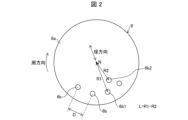
- FIG. 2 is a plan view for explaining the spacing between the holes 6b of the die 6.
- FIG. 2 assuming a circle centered on the central axis N, the distance between the holes 6b of the die 6 can be defined as a circumferential distance D and a radial distance L. As shown in FIG. 2,
- the interval D between the holes 6b in the circumferential direction is defined as the interval between the holes 6b adjacent in the circumferential direction.
- the distance L between the holes 6b in the radial direction is defined based on the distance between each of the two adjacent holes 6b1 and 6b2 and the central axis N, for example. That is, the interval L is defined as the difference between the distance R1 between the center of the hole 6b1 and the central axis N and the distance R2 between the center of the hole 6b2 and the central axis N.
- the cutter blade rotates in a direction perpendicular to the radial direction. That is, it can be said that the cutter blade rotates in the circumferential direction of the die 6 . Therefore, it is considered that the arrangement of the holes 6b in the circumferential direction has a greater effect on the arrangement of the holes 6b than the arrangement of the holes 6b1 and 6b2 in the radial direction. That is, it can be said that the interval D between the holes 6b in the circumferential direction is important in preventing the extruded foamed polypropylene resin particles from sticking to each other.
- the interval D between the holes 6b in the circumferential direction is 6.5 mm or more, preferably 7 mm or more, and more preferably 8 mm or more.
- the distance D is within the above numerical range, it is possible to prevent the extruded expanded polypropylene resin particles from sticking to each other.
- the amount of composition discharged per hole of the die 6 can be reduced.
- the amount of the composition discharged per die hole decreases, the extruded foamed particles tend to have low open cells. As a result, the quality of extruded foam particles can be improved.
- the upper limit of the distance D is not particularly limited, but from the viewpoint of increasing the number of holes in the die 6, it is preferably 12 mm or less, more preferably 10 mm or less, and even more preferably less than 10 mm. It is preferably 9 mm or less, particularly preferably 9 mm or less.
- the distance L between the holes 6b in the radial direction is not particularly limited, but is preferably 5.5 mm to 15 mm, more preferably 5.5 mm to 10 mm.
- the interval L is within the above numerical range, there is an advantage that the width of the cutter blade can be narrowed.
- the cross-sectional shape of the walls forming the hole 6b perpendicular to the extrusion direction (hereinafter sometimes simply referred to as "the shape of the hole 6b") is not particularly limited.
- the shape of the hole 6b of the die 6 is preferably a perfect circle, an approximate circle, an ellipse, or the like, since extruded expanded particles having a spherical or approximately spherical shape can be obtained. is more preferable.
- the number of holes 6b is not particularly limited.
- the diameter of the hole 6b is not particularly limited, but is preferably less than 1.6 mm, more preferably 1.4 mm or less, further preferably 1.2 mm or less, and 1.0 mm or less. is particularly preferred.
- the diameter of the hole 6b is within the above numerical range, there is an advantage that the size of the extruded expanded particles becomes smaller at the same expansion ratio, and the mold filling property in the molding process is improved.
- the lower limit of the diameter of the hole 6b is not particularly limited, it is preferably 0.3 mm or more, more preferably 0.5 mm or more.
- the resin mixture containing a polypropylene-based resin having a branched structure can be said to be a component other than the foaming agent in the composition.
- the resin mixture contains a polypropylene-based resin having a branched structure, and may optionally contain additives such as cell nucleating agents and colorants.
- polypropylene resin having a branched structure refers to (a) a polypropylene resin obtained by partially cross-linking the molecules of a polypropylene resin to which no branched structure has been introduced, and (b) A polypropylene resin in which a diene compound other than (poly)propylene or the like is introduced as a branched chain is intended for a polypropylene resin in which a branched structure is not introduced.
- the polypropylene-based resin having a branched structure is preferably a polypropylene-based resin having a loss tangent tan ⁇ of 5 or less at 200° C. and 0.1 rad/s. Other aspects (measurement method, etc.) of the loss tangent tan ⁇ will be described in detail in the section (polypropylene resin having a branched structure) below.
- polypropylene-based resin into which no branched structure is introduced may be referred to as "linear polypropylene-based resin", and the "polypropylene-based resin having a branched structure” is referred to as "branched polypropylene-based resin”.
- linear polypropylene resin and branched polypropylene resin may be collectively referred to as “polypropylene resin”.
- the linear polypropylene-based resin can also be said to be a raw material for the branched polypropylene-based resin.
- the linear polypropylene-based resin means a resin containing 50 mol% or more of structural units derived from a propylene monomer out of 100 mol% of all structural units contained in the resin.
- structural unit derived from propylene monomer may be referred to as "propylene unit”.
- the linear polypropylene-based resin may be (a) a homopolymer of propylene, or (b) a block copolymer or random copolymer of propylene and a monomer other than propylene, or (c) A mixture of two or more of these may be used. That is, the linear polypropylene-based resin may be one or more selected from the group containing polypropylene homopolymers and block copolymers or random copolymers of propylene and monomers other than propylene. .
- the linear polypropylene resin may have one or more structural units derived from a monomer other than the propylene monomer, or may have one or more types.
- “Monomers other than propylene monomers” used in the production of linear polypropylene resins are sometimes referred to as “comonomers”, and “monomers other than propylene monomers” contained in linear polypropylene resins Structural unit derived from” may be referred to as "comonomer unit".
- Comonomers include monomers such as: (a) ethylene, 1-butene, isobutene, 1-pentene, 3-methyl-1-butene, 1-hexene, 4-methyl-1-pentene, ⁇ -olefins having 2 or 4 to 12 carbon atoms such as 3,4-dimethyl-1-butene, 1-heptene, 3-methyl-1-hexene, 1-octene, 1-decene, (b) cyclopentene, norbornene, Cyclic olefins such as tetracyclo[6,2,11,8,13,6]-4-dodecene, (c) 5-methylene-2-norbornene, 5-ethylidene-2-norbornene, 1,4-hexadiene, methyl- dienes such as 1,4-hexadiene, 7-methyl-1,6-octadiene, and (d) vinyl chloride, vinylidene chloride, acrylonitrile, meth
- Acrylic esters include methyl acrylate, ethyl acrylate, butyl acrylate, hexyl acrylate, 2-ethylhexyl acrylate, lauryl acrylate, stearyl acrylate, 2-hydroxyethyl acrylate, 2-hydroxypropyl acrylate and and glycidyl acrylate.
- Methacrylates include methyl methacrylate, ethyl methacrylate, butyl methacrylate, hexyl methacrylate, 2-ethylhexyl methacrylate, lauryl methacrylate, stearyl methacrylate, 2-hydroxyethyl methacrylate, 2-hydroxypropyl methacrylate and and glycidyl methacrylate.
- Styrenic monomers include styrene, methylstyrene, dimethylstyrene, alphamethylstyrene, paramethylstyrene, ethylstyrene, diethylstyrene, isopropylstyrene, t-butylstyrene, bromostyrene, dibromostyrene, tribromostyrene, chlorostyrene. , dichlorostyrene and trichlorostyrene.
- Linear polypropylene resin as a comonomer unit, preferably has a structural unit derived from an ⁇ -olefin having 2 or 4 to 12 carbon atoms, ethylene, 1-butene, isobutene, 1-pentene, 3-methyl-1 -butene, 1-hexene, 4-methyl-1-pentene, 3,4-dimethyl-1-butene, 1-heptene, 3-methyl-1-hexene, 1-octene and/or 1-decene, etc.
- this configuration (a) the advantage that a branched polypropylene resin having a high melt tension and a low gel fraction can be obtained, and (b) the obtained branched polypropylene resin has excellent moldability. It has the advantage of being able to provide particles.
- the linear polypropylene-based resin is preferably a propylene homopolymer, a polypropylene-based block copolymer and/or a polypropylene-based random copolymer, and is preferably a propylene homopolymer and/or a polypropylene-based random copolymer. more preferred.
- a branched polypropylene resin having a high melt tension and a low gel fraction can be obtained
- the obtained branched polypropylene resin has excellent moldability. It has the advantage of being able to provide particles.
- the linear polypropylene resin preferably contains 90 mol% or more of propylene units, more preferably 93 mol% or more, and 95 mol% or more of all 100 mol% of the total structural units contained in the linear polypropylene resin. It is more preferable to contain it, and it is particularly preferable to contain it in an amount of 97 mol % or more. This configuration has the advantage of obtaining a branched polypropylene resin having a high melt tension and a low gel fraction.
- the melting point of the linear polypropylene resin is not particularly limited.
- the melting point of the linear polypropylene resin is, for example, preferably 130° C. to 165° C., more preferably 135° C. to 164° C., even more preferably 138° C. to 163° C., and 140° C. to 162° C. °C is particularly preferred.
- the melting point of the linear polypropylene-based resin is within the range described above, (a) the advantage that the obtained extruded expanded particles are excellent in moldability, and (b) the extruded expanded particles produce a foamed molded article with excellent breakage resistance. have the advantage of being able to provide When the melting point of the linear polypropylene-based resin is (a) 130° C.
- the melting point of the linear polypropylene-based resin is a value obtained by measuring with a differential scanning calorimeter method (hereinafter referred to as "DSC method").
- DSC method differential scanning calorimeter method
- the specific operating procedure is as follows: (1) 5 to 6 mg of the linear polypropylene resin is heated from 40° C. to 220° C. at a rate of 10° C./min to obtain the linear polypropylene. (2) Then, the temperature of the melted linear polypropylene resin is lowered from 220° C. to 40° C. at a rate of 10° C./min to crystallize the linear polypropylene resin.
- the temperature of the crystallized linear polypropylene resin is further increased from 40°C to 220°C at a rate of temperature increase of 10°C/min.
- the temperature of the peak (melting peak) of the DSC curve of the linear polypropylene-based resin obtained during the second heating can be obtained as the melting point of the linear polypropylene-based resin. If there are multiple peaks (melting peaks) in the DSC curve of the linear polypropylene resin obtained during the second heating by the above method, the temperature of the peak (melting peak) with the maximum amount of heat of fusion is , the melting point of the linear polypropylene resin.
- the differential scanning calorimeter for example, DSC6200 type manufactured by Seiko Instruments Inc. can be used.
- the melt flow rate (MFR) of the linear polypropylene resin is not particularly limited.
- the MFR of the linear polypropylene resin is, for example, preferably 0.5 g/10 min to 50.0 g/10 min, more preferably 1.0 g/10 min to 30.0 g/10 min, It is more preferably 2.0 g/10 minutes to 20.0 g/10 minutes, and particularly preferably 2.0 g/10 minutes to 10.0 g/10 minutes.
- MFR of the linear polypropylene-based resin is within the range described above, there is an advantage that a branched polypropylene-based resin having an MFR of 0.5 g/10 min to 20 g/10 min can be easily obtained.
- the MFR of the linear polypropylene resin is measured using an MFR measuring device described in JIS K7210, the orifice diameter is 2.0959 ⁇ 0.0050 mm ⁇ , the orifice length is 8.000 ⁇ 0.025 mm, And it is a value obtained by measuring under conditions of a load of 2160 g and a temperature of 230 ⁇ 0.2°C.
- a polypropylene-based resin having a branched structure can be obtained by introducing a branched structure into a linear polypropylene-based resin.
- the method for introducing a branched structure into the linear polypropylene-based resin is not particularly limited.
- a method of melt-kneading a mixture containing a compound and a radical polymerization initiator can be used.
- the conjugated diene compound is preferably isoprene and/or butadiene.
- the method (a2) will be further explained.
- the following (i) to (iv) are performed in order to obtain a branched polypropylene-based resin: (i) a linear polypropylene-based resin and a conjugated diene-based resin such as isoprene or butadiene; A mixture containing a compound and a radical polymerization initiator such as an organic peroxide is melt-kneaded in an apparatus equipped with a die; (ii) extruding the resulting melt-kneaded product through a die; (iii) extruded melt cooling the kneaded mass (also called strands); (iv) chopping the strands simultaneously with and after cooling the strands.
- Specific examples of the method (a2) include the method described in WO2020/004429.
- branched structure can be stably introduced into a linear polypropylene-based resin, and the reproducibility of the introduction of the branched structure is high; and/or (ii) no complicated equipment is required and high productivity Since a branched polypropylene-based resin can be obtained, in one embodiment of the present invention, the branched polypropylene-based resin is preferably a branched polypropylene-based resin obtained by the method (a2) described above.
- the loss tangent tan ⁇ of the branched polypropylene resin can be smaller than the loss tangent tan ⁇ of the linear polypropylene resin.
- the loss tangent tan ⁇ is the ratio (G''/G') of the storage modulus G' and the loss modulus G''.
- the loss tangent tan ⁇ of the resin at 200° C. and 0.1 rad/s is preferably 5 or less, more preferably 4 or less, more preferably 3 or less, and 2 or less. is more preferred.
- loss tangent tan ⁇ in this specification will be described below.
- loss tangent tan ⁇ , storage modulus G′, and loss modulus G′′ are measured using a rotational rheometer (TA Instruments It is measured by a vibration experiment using ARES, a product of ARES Corporation.
- (1) to (3) are as follows: (1) A sample resin for measurement (branched polypropylene resin) is sandwiched between two parallel plates (gap 1 mm); 2) applying a cyclic strain due to vibration to the sample resin between the plates by driving one side plate; The modulus G', the loss modulus G'', and the loss tangent tan ⁇ are determined.
- the melt flow rate of the branched polypropylene resin is not particularly limited.
- the MFR of the branched polypropylene resin is, for example, preferably 0.5 g/10 min to 20.0 g/10 min, more preferably 1.0 g/10 min to 15.0 g/10 min, Particularly preferred is from 2.0 g/10 min to 10.0 g/10 min.
- the MFR of the branched polypropylene-based resin is measured using an MFR measuring device described in JIS K7210, and the diameter of the orifice is 2.0959 ⁇ 0.0050 mm ⁇ , the length of the orifice is 8.000 ⁇ 0.025 mm, And it is a value obtained by measuring under conditions of a load of 2160 g and a temperature of 230 ⁇ 0.2°C.
- the melt tension of the branched polypropylene resin is not particularly limited.
- the melt tension of the branched polypropylene resin is, for example, preferably 3 cN to 20 cN, more preferably 3 cN to 15 cN, and particularly preferably 3 cN to 10 cN.
- melt tension of the branched polypropylene resin is measured using Capilograph 1D (manufactured by Toyo Seiki Seisakusho Co., Ltd., Japan).
- Capilograph 1D manufactured by Toyo Seiki Seisakusho Co., Ltd., Japan.
- (1) to (5) are as follows: (1) A sample resin (branched polypropylene resin) for measurement is placed in a barrel with a diameter of 9.55 mm heated to the test temperature (200 ° C.).
- the resin mixture may further contain a resin other than the branched polypropylene-based resin (sometimes referred to as "other resin") or rubber within a range that does not impair the effects of one embodiment of the present invention.
- Other resins include (a) linear polypropylene resins such as ethylene/propylene random copolymers, ethylene/propylene block copolymers, and propylene homopolymers; Ethylene resins such as density polyethylene, linear low density polyethylene, linear ultra-low density polyethylene, ethylene/vinyl acetate copolymer, ethylene/acrylic acid copolymer, and ethylene/methacrylic acid copolymer, and (c) Styrenic resins such as polystyrene, styrene/maleic anhydride copolymers, and styrene/ethylene copolymers.
- the rubber include olefin rubbers such as ethylene/propylene rubber, ethylene/butene rubber, ethylene
- the content of other resins in the resin mixture is, for example, preferably 60 parts by weight or less, more preferably 40 parts by weight or less, and 20 parts by weight or less with respect to 100 parts by weight of the resin mixture. is more preferred.
- the lower limit of the content of other resins is not particularly limited, and may be, for example, 0 parts by weight with respect to 100 parts by weight of the resin mixture.
- the resin mixture may contain a cell nucleating agent for the purpose of controlling the number and shape of cells in the resulting extruded expanded particles.
- Conventionally known agents can be used as the bubble nucleating agent.
- the resin mixture may or may not contain a coloring agent.
- the coloring agent conventionally known ones can be used.
- the resin mixture may contain other components as required: (a) antioxidants, metal deactivators, phosphorus-based processing stabilizers, ultraviolet absorbers, ultraviolet stabilizers, fluorescent brighteners, metallic soaps, and inhibitors. and/or (b) additives such as crosslinkers, chain transfer agents, lubricants, plasticizers, fillers, reinforcements, flame retardants, and antistatic agents. good too.
- antioxidants metal deactivators, phosphorus-based processing stabilizers, ultraviolet absorbers, ultraviolet stabilizers, fluorescent brighteners, metallic soaps, and inhibitors.
- additives such as crosslinkers, chain transfer agents, lubricants, plasticizers, fillers, reinforcements, flame retardants, and antistatic agents. good too.
- additives such as crosslinkers, chain transfer agents, lubricants, plasticizers, fillers, reinforcements, flame retardants, and antistatic agents. good too.
- additives such as crosslinkers, chain transfer agents, lubricants, plasticizers, fillers, reinforcements, flame retardants
- the melting point of the resin mixture is not particularly limited.
- the melting point of the resin mixture is, for example, preferably 130°C to 165°C, more preferably 135°C to 164°C, even more preferably 138°C to 163°C, and 140°C to 162°C. is particularly preferred.
- the melting point of the resin mixture is within the range described above, it is said that (a) the extruded foamed particles obtained have the advantage of being excellent in moldability, and (b) the extruded foamed particles can provide a foamed article having excellent breakage resistance. have the advantage.
- the melting point of the resin mixture is (a) 130° C.
- the melting point of the resin mixture is a value obtained by measuring by the DSC method. Specifically, it can be identified by the same method as the method for measuring the melting point of the linear polypropylene-based resin described above, except that a resin mixture is used instead of the linear polypropylene-based resin.
- composition In this production method, the substance obtained by adding the foaming agent to the resin mixture described above may be referred to as a "composition".
- the blowing agent is not particularly limited as long as it is conventionally known, but examples include (a) aliphatic hydrocarbons such as propane, normal butane, isobutane, normal pentane, isopentane and hexane, and (b) Aliphatic cyclic hydrogens such as cyclopentane and cyclobutane, (c) inorganic gases such as air, nitrogen, carbon dioxide, and (d) water.
- the foaming agent is one or more selected from the group including normal butane, isobutane, and carbon dioxide gas. Among these, it is particularly preferable to use carbon dioxide gas as the foaming agent from the viewpoint of low production cost and low environmental load.
- the amount of foaming agent used can be adjusted as appropriate according to the target expansion ratio of the foam.
- the amount (total amount) of the foaming agent used is preferably, for example, 0.5 to 7.0 parts by weight with respect to 100.0 parts by weight of the resin mixture. , More preferably 0.5 to 6.0 parts by weight, more preferably 0.5 to 5.0 parts by weight, 0.5 to 4.0 parts by weight is more preferred, and 0.5 to 3.0 parts by weight is particularly preferred.
- the "amount of foaming agent used” can also be referred to as "the amount of carbon dioxide used” or "the content of foaming agent (carbon dioxide) in the composition”.
- the production method includes a melt-kneading step of melt-kneading a composition containing a resin mixture containing a branched polypropylene-based resin and a foaming agent.
- the melt-kneading step can also be said to be a step of melting the branched polypropylene-based resin and dissolving the foaming agent in the branched polypropylene-based resin in the kneading device of the extruder.
- the melt-kneading step can also be said to be a step of preparing a melt-kneaded product of a composition containing a resin mixture containing a branched polypropylene-based resin and a foaming agent.
- the order and method of supplying the branched polypropylene-based resin and the foaming agent to the melt-kneading unit are not particularly limited.
- a foaming agent is supplied from a foaming agent supply device in the middle of the kneading device to the kneading device. , that is, a method of preparing (finishing) a composition in a kneading device and further melt-kneading the composition.
- the method and order of supplying these raw materials to the kneading device are not particularly limited.
- Other resins, cell nucleating agents and other components used as necessary may be added simultaneously with the branched polypropylene resin and/or the blowing agent, or may be added separately and in any order.
- the barrel temperature in the kneading device for melting the raw material such as the branched polypropylene resin is not particularly limited as long as it does not interfere with the supply of the foaming agent to the raw material. If the branched polypropylene resin is not melted at the supply position of the foaming agent in the kneading device, the foaming agent may escape to the upstream side of the kneading device. Therefore, it is preferable to set the barrel temperature such that the branched polypropylene-based resin is completely melted and the polypropylene-based resin is not deteriorated or decomposed.
- the branched polypropylene resin is preferably melt-kneaded at a barrel temperature of 160°C to 260°C, more preferably melt-kneaded at a barrel temperature of 170°C to 240°C, and 180°C to 220°C. Melt-kneading at barrel temperature is more preferred.
- the melt-kneading step further includes a cooling step of lowering the temperature of the melt-kneaded composition within a temperature range at which the melt-kneaded composition does not solidify after the composition is melt-kneaded, for example, by the method described above.
- the cooling step is performed by sending the composition melted and kneaded in the kneading device to the cooling section and cooling the composition to a desired temperature in the cooling section.
- the temperature of the composition at the outlet of the cooling section can be appropriately set according to the amount of carbon dioxide used as a foaming agent, the discharge amount of the composition, and the like.
- the temperature of the composition at the outlet of the cooling section can be controlled within a desired range by adjusting the temperature and heat transfer area of the cooling member, the residence time of the composition in the cooling member, and the like.
- the method of manufacture includes an extrusion step of extruding the composition through a die into a region of lower pressure and liquid phase than the extruder.
- the extrusion step can also be said to be a step of extruding the composition obtained in the melt-kneading step, that is, the melt-kneaded composition through a die into a liquid phase.
- the extrusion step a conventionally known method can be adopted as long as the composition can be extruded through a die into a region that is in a liquid phase at a pressure lower than that of the extruder.
- the extrusion process includes the following method: a method in which the extruded composition is filled into a chamber attached to the tip of the die with cooling water so as to be in contact with the resin discharge surface of the die to form a liquid phase.
- the temperature of the liquid phase is 65°C or higher, preferably 67°C or higher, and more preferably 70°C or higher.
- the temperature of the liquid phase is low, the extruded expanded particles are less likely to adhere to each other, while the expansion ratio of the extruded expanded particles tends not to increase. Therefore, from the viewpoint of increasing the expansion ratio of the extruded expanded particles to a predetermined value or more, it is preferable to be able to prevent mutual adhesion of the extruded expanded particles while increasing the temperature of the liquid phase.
- the distance between the holes in the die in the circumferential direction is set to 6.5 mm or more, and the temperature of the liquid phase is within the above numerical range, thereby preventing the extruded foam particles from sticking to each other, and , the expansion ratio of the extruded expanded particles can be increased to a predetermined value or more.
- the upper limit of the temperature of the liquid phase is not particularly limited, it is preferably 80°C or lower, more preferably 75°C or lower, from the viewpoint of heating energy costs.
- the flow rate of the liquid phase is not particularly limited as long as it is a flow rate that can prevent mutual adhesion of the extruded expanded particles, but it is preferably 20 m 3 /hr or more, more preferably 20.5 m 3 /hr or more. more preferred.
- the upper limit of the flow rate of the liquid phase is not particularly limited, it can be exemplified to be 40 m 3 /hr or less from the viewpoint of pumping capacity.
- the discharge rate of the composition per die hole is not particularly limited, but is preferably 4.0 kg/hr or less, more preferably 3.5 kg/hr or less.
- the discharge rate of the composition per hole of the die is preferably 1 kg/hr or more, more preferably 1.5 kg/hr or more. preferable.
- Methods for adjusting the discharge amount of the composition per die hole within a desired range include a method of adjusting the total discharge amount of the composition, a method of adjusting the number of holes in the die, and the like.
- the composition is extruded into a region of lower pressure and liquid phase than the extruder.
- the liquid phase in this region is not particularly limited, but water is preferable because it can be produced inexpensively and safely.
- the pressure of the liquid phase against the composition within the region does not affect mutual bonding, but greatly affects the expansion ratio of the extruded foam particles.
- the pressure of the liquid phase is high, the expansion ratio of the extruded expanded particles is small.
- the pressure of the liquid phase against the composition in the region is preferably 0.01 MPa ⁇ G to 0.60 MPa ⁇ G, more preferably 0.01 MPa ⁇ G to 0.55 MPa. ⁇ G is more preferable, 0.02 MPa ⁇ G to 0.55 MPa ⁇ G is more preferable, and 0.02 MPa ⁇ G to 0.50 MPa ⁇ G is particularly preferable.
- This configuration has the advantage that mutual adhesion between the obtained extruded expanded particles can be easily suppressed.
- MPa ⁇ G intends that MPa indicates gauge pressure.
- the composition extruded through the die into a region of lower pressure and liquid phase than the extruder begins to foam.
- the composition before or during foaming may be shredded, or the composition after foaming may be shredded. If the composition is shredded before or during foaming, the shredded composition may complete foaming in the region.
- the shredding step can also be said to be a step of shredding the composition into particles to prepare extruded polypropylene-based resin expanded particles.
- the shredded composition is cooled in a region while or after foaming and solidification begins during or after foaming is completed.
- the method of shredding the composition extruded from the die is not particularly limited.
- the step of obtaining the extruded polypropylene resin particles can also be said to be a step of collecting the extruded polypropylene resin particles prepared in the chopping step.
- the method for recovering extruded polypropylene resin expanded particles is not particularly limited. Examples of the method for recovering the extruded polypropylene-based resin expanded particles include centrifugal dehydration.
- extruded expanded polypropylene particles In this specification, "the extruded polypropylene resin particles obtained by the production method of the present invention” may be referred to as “the extruded expanded particles of the present invention”.
- the present extruded expanded beads have the advantage of being excellent in quality, specifically, the advantage that the present extruded expanded beads have low open cells. Low open cell formation can be evaluated based on the open cell ratio of the extruded foamed particles.
- the open cell ratio of the extruded expanded beads is 6.5% or less, preferably 5% or less, and more preferably 3.5% or less.
- the extruded expanded particles can preferably exhibit an expansion ratio in the range of 2-15 times.
- the expansion ratio of the present extruded expanded particles is more preferably 2 to 13 times, still more preferably 2 to 11 times.
- the polypropylene resin-based in-mold expansion molded product obtained by using the extruded expanded particles has the advantage that characteristics such as shape arbitrariness, cushioning properties, lightness, and heat insulating properties are exhibited more effectively.
- the expansion ratio of the extruded polypropylene resin expanded beads is calculated by the following method: (1) measuring the weight w (g) of the extruded expanded beads; The extruded foamed particles used are submerged in ethanol contained in a graduated cylinder, and the volume v (cm 3 ) of the extruded foamed particles is measured based on the amount of rise in the liquid level of the graduated cylinder; (3) Weight w ( g) is divided by the volume v (cm 3 ) to calculate the density ⁇ 1 of the extruded foamed beads; (4) The same operations as (1) to (3) are performed using the base resin instead of the extruded foamed beads. (5) Divide the density ⁇ 2 of the base resin of the extruded foamed beads by the density ⁇ 1 of the extruded foamed beads ( ⁇ 2 / ⁇ 1 ) to obtain The obtained value is taken as the foaming ratio.
- the base resin can also be said to be a resin component that substantially constitutes the extruded expanded beads.
- the density of the base resin of the extruded foamed beads does not substantially change even when the extruded foamed beads are melted under reduced pressure and returned to the resin mass. Therefore, the density of the resin mass obtained by melting the extruded foamed beads under reduced pressure can be regarded as the density of the base resin of the extruded foamed beads.
- the process of melting the extruded foamed particles under reduced pressure to obtain a resin lump may be referred to as "returning the resin”
- the resin lump obtained by returning the resin may be referred to as a "returned resin”.
- a specific method for returning the resin is not particularly limited, but includes, for example, a method in which the following (b1) to (b5) are performed in order: (b1) a temperature sufficiently higher than the melting point of the linear polypropylene resin (e.g., melting point (b2) Then, using a vacuum pump over 5-10 minutes, the pressure in the dryer is increased from -0.05 MPa (gauge pressure) to (b3) Then, the extruded foamed particles are left in the dryer for 30 minutes to prepare a resin mass (returned resin); (b4) Then, in the dryer (b5) After that, the resin mass is taken out from the dryer.
- a temperature sufficiently higher than the melting point of the linear polypropylene resin e.g., melting point (b2)
- the pressure in the dryer is increased from -0.05 MPa (gauge pressure) to (b3)
- the extruded foamed particles are left in the dryer for 30 minutes to prepare a resin mass (returned resin)
- (b4) Then, in the dryer
- Producible extruded foam particles are evaluated as “not sticking together” and “slightly sticking together”.
- the method for producing a foamed polypropylene resin molded article according to the present embodiment is a method for molding extruded polypropylene resin expanded particles produced by the above-described production method.
- the extruded polypropylene resin expanded particles can be molded by a known method.
- the method for producing extruded polypropylene-based resin expanded particles according to one embodiment of the present invention includes the following configurations.
- the interval between the holes in the circumferential direction is 6.5 mm or more,
- the method for producing extruded polypropylene-based resin expanded particles, wherein the temperature of the liquid phase is 65° C. or higher.
- [6] A method for producing an expanded polypropylene resin molding, comprising molding extruded polypropylene resin expanded particles produced by the production method according to any one of [1] to [5].
- the polypropylene-based resin having a branched structure is a resin obtained by melt-kneading a mixture containing a linear polypropylene-based resin, a conjugated diene-based compound and a radical polymerization initiator, [1] to [7]. 3. A method for producing extruded polypropylene-based resin expanded particles according to any one of .
- the polypropylene-based resin having a branched structure is a polypropylene-based resin having a loss tangent tan ⁇ of 5 or less at 200° C. and 0.1 rad/s, [1] to [8].
- a method for producing extruded resin foam particles is a polypropylene-based resin having a loss tangent tan ⁇ of 5 or less at 200° C. and 0.1 rad/s, [1] to [8].
- the polypropylene-based resin having a branched structure is a resin obtained by melt-kneading a mixture containing a linear polypropylene-based resin, a conjugated diene-based compound, and a radical polymerization initiator, and the conjugated diene-based compound is The method for producing extruded polypropylene-based resin expanded particles according to any one of [1] to [20], which is isoprene and/or butadiene.
- the polypropylene-based resin having a branched structure is a resin obtained by melt-kneading a mixture containing a linear polypropylene-based resin, a conjugated diene-based compound, and a radical polymerization initiator, and the linear polypropylene-based resin is Any one of [1] to [21], which is one or more selected from the group comprising a homopolymer of polypropylene and a block copolymer or random copolymer of propylene and a monomer other than propylene. 3.
- the method for producing extruded polypropylene resin expanded particles according to 1.
- [23] A method for producing an expanded polypropylene resin molding, comprising molding extruded polypropylene resin expanded particles produced by the production method according to any one of [1] to [22].
- the expansion ratio of the extruded polypropylene resin expanded beads was calculated by the following method: (1) the weight w (g) of the extruded expanded beads was measured; , immersed in ethanol contained in a graduated cylinder, and the volume v (cm 3 ) of the extruded expanded particles was measured based on the rise in the liquid level of the graduated cylinder; (3) weight w (g) was converted to volume v ( cm 3 ) to calculate the density ⁇ 1 of the extruded foamed beads; (4) dividing the density ⁇ 2 of the base resin of the extruded foamed beads by the density ⁇ 1 of the extruded foamed beads ( ⁇ 2 / ⁇ 1 ); It was taken as foaming ratio. As the density ⁇ 2 of the base resin, the density 0.9 g/cm 3 of a general polypropylene-based resin was adopted.
- extruded foamed particles that were not evaluated as “acceptable” in at least one of "mutual adhesion”, “expansion ratio”, and “low open cells” were comprehensively evaluated as "x”.
- a branched polypropylene-based resin composition was produced by the following method.
- a random polypropylene resin, RD265CF (manufactured by Borouge) was supplied to a twin-screw extruder, and then t-butyl peroxyisopropyl monocarbonate (manufactured by NOF Corporation, Perbutyl I) was added as a radical polymerization initiator to 100 parts by weight of RD265CF. .0 parts by weight was fed to a twin screw extruder.
- the prepared resin mixture was melt-kneaded in a twin-screw extruder at a cylinder temperature of 180°C and a screw rotation speed of 230 rpm to obtain a branched polypropylene-based resin composition.
- the resulting branched polypropylene-based resin composition was extruded from a die at a discharge rate of 70 kg/h in the form of a strand.
- the extruded polypropylene-based resin composition (strand) having branches was (a) cooled with water, and then (b) chopped into pellets (cylindrical).
- a resin mixture was prepared by blending 100 parts by weight of a branched polypropylene-based resin composition and 0.02 parts by weight of talc as a cell nucleating agent. Thereafter, the resin mixture was supplied from the raw material supply section to the twin-screw extruder (melt-kneading section), and melt-kneading of the resin mixture was started at a cylinder temperature of 180° C. and a screw rotation speed of 120 rpm. The feed rate of the resin mixture to the twin-screw extruder was 10 kg/h.
- the melt-kneaded composition obtained through the melt-kneading step was passed through the die of the granulation unit and extruded into the air phase, which has a pressure lower than the internal pressure of the extruder, at a discharge rate of 10 kg / h.
- the extruded composition is filled in a chamber attached to the tip of the die with cooling water so as to be in contact with the resin discharge surface of the die, and the melted and kneaded material extruded from the die hole is cut in water to form foamed particles. obtained (extrusion process, chopping process).
- the temperature of the cooling water was 70° C.
- the flow rate of the cooling water was 20.8 m 3 /hr.
- the die used had three holes, and the discharge rate of the composition per die hole was 3.3 kg/h.
- the circumferential distance between the holes in the die used was 6.9 mm.
- the number of blades used for cutting was 6, and the rotation speed of the blades was 3500 rpm.
- the hole diameter of the die is 0.8 mm.
- Example 2 Polypropylene-based resin extruded foamed particles were produced in the same manner as in Example 1, except that the number of die holes, the amount of composition discharged per die hole, and the production conditions were changed as shown in Table 1. Obtained. Regarding the obtained extruded polypropylene-based resin expanded particles, mutual adhesion was determined, and the expansion ratio and the open cell ratio were measured. Table 1 shows the manufacturing conditions and measurement results.
- Example 3 Extruded expanded polypropylene resin particles were obtained in the same manner as in Example 1, except that the cooling water flow rate and production conditions were changed as shown in Table 1. Regarding the obtained extruded polypropylene-based resin expanded particles, mutual adhesion was determined, and the expansion ratio and the open cell ratio were measured. Table 1 shows the manufacturing conditions and measurement results.
- Example 4 Polypropylene-based resin extruded foamed particles were produced in the same manner as in Example 1, except that the number of die holes, the amount of composition discharged per die hole, and the production conditions were changed as shown in Table 1. Obtained. Regarding the obtained extruded polypropylene-based resin expanded particles, mutual adhesion was determined, and the expansion ratio and the open cell ratio were measured. Table 1 shows the manufacturing conditions and measurement results.
- Example 5 Extruded expanded polypropylene resin particles were obtained in the same manner as in Example 4, except that the discharge amount of the composition and the production conditions were changed as shown in Table 1. Regarding the obtained extruded polypropylene-based resin expanded particles, mutual adhesion was determined, and the expansion ratio and the open cell ratio were measured. Table 1 shows the manufacturing conditions and measurement results.
- Example 1 Extruded expanded polypropylene resin particles were obtained in the same manner as in Example 1, except that the circumferential distance between the holes in the die used and the manufacturing conditions were changed as shown in Table 1. Regarding the obtained extruded polypropylene-based resin expanded particles, mutual adhesion was determined, and the expansion ratio and the open cell ratio were measured. Table 1 shows the manufacturing conditions and measurement results. As shown in Table 1, in Comparative Example 1, due to mutual adhesion, extruded expanded polypropylene resin particles could not be produced. Therefore, the foaming ratio and open cell ratio could not be measured.
- Comparative example 2 Except for changing the cooling water temperature and production conditions as shown in Table 1, extruded polypropylene resin foamed particles were obtained in the same manner as in Example 1. Regarding the obtained extruded polypropylene-based resin expanded particles, mutual adhesion was determined, and the expansion ratio and the open cell ratio were measured. Table 1 shows the manufacturing conditions and measurement results. In Comparative Example 2, the foaming ratio was 2.1 times, which was significantly lower than the target ratio of 5.0 to 6 times.
- Example 5 the polypropylene resin extruded foamed particles of Examples 1 to 5 produced by this production method were evaluated as " ⁇ " or " ⁇ ”, had a good expansion ratio, and prevented mutual adhesion. While, it was excellent in quality (especially low open cell formation). Furthermore, in Example 5, in which the discharge rate was increased more than in Example 4, the "mutual adhesion”, “open cell ratio”, and “expansion ratio” of the extruded polypropylene-based resin expanded particles were about the same. From these facts, it was found that according to the present production method, it is possible to obtain extruded polypropylene-based resin expanded particles having excellent quality (especially low open cells) while preventing mutual adhesion even under high production conditions. .
- the present invention can be suitably used in fields such as automotive interior parts, cushioning materials, packaging materials, and heat insulating materials.
Landscapes
- Engineering & Computer Science (AREA)
- Mechanical Engineering (AREA)
- Chemical & Material Sciences (AREA)
- Materials Engineering (AREA)
- Health & Medical Sciences (AREA)
- Chemical Kinetics & Catalysis (AREA)
- Medicinal Chemistry (AREA)
- Polymers & Plastics (AREA)
- Organic Chemistry (AREA)
- Physics & Mathematics (AREA)
- Thermal Sciences (AREA)
- Manufacturing & Machinery (AREA)
- Manufacture Of Porous Articles, And Recovery And Treatment Of Waste Products (AREA)
Priority Applications (2)
| Application Number | Priority Date | Filing Date | Title |
|---|---|---|---|
| JP2023571075A JPWO2023127914A1 (https=) | 2021-12-28 | 2022-12-27 | |
| EP22916136.9A EP4458541A4 (en) | 2021-12-28 | 2022-12-27 | METHOD FOR THE PRODUCTION OF EXTRUDED POLYPROPYLENE RESIN FOAM PARTICLES |
Applications Claiming Priority (2)
| Application Number | Priority Date | Filing Date | Title |
|---|---|---|---|
| JP2021-214944 | 2021-12-28 | ||
| JP2021214944 | 2021-12-28 |
Publications (1)
| Publication Number | Publication Date |
|---|---|
| WO2023127914A1 true WO2023127914A1 (ja) | 2023-07-06 |
Family
ID=86999198
Family Applications (1)
| Application Number | Title | Priority Date | Filing Date |
|---|---|---|---|
| PCT/JP2022/048373 Ceased WO2023127914A1 (ja) | 2021-12-28 | 2022-12-27 | ポリプロピレン系樹脂押出発泡粒子の製造方法 |
Country Status (3)
| Country | Link |
|---|---|
| EP (1) | EP4458541A4 (https=) |
| JP (1) | JPWO2023127914A1 (https=) |
| WO (1) | WO2023127914A1 (https=) |
Cited By (1)
| Publication number | Priority date | Publication date | Assignee | Title |
|---|---|---|---|---|
| EP4631693A1 (de) * | 2024-04-10 | 2025-10-15 | Robert Bosch GmbH | Verfahren und anlage zur herstellung von geschäumten kunststoffteilen |
Citations (7)
| Publication number | Priority date | Publication date | Assignee | Title |
|---|---|---|---|---|
| JPH01110911A (ja) * | 1987-09-04 | 1989-04-27 | General Electric Co <Ge> | 発泡性フォームビーズの一段階製造法 |
| JPH05116196A (ja) * | 1991-10-30 | 1993-05-14 | Sekisui Chem Co Ltd | 熱可塑性樹脂発泡体の製造方法 |
| JPH06182847A (ja) * | 1992-12-21 | 1994-07-05 | Mabuchi:Kk | 合成樹脂体の製造方法 |
| JPH06254935A (ja) * | 1993-03-05 | 1994-09-13 | Sekisui Chem Co Ltd | 発泡体の製造方法及び装置 |
| WO2004080678A1 (ja) * | 2003-03-12 | 2004-09-23 | Sekisui Plastics Co., Ltd. | 造粒用ダイス、造粒装置、および発泡性熱可塑性樹脂粒子の製造方法 |
| WO2009104671A1 (ja) * | 2008-02-20 | 2009-08-27 | 積水化成品工業株式会社 | 造粒用ダイス、造粒装置、及び発泡性熱可塑性樹脂粒子の製造方法 |
| JP2018144299A (ja) | 2017-03-03 | 2018-09-20 | 株式会社カネカ | 発泡性熱可塑性樹脂粒子の製造方法 |
Family Cites Families (2)
| Publication number | Priority date | Publication date | Assignee | Title |
|---|---|---|---|---|
| CN1852797B (zh) * | 2003-09-17 | 2010-04-28 | 积水化成品工业株式会社 | 热塑性树脂发泡性粒子的制造方法 |
| JP6668839B2 (ja) * | 2016-03-11 | 2020-03-18 | 日本ポリプロ株式会社 | ペレタイザ、及び、これを用いたペレットの製造方法 |
-
2022
- 2022-12-27 EP EP22916136.9A patent/EP4458541A4/en active Pending
- 2022-12-27 WO PCT/JP2022/048373 patent/WO2023127914A1/ja not_active Ceased
- 2022-12-27 JP JP2023571075A patent/JPWO2023127914A1/ja active Pending
Patent Citations (7)
| Publication number | Priority date | Publication date | Assignee | Title |
|---|---|---|---|---|
| JPH01110911A (ja) * | 1987-09-04 | 1989-04-27 | General Electric Co <Ge> | 発泡性フォームビーズの一段階製造法 |
| JPH05116196A (ja) * | 1991-10-30 | 1993-05-14 | Sekisui Chem Co Ltd | 熱可塑性樹脂発泡体の製造方法 |
| JPH06182847A (ja) * | 1992-12-21 | 1994-07-05 | Mabuchi:Kk | 合成樹脂体の製造方法 |
| JPH06254935A (ja) * | 1993-03-05 | 1994-09-13 | Sekisui Chem Co Ltd | 発泡体の製造方法及び装置 |
| WO2004080678A1 (ja) * | 2003-03-12 | 2004-09-23 | Sekisui Plastics Co., Ltd. | 造粒用ダイス、造粒装置、および発泡性熱可塑性樹脂粒子の製造方法 |
| WO2009104671A1 (ja) * | 2008-02-20 | 2009-08-27 | 積水化成品工業株式会社 | 造粒用ダイス、造粒装置、及び発泡性熱可塑性樹脂粒子の製造方法 |
| JP2018144299A (ja) | 2017-03-03 | 2018-09-20 | 株式会社カネカ | 発泡性熱可塑性樹脂粒子の製造方法 |
Non-Patent Citations (1)
| Title |
|---|
| See also references of EP4458541A4 |
Cited By (1)
| Publication number | Priority date | Publication date | Assignee | Title |
|---|---|---|---|---|
| EP4631693A1 (de) * | 2024-04-10 | 2025-10-15 | Robert Bosch GmbH | Verfahren und anlage zur herstellung von geschäumten kunststoffteilen |
Also Published As
| Publication number | Publication date |
|---|---|
| JPWO2023127914A1 (https=) | 2023-07-06 |
| EP4458541A4 (en) | 2025-12-17 |
| EP4458541A1 (en) | 2024-11-06 |
Similar Documents
| Publication | Publication Date | Title |
|---|---|---|
| US10941265B2 (en) | Polypropylene-type resin pre-expanded particles, and method for producing said pre-expanded particles | |
| EP2161298B1 (en) | Polypropylene resin foam particle and molding thereof | |
| JP5107692B2 (ja) | ポリプロピレン系樹脂発泡粒子、及びその発泡粒子成形体 | |
| JP7671610B2 (ja) | ポリプロピレン系樹脂押出発泡粒子の製造方法 | |
| KR20060065717A (ko) | 열가소성 수지 발포성 입자의 제조 방법 | |
| EP4317274A1 (en) | Polypropylene resin extruded foam particles, method for producing same, and foam molded body | |
| WO2023127914A1 (ja) | ポリプロピレン系樹脂押出発泡粒子の製造方法 | |
| EP4286126B1 (en) | Method for producing polypropylene-based resin having branched structure, method for producing extrusion-foamed particles, and method for producing foamed molded article | |
| WO2022154070A1 (ja) | ポリプロピレン系樹脂押出発泡粒子およびその製造方法、並びに発泡成形体 | |
| JP7832171B2 (ja) | 押出発泡用ポリプロピレン系樹脂組成物、押出発泡粒子および発泡成形体 | |
| JP7840931B2 (ja) | ポリプロピレン系樹脂押出発泡粒子の製造方法 | |
| JP7809692B2 (ja) | ポリプロピレン系樹脂押出発泡粒子 | |
| JP7789684B2 (ja) | 押出発泡粒子およびその製造方法 | |
| EP4083089A1 (en) | Polypropylene resin composition, method for producing same, method for producing pre-foamed particles, and method for producing foam molded articles | |
| JP5358106B2 (ja) | ポリプロピレン系樹脂予備発泡粒子 | |
| JP2023117237A (ja) | 押出発泡粒子の製造方法 | |
| TWI627193B (zh) | 改質聚丙烯系樹脂及改質聚丙烯系樹脂之製造方法 | |
| WO2022210645A1 (ja) | ポリプロピレン系樹脂押出発泡粒子およびその製造方法、並びに発泡成形体 | |
| JP2024142608A (ja) | 分岐構造を有するポリプロピレン系樹脂の押出発泡粒子の製造方法、および発泡成形体の製造方法 | |
| WO2023176911A1 (ja) | ポリプロピレン系樹脂押出発泡粒子の製造方法 | |
| WO2022210648A1 (ja) | ポリプロピレン系樹脂押出発泡粒子の製造方法 | |
| WO2024176975A1 (ja) | ポリプロピレン系樹脂二段発泡粒子の製造方法、発泡成形体の製造方法、及びポリプロピレン系樹脂二段発泡粒子 | |
| JP2025141026A (ja) | ポリプロピレン系樹脂押出発泡粒子、発泡成形体、及びポリプロピレン系樹脂押出発泡粒子の製造方法 | |
| WO2023054223A1 (ja) | ポリプロピレン系樹脂押出発泡粒子、ポリプロピレン系樹脂発泡成形体および積層発泡体 |
Legal Events
| Date | Code | Title | Description |
|---|---|---|---|
| 121 | Ep: the epo has been informed by wipo that ep was designated in this application |
Ref document number: 22916136 Country of ref document: EP Kind code of ref document: A1 |
|
| WWE | Wipo information: entry into national phase |
Ref document number: 2023571075 Country of ref document: JP |
|
| NENP | Non-entry into the national phase |
Ref country code: DE |
|
| ENP | Entry into the national phase |
Ref document number: 2022916136 Country of ref document: EP Effective date: 20240729 |