WO2023120279A1 - パンツ型の吸収性物品 - Google Patents
パンツ型の吸収性物品 Download PDFInfo
- Publication number
- WO2023120279A1 WO2023120279A1 PCT/JP2022/045701 JP2022045701W WO2023120279A1 WO 2023120279 A1 WO2023120279 A1 WO 2023120279A1 JP 2022045701 W JP2022045701 W JP 2022045701W WO 2023120279 A1 WO2023120279 A1 WO 2023120279A1
- Authority
- WO
- WIPO (PCT)
- Prior art keywords
- waist region
- absorbent article
- region
- main body
- absorbent
- Prior art date
- Legal status (The legal status is an assumption and is not a legal conclusion. Google has not performed a legal analysis and makes no representation as to the accuracy of the status listed.)
- Ceased
Links
Images


Classifications
-
- A—HUMAN NECESSITIES
- A61—MEDICAL OR VETERINARY SCIENCE; HYGIENE
- A61F—FILTERS IMPLANTABLE INTO BLOOD VESSELS; PROSTHESES; DEVICES PROVIDING PATENCY TO, OR PREVENTING COLLAPSING OF, TUBULAR STRUCTURES OF THE BODY, e.g. STENTS; ORTHOPAEDIC, NURSING OR CONTRACEPTIVE DEVICES; FOMENTATION; TREATMENT OR PROTECTION OF EYES OR EARS; BANDAGES, DRESSINGS OR ABSORBENT PADS; FIRST-AID KITS
- A61F13/00—Bandages or dressings; Absorbent pads
- A61F13/15—Absorbent pads, e.g. sanitary towels, swabs or tampons for external or internal application to the body; Supporting or fastening means therefor; Tampon applicators
- A61F13/45—Absorbent pads, e.g. sanitary towels, swabs or tampons for external or internal application to the body; Supporting or fastening means therefor; Tampon applicators characterised by the shape
- A61F13/49—Absorbent pads, e.g. sanitary towels, swabs or tampons for external or internal application to the body; Supporting or fastening means therefor; Tampon applicators characterised by the shape specially adapted to be worn around the waist, e.g. diapers, nappies
Definitions
- the present invention relates to pants-type absorbent articles.
- absorbent articles such as pants-type disposable diapers are known.
- the absorbent article described in Patent Document 1 divides the waist region arranged around the wearer's waist into a plurality of zones, different stresses for each zone, and arranges the waist region so as to fit the shape of the body. It is an object.
- a pants-type absorbent article includes an absorbent main body having a front-rear direction and a width direction perpendicular to each other, an absorbent core and arranged at least in a crotch region, and the absorbent main body and the absorbent main body laminated in a thickness direction.
- a back exterior body arranged in a rear waist region, a front exterior body laminated in a thickness direction with the absorbent body and arranged in a front waist region, and the front exterior body and the back exterior body joined together and a side joint.
- the absorbent article includes a rear waist region arranged between a waist opening of the rear waist region and a rear edge of the absorbent main body, and a rear edge of the absorbent main body and a rear edge of the absorbent core.
- the rear waist region includes a rear first waist region extending forward from the waist opening, and a rear first waist region positioned forward of the rear first waist region and having a contraction force smaller than that of the rear first waist region in the width direction. and a rear second waist region.
- the contractile force of the rear second waist region in the width direction is smaller than the contractile force of the rear intermediate region in the width direction.
- the length in the width direction of the back waist region in the natural state of the absorbent article is longer than the length in the width direction of the front waist region in the natural state.
- FIG. 1 is a schematic front view of an absorbent article according to this embodiment.
- FIG. 2 is a schematic plan view of an absorbent article according to this embodiment.
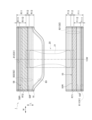
- 3 is a cross-sectional view taken along line AA shown in FIG. 2.
- FIG. 4 is a diagram schematically showing a state in which the absorbent article is attached to the wearer.
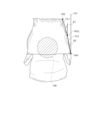
- FIG. 5 is a diagram schematically showing an absorbent article placed on a table in a natural state.
- a pants-type absorbent article includes an absorbent main body having a front-rear direction and a width direction perpendicular to each other, an absorbent core and arranged at least in a crotch region, and the absorbent main body and the absorbent main body laminated in a thickness direction.
- a back exterior body arranged in a rear waist region, a front exterior body laminated in a thickness direction with the absorbent body and arranged in a front waist region, and the front exterior body and the back exterior body joined together and a side joint.
- the absorbent article includes a rear waist region arranged between a waist opening of the rear waist region and a rear edge of the absorbent main body, and a rear edge of the absorbent main body and a rear edge of the absorbent core. It has a back intermediate region positioned therebetween and a front waist positioned between the waist opening of the front waist region and the front edge of the absorbent body.
- the rear waist region includes a rear first waist region extending forward from the waist opening, and a rear first waist region positioned forward of the rear first waist region and having a contraction force smaller than that of the rear first waist region in the width direction. and a rear second waist region.
- the contractile force of the rear second waist region in the width direction is smaller than the contractile force of the rear intermediate region in the width direction.
- the length in the width direction of the back waist region in the natural state of the absorbent article is longer than the length in the width direction of the front waist region in the natural state.
- the contractile force of the rear second waist region is lower than the contractile force of the rear intermediate region, and when the wearer spreads the absorbent article in the width direction, the rear waist region smoothly expands and fits on the buttocks. Hard to catch.
- the length of the rear waist region in the width direction in the natural state is longer than the length of the front waist region in the width direction in the natural state, it is possible to suppress the buttocks from being caught when pulled up with the side joints.
- the post-exterior body is formed by laminating a plurality of exterior sheets.
- a high basis weight region in which the total basis weight of the exterior sheets laminated in the thickness direction in the rear exterior body is the highest is arranged in the rear intermediate region.
- the rigidity of the rear intermediate region is increased by the high basis weight region, and by suppressing the back intermediate region from sagging and twisting, it is possible to further suppress catching on the buttocks.
- the high basis weight region is arranged across the rear intermediate region and the rear waist region, and is arranged across the rear edge of the absorbent main body in the front-rear direction. ing.
- the high basis weight area straddles the rear edge of the absorbent main body, the rigidity of the back exterior body in the vicinity of the rear edge of the absorbent main body is increased, and the rear edge of the absorbent main body is increased. It is possible to suppress the catching of the edge.
- the angle formed by the width center line passing through the center of the width direction and parallel to the front-rear direction is 35 degrees or less.
- the first angle formed by a width center line that passes through the center of the width direction and is parallel to the front-rear direction is ⁇ 1
- the pull-up force is divided at the point where the angle changes greatly, and the pull-up force is applied to the exterior body.
- the difference between ⁇ 1 and ⁇ 2 is 10 degrees or less, even when the upper end of the side joint is pulled up, the force is not divided in the middle, and the force when pulling up the entire exterior body does not break. Easy to apply. Therefore, the mounting operation can be performed smoothly.
- the post-exterior body has a post-inner material located closer to the skin than the absorbent main body.
- the rear inner material is arranged across the rear edge of the absorbent main body in the front-rear direction. According to this aspect, it is possible to cover the skin surface side of the rear edge of the absorbent main body with the rear inner material, thereby further suppressing the rear edge of the absorbent main body from being caught.
- the front exterior body has a front inner material located closer to the skin surface than the absorbent main body.
- the length of the rear inner member in the front-rear direction is longer than the length of the front inner member in the front-rear direction.
- the skin surface side of the absorbent main body can be covered with the front inner material, and catching of the absorbent main body can be suppressed. Since the length of the rear inner material is longer than that of the front inner material, when the absorbent article is lifted up during wearing, the rear waist area is less likely to swell, and the buttocks can be prevented from being caught.
- the post-exterior body has a post-inner material positioned closer to the skin surface than the absorbent body, and a post-outer material joined to the non-skin surface of the absorbent body.
- the bending rigidity of the rear inner member in the front-rear direction is higher than the bending rigidity of the rear outer member in the front-rear direction. According to this aspect, since the bending rigidity in the front-rear direction of the rear inner member is higher than the bending rigidity in the front-rear direction of the rear outer member, the rear inner member is less likely to sag than the rear outer member.
- the absorbent main body when the absorbent main body is deformed so as to swell in the thickness direction, the absorbent main body is more likely to deform toward the non-skin surface side than toward the skin surface side. It is possible to suppress the generation of unevenness on the skin surface side of the absorbent article, and to further suppress the absorbent article from being caught when it is pulled up.
- the flexural rigidity of the rear outer material since the flexural rigidity of the rear outer material is low, it is soft when touched by the wearer, etc., and can realize a texture like underwear.
- the post-exterior body includes a post-outer material joined to the non-skin surface of the absorbent main body, a second post-outer material positioned closer to the non-skin surface than the post-outer material, have
- the bending rigidity of the rear outer member in the front-rear direction is higher than the bending rigidity of the second rear outer member in the front-rear direction.
- the rear outer material is less likely to sag than the second rear outer material. Since the flexural rigidity of the rear outer material that comes into contact with the skin is high, unevenness is less likely to be formed, and catching of the absorbent article when it is pulled up can be further suppressed.
- the adhesive for bonding the non-skin surface of the absorbent main body and the skin surface of the post-exterior body includes the skin-side adhesive applied to the absorbent main body and the adhesive applied to the post-exterior body. and a non-skin side adhesive.
- the coating pattern of the skin-side adhesive extends along the width direction.
- the coating pattern of the non-skin side adhesive extends along the front-rear direction.
- the non-skin side adhesive along the up-down direction Force can be transmitted to the absorbent main body side.
- the force transmitted to the absorbent body can be transmitted to the entire width of the absorbent body via the skin-side adhesive extending in the width direction. Therefore, when pulling up the exterior body, the entire width direction of the absorbent main body can be pulled up.
- a plurality of first elastic members that stretch in the width direction are arranged in the rear first waist region.
- a second elastic member that expands and contracts in the width direction is arranged in the rear second waist region.
- the distance between the first elastic members in the front-rear direction is shorter than the distance between the second elastic members in the front-rear direction.
- the thickness of the rear first waist region is likely to be thinner than the thickness of the rear second waist region, and a thickness difference is formed between the rear first waist region and the rear second waist region. Due to the thickness difference, it becomes easier to grasp the position to be gripped at the time of mounting, and it is possible to grip and pull up at an appropriate position on the left and right (without vertically shifting the gripping position on the left and right). By pulling up the absorbent article evenly from side to side, it is possible to further suppress catching on the body.
- the front waist region includes a front first waist region extending rearward from the waist opening, and a front first waist region positioned rearward of the front first waist region and further than the front first waist region. and a front second waist region smaller than the contractile force in the width direction.
- the widthwise length of the rear second waist region in the natural state of the absorbent article is longer than the widthwise length of the front second waist region in the natural state.
- the length in the width direction of the rear second waist region in the natural state is longer than the length in the width direction of the front second waist region in the natural state. It is possible to suppress catching on. Therefore, it is possible to prevent the absorbent main body from being caught on the buttocks and twisted or turned up when the absorbent article is pulled up.
- the absorbent article is for adults.
- a wearer who wears an absorbent article for adults may have insufficient muscle strength in the hands and feet, or may find it difficult to correct the catching of the buttocks by turning the hand to the rear side, which may cause troubles in the wearing operation.
- FIG. 1 is a schematic front view of an absorbent article according to this embodiment.
- FIG. 2 is a schematic plan view of an absorbent article according to this embodiment.
- 3 is a cross-sectional view taken along line AA shown in FIG. 2.
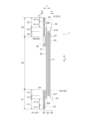
- FIG. 4 is a diagram schematically showing a state in which the absorbent article 1 is worn by a wearer.
- FIG. 4 is a diagram showing the mounting state of the side surface side in a standing state.
- a line of the wearer's body is indicated by a one-dot chain line BL.
- each member may be spaced apart in the thickness direction T for convenience of explanation, but they are in contact with each other in the thickness direction T in an actual product.
- the outer portion in the present invention is a portion occupying a certain range in the width direction W including the outer edge in the width direction W, and the outer edge is the outer edge in the width direction W.
- the inner portion in the present invention is a portion occupying a certain range in the width direction W including the inner edge in the width direction W, and the inner edge is the inner edge in the width direction W.
- front end portion and the rear end portion in the present invention are portions occupying a certain range in the front-rear direction L including edges in the front-rear direction L, and the front end edge and the rear end edge are edges in the front-rear direction L.
- the outer edge includes a leading edge and a trailing edge, and the outer edge includes a leading edge and a trailing edge.
- the absorbent article 1 has a front-rear direction L and a width direction W perpendicular to the front-rear direction L.
- the front-rear direction L is defined by the direction extending to the front side of the body and the rear side of the body.
- the front-rear direction L is a direction extending front-rear in the unfolded absorbent article 1 .
- the absorbent article 1 has a thickness direction T in which both the front-rear direction L and the width direction W are perpendicular to each other.
- the thickness direction T extends to a skin side T1 facing the wearer and a non-skin side T2 opposite to the skin side T1.
- the absorbent article 1 has a front waist region S1, a back waist region S2, and a crotch region S3.
- the front waist region S1 is a region arranged around the wearer's front waist (abdomen).
- the back waist region S2 is a region arranged on the back side of the wearer.
- the crotch region S3 is a region that is arranged between the front waist region S1 and the back waist region and that is arranged at the wearer's crotch.
- the absorbent article 1 may have an absorbent main body 20 and an exterior body 50 .
- the absorbent main body 20 may be configured as a separate body from the exterior body 50 .
- the absorbent main body 20 has an absorbent core 21 and is arranged at least in the crotch region S3.
- the absorbent main body 20 may extend in the longitudinal direction L from the crotch region S3 to the front waist region S1, and may extend in the longitudinal direction L from the crotch region S3 to the back waist region S2.
- the absorbent main body 20 may overlap the outer body 50 in the thickness direction T in the front waist region S1 and the back waist region S2.
- the absorbent main body 20 has an absorbent core 21 arranged at least in the crotch region S3.
- the absorbent core 21 comprises an absorbent material that absorbs liquids.
- the absorbent core 21 may be covered with a core wrap 22 .
- the absorbent main body 20 comprises a skin sheet 25 located on the skin side T1 of the absorbent core 21, a liquid-impermeable sheet 26 located on the non-skin side T2 of the absorbent core 21, and the liquid-impermeable sheet 26. and a body sheet 27 disposed on the non-skin side T2.
- the skin sheet 25 and the body sheet 27 may be made of nonwoven fabric, for example.
- the liquid-impermeable sheet 26 may be made of, for example, a film.
- the outer body 50 is laminated with the absorbent main body 20 in the thickness direction T, and is laminated with the front outer body 51 arranged in the front waist region S1 and the absorbent main body 20 in the thickness direction T, and is laminated in the back waist region S2. and a rear exterior body 52 disposed thereon. At least a portion of the front exterior body 51 may overlap the absorbent main body 20 , and at least a portion of the rear exterior body 52 may overlap the absorbent main body 20 .
- the front exterior body 51 and the rear exterior body 52 may be spaced apart in the front-rear direction L, or may be connected to each other. The length in the front-rear direction L of the rear exterior body 52 may be longer than that of the front exterior body 51 .
- the back exterior body 52 may be arranged across the back waist region S2 and the crotch region S3.
- the center of the rear exterior body 52 in the width direction W may extend toward the crotch region S3 from the side joints 16 .
- the absorbent article 1 is provided with side joints 16 that join the front waist region S1 and the rear waist region S2.
- the side joint portion 16 is a portion where the outer portion of the front exterior body 51 that constitutes the front waist region S1 and the outer portion of the rear exterior body 52 that constitutes the rear waist region S2 are engaged with each other.
- the absorbent article 1 has a waist opening 62 through which the wearer's torso is passed and a pair of legs into which the wearer's legs are respectively inserted.
- a turning opening 66 is formed.
- the waist opening 62 may be defined by a front edge S1F of the front waist region S1 and a rear edge S2R of the rear waist region S2.
- FIG. 2 shows a stretched state in which the side joints 16 are released and the absorbent article 1 is unfolded and stretched in the front-rear direction L and the width direction W.
- the side joint portion 16 may extend along the front-rear direction L in each of the front exterior body 51 and the rear exterior body 52 .
- the boundary between the front waist region S ⁇ b>1 and the crotch region S ⁇ b>3 may be defined by the rear edges of the side joints 16 provided in the front exterior body 51 .
- a boundary between the rear waist region S2 and the crotch region S3 may be defined by the front edge of the side joint portion 16 provided in the rear exterior body 52 .
- the crotch region S3 may be a region in which the leg openings 66 are provided.
- the leg openings 66 may be portions recessed inward in the width direction W from the outer edge of the absorbent article 1 .
- the front exterior body 51 and the rear exterior body 52 may have a plurality of exterior sheets such as nonwoven fabric.
- the exterior sheet of the front exterior body 51 has a front outer material located on the non-skin surface side T2 of the absorbent main body 20 and a front inner material 55 located on the skin surface side T1 of the absorbent main body 20. you can A plurality of front outer members may be provided.
- the front outer material includes a first front outer material 53 joined to the non-skin surface of the absorbent main body 20, and a second front outer material 54 located on the non-skin surface side T2 of the first front outer material 53. may have
- the first front outer material 53 and the second front outer material 54 may be composed of the same folded sheet, or may be composed of separate sheets.
- the front inner material 55 may be composed of a portion in which at least one of the front outer materials is folded back to the skin surface side T1, or may be composed of a sheet separate from the front outer material.
- the exterior sheet of the post-exterior body 52 has a rear outer material located on the non-skin surface side T2 of the absorbent main body 20 and a rear inner material 58 located on the skin surface side T1 of the absorbent main body 20. you can A plurality of rear outer materials may be provided.
- the rear outer material includes a first rear outer material 56 joined to the non-skin surface of the absorbent main body 20 and a second rear outer material 57 located on the non-skin surface side T2 of the first rear outer material 56.
- the first rear outer material 56 and the second rear outer material 57 may be composed of the same folded sheet, or may be composed of separate sheets. Further, the rear inner material 58 may be constituted by a portion in which at least one of the rear outer materials is folded back toward the skin surface side T1, or may be constituted by a sheet separate from the rear outer material.
- an elastic member that can be stretched in the width direction W may be arranged between the outer sheets of the outer body 50.
- the elastic member may be composed of, for example, a thread rubber stretchable in the width direction W or an elastic sheet stretchable in the width direction W.
- the elastic member may be constituted by the exterior sheet itself, for example constituted by a stretchable sheet.
- the elastic member of the present embodiment is made of rubber thread.
- the elastic members are a first elastic member 81, a second elastic member 82 positioned closer to the crotch region S3 than the first elastic member 81, and a third elastic member positioned closer to the crotch region S3 than the second elastic member 82. 83 and .
- the expansion ratio of the first elastic member 81 may be different from the expansion ratio of the second elastic member 82 and may be different from the expansion ratio of the third elastic member 83 .
- the expansion ratio of the second elastic member 82 may be different from the expansion ratio of the third elastic member 83 .
- the interval in the front-rear direction L of the first elastic member 81 may be different from the interval in the front-rear direction L of the second elastic member 82 , and may be different from the interval in the front-rear direction L of the third elastic member 83 .
- the interval in the front-rear direction L of the second elastic members 82 may be different from the interval in the front-rear direction L of the third elastic members 83 .
- the first elastic member 81, the second elastic member 82, and the third elastic member 83 may be arranged to extend in the width direction W, and may be provided so as to be extendable in the width direction W.
- the first elastic member 81 and the second elastic member 82 are arranged in the front exterior body 51 and the rear exterior body 52, respectively, along the width direction W.
- the third elastic member 83 is not arranged on the front exterior body 51 but is arranged on the rear exterior body 52 .
- the third elastic member 83 is arranged across the rear waist region S2 and the crotch region S3, and the center in the width direction of the third elastic member 83 is curved so as to expand toward the crotch region S3.
- the first elastic member 81 is the elastic member closest to the waist opening 62 among the plurality of elastic members (the first elastic member, the second elastic member, and the third elastic member).
- the first elastic member 81 is arranged between the first front outer member 53 and the second front outer member 54 and between the first rear outer member 56 and the second rear outer member 57 . and a first elastic member 812 after being deployed.
- the front first elastic member 811 and the rear first elastic member 812 of the present embodiment may each be provided with six pieces of 940 dtex rubber at an expansion ratio of 2.8 times.
- the front first elastic member 811 may be arranged in a front first waist region F111, which will be described later, and the rear first elastic member 812 may be arranged in a rear first waist region R111, which will be described later.
- the second elastic member 82 includes a front second elastic member 821 arranged between the first front outer member 53 and the second front outer member 54 and between the first rear outer member 56 and the second rear outer member 57. and a second elastic member 822 after being deployed.
- the front second elastic members 821 may be arranged in a front second waist region F112, a front intermediate region F12, and a front leg side region F13, which will be described later.
- nine pieces of 620 dtex rubber are arranged at an expansion ratio of 2.4 times, and two pieces of 780 dtex rubber are arranged on the crotch region S3 side of the nine pieces of rubber. .5 are arranged at a magnification of 4 times.
- the front edge of the absorbent core 21 is arranged at the boundary between the nine rubber threads and the five rubber threads. That is, the expansion ratio of the front second elastic member 821 in the region overlapping the absorbent core 21 is the expansion ratio of the front second elastic member 821 in the region not overlapping the absorbent core 21 (the region on the front side of the front edge of the absorbent core). higher than The front edge 20F of the absorbent main body 20 overlaps the area where the nine rubber threads are arranged. Therefore, the expansion ratio of the front second elastic member is the same on the front side and the rear side with respect to the front edge 20F of the absorbent main body 20 as a boundary.
- the rear second elastic members 822 may be arranged in a rear second waist region R112, a rear intermediate region R12, and a rear leg side region R13, which will be described later.
- the rear second elastic member 822 of the present embodiment five rubbers of 620 dtex are arranged at an expansion ratio of 2.4 times, and two rubbers of 780 dtex are arranged on the crotch region S3 side of the five rubbers.
- Ten lines are arranged at a magnification of .4 times.
- the rear edge of the absorbent main body 20 is arranged at the boundary between the five rubber threads and the ten rubber threads.
- the extension ratio of the rear second elastic member 822 in the region overlapping the absorbent main body 20 is the rear second elastic member 822 in the region not overlapping the absorbent main body 20 (the region behind the rear edge of the absorbent main body). It is higher than the expansion ratio of member 822 .
- the rear edge 21R of the absorbent core 21 overlaps the area where ten rubber threads are arranged. Therefore, the expansion ratio of the rear second elastic member 822 does not differ between the front side and the rear side with respect to the rear edge 20R of the absorbent core 21, and is the same.
- the number of rear second elastic members 822 is greater than the number of front second elastic members 821 .
- the interval in the front-rear direction L of the front first elastic member 811 is shorter than the interval in the front-rear direction L of the front second elastic member 821 .
- the interval in the front-rear direction L between the rear first elastic members 812 is shorter than the interval in the front-rear direction L between the rear second elastic members 822 .
- the absorbent article 1 is configured to prevent the buttocks from being caught when worn, and to improve wearability. Next, a detailed description will be given of a configuration for improving wearability by suppressing catching of the buttocks when worn.
- the absorbent article 1 has multiple regions. Each region is a region of the entire absorbent article 1 (a region where the outer body 50 and the absorbent main body 20 are combined).
- the front waist region S1 includes a front waist region F11 arranged between the waist opening 62 of the front waist region S1 and the front edge 20F of the absorbent main body 20, the front edge 20F of the absorbent main body 20, and the front edge of the absorbent core 21.
- the front waist region F11 includes a front first waist region F111 extending rearward from the waist opening 62, and a front first waist region F111 located rearward of the front first waist region F111 and having a widthwise contraction force greater than the front first waist region F111. and a small front second waist region F112.
- the front first waist region F111 of the present embodiment is a region in which the front first elastic member 811 is arranged, and the front second waist region F112 is a region in which the front second elastic member 821 is arranged.
- the boundary between the front first waist region F111 and the front second waist region F112 may be the position of the front first elastic member 811 positioned closest to the crotch side.
- the rear exterior body 52 includes a rear waist region R11 arranged between the waist opening 62 of the rear waist region S2 and the rear edge 20R of the absorbent main body 20, the rear edge 20R of the absorbent main body 20, and the absorbent core 21. It has a rear intermediate region R12 arranged between the rear edges 21R, and a rear leg side region R13 positioned between the rear edges 21R of the absorbent core 21 and the front edges of the side joints 16 of the rear waist region S2.
- the rear waist region R11 is located forward of the first rear waist region R111 extending forward from the waist opening 62 and the first rear waist region R111, and the contraction force in the width direction W is greater than the first rear waist region R111. and a small rear second waist region R112.
- the rear first waist region R111 of the present embodiment is a region where the rear first elastic member 812 is arranged, and the rear second waist region R112 is a region where the rear second elastic member 822 is arranged.
- the boundary between the rear first waist region R111 and the rear second waist region R112 may be the position of the rear first elastic member 812 positioned closest to the crotch side.
- the contractile force in the width direction W of the rear second waist region R112 is smaller than the contractile force in the width direction W of the rear intermediate region R12.
- the "contraction force" of each region is measured by the following method. First, a test piece to be measured is prepared. The side joints 16 of the absorbent article 1 are released and the absorbent article 1 is unfolded. When the absorbent main body 20 is joined to the front waist region S1 and the rear waist region S2, each region is cut without releasing the joining to obtain a test piece. Next, the length in the width direction W and the length in the front-rear direction L are measured in the stretched state in which the absorbent article 1 is stretched, a line is drawn at the boundary, and a test piece is cut out.
- Both ends of the cut test piece are clamped by a chuck (clamping tool) of a tensile tester.
- the distance between chucks is set to 150 mm.
- the other chuck is moved so as to change the distance between the chucks.
- the moving speed of the chuck at this time is 300 mm/min.
- the stress applied to the chuck is measured while the chuck is moving, and the stress (N) obtained at 60% (constant width) from the stretched state is defined as "contraction force". In this manner, the contractile force in the width direction of each region can be obtained.
- the length in the front-back direction is shortened so that the length of the test piece in the front-back direction is the same. Cut the longitudinal length of the other test piece to match the test piece.
- the length in the width direction W of the rear waist region R11 in the natural state of the absorbent article 1 is longer than the length in the width direction W of the front waist region F11 in the natural state. Therefore, as shown in FIG. 4, when the absorbent article 1 is worn, the side joints 16 are biased forward when compared with the wearer's side portions (portions extending downward from the armpits) BL1 as a base point. there is When pulling up the absorbent article 1, the left and right side joints 16 are generally grasped with the left and right hands and pulled up.
- the waist region extending from the waist opening 62 toward the crotch region is longer than the length of the front waist region S1, and it is possible to suppress the buttocks from being caught when the side joints 16 are pulled up. Therefore, it is possible to prevent the absorbent main body 20 from being caught on the buttocks and twisted or turned up when the absorbent article 1 is pulled up.
- the length in the width direction W of the rear second waist region R112 in the natural state of the absorbent article may be longer than the length in the width direction W of the front second waist region F112 in the natural state.
- the length in the width direction W of the rear second waist region R112 in the natural state is longer than the length in the width direction W of the front second waist region F112 in the natural state. It is possible to suppress catching on the buttocks when pulled up. Therefore, it is possible to prevent the absorbent main body 20 from being caught on the buttocks and twisted or turned up when the absorbent article 1 is pulled up.
- the measurement of the length in the width direction W of each region can be obtained by the following method.
- the side joints 16 of the absorbent article 1 are released to separate the front waist region S1 and the rear waist region S2. After leaving the absorbent article 1 in an environment with a temperature of 23 ° C. ⁇ 2 ° C.
- the absorbent article 1 is stretched until no wrinkles are visible, and the front waist region F11 and In each of the rear waist regions R11, a mark is attached in the front-rear direction from the waist opening 62 at a pitch of 10 mm, and a line passing through the marks along the width direction is attached, and a front second waist region F112 and a rear second waist region R112 3, marks are given in the front-rear direction from the waist opening 62 at a pitch of 10 mm, and lines are drawn along the width direction through the marks.
- the front waist region F11 and the rear waist region R11 are cut out without releasing the joining to obtain a test piece
- the front second waist region F112 and the rear second waist region R112 are cut out to obtain test pieces.
- a 5 mm acrylic plate is placed on the test piece, the test piece is sandwiched between the stand and the acrylic plate, and the length of the test piece in the width direction is measured.
- the measurement of the length in the width direction measures the length of the line drawn along the width direction in the stretched state described above. Therefore, the length of the natural state is measured multiple times in each region.
- test piece If the test piece is curved, bend the soft measure to measure. If the absorber is placed in the area, it is difficult to sandwich the test piece between the table and the acrylic plate due to the thickness of the absorber. to measure. The average value of the measurements taken in the front waist region and the average value of the measurements taken in the back waist region are compared.
- the contractile force in the width direction W of the rear second waist region R112 is smaller than the contractile force in the width direction of the rear intermediate region R12.
- both legs are passed through the leg openings 66 and the absorbent article 1 is pulled up to the waist.
- the wearer or the wearing assistant grasps the vicinity of the waist opening 62 of the absorbent article 1 and pulls it up while widening the vicinity of the waist opening 62 in the width direction.
- the rear first waist region R111 in the vicinity of the waist opening 62 is likely to be subject to a force that spreads the absorbent article 1 in the width direction W by the wearer, and is less likely to get caught on the buttocks or the like when pulled up.
- the rear second waist region R112 located away from the waist opening 62 is difficult for the wearer to apply a force to widen the absorbent article 1 in the width direction, and is likely to be caught by the bulge of the buttocks. If the rear second waist region R112 is caught on the buttocks, the rear end of the absorbent main body 20 may be twisted or turned up, and the absorbent main body 20 may not be properly arranged so as to cover the body.
- the contractile force of the rear second waist region R112 is lower than the contractile force of the rear intermediate region R12, and when the wearer spreads the absorbent article 1 in the width direction W, the rear second waist region R112 Spreads smoothly and does not get caught on the buttocks.
- the contractile force of the rear intermediate region R12 adjacent to the rear second waist region R112 is high, it is possible to ensure fit when worn. Therefore, it is possible to improve the wearability by suppressing the buttocks from being caught while ensuring the fit when worn.
- the distance between the rear first elastic members 812 in the front-rear direction L may be shorter than the distance between the rear second elastic members 822 in the front-rear direction L.
- the thickness of the rear first waist region R111 tends to be thinner than the thickness of the rear second waist region R112. That is, a thickness difference is formed between the rear first waist region R111 and the rear second waist region R112. Due to the thickness difference, it becomes easier to grasp the position to be gripped at the time of mounting, and it is possible to grip and pull up at an appropriate position on the left and right (without vertically shifting the gripping position on the left and right). By pulling up the absorbent article 1 evenly to the left and right, it is possible to further suppress catching on the body.
- the expansion ratio of the rear first elastic member 812 may be higher than the expansion ratio of the rear second elastic member 822 . Even with this configuration, the thickness of the rear first waist region R111 is likely to be thinner than the thickness of the rear second waist region R112, and the operability at the time of pulling up can be improved.
- the distance between the front first elastic members 811 in the front-rear direction L may be shorter than the distance between the front second elastic members 821 in the front-rear direction L.
- the thickness of the front first waist region F111 is likely to be thinner than the thickness of the front second waist region F112. That is, a thickness difference is formed between the front first waist region F111 and the front second waist region F112. Due to the thickness difference, it becomes easier to grasp the position to be gripped at the time of mounting, and it is possible to grip and pull up at an appropriate position on the left and right (without vertically shifting the gripping position on the left and right). By pulling up the absorbent article evenly from side to side, it is possible to further suppress catching on the body.
- the expansion ratio of the front first elastic member 811 may be higher than the expansion ratio of the front second elastic member 821 . Even with this configuration, the thickness of the front first waist region F111 is likely to be thinner than the thickness of the front second waist region F112, and the operability at the time of lifting can be improved.
- FIG. 5 is a diagram schematically showing the absorbent article placed on a table in its natural state.
- a first imaginary line FL1 connecting the center 16CL of the side joint portion 16 in the front-rear direction L and the outer edge 16G of the side joint portion 16 in the front-rear direction L;
- An angle ⁇ 1 formed by a width center line 1CW passing through the center of the width direction W and parallel to the front-rear direction L may be 35 degrees or less.
- the angle between the first imaginary line FL1 and the width center line 1CW is the angle formed by the first imaginary line FL1 and a line parallel to the width center line 1CW (a line obtained by moving the width center line 1CW outward in the width direction).
- the angle is measured in a state of being placed on a table as shown in FIG. More specifically, after leaving the absorbent article 1 on a table for 2 hours in an environment with a temperature of 23 ° C ⁇ 2 ° C and a humidity of 50% ⁇ 5%, the width direction and the front-back direction of the absorbent article With a 1 kg weight 100 placed across the center, the outer edge of the absorbent article is measured with a line 1CL parallel to the center of the width as a reference (applying a ruler to the outer edge of the absorbent article).
- the center 16CL in the front-rear direction L of the side joint portion 16 is the center position in the front-rear direction L of the outer edge of the side joint portion.
- the line extending from the center 16CL in the front-rear direction of the side joints 16 toward the waist opening 62 is not excessively inclined with respect to the width center line, it is possible to smoothly insert the hand inside the side joints. A hand can be put in, and the mounting operation can be performed smoothly.
- a first imaginary line FL1 that connects the center 16CL of the side joint portion 16 in the front-rear direction L and the outer edge 16G of the side joint portion in the front-rear direction and the width center line 1CW form a first virtual line FL1.
- One angle is ⁇ 1
- the second angle formed by the width center line 1CW and the second imaginary line FL2 connecting the center 16CL in the front-rear direction of the side joint and the inner edge 16H in the front-rear direction of the side joint is ⁇ 2.
- the difference between ⁇ 1 and ⁇ 2 may be 10 degrees or less.
- the angle formed by the second virtual line FL2 and the width center line 1CW is defined by a line parallel to the width center line 1CW (a line obtained by moving the width center line 1CW outward in the width direction) and the second virtual line FL2. It may be the same as the angle to form.
- the difference between ⁇ 1 and ⁇ 2 is 10 degrees or less, even when the upper end of the side joint is pulled up, the force is not divided in the middle, and the force when pulling up the entire exterior body does not break. Easy to apply. Therefore, the mounting operation can be performed smoothly. Also, ⁇ 1> ⁇ 2 may be satisfied. That is, the first virtual line may be more inclined with respect to the width center line than the second virtual line FL2.
- the rear exterior body 52 may have a rear high basis weight region R72 where the total basis weight of the exterior sheets laminated in the thickness direction T in the rear exterior body 52 is the highest.
- the rear high basis weight area R72 constitutes the "high basis weight area" of the present invention, and is the area where the total basis weight of each sheet is the highest.
- the first rear outer member 56 and the second rear outer member 57 are arranged over the entire rear exterior body 52, and the rear inner member 58 is arranged partially. Therefore, the area where the rear inner material 58 is arranged constitutes the rear high basis weight area R72.
- the rear high basis weight region R72 is hatched.
- the rear high basis weight area R ⁇ b>72 is arranged across the left and right side joints 16 and arranged over the entire area of the rear exterior body 52 .
- the rear high basis weight region R72 may be arranged in at least a portion of the rear intermediate region R12. If the rear intermediate region R12 of the back exterior body 52 is twisted or shrunk, the thickness of the back exterior body 52 is increased, or unevenness is formed on the inner surface of the absorbent article 1. easier to get caught.
- the rigidity of the rear intermediate region R12 is increased by the rear high basis weight region R72, and the back intermediate region R12 is prevented from sagging or twisting, thereby further suppressing the catching on the buttocks.
- the rear high basis weight region R72 is arranged across the rear intermediate region R12 and the rear waist region R11, and arranged across the rear edge 20R of the absorbent main body 20 in the front-rear direction L. you can The rear edge 20R of the absorbent main body 20 is located on the boundary between the rear intermediate region R12 and the rear waist region R11. thickness difference occurs. There is a possibility that the buttocks may be caught due to the difference in thickness due to the presence or absence of the absorbent main body 20 . However, according to this aspect, since the rear high basis weight region R72 straddles the rear edge 20R of the absorbent main body 20, the rigidity of the rear exterior body 52 near the rear edge 20R of the absorbent main body 20 increases.
- the length of the rear high basis weight area R72 in the rear waist area R11 in the front-rear direction may be longer than the length of the rear high basis weight area R72 in the rear intermediate area R12 in the front-rear direction.
- the rear waist region R11 can be easily formed into a flat shape, and the absorbent article can be pulled up more smoothly from the waist opening 62 side.
- the front exterior body 51 may have a front high basis weight area R71 where the total basis weight of the exterior sheets laminated in the thickness direction T in the front exterior body 51 is the highest.
- the first front outer member 53 and the second front outer member 54 are arranged over the entire front exterior body 51, and the front inner member 55 is arranged partially. Therefore, the area where the front inner material 55 is arranged constitutes the front high basis weight area R71.
- the front high basis weight region R71 is hatched.
- the front high basis weight region R71 is arranged across the left and right side joint portions 16 and is arranged over the entire area of the front exterior body 51 .
- the front high basis weight area R71 may be arranged in at least part of the front intermediate area F12.
- the rigidity of the front intermediate region F12 is increased by the front high basis weight region R71, and the front intermediate region F12 is prevented from sagging or twisting, thereby suppressing the swelling of the abdomen.
- the front high basis weight area R71 may be arranged across the front intermediate area F12 and the front waist area F11.
- the rigidity of the front exterior body 51 in the vicinity of the front edge 20F of the absorbent main body 20 can be increased, and the front edge 20F of the absorbent main body 20 can be prevented from being caught.
- the length of the rear high basis weight region R72 in the front-rear direction may be longer than the length of the front high basis weight region R71 in the front-rear direction.
- the inner surface of the back exterior body 52 can be suppressed from sagging, and it is possible to further suppress the buttocks from being caught in the rear waist region.
- the rear inner material 58 may be arranged across the rear edge 20R of the absorbent main body 20 in the front-rear direction. According to this aspect, the rear inner material 58 can cover the skin surface side of the rear edge 20R of the absorbent main body 20 with the rear inner material 58, so that the rear edge 20R of the absorbent main body 20 can be further suppressed from being caught. .
- the rear edge 58R of the rear inner material 58 is positioned rearward of the rear edge 20R of the absorbent main body 20, and the front edge 58F of the rear inner material 58 is positioned frontward of the rear edge 20R of the absorbent main body 20. , and may be positioned rearward of the rear edge 21R of the absorbent core 21 .
- the front inner material 55 may be arranged across the front edge 20F of the absorbent main body 20 in the front-rear direction. According to this aspect, the front inner material 55 can cover the skin surface side of the front edge 20F of the absorbent main body 20, and the front edge 20F of the absorbent main body 20 can be prevented from being caught.
- the front edge 55F of the front inner material 55 is positioned forward of the front edge 20F of the absorbent main body 20, and the rear edge 55R of the front inner material 55 is positioned rearward of the front edge 20F of the absorbent main body 20. However, it may be located forward of the front edge 21F of the absorbent core 21 .
- the length of the rear inner member 58 in the front-rear direction L may be longer than the length of the front inner member 55 in the front-rear direction L. According to this aspect, since the length of the rear inner member is longer than that of the front inner member, when the absorbent article is pulled up at the time of wearing, the rear waist region is less likely to become bulky, and the buttocks can be prevented from being caught.
- the bending rigidity in the front-rear direction L of the rear inner member 58 may be higher than the bending rigidity in the front-rear direction L of the first rear outer member 56 joined to the absorbent main body 20 .
- the rear inner member 58 is less likely to sag than the first rear outer member 56 . Therefore, when the absorbent main body 20 deforms so as to expand in the thickness direction T, the absorbent main body 20 is more likely to deform toward the non-skin surface side T2 than toward the skin surface side T1.
- the occurrence of unevenness on the skin surface side T1 of the absorbent article 1 can be suppressed, and the absorbent article 1 can be further suppressed from being caught when pulled up.
- the bending rigidity of the first rear outer material 56 is low, it is soft when touched by the wearer, etc., and can realize a texture like underwear.
- the bending rigidity in the front-rear direction L of the front inner member 55 may be higher than the bending rigidity in the front-rear direction L of the first front outer member 53 joined to the absorbent main body 20 .
- the front inner material 55 is less prone to sagging than the first front outer material 53, suppresses the occurrence of unevenness on the skin surface side T1 of the absorbent article 1, and makes it easier for the absorbent article to get caught when pulled up. can be suppressed.
- the bending rigidity of the first front outer material 53 is low, when the wearer or the like touches it, it is soft and can realize a texture like underwear.
- the bending rigidity of the seat can be measured using a digital force gauge 200gf (2N) (manufactured by SHIMPO model number FGP-0.2) and a force gauge stand (manufactured by SHIMPO model number GS-50X-H).
- the bending rigidity in the front-rear direction L of the first rear outer member 56 may be higher than the bending rigidity in the front-rear direction L of the second rear outer member 57 .
- the first rear outer member 56 is less likely to sag than the second rear outer member 57 . Since the bending rigidity of the first rear outer member 56 that comes into contact with the skin is high, irregularities are less likely to be formed, and catching of the absorbent article when pulled up can be further suppressed.
- the bending rigidity of the first front outer member 53 in the front-rear direction L may be higher than the bending rigidity of the second front outer member 54 in the front-rear direction.
- the first front outer member 53 is less prone to bulging than the second front outer member 54 . Since the bending rigidity of the first front outer material 53 in contact with the skin is high, irregularities are less likely to be formed, and catching of the absorbent article when pulled up can be further suppressed.
- the non-skin surface of the absorbent main body and the exterior body may be joined via an adhesive.
- the adhesive for adhering the skin surface of the post-exterior body may have a skin-side adhesive applied to the absorbent main body 20 and a non-skin-side adhesive applied to the post-exterior body 52 .
- the application pattern of the skin-side adhesive may extend along the width direction
- the application pattern of the non-skin-side adhesive may extend along the front-rear direction.
- the adhesive for bonding the skin surface of the front exterior body 51 has a skin side adhesive attached to the absorbent main body 20 and a non-skin side adhesive attached to the front exterior body 51. good.
- the application pattern of the skin-side adhesive may extend along the width direction W, and the application pattern of the non-skin-side adhesive may extend along the front-rear direction L.
- the coating pattern of the non-skin side adhesive extends along the front-rear direction
- the non-skin side adhesive along the up-down direction Force can be transmitted to the absorbent main body side.
- the force transmitted to the absorbent body can be transmitted to the entire width of the absorbent body via the skin-side adhesive extending in the width direction. Therefore, when pulling up the exterior body, the entire width direction of the absorbent main body can be pulled up.
- the absorbent article may be an absorbent article for adults.
- the absorbent article for adults means, for example, the ratio of the width direction W dimension of the absorbent main body 20 to the width direction W dimension of the absorbent article 1 in a natural state is 50% or less.
- the width direction W dimension of the absorbent article 1 and the width direction W main body of the absorbent main body 20 are measured, for example, at approximately the midpoint in the front-rear direction L of the front waist region S1 or the rear waist region S2 in the natural state.
- a wearer who wears an absorbent article for adults tends to have troubles in putting on the absorbent article, such as insufficient muscle strength in the hands and feet, difficulty in correcting the catching of the buttocks by turning the hand backward, and so on.
- the absorbent article of the present embodiment it is possible for the wearer to appropriately and smoothly wear the absorbent article by suppressing catching of the buttocks and suppressing troubles in the wearing operation.
Landscapes
- Health & Medical Sciences (AREA)
- Epidemiology (AREA)
- Engineering & Computer Science (AREA)
- Biomedical Technology (AREA)
- Heart & Thoracic Surgery (AREA)
- Vascular Medicine (AREA)
- Life Sciences & Earth Sciences (AREA)
- Animal Behavior & Ethology (AREA)
- General Health & Medical Sciences (AREA)
- Public Health (AREA)
- Veterinary Medicine (AREA)
- Absorbent Articles And Supports Therefor (AREA)
Priority Applications (1)
| Application Number | Priority Date | Filing Date | Title |
|---|---|---|---|
| CN202280080071.XA CN118434394A (zh) | 2021-12-20 | 2022-12-12 | 内裤型的吸收性物品 |
Applications Claiming Priority (2)
| Application Number | Priority Date | Filing Date | Title |
|---|---|---|---|
| JP2021206066A JP7550133B2 (ja) | 2021-12-20 | 2021-12-20 | パンツ型の吸収性物品 |
| JP2021-206066 | 2021-12-20 |
Publications (1)
| Publication Number | Publication Date |
|---|---|
| WO2023120279A1 true WO2023120279A1 (ja) | 2023-06-29 |
Family
ID=86902373
Family Applications (1)
| Application Number | Title | Priority Date | Filing Date |
|---|---|---|---|
| PCT/JP2022/045701 Ceased WO2023120279A1 (ja) | 2021-12-20 | 2022-12-12 | パンツ型の吸収性物品 |
Country Status (3)
| Country | Link |
|---|---|
| JP (2) | JP7550133B2 (enExample) |
| CN (1) | CN118434394A (enExample) |
| WO (1) | WO2023120279A1 (enExample) |
Families Citing this family (1)
| Publication number | Priority date | Publication date | Assignee | Title |
|---|---|---|---|---|
| JP7550133B2 (ja) * | 2021-12-20 | 2024-09-12 | ユニ・チャーム株式会社 | パンツ型の吸収性物品 |
Citations (5)
| Publication number | Priority date | Publication date | Assignee | Title |
|---|---|---|---|---|
| JP2011235020A (ja) * | 2010-05-13 | 2011-11-24 | Oji Nepia Co Ltd | 使い捨ておむつ |
| JP2011240052A (ja) * | 2010-05-20 | 2011-12-01 | Unicharm Corp | 使い捨て着用物品 |
| JP2015047367A (ja) * | 2013-09-02 | 2015-03-16 | ユニ・チャーム株式会社 | パンツ型着用物品 |
| JP2016010518A (ja) * | 2014-06-27 | 2016-01-21 | ユニ・チャーム株式会社 | パンツ型の着用物品 |
| WO2016158750A1 (ja) * | 2015-03-30 | 2016-10-06 | 大王製紙株式会社 | 吸収性物品及びその製造方法 |
Family Cites Families (4)
| Publication number | Priority date | Publication date | Assignee | Title |
|---|---|---|---|---|
| JP3175912B2 (ja) * | 1995-10-04 | 2001-06-11 | 花王株式会社 | 使い捨てパンツ型おむつ |
| JP3144550B2 (ja) * | 1999-01-07 | 2001-03-12 | 花王株式会社 | 使い捨ておむつ |
| JP6132638B2 (ja) | 2013-04-11 | 2017-05-24 | ユニ・チャーム株式会社 | パンツ型着用物品 |
| JP7550133B2 (ja) * | 2021-12-20 | 2024-09-12 | ユニ・チャーム株式会社 | パンツ型の吸収性物品 |
-
2021
- 2021-12-20 JP JP2021206066A patent/JP7550133B2/ja active Active
-
2022
- 2022-12-12 WO PCT/JP2022/045701 patent/WO2023120279A1/ja not_active Ceased
- 2022-12-12 CN CN202280080071.XA patent/CN118434394A/zh active Pending
-
2024
- 2024-08-28 JP JP2024146967A patent/JP2024160412A/ja active Pending
Patent Citations (5)
| Publication number | Priority date | Publication date | Assignee | Title |
|---|---|---|---|---|
| JP2011235020A (ja) * | 2010-05-13 | 2011-11-24 | Oji Nepia Co Ltd | 使い捨ておむつ |
| JP2011240052A (ja) * | 2010-05-20 | 2011-12-01 | Unicharm Corp | 使い捨て着用物品 |
| JP2015047367A (ja) * | 2013-09-02 | 2015-03-16 | ユニ・チャーム株式会社 | パンツ型着用物品 |
| JP2016010518A (ja) * | 2014-06-27 | 2016-01-21 | ユニ・チャーム株式会社 | パンツ型の着用物品 |
| WO2016158750A1 (ja) * | 2015-03-30 | 2016-10-06 | 大王製紙株式会社 | 吸収性物品及びその製造方法 |
Also Published As
| Publication number | Publication date |
|---|---|
| JP2023091360A (ja) | 2023-06-30 |
| JP7550133B2 (ja) | 2024-09-12 |
| CN118434394A (zh) | 2024-08-02 |
| JP2024160412A (ja) | 2024-11-13 |
Similar Documents
| Publication | Publication Date | Title |
|---|---|---|
| CN101803977B (zh) | 一次性穿着物品 | |
| TWI272096B (en) | Pull-on disposable wearing article | |
| CN102325513B (zh) | 内裤型吸收性物品 | |
| AU2014285564B2 (en) | Pull-on wearing article | |
| WO2010074131A1 (ja) | 着用物品及びその製造方法 | |
| JP5238567B2 (ja) | パンツ型吸収性物品 | |
| CN103079516A (zh) | 一次性穿用物品 | |
| JP7212458B2 (ja) | パンツ型使い捨ておむつ | |
| JP5238568B2 (ja) | パンツ型吸収性物品 | |
| JP2019536549A5 (enExample) | ||
| WO2023120279A1 (ja) | パンツ型の吸収性物品 | |
| CN107847370B (zh) | 一次性穿着物品 | |
| CN112334106B (zh) | 吸收性物品以及片构件 | |
| WO2013094334A1 (ja) | パンツ型吸収性物品 | |
| CN104780880B (zh) | 一次性尿布 | |
| TW201801693A (zh) | 短褲型吸收性物品 | |
| JP2018050831A (ja) | 吸収性物品 | |
| JP2010220783A (ja) | パンツ型吸収性物品 | |
| JP7217148B2 (ja) | 吸収性物品 | |
| JP3211442U (ja) | パンツ型の着用物品 | |
| WO2023276192A1 (ja) | 吸収性物品 | |
| JP6419012B2 (ja) | 使い捨て着用物品 | |
| JP7083640B2 (ja) | 吸収性物品 | |
| WO2025225344A1 (ja) | 吸収性物品 | |
| WO2025205650A1 (ja) | パンツ型吸収性物品 |
Legal Events
| Date | Code | Title | Description |
|---|---|---|---|
| 121 | Ep: the epo has been informed by wipo that ep was designated in this application |
Ref document number: 22910987 Country of ref document: EP Kind code of ref document: A1 |
|
| WWE | Wipo information: entry into national phase |
Ref document number: 202280080071.X Country of ref document: CN |
|
| REG | Reference to national code |
Ref country code: BR Ref legal event code: B01A Ref document number: 112024010931 Country of ref document: BR |
|
| WWE | Wipo information: entry into national phase |
Ref document number: 202417045316 Country of ref document: IN |
|
| NENP | Non-entry into the national phase |
Ref country code: DE |
|
| ENP | Entry into the national phase |
Ref document number: 112024010931 Country of ref document: BR Kind code of ref document: A2 Effective date: 20240531 |
|
| 122 | Ep: pct application non-entry in european phase |
Ref document number: 22910987 Country of ref document: EP Kind code of ref document: A1 |