WO2023112496A1 - 照明装置、導光板配置決定方法及び印刷システム - Google Patents
照明装置、導光板配置決定方法及び印刷システム Download PDFInfo
- Publication number
- WO2023112496A1 WO2023112496A1 PCT/JP2022/039842 JP2022039842W WO2023112496A1 WO 2023112496 A1 WO2023112496 A1 WO 2023112496A1 JP 2022039842 W JP2022039842 W JP 2022039842W WO 2023112496 A1 WO2023112496 A1 WO 2023112496A1
- Authority
- WO
- WIPO (PCT)
- Prior art keywords
- guide plate
- light guide
- light
- reading
- target area
- Prior art date
- Legal status (The legal status is an assumption and is not a legal conclusion. Google has not performed a legal analysis and makes no representation as to the accuracy of the status listed.)
- Ceased
Links
Images









Classifications
-
- G—PHYSICS
- G02—OPTICS
- G02B—OPTICAL ELEMENTS, SYSTEMS OR APPARATUS
- G02B6/00—Light guides; Structural details of arrangements comprising light guides and other optical elements, e.g. couplings
- G02B6/0001—Light guides; Structural details of arrangements comprising light guides and other optical elements, e.g. couplings specially adapted for lighting devices or systems
- G02B6/0011—Light guides; Structural details of arrangements comprising light guides and other optical elements, e.g. couplings specially adapted for lighting devices or systems the light guides being planar or of plate-like form
- G02B6/0033—Means for improving the coupling-out of light from the light guide
- G02B6/005—Means for improving the coupling-out of light from the light guide provided by one optical element, or plurality thereof, placed on the light output side of the light guide
- G02B6/0055—Reflecting element, sheet or layer
-
- B—PERFORMING OPERATIONS; TRANSPORTING
- B41—PRINTING; LINING MACHINES; TYPEWRITERS; STAMPS
- B41J—TYPEWRITERS; SELECTIVE PRINTING MECHANISMS, i.e. MECHANISMS PRINTING OTHERWISE THAN FROM A FORME; CORRECTION OF TYPOGRAPHICAL ERRORS
- B41J2/00—Typewriters or selective printing mechanisms characterised by the printing or marking process for which they are designed
- B41J2/005—Typewriters or selective printing mechanisms characterised by the printing or marking process for which they are designed characterised by bringing liquid or particles selectively into contact with a printing material
- B41J2/01—Ink jet
- B41J2/015—Ink jet characterised by the jet generation process
- B41J2/04—Ink jet characterised by the jet generation process generating single droplets or particles on demand
- B41J2/045—Ink jet characterised by the jet generation process generating single droplets or particles on demand by pressure, e.g. electromechanical transducers
- B41J2/04501—Control methods or devices therefor, e.g. driver circuits, control circuits
- B41J2/0451—Control methods or devices therefor, e.g. driver circuits, control circuits for detecting failure, e.g. clogging, malfunctioning actuator
-
- B—PERFORMING OPERATIONS; TRANSPORTING
- B41—PRINTING; LINING MACHINES; TYPEWRITERS; STAMPS
- B41J—TYPEWRITERS; SELECTIVE PRINTING MECHANISMS, i.e. MECHANISMS PRINTING OTHERWISE THAN FROM A FORME; CORRECTION OF TYPOGRAPHICAL ERRORS
- B41J2/00—Typewriters or selective printing mechanisms characterised by the printing or marking process for which they are designed
- B41J2/005—Typewriters or selective printing mechanisms characterised by the printing or marking process for which they are designed characterised by bringing liquid or particles selectively into contact with a printing material
- B41J2/01—Ink jet
- B41J2/015—Ink jet characterised by the jet generation process
- B41J2/04—Ink jet characterised by the jet generation process generating single droplets or particles on demand
- B41J2/045—Ink jet characterised by the jet generation process generating single droplets or particles on demand by pressure, e.g. electromechanical transducers
- B41J2/04501—Control methods or devices therefor, e.g. driver circuits, control circuits
- B41J2/04558—Control methods or devices therefor, e.g. driver circuits, control circuits detecting presence or properties of a dot on paper
-
- F—MECHANICAL ENGINEERING; LIGHTING; HEATING; WEAPONS; BLASTING
- F21—LIGHTING
- F21S—NON-PORTABLE LIGHTING DEVICES; SYSTEMS THEREOF; VEHICLE LIGHTING DEVICES SPECIALLY ADAPTED FOR VEHICLE EXTERIORS
- F21S2/00—Systems of lighting devices, not provided for in main groups F21S4/00 - F21S10/00 or F21S19/00, e.g. of modular construction
-
- G—PHYSICS
- G02—OPTICS
- G02B—OPTICAL ELEMENTS, SYSTEMS OR APPARATUS
- G02B6/00—Light guides; Structural details of arrangements comprising light guides and other optical elements, e.g. couplings
- G02B6/0001—Light guides; Structural details of arrangements comprising light guides and other optical elements, e.g. couplings specially adapted for lighting devices or systems
- G02B6/0011—Light guides; Structural details of arrangements comprising light guides and other optical elements, e.g. couplings specially adapted for lighting devices or systems the light guides being planar or of plate-like form
- G02B6/0081—Mechanical or electrical aspects of the light guide and light source in the lighting device peculiar to the adaptation to planar light guides, e.g. concerning packaging
- G02B6/0086—Positioning aspects
- G02B6/0088—Positioning aspects of the light guide or other optical sheets in the package
-
- G—PHYSICS
- G02—OPTICS
- G02B—OPTICAL ELEMENTS, SYSTEMS OR APPARATUS
- G02B6/00—Light guides; Structural details of arrangements comprising light guides and other optical elements, e.g. couplings
- G02B6/0001—Light guides; Structural details of arrangements comprising light guides and other optical elements, e.g. couplings specially adapted for lighting devices or systems
- G02B6/0011—Light guides; Structural details of arrangements comprising light guides and other optical elements, e.g. couplings specially adapted for lighting devices or systems the light guides being planar or of plate-like form
- G02B6/0081—Mechanical or electrical aspects of the light guide and light source in the lighting device peculiar to the adaptation to planar light guides, e.g. concerning packaging
- G02B6/0086—Positioning aspects
- G02B6/0091—Positioning aspects of the light source relative to the light guide
-
- G—PHYSICS
- G06—COMPUTING OR CALCULATING; COUNTING
- G06K—GRAPHICAL DATA READING; PRESENTATION OF DATA; RECORD CARRIERS; HANDLING RECORD CARRIERS
- G06K15/00—Arrangements for producing a permanent visual presentation of the output data, e.g. computer output printers
- G06K15/02—Arrangements for producing a permanent visual presentation of the output data, e.g. computer output printers using printers
- G06K15/12—Arrangements for producing a permanent visual presentation of the output data, e.g. computer output printers using printers by photographic printing, e.g. by laser printers
- G06K15/1238—Arrangements for producing a permanent visual presentation of the output data, e.g. computer output printers using printers by photographic printing, e.g. by laser printers simultaneously exposing more than one point
- G06K15/1242—Arrangements for producing a permanent visual presentation of the output data, e.g. computer output printers using printers by photographic printing, e.g. by laser printers simultaneously exposing more than one point on one main scanning line
- G06K15/1247—Arrangements for producing a permanent visual presentation of the output data, e.g. computer output printers using printers by photographic printing, e.g. by laser printers simultaneously exposing more than one point on one main scanning line using an array of light sources, e.g. a linear array
-
- G—PHYSICS
- G06—COMPUTING OR CALCULATING; COUNTING
- G06T—IMAGE DATA PROCESSING OR GENERATION, IN GENERAL
- G06T1/00—General purpose image data processing
-
- H—ELECTRICITY
- H04—ELECTRIC COMMUNICATION TECHNIQUE
- H04N—PICTORIAL COMMUNICATION, e.g. TELEVISION
- H04N1/00—Scanning, transmission or reproduction of documents or the like, e.g. facsimile transmission; Details thereof
- H04N1/04—Scanning arrangements, i.e. arrangements for the displacement of active reading or reproducing elements relative to the original or reproducing medium, or vice versa
-
- H—ELECTRICITY
- H04—ELECTRIC COMMUNICATION TECHNIQUE
- H04N—PICTORIAL COMMUNICATION, e.g. TELEVISION
- H04N1/00—Scanning, transmission or reproduction of documents or the like, e.g. facsimile transmission; Details thereof
- H04N1/04—Scanning arrangements, i.e. arrangements for the displacement of active reading or reproducing elements relative to the original or reproducing medium, or vice versa
- H04N1/12—Scanning arrangements, i.e. arrangements for the displacement of active reading or reproducing elements relative to the original or reproducing medium, or vice versa using the sheet-feed movement or the medium-advance or the drum-rotation movement as the slow scanning component, e.g. arrangements for the main-scanning
-
- B—PERFORMING OPERATIONS; TRANSPORTING
- B41—PRINTING; LINING MACHINES; TYPEWRITERS; STAMPS
- B41J—TYPEWRITERS; SELECTIVE PRINTING MECHANISMS, i.e. MECHANISMS PRINTING OTHERWISE THAN FROM A FORME; CORRECTION OF TYPOGRAPHICAL ERRORS
- B41J2/00—Typewriters or selective printing mechanisms characterised by the printing or marking process for which they are designed
- B41J2/005—Typewriters or selective printing mechanisms characterised by the printing or marking process for which they are designed characterised by bringing liquid or particles selectively into contact with a printing material
- B41J2/01—Ink jet
- B41J2/135—Nozzles
- B41J2/165—Prevention or detection of nozzle clogging, e.g. cleaning, capping or moistening for nozzles
- B41J2/16579—Detection means therefor, e.g. for nozzle clogging
-
- B—PERFORMING OPERATIONS; TRANSPORTING
- B41—PRINTING; LINING MACHINES; TYPEWRITERS; STAMPS
- B41J—TYPEWRITERS; SELECTIVE PRINTING MECHANISMS, i.e. MECHANISMS PRINTING OTHERWISE THAN FROM A FORME; CORRECTION OF TYPOGRAPHICAL ERRORS
- B41J2/00—Typewriters or selective printing mechanisms characterised by the printing or marking process for which they are designed
- B41J2/005—Typewriters or selective printing mechanisms characterised by the printing or marking process for which they are designed characterised by bringing liquid or particles selectively into contact with a printing material
- B41J2/01—Ink jet
- B41J2/21—Ink jet for multi-colour printing
- B41J2/2132—Print quality control characterised by dot disposition, e.g. for reducing white stripes or banding
- B41J2/2142—Detection of malfunctioning nozzles
-
- F—MECHANICAL ENGINEERING; LIGHTING; HEATING; WEAPONS; BLASTING
- F21—LIGHTING
- F21Y—INDEXING SCHEME ASSOCIATED WITH SUBCLASSES F21K, F21L, F21S and F21V, RELATING TO THE FORM OR THE KIND OF THE LIGHT SOURCES OR OF THE COLOUR OF THE LIGHT EMITTED
- F21Y2115/00—Light-generating elements of semiconductor light sources
- F21Y2115/10—Light-emitting diodes [LED]
Definitions
- the present invention relates to a lighting device, a light guide plate arrangement determination method, and a printing system.
- the printed image and specific charts are read, and image processing technology is used to detect ink discharge bending and printing defects. Density unevenness correction is performed.
- digital printing such as inkjet printing systems can cause characteristic printing defects such as fine streak defects and density unevenness due to differences in ejection characteristics of each nozzle.
- print defects are detected with high accuracy and corrected appropriately.
- Patent Document 1 describes an illumination device applied to reading devices such as digital copiers and image scanners.
- the illumination device described in the document includes an LED array in which a plurality of LEDs are arranged in an array, and uses a plate-shaped light guide plate to relatively increase light utilization efficiency and achieve uniform illumination.
- Patent Document 2 describes an illumination unit composed of an LED substrate on which a plurality of LEDs are arranged in an array and a light guide member that guides the light emitted from the LEDs to the irradiated portion.
- the arrangement of the two lighting units is stipulated when the ratio of the distance from the emission surface of the light guide member to the irradiated part and the length of the light guide member satisfies the stipulated condition. be written.
- LED is an abbreviation for Light Emitting Diode.
- a reading device such as a scanner has a fixed resolution in the direction in which the reading elements are arranged when the image sensor that reads the image is a line sensor in which a plurality of reading elements are arranged.
- the resolution of the reading device in the conveying direction of the printed matter is determined from the conveying speed of the printed matter and the reading cycle of the image sensor.
- the reading cycle of the image sensor For example, in order to maintain the same resolution in the transport direction of the printed material when the transport speed of the printed material is doubled, it is necessary to halve the reading cycle of the image sensor. If the storage time of the reading element is almost equal to the reading period, and if the reading period is halved, the amount of charge accumulation must be the same to keep the SN ratio the same. must be doubled. For example, in order to double the amount of light received by the image sensor, it is necessary to illuminate the printed matter using illumination light that doubles the illuminance.
- the light receiving sensitivity of the image sensor is the same, and as a method of increasing the amount of light reaching the image sensor with the intention of equalizing the amount of charge accumulation, a mirror is used to remove light that does not contribute to reading. It is possible to adopt a method of reflecting the light by the light and guiding it to the irradiation position of the illumination light.
- a light guide plate made of highly transparent acrylic resin can be used as the mirror.
- the size of the light guide plate is specified, and the incident angle of the light rays emitted from the light guide plate to the contact glass is specified as the arrangement of the light guide plate. to the illuminated surface is not specified.
- Patent Literature 2 describes an arrangement of lighting units that reduces illuminance ripples under conditions in which the illuminance ripple is large and the parameters are not normally selected, but describes the optimum arrangement of the light guide plate.
- the lighting device includes a light source that emits light to illuminate an illumination target area, a first surface on which the light emitted from the light source is incident, and a reflecting surface that reflects the light incident from the first surface one or more times.
- a light guide plate including a reflective surface oriented to intersect with the first surface and a light guide plate facing the first surface and oriented to intersect the reflective surface, wherein the light guide plate emits light from the first surface
- the direction facing the surface is defined as the length direction
- the direction of the relatively short side of the two directions perpendicular to the length direction is defined as the thickness direction
- the total length of the light guide plate in the thickness direction is W
- the light guide plate Let n1 be the refractive index of the surroundings and n2 be the refractive index of the light guide plate.
- the total length of the light guide plate in the thickness direction is W
- the refractive index of the periphery of the light guide plate is n1
- the refractive index of the light guide plate is n2.
- the maximum incident angle to the first surface according to the number of reflections is ⁇ imax
- the light guide plate is arranged at a position where Lt calculated as W ⁇ /tan ⁇ imax is equal to or less than t .
- the light guide plate is positioned such that the distance from the emission surface to the illumination target area is equal to or greater than the maximum size of the member entering the illumination target area, or the maximum size of the member arranged in the illumination target area. You may arrange
- a maximum angle of incidence ⁇ imax may be defined.
- the refractive index n1 of the air can be applied as the refractive index n1 around the light guide plate.
- the shortest distance from the emission surface of the light source to the illumination target area can be applied.
- the number of reflections C is an integer equal to or greater than 1, and an integer equal to or less than the maximum number of reflections C m may be defined.
- the incident angle to the first surface of the light guide plate is ⁇ i
- the incident angle ⁇ ° to the reflecting surface is 90° ⁇ arcsin ⁇ (n 1 /n 2 ) ⁇ sin ⁇ i ⁇ .
- the incident angle ⁇ to the reflective surface is defined using the refractive index n 1 around the light guide plate, the refractive index n 2 of the light guide plate, and the incident angle ⁇ i to the first surface of the light guide plate. obtain.
- the critical angle ⁇ t of the reflective surface can be defined using the refractive index n 1 around the light guide plate and the refractive index n 2 of the light guide plate.
- a non-reflecting position different from the light reflecting position on the reflecting surface may be supported.
- the position between the reflection position and the exit surface of the light guide plate may be supported when fixing the light guide plate.
- the position between the reflection position and the exit surface of the light guide plate can be applied to the support position that can avoid the inhibition of total reflection.
- the non-reflection position with the longest distance between adjacent reflection positions may be supported.
- positions with relatively long distances between the reflection positions can be applied to the support positions of the light guide plate that avoid obstruction of total reflection.
- the reflection position closest to the exit surface of the light guide plate and the guide plate are positioned closer to the exit surface of the light guide plate than the distance between the adjacent reflection positions.
- a non-reflective position between the reflective position closest to the exit surface of the light guide plate and the exit surface of the light guide plate may be supported when the distance between the exit surface of the light plate is large.
- positions with relatively long distances between the reflection positions can be applied to the support positions of the light guide plate that avoid obstruction of total reflection.
- the position where the light density is low may be supported when fixing the light guide plate.
- the emission surface of the light guide plate may have diffusivity for the light emitted from the emission surface of the light guide plate.
- the illumination target area can be irradiated with diffused light having a uniform light amount distribution.
- the exit surface of the light guide plate is a smooth surface
- a diffusion member for diffusing the light emitted from the exit surface of the light guide plate is provided between the exit surface of the light guide plate and the illumination target area. may be placed.
- the illumination target area can be irradiated with diffused light having a uniform light amount distribution.
- a light guide plate arrangement determination method includes a light source that emits light to illuminate an illumination target area, a first surface on which the light emitted from the light source is incident, and the light that is incident from the first surface is reflected one or more times.
- Arrangement of light guide plates in a lighting device comprising: a reflecting surface that is a reflecting surface and has a direction that intersects with the first surface; and a light guide plate that has an output surface that faces the first surface and has a direction that intersects with the reflecting surface
- the direction from the first surface to the emission surface is defined as the length direction
- the direction of the relatively short side of the two directions orthogonal to the length direction is defined as the thickness direction.
- the total length of the light guide plate in the thickness direction is W
- the refractive index around the light guide plate is n1
- the refractive index of the light guide plate is n2
- the maximum incident angle to the first surface corresponding to the number of reflections equal to or less than the number of reflections is ⁇ imax
- ⁇ imax is a light guide plate arrangement determination method for determining the arrangement of the light guide plate at a position equal to or less than L t calculated as follows.
- the light guide plate arrangement determination method it is possible to obtain the same effects as those of the lighting device according to the present disclosure.
- Components of lighting devices according to other aspects can be applied to components of light guide plate arrangement determination methods according to other aspects.
- a printing system includes a printing device and a reading device that reads a printed matter generated using the printing device.
- the reading device includes a light source for emitting light for illuminating an illumination target area of the printed matter, A first surface on which light emitted from the first surface is incident, a reflecting surface that reflects the light incident from the first surface one or more times, and faces the reflecting surface having a direction that intersects the first surface, and the first surface, a light guide plate having an exit surface oriented to intersect the reflecting surface, wherein the direction from the first surface to the exit surface of the light guide plate is defined as the length direction, and one of the two directions orthogonal to the length direction The direction of the relatively short side is defined as the thickness direction .
- the distance from the exit surface to the illumination target area is L
- the printing device may include an inkjet head that ejects ink using an inkjet method.
- a reference member that serves as a reference when setting reading conditions for a reading device, a support member that supports the reference member, a reading position for reading the reference member using the reading device, and illumination.
- a reference member moving device for moving the reference member between a reading position included in the target area and a retracted position for retracting the reference member from the reading position; It may be arranged at a position where the distance is greater than or equal to the maximum size of the support member.
- the reading device includes an image sensor that reads printed matter, and an imaging lens that forms an optical image of the printed matter on the image sensor, and the exit surface has a numerical aperture corresponding to the numerical aperture of the imaging lens. Concavities and convexities for diffusing the light emitted from the emission surface may be formed in the corresponding regions.
- the illumination target area can be irradiated with diffused light having a uniform light amount distribution.
- the total length of the light guide plate in the thickness direction is W
- the refractive index of the periphery of the light guide plate is n1
- the refractive index of the light guide plate is n2
- the number of reflections is where ⁇ imax is the maximum incident angle to the first surface according to
- the light guide plate is arranged at a position equal to or less than Lt calculated as imax .
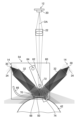
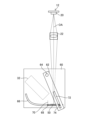
- FIG. 1 is an overall configuration diagram showing a schematic configuration of a reading device provided with an illumination device according to an embodiment.
- FIG. 2 is a view of the reader shown in FIG. 1 as viewed in the direction of arrow A shown in FIG.
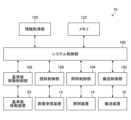
- FIG. 3 is a functional block diagram showing the electrical configuration of the reader shown in FIG.
- FIG. 4 is a schematic diagram showing a configuration example of the lighting device shown in FIG.
- FIG. 5 is a schematic diagram when the light beam density shown in FIG. 4 is increased.
- FIG. 6 is a schematic diagram of an example in which the light emitted from the light guide plate is incident on the diffuser plate.
- FIG. 7 is a schematic diagram of light rays when the number of times of reflection is one.
- FIG. 1 is an overall configuration diagram showing a schematic configuration of a reading device provided with an illumination device according to an embodiment.
- FIG. 2 is a view of the reader shown in FIG. 1 as viewed in the direction of arrow A shown in FIG.
- FIG. 3 is a
- FIG. 8 is an explanatory diagram of the incident angle on the first surface of the light guide plate and the incident angle on the reflecting surface.
- FIG. 9 is a schematic diagram of light rays when the number of reflections is two or more.
- FIG. 10 is a cross-sectional view of a light guide plate having a hexagonal cross-sectional shape.
- FIG. 11 is a perspective view showing a schematic configuration of the reference plate moving device.
- FIG. 12 is a schematic diagram showing the standby state of the reference plate.
- FIG. 13 is a schematic diagram showing a state in which the reference plate has reached the reading start position.
- FIG. 14 is a schematic diagram showing a state in which the reference plate reaches the reading center position.
- FIG. 15 is a schematic diagram showing a state in which the reference plate has reached the reading end position.
- FIG. 16 is a perspective view of the reference plate bracket.
- FIG. 17 is a side view of the reference plate bracket.
- FIG. 18 is an overall configuration diagram showing a schematic configuration of the printing system according to the embodiment.
- 19 is a functional block diagram showing the electrical configuration of the printing system shown in FIG. 18.
- FIG. 20 is a block diagram showing a hardware configuration example of a control device applied to the printing system shown in FIG.
- FIG. 1 is an overall configuration diagram showing a schematic configuration of a reading device provided with an illumination device according to an embodiment.
- the reading device 10 shown in the figure includes an image receiving device 12 , an illumination device 14 and a conveying device 16 .
- the image receiving device 12 and the illumination device 14 are housed in a housing 18 with an open bottom. In FIG. 1, the housing 18 is illustrated as seen through.
- the reading device 10 irradiates illumination light onto the printed matter P, which is an object to be read, which is conveyed using the conveying device 16, receives reflected light from the printed matter P using the image receiving device 12, and obtains read data of the printed matter P. Generate and output.
- the image receiving device 12 has an image sensor 20 and an imaging lens 22 .
- the image sensor 20 may be a line sensor in which a plurality of light receiving elements are arranged in a line in the width direction of the printed material P perpendicular to the transport direction of the printed material P, or a line sensor in which a plurality of light receiving elements are arranged in a two-dimensional shape. Area sensors may be applied. 1 indicates the conveying direction of the printed matter P, and the arrowed line labeled "width direction" indicates the width direction of the printed matter P. As shown in FIG. The same applies to FIGS. 4 to 10 as well.
- orthogonal is not limited to strict orthogonality, and can include the concept of substantial orthogonality, which can be regarded as orthogonal even when the actual angle formed by two directions is less than or greater than 90°.
- parallel is not limited to strict parallel, but can include the concept of substantially parallel, where two directions can be considered parallel even when they actually intersect.
- FIG. 1 illustrates an image sensor 20 in which a plurality of light receiving elements are arranged over a length shorter than the full width of the printed matter P in the width direction. Note that illustration of a plurality of light receiving elements is omitted. 1 indicates a part of the optical axis of the imaging lens 22. As shown in FIG.
- the imaging lens 22 forms an optical image of the printed material P on the image sensor 20 .
- a reduction optical system is applied to the imaging lens 22 . This makes it possible to collectively read the entire width of the printed material P using the image sensor 20 having a reading length shorter than the full width of the printed material P.
- the illumination device 14 has two LED light sources 30 and two light guide plates 32 .
- One LED light source 30 and the other LED light source 30 are arranged at symmetrical positions with respect to the conveying direction of the printed matter P with the reading line TL of the image receiving device 12 interposed therebetween.
- one light guide plate 32 and the other light guide plate 32 are arranged at symmetrical positions with respect to the transport direction of the printed matter P with the reading line TL of the printed matter P interposed therebetween.
- the reading line TL is the reading target position of the image sensor 20 provided in the image receiving device 12 .
- the reading line TL has a length equal to or longer than the entire length of the printed material P in the width direction of the printed material P. As shown in FIG.
- the reading line TL is for different printed matter P for each reading cycle of the image sensor 20 as the printed matter P is conveyed by a length determined for each object to be read according to an instruction from the reading control unit. It is placed at the position where the position reading is performed. Note that the reading control unit is indicated by reference numeral 106 in FIG.
- Each of the two LED light sources 30 and the two light guide plates 32 illuminates the printed matter P obliquely to the normal line of the printed matter P.
- Each of the two LED light sources 30 and the two light guide plates 32 has a posture in which the optical axis faces the reading line TL.
- the LED light source 30 has a structure in which a plurality of LED elements 34 are arranged along the width direction of the LED light source 30 .
- a plurality of LED elements 34 are mounted on an LED substrate 36 .
- the LED substrate 36 includes electrical wiring electrically connected to the plurality of LED elements 34 .
- the arrangement of the plurality of LED elements 34 may be in a line or in a two-dimensional arrangement.
- Examples of the two-dimensional arrangement include a two-row zigzag arrangement and a matrix arrangement.
- FIG. 1 illustrates an LED light source 30 in which a plurality of LED elements 34 are arranged over a length longer than the entire length of the printed material P in the width direction. The same configuration can be applied to one LED light source 30 and the other LED light source 30 .
- the light guide plate 32 shown in FIG. 1 has a rectangular parallelepiped shape, and the length direction, width direction and thickness direction are defined.
- the length direction, width direction and thickness direction are orthogonal to each other.
- the length direction is the direction from the LED light source 30 to the reading line TL
- the width direction is parallel to the width direction of the LED light source 30 .
- the thickness direction is a direction perpendicular to the length direction of the light guide plate 32 and the width direction of the light guide plate 32 . That is, of the two directions orthogonal to the length direction of the light guide plate 32, the direction of the relatively short side is defined as the thickness direction, and the direction of the relatively long side is defined as the width direction.
- the total length of the light guide plate 32 in the width direction is equal to or greater than the total length of the LED light source 30 in the width direction, and the total length of the light guide plate 32 in the length direction is less than the distance from the output surface of the LED light source 30 to the reading line TL.
- the light guide plate 32 has a first surface on which the illumination light emitted from the LED light source 30 is incident and an emission surface for emitting the illumination light to the printed matter P.
- the light guide plate 32 is not arranged, it functions as a mirror that reflects light that does not contribute to reading to the vicinity of the reading line TL of the printed matter P.
- the transport device 16 includes upstream transport rollers 40 , background rollers 42 and downstream transport rollers 44 .
- the upstream transport rollers 40, the background rollers 42, and the downstream transport rollers 44 are arranged in the order of the upstream transport rollers 40, the background rollers 42, and the downstream transport rollers 44 from the upstream side along the transport direction of the printed matter P.
- the upstream transport roller 40 receives the printed matter P and sends the printed matter P to the background roller 42 .
- the background roller 42 supports the printed matter P on the reading line TL and conveys the printed matter P along the conveying direction of the printed matter P.
- the downstream transport roller 44 discharges the printed matter P transported from the background roller 42 from the reading device 10 .
- the supporting surface of the printed matter P on the background roller 42 is applied with a color and surface treatment that do not affect the reading of the printed matter P using the image receiving device 12 .
- the upstream transport roller 40, the background roller 42, and the downstream transport roller 44 are each connected to the rotating shaft of the motor and rotate according to the rotation of the rotating shaft of the motor. Note that illustration of a motor connected to the upstream-side conveying roller 40 and the like is omitted.
- the reading device 10 includes a reference plate 50 and a reference plate moving device 52 .
- the reference plate 50 is a member that is read using the image sensor 20 when setting reading conditions for the image sensor 20 .
- the reference plate 50 may be a white reference plate on which the surface to be read by the image sensor 20 is painted with white paint.
- the reference plate moving device 52 includes a moving mechanism 54 and a motor 56.
- the moving mechanism 54 movably supports the reference plate 50 between the retracted position of the reference plate 50 and the reading position of the reference plate 50 .
- the moving mechanism 54 is connected to the rotating shaft of the motor 56 and moves the reference plate 50 according to the operation of the motor 56 .
- reference plate 50 described in the embodiment is an example of a reference member.
- the reference plate moving device 52 described in the embodiment is an example of a reference member moving device.
- the movement mechanism 54 includes a guide groove bracket 60 , a drive arm 62 and a drive force transmission shaft 64 .
- the guide groove brackets 60 are arranged outside of both ends in the width direction of the lighting device 14, movably support the driving arm 62, and rotatably support the driving force transmission shaft 64. As shown in FIG.
- a first guide groove 66 is formed in the guide groove bracket 60 .
- the first guide groove 66 penetrates the guide groove bracket 60 in the thickness direction.
- the first guide groove 66 movably supports a reference plate bracket 70 that supports the reference plate 50 using a first guide pin 68 and a second guide pin 74 .
- a rotating shaft of the motor 56 is connected to the drive arm 62 .
- One driving arm 62 and the other driving arm 62 are connected using a driving force transmission shaft 64 .
- Drive arm 62 swings according to the operation of motor 56 .
- a second guide groove 72 is formed in the drive arm 62 .
- the second guide groove 72 uses a second guide pin 74 to movably support the reference plate bracket 70 at a position intersecting the first guide groove 66 according to the swinging of the drive arm 62 .
- FIG. 1 shows a state in which the reference plate 50 is positioned at the retracted position.
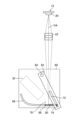
- FIG. 2 is an arrow view of the reading device shown in FIG. 1 in the A direction shown in FIG. 2 is the width direction of the printed matter P, the width direction of the LED light source 30, and the width direction of the light guide plate 32. As shown in FIG. 2, illustration of some of the constituent elements shown in FIG. 1 is omitted. In FIG. 2 , the light guide plate 32 hidden behind the guide groove bracket 60 and the light emitted from the light guide plate 32 are shown through the guide groove bracket 60 .
- FIG. 2 shows a state in which the reference plate 50 has moved to the reading position and stopped.
- the reference plate 50 is illuminated using the illumination device 14 and the surface of the reference plate 50 is read using the image receiving device 12 .
- FIG. 2 schematically shows illumination light that illuminates the reference plate 50. As shown in FIG.
- the illumination device 14 illuminates an illumination target area having a length equal to or greater than the full width of the printed matter P in the width direction of the printed matter P and a specified length in the transport direction of the printed matter P. Illumination light that can obtain illuminance is emitted. Note that the illumination target area is illustrated in FIG. 4 using the symbol AI.
- FIG. 3 is a functional block diagram showing the electrical configuration of the reader shown in FIG.
- the reader 10 has a system control unit 100 .
- the system control unit 100 controls the reading device 10 in an integrated manner.
- the reading device 10 includes a transport control section 102 .
- the transport control unit 102 controls the operation of the transport device 16 according to command signals transmitted from the system control unit 100 .
- the transport control unit 102 controls the transport speed of the printed matter P and the like.
- the reading device 10 includes an illumination control section 104 .
- the lighting control unit 104 controls the operation of the lighting device 14 according to command signals transmitted from the system control unit 100 .
- the illumination control unit 104 controls the amount of illumination light emitted from the illumination device 14 and the like.
- the reading device 10 has a reading control unit 106 .
- the reading control unit 106 controls the operation of the image receiving device 12 according to command signals transmitted from the system control unit 100 .
- the reading control unit 106 controls operations of the image sensor 20 .
- the reading device 10 includes a reference plate movement control section 108 .
- the reference plate movement control section 108 controls the operation of the reference plate movement device 52 according to the command signal transmitted from the system control section 100 .
- the reading device 10 has an information acquisition unit 120 .
- the information acquisition unit 120 acquires various types of information applied to the reading device 10 .
- the system control unit 100 generates command signals for various control units based on various information acquired using the information acquisition unit 120 .
- the reading device 10 has a memory 122 .
- the memory 122 stores various information acquired using the information acquisition unit 120 .
- the memory 122 stores programs for realizing various functions of the reading device 10 .
- the memory 122 stores various parameters used when executing the program.
- the electrical configuration of the reader 10 shown in FIG. 2 is realized using a computer. That is, a processor provided in the computer executes various functions of the reading device 10 by executing program instructions stored in the memory.
- the reader 10 shown in FIG. 1 and the like has a problem of increasing the amount of light reaching the image sensor 20 .
- the following methods are conceivable.
- the light that does not contribute to reading is reflected using a mirror to irradiate the reading line TL.
- the theoretical limit value of the luminous efficiency of a white LED which is a combination of a blue LED chip and a phosphor, is 260 lumens/watt to 300 lumens/watt. , the luminous efficiency is close to the limit.
- LEDs with high luminous efficiency do not increase the maximum amount of emitted light in proportion to the luminous efficiency, but increase the luminous efficiency in a relatively small amount of emitted light, which necessarily increases the total luminous flux and increases the illuminance. Do not mean.
- LEDs with high luminous efficiency are expensive, and the use of LEDs with high luminous efficiency results in a large cost increase.
- an increase in the amount of current supplied when increasing the amount of light emitted promotes heat generation in the LED, and the luminous efficiency decreases when the LED is used without being sufficiently cooled.
- cooling the LEDs that generate heat is costly.
- the LED light source 30 Even if the number of LED elements 34 is increased, the LED light source 30 must be able to be arranged inside the reading device 10. If the number of 34 is doubled, there is a concern that it will be difficult to dispose the LED light source 30 inside the reader 10 .
- a method of condensing the light emitted from the LED light source 30 onto the reading line TL using a condensing lens is common and widely used.
- a large printed matter P with a width of 600 mm or more and 1200 mm or less is to be read, it is difficult to irradiate the printed matter P with the illumination light without causing large unevenness of the illumination light over the entire width. .
- the LED light source 30 is an LED array having a plurality of LED elements 34
- the light emitted from each LED element 34 is strongest in front of the LED element 34, and the light emitted from the LED element 34 is strongest in the diagonal direction. become weak.
- the LED light source 30 is brought closer to the reading line TL, the illuminance unevenness on the reading line TL becomes relatively large due to the emission distribution of the individual LED elements 34 .
- the lighting device 14 provided in the reading device 10 according to the present embodiment is based on the method (6) above, and the light guide plate 32 is created using a plate-shaped member made of acrylic resin with high transparency as a mirror, The printed material P is illuminated by efficiently reflecting light using total reflection of the light guide plate 32 .
- the light guide plate 32 is used to use the diffused light of the LED light source 30 as illumination light for the printed matter P, which is the object to be read.
- the configuration of the light guide plate 32 is arranged at a specified distance from the reading line TL, and the light guide plate 32 realizes efficient use of the illumination light using total reflection, and the influence on total reflection is suppressed.
- a method for fixing the light guide plate 32 is provided.
- FIG. 4 is a schematic diagram showing a configuration example of the lighting device shown in FIG.
- the direction through the plane of FIG. 4 is the width direction of the LED light source 30 and the width direction of the light guide plate 32 .
- FIG. 4 exemplifies an LED light source 30 having a point light source such as an LED element 34 as a light source.
- the light source applied to the illumination device 14 may be a linear light source, a diffuse light source having a relatively small light emitting surface, or a light source in which diffuse light sources having relatively small light emitting surfaces are arranged two-dimensionally. Relatively small means that the width direction of the light guide plate 32 is equal to or smaller than the first surface 33 of the light guide plate 32 on which light is incident. .
- An illumination target area AI on the printed matter P is defined for the illumination device 14, and a distance between the LED light source 30 and the illumination target area AI is specified.
- the light guide plate 32 is arranged between the LED light source 30 and the illumination target area AI.
- the light guide plate 32 has a reflecting surface 32A that totally reflects at least part of the incident light.
- FIG. 4 schematically shows rays calculated using ray tracing. For the purpose of making the light rays easier to see, FIG. ray of light.
- the light guide plate 32 shown in FIG. 4 is made of acrylic resin and has a refractive index of 1.49.
- the total length B of the light guide plate 32 may be 40 millimeters, and the total length W of the light guide plate 32 in the thickness direction may be 4.0 millimeters.
- the distance L from the emission surface 35 of the LED light source 30 to the illumination target area AI is 48.75 mm
- the distance from the emission surface of the LED light source 30 to the first surface 33 of the light guide plate 32 is 2.25 mm
- the distance Le from the exit surface 35 of the light guide plate 32 to the illumination target area AI can be 2.25 millimeters.
- the distance L from the emission surface 35 of the LED light source 30 to the illumination target area AI the shortest distance from the emission surface 35 of the LED light source 30 to the illumination target area AI can be applied. The same applies to the distance L e from the exit surface 35 of the light guide plate 32 to the illumination target area AI.
- the light Rd having a relatively large incident angle to the reflecting surface 32A passes through the edge of the exit surface 35 of the light guide plate 32, It reaches a position away from the reading line TL in the illumination target area AI.
- the angle of incidence on the reflecting surface 32A is the angle between the normal to the reflecting surface 32A and the light.
- illustration of the incident angle to the reflecting surface 32A is omitted.
- the angle of incidence on the reflecting surface 32A is illustrated in FIG. 7 using the symbol ⁇ .
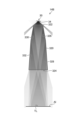
- FIG. 5 is a schematic diagram when the light beam density shown in FIG. 4 is increased.
- FIG. 5 is a diagram in which the light ray density is increased compared to the calculation example shown in FIG. 4 so that the continuous distribution of light can be grasped.
- the reason why the light emitted from the emission surface 35 of the light guide plate 32 in FIG. When the light that is emitted after being reflected one to five times inside the light guide plate 32 and the light that is emitted without being reflected inside the light guide plate 32 pass through the same path, the light is relatively displayed darker.
- the light when confirming the arrival position of the light beam that has been reflected three times inside the light guide plate 32, the light reaches a position slightly away from the reading line TL.
- the illumination target area AI is moved toward the light guide plate 32 by 1 millimeter to bring the illumination target area AI closer to the light guide plate 32, the light beam reflected three times inside the light guide plate 32 reaches the reading line TL.
- FIG. 6 is a schematic diagram of an example in which the light emitted from the light guide plate is incident on the diffuser plate.
- a configuration example of illumination using the light guide plate 32 is illumination in which the illumination target area AI of the illumination light is narrowed down. For example, it is applied when a printed matter such as paper is irradiated with reflected illumination light and a narrow range is read in a direction orthogonal to the arrangement direction of the reading elements of the image sensor.
- the illumination device 14A shown in FIG. 6 can be applied to illumination that narrows down the illumination target area AI of the illumination light.
- illumination using the light guide plate 32 is diffuse illumination having a relatively uniform light quantity distribution.
- the illumination device 14A shown in FIG. 6 reflects the light emitted from the LED light source 30 on the light guide plate 32 from zero to several times, generates light having a uniform light amount distribution over the entire width of the emission surface 35, and emits the light.
- the diffused light is emitted through a diffuser plate 37 arranged near the surface 35 .
- the illumination device 14A irradiates a printed material using a transparent base material with transmitted illumination light, and functions as backlight illumination when reading the transmitted light of the printed material using an image sensor. Also, the lighting device 14A can be used as diffuse lighting where an area sensor is used.
- the technique of repeating the precise ray tracing shown in FIGS. 4 to 6 can be adopted. can be used to derive a suitable number that allows relatively more total internal reflection to be utilized.
- a configuration example of the light guide plate 32 capable of deriving an appropriate numerical value for using a relatively large amount of total reflected light will be described in detail below.
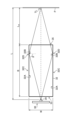
- FIG. 7 is a schematic diagram showing an arrangement example of one light guide plate.
- FIG. 7 shows an approximate solution for the ray trajectory.
- the approximate solution of the trajectory of light rays utilizes the fact that the optical path length of light traveling through media with refractive indices n1 and n2 is proportional to the refractive index. from the exit surface of the light guide plate 32 to the first surface 33 of the light guide plate 32 and the distance from the exit surface 35 of the light guide plate 32 to the illumination target area AI are defined by the refractive index n1 of air and the refractive index n2 of the light guide plate 32.
- FIG. 8 is an explanatory diagram of the incident angle on the first surface of the light guide plate and the incident angle on the reflecting surface. Unlike FIG. 7, FIG. 8 shows the exact solution of the ray trajectory based on the law of refraction. 7 and 8 is the width direction of the light guide plate 32. As shown in FIG.
- FIG. 7 shows the size in the length direction and Here is an example that defines the placement.
- the symbol L shown in FIG. 7 is the shortest distance from the emission surface of the LED light source 30 to the illumination target area AI.
- the length L is shown as the shortest distance from the center of the emitting surface of the LED element 34 to the reading line TL. Note that illustration of the illumination target area AI is omitted in FIG. The same applies to FIGS. 8 and 9 as well.
- Symbol B is the total length of the light guide plate 32 in the longitudinal direction
- symbol Le is the shortest distance from the exit surface 35 of the light guide plate 32 to the illumination target area AI.
- the length indicated by symbol L e is illustrated as the shortest distance from the center of the exit surface 35 of the light guide plate 32 to the reading line TL.
- the refractive index around the light guide plate 32 is n1
- the refractive index of the light guide plate 32 is n2 .
- the refractive index n1, 1 which is the refractive index of air, can be applied.
- the refractive index n2 of the light guide plate 32 can be 1.49.
- the incident angle to the first surface 33 of the light guide plate 32 is ⁇ i
- the incident angle to the reflecting surface 32A of the light guide plate 32 is ⁇ .
- the incident angle ⁇ on the reflecting surface 32A is greater than or equal to the critical angle ⁇ t .
- the incident angle ⁇ i to the first surface 33 is the angle between the normal to the first surface 33 and the light incident on the first surface 33 .
- ° is applied as the unit of angle. Units of angles are added as necessary.
- the light incident on the light guide plate 32 is reflected once to the LED element 34.
- the distance traveled in the direction of the optical axis is expressed as W ⁇ tan ⁇ .
- the entire area from the emission surface of the LED light source 30 to the illumination target area AI was converted as the refractive index medium of the light guide plate 32 .
- C m INT[ ⁇ B+(LB) ⁇ (n 2 /n 1 ) ⁇ /(W ⁇ tan ⁇ t )]. Note that INT in the above formula indicates a function that truncates a numerical value below the decimal point and converts the numerical value into an integer.
- the maximum incident angle to the first surface 33 of the light guide plate 32 is determined as ⁇ imax .
- the distance Le from the exit surface 35 of the light guide plate 32 to the illumination target area AI is equal to or less than the index value Lt
- the distance from the LED light source 30 to the first surface 33 of the light guide plate 32 is also the index value. is less than or equal to the value Lt. Therefore, the total length B in the length direction of the light guide plate 32 is expressed as L ⁇ 2 ⁇ L t ⁇ B using the distance L from the emission surface of the LED light source 30 to the illumination target area AI and the index value L t . .
- L ⁇ 2 ⁇ L t ⁇ B can be transformed using the total length W in the thickness direction of the light guide plate 32, the refractive index n 1 around the light guide plate, the refractive index n 2 of the light guide plate, and the maximum incident angle ⁇ imax , and the formula 2.
- Equation 1 Define the number of reflections C that is equal to or less than the maximum number of reflections Cm , and use Equation 1 to determine the maximum incident angle ⁇ imax .
- the maximum incident angle ⁇ imax is derived, if the total length B of the light guide plate 32 in the length direction does not satisfy Equation 2, the total length B of the light guide plate 32 and the total length of the light guide plate 32 in the thickness direction are The size of the light guide plate 32 such as W is changed, or the number of reflections C is changed.
- the above calculation method is an approximation under the condition that the maximum incident angle ⁇ imax is relatively small. After that, the reflection position can be accurately calculated to determine the design of the light guide plate 32 .
- Example of light guide plate support position When fixing the light guide plate 32 that utilizes total reflection, if the surface opposite to the reflective surface 32A is supported from the outside, total reflection may not occur depending on the refractive index of the support member brought into close contact with the support position. Therefore, there is concern that the amount of light emitted from the light guide plate 32 may decrease.
- the discrete arrangement of the support positions causes a local decrease in the amount of light emitted from the light guide plate 32. , a non-uniform illuminance distribution occurs in the illumination target area AI.
- the illumination device 14 that uses the light guide plate 32 to efficiently use the light emitted from the LED light source 30, there is a method for supporting the light guide plate 32 that can suppress a decrease in illumination efficiency and suppress unevenness in the illuminance distribution. is necessary.
- the light guide plate 32 is used under the condition that the number of reflections is about 1 or 2, the light amount for each reflection makes a relatively large contribution to the illuminance, and the light guide plate 32 can suppress the influence on the reflection. It would be useful to provide a support method for
- FIG. 7 schematically illustrates light when the number of times of reflection is one.
- FIG. 9 schematically illustrates light when the number of reflections is one and when the number of reflections is two or more.
- the solid lines are used to illustrate the light beams reflected once and twice, the dotted lines are used to illustrate the light beams reflected three times, and the broken lines are used to illustrate the light beams reflected four times and two times. The light for 5 times is illustrated.
- the total length B of the light guide plate 32 in the longitudinal direction is reduced by 1/n2 times using the refractive index n2 of the light guide plate 32, and the approximation is As a solution, it is possible to illustrate a state in which the light rays on the first surface 33 and the exit surface 35 of the light guide plate 32 travel substantially straight.
- the actual length of the light guide plate 32 is n2 times the illustrated example. Also, the actual distance from the LED light source 30 to the reading line TL is n2 times the total length B of the light guide plate 32 in the longitudinal direction. 7 and 9 schematically show a state in which the light on the first surface 33 and the emission surface 35 of the light guide plate 32 travels substantially straight.
- FIG. 7 shows a state in which light reflected once inside the light guide plate 32 reaches the reading line TL.
- the distance L from the light guide plate 32 to the illumination target area AI is relatively large. There is no light that reaches the line TL and is reflected twice or more.
- the light reflection positions 32B inside the light guide plate 32 are as shown, and when fixing the light guide plate 32, the reflection corresponding positions 32D on the outer surface 32C of the light guide plate 32 corresponding to the reflection positions 32B are The light guide plate 32 is supported while avoiding.
- FIG. 9 illustrates a configuration in which the distance L from the emission surface 35 of the light guide plate 32 to the illumination target area AI can be made relatively narrow.
- the light reflected one to five times reaches the reading line TL.
- the light guide plate 32 ⁇ /b>F illustrated using broken lines reaches the reading line TL with light reflected one to three times.
- support location 32G, support location 32H, and support location 32I are locations on the outer surface that correspond to non-reflective locations, and locations of reflective surface 32A that correspond to support location 32G, support location 32H, and support location 32I. is a non-reflective position different from the reflective position 32B. Therefore, when fixing the light guide plate 32, the support position 32G, the support position 32H, and the support position 32I should be supported.
- a support position 32H which is a position between the reflection position 32B and the end of the light guide plate on the output surface 35 side, is supported. be.
- the support position 32H corresponding to the non-reflection position where the distance between the adjacent reflection positions 32B is the longest is supported.
- the distance between the reflection position 32B closest to the emission surface 35 and the emission surface 35 is longer than the distance between the adjacent reflection positions 32B.
- the support position 32I corresponding to the non-reflecting position between the reflective position 32B closest to the exit surface 35 and the exit surface 35 is supported.
- the non-reflection position where the light density is relatively low is supported.
- Di the distance between adjacent reflection positions 32B.
- i is an integer greater than or equal to 1 and less than or equal to the number of all reflection positions 32B.
- An average value ⁇ a of the incident angles ⁇ for adjacent reflection positions 32B is calculated, and D i ⁇ cos ⁇ a is calculated. Assuming that the distance between the reflection position 32B closest to the exit surface 35 and the exit surface 35 is D1 , and the incident angle of the reflection position 32B closest to the exit surface 35 is ⁇ 1 , D i ⁇ cos ⁇ 1 is calculated.
- D i ⁇ cos ⁇ a and D i ⁇ cos ⁇ 1 are expressions corresponding to the density of light . corresponds to a relatively small non-reflective position.
- the refractive index n1 is 1
- the refractive index n2 is 1.49
- the critical angle ⁇ t is 42.2°. becomes.
- the maximum number of reflections Cm of the light guide plate 32 calculated by applying the above conditions is five.
- the LED element 34 When the LED element 34 is used as the light source, light with a relatively large number of reflections has a low intensity of light emitted obliquely from the light source. Light with a relatively large number of reflections has a relatively small original amount of light when viewed in terms of the amount of light per unit angle, and the ratio of light reaching the reading line TL to the total light is relatively small.
- the support position 32G of the light guide plate 32 is set to the intermediate position of the light reflection position 32B, and the support member is in close contact with the light guide plate 32 at the support position 32G. It is possible to suppress the occurrence of unevenness in the illumination light caused by this. Furthermore, by making the size of the support member relatively small, the influence of the support member on the unevenness of the illumination light can be suppressed.
- the number of available reflections decreases.
- the formula for the maximum number of reflections Cm can be used to calculate how many reflections are available.
- an illumination device 14A that includes a diffusion plate 37 shown in FIG. 6 and generates a backlight is applied.
- minute unevenness is formed on the surface of the light guide plate 32 within the range of the numerical aperture of the imaging lens 22 shown in FIG. can be given. This can reduce the unevenness of illumination light.
- a region in which minute irregularities are not formed on the exit surface 35 of the light guide plate 32 can be made smooth and transparent.
- the diffusion plate 37 described in the embodiment is an example of a diffusion member.
- the light reflected more times is emitted more obliquely to the emission surface 35 .
- This light irradiates the ink forming the printed matter P from a position away from the line connecting the LED element 34 and the reading line TL, diffuses using the components of the ink, and reaches the range of the numerical aperture of the imaging lens 22. It produces a diffuse component and functions as illumination light.
- the reflection position 32B of the light guide plate 32 may shift.
- the light guide plate 32 is displaced in the direction perpendicular to the line connecting the LED light source 30 and the reading line TL, the light arrival position is shifted by a distance twice the amount of displacement of the light guide plate 32 with respect to the reading line TL. deviate. Therefore, the relationship between the allowable range of mounting error of the light guide plate 32 and the setting of the fixed position is defined.
- FIG. 10 is a cross-sectional view of a light guide plate having a hexagonal cross-sectional shape.
- the illumination device 14B shown in the figure includes a light guide plate 320 instead of the light guide plate 32 shown in FIG. 4 and the like.
- the light guide plate 320 includes a first surface 322 on which light is incident and an exit surface 324 .
- the first surface 322 and the exit surface 324 are planes parallel to each other.
- the light guide plate 320 includes a first reflecting surface 326, a second reflecting surface 328, a third reflecting surface 330 and a fourth reflecting surface 332 between the first surface 322 and the exit surface 324.
- the first reflecting surface 326 and the second reflecting surface 328 constitute a continuous surface
- the third reflecting surface 330 and the fourth reflecting surface 332 constitute a continuous surface.
- a reflecting surface composed of the first reflecting surface 326 and the second reflecting surface 328 and a reflecting surface composed of the third reflecting surface 330 and the fourth reflecting surface 332 face each other. That is, the light guide plate 320 has nonparallel reflective surfaces facing each other from the first surface 322 toward the emission surface 324, and has a structure in which the distance between the two reflective surfaces facing each other increases. In other words, the light guide plate 320 has a cross-sectional shape in which one lower base and the other upper base of two trapezoids are connected.
- the light guide plate 320 receives light from the first surface 322 , and emits light from the emission surface 324 without being reflected by the reflection surfaces such as the first reflection surface 326 .
- the illumination target area AI can be irradiated with the reflected light.
- the light guide plate 320 emits light that is incident from the first surface 322, and is five times as much as the light that is emitted from the emission surface 324 without being reflected by the reflection surfaces such as the first reflection surface 326. can emit a light amount close to
- the light guide plate 320 employs a structure in which the distance between the two reflective surfaces facing each other increases from the first surface 322 toward the emission surface 324, and the distance L e from the emission surface 324 to the illumination target area AI can be relatively long.
- FIG. 10 illustrates the light guide plate 320 in which the distance between the two reflecting surfaces facing each other widens in two steps from the first surface 322 toward the exit surface 324.
- the light guide plate 320 A configuration in which the distance spreads in multiple stages may be applied, or a configuration in which the distance spreads continuously may be applied.
- FIG. 11 is a perspective view showing a schematic configuration of the reference plate moving device.
- the reference plate moving device 52 is extracted from the reading device 10 shown in FIG.
- explanations overlapping with the explanation with reference to FIG. 1 will be omitted as appropriate.
- an arrow line shown in the vicinity of the reference plate 50 indicates the moving direction of the reference plate 50.
- An arrow line illustrated near the drive arm 62 indicates the swinging direction of the drive arm 62 .
- An arrow line shown near the driving force transmission shaft 64 indicates the rotation direction of the driving force transmission shaft 64 .
- FIG. 12 is a schematic diagram showing the standby state of the reference plate. 12 is a view in the direction of arrow A shown in FIG. 11. FIG. The same applies to FIGS. 13 to 15 as well. 12 to 15, illustration of the components of the reference plate moving device 52 such as the motor 56 shown in FIG. 11 is omitted.
- the standby state of the reference plate 50 shown in FIG. 12 is a state in which the printed matter P is read using the image receiving device 12 .
- the position of the reference plate 50 in the standby state of the reference plate 50 described in the embodiment is an example of a retracted position at which the reference member is retracted from the reading position.
- FIG. 13 is a schematic diagram showing the state in which the reference plate has reached the reading start position.
- FIG. 13 shows a state in which one end of the reference plate 50 in the short direction has reached the reading position of the image sensor.
- the illumination device 14 starts emitting illumination light before the reference plate 50 reaches the reading start position, so that the LED element 34 reaches the equilibrium temperature and stabilizes the amount of light emitted. Further, the image receiving device 12 starts reading the reference plate 50 at the timing when the reference plate 50 reaches the reading start position.
- FIG. 14 is a schematic diagram showing a state in which the reference plate has reached the reading center position.
- FIG. 14 shows a state in which the central position of the reference plate 50 in the lateral direction has reached the reading position of the image receiving device 12 .
- the illumination device 14 continues to emit illumination light at the timing when the reference plate 50 reaches the reading center position.
- the image receiving device 12 continues reading the reference plate 50 at the timing when the reference plate 50 reaches the reading center position.
- FIG. 15 is a schematic diagram showing a state in which the reference plate has reached the reading end position.
- FIG. 15 shows a state in which the other end of the reference plate 50 in the short direction has reached the reading position of the image sensor.
- the lighting device 14 can end irradiation of the illumination light after the reference plate 50 reaches the reading end position. Further, the image receiving device 12 can finish reading the reference plate 50 after the reference plate 50 reaches the reading end position.
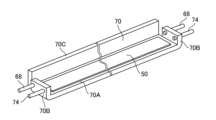
- FIG. 16 is a perspective view of the reference plate bracket.
- FIG. 17 is a side view of the reference plate bracket.
- the reference plate bracket 70 includes a reference plate fixing portion 70A, a guide pin mounting portion 70B, and a bent portion 70C.
- the reference plate bracket 70 shown in FIG. 16 can be manufactured by bending three sides of a plate member such as a metal plate at right angles.
- the reference plate 50 is fixed to the reference plate fixing portion 70A.
- adhesion using an adhesive or the like may be applied, or screwing using screws may be applied.
- the reference plate fixing portion 70A may be painted white and used as the reference plate 50 .
- a first guide pin 68 and a second guide pin 74 are attached to the guide pin attachment portion 70B.
- a first guide pin 68 is inserted into the first guide groove 66 and a second guide pin 74 is inserted into the first guide groove 66 and the second guide groove 72 .
- the reference plate bracket 70 is swingably supported with respect to the guide groove bracket 60 .
- the bent portion 70C has the function of improving the rigidity of the reference plate bracket 70 in the longitudinal direction and suppressing the bending of the reference plate bracket 70 in the longitudinal direction.
- 16 and 17 illustrate the bent portion 70C that is bent perpendicular to the reference plate fixing portion 70A, but the angle of the bent portion 70C with respect to the reference plate fixing portion 70A may be less than 90° or 90°. may exceed
- the length of the reference plate 50 in the longitudinal direction is greater than or equal to the length that the image sensor 20 can read. It can be 470 millimeters.
- the length of the reference plate 50 in the lateral direction is defined from the viewpoint of avoiding contact with the light guide plate 32 or the like when the reference plate 50 is moved. Also, the length of the reference plate 50 in the lateral direction may be defined in consideration of the reading resolution and reading period of the image sensor 20 . If the reference plate 50 has a width of 14 millimeters, the width of the reference plate bracket 70 may be 17 millimeters.
- the thickness of the reference plate 50 can be defined based on the processing conditions when manufacturing the reference plate 50.
- the thickness of the reference plate 50 may be 0.2 millimeters.
- the reference plate bracket 70 may have a length of 5 millimeters in the height direction.
- the length of the reference plate bracket 70 in the height direction can be defined based on the viewpoint that the bending of the reference plate bracket 70 is suppressed and that the reference plate bracket 70 does not come into contact with the light guide plate 32 during rocking.
- the distance between the upper end of the bent portion 70C and the lower end of the light guide plate 32 is 1.5 mm or more. Contact with the lower end of the light guide plate 32 can be avoided.
- the reference plate bracket 70 When the reference plate 50 shown in FIG. 14 reaches the reading center position, if the distance between the lower end of the reference plate bracket 70 and the lower end of the light guide plate 32 is set to 8 mm or more, the reference plate bracket 70 is swung. Contact between the upper end of the bent portion 70C and the lower end of the light guide plate 32 can be avoided. That is, the distance Le from the exit surface 35 of the light guide plate 32 to the illumination target area AI can be defined according to the size of the reference plate bracket 70 that supports the reference plate 50 .
- the longitudinal direction of the reference plate 50 and the longitudinal direction of the reference plate bracket 70 are the width direction of the printed matter P and correspond to the width direction of the LED light source 30 and the width direction of the light guide plate 32 .
- the lateral direction of the reference plate 50 and the lateral direction of the reference plate bracket 70 correspond to the conveying direction of the printed matter P.
- the height direction of the reference plate bracket 70 is a direction orthogonal to the longitudinal direction of the reference plate 50 and the lateral direction of the reference plate bracket 70, and the direction orthogonal to the surface on which the reference plate 50 is supported.
- the reference plate bracket 70 that supports the reference plate 50 described in the embodiment is an example of a member that enters the illumination target area, and is an example of a member that is arranged in the illumination target area. Further, the above-described size of the reference plate bracket 70 or larger is an example of a size larger than or equal to the maximum size of the member.
- a light guide plate 32 utilizing total reflection is arranged between the LED light source 30 and the illumination target area AI of the illumination light.
- the maximum incident angle ⁇ imax to the light guide plate 32 is defined based on the number of reflections C less than or equal to the maximum number of reflections Cm of the light guide plate 32 .
- an efficient arrangement of the light guide plate 32 is defined when relatively bright illumination is performed using the total reflection of the light guide plate 32 as compared with the case where only the direct light from the LED light source 30 is used. .
- the total length B of the light guide plate 32 in the length direction is the distance L from the emission surface of the LED light source 30 to the illumination target area AI, the total length W of the light guide plate 32 in the thickness direction, the refractive index n 1 around the light guide plate, and the light guide plate is defined as L ⁇ (n 1 /n 2 ) ⁇ W/tan ⁇ imax ⁇ B using the refractive index n 2 of , and the maximum incident angle ⁇ imax to the light guide plate 32 . This defines the dimensions of the light guide plate 32 with good efficiency.
- the support position 32G of the light guide plate 32 when the light guide plate 32 is fixed is the position of the outer surface corresponding to the non-reflecting position on the reflecting surface 32A of the light guide plate 32 . This makes it possible to present the support position 32G when fixing the light guide plate 32 that suppresses the influence of the illumination light on the illuminance distribution in the illumination target area AI.
- the power consumption of the LED element 34 is suppressed without increasing the current supplied to the LED element 34 .
- the heat generation of the LED element 34 is suppressed, and the change in the light emission amount of the LED element 34 caused by the heat generation of the LED element 34 is reduced.
- a relatively high illuminance can be obtained in the illumination target area AI of the illumination light, and high-speed reading of the image sensor 20 can be realized.
- the illumination device 14 shown in FIG. 1 can be used as an independent device separate from the reading device 10 .
- the lighting device 14 may include, as an electrical configuration, the system control unit 100, the lighting control unit 104, the information acquisition unit 120, and the memory 122 shown in FIG.
- the electrical configuration of lighting device 14 is implemented using a computer.
- the procedure for determining the arrangement of the light guide plate 32 and the dimensions of the light guide plate 32 described with reference to FIGS. 1 to 17 can be understood as a light guide plate arrangement determination method.
- the light guide plate arrangement determination method includes steps corresponding to the procedure for determining the arrangement of the light guide plate 32 and the dimensions of the light guide plate 32 described above.
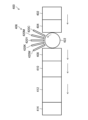
- FIG. 18 is an overall configuration diagram showing a schematic configuration of the printing system according to the embodiment.
- the printing system 400 is equipped with a digital printing device 406 that applies single-pass printing to print a color image on a substrate. Note that illustration of the base material is omitted in FIG. 18 .
- An example of the base material is the medium used for the printed matter P shown in FIG.
- paper media such as sheet paper and continuous paper, sheet-like metal media, and cloth media such as cloth can be applied.
- Flexible packaging such as a plastic film can be applied to the substrate.
- the substrate may be a single layer, or may be a stack of multiple layers.
- the base material may be a roll-to-roll continuous form, or may be a sheet form cut to a specified length.
- the base material may be called a medium, a medium, a sheet, a film, a substrate, or the like.
- the printing system 400 includes a substrate supply device 402 , a first intermediate conveying device 404 , a printing device 406 , a second intermediate conveying device 408 , a measuring device 410 , a drying device 412 and a stacking device 414 . Each part will be described in detail below.
- the substrate supply device 402 When the substrate is in a continuous form, the substrate supply device 402 includes a roll container for accommodating a roll around which the substrate is wound. If the substrate is in the form of a sheet, the substrate supply device 402 has a tray in which the substrate is accommodated. The substrate supply device 402 supplies the substrate to the first intermediate transport device 404 in response to the printing control of the printing device 406 .
- the substrate supply device 402 may include a correction mechanism that corrects the orientation of the substrate.
- the first intermediate transfer device 404 delivers the substrate supplied from the substrate supply device 402 to the printing device 406 .
- the first intermediate conveying device 404 can apply a known configuration according to the form of the substrate.
- An arrow line directed from the base material supplying device 402 to the first intermediate conveying device 404 represents the base material conveying direction.
- the printing device 406 includes an inkjet head 420C, an inkjet head 420M, an inkjet head 420Y, an inkjet head 420K and an inkjet head 420W.
- the inkjet head 420C, the inkjet head 420M, the inkjet head 420Y, the inkjet head 420K, and the inkjet head 420W are arranged in the order described above from the upstream side along the substrate conveying direction.
- the inkjet head 420C ejects cyan ink.
- the inkjet head 420M ejects magenta ink.
- the inkjet head 420Y ejects yellow ink.
- the inkjet head 420K ejects black ink.
- the inkjet head 420W ejects white ink.
- the inkjet head 420C or the like can be a line head in which a plurality of nozzles are arranged over a length equal to or greater than the entire length of the substrate in the width direction of the substrate.
- a configuration example of the line head includes a configuration in which a plurality of head modules are joined together.
- a two-dimensional arrangement such as a matrix arrangement is applied to the plurality of nozzles provided in the inkjet head 420C or the like.
- the inkjet head 420C and the like may employ a piezoelectric ejection method including a piezoelectric element as an ejection pressure element that generates an ejection pressure.
- the inkjet head 420C and the like may employ a thermal method that ejects ink using the film boiling phenomenon of ink.
- the printing device 406 forms a color image on the substrate using color ink such as cyan ink.
- the printing device 406 forms a white image as a background image of the color image using white ink.
- the printing device 406 includes a printing drum 422 .
- the print drum 422 has a cylindrical shape.
- the print drum 422 includes a substrate support area for supporting the substrate on its peripheral surface. Illustration of the substrate supporting region is omitted.
- the rotating shaft of the print drum 422 is connected to a motor (not shown) via a drive mechanism (not shown). Rotation of the motor causes print drum 422 to rotate in the direction indicated by the arrow line. When the print drum 422 is rotated, the substrate supported on the peripheral surface of the print drum 422 is transported along the rotational direction of the print drum 422 .
- a plurality of suction holes are formed in the substrate support area.
- a plurality of suction holes are arranged according to a prescribed pattern.
- the plurality of suction holes communicate with suction channels (not shown).
- the adsorption channel is connected to an adsorption pump (not shown).
- the base material is sucked and supported on the circumferential surface of the printing drum 422 using the negative pressure generated in the plurality of suction holes by operating the suction pump.
- the conveyance form of the base material in the printing device 406 is not limited to the conveyance form using the printing drum 422 .
- a transport mode using a transport belt and a transport mode using a plurality of rollers can be applied.
- the second intermediate transport device 408 transfers the substrate transferred from the print drum 422 to the measuring device 410 .
- the second intermediate conveying device 408 can apply the same configuration as the first intermediate conveying device 404 .
- the arrow line shown in the second intermediate conveying device 408 represents the substrate conveying direction in the second intermediate conveying device 408 .
- the reading device 10 shown in FIG. 1 and the like can be applied to the measuring device 410 .
- the measuring device 410 can read the test pattern printed on the base material and detect an ejection abnormality of the inkjet head 420C or the like based on the read data of the test pattern.
- the measuring device 410 can read the printed image printed on the base material and detect defects in the printed image based on the read data of the printed image.
- the measuring device 410 provided in the printing system 400 achieves relatively high illuminance in the illumination target area AI, enabling high-speed reading of the object to be read.
- high-speed printing high-speed reading of the printed image and test pattern of the printed material is performed, image processing is performed on the read data, ejection failure detection of the inkjet head 420C, etc., and It enables execution of defect detection and density unevenness correction.
- the drying device 412 performs a drying process on the printed base material.
- the drying device 412 is equipped with a heater and a fan, and can apply a configuration for blowing hot air against the printed base material.
- the drying device 412 includes a drying transport section that transports the printed base material. Known transport modes such as drum transport, belt transport, and roller transport can be applied as the transport mode for the printed base material.
- the arrow line shown in the drying device 412 indicates the direction in which the drying device 412 substrate is conveyed.
- the accumulator 414 accommodates substrates delivered from the drying device 412 . If the substrate is in continuous form, the accumulator 414 includes a roll receiving section for receiving rolls of the substrate wound thereon. If the substrates are in sheet form, the stacker 414 comprises trays in which the substrates are stored.
- FIG. 19 is a functional block diagram showing the electrical configuration of the printing system shown in FIG. 18.
- the printing system 400 includes a system control section 460 , a transport control section 462 , a print control section 466 , a measurement control section 468 , a drying control section 470 and an information acquisition section 472 .
- the system control unit 460 controls overall operations of the printing system 400 .
- the system control unit 460 transmits command signals to various control units.
- the system control unit 460 functions as a memory controller that controls storage of data in the memory 474 and reading of data from the memory 474 .
- the system control unit 460 acquires sensor signals transmitted from the sensor 476 and transmits command signals based on the sensor signals to various control units.
- the sensor 476 includes a position detection sensor, a temperature sensor, and the like provided in each part of the printing system 400 .
- the transport control unit 462 sets transport conditions based on command signals transmitted from the system control unit 460, and controls the operation of the transport device 464 based on the set transport conditions.
- the conveying device 464 shown in FIG. 19 includes the drying conveying device provided in the first intermediate conveying device 404, the printing drum 422 and the drying device 412 shown in FIG. Also, the transport device 464 includes the transport device 16 shown in FIG. Transport device 464 may include substrate feeder 402 and accumulator 414 .
- the print control unit 466 sets printing conditions based on command signals transmitted from the system control unit 460, and controls the operation of the printing device 406 based on the set printing conditions. That is, the print control unit 466 includes an image processing unit that performs color separation processing, color conversion processing, correction processing for each processing, and halftone processing on print data to generate halftone data for each color. .
- the print control unit 466 includes a drive voltage generation unit that generates drive voltages to be supplied to the inkjet heads 420C and the like based on halftone data for each color.
- the print control unit 466 includes a drive voltage output unit that supplies a drive voltage to the inkjet head 420C.
- the print control unit 466 corrects the printing device 406 based on measurement data obtained using the measurement device 410 .
- the printing system 400 may include, apart from the print control unit 466 , a correction processing unit that corrects the printing device 406 based on measurement data obtained using the measurement device 410 .
- the measurement control unit 468 sets measurement conditions based on command signals transmitted from the system control unit 460, and controls the operation of the measurement device 410 based on the set measurement conditions.
- the measurement control section 468 shown in FIG. 19 can have the functions of the reader 10 shown in FIG.
- the drying control unit 470 sets processing conditions for the main drying process based on command signals transmitted from the system control unit 460, and controls the operation of the drying device 412 based on the set processing conditions.
- the information acquisition unit 472 acquires various types of information applied to control the printing system 400 .
- the system control unit 460 transmits command signals to various control units based on various information acquired using the information acquisition unit 472 .
- the memory 474 can store various data, parameters and programs applied to the printing system 400 .
- Memory 474 may function as memory 122 shown in FIG.
- FIG. 20 is a block diagram showing a hardware configuration example of a control device applied to the printing system shown in FIG.
- the control device 500 included in the printing system 400 includes a processor 502 , a non-transitory tangible computer-readable medium 504 , a communication interface 506 and an input/output interface 508 .
- a computer is applied to the control device 500 .
- the form of the computer may be a server, a personal computer, a workstation, a tablet terminal, or the like.
- the processor 502 includes a CPU (Central Processing Unit). Processor 502 may include a GPU (Graphics Processing Unit). Processor 502 is coupled to computer-readable media 504 , communication interface 506 , and input/output interface 508 via bus 510 . Input device 512 and display device 514 are connected to bus 510 via input/output interface 508 .
- CPU Central Processing Unit
- GPU Graphics Processing Unit
- the processor 502 can function as a first processor that performs processing related to tone correction data generation, a second processor that performs processing related to image formation, and a third processor that performs processing related to measurement.
- the computer-readable medium 504 includes memory as a main memory and storage as an auxiliary memory.
- the computer-readable medium 504 can apply a semiconductor memory, a hard disk device, a solid state drive device, and the like. Computer readable medium 504 may apply any combination of devices.
- the hard disk device can be called HDD, which is an abbreviation for Hard Disk Drive in English.
- a solid state drive device may be referred to as SSD, which is an abbreviation for the English notation Solid State Drive.
- the control device 500 is connected to a network via a communication interface 506 and is communicably connected to an external device.
- a LAN Local Area Network
- a LAN Local Area Network
- a computer-readable medium 504 stores a transport control program 520, a print control program 522, a measurement control program 524, and a drying control program 526.
- the transport control program 520 corresponds to transport control applied to the transport device 464 shown in FIG.
- Print control program 522 corresponds to print control applied to printing device 406 .
- Measurement control program 524 corresponds to the measurement control applied to measurement device 410 .
- Drying control program 526 corresponds to the drying control applied to drying device 412 .
- Various programs stored on computer-readable medium 504 include one or more instructions.
- the computer-readable medium 504 stores various data, various parameters, and the like. Note that the memory 474 shown in FIG. 19 is included in the computer-readable medium 504 shown in FIG.
- the printing system 400 implements various functions in the printing system 400 by executing various programs stored in the computer-readable medium 504 by the processor 502 .
- program is synonymous with the term software.
- the control device 500 performs data communication with an external device via the communication interface 506.
- the communication interface 506 can apply various standards such as USB (Universal Serial Bus).
- the communication form of the communication interface 506 may be either wired communication or wireless communication.
- An input device 512 and a display device 514 are connected to the control device 500 via an input/output interface 508 .
- Input devices such as a keyboard and a mouse are applied to the input device 512 .
- Various information applied to the control device 500 is displayed on the display device 514 .
- a liquid crystal display, an organic EL display, a projector, or the like can be applied to the display device 514 .
- the display device 514 may apply any combination of multiple devices.
- EL in the organic EL display is an abbreviation for Electro-Luminescence.
- examples of the hardware structure of the processor 502 include a CPU, GPU, PLD (Programmable Logic Device), and ASIC (Application Specific Integrated Circuit).
- a CPU is a general-purpose processor that executes programs and acts as various functional units.
- a GPU is a processor specialized for image processing.
- a PLD is a processor whose electrical circuit configuration can be changed after the device is manufactured. Examples of PLDs include FPGAs (Field Programmable Gate Arrays). An ASIC is a processor with dedicated electrical circuitry specifically designed to perform a particular process.
- a single processing unit may be composed of one of these various processors, or may be composed of two or more processors of the same type or different types.
- Examples of combinations of various processors include combinations of one or more FPGAs and one or more CPUs, and combinations of one or more FPGAs and one or more GPUs.
- Another example of a combination of various processors is a combination of one or more CPUs and one or more GPUs.
- a single processor may be used to configure multiple functional units.
- configuring multiple functional units using one processor applying a combination of one or more CPUs and software such as SoC (System On a Chip), typified by a computer such as a client or server
- SoC System On a Chip
- IC is an abbreviation for Integrated Circuit.
- various functional units are configured using one or more of the various processors described above as a hardware structure.
- the hardware structure of the various processors described above is, more specifically, an electric circuit combining circuit elements such as semiconductor elements.
- the computer-readable medium 504 may include semiconductor devices such as ROM (Read Only Memory) and RAM (Random Access Memory).
- Computer readable media 504 may include magnetic storage media such as hard disks.
- Computer readable media 504 may comprise multiple types of storage media.
- reading device 12 image receiving device 14 illumination device 14A illumination device 14B illumination device 16 conveying device 18 housing 20 image sensor 22 imaging lens 30 LED light source 32 light guide plate 32A reflective surface 32B reflective position 32C outer surface 32D reflection corresponding position 32E guide Light plate 32F Light guide plate 32G Support position 32H Support position 32I Support position 33 First surface 34 LED element 35 Emission surface 36 LED substrate 37 Diffusion plate 40 Upstream transport roller 42 Background roller 44 Downstream transport roller 50 Reference plate 52 Reference plate moving device 54 moving mechanism 56 motor 60 guide groove bracket 62 drive arm 64 driving force transmission shaft 66 first guide groove 68 first guide pin 70 reference plate bracket 70A reference plate fixing portion 70B guide pin mounting portion 70C bending portion 72 second guide groove 74 Second guide pin 100 System control unit 102 Transport control unit 104 Illumination control unit 106 Reading control unit 108 Reference plate movement control unit 120 Information acquisition unit 122 Memory 320 Light guide plate 322 First surface 324 Output surface 326 First reflecting surface 328 Second Reflecting surface 330 Third reflecting surface 332 Fourth reflecting surface 400 Printing system 402 Base material supply device
Landscapes
- Physics & Mathematics (AREA)
- General Physics & Mathematics (AREA)
- Optics & Photonics (AREA)
- Engineering & Computer Science (AREA)
- General Engineering & Computer Science (AREA)
- Theoretical Computer Science (AREA)
- Multimedia (AREA)
- Signal Processing (AREA)
- Facsimile Scanning Arrangements (AREA)
Priority Applications (3)
| Application Number | Priority Date | Filing Date | Title |
|---|---|---|---|
| JP2023567582A JP7769012B2 (ja) | 2021-12-14 | 2022-10-26 | 照明装置、導光板配置決定方法及び印刷システム |
| EP22907030.5A EP4450865B1 (en) | 2021-12-14 | 2022-10-26 | Illuminating device, method for determining disposition of light-guiding plate, and printing system |
| US18/735,163 US20240319433A1 (en) | 2021-12-14 | 2024-06-05 | Illumination device, light guide plate disposition determination method, and printing system |
Applications Claiming Priority (2)
| Application Number | Priority Date | Filing Date | Title |
|---|---|---|---|
| JP2021202720 | 2021-12-14 | ||
| JP2021-202720 | 2021-12-14 |
Related Child Applications (1)
| Application Number | Title | Priority Date | Filing Date |
|---|---|---|---|
| US18/735,163 Continuation US20240319433A1 (en) | 2021-12-14 | 2024-06-05 | Illumination device, light guide plate disposition determination method, and printing system |
Publications (1)
| Publication Number | Publication Date |
|---|---|
| WO2023112496A1 true WO2023112496A1 (ja) | 2023-06-22 |
Family
ID=86774365
Family Applications (1)
| Application Number | Title | Priority Date | Filing Date |
|---|---|---|---|
| PCT/JP2022/039842 Ceased WO2023112496A1 (ja) | 2021-12-14 | 2022-10-26 | 照明装置、導光板配置決定方法及び印刷システム |
Country Status (4)
| Country | Link |
|---|---|
| US (1) | US20240319433A1 (https=) |
| EP (1) | EP4450865B1 (https=) |
| JP (1) | JP7769012B2 (https=) |
| WO (1) | WO2023112496A1 (https=) |
Families Citing this family (1)
| Publication number | Priority date | Publication date | Assignee | Title |
|---|---|---|---|---|
| CN119934478B (zh) * | 2025-02-24 | 2026-04-10 | 飞航建设集团有限公司 | 一种照射角度可调节的led高杆灯 |
Citations (3)
| Publication number | Priority date | Publication date | Assignee | Title |
|---|---|---|---|---|
| JP2006017951A (ja) | 2004-06-30 | 2006-01-19 | Ricoh Co Ltd | 原稿照明装置、画像読取り装置、および画像形成装置 |
| JP2006067551A (ja) * | 2004-07-29 | 2006-03-09 | Ricoh Co Ltd | 原稿照明装置、画像読み取り装置、および画像形成装置 |
| JP2012147143A (ja) | 2011-01-11 | 2012-08-02 | Ricoh Co Ltd | ライン照明光学系、及び画像読取装置 |
Family Cites Families (1)
| Publication number | Priority date | Publication date | Assignee | Title |
|---|---|---|---|---|
| CN107577084B (zh) * | 2017-09-29 | 2020-06-05 | 京东方科技集团股份有限公司 | 背光设备及其制作方法 |
-
2022
- 2022-10-26 EP EP22907030.5A patent/EP4450865B1/en active Active
- 2022-10-26 JP JP2023567582A patent/JP7769012B2/ja active Active
- 2022-10-26 WO PCT/JP2022/039842 patent/WO2023112496A1/ja not_active Ceased
-
2024
- 2024-06-05 US US18/735,163 patent/US20240319433A1/en active Pending
Patent Citations (3)
| Publication number | Priority date | Publication date | Assignee | Title |
|---|---|---|---|---|
| JP2006017951A (ja) | 2004-06-30 | 2006-01-19 | Ricoh Co Ltd | 原稿照明装置、画像読取り装置、および画像形成装置 |
| JP2006067551A (ja) * | 2004-07-29 | 2006-03-09 | Ricoh Co Ltd | 原稿照明装置、画像読み取り装置、および画像形成装置 |
| JP2012147143A (ja) | 2011-01-11 | 2012-08-02 | Ricoh Co Ltd | ライン照明光学系、及び画像読取装置 |
Non-Patent Citations (1)
| Title |
|---|
| See also references of EP4450865A4 |
Also Published As
| Publication number | Publication date |
|---|---|
| US20240319433A1 (en) | 2024-09-26 |
| JP7769012B2 (ja) | 2025-11-12 |
| EP4450865B1 (en) | 2026-01-21 |
| EP4450865A4 (en) | 2025-04-16 |
| JPWO2023112496A1 (https=) | 2023-06-22 |
| EP4450865A1 (en) | 2024-10-23 |
Similar Documents
| Publication | Publication Date | Title |
|---|---|---|
| WO2018088423A1 (ja) | 光学検査装置 | |
| JP2010217418A (ja) | 光照射装置、画像読取装置、および、画像形成装置 | |
| JP2008180841A (ja) | 照明装置、画像読取装置、及び、画像形成装置 | |
| US8537434B2 (en) | Image reading device and image forming apparatus | |
| JP5720134B2 (ja) | 画像検査装置及び画像形成装置 | |
| HK1197333A1 (en) | Lighting unit and image scanner using same | |
| HK1197328A1 (en) | Lighting unit and image scanner using same | |
| JP2009063613A (ja) | 画像読取装置及び画像形成装置 | |
| WO2023112496A1 (ja) | 照明装置、導光板配置決定方法及び印刷システム | |
| CN102111523A (zh) | 图像读取装置以及图像形成装置 | |
| US8395829B2 (en) | Illuminating device, image reading device, and image forming apparatus | |
| JP7472646B2 (ja) | 画像形成装置及び画像読取部の検査方法 | |
| US11570326B2 (en) | Reading device and output apparatus | |
| US9056490B2 (en) | Optical scanning device | |
| JP2011229000A (ja) | 画像読取装置 | |
| JP6052634B2 (ja) | 光照射装置、画像読取装置、および、画像形成装置 | |
| JP6520402B2 (ja) | 光照射装置、画像読取装置及び画像形成装置 | |
| JP5729657B2 (ja) | 画像読取装置、および、画像形成装置 | |
| JP6037247B2 (ja) | 画像読取装置、および、画像形成装置 | |
| JP6008261B2 (ja) | 画像読取装置、および、画像形成装置 | |
| JP5729656B2 (ja) | 画像読取装置、および、画像形成装置 | |
| JP2025147866A (ja) | 読み取り装置 | |
| JP6156753B2 (ja) | 画像読取装置、および、画像形成装置 | |
| JP6136155B2 (ja) | 原稿照明ユニット、原稿読取装置、及び画像形成装置 | |
| JP2014027542A (ja) | 照明装置、画像読取装置、画像形成装置 |
Legal Events
| Date | Code | Title | Description |
|---|---|---|---|
| 121 | Ep: the epo has been informed by wipo that ep was designated in this application |
Ref document number: 22907030 Country of ref document: EP Kind code of ref document: A1 |
|
| WWE | Wipo information: entry into national phase |
Ref document number: 2023567582 Country of ref document: JP |
|
| WWE | Wipo information: entry into national phase |
Ref document number: 2022907030 Country of ref document: EP |
|
| NENP | Non-entry into the national phase |
Ref country code: DE |
|
| ENP | Entry into the national phase |
Ref document number: 2022907030 Country of ref document: EP Effective date: 20240715 |
|
| WWG | Wipo information: grant in national office |
Ref document number: 2022907030 Country of ref document: EP |