WO2023106318A1 - 線虫封入カプセル、線虫封入カプセルの製造方法、および、線虫封入カプセルの用途 - Google Patents
線虫封入カプセル、線虫封入カプセルの製造方法、および、線虫封入カプセルの用途 Download PDFInfo
- Publication number
- WO2023106318A1 WO2023106318A1 PCT/JP2022/045039 JP2022045039W WO2023106318A1 WO 2023106318 A1 WO2023106318 A1 WO 2023106318A1 JP 2022045039 W JP2022045039 W JP 2022045039W WO 2023106318 A1 WO2023106318 A1 WO 2023106318A1
- Authority
- WO
- WIPO (PCT)
- Prior art keywords
- nematode
- nematodes
- capsule
- encapsulating
- encapsulation
- Prior art date
- Legal status (The legal status is an assumption and is not a legal conclusion. Google has not performed a legal analysis and makes no representation as to the accuracy of the status listed.)
- Ceased
Links
Images






Classifications
-
- G—PHYSICS
- G01—MEASURING; TESTING
- G01N—INVESTIGATING OR ANALYSING MATERIALS BY DETERMINING THEIR CHEMICAL OR PHYSICAL PROPERTIES
- G01N33/00—Investigating or analysing materials by specific methods not covered by groups G01N1/00 - G01N31/00
- G01N33/48—Biological material, e.g. blood, urine; Haemocytometers
- G01N33/50—Chemical analysis of biological material, e.g. blood, urine; Testing involving biospecific ligand binding methods; Immunological testing
- G01N33/5005—Chemical analysis of biological material, e.g. blood, urine; Testing involving biospecific ligand binding methods; Immunological testing involving human or animal cells
- G01N33/5008—Chemical analysis of biological material, e.g. blood, urine; Testing involving biospecific ligand binding methods; Immunological testing involving human or animal cells for testing or evaluating the effect of chemical or biological compounds, e.g. drugs, cosmetics
- G01N33/5082—Supracellular entities, e.g. tissue, organisms
- G01N33/5085—Supracellular entities, e.g. tissue, organisms of invertebrates
-
- B—PERFORMING OPERATIONS; TRANSPORTING
- B01—PHYSICAL OR CHEMICAL PROCESSES OR APPARATUS IN GENERAL
- B01J—CHEMICAL OR PHYSICAL PROCESSES, e.g. CATALYSIS OR COLLOID CHEMISTRY; THEIR RELEVANT APPARATUS
- B01J13/00—Colloid chemistry, e.g. the production of colloidal materials or their solutions, not otherwise provided for; Making microcapsules or microballoons
- B01J13/02—Making microcapsules or microballoons
- B01J13/04—Making microcapsules or microballoons by physical processes, e.g. drying, spraying
- B01J13/046—Making microcapsules or microballoons by physical processes, e.g. drying, spraying combined with gelification or coagulation
-
- C—CHEMISTRY; METALLURGY
- C12—BIOCHEMISTRY; BEER; SPIRITS; WINE; VINEGAR; MICROBIOLOGY; ENZYMOLOGY; MUTATION OR GENETIC ENGINEERING
- C12N—MICROORGANISMS OR ENZYMES; COMPOSITIONS THEREOF; PROPAGATING, PRESERVING, OR MAINTAINING MICROORGANISMS; MUTATION OR GENETIC ENGINEERING; CULTURE MEDIA
- C12N11/00—Carrier-bound or immobilised enzymes; Carrier-bound or immobilised microbial cells; Preparation thereof
- C12N11/02—Enzymes or microbial cells immobilised on or in an organic carrier
- C12N11/04—Enzymes or microbial cells immobilised on or in an organic carrier entrapped within the carrier, e.g. gel or hollow fibres
-
- C—CHEMISTRY; METALLURGY
- C12—BIOCHEMISTRY; BEER; SPIRITS; WINE; VINEGAR; MICROBIOLOGY; ENZYMOLOGY; MUTATION OR GENETIC ENGINEERING
- C12Q—MEASURING OR TESTING PROCESSES INVOLVING ENZYMES, NUCLEIC ACIDS OR MICROORGANISMS; COMPOSITIONS OR TEST PAPERS THEREFOR; PROCESSES OF PREPARING SUCH COMPOSITIONS; CONDITION-RESPONSIVE CONTROL IN MICROBIOLOGICAL OR ENZYMOLOGICAL PROCESSES
- C12Q1/00—Measuring or testing processes involving enzymes, nucleic acids or microorganisms; Compositions therefor; Processes of preparing such compositions
- C12Q1/02—Measuring or testing processes involving enzymes, nucleic acids or microorganisms; Compositions therefor; Processes of preparing such compositions involving viable microorganisms
-
- G—PHYSICS
- G01—MEASURING; TESTING
- G01N—INVESTIGATING OR ANALYSING MATERIALS BY DETERMINING THEIR CHEMICAL OR PHYSICAL PROPERTIES
- G01N33/00—Investigating or analysing materials by specific methods not covered by groups G01N1/00 - G01N31/00
- G01N33/48—Biological material, e.g. blood, urine; Haemocytometers
- G01N33/50—Chemical analysis of biological material, e.g. blood, urine; Testing involving biospecific ligand binding methods; Immunological testing
- G01N33/5005—Chemical analysis of biological material, e.g. blood, urine; Testing involving biospecific ligand binding methods; Immunological testing involving human or animal cells
- G01N33/5008—Chemical analysis of biological material, e.g. blood, urine; Testing involving biospecific ligand binding methods; Immunological testing involving human or animal cells for testing or evaluating the effect of chemical or biological compounds, e.g. drugs, cosmetics
- G01N33/5014—Chemical analysis of biological material, e.g. blood, urine; Testing involving biospecific ligand binding methods; Immunological testing involving human or animal cells for testing or evaluating the effect of chemical or biological compounds, e.g. drugs, cosmetics for testing toxicity
- G01N33/5017—Chemical analysis of biological material, e.g. blood, urine; Testing involving biospecific ligand binding methods; Immunological testing involving human or animal cells for testing or evaluating the effect of chemical or biological compounds, e.g. drugs, cosmetics for testing toxicity for testing neoplastic activity
Definitions
- the present invention relates to capsules enclosing nematodes (hereinafter sometimes referred to as "nematode-encapsulated capsules"), methods for producing nematode-encapsulated capsules, and uses of nematode-encapsulated capsules. Specifically, it relates to a nematode-encapsulated capsule, a method for producing a nematode-encapsulated capsule, a nematode response evaluation method, a cancer test method, a nematode response evaluation kit, and a production kit for producing a nematode-encapsulated capsule. .
- Non-Patent Document 1 the supply of nematodes among experts such as nematode researchers is a state in which nematodes are cultured on an agar medium coated with E. coli that feeds nematodes. is carried out at room temperature.
- researchers collect nematodes on an agar medium and culture them under conditions suitable for the intended test.
- Non-Patent Document 2 describes an experimental method using nematodes using a special pack that encloses nematodes and food.
- the experimental method is a method developed for space experiments.
- Non-Patent Document 1 requires appropriate knowledge, technology and equipment, and cannot be said to be easily implemented by anyone.
- the experimental method described in Non-Patent Document 2 requires special culture conditions, etc., and is not necessarily suitable for cancer tests and various basic biological experiments using nematodes. Therefore, even if you are not a so-called expert, such as a researcher who is proficient in culturing or experimenting with nematodes, such as performing experiments using nematodes on a daily basis, nematodes can be easily used in experiments or tests. It would be desirable to develop a technology that would allow it to be used.
- An object of one aspect of the present invention is to realize a technique that allows even non-experts to easily use nematodes.
- nematodes can be easily used even by non-experts by using a capsule enclosing nematodes in a biocompatible artificial membrane, and completed the present invention. came to.
- a nematode encapsulation capsule comprises an encapsulation composition containing a nematode and at least one layer of coating containing the encapsulation composition, wherein the coating is gelled by reacting with cations. It is a nematode encapsulation capsule containing a water-soluble polymer as a main component.
- 1 is a microscope image of a spherical capsule enclosing an adult nematode in Example 1, taken from above.
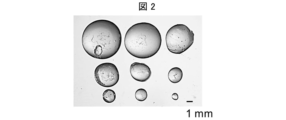
- 1 is a microscope image of spherical capsules of various sizes enclosing adult nematodes in Example 1, taken from above.
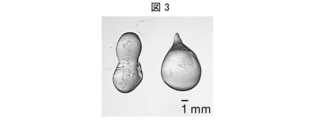
- 1 is a microscopic image of an arbitrary-shaped capsule enclosing an adult nematode in Example 1, taken from above.
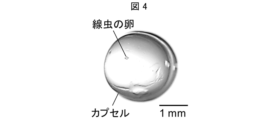
- 2 is a microscopic image of a spherical capsule enclosing nematode eggs in Example 2, taken from above.
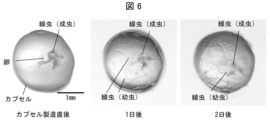
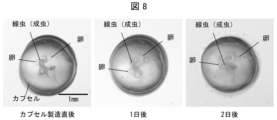
- Fig. 10 is a microscopic image of a spherical capsule enclosing nematode eggs in Example 3, taken from above every day.
- FIG. 10 is a microscopic image of a spherical capsule enclosing an adult nematode in Example 4, taken from above every day.
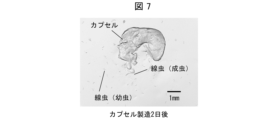
- FIG. 10 is a microscopic image taken from the upper side showing how adult and larvae of nematodes crawl out of a nematode-encapsulating capsule in Example 4.
- FIG. 10 is a microscopic image of a spherical capsule enclosing an adult of a radiation-irradiated nematode in Example 5, taken from above every day.
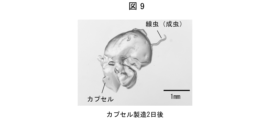
- FIG. FIG. 10 is a microscopic image taken from the upper side showing a state in which an adult of a radiation-irradiated nematode crawls out of a nematode-encapsulating capsule in Example 5.
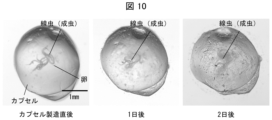
- FIG. Fig. 10 is a microscopic image of a spherical capsule enclosing hatching inhibitor-exposed adult nematodes in Example 6 taken from the upper side every day.
- FIG. 10 is a microscopic image of a state in which an adult hatching inhibitor-exposed nematode crawls out of a nematode-encapsulating capsule, taken from above in Example 6.
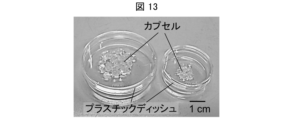
- Example 7 it is a figure which shows a mode that the spherical capsule of two types of sizes which enclosed the adult nematode was enclosed in the plastic dish.
- Example 8 spherical capsules enclosing nematode adults were sprinkled on leaf mulch spread over a plastic dish, and images were taken from above every day.
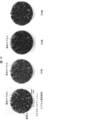
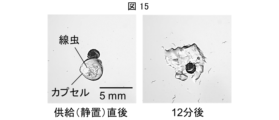
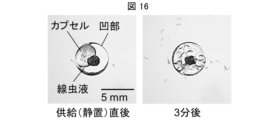
- the nematode test plate A1 is supplied with capsules enclosing nematode adults, and the results of continuous observation of the supplied part are shown.
- a capsule enclosing an adult nematode was supplied to the nematode test plate A2, and the results of observation of the supply part over time are shown.
- nematodes are supplied to the nematode test plate A1 by a conventional method, and the appearance of the supply part is a diagram showing the results of successive observations.
- nematodes are supplied to the nematode test plate A2, and the appearance of the supply part is a diagram showing the results of successive observations.
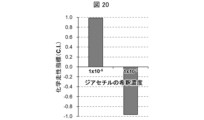
- Example 10 it is a diagram showing the results of a nematode chemotaxis test for volatile substances by supplying a capsule enclosing an adult nematode to the nematode test plate A3.
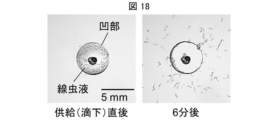
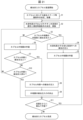
- nematodes are supplied to the nematode test plate A3 by a conventional method, and a diagram showing the results of a nematode chemotaxis test for volatile substances. It is a flow chart which shows an example of the manufacturing method of the nematode encapsulation capsule concerning this embodiment.
- the nematode encapsulation capsule comprises an encapsulation composition containing nematodes and at least one layer of coating.
- capsule is intended a shell of at least one layer that contains an encapsulating composition within it.
- the encapsulation composition contains nematodes.
- nematodes include nematodes at each stage of development. Nematodes at each developmental stage include nematode eggs (including fertilized eggs), larvae (first to fourth instars) and adults. In addition, adult nematodes include nematodes of each sex. Each sex of nematodes includes males and hermaphrodites of nematodes.
- nematodes By nematodes herein is intended both animals belonging to the taxonomic phylum Nematozoa and animals belonging to the phylum Nematozoa. Among the animals included in these, there is no particular limitation as long as they are terrestrial or semi-terrestrial and can move on a solid phase.
- Nematoda Animals belonging to the phylum Nematoda include nonparasitic nematodes (or free-living nematodes), plant-parasitic nematodes, insect-loving nematodes (pathogenic nematodes, predatory parasitic nematodes, parasitic nematodes, including opportunistic nematodes), and various nematodes of parasitic nematodes such as mammals.
- Non-parasitic nematodes include, for example, Caenorhabditis elegans (hereinafter sometimes referred to as "C. elegans”), Aphelenchus avenae, Caenorhabditis angaria), Caenorhabditis brenneri, Caenorhabditis briggsae, Caenorhabditis japonica, Caenorhabditis remanei, and Pristinchus pacificus ( Pristionchus pacificus), etc.
- Caenorhabditis elegans hereinafter sometimes referred to as "C. elegans”
- Plant parasitic nematodes include, for example, Acreberoides nanus, Bastiania gracilis, Wilsonema othophorum, Meloidogyne incognita, Meloidogyne arenaria, Meloidogyne javanica, Meloidogyne hapla, Meloidogyne marytlandi, Meloidogyne mali, Heterodera glycines, Heterodera schachtii, Ocabocyst nematode (Heterodera elachista ), potato cyst nematode (Globodera rostochiensis), potato cyst nematode (Globodera pallida), lotus root nematode (Hirschmanniella diversa), lotus root nematode (Hirschmanniella immamuri), northern nematode nematode (Pratylenchus penetrans), southern nem
- Insect parasitic nematodes include, for example, Sphaerularia bombi, Sphaerularia vespae, Agamermis unka, Amphimermis zuimushi, and Skimshinoshi nematode ( Hexamermis microamphidis), Steinernema carpocapsae, Steinernema kushidai, Iotonchium ungulatum, Iotonchium californicum, Iotonchium cateniform e), Iotoncium lacarye ( Iotonchium laccariae, Iotonchium russulae, Caenorhabditis auriculariae, and Bursaphelenchus tadamiensis, Contortylenchus sp., Contortylenchus genitalicola ( Contortylenchus genitalicola), Romanomermis culicivorax and the like.
- opportunistic nematodes such as insects include Caenorhabditis japonica, Pristionchus pacificus, Bursaphelenchus xylophilus, Bursaphelenchus mucronatus, Bursaphelenchus doui , Bursaphelenchus firmae, Bursaphelenchus conicaudatus, Bursaphelenchus luxuriosae, Bursaphelenchus hunti, Bursaphelenchus okinawaensis, Bursaphelenchus yongensis, Bursa phelenchus kiyoharai, Bursaphelenchus cocophilus, Bursaphelenchus niphades , Bursaphelenchus sexdentati, Teratorhabditis synpapillata, Caenorhabditis briggsae, and Caenorhabditis
- Cenoorhabditis japonica, Pristinchus pacificus, Cenoorhabditis brigsae, and Cenoorhabditis lemanei are treated like free-living nematodes (non-parasitic nematodes) in the laboratory. .
- Parasitic nematodes such as mammals include Strongyloides, filariae, roundworms (ascaris), Anisakis, whipworms, hookworms, jawworms, and trichinella (trichenia).
- S. anura parasitic strongyloides
- S. carinii S. amphibiophilus
- S. bufonis S. physali
- S. spiralis S. prokopici
- S. mascomai etc.
- reptilian lizard parasitic strongyloides S. cruzi, S. darevskyi, and S. ophiusensis, etc.
- reptilian serpentine strongyloides S. ophidiae, S. mirzai, S. gulae, and S.
- aviary stork parasitic strongyloidiae S. cubaensis, S. ardeae, and S. herodiae, etc.
- Avioptera parasitic strongyloides S. avium, S. oswaldoi, and S. pavonis, etc.
- Anatal parasitic strongyloides such as S. avium, S. oswaldoi, and S. pavonis
- Avioptera parasitic strongyloides S. turkmenica, etc.
- Avian passerine parasitic strongyloides S. quiscali Barus, etc.
- Mammary net marsupial parasitic strongyloidia S.
- mammary networms S. akbari, and S. rostombekowi, etc.
- mammary reticulum primates S. stercoralis, S. fuelleborni, S. fuelleborni kellyi) , and S. cebus, etc.
- mammary reticulum heteropodia S. dasypodis, S. shastensis, etc.
- mammary reticulum squamata S. leiperi, etc.
- mammary net rodent Order parasitic strongyloidiasis S. chapini, S. ratti, S. myopotami, S. venezuelensis, S. agoutii, S.
- mammalian reticulum carnivorous strongyloidiasis (S. nasua, S. felis, S. mustelorum, S. erschowi, S. planiceps, S. puttori, S. martis, S. vulpis, S. tumefasciens, S. lutrae, and S. procyonis, etc.), Mammal Reticulata Parasitic strongyloides (such as S. elephantis), mammalian reticulodactyloidal strongyloides (such as S.
- S. stercoralis, S. fuelleborni and S. fuelleborni kellyi are so-called human strongyloides that parasitize humans. Humans can also be parasitized by S. procyonis, a raccoon strongyloidiasis, and S. ransomi, a swine strongyloidiasis.
- Filariae include Parafilaria multipapillosa, Stephanofilaria okinawaensis, Wuchereria bancrofti, Brugia malayi, Onchocerca cervicalis, Gibson worm ( Onchocerca gibsoni, Onchocerca gutturosa, Onchocerca volvulus, Acanthocheilonema reconditum, Setaria digitata, Setaria equina, Labial papillae (Setaria labiatopapillosa), Setaria marshalli, Dirofilaria immitis, Loa loa, and the like.
- Anisakis As Anisakis, Anisakis pegreffii, Anisakis simplex sense stricto, and Anisakis simplex C (Anisakis simplex C) so-called Anisakis type I, Anisakis type II (sperm whale Anisakis ( Anisakis physeteris), Anisakis typica, Psudoterranova decipiens, and Contracaecum osculatum.
- Trichuris trichuris include Trichuris discolor, Trichuris muris, Trichuris ovis, Trichuris suis, Trichuris trichiura, and Trichuris canis ( Trichuris vulpis), etc.
- the hookworms include Ancylostoma braziliense, Ancylostoma caninum, Ancylostoma ceylanicum, Ancylostoma duodenale, Ancylostoma kusimaense, Ancylostoma malayanum, Miyazaki raccoon hookworm Arthrostoma miyazakiense, Ancylostoma tubaeforme, Uncinaria stenocephala, Bunostomum phlebotomum, Bunostomum trigonocephalum, Globocepharus urosubulatus, and Necator americanus ) etc. It is mentioned as a target.
- Gnathostoma nipponicum, Gnathostoma spinigerum, Gnathostoma hispidum, Gnathostoma doloresi, Gnathostoma procyonis, and Gnathostoma vietnamicum and so on.
- trichinella examples include Trichinella britovi, Trichinella spiralis, Trichinella nativa, Trichinella nelsoni, and Trichinella pseudospiralis.
- Mammal parasitic nematodes other than the above include Abbreviata caucasica, Physaloptera praeputialis, Thelazia callipaeda, Thelazia rhodesi, and Thelazia skrjabini. , Habronema microstoma, Habronema muscae, Drachia megastoma, Crassicauda giliakiana, Gongylonema pulchrum, Round pig stomach worm (Ascarops strongylina), and Physocephalus sexalatus.
- worms such as Donkey asini, Strongylus edentates, Strongylus equinus, and Strongylus vulgaris, and Eucoleus annulate , Eucoleus contorta, Pearsonema feliscati, Eucoleus perforans, Paracapillaria philippinensis, or Capillaria philippinensis, and Calodium hepatica , or Capillaria aerophila), Aonchotheca bovis, Eucoleus aerophile, and Pearsonema plica. .
- Trichostrongylus axei Trichostrongylus colubriformis, and Trichostrongylus orientalis
- Haemonchus contortus and bovine torsion Torsion stomach worms such as Mecistocirrus digitatus, Dictyocaulus filaria, Dictyocaulus viviviparus, Nematodirus filicollis, Angiostrongylus cantonensis and Costa Rica
- Targets include blood nematodes such as Angiostrongylus costaricensis, pig lungworm (Metastrongylus elongatus), dog lungworm (Filaroides hirthi), and the like.
- pinworms such as Enterobius vermicularis, Passalurus ambiguous, Syphacia muris, Syphacia obvelata, and Oxyuris equi.
- animals belonging to the phylum Nematoda include wireworms and the like.
- wire bugs include Gordius robustus, Gordius ogatai, Pseudogordius tanganykae, and Chordodes japonensis.
- the nematode to be enclosed in the nematode-encapsulating capsule according to the present embodiment is preferably Caenorhabditis elegans or its related species.
- C. Relatives of elegans include Caenorhabditis brenneri, Caenorhabditis briggsae, Caenorhabditis japonica, Caenorhabditis remanei, and Seno Rabditis inopinata (Caenorhabditis inopinata) and the like.
- the encapsulating composition may contain components other than nematodes.
- Other components include a water-soluble polymer that gels by reacting with cations; liquids in which nematodes can survive, such as water and buffers; nematode culture medium; nematode food such as E. coli; culture of E. coli E. coli food such as yeast; labeling substances such as dyes and fluorescent substances to make the encapsulated composition more visible; antibiotics to prevent contamination by bacteria or fungi; Also called.); and the like. Details of the water-soluble polymer will be described later.
- nematodes By adjusting the amount of food such as E. coli in the encapsulating composition, it is possible to adjust the nutritional status of nematodes and control the developmental stage or growth rate of nematodes. Controlling the developmental stage or growth rate of nematodes facilitates medium- to long-term transportation or medium- to long-term storage of nematode-encapsulating capsules.
- the developmental stage of the nematode encapsulated in the nematode encapsulation capsule is the egg, if the amount of food such as E. coli in the encapsulated composition is small, the development will stop at the first instar larva (L1 larva) stage. Nematodes in this developmentally halted state are called resistant larvae. Resistant larvae can survive without nutrients for about a month. If environmental conditions such as nutritional status improve, the resistant larvae return to normal developmental stages and grow to adults.
- the amount of food such as E. coli in the encapsulation composition is small, for example, immediately after manufacturing the nematode encapsulation capsule, the amount of bait is 10% or less when the amount of eggs in the encapsulation composition is 100% by mass. Alternatively, states of 5% or less are included.
- the developmental stage of the nematode encapsulated in the nematode encapsulation capsule is the L1 larvae
- the amount of food such as E. coli in the encapsulation composition is small, development will stop at the L1 larval stage, resulting in resistant larvae.
- the amount of bait such as E. coli in the encapsulation composition is small, for example, immediately after manufacturing the nematode encapsulation capsule, the amount of bait is 10% or less when the amount of LI larvae in the encapsulation composition is 100% by mass. , or 5% or less.
- the hatching inhibitor can suppress the growth of nematodes after using the nematode-encapsulating capsule and prevent the nematodes from spreading into the environment.
- the number of nematodes in the encapsulating composition can be appropriately selected according to the use and size of the nematode encapsulating capsule, and may be one (one in the case of eggs), It may be plural (plural in the case of eggs).
- the nematodes may be irradiated nematodes. By using irradiated nematodes, the percentage of eggs that hatch can be adjusted. Also, development can be controlled (eg, development is halted, development is delayed, etc.) by using irradiated larvae. Radiation irradiation will be described later.
- the nematodes may be nematodes that have been treated (typically exposed) with a hatching inhibitor.
- a hatching inhibitor By using nematode adults exposed to hatching inhibitors for a period of time, the number of adult eggs laid or the percentage of eggs that hatch can be adjusted. The hatching inhibitor treatment will be described later.
- the nematode may be a sterilized nematode.
- sterilized nematodes it is possible to suppress the growth of nematodes after using the nematode-encapsulating capsule and prevent the nematodes from spreading into the environment. The sterilization process will be described later.
- the membrane of the nematode-encapsulating capsule according to the present embodiment is a membrane forming the outer phase of the nematode-encapsulating capsule, thereby enclosing an encapsulating composition containing nematodes inside thereof (hereinafter, Sometimes referred to as "external phase membrane").
- the film contains as a main component a water-soluble polymer that gels by reacting with cations.
- "containing a water-soluble polymer as a main component” means that the film contains 50% by mass or more of the water-soluble polymer when the components excluding the liquid component in the film are taken as 100% by mass. .
- the film is preferably composed of a material that nematodes do not eat, a material that does not adversely affect nematodes, and/or a material that is permeable to oxygen.
- the water-soluble polymer that gels by reacting with cations is preferably a water-soluble polymer that gels by reacting with divalent cations (eg, Mg 2+ , Ca 2+ ). More preferably, it is a water-soluble polymer (calcium-coagulating polymer compound) that gels by reacting with calcium ions.
- water-soluble polymers examples include proteins and polysaccharides.
- water-soluble polymers include guar gum, casein, pectin, sodium cellulose glycolate, sodium alginate, sodium polyacrylate, agar, ⁇ (kappa) carrageenan, ⁇ (iota) carrageenan, ⁇ (lambda) carrageenan, Gluten, dextrin, xanthan gum, methylcellulose, starch, gelatin, locust bean gum, galactan, albumin and keratin. Those that dissolve in water at room temperature or lower are preferred. Among these, sodium alginate is more preferred.
- water-soluble polymer Even if it dissolves in hot water but does not dissolve in cold water, it is acceptable if it can be prepared at a low temperature, such as by dissolving it in sodium salt. Moreover, one type of water-soluble polymer may be used, or two or more types may be used.
- the film may contain components other than the water-soluble polymer.
- Other components include dyes; labeling substances such as fluorescent substances; nematodes; liquid components such as water and buffers in which nematodes can survive; nematode culture components; liquid components; food for Escherichia coli such as yeast; and antibiotics for preventing contamination with bacteria or fungi.
- the coating contains a dye or a labeling substance, the outer shape of the nematode-encapsulating capsule can be easily visualized during visual observation or microscopic observation (for example, fluorescence microscopic observation).
- the thickness and hardness of the coating can be appropriately selected according to the use and size of the nematode-encapsulating capsule. For example, by thinning the membrane, the encapsulated nematodes can be induced to break through the membrane and escape from the nematode encapsulation capsule.
- the coating may be a single layer or multiple layers.
- the shape of the nematode-encapsulating capsule according to the present embodiment is not particularly limited as long as the desired amount of nematodes can be encapsulated in the capsule.
- Examples of the shape of the capsule include spherical, elliptical, teardrop, and gourd-shaped.
- one or more faces of the capsule may be flat.
- the size of the nematode-encapsulated capsule according to the present embodiment is the type of nematode to be encapsulated in the capsule, the developmental stage (egg, larva, adult, etc.), the presence or absence of sterilization treatment of the nematode before encapsulation, sex, It may be appropriately selected according to the size, number, and the like.
- the outer diameter of the capsule may be several micrometers, several tens of micrometers, or several hundred micrometers. Moreover, the outer diameter of the capsule may be several millimeters, several tens of millimeters, or several hundred millimeters. Moreover, the outer diameter of the capsule may be 10 cm or less, or may be 1 cm or less. Moreover, the outer diameter of the capsule may be 10 ⁇ m or more, or may be 20 ⁇ m or more. As used herein, the outer diameter of the capsule indicates the maximum diameter of the cross section of the capsule.
- Oxygen is essential for the survival of nematodes enclosed in the nematode encapsulation capsule according to the present embodiment, but since the shell of the capsule is oxygen-permeable, it is possible to survive for several days in the capsule. .
- the encapsulation composition of the nematode-encapsulating capsule contains food for nematodes such as E. coli, the nematodes can grow in the capsule.
- the nematode-encapsulated capsule according to this embodiment can be stored in a good condition for several days even if it is sealed in a container such as a plastic dish. That is, the nematode-encapsulating capsule according to the present embodiment can be transported, and the nematodes encapsulated in the capsule can be used at the transported destination. Moreover, the nematodes enclosed in the capsule can be taken out by a simple operation such as making a hole in the capsule. Therefore, even an unskilled person can carry out an experiment or the like using nematodes by using the capsule.
- a liquid such as water may be injected into the storage container.
- a liquid such as water By injecting a liquid such as water into the storage container, it is possible to reduce the influence of vibration on nematodes during transportation.
- nematode-encapsulating capsules by increasing the number of nematode-encapsulating capsules in the same storage container and storing them in a dense state, it is possible to suppress rolling or breakage of each nematode-encapsulating capsule due to vibration during transportation.
- shape of the nematode-encapsulating capsule is not spherical, but one or more surfaces are flat, placing the surface down in a storage container can suppress rolling of the capsule due to vibration, and transport. It is possible to reduce the influence on the nematodes in the capsule due to the vibration of time.
- Method (1) a method of encapsulating a nematode at the same time as preparing a film that will be the outer layer of the capsule (hereinafter, sometimes referred to as “method (1)”). and (2) a method of injecting nematodes after preparation of the film that will be the outer layer of the capsule (hereinafter sometimes referred to as “method (2)”), and the like.
- method (1) a method of encapsulating a nematode at the same time as preparing a film that will be the outer layer of the capsule
- method (2) a method of injecting nematodes after preparation of the film that will be the outer layer of the capsule
- (S1) Determination of various conditions such as developmental stage (stage) of nematodes to be encapsulated, culture of nematodes]
- stage stage of nematodes to be encapsulated
- culture of nematodes the type of nematode to be encapsulated, developmental stage (egg, larva, adult, etc.), presence or absence of sterilization treatment of nematode before encapsulation, sex, and encapsulation, depending on the use of the nematode encapsulation capsule
- the number of nematodes or the amount (volume) of liquid containing nematodes hereinafter sometimes referred to as "nematode liquid"
- the nematodes may be cultured prior to encapsulation to obtain nematodes at the desired developmental stage.
- irradiating nematodes with radiation By irradiating nematodes with radiation (X-rays, gamma rays, electron beams, heavy particle beams, proton beams, etc.), the reproductive function of nematodes can be suppressed.
- the method of irradiating nematodes with radiation may be selected according to the radiation irradiation facility, the type of nematode, the purpose of irradiation, and the like.
- Examples of radiation irradiation to nematodes include irradiation onto a culture plate, irradiation into a culture solution in a centrifuge tube (tube), and irradiation in a state enclosed in a microchip for retaining nematodes. be done.
- irradiating nematodes with radiation a method of irradiating the whole body of nematodes by irradiating the entire container containing nematodes, and a special method that can irradiate radiation targeting specific parts
- a method of irradiating only nematode gonads using an irradiation device for example, a heavy ion microbeam irradiation device, etc.
- the dose required to render all fertilized eggs from the irradiated generation incapable of hatching depends on the type of nematode, developmental stage or sex, type of radiation ( radiation quality) or dose rate, etc.
- the sexes of nematodes are divided into female, female and hermaphroditic. If the irradiated individual is a male, it is evaluated whether the next generation (fertilized egg) fertilized by mating with an unsterilized female or hermaphrodite after irradiation can hatch.
- the irradiated individual is a female, it is evaluated whether or not the next generation (fertilized egg) fertilized by mating with a male that has not been sterilized after irradiation can hatch.
- the irradiated individual is hermaphroditic, can the next generation (fertilized eggs) self-fertilized before or after irradiation, or the next generation fertilized by mating with a male after irradiation (fertilized eggs) hatch?
- C.I. ED 37 the effective dose that reduces hatchability by 37% when irradiating pre-oviposition hermaphroditic adults of C.
- elegans is approximately 184 Gy (Gray, a unit of absorbed dose) for X-rays or gamma rays. , there is a report that it is about 41 Gy for carbon ray, which is a kind of heavy ion beam.
- the threshold dose for 0% hatchability (sterilizing dose: ED 0 ) is about 500 Gy for X-rays or gamma rays.
- a medium added with fluorodeoxyuridine hereinafter referred to as "FUdR"
- FUdR fluorodeoxyuridine
- the dose of drug required to render all eggs laid by the drug-treated generation unhatched depends on the type of nematode, developmental stage or sex, type of drug or treatment (exposure) time, etc. For example, by adding FUdR solution to culture plates, C. For 1-day exposure to pre-laid hermaphroditic adults of C. elegans, the sterilizing dose for 0% hatchability of the next generation is 0.5 mg/mL or higher. By exposing pre-laying adults to lower than sterilizing doses of the drug, it is possible to adjust so that only a certain percentage of the eggs hatch.
- a drug such as FUdR is added to the encapsulation composition of the nematode encapsulation capsule. It can also be added. In this case, hatching of eggs in the nematode-encapsulating capsule can be suppressed.
- a water-soluble polymer such as a calcium-coagulating polymer compound and a cation such as an aqueous calcium salt solution are selected, and various conditions such as concentration are determined.
- calcium-coagulating polymeric compounds include sodium alginate, and suitable cations for its coagulation include aqueous calcium salt solutions such as aqueous calcium lactate and aqueous calcium chloride solutions.
- a solution containing the water-soluble polymer and an aqueous cation solution are prepared.
- Various conditions such as the concentration may be determined based on the conditions used in known methods for producing artificial particles. For example, the conditions described in Japanese Patent Application Laid-Open No. 7-133209 may be referred to.
- FIG. 21 shows an example of injecting a nematode liquid into a solution containing a water-soluble polymer
- a water-soluble polymer may be added to the nematode liquid to prepare an encapsulating composition.
- the nematode-containing encapsulation composition prepared in (S4) and the cation-containing solution prepared in (S2) are reacted to form a coating that will be the outer phase membrane of the nematode-encapsulated capsule.
- a film that will be the outer phase membrane of the nematode-encapsulated capsule is prepared.
- a film that will be the outer phase membrane of the nematode encapsulating capsule is produced.
- the size and shape of the nematode encapsulating capsule can be adjusted.
- the dripping object is immersed in the receiving liquid until the thickness and hardness of the desired film are obtained after the coating is formed.
- the immersion time eg, about 5 minutes
- the thicker and harder the coating e.g., the immersion time is short (eg, less than 30 seconds)
- the coating will be thin and soft. If the film is thin and soft, the nematodes enclosed in the nematode-encapsulating capsule can break the film by themselves and escape from the nematode-encapsulating capsule.
- JP-A-5-92909 may be referred to.
- Japanese Patent Application Laid-Open No. 7-133209 and the like may be referred to.
- This step is a determination step performed when not injecting nematodes is selected in (S7) “Inject nematodes into capsule?”. If the capsule is multi-layered and the capsule enclosing the nematode inside has already been produced before the production of the outer phase membrane of the capsule in (S6), proceed to (S11). If the capsule consists of the single-layer outer phase membrane prepared in (S6) immediately before, or if it is multi-layered but does not enclose the nematode inside, return to (S2) and make the nematode-encapsulated capsule. Continue manufacturing.
- nematode encapsulation capsules containing multiple layers without encapsulating nematodes in the encapsulation composition contained in the inner layer coating or in the inner layer, even if the nematode is enclosed between the inner layer and the outer layer or in the outer layer. good.
- the type, developmental stage, sex, etc. of nematodes may be varied depending on the encapsulation position.
- a gel is generated by reacting a water-soluble polymer that gels by reacting with a cation with a cation such as calcium ion. Then, a film is formed on the surface of the gel. Since the encapsulated composition contained in the coating is in a liquid or sol form, nematodes can be encapsulated in the nematode encapsulation capsule while maintaining fluidity.
- the method for producing nematode-encapsulated capsules according to the present embodiment since gelation is not induced by heating, nematodes are not affected by heat shock or the like. In addition, there is the advantage that the manufacturing process and the components of the nematode-encapsulating capsule do not cause any chemical effects on nematodes. Furthermore, the film formed in the method for producing the nematode-encapsulated capsule according to the present embodiment is oxygen-permeable, and can maintain the oxygen supply essential for survival of the nematode encapsulated in the nematode-encapsulated capsule. .
- the nematode response evaluation method includes a step of supplying a nematode-encapsulated capsule to a nematode test plate (hereinafter sometimes simply referred to as "plate"), and nematodes from the nematode-encapsulated capsule. releasing and assessing the nematode response.
- plate a nematode test plate
- Step of supplying nematode-encapsulated capsules to nematode test plate This step is a step of supplying nematode-encapsulating capsules to a nematode test plate partly supplied with a test substance (hereinafter sometimes referred to as a “supplying step”).
- the nematode test plate is not particularly limited as long as it can be used for nematode response evaluation tests.
- a nematode trap plate having a dropping tank described in Patent Document 2 International Publication No. 2020/218501 (hereinafter sometimes referred to as "nematode trap plate") may be used. good.
- a nematode trap plate When a nematode trap plate is used, it may be carried out according to the nematode response evaluation method described in Patent Document 2.
- a nematode test plate provided with a supply unit for supplying nematodes, spread on the plate of a solution containing nematodes flowing out from the nematode encapsulation capsule
- a plate (hereinafter, sometimes referred to as a “supply portion processed plate”) whose feed portion has been processed to suppress it may also be used.
- nematodes can be fed by feeding the nematode-encapsulating capsule to the feeding section.
- the supply section processing plate will be described below.
- the feeder processing plate has a feeder in the solid phase that feeds the nematode encapsulation capsules in the feeding process.
- the supply part is processed to suppress the spread of the nematode-containing solution in the nematode-encapsulated capsule, which flows out from the nematode-encapsulated capsule in the step of releasing nematodes from the nematode-encapsulated capsule, which will be described later.
- the nematodes stay within a predetermined range, and the movement start position of the nematodes can be sufficiently controlled.
- Specific embodiments are not limited as long as the processing suppresses the spread of the nematode-containing solution flowing out of the nematode-encapsulating capsule.
- the surface that is in contact with the nematode-containing solution that flows out from the encapsulated capsule is made hydrophobic.
- the case where the solid phase is a solid medium will be described below.
- the provision of a concave portion for the supply portion will be described.
- the supply part By making the supply part a recess, it is possible to hold the solution containing the nematodes flowing out of the nematode-encapsulating capsule inside, so that the solution containing the nematodes flowing out of the nematode-encapsulating capsule spreads on the plate. can be suppressed.
- nematodes overlap in the recess and form a mass group, nematodes crawl out to the solid medium surface in order from the nematode close to the opening on the solid medium surface side of the recess, so when nematodes are released groups can be dissolved.
- the continuation of the cluster state can be prevented by providing the concave portion.
- the nematode-encapsulated capsule can be retained in the concave portion, it is easy to supply the nematode-encapsulated capsule onto the plate.
- the recess is formed to extend from the surface of the solid medium toward the bottom of the solid medium.
- the depth of the recess is not particularly limited as long as it is within the range where the effect of the recess can be obtained. For example, it may or may not reach the bottom surface of the solid medium.
- the shape of the recess when viewed from the opening side is not particularly limited, but the ease of observation when observing the nematode in the recess with an upright microscope, and the line after the solution in the nematode encapsulation capsule dries From the viewpoint of ease of crawling of insects onto the surface of the solid medium, the opening of the recess preferably has the same shape as the bottom surface of the recess or a shape wider than the bottom surface.
- the method of forming the recess is not particularly limited.
- a method of hollowing out a solid medium to form a recess and a method of injecting a solid medium into a container preliminarily provided with a structure for forming a recess to form a recess can be used.
- the volume of the recess is not particularly limited.
- the volume of the recess depends on the thickness of the solid medium.
- a feeder processing plate having recesses for example, a round plastic dish with a bottom surface inner diameter of about 8.4 cm and a bottom surface area of about 55 cm 2 is provided with one cylindrical recess with an inner diameter of 5 mm (bottom surface area is about 0.2 cm 2 ).
- the recess may penetrate the solid medium, and the container may be exposed on the bottom surface of the recess.
- the bottom surface of the container is hydrophobic, part of it is exposed in the recess, and the solution containing nematodes that has flowed out of the supplied nematode-encapsulating capsule is in contact with the hydrophobic part, thereby drying the nematode solution.
- hydrophobic part is exposed in the recess, and the solution containing nematodes that has flowed out of the supplied nematode-encapsulating capsule is in contact with the hydrophobic part, thereby drying the nematode solution.
- hydrophobic part is exposed in the recess, and the solution containing nematodes that has flowed out of the supplied nematode-encapsulating capsule is in contact with the hydrophobic part, thereby drying the nematode solution.
- hydrophobic part refers to the property of repelling liquid components of a nematode-containing
- the nematode liquid supplied (dropped) to the bottom surface of the recess spreads over the whole because the bottom surface of the recess is hydrophobic, and then quickly moves to the outer periphery of the bottom surface of the recess, First, the center of the bottom surface of the recess becomes dry. Therefore, the nematode-containing solution flowing out from the nematode-encapsulating capsule can be efficiently moved to the outer periphery of the bottom surface of the recess following the inner wall of the recess, which is the flow line when the nematode crawls on the surface of the solid medium. Thereby, the nematodes can be suitably supplied to the surface of the solid medium.
- the bottom surface of the recess may be processed to be hydrophobic by making the entire container hydrophobic. Since the bottom surface of the concave portion is hydrophobic, the liquid component of the nematode-containing solution that flows out from the nematode-encapsulating capsule onto the plate is repelled by the hydrophobic part, so the nematode-containing solution that flows out from the nematode-encapsulating capsule. can be rapidly moved from the center of the bottom surface of the recess to the periphery of the bottom surface of the recess.
- the material of the container is preferably a material that does not absorb or permeate liquid. As such a material, for example, plastic, glass, silicone resin such as polydimethylsiloxane (PDMS), etc., or metal such as aluminum can be selected.
- a similar effect can also be obtained by applying a hydrophobic material such as a water-repellent polymer to the bottom surface of the recess instead of exposing the container portion made of a hydrophobic material on the bottom surface of the recess.
- a hydrophobic material such as a water-repellent polymer
- it may be applied not only to the bottom surface but also to the inner wall (side surface) side of the concave portion.
- the processing to make the surface of the supply portion hydrophobic is not particularly limited.
- a hydrophobic sheet of any material and shape is placed on a nematode test plate, and the sheet is used as a supply part.
- the inner wall of the recess connecting the bottom surface of the recess and the opening may be water absorbent. Since the inner wall of the recess is water absorbent, the liquid component of the nematode-containing solution flowing out from the nematode-encapsulating capsule is absorbed by the solid medium, so that the nematode liquid in the recess can be dried quickly.
- water absorbability refers to the ability of a solid medium to absorb liquid components of a solution (not limited to water) flowing out of a nematode-encapsulating capsule. For example, within about 30 minutes from the supply of the nematode-containing solution flowing out from the nematode-encapsulating capsule, the solid medium absorbs 40% or more, preferably 50% or more, more preferably 70% or more of the liquid component of the solution. refers to doing
- the bottom surface of the recess may be hydrophobic, and the inner wall of the recess may be water absorbent.
- the nematode-containing solution that flows out of the nematode-encapsulating capsule preferably moves to the outer periphery of the bottom surface of the recess. Therefore, the liquid component of the solution containing nematodes flowing out of the nematode-encapsulating capsule is more preferably absorbed by the inner wall of the recess, so that the drying time of the solution can be shortened.
- the method of making the inner wall of the concave portion water absorbent is not particularly limited.
- the solid medium may be hollowed out to form recesses to make the inner walls water absorbent.
- By hollowing out the solid medium to form a recess fine holes formed inside as the solid medium solidifies are exposed on the inner wall of the recess, and the function of the exposed hole makes the inner wall of the recess absorb water.
- the concave portion is formed by a method of hollowing out a solid medium.
- the surface of the inner wall of the recess becomes rough and the area of the inner wall of the recess increases. It is presumed that by hollowing out and forming recesses in this way, the area capable of absorbing the liquid component of the solution containing nematodes flowing out from the nematode-encapsulating capsule and the number of fine holes are increased. . Therefore, it is preferable to form the concave portion by hollowing it out.
- the area of the inner wall of the recess is not particularly limited, but from the viewpoint of increasing the water absorption of the nematode liquid on the inner wall of the recess, it is preferably 0.1 cm 2 or more and 4 cm 2 or less, and 0.2 cm 2 or more and 2 cm. It is more preferably 2 or less.
- the area of the inner wall of the recess increases due to an increase in the amount of the solid medium, the humidity in the feeding part processing plate and thus in the recess increases. Dryness is suppressed.
- the time required for drying the liquid component of the nematode-containing solution flowing out of the nematode-encapsulating capsule depends on the size and shape of the feeding section processing plate, the size, shape and number of recesses, and the line flowing out of the nematode-encapsulating capsule.
- the area of the inner wall of the recess may be appropriately selected with reference to the above range and other conditions.
- the depth of the recess is preferably 0.1 cm or more and 1 cm or less, and more preferably 0.14 cm or more and 0.6 cm or less.
- the depth of the recess is not less than the lower limit, the area of the inner wall of the recess can be kept within a sufficient range, so that the inner wall of the recess can maintain sufficient water absorbency.
- the upper limit of the depth of the recesses it is possible to shorten the distance for the nematodes to crawl out of the recesses and to control the humidity in the recesses within a suitable range. Therefore, the time until the nematodes are released can be shortened.
- the depth of the concave portion may be set low by relatively increasing the amount (volume) of the solid medium injected into the feed section processing plate, that is, by making the thickness of the solid medium relatively thin.
- the distance from the bottom surface of the recess to the surface of the solid medium is shortened, and the number of nematodes stacked along the inner wall from the bottom of the recess toward the opening on the surface of the solid medium can be limited. You can control the size.
- the release of the nematodes becomes smoother. For example, when the depth of the recess is 0.17 cm or more and 0.25 cm or less, nematode release can be started within 3 minutes after release of the nematode from the nematode encapsulation capsule.
- the amount (volume) of the solid medium may be changed as appropriate depending on the method for preparing the solid medium, the size of the container, and the conditions of the drying process described below.
- the amount of the solid medium will be described below, taking as an example a solid medium that has been solidified by pouring it into a container and left overnight in a highly airtight storage container at room temperature, in the case where the supply portion is a recess. Since the water content of the solid medium changes depending on the storage time after solidification, the conditions of the supply step and the drying step described later may be adjusted according to the state of the solid medium.
- the amount (volume) of the solid medium should be such that the nematode-containing solution flowing out from the nematode-encapsulating capsule supplied to the recess does not overflow onto the surface of the solid medium.
- the amount of the solid medium is preferably 40% or less of the volume of the container.
- the lower limit is not particularly set, if it is 10% or more, the nematode-containing solution flowing out from the nematode-encapsulating capsule does not overflow into the solid medium, and is within the range where the test can be performed.
- the amount of the solid medium is about 10 mL to 30 mL, that is, the thickness is 0.4 cm. It may be about 2 cm to 0.6 cm.
- the amount of the solid medium should be about 3 mL to 10 mL, ie, the thickness should be about 0.14 cm to 0.5 cm.
- the depth of the recesses is the same as the thickness of the solid medium, and depends on the amount (volume) of the solid medium. You may adjust it so that it is inside.
- the amount (volume) of the solid medium may be 20% or less of the volume of the container.
- using a solid medium within the range will result in a larger amount of solid medium than this range.
- the drying speed of the liquid component of the nematode-containing solution flowing out from the supplied nematode-encapsulating capsule is faster. Therefore, when it is desired to relatively shorten the time required for the drying step, which will be described later, a solid medium within this range can be suitably used.
- "relatively short time required for the drying process” means that the time required for the drying process is typically within 25 minutes.
- the amount of solid medium is about 10 mL, that is, the thickness is from 0.2 cm to It may be about 0.4 cm.
- the amount of solid medium should be about 3 mL, that is, the thickness should be about 0.15 cm.
- the amount (volume) of the solid medium may be 40% or more of the volume of the container. Although there is no upper limit to the amount of the solid medium, it is preferably 50% or less of the volume of the container from the viewpoint of ease of testing.
- the amount (volume) of the nematode-containing solution flowing out from the nematode-encapsulated capsule to be supplied are the same, compared to using a solid medium in an amount smaller than this range, from the nematode-encapsulated capsule
- the drying speed of the liquid component of the outflowing nematode-containing solution slows down. Therefore, a solid medium within this range can be suitably used when the time required for the drying step is desired to be relatively long.
- a relatively long time required for the drying process typically means that the time required for the drying process is 60 minutes or more and 180 minutes or less. If it takes more than 180 minutes, the nematodes used in the test will be starved and may not be suitable for normal tests, but in the test using starved nematodes, an extremely long time exceeding 180 minutes Drying, which takes longer, can also be selected.
- the number, shape, size, and position of the supply part may be appropriately changed according to the type and number of nematodes used, the type and number of test objects, and the purpose of the test. good.
- the number of feeds can be, for example, 1, 2, 3, 4, 5, or 6 or more.
- the shape of the supply portion may be, for example, a circular shape, a rectangular shape, a polygonal shape, or the like when the supply portion is cut in the horizontal direction.
- the size of the feed section is preferably sufficiently smaller than the size of the feed section processing plate.
- the total area of the openings of the recess on the plate surface side may be approximately 2% or less, more preferably 0.4% or less, of the surface of the solid medium.
- the position of the feed section is typically near the center of the feed section processing plate, but is not particularly limited, and may be determined according to the purpose and content of the test.
- the size of the container used for the supply section processing plate is not particularly limited as long as it is suitable for the test.
- the inner diameter of the bottom surface of the container is preferably 3.0 cm or more and 15.0 cm or less
- the height (inner height) is preferably 0.5 cm or more and 3 cm or less. 0 cm or less, and a height (inner height) of 1 cm or more and 1.5 cm or less.
- the internal dimensions are length (typically short side) 3 cm or more and 30 cm or less, width (typically long side) 3 cm or more and 30 cm or less, and height 0.5 cm or more and 3 cm.
- the volume of the container is preferably 3.6 cm 3 or more and 2700 cm 3 or less, and preferably 19.5 cm 3 or more and 565 cm 3 or less.
- Step of releasing nematodes from nematode encapsulation capsule This step is a step of releasing the nematodes from the nematode-encapsulating capsule supplied in the supplying step (hereinafter sometimes referred to as a “release step”).
- the nematode may be released by providing a hole in the nematode encapsulating capsule.
- the nematode-containing solution may be pipetted or the like so that the nematode density is constant.
- the liquid component of the solution containing nematodes that has flowed out from the nematode-encapsulated capsule is dried, and a drying step is performed to facilitate the movement of nematodes on the plate.
- a drying step is performed to facilitate the movement of nematodes on the plate.
- Drying of the liquid component of the nematode-containing solution that has flowed out of the nematode-encapsulating capsule may be performed by evaporation or the like of the solution.
- the liquid component of the nematode-containing solution that has flowed out from the nematode-encapsulating capsule dries, making it easier for the nematodes to move and releasing the nematodes onto the feeding section processing plate.
- the supply part is processed to suppress the spread of the solution containing nematodes that flows out from the nematode-encapsulating capsule on the plate, so that the solution spreads before the liquid component of the solution containing nematodes dries. can be prevented and nematodes can be kept within a predetermined range. This makes it possible to control the release timing of nematodes, particularly when nematode-encapsulated capsules with an outer diameter of about several centimeters and containing a large amount (volume) of the encapsulating composition are used.
- the term “release” refers to drying of the liquid component of the nematode-containing solution flowing out from the nematode-encapsulating capsule and the nematodes crawling out onto the feeding portion processing plate. Further, in the present embodiment, “drying” means that the liquid component of the solution containing nematodes flowing out from the nematode-encapsulating capsule is removed to the extent that the nematodes can move freely on the feeding part processing plate. It is intended and typically refers to a state in which 80% or more of the liquid component has been removed.
- Step of evaluating nematode response This step is a step of evaluating the response (for example, chemotaxis) of the nematodes released in the release step to the test substance (hereinafter sometimes referred to as "response evaluation step").
- C. elegans are attracted to a specific concentration of sodium chloride (NaCl), chemotaxis to escape from a specific concentration of diacetyl, and to the urine of cancer patients. as well as taxis to specific temperatures (thermotaxis).
- NaCl sodium chloride
- chemotaxis to escape from a specific concentration of diacetyl
- the response evaluation step can determine the possibility of cancer morbidity of the subject. That is, the nematode response evaluation method according to the present embodiment can be used in a cancer examination method.
- cancer testing for example, a step of supplying the target test substance to a part of the nematode test plate (forming a concentration gradient of the target test substance), and supplying the nematode encapsulating capsule to a predetermined position A step of releasing nematodes from the nematode-encapsulating capsule, and after a certain period of time, the number of nematodes attracted to or escaped from the test object, or an element that correlates with the number of nematodes and measuring.
- the nematode test plate is not particularly limited as long as it can be used in a nematode cancer response evaluation test.
- the nematode trap plate described above may be used.
- the nematode trap plate may be carried out according to the cancer examination method described in Patent Document 2.
- the number of nematodes attracted to the test object may be, for example, the number of nematodes present within a predetermined area from the portion.
- the number of nematodes that have escaped from a portion of the nematode test plate may be the number of nematodes present outside a predetermined region from the portion.
- test items used in cancer testing methods include biological samples collected from test subjects.
- the biological sample include body fluids such as urine, sweat, saliva, pleural effusion, ascites, stool and blood (including individual components separated from blood, such as plasma, serum, etc.); cells such as biopsy cells , cancer tissues such as biopsy tissues and tissue sections; preservation solutions and culture solutions for biological tissues and the like;
- the test substance is preferably a bodily fluid that can be easily collected from a mammal to be tested, more preferably urine or blood.
- nematode olfactory tests for odorant-releasing test objects or nematode taste tests for taste-bearing test objects may be performed.
- part of the nematode test plate, the step of supplying the test substance of interest (forming a concentration gradient of the test substance of interest), and the nematode encapsulation capsule at a predetermined position The step of supplying, the step of releasing nematodes from the nematode-encapsulating capsule, and the number of nematodes attracted to or escaped from the test object after a certain period of time, or an element that correlates with the number of nematodes and a step of measuring the
- the olfactory test can be used to select a hostile or repellent organism against plant parasitic nematodes.
- the nematode test plate is not particularly limited as long as it can be used in a nematode chemotaxis test.
- the nematode trap plate When the nematode trap plate is used, it may be carried out according to the response evaluation method of nematodes described in Patent Document 2.
- the number of nematodes attracted to the test object may be, for example, the number of nematodes present within a predetermined area from the portion.
- the number of nematodes that have escaped from a portion of the nematode test plate may be the number of nematodes present outside a predetermined region from the portion.
- thermotaxis a test to examine the response of nematodes to temperature (thermotaxis) may be performed using the nematode response evaluation method according to this embodiment.
- thermotaxis test a part of the nematode test plate is adjusted to the desired temperature, the step of supplying the nematode encapsulation capsule to a predetermined position, and the nematode is released from the nematode encapsulation capsule. and a step of measuring the number of nematodes attracted to or escaped from the part after a certain period of time, or a factor correlated with the number of nematodes.
- the nematode test plate is not particularly limited as long as it can be used for the thermotaxis test of nematodes.
- the number of nematodes attracted to a portion of the nematode test plate may be, for example, the number of nematodes present within a predetermined area from the portion.
- the number of nematodes that have escaped from a portion of the nematode test plate may be the number of nematodes present outside a predetermined region from the portion.
- the nematode response evaluation kit includes the nematode encapsulation capsule.
- a nematode test plate may be included.
- the nematode test plate is not particularly limited as long as it is a plate that can be used in nematode response evaluation tests. is mentioned.
- the evaluation kit may include instructions describing procedures for evaluating nematode responses. It may be written or printed on paper or other medium, or may be provided on electronic media such as magnetic tape, a computer readable disk, or a CD-ROM. Instead of instructions, an audio or video file describing the procedure, etc., for evaluating nematode responses may be included. It may be attached to an electronic medium such as a magnetic tape, a computer-readable disk or a CD-ROM, etc., or it may be stored in an accessible cloud server or the like and referenced via the Internet line. .
- the nematode response evaluation kit may be used as a cancer test kit.
- a production kit for producing a nematode-encapsulating capsule according to this embodiment includes a nematode, a water-soluble polymer, and a cation salt.
- the nematodes may be irradiated, hatch-suppressant-exposed, or otherwise sterilized nematodes.
- Examples of aqueous polymers include alginates such as sodium alginate. Salts of cations include calcium salts such as calcium chloride and calcium lactate.
- the production kit may also contain a hatching inhibitor (for example, powder or liquid) or a liquid containing the agent.
- the production kit may include instructions that describe the procedure for producing the nematode-encapsulated capsule. It may be written or printed on paper or other medium, or may be provided on electronic media such as magnetic tape, a computer readable disk, or a CD-ROM. Instead of the instructions, an audio file or video file explaining the procedure for manufacturing the nematode-encapsulating capsule may be included. It may be attached to an electronic medium such as a magnetic tape, a computer-readable disk or a CD-ROM, etc., or it may be stored in an accessible cloud server or the like and referenced via the Internet line. .
- the membrane of the nematode-encapsulated capsule is pierced with a toothpick or tip to break it, the membrane is dissolved by adding a chelating agent such as sodium citrate solution, or microorganisms and chemicals are used.
- a chelating agent such as sodium citrate solution, or microorganisms and chemicals are used.
- Nematodes can escape from the inside of the capsule and can be supplied to a nematode test plate or the like simply by contacting a mixture of substances (typically by spreading them on soil).
- nematode-encapsulating capsule according to the present embodiment is effective in space experiments that require reduction of experimenter's operations and reduction of sample storage space.
- the nematode encapsulation capsule according to this embodiment Use is valid. That is, in a space experiment or an experimental scene by an experimenter who is not an expert, by obtaining the nematode-encapsulated capsule according to the present embodiment, it is possible to use nematodes in good condition suitable for experiments etc. with a simple operation. It becomes possible.
- the line according to the present embodiment By obtaining worm-encapsulating capsules, it becomes possible to use any nematode with a simple operation.
- nematode-encapsulated capsules that contain nematodes in a good state are used when you want to observe nematodes as they are without breaking the membrane or dissolving the membrane, or when you want to keep nematodes in a fixed position. It also contributes to efficient implementation of experiments in which is effective (for example, ion microbeam irradiation experiments in which a specific tissue is irradiated with radiation targeting a range of several tens of ⁇ m).
- nematode-encapsulated capsules When nematode-encapsulated capsules are used in school education and experiments (experiences) at home, etc., it is preferable to suppress the growth of nematodes in the nematode-encapsulated capsules after use and to prevent the spread of nematodes into the environment. .
- nematode-encapsulated capsules containing sterilized nematodes are preferably used in school education and experiments (experiences) at home and the like.
- disease nematodes that cause serious damage to
- the capsule shells are coated with microorganisms and chemical substances contained in the soil or trees for several hours to several days. It can degrade slowly and release nematodes.
- a cancer test using the nematode-encapsulated capsule or the like according to this embodiment can be performed easily and regularly. This will enable early detection of risk factors that may harm health, strengthen measures for risk factor mitigation and risk factor avoidance, thereby extending healthy life expectancy and achieving the Sustainable Development Goals (SDGs). can contribute to the achievement of
- the nematode encapsulation capsule according to aspect 1 of the present invention comprises an encapsulation composition containing nematodes and at least one layer of coating containing the encapsulation composition, and the coating is gelled by reacting with cations. It contains a water-soluble polymer as a main component.
- the nematode-encapsulated capsule according to aspect 2 of the present invention may have an outer diameter of 10 cm or less in the above aspect 1.
- the nematode in aspect 1 or 2 above, may be Caenorhabditis elegans or a related species thereof.
- the water-soluble polymer is at least one water-soluble polymer selected from the group consisting of proteins and polysaccharides. There may be.
- the nematode-encapsulating capsule according to aspect 5 of the present invention may be a nematode irradiated with radiation in any one of aspects 1 to 4 above.
- the nematode in any one of aspects 1 to 5 above, may be a nematode treated with a hatching inhibitor.
- the nematode in any of aspects 1 to 6 above may be a sterilized nematode.
- the encapsulating composition may further contain a hatching inhibitor.
- a method for producing a nematode-encapsulated capsule according to aspect 9 of the present invention is a method for producing a nematode-encapsulated capsule according to any one of aspects 1 to 8 above, wherein the nematode and the water-soluble polymer are mixed.
- the method comprises the steps of preparing an encapsulating composition and reacting the encapsulating composition with a solution containing the cation to produce nematode encapsulating capsules.
- a method for producing a nematode-encapsulated capsule according to aspect 10 of the present invention is a method for producing a nematode-encapsulated capsule according to any one of aspects 1 to 8 above, comprising a solution containing the water-soluble polymer and the cation. It comprises a step of reacting with a solution to prepare a base for the coating of the nematode-encapsulated capsule, and a step of producing the nematode-encapsulated capsule by injecting the nematode into the base.
- the method for producing a nematode-encapsulated capsule according to aspect 11 of the present invention may include a step of irradiating the nematode-encapsulated capsule with radiation.
- the method for producing a nematode-encapsulated capsule according to aspect 12 of the present invention, in aspect 10 above, may include a step of irradiating the nematode-encapsulated capsule with radiation.
- the nematode response evaluation method includes the step of supplying a test article to a part of the nematode test plate, and enclosing the nematode according to any one of aspects 1 to 8 above at a predetermined position. providing a capsule; releasing the nematode from the nematode-encapsulating capsule; and assessing the nematode's response to the test article.
- the step of evaluating the response of the nematode to the test object is after a certain period of time has passed, and is attracted to the part or the It may include a step of measuring the number of nematodes that have escaped from a part or a factor that correlates with the number of nematodes.
- the test object may be a test object that emits an odorant or a test object that has a taste.
- a cancer examination method comprises a step of evaluating the response of a nematode to a biological sample collected from a subject by the response evaluation method of any one of the above aspects 13 to 15; and determining the cancer susceptibility of the.
- the nematode response evaluation method for temperature includes the step of adjusting a part of the nematode test plate to the desired temperature, and any of the aspects 1 to 8 above at a predetermined position.
- a nematode response evaluation kit includes the nematode-encapsulating capsule of any one of aspects 1 to 8 above.
- the nematode response evaluation kit according to aspect 19 of the present invention may be for cancer testing in aspect 18 above.
- a production kit for producing the nematode-encapsulated capsule according to aspect 20 of the present invention is a production kit for producing the nematode-encapsulated capsule according to any one of aspects 1 to 4 above, comprising: a nematode; It contains a water-soluble polymer and a salt of a cation.
- a production kit for producing the nematode-encapsulated capsule according to aspect 21 of the present invention is a production kit for producing the nematode-encapsulated capsule according to aspect 5 above, comprising a nematode that has been irradiated with radiation; It contains a water-soluble polymer and a salt of a cation.
- a production kit for producing the nematode-encapsulated capsule according to aspect 22 of the present invention is a production kit for producing the nematode-encapsulated capsule according to aspect 6 above, comprising nematodes treated with a hatching inhibitor and , a water-soluble polymer, and a salt of a cation.
- a production kit for producing the nematode-encapsulated capsule according to aspect 23 of the present invention is a production kit for producing the nematode-encapsulated capsule according to aspect 7 above, comprising a sterilized nematode, It contains a water-soluble polymer and a salt of a cation.
- a production kit for producing the nematode-encapsulated capsule according to aspect 24 of the present invention is a production kit for producing the nematode-encapsulated capsule according to aspect 8 above, comprising a nematode and a water-soluble polymer , salts of cations, and hatching inhibitors.
- C. elegans was used as a nematode.
- elegans hermaphrodites were used.
- C. elegans was cultured and reared at the optimum temperature of 20°C.
- Table 1 shows the type of buffer used as a liquid and the presence or absence of food in the nematode-encapsulated capsule.
- the following shows an example of the nematode-encapsulating capsule manufacturing process and nematode culture in the capsule.
- a typical method for producing the nematode-encapsulating capsule of one embodiment of the present invention is to drop an aqueous sol of a calcium-coagulating polymer compound encapsulating a nematode into an aqueous solution of a calcium salt to cause gelation.
- nematode adult encapsulation capsules were produced by this method.
- a wash buffer was used to wash the nematodes.
- the wash buffer was prepared by dissolving 0.5 g of gelatin powder in 993 mL of ultrapure water, autoclaved, and then adding 1 M MgSO 4 (1 mL), 1 M potassium phosphate (pH 6.0, 5 mL), and 1 M CaCl. 2 (1 mL) was added and stirred to prepare.
- the nematode-encapsulating capsules produced in this example were not added with Escherichia coli as food.
- S-basal buffer commonly used for nematode culture or various tests Sodium alginate (2 g) was dissolved in 200 mL and stirred to prepare an aqueous sol as a base material for encapsulating nematodes.
- S-basal buffer is a liquid obtained by dissolving NaCl (5.9 g) in 949 mL of ultrapure water, adding ethanol (1 mL) in which cholesterol (5 mg) is dissolved, autoclave, and adding 1 M potassium phosphate (pH 6 .0, 50 mL) was added and stirred.
- calcium lactate (2 g) was dissolved in 200 mL of ultrapure water and stirred to prepare a calcium salt aqueous solution used in the manufacturing process for gelling the aqueous sol.
- nematode sol an aqueous sol containing nematodes (hereinafter sometimes referred to as "nematode sol").
- nematode sol was sucked out using a micropipette or an electric pipettor, dropped into a calcium lactate solution filled in a beaker, and immersed for about 5 minutes. In this way, nematode adult encapsulation capsules enclosing nematode adults were produced.
- the adult nematode encapsulation capsule was taken out from the calcium lactate solution, and the outer phase membrane of the capsule was washed with ultrapure water.
- FIG. 1 shows an image of a spherical capsule enclosing about 100 adult nematodes taken from above using a digital camera attached to a microscope.
- Fig. 2 shows examples of spherical nematode (adult) capsules formed in various sizes by adjusting the diameter of the tip of an electric pipettor or the tip of a micropipette and the amount of droplets of nematode sol.
- Fig. 3 shows an example of a nematode (adult) encapsulated capsule formed in an arbitrary shape by reducing the amount of the aqueous calcium lactate solution or by placing the nematode sol drop position directly above the liquid surface of the aqueous calcium lactate solution.
- nematode-encapsulating capsules of various sizes can be freely produced by adjusting the dropping amount of the nematode sol.
- nematode-encapsulating capsules of any shape, not limited to spherical, such as teardrop-shaped or gourd-shaped, as shown in FIG. 3, can be produced in a controlled or accidental manner.
- nematode-encapsulated capsules enclosing nematodes inside can be produced by dropping nematode sol obtained by injecting nematode liquid into aqueous sol and immersing it in a calcium salt solution.
- Nematode egg-encapsulating capsules were produced by dropping an aqueous sol of a calcium-coagulating polymer compound encapsulating nematode eggs into an aqueous solution of a calcium salt and allowing it to gel.
- a 20° C. wash buffer containing nematodes (eggs or individuals) washed with a wash buffer was used.
- the nematode egg-encapsulated capsules produced here were not added with E. coli as food, and the state of survival of the nematode egg-encapsulated capsules under malnutrition conditions was observed over time.
- FIG. 4 shows an image of a spherical capsule containing about 10 nematode eggs captured from above using a digital camera attached to a microscope. As shown in FIG. 4, it can be seen that nematode eggs are enclosed in capsules. Based on the results of Example 1, it is clear that nematode-encapsulated capsules can be produced by the same method for both eggs and individuals. Although not shown, the nematodes in the capsule hatched into L1 larvae one day later. However, in this example, in which no E. coli was added as food to the nematode egg sol, nutrition for growth was insufficient. They switched to resistant larvae that stopped and survived in the capsules for at least 1 month. From this, it was clarified that nematodes can be positively maintained as resistant larvae for a long period of time by adjusting the nutritional status in the capsule.
- Example 3 Production of capsules encapsulating nematode eggs and cultivation of nematodes in the presence of food E. coli]
- an aqueous sol of a calcium-coagulating polymer compound encapsulating nematode eggs was dropped into an aqueous solution of a calcium salt to gel, thereby forming nematode-encapsulating capsules encapsulating the eggs. manufactured.
- a 20° C. wash buffer containing nematodes (eggs or individuals) washed with a wash buffer was used.
- Escherichia coli as food was added to the nematode egg-encapsulated capsules produced here, and the state of survival of the nematodes in the nematode egg-encapsulated capsules under nutrient-rich conditions was observed over time.
- nematode eggs are enclosed in the nematode encapsulation capsule immediately after production.
- nematode eggs hatched into larvae (L1) within the capsule, which gradually grew two days later.
- larvae became an adult, and after 4 days, egg-laying of the next generation started.
- growth at a normal rate was observed in this example. It became clear that it is possible to grow (culture) appropriately.
- M9 buffer which is commonly used for nematode culture or various tests, in place of the S-basal buffer in Example 3.
- M9 buffer is prepared by dissolving NaCl (50 g), KH 2 PO 4 (30 g), and Na 2 HPO 4 (60 g) in ultrapure water (approximately 100 mL), autoclaved, and then adding 1 M MgSO 4 (1 mL). was added and stirred. Sterilized ultrapure water was added to this solution to dilute it 10-fold, and the solution was prepared by stirring.
- Example 4 Production of capsules encapsulating adult nematodes and culture of nematodes in the presence of food E. coli
- An aqueous sol of a calcium-coagulating polymer compound encapsulating adult nematodes 3 days after hatching was dropped into an aqueous solution of a calcium salt to form a gel, thereby producing capsules encapsulating adult nematodes.
- As the nematode liquid used for injection into the aqueous sol 20° C. M9 buffer containing nematodes (adults) recovered from the culture plate using M9 buffer was used.
- FIG. 7 shows how the nematodes crawled out onto the plate A1.
- the number of individuals to be encapsulated, the size of the capsule, the number of days of encapsulation, etc. should be considered so that the parent generation survives with the next generation. It is effective to adjust the capsule manufacturing conditions, culture conditions, etc.
- a method for inhibiting egg hatching which will be described later, can also be selected.
- Example 5 Production of capsules encapsulating irradiated adult nematodes and cultivation of nematodes in the presence of E. coli food] An experiment was conducted to confirm the efficacy of nematode-encapsulated capsules containing nematodes sterilized by irradiation. An aqueous sol of a calcium-coagulating polymer compound encapsulating adult nematodes three days after hatching irradiated with cobalt 60 ( 60 Co) gamma rays is dropped into an aqueous solution of a calcium salt to form a gel, thereby irradiating radiation. A nematode encapsulation capsule was produced.
- the nematodes used for injection into the aqueous sol were adult nematodes irradiated with cobalt 60 gamma rays while swimming in a tube containing M9 buffer, and the nematode fluid immediately after irradiation was used.
- Example 4 As in Example 4, eggs were collected from adult nematodes and cultured on a plate coated with E. coli until 3 days after hatching. Adult worms 3 days after hatching were collected from the culture plate with M9 buffer and suspended in a tube.
- Example 5 was carried out under the same conditions and procedures as in Example 4, except that adult nematodes were irradiated with gamma rays before manufacturing nematode-encapsulating capsules. Based on the results of Example 4, the sterilization (inhibition of hatching) treatment by irradiation suppresses the development of the next generation even when encapsulating the adult worms on the third day after hatching, which starts laying eggs. It is clear that only the original parent generation can be maintained.
- FIG. 9 shows how the nematodes crawled out on the surface of the plate A1.
- nematodes irradiated with 500 Gy of cobalt-60 gamma rays exhibit a temporary decrease in locomotion, but recover after one day.
- Example 6 Production of capsules enclosing nematode adults exposed to hatching inhibitors and cultivation of nematodes in the presence of food E. coli]
- An aqueous sol of a calcium-coagulating polymer compound encapsulating adult nematodes treated with a hatching inhibitor and 4 days after hatching is dropped into an aqueous solution of a calcium salt to gel the nematode treated with the hatching inhibitor.
- An encapsulated capsule was produced.
- adult nematodes were collected one by one from the culture plate using a platinum wire picker without using the nematode solution, and transferred into an aqueous sol together with E. coli.
- the nematodes were cultured on a plate coated with E. coli until they reached adulthood (before egg-laying) three days after hatching.
- the FUdR solution was added to this nematode culture plate and cultured for another day.
- the FUdR solution was prepared by dissolving 5 mg of FUdR powder in 10 mL of sterilized ultrapure water and stirring. It was confirmed that although adult nematodes laid eggs to some extent on the FUdR-added culture plate, the eggs did not hatch.
- FIG. 10 shows the results from immediately after to two days later. As shown in FIG. 10, immediately after the production of the nematode-encapsulating capsule, the adult nematodes in the capsule began laying eggs. After 1 and 2 days, it was confirmed that the adults were still moving in the capsule, but the eggs laid by the adults did not hatch and no larvae were found.
- FIG. 11 shows how the nematodes crawled out on the surface of the plate A1.
- Adult worms (parents) that escaped from the nematode-encapsulating capsule 2 days after production showed no significant abnormality in locomotion. From this result, it is clear that encapsulation of adult nematodes exposed to a hatching inhibitor in capsules for about two days does not cause any problem in motor function.
- Example 6 instead of culturing for 1 day on a culture plate containing an FUdR solution, nematodes produced using nematodes cultured for 1 day in a culture medium containing FUdR It was confirmed that the worm-encapsulated capsule yielded the same results as when cultured on a culture plate to which the FUdR solution was added.
- the nematode depending on the purpose of use of the nematode, it is possible to suppress the development of the next generation, control the nutritional status, and control the population by adjusting the nematode capsule manufacturing conditions or the nematode culture conditions. It was confirmed that it was possible.
- Example 7 Storage of Nematode Encapsulation Capsules] (Production of Nematode Adult Encapsulation Capsule)
- a nematode sol was prepared by the method of Example 1, and a suspension of E. coli to be fed was added. Next, the nematode sol was sucked out using a micropipette, and the nematode sol was dropped into a calcium lactate solution filled in a beaker and immersed in the beaker for about 5 minutes. As a result, spherical nematode-encapsulating capsules with a diameter of about 3 mm were produced in which adult nematodes were enclosed.
- the nematode sol was sucked out using an electric pipettor, and the nematode sol was dropped into a calcium lactate solution filled in a beaker and immersed for about 5 minutes.
- spherical nematode-encapsulating capsules with a diameter of about 5 mm were produced in which adult nematodes were enclosed.
- the nematode-encapsulating capsule was removed from the calcium lactate solution, and the outer phase membrane of the capsule was washed with ultrapure water.
- FIG. 7 An example of two plastic dishes containing spherical nematode-encapsulating capsules of two different sizes is shown in FIG.
- the dish is sealed with a paraffin film and stored, but FIG. 13 shows the plastic dish before being wrapped with the paraffin film so that the contents can be clearly seen.
- the nematodes in the nematode-encapsulating capsule on the plastic dish that had been sealed with a paraffin film and preserved survived in good condition even after 3 days. Therefore, it is clear that the storage method of this example does not adversely affect the survival of the nematode in the nematode-encapsulating capsule.
- the nematode-encapsulating capsule has one or more flat surfaces instead of a spherical shape, or the gap is filled with liquid to reduce the influence of vibration on the nematode during transportation. .
- Example 8. Biodegradation of Nematode Encapsulation Capsules in Soil It may be possible to gradually reduce the population of disease nematodes by sterilizing disease nematodes or counternematodes that cause serious damage to agricultural crops and then returning them to the soil. By encapsulating the target nematodes in capsules and scattering them, effects such as improving work efficiency and slowing the transfer speed of nematodes to the soil can be expected. In this example, biodegradability in soil was examined for evaluating the environmental friendliness of nematode-encapsulating capsules.
- the nematode-encapsulating capsule is a simple and efficient tool for transferring any nematode to soil.
- the capsule since the capsule is made of a highly biodegradable material, it does not impose a burden on the environment.
- Examples and comparative examples regarding the nematode supply process and the nematode response evaluation test are shown below.
- a commercially available circular plastic dish with an inner diameter of 8.4 cm on the bottom surface was used as a container for the nematode test plate.
- 10 mL of solid medium mainly composed of agar was poured into the container and used as plate A1.
- the solid medium of plate A1 is hollowed out to create one recess that serves as a nematode supply part, plate A2, and the solid medium of plate A1 is hollowed out at two locations on the left and right sides to form four nematode dropping tanks.
- a plate A3 with recesses was also used.
- the concave portion serving as the nematode feeding portion was a cylindrical concave portion with an inner diameter of 5 mm centered at the center of the solid medium
- the concave portion serving as the nematode dropping tank was a cylindrical concave portion with an inner diameter of 5 mm for the solid medium.
- Table 2 shows the details of the nematode test plate used in the examples. Plate A3 is the same as plate A1 described in Patent Document 2.
- Example 9 Examination of nematode supply process
- a plate A1 in which 10 mL of solid medium was injected and a plate A2 provided with one recess in the center that serves as a supply part for similarly injecting the solid medium and supplying nematodes one embodiment of the present invention The nematode feeding process by nematode-encapsulating capsules was evaluated.
- Example 2 First, one capsule enclosing an adult nematode produced in the same manner as in Example 1 is sandwiched with tweezers, and the supply portions of each of the plates A1 and A2, that is, the center of the plate A1 and the plate A2 It was left still in the depression in the center of the plate.
- the nematode-encapsulated capsule was pierced multiple times with a sterilized toothpick to expose the inside of the capsule.
- the nematodes crawled out around the feeding portions of the plates A1 and A2.
- the liquid component contained in the capsule was sucked up with a micropipette.
- the nematode-encapsulated capsule of plate A2 placed on the bottom surface of the exposed plate with a concave portion formed rather than the nematode-encapsulated capsule of plate A1 placed on agar. It was harder to roll and easier to pierce.
- the plate A2 has the advantage that the diffusion of the nematode-containing solution that has flowed out of the nematode-encapsulating capsule remains in the recess, and that the movement start point of the nematode can be controlled within a certain range.
- the nematode liquid containing the washed adult nematodes was sucked out with a micropipette, and droplets of the nematode liquid containing approximately 100 adult worms were dropped and supplied to the supply portion of each nematode test plate.
- Liquid components of the nematode liquid on plate A1 were removed by a conventionally known method, ie, a method of wiping with a paper wiper.
- liquid components of the nematode liquid in the recesses of the plate A2 were removed by a method of sucking using a micropipette.
- Example 9 when the nematode liquid was supplied, the nematodes finished spreading within 6 minutes using the plate A1 and plate A2. Even if the results of nematode supply in Example 9 using the nematode-encapsulated capsule of the present invention are compared with the results of this comparative example, there is no significant difference between the two, and the present invention can be used as an alternative method to the conventional nematode supply method. It has been found that nematode encapsulation capsules can be used.
- Example 10 Response evaluation test of nematodes to volatile substances using nematode encapsulation capsule
- Response evaluation of nematodes to volatile substances using diacetyl did the test.
- the test method was a method using a nematode trap plate.
- plate A3 was prepared by providing two dropping tanks side by side along the outer periphery on the left side of the solid medium of the same plate A1 as used in Example 1, and providing two dropping tanks in the same manner at the right control position. bottom.
- the drop tank on the left side was filled with the liquid to be tested (hereinafter sometimes referred to as "test solution"), and the drop tank on the right side was filled with a control buffer solution.
- the test liquid in this example is, as described above, a diluted liquid of diacetyl, which is a kind of volatile substance.
- a control buffer was used for dilution.
- N the total number of nematodes captured in each of the two left drop chambers filled with the test solution, and the total number of nematodes captured in each of the two right drop chambers filled with the control buffer solution.
- the number was defined as N2
- the value calculated by the following formula was defined as the chemotaxis index (C.I.), and the response was evaluated.
- Chemotaxis index (C.I.) (N 1 - N 2 )/(N 1 +N 2 )
- a positive value means that the nematodes were attracted to the left drop bath, ie diacetyl, and a negative value means that the nematodes escaped from the drop bath.
- the test was carried out using diacetyl diluted in three steps as the test liquid, and test liquids of all three concentrations were used. The C.I. I. is shown in FIG.
- the 10-fold dilution gave a negative value, indicating that the nematodes escaped from diacetyl.
- a positive value was obtained with a 10 5 -fold dilution, indicating that nematodes were attracted to diacetyl.
- Example 2 Response evaluation test of nematodes to volatile substances by conventional nematode supply method
- nematode responses were evaluated based on a conventionally known nematode supply method.
- a control buffer was used for dilution.
- a nematode liquid containing nematodes pre-washed with a wash buffer was dropped onto the center of the nematode test plate, and the liquid components were wiped off with a paper wiper to release the nematodes onto the plate.
- the plate was capped, sealed with paraffin film, and allowed to stand in a light-shielded environment for at least 1 hour before counting the number of nematodes captured in the drop tank.
- Example 10 The results of Example 10, in which the test was performed using the nematode-encapsulated capsule, and Comparative Example 2, in which the test was performed using the conventional nematode supply method, were in good agreement. From this, it is clear that a nematode response evaluation test can be performed without problems using nematodes that have been encapsulated at the egg stage and grown to adulthood.
- the present invention solves potential problems related to the preparation and supply of nematodes in the fields of microbiology experiments, cell culture experiments, cancer tests using nematodes, space experiments, etc., pest control, education, research and industry. .
- the present invention is expected to greatly contribute to the efficiency improvement and cost reduction of various biological experiments.
Landscapes
- Health & Medical Sciences (AREA)
- Chemical & Material Sciences (AREA)
- Life Sciences & Earth Sciences (AREA)
- Engineering & Computer Science (AREA)
- Biomedical Technology (AREA)
- Organic Chemistry (AREA)
- Immunology (AREA)
- Molecular Biology (AREA)
- Bioinformatics & Cheminformatics (AREA)
- Zoology (AREA)
- Wood Science & Technology (AREA)
- General Health & Medical Sciences (AREA)
- Biochemistry (AREA)
- Urology & Nephrology (AREA)
- Biotechnology (AREA)
- Hematology (AREA)
- Microbiology (AREA)
- Physics & Mathematics (AREA)
- Genetics & Genomics (AREA)
- Analytical Chemistry (AREA)
- Cell Biology (AREA)
- Toxicology (AREA)
- General Physics & Mathematics (AREA)
- Food Science & Technology (AREA)
- Pathology (AREA)
- Proteomics, Peptides & Aminoacids (AREA)
- General Engineering & Computer Science (AREA)
- Medicinal Chemistry (AREA)
- Dispersion Chemistry (AREA)
- Tropical Medicine & Parasitology (AREA)
- Biophysics (AREA)
- Chemical Kinetics & Catalysis (AREA)
- Agricultural Chemicals And Associated Chemicals (AREA)
Priority Applications (3)
| Application Number | Priority Date | Filing Date | Title |
|---|---|---|---|
| US18/718,005 US20240410879A1 (en) | 2021-12-08 | 2022-12-07 | Nematode-sealed capsule, method for producing nematode-sealed capsule, and use of nematode-sealed capsule |
| EP22904246.0A EP4446412A4 (en) | 2021-12-08 | 2022-12-07 | Nematode-sealed capsule, method for producing nematode-sealed capsule, and use of nematode-sealed capsule |
| JP2023566333A JPWO2023106318A1 (cg-RX-API-DMAC7.html) | 2021-12-08 | 2022-12-07 |
Applications Claiming Priority (2)
| Application Number | Priority Date | Filing Date | Title |
|---|---|---|---|
| JP2021-199634 | 2021-12-08 | ||
| JP2021199634 | 2021-12-08 |
Publications (1)
| Publication Number | Publication Date |
|---|---|
| WO2023106318A1 true WO2023106318A1 (ja) | 2023-06-15 |
Family
ID=86730514
Family Applications (1)
| Application Number | Title | Priority Date | Filing Date |
|---|---|---|---|
| PCT/JP2022/045039 Ceased WO2023106318A1 (ja) | 2021-12-08 | 2022-12-07 | 線虫封入カプセル、線虫封入カプセルの製造方法、および、線虫封入カプセルの用途 |
Country Status (4)
| Country | Link |
|---|---|
| US (1) | US20240410879A1 (cg-RX-API-DMAC7.html) |
| EP (1) | EP4446412A4 (cg-RX-API-DMAC7.html) |
| JP (1) | JPWO2023106318A1 (cg-RX-API-DMAC7.html) |
| WO (1) | WO2023106318A1 (cg-RX-API-DMAC7.html) |
Citations (6)
| Publication number | Priority date | Publication date | Assignee | Title |
|---|---|---|---|---|
| JPH0592909A (ja) | 1991-06-26 | 1993-04-16 | Sansho Kaken Kk | 化粧料および化粧用品 |
| JPH07133209A (ja) | 1993-11-09 | 1995-05-23 | Nippon Carbide Ind Co Inc | 人工粒状物 |
| JP2018061515A (ja) | 2013-12-10 | 2018-04-19 | 国立大学法人九州大学 | 線虫の嗅覚を用いた癌検出法 |
| WO2019225633A1 (ja) * | 2018-05-24 | 2019-11-28 | 国立研究開発法人量子科学技術研究開発機構 | 生物試料用マイクロチップ、カバー、生物試料封入キットおよび方法 |
| WO2020218501A1 (ja) | 2019-04-25 | 2020-10-29 | 国立研究開発法人量子科学技術研究開発機構 | 線虫トラップ用プレート、およびその利用 |
| JP2021026004A (ja) * | 2019-08-01 | 2021-02-22 | 国立大学法人 熊本大学 | 線虫を用いた個体レベルの健康寿命の評価系 |
Family Cites Families (2)
| Publication number | Priority date | Publication date | Assignee | Title |
|---|---|---|---|---|
| US4615883A (en) * | 1985-10-23 | 1986-10-07 | Plant Genetics, Inc. | Hydrogel encapsulated nematodes |
| WO2016176764A1 (en) * | 2015-05-04 | 2016-11-10 | Green Advantage Technology Inc. | Methods and formulations for storing entomopathogenic nematodes |
-
2022
- 2022-12-07 US US18/718,005 patent/US20240410879A1/en active Pending
- 2022-12-07 JP JP2023566333A patent/JPWO2023106318A1/ja active Pending
- 2022-12-07 WO PCT/JP2022/045039 patent/WO2023106318A1/ja not_active Ceased
- 2022-12-07 EP EP22904246.0A patent/EP4446412A4/en active Pending
Patent Citations (6)
| Publication number | Priority date | Publication date | Assignee | Title |
|---|---|---|---|---|
| JPH0592909A (ja) | 1991-06-26 | 1993-04-16 | Sansho Kaken Kk | 化粧料および化粧用品 |
| JPH07133209A (ja) | 1993-11-09 | 1995-05-23 | Nippon Carbide Ind Co Inc | 人工粒状物 |
| JP2018061515A (ja) | 2013-12-10 | 2018-04-19 | 国立大学法人九州大学 | 線虫の嗅覚を用いた癌検出法 |
| WO2019225633A1 (ja) * | 2018-05-24 | 2019-11-28 | 国立研究開発法人量子科学技術研究開発機構 | 生物試料用マイクロチップ、カバー、生物試料封入キットおよび方法 |
| WO2020218501A1 (ja) | 2019-04-25 | 2020-10-29 | 国立研究開発法人量子科学技術研究開発機構 | 線虫トラップ用プレート、およびその利用 |
| JP2021026004A (ja) * | 2019-08-01 | 2021-02-22 | 国立大学法人 熊本大学 | 線虫を用いた個体レベルの健康寿命の評価系 |
Non-Patent Citations (5)
| Title |
|---|
| AKIRA HIGASHIBATA ET AL.: "Microgravity elicits reproducible alterations in cytoskeletal and metabolic gene and protein expression in space-flown Caenorhabditis elegans", NPJ MICROGRAVITY, vol. 2, 2016, pages 15022 |
| BURNETT KYRA, EDSINGER ERIC, ALBRECHT DIRK R.: "Rapid and gentle hydrogel encapsulation of living organisms enables long-term microscopy over multiple hours", COMMUNICATIONS BIOLOGY, vol. 1, no. 1, 21 June 2018 (2018-06-21), pages 73, XP093071035, DOI: 10.1038/s42003-018-0079-6 * |
| KIM JINWON; HILTPOLD IVAN; JAFFUEL GEOFFREY; SBAITI ILHAM; HIBBARD BRUCE E.; TURLINGS TED C. J.: "Calcium-alginate beads as a formulation for the application of entomopathogenic nematodes to control rootworms", JOURNAL OF PEST SCIENCE, SPRINGER BERLIN HEIDELBERG, BERLIN/HEIDELBERG, vol. 94, no. 4, 26 February 2021 (2021-02-26), Berlin/Heidelberg , pages 1197 - 1208, XP037541571, ISSN: 1612-4758, DOI: 10.1007/s10340-021-01349-4 * |
| See also references of EP4446412A4 |
| STIERNAGLE, T: "Maintenance", 11 February 2006, RESEARCH COMMUNITY |
Also Published As
| Publication number | Publication date |
|---|---|
| JPWO2023106318A1 (cg-RX-API-DMAC7.html) | 2023-06-15 |
| EP4446412A4 (en) | 2026-03-04 |
| US20240410879A1 (en) | 2024-12-12 |
| EP4446412A1 (en) | 2024-10-16 |
Similar Documents
| Publication | Publication Date | Title |
|---|---|---|
| Daly et al. | Successful cryopreservation of coral larvae using vitrification and laser warming | |
| Ericson et al. | The response of two ecologically important Antarctic invertebrates (Sterechinus neumayeri and Parborlasia corrugatus) to reduced seawater pH: effects on fertilisation and embryonic development | |
| O’Callaghan et al. | New live screening of plant-nematode interactions in the rhizosphere | |
| JP7229582B2 (ja) | 線虫トラップ用プレート、およびその利用 | |
| JP2007526241A (ja) | 細胞においてスタシスを誘導する方法、組成物、および装置 | |
| Scanes et al. | Mixed effects of elevated p CO2 on fertilisation, larval and juvenile development and adult responses in the mobile subtidal scallop Mimachlamys asperrima (Lamarck, 1819) | |
| Šlapeta et al. | Reptile parasitology in health and disease | |
| Ha et al. | Three-dimensional structures of the tracheal systems of Anopheles sinensis and Aedes togoi pupae | |
| Park et al. | The sterilization effect of methylene blue, formalin, and iodine on egg and adult stage of marine medaka, Oryzias dancena | |
| Bekelaar et al. | Heat shock, but not temperature, is a biological trigger for the exsheathment of third-stage larvae of Haemonchus contortus | |
| MÜLLER‐REICHERT et al. | Electron microscopy of the early Caenorhabditis elegans embryo | |
| WO2019225633A1 (ja) | 生物試料用マイクロチップ、カバー、生物試料封入キットおよび方法 | |
| US20240410879A1 (en) | Nematode-sealed capsule, method for producing nematode-sealed capsule, and use of nematode-sealed capsule | |
| JPWO2023106318A5 (cg-RX-API-DMAC7.html) | ||
| Na-Ek et al. | Restoration of hookworm egg development after prolonged storage in stool suspension | |
| Li et al. | Using the fluorescent dye, Rhodamine B, to study mating competitiveness in male Aedes aegypti mosquitoes | |
| Waller et al. | Safety of the molluscicide Zequanox® to nontarget macroinvertebrates Gammarus lacustris (Amphipoda: Gammaridae) and Hexagenia spp.(Ephemeroptera: Ephemeridae). | |
| Benjamin et al. | Using non-destructive techniques to measure mercury (Hg) concentrations in gravid Blanding’s turtles (Emydoidea blandingii) in northeastern Illinois | |
| Wang et al. | Responses of Takifugu obscurus fertilized eggs and larvae to increased ammonia exposure | |
| JP7301436B2 (ja) | 試験方法および線虫試験用プレート | |
| Torkhani et al. | Does ivermectin attract earthworms? | |
| Andis | A new, noninvasive method of batch-marking amphibians across developmental stages | |
| Elowni et al. | Assessment of the effect of sodium hypochlorite, an artificial exsheathment medium, on the viability of nematode larvae | |
| Mohammed et al. | Effect of the balanced and nano-composite NPK fertilizer on the vitality of the earthworm Octolasion cyanieum and its effect on the histological composition of the middle of the body. | |
| Titus et al. | A disaster for the Pisaster? Temperature effects on Ochre sea star larval development |
Legal Events
| Date | Code | Title | Description |
|---|---|---|---|
| 121 | Ep: the epo has been informed by wipo that ep was designated in this application |
Ref document number: 22904246 Country of ref document: EP Kind code of ref document: A1 |
|
| ENP | Entry into the national phase |
Ref document number: 2023566333 Country of ref document: JP Kind code of ref document: A |
|
| WWE | Wipo information: entry into national phase |
Ref document number: 18718005 Country of ref document: US |
|
| WWE | Wipo information: entry into national phase |
Ref document number: 2022904246 Country of ref document: EP |
|
| NENP | Non-entry into the national phase |
Ref country code: DE |
|
| ENP | Entry into the national phase |
Ref document number: 2022904246 Country of ref document: EP Effective date: 20240708 |