WO2023100653A1 - 組成物及び膜 - Google Patents
組成物及び膜 Download PDFInfo
- Publication number
- WO2023100653A1 WO2023100653A1 PCT/JP2022/042522 JP2022042522W WO2023100653A1 WO 2023100653 A1 WO2023100653 A1 WO 2023100653A1 JP 2022042522 W JP2022042522 W JP 2022042522W WO 2023100653 A1 WO2023100653 A1 WO 2023100653A1
- Authority
- WO
- WIPO (PCT)
- Prior art keywords
- polymer
- mass
- degrees
- parts
- surfactant
- Prior art date
- Legal status (The legal status is an assumption and is not a legal conclusion. Google has not performed a legal analysis and makes no representation as to the accuracy of the status listed.)
- Ceased
Links
Images

Classifications
-
- C—CHEMISTRY; METALLURGY
- C08—ORGANIC MACROMOLECULAR COMPOUNDS; THEIR PREPARATION OR CHEMICAL WORKING-UP; COMPOSITIONS BASED THEREON
- C08J—WORKING-UP; GENERAL PROCESSES OF COMPOUNDING; AFTER-TREATMENT NOT COVERED BY SUBCLASSES C08B, C08C, C08F, C08G or C08H
- C08J5/00—Manufacture of articles or shaped materials containing macromolecular substances
- C08J5/18—Manufacture of films or sheets
-
- C—CHEMISTRY; METALLURGY
- C08—ORGANIC MACROMOLECULAR COMPOUNDS; THEIR PREPARATION OR CHEMICAL WORKING-UP; COMPOSITIONS BASED THEREON
- C08K—Use of inorganic or non-macromolecular organic substances as compounding ingredients
- C08K5/00—Use of organic ingredients
-
- C—CHEMISTRY; METALLURGY
- C08—ORGANIC MACROMOLECULAR COMPOUNDS; THEIR PREPARATION OR CHEMICAL WORKING-UP; COMPOSITIONS BASED THEREON
- C08L—COMPOSITIONS OF MACROMOLECULAR COMPOUNDS
- C08L101/00—Compositions of unspecified macromolecular compounds
-
- C—CHEMISTRY; METALLURGY
- C08—ORGANIC MACROMOLECULAR COMPOUNDS; THEIR PREPARATION OR CHEMICAL WORKING-UP; COMPOSITIONS BASED THEREON
- C08L—COMPOSITIONS OF MACROMOLECULAR COMPOUNDS
- C08L23/00—Compositions of homopolymers or copolymers of unsaturated aliphatic hydrocarbons having only one carbon-to-carbon double bond; Compositions of derivatives of such polymers
-
- C—CHEMISTRY; METALLURGY
- C08—ORGANIC MACROMOLECULAR COMPOUNDS; THEIR PREPARATION OR CHEMICAL WORKING-UP; COMPOSITIONS BASED THEREON
- C08L—COMPOSITIONS OF MACROMOLECULAR COMPOUNDS
- C08L27/00—Compositions of homopolymers or copolymers of compounds having one or more unsaturated aliphatic radicals, each having only one carbon-to-carbon double bond, and at least one being terminated by a halogen; Compositions of derivatives of such polymers
- C08L27/02—Compositions of homopolymers or copolymers of compounds having one or more unsaturated aliphatic radicals, each having only one carbon-to-carbon double bond, and at least one being terminated by a halogen; Compositions of derivatives of such polymers not modified by chemical after-treatment
- C08L27/12—Compositions of homopolymers or copolymers of compounds having one or more unsaturated aliphatic radicals, each having only one carbon-to-carbon double bond, and at least one being terminated by a halogen; Compositions of derivatives of such polymers not modified by chemical after-treatment containing fluorine atoms
- C08L27/16—Homopolymers or copolymers or vinylidene fluoride
-
- C—CHEMISTRY; METALLURGY
- C08—ORGANIC MACROMOLECULAR COMPOUNDS; THEIR PREPARATION OR CHEMICAL WORKING-UP; COMPOSITIONS BASED THEREON
- C08L—COMPOSITIONS OF MACROMOLECULAR COMPOUNDS
- C08L71/00—Compositions of polyethers obtained by reactions forming an ether link in the main chain; Compositions of derivatives of such polymers
- C08L71/02—Polyalkylene oxides
Definitions
- the present invention relates to compositions and films.
- snow cover on living environment materials due to snowfall is a problem. For example, collapse of structural members due to increased load due to snow cover, snow damage caused by a large amount of snow falling at once, failure to check road traffic safety indicator boards and devices such as road signs and traffic lights, solar panels decrease in power generation efficiency.
- Patent Document 1 a vinylidene fluoride-based fluororesin is used as a matrix resin, and a ceramic-based inorganic aggregate, organic polymer beads, and fluororesin powder are added, and a topcoat is applied on top of an undercoat film formed on a metal plate.
- a vinylidene fluoride-based fluororesin-coated metal plate having excellent scratch resistance, galling resistance, and snow-slipping properties is described.
- Patent Document 2 a plurality of grooves extending in one direction are arranged on a solid surface to form unevenness at intervals of 2 ⁇ m or more and 4 mm or less, and the convex portions of the unevenness are made hydrophilic with a water contact angle of 30 degrees or less.
- a snow-slippery solid characterized by making recesses water-repellent with a water contact angle of 90 degrees or more, and a technique for producing the same.
- the composition does not require painting, surface processing such as surface cutting, or special post-processing such as texturing, and even if it has a smooth shape, it can be used for both wet and dry snow. It is required that both the quality and the snow sliding property are excellent.
- the present invention has been made in view of the above problems. To provide a composition excellent in snow sliding properties in both wet snow and dry snow.
- the content of the resin A is 1 to
- the content of the polymer B is 1 to 99 parts by mass
- the content of the surfactant C is 0.01 to 25 parts by mass.
- R 1 to R 3 are each independently selected from a hydrogen atom, a halogen atom, an alkoxy group, or an alkyl group. At least one hydrogen atom in each alkyl group and each alkoxy group may be independently substituted with a halogen atom.
- the polymer B has a structural unit represented by the formula (1), and R 1 to R in the formula (1)
- thermoplastic resin A is an olefin polymer
- the surfactant C is polyhydric alcohol fatty acid ester, polyoxyalkylene polyhydric alcohol fatty acid ester, fatty acid amide, polyoxyalkylene alkyl ether,
- a film containing a resin M and a surfactant C which satisfies the following requirements (a) to (c).
- the present invention there is no need for special post-processing such as painting processing, surface processing such as surface cutting, and texturing processing, and even if it has a smooth shape, it can be used for both wet snow and dry snow. It is possible to obtain a film which is excellent in both quality and snow-sliding properties.
- FIG. 1 is a side view for explaining the tilt angle ⁇ of the film 10.
- the composition of this embodiment is a composition containing a thermoplastic resin A, a polymer B, and a surfactant C, With respect to a total of 100 parts by mass of the resin A and the polymer B, the content of the resin A is 1 to The content of the polymer B is 1 to 99 parts by mass, and the content of the surfactant C is 0.01 to 25 parts by mass.
- thermoplastic resin A examples include olefin-based polymers, styrene-based polymers, methacrylic-based resins, acrylic-based resins, ester-based resins, amide-based resins, and vinyl-based polymers.
- Thermoplastic resin A may be a single resin or a mixture of two or more resins.
- the olefinic polymer of the present invention is a polymer containing 51% by weight or more of constituent units derived from an olefin having 2 to 10 carbon atoms (provided that the total amount of the olefinic polymer is 100 % by weight).
- olefins having 2 to 10 carbon atoms include ethylene, 1-propylene, 1-butene, 4-methyl-1-pentene, 1-hexene, 1-octene, 1- Decene and the like can be mentioned, and any plural kinds thereof may be included.
- the olefinic polymer may also contain structural units derived from monomers other than olefins having 2 to 10 carbon atoms.
- monomers other than olefins having 2 to 10 carbon atoms include aromatic vinyl monomers such as styrene; unsaturated carboxylic acids such as acrylic acid and methacrylic acid; methyl acrylate, ethyl acrylate, acrylic Unsaturated carboxylic acid esters such as butyl acid, methyl methacrylate and ethyl methacrylate; vinyl ester compounds such as vinyl acetate; conjugated dienes such as 1,3-butadiene and 2-methyl-1,3-butadiene (isoprene); non-conjugated dienes such as cyclopentadiene and 5-ethylidene-2-norbornene; and propylene.
- aromatic vinyl monomers such as styrene
- unsaturated carboxylic acids such as acrylic acid and methacrylic acid
- the olefinic polymer may have two or more types of structural units derived from other monomers.
- the olefin-based polymer can be at least one selected from the group consisting of an ethylene-based polymer, a propylene-based polymer, and a butene-based polymer, or a combination of any two or more thereof.
- the ethylene copolymer is a polymer containing 50% by mass or more of structural units derived from ethylene, examples of which include ethylene homopolymer, ethylene-1-butene copolymer, ethylene- 1-hexene copolymer, ethylene-1-octene copolymer, and ethylene-1-butene-1-hexene copolymer.
- the ethylene-based copolymer may be a combination of two or more ethylene-based copolymers.
- a propylene-based copolymer is a polymer containing 50% by mass or more of structural units derived from propylene, and examples thereof include propylene homopolymers, propylene-ethylene copolymers, and propylene-1-butene copolymers. , propylene-1-hexene copolymer, propylene-1-octene copolymer, propylene-ethylene-1-butene copolymer, propylene-ethylene- 1-hexene copolymer and propylene-ethylene-1-octene copolymer.
- the propylene-based copolymer may be a combination of two or more propylene-based copolymers. It is preferred that the olefin-based polymer is a propylene-based copolymer.
- the butene-based copolymer is a polymer containing 50% by mass or more of structural units derived from 1-butene, examples of which include 1-butene homopolymer, 1-butene-ethylene copolymer, 1- Butene-propylene copolymer, 1-butene-1-hexene copolymer, 1-butene-1-octene copolymer, 1-butene-ethylene-propylene copolymer, 1-butene-ethylene-1- A hexene copolymer, a 1-butene-ethylene-1-octene copolymer, a 1-butene-propylene-1-hexene copolymer, and a 1-butene-propylene-1-octene copolymer.
- the butene-based copolymer may be a combination of two or more butene-based copolymers.
- a styrenic polymer is a polymer containing 51% by weight or more of constitutional units derived from styrene or a styrene derivative.
- styrene derivatives include p-methylstyrene, p-tert-butylstyrene, ⁇ -methylstyrene and p-methoxystyrene.
- the styrene polymer may contain structural units derived from monomers other than styrene or styrene derivatives, such as olefins having 2 to 10 carbon atoms; Unsaturated carboxylic acids such as acrylic acid and methacrylic acid; Unsaturated carboxylic acid esters such as methyl acrylate, ethyl acrylate, butyl acrylate, methyl methacrylate and ethyl methacrylate; Vinyl ester compounds such as vinyl acetate; conjugated dienes such as -butadiene and 2-methyl-1,3-butadiene (isoprene); non-conjugated dienes such as dicyclopentadiene and 5-ethylidene-2-norbornene.
- monomers other than styrene or styrene derivatives such as olefins having 2 to 10 carbon atoms
- Unsaturated carboxylic acids such as acrylic acid and methacrylic acid
- a methacrylic resin is a polymer containing 51% by weight or more of structural units derived from a methacrylate ester. (2-ethylhexyl methacrylate) and the like.
- An acrylic resin is a polymer containing 51% by weight or more of structural units derived from an acrylic ester, and examples thereof include poly(methyl acrylate), poly(ethyl acrylate), poly(butyl acrylate), poly (2-ethylhexyl acrylate) and the like.
- An ester resin is a polymer containing 51% by weight or more of structural units derived from an ester of a polyhydric carboxylic acid and a polyhydric alcohol. Examples thereof include polycarbonate, polyethylene terephthalate, polyethylene naphthalate, and polybutylene terephthalate. , polybutylene naphthalate, and the like.
- An amide resin is a polymer containing 51% by weight or more of structural units repeating amide bonds. methylene dodecaneamide), poly(p-phenylene terephthalamide), poly(m-phenylene terephthalamide) and the like.
- the vinyl-based polymer of the present invention contains 51% by weight of structural units derived from a monomer having a vinyl group.
- Polymers containing the above include, for example, polyvinyl chloride, polyvinyl acetate, polyvinyl alcohol, polyvinyl acetal, and polyvinylidene chloride.
- the glass transition temperature (Tg) of the thermoplastic resin A is preferably 0° C. or higher, more preferably 50° C. or higher, and even more preferably 80° C. or higher, from the viewpoint of snow sliding properties in wet snow. The higher the glass transition temperature (Tg), the more excellent the snow sliding properties of the composition on wet snow.
- the glass transition temperature (Tg) of thermoplastic resin A is a value determined by differential scanning calorimeter (DSC) measurement in accordance with JIS K7121.
- Melt mass flow rate (MFR of thermoplastic resin A) can be 0.01 g/10 min or more and can be 200 g/10 min or less.
- the upper limit of MFR can be 100 g/10 min, 50 g/10 min, 30 g/10 min.
- thermoplastic resin A As a method for producing the thermoplastic resin A, a known polymerization method using a known polymerization catalyst is used.
- Polymer B of the present invention is a polymer having a structural unit represented by formula (1) or formula (2).
- R 1 to R 3 are each independently selected from hydrogen atoms, halogen atoms, alkoxy groups and alkyl groups.
- halogen atoms are F, Cl, Br, I.
- the number of carbon atoms in the alkoxy group or alkyl group of R 1 to R 3 in formulas (1) and (2) is preferably 1 or more and 15 or less, more preferably 1 or more and 10 or less, and even more preferably 1 or more and 5 or less. is.
- the alkyl groups and alkoxy groups of R 1 to R 3 may be linear, branched or cyclic, but preferably linear.
- At least one hydrogen atom in each alkyl group and each alkoxy group of R 1 to R 3 may be independently substituted with a halogen atom such as fluorine. It is preferred that all hydrogen atoms in each alkyl group and each alkoxy group are replaced with halogen atoms such as fluorine.
- Polymer B is preferably a polymer containing 51% by weight or more of structural units of formula (1) and/or (2), for example, polytetrafluoroethylene, polychlorotrifluoroethylene, polyvinylidene fluoride, polyvinyl fluoride , tetrafluoroethylene/hexafluoropropylene copolymer, ethylene/chlorotrifluoroethylene copolymer, perfluoroalkoxyalkane (e.g. tetrafluoroethylene/perfluoroalkoxyethylene copolymer), ethylene-tetrafluoroethylene copolymer A coalescence etc. are mentioned.
- the polymer B is preferably polychlorotrifluoroethylene, polyvinylidene fluoride, or perfluoroalkoxyalkane. Further, from the viewpoint of snow-sliding property, the polymer B has a structural unit represented by formula (1), and has R 1 to R 3 is preferably a fluorine atom (F). Examples of such polymers are ethylene-tetrafluoroethylene copolymers, polytetrafluoroethylene, ethylene tetrafluoride-propylene hexafluoride copolymers, perfluoroalkoxyalkanes, but especially ethylene-tetrafluoroethylene. Copolymers are preferred.
- a vinylidene fluoride-based polymer When a vinylidene fluoride-based polymer is used as the polymer B, it may be a resin containing vinylidene fluoride units.
- a copolymer containing The content of vinylidene fluoride units in the vinylidene fluoride polymer is preferably 50% by mass or more, and 70% by mass. 90% by mass or more is more preferable.
- vinyl monomers copolymerizable with vinylidene fluoride include, for example, vinyl fluoride, Fluorinated vinyl monomers such as tetrafluoroethylene, trifluoroethylene chloride, and hexafluoropropylene; and vinyl monomers such as styrene, ethylene, butadiene, and propylene.
- a known polymerization method using a known polymerization catalyst is used as a method for producing the polymer B.
- the melting point of polymer B determined by DSC is not particularly limited, but from the viewpoint of processability, it is preferably less than 300°C, more preferably less than 280°C, and even more preferably less than 260°C. be.
- the melting point (Tm) of polymer B determined by DSC is the melting temperature of the crystalline phase contained in polymer B. Specifically, in the DSC curve obtained when polymer B is heated, It is the peak top temperature in the endothermic peak on the high temperature side.
- this melting point is measured under the following conditions.
- MFR of polymer B Polymer B at a temperature of 230° C., or a temperature of 190° C. or 297° C., and a load2.
- Melt mass flow rate (MFR) measured under conditions of 16 kgf or 5.0 kgf is 0 . It can be 01 g/10 min or more and can be 200 g/10 min or less. M.
- the upper limit of FR can be 100 g/10 min, 50 g/10 min, 30 g/10 min. The smaller the melt mass flow rate of the polymer B, the more excellent the moldability of the composition tends to be.
- a known polymerization method using a known polymerization catalyst is used as a method for producing the polymer B.
- Surfactant C is an organic compound having a hydrophobic group and a hydrophilic group. There is no particular limitation on the surfactant.
- hydrophobic groups are hydrocarbon groups with 5 or more carbon atoms.
- the hydrocarbon group may be linear, branched, or cyclic, but is preferably linear.
- the number of carbon atoms in the hydrocarbon group may be 10 or more, 14 or more, 18 or more, 22 or more, 26 It may be less than or equal to 30, or less than or equal to 34.
- the hydrocarbon group may be unsaturated or saturated, preferably unsaturated. Unsaturated is having at least one double and/or triple bond.
- Hydrophilic groups are moieties other than hydrophobic groups.
- hydrophilic groups are organic groups containing at least one of an oxygen atom and a nitrogen atom.
- hydrophilic groups containing at least one oxygen atom include hydroxyl groups, ester bonds (-COO- ), ether bond (-O-) (including oxyalkylene groups such as oxyethylene groups, polyoxyalkylene groups such as polyoxyethylene groups, and cyclic ether groups), carbonyl groups (including ketone groups and aldehyde groups)
- a group containing one or more atomic groups selected from the group consisting of Preferred atomic groups are hydroxyl groups, ester bonds and ether bonds.
- the hydrophilic group containing at least one oxygen atom preferably has 4 or more oxygen atoms, preferably 5 or more, 6 or more, 35 or less, or 30 or less, In particular, 4 or more and 15 or less are preferable, and 4 or more and 12 or less are more preferable. If the number of oxygen atoms in the hydrophilic group is too low, there is a tendency that poor dispersion tends to occur during kneading. If the number of oxygen atoms in the hydrophilic group is too large, there is a tendency for raw material supply failure to occur during continuous extrusion.
- hydrophilic groups having 4 or more oxygen atoms include groups other than hydrocarbon groups in fatty acid esters of polyhydric alcohols such as sorbitan, and hydrocarbons in fatty acid esters of polyoxyalkylene polyhydric alcohols such as polyoxyethylene sorbitan. It is the group of the portion other than the group.
- the hydrophilic group containing at least one nitrogen atom can be an organic group, including an amide group.
- the number of amide groups in the hydrophilic group may be 1 or more, preferably 5 or less, 3 or less, or 2 or less. A large amount of nitrogen tends to make handling during production difficult.
- the hydrophilic group may have both an oxygen atom and a nitrogen atom.
- the hydrophilic group of surfactant C is preferably nonionic.
- surfactant C is preferably a nonionic surfactant.
- Surfactant C is at least selected from the group consisting of polyhydric alcohol fatty acid ester; polyoxyalkylene polyhydric alcohol fatty acid ester; fatty acid amide; polyoxyalkylene alkyl ether; can be one.
- a polyhydric alcohol fatty acid ester is an ester of a polyhydric alcohol and a fatty acid.
- fatty acids may be linear, branched, or cyclic. It is preferred that the fatty acid is linear.
- Fatty acids can have 6 or more carbon atoms, preferably 8 or more carbon atoms, more preferably 10 or more carbon atoms, even more preferably 12 carbon atoms. That's it. Although there is no particular upper limit for the number of carbon atoms, it can be, for example, 30 or less and 26 or less.
- the fatty acid may be a saturated fatty acid or an unsaturated fatty acid having one or more unsaturated bonds selected from double bonds and triple bonds.
- the unsaturated fatty acid may have one or more double bonds.
- the unsaturated bond may be trans-type or cis-type.
- fatty acids examples include lauric acid, myristic acid, palmitic acid, stearic acid, behenic acid, Saturated fatty acids such as lignoceric acid, isocetyl acid, isostearic acid, arachidic acid, isodocosanoic acid, isotetracosanoic acid, myristoleic acid, palmitoleic acid, oleic acid, Unsaturated fatty acids such as elaidic acid, linoleic acid, linolenic acid, eicosenoic acid and erucic acid can be mentioned.
- polyhydric alcohols herein include sorbitan, sorbitol, mannitane, mannitol, sucrose, glycerin, propylene glycol, ethylene glycol, polyglycerin, trimethylolpropane, pentaerythritol, erythritol, diglycerin, ditrimethylolpropane, di Pentaerythritol.
- the number of ester bonds in the polyhydric alcohol fatty acid ester may be one or more, and may be plural.
- polyhydric alcohol fatty acid esters examples include glycerin fatty acid esters, sorbitan fatty acid esters, sucrose fatty acid esters, mannitan fatty acid esters, propylene glycol fatty acid esters, polyethylene glycol fatty acid esters, glycerin fatty acid esters, polyglycerin fatty acid esters.
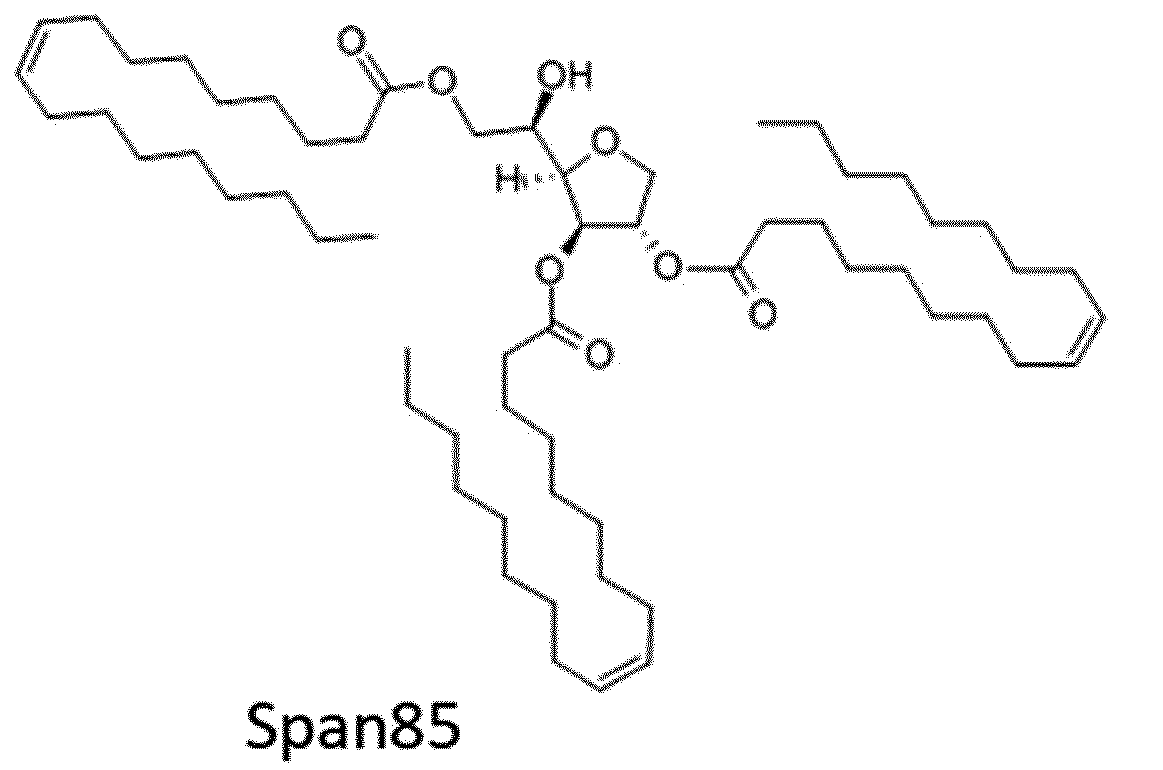
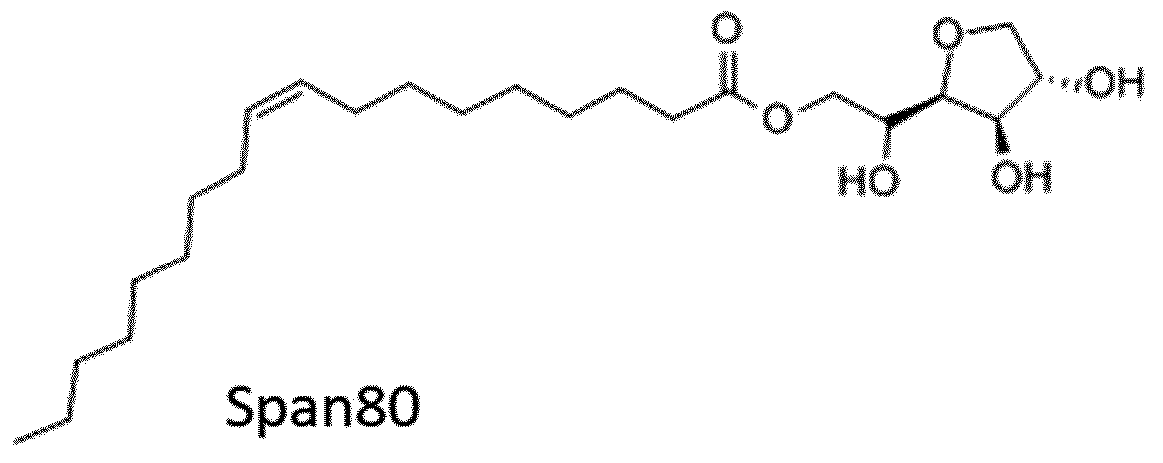
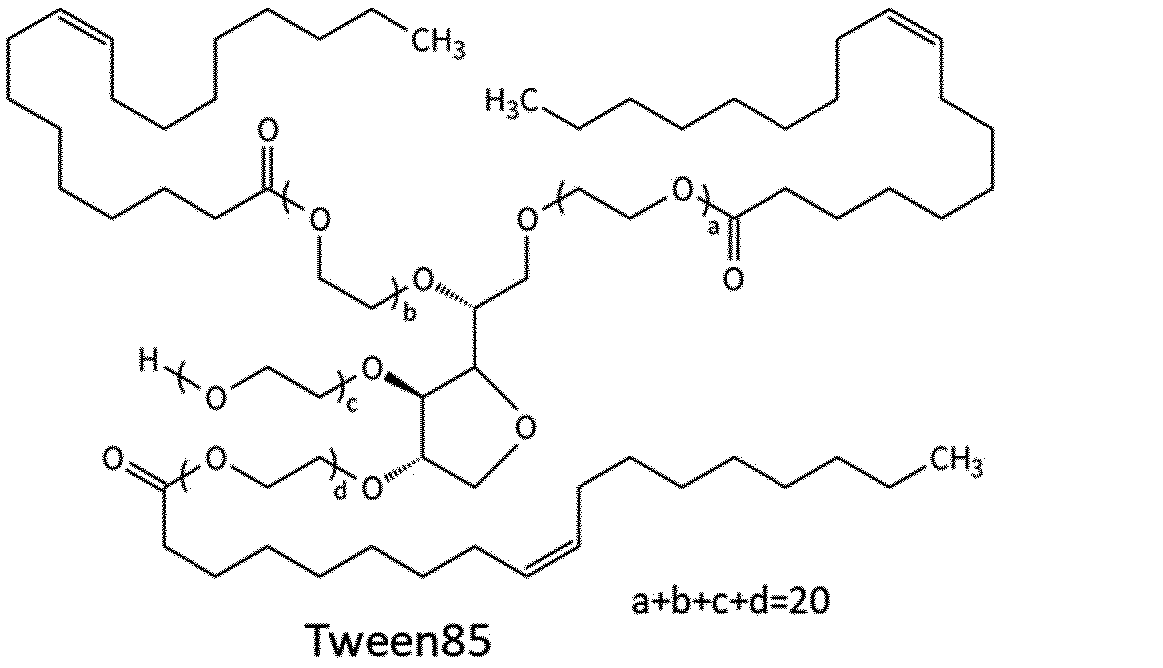
- sorbitan fatty acid esters examples include sorbitan monolaurate (span 20), sorbitan monopalmitate (span 40), sorbitan monostearate (span 60 ), sorbitan tristearate (Span65), sorbitan monooleate (spa n80), sorbitan sesquioleate (span83), sorbitan trioleate ( Span 85). Structural formulas of some of them are shown below.
- a polyoxyalkylene polyhydric alcohol fatty acid ester is a polyoxyalkylenated polyhydric alcohol fatty acid ester.
- polyhydric alcohols examples include sorbitan, sorbitol, mannitane, mannitol, sucrose, glycerin, propylene glycol, ethylene glycol, polyglycerin, trimethylolpropane, pentaerythritol, erythritol, diglycerin, ditrimethylolpropane, dipentaerythritol. .
- sorbitan, mannitan, sucrose and glycerin are preferred.
- oxyalkylene groups are ethylene oxide, propylene oxide, butylene oxide, and may have more than one of these.
- polyoxyalkylenated polyhydric alcohols examples include polyoxyethylene sorbitan, Polyoxyethylene mannitane, polyoxyethylene sucrose, polyoxyethylene glycerin, polyoxypropylene sorbitan, polyoxypropylene mannitane, polyoxypropylene sucrose, polyoxypropylene glycerin, polyoxyethylene polyoxypropylene sorbitan.
- the number of mono- or polyoxyalkylene chains generated by alkylenating each hydroxyl group can be from 1 to 6 in one molecule. It is preferred that all hydroxyl groups of the polyhydric alcohol are mono- or polyoxyalkylenated. In polyoxyalkylenated polyhydric alcohols, the total number of oxyalkylene units for all mono- and polyoxyalkylene chains in one molecule is 10 ⁇ 30.
- fatty acids those mentioned above can be used as appropriate.
- saturated fatty acids such as lauric acid, myristic acid, palmitic acid, stearic acid, behenic acid, lignoceric acid, isocetyl acid, isostearic acid, arachidic acid, isodocosanoic acid, isotetracosanoic acid, myristoleic acid, palmitoleic acid, oleic acid.
- unsaturated fatty acids such as acid, elaidic acid, linoleic acid, linolenic acid, eicosenoic acid, and erucic acid.
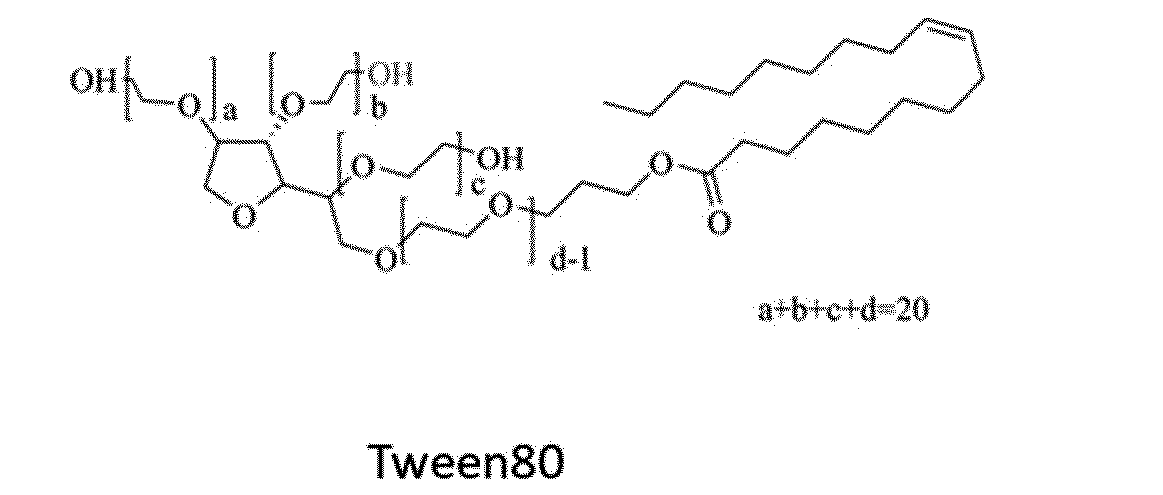
- polyoxyalkylene polyhydric alcohol fatty acid esters include polyoxyethylene sorbitan fatty acid esters, such as polyoxyethylene sorbitan monolaurate (Tween 20), polyoxyethylene sorbitan monostearate ( Tween 60), polyoxyethylene sorbitan oleate (Tween 80), : polyoxyethylene sorbitan tristearate (Tween 65), polyoxyethylene sorbitan trioleate (Tween 85).
- Tween 20 polyoxyethylene sorbitan monolaurate
- Tween 60 polyoxyethylene sorbitan monostearate
- Tween 80 polyoxyethylene sorbitan oleate
- Tween 65 polyoxyethylene sorbitan tristearate
- Tween 85 polyoxyethylene sorbitan trioleate
- Fatty acid amides include saturated fatty acid amides such as lauric acid amide, palmitic acid amide, stearic acid amide and hydroxystearic acid amide; unsaturated fatty acid amides such as oleic acid amide and erucic acid amide; N-stearyl erucic acid amide, N- substituted fatty acid amides such as stearyl stearic acid amide, N-stearyl oleic acid amide, N-oleyl stearic acid amide; methylol fatty acid amides such as methylol stearic acid amide; methylene and ethylenebis fatty acid amides; and alkanolamides such as lauric diethanolamide, oleic diethanolamide, stearic diethanolamide, cocamide diethanolamide.
- the carbon number of the hydrocarbon group in the fatty acid amide can be 18 or more and can be 26 or less.
- polyoxyalkylene alkyl ether examples are polyoxyethylene alkyl ethers.
- a polyoxyethylene alkyl ether can be represented by the following formula.
- R 21 O—(CH 2 CH 2 —O) m —H
- R 21 represents a linear or branched saturated or unsaturated hydrocarbon group having 8 or more and 22 or less carbon atoms
- m represents a number of 1 or more and 100 or less on average.
- the number of carbon atoms in R 21 is preferably 10 or more, more preferably 12 or more, and 22 or less, preferably 20 or less, more preferably 18 or less.
- polyoxyalkylene alkylphenyl ether examples are octylphenol ethoxylates (Triton X-100, X-114, etc.), nonylphenol ethoxylates.
- polyhydric alcohol alkyl ether examples include alkyl glucosides such as octyl glucoside, decyl glucoside, lauryl glucoside.
- a known organic synthesis method may be used as the method for producing the surfactant C described above.
- the composition of the present invention is a composition containing a thermoplastic resin A, a polymer B, and a surfactant C, and the resin A content is 1 to 99 parts by mass, and the content of the polymer B is 1 to 99 parts by mass.
- the content of the resin A is 10 to 90 parts by mass
- the content of the polymer B may be 10 to 90 parts by mass
- the content of the resin A is 10 to 80 parts by mass
- the content of the coalescence B may be 20 to 90 parts by mass
- the content of the resin A may be 10 to 70 parts by mass
- the content of the polymer B may be 30 to 90 parts by mass.
- the content of resin A may be 20 to 70 parts by mass, and the content of polymer B may be 30 to 80 parts by mass.
- the surfactant C is 0.01 to 25 parts by mass with respect to a total of 100 parts by mass of the resin A and the polymer B.
- the content of surfactant C is 0. 01 to 20 parts by mass
- the content of surfactant C is more preferably 0.01 to 15 parts by mass
- the content of surfactant C is 0.01 to 10 parts by mass. Parts by mass is even more preferable, and the content of surfactant C may be 0.1 parts by mass or more, 0.5 parts by mass or more, or 1.0 parts by mass or more.
- the content of the surfactant C may be 10 parts by mass or less, 5 parts by mass or less, or 1.0 parts by mass or less.
- the number of peaks in the glass transition temperature of the composition of the present invention is preferably unimodal.
- the thermoplastic resin A and the polymer B are preferably completely compatible.
- the composition may contain additives other than the thermoplastic resin A, the polymer B, and the surfactant C, if necessary.
- Additives include stabilizers, antibacterial agents, antifungal agents, dispersants, plasticizers, flame retardants, tackifiers, colorants, metal powders, inorganic fibers, organic fibers, composite fibers, inorganic whiskers, and fillers.
- the stabilizer include lubricants, anti-aging agents, heat stabilizers, light stabilizers, Weather stabilizers, metal deactivators, UV absorbers, light stabilizers, and copper damage inhibitors.
- Examples of light stabilizers include hindered amine light stabilizers
- examples of colorants include titanium oxide, carbon black and organic pigments
- examples of metal powders include ferrite
- examples of inorganic fibers include glass fibers
- examples of organic fibers include carbon fibers and aramid fibers.
- examples of inorganic whiskers include potassium titanate whiskers.
- fillers include glass beads, glass balloons, glass flakes, asbestos and mica. , calcium carbonate, talc, silica, calcium silicate, hydrotalcite, kaolin, diatomaceous earth, graphite, pumice stone, evo powder, cotton flock, cork powder, barium sulfate, fluororesin, cellulose powder, wood powder.
- the additive may be contained in the dispersed phase of the thermoplastic resin A, It may be contained in the dispersed phase of the polymer B, or the thermoplastic resin A and the polymer B may form separate dispersed phases.
- thermoplastic resin A As a method for producing the composition according to the present invention, a method of melt-kneading the thermoplastic resin A, the polymer B and the surfactant C, in the presence of the thermoplastic resin A, the polymer B and the surfactant C, A method of polymerizing various monomer components constituting the thermoplastic resin A and the polymer B can be mentioned. From the viewpoint of workability, the method of melt-kneading the thermoplastic resin A, the polymer B and the surfactant C is preferable.
- the melt-kneading described above can be performed by a known method using a known apparatus.
- a thermoplastic resin A, a polymer B, and a surfactant C are mixed using a mixing device such as a Henschel mixer, a ribbon blender, or a tumble mixer, and then further melt-kneaded.
- Thermoplastic resin A, polymer B, surfactant C, and, if necessary, various additives are continuously supplied at a constant ratio to obtain a mixture, and then the mixture is subjected to uniaxial or biaxial
- a method of melt-kneading using the above extruder, Banbury mixer, roll type kneader, or the like can be mentioned.
- the melt-kneading temperature is preferably 80° C. or higher, more preferably 100° C. to 300° C., more preferably 120° C. to 280° C., still more preferably 14 0°C to 260°C.
- the surface of the film molded from the present composition can be highly snow-sliding under both low temperature conditions and high temperature conditions.
- the reason for this is unknown, according to the composition according to the present embodiment, the water contact angle on the surface of the molded article of the composition is reduced, the hysteresis of the water contact angle is increased, and the oil contact angle This is thought to be due to the fact that the One of the reasons for this is that since the fluorine-based polymer B is included in addition to the thermoplastic resin A, the hydrophilic group of the surfactant tends to face outward on the surface of the molded article by thermoforming the composition. can be considered.
- a film according to one embodiment of the present invention is a film containing a resin M and a surfactant C, and satisfies the following requirements (a) to (c).
- Resin M is not particularly limited as long as the surface satisfies the above requirements (a) to (c).
- Resin M may be a mixture of thermoplastic resin A and polymer B in the composition described above.
- the water contact angle on the surface of the membrane is measured by dropping 2 ⁇ L of water onto the horizontal surface of the membrane. As a measuring method, the ⁇ /2 method is used.
- the water contact angle is greater than or equal to 50 degrees and can be greater than or equal to 60 degrees.
- the water contact angle is 90 degrees or less, and can be 80 degrees or less. Although there is no particular lower limit, it may be 10 degrees or more.
- Contact angle measurements herein are made at 23°C. A contact angle is measured according to JIS R 3257:1999.
- Hysteresis of the water contact angle on the surface of the membrane The hysteresis of the water contact angle can be measured by the expansion/contraction method (dynamic contact angle measurement) on the horizontal surface of the membrane. Specifically, the advancing contact angle when increasing the volume of the water droplet on the horizontal surface of the film and the receding contact angle when decreasing the volume of the water droplet are measured, and obtained by the following formula. can.
- Hysteresis of contact angle (degrees) advancing contact angle (degrees) - receding contact angle (degrees) (W3)
- the hysteresis of the water contact angle is 30 degrees or more, and can be 35 degrees or more, 40 degrees or more.
- the hysteresis of the water contact angle is 100 degrees or less, 90 degrees or less, 80 degrees or less, 7 It can be 0 degrees or less and 60 degrees or less.
- Hexadecane Contact Angle The hexadecane contact angle on the surface of the membrane is measured by dropping 2 ⁇ L of hexadecane onto the horizontal surface of the membrane. As a measuring method, the ⁇ /2 method is used.
- the hexadecane contact angle is 10 degrees or more, and can be 20 degrees or more, 30 degrees or more.
- the hexadecane contact angle is 130 degrees or less, and can be 120 degrees or less, 110 degrees or less, 100 degrees or less.
- a contact angle is measured according to JIS R 3257:1999.
- the thickness of the film is not limited, it can be, for example, 1 ⁇ m or more. There is no particular upper limit, but it can be 150 mm.
- the film of the present embodiment can be obtained by melting and molding the above composition.
- molding methods are extrusion, compression molding, injection molding.
- Extrusion methods include, for example, a T-die molding method, a single-layer extrusion molding method by an inflation molding method, a multilayer extrusion molding method by a T-die molding method or a single-layer extrusion molding method by an inflation molding method, and a spinning extrusion method. mentioned.
- Known methods such as a feed block method and a multi-manifold method can be used as the multilayer extrusion method.
- injection molding methods include general injection molding, injection foam molding, supercritical injection foam molding, ultra-high speed injection molding, injection compression molding, gas-assisted injection molding, sandwich molding, and sandwich foam.
- a molding method, an insert/outsert molding method, and the like can be mentioned.
- extrusion molding and compression molding are preferable from the viewpoint of snow-slipping properties.
- the film of the present invention may be used alone, or laminated with other resin members, metal members, paper, leather or the like to form a multi-layer article.
- a surface treatment may be applied to the surface of the film of the present invention.
- Examples of surface treatment methods include embossing, corona discharge treatment, flame treatment, plasma treatment, and ozone treatment.
- the film of the present invention include transparent optical members, fiber materials, agricultural materials, exterior members, furniture and interior decoration members, house members, toy members, gardening members, automobile members, and packaging materials.
- transparent optical members include solar panel members, lens members, and the like.
- Fiber materials include, for example, clothing fabric members, interior fabric members, and industrial fiber members. film members, house members, and net members; Post members, cycle port members, deck members, sunroom members, roof members, terrace members, handrail members, shade members, awning members, etc.
- furniture and interior decoration members include sofa members, table members, and chair members.
- household appliance members include watch members, Examples include mobile phone members, home appliance members, etc.
- Toy members include, for example, plastic model members, diorama members, and video game main body members.
- Gardening members include, for example, planter members, vase members, and flowerpot members.
- Examples of automobile members include bumper materials and instrument panel materials
- examples of packaging materials include food packaging materials, fiber packaging materials, miscellaneous goods packaging materials, and the like.
- other uses include, for example, monitor members, office automation (OA) equipment members, medical members, drainage pans, toiletry members, bottles, containers, snow removal product members, and various construction members.
- OA office automation
- the surface of the film according to the present embodiment has a low water contact angle on the surface, a high hysteresis of the water contact angle, and a certain oil contact angle or more. Therefore, it is possible to improve the snow sliding property under both low temperature conditions and high temperature conditions.
- thermoplastic resin A thermoplastic resin A, polymer B and additive C used in Examples and Comparative Examples are shown below.
- Thermoplastic resin A (A-1) Polymethyl methacrylate (trade name) Sumipex LG (manufactured by Sumitomo Chemical) MFR (230°C 3.80 kgf (37.3 N)): 10.0 g/10 minutes
- Ethylene-tetrafluoroethylene copolymer (Product name) Fluon LM-ETFE AH3000L (manufactured by AGC) MFR (297°C 5.0 kgf (49.0 N)): 6.5 g/10 minutes
- thermoplastic resin each thermoplastic resin
- polymer each polymer
- component each component
- composition were measured according to the methods shown below.
- Melt mass flow rate (MFR, unit: g/10 minutes) It was measured according to the method specified in JIS K7210-2014. Measured temperature is 230 °C or 297 °C, and the load was 2.16 kgf, 3.80 kgf, or 5.00 kgf.
- Dynamic water contact angle (degrees) advancing contact angle (degrees) - receding contact angle (degrees)... (W3)
- Hexadecane Contact Angle The hexadecane contact angle on the horizontal surface of the film was measured by the ⁇ /2 method after dropping 2 ⁇ L of hexadecane liquid.
- Kneader Technobell KZ W15-45
- Example ⁇ 2 Example ⁇ 1 except that 0.1 parts by mass of additive (C-2) was used instead of additive (C-1) did the same.
- Example ⁇ 3 Example ⁇ 1 except that 0.1 parts by mass of additive (C-3) was used instead of additive (C-1) did the same.
- Example ⁇ 4 Example ⁇ 1 except that 0.1 parts by mass of additive (C-4) was used instead of additive (C-1) did the same.
- Example ⁇ 5 The procedure was the same as in Example ⁇ 1, except that 1 part by mass of additive (C-5) was used instead of additive (C-1).
- Example ⁇ 6 The procedure was the same as in Example ⁇ 1, except that 5 parts by mass of additive (C-5) was used instead of additive (C-1).
- Example ⁇ 7 The procedure was the same as in Example ⁇ 1, except that 10 parts by mass of additive (C-5) was used instead of additive (C-1).
- Example ⁇ 8 The procedure was the same as in Example ⁇ 1, except that 50 parts by mass of the thermoplastic resin (A-1), 50 parts by mass of the polymer (B-1), and 5 parts by mass of the additive (C-5) were used.
- Example ⁇ 9 The procedure was the same as in Example ⁇ 1, except that 80 parts by mass of the thermoplastic resin (A-1), 20 parts by mass of the polymer (B-1), and 1 part by mass of the additive (C-5) were used.
- Example ⁇ 10 The procedure was the same as in Example ⁇ 1, except that 80 parts by mass of the thermoplastic resin (A-1), 20 parts by mass of the polymer (B-1), and 5 parts by mass of the additive (C-5) were used.
- Example ⁇ 11 80 parts by mass of thermoplastic resin (A-2) instead of 20 parts by mass of thermoplastic resin (A-1) And, instead of 80 parts by mass of the polymer (B-1), 20 parts by mass of the polymer (B-3), and 0.1
- the procedure was the same as in Example ⁇ 1, except that 5.0 parts by mass of additive (C-5) was used instead of 5.0 parts by mass of additive (C-1).
- Example ⁇ 12 55 parts by mass of thermoplastic resin (A-2) instead of 20 parts by mass of thermoplastic resin (A-1) And, instead of 80 parts by mass of the polymer (B-1), 45 parts by mass of the polymer (B-3), and 0.1
- the procedure was the same as in Example ⁇ 1, except that 5.0 parts by mass of additive (C-5) was used instead of 5.0 parts by mass of additive (C-1).
- thermoplastic resin (A-1) 100 parts by mass of the thermoplastic resin (A-1) and 5 parts by mass of the additive (C-5) were used.
- Example ⁇ 2 The procedure was the same as in Example ⁇ 1, except that 100 parts by mass of the polymer (B-1) and 5 parts by mass of the additive (C-5) were used.
- Example ⁇ 3 The procedure was the same as in Example ⁇ 1, except that 20 parts by mass of the thermoplastic resin (A-1), 80 parts by mass of the polymer (B-1), and 5 parts by mass of the additive (C-6) were used.
- Example ⁇ 4 The procedure was the same as in Example ⁇ 1, except that 20 parts by mass of the thermoplastic resin (A-1), 80 parts by mass of the polymer (B-1), and 30 parts by mass of the additive (C-5) were used. Table 1 shows the conditions and results.
- composition with a predetermined composition ratio provides a film with excellent snow-sliding properties for both dry and wet snow.
- Example ⁇ 11 20 parts by mass of a thermoplastic resin (A-1), 80 parts by mass of a polymer (B-1), and 10 parts by mass of an additive (C-5) are uniformly mixed and kneaded by a twin screw with an inner diameter of 15 mm.
- a film shaped into the shape of The film has a water contact angle of 72.5 degrees and a water contact angle hysteresis of 4.
- the hexadecane contact angle was 7.7 degrees and 31.1 degrees. The snow sliding in wet snow and the snow sliding in dry snow were evaluated.
- Table 2 shows the conditions and results.
Landscapes
- Chemical & Material Sciences (AREA)
- Health & Medical Sciences (AREA)
- Chemical Kinetics & Catalysis (AREA)
- Medicinal Chemistry (AREA)
- Polymers & Plastics (AREA)
- Organic Chemistry (AREA)
- Engineering & Computer Science (AREA)
- Manufacturing & Machinery (AREA)
- Materials Engineering (AREA)
- Compositions Of Macromolecular Compounds (AREA)
- Manufacture Of Macromolecular Shaped Articles (AREA)
Abstract
組成物は、熱可塑性樹脂Aと、重合体Bと、界面活性剤Cと、を含み、 前記重合体Bは式(1)又は式(2)で表される構成単位を有し、前記樹脂Aと前記重 合体Bとの合計100質量部に対して、前記樹脂Aの含有量は1~99質量部であり、前 記重合体Bの含有量は1~99質量部であり、前記界面活性剤Cの含有量は0.01~2 5質量部である組成物。式中、R1~R3は、それぞれ独立に、水素原子、ハロゲン原子、アルコキシ基、又は 、アルキル基から選択される。各アルキル基及び各アルコキシ基の内の少なくとも1つの 水素原子は、独立にハロゲン原子で置換されていてもよい。
Description
本発明は、組成物及び膜に関する。
豪雪地帯では、降雪による住環境部材への冠雪が問題となっている。例えば、冠雪によ
る荷重の増加による構造部材の倒壊や、多量の冠雪が一度に落下することによる人身雪害
、道路標識や交通信号機などの道路交通における安全指示板・装置の確認障害、太陽光パ
ネルの発電効率の低下が挙げられる。
る荷重の増加による構造部材の倒壊や、多量の冠雪が一度に落下することによる人身雪害
、道路標識や交通信号機などの道路交通における安全指示板・装置の確認障害、太陽光パ
ネルの発電効率の低下が挙げられる。
吉田らの報告(北海道立試験所報告299,13-17(2000))によれば、降雪
する雪質には、水分の含有量が多い湿った湿雪と、水分の含有量が少ない乾雪があり、湿
雪か乾雪かは降雪する際の環境温度によって定まり、環境温度が、氷点以上では湿雪が降
雪しやすく、氷点以下では乾雪が降雪しやすく、降雪する雪質が湿雪であれば、冠雪する
材料の表面性質は親水性の方がより落雪(滑雪)しやすく、降雪する雪質が乾雪であれば
、冠雪する材料の表面性質は撥水性の方がより落雪(滑雪)しやすいことが記載されてい
る。このように、親水性かつ撥水性という相反する性質が必要となるため、様々な雪質を
滑雪させる有効な材料の表面性質の設計の報告が非常に少ない。
する雪質には、水分の含有量が多い湿った湿雪と、水分の含有量が少ない乾雪があり、湿
雪か乾雪かは降雪する際の環境温度によって定まり、環境温度が、氷点以上では湿雪が降
雪しやすく、氷点以下では乾雪が降雪しやすく、降雪する雪質が湿雪であれば、冠雪する
材料の表面性質は親水性の方がより落雪(滑雪)しやすく、降雪する雪質が乾雪であれば
、冠雪する材料の表面性質は撥水性の方がより落雪(滑雪)しやすいことが記載されてい
る。このように、親水性かつ撥水性という相反する性質が必要となるため、様々な雪質を
滑雪させる有効な材料の表面性質の設計の報告が非常に少ない。
特許文献1には、フッ化ビニリデン系フッ素樹脂をマトリックス樹脂とし、セラミック
系無機骨材と有機ポリマービーズとフッ素樹脂粉末を添加し、金属板上に形成された下塗
り塗膜の上に塗布する上塗り塗料とし、耐傷付き性、耐塗膜かじり性、および滑雪性に優
れたフッ化ビニリデン系フッ素樹脂塗装金属板が記載されている。
系無機骨材と有機ポリマービーズとフッ素樹脂粉末を添加し、金属板上に形成された下塗
り塗膜の上に塗布する上塗り塗料とし、耐傷付き性、耐塗膜かじり性、および滑雪性に優
れたフッ化ビニリデン系フッ素樹脂塗装金属板が記載されている。
特許文献2には、固体表面に、一方向に延びる溝を複数配設して2μm以上4mm以下
の間隔で凹凸を形成し、該凹凸の凸部を水接触角で30度以下の親水性にし、凹部を水接
触角で90度以上の撥水性にすることを特徴とする易滑雪性固体及びその作製技術が記載
されている。
の間隔で凹凸を形成し、該凹凸の凸部を水接触角で30度以下の親水性にし、凹部を水接
触角で90度以上の撥水性にすることを特徴とする易滑雪性固体及びその作製技術が記載
されている。
ところで、組成物において、塗装加工や、表面切削などの表面加工や、シボ賦形加工な
どの特別な後加工の必要がなく、平滑な形状であっても、湿雪・乾雪の両方の雪質でとも
に滑雪性に優れることが求められる。
どの特別な後加工の必要がなく、平滑な形状であっても、湿雪・乾雪の両方の雪質でとも
に滑雪性に優れることが求められる。
本発明は、上記課題に鑑みてなされたものであり、塗装加工や、表面切削などの表面加
工や、シボ賦形加工などの特別な後加工の必要がなく、平滑な形状であっても、湿雪・乾
雪の両方の雪質でともに滑雪性に優れる組成物を提供することを目的とする。
工や、シボ賦形加工などの特別な後加工の必要がなく、平滑な形状であっても、湿雪・乾
雪の両方の雪質でともに滑雪性に優れる組成物を提供することを目的とする。
[1]熱可塑性樹脂Aと、重合体Bと、界面活性剤Cと、を含む組成物であって前記重
合体Bは式(1)又は式(2)で表される構成単位を有する。
前記樹脂Aと前記重合体Bとの合計100質量部に対して、前記樹脂Aの含有量は1~
99質量部であり、前記重合体Bの含有量は1~99質量部であり、前記界面活性剤Cの
含有量は0.01~25質量部である。
合体Bは式(1)又は式(2)で表される構成単位を有する。
前記樹脂Aと前記重合体Bとの合計100質量部に対して、前記樹脂Aの含有量は1~
99質量部であり、前記重合体Bの含有量は1~99質量部であり、前記界面活性剤Cの
含有量は0.01~25質量部である。
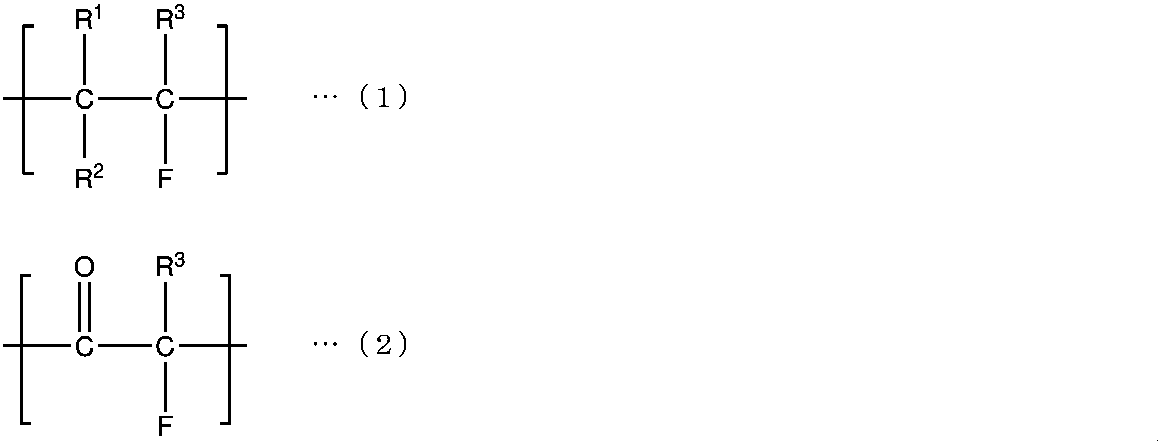
式中、R1~R3は、それぞれ独立に、水素原子、ハロゲン原子、アルコキシ基、又は
、アルキル基から選択される。各アルキル基及び各アルコキシ基の内の少なくとも1つの
水素原子は、独立にハロゲン原子で置換されていてもよい。
[2]前記重合体Bは、(1)式で表される構成単位を有し、前記(1)式のR1~R
3がいずれもフッ素原子である、[1]に記載の組成物。
3がいずれもフッ素原子である、[1]に記載の組成物。
[3]前記熱可塑性樹脂Aは、オレフィン系重合体である、[1]又は[2]に記載の
組成物。
組成物。
[4]前記界面活性剤Cは、非イオン性界面活性剤である[1]~[3]のいずれか一
項に記載の組成物。
項に記載の組成物。
[5]前記界面活性剤Cの親水基が4個以上の酸素原子を有する[1]~[4]のいず
れか一項に記載の組成物。
れか一項に記載の組成物。
[6]前記界面活性剤Cの親水基が1~5個のアミド基を有する[1]~[5]のいず
れか一項に記載の組成物。
れか一項に記載の組成物。
[7]前記界面活性剤Cが、多価アルコール脂肪酸エステル、ポリオキシアルキレン多
価アルコール脂肪酸エステル、脂肪酸アミド、ポリオキシアルキレンアルキルエーテル、
ポリオキシアルキレンアルキルフェニルエーテル、多価アルコールアルキルエーテルから
なる群から選択される少なくとも1つである[1]~[6]のいずれか一項に記載の組成
物。
価アルコール脂肪酸エステル、脂肪酸アミド、ポリオキシアルキレンアルキルエーテル、
ポリオキシアルキレンアルキルフェニルエーテル、多価アルコールアルキルエーテルから
なる群から選択される少なくとも1つである[1]~[6]のいずれか一項に記載の組成
物。
[8]樹脂Mと、界面活性剤Cと、を含む膜であって、下記要件(a)~(c)を満た
す膜。
要件(a):前記膜の水平表面に2μLの水を滴下して測定した水接触角が50度以上
90度以下である。
要件(b):前記膜の水平表面において拡張収縮法により測定した水の接触角のヒステ
リシスが30度以上100度以下である。
要件(c):前記膜の水平表面に2μLのヘキサデカンを滴下して測定したヘキサデカ
ン接触角が10度以上130度以下である。
す膜。
要件(a):前記膜の水平表面に2μLの水を滴下して測定した水接触角が50度以上
90度以下である。
要件(b):前記膜の水平表面において拡張収縮法により測定した水の接触角のヒステ
リシスが30度以上100度以下である。
要件(c):前記膜の水平表面に2μLのヘキサデカンを滴下して測定したヘキサデカ
ン接触角が10度以上130度以下である。
[9]上記の膜を外面の少なくとも一部に有する物品。
本発明によれば、塗装加工や、表面切削などの表面加工や、シボ賦形加工などの特別な
後加工の必要がなく、平滑な形状であっても、湿雪・乾雪の両方の雪質でともに滑雪性に
優れる膜を得ることができる。
後加工の必要がなく、平滑な形状であっても、湿雪・乾雪の両方の雪質でともに滑雪性に
優れる膜を得ることができる。
以下、本発明のいくつかの実施形態について詳細に説明する。ただし、本発明は以下の
実施形態に限定されるものではない。
実施形態に限定されるものではない。
本実施形態の組成物は、熱可塑性樹脂Aと、重合体Bと、界面活性剤Cと、を含む組成
物であって、
前記樹脂Aと前記重合体Bとの合計100質量部に対して、前記樹脂Aの含有量は1~
99質量部であり、前記重合体Bの含有量は1~99質量部であり、前記界面活性剤Cの
含有量は0.01~25質量部である。
物であって、
前記樹脂Aと前記重合体Bとの合計100質量部に対して、前記樹脂Aの含有量は1~
99質量部であり、前記重合体Bの含有量は1~99質量部であり、前記界面活性剤Cの
含有量は0.01~25質量部である。
(熱可塑性樹脂A)
熱可塑性樹脂の例は、オレフィン系重合体、スチレン系重合体、メタクリル系樹脂、ア
クリル系樹脂、エステル系樹脂、アミド系樹脂、ビニル系重合体である。熱可塑性樹脂A
は、単独樹脂であってもよく、2種以上の樹脂の混合物であってもよい。
熱可塑性樹脂の例は、オレフィン系重合体、スチレン系重合体、メタクリル系樹脂、ア
クリル系樹脂、エステル系樹脂、アミド系樹脂、ビニル系重合体である。熱可塑性樹脂A
は、単独樹脂であってもよく、2種以上の樹脂の混合物であってもよい。
<オレフィン系重合体>
本発明のオレフィン系重合体とは、炭素原子数2~10のオレフィンに由来する構成単
位を51重量%以上含有する重合体である(ただし、オレフィン系重合体の全量を100
重量%とする)。炭素原子数2~10のオレフィンとしては、例えば、エチレン、1-プ
ロピレン、1-ブテン、4-メチル-1-ペンテン、1-ヘキセン、1-オクテン、1-
デセン等が挙げられ、任意の複数種を含んでいてもよい。
本発明のオレフィン系重合体とは、炭素原子数2~10のオレフィンに由来する構成単
位を51重量%以上含有する重合体である(ただし、オレフィン系重合体の全量を100
重量%とする)。炭素原子数2~10のオレフィンとしては、例えば、エチレン、1-プ
ロピレン、1-ブテン、4-メチル-1-ペンテン、1-ヘキセン、1-オクテン、1-
デセン等が挙げられ、任意の複数種を含んでいてもよい。
また、オレフィン系重合体は、炭素原子数2~10のオレフィン以外の単量体に由来す
る構成単位を含有していてもよい。この炭素原子数2~10のオレフィン以外の単量体と
しては、例えば、スチレンなどの芳香族ビニル単量体;アクリル酸、メタクリル酸などの
不飽和カルボン酸;アクリル酸メチル、アクリル酸エチル、アクリル酸ブチル、メタクリ
ル酸メチル、メタクリル酸エチルなどの不飽和カルボン酸エステル;酢酸ビニルなどのビ
ニルエステル化合物;1,3-ブタジエン、2-メチル-1,3-ブタジエン(イソプレ
ン)などの共役ジエン;ジシクロペンタジエン、5-エチリデン-2-ノルボルネンなど
の非共役ジエン;プロピレンが挙げられる。
る構成単位を含有していてもよい。この炭素原子数2~10のオレフィン以外の単量体と
しては、例えば、スチレンなどの芳香族ビニル単量体;アクリル酸、メタクリル酸などの
不飽和カルボン酸;アクリル酸メチル、アクリル酸エチル、アクリル酸ブチル、メタクリ
ル酸メチル、メタクリル酸エチルなどの不飽和カルボン酸エステル;酢酸ビニルなどのビ
ニルエステル化合物;1,3-ブタジエン、2-メチル-1,3-ブタジエン(イソプレ
ン)などの共役ジエン;ジシクロペンタジエン、5-エチリデン-2-ノルボルネンなど
の非共役ジエン;プロピレンが挙げられる。
オレフィン系重合体は、他のモノマーに由来する構成単位を、2種以上有していてもよ
い。
い。
オレフィン系重合体は、エチレン系重合体、プロピレン系重合体、及びブテン系重合体
からなる群から選択される少なくとも1つであることができ、これらの内の任意の2種以
上の組み合わせであってもよい。
からなる群から選択される少なくとも1つであることができ、これらの内の任意の2種以
上の組み合わせであってもよい。
エチレン系共重合体とは、エチレンに由来する構造単位を50質量%以上含有する重合
体であり、その例は、エチレン単独重合体、エチレン-1-ブテン共重合体、エチレン-
1-ヘキセン共重合体、エチレン-1-オクテン共重合体、及び、エチレン-1-ブテン
-1-ヘキセン共重合体である。エチレン系共重合体は、2以上のエチレン系共重合体の
組み合わせであってもよい。
体であり、その例は、エチレン単独重合体、エチレン-1-ブテン共重合体、エチレン-
1-ヘキセン共重合体、エチレン-1-オクテン共重合体、及び、エチレン-1-ブテン
-1-ヘキセン共重合体である。エチレン系共重合体は、2以上のエチレン系共重合体の
組み合わせであってもよい。
プロピレン系共重合体とは、プロピレンに由来する構造単位を50質量%以上含有する
重合体であり、その例は、プロピレン単独重合体、プロピレン-エチレン共重合体、プロ
ピレン-1-ブテン共重合体、プロピレン-1-ヘキセン共重合体、プロピレン-1-オ
クテン共重合体、プロピレン-エチレン-1-ブテン共重合体、プロピレン-エチレン-
1-ヘキセン共重合体、及び、プロピレン-エチレン-1-オクテン共重合体である。プ
ロピレン系共重合体は、2種以上のプロピレン系共重合体の組み合わせであってもよい。
オレフィン系重合体がプロピレン系共重合体であることは好適である。
重合体であり、その例は、プロピレン単独重合体、プロピレン-エチレン共重合体、プロ
ピレン-1-ブテン共重合体、プロピレン-1-ヘキセン共重合体、プロピレン-1-オ
クテン共重合体、プロピレン-エチレン-1-ブテン共重合体、プロピレン-エチレン-
1-ヘキセン共重合体、及び、プロピレン-エチレン-1-オクテン共重合体である。プ
ロピレン系共重合体は、2種以上のプロピレン系共重合体の組み合わせであってもよい。
オレフィン系重合体がプロピレン系共重合体であることは好適である。
ブテン系共重合体とは、1-ブテンに由来する構造単位を50質量%以上含有する重合
体であり、その例は、1-ブテン単独重合体、1-ブテン-エチレン共重合体、1-ブテ
ン-プロピレン共重合体、1-ブテン-1-ヘキセン共重合体、1-ブテン-1-オクテ
ン共重合体、1-ブテン-エチレン-プロピレン共重合体、1-ブテン-エチレン-1-
ヘキセン共重合体、1-ブテン-エチレン-1-オクテン共重合体、1-ブテン-プロピ
レン-1-ヘキセン共重合体、及び、1-ブテン-プロピレン-1-オクテン共重合体で
ある。ブテン系共重合体は、2種以上のブテン系共重合体の組み合わせであってもよい。
体であり、その例は、1-ブテン単独重合体、1-ブテン-エチレン共重合体、1-ブテ
ン-プロピレン共重合体、1-ブテン-1-ヘキセン共重合体、1-ブテン-1-オクテ
ン共重合体、1-ブテン-エチレン-プロピレン共重合体、1-ブテン-エチレン-1-
ヘキセン共重合体、1-ブテン-エチレン-1-オクテン共重合体、1-ブテン-プロピ
レン-1-ヘキセン共重合体、及び、1-ブテン-プロピレン-1-オクテン共重合体で
ある。ブテン系共重合体は、2種以上のブテン系共重合体の組み合わせであってもよい。
<スチレン系重合体>
スチレン系重合体とは、スチレンもしくはスチレン誘導体に由来する構成単位を51重
量%以上含有する重合体である。スチレン誘導体としては、例えば、p-メチルスチレン
、p-tert-ブチルスチレン、α-メチルスチレン、p-メトキシスチレンを挙げる
ことができる。スチレン重合体は、スチレンもしくはスチレン誘導体以外の単量体に由来
する構成単位を含有していてもよく、例えば、炭素原子数2以上10以下のオレフィン;
アクリル酸、メタクリル酸などの不飽和カルボン酸;アクリル酸メチル、アクリル酸エチ
ル、アクリル酸ブチル、メタクリル酸メチル、メタクリル酸エチルなどの不飽和カルボン
酸エステル;酢酸ビニルなどのビニルエステル化合物;1,3-ブタジエン、2-メチル
-1,3-ブタジエン(イソプレン)などの共役ジエン;ジシクロペンタジエン、5-エ
チリデン-2-ノルボルネンなどの非共役ジエンを挙げることができる。
<メタクリル系樹脂>
メタクリル系樹脂とは、メタクリル酸エステルに由来する構成単位を51重量%以上含
有する重合体であり、例えば、ポリ(メタクリル酸メチル)、ポリ(メタクリル酸エチル
)、ポリ(メタクリル酸ブチル)、ポリ(メタクリル酸2-エチルヘキシル)等が挙げら
れる。
メタクリル系樹脂とは、メタクリル酸エステルに由来する構成単位を51重量%以上含
有する重合体であり、例えば、ポリ(メタクリル酸メチル)、ポリ(メタクリル酸エチル
)、ポリ(メタクリル酸ブチル)、ポリ(メタクリル酸2-エチルヘキシル)等が挙げら
れる。
<アクリル系樹脂>
アクリル系樹脂とは、アクリル酸エステルに由来する構成単位を51重量%以上含有す
る重合体であり、例えば、ポリ(アクリル酸メチル)、ポリ(アクリル酸エチル)、ポリ
(アクリル酸ブチル)、ポリ(アクリル酸2-エチルヘキシル)等が挙げられる。
アクリル系樹脂とは、アクリル酸エステルに由来する構成単位を51重量%以上含有す
る重合体であり、例えば、ポリ(アクリル酸メチル)、ポリ(アクリル酸エチル)、ポリ
(アクリル酸ブチル)、ポリ(アクリル酸2-エチルヘキシル)等が挙げられる。
<エステル系樹脂>
エステル系樹脂とは、多価カルボン酸と多価アルコールとのエステルに由来する構成単
位を51重量%以上含有する重合体であり、例えば、ポリカルボナート、ポリエチレンテ
レフタレート、ポリエチレンナフタレート、ポリブチレンテレフタレート、ポリブチレン
ナフタレート等が挙げられる。
エステル系樹脂とは、多価カルボン酸と多価アルコールとのエステルに由来する構成単
位を51重量%以上含有する重合体であり、例えば、ポリカルボナート、ポリエチレンテ
レフタレート、ポリエチレンナフタレート、ポリブチレンテレフタレート、ポリブチレン
ナフタレート等が挙げられる。
<アミド系樹脂>
アミド系樹脂とは、アミド結合で繰り返される構成単位を51重量%以上含有する重合
体であり、例えば、ポリ(ε-カプロラクタム)、ポリドデカンアミド、ポリ(ヘキサメ
チレンアジパミド)、ポリ(ヘキサメチレンドデカンアミド)、ポリ(p-フェニレンテ
レフタルアミド)、ポリ(m-フェニレンテレフタルアミド)等が挙げられる。
アミド系樹脂とは、アミド結合で繰り返される構成単位を51重量%以上含有する重合
体であり、例えば、ポリ(ε-カプロラクタム)、ポリドデカンアミド、ポリ(ヘキサメ
チレンアジパミド)、ポリ(ヘキサメチレンドデカンアミド)、ポリ(p-フェニレンテ
レフタルアミド)、ポリ(m-フェニレンテレフタルアミド)等が挙げられる。
<ビニル系重合体>
本発明のビニル系重合体とは、ビニル基をもつ単量体に由来する構成単位を51重量%
以上含有する重合体であり、例えば、ポリ塩化ビニル、ポリ酢酸ビニル、ポリビニルアル
コール、ポリビニルアセタール、ポリ塩化ビニリデンなどが挙げられる。
本発明のビニル系重合体とは、ビニル基をもつ単量体に由来する構成単位を51重量%
以上含有する重合体であり、例えば、ポリ塩化ビニル、ポリ酢酸ビニル、ポリビニルアル
コール、ポリビニルアセタール、ポリ塩化ビニリデンなどが挙げられる。
(熱可塑性樹脂AのTg)
熱可塑性樹脂Aのガラス転移温度(Tg)は、湿雪における滑雪性の観点から、0℃以
上が好ましく、より好ましくは50℃以上、更により好ましくは80℃以上である。ガラ
ス転移温度(Tg)が大きいほど、組成物の湿雪における滑雪性が優れる傾向にある。
熱可塑性樹脂Aのガラス転移温度(Tg)は、湿雪における滑雪性の観点から、0℃以
上が好ましく、より好ましくは50℃以上、更により好ましくは80℃以上である。ガラ
ス転移温度(Tg)が大きいほど、組成物の湿雪における滑雪性が優れる傾向にある。
熱可塑性樹脂Aのガラス転移温度(Tg)は、JIS K7121に準拠した示差走査
熱量計(DSC)測定により求められる値である。
熱量計(DSC)測定により求められる値である。
(熱可塑性樹脂AのMFR)
熱可塑性樹脂Aの、温度190℃もしくは230℃、及び荷重2.16kgfもしくは
荷重3.80kgf(37.3N)の条件で測定されるメルトマスフローレイト(MFR
)は0.01g/10分以上であることができ、200g/10分以下であることができ
る。MFRの上限は、100g/10分、50g/10分、30g/10分であることが
できる。熱可塑性樹脂Aのメルトマスフローレイトが小さいほど、組成物の成形性が優れ
る傾向にある。
熱可塑性樹脂Aの、温度190℃もしくは230℃、及び荷重2.16kgfもしくは
荷重3.80kgf(37.3N)の条件で測定されるメルトマスフローレイト(MFR
)は0.01g/10分以上であることができ、200g/10分以下であることができ
る。MFRの上限は、100g/10分、50g/10分、30g/10分であることが
できる。熱可塑性樹脂Aのメルトマスフローレイトが小さいほど、組成物の成形性が優れ
る傾向にある。
(熱可塑性樹脂AのTm)
上記の熱可塑性樹脂Aの製造方法としては、公知の重合用触媒を用いた公知の重合方法
が用いられる。
上記の熱可塑性樹脂Aの製造方法としては、公知の重合用触媒を用いた公知の重合方法
が用いられる。
(重合体B)
本発明の重合体Bは、式(1)又は式(2)で表される構成単位を有する重合体である
。
本発明の重合体Bは、式(1)又は式(2)で表される構成単位を有する重合体である
。
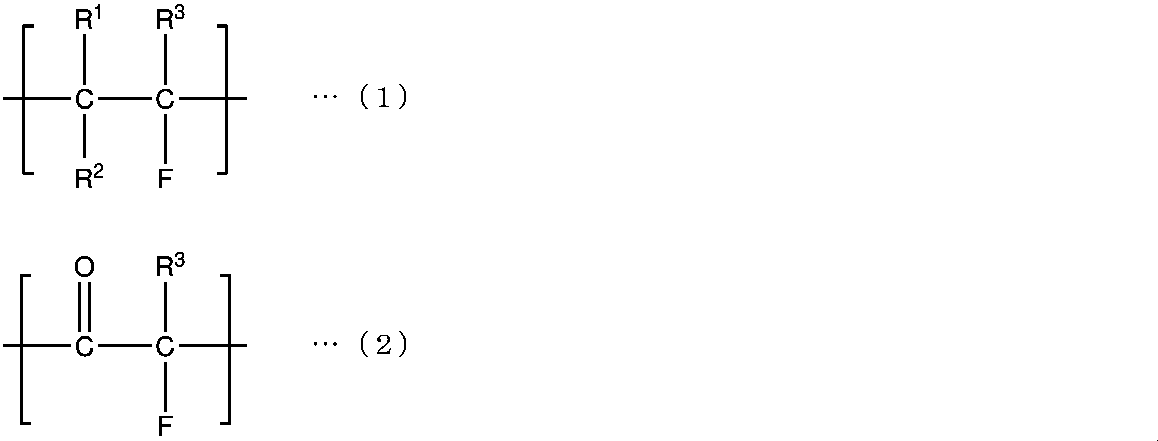
式中、R1~R3は、それぞれ独立に、水素原子、ハロゲン原子、アルコキシ基、及び
、アルキル基から選択される。ハロゲン原子の例は、F,Cl,Br,Iである。
式(1)及び(2)のR1~R3の、アルコキシ基、アルキル基の炭素数は、好ましく
は、1以上15以下、より好ましくは1以上10以下、更により好ましくは1以上5以下
である。R1~R3のアルキル基及びアルコキシ基は、直鎖でも、分岐状でも、環状でも
よいが、直鎖であることが好ましい。R1~R3の各アルキル基及び各アルコキシ基の内
の少なくとも1つの水素原子は、独立にフッ素などのハロゲン原子で置換されていてもよ
い。各アルキル基及び各アルコキシ基の内の全ての水素原子が、フッ素などのハロゲン原
子で置換されていることが好適である。
は、1以上15以下、より好ましくは1以上10以下、更により好ましくは1以上5以下
である。R1~R3のアルキル基及びアルコキシ基は、直鎖でも、分岐状でも、環状でも
よいが、直鎖であることが好ましい。R1~R3の各アルキル基及び各アルコキシ基の内
の少なくとも1つの水素原子は、独立にフッ素などのハロゲン原子で置換されていてもよ
い。各アルキル基及び各アルコキシ基の内の全ての水素原子が、フッ素などのハロゲン原
子で置換されていることが好適である。
重合体Bは、(1)及び/又は(2)式の構成単位を51重量%以上含有する重合体が
好ましく、例えば、ポリテトラフルオロエチレン、ポリクロロトリフルオロエチレン、ポ
リフッ化ビニリデン、ポリフッ化ビニル、四フッ化エチレン・六フッ化プロピレン共重合
体、エチレン・クロロトリフルオロエチレン共重合体、パーフルオロアルコキシアルカン
(例えば四フッ化エチレン・パーフルオロアルコキシエチレン共重合)、エチレン-テト
ラフルオロエチレン共重合体等が挙げられる。
好ましく、例えば、ポリテトラフルオロエチレン、ポリクロロトリフルオロエチレン、ポ
リフッ化ビニリデン、ポリフッ化ビニル、四フッ化エチレン・六フッ化プロピレン共重合
体、エチレン・クロロトリフルオロエチレン共重合体、パーフルオロアルコキシアルカン
(例えば四フッ化エチレン・パーフルオロアルコキシエチレン共重合)、エチレン-テト
ラフルオロエチレン共重合体等が挙げられる。
加工性の観点から、重合体Bとしてポリクロロトリフルオロエチレン、ポリフッ化ビニ
リデン、パーフルオロアルコキシアルカンが好ましい。
また、滑雪性の観点から、重合体Bは、(1)式で表される構造単位を有し、R1~R
3がいずれもフッ素原子(F)であることが好適である。このような重合体の例は、エチ
レン-テトラフルオロエチレン共重合体、ポリテトラフルオロエチレン、四フッ化エチレ
ン・六フッ化プロピレン共重合体、パーフルオロアルコキシアルカンであるが、中でもエ
チレン-テトラフルオロエチレン共重合体が好ましい。
リデン、パーフルオロアルコキシアルカンが好ましい。
また、滑雪性の観点から、重合体Bは、(1)式で表される構造単位を有し、R1~R
3がいずれもフッ素原子(F)であることが好適である。このような重合体の例は、エチ
レン-テトラフルオロエチレン共重合体、ポリテトラフルオロエチレン、四フッ化エチレ
ン・六フッ化プロピレン共重合体、パーフルオロアルコキシアルカンであるが、中でもエ
チレン-テトラフルオロエチレン共重合体が好ましい。
重合体Bとしてフッ化ビニリデン系重合体を用いる場合は、フッ化ビニリデン単位を含
む樹脂であればよく、例えば、フッ化ビニリデン単位のみからなる単独重合体(ポリフッ
化ビニリデン)や、フッ化ビニリデン単位を含む共重合体が挙げられる。フッ化ビニリデ
ン系重合体中のフッ化ビニリデン単位の含有量は50質量%以上が好ましく、70質量%
以上が好ましく、90質量%以上がより好ましい。
む樹脂であればよく、例えば、フッ化ビニリデン単位のみからなる単独重合体(ポリフッ
化ビニリデン)や、フッ化ビニリデン単位を含む共重合体が挙げられる。フッ化ビニリデ
ン系重合体中のフッ化ビニリデン単位の含有量は50質量%以上が好ましく、70質量%
以上が好ましく、90質量%以上がより好ましい。
フッ化ビニリデンと共重合可能な他のビニル単量体としては、例えば、フッ化ビニル、
四フッ化エチレン、三フッ化塩化エチレン、六フッ化プロピレン等のフッ素化されたビニ
ル単量体;スチレン、エチレン、ブタジエン、プロピレン等のビニル単量体が挙げられる
。
四フッ化エチレン、三フッ化塩化エチレン、六フッ化プロピレン等のフッ素化されたビニ
ル単量体;スチレン、エチレン、ブタジエン、プロピレン等のビニル単量体が挙げられる
。
上記の重合体Bの製造方法としては、公知の重合用触媒を用いた公知の重合方法が用い
られる。
られる。
(重合体BのTm)
重合体BのDSCにより求められる融点は、特に限定されるものではないが、加工性の
観点から、好ましくは300℃未満であり、より好ましくは280℃未満、更により好ま
しくは、260℃未満である。
重合体BのDSCにより求められる融点は、特に限定されるものではないが、加工性の
観点から、好ましくは300℃未満であり、より好ましくは280℃未満、更により好ま
しくは、260℃未満である。
重合体BのDSCにより求められる融点(Tm)は、重合体B中に含まれる結晶相の融
解温度であり、具体的には、重合体Bを昇温したときに得られるDSC曲線において、最
も高温側の吸熱ピークにおけるピークトップ温度である。
解温度であり、具体的には、重合体Bを昇温したときに得られるDSC曲線において、最
も高温側の吸熱ピークにおけるピークトップ温度である。
なお、この融点は、以下の条件で測定する。(i)重合体Bの約10mgを、窒素雰囲
気下、220℃で5分間熱処理した後、降温速度10℃/分で50℃まで冷却する。(i
i)次いで、50℃において1分間保温した後、50℃から180℃まで昇温速度10℃
/分で加熱する。
気下、220℃で5分間熱処理した後、降温速度10℃/分で50℃まで冷却する。(i
i)次いで、50℃において1分間保温した後、50℃から180℃まで昇温速度10℃
/分で加熱する。
(重合体BのMFR)
重合体Bの、温度230℃、もしくは温度190℃、もしくは297℃、及び荷重2.
16kgf又は5.0kgfの条件で測定されるメルトマスフローレイト(MFR)は0
.01g/10分以上であることができ、200g/10分以下であることができる。M
FRの上限は、100g/10分、50g/10分、30g/10分であることができる
。重合体Bのメルトマスフローレイトが小さいほど、組成物の成形性が優れる傾向にある
。
重合体Bの、温度230℃、もしくは温度190℃、もしくは297℃、及び荷重2.
16kgf又は5.0kgfの条件で測定されるメルトマスフローレイト(MFR)は0
.01g/10分以上であることができ、200g/10分以下であることができる。M
FRの上限は、100g/10分、50g/10分、30g/10分であることができる
。重合体Bのメルトマスフローレイトが小さいほど、組成物の成形性が優れる傾向にある
。
(重合体BのTg)
上記の重合体Bの製造方法としては、公知の重合用触媒を用いた公知の重合方法が用い
られる。
られる。
(界面活性剤C)
界面活性剤Cは、疎水基及び親水基を有する有機化合物である。界面活性剤に特段の限
定はない。
界面活性剤Cは、疎水基及び親水基を有する有機化合物である。界面活性剤に特段の限
定はない。
疎水基の例は、炭素数5以上の炭化水素基である。炭化水素基は、直鎖でも、分岐鎖で
も、環状でもよいが、直鎖であることが好適である。炭化水素基の炭素数は10以上があ
ってよく、14以上であってよく、18以上であってよく、22以上であってよく、26
以下であってよく、30以下であってよく、34以下であってよい。炭化水素基は、不飽
和であっても、飽和であってもよいが、不飽和であることが好適である。不飽和とは、少
なくとも1つの2重結合及び/又は3重結合を有することである。
も、環状でもよいが、直鎖であることが好適である。炭化水素基の炭素数は10以上があ
ってよく、14以上であってよく、18以上であってよく、22以上であってよく、26
以下であってよく、30以下であってよく、34以下であってよい。炭化水素基は、不飽
和であっても、飽和であってもよいが、不飽和であることが好適である。不飽和とは、少
なくとも1つの2重結合及び/又は3重結合を有することである。
親水基は疎水基以外の部分である。親水基の例は、酸素原子及び窒素原子の少なくとも
1つを含有する有機基である。
酸素原子を少なくとも1つ含有する親水基の例は、水酸基、エステル結合(-COO-
)、エーテル結合(-O-)(ただし、オキシエチレン基などのオキシアルキレン基、ポ
リオキシエチレン基などのポリオキシアルキレン基、環状エーテル基を含む)、カルボニ
ル基(ケトン基及びアルデヒド基を含む)からなる群から選択される原子団を1又は複数
含有する基である。好ましい原子団は、水酸基、エステル結合、及び、エーテル結合であ
る。
1つを含有する有機基である。
酸素原子を少なくとも1つ含有する親水基の例は、水酸基、エステル結合(-COO-
)、エーテル結合(-O-)(ただし、オキシエチレン基などのオキシアルキレン基、ポ
リオキシエチレン基などのポリオキシアルキレン基、環状エーテル基を含む)、カルボニ
ル基(ケトン基及びアルデヒド基を含む)からなる群から選択される原子団を1又は複数
含有する基である。好ましい原子団は、水酸基、エステル結合、及び、エーテル結合であ
る。
酸素原子を少なくとも1つ含有する親水基は、酸素原子を4個以上有することが好適で
あり、5個以上、6個以上、35個以下、或いは、30個以下有することが好適であり、
特に、4個以上、15個以下が好ましく、4個以上、12個以下がより好ましい。親水基
の酸素数が少なすぎると混錬する際に分散不良を起こしやすいと言う傾向がある。親水基
の酸素数が大きくなりすぎると連続押出加工する際に原料供給不良を起こしやすくなる傾
向がある。
酸素原子を4個以上有する親水基の例は、ソルビタンなどの多価アルコールの脂肪酸エ
ステルにおける炭化水素基以外の部分の基、ポリオキシエチレンソルビタンなどのポリオ
キシアルキレン多価アルコールの脂肪酸エステルにおける炭化水素基以外の部分の基であ
る。
あり、5個以上、6個以上、35個以下、或いは、30個以下有することが好適であり、
特に、4個以上、15個以下が好ましく、4個以上、12個以下がより好ましい。親水基
の酸素数が少なすぎると混錬する際に分散不良を起こしやすいと言う傾向がある。親水基
の酸素数が大きくなりすぎると連続押出加工する際に原料供給不良を起こしやすくなる傾
向がある。
酸素原子を4個以上有する親水基の例は、ソルビタンなどの多価アルコールの脂肪酸エ
ステルにおける炭化水素基以外の部分の基、ポリオキシエチレンソルビタンなどのポリオ
キシアルキレン多価アルコールの脂肪酸エステルにおける炭化水素基以外の部分の基であ
る。
また、窒素原子の少なくとも1つを含有する親水基は、アミド基を含む有機基であるこ
とができる。
親水基がアミド基を有する場合、親水基のアミド基の数は1以上であればよく、5以下
であることが好ましく、3以下でもよく、2以下でもよい。窒素が多くなると製造時の取
り扱いが困難になるという傾向がある。
とができる。
親水基がアミド基を有する場合、親水基のアミド基の数は1以上であればよく、5以下
であることが好ましく、3以下でもよく、2以下でもよい。窒素が多くなると製造時の取
り扱いが困難になるという傾向がある。
親水基は、酸素原子及び窒素原子を両方有してもよい。
界面活性剤Cの親水基は非イオン性であることが好適である。言い換えると、界面活性
剤Cは非イオン性界面活性剤であることが好適である。
剤Cは非イオン性界面活性剤であることが好適である。
界面活性剤Cは、多価アルコール脂肪酸エステル;ポリオキシアルキレン多価アルコー
ル脂肪酸エステル;脂肪酸アミド;ポリオキシアルキレンアルキルエーテル;ポリオキシ
アルキレンアルキルフェニルエーテル;多価アルコールアルキルエーテルからなる群から
選択される少なくとも1つであることができる。
ル脂肪酸エステル;脂肪酸アミド;ポリオキシアルキレンアルキルエーテル;ポリオキシ
アルキレンアルキルフェニルエーテル;多価アルコールアルキルエーテルからなる群から
選択される少なくとも1つであることができる。
(多価アルコール脂肪酸エステル)
多価アルコール脂肪酸エステルとは、多価アルコールと脂肪酸とのエステルである。
多価アルコール脂肪酸エステルとは、多価アルコールと脂肪酸とのエステルである。
本明細書において、脂肪酸は、直鎖でも、分岐鎖でも、環状でもよい。脂肪酸は直鎖で
あることが好適である。
あることが好適である。
脂肪酸は、炭素原子数が6以上であることができ、好ましくは、炭素原子数が8以上で
あり、より好ましくは、炭素原子数が10以上であり、更により好ましくは、炭素原子数
が12以上である。炭素原子数の上限は特にないが、例えば、30以下、26以下である
ことができる。
あり、より好ましくは、炭素原子数が10以上であり、更により好ましくは、炭素原子数
が12以上である。炭素原子数の上限は特にないが、例えば、30以下、26以下である
ことができる。
脂肪酸は、飽和脂肪酸であってもよく、2重結合及び3重結合から選択される不飽和結
合を1つ以上有する不飽和脂肪酸であってもよい。不飽和脂肪酸は、2重結合を1つ有し
てもよく、複数有してもよい。
合を1つ以上有する不飽和脂肪酸であってもよい。不飽和脂肪酸は、2重結合を1つ有し
てもよく、複数有してもよい。
不飽和結合は、トランス型でもシス型でもよい。
脂肪酸の例は、ラウリン酸、ミリスチン酸、パルミチン酸、ステアリン酸、ベヘン酸、
リグノセリン酸、イソセチル酸、イソステアリン酸、アラキジン酸、イソドコサン酸、イ
ソテトラコサン酸等の飽和脂肪酸、ミリストレイン酸、パルミトレイン酸、オレイン酸、
エライジン酸、リノール酸、リノレン酸、エイコセン酸、エルカ酸等の不飽和脂肪酸が挙
げられる。
リグノセリン酸、イソセチル酸、イソステアリン酸、アラキジン酸、イソドコサン酸、イ
ソテトラコサン酸等の飽和脂肪酸、ミリストレイン酸、パルミトレイン酸、オレイン酸、
エライジン酸、リノール酸、リノレン酸、エイコセン酸、エルカ酸等の不飽和脂肪酸が挙
げられる。
本明細書における多価アルコールの例は、ソルビタン、ソルビトール、マンニタン、マ
ンニトール、ショ糖、グリセリン、プロピレングリコール、エチレングリコール、ポリグ
リセリン、トリメチロールプロパン、ペンタエリスリトール、エリスリトール、ジグリセ
リン、ジトリメチロールプロパン、ジペンタエリスリトールである。
ンニトール、ショ糖、グリセリン、プロピレングリコール、エチレングリコール、ポリグ
リセリン、トリメチロールプロパン、ペンタエリスリトール、エリスリトール、ジグリセ
リン、ジトリメチロールプロパン、ジペンタエリスリトールである。
多価アルコール脂肪酸エステルにおけるエステル結合の数は1以上であればよく、複数
でもよい。
でもよい。
多価アルコール脂肪酸エステルの例は、グリセリン脂肪酸エステル、ソルビタン脂肪酸
エステル、ショ糖脂肪酸エステル、マンニタン脂肪酸エステル、プロピレングリコール脂
肪酸エステル、ポリエチレングリコール脂肪酸エステル、グリセリン脂肪酸エステル、ポ
リグリセリン脂肪酸エステルである。
エステル、ショ糖脂肪酸エステル、マンニタン脂肪酸エステル、プロピレングリコール脂
肪酸エステル、ポリエチレングリコール脂肪酸エステル、グリセリン脂肪酸エステル、ポ
リグリセリン脂肪酸エステルである。
ソルビタン脂肪酸エステルの例は、ソルビタンモノラウレート(span20)、ソル
ビタンモノパルミテート(Span40)、ソルビタンモノステアレート(span60
)、ソルビタントリステアレート(Span65)、ソルビタンモノオレエート(spa
n80)、ソルビタンセスキオレエート(span83)、ソルビタントリオレエート(
Span85)である。そのうちのいくつかの構造式を下記に示す。
ビタンモノパルミテート(Span40)、ソルビタンモノステアレート(span60
)、ソルビタントリステアレート(Span65)、ソルビタンモノオレエート(spa
n80)、ソルビタンセスキオレエート(span83)、ソルビタントリオレエート(
Span85)である。そのうちのいくつかの構造式を下記に示す。


(ポリオキシアルキレン多価アルコール脂肪酸エステル)
ポリオキシアルキレン多価アルコール脂肪酸エステルとは、ポリオキシアルキレン化し
た多価アルコールの脂肪酸エステルである。
ポリオキシアルキレン多価アルコール脂肪酸エステルとは、ポリオキシアルキレン化し
た多価アルコールの脂肪酸エステルである。
多価アルコールの例は、ソルビタン、ソルビトール、マンニタン、マンニトール、ショ
糖、グリセリン、プロピレングリコール、エチレングリコール、ポリグリセリン、トリメ
チロールプロパン、ペンタエリスリトール、エリスリトール、ジグリセリン、ジトリメチ
ロールプロパン、ジペンタエリスリトールである。これらのなかでも、ソルビタン、マン
ニタン、ショ糖、グリセリンが好ましい。
糖、グリセリン、プロピレングリコール、エチレングリコール、ポリグリセリン、トリメ
チロールプロパン、ペンタエリスリトール、エリスリトール、ジグリセリン、ジトリメチ
ロールプロパン、ジペンタエリスリトールである。これらのなかでも、ソルビタン、マン
ニタン、ショ糖、グリセリンが好ましい。
オキシアルキレン基の例は、エチレンオキシド、プロピレンオキシド、ブチレンオキシ
ドであり、これらの内の複数種を有していてもよい。
ドであり、これらの内の複数種を有していてもよい。
ポリオキシアルキレン化した多価アルコールの例は、ポリオキシエチレンソルビタン、
ポリオキシエチレンマンニタン、ポリオキシエチレンショ糖、ポリオキシエチレングリセ
リン、ポリオキシプロピレンソルビタン、ポリオキシプロピレンマンニタン、ポリオキシ
プロピレンショ糖、ポリオキシプロピレングリセリン、ポリオキシエチレンポリオキシプ
ロピレンソルビタンである。
ポリオキシエチレンマンニタン、ポリオキシエチレンショ糖、ポリオキシエチレングリセ
リン、ポリオキシプロピレンソルビタン、ポリオキシプロピレンマンニタン、ポリオキシ
プロピレンショ糖、ポリオキシプロピレングリセリン、ポリオキシエチレンポリオキシプ
ロピレンソルビタンである。
ポリオキシアルキレン化した多価アルコールにおいて、各水酸基をアルキレン化して生
じたモノ又はポリオキシアルキレン鎖の数は、1つの分子中で1~6であることができる
。多価アルコールの全ての水酸基がモノ又はポリオキシアルキレン化されていることが好
適である。ポリオキシアルキレン化した多価アルコールにおいて、1つの分子中の全ての
モノ及びポリオキシアルキレン鎖について合計したオキシアルキレン構成単位の数は10
~30とすることができる。
じたモノ又はポリオキシアルキレン鎖の数は、1つの分子中で1~6であることができる
。多価アルコールの全ての水酸基がモノ又はポリオキシアルキレン化されていることが好
適である。ポリオキシアルキレン化した多価アルコールにおいて、1つの分子中の全ての
モノ及びポリオキシアルキレン鎖について合計したオキシアルキレン構成単位の数は10
~30とすることができる。
脂肪酸の例は、上述したものを適宜利用できる。脂肪酸の例は、ラウリン酸、ミリスチ
ン酸、パルミチン酸、ステアリン酸、ベヘン酸、リグノセリン酸、イソセチル酸、イソス
テアリン酸、アラキジン酸、イソドコサン酸、イソテトラコサン酸等の飽和脂肪酸、ミリ
ストレイン酸、パルミトレイン酸、オレイン酸、エライジン酸、リノール酸、リノレン酸
、エイコセン酸、エルカ酸等の不飽和脂肪酸が挙げられる。
ン酸、パルミチン酸、ステアリン酸、ベヘン酸、リグノセリン酸、イソセチル酸、イソス
テアリン酸、アラキジン酸、イソドコサン酸、イソテトラコサン酸等の飽和脂肪酸、ミリ
ストレイン酸、パルミトレイン酸、オレイン酸、エライジン酸、リノール酸、リノレン酸
、エイコセン酸、エルカ酸等の不飽和脂肪酸が挙げられる。
ポリオキシアルキレン多価アルコール脂肪酸エステルの具体例としては、ポリオキシエ
チレンソルビタン脂肪酸エステルが挙げられ、例えば、モノラウリン酸ポリオキシエチレ
ンソルビタン(Tween 20)、モノステアリン酸ポリオキシエチレンソルビタン(
Tween 60)、オレイン酸ポリオキシエチレンソルビタン(Tween 80)、
:トリステアリン酸ポリオキシエチレンソルビタン(Tween 65)、トリオレイン
酸ポリオキシエチレンソルビタン(Tween 85)である。その内のいくつかの構造
式を下に示す。
チレンソルビタン脂肪酸エステルが挙げられ、例えば、モノラウリン酸ポリオキシエチレ
ンソルビタン(Tween 20)、モノステアリン酸ポリオキシエチレンソルビタン(
Tween 60)、オレイン酸ポリオキシエチレンソルビタン(Tween 80)、
:トリステアリン酸ポリオキシエチレンソルビタン(Tween 65)、トリオレイン
酸ポリオキシエチレンソルビタン(Tween 85)である。その内のいくつかの構造
式を下に示す。

(脂肪酸アミド)
脂肪酸アミドとしては、ラウリン酸アミド、パルチミン酸アミド、ステアリン酸アミド
、ヒドロキシステアリン酸アミドなどの飽和脂肪酸アミド;オレイン酸アミド、エルカ酸
アミドなどの不飽和脂肪酸アミド;N-ステアリルエルカ酸アミド、N-ステアリルステ
アリン酸アミド、N-ステアリルオレイン酸アミド、N-オレイルステアリン酸アミドな
どの置換脂肪酸アミド、メチロールステアリン酸アミドなどのメチロール脂肪酸アミド、
メチレン及びエチレンビス脂肪酸アミド;並びに、ラウリン酸ジエタノールアミド、オレ
イン酸ジエタノールアミド、ステアリン酸ジエタノールアミド、コカミドジエタノールア
ミドなどのアルカノールアミドが挙げられる。脂肪酸アミドにおける炭化水素基の炭素数
は18以上であることができ、26以下であることができる。
(ポリオキシアルキレンアルキルエーテル)
ポリオキシアルキレンアルキルエーテルの例は、ポリオキシエチレンアルキルエーテル
である。ポリオキシエチレンアルキルエーテルは次式であらわされることができる。
ポリオキシアルキレンアルキルエーテルの例は、ポリオキシエチレンアルキルエーテル
である。ポリオキシエチレンアルキルエーテルは次式であらわされることができる。
R21-O-(CH2CH2-O)m-H
〔式中、R21は炭素数8以上22以下の直鎖又は分岐鎖の飽和又は不飽和の炭化水素基
を示し、mは平均値で1以上100以下の数を示す。〕
〔式中、R21は炭素数8以上22以下の直鎖又は分岐鎖の飽和又は不飽和の炭化水素基
を示し、mは平均値で1以上100以下の数を示す。〕
上式において、R21の炭素数は、好ましくは10以上、より好ましくは12以上であ
り、また、22以下であって、好ましくは20以下、より好ましくは18以下である。
り、また、22以下であって、好ましくは20以下、より好ましくは18以下である。
(ポリオキシアルキレンアルキルフェニルエーテル)
ポリオキシアルキレンアルキルフェニルエーテルの例は、オクチルフェノールエトキシ
レート(Triton X-100、X-114等)、ノニルフェノールエトキシレート
である。
ポリオキシアルキレンアルキルフェニルエーテルの例は、オクチルフェノールエトキシ
レート(Triton X-100、X-114等)、ノニルフェノールエトキシレート
である。
(多価アルコールアルキルエーテル)
多価アルコールアルキルエーテルの例は、オクチルグルコシド、デシルグルコシド、ラ
ウリルグルコシドなどのアルキルグルコシドである。
多価アルコールアルキルエーテルの例は、オクチルグルコシド、デシルグルコシド、ラ
ウリルグルコシドなどのアルキルグルコシドである。
上記の界面活性剤Cの製造方法としては、公知の有機合成法を用いてもよい。
<組成物>
本発明の組成物は、熱可塑性樹脂Aと、重合体Bと、界面活性剤Cを含む組成物であっ
て、前記樹脂Aと前記重合体Bとの合計100質量部に対して、前記樹脂Aの含有量は1
~99質量部であり、前記重合体Bの含有量は1~99質量部である。組成物において、
前記樹脂Aの含有量は10~90質量部であり、前記重合体Bの含有量は10~90質量
部であってよく、前記樹脂Aの含有量は10~80質量部であり、前記重合体Bの含有量
は20~90質量部であってよく、前記樹脂Aの含有量は10~70質量部であり、前記
重合体Bの含有量は30~90質量部であってよく、前記樹脂Aの含有量は20~70質
量部であり、前記重合体Bの含有量は30~80質量部であってよい。
本発明の組成物は、前記樹脂Aと前記重合体Bとの合計100質量部に対して、界面活
性剤Cは、0.01~25質量部である。組成物において、界面活性剤Cの含有量は0.
01~20質量部であることが好適であり、界面活性剤Cの含有量は0.01~15質量
部であることがより好適であり、界面活性剤Cの含有量は0.01~10質量部であるこ
とが更により好適であり、界面活性剤Cの含有量は0.1質量部以上でもよく、0.5質
量部以上でもよく、1.0質量部以上でもよい。また、界面活性剤Cの含有量は10質量
部以下でもよく、5質量部以下でもよく、1.0質量部以下でもよい。
性剤Cは、0.01~25質量部である。組成物において、界面活性剤Cの含有量は0.
01~20質量部であることが好適であり、界面活性剤Cの含有量は0.01~15質量
部であることがより好適であり、界面活性剤Cの含有量は0.01~10質量部であるこ
とが更により好適であり、界面活性剤Cの含有量は0.1質量部以上でもよく、0.5質
量部以上でもよく、1.0質量部以上でもよい。また、界面活性剤Cの含有量は10質量
部以下でもよく、5質量部以下でもよく、1.0質量部以下でもよい。
(ガラス転移温度のピーク数)
本発明の組成物のガラス転移温度のピーク数は、好ましくは単峰である。言い換えると
、熱可塑性樹脂Aと重合体Bとは、完全相溶であることが好ましい。
本発明の組成物のガラス転移温度のピーク数は、好ましくは単峰である。言い換えると
、熱可塑性樹脂Aと重合体Bとは、完全相溶であることが好ましい。
組成物は、必要に応じて、熱可塑性樹脂A、重合体B、及び、界面活性剤C以外に添加
剤を含んでもよい。添加剤としては、安定剤、防菌剤、防黴剤、分散剤、可塑剤、難燃剤
、粘着付与剤、着色剤、金属粉末、無機繊維、有機繊維、複合繊維、無機ウィスカー、充
填剤が挙げられ、前記安定剤としては、例えば、滑剤、老化防止剤、熱安定剤、耐光剤、
耐候剤、金属不活性剤、紫外線吸収剤、光安定剤、銅害防止剤が挙げられる。耐光剤とし
ては、ヒンダードアミン系耐光剤が挙げられ、着色剤としては、例えば、酸化チタン、カ
ーボンブラック及び有機顔料が挙げられ、金属粉末としては、フェライトが挙げられ、無
機繊維としては、ガラス繊維、金属繊維が挙げられ、有機繊維としては、炭素繊維、アラ
ミド繊維が挙げられ、無機ウィスカーとしては、チタン酸カリウムウィスカーが挙げられ
、充填剤としては、ガラスビーズ、ガラスバルーン、ガラスフレーク、アスベスト、マイ
カ、炭酸カルシウム、タルク、シリカ、ケイ酸カルシウム、ハイドロタルサイト、カオリ
ン、けい藻土、グラファイト、軽石、エボ粉、コットンフロック、コルク粉、硫酸バリウ
ム、フッ素樹脂、セルロースパウダー、木粉が挙げられる。添加剤は、1種のみ含んでも
よく、2種以上含んでもよい。添加剤は、熱可塑性樹脂Aの分散相に含まれていてよく、
重合体Bの分散相に含まれていてもよく、熱可塑性樹脂Aと重合体Bが別の分散相を形成
していてもよい。
本発明に係る組成物の製造方法としては、熱可塑性樹脂Aと重合体Bと界面活性剤Cと
を溶融混練する方法、熱可塑性樹脂Aと重合体Bと界面活性剤Cとの存在下、熱可塑性樹
脂Aと重合体Bを構成する各種モノマー成分を重合する方法が挙げられる。加工性の観点
から、好ましくは熱可塑性樹脂Aと重合体Bと界面活性剤Cとを溶融混練する方法である
。
を溶融混練する方法、熱可塑性樹脂Aと重合体Bと界面活性剤Cとの存在下、熱可塑性樹
脂Aと重合体Bを構成する各種モノマー成分を重合する方法が挙げられる。加工性の観点
から、好ましくは熱可塑性樹脂Aと重合体Bと界面活性剤Cとを溶融混練する方法である
。
上記に記載の溶融混練は、公知の装置を用いて公知の方法により行うことができる。例
えば、熱可塑性樹脂Aと重合体Bと界面活性剤Cを、ヘンシェルミキサー、リボンブレン
ダー、タンブルミキサー等の混合装置を用いて混合した後、更に溶融混練する方法や、定
量供給機を用いて、一定の割合で、熱可塑性樹脂Aと重合体Bと界面活性剤Cと、必要に
応じて各種添加剤とをそれぞれ連続的に供給して混合物を得た後、該混合物を単軸又は二
軸以上の押出機、バンバリーミキサー、ロール式混練機等を用いて溶融混練する方法が挙
げられる。
えば、熱可塑性樹脂Aと重合体Bと界面活性剤Cを、ヘンシェルミキサー、リボンブレン
ダー、タンブルミキサー等の混合装置を用いて混合した後、更に溶融混練する方法や、定
量供給機を用いて、一定の割合で、熱可塑性樹脂Aと重合体Bと界面活性剤Cと、必要に
応じて各種添加剤とをそれぞれ連続的に供給して混合物を得た後、該混合物を単軸又は二
軸以上の押出機、バンバリーミキサー、ロール式混練機等を用いて溶融混練する方法が挙
げられる。
上記の溶融混練の温度は、好ましくは80℃以上であり、より好ましくは、100℃~
300℃であり、より好ましくは、120℃~280℃であり、さらに好ましくは、14
0℃~260℃である。
300℃であり、より好ましくは、120℃~280℃であり、さらに好ましくは、14
0℃~260℃である。
(作用)
本組成物を成形した膜の表面では、低温条件および高温条件の両方において滑雪性を高
くすることができる。
この理由は不明であるが、本実施形態に係る組成物によれば、当該組成物の成形体の表
面における水接触角を低くしつつ、水接触角のヒステリシスを高くし、かつ、油接触角を
高くすることができるためと考えられる。その理由の一例としては、熱可塑性樹脂Aに加
えてフッ素系重合体Bを含むので、組成物の加熱成形により成形体の表面において界面活
性剤の親水基が外側を向くように配置されやすいことが考えられる。
本組成物を成形した膜の表面では、低温条件および高温条件の両方において滑雪性を高
くすることができる。
この理由は不明であるが、本実施形態に係る組成物によれば、当該組成物の成形体の表
面における水接触角を低くしつつ、水接触角のヒステリシスを高くし、かつ、油接触角を
高くすることができるためと考えられる。その理由の一例としては、熱可塑性樹脂Aに加
えてフッ素系重合体Bを含むので、組成物の加熱成形により成形体の表面において界面活
性剤の親水基が外側を向くように配置されやすいことが考えられる。
材料表面の水接触角が低いと、雪と材料表面との間に水膜が形成されやすくなり、湿雪
の滑雪性が高くなる。
材料表面の水接触角のヒステリシスが高いと、雪と材料表面との間の水膜が流れやすく
なり、湿雪の滑雪性がより高くなる。
材料表面の油接触角が高いと、雪と材料表面の界面強度が低下するため乾雪の滑雪性が
上昇する。
の滑雪性が高くなる。
材料表面の水接触角のヒステリシスが高いと、雪と材料表面との間の水膜が流れやすく
なり、湿雪の滑雪性がより高くなる。
材料表面の油接触角が高いと、雪と材料表面の界面強度が低下するため乾雪の滑雪性が
上昇する。
(膜)
本発明の一実施形態に係る膜は、樹脂Mと、界面活性剤Cとを含む膜であって、下記要
件(a)~(c)を満たす。
要件(a):前記膜の水平表面(水平面に対して0度の傾斜角度θに静置:図1参照)
に2μLの水を滴下して測定した水接触角が50度以上90度以下である。
要件(b):前記膜の水平表面において拡張収縮法により測定した水の接触角のヒステ
リシスが30度以上100度以下である。
要件(c):前記膜の水平表面に2μLのヘキサデカンを滴下して測定したヘキサデカ
ン接触角が10度以上130度以下である。
本発明の一実施形態に係る膜は、樹脂Mと、界面活性剤Cとを含む膜であって、下記要
件(a)~(c)を満たす。
要件(a):前記膜の水平表面(水平面に対して0度の傾斜角度θに静置:図1参照)
に2μLの水を滴下して測定した水接触角が50度以上90度以下である。
要件(b):前記膜の水平表面において拡張収縮法により測定した水の接触角のヒステ
リシスが30度以上100度以下である。
要件(c):前記膜の水平表面に2μLのヘキサデカンを滴下して測定したヘキサデカ
ン接触角が10度以上130度以下である。
<樹脂M>
樹脂Mは、表面において、上述の要件(a)~(c)を満たすものであれば、特に限定
されない。樹脂Mは、上記の組成物における熱可塑性樹脂A及び重合体Bの混合物であっ
てよい。
樹脂Mは、表面において、上述の要件(a)~(c)を満たすものであれば、特に限定
されない。樹脂Mは、上記の組成物における熱可塑性樹脂A及び重合体Bの混合物であっ
てよい。
要件(a):膜の表面の水接触角
膜の表面の水接触角は、膜の水平表面に2μLの水を滴下して測定される。測定方法と
しては、θ/2法を用いる。水接触角は50度以上であり、60度以上であることができ
、る。水接触角は90度以下であり、80度以下であることができる。下限は特に無いが
、10度以上であってよい。本明細書において接触角の測定は23℃でおこなう。接触角
の測定は、JIS R 3257:1999にしたがって行う。
膜の表面の水接触角は、膜の水平表面に2μLの水を滴下して測定される。測定方法と
しては、θ/2法を用いる。水接触角は50度以上であり、60度以上であることができ
、る。水接触角は90度以下であり、80度以下であることができる。下限は特に無いが
、10度以上であってよい。本明細書において接触角の測定は23℃でおこなう。接触角
の測定は、JIS R 3257:1999にしたがって行う。
要件(b):膜の表面の水接触角のヒステリシス
水接触角のヒステリシスは、膜の水平表面において拡張/収縮法(動的接触角測定)に
より測定できる。具体的には、膜の水平表面において水液滴の体積を増加させる際の前進
接触角と、水液滴の体積を減少させる際の後退接触角とを測定し、以下の式により求める
ことができる。
接触角のヒステリシス(度)=前進接触角(度)-後退接触角(度) …(W3)
水接触角のヒステリシスは、30度以上であり、35度以上、40度以上であることが
できる。水接触角のヒステリシスは、100度以下であり、90度以下、80度以下、7
0度以下、60度以下であることができる。
水接触角のヒステリシスは、膜の水平表面において拡張/収縮法(動的接触角測定)に
より測定できる。具体的には、膜の水平表面において水液滴の体積を増加させる際の前進
接触角と、水液滴の体積を減少させる際の後退接触角とを測定し、以下の式により求める
ことができる。
接触角のヒステリシス(度)=前進接触角(度)-後退接触角(度) …(W3)
水接触角のヒステリシスは、30度以上であり、35度以上、40度以上であることが
できる。水接触角のヒステリシスは、100度以下であり、90度以下、80度以下、7
0度以下、60度以下であることができる。
要件(c):ヘキサデカン接触角
膜の表面のヘキサデカン接触角は、膜の水平表面に2μLのヘキサデカンを滴下して測
定される。測定方法としては、θ/2法を用いる。ヘキサデカン接触角は10度以上であ
り、20度以上、30度以上であることができる。ヘキサデカン接触角は130度以下で
あり、120度以下、110度以下、100度以下であることができる。接触角の測定は
、JIS R 3257:1999にしたがって行う。
膜の表面のヘキサデカン接触角は、膜の水平表面に2μLのヘキサデカンを滴下して測
定される。測定方法としては、θ/2法を用いる。ヘキサデカン接触角は10度以上であ
り、20度以上、30度以上であることができる。ヘキサデカン接触角は130度以下で
あり、120度以下、110度以下、100度以下であることができる。接触角の測定は
、JIS R 3257:1999にしたがって行う。
<膜の厚み>
膜の厚みに限定はないが、例えば、1μm以上であることができる。上限も特にないが
150mmであることができる。
膜の厚みに限定はないが、例えば、1μm以上であることができる。上限も特にないが
150mmであることができる。
(膜の製造方法)
本実施形態の膜は、上記の組成物を溶融して成形することで得ることができる。成形方
法の例は、押出成形、圧縮成形、射出成形である。押出成形法としては、例えば、Tダイ
成形法もしくは、インフレーション成形法による単層押出成形法や、Tダイ成形法もしく
は、インフレーション成形法による単層押出成形法による多層押出成形法、紡糸押出法が
挙げられる。多層押出成形法としてはフィードブロック方式やマルチマニホールド方式な
どの公知の方法が挙げられる。射出成形法としては、例えば、一般的な射出成形法、射出
発泡成形法、超臨界射出発泡成形法、超高速射出成形法、射出圧縮成形法、ガスアシスト
射出成形法、サンドイッチ成形法、サンドイッチ発泡成形法、インサート・アウトサート
成形法等が挙げられる。
成形方法として、滑雪性の観点から、好ましいのは押出成形、圧縮成形である。
(膜を用いた物品の態様)
本発明の膜は、単独で使用してもよく、または、他の樹脂部材、金属部材、紙、皮革等
と張り合わせを行い、多層の物品としてもよい。
本発明の膜は、単独で使用してもよく、または、他の樹脂部材、金属部材、紙、皮革等
と張り合わせを行い、多層の物品としてもよい。
本発明の膜の表面には、表面処理を施してもよい。表面処理の方法としては、エンボス
処理、コロナ放電処理、火炎処理、プラズマ処理、オゾン処理等の方法が挙げられる。
処理、コロナ放電処理、火炎処理、プラズマ処理、オゾン処理等の方法が挙げられる。
本発明の膜の具体例としては、透明系光学用途部材、繊維材、農業資材、外構部材、家
具及び室内装飾部材、家部材、玩具部材、園芸部材、自動車部材、包装材が挙げられる。
透明系光学部材として、太陽光パネル用部材、レンズ部材などが挙げられ、繊維材として
、例えば、衣料用ファブリック部材、インテリア用ファブリック部材、産業用繊維部材な
どが挙げられ、農業資材として、マルチ用フィルム部材、ハウス部材、ネット部材が挙げ
られ、外構部材として、例えば、カーポート部材、フェンス部材、門扉部材、門柱部材、
ポスト部材、サイクルポート部材、デッキ部材、サンルーム部材、屋根部材、テラス部材
、手すり部材、シェード部材、オーニング部材などが挙げられ、家具及び室内装飾部材と
して、例えば、ソファ部材、テーブル部材、チェア部材、ベッド部材、タンス部材、キャ
ブネット部材、ドレッサー部材などが挙げられ、家電部材として、例えば、時計用部材、
携帯電話部材、白物家電部材、などが挙げられ、玩具部材として、例えば、プラモデル部
材、ジオラマ部材、ビデオゲーム本体部材などが挙げられ、園芸部材として、例えば、プ
ランター部材、花瓶部材、植木鉢用部材などが挙げられ、自動車部材として、例えば、バ
ンパー材、インパネ材などが挙げられ、包装材としては、例えば、食品用包装材、繊維用
包装材、雑貨用包装材などが挙げられる。さらに、その他の用途としては、例えば、モニ
ター用部材、オフィスオートメーション(OA)用機器部材、医療用部材、排水パン、ト
イレタリー部材、ボトル、コンテナー、除雪用品部材、各種建築用部材などが挙げられる
。
(作用)
本実施形態に係る膜の表面は、表面における水接触角を低くしつつ、水接触角のヒステ
リシスを高くし、さらに、油接触角もある程度以上となっている。そのため、低温条件お
よび高温条件の両方において滑雪性を高くすることができる。
本実施形態に係る膜の表面は、表面における水接触角を低くしつつ、水接触角のヒステ
リシスを高くし、さらに、油接触角もある程度以上となっている。そのため、低温条件お
よび高温条件の両方において滑雪性を高くすることができる。
以下、本発明について実施例及び比較例を用いて説明する。実施例及び比較例で使用し
た熱可塑性樹脂Aと重合体Bと添加剤Cを下記に示す。
た熱可塑性樹脂Aと重合体Bと添加剤Cを下記に示す。
(1)熱可塑性樹脂A
(A-1)ポリメタクリル酸メチル
(商品名)スミペックス LG(住友化学製)
MFR(230℃ 3.80kgf(37.3N)):10.0g/10分
(A-1)ポリメタクリル酸メチル
(商品名)スミペックス LG(住友化学製)
MFR(230℃ 3.80kgf(37.3N)):10.0g/10分
(A-2)プロピレン単独重合体
MFR(230℃、2.16kgf(21.2N)):0.5g/10分
MFR(230℃、2.16kgf(21.2N)):0.5g/10分
(2)重合体B
(B-1)ポリフッ化ビニリデン
(商品名)クレハKFポリマー#1300(クレハ製)
MFR(230℃ 2.16kgf(21.2N)):0.2g/10分
(B-1)ポリフッ化ビニリデン
(商品名)クレハKFポリマー#1300(クレハ製)
MFR(230℃ 2.16kgf(21.2N)):0.2g/10分
(B-2)エチレン-テトラフルオロエチレン共重合体(ETFE)
(商品名)Fluon LM-ETFE AH3000L(AGC製)
MFR(297℃ 5.0kgf(49.0N)):6.5g/10分
(商品名)Fluon LM-ETFE AH3000L(AGC製)
MFR(297℃ 5.0kgf(49.0N)):6.5g/10分
(3)添加剤C
(C-1)ソルビタントリオレイン酸エステル
(商品名)Span85(=Sorbitan Trioleate)(東京化成工業製
)
(CAS RN)26266-58-0
(疎水基の炭素原子数):17
(疎水基の不飽和度):1
(親水基の酸素原子の合計値):8
(C-1)ソルビタントリオレイン酸エステル
(商品名)Span85(=Sorbitan Trioleate)(東京化成工業製
)
(CAS RN)26266-58-0
(疎水基の炭素原子数):17
(疎水基の不飽和度):1
(親水基の酸素原子の合計値):8
(C-2)ソルビタンモノオレイン酸エステル
(商品名)Span80(=Sorbitan Monooleate)(東京化成工業
製)
(CAS RN)1338-43-8
(疎水基の炭素原子数):17
(疎水基の不飽和度):1
(親水基の酸素原子の合計値):6
(商品名)Span80(=Sorbitan Monooleate)(東京化成工業
製)
(CAS RN)1338-43-8
(疎水基の炭素原子数):17
(疎水基の不飽和度):1
(親水基の酸素原子の合計値):6
(C-3)ポリオキシエチレン-ソルビタントリオレイン酸エステル
(商品名)Tween85(=Polyoxyethylene Sorbitan T
rioleate)
(CAS RN)9005-70-3
(疎水基の炭素原子数):17
(疎水基の不飽和度):1
(親水基の酸素原子の合計値):28
(商品名)Tween85(=Polyoxyethylene Sorbitan T
rioleate)
(CAS RN)9005-70-3
(疎水基の炭素原子数):17
(疎水基の不飽和度):1
(親水基の酸素原子の合計値):28
(C-4)ポリオキシエチレン-ソルビタンモノオレイン酸エステル
(商品名)Tween80(=Polyoxyethylene Sorbitan M
onooleate)
(CAS RN)9005-65-6
(疎水基の炭素原子数):17
(疎水基の不飽和度):1
(親水基の酸素原子の合計値):27
(商品名)Tween80(=Polyoxyethylene Sorbitan M
onooleate)
(CAS RN)9005-65-6
(疎水基の炭素原子数):17
(疎水基の不飽和度):1
(親水基の酸素原子の合計値):27
(C-5)エルカ酸アミド
(商品名)ニュートロン-S(日本精化製)
(CAS RN)112-84-5
(疎水基の炭素原子数):21
(疎水基の不飽和度):1
(親水基のアミド基数):1
(商品名)ニュートロン-S(日本精化製)
(CAS RN)112-84-5
(疎水基の炭素原子数):21
(疎水基の不飽和度):1
(親水基のアミド基数):1
(C-6)シリコーン
(商品名)GENIOPLAST PP50S12(旭化成製)
(CAS RN)7440-21-3
(商品名)GENIOPLAST PP50S12(旭化成製)
(CAS RN)7440-21-3
(膜)
(膜-1)ポリプロピレン単体シート
(水接触角):98.7度
(水接触角のヒステリシス):26.6度
(ヘキサデカン接触角):12.6度
(膜-1)ポリプロピレン単体シート
(水接触角):98.7度
(水接触角のヒステリシス):26.6度
(ヘキサデカン接触角):12.6度
(膜-2)ポリカーボネート単体シート
(商品名)ポリカエース
(水接触角):87.7度
(水接触角のヒステリシス):42.6度
(ヘキサデカン接触角):9.6度
(商品名)ポリカエース
(水接触角):87.7度
(水接触角のヒステリシス):42.6度
(ヘキサデカン接触角):9.6度
(膜-3)撥水性ポリエチレン
(商品名)トーヤルロータス(東洋アルミ製)
(水接触角):154.2度
(水接触角のヒステリシス):0.4度
(ヘキサデカン接触角):0度
(商品名)トーヤルロータス(東洋アルミ製)
(水接触角):154.2度
(水接触角のヒステリシス):0.4度
(ヘキサデカン接触角):0度
(膜-4)撥水性・撥油性ポリエチレン
(商品名)トーヤル ウルトラロータス
(水接触角):142.9度
(水接触角のヒステリシス)22.4度
(ヘキサデカン接触角):129度
(商品名)トーヤル ウルトラロータス
(水接触角):142.9度
(水接触角のヒステリシス)22.4度
(ヘキサデカン接触角):129度
各熱可塑性樹脂、各重合体、各成分、組成物の物性は下記に示した方法に従って測定し
た。
た。
(1)メルトマスフローレイト(MFR、単位:g/10分)
JIS K7210-2014に規定された方法に従って測定した。測定温度は230
℃又は297℃、荷重は2.16kgf又は3.80kgf、又は5.00kgfとした
。
JIS K7210-2014に規定された方法に従って測定した。測定温度は230
℃又は297℃、荷重は2.16kgf又は3.80kgf、又は5.00kgfとした
。
(2)水接触角(単位:度)
膜の水平表面の接触角は、協和界面科学社製DM-501を用いて、θ/2法にて、成
形体に対する純水の接触角を測定した。液滴量は2μLとした。
膜の水平表面の接触角は、協和界面科学社製DM-501を用いて、θ/2法にて、成
形体に対する純水の接触角を測定した。液滴量は2μLとした。
(3)動的水接触角及び水接触角のヒステリシス
協和界面科学社製DM-501及び純水を用いて、拡張収縮法により膜の水平表面にお
ける前進接触角(度)と後退接触角(度)を測定し、下記式(W3)よりヒステリシスを
求めた。
協和界面科学社製DM-501及び純水を用いて、拡張収縮法により膜の水平表面にお
ける前進接触角(度)と後退接触角(度)を測定し、下記式(W3)よりヒステリシスを
求めた。
動的水接触角(度)=前進接触角(度)-後退接触角(度) …(W3)
(5)ヘキサデカン接触角
膜の水平表面のヘキサデカン接触角は、2μLのヘキサデカン液を滴下して、θ/2法
にて測定した。
膜の水平表面のヘキサデカン接触角は、2μLのヘキサデカン液を滴下して、θ/2法
にて測定した。
(6)湿雪における滑雪性(mm/秒)
エタノールで事前に脱脂しかつ、水平面となす角θ(図1参照)が19度となるように
傾斜して静置した150mm2角とした膜の表面に、環境温度15℃で、中部コーポレー
ション社製キューブ氷用かき氷機HC-77Bを用いて、270gの人工雪を、205m
m位置の高さから15秒間降雪し、30mmの標線間を冠雪した人工雪が落下するのに要
する時間を計測した。
湿雪における滑雪は、湿雪が冠雪する条件で発生する落雪現象であり、試験片上で冠雪
が落雪する速度が高いほど、湿雪における滑雪性に優れる。
エタノールで事前に脱脂しかつ、水平面となす角θ(図1参照)が19度となるように
傾斜して静置した150mm2角とした膜の表面に、環境温度15℃で、中部コーポレー
ション社製キューブ氷用かき氷機HC-77Bを用いて、270gの人工雪を、205m
m位置の高さから15秒間降雪し、30mmの標線間を冠雪した人工雪が落下するのに要
する時間を計測した。
湿雪における滑雪は、湿雪が冠雪する条件で発生する落雪現象であり、試験片上で冠雪
が落雪する速度が高いほど、湿雪における滑雪性に優れる。
(7)乾雪における滑雪性(度)
エタノールで事前に脱脂し、かつ、水平面となす角θ(図1参照)が0度となるように
水平に静置した150mm2角とした膜の表面に、環境温度-5℃で、中部コーポレーシ
ョン社製キューブ氷用かき氷機HC-77Bを用いて製造し、メッシュサイズ5.6mm
/1.66mmを通過する人工雪を250g降雪し、徐々に試験片の水平面となす角θを
0から90度まで変更し、落雪が開始された角θを角度計で計測した。
乾雪における滑雪は、乾雪が冠雪する条件で発生する落雪現象であり、試験片上の冠雪
が落雪する角度が低いほど、乾雪における滑雪に優れる。
なお、「滑雪せず」とは、試験片の水平面となす角θを90度にしても雪が滑り落ちな
い状態を示す。
(実施例α1)
20質量部の熱可塑性樹脂(A-1)と、80質量部の重合体(B-1)、0.1質量
部の添加剤(C-1)を均一に混合し、内径15mmの二軸混練機(テクノベル社製KZ
W15-45MG、内径:15mm、L/D=45)にて設定温度:210℃、スクリュ
ー回転数500rpmで加熱溶融混練し、組成物を得た。前記組成物を、新藤金属工業所
圧縮成形機(P-37)を用い、温度210℃で5分間樹脂を予熱した後、温度210℃
・圧力10MPa・5分間の条件で加圧し、幅150mm、長さ150mm、厚み2mm
の形状に賦形された成形体としての膜を得た。得られた膜の湿雪における滑雪と乾雪にお
ける滑雪を評価した。
20質量部の熱可塑性樹脂(A-1)と、80質量部の重合体(B-1)、0.1質量
部の添加剤(C-1)を均一に混合し、内径15mmの二軸混練機(テクノベル社製KZ
W15-45MG、内径:15mm、L/D=45)にて設定温度:210℃、スクリュ
ー回転数500rpmで加熱溶融混練し、組成物を得た。前記組成物を、新藤金属工業所
圧縮成形機(P-37)を用い、温度210℃で5分間樹脂を予熱した後、温度210℃
・圧力10MPa・5分間の条件で加圧し、幅150mm、長さ150mm、厚み2mm
の形状に賦形された成形体としての膜を得た。得られた膜の湿雪における滑雪と乾雪にお
ける滑雪を評価した。
(実施例α2)
添加剤(C-1)に代えて、0.1質量部の添加剤(C-2)とした以外は実施例α1
と同様にした。
添加剤(C-1)に代えて、0.1質量部の添加剤(C-2)とした以外は実施例α1
と同様にした。
(実施例α3)
添加剤(C-1)に代えて、0.1質量部の添加剤(C-3)とした以外は実施例α1
と同様にした。
添加剤(C-1)に代えて、0.1質量部の添加剤(C-3)とした以外は実施例α1
と同様にした。
(実施例α4)
添加剤(C-1)に代えて、0.1質量部の添加剤(C-4)とした以外は実施例α1
と同様にした。
添加剤(C-1)に代えて、0.1質量部の添加剤(C-4)とした以外は実施例α1
と同様にした。
(実施例α5)
添加剤(C-1)に代えて、1質量部の添加剤(C-5)とした以外は実施例α1と同
様にした。
添加剤(C-1)に代えて、1質量部の添加剤(C-5)とした以外は実施例α1と同
様にした。
(実施例α6)
添加剤(C-1)に代えて、5質量部の添加剤(C-5)とした以外は実施例α1と同
様にした。
添加剤(C-1)に代えて、5質量部の添加剤(C-5)とした以外は実施例α1と同
様にした。
(実施例α7)
添加剤(C-1)に代えて、10質量部の添加剤(C-5)とした以外は実施例α1と
同様にした。
添加剤(C-1)に代えて、10質量部の添加剤(C-5)とした以外は実施例α1と
同様にした。
(実施例α8)
50質量部の熱可塑性樹脂(A-1)と、50質量部の重合体(B-1)、5質量部の
添加剤(C-5)とした以外は実施例α1と同様にした。
50質量部の熱可塑性樹脂(A-1)と、50質量部の重合体(B-1)、5質量部の
添加剤(C-5)とした以外は実施例α1と同様にした。
(実施例α9)
80質量部の熱可塑性樹脂(A-1)と、20質量部の重合体(B-1)、1質量部の
添加剤(C-5)とした以外は実施例α1と同様にした。
80質量部の熱可塑性樹脂(A-1)と、20質量部の重合体(B-1)、1質量部の
添加剤(C-5)とした以外は実施例α1と同様にした。
(実施例α10)
80質量部の熱可塑性樹脂(A-1)と、20質量部の重合体(B-1)、5質量部の
添加剤(C-5)とした以外は実施例α1と同様にした。
80質量部の熱可塑性樹脂(A-1)と、20質量部の重合体(B-1)、5質量部の
添加剤(C-5)とした以外は実施例α1と同様にした。
(実施例α11)
20質量部の熱可塑性樹脂(A-1)に代えて、80質量部の熱可塑性樹脂(A-2)
と、80質量部の重合体(B-1)に代えて、20質量部の重合体(B-3)と、0.1
質量部の添加剤(C-1)に代えて、5.0質量部の添加剤(C-5)とした以外は実施
例α1と同様にした。
20質量部の熱可塑性樹脂(A-1)に代えて、80質量部の熱可塑性樹脂(A-2)
と、80質量部の重合体(B-1)に代えて、20質量部の重合体(B-3)と、0.1
質量部の添加剤(C-1)に代えて、5.0質量部の添加剤(C-5)とした以外は実施
例α1と同様にした。
(実施例α12))
20質量部の熱可塑性樹脂(A-1)に代えて、55質量部の熱可塑性樹脂(A-2)
と、80質量部の重合体(B-1)に代えて、45質量部の重合体(B-3)と、0.1
質量部の添加剤(C-1)に代えて、5.0質量部の添加剤(C-5)とした以外は実施
例α1と同様にした。
20質量部の熱可塑性樹脂(A-1)に代えて、55質量部の熱可塑性樹脂(A-2)
と、80質量部の重合体(B-1)に代えて、45質量部の重合体(B-3)と、0.1
質量部の添加剤(C-1)に代えて、5.0質量部の添加剤(C-5)とした以外は実施
例α1と同様にした。
(比較例α1)
100質量部の熱可塑性樹脂(A-1)と、5質量部の添加剤(C-5)とした以外は
実施例α1と同様にした。
100質量部の熱可塑性樹脂(A-1)と、5質量部の添加剤(C-5)とした以外は
実施例α1と同様にした。
(比較例α2)
100質量部の重合体(B-1)と、5質量部の添加剤(C-5)とした以外は実施例
α1と同様にした。
100質量部の重合体(B-1)と、5質量部の添加剤(C-5)とした以外は実施例
α1と同様にした。
(比較例α3)
20質量部の熱可塑性樹脂(A-1)と、80質量部の重合体(B-1)、5質量部の
添加剤(C-6)とした以外は実施例α1と同様にした。
20質量部の熱可塑性樹脂(A-1)と、80質量部の重合体(B-1)、5質量部の
添加剤(C-6)とした以外は実施例α1と同様にした。
(比較例α4)
20質量部の熱可塑性樹脂(A-1)と、80質量部の重合体(B-1)、30質量部
の添加剤(C-5)とした以外は実施例α1と同様にした。
条件及び結果を表1に示す。
20質量部の熱可塑性樹脂(A-1)と、80質量部の重合体(B-1)、30質量部
の添加剤(C-5)とした以外は実施例α1と同様にした。
条件及び結果を表1に示す。
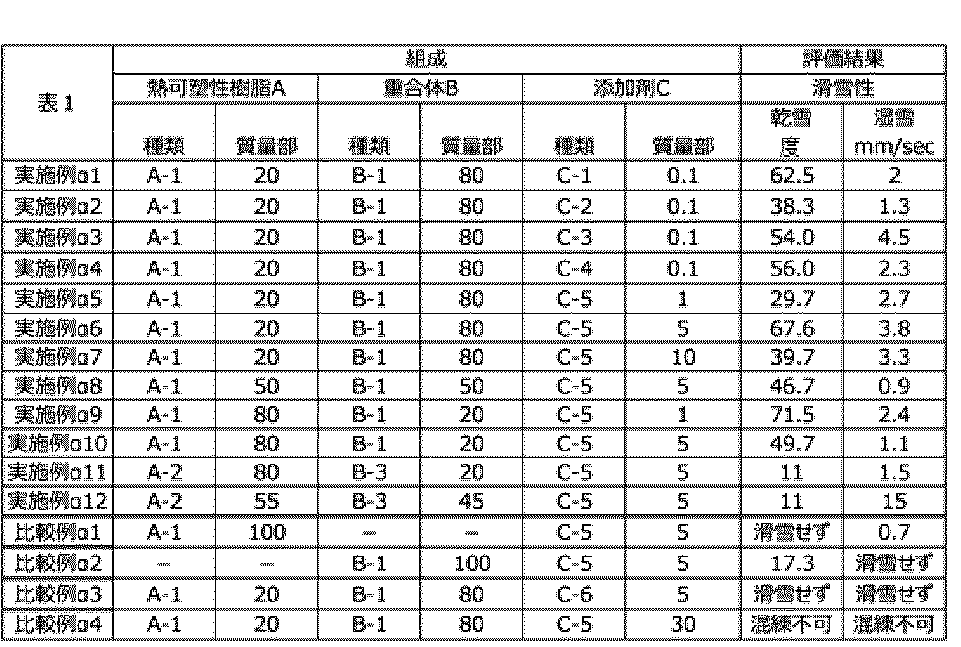
所定の組成比の組成物により、乾雪及び湿雪の両方の滑雪性に優れる膜が得られること
が確認された。
が確認された。
(実施例β11)
20質量部の熱可塑性樹脂(A-1)と、80質量部の重合体(B-1)と、10質量
部の添加剤(C-5)を均一に混合し、内径15mmの二軸混練機(テクノベル社製KZ
W15-45MG、内径:15mm、L/D=45)にて設定温度:210℃、スクリュ
ー回転数500rpmで加熱溶融混練し、組成物を得た。前記組成物を、新藤金属工業所
圧縮成形機(P-37)を用い、温度210℃で5分間樹脂を予熱した後、温度210℃
・圧力10MPa・5分間の条件で加圧し、幅150mm、長さ150mm、厚み2mm
の形状に賦形された膜を得た。膜の水接触角は72.5度、水接触角のヒステリシスは4
7.7度、ヘキサデカン接触角は31.1度であった。湿雪における滑雪と乾雪における
滑雪を評価した。
(比較例β5)
膜-1の湿雪における滑雪と乾雪における滑雪を評価した。
膜-1の湿雪における滑雪と乾雪における滑雪を評価した。
(比較例β6)
膜-2の湿雪における滑雪と乾雪における滑雪を評価した。
膜-2の湿雪における滑雪と乾雪における滑雪を評価した。
(比較例β7)
膜-3の湿雪における滑雪と乾雪における滑雪を評価した。
膜-3の湿雪における滑雪と乾雪における滑雪を評価した。
(比較例β8)
膜-4の湿雪における滑雪と乾雪における滑雪を評価した。
膜-4の湿雪における滑雪と乾雪における滑雪を評価した。
条件及び結果を表2に示す。
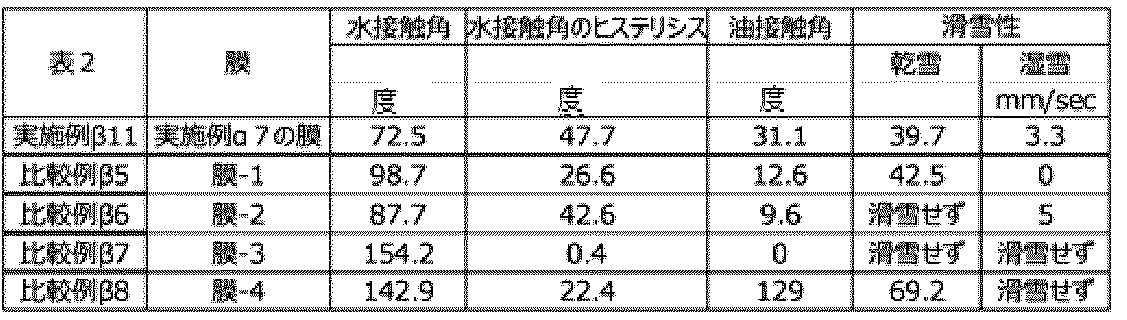
特定の水接触角、水接触角のヒステリシス、及び、油接触角を満たす膜は、乾雪及び湿
雪の両方において、滑雪性に優れることが確認された。
雪の両方において、滑雪性に優れることが確認された。
10…膜。
Claims (9)
- 熱可塑性樹脂Aと、重合体Bと、界面活性剤Cと、を含む組成物であって、
前記重合体Bは式(1)又は式(2)で表される構成単位を有し、
前記樹脂Aと前記重合体Bとの合計100質量部に対して、前記樹脂Aの含有量は1~
99質量部であり、前記重合体Bの含有量は1~99質量部であり、前記界面活性剤Cの
含有量は0.01~25質量部である組成物。

式中、R1~R3は、それぞれ独立に、水素原子、ハロゲン原子、アルコキシ基、又は
、アルキル基から選択される。各アルキル基及び各アルコキシ基の内の少なくとも1つの
水素原子は、独立にハロゲン原子で置換されていてもよい。 - 前記重合体Bは、(1)式で表される構成単位を有し、前記(1)式のR1~R3がい
ずれもフッ素原子である、請求項1に記載の組成物。 - 前記熱可塑性樹脂Aは、オレフィン系重合体である、請求項1又は2に記載の組成物。
- 前記界面活性剤Cは、非イオン性界面活性剤である、請求項1又は2に記載の組成物。
- 前記界面活性剤Cの親水基が4個以上の酸素原子を有する、請求項1又は2に記載の組
成物。 - 前記界面活性剤Cの親水基が1~5個のアミド基を有する、請求項1又は2に記載の組
成物。 - 前記界面活性剤Cが、多価アルコール脂肪酸エステル、ポリオキシアルキレン多価アル
コール脂肪酸エステル、脂肪酸アミド、ポリオキシアルキレンアルキルエーテル、ポリオ
キシアルキレンアルキルフェニルエーテル、多価アルコールアルキルエーテルからなる群
から選択される少なくとも1つである、請求項1又は2に記載の組成物。 - 樹脂Mと、界面活性剤Cと、を含む膜であって、下記要件(a)~(c)を満たす膜。
要件(a):前記膜の水平表面に2μLの水を滴下して測定した水接触角が50度以上
90度以下である。
要件(b):前記膜の水平表面において拡張収縮法により測定した水の接触角のヒステ
リシスが30度以上100度以下である。
要件(c):前記膜の水平表面に2μLのヘキサデカンを滴下して測定したヘキサデカ
ン接触角が10度以上130度以下である。 - 請求項8に記載の膜を外面の少なくとも一部に有する物品。
Applications Claiming Priority (2)
| Application Number | Priority Date | Filing Date | Title |
|---|---|---|---|
| JP2021-194153 | 2021-11-30 | ||
| JP2021194153 | 2021-11-30 |
Publications (1)
| Publication Number | Publication Date |
|---|---|
| WO2023100653A1 true WO2023100653A1 (ja) | 2023-06-08 |
Family
ID=86612045
Family Applications (1)
| Application Number | Title | Priority Date | Filing Date |
|---|---|---|---|
| PCT/JP2022/042522 Ceased WO2023100653A1 (ja) | 2021-11-30 | 2022-11-16 | 組成物及び膜 |
Country Status (2)
| Country | Link |
|---|---|
| JP (1) | JP2023081308A (ja) |
| WO (1) | WO2023100653A1 (ja) |
Citations (4)
| Publication number | Priority date | Publication date | Assignee | Title |
|---|---|---|---|---|
| JPH0485369A (ja) * | 1990-07-26 | 1992-03-18 | Central Glass Co Ltd | 滑雪性および着氷防止性に優れた被覆塗料組成物 |
| JP2005097574A (ja) * | 2003-08-22 | 2005-04-14 | Calp Corp | 成形用原料及びこれを用いた難燃性樹脂組成物の製造方法 |
| WO2018174220A1 (ja) * | 2017-03-24 | 2018-09-27 | 国立研究開発法人防災科学技術研究所 | 難着雪・滑雪フィルム又はシート |
| WO2021221038A1 (ja) * | 2020-04-30 | 2021-11-04 | Agc株式会社 | 分散液の製造方法、ペーストおよび練粉 |
-
2022
- 2022-11-07 JP JP2022178362A patent/JP2023081308A/ja active Pending
- 2022-11-16 WO PCT/JP2022/042522 patent/WO2023100653A1/ja not_active Ceased
Patent Citations (4)
| Publication number | Priority date | Publication date | Assignee | Title |
|---|---|---|---|---|
| JPH0485369A (ja) * | 1990-07-26 | 1992-03-18 | Central Glass Co Ltd | 滑雪性および着氷防止性に優れた被覆塗料組成物 |
| JP2005097574A (ja) * | 2003-08-22 | 2005-04-14 | Calp Corp | 成形用原料及びこれを用いた難燃性樹脂組成物の製造方法 |
| WO2018174220A1 (ja) * | 2017-03-24 | 2018-09-27 | 国立研究開発法人防災科学技術研究所 | 難着雪・滑雪フィルム又はシート |
| WO2021221038A1 (ja) * | 2020-04-30 | 2021-11-04 | Agc株式会社 | 分散液の製造方法、ペーストおよび練粉 |
Also Published As
| Publication number | Publication date |
|---|---|
| JP2023081308A (ja) | 2023-06-09 |
Similar Documents
| Publication | Publication Date | Title |
|---|---|---|
| TWI900735B (zh) | 組合物 | |
| JPWO2021176930A5 (ja) | ||
| EP0595578B1 (en) | Thermoplastic elastomer composition, materials for industrial parts comprising the composition and laminates comprising the covering materials | |
| JP5892283B1 (ja) | 熱可塑性樹脂組成物からなる成形体 | |
| JP2023081308A (ja) | 組成物及び膜 | |
| BR112021009216A2 (pt) | composições que contêm eva com propriedades mecânicas aprimoradas e artigos e métodos das mesmas | |
| EP1767583A1 (en) | Resin composition and moldings thereof | |
| CN107129623B (zh) | 热塑性弹性体组合物 | |
| JP2023081307A (ja) | 組成物及び膜 | |
| JP4926839B2 (ja) | ポリオレフィン樹脂組成物 | |
| JP5501867B2 (ja) | 艶消しフィルム、これを用いた内装材及び艶消しフィルムの製造方法 | |
| JP5958636B1 (ja) | 熱可塑性樹脂組成物からなる成形体 | |
| JP7404732B2 (ja) | 樹脂フィルム | |
| US20160096986A1 (en) | Thermoplastic moulding composition with water-repellent properties | |
| CN116406401B (zh) | 固体组合物及其制造方法 | |
| US20250339993A1 (en) | Pellet, pellet manufacturing method, composition/molded body manufacturing method using pellet, and pellet manufacturing composition | |
| KR100538713B1 (ko) | 투명성 및 진공성형성이 우수한 폴리올레핀 수지 조성물 | |
| JP2025034682A (ja) | 熱可塑性エラストマー成形体、複合成形体および製造方法 | |
| JP2025158798A (ja) | フィルム | |
| JP2023081306A (ja) | 組成物及び膜 | |
| JP2010270183A (ja) | ポリ乳酸系延伸シート及びその製造方法、並びにポリ乳酸系延伸シートを成形してなる成形体 | |
| Major | The structure and performance of pigmented polypropylene and propylene-ethylene copolymers. | |
| JPH0228252A (ja) | 樹脂組成物及びその成形物 | |
| JP2007106841A (ja) | 触感に優れた乳酸系樹脂組成物よりなる成形体 |
Legal Events
| Date | Code | Title | Description |
|---|---|---|---|
| 121 | Ep: the epo has been informed by wipo that ep was designated in this application |
Ref document number: 22901086 Country of ref document: EP Kind code of ref document: A1 |
|
| NENP | Non-entry into the national phase |
Ref country code: DE |
|
| 122 | Ep: pct application non-entry in european phase |
Ref document number: 22901086 Country of ref document: EP Kind code of ref document: A1 |