WO2023095522A1 - 光導波路の接続方法及び光導波路接続構造体 - Google Patents
光導波路の接続方法及び光導波路接続構造体 Download PDFInfo
- Publication number
- WO2023095522A1 WO2023095522A1 PCT/JP2022/039855 JP2022039855W WO2023095522A1 WO 2023095522 A1 WO2023095522 A1 WO 2023095522A1 JP 2022039855 W JP2022039855 W JP 2022039855W WO 2023095522 A1 WO2023095522 A1 WO 2023095522A1
- Authority
- WO
- WIPO (PCT)
- Prior art keywords
- optical fiber
- optical
- fiber block
- substrate
- spacer
- Prior art date
- Legal status (The legal status is an assumption and is not a legal conclusion. Google has not performed a legal analysis and makes no representation as to the accuracy of the status listed.)
- Ceased
Links
Images





Classifications
-
- G—PHYSICS
- G02—OPTICS
- G02B—OPTICAL ELEMENTS, SYSTEMS OR APPARATUS
- G02B6/00—Light guides; Structural details of arrangements comprising light guides and other optical elements, e.g. couplings
- G02B6/24—Coupling light guides
- G02B6/26—Optical coupling means
- G02B6/30—Optical coupling means for use between fibre and thin-film device
-
- G—PHYSICS
- G02—OPTICS
- G02B—OPTICAL ELEMENTS, SYSTEMS OR APPARATUS
- G02B6/00—Light guides; Structural details of arrangements comprising light guides and other optical elements, e.g. couplings
- G02B6/24—Coupling light guides
- G02B6/26—Optical coupling means
- G02B6/30—Optical coupling means for use between fibre and thin-film device
- G02B6/305—Optical coupling means for use between fibre and thin-film device and having an integrated mode-size expanding section, e.g. tapered waveguide
-
- G—PHYSICS
- G02—OPTICS
- G02B—OPTICAL ELEMENTS, SYSTEMS OR APPARATUS
- G02B6/00—Light guides; Structural details of arrangements comprising light guides and other optical elements, e.g. couplings
- G02B6/24—Coupling light guides
- G02B6/36—Mechanical coupling means
- G02B6/3628—Mechanical coupling means for mounting fibres to supporting carriers
- G02B6/3632—Mechanical coupling means for mounting fibres to supporting carriers characterised by the cross-sectional shape of the mechanical coupling means
- G02B6/3636—Mechanical coupling means for mounting fibres to supporting carriers characterised by the cross-sectional shape of the mechanical coupling means the mechanical coupling means being grooves
-
- G—PHYSICS
- G02—OPTICS
- G02B—OPTICAL ELEMENTS, SYSTEMS OR APPARATUS
- G02B6/00—Light guides; Structural details of arrangements comprising light guides and other optical elements, e.g. couplings
- G02B6/24—Coupling light guides
- G02B6/42—Coupling light guides with opto-electronic elements
- G02B6/4201—Packages, e.g. shape, construction, internal or external details
- G02B6/4219—Mechanical fixtures for holding or positioning the elements relative to each other in the couplings; Alignment methods for the elements, e.g. measuring or observing methods especially used therefor
- G02B6/4236—Fixing or mounting methods of the aligned elements
- G02B6/4239—Adhesive bonding; Encapsulation with polymer material
Definitions
- the present disclosure relates to an optical waveguide connection method and an optical waveguide connection structure.
- silicon photonics that forms an optical circuit on a silicon substrate by a CMOS (Complementary Metal Oxide Semiconductor) process, like semiconductor electronic circuits, is attracting attention.
- An optical circuit formed by silicon photonics is a fine-sized circuit having an optical control function.
- An optical input/output unit, an optical modulator, and the like are formed in the optical circuit. These are connected to each other by fine optical waveguides of submicron order. In order to connect an external transmission medium such as an optical fiber to this optical waveguide with high accuracy, various optical interfaces are being actively developed.
- an optical input end surface formed on the substrate and a connection end surface of an optical fiber block that bundles one or more optical fibers are used.
- a method of bonding and fixing the whole with an adhesive is adopted.
- connection loss occurs. It is known that this connection loss increases over time after the laser light is output, and the greater the output of the laser light, the more likely the connection loss will occur over time.
- the adhesive when the optical fiber block is fixed to the substrate, even if the adhesive is applied only to the side surface of the optical fiber block, the adhesive enters between the optical fiber block and the substrate due to capillary action, and the optical fiber and the substrate become separated. reaches between
- Patent Document 1 discloses that an adhesive is prevented from entering between the optical fiber and the substrate by forming a damming groove in the optical fiber block or the substrate.
- the damming grooves are positioned so as to sandwich the optical fibers, and extend in a direction perpendicular to the direction in which the optical fibers are arranged and the direction in which light travels.
- An optical waveguide connection method includes an optical fiber block having a through path with respect to a substrate provided with an optical input section and having a frame-shaped spacer formed to surround the optical input section. After contacting the spacer while holding the optical fiber block, the inclination of the optical fiber block is adjusted by releasing the holding of the optical fiber block, applying adhesive to the outside of the spacers on the substrate; aligning the optical fiber block holding the optical fiber with the light input part so that the intensity of the light emitted from the substrate is maximized; compressing the spacer by pushing the optical fiber block having the through passage against the substrate; The adhesive is cured while the spacer is compressed.
- An optical waveguide connection structure is a connection structure in which a substrate having at least one optical waveguide and an optical input section and an optical fiber block holding an optical fiber are connected by an adhesive. hand, A frame-shaped spacer is provided between the substrate and the optical fiber block so as to surround the optical input section provided on the substrate.
- FIG. 2 is a cross-sectional view along the YZ plane showing an outline of an optical waveguide connection structure according to an embodiment of the present disclosure
- 1 is a plan view showing a substrate of an optical waveguide connection structure according to an embodiment of the present disclosure
- FIG. 1 is an exploded perspective view showing an optical fiber block of an optical waveguide connection structure according to an embodiment of the present disclosure
- Patent Document 1 if an adhesive with low viscosity is used, it may pass through the damming groove, and it is difficult to completely prevent the adhesive from entering between the optical fiber and the substrate. . Furthermore, when the optical fiber block approaches the substrate with a slight inclination, damage and particle generation are induced, resulting in an increase in connection loss.
- a non-limiting embodiment of the present disclosure prevents an adhesive from entering a portion through which light passes with a simple configuration, suppresses an increase in connection loss over time, and prevents an optical fiber block from tilting slightly. It is an object of the present invention to provide an optical waveguide connection method and an optical waveguide connection structure capable of preventing contact between an optical fiber block and a substrate even when the substrate is approached while holding the block.
- the X-axis direction, Y-axis direction, and Z-axis direction represent the direction parallel to the X-axis, the direction parallel to the Y-axis, and the direction parallel to the Z-axis, respectively.
- the X-axis direction and the Y-axis direction are orthogonal to each other.
- the X-axis direction and the Z-axis direction are orthogonal to each other.
- the Y-axis direction and the Z-axis direction are orthogonal to each other.
- the XY plane represents a virtual plane parallel to the X-axis direction and the Y-axis direction.
- the XZ plane represents a virtual plane parallel to the X-axis direction and the Z-axis direction.
- a YZ plane represents a virtual plane parallel to the Y-axis direction and the Z-axis direction.
- 1 to 7, of the X-axis directions, the direction indicated by the arrow is the plus X-axis direction, and the opposite direction is the minus X-axis direction.
- 1 to 7, of the Y-axis directions, the direction indicated by the arrow is the positive Y-axis direction, and the opposite direction is the negative Y-axis direction.
- 1 to 7, of the Z-axis directions, the direction indicated by the arrow is the plus Z-axis direction, and the opposite direction is the minus Z-axis direction.
- the Z-axis direction is, for example, the vertical direction or the vertical direction
- the X-axis and Y-axis directions are, for example, the horizontal direction or the horizontal direction.
- FIG. 1 is a cross-sectional view along the YZ plane schematically showing an optical waveguide connection structure 1 according to an embodiment of the present disclosure
- FIG. 2 shows a substrate 10 of the optical waveguide connection structure 1 according to an embodiment of the present disclosure
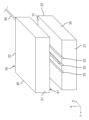
- 3 is an exploded perspective view showing the optical fiber block 20 of the optical waveguide connection structure 1 according to the embodiment of the present disclosure.
- the optical waveguide connection structure 1 is a mounting substrate realized by a method for connecting optical waveguides, which will be described later.
- the optical waveguide connection structure 1 includes a substrate 10 , an optical fiber block 20 and an adhesive layer 71 .
- the substrate 10 includes an optical waveguide 11, an optical input portion 12, and a spacer 60.
- the optical waveguide 11 has a plate-like structure for propagating light from the light input portion 12 to the light output portion (not shown).
- the optical input unit 12 is a grating coupler (that is, a diffraction grating type optical coupler) or the like.
- the optical waveguide 11 and the optical input section 12 are formed by patterning by photolithography, for example.
- the substrate 10 is made of, for example, quartz or silicon.
- a frame-shaped spacer 60 is formed on the surface 13 of the substrate 10 so as to surround the light input section 12 .
- the spacer 60 is a member that undergoes elastic deformation.
- the spacer 60 controls the distance in the Z direction between the optical fiber 50 and the light input section 12, prevents the adhesive layer 71 from flowing between the optical fiber 50 and the light input section 12, and prevents the light from entering. This prevents direct contact between the fiber block 20 and the substrate 10 .
- the elastic modulus is defined by dividing the applied force by the induced strain.
- the elastic modulus of spacer 60 is less than the elastic modulus of each of optical fiber block 20 and substrate 10 .
- the deformation rate of spacer 60 in the direction perpendicular to surface 13 of substrate 10 is greater than the deformation rate of optical fiber block 20 and substrate 10 in each of the aforementioned perpendicular directions.
- the compression modulus of the spacer 60 is, for example, 500 kgf/mm 2 .
- the spacer 60 has an outer dimension smaller than the outer dimension of the facing surface 21 of the optical fiber block 20, and surrounds the light input section 12 outside the position of the through path 34 on the facing surface 21 side of the optical fiber block 20. , is formed on the surface 13 of the substrate 10 in a frame shape, for example, in a ring shape.
- the spacer 60 may be in the shape of a single connected frame, and the shape is linear or curved when viewed from the Z direction, for example.
- the surface of the spacer 60 on the side of the opposing surface 21 of the optical fiber block 20 is formed parallel to the surface 13 of the substrate 10 .
- the dimension of the spacer 60 in the Z direction is larger than the dimension of the adhesive 70 applied to the surface 13 of the substrate 10 in the Z direction. Therefore, when bringing optical fiber block 20 closer to substrate 10 , optical fiber block 20 first contacts spacer 60 . Therefore, the optical fiber block 20 and the substrate 10 do not come into contact with each other.
- the dimension of the spacer 60 in the Z direction is, for example, 5 ⁇ m. Note that the dimension of the spacer 60 in the Z direction is not limited to this, and is, for example, 10 ⁇ m or 50 ⁇ m depending on the desired distance between the optical fiber 50 and the optical input section 12 in the optical waveguide connection structure 1. obtain.
- the width dimension of the spacer 60 is, for example, 10 ⁇ m.
- the spacer 60 is formed so as to surround the light input section 12 on the substrate 10 with high accuracy by patterning by photolithography, for example, using a photosensitive resin.
- the spacer 60 may be configured by combining a plurality of plate-like members so as to surround the light input portion 12 outside the position 34 and arranging them in a frame shape on the surface 13 of the substrate 10 . .
- the optical fiber block 20 is a component for inputting light into the light input section 12 and holds the optical fiber 50 .
- the optical fiber block 20 is fixed to the substrate 10 via an adhesive layer 71 and spacers 60 .
- the optical fiber block 20 has a facing surface 21 and a surface 22 .
- the facing surface 21 is a surface facing the surface 13 of the substrate 10 .
- the facing surface 21 of the optical fiber block 20 is polished using a method such as CMP (chemical mechanical polishing). The reason for the polishing is that when the optical fiber block 20 is tilted so that the light emitted from the optical fiber 50 is incident on the light input section 12 at a predetermined angle, it faces the surface 13 of the substrate 10. This is for making the surface 21 parallel.
- the surface 22 is the surface on the opposite side of the facing surface 21 of the optical fiber block 20 .
- the optical fiber block 20 includes a holder 30 having opposing surfaces 21 and 22 and a lid 40 having opposing surfaces 21 and 22 .
- the holder 30 is a member having a substantially rectangular parallelepiped plate shape, and having an installation groove 32 and two grooves 33 formed on a surface 31 .
- the installation grooves 32 and 33 each have a triangular cutaway cross-section and are arranged in a row parallel to each other. .
- the installation groove 32 between the two grooves 33 is a groove for holding the optical fiber 50 .
- the number of installation grooves 32 is not limited to one, and a plurality of installation grooves 32 may exist according to the configuration of the optical input section 12 .
- the groove 33 is a groove forming a through passage 34 for communicating the air layer 80 and the external space. At least one groove 33 is formed.
- the shape of the installation groove 32 and the groove 33 is, for example, a shape in which the width dimension of the groove becomes shorter toward the bottom of the groove.
- the installation grooves 32 and the grooves 33 are shaped to form triangular cutouts in the facing surface 21 of the holder 30 .
- the depth of the installation groove 32 and the groove 33 is 1 ⁇ m or more.
- the opening angle between one side surface of the installation groove 32 and the groove 33 and the side surface of the installation groove 32 and the groove 33 facing the side surface is 1 degree or more and less than 180 degrees.
- the installation grooves 32 and the grooves 33 are formed on the surface 31 of the holder 30 by cutting, patterning by photolithography, or the like.
- the shape of the installation groove 32 and the groove 33 may be such that the bottom portion draws a straight line when viewed from the facing surface 21, or may have a shape drawing a curved line.
- the holder 30 is made of a material such as quartz or silicon, for example.
- the lid 40 has a substantially rectangular parallelepiped plate shape, and is a member that sandwiches the optical fiber 50 together with the holder 30 .
- a surface 41 in FIG. 3 is a surface of the lid 40 on the holder 30 side.
- the lid 40 can sandwich the optical fiber 50 together with the holder 30 by aligning the surface 41 on the holder 30 side with the surface 31 of the holder 30 .
- the holder 30, the lid 40 and the optical fiber 50 may be fixed via an adhesive (not shown) for fixing.
- the lid 40 is made of, for example, quartz or silicon.
- through paths 34 are formed in the optical fiber block 20 by a plurality of grooves 33 and the surface 41 of the lid 40 on the holder 30 side.
- the through passage 34 penetrates from the opposing surface 21 to the surface 22 of the holder 30 .
- the through passage 34 is a hole used to form the air layer 80 .
- the optical fiber 50 is a medium for transmitting light, such as single mode fiber, multimode fiber, quartz fiber, or plastic fiber.
- the optical fiber 50 is arranged so as to pass through the optical fiber block 20 .
- the adhesive layer 71 is a layer formed by curing the adhesive 70 arranged around the optical fiber block 20 on the surface 13 of the substrate 10 .
- Adhesive layer 71 secures optical fiber block 20 to substrate 10 .
- a component of the adhesive 70 is a photocurable or thermosetting resin such as an acrylic resin, an epoxy resin, an acrylic epoxy resin, or a silicon resin.
- An air layer 80 is formed in the space surrounded by the spacer 60 between the optical fiber block 20 and the light input section 12 of the substrate 10 .
- the air layer 80 communicates with the external space via the through passage 34 . Therefore, the optical fiber 50 and the optical fiber block 20 are connected to the substrate 10 through the air layer 80.
- the air layer 80 may be formed of dry air using the through passage 34, or may be formed of nitrogen, argon, or a mixture thereof. In this case, the surface 22 side of the through path 34 is sealed with resin or the like.
- FIG. 4 is a flow chart showing a method for connecting optical waveguides according to an embodiment of the present disclosure.
- the tilt of the optical fiber block 20 is adjusted (step S10). Adjusting the inclination of the optical fiber block 20 means bringing the angle formed by the facing surface 21 of the optical fiber block 20 and the surface 13 of the substrate 10 closer to 0 degrees.
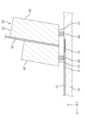
- FIG. 5A and 5B are diagrams for explaining the tilt adjustment of the optical fiber block 20.
- FIG. 5A and 5B are diagrams for explaining the tilt adjustment of the optical fiber block 20.
- step S10 first, the optical fiber block 20 is brought closer to the substrate 10 while holding the optical fiber block 20 . This brings the optical fiber block 20 into contact with the spacer 60 formed on the surface 13 of the substrate 10 . As shown in FIG. 5A, even when the optical fiber block 20 is inclined with respect to the surface 13 of the substrate 10, the spacer 60 prevents the optical fiber block 20 and the substrate 10 from coming into direct contact with each other. . By releasing the holding of the optical fiber block 20 while in contact with the spacer 60, the facing surface 21 of the optical fiber block 20 becomes parallel to the spacer 60 as shown in FIG. 5B. Therefore, the angle formed by the facing surface 21 of the optical fiber block 20 and the surface 13 of the substrate 10 can be made close to 0 degrees. After the tilt of the optical fiber block 20 is adjusted, the optical fiber block 20 is again held and raised in the Z direction for the next step S20 (see FIG. 6).
- the optical fiber block 20 can be easily held and released by sucking the optical fiber block 20 through the suction hole using a member having a suction hole and the suction device 100. Realized.
- Bringing the optical fiber block 20 closer to the substrate 10 is realized by combining the holding member described above with, for example, a linear motion stage and a gonio stage using a linear ball guide.
- the reason why a plurality of stages are combined is to enable adjustment of a plurality of axes of the optical fiber block 20 in an alignment operation, which will be described later.
- the adhesive 70 is supplied to the outside of the spacer 60 of the substrate 10 (step S20).
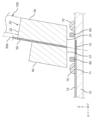
- FIG. 6 is an XZ sectional view of the optical waveguide connection structure 1 before the spacer 60 is compressed.
- the adhesive 70 is applied to the outer side of the spacer 60 so as to surround the entire circumference of the spacer 60 in a Z-direction dimension smaller than the Z-direction dimension of the spacer 60 .
- the applied adhesive 70 is blocked by the spacer 60 and does not enter the interior of the spacer 60 and the light input section 12 .
- the adhesive 70 is not limited to that surrounding the entire circumference of the spacer 60 outside the spacer 60 , and if the optical fiber block 20 and the substrate 10 are fixed with the adhesive 70 , the adhesive 70 is intermittently placed outside the spacer 60 . may be strategically placed.
- the application of the adhesive 70 is achieved, for example, with a dispenser.
- an adhesive is supplied in an amount of, for example, 1 nL or more and 1000 ⁇ L or less.
- the optical fiber block 20 is aligned with the optical input section 12 (step S30).
- the alignment operation is to move the optical fiber block 20 to a predetermined position on the XY plane with respect to the optical input section 12 .
- the predetermined position is an optical fiber block in the XY plane where the intensity of light emitted from the light output portion (not shown) of the substrate 10 is maximized according to the light emitted to the light input portion 12 via the optical fiber 50. 20 positions.
- the optical axis 50 a of the optical fiber block 20 is aligned with the optical input section 12 by moving the optical fiber block 20 to a predetermined position.
- step S31 it is determined whether or not the intensity of the light emitted from the light output portion (not shown) of the substrate 10 is maximum (step S31). That is, in step S30 and next step S31, the intensity of the light emitted from the light output portion (not shown) of the substrate 10 is maximized according to the light emitted to the light input portion 12 via the optical fiber 50. Then, the position of the optical fiber block 20 is adjusted to align the optical axis 50 a of the optical fiber block 20 with respect to the optical input section 12 .
- step S30 is executed until the intensity of light is maximized. That is, while changing and adjusting the position of the optical fiber block 20, the intensity of the light emitted from the light output portion (not shown) of the substrate 10 is measured, and the position where the measured intensity is maximized is found.
- the position adjustment of the optical fiber block 20 is realized by combining a holding member, a linear motion stage and a goniometer stage using, for example, a linear ball guide.
- a linear motion stage When only linear motion stages using linear ball guides are combined, the optical fiber block 20 can be moved in directions along three mutually orthogonal axes. 20 can be moved and the optical fiber block 20 can be tilted around three axes, so the position and attitude of the optical fiber block 20 can be freely adjusted.
- the light emitted from the light output section (not shown) of the substrate 10 is received by, for example, an optical fiber, and the received light is output to a photodetector to measure the intensity of the light. Further, the light receiving position may be adjusted by combining a holding member, a linear motion stage and a goniometer stage using, for example, a linear ball guide.
- step S30 the accuracy of alignment of the optical axis of the optical fiber block 20 by the operation of step S30 is on the order of nanometers.
- the operation of step S30 may be performed so that the alignment accuracy is on the order of micrometers.
- step S31 When the intensity of the light emitted from the light output portion (not shown) of the substrate 10 is maximized (YES in step S31), the spacer 60 is compressed by bringing the optical fiber block 20 closer to the substrate 10 and pushing it toward the substrate. is executed (step S40).
- FIG. 7 is an XZ sectional view of the optical waveguide connection structure 1 after the spacer 60 is compressed.
- the spacer 60 is elastically deformed and compressed by applying force. Since the elastic modulus of the spacer 60 is smaller than that of the optical fiber block 20 and the substrate 10 , the spacer 60 is compressed and deformed between the optical fiber block 20 and the substrate 10 .
- the optical fiber block 20 When the optical fiber block 20 is brought closer to the substrate 10, it is brought closer along the optical axis 50a of the optical fiber block 20, for example.
- the reason why the optical fiber block 20 is moved along the optical axis 50a is that if it is moved only in the Z direction, the optical axis 50a aligned with the light input section 12 is shifted in the X axis direction.
- the compression of the spacer 60 moves the optical fiber block 20 in advance in the X-axis direction so that the optical axis 50a of the optical fiber block 20 aligned with the optical input section 12 and the optical axis after the spacer compression are the same. After that, force is applied along the Z direction.
- step S40 since the Z-direction dimension of the spacer 60 is larger than the Z-direction dimension of the adhesive 70, the optical fiber block 20 first contacts the spacer 60, and the adhesive 70 spreads inside the spacer 60 and at the optical input portion. Do not invade 12.
- the optical fiber block 20 contacts the spacer 60, a force is applied along the optical axis direction of the optical fiber block 20 to the optical input section 12 to bring the optical fiber block 20 closer to the spacer with a predetermined force.
- 60 is compressed, and the distance in the Z direction between the facing surface 21 of the optical fiber block 20 and the light input section 12 can be made uniform.
- the inside of the spacer 60 does not form a sealed space because the through passage 34 is provided in the optical fiber block 20 .
- the distance in the Z direction between the facing surface 21 of the optical fiber block 20 and the light input section 12 after the spacer 60 is compressed is 1 nm or more and 5 ⁇ m or less.
- the predetermined force is a force necessary to realize the distance in the Z direction between the facing surface 21 of the optical fiber block 20 and the light input section 12 by compressing the spacer 60. is determined according to the Z-direction dimension and the amount of dimensional deformation, and is, for example, 1 Pa or more and 1 MPa or less.
- step S50 the adhesive 70 is cured while the spacers 60 are compressed.
- step S50 the adhesive 70 is irradiated with ultraviolet rays or the ambient temperature is raised. Thereby, the adhesive 70 is cured and an adhesive layer 71 is formed. As a result, the optical fiber block 20 is fixed to the substrate 10 .
- Curing of the adhesive 70 can be achieved by, for example, a light source that emits ultraviolet rays or a high-temperature oven.
- the optical waveguide connection structure 1 shown in FIG. 1 is realized.
- the adhesive layer 71 does not enter the optical input section 12 because the spacer 60 is formed on the substrate 10 .
- the through-path 34 is formed in the optical fiber block 20 so that the external space and the space inside the spacer 60 are communicated and do not form a closed space, the space inside the spacer 60 can be easily crushed without resistance. so that the optical fiber block 20 and the adhesive layer 71 on the substrate 10 can be in contact. As a result, the optical fiber block 20 and the substrate 10 are fixed via the adhesive layer 71 , but the optical fiber 50 and the optical input section 12 are not connected via the adhesive layer 71 .
- the simple configuration of the substrate 10 on which the spacer 60 is formed and the optical fiber block 20 on which the through path 34 is formed facilitates adhesion between the optical fiber 50 and the optical input section 12 in connection of the optical waveguide 11. Intrusion of the agent layer 71 can be prevented by the spacer 60 . As a result, an increase in the connection loss of the optical waveguide connection structure 1 over time can be suppressed. Further, even when the optical fiber block 20 approaches the substrate 10 with a slight inclination, the spacer 60 can prevent the optical fiber block 20 from coming into contact with the substrate 10 .
- the optical fiber block 20 and the substrate 10 are fixed mainly by connecting the side surface of the optical fiber block 20 and the surface 13 of the substrate 10 with the adhesive layer 71 via the spacer 60 . Therefore, it is possible to firmly fix the optical fiber block 20 to the substrate 10 while suppressing an increase in the connection loss of the optical waveguide connection structure 1 over time.
- the spacers can prevent an adhesive layer from entering between the optical fiber and the optical input section, and can be used over time.
- An optical waveguide connection method capable of suppressing an increase in connection loss and preventing contact between the optical fiber block and the substrate with a spacer even when the optical fiber block approaches the substrate with a slight inclination;
- An optical waveguide connection structure can be provided.
- An embodiment of the present disclosure can be suitably used for an optical waveguide connection method and an optical waveguide connection structure.
- the optical waveguide connection method and the optical waveguide connection structure according to the aspect of the present disclosure can permanently connect the optical fiber block and the optical circuit board while suppressing the continuous connection loss, which is represented by silicon photonics. It can be applied in fields such as high-speed optical communication and high-precision sensing using laser light.
Landscapes
- Physics & Mathematics (AREA)
- General Physics & Mathematics (AREA)
- Optics & Photonics (AREA)
- Optical Couplings Of Light Guides (AREA)
Priority Applications (2)
| Application Number | Priority Date | Filing Date | Title |
|---|---|---|---|
| JP2023563571A JPWO2023095522A1 (https=) | 2021-11-26 | 2022-10-26 | |
| US18/665,619 US20240302610A1 (en) | 2021-11-26 | 2024-05-16 | Method for connecting optical waveguide, and optical waveguide connection structure |
Applications Claiming Priority (2)
| Application Number | Priority Date | Filing Date | Title |
|---|---|---|---|
| JP2021192459 | 2021-11-26 | ||
| JP2021-192459 | 2021-11-26 |
Related Child Applications (1)
| Application Number | Title | Priority Date | Filing Date |
|---|---|---|---|
| US18/665,619 Continuation US20240302610A1 (en) | 2021-11-26 | 2024-05-16 | Method for connecting optical waveguide, and optical waveguide connection structure |
Publications (1)
| Publication Number | Publication Date |
|---|---|
| WO2023095522A1 true WO2023095522A1 (ja) | 2023-06-01 |
Family
ID=86539327
Family Applications (1)
| Application Number | Title | Priority Date | Filing Date |
|---|---|---|---|
| PCT/JP2022/039855 Ceased WO2023095522A1 (ja) | 2021-11-26 | 2022-10-26 | 光導波路の接続方法及び光導波路接続構造体 |
Country Status (3)
| Country | Link |
|---|---|
| US (1) | US20240302610A1 (https=) |
| JP (1) | JPWO2023095522A1 (https=) |
| WO (1) | WO2023095522A1 (https=) |
Cited By (1)
| Publication number | Priority date | Publication date | Assignee | Title |
|---|---|---|---|---|
| WO2025052796A1 (ja) * | 2023-09-06 | 2025-03-13 | 住友電気工業株式会社 | 光接続アセンブリおよび実装方法 |
Citations (5)
| Publication number | Priority date | Publication date | Assignee | Title |
|---|---|---|---|---|
| CN102540349A (zh) * | 2012-01-18 | 2012-07-04 | 中北大学 | 光纤与光波导芯片高效垂直耦合互连的封装方法 |
| US20140270642A1 (en) * | 2013-03-14 | 2014-09-18 | Micron Technology, Inc. | Photonics grating coupler and method of manufacture |
| JP2016001286A (ja) * | 2014-06-12 | 2016-01-07 | 日本電信電話株式会社 | 光ファイバ接続部品 |
| JP2016053679A (ja) * | 2014-09-04 | 2016-04-14 | 富士通株式会社 | 光ファイバの接続構造、光ファイバホルダおよび光ファイバの接続方法 |
| JP2018017927A (ja) * | 2016-07-28 | 2018-02-01 | 富士通株式会社 | 光配線モジュール、光トランシーバ、及び光接続方法 |
-
2022
- 2022-10-26 WO PCT/JP2022/039855 patent/WO2023095522A1/ja not_active Ceased
- 2022-10-26 JP JP2023563571A patent/JPWO2023095522A1/ja active Pending
-
2024
- 2024-05-16 US US18/665,619 patent/US20240302610A1/en active Pending
Patent Citations (5)
| Publication number | Priority date | Publication date | Assignee | Title |
|---|---|---|---|---|
| CN102540349A (zh) * | 2012-01-18 | 2012-07-04 | 中北大学 | 光纤与光波导芯片高效垂直耦合互连的封装方法 |
| US20140270642A1 (en) * | 2013-03-14 | 2014-09-18 | Micron Technology, Inc. | Photonics grating coupler and method of manufacture |
| JP2016001286A (ja) * | 2014-06-12 | 2016-01-07 | 日本電信電話株式会社 | 光ファイバ接続部品 |
| JP2016053679A (ja) * | 2014-09-04 | 2016-04-14 | 富士通株式会社 | 光ファイバの接続構造、光ファイバホルダおよび光ファイバの接続方法 |
| JP2018017927A (ja) * | 2016-07-28 | 2018-02-01 | 富士通株式会社 | 光配線モジュール、光トランシーバ、及び光接続方法 |
Cited By (1)
| Publication number | Priority date | Publication date | Assignee | Title |
|---|---|---|---|---|
| WO2025052796A1 (ja) * | 2023-09-06 | 2025-03-13 | 住友電気工業株式会社 | 光接続アセンブリおよび実装方法 |
Also Published As
| Publication number | Publication date |
|---|---|
| JPWO2023095522A1 (https=) | 2023-06-01 |
| US20240302610A1 (en) | 2024-09-12 |
Similar Documents
| Publication | Publication Date | Title |
|---|---|---|
| CN109983381B (zh) | 用于产生光学系统的方法以及光学系统 | |
| CN110741294B (zh) | 光波导芯片的连接结构 | |
| US10564374B2 (en) | Electro-optical interconnect platform | |
| JP2020533632A (ja) | 単一側面で結合を行うフォトニックチップのハイブリッド集積化 | |
| JP2615400B2 (ja) | 無調整光コネクタ | |
| US9261652B2 (en) | Optical components including bonding slots for adhesion stability | |
| WO2018067703A1 (en) | An electro-optical interconnect platform | |
| US20250341691A1 (en) | Optical coupling adapter for fiber-to-chip integration | |
| US20240302610A1 (en) | Method for connecting optical waveguide, and optical waveguide connection structure | |
| JP3923328B2 (ja) | レンズ交換型コリメータを備えた機能性光結合モジュール | |
| Taira et al. | Improved connectorization of compliant polymer waveguide ribbon for silicon nanophotonics chip interfacing to optical fibers | |
| US10156688B1 (en) | Passive alignment system and an optical communications module that incorporates the passive alignment system | |
| JP5244585B2 (ja) | 光伝送基板及びその製造方法並びに光伝送装置 | |
| EP4377730B1 (en) | Optical integrated circuit | |
| CN120497752A (zh) | 光模块和光模块的制造方法 | |
| JP2021113844A (ja) | 光配線部品の製造方法 | |
| JP4113577B2 (ja) | 複合光学素子および複合光学部品 | |
| WO2020003973A1 (ja) | 光部品およびその製造方法 | |
| JP7599091B2 (ja) | 光モジュール、光モジュールの製造装置、および、光モジュールの製造方法 | |
| Bakir et al. | Mechanically flexible chip-to-substrate optical interconnections using optical pillars | |
| JP7750288B2 (ja) | 光接続構造およびその製造方法 | |
| JP7728438B2 (ja) | 光接続構造 | |
| JP7478952B2 (ja) | 光モジュール及び光導波路接続方法 | |
| JP7548413B2 (ja) | 光接続構造、パッケージ構造、光モジュールおよびパッケージ構造の製造方法 | |
| US20240402444A1 (en) | Optical module |
Legal Events
| Date | Code | Title | Description |
|---|---|---|---|
| 121 | Ep: the epo has been informed by wipo that ep was designated in this application |
Ref document number: 22898306 Country of ref document: EP Kind code of ref document: A1 |
|
| ENP | Entry into the national phase |
Ref document number: 2023563571 Country of ref document: JP Kind code of ref document: A |
|
| NENP | Non-entry into the national phase |
Ref country code: DE |
|
| 122 | Ep: pct application non-entry in european phase |
Ref document number: 22898306 Country of ref document: EP Kind code of ref document: A1 |