WO2023095383A1 - 接合体、レーザ加工方法及びレーザ加工装置 - Google Patents
接合体、レーザ加工方法及びレーザ加工装置 Download PDFInfo
- Publication number
- WO2023095383A1 WO2023095383A1 PCT/JP2022/028424 JP2022028424W WO2023095383A1 WO 2023095383 A1 WO2023095383 A1 WO 2023095383A1 JP 2022028424 W JP2022028424 W JP 2022028424W WO 2023095383 A1 WO2023095383 A1 WO 2023095383A1
- Authority
- WO
- WIPO (PCT)
- Prior art keywords
- laser
- laser beam
- work material
- workpiece
- joint
- Prior art date
- Legal status (The legal status is an assumption and is not a legal conclusion. Google has not performed a legal analysis and makes no representation as to the accuracy of the status listed.)
- Ceased
Links
Images



Classifications
-
- B—PERFORMING OPERATIONS; TRANSPORTING
- B23—MACHINE TOOLS; METAL-WORKING NOT OTHERWISE PROVIDED FOR
- B23K—SOLDERING OR UNSOLDERING; WELDING; CLADDING OR PLATING BY SOLDERING OR WELDING; CUTTING BY APPLYING HEAT LOCALLY, e.g. FLAME CUTTING; WORKING BY LASER BEAM
- B23K26/00—Working by laser beam, e.g. welding, cutting or boring
- B23K26/20—Bonding
- B23K26/32—Bonding taking account of the properties of the material involved
- B23K26/323—Bonding taking account of the properties of the material involved involving parts made of dissimilar metallic material
-
- B—PERFORMING OPERATIONS; TRANSPORTING
- B23—MACHINE TOOLS; METAL-WORKING NOT OTHERWISE PROVIDED FOR
- B23K—SOLDERING OR UNSOLDERING; WELDING; CLADDING OR PLATING BY SOLDERING OR WELDING; CUTTING BY APPLYING HEAT LOCALLY, e.g. FLAME CUTTING; WORKING BY LASER BEAM
- B23K26/00—Working by laser beam, e.g. welding, cutting or boring
- B23K26/02—Positioning or observing the workpiece, e.g. with respect to the point of impact; Aligning, aiming or focusing the laser beam
- B23K26/06—Shaping the laser beam, e.g. by masks or multi-focusing
- B23K26/0604—Shaping the laser beam, e.g. by masks or multi-focusing by a combination of beams
- B23K26/0619—Shaping the laser beam, e.g. by masks or multi-focusing by a combination of beams with spots located on opposed surfaces of the workpiece
-
- B—PERFORMING OPERATIONS; TRANSPORTING
- B23—MACHINE TOOLS; METAL-WORKING NOT OTHERWISE PROVIDED FOR
- B23K—SOLDERING OR UNSOLDERING; WELDING; CLADDING OR PLATING BY SOLDERING OR WELDING; CUTTING BY APPLYING HEAT LOCALLY, e.g. FLAME CUTTING; WORKING BY LASER BEAM
- B23K26/00—Working by laser beam, e.g. welding, cutting or boring
- B23K26/02—Positioning or observing the workpiece, e.g. with respect to the point of impact; Aligning, aiming or focusing the laser beam
- B23K26/06—Shaping the laser beam, e.g. by masks or multi-focusing
- B23K26/067—Dividing the beam into multiple beams, e.g. multi-focusing
-
- B—PERFORMING OPERATIONS; TRANSPORTING
- B23—MACHINE TOOLS; METAL-WORKING NOT OTHERWISE PROVIDED FOR
- B23K—SOLDERING OR UNSOLDERING; WELDING; CLADDING OR PLATING BY SOLDERING OR WELDING; CUTTING BY APPLYING HEAT LOCALLY, e.g. FLAME CUTTING; WORKING BY LASER BEAM
- B23K26/00—Working by laser beam, e.g. welding, cutting or boring
- B23K26/02—Positioning or observing the workpiece, e.g. with respect to the point of impact; Aligning, aiming or focusing the laser beam
- B23K26/06—Shaping the laser beam, e.g. by masks or multi-focusing
- B23K26/067—Dividing the beam into multiple beams, e.g. multi-focusing
- B23K26/0676—Dividing the beam into multiple beams, e.g. multi-focusing into dependently operating sub-beams, e.g. an array of spots with fixed spatial relationship or for performing simultaneously identical operations
-
- B—PERFORMING OPERATIONS; TRANSPORTING
- B23—MACHINE TOOLS; METAL-WORKING NOT OTHERWISE PROVIDED FOR
- B23K—SOLDERING OR UNSOLDERING; WELDING; CLADDING OR PLATING BY SOLDERING OR WELDING; CUTTING BY APPLYING HEAT LOCALLY, e.g. FLAME CUTTING; WORKING BY LASER BEAM
- B23K26/00—Working by laser beam, e.g. welding, cutting or boring
- B23K26/08—Devices involving relative movement between laser beam and workpiece
- B23K26/082—Scanning systems, i.e. devices involving movement of the laser beam relative to the laser head
-
- B—PERFORMING OPERATIONS; TRANSPORTING
- B23—MACHINE TOOLS; METAL-WORKING NOT OTHERWISE PROVIDED FOR
- B23K—SOLDERING OR UNSOLDERING; WELDING; CLADDING OR PLATING BY SOLDERING OR WELDING; CUTTING BY APPLYING HEAT LOCALLY, e.g. FLAME CUTTING; WORKING BY LASER BEAM
- B23K26/00—Working by laser beam, e.g. welding, cutting or boring
- B23K26/20—Bonding
- B23K26/21—Bonding by welding
-
- B—PERFORMING OPERATIONS; TRANSPORTING
- B23—MACHINE TOOLS; METAL-WORKING NOT OTHERWISE PROVIDED FOR
- B23K—SOLDERING OR UNSOLDERING; WELDING; CLADDING OR PLATING BY SOLDERING OR WELDING; CUTTING BY APPLYING HEAT LOCALLY, e.g. FLAME CUTTING; WORKING BY LASER BEAM
- B23K2103/00—Materials to be soldered, welded or cut
- B23K2103/08—Non-ferrous metals or alloys
- B23K2103/10—Aluminium or alloys thereof
-
- B—PERFORMING OPERATIONS; TRANSPORTING
- B23—MACHINE TOOLS; METAL-WORKING NOT OTHERWISE PROVIDED FOR
- B23K—SOLDERING OR UNSOLDERING; WELDING; CLADDING OR PLATING BY SOLDERING OR WELDING; CUTTING BY APPLYING HEAT LOCALLY, e.g. FLAME CUTTING; WORKING BY LASER BEAM
- B23K2103/00—Materials to be soldered, welded or cut
- B23K2103/08—Non-ferrous metals or alloys
- B23K2103/12—Copper or alloys thereof
-
- B—PERFORMING OPERATIONS; TRANSPORTING
- B23—MACHINE TOOLS; METAL-WORKING NOT OTHERWISE PROVIDED FOR
- B23K—SOLDERING OR UNSOLDERING; WELDING; CLADDING OR PLATING BY SOLDERING OR WELDING; CUTTING BY APPLYING HEAT LOCALLY, e.g. FLAME CUTTING; WORKING BY LASER BEAM
- B23K2103/00—Materials to be soldered, welded or cut
- B23K2103/18—Dissimilar materials
- B23K2103/20—Ferrous alloys and aluminium or alloys thereof
-
- B—PERFORMING OPERATIONS; TRANSPORTING
- B23—MACHINE TOOLS; METAL-WORKING NOT OTHERWISE PROVIDED FOR
- B23K—SOLDERING OR UNSOLDERING; WELDING; CLADDING OR PLATING BY SOLDERING OR WELDING; CUTTING BY APPLYING HEAT LOCALLY, e.g. FLAME CUTTING; WORKING BY LASER BEAM
- B23K2103/00—Materials to be soldered, welded or cut
- B23K2103/18—Dissimilar materials
- B23K2103/22—Ferrous alloys and copper or alloys thereof
Definitions
- the present invention relates to a joined body produced by laminating and laser welding dissimilar metal strips, a laser processing method therefor, and a laser processing apparatus.
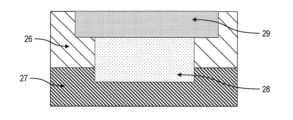
- FIG. 12 is a schematic cross-sectional view showing a cross-sectional structure of a conventional joint/penetration shape of dissimilar metal materials described in Patent Document 1.
- FIG. 12 shows a can 26 made of iron and a negative electrode tab 27 made of copper.
- FIG. 12 also shows a fusion zone 28 where the depth of penetration reaches from the iron side to the copper side when the can and the negative electrode tab are laser-welded.
- FIG. 12 shows a re-melted portion 29 formed when the concentration of Ni plating present on the surface is adjusted by irradiating only the surface portion of the can with a laser again after forming the melted portion 28 . .
- the present invention is intended to solve the conventional problems described above, and an object of the present invention is to provide a joining method that suppresses welding defects in welding dissimilar metal materials.
- a joined body includes a first work material made of a first metal, a second work material made of a second metal different from the first metal, the first work material and the first work material. a joining portion for joining two workpieces.
- the joint portion includes a first joint portion located on the side of the first workpiece and a second joint portion located on the side of the second workpiece, and is included in the first joint portion.
- the concentration of metal contained in the second junction is different from the concentration of metal contained in the second junction.
- a laser processing method is a laser processing method for joining a first member containing a first metal and a second member containing a second metal that is different from the first metal. a first step of forming a joint in which the first metal and the second metal are melted by scanning the first laser light; and a second step of stirring the metallographic structure in the vicinity of the joint by scanning with a second laser beam having a larger beam diameter and a lower power density than the first laser beam.
- a laser processing apparatus includes an irradiation optical system that irradiates a workpiece with a first laser beam forward and a second laser beam backward along a scanning direction, and a scanning system that scans along a scanning direction while irradiating a workpiece with two laser beams.
- the joined body, the laser processing method, and the laser processing apparatus it is possible to control the composition in the vicinity of the joint in the joined body obtained after laser welding dissimilar metal materials. This avoids solidification cracking caused by segregation of dissimilar metal materials in the welded portion of the joint, or the formation of intermetallic compounds that can reduce the joint strength of the joined body, thereby achieving good dissimilar metal material joining. can be realized.
- FIG. 1 is a schematic perspective view showing the configuration of an optical system using a two-dimensional diffractive optical element as a laser oscillator and a branching optical system in a laser processing apparatus according to Embodiment 1;
- FIG. 10 is a schematic perspective view showing a configuration using a laser oscillator and a branching optical system in a laser processing apparatus according to Modification 1 of Embodiment 1;
- FIG. 10 is a schematic perspective view showing a configuration using a laser oscillator and a branching optical system in a laser processing apparatus according to Modification 1 of Embodiment 1;
- FIG. 9 is a schematic perspective view showing the configuration of an optical system using a three-dimensional diffraction optical element as a laser oscillator and a branching optical system in a laser processing apparatus according to Modification 2 of Embodiment 1;
- the states of the cross section of the melted portion when the first laser beam and the second laser beam are sequentially scanned are shown in time series in the order of (a), (b), and (c).
- It is a schematic cross-sectional view shown in . 4 is a plan view showing laser diameters and inter-beam distances of a first laser beam and a second laser beam with which a workpiece is irradiated in the laser processing method according to Embodiment 1.
- FIG. 1 is a schematic perspective view showing the configuration of an optical system using a three-dimensional diffraction optical element as a laser oscillator and a branching optical system in a laser processing apparatus according to Modification 2 of Embodiment 1;
- FIG. 2 is a schematic diagram showing in chronological order how dissimilar metals are mixed and stirred in the vicinity of the joint interface between workpieces P1 and P2 in the laser processing method according to Embodiment 1;
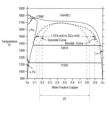
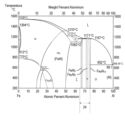
- FIG. 4 is a schematic cross-sectional view showing a cross-sectional structure when scanning is performed multiple times by a multi-branched laser in the embodiment. It is an equilibrium diagram of Fe and Cu. It is an equilibrium diagram of Fe and Al.
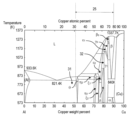
- FIG. 2 is an equilibrium diagram of Al and Cu;
- FIG. 4 is a schematic cross-sectional view showing a cross-sectional structure of a fusion zone formed by conventional lap laser welding of dissimilar metal welding.
- a phase of such a solid solution having a mixed composition of two or more types becomes unstable as the temperature decreases, causing fluctuations in the mixed composition and a phenomenon called spinodal decomposition in which two-phase separation proceeds.
- copper segregates in the molten zone during complete solidification, and solidification cracking occurs due to the difference in mechanical properties between iron and copper.
- dissimilar metal bonding between iron and aluminum from region 24 in the equilibrium diagram shown in FIG. It is reported that intermetallic compounds such as Fe 2 Al 5 , FeAl 2 and FeAl 3 are formed in the vicinity of the interface of the joint and the joint strength is lowered.
- dissimilar metal bonding between aluminum and copper from region 25 in the equilibrium diagram shown in FIG . It has been reported that it is formed in the vicinity of the interface, reduces the bonding strength, and acts as a starting point for crack generation.
- the inventors focused on the fact that in laser welding of dissimilar metal materials, the above defect phenomenon frequently occurs in the vicinity of the metal joint on the laser irradiation side.
- the inventors have found that the concentration of metals has decreased as a whole, and have arrived at the present invention.
- the present invention relates to lapped laser welding of members using dissimilar metal materials that combine two plate-shaped members made of iron, copper, or aluminum.
- the first laser beam forward in the scanning direction and the second laser beam arranged behind the scanning direction are used to irradiate and scan the first laser beam forward.
- irradiation and scanning with a second laser beam arranged in the rear are performed to join the superimposed members.
- the metal structure in the vicinity of the joint formed by the irradiation of the first laser beam is stirred by the irradiation of the second laser beam, and the concentration of the dissimilar metal material mixed when the members are joined is reduced, thereby solidifying. Joints can be made that resist cracking and intermetallic formation.
- a joined body joins a first work material made of a first metal and a second work material made of a second metal different from the first metal at a joint. wherein the joint includes a first joint located on the side of the first workpiece and a second joint located on the side of the second workpiece , the first junction and the second junction have different metal concentrations.
- the first joining The section in a cross-sectional view in a direction perpendicular to a direction in which the first workpiece and the second workpiece are superimposed, the first joining The section may have a greater thickness than the second joint section.
- the first work material and the second work material may be made of iron, copper, or aluminum. .
- a joined body according to a fourth aspect is a joined body according to the third aspect, wherein when the first work material is made of iron and the second work material is made of copper, the concentration of copper in the first joint is It may be 15 atomic % or less.
- a joined body according to a fifth aspect is a joined body according to the third aspect, when the first work material is made of copper and the second work material is made of iron, the concentration of iron in the first joint is It may be 20 atomic % or less.
- a joint body according to a sixth aspect is the joint body according to the third aspect, when the first work material is made of iron and the second work material is made of aluminum, the concentration of aluminum in the first joint is It may be 65 atomic % or less.
- a joined body according to a seventh aspect is a joined body according to the third aspect, when the first work material is made of aluminum and the second work material is made of iron, the concentration of iron in the first joint is It may be 24 atomic % or less.
- a joined body according to an eighth aspect is the third aspect, wherein when the first work material is copper and the second work material is iron, the concentration of iron in the first joint is It may be 15 atomic % or less.
- a joined body according to a ninth aspect is a joined body according to the third aspect, wherein when the first work material is made of iron and the second work material is made of aluminum, the concentration of aluminum in the first joint is It may be 65 atomic % or less.
- a joined body according to a tenth aspect is a joined body according to the third aspect, when the first work material is made of copper and the second work material is made of aluminum, the concentration of iron in the first joint is It may be 20 atomic % or less.
- a bonded body according to an eleventh aspect is a bonded body according to the third aspect, when the first work material is made of aluminum and the second work material is made of copper, the concentration of copper in the first joint is It may be 30 atomic % or less.
- a laser processing method is a laser processing method for joining a first member containing a first metal and a second member containing a second metal that is different from the first metal. and a first step of forming a joint by melting the first metal and the second metal by scanning the first laser light; a second step of stirring the metallographic structure in the vicinity of the joint by scanning with a second laser beam having a larger beam diameter and a lower power density than the first laser beam;
- the beam diameter of the second laser light may be two to three times the beam diameter of the first laser light.
- a laser processing method is the above-described twelfth or thirteenth aspect, wherein the first laser beam and the second laser beam are branched from a single laser beam into a plurality of beams in the scanning direction,
- the inter-beam distance of the adjacent laser beams among the split beams is twice or more the beam diameter of the laser beam ahead in the scanning direction among the adjacent laser beams, and It may be twice or less the beam diameter of the laser light.
- the second laser beam may be split into a plurality of beams from the output source by an optical system.
- the second laser beam from the output source may be split into a plurality of beams by a diffraction grating.
- the second laser light may have a wavelength of 266 nm to 11 ⁇ m.
- a laser processing apparatus includes an irradiation optical system for irradiating a workpiece with a forward first laser beam and a backward second laser beam along a scanning direction, and a first laser beam and a scanning system that scans along the scanning direction while irradiating the workpiece with the second laser beam.
- a laser processing apparatus is the above eighteenth aspect, wherein the irradiation optical system comprises a laser oscillator that emits a single laser beam, A branching optical system for branching the light and the second laser light and irradiating the workpiece along the scanning direction may be provided.
- the dissimilar metal material welding method according to the present disclosure can be applied to lap welding by combining plate materials of metal materials such as iron, copper, and aluminum that are widely used in the industrial world.
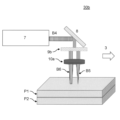
- FIG. 1 is a schematic perspective view showing the configuration of an optical system using a laser oscillator 7 and a two-dimensional diffraction optical element 9a as a branching optical system in a laser processing apparatus 30 according to Embodiment 1.
- FIG. 1 is a schematic perspective view showing the configuration of an optical system using a laser oscillator 7 and a two-dimensional diffraction optical element 9a as a branching optical system in a laser processing apparatus 30 according to Embodiment 1.
- FIG. 1 is a schematic perspective view showing the configuration of an optical system using a laser oscillator 7 and a two-dimensional diffraction optical element 9a as a branching optical system in a laser processing apparatus 30 according to Embodiment 1.
- FIG. 1 is a schematic perspective view showing the configuration of an optical system using a laser oscillator 7 and a two-dimensional diffraction optical element 9a as a branching optical system in a laser processing apparatus 30 according to Embodiment 1.
- FIG. 1 is a schematic perspective view showing
- This laser processing apparatus 30 includes irradiation optical systems 7, 8, and 9a for irradiating workpieces P1 and P2 with a first laser beam B5 forward and a second laser beam B6 backward along a scanning direction 3. , 10a, and a scanning system (not shown) for scanning along the scanning direction 3 while irradiating the workpieces P1 and P2 with the first laser beam B5 and the second laser beam B6.
- the irradiation optical system includes a laser oscillator 7 that emits a single laser beam B4, and splits the single laser beam B4 into a first laser beam B5 and a second laser beam B6, along the scanning direction 3. branching optical systems 8, 9a, and 10a for irradiating the workpieces P1 and P2.
- the first metal which is the material of the workpiece P1
- the second metal which is the material of the workpiece P2
- the second metal is copper, and has a thickness of 0.1 mm, a laser absorptivity of 5% at a wavelength ⁇ of 1070 nm, and a melting point of 1300K. Further, during laser processing, the workpiece P1 and the workpiece P2 are overlapped and fixed, and the fixing member is not shown.
- the laser oscillator 7 is a continuous wave single mode fiber laser with a wavelength of 1070 nm.
- the laser beam B4 is substantially parallel light beam emitted by the laser oscillator 7 .
- the folding mirror 8 reflects 90% or more of light with a wavelength of 1070 nm.
- the two-dimensional diffraction optical element 9a transmits 90% or more of light with a wavelength of 1070 nm.
- the parallel light incident on the two-dimensional diffractive optical element 9a can be transmitted through the lens to form a branched beam at the focal position of the lens.
- the corresponding wavelength of the f- ⁇ lens 10 is 1070 nm
- the focal length is 255 mm
- the scanning range is 200 mm ⁇ 200 mm.
- the folding mirror 8, the two-dimensional diffraction optical element 9a, and the f-.theta. lens 10 correspond to the branching optical system.
- a laser beam B4 emitted from a laser oscillator 7 is bent at an angle of 45° in the scanning direction 3 with respect to the vertical direction by a folding mirror 8, and passes through a two-dimensional diffraction optical element 9a and an f- ⁇ lens 10a.
- the beam is split into a first laser beam B5 and a second laser beam B6.
- the focal position of the first laser beam B5 irradiated at an angle of 45° in the scanning direction 3 with respect to the vertical direction is set to be the surface of the workpiece P1. Therefore, the second laser beam B6 behind in the scanning direction 3 has a larger irradiation diameter on the workpiece P1 than the first laser beam B5 ahead in the scanning direction due to the inclination of the irradiation angle.
- the workpieces P1 and P2 are scanned along the scanning direction 3 while being irradiated with the first laser beam B5 and the second laser beam B6 by a scanning system (not shown).
- the scanning system may be any system as long as it moves the irradiation optical system and the workpiece relative to each other. For example, at least part of the irradiation optical system may be moved along the scanning direction 3 .
- the workpieces P1 and P2 may be moved in a direction opposite to the scanning direction 3 with respect to the irradiation optical system.
- the scanning direction 3 is not limited to a straight line direction, and may be a curved line direction, for example, an arc.
- the scanning system may be any driving unit that is normally used.
- scanning also includes “irradiation” unless scanning and irradiation are described separately. As an inclusion, “irradiate” may be omitted.
- FIG. 2 is a schematic perspective view showing a configuration using a laser oscillator 7 and branching optical systems 8, 11, 10a and 10b in a laser processing apparatus 30a according to Modification 1 of Embodiment 1. As shown in FIG.
- the laser beam B4 is emitted from the laser oscillator 7 and split into two by the half mirror 11 at the same ratio.
- the two-branched first and second laser beams B5 and B6 are focused on the workpiece P1 by two f- ⁇ lenses.
- the f- ⁇ lens 10a for condensing the first laser beam B5 in the forward direction in the scanning direction 3 and the f- ⁇ lens 10b for condensing the second laser beam B6 in the rearward direction have the same focal length. to use.
- the focal length of the f- ⁇ lens 10b that converges the second laser beam B6 may be different from that of the f- ⁇ lens that converges the first laser beam B5.
- FIG. 3 is a schematic perspective view showing the configuration of an optical system using a laser oscillator 7 and a three-dimensional diffraction optical element 9b as a branching optical system in a laser processing apparatus 30b according to Modification 2 of Embodiment 1.
- the first laser beam B5 and the second laser beam B6 can be obtained without adjusting the angle of the mirror to 45°, assuming that the laser folding angle by the folding mirror 8 is 90°, which is generally used in laser processing.
- the beam-to-beam distance L15 can be set to an arbitrary beam-to-beam distance.
- the wavelength of the laser light emitted from the laser oscillator 7 shown in FIGS. 1 to 3 of the present disclosure may be in the wavelength range of 266 nm to 11 ⁇ m, which allows laser welding.
- the mirror angle is 45° in FIG. 2, other angles may be used as long as a difference in focal diameter between the first laser beam B5 and the second laser beam B6 can be created.
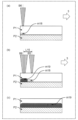
- FIG. 4 shows a melted portion when the first laser beam B5 and the second laser beam B6 are sequentially scanned with respect to superposition of the workpiece P1 and the workpiece P2 in the laser processing method according to the first embodiment.
- 1 is a schematic cross-sectional view showing cross-sectional states of (a), (b), and (c) in chronological order.
- the first melted portion 12a is a portion melted by the incidence of the first laser beam B5.
- the second melted portion 12b is a portion melted by the second laser beam B6 branched backward from the first laser beam B5.
- the beam-to-beam distance L15 is the center-to-center distance between the first laser beam B5 and the second laser beam B6 branched backward.
- a melted portion formed in the laser processing method according to the first embodiment will be described in chronological order using FIG. (1)
- a first laser beam B5 is incident on the joint of dissimilar metal materials between the workpiece P1 and the workpiece P2, and is scanned in the scanning direction 3. be.
- the first melted portion 12a is formed by melting the material to be processed P1 and the material to be processed P2.
- a second laser beam B6 branched to the rear of the first laser beam B5 is scanned to melt into the vicinity of the joint inside the workpiece P1.
- a fusion zone 12b is formed.
- the penetration depth of the second fusion zone 12b is required not to reach the workpiece P2 without penetrating the workpiece P1. This will give you an ideal stirring effect.
- the first laser beam B5 and the second laser beam B6 are scanned in the scanning direction 3, and the first laser beam B5 and the second laser beam B5 are scanned. B6 is scanned in a running manner to the ends of the workpieces P1 and P2 to obtain a bonded body.
- the joined body shown in FIG. 4C includes the workpiece P1 (an example of the first workpiece) and the workpiece P2 (an example of the second workpiece).
- a first fusion zone 12a an example of a first joint
- a second fusion zone 12b an example of a second joint
- the first fusion zone 12a and the second fusion zone 12b are an example of a joint that joins the workpiece P1 and the workpiece P2.
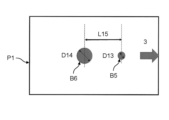
- FIG. 5 is a plane showing the beam diameters D13 and D14 and the inter-beam distance L15 of the first laser beam B5 and the second laser beam B6 with which the workpiece P1 is irradiated in the laser processing method according to the first embodiment. It is a diagram.
- D13 be the beam diameter of the forward first laser beam B5 in the scanning direction 3
- D14 be the beam diameter of the rearward branched second laser beam B6.
- the inter-beam distance between the first laser beam B5 and the second laser beam B6 is L15.
- the first laser beam B5 and the second laser beam B6 with which the surface of the workpiece P1 is irradiated are scanned at the same speed in the scanning direction 3 with a distance L15 between the beams.
- the condensed diameter at the processing point of the second laser beam B6 branched backward is larger than that of the first laser beam B5. If the beam diameter D14 is small, the volume of the molten pool to be stirred becomes small, and the molten pool is not sufficiently stirred. Conversely, if the beam diameter D14 is too large, the first laser beam B5 and the second laser beam B6 form a large keyhole, and the desired stirring effect cannot be obtained. Therefore, in order to control the composition of the molten portion and sufficiently stir it, the beam diameter D14 is desirably two to three times the beam diameter D13.
- the beam-to-beam distance L15 is too small, the first laser beam B5 and the second laser beam B6 are integrated to form a large keyhole, so the desired stirring effect cannot be obtained. Further, if the beam-to-beam distance is too wide, solidification of the first melted portion 12a melted by the first laser beam B5 proceeds, and convection in the portion scanned by the second laser beam B6 is not promoted. Sufficient stirring effect cannot be obtained. Therefore, a sufficient stirring effect can be obtained by setting the inter-beam distance L15 to be at least twice the beam diameter D13 and at most twice the beam diameter D14.
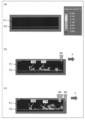
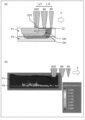
- FIG. 6 shows, in a simulation of laser welding of a laminated member of Fe and Cu in the laser processing method according to Embodiment 1, the ratio of Cu elements in the cross section after laser light scanning is divided into the number of laser scanning lines (a) to It is a schematic diagram shown in (c).
- FIG. 6 is a schematic diagram showing the model before laser irradiation.
- a thick rectangular member in the upper part of the model indicates Fe of the work material P1
- a thin rectangular member in the lower part of the model indicates Cu of the work material P2.
- FIG. 6(b) is a schematic diagram showing the concentration of Cu in the cross section after scanning only the first laser beam B5 and bonding the workpiece P1 and the workpiece P2.
- regions 16a and 17a where the Cu concentration exceeds 15 atomic % and solidification cracking occurs inside the workpiece P1 made of Fe.
- (c) of FIG. 6 is a cross-sectional view when scanning with the second laser beam B6 branched backward after scanning with the first laser beam B5.
- the Cu concentration in the regions 16b and 17b at the same location as the regions 16a and 17a where the Cu concentration exceeded 15 atomic % in FIG. can be greatly reduced to 10 atomic % or less at which solidification cracking does not occur.
- FIG. 7 shows the laser processing method according to the first embodiment, in which the workpiece P1 and the workpiece P2 are overlapped and scanned with the first laser beam B5 and the second laser beam B6.
- FIG. 4 is a schematic diagram showing, in chronological order, (a), (b), and (c) how dissimilar metals are mixed and stirred in the vicinity of the joint interface between a material to be processed P1 and a material to be processed P2.
- the first laser beam B5 is irradiated to superimpose dissimilar metal materials of the workpiece P1 and the workpiece P2, and the upper part of the joint between the workpiece P1 and the workpiece P2 is irradiated.
- a region m18 of a mixed metal layer of the workpiece P1 and the workpiece P2 is formed in the region m18.
- the region m18 of the different metal mixed layer has a portion where the ratio of the metal constituting the material to be processed P2 is several tens of atomic % or more.
- the second laser beam B6 branched behind the first laser beam B5 is irradiated, penetrates to the vicinity of the interface between the workpiece P1 and the workpiece P2, and is scanned. Shows the time. Since the beam diameter of the second laser beam B6 is about 2 to 3 times larger than the beam diameter of the first laser beam B5 used for joining, the convection is promoted by scanning this beam, and the inside of the workpiece P1 is changed. The metal elements forming the workpiece P2 inside the region m18 are stirred in a wide range. A second laser beam B6 is scanned along the scanning direction 3 .
- the metal elements composing the material P2 to be processed are stirred over a wide range including the region m18, and the ratio of the metal elements composing the material P2 to be processed is reduced from that in the region m18.
- a region m19 of the mixed metal mixed layer is formed.
- the first laser beam B5 joins the superimposed member of the workpiece P1 and the workpiece P2, and the second laser beam B6 branched to the rear is used for the workpiece P1 and the workpiece.
- a region m19 is formed up to the end of the material P2, where the region m18 of the mixed metal mixed layer is entirely painted over.
- intermetallic compounds have harder mechanical properties and are more brittle than single elements of Cu, Al, and Fe. Therefore, when a load is applied, these intermetallic compounds tend to become starting points for cracks, causing a decrease in the strength of welded joints. becomes.
- the mixed region m18 is stirred in a wider range with the second laser beam B6 branched from the first laser beam B5 used for bonding, and the mixing ratio of Al, Cu, Fe, and Al is reduced.
- a region of a mixed metal layer such as the region m19 where the layers are formed, it is possible to suppress the formation of an intermetallic compound layer.
- the second laser beam B6 is scanned from behind for the purpose of stirring the melted portion behind the first laser beam B5 for joining.
- the mixing part may not be stirred.
- a third laser beam B20 branched from the rear may be scanned again to re-stir the melted portion once stirred.
- FIG. 8(a) shows a third laser beam branched further backward of the backward branched second laser beam B6 with respect to the region m18 of the dissimilar metal mixed layer formed by scanning the second laser beam B6.
- FIG. 10 is a schematic cross-sectional view showing the third melting zone 22 after being further stirred by scanning with three beams including light B20. The third melted portion 22 is obtained by stirring the second melted portion 12b once stirred by the second laser beam B6 with the third laser beam B20 again.
- the third melting portion 22 melts to a depth of 80% to 95% of the melting depth of the second melting portion 12b, thereby obtaining the effect of stirring a wide range.
- FIG. 8(b) is a simulation result when the melted portion that has been stirred once is stirred again by the third laser beam that scans from behind, as described above.
- the focused diameter (beam diameter D20) at the processing point diameter of the third laser beam B20 branched backward is preferably larger than those of the first laser beam B5 and the second laser beam B6. Further, the beam diameter D20 is set to 2 times the beam diameter D14 of the second laser beam B6 in order to control the composition of the melted portion and obtain a stirring effect over a wide range based on the results of the simulation. It is desirable that the diameter be more than twice and less than three times.
- the beam-to-beam distance L21 according to the simulation, if the beam-to-beam distance L21 is too small, the second laser beam B6 and the third laser beam B20 are integrated to form a large keyhole. I can't get it. Also, if the beam-to-beam distance is too wide, the convection of the laser-scanned portion of the third laser beam B20 is not promoted, and a sufficient stirring effect cannot be obtained. Therefore, a sufficient stirring effect can be obtained by setting the beam-to-beam distance L21 to the same distance as the beam-to-beam distance L15.
- the irradiation and scanning of the second laser beam arranged in the rear is performed to perform the overlapping member are joined.
- the metal structure in the vicinity of the joint is agitated by the irradiation of the second laser beam, and the concentration of dissimilar metal materials in the joint is reduced, creating a joint that prevents solidification cracking and the formation of intermetallic compounds. can. Therefore, it is useful for joining dissimilar metal materials.
Landscapes
- Physics & Mathematics (AREA)
- Optics & Photonics (AREA)
- Engineering & Computer Science (AREA)
- Plasma & Fusion (AREA)
- Mechanical Engineering (AREA)
- Laser Beam Processing (AREA)
Priority Applications (3)
| Application Number | Priority Date | Filing Date | Title |
|---|---|---|---|
| CN202280076453.5A CN118265590A (zh) | 2021-11-29 | 2022-07-22 | 接合体、激光加工方法以及激光加工装置 |
| JP2023563511A JPWO2023095383A1 (https=) | 2021-11-29 | 2022-07-22 | |
| US18/668,288 US20240300052A1 (en) | 2021-11-29 | 2024-05-20 | Joined body, laser machining method and laser machining device |
Applications Claiming Priority (2)
| Application Number | Priority Date | Filing Date | Title |
|---|---|---|---|
| JP2021193486 | 2021-11-29 | ||
| JP2021-193486 | 2021-11-29 |
Related Child Applications (1)
| Application Number | Title | Priority Date | Filing Date |
|---|---|---|---|
| US18/668,288 Continuation US20240300052A1 (en) | 2021-11-29 | 2024-05-20 | Joined body, laser machining method and laser machining device |
Publications (1)
| Publication Number | Publication Date |
|---|---|
| WO2023095383A1 true WO2023095383A1 (ja) | 2023-06-01 |
Family
ID=86539037
Family Applications (1)
| Application Number | Title | Priority Date | Filing Date |
|---|---|---|---|
| PCT/JP2022/028424 Ceased WO2023095383A1 (ja) | 2021-11-29 | 2022-07-22 | 接合体、レーザ加工方法及びレーザ加工装置 |
Country Status (4)
| Country | Link |
|---|---|
| US (1) | US20240300052A1 (https=) |
| JP (1) | JPWO2023095383A1 (https=) |
| CN (1) | CN118265590A (https=) |
| WO (1) | WO2023095383A1 (https=) |
Cited By (1)
| Publication number | Priority date | Publication date | Assignee | Title |
|---|---|---|---|---|
| JPWO2022196442A1 (https=) * | 2021-03-17 | 2022-09-22 |
Families Citing this family (1)
| Publication number | Priority date | Publication date | Assignee | Title |
|---|---|---|---|---|
| CN119973454B (zh) * | 2025-04-15 | 2025-06-27 | 中国电子科技集团公司第三十八研究所 | 基于时间序列数据的pcba焊接质量预测方法和系统 |
Citations (3)
| Publication number | Priority date | Publication date | Assignee | Title |
|---|---|---|---|---|
| JP2002160082A (ja) * | 2000-11-27 | 2002-06-04 | Nkk Corp | 亜鉛系めっき鋼板の重ね溶接方法及び溶接結合薄板 |
| JP2002263878A (ja) * | 2001-03-14 | 2002-09-17 | Kobe Steel Ltd | 突合せ溶接法 |
| JP2015205335A (ja) * | 2014-04-23 | 2015-11-19 | アイシン精機株式会社 | レーザ接合方法、レーザ接合品及びレーザ接合装置 |
-
2022
- 2022-07-22 WO PCT/JP2022/028424 patent/WO2023095383A1/ja not_active Ceased
- 2022-07-22 CN CN202280076453.5A patent/CN118265590A/zh active Pending
- 2022-07-22 JP JP2023563511A patent/JPWO2023095383A1/ja active Pending
-
2024
- 2024-05-20 US US18/668,288 patent/US20240300052A1/en active Pending
Patent Citations (3)
| Publication number | Priority date | Publication date | Assignee | Title |
|---|---|---|---|---|
| JP2002160082A (ja) * | 2000-11-27 | 2002-06-04 | Nkk Corp | 亜鉛系めっき鋼板の重ね溶接方法及び溶接結合薄板 |
| JP2002263878A (ja) * | 2001-03-14 | 2002-09-17 | Kobe Steel Ltd | 突合せ溶接法 |
| JP2015205335A (ja) * | 2014-04-23 | 2015-11-19 | アイシン精機株式会社 | レーザ接合方法、レーザ接合品及びレーザ接合装置 |
Cited By (2)
| Publication number | Priority date | Publication date | Assignee | Title |
|---|---|---|---|---|
| JPWO2022196442A1 (https=) * | 2021-03-17 | 2022-09-22 | ||
| JP7757390B2 (ja) | 2021-03-17 | 2025-10-21 | パナソニックエナジー株式会社 | 密閉電池 |
Also Published As
| Publication number | Publication date |
|---|---|
| CN118265590A (zh) | 2024-06-28 |
| JPWO2023095383A1 (https=) | 2023-06-01 |
| US20240300052A1 (en) | 2024-09-12 |
Similar Documents
| Publication | Publication Date | Title |
|---|---|---|
| AU773440B2 (en) | Laser/arc hybrid welding process with appropriate gas mixture | |
| Xue et al. | Effects of heat input on wettability, interface microstructure and properties of Al/steel butt joint in laser-metal inert-gas hybrid welding-brazing | |
| US10675712B2 (en) | Hot cracking reduction in aluminum laser welding | |
| Vollertsen et al. | Welding thick steel plates with fibre lasers and GMAW | |
| Liu et al. | Joining of advanced high-strength steel to AA 6061 alloy by using Fe/Al structural transition joint | |
| US20240300052A1 (en) | Joined body, laser machining method and laser machining device | |
| CN110325316B (zh) | 用于使激光焊接接头表面平滑的方法 | |
| JP3205647B2 (ja) | Al系部材の高密度エネルギビーム溶接法 | |
| WO2015159503A1 (ja) | 異材金属接合体 | |
| US20200306854A1 (en) | Method for joining different type of metals and laser welding device | |
| JP2013240830A (ja) | ハイブリッドレーザアーク溶接プロセス及び装置 | |
| WO2018145222A1 (en) | Method for laser welding light metal workpieces that include a surface oxide coating | |
| WO2018184131A1 (en) | Smoothing method for enhanced weld surface quality | |
| Shibata et al. | Laser-MIG hybrid welding of aluminium alloys | |
| JP2007075872A (ja) | レーザブレージング接合工法 | |
| KR102900441B1 (ko) | 레이저 브레이징 접합 방법 | |
| Ogura et al. | Microstructure and mechanical properties in laser brazing of A5052/AZ31 dissimilar alloys | |
| JP2018043263A (ja) | アルミニウム接合体の製造方法 | |
| JP7626379B2 (ja) | ハイブリッド溶接方法および溶接継手の製造方法 | |
| JP2025059527A (ja) | 金属箔の溶接方法 | |
| JP5000578B2 (ja) | 薄鋼板の重ねレーザ溶接方法 | |
| WO2023167045A1 (ja) | 板材、接合体、板材の接合方法及び板材の製造方法 | |
| Miller et al. | Laser welding of aluminum alloys | |
| WO2022185989A1 (ja) | レーザーブレージング接合方法 | |
| US20220397141A1 (en) | Hybrid butt-lap joint, and method of production |
Legal Events
| Date | Code | Title | Description |
|---|---|---|---|
| 121 | Ep: the epo has been informed by wipo that ep was designated in this application |
Ref document number: 22898168 Country of ref document: EP Kind code of ref document: A1 |
|
| ENP | Entry into the national phase |
Ref document number: 2023563511 Country of ref document: JP Kind code of ref document: A |
|
| WWE | Wipo information: entry into national phase |
Ref document number: 202280076453.5 Country of ref document: CN |
|
| NENP | Non-entry into the national phase |
Ref country code: DE |
|
| 122 | Ep: pct application non-entry in european phase |
Ref document number: 22898168 Country of ref document: EP Kind code of ref document: A1 |