WO2023067825A1 - 抗菌活性を有する新規メラノイジンの製造方法とその応用 - Google Patents
抗菌活性を有する新規メラノイジンの製造方法とその応用 Download PDFInfo
- Publication number
- WO2023067825A1 WO2023067825A1 PCT/JP2022/013264 JP2022013264W WO2023067825A1 WO 2023067825 A1 WO2023067825 A1 WO 2023067825A1 JP 2022013264 W JP2022013264 W JP 2022013264W WO 2023067825 A1 WO2023067825 A1 WO 2023067825A1
- Authority
- WO
- WIPO (PCT)
- Prior art keywords
- melanoidin
- xylose
- antibacterial activity
- antibacterial
- phenyl
- Prior art date
- Legal status (The legal status is an assumption and is not a legal conclusion. Google has not performed a legal analysis and makes no representation as to the accuracy of the status listed.)
- Ceased
Links
Images




Classifications
-
- A—HUMAN NECESSITIES
- A01—AGRICULTURE; FORESTRY; ANIMAL HUSBANDRY; HUNTING; TRAPPING; FISHING
- A01N—PRESERVATION OF BODIES OF HUMANS OR ANIMALS OR PLANTS OR PARTS THEREOF; BIOCIDES, e.g. AS DISINFECTANTS, AS PESTICIDES OR AS HERBICIDES; PEST REPELLANTS OR ATTRACTANTS; PLANT GROWTH REGULATORS
- A01N43/00—Biocides, pest repellants or attractants, or plant growth regulators containing heterocyclic compounds
- A01N43/34—Biocides, pest repellants or attractants, or plant growth regulators containing heterocyclic compounds having rings with one nitrogen atom as the only ring hetero atom
- A01N43/36—Biocides, pest repellants or attractants, or plant growth regulators containing heterocyclic compounds having rings with one nitrogen atom as the only ring hetero atom five-membered rings
-
- A—HUMAN NECESSITIES
- A01—AGRICULTURE; FORESTRY; ANIMAL HUSBANDRY; HUNTING; TRAPPING; FISHING
- A01N—PRESERVATION OF BODIES OF HUMANS OR ANIMALS OR PLANTS OR PARTS THEREOF; BIOCIDES, e.g. AS DISINFECTANTS, AS PESTICIDES OR AS HERBICIDES; PEST REPELLANTS OR ATTRACTANTS; PLANT GROWTH REGULATORS
- A01N61/00—Biocides, pest repellants or attractants, or plant growth regulators containing substances of unknown or undetermined composition, e.g. substances characterised only by the mode of action
-
- A—HUMAN NECESSITIES
- A01—AGRICULTURE; FORESTRY; ANIMAL HUSBANDRY; HUNTING; TRAPPING; FISHING
- A01P—BIOCIDAL, PEST REPELLANT, PEST ATTRACTANT OR PLANT GROWTH REGULATORY ACTIVITY OF CHEMICAL COMPOUNDS OR PREPARATIONS
- A01P1/00—Disinfectants; Antimicrobial compounds or mixtures thereof
-
- A—HUMAN NECESSITIES
- A23—FOODS OR FOODSTUFFS; TREATMENT THEREOF, NOT COVERED BY OTHER CLASSES
- A23B—PRESERVATION OF FOODS, FOODSTUFFS OR NON-ALCOHOLIC BEVERAGES; CHEMICAL RIPENING OF FRUIT OR VEGETABLES
- A23B2/00—Preservation of foods or foodstuffs, in general
- A23B2/70—Preservation of foods or foodstuffs, in general by treatment with chemicals
- A23B2/725—Preservation of foods or foodstuffs, in general by treatment with chemicals in the form of liquids or solids
- A23B2/729—Organic compounds; Microorganisms; Enzymes
- A23B2/762—Organic compounds containing nitrogen
-
- A—HUMAN NECESSITIES
- A23—FOODS OR FOODSTUFFS; TREATMENT THEREOF, NOT COVERED BY OTHER CLASSES
- A23B—PRESERVATION OF FOODS, FOODSTUFFS OR NON-ALCOHOLIC BEVERAGES; CHEMICAL RIPENING OF FRUIT OR VEGETABLES
- A23B2/00—Preservation of foods or foodstuffs, in general
- A23B2/70—Preservation of foods or foodstuffs, in general by treatment with chemicals
- A23B2/725—Preservation of foods or foodstuffs, in general by treatment with chemicals in the form of liquids or solids
- A23B2/729—Organic compounds; Microorganisms; Enzymes
- A23B2/771—Organic compounds containing hetero rings
-
- A—HUMAN NECESSITIES
- A61—MEDICAL OR VETERINARY SCIENCE; HYGIENE
- A61K—PREPARATIONS FOR MEDICAL, DENTAL OR TOILETRY PURPOSES
- A61K31/00—Medicinal preparations containing organic active ingredients
- A61K31/33—Heterocyclic compounds
- A61K31/395—Heterocyclic compounds having nitrogen as a ring hetero atom, e.g. guanethidine or rifamycins
- A61K31/40—Heterocyclic compounds having nitrogen as a ring hetero atom, e.g. guanethidine or rifamycins having five-membered rings with one nitrogen as the only ring hetero atom, e.g. sulpiride, succinimide, tolmetin, buflomedil
-
- A—HUMAN NECESSITIES
- A61—MEDICAL OR VETERINARY SCIENCE; HYGIENE
- A61P—SPECIFIC THERAPEUTIC ACTIVITY OF CHEMICAL COMPOUNDS OR MEDICINAL PREPARATIONS
- A61P31/00—Antiinfectives, i.e. antibiotics, antiseptics, chemotherapeutics
- A61P31/04—Antibacterial agents
-
- C—CHEMISTRY; METALLURGY
- C07—ORGANIC CHEMISTRY
- C07D—HETEROCYCLIC COMPOUNDS
- C07D207/00—Heterocyclic compounds containing five-membered rings not condensed with other rings, with one nitrogen atom as the only ring hetero atom
- C07D207/02—Heterocyclic compounds containing five-membered rings not condensed with other rings, with one nitrogen atom as the only ring hetero atom with only hydrogen or carbon atoms directly attached to the ring nitrogen atom
- C07D207/30—Heterocyclic compounds containing five-membered rings not condensed with other rings, with one nitrogen atom as the only ring hetero atom with only hydrogen or carbon atoms directly attached to the ring nitrogen atom having two double bonds between ring members or between ring members and non-ring members
- C07D207/32—Heterocyclic compounds containing five-membered rings not condensed with other rings, with one nitrogen atom as the only ring hetero atom with only hydrogen or carbon atoms directly attached to the ring nitrogen atom having two double bonds between ring members or between ring members and non-ring members with only hydrogen atoms, hydrocarbon or substituted hydrocarbon radicals, directly attached to ring carbon atoms
- C07D207/325—Heterocyclic compounds containing five-membered rings not condensed with other rings, with one nitrogen atom as the only ring hetero atom with only hydrogen or carbon atoms directly attached to the ring nitrogen atom having two double bonds between ring members or between ring members and non-ring members with only hydrogen atoms, hydrocarbon or substituted hydrocarbon radicals, directly attached to ring carbon atoms with substituted hydrocarbon radicals directly attached to the ring nitrogen atom
- C07D207/327—Radicals substituted by carbon atoms having three bonds to hetero atoms with at the most one bond to halogen, e.g. ester or nitrile radicals
-
- A—HUMAN NECESSITIES
- A61—MEDICAL OR VETERINARY SCIENCE; HYGIENE
- A61K—PREPARATIONS FOR MEDICAL, DENTAL OR TOILETRY PURPOSES
- A61K8/00—Cosmetics or similar toiletry preparations
- A61K8/18—Cosmetics or similar toiletry preparations characterised by the composition
- A61K8/30—Cosmetics or similar toiletry preparations characterised by the composition containing organic compounds
- A61K8/49—Cosmetics or similar toiletry preparations characterised by the composition containing organic compounds containing heterocyclic compounds
-
- A—HUMAN NECESSITIES
- A61—MEDICAL OR VETERINARY SCIENCE; HYGIENE
- A61Q—SPECIFIC USE OF COSMETICS OR SIMILAR TOILETRY PREPARATIONS
- A61Q19/00—Preparations for care of the skin
Definitions
- the present invention relates to a novel method for producing melanoidin and an antibacterial agent containing melanoidin.
- preservatives and shelf life improving agents In order to lead a safer diet, it is necessary to prevent the growth of bacteria that cause spoilage and food poisoning in food.
- the pH and water activity of the food are adjusted, refrigerated storage, frozen storage, and the addition of preservatives and shelf life improving agents. It is done. Focusing on preservatives and shelf life improvers, sodium benzoate, potassium sorbate, sodium nitrite, nisin, etc. are currently used in a wide range of foods. Among them, nisin, which is produced from lactic acid bacteria, is used in many foods around the world because it has a low volume and a wide range of antibacterial activity. However, since each of these preservatives and shelf-life improving agents differs in the type of bacteria that exhibit antibacterial activity, new antibacterial substances are always in demand.
- Non-Patent Document 1 Non-Patent Document 2
- Melanoidin is a general term for products of the Maillard reaction that occurs between the amino group of an amino acid, peptide, or protein and the carbonyl group of a reducing sugar.
- the Maillard reaction is a chemical reaction that is mainly seen in food, and uses carbonyl compounds such as reducing sugars and amines such as amino acids as reaction substrates, and undergoes processes such as condensation, dehydration, and polymerization by heat, and the final product is brown.
- melanoidins which are products of the Maillard reaction
- melanoidins are produced by comprehensively combining various reducing sugars and amino acids. , aimed to search for melanoidins with antibacterial activity and to establish a reaction system.
- melanoidins having antibacterial activity are produced by the Maillard reaction using xylose, which is a pentose aldose, and phenylalanine or proline. . Furthermore, the structure of one compound contained in the obtained melanoidin was identified. Thus, the present invention was completed.
- An antibacterial composition comprising producing melanoidin by heating a reducing sugar selected from xylose or ribose and an amino acid selected from phenylalanine or proline, and blending the melanoidin as an active ingredient.
- melanoidins with high antibacterial activity can be produced.
- the melanoidin thus produced is highly safe because it is produced from food materials such as reducing sugars and amino acids, and can be safely used as an antibacterial agent in the fields of food and drink, cosmetics, and pharmaceuticals.
- the present invention also provides compositions having high antibacterial activity, which contain compounds identified from melanoidins produced by the methods of the present invention.
- the antibacterial composition of the present invention exhibits antibacterial activity equal to or greater than that of existing preservatives used in the food field, such as nisin, sodium benzoate, and potassium sorbate. Furthermore, since the antibacterial composition of the present invention can be produced simply by heating a solution in which reducing sugars and amino acids are dissolved as reaction substrates, it is advantageous in terms of productivity and reproducibility, and is easier to produce. and can be used.
- ⁇ Melanoidin produced from a combination of xylose and phenylalanine (Melanoidin Xylose-Phe), ⁇ : Melanoidin produced from a combination of xylose and proline (Melanoidin Xylose-Pro), ⁇ : No melanoidin added (no addition), indicates 2 shows the bacterial growth inhibitory effect of two types of melanoidins on Bacillus cereus at 25°C.
- ⁇ melanoidin Xylose-Phe
- ⁇ melanoidin Xylose-Pro
- no addition 2 shows the growth inhibitory effect of two types of melanoidins on Salmonella Typhimurium at 25°C.
- ⁇ melanoidin Xylose-Phe
- ⁇ melanoidin Xylose-Pro
- ⁇ no addition.
- ⁇ Melanoidin Xylose-Phe
- ⁇ Melanoidin Xylose-Pro
- Nisin 250 IU/mL Nisin 250 IU/mL
- ⁇ Nisin 350 IU/mL
- ⁇ Nisin 400 IU/mL
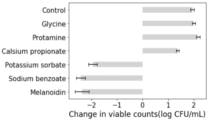
- FIG. 2 shows the effect of various additives on the change in Bacillus cereus logarithmic viable cell count (at 25°C for 3 days) in gyudon.
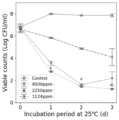
- the antibacterial activity against Bacillus cereus for each concentration of sample A is shown.
- the horizontal axis indicates the incubation period (days).
- the vertical axis indicates the number of viable bacteria.
- the antibacterial activity against Bacillus cereus for each concentration of sample B is shown.
- the horizontal axis indicates the incubation period (days).
- the vertical axis indicates the number of viable bacteria. Antibacterial activity of substances isolated from melanoidins.
- ⁇ control
- ⁇ solution of isolated substance
- ⁇ DMSO
- X indicates detection limit ( ⁇ 10 CFU/mL).
- the horizontal axis indicates the incubation period (days).
- the vertical axis indicates the number of viable bacteria.
- Chemical structures (A) and key COZY and HMBC correlations (B) of the antimicrobial compounds contained in Sample A are shown.
- the present invention provides a method for producing melanoidin comprising subjecting a reducing sugar selected from xylose or ribose and an amino acid selected from phenylalanine or proline as reaction substrates to the Maillard reaction.
- Xylose and ribose which are aldoses of pentose sugars, are selected as reducing sugars for reaction substrates in the Maillard reaction.
- the reducing sugar may be in either the D- or L-configuration.
- Phenylalanine and proline are selected as amino acids for reaction substrates in the Maillard reaction.
- the amino acid may be in either the D or L configuration.
- Reducing sugars and amino acids may be derived from natural products or obtained by chemical synthesis. The amount of reducing sugar and amino acid to be reacted is not particularly limited as long as melanoidin is produced, and can be appropriately set by those skilled in the art.
- the Maillard reaction is performed by subjecting the above reducing sugars and amino acids to heat treatment as reaction substrates.
- the reaction substrate is preferably subjected to heat treatment as a solution in a solvent such as water, for example as an aqueous solution.
- Heating conditions such as temperature and time are not particularly limited as long as melanoidin is produced, and can be appropriately set by those skilled in the art. For example, the higher the temperature, the faster the reaction proceeds, so it is efficient to carry out the reaction at as high a temperature as possible.
- the reaction may be carried out at, for example, about 100° C. to about 130° C., preferably about 115° C. to about 125° C., for about 30 to 100 minutes, preferably about 50 to 80 minutes. For example, it may be carried out under high pressure conditions using an autoclave or the like.
- the melanoidin produced by the method of the present invention has antibacterial activity against bacteria that cause spoilage and food poisoning, particularly Listeria monocytogenes, Brevibacillus brevis, Bacillus cereus, and Salmonella Typhimurium. Furthermore, the melanoidin exhibits an antibacterial activity equal to or greater than that of existing preservatives such as potassium sorbate, sodium benzoate, protamine (mild protein extract), calcium propionate, glycine, nisin, and the like.
- antibacterial activity means activity that suppresses or inhibits the growth of bacteria, and includes bactericidal, sterilizing and bacteriostatic activity.
- the present invention provides an antibacterial composition containing melanoidin produced by the Maillard reaction as an active ingredient.
- the antibacterial composition may contain only melanoidin produced from one combination of one reducing sugar selected from xylose or ribose and one amino acid selected from phenylalanine or proline, Alternatively, it may contain two or more melanoidins produced from two or more combinations of reducing sugars selected from xylose or ribose and amino acids selected from phenylalanine or proline.
- the antimicrobial composition of the present invention comprises a melanoidin made from xylose or ribose and phenylalanine as a reactant and/or a melanoidin made from xylose or ribose and proline as a reactant.
- the melanoidin contained in the antibacterial composition of the present invention may be contained in the reaction liquid obtained after the above Maillard reaction, or may be separated from the reaction liquid.
- the separation may be carried out by conventional methods, such as, but not limited to, various chromatographic methods.
- the chemical structure of one compound contained in melanoidins produced from xylose and phenylalanine as reaction substrates among the above melanoidins was determined. Therefore, in a further aspect of the invention, the compound of formula I: [wherein R 1 to R 10 are independently H or a C1-5 branched or straight chain saturated or unsaturated hydrocarbon group]
- An antibacterial composition comprising a compound represented by or a salt thereof.
- C1-5 branched or straight chain saturated or unsaturated hydrocarbon groups include, but are not limited to, methyl, ethyl, n-propyl, isopropyl, n-butyl, sec-butyl, isobutyl , tert-butyl and the like.
- the hydrocarbon group may be substituted.
- Formula II 3-phenyl-2-(3-phenyl-1H-pyrrol-1-yl)propanoic acid represented by Accordingly, the present invention further provides antimicrobial compositions comprising 3-phenyl-2-(3-phenyl-1H-pyrrol-1-yl)propanoic acid or salts thereof.
- 3-phenyl-2-(3-phenyl-1H-pyrrol-1-yl)propanoic acid is isolated from the resulting melanoidin by performing the Maillard reaction using xylose and phenylalanine as reaction substrates. , may be obtained by purification as necessary, or may be obtained by chemical synthesis. Isolation and purification of 3-phenyl-2-(3-phenyl-1H-pyrrol-1-yl)propanoic acid from melanoidin may be performed by known methods, for example, using various chromatographic methods. can be done. The 3-phenyl-2-(3-phenyl-1H-pyrrol-1-yl)propanoic acid thus obtained may be further converted into various compounds encompassed by formula I by conventional methods.
- the compound represented by formula I above may be in the form of a salt that is acceptable in the fields of food and drink, cosmetics, or pharmaceuticals.
- salts include, but are not limited to, inorganic acid salts such as hydrochlorides, sulfates, phosphates, hydrobromides, acetates, fumarates, maleates, oxalates, citrates, salts, organic acid salts such as methanesulfonate, metal salts such as sodium salts, potassium salts, calcium salts, magnesium salts, zinc salts, silver salts, copper salts, salts with inorganic bases such as ammonium salts, methyl Examples thereof include salts with organic bases such as amine salts, triethylamine salts and triethanolamine salts. Such salts can be prepared by methods known in the art.
- the antibacterial composition of the present invention may be the melanoidin obtained by the above Maillard reaction or the compound represented by formula I itself, or may contain other ingredients other than these active ingredients.
- examples of such other components include, but are not limited to, water, alcohol, various buffer solutions, and the like, and may be appropriately blended according to the purpose of use of the antibacterial composition.
- the content of the melanoidin or compound in the antibacterial composition can be appropriately determined by those skilled in the art, and is not particularly limited.
- the antibacterial composition of the present invention may be in any form that can be used in the fields of food and drink, cosmetics, or pharmaceuticals.
- forms include, but are not limited to, solid (eg, powder), liquid, or lyophilized forms.
- the antibacterial composition of the present invention can be used, for example, as a preservative, shelf life improving agent, or antiseptic in the fields of food and drink, cosmetics, or pharmaceuticals.
- the antibacterial composition of the present invention can be used by adding it to various foods, drinks, cosmetics, or pharmaceuticals, and can also be used in combination with existing preservatives, shelf life improving agents, or preservatives.
- "adding" also includes blending, spraying, coating and dipping.
- Examples of foods and drinks that use the antibacterial composition of the present invention include, but are not limited to, fresh vegetables/fruits, fresh fish, cooked foods such as box lunches and side dishes, various processed fish and meat products, vegetables and Examples include processed fruit products and beverages, and it is particularly suitable for food and drink that can be eaten as is.
- Examples of cosmetics that employ the antimicrobial compositions of the present invention include, but are not limited to, shampoos, rinses, lotions, creams, and the like.
- the active ingredient of the antimicrobial composition of the present invention is melanoidin or a compound derived from melanoidin
- the antimicrobial composition has higher safety because the active ingredient is derived from food materials.
- the antibacterial composition of the present invention has antibacterial activity against bacteria that cause spoilage and food poisoning, particularly Listeria monocytogenes, Brevibacillus brevis, Bacillus cereus, and Salmonella Typhimurium. Furthermore, the antibacterial composition of the present invention exhibits antibacterial activity equal to or greater than that of existing preservatives such as potassium sorbate, sodium benzoate, protamine (milt protein extract), calcium propionate, glycine, nisin, and the like.
- the present invention provides a method for suppressing the growth of bacteria in food, drink, cosmetics or pharmaceuticals, comprising adding the antibacterial composition of the present invention to food, cosmetics or pharmaceuticals.
- inhibition of bacterial growth includes inhibition of bacterial growth, sterilization and sterilization.
- the amount of the antibacterial composition to be added is not particularly limited as long as the antiproliferative effect is exhibited, and can be appropriately determined by those skilled in the art.
- Example 1 Maillard Reaction Using Various Reaction Substrates and Antibacterial Activity Evaluation of Melanoidin (1) Test Material Two types of reducing sugars used in the Maillard reaction, D-glucose and D-xylose, L-alanine as an amino acid, Eleven types of L-arginine, L-glutamine, L-leucine, L-methionine, L-phenylalanine, L-proline, L-threonine, L-valine, L-serine and L-tryptophan were used.
- the following bacteria were used for antibacterial activity evaluation.
- Gram-positive bacteria Bacillus cereus (ATCC10987), Brevibacillus brevis (NBRC100599), Lactobacillus fructivorans (NBRC13954), and Listeria monocytogenes (ATCC19111) were used.
- Gram-negative bacteria Escherichia coli (O157: H7, HIPH 12361), Salmonella Enteritidis (RIMD1933001), and Salmonella Typhimurium (ATCC29630) were used.
- Enterococcus faecalis ATCC 47077
- Escherichia coli ATCC 25922
- Lactobacillus brevis JCM 1059
- Staphylococcus epidermidis ATCC 12221
- Bacterial fluid obtained by enriching and culturing these bacteria in a liquid medium was used in the experiment.
- L. monocytogenes Listeria monocytogenes
- Figure 1 shows the results of evaluating the antibacterial activity of melanoidin.
- the reaction substrates that showed a high growth inhibitory effect on monocytogenes were combinations of xylose and phenylalanine, and xylose and proline.
- melanoidin produced using D-xylose rather than D-glucose produced L.
- the proliferation of monocytogenes was suppressed more remarkably.
- the reason why the antibacterial activity of melanoidin changed depending on the reducing sugar used as a reaction substrate is considered to be that the reactivity of the Maillard reaction differs depending on the reducing sugar.
- melanoidins produced using phenylalanine or proline had the highest antibacterial activity.
- the first is the structure of amino acids.
- a chelating effect on bacterial cell walls has been proposed as the mechanism of melanoidin's antibacterial activity, but it is generally known that chelates are stabilized in a five- or six-membered ring structure. Therefore, it is possible that the six-membered ring structure of phenylalanine and the five-membered ring structure of proline affect the melanoidins produced from these substrates.
- the second point is the effect of peptides in melanoidin.
- melanoidins which are polymers, contain peptides in which amino acids are linked by peptide bonds.
- some peptides rich in proline and peptides containing phenylalanine produced by microorganisms and insects have antibacterial activity. may have. Based on the above, it is speculated that melanoidins produced from combinations of xylose and phenylalanine, and xylose and proline had the highest antibacterial properties.
- Tryptic Soy Broth liquid medium 500 ⁇ L was added to two types of melanoidins (500 ⁇ L each), 20 ⁇ L of bacterial solution (10 5 to 10 6 CFU/mL) was dispensed and cultured at 25° C. for 48 hours. Samples were extracted at 12-hour intervals during the culture period, and the number of viable bacteria (Colony forming unit: CFU/mL) was measured.
- melanoidins were found to be L. In addition to monocytogenes, it exhibited high antibacterial activity against Brevibacillus brevis, and the number of viable bacteria continued to decrease after 48 hours (Fig. 2). Furthermore, Xylose-Phe melanoidin showed particularly high antibacterial activity against Bacillus cereus, and Xylose-Pro melanoidin against Salmonella Typhimurium (FIGS. 3 and 4). However, Xylose-Pro melanoidin only slightly increased the number of viable cells against Bacillus cereus up to 24 hours after culturing at 25°C. (Fig. 3).
- Xylose-Phe melanoidin reduced the number of viable bacteria against Salmonella Typhimurium under culture conditions at 25°C until 12 hours later, and maintained the viable count at the start of the experiment after 24 hours. and showed sufficient growth inhibition (Fig. 4).
- the reason why the two types of melanoidins showed different antibacterial activities is that, assuming that peptides are produced in melanoidins as described above, the produced antibacterial peptides are different. .
- the two types of melanoidins showed little or no antibacterial activity against other bacteria.
- the reason why melanoidin did not show strong antibacterial activity against four types of intestinal bacteria and other lactic acid bacteria is thought to be that these bacteria have melanoidin resistance.
- human beings have long produced foods containing melanoidin and ate them on a daily basis, the intestinal flora living in the human intestine has been frequently exposed to melanoidin. Therefore, it is presumed that the intestinal flora became resistant to melanoidin.
- L. The same can be said for fructivorans. This bacterium can survive in tsukudani and low-salt soy sauce, and is said to be salt-tolerant.
- both tsukudani and soy sauce contain melanoidins
- L. fructivorans is also presumed to have acquired melanoidin resistance like intestinal bacteria.
- melanoidins Two types of melanoidins (Xylose-Phe melanoidin and Xylose-Pro melanoidin) were used, and their antibacterial properties were compared with that of nisin, an existing preservative. Nisin solutions were prepared at 500, 700, or 800 IU/mL. Here, 1 IU (International Unit) indicates 0.25 ⁇ g.
- the melanoidin and nisin solutions were mixed with Tryptic Soy Broth liquid medium, and L. 20 ⁇ L of monocytogenes (10 5 to 10 6 CFU/mL) was dispensed and cultured at 25° C. for 48 hours. The viable cell count (CFU/mL) was measured at 12 hour intervals during the culture period.
- FIG. 5 shows the results of comparing the antibacterial activities against monocytogenes. Under the nisin addition condition, a decrease in the number of viable bacteria was observed after 12 hours of culture after addition, but a similar decrease in the number of viable bacteria was not observed under the melanoidin addition condition, showing a nearly constant value during the 48 hour culture period. . In addition, at 250 IU / mL (domestic standard for Western confectionery etc.) and 350 IU / mL nisin addition conditions, the number of viable bacteria increases after 12 hours, and the number of viable bacteria at the measurement of 48 hours is about the same as the melanoidin addition condition, or increased beyond that. These results suggest that the two melanoidins used in this study, L. Although the antibacterial activity against monocytogenes was about 250 to 350 IU/mL of nisin, the persistence of its growth inhibitory effect was demonstrated.
- Example 2 Evaluation of antibacterial activity of melanoidin against food poisoning bacteria in food The inhibitory effect of melanoidin on bacterial growth in cooked foods was clarified by comparison with existing preservatives.
- Test bacteria and materials S. cereus was enriched in a Tryptic Soy Broth liquid medium, and a bacterial solution adjusted to 10 9 CFU/mL was used.
- B. in the cooking process of stewing as the target food.
- Gyudon of which there is concern about the survival of cereus, was adopted, and the soup extracted from the gyudon stock that had undergone retort sterilization was used in the experiment.
- the test sauce had a pH of 5.6 and a water activity of 0.977.
- melanoidin may be used to develop new methods for preventing food poisoning and suppressing food spoilage using substances derived from food materials.
- Example 3 Isolation of Antibacterial Active Compounds
- Melanoidin has an enormous number of types and amounts of melanoidin intermediates formed during the Maillard reaction, and its chemical structure also depends on conditions such as treatment rate and treatment time. Therefore, it is believed to be a heterogeneous mixture of different substructures, and its structure is uncertain. Therefore, the mechanism of melanoidin's antibacterial activity has not yet been elucidated. In this study, melanoidins, which are complex substances, were repeatedly separated using their scientific properties, and a group of substances with antibacterial activity was selected. clarified the structure.
- sample stock solution is prepared by adding 100 ⁇ L of the Bacillus cereus bacterial solution prepared in (1) above to a mixture of 450 ⁇ L of each concentration sample prepared in (2) and 450 ⁇ L of TSB, The cells were cultured at 25°C, and the number of bacteria in the solution was measured every 24 hours. 100 ⁇ L of the diluted sample was applied to TSA, and after culturing at 37° C. for 24 hours, the number of colonies (CFU) generated on TSA was measured and used as the number of bacteria at each measurement time. As a control, 450 ⁇ L of the sample was replaced with 450 ⁇ L of peptone water, and the same operation was performed for comparison.
- 450 ⁇ L of the sample was replaced with a mixed solution of DMSO and pure water adjusted to have the same concentration as the isolated substance in (2) above in the sample stock solution. performed the operation. Furthermore, for comparison, the same operation was performed with 450 ⁇ L of the sample replaced with 450 ⁇ L of peptone water as a control.
- Example 4 Determination of chemical structure of antibacterial compound The compound isolated in Example 3 was subjected to various instrumental analyses, and the chemical structure was determined. As a result, a strong signal was observed at m/z 291.13 in FD-MS (Field Desorption-Mass Spectroscopy) analysis. The exact mass of this signal was m/z 291.1274, and the molecular formula was estimated to be C19H17NO2 ( calculated mass 291.1259 ). Furthermore, the structure of the compound was determined by 1 H-NMR, 13 C-NMR, COZY, HSQC, and HMBC spectra, and its chemical structure was determined as 3-phenyl-2-(3-phenyl-1H-pyrrole-1- yl) propanoic acid (Fig. 9A). A list of signals in the 1 H-NMR and 13 C-NMR spectra is shown in Table 2 and the key COZY and HMBC correlations are shown in FIG. 9B.
- the antibacterial composition of the present invention and the melanoidin produced by the production method of the present invention can be safely used as shelf life improvers, preservatives, preservatives, etc. in the fields of food, beverages, cosmetics, and pharmaceuticals.
Landscapes
- Life Sciences & Earth Sciences (AREA)
- Chemical & Material Sciences (AREA)
- Health & Medical Sciences (AREA)
- Engineering & Computer Science (AREA)
- Wood Science & Technology (AREA)
- Zoology (AREA)
- General Health & Medical Sciences (AREA)
- Organic Chemistry (AREA)
- Environmental Sciences (AREA)
- Pest Control & Pesticides (AREA)
- Plant Pathology (AREA)
- Chemical Kinetics & Catalysis (AREA)
- Public Health (AREA)
- Agronomy & Crop Science (AREA)
- Polymers & Plastics (AREA)
- General Chemical & Material Sciences (AREA)
- Medicinal Chemistry (AREA)
- Pharmacology & Pharmacy (AREA)
- Food Science & Technology (AREA)
- Animal Behavior & Ethology (AREA)
- Dentistry (AREA)
- Veterinary Medicine (AREA)
- Communicable Diseases (AREA)
- Oncology (AREA)
- Nuclear Medicine, Radiotherapy & Molecular Imaging (AREA)
- Epidemiology (AREA)
- Food Preservation Except Freezing, Refrigeration, And Drying (AREA)
- Pharmaceuticals Containing Other Organic And Inorganic Compounds (AREA)
Applications Claiming Priority (2)
| Application Number | Priority Date | Filing Date | Title |
|---|---|---|---|
| JP2021-170957 | 2021-10-19 | ||
| JP2021170957 | 2021-10-19 |
Publications (1)
| Publication Number | Publication Date |
|---|---|
| WO2023067825A1 true WO2023067825A1 (ja) | 2023-04-27 |
Family
ID=86058105
Family Applications (2)
| Application Number | Title | Priority Date | Filing Date |
|---|---|---|---|
| PCT/JP2022/013264 Ceased WO2023067825A1 (ja) | 2021-10-19 | 2022-03-22 | 抗菌活性を有する新規メラノイジンの製造方法とその応用 |
| PCT/JP2022/037898 Ceased WO2023068112A1 (ja) | 2021-10-19 | 2022-10-11 | 抗菌活性を有する新規メラノイジンの製造方法とその応用 |
Family Applications After (1)
| Application Number | Title | Priority Date | Filing Date |
|---|---|---|---|
| PCT/JP2022/037898 Ceased WO2023068112A1 (ja) | 2021-10-19 | 2022-10-11 | 抗菌活性を有する新規メラノイジンの製造方法とその応用 |
Country Status (2)
| Country | Link |
|---|---|
| JP (1) | JP7594329B2 (https=) |
| WO (2) | WO2023067825A1 (https=) |
Cited By (1)
| Publication number | Priority date | Publication date | Assignee | Title |
|---|---|---|---|---|
| CN117530992A (zh) * | 2023-11-28 | 2024-02-09 | 中国农业科学院深圳农业基因组研究所(岭南现代农业科学与技术广东省实验室深圳分中心) | 植物基组合物及其制备方法和应用 |
Citations (2)
| Publication number | Priority date | Publication date | Assignee | Title |
|---|---|---|---|---|
| JPS5618170B1 (https=) * | 1970-09-25 | 1981-04-27 | ||
| JP2009171890A (ja) * | 2008-01-24 | 2009-08-06 | Tsukishima Foods Industry Co Ltd | 抗酸化パン及び菓子 |
-
2022
- 2022-03-22 WO PCT/JP2022/013264 patent/WO2023067825A1/ja not_active Ceased
- 2022-10-11 JP JP2023554537A patent/JP7594329B2/ja active Active
- 2022-10-11 WO PCT/JP2022/037898 patent/WO2023068112A1/ja not_active Ceased
Patent Citations (2)
| Publication number | Priority date | Publication date | Assignee | Title |
|---|---|---|---|---|
| JPS5618170B1 (https=) * | 1970-09-25 | 1981-04-27 | ||
| JP2009171890A (ja) * | 2008-01-24 | 2009-08-06 | Tsukishima Foods Industry Co Ltd | 抗酸化パン及び菓子 |
Non-Patent Citations (2)
| Title |
|---|
| ALAVEZ-ROSAS DAVID, MALDONADO-DOMÍNGUEZ MAURICIO, GONZÁLEZ-ANTONIO OSCAR, ROMERO-ÁVILA MARGARITA, MÉNDEZ-STIVALET JOSÉ, FLORES-PÉR: "Synthesis of 1,3- and 1,2,3-functionalized pyrroles via Ir(I)-catalyzed vinylation of allyl alcohols", CHEMISTRY OF HETEROCYCLIC COMPOUNDS, SPRINGER US, NEW YORK, vol. 53, no. 5, 1 May 2017 (2017-05-01), New York , pages 526 - 531, XP055872867, ISSN: 0009-3122, DOI: 10.1007/s10593-017-2087-8 * |
| KUWABARA, SOKO; SIMIZU, USIO; YAJIMA, MIZUO: "Antimicrobial Nature of the Products of Sugar-Amino Acid Reaction Part 1. Factors Affecting the Antimicrobial Activity", NIPPON NOGEI KAGAKUKAISHI - JOURNAL OF THE AGRICULTURAL CHEMICAL SOCIETY OF JAPAN, NIPPON NOGEI KAGAKUKAI, TOKYO, JP, vol. 46, no. 2, 1 January 1972 (1972-01-01), JP , pages 89 - 93, XP009545390, ISSN: 0002-1407, DOI: 10.1271/nogeikagaku1924.46.89 * |
Cited By (1)
| Publication number | Priority date | Publication date | Assignee | Title |
|---|---|---|---|---|
| CN117530992A (zh) * | 2023-11-28 | 2024-02-09 | 中国农业科学院深圳农业基因组研究所(岭南现代农业科学与技术广东省实验室深圳分中心) | 植物基组合物及其制备方法和应用 |
Also Published As
| Publication number | Publication date |
|---|---|
| JPWO2023068112A1 (https=) | 2023-04-27 |
| WO2023068112A1 (ja) | 2023-04-27 |
| JP7594329B2 (ja) | 2024-12-04 |
Similar Documents
| Publication | Publication Date | Title |
|---|---|---|
| Khubber et al. | Lactic acid fermentation as a useful strategy to recover antimicrobial and antioxidant compounds from food and by-products | |
| Kumar et al. | Use of red beet (Beta vulgaris L.) for antimicrobial applications—a critical review | |
| Kinae et al. | Functional properties of wasabi and horseradish | |
| Adegoke et al. | Nutritional profile and antimicrobial spectrum of the spice Aframomum danielli K. Schum | |
| US20230047841A1 (en) | Fermented onion composition | |
| JP7594329B2 (ja) | 抗菌活性を有する新規メラノイジンの製造方法とその応用 | |
| Hussein et al. | Use of allyl-isothiocyanate and carvacrol to preserve fresh chicken meat during chilling storage. | |
| US7112323B2 (en) | Intracellular proteinacious antimicrobial agents from lactic acid bacteria derived from fermented food samples | |
| US6602532B2 (en) | Process of preserving food and food preservative | |
| US8309493B2 (en) | Polyphenol-content-increasing agent for plant | |
| CN114271311B (zh) | 一种植物精油联合菌株挥发性物质抑制亚硝胺生成的组合物及其制备方法 | |
| Besbes et al. | Bio-Preservation of refrigerated peeled Shrimp (Parapenaeus longirostris) using cactus fruit peels polyphenolic extract | |
| JPS62111675A (ja) | 食品防腐剤 | |
| Saraya et al. | Sappan wood extract used as preservative in chili paste | |
| CN118632629A (zh) | 发酵洋葱组合物 | |
| KR101616532B1 (ko) | 신규한 락토바실러스 속 미생물 및 이의 용도 | |
| Ammar et al. | Enhancing minced beef shelf-life using Crataegus monogyna essential oil: chemical, microbiological and sensory analysis benefits | |
| RU2631903C2 (ru) | Способ консервации пищевых продуктов | |
| JPH0453475A (ja) | 食品保存用酢酸製剤 | |
| KR101727372B1 (ko) | 젖산 함량이 증가되고 발효기간을 단축시킨 고품질 속성 멸치액젓 및 그 제조방법 | |
| KR101647032B1 (ko) | 신규한 항균성 화합물 | |
| Choi et al. | Selection of starter cultures and optimum conditions for lactic acid fermentation of onion | |
| Abu-ALmaaly | Determine the levels of histamine in certain types of locale and imported fish | |
| Martina et al. | Opuntia cladodes fermentation: an insight into antimicrobial activity and volatile profile | |
| Adeli et al. | Comparison of the Chemical Compositions and Antibacterial Activities of Two Iranian Mustard Essential Oils and Use of these Oils in Turkey Meats as Preservatives |
Legal Events
| Date | Code | Title | Description |
|---|---|---|---|
| 121 | Ep: the epo has been informed by wipo that ep was designated in this application |
Ref document number: 22883138 Country of ref document: EP Kind code of ref document: A1 |
|
| NENP | Non-entry into the national phase |
Ref country code: DE |
|
| 122 | Ep: pct application non-entry in european phase |
Ref document number: 22883138 Country of ref document: EP Kind code of ref document: A1 |