WO2023063373A1 - 炊飯用油脂組成物、飯類、及び飯類の製造方法 - Google Patents
炊飯用油脂組成物、飯類、及び飯類の製造方法 Download PDFInfo
- Publication number
- WO2023063373A1 WO2023063373A1 PCT/JP2022/038118 JP2022038118W WO2023063373A1 WO 2023063373 A1 WO2023063373 A1 WO 2023063373A1 JP 2022038118 W JP2022038118 W JP 2022038118W WO 2023063373 A1 WO2023063373 A1 WO 2023063373A1
- Authority
- WO
- WIPO (PCT)
- Prior art keywords
- rice
- oil
- cooking
- fatty acid
- fat composition
- Prior art date
- Legal status (The legal status is an assumption and is not a legal conclusion. Google has not performed a legal analysis and makes no representation as to the accuracy of the status listed.)
- Ceased
Links
Classifications
-
- A—HUMAN NECESSITIES
- A23—FOODS OR FOODSTUFFS; TREATMENT THEREOF, NOT COVERED BY OTHER CLASSES
- A23D—EDIBLE OILS OR FATS, e.g. MARGARINES, SHORTENINGS OR COOKING OILS
- A23D9/00—Other edible oils or fats, e.g. shortenings or cooking oils
- A23D9/007—Other edible oils or fats, e.g. shortenings or cooking oils characterised by ingredients other than fatty acid triglycerides
- A23D9/013—Other fatty acid esters, e.g. phosphatides
-
- A—HUMAN NECESSITIES
- A23—FOODS OR FOODSTUFFS; TREATMENT THEREOF, NOT COVERED BY OTHER CLASSES
- A23D—EDIBLE OILS OR FATS, e.g. MARGARINES, SHORTENINGS OR COOKING OILS
- A23D9/00—Other edible oils or fats, e.g. shortenings or cooking oils
-
- A—HUMAN NECESSITIES
- A23—FOODS OR FOODSTUFFS; TREATMENT THEREOF, NOT COVERED BY OTHER CLASSES
- A23D—EDIBLE OILS OR FATS, e.g. MARGARINES, SHORTENINGS OR COOKING OILS
- A23D9/00—Other edible oils or fats, e.g. shortenings or cooking oils
- A23D9/007—Other edible oils or fats, e.g. shortenings or cooking oils characterised by ingredients other than fatty acid triglycerides
-
- A—HUMAN NECESSITIES
- A23—FOODS OR FOODSTUFFS; TREATMENT THEREOF, NOT COVERED BY OTHER CLASSES
- A23L—FOODS, FOODSTUFFS OR NON-ALCOHOLIC BEVERAGES, NOT OTHERWISE PROVIDED FOR; PREPARATION OR TREATMENT THEREOF
- A23L7/00—Cereal-derived products; Malt products; Preparation or treatment thereof
- A23L7/10—Cereal-derived products
-
- A—HUMAN NECESSITIES
- A23—FOODS OR FOODSTUFFS; TREATMENT THEREOF, NOT COVERED BY OTHER CLASSES
- A23L—FOODS, FOODSTUFFS OR NON-ALCOHOLIC BEVERAGES, NOT OTHERWISE PROVIDED FOR; PREPARATION OR TREATMENT THEREOF
- A23L7/00—Cereal-derived products; Malt products; Preparation or treatment thereof
- A23L7/10—Cereal-derived products
- A23L7/196—Products in which the original granular shape is maintained, e.g. parboiled rice
- A23L7/1965—Cooked; Precooked; Fried or pre-fried in a non-aqueous liquid frying medium, e.g. oil
Definitions
- the present invention relates to a rice-cooking oil that suppresses the stickiness of rice, a rice whose stickiness is suppressed, and a method for producing rice.
- the tastiness of rice depends on its sweetness, stickiness, hardness, and the like, and it is often said that the higher the stickiness, the better.
- a low temperature such as onigiri rice balls and white rice in lunch boxes
- the rice grains themselves become hard, but also the stickiness of the rice makes it difficult for the rice mass to disintegrate during chewing.
- edible oil is added to uncooked rice soaked in water at the time of cooking in order to improve the looseness, luster, flavor, etc. of rice.
- An object of the present invention is to provide rice cooking oil that suppresses the stickiness of rice, rice with reduced stickiness, and a method for producing rice with reduced stickiness.
- the present inventors found that the stickiness of rice was suppressed by containing specific amounts of specific triglycerides and polyglycerin fatty acid esters, and completed the present invention.
- the present invention provides the following [1] to [9].
- [1] Contains 2 to 14% by mass of a triglyceride whose constituent fatty acids are medium-chain fatty acids, and 0.6 to 4% by mass of a polyglycerin fatty acid ester, The oil-and-fat composition for rice cooking, wherein the medium-chain fatty acid is a straight-chain saturated fatty acid having 6 to 12 carbon atoms.
- [2] The oil-and-fat composition for rice cooking according to [1], wherein the polyglycerin fatty acid ester is a polyglycerin fatty acid ester with HLB 3-8.
- [3] 50% by mass or more of the constituent fatty acids of the polyglycerin fatty acid ester are unsaturated fatty acids having 16 to 22 carbon atoms, and the degree of polymerization of the constituent polyglycerin is 4 to 12, [1] or [2]
- Oil and fat composition for rice cooking [4] The oil-and-fat composition for rice cooking according to any one of [1] to [3], wherein the medium-chain fatty acid is composed only of straight-chain saturated fatty acids having 8 and/or 10 carbon atoms. [5] The oil and fat composition for rice cooking according to any one of [1] to [4], wherein the oil and fat in the oil and fat composition for rice cooking is liquid at 10°C.
- [6] The oil-and-fat composition for rice-cooking according to any one of [1] to [5], which is for cooked rice.
- rice with reduced stickiness can be provided, and the texture and flavor of cold (room temperature) rice can be improved.
- a (numerical value) to B (numerical value) mean A or more and B or less. It should be noted that preferred aspects, more preferred aspects, and the like exemplified below can be used in combination with each other as appropriate regardless of expressions such as “preferred” and “more preferred.”
- the description of the numerical range is an example, and regardless of expressions such as “preferred” and “more preferable”, ranges obtained by appropriately combining the upper and lower limits of each range and the numerical values in the examples can also be preferably used.
- terms such as “contain” or “include” may be read as “consisting essentially of” or “consisting only of” as appropriate.
- the oil-and-fat composition for rice-cooking of the present invention contains 2 to 14% by mass of triglycerides whose constituent fatty acids are medium-chain fatty acids.
- Medium-chain fatty acids are straight-chain saturated fatty acids having 6 to 12 carbon atoms.
- Examples of medium-chain fatty acids include caproic acid, caprylic acid, capric acid, and lauric acid, but straight-chain saturated fatty acids having 6 to 10 carbon atoms are preferred because they have a low melting point and tend to be liquid or easily become liquid.
- triglycerides which are medium-chain fatty acids with a small number of carbon atoms, may irritate the throat and stomach after eating, so it is preferable to have a large amount of straight-chain saturated fatty acids with 8 or more carbon atoms, and straight-chain fatty acids with 10 or more carbon atoms. More saturated fatty acids are more preferred. It is particularly preferred that the medium-chain fatty acids that constitute the triglyceride are composed only of linear saturated fatty acids having 8 and/or 10 carbon atoms.
- the oil and fat composition for rice cooking of the present invention contains 2 to 14% by mass of a triglyceride whose constituent fatty acid is a medium-chain fatty acid in the oil and fat composition for rice cooking.
- a triglyceride whose constituent fatty acid is a medium-chain fatty acid in the oil and fat composition for rice cooking.
- rice with reduced stickiness can be obtained.
- stickiness can be suppressed and the rice which has moderate stickiness can be obtained.
- the oil and fat composition for rice cooking of the present invention preferably contains 4 to 14% by mass, more preferably 5 to 12% by mass, of a triglyceride whose constituent fatty acid is a medium-chain fatty acid. It is more preferable to contain 8 to 12% by mass.
- Triglycerides whose constituent fatty acids are medium-chain fatty acids can be those obtained by dehydration condensation of medium-chain fatty acids and glycerol, or those obtained by transesterification of alkyl esters of medium-chain fatty acids and glycerin.
- Medium-chain fatty acid triglycerides MCT
- dehydration condensation of a medium-chain fatty acid, a fatty acid having 14 to 22 carbon atoms, and glycerol, or transesterification of an alkyl ester of the same fatty acid and glycerol can be used.
- the "fat and oil composition for cooking rice” of the present invention may further contain any other fat and oil raw material as long as the content of triglycerides whose constituent fatty acids are medium-chain fatty acids satisfies the above specific range, Animal and vegetable oils can be used.
- Animal oils and fats such as vegetable oils and fats, milk fats and lard can be used singly or in combination of two or more.
- fractionated vegetable oils such as palm olein, palm super olein, palm mid fraction, and palm stearin, and transesterified oils made from oils and fats and fatty acid lower alcohol esters can also be used.
- the thing which fractionated after transesterification can also be used for the transesterified oil. Fats and oils that are liquid at 10° C. are preferred, and refined oils and fats that have undergone at least a deodorizing step are preferred.
- the oil and fat composition for cooking rice of the present invention contains vegetable oil
- the content of vegetable oil is preferably 82 to 97.4% by mass, more preferably 85 to 94.3% by mass, and 86 to 91.2% by mass. More preferred.
- the present invention by containing triglycerides and polyglycerin fatty acid esters whose constituent fatty acids are medium-chain fatty acids, it is possible to suppress deterioration of the vegetable oil-derived flavor due to rice cooking.
- the oil and fat composition for rice cooking of the present invention contains 0.6 to 4% by mass of polyglycerin fatty acid ester. Within this range, it is possible to obtain rice with moderate stickiness while suppressing stickiness, and the rice also has a good flavor.
- the blending amount of the polyglycerin fatty acid ester is preferably 0.7 to 3% by mass, more preferably 0.8 to 2% by mass, in the oil and fat composition for rice cooking of the present invention.
- the polyglycerol fatty acid ester used in the oil-and-fat composition for cooking rice of the present invention preferably has an HLB of 3 to 8 in terms of dissolution in oil and dispersibility in water during rice-cooking of the oil-and-fat composition for rice cooking.
- HLB is an abbreviation for Hydrophile Lipophile Balance, which is an index for determining whether an emulsifier is hydrophilic or lipophilic, and takes a value of 0-20. A smaller HLB value indicates stronger lipophilicity.
- the calculation method of the Atlas method is used to calculate the HLB value.
- the oil-and-fat composition for rice-cooking tends to be liquid, so that 50% by mass or more of the constituent fatty acids are unsaturated fatty acids having 16 to 22 carbon atoms. More preferably, the unsaturated fatty acid is oleic acid, linoleic acid, linolenic acid, or erucic acid. From the viewpoint of oxidation stability, oleic acid and erucic acid are more preferable. For example, pentaglycerin oleate, decaglycerin oleate, and the like can be used.
- the polyglycerol portion constituting the polyglycerin portion can contain bolyglycerin with various degrees of polymerization.
- a fatty acid ester of polyglycerin (tetrapolyglycerin) having an average degree of polymerization of 4 or more is used.
- the oil-and-fat composition for rice-cooking of the present invention can use, in addition to the above components, raw materials generally blended in oil-and-fat compositions for rice-cooking.
- raw materials generally blended in oil-and-fat compositions for rice-cooking for example, pH adjusters, flavoring agents, coloring agents, fragrances, antioxidants, sugars, sugar alcohols, stabilizers, emulsifiers and the like can be used.
- the amount of these components can be any amount as long as the effects of the present invention are not impaired. %, more preferably 0 to 1 mass %.
- the rice of the present invention is characterized by containing the aforementioned fat and oil composition for rice cooking.
- Rice, millet, millet, quinoa, and wheat can be used as the raw grains used in the present invention, and rice, millet, millet, and wheat are usually threshed. Since suppressing the stickiness of rice is one of the purposes of using the oil and fat composition for cooking rice, it is preferable that uncooked rice having stickiness is uncooked grains of 50% by mass or more, and all uncooked rice is used. It is more preferable to have There are no particular restrictions on the type of uncooked rice or the place of production. For example, not only Japonica rice, Indica rice, and Javanica rice, but also their hybrid varieties and the like can be used. Also, the degree of polishing of the uncooked rice is not particularly limited. In addition to white rice, brown rice, half-milled rice, sprouted brown rice, rinse-free rice, and the like can also be used in the present invention.
- the rice-cooking oil-fat composition described in the above [Rice-cooking oil-fat composition] is added to raw grains and water before rice-cooking.
- the order of addition of raw grains, water, and the oil-and-fat composition for rice cooking is not particularly limited. Stirring may be performed after the addition, but it is preferable not to stir vigorously, as this may damage the raw grains.
- the rice of the present invention is added in an amount of 0.1 to 5% by mass based on raw grains before cooking. Within this range, it is possible to obtain rice with good looseness and good flavor. More preferably 0.3 to 2% by mass, more preferably 0.5 to 1.5% by mass.
- the amount of water, heating temperature, heating time, etc. at the time of rice cooking are the same as those for normal rice cooking.
- Rapeseed salad oil manufactured by Nisshin Oillio Group Co., Ltd.
- A-173E (Sunsoft A-173E” manufactured by Taiyo Kagaku Co., Ltd. : pentaglycerol trioleate HLB7)
- O-50D (“Ryoto Polyglycerol O-50D” manufactured by Mitsubishi Chemical Corporation: decaglycerol pentaoleate HLB7) were blended according to the formulation shown in Table 1, and compositions 1 to Got 10.
- ⁇ Rice cooking test> The polished rice was immersed in water of 1.4 times the mass of the polished rice for 1 hour. After immersion, 1 part by mass of the composition was added to 100 parts by mass of the polished rice and stirred. After that, the rice is cooked in an electric rice cooker ("SR-FC107” manufactured by Panasonic Corporation), transferred to a tray, lightly loosened, cooled to 30°C in a vacuum cooler, and then left to cool at 20°C for 3 hours before evaluation. Got a sample.
- SR-FC107 electric rice cooker
- the evaluation samples were measured for stickiness and adhesiveness using a texture measuring instrument ("Tensipressor Lite" manufactured by Taketomo Electric Co., Ltd.).
Landscapes
- Chemical & Material Sciences (AREA)
- Life Sciences & Earth Sciences (AREA)
- Engineering & Computer Science (AREA)
- Food Science & Technology (AREA)
- Polymers & Plastics (AREA)
- Oil, Petroleum & Natural Gas (AREA)
- Health & Medical Sciences (AREA)
- Nutrition Science (AREA)
- Cereal-Derived Products (AREA)
- Edible Oils And Fats (AREA)
Abstract
本発明の課題は、飯類の粘りを抑制させる炊飯油、さらに、粘りが抑制された飯類、及び粘りが抑制された飯類の製造方法を提供することである。 本発明の解決手段は、構成脂肪酸が中鎖脂肪酸であるトリグリセリドを2~14質量%、ポリグリセリン脂肪酸エステルを0.6~4質量%含有し、前記中鎖脂肪酸が、炭素数6~12の直鎖飽和脂肪酸である、炊飯用油脂組成物である。
Description
本発明は、飯類の粘りを抑制させる炊飯油、さらに、粘りが抑制された飯類、及び飯類の製造方法に関する。
ご飯のおいしさは、甘味や粘り、ご飯の硬さ等によるものであり、特に粘り等は高い方がよいとされることが多い。しかし、おにぎりやお弁当の白米などのように、低温で食す場合は、ご飯粒そのものが硬くなるだけでなく、ご飯の粘りの影響で、咀嚼時のご飯塊の崩壊性が悪くなり、よりご飯が硬く感じる問題があった。そのため、低温時のご飯の食感を少しでも改善させるために、粘りが少ないものが求められていた。
一方、ご飯のほぐれ性や艶、風味等を改善するために炊飯時に、水につけた生米に食用油を添加することが行われている。これらの十分な効果を得るために、水との親和性が悪い食用油を均一に分散させる必要があり、食用油にポリグリセリン脂肪酸エステル等の乳化剤を添加する方法(特許文献1)が提案されている。また、構成脂肪酸が中鎖脂肪酸であるトリグリセリドを15~99.9質量%、ポリグリセリン脂肪酸エステルを0.1~3質量%含有する炊飯油(特許文献2)が提案されている。
これらの炊飯油により、飯粒同士の付着が低減されるものの、飯粒同士の付着性とご飯(塊)の粘りは必ずしも一致しないため、直ちにこれらの炊飯油で解決できるものではなかった。
特開2002-153209号公報
特開2018-108052号公報
一方、ご飯のほぐれ性や艶、風味等を改善するために炊飯時に、水につけた生米に食用油を添加することが行われている。これらの十分な効果を得るために、水との親和性が悪い食用油を均一に分散させる必要があり、食用油にポリグリセリン脂肪酸エステル等の乳化剤を添加する方法(特許文献1)が提案されている。また、構成脂肪酸が中鎖脂肪酸であるトリグリセリドを15~99.9質量%、ポリグリセリン脂肪酸エステルを0.1~3質量%含有する炊飯油(特許文献2)が提案されている。
これらの炊飯油により、飯粒同士の付着が低減されるものの、飯粒同士の付着性とご飯(塊)の粘りは必ずしも一致しないため、直ちにこれらの炊飯油で解決できるものではなかった。
本発明の課題は、飯類の粘りを抑制させる炊飯油、さらに、粘りが抑制された飯類、及び粘りが抑制された飯類の製造方法を提供することである。
本発明者らは、鋭意検討を行った結果、特定のトリグリセリドとポリグリセリン脂肪酸エステルを特定量含有させることにより、飯類の粘りが抑制されることを見出し、本発明を完成させた。
すなわち、本発明は、下記の[1]~[9]を提供する。
[1] 構成脂肪酸が中鎖脂肪酸であるトリグリセリドを2~14質量%、ポリグリセリン脂肪酸エステルを0.6~4質量%含有し、
前記中鎖脂肪酸が、炭素数6~12の直鎖飽和脂肪酸である、炊飯用油脂組成物。
[2] 前記ポリグリセリン脂肪酸エステルが、HLB3~8のポリグリセリン脂肪酸エステルである、[1]の炊飯用油脂組成物。
[3] 前記ポリグリセリン脂肪酸エステルの構成脂肪酸の50質量%以上が炭素数16~22の不飽和脂肪酸であり、構成ポリグリセリンの重合度が4~12である、[1]又は[2]の炊飯用油脂組成物。
[4] 前記中鎖脂肪酸が、炭素数8及び/又は10の直鎖飽和脂肪酸のみから構成されている、[1]~[3]のいずれかの炊飯用油脂組成物。
[5] 炊飯用油脂組成物中の油脂が10℃で液状である、[1]~[4]のいずれかの炊飯用油脂組成物。
[6] 炊飯用油脂組成物が、米飯用である、[1]~[5]のいずれかの炊飯用油脂組成物。
[7] [1]~[6]のいずれかの炊飯用油脂組成物を含有する、飯類。
[8] [1]~[6]のいずれかの炊飯用油脂組成物を、炊飯前の生穀類に対して、0.1~5質量%添加して炊飯することを特徴とする、飯類の製造方法。
[1] 構成脂肪酸が中鎖脂肪酸であるトリグリセリドを2~14質量%、ポリグリセリン脂肪酸エステルを0.6~4質量%含有し、
前記中鎖脂肪酸が、炭素数6~12の直鎖飽和脂肪酸である、炊飯用油脂組成物。
[2] 前記ポリグリセリン脂肪酸エステルが、HLB3~8のポリグリセリン脂肪酸エステルである、[1]の炊飯用油脂組成物。
[3] 前記ポリグリセリン脂肪酸エステルの構成脂肪酸の50質量%以上が炭素数16~22の不飽和脂肪酸であり、構成ポリグリセリンの重合度が4~12である、[1]又は[2]の炊飯用油脂組成物。
[4] 前記中鎖脂肪酸が、炭素数8及び/又は10の直鎖飽和脂肪酸のみから構成されている、[1]~[3]のいずれかの炊飯用油脂組成物。
[5] 炊飯用油脂組成物中の油脂が10℃で液状である、[1]~[4]のいずれかの炊飯用油脂組成物。
[6] 炊飯用油脂組成物が、米飯用である、[1]~[5]のいずれかの炊飯用油脂組成物。
[7] [1]~[6]のいずれかの炊飯用油脂組成物を含有する、飯類。
[8] [1]~[6]のいずれかの炊飯用油脂組成物を、炊飯前の生穀類に対して、0.1~5質量%添加して炊飯することを特徴とする、飯類の製造方法。
本発明によれば、粘りが低減されたご飯を提供することができ、冷えた状態(室温)のご飯類の食感・風味を改善することができる。
以下、本発明について詳細に例示説明する。なお、本発明の実施の形態において、A(数値)~B(数値)は、A以上B以下を意味する。なお、以下で例示する好ましい態様やより好ましい態様等は、「好ましい」や「より好ましい」等の表現にかかわらず適宜相互に組み合わせて使用することができる。また、数値範囲の記載は例示であって、「好ましい」や「より好ましい」等の表現にかかわらず各範囲の上限と下限並びに実施例の数値とを適宜組み合わせた範囲も好ましく使用することができる。さらに、「含有する」又は「含む」等の用語は、適宜「本質的になる」や「のみからなる」と読み替えてもよい。
[炊飯用油脂組成物]
<油脂>
本発明の炊飯用油脂組成物は、構成脂肪酸が中鎖脂肪酸であるトリグリセリドを炊飯用油脂組成物中に2~14質量%含有する。なお、中鎖脂肪酸は炭素数6~12の直鎖飽和脂肪酸である。中鎖脂肪酸は、カプロン酸、カプリル酸、カプリン酸、ラウリン酸を例示できるが、融点が低く、液状、もしくは液状になりやすいことから、炭素数6~10の直鎖飽和脂肪酸が好ましい。一方、炭素数が小さい中鎖脂肪酸のトリグリセリドは食後の喉、胃への刺激がみられる人もいるため、炭素数8以上の直鎖飽和脂肪酸が多いことが好ましく、炭素数10以上の直鎖飽和脂肪酸が多いことがより好ましい。トリグリセリドを構成する中鎖脂肪酸が、炭素数8及び/又は10の直鎖飽和脂肪酸のみから構成されていることが特に好ましい。
<油脂>
本発明の炊飯用油脂組成物は、構成脂肪酸が中鎖脂肪酸であるトリグリセリドを炊飯用油脂組成物中に2~14質量%含有する。なお、中鎖脂肪酸は炭素数6~12の直鎖飽和脂肪酸である。中鎖脂肪酸は、カプロン酸、カプリル酸、カプリン酸、ラウリン酸を例示できるが、融点が低く、液状、もしくは液状になりやすいことから、炭素数6~10の直鎖飽和脂肪酸が好ましい。一方、炭素数が小さい中鎖脂肪酸のトリグリセリドは食後の喉、胃への刺激がみられる人もいるため、炭素数8以上の直鎖飽和脂肪酸が多いことが好ましく、炭素数10以上の直鎖飽和脂肪酸が多いことがより好ましい。トリグリセリドを構成する中鎖脂肪酸が、炭素数8及び/又は10の直鎖飽和脂肪酸のみから構成されていることが特に好ましい。
本発明の炊飯用油脂組成物は、構成脂肪酸が中鎖脂肪酸であるトリグリセリドを炊飯用油脂組成物中に2~14質量%含有するが、同トリグリセリドが2質量%以上であれば、後述のポリグリセリン脂肪酸エステルと共存させることで、粘りが抑制された飯類を得ることができる。また、14質量%以下であれば、粘りが抑制されつつ、適度な粘りを有する飯類を得ることができる。
本発明の炊飯用油脂組成物は、構成脂肪酸が中鎖脂肪酸であるトリグリセリドを炊飯用油脂組成物中に4~14質量%含有することが好ましく、5~12質量%含有することがより好ましく、8~12質量%含有することがさらに好ましい。
本発明の炊飯用油脂組成物は、構成脂肪酸が中鎖脂肪酸であるトリグリセリドを炊飯用油脂組成物中に4~14質量%含有することが好ましく、5~12質量%含有することがより好ましく、8~12質量%含有することがさらに好ましい。
構成脂肪酸が中鎖脂肪酸であるトリグリセリドは、中鎖脂肪酸とグリセロールとを、脱水縮合させたもの、あるいは中鎖脂肪酸のアルキルエステルとグリセリンをエステル交換したものを用いることができ、中鎖脂肪酸トリグリセリド(MCT)として市販されているものを用いることができる。また、MCTと同様に、中鎖脂肪酸と炭素数14~22の脂肪酸と、グリセロールとを、脱水縮合させもの、同脂肪酸のアルキルエステルとグリセロールをエステル交換したものを用いることができる。また、少なくとも脱臭工程を経た精製油脂であることが好ましい。
本発明の「炊飯用油脂組成物」は、構成脂肪酸が中鎖脂肪酸であるトリグリセリドの含量が上記特定の範囲を満たしている限り、他のどのような油脂原料をさらに含有していてもよく、動植物油を用いることができる。例えば、大豆油、菜種油、綿実油、ヒマワリ油、サフラワー油、コーン油、米油、ゴマ油、オリーブ油、えごま油、亜麻仁油、落花生油、ぶどう種子油、ヤシ油、パーム核油、パーム油等の植物油脂、乳脂、ラード等の動物油脂を単独で、あるいは2種以上を混合して用いることができる。また、パームオレイン、パームスーパーオレイン、パームミッドフラクション、パームステアリン等の植物油の分別油や、油脂あるいは油脂と脂肪酸低級アルコールエステルを原料にしたエステル交換油等を用いることができる。なお、エステル交換油は、エステル交換後に分別を行ったものも用いることができる。10℃で液状の油脂が好ましく、少なくとも脱臭工程を経た精製油脂であることが好ましい。
本発明の炊飯用油脂組成物が植物油を含有する場合、植物油の含有量は、82~97.4質量%が好ましく、85~94.3質量%がより好ましく、86~91.2質量%がさらに好ましい。本発明では、構成脂肪酸が中鎖脂肪酸であるトリグリセリドとポリグリセリン脂肪酸エステルを含有させることで、炊飯による植物油由来の風味劣化を抑えることができる。
<ポリグリセリン脂肪酸エステル>
本発明の炊飯用油脂組成物は、ポリグリセリン脂肪酸エステルを0.6~4質量%含有する。この範囲であれば、粘りが抑制されつつ、適度な粘りを有する飯類を得ることができ、さらに飯類の風味も良好である。ポリグリセリン脂肪酸エステルの配合量は、本発明の炊飯用油脂組成物中に、0.7~3質量%含有することが好ましく、0.8~2質量%含有することがより好ましい。
本発明の炊飯用油脂組成物は、ポリグリセリン脂肪酸エステルを0.6~4質量%含有する。この範囲であれば、粘りが抑制されつつ、適度な粘りを有する飯類を得ることができ、さらに飯類の風味も良好である。ポリグリセリン脂肪酸エステルの配合量は、本発明の炊飯用油脂組成物中に、0.7~3質量%含有することが好ましく、0.8~2質量%含有することがより好ましい。
本発明の炊飯用油脂組成物で用いるポリグリセリン脂肪酸エステルは、油脂への溶解及び炊飯用油脂組成物の炊飯時の水への分散性の点からHLB3~8であることが好ましい。
なお、HLBとは、親水性疎水性バランス(Hydrophile Lipophile Balance)の略であって、乳化剤が親水性か親油性かを知る指標となるもので、0~20の値をとる。HLB値が小さい程、親油性が強いことを示す。本発明において、HLB値の算出はアトラス法の算出法を用いる。アトラス法の算出法は、
HLB=20×(1-S/A)
S:ケン化価
A:エステル中の脂肪酸の中和価
からHLB値を算出する方法を言う。
なお、HLBとは、親水性疎水性バランス(Hydrophile Lipophile Balance)の略であって、乳化剤が親水性か親油性かを知る指標となるもので、0~20の値をとる。HLB値が小さい程、親油性が強いことを示す。本発明において、HLB値の算出はアトラス法の算出法を用いる。アトラス法の算出法は、
HLB=20×(1-S/A)
S:ケン化価
A:エステル中の脂肪酸の中和価
からHLB値を算出する方法を言う。
本発明の炊飯用油脂組成物で用いるポリグリセリン脂肪酸エステルは、炊飯用油脂組成物が液状になりやすいことから、構成脂肪酸の50質量%以上が炭素数16~22の不飽和脂肪酸であることが好ましく、不飽和脂肪酸がオレイン酸、リノール酸、リノレン酸、エルカ酸であることがより好ましい。酸化安定性の点から、オレイン酸、エルカ酸がより好ましい。例えば、ペンタグリセリンのオレイン酸エステル、デカグリセリンのオレイン酸エステル等を用いることができる。
本発明の炊飯用油脂組成物で用いるポリグリセリン脂肪酸エステルは、構成するポリグリセリン部分は、種々の重合度のボリグリセリンを含有することができる。好ましくは、平均重合度として、4以上のポリグリセリン(テトラポリグリセリン)の脂肪酸エステルを用いる。また、平均重合度4~40のポリグリセリンの脂肪酸エステルを用いることが、より好ましく、平均重合度4~12のポリグリセリンの脂肪酸エステルを用いることが、さらに好ましい。
本発明の炊飯用油脂組成物は、上記成分以外にも、炊飯用油脂組成物に一般的に配合される原材料を使用することができる。具体的には、例えば、pH調整剤、調味剤、着色料、香料、酸化防止剤、糖類、糖アルコール類、安定剤、乳化剤等を使用することができる。これらの成分の量は、本発明の効果を損なわない限り任意の量とすることができるが、例えば、炊飯用油脂組成物中に10質量%以下含有させることができ、好ましくは0~3質量%、より好ましくは0~1質量%含有させることができる。
[飯類及びその製造方法]
本発明の飯類は、前述の炊飯用油脂組成物を含有することを特徴とする。
本発明の飯類は、前述の炊飯用油脂組成物を含有することを特徴とする。
<炊飯前の生穀類>
本発明で用いる生穀類として、米、粟、ひえ、キヌア、麦を用いることができ、通常、米、粟、ひえ、麦は脱穀されている。飯類の粘りを抑制することが、炊飯用油脂組成物の使用目的の一つであることから、粘りを有する生米が50質量%以上の生穀類であることが好ましく、全てが生米であることがより好ましい。生米の種類や産地なども特に制限されない。例えば、ジャポニカ米、インディカ米、ジャバニカ米だけでなく、これらの交配品種等を用いることができる。また、生米の精米度合も特に制限されない。白米だけでなく、玄米、五分づき米、発芽玄米、無洗米なども本発明で用いることができる。
本発明で用いる生穀類として、米、粟、ひえ、キヌア、麦を用いることができ、通常、米、粟、ひえ、麦は脱穀されている。飯類の粘りを抑制することが、炊飯用油脂組成物の使用目的の一つであることから、粘りを有する生米が50質量%以上の生穀類であることが好ましく、全てが生米であることがより好ましい。生米の種類や産地なども特に制限されない。例えば、ジャポニカ米、インディカ米、ジャバニカ米だけでなく、これらの交配品種等を用いることができる。また、生米の精米度合も特に制限されない。白米だけでなく、玄米、五分づき米、発芽玄米、無洗米なども本発明で用いることができる。
<炊飯>
本発明では、前述の[炊飯用油脂組成物]で示した炊飯用油脂組成物を、炊飯前に、生穀類と水に添加する。生穀類と水と炊飯用油脂組成物の添加順序は、特に限定されない。添加後に撹拌してもかまわないが、生穀物が破損することがあるので、強く撹拌しないことが好ましい。
本発明の飯類は、炊飯前の生穀類に対して、0.1~5質量%添加する。この範囲であれば、ほぐれ性や風味が良好な飯類を得ることができる。より好ましくは、0.3~2質量%であり、より好ましくは、0.5~1.5質量%である。
炊飯時の、水量、加熱温度、加熱時間等は通常の炊飯と同様に行う。
本発明では、前述の[炊飯用油脂組成物]で示した炊飯用油脂組成物を、炊飯前に、生穀類と水に添加する。生穀類と水と炊飯用油脂組成物の添加順序は、特に限定されない。添加後に撹拌してもかまわないが、生穀物が破損することがあるので、強く撹拌しないことが好ましい。
本発明の飯類は、炊飯前の生穀類に対して、0.1~5質量%添加する。この範囲であれば、ほぐれ性や風味が良好な飯類を得ることができる。より好ましくは、0.3~2質量%であり、より好ましくは、0.5~1.5質量%である。
炊飯時の、水量、加熱温度、加熱時間等は通常の炊飯と同様に行う。
次に、実施例、比較例及び参考例を挙げ、本発明を更に詳しく説明するが、本発明はこれらに何ら制限されるものではない。また。以下において「%」とは、特別な記載がない場合、質量%を示す。
[炊飯用油脂組成物(組成物1~10)]
菜種サラダ油(日清オイリオグループ株式会社製)、MCT(日清オイリオ株式会社製:カプリル酸:カプリン酸=75:25のトリグリセリド)、A-173E(「サンソフトA-173E」太陽化学株式会社製:トリオレイン酸ペンタグリセリン HLB7)、O-50D(「リョートーポリグリセルテルO-50D」三菱ケミカル株式会社製:ペンタオレイン酸デカグリセリン HLB7)を表1の配合にてブレンドし、組成物1~10を得た。
<炊飯試験>
精白米を、精白米の1.4倍質量の水中で1時間浸漬させた。浸漬後、精白米100質量部に対して、1質量部の組成物を加えて、撹拌した。その後、電気炊飯器(パナソニック株式会社製「SR-FC107」)で炊きあげ、米飯をバットに移して、軽くほぐし、真空冷却器で30℃まで冷却し、さらに20℃で3時間放冷し評価サンプルを得た。
<物性測定>
評価サンプルを、食感測定器(有限会社タケトモ電機製「テンシプレッサーLite 」)を使用し、粘り、付着性の測定を行った。評価サンプル10gを食感測定器付属のシャーレ(Φ: 42 mm)に詰め、食感測定器付属の米飯成型治具を用いて成形した。食感測定器付属の円柱プローブ(接触面積2.5 cm2)、「米飯2×3測定解析」プログラムを使用し、「粘り」及び「付着」の測定を行った。測定は3回行い、平均値を表1に示した。
なお、「粘り」は数値が高いほど、粘りが強いことを示し、「付着」は数値が高いほど付着性が強いことを示す。
菜種サラダ油(日清オイリオグループ株式会社製)、MCT(日清オイリオ株式会社製:カプリル酸:カプリン酸=75:25のトリグリセリド)、A-173E(「サンソフトA-173E」太陽化学株式会社製:トリオレイン酸ペンタグリセリン HLB7)、O-50D(「リョートーポリグリセルテルO-50D」三菱ケミカル株式会社製:ペンタオレイン酸デカグリセリン HLB7)を表1の配合にてブレンドし、組成物1~10を得た。
<炊飯試験>
精白米を、精白米の1.4倍質量の水中で1時間浸漬させた。浸漬後、精白米100質量部に対して、1質量部の組成物を加えて、撹拌した。その後、電気炊飯器(パナソニック株式会社製「SR-FC107」)で炊きあげ、米飯をバットに移して、軽くほぐし、真空冷却器で30℃まで冷却し、さらに20℃で3時間放冷し評価サンプルを得た。
<物性測定>
評価サンプルを、食感測定器(有限会社タケトモ電機製「テンシプレッサーLite 」)を使用し、粘り、付着性の測定を行った。評価サンプル10gを食感測定器付属のシャーレ(Φ: 42 mm)に詰め、食感測定器付属の米飯成型治具を用いて成形した。食感測定器付属の円柱プローブ(接触面積2.5 cm2)、「米飯2×3測定解析」プログラムを使用し、「粘り」及び「付着」の測定を行った。測定は3回行い、平均値を表1に示した。
なお、「粘り」は数値が高いほど、粘りが強いことを示し、「付着」は数値が高いほど付着性が強いことを示す。
<官能評価>
評価サンプルを、フレーバープロファイル法(5名の訓練されたパネルが、試食評価を行った後に意見を交換し、合議して総合評価を行う方法)により評価を実施した。評価内容は下記の通りであり、結果を表1に示した。
(粘り)
評価は1~5点とし、1点を最も粘りが強い米飯塊、5点を最も粘りが少ない米飯塊とした。また、評価点が3点以上は、適切な粘りを有する米飯塊と判断できるものとした。
(味)
異味を感じなかったものを〇、異味を感じたものを×とした。
評価サンプルを、フレーバープロファイル法(5名の訓練されたパネルが、試食評価を行った後に意見を交換し、合議して総合評価を行う方法)により評価を実施した。評価内容は下記の通りであり、結果を表1に示した。
(粘り)
評価は1~5点とし、1点を最も粘りが強い米飯塊、5点を最も粘りが少ない米飯塊とした。また、評価点が3点以上は、適切な粘りを有する米飯塊と判断できるものとした。
(味)
異味を感じなかったものを〇、異味を感じたものを×とした。
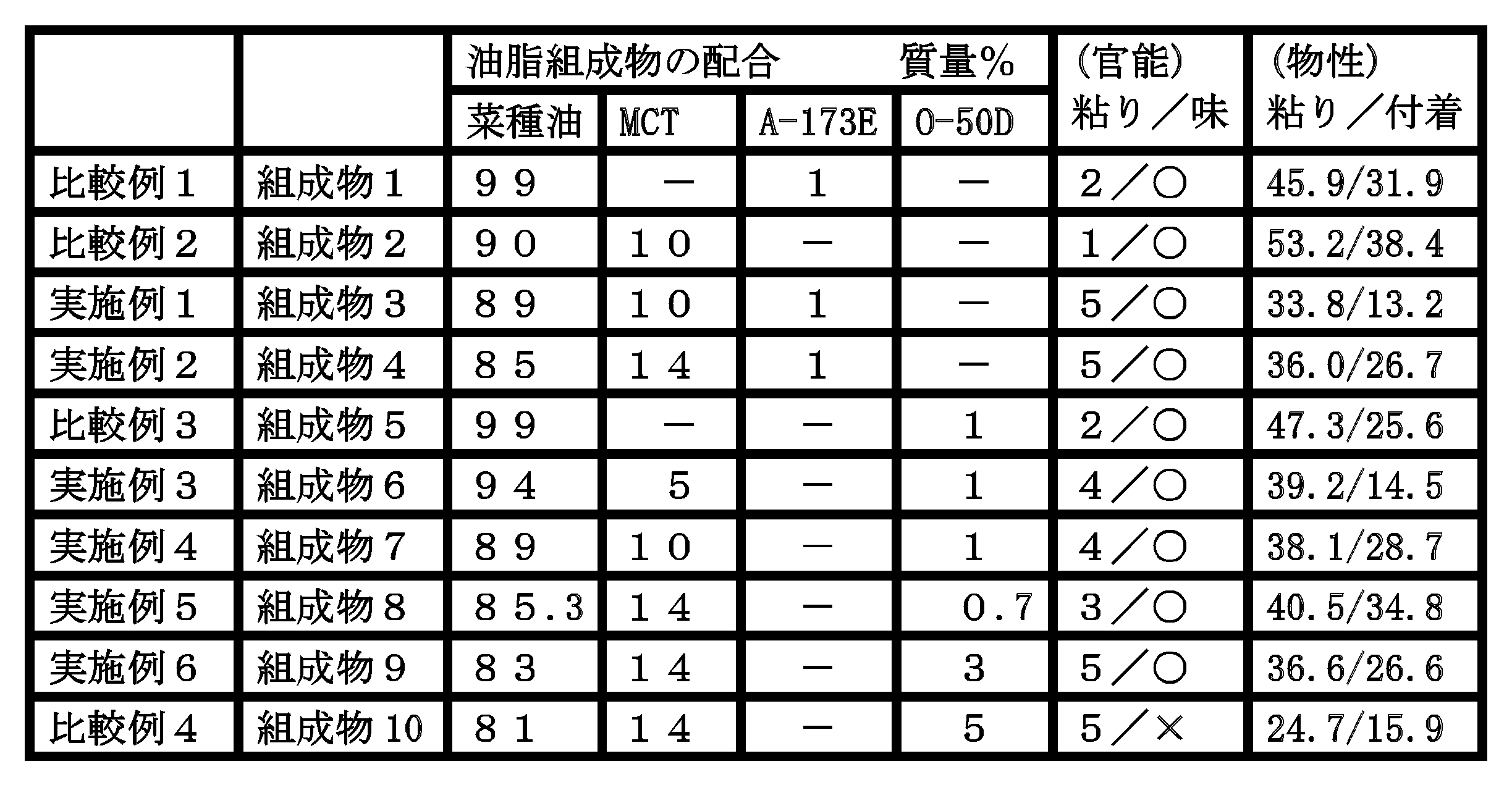
表1の結果から明らかであるように、構成脂肪酸が中鎖脂肪酸であるトリグリセリドとポリグリセリン脂肪酸エステルを一定量含む、実施例1~6は、粘りが低減され、風味も良好であった。なお、「粘り」と「付着」の比較から、両者に必ずしも相関があるわけではないことが確認された。
Claims (8)
- 構成脂肪酸が中鎖脂肪酸であるトリグリセリドを2~14質量%、ポリグリセリン脂肪酸エステルを0.6~4質量%含有し、
前記中鎖脂肪酸が、炭素数6~12の直鎖飽和脂肪酸である、炊飯用油脂組成物。 - 前記ポリグリセリン脂肪酸エステルが、HLB3~8のポリグリセリン脂肪酸エステルである、請求項1に記載の炊飯用油脂組成物。
- 前記ポリグリセリン脂肪酸エステルの構成脂肪酸の50質量%以上が炭素数16~22の不飽和脂肪酸であり、構成ポリグリセリンの重合度が4~12である、請求項1又は2に記載の炊飯用油脂組成物。
- 前記中鎖脂肪酸が、炭素数8及び/又は10の直鎖飽和脂肪酸のみから構成されている、請求項1~3のいずれか1項に記載の炊飯用油脂組成物。
- 炊飯用油脂組成物中の油脂が10℃で液状である、請求項1~4のいずれか1項に記載の炊飯用油脂組成物。
- 炊飯用油脂組成物が、米飯用である、請求項1~5のいずれか1項に記載の炊飯用油脂組成物。
- 請求項1~6のいずれか1項に記載の炊飯用油脂組成物を含有する、飯類。
- 請求項1~6のいずれか1項に記載の炊飯用油脂組成物を、炊飯前の生穀類に対して、0.1~5質量%添加して炊飯することを特徴とする、飯類の製造方法。
Priority Applications (2)
| Application Number | Priority Date | Filing Date | Title |
|---|---|---|---|
| US18/699,173 US20240397967A1 (en) | 2021-10-12 | 2022-10-12 | Oil-and/or-fat composition for cooking rice, cooked rice, and method for manufacturing cooked rice |
| CN202280062669.6A CN117956905A (zh) | 2021-10-12 | 2022-10-12 | 煮饭用油脂组合物、饭类和饭类的制造方法 |
Applications Claiming Priority (2)
| Application Number | Priority Date | Filing Date | Title |
|---|---|---|---|
| JP2021-167524 | 2021-10-12 | ||
| JP2021167524A JP7797077B2 (ja) | 2021-10-12 | 2021-10-12 | 炊飯用油脂組成物、飯類、及び飯類の製造方法 |
Publications (1)
| Publication Number | Publication Date |
|---|---|
| WO2023063373A1 true WO2023063373A1 (ja) | 2023-04-20 |
Family
ID=85988659
Family Applications (1)
| Application Number | Title | Priority Date | Filing Date |
|---|---|---|---|
| PCT/JP2022/038118 Ceased WO2023063373A1 (ja) | 2021-10-12 | 2022-10-12 | 炊飯用油脂組成物、飯類、及び飯類の製造方法 |
Country Status (5)
| Country | Link |
|---|---|
| US (1) | US20240397967A1 (ja) |
| JP (1) | JP7797077B2 (ja) |
| CN (1) | CN117956905A (ja) |
| TW (1) | TW202329819A (ja) |
| WO (1) | WO2023063373A1 (ja) |
Families Citing this family (1)
| Publication number | Priority date | Publication date | Assignee | Title |
|---|---|---|---|---|
| WO2025134594A1 (ja) * | 2023-12-19 | 2025-06-26 | 日清オイリオグループ株式会社 | 炊飯用油脂組成物、炊飯用油脂組成物の製造方法、飯類、飯類の製造方法及び炊飯後の釜の油の残存を抑制する方法 |
Citations (2)
| Publication number | Priority date | Publication date | Assignee | Title |
|---|---|---|---|---|
| JP2020048526A (ja) * | 2018-09-28 | 2020-04-02 | 日清オイリオグループ株式会社 | 風味付飯類及びその製造方法 |
| JP2021101664A (ja) * | 2019-12-25 | 2021-07-15 | 日清オイリオグループ株式会社 | 炊飯用油脂組成物及び米飯の製造方法 |
Family Cites Families (6)
| Publication number | Priority date | Publication date | Assignee | Title |
|---|---|---|---|---|
| JP2008118986A (ja) * | 2006-10-18 | 2008-05-29 | Kaneka Corp | 調理用油脂組成物 |
| CN103260420B (zh) * | 2011-03-30 | 2015-04-01 | 日清奥利友集团株式会社 | 一种煮饭用油脂组合物 |
| CN103875828B (zh) * | 2012-12-19 | 2018-12-21 | 日清奥利友集团株式会社 | 煮饭用油脂组合物、米饭及其制造方法、以及加工食品 |
| JP6925701B2 (ja) * | 2017-01-04 | 2021-08-25 | 日清オイリオグループ株式会社 | 炊飯用油脂組成物、飯類、及び飯類の製造方法 |
| JP6996851B2 (ja) * | 2017-02-20 | 2022-01-17 | 株式会社J-オイルミルズ | 炊飯用油脂組成物 |
| CN112401010B (zh) * | 2019-08-20 | 2024-04-09 | 日清奥利友集团株式会社 | 面用油脂组合物、面及面的制造方法 |
-
2021
- 2021-10-12 JP JP2021167524A patent/JP7797077B2/ja active Active
-
2022
- 2022-10-12 US US18/699,173 patent/US20240397967A1/en active Pending
- 2022-10-12 WO PCT/JP2022/038118 patent/WO2023063373A1/ja not_active Ceased
- 2022-10-12 TW TW111138705A patent/TW202329819A/zh unknown
- 2022-10-12 CN CN202280062669.6A patent/CN117956905A/zh active Pending
Patent Citations (2)
| Publication number | Priority date | Publication date | Assignee | Title |
|---|---|---|---|---|
| JP2020048526A (ja) * | 2018-09-28 | 2020-04-02 | 日清オイリオグループ株式会社 | 風味付飯類及びその製造方法 |
| JP2021101664A (ja) * | 2019-12-25 | 2021-07-15 | 日清オイリオグループ株式会社 | 炊飯用油脂組成物及び米飯の製造方法 |
Also Published As
| Publication number | Publication date |
|---|---|
| JP7797077B2 (ja) | 2026-01-13 |
| CN117956905A (zh) | 2024-04-30 |
| JP2023057831A (ja) | 2023-04-24 |
| TW202329819A (zh) | 2023-08-01 |
| US20240397967A1 (en) | 2024-12-05 |
Similar Documents
| Publication | Publication Date | Title |
|---|---|---|
| TWI743270B (zh) | 炊飯用油脂組成物、飯類及飯類的製造方法 | |
| JP4931690B2 (ja) | 油脂組成物及び油脂組成物の使用方法 | |
| KR102708720B1 (ko) | 에스테르 교환 유지 | |
| JP4517043B1 (ja) | ルウ用油脂組成物及びルウ | |
| JP3583212B2 (ja) | 油脂組成物 | |
| JP5209453B2 (ja) | 油脂組成物 | |
| JP7512000B2 (ja) | 澱粉含有食品用ほぐれ剤、澱粉含有食品及び澱粉含有食品の製造方法 | |
| WO2023063373A1 (ja) | 炊飯用油脂組成物、飯類、及び飯類の製造方法 | |
| JP7427354B2 (ja) | 炊飯用油脂組成物、飯類、及び飯類の製造方法 | |
| JP2021101664A (ja) | 炊飯用油脂組成物及び米飯の製造方法 | |
| JP2017153472A (ja) | 炊飯用油脂組成物及び米飯類の製造方法 | |
| CA2675210A1 (en) | Low trans fatty acid shortening compositions | |
| CN111248297B (zh) | 一种酯交换油脂组合物及其制备方法 | |
| Arifin et al. | Physicochemical properties and sensory attributes of medium-and long-chain triacylglycerols (MLCT)-enriched bakery shortening | |
| JP6996851B2 (ja) | 炊飯用油脂組成物 | |
| JP7844077B2 (ja) | 艶だし剤及び食品の艶だし方法 | |
| Ramadan et al. | Chemical Properties and Oxidative Stability of Modified of Table Margarine from Buffalo Fat Fractions with Vegetable Oil Oleogels | |
| WO2025053149A1 (ja) | 炊飯用油脂組成物及びその製造方法、ご飯類及びその製造方法、飯類の保存後の粘りを増加させる方法 | |
| JP7846509B2 (ja) | 炊飯用油脂組成物、飯類の製造方法及び加工食品の製造方法 | |
| JP7078200B1 (ja) | ランダムエステル交換油 | |
| JP7653811B2 (ja) | 艶だし剤及び食品の艶だし方法 | |
| TW201828826A (zh) | 用於煮飯的油脂組合物及使用其製造米飯方法 | |
| TW202525156A (zh) | 煮飯用油脂組成物、煮飯用油脂組成物的製造方法、飯類、飯類的製造方法及抑制煮飯後的鍋中的油殘存的方法 | |
| JP6853698B2 (ja) | モナカ皮及びコーンの製造方法並びにモナカ皮及びコーン | |
| JP2025040564A (ja) | 麺用ほぐれ剤、麺及びその製造方法 |
Legal Events
| Date | Code | Title | Description |
|---|---|---|---|
| 121 | Ep: the epo has been informed by wipo that ep was designated in this application |
Ref document number: 22881068 Country of ref document: EP Kind code of ref document: A1 |
|
| WWE | Wipo information: entry into national phase |
Ref document number: 202280062669.6 Country of ref document: CN |
|
| NENP | Non-entry into the national phase |
Ref country code: DE |
|
| 122 | Ep: pct application non-entry in european phase |
Ref document number: 22881068 Country of ref document: EP Kind code of ref document: A1 |