WO2023063346A1 - 銅合金、銅合金塑性加工材、電子・電気機器用部品、端子、バスバー、リードフレーム - Google Patents
銅合金、銅合金塑性加工材、電子・電気機器用部品、端子、バスバー、リードフレーム Download PDFInfo
- Publication number
- WO2023063346A1 WO2023063346A1 PCT/JP2022/038028 JP2022038028W WO2023063346A1 WO 2023063346 A1 WO2023063346 A1 WO 2023063346A1 JP 2022038028 W JP2022038028 W JP 2022038028W WO 2023063346 A1 WO2023063346 A1 WO 2023063346A1
- Authority
- WO
- WIPO (PCT)
- Prior art keywords
- copper alloy
- less
- mpa
- stress
- mass
- Prior art date
- Legal status (The legal status is an assumption and is not a legal conclusion. Google has not performed a legal analysis and makes no representation as to the accuracy of the status listed.)
- Ceased
Links
Images

Classifications
-
- C—CHEMISTRY; METALLURGY
- C22—METALLURGY; FERROUS OR NON-FERROUS ALLOYS; TREATMENT OF ALLOYS OR NON-FERROUS METALS
- C22C—ALLOYS
- C22C9/00—Alloys based on copper
-
- C—CHEMISTRY; METALLURGY
- C22—METALLURGY; FERROUS OR NON-FERROUS ALLOYS; TREATMENT OF ALLOYS OR NON-FERROUS METALS
- C22F—CHANGING THE PHYSICAL STRUCTURE OF NON-FERROUS METALS AND NON-FERROUS ALLOYS
- C22F1/00—Changing the physical structure of non-ferrous metals or alloys by heat treatment or by hot or cold working
- C22F1/08—Changing the physical structure of non-ferrous metals or alloys by heat treatment or by hot or cold working of copper or alloys based thereon
-
- H—ELECTRICITY
- H01—ELECTRIC ELEMENTS
- H01B—CABLES; CONDUCTORS; INSULATORS; SELECTION OF MATERIALS FOR THEIR CONDUCTIVE, INSULATING OR DIELECTRIC PROPERTIES
- H01B1/00—Conductors or conductive bodies characterised by the conductive materials; Selection of materials as conductors
- H01B1/02—Conductors or conductive bodies characterised by the conductive materials; Selection of materials as conductors mainly consisting of metals or alloys
- H01B1/026—Alloys based on copper
-
- H—ELECTRICITY
- H01—ELECTRIC ELEMENTS
- H01B—CABLES; CONDUCTORS; INSULATORS; SELECTION OF MATERIALS FOR THEIR CONDUCTIVE, INSULATING OR DIELECTRIC PROPERTIES
- H01B5/00—Non-insulated conductors or conductive bodies characterised by their form
- H01B5/02—Single bars, rods, wires, or strips
-
- H—ELECTRICITY
- H01—ELECTRIC ELEMENTS
- H01M—PROCESSES OR MEANS, e.g. BATTERIES, FOR THE DIRECT CONVERSION OF CHEMICAL ENERGY INTO ELECTRICAL ENERGY
- H01M50/00—Constructional details or processes of manufacture of the non-active parts of electrochemical cells other than fuel cells, e.g. hybrid cells
- H01M50/50—Current conducting connections for cells or batteries
- H01M50/502—Interconnectors for connecting terminals of adjacent batteries; Interconnectors for connecting cells outside a battery casing
- H01M50/521—Interconnectors for connecting terminals of adjacent batteries; Interconnectors for connecting cells outside a battery casing characterised by the material
- H01M50/522—Inorganic material
-
- H—ELECTRICITY
- H01—ELECTRIC ELEMENTS
- H01M—PROCESSES OR MEANS, e.g. BATTERIES, FOR THE DIRECT CONVERSION OF CHEMICAL ENERGY INTO ELECTRICAL ENERGY
- H01M50/00—Constructional details or processes of manufacture of the non-active parts of electrochemical cells other than fuel cells, e.g. hybrid cells
- H01M50/50—Current conducting connections for cells or batteries
- H01M50/543—Terminals
- H01M50/562—Terminals characterised by the material
Definitions
- the present invention relates to copper alloys suitable for electronic and electrical equipment parts such as terminals, bus bars and lead frames, copper alloy plastic working materials made of the copper alloys, electronic and electrical equipment parts, terminals, bus bars and lead frames. is. This application claims priority based on Japanese Patent Application No. 2021-167385 filed in Japan on October 12, 2021, the content of which is incorporated herein.
- Patent Document 1 discloses a rolled copper sheet containing Mg in the range of 0.005 mass% or more and less than 0.1 mass%.
- the copper rolled sheet described in Patent Document 1 contains Mg in the range of 0.005 mass% or more and less than 0.1 mass%, and the balance is Cu and inevitable impurities.
- the present invention has been made in view of the above-mentioned circumstances, and has high strength, excellent stress relaxation resistance, and excellent bending workability.
- the purpose is to provide parts, terminals, bus bars and lead frames.
- the present inventors made intensive studies and obtained the following findings.
- Mg which is an additive element
- stabilizing dislocations it is possible to improve the stress relaxation resistance while maintaining the strength. Furthermore, stably arranging dislocations avoids stress concentration and leads to improved elongation.
- an edge-shaped curve (serration) occurs in the plastic region of the stress-strain curve when a low-speed tensile test is performed.
- the average value of the strain period of the edge curve is 0.01% or more and 1.0% or less
- the average value of the stress height difference of the edge curve is 0 .1 MPa or more and 2 MPa or less
- a strain period of 0.01% or more and 1.0% or less a stress level difference of 0.1 MPa or more and 2 MPa or less, having five or more edge-shaped curves. alloy.
- Mg is contained in the above range, and the stress-strain curve obtained in a low-speed tensile test at a strain rate of 1.0 ⁇ 10 -6 /s shows an edge-like shape in the plastic deformation region.
- the average value of the strain period of the curve is 0.01% or more and 1.0% or less
- the average value of the stress level difference of the edge curve is 0.1 MPa or more and 2 MPa or less
- the strain period is 0.01 MPa or more. 01% or more and 1.0% or less and five or more edge-shaped curves with a stress level difference of 0.1 MPa or more and 2 MPa or less. Therefore, dislocations are stabilized by Mg, and stress relaxation resistance can be improved while maintaining strength. In addition, elongation can be improved, and bending workability can be improved.
- the tensile strength is set to 350 MPa or more, it is not easily deformed, and is particularly suitable as a copper alloy for parts for electronic and electrical equipment such as terminals such as connectors and press-fits, relays, lead frames, bus bars and the like. ing.
- a copper alloy plastically worked material comprising the copper alloy according to any one of [1] to [6].
- the copper alloy plastic working material of this configuration since it is composed of the above-mentioned copper alloy, it is excellent in strength, stress relaxation resistance, and bending workability, and is used for large current applications and in high temperature environments. It is particularly suitable as a material for parts for electronic and electrical equipment such as terminals, bus bars and lead frames.
- the copper alloy plastically worked material according to [7] which is a rolled sheet having a thickness of 0.1 mm or more and 10 mm or less.
- a rolled plate with a thickness of 0.1 mm or more and 10 mm or less terminals, bus bars, Parts for electronic and electrical equipment such as lead frames can be molded.
- it since it has a metal plating layer on the surface, it is particularly suitable as a material for parts for electronic and electrical equipment such as terminals, bus bars, and lead frames.
- a metal plating layer Sn plating, Ag plating, Ni plating, Au plating, Pd plating, Rh plating, etc. are mentioned, for example.
- Sn plating is pure Sn plating or Sn alloy plating
- Ag plating is pure Ag plating or Ag alloy plating
- Ni plating is pure Ni plating or Ni alloy plating
- Ru plating includes pure Rh plating or Rh alloy plating.
- [9a] It is a rolled material that has been rolled, and on the RD surface, a measurement area of 1000 ⁇ m 2 or more is measured by the EBSD method at a measurement interval of 0.1 ⁇ m, and the CI value analyzed by the data analysis software OIM is 0.
- the aspect ratio b/a represented by the major axis a and the minor axis b of the crystal grain size (including twin crystals) is 0.95 or less when analyzed excluding the measurement point of .1 or less.
- the aspect ratio b/a represented by the major axis a and the minor axis b of the crystal grain size (including twins) is 0.95 or less, dislocations are sufficiently introduced by rolling. By stabilizing these dislocations with Mg, it is possible to improve the stress relaxation resistance while maintaining the strength, improve the elongation, and further improve the bending workability.
- a component for electronic/electrical equipment comprising the copper alloy plastically worked material according to any one of [7] to [9] and [9a].
- the components for electronic/electrical devices in one embodiment of the present invention include terminals, bus bars, lead frames, and the like. Since the electronic/electrical device component having this configuration is manufactured using the above-mentioned copper alloy plastically worked material, it can exhibit excellent characteristics even in a high-temperature environment.
- a terminal comprising the plastically worked copper alloy material according to any one of [7] to [9] and [9a]. Since the terminal having this configuration is manufactured using the copper alloy plastically worked material described above, it can exhibit excellent characteristics even in a high-temperature environment.
- a lead frame comprising the plastically worked copper alloy material according to any one of [7] to [9] and [9a]. Since the lead frame having this configuration is manufactured using the copper alloy plastic working material described above, it can exhibit excellent characteristics even in a high-temperature environment.
- a copper alloy having high strength, excellent stress relaxation resistance, and excellent bending workability a copper alloy plastically worked material, a component for electronic and electrical equipment, a terminal, a bus bar, and a lead frame can be provided.
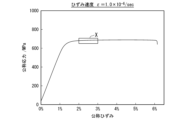
- FIG. 1 is a stress-strain curve obtained in a low-speed tensile test in the copper alloy of this embodiment.
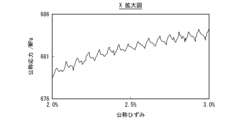
- 1B is an enlarged view of region X in FIG. 1A;
- FIG. 1 is a flowchart of a method for producing a copper alloy according to this embodiment; FIG.
- the copper alloy of the present embodiment has a composition containing Mg in the range of 0.10 mass% or more and 2.6 mass% or less, and the balance being Cu and unavoidable impurities.
- the stress obtained in the low-speed tensile test at a strain rate of 1.0 ⁇ 10 -6 /s - in the plastic deformation region of the strain curve the period of strain of the edge curve (serration) is 0.01% or more and 1.0% or less, and the average value of the stress height difference of the edge curve is 0.1 MPa or more and 2 MPa or less.
- the plastic deformation region of the stress-strain curve there are five or more edge curves with a strain period of 0.01% or more and 1.0% or less and a stress level difference of 0.1 MPa or more and 2 MPa or less. are doing.
- FIGS. 1A and 1B An example of stress-strain curves obtained from a low-speed tensile test at a strain rate of 1.0 ⁇ 10 ⁇ 6 /s of the copper alloy of this embodiment is shown in FIGS. 1A and 1B. As shown in FIGS. 1A and 1B, in the plastic deformation region, the stress periodically rises and falls as the strain increases, forming a serration.
- the copper alloy of the present embodiment a measurement area of 1000 ⁇ m 2 or more is measured by the EBSD method at a measurement interval of 0.1 ⁇ m step, and the CI value analyzed by the data analysis software OIM is 0.1 or less. It is preferable that the aspect ratio b/a represented by the major axis a and the minor axis b of the crystal grain size (including twins) is 0.95 or less when analyzed except for a certain measurement point. Furthermore, the copper alloy of the present embodiment preferably has a tensile strength of 350 MPa or more.
- the electrical conductivity ⁇ (%IACS) satisfies the following relational expression when the content of Mg is A atomic %. ⁇ 1.7680/( ⁇ 0.0200 ⁇ A 2 +0.5769 ⁇ A+1.7) ⁇ 100
- the conductivity ⁇ (%IACS) preferably satisfies the following relational expression. ⁇ 1.7680/( ⁇ 0.0200 ⁇ A X 2 +0.5769 ⁇ A X +1.7) ⁇ 100
- Mg Mg is an element that has the function and effect of improving the stress relaxation resistance without significantly lowering the electrical conductivity by forming a solid solution in the matrix of copper. Further, by forming a Cottrell atmosphere using Mg and stabilizing dislocations, it is possible to improve strength, stress relaxation resistance, and elongation.
- the content of Mg is less than 0.10 mass%, there is a possibility that the action and effect cannot be sufficiently achieved.
- the content of Mg exceeds 2.6 mass%, the manufacturing load increases, which leads to an increase in cost and a decrease in yield, which is not suitable as an industrial product. From the above, in the present embodiment, the content of Mg is set within the range of 0.10 mass% or more and 2.6 mass% or less.
- the lower limit of the Mg content is preferably 0.12 mass% or more, more preferably 0.15 mass% or more, and 0.15 mass% or more. It is more preferable to make it 17 mass% or more.
- the upper limit of the Mg content is preferably less than 2.5 mass%, more preferably less than 2.4 mass%. It is more preferable to make it less than 3 mass%.
- the copper alloy of the present embodiment when P is contained in an amount of 0.0005 mass% or more, fluidity of molten metal is improved and castability is improved. On the other hand, by limiting the P content to 0.1 mass% or less, it is possible to suppress a large decrease in electrical conductivity.
- the lower limit of the P content in order to further improve the castability, is more preferably 0.0006 mass% or more, and more preferably 0.0007 mass% or more. preferable.
- the upper limit of the P content is more preferably 0.095 mass% or less, more preferably 0.092 mass% or less.
- the copper alloy which is this embodiment when containing P as an impurity, it may contain less than 0.0005 mass% of P.
- unavoidable impurities include Ag, Al, B, Ba, Be, Ca, Cd, Cr, Sc, rare earth elements, V, Nb, Ta, Mo, Ni, W, Mn, Re, Ru, Sr, Ti, Os, Co, Rh, Ir, Pb, Pd, Pt, Au, Zn, Zr, Hf, Hg, Ga, In, Ge, Y, Tl, N, Si, Sn, Li, S, Se, Te, SbBi, As, etc. are mentioned. These unavoidable impurities may be contained as long as they do not affect the properties.
- the total amount is preferably 0.1 mass% or less, more preferably 0.05 mass% or less, and 0.03 mass% or less. It is more preferable to set it as 0.01 mass% or less.
- the upper limit of the content of each of these inevitable impurities is preferably 10 mass ppm or less, more preferably 5 mass ppm or less, and more preferably 2 mass ppm or less.
- edge-shaped curve (serration) defined in this embodiment. This makes it possible to distinguish from sudden fluctuations due to noise generated in the test facility or external factors.
- the average value of the strain period of the edge curve is 0.01% or more and 1.0% or less, and the average value of the difference in stress of the edge curve is 0.1 MPa or more and 2 MPa or less.
- the curve from one stress minimum point A to another stress minimum point B adjacent to the stress minimum point A is one edge-shaped curve. (However, the minimum point B is not included).
- One edge curve has one stress minimum point (trough) and one stress maximum point (peak).
- the period of strain is the difference in strain between two adjacent stress minima (troughs).
- the stress height difference is the stress difference between the stress maximum point (mountain) and the stress minimum point (valley) in one edge-shaped curve.
- the average strain period is the average strain period of all blade curves in the plastic deformation region, and the average stress level difference is the stress height difference of all blade curves in the plastic deformation region.
- the average strain period is preferably 0.95% or less, more preferably 0.90% or less.
- the average value of the period of strain is preferably 0.02% or more, more preferably 0.03% or more.
- the average stress level difference is preferably 1.90 MPa or less, more preferably 1.80 MPa or less. Moreover, the average value of the stress level difference is preferably 0.10 MPa or more.
- Mg stabilizes dislocations, thereby improving strength, stress relaxation resistance, and elongation. Therefore, it is possible to have sufficient dislocations. preferable.
- crystal grains including twin crystals
- sufficient dislocations must be present. It becomes possible to further improve strength, stress relaxation resistance and elongation. If the aspect ratio b/a is more than 0.95, there are not enough dislocations, and the dislocations cannot be stabilized by Mg.
- the aspect ratio b/a represented by the major axis a and the minor axis b of the crystal grains (including twin crystals) is more preferably 0.93 or less, more preferably 0.90 or less. is more preferable. Also, the aspect ratio b/a is preferably 0.005 or more, more preferably 0.01 or more.
- a measurement area of 1000 ⁇ m 2 or more is measured at a measurement interval of 0.1 ⁇ m step by the EBSD method, and the CI value analyzed by the data analysis software OIM is 0.1 or less.
- the aspect ratio b/a represented by the major axis a and the minor axis b of the crystal grain size (including twins) is 0.95 or less.
- the tensile strength in this embodiment is the tensile strength in the direction parallel to the rolling direction.
- the above tensile strength is more preferably 360 MPa or more, more preferably 370 MPa or more.
- the upper limit of the tensile strength is not set.
- the tensile strength is preferably 2000 MPa or less. It is more preferably 1700 MPa or less, still more preferably 1500 MPa or less.
- the electrical conductivity ⁇ (%IACS) satisfies the following relational expression, so that Mg is sufficiently dissolved in the copper matrix and bending is performed. It is possible to further improve the performance. ⁇ 1.7680/( ⁇ 0.0200 ⁇ A 2 +0.5769 ⁇ A+1.7) ⁇ 100
- the above elements are added to the molten copper obtained by melting the copper raw material to adjust the composition, thereby producing the molten copper alloy.
- various elements simple elements, master alloys, or the like can be used.
- a raw material containing the above elements may be melted together with the copper raw material. Recycled materials and scrap materials of the present alloy may also be used.
- the molten copper is preferably so-called 4NCu with a purity of 99.99 mass% or higher, or so-called 5NCu with a purity of 99.999 mass% or higher.
- atmosphere dissolution is performed in an inert gas atmosphere (for example, Ar gas) having a low vapor pressure of H 2 O, and the holding time during dissolution is minimized. It is preferable to limit
- the cooling rate of the molten metal is preferably 0.1° C./sec or more, more preferably 0.5° C./sec or more, and most preferably 1° C./sec or more.
- the heating temperature is set in the range of 300° C. or higher and 900° C. or lower.
- hot working may be performed after the homogenization/solution treatment step S02 described above in order to improve the efficiency of rough rolling and homogenize the structure, which will be described later.
- the working method is not particularly limited, and for example, rolling, wire drawing, extrusion, groove rolling, forging, pressing, etc. can be employed.
- the hot working temperature is preferably in the range of 300° C. or higher and 900° C. or lower.
- Rough processing step S03 Rough processing is performed in order to process into a predetermined shape.
- the temperature conditions in this rough processing step S03 are not particularly limited, but in order to suppress recrystallization or improve dimensional accuracy, cold or warm rolling is performed at -200 ° C. to 200 ° C.
- the temperature is preferably within the range, and room temperature is particularly preferable.
- the processing rate is preferably 20% or more, more preferably 30% or more.
- the processing method is not particularly limited, and for example, rolling, wire drawing, extrusion, groove rolling, forging, pressing, etc. can be employed.
- the heat treatment method is not particularly limited, but the heat treatment is preferably performed at a holding temperature of 400° C. or higher and 900° C. or lower for a holding time of 10 seconds or longer and 10 hours or shorter in a non-oxidizing atmosphere or a reducing atmosphere.
- the method of cooling after heating is not particularly limited, but it is preferable to employ a method such as water quenching, in which the cooling rate is 200° C./min or higher. Note that the rough processing step S03 and the intermediate heat treatment step S04 may be repeated.
- pre-processing In order to process the copper material into a predetermined shape after the intermediate heat treatment step S04, pre-processing is performed.
- the temperature conditions in this pre-processing step S05 are not particularly limited, but in order to suppress recrystallization during processing or to suppress softening, cold or warm processing is performed from -200 ° C. It is preferably within the range of 200° C., and particularly preferably room temperature.
- the work rate is appropriately selected so as to approximate the final shape, but is preferably set to 5% or more in order to improve the strength by work hardening.
- the processing method is not particularly limited, and for example, rolling, drawing, extrusion, groove rolling, forging, pressing, etc. can be employed.
- the plastically worked material obtained in the pre-pretreatment step S05 is pre-treated with Mg for the purpose of stabilization by dislocation fixation and dislocation rearrangement.
- the heat treatment temperature is preferably in the range of 100°C or higher and 800°C or lower.
- This heat treatment is preferably performed in a non-oxidizing atmosphere or a reducing atmosphere.
- the method of heat treatment is not particularly limited, but short-time heat treatment in a continuous annealing furnace is preferable from the viewpoint of reducing manufacturing costs.
- the pre-upper processing step S05 and the pre-upper heat treatment step S06 may be repeatedly performed.
- the plastically worked material subjected to the pre-upper heat treatment step S06 is subjected to plastic working at a light working rate in order to develop serrations due to further fixing and stabilization of dislocations by Mg.
- the temperature conditions in this light working step S07 are not particularly limited, but in order to suppress recrystallization or improve dimensional accuracy, cold or warm rolling is performed at -200 ° C. to 200 ° C.
- the temperature is preferably within the range, and room temperature is particularly preferable.
- the total working rate is set within a range of 5% or more and 50% or less, and the working rate for each pass is limited to 20% or less. preferably.
- the heat treatment temperature is preferably in the range of 100° C. or higher and 800° C. or lower.
- This heat treatment is preferably performed in a non-oxidizing atmosphere or a reducing atmosphere.
- the method of heat treatment is not particularly limited, but short-time heat treatment in a continuous annealing furnace is preferable from the viewpoint of reducing manufacturing costs. Further, the above-described light working step S07 and finishing heat treatment step S08 may be repeatedly performed.
- a copper alloy plastically worked material produced by rolling is referred to as a copper alloy rolled sheet.
- the plate thickness of the copper alloy plastically worked material is set to 0.1 mm or more, it is suitable for use as a conductor for large current applications.
- the plate thickness of the copper alloy plastically worked material is preferably in the range of 0.1 mm or more and 10.0 mm or less.
- the lower limit of the plate thickness of the copper alloy plastically worked material (copper alloy rolled material) is preferably 0.5 mm or more, more preferably 1.0 mm or more.
- the upper limit of the plate thickness of the copper alloy plastically worked material (copper alloy rolled material) is preferably less than 9.0 mm, more preferably less than 8.0 mm.
- a metal plating layer (for example, Sn plating, Ag plating, Ni plating, Au plating, Pd plating, Rh plating, etc.) is formed on the surface of the copper alloy plastically worked material (copper alloy rolled material) of the present embodiment. good too.
- the RD surface is measured by the EBSD method at 1000 ⁇ m 2 or more.
- the major axis of the crystal grain size (including twins)
- the aspect ratio b/a represented by a and the minor axis b is preferably 0.95 or less.
- the aspect ratio b/a represented by the major axis a and the minor axis b of the crystal grain size (including twins) is 0.95 or less, dislocations are sufficiently introduced by rolling, and these dislocations is stabilized by Mg, it is possible to further improve strength, stress relaxation resistance and elongation.
- the aspect ratio b/a is more preferably 0.93 or less, more preferably 0.90 or less.
- the copper alloy of the present embodiment configured as described above contains Mg in the range of 0.10 mass % or more and 2.6 mass % or less. Stress obtained in a low-speed tensile test at a strain rate of 1.0 ⁇ 10 -6 /s - In the plastic deformation region of the strain curve, the average value of the strain period of the edge curve is 0.01% or more and 1.0% or less. and the average value of the height difference of the stress of the edge curve is 0.1 MPa or more and 2 MPa or less. Furthermore, in the plastic deformation region of the stress-strain curve, there are five or more edge curves with a strain period of 0.01% or more and 1.0% or less and a stress level difference of 0.1 MPa or more and 2 MPa or less. are doing. Therefore, dislocations are stabilized by Mg, and stress relaxation resistance can be improved while maintaining strength. In addition, elongation can be improved, and bending workability can be improved.
- a measurement area of 1000 ⁇ m 2 or more is measured by the EBSD method at a measurement interval of 0.1 ⁇ m step, and the CI value analyzed by the data analysis software OIM is 0.1 or less. If the aspect ratio b/a represented by the major axis a and the minor axis b of the crystal grain size (including twin crystals) is 0.95 or less when analyzed excluding the measurement points, it can be sufficiently obtained by processing. Dislocations are introduced into the steel, and these dislocations are stabilized by Mg, so that the strength can be maintained, the stress relaxation resistance can be improved, the elongation can be improved, and the bending workability can be improved. can be improved.
- the tensile strength when the tensile strength is 350 MPa or more, the tensile strength is sufficiently high, it is not easily deformed, and terminals such as connectors and press-fits, relays, lead frames, It is particularly suitable as a copper alloy for parts for electronic and electrical equipment such as bus bars.
- the added Mg is the copper matrix It is sufficiently solid-solved in the inside, and the formation of precipitates containing Mg is suppressed. Therefore, bending workability can be further improved. ⁇ 1.7680/( ⁇ 0.0200 ⁇ A 2 +0.5769 ⁇ A+1.7) ⁇ 100
- the Mg content is A atomic %
- the P content is B atomic %
- the copper alloy plastically worked material of the present embodiment is composed of the above-mentioned copper alloy, it is excellent in electrical conductivity, stress relaxation resistance, and bending workability, and is used in electronic and electronic applications such as terminals, bus bars, and lead frames. It is particularly suitable as a material for parts for electrical equipment.
- the copper alloy plastically worked material of the present embodiment is a rolled plate having a thickness in the range of 0.1 mm or more and 10 mm or less
- the copper alloy plastically worked material (rolled plate) is punched or processed.
- a metal plating layer for example, Sn plating, Ag plating, Ni plating, Au plating, Pd plating, Rh plating, etc.
- a metal plating layer for example, Sn plating, Ag plating, Ni plating, Au plating, Pd plating, Rh plating, etc.
- terminals, bus bars It is particularly suitable as a material for parts for electronic and electrical equipment such as
- the electronic/electrical device parts (terminals, bus bars, lead frames, etc.) of the present embodiment are made of the above-mentioned copper alloy plastically worked material and copper alloy, they have excellent properties even in high temperature environments. can be demonstrated.
- a method for producing a copper alloy (copper alloy plastically worked material) has been described, but the method for producing a copper alloy is not limited to those described in the embodiments, and existing methods can be used. It may be manufactured by appropriately selecting a manufacturing method.
- a copper raw material made of oxygen-free copper (ASTM B152 C10100) with a purity of 99.99% by mass or more was prepared, charged into a high-purity graphite crucible, and high-frequency melted in an atmosphere furnace with an Ar gas atmosphere. .
- Various additive elements were added to the obtained molten copper to prepare the component composition shown in Table 1, and the molten copper was poured into a carbon mold to produce an ingot.
- the size of the ingot was 10 to 30 mm thick ⁇ about 20 mm wide ⁇ about 100 to 120 mm long.
- the obtained ingot was subjected to a heating step of heating at 715° C. for 4 hours in an Ar gas atmosphere, and then subjected to water quenching.
- the ingot after heat treatment was cut and the surface was ground to remove the oxide film. After that, the thickness before rough processing was appropriately adjusted so as to obtain the set final thickness, and cutting was performed. Next, rough working, intermediate heat treatment, upper pre-cold rolling, and upper pre-heat treatment are performed under the working rate and temperature conditions listed in Tables 2 and 3, and then light working (light Rolling) and finishing heat treatment were performed to prepare strips for characteristic evaluation having a thickness shown in Tables 2 and 3 and a width of about 20 mm.
- composition analysis A measurement sample was taken from the obtained ingot, the amount of Mg was measured by inductively coupled plasma atomic emission spectrometry, and the amount of other elements was measured using a glow discharge mass spectrometer (GD-MS). In addition, the measurement was carried out by collecting samples from two locations, the central portion of the sample and the end portion in the width direction, and the larger content was taken as the content of the sample. As a result, it was confirmed that the composition was as shown in Table 1.
- the average value of the strain period of the edge-shaped curve in the plastic deformation region, the average value of the stress level difference of the edge-shaped curve, and the number of edge-shaped curves It was described in Tables 4 and 5.
- the strain period of each edge curve in the plastic deformation region is measured, the sum is divided by the number of edge curves to calculate the average value, and the average value is the average value of the strain period of the edge curve.
- the stress level difference of each edge-shaped curve in the plastic deformation region is measured, the total is divided by the number of edge-shaped curves to calculate the average value, and the average value is the stress level difference of the edge-shaped curve.
- the number of edge curves is the number of edge curves having a strain period of 0.01% or more and 1.0% or less and a stress level difference of 0.1 MPa or more and 2 MPa or less in the plastic deformation region. be.
- the surface perpendicular to the rolling direction of the strip for characteristic evaluation, that is, the RD (roll direction) surface is mechanically polished using water-resistant abrasive paper and diamond abrasive grains, and then finish-polished using a colloidal silica solution.
- the grain size on EBSD was set to 5° for the grain tolerance angle and 2 pixels for the minimum grain size. Then, the average value of the aspect ratios of the crystal grains was calculated, and the average value was taken as the aspect ratio of the sample.
- test piece having a width of 10 mm and a length of 60 mm was taken from the strip material for characteristic evaluation, and the electrical resistance was determined by the four-probe method. Also, the dimensions of the test piece were measured using a micrometer, and the volume of the test piece was calculated. Then, the electrical conductivity was calculated from the measured electrical resistance value and volume. The test piece was taken so that its longitudinal direction was parallel to the rolling direction of the strip for characteristic evaluation.
- Stress relaxation resistance In the stress relaxation resistance test, stress was applied by a method according to the cantilever screw type of the Japan Copper and Brass Association technical standard JCBA-T309: 2004, and the residual stress rate was measured after holding at a temperature of 150 ° C. for 1000 hours. .
- a test method a test piece (width 10 mm) was taken from each strip for characteristic evaluation in a direction parallel to the rolling direction, and the initial deflection displacement was applied so that the surface maximum stress of the test piece was 80% of the yield strength. It was set to 2 mm and the span length was adjusted. The surface maximum stress is determined by the following formula.
- Residual stress rate (%) (1- ⁇ t / ⁇ 0 ) x 100
- ⁇ t and ⁇ 0 show the following values.
- ⁇ t (Permanent deflection displacement (mm) after holding at 150°C for 1000 hours) - (Permanent deflection displacement after holding at room temperature for 24 hours (mm))
- ⁇ 0 initial deflection displacement (mm)
- Comparative Example 1 the content of Mg exceeded the range of the present embodiment, and the electrical conductivity was as low as 32%IACS.
- the Mg content was less than the range of this embodiment, the residual stress rate was 58%, and the stress relaxation resistance was poor.
- the stress obtained in the low-speed tensile test at a strain rate of 1.0 ⁇ 10 -6 /s - in the plastic deformation region of the strain curve, the edge curve (serration) defined in the present embodiment is not confirmed, and the tensile strength is It became as low as 320 MPa.
- the strain period is 0.01% or more and 1.0% or less in the plastic deformation region of the stress-strain curve obtained in a low-speed tensile test at a strain rate of 1.0 ⁇ 10 -6 /s.
- the number of edge-shaped curves (serrations) with a stress level difference of 0.1 MPa or more and 2 MPa or less was three, and less than five.
- the average value of the height difference of the stress of the edge curve was lower than the range of the embodiment. Therefore, the residual stress rate was as low as 57%.
- Examples 1 to 16 of the present invention it was confirmed that the tensile strength and the stress relaxation resistance were improved in a well-balanced manner. In addition, the bending workability was sufficiently excellent. From the above, it was confirmed that according to the present invention, it is possible to provide a copper alloy having high strength, excellent stress relaxation resistance, and excellent bending workability.
- the copper alloy (copper alloy plastically worked material) of the present embodiment is suitably applied to parts for electronic and electrical equipment such as terminals, bus bars, and lead frame plates.
Landscapes
- Chemical & Material Sciences (AREA)
- Engineering & Computer Science (AREA)
- Materials Engineering (AREA)
- Mechanical Engineering (AREA)
- Metallurgy (AREA)
- Organic Chemistry (AREA)
- Physics & Mathematics (AREA)
- Thermal Sciences (AREA)
- Crystallography & Structural Chemistry (AREA)
- Conductive Materials (AREA)
Priority Applications (5)
| Application Number | Priority Date | Filing Date | Title |
|---|---|---|---|
| US18/688,197 US20250034679A1 (en) | 2021-10-12 | 2022-10-12 | Copper alloy, copper alloy plastic processing material, component for electronic/electrical device, terminal, bus bar, and lead frame |
| KR1020247003556A KR20240090128A (ko) | 2021-10-12 | 2022-10-12 | 구리 합금, 구리 합금 소성 가공재, 전자·전기 기기용 부품, 단자, 버스 바, 리드 프레임 |
| EP22881041.2A EP4417722A4 (en) | 2021-10-12 | 2022-10-12 | COPPER ALLOY, COPPER ALLOY PLASTIC PROCESSING MATERIAL, COMPONENT FOR ELECTRONIC/ELECTRICAL DEVICE, TERMINAL, BUSS BAR AND LEAD FRAME |
| CN202280059518.5A CN117897510A (zh) | 2021-10-12 | 2022-10-12 | 铜合金、铜合金塑性加工材、电子电气设备用部件、端子、汇流条、引线框架 |
| JP2023554569A JP7736077B2 (ja) | 2021-10-12 | 2022-10-12 | 銅合金、銅合金塑性加工材、電子・電気機器用部品、端子、バスバー、リードフレーム |
Applications Claiming Priority (2)
| Application Number | Priority Date | Filing Date | Title |
|---|---|---|---|
| JP2021-167385 | 2021-10-12 | ||
| JP2021167385 | 2021-10-12 |
Publications (1)
| Publication Number | Publication Date |
|---|---|
| WO2023063346A1 true WO2023063346A1 (ja) | 2023-04-20 |
Family
ID=85988655
Family Applications (1)
| Application Number | Title | Priority Date | Filing Date |
|---|---|---|---|
| PCT/JP2022/038028 Ceased WO2023063346A1 (ja) | 2021-10-12 | 2022-10-12 | 銅合金、銅合金塑性加工材、電子・電気機器用部品、端子、バスバー、リードフレーム |
Country Status (7)
| Country | Link |
|---|---|
| US (1) | US20250034679A1 (cg-RX-API-DMAC7.html) |
| EP (1) | EP4417722A4 (cg-RX-API-DMAC7.html) |
| JP (1) | JP7736077B2 (cg-RX-API-DMAC7.html) |
| KR (1) | KR20240090128A (cg-RX-API-DMAC7.html) |
| CN (1) | CN117897510A (cg-RX-API-DMAC7.html) |
| TW (1) | TWI912563B (cg-RX-API-DMAC7.html) |
| WO (1) | WO2023063346A1 (cg-RX-API-DMAC7.html) |
Citations (8)
| Publication number | Priority date | Publication date | Assignee | Title |
|---|---|---|---|---|
| JPH05311283A (ja) * | 1992-05-01 | 1993-11-22 | Mitsubishi Shindoh Co Ltd | 伸線加工性および繰り返し曲げ性にすぐれたCu合金極細線 |
| WO2013150627A1 (ja) * | 2012-04-04 | 2013-10-10 | 三菱伸銅株式会社 | 優れた耐疲労特性を有するCu-Mg-P系銅合金板及びその製造方法 |
| JP2014114464A (ja) * | 2012-12-06 | 2014-06-26 | Furukawa Electric Co Ltd:The | 銅合金材料およびその製造方法 |
| WO2014196563A1 (ja) * | 2013-06-04 | 2014-12-11 | 日本碍子株式会社 | 銅合金の製造方法および銅合金 |
| JP2016056414A (ja) | 2014-09-10 | 2016-04-21 | 三菱マテリアル株式会社 | 銅圧延板及び電子・電気機器用部品 |
| JP2016079472A (ja) * | 2014-10-17 | 2016-05-16 | Dowaメタルテック株式会社 | 銅合金板材の製造方法並びにその板材および通電部品 |
| JP2021167385A (ja) | 2020-04-10 | 2021-10-21 | 住友ベークライト株式会社 | 樹脂組成物 |
| JP2022025645A (ja) * | 2020-07-29 | 2022-02-10 | Dowaメタルテック株式会社 | Cu-Ni-Co-Si系銅合金板材、その製造方法および導電ばね部材 |
Family Cites Families (5)
| Publication number | Priority date | Publication date | Assignee | Title |
|---|---|---|---|---|
| EP3348656B1 (en) * | 2015-09-09 | 2020-12-30 | Mitsubishi Materials Corporation | Copper alloy for electronic/electrical device, copper alloy plastically worked material for electronic/electrical device, component for electronic/electrical device, terminal, and busbar |
| EP3348657B1 (en) * | 2015-09-09 | 2021-11-10 | Mitsubishi Materials Corporation | Copper alloy for electronic/electrical device, component for electronic/electrical device, terminal, and bus bar |
| TWI713579B (zh) * | 2015-09-09 | 2020-12-21 | 日商三菱綜合材料股份有限公司 | 電子/電氣機器用銅合金、電子/電氣機器用銅合金塑性加工材、電子/電氣機器用零件、端子以及匯流排 |
| JP6680042B2 (ja) * | 2016-03-30 | 2020-04-15 | 三菱マテリアル株式会社 | 電子・電気機器用銅合金、電子・電気機器用銅合金塑性加工材、電子・電気機器用部品、端子、及び、バスバー |
| JP6680041B2 (ja) * | 2016-03-30 | 2020-04-15 | 三菱マテリアル株式会社 | 電子・電気機器用銅合金、電子・電気機器用銅合金塑性加工材、電子・電気機器用部品、端子、及び、バスバー |
-
2022
- 2022-10-11 TW TW111138465A patent/TWI912563B/zh active
- 2022-10-12 JP JP2023554569A patent/JP7736077B2/ja active Active
- 2022-10-12 EP EP22881041.2A patent/EP4417722A4/en active Pending
- 2022-10-12 WO PCT/JP2022/038028 patent/WO2023063346A1/ja not_active Ceased
- 2022-10-12 CN CN202280059518.5A patent/CN117897510A/zh active Pending
- 2022-10-12 US US18/688,197 patent/US20250034679A1/en active Pending
- 2022-10-12 KR KR1020247003556A patent/KR20240090128A/ko active Pending
Patent Citations (8)
| Publication number | Priority date | Publication date | Assignee | Title |
|---|---|---|---|---|
| JPH05311283A (ja) * | 1992-05-01 | 1993-11-22 | Mitsubishi Shindoh Co Ltd | 伸線加工性および繰り返し曲げ性にすぐれたCu合金極細線 |
| WO2013150627A1 (ja) * | 2012-04-04 | 2013-10-10 | 三菱伸銅株式会社 | 優れた耐疲労特性を有するCu-Mg-P系銅合金板及びその製造方法 |
| JP2014114464A (ja) * | 2012-12-06 | 2014-06-26 | Furukawa Electric Co Ltd:The | 銅合金材料およびその製造方法 |
| WO2014196563A1 (ja) * | 2013-06-04 | 2014-12-11 | 日本碍子株式会社 | 銅合金の製造方法および銅合金 |
| JP2016056414A (ja) | 2014-09-10 | 2016-04-21 | 三菱マテリアル株式会社 | 銅圧延板及び電子・電気機器用部品 |
| JP2016079472A (ja) * | 2014-10-17 | 2016-05-16 | Dowaメタルテック株式会社 | 銅合金板材の製造方法並びにその板材および通電部品 |
| JP2021167385A (ja) | 2020-04-10 | 2021-10-21 | 住友ベークライト株式会社 | 樹脂組成物 |
| JP2022025645A (ja) * | 2020-07-29 | 2022-02-10 | Dowaメタルテック株式会社 | Cu-Ni-Co-Si系銅合金板材、その製造方法および導電ばね部材 |
Non-Patent Citations (1)
| Title |
|---|
| See also references of EP4417722A4 |
Also Published As
| Publication number | Publication date |
|---|---|
| EP4417722A1 (en) | 2024-08-21 |
| TW202334447A (zh) | 2023-09-01 |
| JP7736077B2 (ja) | 2025-09-09 |
| KR20240090128A (ko) | 2024-06-21 |
| US20250034679A1 (en) | 2025-01-30 |
| EP4417722A4 (en) | 2025-10-08 |
| JPWO2023063346A1 (cg-RX-API-DMAC7.html) | 2023-04-20 |
| TWI912563B (zh) | 2026-01-21 |
| CN117897510A (zh) | 2024-04-16 |
Similar Documents
| Publication | Publication Date | Title |
|---|---|---|
| JP7024925B2 (ja) | 銅合金、銅合金塑性加工材、電子・電気機器用部品、端子、バスバー、放熱基板 | |
| JP5712585B2 (ja) | 電子機器用銅合金、電子機器用銅合金の製造方法及び電子機器用銅合金圧延材 | |
| JP6981587B2 (ja) | 銅合金、銅合金塑性加工材、電子・電気機器用部品、端子、バスバー、放熱基板 | |
| KR102474009B1 (ko) | 전자·전기 기기용 구리 합금, 전자·전기 기기용 구리 합금 소성 가공재, 전자·전기 기기용 부품, 단자, 및, 버스바 | |
| CN103842551B (zh) | 电子设备用铜合金、电子设备用铜合金的制造方法、电子设备用铜合金轧材及电子设备用组件 | |
| US10128019B2 (en) | Copper alloy for electronic/electrical device, plastically-worked copper alloy material for electronic/electrical device, component for electronic/electrical device, terminal, and busbar | |
| CN103282525A (zh) | 电子设备用或电气设备用铜合金、铜合金薄板及导电部件 | |
| JP6680042B2 (ja) | 電子・電気機器用銅合金、電子・電気機器用銅合金塑性加工材、電子・電気機器用部品、端子、及び、バスバー | |
| JP6981588B2 (ja) | 銅合金、銅合金塑性加工材、電子・電気機器用部品、端子、バスバー、放熱基板 | |
| WO2020122230A1 (ja) | 純銅板、電子・電気機器用部材、放熱用部材 | |
| WO2017043551A1 (ja) | 電子・電気機器用銅合金、電子・電気機器用銅合金塑性加工材、電子・電気機器用部品、端子、及び、バスバー | |
| WO2017170733A1 (ja) | 電子・電気機器用銅合金、電子・電気機器用銅合金板条材、電子・電気機器用部品、端子、バスバー、及び、リレー用可動片 | |
| JP7136157B2 (ja) | 銅合金、銅合金塑性加工材、電子・電気機器用部品、端子 | |
| WO2017043558A1 (ja) | 電子・電気機器用銅合金、電子・電気機器用部品、端子、及びバスバー | |
| JP6101750B2 (ja) | 電子・電気機器用銅合金、電子・電気機器用銅合金薄板、電子・電気機器用導電部品および端子 | |
| JP7078091B2 (ja) | 銅合金、銅合金塑性加工材、電子・電気機器用部品、端子、バスバー、リードフレーム、放熱基板 | |
| JP7604935B2 (ja) | 銅合金、銅合金塑性加工材、電子・電気機器用部品、端子、バスバー、リードフレーム、放熱基板 | |
| JP7736077B2 (ja) | 銅合金、銅合金塑性加工材、電子・電気機器用部品、端子、バスバー、リードフレーム | |
| KR20240131989A (ko) | 구리 합금 이형 조재, 전자·전기 기기용 부품, 단자, 버스바, 리드 프레임, 방열 기판 | |
| JP7512845B2 (ja) | 銅合金、銅合金塑性加工材、電子・電気機器用部品、端子、バスバー、リードフレーム、放熱基板 | |
| JP7187989B2 (ja) | 電子・電気機器用銅合金、電子・電気機器用銅合金薄板、電子・電気機器用導電部品及び端子 | |
| JP5776831B1 (ja) | 電子・電気機器用銅合金、電子・電気機器用銅合金薄板、電子・電気機器用部品及び端子 | |
| KR20230030580A (ko) | 구리 합금, 구리 합금 소성 가공재, 전자·전기 기기용 부품, 단자, 버스 바, 리드 프레임, 방열 기판 |
Legal Events
| Date | Code | Title | Description |
|---|---|---|---|
| 121 | Ep: the epo has been informed by wipo that ep was designated in this application |
Ref document number: 22881041 Country of ref document: EP Kind code of ref document: A1 |
|
| WWE | Wipo information: entry into national phase |
Ref document number: 2023554569 Country of ref document: JP |
|
| WWE | Wipo information: entry into national phase |
Ref document number: 18688197 Country of ref document: US |
|
| WWE | Wipo information: entry into national phase |
Ref document number: 202280059518.5 Country of ref document: CN |
|
| WWE | Wipo information: entry into national phase |
Ref document number: 2022881041 Country of ref document: EP |
|
| NENP | Non-entry into the national phase |
Ref country code: DE |
|
| ENP | Entry into the national phase |
Ref document number: 2022881041 Country of ref document: EP Effective date: 20240513 |