WO2023063223A1 - 二次電池 - Google Patents
二次電池 Download PDFInfo
- Publication number
- WO2023063223A1 WO2023063223A1 PCT/JP2022/037491 JP2022037491W WO2023063223A1 WO 2023063223 A1 WO2023063223 A1 WO 2023063223A1 JP 2022037491 W JP2022037491 W JP 2022037491W WO 2023063223 A1 WO2023063223 A1 WO 2023063223A1
- Authority
- WO
- WIPO (PCT)
- Prior art keywords
- positive electrode
- secondary battery
- electrode lead
- negative electrode
- battery element
- Prior art date
- Legal status (The legal status is an assumption and is not a legal conclusion. Google has not performed a legal analysis and makes no representation as to the accuracy of the status listed.)
- Ceased
Links
Images



Classifications
-
- H—ELECTRICITY
- H01—ELECTRIC ELEMENTS
- H01M—PROCESSES OR MEANS, e.g. BATTERIES, FOR THE DIRECT CONVERSION OF CHEMICAL ENERGY INTO ELECTRICAL ENERGY
- H01M50/00—Constructional details or processes of manufacture of the non-active parts of electrochemical cells other than fuel cells, e.g. hybrid cells
- H01M50/10—Primary casings; Jackets or wrappings
- H01M50/147—Lids or covers
- H01M50/166—Lids or covers characterised by the methods of assembling casings with lids
- H01M50/169—Lids or covers characterised by the methods of assembling casings with lids by welding, brazing or soldering
-
- H—ELECTRICITY
- H01—ELECTRIC ELEMENTS
- H01M—PROCESSES OR MEANS, e.g. BATTERIES, FOR THE DIRECT CONVERSION OF CHEMICAL ENERGY INTO ELECTRICAL ENERGY
- H01M10/00—Secondary cells; Manufacture thereof
- H01M10/04—Construction or manufacture in general
-
- H—ELECTRICITY
- H01—ELECTRIC ELEMENTS
- H01M—PROCESSES OR MEANS, e.g. BATTERIES, FOR THE DIRECT CONVERSION OF CHEMICAL ENERGY INTO ELECTRICAL ENERGY
- H01M10/00—Secondary cells; Manufacture thereof
- H01M10/04—Construction or manufacture in general
- H01M10/0422—Cells or battery with cylindrical casing
- H01M10/0427—Button cells
-
- H—ELECTRICITY
- H01—ELECTRIC ELEMENTS
- H01M—PROCESSES OR MEANS, e.g. BATTERIES, FOR THE DIRECT CONVERSION OF CHEMICAL ENERGY INTO ELECTRICAL ENERGY
- H01M10/00—Secondary cells; Manufacture thereof
- H01M10/04—Construction or manufacture in general
- H01M10/0431—Cells with wound or folded electrodes
-
- H—ELECTRICITY
- H01—ELECTRIC ELEMENTS
- H01M—PROCESSES OR MEANS, e.g. BATTERIES, FOR THE DIRECT CONVERSION OF CHEMICAL ENERGY INTO ELECTRICAL ENERGY
- H01M10/00—Secondary cells; Manufacture thereof
- H01M10/05—Accumulators with non-aqueous electrolyte
- H01M10/058—Construction or manufacture
- H01M10/0587—Construction or manufacture of accumulators having only wound construction elements, i.e. wound positive electrodes, wound negative electrodes and wound separators
-
- H—ELECTRICITY
- H01—ELECTRIC ELEMENTS
- H01M—PROCESSES OR MEANS, e.g. BATTERIES, FOR THE DIRECT CONVERSION OF CHEMICAL ENERGY INTO ELECTRICAL ENERGY
- H01M50/00—Constructional details or processes of manufacture of the non-active parts of electrochemical cells other than fuel cells, e.g. hybrid cells
- H01M50/10—Primary casings; Jackets or wrappings
- H01M50/102—Primary casings; Jackets or wrappings characterised by their shape or physical structure
- H01M50/107—Primary casings; Jackets or wrappings characterised by their shape or physical structure having curved cross-section, e.g. round or elliptic
-
- H—ELECTRICITY
- H01—ELECTRIC ELEMENTS
- H01M—PROCESSES OR MEANS, e.g. BATTERIES, FOR THE DIRECT CONVERSION OF CHEMICAL ENERGY INTO ELECTRICAL ENERGY
- H01M50/00—Constructional details or processes of manufacture of the non-active parts of electrochemical cells other than fuel cells, e.g. hybrid cells
- H01M50/10—Primary casings; Jackets or wrappings
- H01M50/102—Primary casings; Jackets or wrappings characterised by their shape or physical structure
- H01M50/109—Primary casings; Jackets or wrappings characterised by their shape or physical structure of button or coin shape
-
- H—ELECTRICITY
- H01—ELECTRIC ELEMENTS
- H01M—PROCESSES OR MEANS, e.g. BATTERIES, FOR THE DIRECT CONVERSION OF CHEMICAL ENERGY INTO ELECTRICAL ENERGY
- H01M50/00—Constructional details or processes of manufacture of the non-active parts of electrochemical cells other than fuel cells, e.g. hybrid cells
- H01M50/10—Primary casings; Jackets or wrappings
- H01M50/147—Lids or covers
- H01M50/148—Lids or covers characterised by their shape
- H01M50/153—Lids or covers characterised by their shape for button or coin cells
-
- H—ELECTRICITY
- H01—ELECTRIC ELEMENTS
- H01M—PROCESSES OR MEANS, e.g. BATTERIES, FOR THE DIRECT CONVERSION OF CHEMICAL ENERGY INTO ELECTRICAL ENERGY
- H01M50/00—Constructional details or processes of manufacture of the non-active parts of electrochemical cells other than fuel cells, e.g. hybrid cells
- H01M50/10—Primary casings; Jackets or wrappings
- H01M50/183—Sealing members
- H01M50/186—Sealing members characterised by the disposition of the sealing members
- H01M50/188—Sealing members characterised by the disposition of the sealing members the sealing members being arranged between the lid and terminal
-
- H—ELECTRICITY
- H01—ELECTRIC ELEMENTS
- H01M—PROCESSES OR MEANS, e.g. BATTERIES, FOR THE DIRECT CONVERSION OF CHEMICAL ENERGY INTO ELECTRICAL ENERGY
- H01M50/00—Constructional details or processes of manufacture of the non-active parts of electrochemical cells other than fuel cells, e.g. hybrid cells
- H01M50/50—Current conducting connections for cells or batteries
- H01M50/543—Terminals
- H01M50/545—Terminals formed by the casing of the cells
-
- Y—GENERAL TAGGING OF NEW TECHNOLOGICAL DEVELOPMENTS; GENERAL TAGGING OF CROSS-SECTIONAL TECHNOLOGIES SPANNING OVER SEVERAL SECTIONS OF THE IPC; TECHNICAL SUBJECTS COVERED BY FORMER USPC CROSS-REFERENCE ART COLLECTIONS [XRACs] AND DIGESTS
- Y02—TECHNOLOGIES OR APPLICATIONS FOR MITIGATION OR ADAPTATION AGAINST CLIMATE CHANGE
- Y02E—REDUCTION OF GREENHOUSE GAS [GHG] EMISSIONS, RELATED TO ENERGY GENERATION, TRANSMISSION OR DISTRIBUTION
- Y02E60/00—Enabling technologies; Technologies with a potential or indirect contribution to GHG emissions mitigation
- Y02E60/10—Energy storage using batteries
-
- Y—GENERAL TAGGING OF NEW TECHNOLOGICAL DEVELOPMENTS; GENERAL TAGGING OF CROSS-SECTIONAL TECHNOLOGIES SPANNING OVER SEVERAL SECTIONS OF THE IPC; TECHNICAL SUBJECTS COVERED BY FORMER USPC CROSS-REFERENCE ART COLLECTIONS [XRACs] AND DIGESTS
- Y02—TECHNOLOGIES OR APPLICATIONS FOR MITIGATION OR ADAPTATION AGAINST CLIMATE CHANGE
- Y02P—CLIMATE CHANGE MITIGATION TECHNOLOGIES IN THE PRODUCTION OR PROCESSING OF GOODS
- Y02P70/00—Climate change mitigation technologies in the production process for final industrial or consumer products
- Y02P70/50—Manufacturing or production processes characterised by the final manufactured product
Definitions
- This technology relates to secondary batteries.
- the secondary battery includes a positive electrode, a negative electrode, and an electrolyte housed inside an exterior member, and various studies have been made on the configuration of the secondary battery (see Patent Document 1, for example).
- Patent Document 1 describes a sealed power storage device that includes an electrode body in which a positive electrode body and a negative electrode body are laminated or wound with a separator interposed therebetween, and an exterior case that houses the electrode body.
- a secondary battery includes an exterior member and a battery element.
- the exterior member has an upper portion provided with a through hole penetrating in the first direction, and a bottom portion arranged to face the upper portion in the first direction.
- the battery element is housed inside the exterior member, and a laminate including a first electrode and a second electrode is wound around an internal space extending in a first direction.
- the battery element has an outer peripheral portion sandwiched between the top portion and the bottom portion in the first direction, and an inner peripheral portion located between the inner space and the outer peripheral portion and facing the through hole in the first direction.
- the secondary battery of one embodiment of the present technology for example, due to the application of vibration, loose winding occurs in the inner peripheral portion of the battery element around which the laminate including the first electrode and the second electrode is wound. Even so, it is possible to prevent the loosened inner peripheral portion from coming into contact with the exterior member. Therefore, it is possible to prevent the occurrence of a short circuit between the first electrode and the second electrode. Therefore, it has higher reliability.
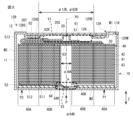
- FIG. 2 is a cross-sectional view showing the configuration of the secondary battery shown in FIG. 1;
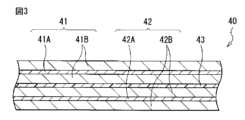
- FIG. 3 is a cross-sectional view showing the configuration of the battery element shown in FIG. 2;
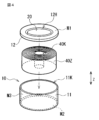
- FIG. 2 is a perspective view showing the configuration of an outer can used in the manufacturing process of a secondary battery;
- FIG. 2 is a cross-sectional view showing the configuration of a secondary battery as a reference example;
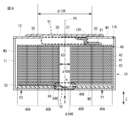
- 3 is a cross-sectional view showing the configuration of a secondary battery of Modification 1.
- FIG. 10 is a cross-sectional view showing the configuration of a secondary battery of Modification 2.
- FIG. FIG. 11 is a cross-sectional view showing the configuration of a secondary battery of Modification 3;
- the secondary battery described here has a flat and columnar three-dimensional shape, and is called a so-called coin type or button type. As will be described later, this secondary battery has a pair of bottom portions facing each other and a side wall portion located between the pair of bottom portions. It's getting smaller.
- the "outer diameter” is the diameter (maximum diameter) of each of the pair of bottoms
- the “height” is the distance (maximum distance) from the surface of one bottom to the surface of the other bottom.
- the direction connecting one bottom portion and the other bottom portion is defined as the height direction Z. As shown in FIG.
- This secondary battery includes an electrolyte together with a positive electrode and a negative electrode.
- the charge capacity of the negative electrode is larger than the discharge capacity of the positive electrode in order to prevent electrode reactants from depositing on the surface of the negative electrode during charging. That is, the electrochemical capacity per unit area of the negative electrode is set to be larger than the electrochemical capacity per unit area of the positive electrode.
- the type of electrode reactant is not particularly limited, but specifically light metals such as alkali metals and alkaline earth metals.
- Alkali metals include lithium, sodium and potassium
- alkaline earth metals include beryllium, magnesium and calcium.
- lithium ion secondary battery A secondary battery whose battery capacity is obtained by utilizing the absorption and release of lithium is a so-called lithium ion secondary battery.
- lithium ion secondary battery lithium is intercalated and deintercalated in an ionic state.
- FIG. 1 shows a perspective configuration of a secondary battery.
- FIG. 2 shows a cross-sectional configuration of the secondary battery shown in FIG.
- FIG. 3 shows a cross-sectional configuration of the battery element 40 shown in FIG.
- FIG. 3 only a part of the cross-sectional structure of the battery element 40 is enlarged.
- the secondary battery described here has a three-dimensional shape in which the height H is smaller than the outer diameter D, that is, a flat and columnar three-dimensional shape.
- the three-dimensional shape of the secondary battery is flat and cylindrical (columnar).
- the vertical direction of each of FIGS. 1 and 2 is defined as the height direction Z.
- the height H means the dimension in the height direction Z of the secondary battery of this embodiment.
- the outer diameter D means the dimension in the direction orthogonal to the height direction Z in the secondary battery of this embodiment.
- the dimensions of the secondary battery are not particularly limited, but for example, the outer diameter D is 3 mm to 30 mm and the height H is 0.5 mm to 70 mm. However, the ratio of the outer diameter D to the height H (D/H) is greater than one. Although the upper limit of this ratio (D/H) is not particularly limited, it is preferably 25 or less.
- This secondary battery includes an outer can 10, an external terminal 20, a battery element 40, and a positive electrode lead 51, as shown in FIGS.
- the secondary battery further includes a gasket 30 , a negative electrode lead 52 , a sealant 61 and insulating films 62 , 63 , 64 .
- the outer can 10 is a hollow outer member that houses the battery element 40 and the like.
- the outer can 10 is made of a conductive material.
- the outer can 10 has a flat and cylindrical three-dimensional shape according to the three-dimensional shape of the secondary battery, which is flat and cylindrical. Therefore, the outer can 10 has a pair of bottom portions M1 and M2 facing each other and a side wall portion M3 positioned between the bottom portions M1 and M2. An upper end portion of the side wall portion M3 is connected to the bottom portion M1, and a lower end portion of the side wall portion M3 is connected to the bottom portion M2.
- the outer can 10 since the outer can 10 has a columnar shape, the planar shapes of the bottoms M1 and M2 are circular, and the surface of the side wall M3 is a convex curved surface.
- the outer can 10 also includes a storage portion 11 and a lid portion 12 that are welded together. That is, the internal space of the outer can 10 is sealed by welding the lid portion 12 to the storage portion 11 .
- the storage part 11 is a flat and columnar storage member that stores the battery element 40 and the like inside.
- the storage part 11 has a hollow structure with an open upper end and a closed lower end. That is, the storage portion 11 has an opening portion 11K at the upper end as an insertion port through which the battery element 40 can be inserted in the height direction Z. As shown in FIG.
- the lid portion 12 is a substantially disk-shaped lid member that closes the opening portion 11K of the storage portion 11, and has a through hole 12K.
- the through-hole 12K has an inner diameter of ⁇ 12K.
- Through-hole 12K is used as a connection path for connecting battery element 40 and external terminal 20 to each other.
- the outer edge of the lid portion 12 is welded to the opening portion 11K of the storage portion 11 as described above.
- An external terminal 20 is attached to the lid portion 12 via a gasket 30 . That is, the lid portion 12 supports the external terminals 20 via the gaskets 30 .
- the external terminal 20 is attached to the lid portion 12 via a gasket 30 so as to block the through hole 12K.
- the external terminal 20 is electrically insulated from the outer can 10 .
- the lid portion 12 is welded to the housing portion 11 as described above.
- the opening 11K is closed by the lid 12 as described above. Therefore, even if the external appearance of the secondary battery is seen, it may not be possible to confirm whether or not the storage portion 11 has the opening 11K.
- the lid portion 12 is welded to the storage portion 11 , welding marks remain on the surface of the outer can 10 , more specifically, on the boundary between the storage portion 11 and the lid portion 12 . Based on the presence or absence of the welding mark, it can be confirmed after the fact whether the storage portion 11 has the opening portion 11K.
- the lid portion 12 is bent so as to partially protrude along the height direction Z toward the interior of the storage portion 11, forming a recess portion 12H. That is, when viewed from the outside of the outer can 10 , the lid portion 12 has a shape that is partially recessed in the height direction Z toward the battery element 40 housed inside the outer can 10 .
- the recessed portion 12H includes a through-hole 12K penetrating in the height direction Z, a bottom portion 12HB surrounding the through-hole 12K along a horizontal plane perpendicular to the height direction Z, and a wall portion erected along the outer edge of the bottom portion 12HB. 12HW.
- a portion of the lid portion 12 other than the recessed portion 12H is a peripheral portion 12R.
- the peripheral portion 12R has an annular shape surrounding the recessed portion 12H in a horizontal plane orthogonal to the height direction Z of the secondary battery.
- the peripheral portion 12R is a portion that surrounds the recessed portion 12H and protrudes away from the battery element 40 along the height direction Z.
- the surface 12HS of the bottom portion 12HB of the recessed portion 12H is positioned lower toward the interior of the storage portion 11 than the surface 12RS of the peripheral portion 12R. That is, in the height direction Z, the distance between the surface 12HS of the bottom portion 12HB of the recessed portion 12H and the battery element 40 is shorter than the distance between the surface 12RS of the peripheral portion 12R and the battery element 40 .
- the shape of the recessed portion 12H in plan view that is, the shape defined by the outer edge of the recessed portion 12H when the secondary battery is viewed from above is not particularly limited.
- the planar view shape of the recessed portion 12H is substantially circular.
- the inner diameter and depth of the recessed portion 12H are not particularly limited, and can be set arbitrarily.
- the recessed portions are arranged such that the height position of the surface 20S of the external terminals 20 is lower than the height position of the surface 12RS of the peripheral portion 12R. A depth of 12H is set.
- the outer can 10 is a so-called welded can in which the storage portion 11 and the lid portion 12, which are physically separated from each other, are welded together.
- the armored can 10 after welding is a single member that is physically integrated as a whole, and thus cannot be separated into the storage portion 11 and the lid portion 12 after the fact.
- the outer can 10 which is a welded can, is a so-called crimpless can that is different from a crimped can formed using caulking. This is because the energy density per unit volume increases because the element space volume increases inside the outer can 10 .
- This “element space volume” is the volume (effective volume) of the internal space of the outer can 10 that can be used to house the battery element 40 .
- the armored can 10 which is a welded can, does not have a portion in which two or more members overlap each other, and does not have a portion in which two or more members overlap each other.
- Does not have a portion folded over means that the outer can 10 is not processed (bent) so that a part of the outer can 10 is folded over. Further, “not having a portion where two or more members overlap each other” means that the outer can 10 is physically one member after the completion of the secondary battery. It literally means that it cannot be separated into two or more members. That is, the state of the outer can 10 in the secondary battery after completion is not a state in which two or more members are combined while overlapping each other so that they can be separated later.
- the outer can 10 has conductivity. Specifically, each of the storage portion 11 and the lid portion 12 has conductivity.
- the outer can 10 is electrically connected to the negative electrode 42 of the battery element 40 via the negative electrode lead 52 . Therefore, the outer can 10 also serves as an external connection terminal for the negative electrode 42 . Since the secondary battery of the present embodiment does not need to be provided with the external connection terminal of the negative electrode 42 separately from the outer can 10, the element space volume due to the presence of the external connection terminal of the negative electrode 42 is reduced. Decrease is suppressed. As a result, the element space volume increases, so the energy density per unit volume increases.
- the outer can 10 is a metal can containing one or more of conductive materials such as metallic materials and alloy materials.
- Conductive materials that make up the metal can include iron, copper, nickel, stainless steel, iron alloys, copper alloys and nickel alloys.
- the type of stainless steel is not particularly limited, but specific examples include SUS304 and SUS316.
- the material for forming the storage portion 11 and the material for forming the lid portion 12 may be the same as or different from each other.
- the lid portion 12 is insulated from the external terminal 20 as an external connection terminal of the positive electrode 41 via the gasket 30 . This is to prevent contact between the outer can 10, which is the external connection terminal of the negative electrode 42, and the external terminal 20, which is the external connection terminal of the positive electrode 41, that is, a short circuit.
- the external terminal 20 is a connection terminal that is connected to an electronic device when the secondary battery is mounted on the electronic device.
- the external terminal 20 is attached to and supported by the lid portion 12 of the outer can 10 as described above.
- the external terminal 20 is connected to the positive electrode 41 of the battery element 40 via the positive electrode lead 51 . Therefore, the external terminal 20 is also a terminal for external connection of the positive electrode 41 .
- the secondary battery is connected to an electronic device through the external terminal 20 as an external connection terminal for the positive electrode 41 and the outer can 10 as an external connection terminal for the negative electrode 42 . Therefore, the electronic device can operate using the secondary battery as a power source.
- the external terminal 20 is a flat, substantially plate-shaped member that extends along a horizontal plane perpendicular to the height direction Z of the secondary battery, and is arranged inside the recess 12H with a gasket 30 interposed therebetween.
- the external terminal 20 is insulated from the lid portion 12 via the gasket 30 .
- the height H1 of the surface 20S of the external terminal 20 faces the battery element 40 more than the height H2 of the surface 12RS of the peripheral portion 12R of the outer can 10. (H1 ⁇ H2). That is, the external terminal 20 is housed inside the recessed portion 12H so that the surface 20S, which is the upper end thereof, is recessed toward the battery element 40 from the surface 12RS.
- the surface 20S is lower than the surface 12RS in the height direction Z by a height DF.
- the height H1 of the surface 20S of the external terminal 20 is the height of the bottom M2 of the outer can 10, which is the lower surface of the secondary battery when the secondary battery is placed on a horizontal surface so that the height direction Z is the vertical direction. It is the vertical dimension from the outer surface M2S to the surface 20S of the external terminal 20 opposite to the battery element 40.
- the height H2 of the surface 12RS of the peripheral portion 12R of the outer can 10 is the same.
- the height H2 of the surface 12RS is the distance from the outer surface M2S of the bottom portion M2 of the outer can 10 to the peripheral portion 12R when the secondary battery is placed on a horizontal surface so that the height direction Z is the vertical direction. This is the vertical dimension up to the surface 12RS on the opposite side of the battery element 40.
- the height H of the secondary battery is smaller than in the case where external terminal 20 protrudes above lid portion 12 . Therefore, the energy density per unit volume of the secondary battery increases. In addition, it is possible to prevent a short circuit between the outer can 10 and the external terminal 20 via another conductive member.
- the peripheral portion of the external terminal 20 overlaps the bottom portion 12HB of the recessed portion 12H in the height direction Z.
- the mechanical strength of the secondary battery as a whole can be improved.
- the length along the horizontal plane orthogonal to the height direction Z in the overlapping portion between the external terminal 20 and the peripheral portion is preferably greater than the thickness of the external terminal 20 and greater than the thickness of the bottom portion 12HB.
- the gasket 30 is arranged only in part of the region between the external terminal 20 and the lid portion 12 (recessed portion 12H).
- the terminals 20 and the lid portion 12 are arranged only where they can contact each other.
- the gasket 30 is also provided between the inner wall surface of the wall portion 12HW of the recessed portion 12H and the outer edge 20T of the external terminal 20 .
- the lid portion 12 and the external terminal 20 are fixed with a gasket 30 .
- the external terminal 20 includes one or more of conductive materials such as metal materials and alloy materials, and the conductive materials are aluminum and aluminum alloys.
- the external terminals 20 may be made of a clad material. This clad material includes an aluminum layer and a nickel layer in order from the side closer to the gasket 30, and in the clad material, the aluminum layer and the nickel layer are roll-bonded to each other.
- the gasket 30 is an insulating member disposed between the outer can 10 (lid portion 12) and the external terminal 20, as shown in FIG. is fixed to This gasket 30 has a ring-shaped planar shape having a through hole at a location corresponding to the through hole 12K.
- Gasket 30 contains one or more of insulating materials such as insulating polymer compounds, and the insulating materials are resins such as polypropylene and polyethylene.
- the installation range of the gasket 30 is not particularly limited and can be set arbitrarily.
- the gasket 30 is arranged in the gap between the upper surface of the lid portion 12 and the lower surface of the external terminal 20 inside the recess portion 12H.
- the gasket 30 may also be provided between the inner wall surface of the wall portion 12HW of the recessed portion 12H and the outer edge 20T of the external terminal 20 .
- the battery element 40 is a power generation element that advances charge/discharge reactions, and is housed inside the outer can 10 .
- This battery element 40 includes a positive electrode 41 and a negative electrode 42 .
- the battery element 40 further includes a separator 43 and an electrolytic solution (not shown) that is a liquid electrolyte.
- the center line PC shown in FIG. 2 is a line segment corresponding to the center of the battery element 40 in the direction along the outer diameter D of the secondary battery (the outer can 10). That is, the position P of the center line PC corresponds to the center position of the battery element 40 .
- the battery element 40 is a so-called wound electrode body. That is, in the battery element 40 , the positive electrode 41 and the negative electrode 42 are stacked with the separator 43 interposed therebetween. Further, the laminated positive electrode 41, negative electrode 42 and separator 43 are wound. The positive electrode 41 and the negative electrode 42 are wound while facing each other with the separator 43 interposed therebetween. Therefore, at the center of the battery element 40, a winding center space 40K is formed as an internal space.
- the winding center space 40K has an inner diameter ⁇ 40K.
- the battery element 40 has an outer peripheral portion 40A and an inner peripheral portion 40B located inside the outer peripheral portion 40A. 40 A of outer peripheral parts are parts pinched
- the inner peripheral portion 40B is located between the winding center space 40K and the outer peripheral portion 40A, and faces the through hole 12K in the height direction Z. Therefore, the inner diameter ⁇ 40K of the winding center space 40K is smaller than the inner diameter ⁇ 12K of the through hole 12K, and the winding center space 40K exists within the region where the through hole 12K is projected in the height direction Z.
- the positive electrode 41, the negative electrode 42, and the separator 43 are wound such that the separator 43 is arranged on the outermost circumference and the innermost circumference of the wound electrode body, respectively.
- the number of turns of each of the positive electrode 41, the negative electrode 42 and the separator 43 is not particularly limited and can be set arbitrarily.
- the battery element 40 has a three-dimensional shape that matches the three-dimensional shape of the outer can 10 .
- the battery element 40 has a flat and cylindrical three-dimensional shape.
- a so-called dead space specifically Ultimately, it becomes difficult for a gap to occur between the outer can 10 and the battery element 40 . Therefore, the internal space of the outer can 10 is effectively utilized. As a result, the element space volume increases, and the energy density per unit volume of the secondary battery increases.
- the positive electrode 41 is a first electrode that is used to advance charge/discharge reactions, and includes a positive electrode current collector 41A and a positive electrode active material layer 41B, as shown in FIG.
- the positive electrode current collector 41A has a pair of surfaces on which the positive electrode active material layer 41B is provided.
- This positive electrode current collector 41A contains a conductive material such as a metal material, and the metal material is aluminum or the like.
- the positive electrode active material layer 41B is provided on both sides of the positive electrode current collector 41A and contains one or more of positive electrode active materials capable of intercalating and deintercalating lithium.
- the cathode active material layer 41B may be provided only on one side of the cathode current collector 41A.
- the positive electrode active material layer 41B may further contain a positive electrode binder, a positive electrode conductive agent, and the like.
- a method for forming the positive electrode active material layer 41B is not particularly limited, but a specific example is a coating method.
- the positive electrode active material contains a lithium compound.
- This lithium compound is a general term for compounds containing lithium as a constituent element, and more specifically, a compound containing lithium and one or more transition metal elements as constituent elements. This is because a high energy density can be obtained.
- the lithium compound may further contain one or more of other elements (excluding lithium and transition metal elements).
- the type of lithium compound is not particularly limited, but specific examples include oxides, phosphoric acid compounds, silicic acid compounds and boric acid compounds. Specific examples of oxides are LiNiO 2 , LiCoO 2 and LiMn 2 O 4 , and specific examples of phosphoric acid compounds are LiFePO 4 and LiMnPO 4 .
- the positive electrode binder contains one or more of synthetic rubber and polymer compounds.
- the synthetic rubber is styrene-butadiene rubber and the like, and the polymer compound is polyvinylidene fluoride and the like.
- the positive electrode conductive agent contains one or more of conductive materials such as carbon materials, such as graphite, carbon black, acetylene black, and ketjen black.
- the conductive material may be a metal material, a polymer compound, or the like.
- the negative electrode 42 is a second electrode that is used to promote charge-discharge reactions, and as shown in FIG. 3, includes a negative electrode current collector 42A and a negative electrode active material layer 42B.
- the negative electrode current collector 42A has a pair of surfaces on which the negative electrode active material layer 42B is provided.
- This negative electrode current collector 42A contains a conductive material such as a metal material, and the metal material is copper or the like.
- the negative electrode active material layer 42B is provided on both sides of the negative electrode current collector 42A and contains one or more of negative electrode active materials capable of intercalating and deintercalating lithium. However, the negative electrode active material layer 42B may be provided only on one side of the negative electrode current collector 42A. Moreover, the negative electrode active material layer 42B may further contain a negative electrode binder, a negative electrode conductive agent, and the like. The details of the negative electrode binder and the negative electrode electrical conductor are the same as the details of the positive electrode binder and the positive electrode electrical conductor.
- the method of forming the negative electrode active material layer 42B is not particularly limited, but specifically, any one of a coating method, a vapor phase method, a liquid phase method, a thermal spraying method, a firing method (sintering method), and the like, or Two or more types.
- the negative electrode active material contains one or both of a carbon material and a metal-based material. This is because a high energy density can be obtained.
- Carbon materials include graphitizable carbon, non-graphitizable carbon and graphite (natural graphite and artificial graphite).
- a metallic material is a material containing as constituent elements one or more of metallic elements and semi-metallic elements capable of forming an alloy with lithium, and the metallic and semi-metallic elements are silicon and one or both of the tins, and so on.
- the metallic material may be a single substance, an alloy, a compound, a mixture of two or more of them, or a material containing two or more phases thereof. Specific examples of metallic materials include TiSi 2 and SiOx (0 ⁇ x ⁇ 2 or 0.2 ⁇ x ⁇ 1.4).
- the height of the negative electrode 42 is greater than the height of the positive electrode 41 . That is, the negative electrode 42 protrudes upward from the positive electrode 41 and protrudes downward from the positive electrode 41 . This is to prevent deposition of lithium released from the positive electrode 41 .
- This "height" is a dimension corresponding to the height H of the secondary battery described above, that is, a vertical dimension in each of FIGS. 1 and 2 . The definition of height explained here is also the same hereafter.
- the separator 43 is an insulating porous film placed between the positive electrode 41 and the negative electrode 42, as shown in FIGS.
- the separator 43 allows lithium ions to pass through while preventing a short circuit between the positive electrode 41 and the negative electrode 42 .
- Separator 43 contains a polymer compound such as polyethylene.
- the height of the separator 43 is greater than the height of the negative electrode 42 . That is, the separator 43 preferably protrudes above the negative electrode 42 and protrudes below the negative electrode 42 . This is because the separator 43 is used to insulate the positive electrode lead 51 from the negative electrode 42 as will be described later.
- the electrolyte is impregnated in each of the positive electrode 41, the negative electrode 42 and the separator 43, and contains a solvent and an electrolyte salt.
- the solvent contains one or more of non-aqueous solvents (organic solvents) such as a carbonate-based compound, a carboxylic acid ester-based compound, and a lactone-based compound, and includes the non-aqueous solvent.
- the electrolytic solution is a so-called non-aqueous electrolytic solution.
- the electrolyte salt contains one or more of light metal salts such as lithium salts.
- the positive electrode lead 51 is accommodated inside the outer can 10 as shown in FIG.
- the positive electrode lead 51 is a connection wiring connected to the positive electrode 41 and the external terminal 20 respectively.
- the secondary battery shown in FIG. 2 has one positive electrode lead 51 .
- the secondary battery may have two or more positive electrode leads 51 .
- the positive electrode lead 51 is connected to the upper end of the positive electrode 41 . Specifically, the positive electrode lead 51 is connected to the upper end portion of the positive electrode current collector 41A. Also, the positive electrode lead 51 is connected to the lower surface of the external terminal 20 via a through hole 12K provided in the lid portion 12 .
- a method of connecting the positive electrode lead 51 is not particularly limited, but specifically, one or more of welding methods such as resistance welding and laser welding are used. The details of the welding method described here are the same hereinafter.
- a portion of the positive electrode lead 51 is electrically insulated from the lid portion 12 of the outer can 10 and the negative electrode 42 of the battery element 40, and is sandwiched between the lid portion 12 and the battery element 40 in the height direction of the secondary battery. It's like As shown in FIG. 2 , the positive lead 51 includes a first portion 511 , a second portion 512 and a folded portion 513 .
- the first portion 511 and the second portion 512 extend along a horizontal plane perpendicular to the height direction Z of the secondary battery. Also, the first portion 511 and the second portion 512 overlap each other in the height direction Z of the secondary battery with the sealant 61 interposed therebetween.
- the folded portion 513 is curved to connect the first portion 511 and the second portion 512 .
- the first portion 511 and the second portion 512 are sandwiched between the battery element 40 and the projecting portion 12P of the lid portion 12 in the height direction Z of the secondary battery.
- the positive electrode lead 51 is held by the lid portion 12 and the battery element 40 by extending along the lower surface of the lid portion 12 and the upper surface of the battery element 40 . Therefore, the positive electrode lead 51 is fixed inside the outer can 10 . Since the positive electrode lead 51 becomes difficult to move even when the secondary battery receives external force such as vibration and shock, the positive electrode lead 51 is less likely to be damaged.
- the breakage of the positive electrode lead 51 as used herein means that the positive electrode lead 51 is cracked, that the positive electrode lead 51 is cut, or that the positive electrode lead 51 falls off from the positive electrode 41 .
- a part of the positive electrode lead 51 sandwiched between the outer can 10 and the battery element 40 means that the positive electrode lead 51 is insulated from the outer can 10 and the battery element 40 while being insulated from the outer can 10 and the battery element 40 . Since the positive electrode lead 51 is held from above and below by , it means that the positive electrode lead 51 is difficult to move inside the outer can 10 even if the secondary battery receives an external force such as vibration or impact.
- the fact that the positive electrode lead 51 is hard to move inside the outer can 10 means that the battery element 40 is also hard to move inside the outer can 10 . Therefore, when the secondary battery is subjected to vibration or impact, it is possible to prevent problems such as collapse of the winding of the battery element 40, which is the wound electrode body.
- the positive electrode lead 51 preferably bites into the battery element 40 due to being pressed by the battery element 40 . More specifically, as described above, the height of the separator 43 is greater than the height of each of the positive electrode 41 and the negative electrode 42, so the positive electrode lead 51 digs into the upper end portion of the separator 43. is preferred. In this case, a depressed portion is formed in the upper end portion of the separator 43 due to the pressure of the positive electrode lead 51 . Since part or all of the positive electrode lead 51 is accommodated inside the recessed portion, the positive electrode lead 51 is held by the separator 43 . This is because the positive electrode lead 51 is more difficult to move inside the outer can 10, and thus the positive electrode lead 51 is less likely to be damaged.
- the lid portion 12 includes the protruding portion 12P, and a portion of the positive electrode lead 51 is sandwiched between the protruding portion 12P and the battery element 40. That is, a portion of positive electrode lead 51 is held by protrusion 12P and battery element 40 by extending along the lower surface of protrusion 12P and the upper surface of battery element 40, respectively. Since the positive electrode lead 51 is more easily held by using the projecting portion 12P, the positive electrode lead 51 is less likely to be damaged.
- a portion of the positive electrode lead 51 is insulated from the lid portion 12 and the negative electrode 42 via the separator 43, the sealant 61, and the insulating films 62, 63, respectively.
- the height of the separator 43 is greater than the height of the negative electrode 42 .
- part of the positive electrode lead 51 is separated from the negative electrode 42 via the separator 43 , and thus is insulated from the negative electrode 42 via the separator 43 . This is because a short circuit between the positive electrode lead 51 and the negative electrode 42 is prevented.
- the positive electrode lead 51 is covered with an insulating sealant 61 .
- a portion of the positive electrode lead 51 is insulated from each of the lid portion 12 and the negative electrode 42 via the sealant 61 . This is because a short circuit between the positive electrode lead 51 and the lid portion 12 is prevented, and a short circuit between the positive electrode lead 51 and the negative electrode 42 is also prevented.
- An insulating film 62 is arranged between the lid portion 12 and the positive electrode lead 51 . As a result, a portion of the positive electrode lead 51 is insulated from the lid portion 12 via the insulating film 62 . This is because a short circuit between the positive electrode lead 51 and the lid portion 12 is prevented.
- an insulating film 63 is arranged between the battery element 40 and the positive electrode lead 51 . Thereby, part of the positive electrode lead 51 is insulated from the negative electrode 42 via the insulating film 63 . This is because a short circuit between the positive electrode lead 51 and the negative electrode 42 is prevented.
- the details of the material forming the positive electrode lead 51 are the same as the details of the material forming the positive electrode current collector 41A. However, the material for forming the positive electrode lead 51 and the material for forming the positive electrode current collector 41A may be the same as or different from each other.
- the positive electrode lead 51 is connected to the positive electrode 41 in a region in front of the center line PC, that is, in a region on the right side of the center line PC in FIG.
- the positive electrode lead 51 has a folded portion 513 on the way to the external terminal 20 in order to be connected to the external terminal 20 .
- the folded portion 513 exists in a region behind the center line PC, that is, in a region on the left side of the center line PC in FIG.
- the positive electrode lead 51 has a first portion 511 as a portion extending from the portion connected to the positive electrode 41 through the center position P to the folded portion 513 .
- the first portion 511 extends in a direction orthogonal to the height direction Z along the upper surface of the battery element 40 .
- the positive electrode lead 51 has a second portion 512 as a portion on the way from the folded portion 513 to the portion connected to the external terminal 20 .
- the second portion 512 extends in a direction orthogonal to the height direction Z along the upper surface of the battery element 40 so as to cover the first portion 511 .
- a portion of the positive electrode lead 51 extends toward the external terminal 20 while being sandwiched between the lid portion 12 and the battery element 40 in both the region in front of the center line PC and the region behind the center line PC. extended.
- the “region in front of the center line PC” refers to two regions in the case where the battery element 40 is divided into two regions with the center line PC as a reference in the direction along the outer diameter D. , where the connection point of the positive electrode lead 51 to the positive electrode 41 is present.
- the “region in front of the center line PC” is the region on the right side of the center line PC.
- the “region behind the center line PC” is, as is clear from FIG. 2, the other of the two regions described above, and in FIG. area. That is, the “region behind the center line PC” refers to the connection point of the positive electrode lead 51 to the positive electrode 41 when the battery element 40 is divided into two regions with reference to the center line PC in the direction along the outer diameter D. is the other region where is absent.
- connection position of the positive electrode lead 51 to the positive electrode 41 is not particularly limited and can be set arbitrarily. Above all, it is preferable that the positive electrode lead 51 is connected to the positive electrode 41 on the inner peripheral side of the outermost periphery of the positive electrode 41 . This is because, unlike the case where the positive electrode lead 51 is connected to the positive electrode 41 at the outermost periphery of the positive electrode 41, corrosion of the outer can 10 due to the electrolyte solution creeping up is prevented.
- This “climbing up of the electrolyte” means that when the positive electrode lead 51 is arranged close to the inner wall surface of the outer can 10 , the electrolyte in the battery element 40 crawls up the positive electrode lead 51 and moves inside the outer can 10 . to reach the wall. When the electrolyte comes into contact with the outer can 10 due to the "electrolyte creeping up", the outer can 10 dissolves or discolors.
- the positive electrode lead 51 is folded back once or more between the positive electrode 41 and the external terminal 20, it is folded over once or more.
- the number of folds of the positive electrode lead 51 is not particularly limited as long as it is one or more times.
- This "positive electrode lead 51 is folded back" means that the extending direction of the positive electrode lead 51 changes so as to form an angle larger than 90° halfway.
- the folded portion of the positive electrode lead 51 preferably has a curved shape without bending, like the folded portion 513 .
- FIG. 2 illustrates the case where the positive electrode lead 51 includes one folded portion 513 , it may include a plurality of folded portions 513 .
- the positive electrode lead 51 is folded back at a folded portion 513 on the way from the positive electrode 41 to the external terminal 20 .
- the first portion 511 extends from a first position P1 other than the center position P of the outer can 10 to the center position in a horizontal plane perpendicular to the height direction of the secondary battery. It extends to a second position P2 on the opposite side of the first position P1 when viewed from above.
- the second portion 512 extends toward the central position P from the second position P2.
- the overlapping portion of the first portion 511 and the second portion 512 is a surplus portion. That is, it can be said that the positive electrode lead 51 has a length margin in its longitudinal direction.
- the outer can 10 when forming the outer can 10 using the storage portion 11 and the lid portion 12 in the manufacturing process of the secondary battery, it is possible to obtain a margin for changing the attitude of the lid portion 12 with respect to the storage portion 11 . . Further, when the secondary battery receives an external force such as vibration and impact, the external force is relieved by using the length margin of the positive electrode lead 51, so the positive electrode lead 51 is less likely to be damaged. Furthermore, by using the length margin of the positive electrode lead 51 , the connection position of the positive electrode lead 51 with respect to the positive electrode 41 can be arbitrarily changed without changing the length of the positive electrode lead 51 .
- the length of the positive electrode lead 51 (the overall length including the length margin) is not particularly limited and can be set arbitrarily.
- the length of the positive electrode lead 51 is preferably half or more of the outer diameter D of the outer can 10 . This is because a length margin for erecting the lid portion 12 with respect to the storage portion 11 is ensured with respect to the length of the positive electrode lead 51 , so that the lid portion 12 can be easily erected with respect to the storage portion 11 .
- connection range of the positive electrode lead 51 to the external terminal 20 is not particularly limited.
- the connection range of the positive electrode lead 51 to the external terminal 20 should be sufficiently wide to prevent the positive electrode lead 51 from falling off from the external terminal 20 and sufficiently narrow to provide a length margin for the positive electrode lead 51 .
- the reason why it is preferable that the connection range of the positive electrode lead 51 to the external terminal 20 is sufficiently narrow is that the portion of the positive electrode lead 51 that is not connected to the external terminal 20 has a length margin. is sufficiently large.
- the positive electrode lead 51 is provided separately from the positive electrode current collector 41A. However, since the positive electrode lead 51 is physically continuous with the positive electrode current collector 41A, it may be integrated with the positive electrode current collector 41A.
- the negative electrode lead 52 is accommodated inside the outer can 10 as shown in FIG.
- the negative electrode lead 52 is connected to each of the negative electrode 42 and the outer can 10 (accommodating portion 11).
- the secondary battery has one negative electrode lead 52 .
- the secondary battery may have two or more negative electrode leads 52 .
- the negative electrode lead 52 is connected to the lower end of the negative electrode 42, and more specifically, to the lower end of the negative electrode current collector 42A. Also, the negative electrode lead 52 is connected to the bottom surface of the housing portion 11 .
- the details of the connection method of the negative electrode lead 52 are the same as the details of the connection method of the positive electrode lead 51 .
- the details of the material forming the negative electrode lead 52 are the same as the details of the material forming the negative electrode current collector 42A. However, the material for forming the negative electrode lead 52 and the material for forming the negative electrode current collector 42A may be the same as or different from each other.
- connection position of the negative electrode lead 52 to the negative electrode 42 is not particularly limited and can be set arbitrarily.
- the negative electrode lead 52 is connected to the outermost peripheral portion of the negative electrode 42 that constitutes the wound electrode body.
- the negative electrode lead 52 is provided separately from the negative electrode current collector 42A. However, since the negative electrode lead 52 is physically continuous with the negative electrode current collector 42A, it may be integrated with the negative electrode current collector 42A.
- the sealant 61 is a first insulating member covering the periphery of the positive electrode lead 51, as shown in FIG. It is configured by attaching Here, the sealant 61 covers the midway portion of the positive electrode lead 51 in order to connect the positive electrode lead 51 to each of the positive electrode 41 and the external terminal 20 .
- the sealant 61 is not limited to having a tape-like structure, and may have a tube-like structure, for example.
- the sealant 61 contains one or more of insulating materials such as insulating polymer compounds, and the insulating material is polyimide or the like.
- the insulating film 62 is a first insulator arranged between the lid portion 12 and the positive electrode lead 51 in the height direction Z, as shown in FIG.
- the insulating film 62 has a ring-shaped planar shape having an opening 62K at a location corresponding to the through hole 12K in the height direction Z.
- the opening 62K has an inner diameter of ⁇ 62K.
- the inner diameter ⁇ 12K of the through hole 12K and the inner diameter ⁇ 62K of the opening 62K are preferably larger than the inner diameter ⁇ 40K of the winding center space 40K.
- the insulating film 62 may have an adhesive layer (not shown) on one surface, and may be adhered to either one of the lid portion 12 and the positive electrode lead 51 via the adhesive layer. Also, the insulating film 62 may have adhesive layers on both sides, and may be adhered to both the lid portion 12 and the positive electrode lead 51 via the adhesive layers.
- the insulating film 62 may contain one or more of insulating materials such as insulating polymer compounds.
- the insulating material included in the insulating film 62 is polyimide or the like.
- the insulating film 63 is a third insulating member arranged between the battery element 40 and the positive electrode lead 51, as shown in FIG.
- the insulating film 63 has a flat planar shape.
- the insulating film 63 is arranged so as to shield the winding central space 40K and cover the battery element 40 around the winding central space 40K.
- the details regarding the material for forming the insulating film 63 are the same as the details regarding the material for forming the insulating film 62 .
- the material forming the insulating film 63 and the material forming the insulating film 62 may be the same as or different from each other.
- the insulating film 64 is a second insulator provided between the bottom M2 and the battery element 40 in the height direction Z, as shown in FIG.
- the insulating film 64 has a ring-shaped planar shape having an opening 64K at a location corresponding to the through hole 12K in the height direction Z.
- the opening 64K has an inner diameter of ⁇ 64K.
- the inner diameter ⁇ 64K of the opening 64K is preferably larger than the inner diameter ⁇ 40K of the winding central space 40K. Accordingly, a portion of the inner peripheral portion 40B including the innermost peripheral portion of the battery element 40 is positioned in the height direction Z corresponding to the opening 64K.
- the details of the material forming the insulating film 64 are the same as the details of the material forming the insulating film 62 .
- the material forming the insulating film 64 and the material forming the insulating film 62 may be the same as or different from each other.
- the material forming the insulating film 64 and the material forming the insulating film 63 may be the same as or different from each other.
- the secondary battery may further include one or more other components.
- the secondary battery is equipped with a safety valve mechanism.
- This safety valve mechanism disconnects the electrical connection between the outer can 10 and the battery element 40 when the internal pressure of the outer can 10 reaches a certain level or higher.
- causes for the internal pressure of the outer can 10 to reach a certain level or higher include occurrence of a short circuit inside the secondary battery, external heating of the secondary battery, and the like.
- the installation location of the safety valve mechanism is not particularly limited, it is preferable that the safety valve mechanism is provided on either of the bottom portions M1 and M2, and is provided on the bottom portion M2 to which the external terminal 20 is not attached. more preferably.
- the secondary battery may have an insulator between the outer can 10 and the battery element 40 .
- This insulator includes one or more of an insulating film and an insulating sheet, and prevents a short circuit between the outer can 10 and the battery element 40 . Since the installation range of the insulator is not particularly limited, it can be set arbitrarily.
- the outer can 10 is provided with an open valve.
- This open valve opens when the internal pressure of the armored can 10 reaches a certain level or more, so that the internal pressure is released.
- the installation location of the open valve is not particularly limited, but, like the installation location of the safety valve mechanism described above, one of the bottoms M1 and M2 is preferable, and the bottom M2 is more preferable.
- FIG. 4 shows a perspective configuration of the outer can 10 used in the manufacturing process of the secondary battery, and corresponds to FIG.
- FIG. 4 shows a state in which the lid portion 12 is separated from the storage portion 11 before the lid portion 12 is welded to the storage portion 11.
- FIGS. 1 to 3 already described will be referred to as needed.
- the storage portion 11 is a substantially container-like member in which a bottom portion M2 and a side wall portion M3 are integrated with each other, and has an opening portion 11K.
- the lid portion 12 is a substantially plate-like member corresponding to the bottom portion M1, and external terminals 20 are attached in advance to recessed portions 12H provided in the lid portion 12 via gaskets 30 .
- the storage portion 11 may be formed by preparing a bottom portion M2 and a side wall portion M3 that are physically separated from each other, and welding the side wall portion M3 to the bottom portion M2.
- a positive electrode mixture is prepared by mixing a positive electrode active material, a positive electrode binder, a positive electrode conductive agent, and the like.
- a pasty positive electrode mixture slurry is prepared by putting the produced positive electrode mixture into an organic solvent or the like.
- the cathode active material layer 41B is formed by applying the cathode mixture slurry to both surfaces of the cathode current collector 41A.
- the cathode active material layer 41B is compression-molded using a roll press or the like. In this case, the positive electrode active material layer 41B may be heated, or the compression molding may be repeated multiple times. Thereby, the positive electrode 41 is produced.
- a negative electrode 42 is manufactured by a procedure similar to that of the positive electrode 41 . Specifically, a negative electrode mixture slurry obtained by mixing a negative electrode active material, a negative electrode binder, a negative electrode conductor, and the like is put into an organic solvent to prepare a pasty negative electrode mixture slurry, and then the negative electrode current collector 42A is prepared. The negative electrode active material layer 42B is formed by applying the negative electrode mixture slurry to both surfaces of the . After that, the negative electrode active material layer 42B is compression-molded using a roll press machine or the like. Thus, the negative electrode 42 is produced.
- the positive electrode lead 51 whose periphery is covered with the sealant 61 is connected to the positive electrode 41 (positive electrode current collector 41A), and the negative electrode lead 52 is connected to the negative electrode 42 (negative electrode collector). 42A).
- the stacked body including the positive electrode 41, the negative electrode 42 and the separator 43 is wound to form a wound body as shown in FIG. 40Z is produced.
- the wound body 40Z has the same configuration as the battery element 40, except that the positive electrode 41, the negative electrode 42, and the separator 43 are not impregnated with the electrolytic solution.
- illustration of each of the positive electrode lead 51 and the negative electrode lead 52 is omitted.
- the wound body 40Z to which the positive electrode lead 51 and the negative electrode lead 52 are respectively connected is stored inside the storage portion 11 through the opening 11K.
- a welding method such as resistance welding is used to connect the negative electrode lead 52 to the storage portion 11 .
- the insulating film 63 is placed on the wound body 40Z.
- the through hole 12K is formed by welding such as resistance welding.
- the positive electrode lead 51 is connected to the external terminal 20 via.
- the wound body 40Z (positive electrode 41) housed inside the housing portion 11 and the external terminal 20 attached to the lid portion 12 are connected to each other via the positive electrode lead 51.
- the electrolytic solution is injected into the storage portion 11 through the opening portion 11K.
- the lid portion 12 does not close the opening portion 11K.
- the electrolytic solution can be easily injected into the inside of 11 .
- the wound body 40Z including the positive electrode 41, the negative electrode 42, and the separator 43 is impregnated with the electrolytic solution, and the battery element 40, which is a wound electrode body, is produced.
- the lid portion 12 is used to close the opening portion 11K, and then the lid portion 12 is attached to the storage portion 11 using a welding method such as laser welding. to weld.
- a welding method such as laser welding. to weld.
- a portion of the positive electrode lead 51 is sandwiched between the lid portion 12 and the battery element 40, and the positive electrode lead 51 is curved in front of the connection to the external terminal 20. folded portion 513 is formed.
- the outer can 10 is formed, and the battery element 40 and the like are housed inside the outer can 10, thus completing the assembly of the secondary battery.
- the secondary battery after assembly is charged and discharged.
- Various conditions such as environmental temperature, number of charge/discharge times (number of cycles), and charge/discharge conditions can be arbitrarily set.
- a film is formed on the surface of the negative electrode 42 and the like, so that the state of the secondary battery is electrochemically stabilized.
- a secondary battery is completed.
- the inner peripheral portion 40B of the battery element 40 faces the through hole 12K of the lid portion 12 in the height direction Z.
- the inner diameter ⁇ 40K of the winding central space 40K is smaller than the inner diameter ⁇ 12K of the through hole 12K, so that the winding central space 40K exists within the area where the through hole 12K is projected in the height direction Z. . Therefore, as shown in FIG. 2, a space V1 is secured between the inner peripheral portion 40B of the battery element 40 and the external terminal 20. As shown in FIG.
- FIG. 5 is a cross-sectional schematic diagram enlarging a part of a secondary battery as a reference example.
- a storage portion 111 a lid portion 112
- an external terminal 120 a gasket 130 and a battery element 140 are shown.
- the lid portion 112 has a through hole 112K penetrating in the height direction Z.
- the battery element 140 is obtained by winding a laminate including a positive electrode 141, a separator 143 and a negative electrode 142 around a winding central space 40K, which is an internal space.
- the winding center space 140K has an inner diameter ⁇ 140K.
- the inner diameter ⁇ 112K of the through hole 112K is equal to or smaller than the inner diameter ⁇ 140K of the winding center space 140K.
- a secondary battery including a battery element 140 having a winding structure as shown in FIG. May protrude upwards.
- the upper end 140 ⁇ /b>E ⁇ b>1 of the innermost peripheral portion of the battery element 140 is pressed against the lower surface of the lid portion 112 . Therefore, the positive electrode and the negative electrode are crushed or bent near the upper end 140E1. As a result, there is concern that a short circuit may occur between the positive electrode and the negative electrode.
- the space V1 is secured between the inner peripheral portion 40B of the battery element 40 and the external terminal 20 as described above. Therefore, even if loose winding occurs in the battery element 40 due to vibration or the like as shown in FIG. It is possible to prevent the upper end from being pressed against the lower surface of the lid portion 12 or the lower surface of the external terminal 20 . Therefore, a short circuit between the positive electrode and the negative electrode can be avoided.
- an insulating film 64 having an opening 64K at a location corresponding to the through hole 12K in the height direction Z is provided between the battery element 40 and the bottom portion M2 of the housing portion 11. ing.
- the inner diameter ⁇ 64K of the opening 64K is larger than the inner diameter ⁇ 40K of the winding central space 40K. Therefore, as shown in FIG. 2, a space V2 is secured between a portion of the inner peripheral portion 40B including the innermost peripheral portion of the battery element 40 and the bottom portion M2.
- the lower end of a part of the inner peripheral portion 40B for example, the lower end of the portion corresponding to several turns including the innermost turn, does not reach the upper surface of the bottom portion M2. can avoid being forced into Therefore, a short circuit between the positive electrode and the negative electrode can be avoided.
- the recessed portion 12H includes a through-hole 12K penetrating in the height direction Z and a bottom portion 12HB surrounding the through-hole 12K along a horizontal plane perpendicular to the height direction Z. It overlaps in the height direction Z with the bottom portion 12HB of the portion 12H.
- the secondary battery of the present embodiment has an overlapping portion between the external terminal 20 and the lid portion 12, so that the mechanical strength of the secondary battery as a whole can be improved.
- the length of the overlapping portion of the external terminal 20 and the bottom portion 12HB along the horizontal plane orthogonal to the height direction Z is greater than the thickness of the external terminal 20 and greater than the thickness of the bottom portion 12HB. Therefore, the mechanical strength is further improved.
- a gasket 30 made of insulating resin is provided between the inner wall surface of the recessed portion 12H and the outer edge 20T of the external terminal 20 . Therefore, it is possible to prevent foreign matter from entering the gap between the inner wall surface of the recessed portion 12H and the outer edge 20T of the external terminal 20, thereby avoiding a short circuit between the lid portion 12 and the external terminal 20.
- lid portion 12 and external terminal 20 are fixed together by gasket 30 made of insulating resin. Therefore, the mechanical strength against vibration can be increased. It is possible to prevent the occurrence of a short circuit due to foreign matter entering the gap between the recessed portion 12 ⁇ /b>H and the external terminal 20 .
- the recessed portion 12H is provided in the lid portion 12, and the external terminal 20 is arranged in the recessed portion 12H. Therefore, the height dimension of the secondary battery can be reduced while ensuring the battery capacity.
- the folded portion 513 is positioned at the peripheral portion 12R of the lid portion 12, and the first portion 511 and the second portion 512 extend from the center position of the secondary battery toward the peripheral portion 12R. It extends in the radial direction of the secondary battery. Specifically, the first portion 511 extends from a first position P1 other than the center position P of the outer can 10 to a first position when viewed from the center position P within a horizontal plane perpendicular to the height direction Z of the secondary battery. It extends to a second position P2 on the opposite side of P1. The second portion 512 extends from the second position P2 toward the central position.
- the overlapping portion of the first portion 511 and the second portion 512 is sandwiched between the protruding portion 12P and the battery element 40 . Therefore, it is possible to secure a larger area where the first portion 511 contacts the battery element 40 via the sealant 61 and a larger area where the second portion 512 contacts directly or via the sealant 61 with the recessed portion 12H. Therefore, movement of the positive electrode lead 51 and the battery element 40 inside the outer can 10 is sufficiently restricted. Therefore, even if the secondary battery is subjected to impact or vibration, problems such as damage to the positive electrode lead 51 and collapse of the winding of the battery element 40 are less likely to occur. Therefore, the secondary battery of this embodiment can obtain excellent physical durability.
- the secondary battery of the present embodiment which is called a coin-shaped or button-shaped secondary battery, that is, a secondary battery having a flat and columnar three-dimensional shape, has a positive electrode 41 as shown in FIGS. It has a small external terminal 20 that functions as an external connection terminal. In this case, since the size of the external terminal 20 is small, the connection area of the positive electrode lead 51 with respect to the external terminal 20 is small. Accordingly, in order to maintain the electrical connection between the external terminal 20 and the positive lead 51 , the positive lead 51 needs to be sufficiently fixed inside the outer can 10 .
- the secondary battery of the present embodiment since the movement of the positive electrode lead 51 inside the outer can 10 is sufficiently suppressed, even if the connection area of the positive electrode lead 51 with respect to the external terminal 20 is small, the external terminal The possibility of the positive electrode lead 51 detaching from 20 or breaking of the positive electrode lead 51 is extremely low. Therefore, according to the secondary battery of the present embodiment, the electrical connection between the external terminal 20 and the positive electrode lead 51 can be maintained in good condition even when subjected to an external force such as vibration or impact. can. Therefore, according to the secondary battery of the present embodiment, high physical durability can be achieved even when miniaturized.
- the lid portion 12 of is arranged close to the external terminal 20 . That is, the lid portion 12 and the external terminal 20, which are two external connection terminals having different polarities, are close to each other. Therefore, in order to prevent a short circuit between the lid portion 12 and the external terminal 20 , it is desirable to sufficiently reduce the connection area of the positive electrode lead 51 to the external terminal 20 and keep the positive electrode lead 51 sufficiently away from the lid portion 12 .
- the secondary battery of the present embodiment since the movement of the positive electrode lead 51 inside the outer can 10 is sufficiently suppressed, even if the connection area of the positive electrode lead 51 with respect to the external terminal 20 is small, the external terminal The possibility of the positive electrode lead 51 detaching from 20 or breaking of the positive electrode lead 51 is extremely low. Therefore, according to the secondary battery of the present embodiment, the electrical connection between the external terminal 20 and the positive electrode lead 51 can be maintained in good condition even when subjected to an external force such as vibration or impact. can. Therefore, according to the secondary battery of the present embodiment, even when miniaturized, it is possible to prevent a short circuit between the lid portion 12 and the external terminal 20 and achieve high physical durability.
- the positive electrode lead 51 and the negative electrode 42 can be prevented from short-circuiting, a higher reliability can be obtained.
- the sealant 61 covers the periphery of the positive electrode lead 51 and a part of the positive electrode lead 51 is insulated from the outer can 10 and the negative electrode 42 via the sealant 61, the positive electrode lead 51 and the outer case are insulated from each other. A short circuit with the can 10 is prevented, and a short circuit between the positive electrode lead 51 and the negative electrode 42 is also prevented, so that higher reliability can be obtained.
- the positive electrode lead 51 is covered with the sealant 61, the following effects can be obtained. That is, when the positive electrode lead 51 is sandwiched between the outer can 10 and the battery element 40 with the sealant 61 interposed therebetween, a grip force is generated between the outer can 10 and the sealant 61, and a gripping force is generated between the battery element 40 and the sealant 61. grip force is generated. Thereby, the positive electrode lead 51 is easily held by the outer can 10 and the battery element 40 by utilizing the gripping force supplied to the positive electrode lead 51 through the sealant 61 . Accordingly, the positive electrode lead 51 is insulated from the outer can 10 and the negative electrode 42 via the sealant 61 . In addition, since the positive electrode lead 51 is more easily fixed inside the outer can 10 by using the sealant 61, even higher physical durability can be obtained.
- the insulating film 62 is arranged between the outer can 10 and the positive electrode lead 51 and a part of the positive electrode lead 51 is insulated from the outer can 10 via the insulating film 62, the positive electrode lead 51 and the outer can 10 are prevented from short-circuiting. Therefore, higher reliability can be obtained.
- the insulating film 63 is arranged between the battery element 40 and the positive electrode lead 51 and a part of the positive electrode lead 51 is insulated from the negative electrode 42 via the insulating film 63, the positive electrode lead 51 and the positive electrode lead 51 A short circuit with the negative electrode 42 is prevented. Therefore, higher reliability can be obtained.
- the outer can 10 includes the storage portion 11 and the lid portion 12 that are welded together, and the positive electrode lead 51 is folded once or more, a length margin of the positive electrode lead 51 is obtained. Therefore, it becomes possible to stand the lid part 12 against the storage part 11 particularly in the process of forming the outer can 10 among the manufacturing processes of the secondary battery. Therefore, it becomes easier to inject the electrolytic solution, and the connection position of the positive electrode lead 51 with respect to the positive electrode 41 can be arbitrarily changed, so that higher manufacturing easiness can be obtained.
- the secondary battery is flat and columnar, that is, if the secondary battery is a secondary battery called a coin type or a button type, the positive electrode lead can be used even in a small secondary battery that is greatly restricted in terms of size. Since 51 is less likely to break, a higher effect can be obtained in terms of physical durability.
- the secondary battery is a lithium-ion secondary battery, a sufficient battery capacity can be stably obtained by utilizing lithium absorption and release.
- FIG. 2 illustrates the case where the positive electrode lead 51 includes the first portion 511 and the second portion 512 provided so as to overlap each other in the height direction Z, and the folded portion 513 that connects them. It is not limited to this.
- the configuration of the secondary battery of Modification 1 of FIG. 6 is substantially the same as the configuration of the secondary battery of the embodiment shown in FIG. be.
- FIG. 7 shows a cross-sectional configuration of a secondary battery as Modification 2 of the above embodiment.
- the layout of the positive electrode lead 51 in the secondary battery of the present disclosure is not limited to those shown in FIGS. 2 and 6.
- FIG. 7 Like the secondary battery of Modification 2 shown in FIG. 7, the positive electrode lead 51 may have a folded portion at a position corresponding to the winding center space 40K in the height direction Z, for example. Since the space V1 is also secured in the secondary battery of Modification 2, it is possible to obtain the same effects as in the secondary battery of the above-described embodiment.
- FIG. 8 shows a cross-sectional configuration of a secondary battery as Modification 3 of the above embodiment.
- the lid portion 12 has a recessed portion 12H.
- the lid portion 12 may not have the recessed portion 12H.
- the inner peripheral portion 40B of the battery element 40 faces the through hole 12K of the lid portion 12 in the height direction Z. . That is, the inner diameter ⁇ 40K of the winding central space 40K is smaller than the inner diameter ⁇ 12K of the through hole 12K, so that the winding central space 40K exists within the area where the through hole 12K is projected in the height direction Z. . Therefore, as shown in FIG. 2, a space V1 is secured between the inner peripheral portion 40B of the battery element 40 and the external terminal 20. As shown in FIG. Therefore, the same effect as that of the secondary battery of the above embodiment can be obtained.
- the outer can is a welded can (crimpless can)
- the configuration of the outer can is not particularly limited, it may be a crimped can.
- this crimped can the storage part and the lid part which are separated from each other are crimped to each other through a gasket.
- the electrode reactant is lithium has been described, but the electrode reactant is not particularly limited.
- the electrode reactants may be other alkali metals such as sodium and potassium, or alkaline earth metals such as beryllium, magnesium and calcium, as described above.
- the electrode reactant may be other light metals such as aluminum.
Landscapes
- Chemical & Material Sciences (AREA)
- Chemical Kinetics & Catalysis (AREA)
- Electrochemistry (AREA)
- General Chemical & Material Sciences (AREA)
- Engineering & Computer Science (AREA)
- Manufacturing & Machinery (AREA)
- Sealing Battery Cases Or Jackets (AREA)
Priority Applications (2)
| Application Number | Priority Date | Filing Date | Title |
|---|---|---|---|
| JP2023554471A JP7816368B2 (ja) | 2021-10-11 | 2022-10-06 | 二次電池 |
| US18/589,660 US20240204236A1 (en) | 2021-10-11 | 2024-02-28 | Secondary battery |
Applications Claiming Priority (2)
| Application Number | Priority Date | Filing Date | Title |
|---|---|---|---|
| JP2021-167067 | 2021-10-11 | ||
| JP2021167067 | 2021-10-11 |
Related Child Applications (1)
| Application Number | Title | Priority Date | Filing Date |
|---|---|---|---|
| US18/589,660 Continuation US20240204236A1 (en) | 2021-10-11 | 2024-02-28 | Secondary battery |
Publications (1)
| Publication Number | Publication Date |
|---|---|
| WO2023063223A1 true WO2023063223A1 (ja) | 2023-04-20 |
Family
ID=85987697
Family Applications (1)
| Application Number | Title | Priority Date | Filing Date |
|---|---|---|---|
| PCT/JP2022/037491 Ceased WO2023063223A1 (ja) | 2021-10-11 | 2022-10-06 | 二次電池 |
Country Status (3)
| Country | Link |
|---|---|
| US (1) | US20240204236A1 (https=) |
| JP (1) | JP7816368B2 (https=) |
| WO (1) | WO2023063223A1 (https=) |
Citations (6)
| Publication number | Priority date | Publication date | Assignee | Title |
|---|---|---|---|---|
| JP2001229903A (ja) * | 2000-02-15 | 2001-08-24 | Sony Corp | 非水電解液電池及びその製造方法 |
| CN111416068A (zh) * | 2020-04-27 | 2020-07-14 | 惠州亿纬锂能股份有限公司 | 一种电子器件及其制作方法 |
| CN212434722U (zh) * | 2020-06-03 | 2021-01-29 | 珠海冠宇电池股份有限公司 | 扣式电池及电子设备 |
| US20210184184A1 (en) * | 2019-12-13 | 2021-06-17 | Samsung Sdi Co., Ltd. | Rechargeable battery |
| CN213716961U (zh) * | 2020-11-18 | 2021-07-16 | 江门市元熙科技有限公司 | 一种扣式电池 |
| WO2022209062A1 (ja) * | 2021-03-31 | 2022-10-06 | 株式会社村田製作所 | 二次電池 |
-
2022
- 2022-10-06 JP JP2023554471A patent/JP7816368B2/ja active Active
- 2022-10-06 WO PCT/JP2022/037491 patent/WO2023063223A1/ja not_active Ceased
-
2024
- 2024-02-28 US US18/589,660 patent/US20240204236A1/en active Pending
Patent Citations (6)
| Publication number | Priority date | Publication date | Assignee | Title |
|---|---|---|---|---|
| JP2001229903A (ja) * | 2000-02-15 | 2001-08-24 | Sony Corp | 非水電解液電池及びその製造方法 |
| US20210184184A1 (en) * | 2019-12-13 | 2021-06-17 | Samsung Sdi Co., Ltd. | Rechargeable battery |
| CN111416068A (zh) * | 2020-04-27 | 2020-07-14 | 惠州亿纬锂能股份有限公司 | 一种电子器件及其制作方法 |
| CN212434722U (zh) * | 2020-06-03 | 2021-01-29 | 珠海冠宇电池股份有限公司 | 扣式电池及电子设备 |
| CN213716961U (zh) * | 2020-11-18 | 2021-07-16 | 江门市元熙科技有限公司 | 一种扣式电池 |
| WO2022209062A1 (ja) * | 2021-03-31 | 2022-10-06 | 株式会社村田製作所 | 二次電池 |
Also Published As
| Publication number | Publication date |
|---|---|
| JPWO2023063223A1 (https=) | 2023-04-20 |
| US20240204236A1 (en) | 2024-06-20 |
| JP7816368B2 (ja) | 2026-02-18 |
Similar Documents
| Publication | Publication Date | Title |
|---|---|---|
| JP7272448B2 (ja) | 二次電池 | |
| JP7505550B2 (ja) | 二次電池 | |
| CN115552688B (zh) | 二次电池 | |
| CN116114094A (zh) | 二次电池 | |
| WO2022059338A1 (ja) | 二次電池 | |
| WO2022209059A1 (ja) | 二次電池およびその製造方法 | |
| JP7711758B2 (ja) | 二次電池 | |
| WO2022264526A1 (ja) | 二次電池 | |
| WO2022209061A1 (ja) | 二次電池 | |
| WO2022044628A1 (ja) | 二次電池 | |
| US20240356162A1 (en) | Secondary battery | |
| JP7276479B2 (ja) | 扁平型二次電池 | |
| JP7816368B2 (ja) | 二次電池 | |
| JP7800729B2 (ja) | 電池 | |
| WO2023026959A1 (ja) | 二次電池 | |
| JP7823762B2 (ja) | 二次電池 | |
| JP7632634B2 (ja) | 二次電池 | |
| WO2022059339A1 (ja) | 二次電池 | |
| JP7841651B2 (ja) | 電池ユニットおよび電池用配線ユニット | |
| JP7831691B2 (ja) | 二次電池 | |
| WO2022264822A1 (ja) | 二次電池 | |
| WO2023002807A1 (ja) | 二次電池 | |
| JP7552875B2 (ja) | 二次電池 | |
| JP2024015927A (ja) | 二次電池 | |
| WO2024053226A1 (ja) | 二次電池 |
Legal Events
| Date | Code | Title | Description |
|---|---|---|---|
| 121 | Ep: the epo has been informed by wipo that ep was designated in this application |
Ref document number: 22880918 Country of ref document: EP Kind code of ref document: A1 |
|
| ENP | Entry into the national phase |
Ref document number: 2023554471 Country of ref document: JP Kind code of ref document: A |
|
| NENP | Non-entry into the national phase |
Ref country code: DE |
|
| 122 | Ep: pct application non-entry in european phase |
Ref document number: 22880918 Country of ref document: EP Kind code of ref document: A1 |