WO2023054714A1 - 抗体および機能性物質の位置選択的なコンジュゲートまたはその塩、ならびにその製造に用いられる抗体誘導体および化合物またはそれらの塩 - Google Patents
抗体および機能性物質の位置選択的なコンジュゲートまたはその塩、ならびにその製造に用いられる抗体誘導体および化合物またはそれらの塩 Download PDFInfo
- Publication number
- WO2023054714A1 WO2023054714A1 PCT/JP2022/036852 JP2022036852W WO2023054714A1 WO 2023054714 A1 WO2023054714 A1 WO 2023054714A1 JP 2022036852 W JP2022036852 W JP 2022036852W WO 2023054714 A1 WO2023054714 A1 WO 2023054714A1
- Authority
- WO
- WIPO (PCT)
- Prior art keywords
- group
- formula
- salt
- residue
- represented
- Prior art date
- Legal status (The legal status is an assumption and is not a legal conclusion. Google has not performed a legal analysis and makes no representation as to the accuracy of the status listed.)
- Ceased
Links
Images


Classifications
-
- A—HUMAN NECESSITIES
- A61—MEDICAL OR VETERINARY SCIENCE; HYGIENE
- A61K—PREPARATIONS FOR MEDICAL, DENTAL OR TOILETRY PURPOSES
- A61K47/00—Medicinal preparations characterised by the non-active ingredients used, e.g. carriers or inert additives; Targeting or modifying agents chemically bound to the active ingredient
- A61K47/50—Medicinal preparations characterised by the non-active ingredients used, e.g. carriers or inert additives; Targeting or modifying agents chemically bound to the active ingredient the non-active ingredient being chemically bound to the active ingredient, e.g. polymer-drug conjugates
- A61K47/51—Medicinal preparations characterised by the non-active ingredients used, e.g. carriers or inert additives; Targeting or modifying agents chemically bound to the active ingredient the non-active ingredient being chemically bound to the active ingredient, e.g. polymer-drug conjugates the non-active ingredient being a modifying agent
- A61K47/68—Medicinal preparations characterised by the non-active ingredients used, e.g. carriers or inert additives; Targeting or modifying agents chemically bound to the active ingredient the non-active ingredient being chemically bound to the active ingredient, e.g. polymer-drug conjugates the non-active ingredient being a modifying agent the modifying agent being an antibody, an immunoglobulin or a fragment thereof, e.g. an Fc-fragment
- A61K47/6801—Drug-antibody or immunoglobulin conjugates defined by the pharmacologically or therapeutically active agent
- A61K47/6803—Drugs conjugated to an antibody or immunoglobulin, e.g. cisplatin-antibody conjugates
- A61K47/6811—Drugs conjugated to an antibody or immunoglobulin, e.g. cisplatin-antibody conjugates the drug being a protein or peptide, e.g. transferrin or bleomycin
-
- A—HUMAN NECESSITIES
- A61—MEDICAL OR VETERINARY SCIENCE; HYGIENE
- A61K—PREPARATIONS FOR MEDICAL, DENTAL OR TOILETRY PURPOSES
- A61K47/00—Medicinal preparations characterised by the non-active ingredients used, e.g. carriers or inert additives; Targeting or modifying agents chemically bound to the active ingredient
- A61K47/50—Medicinal preparations characterised by the non-active ingredients used, e.g. carriers or inert additives; Targeting or modifying agents chemically bound to the active ingredient the non-active ingredient being chemically bound to the active ingredient, e.g. polymer-drug conjugates
- A61K47/51—Medicinal preparations characterised by the non-active ingredients used, e.g. carriers or inert additives; Targeting or modifying agents chemically bound to the active ingredient the non-active ingredient being chemically bound to the active ingredient, e.g. polymer-drug conjugates the non-active ingredient being a modifying agent
- A61K47/68—Medicinal preparations characterised by the non-active ingredients used, e.g. carriers or inert additives; Targeting or modifying agents chemically bound to the active ingredient the non-active ingredient being chemically bound to the active ingredient, e.g. polymer-drug conjugates the non-active ingredient being a modifying agent the modifying agent being an antibody, an immunoglobulin or a fragment thereof, e.g. an Fc-fragment
- A61K47/6835—Medicinal preparations characterised by the non-active ingredients used, e.g. carriers or inert additives; Targeting or modifying agents chemically bound to the active ingredient the non-active ingredient being chemically bound to the active ingredient, e.g. polymer-drug conjugates the non-active ingredient being a modifying agent the modifying agent being an antibody, an immunoglobulin or a fragment thereof, e.g. an Fc-fragment the modifying agent being an antibody or an immunoglobulin bearing at least one antigen-binding site
-
- C—CHEMISTRY; METALLURGY
- C07—ORGANIC CHEMISTRY
- C07K—PEPTIDES
- C07K5/00—Peptides containing up to four amino acids in a fully defined sequence; Derivatives thereof
- C07K5/04—Peptides containing up to four amino acids in a fully defined sequence; Derivatives thereof containing only normal peptide links
- C07K5/10—Tetrapeptides
- C07K5/1021—Tetrapeptides with the first amino acid being acidic
-
- A—HUMAN NECESSITIES
- A61—MEDICAL OR VETERINARY SCIENCE; HYGIENE
- A61K—PREPARATIONS FOR MEDICAL, DENTAL OR TOILETRY PURPOSES
- A61K39/00—Medicinal preparations containing antigens or antibodies
- A61K39/395—Antibodies; Immunoglobulins; Immune serum, e.g. antilymphocytic serum
-
- A—HUMAN NECESSITIES
- A61—MEDICAL OR VETERINARY SCIENCE; HYGIENE
- A61K—PREPARATIONS FOR MEDICAL, DENTAL OR TOILETRY PURPOSES
- A61K47/00—Medicinal preparations characterised by the non-active ingredients used, e.g. carriers or inert additives; Targeting or modifying agents chemically bound to the active ingredient
- A61K47/50—Medicinal preparations characterised by the non-active ingredients used, e.g. carriers or inert additives; Targeting or modifying agents chemically bound to the active ingredient the non-active ingredient being chemically bound to the active ingredient, e.g. polymer-drug conjugates
- A61K47/51—Medicinal preparations characterised by the non-active ingredients used, e.g. carriers or inert additives; Targeting or modifying agents chemically bound to the active ingredient the non-active ingredient being chemically bound to the active ingredient, e.g. polymer-drug conjugates the non-active ingredient being a modifying agent
- A61K47/68—Medicinal preparations characterised by the non-active ingredients used, e.g. carriers or inert additives; Targeting or modifying agents chemically bound to the active ingredient the non-active ingredient being chemically bound to the active ingredient, e.g. polymer-drug conjugates the non-active ingredient being a modifying agent the modifying agent being an antibody, an immunoglobulin or a fragment thereof, e.g. an Fc-fragment
- A61K47/6801—Drug-antibody or immunoglobulin conjugates defined by the pharmacologically or therapeutically active agent
- A61K47/6803—Drugs conjugated to an antibody or immunoglobulin, e.g. cisplatin-antibody conjugates
- A61K47/68031—Drugs conjugated to an antibody or immunoglobulin, e.g. cisplatin-antibody conjugates the drug being an auristatin
-
- A—HUMAN NECESSITIES
- A61—MEDICAL OR VETERINARY SCIENCE; HYGIENE
- A61K—PREPARATIONS FOR MEDICAL, DENTAL OR TOILETRY PURPOSES
- A61K47/00—Medicinal preparations characterised by the non-active ingredients used, e.g. carriers or inert additives; Targeting or modifying agents chemically bound to the active ingredient
- A61K47/50—Medicinal preparations characterised by the non-active ingredients used, e.g. carriers or inert additives; Targeting or modifying agents chemically bound to the active ingredient the non-active ingredient being chemically bound to the active ingredient, e.g. polymer-drug conjugates
- A61K47/51—Medicinal preparations characterised by the non-active ingredients used, e.g. carriers or inert additives; Targeting or modifying agents chemically bound to the active ingredient the non-active ingredient being chemically bound to the active ingredient, e.g. polymer-drug conjugates the non-active ingredient being a modifying agent
- A61K47/68—Medicinal preparations characterised by the non-active ingredients used, e.g. carriers or inert additives; Targeting or modifying agents chemically bound to the active ingredient the non-active ingredient being chemically bound to the active ingredient, e.g. polymer-drug conjugates the non-active ingredient being a modifying agent the modifying agent being an antibody, an immunoglobulin or a fragment thereof, e.g. an Fc-fragment
- A61K47/6801—Drug-antibody or immunoglobulin conjugates defined by the pharmacologically or therapeutically active agent
- A61K47/6803—Drugs conjugated to an antibody or immunoglobulin, e.g. cisplatin-antibody conjugates
- A61K47/68037—Drugs conjugated to an antibody or immunoglobulin, e.g. cisplatin-antibody conjugates the drug being a camptothecin [CPT] or derivatives
-
- A—HUMAN NECESSITIES
- A61—MEDICAL OR VETERINARY SCIENCE; HYGIENE
- A61K—PREPARATIONS FOR MEDICAL, DENTAL OR TOILETRY PURPOSES
- A61K47/00—Medicinal preparations characterised by the non-active ingredients used, e.g. carriers or inert additives; Targeting or modifying agents chemically bound to the active ingredient
- A61K47/50—Medicinal preparations characterised by the non-active ingredients used, e.g. carriers or inert additives; Targeting or modifying agents chemically bound to the active ingredient the non-active ingredient being chemically bound to the active ingredient, e.g. polymer-drug conjugates
- A61K47/51—Medicinal preparations characterised by the non-active ingredients used, e.g. carriers or inert additives; Targeting or modifying agents chemically bound to the active ingredient the non-active ingredient being chemically bound to the active ingredient, e.g. polymer-drug conjugates the non-active ingredient being a modifying agent
- A61K47/68—Medicinal preparations characterised by the non-active ingredients used, e.g. carriers or inert additives; Targeting or modifying agents chemically bound to the active ingredient the non-active ingredient being chemically bound to the active ingredient, e.g. polymer-drug conjugates the non-active ingredient being a modifying agent the modifying agent being an antibody, an immunoglobulin or a fragment thereof, e.g. an Fc-fragment
- A61K47/6835—Medicinal preparations characterised by the non-active ingredients used, e.g. carriers or inert additives; Targeting or modifying agents chemically bound to the active ingredient the non-active ingredient being chemically bound to the active ingredient, e.g. polymer-drug conjugates the non-active ingredient being a modifying agent the modifying agent being an antibody, an immunoglobulin or a fragment thereof, e.g. an Fc-fragment the modifying agent being an antibody or an immunoglobulin bearing at least one antigen-binding site
- A61K47/6851—Medicinal preparations characterised by the non-active ingredients used, e.g. carriers or inert additives; Targeting or modifying agents chemically bound to the active ingredient the non-active ingredient being chemically bound to the active ingredient, e.g. polymer-drug conjugates the non-active ingredient being a modifying agent the modifying agent being an antibody, an immunoglobulin or a fragment thereof, e.g. an Fc-fragment the modifying agent being an antibody or an immunoglobulin bearing at least one antigen-binding site the antibody targeting a determinant of a tumour cell
-
- A—HUMAN NECESSITIES
- A61—MEDICAL OR VETERINARY SCIENCE; HYGIENE
- A61K—PREPARATIONS FOR MEDICAL, DENTAL OR TOILETRY PURPOSES
- A61K49/00—Preparations for testing in vivo
-
- A—HUMAN NECESSITIES
- A61—MEDICAL OR VETERINARY SCIENCE; HYGIENE
- A61P—SPECIFIC THERAPEUTIC ACTIVITY OF CHEMICAL COMPOUNDS OR MEDICINAL PREPARATIONS
- A61P35/00—Antineoplastic agents
-
- C—CHEMISTRY; METALLURGY
- C07—ORGANIC CHEMISTRY
- C07K—PEPTIDES
- C07K16/00—Immunoglobulins [IG], e.g. monoclonal or polyclonal antibodies
-
- C—CHEMISTRY; METALLURGY
- C07—ORGANIC CHEMISTRY
- C07K—PEPTIDES
- C07K16/00—Immunoglobulins [IG], e.g. monoclonal or polyclonal antibodies
- C07K16/18—Immunoglobulins [IG], e.g. monoclonal or polyclonal antibodies against material from animals or humans
- C07K16/32—Immunoglobulins [IG], e.g. monoclonal or polyclonal antibodies against material from animals or humans against translation products of oncogenes
-
- C—CHEMISTRY; METALLURGY
- C07—ORGANIC CHEMISTRY
- C07K—PEPTIDES
- C07K16/00—Immunoglobulins [IG], e.g. monoclonal or polyclonal antibodies
- C07K16/46—Hybrid immunoglobulins
-
- C—CHEMISTRY; METALLURGY
- C07—ORGANIC CHEMISTRY
- C07K—PEPTIDES
- C07K5/00—Peptides containing up to four amino acids in a fully defined sequence; Derivatives thereof
- C07K5/04—Peptides containing up to four amino acids in a fully defined sequence; Derivatives thereof containing only normal peptide links
- C07K5/08—Tripeptides
-
- C—CHEMISTRY; METALLURGY
- C07—ORGANIC CHEMISTRY
- C07K—PEPTIDES
- C07K7/00—Peptides having 5 to 20 amino acids in a fully defined sequence; Derivatives thereof
- C07K7/02—Linear peptides containing at least one abnormal peptide link
-
- C—CHEMISTRY; METALLURGY
- C07—ORGANIC CHEMISTRY
- C07K—PEPTIDES
- C07K7/00—Peptides having 5 to 20 amino acids in a fully defined sequence; Derivatives thereof
- C07K7/04—Linear peptides containing only normal peptide links
- C07K7/08—Linear peptides containing only normal peptide links having 12 to 20 amino acids
-
- C—CHEMISTRY; METALLURGY
- C07—ORGANIC CHEMISTRY
- C07K—PEPTIDES
- C07K2317/00—Immunoglobulins specific features
- C07K2317/20—Immunoglobulins specific features characterized by taxonomic origin
- C07K2317/24—Immunoglobulins specific features characterized by taxonomic origin containing regions, domains or residues from different species, e.g. chimeric, humanized or veneered
-
- C—CHEMISTRY; METALLURGY
- C07—ORGANIC CHEMISTRY
- C07K—PEPTIDES
- C07K2317/00—Immunoglobulins specific features
- C07K2317/50—Immunoglobulins specific features characterized by immunoglobulin fragments
- C07K2317/52—Constant or Fc region; Isotype
-
- C—CHEMISTRY; METALLURGY
- C07—ORGANIC CHEMISTRY
- C07K—PEPTIDES
- C07K2319/00—Fusion polypeptide
-
- C—CHEMISTRY; METALLURGY
- C07—ORGANIC CHEMISTRY
- C07K—PEPTIDES
- C07K5/00—Peptides containing up to four amino acids in a fully defined sequence; Derivatives thereof
- C07K5/04—Peptides containing up to four amino acids in a fully defined sequence; Derivatives thereof containing only normal peptide links
- C07K5/08—Tripeptides
- C07K5/0819—Tripeptides with the first amino acid being acidic
Definitions
- the present invention relates to regioselective conjugates of antibodies and functional substances or salts thereof, antibody derivatives and compounds used for their production, salts thereof, and the like.
- ADC antibody drug conjugates
- ADCs are produced by binding functional groups in the side chains of specific amino acid residues present in antibodies to drugs.
- Examples of such functional groups that are utilized in making ADCs are amino groups in the side chains of lysine residues present in antibodies.
- Several techniques have been reported as techniques for regioselectively modifying lysine groups in antibodies (e.g., lysine residues at positions 246/248, 288/290, or 317) (e.g., patent documents 1-4).
- the antibody and drug are linked via a linker.
- linkers in ADC there are various linkers in ADC.
- a dipeptide consisting of valine-citrulline (Val- Cit:VC structures) are present in an ADC used as an anticancer agent.
- linkers containing such dipeptides are stable in human plasma as shown in (A) below, cathepsins in lysosomes in human cancer cells are shown in (B) below.
- B recognizes the VC structure and cleaves the amide bond present on the carboxy-terminal side of citrulline. Therefore, an ADC having a linker containing such a dipeptide can release a drug in human cancer cells and exert its efficacy.
- ADCs with linkers containing dipeptides such as those described above are unstable in mouse plasma (Non-Patent Documents 1 and 2). This is because Ces1c, a carboxylase that recognizes the VC structure and cleaves the amide bond present on the carboxy-terminal side of citrulline, is present in mouse plasma. This is because it is cleaved in plasma. Therefore, the pharmacokinetics of ADCs having a linker containing a dipeptide as described above are significantly different between mice and humans. Therefore, in mice, there is a problem that it is difficult to evaluate drug efficacy in humans.
- ADCs were modified by modifying the linker (that is, spacer-VC structure-spacer). Stabilization has been attempted, and from this point of view, ADCs linking an antibody and a drug or its mimic via the linker have been reported. For example, the following has been reported as an ADC containing the linker in the side chain of the main chain, not in the main chain connecting the antibody and the drug or its mimic (Patent Document 5).
- Non-Patent Document 3 describes that the higher the hydrophobicity of ADC, the faster the plasma clearance, and that the hydrophobicity of ADC can be evaluated by HIC (Hydrophobic Interaction Chromatography)-HPLC. .
- An object of the present invention is to provide a conjugate or a salt thereof of an antibody and a functional substance having excellent desired properties while controlling the binding ratio between the antibody and the functional substance within a specific range.
- the side chain of the main chain that connects the antibody and the drug (or drug mimic) contains a linker with a specific structure in the side chain, and binds the immunoglobulin unit and the functional substance.
- (functional agent/immunoglobulin unit) in the desired range (1.5-2.5) have excellent properties.
- such regioselective conjugates or salts thereof exhibit excellent clearance (long residence time in the body), low aggregation rate (high monomer ratio), and high cleavability by cathepsin B (functional substances in human cells). ), and high stability in mouse plasma.
- Such a regioselective conjugate or a salt thereof has a hydrophilic group at or near the end of a side chain that is easily exposed on the surface of the conjugate molecule, so that the hydrophilicity of the entire molecule can be efficiently improved. In addition, it can exhibit excellent properties as described above.
- the present inventors also succeeded in developing antibody derivatives and compounds useful for producing such regioselective conjugates.
- the regioselective conjugates, antibody derivatives, and compounds of the present invention represented by structures such as Formulas (I)-(VII) are structural units represented by Formula (V), excluding X and Y It has the technical feature of sharing a partial structural unit.
- the present inventors have succeeded in developing a series of inventions having such technical features, and have completed the present invention.
- the prior art does not describe or suggest the chemical structure of the regioselective conjugates of the present invention and the relationship of such chemical structure to the superior properties as described above.
- the prior art also does not describe or suggest antibody derivatives and compounds of the present invention that can be used to make such regioselective conjugates.
- the present invention is as follows.
- the present invention provides a compound of formula (I):
- Ig refers to an immunoglobulin unit comprising two heavy chains and two light chains, and L It is regioselectively bound to 1
- HG represents a hydrophilic group or a monovalent group containing a hydrophilic group
- RA indicates the side chain of the valine residue
- RB represents the side chain of a citrulline residue or an alanine residue
- Ring A represents a divalent aromatic ring group optionally having a substituent
- R 1 and R 2 each independently represent a hydrogen atom or a monovalent group
- L 1 and L 2 each independently represent a divalent group
- D represents a functional substance
- the average ratio r of said bonds per two heavy chains is between 1.5 and 2.5.
- structural units represented by formula (I) are represented by formula (I'): [In the formula, Ig, R A , R B , ring A, R 1 , R 2 , L 1 , L 2 , D, and r are each the same as represented by formula (I); L HG represents a bond or a divalent group that may contain a hydrophilic group, R HG1 and R HG2 each independently represent a hydrogen atom, a hydrophilic group, or a monovalent group which may contain a hydrophilic group, At least one hydrophilic group is included at one or more sites selected from the group consisting of L HG , R HG1 and R HG2 . ] may be a structural unit.
- the present invention provides a compound of formula (II):
- Ig refers to an immunoglobulin unit comprising two heavy chains and two light chains, and L It is regioselectively bound to 1
- HG represents a hydrophilic group or a monovalent group containing a hydrophilic group
- RA indicates the side chain of the valine residue
- RB represents the side chain of a citrulline residue or an alanine residue
- Ring A represents a divalent aromatic ring group optionally having a substituent
- R 1 and R 2 each independently represent a hydrogen atom or a monovalent group
- L 1 and L 2 each independently represent a divalent group
- B2 represents a bioorthogonal functional group
- the average ratio r of said bonds per two heavy chains is between 1.5 and 2.5.
- structural units represented by formula (II) have the following formula (II'): [In the formula, Ig, R A , R B , ring A, R 1 , R 2 , L 1 , L 2 , B 2 , and r are each the same as represented by formula (II); L HG represents a bond or a divalent group that may contain a hydrophilic group, R HG1 and R HG2 each independently represent a hydrogen atom, a hydrophilic group, or a monovalent group which may contain a hydrophilic group, At least one hydrophilic group is included at one or more sites selected from the group consisting of L HG , R HG1 and R HG2 . ] may be a structural unit.
- the present invention provides a compound of formula (III):
- HG represents a hydrophilic group or a monovalent group containing a hydrophilic group
- RA indicates the side chain of the valine residue
- RB represents the side chain of a citrulline residue or an alanine residue
- Ring A represents a divalent aromatic ring group optionally having a substituent
- R 1 and R 2 each independently represent a hydrogen atom or a monovalent group
- L 1 and L 2 each independently represent a divalent group
- B 1 represents a bioorthogonal functional group
- D indicates a functional substance.
- HG represents a hydrophilic group or a monovalent group containing a hydrophilic group
- RA indicates the side chain of the valine residue
- RB represents the side chain of a citrulline residue or an alanine residue
- Ring A represents a divalent aromatic ring group optionally having a substituent
- R 1 and R 2 each independently represent a hydrogen atom or a monovalent group
- the compound represented by formula (III) has the following formula (III'): [In the formula, R A , R B , ring A, R 1 , R 2 , L 1 , L 2 , B 1 , and D are each the same as represented by formula (III); L HG represents a bond or a divalent group that may contain a hydrophilic group, R HG1 and R HG2 each independently represent a hydrogen atom, a hydrophilic group, or a monovalent group which may contain a hydrophilic group, At least one hydrophilic group is included at one or more sites selected from the group consisting of L HG , R HG1 and R HG2 . ] may be a compound represented by.
- the present invention provides an antibody derivatization reagent comprising a compound according to the third embodiment or a salt thereof.
- HG represents a hydrophilic group or a monovalent group containing a hydrophilic group
- RA indicates the side chain of the valine residue
- RB represents the side chain of a citrulline residue or an alanine residue
- Ring A represents a divalent aromatic ring group optionally having a substituent
- R 1 and R 2 each independently represent a hydrogen atom or a monovalent group
- L 1 and L 2 each independently represent a divalent group
- B 1 represents the first bioorthogonal functional group
- B2 represents a second bioorthogonal functional group.
- the compound represented by formula (IV) has the formula (IV'): [In the formula, R A , R B , ring A, R 1 , R 2 , L 1 , L 2 , B 1 and B 2 are each the same as represented by formula (IV); L HG represents a bond or a divalent group that may contain a hydrophilic group, R HG1 and R HG2 each independently represent a hydrogen atom, a hydrophilic group, or a monovalent group which may contain a hydrophilic group, At least one hydrophilic group is included at one or more sites selected from the group consisting of L HG , R HG1 and R HG2 . ] may be a compound represented by.
- the present invention provides an antibody or functional substance derivatization reagent comprising a compound or a salt thereof according to the fifth embodiment.
- the present invention provides the following formula (V): [In the formula, HG represents a hydrophilic group or a monovalent group containing a hydrophilic group, RA indicates the side chain of the valine residue; RB represents the side chain of a citrulline residue or an alanine residue, Ring A represents a divalent aromatic ring group optionally having a substituent, X and Y each independently represent a monovalent group. ] to provide a compound or a salt thereof.
- the compound represented by formula (V) below is represented by formula (V′) below:
- V′ [In the formula, R A , R B , rings A, X, and Y are each the same as represented by formula (V);
- L HG represents a bond or a divalent group that may contain a hydrophilic group
- R HG1 and R HG2 each independently represent a hydrogen atom, a hydrophilic group, or a monovalent group which may contain a hydrophilic group, At least one hydrophilic group is included at one or more sites selected from the group consisting of L HG , R HG1 and R HG2 .
- the present invention provides a compound of formula (VI): [In the formula, HG represents a hydrophilic group or a monovalent group containing a hydrophilic group, RA indicates the side chain of the valine residue; RB represents the side chain of a citrulline residue or an alanine residue, Ring A represents a divalent aromatic ring group optionally having a substituent, X represents a monovalent group, R 2 represents a hydrogen atom or a monovalent group, L 2 represents a divalent group, B2 denotes a bioorthogonal functional group. ] or a salt thereof having a bioorthogonal functional group.
- the compound represented by formula (VI) has the formula (VI'): [In the formula, R A , R B , ring A, and X are each the same as represented by formula (VI); L HG represents a bond or a divalent group that may contain a hydrophilic group, R HG1 and R HG2 each independently represent a hydrogen atom, a hydrophilic group, or a monovalent group which may contain a hydrophilic group, at least one hydrophilic group is contained at one or more sites selected from the group consisting of L HG , R HG1 and R HG2 ; R 2 represents a hydrogen atom or a monovalent group, L 2 represents a divalent group, B2 denotes a bioorthogonal functional group. ] may be a compound represented by.
- the present invention provides a compound of formula (VII): [In the formula, HG represents a hydrophilic group or a monovalent group containing a hydrophilic group, RA indicates the side chain of the valine residue; RB represents the side chain of a citrulline residue or an alanine residue, Ring A represents a divalent aromatic ring group optionally having a substituent, Y represents a monovalent group, R 1 represents a hydrogen atom or a monovalent group, L 1 represents a divalent group, B 1 represents a bioorthogonal functional group. ] or a salt thereof having a bioorthogonal functional group.
- the compound represented by formula (VII) has the formula (VII'): [In the formula, R A , R B , ring A, and Y are each the same as represented by formula (VII); L HG represents a bond or a divalent group that may contain a hydrophilic group, R HG1 and R HG2 each independently represent a hydrogen atom, a hydrophilic group, or a monovalent group which may contain a hydrophilic group, at least one hydrophilic group is contained at one or more sites selected from the group consisting of L HG , R HG1 and R HG2 ; R 1 represents a hydrogen atom or a monovalent group, L 1 represents a divalent group, B 1 represents a bioorthogonal functional group. ] may be a compound represented by.
- the immunoglobulin unit may be a human immunoglobulin unit.
- the human immunoglobulin unit may be a human IgG antibody.
- the lysine residue may be at positions 246/248, 288/290, or 317 according to Eu numbering.
- regioselective attachment may be achieved by an amide linkage through attachment of an amino group in the side chain of a lysine residue and a carbonyl group in L1 .
- r may range from 1.9 to 2.1.
- the hydrophilic group may be one or more groups selected from the group consisting of carboxylic acid groups, sulfonic acid groups, hydroxyl groups, polyethylene glycol groups, polysarcosine groups, and sugar moieties.
- ring A may be a phenylene group that may have a substituent.
- the functional substance may be a drug, labeling substance, or stabilizer.
- the regioselective conjugate or antibody derivative may exhibit an aggregation rate of 2.6% or less when analyzed by size exclusion chromatography.
- a plurality of R HG each independently represent a hydrogen atom, a hydrophilic group, or a monovalent group that may contain a hydrophilic group
- n1 is an integer from 0 to 3
- n2 is an integer of 0 or 1
- n3 is an integer of 0 or 1
- n4 is an integer of 0-3.
- the hydrophilic groups may each independently be a carboxylic acid group, a sulfonic acid group, or a hydroxyl group.
- the hydrophilic group may be a carboxylic acid group.
- the bioorthogonal functional group may be a maleimide residue, a thiol residue, a furan residue, a halocarbonyl residue, an alkene residue, an alkyne residue, an azide residue, or a tetrazine residue.
- the regioselective conjugate or salt thereof of the present invention has a long residence time in the body, a high monomer ratio (low aggregation rate), high ability to release functional substances in human cells, high stability in mouse plasma, etc. can have excellent properties of
- the antibody derivatives and compounds of the present invention, or salts thereof, and reagents are useful, for example, as synthetic intermediates in the production of the regioselective conjugates described above.
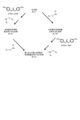
- FIG. 1 illustrates regioselective conjugates of the invention of formula (I), antibody derivatives of the invention of formula (II), and present inventions of formulas (III)-(VII).
- FIG. 1 shows the interrelationship of the compounds of the invention. These substances share partial structural units other than X and Y among the structural units represented by formula (V). Also, these substances can be synthesized according to the scheme shown in FIG. Accordingly, the present invention provides a series of inventions related to synthetic intermediates and final compounds.
- FIG. 2 illustrates regioselective conjugates of the invention of formula (I), antibody derivatives of the invention of formula (II), and present inventions of formulas (III) and (IV). BRIEF DESCRIPTION OF THE DRAWINGS FIG.
- FIG. 1 is a diagram showing a synthesizing outline of a compound of the invention
- FIG. 3 is a diagram showing an example of a synthesis outline of the compounds of the present invention represented by formulas (IV) to (VII).
- DIPEA N,N-diisopropylethylamine
- DMF N,N-dimethylformamide
- the term “antibody” is as follows.
- the term “immunoglobulin unit” corresponds to a divalent monomeric unit that is the basic building block of such an antibody, and is a unit containing two heavy chains and two light chains. .
- immunoglobulin units their origin, type (polyclonal or monoclonal, isotype, and full-length antibody or antibody fragment), antigen, position of lysine residues, and definitions of regioselectivity, examples, and preferred examples are given below. Similar to that of the described antibodies.
- the origin of the antibody is not particularly limited, and may be derived from animals such as mammals and birds (eg, chicken).
- the immunoglobulin unit is of mammalian origin.
- mammals include primates (e.g., humans, monkeys, chimpanzees), rodents (e.g., mice, rats, guinea pigs, hamsters, rabbits), pets (e.g., dogs, cats), livestock. (eg, cows, pigs, goats), working animals (eg, horses, sheep), preferably primates or rodents, more preferably humans.
- the type of antibody may be a polyclonal antibody or a monoclonal antibody.
- the antibody may also be a bivalent antibody (eg, IgG, IgD, IgE) or a tetravalent or higher antibody (eg, IgA antibody, IgM antibody).
- Preferably the antibody is a monoclonal antibody.
- Monoclonal antibodies include, for example, chimeric antibodies, humanized antibodies, human antibodies, antibodies to which a predetermined sugar chain has been added (e.g., modified to have a sugar chain-binding consensus sequence such as an N-type sugar chain-binding consensus sequence). antibodies), bispecific antibodies, Fc region proteins, and Fc fusion proteins.
- Isotypes of monoclonal antibodies include, for example, IgG (eg, IgG1, IgG2, IgG3, IgG4), IgM, IgA, IgD, IgE, and IgY.
- IgG eg, IgG1, IgG2, IgG3, IgG4
- IgM IgA, IgD, IgE, and IgY.
- full-length antibodies or antibody fragments containing variable regions and CH1 and CH2 domains can be used as monoclonal antibodies, but full-length antibodies are preferred.
- the antibody is preferably a human IgG monoclonal antibody, more preferably a human IgG full-length monoclonal antibody.
- any antigen can be used as an antibody antigen.
- antigens include proteins [oligopeptides and polypeptides. proteins modified with biomolecules such as sugars (eg, glycoproteins)], sugar chains, nucleic acids, and low-molecular-weight compounds.
- the antibody may be an antibody whose antigen is a protein. Proteins include, for example, cell membrane receptors, cell membrane proteins other than cell membrane receptors (eg, extracellular matrix proteins), ligands, and soluble receptors.
- the protein that is the antigen of the antibody may be a disease target protein.
- Disease target proteins include, for example:
- Amyloid AL Hereditary/rare diseases Amyloid AL, SEMA4D (CD100), insulin receptor, ANGPTL3, IL4, IL13, FGF23, adrenocorticotropic hormone, transthyretin, huntingtin
- monoclonal antibodies include certain chimeric antibodies (e.g., rituximab, basiliximab, infliximab, cetuximab, siltuximab, dinutuximab, orthotuximab), certain humanized antibodies (e.g., daclizumab, palivizumab, trastuzumab, alentuzumab, omalizumab).
- chimeric antibodies e.g., rituximab, basiliximab, infliximab, cetuximab, siltuximab, dinutuximab, orthotuximab
- humanized antibodies e.g., daclizumab, palivizumab, trastuzumab, alentuzumab, omalizumab.
- efalizumab bevacizumab, natalizumab (IgG4), tocilizumab, eculizumab (IgG2), mogamulizumab, pertuzumab, obinutuzumab, vedrizumab, penprolizumab (IgG4), mepolidumab, elotuzumab, daratumumab, ikesekizumab (IgG4), leslidumab (specific G), atezomab (Ig) human antibodies (e.g., adalimumab (IgG1), panitumumab, golimumab, ustekinumab, canakinumab, ofatumumab, denosumab (IgG2), ipilimumab, belimumab, laxivacumab, ramucirumab, nivolumab, dupilumab
- the positions of amino acid residues in antibodies and the positions of heavy chain constant regions follow EU numbering (see http://www.imgt.org/IMGTScientificChart/Numbering/Hu_IGHGnber.html).
- the lysine residue at position 246 corresponds to the 16th amino acid residue of the human IgG CH2 region
- the lysine residue at position 248 corresponds to the 18th amino acid residue of the human IgG CH2 region.
- the lysine residue at position 288 corresponds to the 58th amino acid residue of the human IgG CH2 region
- the lysine residue at position 290 corresponds to the 60th amino acid residue of the human IgG CH2 region.
- the lysine residue at position 317 corresponds to the 87th amino acid residue of the human IgG CH2 region.
- the notation 246/248 indicates that the lysine residue at position 246 or 248 is of interest.
- the notation 288/290 indicates that the lysine residue at position 288 or 290 is of interest.
- a specific lysine residue e.g., lysine residues at positions 246/248, 288/290, or 317 in the heavy chain of an immunoglobulin unit that constitutes an antibody is regioselectively modified.
- regioselectivity or “regioselectivity” refers to binding to a specific amino acid residue in an antibody even though the specific amino acid residue in the antibody is not unevenly distributed in a specific region. It means that a predetermined structural unit that can be formed is unevenly distributed in a specific region in an antibody.
- expressions related to regioselectivity such as “regioselectively having”, “regioselectively binding”, “regioselectively binding”, etc., refer to target regions comprising one or more specific amino acid residues. is significantly higher than the retention or binding rate of a given structural unit in a non-target region containing multiple amino acid residues that are homologous to the specific amino acid residue in the target region It means that it is high at a certain level.
- Such regioselectivity is 50% or more, preferably 60% or more, more preferably 70% or more, even more preferably 80% or more, particularly preferably 90% or more, 95% or more, 96% or more, It may be 97% or more, 98% or more, 99% or more, 99.5% or more, or 100%.
- specific amino acid residues at other positions may be further regioselectively modified.
- methods for regioselectively modifying specific amino acid residues at predetermined positions in an antibody are disclosed in WO2018/199337, WO2019/240288, WO2019/240287, and WO2019/240287. 2020/090979.
- Such specific amino acid residues include amino acid residues (e.g., lysine residues, aspartic acid residues) having easily modifiable side chains (e.g., amino group, carboxyl group, amide group, hydroxy group, thiol group).
- glutamic acid residues glutamine residues, threonine residues, serine residues, tyrosine residues, cysteine residues
- glutamic acid residues can be utilized, but preferably lysine residues having side chains containing amino groups, hydroxyl tyrosine, serine and threonine residues with side chains containing groups, or cysteine residues with side chains containing thiol groups, more preferably lysine residues (i.e.
- Halogen atoms include, for example, fluorine, chlorine, bromine and iodine atoms.
- Monovalent groups include, for example, monovalent hydrocarbon groups and monovalent heterocyclic groups.
- One or more monovalent groups (for example, 1 to 10, preferably 1 to 8, more preferably 1 to 6, still more preferably 1 to 5, particularly preferably 1 to 3) It may be substituted with a substituent group.
- monovalent hydrocarbon groups include monovalent chain hydrocarbon groups, monovalent alicyclic hydrocarbon groups, and monovalent aromatic hydrocarbon groups.
- a monovalent chain hydrocarbon group means a hydrocarbon group composed only of a chain structure, and the main chain does not contain a cyclic structure. However, the chain structure may be linear or branched. Examples of monovalent chain hydrocarbon groups include alkyl, alkenyl, and alkynyl. Alkyl, alkenyl and alkynyl can be straight or branched.
- the alkyl is preferably alkyl having 1 to 12 carbon atoms, more preferably alkyl having 1 to 6 carbon atoms, and still more preferably alkyl having 1 to 4 carbon atoms.
- alkyl having 1 to 12 carbon atoms include methyl, ethyl, n-propyl, i-propyl, n-butyl, s-butyl, isobutyl, t-butyl, pentyl, hexyl, heptyl, octyl, nonyl and decyl. , dodecyl.
- the alkenyl is preferably alkenyl having 2 to 12 carbon atoms, more preferably alkenyl having 2 to 6 carbon atoms, and even more preferably alkenyl having 2 to 4 carbon atoms.
- alkenyl has a substituent, the number of carbon atoms of the substituent is not included in the above number of carbon atoms.
- alkenyl having 2 to 12 carbon atoms include vinyl, propenyl and n-butenyl.
- the alkynyl is preferably an alkynyl having 2 to 12 carbon atoms, more preferably an alkynyl having 2 to 6 carbon atoms, and still more preferably an alkynyl having 2 to 4 carbon atoms.
- alkynyl has a substituent, the number of carbon atoms of the substituent is not included in the above number of carbon atoms.
- alkynyl having 2 to 12 carbon atoms include ethynyl, propynyl and n-butynyl.
- Alkyl is preferable as the monovalent chain hydrocarbon group.
- a monovalent alicyclic hydrocarbon group means a hydrocarbon group that contains only an alicyclic hydrocarbon as a ring structure and does not contain an aromatic ring. may be However, it does not have to be composed only of alicyclic hydrocarbons, and may partially contain a chain structure.
- Examples of monovalent alicyclic hydrocarbon groups include cycloalkyl, cycloalkenyl, and cycloalkynyl, which may be either monocyclic or polycyclic.
- the cycloalkyl is preferably a cycloalkyl having 3 to 12 carbon atoms, more preferably a cycloalkyl having 3 to 6 carbon atoms, and still more preferably a cycloalkyl having 5 to 6 carbon atoms.
- the cycloalkyl has a substituent, the number of carbon atoms of the substituent is not included in the above number of carbon atoms.
- Examples of cycloalkyl having 3 to 12 carbon atoms include cyclopropyl, cyclobutyl, cyclopentyl and cyclohexyl.
- the cycloalkenyl is preferably a cycloalkenyl having 3 to 12 carbon atoms, more preferably a cycloalkenyl having 3 to 6 carbon atoms, and still more preferably a cycloalkenyl having 5 to 6 carbon atoms.
- the cycloalkenyl has a substituent, the number of carbon atoms of the substituent is not included in the above number of carbon atoms.
- Cycloalkenyl having 3 to 12 carbon atoms includes, for example, cyclopropenyl, cyclobutenyl, cyclopentenyl and cyclohexenyl.
- the cycloalkynyl is preferably a cycloalkynyl having 3 to 12 carbon atoms, more preferably a cycloalkynyl having 3 to 6 carbon atoms, and still more preferably a cycloalkynyl having 5 to 6 carbon atoms.
- cycloalkynyl has a substituent, the number of carbon atoms of the substituent is not included in the above number of carbon atoms.
- Cycloalkynyl having 3 to 12 carbon atoms includes, for example, cyclopropynyl, cyclobutynyl, cyclopentynyl and cyclohexynyl.
- Cycloalkyl is preferred as the monovalent alicyclic hydrocarbon group.
- a monovalent aromatic hydrocarbon group means a hydrocarbon group containing an aromatic ring structure. However, it does not have to be composed only of aromatic rings, and may contain a chain structure or alicyclic hydrocarbon in part, and the aromatic ring may be monocyclic or polycyclic. good.
- the monovalent aromatic hydrocarbon group is preferably an aryl having 6 to 12 carbon atoms, more preferably an aryl having 6 to 10 carbon atoms, and still more preferably an aryl having 6 carbon atoms.
- the monovalent aromatic hydrocarbon group has a substituent, the number of carbon atoms of the substituent is not included in the above number of carbon atoms. Examples of aryl having 6 to 12 carbon atoms include phenyl and naphthyl.
- Phenyl is preferable as the monovalent aromatic hydrocarbon group.
- alkyl, cycloalkyl, and aryl are preferable as monovalent hydrocarbon groups.
- a monovalent heterocyclic group refers to a group obtained by removing one hydrogen atom from a heterocyclic ring of a heterocyclic compound.
- a monovalent heterocyclic group is a monovalent aromatic heterocyclic group or a monovalent non-aromatic heterocyclic group.
- the heteroatom constituting the heterocyclic group preferably contains one or more selected from the group consisting of an oxygen atom, a sulfur atom, a nitrogen atom, a phosphorus atom, a boron atom and a silicon atom, and an oxygen atom, a sulfur atom and a nitrogen atom. More preferably, it contains one or more selected from the group consisting of atoms.
- the monovalent aromatic heterocyclic group is preferably an aromatic heterocyclic group having 1 to 15 carbon atoms, more preferably an aromatic heterocyclic group having 1 to 9 carbon atoms, and an aromatic heterocyclic group having 1 to 6 carbon atoms.
- Group heterocyclic groups are more preferred.
- the monovalent aromatic heterocyclic group has a substituent, the number of carbon atoms of the substituent is not included in the above number of carbon atoms.
- Examples of monovalent aromatic heterocyclic groups include pyrrolyl, furanyl, thiophenyl, pyridinyl, pyridazinyl, pyrimidinyl, pyrazinyl, triazinyl, pyrazolyl, imidazolyl, thiazolyl, isothiazolyl, oxazolyl, isoxazolyl, triazolyl, tetrazolyl, indolyl, purinyl, anthraquinolyl , carbazonyl, fluorenyl, quinolinyl, isoquinolinyl, quinazolinyl, and phthalazinyl.
- the monovalent non-aromatic heterocyclic group is preferably a non-aromatic heterocyclic group having 2 to 15 carbon atoms, more preferably a non-aromatic heterocyclic group having 2 to 9 carbon atoms, and 2 to 2 carbon atoms. 6 non-aromatic heterocyclic groups are more preferred.
- the above number of carbon atoms does not include the number of carbon atoms of the substituent.
- Examples of monovalent non-aromatic heterocyclic groups include oxiranyl, aziridinyl, azetidinyl, oxetanyl, thietanyl, pyrrolidinyl, dihydrofuranyl, tetrahydrofuranyl, dioxolanyl, tetrahydrothiophenyl, pyrrolinyl, imidazolidinyl, oxazolidinyl, piperidinyl and dihydropyranyl.
- tetrahydropyranyl tetrahydrothiopyranyl
- morpholinyl thiomorpholinyl
- piperazinyl dihydrooxazinyl, tetrahydrooxazinyl, dihydropyrimidinyl, and tetrahydropyrimidinyl.
- the monovalent heterocyclic group is preferably a 5- or 6-membered heterocyclic group.
- R7 represents a hydrogen atom or a substituent to be described later.
- R8 represents a divalent linear hydrocarbon group, a divalent cyclic hydrocarbon group, or a divalent heterocyclic group.
- m1 is an integer of 1 to 10, preferably an integer of 1 to 8, more preferably an integer of 1 to 6, still more preferably an integer of 1 to 5, particularly preferably 1 to 3 is an integer of
- a divalent straight chain hydrocarbon group is a straight chain alkylene, a straight chain alkenylene, or a straight chain alkynylene.
- the straight-chain alkylene is straight-chain alkylene having 1 to 6 carbon atoms, preferably straight-chain alkylene having 1 to 4 carbon atoms.
- Linear alkylene includes, for example, methylene, ethylene, n-propylene, n-butylene, n-pentylene, n-hexylene.
- Straight chain alkenylene is straight chain alkenylene having 2 to 6 carbon atoms, preferably straight chain alkenylene having 2 to 4 carbon atoms.
- Linear alkenylenes include, for example, ethylenylene, n-propynylene, n-butenylene, n-pentenylene, and n-hexenylene.
- the straight-chain alkynylene is a straight-chain alkynylene having 2 to 6 carbon atoms, preferably a straight-chain alkynylene having 2 to 4 carbon atoms.
- Linear alkynylene includes, for example, ethynylene, n-propynylene, n-butynylene, n-pentynylene, and n-hexynylene.
- a linear alkylene is preferable as the divalent linear hydrocarbon group.
- a divalent cyclic hydrocarbon group is an arylene or a divalent non-aromatic cyclic hydrocarbon group.
- arylene arylene having 6 to 14 carbon atoms is preferable, arylene having 6 to 10 carbon atoms is more preferable, and arylene having 6 carbon atoms is particularly preferable.
- Arylene includes, for example, phenylene, naphthylene and anthracenylene.
- the divalent non-aromatic cyclic hydrocarbon group is preferably a monocyclic or polycyclic divalent non-aromatic cyclic hydrocarbon group having 3 to 12 carbon atoms, and a monocyclic hydrocarbon group having 4 to 10 carbon atoms.
- a cyclic or polycyclic divalent non-aromatic cyclic hydrocarbon group is more preferred, and a monocyclic divalent non-aromatic cyclic hydrocarbon group having 5 to 8 carbon atoms is particularly preferred.
- Examples of divalent non-aromatic cyclic hydrocarbon groups include cyclopropylene, cyclobutylene, cyclopentylene, cyclohexylene, cycloheptylene, and cyclooctylene.
- Arylene is preferred as the divalent cyclic hydrocarbon group.
- a divalent heterocyclic group is a divalent aromatic heterocyclic group or a divalent non-aromatic heterocyclic group.
- the heteroatom constituting the heterocyclic ring preferably contains one or more selected from the group consisting of an oxygen atom, a sulfur atom, a nitrogen atom, a phosphorus atom, a boron atom and a silicon atom, and an oxygen atom, a sulfur atom and a nitrogen atom. It is more preferable to contain one or more selected from the group consisting of
- the divalent aromatic heterocyclic group is preferably a divalent aromatic heterocyclic group having 3 to 15 carbon atoms, more preferably a divalent aromatic heterocyclic group having 3 to 9 carbon atoms.
- a divalent aromatic heterocyclic group having numbers 3 to 6 is particularly preferred.
- divalent aromatic heterocyclic groups include pyrroldiyl, furandiyl, thiophenediyl, pyridinediyl, pyridazinediyl, pyrimidinediyl, pyrazinediyl, triazinediyl, pyrazoldiyl, imidazoldiyl, thiazoldiyl, isothiazoldiyl, and oxazoldiyl. .
- the divalent non-aromatic heterocyclic group is preferably a non-aromatic heterocyclic group having 3 to 15 carbon atoms, more preferably a non-aromatic heterocyclic group having 3 to 9 carbon atoms, and 3 to 3 carbon atoms.
- a non-aromatic heterocyclic group of 6 is particularly preferred.
- divalent non-aromatic heterocyclic groups include pyrroldionediyl, pyrrolinedionediyl, oxirandiyl, aziridinediyl, azetidinediyl, oxetanediyl, thietanediyl, pyrrolidinediyl, dihydrofurandiyl, tetrahydrofurandiyl, dioxolanediyl, and tetrahydrothiophene.
- diyl pyrrolinediyl, imidazolidinediyl, oxazolidinediyl, piperidinediyl, dihydropyrandiyl, tetrahydropyrandiyl, tetrahydrothiopyrandiyl, morpholindiyl, thiomorpholindiyl, piperazinediyl, dihydrooxazinediyl, tetrahydrooxazinediyl, dihydropyrimidinediyl, and tetrahydropyrimidinediyl.
- divalent heterocyclic group a divalent aromatic heterocyclic group is preferred.
- the main chain structure in the divalent group is 1 or more (eg, 1 to 10, preferably 1 to 8, more preferably 1 to 6, even more preferably 1 to 5, particularly preferably 1 to 3 ) may be substituted with a substituent described later.
- Aralkyl means arylalkyl. Definitions, examples and preferred examples of aryl and alkyl in arylalkyl are as described above.
- aralkyl aralkyl having 3 to 15 carbon atoms is preferable. Such aralkyls include, for example, benzoyl, phenethyl, naphthylmethyl, naphthylethyl.
- hydrophilic group is a group capable of making the structural units represented by formulas (I) to (VII) or subordinate concepts thereof more hydrophilic.
- hydrophilic groups include carboxylic acid groups, sulfonic acid groups, hydroxyl groups, polyethylene glycol groups, polysarcosine groups, and sugar moieties.
- One or more (eg, 1, 2, 3, 4, or 5) hydrophilic groups may be included in the conjugate.
- a polyethylene glycol (PEG) group is a divalent group represented by -(CH 2 -CH 2 -O-) k1 -.
- the conjugate has a polyethylene glycol group
- the conjugate has a monovalent group in which one bond of the polyethylene glycol group is bonded to a hydrogen atom or a monovalent group (e.g., a monovalent hydrocarbon group).
- You may have k1 may be, for example, an integer of 3 or more, preferably an integer of 4 or more, more preferably an integer of 5 or more, and even more preferably an integer of 6 or more.
- k1 may also be an integer of 15 or less, preferably an integer of 12 or less, more preferably an integer of 10 or less, even more preferably an integer of 9 or less. More specifically, k1 may be an integer of 3-15, preferably an integer of 4-12, more preferably an integer of 5-10, even more preferably an integer of 4-9.
- a polysarcosine group is a divalent group represented by -(NCH 3 -CH 2 -CO-) k2 -.
- Polysarcosine groups can be used as an alternative to PEG.
- k2 may be, for example, an integer of 3 or more, preferably an integer of 4 or more, more preferably an integer of 5 or more, and even more preferably an integer of 6 or more.
- k2 may also be an integer of 15 or less, preferably an integer of 12 or less, more preferably an integer of 10 or less, even more preferably an integer of 9 or less. More specifically, k2 may be an integer of 3-15, preferably an integer of 4-12, more preferably an integer of 5-10, even more preferably an integer of 4-9.
- the sugar moieties are monosaccharides, oligosaccharides (eg, disaccharides, trisaccharides, tetrasaccharides, pentasaccharides), or polysaccharides.
- Sugar moieties can include aldoses or ketoses, or combinations thereof.
- the sugar moiety is a monosaccharide such as ribose, deoxyribose, xylose, arabinose, glucose, mannose, galactose, or fructose, or an amino sugar (e.g., glucosamine), or an oligo- or polysaccharide containing such a monosaccharide. good too.
- the sugar moiety may be a low molecular weight hydrophilic group.
- a low-molecular-weight hydrophilic group refers to a hydrophilic group having a molecular weight of 1,500 or less.
- the molecular weight of the low molecular weight hydrophilic group may preferably be 1200 or less, 1000 or less, 800 or less, 700 or less, 600 or less, 500 or less, 400 or less, 300 or less, 200 or less, or 100 or less.
- Low-molecular-weight hydrophilic groups include carboxylic acid groups, sulfonic acid groups, hydroxyl groups, as well as polyethylene glycol groups, polysarcosine groups, and sugar moieties (eg, monosaccharides and oligosaccharides) that satisfy the above molecular weights.
- Bioorthogonal functional groups do not react with biological constituents (e.g., amino acids, proteins, nucleic acids, lipids, sugars, phosphoric acids), or react slowly with biological constituents, but react with constituents other than biological constituents.
- biological constituents e.g., amino acids, proteins, nucleic acids, lipids, sugars, phosphoric acids
- a group that selectively reacts with Bioorthogonal functional groups are well known in the art (e.g., Sharpless KB et al., Angew. Chem. Int. Ed. 40, 2004 (2015); Bertozzi C. R. et al., Science 291, 2357 (2001); Bertozzi CR et al., Nature Chemical Biology 1, 13 (2005)).
- bioorthogonal functional groups for proteins are used as bioorthogonal functional groups. This is because the thiol group-introduced antibody to be derivatized with the reagent of the present invention is a protein.
- a bioorthogonal functional group for a protein is a group that does not react with the side chains of the 20 natural amino acid residues that constitute the protein, or that reacts slowly with the side chains, but reacts with the desired functional group. .
- the 20 natural amino acids that make up proteins are alanine (A), asparagine (N), cysteine (C), glutamine (Q), glycine (G), isoleucine (I), leucine (L), methionine (M ), phenylalanine (F), proline (P), serine (S), threonine (T), tryptophan (W), tyrosine (Y), valine (V), aspartic acid (D), glutamic acid (E), arginine ( R), histidine (H), and lysine (K).
- glycine without a side chain i.e., a hydrogen atom
- the side chain is a hydrocarbon group
- the side chain is a hydrocarbon group
- Bioorthogonal functional groups for proteins are thus asparagine, glutamine, methionine, proline, serine, threonine, tryptophan, tyrosine, in addition to those amino acid side chains with side chains that are inert to normal reactions.
- bioorthogonal functional groups include, for example, an azide residue, an aldehyde residue, a thiol residue, an alkene residue (in other words, a vinylene (ethenylene) moiety, which is the smallest unit having a double bond between carbon atoms.
- an alkyne residue (in other words, it may have an ethynylene moiety, which is the smallest unit having a triple bond between carbon atoms, the same applies hereinafter), a halogen residue, tetrazine residue, nitrone residue, hydroxylamine residue, nitrile residue, hydrazine residue, ketone residue, boronic acid residue, cyanobenzothiazole residue, allyl residue, phosphine residue, maleimide residue, disulfide residue , a thioester residue, an ⁇ -halocarbonyl residue (e.g., a carbonyl residue having a fluorine atom, a chlorine atom, a bromine atom or an iodine atom at the ⁇ -position; the same shall apply hereinafter), an isonitrile residue, a sydone residue, and a selenium residue. mentioned.
- bioorthogonal functional group may correspond to any one chemical structure selected from the group consisting of: ⁇ here, R 1a , single or multiple R 1b , and single or multiple R 1c are the same or different and are the above-described substituents or electron-withdrawing groups; ⁇ is a bond.
- electron-withdrawing groups include halogen atoms, halogen-substituted alkyls (e.g., trifluoromethyl), boronic acid residues, mesyl, tosyl, triflate, nitro, cyano, phenyl groups, keto groups (e.g., acyl), and halogen atoms, boronic acid residues, mesyl, tosyl and triflate are preferred.
- bioorthogonal functional groups may be protected.
- An optionally protected bioorthogonal functional group refers to an unprotected bioorthogonal functional group or a protected bioorthogonal functional group.
- An unprotected bioorthogonal functional group corresponds to the bioorthogonal functional group described above.
- a protected bioorthogonal functional group is a group that yields a bioorthogonal functional group upon cleavage of a protecting group. Cleavage of the protecting group can be carried out by a specific treatment under conditions (mild conditions) that do not cause protein denaturation/decomposition (eg, amide bond cleavage).
- Examples of such specific treatments include (a) treatment with one or more substances selected from the group consisting of acidic substances, basic substances, reducing agents, oxidizing agents, and enzymes; treatment with a chosen physico-chemical stimulus, or (c) leaving when using a cleavable linker comprising a self-cleavable cleavable moiety.
- Such protecting groups and their cleavage conditions are common technical knowledge in the art (e.g., G. Leriche, L. Chisholm, A. Wagner, Bioorganic & Medicinal Chemistry. 20, 571 (2012); Feng P. et al. , Journal of American Chemical Society.132, 1500 (2010).; Bessodes M.
- Protected bioorthogonal functional groups include, for example, disulfide residues, ester residues, acetal residues, ketal residues, imine residues, and vicinal diol residues.
- the protected bioorthogonal functional group may correspond to any one chemical structure selected from the group consisting of: [Where the wavy line perpendicular to the bond indicates the cleavage site, single or multiple R 2a are the same or different and are selected from the group consisting of a hydrogen atom or the substituents described above; ⁇ is a bond. ]
- the optionally protected bioorthogonal functional group is an unprotected bioorthogonal functional group.
- the functional substance is not particularly limited as long as it is a substance that imparts an arbitrary function to the antibody, and includes, for example, drugs, labeling substances, affinity substances, transport substances, and stabilizers. It may be a substance, an affinity substance, or a transport substance, or it may be a drug or labeling substance.
- a functional substance may also be a single functional substance, or a substance in which two or more functional substances are linked.
- the drug may be a drug for any disease.
- diseases include, for example, cancer (e.g., lung cancer, stomach cancer, colon cancer, pancreatic cancer, kidney cancer, liver cancer, thyroid cancer, prostate cancer, bladder cancer, ovarian cancer, uterine cancer, bone cancer, skin cancer, brain tumor, melanoma), autoimmune diseases/inflammatory diseases (e.g., allergic diseases, rheumatoid arthritis, systemic lupus erythematosus), cranial nerve diseases (e.g., cerebral infarction, Alzheimer's disease, Parkinson's disease, amyotrophic lateral sclerosis), Infectious diseases (e.g., bacterial infections, viral infections), hereditary/rare diseases (e.g., hereditary spherocytosis, non-dystrophic myotonia), eye diseases (e.g., age-related macular degeneration, diabetic retinopathy, retinitis pigmentosa), bone/orthopedic diseases (e.g.
- the drug may be an anti-cancer agent.
- Anti-cancer agents include, for example, chemotherapeutic agents, toxins, radioactive isotopes or substances containing the same.
- Chemotherapeutic agents include, for example, DNA damaging agents, antimetabolites, enzyme inhibitors, DNA intercalating agents, DNA cleaving agents, topoisomerase inhibitors, DNA binding inhibitors, tubulin binding inhibitors, cytotoxic nucleosides, A platinum compound is mentioned.
- Toxins include, for example, bacterial toxins (eg, diphtheria toxin), plant toxins (eg, ricin).
- Radioisotopes include, for example, a hydrogen atom radioisotope (e.g., 3 H), a carbon atom radioisotope (e.g., 14 C), a phosphorus atom radioisotope (e.g., 32 P), and a sulfur atom radioisotope (e.g., 32 P).
- Radioisotopes e.g. 35 S
- yttrium radioisotopes e.g. 90 Y
- technetium radioisotopes e.g. 99m Tc
- indium radioisotopes e.g.
- Isotopes e.g., 123 I, 125 I, 129 I, 131 I
- radioisotopes of samarium e.g., 153 Sm
- radioisotopes of rhenium e.g., 186 Re
- radioisotopes of astatine e.g., 211 At
- radioactive isotopes of bismuth e.g, 212 Bi
- drugs include auristatins (MMAE, MMAF), maytansine (DM1, DM4), PBD (pyrrolobenzodiazepine), IGN, camptothecin analogues, calicheamicin, duocalmicin, eribulin, anthracycline, dmDNA31, tubulisin is mentioned.
- a labeling substance is a substance that enables detection of a target (eg, tissue, cell, substance).
- labeling substances include enzymes (e.g., peroxidase, alkaline phosphatase, luciferase, ⁇ -galactosidase), affinity substances (e.g., streptavidin, biotin, digoxigenin, aptamers), fluorescent substances (e.g., fluorescein, fluorescein isothiocyanate, rhodamine , green fluorescent protein, red fluorescent protein), luminescent substances (e.g., luciferin, aequorin, acridinium ester, tris(2,2'-bipyridyl)ruthenium, luminol), radioisotopes (e.g., those described above), or Substances containing it are mentioned.
- enzymes e.g., peroxidase, alkaline phosphatase, luciferase, ⁇
- An affinity substance is a substance that has an affinity for a target.
- Affinity substances include, for example, affinity proteins or peptides such as antibodies, aptamers, lectins, and complementary strands to target nucleic acids.
- the affinity substance is preferably an affinity protein or affinity peptide, more preferably an antibody.
- the types of animals from which antibodies used as functional substances are derived are the same as those described above.
- the types of antibodies used as functional substances may be polyclonal antibodies or monoclonal antibodies.
- the antibody may also be a bivalent antibody (eg, IgG, IgD, IgE) or a tetravalent or higher antibody (eg, IgA antibody, IgM antibody).
- Preferably the antibody is a monoclonal antibody.
- Monoclonal antibodies include, for example, chimeric antibodies, humanized antibodies, human antibodies, antibodies to which a predetermined sugar chain has been added (e.g., modified to have a sugar chain-binding consensus sequence such as an N-type sugar chain-binding consensus sequence). antibodies), bispecific antibodies, Fc region proteins, and Fc fusion proteins.
- Isotypes of monoclonal antibodies include, for example, IgG (eg, IgG1, IgG2, IgG3, IgG4), IgM, IgA, IgD, IgE, and IgY.
- Antibodies used as functional substances include, for example, whole antibodies and fragments thereof (fragment antibodies).
- a fragment antibody may retain binding properties to a desired antigen, and examples thereof include Fab, Fab', F(ab') 2 and scFv.
- the antigenicity of the antibody used as the functional substance may be the same as or different from that of the immunoglobulin unit in the antibody, antibody derivative, and conjugate of the present invention, and is preferably different.
- the origin of the antibody used as the functional substance may be the same as or different from the origin of the immunoglobulin unit, and is preferably different. Therefore, the antibody used as a functional substance may be the specific chimeric antibody, specific humanized antibody, or specific human antibody mentioned in the specific examples of the monoclonal antibody above, or an antibody derived therefrom. good.
- Antibodies used as functional substances may also be IgG1, IgG2, IgG3, or IgG4, or antibodies derived therefrom, mentioned in the monoclonal antibody specific examples above.
- a transport substance is a substance that has the ability to transport compounds.
- a substance capable of encapsulating a compound in a protein shell eg, multimer
- ferritin such as human ferritin, virus particles, virus-like particles
- a stabilizer is a substance that enables the stabilization of antibodies.
- Stabilizers include, for example, diols, glycerin, nonionic surfactants, anionic surfactants, natural surfactants, saccharides, and polyols.
- Functional substances may also be peptides, proteins, nucleic acids, low-molecular-weight organic compounds, sugar chains, lipids, macromolecular polymers, metals (eg, gold), and chelators.
- Peptides include, for example, cell membrane-permeable peptides, blood-brain barrier-permeable peptides, and peptide drugs. Proteins include, for example, enzymes, cytokines, antibody fragments, lectins, interferons, serum albumin, and antibodies.
- Nucleic acids include, for example, DNA, RNA, and artificial nucleic acids. Nucleic acids also include, eg, RNA interference-inducing nucleic acids (eg, siRNA), aptamers, antisense.
- Low-molecular-weight organic compounds include, for example, proteolysis-inducing chimeric molecules, dyes, and photodegradable compounds.
- the functional substance may be a substance having an aromatic ring.
- Substances having an aromatic ring include, for example, monomethylauristatin [eg, monomethylauristatin E (MMAE), monomethylauristatin F (MMAF)], or Exatecan.
- MMAE monomethylauristatin E
- MMAF monomethylauristatin F
- salts with inorganic acids include, for example, salts with hydrogen chloride, hydrogen bromide, phosphoric acid, sulfuric acid, and nitric acid.
- salts with organic acids include formic acid, acetic acid, trifluoroacetic acid, lactic acid, tartaric acid, fumaric acid, oxalic acid, maleic acid, citric acid, succinic acid, malic acid, benzenesulfonic acid, and p-toluenesulfonic acid.
- Salts with inorganic bases include, for example, salts with alkali metals (eg, sodium, potassium), alkaline earth metals (eg, calcium, magnesium), and other metals such as zinc, aluminum, and ammonium.
- Salts with organic bases include, for example, salts with trimethylamine, triethylamine, propylenediamine, ethylenediamine, pyridine, ethanolamine, monoalkylethanolamine, dialkylethanolamine, diethanolamine, and triethanolamine.
- salts with amino acids include salts with basic amino acids (eg, arginine, histidine, lysine, ornithine) and acidic amino acids (eg, aspartic acid, glutamic acid).
- the salt is preferably a salt with an inorganic acid (eg hydrogen chloride) or an organic acid (eg trifluoroacetic acid).
- the present invention provides a regioselective conjugate of an antibody and a functional substance, or a salt thereof, containing the structural unit represented by formula (I) above.
- the regioselectivity of the conjugates of the invention is as described above.
- Antibodies include immunoglobulin units as described above. Such antibodies include, for example, IgG antibodies comprising immunoglobulin units comprising two heavy chains and two light chains and having disulfide bonds between the heavy chains and between the heavy and light chains, IgD Antibodies and IgE antibodies, IgA antibodies comprising an immunoglobulin unit comprising 4 heavy chains and 4 light chains and having disulfide bonds between the heavy chains and between the heavy and light chains, 8 heavy chains and an immunoglobulin unit comprising eight light chains and having disulfide bonds between the heavy chains and between the heavy and light chains, including IgG antibodies (e.g., IgG1, IgG2, IgG3, IgG4 ) is preferred.
- the antibody is preferably a human IgG monoclonal antibody, more preferably a human IgG full-length monoclonal antibody.
- Regioselective binding is preferably achieved by binding between an amino group in the side chain of a lysine residue and an atom or group capable of binding thereto (e.g., carbonyl group, thiocarbonyl group). More preferably, this is achieved by an amide bond between the amino and carbonyl groups in the side chains of the residue.
- an amino group in the side chain of a lysine residue and an atom or group capable of binding thereto (e.g., carbonyl group, thiocarbonyl group). More preferably, this is achieved by an amide bond between the amino and carbonyl groups in the side chains of the residue.
- HG represents a hydrophilic group or a monovalent group containing a hydrophilic group.
- the hydrophilic group and monovalent group are as described above.
- HG may represent a monovalent group containing a hydrophilic group.
- RA indicates the side chain of the valine residue (ie, —CH(CH 3 ) 2 ).
- RA can be the side chain of a phenylalanine, threonine, leucine, or alanine residue.
- the configuration of the amino acid residue in RA may be L-configuration or D-configuration, with L-configuration being preferred.
- RB denotes the side chain of a citrulline residue (ie -CH 2 CH 2 CH 2 NHCONH 2 ) or the side chain of an alanine residue (ie -CH 3 ).
- RB may be the side chain of a glutamic acid, glutamine, lysine, arginine, threonine, or methionine residue.
- the configuration of the amino acid residues in RB may be L-configuration or D-configuration, with L-configuration being preferred.
- a preferred combination of RA and RB is that RA is the side chain of a valine residue and RB is the side chain of a citrulline or alanine residue.
- R A and R B are: (a) RA is the side chain of a valine residue, and RB is the side chain of a glutamic acid, lysine, arginine, or threonine residue; (b) RA is the side chain of a phenylalanine residue, and RB is the side chain of a lysine, arginine, or glutamine residue; (c) RA is the side chain of a threonine residue, and RB is the side chain of a threonine residue or a methionine residue; (d) RA is the side chain of a leucine residue and RB is the side chain of a glutamic acid residue; and (e) RA is the side chain of an alanine residue and RB is the side chain of an alanine residue and
- Ring A represents a divalent aromatic ring group which may have a substituent.
- the divalent aromatic ring group is the above-described arylene or divalent aromatic heterocycle.
- the position of the divalent aromatic ring group to which two adjacent atoms (a carbon atom and a nitrogen atom) are attached is conjugated with a ⁇ electron when cathepsin B cleaves the amide bond present on the carboxy-terminal side of citrulline.
- Such positions are common general technical knowledge in the relevant field, and can be easily determined by those skilled in the art according to factors such as the type of the divalent aromatic ring group.
- ring A may be a divalent monocyclic aromatic ring group which may have a substituent.
- the divalent aromatic ring group is a phenylene group or a divalent monocyclic aromatic heterocyclic group.
- ring A may be a divalent 6-membered aromatic ring group.
- the 6-membered aromatic ring group include the various groups described above.
- the position of the divalent 6-membered aromatic ring group to which two adjacent atoms are bonded is the ortho-position or the para-position, preferably the para-position.
- ring A may be a phenylene group which may have a substituent.
- the position of the phenylene group to which two adjacent atoms are bonded is the ortho-position or the para-position, preferably the para-position.
- the substituents in the divalent aromatic ring group which may have a substituent are as described above. Such substituents may be electron withdrawing groups as described above.
- R 1 and R 2 each independently represent a hydrogen atom or a monovalent group.
- the monovalent group is as described above.
- the monovalent group for R 1 and R 2 is preferably a monovalent hydrocarbon group optionally having substituent(s), more preferably alkyl optionally having substituent(s), still more preferably alkyl. .
- alkyl those mentioned above are preferred.
- the monovalent groups represented by R 1 and R 2 may be amino group-protecting groups.
- protective groups include, for example, alkylcarbonyl groups (acyl groups) (e.g., acetyl group, propoxy group, butoxycarbonyl group such as tert-butoxycarbonyl group), alkyloxycarbonyl groups (e.g., fluorenylmethoxycarbonyl group), aryloxycarbonyl group, and arylalkyl(aralkyl)oxycarbonyl group (eg, benzyloxycarbonyl group).
- alkylcarbonyl groups acyl groups
- alkyloxycarbonyl groups e.g., fluorenylmethoxycarbonyl group
- aryloxycarbonyl group e.g., fluorenylmethoxycarbonyl group
- aryloxycarbonyl group e.g., benzyloxycarbonyl group
- R 1 and R 2 each independently represent a hydrogen atom or an amino-protecting group.
- R 1 and R 2 may each be a hydrogen atom.
- the divalent groups represented by L 1 and L 2 are as described above.
- the divalent groups represented by L 1 and L 2 may each include moieties resulting from the reaction of two bioorthogonal functional groups capable of reacting with each other.
- moieties resulting from the reaction of two bioorthogonal functional groups capable of reacting with each other are well known, the skilled artisan will arbitrarily select such combinations to form moieties formed by reaction of two bioorthogonal functional groups capable of reacting with each other.
- a divalent group containing can be set as appropriate.
- Combinations of bioorthogonal functional groups capable of reacting with each other include, for example, a combination of a thiol residue and a maleimide residue, a combination of a furan residue and a maleimide residue, a combination of a thiol residue and a halocarbonyl residue (by substitution reaction, , halogen is substituted with thiol), combination of alkyne residue (preferably a cyclic group having triple bond between carbon atoms, optionally substituted by substituents as described above) and azide residue, tetrazine A combination of a residue and an alkene residue, a combination of a tetrazine residue and an alkyne residue, and a combination of a thiol residue and another thiol residue (disulfide bond) can be mentioned.
- the above moieties include a group produced by reaction of a thiol residue and a maleimide residue, a group produced by reaction of a furan residue and a maleimide residue, a group produced by reaction of a thiol residue and a halocarbonyl residue, an alkyne It may be a group produced by reaction of a residue and an azide residue, a group produced by reaction of a tetrazine residue and an alkene residue, or a disulfide group produced by a combination of a thiol residue and another thiol residue.
- the moiety may be a divalent group represented by any one of the structural formulas below. [Here, white circles and black circles indicate bonds. ]
- the black circle bond is on the functional substance (D) bond side. may be attached to an atom present in If the open circled bond is bonded to the atom present on the functional substance (D) bond side, the black circled bond is the atom present on the nitrogen atom (N) bond side in “N—R 2 ” may be connected to
- r indicates the average ratio of said bonds per two heavy chains and is between 1.5 and 2.5.
- Such an average ratio may preferably be 1.6 or more, more preferably 1.7 or more, even more preferably 1.8 or more, and particularly preferably 1.9 or more.
- Such an average ratio may also preferably be 2.4 or less, more preferably 2.3 or less, even more preferably 2.2 or less, particularly preferably 2.1 or less. More specifically, such an average ratio is preferably 1.6 to 2.4, more preferably 1.7 to 2.3, still more preferably 1.8 to 2.2, particularly preferably 1 .9 to 2.1.
- the regioselective conjugates of the present invention or salts thereof have the desired property of being resistant to aggregation, and thus can be identified by their aggregation rate. More specifically, the aggregation rate of the conjugates or salts thereof of the present invention may be 5% or less. This is because, according to the present invention, it is easy to avoid antibody aggregation. Aggregation rate is preferably 4.8% or less, more preferably 4.6% or less, still more preferably 4.4% or less, particularly preferably 4.2% or less, 4.0% or less, 3.8% 3.6% or less, 3.4% or less, 3.2% or less, 3.0% or less, 2.8% or less, or 2.6% or less.
- the aggregation rate of antibodies can be measured by size exclusion chromatography (SEC)-HPLC (see Examples and ChemistrySelect, 2020, 5, 8435-8439).
- the regioselective conjugate or salt thereof of the present invention may have an aggregation rate of 2.6% or less.
- the percent agglomeration may also be 2.4% or less, 2.2% or less, 2.0% or less, 1.8% or less, or 1.6% or less.
- the structural unit represented by formula (I) may be represented by formula (I').
- Ig, R A , R B , ring A, R 1 , R 2 , L 1 , L 2 , D, and r represented by formula (I′) are the same as those represented by formula (I). be.
- LHG represents a bond or a divalent group which may contain a hydrophilic group.
- the hydrophilic group and divalent group are as described above.
- the divalent group, which may contain a hydrophilic group may be contained in the main chain connecting the nitrogen and carbon atoms adjacent to LHG or in the side chain of the main chain. It is preferably contained in the side chain of the chain.
- a plurality of RHG each independently represents a hydrogen atom or a monovalent group which may contain a hydrophilic group.
- the hydrophilic group and monovalent group are as described above.
- n1 is an integer of 0 to 3, preferably an integer of 0 to 2, more preferably an integer of 0 or 1.
- n2 is an integer of 0 or 1.
- n3 is an integer of 0 or 1.
- n4 is an integer of 0 to 3, preferably an integer of 0 to 2, more preferably an integer of 0 or 1.
- each of the plurality of R HG independently represents a hydrogen atom, a hydrophilic group, or an alkyl group having 1 to 6 carbon atoms containing a hydrophilic group.
- the hydrophilic group and the alkyl group having 1 to 6 carbon atoms are as described above.
- R HG1 and R HG2 each independently represent a hydrogen atom, a hydrophilic group, or a monovalent group which may contain a hydrophilic group.
- the hydrophilic group and monovalent group are as described above.
- the monovalent group optionally containing a hydrophilic group represented by R HG1 and R HG2 may be an amino group-protecting group.
- Amino-protecting groups include those described above for R 1 and R 2 .
- one of R HG1 and R HG2 may be a hydrogen atom and the other may be an amino-protecting group.
- R HG1 and R HG2 may be a hydrogen atom and the other may be a monovalent group containing a hydrophilic group.
- the monovalent group containing a hydrophilic group includes, for example, an alkyl group containing a hydrophilic group, a carboxyl group containing a hydrophilic group, an alkylcarbonyl group containing a hydrophilic group (e.g., the groups described above), and a hydrophilic group. an alkyloxycarbonyl group containing a hydrophilic group, and an oxycarbonyl group containing a hydrophilic group.
- At least one hydrophilic group is included at one or more sites selected from the group consisting of L HG , R HG1 and R HG2 .
- Moieties containing at least one hydrophilic group and combinations thereof include, for example: (i) LHG alone; (ii) RHG1 alone; (iii) RHG2 alone; (iv) a combination of L HG and L HG1 ; (v) a combination of L HG and L HG2 ; (vi) a combination of L HG1 and L HG2 ; and (vii) a combination of L HG , L HG1 and L HG2 .
- Each of these LHG site, RHG1 site and RHG2 site may contain one hydrophilic group, or may contain two or more hydrophilic groups.
- the regioselective conjugates or salts thereof of the present invention are useful, for example, as pharmaceuticals or reagents (eg, diagnostic agents, research reagents).
- the conjugate or salt thereof of the present invention may be provided in the form of a pharmaceutical composition.
- Such pharmaceutical compositions may contain a pharmaceutically acceptable carrier in addition to the conjugate of the present invention or a salt thereof.
- Pharmaceutically acceptable carriers include, for example, excipients such as sucrose, starch, mannitol, sorbitol, lactose, glucose, cellulose, talc, calcium phosphate, calcium carbonate, cellulose, methylcellulose, hydroxypropylcellulose, polypropylpyrrolidone.
- gelatin gum arabic, polyethylene glycol, sucrose, starch and other binders, starch, carboxymethylcellulose, hydroxypropyl starch, sodium hydrogen carbonate, calcium phosphate, calcium citrate and other disintegrants, magnesium stearate, aerosil, talc, lauryl Lubricants such as sodium sulfate, citric acid, menthol, glycyrrhizin ammonium salt, glycine, fragrances such as orange powder, preservatives such as sodium benzoate, sodium hydrogen sulfite, methylparaben, propylparaben, citric acid, sodium citrate, acetic acid Stabilizers such as methylcellulose, polyvinylpyrrolidone, aluminum stearate, suspending agents such as surfactants, dispersing agents such as surfactants, diluents such as water, physiological saline, orange juice, cacao butter, polyethylene glycol, white kerosene, etc. Examples include, but are not
- Formulations suitable for oral administration include liquid formulations in which an effective amount of the ligand is dissolved in a diluent such as water, saline or orange juice, capsules, sachets or tablets containing an effective amount of the ligand as a solid or granules.
- a diluent such as water, saline or orange juice
- capsules, sachets or tablets containing an effective amount of the ligand as a solid or granules examples include tablets, suspensions in which an effective amount of the active ingredient is suspended in a suitable dispersion medium, and emulsions in which a solution in which an effective amount of the active ingredient is dissolved is dispersed and emulsified in a suitable dispersion medium.
- the pharmaceutical composition is suitable for parenteral administration (eg, intravenous injection, subcutaneous injection, intramuscular injection, local injection, intraperitoneal administration).
- Pharmaceutical compositions suitable for such parenteral administration include aqueous and non-aqueous isotonic sterile injection solutions containing antioxidants, buffers, bacteriostatic agents, tonicity agents. etc. may be included.
- aqueous and non-aqueous sterile suspensions which may contain suspending agents, solubilizers, thickeners, stabilizers, preservatives and the like.
- the dosage of the pharmaceutical composition varies depending on the type and activity of the active ingredient, the severity of the disease, the animal species to be administered, the drug acceptability of the administration subject, body weight, age, etc., but can be set as appropriate.
- the regioselective conjugate or salt thereof of the present invention can be produced by reacting an antibody derivative or a salt thereof regioselectively having a bioorthogonal functional group with a functional substance. (Fig. 2). Such a reaction can proceed through a reaction between a bioorthogonal functional group in the antibody derivative and a functional substance.
- the functional group of the functional substance can be appropriately reacted with the bioorthogonal functional group in the antibody derivative.
- Functional groups that are reactive with bioorthogonal functional groups may also vary depending on the specific type of bioorthogonal functional group.
- a person skilled in the art can appropriately select an appropriate functional group as a functional group that readily reacts with the bioorthogonal functional group (eg, Boutureira et al., Chem. Rev., 2015, 115, 2174-2195 ).
- Functional groups that readily react with bioorthogonal functional groups include, for example, alkyne residues when the bioorthogonal functional groups are azide residues, and maleimide residues when the bioorthogonal functional groups are thiol residues. and disulfide residues, hydrazine residues when the bioorthogonal functional group is an aldehyde residue or a ketone residue, and azide residues when the bioorthogonal functional group is a norbornene residue,
- the bioorthogonal functional group is a tetrazine residue, it includes, but is not limited to, alkyne residues.
- the above combinations of bioorthogonal functional groups and functional groups reactive therewith can be interchanged. Therefore, when the first example in the above combination is exchanged, a combination of an alkyne residue as the bioorthogonal functional group and an azide residue as the functional group that readily reacts with the bioorthogonal functional group can be used.
- the drug may be derivatized to have such a functional group.
- Derivatization is common knowledge in the art (eg, WO 2004/010957, US 2006/0074008, US 2005/0238649).
- derivatization may be performed using any cross-linking agent.
- derivatization may be performed with specific linkers bearing desired functional groups.
- a derivatized functional substance is also simply referred to as a "functional substance" because it is just one type of functional substance.
- the above reaction can be appropriately carried out under conditions (mild conditions) that do not cause protein denaturation/degradation (eg, cleavage of amide bonds).
- a suitable reaction system eg, a buffer.
- the pH of the buffer is, for example, 5-9, preferably 5.5-8.5, more preferably 6.0-8.0.
- the buffer may contain a suitable catalyst.
- the reaction time is, for example, 1 minute to 20 hours, preferably 10 minutes to 15 hours, more preferably 20 minutes to 10 hours, still more preferably 30 minutes to 8 hours.
- the regioselective conjugate or salt thereof of the present invention reacts a compound or salt thereof having a bioorthogonal functional group and a functional substance with a starting antibody having an Ig (immunoglobulin unit). (Fig. 2).
- the raw material antibody contains a lysine residue regioselectively modified with a bioorthogonal functional group.
- the bioorthogonal functional groups in the starting antibody can be selected such that they can react with each other with the bioorthogonal functional groups in the compound having the bioorthogonal functional group and the functional substance.
- As the bioorthogonal functional group in the raw material antibody various bioorthogonal functional groups described above can be used.
- the bioorthogonal functional group in the raw material antibody is a leimide residue, a thiol residue, a furan residue, a halocarbonyl residue, an alkene residue, an alkyne residue, an azide residue, or It may be a tetrazine residue.
- the starting antibody has the following formula (VIII): [In the formula, Ig refers to an immunoglobulin unit comprising two heavy chains and two light chains, and the amino groups in the side chains of the lysine residues in the two heavy chains and the carbonyl groups adjacent to Ig.
- An amide bond is regioselectively formed between L is -(C(R) 2 ) m -, -(O-C(R) 2 -C(R) 2 ) m -, and -(C(R) 2 -C(R) 2 -O) a divalent group selected from the group consisting of m -, each R is independently a hydrogen atom, alkyl having 1 to 6 carbon atoms, alkenyl having 2 to 6 carbon atoms, or alkynyl having 2 to 6 carbon atoms; m is an integer from 0 to 10, B is a bioorthogonal functional group capable of reacting with the bioorthogonal functional group represented by B1 ; The average ratio r of said bonds per two heavy chains is between 1.5 and 2.5. ] may contain an immunoglobulin unit represented by The definitions, examples and preferred examples for Ig and r in formula (VIII) above are the same as described above.
- n may be preferably an integer of 1 or more, more preferably an integer of 2 or more, an integer of 3 or more, an integer of 4 or more, or an integer of 5 or more. m may also preferably be an integer of 9 or less, more preferably an integer of 8 or less, an integer of 7 or less, or an integer of 6 or less. In certain cases, m may be an integer from 1 to 8 (preferably an integer from 2 to 6).
- the bioorthogonal functional group indicated by B is the same as the bioorthogonal functional group described above.
- reaction between a compound having a bioorthogonal functional group and a functional substance or a salt thereof and the starting material antibody is carried out under the above-described conditions (mild conditions) that do not cause protein denaturation/degradation (e.g., cleavage of amide bonds). can be done as appropriate.
- Confirmation of the formation of a regioselective conjugate or a salt thereof can be performed, for example, by reverse-phase HPLC under reducing conditions or by mass spectrometry, depending on the specific starting material and the molecular weight of the product. Confirmation of regioselectivity can be performed, for example, by peptide mapping. Peptide mapping can be performed, for example, by protease (eg, trypsin, chymotrypsin) treatment and mass spectrometry. As the protease, an endoprotease is preferred. Such endoproteases include, for example, trypsin, chymotrypsin, Glu-C, Lys-N, Lys-C, Asp-N.
- protease eg, trypsin, chymotrypsin
- Conjugates or salts thereof can be appropriately purified by any purification method such as chromatography (e.g., gel filtration chromatography, ion exchange chromatography, reverse phase column chromatography, high performance liquid chromatography, affinity chromatography). .
- chromatography e.g., gel filtration chromatography, ion exchange chromatography, reverse phase column chromatography, high performance liquid chromatography, affinity chromatography.
- the present invention also provides an antibody derivative or a salt thereof that regioselectively has a bioorthogonal functional group, including the structural unit represented by formula (II) above.
- the regioselectivity of the antibody derivative of the present invention is as described above.
- the bioorthogonal functional group represented by B2 is as described above.
- the bioorthogonal functional group may be a maleimide residue, a thiol residue, a furan residue, a halocarbonyl residue, an alkene residue, an alkyne residue, an azide residue, or a tetrazine residue. good. These bioorthogonal functional groups are preferable because of their excellent reaction efficiency and high versatility.
- the structural unit represented by formula (II) may be represented by formula (II').
- Ig, R A , R B , ring A, R 1 , R 2 , L 1 , L 2 , B 2 and r represented by formula (II′) are each represented by formula (II); are the same.
- the antibody derivative of the present invention or a salt thereof is useful, for example, as an intermediate for producing the regioselective conjugate of the present invention or a salt thereof.
- the antibody derivative of the present invention or a salt thereof can be obtained, for example, by reacting a compound having a first bioorthogonal functional group and a second bioorthogonal functional group or a salt thereof with a starting antibody having Ig (immunoglobulin unit).
- a starting antibody having Ig immunoglobulin unit
- the starting antibody is the same as described above.
- the reaction between the compound having the first bioorthogonal functional group and the second bioorthogonal functional group or the salt thereof and the raw material antibody is under the above-mentioned conditions that denaturation/degradation (e.g., amide bond cleavage) of the protein cannot be caused. (mild conditions).
- denaturation/degradation e.g., amide bond cleavage
- antibody derivatives or salts thereof can be performed in the same manner as the method described for the regioselective conjugate of the present invention (regioselectivity confirmation is also the same).
- Antibody derivatives or salts thereof can be suitably purified by any purification method as described for the regioselective conjugates of the invention.
- the present invention also provides a compound or a salt thereof having a bioorthogonal functional group and a functional substance represented by formula (III) above.
- B 1 represents a bioorthogonal functional group.
- Bioorthogonal functional groups are as described above.
- the bioorthogonal functional group may be a maleimide residue, a thiol residue, a furan residue, a halocarbonyl residue, an alkene residue, an alkyne residue, an azide residue, or a tetrazine residue. good. These bioorthogonal functional groups are preferable because of their excellent reaction efficiency and high versatility.
- the compound of formula (III) may be of formula (III').
- R A , R B , ring A, R 1 , R 2 , L 1 , L 2 , B 1 and D represented by formula (III′) are respectively the same as those represented by formula (III). be.
- the compound of the present invention represented by formula (III) or a salt thereof is useful, for example, as an intermediate for producing the regioselective conjugate of the present invention.
- the compounds of the present invention represented by formula (III) or salts thereof are also useful for derivatization of any substance such as, for example, biomolecules (eg, proteins such as antibodies, saccharides, nucleic acids, lipids).
- a compound having a bioorthogonal functional group and a functional substance or a salt thereof is obtained by, for example, reacting a compound having a first bioorthogonal functional group and a second bioorthogonal functional group or a salt thereof with a functional substance.
- a compound having a first bioorthogonal functional group and a second bioorthogonal functional group or a salt thereof with a functional substance can be manufactured (Fig. 2). Details of the functional substance are as described above.
- the reaction between the compound having the first bioorthogonal functional group and the second bioorthogonal functional group or the salt thereof and the functional substance is carried out in an appropriate reaction system, such as an organic solvent system or an aqueous solution (e.g., buffer solution) system, It can be carried out at a suitable temperature (eg, about 15 to 200°C).
- the reaction system may contain a suitable catalyst.
- the reaction time is, for example, 1 minute to 20 hours, preferably 10 minutes to 15 hours, more preferably 20 minutes to 10 hours, still more preferably 30 minutes to 8 hours. Of course, such reactions can also be carried out under mild conditions as described above.
- Confirmation of production of a compound having a bioorthogonal functional group and a functional substance or a salt thereof can be performed by, for example, NMR, HPLC, or mass spectrometry, depending on the specific starting material and the molecular weight of the product. .
- Such compounds or salts thereof can be appropriately purified by any purification method such as chromatography (e.g., gel filtration chromatography, ion exchange chromatography, reverse phase column chromatography, high performance liquid chromatography, affinity chromatography). can be done.
- a compound or a salt thereof having a first bioorthogonal functional group and a second bioorthogonal functional group A compound having a group or a salt thereof is provided.
- B 1 represents the first bioorthogonal functional group.
- the first bioorthogonal functional group is the same as described above for the bioorthogonal functional group.
- B2 represents a second bioorthogonal functional group.
- the second bioorthogonal functional group is the same as described above for the bioorthogonal functional group.
- the second bioorthogonal functional group may be a bioorthogonal functional group that does not react with the first bioorthogonal functional group or has low reactivity with the first bioorthogonal functional group.
- the intermolecular reaction of the compound represented by formula (IV) or a salt thereof can be suppressed.
- the first and second bioorthogonal functional groups can be utilized in combinations that are non-reactive or less reactive with each other.
- Such combinations of bioorthogonal functional groups are well known in the art.
- bioorthogonal functional groups maleimide, thiol, furan, halocarbonyl, alkene, alkyne, azide, and tetrazine residues, such combinations Examples are:
- the compound of formula (IV) may be of formula (IV').
- R A , R B , ring A, R 1 , R 2 , L 1 , L 2 , B 1 and B 2 represented by formula (IV′) are respectively the same as those represented by formula (IV) is.
- the compound of the present invention represented by formula (IV) or a salt thereof is useful, for example, as an intermediate for producing the antibody derivative of the present invention and the compound of the present invention represented by formula (III).
- the compound of the present invention represented by formula (IV) or a salt thereof can also be used for derivatization of any substance such as biomolecules (e.g., proteins such as antibodies, saccharides, nucleic acids, lipids), and functional substances. Useful.
- the compound or salt thereof having a first bioorthogonal functional group and a second bioorthogonal functional group is a compound of formula (VI) or salt thereof having a bioorthogonal functional group, B 1 -L It can be produced by reacting with a compound represented by 1 -NH-R 1 (Fig. 3). Definitions, examples and preferred examples of B 1 , L 1 and R 1 are as described above.
- the compound or salt thereof having a first bioorthogonal functional group and a second bioorthogonal functional group is a compound of formula (VII) having a bioorthogonal functional group or a salt thereof comprising a bis(carbonate) 4-nitriphenyl), and N,N-diisopropylethylamine (DIPEA), and then with a compound represented by B 2 -L 2 -NH-R 2 (Fig. 3). ).
- DIPEA N,N-diisopropylethylamine
- the above reaction can be carried out in a suitable reaction system, such as an organic solvent system or an aqueous solution (eg, buffer solution) system, at a suitable temperature (eg, about 15 to 200°C).
- a suitable reaction system such as an organic solvent system or an aqueous solution (eg, buffer solution) system, at a suitable temperature (eg, about 15 to 200°C).
- the reaction system may contain a suitable catalyst.
- the reaction time is, for example, 1 minute to 20 hours, preferably 10 minutes to 15 hours, more preferably 20 minutes to 10 hours, still more preferably 30 minutes to 8 hours.
- such reactions can also be carried out under mild conditions as described above.
- Confirmation of production of a compound having a first bioorthogonal functional group and a second bioorthogonal functional group or a salt thereof may be performed by, for example, NMR, HPLC, or mass Analysis can be done.
- Such compounds or salts thereof can be appropriately purified by any purification method such as chromatography (e.g., gel filtration chromatography, ion exchange chromatography, reverse phase column chromatography, high performance liquid chromatography, affinity chromatography). can be done.
- Each of X and Y independently represents a monovalent group.
- the monovalent group is as described above.
- the compound of formula (V) may be of formula (V').
- R A , R B , rings A, X and Y represented by formula (V′) are respectively the same as those represented by formula (IV).
- a compound represented by formula (V) or a salt thereof is useful, for example, as a regioselective conjugate of the present invention, an antibody derivative, and a synthetic intermediate for other compounds of the present invention.
- the compound represented by formula (V) or a salt thereof has, for example, the following formula (V-1): [In the formula, HG represents a hydrophilic group or a monovalent group containing a hydrophilic group, RA indicates the side chain of the valine residue; RB indicates the side chain of a citrulline residue or an alanine residue. ]
- the monovalent group represented by X is as described above.
- the bioorthogonal functional group represented by B2 is as described above.
- the compound of formula (VI) may be of formula (VI').
- R A , R B , ring A, X, R 2 , L 2 and B 2 represented by formula (VI') are respectively the same as those represented by formula (IV).
- a compound represented by formula (VI) or a salt thereof is useful, for example, as a regioselective conjugate of the present invention, an antibody derivative, and a synthetic intermediate for a given compound of the present invention.
- Such compounds or salts thereof are also useful, for example, in derivatizing functional substances.
- the compound represented by formula (VI) or a salt thereof can be obtained, for example, by combining the compound represented by formula (V) or a salt thereof with bis(4-nitriphenyl)carbonate and N,N-diisopropylethylamine (DIPEA). It can be produced by reacting and then reacting with a compound represented by B 2 -L 2 -NH-R 2 (Fig. 3). Definitions, examples and preferred examples of B 2 , L 2 and R 2 are as described above. Such reactions can be carried out under conditions similar to those described above for the preparation of compounds or salts thereof having a first bioorthogonal functional group and a second bioorthogonal functional group.
- DIPEA N,N-diisopropylethylamine
- the monovalent group represented by Y is as described above.
- the bioorthogonal functional group represented by B 1 is as described above.
- the compound of formula (VII) may be of formula (VII').
- R A , R B , ring A, Y, R 1 , L 1 and B 1 represented by formula (VII') are respectively the same as those represented by formula (IIV).
- a compound represented by formula (VII) or a salt thereof is useful, for example, as a regioselective conjugate of the present invention, an antibody derivative, and a synthetic intermediate for a given compound of the present invention.
- Such compounds or salts thereof are also useful for derivatization of any substance such as, for example, biomolecules (eg, proteins such as antibodies, saccharides, nucleic acids, lipids).
- the compound represented by formula (VII) or a salt thereof can be obtained, for example, by reacting a compound represented by formula (V) or a salt thereof with a compound represented by B 1 -L 1 -NH-R 1 can be manufactured (Fig. 3). Definitions, examples and preferred examples of B 1 , L 1 and R 1 are as described above. Such reactions can be carried out under conditions similar to those described above for the preparation of compounds or salts thereof having a first bioorthogonal functional group and a second bioorthogonal functional group.
- methyl 4-aminomandelate (8.63 mg, 47.6 ⁇ mol) was added, and the mixture was stirred at room temperature for 21.5 hours, and then purified by reverse phase preparative chromatography. The fraction containing the product was collected, concentrated under reduced pressure to remove acetonitrile, and freeze-dried to obtain the alcohol (2) (28.5 mg, quant).
- 1,4-dioxane (380 ⁇ L) and 4M hydrogen chloride/dioxane solution (95 ⁇ L, 380 ⁇ mol) were sequentially added to pyrene (5) (2.2 mg, 1.9 ⁇ mol), and the mixture was stirred at room temperature for 4 hours. After cooling with ice, N,N-diisopropylethylamine (71.8 ⁇ L, 418 ⁇ mol) was added and stirred at room temperature for 10 minutes.
- the reaction solution was purified by reversed-phase preparative chromatography, the fraction containing the product was collected and concentrated under reduced pressure to remove acetonitrile, and then lyophilized to obtain Linker-payload mimic (1) (2.1 mg, 1.9 ⁇ mol).
- Alcohol (7) (44.6 mg, 58.9 ⁇ mol) was dissolved in N,N-dimethylformamide (650 ⁇ L), stirred for 5 minutes under ice-cooling, and then bis(4-nitrophenyl) carbonate (53.8 mg, 177 ⁇ mol) and N,N-diisopropylethylamine (22.5 ⁇ L, 133 ⁇ mol) were added, and the mixture was stirred at room temperature for 4 hours.
- 1,4-dioxane (2.0 mL) and 4M hydrogen chloride/dioxane solution (490 ⁇ L, 1.96 mmol) were sequentially added to pyrene (10) (12.1 mg, 9.79 ⁇ mol), and the mixture was stirred at room temperature for 4 hours. After cooling with ice, N,N-diisopropylethylamine (366 ⁇ L, 2.15 mmol) was added and stirred at room temperature for 10 minutes.
- the reaction solution was purified by reversed-phase preparative chromatography, the fraction containing the product was collected, concentrated under reduced pressure to remove acetonitrile, and then lyophilized to obtain Linker-payload mimic (6) (6.0 mg, 5.1 ⁇ mol).
- Alcohol (12) (50.3 mg, 59.2 ⁇ mol) was dissolved in N,N-dimethylformamide (650 ⁇ L), stirred for 5 minutes under ice-cooling, and then bis(4-nitrophenyl) carbonate (54.0 mg, 178 ⁇ mol). ) and N,N-diisopropylethylamine (22.7 ⁇ L, 133 ⁇ mol) were added, and the mixture was stirred at room temperature for 5 hours.
- 1,4-dioxane (920 ⁇ L) and 4M hydrogen chloride/dioxane solution (230 ⁇ L, 918 ⁇ mol) were sequentially added to pyrene (15) (6.1 mg, 4.6 ⁇ mol), and the mixture was stirred at room temperature for 4 hours. After cooling with ice, N,N-diisopropylethylamine (172 ⁇ L, 1.10 mmol) was added and stirred at room temperature for 10 minutes.
- the reaction solution was purified by reversed-phase preparative chromatography, the fraction containing the product was collected, concentrated under reduced pressure to remove acetonitrile, and then lyophilized to obtain Linker-payload mimic (11) (3.7 mg, 3.0 ⁇ mol).
- Linker-payload mimic (16) was synthesized as follows.
- Alcohol (17) (58.0 mg, 74.5 ⁇ mol) was dissolved in N,N-dimethylformamide (820 ⁇ L), stirred for 5 minutes under ice-cooling, and then bis(4-nitrophenyl) carbonate (68.0 mg, 223 ⁇ mol) and N,N-diisopropylethylamine (28.5 ⁇ L, 168 ⁇ mol) were added, and the mixture was stirred at room temperature for 6 hours.
- 1,4-dioxane (454 ⁇ L) and 4M hydrogen chloride/dioxane solution (568 ⁇ L, 2.27 mmol) were sequentially added to pyrene (25) (2.4 mg, 2.3 ⁇ mol), and the mixture was stirred at room temperature for 4 hours.
- N,N-dimethylformamide (300 ⁇ L) under ice-cooling, N,N-diisopropylethylamine (214 ⁇ L, 1.25 mmol) was added and stirred at room temperature for 10 minutes.
- the reaction solution was purified by reversed-phase preparative chromatography, and the fraction containing the product was collected and concentrated under reduced pressure to remove acetonitrile, followed by freeze-drying to obtain Linker-payload mimic (21) (1.1 mg, 1.1 ⁇ mol).
- Linker-Payload (26) was synthesized according to the following scheme.
- Example 2 Synthesis of ADC mimic (2-1) Synthesis of ADC mimic
- a thiol group-introduced antibody Example 81-7 of International Publication No. 2019/240287 (WO2019/240287A1)
- the antibody derivative described in (thiol group-introduced trastuzumab) was used as a thiol group-introduced antibody.
- This antibody derivative has the following structure in which a thiol group is regioselectively introduced into trastuzumab (humanized IgG1 antibody) via the side chain amino group of the lysine residue at position 246 or 248 of the antibody heavy chain. (the position of the lysine residue follows EU numbering).
- ADC mimic 1 having the following structure was synthesized from Linker-payload mimic (1) synthesized in Example 1-1 and a thiol-containing antibody. ESI-TOFMS analysis was performed, and the reaction product was confirmed to have a peak at 150350 where two Linker-payload mimics (1) were introduced.
- ADC mimic 2 having the following structure was synthesized from Linker-payload mimic (6) of Example 1-2 and a thiol-containing antibody. ESI-TOFMS analysis was performed, and the reaction product was confirmed to have a peak at 150535 where two Linker-payload mimics (6) were introduced.
- ADC mimic 3 having the following structure was synthesized from the linker-payload mimic (11) of Example 1-3 and a thiol-containing antibody. ESI-TOFMS analysis was performed, and the reaction product was confirmed to have a peak at 150609 where two Linker-payload mimics (11) were introduced.
- ADC mimic 4 having the following structure was synthesized from the linker-payload mimic (16) of Example 1-4 and a thiol-containing antibody. ESI-TOFMS analysis was performed, and the reaction product was confirmed to have a peak at 150466 where two Linker-payload mimics (16) were introduced.
- ADC mimic 5 having the following structure was synthesized from Linker-payload mimic (26) of Comparative Example 1 and a thiol-containing antibody. ESI-TOFMS analysis was performed, and the reaction product was confirmed to have a peak at 150276 where two Linker-payload mimics (26) were introduced.
- Example 3 Evaluation of the hydrophobicity of ADC and ADC mimic by hydrophobic column chromatography (HIC-HPLC) According to a previous report (Anal.Chem., 2019, 91, 20, 12724-12732), HIC-HPLC analysis was performed. gone. Measurement was performed using the following conditions. The hydrophobicity of ADC can be evaluated by the retention time of ADC in the HIC chromatogram.
- the ADC mimics synthesized in Examples 1-1, 1-2, 1-3, and 1-4 tended to have a short retention time, indicating a high degree of hydrophilicity. Therefore, the ADC mimics synthesized in Examples 1-1, 1-2, 1-3, and 1-4 have slow plasma clearance and are believed to remain in the body for a long time, confirming that they are preferable ADCs. was done.
- Example 4 Evaluation of aggregation rate of ADC and ADC mimic by size exclusion chromatography (SEC-HPLC) SEC-HPLC analysis was performed according to a previous report (ChemistrySelect, 2020, 5, 8435-8439). Measurement was performed using the following conditions.
- Measurement system 1260 HPLC system (manufactured by Agilent) Column: Agilent AdvanceBio SEC 300 ⁇ 2.7 ⁇ m, 4.6 mm ⁇ 150 mm Flow rate: 0.25 mL/minute Eluent: 100 mM sodium dihydrogen phosphate/sodium hydrogen phosphate, 250 mM sodium chloride aqueous solution (pH 6.8), 10% v/v isopropanol Detector: UV (280 nm)
- Example 5 Evaluation of ADC mimic using enzyme cathepsin B The ability of various ADC mimics to be cleaved by cathepsin B was evaluated by analyzing the amount of fluorescent molecules shed from the ADC mimic as described below.
- the synthesized ADC mimic was found to have sufficient cathepsin B cleavage.
- Example 6 Evaluation of ADC mimic using mouse plasma (6-1) Plasma stability test of ADC mimic To 500 ⁇ L of mouse plasma (manufactured by Charles River), a concentration of 0.1 mg / mL Addition of ADC mimic was followed by sterile filtration. 50 ⁇ L of this solution was dispensed into 6 Eppendorf tubes. Three of the six samples were stored in an incubator set at 37°C for four days. The remaining 3 tubes were similarly stored in a -80°C freezer for 4 days. A precipitate was obtained by adding 100 ⁇ L of acetonitrile to each sample, stirring with a vortex, and centrifuging. The resulting supernatant solution was collected and subjected to HPLC analysis.
- Example 9-1 (6-2) Analysis of Quantity of Dropped Fluorescent Molecules Using HPLC Analysis
- the ADC mimic synthesized in Examples 1-1 and 1-2 exhibited three times or more stability, and the ADC mimic synthesized in Examples 1-3 and 1-4 ADC mimic showed 10-fold more stability.
- the alcohol (2) (105 mg, 0.158 mmol) obtained in (1-1-1) was dissolved in N,N-dimethylformamide (2 mL) and stirred for 5 minutes under ice-cooling. Nitrophenyl) (100 mg, 0.329 mmol) and N,N-diisopropylethylamine (83 ⁇ L, 0.48 mmol) were added, and the mixture was stirred at room temperature for 19.5 hours under nitrogen atmosphere. After removing N,N-dimethylformamide with an evaporator, ethyl acetate (3 mL) was added to the obtained crude product to dissolve it, and then diethyl ether (3 mL) was added. After the residue was removed from the obtained solution by filtration, the organic solvent was removed with a vacuum pump to obtain carbonate (36) (102 mg, 0.123 mmol).
- Linker-payload (40) was synthesized as follows.
- Linker-payload (47) was synthesized as follows.
- Linker-payload (125) shown below was synthesized in a similar manner using MMAE instead of sarcosine-pyrene in the synthesis of Linker-payload mimic (120) .
- Linker-payload (126) shown below was synthesized in the same manner as in the synthesis of Linker-payload mimic (35), using Exatecan mesylate instead of MMAE.
- Example 8 Synthesis of ADC (8-1) Synthesis of ADC4
- a thiol group-introduced antibody described in Example 81-7 of International Publication No. 2019/240287 (WO2019/240287A1)
- An antibody derivative (thiol group-introduced trastuzumab) was used.
- This antibody derivative has the following structure in which a thiol group is regioselectively introduced into trastuzumab (humanized IgG1 antibody) via the side chain amino group of the lysine residue at position 246 or 248 of the antibody heavy chain. (the position of the lysine residue follows EU numbering).
- ADC5 was obtained from Linker-payload (42) according to (8-1). ESI-TOFMS analysis was performed, and the reaction product was confirmed to have a peak at 151673 in which two Linker-payloads (42) were introduced.
- ADC6 was obtained from Linker-payload (47) according to (13-1). ESI-TOFMS analysis was performed, and the reaction product was confirmed to have a peak at 151109 in which two Linker-payloads (47) were introduced.
- ADC11 was obtained from Linker-payload (126) according to (13-1). ESI-TOFMS analysis was performed, and the reaction product was confirmed to have a peak at 150615 where two Linker-payloads (126) were introduced.
- Example 9 HIC-HPLC Analysis of ADC Using the conditions of Example 3, HIC-HPLC analysis was performed.
- hydrophobicity evaluation of ADC was performed using HIC-HPLC. Measurements were made according to Example 3.
- the hydrophobicity of the ADC can be evaluated by the retention time of the ADC in the HIC chromatogram.
- Trastuzumab which is a starting antibody, was used for comparison.
- ADCs 4, 5, and 6, which are exo-type ADCs, have retention times comparable to those of the raw material antibody in the HIC chromatogram, indicating that they are more hydrophilic ADCs.
- Example 10 Evaluation of Aggregation Rate of ADC by Size Exclusion Chromatography (SEC-HPLC) According to Example 4, SEC-HPLC analysis was performed.
- Example 11 Synthesis of Linker-payload mimic (11-1) Synthesis of Linker-payload mimic (56) Linker-payload mimic (56) was synthesized as follows.
- Alcohol (57) (55.0 mg, 84.5 ⁇ mol) was dissolved in N,N-dimethylformamide (423 ⁇ L), stirred for 5 minutes under ice-cooling, and then bis(4-nitrophenyl) carbonate (77.1 mg, 254 ⁇ mol). ) and N,N-diisopropylethylamine (32.3 ⁇ L, 190 ⁇ mol) were added, and the mixture was stirred at room temperature for 2 hours. Then, after cooling with ice, Sarcosin-Pyrene (76.7 mg, 254 ⁇ mol), 1-hydroxybenzotriazole (17.1 mg, 127 ⁇ mol), and N,N-diisopropylethylamine (53.9 ⁇ L, 317 ⁇ mol) were added.
- Linker-payload mimic (11) was also synthesized by a route different from (1-3) as follows.
- Alcohol (12) (80.0 mg, 94.1 ⁇ mol) obtained in Example (1-3-1) was dissolved in tetrahydrofuran (7.0 mL) and water (2.35 mL) and stirred for 5 minutes under ice cooling. After that, 1M lithium hydroxide aqueous solution (226 ⁇ L, 226 ⁇ mol) was added, and the mixture was stirred at room temperature for 2 hours. After completion of the reaction, the pH was adjusted to about 6 using 1M hydrochloric acid, and the product was purified by reverse phase preparative chromatography. Fractions containing the product were collected, concentrated under reduced pressure to remove acetonitrile, and freeze-dried to obtain the alcohol (96) (61.5 mg, 73.6 ⁇ mol).
- Alcohol (96) (60.5 mg, 72.4 ⁇ mol) was dissolved in N,N-dimethylformamide (3.6 mL), cooled with ice, and N,N-diisopropylethylamine (25 ⁇ L, 145 ⁇ mol) and 1H-benzotriazole were added.
- -1-yloxytripyrrolidinophosphonium hexafluorophosphate (56.5 mg, 109 ⁇ mol) was added.
- N-(5-aminopentyl)maleimide hydrochloride (23.7 mg, 109 ⁇ mol) was added and the mixture was warmed to room temperature and stirred for 3 hours. After completion of the reaction, the product was purified by reverse phase preparative chromatography. Fractions containing the product were collected and concentrated under reduced pressure to remove acetonitrile, followed by freeze-drying to obtain alcohol (97) (68.0 mg, 72.4 ⁇ mol).
- Linker-payload mimic (120) was synthesized as follows.
- 21-[(tert-butoxycarbonyl)amino]-4,7,10,13,16,19-hexaoxaheneicosanoic acid (121) (70.0 mg, 154 ⁇ mol) was treated with N,N-dimethylformamide (7. 72 mL) and cooled with ice, N,N-diisopropylethylamine (52.0 ⁇ L, 309 ⁇ mol) and 1H-benzotriazol-1-yloxytripyrrolidinophosphonium hexafluorophosphate (120 mg, 232 ⁇ mol) were added. .
- N-(5-aminopentyl)maleimide hydrochloride 50.6 mg, 232 ⁇ mol was added and the mixture was warmed to room temperature and stirred for 4 hours. After completion of the reaction, the product was purified by reverse phase preparative chromatography. Fractions containing the product were collected and concentrated under reduced pressure to remove acetonitrile, followed by freeze-drying to obtain compound (122) (83.4 mg, 135 ⁇ mol).
- Example 12 Synthesis of ADC mimic (12-1) Synthesis of ADC mimic
- ADC mimic was prepared in the same manner as in Example 2.
- ADC mimic 22 having the following structure was synthesized from the linker-payload mimic (56) of (11-1) and a thiol-containing antibody. ESI-TOFMS analysis was performed, and the reaction product was confirmed to have a peak at 150322 in which two Linker-payload mimics (56) were introduced.
- ADC mimic 24 having the following structure was synthesized from the linker-payload mimic (66) of (11-2) and a thiol-containing antibody. ESI-TOFMS analysis was performed, and the reaction product was confirmed to have a peak at 151125 where two Linker-payload mimics (66) were introduced.
- ADC mimic 33 having the following structure was synthesized from the linker-payload mimic (120) of (11-4) and a thiol-containing antibody. ESI-TOFMS analysis was performed, and the reaction product was confirmed to have a peak at 151279 in which two Linker-payload mimics (120) were introduced.
- Example 13 Evaluation of hydrophobicity of ADC and ADC mimic by hydrophobic column chromatography (HIC-HPLC) gone. Measurement was performed using the following conditions. The hydrophobicity of ADC can be evaluated by the retention time of ADC in the HIC chromatogram.
- the ADC mimics synthesized in Examples 11-1, 11-2, and 11-4 tended to have a short retention time, indicating a high degree of hydrophilicity. Therefore, it was confirmed that the ADC mimics synthesized in Examples 11-1, 11-2, and 11-4 are preferable ADCs because they have slow plasma clearance and are thought to remain in the body for a long time.
- Example 14 Evaluation of aggregation rate of ADC and ADC mimic by size exclusion chromatography (SEC-HPLC) SEC-HPLC analysis was performed according to a previous report (ChemistrySelect, 2020, 5, 8435-8439). Measurement was performed using the following conditions.
- Measurement system 1260 HPLC system (manufactured by Agilent) Column: Agilent AdvanceBio SEC 300 ⁇ 2.7 ⁇ m, 4.6 mm ⁇ 150 mm Flow rate: 0.25 mL/minute Eluent: 100 mM sodium dihydrogen phosphate/sodium hydrogen phosphate, 250 mM sodium chloride aqueous solution (pH 6.8), 10% v/v isopropanol Detector: UV (280 nm)
- Example 15 Evaluation of ADC mimic using enzyme cathepsin B The ability of various ADC mimics to be cleaved by cathepsin B was evaluated by analyzing the amount of fluorescent molecules shed from the ADC mimic as described below.
- Example 16 Evaluation of ADC mimic using mouse plasma (16-1) Stability test of ADC mimic in plasma A test was performed in the same manner as in Example 6.
- the ADC mimic synthesized in Example 12-4 exhibited more than twice the stability, and the ADC mimic synthesized in Examples 12-1 and 12-2 exhibited 10 times the stability. It showed more than double the stability.
- Example 17 Synthesis of Linker-payload NMR spectrum data of Linker-payload (42) synthesized in Example (7-3-5) were as follows.
- 5-Azidopentanoic acid 800 mg, 5.59 mmol was dissolved in THF (14 mL), isobutyl chloroformate (808 ⁇ L, 6.15 mmol) and N-methylmorpholine (873 ⁇ L, 8.39 mmol) were added and the mixture was stirred at 0°C for 30 minutes. After stirring for 3 minutes, hydrazine hydrate (1.36 g, 6.71 mmol) dissolved in 1 M NaOH aqueous solution (4 mL) was added, and the mixture was stirred at room temperature for 3 hours. After concentrating under reduced pressure, 1M NaOH aqueous solution was added to adjust the pH of the system to pH 10.
- Linker intermediate (117) (2.20 g, 5.23 mmol) was dissolved in dichloromethane (10 mL), trifluoroacetic acid (10 mL) was added, the mixture was stirred at room temperature for 1 hour, and then concentrated under reduced pressure to remove dichloromethane. and lyophilized with water to give linker intermediate (118) (1.98 g, 5.43 mmo).
- the peptide reagent (121) prepared in Example 18-2 was used to conjugate trastuzumab according to the method previously reported (WO2019/240287A1). As a result, an antibody into which modification reagent (121) was introduced was obtained. DAR analysis of the antibody into which the peptide reagent (121) was introduced was performed by HIC-HPLC analysis according to a previous report (Anal.Chem., 2019, 91, 20, 12724-12732), and two peptide reagents were introduced. confirmed.
- Example 18-3 To the antibody into which the modification reagent (121) obtained in Example 18-3 was introduced, a methoxyamine solution was added with reference to the method of the previous report (WO2019/240287A1) and shaken at room temperature for 3 hours to cleave. The reaction was carried out. As a result, an antibody into which an azide group was introduced was obtained. According to the previous report (Anal.Chem., 2019, 91, 20, 12724-12732), HIC-HPLC analysis was performed to confirm the introduction of an azide group.
- Example 19 Evaluation of ADC using mouse plasma (19-1) Stability test of ADC in plasma ADC mimic was added to 500 ⁇ L of mouse plasma (manufactured by Charles River) at a concentration of 0.1 mg/mL. was added and then sterilized and filtered. 50 ⁇ L of this solution was dispensed into 6 Eppendorf tubes. Three of the six samples were stored in an incubator set at 37°C for four days. The remaining 3 tubes were similarly stored in a -80°C freezer for 4 days. A precipitate was obtained by adding 100 ⁇ L of acetonitrile to each sample, stirring with a vortex, and centrifuging. The resulting supernatant solution was collected and subjected to HPLC analysis.
- Example 19-2 (19-2) Analysis of Amount of Dropped Payload Using HPLC Analysis
- liquid chromatography-mass spectrometry (including tandem mass spectrometry) was used to measure the amount of payload dropped from the ADC.
- the sample stored in the -80 ° C. freezer for 4 days in Example 19-1 was treated as day 0, and the three samples incubated at 37 ° C. for 4 days in Example 19-1 were treated as 4 days.
- the MS intensities of the payloads detected from the day 4 and day 0 samples were calculated by extracted ion chromatograms, respectively, and their differences were analyzed.
- the area area of TIC by HPLC and the correlation between the concentration was calculated.
- the TIC of the fluorescence intensity of each ADC was converted to a concentration.
- the ratio of the difference in the above-mentioned ion chromatogram when the concentration on Day 0 was taken as 100% was calculated as the dropout rate.
Landscapes
- Health & Medical Sciences (AREA)
- Chemical & Material Sciences (AREA)
- Life Sciences & Earth Sciences (AREA)
- General Health & Medical Sciences (AREA)
- Medicinal Chemistry (AREA)
- Organic Chemistry (AREA)
- Bioinformatics & Cheminformatics (AREA)
- Engineering & Computer Science (AREA)
- Immunology (AREA)
- Veterinary Medicine (AREA)
- Public Health (AREA)
- Animal Behavior & Ethology (AREA)
- Pharmacology & Pharmacy (AREA)
- Molecular Biology (AREA)
- Epidemiology (AREA)
- Genetics & Genomics (AREA)
- Proteomics, Peptides & Aminoacids (AREA)
- Biophysics (AREA)
- Biochemistry (AREA)
- Nuclear Medicine, Radiotherapy & Molecular Imaging (AREA)
- General Chemical & Material Sciences (AREA)
- Chemical Kinetics & Catalysis (AREA)
- Microbiology (AREA)
- Mycology (AREA)
- Cell Biology (AREA)
- Oncology (AREA)
- Peptides Or Proteins (AREA)
- Medicines Containing Antibodies Or Antigens For Use As Internal Diagnostic Agents (AREA)
- Medicinal Preparation (AREA)
Priority Applications (8)
| Application Number | Priority Date | Filing Date | Title |
|---|---|---|---|
| EP22876576.4A EP4410831A1 (en) | 2021-09-30 | 2022-09-30 | Regioselective conjugate of functional substance and antibody or salt of said conjugate, and antibody derivative and compound for use in production of said conjugate, or salt of said antibody derivative and compound |
| CA3234689A CA3234689A1 (en) | 2021-09-30 | 2022-09-30 | Regioselective conjugate of antibody and functional substance or salt thereof, and antibody derivative and compound used in production of the same or salts thereof |
| JP2023551927A JP7658450B2 (ja) | 2021-09-30 | 2022-09-30 | 抗体および機能性物質の位置選択的なコンジュゲートまたはその塩、ならびにその製造に用いられる抗体誘導体および化合物またはそれらの塩 |
| AU2022353331A AU2022353331A1 (en) | 2021-09-30 | 2022-09-30 | Regioselective conjugate of functional substance and antibody or salt of said conjugate, and antibody derivative and compound for use in production of said conjugate, or salt of said antibody derivative and compound |
| KR1020247010602A KR20240073034A (ko) | 2021-09-30 | 2022-09-30 | 항체 및 기능성 물질의 위치 선택적인 컨쥬게이트 또는 그 염, 및 그 제조에 사용되는 항체 유도체 및 화합물 또는 그것들의 염 |
| CN202280066825.6A CN118119640A (zh) | 2021-09-30 | 2022-09-30 | 抗体和功能性物质的位点选择性的缀合物或其盐、以及其制造中使用的抗体衍生物和化合物或它们的盐 |
| US18/619,756 US20240269311A1 (en) | 2021-09-30 | 2024-03-28 | Regioselective conjugate of antibody and functional substance or salt thereof, and antibody derivative and compound used in production of the same or salts thereof |
| JP2025054423A JP2025098209A (ja) | 2021-09-30 | 2025-03-27 | 抗体および機能性物質の位置選択的なコンジュゲートまたはその塩、ならびにその製造に用いられる抗体誘導体および化合物またはそれらの塩 |
Applications Claiming Priority (2)
| Application Number | Priority Date | Filing Date | Title |
|---|---|---|---|
| JP2021-162299 | 2021-09-30 | ||
| JP2021162299 | 2021-09-30 |
Related Child Applications (1)
| Application Number | Title | Priority Date | Filing Date |
|---|---|---|---|
| US18/619,756 Continuation US20240269311A1 (en) | 2021-09-30 | 2024-03-28 | Regioselective conjugate of antibody and functional substance or salt thereof, and antibody derivative and compound used in production of the same or salts thereof |
Publications (1)
| Publication Number | Publication Date |
|---|---|
| WO2023054714A1 true WO2023054714A1 (ja) | 2023-04-06 |
Family
ID=85780816
Family Applications (1)
| Application Number | Title | Priority Date | Filing Date |
|---|---|---|---|
| PCT/JP2022/036852 Ceased WO2023054714A1 (ja) | 2021-09-30 | 2022-09-30 | 抗体および機能性物質の位置選択的なコンジュゲートまたはその塩、ならびにその製造に用いられる抗体誘導体および化合物またはそれらの塩 |
Country Status (8)
| Country | Link |
|---|---|
| US (1) | US20240269311A1 (https=) |
| EP (1) | EP4410831A1 (https=) |
| JP (2) | JP7658450B2 (https=) |
| KR (1) | KR20240073034A (https=) |
| CN (1) | CN118119640A (https=) |
| AU (1) | AU2022353331A1 (https=) |
| CA (1) | CA3234689A1 (https=) |
| WO (1) | WO2023054714A1 (https=) |
Cited By (1)
| Publication number | Priority date | Publication date | Assignee | Title |
|---|---|---|---|---|
| WO2024206573A3 (en) * | 2023-03-29 | 2024-12-26 | Exelixis, Inc. | Amhrii antibody-drug conjugates and uses thereof |
Families Citing this family (2)
| Publication number | Priority date | Publication date | Assignee | Title |
|---|---|---|---|---|
| WO2026076215A1 (en) * | 2024-10-03 | 2026-04-09 | Solve Therapeutics, Inc. | Conjugates and uses thereof |
| WO2026085106A1 (en) * | 2024-10-15 | 2026-04-23 | Solve Therapeutics, Inc. | Conjugates and uses thereof |
Citations (10)
| Publication number | Priority date | Publication date | Assignee | Title |
|---|---|---|---|---|
| WO2004010957A2 (en) | 2002-07-31 | 2004-02-05 | Seattle Genetics, Inc. | Drug conjugates and their use for treating cancer, an autoimmune disease or an infectious disease |
| US20050238649A1 (en) | 2003-11-06 | 2005-10-27 | Seattle Genetics, Inc. | Monomethylvaline compounds capable of conjugation to ligands |
| WO2014100762A1 (en) * | 2012-12-21 | 2014-06-26 | Biolliance C.V. | Hydrophilic self-immolative linkers and conjugates thereof |
| WO2015038426A1 (en) | 2013-09-13 | 2015-03-19 | Asana Biosciences, Llc | Self-immolative linkers containing mandelic acid derivatives, drug-ligand conjugates for targeted therapies and uses thereof |
| WO2018199337A1 (ja) | 2017-04-28 | 2018-11-01 | 味の素株式会社 | 可溶性タンパク質に対する親和性物質、切断性部分および反応性基を有する化合物またはその塩 |
| WO2019231879A1 (en) * | 2018-05-29 | 2019-12-05 | Bristol-Myers Squibb Company | Modified self-immolating moieties for use in prodrugs and conjugates and methods of using and making |
| WO2019240288A1 (ja) | 2018-06-14 | 2019-12-19 | 味の素株式会社 | 抗体に対する親和性物質、および生体直交性官能基を有する化合物またはその塩 |
| WO2019240287A1 (ja) | 2018-06-14 | 2019-12-19 | 味の素株式会社 | 抗体に対する親和性物質、切断性部分および反応性基を有する化合物またはその塩 |
| WO2020090979A1 (ja) | 2018-10-31 | 2020-05-07 | 味の素株式会社 | 抗体に対する親和性物質、切断性部分および反応性基を有する化合物またはその塩 |
| WO2022058548A1 (en) * | 2020-09-17 | 2022-03-24 | Merck Patent Gmbh | Molecules with solubility tag and related methods |
Family Cites Families (2)
| Publication number | Priority date | Publication date | Assignee | Title |
|---|---|---|---|---|
| JP2015038426A (ja) | 2013-07-04 | 2015-02-26 | 株式会社阪本商会 | 液体定量抽出具 |
| JP7110955B2 (ja) | 2018-12-04 | 2022-08-02 | トヨタ自動車株式会社 | インホイールモータ |
-
2022
- 2022-09-30 AU AU2022353331A patent/AU2022353331A1/en active Pending
- 2022-09-30 CA CA3234689A patent/CA3234689A1/en active Pending
- 2022-09-30 KR KR1020247010602A patent/KR20240073034A/ko active Pending
- 2022-09-30 CN CN202280066825.6A patent/CN118119640A/zh active Pending
- 2022-09-30 WO PCT/JP2022/036852 patent/WO2023054714A1/ja not_active Ceased
- 2022-09-30 EP EP22876576.4A patent/EP4410831A1/en active Pending
- 2022-09-30 JP JP2023551927A patent/JP7658450B2/ja active Active
-
2024
- 2024-03-28 US US18/619,756 patent/US20240269311A1/en active Pending
-
2025
- 2025-03-27 JP JP2025054423A patent/JP2025098209A/ja active Pending
Patent Citations (11)
| Publication number | Priority date | Publication date | Assignee | Title |
|---|---|---|---|---|
| WO2004010957A2 (en) | 2002-07-31 | 2004-02-05 | Seattle Genetics, Inc. | Drug conjugates and their use for treating cancer, an autoimmune disease or an infectious disease |
| US20060074008A1 (en) | 2002-07-31 | 2006-04-06 | Senter Peter D | Drug conjugates and their use for treating cancer, an autoimmune disease or an infectious disease |
| US20050238649A1 (en) | 2003-11-06 | 2005-10-27 | Seattle Genetics, Inc. | Monomethylvaline compounds capable of conjugation to ligands |
| WO2014100762A1 (en) * | 2012-12-21 | 2014-06-26 | Biolliance C.V. | Hydrophilic self-immolative linkers and conjugates thereof |
| WO2015038426A1 (en) | 2013-09-13 | 2015-03-19 | Asana Biosciences, Llc | Self-immolative linkers containing mandelic acid derivatives, drug-ligand conjugates for targeted therapies and uses thereof |
| WO2018199337A1 (ja) | 2017-04-28 | 2018-11-01 | 味の素株式会社 | 可溶性タンパク質に対する親和性物質、切断性部分および反応性基を有する化合物またはその塩 |
| WO2019231879A1 (en) * | 2018-05-29 | 2019-12-05 | Bristol-Myers Squibb Company | Modified self-immolating moieties for use in prodrugs and conjugates and methods of using and making |
| WO2019240288A1 (ja) | 2018-06-14 | 2019-12-19 | 味の素株式会社 | 抗体に対する親和性物質、および生体直交性官能基を有する化合物またはその塩 |
| WO2019240287A1 (ja) | 2018-06-14 | 2019-12-19 | 味の素株式会社 | 抗体に対する親和性物質、切断性部分および反応性基を有する化合物またはその塩 |
| WO2020090979A1 (ja) | 2018-10-31 | 2020-05-07 | 味の素株式会社 | 抗体に対する親和性物質、切断性部分および反応性基を有する化合物またはその塩 |
| WO2022058548A1 (en) * | 2020-09-17 | 2022-03-24 | Merck Patent Gmbh | Molecules with solubility tag and related methods |
Non-Patent Citations (19)
| Title |
|---|
| A. WAGNER ET AL., BIOCONJUGATE. CHEM., vol. 25, 2014, pages 825 |
| ANAL. CHEM., vol. 91, no. 20, 2019, pages 12724 - 12732 |
| B. G. DAVIES ET AL., NAT. COMMUN., vol. 5, 2014, pages 4740 |
| BERTOZZI C. R. ET AL., SCIENCE, vol. 291, 2001, pages 2357 |
| BERTOZZI C. R., NATURE CHEMICAL BIOLOGY, vol. 1, 2005, pages 13 |
| CHEMISTRY SELECT, vol. 5, 2020, pages 8435 - 8439 |
| DESIMONE, J. M., JOURNAL OF AMERICAN CHEMICAL SOCIETY, vol. 132, 2010, pages 17928 |
| DORYWALSKA ET AL., BIOCONJUGATE CHEM., vol. 26, no. 4, 2015, pages 650 - 659 |
| DORYWALSKA ET AL., MOL CANCER THER., vol. 15, no. 5, 2016, pages 958 - 70 |
| EXAMPLES AND CHEMISTRY SELECT, vol. 5, 2020, pages 8435 - 8439 |
| FENG P. ET AL., JOUNAL OF AMERICAN CHEMICAL SOCIETY, vol. 132, 2010, pages 1500 |
| G. J. L. BERNARDES ET AL., CHEM. ASIAN. J., vol. 4, 2009, pages 630 |
| G. J. L. BERNARDES ET AL., CHEM. REV., vol. 115, 2015, pages 2174 - 2195 |
| G. LERICHEL. CHISHOLMA. WAGNER, BIOORGANIC MEDICINAL CHEMISTRY, vol. 20, 2012, pages 571 |
| LYON ET AL., NAT BIOTECHNOL., vol. 33, no. 7, 2015, pages 733 - 5 |
| NATURE COMMUNICATIONS, vol. 9, 2018, pages 2512 |
| SCHOENMARKS, R. G., JOURNAL OF CONTROLLED RELEASE, vol. 95, 2004, pages 291 |
| SHARPLESS K.B., ANGEW. CHEM. INT. ED., vol. 40, 2015, pages 2004 |
| THOMPSON, D. H., JOURNAL OF CONTROLLED RELEASE, vol. 91, 2003, pages 187 |
Cited By (1)
| Publication number | Priority date | Publication date | Assignee | Title |
|---|---|---|---|---|
| WO2024206573A3 (en) * | 2023-03-29 | 2024-12-26 | Exelixis, Inc. | Amhrii antibody-drug conjugates and uses thereof |
Also Published As
| Publication number | Publication date |
|---|---|
| CA3234689A1 (en) | 2023-04-06 |
| AU2022353331A1 (en) | 2024-04-11 |
| US20240269311A1 (en) | 2024-08-15 |
| JP7658450B2 (ja) | 2025-04-08 |
| CN118119640A (zh) | 2024-05-31 |
| EP4410831A1 (en) | 2024-08-07 |
| JP2025098209A (ja) | 2025-07-01 |
| KR20240073034A (ko) | 2024-05-24 |
| JPWO2023054714A1 (https=) | 2023-04-06 |
Similar Documents
| Publication | Publication Date | Title |
|---|---|---|
| JP7658450B2 (ja) | 抗体および機能性物質の位置選択的なコンジュゲートまたはその塩、ならびにその製造に用いられる抗体誘導体および化合物またはそれらの塩 | |
| JP7605290B2 (ja) | 化合物またはその塩、およびそれらにより得られる抗体 | |
| WO2024210154A1 (ja) | 抗体および機能性物質のコンジュゲート、抗体誘導体ならびに化合物、またはそれらの塩 | |
| JP2025111561A (ja) | 化合物またはその塩、およびそれらにより得られる抗体 | |
| JP2025124732A (ja) | 化合物またはその塩、およびそれらにより得られる抗体 | |
| JP2025060910A (ja) | 抗体および機能性物質のコンジュゲートまたはその塩、ならびにその製造に用いられる化合物またはその塩 | |
| US20240285788A1 (en) | Conjugate of antibody and functional substance or salt thereof, and antibody derivative and compound used in production of the same or salts thereof | |
| AU2024243973C1 (en) | Conjugate of antibody and functional substance or salt of said conjugate, and antibody intermediate having thiol group or salt of said antibody intermediate | |
| CN118119639A (zh) | 抗体和功能性物质的缀合物或其盐、以及其制造中使用的抗体衍生物和化合物或它们的盐 | |
| JP2024010532A (ja) | 化合物またはその塩 | |
| AU2026202991A1 (en) | Compound or salt thereof, and antibody produced using same |
Legal Events
| Date | Code | Title | Description |
|---|---|---|---|
| 121 | Ep: the epo has been informed by wipo that ep was designated in this application |
Ref document number: 22876576 Country of ref document: EP Kind code of ref document: A1 |
|
| WWE | Wipo information: entry into national phase |
Ref document number: 2023551927 Country of ref document: JP |
|
| ENP | Entry into the national phase |
Ref document number: 20247010602 Country of ref document: KR Kind code of ref document: A Ref document number: 3234689 Country of ref document: CA |
|
| WWE | Wipo information: entry into national phase |
Ref document number: 202280066825.6 Country of ref document: CN Ref document number: 202447025206 Country of ref document: IN Ref document number: AU2022353331 Country of ref document: AU Ref document number: 2022353331 Country of ref document: AU |
|
| ENP | Entry into the national phase |
Ref document number: 2022353331 Country of ref document: AU Date of ref document: 20220930 Kind code of ref document: A |
|
| NENP | Non-entry into the national phase |
Ref country code: DE |
|
| ENP | Entry into the national phase |
Ref document number: 2022876576 Country of ref document: EP Effective date: 20240430 |