WO2023054484A1 - 粘着剤組成物、粘着シート、及び接合体 - Google Patents
粘着剤組成物、粘着シート、及び接合体 Download PDFInfo
- Publication number
- WO2023054484A1 WO2023054484A1 PCT/JP2022/036203 JP2022036203W WO2023054484A1 WO 2023054484 A1 WO2023054484 A1 WO 2023054484A1 JP 2022036203 W JP2022036203 W JP 2022036203W WO 2023054484 A1 WO2023054484 A1 WO 2023054484A1
- Authority
- WO
- WIPO (PCT)
- Prior art keywords
- sensitive adhesive
- pressure
- mass
- polymer
- parts
- Prior art date
- Legal status (The legal status is an assumption and is not a legal conclusion. Google has not performed a legal analysis and makes no representation as to the accuracy of the status listed.)
- Ceased
Links
Images



Classifications
-
- C—CHEMISTRY; METALLURGY
- C09—DYES; PAINTS; POLISHES; NATURAL RESINS; ADHESIVES; COMPOSITIONS NOT OTHERWISE PROVIDED FOR; APPLICATIONS OF MATERIALS NOT OTHERWISE PROVIDED FOR
- C09J—ADHESIVES; NON-MECHANICAL ASPECTS OF ADHESIVE PROCESSES IN GENERAL; ADHESIVE PROCESSES NOT PROVIDED FOR ELSEWHERE; USE OF MATERIALS AS ADHESIVES
- C09J7/00—Adhesives in the form of films or foils
- C09J7/30—Adhesives in the form of films or foils characterised by the adhesive composition
- C09J7/38—Pressure-sensitive adhesives [PSA]
- C09J7/381—Pressure-sensitive adhesives [PSA] based on macromolecular compounds obtained by reactions involving only carbon-to-carbon unsaturated bonds
- C09J7/385—Acrylic polymers
-
- C—CHEMISTRY; METALLURGY
- C09—DYES; PAINTS; POLISHES; NATURAL RESINS; ADHESIVES; COMPOSITIONS NOT OTHERWISE PROVIDED FOR; APPLICATIONS OF MATERIALS NOT OTHERWISE PROVIDED FOR
- C09J—ADHESIVES; NON-MECHANICAL ASPECTS OF ADHESIVE PROCESSES IN GENERAL; ADHESIVE PROCESSES NOT PROVIDED FOR ELSEWHERE; USE OF MATERIALS AS ADHESIVES
- C09J133/00—Adhesives based on homopolymers or copolymers of compounds having one or more unsaturated aliphatic radicals, each having only one carbon-to-carbon double bond, and at least one being terminated by only one carboxyl radical, or of salts, anhydrides, esters, amides, imides, or nitriles thereof; Adhesives based on derivatives of such polymers
- C09J133/04—Homopolymers or copolymers of esters
- C09J133/06—Homopolymers or copolymers of esters of esters containing only carbon, hydrogen and oxygen, the oxygen atom being present only as part of the carboxyl radical
- C09J133/08—Homopolymers or copolymers of acrylic acid esters
-
- C—CHEMISTRY; METALLURGY
- C09—DYES; PAINTS; POLISHES; NATURAL RESINS; ADHESIVES; COMPOSITIONS NOT OTHERWISE PROVIDED FOR; APPLICATIONS OF MATERIALS NOT OTHERWISE PROVIDED FOR
- C09J—ADHESIVES; NON-MECHANICAL ASPECTS OF ADHESIVE PROCESSES IN GENERAL; ADHESIVE PROCESSES NOT PROVIDED FOR ELSEWHERE; USE OF MATERIALS AS ADHESIVES
- C09J11/00—Features of adhesives not provided for in group C09J9/00, e.g. additives
- C09J11/02—Non-macromolecular additives
- C09J11/06—Non-macromolecular additives organic
-
- C—CHEMISTRY; METALLURGY
- C08—ORGANIC MACROMOLECULAR COMPOUNDS; THEIR PREPARATION OR CHEMICAL WORKING-UP; COMPOSITIONS BASED THEREON
- C08K—Use of inorganic or non-macromolecular organic substances as compounding ingredients
- C08K3/00—Use of inorganic substances as compounding ingredients
- C08K3/30—Sulfur-, selenium- or tellurium-containing compounds
-
- C—CHEMISTRY; METALLURGY
- C08—ORGANIC MACROMOLECULAR COMPOUNDS; THEIR PREPARATION OR CHEMICAL WORKING-UP; COMPOSITIONS BASED THEREON
- C08K—Use of inorganic or non-macromolecular organic substances as compounding ingredients
- C08K5/00—Use of organic ingredients
- C08K5/36—Sulfur-, selenium-, or tellurium-containing compounds
- C08K5/43—Compounds containing sulfur bound to nitrogen
-
- C—CHEMISTRY; METALLURGY
- C08—ORGANIC MACROMOLECULAR COMPOUNDS; THEIR PREPARATION OR CHEMICAL WORKING-UP; COMPOSITIONS BASED THEREON
- C08L—COMPOSITIONS OF MACROMOLECULAR COMPOUNDS
- C08L57/00—Compositions of unspecified polymers obtained by reactions only involving carbon-to-carbon unsaturated bonds
- C08L57/02—Copolymers of mineral oil hydrocarbons
-
- C—CHEMISTRY; METALLURGY
- C08—ORGANIC MACROMOLECULAR COMPOUNDS; THEIR PREPARATION OR CHEMICAL WORKING-UP; COMPOSITIONS BASED THEREON
- C08L—COMPOSITIONS OF MACROMOLECULAR COMPOUNDS
- C08L93/00—Compositions of natural resins; Compositions of derivatives thereof
- C08L93/04—Rosin
-
- C—CHEMISTRY; METALLURGY
- C09—DYES; PAINTS; POLISHES; NATURAL RESINS; ADHESIVES; COMPOSITIONS NOT OTHERWISE PROVIDED FOR; APPLICATIONS OF MATERIALS NOT OTHERWISE PROVIDED FOR
- C09J—ADHESIVES; NON-MECHANICAL ASPECTS OF ADHESIVE PROCESSES IN GENERAL; ADHESIVE PROCESSES NOT PROVIDED FOR ELSEWHERE; USE OF MATERIALS AS ADHESIVES
- C09J11/00—Features of adhesives not provided for in group C09J9/00, e.g. additives
- C09J11/02—Non-macromolecular additives
- C09J11/04—Non-macromolecular additives inorganic
-
- C—CHEMISTRY; METALLURGY
- C09—DYES; PAINTS; POLISHES; NATURAL RESINS; ADHESIVES; COMPOSITIONS NOT OTHERWISE PROVIDED FOR; APPLICATIONS OF MATERIALS NOT OTHERWISE PROVIDED FOR
- C09J—ADHESIVES; NON-MECHANICAL ASPECTS OF ADHESIVE PROCESSES IN GENERAL; ADHESIVE PROCESSES NOT PROVIDED FOR ELSEWHERE; USE OF MATERIALS AS ADHESIVES
- C09J11/00—Features of adhesives not provided for in group C09J9/00, e.g. additives
- C09J11/08—Macromolecular additives
-
- C—CHEMISTRY; METALLURGY
- C09—DYES; PAINTS; POLISHES; NATURAL RESINS; ADHESIVES; COMPOSITIONS NOT OTHERWISE PROVIDED FOR; APPLICATIONS OF MATERIALS NOT OTHERWISE PROVIDED FOR
- C09J—ADHESIVES; NON-MECHANICAL ASPECTS OF ADHESIVE PROCESSES IN GENERAL; ADHESIVE PROCESSES NOT PROVIDED FOR ELSEWHERE; USE OF MATERIALS AS ADHESIVES
- C09J133/00—Adhesives based on homopolymers or copolymers of compounds having one or more unsaturated aliphatic radicals, each having only one carbon-to-carbon double bond, and at least one being terminated by only one carboxyl radical, or of salts, anhydrides, esters, amides, imides, or nitriles thereof; Adhesives based on derivatives of such polymers
-
- C—CHEMISTRY; METALLURGY
- C09—DYES; PAINTS; POLISHES; NATURAL RESINS; ADHESIVES; COMPOSITIONS NOT OTHERWISE PROVIDED FOR; APPLICATIONS OF MATERIALS NOT OTHERWISE PROVIDED FOR
- C09J—ADHESIVES; NON-MECHANICAL ASPECTS OF ADHESIVE PROCESSES IN GENERAL; ADHESIVE PROCESSES NOT PROVIDED FOR ELSEWHERE; USE OF MATERIALS AS ADHESIVES
- C09J133/00—Adhesives based on homopolymers or copolymers of compounds having one or more unsaturated aliphatic radicals, each having only one carbon-to-carbon double bond, and at least one being terminated by only one carboxyl radical, or of salts, anhydrides, esters, amides, imides, or nitriles thereof; Adhesives based on derivatives of such polymers
- C09J133/04—Homopolymers or copolymers of esters
- C09J133/06—Homopolymers or copolymers of esters of esters containing only carbon, hydrogen and oxygen, the oxygen atom being present only as part of the carboxyl radical
- C09J133/10—Homopolymers or copolymers of methacrylic acid esters
-
- C—CHEMISTRY; METALLURGY
- C09—DYES; PAINTS; POLISHES; NATURAL RESINS; ADHESIVES; COMPOSITIONS NOT OTHERWISE PROVIDED FOR; APPLICATIONS OF MATERIALS NOT OTHERWISE PROVIDED FOR
- C09J—ADHESIVES; NON-MECHANICAL ASPECTS OF ADHESIVE PROCESSES IN GENERAL; ADHESIVE PROCESSES NOT PROVIDED FOR ELSEWHERE; USE OF MATERIALS AS ADHESIVES
- C09J167/00—Adhesives based on polyesters obtained by reactions forming a carboxylic ester link in the main chain; Adhesives based on derivatives of such polymers
-
- C—CHEMISTRY; METALLURGY
- C09—DYES; PAINTS; POLISHES; NATURAL RESINS; ADHESIVES; COMPOSITIONS NOT OTHERWISE PROVIDED FOR; APPLICATIONS OF MATERIALS NOT OTHERWISE PROVIDED FOR
- C09J—ADHESIVES; NON-MECHANICAL ASPECTS OF ADHESIVE PROCESSES IN GENERAL; ADHESIVE PROCESSES NOT PROVIDED FOR ELSEWHERE; USE OF MATERIALS AS ADHESIVES
- C09J175/00—Adhesives based on polyureas or polyurethanes; Adhesives based on derivatives of such polymers
- C09J175/04—Polyurethanes
-
- C—CHEMISTRY; METALLURGY
- C09—DYES; PAINTS; POLISHES; NATURAL RESINS; ADHESIVES; COMPOSITIONS NOT OTHERWISE PROVIDED FOR; APPLICATIONS OF MATERIALS NOT OTHERWISE PROVIDED FOR
- C09J—ADHESIVES; NON-MECHANICAL ASPECTS OF ADHESIVE PROCESSES IN GENERAL; ADHESIVE PROCESSES NOT PROVIDED FOR ELSEWHERE; USE OF MATERIALS AS ADHESIVES
- C09J175/00—Adhesives based on polyureas or polyurethanes; Adhesives based on derivatives of such polymers
- C09J175/04—Polyurethanes
- C09J175/06—Polyurethanes from polyesters
-
- C—CHEMISTRY; METALLURGY
- C09—DYES; PAINTS; POLISHES; NATURAL RESINS; ADHESIVES; COMPOSITIONS NOT OTHERWISE PROVIDED FOR; APPLICATIONS OF MATERIALS NOT OTHERWISE PROVIDED FOR
- C09J—ADHESIVES; NON-MECHANICAL ASPECTS OF ADHESIVE PROCESSES IN GENERAL; ADHESIVE PROCESSES NOT PROVIDED FOR ELSEWHERE; USE OF MATERIALS AS ADHESIVES
- C09J175/00—Adhesives based on polyureas or polyurethanes; Adhesives based on derivatives of such polymers
- C09J175/04—Polyurethanes
- C09J175/14—Polyurethanes having carbon-to-carbon unsaturated bonds
-
- C—CHEMISTRY; METALLURGY
- C09—DYES; PAINTS; POLISHES; NATURAL RESINS; ADHESIVES; COMPOSITIONS NOT OTHERWISE PROVIDED FOR; APPLICATIONS OF MATERIALS NOT OTHERWISE PROVIDED FOR
- C09J—ADHESIVES; NON-MECHANICAL ASPECTS OF ADHESIVE PROCESSES IN GENERAL; ADHESIVE PROCESSES NOT PROVIDED FOR ELSEWHERE; USE OF MATERIALS AS ADHESIVES
- C09J193/00—Adhesives based on natural resins; Adhesives based on derivatives thereof
- C09J193/04—Rosin
-
- C—CHEMISTRY; METALLURGY
- C09—DYES; PAINTS; POLISHES; NATURAL RESINS; ADHESIVES; COMPOSITIONS NOT OTHERWISE PROVIDED FOR; APPLICATIONS OF MATERIALS NOT OTHERWISE PROVIDED FOR
- C09J—ADHESIVES; NON-MECHANICAL ASPECTS OF ADHESIVE PROCESSES IN GENERAL; ADHESIVE PROCESSES NOT PROVIDED FOR ELSEWHERE; USE OF MATERIALS AS ADHESIVES
- C09J201/00—Adhesives based on unspecified macromolecular compounds
-
- C—CHEMISTRY; METALLURGY
- C09—DYES; PAINTS; POLISHES; NATURAL RESINS; ADHESIVES; COMPOSITIONS NOT OTHERWISE PROVIDED FOR; APPLICATIONS OF MATERIALS NOT OTHERWISE PROVIDED FOR
- C09J—ADHESIVES; NON-MECHANICAL ASPECTS OF ADHESIVE PROCESSES IN GENERAL; ADHESIVE PROCESSES NOT PROVIDED FOR ELSEWHERE; USE OF MATERIALS AS ADHESIVES
- C09J5/00—Adhesive processes in general; Adhesive processes not provided for elsewhere, e.g. relating to primers
-
- C—CHEMISTRY; METALLURGY
- C09—DYES; PAINTS; POLISHES; NATURAL RESINS; ADHESIVES; COMPOSITIONS NOT OTHERWISE PROVIDED FOR; APPLICATIONS OF MATERIALS NOT OTHERWISE PROVIDED FOR
- C09J—ADHESIVES; NON-MECHANICAL ASPECTS OF ADHESIVE PROCESSES IN GENERAL; ADHESIVE PROCESSES NOT PROVIDED FOR ELSEWHERE; USE OF MATERIALS AS ADHESIVES
- C09J7/00—Adhesives in the form of films or foils
- C09J7/10—Adhesives in the form of films or foils without carriers
-
- C—CHEMISTRY; METALLURGY
- C09—DYES; PAINTS; POLISHES; NATURAL RESINS; ADHESIVES; COMPOSITIONS NOT OTHERWISE PROVIDED FOR; APPLICATIONS OF MATERIALS NOT OTHERWISE PROVIDED FOR
- C09J—ADHESIVES; NON-MECHANICAL ASPECTS OF ADHESIVE PROCESSES IN GENERAL; ADHESIVE PROCESSES NOT PROVIDED FOR ELSEWHERE; USE OF MATERIALS AS ADHESIVES
- C09J7/00—Adhesives in the form of films or foils
- C09J7/30—Adhesives in the form of films or foils characterised by the adhesive composition
-
- C—CHEMISTRY; METALLURGY
- C08—ORGANIC MACROMOLECULAR COMPOUNDS; THEIR PREPARATION OR CHEMICAL WORKING-UP; COMPOSITIONS BASED THEREON
- C08F—MACROMOLECULAR COMPOUNDS OBTAINED BY REACTIONS ONLY INVOLVING CARBON-TO-CARBON UNSATURATED BONDS
- C08F220/00—Copolymers of compounds having one or more unsaturated aliphatic radicals, each having only one carbon-to-carbon double bond, and only one being terminated by only one carboxyl radical or a salt, anhydride ester, amide, imide or nitrile thereof
- C08F220/02—Monocarboxylic acids having less than ten carbon atoms; Derivatives thereof
- C08F220/10—Esters
- C08F220/12—Esters of monohydric alcohols or phenols
- C08F220/16—Esters of monohydric alcohols or phenols of phenols or of alcohols containing two or more carbon atoms
- C08F220/18—Esters of monohydric alcohols or phenols of phenols or of alcohols containing two or more carbon atoms with acrylic or methacrylic acids
- C08F220/1804—C4-(meth)acrylate, e.g. butyl (meth)acrylate, isobutyl (meth)acrylate or tert-butyl (meth)acrylate
-
- C—CHEMISTRY; METALLURGY
- C08—ORGANIC MACROMOLECULAR COMPOUNDS; THEIR PREPARATION OR CHEMICAL WORKING-UP; COMPOSITIONS BASED THEREON
- C08F—MACROMOLECULAR COMPOUNDS OBTAINED BY REACTIONS ONLY INVOLVING CARBON-TO-CARBON UNSATURATED BONDS
- C08F220/00—Copolymers of compounds having one or more unsaturated aliphatic radicals, each having only one carbon-to-carbon double bond, and only one being terminated by only one carboxyl radical or a salt, anhydride ester, amide, imide or nitrile thereof
- C08F220/02—Monocarboxylic acids having less than ten carbon atoms; Derivatives thereof
- C08F220/10—Esters
- C08F220/12—Esters of monohydric alcohols or phenols
- C08F220/16—Esters of monohydric alcohols or phenols of phenols or of alcohols containing two or more carbon atoms
- C08F220/18—Esters of monohydric alcohols or phenols of phenols or of alcohols containing two or more carbon atoms with acrylic or methacrylic acids
- C08F220/1806—C6-(meth)acrylate, e.g. (cyclo)hexyl (meth)acrylate or phenyl (meth)acrylate
-
- C—CHEMISTRY; METALLURGY
- C08—ORGANIC MACROMOLECULAR COMPOUNDS; THEIR PREPARATION OR CHEMICAL WORKING-UP; COMPOSITIONS BASED THEREON
- C08K—Use of inorganic or non-macromolecular organic substances as compounding ingredients
- C08K2201/00—Specific properties of additives
- C08K2201/001—Conductive additives
-
- C—CHEMISTRY; METALLURGY
- C08—ORGANIC MACROMOLECULAR COMPOUNDS; THEIR PREPARATION OR CHEMICAL WORKING-UP; COMPOSITIONS BASED THEREON
- C08K—Use of inorganic or non-macromolecular organic substances as compounding ingredients
- C08K2201/00—Specific properties of additives
- C08K2201/017—Additives being an antistatic agent
-
- C—CHEMISTRY; METALLURGY
- C08—ORGANIC MACROMOLECULAR COMPOUNDS; THEIR PREPARATION OR CHEMICAL WORKING-UP; COMPOSITIONS BASED THEREON
- C08L—COMPOSITIONS OF MACROMOLECULAR COMPOUNDS
- C08L2205/00—Polymer mixtures characterised by other features
- C08L2205/02—Polymer mixtures characterised by other features containing two or more polymers of the same C08L -group
-
- C—CHEMISTRY; METALLURGY
- C08—ORGANIC MACROMOLECULAR COMPOUNDS; THEIR PREPARATION OR CHEMICAL WORKING-UP; COMPOSITIONS BASED THEREON
- C08L—COMPOSITIONS OF MACROMOLECULAR COMPOUNDS
- C08L2205/00—Polymer mixtures characterised by other features
- C08L2205/03—Polymer mixtures characterised by other features containing three or more polymers in a blend
-
- C—CHEMISTRY; METALLURGY
- C09—DYES; PAINTS; POLISHES; NATURAL RESINS; ADHESIVES; COMPOSITIONS NOT OTHERWISE PROVIDED FOR; APPLICATIONS OF MATERIALS NOT OTHERWISE PROVIDED FOR
- C09J—ADHESIVES; NON-MECHANICAL ASPECTS OF ADHESIVE PROCESSES IN GENERAL; ADHESIVE PROCESSES NOT PROVIDED FOR ELSEWHERE; USE OF MATERIALS AS ADHESIVES
- C09J2203/00—Applications of adhesives in processes or use of adhesives in the form of films or foils
- C09J2203/326—Applications of adhesives in processes or use of adhesives in the form of films or foils for bonding electronic components such as wafers, chips or semiconductors
-
- C—CHEMISTRY; METALLURGY
- C09—DYES; PAINTS; POLISHES; NATURAL RESINS; ADHESIVES; COMPOSITIONS NOT OTHERWISE PROVIDED FOR; APPLICATIONS OF MATERIALS NOT OTHERWISE PROVIDED FOR
- C09J—ADHESIVES; NON-MECHANICAL ASPECTS OF ADHESIVE PROCESSES IN GENERAL; ADHESIVE PROCESSES NOT PROVIDED FOR ELSEWHERE; USE OF MATERIALS AS ADHESIVES
- C09J2301/00—Additional features of adhesives in the form of films or foils
- C09J2301/10—Additional features of adhesives in the form of films or foils characterized by the structural features of the adhesive tape or sheet
- C09J2301/12—Additional features of adhesives in the form of films or foils characterized by the structural features of the adhesive tape or sheet by the arrangement of layers
- C09J2301/122—Additional features of adhesives in the form of films or foils characterized by the structural features of the adhesive tape or sheet by the arrangement of layers the adhesive layer being present only on one side of the carrier, e.g. single-sided adhesive tape
-
- C—CHEMISTRY; METALLURGY
- C09—DYES; PAINTS; POLISHES; NATURAL RESINS; ADHESIVES; COMPOSITIONS NOT OTHERWISE PROVIDED FOR; APPLICATIONS OF MATERIALS NOT OTHERWISE PROVIDED FOR
- C09J—ADHESIVES; NON-MECHANICAL ASPECTS OF ADHESIVE PROCESSES IN GENERAL; ADHESIVE PROCESSES NOT PROVIDED FOR ELSEWHERE; USE OF MATERIALS AS ADHESIVES
- C09J2301/00—Additional features of adhesives in the form of films or foils
- C09J2301/30—Additional features of adhesives in the form of films or foils characterized by the chemical, physicochemical or physical properties of the adhesive or the carrier
- C09J2301/302—Additional features of adhesives in the form of films or foils characterized by the chemical, physicochemical or physical properties of the adhesive or the carrier the adhesive being pressure-sensitive, i.e. tacky at temperatures inferior to 30°C
-
- C—CHEMISTRY; METALLURGY
- C09—DYES; PAINTS; POLISHES; NATURAL RESINS; ADHESIVES; COMPOSITIONS NOT OTHERWISE PROVIDED FOR; APPLICATIONS OF MATERIALS NOT OTHERWISE PROVIDED FOR
- C09J—ADHESIVES; NON-MECHANICAL ASPECTS OF ADHESIVE PROCESSES IN GENERAL; ADHESIVE PROCESSES NOT PROVIDED FOR ELSEWHERE; USE OF MATERIALS AS ADHESIVES
- C09J2301/00—Additional features of adhesives in the form of films or foils
- C09J2301/30—Additional features of adhesives in the form of films or foils characterized by the chemical, physicochemical or physical properties of the adhesive or the carrier
- C09J2301/312—Additional features of adhesives in the form of films or foils characterized by the chemical, physicochemical or physical properties of the adhesive or the carrier parameters being the characterizing feature
-
- C—CHEMISTRY; METALLURGY
- C09—DYES; PAINTS; POLISHES; NATURAL RESINS; ADHESIVES; COMPOSITIONS NOT OTHERWISE PROVIDED FOR; APPLICATIONS OF MATERIALS NOT OTHERWISE PROVIDED FOR
- C09J—ADHESIVES; NON-MECHANICAL ASPECTS OF ADHESIVE PROCESSES IN GENERAL; ADHESIVE PROCESSES NOT PROVIDED FOR ELSEWHERE; USE OF MATERIALS AS ADHESIVES
- C09J2301/00—Additional features of adhesives in the form of films or foils
- C09J2301/40—Additional features of adhesives in the form of films or foils characterized by the presence of essential components
- C09J2301/408—Additional features of adhesives in the form of films or foils characterized by the presence of essential components additives as essential feature of the adhesive layer
-
- C—CHEMISTRY; METALLURGY
- C09—DYES; PAINTS; POLISHES; NATURAL RESINS; ADHESIVES; COMPOSITIONS NOT OTHERWISE PROVIDED FOR; APPLICATIONS OF MATERIALS NOT OTHERWISE PROVIDED FOR
- C09J—ADHESIVES; NON-MECHANICAL ASPECTS OF ADHESIVE PROCESSES IN GENERAL; ADHESIVE PROCESSES NOT PROVIDED FOR ELSEWHERE; USE OF MATERIALS AS ADHESIVES
- C09J2301/00—Additional features of adhesives in the form of films or foils
- C09J2301/50—Additional features of adhesives in the form of films or foils characterized by process specific features
- C09J2301/502—Additional features of adhesives in the form of films or foils characterized by process specific features process for debonding adherents
-
- C—CHEMISTRY; METALLURGY
- C09—DYES; PAINTS; POLISHES; NATURAL RESINS; ADHESIVES; COMPOSITIONS NOT OTHERWISE PROVIDED FOR; APPLICATIONS OF MATERIALS NOT OTHERWISE PROVIDED FOR
- C09J—ADHESIVES; NON-MECHANICAL ASPECTS OF ADHESIVE PROCESSES IN GENERAL; ADHESIVE PROCESSES NOT PROVIDED FOR ELSEWHERE; USE OF MATERIALS AS ADHESIVES
- C09J2433/00—Presence of (meth)acrylic polymer
-
- C—CHEMISTRY; METALLURGY
- C09—DYES; PAINTS; POLISHES; NATURAL RESINS; ADHESIVES; COMPOSITIONS NOT OTHERWISE PROVIDED FOR; APPLICATIONS OF MATERIALS NOT OTHERWISE PROVIDED FOR
- C09J—ADHESIVES; NON-MECHANICAL ASPECTS OF ADHESIVE PROCESSES IN GENERAL; ADHESIVE PROCESSES NOT PROVIDED FOR ELSEWHERE; USE OF MATERIALS AS ADHESIVES
- C09J2467/00—Presence of polyester
-
- C—CHEMISTRY; METALLURGY
- C09—DYES; PAINTS; POLISHES; NATURAL RESINS; ADHESIVES; COMPOSITIONS NOT OTHERWISE PROVIDED FOR; APPLICATIONS OF MATERIALS NOT OTHERWISE PROVIDED FOR
- C09J—ADHESIVES; NON-MECHANICAL ASPECTS OF ADHESIVE PROCESSES IN GENERAL; ADHESIVE PROCESSES NOT PROVIDED FOR ELSEWHERE; USE OF MATERIALS AS ADHESIVES
- C09J2475/00—Presence of polyurethane
Definitions
- the present invention relates to a pressure-sensitive adhesive composition, a pressure-sensitive adhesive sheet including a pressure-sensitive adhesive layer formed from the pressure-sensitive adhesive composition, and a bonded body of the pressure-sensitive adhesive sheet and an adherend.
- Patent Documents 1 to 3 As a double-faced pressure-sensitive adhesive sheet that achieves the above adhesive strength and releasability, a pressure-sensitive adhesive sheet (electro-peelable pressure-sensitive adhesive sheet) that can be peeled off by applying a voltage to the pressure-sensitive adhesive layer is known (Patent Documents 1 to 3).
- an ionic liquid composed of cations and anions is used as a component forming the pressure-sensitive adhesive composition. It is described that the uneven distribution near the interface between the pressure-sensitive adhesive layer and the adherend weakens the adhesive strength of the adhesive interface, making the peeling easier.
- Patent Documents 1 to 3 disclose that a tackifier can be contained as an additive in the adhesive layer forming the adhesive sheet in order to improve the adhesive strength when no voltage is applied.
- the electro-peelable pressure-sensitive adhesive sheet can firmly bond the members when no voltage is applied, and can be peeled off with a small force when voltage is applied.
- the present invention has been completed in view of the above, and a pressure-sensitive adhesive composition capable of forming a pressure-sensitive adhesive layer that firmly bonds members when no voltage is applied and whose adhesive strength is sufficiently reduced by the application of voltage, and the An object of the present invention is to provide a pressure-sensitive adhesive sheet having a pressure-sensitive adhesive layer formed from a pressure-sensitive adhesive composition.
- the product of the acid value [mgKOH/g] of the tackifier and the content [parts by mass] of the tackifier with respect to 100 parts by mass of the polymer is defined as a specific range.
- the present invention is as follows.
- [1] Containing a polymer, an ionic liquid, and a tackifier, The pressure-sensitive adhesive composition, wherein the product of the acid value [mgKOH/g] of the tackifier and the content [parts by mass] of the tackifier per 100 parts by mass of the polymer is less than 1200.
- [2] The pressure-sensitive adhesive composition according to [1], wherein the tackifier has a softening point of 100°C or higher.
- [3] The pressure-sensitive adhesive composition according to [1], wherein the content of the tackifier is 5 to 50 parts by mass with respect to 100 parts by mass of the polymer.
- the anion of the ionic liquid includes at least one selected from the group consisting of bis(fluorosulfonyl)imide anions and bis(trifluoromethanesulfonyl)imide anions.
- the polymer includes at least one selected from the group consisting of polyester polymers, urethane polymers, and acrylic polymers.
- Tg glass transition temperature
- a pressure-sensitive adhesive sheet comprising a pressure-sensitive adhesive layer formed from the pressure-sensitive adhesive composition according to any one of [1] to [9].
- [11] [10] comprising the pressure-sensitive adhesive sheet and a conductive material, A joined body in which the pressure-sensitive adhesive layer is adhered to the conductive material.
- a pressure-sensitive adhesive composition that can form a pressure-sensitive adhesive layer that firmly bonds members when no voltage is applied and whose adhesive strength is sufficiently reduced by voltage application, and a pressure-sensitive adhesive composition formed from the pressure-sensitive adhesive composition.
- a pressure-sensitive adhesive sheet having a pressure-sensitive adhesive layer and a bonded body can be provided.
- FIG. 1 is a cross-sectional view showing an example of the adhesive sheet of the present invention.
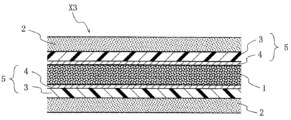
- FIG. 2 is a cross-sectional view showing an example of the laminated structure of the pressure-sensitive adhesive sheet of the present invention.
- FIG. 3 is a cross-sectional view showing another example of the laminated structure of the pressure-sensitive adhesive sheet of the present invention.
- FIG. 4 is a cross-sectional view showing an overview of the method of the 180° peel test in Examples.
- the pressure-sensitive adhesive composition according to the embodiment of the present invention contains a polymer, an ionic liquid, and a tackifier, and the acid value [mgKOH/g] of the tackifier and The product of the content [parts by mass] is less than 1200.
- a tackifier having an acid value in a pressure-sensitive adhesive composition containing a polymer and an ionic liquid was added to the acid value [mgKOH/g] of the tackifier and When added so that the product of the content [parts by mass] of the agent is 1200 or more, the adhesive strength is improved when no voltage is applied, but the decrease in adhesive strength due to the application of voltage is insufficient.
- the product of the acid value [mgKOH/g] of the tackifier and the content [parts by mass] of the tackifier with respect to 100 parts by mass of the polymer is less than 1200.
- the pressure-sensitive adhesive composition is suitable as an electro-peeling pressure-sensitive adhesive composition. The adhesive composition will be described below.
- the adhesive strength when no voltage is applied is sometimes referred to as “initial adhesive strength”.
- the property that the adhesive force is reduced by voltage application is called “electro-peeling property”, and a large reduction rate of adhesive force by voltage application is sometimes called “excellent electro-peeling property”.
- a pressure-sensitive adhesive composition according to an embodiment of the present invention contains a polymer.
- the polymer is not particularly limited as long as it is a general organic polymer compound, and is, for example, a polymer or partial polymer of monomers.
- the monomer may be a single monomer or a mixture of two or more monomers.
- a partially polymerized product means a polymerized product in which at least a part of a monomer or a monomer mixture is partially polymerized.
- the polymer in the embodiment of the present invention is usually used as an adhesive and is not particularly limited as long as it has adhesiveness.
- examples include acrylic polymers, rubber polymers, vinyl alkyl ether polymers, silicone polymers, polyesters polymer, polyamide-based polymer, urethane-based polymer, fluorine-based polymer, and epoxy-based polymer.
- the above polymers can be used alone or in combination of two or more.
- the polymer in the embodiment of the invention preferably contains at least one selected from the group consisting of polyester-based polymers, urethane-based polymers, and acrylic-based polymers.
- the acrylic polymer preferably has carboxyl groups, alkoxy groups, hydroxyl groups and/or amide bonds. Since polyester-based polymers and urethane-based polymers have terminal hydroxyl groups that are easily polarized, acrylic polymers having carboxyl groups, alkoxy groups, hydroxyl groups and/or amide bonds have carboxyl groups, alkoxy groups, hydroxyl groups and / Or since the amide bond is easily polarized, by using these polymers, it is possible to obtain a pressure-sensitive adhesive layer that exhibits excellent adhesive strength when no voltage is applied.
- the total content of the polyester-based polymer, urethane-based polymer, and acrylic polymer in the total polymer contained in the pressure-sensitive adhesive composition according to the embodiment of the present invention is preferably 60% by mass or more, and 80% by mass. % or more is more preferable.
- the polymer in the embodiment of the present invention is preferably an acrylic polymer, and has a carboxyl group, an alkoxy group, a hydroxyl group, and/or an amide group. More preferably, it is an acrylic polymer having a bond. That is, the pressure-sensitive adhesive composition according to the embodiment of the present invention is preferably an acrylic pressure-sensitive adhesive composition containing an acrylic polymer as a polymer.
- the acrylic polymer preferably contains a monomer unit derived from a (meth)acrylic acid alkyl ester (formula (1) below) having an alkyl group having 1 to 14 carbon atoms.
- Such monomer units are suitable for obtaining high initial adhesive strength.
- the number of carbon atoms in the alkyl group R b in the following formula (1) is preferably small, particularly 8 or less. Preferably, it is 4 or less.
- CH2 C( Ra ) COORb (1) [R a in formula (1) is a hydrogen atom or a methyl group, and R b is an alkyl group having 1 to 14 carbon atoms]
- Examples of (meth)acrylic acid alkyl esters having an alkyl group having 1 to 14 carbon atoms include methyl (meth)acrylate, ethyl (meth)acrylate, propyl (meth)acrylate, isopropyl (meth)acrylate, n-butyl ( meth)acrylate, sec-butyl (meth)acrylate, 1,3-dimethylbutyl acrylate, pentyl (meth)acrylate, isopentyl (meth)acrylate, hexyl (meth)acrylate, 2-ethylbutyl (meth)acrylate, heptyl (meth)acrylate ) acrylate, n-octyl (meth) acrylate, isooctyl (meth) acrylate, 2-ethylhexyl (meth) acrylate, n-nonyl (meth) acrylate, isononyl (meth) acrylate,
- n-butyl acrylate, 2-ethylhexyl acrylate and isononyl acrylate are preferred.
- the (meth)acrylic acid alkyl esters having an alkyl group of 1 to 14 carbon atoms can be used alone or in combination of two or more.
- the ratio of the (meth)acrylic acid alkyl ester having an alkyl group having 1 to 14 carbon atoms to the total monomer components (100% by mass) constituting the acrylic polymer is not particularly limited, but is preferably 70% by mass or more, more preferably. is 80% by mass or more, more preferably 85% by mass or more.
- a large initial adhesive strength can be easily obtained.
- the acrylic polymer in addition to the monomer unit derived from (meth)acrylic acid alkyl ester having an alkyl group having 1 to 14 carbon atoms, for the purpose of improving cohesion, heat resistance, crosslinkability, etc. It preferably contains a monomer unit derived from a copolymerizable polar group-containing monomer.
- a monomer unit can provide cross-linking points and is suitable for obtaining a large initial adhesive strength.
- Polar group-containing monomers include, for example, carboxyl group-containing monomers, alkoxy group-containing monomers, hydroxyl group-containing monomers, cyano group-containing monomers, vinyl group-containing monomers, aromatic vinyl monomers, amide group-containing monomers, imide group-containing monomers, amino Examples include group-containing monomers, epoxy group-containing monomers, vinyl ether monomers, N-acryloylmorpholine, sulfo group-containing monomers, phosphoric acid group-containing monomers, and acid anhydride group-containing monomers.
- carboxyl group-containing monomers alkoxy group-containing monomers, hydroxyl group-containing monomers, and amide group-containing monomers are preferable, and carboxyl group-containing monomers are particularly preferable, from the viewpoint of excellent cohesiveness.
- a carboxyl group-containing monomer is particularly suitable for obtaining a large initial adhesive strength.
- Polar group-containing monomers can be used alone or in combination of two or more.
- Carboxyl group-containing monomers include, for example, acrylic acid, methacrylic acid, carboxyethyl (meth)acrylate, carboxypentyl (meth)acrylate, itaconic acid, maleic acid, fumaric acid, crotonic acid, and isocrotonic acid. Acrylic acid is particularly preferred. Carboxyl group-containing monomers can be used alone or in combination of two or more.
- alkoxy group-containing monomers examples include methoxy group-containing monomers and ethoxy group-containing monomers.
- methoxy group-containing monomers include 2-methoxyethyl acrylate.
- hydroxyl group-containing monomers examples include 2-hydroxyethyl (meth)acrylate, 2-hydroxypropyl (meth)acrylate, 4-hydroxybutyl (meth)acrylate, 6-hydroxyhexyl (meth)acrylate, 8-hydroxyoctyl ( meth)acrylate, 10-hydroxydecyl (meth)acrylate, 12-hydroxylauryl (meth)acrylate, (4-hydroxymethylcyclohexyl)methyl (meth)acrylate, N-methylol (meth)acrylamide, vinyl alcohol, allyl alcohol , 2-hydroxyethyl vinyl ether, 4-hydroxybutyl vinyl ether, and diethylene glycol monovinyl ether. 2-Hydroxyethyl (meth)acrylate and 4-hydroxybutyl (meth)acrylate are particularly preferred.
- a hydroxyl group-containing monomer can be used individually or in combination of 2 or more types.
- amide group-containing monomers examples include acrylamide, methacrylamide, N-vinylpyrrolidone, N,N-dimethylacrylamide, N,N-dimethylmethacrylamide, N,N-diethylacrylamide, N,N-diethylmethacrylamide, N , N′-methylenebisacrylamide, N,N-dimethylaminopropylacrylamide, N,N-dimethylaminopropylmethacrylamide, and diacetoneacrylamide.
- Amido group-containing monomers can be used alone or in combination of two or more.
- cyano group-containing monomers examples include acrylonitrile and methacrylonitrile.
- vinyl group-containing monomers examples include vinyl esters such as vinyl acetate, vinyl propionate, and vinyl laurate, and vinyl acetate is particularly preferred.
- aromatic vinyl monomers examples include styrene, chlorostyrene, chloromethylstyrene, ⁇ -methylstyrene, and other substituted styrenes.
- imide group-containing monomers examples include cyclohexylmaleimide, isopropylmaleimide, N-cyclohexylmaleimide, and itaconimide.
- amino group-containing monomers examples include aminoethyl (meth)acrylate, N,N-dimethylaminoethyl (meth)acrylate, and N,N-dimethylaminopropyl (meth)acrylate.
- epoxy group-containing monomers examples include glycidyl (meth)acrylate, methylglycidyl (meth)acrylate, and allyl glycidyl ether.
- vinyl ether monomers examples include methyl vinyl ether, ethyl vinyl ether, and isobutyl vinyl ether.
- the ratio of the polar group-containing monomer to the total monomer components (100% by mass) constituting the acrylic polymer is preferably 0.1% by mass or more and 35% by mass or less.
- the upper limit of the ratio of the polar group-containing monomer is more preferably 25% by mass, more preferably 20% by mass, and the lower limit is more preferably 0.5% by mass, further preferably 1% by mass. , particularly preferably 2% by weight.
- the ratio of the polar group-containing monomer is 35% by mass or less, it becomes easier to prevent the pressure-sensitive adhesive layer from excessively adhering to the adherend and causing heavy release.
- the amount is 2% by mass or more and 20% by mass or less, it becomes easy to achieve both the releasability from the adherend and the adhesion between the pressure-sensitive adhesive layer and other layers.
- a polyfunctional monomer may be included in order to introduce a crosslinked structure into the acrylic polymer and facilitate the acquisition of the necessary cohesive force.
- polyfunctional monomers examples include ethylene glycol di(meth)acrylate, diethylene glycol di(meth)acrylate, tetraethylene glycol di(meth)acrylate, neopentyl glycol di(meth)acrylate, 1,6-hexanediol di( meth)acrylate, trimethylolpropane tri(meth)acrylate, pentaerythritol tri(meth)acrylate, dipentaerythritol hexa(meth)acrylate, divinylbenzene, and N,N'-methylenebisacrylamide.
- a polyfunctional monomer can be used individually or in combination of 2 or more types.
- the content of the polyfunctional monomer with respect to the total monomer components (100% by mass) constituting the acrylic polymer is preferably 0.1% by mass or more and 15% by mass or less.
- the upper limit of the polyfunctional monomer content is more preferably 10% by mass, and the lower limit is more preferably 3% by mass.
- the content of the polyfunctional monomer is 0.1% by mass or more, the flexibility and adhesiveness of the pressure-sensitive adhesive layer are likely to be improved, which is preferable.
- the content of the polyfunctional monomer is 15% by mass or less, the cohesive force does not become too high, making it easier to obtain appropriate adhesiveness.
- Polyester-based polymers are typically composed of polyvalent carboxylic acids such as dicarboxylic acids and derivatives thereof (hereinafter also referred to as “polyvalent carboxylic acid monomers”), and polyhydric alcohols such as diols and derivatives thereof (hereinafter referred to as “polyhydric alcohol monomers”). ”) is a polymer having a condensed structure.
- polyvalent carboxylic acid monomers include, but are not limited to, adipic acid, azelaic acid, dimer acid, sebacic acid, 1,4-cyclohexanedicarboxylic acid, 1,3-cyclohexanedicarboxylic acid, 1,2-cyclohexanedicarboxylic acid, 4-methyl-1,2-cyclohexanedicarboxylic acid, dodecenylsuccinic anhydride, fumaric acid, succinic acid, dodecanedioic acid, hexahydrophthalic anhydride, tetrahydrophthalic anhydride, etc., maleic acid, maleic anhydride, itaconic acid, citraconic acid , and derivatives thereof and the like can be used.
- Polyvalent carboxylic acid monomers can be used alone or in combination of two or more.
- polyhydric alcohol monomers include, but are not limited to, ethylene glycol, 1,2-propylene glycol, 1,3-propanediol, 2-methyl-1,3-propanediol, 1,2-butanediol, 1, 3-butanediol, 1,4-butanediol, 1,5-pentanediol, 1,6-hexanediol, 3-methyl-1,5-pentanediol, neopentyl glycol, diethylene glycol, dipropylene glycol, 2,2 ,4-trimethyl-1,5-pentanediol, 2-ethyl-2-butylpropanediol, 1,9-nonanediol, 2-methyloctanediol, 1,10-decanediol, derivatives thereof, etc. can be done.
- a polyhydric alcohol monomer can be used individually or in combination of 2 or more types.
- Urethane-based polymers include, for example, ether-based polyurethanes and polyester-based polyurethanes.
- Ether-based polyurethanes include, for example, urethane acrylate resins.
- a coating composition for forming a resin film using a urethane acrylate resin is prepared by, for example, polymerizing a precursor containing a polyether segment, a (meth)acrylic segment, and a urethane segment under conditions in which the molecular weight can be controlled to form an oligomer. , can be prepared by adding various additives. This can be coated on a supporting substrate and crosslinked to obtain a urethane acrylate resin film on the supporting substrate.
- the coating composition for forming a resin film using a urethane acrylate resin contains a polyether polyol, a compound containing an isocyanate group and a hydroxyalkyl (meth)acrylate, or an acrylic-modified polyether polyol and an isocyanate group. It can be prepared by previously polymerizing a compound to form a urethane acrylate oligomer and adding an appropriate additive thereto. This can be coated on a supporting substrate and crosslinked to obtain a urethane acrylate resin film on the supporting substrate.
- polyether polyols examples include polyalkylene glycols such as polyethylene glycol, polypropylene glycol, polytetramethylene glycol, and various derivatives thereof.
- ester-based polyurethanes examples include adipate-based (ester-based) polyurethanes and polycaprolactone-based (ester-based) polyurethanes.
- the polymer in the embodiment of the present invention can be obtained by (co)polymerizing monomer components.
- the polymerization method is not particularly limited, but includes solution polymerization, emulsion polymerization, bulk polymerization, suspension polymerization, photopolymerization (active energy ray polymerization), and the like.
- the solution polymerization method is preferable from the viewpoint of cost and productivity.
- the polymer may be a random copolymer, a block copolymer, an alternating copolymer, a graft copolymer, or the like.
- the solution polymerization method is not particularly limited, but examples include a method of dissolving a monomer component, a polymerization initiator, etc. in a solvent and heating and polymerizing to obtain a polymer solution containing the polymer.
- solvents can be used as the solvent used in the solution polymerization method.
- solvents include aromatic hydrocarbons such as toluene, benzene, and xylene; esters such as ethyl acetate and n-butyl acetate; Alicyclic hydrocarbons such as cyclohexane and methylcyclohexane; organic solvents such as ketones such as methyl ethyl ketone and methyl isobutyl ketone;
- a solvent can be used individually or in combination of 2 or more types.
- the amount of the solvent used is not particularly limited, but is preferably 10 parts by mass or more and 1000 parts by mass or less with respect to all the monomer components (100 parts by mass) constituting the polymer.
- the upper limit of the amount of solvent used is more preferably 500 parts by mass, and the lower limit is more preferably 50 parts by mass.
- the polymerization initiator used in the solution polymerization method is not particularly limited, but includes peroxide-based polymerization initiators, azo-based polymerization initiators, and the like.
- Peroxide-based polymerization initiators are not particularly limited, but include peroxycarbonates, ketone peroxides, peroxyketals, hydroperoxides, dialkyl peroxides, diacyl peroxides, and peroxyesters.
- the azo polymerization initiator is not particularly limited, but 2,2'-azobisisobutyronitrile, 2,2'-azobis-2-methylbutyronitrile, 2,2'-azobis(2,4- dimethylvaleronitrile), 2,2′-azobis(2-methylpropionate)dimethyl, 2,2′-azobis(4-methoxy-2,4-dimethylvaleronitrile), 1,1′-azobis(cyclohexane-1 -carbonitrile), 2,2′-azobis(2,4,4-trimethylpentane), 4,4′-azobis-4-cyanovaleric acid, 2,2′-azobis(2-amidinopropane) dihydrochloride, 2,2'-azobis[2-(5-methyl-2-imidazolin-2-yl)propane]dihydrochloride, 2,2'-azobis(2-methylpropionamidine) disulfate, 2,2'-azobis (N,N'-dimethyleneisobutylamidine) hydro
- the amount of the polymerization initiator used is not particularly limited, but is preferably 0.01 parts by mass or more and 5 parts by mass or less with respect to all the monomer components (100 parts by mass) constituting the polymer.
- the upper limit of the amount of the polymerization initiator used is more preferably 3 parts by mass, and the lower limit is more preferably 0.05 parts by mass.
- the heating temperature for polymerization by heating is not particularly limited, but is, for example, 50°C or higher and 80°C or lower.
- the heating time is not particularly limited, but is, for example, 1 hour or more and 24 hours or less.
- the weight average molecular weight of the polymer is not particularly limited, it is preferably 100,000 or more and 5,000,000 or less.
- the upper limit of the weight average molecular weight is more preferably 4,000,000, more preferably 3,000,000, and the lower limit is more preferably 200,000, still more preferably 300,000.
- the weight-average molecular weight is 100,000 or more, the cohesive force becomes small, and it is possible to effectively suppress the problem that adhesive residue is left on the surface of the adherend after the pressure-sensitive adhesive layer is peeled off.
- the weight-average molecular weight is 5,000,000 or less, it is possible to effectively suppress the problem that the wettability of the surface of the adherend after the pressure-sensitive adhesive layer is peeled off becomes insufficient.
- the weight average molecular weight is obtained by measuring by a gel permeation chromatograph (GPC) method. ) can be used to measure under the following conditions, and can be calculated from standard polystyrene conversion values.
- GPC gel permeation chromatograph
- the glass transition temperature (Tg) of the polymer is not particularly limited, but when it is 0° C. or less, it is preferable because a decrease in initial adhesive strength can be suppressed, more preferably ⁇ 10° C. or less, and even more preferably ⁇ 20° C. or less. is.
- a temperature of ⁇ 40° C. or less is particularly preferable, and most preferably ⁇ 50° C. or less, because the rate of decrease in adhesive strength due to voltage application is particularly large.
- the above formula (Y) is a calculation formula when the polymer is composed of n kinds of monomer components of monomer 1, monomer 2, . . . , monomer n.
- the glass transition temperature when forming a homopolymer means the glass transition temperature of a homopolymer of the monomer, and is formed using only a certain monomer (sometimes referred to as "monomer X") as a monomer component. It refers to the glass transition temperature (Tg) of a polymer. Specifically, numerical values are listed in "Polymer Handbook” (3rd edition, John Wiley & Sons, Inc., 1989).
- the glass transition temperature (Tg) of a homopolymer not described in the literature refers to a value obtained by, for example, the following measuring method.
- a reactor equipped with a thermometer, a stirrer, a nitrogen inlet tube and a reflux condenser was charged with 100 parts by mass of monomer X, 0.2 parts by mass of 2,2'-azobisisobutyronitrile and 200 parts by mass of ethyl acetate as a polymerization solvent. Parts by mass are added, and the mixture is stirred for 1 hour while nitrogen gas is introduced. After oxygen is removed from the polymerization system in this manner, the temperature is raised to 63° C. and the reaction is allowed to proceed for 10 hours. Then, it is cooled to room temperature to obtain a homopolymer solution having a solid concentration of 33% by mass.
- the homopolymer solution is then cast onto a release liner and dried to form a test sample (sheet-like homopolymer) having a thickness of about 2 mm. Then, about 1 to 2 mg of this test sample was weighed in an aluminum open cell, and a temperature-modulated DSC (trade name "Q-2000" manufactured by T.A. Instruments) was used to measure the temperature in a nitrogen atmosphere of 50 ml/min. The reversing heat flow (specific heat component) behavior of the homopolymer is obtained at a heating rate of 5°C/min.
- the glass transition temperature (Tg) of the homopolymer is defined as the temperature at which the curve of the part intersects.
- the content of the polymer in the adhesive composition according to the embodiment of the present invention is preferably 50% by mass or more and 99.9% by mass or less with respect to the total amount (100% by mass) of the adhesive composition, and the upper limit is more preferably is 99.5% by mass, more preferably 99% by mass, and the lower limit is more preferably 60% by mass, still more preferably 70% by mass.
- the ionic liquid in the embodiment of the present invention is not particularly limited as long as it is a molten salt (normal temperature molten salt) that is composed of a pair of anion and cation and is liquid at 25°C. Examples of anions and cations are given below. Of the ionic substances obtained by combining these, those that are liquid at 25°C are ionic liquids, and those that are solid at 25°C are not ionic liquids. is an ionic solid.
- the anions of the ionic liquid are, for example, (FSO 2 ) 2 N ⁇ , (CF 3 SO 2 ) 2 N ⁇ , (CF 3 CF 2 SO 2 ) 2 N ⁇ , (CF 3 SO 2 ) 3 C ⁇ , Br ⁇ , AlCl 4 ⁇ , Al 2 Cl 7 ⁇ , NO 3 ⁇ , BF 4 ⁇ , PF 6 ⁇ , CH 3 COO ⁇ , CF 3 COO ⁇ , CF 3 CF 2 CF 2 COO ⁇ , CF 3 SO 3 ⁇ , CF 3 (CF 2 ) 3 SO 3 ⁇ , AsF 6 ⁇ , SbF 6 ⁇ , F(HF) n ⁇ and the like.
- the anions include sulfonylimide compounds such as (FSO 2 ) 2 N ⁇ [bis(fluorosulfonyl)imide anion] and (CF 3 SO 2 ) 2 N ⁇ [bis(trifluoromethanesulfonyl)imide anion].
- Anions are preferable because they are chemically stable and suitable for improving the electrical strippability. That is, the anion of the ionic liquid preferably contains at least one selected from the group consisting of bis(fluorosulfonyl)imide anions and bis(trifluoromethanesulfonyl)imide anions.
- nitrogen-containing onium, sulfur-containing onium, and phosphorus-containing onium cations are preferable because they are chemically stable and suitable for improving the electrical stripping property.
- pyrrolidinium-based, and pyridinium-based cations are more preferred.
- imidazolium cations include 1-methylimidazolium cation, 1-ethyl-3-methylimidazolium cation, 1-propyl-3-methylimidazolium cation, 1-butyl-3-methylimidazolium cation, 1 -Pentyl-3-methylimidazolium cation, 1-hexyl-3-methylimidazolium cation, 1-heptyl-3-methylimidazolium cation, 1-octyl-3-methylimidazolium cation, 1-nonyl-3- methylimidazolium cation, 1-undecyl-3-methylimidazolium cation, 1-dodecyl-3-methylimidazolium cation, 1-tridecyl-3-methylimidazolium cation, 1-tetradecyl-3-methylimidazolium cation, 1 -pentadecyl-3-methylimidazolium cation,
- pyridinium-based cations examples include 1-butylpyridinium cation, 1-hexylpyridinium cation, 1-butyl-3-methylpyridinium cation, 1-butyl-4-methylpyridinium cation, and 1-octyl-4-methylpyridinium cation. etc.
- pyrrolidinium-based cations examples include 1-ethyl-1-methylpyrrolidinium cations and 1-butyl-1-methylpyrrolidinium cations.
- ammonium-based cations include tetraethylammonium cation, tetrabutylammonium cation, methyltrioctylammonium cation, tetradecitrihexylammonium cation, glycidyltrimethylammonium cation and trimethylaminoethylacrylate cation.
- the ionic liquid it is preferable to select a cation having a molecular weight of 160 or less as a constituent cation from the viewpoint of increasing the rate of decrease in adhesive strength when a voltage is applied.
- Ionic liquids containing [fluorosulfonyl)imide anion] or (CF 3 SO 2 ) 2 N ⁇ [bis(trifluoromethanesulfonyl)imide anion] and a cation having a molecular weight of 160 or less are particularly preferred.
- Examples of cations having a molecular weight of 160 or less include 1-methylimidazolium cation, 1-ethyl-3-methylimidazolium cation, 1-propyl-3-methylimidazolium cation, 1-butyl-3-methylimidazolium cation, 1-pentyl-3-methylimidazolium cation, 1-butylpyridinium cation, 1-hexylpyridinium cation, 1-butyl-3-methylpyridinium cation, 1-butyl-4-methylpyridinium cation, 1-ethyl-1-methyl pyrrolidinium cation, 1-butyl-1-methylpyrrolidinium cation, tetraethylammonium cation, glycidyltrimethylammonium cation, trimethylaminoethylacrylate cation, and the like.
- R 1 in formula (2-A) represents a hydrocarbon group having 4 to 10 carbon atoms (preferably a hydrocarbon group having 4 to 8 carbon atoms, more preferably a hydrocarbon group having 4 to 6 carbon atoms), A heteroatom may be included, and R 2 and R 3 are the same or different and are a hydrogen atom or a hydrocarbon group having 1 to 12 carbon atoms (preferably a hydrocarbon group having 1 to 8 carbon atoms, more preferably a hydrocarbon group having 1 to 8 carbon atoms, more preferably to 6 hydrocarbon groups, more preferably hydrocarbon groups having 2 to 4 carbon atoms), which may contain a heteroatom. However, when the nitrogen atom forms a double bond with the adjacent carbon atom, R3 is absent.
- R 4 in formula (2-B) represents a hydrocarbon group having 2 to 10 carbon atoms (preferably a hydrocarbon group having 2 to 8 carbon atoms, more preferably a hydrocarbon group having 2 to 6 carbon atoms), A heteroatom may be included, and R 5 , R 6 and R 7 are the same or different and are a hydrogen atom or a hydrocarbon group having 1 to 12 carbon atoms (preferably a hydrocarbon group having 1 to 8 carbon atoms, more preferably represents a hydrocarbon group having 2 to 6 carbon atoms, more preferably a hydrocarbon group having 2 to 4 carbon atoms, which may contain a heteroatom.
- R 8 in formula (2-C) represents a hydrocarbon group having 2 to 10 carbon atoms (preferably a hydrocarbon group having 2 to 8 carbon atoms, more preferably a hydrocarbon group having 2 to 6 carbon atoms), A heteroatom may be included, and R 9 , R 10 and R 11 are the same or different and are a hydrogen atom or a hydrocarbon group having 1 to 16 carbon atoms (preferably a hydrocarbon group having 1 to 10 carbon atoms, more preferably represents a hydrocarbon group having 1 to 8 carbon atoms) and may contain a heteroatom.
- X in formula (2-D) represents a nitrogen, sulfur or phosphorus atom
- R 12 , R 13 , R 14 and R 15 are the same or different and are hydrocarbon groups having 1 to 16 carbon atoms ( Preferably a hydrocarbon group having 1 to 14 carbon atoms, more preferably a hydrocarbon group having 1 to 10 carbon atoms, still more preferably a hydrocarbon group having 1 to 8 carbon atoms, particularly preferably a hydrocarbon group having 1 to 6 carbon atoms. ) and may contain heteroatoms. However, when X is a sulfur atom, R 12 does not exist.
- the cation of the ionic liquid preferably contains at least one selected from the group consisting of nitrogen-containing onium cations, sulfur-containing onium cations, and phosphorus-containing onium cations.
- the molecular weight of the cation in the ionic liquid is, for example, 500 or less, preferably 400 or less, more preferably 300 or less, still more preferably 250 or less, particularly preferably 200 or less, and most preferably 160 or less. Moreover, it is usually 50 or more. It is thought that cations in the ionic liquid have the property of moving toward the cathode side in the pressure-sensitive adhesive layer upon application of a voltage and being concentrated near the interface between the pressure-sensitive adhesive layer and the adherend. In the present invention, therefore, the adhesive strength during voltage application is lower than the initial adhesive strength, resulting in electro-peeling. A cation with a low molecular weight such as 500 or less facilitates movement of the cation to the cathode side in the pressure-sensitive adhesive layer, and is suitable for increasing the rate of decrease in adhesive strength upon voltage application.
- ionic liquids include, for example, "Elexel AS-110”, “Elexel MP-442”, “Elexel IL-210”, “Elexel MP-471”, “Elexel MP-” manufactured by Daiichi Kogyo Seiyaku Co., Ltd. 456”, “Elexel AS-804”, “HMI-FSI” manufactured by Mitsubishi Materials Corporation, “CIL-312” and “CIL-313” manufactured by Nippon Carlit Co., Ltd., and the like.
- the ionic conductivity of the ionic liquid is preferably 0.1 mS/cm or more. It is more preferably 1 mS/cm or more, still more preferably 3 mS/cm or more, still more preferably 5 mS/cm or more, even more preferably 10 mS/cm or more, and particularly preferably 15 mS/cm or more. and most preferably 20 mS/cm or more.
- the adhesive strength is sufficiently lowered even at a low voltage.
- the ionic conductivity can be measured by an AC impedance method using, for example, a Solartron 1260 frequency response analyzer.
- the content (blended amount) of the ionic liquid in the pressure-sensitive adhesive composition according to the embodiment of the present invention is 0.5 parts by mass or more with respect to 100 parts by mass of the polymer, which reduces the adhesive strength during voltage application. From this point of view, it is preferably 30 parts by mass or less from the point of view of increasing the initial adhesive strength. From the same viewpoint, it is more preferably 20 parts by mass or less, further preferably 15 parts by mass or less, particularly preferably 10 parts by mass or less, and most preferably 5 parts by mass or less. Further, it is more preferably 0.6 parts by mass or more, further preferably 0.8 parts by mass or more, particularly preferably 1.0 parts by mass or more, and 1.5 parts by mass or more. is most preferred.
- the tackifier according to the embodiment of the present invention is the product of the acid value [mgKOH / g] of the tackifier and the content [parts by mass] of the tackifier with respect to 100 parts by mass of the polymer (hereinafter simply referred to as "acid value and content”) is less than 1200.
- the product of the acid value and the content should be less than 1200, but since the electrical peelability tends to deteriorate as the amount of carboxylic acid groups contained in the adhesive increases, it is preferably 1000 or less, for example. , 750 or less, more preferably 500 or less, and most preferably 300 or less.
- the lower limit is not particularly limited, it can be set to, for example, 10 or more from the viewpoint of electro-peeling properties.
- a value measured by a potentiometric titration method specified in JIS K0070:1992 can be adopted.
- a specific measuring method is as follows.
- Acid value (mgKOH/g) (B x f x 5.611)/S here, B: Amount (mL) of 0.1 mol/L potassium hydroxide ethanol solution used for the sample, f: factor of 0.1 mol/L potassium hydroxide ethanol solution, S: mass of sample (g), 5.611: 1/10 of the molecular weight of potassium hydroxide, 56.11; is.
- the hydroxyl value of the tackifier is not particularly limited, and may exceed 0 mgKOH/g, but is preferably 0 mgKOH/g.
- the softening point of the tackifier is preferably 100°C or higher, more preferably 120°C or higher, even more preferably 130°C or higher, and most preferably 145°C or higher.
- the softening point of the tackifier is preferably 200° C. or lower, more preferably 180° C. or lower, even more preferably 170° C. or lower, and most preferably 160° C. or lower.
- the dispersibility of the tackifier in the adhesive layer is improved, the precipitation and phase separation of the tackifier are less likely to occur, and the pressure-sensitive adhesive layer when voltage is applied. It is difficult to inhibit the movement of the ionic liquid.
- the softening point of the tackifier here is defined as a value measured based on the softening point test method (ring and ball method) specified in JIS K5902 and JIS K2207. Specifically, the sample is melted as quickly as possible at the lowest possible temperature and carefully filled into a ring placed on a flat metal plate to avoid the formation of bubbles. After it cools down, cut off the raised part from the plane including the top of the ring with a slightly heated knife. Next, a supporter (ring base) is placed in a glass container (heating bath) having a diameter of 85 mm or more and a height of 127 mm or more, and glycerin is poured to a depth of 90 mm or more.
- ring and ball method specified in JIS K5902 and JIS K2207.
- the steel ball (diameter 9.5 mm, weight 3.5 g) and the ring filled with the sample are immersed in the glycerin without touching each other, and the temperature of the glycerin is kept at 20° C. ⁇ 5° C. for 15 minutes. .
- a steel ball is then centered on the surface of the sample in the ring and placed in position on the support.
- the distance from the upper end of the ring to the glycerin surface is kept at 50 mm, a thermometer is placed, the center of the mercury ball of the thermometer is set at the same height as the center of the ring, and the container is heated.
- the Bunsen burner flame used for heating is directed halfway between the center and the rim of the bottom of the vessel to ensure even heating.
- the rate at which the bath temperature rises after reaching 40° C. from the start of heating must be 5.0 ⁇ 0.5° C. per minute.
- the temperature at which the sample gradually softens and flows down the ring and finally touches the bottom plate is read and taken as the softening point. Two or more softening points are measured at the same time, and the average value is adopted.
- tackifier resin for example, a tackifier resin is used.
- tackifying resins include phenol-based tackifying resins, terpene-based tackifying resins, rosin-based tackifying resins, hydrocarbon-based tackifying resins, epoxy-based tackifying resins, polyamide-based tackifying resins, and elastomer-based tackifying resins. resins, ketone-based tackifying resins, and the like.
- phenol-based tackifying resins include terpene phenol resins, hydrogenated terpene phenol resins, alkylphenol resins, rosin phenol resins, and xylene formaldehyde resins.
- Terpene phenol resin refers to a polymer containing a terpene residue and a phenol residue, a copolymer of terpenes and a phenol compound (terpene-phenol copolymer resin), and a homopolymer or copolymer of terpenes is a concept that includes both phenol-modified (phenol-modified terpene resin).
- terpenes constituting such a terpene phenol resin include monoterpenes such as ⁇ -pinene, ⁇ -pinene, and limonene (including d-, l- and d/l (dipentene)). mentioned.
- a hydrogenated terpene phenol resin refers to a hydrogenated terpene phenol resin having a structure obtained by hydrogenating such a terpene phenol resin, and is sometimes referred to as a hydrogenated terpene phenol resin.
- Alkylphenol resins are resins obtained from alkylphenols and formaldehyde (oily phenolic resins). Alkylphenol resins include, for example, novolak type and resol type.
- rosin phenol resins include phenol-modified rosins and various rosin derivatives (including rosin esters, unsaturated fatty acid-modified rosins, and unsaturated fatty acid-modified rosin esters). Rosin phenol resins include, for example, rosin phenol resins obtained by adding phenol to rosins or various rosin derivatives with an acid catalyst and thermally polymerizing them.
- Terpene-based tackifying resins include, for example, terpene resins, terpene phenol resins, styrene-modified terpene resins, aromatic modified terpene resins, and hydrogenated terpene resins.
- Terpene resins include polymers of terpenes (typically monoterpenes) such as ⁇ -pinene, ⁇ -pinene, d-limonene, l-limonene and dipentene.
- terpene homopolymer includes, for example, ⁇ -pinene polymer, ⁇ -pinene polymer, and dipentene polymer.
- rosin-based tackifying resins includes both rosins and rosin derivative resins.
- rosins include unmodified rosins (fresh rosins) such as gum rosin, wood rosin and tall oil rosin; homogenized rosin, polymerized rosin, other chemically modified rosins, etc.);
- rosin derivative resins include rosin esters such as unmodified rosin esters that are esters of unmodified rosin and alcohols, and modified rosin esters that are esters of denatured rosin and alcohols; Unsaturated fatty acid-modified rosins; rosin esters modified with unsaturated fatty acids; rosins and rosin derivative resins (rosin esters, unsaturated fatty acid-modified rosins, unsaturated fatty acid-modified rosin alcohols obtained by reducing the carboxyl groups of esters, etc.); rosin phenols; metal salts thereof;
- rosin esters include methyl esters, triethylene glycol esters, glycerin esters, pentaerythritol esters, and maleic esters of unmodified rosins or modified rosins (e.g., hydrogenated rosins, disproportionated rosins, polymerized rosins, etc.). is
- hydrocarbon-based tackifying resins examples include aliphatic hydrocarbon resins, aromatic hydrocarbon resins (e.g., styrene-based resins, xylene-based resins, etc.), aliphatic cyclic hydrocarbon resins, aliphatic/aromatic petroleum resins (styrene-olefin copolymers, etc.), aliphatic/alicyclic petroleum resins, hydrogenated hydrocarbon resins, coumarone resins, and coumarone-indene resins.
- aromatic hydrocarbon resins e.g., styrene-based resins, xylene-based resins, etc.
- aliphatic cyclic hydrocarbon resins aliphatic/aromatic petroleum resins (styrene-olefin copolymers, etc.)
- aliphatic/alicyclic petroleum resins hydrogenated hydrocarbon resins
- coumarone resins coumarone-indene resins
- a terpene-based tackifying resin or a rosin-based tackifying resin is preferable.
- a tackifier may be used alone or in combination of two or more. When two or more types of tackifiers are used in combination in the embodiment of the present invention, the product of the acid value and the content of each tackifier should be obtained, and the sum of these values should be less than 1200. When two or more tackifiers are used in combination, the preferred range of the sum of the products of each acid value and content is the same as the preferred range when used alone.
- the preferred acid value of the tackifier according to the embodiment of the present invention varies depending on the content of the tackifier used, but in general, it is preferably, for example, 50 mgKOH/g or less from the viewpoint of electrical peelability. 30 mgKOH/g or less is more preferred, and 10 mgKOH/g is most preferred. The lower limit is not particularly limited.
- the acid value of the tackifier is preferably 1 to 200 mgKOH/g.
- the content of the tackifier in the pressure-sensitive adhesive composition according to the embodiment of the present invention varies depending on the acid value of the tackifier used. It is preferably 5 parts by mass or more, more preferably 7.5 parts by mass or more, still more preferably 10 parts by mass or more, and most preferably 15 parts by mass or more with respect to 100 parts by mass.
- the upper limit is preferably 50 parts by mass or less, more preferably 45 parts by mass or less, even more preferably 40 parts by mass or less, and most preferably 30 parts by mass.
- the content of the tackifier in the adhesive composition is preferably 5 to 50 parts by mass with respect to 100 parts by mass of the polymer.
- the pressure-sensitive adhesive composition according to the embodiment of the present invention may further contain a second polymer having a glass transition temperature (Tg) of 40-180°C.
- the second polymer should have a glass transition temperature (Tg) of 40 to 180°C.
- Tg glass transition temperature
- any material may be used as long as it is different from the polymer.
- the pressure-sensitive adhesive composition according to the embodiment of the present invention contains a second polymer having a glass transition temperature (Tg) of 40 to 180 ° C., so that the effect of improving the elastic modulus is obtained, and it is excellent when no voltage is applied. It is possible to form a pressure-sensitive adhesive layer having excellent wet heat stability, which exhibits a high adhesive strength, and whose adhesive strength is sufficiently lowered by voltage application even after storage in a high-temperature and high-humidity environment.
- the glass transition temperature (Tg) of the second polymer is preferably 40°C or higher, more preferably 50°C or higher, even more preferably 60°C or higher, further preferably 70°C, from the viewpoint of adhesive properties. It is preferable that it is above. In addition, from the viewpoint of adhesive properties, the temperature must be 180° C. or lower, more preferably 160° C. or lower, even more preferably 140° C. or lower, even more preferably 120° C. or lower, and 100° C. or lower. Preferably.
- the glass transition temperature (Tg) of the second polymer can be calculated by the same method as for the glass transition temperature (Tg) of the polymer. Further, the glass transition temperature (Tg) of the second polymer can be adjusted by adjusting the type and blending amount of the monomers constituting the second polymer.
- the second polymer is not particularly limited as long as the Tg satisfies the above specific range, and general organic polymer compounds can be used. things are mentioned.
- the above monomer may be a single monomer or a mixture of two or more monomers.
- the partially polymerized product means a polymerized product in which one or two or more components of a monomer or a monomer mixture are partially polymerized.
- the second polymer may be one having adhesiveness, or may be the tackifying resin described above.
- the second polymer it is preferable to further include an organic polymer compound in addition to the tackifying resin described above.
- the pressure-sensitive adhesive composition contains a second polymer, particularly an organic polymer compound as the second polymer, the initial adhesive strength and electrical peelability are further improved, which is preferable.
- organic polymer compounds contained in the second polymer include acrylic polymers, rubber polymers, vinyl alkyl ether polymers, silicone polymers, polyester polymers, polyamide polymers, urethane polymers, and fluorine polymers. , epoxy-based polymers, and the like.
- the organic polymer compound in the second polymer refers to a compound that is a polymer or partial polymer of monomers, and refers to a component different from the tackifying resin and polymer.
- acrylic polymers and polyester polymers are preferably used from the viewpoint of adhesive properties.
- the acrylic polymer used as the organic polymer compound in the second polymer may be a commercially available one, or may be obtained by polymerizing an acrylic monomer component.
- acrylic polymers used as the organic polymer compound in the second polymer include ARUFON UH2170 and UC3000 (manufactured by Toagosei Co., Ltd.).
- Any acrylic monomer can be used as the acrylic monomer component, and examples thereof include hydroxyl group-containing acrylic monomers and polymerizable acrylic monomers.
- the acrylic monomer component that constitutes the organic polymer compound in the second polymer preferably contains a polymerizable acrylic monomer.
- the polymerizable acrylic monomer contained in the acrylic monomer component may be of only one type, or may be of two or more types.
- polymerizable monomers examples include acrylic acid (AA), N-vinyl-2-pyrrolidone, dicyclopentanyl methacrylate, methyl acrylate (MA), methyl methacrylate (MMA), cyclohexyl acrylate, cyclohexyl methacrylate (CHMA), iso Bonyl acrylate (IBXMA), ⁇ -carboxyethyl acrylate, 2-hydroxy-3-phenoxypropyl acrylate, acrylonitrile, acrylamide, dimethylacrylamide, isopropylacrylamide, hydroxyethylacrylamide, hydroxymethylacrylamide, hydroxybutylacrylamide, acryloylmorpholine (ACMO) , 1-vinylimidazole and the like, and from the viewpoint that the effects of the present invention can be more expressed, acrylic acid, methyl acrylate (MA), methyl methacrylate (MMA), cyclohexyl acrylate, cyclohexyl methacrylate (CHMA
- the content of the polymerizable monomer in the acrylic monomer component is preferably 1% by mass or more, more preferably 10% by mass or more, and even more preferably 30% by mass or more, from the viewpoint of adhesive properties. , more preferably 50% by mass or more, and preferably 80% by mass or more.
- hydroxyl group-containing monomers include 2-hydroxybutyl (meth)acrylate, 3-hydroxypropyl (meth)acrylate, 4-hydroxybutyl acrylate (4HBA), 4-hydroxybutyl methacrylate, and 6-hydroxyhexyl.
- Hydroxyalkyl (meth)acrylates such as (meth)acrylates, 8-hydroxyoctyl (meth)acrylate, 10-hydroxydecyl (meth)acrylate, 12-hydroxylauryl (meth)acrylate; (4-hydroxymethylcyclohexyl)methyl hydroxyalkylcycloalkane (meth)acrylates such as (meth)acrylates; other hydroxyl group-containing monomers such as hydroxyethyl (meth)acrylamide, allyl alcohol, 2-hydroxyethyl vinyl ether, 4-hydroxybutyl vinyl ether, diethylene glycol monovinyl ether; mentioned.
- the hydroxyl group-containing monomer is preferably a hydroxyalkyl (meth)acrylate from the viewpoint of ease of handling and the ability to further express the effects of the present invention. More preferably meth)acrylate, specifically preferably at least one selected from 2-hydroxyethyl (meth)acrylate and 4-hydroxybutyl (meth)acrylate, more preferably 4-hydroxybutyl acrylate (4HBA).
- the content of the hydroxyl group-containing monomer in the acrylic monomer component is preferably 1% by mass or more, more preferably 3% by mass or more, and even more preferably 5% by mass or more, from the viewpoint of adhesive properties. , more preferably 10% by mass or more, and preferably 15 parts by mass. From the viewpoint of adhesion properties, the content is preferably 30% by mass or less, more preferably 25% by mass or less, and even more preferably 20% by mass or less.
- the organic polymer compound in the second polymer according to the embodiment of the invention can be produced by any appropriate polymerization within the range that does not impair the effects of the invention.
- Methods for polymerizing the organic polymer compound in the second polymer according to the embodiment of the present invention include, for example, a solution polymerization method, an emulsion polymerization method, a bulk polymerization method, and a polymerization method by active energy ray irradiation (active energy ray polymerization method).
- active energy ray polymerization method active energy ray polymerization method
- bulk polymerization method and solution polymerization method are preferred, and solution polymerization method is more preferred.
- solvents examples include esters such as ethyl acetate and n-butyl acetate; aromatic hydrocarbons such as toluene and benzene; aliphatic hydrocarbons such as n-hexane and n-heptane; alicyclic hydrocarbons such as methylcyclohexane; ketones such as methyl ethyl ketone and methyl isobutyl ketone; and organic solvents. Only one kind of solvent may be used, or two or more kinds thereof may be used.
- Any suitable polymerization initiator for example, a thermal polymerization initiator, a photopolymerization initiator, etc.
- a thermal polymerization initiator for example, a thermal polymerization initiator, a photopolymerization initiator, etc.
- Only one polymerization initiator may be used, or two or more polymerization initiators may be used.
- an oil-soluble polymerization initiator when performing solution polymerization, it is preferable to use an oil-soluble polymerization initiator.
- thermal polymerization initiator can be used as the thermal polymerization initiator as long as it does not impair the effects of the present invention.
- the thermal polymerization initiator may be used alone or in combination of two or more.
- thermal polymerization initiators include 2,2'-azobisisobutyronitrile (AIBN), 2,2'-azobis-2-methylbutyronitrile (AMBN), 2,2'-azobis(2- methylpropionate) dimethyl, 4,4′-azobis-4-cyanovaleric acid, 2,2′-azobis(4-methoxy-2,4-dimethylvaleronitrile), 2,2′-azobis(2,4- dimethylvaleronitrile), 1,1'-azobis (cyclohexane-1-carbonitrile), 2,2'-azobis (2,4,4-trimethylpentane) and other azo initiators; benzoyl peroxide, t-butyl hydroperoxide, di-t-butyl peroxide, t-butyl peroxybenz
- the amount of the thermal polymerization initiator to be used is preferably 0.1 parts by mass with respect to 100 parts by mass of the total monomers (monomer composition) that can be used to form the organic polymer compound in the second polymer. ⁇ 15 parts by mass.
- photopolymerization initiator Any appropriate photopolymerization initiator can be employed as the photopolymerization initiator as long as it does not impair the effects of the present invention. Only one type of photopolymerization initiator may be used, or two or more types may be used. Examples of such photopolymerization initiators include benzoin ether-based photopolymerization initiators, acetophenone-based photopolymerization initiators, ⁇ -ketol-based photopolymerization initiators, aromatic sulfonyl chloride-based photopolymerization initiators, and photoactive oxime-based photopolymerization initiators.
- Photoinitiators benzoin photoinitiators, benzyl photoinitiators, benzophenone photoinitiators, ketal photoinitiators, thioxanthone photoinitiators, acylphosphine oxide photoinitiators, etc. is mentioned.
- the amount of the photopolymerization initiator used is, for example, preferably 0.001 part by mass with respect to 100 parts by mass of all the monomers (monomer composition) that can be used to constitute the organic polymer compound in the second polymer. ⁇ 0.5 parts by mass.
- a chain transfer agent may be used in order to adjust the molecular weight during the polymerization of the organic polymer compound in the second polymer.
- chain transfer agents include 2-mercaptoethanol, ⁇ -thioglycerol, 2,3-dimercapto-1-propanol, octyl mercaptan, t-nonyl mercaptan, dodecyl mercaptan (lauryl mercaptan), t-dodecyl mercaptan, glycidyl mercaptan.
- thioglycolic acid methyl thioglycolate, ethyl thioglycolate, propyl thioglycolate, butyl thioglycolate, t-butyl thioglycolate, 2-ethylhexyl thioglycolate, octyl thioglycolate, isooctyl thioglycolate, thio decyl glycolate, dodecyl thioglycolate, ethylene glycol thioglycolate, neopentyl glycol thioglycolate, pentaerythritol thioglycolate, ⁇ -methylstyrene dimer and the like.
- 2-mercaptoethanol and methyl thioglycolate are preferred, and 2-mercaptoethanol is particularly preferred, from the viewpoint of suppressing whitening of the double-sided pressure-sensitive adhesive tape of the present invention.
- Only one type of chain transfer agent may be used, or two or more types may be used.
- the amount of the chain transfer agent used is, for example, preferably 0.1 parts by mass to 20 parts by mass with respect to 100 parts by mass of all monomers (monomer composition) that can be used to constitute the organic polymer compound in the second polymer. parts by mass, more preferably 0.2 to 15 parts by mass, still more preferably 0.3 to 10 parts by mass.
- the weight-average molecular weight of the organic polymer compound in the second polymer is not particularly limited, it is preferably 500 or more and 1,000,000 or less.
- the upper limit of the weight average molecular weight is more preferably 800,000, more preferably 600,000, still more preferably 400,000, more preferably 200,000, still more preferably 100,000, still more preferably 10,000. It is more preferably 1,000, still more preferably 2,000, even more preferably 3,000, still more preferably 4,000.
- the weight-average molecular weight is 500 or more, it is possible to effectively suppress the problem of contamination of the adherend surface after the pressure-sensitive adhesive layer is peeled off due to surface segregation. Further, when the weight-average molecular weight is 1,000,000 or less, it is possible to effectively suppress the problem that the cohesive force of the pressure-sensitive adhesive layer is lowered and adhesive residue is generated on the adherend after peeling.
- the content of the organic polymer compound in the second polymer is preferably 1 to 40 parts by mass, more preferably 1 to 30 parts by mass with respect to 100 parts by mass of the polymer, from the viewpoint of adhesive properties. , more preferably 1 to 20 parts by mass, particularly preferably 1 to 10 parts by mass.
- the second polymer can be used alone or in combination of two or more.
- the content of the second polymer in the adhesive composition according to the embodiment of the present invention is 1 mass from the viewpoint of adhesive properties with respect to 100 parts by mass of the polymer or 100 parts by mass of the monomer mixture that is the raw material of the polymer. It is preferably at least 5 parts by mass, more preferably at least 5 parts by mass, even more preferably at least 10 parts by mass, particularly preferably at least 15 parts by mass, and even more preferably at least 20 parts by mass. Preferably, it is at least 25 parts by mass, and most preferably at least 30 parts by mass. From the viewpoint of adhesion properties, the amount is preferably 50 parts by mass or less, more preferably 40 parts by mass or less, and even more preferably 30 parts by mass or less.
- the content of the second polymer may be 1 to 50 parts by weight with respect to 100 parts by weight of the polymer.
- These second polymers may be added after obtaining the polymer, or may be blended with the monomer mixture which is the raw material of the polymer before obtaining the polymer and undergo a polymerization reaction. It is preferable that the polymer of 2 is blended after undergoing a polymerization reaction.
- the pressure-sensitive adhesive composition according to the embodiment of the present invention may contain components other than the polymer, the ionic liquid, and the second polymer (hereinafter referred to as "other components") as long as the effects of the present invention are not impaired. may be called) can be contained in one or more.
- other components that may be contained in the pressure-sensitive adhesive composition according to the embodiment of the present invention are described below.
- the adhesive composition according to the embodiment of the invention may contain a catalyst.
- catalysts include organometallic compounds and tertiary amine compounds. Only one kind of catalyst may be used, or two or more kinds thereof may be used.
- organometallic compounds include iron-based compounds, tin-based compounds, titanium-based compounds, zirconium-based compounds, lead-based compounds, cobalt-based compounds, and zinc-based compounds.
- iron-based compounds and tin-based compounds are preferable in terms of reaction speed and pot life of the pressure-sensitive adhesive layer.
- iron-based compounds include iron acetylacetonate and iron 2-ethylhexanoate.
- tin compounds include dibutyltin dichloride, dibutyltin oxide, dibutyltin dibromide, dibutyltin maleate, dibutyltin dilaurate, dibutyltin diacetate, dibutyltin sulfide, tributyltin methoxide, tributyltin acetate, triethyltin ethoxide, tributyltin ethoxide, dioctyltin oxide, dioctyltin dilaurate, tributyltin chloride, tributyltin trichloroacetate, and tin 2-ethylhexanoate.
- titanium-based compounds examples include dibutyl titanium dichloride, tetrabutyl titanate, and butoxy titanium trichloride.
- zirconium-based compounds include zirconium naphthenate and zirconium acetylacetonate.
- lead-based compounds examples include lead oleate, lead 2-ethylhexanoate, lead benzoate, and lead naphthenate.
- cobalt-based compounds examples include cobalt 2-ethylhexanoate and cobalt benzoate.
- Examples of zinc-based compounds include zinc naphthenate and zinc 2-ethylhexanoate.
- tertiary amine compounds include triethylamine, triethylenediamine, and 1,8-diazabisic-(5,4,0)-undecene-7.
- the amount of the catalyst is preferably 0.02% to 0.50% by weight, more preferably 0.05% to 0.40% by weight, more preferably 0% by weight, relative to the polyol (A). 0.07% by weight.
- the pressure-sensitive adhesive composition according to the embodiment of the invention may contain an ionic additive for the purpose of controlling the electrical peeling force.
- An ionic solid, for example, can be used as the ionic additive.
- An ionic solid is an ionic substance that is solid at 25°C.
- the ionic solid is not particularly limited, for example, among the ionic substances obtained by combining the anions and cations exemplified in the description of the ionic liquid described above, those that are solid can be used.
- the content of the ionic solid is preferably 0.5 parts by mass or more, more preferably 1 part by mass or more, or 10 parts by mass with respect to 100 parts by mass of the polymer. parts by mass or less is preferable, 5 parts by mass or less is more preferable, and 2.5 parts by mass or less is even more preferable.
- crosslinking agent The pressure-sensitive adhesive composition according to the embodiment of the present invention may optionally contain a cross-linking agent for the purpose of improving the creep property and shear property by cross-linking the polymer.
- cross-linking agents include isocyanate-based cross-linking agents, carbodiimide-based cross-linking agents, epoxy-based cross-linking agents, melamine-based cross-linking agents, peroxide-based cross-linking agents, urea-based cross-linking agents, metal alkoxide-based cross-linking agents, and metal chelate-based cross-linking agents.
- cross-linking agents metal salt-based cross-linking agents, oxazoline-based cross-linking agents, aziridine-based cross-linking agents, and amine-based cross-linking agents.
- isocyanate-based cross-linking agents include toluenediisocyanate and methylenebisphenylisocyanate.
- carbodiimide-based cross-linking agents include polycarbodiimide resins.
- epoxy-based cross-linking agents examples include N,N,N',N'-tetraglycidyl-m-xylenediamine, diglycidylaniline, 1,3-bis(N,N-diglycidylaminomethyl)cyclohexane and 1, 6-hexanediol diglycidyl ether and the like.
- the content of the cross-linking agent is preferably 0.1 parts by mass or more, more preferably 0.7 parts by mass or more, and preferably 50 parts by mass or less, and 10 parts by mass with respect to 100 parts by mass of the polymer. The following is more preferable, and 3 parts by mass or less is even more preferable.
- a crosslinking agent can be used individually or in combination of 2 or more types.
- the pressure-sensitive adhesive composition according to the embodiment of the present invention may contain polyethylene glycol or tetraethylene glycol dimethyl ether for the purpose of assisting movement of the ionic liquid during voltage application.
- polyethylene glycol and tetraethylene glycol dimethyl ether those having a number average molecular weight of 100 to 6,000 can be used.
- the content when these components are contained is preferably 0.1 parts by mass or more, more preferably 0.5 parts by mass or more, still more preferably 1 part by mass or more, relative to 100 parts by mass of the polymer. Part by mass or less is preferable, 20 parts by mass or less is more preferable, and 15 parts by mass or less is even more preferable.
- the pressure-sensitive adhesive composition according to the embodiment of the present invention may contain a conductive filler, if necessary, for the purpose of imparting conductivity to the pressure-sensitive adhesive composition.
- the conductive filler is not particularly limited, and general known or commonly used conductive fillers can be used. For example, graphite, carbon black, carbon fiber, metal powder such as silver and copper, etc. can be used. .
- the content is preferably 0.1 parts by mass or more and 200 parts by mass or less with respect to 100 parts by mass of the polymer.
- the pressure-sensitive adhesive composition according to the embodiment of the present invention may contain a corrosion inhibitor, if necessary, for the purpose of suppressing corrosion of metal adherends.
- the corrosion inhibitor is not particularly limited, and general known or commonly used corrosion inhibitors can be used.
- carbodiimide compounds, adsorption inhibitors, chelate-forming metal deactivators, and the like can be used.
- Carbodiimide compounds include, for example, 1-[3-(dimethylamino)propyl]-3-ethylcarbodiimide, 1-ethyl-3-(3-dimethylaminopropyl)carbodiimide, N,N'-dicyclohexylcarbodiimide, N,N '-diisopropylcarbodiimide, 1-ethyl-3-tert-butylcarbodiimide, N-cyclohexyl-N'-(2-morpholinoethyl)carbodiimide, N,N'-di-tert-butylcarbodiimide, 1,3-bis(p -tolyl) carbodiimide and the like.
- carbodiimide compounds can be used alone or in combination of two or more.
- the content is preferably 0.01 parts by mass or more and 10 parts by mass or less with respect to 100 parts by mass of the polymer.
- adsorption-type inhibitors examples include alkylamines, carboxylates, carboxylic acid derivatives, and alkyl phosphates.
- An adsorption inhibitor can be used individually or in combination of 2 or more types.
- the pressure-sensitive adhesive composition according to the embodiment of the present invention contains an alkylamine as an adsorptive inhibitor, the content thereof is preferably 0.01 parts by mass or more and 20 parts by mass or less with respect to 100 parts by mass of the polymer.
- the adhesive composition according to the embodiment of the present invention contains a carboxylate as an adsorptive inhibitor, the content is preferably 0.01 parts by mass or more and 10 parts by mass or less with respect to 100 parts by mass of the polymer.
- the content is preferably 0.01 parts by mass or more and 10 parts by mass or less with respect to 100 parts by mass of the polymer.
- the adhesive composition according to the embodiment of the present invention contains an alkyl phosphate as an adsorption inhibitor, the content is preferably 0.01 parts by mass or more and 10 parts by mass or less with respect to 100 parts by mass of the polymer.
- a chelate-forming metal deactivator for example, a triazole group-containing compound or a benzotriazole group-containing compound can be used. These are preferable because they have a high effect of inactivating the surface of metals such as stainless steel and aluminum, and they hardly affect adhesiveness even if they are contained in the adhesive component.
- Chelate-forming metal deactivators can be used alone or in combination of two or more.
- the content is preferably 0.01 parts by mass or more and 20 parts by mass or less with respect to 100 parts by mass of the polymer.
- the total content (compounding amount) of the corrosion inhibitor is preferably 0.01 parts by mass or more and 30 parts by mass or less with respect to 100 parts by mass of the polymer.
- the pressure-sensitive adhesive composition according to the embodiment of the present invention also includes fillers, plasticizers, anti-aging agents, antioxidants, pigments (dyes), flame retardants, solvents, surfactants (leveling agents), and rust preventives. agents, and various additives such as antistatic agents.
- the total content of these components is not particularly limited as long as the effects of the present invention are exhibited, but is preferably 0.01 parts by mass or more and 20 parts by mass or less, more preferably 10 parts by mass or less, relative to 100 parts by mass of the polymer. , more preferably 5 parts by mass or less.
- fillers include silica, iron oxide, zinc oxide, aluminum oxide, titanium oxide, barium oxide, magnesium oxide, calcium carbonate, magnesium carbonate, zinc carbonate, pyroxene clay, kaolin clay, and calcined clay. .
- plasticizer known and commonly used plasticizers used in general resin compositions can be used.
- oils such as paraffin oil and process oil, liquid polyisoprene, liquid polybutadiene, liquid ethylene-propylene rubber, Liquid rubber, tetrahydrophthalic acid, azelaic acid, benzoic acid, phthalic acid, trimellitic acid, pyromellitic acid, adipic acid, sebacic acid, fumaric acid, maleic acid, itaconic acid, citric acid and their derivatives, dioctyl phthalate ( DOP), dibutyl phthalate (DBP), dioctyl adipate, diisononyl adipate (DINA), isodecyl succinate, and the like can be used.
- DOP dioctyl phthalate
- DBP dibutyl phthalate
- DINA diisononyl adipate
- antioxidants examples include butylhydroxytoluene (BHT) and butylhydroxyanisole (BHA).
- BHT butylhydroxytoluene
- BHA butylhydroxyanisole
- pigments include inorganic pigments such as titanium dioxide, zinc oxide, ultramarine blue, red iron oxide, lithopone, lead, cadmium, iron, cobalt, aluminum, hydrochlorides and sulfates, organic pigments such as azo pigments, and copper phthalocyanine pigments. is mentioned.
- rust preventives include zinc phosphates, tannic acid derivatives, phosphate esters, basic sulfonates, and various rust preventive pigments.
- Tackifiers include, for example, titanium coupling agents and zirconium coupling agents.
- Antistatic agents generally include quaternary ammonium salts, or hydrophilic compounds such as polyglycolic acid and ethylene oxide derivatives.
- the adhesive strength of the pressure-sensitive adhesive composition according to the embodiment of the present invention can be evaluated by various methods. For example, it can be evaluated by the 180° peel test described in the Examples section.
- the pressure-sensitive adhesive composition according to the embodiment of the present invention forms a pressure-sensitive adhesive sheet as described in Examples, and has an initial adhesive strength of 4.0 N/cm or more as measured by a 180° peel test. is preferably 4.5 N/cm or more, more preferably 5.0 N/cm or more, particularly preferably 5.5 N/cm or more, and 6.0 N/cm or more. Most preferably there is.
- the initial adhesive strength is 4.0 N/cm or more, the adhesion to the adherend is sufficient, and the adherend is less likely to peel off or shift.
- the pressure-sensitive adhesive composition according to the embodiment of the present invention was formed into a pressure-sensitive adhesive sheet as described in the Examples section, and after applying a voltage of 30 V for 30 seconds, a 180 ° peel test was performed while applying a voltage of 30 V. It is preferable that the adhesive force measured by , that is, the electrical peeling force is sufficiently small relative to the initial adhesive force.
- the pressure-sensitive adhesive composition according to the embodiment of the present invention is formed into a pressure-sensitive adhesive sheet as described in the Examples section, and after applying a voltage of 30 V for 30 seconds, a 180 ° peel test is performed while applying a voltage of 30 V.
- the applied electrical peeling force is preferably 1.0 N/cm or less, more preferably 0.5 N/cm or less, even more preferably 0.3 N/cm or less, and 0.1 N/cm or less. is particularly preferable, and it is most preferably 0.05 N/cm or less.
- the electro-peeling force is 1.0 N/cm or less, the electro-peeling property is excellent, so that the rework performance is improved and recycling is facilitated.
- the applied voltage and voltage application time during the electro-peeling are not limited to those described above, and are not particularly limited as long as the pressure-sensitive adhesive sheet can be peeled off. These preferred ranges are shown below.
- the applied voltage is preferably 1 V or higher, more preferably 3 V or higher, and even more preferably 6 V or higher. Also, it is preferably 100 V or less, more preferably 50 V or less, even more preferably 30 V or less, and particularly preferably 15 V or less.
- the voltage application time is preferably 60 seconds or less, more preferably 40 seconds or less, even more preferably 20 seconds or less, and particularly preferably 10 seconds or less. In such a case, workability is excellent. Also, the shorter the application time, the better, but it is usually 1 second or longer.
- the pressure-sensitive adhesive composition of the present invention is not particularly limited, but can be obtained by appropriately stirring and mixing a polymer, an ionic liquid, a tackifier, and optionally a cross-linking agent, polyethylene glycol, conductive filler, etc. can be manufactured.
- the pressure-sensitive adhesive sheet according to the embodiment of the present invention has at least one pressure-sensitive adhesive layer formed from the above-described pressure-sensitive adhesive composition according to the embodiment of the present invention (hereinafter also referred to as "electro-peelable pressure-sensitive adhesive layer”). Not restricted.
- the pressure-sensitive adhesive sheet according to the embodiment of the present invention may have a pressure-sensitive adhesive layer containing no ionic liquid (hereinafter sometimes referred to as "another pressure-sensitive adhesive layer”) other than the electro-peelable pressure-sensitive adhesive layer. good.
- the pressure-sensitive adhesive sheet according to the embodiment of the present invention may have a substrate, a conductive layer, a conductive substrate, an intermediate layer, an undercoat layer, etc., in addition to the above.
- the pressure-sensitive adhesive sheet according to the embodiment of the present invention may be, for example, wound in a roll or in a sheet form.
- the meaning of an "adhesive tape" shall also be included in an "adhesive sheet.” That is, the pressure-sensitive adhesive sheet according to the embodiment of the present invention may be a pressure-sensitive adhesive tape having a tape-like shape.
- the pressure-sensitive adhesive sheet according to the embodiment of the present invention may be a double-sided pressure-sensitive adhesive sheet that does not have a substrate and consists only of an electrically peeling pressure-sensitive adhesive layer, that is, does not contain a substrate layer (substrate-less).
- the pressure-sensitive adhesive sheet according to the embodiment of the present invention may be a double-sided pressure-sensitive adhesive sheet having a base material and pressure-sensitive adhesive layers (electro-peeling pressure-sensitive adhesive layers or other pressure-sensitive adhesive layers) on both sides of the base material. good.
- the pressure-sensitive adhesive sheet according to the embodiment of the present invention is a single-sided pressure-sensitive adhesive sheet having a base material, and only one side of the base material is a pressure-sensitive adhesive layer (electro-peelable pressure-sensitive adhesive layer or other pressure-sensitive adhesive layer). There may be.
- the pressure-sensitive adhesive sheet according to the embodiment of the invention may have a release liner for the purpose of protecting the surface of the pressure-sensitive adhesive layer, but the release liner is not included in the pressure-sensitive adhesive sheet according to the embodiment of the invention. Make it not exist.
- the structure of the pressure-sensitive adhesive sheet according to the embodiment of the present invention is not particularly limited, but pressure-sensitive adhesive sheet X1 shown in FIG. 1, pressure-sensitive adhesive sheet X2 showing a laminated structure in FIG. 2, and pressure-sensitive adhesive sheet X3 showing a laminated structure in FIG. 3 are preferable. mentioned.
- the pressure-sensitive adhesive sheet X1 is a substrate-less double-sided pressure-sensitive adhesive sheet consisting of only the electro-peelable pressure-sensitive adhesive layer 1.
- the pressure-sensitive adhesive sheet X2 is a double-sided pressure-sensitive adhesive sheet with a substrate having a layer configuration of a pressure-sensitive adhesive layer 2, a conductive substrate 5 (a substrate 3 and a conductive layer 4), and an electrically peeling pressure-sensitive adhesive layer 1.
- the pressure-sensitive adhesive sheet X3 includes an adhesive layer 2, a conductive base material 5 (a base material 3 and a conductive layer 4), an electrically peelable pressure-sensitive adhesive layer 1, a conductive base material 5 (a base material 3 and a conductive layer 4), and an adhesive. It is a double-sided pressure-sensitive adhesive sheet with a substrate having a layer structure of Layer 2. In the conductive base material 5 of the pressure-sensitive adhesive sheets X2 and X3 shown in FIGS. Moreover, in the adhesive sheet X2 of FIG. 2, the single-sided adhesive sheet which does not provide the adhesive layer 2 may be used.
- the substrate 3 is not particularly limited, but may be a paper-based substrate such as paper, a fiber-based substrate such as cloth or non-woven fabric, various plastics (polyolefin-based resins such as polyethylene and polypropylene, polyester-based resins such as polyethylene terephthalate, poly Examples include plastic base materials such as films and sheets made of acrylic resins such as methyl methacrylate, laminates thereof, and the like.
- the substrate may have the form of a single layer, or may have the form of multiple layers.
- the base material may be subjected to various treatments such as back surface treatment, antistatic treatment, and undercoating treatment, if necessary.
- the conductive layer 4 is not particularly limited as long as it is a layer having conductivity, but metal (e.g., aluminum, magnesium, copper, iron, tin, gold, etc.) foil, metal plate (e.g., aluminum, magnesium, copper, iron , tin, silver, etc.), a conductive polymer, or the like, or a metal deposition film provided on the substrate 3 may be used.
- metal e.g., aluminum, magnesium, copper, iron, tin, gold, etc.
- metal plate e.g., aluminum, magnesium, copper, iron , tin, silver, etc.
- a conductive polymer e.g., aluminum, magnesium, copper, iron , tin, silver, etc.
- the conductive base material 5 is not particularly limited as long as it is a base material having a conductive layer (conducts current), and examples thereof include those having a metal layer formed on the surface of the base material.
- a metal layer is formed on the surface of the material by a method such as plating, chemical vapor deposition, or sputtering. Examples of the metal layer include the above-exemplified metals, metal plates, conductive polymers, and the like.
- the adherends on both sides are preferably adherends having metal adherend surfaces.
- the adherend on the side of the electro-peelable pressure-sensitive adhesive layer 1 is preferably an adherend having a metal adherend surface.
- the metal adhering surface examples include conductive surfaces made of metals containing aluminum, copper, iron, magnesium, tin, gold, silver, lead, etc. as main components.
- a surface made of metal (for example, stainless steel, etc.) is preferable.
- the adherend having a metal adherend surface includes, for example, sheets, parts, and plates made of a metal containing aluminum, copper, iron, magnesium, tin, gold, silver, lead, or the like as a main component.
- the adherend other than the adherend having a metal adherend surface include, but are not particularly limited to, paper, cloth, fiber sheets such as nonwoven fabric, and various plastic films and sheets.
- the thickness of the electro-peelable pressure-sensitive adhesive layer 1 is preferably 1 ⁇ m or more and 1000 ⁇ m or less.
- the upper limit of the thickness of the electrically peelable pressure-sensitive adhesive layer 1 is more preferably 500 ⁇ m, still more preferably 300 ⁇ m, still more preferably 200 ⁇ m, still more preferably 150 ⁇ m, still more preferably 100 ⁇ m, and even more preferably 100 ⁇ m. is 80 ⁇ m, more preferably 70 ⁇ m, more preferably 60 ⁇ m, still more preferably 50 ⁇ m, the lower limit is more preferably 5 ⁇ m, more preferably 10 ⁇ m, still more preferably 20 ⁇ m, More preferably, it is 30 ⁇ m.
- the thickness of the electropeelable pressure-sensitive adhesive sheet of this embodiment is preferably 20 ⁇ m or more and 3000 ⁇ m or less.
- the upper limit of the thickness is more preferably 1000 ⁇ m, still more preferably 500 ⁇ m, still more preferably 300 ⁇ m, still more preferably 250 ⁇ m, still more preferably 200 ⁇ m, still more preferably 150 ⁇ m, still more preferably It is 100 ⁇ m, and the lower limit is more preferably 30 ⁇ m, still more preferably 50 ⁇ m.
- the thickness of the pressure-sensitive adhesive layer 2 is preferably 1 ⁇ m or more and 2000 ⁇ m or less from the viewpoint of adhesive strength.
- the upper limit of the thickness of the pressure-sensitive adhesive layer 2 is more preferably 1000 ⁇ m, more preferably 500 ⁇ m, particularly preferably 100 ⁇ m, and the lower limit is more preferably 3 ⁇ m, still more preferably 5 ⁇ m, and particularly preferably. is 8 ⁇ m.
- the thickness of the base material 3 is preferably 10 ⁇ m or more and 1000 ⁇ m or less.
- the upper limit of the thickness is more preferably 500 ⁇ m, still more preferably 300 ⁇ m, particularly preferably 100 ⁇ m, and the lower limit is more preferably 12 ⁇ m, still more preferably 25 ⁇ m.
- the thickness of the conductive layer 4 is preferably 0.001 ⁇ m or more and 1000 ⁇ m or less.
- the upper limit of the thickness is more preferably 500 ⁇ m, more preferably 300 ⁇ m, still more preferably 50 ⁇ m, still more preferably 10 ⁇ m, and the lower limit is more preferably 0.01 ⁇ m, more preferably 0.01 ⁇ m.
- the thickness of the conductive substrate 5 is preferably 10 ⁇ m or more and 1000 ⁇ m or less.
- the upper limit of the thickness is more preferably 500 ⁇ m, still more preferably 300 ⁇ m, particularly preferably 100 ⁇ m, and the lower limit is more preferably 12 ⁇ m, still more preferably 25 ⁇ m.
- the surfaces of the electro-peelable adhesive layer and other adhesive layers of the adhesive sheet according to the embodiment of the present invention may be protected with a release liner.
- the release liner is not particularly limited, but a release liner in which the surface of the substrate (liner substrate) such as paper or plastic film is silicone-treated, or a release liner in which the surface of the substrate (liner substrate) such as paper or plastic film is polyolefin.
- a release liner laminated with a base resin and the like can be used.
- the thickness of the release liner is not particularly limited, but is preferably 10 ⁇ m or more and 100 ⁇ m or less.
- the thickness of the adhesive sheet according to the embodiment of the present invention is preferably 20 ⁇ m or more and 3000 ⁇ m or less.
- the upper limit of the thickness is more preferably 1000 ⁇ m, still more preferably 500 ⁇ m, still more preferably 300 ⁇ m, still more preferably 250 ⁇ m, still more preferably 200 ⁇ m, still more preferably 150 ⁇ m, still more preferably It is 100 ⁇ m, and the lower limit is more preferably 30 ⁇ m, still more preferably 50 ⁇ m.
- the thickness of the adhesive sheet is preferably 50 ⁇ m or more and 2000 ⁇ m or less.
- the upper limit of the thickness is more preferably 1000 ⁇ m, still more preferably 500 ⁇ m, still more preferably 300 ⁇ m, still more preferably 250 ⁇ m, still more preferably 200 ⁇ m, still more preferably 150 ⁇ m, and the lower limit is It is more preferably 80 ⁇ m, and still more preferably 100 ⁇ m.
- the thickness of the adhesive sheet is preferably 20 ⁇ m or more and 3000 ⁇ m or less.
- the upper limit of the thickness is more preferably 1000 ⁇ m, still more preferably 500 ⁇ m, still more preferably 300 ⁇ m, still more preferably 250 ⁇ m, still more preferably 200 ⁇ m, still more preferably 150 ⁇ m, and the lower limit is It is more preferably 50 ⁇ m, still more preferably 80 ⁇ m, and even more preferably 100 ⁇ m.
- the pressure-sensitive adhesive sheet according to the embodiment of the invention may further have a coat layer.
- the coat layer is preferably provided between the electrically-peelable pressure-sensitive adhesive layer and the conductive layer.
- the electro-peeling pressure-sensitive adhesive sheet of the present embodiment further comprises a coat layer, which serves as a barrier for the ionic liquid contained in the electro-peeling pressure-sensitive adhesive layer to penetrate into the conductive layer when a voltage is applied, thereby preventing the conductive layer from peeling off from the substrate. It has a preventive effect.
- the coating layer is in contact with the electro-peeling adhesive layer, the adhesion between the electro-peeling adhesive layer and the conductive layer is improved, and the electro-peeling adhesive layer exposed to a high-temperature environment is improved.
- Heat curing reduces the interfacial adhesive strength between the electrically-peelable pressure-sensitive adhesive layer and a conductive material (for example, an adherend), thereby preventing peeling within the electrically-peelable pressure-sensitive adhesive sheet.
- the coat layer is a layer containing a resin or an inorganic substance as a main component, and can be formed from a resin composition containing a resin component as a main component or a composition containing an inorganic substance as a main component.
- the coating layer contains at least one resin selected from polyester resins, acrylic resins, epoxy resins, and urethane resins, or at least one inorganic material selected from SiNx, SiOx, Al 2 O 3 , Ni, and NiCr. is preferred.
- a known or commonly used manufacturing method can be used as the method for manufacturing the pressure-sensitive adhesive sheet according to the embodiment of the present invention.
- the electro-peelable pressure-sensitive adhesive layer in the pressure-sensitive adhesive sheet according to the embodiment of the present invention is formed by coating a release liner with a solution of the pressure-sensitive adhesive composition according to the embodiment of the present invention dissolved in a solvent, followed by drying and drying. / Or the method of hardening, etc. are mentioned.
- Other pressure-sensitive adhesive layers may be formed by coating a release liner with a solution of a pressure-sensitive adhesive composition containing no ionic liquid, optionally dissolved in a solvent, followed by drying and/or curing. As the solvent and the release liner, those mentioned above can be used.
- a conventional coater eg, gravure roll coater, reverse roll coater, kiss roll coater, dip roll coater, bar coater, knife coater, spray roll coater, etc.
- a conventional coater eg, gravure roll coater, reverse roll coater, kiss roll coater, dip roll coater, bar coater, knife coater, spray roll coater, etc.
- an electrically peelable pressure-sensitive adhesive layer and other pressure-sensitive adhesive layers can be produced, and the substrate, conductive layer, and electrically-disconnecting substrate may be appropriately coated with an electrically-peeling pressure-sensitive adhesive layer and other pressure-sensitive adhesive layers.
- the pressure-sensitive adhesive sheet according to the embodiment of the present invention can be produced.
- the adhesive sheet may be produced by using the base material, the conductive layer, and the conductive base material, and applying the pressure-sensitive adhesive composition.
- the pressure-sensitive adhesive sheet according to the embodiment of the present invention can be peeled from the adherend by applying a voltage to the electro-peeling pressure-sensitive adhesive layer to generate a potential difference in the thickness direction of the electro-peeling pressure-sensitive adhesive layer.
- a joined body in which the pressure-sensitive adhesive sheet X1 is attached to a conductive adherend can be peeled off by energizing the conductive adherend and applying a voltage to the electrically-peeling pressure-sensitive adhesive layer.
- the electrically-peeling adhesive layer side of the adhesive sheet X2 is an adherend having a metal adherend surface
- the conductive adherend and the conductive layer 4 are energized, and a voltage is applied to the electrically-peeling adhesive layer. It can be peeled off by
- the pressure-sensitive adhesive sheet X3 it can be peeled off by energizing the conductive layers 4 on both sides and applying a voltage to the electrically-peeling pressure-sensitive adhesive layer.
- the energization is preferably performed by connecting terminals to one end and the other end of the pressure-sensitive adhesive sheet so that a voltage is applied to the entire electro-peelable pressure-sensitive adhesive layer.
- the adherend has a metal adherend surface
- the one end and the other end may be part of the adherend having the metal adherend surface.
- the voltage may be applied after water is added to the interface between the metal adhesion surface and the electrically peeling pressure-sensitive adhesive layer.
- the pressure-sensitive adhesive sheet according to the embodiment of the present invention is used for mobile terminals such as smartphones, mobile phones, laptop computers, video cameras, and digital cameras. Suitable for fixing to In addition, the pressure-sensitive adhesive sheet according to the embodiment of the present invention is suitable for fixing vehicle-mounted members (for example, batteries, motors, etc.). And the adhesive sheet according to the embodiment of the present invention is suitable for fixing applications (for example, ceramic capacitors, lithium ion batteries, etc.) in semiconductor manufacturing processes and inspections. Furthermore, the pressure-sensitive adhesive sheet according to the embodiment of the present invention is suitable for protective applications in metalworking processes (for example, stainless steel plates for railways, etc.).
- vehicle-mounted members for example, batteries, motors, etc.
- the adhesive sheet according to the embodiment of the present invention is suitable for fixing applications (for example, ceramic capacitors, lithium ion batteries, etc.) in semiconductor manufacturing processes and inspections.
- the pressure-sensitive adhesive sheet according to the embodiment of the present invention is suitable for protective applications in metalworking processes (for example, stainless steel plates for railways
- Examples of rigid members to be bonded by the pressure-sensitive adhesive sheet according to the embodiment of the present invention include silicon substrates for semiconductor wafers, sapphire substrates for LEDs, SiC substrates and metal base substrates, TFT substrates for displays and Examples include color filter substrates and base substrates for organic EL panels.
- Examples of fragile members to be bonded with double-sided adhesive sheets include semiconductor substrates such as compound semiconductor substrates, silicon substrates for MEMS devices, passive matrix substrates, surface cover glass for smartphones, and touch panel sensors attached to the cover glass.
- OGS One Glass Solution
- substrates organic substrates and organic-inorganic hybrid substrates containing silsesquioxane as a main component
- flexible glass substrates for flexible displays and graphene sheets.
- a joined body according to an embodiment of the present invention includes the pressure-sensitive adhesive sheet according to the embodiment of the present invention and a conductive material, and an electrically-peelable pressure-sensitive adhesive layer of the pressure-sensitive adhesive sheet is adhered to the conductive material.
- the conductive material is preferably an adherend having a metal adherend surface. Examples of adherends having a metal adherend surface include aluminum, copper, iron, magnesium, tin, gold, silver, and lead. and the like, and metals containing aluminum are particularly preferred.
- the adhesive sheet X1 is a bonded body provided with an adherend having metal adhesion surfaces on both sides of the electro-peelable adhesive layer 1, or the adhesive sheet X2. a joined body having an adherend having a metal adherend surface on the side of the electro-peelable pressure-sensitive adhesive layer 1 and an adherend on the side of the pressure-sensitive adhesive layer 2; Examples include bonded bodies including adherends.
- ⁇ 1> Containing a polymer, an ionic liquid, and a tackifier, The pressure-sensitive adhesive composition, wherein the product of the acid value [mgKOH/g] of the tackifier and the content [parts by mass] of the tackifier per 100 parts by mass of the polymer is less than 1200.
- ⁇ 2> The pressure-sensitive adhesive composition according to ⁇ 1>, wherein the tackifier has a softening point of 100°C or higher.
- ⁇ 3> The pressure-sensitive adhesive composition according to ⁇ 1> or ⁇ 2>, wherein the content of the tackifier is 5 to 50 parts by mass with respect to 100 parts by mass of the polymer.
- ⁇ 4> The pressure-sensitive adhesive composition according to any one of ⁇ 1> to ⁇ 3>, wherein the tackifier is a terpene-based tackifier resin or a rosin-based tackifier resin.
- the anion of the ionic liquid includes at least one selected from the group consisting of bis(fluorosulfonyl)imide anions and bis(trifluoromethanesulfonyl)imide anions.
- ⁇ 6> The pressure-sensitive adhesive composition according to any one of ⁇ 1> to ⁇ 5>, wherein the polymer includes at least one selected from the group consisting of polyester polymers, urethane polymers, and acrylic polymers.
- the polymer includes at least one selected from the group consisting of polyester polymers, urethane polymers, and acrylic polymers.
- Tg glass transition temperature
- ⁇ 8> The adhesive composition according to ⁇ 7>, wherein the content of the second polymer is 1 to 50 parts by mass with respect to 100 parts by mass of the polymer.
- Tg glass transition temperature
- ⁇ 9> The pressure-sensitive adhesive composition according to any one of ⁇ 1> to ⁇ 8>, which is for electrical peeling.
- a pressure-sensitive adhesive sheet comprising a pressure-sensitive adhesive layer formed from the pressure-sensitive adhesive composition according to any one of ⁇ 1> to ⁇ 9>.
- ⁇ 11> Equipped with the adhesive sheet according to ⁇ 10> and a conductive material, A joined body in which the pressure-sensitive adhesive layer is adhered to the conductive material.
- the present invention will be described in more detail below with reference to examples, but the present invention is not limited by these examples.
- the weight average molecular weights below are those measured by a gel permeation chromatography (GPC) method.
- the Tg values of the acrylic polymer and the second polymer are obtained from the FOX formula described above, and the Tg value of the polyester polymer is the catalog value.
- the catalog values are adopted, and for those without catalog values, actual measurement values are adopted. If there is a range in the catalog values, the median value is used in principle.
- BA n-butyl acrylate
- MEA 2-methoxyethyl acrylate
- ethyl acetate as a polymerization solvent 150 parts by mass.
- AIBN 2,2′-azobisisobutyronitrile
- CHMA cyclohexyl methacrylate
- ethyl acetate as a polymerization solvent
- 2-mercaptoethanol (thioglycol) 2-mercaptoethanol (thioglycol) as a chain transfer agent: 3 parts by mass
- AIBN 2,2′-azobisisobutyronitrile
- the electro-peeling adhesive composition (solution) obtained above is applied onto the release-treated surface of a polyethylene terephthalate release liner (trade name: "MRF38", manufactured by Mitsubishi Chemical Corporation) whose surface has been subjected to a release treatment, using an applicator. It was applied so as to have a uniform thickness. Next, heat drying is performed at 150° C. for 3 minutes, and the release-treated surface of the release-treated polyethylene terephthalate release liner (trade name “MRE38”, manufactured by Mitsubishi Chemical Corporation) is coated with an adhesive layer using a hand roller. It was laminated thereon to obtain an electro-peelable pressure-sensitive adhesive layer (adhesive sheet) having a thickness of 60 ⁇ m.
- the resulting electro-peelable pressure-sensitive adhesive layer was made into a sheet with a size of 10 mm ⁇ 80 mm. , manufactured by Toray Industries, Inc., thickness 12 ⁇ m, size 10 mm ⁇ 100 mm).
- UR-V8700 Urethane-modified polyester resin, trade name "Vylon UR-V8700", manufactured by Toyobo Co., Ltd.
- (ionic liquid) AS-110 cation: 1-ethyl-3-methylimidazolium cation, anion: bis (fluorosulfonyl) imide anion, trade name "ELEXCEL AS-110", manufactured by Daiichi Kogyo Seiyaku Co., Ltd.
- crosslinking agent V-05 Polycarbodiimide resin, trade name "Carbodilite V-05", manufactured by Nisshinbo Chemical Co., Ltd.
- Coronate L Isocyanate-based cross-linking agent, manufactured by Tosoh Corporation
- (catalyst) ZC-150 Zirconium tetraacetyl acetate, trade name "Orgatics ZC-150", manufactured by Matsumoto Fine Chemical Co., Ltd.
- the electro-peelable pressure-sensitive adhesive layers formed from the pressure-sensitive adhesive compositions of Examples 1 to 20 have an acid value [mgKOH/g] of the tackifier, and a content of the tackifier with respect to 100 parts by weight of the polymer [parts by weight]. is less than 1200, all of them had high initial adhesive strength and excellent electrical stripping properties.
- the electrical peeling pressure-sensitive adhesive layers formed from the pressure-sensitive adhesive compositions of Examples 11 to 20 further improved the initial adhesive strength and the electrical peelability by containing the second polymer.
- Adhesive sheet 1 Electro-peeling adhesive layer 2 Adhesive layer 3 Base material 4 Conductive layer 5 Conductive base material
Landscapes
- Chemical & Material Sciences (AREA)
- Organic Chemistry (AREA)
- Chemical Kinetics & Catalysis (AREA)
- Health & Medical Sciences (AREA)
- Medicinal Chemistry (AREA)
- Polymers & Plastics (AREA)
- Oil, Petroleum & Natural Gas (AREA)
- Inorganic Chemistry (AREA)
- Adhesives Or Adhesive Processes (AREA)
Priority Applications (5)
| Application Number | Priority Date | Filing Date | Title |
|---|---|---|---|
| CN202280065862.5A CN118043425A (zh) | 2021-09-30 | 2022-09-28 | 粘合剂组合物、粘合片及接合体 |
| JP2023551609A JPWO2023054484A1 (https=) | 2021-09-30 | 2022-09-28 | |
| EP22876350.4A EP4410919A4 (en) | 2021-09-30 | 2022-09-28 | ADHESIVE COMPOSITION, ADHESIVE SHEET AND BOUND BODY |
| US18/697,248 US20250059406A1 (en) | 2021-09-30 | 2022-09-28 | Pressure-sensitive adhesive composition, pressure-sensitive adhesive sheet, and bonded body |
| KR1020247010391A KR20240075827A (ko) | 2021-09-30 | 2022-09-28 | 점착제 조성물, 점착 시트, 및 접합체 |
Applications Claiming Priority (6)
| Application Number | Priority Date | Filing Date | Title |
|---|---|---|---|
| JP2021161475 | 2021-09-30 | ||
| JP2021-161475 | 2021-09-30 | ||
| JP2022-001918 | 2022-01-07 | ||
| JP2022001918 | 2022-01-07 | ||
| JP2022-026642 | 2022-02-24 | ||
| JP2022026642 | 2022-02-24 |
Publications (1)
| Publication Number | Publication Date |
|---|---|
| WO2023054484A1 true WO2023054484A1 (ja) | 2023-04-06 |
Family
ID=85782855
Family Applications (1)
| Application Number | Title | Priority Date | Filing Date |
|---|---|---|---|
| PCT/JP2022/036203 Ceased WO2023054484A1 (ja) | 2021-09-30 | 2022-09-28 | 粘着剤組成物、粘着シート、及び接合体 |
Country Status (5)
| Country | Link |
|---|---|
| US (1) | US20250059406A1 (https=) |
| EP (1) | EP4410919A4 (https=) |
| JP (1) | JPWO2023054484A1 (https=) |
| KR (1) | KR20240075827A (https=) |
| WO (1) | WO2023054484A1 (https=) |
Cited By (2)
| Publication number | Priority date | Publication date | Assignee | Title |
|---|---|---|---|---|
| WO2025095000A1 (ja) * | 2023-10-30 | 2025-05-08 | 日東電工株式会社 | 粘着剤組成物、粘着シート、及び接合体 |
| WO2025094995A1 (ja) * | 2023-10-30 | 2025-05-08 | 日東電工株式会社 | 粘着剤組成物、粘着シート、及び接合体 |
Families Citing this family (1)
| Publication number | Priority date | Publication date | Assignee | Title |
|---|---|---|---|---|
| DE102024127590A1 (de) * | 2024-09-24 | 2026-03-26 | Tesa Se | Wiederablösbare Klebeverbindung |
Citations (9)
| Publication number | Priority date | Publication date | Assignee | Title |
|---|---|---|---|---|
| JP2006342191A (ja) * | 2005-06-07 | 2006-12-21 | Nitto Denko Corp | 粘着剤組成物および粘着シート類 |
| JP2016065209A (ja) * | 2014-09-25 | 2016-04-28 | 日東電工株式会社 | 熱剥離型粘着シート |
| JP6097112B2 (ja) | 2013-03-27 | 2017-03-15 | リンテック株式会社 | 電気剥離性粘着シート、及び電気剥離性粘着シートの使用方法 |
| JP6152288B2 (ja) | 2013-03-27 | 2017-06-21 | リンテック株式会社 | 電気剥離性粘着剤組成物、及び電気剥離性粘着シート、並びに電気剥離性粘着シートの使用方法 |
| JP2020164778A (ja) | 2018-09-03 | 2020-10-08 | 日東電工株式会社 | 粘着剤組成物、粘着シート、及び接合体 |
| JP2021161475A (ja) | 2020-03-31 | 2021-10-11 | 日本製鉄株式会社 | クラッド材とその製造方法 |
| JP2022001918A (ja) | 2020-06-22 | 2022-01-06 | キヤノン株式会社 | トナー |
| JP2022026642A (ja) | 2020-07-31 | 2022-02-10 | セイコーエプソン株式会社 | インクジェット記録方法及びインクジェット記録装置 |
| WO2022065483A1 (ja) * | 2020-09-28 | 2022-03-31 | リンテック株式会社 | 電気剥離性粘着剤組成物、電気剥離性粘着シート、及び電気剥離性粘着シートの使用方法 |
Family Cites Families (7)
| Publication number | Priority date | Publication date | Assignee | Title |
|---|---|---|---|---|
| JPS6097112U (ja) | 1983-12-09 | 1985-07-02 | 株式会社ヨシダ | 人工歯根 |
| JPS6152288U (https=) | 1984-09-08 | 1986-04-08 | ||
| JP2006232882A (ja) * | 2005-02-22 | 2006-09-07 | Nitto Denko Corp | 粘着剤組成物、粘着シート類および両面粘着テープ |
| JP5422693B2 (ja) * | 2012-04-06 | 2014-02-19 | 日東電工株式会社 | 粘着剤組成物、粘着剤層、粘着シート、表面保護シート、光学用表面保護シート、及び、表面保護シート付き光学フィルム |
| JP6687997B2 (ja) * | 2013-12-20 | 2020-04-28 | 日東電工株式会社 | 粘着剤組成物、粘着剤層、粘着テープ、及び、両面粘着テープ |
| JP6791277B2 (ja) * | 2019-01-31 | 2020-11-25 | 横浜ゴム株式会社 | タイヤ用ゴム組成物およびそれを用いた空気入りタイヤ |
| KR20240068665A (ko) * | 2021-09-30 | 2024-05-17 | 닛토덴코 가부시키가이샤 | 점착제 조성물, 점착 시트, 및 접합체 |
-
2022
- 2022-09-28 EP EP22876350.4A patent/EP4410919A4/en active Pending
- 2022-09-28 JP JP2023551609A patent/JPWO2023054484A1/ja active Pending
- 2022-09-28 KR KR1020247010391A patent/KR20240075827A/ko active Pending
- 2022-09-28 WO PCT/JP2022/036203 patent/WO2023054484A1/ja not_active Ceased
- 2022-09-28 US US18/697,248 patent/US20250059406A1/en active Pending
Patent Citations (9)
| Publication number | Priority date | Publication date | Assignee | Title |
|---|---|---|---|---|
| JP2006342191A (ja) * | 2005-06-07 | 2006-12-21 | Nitto Denko Corp | 粘着剤組成物および粘着シート類 |
| JP6097112B2 (ja) | 2013-03-27 | 2017-03-15 | リンテック株式会社 | 電気剥離性粘着シート、及び電気剥離性粘着シートの使用方法 |
| JP6152288B2 (ja) | 2013-03-27 | 2017-06-21 | リンテック株式会社 | 電気剥離性粘着剤組成物、及び電気剥離性粘着シート、並びに電気剥離性粘着シートの使用方法 |
| JP2016065209A (ja) * | 2014-09-25 | 2016-04-28 | 日東電工株式会社 | 熱剥離型粘着シート |
| JP2020164778A (ja) | 2018-09-03 | 2020-10-08 | 日東電工株式会社 | 粘着剤組成物、粘着シート、及び接合体 |
| JP2021161475A (ja) | 2020-03-31 | 2021-10-11 | 日本製鉄株式会社 | クラッド材とその製造方法 |
| JP2022001918A (ja) | 2020-06-22 | 2022-01-06 | キヤノン株式会社 | トナー |
| JP2022026642A (ja) | 2020-07-31 | 2022-02-10 | セイコーエプソン株式会社 | インクジェット記録方法及びインクジェット記録装置 |
| WO2022065483A1 (ja) * | 2020-09-28 | 2022-03-31 | リンテック株式会社 | 電気剥離性粘着剤組成物、電気剥離性粘着シート、及び電気剥離性粘着シートの使用方法 |
Non-Patent Citations (2)
| Title |
|---|
| "Polymer Handbook", 1989, JOHN WILEY & SONS, INC. |
| See also references of EP4410919A4 |
Cited By (2)
| Publication number | Priority date | Publication date | Assignee | Title |
|---|---|---|---|---|
| WO2025095000A1 (ja) * | 2023-10-30 | 2025-05-08 | 日東電工株式会社 | 粘着剤組成物、粘着シート、及び接合体 |
| WO2025094995A1 (ja) * | 2023-10-30 | 2025-05-08 | 日東電工株式会社 | 粘着剤組成物、粘着シート、及び接合体 |
Also Published As
| Publication number | Publication date |
|---|---|
| KR20240075827A (ko) | 2024-05-29 |
| EP4410919A4 (en) | 2025-09-10 |
| EP4410919A1 (en) | 2024-08-07 |
| US20250059406A1 (en) | 2025-02-20 |
| JPWO2023054484A1 (https=) | 2023-04-06 |
Similar Documents
| Publication | Publication Date | Title |
|---|---|---|
| JP7284226B2 (ja) | 電気剥離用粘着剤組成物、粘着シート、及び接合体 | |
| JP2022125167A (ja) | 電気剥離用粘着剤組成物、粘着シート、及び接合体 | |
| WO2023054480A1 (ja) | 粘着剤組成物、粘着シート、及び接合体 | |
| CN112639045A (zh) | 粘合剂组合物、粘合片和接合体 | |
| TWI819084B (zh) | 黏著劑組合物、黏著片、及接合體 | |
| US20230159799A1 (en) | Adhesive composition, adhesive sheet, and joined body | |
| US20250051616A1 (en) | Pressure-sensitive adhesive composition, pressure-sensitive adhesive sheet, and bonded body | |
| WO2023054484A1 (ja) | 粘着剤組成物、粘着シート、及び接合体 | |
| JP7803863B2 (ja) | 電気剥離型粘着シート、及び接合体 | |
| CN112789336A (zh) | 被粘物的分离方法及接合方法 | |
| CN112752812A (zh) | 被粘物的接合·分离方法 | |
| CN118043424A (zh) | 粘合剂组合物、粘合片及接合体 | |
| JP7744146B2 (ja) | 粘着剤組成物、粘着シート、及び接合体 | |
| KR20250101924A (ko) | 전기 박리형 점착 시트, 및 접합체 | |
| CN118043425A (zh) | 粘合剂组合物、粘合片及接合体 | |
| WO2022210055A1 (ja) | 粘着シート、接合体、及び接合体の分離方法 | |
| CN118043426A (zh) | 粘合剂组合物、粘合片及接合体 | |
| WO2025239391A1 (ja) | 電気剥離用粘着剤組成物、電気剥離型粘着シート、及び接合体 | |
| JP2025104275A (ja) | 電気剥離型粘着シート、及び接合体 | |
| WO2025239393A1 (ja) | 電気剥離用粘着剤組成物、電気剥離型粘着シート、及び接合体 | |
| JP2025103669A (ja) | 電気剥離型粘着シート、及び接合体 | |
| TW202506930A (zh) | 電氣剝離型黏著片材、及接合體 |
Legal Events
| Date | Code | Title | Description |
|---|---|---|---|
| 121 | Ep: the epo has been informed by wipo that ep was designated in this application |
Ref document number: 22876350 Country of ref document: EP Kind code of ref document: A1 |
|
| WWE | Wipo information: entry into national phase |
Ref document number: 2023551609 Country of ref document: JP |
|
| WWE | Wipo information: entry into national phase |
Ref document number: 202280065862.5 Country of ref document: CN |
|
| NENP | Non-entry into the national phase |
Ref country code: DE |
|
| ENP | Entry into the national phase |
Ref document number: 2022876350 Country of ref document: EP Effective date: 20240430 |