WO2023054065A1 - 石炭分析装置、石炭分析方法、混合石炭の調製方法およびコークスの製造方法 - Google Patents
石炭分析装置、石炭分析方法、混合石炭の調製方法およびコークスの製造方法 Download PDFInfo
- Publication number
- WO2023054065A1 WO2023054065A1 PCT/JP2022/034999 JP2022034999W WO2023054065A1 WO 2023054065 A1 WO2023054065 A1 WO 2023054065A1 JP 2022034999 W JP2022034999 W JP 2022034999W WO 2023054065 A1 WO2023054065 A1 WO 2023054065A1
- Authority
- WO
- WIPO (PCT)
- Prior art keywords
- coal
- vitrinite
- total
- reflectance
- amount
- Prior art date
- Legal status (The legal status is an assumption and is not a legal conclusion. Google has not performed a legal analysis and makes no representation as to the accuracy of the status listed.)
- Ceased
Links
Images




Classifications
-
- G—PHYSICS
- G01—MEASURING; TESTING
- G01N—INVESTIGATING OR ANALYSING MATERIALS BY DETERMINING THEIR CHEMICAL OR PHYSICAL PROPERTIES
- G01N21/00—Investigating or analysing materials by the use of optical means, i.e. using sub-millimetre waves, infrared, visible or ultraviolet light
- G01N21/17—Systems in which incident light is modified in accordance with the properties of the material investigated
- G01N21/55—Specular reflectivity
-
- C—CHEMISTRY; METALLURGY
- C10—PETROLEUM, GAS OR COKE INDUSTRIES; TECHNICAL GASES CONTAINING CARBON MONOXIDE; FUELS; LUBRICANTS; PEAT
- C10B—DESTRUCTIVE DISTILLATION OF CARBONACEOUS MATERIALS FOR PRODUCTION OF GAS, COKE, TAR, OR SIMILAR MATERIALS
- C10B45/00—Other details
-
- C—CHEMISTRY; METALLURGY
- C10—PETROLEUM, GAS OR COKE INDUSTRIES; TECHNICAL GASES CONTAINING CARBON MONOXIDE; FUELS; LUBRICANTS; PEAT
- C10B—DESTRUCTIVE DISTILLATION OF CARBONACEOUS MATERIALS FOR PRODUCTION OF GAS, COKE, TAR, OR SIMILAR MATERIALS
- C10B57/00—Other carbonising or coking processes; Features of destructive distillation processes in general
- C10B57/04—Other carbonising or coking processes; Features of destructive distillation processes in general using charges of special composition
-
- C—CHEMISTRY; METALLURGY
- C10—PETROLEUM, GAS OR COKE INDUSTRIES; TECHNICAL GASES CONTAINING CARBON MONOXIDE; FUELS; LUBRICANTS; PEAT
- C10L—FUELS NOT OTHERWISE PROVIDED FOR; NATURAL GAS; SYNTHETIC NATURAL GAS OBTAINED BY PROCESSES NOT COVERED BY SUBCLASSES C10G OR C10K; LIQUIFIED PETROLEUM GAS; USE OF ADDITIVES TO FUELS OR FIRES; FIRE-LIGHTERS
- C10L5/00—Solid fuels
- C10L5/02—Solid fuels such as briquettes consisting mainly of carbonaceous materials of mineral or non-mineral origin
- C10L5/04—Raw material of mineral origin to be used; Pretreatment thereof
-
- G—PHYSICS
- G01—MEASURING; TESTING
- G01N—INVESTIGATING OR ANALYSING MATERIALS BY DETERMINING THEIR CHEMICAL OR PHYSICAL PROPERTIES
- G01N21/00—Investigating or analysing materials by the use of optical means, i.e. using sub-millimetre waves, infrared, visible or ultraviolet light
- G01N21/17—Systems in which incident light is modified in accordance with the properties of the material investigated
- G01N21/25—Colour; Spectral properties, i.e. comparison of effect of material on the light at two or more different wavelengths or wavelength bands
- G01N21/27—Colour; Spectral properties, i.e. comparison of effect of material on the light at two or more different wavelengths or wavelength bands using photo-electric detection ; circuits for computing concentration
- G01N21/274—Calibration, base line adjustment, drift correction
-
- G—PHYSICS
- G01—MEASURING; TESTING
- G01N—INVESTIGATING OR ANALYSING MATERIALS BY DETERMINING THEIR CHEMICAL OR PHYSICAL PROPERTIES
- G01N21/00—Investigating or analysing materials by the use of optical means, i.e. using sub-millimetre waves, infrared, visible or ultraviolet light
- G01N21/84—Systems specially adapted for particular applications
-
- G—PHYSICS
- G01—MEASURING; TESTING
- G01N—INVESTIGATING OR ANALYSING MATERIALS BY DETERMINING THEIR CHEMICAL OR PHYSICAL PROPERTIES
- G01N33/00—Investigating or analysing materials by specific methods not covered by groups G01N1/00 - G01N31/00
- G01N33/22—Fuels; Explosives
- G01N33/222—Solid fuels, e.g. coal
-
- C—CHEMISTRY; METALLURGY
- C10—PETROLEUM, GAS OR COKE INDUSTRIES; TECHNICAL GASES CONTAINING CARBON MONOXIDE; FUELS; LUBRICANTS; PEAT
- C10L—FUELS NOT OTHERWISE PROVIDED FOR; NATURAL GAS; SYNTHETIC NATURAL GAS OBTAINED BY PROCESSES NOT COVERED BY SUBCLASSES C10G OR C10K; LIQUIFIED PETROLEUM GAS; USE OF ADDITIVES TO FUELS OR FIRES; FIRE-LIGHTERS
- C10L2290/00—Fuel preparation or upgrading, processes or apparatus therefore, comprising specific process steps or apparatus units
- C10L2290/24—Mixing, stirring of fuel components
-
- C—CHEMISTRY; METALLURGY
- C10—PETROLEUM, GAS OR COKE INDUSTRIES; TECHNICAL GASES CONTAINING CARBON MONOXIDE; FUELS; LUBRICANTS; PEAT
- C10L—FUELS NOT OTHERWISE PROVIDED FOR; NATURAL GAS; SYNTHETIC NATURAL GAS OBTAINED BY PROCESSES NOT COVERED BY SUBCLASSES C10G OR C10K; LIQUIFIED PETROLEUM GAS; USE OF ADDITIVES TO FUELS OR FIRES; FIRE-LIGHTERS
- C10L2290/00—Fuel preparation or upgrading, processes or apparatus therefore, comprising specific process steps or apparatus units
- C10L2290/60—Measuring or analysing fractions, components or impurities or process conditions during preparation or upgrading of a fuel
-
- G—PHYSICS
- G01—MEASURING; TESTING
- G01N—INVESTIGATING OR ANALYSING MATERIALS BY DETERMINING THEIR CHEMICAL OR PHYSICAL PROPERTIES
- G01N1/00—Sampling; Preparing specimens for investigation
- G01N1/28—Preparing specimens for investigation including physical details of (bio-)chemical methods covered elsewhere, e.g. G01N33/50, C12Q
- G01N1/286—Preparing specimens for investigation including physical details of (bio-)chemical methods covered elsewhere, e.g. G01N33/50, C12Q involving mechanical work, e.g. chopping, disintegrating, compacting, homogenising
-
- G—PHYSICS
- G01—MEASURING; TESTING
- G01N—INVESTIGATING OR ANALYSING MATERIALS BY DETERMINING THEIR CHEMICAL OR PHYSICAL PROPERTIES
- G01N1/00—Sampling; Preparing specimens for investigation
- G01N1/28—Preparing specimens for investigation including physical details of (bio-)chemical methods covered elsewhere, e.g. G01N33/50, C12Q
- G01N1/32—Polishing; Etching
-
- G—PHYSICS
- G01—MEASURING; TESTING
- G01N—INVESTIGATING OR ANALYSING MATERIALS BY DETERMINING THEIR CHEMICAL OR PHYSICAL PROPERTIES
- G01N1/00—Sampling; Preparing specimens for investigation
- G01N1/28—Preparing specimens for investigation including physical details of (bio-)chemical methods covered elsewhere, e.g. G01N33/50, C12Q
- G01N1/36—Embedding or analogous mounting of samples
- G01N2001/364—Embedding or analogous mounting of samples using resins, epoxy
-
- G—PHYSICS
- G01—MEASURING; TESTING
- G01N—INVESTIGATING OR ANALYSING MATERIALS BY DETERMINING THEIR CHEMICAL OR PHYSICAL PROPERTIES
- G01N21/00—Investigating or analysing materials by the use of optical means, i.e. using sub-millimetre waves, infrared, visible or ultraviolet light
- G01N21/17—Systems in which incident light is modified in accordance with the properties of the material investigated
- G01N21/55—Specular reflectivity
- G01N2021/559—Determining variation of specular reflection within diffusively reflecting sample
Definitions
- the present invention relates to a coal analysis device, a coal analysis method, a method for preparing mixed coal, and a method for producing coke.
- Coke is produced by blending various brands of coal according to its product index. Coal used for coke production is analyzed in advance for structural components (Patent Document 1).
- the total inert content of coal is measured using a microscope in conformity with JIS M 8816-1992 (Method for measuring microstructural components and reflectance of coal).
- JIS M 8816-1992 Method for measuring microstructural components and reflectance of coal.
- it is very complicated because it is necessary to individually identify the microstructure components (macerals) such as semi-fusinite belonging to inertinite.
- identification is based on criteria such as patterns, the identification results largely depend on the person, and it takes time. The same is true when measuring the proportions of other microstructural component groups, vitrinite and ecginite.
- the present invention has been made in view of the above points, and an object of the present invention is to easily obtain the ratio of at least one of the fine structure component groups of coal.
- the present invention provides the following [1] to [16].
- An image acquisition unit that acquires a surface image of a coal sample, an identification unit that identifies a microstructure component group included in the surface image, and a calculation unit that calculates the ratio of at least one of the microstructure component groups. , a coal analyzer.
- the coal analysis device according to [1], wherein the identification unit identifies the microstructure component group based on the reflectance of the microstructure component group.
- the calculator calculates an average reflectance Ro of vitrinite, which is one of the microstructure component groups.
- a method of analyzing coal comprising acquiring a surface image of a coal sample, identifying a microstructure component group contained in the surface image, and calculating the ratio of at least one of the microstructure component groups.
- the coal analysis method according to any one of [8] to [10] above, wherein a total inert content, which is a ratio of inertinite in the microstructure component group, is calculated.
- Blending a plurality of types of coal to prepare mixed coal, and using the method according to any one of [8] to [14] above, specifying the total inert content of at least a portion of the coal A method for preparing mixed coal.
- FIG. 3 is a diagram showing a surface image of a coal sample;
- Figure 3 is a combined reflectance histogram of all coal particles;
- Figure 2 is a reflectance histogram of a single coal particle;
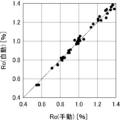
- FIG. 4 is a relational diagram between Ro (manual) and Ro (automatic); 4 is a relational diagram between a total inertia amount (manual) and a total inertia amount (automatic).
- FIG. Figure 2 is a reflectance histogram of a single coal particle with semi-fuginite reflectance plotted;
- FIG. 4 is a relational diagram between Ro (automatic) and semi-fujinit ratio (manual);
- FIG. 5 is a relational diagram between a total inertia amount (manual) and a corrected total inertia amount (automatic).
- coal fine structure component and fine structure component group
- the fine structure component (maceral) and the group of fine structure components (maceral group) of coal will be explained.
- Coal microstructural components are microscopic organic components of coal, and are classified into 12 types. Specifically, the microstructural components are 12 kinds of terrinite, colinit, degradinit, spolinit, cutinit, alginit, resinite, semi-fuginit, fuginit, miclinit, sclerotinite and macrinite.
- the coal microstructural component group (maceral group) is a group of coal microstructural components that have similar properties under a microscope, and is divided into three types. Specifically, the microstructure component group includes three types of vitrinite, ecginite and inertinite (also referred to as "inert").
- microstructural constituents belonging to vitrinite are terrinite, colinite and degradinite.
- microstructural components belonging to ecginite There are four types of microstructural components belonging to ecginite: spolinites, cutinites, alginites, and resinites.
- microstructural components belonging to inertinite semi-fuginit, fusginite, micrinit, sclerotinite and macrinite.
- the total inert content which represents the ratio of inertinite among the three types of microstructure components (vitrinite, ecginite, and inertinite). Therefore, in this embodiment, the total inert amount of coal is obtained.
- FIG. 1 is a block diagram showing the configuration of the coal analysis device 1.
- the coal analysis device 1 includes an image acquisition section 2 , an identification section 3 , a calculation section 4 and a correction section 5 .
- the image acquiring unit 2, the identifying unit 3, the calculating unit 4, and the correcting unit 5 include, for example, a CPU (Central Processing Unit), a main storage device such as a DRAM (Dynamic Random Access Memory) connected to the CPU, It consists of a large-capacity storage device such as an SSD (Solid State Drive) or HDD (Hard Disk Drive) connected to the CPU, and a program that operates the CPU. Processing executed by these units will be described later.
- a CPU Central Processing Unit
- main storage device such as a DRAM (Dynamic Random Access Memory) connected to the CPU
- DRAM Dynamic Random Access Memory
- HDD Hard Disk Drive
- the coal analyzer 1 is connected to the microscope 6.
- a coal sample 7 is placed on the stage (not shown) of the microscope 6 .
- Coal sample 7 is prepared according to JIS M 8816-1992. More specifically, the coal sample 7 is obtained by pulverizing the collected coal, embedding the obtained coal particles in resin, curing the resin, and then polishing the surface of the cured product.
- a microscope 6 captures a surface image of the coal sample 7 .
- the microscope 6 has a function of automatically moving the stage to capture a plurality of micro images by specifying a macro imaging range in advance, and finally synthesizing each captured micro image into a macro image. is preferred.
- the size of the micro image is approximately 800 ⁇ m in length and 530 ⁇ m in width, and an oil immersion objective lens (magnification: 20 ⁇ ) is used as the objective lens.
- the microscope 6 does not have to have the above functions as long as it can take an image of the surface of the coal sample 7, and another objective lens may be used.
- FIG. 2 is a flow chart showing the flow of processing executed by each unit included in the coal analysis apparatus 1. As shown in FIG.
- the image acquisition unit 2 of the coal analysis device 1 causes the microscope 6 to capture a surface image of the coal sample 7, and acquires the captured surface image (step S101).
- the surface image of the coal sample 7 is limited to a part of the surface and the representativeness is low.
- the entire surface of the coal sample 7 is imaged, about 2000 individual images are obtained, and the obtained individual images are joined to obtain one huge surface image.
- FIG. 3 shows a surface image 8 of the coal sample 7.
- FIG. 3 shows a surface image 8 of the coal sample 7.
- FIG. 3 nine individual images are combined into one surface image 8 for the sake of simplicity.
- part of the three coal particles 9 (coal particles 9a, 9b and 9c) embedded in the resin 10 are exposed.
- the vitrinite 11 is represented by a vertical dashed line
- the inert 12 is represented by a horizontal dashed line.
- Coal particles 9 a on the upper side of surface image 8 consist of vitrinite 11 .
- Coal particles 9 b in the middle of surface image 8 are made of inert 12 .
- Coal particles 9 c in the lower part of the surface image 8 are mixed with vitrinite 11 and inert 12 .
- the identification unit 3 of the coal analyzer 1 extracts only pixels corresponding to the coal particles 9 from the surface image 8 (step S102).
- the resin 10 is nearly black. Therefore, for example, the surface image 8 is subjected to differentiation processing, the boundary between the coal particles 9 and the resin 10 having a large differential value is detected, and only each pixel inside the boundary (that is, the coal particles 9) is acquired.
- Each pixel forming the surface image 8 contains luminance information.
- a calibration curve between luminance and reflectance is created in advance using a known reflectance standard test piece.
- the identification unit 3 of the coal analyzer 1 converts the brightness of each pixel into reflectance based on the prepared calibration curve. Thus, the reflectance of each pixel of the coal particles 9 is obtained.
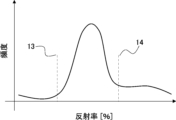
- the identification unit 3 of the coal analysis device 1 collects the reflectance of each pixel, adds them up, and creates a combined reflectance histogram of all coal particles (step S103).
- FIG. 4 is a combined reflectance histogram of all coal particles.
- the horizontal axis indicates reflectance (unit: %), and the vertical axis indicates frequency (frequency) (the same applies hereinafter).
- the reflectances of vitrinite, ecginite and inert have a magnitude relation of inert>vitrinite>ecginite.
- the reflectance distribution of vitrinite takes a normal distribution.
- the histogram in FIG. 4 is constructed by synthesizing vitrinite peaks having the shape of a normal distribution and inert peaks having long tails in brighter (high reflectance) ranges.
- Ecginite is assumed to be negligible because its abundance is very small compared to vitrinite and inert.
- the fine structure component group (vitrinite or inert) of the coal particles 9 included in the surface image 8 is identified based on the magnitude relationship between the reflectances of vitrinite and inert. Specifically, it is as follows.
- the identification unit 3 of the coal analyzer 1 roughly determines the threshold of the vitrinite reflectance range in the combined reflectance histogram of all coal particles. Specifically, as shown in FIG. 4, the minimum threshold value 13 and the maximum threshold value 14 of the vitrinite reflectance range are determined (step S104). As a method of determining the threshold, a method of judging a portion where the reflectance histogram abruptly changes as the threshold is preferable. In this method, the threshold can be determined, for example, based on the differential value or curvature of the reflectance histogram.
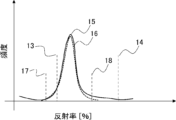
- the identification unit 3 of the coal analyzer 1 assumes that the reflectance distribution of vitrinite is a normal distribution, and fits the normal distribution to the reflectance histogram of each coal particle (see FIG. 5 described later). (step S105).
- the vitrinite reflectance range of individual coal particles is determined.
- the combined reflectance histogram of all coal particles may be used to determine the vitrinite reflectance range, in practice the vitrinite reflectance range is different for each individual coal particle. Therefore, by determining the vitrinite reflectance range for each individual coal particle, the finally obtained total inert amount can be made more accurate.
- the identification unit 3 of the coal analyzer 1 determines the vitrinite reflectance and the inert reflectance of the coal particles based on the following equations (step S108). u ⁇ 3 ⁇ vitrinite reflectance ⁇ u+3 ⁇ u+3 ⁇ inert reflectance Then, a microstructure component group (vitrinite or inert) is identified for each pixel based on the reflectance (step S110).
- the identification unit 3 of the coal analyzer 1 determines the vitrinite reflectance and the inert reflectance of the coal particles based on the following equations. (Step S109). minimum threshold 13 ⁇ vitrinite reflectance ⁇ maximum threshold 14 Maximum Threshold 14 ⁇ Inert Reflectance Then, the microstructure component group (vitrinite or inert) is identified for each pixel based on the reflectance (step S110).
- the identification unit 3 of the coal analysis device 1 identifies the microstructure component group for each pixel of all the coal particles 9 included in the surface image 8 of the coal sample 7 . Reflectances outside the range of the above formula are not considered.
- the calculator 4 of the coal analyzer 1 calculates the average reflectance Ro (unit: %) of vitrinite based on the following formula (step S111).
- average reflectance Ro of vitrinite is also simply referred to as "Ro”.
- Ro represents the degree of maturity of coal.
- Ro ⁇ (reflectance of vitrinite pixel) / number of vitrinite pixels
- vitrinite pixel means a pixel identified as vitrinite.
- inert pixel means a pixel identified as being inert.
- the calculator 4 of the coal analyzer 1 calculates the total inert amount (unit: %) based on the following formula (step S112).
- Total inert amount 100 x (number of inert pixels)/(number of vitrinite pixels + number of inert pixels)
- Total inert amount 100 x ⁇ coefficient a x semi-fujinit (number of counts) + fujinit (number of counts) + micrinite (number of counts) + sclerotinite (number of counts) + macrinite (number of counts) ⁇ / (number of total counts)
- the factor a is 1 or 2/3 considering the active ingredient of semifuginit. In this specification, the coefficient a is calculated as 1, but it is not limited to this.
- Ro is also determined manually in the same manner as the total inertia amount. That is, according to JIS M 8816-1992, the stage of the microscope is manually moved to identify vitrinite within the field of view and obtain its average reflectance.
- Patent Document 1 uses a "computer”, but based on criteria such as “variation range of reflectance”, individual identification of microstructure components such as semi-fuginit and fuginit belonging to inertinite. However, it is still complicated.
- the coal analysis apparatus 1 (coal analysis method) of the present embodiment, it is possible to easily obtain the total inert amount, which is the ratio of one type, without individually identifying the fine structure components of coal. can be done. At this time, since a reference such as a pattern is not used, the portion depending on the person is small, and the time can be shortened.
- the correction unit 5 of the coal analysis device 1 corrects the total inert amount calculated by the calculation unit 4 (step S113).
- the inventor compared Ro (automatic) and total inertia amount (automatic) with Ro (manual) and total inertia amount (manual).
- FIG. 7 is a diagram showing the relationship between the total inertia amount (manual) and the total inertia amount (automatic).
- semi-fujinit which belongs to inertinite, has intermediate properties between those of vitrinite and inertinite. Since semi-fuginit has a reflectance intermediate between that of vitrinite and inertinite, it is difficult to strictly classify semi-fuginit only by the magnitude of the reflectance.
- FIG. 8 is a reflectance histogram of a single coal particle with semi-fuginite reflectance plotted.
- a normal distribution 16 is fitted to the reflectance histogram 15 of a single coal particle, and the vitrinite reflectance maximum 18 is also shown.
- the semi-fuzzinit reflectance 19 is also shown in FIG. 8 .
- the range of vitrinite reflectance includes many semi-fujinit reflectances.
- semi-fujinit belonging to inertinite is erroneously identified as vitrinite, so the total inert amount (automatic) is underestimated as compared to the total inert amount (manual), as shown in FIG. The inventor thought so.
- the inventor obtained the ratio of semi-fujinit (unit: %) by the conventional method in the same manner as the total inert amount.
- this may be referred to as "semi-fujinit ratio (manual)".
- the present inventor corrected the total inertia amount (automatic) using multiple regression coefficients obtained by multiple regression analysis. Specifically, the corrected total inertia amount (automatic) was obtained based on the following formula.
- Total inertia amount after correction (automatic) ⁇ a x total inertia amount (automatic) ⁇ + ⁇ b x Ro (automatic) ⁇ + c
- FIG. 10 is a diagram showing the relationship between the total inertia amount (manual) and the corrected total inertia amount (automatic).
- the determination coefficient R 2 was 0.9
- the error standard deviation RMSE was 4%
- the corrected total inertia amount (automatic) was equivalent to the total inertia amount (manual). If the total inertia amount (manual) is more accurate than the total inertia amount (automatic), it can be said that the total inertia amount after correction (automatic) obtained by correction using multiple regression coefficients is also highly accurate.
- the correction unit 5 of the coal analysis device 1 determines and holds multiple regression coefficients in advance. Then, the total inertia amount is corrected using the multiple regression coefficient, Ro (automatic) and the total inertia amount (automatic) calculated by the calculator 4 (step S113). Such correction can improve the accuracy of the finally obtained total inert amount.
- explanatory variables in multiple regression analysis are not limited to Ro (automatic) and total inertia amount (automatic). Other information that can be obtained from the surface image 8 may also be added as an explanatory variable.
- Coke is produced by blending various brands of coal according to its product index. That is, coke is obtained by blending a plurality of types of coal to prepare mixed coal, and firing the prepared mixed coal in a coke oven or the like. At this time, it is preferable to specify the total inert amount of at least a part of the coal to be blended using the coal analysis method of the present embodiment described above. As described above, according to the coal analysis method of the present embodiment, the total inert amount can be easily obtained and the time can be shortened. etc. can be done. In addition, the obtained total inert amount can be immediately reflected in the coal blending calculation or the like.
- coal analyzer 2 image acquisition unit 3: identification unit 4: calculation unit 5: correction unit 6: microscope 7: coal sample 8: surface image 9 (9a, 9b, 9c): coal particles 10: resin 11: vitrinite 12: inert 13: minimum threshold of vitrinite reflectance range 14: maximum threshold of vitrinite reflectance range 15: reflectance histogram of one coal particle 16: normal distribution 17: minimum value of vitrinite reflectance 18: of vitrinite reflectance Maximum value 19: semi-fujinit reflectance
Landscapes
- Chemical & Material Sciences (AREA)
- Life Sciences & Earth Sciences (AREA)
- Physics & Mathematics (AREA)
- Health & Medical Sciences (AREA)
- Pathology (AREA)
- Immunology (AREA)
- Analytical Chemistry (AREA)
- Biochemistry (AREA)
- General Health & Medical Sciences (AREA)
- General Physics & Mathematics (AREA)
- Engineering & Computer Science (AREA)
- Oil, Petroleum & Natural Gas (AREA)
- Organic Chemistry (AREA)
- Materials Engineering (AREA)
- Geochemistry & Mineralogy (AREA)
- Environmental & Geological Engineering (AREA)
- General Life Sciences & Earth Sciences (AREA)
- Geology (AREA)
- Spectroscopy & Molecular Physics (AREA)
- Food Science & Technology (AREA)
- Medicinal Chemistry (AREA)
- Theoretical Computer Science (AREA)
- Mathematical Physics (AREA)
- Investigating Or Analysing Materials By Optical Means (AREA)
- Coke Industry (AREA)
- Analysing Materials By The Use Of Radiation (AREA)
Priority Applications (5)
| Application Number | Priority Date | Filing Date | Title |
|---|---|---|---|
| US18/695,923 US20250116602A1 (en) | 2021-09-30 | 2022-09-20 | Coal analyzer, coal analysis method, mixed coal preparation method, and coke production method |
| JP2023507326A JP7405303B2 (ja) | 2021-09-30 | 2022-09-20 | 石炭分析装置、石炭分析方法、混合石炭の調製方法およびコークスの製造方法 |
| AU2022355586A AU2022355586B2 (en) | 2021-09-30 | 2022-09-20 | Coal analyzer, coal analysis method, mixed coal preparation method, and coke production method |
| CA3233032A CA3233032A1 (en) | 2021-09-30 | 2022-09-20 | Coal analyzer, coal analysis method, mixed coal preparation method, and coke production method |
| EP22875935.3A EP4394353A4 (en) | 2021-09-30 | 2022-09-20 | Coal analyzer, coal analysis method, mixed coal preparation method, and coke production method |
Applications Claiming Priority (2)
| Application Number | Priority Date | Filing Date | Title |
|---|---|---|---|
| JP2021-161012 | 2021-09-30 | ||
| JP2021161012 | 2021-09-30 |
Publications (1)
| Publication Number | Publication Date |
|---|---|
| WO2023054065A1 true WO2023054065A1 (ja) | 2023-04-06 |
Family
ID=85782548
Family Applications (1)
| Application Number | Title | Priority Date | Filing Date |
|---|---|---|---|
| PCT/JP2022/034999 Ceased WO2023054065A1 (ja) | 2021-09-30 | 2022-09-20 | 石炭分析装置、石炭分析方法、混合石炭の調製方法およびコークスの製造方法 |
Country Status (7)
| Country | Link |
|---|---|
| US (1) | US20250116602A1 (https=) |
| EP (1) | EP4394353A4 (https=) |
| JP (1) | JP7405303B2 (https=) |
| AU (1) | AU2022355586B2 (https=) |
| CA (1) | CA3233032A1 (https=) |
| TW (1) | TWI828344B (https=) |
| WO (1) | WO2023054065A1 (https=) |
Families Citing this family (1)
| Publication number | Priority date | Publication date | Assignee | Title |
|---|---|---|---|---|
| CN115950858B (zh) * | 2022-12-01 | 2025-06-24 | 中煤科工智能储装技术有限公司 | 一种基于多线激光雷达扫描的水煤识别方法 |
Citations (6)
| Publication number | Priority date | Publication date | Assignee | Title |
|---|---|---|---|---|
| JPS50112096A (https=) * | 1974-02-05 | 1975-09-03 | ||
| JPS5822940A (ja) * | 1981-08-03 | 1983-02-10 | Mitsubishi Chem Ind Ltd | 石炭組織分析法及び装置 |
| JPS5835442A (ja) | 1981-08-27 | 1983-03-02 | Sumitomo Metal Ind Ltd | 石炭組織の自動分析方法 |
| JP2005338011A (ja) * | 2004-05-31 | 2005-12-08 | Jfe Steel Kk | 石炭分析方法及び石炭の品質管理方法 |
| CN102297850A (zh) * | 2010-06-22 | 2011-12-28 | 宝山钢铁股份有限公司 | 数字化煤岩组分自动测定方法 |
| CN111879732A (zh) * | 2020-08-17 | 2020-11-03 | 山西阳光焦化集团股份有限公司 | 一种简便定量测量煤中镜质组含量的方法 |
Family Cites Families (9)
| Publication number | Priority date | Publication date | Assignee | Title |
|---|---|---|---|---|
| JPS58153144A (ja) * | 1982-03-09 | 1983-09-12 | Nippon Kokan Kk <Nkk> | 反射率が異なる複数の組織を有する塊状物質における組織構成比率測定装置 |
| JPH0219715Y2 (https=) * | 1987-05-07 | 1990-05-30 | ||
| FR2713779B1 (fr) * | 1993-12-10 | 1996-03-08 | Lorraine Laminage | Procédé automatique d'analyse macérale et de détermination du pouvoir réflecteur de la vitrinite dans les charbons. |
| JP4438532B2 (ja) * | 2004-06-30 | 2010-03-24 | Jfeスチール株式会社 | コークスおよびコークスの製造方法 |
| CN102928340A (zh) * | 2012-10-19 | 2013-02-13 | 煤炭科学研究总院 | 基于图像分析同时测定煤的显微组分含量和镜质体反射率的方法及其专用设备 |
| JP6342280B2 (ja) * | 2014-09-25 | 2018-06-13 | 関西熱化学株式会社 | 石炭における高輝度成分を識別する方法、装置及びコンピュータプログラム。 |
| CN111160064B (zh) * | 2018-11-06 | 2023-05-02 | 煤炭科学技术研究院有限公司 | 煤岩组分识别方法 |
| CN112132078A (zh) * | 2020-09-29 | 2020-12-25 | 三一重型装备有限公司 | 一种基于图像和热成像跟踪的煤岩界面识别系统 |
| CN112881306A (zh) * | 2021-01-15 | 2021-06-01 | 吉林大学 | 一种基于高光谱图像的煤炭灰分含量快速检测方法 |
-
2022
- 2022-09-20 AU AU2022355586A patent/AU2022355586B2/en active Active
- 2022-09-20 US US18/695,923 patent/US20250116602A1/en active Pending
- 2022-09-20 JP JP2023507326A patent/JP7405303B2/ja active Active
- 2022-09-20 WO PCT/JP2022/034999 patent/WO2023054065A1/ja not_active Ceased
- 2022-09-20 EP EP22875935.3A patent/EP4394353A4/en active Pending
- 2022-09-20 CA CA3233032A patent/CA3233032A1/en active Pending
- 2022-09-29 TW TW111137076A patent/TWI828344B/zh active
Patent Citations (6)
| Publication number | Priority date | Publication date | Assignee | Title |
|---|---|---|---|---|
| JPS50112096A (https=) * | 1974-02-05 | 1975-09-03 | ||
| JPS5822940A (ja) * | 1981-08-03 | 1983-02-10 | Mitsubishi Chem Ind Ltd | 石炭組織分析法及び装置 |
| JPS5835442A (ja) | 1981-08-27 | 1983-03-02 | Sumitomo Metal Ind Ltd | 石炭組織の自動分析方法 |
| JP2005338011A (ja) * | 2004-05-31 | 2005-12-08 | Jfe Steel Kk | 石炭分析方法及び石炭の品質管理方法 |
| CN102297850A (zh) * | 2010-06-22 | 2011-12-28 | 宝山钢铁股份有限公司 | 数字化煤岩组分自动测定方法 |
| CN111879732A (zh) * | 2020-08-17 | 2020-11-03 | 山西阳光焦化集团股份有限公司 | 一种简便定量测量煤中镜质组含量的方法 |
Non-Patent Citations (1)
| Title |
|---|
| See also references of EP4394353A4 |
Also Published As
| Publication number | Publication date |
|---|---|
| EP4394353A1 (en) | 2024-07-03 |
| TWI828344B (zh) | 2024-01-01 |
| EP4394353A4 (en) | 2025-01-22 |
| AU2022355586A1 (en) | 2024-04-11 |
| JPWO2023054065A1 (https=) | 2023-04-06 |
| CA3233032A1 (en) | 2023-04-06 |
| TW202319745A (zh) | 2023-05-16 |
| AU2022355586B2 (en) | 2025-08-28 |
| JP7405303B2 (ja) | 2023-12-26 |
| US20250116602A1 (en) | 2025-04-10 |
Similar Documents
| Publication | Publication Date | Title |
|---|---|---|
| CN114549522B (zh) | 基于目标检测的纺织品质量检测方法 | |
| CN113838081A (zh) | 一种基于机器视觉判别烤烟烟叶颜色均匀度的方法和装置 | |
| CN103674968A (zh) | 材料外观腐蚀形貌特征机器视觉原值检测评价方法及装置 | |
| CN105678734B (zh) | 一种图像匹配系统的异源测试图像标定方法 | |
| CN118964873B (zh) | 一种中药饮片的智能筛选方法 | |
| Van Zwanenberg et al. | Edge detection techniques for quantifying spatial imaging system performance and image quality | |
| CN113570538B (zh) | 一种叶片rgb图像偏态分布参数信息采集及分析方法 | |
| CN117348574A (zh) | 涂料生产线的智能化控制系统及方法 | |
| CN119985484A (zh) | 一种精密注塑模胚表面质量视觉检测方法 | |
| WO2023054065A1 (ja) | 石炭分析装置、石炭分析方法、混合石炭の調製方法およびコークスの製造方法 | |
| CN106709501B (zh) | 一种图像匹配系统的景象匹配区域选择与基准图优化方法 | |
| CN114022574A (zh) | 一种工业视觉检测的图像颜色质量判定方法 | |
| CN114022795B (zh) | 基于实拍图像的红外系统mtf自动计算方法 | |
| Widiastuti et al. | Digital image analysis using flatbed scanning system for purity testing of rice seed and confirmation by grow out test | |
| CN120107806A (zh) | 基于图像识别的植物生长区域的灌水状态的识别方法 | |
| CN120318177A (zh) | 一种烟草薄片颜色外观均匀性的量化方法和装置 | |
| CN114820611B (zh) | 基于人工智能的机械零件质量评估方法及系统 | |
| CN118096697A (zh) | 基于信息熵的雪茄烟叶色度测定方法、系统、介质及设备 | |
| CN116612331A (zh) | 基于图像处理的图片质量自动检测方法、装置及存储介质 | |
| CN114529601A (zh) | 一种草坪盖度的精准测量方法 | |
| CN118310585B (zh) | 一种设备表面金属镀覆检测方法及其检测装置 | |
| Kipli et al. | Full reference image quality metrics and their performance | |
| CN105866042A (zh) | 基于像素指标无偏估计法生物品质指标空间分布检测方法 | |
| CN116129283B (zh) | 一种辐射真值感兴趣区提取方法和系统 | |
| CN115082391B (zh) | 一种晶圆反射率确定方法及相关设备 |
Legal Events
| Date | Code | Title | Description |
|---|---|---|---|
| WWE | Wipo information: entry into national phase |
Ref document number: 2023507326 Country of ref document: JP |
|
| 121 | Ep: the epo has been informed by wipo that ep was designated in this application |
Ref document number: 22875935 Country of ref document: EP Kind code of ref document: A1 |
|
| WWE | Wipo information: entry into national phase |
Ref document number: 3233032 Country of ref document: CA |
|
| WWE | Wipo information: entry into national phase |
Ref document number: 2022355586 Country of ref document: AU Ref document number: AU2022355586 Country of ref document: AU |
|
| WWE | Wipo information: entry into national phase |
Ref document number: 18695923 Country of ref document: US |
|
| WWE | Wipo information: entry into national phase |
Ref document number: 202417025294 Country of ref document: IN Ref document number: 2022875935 Country of ref document: EP |
|
| REG | Reference to national code |
Ref country code: BR Ref legal event code: B01A Ref document number: 112024005768 Country of ref document: BR |
|
| ENP | Entry into the national phase |
Ref document number: 2022875935 Country of ref document: EP Effective date: 20240328 |
|
| ENP | Entry into the national phase |
Ref document number: 2022355586 Country of ref document: AU Date of ref document: 20220920 Kind code of ref document: A |
|
| NENP | Non-entry into the national phase |
Ref country code: DE |
|
| ENP | Entry into the national phase |
Ref document number: 112024005768 Country of ref document: BR Kind code of ref document: A2 Effective date: 20240322 |
|
| WWP | Wipo information: published in national office |
Ref document number: 18695923 Country of ref document: US |