WO2023037922A1 - インクジェット用処理液、インクジェット捺染装置、およびインクジェット捺染方法 - Google Patents
インクジェット用処理液、インクジェット捺染装置、およびインクジェット捺染方法 Download PDFInfo
- Publication number
- WO2023037922A1 WO2023037922A1 PCT/JP2022/032479 JP2022032479W WO2023037922A1 WO 2023037922 A1 WO2023037922 A1 WO 2023037922A1 JP 2022032479 W JP2022032479 W JP 2022032479W WO 2023037922 A1 WO2023037922 A1 WO 2023037922A1
- Authority
- WO
- WIPO (PCT)
- Prior art keywords
- silicone oil
- treatment liquid
- ink
- inkjet
- ionic group
- Prior art date
- Legal status (The legal status is an assumption and is not a legal conclusion. Google has not performed a legal analysis and makes no representation as to the accuracy of the status listed.)
- Ceased
Links
Images
Classifications
-
- D—TEXTILES; PAPER
- D06—TREATMENT OF TEXTILES OR THE LIKE; LAUNDERING; FLEXIBLE MATERIALS NOT OTHERWISE PROVIDED FOR
- D06P—DYEING OR PRINTING TEXTILES; DYEING LEATHER, FURS OR SOLID MACROMOLECULAR SUBSTANCES IN ANY FORM
- D06P5/00—Other features in dyeing or printing textiles, or dyeing leather, furs, or solid macromolecular substances in any form
- D06P5/30—Ink jet printing
-
- B—PERFORMING OPERATIONS; TRANSPORTING
- B41—PRINTING; LINING MACHINES; TYPEWRITERS; STAMPS
- B41J—TYPEWRITERS; SELECTIVE PRINTING MECHANISMS, i.e. MECHANISMS PRINTING OTHERWISE THAN FROM A FORME; CORRECTION OF TYPOGRAPHICAL ERRORS
- B41J11/00—Devices or arrangements of selective printing mechanisms, e.g. ink-jet printers or thermal printers, for supporting or handling copy material in sheet or web form
- B41J11/0015—Devices or arrangements of selective printing mechanisms, e.g. ink-jet printers or thermal printers, for supporting or handling copy material in sheet or web form for treating before, during or after printing or for uniform coating or laminating the copy material before or after printing
- B41J11/002—Curing or drying the ink on the copy materials, e.g. by heating or irradiating
-
- B—PERFORMING OPERATIONS; TRANSPORTING
- B41—PRINTING; LINING MACHINES; TYPEWRITERS; STAMPS
- B41J—TYPEWRITERS; SELECTIVE PRINTING MECHANISMS, i.e. MECHANISMS PRINTING OTHERWISE THAN FROM A FORME; CORRECTION OF TYPOGRAPHICAL ERRORS
- B41J2/00—Typewriters or selective printing mechanisms characterised by the printing or marking process for which they are designed
- B41J2/005—Typewriters or selective printing mechanisms characterised by the printing or marking process for which they are designed characterised by bringing liquid or particles selectively into contact with a printing material
- B41J2/01—Ink jet
- B41J2/21—Ink jet for multi-colour printing
- B41J2/2107—Ink jet for multi-colour printing characterised by the ink properties
-
- B—PERFORMING OPERATIONS; TRANSPORTING
- B41—PRINTING; LINING MACHINES; TYPEWRITERS; STAMPS
- B41J—TYPEWRITERS; SELECTIVE PRINTING MECHANISMS, i.e. MECHANISMS PRINTING OTHERWISE THAN FROM A FORME; CORRECTION OF TYPOGRAPHICAL ERRORS
- B41J3/00—Typewriters or selective printing or marking mechanisms characterised by the purpose for which they are constructed
- B41J3/407—Typewriters or selective printing or marking mechanisms characterised by the purpose for which they are constructed for marking on special material
- B41J3/4078—Printing on textile
-
- C—CHEMISTRY; METALLURGY
- C09—DYES; PAINTS; POLISHES; NATURAL RESINS; ADHESIVES; COMPOSITIONS NOT OTHERWISE PROVIDED FOR; APPLICATIONS OF MATERIALS NOT OTHERWISE PROVIDED FOR
- C09D—COATING COMPOSITIONS, e.g. PAINTS, VARNISHES OR LACQUERS; FILLING PASTES; CHEMICAL PAINT OR INK REMOVERS; INKS; CORRECTING FLUIDS; WOODSTAINS; PASTES OR SOLIDS FOR COLOURING OR PRINTING; USE OF MATERIALS THEREFOR
- C09D11/00—Inks
- C09D11/02—Printing inks
- C09D11/023—Emulsion inks
-
- C—CHEMISTRY; METALLURGY
- C09—DYES; PAINTS; POLISHES; NATURAL RESINS; ADHESIVES; COMPOSITIONS NOT OTHERWISE PROVIDED FOR; APPLICATIONS OF MATERIALS NOT OTHERWISE PROVIDED FOR
- C09D—COATING COMPOSITIONS, e.g. PAINTS, VARNISHES OR LACQUERS; FILLING PASTES; CHEMICAL PAINT OR INK REMOVERS; INKS; CORRECTING FLUIDS; WOODSTAINS; PASTES OR SOLIDS FOR COLOURING OR PRINTING; USE OF MATERIALS THEREFOR
- C09D11/00—Inks
- C09D11/02—Printing inks
- C09D11/10—Printing inks based on artificial resins
- C09D11/102—Printing inks based on artificial resins containing macromolecular compounds obtained by reactions other than those only involving unsaturated carbon-to-carbon bonds
-
- C—CHEMISTRY; METALLURGY
- C09—DYES; PAINTS; POLISHES; NATURAL RESINS; ADHESIVES; COMPOSITIONS NOT OTHERWISE PROVIDED FOR; APPLICATIONS OF MATERIALS NOT OTHERWISE PROVIDED FOR
- C09D—COATING COMPOSITIONS, e.g. PAINTS, VARNISHES OR LACQUERS; FILLING PASTES; CHEMICAL PAINT OR INK REMOVERS; INKS; CORRECTING FLUIDS; WOODSTAINS; PASTES OR SOLIDS FOR COLOURING OR PRINTING; USE OF MATERIALS THEREFOR
- C09D11/00—Inks
- C09D11/30—Inkjet printing inks
- C09D11/32—Inkjet printing inks characterised by colouring agents
- C09D11/322—Pigment inks
-
- C—CHEMISTRY; METALLURGY
- C09—DYES; PAINTS; POLISHES; NATURAL RESINS; ADHESIVES; COMPOSITIONS NOT OTHERWISE PROVIDED FOR; APPLICATIONS OF MATERIALS NOT OTHERWISE PROVIDED FOR
- C09D—COATING COMPOSITIONS, e.g. PAINTS, VARNISHES OR LACQUERS; FILLING PASTES; CHEMICAL PAINT OR INK REMOVERS; INKS; CORRECTING FLUIDS; WOODSTAINS; PASTES OR SOLIDS FOR COLOURING OR PRINTING; USE OF MATERIALS THEREFOR
- C09D11/00—Inks
- C09D11/30—Inkjet printing inks
- C09D11/38—Inkjet printing inks characterised by non-macromolecular additives other than solvents, pigments or dyes
-
- C—CHEMISTRY; METALLURGY
- C09—DYES; PAINTS; POLISHES; NATURAL RESINS; ADHESIVES; COMPOSITIONS NOT OTHERWISE PROVIDED FOR; APPLICATIONS OF MATERIALS NOT OTHERWISE PROVIDED FOR
- C09D—COATING COMPOSITIONS, e.g. PAINTS, VARNISHES OR LACQUERS; FILLING PASTES; CHEMICAL PAINT OR INK REMOVERS; INKS; CORRECTING FLUIDS; WOODSTAINS; PASTES OR SOLIDS FOR COLOURING OR PRINTING; USE OF MATERIALS THEREFOR
- C09D11/00—Inks
- C09D11/30—Inkjet printing inks
- C09D11/40—Ink-sets specially adapted for multi-colour inkjet printing
-
- C—CHEMISTRY; METALLURGY
- C09—DYES; PAINTS; POLISHES; NATURAL RESINS; ADHESIVES; COMPOSITIONS NOT OTHERWISE PROVIDED FOR; APPLICATIONS OF MATERIALS NOT OTHERWISE PROVIDED FOR
- C09D—COATING COMPOSITIONS, e.g. PAINTS, VARNISHES OR LACQUERS; FILLING PASTES; CHEMICAL PAINT OR INK REMOVERS; INKS; CORRECTING FLUIDS; WOODSTAINS; PASTES OR SOLIDS FOR COLOURING OR PRINTING; USE OF MATERIALS THEREFOR
- C09D11/00—Inks
- C09D11/54—Inks based on two liquids, one liquid being the ink, the other liquid being a reaction solution, a fixer or a treatment solution for the ink
-
- D—TEXTILES; PAPER
- D06—TREATMENT OF TEXTILES OR THE LIKE; LAUNDERING; FLEXIBLE MATERIALS NOT OTHERWISE PROVIDED FOR
- D06M—TREATMENT, NOT PROVIDED FOR ELSEWHERE IN CLASS D06, OF FIBRES, THREADS, YARNS, FABRICS, FEATHERS OR FIBROUS GOODS MADE FROM SUCH MATERIALS
- D06M15/00—Treating fibres, threads, yarns, fabrics, or fibrous goods made from such materials, with macromolecular compounds; Such treatment combined with mechanical treatment
- D06M15/19—Treating fibres, threads, yarns, fabrics, or fibrous goods made from such materials, with macromolecular compounds; Such treatment combined with mechanical treatment with synthetic macromolecular compounds
- D06M15/37—Macromolecular compounds obtained otherwise than by reactions only involving carbon-to-carbon unsaturated bonds
- D06M15/643—Macromolecular compounds obtained otherwise than by reactions only involving carbon-to-carbon unsaturated bonds containing silicon in the main chain
-
- D—TEXTILES; PAPER
- D06—TREATMENT OF TEXTILES OR THE LIKE; LAUNDERING; FLEXIBLE MATERIALS NOT OTHERWISE PROVIDED FOR
- D06P—DYEING OR PRINTING TEXTILES; DYEING LEATHER, FURS OR SOLID MACROMOLECULAR SUBSTANCES IN ANY FORM
- D06P1/00—General processes of dyeing or printing textiles, or general processes of dyeing leather, furs, or solid macromolecular substances in any form, classified according to the dyes, pigments, or auxiliary substances employed
- D06P1/44—General processes of dyeing or printing textiles, or general processes of dyeing leather, furs, or solid macromolecular substances in any form, classified according to the dyes, pigments, or auxiliary substances employed using insoluble pigments or auxiliary substances, e.g. binders
- D06P1/52—General processes of dyeing or printing textiles, or general processes of dyeing leather, furs, or solid macromolecular substances in any form, classified according to the dyes, pigments, or auxiliary substances employed using insoluble pigments or auxiliary substances, e.g. binders using compositions containing synthetic macromolecular substances
- D06P1/5264—Macromolecular compounds obtained otherwise than by reactions involving only unsaturated carbon-to-carbon bonds
- D06P1/5292—Macromolecular compounds obtained otherwise than by reactions involving only unsaturated carbon-to-carbon bonds containing Si-atoms
-
- D—TEXTILES; PAPER
- D06—TREATMENT OF TEXTILES OR THE LIKE; LAUNDERING; FLEXIBLE MATERIALS NOT OTHERWISE PROVIDED FOR
- D06P—DYEING OR PRINTING TEXTILES; DYEING LEATHER, FURS OR SOLID MACROMOLECULAR SUBSTANCES IN ANY FORM
- D06P1/00—General processes of dyeing or printing textiles, or general processes of dyeing leather, furs, or solid macromolecular substances in any form, classified according to the dyes, pigments, or auxiliary substances employed
- D06P1/90—General processes of dyeing or printing textiles, or general processes of dyeing leather, furs, or solid macromolecular substances in any form, classified according to the dyes, pigments, or auxiliary substances employed using dyes dissolved in organic solvents or aqueous emulsions thereof
-
- D—TEXTILES; PAPER
- D06—TREATMENT OF TEXTILES OR THE LIKE; LAUNDERING; FLEXIBLE MATERIALS NOT OTHERWISE PROVIDED FOR
- D06P—DYEING OR PRINTING TEXTILES; DYEING LEATHER, FURS OR SOLID MACROMOLECULAR SUBSTANCES IN ANY FORM
- D06P5/00—Other features in dyeing or printing textiles, or dyeing leather, furs, or solid macromolecular substances in any form
- D06P5/002—Locally enhancing dye affinity of a textile material by chemical means
-
- D—TEXTILES; PAPER
- D06—TREATMENT OF TEXTILES OR THE LIKE; LAUNDERING; FLEXIBLE MATERIALS NOT OTHERWISE PROVIDED FOR
- D06P—DYEING OR PRINTING TEXTILES; DYEING LEATHER, FURS OR SOLID MACROMOLECULAR SUBSTANCES IN ANY FORM
- D06P5/00—Other features in dyeing or printing textiles, or dyeing leather, furs, or solid macromolecular substances in any form
- D06P5/02—After-treatment
- D06P5/04—After-treatment with organic compounds
- D06P5/08—After-treatment with organic compounds macromolecular
-
- D—TEXTILES; PAPER
- D06—TREATMENT OF TEXTILES OR THE LIKE; LAUNDERING; FLEXIBLE MATERIALS NOT OTHERWISE PROVIDED FOR
- D06P—DYEING OR PRINTING TEXTILES; DYEING LEATHER, FURS OR SOLID MACROMOLECULAR SUBSTANCES IN ANY FORM
- D06P5/00—Other features in dyeing or printing textiles, or dyeing leather, furs, or solid macromolecular substances in any form
- D06P5/20—Physical treatments affecting dyeing, e.g. ultrasonic or electric
- D06P5/2066—Thermic treatments of textile materials
- D06P5/2077—Thermic treatments of textile materials after dyeing
-
- B—PERFORMING OPERATIONS; TRANSPORTING
- B41—PRINTING; LINING MACHINES; TYPEWRITERS; STAMPS
- B41M—PRINTING, DUPLICATING, MARKING, OR COPYING PROCESSES; COLOUR PRINTING
- B41M5/00—Duplicating or marking methods; Sheet materials for use therein
- B41M5/0041—Digital printing on surfaces other than ordinary paper
- B41M5/0047—Digital printing on surfaces other than ordinary paper by ink-jet printing
-
- B—PERFORMING OPERATIONS; TRANSPORTING
- B41—PRINTING; LINING MACHINES; TYPEWRITERS; STAMPS
- B41M—PRINTING, DUPLICATING, MARKING, OR COPYING PROCESSES; COLOUR PRINTING
- B41M5/00—Duplicating or marking methods; Sheet materials for use therein
- B41M5/0041—Digital printing on surfaces other than ordinary paper
- B41M5/0064—Digital printing on surfaces other than ordinary paper on plastics, horn, rubber, or other organic polymers
-
- B—PERFORMING OPERATIONS; TRANSPORTING
- B41—PRINTING; LINING MACHINES; TYPEWRITERS; STAMPS
- B41M—PRINTING, DUPLICATING, MARKING, OR COPYING PROCESSES; COLOUR PRINTING
- B41M7/00—After-treatment of prints, e.g. heating, irradiating, setting of the ink, protection of the printed stock
- B41M7/0018—After-treatment of prints, e.g. heating, irradiating, setting of the ink, protection of the printed stock using ink-fixing material, e.g. mordant, precipitating agent, after printing, e.g. by ink-jet printing, coating or spraying
Definitions
- the present disclosure relates to an inkjet treatment liquid, an inkjet printing apparatus, and an inkjet printing method.
- an ink containing a pigment is used.
- Pigment-containing inks are sometimes used together with post-treatment liquids in order to improve the friction fastness of an imaged printing object (hereinafter sometimes referred to as printed matter).
- Patent Document 1 a transport roller for an inkjet recording device is known (see Patent Document 1, for example).
- the surface of the transport roller is coated with a treatment liquid containing one or both of fullerene and fullerene derivative.
- An inkjet treatment liquid includes emulsified particles containing silicone oil and an aqueous medium,
- the silicone oil includes an ionic group-containing silicone oil and an unmodified silicone oil.
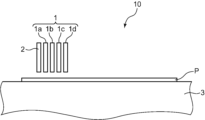
- FIG. 1 is a side view showing an example of an inkjet textile printing apparatus according to a second embodiment of the present disclosure.
- the friction fastness of the printed material also changes depending on the type of silicone oil contained in the treatment liquid. Therefore, from the viewpoint of the type of silicone oil, it is preferable to know the conditions for the characteristics of the inkjet treatment liquid that can produce a printed material with excellent friction fastness.
- friction fastness properties include dry friction fastness properties and wet friction fastness properties.
- silicone oil contained in the treatment liquid it is often possible to specialize in one of these to produce a printed material with excellent fastness to rubbing. Accordingly, there is a need for an inkjet processing liquid capable of producing prints having both excellent dry and wet rub fastnesses. Furthermore, it is more preferable if the inkjet treatment liquid can also suppress deterioration in the tactile sensation of the printed material.
- the inkjet treatment liquid of the present disclosure can suppress deterioration in the tactile feel of printed materials, and can produce printed materials that are excellent in both dry friction fastness and wet friction fastness.
- the volume median diameter (D 50 ) is measured using a laser diffraction/scattering particle size distribution analyzer ("LA-950" manufactured by Horiba, Ltd.). is the median diameter measured by Hereinafter, the volume median diameter may be referred to as " D50 ".
- a "major component” of a material means, by mass, the component that is the most abundant in the material, unless otherwise specified.
- Specific gravity means specific gravity at 25°C, unless otherwise specified.
- Acryl and methacryl may be collectively referred to as "(meth)acryl". Each component described in this specification may be used alone or in combination of two or more.
- the treatment liquid according to the first embodiment contains emulsified particles and an aqueous medium.
- the emulsified particles are dispersed in the aqueous medium of the treatment liquid. That is, the treatment liquid according to the first embodiment is an emulsion, more specifically an oil-in-water (O/W) emulsion.
- O/W oil-in-water
- the treatment liquid according to the first embodiment is suitably used, for example, in an inkjet printing apparatus and an inkjet printing method, which will be described later.
- the treatment liquid according to the first embodiment is, for example, a treatment liquid for post-treatment. Specifically, after an image is formed in the image forming area to be printed with ink, the image forming area is post-treated with the treatment liquid according to the first embodiment.
- the emulsified particles contained in the treatment liquid contain silicone oil.
- Silicone oils include ionic group-containing silicone oils and unmodified silicone oils.
- the treatment liquid contains an ionic group-containing silicone oil, an unmodified silicone oil, and an aqueous medium, and the ionic group-containing silicone oil and the unmodified silicone oil are contained in the emulsified particles in the treatment liquid. dispersed within.
- the emulsified particles containing silicone oil can be classified into three types. Specifically, emulsified particles containing only ionic group-containing silicone oil as silicone oil, emulsified particles containing only unmodified silicone oil as silicone oil, and ionic group-containing silicone oil and unmodified silicone as silicone oil It can be classified into emulsified particles containing both oil and oil. More specifically, the emulsified particles contained in the treatment liquid may include first emulsified particles containing ionic group-containing silicone oil and second emulsified particles containing unmodified silicone oil.
- the emulsified particles contained in the treatment liquid may include emulsified particles containing both the ionic group-containing silicone oil and the unmodified silicone oil (hereinafter also referred to as "third emulsified particles").
- the emulsified particles contained in the treatment liquid are the first emulsified particles containing the ionic group-containing silicone oil, the second emulsified particles containing the unmodified silicone oil, the ionic group-containing silicone oil and the unmodified silicone oil. and a third emulsified particle containing both.
- the emulsified particles contain the first emulsified particles containing the ionic group-containing silicone oil and the non-modified silicone oil from the viewpoint that the printed matter with the superior wet rubbing fastness can be produced. It is preferable that the second emulsified particles are included.
- the silicone oil contained in the emulsified particles contains both the ionic group-containing silicone oil and the non-modified silicone oil, the following first to fifth advantages are obtained.
- Silicone oil has a friction reducing effect.
- the image formed on the printing target is coated with silicone oil, and the coefficient of friction of the surface of the printing target is reduced.
- the friction between threads to be printed is reduced by being coated with silicone oil that has a friction-reducing effect.
- the stiffness of the printed object caused by the image formation is reduced, and the deterioration of the tactile sensation of the printed product is suppressed.
- Silicone oil has water repellency.
- the printing target is coated with the water-repellent silicone oil, and the surface of the printing target is imparted with water repellency.
- the ionic group-containing silicone oil has an ionic group, the ionic group and the object to be printed, and the ionic group and the polymer, ink and/or binder of the pretreatment liquid discharged onto the object to be printed. It is speculated that an ionic bond is formed between them. The formation of ionic bonds makes it difficult for water to wash away the ionic group-containing silicone oil from the printing target, the polymer of the pretreatment liquid, the ink binder and/or the ink. As a result, prints with excellent wet rubbing fastness can be produced.
- the emulsified particles containing the ionic group-containing silicone oil are preferably dispersed in the aqueous medium of the treatment liquid.
- a treatment liquid can be suitably discharged from a treatment head of an inkjet textile printing apparatus.
- the processing liquid is discharged from the processing head, the amount of processing liquid used is reduced compared to the case where the printed matter is immersed in the processing liquid. Therefore, it is difficult for the object to be printed to become rough, and the decrease in tactile sensation of the printed product is suppressed.
- silicone oil with a higher viscosity can be used than when ink containing silicone oil as the base oil is ejected from the print head. Therefore, a printed material having excellent friction fastness can be produced.
- the printed matter is excellent in both dry friction fastness and wet friction fastness.
- the ionic group-containing silicone oil by including the ionic group-containing silicone oil, it is possible to produce a printed material with excellent wet friction fastness.
- a printed material with excellent dry friction fastness can be produced by including an unmodified silicone oil with higher lubricity and film durability than the ionic group-containing silicone oil.
- the content of silicone oil in the treatment liquid is preferably 5% by mass or more and 15% by mass or less.
- the content of the silicone oil is 5% by mass or more, it is possible to further suppress deterioration of the tactile feel of the printed material and to produce a printed material having excellent friction fastness.
- the silicone oil content is 15% by mass or less, it is possible to improve the dischargeability of the treatment liquid from the treatment head of the inkjet printing apparatus.
- the content of the silicone oil is 15% by mass or less, so that the ionic group contained in the silicone oil Suppresses excessive increase in the amount of ionic groups in silicone oil.
- the content of silicone oil in the treatment liquid is preferably 7% by mass or more, more preferably 9% by mass or more, and even more preferably 10% by mass or more. Also, the content of silicone oil in the treatment liquid is preferably 14% by mass or less, more preferably 13% by mass or less. In particular, by setting the silicone oil content in the treatment liquid to within the range of 10% by mass or more and 13% by mass or less, it is possible to produce a printed material that is superior in both dry friction fastness and wet friction fastness.
- the content of silicone oil in the treatment liquid means the percentage of the mass of silicone oil with respect to the mass of the treatment liquid.
- the content of silicone oil means the percentage of the total mass of the ionic group-containing silicone oil and the non-modified silicone oil relative to the mass of the treatment liquid.
- the viscosity of the silicone oil is preferably 500 mm 2 /s (ie mm 2 /s) or more.
- the silicone oil has a viscosity of 500 mm 2 /s or more, the silicone oil is less likely to detach from the printed matter due to friction, and a printed matter having excellent dry and wet friction fastnesses can be produced.
- the treatment liquid according to the first embodiment can be discharged from the treatment head of the inkjet textile printing apparatus. When the processing liquid is discharged from the processing head, the amount of processing liquid used is reduced compared to the case where the printed matter is immersed in the processing liquid. Therefore, even if silicone oil with a high viscosity of 500 mm 2 /s or more is used as the treatment liquid, it is difficult for the printed object to become rough, and the deterioration of the tactile sensation of the printed product is further suppressed.
- the upper limit of the viscosity of the silicone oil is not particularly limited.
- the viscosity of the silicone oil is, for example, preferably 100000 mm 2 /s or less, preferably 6000 mm 2 /s or less.
- the viscosity of the silicone oil is, for example, 500 mm 2 /s, 700 mm 2 /s, 900 mm 2 /s, 1000 mm 2 /s, 1100 mm 2 /s, 1200 mm 2 /s, 1500 mm 2 /s, 1700 mm 2 /s, 1800 mm 2 /s, 2000 mm 2 /s, 3000 mm 2 /s, 5700 mm 2 /s, and 6000 mm 2 /s.
- the viscosity of silicone oil means dynamic viscosity at 25°C.
- the viscosity of the silicone oil mentioned above means the viscosity of the silicone oil contained in one emulsified particle.
- the above viscosity of the silicone oil means the viscosity of the one type of silicone oil.
- the viscosity of the silicone oil is It means the viscosity of the ionic group-containing silicone oil or the one kind of non-modified silicone oil.
- the viscosity of the above silicone oils means the viscosity of a mixture of the two or more types of silicone oils.
- the viscosity of the silicone oil is and the viscosity of the mixture of the one unmodified silicone oil.
- the viscosity condition of the silicone oil described above means that all types of emulsified particles contained in the treatment liquid satisfy the above condition.
- the viscosity of the ionic group-containing silicone oil contained in the treatment liquid according to the first embodiment is preferably 500 mm 2 /s or more.
- the viscosity of the ionic group-containing silicone oil is 500 mm 2 /s or more, it becomes difficult for the silicone oil to detach from the printed matter due to friction, and a printed matter having particularly excellent wet rubbing fastness can be produced.
- the viscosity of the ionic group-containing silicone oil is 1000 mm 2 /s or more.
- the upper limit of the viscosity of the ionic group-containing silicone oil is not particularly limited, but the viscosity of the ionic group-containing silicone oil is more preferably 100000 mm 2 /s or less, and more preferably 6000 mm 2 /s or less. preferable.
- the viscosity of the unmodified silicone oil contained in the treatment liquid according to the first embodiment is preferably 300 mm 2 /s or more.
- the viscosity of the non-modified silicone oil is 300 mm 2 /s or more, it becomes difficult for the silicone oil to detach from the printed matter due to friction, and in particular, the printed matter having excellent dry friction fastness can be produced.
- the viscosity of the non-modified silicone oil is more preferably 500 mm 2 /s or higher, even more preferably 1000 mm 2 /s or higher.
- the viscosity of the unmodified silicone oil is more preferably 100000 mm 2 /s or less, and even more preferably 6000 mm 2 /s or less.
- the viscosity of the silicone oil is measured according to the method described in JIS (Japanese Industrial Standard) Z8803:2011 (liquid viscosity measurement method). For example, by extracting the silicone oil from the treatment liquid with toluene, washing, and drying, the silicone oil can be separated from the treatment liquid and the viscosity of the silicone oil can be measured.
- JIS Japanese Industrial Standard
- Z8803:2011 liquid viscosity measurement method
- the average particle size of emulsified particles is preferably 100 nm or more and 250 nm or less.
- the inkjet treatment liquid according to the first embodiment further suppresses a decrease in the tactile sensation of the printed matter, and produces a printed matter with excellent friction fastness. In addition, it is excellent in dischargeability from the processing head of the inkjet textile printing apparatus.
- the average particle size of the emulsified particles by setting the average particle size of the emulsified particles to 100 nm or more, it is possible to prevent a decrease in the friction fastness of the printed matter, particularly the wet friction fastness.
- the average particle diameter of the emulsified particles by setting the average particle diameter of the emulsified particles to 250 nm or less, it is possible to improve the dischargeability of the treatment liquid from the treatment head.
- the average particle size of the emulsified particles is more preferably 100 nm or more and 160 nm or less.
- the average particle diameter of the emulsified particles is, for example, and 250 nm.
- two or more types of emulsified particles having different average particle sizes in the treatment liquid e.g., first emulsified particles containing ionic group-containing silicone oil, second emulsified particles containing unmodified silicone oil, and two or more emulsified particles selected from the group of third emulsified particles containing both an ionic group-containing silicone oil and an unmodified silicone oil
- the average particle size of the emulsified particles is within a specific range
- There is means "the average particle size of each of two or more kinds of emulsified particles is within a specific range”.
- the average particle size of the first emulsified particles containing the ionic group-containing silicone oil and the average particle size of the second emulsified particles containing the unmodified silicone oil are both in the range of 100 nm or more and 160 nm or less. more preferred.
- the average particle size of emulsified particles means the harmonic average particle size (also called the cumulant average particle size) based on the scattered light intensity calculated based on the cumulant method.
- the average particle size of emulsion particles is measured according to the method described in ISO 13321:1996 (Particle size analysis-Photon correlation spectroscopy).
- the emulsified particles may further contain components other than silicone oil.
- silicone oil when the emulsified particles contain only silicone oil, it is possible to more reliably produce a printed material with excellent friction fastness and to more reliably suppress deterioration of the tactile feel of the printed material.
- the silicone oil contained in the emulsified particles includes ionic group-containing silicone oil and non-modified silicone oil.
- the first emulsified particles may contain the ionic group-containing silicone oil
- the second emulsified particles which are different types of emulsified particles, may contain the non-modified silicone oil.
- one type of emulsified particles may contain both the ionic group-containing silicone oil and the unmodified silicone oil.
- the ionic group-containing silicone oil and the non-modified silicone oil are described below.
- the ionic group-containing silicone oil is modified silicone oil, more specifically, ionic group-modified silicone oil.
- ionic group-modified silicone oils include modified silicone oils in which ionic groups are introduced into side chains and modified silicone oils in which ionic groups are introduced into terminal groups.
- Modified silicone oil in which an ionic group is introduced into the side chain includes a first terminal group represented by the following formula (1a), a repeating unit represented by the following formula (1b), and the following formula (1c ) and a second terminal group represented by the following formula (1d).
- * in formula (1a) represents a bond that bonds to the silicon atom in the repeating unit represented by formula (1b) or (1c).
- * in formula (1d) represents a bond that binds to the oxygen atom in the repeating unit represented by formula (1b) or (1c).
- R 1 in formula (1c) represents a group containing an ionic group.
- the ionic group of the group containing an ionic group is preferably an amino group, a carboxyl group, a phenolic hydroxy group, or a silanol group.
- the modified silicone oil in which an ionic group is introduced into the terminal group comprises a first terminal group represented by the following formula (2a), a repeating unit represented by the following formula (2b), and the following formula (2c ) and a second terminal group represented by
- R 2 in formula (2a) and R 3 in formula (2c) each independently represent a group containing an ionic group.
- the ionic group of the group containing an ionic group is preferably an amino group, a carboxyl group, a phenolic hydroxy group, or a silanol group.
- the ionic group-containing silicone oil preferably contains at least one selected from the group consisting of amino-modified silicone oil, carboxy-modified silicone oil, phenol-modified silicone oil, and silanol-modified silicone oil. Furthermore, the ionic group-containing silicone oil is more preferably at least one selected from the group consisting of these. Moreover, the ionic group-containing silicone oil is more preferably one of these. Amino-modified silicone oil, carboxy-modified silicone oil, phenol-modified silicone oil, and silanol-modified silicone oil each have an amino group, a carboxy group, a phenolic hydroxy group, and a silanol group as ionic groups. Among these, the ionic group-containing silicone oil is more preferably a carboxy-modified silicone oil.
- the functional group equivalent of the ionic group-containing silicone oil is preferably 1000 g/mol or more and 5500 g/mol or less.
- the functional group equivalent is the molecular weight per 1 mol of functional group (ionic group).
- Functional group equivalents of ionic group-containing silicone oils are, for example, 1000 g/mol, 1200 g/mol, 1474 g/mol, 1490 g/mol, 1500 g/mol, 2000 g/mol, 3800 g/mol, 3900 g/mol, 4000 g/mol, It may be within two values selected from the group consisting of 5000 g/mol, 5200 g/mol and 5500 g/mol.
- the emulsified particles When one emulsified particle contains an ionic group-containing silicone oil, or when one emulsified particle contains both an ionic group-containing silicone oil and an unmodified silicone oil, the emulsified particles contain
- the content of the ionic group-containing silicone oil relative to the total mass of the silicone oil is preferably 30% by mass or more and 100% by mass or less, more preferably 40% by mass or more and 100% by mass or less, and 100% by mass % is particularly preferred.
- Non-denatured silicone oil Dry friction fastness can be improved by including not only an ionic group-containing silicone oil but also an unmodified silicone oil in the treatment liquid. Moreover, when one type of emulsified particles contains both the ionic group-containing silicone oil and the non-modified silicone oil, the viscosity of the silicone oil can be adjusted.
- the unmodified silicone oil preferably contains dimethylpolysiloxane, more preferably dimethylpolysiloxane.
- the silicone contained in the emulsified particles is preferably 50% by mass or more and 100% by mass or less, more preferably 50% by mass or more and 70% by mass or less, and 50% by mass or more and 60% by mass. % or less.
- the silicone oil contained in the emulsified particles is preferably a combination of carboxy-modified silicone oil and dimethylpolysiloxane.
- the first emulsified particles may contain the carboxy-modified silicone oil
- the second emulsified particles may contain the dimethylpolysiloxane.
- one type of emulsified particles may contain both carboxy-modified silicone oil and dimethylpolysiloxane.
- the first emulsified particles contain carboxy-modified silicone oil and the second emulsified particles contain dimethylpolysiloxane. preferably.
- the content ratio of the non-modified silicone oil to the ionic group-containing silicone oil in the treatment liquid is preferably 0.33 or more and 3 or less.
- the content ratio of the non-modified silicone oil to such a range it is possible to more reliably suppress the deterioration of the tactile sensation of the printed material and to produce the printed material which is excellent in both dry friction fastness and wet friction fastness. It can be manufactured with certainty.
- the content ratio of the non-modified silicone oil to the ionic group-containing silicone oil is 0.33 or more and 1 or less. By setting the content ratio of the non-modified silicone oil to such a range, it is possible to produce a printed material having excellent wet friction fastness.
- the aqueous medium contained in the treatment liquid is a medium containing water as a main component.
- the aqueous medium may function as a solvent or as a dispersion medium.
- Specific examples of the aqueous medium include water or a mixture of water and a polar solvent.
- Examples of polar solvents contained in aqueous media include methanol, ethanol, isopropyl alcohol, butanol, and methyl ethyl ketone.
- the water content in the aqueous medium is preferably 90% by mass or more, particularly preferably 100% by mass.
- the content of the aqueous medium is preferably 50% by mass or more and 90% by mass or less, more preferably 55% by mass or more and 70% by mass or less, relative to the mass of the treatment liquid.
- the treatment liquid is, if necessary, emulsified particles containing silicone oil (including ionic group-containing silicone oil and unmodified silicone oil) and components other than the aqueous medium (hereinafter sometimes referred to as other components). may contain.
- Other ingredients include acids, bases, polyols, and dispersants.
- the treatment liquid preferably contains an acid.
- the acid promotes ionization of the anionic groups, and the emulsified particles containing the ionic group-containing silicone oil are preferably dispersed in the aqueous medium.
- Acids include, for example, strong acids and weak acids. Strong acids include, for example, hydrochloric acid, paratoluenesulfonic acid, and sulfuric acid. Weak acids include, for example, benzoic acid and acetic acid. A strong acid is preferable as the acid in order to promote the ionization of the anionic groups possessed by the silicone oil.
- the treatment liquid contains an acid
- the content of the acid in terms of the amount of acid at a concentration of 1 mol/L is preferably 1% by mass or more and 5% by mass or less with respect to the mass of the treatment liquid.
- the treatment liquid When the ionic group-containing silicone oil has a cationic group, the treatment liquid preferably contains a base. Ionization of the cationic groups is promoted by the base, and the emulsified particles containing the ionic group-containing silicone oil are preferably dispersed in the aqueous medium.
- Bases include, for example, sodium hydroxide.
- the content of the base in terms of the amount of the base at a concentration of 1 mol/L is preferably 1% by mass or more and 5% by mass or less with respect to the mass of the treatment liquid.
- polyol By containing a polyol in the treatment liquid, the viscosity of the treatment liquid is suitably adjusted.
- Preferred polyols are diols or triols.
- Diols include, for example, glycol compounds. More specific examples include ethylene glycol, propylene glycol, diethylene glycol, triethylene glycol, and tetraethylene glycol.
- Triols include, for example, glycerin.
- the content of the polyol is preferably 10% by mass or more and 40% by mass or less, more preferably 15% by mass or more and 35% by mass or less, relative to the mass of the treatment liquid. preferable.
- Dispersants include, for example, surfactants, resin dispersants, and polysaccharides. However, it is preferable that the emulsified particles are dispersed in the treatment liquid without containing a dispersant. As already mentioned, emulsified particles containing an ionic group-containing silicone oil are well dispersed in an aqueous medium. Therefore, the dispersed state of the emulsified particles can be maintained even when the dispersant is not contained. Dispersants often have hydrophilic groups. Since the treatment liquid does not contain a dispersant having a hydrophilic group, the wet rubbing fastness of the printed material treated with the treatment liquid is further improved.
- a homogenizer is used to mix and emulsify the ionic group-containing silicone oil, aqueous medium, and optionally added components (eg, acid or base, and polyol).
- the first emulsified particles containing the ionic group-containing silicone oil are dispersed in the aqueous medium to obtain the first treatment liquid.
- a homogenizer is then used to mix and emulsify the unmodified silicone oil, aqueous medium, and optional ingredients (eg, acid or base, and polyol).
- the second treatment liquid is obtained by dispersing the second emulsified particles containing the unmodified silicone oil in the aqueous medium. Finally, by mixing the first treatment liquid and the second treatment liquid, the first emulsified particles containing the ionic group-containing silicone oil and the second emulsified particles containing the unmodified silicone oil are obtained.
- a processing liquid can be produced.
- a first raw material emulsion containing first emulsified particles and a second raw material emulsion containing second emulsified particles are produced in advance, and the first raw material emulsion and the second raw material
- a treatment liquid may be obtained by mixing an emulsion, an aqueous medium, and optionally a polyol.
- the raw material emulsion contains, for example, an ionic group-containing silicone oil or unmodified silicone oil, a portion of the aqueous medium, and optionally an acid or base.
- the emulsification time is, for example, 5 minutes or more and 1 hour or less.
- the emulsification temperature is, for example, 5°C or higher and 40°C or lower.
- the content of the raw material emulsion is, for example, 15% by mass or more and 50% by mass or less with respect to the mass of the treatment liquid.
- an ionic group-containing silicone oil, a non-modified silicone oil, an aqueous medium, and optionally added components are mixed and emulsified.
- emulsified particles containing both the ionic group-containing silicone oil and the unmodified silicone oil are dispersed in the aqueous medium.
- a treatment liquid containing emulsified particles containing both the ionic group-containing silicone oil and the unmodified silicone oil is possible to produce a treatment liquid containing emulsified particles containing both the ionic group-containing silicone oil and the unmodified silicone oil.
- a raw material emulsion containing emulsified particles containing both an ionic group-containing silicone oil and a non-modified silicone oil is prepared in advance, and the raw material emulsion, the aqueous medium, and, if necessary, A treatment liquid may be obtained by mixing with a polyol as appropriate.
- the raw material emulsion contains, for example, an ionic group-containing silicone oil, an unmodified silicone oil, a portion of the aqueous medium, and optionally an acid or base.
- the emulsification time and emulsification temperature during the production of the raw material emulsion, and the content of the raw material emulsion are the same as in the above-described production examples.
- an appropriately adjusted amount of a surfactant such as polyoxyethylene alkyl ether is added at the time of preparation of the treatment liquid or raw material emulsion. Just add and mix. Specifically, the average particle size of emulsified particles can be made smaller by increasing the amount of surfactant added.
- FIG. 1 schematically shows mainly each component. The size, number, etc. of each illustrated component may be changed as appropriate.
- FIG. 1 is a side view showing essential parts of an inkjet textile printing apparatus 10, which is an example of an inkjet textile printing apparatus according to a second embodiment.
- the inkjet textile printing apparatus 10 shown in FIG. 1 is a flatbed inkjet textile printing apparatus.
- the inkjet printing apparatus 10 processes the printing target P using the treatment liquid according to the first embodiment. Since the treatment liquid according to the first embodiment is used, for the same reason as described in the first embodiment, according to the inkjet printing apparatus 10, the printed matter is excellent in both dry friction fastness and wet friction fastness. can be produced, and the deterioration of the tactile sensation of the printed material can be suppressed.
- the inkjet printing apparatus 10 shown in FIG. 1 includes a recording head 1, a processing head 2, and a mounting table 3.
- the recording head 1 has a first recording head 1a, a second recording head 1b, a third recording head 1c, and a fourth recording head 1d.
- the recording head 1 ejects ink onto the image forming area of the printing target P.
- the first recording head 1a, the second recording head 1b, the third recording head 1c, and the fourth recording head 1d included in the recording head 1 each use inks of different colors (for example, yellow ink, magenta ink, cyan ink, and black ink).
- Examples of the recording head 1 include, but are not limited to, a piezo head and a thermal inkjet head.
- the processing head 2 ejects the processing liquid onto at least the image forming area of the printing target P.
- the processing liquid is the processing liquid according to the first embodiment.
- the processing head 2 is not particularly limited, but includes, for example, a piezo system head and a thermal inkjet system head.
- a printing target P is placed on the placement table 3 .
- a recording head 1 and a processing head 2 are arranged above a mounting table 3 so that ink and processing liquid can be ejected onto a printing target P.
- FIG. Driven by a motor (not shown), the mounting table 3 moves horizontally from the recording head 1 toward the processing head 2 (for example, leftward in FIG. 1).
- the printing target P on the mounting table 3 is conveyed by moving the mounting table 3 horizontally.
- the printing target P may be a woven fabric or a knitted fabric.
- Examples of the printing target P include cotton fabric, silk fabric, linen fabric, acetate fabric, rayon fabric, nylon fabric, polyurethane fabric, and polyester fabric.
- the mounting table 3 on which the printing target P is placed moves horizontally, and the printing target P is transported to a position facing the recording head 1 .
- Ink is ejected from the recording head 1 onto the image forming area of the printing target P.
- FIG. In this manner, an image is formed in the image forming area of the printing target P with ink.
- the mounting table 3 on which the printing target P is placed further moves horizontally, and the printing target P is transported to a position facing the processing head 2 .
- the processing liquid is discharged from the processing head 2 onto at least the image forming area of the printing target P.
- a treatment film is formed by the treatment liquid on the image formed in the image forming area of the printing target P.
- the processing head 2 may eject the processing liquid only to the image forming area of the printing target P.
- the processing head 2 may eject the processing liquid onto an area wider than the image forming area of the printing target P, or may eject the processing liquid onto the entire surface of the printing target P. It is preferable that the processing head 2 ejects the processing liquid only to the image forming area of the printing target P in order to reduce the amount of the processing liquid used and suppress the deterioration of the tactile sensation of the printed material. Further, for the same reason, it is more preferable that the processing head 2 ejects the processing liquid only to the area where ink has been ejected by the recording head 1 among the image forming areas.
- the processing head 2 can accurately control the ejection position of the treatment liquid, it is possible to eject the treatment liquid only to the area where the ink has been ejected.
- the distance between the treatment head 2 and the printing target P is preferably 1 mm or more and 5 mm or less.
- the mounting table 3 on which the printing target P is placed further moves horizontally to bring the printing target P to a position facing the heating unit (not shown). be transported.
- the heating unit heats the printing target P to dry the ink and the treatment liquid.
- the heating temperature is, for example, 120° C. or higher and 180° C. or lower.
- the heating time is, for example, 1 minute or more and 10 minutes or less.
- the heating evaporates volatile components contained in the ink and the treatment liquid, thereby promoting fixation of the ink and the treatment liquid to the printing target P.
- a printed material is produced, which is a printing target P on which an image is formed with ink and treated with a treatment liquid.
- the inkjet textile printing apparatus 10 according to the second embodiment has been described above.
- the inkjet textile printing apparatus of the present disclosure is not limited to the inkjet textile printing apparatus 10 described above, and can be modified, for example, as shown in the following modified examples.
- the inkjet textile printing apparatus 10 may be provided with a sprayer for spraying the treatment liquid instead of the treatment head 2 for discharging the treatment liquid.
- the treatment with the treatment liquid may be performed by immersing the printing target P in a tank in which the treatment liquid is stored.
- the discharge amount of the processing liquid described later in the third embodiment corresponds to the coating amount of the processing liquid.
- the mounting table 3 moved horizontally, but the recording head 1 and the processing head 2 may move horizontally while the mounting table 3 is fixed.
- the mounting table 3 moves horizontally, or the recording head 1 and the processing head 2 move horizontally in the direction in which the printing target P is conveyed. may move horizontally in a direction orthogonal to the conveying direction of the .
- the number of recording heads 1 may be 1 to 3 or 5 or more.
- it may be an inkjet printing apparatus that is not a flatbed type. As long as the recording head 1 and the processing head 2 are provided, the effect of using the processing liquid according to the first embodiment can be obtained regardless of the style of the inkjet printing apparatus.
- the inkjet printing method according to the third embodiment forms an image on the image forming area of the printing target P using the treatment liquid according to the first embodiment.
- an image is formed on the image forming area of the textile printing target P using the inkjet textile printing apparatus 10 according to the second embodiment. Since the ink jet printing method according to the third embodiment uses the treatment liquid according to the first embodiment, both dry friction fastness and wet friction fastness are excellent for the same reason as described in the first embodiment. A printed material can be produced, and deterioration of the tactile sensation of the printed material can be suppressed.
- the inkjet textile printing method includes an ink ejection process and a treatment process.
- ink is ejected from the recording head 1 onto the image forming area of the printing target P.
- the processing liquid is discharged from the processing head 2 onto at least the image forming area of the printing target P.
- the processing liquid is the processing liquid according to the first embodiment.
- the treatment process is performed, for example, after the ink ejection process.
- the inkjet textile printing method may further include a heating step, if necessary.
- the amount of ink ejected onto the printing target P is, for example, 5 g/m 2 or more and 40 g/m 2 or less.
- the ejection amount of the treatment liquid to the printing target P is, for example, 10 g/m 2 or more and 120 g/m 2 or less (including the case of coating).
- the discharge amount of the treatment liquid is preferably 15 g/m 2 or more and 30 g/m 2 or less.
- the discharge amount of the treatment liquid is more preferably 17 g/m 2 or more and 25 g/m 2 or less.
- the ink contains, for example, a pigment and an aqueous medium.
- the ink may further contain at least one selected from the group consisting of surfactants, polyols, and binder resin particles, if necessary.
- a pigment exists, for example, dispersed in an aqueous medium.
- D50 of the pigment is preferably 30 nm or more and 250 nm or less, more preferably 70 nm or more and 160 nm or less, from the viewpoint of obtaining an ink excellent in image density, hue and color stability.
- Examples of pigments include yellow pigments, orange pigments, red pigments, blue pigments, purple pigments, and black pigments.
- Examples of yellow pigments include C.I. I. Pigment Yellow (74, 93, 95, 109, 110, 120, 128, 138, 139, 151, 154, 155, 173, 180, 185, and 193).
- Examples of orange pigments include C.I. I. Pigment Orange (34, 36, 43, 61, 63, and 71).
- Examples of red pigments include C.I. I. Pigment Reds (122 and 202).
- Examples of blue pigments include C.I. I. Pigment Blue (15, more specifically 15:3).
- Examples of purple pigments include C.I. I. Pigment Violet (19, 23, and 33).
- Examples of black pigments include C.I. I. Pigment Black (7) may be mentioned.
- the pigment content is preferably 1% by mass or more and 12% by mass or less, more preferably 1% by mass or more and 7% by mass or less, relative to the mass of the ink.
- the content of the pigment is 1% by mass or more, the image density of the produced printed matter can be improved.
- the pigment content is 12% by mass or less, an ink with high fluidity can be obtained.
- the aqueous medium contained in the ink is synonymous with the aqueous medium contained in the treatment liquid described in the first embodiment.
- the content of the aqueous medium is preferably 5% by mass or more and 70% by mass or less, more preferably 40% by mass or more and 60% by mass or less, relative to the mass of the ink.
- Surfactant When the ink contains a surfactant, the wettability of the ink to the printing target is improved.
- Surfactants include, for example, anionic surfactants, cationic surfactants, nonionic surfactants, and amphoteric surfactants.
- the surfactant contained in the ink is preferably a nonionic surfactant.
- the nonionic surfactant is preferably a surfactant having an acetylene glycol structure, more preferably an acetylene diol ethylene oxide adduct.
- the HLB value of the surfactant is preferably 3 or more and 20 or less, more preferably 6 or more and 16 or less, and even more preferably 7 or more and 10 or less.
- the content of the surfactant is preferably 0.1% by mass or more and 5.0% by mass or less with respect to the mass of the ink. More preferably, it is 0.5% by mass or more and 2.0% by mass or less.
- polyol Containing a polyol in the ink suitably adjusts the viscosity of the ink.
- the polyol contained in the ink is synonymous with the polyol contained in the treatment liquid described in the first embodiment.
- the polyol content is preferably 5% by mass or more and 60% by mass or less, and preferably 20% by mass or more, relative to the mass of the ink, in order to suitably adjust the viscosity of the ink. It is more preferably 50% by mass or less.
- binder resin particles are present in a dispersed state in the aqueous medium.
- the binder resin particles function as a binder that binds the material to be printed and the pigment. Therefore, by including the binder resin particles in the ink, it is possible to obtain a printed material having excellent pigment fixability.
- the resin contained in the binder resin particles examples include urethane resin, (meth)acrylic resin, styrene-(meth)acrylic resin, styrene-maleic acid copolymer, vinylnaphthalene-(meth)acrylic acid copolymer, and vinylnaphthalene. - maleic acid copolymers.
- a urethane resin is preferable as the resin contained in the binder resin particles.
- the content of the urethane resin in the binder resin particles is preferably 80% by mass or more, more preferably 100% by mass.
- the content of the binder resin is preferably 1% by mass or more and 20% by mass or less, more preferably 2% by mass or more and 10% by mass or less, relative to the mass of the ink.
- the binder resin particle content is 1% by mass or more, it is possible to obtain a printing target having excellent pigment fixability.
- the content of the binder resin particles is 20% by mass or less, the ink can be stably discharged onto the printing target.
- the ink further contains known additives (more specifically, dissolution stabilizers, anti-drying agents, antioxidants, viscosity modifiers, pH modifiers, anti-mold agents, etc.) as necessary. good too.
- the ink is produced by, for example, using a stirrer to mix the pigment, aqueous medium, and optional ingredients (eg, surfactant, polyol, and binder resin particles).
- the mixing time is, for example, 1 minute or more and 30 minutes or less.
- An inkjet treatment liquid according to a first aspect of the present disclosure includes emulsified particles containing silicone oil and an aqueous medium,
- the silicone oil includes an ionic group-containing silicone oil and an unmodified silicone oil.
- This inkjet treatment liquid suppresses deterioration of the tactile feel of the printed material and can produce a printed material excellent in both dry friction fastness and wet friction fastness.
- the emulsified particles may include first emulsified particles containing the ionic group-containing silicone oil and second emulsified particles containing the unmodified silicone oil.
- the emulsified particles may contain emulsified particles containing both the ionic group-containing silicone oil and the unmodified silicone oil.
- the content ratio of the unmodified silicone oil to the ionic group-containing silicone oil in the inkjet treatment liquid may be 0.33 or more and 1 or less.
- the viscosity of the ionic group-containing silicone oil may be 500 mm 2 /s or more.
- the silicone oil is less likely to be detached from the printed matter by rubbing, and a printed matter that is excellent in both dry and wet friction fastness, especially in wet friction fastness, can be produced.
- the ionic group-containing silicone oil may contain at least one selected from the group consisting of carboxy-modified silicone oil, amino-modified silicone oil, phenol-modified silicone oil and silanol-modified silicone oil. .
- the viscosity of the unmodified silicone oil may be 300 mm 2 /s or more.
- the unmodified silicone oil may contain dimethylpolysiloxane.
- the printed material is more reliably prevented from deteriorating in the touch feeling of the printed material, and is excellent in both dry friction fastness and wet friction fastness, especially dry friction fastness. can be produced more reliably.
- inkjet treatment liquid it may be for textile printing.
- An inkjet printing apparatus includes a recording head that ejects ink onto an image forming area to be printed, and a processing head that ejects a treatment liquid onto at least the image forming area of the printing target,
- the treatment liquid is the inkjet treatment liquid according to the first aspect of the present disclosure.
- this inkjet printing apparatus uses the inkjet treatment liquid according to the first aspect of the present disclosure, it is possible to produce a printed material in which deterioration in tactile sensation is suppressed, and to improve the dry friction fastness and the wet friction fastness. Prints can be produced which are excellent both in terms of density.
- An inkjet printing method includes an ink ejection step of ejecting ink from a recording head onto an image forming area to be printed, and ejecting a treatment liquid from a treatment head onto at least the image forming area of the printing object. and a processing step to The treatment liquid is the inkjet treatment liquid according to the first aspect of the present disclosure.
- the inkjet treatment liquid according to the first aspect of the present disclosure is used in this inkjet textile printing method, it is possible to produce a printed material in which a decrease in tactile sensation is suppressed, and to improve the dry friction fastness and the wet friction fastness. Prints can be produced which are excellent both in terms of density.
- the treatment liquid (A-1) and the treatment liquid (A-2) used in this evaluation test were prepared by the method described below.
- the silicone oil content was calculated by rounding off to the first decimal place.
- raw material emulsion A contained in treatment liquid (A-1) was prepared. Specifically, 180 g of unmodified silicone oil (specifically, dimethylpolysiloxane) (“KF96-3000cs” manufactured by Shin-Etsu Chemical Co., Ltd., viscosity: 3,000 mm 2 /s, specific gravity: 0.97), And 120 g of phenol-modified silicone oil (“KF2201” manufactured by Shin-Etsu Chemical Co., Ltd., viscosity: 97 m 2 /s, specific gravity: 0.99, functional group equivalent: 1,474 g / mol) was mixed, and the viscosity was 1,000 mm 2 /s mixture MD was obtained.
- unmodified silicone oil specifically, dimethylpolysiloxane
- KF2201 phenol-modified silicone oil manufactured by Shin-Etsu Chemical Co., Ltd., viscosity: 97 m 2 /s, specific gravity: 0.99, functional group equivalent: 1,474 g /
- a treatment liquid (A-1) was prepared. Specifically, 33.30 g of raw material emulsion A (content of mixture of phenol-modified silicone oil and unmodified silicone oil: 30% by mass), 33.35 g of ion-exchanged water, and 33.35 g of propylene glycol By mixing, a treatment liquid (A-1) was obtained. The content (total) of the phenol-modified silicone oil and the non-modified silicone oil in the treatment liquid (A-1) was 10% by mass.
- raw material emulsion B contained in treatment liquid (A-2) was prepared. Specifically, 180 g of unmodified silicone oil (specifically, dimethylpolysiloxane) (“KF96-3000cs” manufactured by Shin-Etsu Chemical Co., Ltd., viscosity: 3,000 mm 2 /s, specific gravity: 0.97), And 120 g of silanol-modified silicone oil (“KF9701” manufactured by Shin-Etsu Chemical Co., Ltd., viscosity: 60 mm 2 /s, specific gravity: 0.977, functional group equivalent: 1,500 g / mol) was mixed to obtain a viscosity of 1,200 mm 2 /s mixture ME was obtained.
- unmodified silicone oil specifically, dimethylpolysiloxane
- silanol-modified silicone oil (“KF9701” manufactured by Shin-Etsu Chemical Co., Ltd., viscosity: 60 mm 2 /s, specific gravity: 0.977, functional group equivalent:
- a treatment liquid (A-2) was prepared using the raw material emulsion B prepared as described above. Specifically, raw material emulsion A (content of mixture of phenol-modified silicone oil and unmodified silicone oil: 30% by mass) was added to raw material emulsion B (content of mixture of silanol-modified silicone oil and unmodified silicone oil : 30% by mass), the treatment liquid (A-2) was obtained in the same manner as the treatment liquid (A-1). The content (total) of the silanol-modified silicone oil and the non-modified silicone oil in the treatment liquid (A-2) was 10% by mass.
- Table 1 summarizes the type of raw material emulsion, the method of preparing the treatment liquid, the type and content of the silicone oil, and the viscosity of the silicone oil in the treatment liquid (A-1) and the treatment liquid (A-2). is shown.
- “i” in “Method for preparing treatment liquid” refers to a preparation method in which an ionic group-containing silicone oil and a non-modified silicone oil are mixed from the preparation stage of the raw material emulsion. show. Therefore, in this production method, the finally obtained treatment liquid is a treatment liquid containing emulsified particles containing both the ionic group-containing silicone oil and the non-modified silicone oil.
- “ii” of “treatment liquid preparation method” which is shown only in Table 3 below, means that raw material emulsions of ionic group-containing silicone oil and unmodified silicone oil are prepared in advance, and then both emulsions are prepared. A manufacturing method for mixing is shown. Therefore, in this production method, the finally obtained treatment liquid is a treatment liquid containing the first emulsified particles containing the ionic group-containing silicone oil and the second emulsified particles containing the unmodified silicone oil.
- both the treatment liquid (A-1) and the treatment liquid (A-2) contain emulsified particles containing silicone oil and an aqueous medium, and the silicone oil contains an ionic group. Including contained silicone oil and unmodified silicone oil.
- the average particle size of the emulsified particles is measured using a laser diffraction particle size distribution analyzer ("Zetasizer Nano ZS" manufactured by Malvern) in accordance with the method described in ISO 13321:1996 (Particle size analysis-Photon correlation spectroscopy). measured by For the measurement of the average particle size of the emulsified particles, a measurement sample obtained by diluting the treatment liquid or raw material emulsion (when mixing two different raw material emulsions) by 1000 times with water was used. The average particle size of the emulsified particles contained in the raw material emulsion and the average particle size of the emulsified particles contained in the treatment liquid are substantially the same.
- Ink a for use in evaluating the treatment liquid was prepared by the method shown below.
- Prints for evaluation were produced using the inks and treatment liquids shown in Table 2 below.
- treatment liquid (A-1) and ink a were used.
- cotton broadcloth manufactured by Shikisen Co., Ltd., size: A4 size, warp and weft cotton count: 40/1, warp density: 130 / inch, weft density: 75 / inch, basis weight : 122 g/m 2
- An inkjet printer (“Colorio (registered trademark) PX-045A” manufactured by Seiko Epson Corporation) was used to prepare the printed material for evaluation.
- Ink was filled into the first ink chamber of the first cartridge.
- the second ink chamber of the second cartridge was filled with the treatment liquid.
- the first cartridge and the second cartridge were loaded into the inkjet printer.
- the ink filled in the first ink chamber is ejected from the recording head of the inkjet printer.
- the processing liquid filled in the second ink chamber is ejected from the processing head of the inkjet printer.
- ink was ejected from a recording head onto a printing target so that the ink ejection amount was 20 g/m 2 to form a solid ink image.
- the treatment liquid was ejected from the treatment head onto the object to be printed so that the ejection amount of the treatment liquid was 20 g/m 2 as described above. In this manner, a treatment film having the same size as the solid image was formed on the solid image of the ink with the treatment liquid.
- the printed material was heated at 160° C. for 3 minutes to dry the ink and the treatment liquid to obtain a printed material for evaluation.
- JIS L-0849: 2013 (Test method for color fastness to rubbing) According to the dry test and wet test of the friction tester type II (Gakushin type) method, the solid image formed on the printed material for evaluation was rubbed. It was rubbed with a white cotton cloth.
- JIS L-0801: 2011 general rules for dyeing fastness test method), in accordance with the "criteria for discoloration and fading" described in Clause 10 (determination of dyeing fastness), and the degree of coloring of the white cotton cloth for rubbing after rubbing. evaluated.
- the degree of coloring of the white cotton cloth for friction is 9 levels (in descending order of degree of contamination, grade 1, grade 1-2, grade 2, grade 2-3, grade 3, grade 3-4, grade 4, grade 4-4). grade 5 and grade 5).
- the friction fastness is better when the degree of coloration of the white cotton cloth for rubbing is smaller (closer to grade 5).
- the dry rubbing fastness and the wet rubbing fastness were evaluated according to the following criteria.
- the determination result of the dry test was defined as the dry friction fastness
- the determination result of the wet test was defined as the wet friction fastness.
- the determined friction fastness and the evaluation results thereof are summarized in Table 2 below.
- Evaluation A The dry friction fastness is grade 4 or higher.
- Evaluation B The dry friction fastness is grade 3-4.
- Evaluation C The dry friction fastness is grade 3 or lower.
- Evaluation A The wet friction fastness is grade 3 or higher.
- Evaluation B Wet friction fastness is grade 2-3.
- Evaluation C Wet friction fastness is grade 2 or lower.
- Evaluation A The rate of change in loop height is 125% or less.
- Evaluation B The rate of change in loop height is more than 125% and 130% or less.
- Evaluation C The rate of change in loop height is over 130%.
- the printed materials produced using the treatment liquid (A-1) and the treatment liquid (A-2) were evaluated for suppression of deterioration in dry friction fastness, wet friction fastness and tactile feel. were both A or B.
- friction fastness it was particularly excellent in dry friction fastness. Therefore, according to the inkjet treatment liquid of the present embodiment containing the treatment liquid (A-1) and the treatment liquid (A-2), a printed material excellent in both dry friction fastness and wet friction fastness can be produced. It is judged that the deterioration of the tactile sensation of the printed material can be suppressed.
- the contents of the beaker were stirred at a rotation speed of 10000 rpm for 15 minutes and allowed to stand for 30 minutes.
- the contents of the beaker were filtered with a 120-mesh stainless filter to obtain a first raw material emulsion.
- First emulsified particles containing carboxy-modified silicone oil were dispersed in this first raw material emulsion.
- the average particle size of the first emulsified particles containing carboxy-modified silicone oil was 102 nm.
- Second emulsion particles containing unmodified silicone oil were dispersed in the second raw material emulsion.
- the average particle size of the second emulsified particles containing unmodified silicone oil was 115 nm.
- a treatment liquid (B-1) was prepared using the first raw material emulsion and the second raw material emulsion prepared as described above. Specifically, 25 g of the first raw material emulsion (content of carboxy-modified silicone oil: 30% by mass), 8.33 g of second raw material emulsion (content of unmodified silicone oil: 30% by mass), 33 0.32 g of ion-exchanged water and 33.35 g of propylene glycol were mixed to obtain a treatment liquid (B-1). In the treatment liquid (B-1), the content of carboxy-modified silicone oil was 7.5% by mass, and the content of non-modified silicone oil was 2.5% by mass.
- ⁇ Preparation of treatment liquid (B-2)> In the preparation of the treatment liquid (B-2), when the first raw material emulsion and the second raw material emulsion are finally mixed, the amount of the first raw material emulsion (content of carboxy-modified silicone oil: 30% by mass) was changed to 16.67 g, and the second raw material emulsion (content of unmodified silicone oil: 30% by mass) was changed to 16.67 g by the same method as the treatment liquid (B-1). , to obtain a treatment liquid (B-2). In the treatment liquid (B-2), the content of carboxy-modified silicone oil was 5% by mass, and the content of non-modified silicone oil was 5% by mass.
- ⁇ Preparation of treatment liquid (B-3)> In the preparation of the treatment liquid (B-3), when the first raw material emulsion and the second raw material emulsion were finally mixed, 8 parts of the first raw material emulsion (carboxy-modified silicone oil content: 30% by mass) were added.
- the treatment liquid (B-1) was prepared in the same manner as the treatment liquid (B-1), except that the amount was changed to 33 g and the second raw material emulsion (content of unmodified silicone oil: 30% by mass) was changed to 25 g. B-3) was obtained.
- the content of carboxy-modified silicone oil was 2.5% by mass
- the content of non-modified silicone oil was 7.5% by mass.
- a raw material emulsion contained in the treatment liquid (B-4) was prepared. Specifically, 150 g of unmodified silicone oil (specifically, dimethylpolysiloxane) (“KF96-3000cs” manufactured by Shin-Etsu Chemical Co., Ltd., viscosity: 3,000 mm 2 /s, specific gravity: 0.97), 150 g of carboxy-modified silicone oil (“X-22-3701E” manufactured by Shin-Etsu Chemical Co., Ltd., viscosity: 2,000 mm 2 /s, specific gravity: 0.98, functional group equivalent: 4,000 g/mol), 610 g of ions Exchanged water, 10 g of sodium hydroxide aqueous solution (concentration 1 mol/L), and 90 g of surfactant (polyoxyethylene alkyl ether) were placed in a beaker.
- unmodified silicone oil specifically, dimethylpolysiloxane
- X-22-3701E manufactured by Shin-Etsu Chemical Co.
- the contents of the beaker were stirred at a rotation speed of 10000 rpm for 15 minutes and allowed to stand for 30 minutes.
- the content of the beaker was filtered through a 120-mesh stainless filter to obtain a raw material emulsion.
- Emulsified particles containing both carboxy-modified silicone oil and non-modified silicone oil were dispersed in the raw material emulsion.
- the average particle size of emulsified particles containing both carboxy-modified silicone oil and non-modified silicone oil was 110 nm.
- a treatment liquid (B-4) was prepared using the raw material emulsion prepared as described above. Specifically, 33.33 g of the above raw material emulsion (content of mixture of carboxy-modified silicone oil and unmodified silicone oil: 30% by mass), 33.32 g of ion-exchanged water, and 33.35 g of propylene glycol were mixed to obtain a treatment liquid (B-4). In the treatment liquid (B-4), the content of carboxy-modified silicone oil was 5% by mass, and the content of non-modified silicone oil was 5% by mass.
- ⁇ Preparation of treatment liquid (B-5)> In the preparation of the treatment liquid (B-5), not the carboxy-modified silicone oil but the amino-modified silicone oil was used in preparing the first raw material emulsion. Specifically, first, 300 g of amino-modified silicone oil (“KF-864” manufactured by Shin-Etsu Chemical Co., Ltd., viscosity: 1,700 mm 2 /s, specific gravity: 0.98, functional group equivalent: 3,800 g / mol ), 600 g of ion-exchanged water, and 100 g of hydrochloric acid (concentration: 1 mol/L) were placed in a beaker.
- KF-864 manufactured by Shin-Etsu Chemical Co., Ltd., viscosity: 1,700 mm 2 /s, specific gravity: 0.98, functional group equivalent: 3,800 g / mol
- 600 g of ion-exchanged water 600 g of ion-exchanged water
- the contents of the beaker were stirred for 15 minutes at a rotational speed of 10000 rpm and allowed to stand for 30 minutes.
- the contents of the beaker were filtered with a 120-mesh stainless filter to obtain a first raw material emulsion.
- Emulsified particles of amino-modified silicone oil were dispersed in the first raw material emulsion.
- the average particle size of emulsified particles contained in the first raw material emulsion was 150 nm.
- a treatment liquid (B-5) was obtained in the same manner as the treatment liquid (B-2), except that the raw material emulsion containing the amino-modified silicone oil thus prepared was used as the first raw material emulsion. .
- the content of amino-modified silicone oil was 5% by mass, and the content of non-modified silicone oil was 5% by mass.
- the treatment liquid was prepared using only the first raw material emulsion prepared in the treatment liquid (B-1). Specifically, 33.33 g of the first raw material emulsion (content of carboxy-modified silicone oil: 30% by mass), 33.32 g of ion-exchanged water, and 33.35 g of propylene glycol were mixed to form a treatment liquid. (C-1) was obtained. The content of carboxy-modified silicone oil in the treatment liquid (C-1) was 10% by mass.
- the second raw material emulsion prepared in the treatment liquid (B-1) was used to prepare the treatment liquid.
- 33.32 g of ion-exchanged water, and 33.35 g of propylene glycol were mixed to form a treatment liquid.
- (C-2) was obtained.
- the content of unmodified silicone oil in the treatment liquid (C-2) was 10% by mass.
- a printed material for evaluation was produced by the same method as the method for producing a printed material for evaluation described in . Specifically, the first ink chamber of the first cartridge is filled with the above ink a, and the second ink chamber of the second cartridge is filled with treatment liquid (B-1) to treatment liquid (B-1) shown in Table 3 below. B-5) and one of the treatment liquids (C-1) to (C-2) was filled.
- the method for preparing the ink to be used is the same as in 1. above. is the same as the method described in In each example and each comparative example, the ejection amount of the treatment liquid was set to the amount shown in Table 3 below. The amount of ink discharged was 20 g/m 2 .
- Table 3 summarizes the types and contents of the ionic group-containing silicone oil and the non-modified silicone oil used in each example and each comparative example, the preparation method of the treatment liquid, and the evaluation results of friction fastness. .
- treatment liquids (B-1) to (B-5) containing both an ionic group-containing silicone oil and an unmodified silicone oil as silicone oil were used regardless of the method of preparing the treatment liquid.
- Examples 2-1 to 2-5 used were excellent in both dry friction fastness and wet friction fastness. This is because the inclusion of the ionic group-containing silicone oil causes ionic bonds to be formed by the ionic groups, making it difficult for the oil to be washed away by water. It is assumed that it will be higher.
- the printed material of Comparative Example 2-1 using the treatment liquid (C-1) containing only the ionic group-containing silicone oil was inferior in dry friction fastness.
- the printed material of Comparative Example 2-2 using the treatment liquid (C-2) containing only the unmodified silicone oil was remarkably inferior in wet rubbing fastness.
- the production method “ii” is a production method in which raw material emulsions of the ionic group-containing silicone oil and the unmodified silicone oil are respectively prepared in advance, and then both emulsions are mixed to finally obtain the treatment liquid.
- the emulsified particles in the treatment liquid contain the first emulsified particles containing the ionic group-containing silicone oil and the second emulsified particles containing the non-modified silicone oil, the wet friction fastness is more excellent. rice field.
- the treatment liquid, inkjet printing apparatus, and inkjet printing method according to the present disclosure can be used to form a printed material.
Landscapes
- Chemical & Material Sciences (AREA)
- Engineering & Computer Science (AREA)
- Textile Engineering (AREA)
- Organic Chemistry (AREA)
- Materials Engineering (AREA)
- Wood Science & Technology (AREA)
- Life Sciences & Earth Sciences (AREA)
- Chemical Kinetics & Catalysis (AREA)
- General Chemical & Material Sciences (AREA)
- Ink Jet (AREA)
- Ink Jet Recording Methods And Recording Media Thereof (AREA)
- Inks, Pencil-Leads, Or Crayons (AREA)
- Coloring (AREA)
Priority Applications (6)
| Application Number | Priority Date | Filing Date | Title |
|---|---|---|---|
| CN202280029377.2A CN117178089B (zh) | 2021-09-07 | 2022-08-30 | 喷墨用处理液、喷墨印花装置以及喷墨印花方法 |
| US18/557,960 US20240218200A1 (en) | 2021-09-07 | 2022-08-30 | Ink-jet treatment liquid, ink-jet textile printing device, and ink-jet textile printing method |
| JP2023513859A JP7342305B2 (ja) | 2021-09-07 | 2022-08-30 | インクジェット用処理液、インクジェット捺染装置、およびインクジェット捺染方法 |
| EP22867244.0A EP4357427A4 (en) | 2021-09-07 | 2022-08-30 | INKJET TREATMENT LIQUID, INKJET TEXTILE PRINTING DEVICE, AND INKJET TEXTILE PRINTING METHOD |
| CN202510108761.7A CN119877302A (zh) | 2021-09-07 | 2022-08-30 | 喷墨用处理液、喷墨印花装置以及喷墨印花方法 |
| JP2023138401A JP2023158031A (ja) | 2021-09-07 | 2023-08-28 | インクジェット用処理液、インクジェット捺染装置、およびインクジェット捺染方法 |
Applications Claiming Priority (2)
| Application Number | Priority Date | Filing Date | Title |
|---|---|---|---|
| JP2021-145353 | 2021-09-07 | ||
| JP2021145353 | 2021-09-07 |
Publications (1)
| Publication Number | Publication Date |
|---|---|
| WO2023037922A1 true WO2023037922A1 (ja) | 2023-03-16 |
Family
ID=85506660
Family Applications (1)
| Application Number | Title | Priority Date | Filing Date |
|---|---|---|---|
| PCT/JP2022/032479 Ceased WO2023037922A1 (ja) | 2021-09-07 | 2022-08-30 | インクジェット用処理液、インクジェット捺染装置、およびインクジェット捺染方法 |
Country Status (5)
| Country | Link |
|---|---|
| US (1) | US20240218200A1 (https=) |
| EP (1) | EP4357427A4 (https=) |
| JP (2) | JP7342305B2 (https=) |
| CN (2) | CN117178089B (https=) |
| WO (1) | WO2023037922A1 (https=) |
Cited By (2)
| Publication number | Priority date | Publication date | Assignee | Title |
|---|---|---|---|---|
| WO2024253137A1 (ja) * | 2023-06-06 | 2024-12-12 | 京セラ株式会社 | 捺染物 |
| WO2024252701A1 (ja) * | 2023-06-06 | 2024-12-12 | 京セラ株式会社 | 捺染物 |
Families Citing this family (1)
| Publication number | Priority date | Publication date | Assignee | Title |
|---|---|---|---|---|
| WO2023037924A1 (ja) * | 2021-09-07 | 2023-03-16 | 京セラ株式会社 | インクジェット用処理液、インクジェット捺染装置、およびインクジェット捺染方法 |
Citations (7)
| Publication number | Priority date | Publication date | Assignee | Title |
|---|---|---|---|---|
| JPS6278288A (ja) * | 1985-09-30 | 1987-04-10 | 一方社油脂工業株式会社 | 染色堅牢度向上方法 |
| JP2000290884A (ja) * | 1999-04-06 | 2000-10-17 | Kao Corp | 濃色化剤 |
| JP2013075524A (ja) | 2012-11-30 | 2013-04-25 | Kyocera Document Solutions Inc | インクジェット記録装置に用いられる搬送ローラ |
| CN107956168A (zh) * | 2017-11-22 | 2018-04-24 | 辽宁恒星精细化工有限公司 | 一种活性染料印花面料增深增艳整理剂及制备方法 |
| JP2020105304A (ja) * | 2018-12-26 | 2020-07-09 | 花王株式会社 | 捺染用インクセット |
| JP2021102337A (ja) * | 2019-12-25 | 2021-07-15 | 株式会社リコー | 処理液、インクセット、インクジェット印刷装置およびインクジェット印刷方法 |
| WO2021182338A1 (ja) * | 2020-03-10 | 2021-09-16 | 京セラドキュメントソリューションズ株式会社 | インクジェット用処理液、インクジェット捺染装置、及びインクジェット捺染方法 |
Family Cites Families (5)
| Publication number | Priority date | Publication date | Assignee | Title |
|---|---|---|---|---|
| US4689049A (en) * | 1985-07-23 | 1987-08-25 | Spectrachem Corporation | Pigment print paste with improved adhesion characteristics |
| DE19835227A1 (de) * | 1998-08-04 | 2000-02-24 | Rudolf Gmbh & Co Kg Chem Fab | Wäßrige Mikroemulsionen, enthaltend Organopolysiloxane |
| JP4334260B2 (ja) * | 2003-04-01 | 2009-09-30 | 三愛石油株式会社 | 光沢撥水付与組成物、その製造方法及び自動塗布方法 |
| JP2021085128A (ja) * | 2019-11-29 | 2021-06-03 | セイコーエプソン株式会社 | インクジェット捺染方法及びインクジェット捺染組成物セット |
| US11629263B2 (en) * | 2019-12-25 | 2023-04-18 | Ricoh Company, Ltd. | Processing fluid, ink set, inkjet printing device, and inkjet printing method |
-
2022
- 2022-08-30 EP EP22867244.0A patent/EP4357427A4/en active Pending
- 2022-08-30 JP JP2023513859A patent/JP7342305B2/ja active Active
- 2022-08-30 WO PCT/JP2022/032479 patent/WO2023037922A1/ja not_active Ceased
- 2022-08-30 CN CN202280029377.2A patent/CN117178089B/zh active Active
- 2022-08-30 CN CN202510108761.7A patent/CN119877302A/zh active Pending
- 2022-08-30 US US18/557,960 patent/US20240218200A1/en active Pending
-
2023
- 2023-08-28 JP JP2023138401A patent/JP2023158031A/ja active Pending
Patent Citations (7)
| Publication number | Priority date | Publication date | Assignee | Title |
|---|---|---|---|---|
| JPS6278288A (ja) * | 1985-09-30 | 1987-04-10 | 一方社油脂工業株式会社 | 染色堅牢度向上方法 |
| JP2000290884A (ja) * | 1999-04-06 | 2000-10-17 | Kao Corp | 濃色化剤 |
| JP2013075524A (ja) | 2012-11-30 | 2013-04-25 | Kyocera Document Solutions Inc | インクジェット記録装置に用いられる搬送ローラ |
| CN107956168A (zh) * | 2017-11-22 | 2018-04-24 | 辽宁恒星精细化工有限公司 | 一种活性染料印花面料增深增艳整理剂及制备方法 |
| JP2020105304A (ja) * | 2018-12-26 | 2020-07-09 | 花王株式会社 | 捺染用インクセット |
| JP2021102337A (ja) * | 2019-12-25 | 2021-07-15 | 株式会社リコー | 処理液、インクセット、インクジェット印刷装置およびインクジェット印刷方法 |
| WO2021182338A1 (ja) * | 2020-03-10 | 2021-09-16 | 京セラドキュメントソリューションズ株式会社 | インクジェット用処理液、インクジェット捺染装置、及びインクジェット捺染方法 |
Non-Patent Citations (1)
| Title |
|---|
| See also references of EP4357427A4 |
Cited By (4)
| Publication number | Priority date | Publication date | Assignee | Title |
|---|---|---|---|---|
| WO2024253137A1 (ja) * | 2023-06-06 | 2024-12-12 | 京セラ株式会社 | 捺染物 |
| WO2024252701A1 (ja) * | 2023-06-06 | 2024-12-12 | 京セラ株式会社 | 捺染物 |
| JPWO2024253137A1 (https=) * | 2023-06-06 | 2024-12-12 | ||
| JP7749159B2 (ja) | 2023-06-06 | 2025-10-03 | 京セラ株式会社 | 捺染物 |
Also Published As
| Publication number | Publication date |
|---|---|
| JPWO2023037922A1 (https=) | 2023-03-16 |
| JP7342305B2 (ja) | 2023-09-11 |
| JP2023158031A (ja) | 2023-10-26 |
| CN119877302A (zh) | 2025-04-25 |
| EP4357427A1 (en) | 2024-04-24 |
| EP4357427A4 (en) | 2024-11-20 |
| CN117178089B (zh) | 2025-02-25 |
| US20240218200A1 (en) | 2024-07-04 |
| CN117178089A (zh) | 2023-12-05 |
Similar Documents
| Publication | Publication Date | Title |
|---|---|---|
| JP7323053B2 (ja) | インクジェット用処理液、インクジェット捺染装置、及びインクジェット捺染方法 | |
| WO2023037922A1 (ja) | インクジェット用処理液、インクジェット捺染装置、およびインクジェット捺染方法 | |
| JP7338790B2 (ja) | インクジェット捺染用処理液、インクジェット捺染装置、インクジェット捺染方法及び捺染物 | |
| US20250051600A1 (en) | Ink-jet treatment liquid, ink-jet textile printing device, and ink-jet textile printing method | |
| US20250052001A1 (en) | Ink-jet treatment liquid, ink-jet textile printing device, and ink-jet textile printing method | |
| JP2026048783A (ja) | インクジェット用処理液、インクジェット捺染装置、及び、インクジェット捺染方法 | |
| US12552191B2 (en) | Image forming method, image-formed article manufacturing method, and image forming system |
Legal Events
| Date | Code | Title | Description |
|---|---|---|---|
| WWE | Wipo information: entry into national phase |
Ref document number: 2023513859 Country of ref document: JP |
|
| 121 | Ep: the epo has been informed by wipo that ep was designated in this application |
Ref document number: 22867244 Country of ref document: EP Kind code of ref document: A1 |
|
| WWE | Wipo information: entry into national phase |
Ref document number: 18557960 Country of ref document: US |
|
| WWE | Wipo information: entry into national phase |
Ref document number: 2022867244 Country of ref document: EP |
|
| ENP | Entry into the national phase |
Ref document number: 2022867244 Country of ref document: EP Effective date: 20240115 |
|
| NENP | Non-entry into the national phase |
Ref country code: DE |
|
| WWG | Wipo information: grant in national office |
Ref document number: 202280029377.2 Country of ref document: CN |