WO2023037442A1 - 定方位化処理装置、定方位化支援方法及びプログラム - Google Patents
定方位化処理装置、定方位化支援方法及びプログラム Download PDFInfo
- Publication number
- WO2023037442A1 WO2023037442A1 PCT/JP2021/032993 JP2021032993W WO2023037442A1 WO 2023037442 A1 WO2023037442 A1 WO 2023037442A1 JP 2021032993 W JP2021032993 W JP 2021032993W WO 2023037442 A1 WO2023037442 A1 WO 2023037442A1
- Authority
- WO
- WIPO (PCT)
- Prior art keywords
- image
- rock
- orientation
- pattern
- pit wall
- Prior art date
- Legal status (The legal status is an assumption and is not a legal conclusion. Google has not performed a legal analysis and makes no representation as to the accuracy of the status listed.)
- Ceased
Links
Images





Classifications
-
- E—FIXED CONSTRUCTIONS
- E21—EARTH OR ROCK DRILLING; MINING
- E21B—EARTH OR ROCK DRILLING; OBTAINING OIL, GAS, WATER, SOLUBLE OR MELTABLE MATERIALS OR A SLURRY OF MINERALS FROM WELLS
- E21B25/00—Apparatus for obtaining or removing undisturbed cores, e.g. core barrels or core extractors
- E21B25/16—Apparatus for obtaining or removing undisturbed cores, e.g. core barrels or core extractors for obtaining oriented cores
-
- E—FIXED CONSTRUCTIONS
- E21—EARTH OR ROCK DRILLING; MINING
- E21B—EARTH OR ROCK DRILLING; OBTAINING OIL, GAS, WATER, SOLUBLE OR MELTABLE MATERIALS OR A SLURRY OF MINERALS FROM WELLS
- E21B47/00—Survey of boreholes or wells
- E21B47/002—Survey of boreholes or wells by visual inspection
-
- E—FIXED CONSTRUCTIONS
- E21—EARTH OR ROCK DRILLING; MINING
- E21B—EARTH OR ROCK DRILLING; OBTAINING OIL, GAS, WATER, SOLUBLE OR MELTABLE MATERIALS OR A SLURRY OF MINERALS FROM WELLS
- E21B47/00—Survey of boreholes or wells
- E21B47/002—Survey of boreholes or wells by visual inspection
- E21B47/0025—Survey of boreholes or wells by visual inspection generating an image of the borehole wall using down-hole measurements, e.g. acoustic or electric
-
- G—PHYSICS
- G06—COMPUTING OR CALCULATING; COUNTING
- G06T—IMAGE DATA PROCESSING OR GENERATION, IN GENERAL
- G06T7/00—Image analysis
- G06T7/0002—Inspection of images, e.g. flaw detection
- G06T7/0004—Industrial image inspection
-
- G—PHYSICS
- G06—COMPUTING OR CALCULATING; COUNTING
- G06T—IMAGE DATA PROCESSING OR GENERATION, IN GENERAL
- G06T7/00—Image analysis
- G06T7/30—Determination of transform parameters for the alignment of images, i.e. image registration
- G06T7/32—Determination of transform parameters for the alignment of images, i.e. image registration using correlation-based methods
-
- G—PHYSICS
- G06—COMPUTING OR CALCULATING; COUNTING
- G06T—IMAGE DATA PROCESSING OR GENERATION, IN GENERAL
- G06T2207/00—Indexing scheme for image analysis or image enhancement
- G06T2207/30—Subject of image; Context of image processing
- G06T2207/30181—Earth observation
Definitions
- the present invention relates to an orientation processing device, an orientation support method, and a program.
- a drill bit for drilling rock is attached to the end of a long drill pipe and lowered into a well. By rotating the upper end of the drill pipe on the ground, the drill bit is rotated, and the rock at the bottom of the hole is shaved and excavated.
- FIG. 11 is an example of a photograph of a rock core taken.
- the direction of the crustal stress can be estimated in addition to the differential stress of the crustal stress.
- knowing the orientation of the rock core in the ground will make it possible to estimate information related to the stratum structure, such as underground anisotropic permeability and directions of underground faults.
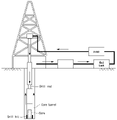
- FIG. 12 is a schematic diagram showing an example of coring. Coring uses a bit called a core bit, which has a hole in the center of the drill for extracting the rock core, unlike the drill bit used for drilling. A rock core separated from the underground bedrock enters a tube called a core barrel through a core bit and is taken out above ground.
- the rock core In the general coring method, the rock core inevitably rotates inside the coring device when it is extracted from the ground. Therefore, when recovering the rock core on the ground, it is difficult to accurately estimate the orientation of the rock core in the ground (hereinafter referred to as "orientation").
- General methods for orienting a rock core that has been rotated include, for example, taking a mold of the cross section of the rock core in the ground and estimating the orientation by comparing it with the cross section of the recovered rock core; and a method of estimating the bearing from the difference in the direction of gravity using a tool equipped with an acceleration sensor.
- the former method has the problem that it is difficult to accurately take a model of the rock core cross section deep underground.
- the latter method has a problem that it cannot be applied to perfectly vertical wells.
- FIG. 13 is a diagram showing how the rock core is oriented by the above method.
- the steps of the above method are as follows. First, an operator prints out a hole wall image and traces the pattern of the hole wall image on paper. Next, an operator winds the traced paper on the surface of the rock core so that the vein pattern drawn on the pit wall image and the vein pattern drawn on the paper match. Then, the operator determines the orientation of the rock core based on the position where the pattern of the hole wall image traced on the paper matches the pattern of the rock core.
- the well wall image includes information indicating the orientation of the rock core in the ground in addition to the information on the excavation depth. Therefore, the operator can specify the orientation of the rock core in the ground by winding the traced paper so as to match the pattern on the surface of the rock core. That is, in this method, the orientation of the rock core is realized by aligning the pattern of the hole wall image with the pattern of the rock core by visual observation by the operator.
- an object of the present invention is to provide a technology that can objectively and automatically determine the orientation of a rock core.
- One aspect of the present invention is rock image data showing a rock image in which the surface of an excavated rock is imaged, and a hole wall image showing the surface of the hole wall where the rock was present.
- an image data acquisition unit for acquiring image data and orientation information indicating the direction in which the surface of the well wall was captured; and a feature amount extraction unit for extracting a feature amount related to the pattern of the hole wall from the above, and alignment of the surface pattern of the rock and the surface pattern of the hole wall based on the feature amount extracted by the feature amount extraction unit.
- an orientation processing device that specifies an orientation in which the surface of the rock is imaged based on the alignment result and the orientation information.
- a computer stores rock image data representing a rock image in which the surface of an excavated rock is captured, and a pit wall image in which the surface of the pit wall where the rock was present is captured. and orientation information indicating the direction in which the surface of the tunnel wall was captured; a feature quantity extraction step of extracting a feature quantity relating to the pattern of the hole wall from the hole wall image; and a computer extracting the pattern of the surface of the rock and the an orientation support for identifying an orientation in which the surface of the rock is imaged based on the alignment result and the orientation information; The method.
- a computer stores rock image data representing a rock image in which the surface of an excavated rock is captured, and a pit wall image in which the surface of the pit wall where the rock was present is captured.
- an image data acquisition step of acquiring image data of the well wall showing the image and orientation information indicating the direction in which the surface of the well wall was captured;
- a feature quantity extraction step of extracting a feature quantity relating to the pattern of the hole wall from the hole wall image; and an orientation step of specifying the orientation in which the surface of the rock is imaged based on the result of the registration and the orientation information.
- the present invention makes it possible to determine the orientation of the rock core objectively and automatically.
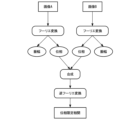
- FIG. 1 is a block diagram showing the functional configuration of an orientation processing device 1 according to an embodiment of the present invention
- FIG. 4 is a flow chart showing the operation of the orientation processing device 1 according to the embodiment of the present invention
- FIG. 10 is a diagram showing an example of an image before and after local contrast adjustment
- FIG. 4 is a diagram showing an example of images before and after filtering by a Canny filter and a Sobel filter
- It is a figure which shows the procedure of a phase-only correlation method.
- It is a figure which shows the hole wall image and the core expansion
- It is a figure which shows an example of a hole wall image and a core deployment image.
- FIG. 10 is a diagram showing an example of image analysis results obtained by image preprocessing and image registration processing
- FIG. 4 is a diagram showing parameters that can be set during preprocessing and optimized parameter values; It is a figure which shows the hole wall image and the core deployment image which were used in the Example, and the result of image registration. It is a figure which shows an example of the rock core sampled. It is a schematic diagram which shows an example of coring.
- FIG. 4 is a diagram showing how a rock core is oriented.
- An orientation processing apparatus 1 of an embodiment described below is an apparatus that orients a rock core using an image analysis technique.
- the orientation processing device 1 automatically aligns the pattern of the image by image registration, which is one of the image analysis techniques, using the hole wall image with a known orientation and the core development image, and rock core is oriented. In this way, the orientation processing device 1 can objectively and automatically determine the orientation of the rock core.
- FIG. 1 is a block diagram showing the functional configuration of an orientation processing device 1 according to an embodiment of the present invention.
- the orientation processing device 1 is, for example, an information processing device such as a general-purpose computer. As shown in FIG. 1, the orientation processing device 1 includes an image data acquisition unit 10, a feature quantity extraction unit 20, an orientation unit 30, and a result output unit .
- the image data acquisition unit 10 acquires the image data of the core development image and the image data of the tunnel wall image from, for example, an external information processing device or storage medium.
- a core development image is, for example, a development image in which the surface of a cylindrically excavated rock core (for example, 360 degrees around the side surface) is captured.
- the pit wall image is a developed image obtained by imaging the surface of the pit wall (for example, 360 degrees) at the position where the excavated rock was in contact with the ground.
- the image data of the pit wall image includes information (orientation information) indicating the direction in which the surface of the pit wall was captured. Therefore, it is possible to specify in which direction each position in the hole wall image is located in the actual hole wall.
- the image data acquisition unit 10 separately acquires the image data of the tunnel wall image that does not contain the direction information and the direction information, instead of acquiring the image data of the tunnel wall image that contains the direction information. may be
- the azimuth information is information that makes it possible to specify the direction in which the surface of the pit wall is captured, such as when it is predetermined that a specific portion of the pit wall image is oriented at a predetermined angle. If there is, it is not limited to information explicitly indicating the direction itself.
- the image data acquisition unit 10 outputs the acquired image data of the core development image and the acquired image data of the tunnel wall image to the feature amount extraction unit 20 .
- the image data of the core developed image may be simply referred to as “core developed image”
- the image data of the well wall image may be simply referred to as “well wall image”.
- the feature quantity extraction unit 20 extracts a feature quantity related to the surface pattern of the rock core from the core development image, and extracts a feature quantity related to the rock core surface pattern from the hole wall image, before image registration and orientation processing by the orientation unit 30, which will be described later. Processing (hereinafter also referred to as “preprocessing”) for extracting a feature amount related to the wall surface pattern is performed.
- the pattern here is, for example, a vein pattern.
- the feature amount extraction unit 20 includes an image shaping unit 21, a grayscale conversion unit 22, a contrast adjustment unit 23, and a filtering unit 24.
- the image forming unit 21 acquires the core development image and the tunnel wall image from the image data acquisition unit 10 .
- the image forming unit 21 forms data of the acquired core development image and tunnel wall image so that the image analysis is easy. For example, the image forming unit 21 cuts out image regions corresponding to the same depth position from the acquired core development image and tunnel wall image, and performs image processing such as enlargement/reduction and trimming.
- the image forming unit 21 outputs the formed core development image and tunnel wall image to the grayscale conversion unit 22 .
- the grayscale conversion unit 22 acquires the core development image and the tunnel wall image from the image forming unit 21 .
- the grayscale conversion unit 22 converts the color image into a grayscale image.
- the grayscale conversion unit 22 outputs the core development image and the tunnel wall image, which are grayscale images, to the contrast adjustment unit 23 .
- the contrast adjustment unit 23 acquires the core development image and the tunnel wall image from the grayscale conversion unit 22 .
- the contrast adjustment unit 23 emphasizes the edges of the pattern in the core development image and the pattern edges in the hole wall image by adjusting the contrasts of the acquired core deployment image and the hole wall image, respectively. .
- An edge is, for example, a location in an image where pixel values change abruptly.
- the contrast adjustment unit 23 outputs the core development image and the tunnel wall image for which the contrast has been adjusted to the filtering unit 24 .
- the filtering unit 24 acquires the core deployment image and the tunnel wall image from the contrast adjustment unit 23 .
- the filtering unit 24 removes noise or sharpens the pattern by performing filtering processing on the acquired core deployment image and the hole wall image, respectively, thereby reducing the pattern in the core deployment image. Emphasize the edges and the edges of the pattern in the pit wall image, respectively.
- the filtering unit 24 performs filtering processing using, for example, a Canny filter.
- the filtering unit 24 outputs the filtered core deployment image and tunnel wall image to the orientation unit 30 .
- the order of the processes performed by the image shaping section 21, the grayscale conversion section 22, the contrast adjustment section 23, and the filtering section 24 is not limited to the order described above, and can be arbitrarily set.
- the orientation unit 30 performs image registration (alignment) between the patterns in both images using the core development image and the tunnel wall image preprocessed by the feature quantity extraction unit 20 .
- the orientation unit 30 determines the direction in which the core deployment image is taken (that is, Orientation is performed to identify the orientation of the rock core in the ground.
- the orientation unit 30 includes a registration unit 31 and an orientation specifying unit 32.
- the registration unit 31 acquires the core deployment image and the tunnel wall image from the filtering unit 24 .
- the registration unit 31 performs image registration (alignment) between the pattern in the core development image and the pattern in the tunnel wall image.
- the registration unit 31 performs image registration using, for example, the phase-only correlation method.
- the registration unit 31 performs image registration by approximating the pattern in the core development image and the pattern in the tunnel wall image to a sine wave shape.
- the registration unit 31 can align the pattern with higher accuracy.
- the registration unit 31 regards the pattern in the core development image and the pattern in the tunnel wall image as sine waves, detects them using a technique such as Hough transform, and performs image registration between the sine waves.
- the registration unit 31 outputs information indicating the result of the image registration and direction information included in the tunnel wall image data to the direction specifying unit 32 .
- the information indicating the result of image registration is, for example, information that links a position in the core deployment image and a position in the tunnel wall image that are estimated to be the same position.
- the information indicating the result of image registration is, for example, superimposition (or synthesis) of both images based on the position in the core development image and the position in the hole wall image that are estimated to be the same position. image data.
- the orientation specifying unit 32 acquires information indicating the result of image registration and orientation information from the registration unit 31 .
- the orientation specifying unit 32 determines the direction in which the core deployment image is taken (that is, the underground Orientation is performed to identify the orientation of the rock core at
- the azimuth identification unit 32 outputs information indicating the identified azimuth to the result output unit 40 .
- the result output unit 40 acquires information indicating the orientation from the orientation identification unit 32 .
- the result output unit 40 outputs the information indicating the acquired direction to, for example, an external information processing device or the like.
- the result output unit 40 may include a display device such as a liquid crystal display (LCD), for example, and may output the result by causing the display device to display the information indicating the azimuth.
- LCD liquid crystal display
- FIG. 2 is a flow chart showing the operation of the orientation processing device 1 according to the embodiment of the present invention.
- the image data acquisition unit 10 acquires the core development image and the tunnel wall image from, for example, an external information processing device (step S001).
- the hole wall image includes information (orientation information) indicating the direction in which the surface of the hole wall was captured.
- the image forming unit 21 forms data so that the core development image and the tunnel wall image are in a format that facilitates image analysis (step S002).
- the grayscale conversion unit 22 converts the color image into a grayscale image (step S003).
- the contrast adjustment unit 23 enhances the edge of the pattern in the core deployment image and the edge of the pattern in the well wall image by adjusting the contrast of each of the core deployment image and the well wall image (step S004).
- the filtering unit 24 removes noise or sharpens the pattern by performing filtering processing on the core deployment image and the tunnel wall image, respectively, so that the pattern in the core deployment image is The edges and the edges of the pattern in the hole wall image are emphasized (step S005). Note that the filtering unit 24 performs filtering processing using, for example, a Canny filter.
- the registration unit 31 performs image registration (alignment) for the pattern in the core development image and the pattern in the tunnel wall image (step S006).
- the registration unit 31 performs image registration using, for example, the phase-only correlation method.
- the orientation specifying unit 32 generates a core deployment image based on the core deployment image and the well wall image aligned by image registration, and the orientation of the well wall based on the orientation information included in the well wall image data. Orientation is performed to identify the direction in which is imaged (that is, the direction of the rock core in the ground) (step S007).
- the result output unit 40 outputs information indicating the specified direction to, for example, an external device (step S008). Thus, the operation of the orientation processing device 1 shown in the flowchart of FIG. 2 is completed.
- orientation processing device 1 of the embodiment will be described in more detail below.
- the orientation processing device 1 of the embodiment sequentially performs image data extraction/shaping, image preprocessing, image registration, and orientation.
- the orientation processing device 1 uses, for example, a phase-only correlation method as an image registration technique.
- the phase-only correlation method is a technique used for collation of images with complicated linear patterns, such as fingerprint collation.
- the orientation processing device 1 of the embodiment detects, for example, a characteristic linear pattern such as a vein pattern from the tunnel wall image and core development image, and performs image registration using the phase-only correlation method.
- the orientation processing device 1 is a device that orients the rock core, but it is not limited to this.
- the present invention can also be applied in the orientation of objects other than rock cores, as long as the object has a characteristic linear pattern.
- the orientation processing device 1 in the embodiment performs preprocessing on images for the purpose of accurately detecting necessary information (feature amounts) from images before performing image registration and orientation processing.
- Pre-processing mainly includes processes such as image contrast adjustment and filtering.
- the orientation processing device 1 can make the difference between the dark part and the bright part of the image clearer by adjusting the contrast of the image.
- a method of adjusting the contrast of an image for example, a method of equalizing a histogram of luminance values in the image can be used.
- the orientation processing device 1 in the embodiment locally adjusts the contrast of the image. Specifically, the orientation processing device 1 performs local contrast adjustment by performing processing for smoothing details while maintaining strong edge portions drawn in the image as they are.
- FIG. 3 is a diagram showing an example of an image before and after local contrast adjustment.
- FIG. 3(A) represents the image before local contrast adjustment is performed
- FIG. 3(B) represents the image after local contrast adjustment is performed.
- a threshold setting can distinguish between edges to keep and edges to process.
- the background portion (for example, the portion of the sky with few clouds and the portion of the sea surface) is recognized as a weak edge portion with little change in luminance value. Therefore, in the image after the local contrast adjustment shown in FIG. 3B, the image is locally blurred in the region of the background portion.
- the orientation processing device 1 classifies the image into a blurred portion and a non-blurred portion so as to increase the contrast of the pattern of interest. can do.
- the orientation processing device 1 in the embodiment can remove noise contained in the image and sharpen/detect patterns in the image by performing filtering.
- the orientation processing device 1 can perform filtering by performing a convolution operation, for example.
- the orientation processing device 1 multiplies all pixel values of the pixel of interest and its neighboring pixels in the input image by the coefficients of the corresponding pixels in the spatial filter. Then, the orientation processing device 1 replaces the value of the pixel at the same position as the pixel of interest in the output image with the sum of the multiplication results of each pixel.
- Filters can be broadly classified into linear filters and nonlinear filters. Filtering with a linear filter performs a linear calculation between the pixel values of the input image and the pixel values of the filtered output image. On the other hand, in filtering using a nonlinear filter, nonlinear calculation is performed between the pixel values of the input image and the pixel values of the output image.
- Filters used for filtering can be broadly classified into three types: smoothing filters, sharpening filters, and edge detection filters, depending on the effect obtained by processing.
- the smoothing filter is used for the purpose of removing noise contained in the input image.
- Typical filters include moving average filters, Gaussian filters, and median filters.
- the moving average filter performs smoothing by replacing the value of the pixel of interest with the average value of neighboring pixel values. While the moving average filter can remove noise, the edges of the input image are also lost at the same time, resulting in blurring of the image. In contrast, there are weighted filters that change the coefficients of the filter according to the distance from the central pixel.
- a filter whose filter coefficients are set based on a Gaussian distribution is called a Gaussian filter.
- the median filter is the most basic non-linear filter.
- a sharpening filter is used for the purpose of enhancing edges in an image.
- a typical sharpening filter process there is a process of subtracting the input image from the output result of the Laplacian filter, which obtains the second derivative of the pixel value in the spatial direction.
- An edge detection filter is obtained by combining a smoothing filter and a differentiation filter.
- a filter coefficient is determined based on taking a difference between adjacent pixel values as a primary differential and approximating the obtained difference as a secondary differential.
- Typical filters for edge detection are the Prewitt filter, the Sobel filter, and the Laplacian filter.
- the Prewitt filter and the Sobel filter are filters that use the difference in mean value from neighboring pixels, and are based on the principle of first-order differentiation.
- the Prewitt filter and the Sobel filter can specify the direction of edge detection, such as only the vertical direction or only the horizontal direction, by the filter coefficients.
- FIG. 4 is a diagram showing an example of images before and after filtering by a Canny filter and a Sobel filter.
- 4A shows an image before filtering
- FIG. 4B shows an image after filtering with a Sobel filter
- FIG. 4C shows an image after filtering with a Canny filter.
- the contours and edges of the coin drawn in the image before filtering are better when filtering by the Canny filter is performed than when filtering by the Sobel filter is performed. is detected more accurately.
- the orientation processing device 1 in the embodiment performs pattern alignment by image registration using an image in which a pattern is detected by the image preprocessing described above and edges are emphasized.
- Image registration is a type of image analysis technology, and is a technology for estimating geometric transformations necessary for aligning common patterns between two images and aligning the patterns. In image registration, one image is used as a reference image (fixed image), and geometric transformation is applied to the other image (moving image) to superimpose it on the reference image.
- image registration technology is used to align satellite images and aerial photographs, as well as medical images taken by medical examination equipment such as MRI (Magnetic Resonance Imaging) and SPECT (Single Photon Emission Computed Tomography). It is also used for alignment.
- medical examination equipment such as MRI (Magnetic Resonance Imaging) and SPECT (Single Photon Emission Computed Tomography). It is also used for alignment.
- Image registration techniques for image alignment can be roughly divided into two types: a technique based on feature points and a technique based on the intensity of the brightness value of an image.
- image registration In the method of image registration based on feature points, feature points are detected in sharp corners, blobs, areas with uniform intensity, etc. for multiple images. Then, image registration is performed by associating feature points common to each image.
- Functions for detecting feature points include functions based on feature amounts, such as SIFT (Scale Invariant Feature Transform) and SURF (Speed Up Robust Features).
- differences such as SAD (Sum of Absolute Differences) or SSD (Sum of Squared Differences) are used.
- SAD Sum of Absolute Differences
- SSD Sud of Squared Differences
- the SAD uses the absolute value of the luminance value difference
- the SSD uses the squared value of the luminance value difference.
- the image registration method using POC is superior in robustness to luminance changes and noise in an image compared to image registration methods based on the intensity of luminance values.
- the orientation processing device 1 in the embodiment performs image registration by the phase-only correlation method using POC.
- the image registration using the phase-only correlation method is an image analysis technique used in recent years in fingerprint matching systems, face authentication systems, and the like, in which it is considered difficult to detect feature amounts.
- FIG. 5 is a diagram showing the procedure of the phase-only correlation method.
- the phase-only correlation method two images are transformed into a two-dimensional frequency domain by discrete Fourier transform, and then processed. The flow of processing using the phase-only correlation method will be described below.
- a F (k 1 ,k 2 ) and AG (k 1 ,k 2 ) in the above equation represent the amplitude components of f(m,n) and g(m,n), respectively.
- êj ⁇ F (k 1 , k 2 ) and êj ⁇ G (k 1 , k 2 ) represent phase components.
- the phase component contains information related to the shape of the image in the image. Therefore, in order to obtain the correlation using only the phase component of each image, the calculation represented by the following equation (4) is performed.
- a function called a phase-only correlation function can be obtained by subjecting H(k 1 , k 2 ) obtained by the formula (4) to an inverse discrete Fourier transform.
- POC function phase-only correlation function
- the orientation processing device 1 in the embodiment detects a characteristic linear pattern corresponding to an ore vein from the image, and performs image registration using the phase-only correlation method to orient the rock core.
- Procedures 1 to 3 which are a rough flow of rock core orientation processing by the orientation processing device 1, are shown below.
- Procedure 1 Extraction and Formation of Image Data
- Data are formed into a form that facilitates image analysis with respect to the original tunnel wall image and core development image.
- Procedure 2. Image pre-processing
- Only prominent vein patterns drawn in the image data are detected.
- Step 3. Image registration
- Image registration is performed by the phase-only correlation method using images in which only prominent vein patterns are detected, and the orientation of the rock core is determined.
- the well is logged.
- an optical camera is lowered into an excavated well, and a wall surface (pit wall) is photographed while rotating the optical camera inside the well.
- a 360-degree unfolded image of the well wall (pit wall image) is obtained.
- the surface of the rock core is photographed by a scanner.
- a 360-degree unfolded image of the rock core (core unfolded image) is obtained.
- the wells are tilted about 45 degrees from the vertical direction and have an average diameter of about 96.3 [mm]. Also, the average diameter of the rock core is about 47.6 [mm].
- the line representing the direction corresponding to the vertically downward direction of the recovered rock core is referred to as the "bottom line”.
- the bottom line of the rock core determined visually is drawn at a depth of about 40% of the depth of about 800 [m].
- this bottom line is the orientation of the rock core, only the data of the depth 500 to 530 [m] section where many bottom lines are drawn among the image data of about 800 [m] was used. .
- FIG. 6 is a diagram showing the tunnel wall image and the core deployment image used in this example.
- the left half represents an image of the entire depth range of 500 to 530 [m]
- the right half represents an enlarged image near the depth of 524.5 [m].
- the hole wall image has an image size of 30801 pixels ⁇ 1440 pixels (vertical ⁇ horizontal)
- the core development image has an image size of 62730 pixels ⁇ 275 pixels (vertical ⁇ horizontal). .
- the line in the center of the image corresponds to the exact bottom line of the rock core.
- the vein pattern on the right half is hidden and not visible at most depths. This is caused, for example, by the optical camera hitting the wall of the well when photographing the wall of the well, and the wall of the well being scraped by the excavation pipe hitting the wall of the well.
- a line BL1 corresponding to the bottom line visually determined as described above is drawn in the core development image.
- the orientation processing device 1 of the embodiment performs the following procedures 1-1 to 1-4 in extracting and forming image data in procedure 1.
- FIG. 1 is an explanation along the steps 1 to 3 above.
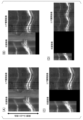
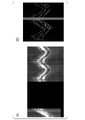
- FIG. 7 is a diagram showing an example of the tunnel wall image and the core deployment image in the processing of procedures 1-1 to 1-4 below.
- the image used here is data near the aforementioned depth of 524.5 [m].
- the image on the left side is the image of the tunnel wall
- the image on the right side is the core deployment image.
- Procedure 1-1 extraction of Hole Wall Image and Core Deployment Image Corresponding to the Same Depth
- the orientation processing device 1 extracts the hole wall image and the core deployment image corresponding to the same depth from the image data of the depth range of 500 to 530 [m]. Crop and match the size of the two images. For example, the orientation processing device 1 sets the image size to 280 pixels in the vertical direction and 180 pixels in the horizontal direction, and cuts out the image so that the length in the vertical direction corresponds to the actual depth of 0.5 [m] (Fig. 7 ( A)).
- Procedure 1-2 (Reduction of the Pit Wall Image in the Vertical Direction)
- the orientation processing device 1 reduces only the vertical width of the pit wall image.
- the vein pattern drawn in the well wall image has a larger amplitude than the vein pattern in the core deployment image. Therefore, the orientation processing device 1 reduces the hole wall image in the vertical direction to roughly match the amplitude of the vein pattern drawn in the core deployment image with the hole wall image (Fig. 7 (B )).
- Procedure 1-3 (Trimming of Right Part of Pit Wall Image)
- the orientation processing device 1 removes the right half of the hole wall image by trimming (FIG. 7(C)).
- the orientation processing apparatus 1 can avoid affecting the result of the image registration by the part where the vein pattern is not visible when performing the image registration.
- Procedure 1-4 (Horizontal Parallelism of Core Expanded Images)
- the orientation processing device 1 arranges two identical core expanded images horizontally and expands the 360-degree core expanded image into a 720-degree core expanded image (FIG. 7). (D)).
- the orientation processing apparatus 1 can prevent occurrence of a position where the vein pattern in the core development image is interrupted, and can further stabilize the result of image registration.
- the orientation processing device 1 in the embodiment performs image preprocessing in procedure 2 on the tunnel wall image and the core deployment image processed in accordance with the above procedures 1-1 to 1-4.
- the flow of image preprocessing is shown below.
- the orientation processing device 1 performs the following procedures 2-1 and 2-2 in the image preprocessing of procedure 2.
- Procedure 2-1 (Grayscale conversion of hole wall image and core development image)
- the orientation processing device 1 converts the hole wall image and the core expansion image from color images to grayscale images. With this conversion, the orientation processing device 1 converts the image from three-dimensional array data to two-dimensional array data, thereby facilitating image analysis.
- Procedure 2-2 (Image Contrast Adjustment)
- the orientation processing device 1 performs the above-described local contrast adjustment in order to emphasize the contrast of the large and thick vein pattern drawn in the tunnel wall image and the core development image. .
- the orientation processing device 1 performs filtering processing using the aforementioned Canny filter, Sobel filter, etc. on the contrast-adjusted tunnel wall image and core development image.
- the Canny filter can detect edges more accurately than the Sobel filter, but the direction of edge detection cannot be specified.
- the Sobel filter is inferior to the Canny filter in edge detection accuracy, but can specify the edge detection direction.
- the orientation processing device 1 uses the Canny filter to detect the edges of the vein pattern regardless of the direction, and then uses the Sobel filter to detect only the edges in the horizontal direction. Through this series of preprocessing, the orientation processing device 1 can remove small noises and fine vein patterns in the image, and can detect only large, thick, horizontal vein patterns as edges. can.
- the orientation processing device 1 in the embodiment performs image registration by the phase-only correlation method on the tunnel wall image and the core deployment image that have been preprocessed according to the above procedures 2-1 to 2-3. ration processing.
- the flow of image registration processing by the phase-only correlation method is shown below.
- the orientation processing device 1 performs the following procedures 3-1 and 3-2 in the image registration processing of procedure 3.
- FIG. 1
- Procedure 3-1 (Image Registration by Phase Only Correlation Method)
- the orientation processing apparatus 1 performs image registration using the preprocessed hole wall image and core development image, and aligns patterns.
- the orientation processing device 1 moves the image so that the pattern of the hole wall image overlaps the pattern of the core development image.
- Procedure 3-2 (Detection of Rock Core Orientation Deviation)
- the deviation between the rock core orientation determined by image registration and the rock core orientation determined by alignment of the pattern by visual inspection is detected and implemented.
- the effectiveness of image analysis by the morphological orientation processing device 1 was verified.
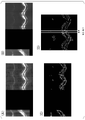
- FIG. 8 is a diagram showing an example of the result of image analysis by the image preprocessing in procedures 2-1 to 2-3 and the image registration processing in procedures 3-1 to 3-2.
- the image used here is data near the depth of 524.5 [m], as in FIG.
- the images in FIGS. 8A, 8B, and 8C represent the image after grayscale conversion, the image after local contrast adjustment, and the image after edge detection, respectively.
- FIG. 8(D) is an image showing the result of performing image registration using the hole wall image and the core development image after edge detection.
- line BL2 represents the bottom line of the rock core determined by visual pattern registration
- line BL3 represents the bottom line of the rock core determined by image registration.
- the deviation between the line BL2 and the line BL3 was determined based on the bottom line of the rock core determined by visually aligning the patterns. At this time, when the line BL3 was on the left side of the line BL2, the shift was assumed to be a negative value, and when the line BL3 was on the right side of the line BL2, the shift was assumed to be a positive value.
- the numerical value that indicates the magnitude of this deviation indicates how much the orientation of the rock core determined by image analysis deviates from the correct orientation. For example, in the crustal stress measurement, since a determination error of 10 degrees in the stress direction is accepted, the orientation processing device 1 performs orientation so that the deviation falls within the range of about 20 degrees. You can do it.
- the orientation processing device 1 uses the tunnel wall image and the core deployment image in the depth range of 500 to 530 [m] to orient the rock core according to the procedures 1 to 3 described above.
- the analysis results and verification results in the case of conducting the test will be described.
- the orientation processing device 1 orientated the rock core using image data at a depth of around 524.4 to 524.7 [m] where large and thick vein patterns exist.
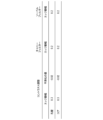
- FIG. 9 is a diagram showing parameters that can be set during preprocessing and optimized parameter values.
- the parameters that can be set for local contrast adjustment are the threshold for edges in the image to be kept as they are, and the degree of smoothing for edges below the threshold.
- Parameters that can be set during filtering are edge thresholds detected during the Canny filter and Sobel filter.
- the threshold of edges to be retained during local contrast adjustment takes a value between 0 and 1, and the closer to 1, the fewer edges are retained.
- the parameter values set by default were used.
- the degree of smoothing takes a value between -1 and 0, and the closer to -1, the stronger the degree of smoothing. Also, here, the value is decreased by 0.1 from -1 to -0.1, and the change in the image is confirmed while decreasing the value by 0.01 from -0.1 to 0. , set the optimal parameter values.
- the threshold for detected edges in the Canny filter and Sobel filter takes a value between 0 and 1, and the closer to 1, the fewer edges are detected.
- the optimum parameter values are set by decreasing the values by 0.1 from 0.5. A method for optimizing the parameters will be described below.
- FIG. 10 is a diagram showing the tunnel wall image and core development image used and the result of image registration.
- FIG. 10(A) shows the hole wall image and core development image used
- FIG. 10(B) shows the result of image registration.
- the azimuth deviation obtained based on the result of the image registration was 12.2 degrees.
- the misorientation obtained here was within 20 degrees, which was within the permissible range of the determination error of the stress direction in the above-mentioned crustal stress measurement.
- the orientation processing device 1 in the embodiment is considered to be able to precisely orient the rock core by image analysis.
- the orientation processing device 1 of the embodiment performs image registration, which is one of the image analysis methods, to align the pattern of the core deployment image with the pattern of the hole wall image whose orientation is known. Orientation of the rock core is performed by performing With the configuration as described above, the orientation processing device 1 of the embodiment can objectively and automatically specify the orientation of the rock core.
- the orientation processing device 1 may be configured to orient the rock core using machine learning. Specifically, it is conceivable to construct a learning model in which an image subjected to image registration is output in response to the input of the tunnel wall image and the core development image. By using machine learning, it is possible to automate all the image analysis processes related to rock core orientation, including parameter adjustment in image preprocessing. This makes it possible to orientate the rock core more easily.
- the orientation processing device 1 automatically divides, for example, several hundreds [m] of tunnel wall images by 0.5 [m] (Step 1).
- the orientation processing device 1 organizes the divided tunnel wall image and core deployment image for each depth (Step 2).
- the orientation processing device 1 creates a teacher data set by putting together the core development image, the tunnel wall image, and the result of the image registration for each depth (Step 3).
- the orientation processing device 1 performs machine learning using the created teacher data set to obtain a learned learning model (Step 4).
- the orientation processing device 1 performs parameter adjustment of the learned model using test data and the like to further improve orientation accuracy (Step 5). Note that this Step 5 may be omitted.
- the orientation processing device 1 inputs the tunnel wall image and the core development image, which are the objects of orientation, to a learned learning model, and obtains an image with image registration output from the learning model. .
- the orientation processing device 1 orients the rock core using the obtained image (Step 6).
- the orientation processing device 1 may further perform machine learning using the input/output data in Step 6 as teacher data.
- the orientation processing device includes the image data acquisition section, the feature quantity extraction section, and the orientation section.
- the orientation processing device is the orientation processing device 1 in the embodiment
- the image data acquisition unit is the image data acquisition unit 10 in the embodiment
- the feature amount extraction unit is the feature amount extraction unit 20 in the embodiment.
- the orientation unit is the orientation unit 30 in the embodiment.
- the image data acquisition unit obtains rock image data representing a rock image of the surface of the excavated rock, and pit wall image data representing a pit wall image of the surface of the pit wall where the rock was present. and azimuth information indicating the azimuth in which the surface of the pit wall was imaged.
- rock images are core deployment images in the embodiment.
- the feature quantity extraction unit extracts a feature quantity relating to the pattern of the surface of the rock from the rock image, and extracts a feature quantity relating to the pattern of the pit wall from the pit wall image.
- the pattern is the vein pattern in the embodiment
- the feature quantity is the pixel value (such as edge) in the embodiment.
- the orientation unit aligns the pattern of the surface of the rock with the pattern of the surface of the pit wall based on the feature quantity extracted by the feature quantity extraction unit. Identify the orientation in which the surface of is imaged. For example, alignment is image registration in practitioner relative.
- the orientation unit may align the pattern on the surface of the rock with the pattern on the surface of the pit wall using the phase-only correlation method.
- orientation unit may perform alignment by approximating the pattern to the shape of a sine wave.
- the feature amount extraction unit performs contrast adjustment on the rock image and the hole wall image to emphasize the edges of the pattern on the surface of the rock and the edges of the pattern on the surface of the hole wall to extract the feature amount.
- the feature amount extraction unit performs a filtering process on the rock image and the hole wall image to emphasize the edge of the pattern on the surface of the rock and the edge of the pattern on the surface of the hole wall to extract the feature amount.
- the feature amount extraction unit may perform filtering processing using a Canny filter.
- a part or all of the orientation processing device 1 in each of the above-described embodiments may be realized by a computer.
- a program for realizing this function may be recorded in a computer-readable recording medium, and the program recorded in this recording medium may be read into a computer system and executed.
- the "computer system” referred to here includes hardware such as an OS and peripheral devices.
- the term "computer-readable recording medium” refers to portable media such as flexible discs, magneto-optical discs, ROMs and CD-ROMs, and storage devices such as hard discs incorporated in computer systems.
- “computer-readable recording medium” means a medium that dynamically retains a program for a short period of time, like a communication line when transmitting a program via a network such as the Internet or a communication line such as a telephone line. It may also include something that holds the program for a certain period of time, such as a volatile memory inside a computer system that serves as a server or client in that case. Further, the program may be for realizing a part of the functions described above, or may be capable of realizing the functions described above in combination with a program already recorded in the computer system. It may be implemented using a programmable logic device such as an FPGA (Field Programmable Gate Array).
- FPGA Field Programmable Gate Array
- SYMBOLS 1 Orientation processing apparatus, 10... Image data acquisition part, 20... Feature-value extraction part, 21... Image formation part, 22... Gray scale conversion part, 23... Contrast adjustment part, 24... Filtering part, 30... Orientation Transformation unit 31 Registration unit 32 Orientation identification unit 40 Result output unit
Landscapes
- Engineering & Computer Science (AREA)
- Physics & Mathematics (AREA)
- Life Sciences & Earth Sciences (AREA)
- Mining & Mineral Resources (AREA)
- Geology (AREA)
- Geochemistry & Mineralogy (AREA)
- Environmental & Geological Engineering (AREA)
- Fluid Mechanics (AREA)
- General Life Sciences & Earth Sciences (AREA)
- Geophysics (AREA)
- Theoretical Computer Science (AREA)
- General Physics & Mathematics (AREA)
- Computer Vision & Pattern Recognition (AREA)
- Quality & Reliability (AREA)
- Image Analysis (AREA)
- Image Processing (AREA)
Priority Applications (4)
| Application Number | Priority Date | Filing Date | Title |
|---|---|---|---|
| JP2023546622A JP7554520B2 (ja) | 2021-09-08 | 2021-09-08 | 定方位化処理装置、定方位化支援方法及びプログラム |
| US18/689,480 US20240352818A1 (en) | 2021-09-08 | 2021-09-08 | Orienting processing device, orienting assistance method, and program |
| EP21956739.3A EP4400690A4 (en) | 2021-09-08 | 2021-09-08 | ORIENTATION STABILIZATION PROCESSING DEVICE, ORIENTATION STABILIZATION ASSISTANCE METHOD, AND PROGRAM |
| PCT/JP2021/032993 WO2023037442A1 (ja) | 2021-09-08 | 2021-09-08 | 定方位化処理装置、定方位化支援方法及びプログラム |
Applications Claiming Priority (1)
| Application Number | Priority Date | Filing Date | Title |
|---|---|---|---|
| PCT/JP2021/032993 WO2023037442A1 (ja) | 2021-09-08 | 2021-09-08 | 定方位化処理装置、定方位化支援方法及びプログラム |
Publications (1)
| Publication Number | Publication Date |
|---|---|
| WO2023037442A1 true WO2023037442A1 (ja) | 2023-03-16 |
Family
ID=85507338
Family Applications (1)
| Application Number | Title | Priority Date | Filing Date |
|---|---|---|---|
| PCT/JP2021/032993 Ceased WO2023037442A1 (ja) | 2021-09-08 | 2021-09-08 | 定方位化処理装置、定方位化支援方法及びプログラム |
Country Status (4)
| Country | Link |
|---|---|
| US (1) | US20240352818A1 (https=) |
| EP (1) | EP4400690A4 (https=) |
| JP (1) | JP7554520B2 (https=) |
| WO (1) | WO2023037442A1 (https=) |
Cited By (1)
| Publication number | Priority date | Publication date | Assignee | Title |
|---|---|---|---|---|
| CN116310446A (zh) * | 2023-04-04 | 2023-06-23 | 中南大学 | 一种基于数字图像智能识别的岩芯重定位方法 |
Citations (5)
| Publication number | Priority date | Publication date | Assignee | Title |
|---|---|---|---|---|
| JPH0381492A (ja) * | 1989-08-23 | 1991-04-05 | Taisei Kiso Sekkei Kk | 地層調査方法 |
| JPH0453239A (ja) | 1990-06-20 | 1992-02-20 | Mitsubishi Electric Corp | 樹脂封止型半導体装置用のモールド金型 |
| JP2881758B2 (ja) | 1996-03-06 | 1999-04-12 | 科学技術庁防災科学技術研究所長 | 定方位コアサンプリング装置及び定方位コアサンプリング方法 |
| US20090080705A1 (en) * | 2006-03-07 | 2009-03-26 | Ground Modelling Technologies Ltd. | Rock core logging |
| US20210003731A1 (en) * | 2019-07-04 | 2021-01-07 | Chengdu University Of Technology | Method for determining favorable time window of infill well in unconventional oil and gas reservoir |
Family Cites Families (5)
| Publication number | Priority date | Publication date | Assignee | Title |
|---|---|---|---|---|
| US8106968B1 (en) * | 2008-02-20 | 2012-01-31 | Cognitech, Inc. | System and method for pattern detection and camera calibration |
| JP6746960B2 (ja) * | 2016-03-02 | 2020-08-26 | 株式会社ニデック | 眼科用レーザ治療装置 |
| US9906654B1 (en) * | 2016-12-01 | 2018-02-27 | Xerox Corporation | White area defect detection for image based controls applications |
| CN113918908A (zh) * | 2020-07-07 | 2022-01-11 | 三星电子株式会社 | 用于指纹验证的方法和设备 |
| CN116323974A (zh) * | 2020-07-31 | 2023-06-23 | 元素生物科学公司 | 多路复用covid-19锁式测定 |
-
2021
- 2021-09-08 EP EP21956739.3A patent/EP4400690A4/en active Pending
- 2021-09-08 US US18/689,480 patent/US20240352818A1/en active Pending
- 2021-09-08 JP JP2023546622A patent/JP7554520B2/ja active Active
- 2021-09-08 WO PCT/JP2021/032993 patent/WO2023037442A1/ja not_active Ceased
Patent Citations (5)
| Publication number | Priority date | Publication date | Assignee | Title |
|---|---|---|---|---|
| JPH0381492A (ja) * | 1989-08-23 | 1991-04-05 | Taisei Kiso Sekkei Kk | 地層調査方法 |
| JPH0453239A (ja) | 1990-06-20 | 1992-02-20 | Mitsubishi Electric Corp | 樹脂封止型半導体装置用のモールド金型 |
| JP2881758B2 (ja) | 1996-03-06 | 1999-04-12 | 科学技術庁防災科学技術研究所長 | 定方位コアサンプリング装置及び定方位コアサンプリング方法 |
| US20090080705A1 (en) * | 2006-03-07 | 2009-03-26 | Ground Modelling Technologies Ltd. | Rock core logging |
| US20210003731A1 (en) * | 2019-07-04 | 2021-01-07 | Chengdu University Of Technology | Method for determining favorable time window of infill well in unconventional oil and gas reservoir |
Non-Patent Citations (2)
| Title |
|---|
| See also references of EP4400690A4 |
| TATSUHIRO SUGIMOTO ET AL.: "A method for core reorientation based on rock remanent magnetization: Application to hemipelagic sedimentary soft rock", THE SOCIETY OF MATERIALS SCIENCE, JAPAN, vol. 69, no. 3, March 2020 (2020-03-01), pages 256 - 262 |
Cited By (1)
| Publication number | Priority date | Publication date | Assignee | Title |
|---|---|---|---|---|
| CN116310446A (zh) * | 2023-04-04 | 2023-06-23 | 中南大学 | 一种基于数字图像智能识别的岩芯重定位方法 |
Also Published As
| Publication number | Publication date |
|---|---|
| JP7554520B2 (ja) | 2024-09-20 |
| JPWO2023037442A1 (https=) | 2023-03-16 |
| EP4400690A1 (en) | 2024-07-17 |
| US20240352818A1 (en) | 2024-10-24 |
| EP4400690A4 (en) | 2025-07-09 |
Similar Documents
| Publication | Publication Date | Title |
|---|---|---|
| CN108109157B (zh) | 一种基于数字式全景钻孔图像的岩体评估分析方法 | |
| WO2012118868A2 (en) | Petrographic image analysis for determining capillary pressure in porous media | |
| CN104823202A (zh) | 分析由处理引起的岩石性质变化的计算机断层扫描(ct)系统及方法 | |
| Zhang et al. | Image processing for the analysis of an evolving broken-ice field in model testing | |
| CN109241867B (zh) | 采用人工智能算法识别数字岩心图像的方法及装置 | |
| CN109766892A (zh) | 一种基于边缘检测的射线检测图像标记信息字符分割方法 | |
| CN119991512A (zh) | 图像的去折痕方法、装置和存储介质 | |
| JP7554520B2 (ja) | 定方位化処理装置、定方位化支援方法及びプログラム | |
| CN108460419B (zh) | 钻孔光学图像和雷达成像信息融合的裂缝参数提取方法 | |
| CN116310784A (zh) | 一种基于图像拉平处理的岩芯图片裂缝识别方法 | |
| US20220164968A1 (en) | Automated core scan alignment | |
| CN119624857A (zh) | 基于机器视觉的水平井压裂效果诊断方法及装置 | |
| Faraklioti et al. | The use of structure tensors in the analysis of seismic data | |
| CN117409408B (zh) | 层理缝参数获取方法、装置、设备及可读存储介质 | |
| Aspert et al. | Time-varying segmentation for mapping of land cover changes | |
| CN117409028A (zh) | 声成像孔洞识别评价方法、装置、计算设备及存储介质 | |
| CN111275687A (zh) | 一种基于连通区域标记的细粒度图像拼接检测方法 | |
| 吴一全 et al. | Edge detection of river in SAR image based on contourlet modulus maxima and improved mathematical morphology | |
| Cheng et al. | Text Region Adaptive Multi-temporal Stone Inscriptions Image Registration Framework | |
| Chen et al. | Cross-cycle Transformer-based Stitching Method for Low-resolution Borehole Images | |
| Wu et al. | Research on Recognition Method of Oil Downhole Perforation Image | |
| CN118864849B (zh) | 一种分割土壤ct图像中生物性孔隙的方法 | |
| Liang et al. | Feature-based multi-resolution SAR and TM images auto-registration | |
| Rachee | Segmentation of satellite imagery of Amedi site using Chan–Vese model with saliency estimation | |
| Rizee et al. | Analysis of Feature Extraction Techniques on Various Signal and Image Attacks |
Legal Events
| Date | Code | Title | Description |
|---|---|---|---|
| 121 | Ep: the epo has been informed by wipo that ep was designated in this application |
Ref document number: 21956739 Country of ref document: EP Kind code of ref document: A1 |
|
| WWE | Wipo information: entry into national phase |
Ref document number: 2023546622 Country of ref document: JP |
|
| WWE | Wipo information: entry into national phase |
Ref document number: 18689480 Country of ref document: US |
|
| WWE | Wipo information: entry into national phase |
Ref document number: 2021956739 Country of ref document: EP |
|
| NENP | Non-entry into the national phase |
Ref country code: DE |
|
| ENP | Entry into the national phase |
Ref document number: 2021956739 Country of ref document: EP Effective date: 20240408 |