WO2023032467A1 - 樹脂組成物、樹脂組成物フィルム、硬化膜、および半導体装置 - Google Patents
樹脂組成物、樹脂組成物フィルム、硬化膜、および半導体装置 Download PDFInfo
- Publication number
- WO2023032467A1 WO2023032467A1 PCT/JP2022/026925 JP2022026925W WO2023032467A1 WO 2023032467 A1 WO2023032467 A1 WO 2023032467A1 JP 2022026925 W JP2022026925 W JP 2022026925W WO 2023032467 A1 WO2023032467 A1 WO 2023032467A1
- Authority
- WO
- WIPO (PCT)
- Prior art keywords
- resin composition
- component
- film
- group
- compound
- Prior art date
- Legal status (The legal status is an assumption and is not a legal conclusion. Google has not performed a legal analysis and makes no representation as to the accuracy of the status listed.)
- Ceased
Links
Classifications
-
- C—CHEMISTRY; METALLURGY
- C08—ORGANIC MACROMOLECULAR COMPOUNDS; THEIR PREPARATION OR CHEMICAL WORKING-UP; COMPOSITIONS BASED THEREON
- C08K—Use of inorganic or non-macromolecular organic substances as compounding ingredients
- C08K5/00—Use of organic ingredients
- C08K5/54—Silicon-containing compounds
- C08K5/541—Silicon-containing compounds containing oxygen
-
- C—CHEMISTRY; METALLURGY
- C08—ORGANIC MACROMOLECULAR COMPOUNDS; THEIR PREPARATION OR CHEMICAL WORKING-UP; COMPOSITIONS BASED THEREON
- C08L—COMPOSITIONS OF MACROMOLECULAR COMPOUNDS
- C08L101/00—Compositions of unspecified macromolecular compounds
- C08L101/02—Compositions of unspecified macromolecular compounds characterised by the presence of specified groups, e.g. terminal or pendant functional groups
-
- C—CHEMISTRY; METALLURGY
- C08—ORGANIC MACROMOLECULAR COMPOUNDS; THEIR PREPARATION OR CHEMICAL WORKING-UP; COMPOSITIONS BASED THEREON
- C08L—COMPOSITIONS OF MACROMOLECULAR COMPOUNDS
- C08L63/00—Compositions of epoxy resins; Compositions of derivatives of epoxy resins
-
- C—CHEMISTRY; METALLURGY
- C08—ORGANIC MACROMOLECULAR COMPOUNDS; THEIR PREPARATION OR CHEMICAL WORKING-UP; COMPOSITIONS BASED THEREON
- C08L—COMPOSITIONS OF MACROMOLECULAR COMPOUNDS
- C08L77/00—Compositions of polyamides obtained by reactions forming a carboxylic amide link in the main chain; Compositions of derivatives of such polymers
-
- C—CHEMISTRY; METALLURGY
- C08—ORGANIC MACROMOLECULAR COMPOUNDS; THEIR PREPARATION OR CHEMICAL WORKING-UP; COMPOSITIONS BASED THEREON
- C08L—COMPOSITIONS OF MACROMOLECULAR COMPOUNDS
- C08L79/00—Compositions of macromolecular compounds obtained by reactions forming in the main chain of the macromolecule a linkage containing nitrogen with or without oxygen or carbon only, not provided for in groups C08L61/00 - C08L77/00
- C08L79/04—Polycondensates having nitrogen-containing heterocyclic rings in the main chain; Polyhydrazides; Polyamide acids or similar polyimide precursors
- C08L79/08—Polyimides; Polyester-imides; Polyamide-imides; Polyamide acids or similar polyimide precursors
-
- G—PHYSICS
- G03—PHOTOGRAPHY; CINEMATOGRAPHY; ANALOGOUS TECHNIQUES USING WAVES OTHER THAN OPTICAL WAVES; ELECTROGRAPHY; HOLOGRAPHY
- G03F—PHOTOMECHANICAL PRODUCTION OF TEXTURED OR PATTERNED SURFACES, e.g. FOR PRINTING, FOR PROCESSING OF SEMICONDUCTOR DEVICES; MATERIALS THEREFOR; ORIGINALS THEREFOR; APPARATUS SPECIALLY ADAPTED THEREFOR
- G03F7/00—Photomechanical, e.g. photolithographic, production of textured or patterned surfaces, e.g. printing surfaces; Materials therefor, e.g. comprising photoresists; Apparatus specially adapted therefor
- G03F7/004—Photosensitive materials
-
- G—PHYSICS
- G03—PHOTOGRAPHY; CINEMATOGRAPHY; ANALOGOUS TECHNIQUES USING WAVES OTHER THAN OPTICAL WAVES; ELECTROGRAPHY; HOLOGRAPHY
- G03F—PHOTOMECHANICAL PRODUCTION OF TEXTURED OR PATTERNED SURFACES, e.g. FOR PRINTING, FOR PROCESSING OF SEMICONDUCTOR DEVICES; MATERIALS THEREFOR; ORIGINALS THEREFOR; APPARATUS SPECIALLY ADAPTED THEREFOR
- G03F7/00—Photomechanical, e.g. photolithographic, production of textured or patterned surfaces, e.g. printing surfaces; Materials therefor, e.g. comprising photoresists; Apparatus specially adapted therefor
- G03F7/004—Photosensitive materials
- G03F7/038—Macromolecular compounds which are rendered insoluble or differentially wettable
-
- H—ELECTRICITY
- H10—SEMICONDUCTOR DEVICES; ELECTRIC SOLID-STATE DEVICES NOT OTHERWISE PROVIDED FOR
- H10W—GENERIC PACKAGES, INTERCONNECTIONS, CONNECTORS OR OTHER CONSTRUCTIONAL DETAILS OF DEVICES COVERED BY CLASS H10
- H10W70/00—Package substrates; Interposers; Redistribution layers [RDL]
- H10W70/60—Insulating or insulated package substrates; Interposers; Redistribution layers
- H10W70/67—Insulating or insulated package substrates; Interposers; Redistribution layers characterised by their insulating layers or insulating parts
- H10W70/69—Insulating materials thereof
Definitions
- the present invention relates to resin compositions, resin composition films, cured films, and semiconductor devices. More particularly, the present invention relates to resin compositions suitably used for surface protective films of semiconductor elements and inductor devices, interlayer insulating films, structures of MEMS (Micro Electro Mechanical Systems), and the like.
- MEMS Micro Electro Mechanical Systems
- Patent Document 1 a chemically amplified photo-cationically polymerizable photosensitive material
- Patent Document 2 a photocationic polymerizable material intended to improve mechanical properties and thermal properties by containing an epoxy resin with a specific structure
- Patent Document 3 a cationic photopolymerizable material having excellent heat resistance and tensile elongation is disclosed by containing a polymer compound such as polyimide and an epoxy compound having a specific structure
- Patent Documents 2 and 3 are capable of photocationic polymerization that achieves both sufficient adhesion and sensitivity during pattern processing. No material was obtained.
- the present invention for solving the above problems is as follows.
- the resin composition of the present invention provides a resin composition, a resin composition film, a cured film, and a semiconductor device that exhibit sufficient adhesion to inorganic substrates and sensitivity during pattern processing.
- the present invention is a resin composition containing a polymer compound as component (A), a cationic polymerizable compound as component (B), a cationic polymerization initiator as component (C), and a silane coupling agent as component (D).
- the resin composition is characterized in that the component (D) has a carboxyl group and/or an acid anhydride group.
- the resin composition of the present invention contains a polymer compound as the (A) component, so that it is excellent in film formability when formed into a film.
- the weight average molecular weight of component (A) is not particularly limited as long as it is a polymer compound, but the weight average molecular weight is preferably 1,000 or more and 200,000 or less.
- (A) component may be used individually or may use 2 or more types together.
- the weight average molecular weight of component (A) in the present invention is measured by gel permeation chromatography (GPC method) and calculated in terms of polystyrene.
- component (A) is preferably at least one compound selected from the group consisting of polyamide, polyimide, and polyamideimide. If at least one compound selected from the group consisting of polyamides, polyimides, and polyamideimides is included as the component (A), the component (A) can also include polymer compounds other than polyamides, polyimides, and polyamideimides. .
- the polyimide precursor and the polybenzoxazole precursor each correspond to the polyamide described above.
- the component (A) preferably has a carboxylic acid residue at the molecular chain end. Since the molecular chain end of component (A) is a carboxylic acid residue, the molecular chain end can have a molecular structure that does not possess an amine terminal structure, which can serve as an inhibitory functional group for cationic polymerization. It is preferable because sufficient cationic polymerizability can be expressed.
- the expression that the molecular chain end of component (A) is a carboxylic acid residue means that the molecular chain end of component (A) is an organic group derived from a carboxylic acid capable of constituting polyamide, polyimide or polyamideimide.
- the molecular chain end of component (A) is a carboxylic acid residue specifically means that the molecular chain end of component (A) is a monocarboxylic acid, a dicarboxylic acid, a monoacid chloride compound, a diacid chloride compound, It means an organic group derived from a tetracarboxylic acid, an acid anhydride, an acid dianhydride, or the like.
- Carboxylic acids suitable for forming carboxylic acid residues at the molecular chain ends of component (A) include aromatic dicarboxylic acids, aromatic dianhydrides, alicyclic dicarboxylic acids, and alicyclic dianhydrides. compounds, aliphatic dicarboxylic acids, aliphatic dianhydrides, and the like, but are not limited to these. Moreover, these are used individually or in combination of 2 or more types.
- the component (A) is preferably a compound having at least one structure selected from structures represented by general formula (1) and general formula (2).
- X 1 and X 2 independently represent a divalent to 10-valent organic group
- X 2 represents a 4- to 10-valent organic group
- Y 1 and Y 2 each independently represents a divalent to tetravalent organic group
- R represents a hydrogen atom or an organic group having 1 to 20 carbon atoms
- q is an integer of 0 to 2
- r, s, t and u are Each is independently an integer from 0 to 4.
- Y 1 and Y 2 in general formulas (1) and (2) each represent a divalent to tetravalent organic group, and represent an organic group derived from diamine.
- Y1 and Y2 in general formulas ( 1 ) and ( 2 ) of component (A) preferably contain a diamine residue having a phenolic hydroxyl group.
- a diamine residue having a phenolic hydroxyl group in the component (A) moderate solubility of the resin in an alkaline developer can be obtained, so that a high contrast between the exposed and unexposed areas can be obtained. pattern can be formed.
- diamines having a phenolic hydroxyl group include bis(3-amino-4-hydroxyphenyl)hexafluoropropane, bis(3-amino-4-hydroxyphenyl)sulfone, bis(3-amino- 4-hydroxyphenyl)propane, bis(3-amino-4-hydroxyphenyl)methylene, bis(3-amino-4-hydroxyphenyl)ether, bis(3-amino-4-hydroxy)biphenyl, 2,2'- Ditrifluoromethyl-5,5'-dihydroxyl-4,4'-diaminobiphenyl, bis(3-amino-4-hydroxyphenyl)fluorene, 2,2'-bis(trifluoromethyl)-5,5'- Aromatic diamines such as dihydroxybenzidine, compounds in which some of the hydrogen atoms of these aromatic rings or hydrocarbons are substituted with alkyl groups having 1 to 10 carbon atoms, fluoroalkyl groups, halogen
- Y 1 and Y 2 in general formulas (1) and (2) may contain a diamine residue having an aromatic group other than those mentioned above. Heat resistance can be improved by copolymerizing these.
- aromatic diamine residues include 3,4'-diaminodiphenyl ether, 4,4'-diaminodiphenyl ether, 3,4'-diaminodiphenylmethane, 4,4'-diaminodiphenylmethane, 3,4 '-diaminodiphenyl sulfone, 4,4'-diaminodiphenyl sulfone, 3,4'-diaminodiphenyl sulfide, 4,4'-diaminodiphenyl sulfide, 1,4-bis(4-aminophenoxy)benzene, benzine, m- phenylenediamine, p-phenylenediamine, 1,5-naphthalenediamine, 2,6-naphthalenedi
- aromatic diamines and compounds in which some of the hydrogen atoms of these aromatic rings or hydrocarbons are substituted with an alkyl group having 1 to 10 carbon atoms, a fluoroalkyl group, a halogen atom, or the like. It is not limited to these.
- Other diamines to be copolymerized can be used as they are or as corresponding diisocyanate compounds, trimethylsilylated diamines. Moreover, you may use combining these 2 or more types of diamine components.
- X 1 and X 2 are preferably carboxylic acid residues independently, and X 1 is a divalent to decavalent organic is preferred, and X 2 is preferably a tetravalent to decavalent organic group.
- the carboxylic acid residue preferably has a structure derived from an alicyclic tetracarboxylic dianhydride. That is, (A) the polymer compound is at least one compound selected from the group consisting of polyamide, polyimide, and polyamideimide, and further preferably has a structure derived from an alicyclic tetracarboxylic dianhydride. .
- the carboxylic acid residue has a structure derived from an alicyclic tetracarboxylic dianhydride, the light transmittance of the resin composition with respect to the exposure wavelength is increased, and processing into a thick film of 20 ⁇ m or more is facilitated. .
- the (A) polymer compound has a structure derived from an alicyclic tetracarboxylic dianhydride, so that the reactivity of cationic polymerization is higher than that of an aromatic dianhydride. It is preferable in that it increases and the chemical resistance of the cured film is improved.
- alicyclic tetracarboxylic dianhydrides having a polycyclic structure improve chemical resistance when cured and improve ion migration resistance. is preferably
- organic group derived from an alicyclic tetracarboxylic dianhydride having a polycyclic structure include 4-(2,5-dioxotetrahydrofuran-3-yl)-1,2,3 ,4-tetrahydronaphthalene-1,2-dicarboxylic dianhydride, 4-(2,5-dioxotetrahydrofuran-3-yl)-4methyl-1,2,3,4-tetrahydronaphthalene-1,2- Dicarboxylic dianhydride, 4-(2,5-dioxotetrahydrofuran-3-yl)-7methyl-1,2,3,4-tetrahydronaphthalene-1,2-dicarboxylic dianhydride, norbornane-2- Spiro-2'-cyclopentanone-5'-spiro-2''-norbornane-5,5'',6,6''-tetracarboxylic dianhydride, norbornane-2-spir
- the molar ratio of the structures represented by the general formulas (1) and (2) in the present invention is obtained by a method of calculating from the molar ratio of the monomers used for polymerization or by using a nuclear magnetic resonance spectrometer (NMR). It can be confirmed by a method for detecting peaks of a polyamide structure, an imide precursor structure, or an imide structure in a resin, a resin composition, or a cured film.
- NMR nuclear magnetic resonance spectrometer
- the component (A) having a carboxylic acid residue at the molecular chain end is, for example, in the case of a polyimide having a carboxylic acid residue at the molecular chain end, an acid anhydride content greater than that of the diamine used for polymerization.
- a specific compound from compounds generally used as a terminal blocking agent specifically , an acid anhydride, a monocarboxylic acid, a monoacid chloride compound, or a monoactive ester compound.
- component (A) By blocking the molecular chain ends of component (A) with a carboxylic acid or acid anhydride terminal blocker having a hydroxyl group, a carboxyl group, a sulfonic acid group, a thiol group, a vinyl group, an ethynyl group, or an allyl group,
- a carboxylic acid or acid anhydride terminal blocker having a hydroxyl group, a carboxyl group, a sulfonic acid group, a thiol group, a vinyl group, an ethynyl group, or an allyl group.
- the rate of dissolution of component (A) in an alkaline aqueous solution and the mechanical properties of the resulting cured film can be easily adjusted within a preferred range.
- a plurality of terminal blocking agents may be reacted to introduce a plurality of different terminal groups.
- Acid anhydrides, monocarboxylic acids, monoacid chloride compounds, and monoactive ester compounds suitable as terminal blocking agents include phthalic anhydride, maleic anhydride, nadic anhydride, cyclohexanedicarboxylic anhydride, and 3-hydroxyphthalic acid.
- Acid anhydrides such as acid anhydride, 3-carboxyphenol, 4-carboxyphenol, 3-carboxythiophenol, 4-carboxythiophenol, 1-hydroxy-7-carboxynaphthalene, 1-hydroxy-6-carboxynaphthalene, 1 -hydroxy-5-carboxynaphthalene, 1-mercapto-7-carboxynaphthalene, 1-mercapto-6-carboxynaphthalene, 1-mercapto-5-carboxynaphthalene, 3-carboxybenzenesulfonic acid, 4-carboxybenzenesulfonic acid, etc.
- Polymer compounds into which these terminal blocking agents are introduced become component (A) with a structure in which the molecular chain ends are derived from carboxylic acid residues.
- a terminal blocking agent that can be used to obtain the component (A) whose molecular chain terminal is a structure derived from a carboxylic acid residue can be easily detected by the following method.
- the component (A) into which a terminal blocking agent has been introduced is dissolved in an acidic solution, decomposed into the amine component and the acid anhydride component, which are structural units, and analyzed by gas chromatography (GC) or NMR.
- GC gas chromatography
- the terminal blocking agent used in the present invention can be easily detected. Apart from this, it can be easily detected by directly measuring the resin component into which the end blocking agent has been introduced by pyrolysis gas chromatography (PGC), infrared spectrum and 13C-NMR spectrum.
- PPC pyrolysis gas chromatography
- component (A) is synthesized, for example, by the following method, but is not limited to this.
- the polyimide structure is formed by replacing part of the diamine with a primary monoamine as a terminal blocker, or by replacing tetracarboxylic dianhydride with a dicarboxylic anhydride as a terminal blocker by a known method. synthesized.
- a method of reacting a tetracarboxylic dianhydride, a diamine compound and a monoamine at a low temperature a method of reacting a tetracarboxylic dianhydride, a dicarboxylic anhydride and a diamine compound at a low temperature, and a method of reacting a tetracarboxylic dianhydride with a diamine compound.
- a polyimide precursor is obtained by using a method such as a method of obtaining a diester with an alcohol, and then reacting a diamine, a monoamine, and a condensing agent. After that, a polyimide can be synthesized using a known imidization reaction method.
- the component (A) is polymerized by the above method, then poured into a large amount of water or a mixture of methanol and water, etc., precipitated, separated by filtration and dried, and isolated.
- the drying temperature is preferably 40-100°C, more preferably 50-80°C.
- the imidization rate of the polyimide suitably used as a component can be easily calculated
- the polymer was heat-treated at 350 ° C. for 1 hour , and the infrared absorption spectrum was measured as a sample with an imidization rate of 100%.
- the imidization ratio is determined by calculating the content of imide groups in the pre-resin.
- the imidization rate is preferably 50% or more, more preferably 80% or more, in order to suppress the change in the ring closure rate during thermosetting and obtain the effect of reducing stress.
- the resin composition of the present invention contains a cationic polymerizable compound as the (B) component.
- Component (B) is preferably an epoxy compound or an oxetane compound.
- Preferred examples include cyclic ether compounds such as epoxy compounds and oxetane compounds, ethylenically unsaturated compounds such as vinyl ethers and styrenes, bicycloorthoesters, spiroorthocarbonates, and spiroorthoesters.
- epoxy compound known ones can be used, including aromatic epoxy compounds, alicyclic epoxy compounds and aliphatic epoxy compounds.
- aromatic epoxy compounds include glycidyl ethers of monohydric or polyhydric phenols (phenol, bisphenol A, phenol novolak, and alkylene oxide adducts thereof) having at least one aromatic ring.
- Examples of alicyclic epoxy compounds include compounds obtained by epoxidizing a compound having at least one cyclohexene or cyclopentene ring with an oxidizing agent (3,4-epoxycyclohexylmethyl-3,4-epoxycyclohexanecarboxylate, etc. ).
- Aliphatic epoxy compounds include aliphatic polyhydric alcohols or polyglycidyl ethers of alkylene oxide adducts thereof (1,4-butanediol diglycidyl ether, 1,6-hexanediol diglycidyl ether, etc.), aliphatic polybasic acids polyglycidyl esters (diglycidyl tetrahydrophthalate, etc.), and epoxidized long-chain unsaturated compounds (epoxidized soybean oil, epoxidized polybutadiene, etc.).
- oxetane compound known ones can be used. -oxetanylmethyl)ether, 2-hydroxypropyl(3-ethyl-3-oxetanylmethyl)ether, 1,4-bis[(3-ethyl-3-oxetanylmethoxy)methyl]benzene, oxetanylsilsesquioxetane and phenol novolac oxetane etc.
- known cationic polymerizable monomers can be used, including aliphatic monovinyl ethers, aromatic monovinyl ethers, polyfunctional vinyl ethers, styrene and cationic polymerizable nitrogen-containing monomers.
- the aliphatic monovinyl ethers include methyl vinyl ether, ethyl vinyl ether, butyl vinyl ether and cyclohexyl vinyl ether.
- Aromatic monovinyl ethers include 2-phenoxyethyl vinyl ether, phenyl vinyl ether and p-methoxyphenyl vinyl ether.
- polyfunctional vinyl ethers examples include butanediol-1,4-divinyl ether and triethylene glycol divinyl ether.
- Styrenes include styrene, ⁇ -methylstyrene, p-methoxystyrene and ptert-butoxystyrene.
- Examples of cationic polymerizable nitrogen-containing monomers include N-vinylcarbazole and N-vinylpyrrolidone.
- Bicycloorthoesters include 1-phenyl-4-ethyl-2,6,7-trioxabicyclo[2.2.2]octane and 1-ethyl-4-hydroxymethyl-2,6,7-trioxabicyclo - [2.2.2] octane and the like.
- spiro orthocarbonates examples include 1,5,7,11-tetraoxaspiro[5.5]undecane and 3,9-dibenzyl-1,5,7,11-tetraoxaspiro[5.5]undecane. be done.
- Spiro orthoesters include 1,4,6-trioxaspiro[4.4]nonane, 2-methyl-1,4,6-trioxaspiro[4.4]nonane and 1,4,6-trioxas pyro[4.5]decane and the like.
- epoxy compounds oxetane compounds and vinyl ethers are preferred, epoxy compounds and oxetane compounds are more preferred, and epoxy compounds are particularly preferred.
- the component (B) may be used alone or in combination of two or more.
- the content of component (B) is preferably 30 parts by mass or more from the viewpoint of exhibiting sufficient cationic curability and improving pattern processability when the total of components (A) is 100 parts by mass. More preferably, it is 50 parts by mass or more. On the other hand, from the viewpoint of improving resolution, it is preferably 200 parts by mass or less, more preferably 150 parts by mass or less.
- the resin composition of the present invention contains a cationic polymerization initiator as the (C) component.
- the cationic polymerization initiator is one that directly or indirectly generates an acid by light or heating to cause cationic polymerization.
- known compounds can be used without particular limitation.
- Specific examples of cationic polymerization initiators include aromatic iodonium complex salts and aromatic sulfonium complex salts.
- aromatic iodonium complex salts include diphenyliodonium tetrakis(pentafluorophenyl)borate, diphenyliodonium hexafluorophosphate, diphenyliodonium hexafluoroantimonate, di(4-nonylphenyl)iodonium hexafluorophosphate, and the like.
- These (C) components may be used alone or in combination of two or more.
- the resin composition of the present invention is preferably a negative photosensitive resin composition.
- component (C) is preferably a photocationic polymerization initiator.
- a photocationic polymerization initiator By selecting a photocationic polymerization initiator as the component (C), it is possible to add a contrast between the progress of cationic polymerization in the light-irradiated part and the light-unirradiated part in the resin composition, and the resin composition can be developed with any developer.
- dissolving it is preferable from the point that negative pattern formation is possible, and it is preferable as a negative photosensitive resin composition.
- the resin composition of the present invention contains a silane coupling agent as the (D) component. It is important that component (D) has a carboxyl group and/or an acid anhydride group.
- the silane coupling agent refers to a silane compound having two or more functional groups.
- the (D) component having a carboxyl group and/or an acid anhydride group can improve adhesion to an inorganic substrate. Furthermore, by trapping a compound that inhibits cationic polymerization such as amines, which may be present in a very small amount in the resin composition, the carboxyl group or acid anhydride group improves the reactivity of cationic polymerization, and during patterning.
- silane coupling agent having a carboxyl group examples include X-12-1135 (manufactured by Shin-Etsu Chemical Co., Ltd.).
- silane coupling agent having an acid anhydride group examples include KBM-967TR-1 (manufactured by Shin-Etsu Chemical Co., Ltd.).
- component (D) preferably has the structure of general formula (3).
- n is an integer of 1 or more, and X is an organic group.
- n is an integer of 1 or more, and more preferably an integer of 1 to 6.
- X is not particularly limited as long as it is an organic group, it is more preferably an organic group having 1 to 6 carbon atoms.
- X satisfying formula (3) include methyl, ethyl, propyl, isopropyl, n-butyl, tert-butyl, n-hexyl, cyclohexyl, and phenyl groups. is preferably a methyl group or an ethyl group.
- the component (D) has the structure of the general formula (3)
- the sensitivity during patterning is further improved.
- Specific examples of the silane coupling agent having the structure of general formula (3) include KBM-967TR-1 (manufactured by Shin-Etsu Chemical Co., Ltd.).
- the resin composition of the present invention has a silane coupling agent having a carboxyl group and/or an acid anhydride group as the component (D), the silane coupling agent having a functional group other than the carboxyl group and the acid anhydride group A ring agent may be included.
- silane coupling agents having functional groups other than carboxyl groups and acid anhydride groups include N-phenylaminoethyltrimethoxysilane, N-phenylaminoethyltriethoxysilane, N-phenylaminopropyltrimethoxysilane, N-phenylaminopropyltriethoxysilane, N-phenylaminobutyltrimethoxysilane, N-phenylaminobutyltriethoxysilane, vinyltrimethoxysilane, vinyltriethoxysilane, vinyltrichlorosilane, vinyltris( ⁇ -methoxyethoxy)silane, 3-methacryloxypropyltrimethoxysilane, 3-acryloxypropyltrimethoxysilane, p-styryltrimethoxysilane, 3-methacryloxypropylmethyldimethoxysilane, 3-methacryloxypropylmethyldiethoxysilane
- the total amount of component (D) is preferably 1 to 10% by mass, more preferably 2 to 5% by mass. If the total amount of component (D) is less than the preferred range, adhesion will be reduced, and if it exceeds the preferred range, development residue will tend to occur.
- the resin composition of the present invention may contain a sensitizer to absorb ultraviolet rays and provide the absorbed light energy to the photoacid generator.
- a sensitizer for example, an anthracene compound having alkoxy groups at the 9- and 10-positions (9,10-dialkoxy-anthracene derivative) is preferable.
- alkoxy groups include C1-C4 alkoxy groups such as methoxy, ethoxy and propoxy groups.
- the 9,10-dialkoxy-anthracene derivative may further have a substituent.
- substituents include halogen atoms such as a fluorine atom, a chlorine atom, a bromine atom and an iodine atom, C1 to C4 alkyl groups such as a methyl group, an ethyl group and a propyl group, a sulfonic acid alkyl ester group, and a carboxylic acid alkyl ester group. etc.
- substituents include halogen atoms such as a fluorine atom, a chlorine atom, a bromine atom and an iodine atom, C1 to C4 alkyl groups such as a methyl group, an ethyl group and a propyl group, a sulfonic acid alkyl ester group, and a carboxylic acid alkyl ester group. etc.
- alkyl in the sulfonic acid alkyl ester group and carboxylic acid alkyl ester include C1-C4 alkyl such as methyl
- the resin composition of the present invention may contain a thermal cross-linking agent, and although the thermal cross-linking agent at that time is not particularly limited, a compound having an alkoxymethyl group or a methylol group is preferable.
- Examples having an alkoxymethyl group or a methylol group include, for example, DML-PC, DML-PEP, DML-OC, DML-OEP, DML-34X, DML-PTBP, DML-PCHP, DML-OCHP, DML-PFP, DML-PSBP, DML-POP, DML-MBOC, DML-MBPC, DML-MTrisPC, DML-BisOC-Z, DML-BisOCHP-Z, DML-BPC, DML-BisOC-P, DMO-PC, DMO-PTBP, DMOM-MBPC, TriML-P, TriML-35XL, TML-HQ, TML-BP, TML-pp-BPF, TML-BPE, TML-BPA, TML-BPAF, TML-BPAP, TMOM-BP, TMOM-BPE, TMOM-BPA, TMOM-BPAF, TMOM-BPAP, HML-TPPHBA, HML
- the resin composition of the present invention may optionally contain surfactants, esters such as ethyl lactate and propylene glycol monomethyl ether acetate, alcohols such as ethanol, cyclohexanone and methyl for the purpose of improving the wettability with the substrate.
- esters such as ethyl lactate and propylene glycol monomethyl ether acetate
- alcohols such as ethanol, cyclohexanone and methyl
- Ketones such as isobutyl ketone and ethers such as tetrahydrofuran and dioxane may be included.
- inorganic particles such as silicon dioxide or titanium dioxide, polyimide powder, or the like may be contained.
- the shape of the resin composition of the present invention before curing is not limited, and examples thereof include a varnish shape and a film shape.
- the resin composition of the present invention in the form of a varnish is referred to as a resin composition varnish
- the resin composition of the present invention in the form of a film is referred to as the resin composition film of the present invention.
- the resin composition film of the present invention may be in the form of a film formed on a support, or may be in the form of no support.
- the resin composition of the present invention is used in the form of a varnish, the components (A) to (D) and optional components dissolved in an organic solvent can be used.
- the resin composition film of the present invention can be obtained, for example, by coating the resin composition of the present invention on a support and then drying it if necessary.
- the resin composition film of the present invention is obtained by applying a solution (varnish) of the resin composition of the present invention onto a support and then drying it if necessary.
- a resin composition varnish is obtained by adding an organic solvent to a resin composition. Any organic solvent that dissolves the resin composition may be used as the organic solvent.
- organic solvents include ethers such as ethylene glycol monomethyl ether, ethylene glycol monoethyl ether, propylene glycol monomethyl ether, propylene glycol monoethyl ether, ethylene glycol dimethyl ether, ethylene glycol diethyl ether, and ethylene glycol dibutyl ether, Acetates such as ethylene glycol monoethyl ether acetate, propylene glycol monomethyl ether acetate, propyl acetate, butyl acetate, isobutyl acetate, 3-methoxybutyl acetate, 3-methyl-3-methoxybutyl acetate, methyl lactate, ethyl lactate and butyl lactate , acetone, methyl ethyl ketone, acetylacetone, methyl propyl ketone, methyl butyl ketone, methyl isobutyl ketone, cyclopentanone, ketones such as 2-heptan
- the resin composition varnish may be filtered using filter paper or a filter.
- the filtration method is not particularly limited, but a method of filtration by pressure filtration using a filter having a retained particle size of 0.4 ⁇ m to 10 ⁇ m is preferred.
- the resin composition film of the present invention is preferably used after being formed on a support.
- the support is not particularly limited, but various commercially available films such as polyethylene terephthalate (sometimes called PET) film, polyphenylene sulfide film, and polyimide film can be used.
- the bonding surface between the support and the resin composition film may be surface-treated with silicone, a silane coupling agent, an aluminum chelating agent, polyurea, or the like in order to improve adhesion and releasability.
- the thickness of the support is not particularly limited, but from the viewpoint of workability, it is preferably in the range of 10 to 100 ⁇ m.
- the resin composition film of the present invention may have a protective film on the film in order to protect the surface. Thereby, the surface of the resin composition film can be protected from contaminants such as dirt and dust in the air.
- protective films include polyolefin films and polyester films.
- the protective film preferably has a small adhesive force to the resin composition film.
- Methods for applying the resin composition varnish to the support include spin coating using a spinner, spray coating, roll coating, screen printing, blade coater, die coater, calendar coater, meniscus coater, bar coater, roll coater, and comma roll coater. , gravure coater, screen coater, slit die coater and the like.
- the coating film thickness varies depending on the coating method, the solid content concentration of the composition, the viscosity, etc., it is generally preferable that the film thickness after drying is 0.5 ⁇ m or more and 100 ⁇ m or less.
- Ovens, hot plates, infrared rays, etc. can be used for drying.
- the drying temperature and drying time may be within a range in which the organic solvent can be volatilized, and it is preferable to appropriately set a range such that the resin composition film is in an uncured or semi-cured state. Specifically, it is preferable to carry out at a temperature in the range of 40° C. to 120° C. for 1 minute to several tens of minutes. Further, these temperatures may be combined and the temperature may be raised stepwise, for example, heat treatment may be performed at 70° C., 80° C., and 90° C. for 1 minute each.
- the varnish is first applied onto the substrate.
- coating methods include spin coating using a spinner, spray coating, roll coating, and screen printing.
- the coating film thickness varies depending on the coating method, the solid content concentration and viscosity of the resin composition, etc., but it is usually preferable to apply the coating so that the film thickness after drying is 0.5 ⁇ m or more and 100 ⁇ m or less.
- the substrate coated with the resin composition varnish is dried to obtain a resin composition film. Ovens, hot plates, infrared rays, etc. can be used for drying.
- the drying temperature and drying time may be within a range in which the organic solvent can be volatilized, and it is preferable to appropriately set a range such that the resin composition film is in an uncured or semi-cured state. Specifically, it is preferable to carry out at a temperature in the range of 50 to 150° C. for 1 minute to several hours.
- a resin composition film when used, if it has a protective film, it is peeled off, and the resin composition film and the substrate are opposed to each other and bonded together by thermocompression to obtain a resin composition coating.
- Thermocompression bonding can be performed by heat press treatment, heat lamination treatment, heat vacuum lamination treatment, or the like.
- the bonding temperature is preferably 40° C. or higher from the viewpoint of adhesion to the substrate and embedding.
- the bonding temperature is preferably 150° C. or less in order to prevent the resin composition film from hardening during bonding and the resolution of pattern formation in the exposure and development steps from deteriorating.
- the substrates to be used include silicon wafers, ceramics, gallium arsenide, organic circuit substrates, inorganic circuit substrates, and circuit-constituting materials arranged on these substrates. It is not limited to these.
- organic circuit boards include glass-based copper-clad laminates such as glass cloth and epoxy copper-clad laminates, composite copper-clad laminates such as glass nonwoven fabrics and epoxy copper-clad laminates, polyetherimide resin substrates, and polyetherimide resin substrates.
- heat-resistant/thermoplastic substrates such as etherketone resin substrates and polysulfone resin substrates, and flexible substrates such as polyester copper-clad film substrates and polyimide copper-clad film substrates.
- inorganic circuit substrates include ceramic substrates such as alumina substrates, aluminum nitride substrates and silicon carbide substrates, and metal substrates such as aluminum base substrates and iron base substrates.
- circuit constituent materials include conductors containing metals such as silver, gold, and copper; resistors containing inorganic oxides; low dielectric materials containing glass materials and/or resins; Examples include high dielectric materials containing dielectric inorganic particles and the like, and insulators containing glass-based materials and the like.
- the resin composition film formed by the above method is exposed to actinic rays through a mask having a desired pattern.
- Actinic rays used for exposure include ultraviolet rays, visible rays, electron beams, X-rays, etc.
- the exposure may be performed without peeling the support from the resin composition film.
- these alkaline aqueous solutions are added with a polar solvent such as N-methyl-2-pyrrolidone, N,N-dimethylformamide, N,N-dimethylacetamide, dimethylsulfoxide, ⁇ -butyrolactone, dimethylacrylamide, methanol, ethanol, Alcohols such as isopropanol, esters such as ethyl lactate and propylene glycol monomethyl ether acetate, and ketones such as cyclopentanone, cyclohexanone, isobutyl ketone, and methyl isobutyl ketone may be contained alone or in combination. good.
- a polar solvent such as N-methyl-2-pyrrolidone, N,N-dimethylformamide, N,N-dimethylacetamide, dimethylsulfoxide, ⁇ -butyrolactone, dimethylacrylamide, methanol, ethanol, Alcohols such as isopropanol, esters such as ethyl
- Development can be carried out by a method such as spraying the above developer onto the film surface, heaping the developer onto the film surface, immersing in the developer, or immersing and applying ultrasonic waves.
- Developing conditions such as the developing time and the temperature of the developer in the developing step may be any conditions as long as the exposed portion can be removed and the pattern can be formed.
- alcohols such as ethanol and isopropyl alcohol
- esters such as ethyl lactate and propylene glycol monomethyl ether acetate may be added to water for rinsing.
- baking may be performed before development. This may improve the resolution of the pattern after development and increase the allowable range of development conditions.
- the baking temperature is preferably in the range of 50 to 180°C, more preferably in the range of 60 to 120°C.
- the time is preferably 5 seconds to several hours.
- unreacted cationic polymerizable compounds and cationic polymerization initiators remain in the resin composition film. For this reason, they may be thermally decomposed to generate gas during thermocompression bonding or curing. In order to avoid this, it is preferable to irradiate the entire surface of the resin composition film after pattern formation with the above-described exposure light to generate acid from the cationic polymerization initiator. By doing so, the reaction of the unreacted cationic polymerizable compound proceeds during thermocompression bonding or curing, and generation of gas due to thermal decomposition can be suppressed.
- a temperature of 150°C to 500°C is applied to advance the thermal cross-linking reaction.
- Crosslinking can improve heat resistance and chemical resistance.
- a method for this heat treatment a method of selecting a temperature and increasing the temperature stepwise, or a method of selecting a certain temperature range and continuously increasing the temperature for 5 minutes to 5 hours can be selected.
- the former there is a method of heat-treating at 130° C. and 200° C. for 30 minutes each.
- An example of the latter is a method of linearly raising the temperature from room temperature to 400° C. over 2 hours.
- the cured film of the present invention obtained by curing the resin composition of the present invention or the resin composition film of the present invention can be used for electronic parts such as semiconductor devices. That is, the semiconductor device of the present invention has the cured film of the present invention.
- the semiconductor device in the present invention refers to all devices that can function by utilizing the characteristics of semiconductor elements.
- An electro-optical device in which a semiconductor element is connected to a substrate, a semiconductor circuit board, a stack of a plurality of semiconductor elements, and an electronic device including these are all included in the semiconductor device.
- Semiconductor devices also include electronic parts such as multilayer wiring boards for connecting semiconductor elements.
- semiconductor passivation films surface protective films of semiconductor elements, interlayer insulating films between semiconductor elements and wiring, interlayer insulating films between a plurality of semiconductor elements, and interlayer insulation between wiring layers in multi-layer wiring for high-density mounting.
- semiconductor passivation films surface protective films of semiconductor elements
- interlayer insulating films between semiconductor elements and wiring interlayer insulating films between a plurality of semiconductor elements
- interlayer insulation between wiring layers in multi-layer wiring for high-density mounting.
- it is suitably used for applications such as insulating films and insulating layers of organic electroluminescence elements, it is not limited to this and can be used for various applications.
- a mask having a pattern with a via size of 20 ⁇ m ⁇ is set in the exposure device, and an ultra-high pressure mercury lamp is used under the condition of an exposure gap of 100 ⁇ m between the mask and the resin composition film. Then, exposure was performed with an exposure amount of 100 to 1000 mJ/cm 2 (i-line conversion, full wavelength exposure). After exposure, post-exposure heating was performed on a hot plate at 80° C. for 10 minutes. After that, by dip development, the unexposed portion was removed using a 2.38% by mass aqueous solution of tetramethylammonium hydroxide, and rinsed with water.
- the development time was twice the time required for the unexposed areas to completely dissolve.
- the pattern thus obtained was observed with an optical microscope to confirm whether there was any abnormality such as clogging in the pattern. Further, the remaining film ratio was calculated from the film thickness of the obtained pattern before development and the film thickness after development. The obtained residual film ratio was rounded off to the first decimal place. The minimum exposure dose at which the pattern was not clogged and the residual film rate was 90% or more was determined, and the sensitivity during pattern processing was evaluated in five stages from A++ to C as follows.
- a resin composition film was formed on a silicon wafer in the same manner as in the pattern processability evaluation method. If there was a support film, it was peeled off and then exposed to light with an exposure amount of 500 mJ/cm 2 (i-line conversion, full wavelength exposure) using an ultra-high pressure mercury lamp. After exposure, post-exposure heating was performed on a hot plate at 80° C. for 10 minutes. Then, using an inert oven (INL-60, manufactured by Koyo Thermo Systems Co., Ltd.), the temperature was raised from room temperature to 200 ° C. over 60 minutes in an N 2 atmosphere (oxygen concentration 20 ppm or less), and then 60 at 200 ° C.
- an inert oven INL-60, manufactured by Koyo Thermo Systems Co., Ltd.
- Synthesis Example 1 Synthesis of hydroxyl group-containing diamine compound (a) 2,2-bis(3-amino-4-hydroxyphenyl)hexafluoropropane (hereinafter referred to as BAHF) (18.3 g, 0.05 mol) was added to 100 mL of acetone. , propylene oxide (17.4 g, 0.3 mol) and cooled to -15°C. A solution of 3-nitrobenzoyl chloride (20.4 g, 0.11 mol) dissolved in 100 mL of acetone was added dropwise thereto. After completion of the dropwise addition, the mixture was allowed to react at -15°C for 4 hours, and then returned to room temperature. The precipitated white solid was separated by filtration and vacuum dried at 50°C.
- BAHF 2,2-bis(3-amino-4-hydroxyphenyl)hexafluoropropane
- Synthesis Example 2 Synthesis of Polyimide (A-2) Under a dry nitrogen stream, BAHF (36.63 g, 0.10 mol) was added to 80 g of ⁇ -butyrolactone (hereinafter referred to as GBL), and stirred and dissolved at 120°C. Next, 1,3,3a,4,5,9b-hexahydro-5(tetrahydro-2,5-dioxo-3-furanyl)naphtho[1,2-C]furan-1,3-dione (hereinafter referred to as TDA ⁇ 100) (24.02 g, 0.08 mol) was added together with 20 g of GBL and stirred at 120° C. for 1 hour and then at 200° C.
- TDA ⁇ 100 1,3,3a,4,5,9b-hexahydro-5(tetrahydro-2,5-dioxo-3-furanyl)naphtho[1,2-C]furan-1,3-dione
- reaction solution was poured into 3 L of water to collect a white precipitate. This precipitate was collected by filtration, washed with water three times, and dried in a vacuum dryer at 80° C. for 5 hours to obtain a polyimide having a structure in which the molecular chain ends are derived from amino residues.
- Synthesis Example 2 Synthesis of polyamide (A-3) BAHF (29.30 g, 0.08 mol) was added to 100 g of N-methyl-2-pyrrolidone (hereinafter referred to as NMP) under a dry nitrogen stream, and stirred at room temperature. Dissolved. Thereafter, 4,4′-diphenyletherdicarboxylic acid dichloride (29.52, 0.1 mol) was added little by little while maintaining the temperature of the reaction solution at ⁇ 10 to 0° C. After completion of the addition, the temperature was raised to room temperature, Stirring was continued for 3 hours. Next, the reaction solution was poured into 3 L of water to collect a white precipitate. This precipitate was collected by filtration, washed with water three times, and dried in a vacuum dryer at 80° C. for 5 hours to obtain a polyamide having a structure in which the molecular chain ends were derived from carboxylic acid residues.
- NMP N-methyl-2-pyrrolidone
- Synthesis Example 4 Synthesis of Polyamideimide (A-5) Under a dry nitrogen stream, a hydroxyl group-containing diamine compound (a) (31.43 g, 0.08 mol) was added to 80 g of GBL and stirred at 120°C. Next, TDA-100 (30.03 g, 0.1 mol) was added together with 20 g of GBL and stirred at 120° C. for 1 hour and then at 200° C. for 4 hours to obtain a reaction solution. Next, the reaction solution was poured into 3 L of water to collect a white precipitate. This precipitate was collected by filtration, washed with water three times, and dried in a vacuum dryer at 80° C. for 5 hours to obtain a polyamideimide having a structure in which the molecular chain ends were derived from carboxylic acid residues.
- Example 1 10 g of GPH-103 (trade name, manufactured by Nippon Kayaku Co., Ltd.) as component (A), 12.5 g of TEPIC-VL (trade name, manufactured by Nissan Chemical Industries, Ltd.) as component (B), and (C) as component 1 g of CPI-310FG (trade name, manufactured by San-Apro Co., Ltd.) and 1 g of X-12-1135 (trade name, manufactured by Shin-Etsu Chemical Co., Ltd.) as component (D) were dissolved in GBL. The amount of the solvent added was adjusted so that the solid content concentration was 60% by mass, with the additives other than the solvent being the solid content. Thereafter, pressure filtration was performed using a filter having a retained particle size of 1 ⁇ m to obtain a resin composition varnish.
- GPH-103 trade name, manufactured by Nippon Kayaku Co., Ltd.
- TEPIC-VL trade name, manufactured by Nissan Chemical Industries, Ltd.
- C component 1 g of CPI-310FG
- A Polymer compound A-1: GPH-103 (alkali-soluble biphenylaralkyl-type phenol compound, manufactured by Nippon Kayaku Co., Ltd.)
- A-5 Polyimide having a carboxylic acid residue at the molecular chain end Polyamidoimide of acid residues.
- B-1 Cationic polymerizable compound B-1: TEPIC-VL (epoxy compound, manufactured by Nissan Chemical Industries, Ltd.)
- B-2 OXT-221 (oxetane compound, manufactured by Toagosei Co., Ltd.).
- C Cationic polymerization initiator C-1: CPI-310FG (sulfonium salt-based photoacid generator, manufactured by San-Apro Co., Ltd.).
- Silane coupling agent D-1 X-12-1135 (silane coupling agent having a carboxyl group, manufactured by Nissan Chemical Industries, Ltd.)
- D-4: KBM-903 silane coupling agent having an amino group, manufactured by Shin-Etsu Chemical Co., Ltd.).
- the above resin composition varnish was applied onto a 50 ⁇ m thick PET film using a comma roll coater, dried at 120° C. for 8 minutes, and then laminated with a 10 ⁇ m thick polypropylene film as a protective film. , to obtain a resin composition film.
- the thickness of the resin composition film was adjusted to 20 ⁇ m.
- sensitivity and adhesion during patterning were evaluated as described above. Table 2 shows the results.
- the present invention it is possible to provide a resin composition, a resin composition film, a cured film, and a semiconductor device using these, which exhibit sufficient adhesion to inorganic substrates and sensitivity during patterning. It is possible.
Landscapes
- Chemical & Material Sciences (AREA)
- Health & Medical Sciences (AREA)
- Chemical Kinetics & Catalysis (AREA)
- Medicinal Chemistry (AREA)
- Polymers & Plastics (AREA)
- Organic Chemistry (AREA)
- Physics & Mathematics (AREA)
- General Physics & Mathematics (AREA)
- Spectroscopy & Molecular Physics (AREA)
- Materials For Photolithography (AREA)
- Compositions Of Macromolecular Compounds (AREA)
- Macromolecular Compounds Obtained By Forming Nitrogen-Containing Linkages In General (AREA)
Abstract
パターン加工時の感度に優れ、且つ無機材料との密着性に優れた樹脂組成物、樹脂組成物フィルムおよびこれらを用いた半導体装置を提供する。(A)成分として高分子化合物、(B)成分としてカチオン重合性化合物、(C)成分としてカチオン重合開始剤、及び(D)成分としてシランカップリング剤を含有する樹脂組成物であって、前記(D)成分は、カルボキシル基及び/又は酸無水物基を有することを特徴とする、樹脂組成物である。
Description
本発明は、樹脂組成物、樹脂組成物フィルム、硬化膜、および半導体装置に関する。より詳しくは、半導体素子やインダクタ装置の表面保護膜、層間絶縁膜、MEMS(マイクロエレクトロメカニカルシステムズ)の構造体などに好適に用いられる樹脂組成物に関する。
従来、半導体素子の表面保護膜や層間絶縁膜には、耐熱性や電気絶縁性及び機械特性に優れたポリイミド系材料やポリベンゾオキサゾール系材料が広く使用されている。近年の半導体素子の高密度化や高性能化要求に伴い、生産効率の観点から、表面保護膜や層間絶縁膜には、感光性を有する材料が求められている。
一方、感光性材料には、近年の半導体素子の様々なパッケージング構造や、MEMS向けに高アスペクト比の加工が要求されている。そのような要求に応えるために、化学増幅型の光カチオン重合系の感光性材料が開示されている(例えば、特許文献1)。また、化学増幅型の光カチオン重合系において、特定の構造のエポキシ樹脂を含有させることで、機械特性や熱特性の向上を意図した光カチオン重合系材料が開示されている(例えば、特許文献2)。さらには、ポリイミドなどの高分子化合物と特定の構造を有するエポキシ化合物を含有させることで耐熱性と引張伸度に優れた光カチオン重合系材料が開示されている(例えば、特許文献3)。
しかしながら、上記のような光カチオン重合系材料では、十分な無機基材への密着性とパターン加工時の感度を両立させることは困難であった。一般に、樹脂組成物に適した官能基を有するシランカップリング剤を含有することで、樹脂組成物の無機基材への密着性が向上することが知られている。特にエポキシ化合物を含有する樹脂組成物には、アミノ基を有するシランカップリング剤が有効であることが知られている。しかしながら、光カチオン重合系材料においては、アミノ基を有するシランカップリング剤を含有すると、カチオン重合開始剤から発生したカチオン種がアミノ基にトラップされるため、パターン加工時の感度が著しく低下するという課題があった。ゆえに光カチオン重合系材料にアミノ基を有するシランカップリング剤を用いることは困難であり、前記特許文献2や3に記載の方法では十分な密着性とパターン加工時の感度を両立した光カチオン重合系材料が得られなかった。
かかる状況に鑑み、筆者らは鋭意検討した結果、カルボキシル基及び/又は酸無水物基を有するシランカップリング剤を用いた光カチオン重合系材料とすることによって、十分な無機基材への密着性とパターン加工時の感度を示すことを見出した。
上記課題を解決するための本発明は、以下である。
(A)成分として高分子化合物、(B)成分としてカチオン重合性化合物、(C)成分としてカチオン重合開始剤、及び(D)成分としてシランカップリング剤を含有する樹脂組成物であって、前記(D)成分は、カルボキシル基及び/又は酸無水物基を有することを特徴とする、樹脂組成物。
本発明の樹脂組成物は、十分な無機基材への密着性とパターン加工時の感度を示す、樹脂組成物、樹脂組成物フィルム、硬化膜、および半導体装置を提供するものである。
本発明は、(A)成分として高分子化合物、(B)成分としてカチオン重合性化合物、(C)成分としてカチオン重合開始剤、及び(D)成分としてシランカップリング剤を含有する樹脂組成物であって、前記(D)成分は、カルボキシル基及び/又は酸無水物基を有することを特徴とする、樹脂組成物である。
(A)成分
本発明の樹脂組成物は、(A)成分として高分子化合物を含有することにより、フィルム状にする際の製膜性に優れる。(A)成分は、高分子化合物であれば、その重量平均分子量は特に限定されないが、重量平均分子量が1,000以上200,000以下であることが好ましい。また(A)成分は、単独で使用しても2種以上を併用してもよい。なお、本発明における(A)成分の重量平均分子量は、ゲルパーミエーションクロマトグラフィー法(GPC法)によって測定し、ポリスチレン換算で算出する。
本発明の樹脂組成物は、(A)成分として高分子化合物を含有することにより、フィルム状にする際の製膜性に優れる。(A)成分は、高分子化合物であれば、その重量平均分子量は特に限定されないが、重量平均分子量が1,000以上200,000以下であることが好ましい。また(A)成分は、単独で使用しても2種以上を併用してもよい。なお、本発明における(A)成分の重量平均分子量は、ゲルパーミエーションクロマトグラフィー法(GPC法)によって測定し、ポリスチレン換算で算出する。
本発明の樹脂組成物は、(A)成分は、ポリアミド、ポリイミド、及びポリアミドイミドからなる群より選ばれる少なくとも一つの化合物であることが好ましい。(A)成分としてポリアミド、ポリイミド、およびポリアミドイミドからなる群より選ばれる少なくとも一つの化合物を含めば、(A)成分はポリアミド、ポリイミド、およびポリアミドイミド以外の高分子化合物を含むことも可能である。なお、ポリイミド前駆体およびポリベンゾオキサゾール前駆体は、それぞれ、上記のポリアミドに相当する。
(A)成分は、分子鎖末端がカルボン酸残基であることが好ましい。(A)成分の分子鎖末端がカルボン酸残基であることによって、その分子鎖末端が、カチオン重合の阻害官能基となり得る、アミン末端構造を保有しない分子構造とすることができ、結果として、十分なカチオン重合性を発現することができるために好ましい。ここで、(A)成分の分子鎖末端がカルボン酸残基であるとは、(A)成分の分子鎖末端が、ポリアミドやポリイミドまたはポリアミドイミドを構成し得る、カルボン酸に由来する有機基であることを意味する。そのため(A)成分の分子鎖末端がカルボン酸残基であるとは、具体的には、(A)成分の分子鎖末端がモノカルボン酸やジカルボン酸、モノ酸クロリド化合物、ジ酸クロリド化合物、テトラカルボン酸または酸無水物、酸二無水物等に由来する有機基であることを言う。
(A)成分の分子鎖末端をカルボン酸残基とするために用いる、好適なカルボン酸としては、芳香族ジカルボン酸、芳香族酸二無水物、脂環式ジカルボン酸、脂環式酸二無水物、脂肪族ジカルボン酸、脂肪族酸二無水物などを挙げることができるが、これらに限定されない。また、これらは単独でまたは2種以上を組み合わせて使用される。
本発明において、前記(A)成分は、一般式(1)および一般式(2)で表される構造から選ばれる少なくとも1種類以上の構造を有する化合物であることが好ましい。
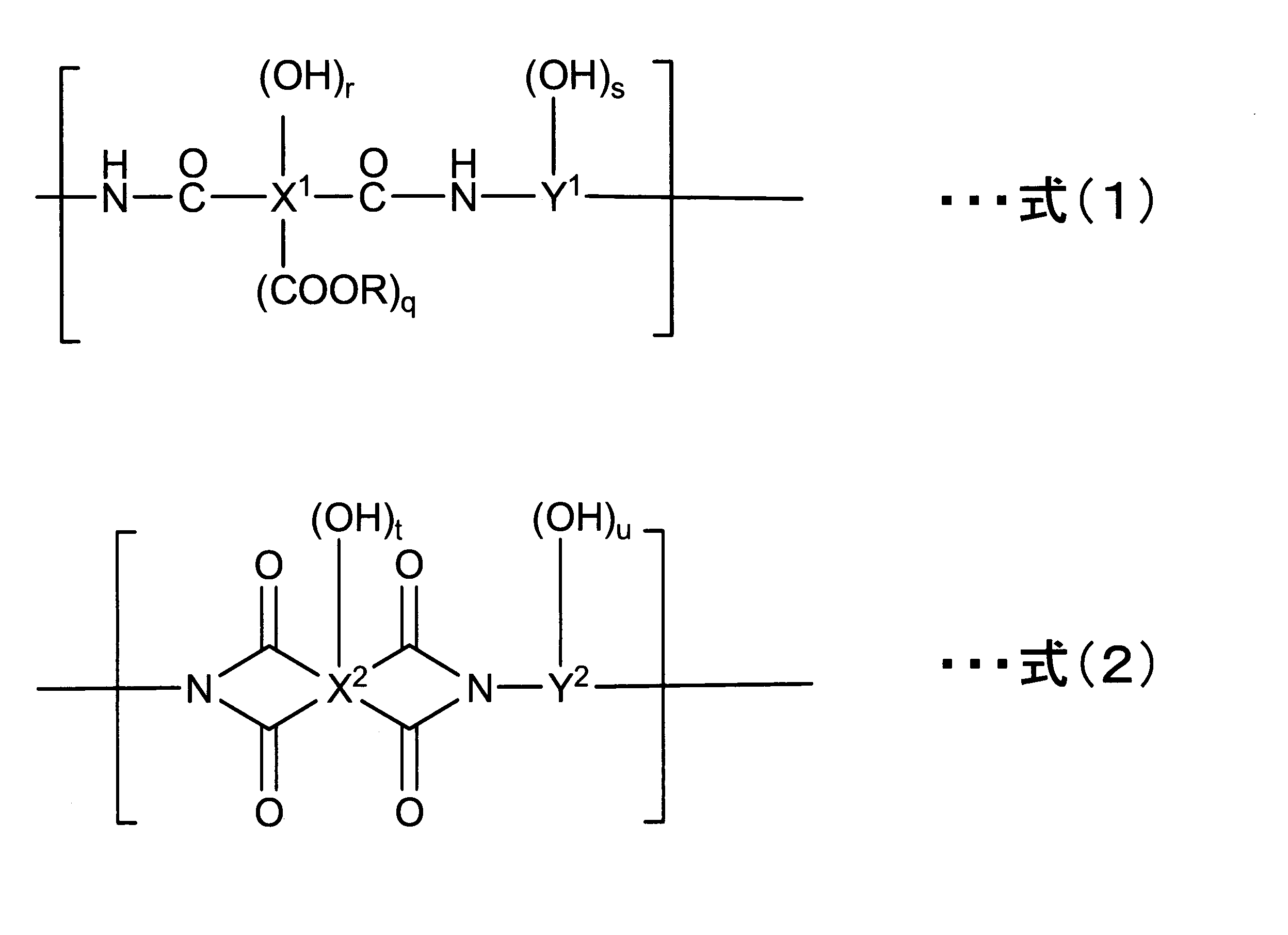
(一般式(1)および(2)中、X1およびX2は独立に、X1は2~10価の有機基を示し、X2は4~10価の有機基を示し、Y1およびY2はそれぞれ独立に2~4価の有機基を示し、Rは水素原子または炭素数1~20の有機基を示す。qは0~2の整数であり、r、s、t、uはそれぞれ独立に0~4の整数である。)
一般式(1)および(2)中のY1およびY2は2価~4価の有機基を示し、ジアミン由来の有機基を表している。
一般式(1)および(2)中のY1およびY2は2価~4価の有機基を示し、ジアミン由来の有機基を表している。
前記(A)成分の一般式(1)および(2)中のY1およびY2は、フェノール性水酸基を有するジアミン残基を含有することが好ましい。(A)成分中にフェノール性水酸基を有するジアミン残基を含有させることで、樹脂のアルカリ現像液への適度な溶解性が得られるため、露光部と未露光部の高いコントラストが得られ、所望のパターンが形成できる。
フェノール性水酸基を有するジアミンの具体的な例としては、例えば、ビス(3-アミノ-4-ヒドロキシフェニル)ヘキサフルオロプロパン、ビス(3-アミノ-4-ヒドロキシフェニル)スルホン、ビス(3-アミノ-4-ヒドロキシフェニル)プロパン、ビス(3-アミノ-4-ヒドロキシフェニル)メチレン、ビス(3-アミノ-4-ヒドロキシフェニル)エーテル、ビス(3-アミノ-4-ヒドロキシ)ビフェニル、2,2’-ジトリフルオロメチル-5,5’-ジヒドロキシル-4,4’-ジアミノビフェニル、ビス(3-アミノ-4-ヒドロキシフェニル)フルオレン、2,2’-ビス(トリフルオロメチル)-5,5’-ジヒドロキシベンジジンなどの芳香族ジアミンや、これらの芳香族環や炭化水素の水素原子の一部を、炭素数1~10のアルキル基やフルオロアルキル基、ハロゲン原子などで置換した化合物、また、下記に示す構造を有するジアミンなどを挙げることができるが、これらに限定されない。共重合させる他のジアミンは、そのまま、あるいは対応するジイソシアネート化合物、トリメチルシリル化ジアミンとして用いることができる。また、これら2種以上のジアミン成分を組み合わせて用いてもよい。

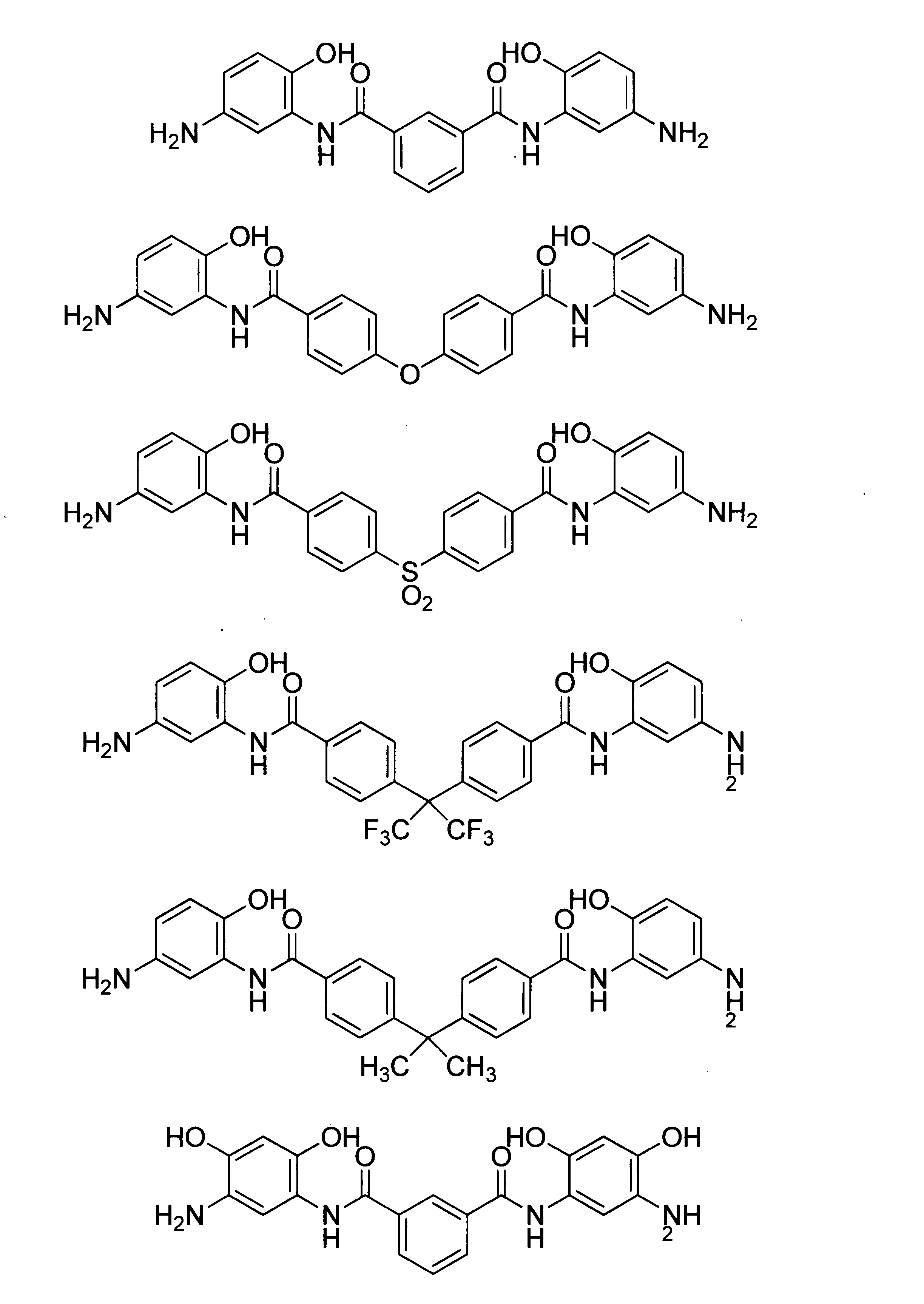
一般式(1)および(2)中のY1およびY2は、前記以外の芳香族を有するジアミン残基を含んでもよい。これらを共重合することで、耐熱性が向上できる。芳香族を有するジアミン残基の具体的な例としては、3,4’-ジアミノジフェニルエーテル、4,4’-ジアミノジフェニルエーテル、3,4’-ジアミノジフェニルメタン、4,4’-ジアミノジフェニルメタン、3,4’-ジアミノジフェニルスルホン、4,4’-ジアミノジフェニルスルホン、3,4’-ジアミノジフェニルスルフィド、4,4’-ジアミノジフェニルスルフィド、1,4-ビス(4-アミノフェノキシ)ベンゼン、ベンジン、m-フェニレンジアミン、p-フェニレンジアミン、1,5-ナフタレンジアミン、2,6-ナフタレンジアミン、ビス(4-アミノフェノキシフェニル)スルホン、ビス(3-アミノフェノキシフェニル)スルホン、ビス(4-アミノフェノキシ)ビフェニル、ビス{4-(4-アミノフェノキシ)フェニル}エーテル、1,4-ビス(4-アミノフェノキシ)ベンゼン、2,2’-ジメチル-4,4’-ジアミノビフェニル、2,2’-ジエチル-4,4’-ジアミノビフェニル、3,3’-ジメチル-4,4’-ジアミノビフェニル、3,3’-ジエチル-4,4’-ジアミノビフェニル、2,2’,3,3’-テトラメチル-4,4’-ジアミノビフェニル、3,3’,4,4’-テトラメチル-4,4’-ジアミノビフェニル、2,2’-ビス(トリフルオロメチル)-4,4’-ジアミノビフェニルなどの芳香族ジアミンや、これらの芳香族環や炭化水素の水素原子の一部を、炭素数1~10のアルキル基やフルオロアルキル基、ハロゲン原子などで置換した化合物などを挙げることができるが、これらに限定されない。共重合させる他のジアミンは、そのまま、あるいは対応するジイソシアネート化合物、トリメチルシリル化ジアミンとして用いることができる。また、これら2種以上のジアミン成分を組み合わせて用いてもよい。
また、本発明における上記一般式(1)や一般式(2)中、X1およびX2は独立に、X1およびX2はカルボン酸残が好ましく、X1は2価~10価の有機基が好ましく、X2は4価~10価の有機基が好ましい。
前記カルボン酸残基としては、脂環式テトラカルボン酸二無水物に由来する構造を有することが好ましい。つまり(A)高分子化合物は、ポリアミド、ポリイミド、及びポリアミドイミドからなる群より選ばれる少なくとも1つの化合物であって、さらに、脂環式テトラカルボン酸二無水物に由来する構造を有することが好ましい。カルボン酸残基が、脂環式テトラカルボン酸二無水物に由来する構造を有することにより、露光波長に対する樹脂組成物の光透過率が高くなり、20μm以上の厚膜での加工が容易となる。更に理由は定かではないが、(A)高分子化合物が脂環式テトラカルボン酸二無水物に由来する構造を有することにより、芳香族酸二無水物と比較して、カチオン重合の反応性が高くなり、硬化膜の耐薬品性が向上する点で好ましい。
更に、脂環式テトラカルボン酸二無水物の中でも、硬化物とした際の耐薬品性が向上し、イオンマイグレーション耐性が向上する点から、多環構造を有する脂環式テトラカルボン酸二無水物であることが好ましい。
また、多環構造を有する脂環式テトラカルボン酸二無水物に由来する有機基の具体的な例としては、4-(2,5-ジオキソテトラヒドロフラン-3-イル)-1,2,3,4-テトラヒドロナフタレン-1,2-ジカルボン酸二無水物、4-(2,5-ジオキソテトラヒドロフラン-3-イル)-4メチル-1,2,3,4-テトラヒドロナフタレン-1,2-ジカルボン酸二無水物、4-(2,5-ジオキソテトラヒドロフラン-3-イル)-7メチル-1,2,3,4-テトラヒドロナフタレン-1,2-ジカルボン酸二無水物、ノルボルナン-2-スピロ-2’-シクロペンタノン-5’-スピロ-2’’-ノルボルナン-5,5’’,6,6’’-テトラカルボン酸二無水物、ノルボルナン-2-スピロ-2’-シクロヘキサノン-6’-スピロ-2’’-ノルボルナン-5,5’’,6,6’’-テトラカルボン酸二無水物が挙げられる。
本発明における一般式(1)および(2)で表される構造のモル比は、重合する際に用いるモノマーのモル比から算出する方法や、核磁気共鳴装置(NMR)を用いて、得られた樹脂、樹脂組成物、硬化膜におけるポリアミド構造やイミド前駆体構造、イミド構造のピークを検出する方法において確認できる。
分子鎖末端がカルボン酸残基である(A)成分は、例えば分子鎖末端がカルボン酸残基であるポリイミドの場合には、重合の際に用いるジアミンに対して酸無水物の含有量を多くすることで得ることができるが、分子鎖末端がカルボン酸残基である(A)成分を得る別の方法として、一般に末端封止剤として用いられる化合物の中から特定の化合物、具体的には、酸無水物、モノカルボン酸、モノ酸クロリド化合物、モノ活性エステル化合物を用いることによっても得る事ができる。
(A)成分の分子鎖末端を水酸基、カルボキシル基、スルホン酸基、チオール基、ビニル基、エチニル基、またはアリル基を有するカルボン酸または酸無水物の末端封止剤により封止することで、前記(A)成分のアルカリ水溶液に対する溶解速度や得られる硬化膜の機械特性を好ましい範囲に容易に調整することができる。また、複数の末端封止剤を反応させ、複数の異なる末端基を導入してもよい。
末端封止剤として好適な酸無水物、モノカルボン酸、モノ酸クロリド化合物、モノ活性エステル化合物としては、無水フタル酸、無水マレイン酸、ナジック酸無水物、シクロヘキサンジカルボン酸無水物、3-ヒドロキシフタル酸無水物などの酸無水物、3-カルボキシフェノール、4-カルボキシフェノール、3-カルボキシチオフェノール、4-カルボキシチオフェノール、1-ヒドロキシ-7-カルボキシナフタレン、1-ヒドロキシ-6-カルボキシナフタレン、1-ヒドロキシ-5-カルボキシナフタレン、1-メルカプト-7-カルボキシナフタレン、1-メルカプト-6-カルボキシナフタレン、1-メルカプト-5-カルボキシナフタレン、3-カルボキシベンゼンスルホン酸、4-カルボキシベンゼンスルホン酸などのモノカルボン酸類およびこれらのカルボキシル基が酸クロリド化したモノ酸クロリド化合物、テレフタル酸、フタル酸、マレイン酸、シクロヘキサンジカルボン酸、1,5-ジカルボキシナフタレン、1,6-ジカルボキシナフタレン、1,7-ジカルボキシナフタレン、2,6-ジカルボキシナフタレンなどのジカルボン酸類の一方のカルボキシル基だけが酸クロリド化したモノ酸クロリド化合物、モノ酸クロリド化合物とN-ヒドロキシベンゾトリアゾールやイミダゾール、N-ヒドロキシ-5-ノルボルネン-2,3-ジカルボキシイミドとの反応により得られる活性エステル化合物などが好ましい。これらを2種以上用いてもよい。
これらの末端封止剤を導入した高分子化合物は、分子鎖末端がカルボン酸残基に由来する構造の(A)成分となる。そして分子鎖末端がカルボン酸残基に由来する構造である(A)成分を得るために用いることのできる末端封止剤は、以下の方法で容易に検出できる。例えば、末端封止剤が導入された(A)成分を、酸性溶液に溶解し、構成単位であるアミン成分と酸無水物成分に分解し、これをガスクロマトグラフィー(GC)や、NMRにより、本発明に使用された末端封止剤を容易に検出できる。これとは別に、末端封止剤が導入された樹脂成分を直接、熱分解ガスクロマトグラフ(PGC)や赤外スペクトルおよび13C-NMRスペクトルで測定することによっても、容易に検出できる。
本発明において、(A)成分は、たとえば、次の方法により合成されるが、これに限定はされない。ポリイミド構造は、ジアミンの一部を末端封止剤である1級モノアミンに置き換えて、または、テトラカルボン酸二無水物を、末端封止剤であるジカルボン酸無水物に置き換えて、公知の方法で合成される。例えば、低温中でテトラカルボン酸二無水物とジアミン化合物とモノアミンを反応させる方法、低温中でテトラカルボン酸二無水物とジカルボン酸無水物とジアミン化合物を反応させる方法、テトラカルボン酸二無水物とアルコールとによりジエステルを得、その後ジアミンとモノアミンと縮合剤の存在下で反応させる方法などの方法を利用して、ポリイミド前駆体を得る。その後、公知のイミド化反応法を利用してポリイミドを合成することができる。
本発明において、(A)成分は、上記の方法で重合させた後、多量の水またはメタノールおよび水の混合液などに投入し、沈殿させて濾別乾燥し、単離することが好ましい。乾燥温度は40~100℃が好ましく、より好ましくは50~80℃である。この操作によって未反応のモノマーや、2量体や3量体などのオリゴマー成分が除去され、熱硬化後の膜特性を向上させることができる。
(A)成分として好適に用いられるポリイミドのイミド化率は、例えば以下の方法で容易に求めることができる。まず、ポリマーの赤外吸収スペクトルを測定し、ポリイミドに起因するイミド構造の吸収ピーク(1780cm-1付近、1377cm-1付近)の存在を確認する。次に、そのポリマーを350℃で1時間熱処理したもののイミド化率を100%のサンプルとして赤外吸収スペクトルを測定し、熱処理前後の樹脂の1377cm-1付近のピーク強度を比較することによって、熱処理前樹脂中のイミド基の含量を算出し、イミド化率を求める。熱硬化時の閉環率の変化を抑制し、低応力化の効果が得られるため、イミド化率は50%以上が好ましく、80%以上がさらに好ましい。
(B)成分
本発明の樹脂組成物は、(B)成分としてカチオン重合性化合物を含有する。(B)成分は、エポキシ化合物またはオキセタン化合物であることが好ましい。エポキシ化合物またはオキセタン化合物等の環状エーテル化合物、ビニルエーテル及びスチレン類等のエチレン性不飽和化合物、ビシクロオルトエステル、スピロオルトカーボネート、並びにスピロオルトエステル等が好ましく挙げられる。
本発明の樹脂組成物は、(B)成分としてカチオン重合性化合物を含有する。(B)成分は、エポキシ化合物またはオキセタン化合物であることが好ましい。エポキシ化合物またはオキセタン化合物等の環状エーテル化合物、ビニルエーテル及びスチレン類等のエチレン性不飽和化合物、ビシクロオルトエステル、スピロオルトカーボネート、並びにスピロオルトエステル等が好ましく挙げられる。
エポキシ化合物としては、公知のもの等が使用でき、芳香族エポキシ化合物、脂環式エポキシ化合物及び脂肪族エポキシ化合物が含まれる。
芳香族エポキシ化合物としては、少なくとも1個の芳香環を有する1価又は多価のフェノール(フェノール、ビスフェノールA、フェノールノボラック及びこれらのアルキレンオキシド付加体した化合物)のグリシジルエーテル等が挙げられる。
脂環式エポキシ化合物としては、少なくとも1個のシクロヘキセンやシクロペンテン環を有する化合物を酸化剤でエポキシ化することによって得られる化合物(3,4-エポキシシクロヘキシルメチル-3,4-エポキシシクロヘキサンカルボキシレート、等)が挙げられる。
脂肪族エポキシ化合物としては、脂肪族多価アルコール又はこのアルキレンオキシド付加体のポリグリシジルエーテル(1,4-ブタンジオールジグリシジルエーテル、1,6-ヘキサンジオールジグリシジルエーテル等)、脂肪族多塩基酸のポリグリシジルエステル(ジグリシジルテトラヒドロフタレート等)、長鎖不飽和化合物のエポキシ化物(エポキシ化大豆油及びエポキシ化ポリブタジエン等)が挙げられる。
オキセタン化合物としては、公知のもの等が使用でき、例えば、3-エチル-3-ヒドロキシメチルオキセタン、2-エチルヘキシル(3-エチル-3-オキセタニルメチル)エーテル、2-ヒドロキシエチル(3-エチル-3-オキセタニルメチル)エーテル、2-ヒドロキシプロピル(3-エチル-3-オキセタニルメチル)エーテル、1,4-ビス[(3-エチル-3-オキセタニルメトキシ)メチル]ベンゼン、オキセタニルシルセスキオキセタン及びフェノールノボラックオキセタン等が挙げられる。
エチレン性不飽和化合物としては、公知のカチオン重合性単量体等が使用でき、脂肪族モノビニルエーテル、芳香族モノビニルエーテル、多官能ビニルエーテル、スチレン及びカチオン重合性窒素含有モノマーが含まれる。
脂肪族モノビニルエーテルとしては、メチルビニルエーテル、エチルビニルエーテル、ブチルビニルエーテル及びシクロヘキシルビニルエーテル等が挙げられる。
芳香族モノビニルエーテルとしては、2-フェノキシエチルビニルエーテル、フェニルビニルエーテル及びp-メトキシフェニルビニルエーテル等が挙げられる。
多官能ビニルエーテルとしては、ブタンジオール-1,4-ジビニルエーテル及びトリエチレングリコールジビニルエーテル等が挙げられる。
スチレン類としては、スチレン、α-メチルスチレン、p-メトキシスチレン及びptert-ブトキシスチレン等が挙げられる。
カチオン重合性窒素含有モノマーとしては、N-ビニルカルバゾール及びN-ビニルピロリドン等が挙げられる。
ビシクロオルトエステルとしては、1-フェニル-4-エチル-2,6,7-トリオキサビシクロ[2.2.2]オクタン及び1-エチル-4-ヒドロキシメチル-2,6,7-トリオキサビシクロ-[2.2.2]オクタン等が挙げられる。
スピロオルトカーボネートとしては、1,5,7,11-テトラオキサスピロ[5.5]ウンデカン及び3,9-ジベンジル-1,5,7,11-テトラオキサスピロ[5.5]ウンデカン等が挙げられる。
スピロオルトエステルとしては、1,4,6-トリオキサスピロ[4.4]ノナン、2-メチル-1,4,6-トリオキサスピロ[4.4]ノナン及び1,4,6-トリオキサスピロ[4.5]デカン等が挙げられる。
これらのカチオン重合性化合物のうち、エポキシ化合物、オキセタン化合物及びビニルエーテルが好ましく、さらに好ましくはエポキシ化合物及びオキセタン化合物、特に好ましくはエポキシ化合物である。
(B)成分は単独で使用してもよく、または2種以上を併用してもよい。
(B)成分の含有量は、(A)成分の合計を100質量部とした際、十分なカチオン硬化性を示し、パターン加工性を向上させる点から、30質量部以上であることが好ましく、より好ましくは50質量部以上である。一方、解像度を向上させる点から、200質量部以下が好ましく、より好ましくは150質量部以下である。
(C)成分
本発明の樹脂組成物は、(C)成分としてカチオン重合開始剤を含有する。ここでカチオン重合開始剤とは、光あるいは加熱により直接または間接的に酸を発生しカチオン重合を生じさせるものである。このようなカチオン重合開始剤としては、公知の化合物を、特に限定なく使用することができる。カチオン重合開始剤として具体的には、例えば芳香族ヨードニウム錯塩と芳香族スルホニウム錯塩等を挙げることができる。芳香族ヨードニウム錯塩の具体例としては、ジフェニルヨードニウムテトラキス(ペンタフルオロフェニル)ボレート、ジフェニルヨードニウムヘキサフルオロホスフェート、ジフェニルヨードニウムヘキサフルオロアンチモネート、ジ(4-ノニルフェニル)ヨードニウムヘキサフルオロホスフェート等が挙げられる。これらの(C)成分は単独で使用してもよく、または2種以上を併用してもよい。
本発明の樹脂組成物は、(C)成分としてカチオン重合開始剤を含有する。ここでカチオン重合開始剤とは、光あるいは加熱により直接または間接的に酸を発生しカチオン重合を生じさせるものである。このようなカチオン重合開始剤としては、公知の化合物を、特に限定なく使用することができる。カチオン重合開始剤として具体的には、例えば芳香族ヨードニウム錯塩と芳香族スルホニウム錯塩等を挙げることができる。芳香族ヨードニウム錯塩の具体例としては、ジフェニルヨードニウムテトラキス(ペンタフルオロフェニル)ボレート、ジフェニルヨードニウムヘキサフルオロホスフェート、ジフェニルヨードニウムヘキサフルオロアンチモネート、ジ(4-ノニルフェニル)ヨードニウムヘキサフルオロホスフェート等が挙げられる。これらの(C)成分は単独で使用してもよく、または2種以上を併用してもよい。
本発明の樹脂組成物は、ネガ型の感光性樹脂組成物であることが好ましい。本発明において、(C)成分は、光カチオン重合開始剤であることが好ましい。(C)成分として光カチオン重合開始剤を選択することにより、樹脂組成物中の光照射部と光未照射部でカチオン重合の進行のコントラストをつけることができ、任意の現像液で樹脂組成物を溶解させることで、ネガ型のパターン形成が可能となる点から好ましく、ネガ型の感光性樹脂組成物として好ましい。
(D)成分
本発明の樹脂組成物は、(D)成分としてシランカップリング剤を含有する。そして(D)成分は、カルボキシル基及び/又は酸無水物基を有することが重要である。ここでシランカップリング剤とは、2種以上の官能基を有するシラン化合物のことを指す。(D)成分がカルボキシル基及び/又は酸無水物基を有していることにより、無機基材との密着性を向上させることができる。さらには、カルボキシル基又は酸無水物基が樹脂組成物中にごくわずかに存在し得るアミン類などのカチオン重合を阻害する化合物をトラップすることで、カチオン重合の反応性が向上し、パターン加工時の感度に優れた樹脂組成物を提供することができる。カルボキシル基を有するシランカップリング剤の具体例としては、X-12-1135(信越化学工業(株)製)などが挙げられる。酸無水物基を有するシランカップリング剤の具体例としては、KBM-967TR-1(信越化学工業(株)製)などが挙げられる。
本発明の樹脂組成物は、(D)成分としてシランカップリング剤を含有する。そして(D)成分は、カルボキシル基及び/又は酸無水物基を有することが重要である。ここでシランカップリング剤とは、2種以上の官能基を有するシラン化合物のことを指す。(D)成分がカルボキシル基及び/又は酸無水物基を有していることにより、無機基材との密着性を向上させることができる。さらには、カルボキシル基又は酸無水物基が樹脂組成物中にごくわずかに存在し得るアミン類などのカチオン重合を阻害する化合物をトラップすることで、カチオン重合の反応性が向上し、パターン加工時の感度に優れた樹脂組成物を提供することができる。カルボキシル基を有するシランカップリング剤の具体例としては、X-12-1135(信越化学工業(株)製)などが挙げられる。酸無水物基を有するシランカップリング剤の具体例としては、KBM-967TR-1(信越化学工業(株)製)などが挙げられる。
本発明において、(D)成分は、一般式(3)の構造を有することが好ましい。
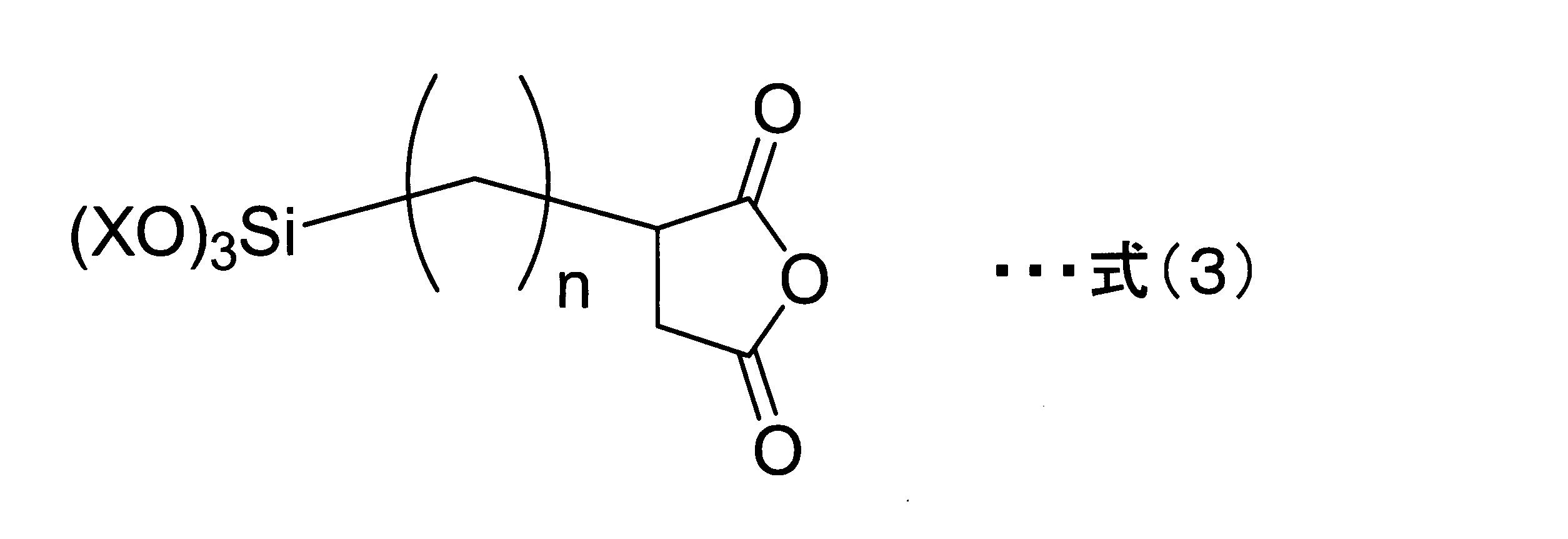
式(3)中、nは1以上の整数であり、Xは有機基である。
なお式(3)中、nは1以上の整数であるが、1~6の整数であることがより好ましい。またXは有機基であれば特に制限されないが、炭素数が1~6の有機基であることがより好ましい。
式(3)を満たすXの具体例としては、例えばメチル基、エチル基、プロピル基、イソプロピル基、n-ブチル基、tert-ブチル基、n-ヘキシル基、シクロヘキシル基、フェニル基等が挙げられるが、好ましくはメチル基又はエチル基である。
(D)成分が一般式(3)の構造を有することで、パターン加工時の感度がより向上する。一般式(3)の構造を有するシランカップリング剤の具体例としては、KBM-967TR-1(信越化学工業(株)製)などが挙げられる。
本発明の樹脂組成物は、(D)成分としてカルボキシル基及び/又は酸無水物基を有するシランカップリング剤を有していれば、カルボキシル基や酸無水物基以外の官能基を有するシランカップリング剤を含むことができる。カルボキシル基や酸無水物基以外の官能基を有するシランカップリング剤の具体例としては、N-フェニルアミノエチルトリメトキシシラン、N-フェニルアミノエチルトリエトキシシラン、N-フェニルアミノプロピルトリメトキシシラン、N-フェニルアミノプロピルトリエトキシシラン、N-フェニルアミノブチルトリメトキシシラン、N-フェニルアミノブチルトリエトキシシラン、ビニルトリメトキシシラン、ビニルトリエトキシシラン、ビニルトリクロルシラン、ビニルトリス(β-メトキシエトキシ)シラン、3-メタクリロキシプロピルトリメトキシシラン、3-アクリロキシプロピルトリメトキシシラン、p-スチリルトリメトキシシラン、3-メタクリロキシプロピルメチルジメトキシシラン、3-メタクリロキシプロピルメチルジエトキシシランなどを挙げることができる。
本発明の樹脂組成物を100質量%とした場合、(D)成分の合計は1~10質量%であることが好ましく、より好ましくは2~5質量%である。(D)成分の合計が好ましい範囲未満だと密着性が低下し、好ましい範囲を上回ると現像残渣が生じやすくなる。
本発明の樹脂組成物は、紫外線を吸収し、吸収した光エネルギーを光酸発生剤に供与するために増感剤を含んでもよい。増感剤としては、例えば9位と10位にアルコキシ基を有するアントラセン化合物(9,10-ジアルコキシ-アントラセン誘導体)が好ましい。アルコキシ基としては、例えばメトキシ基、エトキシ基、プロポキシ基等のC1~C4のアルコキシ基が挙げられる。9,10-ジアルコキシ-アントラセン誘導体は、さらに置換基を有していても良い。置換基としては、例えばフッ素原子、塩素原子、臭素原子、ヨウ素原子等のハロゲン原子、メチル基、エチル基、プロピル基等のC1~C4のアルキル基やスルホン酸アルキルエステル基、カルボン酸アルキルエステル基等が挙げられる。スルホン酸アルキルエステル基やカルボン酸アルキルエステルにおけるアルキルとしては、例えばメチル、エチル、プロピル等のC1~C4のアルキルが挙げられる。これらの置換基の置換位置は2位が好ましい。
本発明の樹脂組成物は、熱架橋剤を含有してもよく、その際の熱架橋剤としては特に限定されないものの、アルコキシメチル基又はメチロール基を有する化合物が好ましい。
アルコキシメチル基またはメチロール基を有する例としては、例えば、DML-PC、DML-PEP、DML-OC、DML-OEP、DML-34X、DML-PTBP、DML-PCHP、DML-OCHP、DML-PFP、DML-PSBP、DML-POP、DML-MBOC、DML-MBPC、DML-MTrisPC、DML-BisOC-Z、DML-BisOCHP-Z、DML-BPC、DML-BisOC-P、DMOM-PC、DMOM-PTBP、DMOM-MBPC、TriML-P、TriML-35XL、TML-HQ、TML-BP、TML-pp-BPF、TML-BPE、TML-BPA、TML-BPAF、TML-BPAP、TMOM-BP、TMOM-BPE、TMOM-BPA、TMOM-BPAF、TMOM-BPAP、HML-TPPHBA、HML-TPHAP、HMOM-TPPHBA、HMOM-TPHAP(以上、商品名、本州化学工業(株)製)、NIKALAC(登録商標)MX-290、NIKALAC MX-280、NIKALAC MW-100LM、NIKALAC MX-750LM(以上、商品名、(株)三和ケミカル製)が挙げられる。
本発明の樹脂組成物は、必要に応じて、基材との塗れ性を向上させる目的で界面活性剤、乳酸エチルやプロピレングリコールモノメチルエーテルアセテートなどのエステル類、エタノールなどのアルコール類、シクロヘキサノン、メチルイソブチルケトンなどのケトン類、テトラヒドロフラン、ジオキサンなどのエーテル類を含有してもよい。また、熱膨張係数の抑制や高誘電率化、低誘電率化のなどの目的で、二酸化ケイ素、二酸化チタンなどの無機粒子、あるいはポリイミドの粉末などを含有してもよい。
本発明の樹脂組成物は、硬化前の形状は限定されず、例えば、ワニス状やフィルム状などが挙げられる。以下、本発明の樹脂組成物の形状をワニス状としたものを樹脂組成物ワニス、本発明の樹脂組成物の形状をフィルム状としたものを本発明の樹脂組成物フィルムと記す。
本発明の樹脂組成物フィルムは、支持体上に形成されたフィルム状の態様であってもよいし、支持体のない態様であってもよい。本発明の樹脂組成物をワニス状で用いる場合は、(A)~(D)成分および必要に応じ加えられる成分を有機溶媒に溶解させたものを用いることができる。また、本発明の樹脂組成物フィルムは、例えば本発明の樹脂組成物を支持体上に塗布し、次いでこれを必要により乾燥することにより得られる。
次に、本発明の樹脂組成物フィルムを作製する方法について説明する。
本発明の樹脂組成物フィルムは、本発明の樹脂組成物の溶液(ワニス)を支持体上に塗布し、次いでこれを必要により乾燥することにより得られる。樹脂組成物ワニスは、樹脂組成物に有機溶剤を添加することで得られる。ここで使用される有機溶剤としては、樹脂組成物を溶解するものであればよい。
有機溶剤としては、具体的には、エチレングリコールモノメチルエーテル、エチレングリコールモノエチルエーテル、プロピレングリコールモノメチルエーテル、プロピレングリコールモノエチルエーテル、エチレングリコールジメチルエーテル、エチレングリコールジエチルエーテル、エチレングリコールジブチルエーテルなどのエーテル類、エチレングリコールモノエチルエーテルアセテート、プロピレングリコールモノメチルエーテルアセテート、プロピルアセテート、ブチルアセテート、イソブチルアセテート、3-メトキシブチルアセテート、3-メチル-3-メトキシブチルアセテート、乳酸メチル、乳酸エチル、乳酸ブチルなどのアセテート類、アセトン、メチルエチルケトン、アセチルアセトン、メチルプロピルケトン、メチルブチルケトン、メチルイソブチルケトン、シクロペンタノン、2-ヘプタノンなどのケトン類、ブチルアルコール、イソブチルアルコール、ペンタノ-ル、4-メチル-2-ペンタノール、3-メチル-2-ブタノール、3-メチル-3-メトキシブタノール、ジアセトンアルコールなどのアルコール類、トルエン、キシレンなどの芳香族炭化水素類、その他、N-メチル-2-ピロリドン、N-シクロヘキシル-2-ピロリドン、N,N-ジメチルホルムアミド、N,N-ジメチルアセトアミド、ジメチルスルホキシド、γ-ブチロラクトンなどが挙げられる。
樹脂組成物ワニスを濾紙やフィルターを用いて濾過しても良い。濾過方法は特に限定されないが、保留粒子径0.4μm~10μmのフィルターを用いて加圧濾過により濾過する方法が好ましい。
本発明の樹脂組成物フィルムは支持体上に形成されて用いられるのが好ましい。支持体は特に限定されないが、ポリエチレンテレフタレート(PETということがある)フィルム、ポリフェニレンサルファイドフィルム、ポリイミドフィルムなど、通常市販されている各種のフィルムが使用可能である。支持体と樹脂組成物フィルムとの接合面には、密着性と剥離性を向上させるために、シリコーン、シランカップリング剤、アルミキレート剤、ポリ尿素などの表面処理を施してもよい。また、支持体の厚みは特に限定されないが、作業性の観点から、10~100μmの範囲であることが好ましい。
本発明の樹脂組成物フィルムは、表面を保護するために、膜上に保護フィルムを有してもよい。これにより、大気中のゴミやチリ等の汚染物質から樹脂組成物フィルムの表面を保護することができる。保護フィルムとしては、ポリオレフィンフィルム、ポリエステルフィルム等が挙げられる。保護フィルムは、樹脂組成物フィルムとの接着力が小さいものが好ましい。
樹脂組成物ワニスを支持体に塗布する方法としてはスピンナを用いた回転塗布、スプレー塗布、ロールコーティング、スクリーン印刷、ブレードコーター、ダイコーター、カレンダーコーター、メニスカスコーター、バーコーター、ロールコーター、コンマロールコーター、グラビアコーター、スクリーンコーター、スリットダイコーターなどの方法が挙げられる。また、塗布膜厚は、塗布手法、組成物の固形分濃度、粘度などによって異なるが、通常、乾燥後の膜厚が、0.5μm以上100μm以下であることが好ましい。
乾燥には、オーブン、ホットプレート、赤外線などを使用することができる。乾燥温度および乾燥時間は、有機溶媒を揮発させることが可能な範囲であればよく、樹脂組成物フィルムが未硬化または半硬化状態となるような範囲を適宜設定することが好ましい。具体的には、40℃から120℃の範囲で1分から数十分行うことが好ましい。また、これらの温度を組み合わせて段階的に昇温してもよく、例えば、70℃、80℃、90℃で各1分ずつ熱処理してもよい。
次に、本発明の樹脂組成物のワニス、またはそれを用いた樹脂組成物フィルムをパターン加工する方法、および他の部材に熱圧着する方法について、例を挙げて説明する。
まず、本発明の樹脂組成物、またはそれを用いた樹脂組成物フィルムを用いて、基板上に樹脂組成物膜を形成する方法について説明する。樹脂組成物ワニスを用いる場合は、まずワニスを基板上に塗布する。塗布方法としてはスピンナを用いた回転塗布、スプレー塗布、ロールコーティング、スクリーン印刷などの方法が挙げられる。また、塗布膜厚は、塗布手法、樹脂組成物の固形分濃度および粘度などによって異なるが、通常、乾燥後の膜厚が0.5μm以上100μm以下になるように塗布することが好ましい。次に、樹脂組成物ワニスを塗布した基板を乾燥して、樹脂組成物被膜を得る。乾燥はオーブン、ホットプレート、赤外線などを使用することができる。乾燥温度および乾燥時間は、有機溶媒を揮発させることが可能な範囲であればよく、樹脂組成物被膜が未硬化または半硬化状態となるような範囲を適宜設定することが好ましい。具体的には、50~150℃の範囲で1分から数時間行うのが好ましい。
一方、樹脂組成物フィルムを用いる場合は、保護フィルムを有する場合にはこれを剥離し、樹脂組成物フィルムと基板を対向させ、熱圧着により貼り合わせて、樹脂組成物被膜を得る。熱圧着は、熱プレス処理、熱ラミネート処理、熱真空ラミネート処理等によって行うことができる。貼り合わせ温度は、基板への密着性、埋め込み性の点から40℃以上が好ましい。また、貼り合わせ時に樹脂組成物フィルムが硬化し、露光・現像工程におけるパターン形成の解像度が悪くなることを防ぐために、貼り合わせ温度は150℃以下が好ましい。
いずれの場合にも、用いられる基板は、シリコンウェハ、セラミックス類、ガリウムヒ素、有機系回路基板、無機系回路基板、およびこれらの基板に回路の構成材料が配置されたものなどが挙げられるが、これらに限定されない。有機系回路基板の例としては、ガラス布・エポキシ銅張積層板などのガラス基材銅張積層板、ガラス不織布・エポキシ銅張積層板などのコンポジット銅張積層板、ポリエーテルイミド樹脂基板、ポリエーテルケトン樹脂基板、ポリサルフォン系樹脂基板などの耐熱・熱可塑性基板、ポリエステル銅張フィルム基板、ポリイミド銅張フィルム基板などのフレキシブル基板が挙げられる。また、無機系回路基板の例は、アルミナ基板、窒化アルミニウム基板、炭化ケイ素基板などのセラミック基板、アルミニウムベース基板、鉄ベース基板などの金属系基板が挙げられる。回路の構成材料の例は、銀、金、銅などの金属を含有する導体、無機系酸化物などを含有する抵抗体、ガラス系材料および/または樹脂などを含有する低誘電体、樹脂や高誘電率無機粒子などを含有する高誘電体、ガラス系材料などを含有する絶縁体などが挙げられる。
次に、上記方法によって形成された樹脂組成物被膜上に、所望のパターンを有するマスクを通して化学線を照射し、露光する。露光に用いられる化学線としては紫外線、可視光線、電子線、X線などがあるが、本発明では水銀灯のi線(365nm)、h線(405nm)、g線(436nm)を用いるのが好ましい。樹脂組成物フィルムにおいて、支持体がこれらの光線に対して透明な材質である場合は、樹脂組成物フィルムから支持体を剥離せずに露光を行ってもよい。
パターンを形成するには、露光後、現像液にて露光部を除去する。現像液としては、水酸化テトラメチルアンモニウムの水溶液、ジエタノールアミン、ジエチルアミノエタノール、水酸化ナトリウム、水酸化カリウム、炭酸ナトリウム、炭酸カリウム、トリエチルアミン、ジエチルアミン、メチルアミン、ジメチルアミン、酢酸ジメチルアミノエチル、ジメチルアミノエタノール、ジメチルアミノエチルメタクリレート、シクロヘキシルアミン、エチレンジアミン、ヘキサメチレンジアミンなどのアルカリ性を示す化合物の水溶液が好ましい。また場合によっては、これらのアルカリ水溶液にN-メチル-2-ピロリドン、N,N-ジメチルホルムアミド、N,N-ジメチルアセトアミド、ジメチルスルホキシド、γ-ブチロラクトン、ジメチルアクリルアミドなどの極性溶媒、メタノール、エタノール、イソプロパノールなどのアルコール類、乳酸エチル、プロピレングリコールモノメチルエーテルアセテートなどのエステル類、シクロペンタノン、シクロヘキサノン、イソブチルケトン、メチルイソブチルケトンなどのケトン類などを単独あるいは数種を組み合わせたものを含有してもよい。
現像は、上記の現像液を被膜面にスプレーする、被膜面に現像液を液盛りする、現像液中に浸漬する、あるいは浸漬して超音波をかけるなどの方法によって行うことができる。現像時間や現像ステップ現像液の温度などの現像条件は、露光部が除去されパターン形成が可能な条件であればよい。
現像後は水にてリンス処理を行うことが好ましい。ここでもエタノール、イソプロピルアルコールなどのアルコール類、乳酸エチル、プロピレングリコールモノメチルエーテルアセテートなどのエステル類などを水に加えてリンス処理をしても良い。
また、必要に応じて現像前にベーク処理を行ってもよい。これにより、現像後のパターンの解像度が向上し、現像条件の許容幅が増大する場合がある。このベーク処理温度は50~180℃の範囲が好ましく、特に60~120℃の範囲がより好ましい。時間は5秒~数時間が好ましい。
パターン形成後、樹脂組成物被膜中には未反応のカチオン重合性化合物やカチオン重合開始剤が残存している。このため、熱圧着あるいは硬化の際にこれらが熱分解しガスが発生することがある。これを避けるため、パターン形成後の樹脂組成物被膜の全面に上述の露光光を照射し、カチオン重合開始剤から酸を発生させておくことが好ましい。こうすることによって、熱圧着あるいは硬化の際に、未反応のカチオン重合性化合物の反応が進行し、熱分解由来のガスの発生を抑制することができる。
現像後、150℃~500℃の温度を加えて熱架橋反応を進行させる。架橋により、耐熱性および耐薬品性を向上させることができる。この加熱処理の方法は、温度を選び、段階的に昇温する方法や、ある温度範囲を選び連続的に昇温しながら5分間~5時間実施する方法を選択できる。前者の一例として、130℃、200℃で各30分ずつ熱処理する方法が挙げられる。後者の一例として室温より400℃まで2時間かけて直線的に昇温するなどの方法が挙げられる。
本発明の樹脂組成物や本発明の樹脂組成物フィルムを硬化した本発明の硬化膜は、半導体装置等の電子部品に使用することができる。つまり本発明の半導体装置とは、本発明の硬化膜を有する。なお、本発明でいう半導体装置とは、半導体素子の特性を利用することで機能し得る装置全般を指す。半導体素子を基板に接続した電気光学装置や半導体回路基板、複数の半導体素子を積層したもの、並びにこれらを含む電子装置は、全て半導体装置に含まれる。また、半導体素子を接続するための多層配線板等の電子部品も半導体装置に含める。具体的には、半導体のパッシベーション膜、半導体素子の表面保護膜、半導体素子と配線の間の層間絶縁膜、複数の半導体素子の間の層間絶縁膜、高密度実装用多層配線の配線層間の層間絶縁膜、有機電界発光素子の絶縁層などの用途に好適に用いられるが、これに制限されず、様々な用途に用いることができる。
以下に、本発明を実施例に基づいて具体的に説明するが、本発明はこれに限定されるものではない。
<パターン加工時の感度の評価>
各実施例および比較例で作製した樹脂組成物フィルムの、保護フィルムがある場合はそれを剥離し、該剥離面を、4インチのシリコンウェハ上に、真空ダイアフラム式ラミネータ((株)名機製作所製、MVLP-500/600)を用いて、上下熱盤温度80℃、真空引き時間20秒、真空プレス時間30秒、貼付圧力0.3MPaの条件でラミネートし、シリコンウェハ上に樹脂組成物フィルムを形成した。そして、支持体フィルムがある場合はそれを剥離した後、露光装置にビアサイズが20μmφのパターンを有するマスクをセットし、マスクと樹脂組成物フィルムの露光ギャップ100μmの条件下で、超高圧水銀灯を用いて、露光量100~1000mJ/cm2(i線換算、全波長露光)で露光を行った。露光後、ホットプレートで80℃、10分間、露光後加熱を行った。その後、ディップ現像にて、水酸化テトラメチルアンモニウムの2.38質量%水溶液を用いて未露光部を除去し、水にてリンス処理をした。現像時間は、未露光部が完全に溶解した時間の2倍の時間とした。この様にして得られたパターンを、光学顕微鏡で観察し、パターンにツマリ等の異常がないか確認した。さらに得られたパターンの現像前の膜厚と現像後の膜厚から残膜率を算出した。得られた残膜率の小数点第一位を四捨五入した。パターンにつまりがなく、かつ残膜率が90%以上となった最小の露光量を求め、パターン加工時の感度を下記のようにA++からCの5段階で判定した。
A++:300mJ/cm2未満
A+:300mJ/cm2以上500mJ/cm2未満
A:500mJ/cm2以上800mJ/cm2未満
B:800mJ/cm2以上1000mJ/cm2以下
C:(1000mJ/cm2以下の露光では)パターン加工不可。
各実施例および比較例で作製した樹脂組成物フィルムの、保護フィルムがある場合はそれを剥離し、該剥離面を、4インチのシリコンウェハ上に、真空ダイアフラム式ラミネータ((株)名機製作所製、MVLP-500/600)を用いて、上下熱盤温度80℃、真空引き時間20秒、真空プレス時間30秒、貼付圧力0.3MPaの条件でラミネートし、シリコンウェハ上に樹脂組成物フィルムを形成した。そして、支持体フィルムがある場合はそれを剥離した後、露光装置にビアサイズが20μmφのパターンを有するマスクをセットし、マスクと樹脂組成物フィルムの露光ギャップ100μmの条件下で、超高圧水銀灯を用いて、露光量100~1000mJ/cm2(i線換算、全波長露光)で露光を行った。露光後、ホットプレートで80℃、10分間、露光後加熱を行った。その後、ディップ現像にて、水酸化テトラメチルアンモニウムの2.38質量%水溶液を用いて未露光部を除去し、水にてリンス処理をした。現像時間は、未露光部が完全に溶解した時間の2倍の時間とした。この様にして得られたパターンを、光学顕微鏡で観察し、パターンにツマリ等の異常がないか確認した。さらに得られたパターンの現像前の膜厚と現像後の膜厚から残膜率を算出した。得られた残膜率の小数点第一位を四捨五入した。パターンにつまりがなく、かつ残膜率が90%以上となった最小の露光量を求め、パターン加工時の感度を下記のようにA++からCの5段階で判定した。
A++:300mJ/cm2未満
A+:300mJ/cm2以上500mJ/cm2未満
A:500mJ/cm2以上800mJ/cm2未満
B:800mJ/cm2以上1000mJ/cm2以下
C:(1000mJ/cm2以下の露光では)パターン加工不可。
<密着性の評価>
前記パターン加工性の評価方法と同様にして、シリコンウェハ上に樹脂組成物フィルムを形成した。そして支持体フィルムがある場合はそれを剥離した後、超高圧水銀灯を用いて、露光量500mJ/cm2(i線換算、全波長露光)で露光を行った。露光後、ホットプレートで80℃、10分間、露光後加熱を行った。そして、イナートオーブン(光洋サーモシステム(株)製、INL-60)を用いて、N2雰囲気下(酸素濃度20ppm以下)、室温から200℃まで60分かけて昇温したのち、200℃で60分間熱処理し、シリコンウェハ上に形成された樹脂組成物フィルムの硬化膜を得た。得られた硬化膜を不飽和プレッシャークッカー試験(130℃、湿度85%)で96時間処理した。試験後のサンプルについて、クロスカット試験を実施し、下記のように4段階で評価した。
A+:いずれの格子も剥がれが見られなかった。
A:格子の交差点付近にわずかな剥がれが見られた。
B:格子の線に沿って部分的な剥がれが見られた。
C:全面的に剥がれていた。
前記パターン加工性の評価方法と同様にして、シリコンウェハ上に樹脂組成物フィルムを形成した。そして支持体フィルムがある場合はそれを剥離した後、超高圧水銀灯を用いて、露光量500mJ/cm2(i線換算、全波長露光)で露光を行った。露光後、ホットプレートで80℃、10分間、露光後加熱を行った。そして、イナートオーブン(光洋サーモシステム(株)製、INL-60)を用いて、N2雰囲気下(酸素濃度20ppm以下)、室温から200℃まで60分かけて昇温したのち、200℃で60分間熱処理し、シリコンウェハ上に形成された樹脂組成物フィルムの硬化膜を得た。得られた硬化膜を不飽和プレッシャークッカー試験(130℃、湿度85%)で96時間処理した。試験後のサンプルについて、クロスカット試験を実施し、下記のように4段階で評価した。
A+:いずれの格子も剥がれが見られなかった。
A:格子の交差点付近にわずかな剥がれが見られた。
B:格子の線に沿って部分的な剥がれが見られた。
C:全面的に剥がれていた。
各実施例および比較例で用いた化合物は以下の方法により合成した。
合成例1 ヒドロキシル基含有ジアミン化合物(a)の合成
2,2-ビス(3-アミノ-4-ヒドロキシフェニル)ヘキサフルオロプロパン(以降BAHFと呼ぶ)(18.3g、0.05モル)をアセトン100mL、プロピレンオキシド(17.4g、0.3モル)に溶解させ、-15℃に冷却した。ここに3-ニトロベンゾイルクロリド(20.4g、0.11モル)をアセトン100mLに溶解させた溶液を滴下した。滴下終了後、-15℃で4時間反応させ、その後室温に戻した。析出した白色個体をろ別し、50℃で真空乾燥した。
2,2-ビス(3-アミノ-4-ヒドロキシフェニル)ヘキサフルオロプロパン(以降BAHFと呼ぶ)(18.3g、0.05モル)をアセトン100mL、プロピレンオキシド(17.4g、0.3モル)に溶解させ、-15℃に冷却した。ここに3-ニトロベンゾイルクロリド(20.4g、0.11モル)をアセトン100mLに溶解させた溶液を滴下した。滴下終了後、-15℃で4時間反応させ、その後室温に戻した。析出した白色個体をろ別し、50℃で真空乾燥した。
得られた白色個体30gを300mLのステンレスオートクレーブに入れ、メチルセロソルブ250mLに分散させ、5%パラジウム―炭素を2g加えた。ここに水素を風船で導入して、還元反応を室温で行った。約2時間後、風船がこれ以上しぼまないことを確認して反応を終了させた。反応終了後、ろ過して触媒であるパラジウム化合物を除き、ロータリーエバポレーターで濃縮し、下記式で表されるヒドロキシル基含有ジアミン化合物(a)を得た。得られた個体はそのまま反応に使用した。

合成例2 ポリイミド(A-2)の合成
乾燥窒素気流下、BAHF(36.63g、0.10モル)をγ―ブチロラクトン(以下、GBLとする)80gに添加し、120℃で攪拌溶解した。次に、1,3,3a,4,5,9b-ヘキサヒドロ-5(テトラヒドロ-2,5-ジオキソ-3-フラニル)ナフト[1,2-C]フラン-1,3-ジオン(以下、TDA-100とする)(24.02g、0.08モル)をGBL20gとともに加えて、120℃で1時間攪拌し、次いで200℃で4時間攪拌して反応溶液を得た。次に、反応溶液を水3Lに投入して白色沈殿を集めた。この沈殿をろ過で集めて、水で3回洗浄した後、80℃の真空乾燥機で5時間乾燥して、分子鎖末端がアミノ残基に由来する構造のポリイミドを得た。
乾燥窒素気流下、BAHF(36.63g、0.10モル)をγ―ブチロラクトン(以下、GBLとする)80gに添加し、120℃で攪拌溶解した。次に、1,3,3a,4,5,9b-ヘキサヒドロ-5(テトラヒドロ-2,5-ジオキソ-3-フラニル)ナフト[1,2-C]フラン-1,3-ジオン(以下、TDA-100とする)(24.02g、0.08モル)をGBL20gとともに加えて、120℃で1時間攪拌し、次いで200℃で4時間攪拌して反応溶液を得た。次に、反応溶液を水3Lに投入して白色沈殿を集めた。この沈殿をろ過で集めて、水で3回洗浄した後、80℃の真空乾燥機で5時間乾燥して、分子鎖末端がアミノ残基に由来する構造のポリイミドを得た。
合成例2 ポリアミド(A-3)の合成
乾燥窒素気流下、BAHF(29.30g、0.08モル)をN-メチル-2-ピロリドン(以下、NMPとする)100gに添加し、室温で攪拌溶解した。その後、反応溶液の温度を-10~0℃に保ちながら、4,4’-ジフェニルエーテルジカルボン酸ジクロリド(29.52、0.1モル)を少量ずつ添加し、添加終了後室温まで昇温させ、3時間攪拌を続けた。次に、反応溶液を水3Lに投入して白色沈殿を集めた。この沈殿をろ過で集めて、水で3回洗浄した後、80℃の真空乾燥機で5時間乾燥して、分子鎖末端がカルボン酸残基に由来する構造のポリアミドを得た。
乾燥窒素気流下、BAHF(29.30g、0.08モル)をN-メチル-2-ピロリドン(以下、NMPとする)100gに添加し、室温で攪拌溶解した。その後、反応溶液の温度を-10~0℃に保ちながら、4,4’-ジフェニルエーテルジカルボン酸ジクロリド(29.52、0.1モル)を少量ずつ添加し、添加終了後室温まで昇温させ、3時間攪拌を続けた。次に、反応溶液を水3Lに投入して白色沈殿を集めた。この沈殿をろ過で集めて、水で3回洗浄した後、80℃の真空乾燥機で5時間乾燥して、分子鎖末端がカルボン酸残基に由来する構造のポリアミドを得た。
合成例3 ポリイミド(A-4)の合成
乾燥窒素気流下、BAHF(29.30g、0.08モル)をγ―ブチロラクトン(以下、GBLとする)80gに添加し、120℃で攪拌溶解した。次に、TDA-100(30.03g、0.1モル)をGBL20gとともに加えて、120℃で1時間攪拌し、次いで200℃で4時間攪拌して反応溶液を得た。次に、反応溶液を水3Lに投入して白色沈殿を集めた。この沈殿をろ過で集めて、水で3回洗浄した後、80℃の真空乾燥機で5時間乾燥して、分子鎖末端がカルボン酸残基に由来する構造のポリイミドを得た。
乾燥窒素気流下、BAHF(29.30g、0.08モル)をγ―ブチロラクトン(以下、GBLとする)80gに添加し、120℃で攪拌溶解した。次に、TDA-100(30.03g、0.1モル)をGBL20gとともに加えて、120℃で1時間攪拌し、次いで200℃で4時間攪拌して反応溶液を得た。次に、反応溶液を水3Lに投入して白色沈殿を集めた。この沈殿をろ過で集めて、水で3回洗浄した後、80℃の真空乾燥機で5時間乾燥して、分子鎖末端がカルボン酸残基に由来する構造のポリイミドを得た。
合成例4 ポリアミドイミド(A-5)の合成
乾燥窒素気流下、ヒドロキシル基含有ジアミン化合物(a)(31.43g、0.08モル)をGBL80gに添加し、120℃で攪拌した。次に、TDA-100(30.03g、0.1モル)をGBL20gとともに加えて、120℃で1時間攪拌し、次いで200℃で4時間攪拌して反応溶液を得た。次に、反応溶液を水3Lに投入して白色沈殿を集めた。この沈殿をろ過で集めて、水で3回洗浄した後、80℃の真空乾燥機で5時間乾燥して、分子鎖末端がカルボン酸残基に由来する構造のポリアミドイミドを得た。
乾燥窒素気流下、ヒドロキシル基含有ジアミン化合物(a)(31.43g、0.08モル)をGBL80gに添加し、120℃で攪拌した。次に、TDA-100(30.03g、0.1モル)をGBL20gとともに加えて、120℃で1時間攪拌し、次いで200℃で4時間攪拌して反応溶液を得た。次に、反応溶液を水3Lに投入して白色沈殿を集めた。この沈殿をろ過で集めて、水で3回洗浄した後、80℃の真空乾燥機で5時間乾燥して、分子鎖末端がカルボン酸残基に由来する構造のポリアミドイミドを得た。
実施例1
(A)成分としてGPH-103(商品名、日本化薬(株)製)10g、(B)成分としてTEPIC-VL(商品名、日産化学(株)製)12.5g、(C)成分としてCPI-310FG(商品名、サンアプロ(株)製)1g、(D)成分としてX-12-1135(商品名、信越化学工業(株)製)1gをGBLに溶解した。溶媒の添加量は、溶媒以外の添加物を固形分とし、固形分濃度が60質量%となるように調整した。その後、保留粒子径1μmのフィルターを用いて加圧ろ過し、樹脂組成物ワニスを得た。
(A)成分としてGPH-103(商品名、日本化薬(株)製)10g、(B)成分としてTEPIC-VL(商品名、日産化学(株)製)12.5g、(C)成分としてCPI-310FG(商品名、サンアプロ(株)製)1g、(D)成分としてX-12-1135(商品名、信越化学工業(株)製)1gをGBLに溶解した。溶媒の添加量は、溶媒以外の添加物を固形分とし、固形分濃度が60質量%となるように調整した。その後、保留粒子径1μmのフィルターを用いて加圧ろ過し、樹脂組成物ワニスを得た。
実施例2~7、比較例1~5
(A)~(D)成分および、その他成分を下記の構造の化合物に変更し、それらの混合比を表1に記載のように変更した以外は実施例1と同様にして、樹脂組成物ワニスを得た。
(A)~(D)成分および、その他成分を下記の構造の化合物に変更し、それらの混合比を表1に記載のように変更した以外は実施例1と同様にして、樹脂組成物ワニスを得た。

なお、各合成例、実施例および比較例で用いた化合物を下記に示した。
(A)高分子化合物
A-1:GPH-103(アルカリ可溶性ビフェニルアラルキル型フェノール化合物、日本化薬(株)製)
A-2:分子鎖末端がアミン残基のポリイミド
A-3:分子鎖末端がカルボン酸残基のポリアミド
A-4:分子鎖末端がカルボン酸残基のポリイミド
A-5:分子鎖末端がカルボン酸残基のポリアミドイミド。
A-1:GPH-103(アルカリ可溶性ビフェニルアラルキル型フェノール化合物、日本化薬(株)製)
A-2:分子鎖末端がアミン残基のポリイミド
A-3:分子鎖末端がカルボン酸残基のポリアミド
A-4:分子鎖末端がカルボン酸残基のポリイミド
A-5:分子鎖末端がカルボン酸残基のポリアミドイミド。
(B)カチオン重合性化合物
B-1:TEPIC-VL(エポキシ化合物、日産化学(株)製)
B-2:OXT-221(オキセタン化合物、東亜合成(株)製)。
B-1:TEPIC-VL(エポキシ化合物、日産化学(株)製)
B-2:OXT-221(オキセタン化合物、東亜合成(株)製)。
(C)カチオン重合開始剤
C-1:CPI-310FG(スルホニウム塩系光酸発生剤、サンアプロ(株)製)。
C-1:CPI-310FG(スルホニウム塩系光酸発生剤、サンアプロ(株)製)。
(D)シランカップリング剤
D-1:X-12-1135(カルボキシル基を有するシランカップリング剤、日産化学(株)製)
D-2:KBM-967TR-1(酸無水物基を有するシランカップリング剤、日産化学(株)製)
D-3:KBM-303(エポキシ基を有するシランカップリング剤、信越化学工業(株)製)
D-4:KBM-903(アミノ基を有するシランカップリング剤、信越化学工業(株)製)。
D-1:X-12-1135(カルボキシル基を有するシランカップリング剤、日産化学(株)製)
D-2:KBM-967TR-1(酸無水物基を有するシランカップリング剤、日産化学(株)製)
D-3:KBM-303(エポキシ基を有するシランカップリング剤、信越化学工業(株)製)
D-4:KBM-903(アミノ基を有するシランカップリング剤、信越化学工業(株)製)。
上記の樹脂組成物ワニスを、コンマロールコーターを用いて、厚さ50μmのPETフィルム上に塗布し、120℃で8分間乾燥を行った後、保護フィルムとして、厚さ10μmのポリプロピレンフィルムをラミネートし、樹脂組成物フィルムを得た。樹脂組成物フィルムの膜厚は20μmとなるように調整した。得られた樹脂組成物フィルムを用いて、前記のように、パターン加工時の感度、密着性の評価を行った。結果を表2に示す。
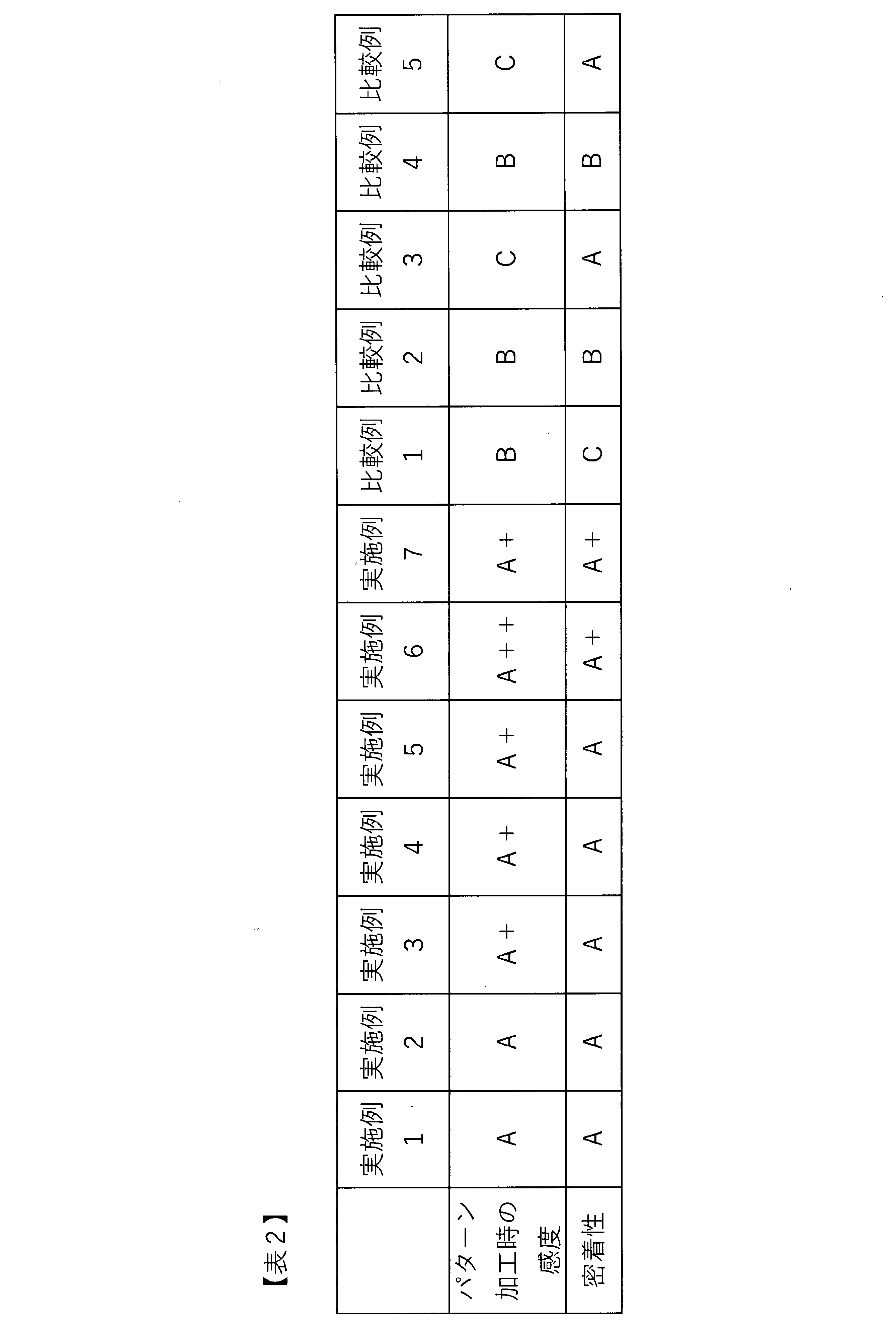
表2の結果から、実施例1~7の樹脂組成物は、比較例1~5に比べて、パターン加工時の感度及び密着性に優れていることがわかる。
すなわち、本発明によれば、十分な無機基材への密着性とパターン加工時の感度を示す、樹脂組成物、樹脂組成物フィルム、硬化膜、およびこれらを用いた半導体装置を提供することが可能である。
Claims (9)
- (A)成分として高分子化合物、(B)成分としてカチオン重合性化合物、(C)成分としてカチオン重合開始剤、及び(D)成分としてシランカップリング剤を含有する樹脂組成物であって、
前記(D)成分は、カルボキシル基及び/又は酸無水物基を有することを特徴とする、樹脂組成物。 - 前記(A)成分は、ポリアミド、ポリイミド、及びポリアミドイミドからなる群より選ばれる少なくとも1つの化合物である、請求項1に記載の樹脂組成物。
- 前記(A)成分は、分子鎖末端がカルボン酸残基である、請求項1または2に記載の樹脂組成物。
- 前記(D)成分は、一般式(3)の構造を有する、請求項1~3のいずれかに記載の樹脂組成物。

- 前記(B)成分は、エポキシ化合物またはオキセタン化合物である、請求項1~4のいずれかに記載の樹脂組成物。
- ネガ型の感光性樹脂組成物である、請求項1~5のいずれかに記載の樹脂組成物。
- 請求項1~6のいずれかに記載の樹脂組成物からなる樹脂組成物フィルム。
- 請求項1~6のいずれかに記載の樹脂組成物、又は、請求項7に記載の樹脂組成物フィルム、を硬化した硬化膜。
- 請求項8に記載の硬化膜を有する半導体装置。
Priority Applications (1)
| Application Number | Priority Date | Filing Date | Title |
|---|---|---|---|
| JP2022542672A JPWO2023032467A1 (ja) | 2021-08-30 | 2022-07-07 |
Applications Claiming Priority (2)
| Application Number | Priority Date | Filing Date | Title |
|---|---|---|---|
| JP2021-139686 | 2021-08-30 | ||
| JP2021139686 | 2021-08-30 |
Publications (1)
| Publication Number | Publication Date |
|---|---|
| WO2023032467A1 true WO2023032467A1 (ja) | 2023-03-09 |
Family
ID=85412095
Family Applications (1)
| Application Number | Title | Priority Date | Filing Date |
|---|---|---|---|
| PCT/JP2022/026925 Ceased WO2023032467A1 (ja) | 2021-08-30 | 2022-07-07 | 樹脂組成物、樹脂組成物フィルム、硬化膜、および半導体装置 |
Country Status (3)
| Country | Link |
|---|---|
| JP (1) | JPWO2023032467A1 (ja) |
| TW (1) | TW202309141A (ja) |
| WO (1) | WO2023032467A1 (ja) |
Citations (4)
| Publication number | Priority date | Publication date | Assignee | Title |
|---|---|---|---|---|
| JP2020101650A (ja) * | 2018-12-21 | 2020-07-02 | 住友ベークライト株式会社 | ネガ型感光性樹脂組成物、それを用いた半導体装置および電子機器 |
| JP2021047378A (ja) * | 2019-09-20 | 2021-03-25 | 住友ベークライト株式会社 | 感光性樹脂組成物、電子デバイスの製造方法および電子デバイス |
| JP2021055055A (ja) * | 2019-09-24 | 2021-04-08 | 東レ株式会社 | 樹脂組成物、樹脂組成物フィルム、硬化膜、およびこれらを用いた半導体装置 |
| JP2021076728A (ja) * | 2019-11-11 | 2021-05-20 | 住友ベークライト株式会社 | 感光性樹脂組成物、電子デバイスの製造方法および電子デバイス |
-
2022
- 2022-07-07 JP JP2022542672A patent/JPWO2023032467A1/ja active Pending
- 2022-07-07 WO PCT/JP2022/026925 patent/WO2023032467A1/ja not_active Ceased
- 2022-08-04 TW TW111129402A patent/TW202309141A/zh unknown
Patent Citations (4)
| Publication number | Priority date | Publication date | Assignee | Title |
|---|---|---|---|---|
| JP2020101650A (ja) * | 2018-12-21 | 2020-07-02 | 住友ベークライト株式会社 | ネガ型感光性樹脂組成物、それを用いた半導体装置および電子機器 |
| JP2021047378A (ja) * | 2019-09-20 | 2021-03-25 | 住友ベークライト株式会社 | 感光性樹脂組成物、電子デバイスの製造方法および電子デバイス |
| JP2021055055A (ja) * | 2019-09-24 | 2021-04-08 | 東レ株式会社 | 樹脂組成物、樹脂組成物フィルム、硬化膜、およびこれらを用いた半導体装置 |
| JP2021076728A (ja) * | 2019-11-11 | 2021-05-20 | 住友ベークライト株式会社 | 感光性樹脂組成物、電子デバイスの製造方法および電子デバイス |
Also Published As
| Publication number | Publication date |
|---|---|
| TW202309141A (zh) | 2023-03-01 |
| JPWO2023032467A1 (ja) | 2023-03-09 |
Similar Documents
| Publication | Publication Date | Title |
|---|---|---|
| JP7643503B2 (ja) | ネガ型感光性樹脂組成物、ネガ型感光性樹脂組成物フィルム、硬化膜、および電子部品 | |
| JP7533048B2 (ja) | 樹脂組成物、樹脂組成物フィルム、硬化膜、およびこれらを用いた半導体装置 | |
| WO2023139814A1 (ja) | 樹脂組成物、フィルム、硬化膜、および半導体装置、多層配線基板 | |
| WO2023148996A1 (ja) | 樹脂組成物、樹脂組成物被膜、樹脂組成物フィルム、硬化膜、および電子部品 | |
| JP7315127B1 (ja) | 感光性樹脂組成物、感光性樹脂組成物フィルム、硬化物、これらを用いた電子部品 | |
| TWI830255B (zh) | 感光性聚醯亞胺樹脂組成物 | |
| JP2022162611A (ja) | ネガ型感光性樹脂組成物、樹脂組成物フィルム、硬化膜、および半導体装置 | |
| WO2023032467A1 (ja) | 樹脂組成物、樹脂組成物フィルム、硬化膜、および半導体装置 | |
| US20250164880A1 (en) | Resin composition, resin composition film and semiconductor device using these products | |
| JP2024046877A (ja) | 樹脂組成物、樹脂組成物被膜、樹脂組成物フィルム、硬化膜、およびこれらを用いた半導体装置 | |
| WO2025063041A1 (ja) | ネガ型感光性樹脂組成物、ネガ型感光性樹脂組成物被膜、ネガ型感光性樹脂組成物フィルム、硬化膜、およびこれらを用いた電子部品 | |
| WO2025004697A1 (ja) | ネガ型感光性樹脂組成物、ネガ型感光性樹脂組成物被膜、ネガ型感光性樹脂組成物フィルム、硬化膜、およびこれらを用いた半導体装置 | |
| WO2024157672A1 (ja) | 可溶性高分子化合物、可溶性高分子化合物の製造方法、樹脂組成物、樹脂組成物フィルム、硬化膜、および電子部品 | |
| JP2024023052A (ja) | ネガ型感光性樹脂組成物、ネガ型感光性樹脂組成物被膜、ネガ型感光性樹脂組成物フィルム、硬化膜、およびこれらを用いた電子部品 | |
| JP7259475B2 (ja) | 感光性樹脂組成物、感光性樹脂組成物フィルムおよびこれらを用いた半導体装置 | |
| WO2023182041A1 (ja) | 感光性樹脂組成物、感光性樹脂組成物フィルム、硬化物、これらを用いた電子部品 | |
| CN121443649A (zh) | 树脂、感光性树脂组合物及这些的硬化物、以及使用所述硬化物的电子部件和显示装置 |
Legal Events
| Date | Code | Title | Description |
|---|---|---|---|
| ENP | Entry into the national phase |
Ref document number: 2022542672 Country of ref document: JP Kind code of ref document: A |
|
| 121 | Ep: the epo has been informed by wipo that ep was designated in this application |
Ref document number: 22864055 Country of ref document: EP Kind code of ref document: A1 |
|
| NENP | Non-entry into the national phase |
Ref country code: DE |
|
| 122 | Ep: pct application non-entry in european phase |
Ref document number: 22864055 Country of ref document: EP Kind code of ref document: A1 |