WO2023013579A1 - 銅-ダイヤモンド複合体、放熱部材および電子装置 - Google Patents
銅-ダイヤモンド複合体、放熱部材および電子装置 Download PDFInfo
- Publication number
- WO2023013579A1 WO2023013579A1 PCT/JP2022/029486 JP2022029486W WO2023013579A1 WO 2023013579 A1 WO2023013579 A1 WO 2023013579A1 JP 2022029486 W JP2022029486 W JP 2022029486W WO 2023013579 A1 WO2023013579 A1 WO 2023013579A1
- Authority
- WO
- WIPO (PCT)
- Prior art keywords
- copper
- diamond
- diamond particles
- particle size
- diamond composite
- Prior art date
- Legal status (The legal status is an assumption and is not a legal conclusion. Google has not performed a legal analysis and makes no representation as to the accuracy of the status listed.)
- Ceased
Links
Images

Classifications
-
- B—PERFORMING OPERATIONS; TRANSPORTING
- B22—CASTING; POWDER METALLURGY
- B22F—WORKING METALLIC POWDER; MANUFACTURE OF ARTICLES FROM METALLIC POWDER; MAKING METALLIC POWDER; APPARATUS OR DEVICES SPECIALLY ADAPTED FOR METALLIC POWDER
- B22F3/00—Manufacture of workpieces or articles from metallic powder characterised by the manner of compacting or sintering; Apparatus specially adapted therefor ; Presses and furnaces
- B22F3/10—Sintering only
- B22F3/105—Sintering only by using electric current other than for infrared radiant energy, laser radiation or plasma ; by ultrasonic bonding
-
- C—CHEMISTRY; METALLURGY
- C22—METALLURGY; FERROUS OR NON-FERROUS ALLOYS; TREATMENT OF ALLOYS OR NON-FERROUS METALS
- C22C—ALLOYS
- C22C1/00—Making non-ferrous alloys
- C22C1/04—Making non-ferrous alloys by powder metallurgy
- C22C1/05—Mixtures of metal powder with non-metallic powder
-
- C—CHEMISTRY; METALLURGY
- C22—METALLURGY; FERROUS OR NON-FERROUS ALLOYS; TREATMENT OF ALLOYS OR NON-FERROUS METALS
- C22C—ALLOYS
- C22C26/00—Alloys containing diamond or cubic or wurtzitic boron nitride, fullerenes or carbon nanotubes
-
- C—CHEMISTRY; METALLURGY
- C22—METALLURGY; FERROUS OR NON-FERROUS ALLOYS; TREATMENT OF ALLOYS OR NON-FERROUS METALS
- C22C—ALLOYS
- C22C9/00—Alloys based on copper
-
- C—CHEMISTRY; METALLURGY
- C22—METALLURGY; FERROUS OR NON-FERROUS ALLOYS; TREATMENT OF ALLOYS OR NON-FERROUS METALS
- C22C—ALLOYS
- C22C9/00—Alloys based on copper
- C22C9/01—Alloys based on copper with aluminium as the next major constituent
-
- C—CHEMISTRY; METALLURGY
- C22—METALLURGY; FERROUS OR NON-FERROUS ALLOYS; TREATMENT OF ALLOYS OR NON-FERROUS METALS
- C22C—ALLOYS
- C22C9/00—Alloys based on copper
- C22C9/02—Alloys based on copper with tin as the next major constituent
-
- C—CHEMISTRY; METALLURGY
- C22—METALLURGY; FERROUS OR NON-FERROUS ALLOYS; TREATMENT OF ALLOYS OR NON-FERROUS METALS
- C22C—ALLOYS
- C22C9/00—Alloys based on copper
- C22C9/04—Alloys based on copper with zinc as the next major constituent
-
- C—CHEMISTRY; METALLURGY
- C22—METALLURGY; FERROUS OR NON-FERROUS ALLOYS; TREATMENT OF ALLOYS OR NON-FERROUS METALS
- C22C—ALLOYS
- C22C9/00—Alloys based on copper
- C22C9/06—Alloys based on copper with nickel or cobalt as the next major constituent
-
- H—ELECTRICITY
- H05—ELECTRIC TECHNIQUES NOT OTHERWISE PROVIDED FOR
- H05K—PRINTED CIRCUITS; CASINGS OR CONSTRUCTIONAL DETAILS OF ELECTRIC APPARATUS; MANUFACTURE OF ASSEMBLAGES OF ELECTRICAL COMPONENTS
- H05K7/00—Constructional details common to different types of electric apparatus
- H05K7/20—Modifications to facilitate cooling, ventilating, or heating
-
- H—ELECTRICITY
- H10—SEMICONDUCTOR DEVICES; ELECTRIC SOLID-STATE DEVICES NOT OTHERWISE PROVIDED FOR
- H10W—GENERIC PACKAGES, INTERCONNECTIONS, CONNECTORS OR OTHER CONSTRUCTIONAL DETAILS OF DEVICES COVERED BY CLASS H10
- H10W40/00—Arrangements for thermal protection or thermal control
- H10W40/20—Arrangements for cooling
- H10W40/25—Arrangements for cooling characterised by their materials
-
- H—ELECTRICITY
- H10—SEMICONDUCTOR DEVICES; ELECTRIC SOLID-STATE DEVICES NOT OTHERWISE PROVIDED FOR
- H10W—GENERIC PACKAGES, INTERCONNECTIONS, CONNECTORS OR OTHER CONSTRUCTIONAL DETAILS OF DEVICES COVERED BY CLASS H10
- H10W40/00—Arrangements for thermal protection or thermal control
- H10W40/20—Arrangements for cooling
- H10W40/25—Arrangements for cooling characterised by their materials
- H10W40/254—Diamond
-
- H—ELECTRICITY
- H10—SEMICONDUCTOR DEVICES; ELECTRIC SOLID-STATE DEVICES NOT OTHERWISE PROVIDED FOR
- H10W—GENERIC PACKAGES, INTERCONNECTIONS, CONNECTORS OR OTHER CONSTRUCTIONAL DETAILS OF DEVICES COVERED BY CLASS H10
- H10W40/00—Arrangements for thermal protection or thermal control
- H10W40/20—Arrangements for cooling
- H10W40/25—Arrangements for cooling characterised by their materials
- H10W40/258—Metallic materials
-
- B—PERFORMING OPERATIONS; TRANSPORTING
- B22—CASTING; POWDER METALLURGY
- B22F—WORKING METALLIC POWDER; MANUFACTURE OF ARTICLES FROM METALLIC POWDER; MAKING METALLIC POWDER; APPARATUS OR DEVICES SPECIALLY ADAPTED FOR METALLIC POWDER
- B22F3/00—Manufacture of workpieces or articles from metallic powder characterised by the manner of compacting or sintering; Apparatus specially adapted therefor ; Presses and furnaces
- B22F3/10—Sintering only
- B22F3/105—Sintering only by using electric current other than for infrared radiant energy, laser radiation or plasma ; by ultrasonic bonding
- B22F2003/1051—Sintering only by using electric current other than for infrared radiant energy, laser radiation or plasma ; by ultrasonic bonding by electric discharge
-
- B—PERFORMING OPERATIONS; TRANSPORTING
- B22—CASTING; POWDER METALLURGY
- B22F—WORKING METALLIC POWDER; MANUFACTURE OF ARTICLES FROM METALLIC POWDER; MAKING METALLIC POWDER; APPARATUS OR DEVICES SPECIALLY ADAPTED FOR METALLIC POWDER
- B22F3/00—Manufacture of workpieces or articles from metallic powder characterised by the manner of compacting or sintering; Apparatus specially adapted therefor ; Presses and furnaces
- B22F3/24—After-treatment of workpieces or articles
- B22F2003/241—Chemical after-treatment on the surface
- B22F2003/242—Coating
-
- B—PERFORMING OPERATIONS; TRANSPORTING
- B22—CASTING; POWDER METALLURGY
- B22F—WORKING METALLIC POWDER; MANUFACTURE OF ARTICLES FROM METALLIC POWDER; MAKING METALLIC POWDER; APPARATUS OR DEVICES SPECIALLY ADAPTED FOR METALLIC POWDER
- B22F2202/00—Treatment under specific physical conditions
- B22F2202/13—Use of plasma
-
- B—PERFORMING OPERATIONS; TRANSPORTING
- B22—CASTING; POWDER METALLURGY
- B22F—WORKING METALLIC POWDER; MANUFACTURE OF ARTICLES FROM METALLIC POWDER; MAKING METALLIC POWDER; APPARATUS OR DEVICES SPECIALLY ADAPTED FOR METALLIC POWDER
- B22F2301/00—Metallic composition of the powder or its coating
- B22F2301/10—Copper
-
- B—PERFORMING OPERATIONS; TRANSPORTING
- B22—CASTING; POWDER METALLURGY
- B22F—WORKING METALLIC POWDER; MANUFACTURE OF ARTICLES FROM METALLIC POWDER; MAKING METALLIC POWDER; APPARATUS OR DEVICES SPECIALLY ADAPTED FOR METALLIC POWDER
- B22F2302/00—Metal Compound, non-Metallic compound or non-metal composition of the powder or its coating
- B22F2302/40—Carbon, graphite
- B22F2302/406—Diamond
-
- B—PERFORMING OPERATIONS; TRANSPORTING
- B22—CASTING; POWDER METALLURGY
- B22F—WORKING METALLIC POWDER; MANUFACTURE OF ARTICLES FROM METALLIC POWDER; MAKING METALLIC POWDER; APPARATUS OR DEVICES SPECIALLY ADAPTED FOR METALLIC POWDER
- B22F2998/00—Supplementary information concerning processes or compositions relating to powder metallurgy
- B22F2998/10—Processes characterised by the sequence of their steps
-
- B—PERFORMING OPERATIONS; TRANSPORTING
- B22—CASTING; POWDER METALLURGY
- B22F—WORKING METALLIC POWDER; MANUFACTURE OF ARTICLES FROM METALLIC POWDER; MAKING METALLIC POWDER; APPARATUS OR DEVICES SPECIALLY ADAPTED FOR METALLIC POWDER
- B22F2999/00—Aspects linked to processes or compositions used in powder metallurgy
Definitions
- the present invention relates to copper-diamond composites, heat dissipation members and electronic devices.
- Patent Document 1 describes that the average particle size of good thermal conductor particles such as diamond particles and SiC particles is 10 to 100 ⁇ m or less with respect to composite materials of metal matrix-thermal conductor particles (paragraph 0060, etc.).
- the thermal conductivity of the copper-diamond composite can be improved by appropriately controlling the degree of sphericity of the diamond particles contained in the composite.
- the present inventors found that the number average sphericity of diamond particles obtained using an image-type particle size distribution analyzer is set to a predetermined value or more, thereby improving the thermal conductivity of the composite. The inventors have found that the properties can be improved, and have completed the present invention.
- the following copper-diamond composite, heat dissipation member, and electronic device are provided.
- a copper-diamond composite comprising a plurality of diamond particles dispersed in a metal matrix containing copper, When the particle size distribution of the diamond particles is measured using an image-type particle size distribution measuring device, the number average of the sphericity distribution of the diamond particles is 0.90 or more. Copper-diamond composite.
- 2. 1. A copper-diamond composite according to The copper-diamond composite, wherein the sphericity S50 at which the cumulative value is 50% is 0.87 or more in the volume particle size distribution of the sphericity of the diamond particles. 3. 1. or 2.
- a copper-diamond composite according to any one of a metal film bonded to at least one surface of the copper-diamond composite;
- a heat dissipating member comprising: 14. 13. and the heat dissipating member according to and an electronic component provided on the heat dissipation member.
- a copper-diamond composite with excellent thermal conductivity, a heat dissipation member and an electronic device using the same are provided.
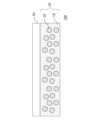
- FIG. 1 is a schematic cross-sectional view showing an example of the configuration of a copper-diamond composite according to an embodiment
- FIG. It is a cross-sectional schematic diagram which shows an example of a structure of the heat radiating member which concerns on this embodiment.
- FIG. 1 is a schematic cross-sectional view showing an example of the configuration of a copper-diamond composite according to this embodiment.
- the copper-diamond composite 30 of this embodiment has a structure in which a plurality of diamond particles 20 are dispersed in a metal matrix 10 containing copper.
- This copper-diamond composite 30 is configured so that the number average of the sphericity distribution of the diamond particles 20 is 0.90 or more when the particle size distribution of the diamond particles 20 is measured using an image-type particle size distribution measuring device. be.
- the thermal conductivity of copper-diamond composites can be stably evaluated, and diamonds having a sphericity of a predetermined value or more It has been found that the use of particles can improve the thermal conductivity of the composite.
- the detailed mechanism is not clear, but by using diamond particles with a high degree of sphericity, it is possible to reduce the frequency of breakage and cracking due to contact between particles during the filling process, etc. Therefore, heat conduction due to breakage of diamond particles It is considered that the decrease in the rate can be suppressed.
- diamond particles with a high degree of sphericity can be highly packed in the metal matrix, so that the thermal conductivity of the composite can be further increased.
- the sphericity and particle size of diamond particles 20 can be measured according to the following procedure.
- the particle size distribution of the diamond particles 20 is measured using an image-type particle size distribution analyzer (eg, Morphologi 4 manufactured by Malvern).
- Particle size distribution includes shape distribution and particle size distribution. From the obtained particle size distribution, a volume particle size distribution of sphericity and a volume particle size distribution of particle diameter are created. Then, in the volume particle size distribution of the sphericity of the diamond particles 20, a predetermined cumulative value of sphericity and a predetermined cumulative value of particle diameter are obtained.
- the particle size D 10 at which the cumulative value is 10%, the particle size D 50 at which the cumulative value is 50%, and the particle size D 90 at which the cumulative value is 90% are determined.
- sphericity S 10 with a cumulative value of 10%, sphericity S 50 with a cumulative value of 50%, and sphericity S 90 with a cumulative value of 90% are determined.
- the particle diameter of the diamond particles is in the range of particle diameter D 10 or less, the particle diameter D 10 or more and the particle diameter D 50 or less, the particle diameter D 50 or more and the particle diameter D 90 or less, or the particle diameter D 90 or more.
- each particle size class is determined for each particle size class classified into four categories. Also, in the particle size distribution and the shape distribution (sphericity distribution), each number average (average particle size based on the number of diamond particles) is calculated.
- sphericity and particle size are defined as follows. Circularity: Ratio of the circumference of the projected object and the circumference of the object Particle diameter: Maximum length at two points on the contour of the particle image
- the lower limit of the number average of the sphericity distribution of the diamond particles 20 is, for example, 0.90 or more, preferably 0.91 or more, and more preferably 0.92 or more. As a result, the filling degree of the diamond particles 20 can be increased, and the thermal conductivity of the copper-diamond composite 30 can be increased.
- the upper limit of the number average of the sphericity distribution of the diamond particles 20 is not particularly limited, but may be 0.99 or less.
- the lower limit of the sphericity S50 of the diamond particles 20 is, for example, 0.87 or more, preferably 0.90 or more, and more preferably 0.92 or more. This increases the packing degree of the diamond particles 20 and increases the thermal conductivity of the composite.
- the upper limit of the sphericity S50 of the diamond particles 20 is not particularly limited, but may be 0.99 or less or 0.98 or less.
- the lower limit of the sphericity S90 of the diamond particles 20 is, for example, 0.91 or more, preferably 0.93 or more, and more preferably 0.95 or more. This increases the packing degree of the diamond particles 20 and increases the thermal conductivity of the composite.
- the upper limit of the sphericity S90 of the diamond particles 20 is not particularly limited, but may be 0.99 or less.
- the lower limit of the sphericity S10 of the diamond particles 20 is, for example, 0.80 or more, preferably 0.82 or more, and more preferably 0.85 or more. This increases the packing degree of the diamond particles 20 and increases the thermal conductivity of the composite.
- the upper limit of the sphericity S10 of the diamond particles 20 is not particularly limited, but may be 0.99 or less or 0.95 or less.
- the upper limit of the number average particle size distribution of the diamond particles 20 is, for example, 180 ⁇ m or less, preferably 175 ⁇ m or less, and more preferably 170 ⁇ m or less. This increases the packing degree of the diamond particles 20 and increases the thermal conductivity of the composite.
- the lower limit of the number average particle size distribution of the diamond particles 20 is not particularly limited, but is, for example, 30 ⁇ m or more, preferably 50 ⁇ m or more, and more preferably 100 ⁇ m or more.
- the volume particle size distribution of the particle diameter of the diamond particles may be configured to include one peak, or may be configured to include two or more peaks.
- the upper limit of the particle diameter D50 of the diamond particles 20 is, for example, 180 ⁇ m or less, preferably 175 ⁇ m or less, and more preferably 170 ⁇ m or less. This increases the packing degree of the diamond particles 20 and increases the thermal conductivity of the composite.
- the lower limit of the particle diameter D50 of the diamond particles 20 is not particularly limited, but is, for example, 30 ⁇ m or more, preferably 50 ⁇ m or more, more preferably 100 ⁇ m or more.
- the upper limit of the particle diameter D90 of the diamond particles 20 is, for example, 210 ⁇ m or less, preferably 200 ⁇ m or less, more preferably 190 ⁇ m or less. This increases the packing degree of the diamond particles 20 and increases the thermal conductivity of the composite.
- the lower limit of the particle diameter D90 of the diamond particles 20 is not particularly limited, but is, for example, 30 ⁇ m or more, preferably 50 ⁇ m or more, more preferably 110 ⁇ m or more.
- the upper limit of the particle diameter D10 of the diamond particles 20 is, for example, 160 ⁇ m or less, preferably 158 ⁇ m or less, and more preferably 155 ⁇ m or less. This increases the packing degree of the diamond particles 20 and increases the thermal conductivity of the composite.
- the lower limit of the particle diameter D10 of the diamond particles 20 is not particularly limited, but is, for example, 30 ⁇ m or more, preferably 50 ⁇ m or more, and more preferably 100 ⁇ m or more.
- the sphericity of the diamond particles 20 belonging to the range of the particle diameter of the diamond particles 20 larger than the particle diameter of D50 and equal to or smaller than the particle diameter of D90 is, for example, 0.90 or more, preferably 0.91 or more, more preferably 0.92 or more. This increases the packing degree of the diamond particles 20 and increases the thermal conductivity of the composite.
- the upper limit of the sphericity of the diamond particles 20 is not particularly limited, but may be 0.99 or less.
- the sphericity of the diamond particles 20 belonging to the range of the particle diameter of the diamond particles 20 larger than the particle diameter of D10 and equal to or smaller than the particle diameter of D50 is, for example, 0.90 or more, preferably 0.91 or more, more preferably 0.92 or more. This increases the packing degree of the diamond particles 20 and increases the thermal conductivity of the composite.
- the upper limit of the sphericity of the diamond particles 20 is not particularly limited, but may be 0.99 or less.
- a copper-diamond composite 30 (hereinafter sometimes simply referred to as “composite”) includes a metal matrix 10 containing copper and a plurality of diamond particles 20 present in the metal matrix 10 .
- the diamond particles 20 in the composite are in a state in which all of the plurality of particles are embedded in the metal matrix 10, but at least a portion of one or more particles is from the surface of the copper-diamond composite 30. It may be exposed.
- the lower limit of the thermal conductivity of the copper-diamond composite 30 is, for example, 610 W/m ⁇ K or more, preferably 620 W/m ⁇ K or more, more preferably 630 W/m ⁇ K or more. Thereby, the heat dissipation property of the heat dissipation member can be enhanced.
- the upper limit of the thermal conductivity of the copper-diamond composite 30 is not particularly limited, but is, for example, 900 W/m K or less, preferably 890 W/m K or less, more preferably 880 W/m K or less. .
- the shape and size of the copper-diamond composite 30 can be appropriately set according to the application.
- Examples of the shape of the copper-diamond composite 30 include flat plate-like, block-like, rod-like, and the like.
- the metal matrix 10 may contain copper, and may contain other highly thermally conductive metals than copper. That is, the metal matrix 10 is composed of a copper phase and/or a copper alloy phase.
- the main component in the metal matrix 10 is preferably copper from the viewpoint of thermal conductivity and cost.
- the lower limit of the content of copper as the main component is preferably 50% by mass or more, more preferably 60% by mass or more, still more preferably 70% by mass or more, and particularly preferably 80% by mass or more in 100% by mass of the metal matrix 10. , and most preferably at least 90% by mass. This takes advantage of the good thermal conductivity of copper and copper alloys.
- the same copper as the matrix can be used as the surface layer to ensure brazing properties and surface smoothness, and the formation of other surface coating layers can be omitted.
- the upper limit of the content of copper, which is the main component is not particularly limited in 100% by mass of the metal matrix 10, but may be 100% by mass or less or 99% by mass or less.
- highly thermally conductive metals include, for example, silver, gold, and aluminum. These may be used alone or in combination of two or more. When combining copper with other highly thermally conductive metals, alloys or composite materials formed of copper and other highly thermally conductive metals can be used. Note that the metal matrix 10 may be made of metal other than the highly thermally conductive metal as long as it does not impair the effects of the present invention.
- examples of the copper alloy include CuAg, CuAl, CuSn, CuZr, and CrCu.
- the metal matrix 10 is, for example, a sintered body of metal powder containing copper (and other photothermally conductive metals as necessary).
- the metal matrix 10 is composed of a sintered body in which at least some of the plurality of diamond particles 20 are embedded.
- the diamond particles 20 include at least one of non-coated diamond particles that do not have a metal-containing coating layer on their surfaces and coated diamond particles that have a metal-containing coating layer on their surfaces. Coated diamond particles are more preferable from the viewpoint of improving adhesion and dispersibility between diamond and metal particles.
- the lower limit of the volume content of diamond particles 20 in copper-diamond composite 30 is preferably 10% by volume or more, more preferably 20% by volume or more, and still more preferably 30% by volume or more. Thereby, the thermal conductivity of the copper-diamond composite 30 can be enhanced.
- the upper limit of the volume content of the diamond particles 20 in the copper-diamond composite 30 is, for example, preferably 80% by volume or less, more preferably 70% by volume or less, and even more preferably 65% by volume or less.
- the metal-containing coating layer in the coated diamond particles may contain molybdenum, tungsten, chromium, zirconium, hafnium, vanadium, niobium, tantalum, and alloys thereof. These may be used alone or in combination of two or more. Also, the metal-containing coating layer is configured to cover at least a portion or the entire surface of the particle.
- FIG. 2 is a schematic cross-sectional view showing an example of the configuration of the heat radiating member according to this embodiment.
- the heat dissipation member 100 of this embodiment includes a copper-diamond composite 30 and a metal film 50 bonded to at least one surface of the copper-diamond composite 30 .
- the lower limit of the thermal conductivity of the heat radiating member 100 is, for example, 600 W/m ⁇ K or more, preferably 630 W/m ⁇ K or more, more preferably 650 W/m ⁇ K or more. Thereby, the heat dissipation property of the heat dissipation member can be enhanced.
- the upper limit of the thermal conductivity of the heat radiating member 100 is not particularly limited, but is, for example, 780 W/m ⁇ K or less, preferably 760 W/m ⁇ K or less, more preferably 760 W/m ⁇ K or less.
- the metal film 50 may be formed on at least one surface of the copper-diamond composite 30, and may be formed on both surfaces of the flat copper-diamond composite 30, for example.
- the metal film 50 may contain one or more selected from the group consisting of copper, silver, gold, aluminum, nickel, zinc, tin, and magnesium.
- the metal film 50 contains the same metal as the main component metal in the metal matrix 10, and preferably contains at least copper or a copper alloy.
- the content of copper, which is the main component, in 100% by mass of the metal film 50 is preferably 50% by mass or more, more preferably 60% by mass or more, still more preferably 70% by mass or more, particularly preferably 80% by mass or more, and most preferably Preferably, it is 90% by mass or more.
- the upper limit of the content of copper, which is the main component is not particularly limited in 100% by mass of the metal film 50, but may be 100% by mass or less or 99% by mass or less.
- the upper limit of the film thickness of the metal film 50 is preferably 150 ⁇ m or less, more preferably 120 ⁇ m or less, and still more preferably 100 ⁇ m or less. Thereby, the thermal conductivity of the heat radiating member can be increased.
- the lower limit of the film thickness of the metal film 50 is preferably 10 ⁇ m or more, more preferably 15 ⁇ m or more, and even more preferably 20 ⁇ m or more. As a result, the strength of adhesion to the composite and the durability of itself can be enhanced.
- the metal film 50 is obtained by, for example, sputtering or plating.
- the electronic device of the present embodiment includes the above heat dissipation member and an electronic component provided on the heat dissipation member.
- Examples of electronic components include semiconductor elements.
- Specific examples of semiconductor elements include power semiconductors, image display elements, microprocessor units, laser diodes, and the like.
- the heat dissipation member is used for heat sinks, heat spreaders, etc.
- the heat sink dissipates heat generated during operation of the semiconductor element to an external space, and the heat spreader transfers the heat generated by the semiconductor element to other members.
- the electronic component may be installed directly on the heat dissipation member or indirectly via a ceramic substrate or the like.
- An example of a method for producing a copper-diamond composite includes a raw material mixing step and a sintering step.
- metal powder containing copper such as copper powder and diamond particles are mixed to obtain a mixture.
- Various dry and wet methods can be applied to mixing the raw material powders, and a dry mixing method may also be used.
- a mixture of metal powder and diamond particles is fired to obtain a composite sintered body of copper and diamond particles (copper-diamond composite).
- the firing temperature can be appropriately selected according to the metal species contained in the metal powder, but in the case of copper powder, it is preferably 800° C. or higher and 1100° C. or lower, more preferably 850° C. or higher and 1000° C. or lower.
- the firing temperature is preferably 800° C. or higher and 1100° C. or lower, more preferably 850° C. or higher and 1000° C. or lower.
- the firing temperature By setting the firing temperature to 800° C. or higher, the copper-diamond composite is densified and the desired thermal conductivity is obtained.
- the sintering temperature By setting the sintering temperature to 1100° C. or less, deterioration due to graphitization of the interfaces of the diamond particles can be suppressed, and a decrease in the inherent thermal conductivity of diamond can be prevented.
- the firing time is not particularly limited, but is preferably 5 minutes or more and 3 hours or less, more preferably 10 minutes or more and 2 hours or less.
- the firing time is preferably 5 minutes or more and 3 hours or less, more preferably 10 minutes or more and 2 hours or less.
- the copper-diamond composite is densified and the desired thermal conductivity is obtained.
- the firing time is set to 3 hours or less, carbide formation and film thickness increase occur between the diamond in the coated diamond particles and the metal coating the surface, resulting in a decrease in thermal conductivity and a difference in coefficient of linear expansion due to phonon scattering. It is possible to suppress the cracks caused by In addition, the productivity of the complex can be increased.
- the sintering step either the normal pressure sintering method or the pressure sintering method may be used, but the pressure sintering method is preferable in order to obtain a dense composite.
- pressure sintering methods include hot press sintering, spark plasma sintering (SPS), and hot isostatic pressure sintering (HIP).
- SPS spark plasma sintering
- HIP hot isostatic pressure sintering
- the pressure is preferably 10 MPa or higher, more preferably 30 MPa or higher.
- the pressure is preferably 100 MPa or less.
- the pressure By setting the pressure to 100 MPa or less, it is possible to prevent the diamond from cracking, resulting in an increase in the diamond interface and a decrease in adhesion between the crushed diamond surface and the metal, and a decrease in the original thermal conductivity of the diamond. .
- an example of a method for manufacturing a heat radiating member includes a film forming step of forming a metal film on the composite obtained above.
- a metal film 50 is formed on at least part of the surface of the copper-diamond composite 30 .
- a method for forming the metal film a general method such as a sputtering method, a plating method, or a pressurized co-firing method using copper foil may be adopted, but a sputtering method may be used to form a thin film. .
- at least part of the surface of the metal film may be ground and polished. This can improve the surface smoothness of the metal film after the film formation process.
- the smoothing step at least part of the surface of the composite sintered body is ground and polished. Further, an annealing step may be added between the firing step and the smoothing step. Moreover, before the film formation step, the copper-diamond composite may be subjected to processing such as shape processing and perforation processing.
- the particle size distribution (shape distribution/particle size distribution) of the diamond particles was measured using an image-type particle size distribution analyzer (Morphologi 4, manufactured by Malvern).
- image-type particle size distribution analyzer manufactured by Malvern.
- the particle size D 10 at which the cumulative value is 10%, the particle size D 50 at which the cumulative value is 50%, and the particle size D 90 at which the cumulative value is 90% were determined.
- sphericity S 10 with a cumulative value of 10%, sphericity S 50 with a cumulative value of 50%, and sphericity S 90 with a cumulative value of 90% were determined.
- the particle diameter of the diamond particles is in the range of particle diameter D 10 or less, the particle diameter D 10 or more and the particle diameter D 50 or less, the particle diameter D 50 or more and the particle diameter D 90 or less, or the particle diameter D 90 or more.
- the sphericity in each particle size class was determined for each particle size class classified into four categories.
- each number average (number-based average particle size of diamond particles) was calculated. These values are shown in Table 1 as average values of two measurements.
- the sphericity and particle size were defined as follows. Circularity: Ratio of the circumference of the projected object and the circumference of the object Particle diameter: Maximum length at two points on the contour of the particle image
- Example 1 The copper powder and the diamond particles A (Mo coat) were weighed at a ratio of 50% by volume:50% by volume, and the weighed powders were uniformly mixed in a V-type mixer to obtain a mixture (raw material mixing step). Subsequently, using an SPS sintering device, the obtained mixture was filled in a mold and heat-sintered at 900° C. for 1 hour under a pressure condition of 30 MPa to disperse a plurality of diamond particles in the copper matrix. A disk-shaped composite sintered body (copper-diamond composite) was obtained (sintering step).
- the content of diamond particles in the copper-diamond composite was 50% by volume.
- the thermal conductivity of the copper-diamond composite was measured by a laser flash method and found to be 747 W/m ⁇ K. In addition, the measurement by the laser flash method was carried out at room temperature with carbon coating applied to the sample surface in accordance with JIS H7801.
- Example 2-4 Comparative Examples 1-4
- a copper-diamond composite was obtained in the same manner as in Example 1, except that the type of diamond particles and the content of diamond particles were changed according to Table 2. The same evaluation as in Example 1 was performed on the obtained composite.
- the copper-diamond composites of Examples 1 to 4 use diamond particles with a higher sphericity than those of Comparative Examples 1 to 4, so the thermal conductivity is improved. showed the results.
- a heat dissipating member having excellent thermal conductivity can be provided.
- metal matrix 10 metal matrix 20 diamond particles 30 copper-diamond composite 50 metal film 100 heat dissipation member
Landscapes
- Chemical & Material Sciences (AREA)
- Engineering & Computer Science (AREA)
- Materials Engineering (AREA)
- Mechanical Engineering (AREA)
- Metallurgy (AREA)
- Organic Chemistry (AREA)
- Physics & Mathematics (AREA)
- Optics & Photonics (AREA)
- Manufacturing & Machinery (AREA)
- Thermal Sciences (AREA)
- Microelectronics & Electronic Packaging (AREA)
- Cooling Or The Like Of Semiconductors Or Solid State Devices (AREA)
- Powder Metallurgy (AREA)
Priority Applications (3)
| Application Number | Priority Date | Filing Date | Title |
|---|---|---|---|
| JP2023540331A JP7622234B2 (ja) | 2021-08-05 | 2022-08-01 | 銅-ダイヤモンド複合体、放熱部材および電子装置 |
| CN202280053902.4A CN117813684A (zh) | 2021-08-05 | 2022-08-01 | 铜-金刚石复合体、散热部件及电子设备 |
| US18/681,230 US12612682B2 (en) | 2021-08-05 | 2022-08-01 | Copper-diamond composite, heat dissipation member, and electronic device |
Applications Claiming Priority (2)
| Application Number | Priority Date | Filing Date | Title |
|---|---|---|---|
| JP2021128792 | 2021-08-05 | ||
| JP2021-128792 | 2021-08-05 |
Publications (1)
| Publication Number | Publication Date |
|---|---|
| WO2023013579A1 true WO2023013579A1 (ja) | 2023-02-09 |
Family
ID=85154754
Family Applications (1)
| Application Number | Title | Priority Date | Filing Date |
|---|---|---|---|
| PCT/JP2022/029486 Ceased WO2023013579A1 (ja) | 2021-08-05 | 2022-08-01 | 銅-ダイヤモンド複合体、放熱部材および電子装置 |
Country Status (4)
| Country | Link |
|---|---|
| US (1) | US12612682B2 (https=) |
| JP (1) | JP7622234B2 (https=) |
| CN (1) | CN117813684A (https=) |
| WO (1) | WO2023013579A1 (https=) |
Cited By (2)
| Publication number | Priority date | Publication date | Assignee | Title |
|---|---|---|---|---|
| CN117123776A (zh) * | 2023-05-26 | 2023-11-28 | 郑州大学 | 一种铜/硅镀覆金刚石复合导热材料及其制备方法 |
| CN117484969A (zh) * | 2023-10-12 | 2024-02-02 | 广东工业大学 | 一种片状的金属基金刚石复合材料及其制备方法和应用 |
Citations (3)
| Publication number | Priority date | Publication date | Assignee | Title |
|---|---|---|---|---|
| WO2007074720A1 (ja) * | 2005-12-28 | 2007-07-05 | A. L. M. T. Corp. | 半導体素子実装用基板とそれを用いた半導体装置および半導体素子実装用基板の製造方法 |
| JP2013098491A (ja) * | 2011-11-04 | 2013-05-20 | Sumitomo Electric Ind Ltd | ヒートシンク、ヒートシンクを作製する方法、半導体装置、半導体モジュール |
| JP2015160996A (ja) * | 2014-02-27 | 2015-09-07 | 国立大学法人信州大学 | 銅−ダイヤモンド複合材及びその製造方法 |
Family Cites Families (3)
| Publication number | Priority date | Publication date | Assignee | Title |
|---|---|---|---|---|
| CN106232845B (zh) * | 2014-04-25 | 2019-04-26 | 电化株式会社 | 铝-金刚石系复合体及使用其的散热部件 |
| WO2016035796A1 (ja) | 2014-09-02 | 2016-03-10 | 株式会社アライドマテリアル | 放熱部材、及び放熱部材の製造方法 |
| CN111455205B (zh) * | 2020-03-26 | 2021-03-12 | 陕西斯瑞新材料股份有限公司 | 一种具有夹层结构的高导热低膨胀Diamond-Cu复合材料的制备方法 |
-
2022
- 2022-08-01 CN CN202280053902.4A patent/CN117813684A/zh active Pending
- 2022-08-01 US US18/681,230 patent/US12612682B2/en active Active
- 2022-08-01 JP JP2023540331A patent/JP7622234B2/ja active Active
- 2022-08-01 WO PCT/JP2022/029486 patent/WO2023013579A1/ja not_active Ceased
Patent Citations (3)
| Publication number | Priority date | Publication date | Assignee | Title |
|---|---|---|---|---|
| WO2007074720A1 (ja) * | 2005-12-28 | 2007-07-05 | A. L. M. T. Corp. | 半導体素子実装用基板とそれを用いた半導体装置および半導体素子実装用基板の製造方法 |
| JP2013098491A (ja) * | 2011-11-04 | 2013-05-20 | Sumitomo Electric Ind Ltd | ヒートシンク、ヒートシンクを作製する方法、半導体装置、半導体モジュール |
| JP2015160996A (ja) * | 2014-02-27 | 2015-09-07 | 国立大学法人信州大学 | 銅−ダイヤモンド複合材及びその製造方法 |
Cited By (2)
| Publication number | Priority date | Publication date | Assignee | Title |
|---|---|---|---|---|
| CN117123776A (zh) * | 2023-05-26 | 2023-11-28 | 郑州大学 | 一种铜/硅镀覆金刚石复合导热材料及其制备方法 |
| CN117484969A (zh) * | 2023-10-12 | 2024-02-02 | 广东工业大学 | 一种片状的金属基金刚石复合材料及其制备方法和应用 |
Also Published As
| Publication number | Publication date |
|---|---|
| US20240309495A1 (en) | 2024-09-19 |
| JP7622234B2 (ja) | 2025-01-27 |
| CN117813684A (zh) | 2024-04-02 |
| US12612682B2 (en) | 2026-04-28 |
| JPWO2023013579A1 (https=) | 2023-02-09 |
Similar Documents
| Publication | Publication Date | Title |
|---|---|---|
| US9188397B2 (en) | Dense composite material, method for producing the same, and component for semiconductor production equipment | |
| JP6182084B2 (ja) | 緻密質複合材料、その製法、接合体及び半導体製造装置用部材 | |
| WO2003040420A1 (fr) | Diamant fritte presentant une conductivite thermique elevee et procede de production d'un tel diamant et puits thermique utilisant un tel diamant | |
| CN114032413A (zh) | 金刚石复合材料和散热部件 | |
| JP2023087658A (ja) | 複合材料およびこの複合材料を含む放熱部品 | |
| US12120852B2 (en) | Composite material and heat dissipation part | |
| JP7622234B2 (ja) | 銅-ダイヤモンド複合体、放熱部材および電子装置 | |
| EP3023510A1 (en) | Spray coating film, engine having the spray coating film and film-forming method of the spray coating film | |
| CN110453126B (zh) | 一种金刚石-金属基复合导热材料及其制备方法 | |
| CN108603294A (zh) | 陶瓷层叠体、陶瓷绝缘基板及陶瓷层叠体的制造方法 | |
| WO2020013300A1 (ja) | 金属-炭化珪素質複合体、及び金属-炭化珪素質複合体の製造方法 | |
| WO2023013500A1 (ja) | 放熱部材および電子装置 | |
| JPWO2020084903A1 (ja) | 複合部材 | |
| WO2019163710A1 (ja) | 複合焼結体、半導体製造装置部材および複合焼結体の製造方法 | |
| US20240347415A1 (en) | Heat dissipation member and electronic device | |
| WO2023013502A1 (ja) | 放熱部材および電子装置 | |
| WO2023074633A1 (ja) | 放熱部材および電子装置 | |
| US20250261338A1 (en) | Heat dissipation member and electronic device | |
| CN116656985A (zh) | 一种金刚石/铝复合材料的制备方法 | |
| JP2003078087A (ja) | 半導体素子用フィン付き放熱性複合基板 | |
| JP2002285259A (ja) | 電子機器用放熱部材およびその製造方法 | |
| WO2023013580A1 (ja) | 銅-ダイヤモンド複合体、放熱部材および電子装置 | |
| JP2004055577A (ja) | アルミニウム−炭化珪素質板状複合体 | |
| WO2024111483A1 (ja) | セラミック焼結体及びその製造方法、接合体、並びにパワーモジュール | |
| CN121294976A (zh) | 导热复合材料及包含其的散热元件 |
Legal Events
| Date | Code | Title | Description |
|---|---|---|---|
| 121 | Ep: the epo has been informed by wipo that ep was designated in this application |
Ref document number: 22852998 Country of ref document: EP Kind code of ref document: A1 |
|
| WWE | Wipo information: entry into national phase |
Ref document number: 2023540331 Country of ref document: JP |
|
| WWE | Wipo information: entry into national phase |
Ref document number: 202280053902.4 Country of ref document: CN |
|
| NENP | Non-entry into the national phase |
Ref country code: DE |
|
| 122 | Ep: pct application non-entry in european phase |
Ref document number: 22852998 Country of ref document: EP Kind code of ref document: A1 |