WO2022265016A1 - リチウム金属複合酸化物、リチウム二次電池用正極活物質、リチウム二次電池用正極及びリチウム二次電池 - Google Patents
リチウム金属複合酸化物、リチウム二次電池用正極活物質、リチウム二次電池用正極及びリチウム二次電池 Download PDFInfo
- Publication number
- WO2022265016A1 WO2022265016A1 PCT/JP2022/023824 JP2022023824W WO2022265016A1 WO 2022265016 A1 WO2022265016 A1 WO 2022265016A1 JP 2022023824 W JP2022023824 W JP 2022023824W WO 2022265016 A1 WO2022265016 A1 WO 2022265016A1
- Authority
- WO
- WIPO (PCT)
- Prior art keywords
- metal composite
- lithium
- limo
- composite oxide
- particles
- Prior art date
- Legal status (The legal status is an assumption and is not a legal conclusion. Google has not performed a legal analysis and makes no representation as to the accuracy of the status listed.)
- Ceased
Links
Images


Classifications
-
- C—CHEMISTRY; METALLURGY
- C01—INORGANIC CHEMISTRY
- C01G—COMPOUNDS CONTAINING METALS NOT COVERED BY SUBCLASSES C01D OR C01F
- C01G53/00—Compounds of nickel
- C01G53/40—Complex oxides containing nickel and at least one other metal element
- C01G53/42—Complex oxides containing nickel and at least one other metal element containing alkali metals, e.g. LiNiO2
- C01G53/44—Complex oxides containing nickel and at least one other metal element containing alkali metals, e.g. LiNiO2 containing manganese
- C01G53/50—Complex oxides containing nickel and at least one other metal element containing alkali metals, e.g. LiNiO2 containing manganese of the type (MnO2)n-, e.g. Li(NixMn1-x)O2 or Li(MyNixMn1-x-y)O2
- C01G53/502—Complex oxides containing nickel and at least one other metal element containing alkali metals, e.g. LiNiO2 containing manganese of the type (MnO2)n-, e.g. Li(NixMn1-x)O2 or Li(MyNixMn1-x-y)O2 containing lithium and cobalt
-
- C—CHEMISTRY; METALLURGY
- C01—INORGANIC CHEMISTRY
- C01G—COMPOUNDS CONTAINING METALS NOT COVERED BY SUBCLASSES C01D OR C01F
- C01G53/00—Compounds of nickel
- C01G53/80—Compounds containing nickel, with or without oxygen or hydrogen, and containing one or more other elements
- C01G53/82—Compounds containing nickel, with or without oxygen or hydrogen, and containing two or more other elements
-
- H—ELECTRICITY
- H01—ELECTRIC ELEMENTS
- H01M—PROCESSES OR MEANS, e.g. BATTERIES, FOR THE DIRECT CONVERSION OF CHEMICAL ENERGY INTO ELECTRICAL ENERGY
- H01M4/00—Electrodes
- H01M4/02—Electrodes composed of, or comprising, active material
- H01M4/13—Electrodes for accumulators with non-aqueous electrolyte, e.g. for lithium-accumulators; Processes of manufacture thereof
- H01M4/131—Electrodes based on mixed oxides or hydroxides, or on mixtures of oxides or hydroxides, e.g. LiCoOx
-
- H—ELECTRICITY
- H01—ELECTRIC ELEMENTS
- H01M—PROCESSES OR MEANS, e.g. BATTERIES, FOR THE DIRECT CONVERSION OF CHEMICAL ENERGY INTO ELECTRICAL ENERGY
- H01M4/00—Electrodes
- H01M4/02—Electrodes composed of, or comprising, active material
- H01M4/36—Selection of substances as active materials, active masses, active liquids
- H01M4/48—Selection of substances as active materials, active masses, active liquids of inorganic oxides or hydroxides
- H01M4/50—Selection of substances as active materials, active masses, active liquids of inorganic oxides or hydroxides of manganese
- H01M4/505—Selection of substances as active materials, active masses, active liquids of inorganic oxides or hydroxides of manganese of mixed oxides or hydroxides containing manganese for inserting or intercalating light metals, e.g. LiMn2O4 or LiMn2OxFy
-
- H—ELECTRICITY
- H01—ELECTRIC ELEMENTS
- H01M—PROCESSES OR MEANS, e.g. BATTERIES, FOR THE DIRECT CONVERSION OF CHEMICAL ENERGY INTO ELECTRICAL ENERGY
- H01M4/00—Electrodes
- H01M4/02—Electrodes composed of, or comprising, active material
- H01M4/36—Selection of substances as active materials, active masses, active liquids
- H01M4/48—Selection of substances as active materials, active masses, active liquids of inorganic oxides or hydroxides
- H01M4/52—Selection of substances as active materials, active masses, active liquids of inorganic oxides or hydroxides of nickel, cobalt or iron
- H01M4/525—Selection of substances as active materials, active masses, active liquids of inorganic oxides or hydroxides of nickel, cobalt or iron of mixed oxides or hydroxides containing iron, cobalt or nickel for inserting or intercalating light metals, e.g. LiNiO2, LiCoO2 or LiCoOxFy
-
- C—CHEMISTRY; METALLURGY
- C01—INORGANIC CHEMISTRY
- C01P—INDEXING SCHEME RELATING TO STRUCTURAL AND PHYSICAL ASPECTS OF SOLID INORGANIC COMPOUNDS
- C01P2002/00—Crystal-structural characteristics
- C01P2002/70—Crystal-structural characteristics defined by measured X-ray, neutron or electron diffraction data
- C01P2002/72—Crystal-structural characteristics defined by measured X-ray, neutron or electron diffraction data by d-values or two theta-values, e.g. as X-ray diagram
-
- C—CHEMISTRY; METALLURGY
- C01—INORGANIC CHEMISTRY
- C01P—INDEXING SCHEME RELATING TO STRUCTURAL AND PHYSICAL ASPECTS OF SOLID INORGANIC COMPOUNDS
- C01P2004/00—Particle morphology
- C01P2004/01—Particle morphology depicted by an image
- C01P2004/03—Particle morphology depicted by an image obtained by SEM
-
- C—CHEMISTRY; METALLURGY
- C01—INORGANIC CHEMISTRY
- C01P—INDEXING SCHEME RELATING TO STRUCTURAL AND PHYSICAL ASPECTS OF SOLID INORGANIC COMPOUNDS
- C01P2004/00—Particle morphology
- C01P2004/51—Particles with a specific particle size distribution
-
- C—CHEMISTRY; METALLURGY
- C01—INORGANIC CHEMISTRY
- C01P—INDEXING SCHEME RELATING TO STRUCTURAL AND PHYSICAL ASPECTS OF SOLID INORGANIC COMPOUNDS
- C01P2004/00—Particle morphology
- C01P2004/60—Particles characterised by their size
- C01P2004/61—Micrometer sized, i.e. from 1-100 micrometer
-
- C—CHEMISTRY; METALLURGY
- C01—INORGANIC CHEMISTRY
- C01P—INDEXING SCHEME RELATING TO STRUCTURAL AND PHYSICAL ASPECTS OF SOLID INORGANIC COMPOUNDS
- C01P2006/00—Physical properties of inorganic compounds
- C01P2006/12—Surface area
-
- H—ELECTRICITY
- H01—ELECTRIC ELEMENTS
- H01M—PROCESSES OR MEANS, e.g. BATTERIES, FOR THE DIRECT CONVERSION OF CHEMICAL ENERGY INTO ELECTRICAL ENERGY
- H01M10/00—Secondary cells; Manufacture thereof
- H01M10/05—Accumulators with non-aqueous electrolyte
- H01M10/052—Li-accumulators
-
- H—ELECTRICITY
- H01—ELECTRIC ELEMENTS
- H01M—PROCESSES OR MEANS, e.g. BATTERIES, FOR THE DIRECT CONVERSION OF CHEMICAL ENERGY INTO ELECTRICAL ENERGY
- H01M4/00—Electrodes
- H01M4/02—Electrodes composed of, or comprising, active material
- H01M2004/026—Electrodes composed of, or comprising, active material characterised by the polarity
- H01M2004/028—Positive electrodes
-
- Y—GENERAL TAGGING OF NEW TECHNOLOGICAL DEVELOPMENTS; GENERAL TAGGING OF CROSS-SECTIONAL TECHNOLOGIES SPANNING OVER SEVERAL SECTIONS OF THE IPC; TECHNICAL SUBJECTS COVERED BY FORMER USPC CROSS-REFERENCE ART COLLECTIONS [XRACs] AND DIGESTS
- Y02—TECHNOLOGIES OR APPLICATIONS FOR MITIGATION OR ADAPTATION AGAINST CLIMATE CHANGE
- Y02E—REDUCTION OF GREENHOUSE GAS [GHG] EMISSIONS, RELATED TO ENERGY GENERATION, TRANSMISSION OR DISTRIBUTION
- Y02E60/00—Enabling technologies; Technologies with a potential or indirect contribution to GHG emissions mitigation
- Y02E60/10—Energy storage using batteries
Definitions
- the present invention relates to a lithium metal composite oxide, a positive electrode active material for lithium secondary batteries, a positive electrode for lithium secondary batteries, and a lithium secondary battery.
- Lithium metal composite oxide is used as the positive electrode active material used for the positive electrode of lithium secondary batteries.
- the crystal shape and crystal structure of the lithium metal composite oxide particles affect various battery characteristics.
- Lithium metal composite oxides have specific crystal planes that can contribute to the desorption and insertion of lithium ions.
- a lithium metal composite oxide having such a crystal shape with a large proportion of crystal planes is used as a positive electrode active material, good battery characteristics are likely to be obtained.
- Cation mixing means that a site where Li should enter is occupied by a transition metal other than Li.
- Cation mixing is a phenomenon caused by close ionic radii of lithium ions and transition metal ions.
- transition metals are, for example, Ni, Co, Mn, and the like.
- a lithium metal composite oxide with a crystal structure with a small proportion of cation mixing is filled with lithium ions, so the capacity of the lithium secondary battery is less likely to decrease.
- Patent Document 1 discloses a lithium nickel-containing composite oxide having octahedral primary particles and a layered rock salt type crystal structure. Are listed. Further, Patent Document 1 discloses that the Li site occupancy at the 3a site of the layered rock salt crystal structure is set to 96.0% or more, and the proportion of cation mixing is reduced. Patent Document 1 discloses that such a lithium-nickel-containing composite oxide improves the cycle characteristics of lithium secondary batteries.
- the present invention has been made in view of the above circumstances, and focuses on the crystal shape and crystal structure of the lithium metal composite oxide, and provides a lithium metal composite oxide that can provide a lithium secondary battery with high rate characteristics and cycle characteristics.
- intended to Another object of the present invention is to provide a positive electrode active material for a lithium secondary battery, a positive electrode for a lithium secondary battery, and a lithium secondary battery using the same.
- Me is Ni, Co, Mn or X1.
- D50 is the 50 % cumulative lithium metal composite oxide obtained from the volume-based cumulative particle size distribution curve measured by the laser diffraction scattering method. Volume particle size ( ⁇ m).)
- [6] The lithium metal composite oxide according to any one of [1] to [5], wherein L B is 1000 ⁇ or less.
- a positive electrode active material for a lithium secondary battery containing the lithium metal composite oxide according to any one of [1] to [6].
- a lithium secondary battery comprising the positive electrode for a lithium secondary battery according to [8].
- FIG. 1 is a schematic diagram showing an example of a lithium secondary battery;
- FIG. 1 is a schematic diagram showing an example of an all-solid lithium secondary battery;
- FIG. 1 is a SEM photograph of a lithium metal composite oxide produced in Example 1.
- FIG. 4 is a SEM photograph of the lithium metal composite oxide produced in Example 2.
- FIG. 4 is an SEM photograph of a single particle of lithium metal composite oxide produced in Example 3.
- FIG. 4 is an SEM photograph including secondary particles of the lithium metal composite oxide produced in Example 3.
- FIG. 4 is an SEM photograph of a lithium metal composite oxide produced in Example 4.
- FIG. 4 is a SEM photograph of a lithium metal composite oxide produced in Comparative Example 1.
- FIG. 4 is a SEM photograph of a lithium metal composite oxide produced in Comparative Example 2.
- FIG. 4 is an SEM photograph of a lithium metal composite oxide produced in Comparative Example 3.
- FIG. 4 is an SEM photograph of a lithium metal composite oxide produced in Comparative Example 4.
- FIG. 4 is a S
- the present invention is a lithium metal composite oxide containing secondary particles that are aggregates of primary particles and single particles that exist independently of the secondary particles, has a layered rock salt structure, and has a composition formula: A lithium metal composite oxide represented by (I) and satisfying (1) and (2). Details will be described later.
- MCC Metal Composite Compound
- LiMO Lithium Metal Composite Oxide
- CAM cathode active material for lithium secondary batteries
- Ni refers to nickel atoms, not nickel metal.
- Co and Li similarly refer to cobalt atoms and lithium atoms and the like, respectively.
- “A or more and B or less” is written as “A to B”.
- “1 to 10 ⁇ m” means a numerical range from 1 ⁇ m to 10 ⁇ m including the lower limit (1 ⁇ m) and the upper limit (10 ⁇ m), that is, “1 ⁇ m or more and 10 ⁇ m or less”.
- rate characteristics and cycle characteristics of lithium secondary batteries are measured by the following methods.
- the LiMO of this embodiment is used as a CAM.
- N-methyl-2-pyrrolidone is used as an organic solvent when preparing the positive electrode mixture.
- Acetylene black is used as the conductive material.
- Polyvinylidene fluoride is used as the binder.
- the obtained positive electrode mixture is applied to an Al foil having a thickness of 40 ⁇ m as a current collector and vacuum-dried at 150° C. for 8 hours to obtain a positive electrode for a lithium secondary battery.
- the positive electrode area of this positive electrode for lithium secondary battery is 1.65 cm 2 .
- the negative electrode is placed on the upper side of the laminated film separator, the upper lid is placed via a gasket, and the lid is crimped with a crimping machine to produce a lithium secondary battery (coin-type half cell R2032).
- rate characteristics and cycle characteristics are measured by the following method.
- Rate characteristics refers to the ratio of the discharge capacity at 5 CA to the discharge capacity at 1 CA as 100%. The higher the ratio, the higher the output of the battery, which is preferable in terms of battery performance. In the present specification, “rate characteristics” are evaluated as indicators of discharge rate characteristics by values obtained by performing discharge rate tests under the following conditions. “High rate characteristics” means that the ratio of discharge capacity obtained by the following method exceeds 85%.
- 5CA/1 CA discharge capacity ratio Discharge capacity at 5 CA (mAh/g)/Discharge capacity at 1 CA (mAh/g) x 100
- Cycle characteristics means characteristics in which battery capacity decreases due to repeated charging and discharging. In this specification, the cycle retention rate measured by the following method is used as an index of cycle characteristics. Moreover, “high cycle characteristics” means that the cycle retention rate exceeds 85%.
- the coin-type half-cell lithium secondary battery is allowed to stand at room temperature for 10 hours, so that the separator and the positive electrode mixture layer are sufficiently impregnated with the electrolytic solution.
- the battery is charged at a constant current of 0.5 CA to 4.35 V and then charged at a constant voltage of 4.35 V. After that, the battery is discharged at a constant current of 1 CA to 2.8 V.
- Initial charge/discharge is performed by The discharge capacity is measured, and the obtained value is defined as “initial discharge capacity” (mAh/g).
- the charge capacity is measured, and the obtained value is defined as “initial charge capacity” (mAh/g).
- Cycle retention rate (%) 50th cycle discharge capacity (mAh/g) / initial discharge capacity (mAh/g) x 100
- LiMO includes secondary particles and single particles.
- primary particles that exist independently of secondary particles without agglomeration are referred to as “single particles.”
- primary particles constituting secondary particles are referred to as “primary particles A”.
- a primary particle that does not constitute a secondary particle is called a "single particle”.
- primary particles A mean particles that do not have grain boundaries in appearance and that constitute secondary particles. More specifically, the “primary particles A” constitute secondary particles, and when the particles are observed with a scanning electron microscope or the like in a field of view of 5000 times or more and 20000 times or less, a clear grain boundary on the particle surface means particles for which no is seen.
- secondary particle means a particle in which a plurality of primary particles A are three-dimensionally bonded.
- the secondary particles have a spherical or substantially spherical shape.
- Secondary particles are particles having grain boundaries in appearance. Generally, the secondary particles are formed by agglomeration of 10 or more primary particles A.
- single particle means a particle that does not appear to have a grain boundary and that does not constitute a secondary particle. More specifically, the term “single particle” means that a particle exists independently of a secondary particle, and when the particle is observed with a scanning electron microscope or the like in a field of view of 5000 times or more and 20000 times or less, a clear means grains with no visible grain boundaries.
- particles when two or more multiple particles are adjacent or overlapping, particles that do not have a clear grain boundary on the particle surface and do not have a spherical or substantially spherical shape are referred to as “single particles.” "particles”.
- the content of single particles in the entire particles is preferably 20% or more on a number basis.
- LiMO which has a single particle content of 20% or more in the whole particles, is used as a positive electrode active material for a lithium secondary battery, the ratio of the surface that contributes to the desorption and insertion of lithium ions tends to increase, and the lithium ion is easily conducted smoothly.
- LiMO in which the content of single particles in the whole particles is 20% or more means that the existence ratio of particles in which no grain boundary exists in one particle is large in the whole particles. Even if such LiMO is used for the positive electrode of a lithium secondary battery and the charging and discharging are repeated, the particles are less likely to crack. When the particles are hard to break, they are easy to maintain conductive paths, and poor contact between particles and poor diffusion of lithium ions are less likely to occur. Therefore, rate characteristics and cycle characteristics are less likely to deteriorate.
- the average particle size of single particles is preferably 2.0 ⁇ m or more, more preferably 2.2 ⁇ m or more, and even more preferably 3.0 ⁇ m or more. Also, the average particle size of the single particles is preferably 10 ⁇ m or less, more preferably 5.0 ⁇ m or less, and even more preferably 4.0 ⁇ m or less.
- the upper limit and lower limit of the average particle size of single particles can be combined arbitrarily.
- the average particle size of the single particles is preferably 2.0 ⁇ m to 10 ⁇ m, more preferably 2.2 ⁇ m to 5.0 ⁇ m, even more preferably 3.0 ⁇ m to 5.0 ⁇ m.
- the average particle size of secondary particles is preferably 3.0 ⁇ m or more, more preferably 5.0 ⁇ m or more. Also, the average particle size of the secondary particles is preferably 15 ⁇ m or less, more preferably 10 ⁇ m or less.
- the upper limit and lower limit of the average particle size of secondary particles can be combined arbitrarily.
- the average particle size of secondary particles is preferably 3.0 ⁇ m to 15 ⁇ m, more preferably 5.0 ⁇ m to 10 ⁇ m.
- the average particle size of single particles and secondary particles can be measured by the following method.
- LiMO is placed on a conductive sheet pasted on a sample stage. Then, using a scanning electron microscope, LiMO is irradiated with an electron beam with an acceleration voltage of 15 kV, and SEM observation is performed.
- a scanning electron microscope for example, JSM-5510 manufactured by JEOL Ltd. can be used.
- Method for extracting single particles When measuring the average particle size of single particles, all single particles included in one field of view are to be measured. When the number of single particles contained in one field of view is less than 50, the measurement is continued until the total number of single particles contained in a plurality of fields of view reaches 50 or more.
- a rectangle circumscribing the single particle is assumed for the extracted image of the single particle, and the dimension in the longitudinal direction of the rectangle is taken as the particle diameter of the single particle.
- the arithmetic mean value of the obtained particle diameters of the single particles is the average particle diameter of the single particles contained in LiMO.
- Method for extracting secondary particles When measuring the average particle size of secondary particles, all the secondary particles included in one field of view are to be measured. When the number of secondary particles contained in one field of view is less than 50, the measurement is continued until the total number of secondary particles contained in a plurality of fields of view reaches 50 or more.
- the average particle size of secondary particles is measured by the same method as for single particles.
- the number-based content of single particles can be measured by observation using a scanning electron microscope (SEM). Specifically, first, after taking SEM photographs of one or more fields of view, the total number of particles (total of single particles and secondary particles) and the number of single particles per whole field of view are counted. Next, the ratio of the number of single particles (number) to the total number of particles (number) is calculated as a percentage. When SEM photographs of multiple fields of view are taken, in one field of view, the number of single particles relative to the total number of particles confirmed in the entire photograph is calculated for 10 fields of view, and the average value of the content rate in each field of view is calculated. , the “single particle content” of the present invention.
- ⁇ Crystal structure ⁇ LiMO has a layered rocksalt type structure.
- the layered rock salt structure is a crystal structure in which lithium layers and transition metal layers other than lithium are alternately laminated with oxygen layers interposed therebetween. That is, the layered rock salt structure is a crystal structure in which transition metal ion layers and lithium single layers are alternately laminated via oxide ions.
- a typical crystal structure is ⁇ -NaFeO 2 type.
- LiMO having such a crystal structure has a (003) plane from which it is difficult for lithium ions to be detached and inserted, and a plane from which lithium ions are well detached and inserted.
- the surfaces from which lithium ions are desorbed and inserted well are surfaces other than the (003) surface, such as the (012) surface and the (104) surface.
- the crystal structure of LiMO can be confirmed by observation using a powder X-ray diffractometer.
- a powder X-ray diffractometer such as Rigaku Ultima IV can be used.
- compositional formula ⁇ LiMO is represented by the following compositional formula (I).
- LixNi1 - yzwCoyMnzX1wO2 ( I ) (However, the above composition formula (I) is 0.9 ⁇ x ⁇ 1.2, 0 ⁇ y ⁇ 0.4, 0 ⁇ z ⁇ 0.4, 0 ⁇ w ⁇ 0.1, and y + z + w ⁇ 1 and X1 is Mg, Ca, Sr, Ba, Zn, B, Al, Ga, Ti, Zr, Ge, Fe, Cu, Cr, V, W, Mo, Sc, Y, Nb, La, Ta, Tc, represents one or more elements selected from the group consisting of Ru, Rh, Pd, Ag, Cd, In and Sn.)
- x is preferably 0.9 or more, more preferably 0.95 or more. From the viewpoint of obtaining a lithium secondary battery with a higher initial coulomb efficiency, x is preferably 1.1 or less, more preferably 1.05 or less.
- the upper limit and lower limit of x can be combined arbitrarily. Examples of combinations of x include 0.9 ⁇ x ⁇ 1.1 and 0.95 ⁇ x ⁇ 1.05.
- y is preferably 0.005 or more, more preferably 0.01 or more, and even more preferably 0.05 or more.
- y is preferably 0.4 or less, more preferably 0.35 or less, and even more preferably 0.33 or less.
- the upper limit and lower limit of y can be combined arbitrarily. Examples of combinations include 0.005 ⁇ y ⁇ 0.4, 0.01 ⁇ y ⁇ 0.35, 0.05 ⁇ y ⁇ 0.33, and 0.005 ⁇ y ⁇ 0.15. .
- z is preferably 0 or more, more preferably 0.01 or more, and even more preferably 0.02 or more. From the viewpoint of obtaining a lithium secondary battery with high storage characteristics at high temperatures (for example, in an environment of 60° C.), z is preferably 0.2 or less, more preferably 0.19 or less, and even more preferably 0.18 or less.
- the upper limit and lower limit of z can be combined arbitrarily. Examples of combinations include 0 ⁇ z ⁇ 0.2, 0.01 ⁇ z ⁇ 0.19, 0.02 ⁇ z ⁇ 0.18, and 0 ⁇ z ⁇ 0.15.
- X1 is preferably one or more elements selected from the group consisting of Ti, Mg, Al, W, B, Zr, and Nb from the viewpoint of obtaining a lithium secondary battery with high cycle characteristics, and has thermal stability. At least one element selected from the group consisting of Al, W, B, Zr, and Nb is preferable from the viewpoint of obtaining a high-quality lithium secondary battery.
- w is preferably 0.01 or more, more preferably 0.02 or more, and even more preferably 0.03 or more.
- w is preferably 0.09 or less, more preferably 0.08 or less, and even more preferably 0.07 or less.
- the upper limit and lower limit of w can be combined arbitrarily. Examples of combinations of w include 0.01 ⁇ w ⁇ 0.09, 0.02 ⁇ w ⁇ 0.08, and 0.03 ⁇ w ⁇ 0.07.
- composition formula (I) examples include the following composition formula (i). Li x Ni 1-yzw Co y Mn z X1 w O 2 (i) (However, the above composition formula (i) is 0.9 ⁇ x ⁇ 1.1, 0.005 ⁇ y ⁇ 0.15, 0 ⁇ z ⁇ 0.15, 0 ⁇ w ⁇ 0.1, and y + z + w ⁇ 1, and X1 is one or more elements selected from the group consisting of Ti, Mg, Al, W, B, Zr, and Nb.)
- the LiMO composition analysis can be performed by dissolving the obtained LiMO powder in hydrochloric acid and then using an ICP emission spectrometer.
- ICP emission spectrometer for example, SPS3000 manufactured by SII Nanotechnology Co., Ltd. can be used.
- LiMO satisfies the following (1).
- LA is the crystallite size of the (003) plane
- LB is the crystallite size of the ( 012 ) plane.
- the crystallite sizes LA and LB can be measured by powder X - ray diffraction measurement.
- Powder X-ray diffraction measurement may be performed using an X-ray diffractometer, for example, Ultima IV manufactured by Rigaku Corporation.
- LiMO powder is first filled into a dedicated substrate and measured using a Cu-K ⁇ radiation source to obtain a powder X-ray diffraction pattern.
- An example of measurement conditions is described below.
- the crystallite size LA and 2 ⁇ 38.3 ⁇ Obtain the crystallite size LB obtained from the diffraction peak 2 within the range of 1°.
- a ratio L A /L B is obtained from the obtained L A and L B .
- LiMO preferably satisfies 1.21 ⁇ L A /L B ⁇ 1.59, more preferably 1.22 ⁇ L A /L B ⁇ 1.55, and 1.22 ⁇ L A /L. B ⁇ 1.50 is more preferred.
- the (012) plane is the plane from which lithium ions can be desorbed and intercalated.
- the ratio L A /L B is equal to or less than the above upper limit, it means that the ratio of (012) planes to (003) planes is large, and there are many planes from which lithium ions can be desorbed and intercalated. In this case, rate characteristics and cycle characteristics are likely to be improved.
- the ratio L A /L B is equal to or higher than the above lower limit, it means that the particles have grown to an appropriate shape and size.
- the crystal shape changes from a hexagonal tabular shape to an octahedral shape.
- LiMO whose crystal shape is an octahedral shape is easier for lithium ions to move in and out than LiMO whose crystal shape is a hexagonal tabular shape.
- the octahedral particles that have undergone significant particle growth such as those seen in Patent Document 1, tend to have poor contact between particles, resulting in a decrease in rate characteristics and cycle characteristics. In addition, such excessive growth of particles tends to cause poor diffusion of lithium ions. For this reason, LiMO in which the ratio L A /L B is equal to or higher than the above lower limit is less likely to deteriorate in rate characteristics and cycle characteristics.
- (1) defines the ratio between the (003) plane and the (012) plane.
- planes from which lithium ions can be desorbed and inserted well are planes other than the (003) plane, such as the (012) plane and the (104) plane.
- the (012) plane is a plane that particularly contributes to desorption and insertion of lithium ions.
- the (104) plane can contribute to desorption and insertion of lithium ions, it is known that when the proportion of the (104) plane exposed to the surface increases, Ni tends to segregate on the LiMO surface.
- the present inventors have focused on the crystallite diameter of the (012) plane among a plurality of crystal planes, and found that when the ratio to the (003) plane satisfies a specific range, both cycle characteristics and rate characteristics can be achieved. I found
- LB of LiMO is preferably 1000 ⁇ or less, more preferably 980 ⁇ or less, and even more preferably 950 ⁇ or less.
- the lower limit of L B is 100 ⁇ or more, 200 ⁇ or more, or 300 ⁇ or more.
- the above upper limit and lower limit of LB can be combined arbitrarily. Examples of combinations include 100 ⁇ ⁇ LB ⁇ 1000 ⁇ , 200 ⁇ ⁇ LB ⁇ 980 ⁇ , 300 ⁇ ⁇ LB ⁇ 950 ⁇ , and 100 ⁇ ⁇ LB ⁇ 950 ⁇ .
- the LB of LiMO is equal to or less than the above upper limit, it means that the crystal growth of LiMO progresses moderately and the (012) plane is likely to appear on the particle surface.
- LiMO satisfies the following (2).
- the Me occupancy at the lithium site of the layered rock salt structure which is obtained by analyzing the diffraction peaks by the Rietveld analysis method, is 2.5% or less, preferably 2.0% or less. 7% or less is more preferable. Examples of the lower limit of the Me occupancy at the lithium site are over 0%, 0.1% or more, and 0.2% or more. The Me occupancy at lithium sites is more than 0% and 2.5% or less, 0.1% to 2.0%, and 0.2% to 1.7%.
- Me is Ni, Co, Mn, and the above element X1.
- (2) is the Me occupancy obtained from the Rietveld analysis of powder X-ray diffraction when LiMO is represented by (Li 1-n Men ) (Me 1-n Li n ) O 2 is 0.25 or less.
- LiMO satisfying (2) has a low Me occupancy, that is, a high Li occupancy.
- Me does not impede movement (desorption and insertion) of lithium ions during charge and discharge, so the rate characteristics are less likely to deteriorate.
- LiMO that satisfies (2) does not undergo cation mixing, so that the crystal structure is less likely to be disturbed and the layered rock salt structure is more likely to be maintained, so that the cycle characteristics are less likely to deteriorate.
- the layered rock salt structure tends to change to a rock salt structure. Since the cations are arranged irregularly in the rock salt structure, there are few diffusion paths for lithium ions, and electrochemical characteristics such as rate characteristics and cycle characteristics tend to deteriorate.
- Rietveld analysis method For the Me occupancy at the lithium site, set the Me occupancy in the layered rock salt type crystal structure to n and the Li occupancy to 1-n for the diffraction peak obtained from the X-ray diffraction data, and perform Rietveld analysis. is obtained by For Rietveld analysis, for example, TOPAS manufactured by Bruker can be used.
- LiMO preferably satisfies the following (3).
- D50 is the 50 % cumulative volume particle size ( ⁇ m) of LiMO obtained from the volume-based cumulative particle size distribution curve measured by the laser diffraction scattering method. be.)
- P1/ D50 is preferably 0.40 or more.
- P1/ D50 is preferably 1.40 or less, more preferably 1.30 or less, even more preferably 1.20 or less, and even more preferably 1.10.
- P1/ D50 is preferably 0.30 ⁇ P1 / D50 ⁇ 1.40 , more preferably 0.30 ⁇ P1 /D50 ⁇ 1.30, and 0.40 ⁇ P1/D50 ⁇ 1.20. More preferred.
- P1/ D50 becomes a smaller value as the particle diameter of the secondary particles of LiMO is larger.
- P1/ D50 is 0.30 or more, the particle size of the secondary particles is not too large. Therefore, even if the primary particles of LiMO expand or contract due to the absorption and desorption reactions of lithium ions accompanying repeated charging and discharging of the lithium secondary battery, cracks occur at the grain boundaries between the primary particles of LiMO. and good cycle characteristics can be obtained.
- the "volume-based cumulative particle size distribution” can be measured by a measuring method based on the principle of laser diffraction scattering. Particle size distribution measurement based on the principle of laser diffraction scattering is called “laser diffraction particle size distribution measurement”. Specifically, the cumulative particle size distribution of the metal composite hydroxide or LiMO, which will be described later, is measured by the following measuring method.
- metal composite hydroxide or LiMO is added to 50 ml of a 0.2% by mass sodium hexametaphosphate aqueous solution to obtain a dispersion in which metal composite hydroxide or LiMO is dispersed.
- the particle size distribution of the resulting dispersion is measured using a laser diffraction scattering particle size distribution analyzer to obtain a volume-based cumulative particle size distribution curve.
- the measurement range of the particle size distribution is from 0.02 ⁇ m to 2000 ⁇ m.
- Microtrac MT3300EXII manufactured by Microtrac Bell Co., Ltd. can be used as a laser diffraction scattering particle size distribution measuring device.
- the value of the particle size at the point where the cumulative volume from the microparticle side becomes 50% when the whole is 100% is defined as the 50% cumulative volume particle size D50 ( ⁇ m).
- LiMO preferably has a BET specific surface area of 1.0 m 2 /g or less.
- the lower limit of the BET specific surface area is preferably 0.20 m 2 /g or more, more preferably 0.30 m 2 /g or more, and particularly preferably 0.35 m 2 /g or more.
- the upper limit of the BET specific surface area is preferably 0.99 m 2 /g or less, more preferably 0.90 m 2 /g or less, still more preferably 0.80 m 2 /g or less, and particularly preferably 0.70 m 2 /g or less.
- the above upper and lower limits of the BET specific surface area can be combined arbitrarily. Examples of combinations include BET specific surface areas of 0.20 m 2 /g to 0.99 m 2 /g, 0.20 m 2 /g to 0.90 m 2 /g, 0.30 m 2 /g to 0.80 m 2 / g, 0.35 m 2 /g to 0.70 m 2 /g.
- LiMO whose BET specific surface area is within the above range, tends to improve its electrical conductivity, so its cycle characteristics are less likely to deteriorate.
- the BET specific surface area can be measured by the following method. After drying 1 g of LiMO at 105° C. for 30 minutes in a nitrogen atmosphere, it is measured using a BET specific surface area measurement device.
- a BET specific surface area measuring device for example, Macsorb (registered trademark) manufactured by Mountech Co., Ltd. can be used.
- the method for producing LiMO preferably comprises a step of obtaining MCC and a step of obtaining LiMO.
- the process of obtaining MCC and the process of obtaining LiMO will be described in this order.
- an MCC containing a metal element other than Li, that is, Ni, arbitrary metals Co and Mn, and element X1 is prepared.
- a metal composite hydroxide is produced.
- the obtained metal composite hydroxide is oxidized to obtain a metal composite oxide as MCC.
- a metal composite hydroxide can be produced by a generally known batch co-precipitation method, semi-continuous method (semi-batch method) or continuous co-precipitation method. In this embodiment, it is preferable to manufacture by a semi-continuous method.
- the method for producing the metal composite hydroxide containing Ni, Co and Mn as metals will be described in detail below.
- Metal composite hydroxides include metal composite hydroxides containing Ni, Co, and Al, and metal composite hydroxides containing Ni, Co, and Mn.
- a nickel salt solution, a cobalt salt solution, and a manganese salt solution are examples of metal raw material liquids for producing metal composite hydroxides containing Ni, Co, and Mn.
- a nickel salt solution, a cobalt salt solution, and an aluminum salt solution are examples of metal raw material liquids for producing metal composite hydroxides containing Ni, Co, and Al.
- metal composite hydroxide containing Ni, Co, and Mn An example of producing a metal composite hydroxide containing Ni, Co, and Mn will be described below as a metal composite hydroxide.
- Metal composite hydroxides containing Ni, Co, and Mn are sometimes called nickel-cobalt-manganese metal composite hydroxides.
- [Nucleation step] A mixture of metal raw materials, a complexing agent, and an alkaline aqueous solution are reacted to form a nucleus of a metal composite hydroxide represented by Ni 1-xy Co x Mny (OH) 2 .
- the metal raw material mixed solution is a mixed solution of a nickel salt solution, a cobalt salt solution, and a manganese salt solution.
- the metal raw material mixture, the complexing agent and the alkaline aqueous solution are continuously and simultaneously supplied to a reaction tank equipped with a stirrer. This produces nuclei.
- an alkaline aqueous solution is added to the mixture before the pH of the mixture changes from alkaline to neutral.
- Sodium hydroxide and potassium hydroxide can be used as the alkaline aqueous solution.
- a complexing agent is a compound capable of forming a complex with nickel ions and cobalt ions in an aqueous solution.
- Complexing agents include, for example, ammonium ion donors, hydrazine, ethylenediaminetetraacetic acid, nitrilotriacetic acid, uracildiacetic acid, and glycine.
- ammonium ion donor for example, ammonium salts such as ammonium hydroxide, ammonium sulfate, ammonium chloride, ammonium carbonate and ammonium fluoride can be used.
- the pH value in this specification is defined as the value measured when the temperature of the mixed liquid is 40°C.
- the pH of the mixed solution is measured when the temperature of the mixed solution sampled from the reaction tank reaches 40°C.
- the pH is measured when the mixed liquid is heated to 40°C. If the temperature of the sampled mixture is higher than 40°C, the pH is measured when the mixture is cooled to 40°C.
- the temperature of the reaction vessel is controlled, for example, within the range of 20°C to 80°C, preferably 30°C to 70°C.
- the pH value in the reaction tank is controlled, for example, within the range of pH10 to pH13, preferably pH11 to pH13.
- the materials in the reactor are agitated to mix.
- the stirring rotation speed preferably exceeds 1000 rpm, more preferably 1100 rpm or more, and even more preferably 11500 rpm or more. Stirring under such stirring conditions facilitates uniform mixing of the supplied raw material liquids.
- the concentration of the complexing agent in the reaction tank is controlled within the range of, for example, 0.1 g/L to 15.0 g/L, preferably 1.0 g/L to 12.0 g/L.
- the predetermined period of time is appropriately adjusted according to the feed amount of the raw material liquid and the slurry concentration in the reaction tank. Generally, 0.1 hour to 10 hours is preferred.
- nuclear growth step After completion of the nucleation step, the metal raw material mixed solution, the complexing agent and the alkaline aqueous solution are continuously supplied to the same reactor as the reactor in which the nucleation step was performed. This causes the nucleus to grow.
- the concentration of the complexing agent in the reactor in the nuclear growth step is preferably in the same range as in the nuclear generation step, and the pH in the nuclear growth step is controlled, for example, within the range of pH 9-12, preferably pH 9-11.5.
- an overflow type reaction tank is used to separate the generated nuclei.
- the generated nuclei are overflowed from the reactor and sedimented and concentrated in a sedimentation tank connected to the overflow tube.
- the concentrated nucleus-containing slurry is refluxed to the reactor, and the nuclei are grown again in the reactor.
- the nucleus-containing slurry in the reaction tank is appropriately sampled, and the supply of the metal raw material mixture, complexing agent and alkaline aqueous solution is stopped when the desired physical properties are achieved.
- the slurry in the reaction tank at the time when the supply of each solution is stopped becomes the desired slurry containing the nickel-cobalt-manganese metal composite hydroxide.
- slurry containing nickel-cobalt-manganese metal composite hydroxide is obtained as the metal composite hydroxide-containing slurry.
- the metal composite hydroxide-containing slurry When isolating the metal composite hydroxide, it is preferable to dehydrate the metal composite hydroxide-containing slurry by centrifugation, suction filtration, or the like.
- the metal composite hydroxide obtained by dehydration is preferably washed with a washing liquid containing water or alkali.
- cleaning is preferably performed with a cleaning solution containing alkali, and more preferably cleaning with a sodium hydroxide solution.
- the metal composite hydroxide obtained by the dehydration step is dried at 105° C. to 200° C. for 1 hour to 20 hours in the atmosphere.
- a metal composite hydroxide can also be produced using a continuous coprecipitation method.
- Specific examples include a method for producing a metal composite hydroxide by the continuous coprecipitation method described in JP-A-2002-201028.
- the same raw material liquid, alkali, and complexing agent as in the semi-continuous method are preferably used. Also, during the reaction, it is preferable to set the pH value in the reaction vessel within a range of, for example, 9 to 13, and control the pH value within a range of ⁇ 0.03.
- an overflow type reaction tank can be used to separate the formed reaction precipitate.
- the physical properties of the resulting metal composite hydroxide can be controlled within the desired range.
- a slurry containing a nickel-cobalt-manganese metal composite hydroxide is obtained as a metal composite hydroxide-containing slurry.
- a method similar to the semi-continuous method is preferably used for the dehydration step and the drying step.
- DH50 is the particle diameter at the point where the cumulative volume from the fine particle side is 50% when the whole is 100% in the volume-based cumulative particle size distribution curve obtained by the above-mentioned laser diffraction particle size distribution measurement.
- DH10 is the value of the particle size at 10%
- DH90 is the value of the particle size at 90 %.
- the metal composite hydroxide preferably has a particle size distribution in which D H50 , D H10 and D H90 satisfy the following formulas. (D H90 ⁇ D H10 )/D H50 ⁇ 1.0
- the metal composite hydroxide that satisfies the above particle size distribution tends to uniformly react with the lithium compound. In this case, cation mixing is less likely to occur, making it easier to produce LiMO that satisfies the above (2).
- a nickel-cobalt-manganese metal composite oxide which is a metal composite oxide, is prepared by oxidizing the nickel-cobalt-manganese metal composite hydroxide.
- the nickel-cobalt-manganese metal composite hydroxide is preferably oxidized by heating.
- the heating temperature for oxidation is preferably 400°C to 700°C, more preferably 450°C to 680°C. Multiple heating steps may be performed if desired.
- metal composite hydroxide When the metal composite hydroxide is heated at a temperature exceeding 700°C, oxidation proceeds excessively and the transition metal tends to be irregularly arranged. When such a metal composite oxide and a lithium compound are mixed and fired, cation mixing is likely to proceed.
- a metal composite oxide produced by heating at a temperature of 700°C or less tends to have a crystal structure in which transition metals are regularly arranged.
- cation mixing is less likely to occur, making it easier to produce LiMO that satisfies the above (2).
- the retention time for oxidation is 0.1 to 20 hours, preferably 0.5 to 10 hours.
- the rate of temperature rise to the heating temperature is, for example, 50° C./hour to 400° C./hour, and the rate of temperature drop from the heating temperature to room temperature is, for example, 10° C./hour to 400° C./hour.
- Air, oxygen, nitrogen, argon, or a mixed gas thereof can be used as the heating atmosphere.
- the inside of the heating device may have a moderate oxygen-containing atmosphere.
- the oxidizing atmosphere may be an oxygen-containing atmosphere in which an oxidizing gas is mixed with an inert gas, or an oxidizing agent may be present in an inert gas atmosphere.
- a moderately oxidizing atmosphere in the heating apparatus moderately oxidizes the transition metal contained in the metal composite hydroxide, making it easier to control the form of the metal composite oxide.
- the oxygen or oxidizing agent in the oxidizing atmosphere should have enough oxygen atoms to oxidize the transition metal.
- the atmosphere in the reaction vessel can be controlled by a method such as passing an oxidizing gas into the reaction vessel or bubbling the oxidizing gas into the mixed liquid.
- peroxides such as hydrogen peroxide, peroxide salts such as permanganate, perchlorates, hypochlorites, nitric acid, halogens, ozone, and the like can be used.
- the metal composite oxide obtained by the above method and the lithium compound are mixed to obtain a mixture of the metal composite oxide and the lithium compound.
- the lithium compound one or more selected from the group consisting of lithium carbonate, lithium hydroxide, and lithium hydroxide monohydrate can be used.
- a mixture is obtained by mixing the lithium compound and the metal composite oxide in consideration of the composition ratio of the final object.
- the lithium compound and the metal composite oxide are preferably mixed at a ratio corresponding to the composition ratio of the composition formula (I).
- an inert melting agent it is preferable to mix an inert melting agent at the same time when the metal composite oxide and the lithium compound are mixed.
- the mixture of the metal composite oxide and the lithium compound is fired in the presence of the inert melting agent.
- LiMO can be obtained by firing a mixture of a metal composite oxide and a lithium compound. Dry air, an oxygen atmosphere, an inert atmosphere, or the like is used for firing. Also, the firing process may have a plurality of firing stages with different firing temperatures. For example, it may have a first firing stage and a second firing stage that fires at a higher temperature than the first firing stage. Furthermore, it may have firing stages with different firing temperatures and firing times.
- the firing temperature in this specification means the temperature of the atmosphere in the firing furnace, and is the maximum temperature held in the main firing process.
- the "maximum holding temperature” may be hereinafter referred to as the maximum holding temperature.
- the firing temperature means the temperature at the highest holding temperature among the heating steps.
- the firing time is preferably 1 hour or more and 30 hours or less, which is the total time from the start of temperature rise until the maximum holding temperature is reached and the temperature holding is finished.
- the rate of temperature increase in the firing process to reach the maximum holding temperature is usually 50° C./hour to 400° C./hour, and the temperature drop rate from the holding temperature to room temperature is usually 10° C./hour to 400° C./hour.
- the temperature increase rate is preferably 80° C./hour or more, more preferably 100° C./hour or more, and particularly preferably 150° C./hour or more.
- the rate of temperature increase is the time from the start of temperature rise to the maximum holding temperature in the firing device, the temperature difference from the temperature at the start of heating to the maximum holding temperature in the firing furnace of the firing device, calculated from
- the particle size of the resulting LiMO single particles can be controlled within the preferred range of the present embodiment.
- the higher the holding temperature the larger the particle size of single particles and the smaller the BET specific surface area.
- the holding temperature in the firing may be appropriately adjusted according to the type of transition metal element used and the type and amount of precipitant and inert melting agent.
- the holding temperature can be set by considering the melting point of the inert melting agent, which will be described later, and is preferably set within the range of [melting point of inert melting agent - 200°C] to [melting point of inert melting agent + 200°C] or less. .
- the holding temperature can be in the range of 200°C to 1150°C, preferably 300°C to 1050°C, more preferably 500°C to 1000°C.
- the holding time at the holding temperature is 0.1 to 20 hours, preferably 0.5 to 10 hours.
- air, oxygen, nitrogen, argon, or a mixed gas thereof can be used as the firing atmosphere.
- a commercially available inert melting agent may be used in the above firing.
- the inert melting agent is fluorine containing at least one element selected from the group consisting of Na, K, Rb, Cs, Ca, Mg, Sr and Ba (hereinafter referred to as "A").
- Fluorides of A include NaF (melting point: 993° C.), KF (melting point: 858° C.), RbF (melting point: 795° C.), CsF (melting point: 682° C.), CaF 2 (melting point: 1402° C.), MgF 2 (melting point: 1263° C.), SrF 2 (melting point: 1473° C.) and BaF 2 (melting point: 1355° C.).
- Chlorides of A include NaCl (melting point: 801°C), KCl (melting point: 770°C), RbCl (melting point: 718°C), CsCl (melting point: 645°C), CaCl2 (melting point: 782°C), MgCl 2 ( melting point: 714° C.), SrCl 2 (melting point: 857° C.) and BaCl 2 (melting point: 963° C.).
- Carbonates of A include Na 2 CO 3 (melting point: 854° C.), K 2 CO 3 (melting point: 899° C.), Rb 2 CO 3 (melting point: 837° C.), Cs 2 CO 3 (melting point: 793° C.). , CaCO 3 (melting point: 825° C.), MgCO 3 (melting point: 990° C.), SrCO 3 (melting point: 1497° C.) and BaCO 3 (melting point: 1380° C.).
- Sulfates of A include Na 2 SO 4 (melting point: 884° C.), K 2 SO 4 (melting point: 1069° C.), Rb 2 SO 4 (melting point: 1066° C.), Cs 2 SO 4 (melting point: 1005° C.). , CaSO 4 (melting point: 1460° C.), MgSO 4 (melting point: 1137° C.), SrSO 4 (melting point: 1605° C.) and BaSO 4 (melting point: 1580° C.).
- Nitrates of A include NaNO 3 (melting point: 310° C.), KNO 3 (melting point: 337° C.), RbNO 3 (melting point: 316° C.), CsNO 3 (melting point: 417° C.), Ca(NO 3 ) 2 (melting point: 417° C.). : 561°C), Mg( NO3 ) 2 , Sr( NO3 ) 2 (melting point: 645°C) and Ba( NO3 ) 2 (melting point: 596°C).
- Phosphates of A include Na 3 PO 4 , K 3 PO 4 (melting point: 1340° C.), Rb 3 PO 4 , Cs 3 PO 4 , Ca 3 (PO 4 ) 2 , Mg 3 (PO 4 ) 2 ( 1184° C.), Sr 3 (PO 4 ) 2 (melting point: 1727° C.) and Ba 3 (PO 4 ) 2 (melting point: 1767° C.).
- Molybdates of A include Na 2 MoO 4 (melting point: 698° C.), K 2 MoO 4 (melting point: 919° C.), Rb 2 MoO 4 (melting point: 958° C.), Cs 2 MoO 4 (melting point: 956° C.). ), CaMoO 4 (melting point: 1520° C.), MgMoO 4 (melting point: 1060° C.), SrMoO 4 (melting point: 1040° C.) and BaMoO 4 (melting point: 1460° C.).
- Tungstates of A include Na2WO4 ( melting point: 687 °C), K2WO4 , Rb2WO4 , Cs2WO4 , CaWO4 , MgWO4 , SrWO4 and BaWO4 . .
- two or more of these inert melting agents can be used. When two or more are used, the melting point of the entire inert melting agent may be lowered.
- the inert melting agent for obtaining a lithium metal composite oxide with higher crystallinity is selected from the group consisting of A carbonate, A sulfate and A chloride.
- One or more selected salts are preferred.
- A is preferably one or both of sodium (Na) and potassium (K).
- particularly preferred inert melting agents are selected from the group consisting of NaCl , KCl , Na2CO3 , K2CO3 , Na2SO4 , and K2SO4 .
- One or more are preferable, and it is more preferable to use either one or both of K 2 SO 4 and K 2 CO 3 .
- the ratio of the number of moles of the inert melting agent to the total number of moles of the lithium compound and the inert melting agent is preferably 0.06 to 30, and preferably 0.10 to 0.10. 20 is more preferred, and 0.10 to 15 is even more preferred.
- LiMO that satisfies (1) can be produced by adjusting the amount of the inert melting agent to be used within the above range.
- an inert melting agent other than the inert melting agents listed above may be used together.
- inert melting agents include ammonium salts such as NH4Cl and NH4F .
- the inert melting agent may remain in LiMO after firing, or may be removed by washing with water or alcohol after firing. LiMO after sintering is preferably washed with water or alcohol.
- LiMO manufactured by the manufacturing method of the present embodiment can be suitably used as a CAM.
- the CAM of this embodiment contains LiMO.
- the CAM may contain LiMO other than the present invention as long as the effects of the present invention are not impaired.
- Lithium secondary battery A configuration of a lithium secondary battery suitable for using LiMO manufactured by the manufacturing method of the present embodiment as a CAM will be described. Furthermore, a positive electrode for a lithium secondary battery suitable for using LiMO manufactured by the manufacturing method of the present embodiment as a CAM will be described. Hereinafter, the positive electrode for lithium secondary batteries may be referred to as a positive electrode. Furthermore, a lithium secondary battery suitable for use as a positive electrode will be described.
- An example of a lithium secondary battery suitable for using LiMO produced by the production method of the present embodiment as a CAM includes a positive electrode and a negative electrode, a separator sandwiched between the positive electrode and the negative electrode, and a separator sandwiched between the positive electrode and the negative electrode. It has an electrolyte disposed thereon.
- An example of a lithium secondary battery has a positive electrode and a negative electrode, a separator sandwiched between the positive electrode and the negative electrode, and an electrolytic solution placed between the positive electrode and the negative electrode.
- FIG. 1 is a schematic diagram showing an example of a lithium secondary battery.
- a cylindrical lithium secondary battery 10 is manufactured as follows.
- a pair of strip-shaped separators 1, a strip-shaped positive electrode 2 having a positive electrode lead 21 at one end, and a strip-shaped negative electrode 3 having a negative electrode lead 31 at one end are prepared as follows: 1 and the negative electrode 3 are stacked in this order and wound to form an electrode group 4 .
- the can bottom is sealed, the electrode group 4 is impregnated with the electrolytic solution 6, and the electrolyte is arranged between the positive electrode 2 and the negative electrode 3. . Further, by sealing the upper portion of the battery can 5 with the top insulator 7 and the sealing member 8, the lithium secondary battery 10 can be manufactured.
- the shape of the electrode group 4 is, for example, a columnar shape such that the cross-sectional shape of the electrode group 4 cut in the direction perpendicular to the winding axis is a circle, an ellipse, a rectangle, or a rectangle with rounded corners. can be mentioned.
- a shape defined by IEC60086 which is a standard for batteries defined by the International Electrotechnical Commission (IEC), or JIS C 8500 can be adopted.
- IEC60086 which is a standard for batteries defined by the International Electrotechnical Commission (IEC), or JIS C 8500
- a shape such as a cylindrical shape or a rectangular shape can be mentioned.
- the lithium secondary battery is not limited to the wound type configuration described above, and may have a layered configuration in which a layered structure of a positive electrode, a separator, a negative electrode, and a separator is repeatedly stacked.
- laminated lithium secondary batteries include so-called coin-type batteries, button-type batteries, and paper-type (or sheet-type) batteries.
- the positive electrode can be manufactured by first preparing a positive electrode mixture containing CAM, a conductive material, and a binder, and supporting the positive electrode mixture on a positive electrode current collector.
- the negative electrode included in the lithium secondary battery may be capable of doping and dedoping lithium ions at a potential lower than that of the positive electrode.
- Examples thereof include an electrode in which a negative electrode mixture containing a negative electrode active material is supported on a negative electrode current collector, and an electrode made of a negative electrode active material.
- the positive electrode, separator, negative electrode and electrolyte that constitute the lithium secondary battery for example, the configurations, materials and manufacturing methods described in [0113] to [0140] of WO2022/113904A1 can be used.
- FIG. 2 is a schematic diagram showing an example of an all-solid lithium secondary battery.
- the all-solid lithium secondary battery 1000 shown in FIG. 2 has a laminate 100 having a positive electrode 110, a negative electrode 120, and a solid electrolyte layer 130, and an outer package 200 that accommodates the laminate 100.
- the all-solid lithium secondary battery 1000 may have a bipolar structure in which a CAM and a negative electrode active material are arranged on both sides of a current collector.
- bipolar structures include structures described in JP-A-2004-95400. The material forming each member will be described later.
- the laminate 100 may have an external terminal 113 connected to the positive electrode current collector 112 and an external terminal 123 connected to the negative electrode current collector 122 .
- all-solid lithium secondary battery 1000 may have a separator between positive electrode 110 and negative electrode 120 .
- the all-solid lithium secondary battery 1000 further has an insulator (not shown) for insulating the laminate 100 and the exterior body 200 and a sealing body (not shown) for sealing the opening 200 a of the exterior body 200 .
- a container molded from a highly corrosion-resistant metal material such as aluminum, stainless steel, or nickel-plated steel can be used.
- a container in which a laminated film having at least one surface subjected to corrosion-resistant processing is processed into a bag shape can also be used.
- Examples of the shape of the all-solid lithium secondary battery 1000 include coin-shaped, button-shaped, paper-shaped (or sheet-shaped), cylindrical, rectangular, and laminate-shaped (pouch-shaped).
- the all-solid-state lithium secondary battery 1000 is illustrated as having one laminate 100 as an example, but the present embodiment is not limited to this.
- the all-solid lithium secondary battery 1000 may have a configuration in which the laminate 100 is used as a unit cell and a plurality of unit cells (laminate 100 ) are sealed inside the exterior body 200 .
- the positive electrode 110 has a positive electrode active material layer 111 and a positive electrode current collector 112 .
- the positive electrode active material layer 111 contains the above-described CAM and solid electrolyte. Moreover, the positive electrode active material layer 111 may contain a conductive material and a binder.
- the negative electrode 120 has a negative electrode active material layer 121 and a negative electrode current collector 122 .
- the negative electrode active material layer 121 contains a negative electrode active material. Further, the negative electrode active material layer 121 may contain a solid electrolyte and a conductive material. As the negative electrode active material, the negative electrode current collector, the solid electrolyte, the conductive material and the binder, those described above can be used.
- the LiMO of the present embodiment can improve the rate characteristics and cycle characteristics of the lithium secondary battery.
- the reason for this is considered to be that the crystal structure is easily maintained even when charging and discharging are repeated by having a predetermined crystal structure, so that the cycle retention rate is less likely to decrease.
- the rate characteristics are less likely to deteriorate because the lithium ion has a large lithium ion desorption surface and a lithium ion insertion surface due to the predetermined crystal shape.
- the present invention includes the following [10] to [18].
- a LiMO comprising secondary particles that are aggregates of primary particles and single particles that exist independently of the secondary particles, the LiMO having a layered rock salt structure, LiMO represented by the composition formula (I) and satisfying the following (1) and (2).
- the LiMO according to [10] or [11] which has a BET specific surface area of 0.20 m 2 /g or more and 0.90 m 2 /g or less.
- composition analysis of LiMO was performed by the method described in [Composition analysis] above.
- a nickel sulfate aqueous solution and a cobalt sulfate aqueous solution were mixed at a ratio of 0.89:0.11 atomic ratio of Ni to Co to prepare a metal raw material mixed solution.
- the nickel-containing metal composite hydroxide 1 was heated at 650°C for 5 hours to obtain the nickel-containing metal composite oxide 1.
- Table 1 the added amount of K 2 CO 3 is described as 10 mol %. It will be described in the same manner in the following.
- Mixture 1 and pure water (water temperature: 5°C) were mixed at a ratio such that the ratio of mixture 1 to the total amount of mixture 1 and pure water was 30% by mass, and the resulting slurry was stirred for 10 minutes.
- the slurry was dehydrated, and the obtained solid matter was rinsed with pure water (liquid temperature: 5°C) twice as much as the mixture 1 used for preparing the slurry (rinsing step).
- the solid was dehydrated again and heat-treated at 760° C. for 5 hours in an oxygen atmosphere to obtain LiMO-1.
- FIG. 3 shows an SEM image of a single LiMO-1 particle.
- the crystal structure of LiMO-1 was a layered rock salt structure.
- Table 2 shows L A /L B , Me occupancy, BET specific surface area, average particle size of single particles, P1/D 50 , L B , rate characteristics and cycle characteristics of LiMO-1.
- LiMO-2 was obtained in the same manner as in Example 1, except that the firing process was changed to two steps of 760° C. for 5 hours and 790° C. for 5 hours in an oxygen atmosphere.
- FIG. 4 shows an SEM image of a LiMO-2 single particle.
- the crystal structure of LiMO-2 was a layered rock salt structure.
- Table 2 shows L A /L B , Me occupancy, BET specific surface area, average particle size of single particles, P1/D 50 , L B , rate characteristics and cycle characteristics of LiMO-2.
- a nickel-containing metal composite hydroxide 2 was obtained in the same manner as in Example 1 except for the above. (D H90 -D H10 )/D H50 of the nickel-containing metal composite hydroxide 2 was 0.95.
- the nickel-containing metal composite hydroxide 2 was heated at 650°C for 5 hours to obtain the nickel-containing metal composite oxide 2.
- LiMO-3 was obtained in the same manner as in Example 1, except that nickel-containing metal composite oxide 2 was used instead of nickel-containing metal composite oxide 1.
- FIG. 5 shows an SEM image of LiMO-3 single particles
- FIG. 6 shows an SEM image containing LiMO-3 secondary particles.
- the crystal structure of LiMO-3 was a layered rock salt structure.
- Table 2 shows L A /L B , Me occupancy, BET specific surface area, average particle size of single particles, P1/D 50 , L B , rate characteristics and cycle characteristics of LiMO-3.
- LiMO-4 was obtained in the same manner as in Example 3, except that the firing process was changed to 820° C. for 10 hours.
- FIG. 7 shows an SEM image of a LiMO-4 single particle.
- the crystal structure of LiMO-4 was a layered rock salt structure.
- Table 2 shows L A /L B , Me occupancy, BET specific surface area, average particle size of single particles, P1/D 50 , L B , rate characteristics and cycle characteristics of LiMO-4.
- this mixed raw material solution and an aqueous solution of ammonium sulfate were continuously added as a complexing agent into the reaction tank while stirring.
- An aqueous solution of sodium hydroxide was added dropwise at appropriate times so that the pH of the solution in the reaction tank was 11.2 (measured at a liquid temperature of 40° C.) to obtain a reaction product.
- the nickel-containing metal composite hydroxide 3 was heated at 650°C for 5 hours to obtain the nickel-containing metal composite oxide 3.
- LiMO-5 was obtained in the same manner as in Example 1, except that nickel-containing metal composite oxide 3 was used instead of nickel-containing metal composite oxide 1.
- FIG. 8 shows an SEM image of a single LiMO-5 particle.
- the crystal structure of LiMO-5 was a layered rock salt structure.
- Table 2 shows L A /L B , Me occupancy, BET specific surface area, average particle size of single particles, P1/D 50 , L B , rate characteristics and cycle characteristics of LiMO-5.
- LiMO-6 was obtained in the same manner as in Example 1, except that the heating temperature of the nickel-containing metal composite hydroxide 1 was changed from 650°C to 800°C.
- FIG. 9 shows an SEM image of a LiMO-6 single particle.
- the crystal structure of LiMO-6 was a layered rock salt structure.
- Table 2 shows L A /L B , Me occupancy, BET specific surface area, average particle size of single particles, P1/D 50 , L B , rate characteristics and cycle characteristics of LiMO-6.
- this mixed raw material liquid and an aqueous solution of ammonium sulfate were continuously added as a complexing agent into the reactor while stirring.
- An aqueous solution of sodium hydroxide was added dropwise at appropriate times so that the pH of the solution in the reaction tank was 11.2 (measured at a liquid temperature of 40° C.) to obtain a reaction product.
- After washing the reaction product it was dehydrated in a centrifuge, isolated, and dried at 105° C. to obtain nickel-containing metal composite hydroxide 4 .
- the middle particle side classified particles were heated at 650°C for 5 hours to obtain a nickel-containing metal composite oxide 4.
- LiMO-7 was obtained by performing the same operation as in Example 1 except that they were weighed and mixed.
- FIG. 10 shows an SEM image of a LiMO-7 single particle.
- the crystal structure of LiMO-7 was a layered rock salt structure.
- Table 2 shows L A /L B , Me occupancy, BET specific surface area, average particle size of single particles, P1/D 50 , L B , rate characteristics and cycle characteristics of LiMO-7.
- FIG. 11 shows an SEM image of secondary particles of LiMO-8.
- the crystal structure of LiMO-8 was a layered rock salt structure.
- Table 2 shows L A /L B , Me occupancy, BET specific surface area, average particle size of single particles, P1/D 50 , L B , rate characteristics and cycle characteristics of LiMO8.
- Table 1 lists the Ni/Co/Mn charge ratio, (D H90 -D H10 )/D H50 of the metal composite hydroxide, oxidation temperature and inert melting agent.
Landscapes
- Chemical & Material Sciences (AREA)
- Chemical Kinetics & Catalysis (AREA)
- Electrochemistry (AREA)
- General Chemical & Material Sciences (AREA)
- Inorganic Chemistry (AREA)
- Organic Chemistry (AREA)
- Engineering & Computer Science (AREA)
- Materials Engineering (AREA)
- Manufacturing & Machinery (AREA)
- Battery Electrode And Active Subsutance (AREA)
- Inorganic Compounds Of Heavy Metals (AREA)
Abstract
一次粒子の凝集体である二次粒子と、前記二次粒子とは独立して存在する単粒子と、を含むリチウム金属複合酸化物であって、層状岩塩型構造を有し、組成式(I)で表され、下記(1)及び(2)を満たす、リチウム金属複合酸化物。(1):1.2≦LA/LB<1.60(LAは、CuKα線を使用した粉末X線回折において、2θ=18.8±1°の範囲内の回折ピークから求められる結晶子径であり、LBは、2θ=38.3±1°の範囲内の回折ピークから求められる結晶子径である。)(2):前記回折ピークをリートベルト解析法で解析して求められる、前記層状岩塩型構造のリチウムサイトにおけるMe占有率が2.5%以下である。前記Meは、Ni、Co、Mn又は前記X1である。
Description
本発明は、リチウム金属複合酸化物、リチウム二次電池用正極活物質、リチウム二次電池用正極及びリチウム二次電池に関する。
本願は、2021年6月16日に、日本に出願された特願2021-100125号に基づき優先権を主張し、その内容をここに援用する。
本願は、2021年6月16日に、日本に出願された特願2021-100125号に基づき優先権を主張し、その内容をここに援用する。
リチウム二次電池の正極に用いられる正極活物質には、リチウム金属複合酸化物が使用される。リチウム金属複合酸化物の粒子の結晶形状と結晶構造は、種々の電池特性に影響を与える。
リチウム金属複合酸化物は、リチウムイオンの脱離と挿入に寄与できる特定の結晶面を有する。このような結晶面の割合が大きい結晶形状を備えるリチウム金属複合酸化物を正極活物質として用いると、良好な電池特性が得られやすい。
また、層状岩塩型の結晶構造を備えたリチウム金属複合酸化物には、カチオンミキシングという現象が生じることが知られている。
カチオンミキシングとは、Liが入るべきサイトが、Li以外の遷移金属で占有されることをいう。カチオンミキシングは、リチウムイオンと遷移金属イオンのイオン半径が近似していることに起因する現象である。ここで遷移金属とは、例えばNi、Co、Mn等である。
カチオンミキシングとは、Liが入るべきサイトが、Li以外の遷移金属で占有されることをいう。カチオンミキシングは、リチウムイオンと遷移金属イオンのイオン半径が近似していることに起因する現象である。ここで遷移金属とは、例えばNi、Co、Mn等である。
カチオンミキシングの割合が小さい結晶構造を備えるリチウム金属複合酸化物は、リチウムイオンが充足しているため、リチウム二次電池の容量は低下しにくい。
リチウム金属複合酸化物の結晶形状と結晶構造に着目した試みとして、例えば特許文献1には、八面体形状の一次粒子を有し、層状岩塩型の結晶構造を備えたリチウムニッケル含有複合酸化物が記載されている。また特許文献1は、層状岩塩型の結晶構造の3aサイトにおけるLi席占有率を96.0%以上とし、カチオンミキシングの割合を小さくすることを開示している。特許文献1は、このようなリチウムニッケル含有複合酸化物が、リチウム二次電池のサイクル特性を改善することを開示している。
リチウム金属複合酸化物の結晶形状と結晶構造は、種々の電池特性に影響を与えるため、さらなる検討及び改良の余地がある。
本発明は上記事情に鑑みてなされたものであり、リチウム金属複合酸化物の結晶形状と結晶構造に着目し、レート特性及びサイクル特性が高いリチウム二次電池が得られるリチウム金属複合酸化物を提供することを目的とする。また、これを用いたリチウム二次電池用正極活物質、リチウム二次電池用正極及びリチウム二次電池を提供することを目的とする。
本発明は上記事情に鑑みてなされたものであり、リチウム金属複合酸化物の結晶形状と結晶構造に着目し、レート特性及びサイクル特性が高いリチウム二次電池が得られるリチウム金属複合酸化物を提供することを目的とする。また、これを用いたリチウム二次電池用正極活物質、リチウム二次電池用正極及びリチウム二次電池を提供することを目的とする。
本発明の一態様は[1]~[9]を包含する。
[1]一次粒子の凝集体である二次粒子と、前記二次粒子とは独立して存在する単粒子と、を含むリチウム金属複合酸化物であって、層状岩塩型構造を有し、下記組成式(I)で表され、下記(1)及び(2)を満たす、リチウム金属複合酸化物。
LixNi1-y-z-wCoyMnzX1wO2 ・・・(I)
(ただし、前記組成式(I)は、0.9≦x≦1.2、0≦y≦0.4、0≦z≦0.4、0≦w≦0.1、及びy+z+w≦1を満たし、X1はMg、Ca、Sr、Ba、Zn、B、Al、Ga、Ti、Zr、Ge、Fe、Cu、Cr、V、W、Mo、Sc、Y、Nb、La、Ta、Tc、Ru、Rh、Pd、Ag、Cd、In及びSnからなる群から選択される1種以上の元素を表す。)
(1):1.20≦LA/LB<1.60
(LAは、CuKα線を使用した粉末X線回折から得られる回折ピークにおいて、2θ=18.8±1°の範囲内の回折ピーク1から求められる結晶子径であり、LBは、2θ=38.3±1°の範囲内の回折ピーク2から求められる結晶子径である。)
(2):前記回折ピークをリートベルト解析法で解析して求められる、前記層状岩塩型構造のリチウムサイトにおけるMe占有率が2.5%以下である。前記Meは、Ni、Co、Mn又は前記X1である。
[2]前記zは0≦z≦0.2を満たす、[1]に記載のリチウム金属複合酸化物。
[3]BET比表面積が1.0m2/g以下である、[1]又は[2]に記載のリチウム金属複合酸化物。
[4]前記単粒子の平均粒子径が2.0μm以上10μm以下である、[1]~[3]のいずれか1つに記載のリチウム金属複合酸化物。
[5]下記(3)を満たす、[1]~[4]のいずれか1つに記載のリチウム金属複合酸化物。
(3):0.30≦P1/D50
(P1は、前記単粒子の平均粒子径(μm)である。D50は、レーザー回折散乱法により測定される体積基準の累積粒度分布曲線から得られる、前記リチウム金属複合酸化物の50%累積体積粒度(μm)である。)
[6]前記LBは1000Å以下である、[1]~[5]のいずれか1つに記載のリチウム金属複合酸化物。
[7][1]~[6]のいずれか1つに記載のリチウム金属複合酸化物を含有するリチウム二次電池用正極活物質。
[8][7]に記載のリチウム二次電池用正極活物質を含むリチウム二次電池用正極。[9][8]に記載のリチウム二次電池用正極を含むリチウム二次電池。
本発明によれば、レート特性及びサイクル特性が高いリチウム二次電池が得られるリチウム金属複合酸化物を提供することができる。
本発明は、一次粒子の凝集体である二次粒子と、二次粒子とは独立して存在する単粒子と、を含むリチウム金属複合酸化物であり、層状岩塩型構造を有し、組成式(I)で表され、(1)及び(2)を満たす、リチウム金属複合酸化物である。詳細は後述する。
本明細書において、金属複合化合物(Metal Composite Compound)を以下「MCC」と称する。
リチウム金属複合酸化物(Lithium Metal composite Oxide)を以下「LiMO」と称する。
リチウム二次電池用正極活物質(Cathode Active Material for lithium secondary batteries)を以下「CAM」と称する。
リチウム金属複合酸化物(Lithium Metal composite Oxide)を以下「LiMO」と称する。
リチウム二次電池用正極活物質(Cathode Active Material for lithium secondary batteries)を以下「CAM」と称する。
「Ni」とは、ニッケル金属ではなく、ニッケル原子を指す。「Co」及び「Li」等も同様に、それぞれコバルト原子及びリチウム原子等を指す。
数値範囲について、「A以上B以下」を「A~B」と表記する。例えば「1~10μm」と記載した場合、1μmから10μmまでの範囲であって下限値(1μm)と上限値(10μm)を含む数値範囲、すなわち「1μm以上10μm以下」を意味する。
本明細書において、リチウム二次電池のレート特性及びサイクル特性は下記の方法により測定する。
[レート特性及びサイクル特性の測定]
(リチウム二次電池用正極の作製)
本実施形態のLiMOをCAMとして用いる。CAMと導電材とバインダーとを、CAM:導電材:バインダー=92:5:3(質量比)で混練し、ペースト状の正極合剤を調製する。正極合剤の調製時には、N-メチル-2-ピロリドンを有機溶媒として用いる。導電材にはアセチレンブラックを用いる。バインダーには、ポリフッ化ビニリデンを用いる。
(リチウム二次電池用正極の作製)
本実施形態のLiMOをCAMとして用いる。CAMと導電材とバインダーとを、CAM:導電材:バインダー=92:5:3(質量比)で混練し、ペースト状の正極合剤を調製する。正極合剤の調製時には、N-メチル-2-ピロリドンを有機溶媒として用いる。導電材にはアセチレンブラックを用いる。バインダーには、ポリフッ化ビニリデンを用いる。
得られた正極合剤を、集電体となる厚さ40μmのAl箔に塗布して150℃で8時間真空乾燥を行い、リチウム二次電池用正極を得る。このリチウム二次電池用正極の正極面積は1.65cm2とする。
(リチウム二次電池の作製)
以下の操作を、アルゴン雰囲気のグローブボックス内で行う。
(リチウム二次電池用正極の作製)で作製されるリチウム二次電池用正極を、コイン型電池R2032用のパーツ(宝泉株式会社製)の下蓋にアルミ箔面を下に向けて置き、その上にセパレータ(ポリエチレン製多孔質フィルム)を置く。ここに電解液を300μl注入する。電解液は、エチレンカーボネートとジメチルカーボネートとエチルメチルカーボネートの30:35:35(体積比)混合液に、LiPF6を1.0mol/lとなる割合で溶解した溶液を用いる。
以下の操作を、アルゴン雰囲気のグローブボックス内で行う。
(リチウム二次電池用正極の作製)で作製されるリチウム二次電池用正極を、コイン型電池R2032用のパーツ(宝泉株式会社製)の下蓋にアルミ箔面を下に向けて置き、その上にセパレータ(ポリエチレン製多孔質フィルム)を置く。ここに電解液を300μl注入する。電解液は、エチレンカーボネートとジメチルカーボネートとエチルメチルカーボネートの30:35:35(体積比)混合液に、LiPF6を1.0mol/lとなる割合で溶解した溶液を用いる。
次に、負極として金属リチウムを用いて、負極を積層フィルムセパレータの上側に置き、ガスケットを介して上蓋をし、かしめ機でかしめてリチウム二次電池(コイン型ハーフセルR2032)を作製する。
上記の方法で作製されるリチウム二次電池を用いて、以下の方法でレート特性及びサイクル特性を測定する。
(レート特性)
「レート特性」とは、1CAでの放電容量を100%とした場合の5CAでの放電容量の比率をいう。この比率が高ければ高いほど電池は高出力を示し、電池性能として好ましい。本明細書では、「レート特性」とは、以下の条件で放電レート試験を行って得られた値を放電レート特性の指標として評価する。また「レート特性が高い」とは、下記の方法により得られる放電容量の比率が85%を超えることを意味する。
「レート特性」とは、1CAでの放電容量を100%とした場合の5CAでの放電容量の比率をいう。この比率が高ければ高いほど電池は高出力を示し、電池性能として好ましい。本明細書では、「レート特性」とは、以下の条件で放電レート試験を行って得られた値を放電レート特性の指標として評価する。また「レート特性が高い」とは、下記の方法により得られる放電容量の比率が85%を超えることを意味する。
(放電レート試験)
試験温度:25℃
充電最大電圧4.35V、充電電流1CA、定電流定電圧充電
放電最小電圧2.8V、放電電流1CAまたは5CA、定電流放電
試験温度:25℃
充電最大電圧4.35V、充電電流1CA、定電流定電圧充電
放電最小電圧2.8V、放電電流1CAまたは5CA、定電流放電
1CAで定電流放電させたときの放電容量と5CAで定電流放電させたときの放電容量とを用い、以下の式で求められる5CA/1CA放電容量比率を求め、放電レート特性の指標とする。
(5CA/1CA放電容量比率)
5CA/1CA放電容量比率(%)
=5CAにおける放電容量(mAh/g)/1CAにおける放電容量(mAh/g)×100
(5CA/1CA放電容量比率)
5CA/1CA放電容量比率(%)
=5CAにおける放電容量(mAh/g)/1CAにおける放電容量(mAh/g)×100
(サイクル特性)
「サイクル特性」とは、充電と放電との繰返しにより電池容量が低下する特性を意味する。本明細書では、下記の方法により測定するサイクル維持率をサイクル特性の指標とする。また、「サイクル特性が高い」とは、サイクル維持率が85%を超えることを意味する。
「サイクル特性」とは、充電と放電との繰返しにより電池容量が低下する特性を意味する。本明細書では、下記の方法により測定するサイクル維持率をサイクル特性の指標とする。また、「サイクル特性が高い」とは、サイクル維持率が85%を超えることを意味する。
まず、コイン型ハーフセルのリチウム二次電池を室温で10時間静置することでセパレータ及び正極合剤層に充分電解液を含浸させる。
次に、室温において4.35Vまで0.5CAで定電流充電してから4.35Vで定電圧充電する定電流定電圧充電を行った後、2.8Vまで1CAで放電する定電流放電を行うことで初期充放電を行う。
放電容量を測定し、得られた値を「初回放電容量」(mAh/g)とする。
充電容量を測定し、得られた値を「初回充電容量」(mAh/g)とする。
放電容量を測定し、得られた値を「初回放電容量」(mAh/g)とする。
充電容量を測定し、得られた値を「初回充電容量」(mAh/g)とする。
初期充放電後、初期充放電と同じ条件で、0.5CAで充電、1CAで放電を繰り返す。その後、50サイクル目の放電容量(mAh/g)を測定する。
初回放電容量と50サイクル目の放電容量から、下記の式でサイクル維持率を算出する。サイクル維持率が高いほど、充電と放電を繰り返した後の電池の容量低下が抑制されるため、電池性能として望ましいことを意味する。
サイクル維持率(%)=50サイクル目の放電容量(mAh/g)÷初回放電容量(mAh/g)×100
サイクル維持率(%)=50サイクル目の放電容量(mAh/g)÷初回放電容量(mAh/g)×100
<LiMO>
LiMOは、二次粒子と、単粒子とを含む。
本実施形態においては、凝集することなく、二次粒子とは独立して存在する一次粒子のことを「単粒子」と称する。
本実施形態において、二次粒子を構成する一次粒子を「一次粒子A」と称する。二次粒子を構成しない一次粒子を「単粒子」と称する。
LiMOは、二次粒子と、単粒子とを含む。
本実施形態においては、凝集することなく、二次粒子とは独立して存在する一次粒子のことを「単粒子」と称する。
本実施形態において、二次粒子を構成する一次粒子を「一次粒子A」と称する。二次粒子を構成しない一次粒子を「単粒子」と称する。
本明細書において、「一次粒子A」とは、外観上に粒界が存在しない粒子であって、二次粒子を構成する粒子を意味する。より詳細には、「一次粒子A」とは、二次粒子を構成し、走査型電子顕微鏡等で5000倍以上20000倍以下の視野にて粒子を観察した場合に、粒子表面に明確な粒界が見られない粒子を意味する。
本明細書において、「二次粒子」とは、複数の前記一次粒子Aが三次元的に結合した粒子を意味する。二次粒子は、球状、略球状の形状を有する。「二次粒子」とは、外観上に粒界が存在する粒子である。
通常、前記二次粒子は前記一次粒子Aが10個以上凝集して形成される。
通常、前記二次粒子は前記一次粒子Aが10個以上凝集して形成される。
本明細書において、「単粒子」とは、外観上に粒界が存在しない粒子であって、二次粒子を構成しない粒子を意味する。より詳細には、「単粒子」とは、二次粒子とは独立して存在し、走査型電子顕微鏡等で5000倍以上20000倍以下の視野にて粒子を観察した場合に、粒子表面に明確な粒界が見られない粒子を意味する。
本明細書において、2個以上の複数粒子が隣り合っている、または重なり合っている場合、粒子表面に明確な粒界が見られず、かつ球状、略球状の形状を有しない粒子は、「単粒子」とみなす。
LiMOは、粒子全体における単粒子の含有率が、個数基準で20%以上であると好ましい。粒子全体における単粒子の含有率が20%以上であるLiMOは、リチウム二次電池の正極活物質に用いた場合、リチウムイオンの脱離と挿入に寄与する面の割合が大きくなりやすく、リチウムイオンの伝導がスムーズに行われやすい。
また、粒子全体における単粒子の含有率が20%以上であるLiMOは、粒子全体のうち、一粒子内に粒界が存在しない粒子の存在割合が大きいことを意味する。このようなLiMOは、リチウム二次電池の正極に用い充電と放電を繰り返したとしても、粒子が割れにくい。粒子が割れにくいと導電経路を保持しやすく、粒子間の接触不良やリチウムイオンの拡散不良が生じにくい。このため、レート特性やサイクル特性が低下しにくくなる。
単粒子の平均粒子径は、2.0μm以上が好ましく、2.2μm以上がより好ましく、3.0μm以上がさらに好ましい。また、単粒子の平均粒子径は、10μm以下が好ましく、5.0μm以下がより好ましく、4.0μm以下がさらに好ましい。
単粒子の平均粒子径の上限値と下限値とは、任意に組み合わせることができる。
単粒子の平均粒子径は、2.0μm~10μmが好ましく、2.2μm~5.0μmがより好ましく、3.0μm~5.0μmがさらに好ましい。
単粒子の平均粒子径は、2.0μm~10μmが好ましく、2.2μm~5.0μmがより好ましく、3.0μm~5.0μmがさらに好ましい。
二次粒子の平均粒子径は、3.0μm以上が好ましく、5.0μm以上がより好ましい。また、二次粒子の平均粒子径は、15μm以下が好ましく、10μm以下がより好ましい。
二次粒子の平均粒子径の上限値と下限値とは、任意に組み合わせることができる。
二次粒子の平均粒子径は、3.0μm~15μmが好ましく、5.0μm~10μmがより好ましい。
二次粒子の平均粒子径は、3.0μm~15μmが好ましく、5.0μm~10μmがより好ましい。
[単粒子及び二次粒子の平均粒子径の測定方法]
単粒子及び二次粒子の平均粒子径は、以下の方法で測定することができる。
単粒子及び二次粒子の平均粒子径は、以下の方法で測定することができる。
まず、LiMOを、サンプルステージ上に貼った導電性シート上に載せる。次いで、走査型電子顕微鏡を用い、LiMOに加速電圧が15kVの電子線を照射して、SEM観察を行う。
走査型電子顕微鏡としては、例えば、日本電子株式会社製JSM-5510が使用できる。
走査型電子顕微鏡としては、例えば、日本電子株式会社製JSM-5510が使用できる。
次いで、得られた電子顕微鏡画像(SEM写真)から下記方法で50個以上の単粒子を抽出する。このとき、外観上粒界が観察されない粒子を単粒子として抽出する。2個以上の複数粒子が隣り合っている、または重なり合っている場合、粒子表面に明確な粒界が見られず、かつ球状、略球状の形状を有しない粒子は、単粒子とみなす 。
(単粒子の抽出方法)
単粒子の平均粒子径を測定する場合、一視野に含まれる単粒子の全てを測定対象とする。一視野に含まれる単粒子が50個未満である場合には、複数視野に含まれる単粒子の合計が50個以上となるまで測定する。
単粒子の平均粒子径を測定する場合、一視野に含まれる単粒子の全てを測定対象とする。一視野に含まれる単粒子が50個未満である場合には、複数視野に含まれる単粒子の合計が50個以上となるまで測定する。
抽出した単粒子の像について、単粒子が外接する矩形を想定し、前記矩形の長手方向の寸法を単粒子の粒子径とする。
得られた単粒子の粒子径の算術平均値が、LiMOに含まれる単粒子の平均粒子径である。
(二次粒子の抽出方法)
二次粒子の平均粒子径を測定する場合、一視野に含まれる二次粒子の全てを測定対象とする。一視野に含まれる二次粒子が50個未満である場合には、複数視野に含まれる二次粒子の合計が50個以上となるまで測定する。
二次粒子の平均粒子径を測定する場合、一視野に含まれる二次粒子の全てを測定対象とする。一視野に含まれる二次粒子が50個未満である場合には、複数視野に含まれる二次粒子の合計が50個以上となるまで測定する。
二次粒子の平均粒子径は、単粒子と同様の方法により測定する。
[個数基準の単粒子の含有率の測定方法]
個数基準の単粒子の含有率は、走査型電子顕微鏡(SEM)を用いた観察により測定することができる。具体的には、まず、1視野以上のSEM写真を撮影した後、視野全体当たりの全粒子数(単粒子と二次粒子との合計)と、単粒子数を数える。
次に、全粒子数(個数)に対する単粒子数(個数)の比率を百分率で求める。
複数視野のSEM写真を撮影した場合、1視野において、写真全体に確認された全粒子数に対する単粒子数を算出することを、10視野分に対して行い、各視野における含有率の平均値を、本発明の「単粒子の含有率」とする。
個数基準の単粒子の含有率は、走査型電子顕微鏡(SEM)を用いた観察により測定することができる。具体的には、まず、1視野以上のSEM写真を撮影した後、視野全体当たりの全粒子数(単粒子と二次粒子との合計)と、単粒子数を数える。
次に、全粒子数(個数)に対する単粒子数(個数)の比率を百分率で求める。
複数視野のSEM写真を撮影した場合、1視野において、写真全体に確認された全粒子数に対する単粒子数を算出することを、10視野分に対して行い、各視野における含有率の平均値を、本発明の「単粒子の含有率」とする。
≪結晶構造≫
LiMOは、層状岩塩型構造を備える。
層状岩塩型構造とは、リチウム層とリチウム以外の遷移金属層とが酸素の層を挟んで交互に積層された結晶構造である。即ち、層状岩塩型構造は、酸化物イオンを介して遷移金属イオン層とリチウム単独層とが交互に積層した結晶構造である。典型的には、α-NaFeO2型の結晶構造である。
LiMOは、層状岩塩型構造を備える。
層状岩塩型構造とは、リチウム層とリチウム以外の遷移金属層とが酸素の層を挟んで交互に積層された結晶構造である。即ち、層状岩塩型構造は、酸化物イオンを介して遷移金属イオン層とリチウム単独層とが交互に積層した結晶構造である。典型的には、α-NaFeO2型の結晶構造である。
このような結晶構造を有するLiMOは、リチウムイオンの脱離と挿入が行われにくい面である(003)面と、リチウムイオンの脱離と挿入が良好に行われる面を備える。リチウムイオンの脱離と挿入が良好に行われる面は、(003)面以外の面であり、例えば(012)面、(104)面がある。(012)面や(104)面が電解質に多く露出できると、リチウムイオンと脱離と挿入がスムーズに進行するため、電池特性が向上しやすい。
[結晶構造の確認方法]
LiMOの結晶構造は、粉末X線回折測定装置を用いて観察することにより確認できる。
粉末X線回折測定は、X線回折装置、例えば、株式会社リガク製UltimaIVが使用できる。
LiMOの結晶構造は、粉末X線回折測定装置を用いて観察することにより確認できる。
粉末X線回折測定は、X線回折装置、例えば、株式会社リガク製UltimaIVが使用できる。
≪組成式≫
LiMOは、下記の組成式(I)で表される。
LixNi1-y-z-wCoyMnzX1wO2 ・・・(I)
(ただし、上記組成式(I)は、0.9≦x≦1.2、0≦y≦0.4、0≦z≦0.4、0≦w≦0.1、及びy+z+w≦1を満たし、X1はMg、Ca、Sr、Ba、Zn、B、Al、Ga、Ti、Zr、Ge、Fe、Cu、Cr、V、W、Mo、Sc、Y、Nb、La、Ta、Tc、Ru、Rh、Pd、Ag、Cd、In及びSnからなる群から選択される1種以上の元素を表す。)
LiMOは、下記の組成式(I)で表される。
LixNi1-y-z-wCoyMnzX1wO2 ・・・(I)
(ただし、上記組成式(I)は、0.9≦x≦1.2、0≦y≦0.4、0≦z≦0.4、0≦w≦0.1、及びy+z+w≦1を満たし、X1はMg、Ca、Sr、Ba、Zn、B、Al、Ga、Ti、Zr、Ge、Fe、Cu、Cr、V、W、Mo、Sc、Y、Nb、La、Ta、Tc、Ru、Rh、Pd、Ag、Cd、In及びSnからなる群から選択される1種以上の元素を表す。)
(x)
xは、サイクル特性が高いリチウム二次電池を得る観点から、0.9以上が好ましく、0.95以上がより好ましい。また、初回クーロン効率がより高いリチウム二次電池を得る観点から、xは1.1以下が好ましく、1.05以下がより好ましい。
xの上限値と下限値は任意に組み合わせることができる。
組み合わせの例としては、xは、0.9≦x≦1.1、0.95≦x≦1.05が挙げられる。
xは、サイクル特性が高いリチウム二次電池を得る観点から、0.9以上が好ましく、0.95以上がより好ましい。また、初回クーロン効率がより高いリチウム二次電池を得る観点から、xは1.1以下が好ましく、1.05以下がより好ましい。
xの上限値と下限値は任意に組み合わせることができる。
組み合わせの例としては、xは、0.9≦x≦1.1、0.95≦x≦1.05が挙げられる。
(y)
yは、電池の内部抵抗が低いリチウム二次電池を得る観点から、0.005以上が好ましく、0.01以上がより好ましく、0.05以上がさらに好ましい。また、熱的安定性が高いリチウム二次電池を得る観点から、yは0.4以下が好ましく、0.35以下がより好ましく、0.33以下がさらに好ましい。
yの上限値と下限値は任意に組み合わせることができる。
組み合わせの例としては、yは0.005≦y≦0.4、0.01≦y≦0.35、0.05≦y≦0.33、0.005≦y≦0.15が挙げられる。
yは、電池の内部抵抗が低いリチウム二次電池を得る観点から、0.005以上が好ましく、0.01以上がより好ましく、0.05以上がさらに好ましい。また、熱的安定性が高いリチウム二次電池を得る観点から、yは0.4以下が好ましく、0.35以下がより好ましく、0.33以下がさらに好ましい。
yの上限値と下限値は任意に組み合わせることができる。
組み合わせの例としては、yは0.005≦y≦0.4、0.01≦y≦0.35、0.05≦y≦0.33、0.005≦y≦0.15が挙げられる。
(z)
zは、サイクル特性が高いリチウム二次電池を得る観点から、0以上が好ましく、0.01以上がより好ましく、0.02以上がさらに好ましい。また、高温(例えば60℃環境下)での保存特性が高いリチウム二次電池を得る観点から、zは0.2以下が好ましく、0.19以下がより好ましく、0.18以下がさらに好ましい。
zの上限値と下限値は任意に組み合わせることができる。
組み合わせの例としては、zは0≦z≦0.2、0.01≦z≦0.19、0.02≦z≦0.18、0≦z≦0.15が挙げられる。
zは、サイクル特性が高いリチウム二次電池を得る観点から、0以上が好ましく、0.01以上がより好ましく、0.02以上がさらに好ましい。また、高温(例えば60℃環境下)での保存特性が高いリチウム二次電池を得る観点から、zは0.2以下が好ましく、0.19以下がより好ましく、0.18以下がさらに好ましい。
zの上限値と下限値は任意に組み合わせることができる。
組み合わせの例としては、zは0≦z≦0.2、0.01≦z≦0.19、0.02≦z≦0.18、0≦z≦0.15が挙げられる。
X1は、サイクル特性が高いリチウム二次電池を得る観点から、Ti、Mg、Al、W、B、Zr、及びNbからなる群より選択される1種以上の元素が好ましく、熱的安定性が高いリチウム二次電池を得る観点から、Al、W、B、Zr、及びNbからなる群より選択される1種以上の元素が好ましい。
(w)
wは、サイクル特性が高いリチウム二次電池を得る観点から、0.01以上が好ましく、0.02以上がより好ましく、0.03以上がさらに好ましい。また、高温(例えば60℃環境下)での保存特性が高いリチウム二次電池を得る観点から、wは0.09以下が好ましく、0.08以下がより好ましく、0.07以下がさらに好ましい。
wの上限値と下限値は任意に組み合わせることができる。
組み合わせの例としては、wは0.01≦w≦0.09、0.02≦w≦0.08、0.03≦w≦0.07が挙げられる。
wは、サイクル特性が高いリチウム二次電池を得る観点から、0.01以上が好ましく、0.02以上がより好ましく、0.03以上がさらに好ましい。また、高温(例えば60℃環境下)での保存特性が高いリチウム二次電池を得る観点から、wは0.09以下が好ましく、0.08以下がより好ましく、0.07以下がさらに好ましい。
wの上限値と下限値は任意に組み合わせることができる。
組み合わせの例としては、wは0.01≦w≦0.09、0.02≦w≦0.08、0.03≦w≦0.07が挙げられる。
上記組成式(I)としては、例えば、以下の組成式(i)が挙げられる。
LixNi1-y-z-wCoyMnzX1wO2 ・・・(i)
(ただし、上記組成式(i)は、0.9≦x≦1.1、0.005≦y≦0.15、0≦z≦0.15、0≦w≦0.1、及びy+z+w≦1を満たし、X1はTi、Mg、Al、W、B、Zr、及びNbからなる群から選択される1種以上の元素である。)
LixNi1-y-z-wCoyMnzX1wO2 ・・・(i)
(ただし、上記組成式(i)は、0.9≦x≦1.1、0.005≦y≦0.15、0≦z≦0.15、0≦w≦0.1、及びy+z+w≦1を満たし、X1はTi、Mg、Al、W、B、Zr、及びNbからなる群から選択される1種以上の元素である。)
[組成分析]
LiMOの組成分析は、得られたLiMOの粉末を塩酸に溶解させた後、ICP発光分光分析装置を用いて測定できる。
ICP発光分光分析装置としては、例えばエスアイアイ・ナノテクノロジー株式会社製、SPS3000が使用できる。
LiMOの組成分析は、得られたLiMOの粉末を塩酸に溶解させた後、ICP発光分光分析装置を用いて測定できる。
ICP発光分光分析装置としては、例えばエスアイアイ・ナノテクノロジー株式会社製、SPS3000が使用できる。
(1)
LiMOは、下記(1)を満たす。
(1):1.20≦LA/LB<1.60
(LAは、CuKα線を使用した粉末X線回折から得られる回折ピークにおいて、2θ=18.8±1°の範囲内の回折ピーク1から求められる結晶子径であり、LBは、2θ=38.3±1°の範囲内の回折ピーク2から求められる結晶子径である。)
LiMOは、下記(1)を満たす。
(1):1.20≦LA/LB<1.60
(LAは、CuKα線を使用した粉末X線回折から得られる回折ピークにおいて、2θ=18.8±1°の範囲内の回折ピーク1から求められる結晶子径であり、LBは、2θ=38.3±1°の範囲内の回折ピーク2から求められる結晶子径である。)
LAは(003)面の結晶子径であり、LBは(012)面の結晶子径である。
[LA及びLBの測定方法]
結晶子径であるLA及びLBは粉末X線回折測定により測定できる。
粉末X線回折測定は、X線回折装置、例えば株式会社リガク製UltimaIVを用いて行えばよい。
結晶子径であるLA及びLBは粉末X線回折測定により測定できる。
粉末X線回折測定は、X線回折装置、例えば株式会社リガク製UltimaIVを用いて行えばよい。
具体的には、まず、LiMOの粉末を専用の基板に充填し、Cu-Kα線源を用いて測定し、粉末X線回折図形を得る。測定条件の一例を以下に記載する。
(測定条件)
回折角2θ=10°~90°
サンプリング幅0.02°
スキャンスピード4°/min
回折角2θ=10°~90°
サンプリング幅0.02°
スキャンスピード4°/min
統合粉末X線解析ソフトウェアJADEを用い、得られた粉末X線回折図形から、2θ=18.8±1°の範囲内の回折ピーク1から求められる結晶子径LA及び2θ=38.3±1°の範囲内の回折ピーク2から求められる結晶子径LBを求める。
得られたLA及びLBから、比LA/LBを求める。
LiMOは、1.21≦LA/LB≦1.59を満たすことが好ましく、1.22≦LA/LB≦1.55を満たすことがより好ましく、1.22≦LA/LB≦1.50がさらに好ましい。
前述のように、(012)面はリチウムイオンが脱離及び挿入できる面である。
比LA/LBが上記上限値以下であると、(003)面に対する(012)面の割合が大きく、リチウムイオンが脱離及び挿入できる面が多いことを意味する。この場合、レート特性やサイクル特性が向上しやすくなる。
比LA/LBが上記上限値以下であると、(003)面に対する(012)面の割合が大きく、リチウムイオンが脱離及び挿入できる面が多いことを意味する。この場合、レート特性やサイクル特性が向上しやすくなる。
比LA/LBが上記下限値以上であると、粒子が適度な形状、大きさに成長していることを意味する。結晶成長が進行すると、結晶形状は六角平板形状から八面体形状へと変化する。結晶形状が八面体形状であるLiMOは、六角平板形状であるLiMOよりもリチウムイオンが出入りしやすい。一方で、特許文献1に見られるような、粒子成長が大きく進行した八面体形状の粒子は、粒子間の接触不良が生じ、レート特性やサイクル特性が低下しやすい。また、このような粒子の過度な成長は、リチウムイオンの拡散不良を生じさせやすい。このため、比LA/LBが上記下限値以上であるLiMOは、レート特性やサイクル特性が低下しにくくなる。
(1)は、(003)面と(012)面との比を規定する。上述のとおり、リチウムイオンの脱離と挿入が良好に行われる面は、(003)面以外の面であり、例えば(012)面、(104)面がある。(012)面は、中でもリチウムイオンの脱離と挿入に寄与しやすい面である。
例えば、(104)面はリチウムイオンの脱離と挿入に寄与できるものの、(104)面が表面に露出する割合が多くなると、LiMOの表面にNiが偏析しやすくなることが知られている。
本発明者らは、複数ある結晶面のなかでも(012)面の結晶子径に着目し、(003)面との比が特定の範囲を満たす場合に、サイクル特性とレート特性とを両立できることを見出した。
LiMOのLBは、1000Å以下が好ましく、980Å以下がより好ましく、950Å以下がさらに好ましい。またLBの下限値は、100Å以上、200Å以上、300Å以上が挙げられる。
LBの上記上限値及び下限値は任意に組み合わせることができる。組み合わせの例としては、100Å≦LB≦1000Å、200Å≦LB≦980Å、300Å≦LB≦950Å、100Å≦LB≦950Åが挙げられる。
LBの上記上限値及び下限値は任意に組み合わせることができる。組み合わせの例としては、100Å≦LB≦1000Å、200Å≦LB≦980Å、300Å≦LB≦950Å、100Å≦LB≦950Åが挙げられる。
LiMOのLBが上記上限値以下であると、LiMOの結晶成長が適度に進んでおり、(012)面が粒子の表面に表れやすいことを意味する。
(2)
LiMOは、下記(2)を満たす。
(2):前記回折ピークをリートベルト解析法で解析して求められる、前記層状岩塩型構造のリチウムサイトにおけるMe占有率が2.5%以下であり、2.0%以下が好ましく、1.7%以下がさらに好ましい。
リチウムサイトにおけるMe占有率の下限値の例は、0%を超え、0.1%以上、0.2%以上が挙げられる。
リチウムサイトにおけるMe占有率は、0%を超え2.5%以下、0.1%~2.0%、0.2%~1.7%が挙げられる。
LiMOは、下記(2)を満たす。
(2):前記回折ピークをリートベルト解析法で解析して求められる、前記層状岩塩型構造のリチウムサイトにおけるMe占有率が2.5%以下であり、2.0%以下が好ましく、1.7%以下がさらに好ましい。
リチウムサイトにおけるMe占有率の下限値の例は、0%を超え、0.1%以上、0.2%以上が挙げられる。
リチウムサイトにおけるMe占有率は、0%を超え2.5%以下、0.1%~2.0%、0.2%~1.7%が挙げられる。
Meは、Ni、Co、Mn、上記元素X1である。
(2)は、具体的には、LiMOを(Li1-nMen)(Me1-nLin)O2で表示した場合に、粉末X線回折のリートベルト解析から得られるMe占有率であるnが、0.25以下であることを意味する。
(2)を満たすLiMOは、Meによる占有率が低い、即ちLiの占有率が高い。
このようなLiMOは、充電時及び放電時のリチウムイオンの移動(脱離と挿入)をMeが阻害しないため、レート特性が低下しにくい。
また、(2)を満たすLiMOは、カチオンミキシングが進行していないため結晶構造が乱れにくく、層状岩塩型構造を維持しやすいため、サイクル特性が低下しにくい。
このようなLiMOは、充電時及び放電時のリチウムイオンの移動(脱離と挿入)をMeが阻害しないため、レート特性が低下しにくい。
また、(2)を満たすLiMOは、カチオンミキシングが進行していないため結晶構造が乱れにくく、層状岩塩型構造を維持しやすいため、サイクル特性が低下しにくい。
なお、カチオンミキシングが進行すると、層状岩塩型構造から岩塩型構造に変化しやすい。岩塩型構造は、カチオンが不規則に配列しているため、リチウムイオンの拡散経路が少なく、レート特性やサイクル特性等の電気化学特性が低下しやすい。
[リートベルト解析法]
リチウムサイトにおけるMe占有率は、X線回折データから得られる回折ピークに対し、層状岩塩型結晶構造中のMe占有率をn、Li占有率を1-nと設定し、リートベルト解析を行うことで得られる。リートベルト解析には、例えばBruker社製TOPASを用いることが出来る。
リチウムサイトにおけるMe占有率は、X線回折データから得られる回折ピークに対し、層状岩塩型結晶構造中のMe占有率をn、Li占有率を1-nと設定し、リートベルト解析を行うことで得られる。リートベルト解析には、例えばBruker社製TOPASを用いることが出来る。
(3)
LiMOは、下記(3)を満たすことが好ましい。
(3):0.30≦P1/D50
(P1は、単粒子の平均粒子径(μm)である。D50は、レーザー回折散乱法により測定される体積基準の累積粒度分布曲線から得られる、LiMOの50%累積体積粒度(μm)である。)
LiMOは、下記(3)を満たすことが好ましい。
(3):0.30≦P1/D50
(P1は、単粒子の平均粒子径(μm)である。D50は、レーザー回折散乱法により測定される体積基準の累積粒度分布曲線から得られる、LiMOの50%累積体積粒度(μm)である。)
P1/D50は、0.40以上が好ましい。P1/D50は、1.40以下が好ましく、1.30以下がより好ましく、1.20以下がさらに好ましく、1.10がさらにいっそう好ましい。
P1/D50は、0.30≦P1/D50≦1.40が好ましく、0.30≦P1/D50≦1.30がより好ましく、0.40≦P1/D50≦1.20がさらに好ましい。
P1/D50は、0.30≦P1/D50≦1.40が好ましく、0.30≦P1/D50≦1.30がより好ましく、0.40≦P1/D50≦1.20がさらに好ましい。
LiMOの二次粒子の粒子径が大きいほど、P1/D50は小さい値となる。P1/D50が0.30以上であると、二次粒子の粒子径が大きすぎない。そのため、リチウム二次電池の充電と放電の繰り返しに伴う、リチウムイオンの吸蔵反応と脱離反応により、LiMOの一次粒子が膨張または収縮しても、LiMOの一次粒子間の粒界面の割れが生じにくく、良好なサイクル特性が得られる。
[累積体積粒度の測定方法]
「体積基準の累積粒度分布」は、レーザー回折散乱法を測定原理とする測定方法によって測定することができる。レーザー回折散乱法を測定原理とする粒度分布測定のことを「レーザー回折式粒度分布測定」と称する。
具体的には、後述する金属複合水酸化物又はLiMOの累積粒度分布は、次の測定方法で測定する。
「体積基準の累積粒度分布」は、レーザー回折散乱法を測定原理とする測定方法によって測定することができる。レーザー回折散乱法を測定原理とする粒度分布測定のことを「レーザー回折式粒度分布測定」と称する。
具体的には、後述する金属複合水酸化物又はLiMOの累積粒度分布は、次の測定方法で測定する。
まず、0.1gの金属複合水酸化物又はLiMOを、0.2質量%ヘキサメタりん酸ナトリウム水溶液50mlに投入し、金属複合水酸化物又はLiMOを分散させた分散液を得る。
次いで、得られた分散液についてレーザー回折散乱粒度分布測定装置を用いて、粒度分布を測定し、体積基準の累積粒度分布曲線を得る。粒度分布の測定範囲は、0.02μm以上2000μm以下とする。
レーザー回折散乱粒度分布測定装置としては、例えばマイクロトラック・ベル株式会社製マイクロトラックMT3300EXIIが使用できる。
得られた累積粒度分布曲線において、全体を100%としたときに、微小粒子側からの累積体積が50%となる点の粒子径の値を50%累積体積粒度D50(μm)とする。
(4)
LiMOは、BET比表面積が1.0m2/g以下が好ましい。
LiMOは、BET比表面積が1.0m2/g以下が好ましい。
BET比表面積の下限は、0.20m2/g以上が好ましく、0.30m2/g以上がより好ましく、0.35m2/g以上が特に好ましい。
BET比表面積の上限は、0.99m2/g以下が好ましく、0.90m2/g以下がより好ましく、0.80m2/g以下がさらに好ましく、0.70m2/g以下が特に好ましい。
BET比表面積の上記上限及び下限は任意に組みわせることができる。
組み合わせの例としては、BET比表面積は0.20m2/g~0.99m2/g、0.20m2/g~0.90m2/g、0.30m2/g~0.80m2/g、0.35m2/g~0.70m2/gが挙げられる。
組み合わせの例としては、BET比表面積は0.20m2/g~0.99m2/g、0.20m2/g~0.90m2/g、0.30m2/g~0.80m2/g、0.35m2/g~0.70m2/gが挙げられる。
BET比表面積が上記の範囲であるLiMOは、導電性が向上しやすいためサイクル特性が低下しにくい。
[BET比表面積の測定方法]
BET比表面積は下記の方法により測定できる。
1gのLiMOを窒素雰囲気中、105℃で30分間乾燥させた後、BET比表面積測定装置を用いて測定する。
BET比表面積測定装置としては、例えばマウンテック社製Macsorb(登録商標)が使用できる。
BET比表面積は下記の方法により測定できる。
1gのLiMOを窒素雰囲気中、105℃で30分間乾燥させた後、BET比表面積測定装置を用いて測定する。
BET比表面積測定装置としては、例えばマウンテック社製Macsorb(登録商標)が使用できる。
<LiMOの製造方法>
LiMOの製造方法は、MCCを得る工程、LiMOを得る工程を備えることが好ましい。以下、MCCを得る工程、LiMOを得る工程の順に説明する。
LiMOの製造方法は、MCCを得る工程、LiMOを得る工程を備えることが好ましい。以下、MCCを得る工程、LiMOを得る工程の順に説明する。
≪MCCを得る工程≫
まず、Li以外の金属元素、すなわち、Niと、任意金属であるCo、Mn、及び元素X1と、を含むMCCを調製する。
MCCの調製にあたり、まず金属複合水酸化物を製造する。
得られた金属複合水酸化物を酸化し、MCCとして金属複合酸化物を得る。
金属複合水酸化物は、通常公知のバッチ共沈殿法、半連続法(セミバッチ法)又は連続共沈殿法により製造することが可能である。本実施形態においては、半連続法により製造することが好ましい。
以下、金属として、Ni、Co及びMnを含む金属複合水酸化物を例に、その製造方法を詳述する。
まず、Li以外の金属元素、すなわち、Niと、任意金属であるCo、Mn、及び元素X1と、を含むMCCを調製する。
MCCの調製にあたり、まず金属複合水酸化物を製造する。
得られた金属複合水酸化物を酸化し、MCCとして金属複合酸化物を得る。
金属複合水酸化物は、通常公知のバッチ共沈殿法、半連続法(セミバッチ法)又は連続共沈殿法により製造することが可能である。本実施形態においては、半連続法により製造することが好ましい。
以下、金属として、Ni、Co及びMnを含む金属複合水酸化物を例に、その製造方法を詳述する。
[半連続法]
金属複合水酸化物を半連続法にて製造する方法について説明する。
具体的には、まず金属複合水酸化物の粒子の核を生成させ、その後、核を成長させる。
金属複合水酸化物を半連続法にて製造する方法について説明する。
具体的には、まず金属複合水酸化物の粒子の核を生成させ、その後、核を成長させる。
金属複合水酸化物は、Ni、Co、及びAlを含む金属複合水酸化物や、Ni、Co、及びMnを含む金属複合水酸化物が挙げられる。
Ni、Co、及びMnを含む金属複合水酸化物を製造する場合の金属原料液としては、ニッケル塩溶液、コバルト塩溶液、マンガン塩溶液が挙げられる。
Ni、Co、及びAlを含む金属複合水酸化物を製造する場合の金属原料液としては、ニッケル塩溶液、コバルト塩溶液、アルミニウム塩溶液が挙げられる。
以下、金属複合水酸化物として、Ni、Co、及びMnを含む金属複合水酸化物の製造例を説明する。Ni、Co、及びMnを含む金属複合水酸化物をニッケルコバルトマンガン金属複合水酸化物と称することがある。
[核生成工程]
金属原料混合液、錯化剤及びアルカリ性水溶液を反応させ、Ni1-x-yCoxMny(OH)2で表される金属複合水酸化物の核を生成する。金属原料混合液は、ニッケル塩溶液、コバルト塩溶液、マンガン塩溶液の混合液である。
金属原料混合液、錯化剤及びアルカリ性水溶液を反応させ、Ni1-x-yCoxMny(OH)2で表される金属複合水酸化物の核を生成する。金属原料混合液は、ニッケル塩溶液、コバルト塩溶液、マンガン塩溶液の混合液である。
金属原料混合液、錯化剤及びアルカリ性水溶液を、撹拌機を備えた反応槽にそれぞれ連続的に同時に供給する。これにより、核が生成する。
半連続法に際しては、金属原料混合液及び錯化剤を含む混合液のpH値を調整するため、混合液のpHがアルカリ性から中性になる前に、混合液にアルカリ性水溶液を添加する。アルカリ性水溶液は、水酸化ナトリウム、水酸化カリウムが使用できる。また、錯化剤は、水溶液中で、ニッケルイオン、コバルトイオンと錯体を形成可能な化合物である。錯化剤は、例えば、アンモニウムイオン供給体、ヒドラジン、エチレンジアミン四酢酸、ニトリロ三酢酸、ウラシル二酢酸、及びグリシンが挙げられる。アンモニウムイオン供給体としては、例えば水酸化アンモニウム、硫酸アンモニウム、塩化アンモニウム、炭酸アンモニウム、弗化アンモニウム等のアンモニウム塩が使用できる。
なお、本明細書におけるpHの値は、混合液の温度が40℃の時に測定された値であると定義する。混合液のpHは、反応槽からサンプリングした混合液の温度が、40℃になったときに測定する。
サンプリングした混合液の温度が40℃よりも低い場合には、混合液を加熱して40℃になったときにpHを測定する。サンプリングした混合液の温度が40℃よりも高い場合には、混合液を冷却して40℃になったときにpHを測定する。
反応に際しては、反応槽の温度を、例えば20℃~80℃、好ましくは30℃~70℃の範囲内で制御する。
また、核生成工程においては、反応槽内のpH値を、例えばpH10~pH13、好ましくはpH11~pH13の範囲内で制御する。
核生成工程において反応槽内の物質は、撹拌して混合する。
攪拌回転数の一例をあげると、攪拌回転数は1000rpmを超えることが好ましく、1100rpm以上がより好ましく、11500rpm以上がさらに好ましい。このような攪拌条件で攪拌することにより、供給した各原料液が均一に混合されやすい。
攪拌回転数の一例をあげると、攪拌回転数は1000rpmを超えることが好ましく、1100rpm以上がより好ましく、11500rpm以上がさらに好ましい。このような攪拌条件で攪拌することにより、供給した各原料液が均一に混合されやすい。
核生成工程においては、反応槽内の錯化剤の濃度を、例えば0.1g/L~15.0g/L、好ましくは1.0g/L~12.0g/Lの範囲内に制御する。
核生成工程の開始から、一定時間が経過した後、後述する核成長工程の反応条件へ各種条件を変更する。前記一定時間は、原料液の送液量や反応槽中のスラリー濃度に応じて適宜調整することが好ましい。一般的には0.1時間~10時間が好ましい。
[核成長工程]
核生成工程終了後、核生成工程を実施した反応槽と同一の反応槽に金属原料混合液、錯化剤及びアルカリ性水溶液をそれぞれ連続的に供給する。これにより核が成長する。
核生成工程終了後、核生成工程を実施した反応槽と同一の反応槽に金属原料混合液、錯化剤及びアルカリ性水溶液をそれぞれ連続的に供給する。これにより核が成長する。
核成長工程における反応槽内の錯化剤の濃度は核生成工程と同様の範囲が好ましく、核成長工程におけるpHは、例えばpH9~12、好ましくはpH9~11.5の範囲内で制御する。
核成長工程において、反応槽内の物質は核生成工程と同一の攪拌条件で攪拌して混合することが好ましい。
反応槽は、生成した核を分離するために、オーバーフローさせるタイプの反応槽を用いる。生成した核は、反応槽からオーバーフローされ、オーバーフロー菅に連結された沈降槽で沈降濃縮する。濃縮された核含有スラリーは反応槽に還流され、反応槽において再度、核を成長させる。
核成長工程においては、反応槽中の核含有スラリーを適宜サンプルリングし、所望の物性をなった時点で金属原料混合液、錯化剤及びアルカリ性水溶液の供給を停止する。各液の供給を停止した時点の、反応槽内のスラリーが目的のニッケルコバルトマンガン金属複合水酸化物を含むスラリーとなる。
上述の工程により、金属複合水酸化物含有スラリーとして、ニッケルコバルトマンガン金属複合水酸化物を含むスラリーが得られる。
[脱水工程]
以上の反応後、得られたニッケルコバルトマンガン金属複合水酸化物を含むスラリーを洗浄した後、乾燥し、ニッケルコバルトマンガン金属複合水酸化物としての金属複合水酸化物が得られる。
以上の反応後、得られたニッケルコバルトマンガン金属複合水酸化物を含むスラリーを洗浄した後、乾燥し、ニッケルコバルトマンガン金属複合水酸化物としての金属複合水酸化物が得られる。
金属複合水酸化物を単離する際には、金属複合水酸化物含有スラリーを遠心分離や吸引ろ過などで脱水する方法が好ましい。
脱水により得られた金属複合水酸化物は、水またはアルカリが含まれる洗浄液で洗浄することが好ましい。本実施形態においては、アルカリが含まれる洗浄液で洗浄することが好ましく、水酸化ナトリウム溶液で洗浄することがより好ましい。
[乾燥工程]
上記脱水工程によって得られた金属複合水酸化物は、大気雰囲気下105℃~200℃の条件で1時間~20時間、乾燥させる。
上記脱水工程によって得られた金属複合水酸化物は、大気雰囲気下105℃~200℃の条件で1時間~20時間、乾燥させる。
[連続共沈殿法]
金属複合水酸化物は連続共沈法を用いて製造することも可能である。
金属複合水酸化物は連続共沈法を用いて製造することも可能である。
具体的には、JP-A-2002-201028に記載された連続式共沈殿法により、金属複合水酸化物を製造する方法などが挙げられる。
連続式共沈殿法で金属複合水酸化物を製造する場合は、半連続法と同様の原料液やアルカリ、錯化剤が好ましく用いられる。また、反応に際しては、反応槽内のpH値を、例えば9~13の範囲内で設定し、設定したpH値±0.03の範囲内で制御することが好ましい。
連続式共沈殿法で用いる反応槽は、形成された反応沈殿物を分離するためオーバーフローさせるタイプの反応槽を用いることができる。
反応槽に供給する金属塩の濃度、反応温度、反応pH等を適宜制御することにより、得られる金属複合水酸化物の物性を所望の範囲に制御することができる。
以上の工程により、金属複合水酸化物含有スラリーとして、ニッケルコバルトマンガン金属複合水酸化物を含むスラリーが得られる。脱水工程・乾燥工程については半連続法と同様の方法が好ましく用いられる。
[粉砕・分級工程]
必要に応じて、得られたニッケルコバルトマンガン金属複合水酸化物を粉砕や分級を行うことで得られる金属複合水酸化物の粒度分布(DH90-DH10)/DH50を調整することも可能である。DH50は、前述のレーザー回折式粒度分布測定により得られる体積基準の累積粒度分布曲線において、全体を100%としたときに、微小粒子側からの累積体積が50%となる点の粒子径の値であり、DH10は10%となる点の粒子径の値であり、DH90は90%となる点の粒子径の値である。
必要に応じて、得られたニッケルコバルトマンガン金属複合水酸化物を粉砕や分級を行うことで得られる金属複合水酸化物の粒度分布(DH90-DH10)/DH50を調整することも可能である。DH50は、前述のレーザー回折式粒度分布測定により得られる体積基準の累積粒度分布曲線において、全体を100%としたときに、微小粒子側からの累積体積が50%となる点の粒子径の値であり、DH10は10%となる点の粒子径の値であり、DH90は90%となる点の粒子径の値である。
金属複合水酸化物は、DH50、DH10、及びDH90が下記の式を満たす粒度分布であることが好ましい。
(DH90-DH10)/DH50≦1.0
(DH90-DH10)/DH50≦1.0
上記の粒度分布を満たす金属複合水酸化物は、リチウム化合物と均一に反応しやすい。この場合、カチオンミキシングが生じにくく、上記(2)を満たすLiMOを製造しやすくなる。
次に、ニッケルコバルトマンガン金属複合水酸化物を酸化することにより金属複合酸化物であるニッケルコバルトマンガン金属複合酸化物を調製する。
具体的には、ニッケルコバルトマンガン金属複合水酸化物を加熱することにより酸化することが好ましい。酸化のための加熱温度は、400℃~700℃であることが好ましく、450℃~680℃であることがより好ましい。必要ならば複数の加熱工程を実施してもよい。
具体的には、ニッケルコバルトマンガン金属複合水酸化物を加熱することにより酸化することが好ましい。酸化のための加熱温度は、400℃~700℃であることが好ましく、450℃~680℃であることがより好ましい。必要ならば複数の加熱工程を実施してもよい。
700℃を超える温度で金属複合水酸化物を加熱すると酸化が過剰に進み、遷移金属が不規則に配列しやすい。このような金属複合酸化物とリチウム化合物とを混合して焼成すると、カチオンミキシングが進行しやすい。
一方、700℃以下の温度で加熱して製造される金属複合酸化物は、遷移金属が規則的に配列した結晶構造となりやすい。このような金属複合酸化物をリチウム化合物と混合して焼成した場合、カチオンミキシングが生じにくく、上記(2)を満たすLiMOを製造しやすくなる。
酸化のための保持時間は、0.1時間~20時間が挙げられ、0.5時間~10時間が好ましい。前記加熱温度までの昇温速度は、例えば、50℃/時間~400℃/時間であり、前記加熱温度から室温までの降温速度は、例えば、10℃/時間~400℃/時間である。また、加熱雰囲気としては、大気、酸素、窒素、アルゴン又はこれらの混合ガスを用いることができる。
加熱装置内は、適度な酸素含有雰囲気であってもよい。酸化性雰囲気は、不活性ガスに、酸化性ガスを混合した酸素含有雰囲気であってもよく、不活性ガス雰囲気下で酸化剤を存在させてもよい。加熱装置内が適度な酸化性雰囲気であることにより、金属複合水酸化物に含まれる遷移金属が適度に酸化され、金属複合酸化物の形態を制御しやすくなる。
酸化性雰囲気中の酸素や酸化剤は、遷移金属を酸化させるために十分な酸素原子が存在すればよい。
酸化性雰囲気が酸素含有雰囲気である場合、反応槽内の雰囲気の制御は、反応槽内に酸化性ガスを通気させる、混合液に酸化性ガスをバブリングするなどの方法で行うことができる。
酸化剤として、過酸化水素などの過酸化物、過マンガン酸塩などの過酸化物塩、過塩素酸塩、次亜塩素酸塩、硝酸、ハロゲン又はオゾンなどを使用できる。
≪LiMOを得る工程≫
上記の方法により得られた金属複合酸化物と、リチウム化合物とを混合し、金属複合酸化物とリチウム化合物との混合物を得る。
リチウム化合物としては、炭酸リチウム、水酸化リチウム、水酸化リチウム一水和物からなる群より選択される1種以上が使用できる。
上記の方法により得られた金属複合酸化物と、リチウム化合物とを混合し、金属複合酸化物とリチウム化合物との混合物を得る。
リチウム化合物としては、炭酸リチウム、水酸化リチウム、水酸化リチウム一水和物からなる群より選択される1種以上が使用できる。
リチウム化合物と金属複合酸化物とを、最終目的物の組成比を勘案して混合し、混合物を得る。具体的には、リチウム化合物と金属複合酸化物は、前記組成式(I)の組成比に対応する割合で混合することが好ましい。
また、本実施形態において、金属複合酸化物とリチウム化合物を混合する際に、同時に不活性溶融剤を混合することが好ましい。
金属複合酸化物とリチウム化合物と不活性溶融剤とを含む混合物を焼成することにより、不活性溶融剤の存在下で、金属複合酸化物とリチウム化合物との混合物を焼成することになる。
金属複合酸化物とリチウム化合物との混合物を不活性溶融剤の存在下で焼成することにより、一次粒子A同士が焼結した二次粒子が生成しにくくなる。また、単粒子の成長を促進できる。
また、金属複合酸化物とリチウム化合物との混合物を後述の不活性溶融剤の存在下で焼成することにより、粒子が成長しやすくなり、(1)を満たすLiMOを製造することができる。
金属複合酸化物及びリチウム化合物の混合物を焼成することによって、LiMOが得られる。なお、焼成には、乾燥空気、酸素雰囲気、不活性雰囲気等が用いられる。また、焼成工程は、焼成温度が異なる複数の焼成段階を有してもよい。例えば、第1の焼成段階と、第1の焼成段階よりも高温で焼成する第2の焼成段階を有していてもよい。さらに焼成温度及び焼成時間が異なる焼成段階を有していてもよい。
本明細書における焼成温度とは、焼成炉内の雰囲気の温度を意味し、かつ本焼成工程での保持温度の最高温度である。「保持温度の最高温度」のことを、以下、最高保持温度と呼ぶことがある。本焼成工程が、複数の加熱工程を有する場合、焼成温度とは、各加熱工程のうち最高保持温度で加熱した際の温度を意味する。
焼成時間は、昇温開始から最高保持温度に達して温度保持が終了するまでの合計時間を1時間以上30時間以下とすることが好ましい。最高保持温度に達する焼成工程の昇温速度は、通常50℃/時間~400℃/時間であり、前記保持温度から室温までの降温速度は、通常10℃/時間~400℃/時間である。なかでも、昇温速度は80℃/時間以上が好ましく、100℃/時間以上がより好ましく、150℃/時間以上が特に好ましい。昇温速度は、焼成装置において、昇温を開始した時間から最高保持温度に到達するまでの時間と、焼成装置の焼成炉内の昇温開始時の温度から最高保持温度までの温度差と、から算出される。
焼成における保持温度を調整することにより、得られるLiMOの単粒子の粒子径を本実施形態の好ましい範囲に制御できる。
通常、保持温度が高くなればなるほど、単粒子の粒子径は大きくなり、BET比表面積は小さくなる傾向にある。焼成における保持温度は、用いる遷移金属元素の種類、沈殿剤、不活性溶融剤の種類、量に応じて適宜調整すればよい。
保持温度の設定は、後述する不活性溶融剤の融点を考慮すればよく、[不活性溶融剤の融点-200℃]以上[不活性溶融剤の融点+200℃]以下の範囲で行うことが好ましい。
保持温度として、具体的には、200℃~1150℃の範囲を挙げることができ、300℃~1050℃が好ましく、500℃~1000℃がより好ましい。
また、保持温度で保持する時間は、0.1時間~20時間が挙げられ、0.5時間~10時間が好ましい。また、焼成の雰囲気としては、大気、酸素、窒素、アルゴン又はこれらの混合ガスを用いることができる。
上記焼成では、不活性溶融剤の市販品を用いればよい。
不活性溶融剤は、本実施形態においては、Na、K、Rb、Cs、Ca、Mg、Sr及びBaからなる群より選ばれる1種以上の元素(以下、「A」と称する。)のフッ化物、Aの塩化物、Aの炭酸塩、Aの硫酸塩、Aの硝酸塩、Aのリン酸塩、Aのモリブデン酸塩及びAのタングステン酸塩からなる群より選ばれる1種以上が挙げられる。
Aのフッ化物としては、NaF(融点:993℃)、KF(融点:858℃)、RbF(融点:795℃)、CsF(融点:682℃)、CaF2(融点:1402℃)、MgF2(融点:1263℃)、SrF2(融点:1473℃)及びBaF2(融点:1355℃)を挙げることができる。
Aの塩化物としては、NaCl(融点:801℃)、KCl(融点:770℃)、RbCl(融点:718℃)、CsCl(融点:645℃)、CaCl2(融点:782℃)、MgCl2(融点:714℃)、SrCl2(融点:857℃)及びBaCl2(融点:963℃)を挙げることができる。
Aの炭酸塩としては、Na2CO3(融点:854℃)、K2CO3(融点:899℃)、Rb2CO3(融点:837℃)、Cs2CO3(融点:793℃)、CaCO3(融点:825℃)、MgCO3(融点:990℃)、SrCO3(融点:1497℃)及びBaCO3(融点:1380℃)を挙げることができる。
Aの硫酸塩としては、Na2SO4(融点:884℃)、K2SO4(融点:1069℃)、Rb2SO4(融点:1066℃)、Cs2SO4(融点:1005℃)、CaSO4(融点:1460℃)、MgSO4(融点:1137℃)、SrSO4(融点:1605℃)及びBaSO4(融点:1580℃)を挙げることができる。
Aの硝酸塩としては、NaNO3(融点:310℃)、KNO3(融点:337℃)、RbNO3(融点:316℃)、CsNO3(融点:417℃)、Ca(NO3)2(融点:561℃)、Mg(NO3)2、Sr(NO3)2(融点:645℃)及びBa(NO3)2(融点:596℃)を挙げることができる。
Aのリン酸塩としては、Na3PO4、K3PO4(融点:1340℃)、Rb3PO4、Cs3PO4、Ca3(PO4)2、Mg3(PO4)2(融点:1184℃)、Sr3(PO4)2(融点:1727℃)及びBa3(PO4)2(融点:1767℃)を挙げることができる。
Aのモリブデン酸塩としては、Na2MoO4(融点:698℃)、K2MoO4(融点:919℃)、Rb2MoO4(融点:958℃)、Cs2MoO4(融点:956℃)、CaMoO4(融点:1520℃)、MgMoO4(融点:1060℃)、SrMoO4(融点:1040℃)及びBaMoO4(融点:1460℃)を挙げることができる。
Aのタングステン酸塩としては、Na2WO4(融点:687℃)、K2WO4、Rb2WO4、Cs2WO4、CaWO4、MgWO4、SrWO4及びBaWO4を挙げることができる。
本実施形態においては、これらの不活性溶融剤を2種以上用いることもできる。2種以上用いる場合は、不活性溶融剤全体の融点が下がることもある。
また、これらの不活性溶融剤の中でも、より結晶性が高いリチウム金属複合酸化物を得るための不活性溶融剤としては、Aの炭酸塩、Aの硫酸塩及びAの塩化物からなる群から選ばれる1種以上の塩が好ましい。
また、Aは、ナトリウム(Na)及びカリウム(K)のいずれか一方又は両方であることが好ましい。
すなわち、上記の不活性溶融剤の中で、とりわけ好ましい不活性溶融剤は、NaCl、KCl、Na2CO3、K2CO3、Na2SO4、及びK2SO4からなる群より選ばれる1種以上が好ましく、K2SO4及びK2CO3のいずれか一方又は両方を用いることがより好ましい。
焼成時の不活性溶融剤の使用量は、リチウム化合物と不活性溶融剤の合計モル数に対する不活性溶融剤のモル数の割合が、0.06~30であることが好ましく、0.10~20であることがより好ましく、0.10~15であることがさらに好ましい。不活性溶融剤の使用量を上記範囲にすることで、(1)を満たすLiMOを製造することができる。
また、結晶成長を任意に促進させる場合には、上記に挙げた不活性溶融剤以外の不活性溶融剤を併せて用いてもよい。このような不活性溶融剤としては、NH4Cl、NH4Fなどのアンモニウム塩等を挙げることができる。
不活性溶融剤は、焼成後のLiMOに残留していてもよいし、焼成後に水やアルコールで洗浄すること等により除去されていてもよい。焼成後のLiMOは水やアルコールを用いて洗浄することが好ましい。
<CAM>
本実施形態の製造方法により製造されるLiMOは、CAMとして好適に用いることができる。
本実施形態のCAMは、LiMOを含有する。CAMは、本発明の効果を損なわない範囲で、本発明以外のLiMOを含んでいてもよい。
本実施形態の製造方法により製造されるLiMOは、CAMとして好適に用いることができる。
本実施形態のCAMは、LiMOを含有する。CAMは、本発明の効果を損なわない範囲で、本発明以外のLiMOを含んでいてもよい。
<リチウム二次電池>
本実施形態の製造方法により製造されるLiMOをCAMとして用いる場合に好適なリチウム二次電池の構成を説明する。
さらに、本実施形態の製造方法により製造されるLiMOをCAMとして用いる場合に好適なリチウム二次電池用正極について説明する。以下、リチウム二次電池用正極を正極と称することがある。
さらに、正極の用途として好適なリチウム二次電池について説明する。
本実施形態の製造方法により製造されるLiMOをCAMとして用いる場合に好適なリチウム二次電池の構成を説明する。
さらに、本実施形態の製造方法により製造されるLiMOをCAMとして用いる場合に好適なリチウム二次電池用正極について説明する。以下、リチウム二次電池用正極を正極と称することがある。
さらに、正極の用途として好適なリチウム二次電池について説明する。
本実施形態の製造方法により製造されるLiMOをCAMとして用いる場合の好適なリチウム二次電池の一例は、正極及び負極、正極と負極との間に挟持されるセパレータ、正極と負極との間に配置される電解液を有する。
リチウム二次電池の一例は、正極及び負極、正極と負極との間に挟持されるセパレータ、正極と負極との間に配置される電解液を有する。
図1は、リチウム二次電池の一例を示す模式図である。例えば円筒型のリチウム二次電池10は、次のようにして製造する。
まず、図1に示すように、帯状を呈する一対のセパレータ1、一端に正極リード21を有する帯状の正極2、及び一端に負極リード31を有する帯状の負極3を、セパレータ1、正極2、セパレータ1、負極3の順に積層し、巻回することにより電極群4とする。
次いで、電池缶5に電極群4及び不図示のインシュレーターを収容した後、缶底を封止し、電極群4に電解液6を含浸させ、正極2と負極3との間に電解質を配置する。さらに、電池缶5の上部をトップインシュレーター7及び封口体8で封止することで、リチウム二次電池10を製造することができる。
電極群4の形状としては、例えば、電極群4を巻回の軸に対して垂直方向に切断したときの断面形状が、円、楕円、長方形又は角を丸めた長方形となるような柱状の形状を挙げることができる。
また、このような電極群4を有するリチウム二次電池の形状としては、国際電気標準会議(IEC)が定めた電池に対する規格であるIEC60086、又はJIS C 8500で定められる形状を採用することができる。例えば、円筒型又は角型などの形状を挙げることができる。
さらに、リチウム二次電池は、上記巻回型の構成に限らず、正極、セパレータ、負極、セパレータの積層構造を繰り返し重ねた積層型の構成であってもよい。積層型のリチウム二次電池としては、いわゆるコイン型電池、ボタン型電池、又はペーパー型(又はシート型)電池を例示することができる。
以下、各構成について順に説明する。
(正極)
正極は、まずCAM、導電材及びバインダーを含む正極合剤を調整し、正極合剤を正極集電体に担持させることで製造できる。
(正極)
正極は、まずCAM、導電材及びバインダーを含む正極合剤を調整し、正極合剤を正極集電体に担持させることで製造できる。
(負極)
リチウム二次電池が有する負極は、正極よりも低い電位でリチウムイオンのドープかつ脱ドープが可能であればよい。例えば、負極活物質を含む負極合剤が負極集電体に担持されてなる電極、及び負極活物質からなる電極を挙げることができる。
リチウム二次電池が有する負極は、正極よりも低い電位でリチウムイオンのドープかつ脱ドープが可能であればよい。例えば、負極活物質を含む負極合剤が負極集電体に担持されてなる電極、及び負極活物質からなる電極を挙げることができる。
リチウム二次電池を構成する正極、セパレータ、負極及び電解液については、例えば、WO2022/113904A1の[0113]~[0140]に記載の構成、材料及び製造方法を用いることができる。
<全固体リチウム二次電池>
次いで、全固体リチウム二次電池の構成を説明しながら、本実施形態の製造方法により製造されるLiMOを全固体リチウム二次電池のCAMとして用いた正極、及びこの正極を有する全固体リチウム二次電池について説明する。
次いで、全固体リチウム二次電池の構成を説明しながら、本実施形態の製造方法により製造されるLiMOを全固体リチウム二次電池のCAMとして用いた正極、及びこの正極を有する全固体リチウム二次電池について説明する。
図2は、全固体リチウム二次電池の一例を示す模式図である。図2に示す全固体リチウム二次電池1000は、正極110と、負極120と、固体電解質層130とを有する積層体100と、積層体100を収容する外装体200と、を有する。また、全固体リチウム二次電池1000は、集電体の両側にCAMと負極活物質とを配置したバイポーラ構造であってもよい。バイポーラ構造の具体例として、例えば、JP-A-2004-95400に記載される構造が挙げられる。各部材を構成する材料については、後述する。
積層体100は、正極集電体112に接続される外部端子113と、負極集電体122に接続される外部端子123と、を有していてもよい。その他、全固体リチウム二次電池1000は、正極110と負極120との間にセパレータを有していてもよい。
全固体リチウム二次電池1000は、さらに積層体100と外装体200とを絶縁する不図示のインシュレーター及び外装体200の開口部200aを封止する不図示の封止体を有する。
外装体200は、アルミニウム、ステンレス鋼又はニッケルメッキ鋼などの耐食性の高い金属材料を成形した容器を用いることができる。また、外装体200として、少なくとも一方の面に耐食加工を施したラミネートフィルムを袋状に加工した容器を用いることもできる。
全固体リチウム二次電池1000の形状としては、例えば、コイン型、ボタン型、ペーパー型(またはシート型)、円筒型、角型、又はラミネート型(パウチ型)などの形状を挙げることができる。
全固体リチウム二次電池1000は、一例として積層体100を1つ有する形態が図示されているが、本実施形態はこれに限らない。全固体リチウム二次電池1000は、積層体100を単位セルとし、外装体200の内部に複数の単位セル(積層体100)を封じた構成であってもよい。
(正極)
正極110は、正極活物質層111と正極集電体112とを有している。
正極110は、正極活物質層111と正極集電体112とを有している。
正極活物質層111は、上述したCAM及び固体電解質を含む。また、正極活物質層111は、導電材及びバインダーを含んでいてもよい。
(負極)
負極120は、負極活物質層121と負極集電体122とを有している。負極活物質層121は、負極活物質を含む。また、負極活物質層121は、固体電解質及び導電材を含んでいてもよい。負極活物質、負極集電体、固体電解質、導電材及びバインダーは、上述したものを用いることができる。
負極120は、負極活物質層121と負極集電体122とを有している。負極活物質層121は、負極活物質を含む。また、負極活物質層121は、固体電解質及び導電材を含んでいてもよい。負極活物質、負極集電体、固体電解質、導電材及びバインダーは、上述したものを用いることができる。
全固体リチウム二次電池については、例えば、WO2022/113904A1の[0151]~[0181]に記載の構成、材料及び製造方法を用いることができる。
本実施形態のLiMOは、所定の結晶構造及び結晶形状を有することにより、リチウム二次電池のレート特性及びサイクル特性を向上させることができる。その理由としては、所定の結晶構造を有することにより、充電と放電を繰り返した場合にも結晶構造を維持しやすいためサイクル維持率が低下しにくいと考えられる。また、所定の結晶形状を有することにより、リチウムイオンの脱離面と挿入面が大きいため、レート特性が低下しにくいと考えられる。
本発明は、以下の[10]~[18]を包含する。
[10]一次粒子の凝集体である二次粒子と、前記二次粒子とは独立して存在する単粒子と、を含むLiMOであって、層状岩塩型構造を有し、
前記組成式(I)で表され、下記(1)及び(2)を満たす、LiMO。
(1):1.22≦LA/LB≦1.50
(2):前記リチウムサイトにおけるMe占有率が0%を超え2.0%以下である。
[11]前記組成式(I)におけるzは、0≦z≦0.15を満たす、[10]に記載のLiMO。
[12]BET比表面積が0.20m2/g以上0.90m2/g以下である、[10]又は[11]に記載のLiMO。
[13]前記単粒子の平均粒子径が2.2μm以上4.0μm以下である、[10]~[12]のいずれか1つに記載のLiMO。
[14]下記(3)を満たす、[10]~[13]のいずれか1つに記載のLiMO。
(3):0.30≦P1/D50≦1.10
[15]前記LBは100Å≦LB≦950Åを満たす、[10]~[14]のいずれか1つに記載のLiMO。
[16]前記組成式(I)が、前記組成式(i)である、LiMO。
[17][10]~[16]のいずれか1つに記載のLiMOを含有するCAM。
[18][17]に記載のCAMを含むリチウム二次電池用正極。
[18][17]に記載のリチウム二次電池用正極を含むリチウム二次電池。
次に、本発明を実施例によりさらに詳細に説明する。
<組成分析>
LiMOの組成分析は、前記[組成分析]において説明した方法により実施した。
LiMOの組成分析は、前記[組成分析]において説明した方法により実施した。
<単粒子の平均粒子径の測定方法>
LiMOの単粒子の平均粒子径は、前記[単粒子及び二次粒子の平均粒子径の測定方法]に記載の方法により実施した。
LiMOの単粒子の平均粒子径は、前記[単粒子及び二次粒子の平均粒子径の測定方法]に記載の方法により実施した。
<個数基準の単粒子の含有率の測定方法>
LiMOの個数基準の単粒子の含有率は、前記[個数基準の単粒子の含有率の測定方法]に記載の方法により実施した。
LiMOの個数基準の単粒子の含有率は、前記[個数基準の単粒子の含有率の測定方法]に記載の方法により実施した。
<結晶構造の確認方法>
LiMOの結晶構造は、前記[結晶構造の確認方法]に記載の方法により実施した。
LiMOの結晶構造は、前記[結晶構造の確認方法]に記載の方法により実施した。
<LA及びLBの測定方法>
LiMOのLA及びLBは、前記[LA及びLBの測定方法]に記載の方法により実施した。得られたLA及びLBから、比LA/LBを算出した。
LiMOのLA及びLBは、前記[LA及びLBの測定方法]に記載の方法により実施した。得られたLA及びLBから、比LA/LBを算出した。
<Me占有率の測定>
LiMOのリチウムサイトのMe占有率は、前記[リートベルト解析法]に記載の方法により実施した。
LiMOのリチウムサイトのMe占有率は、前記[リートベルト解析法]に記載の方法により実施した。
<累積体積粒度の測定方法>
金属複合水酸化物及びLiMOの累積体積粒度は、前記[累積体積粒度の測定方法]に記載の方法により実施した。得られた金属複合水酸化物のDH10、DH50、DH90から、(DH90-DH10)/DH50を算出した。
金属複合水酸化物及びLiMOの累積体積粒度は、前記[累積体積粒度の測定方法]に記載の方法により実施した。得られた金属複合水酸化物のDH10、DH50、DH90から、(DH90-DH10)/DH50を算出した。
<P1/D50の算出>
上記の方法により得た単粒子の平均粒子径P1と、LiMOの50%累積体積粒度D50とから、P1/D50を求めた。
上記の方法により得た単粒子の平均粒子径P1と、LiMOの50%累積体積粒度D50とから、P1/D50を求めた。
<BET比表面積の測定方法>
LiMOのBET比表面積は、前記[BET比表面積の測定方法]により求めた。
LiMOのBET比表面積は、前記[BET比表面積の測定方法]により求めた。
<リチウム二次電池のレート特性及びサイクル特性の測定>
リチウム二次電池のレート特性及びサイクル特性は、上記[レート特性及びサイクル特性の測定]に記載の方法により実施した。
リチウム二次電池のレート特性及びサイクル特性は、上記[レート特性及びサイクル特性の測定]に記載の方法により実施した。
<実施例1>
[核発生工程]
攪拌器及びオーバーフローパイプを備えた反応槽内と、オーバーフローパイプに連結された濃縮槽、および濃縮槽から反応槽へ循環を行う機構を有する装置を用い、反応槽に水を入れた後、水酸化ナトリウム水溶液を添加し、液温を50℃に保持した。
[核発生工程]
攪拌器及びオーバーフローパイプを備えた反応槽内と、オーバーフローパイプに連結された濃縮槽、および濃縮槽から反応槽へ循環を行う機構を有する装置を用い、反応槽に水を入れた後、水酸化ナトリウム水溶液を添加し、液温を50℃に保持した。
硫酸ニッケル水溶液と硫酸コバルト水溶液とを、Niと、Coとの原子比が0.89:0.11となる割合で混合して、金属原料混合液を調製した。
次に、反応槽内に、反応槽の容積1Lに対して、錯化剤として3gの硫酸アンモニウム結晶を投入し、反応槽内の錯化剤の濃度を3g/Lに調整した。攪拌下、前記金属原料混合液と錯化剤として硫酸アンモニウム水溶液とを連続的に添加した。
反応槽内の溶液のpHが11.5(測定温度:40℃)になるよう水酸化ナトリウム水溶液を適時滴下した。
[核成長工程]
続いて、反応槽内の溶液のpHが11.2(測定温度:40℃)になるよう水酸化ナトリウム水溶液を適時滴下した。核成長工程開始から33時間経過した後、すべての送液を停止し晶析反応を終了した。
続いて、反応槽内の溶液のpHが11.2(測定温度:40℃)になるよう水酸化ナトリウム水溶液を適時滴下した。核成長工程開始から33時間経過した後、すべての送液を停止し晶析反応を終了した。
得られたニッケルコバルト金属複合水酸化物含有スラリーを洗浄して脱水した後、105℃で24時間乾燥および篩別し、ニッケル含有金属複合水酸化物1を得た。ニッケル含有金属複合水酸化物1の(DH90-DH10)/DH50は1.00であった。
ニッケル含有金属複合水酸化物1を650℃で5時間加熱し、ニッケル含有金属複合酸化物1を得た。
ニッケル含有金属複合酸化物1と、水酸化リチウム粉末と、不活性溶融剤である炭酸カリウム粉末とを、Li/(Ni+Co)=1.1、K2CO3/(LiOH+K2CO3)=0.1(mol/mol)となる割合で秤量して混合した後、酸素雰囲気下790℃で10時間焼成して(焼成工程)、LiMO-1を含む混合物1得た。表1において、K2CO3の添加量を10mol%と記載する。以降においても同様に記載する。
混合物1と純水(水温5℃)とを、混合物1と純水との合計量に対する混合物1の割合が30質量%となる割合で混合し、得られたスラリーを10分間撹拌した。
スラリーを脱水し、得られた固形物を、上記スラリーの調整に用いた混合物1の2倍の質量の純水(液温5℃)ですすいだ(リンス工程)。固形物を再度脱水し、酸素雰囲気中760℃で5時間熱処理を行い、LiMO-1を得た。
(LiMO-1の評価)
LiMO-1の組成分析を行い、組成式(I)に対応させたところ、x=1.01、y=0.105、z=0、w=0であった。
LiMO-1の組成分析を行い、組成式(I)に対応させたところ、x=1.01、y=0.105、z=0、w=0であった。
LiMO-1のSEM観察を実施した結果、LiMO-1には単粒子と二次粒子が含まれていることが確認できた。図3にLiMO-1の単粒子のSEM像を示す。
LiMO-1の結晶構造は、層状岩塩型構造であった。LiMO-1のLA/LB、Me占有率、BET比表面積、単粒子の平均粒子径、P1/D50、LB、レート特性及びサイクル特性を表2に記載する。
<実施例2>
焼成工程を酸素雰囲気中760℃、5時間と、790℃、5時間の2段階に変更したこと以外は実施例1と同様の操作を行い、LiMO-2を得た。
焼成工程を酸素雰囲気中760℃、5時間と、790℃、5時間の2段階に変更したこと以外は実施例1と同様の操作を行い、LiMO-2を得た。
(LiMO-2の評価)
LiMO-2の組成分析を行い、組成式(I)に対応させたところ、x=0.98、y=0.106、z=0、w=0であった。
LiMO-2の組成分析を行い、組成式(I)に対応させたところ、x=0.98、y=0.106、z=0、w=0であった。
LiMO-2のSEM観察を実施した結果、LiMO-2には単粒子と二次粒子が含まれていることが確認できた。図4にLiMO-2の単粒子のSEM像を示す。
LiMO-2の結晶構造は、層状岩塩型構造であった。LiMO-2のLA/LB、Me占有率、BET比表面積、単粒子の平均粒子径、P1/D50、LB、レート特性及びサイクル特性を表2に記載する。
<実施例3>
金属原料混合液をNi:Co:Mn=88.5:9:2.5となる割合で供給したこと、核発生工程におけるpHを11.3とし、核成長工程におけるpHを10.9とした以外は実施例1と同様にしてニッケル含有金属複合水酸化物2を得た。
ニッケル含有金属複合水酸化物2の(DH90-DH10)/DH50は0.95であった。
金属原料混合液をNi:Co:Mn=88.5:9:2.5となる割合で供給したこと、核発生工程におけるpHを11.3とし、核成長工程におけるpHを10.9とした以外は実施例1と同様にしてニッケル含有金属複合水酸化物2を得た。
ニッケル含有金属複合水酸化物2の(DH90-DH10)/DH50は0.95であった。
ニッケル含有金属複合水酸化物2を650℃で5時間加熱し、ニッケル含有金属複合酸化物2を得た。ニッケル含有金属複合酸化物1の代わりにニッケル含有金属複合酸化物2を用いた以外は実施例1と同様の操作を行い、LiMO-3を得た。
(LiMO-3の評価)
LiMO-3の組成分析を行い、組成式(I)に対応させたところ、x=1.03、y=0.089、z=0.026、w=0であった。
LiMO-3の組成分析を行い、組成式(I)に対応させたところ、x=1.03、y=0.089、z=0.026、w=0であった。
LiMO-3のSEM観察を実施した結果、LiMO-3には単粒子と二次粒子が含まれていることが確認できた。図5にLiMO-3の単粒子のSEM像を、図6にLiMO-3の二次粒子を含むSEM像を示す。
LiMO-3の結晶構造は、層状岩塩型構造であった。LiMO-3のLA/LB、Me占有率、BET比表面積、単粒子の平均粒子径、P1/D50、LB、レート特性及びサイクル特性を表2に記載する。
<実施例4>
焼成工程を820℃で10時間に変更したこと以外は実施例3と同様の操作を行い、LiMO-4を得た。
焼成工程を820℃で10時間に変更したこと以外は実施例3と同様の操作を行い、LiMO-4を得た。
(LiMO-4の評価)
LiMO-4の組成分析を行い、組成式(I)に対応させたところ、x=1.01、y=0.089、z=0.025、w=0であった。
LiMO-4の組成分析を行い、組成式(I)に対応させたところ、x=1.01、y=0.089、z=0.025、w=0であった。
LiMO-4のSEM観察を実施した結果、LiMO-4には単粒子と二次粒子が含まれていることが確認できた。図7にLiMO-4の単粒子のSEM像を示す。
LiMO-4の結晶構造は、層状岩塩型構造であった。LiMO-4のLA/LB、Me占有率、BET比表面積、単粒子の平均粒子径、P1/D50、LB、レート特性及びサイクル特性を表2に記載する。
<比較例1>
硫酸ニッケル水溶液と硫酸コバルト水溶液と硫酸マンガン水溶液と硫酸ジルコニウム水溶液を、NiとCoとMnとZrとの原子比が87.5:8:4:0.5(Ni/Co/Mn=88/8/4)となる割合で混合して、混合原料液を調製した。
硫酸ニッケル水溶液と硫酸コバルト水溶液と硫酸マンガン水溶液と硫酸ジルコニウム水溶液を、NiとCoとMnとZrとの原子比が87.5:8:4:0.5(Ni/Co/Mn=88/8/4)となる割合で混合して、混合原料液を調製した。
次に、反応槽内に、攪拌下、この混合原料液と硫酸アンモニウム水溶液を錯化剤として連続的に添加した。反応槽内の溶液のpHが11.2(液温40℃での測定時)になるよう、水酸化ナトリウム水溶液を適時滴下し、反応生成物を得た。
反応生成物を洗浄した後、遠心分離機で脱水し、単離して105℃で乾燥することで、ニッケル含有金属複合水酸化物3を得た。
ニッケル含有金属複合水酸化物3の(DH90-DH10)/DH50は1.07であった。
ニッケル含有金属複合水酸化物3の(DH90-DH10)/DH50は1.07であった。
ニッケル含有金属複合水酸化物3を650℃で5時間加熱し、ニッケル含有金属複合酸化物3を得た。
ニッケル含有金属複合酸化物1の代わりにニッケル含有金属複合酸化物3を用いた以外は実施例1と同様の操作を行い、LiMO-5を得た。
(LiMO-5の評価)
LiMO-5の組成分析を行い、組成式(I)に対応させたところ、x=0.99、y=0.076、z=0.040、w=0.002であった。
LiMO-5の組成分析を行い、組成式(I)に対応させたところ、x=0.99、y=0.076、z=0.040、w=0.002であった。
LiMO-5のSEM観察を実施した結果、LiMO-5には単粒子と二次粒子が含まれていることが確認できた。図8にLiMO-5の単粒子のSEM像を示す。
LiMO-5の結晶構造は、層状岩塩型構造であった。LiMO-5のLA/LB、Me占有率、BET比表面積、単粒子の平均粒子径、P1/D50、LB、レート特性及びサイクル特性を表2に記載する。
<比較例2>
ニッケル含有金属複合水酸化物1の加熱温度を650℃から800℃に変更したこと以外は実施例1と同様の操作を行い、LiMO-6を得た。
ニッケル含有金属複合水酸化物1の加熱温度を650℃から800℃に変更したこと以外は実施例1と同様の操作を行い、LiMO-6を得た。
(LiMO-6の評価)
LiMO-6の組成分析を行い、組成式(I)に対応させたところ、x=0.89、y=0.105、z=0、w=0であった。
LiMO-6の組成分析を行い、組成式(I)に対応させたところ、x=0.89、y=0.105、z=0、w=0であった。
LiMO-6のSEM観察を実施した結果、LiMO-6には単粒子と二次粒子が含まれていることが確認できた。図9にLiMO-6の単粒子のSEM像を示す。
LiMO-6の結晶構造は、層状岩塩型構造であった。LiMO-6のLA/LB、Me占有率、BET比表面積、単粒子の平均粒子径、P1/D50、LB、レート特性及びサイクル特性を表2に記載する。
<比較例3>
硫酸ニッケル水溶液と硫酸コバルト水溶液と硫酸マンガンを、NiとCoとMnとの原子比が91:5:4となる割合で混合して、混合原料液を調製した。
硫酸ニッケル水溶液と硫酸コバルト水溶液と硫酸マンガンを、NiとCoとMnとの原子比が91:5:4となる割合で混合して、混合原料液を調製した。
次に、反応槽内に、攪拌下、この混合原料液と硫酸アンモニウム水溶液を錯化剤として連続的に添加した。反応槽内の溶液のpHが11.2(液温40℃での測定時)になるよう、水酸化ナトリウム水溶液を適時滴下し、反応生成物を得た。
反応生成物を洗浄した後、遠心分離機で脱水し、単離して105℃で乾燥することで、ニッケル含有金属複合水酸化物4を得た。
反応生成物を洗浄した後、遠心分離機で脱水し、単離して105℃で乾燥することで、ニッケル含有金属複合水酸化物4を得た。
エルボージェット分級機(マツボーEJ-L-3型)を用いて、ニッケル含有金属複合水酸化物4を小粒径側分級粒子:中粒子側分級粒子:大粒径側分級粒子(重量%比)=20:50:30に分級した。
ニッケル含有金属複合水酸化物4の中粒子側分級粒子の(DH90-DH10)/DH50は0.93であった。
ニッケル含有金属複合水酸化物4の中粒子側分級粒子の(DH90-DH10)/DH50は0.93であった。
中粒子側分級粒子を650℃で5時間加熱し、ニッケル含有金属複合酸化物4を得た。
ニッケル含有金属複合酸化物4と、水酸化リチウム粉末と、水酸化カリウム粉末とを、Li/(Ni+Co+Mn)=1.1、KOH/(LiOH+KOH)=0.1(mol/mol)となる割合で秤量して混合した以外は実施例1と同様の操作を行い、LiMO-7を得た。
(LiMO-7の評価)
LiMO-7の組成分析を行い、組成式(I)に対応させたところ、x=1.02、y=0.049、z=0.033、w=0であった。
LiMO-7の組成分析を行い、組成式(I)に対応させたところ、x=1.02、y=0.049、z=0.033、w=0であった。
LiMO-7のSEM観察を実施した結果、LiMO-7には単粒子と二次粒子が含まれていることが確認できた。図10にLiMO-7の単粒子のSEM像を示す。
LiMO-7の結晶構造は、層状岩塩型構造であった。LiMO-7のLA/LB、Me占有率、BET比表面積、単粒子の平均粒子径、P1/D50、LB、レート特性及びサイクル特性を表2に記載する。
<比較例4>
金属原料混合液をNi:Co:Mn=88:8:4となる割合で供給したこと、核発生工程におけるpHを11.6とし、核成長工程におけるpHを11.0とした以外は実施例1と同様にしてニッケル含有金属複合水酸化物5を得た。ニッケル含有金属複合水酸化物5の(DH90-DH10)/DH50は1.02であった。ニッケル含有金属複合水酸化物5を650℃で5時間加熱し、ニッケル含有金属複合酸化物5を得た。
金属原料混合液をNi:Co:Mn=88:8:4となる割合で供給したこと、核発生工程におけるpHを11.6とし、核成長工程におけるpHを11.0とした以外は実施例1と同様にしてニッケル含有金属複合水酸化物5を得た。ニッケル含有金属複合水酸化物5の(DH90-DH10)/DH50は1.02であった。ニッケル含有金属複合水酸化物5を650℃で5時間加熱し、ニッケル含有金属複合酸化物5を得た。
ニッケル含有金属複合酸化物5と、水酸化リチウム粉末と、炭酸カリウム粉末とを、Li/(Ni+Co+Mn)=1.1、K2CO3/(LiOH+K2CO3)=0.05(mol/mol)となる割合で秤量して混合した以外は実施例1と同様の操作を行い、LiMO-8を得た。
(LiMO-8の評価)
LiMO-8の組成分析を行い、組成式(I)に対応させたところ、x=1.06、y=0.050、z=0.043、w=0であった。
LiMO-8の組成分析を行い、組成式(I)に対応させたところ、x=1.06、y=0.050、z=0.043、w=0であった。
LiMO-8のSEM観察を実施した結果、LiMO-8には単粒子が含まれず、二次粒子のみで構成されていることが確認できた。このため、表2に記載の比較例4における「単粒子の平均粒子径:1.1μm」とは、二次粒子を構成する一次粒子の平均粒子径を意味する。図11にLiMO-8の二次粒子のSEM像を示す。
LiMO-8の結晶構造は、層状岩塩型構造であった。LiMO8のLA/LB、Me占有率、BET比表面積、単粒子の平均粒子径、P1/D50、LB、レート特性及びサイクル特性を表2に記載する。
下記表1に、Ni/Co/Mnの仕込み比、金属複合水酸化物の(DH90-DH10)/DH50、酸化温度及び不活性溶融剤を記載する。

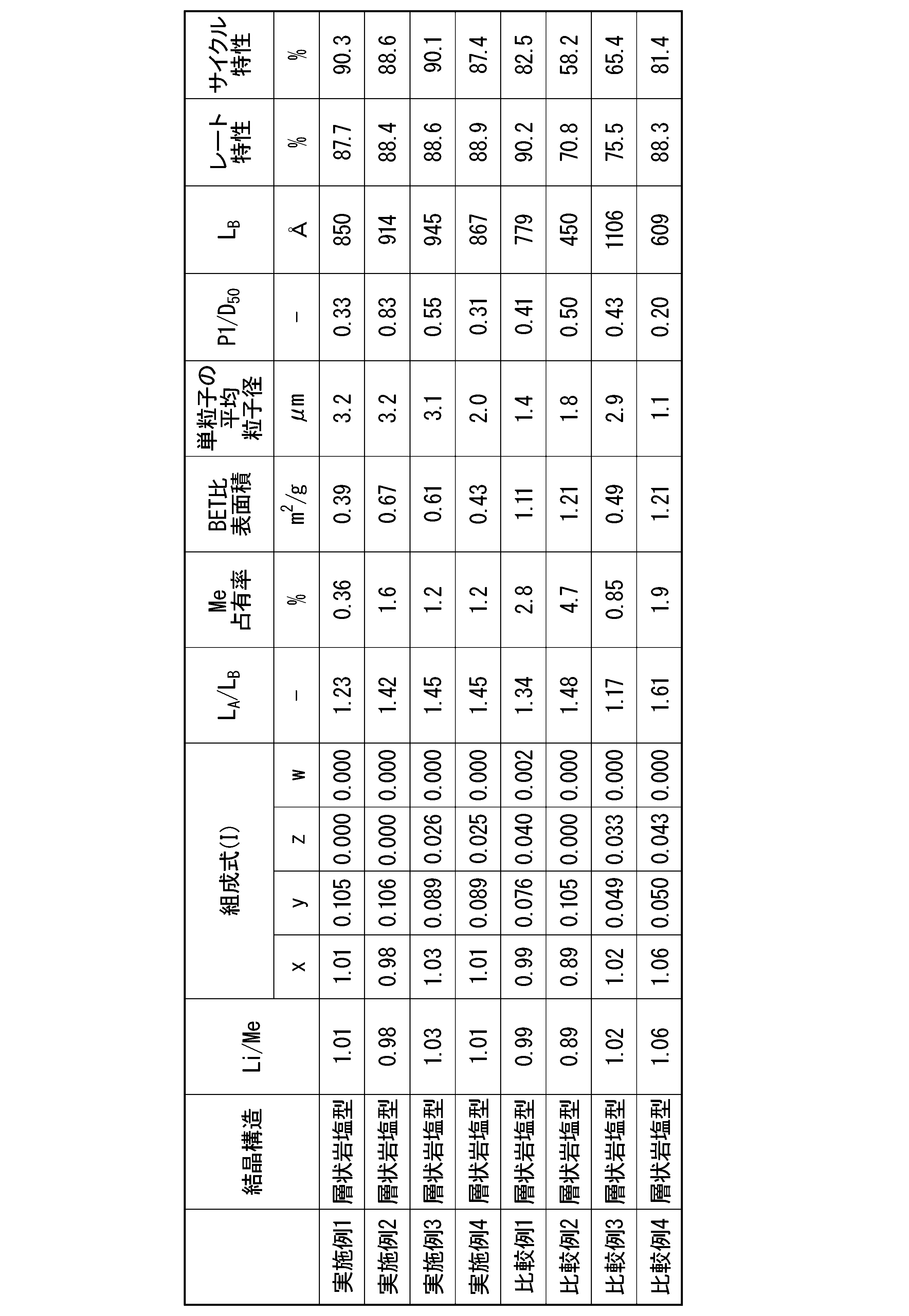
上記結果に示した通り、LA/LB、Me占有率が本発明の範囲である実施例1~4は、レート特性及びサイクル特性が共に優れていた。
比較例1は、(DH90-DH10)/DH50が1を超えていたため、カチオンミキシングが進行したと考えられる。これにより、リチウムイオンが不足したため、リチウム二次電池の容量は低下しやすく、サイクル特性が不良という結果であった。
比較例2は、金属複合水酸化物の酸化温度が高温であったため、カチオンミキシングが進行したと考えられる。これにより、リチウムイオンが不足したため、リチウム二次電池の容量は低下しやすく、レート特性及びサイクル特性が不良という結果であった。
比較例3は、不活性溶融剤としてKOHを使用したため、結晶が過剰に異方成長していた。これにより、リチウムイオンの拡散経路が長くなり、内部抵抗が増大してレート特性とサイクル特性が劣化したと考えられる。
比較例4は、不活性溶融剤の添加量が少なかったため、単粒子の成長が十分に促進されず、レート特性とサイクル特性が不良という結果であった。
比較例2は、金属複合水酸化物の酸化温度が高温であったため、カチオンミキシングが進行したと考えられる。これにより、リチウムイオンが不足したため、リチウム二次電池の容量は低下しやすく、レート特性及びサイクル特性が不良という結果であった。
比較例3は、不活性溶融剤としてKOHを使用したため、結晶が過剰に異方成長していた。これにより、リチウムイオンの拡散経路が長くなり、内部抵抗が増大してレート特性とサイクル特性が劣化したと考えられる。
比較例4は、不活性溶融剤の添加量が少なかったため、単粒子の成長が十分に促進されず、レート特性とサイクル特性が不良という結果であった。
1:セパレータ、3:負極、4:電極群、5:電池缶、6:電解液、7:トップインシュレーター、8:封口体、10:リチウム二次電池、21:正極リード、100:積層体、110:正極、111:正極活物質層、112:正極集電体、113:外部端子、120:負極、121:負極活物質層、122:負極集電体、123:外部端子、130:固体電解質層、200:外装体、200a:開口部、1000:全固体リチウム二次電池
Claims (9)
- 一次粒子の凝集体である二次粒子と、
前記二次粒子とは独立して存在する単粒子と、を含むリチウム金属複合酸化物であって、
層状岩塩型構造を有し、
下記組成式(I)で表され、
下記(1)及び(2)を満たす、リチウム金属複合酸化物。
LixNi1-y-z-wCoyMnzX1wO2 ・・・(I)
(ただし、前記組成式(I)は、0.9≦x≦1.2、0≦y≦0.4、0≦z≦0.4、0≦w≦0.1、及びy+z+w≦1を満たし、X1はMg、Ca、Sr、Ba、Zn、B、Al、Ga、Ti、Zr、Ge、Fe、Cu、Cr、V、W、Mo、Sc、Y、Nb、La、Ta、Tc、Ru、Rh、Pd、Ag、Cd、In及びSnからなる群から選択される1種以上の元素を表す。)
(1):1.20≦LA/LB<1.60
(LAは、CuKα線を使用した粉末X線回折から得られる回折ピークにおいて、2θ=18.8±1°の範囲内の回折ピーク1から求められる結晶子径であり、LBは、2θ=38.3±1°の範囲内の回折ピーク2から求められる結晶子径である。)
(2):前記回折ピークをリートベルト解析法で解析して求められる、前記層状岩塩型構造のリチウムサイトにおけるMe占有率が2.5%以下である。前記Meは、Ni、Co、Mn又は前記X1である。 - 前記zは0≦z≦0.2を満たす、請求項1に記載のリチウム金属複合酸化物。
- BET比表面積が1.0m2/g以下である、請求項1又は2に記載のリチウム金属複合酸化物。
- 前記単粒子の平均粒子径が2.0μm以上10μm以下である、請求項1~3のいずれか1項に記載のリチウム金属複合酸化物。
- 下記(3)を満たす、請求項1~4のいずれか1項に記載のリチウム金属複合酸化物。
(3):0.30≦P1/D50
(P1は、前記単粒子の平均粒子径(μm)である。D50は、レーザー回折散乱法により測定される体積基準の累積粒度分布曲線から得られる、前記リチウム金属複合酸化物の50%累積体積粒度(μm)である。) - 前記LBは1000Å以下である、請求項1~5のいずれか1項に記載のリチウム金属複合酸化物。
- 請求項1~6のいずれか1項に記載のリチウム金属複合酸化物を含有するリチウム二次電池用正極活物質。
- 請求項7に記載のリチウム二次電池用正極活物質を含むリチウム二次電池用正極。
- 請求項8に記載のリチウム二次電池用正極を含むリチウム二次電池。
Priority Applications (2)
| Application Number | Priority Date | Filing Date | Title |
|---|---|---|---|
| US18/569,203 US20240286922A1 (en) | 2021-06-16 | 2022-06-14 | Lithium metal composite oxide, positive electrode active material for lithium secondary battery, positive electrode for lithium secondary battery, and lithium secondary battery |
| KR1020237043433A KR20240021817A (ko) | 2021-06-16 | 2022-06-14 | 리튬 금속 복합 산화물, 리튬 이차 전지용 정극 활물질, 리튬 이차 전지용 정극 및 리튬 이차 전지 |
Applications Claiming Priority (2)
| Application Number | Priority Date | Filing Date | Title |
|---|---|---|---|
| JP2021100125A JP7678714B2 (ja) | 2021-06-16 | 2021-06-16 | リチウム金属複合酸化物、リチウム二次電池用正極活物質、リチウム二次電池用正極及びリチウム二次電池 |
| JP2021-100125 | 2021-06-16 |
Publications (1)
| Publication Number | Publication Date |
|---|---|
| WO2022265016A1 true WO2022265016A1 (ja) | 2022-12-22 |
Family
ID=84527492
Family Applications (1)
| Application Number | Title | Priority Date | Filing Date |
|---|---|---|---|
| PCT/JP2022/023824 Ceased WO2022265016A1 (ja) | 2021-06-16 | 2022-06-14 | リチウム金属複合酸化物、リチウム二次電池用正極活物質、リチウム二次電池用正極及びリチウム二次電池 |
Country Status (4)
| Country | Link |
|---|---|
| US (1) | US20240286922A1 (ja) |
| JP (1) | JP7678714B2 (ja) |
| KR (1) | KR20240021817A (ja) |
| WO (1) | WO2022265016A1 (ja) |
Families Citing this family (1)
| Publication number | Priority date | Publication date | Assignee | Title |
|---|---|---|---|---|
| JP2024115038A (ja) * | 2023-02-14 | 2024-08-26 | トヨタ自動車株式会社 | 非水電解質二次電池 |
Citations (3)
| Publication number | Priority date | Publication date | Assignee | Title |
|---|---|---|---|---|
| WO2018043189A1 (ja) * | 2016-08-31 | 2018-03-08 | パナソニックIpマネジメント株式会社 | 非水電解質二次電池用正極活物質及び非水電解質二次電池 |
| JP2018107053A (ja) * | 2016-12-28 | 2018-07-05 | 日立オートモティブシステムズ株式会社 | リチウムイオン二次電池 |
| JP2019106241A (ja) * | 2017-12-08 | 2019-06-27 | 住友金属鉱山株式会社 | ニッケルマンガンコバルト複合水酸化物、ニッケルマンガンコバルト複合水酸化物の製造方法及び、リチウムニッケルマンガンコバルト複合酸化物 |
Family Cites Families (2)
| Publication number | Priority date | Publication date | Assignee | Title |
|---|---|---|---|---|
| JP6729051B2 (ja) | 2016-06-22 | 2020-07-22 | 住友金属鉱山株式会社 | リチウムニッケル含有複合酸化物および非水系電解質二次電池 |
| KR102761160B1 (ko) | 2017-08-25 | 2025-02-03 | 스미토모 긴조쿠 고잔 가부시키가이샤 | 비수계 전해질 이차 전지용 정극 활물질과 그의 제조 방법, 비수계 전해질 이차 전지용 정극 합재 페이스트 및 비수계 전해질 이차 전지 |
-
2021
- 2021-06-16 JP JP2021100125A patent/JP7678714B2/ja active Active
-
2022
- 2022-06-14 US US18/569,203 patent/US20240286922A1/en active Pending
- 2022-06-14 KR KR1020237043433A patent/KR20240021817A/ko active Pending
- 2022-06-14 WO PCT/JP2022/023824 patent/WO2022265016A1/ja not_active Ceased
Patent Citations (3)
| Publication number | Priority date | Publication date | Assignee | Title |
|---|---|---|---|---|
| WO2018043189A1 (ja) * | 2016-08-31 | 2018-03-08 | パナソニックIpマネジメント株式会社 | 非水電解質二次電池用正極活物質及び非水電解質二次電池 |
| JP2018107053A (ja) * | 2016-12-28 | 2018-07-05 | 日立オートモティブシステムズ株式会社 | リチウムイオン二次電池 |
| JP2019106241A (ja) * | 2017-12-08 | 2019-06-27 | 住友金属鉱山株式会社 | ニッケルマンガンコバルト複合水酸化物、ニッケルマンガンコバルト複合水酸化物の製造方法及び、リチウムニッケルマンガンコバルト複合酸化物 |
Also Published As
| Publication number | Publication date |
|---|---|
| JP2022191727A (ja) | 2022-12-28 |
| JP7678714B2 (ja) | 2025-05-16 |
| KR20240021817A (ko) | 2024-02-19 |
| US20240286922A1 (en) | 2024-08-29 |
Similar Documents
| Publication | Publication Date | Title |
|---|---|---|
| EP3852170B1 (en) | Positive electrode active material for all-solid-state lithium-ion battery, electrode, and all-solid-state lithium-ion battery | |
| JP6650064B1 (ja) | 全固体リチウムイオン電池用正極活物質、電極および全固体リチウムイオン電池 | |
| EP3678231B1 (en) | Positive electrode active substance for all solid-state lithium secondary battery | |
| EP3537521B1 (en) | Lithium cobalt oxide positive electrode material and preparation method therefor and lithium ion secondary battery | |
| KR101989760B1 (ko) | 정극 활성 물질 전구체 입자 분말 및 정극 활성 물질 입자 분말, 및 비수전해질 이차 전지 | |
| JP6542421B1 (ja) | リチウム金属複合酸化物粉末、リチウム二次電池用正極活物質、リチウム二次電池用正極、及びリチウム二次電池 | |
| JP2024533230A (ja) | リチウム二次電池用正極活物質、その製造方法およびこれを含むリチウム二次電池 | |
| JP7194703B2 (ja) | 全固体リチウムイオン電池用正極活物質、電極および全固体リチウムイオン電池 | |
| JP7691527B2 (ja) | 充電式リチウムイオン電池用の正極活物質としてのリチウムニッケル系複合酸化物 | |
| JP7471903B2 (ja) | リチウム金属複合酸化物、リチウム二次電池用正極活物質、リチウム二次電池用正極及びリチウム二次電池 | |
| JP7157219B1 (ja) | リチウム二次電池用正極活物質、リチウム二次電池用正極及びリチウム二次電池 | |
| JP5884084B2 (ja) | 負極活物質、蓄電デバイス及び負極活物質の製造方法 | |
| JP6810287B1 (ja) | 全固体リチウムイオン電池用正極活物質、電極及び全固体リチウムイオン電池 | |
| US10305103B2 (en) | Stabilized electrodes for lithium batteries | |
| JP6980053B2 (ja) | リチウム二次電池用正極活物質前駆体、リチウム二次電池用正極活物質前駆体の製造方法及びリチウム二次電池用正極活物質の製造方法 | |
| US20240286922A1 (en) | Lithium metal composite oxide, positive electrode active material for lithium secondary battery, positive electrode for lithium secondary battery, and lithium secondary battery | |
| KR102533325B1 (ko) | 리튬 전이 금속 복합 산화물 및 제조 방법 | |
| RU2776156C1 (ru) | Катодный материал с высокой объемной плотностью энергии для литий-ионных аккумуляторов | |
| JP7227894B2 (ja) | リチウム金属複合酸化物、リチウム二次電池用正極活物質、リチウム二次電池用正極及びリチウム二次電池 |
Legal Events
| Date | Code | Title | Description |
|---|---|---|---|
| 121 | Ep: the epo has been informed by wipo that ep was designated in this application |
Ref document number: 22825004 Country of ref document: EP Kind code of ref document: A1 |
|
| WWE | Wipo information: entry into national phase |
Ref document number: 18569203 Country of ref document: US |
|
| NENP | Non-entry into the national phase |
Ref country code: DE |
|
| 122 | Ep: pct application non-entry in european phase |
Ref document number: 22825004 Country of ref document: EP Kind code of ref document: A1 |