WO2022264841A1 - 水中油型乳化化粧料 - Google Patents
水中油型乳化化粧料 Download PDFInfo
- Publication number
- WO2022264841A1 WO2022264841A1 PCT/JP2022/022667 JP2022022667W WO2022264841A1 WO 2022264841 A1 WO2022264841 A1 WO 2022264841A1 JP 2022022667 W JP2022022667 W JP 2022022667W WO 2022264841 A1 WO2022264841 A1 WO 2022264841A1
- Authority
- WO
- WIPO (PCT)
- Prior art keywords
- oil
- acid
- mass
- cosmetic
- type
- Prior art date
- Legal status (The legal status is an assumption and is not a legal conclusion. Google has not performed a legal analysis and makes no representation as to the accuracy of the status listed.)
- Ceased
Links
Images


Classifications
-
- A—HUMAN NECESSITIES
- A61—MEDICAL OR VETERINARY SCIENCE; HYGIENE
- A61K—PREPARATIONS FOR MEDICAL, DENTAL OR TOILETRY PURPOSES
- A61K8/00—Cosmetics or similar toiletry preparations
- A61K8/02—Cosmetics or similar toiletry preparations characterised by special physical form
- A61K8/04—Dispersions; Emulsions
- A61K8/06—Emulsions
-
- A—HUMAN NECESSITIES
- A61—MEDICAL OR VETERINARY SCIENCE; HYGIENE
- A61K—PREPARATIONS FOR MEDICAL, DENTAL OR TOILETRY PURPOSES
- A61K8/00—Cosmetics or similar toiletry preparations
- A61K8/18—Cosmetics or similar toiletry preparations characterised by the composition
- A61K8/30—Cosmetics or similar toiletry preparations characterised by the composition containing organic compounds
- A61K8/33—Cosmetics or similar toiletry preparations characterised by the composition containing organic compounds containing oxygen
- A61K8/37—Esters of carboxylic acids
-
- A—HUMAN NECESSITIES
- A61—MEDICAL OR VETERINARY SCIENCE; HYGIENE
- A61Q—SPECIFIC USE OF COSMETICS OR SIMILAR TOILETRY PREPARATIONS
- A61Q19/00—Preparations for care of the skin
Definitions
- the present disclosure relates to oil-in-water emulsified cosmetics.
- Patent Document 1 discloses that i) at least one polymer containing a sulfonic acid group, ii) a polysaccharide modified with a hydrophobic chain, and iii) at least one ( Disclosed is an oil-in-water emulsion type composition comprising one silicone surfactant selected from meth)acrylic acid polymers and/or oxyethylenated polydimethylsiloxanes, and pigments and/or fillers. .
- Patent Document 2 discloses (A) a salt-type drug, (B) a hydrophilic nonionic surfactant, (C) an N-long-chain acyl acidic amino acid monosalt, (D) two or more higher fatty acids and a higher fatty acid soap. an alkali, (E) a higher alcohol, (F) an oil, and (G) water, and the emulsified particles are made fine by high-pressure emulsification.
- Patent Document 3 discloses (A) 0.01 to 2.0% by mass of a water-soluble gelling agent, (B) 0.01 to 1.0% by mass of a water-soluble thickening agent, and (C) a gemini type anion. 0.01 to 2.0% by mass of a surfactant, (D) a water-soluble whitening agent, (E) an electrolyte other than (D), and (F) an oil agent, an oil-in-water emulsion composition is disclosed. ing.
- hydrophobized particles are blended in the oil phase (oil droplets), and salt-type or acid-type drugs are blended in the water phase (dispersion medium).
- Patent Document 1 [0010]
- Patent Document 2 [0002] [0003]
- Patent Document 3 [0002]
- powders for example, pigments , fillers
- salt-type agents etc.
- hydrophobized particles when relatively large-sized pigment-grade hydrophobized particles are used as the hydrophobized particles to be blended in the oil-in-water emulsified cosmetic for the purpose of expressing a tone-up effect that brightens the skin color.
- oil droplets When an oil-in-water emulsified cosmetic containing such hydrophobized particles in the oil phase (oil droplets) is applied to the skin, the oil droplets containing the hydrophobized particles are in a state in which the oil is attracted by the particles. Therefore, it is likely to be adsorbed and stay near the ridges or grooves of the skin, which have high surface activity. As a result, an oil containing hydrophobized particles (for example, pigment-grade hydrophobized particles) is difficult to apply evenly on the skin, which may cause tone-up unevenness.
- hydrophobized particles for example, pigment-grade hydrophobized particles
- the subject of the present disclosure provides an oil-in-water emulsified cosmetic that contains pigment-grade hydrophobized particles and a salt-type or acid-type whitening agent and/or anti-inflammatory agent and has excellent emulsion stability and tone-up properties. It is to be.
- An oil-in-water emulsified cosmetic comprising a dispersion medium containing water and oil droplets dispersed in the dispersion medium,
- the dispersion medium contains at least one selected from the group consisting of whitening agents and anti-inflammatory agents, and pigment-grade hydrophobized particles
- the whitening agent contains at least one selected from the group consisting of salt-type whitening agents and acid-type whitening agents
- the anti-inflammatory agent contains at least one selected from the group consisting of salt-type anti-inflammatory agents and acid-type anti-inflammatory agents
- Oil-in-water emulsified cosmetic ⁇ Aspect 2> The cosmetic according to aspect 1, wherein the oil droplets contain a nonionic surfactant.
- the salt-type whitening agent is ascorbate, tranexamate, glycyrrhizinate, nicotinate, kojicate, ellagate, 1-piperidinepropionate, 3-O-ethyl-L-ascorbate, and alkoxysalicylate
- the acid-type whitening agent is ascorbic acid, tranexamic acid, glycyrrhizic acid, nicotinic acid, kojic acid, ellagic acid, 1-piperidinepropionic acid, 3-O -ethyl-L-ascorbic acid, and at least one selected from the group consisting of alkoxysalicylic acid, cosmetics according to any one of aspects 1 to 5.
- ⁇ Aspect 9> The cosmetic according to any one of aspects 1 to 8, wherein the pigment-grade hydrophobized particles have an average particle size of 250 nm or more.
- an oil-in-water emulsified cosmetic containing pigment-grade hydrophobized particles and a salt-type or acid-type whitening agent and/or anti-inflammatory agent and having excellent emulsion stability and tone-up properties is provided. can be done.
- (a) is a schematic diagram of an oil-in-water emulsified cosmetic according to one embodiment of the present disclosure
- (b) is a schematic diagram of a state in which the cosmetic is applied to the skin and the moisture is dried
- ( c) is a schematic diagram of a state in which the cosmetics are familiar with the skin.
- (a) is a schematic diagram of an oil-in-water emulsified cosmetic containing oil droplets containing pigment-grade hydrophobized particles
- (b) is a schematic diagram of a state in which the cosmetic is applied to the skin.
- the oil-in-water emulsified cosmetic of the present disclosure includes a dispersion medium containing water and oil droplets dispersed in the dispersion medium, and the dispersion medium is at least selected from the group consisting of whitening agents and anti-inflammatory agents. and pigment-grade hydrophobized particles, the whitening agent includes at least one selected from the group consisting of a salt-type whitening agent and an acid-type whitening agent, and the anti-inflammatory agent is a salt-type anti-inflammatory agent and an acid-type anti-inflammatory agent. It contains at least one selected from the group consisting of anti-inflammatory agents.
- the cosmetic of the present disclosure contains pigment-grade hydrophobized particles and salt-type or acid-type whitening agents and/or anti-inflammatory agents, but emulsification stability It is believed that the principle of action of the superiority and tone-up properties is as follows.
- an oil-in-water emulsified cosmetic contains powders (e.g., pigments, fillers), salt-type agents, etc., each of them individually has a certain amount of electric charge, and thus emulsified particles ( It is thought that it acts so as to destroy the emulsification balance of oil droplets).
- the cosmetics of the present disclosure contain a salt-type or acid-type whitening agent and/or an anti-inflammatory agent together with pigment-grade hydrophobized particles. It is believed that salt-type or acid-type whitening agents and anti-inflammatory agents carry a negative charge in the aqueous phase, while the pigment-grade hydrophobized particles carry a positive charge. As a result, the attraction between the salt-type or acid-type whitening agent and anti-inflammatory agent and the pigment-level hydrophobized particles becomes dominant, and the effect on the emulsified particles (oil droplets) is reduced. I think that will improve.
- the hydrophobicized particles are generally blended in the oil phase because they are hydrophobic.
- the present inventors have found that when pigment-level hydrophobized particles are blended in the aqueous phase of an oil-in-water emulsified cosmetic, the tone-up effect is improved when such cosmetic is applied to the skin. .
- the pigment-level hydrophobized particles 20 are shown in FIG.
- the tone-up effect is greater than that of oil-in-water emulsified cosmetics containing pigment-level hydrophobized particles in the oil phase.
- the dispersion medium (aqueous phase) in the oil-in-water emulsified cosmetic composition of the present disclosure contains at least one selected from the group consisting of water, pigment-grade hydrophobized particles, whitening agents and anti-inflammatory agents.
- the amount of water to be blended is not particularly limited.
- the water that can be used in the oil-in-water emulsified cosmetic of the present disclosure is not particularly limited, and for example, water used in cosmetics and quasi-drugs can be used.
- water used in cosmetics and quasi-drugs can be used.
- deionized water, distilled water, ultrapure water, and tap water can be used.
- the blending amount of the pigment-grade hydrophobized particles is not particularly limited, and can be appropriately selected based on the desired effect (for example, tone-up effect, SPF) according to the application.
- the blending amount of the pigment-grade hydrophobized particles may be, for example, 0.5% by mass or more, 1.0% by mass or more, or 1.5% by mass or more with respect to the total amount of the cosmetic, and It can be 15% by mass or less, 12% by mass or less, 10% by mass or less, 8.0% by mass or less, 6.0% by mass or less, or 5.0% by mass or less.
- the average particle size of the pigment-grade hydrophobized particles can be appropriately selected so as to obtain the desired effect (for example, tone-up effect, SPF) according to the application.
- the average particle diameter of the pigment-grade hydrophobized particles can be, for example, 250 nm or more, 300 nm or more, 350 nm or more, or 400 nm or more.
- Pigment-grade hydrophobized particles having an average particle diameter of 300 nm or more can suitably exhibit a tone-up effect for brightening skin color.
- the upper limit of the average particle size is not particularly limited, for example, 100 ⁇ m or less, 70 ⁇ m or less, 50 ⁇ m or less, 30 ⁇ m or less, 10 ⁇ m or less, 5 ⁇ m or less, 1 ⁇ m (1,000 nm) or less, 800 nm or less, 700 nm or less, or 600 nm or less.
- the average particle size of the pigment-grade hydrophobized particles in the present disclosure and the hydrophobized fine particles of an optional component to be described later may be the size of primary particles or aggregated secondary particles. can be calculated by
- the hydrophobization treatment of the pigment-grade hydrophobized particles is not particularly limited, and any treatment that modifies the surface of such particles with an organic compound to make them hydrophobic, such as methylhydrogenpolysiloxane, dimethylpolysiloxane (dimethicone), silicone-based treatment or silane-based treatment with alkylsilane or the like; fluorine-based treatment with perfluoroalkyl phosphate, perfluoroalcohol or the like; titanate-based treatment with alkyl titanate or the like; amino acid treatment with N-acylglutamic acid or the like; , lecithin treatment; metal soap treatment; fatty acid treatment; and alkyl phosphate treatment.
- Hydrophobic treatment can be used alone or in combination.
- the hydrophobizing treatment can be carried out using a hydrophobizing agent.
- silicones used as hydrophobizing agents include known silicones having hydrogen-silicon bonds such as methylhydrogenpolysiloxane (dimethicone/methicone) copolymers.
- silicones having hydrogen-silicon bonds such as methylhydrogenpolysiloxane (dimethicone/methicone) copolymers.
- triethoxysilylethylpolydimethylsiloxyethyldimethicone triethoxysilylethylpolydimethylsiloxyethylhexyldimethicone, etc., having an alkoxy group-silicon bond as a reactive group can also be mentioned.
- dimethylpolysiloxane and the like can also be used.
- silane-based treatment agents examples include silylating agents into which organic groups are introduced, and silane coupling agents, such as triethoxycaprylylsilane.
- titanate-based treatment agents include titanium coupling agents such as alkyl titanates, pyrophosphate-type titanates, phosphorous acid-type titanates, and amino acid-type titanates.
- the type of particles constituting the pigment-grade hydrophobized particles is not particularly limited, and can be appropriately selected so as to obtain the desired effect (eg, tone-up effect, SPF) according to the application.
- pigment-grade hydrophobized particles include inorganic particles, specifically inorganic oxide particles, for example, white inorganic oxide particles such as titanium oxide particles, zinc oxide particles, and cerium oxide particles ("inorganic white may be referred to as "system pigment”.) and the like.
- inorganic particles that are generally classified as pearlescent agents (bright pigments), colorants, or phosphors can also be used as the pigment-grade hydrophobized particles of the present disclosure.
- Organic particles can also be used as the pigmentary hydrophobized particles of the present disclosure.
- the pigment-grade hydrophobized particles can be used alone or in combination of two or more.
- the term “pearl agent” means particles that exhibit luster without including a coloring material and a phosphor.
- a pearlescent agent typically has a plate-like form such as flakes or scales.
- the term “coloring material” refers to a material that presents a color other than white, does not contain pearlescent agents and phosphors, and does not exhibit luster that can cause the cosmetic to develop color.
- inorganic oxide particles such as titanium oxide particles and / or phosphors described above. It is preferable to use together at least one selected from inorganic oxide particles such as titanium oxide particles, pearlescent agents, and phosphors.
- Pearl agents include, for example, mica titanium (mica titanium), iron oxide-coated mica titanium, carmine-coated mica titanium, carmine/conjo-coated mica titanium, iron oxide/carmine-treated mica titanium, konjo-treated mica titanium, and iron oxide/conjo treatment.
- a colorless pearlescent agent can also be used as the pearlescent agent.
- a known transparent pearlescent agent transparent luster pigment
- a pearlescent agent can be used in which a glass particle is used as a base material and a coating film composed of a high refractive index material such as titanium oxide is formed on the surface of the base material.
- an inorganic pigment can be used as the coloring material.
- inorganic pigments include inorganic red pigments (e.g., iron oxide (red iron oxide), iron titanate, etc.); inorganic brown pigments (e.g., ⁇ -iron oxide, etc.); inorganic yellow pigments (e.g., yellow iron oxide , ocher, etc.); inorganic black pigments (e.g., black iron oxide, low order titanium oxide, etc.); inorganic purple pigments (e.g., manganese violet, cobalt violet, etc.); inorganic green pigments (e.g., chromium oxide, hydroxide chromium, cobalt titanate, etc.); inorganic blue pigments (eg, ultramarine blue, Prussian blue, etc.); metal powders (eg, aluminum, gold, silver, copper, etc.).
- inorganic red pigments e.g., iron oxide (red iron oxide), iron titanate, etc.
- inorganic brown pigments e.g., ⁇ -iron oxide, etc.
- Phosphors include, for example, MnCl 2 (red), Sm 2 (SO 4 ) 3.8H 2 O (orange), CaWO 4 (blue), MgWO 4 (bluish white), CaMoO 4 (yellow green), KCl: Tl (blue-green), NaCl:Mn (red), ZnO:Zn (white-green), CaS:Bi (purple), ZnS:Cu (yellow - green), ZnS:Ag ( purple), Zn2SiO4:Mn ( green), Ca3(PO4)2 : Ce :Mn (red), Y2O3:Eu, YVO4 :Eu, Y2O2S :Eu, ( Y,Cd) BO3 :Eu , 0 .
- a luminescent composition containing predetermined amounts of In 2 O 3 and ZnS:Ag examples include a luminescent composition containing predetermined amounts of In 2 O 3 and ZnS:Ag, and a luminescent composition containing predetermined amounts of ZnO and ZnS:Ag phosphor.
- zinc oxide phosphor ZnO:Zn
- a zinc oxide phosphor can be obtained by firing zinc oxide in a reducing atmosphere such as H 2 or CO.
- a magnesium titanate phosphor can also be suitably used.
- the oil-in-water emulsified cosmetic of the present disclosure contains at least one selected from the group consisting of a salt-type whitening agent and an acid-type whitening agent as a whitening agent in a dispersion medium (aqueous phase). include.
- the amount of the whitening agent is not particularly limited. .5% by mass or more, 0.7% by mass or more, or 1.0% by mass or more, and 15.0% by mass or less, 10.0% by mass or less, 8.0% by mass or less, or It can be 5.0% by mass or less.
- Such a whitening agent is not particularly limited as long as it exhibits a whitening effect.
- examples include ascorbic acid (L-ascorbic acid), tranexamic acid, glycyrrhizic acid, nicotinic acid, kojic acid, ellagic acid, 1-piperidinepropionic acid, 3-O-ethyl-L-ascorbic acid, and alkoxysalicylic acid (such as 4-methoxysalicylic acid); at least one acid-type whitening agent selected from; At least one salt-type whitening agent selected from O-ethyl-L-ascorbate and alkoxysalicylate (eg, 4-methoxysalicylate).
- Salts of salt-type whitening agents include alkali metal salts such as sodium salts and potassium salts; alkaline earth metal salts such as calcium salts and magnesium salts; zinc salts; iron salts; ammonium salts; salts with basic amino acids; and salts with amines such as monoethanolamine, diethanolamine and triethanolamine.
- Salt-type whitening agents and acid-type whitening agents can be used alone or in combination of two or more.
- a whitening agent other than salt-type whitening agents and acid-type whitening agents may be used in combination.
- examples of such whitening agents include ascorbic acid derivatives (eg, ascorbic acid glucoside), tranexamic acid derivatives, glycyrrhizic acid derivatives, nicotinic acid derivatives (eg, niacinamide), kojic acid derivatives (eg, kojic acid dipalmitate), ellagic acid derivatives, Alkoxysalicylic acid derivatives, hydroquinone, ⁇ -arbutin, ⁇ -arbutin, nicotinamide, astaxanthin, histidine dithiooctanamide (Na/zinc), chamomile extract, licorice extract, placenta extract, rosemary extract, lucinol, magnolignan, etc. mentioned.
- Other whitening agents can be used alone or in combination of two or more.
- the cosmetic of the present disclosure contains a salt-type whitening agent and/or an acid-type whitening agent, it simultaneously contains pigment-grade hydrophobized particles in the aqueous phase, so that the salt-type whitening agent and/or acid-type whitening agent is used as the whitening agent. Even if the whitening agent is contained at a high level, the emulsion stability of the cosmetic can be improved.
- the cosmetic of the present disclosure contains at least one selected from the group consisting of salt-type whitening agents and acid-type whitening agents in an amount of 50% by mass or more, 60% by mass or more, based on the total amount of the whitening agent components, 70 mass % or more, 80 mass % or more, or 90 mass % or more can be included.
- the oil-in-water emulsified cosmetic of the present disclosure contains an anti-inflammatory agent selected from the group consisting of a salt-type anti-inflammatory agent and an acid-type anti-inflammatory agent in a dispersion medium (aqueous phase). Contains at least one.
- the amount of the anti-inflammatory agent is not particularly limited. 0.5% by mass or more, 0.7% by mass or more, or 1.0% by mass or more, and 15.0% by mass or less, 10.0% by mass or less, 8.0% by mass or less, Alternatively, it can be 5.0% by mass or less.
- Such an anti-inflammatory agent is not particularly limited as long as it exhibits an anti-inflammatory effect.
- agents that exhibit both skin-lightening and anti-inflammatory properties are treated as skin-lightening agents in the present disclosure.
- anti-inflammatory agents include L-ascorbyl magnesium phosphate, glycyrrhizin, dipotassium glycyrrhizinate, ammonium glycyrrhizinate, allantoin, and the like.
- Salt-type anti-inflammatory agents and acid-type anti-inflammatory agents can each be used alone or in combination of two or more.
- Anti-inflammatory agents other than salt-type anti-inflammatory agents and acid-type anti-inflammatory agents may be used in combination.
- the cosmetic of the present disclosure contains a salt-type anti-inflammatory agent and/or an acid-type anti-inflammatory agent, it simultaneously contains pigment-grade hydrophobized particles in the aqueous phase. / Or even if the acid type anti-inflammatory agent is highly contained, the emulsification stability of the cosmetic can be improved.
- the cosmetic of the present disclosure contains at least one selected from the group consisting of salt-type anti-inflammatory agents and acid-type anti-inflammatory agents in an amount of 50% by mass or more and 60% by mass of the total amount of anti-inflammatory agent components. % or more, 70 mass % or more, 80 mass % or more, or 90 mass % or more.
- the cosmetics of the present disclosure contain at least one selected from the group consisting of salt-type whitening agents, acid-type whitening agents, salt-type anti-inflammatory agents, and acid-type anti-inflammatory agents. , 50% by mass or more, 60% by mass or more, 70% by mass or more, 80% by mass or more, or 90% by mass or more relative to the total amount of the whitening agent component and the anti-inflammatory agent component.
- the mass ratio of the pigment-grade hydrophobized particles to the total amount of the whitening agent component and the anti-inflammatory agent component is 5.0 or less, 4.5 or less, 4.0 or less, It is preferably 3.5 or less, 3.0 or less, 2.5 or less, 2.0 or less, 1.5 or less, 1.0 or less, less than 1.0, or 0.9 or less.
- the lower limit of the mass ratio is preferably 0.1 or more, 0.3 or more, or 0.5 or more.
- Oil droplet as the oil phase or dispersed phase in the oil-in-water emulsified cosmetic contain oil.
- oil content in the oil-in-water emulsified cosmetic of the present disclosure is not particularly limited. 5.0% by mass or more, 7.0% by mass or more, 10% by mass or more, 15% by mass or more, 20% by mass or more, 25% by mass or more, or 30% by mass or more, and 50% by mass or more % by mass or less, 40% by mass or less, 30% by mass or less, 20% by mass or less, 15% by mass or less, or 10% by mass or less.
- Cosmetics having a high oil content for example, 20% by mass or more, can be blended in the oil phase. Therefore, the UV protection effect (SPF) can be further improved.
- SPF UV protection effect
- the type of oil is not particularly limited, and for example, volatile oil and non-volatile oil can be used.
- An oil component can be used individually or in combination of 2 or more types.
- volatile is intended to exhibit a volatile content of more than 5% when left at 105°C under atmospheric pressure for 3 hours.
- the volatile content which is a guideline for volatility, should be 10% or more, 20% or more, 40% or more, 50% or more, 60% or more, 80% or more, or 100%. is preferred.
- the boiling point at 1 atmosphere (101.325 kPa) can be used as an indicator of volatility.
- the boiling point is preferably 250° C. or lower, 240° C. or lower, or 230° C.
- non-volatile intends to exhibit a volatile content of 5% or less when left at 105°C for 3 hours.
- the volatile oil is not particularly limited, and examples include volatile silicone oil and volatile hydrocarbon oil.
- a volatile oil can be used individually or in combination of 2 or more types.
- Volatile silicone oils include, for example, volatile acyclic silicone oils and volatile cyclic silicone oils. Among these, volatile acyclic silicone oils are preferred.
- volatile acyclic silicone oils for example, volatile linear silicone oils and volatile branched silicone oils can be used. Among these, volatile linear silicone oils are preferred.
- Volatile linear silicone oils include, for example, dimethylpolysiloxane with a viscosity of 0.65 cSt (sometimes referred to as “dimethicone"), dimethylpolysiloxane with a viscosity of 1 cSt, dimethylpolysiloxane with a viscosity of 1.5 cSt, and dimethylpolysiloxane with a viscosity of 2 cSt. and low-molecular-weight linear dimethylpolysiloxane such as dimethylpolysiloxane.
- dimethylpolysiloxane having a viscosity of 1 cSt and dimethylpolysiloxane having a viscosity of 1.5 cSt are preferable.
- these viscosities are intended to be kinematic viscosities at 25°C.
- Volatile branched silicone oils include, for example, low-molecular-weight branched siloxanes such as methyltrimethicone, tris(trimethylsilyl)methylsilane, and tetrakis(trimethylsilyl)silane.
- Volatile cyclic silicone oils include, for example, octamethylcyclotetrasiloxane, decamethylcyclopentasiloxane, and dodecamethylcyclohexasiloxane.
- Volatile hydrocarbon oils include, for example, heptane, isododecane, isohexadecane, and isodecane. Among them, isododecane is preferred.
- the amount of volatile oil blended in the oil is, for example, 0% by mass or more, 5% by mass or more, 10% by mass or more, 15% by mass or more, 20% by mass or more, 25% by mass or more, 30% by mass or more, based on the total oil content. It can be 90% by mass or more, 85% by mass or less, 80% by mass or less, 75% by mass or less, or 70% by mass. 65% by mass or less, 60% by mass or less, 55% by mass or less, or 50% by mass or less.
- the rest of the oil in this case can be non-volatile oil.
- oils include oils commonly used in cosmetics, such as liquid oils, solid oils, waxes, hydrocarbon oils other than the above, silicone oils other than the above, polar oils, and higher alcohols. etc. can be mentioned.
- oils e.g., non-volatile oils
- other oils can function as a binder between the particles and the skin. Particles can be suitably immobilized.
- Other oil components can be used alone or in combination of two or more.
- some UV absorbers act as oils, especially polar oils. Such ultraviolet absorbers can also be regarded as oils.
- liquid oils examples include avocado oil, camellia oil, turtle oil, macadamia nut oil, corn oil, mink oil, olive oil, rapeseed oil, egg yolk oil, sesame oil, persic oil, wheat germ oil, sasanqua oil, castor oil, and linseed oil. , safflower oil, cottonseed oil, perilla oil, soybean oil, peanut oil, tea seed oil, kaya oil, rice bran oil, sinagi oil, Japanese pear oil, jojoba oil, germ oil, and triglycerin.
- solid fats and oils examples include cacao butter, coconut oil, horse fat, hydrogenated coconut oil, palm oil, beef tallow, mutton tallow, hydrogenated beef tallow, palm kernel oil, lard, beef bone fat, Japanese wax kernel oil, hydrogenated oil, beef Leg fat, Japanese wax, and hydrogenated castor oil.
- Waxes include, for example, beeswax, candelilla wax, cotton wax, carnauba wax, bayberry wax, wart wax, whale wax, montan wax, bran wax, lanolin, kapok wax, lanolin acetate, liquid lanolin, sugarcane wax, isopropyl lanolin fatty acid, hexyl laurate, Reduced lanolin, jojoba wax, hard lanolin, shellac wax, POE lanolin alcohol ether, POE lanolin alcohol acetate, POE cholesterol ether, lanolin fatty acid polyethylene glycol, and POE hydrogenated lanolin alcohol ether.
- hydrocarbon oils examples include liquid paraffin, ozokerite, squalane, pristane, paraffin, ceresin, squalene, petrolatum, microcrystalline wax, and olefin oligomers.
- silicone oils examples include linear silicones such as dimethylpolysiloxane (dimethicone), methylphenylpolysiloxane (diphenylsiloxyphenyltrimethicone), and methylhydrogenpolysiloxane having a viscosity of 6 cSt or more.
- polar oil for example, a polar oil with an IOB of 0.10 or more can be used.
- the IOB value of the polar oil and UV absorber can be, for example, 0.11 or more, 0.12 or more, or 0.13 or more, and 0.50 or less, 0.45 or less, or 0.40 or less.
- the IOB value is an abbreviation for Inorganic/Organic Balance (inorganic/organic ratio), which is a value representing the ratio of the inorganic value to the organic value, and is an index indicating the degree of polarity of an organic compound. It becomes.
- higher alcohols examples include those having a carbon chain length of 16 or more, and specific examples include lauryl alcohol, cetyl alcohol, stearyl alcohol, behenyl alcohol, myristyl alcohol, oleyl alcohol, cetostearyl alcohol, and monostearyl.
- linear or branched higher alcohols such as glycerene ether (bacyl alcohol), 2-decyltetradecinol, lanolin alcohol, cholesterol, phytosterol, hexyldodecanol, isostearyl alcohol and octyldodecanol;
- the oil-in-water emulsified cosmetic composition of the present disclosure can be appropriately blended with various components within a range that does not adversely affect the effects of the present disclosure.
- various components include additive components that can be usually blended in cosmetics, such as anionic surfactants, cationic surfactants, amphoteric surfactants, nonionic surfactants, moisturizers, thickeners ( water-soluble thickeners, oil-soluble thickeners), water-soluble polymers, oil-soluble polymers, film-forming agents such as siliconized polysaccharides, higher fatty acids (e.g.
- silica, etc. usable powders
- pigments other than the pigments usable in the above pearlescent agents and coloring materials for example, organic pigments
- stabilizers, hydrophobized fine particles, dyes, pigments, fragrances, and the like can be blended in the oil phase and/or the water phase, and can be used alone or in combination of two or more. Some of these ingredients are described below.
- the oil-in-water emulsified cosmetic of the present disclosure contains a nonionic surfactant.
- Such active agents can typically function as emulsifiers, so emulsified particles (oil droplets) can include such active agents.
- nonionic surfactants examples include polyoxyalkylene alkyl ethers, polyalkylene glycol fatty acid esters, POE hydrogenated castor oil derivatives, POE alkyl ethers, POE/POP alkyl ethers, PEG fatty acid esters, polyglycerin fatty acid esters. , POE glycerin fatty acid esters, PEG glyceryl isostearate, and silicone surfactants.
- nonionic surfactants such as polyglyceryl-2 diisostearate and sorbitan sesquiisostearate can also be used.
- a nonionic surfactant can be used individually or in combination of 2 or more types.
- polyoxyalkylene alkyl ethers examples include polyoxyethylene behenyl ether and polyoxyethylene stearyl ether.
- polyalkylene glycol fatty acid esters examples include polyethylene glycol monostearate and polyethylene glycol monooleate.
- POE hydrogenated castor oil derivatives examples include POE (20-100) hydrogenated castor oil derivatives. Specific examples include POE (20) hydrogenated castor oil derivative, POE (40) hydrogenated castor oil derivative, POE (60) hydrogenated castor oil derivative, and POE (100) hydrogenated castor oil derivative.
- POE alkyl ethers examples include POE (2) lauryl ether, POE (4.2) lauryl ether, POE (9) lauryl ether, POE (5.5) cetyl ether, POE (7) cetyl ether, POE ( 10) Cetyl ether, POE (15) cetyl ether, POE (20) cetyl ether, POE (23) cetyl ether, POE (4) stearyl ether, POE (20) stearyl ether, POE (7) oleyl ether, POE (10) ) oleyl ether, POE (15) oleyl ether, POE (20) oleyl ether, POE (50) oleyl ether, POE (10) behenyl ether, POE (20) behenyl ether, POE (30) behenyl ether, POE (2) (C12-15) alkyl ether, POE (4) (C12-15) alkyl ether, POE (10) (C12-15) al
- POE/POP alkyl ethers examples include POE (1) polyoxypropylene (POP) (4) cetyl ether, POE (10) POP (4) cetyl ether, POE (20) POP (8) cetyl ether, POE (20) POP(6) decyltetradecyl ether and POE(30) POP(6) decyltetradecyl ether can be mentioned.
- PEG fatty acid esters include, for example, polyethylene glycol monolaurate (hereinafter abbreviated as PEG) (10), PEG monostearate (10), PEG monostearate (25), PEG monostearate (40), monostearate Mention may be made of PEG acid (45), PEG monostearate (55), PEG monostearate (100), PEG monooleate (10), PEG distearate, and PEG diisostearate.
- PEG polyethylene glycol monolaurate
- PEG monostearate PEG monostearate
- PEG monostearate 25
- PEG monostearate 40
- monostearate Mention may be made of PEG acid (45), PEG monostearate (55), PEG monostearate (100), PEG monooleate (10), PEG distearate, and PEG diisostearate.
- polyglycerol fatty acid esters examples include hexaglyceryl monolaurate, hexaglyceryl monomyristate, hexaglyceryl monostearate, hexaglyceryl monooleate, decaglyceryl monolaurate, decaglyceryl monomyristate, decaglyceryl monostearate, Mention may be made of decaglyceryl monoisostearate, decaglyceryl monooleate, decaglyceryl distearate, and decaglyceryl diisostearate.
- POE glycerin fatty acid esters examples include polyoxyethylene (POE) (5) glyceryl monostearate, POE (15) glyceryl monostearate, POE (5) glyceryl monooleate, and POE (15) monooleate. Mention may be made of glyceryl.
- PEG glyceryl isostearate examples include, for example, PEG (8) glyceryl isostearate, PEG (10) glyceryl isostearate, PEG (15) glyceryl isostearate, PEG (20) glyceryl isostearate, PEG (25) glyceryl isostearate, PEG (30) glyceryl isostearate, PEG (40) glyceryl isostearate, PEG (50) glyceryl isostearate, and PEG (60) glyceryl isostearate can be mentioned.
- PEG (8) glyceryl isostearate examples include, for example, PEG (8) glyceryl isostearate, PEG (10) glyceryl isostearate, PEG (15) glyceryl isostearate, PEG (20) glyceryl isostearate, PEG (25) glyceryl isostearate, PEG (30) glyceryl isostearate
- silicone surfactants examples include PEG(7) dimethicone and PEG(10) dimethicone.
- the content of the nonionic surfactant is not particularly limited. % by mass or more, and 3.0% by mass or less, 2.5% by mass or less, 2.0% by mass or less, 1.5% by mass or less, 1.0% by mass or less, or 0.5% by mass % by mass or less.
- the oil-in-water emulsified cosmetic of the present disclosure contains a polyether-modified silicone having an HLB of more than 10.0 and not more than 18.0 (sometimes simply referred to as "polyether-modified silicone") in a dispersion medium.
- the polyether-modified silicone can function as a dispersant for pigment-grade hydrophobized particles and improve the emulsion stability and tone-up of oil-in-water emulsion cosmetics containing salt-type or acid-type whitening agents and/or anti-inflammatory agents. It is possible to further improve the performance.
- Polyether-modified silicone can be used individually or in combination of 2 or more types.
- the HLB of the polyether-modified silicone is 10.5 or more, 11.0 or more, 11.5 or more, 12.5 or more, from the viewpoint of the dispersibility of the pigment-grade hydrophobized particles, emulsification stability of cosmetics, tone-up properties, and the like. It is preferably 0 or more, 12.5 or more, or 13.0 or more, and 17.5 or less, 17.0 or less, 16.5 or less, 16.0 or less, 15.5 or less, or 15.0 or less Preferably.
- HLB is generally a value indicating affinity for water and oil, a parameter known as hydrophilic-lipophilic balance.
- the HLB of polyether-modified silicone can be easily determined by the Griffin method.
- the amount of polyether-modified silicone to be blended is 0.01% by mass based on the total amount of the cosmetic, from the viewpoint of the dispersibility of the pigment-grade hydrophobized particles in the aqueous phase, the emulsification stability of the cosmetic, and the tone-up properties. 0.03% by mass or more, or 0.05% by mass or more, and 1.0% by mass or less, 0.8% by mass or less, 0.5% by mass or less, and 0.3% by mass or less, or 0.2% by mass or less.
- the mass ratio of the pigment-level hydrophobized particles to the polyether-modified silicone is, for example, 5 or more. , 7 or more, 10 or more, 12 or more, 14 or more, 15 or more, or 17 or more. , or 30 or less.
- the type of polyether-modified silicone is not particularly limited as long as it has a specific HLB. Mention may be made of methyl ether dimethicone, PEG/PPG-20/20 dimethicone, PEG/PPG-20/23 dimethicone, and PEG-17 dimethicone. Among them, PEG-11 methyl ether dimethicone is preferred.
- thickener In general, it is difficult to improve the emulsion stability of oil-in-water emulsified cosmetics containing powders, salt-type drugs and the like. ensure the emulsification stability of cosmetics. However, although the addition of a thickener may improve the emulsion stability, it tends to give a sticky feeling.
- the oil-in-water emulsified cosmetic of the present disclosure improves emulsion stability by simultaneously blending pigment-level hydrophobized particles and a salt-type or acid-type whitening agent and/or anti-inflammatory agent. Therefore, the cosmetic of the present disclosure may be substantially free of thickeners. That is, the thickener is 1% by mass or less, 0.5% by mass or less, 0.1% by mass or less, 0.01% by mass or less, or 0.001% by mass or less with respect to the total amount of the cosmetic. Although it may be blended, it is advantageous not to use a thickener from the viewpoint of stickiness and the like.
- the oil-in-water emulsified cosmetic of the present disclosure contains hydrophobized microparticles.
- hydrophobized microparticles From the viewpoint of UV protection effect, emulsion stability, etc., it is preferable to blend the hydrophobic-treated fine particles into the inner oil phase.
- the above-described pigment-grade hydrophobized particles and hydrophobized microparticles can be distinguished by their sizes.
- the pigment-grade hydrophobized particles mean hydrophobized particles having a larger particle diameter than the hydrophobized fine particles.
- the amount of the hydrophobized fine particles to be blended is not particularly limited, and can be appropriately selected based on the desired effect (for example, ultraviolet scattering effect) according to the application.
- % or more 1.0 mass % or more, 1.5 mass % or more, 2.0 mass % or more, 2.5 mass % or more, 3.0 mass % or more, 3.5 mass % or more, 4.0 mass % 4.5% by mass or more, or 5.0% by mass or more, and 20% by mass or less, 17% by mass or less, 15% by mass or less, 13% by mass or less, 10% by mass or less, 8 .0% by mass or less, 6.0% by mass or less, 5.0% by mass or less, 3.0% by mass or less, 1.0% by mass or less, 0.5% by mass or less, or 0.1% by mass or less be able to.
- hydrophobized fine particles with an average particle diameter of 200 nm or less can exhibit an ultraviolet scattering effect.
- the average particle size of the hydrophobized fine particles can be appropriately selected based on the desired effect (for example, ultraviolet scattering effect) according to the application. Alternatively, it can be 80 nm or less.
- the lower limit of the average particle size of the hydrophobized fine particles is not particularly limited, but can be, for example, 10 nm or more, 20 nm or more, 30 nm or more, 40 nm or more, 50 nm or more, 60 nm or more, or 70 nm or more.
- the hydrophobization treatment of the hydrophobized fine particles is not particularly limited, and for example, the same hydrophobization treatment as the above-described pigment-grade hydrophobized particles can be performed.
- the type of particles constituting the hydrophobized fine particles is not particularly limited, and can be appropriately selected based on the desired effect (for example, ultraviolet scattering effect) according to the application. Titanium oxide, zinc oxide, barium sulfate, iron oxide, talc, mica, sericite, kaolin, mica titanium, Prussian blue, chromium oxide, chromium hydroxide, silica, cerium oxide and the like.
- the hydrophobized microparticles can be used alone or in combination of two or more.
- particles having a refractive index of 1.5 or more such as zinc oxide particles and titanium oxide particles, from the viewpoint of optical properties and the like.
- the oil-in-water emulsified cosmetic composition of the present disclosure has a viscosity of 10,000 mPa after one day of preparation at 30° C. of the cosmetic composition measured using the conditions and apparatus described in the examples below. ⁇ s or less, 9,000 mPa s or less, 8,000 mPa s or less, 7,000 mPa s or less, or 6,000 mPa s or less, and 500 mPa s or more and 1,000 mPa s Above, it can be 1,500 mPa ⁇ s or more, 2,000 mPa ⁇ s or more, or 2,500 mPa ⁇ s or more. Since the cosmetic of the present disclosure simultaneously contains a salt-type or acid-type whitening agent and/or an anti-inflammatory agent together with pigment-grade hydrophobized particles, it exhibits good emulsification performance even under such viscosity. can be presented.
- the oil-in-water emulsified cosmetic composition of the present disclosure is 0° C., 25° C., or 4 weeks of production at 50° C. measured using the conditions and apparatus described in the examples below.
- the viscosity after treatment can be 10,000 mPa s or less, 9,000 mPa s or less, 8,000 mPa s or less, 7,000 mPa s or less, or 6,000 mPa s or less, or 500 mPa s or less. s or more, 1,000 mPa ⁇ s or more, 1,500 mPa ⁇ s or more, 2,000 mPa ⁇ s or more, or 2,500 mPa ⁇ s or more.
- the method for preparing the oil-in-water emulsified cosmetic of the present disclosure is not particularly limited, and for example, it can be prepared by known methods such as a dispersion method and an aggregation method.
- the dispersion method is a method of refining the aggregates of the dispersed phase by mechanical force. Specifically, it is a method of emulsifying using the crushing force of an emulsifier, and examples of such a method include a high-pressure emulsification method in which a high-pressure homogenizer is used to apply a high shearing force.
- the coagulation method is a colloidal preparation method that utilizes surface chemical properties, and is a method in which a uniformly dissolved state is brought into a supersaturated state by some means to emerge as a dispersed phase.
- the HLB temperature emulsification method, the phase inversion emulsification method, the non-aqueous emulsification method, the D phase emulsification method, the liquid crystal emulsification method, and the like are known.
- the dosage form of the oil-in-water emulsified cosmetic of the present disclosure is not particularly limited, and examples thereof include liquid, milky lotion, cream, gel, spray, and mousse.
- “spray” can include mist type spray, aerosol type spray, and the like.
- oil-in-water emulsified cosmetics can be used, for example, as a cosmetic that is spread and applied to the skin or the like.
- cosmetics applied to the skin can also include so-called external preparations for skin.
- the product form of the cosmetics of the present disclosure is not particularly limited, but for example, facial cosmetics such as lotions, beauty essences, milky lotions, and packs; makeup cosmetics such as foundations, lipsticks, and eye shadows; body cosmetics; hair cosmetics such as hair liquids, hair tonics, hair conditioners, shampoos, rinses and hair restorers; and ointments.
- the oil-in-water emulsified cosmetic of the present disclosure will be described in more detail below with reference to examples, but the cosmetic of the present disclosure is not limited to these.
- the compounding amount is indicated by mass %.
- tone-up evaluation test The prepared cosmetic was applied to the arm, the water was dried, and the cosmetic-applied surface was visually observed to evaluate the tone-up state according to the following criteria.
- evaluations A to B can be regarded as pass
- evaluations C to D can be regarded as failure.
- this tone-up test can indirectly evaluate whether particles such as pigment-grade hydrophobized particles are evenly applied to the skin surface. That is, it can be said that particles such as pigment-grade hydrophobized particles are uniformly applied to the skin surface in the order of D, C, B, and A.
- A There was no unevenness in brightness, and an excellent tone-up effect was exhibited.
- B A good tone-up effect was obtained, although slight unevenness in brightness occurred.
- C There was slight unevenness in brightness, and a good tone-up effect was not obtained.
- D Clear unevenness in brightness occurred, and a good tone-up effect was not obtained.
- Viscosity after 1 day of preparation of the cosmetic is rotor number 4 under conditions of 30°C and 12 rpm, and viscosity of the cosmetic after 4 weeks of preparation is rotor number 4 at 0°C, 25°C or 50°C and 12 rpm. was evaluated using a B-type viscometer (TVB-type viscometer TVB-10, manufactured by Toki Sangyo Co., Ltd.).
- Example 1 No. A part of the ion-exchanged water of No. 1 is added. 2, No. 3, No. 5 to No. 12, No. 18 ingredients were added and mixed uniformly to obtain a water phase part.
- No. No. 1 is added to the remaining ion-exchanged water of No. 1. 21 to No. 23 materials were uniformly mixed to obtain a powder part.
- the powder part was gradually added and uniformly dispersed with a homomixer to obtain an oil-in-water emulsified cosmetic of Example 1.
- Examples 2--7 Oil-in-water emulsified cosmetics of Examples 2 to 7 were obtained in the same manner as in Example 1, except that the formulations were changed to those shown in Tables 1 and 2.
- Example 8 No. A part of the ion-exchanged water of No. 1 is added. 2, No. 4, No. 8 to No. 11, No. 14 to No. 18 ingredients were added and mixed uniformly to obtain a water phase part.
- No. No. 1 is added to the remaining ion-exchanged water of No. 1. 19, No. 22, No. 23 materials were uniformly mixed to obtain a powder part.
- the powder part was gradually added and uniformly dispersed with a homomixer to obtain an oil-in-water emulsified cosmetic of Example 8.
- Example 9 An oil-in-water emulsified cosmetic of Example 9 was obtained in the same manner as in Example 8, except that the formulation was changed to that shown in Table 2.
- Reference example 1 An oil-in-water emulsified cosmetic of Reference Example 1 was obtained in the same manner as in Example 1, except that no whitening agent or anti-inflammatory agent was used. This cosmetic material was used as a reference example because it was creamy and could not be subjected to a rolling stability test.
- Reference example 2 An oil-in-water emulsified cosmetic of Reference Example 2 was obtained in the same manner as in Example 2, except that no whitening agent or anti-inflammatory agent was used. In addition, since this cosmetic also exhibited a creamy form and could not be subjected to a rolling stability test, it was used as a reference example.
- Comparative example 1 An oil-in-water emulsified cosmetic of Comparative Example 1 was obtained in the same manner as in Example 1, except that untreated polymer particles (hydrophobic) were used instead of the pigment-grade hydrophobized particles.
- Comparative example 2 An oil-in-water emulsified cosmetic of Comparative Example 2 was obtained in the same manner as in Example 1, except that instead of the pigment-grade hydrophobized particles, hydrophobized microparticles having a smaller particle diameter than those particles were used. .
- Comparative Example 3 An oil-in-water emulsified cosmetic of Comparative Example 3 was obtained in the same manner as in Example 1, except that untreated pigment-grade particles (hydrophilic) were used instead of the pigment-grade hydrophobized particles.
- Comparative Example 5 An oil-in-water emulsified cosmetic of Comparative Example 5 was obtained in the same manner as in Comparative Example 3, except that no whitening agent or anti-inflammatory agent was used. This cosmetic material had a creamy morphology and could not be subjected to a rolling stability test.
- Comparative Example 6 An oil-in-water emulsified cosmetic of Comparative Example 6 was obtained in the same manner as in Comparative Example 4, except that no whitening agent or anti-inflammatory agent was used. This cosmetic also exhibited a cream-like form and could not be subjected to a rolling stability test.
- ⁇ Prescription example 1> No. A part of the ion-exchanged water of No. 1 is added. 2, No. 17, No. 18, No. 20, No. 21, No. 27-29, No. 31 ingredients were added and uniformly mixed to obtain a water phase part.
- No. No. 1 is added to the remaining ion-exchanged water of No. 1. 39 to No. 41, No. 44 materials were uniformly mixed to obtain a powder part.
- the powder part was gradually added and uniformly dispersed with a homomixer to obtain a creamy oil-in-water emulsified cosmetic of Formulation Example 1.
- ⁇ Prescription example 5> No. A part of the ion-exchanged water of No. 1 is added. 2 to No. 17, No. 19 to No. 28, No. 30, No. 32 to No. 38 ingredients were added and mixed uniformly to obtain a water phase part.
- No. No. 1 is added to the remaining ion-exchanged water of No. 1. 39 to No. 41, No. 44 materials were uniformly mixed to obtain a powder part.
- the powder part was gradually added and uniformly dispersed with a homomixer to obtain a creamy oil-in-water emulsified cosmetic of Formulation Example 5.
Landscapes
- Health & Medical Sciences (AREA)
- Life Sciences & Earth Sciences (AREA)
- Veterinary Medicine (AREA)
- Animal Behavior & Ethology (AREA)
- General Health & Medical Sciences (AREA)
- Public Health (AREA)
- Birds (AREA)
- Epidemiology (AREA)
- Dermatology (AREA)
- Chemical & Material Sciences (AREA)
- Dispersion Chemistry (AREA)
- Emergency Medicine (AREA)
- Cosmetics (AREA)
Abstract
Description
水を含む分散媒、及び
前記分散媒中に分散している油滴
を含む、水中油型乳化化粧料であって、
前記分散媒は、美白剤及び抗炎症剤からなる群から選択される少なくとも一種、並びに顔料級疎水化処理粒子を含み、
前記美白剤は、塩型美白剤及び酸型美白剤からなる群から選択される少なくとも一種を含み、
前記抗炎症剤は、塩型抗炎症剤及び酸型抗炎症剤からなる群から選択される少なくとも一種を含む、
水中油型乳化化粧料。
〈態様2〉
前記油滴が、非イオン性界面活性剤を含む、態様1に記載の化粧料。
〈態様3〉
前記油滴が、高級アルコールを含む、態様1又は2に記載の化粧料。
〈態様4〉
前記分散媒が、HLBが10.0超18.0以下のポリエーテル変性シリコーンを含む、態様1~3のいずれかに記載の化粧料。
〈態様5〉
前記ポリエーテル変性シリコーンに対する前記顔料級疎水化処理粒子の質量比が、10以上である、態様4に記載の化粧料。
〈態様6〉
前記塩型美白剤が、アスコルビン酸塩、トラネキサム酸塩、グリチルリチン酸塩、ニコチン酸塩、コウジ酸塩、エラグ酸塩、1-ピペリジンプロピオン酸塩、3-O-エチル-L-アスコルビン酸塩、及びアルコキシサリチル酸塩からなる群から選択される少なくとも一種であり、前記酸型美白剤が、アスコルビン酸、トラネキサム酸、グリチルリチン酸、ニコチン酸、コウジ酸、エラグ酸、1-ピペリジンプロピオン酸、3-O-エチル-L-アスコルビン酸、及びアルコキシサリチル酸からなる群から選択される少なくとも一種である、態様1~5のいずれかに記載の化粧料。
〈態様7〉
前記抗炎症剤が、リン酸L-アスコルビルマグネシウム、グリチルリチン酸ジカリウム及びグリチルリチン酸アンモニウムからなる群から選択される少なくとも一種である、態様1~6のいずれかに記載の化粧料。
〈態様8〉
前記塩型美白剤、前記酸型美白剤、前記塩型抗炎症剤、及び前記酸型抗炎症剤からなる群から選択される少なくとも一種が、美白剤成分及び抗炎症剤成分の全量に対し、50質量%以上含まれている、態様1~7のいずれかに記載の化粧料。
〈態様9〉
前記顔料級疎水化処理粒子の平均粒子径が、250nm以上である、態様1~8のいずれかに記載の化粧料。
〈態様10〉
増粘剤の含有量が、1質量%以下である、態様1~9のいずれかに記載の化粧料。
〈分散媒〉
本開示の水中油型乳化化粧料における分散媒(水相)は、水、顔料級疎水化処理粒子、美白剤及び抗炎症剤からなる群から選択される少なくとも一種を含む。
水の配合量としては特に制限はなく、例えば、乳化安定性等の観点から、化粧料全量に対し、30質量%以上、40質量%以上、50質量%以上、60質量%以上、70質量%以上、又は80質量%以上とすることができ、また、90質量%以下、80質量%以下、70質量%以下、又は60質量%以下とすることができる。
顔料級疎水化処理粒子の配合量としては特に制限はなく、用途に応じた所望の効果(例えば、トーンアップ効果、SPF)に基づいて適宜選択することができる。顔料級疎水化処理粒子の配合量としては、例えば、化粧料全量に対して、0.5質量%以上、1.0質量%以上、又は1.5質量%以上とすることができ、また、15質量%以下、12質量%以下、10質量%以下、8.0質量%以下、6.0質量%以下、又は5.0質量%以下とすることができる。
いくつかの実施形態において、本開示の水中油型乳化化粧料は、分散媒(水相)中に、美白剤として、塩型美白剤及び酸型美白剤からなる群から選択される少なくとも一種を含む。
いくつかの実施形態において、本開示の水中油型乳化化粧料は、分散媒(水相)中に、抗炎症剤として、塩型抗炎症剤及び酸型抗炎症剤からなる群から選択される少なくとも一種を含む。
水中油型乳化化粧料における油相又は分散相としての油滴は、油分を含んでいる。
本開示の水中油型乳化化粧料中の油分の含有量としては特に制限はなく、例えば、化粧料の全量に対し、1.0質量%以上、2.0質量%以上、3.0質量%以上、5.0質量%以上、7.0質量%以上、10質量%以上、15質量%以上、20質量%以上、25質量%以上、又は30質量%以上とすることができ、また、50質量%以下、40質量%以下、30質量%以下、20質量%以下、15質量%以下、又は10質量%以下とすることができる。
本開示の水中油型乳化化粧料は、本開示の効果に悪影響を及ぼさない範囲で、各種成分を適宜配合することができる。各種成分としては、化粧料に通常配合し得るような添加成分、例えば、アニオン性界面活性剤、カチオン性界面活性剤、両性界面活性剤、非イオン性界面活性剤、保湿剤、増粘剤(例えば水溶性増粘剤、油溶性増粘剤)、水溶性高分子、油溶性高分子、シリコーン化多糖類等の皮膜形成剤、高級脂肪酸(例えばイソステアリン酸、ベヘニン酸)、金属イオン封鎖剤、エタノール等の低級アルコール、多価アルコール、各種抽出液、糖、アミノ酸、有機アミン、高分子エマルジョン、キレート剤、上記の紫外線吸収剤以外の他の紫外線吸収剤、pH調整剤、中和剤、皮膚栄養剤、ビタミン、医薬品、医薬部外品、化粧品等に適用可能な水溶性薬剤、緩衝剤、退色防止剤、防腐剤、分散剤、経皮吸収抑制剤、噴射剤、充填剤(例えばシリカ等の使用性粉末)、上記のパール剤及び色材で使用し得る顔料以外の他の顔料(例えば有機顔料)、安定化剤、疎水化処理微粒子、染料、色素、香料等を挙げることができる。任意成分は、油相中及び/又は水相中に配合することができ、単独で又は二種以上組み合わせて使用することができる。この中のいくつかの成分について、以下に記載する。
いくつかの実施形態において、本開示の水中油型乳化化粧料は、非イオン性界面活性剤を含む。かかる活性剤は、典型的には、乳化剤として機能し得るため、乳化粒子(油滴)は、かかる活性剤を含み得る。
いくつかの実施形態において、本開示の水中油型乳化化粧料は、分散媒中に、HLBが10.0超18.0以下のポリエーテル変性シリコーン(単に「ポリエーテル変性シリコーン」と称する場合がある。)を含む。ポリエーテル変性シリコーンは、顔料級疎水化処理粒子の分散剤として機能し得るとともに、塩型若しくは酸型の美白剤及び/又は抗炎症剤を含む水中油型乳化化粧料の乳化安定性及びトーンアップ性をより向上させることができる。ポリエーテル変性シリコーンは、単独で又は二種以上組み合わせて使用することができる。
HLB値=20×親水部の式量の総和/分子量 …式1
一般に、粉体、塩型薬剤等を含む水中油型乳化化粧料の乳化安定性を向上させることは困難であるため、通常、増粘剤、特に水溶性の増粘剤を使用してこのような化粧料の乳化安定性を確保している。しかしながら、増粘剤の配合は、乳化安定性を向上させることはできるかもしれないが、べたつき感を呈しやすい。
いくつかの実施形態において、本開示の水中油型乳化化粧料は疎水化処理微粒子を含む。紫外線防御効果、乳化安定性等の観点から、疎水化処理微粒子は内油相中に配合することが好ましい。ここで、上述した顔料級疎水化処理粒子と、疎水化処理微粒子は、それらの大きさによって区別することができる。つまり、顔料級疎水化処理粒子とは、疎水化処理微粒子よりも大きな粒子径を有する疎水化処理粒子を意図する。
いくつかの実施態様において、本開示の水中油型乳化化粧料は、後述する実施例に記載される条件及び装置を用いて測定した化粧料の30℃における作製1日後の粘度として、10,000mPa・s以下、9,000mPa・s以下、8,000mPa・s以下、7,000mPa・s以下、又は6,000mPa・s以下とすることができ、また、500mPa・s以上、1,000mPa・s以上、1,500mPa・s以上、2,000mPa・s以上、又は2,500mPa・s以上とすることができる。本開示の化粧料は、顔料級疎水化処理粒子とともに、塩型若しくは酸型の美白剤及び/又は抗炎症剤を同時に含んでいるため、このような粘度下であっても良好な乳化性能を呈することができる。
本開示の水中油型乳化化粧料の調製方法としては特に制限はなく、例えば、分散法、凝集法といった公知の方法により調製することができる。
本開示の水中油型乳化化粧料の剤型としては特に制限はなく、例えば、液状、乳液状、クリーム状、ジェル状、スプレー状、ムース状が挙げられる。ここで、本開示において「スプレー」とは、ミストタイプのスプレー、エアゾールタイプのスプレーなどを包含することができる。
本開示の水中油型乳化化粧料は、例えば、皮膚等に対して塗り広げて適用される化粧料として使用することができる。ここで、皮膚に適用される化粧料には、皮膚外用剤と呼ばれるものも包含することができる。
表1~4に示す処方及び下記に示す製造方法により得た水中油型乳化化粧料について、以下の試験を行い、その結果を表1~4に示す。ここで、表中の「O/W(水相)」は、粒子が水相中に含まれている水中油型乳化化粧料を意図し、「O/W(油相)」は、粒子が油相中に含まれている水中油型乳化化粧料を意図している。
(ローリング安定性試験:乳化安定性)
調製した化粧料を50mLの透明なサンプル管(直径3cm)に入れ、25℃の雰囲気下、速度45rpmでサンプル管を4時間回転させ、粒子の凝集状態を目視で観察し、下記の基準で評価した。ここで、A~C評価までが合格、D評価は不合格とみなすことができる。
B:粒子の凝集物に伴う色縞模様がごく僅かに観察された。
C:粒子の凝集物に伴う色縞模様が僅かに観察された。
D:粒子の凝集物に伴う色縞模様が明らかに観察された。
調製した化粧料を腕に塗布して水分を乾燥させ、化粧料の塗布面を目視で観察し、トーンアップの状態を下記の基準で評価した。ここで、A~B評価が合格、C~D評価は不合格とみなすことができる。また、このトーンアップ試験は、トーンアップ効果に加え、顔料級疎水化処理粒子等の粒子が肌表面に対して均一に適用されているか否かを間接的に評価することができる。すなわち、D、C、B、Aの順に、顔料級疎水化処理粒子等の粒子が肌表面に対して均一に適用されているといえる。
B:明るさにごく僅かなムラが生じていたが、良好なトーンアップ効果が得られた。
C:明るさに僅かなムラが生じており、良好なトーンアップ効果が得られなかった。
D:明るさに明らかなムラが生じており、良好なトーンアップ効果が得られなかった。
調製した化粧料を50mLの透明なサンプル管(直径3cm)に入れ、25℃で7日間保管後の粒子の分散状態を目視で観察し、下記の基準で評価した。
B:顔料級疎水化処理粒子の沈殿物がごく僅かに確認された。
C:顔料級疎水化処理粒子の沈殿物が僅かに確認された。
D:顔料級疎水化処理粒子の沈殿物が明らかに確認された。
各化粧料を直接に顔に塗布したときの使用性(べたつき)について、専門パネラー3名により、下記の評価基準で総合評価を行った。
B:べたつきをほとんど感じない。
C:べたつきをやや感じる。
D:べたつきを感じる。
化粧料の作製1日後の粘度は、ローター番号4、30℃、12rpmの条件で、また、化粧料の作製4週間後の粘度は、ローター番号4、0℃、25℃、又は50℃、12rpmの条件で、B型粘度計(TVB形粘度計TVB-10、東機産業株式会社製)を用いて評価した。
表1~4に示す処方を用い、以下の方法によって水中油型乳化化粧料を製造した。ここで、以下に示す番号は、表1~4の処方の成分名を示す左側の番号と一致する。
No.1のイオン交換水の一部に、No.2、No.3、No.5~No.12、No.18の材料を添加して均一に混合して水相パーツを得た。
表1~2に示す処方に変更したこと以外は、実施例1と同様にして、実施例2~7の水中油型乳化化粧料を得た。
No.1のイオン交換水の一部に、No.2、No.4、No.8~No.11、No.14~No.18の材料を添加して均一に混合して水相パーツを得た。
表2に示す処方に変更したこと以外は、実施例8と同様にして、実施例9の水中油型乳化化粧料を得た。
美白剤及び抗炎症剤を使用しなかったこと以外は、実施例1と同様にして、参考例1の水中油型乳化化粧料を得た。なお、この化粧料はクリーム状の形態を呈し、ローリング安定性試験を実施できなかったため、参考例とした。
美白剤及び抗炎症剤を使用しなかったこと以外は、実施例2と同様にして、参考例2の水中油型乳化化粧料を得た。なお、この化粧料もクリーム状の形態を呈し、ローリング安定性試験を実施できなかったため、参考例とした。
顔料級疎水化処理粒子に代えて、未処理のポリマー粒子(疎水性)を使用したこと以外は、実施例1と同様にして、比較例1の水中油型乳化化粧料を得た。
顔料級疎水化処理粒子に代えて、かかる粒子よりも粒子径の小さい疎水化処理微粒子を使用したこと以外は、実施例1と同様にして、比較例2の水中油型乳化化粧料を得た。
顔料級疎水化処理粒子に代えて、未処理の顔料級粒子(親水性)を使用したこと以外は、実施例1と同様にして、比較例3の水中油型乳化化粧料を得た。
No.1のイオン交換水に、No.2、No.3、No.5~No.13、No.18の材料を添加して均一に混合して水相パーツを得た。
美白剤及び抗炎症剤を使用しなかったこと以外は、比較例3と同様にして、比較例5の水中油型乳化化粧料を得た。なお、この化粧料はクリーム状の形態を呈し、ローリング安定性試験を実施できなかったが、トーンアップ性の評価がD評価となったため、比較例とした。
美白剤及び抗炎症剤を使用しなかったこと以外は、比較例4と同様にして、比較例6の水中油型乳化化粧料を得た。なお、この化粧料もクリーム状の形態を呈し、ローリング安定性試験を実施できなかったが、トーンアップ性の評価がD評価となったため、比較例とした。

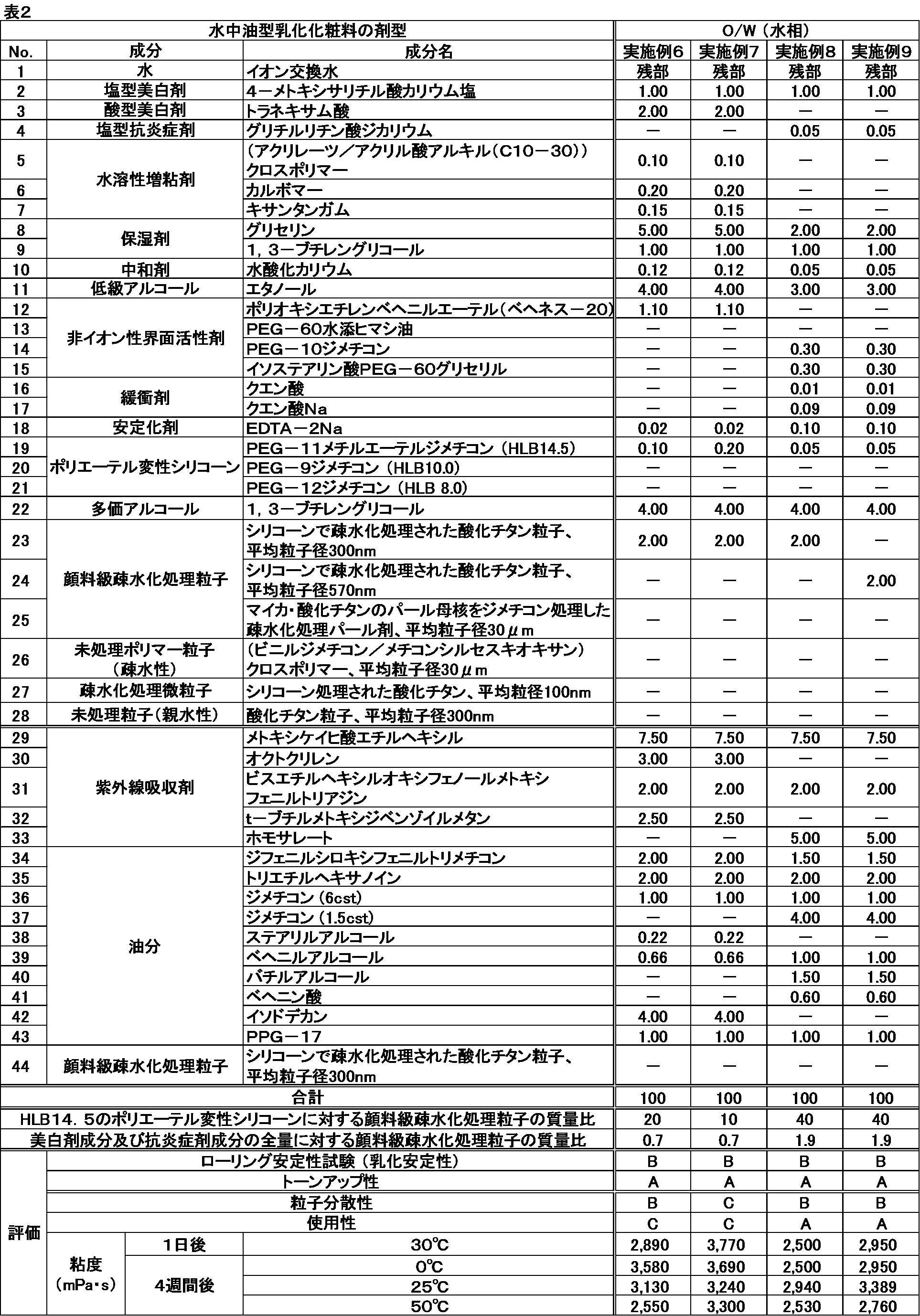
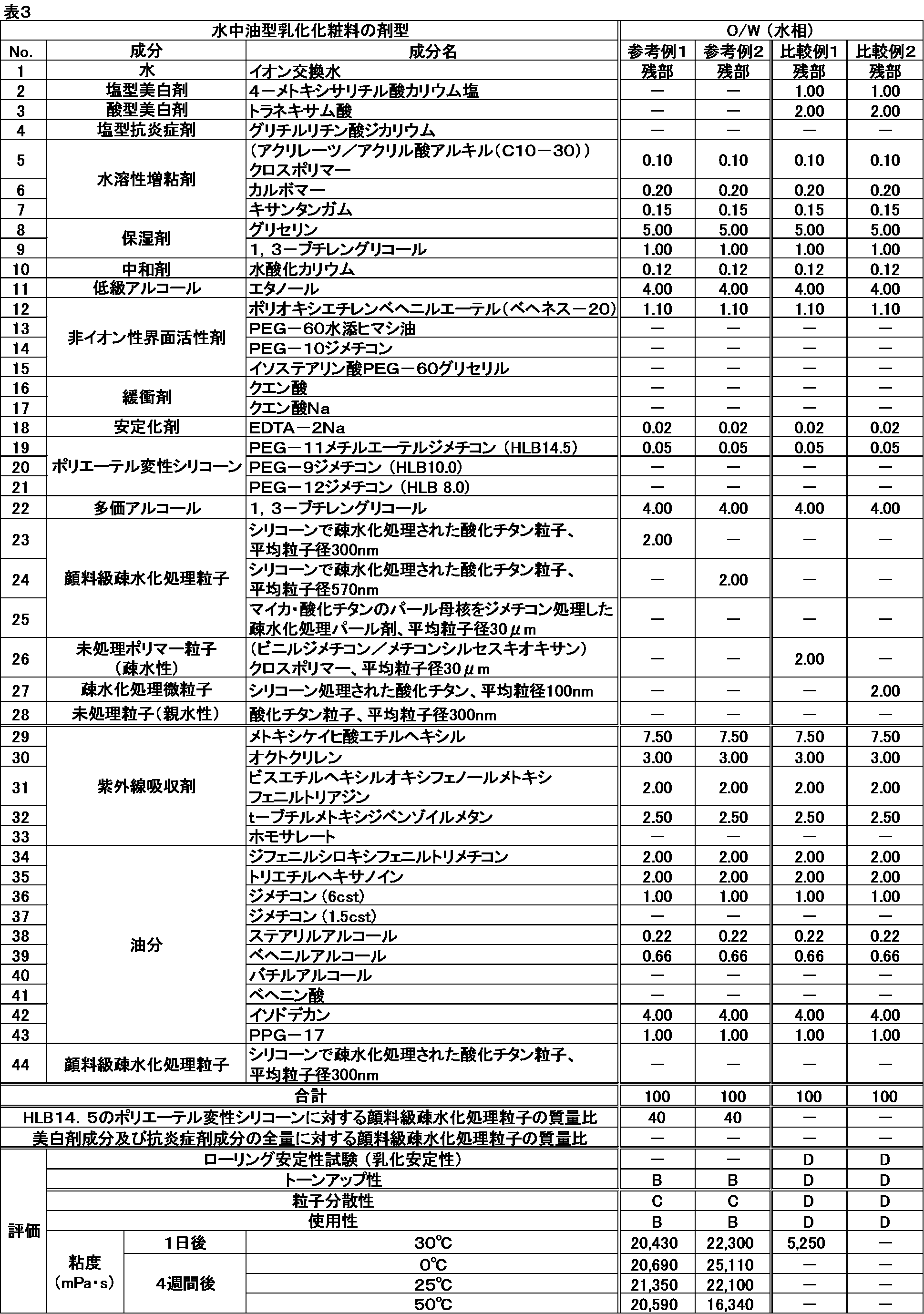
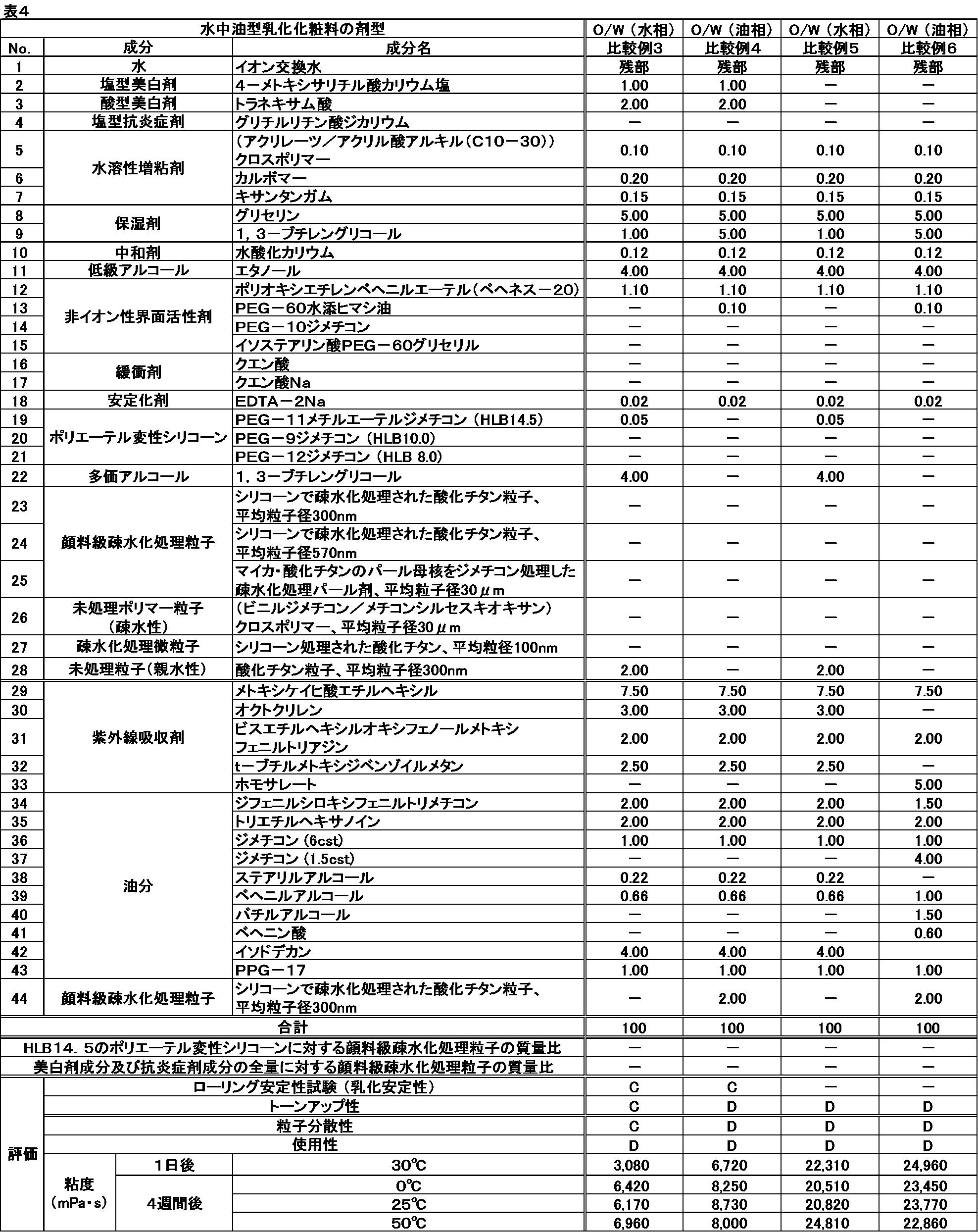
表1~4の結果より、顔料級疎水化処理粒子と、塩型若しくは酸型の美白剤及び/又は抗炎症剤とを含む実施例1~9の水中油型乳化化粧料は、乳化安定性及びトーンアップ性に優れることが確認できた。
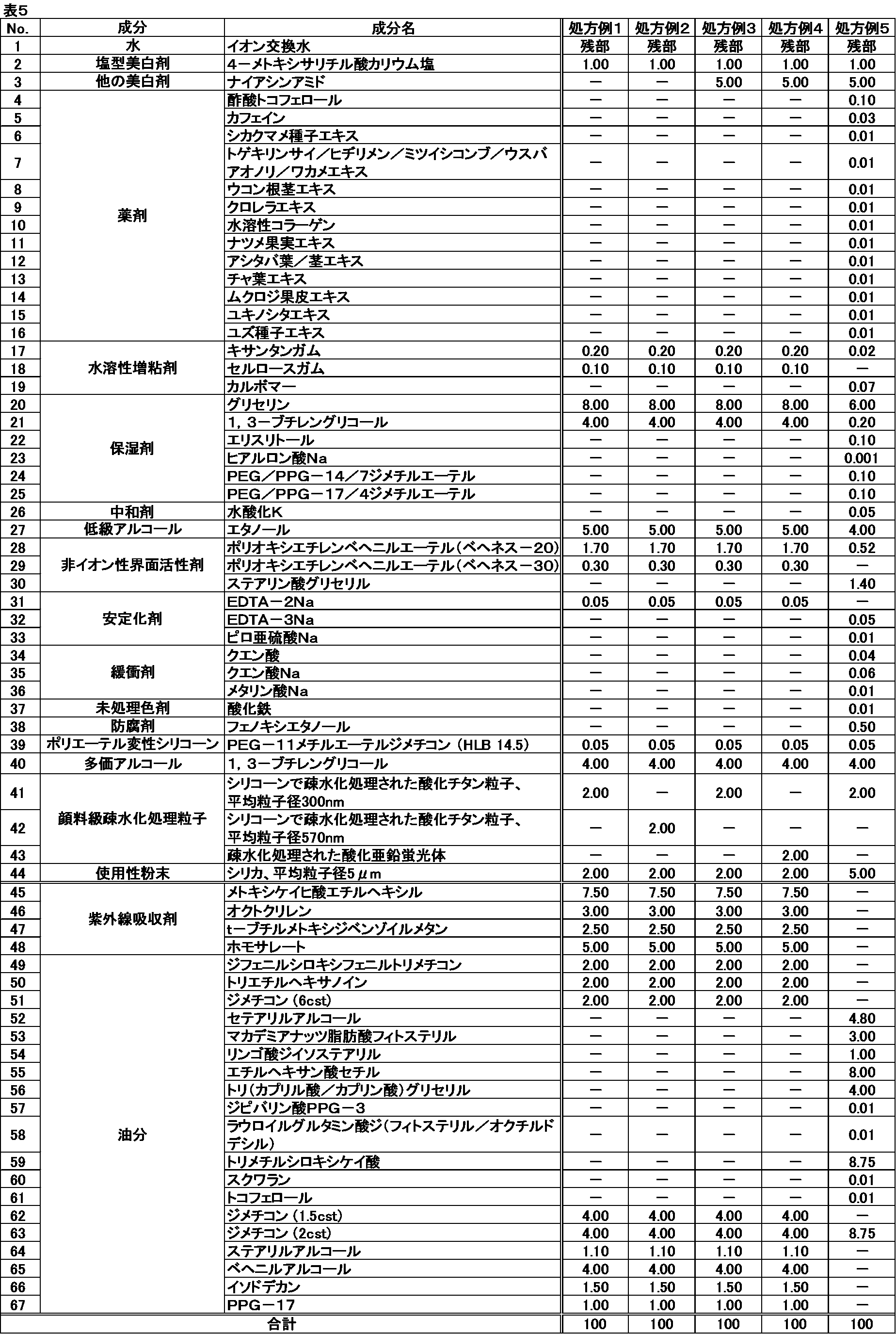
以下に、本開示の水中油型乳化化粧料の処方例を挙げるが、この例示に限定されるものではない。ここで、以下に示す番号は、表5の処方の成分名を示す左側の番号と一致する。なお、得られた化粧料はいずれも、乳化安定性及びトーンアップ性に優れていた。
No.1のイオン交換水の一部に、No.2、No.17、No.18、No.20、No.21、No.27~29、No.31の材料を添加して均一に混合して水相パーツを得た。
顔料級疎水化処理粒子をNo.42の粒子に変更したこと以外は、処方例1と同様にして、処方例2のクリーム状の水中油型乳化化粧料を得た。
No.3の材料も水相パーツに添加したこと以外は、処方例1と同様にして、処方例3のクリーム状の水中油型乳化化粧料を得た。
顔料級疎水化処理粒子をNo.43の粒子に変更したこと以外は、処方例3と同様にして、処方例4のクリーム状の水中油型乳化化粧料を得た。
No.1のイオン交換水の一部に、No.2~No.17、No.19~No.28、No.30、No.32~No.38の材料を添加して均一に混合して水相パーツを得た。
30 水
40 油分
Claims (10)
- 水を含む分散媒、及び
前記分散媒中に分散している油滴
を含む、水中油型乳化化粧料であって、
前記分散媒は、美白剤及び抗炎症剤からなる群から選択される少なくとも一種、並びに顔料級疎水化処理粒子を含み、
前記美白剤は、塩型美白剤及び酸型美白剤からなる群から選択される少なくとも一種を含み、
前記抗炎症剤は、塩型抗炎症剤及び酸型抗炎症剤からなる群から選択される少なくとも一種を含む、
水中油型乳化化粧料。 - 前記油滴が、非イオン性界面活性剤を含む、請求項1に記載の化粧料。
- 前記油滴が、高級アルコールを含む、請求項1又は2に記載の化粧料。
- 前記分散媒が、HLBが10.0超18.0以下のポリエーテル変性シリコーンを含む、請求項1~3のいずれか一項に記載の化粧料。
- 前記ポリエーテル変性シリコーンに対する前記顔料級疎水化処理粒子の質量比が、10以上である、請求項4に記載の化粧料。
- 前記塩型美白剤が、アスコルビン酸塩、トラネキサム酸塩、グリチルリチン酸塩、ニコチン酸塩、コウジ酸塩、エラグ酸塩、1-ピペリジンプロピオン酸塩、3-O-エチル-L-アスコルビン酸塩、及びアルコキシサリチル酸塩からなる群から選択される少なくとも一種であり、前記酸型美白剤が、アスコルビン酸、トラネキサム酸、グリチルリチン酸、ニコチン酸、コウジ酸、エラグ酸、1-ピペリジンプロピオン酸、3-O-エチル-L-アスコルビン酸、及びアルコキシサリチル酸からなる群から選択される少なくとも一種である、請求項1~5のいずれか一項に記載の化粧料。
- 前記抗炎症剤が、リン酸L-アスコルビルマグネシウム、グリチルリチン酸ジカリウム及びグリチルリチン酸アンモニウムからなる群から選択される少なくとも一種である、請求項1~6のいずれか一項に記載の化粧料。
- 前記塩型美白剤、前記酸型美白剤、前記塩型抗炎症剤、及び前記酸型抗炎症剤からなる群から選択される少なくとも一種が、美白剤成分及び抗炎症剤成分の全量に対し、50質量%以上含まれている、請求項1~7のいずれか一項に記載の化粧料。
- 前記顔料級疎水化処理粒子の平均粒子径が、250nm以上である、請求項1~8のいずれか一項に記載の化粧料。
- 増粘剤の含有量が、1質量%以下である、請求項1~9のいずれか一項に記載の化粧料。
Priority Applications (2)
| Application Number | Priority Date | Filing Date | Title |
|---|---|---|---|
| JP2023529784A JP7890287B2 (ja) | 2021-06-17 | 2022-06-03 | 水中油型乳化化粧料 |
| CN202280036119.7A CN117500474A (zh) | 2021-06-17 | 2022-06-03 | 水包油型乳化化妆料 |
Applications Claiming Priority (2)
| Application Number | Priority Date | Filing Date | Title |
|---|---|---|---|
| JP2021-100974 | 2021-06-17 | ||
| JP2021100974 | 2021-06-17 |
Publications (1)
| Publication Number | Publication Date |
|---|---|
| WO2022264841A1 true WO2022264841A1 (ja) | 2022-12-22 |
Family
ID=84526390
Family Applications (1)
| Application Number | Title | Priority Date | Filing Date |
|---|---|---|---|
| PCT/JP2022/022667 Ceased WO2022264841A1 (ja) | 2021-06-17 | 2022-06-03 | 水中油型乳化化粧料 |
Country Status (3)
| Country | Link |
|---|---|
| JP (1) | JP7890287B2 (ja) |
| CN (1) | CN117500474A (ja) |
| WO (1) | WO2022264841A1 (ja) |
Citations (5)
| Publication number | Priority date | Publication date | Assignee | Title |
|---|---|---|---|---|
| WO2007122822A2 (ja) * | 2007-07-27 | 2007-11-01 | Shiseido Company, Ltd. | 水中油型乳化日焼け止め化粧料 |
| JP2011246445A (ja) * | 2010-04-28 | 2011-12-08 | Shiseido Co Ltd | O/w乳化組成物及びその製造方法 |
| JP2013095705A (ja) * | 2011-11-01 | 2013-05-20 | Kose Corp | 水中油型化粧料 |
| JP2018039770A (ja) * | 2016-09-09 | 2018-03-15 | 伯東株式会社 | 日焼け止め化粧料 |
| JP2019142825A (ja) * | 2018-02-23 | 2019-08-29 | 株式会社ナリス化粧品 | 水中油型乳化組成物 |
Family Cites Families (2)
| Publication number | Priority date | Publication date | Assignee | Title |
|---|---|---|---|---|
| JP2016135751A (ja) * | 2015-01-23 | 2016-07-28 | 株式会社コーセー | 水中油型乳化化粧料 |
| JP6733326B2 (ja) * | 2016-06-09 | 2020-07-29 | 堺化学工業株式会社 | 液状分散体及びその用途 |
-
2022
- 2022-06-03 CN CN202280036119.7A patent/CN117500474A/zh active Pending
- 2022-06-03 WO PCT/JP2022/022667 patent/WO2022264841A1/ja not_active Ceased
- 2022-06-03 JP JP2023529784A patent/JP7890287B2/ja active Active
Patent Citations (5)
| Publication number | Priority date | Publication date | Assignee | Title |
|---|---|---|---|---|
| WO2007122822A2 (ja) * | 2007-07-27 | 2007-11-01 | Shiseido Company, Ltd. | 水中油型乳化日焼け止め化粧料 |
| JP2011246445A (ja) * | 2010-04-28 | 2011-12-08 | Shiseido Co Ltd | O/w乳化組成物及びその製造方法 |
| JP2013095705A (ja) * | 2011-11-01 | 2013-05-20 | Kose Corp | 水中油型化粧料 |
| JP2018039770A (ja) * | 2016-09-09 | 2018-03-15 | 伯東株式会社 | 日焼け止め化粧料 |
| JP2019142825A (ja) * | 2018-02-23 | 2019-08-29 | 株式会社ナリス化粧品 | 水中油型乳化組成物 |
Also Published As
| Publication number | Publication date |
|---|---|
| CN117500474A (zh) | 2024-02-02 |
| JPWO2022264841A1 (ja) | 2022-12-22 |
| JP7890287B2 (ja) | 2026-07-14 |
Similar Documents
| Publication | Publication Date | Title |
|---|---|---|
| JP6535329B2 (ja) | 水中油型乳化組成物 | |
| JP6053922B2 (ja) | 水中油型化粧料 | |
| TWI558415B (zh) | 油中水型乳化組成物 | |
| KR101801410B1 (ko) | W/o 유화 화장료 | |
| EP0331833A1 (en) | Water-in-oil emulsion type cosmetics | |
| JP7324217B2 (ja) | 油中水型乳化固形化粧料 | |
| KR102104808B1 (ko) | 화장료 | |
| WO2013192004A2 (en) | Water-releasing cosmetic composition | |
| CN102300549A (zh) | 油包水型乳化防晒化妆品 | |
| CA2804272A1 (en) | Skin care emulsion composition | |
| JP7660524B2 (ja) | 水中油型乳化化粧料 | |
| TW201336525A (zh) | 化粧用化粧料 | |
| JP7347993B2 (ja) | 日焼け止め用組成物 | |
| WO2019045056A1 (ja) | 油中水型乳化化粧料 | |
| JP6831737B2 (ja) | 水中油型化粧料 | |
| WO2022224672A1 (ja) | 水中油型乳化化粧料 | |
| JP7721109B2 (ja) | 水中油型乳化化粧料 | |
| CN117794512A (zh) | 水包油型乳化化妆品 | |
| WO2018159773A1 (ja) | 温感化粧料 | |
| JP7689822B2 (ja) | 水中油型乳化化粧料 | |
| WO2022264840A1 (ja) | 水中油型乳化化粧料 | |
| WO2021125051A1 (ja) | 水中油型乳化化粧料 | |
| WO2012073928A1 (ja) | 低粘度w/o乳化組成物 | |
| CN117500474A (zh) | 水包油型乳化化妆料 | |
| CN118717558A (zh) | 水包油型乳化化妆品 |
Legal Events
| Date | Code | Title | Description |
|---|---|---|---|
| 121 | Ep: the epo has been informed by wipo that ep was designated in this application |
Ref document number: 22824833 Country of ref document: EP Kind code of ref document: A1 |
|
| WWE | Wipo information: entry into national phase |
Ref document number: 202280036119.7 Country of ref document: CN Ref document number: 2023529784 Country of ref document: JP |
|
| NENP | Non-entry into the national phase |
Ref country code: DE |
|
| 122 | Ep: pct application non-entry in european phase |
Ref document number: 22824833 Country of ref document: EP Kind code of ref document: A1 |