WO2022259382A1 - ステント - Google Patents
ステント Download PDFInfo
- Publication number
- WO2022259382A1 WO2022259382A1 PCT/JP2021/021792 JP2021021792W WO2022259382A1 WO 2022259382 A1 WO2022259382 A1 WO 2022259382A1 JP 2021021792 W JP2021021792 W JP 2021021792W WO 2022259382 A1 WO2022259382 A1 WO 2022259382A1
- Authority
- WO
- WIPO (PCT)
- Prior art keywords
- stent
- strut
- extension
- struts
- bisector
- Prior art date
- Legal status (The legal status is an assumption and is not a legal conclusion. Google has not performed a legal analysis and makes no representation as to the accuracy of the status listed.)
- Ceased
Links
Images





Classifications
-
- A—HUMAN NECESSITIES
- A61—MEDICAL OR VETERINARY SCIENCE; HYGIENE
- A61F—FILTERS IMPLANTABLE INTO BLOOD VESSELS; PROSTHESES; DEVICES PROVIDING PATENCY TO, OR PREVENTING COLLAPSING OF, TUBULAR STRUCTURES OF THE BODY, e.g. STENTS; ORTHOPAEDIC, NURSING OR CONTRACEPTIVE DEVICES; FOMENTATION; TREATMENT OR PROTECTION OF EYES OR EARS; BANDAGES, DRESSINGS OR ABSORBENT PADS; FIRST-AID KITS
- A61F2/00—Filters implantable into blood vessels; Prostheses, i.e. artificial substitutes or replacements for parts of the body; Appliances for connecting them with the body; Devices providing patency to, or preventing collapsing of, tubular structures of the body, e.g. stents
- A61F2/82—Devices providing patency to, or preventing collapsing of, tubular structures of the body, e.g. stents
- A61F2/86—Stents in a form characterised by the wire-like elements; Stents in the form characterised by a net-like or mesh-like structure
- A61F2/90—Stents in a form characterised by the wire-like elements; Stents in the form characterised by a net-like or mesh-like structure characterised by a net-like or mesh-like structure
- A61F2/91—Stents in a form characterised by the wire-like elements; Stents in the form characterised by a net-like or mesh-like structure characterised by a net-like or mesh-like structure made from perforated sheets or tubes, e.g. perforated by laser cuts or etched holes
- A61F2/915—Stents in a form characterised by the wire-like elements; Stents in the form characterised by a net-like or mesh-like structure characterised by a net-like or mesh-like structure made from perforated sheets or tubes, e.g. perforated by laser cuts or etched holes with bands having a meander structure, adjacent bands being connected to each other
-
- A—HUMAN NECESSITIES
- A61—MEDICAL OR VETERINARY SCIENCE; HYGIENE
- A61F—FILTERS IMPLANTABLE INTO BLOOD VESSELS; PROSTHESES; DEVICES PROVIDING PATENCY TO, OR PREVENTING COLLAPSING OF, TUBULAR STRUCTURES OF THE BODY, e.g. STENTS; ORTHOPAEDIC, NURSING OR CONTRACEPTIVE DEVICES; FOMENTATION; TREATMENT OR PROTECTION OF EYES OR EARS; BANDAGES, DRESSINGS OR ABSORBENT PADS; FIRST-AID KITS
- A61F2/00—Filters implantable into blood vessels; Prostheses, i.e. artificial substitutes or replacements for parts of the body; Appliances for connecting them with the body; Devices providing patency to, or preventing collapsing of, tubular structures of the body, e.g. stents
- A61F2/82—Devices providing patency to, or preventing collapsing of, tubular structures of the body, e.g. stents
- A61F2/86—Stents in a form characterised by the wire-like elements; Stents in the form characterised by a net-like or mesh-like structure
- A61F2/90—Stents in a form characterised by the wire-like elements; Stents in the form characterised by a net-like or mesh-like structure characterised by a net-like or mesh-like structure
- A61F2/91—Stents in a form characterised by the wire-like elements; Stents in the form characterised by a net-like or mesh-like structure characterised by a net-like or mesh-like structure made from perforated sheets or tubes, e.g. perforated by laser cuts or etched holes
- A61F2/915—Stents in a form characterised by the wire-like elements; Stents in the form characterised by a net-like or mesh-like structure characterised by a net-like or mesh-like structure made from perforated sheets or tubes, e.g. perforated by laser cuts or etched holes with bands having a meander structure, adjacent bands being connected to each other
- A61F2002/9155—Adjacent bands being connected to each other
- A61F2002/91558—Adjacent bands being connected to each other connected peak to peak
-
- A—HUMAN NECESSITIES
- A61—MEDICAL OR VETERINARY SCIENCE; HYGIENE
- A61F—FILTERS IMPLANTABLE INTO BLOOD VESSELS; PROSTHESES; DEVICES PROVIDING PATENCY TO, OR PREVENTING COLLAPSING OF, TUBULAR STRUCTURES OF THE BODY, e.g. STENTS; ORTHOPAEDIC, NURSING OR CONTRACEPTIVE DEVICES; FOMENTATION; TREATMENT OR PROTECTION OF EYES OR EARS; BANDAGES, DRESSINGS OR ABSORBENT PADS; FIRST-AID KITS
- A61F2/00—Filters implantable into blood vessels; Prostheses, i.e. artificial substitutes or replacements for parts of the body; Appliances for connecting them with the body; Devices providing patency to, or preventing collapsing of, tubular structures of the body, e.g. stents
- A61F2/82—Devices providing patency to, or preventing collapsing of, tubular structures of the body, e.g. stents
- A61F2/86—Stents in a form characterised by the wire-like elements; Stents in the form characterised by a net-like or mesh-like structure
- A61F2/90—Stents in a form characterised by the wire-like elements; Stents in the form characterised by a net-like or mesh-like structure characterised by a net-like or mesh-like structure
- A61F2/91—Stents in a form characterised by the wire-like elements; Stents in the form characterised by a net-like or mesh-like structure characterised by a net-like or mesh-like structure made from perforated sheets or tubes, e.g. perforated by laser cuts or etched holes
- A61F2/915—Stents in a form characterised by the wire-like elements; Stents in the form characterised by a net-like or mesh-like structure characterised by a net-like or mesh-like structure made from perforated sheets or tubes, e.g. perforated by laser cuts or etched holes with bands having a meander structure, adjacent bands being connected to each other
- A61F2002/9155—Adjacent bands being connected to each other
- A61F2002/91575—Adjacent bands being connected to each other connected peak to trough
-
- A—HUMAN NECESSITIES
- A61—MEDICAL OR VETERINARY SCIENCE; HYGIENE
- A61F—FILTERS IMPLANTABLE INTO BLOOD VESSELS; PROSTHESES; DEVICES PROVIDING PATENCY TO, OR PREVENTING COLLAPSING OF, TUBULAR STRUCTURES OF THE BODY, e.g. STENTS; ORTHOPAEDIC, NURSING OR CONTRACEPTIVE DEVICES; FOMENTATION; TREATMENT OR PROTECTION OF EYES OR EARS; BANDAGES, DRESSINGS OR ABSORBENT PADS; FIRST-AID KITS
- A61F2210/00—Particular material properties of prostheses classified in groups A61F2/00 - A61F2/26 or A61F2/82 or A61F9/00 or A61F11/00 or subgroups thereof
- A61F2210/0014—Particular material properties of prostheses classified in groups A61F2/00 - A61F2/26 or A61F2/82 or A61F9/00 or A61F11/00 or subgroups thereof using shape memory or superelastic materials, e.g. nitinol
-
- A—HUMAN NECESSITIES
- A61—MEDICAL OR VETERINARY SCIENCE; HYGIENE
- A61F—FILTERS IMPLANTABLE INTO BLOOD VESSELS; PROSTHESES; DEVICES PROVIDING PATENCY TO, OR PREVENTING COLLAPSING OF, TUBULAR STRUCTURES OF THE BODY, e.g. STENTS; ORTHOPAEDIC, NURSING OR CONTRACEPTIVE DEVICES; FOMENTATION; TREATMENT OR PROTECTION OF EYES OR EARS; BANDAGES, DRESSINGS OR ABSORBENT PADS; FIRST-AID KITS
- A61F2210/00—Particular material properties of prostheses classified in groups A61F2/00 - A61F2/26 or A61F2/82 or A61F9/00 or A61F11/00 or subgroups thereof
- A61F2210/0076—Particular material properties of prostheses classified in groups A61F2/00 - A61F2/26 or A61F2/82 or A61F9/00 or A61F11/00 or subgroups thereof multilayered, e.g. laminated structures
-
- A—HUMAN NECESSITIES
- A61—MEDICAL OR VETERINARY SCIENCE; HYGIENE
- A61F—FILTERS IMPLANTABLE INTO BLOOD VESSELS; PROSTHESES; DEVICES PROVIDING PATENCY TO, OR PREVENTING COLLAPSING OF, TUBULAR STRUCTURES OF THE BODY, e.g. STENTS; ORTHOPAEDIC, NURSING OR CONTRACEPTIVE DEVICES; FOMENTATION; TREATMENT OR PROTECTION OF EYES OR EARS; BANDAGES, DRESSINGS OR ABSORBENT PADS; FIRST-AID KITS
- A61F2250/00—Special features of prostheses classified in groups A61F2/00 - A61F2/26 or A61F2/82 or A61F9/00 or A61F11/00 or subgroups thereof
- A61F2250/0014—Special features of prostheses classified in groups A61F2/00 - A61F2/26 or A61F2/82 or A61F9/00 or A61F11/00 or subgroups thereof having different values of a given property or geometrical feature, e.g. mechanical property or material property, at different locations within the same prosthesis
- A61F2250/0036—Special features of prostheses classified in groups A61F2/00 - A61F2/26 or A61F2/82 or A61F9/00 or A61F11/00 or subgroups thereof having different values of a given property or geometrical feature, e.g. mechanical property or material property, at different locations within the same prosthesis differing in thickness
-
- A—HUMAN NECESSITIES
- A61—MEDICAL OR VETERINARY SCIENCE; HYGIENE
- A61F—FILTERS IMPLANTABLE INTO BLOOD VESSELS; PROSTHESES; DEVICES PROVIDING PATENCY TO, OR PREVENTING COLLAPSING OF, TUBULAR STRUCTURES OF THE BODY, e.g. STENTS; ORTHOPAEDIC, NURSING OR CONTRACEPTIVE DEVICES; FOMENTATION; TREATMENT OR PROTECTION OF EYES OR EARS; BANDAGES, DRESSINGS OR ABSORBENT PADS; FIRST-AID KITS
- A61F2250/00—Special features of prostheses classified in groups A61F2/00 - A61F2/26 or A61F2/82 or A61F9/00 or A61F11/00 or subgroups thereof
- A61F2250/0058—Additional features; Implant or prostheses properties not otherwise provided for
- A61F2250/0067—Means for introducing or releasing pharmaceutical products into the body
-
- A—HUMAN NECESSITIES
- A61—MEDICAL OR VETERINARY SCIENCE; HYGIENE
- A61F—FILTERS IMPLANTABLE INTO BLOOD VESSELS; PROSTHESES; DEVICES PROVIDING PATENCY TO, OR PREVENTING COLLAPSING OF, TUBULAR STRUCTURES OF THE BODY, e.g. STENTS; ORTHOPAEDIC, NURSING OR CONTRACEPTIVE DEVICES; FOMENTATION; TREATMENT OR PROTECTION OF EYES OR EARS; BANDAGES, DRESSINGS OR ABSORBENT PADS; FIRST-AID KITS
- A61F2310/00—Prostheses classified in A61F2/28 or A61F2/30 - A61F2/44 being constructed from or coated with a particular material
- A61F2310/00389—The prosthesis being coated or covered with a particular material
- A61F2310/00592—Coating or prosthesis-covering structure made of ceramics or of ceramic-like compounds
Definitions
- the present disclosure relates to stents.
- US Pat. No. 7,264,633 discloses a stent having links that connect mutually facing crests of two adjacent struts.
- the stent disclosed in US Pat. No. 7,264,633 has a configuration in which the links extend only from one side to the crests of the struts. Therefore, in this stent, stress is likely to concentrate on the links and their peripheral portions as the stent transitions from one of the diameter-reduced state and the diameter-expanded state to the other. This stress concentration causes deterioration in the shape accuracy of the stent.
- An object of the present invention is to improve the shape accuracy of a stent.
- a stent according to a first aspect includes first struts arranged along a cylindrical surface and having a wavy shape whose amplitude direction is the axial direction of the cylindrical surface; A second strut adjacent to the first strut in the axial direction, and a part of a plurality of peaks of the first strut that are convex toward the second strut side and extend along the first bisector from both sides of the first bisector that bisects the first ridge to the second strut side and a second peak portion that is circumferentially displaced from the first peak portion among a plurality of peak portions that are convex toward the first strut side of the second strut, a second extension portion extending from both sides of a second bisector that bisects the second peak portion toward the first strut along the second bisector; and the first extension portion. and a bridging portion bridging the second extension portion.
- a stent according to a second aspect is the stent according to the first aspect, wherein the thickness of the bridging portion is uniform and equivalent to the thickness of the first extension portion or the second extension portion.
- a stent according to a third aspect is the stent according to the first aspect or the second aspect, wherein the first extension has an elliptical shape with the first bisector as a major axis, and the second The extension has an elliptical shape with the second bisector being the major axis.
- a stent according to a fourth aspect is the stent according to any one of the first to third aspects, wherein the edge of the bridging portion is the first One end on the side of the extension forms a common tangent line with the edge of the first extension at the boundary with the first extension, and the other end on the side of the second extension forms the boundary with the second extension. It is curvilinear forming a common tangent to the edge of the second extension.
- a stent according to a fifth aspect is the stent according to any one of the first to fourth aspects, and is made of a shape memory alloy.
- a stent according to a sixth aspect is the stent according to any one of the first to fifth aspects, and has a coating layer on the surface.
- a stent according to a seventh aspect is the stent according to the sixth aspect, wherein the coating layer includes a ceramic layer.
- a stent according to an eighth aspect is the stent according to the sixth aspect or the seventh aspect, wherein the coating layer includes a drug-eluting coating layer.
- a stent according to a ninth aspect is the stent according to any one of the first to eighth aspects, wherein the thickness of the first strut and the second strut is the thickness of the first strut in the direction along the cylindrical surface. It is in the range of 0.6 times or more of the minimum width B of the first strut and the second strut and B or less.
- the portion connecting the circumferentially displaced crests of the axially adjacent struts extends only from one side of the first crest or the second crest with respect to the bisector.
- the shape accuracy of the stent is improved compared to the configuration.
- the shape accuracy of the stent is improved as compared with a structure in which the thickness of the bridging portion is smaller than the thickness of the first extension portion or the second extension portion.
- the shape accuracy of the stent is improved as compared with the configuration in which the first extension portion or the second extension portion has a rectangular shape when viewed from the radial direction.
- the shape accuracy of the stent is improved as compared with the configuration in which the ends of the bridging portions are linear.
- the portion connecting the first peak and the second peak is relative to the bisector of the first peak or the second peak.
- the shape accuracy of the stent is improved compared to configurations that extend from only one side.
- the portion connecting the first peak and the second peak extends only from one side of the bisector of the first peak or the second peak.
- the coating layer is less likely to peel off compared to the structure with
- the portion connecting the first peak portion and the second peak portion is the circumference of the bisector of the first peak portion or the second peak portion. Stent aging is reduced compared to configurations that extend from only one direction.
- the portion connecting the first peak portion and the second peak portion divides the first peak portion and the second peak portion into two equal parts.
- the drug eluting effect of the stent lasts longer than configurations that extend from only one side of the wire.
- the inner diameter of the stent is large compared to the configuration in which the thickness of the strut exceeds the minimum width of the strut. Moreover, according to the stent according to the ninth aspect, the stent is less likely to be distorted compared to a configuration in which the thickness of the strut is less than 0.6 times the minimum width of the strut.
- FIG. 2 is a developed view of the stent in a processed state according to the embodiment of the present disclosure, which is developed in a plane along the circumferential direction;
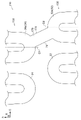
- Fig. 4A is an enlarged view of a link of a stent in accordance with an embodiment of the present disclosure;
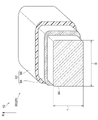
- FIG. 3 is a cross-sectional view showing a base layer and a coating layer that make up a stent according to an embodiment of the present disclosure;
- FIG. 10 is an enlarged view of the links of a stent according to a comparative form to the present disclosure;
- FIG. 10 is an expanded view of a stent expanded in a circumferential direction according to a modification of the embodiment of the present disclosure;
- FIG. 10 is an enlarged view of a link of a stent according to a variation of the embodiment of the present disclosure
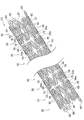
- 1 is a perspective view of a stent in an expanded state according to an embodiment of the present disclosure
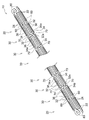
- FIG. 1 is a perspective view of a stent in a reduced diameter state according to an embodiment of the present disclosure
- FIG. 10 is an expanded view of a stent expanded in a circumferential direction according to a modification of the embodiment of the present disclosure
- FIG. 1 An example of a stent according to an embodiment of the present disclosure will be described with reference to FIGS. 1 to 9.
- FIG. 1 An example of a stent according to an embodiment of the present disclosure will be described with reference to FIGS. 1 to 9.
- FIG. 1 An example of a stent according to an embodiment of the present disclosure will be described with reference to FIGS. 1 to 9.
- FIG. 1 An example of a stent according to an embodiment of the present disclosure will be described with reference to FIGS. 1 to 9.
- the stent 10 has a substantially cylindrical shape (see FIGS. 7 and 8) and is used to dilate the lumen of the stenosis when stenosis or the like occurs in a biological organ having a luminal structure such as a blood vessel. stent. Specifically, the stent 10 is formed along a cylindrical surface having a length L and a diameter D of a tubular member (details will be described later) that is the material of the stent 10 .
- the term "cylindrical surface” used in the following description includes a cylindrical surface having a length L and a diameter D, as well as a part of the cylindrical surface, an axial extension of the cylindrical surface, and the cylindrical surface.
- FIG. 1 is a developed view of a processed stent 10 cut out from a tubular member by laser processing and laid out in a plane along the circumferential direction. That is, the diameter of stent 10 shown in FIG.
- the stent 10 is, for example, a self-expanding stent, and has a function of being able to switch between a diameter-expanded state shown in FIG. 7 and a diameter-reduced state shown in FIG.
- the diameter of stent 10 in the expanded state is greater than the diameter D of the stent in the processed state.
- the diameter of the stent 10 in the contracted state is smaller than the diameter D of the stent 10 in the processed state.
- the stent according to the present disclosure is not limited to a self-expanding stent, and may be a balloon-expandable stent.
- the dimensions of the stent 10 in the as-fabricated state are described.
- the arrows A, R, and C attached to each figure indicate the axial direction, radial direction, and circumferential direction of the stent 10 .
- the stent 10 has end struts 20 arranged at both axial ends of the stent 10 and axially aligned between the two end struts 20, as shown in FIG. a plurality of struts 30 arranged at .
- the stent 10 further includes links 60 connecting the end struts 20 and struts 30 and links 70 connecting adjacent struts 30 .
- Stent 10 also includes markers 80 projecting axially outwardly from portions of end struts 20 .
- Stent 10 is integrally formed with end struts 20 , struts 30 , links 60 and 70 and markers 80 .
- the end strut 20 is an annular member along the cylindrical surface.
- the end struts 20 are formed in a wavy shape with the axial direction of the stent 10 as the amplitude direction.
- the end strut 20 has a plurality of crests 22 that are convex on the side opposite to the struts 30 adjacent to the end strut 20 with respect to the wave centerline CT of the end strut 20 . Also, the end strut 20 has a plurality of crests 24 projecting toward the strut 30 adjacent to the end strut 20 with respect to the wave centerline CT of the end strut 20 .
- the end strut 20 also has a straight portion 26 that connects the peaks 22 and 24 in a straight line. At the boundary between the straight portion 26 and the peak portions 22 and 24 , the edge of the straight portion 26 forms a common tangent line to the edge of the peak portion 22 and the edge of the peak portion 24 .
- peaks 22 , 24 of end strut 20 refer to wave turn-up portions of end strut 20 , respectively.
- both the inner peripheral edge and the outer peripheral edge of the peaks 22 and 24 are arc-shaped when viewed in the radial direction.
- the marker 80 extends from the top of some of the plurality of ridges 22 of the end strut 20 to the ridges 24 relative to the ridges 22. As shown in FIG. It is a substantially disk-shaped member that extends along the cylindrical surface and is formed so as to protrude in the opposite direction.
- the struts 30 are annular members disposed along the cylindrical surface between the two end struts 20 .
- the plurality of struts 30 are arranged side by side at predetermined intervals in the axial direction.
- Each strut 30 is formed in a wavy shape whose amplitude direction is the axial direction of the stent 10 .
- Each strut 30 has the same shape as each other.
- each strut 30 is substantially the same shape as the end struts 20 . More specifically, the strut 30 of the embodiment has a wavy shape with 9 periods in one round along the cylindrical surface. It has a peak portion 34 that protrudes to the side.
- the strut 30 of the embodiment has nine peaks 32 and 34 each.
- the strut 30 also has a straight portion 36 that linearly connects the peak portions 32 and 34 .
- the edge of the straight portion 36 forms a common tangent line to the edge of the peak portion 32 and the edge of the peak portion 34 .
- peaks 32 and 34 of strut 30 respectively indicate wave turn-up portions of strut 30 .
- both the inner peripheral edge and the outer peripheral edge of the peaks 32 and 34 are arc-shaped when viewed in the radial direction.
- a bisector (including a bisector D1, which will be described later) that bisects the peaks 32 and 34 when viewed from the radial direction is parallel to the axial direction.
- a pair of straight portions 36 connected to one peak portion 32, 34 are formed symmetrically (that is, equiangularly) with respect to the bisector.
- the distance between the pair of straight portions 36 connected to one peak portion 32 gradually widens toward the adjacent peak portions 34 in the circumferential direction.
- a pair of straight portions 36 connected to one peak portion 34 are gradually spaced apart from each other toward adjacent peak portions 32 in the circumferential direction.
- the angle ⁇ formed between the pair of straight portions 36 is preferably in the range of 25° or more and 50° or less in the expanded diameter stent 10 .
- the angle ⁇ formed between the pair of straight portions 36 is preferably in the range of -10° to -5°.
- the angle ⁇ formed between a pair of straight portions 36 connected to one peak portion 32 has a negative value
- the pair of straight portions 36 are circumferentially adjacent to each other as shown in FIG. The distance between them gradually narrows toward the portion 34 .
- the angle ⁇ formed between a pair of straight portions 36 connected to one peak portion 34 has a negative value
- the pair of straight portions 36 are adjacent in the circumferential direction as shown in FIG. The distance between them gradually narrows toward the matching peaks 32 .
- the plurality of struts 30 are arranged side by side in the axial direction as shown in FIG. Two struts 30 adjacent to each other in the axial direction are arranged such that the phase of the waves in the circumferential direction is shifted within the range of 10° or more and 90° or less. In addition, it is preferable that the phase shift amount of the waves in the circumferential direction of the two adjacent struts 30 is within the range of 5° or more and 20° or less. In addition, among the plurality of struts 30 arranged in the axial direction, the n-th strut (where n is an integer equal to or greater than 1) and the (n ⁇ 2)th or (n+2)th strut have wave phases in the circumferential direction. arranged to be the same.
- the struts 30 adjacent to the end struts 20 are arranged such that the phase of the waves in the circumferential direction is shifted from the end struts 20 by 180°. That is, the strut 30 adjacent to one of the end struts 20 (the end strut 20 on the upper side of the page in FIG. 1) is arranged such that the ridges 32 face the ridges 24 of the end strut 20 in the axial direction. there is Also, the strut 30 adjacent to the other end strut 20 (the end strut 20 on the lower side of the paper in FIG. 1) is arranged so that the ridges 34 face the ridges 24 of the end strut 20 in the axial direction. ing. Each ridge 24 of strut 30 adjacent to these end struts 20 is connected to the ridge 24 of axially opposite end strut 20 via link 60 .
- the two struts 30 that are adjacent to each other in the axial direction include a portion of the peak portions 32 a of the plurality of peak portions 32 of one strut 30 and a portion of the plurality of peak portions 34 of the other strut 30 .
- 34a are connected via a link 70 which will be described in detail later.
- axially adjacent struts 30 are connected by three links 70 arranged at equal intervals in the circumferential direction.
- the peak portion 34a of the other strap 30 connected to the peak portion 32a of one strut 30 by the link 70 is closest to the peak portion 32a of the one strut 30 among the plurality of peak portions 34 of the other strut 30.
- the link 70 connecting the n-th strut 30 (where n is an even number equal to or greater than 2) among the plurality of struts 30 arranged in the axial direction and the (n-1)-th strut 30 is connected to the n-th strut 30. It is displaced in the circumferential direction with respect to the link 70 connecting the (n+1)th strut 30 . Furthermore, the link 70 connecting the n-th strut 30 and the (n-1)th strut 30 is inclined in the opposite direction to the link 70 connecting the n-th strut 30 and the (n+1)th strut 30.
- the peak portion 32a is an example of the first peak portion
- the peak portion 34a is an example of the second peak portion.
- the odd-numbered struts 30 are an example of the first struts
- the even-numbered struts 30 are an example of the second struts
- the odd-numbered struts 30 are an example of the second struts
- the even-numbered struts 30 are the second struts. This is an example of one strut.
- the link 70 connects the crest portion 32a of one strut 30 and the crest portion 34a of the other strut 30 of the two axially adjacent struts 30 as described above.
- the link 70 includes an extension portion 44 formed on the peak portion 32a, an extension portion 54 formed on the peak portion 34a, and a bridging portion 72 bridging the extension portions 44 and 54. consists of In the following description, the bisector of the peak portion 32a is called the bisector D1, and the bisector of the peak 34a is called the bisector D2.
- the extension portion 44 is a portion extending from both sides of the bisector D1 at the outer peripheral edge of the peak portion 32a toward the strut 30 to be connected by the link 70 along the bisector D1.
- the extension 44 is symmetrical with respect to the bisector D1. More specifically, the extension portion 44 is formed in an elliptical shape with the bisector D1 as the major axis direction.
- the elliptical shape means that the outer edge viewed from the radial direction forms a part of an ellipse.
- the elliptical edge portion of the extension portion 44 has a common tangent line with the peak portion 32a at two boundaries with the peak portion 32a.
- Extension 54 is formed similarly to extension 44 .
- the extension 54 has a shape that is symmetrical in the axial direction with respect to the extension 44, and the link 70 extends from the peak 34a along the bisector D2. It extends toward the strut 30 to be connected.
- the extensions 44, 54 can also be regarded as portions extending the peaks 32a, 34a along the respective bisectors D1, D2.
- the extension 44 is an example of a first extension
- the extension 54 is an example of a second extension. Extension portions are not formed on the peak portions 32 and 34 other than the peak portions 32a and 34a.
- the peaks 32a and 34a have elliptical outer edges and arcuate inner edges, and can be regarded as peaks longer than the other peaks 32 and 34 in the axial direction.
- the bridging portion 72 is a substantially rectangular portion formed between the first extension portion 44 and the second extension portion 54 when viewed from the radial direction (that is, the R direction). .
- the bridging portion 72 extends in a direction inclined with respect to the axial direction (that is, the bisectors D1 and D2). Specifically, the bridging portion 72 is formed along an extension direction extending from the peak portion 32a toward the peak portion 34a.
- the bridging portion 72 has an imaginary straight line (not shown) that passes through the center of the ellipse forming the outer edge of the extension portion 44 and the center of the ellipse forming the outer edge of the extension portion 54 .
- the bridging portion 72 has two edges 74 extending along the extension direction. One edge portion 74 extends from the vicinity of the top of the extension portion 44 to a portion of the extension portion 54 between the bisectors D1 and D2 on the straight portion 36 side. The other edge portion 74 extends from near the top of the extension portion 54 to a portion of the extension portion 44 between the bisectors D1 and D2 on the straight portion 36 side.
- An edge portion 74 of the bridging portion 72 has both ends formed in a curved shape, and the space between the ends is formed in a straight line parallel to the imaginary straight line. Specifically, when viewed from the radial direction, the edge portion 74 extends at the boundary between the top portion side of the extension portion 44 or the top portion side end portion of the extension portion 54 and the extension portion 44 or the vicinity of the top portion of the extension portion 54, respectively. It is common tangent to the edge of portion 44 or the edge of extension 54 .
- the edge portion 74 when viewed from the radial direction, is formed such that the straight portion 36 side of the extension portion 44 or the end portion of the extension portion 54 on the straight portion 36 side is the straight portion 36 side portion of the extension portion 44 or the extension portion 54 . It forms a common tangent line with the edge of the extension 44 or the edge of the extension 54 at the boundary with the portion on the side of the straight portion 36 . That is, one end of the edge portion 74 of the bridging portion 72 on the extension portion 44 side forms a common tangent line with the edge of the extension portion 44 at the boundary with the extension portion 44 when viewed in the radial direction. The other end of the edge portion 74 of the bridging portion 72 on the extension portion 54 side forms a common tangent line with the edge of the second extension portion 54 at the boundary with the second extension portion 54 when viewed from the radial direction.
- the minimum width of the bridging portion 72 (that is, the width of the bridging portion 72 in the direction perpendicular to the inclined direction) is substantially the same as the minimum width of the straight portion 36 of the strut 30 .
- the stent 10 is formed in a layered shape having a base material layer 90 and a coating layer 92 in cross section.
- the wavy strut 30 is positioned at the center of a cross section cut along an imaginary plane perpendicular to the direction along the wavy line. It has a layer 90 and a coating layer 92 formed on the surface of the substrate layer 90 .
- end struts 20, links 60, 70 and markers 80 are also be used to end struts 20, links 60, 70 and markers 80.
- the base material layer 90 is made of a material containing a shape memory metal such as a nickel-titanium alloy. That is, the stent 10 is made of a shape memory alloy. The shape of the stent 10 is formed by cutting out, for example, a tubular member having a cylindrical surface having a length L and a diameter D and made of the metal described above by laser processing. Note that the material forming the base layer 90 according to the present disclosure is not limited to nickel-titanium alloys, and includes iron, copper, titanium, nickel, cobalt, chromium, aluminum, zinc, manganese, tantalum, tungsten, platinum, and gold.
- the metal forming base layer 90 may contain metals such as in particular, the metal forming base layer 90 preferably contains at least one selected from the group consisting of titanium, nickel, cobalt, chromium, tantalum, platinum, and gold.
- the material forming the base layer 90 may include a cobalt-chromium alloy, a copper-aluminum-manganese alloy, a copper-zinc alloy, a nickel-aluminum alloy, or an alloy such as stainless steel.
- the metal forming the base material layer 90 preferably contains a nickel-titanium alloy, a cobalt-chromium alloy, or stainless steel among the alloys.
- the material forming the base material layer 90 according to the present disclosure is not limited to the metals described above, and may include polymers such as polyester or polycarbonate copolymers, for example.
- polymers forming the base layer 90 according to the present disclosure include polylactic acid, polyhydroxybutyrate, polyglycolic acid, lactic acid-glycolic acid copolymer, polycaprolactone, lactic acid-caprolactone copolymer, and glycolic acid-caprolactone.
- Biodegradable polymers having biodegradability such as copolymers, poly- ⁇ -glutamic acid, and collagen may be included.
- the base layer 90 of the end struts 20 and struts 30 has a rectangular cross section, as shown in FIG.
- the thickness of the section in the R direction is the thickness T.
- the minimum width in the width direction with respect to the thickness T of the cross section is the minimum width B.
- the thickness T of the base layer 90 of the end struts 20 and struts 30 is in the range of 0.6 times or more the minimum width B and less than or equal to the minimum width B.
- the thickness T of the end struts 20 and struts 30 is 120 ⁇ m ⁇ 10 ⁇ m
- the minimum width B of the end struts 20 and struts 30 is 150 ⁇ m ⁇ 10 ⁇ m.
- the end struts 20, the struts 30, the links 60 and 70, and the markers 80 are each formed to have a uniform thickness T in the R direction of the base material layer 90. That is, the thickness of the bridging portion 72 in the R direction is equal to and uniform to the thickness of the extension portions 44 and 54 in the R direction.
- the coating layer 92 includes a diamond-like carbon layer (DLC layer) 94 formed on the surface of the substrate layer 90 and a drug-eluting coating layer 96 formed on the surface of the DLC layer 94.
- DLC layer diamond-like carbon layer
- the DLC layer 94 is made of diamond-like carbon containing fluorine (F) and silicon (Si).
- the DLC layer 94 is an example of a ceramic layer.
- the DLC layer 94 which is an example of a ceramic layer, is included in the coating layer 92, thereby suppressing the elution of metal ions constituting the stent and suppressing the biological reaction of the stent 10 to living organs or blood. be.
- the DLC layer 94 has followability to stably follow the deformation of the stent 10 accompanying the movement of the living body, flexibility to flexibly deform against various stresses when following, have In addition, the DLC layer 94 has antithrombotic properties due to the inclusion of F.
- the ceramic layer according to the present disclosure is not limited to the DLC layer 94 as long as it is composed of a metal oxide layer, a metal nitride layer, a Si layer, or a carbon layer.
- Metal oxide layers or metal nitride layers according to the present disclosure preferably include titanium, nickel, cobalt, chromium, aluminum, zinc, manganese, tantalum, and the like.
- the Si layer according to the present disclosure preferably comprises silicon carbide or silicon dioxide.
- the carbon layer according to the present disclosure preferably contains diamond-like carbon or graphene.
- the DLC layer 94 may be a layer formed by any method as long as it contains F and Si.
- the DLC layer 94 can be formed using known methods such as vapor deposition and sputtering.
- the DLC layer 94 is preferably formed by ion vapor deposition.
- the DLC layer 94 is more preferably formed by chemical vapor deposition (CVD method) or physical vapor deposition (PVD method).
- CVD method chemical vapor deposition
- PVD method physical vapor deposition
- CVD methods include, for example, plasma enhanced-CVD (PE-CVD) and thermal chemical vapor deposition.
- PE-CVD plasma enhanced-CVD
- a thin film containing F, Si and C can be formed by thin film synthesis using the PE-CVD method.
- the PE-CVD method is a type of chemical vapor deposition (CVD) method that uses gas as a raw material.
- a raw material gas is introduced into a vacuum chamber, plasma is generated, and a chemical reaction occurs to deposit a film.
- the CVD method is a general term for methods of depositing a film on a substrate using chemical reactions.
- Heat, plasma, laser, etc. are used as energy sources to cause chemical reactions.
- gases are used as raw materials. Therefore, the quality of the film that can be formed can be freely changed by selecting the raw material gas, and various elements can be added as desired.
- a hydrocarbon gas or a gas containing an element to be added is flowed as a raw material gas into a vacuum chamber, plasma is generated, and a chemical reaction is caused to deposit a film.
- the power for generating plasma AC power such as DC power, high frequency, and microwave is preferably used.
- the PE-CVD method can react highly activated chemical species by using plasma, and the reaction can be carried out at a low temperature.
- the DLC layer in the present disclosure can be formed using an inductively coupled plasma-enhanced chemical vapor deposition (ICP-CVD) apparatus using high frequencies.
- ICP-CVD inductively coupled plasma-enhanced chemical vapor deposition
- YH-100NX manufactured by Onward Giken Co., Ltd.
- a bias voltage is applied to a jig on which a substrate is placed, thereby adsorbing ionized or excited chemical species and depositing a film.
- parameters such as processing time, high frequency output, bias voltage, raw material gas flow rate, high frequency pulse amplitude, bias pulse amplitude, high frequency voltage at the time of plasma ignition, bias voltage, raw material gas flow rate, etc. can be controlled. can be done.
- PVD methods include plasma ion implantation, vacuum deposition, and sputtering.
- a mixed raw material in which a silane compound and a fluorine-containing aliphatic hydrocarbon are mixed is used.
- organosilicon compound containing carbon is preferable.
- organosilicon compounds include compounds represented by Formula S below.
- Examples of compounds represented by formula S include tetramethylsilane, tetraethylsilane, trimethylsilane, diethylsilane, methyldiethylsilane, diethyldimethylsilane, and the like.
- fluorine-containing aliphatic hydrocarbon a fluorine-containing aliphatic hydrocarbon having 1 to 4 carbon atoms is preferable, and a perfluorohydrocarbon having 1 to 4 carbon atoms is more preferable.
- fluorine-containing aliphatic hydrocarbons include tetrafluoromethane (CF 4 ), hexafluoroethane (C 2 F 6 ), octafluoropropane, and perfluorobutane (C 4 F 10 ).
- Hydrocarbons can also be used as raw materials.
- the hydrocarbons include saturated hydrocarbons (eg, methane (CH 4 ), ethane (C 2 H 6 ), etc.), unsaturated hydrocarbons (eg, acetylene (C 2 H 2 ), benzene (C 6 H 6 ), etc.) can be used.
- saturated hydrocarbons eg, methane (CH 4 ), ethane (C 2 H 6 ), etc.
- unsaturated hydrocarbons eg, acetylene (C 2 H 2 ), benzene (C 6 H 6 ), etc.
- solid carbon can be used as the hydrocarbon.
- the silane compound is vaporized, and the vaporized silane compound and fluorine-containing aliphatic hydrocarbon (unsaturated hydrocarbon may be added) are introduced into a chamber to form a film.
- the vaporized silane compound and fluorine-containing aliphatic hydrocarbon unsaturated hydrocarbon may be added
- the mixed raw material of the silane compound and the fluorine-containing aliphatic hydrocarbon can form the DLC layer in the present disclosure by mixing the silane compound and the fluorine-containing aliphatic hydrocarbon at an arbitrary ratio. For example, it can be done as follows.
- the silane compound and the fluorine-containing aliphatic hydrocarbon are first supplied to the surface of the metal layer at a mixing ratio of the silane compound ⁇ the fluorine-containing aliphatic hydrocarbon to be adsorbed and deposited.
- the silane compound may be used without using the mixed material.
- the mixture ratio of the silane compound is decreased (preferably gradually decreased) and the mixture ratio of the fluorine-containing aliphatic hydrocarbon is increased (preferably gradually increased), while adsorbing and depositing to continuously form a film.
- the thickness of the DLC layer 94 is preferably thin from the viewpoint of the use of the stent 10.
- the range is preferably 10 nm or more and less than 1000 nm, more preferably 100 nm to 500 nm, and even more preferably 150 nm to 250 nm.
- the drug-eluting coating layer 96 is a layered polymer formed on the surface of the DLC layer 94 and has the function of storing a drug inside.
- the drug-eluting coating layer 96 has the function of eluting the stored drug when the stent 10 is placed in a biological organ having a lumen structure such as a blood vessel.
- the method of storing the drug in the drug-eluting coating layer 96 according to the present disclosure is not particularly limited, and known methods can be used.
- the drug-eluting coating layer 96 stores a drug or a biodegradable polymer containing a drug in grooves or holes formed in the drug-eluting coating layer 96 as a method for storing the drug. may apply.
- the drug-eluting coating layer 96 according to the present disclosure applies a method of forming the drug-eluting coating layer 96 with a biodegradable polymer or a drug that contains a drug and has biodegradability as a method for storing the drug.
- Polymers forming the drug-eluting coating layer 96 include silicone rubber, urethane rubber, fluorine resin, polybutyl acrylate, polybutyl methacrylate, acrylic rubber, natural rubber, ethylene-vinyl acetate copolymer, and styrene-butadiene block copolymer. , styrene-isoprene block copolymers, styrene-isobutylene block copolymers, and the like.
- Biodegradable polymers forming the drug-eluting coating layer 96 include polylactic acid, poly- ⁇ -hydroxybutyric acid, polyglycolic acid, lactic acid-glycolic acid copolymer, polycaprolactone, lactic acid-caprolactone copolymer, glycol. Acid-caprolactone copolymer, poly- ⁇ -glutamic acid, glycolic acid-trimethylene carbonate copolymer and the like may be included.
- the thickness of the drug-eluting coating layer 96 is preferably thin from the viewpoint of the use of the stent 10. For example, it is preferably in the range of 1 ⁇ m or more and less than 20 ⁇ m, and more preferably in the range of 1 ⁇ m or more and less than 10 ⁇ m.
- the stent 10 When the stent 10 is ejected from the indwelling device at a predetermined position in the blood vessel, the stent 10 expands in the blood vessel and adheres closely to the inner wall of the blood vessel and is indwelled in the blood vessel.
- the stent 10 made of a shape memory alloy has good followability to the deformation of blood vessels.
- the drug is eluted from the drug-eluting coating layer 96 of the stent 10 placed in the blood vessel.
- the link 70 connecting the peak portion 32a of one of the two axially adjacent struts 30 and the peak portion 34a of the other strut 30 is connected to the extension portion 44. , an extension portion 54 , and a bridging portion 72 .
- the stent 10 of the embodiment is compared with a stent 110 as a comparative example shown below.
- the comparative stent 110 does not have the extensions 44, 54 of the stent 10 of the embodiment, as shown in FIG. Moreover, in the stent 110 , the ridges 32 a of one strut 130 and the ridges 34 a of the other strut 130 of two axially adjacent struts 130 are integrally connected by links 170 .
- the link 170 extends toward the peak portion 34a from a portion on the peak portion 34a side to be connected with respect to the bisector D1. Viewed conversely, the link 170 extends from a portion on the side of the peak 32a to be connected with respect to the bisector D2 toward the peak 32a.
- the links 170 extend from one side of the bisector of each of the peaks 32a or 34a (that is, only between the bisectors D1 and D2 in the circumferential direction). To position). Both ends of the edge portion 174 of the link 170 are formed in a straight line. That is, the edge 174 of the link 170 does not form a common tangent line with the edge of the peak portion 32a at the boundary with the peak portion 32a at one end on the peak portion 32a side when viewed in the radial direction.
- the edge 174 of the link 170 does not form a common tangential line with the edge of the peak portion 34a at the other end on the peak portion 34a side when viewed in the radial direction.
- the stent 110 of the comparative example has the same configuration as the stent 10 of the embodiment.
- the stent 110 of the comparative form has a configuration in which the links 170 extend from one side of the bisector of the peaks 32a or 34a, the stent 110 can move from one of the contracted state and the expanded state to the other. Stress is likely to concentrate on the link 170 and its surroundings along with the displacement of .
- the stent 110 of the comparative embodiment is located at the link 170 and its peripheral portion. Stress is easily concentrated. This stress concentration may deteriorate the shape accuracy of the stent 110 after diameter expansion.
- the extensions 44 and 54 of one strut 30 extend from both sides of the bisectors D1 and D2 that bisect the peaks 32a and 34a toward the other strut 30 side. It has a configuration extending along D1. Moreover, in the stent 10 of the embodiment, the extension portions 44 and 54 are bridged by the bridging portion 72 . As a result, compared with the stent 110 of the comparative embodiment, the stent 10 of the embodiment has stress applied to the link 70 and its peripheral portion when the diameter-reduced or expanded state changes to the expanded or reduced-diameter state. is difficult to concentrate.
- the stent 10 of the embodiment has a configuration in which the thickness of the bridging portion 72 is equal to the thickness of the extension portions 44 and 54 and is uniform. Accordingly, in the stent 10 of the embodiment, stress is less likely to concentrate on the link 70 and its surroundings compared to a configuration in which the thickness of the bridging portion 72 is smaller than the thickness of the extension portion 44 or the extension portion 54 . Therefore, in the stent 10 of the embodiment, the shape accuracy of the stent 10 is improved as compared with a structure in which the thickness of the bridging portion 72 is smaller than the thickness of the extension portion 44 or the extension portion 54 .
- the stent 10 of the embodiment has a configuration in which the extension portion 44 is elliptical with the bisector D1 as the major axis, and the extension 54 is elliptical with the bisector D2 as the major axis. ing.
- This allows the stent 10 of the embodiment to concentrate stresses on the link 70 and its surrounding areas compared to a configuration in which the extensions 44, 54 extend axially in a manner that is rectangular when viewed in the radial direction. hard to do. Therefore, in the stent 10 of the embodiment, the shape accuracy of the stent 10 is improved compared to a configuration in which the extensions 44 and 54 are rectangular when viewed from the radial direction.
- one end of the edge portion 74 of the bridging portion 72 on the side of the extension portion 44 forms a common tangent line with the edge of the extension portion 44 at the boundary with the extension portion 44 when viewed from the radial direction. It has a configuration that in the stent 10 of the embodiment, the other end of the edge portion 74 of the bridging portion 72 on the extension portion 54 side is in a common tangential line with the edge of the extension portion 54 at the boundary with the extension portion 54 when viewed from the radial direction.
- the stent 10 of the embodiment is made of a shape memory alloy. Therefore, the stent 10 of the embodiment, which is made of a shape memory alloy, has improved shape accuracy compared to the stent 110 of the comparative embodiment.
- the stent 10 of the embodiment has a coating layer 92 on its surface.
- the stent 10 of the embodiment has improved shape accuracy compared to the stent 110 of the comparative embodiment, so that the coating layer 92 is less likely to be distorted. Therefore, in the stent 10 of the embodiment, the coating layer 92 is less likely to peel off due to distortion of the stent 10 than the stent 110 of the comparative embodiment.
- the coating layer 92 includes a DLC layer 94 containing fluorine and silicon. Accordingly, in the stent 10 of the embodiment, the DLC layer 94 is less likely to peel off due to distortion of the stent 10 than in the stent 110 of the comparative embodiment. Therefore, the stent 10 of the embodiment is less likely to deteriorate over time than the stent 110 of the comparative embodiment.
- the coating layer 92 includes a drug-eluting coating layer 96 . Accordingly, in the stent 10 of the embodiment, the drug-eluting coating layer 96 is less likely to peel off due to distortion of the stent 10 than in the stent 110 of the comparative embodiment. Therefore, the stent 10 of the embodiment maintains the drug elution effect of the stent 10 for a longer period of time than the stent 110 of the comparative embodiment.
- the thickness T of the struts 30 is within the range of 0.6 times or more the minimum width B of the struts 30 and B or less. Therefore, the stent 10 of the embodiment has the same outer diameter as the substantially cylindrical stent 10 and the thickness of the struts 30 exceeds the minimum width B of the struts 30, and the inner diameter of the stent 10 is larger. . Therefore, the stent 10 of the embodiment has the same outer diameter as the stent 10 and the thickness of the struts 30 exceeds the minimum width B of the struts 30 when placed inside the blood vessel. It has a small protrusion into the lumen and a small effect on the blood flow of the blood vessel.
- the stent 10 of the embodiment can suppress poor blood circulation in the blood vessel, compared to a configuration in which the stent 10 has the same outer diameter as the stent 10 and the thickness of the struts 30 exceeds the minimum width B of the struts 30. can.
- the stent 10 of the embodiment has a thickness greater than that of the structure in which the thickness of the struts 30 is less than 0.6 times the minimum width B of the struts 30, so that the stent 10 is less likely to be distorted. Therefore, in the stent 10 of the embodiment, the shape accuracy of the stent 10 is improved as compared with the configuration in which the thickness of the struts 30 is less than 0.6 times the minimum width B of the struts 30 .
- the edge of the straight portion 26 of the end strut 20 forms a common tangent to the edges of the two crests that axially sandwich the wave centerline CT of the end strut 20.
- the straight portions 26 of the end struts 20 according to the present disclosure are not so limited.
- a straight section according to the present disclosure may be formed from one end of arcuate peaks 232, 234 with a central angle greater than 180° along the wavy line of the stent along the center line of the wavy line, as shown in FIGS. It may have a configuration extending toward the peak portion on the opposite side of the peak portion. In this configuration as well, it is desirable that the pair of straight portions 36 connected to one peak 232, 234 are spaced apart from each other (the angle ⁇ is negative) in the diameter-reduced state as they move away from one peak.
- the stent 10 of the embodiment has the bridging portion 72 which is formed between the extension portions 44 and 54 when viewed in the radial direction and which has a substantially rectangular shape.
- the bridging section 72 according to the present disclosure is not limited to this.
- the bridging portion according to the present disclosure spans between a first extension extending from the first ridge and a second extension extending from the second ridge such that they are in contact with each other. It may have a mode that is A stent having a bridging portion bridging between a first extension portion extending from a first peak portion and a second extension portion extending from a second peak portion so as to be in contact with each other.
- An example stent 210 is described below. As shown in FIG.
- the stent 210 has an extension 244 extending axially from the crest 232a of one strut 230 in an elliptical shape.
- the stent 210 also has an extension 254 extending in an elliptical shape along the axial direction from the crest 234 a of the other strut 230 so as to contact the extension 244 .
- Stent 210 also has bridging portions 272 bridging extensions 244 and 254 on both sides of the contact portion between extensions 244 and 254 .
- the stent 10 of the embodiment has a coating layer 92 including a DLC layer 94 and a drug-eluting coating layer 96 on its surface.
- the coating layer 92 according to the present disclosure may be configured to have either the DLC layer 94 or the drug-eluting coating layer 96 alone.
- the stent 10 according to the present disclosure may be configured without the coating layer 92 .
- the extensions 44 and 54 of the embodiment are assumed to be elliptical.
- the extensions 44, 54 according to the present disclosure may have shapes other than elliptical.
- the extensions 44, 54 according to the present disclosure may be parabolically shaped or may be isosceles triangularly shaped.
- the extensions 44, 54 according to the present disclosure may be formed in an isosceles trapezoidal shape.
- the plurality of struts 30 of the embodiment has a configuration in which two struts 30 adjacent to each other in the axial direction are arranged such that the phases of the waves in the circumferential direction are shifted.
- multiple struts 30 according to the present disclosure may be arranged axially side by side such that the phases of the waves in the respective circumferential directions are the same as each other, as shown in FIG.
- the ridges 32a and 34a connected by the link 70 are located in two adjacent struts 30 with a shift of half the wavelength of the wave, and one of the ridges is convex on the other side. It is considered to be between departments.
- the strut 30 of the embodiment has nine peaks 32 and 34 each.
- the number of crests of the struts of the stent according to the present disclosure is not particularly limited, and can be set according to the size of the biological organ having the luminal structure in which the stent is placed.
- two adjacent struts 30 in the embodiment are connected by three links 70 arranged at regular intervals in the circumferential direction.
- the arrangement and number of links according to the present disclosure are not particularly limited, and can be set according to the size of the biological organ having the luminal structure in which the stent is placed.
Landscapes
- Health & Medical Sciences (AREA)
- Engineering & Computer Science (AREA)
- Biomedical Technology (AREA)
- Heart & Thoracic Surgery (AREA)
- Life Sciences & Earth Sciences (AREA)
- Cardiology (AREA)
- Oral & Maxillofacial Surgery (AREA)
- Transplantation (AREA)
- Physics & Mathematics (AREA)
- Vascular Medicine (AREA)
- Optics & Photonics (AREA)
- Animal Behavior & Ethology (AREA)
- General Health & Medical Sciences (AREA)
- Public Health (AREA)
- Veterinary Medicine (AREA)
- Media Introduction/Drainage Providing Device (AREA)
- Prostheses (AREA)
Priority Applications (10)
| Application Number | Priority Date | Filing Date | Title |
|---|---|---|---|
| BR112023025684-4A BR112023025684B1 (pt) | 2021-06-08 | Stent | |
| EP21944438.7A EP4353201A4 (en) | 2021-06-08 | 2021-06-08 | STENT |
| PCT/JP2021/021792 WO2022259382A1 (ja) | 2021-06-08 | 2021-06-08 | ステント |
| JP2023526692A JP7610232B2 (ja) | 2021-06-08 | 2021-06-08 | ステント |
| AU2021449863A AU2021449863B2 (en) | 2021-06-08 | 2021-06-08 | Stent |
| CA3222001A CA3222001C (en) | 2021-06-08 | Stent | |
| CN202180099097.4A CN117529294A (zh) | 2021-06-08 | 2021-06-08 | 支架 |
| KR1020247000560A KR102848975B1 (ko) | 2021-06-08 | 2021-06-08 | 의료용 스텐트 |
| US18/567,462 US20250120829A1 (en) | 2021-06-08 | 2021-06-08 | Stent |
| JP2024158098A JP2024178235A (ja) | 2021-06-08 | 2024-09-12 | ステント |
Applications Claiming Priority (1)
| Application Number | Priority Date | Filing Date | Title |
|---|---|---|---|
| PCT/JP2021/021792 WO2022259382A1 (ja) | 2021-06-08 | 2021-06-08 | ステント |
Publications (1)
| Publication Number | Publication Date |
|---|---|
| WO2022259382A1 true WO2022259382A1 (ja) | 2022-12-15 |
Family
ID=84425868
Family Applications (1)
| Application Number | Title | Priority Date | Filing Date |
|---|---|---|---|
| PCT/JP2021/021792 Ceased WO2022259382A1 (ja) | 2021-06-08 | 2021-06-08 | ステント |
Country Status (7)
| Country | Link |
|---|---|
| US (1) | US20250120829A1 (https=) |
| EP (1) | EP4353201A4 (https=) |
| JP (2) | JP7610232B2 (https=) |
| KR (1) | KR102848975B1 (https=) |
| CN (1) | CN117529294A (https=) |
| AU (1) | AU2021449863B2 (https=) |
| WO (1) | WO2022259382A1 (https=) |
Cited By (3)
| Publication number | Priority date | Publication date | Assignee | Title |
|---|---|---|---|---|
| WO2026070551A1 (ja) * | 2024-09-27 | 2026-04-02 | テルモ株式会社 | 生体内留置用ステントおよびステントデリバリーシステム |
| WO2026070550A1 (ja) * | 2024-09-27 | 2026-04-02 | テルモ株式会社 | 生体内留置用ステントおよびステントデリバリーシステム |
| WO2026070552A1 (ja) * | 2024-09-27 | 2026-04-02 | テルモ株式会社 | 生体内留置用ステント、ステントデリバリーシステムおよび生体内留置用ステントの製造方法 |
Citations (4)
| Publication number | Priority date | Publication date | Assignee | Title |
|---|---|---|---|---|
| US7264633B2 (en) | 2003-03-20 | 2007-09-04 | Cordis Corp. | Anvil bridge stent design |
| US20200246165A1 (en) * | 2019-02-01 | 2020-08-06 | Bolton Medical, Inc. | Expandable luminal stents and methods of use |
| JP2020124642A (ja) * | 2014-06-12 | 2020-08-20 | 国立研究開発法人国立循環器病研究センター | ステント |
| JP2020179216A (ja) * | 2012-04-06 | 2020-11-05 | マーリン エムディー プライベート リミテッド | 動脈瘤を治療するためのデバイスおよび方法 |
Family Cites Families (8)
| Publication number | Priority date | Publication date | Assignee | Title |
|---|---|---|---|---|
| US6342067B1 (en) * | 1998-01-09 | 2002-01-29 | Nitinol Development Corporation | Intravascular stent having curved bridges for connecting adjacent hoops |
| US9561123B2 (en) * | 2002-08-30 | 2017-02-07 | C.R. Bard, Inc. | Highly flexible stent and method of manufacture |
| US20040054398A1 (en) * | 2002-09-13 | 2004-03-18 | Cully Edward H. | Stent device with multiple helix construction |
| US7959665B2 (en) * | 2003-07-31 | 2011-06-14 | Abbott Cardiovascular Systems Inc. | Intravascular stent with inverted end rings |
| EP2120785B1 (en) * | 2007-02-12 | 2021-12-01 | C.R. Bard, Inc. | Highly flexible stent and method of manufacture |
| US10842654B2 (en) | 2017-07-19 | 2020-11-24 | Cook Medical Technologies Llc | Stent with segments capable of uncoupling during expansion |
| WO2020219567A1 (en) | 2019-04-25 | 2020-10-29 | Intact Vascular, Inc. | Intravascular implant |
| CN114929162A (zh) | 2019-10-24 | 2022-08-19 | 阿特利姆医疗公司 | 血管内固定装置 |
-
2021
- 2021-06-08 AU AU2021449863A patent/AU2021449863B2/en active Active
- 2021-06-08 CN CN202180099097.4A patent/CN117529294A/zh active Pending
- 2021-06-08 EP EP21944438.7A patent/EP4353201A4/en active Pending
- 2021-06-08 US US18/567,462 patent/US20250120829A1/en active Pending
- 2021-06-08 JP JP2023526692A patent/JP7610232B2/ja active Active
- 2021-06-08 WO PCT/JP2021/021792 patent/WO2022259382A1/ja not_active Ceased
- 2021-06-08 KR KR1020247000560A patent/KR102848975B1/ko active Active
-
2024
- 2024-09-12 JP JP2024158098A patent/JP2024178235A/ja active Pending
Patent Citations (4)
| Publication number | Priority date | Publication date | Assignee | Title |
|---|---|---|---|---|
| US7264633B2 (en) | 2003-03-20 | 2007-09-04 | Cordis Corp. | Anvil bridge stent design |
| JP2020179216A (ja) * | 2012-04-06 | 2020-11-05 | マーリン エムディー プライベート リミテッド | 動脈瘤を治療するためのデバイスおよび方法 |
| JP2020124642A (ja) * | 2014-06-12 | 2020-08-20 | 国立研究開発法人国立循環器病研究センター | ステント |
| US20200246165A1 (en) * | 2019-02-01 | 2020-08-06 | Bolton Medical, Inc. | Expandable luminal stents and methods of use |
Non-Patent Citations (1)
| Title |
|---|
| See also references of EP4353201A4 |
Cited By (3)
| Publication number | Priority date | Publication date | Assignee | Title |
|---|---|---|---|---|
| WO2026070551A1 (ja) * | 2024-09-27 | 2026-04-02 | テルモ株式会社 | 生体内留置用ステントおよびステントデリバリーシステム |
| WO2026070550A1 (ja) * | 2024-09-27 | 2026-04-02 | テルモ株式会社 | 生体内留置用ステントおよびステントデリバリーシステム |
| WO2026070552A1 (ja) * | 2024-09-27 | 2026-04-02 | テルモ株式会社 | 生体内留置用ステント、ステントデリバリーシステムおよび生体内留置用ステントの製造方法 |
Also Published As
| Publication number | Publication date |
|---|---|
| JPWO2022259382A1 (https=) | 2022-12-15 |
| JP7610232B2 (ja) | 2025-01-08 |
| KR20240017081A (ko) | 2024-02-06 |
| AU2021449863B2 (en) | 2025-02-06 |
| JP2024178235A (ja) | 2024-12-24 |
| CA3222001A1 (en) | 2022-12-15 |
| KR102848975B1 (ko) | 2025-08-20 |
| EP4353201A4 (en) | 2025-02-26 |
| AU2021449863A1 (en) | 2024-02-01 |
| US20250120829A1 (en) | 2025-04-17 |
| CN117529294A (zh) | 2024-02-06 |
| EP4353201A1 (en) | 2024-04-17 |
| BR112023025684A2 (pt) | 2024-02-27 |
Similar Documents
| Publication | Publication Date | Title |
|---|---|---|
| JP2024178235A (ja) | ステント | |
| CA2456697C (en) | Self-supporting metallic implantable grafts, compliant implantable medical devices and methods of making same | |
| US8313523B2 (en) | Metallic implantable grafts and method of making same | |
| US6537310B1 (en) | Endoluminal implantable devices and method of making same | |
| US7875068B2 (en) | Removable biliary stent | |
| US20030028246A1 (en) | Compliant implantable medical devices and methods of making same | |
| US20100131044A1 (en) | Stent | |
| US10745799B2 (en) | Compliant implantable medical devices and methods of making same | |
| WO2008055980A1 (en) | Stent | |
| EP2054190A1 (en) | Method of welding a component to a shape memory alloy workpiece with provision of an extra cut for compensating the variations of dimension of workpiece and component | |
| US8287937B2 (en) | Endoprosthese | |
| JP2007044525A (ja) | 横方向に重複する屈曲部を具えた管形支持プロテーゼ | |
| CA3222001C (en) | Stent | |
| RU2830414C2 (ru) | Стент | |
| HK40107450A (zh) | 支架 | |
| BR112023025684B1 (pt) | Stent | |
| KR20170114805A (ko) | 의료용 스텐트 및 이의 표면처리 방법 | |
| KR102094269B1 (ko) | 의료용 스텐트 및 이의 제조 방법 |
Legal Events
| Date | Code | Title | Description |
|---|---|---|---|
| 121 | Ep: the epo has been informed by wipo that ep was designated in this application |
Ref document number: 21944438 Country of ref document: EP Kind code of ref document: A1 |
|
| WWE | Wipo information: entry into national phase |
Ref document number: 18567462 Country of ref document: US Ref document number: 202180099097.4 Country of ref document: CN |
|
| WWE | Wipo information: entry into national phase |
Ref document number: 2023526692 Country of ref document: JP |
|
| WWE | Wipo information: entry into national phase |
Ref document number: 3222001 Country of ref document: CA |
|
| REG | Reference to national code |
Ref country code: BR Ref legal event code: B01A Ref document number: 112023025684 Country of ref document: BR |
|
| WWE | Wipo information: entry into national phase |
Ref document number: 202317089769 Country of ref document: IN |
|
| WWE | Wipo information: entry into national phase |
Ref document number: 2021449863 Country of ref document: AU Ref document number: AU2021449863 Country of ref document: AU |
|
| ENP | Entry into the national phase |
Ref document number: 20247000560 Country of ref document: KR Kind code of ref document: A |
|
| WWE | Wipo information: entry into national phase |
Ref document number: 1020247000560 Country of ref document: KR |
|
| WWE | Wipo information: entry into national phase |
Ref document number: 2021944438 Country of ref document: EP |
|
| NENP | Non-entry into the national phase |
Ref country code: DE |
|
| WWE | Wipo information: entry into national phase |
Ref document number: 2023136123 Country of ref document: RU |
|
| ENP | Entry into the national phase |
Ref document number: 2021449863 Country of ref document: AU Date of ref document: 20210608 Kind code of ref document: A |
|
| ENP | Entry into the national phase |
Ref document number: 2021944438 Country of ref document: EP Effective date: 20240108 |
|
| ENP | Entry into the national phase |
Ref document number: 112023025684 Country of ref document: BR Kind code of ref document: A2 Effective date: 20231206 |
|
| WWP | Wipo information: published in national office |
Ref document number: 18567462 Country of ref document: US |