WO2022255404A1 - 光分解性ポリマー材料 - Google Patents
光分解性ポリマー材料 Download PDFInfo
- Publication number
- WO2022255404A1 WO2022255404A1 PCT/JP2022/022286 JP2022022286W WO2022255404A1 WO 2022255404 A1 WO2022255404 A1 WO 2022255404A1 JP 2022022286 W JP2022022286 W JP 2022022286W WO 2022255404 A1 WO2022255404 A1 WO 2022255404A1
- Authority
- WO
- WIPO (PCT)
- Prior art keywords
- polymer
- material according
- represented
- ions
- polymer material
- Prior art date
- Legal status (The legal status is an assumption and is not a legal conclusion. Google has not performed a legal analysis and makes no representation as to the accuracy of the status listed.)
- Ceased
Links
Images


Classifications
-
- C—CHEMISTRY; METALLURGY
- C08—ORGANIC MACROMOLECULAR COMPOUNDS; THEIR PREPARATION OR CHEMICAL WORKING-UP; COMPOSITIONS BASED THEREON
- C08K—Use of inorganic or non-macromolecular organic substances as compounding ingredients
- C08K3/00—Use of inorganic substances as compounding ingredients
- C08K3/01—Use of inorganic substances as compounding ingredients characterized by their specific function
- C08K3/012—Additives activating the degradation of the macromolecular compounds
-
- C—CHEMISTRY; METALLURGY
- C08—ORGANIC MACROMOLECULAR COMPOUNDS; THEIR PREPARATION OR CHEMICAL WORKING-UP; COMPOSITIONS BASED THEREON
- C08K—Use of inorganic or non-macromolecular organic substances as compounding ingredients
- C08K3/00—Use of inorganic substances as compounding ingredients
- C08K3/10—Metal compounds
- C08K3/11—Compounds containing metals of Groups 4 to 10 or of Groups 14 to 16 of the Periodic Table
-
- C—CHEMISTRY; METALLURGY
- C08—ORGANIC MACROMOLECULAR COMPOUNDS; THEIR PREPARATION OR CHEMICAL WORKING-UP; COMPOSITIONS BASED THEREON
- C08K—Use of inorganic or non-macromolecular organic substances as compounding ingredients
- C08K3/00—Use of inorganic substances as compounding ingredients
- C08K3/18—Oxygen-containing compounds, e.g. metal carbonyls
- C08K3/20—Oxides; Hydroxides
- C08K3/22—Oxides; Hydroxides of metals
-
- C—CHEMISTRY; METALLURGY
- C08—ORGANIC MACROMOLECULAR COMPOUNDS; THEIR PREPARATION OR CHEMICAL WORKING-UP; COMPOSITIONS BASED THEREON
- C08L—COMPOSITIONS OF MACROMOLECULAR COMPOUNDS
- C08L101/00—Compositions of unspecified macromolecular compounds
-
- Y—GENERAL TAGGING OF NEW TECHNOLOGICAL DEVELOPMENTS; GENERAL TAGGING OF CROSS-SECTIONAL TECHNOLOGIES SPANNING OVER SEVERAL SECTIONS OF THE IPC; TECHNICAL SUBJECTS COVERED BY FORMER USPC CROSS-REFERENCE ART COLLECTIONS [XRACs] AND DIGESTS
- Y02—TECHNOLOGIES OR APPLICATIONS FOR MITIGATION OR ADAPTATION AGAINST CLIMATE CHANGE
- Y02W—CLIMATE CHANGE MITIGATION TECHNOLOGIES RELATED TO WASTEWATER TREATMENT OR WASTE MANAGEMENT
- Y02W30/00—Technologies for solid waste management
- Y02W30/50—Reuse, recycling or recovery technologies
- Y02W30/62—Plastics recycling; Rubber recycling
Definitions
- the purpose of the present invention is to provide a new technology for decomposing polymers (plastics) when they are washed away into the ocean.
- the present inventors found that the use of a specific metal oxide cluster catalyst causes polymer decomposition in response to multiple stimuli in the ocean.
- the metal oxide clusters function as photocatalysts by irradiating light (sunlight, etc.) to promote decomposition of the polymer, and have completed the present invention.
- the use of a specific metal oxide cluster catalyst significantly accelerates the decomposition of polymers when components present in the ocean, specifically moisture and salts (such as sulfate ions) coexist. completed.
- the present invention [1] One selected from the group consisting of one or more polyoxometalates represented by the following formula (1) and one or more heteropolyoxometalates represented by the following formula (2) A photodegradable polymeric material comprising a cluster catalyst containing the above and one or more polymers.
- M is W, Mo, Ti or V; x is an integer from 4 to 34: y is an integer from 12 to 116; n is an integer from 2 to 28; ) [AB a X b O c ] m ⁇ (2) (wherein A is selected from P, Si, Ge, S or Sb; B is selected from V, Ti, Mn, Co, Ni, Cu, Zn, Zr, Nb, Pb, or Ag; X is W, Mo, Ti or V; a is an integer from 0 to 40: b is an integer from 4 to 200: c is an integer from 12 to 600: m is an integer from 2 to 40; ) [2] The polymer material according to [1], wherein the cluster catalyst contains one or more polyoxometalates represented by formula (1).
- the ions contained in the seawater are one or more selected from the group consisting of chloride ions, sulfate ions, hydrogen sulfate ions, hydrogen carbonate ions, bromide ions, sodium ions, magnesium ions, calcium ions, and potassium ions.
- the polymer material according to [14], wherein [16] The polymer material according to any one of [1] to [15], wherein the polymer is one or more selected from natural polymers, synthetic resins, synthetic fibers and synthetic rubbers.
- the polymer is polyethylene-based resin, polypropylene-based resin, polybutadiene-based resin, polystyrene-based resin, polyvinyl acetate, polyvinyl chloride, polyvinylidene chloride, polyester-based resin, acrylic-based resin, polycarbonate-based resin, epoxy-based resin.
- the molded article according to [19] which is a film, molded article, tire, fiber, packaging material, container, fishing net, fishing tackle, gel, or composite material. It provides
- the present invention it is possible to provide a polymer material in which decomposition of a polymer (plastics) progresses by irradiating it with light (sunlight or the like) when it is washed away into the ocean.
- a polymer plastics
- the decomposition of the polymer can be further promoted in the presence of salts (such as sulfate ions) present in the ocean.
- the present invention it is possible to provide a polymer material that suppresses decomposition during use, maintains toughness (strength), prevents deterioration, and enables high-speed on-demand decomposition when washed away into the ocean.
- the polymer material of the present invention can be used to obtain a transparent molded product even if a cluster catalyst is added.
- plastic products, tires, fibers, fishing nets, etc. obtained from the polymer material of the present invention are washed away into the ocean, they are capable of progressing polymer decomposition in response to multiple stimuli in the ocean.
- Catalyst-containing polymer films W10-PCL, W10-CA surface observation results are shown. 4 shows the result of measuring the infrared absorption spectrum of the catalyst extracted from the catalyst-containing polymer film.
- FIG. 1 shows a schematic of an experiment measuring photodegradation of a catalyst-containing polymer film.
- Fig. 3 shows the experimental results of photodegradation using W10-PCL film.
- Fig. 3 shows experimental results of photodegradation using W10-CA film.
- One embodiment of the present invention consists of one or more polyoxometalates represented by the following formula (1) and one or more heteropolyoxometallates represented by the following formula (2)
- a photodegradable polymeric material comprising a cluster catalyst containing one or more selected from the group and one or more polymers.
- a metal oxide cluster catalyst containing at least one species and when irradiated with light such as sunlight, the metal oxide cluster functions as a photocatalyst, and the decomposition of the polymer proceeds.
- cluster catalysts containing polyoxometallates represented by formula (1) have the property of degrading polymers by functioning as highly active photodegradation catalysts. .
- heteropolyoxometalate-containing cluster catalyst represented by the formula (2) responds to multiple stimuli such as moisture and ions contained in seawater in addition to ultraviolet light and visible light (multilock type) has the property of degrading polymers by functioning as a photodegradation catalyst.
- x is an integer from 4 to 34.
- y is an integer from 12 to 116.
- n is an integer from 2 to 28.
- M is W.
- the range of x is preferably 5-13
- the range of y is preferably 19-40 and the range of n is preferably 2-8.
- the polyoxometallate is represented by [W 10 O 32 ] 4- .
- the cluster catalyst has a composition of Y 4 [W 10 O 32 ].
- Y represents a counter cation, and each cation represented by Y may be the same or different.
- Examples of Y include tetrabutylammonium (TBA), hydrogen ion, sodium ion, potassium ion and the like.
- the cluster catalyst is TBA 4 [W 10 O 32 ].
- M is V.
- the range of x is preferably 4-16
- the range of y is preferably 12-42
- the range of n is preferably 3-8.
- the polyoxometallate is represented by [V 10 O 28 ] 6- .
- the cluster catalyst has a composition of Y 6 [V 10 O 28 ].
- Y represents a counter cation, and each cation represented by Y may be the same or different.
- Y is as described above.
- the cluster catalyst is TBA 3 H 3 [V 10 O 28 ].
- B is selected from V, Ti, Mn, Co, Ni, Cu, Zn, Zr, Nb, Pb, or Ag, preferably V and Ti.
- X is W or Mo.
- a is an integer from 0 to 40; When a is 0, there is no metal in the B portion.
- b is an integer from 4 to 200;
- c is an integer from 12 to 600
- n is an integer from 2 to 40.
- X is W
- A is P
- B is V in formula (2).
- the range of a is preferably 1 to 3
- the range of b is preferably 9 to 11
- the range of c is preferably 40
- the range of m is preferably 4 to 6.
- the heteropolyoxometallate is represented by [PV 2 W 10 O 40 ] 5- .
- the cluster catalyst has a composition of Y5 [ PV2W10O40 ] .
- Y represents a counter cation, and each cation represented by Y may be the same or different.
- Y is as described above.
- the cluster catalyst is TBA 4 H[ ⁇ -PV 2 W 10 O 40 ].
- X is W
- A is P
- a is 0 (that is, the polyoxometalate has no substituted metals).
- the range of b is preferably 9-12
- the range of c is preferably 34-40 and the range of m is preferably 3-8.
- the heteropolyoxometallate is represented by [PW 12 O 40 ] 3- .
- the cluster catalyst has the composition Y 3 [PW 12 O 40 ].
- Y represents a counter cation, and each cation represented by Y may be the same or different.
- Y is as described above.
- heteropolyoxometalate-containing cluster catalysts represented by formula (2) function as photodegradation catalysts that respond to multiple stimuli (multi-lock type), and in addition to polymer decomposition by ultraviolet light or visible light, Moisture and ions contained in seawater have the property of further promoting decomposition.
- the ions contained in seawater are one or more selected from the group consisting of chloride ions, sulfate ions, hydrogen sulfate ions, hydrogen carbonate ions, bromide ions, sodium ions, magnesium ions, calcium ions, and potassium ions. is.
- a metal oxide cluster catalyst containing the polyoxometallate represented by formula (1) or the heteropolyoxometallate represented by formula (2) can be produced by a known synthesis method.
- the cluster catalysts used in the examples can be synthesized according to Inorg. Synth. 1990, 27, 71-135, Nat. Chem. 2010, 2, 478-483.
- Polymers that can be used in the present invention include natural polymers, synthetic polymers, and semi-synthetic polymers.
- Polymers that can be used in the present invention may be organic polymers, inorganic polymers, or organic/inorganic hybrid polymers.
- natural polymers include, but are not limited to, polyamines, cellulose, amylose, starch, chitin, and natural rubber.
- Synthetic polymers include synthetic resins, synthetic fibers, and synthetic rubbers.
- thermoplastic resins and thermosetting resins can be used as synthetic resins.
- thermoplastic resins examples include polyethylene-based resins (high-density polyethylene, medium-density polyethylene, low-density polyethylene, linear low-density polyethylene, etc.), polypropylene-based resins, polyolefin-based elastomers, cyclic polyolefins, polystyrene, polyvinyl acetate, and polyurethane.
- polylactic acid polytetrafluoroethylene, polyvinylidene fluoride, etc.
- ABS resin AS resin, acrylic resin (polymethyl methacrylate, polyacrylate, polybutyl acrylate, etc.), polyvinyl chloride, polyvinylidene chloride, Polyamide (nylon, etc.), polyacetal, polycarbonate, polyether (polytetrahydrofuran, etc.), modified polyphenylene ether, polyester resin (polyethylene terephthalate, polybutylene terephthalate, polytrimethylene terephthalate, polyethylene naphthalate, polybutylene naphthalate, poly(1 , 4-butylene adipate, polycaprolactone, etc.), polyethylene glycol (PEG), polypropylene glycol (PPG) and the like, but are not limited thereto.
- PEG polyethylene glycol
- PPG polypropylene glycol
- so-called super engineering plastics such as polyphenylene sulfide, polysulfone, polyether sulfone, amorphous polyarylate, liquid crystal polymer, polyether ether ketone, thermoplastic polyimide, and polyamideimide can be used.
- rubber-based materials such as polyisoprene, polybutadiene, EPDM, silicone rubber, copolymers of resin and rubber, styrene-based, olefin-based, polyurethane-based, polyester-based, and polyamide-based thermoplastic resins. and blend moldings thereof can also be used.
- Thermosetting resins include phenolic resins, epoxy resins, urethane resins, melamine resins, urea resins, epoxy resins, cellulose resins, xylene resins, alkyd resins, unsaturated polyester resins, thermosetting polyimides, and the like. be done. These resins may be used singly or in combination of two or more.
- Synthetic fibers include, for example, nylon (6,6-nylon, etc.), vinylon (synthetic fiber obtained by acetalizing polyvinyl alcohol), polyester fiber (polyethylene terephthalate, etc.), aramid fiber, etc., but are limited to these. not.
- Synthetic rubbers include, but are not limited to, styrene-butadiene rubber (SBR), butadiene rubber (BR), isoprene rubber (IR), butyl rubber, chloroprene rubber, and the like.
- semi-synthetic polymers include, but are not limited to, cellulose acetate, cellulose nitrate, celluloid, and rayon.
- the inorganic polymer is not limited to a specific resin, but examples include silicone resin, polysiloxane, polysilsesquioxane, polytitanoxane, polyzirconoxane, polysilazane, and silicone rubber.
- the organic/inorganic hybrid polymer is a polymer in which silica is partially combined with the carbon skeleton of an organic polymer, and is not limited to a specific polymer.
- epoxy resin-silica hybrid polymer, polyalkylsiloxane, etc. are mentioned.
- polymers may be homopolymers or copolymers. Further, the polymer may be of one type, or may be a mixture of two or more types of polymer (polymer blend).
- Polymers also include glass fiber reinforced plastics and carbon fiber reinforced plastics reinforced with glass fibers or carbon fibers.
- the content of the cluster catalyst is usually 0.1 to 20 weight percent, preferably 0.1 to 10 weight percent, relative to 100 weight percent of the polymer.
- the polymer material of the present invention is referred to as "the resin composition of the present invention", “the fiber composition of the present invention” or “the fiber composition of the present invention”. It can also be called a "rubber composition”.
- the polymer material of the present invention can also be referred to as “the polymer composition of the present invention” including the case where the polymer is other polymer.
- the cluster catalyst can be incorporated into the polymer by various methods.
- the cluster catalyst can be kneaded together with the polymer, or the polymer and the cluster catalyst can be dissolved or dispersed in a solvent, and then the solvent can be evaporated to mix the cluster catalyst with the polymer.
- additives can be added to the polymer material of the present invention in order to impart properties (heat resistance, weather resistance, etc.) required for the intended product.
- Specific examples include, for example, antistatic agents, antioxidants, neutralizers, lubricants, antiblocking agents, plasticizers, heat stabilizers, light stabilizers, dyes and pigments, crystal nucleating agents, ultraviolet absorbers, fillers, An inorganic filler that imparts rigidity and an elastomer or the like that imparts flexibility may be used as long as the effects of the present invention are not impaired.
- the polymeric material of the present invention exhibits excellent photodegradability.
- the weight-average molecular weight before irradiation with light is Mw0
- the weight-average molecular weight after irradiation with light (such as sunlight) for a certain period of time is Mw .
- /M w0 ⁇ 100 can be used.
- molded article of the present invention is a molded article obtained by molding the polymer material of the present invention (hereinafter also referred to as "molded article of the present invention").
- the molded article of the present invention can be obtained by various molding methods depending on the type of polymer contained in the polymer material and the type of intended product.
- film molding calender molding, T die molding, blow molding, cast molding, etc.
- spinning method melt spinning method, wet spinning method, dry prevention method
- pultrusion molding etc. include but are not limited to:
- Products obtained from the polymer material of the present invention include, but are not limited to, films, toys, tires, fibers, packaging materials, containers, fishing nets, fishing gear, gels, composite materials, and the like.
- the cluster catalyst is mixed into the polymer by various methods to obtain the polymer material of the present invention once, and this is used for molding by the above molding method. can do. For example, by kneading the cluster catalyst together with the polymer, or by dissolving or dispersing the polymer and the cluster catalyst in a solvent and then evaporating the solvent, the polymer material of the present invention in which the cluster catalyst is mixed with the polymer is obtained. Then, by subjecting this to film molding, injection molding, blow molding, extrusion molding, spinning method, pultrusion molding, etc., a molded product can be obtained.
- a molded article can be obtained by kneading the cluster catalyst together with the polymer and directly subjecting this to injection molding, blow molding, extrusion molding, spinning, or pultrusion molding.
- a film can also be obtained by dissolving or dispersing a polymer and a cluster catalyst in a solvent and subjecting the resulting solution or dispersion to cast molding.
- the solvent to be used can dissolve or disperse the polymer to be used, and a solvent stable for the cluster catalyst can be appropriately used. Drying may be carried out by natural drying, or the film may be dried by applying heat at a predetermined temperature.
- Example 1 Decomposition of PBA with Cluster Catalyst TBA 4 [W 10 O 32 ]
- poly(1,4-butylene adipate) PBA, 40 mg
- catalyst TBA 4 [W 10 O 32 ] TBAW10, 10 wt %)
- acetonitrile 4 mL
- stirrer a stirrer
- oxygen 1 atm
- light irradiation was performed using a xenon lamp with an output of 300 W.
- the solvent was distilled off under reduced pressure. After that, chloroform or tetrahydrofuran was added to extract the decomposition products.
- This decomposition product was analyzed for molecular weight (number average molecular weight and weight average molecular weight) using gel permeation chromatography.
- Table 1 shows that PBA was rapidly decomposed by light irradiation in the presence of TBA 4 [W 10 O 32 ].
- Example 2 Cellulose acetate decomposition using cluster catalyst TBA 4 [W 10 O 32 ] Cellulose acetate (40 mg) and catalyst TBA 4 [W 10 O 32 ] (TBAW 10, addition amount 10 wt%) were added to a glass test tube, and Acetonitrile (4 mL), a stirrer, and oxygen (1 atm) were added, and after plugging, light irradiation was performed using a xenon lamp with an output of 300 W. After reacting for a certain period of time, the solvent was distilled off under reduced pressure. After that, chloroform or tetrahydrofuran was added to extract the decomposition products.
- This decomposition product was analyzed for molecular weight (number average molecular weight and weight average molecular weight) using gel permeation chromatography.
- gel permeation chromatography separation was performed using a Tosoh TSKgel SuperHM-N column and detection was performed using a differential refractive index detector.
- Table 2 shows that cellulose acetate was rapidly degraded by light irradiation in the presence of TBA 4 [W 10 O 32 ].
- Example 3 Decomposition of PTHF Using Cluster Catalyst TBA 4 [W 10 O 32 ] An experiment was conducted in the same manner as in Example 2, except that PTHF was used instead of the polymer. The results are shown below. Table 3 shows that PTHF was rapidly degraded by light irradiation in the presence of TBA 4 [W 10 O 32 ].
- Example 4 Decomposition of Polycaprolactone Using Cluster Catalyst TBA 4 [W 10 O 32 ] An experiment was conducted in the same manner as in Example 2, except that the polymer was replaced with polycaprolactone. The results are shown below. Table 4 shows that polycaprolactone was rapidly decomposed by light irradiation in the presence of TBA 4 [W 10 O 32 ].
- Example 5 An experiment was performed in the same manner as in Example 2, except that PPG was used instead of the PPG decomposition polymer using the cluster catalyst TBA 4 [W 10 O 32 ]. The results are shown below. Table 5 shows that polycaprolactone was rapidly decomposed by light irradiation in the presence of TBA 4 [W 10 O 32 ].
- Example 6 Decomposition of PBA using multiple stimulus-responsive photocatalyst [ ⁇ -PV 2 W 10 O 40 ] 5- PBA (40 mg) and catalyst TBA 4 H [ ⁇ -PV 2 W 10 O 40 ] (TBAPV2W10, Addition amount 10 wt%), additive (tetrabutylammonium hydrogensulfate, 10 wt%), solvent acetonitrile (4 mL), stirrer, oxygen (1 atm), and after plugging, light irradiation was performed with a 300 W xenon lamp. rice field. After reacting for a certain period of time, the solvent was distilled off under reduced pressure.
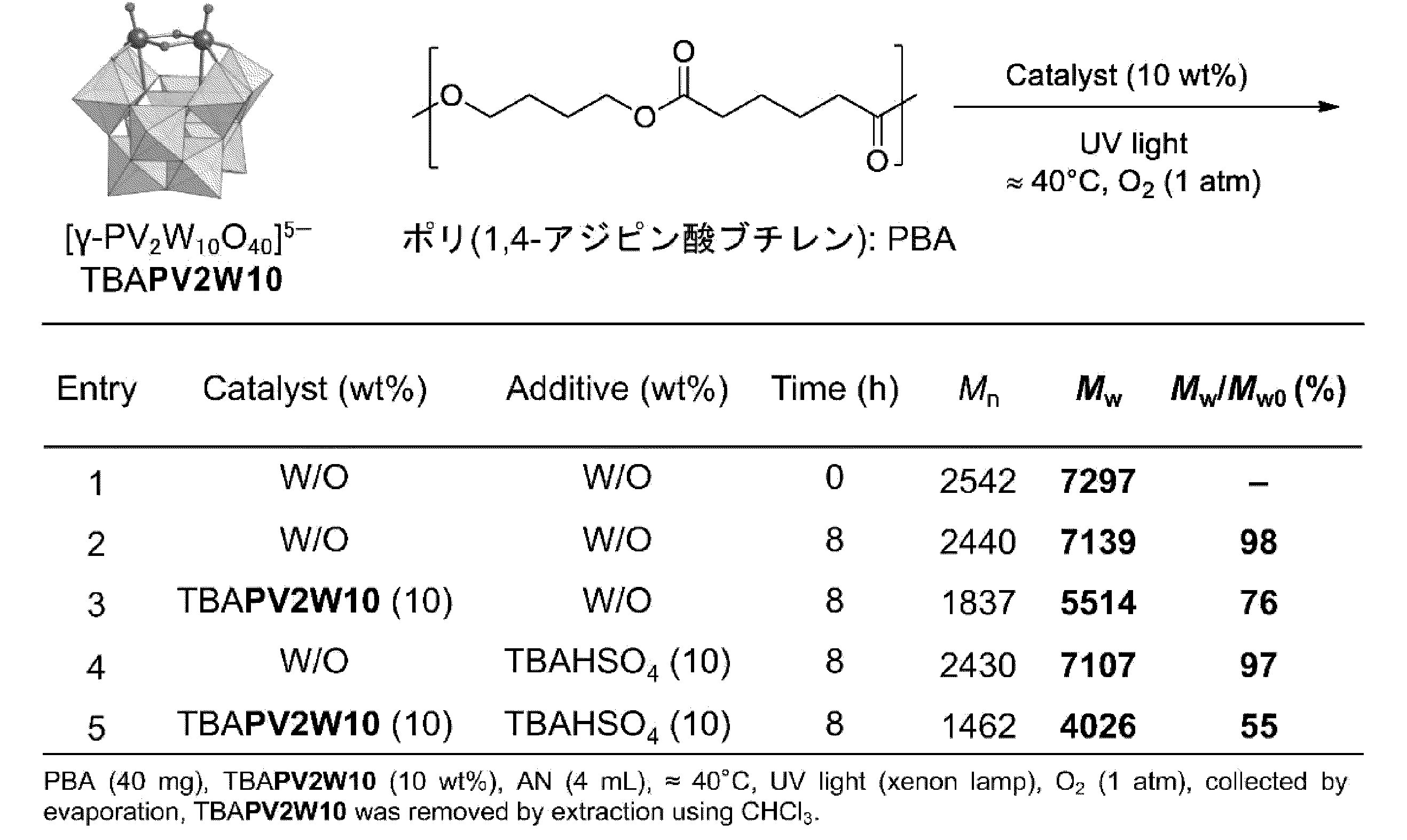
- Table 6 shows that photoirradiation in the presence of TBAPV2W10 and additives accelerated the degradation of PBA (see samples 3 and 5).
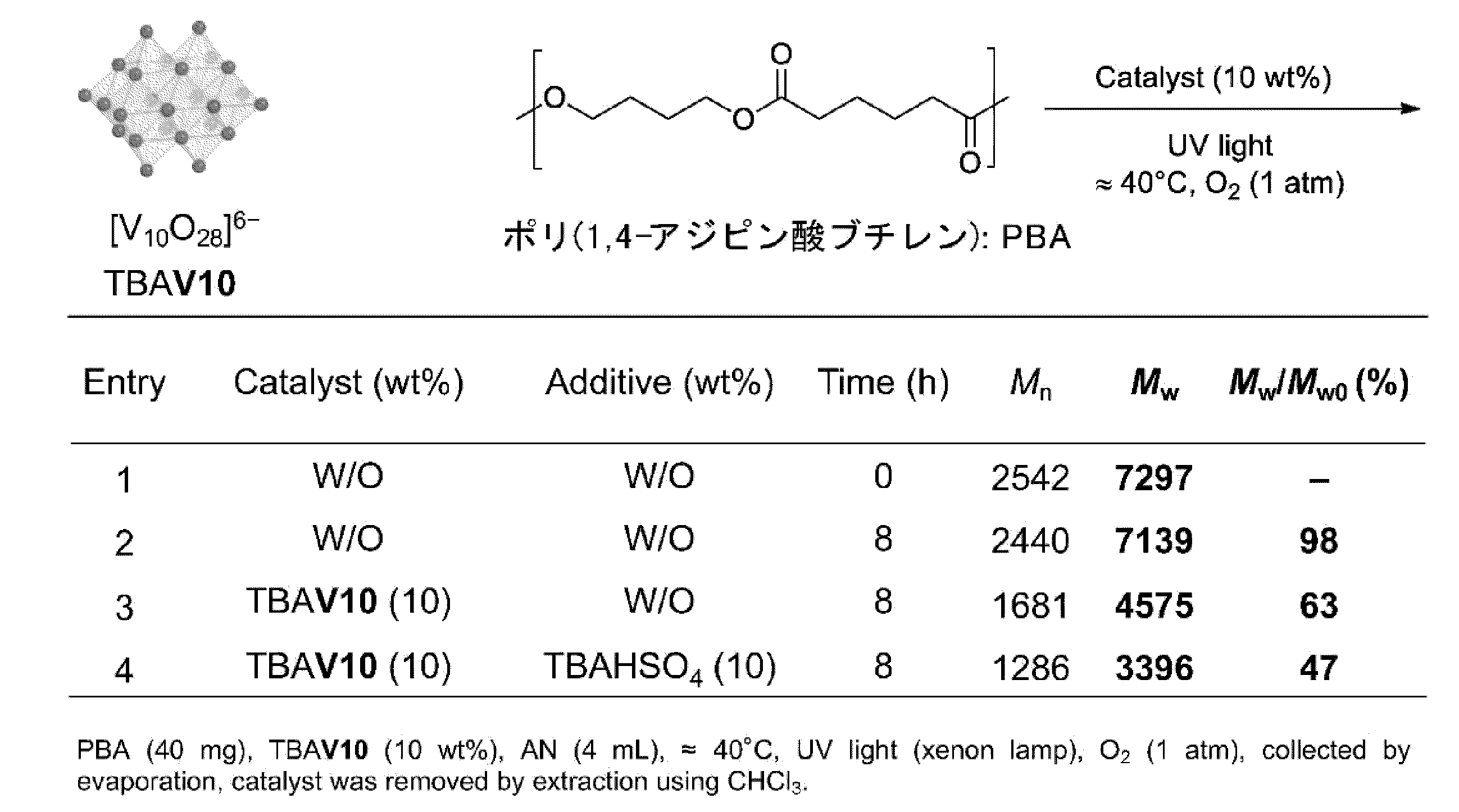
- Example 7 An experiment was conducted in the same manner as in Example 6, except that the PBA decomposition catalyst using a multiple stimulus-responsive photocatalyst was replaced with TBA 3 H 3 [V 10 O 28 ] (TBAV 10, addition amount 10 wt %). The results are shown below. Table 7 shows that photoirradiation in the presence of TBAV10 and additives accelerated the degradation of PBA (see samples 3 and 4).
- Example 8 Cellulose Acetate Decomposition Using Multiple Stimulus Responsive Photocatalyst
- ⁇ -PV 2 W 10 O 40 5- Cellulose acetate (0.2 mmol in terms of monomer), catalyst TBA 4 H [ ⁇ - PV 2 W 10 O 40 ] (TBAPV2W10, added amount 10 wt%), additive (tetrabutylammonium hydrogensulfate, 10 wt%), solvent acetonitrile (4 mL), stirrer, oxygen (1 atm) and stoppered. After that, light irradiation was performed with a 300 W xenon lamp. After reacting for a certain period of time, the solvent was distilled off under reduced pressure.
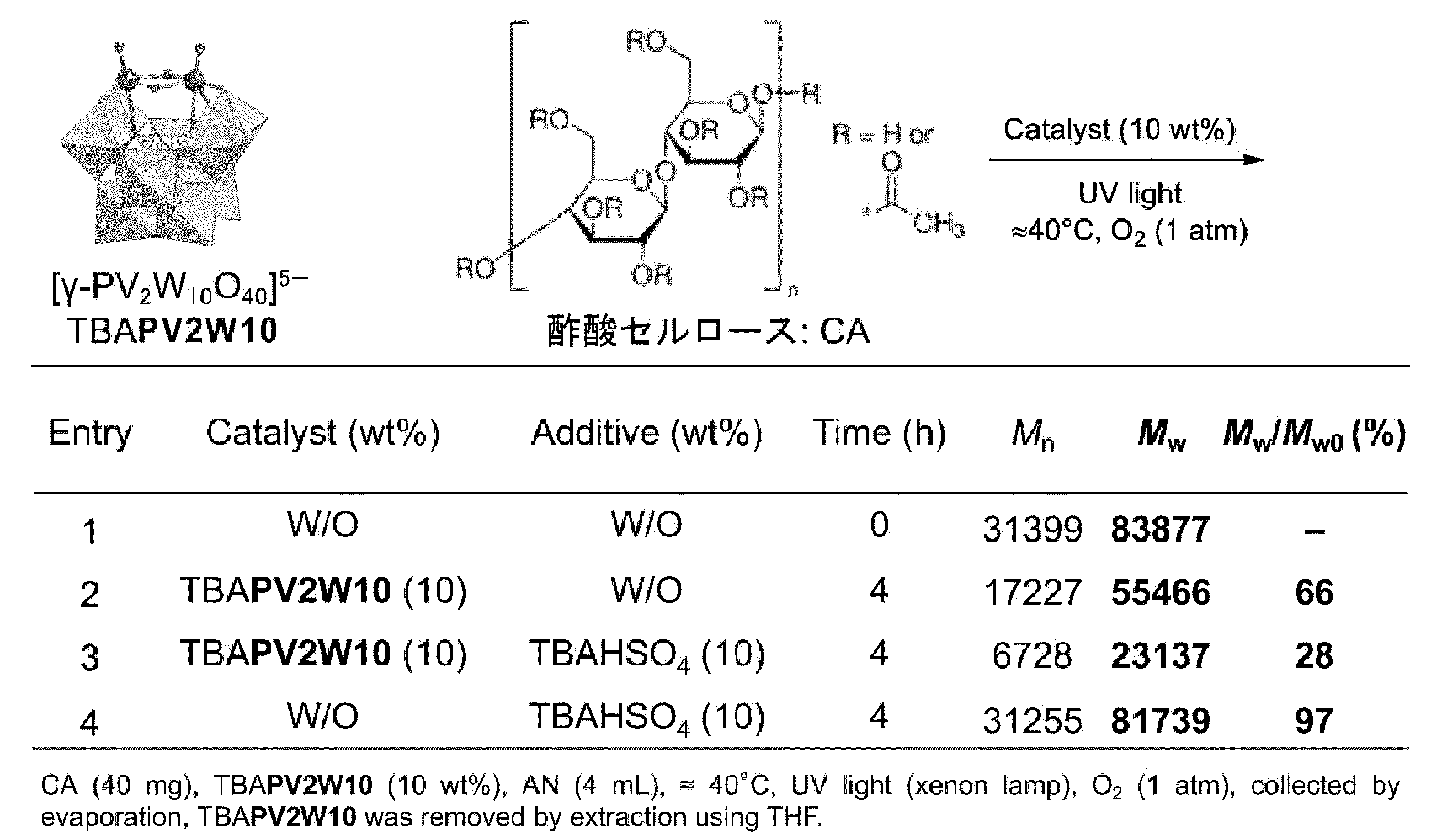
- Table 8 shows that the degradation of cellulose acetate was accelerated by light irradiation in the presence of TBAPV2W10 and additives.
- Example 9 Decomposition of PTHF using a multiple stimulus responsive photocatalyst [ ⁇ -PV 2 W 10 O 40 ] 5- An experiment was conducted in the same manner as in Example 8, except that PTHF was used instead of the polymer. The results are shown below. Table 9 shows that the degradation of PTHF was accelerated by light irradiation in the presence of TBAPV2W10 and additives.
- Example 10 An experiment was conducted in the same manner as in Example 8, except that PPG was used instead of the PPG decomposition polymer using the multiple stimulus-responsive photocatalyst [ ⁇ -PV 2 W 10 O 40 ] 5- . The results are shown below. Table 10 shows that the degradation of PPG was accelerated by light irradiation in the presence of TBAPV2W10 and additives.
- V2W10 ⁇ -PV 2 W 10 O 40 ]
- FIG. 2 shows that the structure of the catalyst is retained even in the film produced by the solution casting method.
- Fig. 4 shows the experimental results using the W10-PCL film. From the figure, it can be seen that the number average molecular weight and weight average molecular weight of the PCL film containing catalyst W10 decreased with the lapse of reaction time. Therefore, it can be understood that the photodegradation of the PCL film containing the catalyst W10 was significantly accelerated.
- Example 12 (1) Preparation of Polymer Film Containing Cluster Catalyst A catalyst-containing film (thickness: 20 ⁇ m) was produced in the same manner as in Example 11 using cellulose acetate (CA) as the polymer. The produced film sample is also called W10-CA. A photograph of the surface of the catalyst-containing polymer film prepared above: W10-CA observed with a digital camera is shown in the right figure of FIG.
- CA cellulose acetate
Landscapes
- Chemical & Material Sciences (AREA)
- Health & Medical Sciences (AREA)
- Chemical Kinetics & Catalysis (AREA)
- Medicinal Chemistry (AREA)
- Polymers & Plastics (AREA)
- Organic Chemistry (AREA)
- Catalysts (AREA)
Abstract
【解決課題】 ポリマー(プラスチックス)が海洋に流失した際に分解する新たな技術を提供すること。 【解決手段】 以下の式(1)で表される1種以上のポリオキソメタレート、及び 以下の式(2)で表される1種以上のヘテロポリオキソメタレート からなる群から選択される1種以上を含有するクラスター触媒、及び 1種以上のポリマー を含む、光分解性ポリマー材料。
Description
高分子材料は、自動車、電気・電子、衣類、食品、医療分野など広域な産業分野で開発され多量に利用されている。近年、マイクロプラスチックス(大きさが5mm以下のプラスチック片)や同様に回収困難な高分子材料などの海洋流出による海洋汚染が注目されるようになってきた。例えば、船舶塗料ではその約1割が海洋に流出している。また、海洋からの回収や海洋での分解が困難なタイヤ摩耗粉、繊維、漁網や釣具なども解決すべき対象である。
環境低負荷型高分子の分子設計と合成は、グリーンケミストリーとして、化学分野や高分子科学分野において長い間議論がなされてきた。これまで、新規なバイオマス由来の高分子材料や生分解性ポリマーが開発され、すでに実用化されているものもある。しかしながら、土壌と海洋の両方で生分解性を示すポリマー材料で実用化されているものは極めて少なく、また生分解性ポリマーは自然環境下で劣化が進みやすいので耐久性に劣り、機械特性も十分でないため、用途が限られ広範囲な分野での利用が進んでいない。すなわち、高分子の生分解性と耐久性・強靭性は典型的なトレードオフの関係にある。
本発明は、ポリマー(プラスチックス)が海洋に流失した際に分解する新たな技術を提供することを目的としている。特に、海洋における多重刺激に応答してポリマー分解が進行する新手法を提供することを目的とする。
本発明者らは、上記課題を解決するために鋭意検討した結果、特定の金属酸化物クラスター触媒を用いることで、海洋における多重刺激に応答してポリマー分解が起こることを見出した。特に、光(太陽光など)を照射することで金属酸化物クラスターが光触媒として機能し、ポリマーの分解が進行することを見出し、本発明を完成した。
また、特定の金属酸化物クラスター触媒を用いると、海洋に存在する成分、具体的には水分や塩(硫酸イオンなど)が共存する時に、ポリマーの分解が顕著に促進することも見出し、本発明を完成した。
また、特定の金属酸化物クラスター触媒を用いると、海洋に存在する成分、具体的には水分や塩(硫酸イオンなど)が共存する時に、ポリマーの分解が顕著に促進することも見出し、本発明を完成した。
即ち、本発明は、
[1]以下の式(1)で表される1種以上のポリオキソメタレート、及び
以下の式(2)で表される1種以上のヘテロポリオキソメタレート
からなる群から選択される1種以上を含有するクラスター触媒、及び
1種以上のポリマー
を含む、光分解性ポリマー材料。
[MxOy]n-(1)
(式(1)中、Mは、W、Mo、Ti又はVであり;
xは、4~34の整数であり:
yは、12~116の整数であり;
nは、2~28の整数である。)
[ABaXbOc]m- (2)
(式中、Aは、P、Si、Ge、S又はSbから選択され;
Bは、V、Ti、Mn、Co、Ni、Cu、Zn、Zr、Nb、Pb、又はAgから選択され;
Xは、W、Mo、Ti又はVであり;
aは、0~40の整数であり:
bは、4~200の整数であり:
cは、12~600の整数であり:
mは、2~40の整数である。)
[2]前記クラスター触媒が式(1)で表される1種以上のポリオキソメタレートを含有する、[1]に記載のポリマー材料。
[3]MがWである、[2]に記載のポリマー材料。
[4]前記ポリオキソメタレートが[W10O32]4-で表される、[3]に記載のポリマー材料。
[5]前記クラスター触媒が、Y4[W10O32]の組成を有する、[4]に記載のポリマー材料(Yは、対カチオンを表し、Yで表される各カチオンは同一であっても異なっていてもよい)。
[6]MがVである、[2]に記載のポリマー材料。
[7]前記ポリオキソメタレートが[V10O28]6-で表される、[6]に記載のポリマー材料。
[8]前記クラスター触媒が、Y6[V10O28]の組成を有する、[7]に記載のポリマー材料(Yは、対カチオンを表し、Yで表される各カチオンは同一であっても異なっていてもよい)。
[9]前記クラスター触媒が式(2)で表される1種以上のヘテロポリオキソメタレートを含有する、[1]に記載のポリマー材料。
[10]XがWである、[9]に記載のポリマー材料。
[11]AがPであり、BがVである、[10]に記載のポリマー材料。
[12]ヘテロポリオキソメタレートが、[PV2W10O40]5-で表される、[11]に記載のポリマー材料
[13]前記クラスター触媒が、Y5[PV2W10O40]の組成を有する、[7]に記載のポリマー材料(Yは、対カチオンを表し、Yで表される各カチオンは同一であっても異なっていてもよい)。
[14]海水に含まれるイオンにより、分解が更に促進される、[9]~[13]のいずれか1項に記載のポリマー材料。
[15]前記海水に含まれるイオンが、塩化物イオン、硫酸イオン、硫酸水素イオン、炭酸水素イオン、臭化物イオン、ナトリウムイオン、マグネシウムイオン、カルシウムイオン、カリウムイオンからなる群から選択される1種以上である、[14]に記載のポリマー材料。
[16]前記ポリマーが、天然高分子、合成樹脂、合成繊維又は合成ゴムから選択される1種以上である、[1]~[15]のいずれか1項に記載のポリマー材料。
[17]前記ポリマーが、熱可塑性樹脂および/又は熱硬化性樹脂である、[1]~[16]のいずれか1項に記載のポリマー材料。
[18]前記ポリマーが、ポリエチレン系樹脂、ポリプロピレン系樹脂、ポリブタジエン系樹脂、ポリスチレン系樹脂、ポリ酢酸ビニル、ポリ塩化ビニル、ポリ塩化ビニリデン、ポリエステル系樹脂、アクリル系樹脂、ポリカーボネート系樹脂、エポキシ系樹脂、アクリル系樹脂、ポリエーテル、ポリアミド、ポリイミド、ポリウレタン、酢酸セルロース、セルロース、シリコーン樹脂、ポリ乳酸、ポリカプロラクタム、ポリエチレングリコール、ポリプロピレングリコール、ポリエチレンテレフタラート、ポリエステル繊維、ナイロン、およびこれらのコポリマー;ポリイソプレン、ポリブタジエン、EPDM、シリコーンゴム、および樹脂とゴムのコポリマー;及びこれらのブレンドからなる群から選択される、[1]~[17]のいずれか1項に記載の光分解性ポリマー材料。
[19][1]~[18]のいずれか1項に記載のポリマー材料を成形してなる成形体。
[20]前記成形体が、フィルム、成型品、タイヤ、繊維、包装材、容器、漁網、釣具、ゲル、又は複合材料である、[19]に記載の成形体。
を提供するものである。
[1]以下の式(1)で表される1種以上のポリオキソメタレート、及び
以下の式(2)で表される1種以上のヘテロポリオキソメタレート
からなる群から選択される1種以上を含有するクラスター触媒、及び
1種以上のポリマー
を含む、光分解性ポリマー材料。
[MxOy]n-(1)
(式(1)中、Mは、W、Mo、Ti又はVであり;
xは、4~34の整数であり:
yは、12~116の整数であり;
nは、2~28の整数である。)
[ABaXbOc]m- (2)
(式中、Aは、P、Si、Ge、S又はSbから選択され;
Bは、V、Ti、Mn、Co、Ni、Cu、Zn、Zr、Nb、Pb、又はAgから選択され;
Xは、W、Mo、Ti又はVであり;
aは、0~40の整数であり:
bは、4~200の整数であり:
cは、12~600の整数であり:
mは、2~40の整数である。)
[2]前記クラスター触媒が式(1)で表される1種以上のポリオキソメタレートを含有する、[1]に記載のポリマー材料。
[3]MがWである、[2]に記載のポリマー材料。
[4]前記ポリオキソメタレートが[W10O32]4-で表される、[3]に記載のポリマー材料。
[5]前記クラスター触媒が、Y4[W10O32]の組成を有する、[4]に記載のポリマー材料(Yは、対カチオンを表し、Yで表される各カチオンは同一であっても異なっていてもよい)。
[6]MがVである、[2]に記載のポリマー材料。
[7]前記ポリオキソメタレートが[V10O28]6-で表される、[6]に記載のポリマー材料。
[8]前記クラスター触媒が、Y6[V10O28]の組成を有する、[7]に記載のポリマー材料(Yは、対カチオンを表し、Yで表される各カチオンは同一であっても異なっていてもよい)。
[9]前記クラスター触媒が式(2)で表される1種以上のヘテロポリオキソメタレートを含有する、[1]に記載のポリマー材料。
[10]XがWである、[9]に記載のポリマー材料。
[11]AがPであり、BがVである、[10]に記載のポリマー材料。
[12]ヘテロポリオキソメタレートが、[PV2W10O40]5-で表される、[11]に記載のポリマー材料
[13]前記クラスター触媒が、Y5[PV2W10O40]の組成を有する、[7]に記載のポリマー材料(Yは、対カチオンを表し、Yで表される各カチオンは同一であっても異なっていてもよい)。
[14]海水に含まれるイオンにより、分解が更に促進される、[9]~[13]のいずれか1項に記載のポリマー材料。
[15]前記海水に含まれるイオンが、塩化物イオン、硫酸イオン、硫酸水素イオン、炭酸水素イオン、臭化物イオン、ナトリウムイオン、マグネシウムイオン、カルシウムイオン、カリウムイオンからなる群から選択される1種以上である、[14]に記載のポリマー材料。
[16]前記ポリマーが、天然高分子、合成樹脂、合成繊維又は合成ゴムから選択される1種以上である、[1]~[15]のいずれか1項に記載のポリマー材料。
[17]前記ポリマーが、熱可塑性樹脂および/又は熱硬化性樹脂である、[1]~[16]のいずれか1項に記載のポリマー材料。
[18]前記ポリマーが、ポリエチレン系樹脂、ポリプロピレン系樹脂、ポリブタジエン系樹脂、ポリスチレン系樹脂、ポリ酢酸ビニル、ポリ塩化ビニル、ポリ塩化ビニリデン、ポリエステル系樹脂、アクリル系樹脂、ポリカーボネート系樹脂、エポキシ系樹脂、アクリル系樹脂、ポリエーテル、ポリアミド、ポリイミド、ポリウレタン、酢酸セルロース、セルロース、シリコーン樹脂、ポリ乳酸、ポリカプロラクタム、ポリエチレングリコール、ポリプロピレングリコール、ポリエチレンテレフタラート、ポリエステル繊維、ナイロン、およびこれらのコポリマー;ポリイソプレン、ポリブタジエン、EPDM、シリコーンゴム、および樹脂とゴムのコポリマー;及びこれらのブレンドからなる群から選択される、[1]~[17]のいずれか1項に記載の光分解性ポリマー材料。
[19][1]~[18]のいずれか1項に記載のポリマー材料を成形してなる成形体。
[20]前記成形体が、フィルム、成型品、タイヤ、繊維、包装材、容器、漁網、釣具、ゲル、又は複合材料である、[19]に記載の成形体。
を提供するものである。
本発明により、ポリマー(プラスチックス)が海洋に流失した際に、光(太陽光など)を照射することにより、ポリマーの分解が進行するポリマー材料を提供することができる。また、多重刺激に応答する(マルチロック型)光分解触媒を用いることにより、海洋に存在する塩(硫酸イオンなど)が共存する時に、ポリマーの分解を更に促進することができる。
このように、本発明により、使用時には分解を抑えてタフネス(強度)を保って劣化を防ぎ、海洋に流失した際には高速なオンデマンド分解が可能となるポリマー材料を提供することができる。また、本発明のポリマー材料は、クラスター触媒を添加しても透明な成形品を得ることが可能である。
本発明のポリマー材料から得られるプラスチック製品、タイヤ、繊維、漁網などは、海洋に流失した際に、海洋における多重刺激に応答してポリマー分解を進行させることが可能である。
このように、本発明により、使用時には分解を抑えてタフネス(強度)を保って劣化を防ぎ、海洋に流失した際には高速なオンデマンド分解が可能となるポリマー材料を提供することができる。また、本発明のポリマー材料は、クラスター触媒を添加しても透明な成形品を得ることが可能である。
本発明のポリマー材料から得られるプラスチック製品、タイヤ、繊維、漁網などは、海洋に流失した際に、海洋における多重刺激に応答してポリマー分解を進行させることが可能である。
本発明の1つの実施態様は、以下の式(1)で表される1種以上のポリオキソメタレート、及び、以下の式(2)で表される1種以上のヘテロポリオキソメタレートからなる群から選択される1種以上を含有するクラスター触媒、及び1種以上のポリマーを含む、光分解性ポリマー材料である。
[MxOy]n-(1)
[ABaXbOc]m- (2)
[MxOy]n-(1)
[ABaXbOc]m- (2)
即ち、本発明においては、式(1)で表される1種以上のポリオキソメタレート、及び、式(2)で表される1種以上のヘテロポリオキソメタレートからなる群から選択される1種以上を含有する金属酸化物クラスター触媒を用いることが重要であり、太陽光などの光を照射することで金属酸化物クラスターが光触媒として機能し、ポリマーの分解が進行するのである。
理論に拘束されることを意図するものではないが、式(1)で表されるポリオキソメタレートを含有するクラスター触媒は、高活性な光分解触媒として機能してポリマーを分解する特性を有する。また、式(2)で表されるヘテロポリオキソメタレートを含有するクラスター触媒は、紫外光や可視光に加えて、海水に含まれる水分やイオンにも応答する、多重刺激に応答する(マルチロック型)光分解触媒として機能してポリマーを分解する特性を有する。
理論に拘束されることを意図するものではないが、式(1)で表されるポリオキソメタレートを含有するクラスター触媒は、高活性な光分解触媒として機能してポリマーを分解する特性を有する。また、式(2)で表されるヘテロポリオキソメタレートを含有するクラスター触媒は、紫外光や可視光に加えて、海水に含まれる水分やイオンにも応答する、多重刺激に応答する(マルチロック型)光分解触媒として機能してポリマーを分解する特性を有する。
(I)式(1)で表されるポリオキソメタレート
[MxOy]n-(1)
式(1)において、Mは、W、Mo、Ti又はVである。
[MxOy]n-(1)
式(1)において、Mは、W、Mo、Ti又はVである。
xは、4~34の整数である。
yは、12~116の整数である。
nは、2~28の整数である。
本発明の1つの態様においては、MがWである。この場合、xの範囲は、好ましくは5~13であり、yの範囲は、好ましくは19~40であり、nの範囲は、好ましくは2~8である。
本発明の1つの態様においては、ポリオキソメタレートは、[W10O32]4-で表される。
本発明の1つの態様においては、クラスター触媒は、Y4[W10O32]の組成を有する。ここで、Yは、対カチオンを表し、Yで表される各カチオンは同一であっても異なっていてもよい。
Yとしては、例えば、テトラブチルアンモニウム(TBA)、水素イオン、ナトリイオン、カリウムイオン等が挙げられる。
Yとしては、例えば、テトラブチルアンモニウム(TBA)、水素イオン、ナトリイオン、カリウムイオン等が挙げられる。
本発明の1つの好ましい態様においては、クラスター触媒は、TBA4[W10O32]である。
本発明の1つの態様においては、MがVである。この場合、xの範囲は、好ましくは4~16であり、yの範囲は、好ましくは12~42であり、nの範囲は、好ましくは3~8である。
本発明の1つの態様においては、ポリオキソメタレートは、[V10O28]6-で表される。
本発明の1つの態様においては、クラスター触媒は、Y6[V10O28]の組成を有する。ここで、Yは、対カチオンを表し、Yで表される各カチオンは同一であっても異なっていてもよい。Yとしては、前記した通りである。
本発明の1つの好ましい態様においては、クラスター触媒は、TBA3H3[V10O28]である。
(II)式(2)で表される1種以上のヘテロポリオキソメタレート
[ABaXbOc]m- (2)
式(2)において、Aは、P、Si、Ge、S又はSbから選択され、好ましくは、Pである。
[ABaXbOc]m- (2)
式(2)において、Aは、P、Si、Ge、S又はSbから選択され、好ましくは、Pである。
式(2)において、Bは、V、Ti、Mn、Co、Ni、Cu、Zn、Zr、Nb、Pb、又はAgから選択され、好ましくは、V、Tiである。
Xは、W又はMoである。
aは、0~40の整数である。aが0の場合は、Bの部分の金属は存在しない。
bは、4~200の整数である。
cは、12~600の整数である
mは、2~40の整数である。
本発明の1つの態様においては、式(2)において、XがWであり、AがPであり、BがVである。この場合、aの範囲は、好ましくは1~3であり、bの範囲は、好ましくは9~11であり、cは、好ましくは40であり、mの範囲は、好ましくは4~6である。
本発明の1つの態様においては、ヘテロポリオキソメタレートが、[PV2W10O40]5-で表される。
本発明の1つの態様においては、クラスター触媒は、Y5[PV2W10O40]の組成を有する。ここで、Yは、対カチオンを表し、Yで表される各カチオンは同一であっても異なっていてもよい。Yとしては、前記した通りである。
本発明の1つの好ましい態様においては、クラスター触媒は、TBA4H[γ-PV2W10O40]である。
本発明のもう1つの態様においては、式(2)において、XがWであり、AがPであり、aが0である(即ち、置換金属がないポリオキソメタレートである)。この場合、bの範囲は、好ましくは9~12であり、cの範囲は、好ましくは34~40であり、mの範囲は、好ましくは3~8である。
本発明の1つの態様においては、ヘテロポリオキソメタレートが、[PW12O40]3-で表される。
本発明の1つの態様においては、クラスター触媒は、Y3[PW12O40]の組成を有する。ここで、Yは、対カチオンを表し、Yで表される各カチオンは同一であっても異なっていてもよい。Yとしては、前記した通りである。
これら式(2)で表されるヘテロポリオキソメタレートを含有するクラスター触媒は、多重刺激に応答する(マルチロック型)光分解触媒として機能し、紫外光や可視光によるポリマーの分解に加えて、海水に含まれる水分やイオンにより、分解を更に促進するという特性を有する。ここで、海水に含まれるイオンとしては、塩化物イオン、硫酸イオン、硫酸水素イオン、炭酸水素イオン、臭化物イオン、ナトリウムイオン、マグネシウムイオン、カルシウムイオン、カリウムイオンからなる群から選択される1種以上である。
式(1)で表されるポリオキソメタレート、又は、式(2)で表されるヘテロポリオキソメタレートを含有する金属酸化物クラスター触媒は、公知の合成方法で製造することができる。実施例で用いたクラスター触媒は、Inorg. Synth. 1990, 27, 71-135、Nat. Chem. 2010, 2, 478-483に従って合成することができ
る。
る。
本発明に使用できるポリマーとしては、天然高分子、合成高分子、半合成高分子が挙げられる。本発明に使用できるポリマーは、有機ポリマー、無機ポリマー、有機・無機ハイブリッドポリマーの何れでもよい。
天然高分子としては、ポリアミン、セルロース、アミロース、デンプン、キチン、天然ゴム等が挙げられるが、これらに限定されない。
合成高分子としては、合成樹脂、合成繊維、合成ゴムが挙げられる。
合成樹脂としては、熱可塑性樹脂、熱硬化性樹脂のいずれも使用することができる。
熱可塑性樹脂としては、例えば、ポリエチレン系樹脂(高密度ポリエチレン、中密度ポリエチレン、低密度ポリエチレン、線状低密度ポリエチレン等)、ポリプロピレン系樹脂、ポリオレフィン系エラストマー、環状ポリオレフィン、ポリスチレン、ポリ酢酸ビニル、ポリウレタン、ポリ乳酸、フッ素系樹脂(ポリテトラフルオロエチレン、ポリフッ化ビニリデン等)、ABS樹脂、AS樹脂、アクリル系樹脂(ポリメチルメタクリレート、ポリアクリレート、ポリブチルアクリレート等)、ポリ塩化ビニル、ポリ塩化ビニリデン、ポリアミド(ナイロン等)、ポリアセタール、ポリカーボネート、ポリエーテル(ポリテトラヒドロフラン等)、変性ポリフェニレンエーテル、ポリエステル系樹脂(ポリエチレンテレフタレート、ポリブチレンテレフタレート、ポリトリメチレンテレフタレート、ポリエチレンナフタレート、ポリブチレンナフタレート、ポリ(1,4-アジピン酸ブチレン、ポリカプロラクトン等)、ポリエチレングリコール(PEG)、ポリプロピレングリコール(PPG)等が挙げられるが、これらに限定されない。
また、いわゆるスーパーエンジニアリングプラスチック、例えば、ポリフェニレンスルファイド、ポリサルフォン、ポリエーテルサルフォン、非晶ポリアリレート、液晶ポリマー、ポリエーテルエーテルケトン、熱可塑性ポリイミド、ポリアミドイミド等も使用することができる。
また、ゴム系の材料、ポリイソプレン、ポリブタジエン、EPDM,シリコーンゴム、および樹脂とゴムのコポリマー、スチレン系、オレフィン系、ポリウレタン系、ポリエステル系、ポリアミド系熱可塑性樹脂。およびこれらのブレンド成形物等も使用することができる。
また、いわゆるスーパーエンジニアリングプラスチック、例えば、ポリフェニレンスルファイド、ポリサルフォン、ポリエーテルサルフォン、非晶ポリアリレート、液晶ポリマー、ポリエーテルエーテルケトン、熱可塑性ポリイミド、ポリアミドイミド等も使用することができる。
また、ゴム系の材料、ポリイソプレン、ポリブタジエン、EPDM,シリコーンゴム、および樹脂とゴムのコポリマー、スチレン系、オレフィン系、ポリウレタン系、ポリエステル系、ポリアミド系熱可塑性樹脂。およびこれらのブレンド成形物等も使用することができる。
また、熱硬化性樹脂としては、フェノール系樹脂、エポキシ樹脂、ウレタン樹脂、メラミン樹脂、尿素樹脂、エポキシ樹脂、セルロース樹脂、キシレン樹脂、アルキッド樹脂、不飽和ポリエステル系樹脂、熱硬化性ポリイミド等が挙げられる。これらの樹脂を一種単独で用いてもよく、二種以上組み合わせて用いてもよい。
合成繊維としては、例えば、ナイロン(6,6-ナイロン等)、ビニロン(ポリビニルアルコールをアセタール化して得られる合成繊維)、ポリエステル繊維(ポリエチレンテレフタレート等)、アラミド繊維等が挙げられるが、これらに限定されない。
合成ゴムとしては、例えば、スチレンブタジエンゴム(SBR)、ブタジエンゴム(BR)、イソプレンゴム(IR)、ブチルゴム、クロロプレンゴム等が挙げられるが、これらに限定されない。
半合成高分子としては、例えば、酢酸セルロース、硝酸セルロース、セルロイド、レイヨン等が挙げられるが、これらに限定されない。
無機ポリマーとしては、特定の樹脂に限定されるものではないが、例えば、シリコーン樹脂、ポリシロキサン、ポリシルセスキオキサン、ポリチタノキサン、ポリジルコノキサン、ポリシラザン、シリコーンゴム等が挙げられる。
また、有機・無機ハイブリッドポリマーは、有機ポリマーの炭素骨格に部分的にシリカを複合させたポリマーで、特定のポリマーに限定されるものではないが、例えばエポキシ樹脂-シリカハイブリッドポリマー、ポリアルキルシロキサン等が挙げられる。
これらポリマーは、ホモポリマーであっても共重合体であってもよい。
また、ポリマーは1種類でもよく、2種以上のポリマーの混合物(ポリマーブレンド)であってもよい。
また、ポリマーは1種類でもよく、2種以上のポリマーの混合物(ポリマーブレンド)であってもよい。
また、ポリマーには、ガラス繊維や炭素繊維で強化したガラス繊維強化プラスチックや炭素繊維強化プラスチックも含まれる。
本発明のポリマー材料においては、クラスター触媒の含有量は、通常、ポリマー100重量%に対して、0.1~20重量パーセントの濃度、好ましくは0.1~10重量パーセントの濃度である。
本発明に使用されるポリマーが、合成樹脂、合成繊維又は合成ゴムである場合、本発明のポリマー材料は、「本発明の樹脂組成物」、「本発明の繊維組成物」又は「本発明のゴム組成物」と呼ぶこともできる。また、これらと、ポリマーがその他のポリマーである場合も含めて、本発明のポリマー材料を「本発明の高分子組成物」と言うこともできる。
本発明のポリマー材料においては、クラスター触媒をポリマーに様々な方法で混入させることができる。例えば、クラスター触媒をポリマーと一緒に練り込んだり、ポリマーとクラスター触媒を溶媒に溶解又は分散させて、その後、溶媒を蒸発させることでポリマーにクラスター触媒を混入させることもできる。
本発明のポリマー材料には、目的とする製品に要求される特性(耐熱性や耐候性等)を付与するために各種添加剤を配合することができる。
具体例としては、例えば、帯電防止剤、酸化防止剤、中和剤、滑剤、アンチブロッキング剤、可塑剤、熱安定剤、光安定剤、染顔料、結晶核剤、紫外線吸収剤、充填剤、剛性を付与する無機フィラー、及び柔軟性を付与するためにエラストマー等を、本発明の効果を阻害しない範囲において用いてもよい。
具体例としては、例えば、帯電防止剤、酸化防止剤、中和剤、滑剤、アンチブロッキング剤、可塑剤、熱安定剤、光安定剤、染顔料、結晶核剤、紫外線吸収剤、充填剤、剛性を付与する無機フィラー、及び柔軟性を付与するためにエラストマー等を、本発明の効果を阻害しない範囲において用いてもよい。
本発明のポリマー材料は、優れた光分解性を示す。光分解性の指標として、光を照射する前の重量平均分子量をMw0とし、光(太陽光など)を一定時間照射した後の重量平均分子量をMwとすると、両者の比として、Mw/Mw0×100を用いることができる。
本発明のもう1つの実施態様は、本発明のポリマー材料を成形してなる成形体である(以下「本発明の成形体」とも言う)。
本発明の成形体は、ポリマー材料に含まれるポリマーの種類や目的とする製品の種類に応じて、種々の成形方法で得ることができる。例えば、フィルム成形(カレンダー成形、Tダイ成形、ブロー成形、キャスト成形等)、射出成形、ブロー成型、押出成形、紡糸法(溶融紡糸法、湿式紡糸法、乾式防止法)、引き抜き成形等が挙げられるが、これらに限定されない。
本発明の成形体は、ポリマー材料に含まれるポリマーの種類や目的とする製品の種類に応じて、種々の成形方法で得ることができる。例えば、フィルム成形(カレンダー成形、Tダイ成形、ブロー成形、キャスト成形等)、射出成形、ブロー成型、押出成形、紡糸法(溶融紡糸法、湿式紡糸法、乾式防止法)、引き抜き成形等が挙げられるが、これらに限定されない。
本発明のポリマー材料から得られる製品としては、例えば、フィルム、玩具、タイヤ、繊維、梱包材、容器、漁網、釣具、ゲル、複合材料などが挙げられるが、これらに限定されない。
本発明のポリマー材料を成形してなる成形体を調製するには、クラスター触媒をポリマーに様々な方法で混入させて本発明のポリマー材料を一旦得て、これを用いて上記の成形方法により成形することができる。
例えば、クラスター触媒をポリマーと一緒に練り込んだり、ポリマーとクラスター触媒を溶媒に溶解又は分散させて、その後、溶媒を蒸発させることにより、ポリマーにクラスター触媒を混入させた本発明のポリマー材料を得て、これを、フィルム成形、射出成形、ブロー成型、押出成形、紡糸法、引き抜き成形等に供することで成形体を得ることができる。
例えば、クラスター触媒をポリマーと一緒に練り込んだり、ポリマーとクラスター触媒を溶媒に溶解又は分散させて、その後、溶媒を蒸発させることにより、ポリマーにクラスター触媒を混入させた本発明のポリマー材料を得て、これを、フィルム成形、射出成形、ブロー成型、押出成形、紡糸法、引き抜き成形等に供することで成形体を得ることができる。
また、クラスター触媒をポリマーと一緒に練り込んで、これを直接、射出成形、ブロー成型、押出成形、紡糸法、引き抜き成形することで成形体を得ることもできる。
また、ポリマーとクラスター触媒を溶媒に溶解又は分散させて、得られた溶液又は分散液をキャスト成形することによりフィルムを得ることもできる。この際に、用いる溶媒は、使用するポリマーを溶解又は分散させることができ、クラスター触媒に安定な溶媒を適宜使用することができる。また、乾燥は、自然乾燥を行ってもよく、フィルムに所定の温度の熱をかけて乾燥させてもよい。
また、ポリマーとクラスター触媒を溶媒に溶解又は分散させて、得られた溶液又は分散液をキャスト成形することによりフィルムを得ることもできる。この際に、用いる溶媒は、使用するポリマーを溶解又は分散させることができ、クラスター触媒に安定な溶媒を適宜使用することができる。また、乾燥は、自然乾燥を行ってもよく、フィルムに所定の温度の熱をかけて乾燥させてもよい。
以下、本発明の実施例及び比較例を示して、具体的に説明するが、本発明は、これらの実施例により何ら限定されるものではない。
1.クラスター触媒TBA4[W10O32]を用いた各種ポリマーの分解
[触媒の調製]
クラスター触媒TBA4[W10O32]は、文献(Inorg. Synth. 1990, 27, 81-83)に従って合成した。
[触媒の調製]
クラスター触媒TBA4[W10O32]は、文献(Inorg. Synth. 1990, 27, 81-83)に従って合成した。
[実施例1]
クラスター触媒TBA 4 [W 10 O 32 ]を用いたPBAの分解
ガラス製試験管に、ポリ(1,4-アジピン酸ブチレン)(PBA、40mg)、触媒TBA4[W10O32](TBAW10、添加量10wt%)を加え、溶媒としてアセトニトリル(4mL)、撹拌子、酸素(1気圧)を入れて栓をした後、出力300Wのキセノンランプで光照射を行った。8時間の反応後、溶媒を減圧留去した。その後、クロロホルムまたはテトラヒドロフランを加えて、分解生成物を抽出した。
この分解生成物について、ゲル浸透クロマトグラフィーを用いて分子量(数平均分子量及び重量平均分子量)の分析を行った。なお、ゲル浸透クロマトグラフィーでは、東ソーのTSKgel SuperHM-N カラムを用いて分離し、示差屈折率検出器を用いて検出した。分析の結果、反応前には、重量平均分子量Mw=7297であったものが、反応後にはMw=739まで低下し、分解が進行したことを確認した。
クラスター触媒TBA 4 [W 10 O 32 ]を用いたPBAの分解
ガラス製試験管に、ポリ(1,4-アジピン酸ブチレン)(PBA、40mg)、触媒TBA4[W10O32](TBAW10、添加量10wt%)を加え、溶媒としてアセトニトリル(4mL)、撹拌子、酸素(1気圧)を入れて栓をした後、出力300Wのキセノンランプで光照射を行った。8時間の反応後、溶媒を減圧留去した。その後、クロロホルムまたはテトラヒドロフランを加えて、分解生成物を抽出した。
この分解生成物について、ゲル浸透クロマトグラフィーを用いて分子量(数平均分子量及び重量平均分子量)の分析を行った。なお、ゲル浸透クロマトグラフィーでは、東ソーのTSKgel SuperHM-N カラムを用いて分離し、示差屈折率検出器を用いて検出した。分析の結果、反応前には、重量平均分子量Mw=7297であったものが、反応後にはMw=739まで低下し、分解が進行したことを確認した。
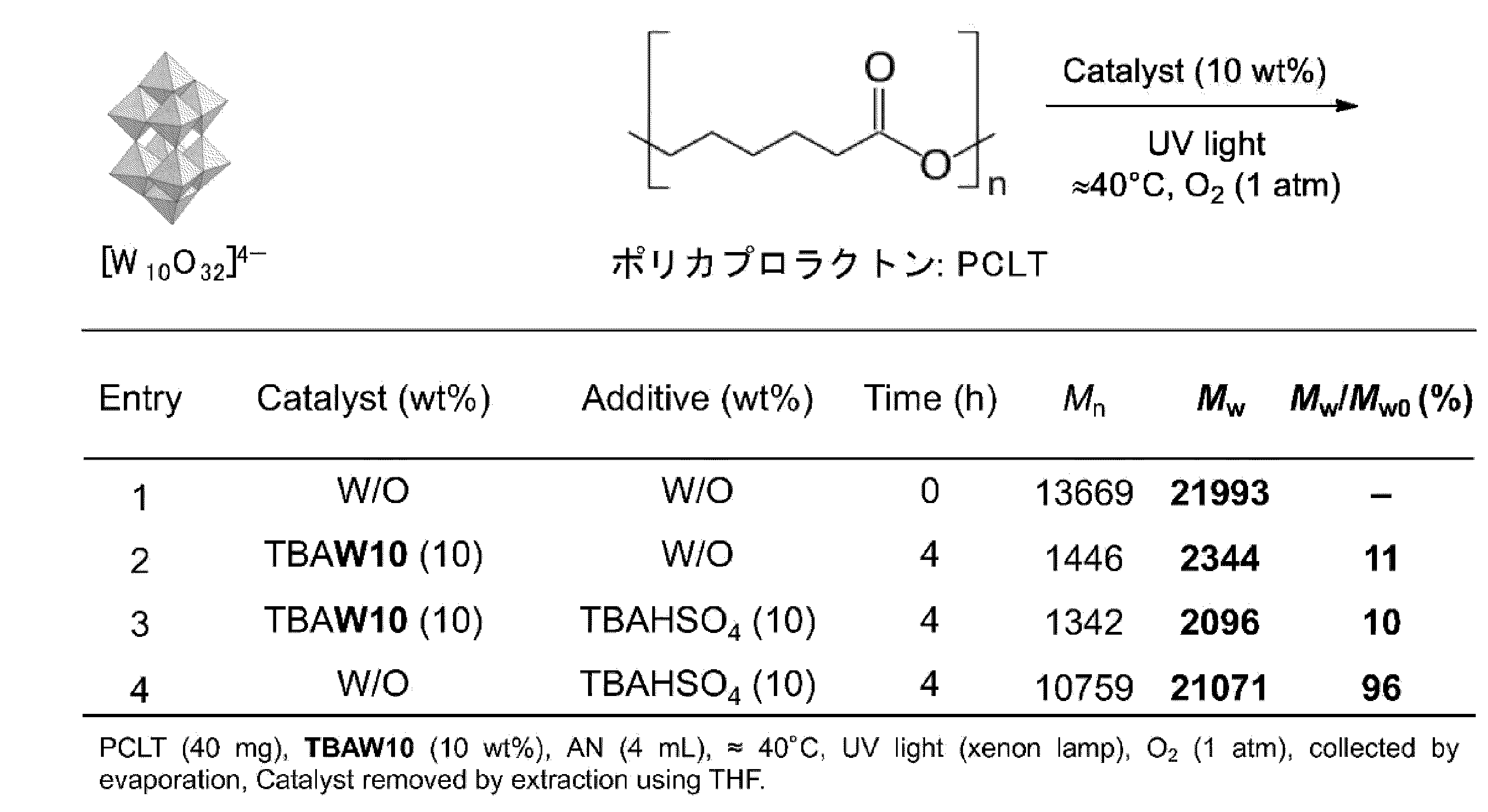
結果を以下に示す。表1から、TBA4[W10O32]の存在下での光照射によりPBAが高速分解されたことが示される。

[実施例2]
クラスター触媒TBA 4 [W 10 O 32 ]を用いた酢酸セルロースの分解
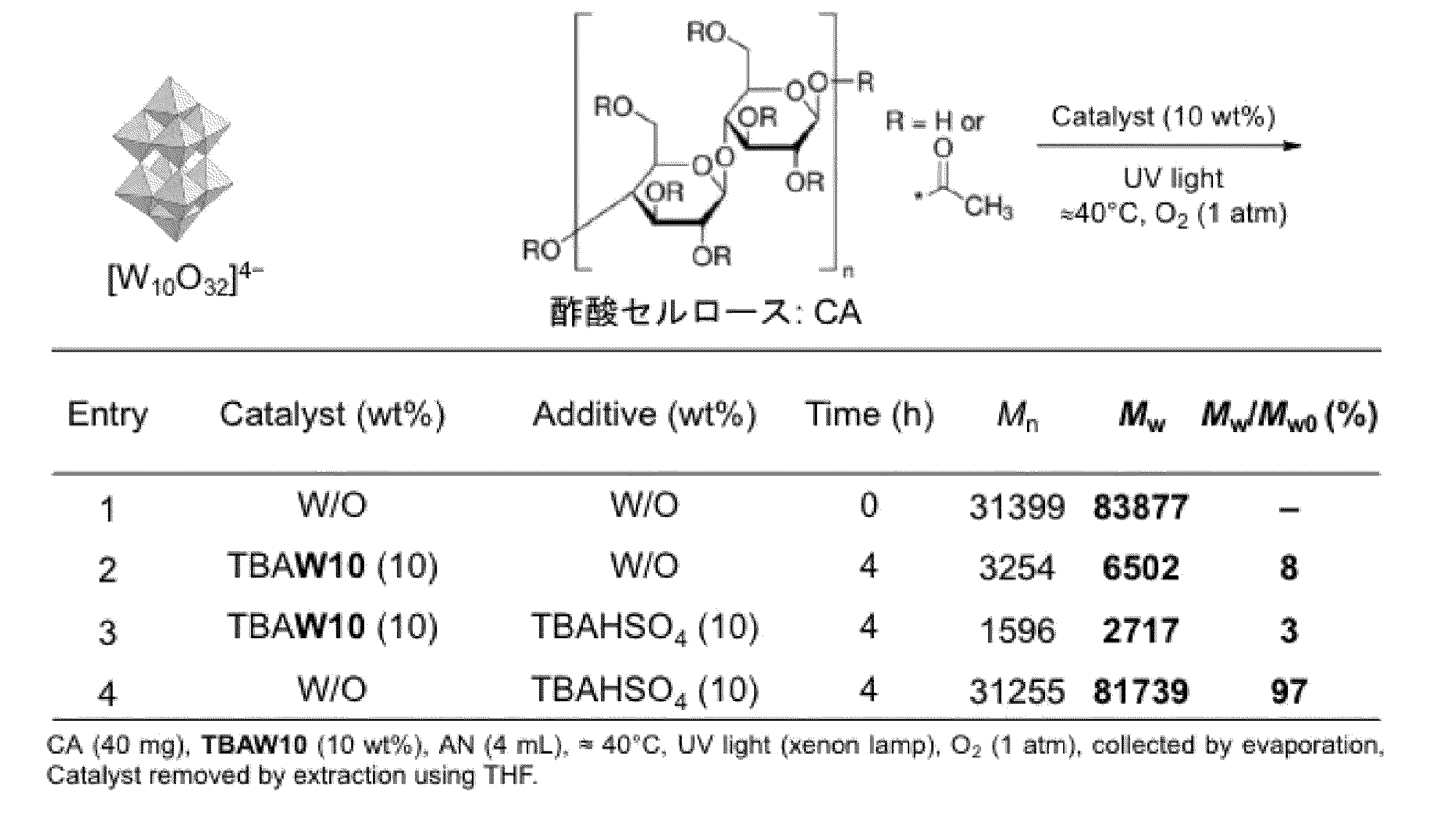
ガラス製試験管に酢酸セルロース(40mg)、触媒TBA4[W10O32](TBAW10、添加量10wt%)を加え、溶媒としてアセトニトリル(4mL)、撹拌子、酸素(1気圧)を入れて栓をした後、出力300 Wのキセノンランプで光照射を行った。一定時間の反応後、溶媒を減圧留去した。その後、クロロホルムまたはテトロヒドロフランを加えて、分解生成物を抽出した。この分解生成物について、ゲル浸透クロマトグラフィーを用いて分子量(数平均分子量及び重量平均分子量)の分析を行った。なお、ゲル浸透クロマトグラフィーでは、東ソーのTSKgel SuperHM-Nカラムを用いて分離し、示差屈折率検出器を用いて検出した。
クラスター触媒TBA 4 [W 10 O 32 ]を用いた酢酸セルロースの分解
ガラス製試験管に酢酸セルロース(40mg)、触媒TBA4[W10O32](TBAW10、添加量10wt%)を加え、溶媒としてアセトニトリル(4mL)、撹拌子、酸素(1気圧)を入れて栓をした後、出力300 Wのキセノンランプで光照射を行った。一定時間の反応後、溶媒を減圧留去した。その後、クロロホルムまたはテトロヒドロフランを加えて、分解生成物を抽出した。この分解生成物について、ゲル浸透クロマトグラフィーを用いて分子量(数平均分子量及び重量平均分子量)の分析を行った。なお、ゲル浸透クロマトグラフィーでは、東ソーのTSKgel SuperHM-Nカラムを用いて分離し、示差屈折率検出器を用いて検出した。
結果を以下に示す。表2から、TBA4[W10O32]の存在下での光照射により酢酸セルロースが高速分解されたことが示される。
[実施例3]
クラスター触媒TBA 4 [W 10 O 32 ]を用いたPTHFの分解
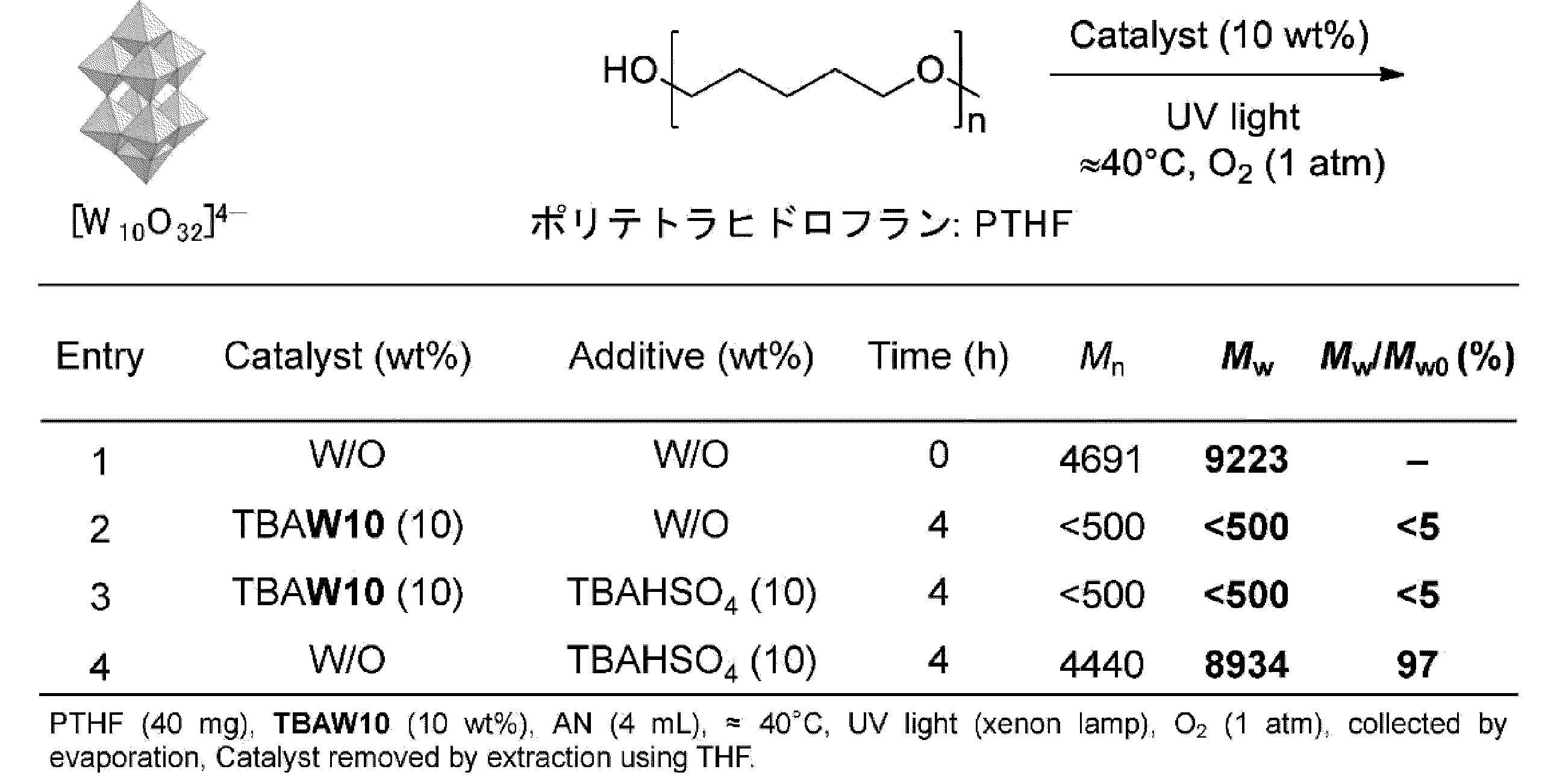
ポリマーをPTHFに代えた以外は、実施例2と同様の手順で実験を行った。
結果を以下に示す。表3から、TBA4[W10O32]の存在下での光照射によりPTHFが高速分解されたことが示される。
クラスター触媒TBA 4 [W 10 O 32 ]を用いたPTHFの分解
ポリマーをPTHFに代えた以外は、実施例2と同様の手順で実験を行った。
結果を以下に示す。表3から、TBA4[W10O32]の存在下での光照射によりPTHFが高速分解されたことが示される。
[実施例4]
クラスター触媒TBA 4 [W 10 O 32 ]を用いたポリカプロラクトンの分解
ポリマーをポリカプロラクトンに代えた以外は、実施例2と同様の手順で実験を行った。
結果を以下に示す。表4から、TBA4[W10O32]の存在下での光照射によりポリカプロラクトンが高速分解されたことが示される。
クラスター触媒TBA 4 [W 10 O 32 ]を用いたポリカプロラクトンの分解
ポリマーをポリカプロラクトンに代えた以外は、実施例2と同様の手順で実験を行った。
結果を以下に示す。表4から、TBA4[W10O32]の存在下での光照射によりポリカプロラクトンが高速分解されたことが示される。
[実施例5]
クラスター触媒TBA 4 [W 10 O 32 ]を用いたPPGの分解
ポリマーをPPGに代えた以外は、実施例2と同様の手順で実験を行った。
結果を以下に示す。表5から、TBA4[W10O32]の存在下での光照射によりポリカプロラクトンが高速分解されたことが示される。
クラスター触媒TBA 4 [W 10 O 32 ]を用いたPPGの分解
ポリマーをPPGに代えた以外は、実施例2と同様の手順で実験を行った。
結果を以下に示す。表5から、TBA4[W10O32]の存在下での光照射によりポリカプロラクトンが高速分解されたことが示される。

2.多重刺激応答型光触媒を用いた各種ポリマーの分解
[触媒の調製]
触媒TBA4H[γ-PV2W10O40](TBAPV2W10)は、文献(Nat. Chem. 2010, 2, 478-483)に従って合成した。
触媒TBA3H3[V10O28](TBAV10)は、文献(Inorg. Synth. 1990, 27, 83-85)に従って合成した。
[触媒の調製]
触媒TBA4H[γ-PV2W10O40](TBAPV2W10)は、文献(Nat. Chem. 2010, 2, 478-483)に従って合成した。
触媒TBA3H3[V10O28](TBAV10)は、文献(Inorg. Synth. 1990, 27, 83-85)に従って合成した。
[実施例6]
多重刺激応答型光触媒[γ-PV 2 W 10 O 40 ] 5- を用いたPBAの分解
ガラス製試験管にPBA(40mg)、触媒TBA4H[γ-PV2W10O40](TBAPV2W10、添加量10wt%)、添加剤(テトラブチルアンモニウム硫酸水素塩、10wt%)、溶媒アセトニトリル(4mL)、撹拌子、酸素(1気圧)を入れて栓をした後、300Wキセノンランプで光照射を行った。一定時間の反応後、溶媒を減圧留去した。その後、クロロホルムまたはテトロヒドロフランを加えて、分解生成物を抽出した。
この分解生成物について、ゲル浸透クロマトグラフィーを用いて分子量(数平均分子量及び重量平均分子量)の分析を行った。なお、ゲル浸透クロマトグラフィーでは、東ソーのTSKgel SuperHM-Nカラムを用いて分離し、示差屈折率検出器を用いて検出した。
多重刺激応答型光触媒[γ-PV 2 W 10 O 40 ] 5- を用いたPBAの分解
ガラス製試験管にPBA(40mg)、触媒TBA4H[γ-PV2W10O40](TBAPV2W10、添加量10wt%)、添加剤(テトラブチルアンモニウム硫酸水素塩、10wt%)、溶媒アセトニトリル(4mL)、撹拌子、酸素(1気圧)を入れて栓をした後、300Wキセノンランプで光照射を行った。一定時間の反応後、溶媒を減圧留去した。その後、クロロホルムまたはテトロヒドロフランを加えて、分解生成物を抽出した。
この分解生成物について、ゲル浸透クロマトグラフィーを用いて分子量(数平均分子量及び重量平均分子量)の分析を行った。なお、ゲル浸透クロマトグラフィーでは、東ソーのTSKgel SuperHM-Nカラムを用いて分離し、示差屈折率検出器を用いて検出した。
結果を以下に示す。表6から、TBAPV2W10及び添加剤の存在下での光照射によりPBAの分解が促進されたことが示される(試料3及び5を参照)。
[実施例7]
多重刺激応答型光触媒を用いたPBAの分解
触媒をTBA3H3[V10O28](TBAV10、添加量10wt%)に代えた以外は、実施例6と同様の手順で実験を行った。
結果を以下に示す。表7から、TBAV10及び添加剤の存在下での光照射によりPBAの分解が促進されたことが示される(試料3及び4を参照)。
多重刺激応答型光触媒を用いたPBAの分解
触媒をTBA3H3[V10O28](TBAV10、添加量10wt%)に代えた以外は、実施例6と同様の手順で実験を行った。
結果を以下に示す。表7から、TBAV10及び添加剤の存在下での光照射によりPBAの分解が促進されたことが示される(試料3及び4を参照)。
[実施例8]
多重刺激応答型光触媒[γ-PV 2 W 10 O 40 ] 5- を用いた酢酸セルロースの分解
ガラス製試験管に酢酸セルロース(単量体換算で0.2 mmol)、触媒TBA4H[γ-PV2W10O40](TBAPV2W10、添加量10wt%)、添加剤(テトラブチルアンモニウム硫酸水素塩、10wt%)、溶媒アセトニトリル(4mL)、撹拌子、酸素(1気圧)を入れて栓をした後、300Wキセノンランプで光照射を行った。一定時間の反応後、溶媒を減圧留去した。その後、クロロホルムまたはテトロヒドロフランを加えて、分解生成物を抽出した。
この分解生成物について、ゲル浸透クロマトグラフィーを用いて分子量(数平均分子量及び重量平均分子量)の分析を行った。なお、ゲル浸透クロマトグラフィーでは、東ソーのTSKgel SuperHM-Nカラムを用いて分離し、示差屈折率検出器を用いて検出した。
多重刺激応答型光触媒[γ-PV 2 W 10 O 40 ] 5- を用いた酢酸セルロースの分解
ガラス製試験管に酢酸セルロース(単量体換算で0.2 mmol)、触媒TBA4H[γ-PV2W10O40](TBAPV2W10、添加量10wt%)、添加剤(テトラブチルアンモニウム硫酸水素塩、10wt%)、溶媒アセトニトリル(4mL)、撹拌子、酸素(1気圧)を入れて栓をした後、300Wキセノンランプで光照射を行った。一定時間の反応後、溶媒を減圧留去した。その後、クロロホルムまたはテトロヒドロフランを加えて、分解生成物を抽出した。
この分解生成物について、ゲル浸透クロマトグラフィーを用いて分子量(数平均分子量及び重量平均分子量)の分析を行った。なお、ゲル浸透クロマトグラフィーでは、東ソーのTSKgel SuperHM-Nカラムを用いて分離し、示差屈折率検出器を用いて検出した。
結果を以下に示す。表8から、TBAPV2W10及び添加剤の存在下での光照射により酢酸セルロースの分解が促進されたことが示される。
[実施例9]
多重刺激応答型光触媒[γ-PV 2 W 10 O 40 ] 5- を用いたPTHFの分解 ポリマーをPTHFに代えた以外は、実施例8と同様の手順で実験を行った。
結果を以下に示す。表9から、TBAPV2W10及び添加剤の存在下での光照射によりPTHFの分解が促進されたことが示される。
多重刺激応答型光触媒[γ-PV 2 W 10 O 40 ] 5- を用いたPTHFの分解 ポリマーをPTHFに代えた以外は、実施例8と同様の手順で実験を行った。
結果を以下に示す。表9から、TBAPV2W10及び添加剤の存在下での光照射によりPTHFの分解が促進されたことが示される。

[実施例10]
多重刺激応答型光触媒[γ-PV 2 W 10 O 40 ] 5- を用いたPPGの分解
ポリマーをPPGに代えた以外は、実施例8と同様の手順で実験を行った。
結果を以下に示す。表10から、TBAPV2W10及び添加剤の存在下での光照射によりPPGの分解が促進されたことが示される。
多重刺激応答型光触媒[γ-PV 2 W 10 O 40 ] 5- を用いたPPGの分解
ポリマーをPPGに代えた以外は、実施例8と同様の手順で実験を行った。
結果を以下に示す。表10から、TBAPV2W10及び添加剤の存在下での光照射によりPPGの分解が促進されたことが示される。

3.溶液キャスト法による触媒含有ポリマーフィルムの作成
[実施例11]
(1)クラスター触媒を含有するポリマーフィルムの調製
ポリマーとしてポリカプロラクトン(PCL)(180mg)と触媒TBA4[W10O32](TBAW10;以下「W10」とも略記する)(1.0重量%)をアセトンに溶解し、この溶液をΦ10cmの蒸発皿にキャストした後、自然乾燥することで触媒含有フィルム(厚さ20μm)を作製した。作製したフィルムサンプルをW10-PCLともいう。
[実施例11]
(1)クラスター触媒を含有するポリマーフィルムの調製
ポリマーとしてポリカプロラクトン(PCL)(180mg)と触媒TBA4[W10O32](TBAW10;以下「W10」とも略記する)(1.0重量%)をアセトンに溶解し、この溶液をΦ10cmの蒸発皿にキャストした後、自然乾燥することで触媒含有フィルム(厚さ20μm)を作製した。作製したフィルムサンプルをW10-PCLともいう。
また、触媒としてTBA4H[γ-PV2W10O40](TBAPV2W10;以下「V2W10」とも略記する)を用いて、上記と同様の手順により触媒含有フィルム(厚さ20μm)を作製した。作製したフィルムサンプルをV2W10-PCLともいう。
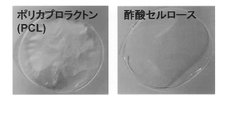
上記で調製した触媒含有ポリマーフィルム:W10-PCLの表面をデジタルカメラで観察した写真を図1の左図に示す。
調製した触媒含有ポリマーフィルムの分子量を調べた結果を以下に示す。

上記の結果から、触媒の有無による分子量(数平均分子量及び重量平均分子量)の変化はないことが確認された。
次に、溶液キャスト法で作製したフィルム中での触媒の構造を調べるため、フィルムから抽出した触媒の赤外線吸収スペクトルを測定した。W10-PCLのフィルムをTHFに溶かして、W10を沈殿として回収し、得られた試料を日本分光 赤外分光光度計FT/IR-4100により測定した。結果を図2に示す。
図2から、溶液キャスト法で作成したフィルム中でも触媒の構造は保持されていることが示される。
図2から、溶液キャスト法で作成したフィルム中でも触媒の構造は保持されていることが示される。
(2)W10-PCLフィルムの光分解の測定
次に、W10-PCLフィルムの光分解を以下の実験方法で評価した。
<実験方法>
ガラス製試験管に触媒含有ポリマーフィルム(80mg)、水、撹拌子、酸素(1気圧)を入れて栓をした後、300Wキセノンランプで光照射を行った。一定時間の反応後、フィルムを取り出して水で洗浄した後、乾燥した。クロロホルムまたはテトロヒドロフランにフィルムを溶かした後、濾過により触媒を除去した。ゲル浸透クロマトグラフィーを用いてポリマーの分子量の分析を行った。なお、ゲル浸透クロマトグラフィーでは、東ソーのTSKgel SuperHM-Nカラムを用いて分離し、示差屈折率検出器を用いて検出した。
図3に本実験の模式図を示す。
次に、W10-PCLフィルムの光分解を以下の実験方法で評価した。
<実験方法>
ガラス製試験管に触媒含有ポリマーフィルム(80mg)、水、撹拌子、酸素(1気圧)を入れて栓をした後、300Wキセノンランプで光照射を行った。一定時間の反応後、フィルムを取り出して水で洗浄した後、乾燥した。クロロホルムまたはテトロヒドロフランにフィルムを溶かした後、濾過により触媒を除去した。ゲル浸透クロマトグラフィーを用いてポリマーの分子量の分析を行った。なお、ゲル浸透クロマトグラフィーでは、東ソーのTSKgel SuperHM-Nカラムを用いて分離し、示差屈折率検出器を用いて検出した。
図3に本実験の模式図を示す。
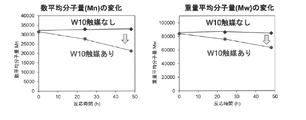
W10-PCLフィルムを用いた実験結果を図4に示す。同図から、触媒W10を含有したPCLフィルムは、数平均分子量及び重量平均分子量が反応時間の経過により減少したことが分かる。従って、触媒W10を含有したPCLフィルムの光分解が顕著に促進したことが理解できる。
[実施例12]
(1)クラスター触媒を含有するポリマーフィルムの調製
ポリマーとして酢酸セルロース(CA)を用いて、実施例11と同様の手順により触媒含有フィルム(厚さ20μm)を作製した。作製したフィルムサンプルをW10-CAともいう。
上記で調製した触媒含有ポリマーフィルム:W10-CAの表面をデジタルカメラで観察した写真を図1の右図に示す。
(1)クラスター触媒を含有するポリマーフィルムの調製
ポリマーとして酢酸セルロース(CA)を用いて、実施例11と同様の手順により触媒含有フィルム(厚さ20μm)を作製した。作製したフィルムサンプルをW10-CAともいう。
上記で調製した触媒含有ポリマーフィルム:W10-CAの表面をデジタルカメラで観察した写真を図1の右図に示す。
(2)W10-CAフィルムの光分解の測定
W10-CAフィルムの光分解を実施例11に記載の実験方法で評価した。結果を図5に示す。触媒W10を含有したCAフィルムは、数平均分子量及び重量平均分子量が反応時間の経過により減少したことが分かる。従って、触媒W10を含有したCAフィルムの光分解が顕著に促進したことが理解できる。
W10-CAフィルムの光分解を実施例11に記載の実験方法で評価した。結果を図5に示す。触媒W10を含有したCAフィルムは、数平均分子量及び重量平均分子量が反応時間の経過により減少したことが分かる。従って、触媒W10を含有したCAフィルムの光分解が顕著に促進したことが理解できる。
Claims (20)
- 以下の式(1)で表される1種以上のポリオキソメタレート、及び
以下の式(2)で表される1種以上のヘテロポリオキソメタレート
からなる群から選択される1種以上を含有するクラスター触媒、及び
1種以上のポリマー
を含む、光分解性ポリマー材料。
[MxOy]n-(1)
(式(1)中、Mは、W、Mo、Ti又はVであり;
xは、4~34の整数であり:
yは、12~116の整数であり;
nは、2~28の整数である。)
[ABaXbOc]m- (2)
(式中、Aは、P、Si、Ge、S又はSbから選択され;
Bは、V、Ti、Mn、Co、Ni、Cu、Zn、Zr、Nb、Pb、又はAgから選択され;
Xは、W、Mo、Ti又はVであり;
aは、0~40の整数であり:
bは、4~200の整数であり:
cは、12~600の整数であり:
mは、2~40の整数である。) - 前記クラスター触媒が式(1)で表される1種以上のポリオキソメタレートを含有する、請求項1に記載のポリマー材料。
- MがWである、請求項2に記載のポリマー材料。
- 前記ポリオキソメタレートが[W10O32]4-で表される、請求項3に記載のポリマー材料。
- 前記クラスター触媒が、Y4[W10O32]の組成を有する、請求項4に記載のポリマー材料(Yは、対カチオンを表し、Yで表される各カチオンは同一であっても異なっていてもよい)。
- MがVである、請求項2に記載のポリマー材料。
- 前記ポリオキソメタレートが[V10O28]6-で表される、請求項6に記載のポリマー材料。
- 前記クラスター触媒が、Y6[V10O28]の組成を有する、請求項7に記載のポリマー材料(Yは、対カチオンを表し、Yで表される各カチオンは同一であっても異なっていてもよい)。
- 前記クラスター触媒が式(2)で表される1種以上のヘテロポリオキソメタレートを含有する、請求項1に記載のポリマー材料。
- XがWである、請求項9に記載のポリマー材料。
- AがPであり、BがVである、請求項10に記載のポリマー材料。
- ヘテロポリオキソメタレートが、[PV2W10O40]5-で表される、請求項11に記載のポリマー材料
- 前記クラスター触媒が、Y5[PV2W10O40]の組成を有する、請求項7に記載のポリマー材料(Yは、対カチオンを表し、Yで表される各カチオンは同一であっても異なっていてもよい)。
- 海水に含まれるイオンにより、分解が更に促進される、請求項9~13のいずれか1項に記載のポリマー材料。
- 前記海水に含まれるイオンが、塩化物イオン、硫酸イオン、硫酸水素イオン、炭酸水素イオン、臭化物イオン、ナトリウムイオン、マグネシウムイオン、カルシウムイオン、カリウムイオンからなる群から選択される1種以上である、請求項14に記載のポリマー材料。
- 前記ポリマーが、天然高分子、合成樹脂、合成繊維又は合成ゴムから選択される1種以上である、請求項1~15のいずれか1項に記載のポリマー材料。
- 前記ポリマーが、熱可塑性樹脂および/又は熱硬化性樹脂である、請求項1~16のいずれか1項に記載のポリマー材料。
- 前記ポリマーが、ポリエチレン系樹脂、ポリプロピレン系樹脂、ポリブタジエン系樹脂、ポリスチレン系樹脂、ポリ酢酸ビニル、ポリ塩化ビニル、ポリ塩化ビニリデン、ポリエステル系樹脂、アクリル系樹脂、ポリカーボネート系樹脂、エポキシ系樹脂、アクリル系樹脂、ポリエーテル、ポリアミド、ポリイミド、ポリウレタン、酢酸セルロース、セルロース、シリコーン樹脂、ポリ乳酸、ポリカプロラクタム、ポリエチレングリコール、ポリプロピレングリコール、ポリエチレンテレフタラート、ポリエステル繊維、ナイロン、およびこれらのコポリマー;ポリイソプレン、ポリブタジエン、EPDM、シリコーンゴム、および樹脂とゴムのコポリマー;及びこれらのブレンドからなる群から選択される、請求項1~17のいずれか1項に記載の光分解性ポリマー材料。
- 請求項1~18のいずれか1項に記載のポリマー材料を成形してなる成形体。
- 前記成形体が、フィルム、成型品、タイヤ、繊維、包装材、容器、漁網、釣具、ゲル、又は複合材料である、請求項19に記載の成形体。
Priority Applications (1)
| Application Number | Priority Date | Filing Date | Title |
|---|---|---|---|
| JP2023525889A JPWO2022255404A1 (ja) | 2021-06-02 | 2022-06-01 |
Applications Claiming Priority (2)
| Application Number | Priority Date | Filing Date | Title |
|---|---|---|---|
| JP2021-093221 | 2021-06-02 | ||
| JP2021093221 | 2021-06-02 |
Publications (1)
| Publication Number | Publication Date |
|---|---|
| WO2022255404A1 true WO2022255404A1 (ja) | 2022-12-08 |
Family
ID=84323438
Family Applications (1)
| Application Number | Title | Priority Date | Filing Date |
|---|---|---|---|
| PCT/JP2022/022286 Ceased WO2022255404A1 (ja) | 2021-06-02 | 2022-06-01 | 光分解性ポリマー材料 |
Country Status (2)
| Country | Link |
|---|---|
| JP (1) | JPWO2022255404A1 (ja) |
| WO (1) | WO2022255404A1 (ja) |
Cited By (1)
| Publication number | Priority date | Publication date | Assignee | Title |
|---|---|---|---|---|
| CN117884117A (zh) * | 2024-01-08 | 2024-04-16 | 中南大学 | 一种贵金属纳米团簇复合纤维膜的制备方法及应用 |
Citations (3)
| Publication number | Priority date | Publication date | Assignee | Title |
|---|---|---|---|---|
| JP2011186043A (ja) * | 2010-03-05 | 2011-09-22 | Dic Corp | カラーフィルタ用青色顔料及びカラーフィルタ |
| CN107365429A (zh) * | 2017-08-31 | 2017-11-21 | 江苏中信世纪新材料有限公司 | 杂多酸和路易斯酸在降解热固性树脂中作为催化剂的应用 |
| JP2019178187A (ja) * | 2018-03-30 | 2019-10-17 | ポリプラスチックス株式会社 | ポリアセタール共重合体の製造方法 |
-
2022
- 2022-06-01 WO PCT/JP2022/022286 patent/WO2022255404A1/ja not_active Ceased
- 2022-06-01 JP JP2023525889A patent/JPWO2022255404A1/ja active Pending
Patent Citations (3)
| Publication number | Priority date | Publication date | Assignee | Title |
|---|---|---|---|---|
| JP2011186043A (ja) * | 2010-03-05 | 2011-09-22 | Dic Corp | カラーフィルタ用青色顔料及びカラーフィルタ |
| CN107365429A (zh) * | 2017-08-31 | 2017-11-21 | 江苏中信世纪新材料有限公司 | 杂多酸和路易斯酸在降解热固性树脂中作为催化剂的应用 |
| JP2019178187A (ja) * | 2018-03-30 | 2019-10-17 | ポリプラスチックス株式会社 | ポリアセタール共重合体の製造方法 |
Non-Patent Citations (1)
| Title |
|---|
| MOJTABA AMINI; ZAHRA SHEKARI; ALI AKBARI; HADI NASLHAJIAN; AYDA SHEYKHI; ESMAEIL KARIMI; SANJEEV GAUTAM; KEUN HWA CHAE: "Novel thin film nanocomposite membranes incorporated with polyoxovanadate nanocluster for high water flux and antibacterial properties", APPLIED ORGANOMETALLIC CHEMISTRY, LONGMAN GROUP UK, LTD., HOBOKEN, USA, vol. 34, no. 4, 14 January 2020 (2020-01-14), Hoboken, USA, pages n/a - n/a, XP071553321, ISSN: 0268-2605, DOI: 10.1002/aoc.5494 * |
Cited By (1)
| Publication number | Priority date | Publication date | Assignee | Title |
|---|---|---|---|---|
| CN117884117A (zh) * | 2024-01-08 | 2024-04-16 | 中南大学 | 一种贵金属纳米团簇复合纤维膜的制备方法及应用 |
Also Published As
| Publication number | Publication date |
|---|---|
| JPWO2022255404A1 (ja) | 2022-12-08 |
Similar Documents
| Publication | Publication Date | Title |
|---|---|---|
| Suhaimi et al. | Recycling of polyethylene terephthalate wastes: A review of technologies, routes, and applications | |
| Venkatesan et al. | Biodegradable composites from poly (butylene adipate-co-terephthalate) with carbon nanoparticles: Preparation, characterization and performances | |
| Xu et al. | Morphological, barrier and mechanical properties of films from poly (butylene succinate) reinforced with nanocrystalline cellulose and chitin whiskers using melt extrusion | |
| Sen Gupta et al. | Going beyond cellulose and chitosan: synthetic biodegradable membranes for drinking water, wastewater, and oil–water remediation | |
| KR101701568B1 (ko) | 리그닌 함유 열가소성 수지 필름 및 이의 제조방법 | |
| Supanakorn et al. | Ternary composite films of natural rubber, cellulose microfiber, and carboxymethyl cellulose for excellent mechanical properties, biodegradability and chemical resistance | |
| CN116178921B (zh) | 一种降解pp、pe的降解助剂 | |
| EP4071211A1 (en) | Biodegradable resin composition and method for producing same | |
| Rasilainen et al. | A review of plastic waste nanocomposites: assessment of features and applications | |
| El Feky et al. | Biodegradable plastic formulated from chitosan of Aristeus antennatus shells with castor oil as a plasticizer agent and starch as a filling substrate | |
| Khankrua et al. | Biopolymer blends based on poly (lactic acid) and polyamide for durable applications | |
| JP6117107B2 (ja) | 環境保全に配慮した熱収縮フィルム | |
| Motta et al. | Sequential Infiltration Synthesis of Al2O3 in Biodegradable Polybutylene Succinate: Characterization of the Infiltration Mechanism | |
| KR20160053599A (ko) | 열가소성 수지 조성물, 이로 이루어진 성형품 및 열가소성 수지 조성물 제조 방법 | |
| Chen et al. | Sustainable macromolecular materials and engineering | |
| Zaman et al. | Biodegradable composites manufactured from low-density polyethylene and thermoplastic sago starch: preparation and characterization | |
| Wang et al. | High-Toughness and High-Transparency Recyclable Poly (vinyl alcohol)-Based Organic–Inorganic Composite Membranes | |
| Pokharel | Development of flax-and hemp-based polylactic acid films for bioplastic applications | |
| Sharma et al. | Green nanocomposites: incorporating biopolymers into plastics for enhanced environmental sustainability | |
| EP2489696A1 (en) | Biodegradable polyurethane plastic using phosphorus pentoxide | |
| Rajan et al. | Properties of biopolymers and their recent developments | |
| KR20040016340A (ko) | 복합 분해성 폴리프로필렌 조성물, 그를 사용한폴리프로필렌 제품 | |
| Brugnoli et al. | Multi‐Parameter Characterization and Photocatalytic Activity of Biodegradable Poly‐l‐Lactide and Polyhydroxybutyrate‐co‐Hydroxyhexanoate Films Incorporating TiO2 | |
| Weyhrich | 3d printing of fully aromatic high-performance polymers: Considerations for advanced manufacturing techniques | |
| Turdikulov et al. | Study of structure and properties of biodegradable composite films based on thermoplastic starch |
Legal Events
| Date | Code | Title | Description |
|---|---|---|---|
| 121 | Ep: the epo has been informed by wipo that ep was designated in this application |
Ref document number: 22816150 Country of ref document: EP Kind code of ref document: A1 |
|
| WWE | Wipo information: entry into national phase |
Ref document number: 2023525889 Country of ref document: JP |
|
| NENP | Non-entry into the national phase |
Ref country code: DE |
|
| 122 | Ep: pct application non-entry in european phase |
Ref document number: 22816150 Country of ref document: EP Kind code of ref document: A1 |