WO2022250089A1 - 摩擦材組成物および摩擦材 - Google Patents
摩擦材組成物および摩擦材 Download PDFInfo
- Publication number
- WO2022250089A1 WO2022250089A1 PCT/JP2022/021436 JP2022021436W WO2022250089A1 WO 2022250089 A1 WO2022250089 A1 WO 2022250089A1 JP 2022021436 W JP2022021436 W JP 2022021436W WO 2022250089 A1 WO2022250089 A1 WO 2022250089A1
- Authority
- WO
- WIPO (PCT)
- Prior art keywords
- friction material
- material composition
- friction
- mass
- less
- Prior art date
- Legal status (The legal status is an assumption and is not a legal conclusion. Google has not performed a legal analysis and makes no representation as to the accuracy of the status listed.)
- Ceased
Links
Classifications
-
- C—CHEMISTRY; METALLURGY
- C09—DYES; PAINTS; POLISHES; NATURAL RESINS; ADHESIVES; COMPOSITIONS NOT OTHERWISE PROVIDED FOR; APPLICATIONS OF MATERIALS NOT OTHERWISE PROVIDED FOR
- C09K—MATERIALS FOR MISCELLANEOUS APPLICATIONS, NOT PROVIDED FOR ELSEWHERE
- C09K3/00—Materials not provided for elsewhere
- C09K3/14—Anti-slip materials; Abrasives
-
- F—MECHANICAL ENGINEERING; LIGHTING; HEATING; WEAPONS; BLASTING
- F16—ENGINEERING ELEMENTS AND UNITS; GENERAL MEASURES FOR PRODUCING AND MAINTAINING EFFECTIVE FUNCTIONING OF MACHINES OR INSTALLATIONS; THERMAL INSULATION IN GENERAL
- F16D—COUPLINGS FOR TRANSMITTING ROTATION; CLUTCHES; BRAKES
- F16D69/00—Friction linings; Attachment thereof; Selection of coacting friction substances or surfaces
- F16D69/02—Composition of linings ; Methods of manufacturing
-
- F—MECHANICAL ENGINEERING; LIGHTING; HEATING; WEAPONS; BLASTING
- F16—ENGINEERING ELEMENTS AND UNITS; GENERAL MEASURES FOR PRODUCING AND MAINTAINING EFFECTIVE FUNCTIONING OF MACHINES OR INSTALLATIONS; THERMAL INSULATION IN GENERAL
- F16D—COUPLINGS FOR TRANSMITTING ROTATION; CLUTCHES; BRAKES
- F16D69/00—Friction linings; Attachment thereof; Selection of coacting friction substances or surfaces
- F16D69/02—Composition of linings ; Methods of manufacturing
- F16D69/025—Compositions based on an organic binder
- F16D69/026—Compositions based on an organic binder containing fibres
-
- F—MECHANICAL ENGINEERING; LIGHTING; HEATING; WEAPONS; BLASTING
- F16—ENGINEERING ELEMENTS AND UNITS; GENERAL MEASURES FOR PRODUCING AND MAINTAINING EFFECTIVE FUNCTIONING OF MACHINES OR INSTALLATIONS; THERMAL INSULATION IN GENERAL
- F16D—COUPLINGS FOR TRANSMITTING ROTATION; CLUTCHES; BRAKES
- F16D69/00—Friction linings; Attachment thereof; Selection of coacting friction substances or surfaces
- F16D69/02—Composition of linings ; Methods of manufacturing
- F16D69/027—Compositions based on metals or inorganic oxides
- F16D69/028—Compositions based on metals or inorganic oxides containing fibres
-
- F—MECHANICAL ENGINEERING; LIGHTING; HEATING; WEAPONS; BLASTING
- F16—ENGINEERING ELEMENTS AND UNITS; GENERAL MEASURES FOR PRODUCING AND MAINTAINING EFFECTIVE FUNCTIONING OF MACHINES OR INSTALLATIONS; THERMAL INSULATION IN GENERAL
- F16D—COUPLINGS FOR TRANSMITTING ROTATION; CLUTCHES; BRAKES
- F16D2200/00—Materials; Production methods therefor
- F16D2200/0004—Materials; Production methods therefor metallic
- F16D2200/0008—Ferro
- F16D2200/0021—Steel
-
- F—MECHANICAL ENGINEERING; LIGHTING; HEATING; WEAPONS; BLASTING
- F16—ENGINEERING ELEMENTS AND UNITS; GENERAL MEASURES FOR PRODUCING AND MAINTAINING EFFECTIVE FUNCTIONING OF MACHINES OR INSTALLATIONS; THERMAL INSULATION IN GENERAL
- F16D—COUPLINGS FOR TRANSMITTING ROTATION; CLUTCHES; BRAKES
- F16D2200/00—Materials; Production methods therefor
- F16D2200/0034—Materials; Production methods therefor non-metallic
- F16D2200/0039—Ceramics
- F16D2200/0043—Ceramic base, e.g. metal oxides or ceramic binder
-
- F—MECHANICAL ENGINEERING; LIGHTING; HEATING; WEAPONS; BLASTING
- F16—ENGINEERING ELEMENTS AND UNITS; GENERAL MEASURES FOR PRODUCING AND MAINTAINING EFFECTIVE FUNCTIONING OF MACHINES OR INSTALLATIONS; THERMAL INSULATION IN GENERAL
- F16D—COUPLINGS FOR TRANSMITTING ROTATION; CLUTCHES; BRAKES
- F16D2200/00—Materials; Production methods therefor
- F16D2200/006—Materials; Production methods therefor containing fibres or particles
- F16D2200/0069—Materials; Production methods therefor containing fibres or particles being characterised by their size
-
- F—MECHANICAL ENGINEERING; LIGHTING; HEATING; WEAPONS; BLASTING
- F16—ENGINEERING ELEMENTS AND UNITS; GENERAL MEASURES FOR PRODUCING AND MAINTAINING EFFECTIVE FUNCTIONING OF MACHINES OR INSTALLATIONS; THERMAL INSULATION IN GENERAL
- F16D—COUPLINGS FOR TRANSMITTING ROTATION; CLUTCHES; BRAKES
- F16D2200/00—Materials; Production methods therefor
- F16D2200/0082—Production methods therefor
- F16D2200/0086—Moulding materials together by application of heat and pressure
Definitions
- the present invention relates to friction material compositions and friction materials.
- Friction materials are used in the disc brake pads and brake shoes of braking devices such as disc brakes and drum brakes.
- Patent Document 1 in a composition that does not contain copper as an element in the friction material composition or has a copper content of 0.5% by mass or less with respect to the entire friction material composition, as an inorganic filler, A friction material composition containing 1 to 50% by mass of particles having a melting point of 2000° C. or higher, a Vickers hardness of 500 to 1500, and an average particle size of 15 to 50 ⁇ m, and containing 5 to 30% by mass of a titanate is described. . It is described that a friction material obtained by molding the friction material composition maintains a high coefficient of friction during high-speed, high-load braking and exhibits excellent wear resistance.
- Patent Document 2 in a composition that does not contain copper as an element in the friction material composition or has a copper content of 0.5% by mass or less with respect to the entire friction material composition, a specific average particle size Friction material composition containing one or more inorganic fillers selected from ⁇ -alumina, dolomite, calcium carbonate, magnesium carbonate, manganese dioxide, zinc oxide, triiron tetraoxide, cerium oxide, and zirconia is described. It is described that a friction material obtained by molding the friction material composition is excellent in fade resistance and wear resistance at high temperatures exceeding 500°C.
- An object of one aspect of the present invention is to provide a friction material that is excellent in high-speed braking effectiveness and wear resistance in a high-temperature range and has sufficient wear resistance even in a normal temperature range.
- a friction material containing magnesite as an inorganic filler in a composition having a copper content of 5% by mass or less as a copper element has a high temperature range.
- the present inventors have found for the first time that they are excellent in high-speed braking effectiveness and wear resistance and can exhibit sufficient wear resistance even in the normal temperature range, and have completed the present invention.
- the friction material composition according to one aspect of the present invention is a friction material composition containing a fiber base material, a binder, an organic filler, and an inorganic filler, wherein copper in the friction material composition
- the content of the copper element is 5% by mass or less, and magnesite is included as the inorganic filler.
- the content of copper which has a high environmental load, is 5% by mass or less as a copper element
- excellent high-speed braking effectiveness and wear resistance in a high temperature range It is possible to provide a friction material having sufficient wear resistance even in the region.
- a friction material composition according to one aspect of the present invention is a friction material composition containing a fiber base material, a binder, an organic filler, and an inorganic filler, and the content of copper in the friction material composition is 5% by mass or less as a copper element, and magnesite is included as the inorganic filler.
- the friction material composition of this aspect is intended to be a blend of the above raw materials (friction material raw materials).
- the friction material composition of this aspect can be used for the friction material described later.
- the friction material composition of this aspect is environmentally friendly because the copper content in the friction material composition is 5% by mass or less as a copper element, and contains magnesite as an inorganic filler, so that it can be used as a conventional friction material. Compared to , it is possible to provide a friction material that is excellent in high-speed braking effectiveness and wear resistance in a high temperature range and has sufficient wear resistance even in a normal temperature range.
- the friction material using the friction material composition of this aspect exhibits wear resistance during high-speed braking in a high temperature range (eg, 600° C. or higher) and wear resistance in a normal temperature range (eg, 200° C. or lower). Since it is possible to achieve both, it has an excellent effect of having a longer life compared to conventional friction materials. Furthermore, the friction material using the friction material composition of this aspect is excellent in wear resistance, so that less dust is emitted due to wear. As a result, excellent effects are achieved in that the wheel is less likely to become dirty with dust, and the emission of PM2.5, which has a high environmental impact, is small.
- the friction material composition of this aspect having the characteristics described above is used as a friction material used for the friction surface of disc brake pads for electric vehicles (EV) and hybrid vehicles (HEV) and brake shoes for drum brakes. Therefore, it is particularly useful as a friction material composition. This is because EVs/HEVs are heavier than conventional gasoline vehicles due to their large batteries, and regenerative braking tends to make little contribution to high-speed braking. This is because the temperature of the brake pads or brake shoes tends to rise during high-speed braking, and the frequency of reaching high temperatures increases.
- the application of the friction material composition of this embodiment is not particularly limited to EV/HEV, and it is used for friction surfaces such as disc brake pads and drum brake brake shoes used in vehicles in general including motorcycles. It can be suitably used for friction materials.
- the content of copper in the friction material composition is 5% by mass or less as copper element.
- the friction material composition according to one aspect of the present invention has a low content of copper and copper alloys, which are highly harmful to the environment, and thus has the effect of being able to provide an environmentally friendly friction material.
- the content of copper in the friction material composition is preferably 0.5% by mass or less as a copper element, and more preferably 0% by mass (copper-free). preferable.
- the copper contained in the friction material composition according to one aspect of the present invention may be derived from copper fibers added as a fiber base material.
- the content of copper fibers in the friction material composition is preferably 5% by mass or less from the viewpoint of suppressing wear in the normal temperature range.
- a friction material composition according to an aspect of the present invention contains magnesite as an inorganic filler.
- Magnesite is also called anhydrous magnesium carbonate.
- Magnesite contains a magnesium component of 46% by mass or more in terms of MgO.
- the common magnesium carbonate industrially produced is basic magnesium carbonate (nMgCO 3 .MgOH 2 .mH 2 O, where m is 3 to 5 and n is 3 to 7), and the magnesium component The amount is 40% by mass or more and 44% by mass or less in terms of MgO. For this reason, magnesite is clearly distinguished from common magnesium carbonate.
- the magnesium component contained in magnesite forms a smooth coating on the friction surface due to friction because the hardness and yield stress decrease as the temperature rises during high-speed braking in a high-temperature region.
- This coating increases the contact area on the friction surface to improve the coefficient of friction ( ⁇ ), and protects the friction surface to improve wear resistance.
- magnesite does not have water of hydration, so hydrates do not detach due to temperature rise. Therefore, the friction material containing magnesite is less likely to change in volume due to detachment of hydrates or to decrease in strength due to decomposition of the resin in the friction material composition by hydrates. As a result, the friction material is less likely to crack due to a decrease in strength during high-speed braking in a high-temperature range, and wear resistance in a normal temperature range is improved.
- the content of magnesite in the friction material composition is not particularly limited, and can be appropriately determined within a range in which the desired effect of containing magnesite is sufficiently exhibited. From the viewpoint of improving the high-speed braking performance (effectiveness and wear resistance) of the friction material in a high-temperature range, the content of magnesite in the friction material composition is 1 mass% with respect to 100 mass% of the friction material composition. % or more, preferably 5 mass % or more, and more preferably 10 mass % or more. In addition, from the viewpoint of improving the life performance of the friction material in the normal temperature range, the content of magnesite in the friction material composition is 15% by mass or less with respect to 100% by mass of the friction material composition.
- the content of magnesite in the friction material composition is 1% by mass or more and 10% by mass or less with respect to 100% by mass of the friction material composition, the life performance during high-speed braking in a high temperature range and normal temperature It is preferable because it is possible to achieve a good balance between longevity performance in a wide range and a good blending balance with other components contained in the friction material composition.
- the particle size of magnesite is not limited, but if the average particle size of magnesite is 50 ⁇ m or less, it is possible to uniformly mix without unevenness during the production of the friction material composition, and the particles of magnesite during braking. is less likely to come off from the friction surface, and the effect of improving the performance (efficacy and wear resistance) of the friction material during high-speed braking in a high-temperature range can be stably obtained.
- the average particle size of magnesite is preferably 1 ⁇ m or more.
- the average particle diameter of magnesite is the volume-based median diameter obtained according to JIS Z 8825 "Particle Size Analysis - Laser Analysis/Scattering Method".
- the average particle size of the particles corresponding to magnesite is determined from the electron microscope image of the cross section of the friction material according to JIS Z 8827-1 "Particle size analysis - Image analysis method - Chapter Part 1: Static image analysis method” to measure the volume-based particle size distribution to obtain the median diameter.
- fiber base material examples include organic fibers, inorganic fibers, and metal fibers. These fibers may be natural fibers or artificially synthesized synthetic fibers. Examples of organic fibers include aromatic polyamide fibers (aramid fibers), acrylic fibers, cellulose fibers, and carbon fibers. Examples of inorganic fibers include rock wool and glass fibers. Examples of metal fibers include fibers composed of single metals such as steel, stainless steel, aluminum, zinc and tin, and fibers composed of metal alloys thereof. A fiber base material can be used individually by 1 type or in combination of multiple types.
- the content of the fiber base material in the friction material composition is not particularly limited.
- the fiber content is preferably 5% by mass or less.
- chromium-containing metal fibers include stainless steel fibers (SUS fibers, chromium content is 10.5% by mass or more), chromium steel (chromium content is about 1% by mass), and the like.
- the chromium content in the chromium-containing metal fibers is not particularly limited, but chromium-containing metal fibers having a chromium content of 1% by mass or more and 30% by mass or less can be suitably used, and stainless steel fibers are preferable.
- the binding material has a function of binding the friction material raw materials in the friction material composition.
- the binder is not particularly limited as long as it can exhibit the above performance, and binders known in the art can be preferably used. Specific examples of binders include resins such as phenol resins, epoxy resins, melamine resins, and imide resins. The binder can be used singly or in combination.
- the content of the binder in the friction material composition is not particularly limited, and may be the content commonly employed in the technical field.
- the organic filler has a function as a friction modifier for improving wear resistance and the like.
- the organic filler is not particularly limited as long as it can exhibit the above performance, and organic fillers known in the art can be preferably used. Specific examples of organic fillers include cashew dust, rubber powder, tire powder, fluororesin, melamine cyanurate, and polyethylene resin.
- An organic filler can be used individually by 1 type or in combination of multiple types.
- the surface of the organic filler may be coated with phosphoric acid or fluororesin.
- the content of the organic filler in the friction material composition is not particularly limited, and may be the content commonly employed in the technical field.
- the friction material composition of this aspect may contain an inorganic filler other than magnesite as long as the effects of the present invention are not impaired.
- inorganic fillers other than magnesite inorganic substances known in the art can be preferably used.
- zirconium oxide, barium sulfate, mica, iron oxide (ferrous oxide, ferric oxide, etc.), Titanates, calcium hydroxide and the like can be mentioned.
- titanates include alkali metal titanates, alkali metal titanates/group II salts, and specific examples include potassium titanate, sodium titanate, lithium titanate, and lithium potassium titanate. , magnesium potassium titanate, and the like.
- the content of the inorganic filler is not particularly limited, and may be the content adopted in the technical field.
- the particle size of the inorganic filler is not particularly limited, and an inorganic substance having an average particle size commonly employed in the technical field can be preferably used.
- the friction material composition of this aspect may further contain a lubricant within a range that does not impair the effects of the present invention.
- Lubricants are not particularly limited, and lubricants known in the art can be preferably used. Specific examples of lubricants include coke, graphite, carbon black, graphite, and metal sulfides. Examples of metal sulfides include tin sulfide, antimony trisulfide, molybdenum disulfide, bismuth sulfide, iron sulfide, zinc sulfide, and tungsten sulfide. These lubricants can be used singly or in combination. The content of the lubricant is not particularly limited, and may be the content commonly employed in the technical field.
- the friction material composition of this aspect can be produced by a production method including a mixing step of blending the friction material raw materials described above and mixing them. From the viewpoint of uniformly mixing the friction material raw materials, the mixing step is preferably a step of mixing powdery friction material raw materials.
- the mixing method and mixing conditions in the mixing step are not particularly limited as long as the friction material raw materials can be uniformly mixed, and methods known in the art can be adopted.
- the friction material raw materials may be mixed at room temperature for about 10 minutes using a known mixer such as a Fenchel mixer or Loedige mixer.
- the mixture of friction material raw materials may be mixed while being cooled by a known cooling method so that the temperature of the friction material raw materials during mixing does not rise.
- Friction Material> A friction material according to one aspect of the present invention is obtained by molding the friction material composition according to one aspect of the present invention described above. The effect, application, etc. of the friction material of this embodiment are as described for the friction material composition of the present invention, and will not be repeated here.
- the friction material of this aspect can be manufactured by a manufacturing method including a molding step of molding the friction material composition according to one aspect of the present invention.
- the molding method and molding conditions in the molding step are not particularly limited as long as the friction material composition of the present invention can be molded into a predetermined shape, and methods known in the art can be adopted.
- the friction material composition of the present invention can be molded by pressing or the like.
- a molding method by pressing there are a hot press method in which the friction material composition of the present invention is heated and compacted and molded, and a normal temperature press method in which the friction material composition of the present invention is compacted and molded at room temperature without heating. Either can be preferably adopted.
- the molding temperature is 140 ° C. or higher and 200 ° C. or lower (preferably 160 ° C.)
- the molding pressure is 10 MPa or higher and 40 MPa or lower (preferably 20 MPa)
- the molding time is 3 minutes.
- the friction material composition of the present invention can be molded into a friction material by setting the time to 15 minutes or less (preferably 10 minutes).
- the molding pressure is 50 MPa or more and 200 MPa or less (preferably 100 MPa)
- the molding time is 5 seconds or more and 60 seconds or less (preferably 15 seconds).
- a polishing step may be performed to polish the surface of the friction material to form a friction surface.
- Friction member> A friction member using the friction material according to one aspect of the present invention as a friction surface is also included in the scope of the present invention.
- the friction member may have a structure including only the friction material of the present invention, or a structure in which a plate-like member such as a metal plate as a back plate and the friction material of the present invention are integrated.
- the effects, uses, and the like of the friction member of this embodiment are as described for the friction material composition of the present invention, and will not be repeated here.
- the friction material of the present invention and the plate-like member are clamped and then heat-treated to obtain the friction material of the present invention.
- the friction material and the plate-like member can be bonded together.
- the clamping conditions are not particularly limited, but are, for example, 180° C., 1 MPa, and 10 minutes.
- the conditions for the heat treatment after the clamping process are not particularly limited, but are, for example, 150° C. or more and 250° C. or less, 5 minutes or more and 180 minutes or less, preferably 230° C. and 3 hours.
- the friction material composition according to aspect 1 of the present invention is a friction material composition containing a fiber base material, a binder, an organic filler, and an inorganic filler, and the content of copper in the friction material composition is 5% by mass or less as a copper element, and magnesite is included as the inorganic filler. According to such a configuration, it is environmentally friendly, and compared to conventional friction materials, it is excellent in high-speed braking effectiveness and wear resistance in a high temperature range, and has sufficient wear resistance even in a normal temperature range. There is an effect that it is possible to provide a friction material having
- the content of magnesite in the friction material composition is preferably 1% by mass or more and 10% by mass or less. According to such a configuration, it is possible to achieve a good balance between longevity performance during high-speed braking in a high temperature range and longevity performance in a normal temperature range. Good balance of ingredients.
- the average particle size of the magnesite is preferably 50 ⁇ m or less. According to such a configuration, magnesite can be uniformly mixed without unevenness during the production of the friction material composition, and the magnesite particles are less likely to fall off the friction surface during braking. The effect of improving performance (efficacy and wear resistance) during high-speed braking in a high-temperature range can be stably obtained.
- a friction material composition according to aspect 4 of the present invention is the friction material composition according to any one of aspects 1 to 3, wherein the content of copper in the friction material composition is 0.5% by mass or less as copper element. is preferred. With such a configuration, the content of copper, which has a high environmental impact, is small, so an environmentally friendly friction material can be provided.
- a friction material composition according to aspect 5 of the present invention in any one of aspects 1 to 4, includes chromium-containing metal fibers as the fiber base material, and the chromium-containing metal fibers in the friction material composition is preferably 1% by mass or more and 5% by mass or less. According to such a configuration, it is possible to further improve the minimum coefficient of friction in the high temperature range.
- a friction material according to aspect 6 of the present invention is formed by molding the friction material composition according to any one of aspects 1 to 5 above.
- Example 1 ⁇ Production of brake pads> Each raw material was blended according to the blending ratio shown in Table 1, and mixed at room temperature (20° C.) for about 10 minutes using a Loedige mixer to obtain a friction material composition. In addition, the unit of the compounding amount of each raw material in Table 1 is % by mass in the friction material composition.
- the friction material composition was heated and compacted by a hot press method to obtain a molded product.
- the molding conditions by the hot press method were as follows: Molding temperature: 160°C Molding pressure: 20MPa Molding time: 10 minutes.
- the surface of the obtained molded article was polished using a polishing machine to form a friction surface to obtain a friction material.
- a brake pad of Example 1 was produced, and subjected to a high temperature test and a running simulation test.
- the brake pad produced in Example 1 had a thickness of the friction material of 12.5 mm and a projected area of the friction material of 55 cm 2 .
- Example 2 to 13 Brake pads of Examples 2 to 13 were produced in the same manner as in Example 1, except that each raw material was blended according to the blending ratio shown in Table 1.
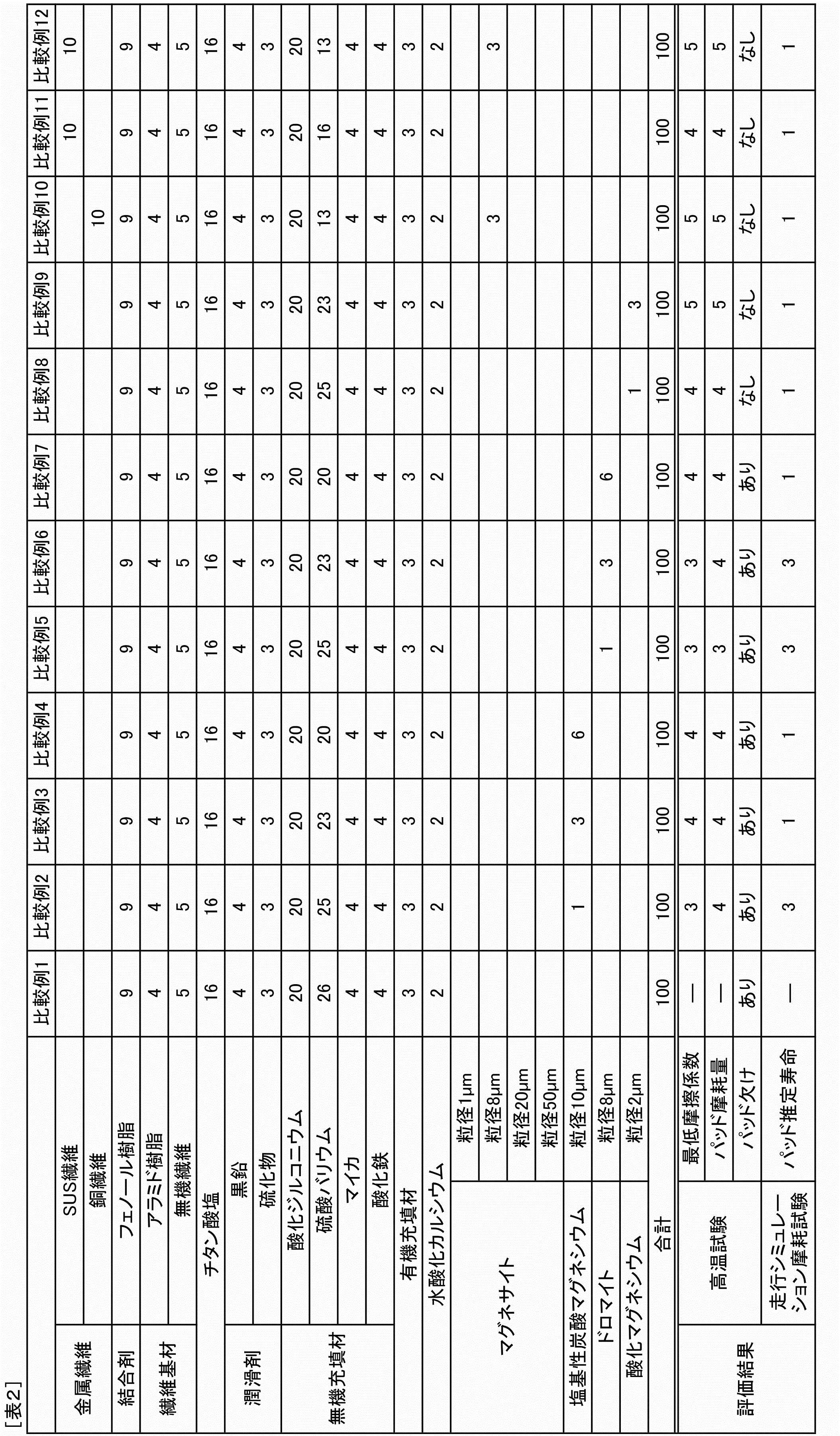
- Comparative Examples 1 to 12 Brake pads of Comparative Examples 1 to 12 were produced in the same manner as in Example 1, except that each raw material was blended according to the blending ratio shown in Table 2.
- the lowest coefficient of friction during the AMS fade test was measured by the following method. (Method for measuring minimum friction coefficient) Using the minimum torque during one braking, the coefficient of friction for each braking was calculated according to the formula described in JIS D 0106. The lowest coefficient of friction in the test was taken as the lowest coefficient of friction.
- the minimum friction coefficient of the brake pad to be evaluated is 10% or more than the minimum friction coefficient of the brake pad of Comparative Example 1 When it increased, it was evaluated as "improved”, and when the minimum friction coefficient of the brake pad to be evaluated decreased by 10% or more from the minimum friction coefficient of the brake pad of Comparative Example 1, it was evaluated as "worse". If the change in the minimum friction coefficient of the brake pad to be evaluated was less than 10% with respect to the minimum friction coefficient of the brake pad of Comparative Example 1, it was evaluated as the same as or equivalent to Comparative Example 1.
- the wear amount of the brake pad after the AMS fade test was measured by the following method. (Method for measuring amount of wear) JASO C4276. The amount of wear was measured according to the measurement method.
- the amount of pad wear was measured at 8 points per brake pad, and the average value was taken as the "amount of pad wear". That is, the "pad wear amount” described in Tables 1 and 2 is synonymous with the “pad average wear amount” described later.
- the measurement results of the amount of wear were evaluated with a five-level score from 1 to 5 according to the criteria shown below. 5: More than 20% improvement over Comparative Example 1 4: 10% or more, 20% or less improvement over Comparative Example 1 3: Same or equivalent to Comparative Example 1 2: 10 over Comparative Example 1 % or more and 20% or less deterioration 1: More than 20% deterioration compared to Comparative Example 1
- the amount of wear of the brake pad to be evaluated decreased by 10% or more compared to the amount of wear of the brake pad of Comparative Example 1.
- the wear amount of the brake pad to be evaluated increased by 10% or more relative to the wear amount of the brake pad of Comparative Example 1, it was evaluated as "worse". If the increase or decrease in the amount of wear of the brake pad to be evaluated was less than 10% of the amount of wear of the brake pad of Comparative Example 1, it was evaluated as the same as or equivalent to Comparative Example 1.
- the estimated pad life of the brake pad to be evaluated is 10% or more of the estimated pad life of the brake pad of Comparative Example 1 When it increased, it was evaluated as "improved”, and when the estimated pad life of the brake pad to be evaluated decreased by 10% or more from the estimated pad life of the brake pad of Comparative Example 1, it was evaluated as "worse". When the estimated pad life of the brake pad to be evaluated increased or decreased by less than 10% with respect to the estimated pad life of the brake pad of Comparative Example 1, it was evaluated as the same as or equivalent to Comparative Example 1.
- Tables 1 and 2 show the evaluation results in the high-speed test and the evaluation results in the running simulation wear test.
- the brake pads of Examples 1 to 13 contained magnesite as an inorganic filler, so that compared with the brake pad of Comparative Example 1, the effectiveness and durability during high-speed braking in a high temperature range were improved. It was confirmed that it has excellent wear resistance and sufficient wear resistance even in the normal temperature range.
- the brake pads of the comparative examples containing basic magnesium carbonate (Comparative Examples 2-4), dolomite (Comparative Examples 5-6), or magnesium oxide (Comparative Examples 8-9) as inorganic fillers are It was not possible to achieve both improved performance during high-speed braking and wear resistance in the normal temperature range.
- dolomite is a carbonate of magnesium and calcium, and is decomposed by friction during high-speed braking in a high temperature range to produce calcium oxide.
- Calcium oxide is strongly alkaline, and the alkaline component in the friction material composition becomes excessive. It was considered that the strength decreased, and as a result, the coefficient of friction ( ⁇ ) was difficult to increase in a high temperature range of 600°C or higher, and chipping occurred in the friction material.
- Example 2 in the composition containing magnesite, when the content of the copper component in the friction material composition increases, the performance during high-speed braking in a high temperature range improves. On the other hand, it was shown that the wear resistance in the normal temperature range is lowered. Therefore, when copper fibers are contained as metal fibers in the friction material composition, the content of copper in the friction material composition is preferably 5% by mass or less as a copper element, and copper in the friction material composition is more preferably set to 0% by mass (copper-free) as a copper element.
- the friction material composition and friction material according to one aspect of the present invention can be suitably used as friction members in braking devices for vehicles such as automobiles.
Landscapes
- Engineering & Computer Science (AREA)
- General Engineering & Computer Science (AREA)
- Chemical & Material Sciences (AREA)
- Mechanical Engineering (AREA)
- Inorganic Chemistry (AREA)
- Materials Engineering (AREA)
- Organic Chemistry (AREA)
- Braking Arrangements (AREA)
Abstract
Description
本発明の一態様に係る摩擦材組成物は、繊維基材、結合材、有機充填材、および無機充填材を含有する摩擦材組成物であって、前記摩擦材組成物中の銅の含有量が銅元素として5質量%以下であり、且つ前記無機充填材としてマグネサイトを含む。本態様の摩擦材組成物は、上述の原料(摩擦材原料)を配合したものが意図される。本態様の摩擦材組成物は、後述する摩擦材に用いることができる。
本態様の摩擦材組成物は、摩擦材組成物中の銅の含有量が銅元素として5質量%以下であるので環境に優しく、且つ無機充填材としてマグネサイトを含むことにより、従来の摩擦材と比較して、高温域での高速制動時の効きおよび耐摩耗性に優れると共に、常用の温度域においても十分な耐摩耗性を有している摩擦材を提供できるという効果を奏する。
上述のような特徴を有する本態様の摩擦材組成物は、電気自動車(EV)やハイブリッド車(HEV)用のディスクブレーキ用パッド、ドラムブレーキ用ブレーキシューの摩擦面に使用される摩擦材に用いるため摩擦材組成物として特に有用である。なぜなら、EV/HEVは、大型バッテリー搭載により従来のガソリン車と比べ車両重量が重く、高速制動時においては回生ブレーキの寄与度が低いという傾向があり、従来のガソリン車と比べて高温域での高速制動時にブレーキパッドまたはブレーキシューの温度が上がりやすく、高温に達する頻度が増加するためである。
以下に、本態様の摩擦材組成物に含まれている原料(摩擦材原料)について説明する。
本発明の一態様に係る摩擦材組成物は、摩擦材組成物中の銅の含有量が銅元素として5質量%以下である。本発明の一態様に係る摩擦材組成物は、環境有害性の高い銅および銅合金の含有量が少ないため、環境に優しい摩擦材を提供できるという効果を奏する。環境により優しい摩擦材を提供する観点から、摩擦材組成物中の銅の含有量は、銅元素として0.5質量%以下であることが好ましく、0質量%(銅フリー)であることがより好ましい。
本発明の一態様に係る摩擦材組成物は、無機充填材としてマグネサイトを含む。マグネサイトは、無水炭酸マグネシウムとも称される。マグネサイトは、マグネシウム成分をMgO換算で46質量%以上含んでいる。一方、工業的に生産されている一般的な炭酸マグネシウムは、塩基性炭酸マグネシウム(nMgCO3・MgOH2・mH2O、ここでmは3~5、nは3~7)であり、マグネシウム成分量がMgO換算で40質量%以上、44質量%以下である。このことから、マグネサイトは一般的な炭酸マグネシウムとは明確に区別される。
マグネサイトに含まれているマグネシウム成分は、高温域での高速制動時に温度上昇とともに硬度および降伏応力が低下するため、摩擦によって摩擦面に平滑な被膜を形成する。この被膜は、摩擦面における接触面積を増加させて摩擦係数(μ)を向上させると共に、摩擦面を保護することによって耐摩耗性を向上させる。
摩擦材組成物中のマグネサイトの含有量は特に限定されず、マグネサイトを含有することによる所期の効果が十分に発現される範囲で適宜決定することができる。摩擦材の高温域での高速制動時の性能(効きおよび耐摩耗性)を向上させる観点から、摩擦材組成物中のマグネサイトの含有量は、摩擦材組成物100質量%に対して1質量%以上であることが好ましく、5質量%以上であることが好ましく、10質量%以上であることがより好ましい。また、摩擦材の常用の温度域での寿命性能を向上させる観点から、摩擦材組成物中のマグネサイトの含有量は、摩擦材組成物100質量%に対して15質量%以下であることが好ましく、10質量%以下であることが好ましく、6質量%以下であることがより好ましい。摩擦材組成物中のマグネサイトの含有量が、摩擦材組成物100質量%に対して1質量%以上、10質量%以下である場合、高温域での高速制動時の寿命性能と常温の温度域での寿命性能とをバランスよく両立させることができ、且つ摩擦材組成物中に含まれている他の成分との配合バランスも良いため好ましい。
マグネサイトの粒径は限定されないが、マグネサイトの平均粒径が50μm以下であれば、摩擦材組成物の製造時に偏りなく均一に混合することが可能となること、および制動時にマグネサイトの粒子が摩擦面から脱落しにくいことから、摩擦材の高温域での高速制動時の性能(効きおよび耐摩耗性)の向上効果が安定して得られるため好ましい。また、摩擦材組成物の製造時の取扱い性の観点から、マグネサイトの平均粒径が1μm以上であることが好ましい。マグネサイトの平均粒径は、JIS Z 8825「粒子径解析-レーザ解析・散乱法」により得られる体積基準の中位径(メジアン径)とする。摩擦材形成後にマグネサイトの粒子径を確認する場合は、摩擦材の断面の電子顕微鏡画像からマグネサイトに該当する粒子の平均粒径をJIS Z 8827-1「粒子径解析-画像解析法-第1部:静的画像解析法」により体積基準の粒度分布を測定し、中位径を求めればよい。
繊維基材としては、例えば、有機繊維、無機繊維、金属繊維等を挙げることができる。これらの繊維は、天然繊維であってもよく、人工的に合成した合成繊維であってもよい。有機繊維としては、例えば、芳香族ポリアミド繊維(アラミド繊維)、アクリル繊維、セルロース繊維、炭素繊維等を挙げることができる。無機繊維としては、ロックウール、ガラス繊維等を挙げることができる。金属繊維としては、スチール、ステンレス、アルミニウム、亜鉛、スズ等の単独金属からなる繊維、並びに、それぞれの合金金属からなる繊維を挙げることができる。繊維基材は、1種類を単独でまたは複数種類を組み合わせて使用することができる。
結合材は、摩擦材組成物中の摩擦材原料を結合させる機能を有している。結合材としては、前記性能を発揮できるものであれば特に限定されず、当該技術分野で公知の結合材を好ましく使用することができる。結合材の具体例としては、フェノール樹脂、エポキシ樹脂、メラミン樹脂、イミド樹脂等の樹脂を挙げることができる。結合材は、1種類を単独でまたは複数種類を組み合わせて使用することができる。摩擦材組成物中の結合材の含有量は特に限定されず、当該技術分野で通常採用される含有量とすることができる。
有機充填材は、耐摩耗性等を向上させるための摩擦調整材としての機能を有している。有機充填材としては、前記性能を発揮できるものであれば特に限定されず、当該技術分野で公知の有機充填材を好ましく使用することができる。有機充填材の具体例としては、カシューダスト、ゴム粉、タイヤ粉、フッ素樹脂、メラミンシアヌレート、ポリエチレン樹脂等を挙げることができる。有機充填材は、1種類を単独でまたは複数種類を組み合わせて使用することができる。また、有機充填材は、リン酸やフッ素樹脂によって表面を被覆していてもよい。摩擦材組成物中の有機充填材の含有量は特に限定されず、当該技術分野で通常採用される含有量とすることができる。
本態様の摩擦材組成物は、本発明の効果を損なわない範囲で、マグネサイト以外の無機充填材を含んでいてもよい。マグネサイト以外の無機充填材としては、当該技術分野で公知の無機物を好ましく使用することができ、例えば、酸化ジルコニウム、硫酸バリウム、マイカ、酸化鉄(酸化第一鉄、酸化第二鉄等)、チタン酸塩、水酸化カルシウム等を挙げることができる。チタン酸塩としては、例えば、チタン酸アルカリ金属塩、チタン酸アルカリ金属・第二族塩等を挙げることができ、具体例として、チタン酸カリウム、チタン酸ナトリウム、チタン酸リチウム、チタン酸リチウムカリウム、チタン酸マグネシウムカリウム等を挙げることができる。これらの無機充填材は、1種類を単独でまたは複数種類を組み合わせて使用することができる。無機充填材の含有量は特に限定されず、当該技術分野で採用される含有量とすることができる。また、無機充填材の粒径は特に限定されず、当該技術分野で通常採用される平均粒径を有する無機物を好ましく使用することができる。
本態様の摩擦材組成物は、本発明の効果を損なわない範囲で、潤滑剤をさらに含んでいてもよい。潤滑剤としては特に限定されず、当該技術分野で公知の潤滑剤を好ましく使用することができる。潤滑剤の具体例としては、コークス、黒鉛、カーボンブラック、グラファイト、金属硫化物等を挙げることができる。金属硫化物としては、例えば、硫化スズ、三硫化アンチモン、二硫化モリブテン、硫化ビスマス、硫化鉄、硫化亜鉛、硫化タングステン等を挙げることができる。これらの潤滑剤は、1種類を単独でまたは複数種類を組み合わせて使用することができる。潤滑剤の含有量は特に限定されず、当該技術分野で通常採用される含有量とすることができる。
本態様の摩擦材組成物は、上述した摩擦材原料を配合し、それらを混合する混合工程を含む製造方法によって製造することができる。摩擦材原料を均一に混合する観点から、混合工程は、粉体状の摩擦材原料を混合する工程であることが好ましい。混合工程における混合方法および混合条件は、摩擦材原料を均一に混合することができる限り特に限定されず、当該技術分野で公知の方法を採用することができる。例えば、フェンシェルミキサ、レーディゲミキサ等の公知の混合機を使用して、摩擦材原料を常温で10分間程度混合すればよい。混合工程では、混合中の摩擦材原料が昇温しないように、公知の冷却方法によって摩擦材原料の混合物を冷却しながら混合してもよい。
本発明の一態様に係る摩擦材は、前述した本発明の一態様に係る摩擦材組成物を成形してなる。本態様の摩擦材の効果、用途等は本発明の摩擦材組成物について説明したとおりであるのでここでは繰り返さない。
本態様の摩擦材は、本発明の一態様に係る摩擦材組成物を成形する成形工程を含む製造方法によって製造することができる。成形工程における成形方法および成形条件は、本発明の摩擦材組成物を所定の形状に成形することができる限り特に限定されず、当該技術分野で公知の方法を採用することができる。例えば、本発明の摩擦材組成物をプレス等で押し固めることにより成形することができる。プレスによる成形方法としては、本発明の摩擦材組成物を加熱して押し固めて成形するホットプレス工法および本発明の摩擦材組成物を加熱せずに常温で押し固めて成形する常温プレス工法のいずれかを好適に採用することができる。ホットプレス工法で成形する場合には、例えば、成形温度を140℃以上、200℃以下(好ましくは160℃)とし、成形圧力を10MPa以上、40MPa以下(好ましくは20MPa)とし、成形時間を3分以上、15分以下(好ましくは10分)とすることで、本発明の摩擦材組成物を摩擦材に成形することができる。常温プレス工法で成形する場合には、例えば、成形圧力を50MPa以上、200MPa以下(好ましくは100MPa)とし、成形時間を5秒以上、60秒以下(好ましくは15秒)とすることで、本発明の摩擦材組成物を摩擦材に成形することができる。更に、必要に応じて、摩擦材の表面を研磨して摩擦面を形成する研磨工程を行ってもよい。
本発明の一態様に係る摩擦材を摩擦面として用いた摩擦部材も本発明の範疇に含まれる。摩擦部材としては、本発明の摩擦材のみを備える構成、または裏板としての金属板等の板状部材と本発明の摩擦材とを一体化した構成とすることができる。本態様の摩擦部材の効果、用途等は本発明の摩擦材組成物について説明したとおりであるのでここでは繰り返さない。
本発明の態様1に係る摩擦材組成物は、繊維基材、結合材、有機充填材、および無機充填材を含有する摩擦材組成物であって、前記摩擦材組成物中の銅の含有量が銅元素として5質量%以下であり、且つ前記無機充填材としてマグネサイトを含む、構成である。このような構成によれば、環境に優しく、且つ従来の摩擦材と比較して、高温域での高速制動時の効きおよび耐摩耗性に優れると共に、常用の温度域においても十分な耐摩耗性を有している摩擦材を提供できるという効果を奏する。
実施例および比較例で用いた摩擦材原料は以下のとおりである。
・マグネサイト(無水炭酸マグネシウム):平均粒径1μm、8μm、20μm、または50μm
・塩基性炭酸マグネシウム:平均粒径10μm
・ドロマイト:平均粒径8μm
・酸化マグネシウム:平均粒径2μm
上述した摩擦原料以外の原料は、当技術分野で通常用いられるものを使用した。
<ブレーキパッドの作製>
表1に示す配合比率に従って各原料を配合し、レーディゲミキサを使用して、常温(20℃)で10分間程度混合することで、摩擦材組成物を得た。なお、表1の各原料の配合量の単位は、摩擦材組成物中の質量%である。
成形温度:160℃
成形圧力:20MPa
成形時間:10分間。
表1に示す配合比率に従って各原料を配合したこと以外は、実施例1と同様の方法で実施例2~13のブレーキパッドを作製した。
表2に示す配合比率に従って各原料を配合したこと以外は、実施例1と同様の方法で比較例1~12のブレーキパッドを作製した。
AMSフェード試験(独自動車雑誌auto motor und sportに掲載の評価条件:車速130km/時間、最高ロータ温度600℃以上)を実施し、実施例1~13および比較例1~12のブレーキパッドについて、以下の評価を行った。
AMSフェード試験時の最も低い摩擦係数を、下記の方法で測定した。
(最低摩擦係数の測定方法)
1制動中の最低トルクを用いて、各制動の摩擦係数をJIS D 0106記載の計算式で算出した。試験中で最も低い摩擦係数を最低摩擦係数とした。
5:比較例1に対して20%を超えて良化
4:比較例1に対して10%以上、20%以下良化
3:比較例1と同じまたは同等
2:比較例1に対して10%以上、20%以下悪化
1:比較例1に対して20%を超えて悪化
ここでは、評価対象のブレーキパッドの最低摩擦係数が比較例1のブレーキパッドの最低摩擦係数に対して10%以上増加した場合に「良化」と評価し、評価対象のブレーキパッドの最低摩擦係数が比較例1のブレーキパッドの最低摩擦係数に対して10%以上減少した場合に「悪化」と評価した。評価対象のブレーキパッドの最低摩擦係数の増減が比較例1のブレーキパッドの最低摩擦係数に対して10%未満の場合は、比較例1と同じまたは同等と評価した。
AMSフェード試験後のブレーキパッドの摩耗量を、下記の方法で測定した。
(摩耗量の測定方法)
JASO C427 6.計測方法に準じて摩耗量を測定した。
5:比較例1に対して20%を超えて良化
4:比較例1に対して10%以上、20%以下良化
3:比較例1と同じまたは同等
2:比較例1に対して10%以上、20%以下悪化
1:比較例1に対して20%を超えて悪化
ここでは、評価対象のブレーキパッドの摩耗量が比較例1のブレーキパッドの摩耗量に対して10%以上減少した場合に「良化」と評価し、評価対象のブレーキパッドの摩耗量が比較例1のブレーキパッドの摩耗量に対して10%以上増加した場合に「悪化」と評価した。評価対象のブレーキパッドの摩耗量の増減が比較例1のブレーキパッドの摩耗量に対して10%未満の場合は、比較例1と同じまたは同等と評価した。
AMSフェード試験後のブレーキパッドの外観観察を目視で行い、ブレーキパッドにおける欠けの有無を確認した。
ロサンゼルス(L.A.)の市街地走行を模擬した台上試験機による試験(通称LACTシミュレーション試験)を行い、ブレーキパッドの推定寿命(パッド推定寿命)(マイル)を以下の式(1)から算出した。パッド推定寿命(マイル)=パッド厚み(mm)÷パッド平均摩耗量(mm)×試験の走行距離(マイル) ・・・(1)
ここで、「パッド厚み(mm)」は、LACTシミュレーション試験前のブレーキパッドの厚みであり、「パッド平均摩耗量(mm)」は、LACTシミュレーション試験前のブレーキパッドの平均摩耗量であり、その測定方法は、JASO C427 6.計測方法に準じた。
5:比較例1に対して20%を超えて良化
4:比較例1に対して10%以上、20%以下良化
3:比較例1と同じまたは同等
2:比較例1に対して10%以上、20%以下悪化
1:比較例1に対して20%を超えて悪化
ここでは、評価対象のブレーキパッドのパッド推定寿命が比較例1のブレーキパッドのパッド推定寿命に対して10%以上増加した場合に「良化」と評価し、評価対象のブレーキパッドのパッド推定寿命が比較例1のブレーキパッドのパッド推定寿命に対して10%以上減少した場合に「悪化」と評価した。評価対象のブレーキパッドのパッド推定寿命の増減が比較例1のブレーキパッドのパッド推定寿命に対して10%未満の場合は、比較例1と同じまたは同等と評価した。
高速試験における各評価結果および走行シミュレーション磨耗試験における評価結果を表1および2に示した。

Claims (6)
- 繊維基材、結合材、有機充填材、および無機充填材を含有する摩擦材組成物であって、
前記摩擦材組成物中の銅の含有量が銅元素として5質量%以下であり、且つ
前記無機充填材としてマグネサイトを含む、摩擦材組成物。 - 前記摩擦材組成物中の前記マグネサイトの含有量が、1質量%以上、10質量%以下である、請求項1に記載の摩擦材組成物。
- 前記マグネサイトの平均粒径が、50μm以下である、請求項1または2に記載の摩擦材組成物。
- 前記摩擦材組成物中の前記銅の含有量が銅元素として0.5質量%以下である、請求項1から3のいずれか1項に記載の摩擦材組成物。
- 前記繊維基材としてクロム含有金属繊維を含み、
前記摩擦材組成物中の前記クロム含有金属繊維の含有量が、1質量%以上、5質量%以下である、請求項1から4のいずれか1項に記載の摩擦材組成物。 - 請求項1から5のいずれか1項に記載の摩擦材組成物を成形してなる摩擦材。
Priority Applications (2)
| Application Number | Priority Date | Filing Date | Title |
|---|---|---|---|
| CN202280037386.6A CN117355592A (zh) | 2021-05-25 | 2022-05-25 | 摩擦材料组合物和摩擦材料 |
| US18/556,010 US20240200628A1 (en) | 2021-05-25 | 2022-05-25 | Friction material composition and friction material |
Applications Claiming Priority (2)
| Application Number | Priority Date | Filing Date | Title |
|---|---|---|---|
| JP2021-087907 | 2021-05-25 | ||
| JP2021087907A JP2022181074A (ja) | 2021-05-25 | 2021-05-25 | 摩擦材組成物および摩擦材 |
Publications (1)
| Publication Number | Publication Date |
|---|---|
| WO2022250089A1 true WO2022250089A1 (ja) | 2022-12-01 |
Family
ID=84230122
Family Applications (1)
| Application Number | Title | Priority Date | Filing Date |
|---|---|---|---|
| PCT/JP2022/021436 Ceased WO2022250089A1 (ja) | 2021-05-25 | 2022-05-25 | 摩擦材組成物および摩擦材 |
Country Status (4)
| Country | Link |
|---|---|
| US (1) | US20240200628A1 (ja) |
| JP (1) | JP2022181074A (ja) |
| CN (1) | CN117355592A (ja) |
| WO (1) | WO2022250089A1 (ja) |
Citations (5)
| Publication number | Priority date | Publication date | Assignee | Title |
|---|---|---|---|---|
| JPS496029A (ja) * | 1972-03-17 | 1974-01-19 | ||
| JPH08253658A (ja) * | 1986-06-13 | 1996-10-01 | Bakelite Ag | 充填剤および添加剤ならびに炭素形成性結合剤を含有する耐熱性成形材料から製造された摩擦ブレーキライニング |
| JP2003322183A (ja) * | 2002-04-26 | 2003-11-14 | Akebono Brake Res & Dev Center Ltd | ブレーキ用摩擦材 |
| WO2007052727A1 (ja) * | 2005-11-04 | 2007-05-10 | Tosoh Corporation | ポリアリーレンスルフィド組成物 |
| CN104909704A (zh) * | 2015-05-18 | 2015-09-16 | 青岛国航祥玉技术服务有限公司 | 一种耐磨性陶瓷刹车片 |
Family Cites Families (3)
| Publication number | Priority date | Publication date | Assignee | Title |
|---|---|---|---|---|
| JP3678808B2 (ja) * | 1995-08-25 | 2005-08-03 | アイシン化工株式会社 | 湿式摩擦材 |
| WO2017170560A1 (ja) * | 2016-03-29 | 2017-10-05 | 日立化成株式会社 | 摩擦材組成物 |
| JP7169981B2 (ja) * | 2017-10-11 | 2022-11-11 | 昭和電工マテリアルズ株式会社 | 摩擦材組成物、摩擦材組成物を用いた摩擦材および摩擦部材 |
-
2021
- 2021-05-25 JP JP2021087907A patent/JP2022181074A/ja active Pending
-
2022
- 2022-05-25 WO PCT/JP2022/021436 patent/WO2022250089A1/ja not_active Ceased
- 2022-05-25 US US18/556,010 patent/US20240200628A1/en active Pending
- 2022-05-25 CN CN202280037386.6A patent/CN117355592A/zh active Pending
Patent Citations (5)
| Publication number | Priority date | Publication date | Assignee | Title |
|---|---|---|---|---|
| JPS496029A (ja) * | 1972-03-17 | 1974-01-19 | ||
| JPH08253658A (ja) * | 1986-06-13 | 1996-10-01 | Bakelite Ag | 充填剤および添加剤ならびに炭素形成性結合剤を含有する耐熱性成形材料から製造された摩擦ブレーキライニング |
| JP2003322183A (ja) * | 2002-04-26 | 2003-11-14 | Akebono Brake Res & Dev Center Ltd | ブレーキ用摩擦材 |
| WO2007052727A1 (ja) * | 2005-11-04 | 2007-05-10 | Tosoh Corporation | ポリアリーレンスルフィド組成物 |
| CN104909704A (zh) * | 2015-05-18 | 2015-09-16 | 青岛国航祥玉技术服务有限公司 | 一种耐磨性陶瓷刹车片 |
Also Published As
| Publication number | Publication date |
|---|---|
| US20240200628A1 (en) | 2024-06-20 |
| JP2022181074A (ja) | 2022-12-07 |
| CN117355592A (zh) | 2024-01-05 |
Similar Documents
| Publication | Publication Date | Title |
|---|---|---|
| KR101355781B1 (ko) | 마찰재 조성물, 이를 이용한 마찰재 및 마찰 부재 | |
| JP6179519B2 (ja) | 摩擦材組成物、摩擦材組成物を用いた摩擦材及び摩擦部材 | |
| US20030026969A1 (en) | Non-asbestos-based friction materials | |
| KR20020068290A (ko) | 비석면계 마찰재 | |
| WO2019074012A1 (ja) | 摩擦材組成物、摩擦材組成物を用いた摩擦材および摩擦部材 | |
| JP6592976B2 (ja) | 摩擦材組成物、摩擦材組成物を用いた摩擦材および摩擦部材 | |
| JP2018135446A (ja) | 摩擦材組成物 | |
| JP7240424B2 (ja) | 摩擦材組成物、摩擦材及び摩擦部材 | |
| US20200063813A1 (en) | Friction member, friction material composition, friction material, and vehicle | |
| JP2003313312A (ja) | 非石綿系摩擦材 | |
| US11060577B2 (en) | Friction material | |
| JP2018172496A (ja) | 摩擦材組成物 | |
| JP6440947B2 (ja) | 摩擦材組成物、摩擦材組成物を用いた摩擦材及び摩擦部材 | |
| JPWO2019151390A1 (ja) | 摩擦材、摩擦材組成物、摩擦部材及び車両 | |
| JP2022181074A (ja) | 摩擦材組成物および摩擦材 | |
| WO2024019126A1 (ja) | 摩擦材組成物および摩擦材 | |
| JP2016079250A (ja) | 摩擦材組成物、摩擦材及び摩擦部材 | |
| JP7735825B2 (ja) | 摩擦材組成物および摩擦材 | |
| US20020132877A1 (en) | Non-asbestos friction materials | |
| JP6531807B2 (ja) | ノンアスベスト摩擦材組成物 | |
| JP2025034131A (ja) | 摩擦材組成物および摩擦材 | |
| JP2019059941A (ja) | 摩擦材組成物、摩擦材組成物を用いた摩擦材及び摩擦部材 | |
| WO2023048298A1 (ja) | 摩擦材組成物および摩擦材 | |
| JP2008024891A (ja) | 摩擦材 | |
| JP2025105057A (ja) | 摩擦材組成物および摩擦材 |
Legal Events
| Date | Code | Title | Description |
|---|---|---|---|
| 121 | Ep: the epo has been informed by wipo that ep was designated in this application |
Ref document number: 22811359 Country of ref document: EP Kind code of ref document: A1 |
|
| WWE | Wipo information: entry into national phase |
Ref document number: 18556010 Country of ref document: US |
|
| WWE | Wipo information: entry into national phase |
Ref document number: 202280037386.6 Country of ref document: CN |
|
| NENP | Non-entry into the national phase |
Ref country code: DE |
|
| 122 | Ep: pct application non-entry in european phase |
Ref document number: 22811359 Country of ref document: EP Kind code of ref document: A1 |