WO2022234785A1 - 生体状態測定装置、生体状態測定方法、プログラム及び生体状態測定システム - Google Patents
生体状態測定装置、生体状態測定方法、プログラム及び生体状態測定システム Download PDFInfo
- Publication number
- WO2022234785A1 WO2022234785A1 PCT/JP2022/018744 JP2022018744W WO2022234785A1 WO 2022234785 A1 WO2022234785 A1 WO 2022234785A1 JP 2022018744 W JP2022018744 W JP 2022018744W WO 2022234785 A1 WO2022234785 A1 WO 2022234785A1
- Authority
- WO
- WIPO (PCT)
- Prior art keywords
- unit
- biological condition
- transmission
- time
- measuring device
- Prior art date
- Legal status (The legal status is an assumption and is not a legal conclusion. Google has not performed a legal analysis and makes no representation as to the accuracy of the status listed.)
- Ceased
Links
Images



Classifications
-
- A—HUMAN NECESSITIES
- A61—MEDICAL OR VETERINARY SCIENCE; HYGIENE
- A61B—DIAGNOSIS; SURGERY; IDENTIFICATION
- A61B5/00—Measuring for diagnostic purposes; Identification of persons
- A61B5/103—Measuring devices for testing the shape, pattern, colour, size or movement of the body or parts thereof, for diagnostic purposes
- A61B5/11—Measuring movement of the entire body or parts thereof, e.g. head or hand tremor or mobility of a limb
-
- G—PHYSICS
- G01—MEASURING; TESTING
- G01S—RADIO DIRECTION-FINDING; RADIO NAVIGATION; DETERMINING DISTANCE OR VELOCITY BY USE OF RADIO WAVES; LOCATING OR PRESENCE-DETECTING BY USE OF THE REFLECTION OR RERADIATION OF RADIO WAVES; ANALOGOUS ARRANGEMENTS USING OTHER WAVES
- G01S13/00—Systems using the reflection or reradiation of radio waves, e.g. radar systems; Analogous systems using reflection or reradiation of waves whose nature or wavelength is irrelevant or unspecified
- G01S13/66—Radar-tracking systems; Analogous systems
-
- A—HUMAN NECESSITIES
- A61—MEDICAL OR VETERINARY SCIENCE; HYGIENE
- A61B—DIAGNOSIS; SURGERY; IDENTIFICATION
- A61B5/00—Measuring for diagnostic purposes; Identification of persons
- A61B5/05—Detecting, measuring or recording for diagnosis by means of electric currents or magnetic fields; Measuring using microwaves or radio waves
-
- A—HUMAN NECESSITIES
- A61—MEDICAL OR VETERINARY SCIENCE; HYGIENE
- A61B—DIAGNOSIS; SURGERY; IDENTIFICATION
- A61B5/00—Measuring for diagnostic purposes; Identification of persons
- A61B5/08—Measuring devices for evaluating the respiratory organs
- A61B5/0816—Measuring devices for examining respiratory frequency
-
- A—HUMAN NECESSITIES
- A61—MEDICAL OR VETERINARY SCIENCE; HYGIENE
- A61B—DIAGNOSIS; SURGERY; IDENTIFICATION
- A61B5/00—Measuring for diagnostic purposes; Identification of persons
- A61B5/72—Signal processing specially adapted for physiological signals or for diagnostic purposes
- A61B5/7235—Details of waveform analysis
- A61B5/7264—Classification of physiological signals or data, e.g. using neural networks, statistical classifiers, expert systems or fuzzy systems
-
- G—PHYSICS
- G01—MEASURING; TESTING
- G01S—RADIO DIRECTION-FINDING; RADIO NAVIGATION; DETERMINING DISTANCE OR VELOCITY BY USE OF RADIO WAVES; LOCATING OR PRESENCE-DETECTING BY USE OF THE REFLECTION OR RERADIATION OF RADIO WAVES; ANALOGOUS ARRANGEMENTS USING OTHER WAVES
- G01S13/00—Systems using the reflection or reradiation of radio waves, e.g. radar systems; Analogous systems using reflection or reradiation of waves whose nature or wavelength is irrelevant or unspecified
- G01S13/88—Radar or analogous systems specially adapted for specific applications
-
- A—HUMAN NECESSITIES
- A61—MEDICAL OR VETERINARY SCIENCE; HYGIENE
- A61B—DIAGNOSIS; SURGERY; IDENTIFICATION
- A61B5/00—Measuring for diagnostic purposes; Identification of persons
- A61B5/02—Detecting, measuring or recording for evaluating the cardiovascular system, e.g. pulse, heart rate, blood pressure or blood flow
- A61B5/024—Measuring pulse rate or heart rate
-
- A—HUMAN NECESSITIES
- A61—MEDICAL OR VETERINARY SCIENCE; HYGIENE
- A61B—DIAGNOSIS; SURGERY; IDENTIFICATION
- A61B5/00—Measuring for diagnostic purposes; Identification of persons
- A61B5/05—Detecting, measuring or recording for diagnosis by means of electric currents or magnetic fields; Measuring using microwaves or radio waves
- A61B5/0507—Detecting, measuring or recording for diagnosis by means of electric currents or magnetic fields; Measuring using microwaves or radio waves using microwaves or terahertz waves
-
- A—HUMAN NECESSITIES
- A61—MEDICAL OR VETERINARY SCIENCE; HYGIENE
- A61B—DIAGNOSIS; SURGERY; IDENTIFICATION
- A61B5/00—Measuring for diagnostic purposes; Identification of persons
- A61B5/103—Measuring devices for testing the shape, pattern, colour, size or movement of the body or parts thereof, for diagnostic purposes
- A61B5/11—Measuring movement of the entire body or parts thereof, e.g. head or hand tremor or mobility of a limb
- A61B5/113—Measuring movement of the entire body or parts thereof, e.g. head or hand tremor or mobility of a limb occurring during breathing
Definitions
- the present invention relates to a biological condition measuring device, a biological condition measuring method, a program, and a biological condition measuring system for measuring a person's biological condition.
- the present invention has been made in view of these points, and it is possible to measure biological conditions such as heart rate and respiration rate even when there are multiple people in an area where radio waves are transmitted. for the purpose.
- a biological condition measuring apparatus includes a transmitting unit that transmits a transmission signal in a frequency band of a millimeter wave band or higher at predetermined time intervals; a receiver that receives a plurality of reflected signals; a measuring unit that measures a plurality of propagation times from when the transmitter transmits the transmitted signal to when the receiver receives the plurality of reflected signals; a plurality of pieces of propagation time data indicating the propagation time of are classified into a plurality of time series data composed of a plurality of pieces of propagation time data indicating the propagation time varying within a time range equal to or less than a first threshold; and a specifying unit that specifies the biological condition of each of the plurality of subjects based on the mode of change in the propagation time indicated by each of the data.
- the first threshold is larger than the maximum value of the amount of change in propagation time due to movement of an organ of one subject, and is larger than the difference in propagation time from the reflected signals from other subjects. It may be a small value.
- the identifying unit is configured to set a second threshold larger than the first threshold within a cycle in which the propagation time varies.
- the specifying unit includes the propagation time measured by the measurement unit for a plurality of the reflected signals generated by reflecting the one transmission signal transmitted by the transmission unit at a plurality of parts of the person to be measured.
- a plurality of the biological conditions corresponding to the plurality of parts may be specified by classifying based on the range.
- the transmission unit may transmit the transmission signal at the time interval that is less than a half cycle of a preset minimum cycle in which the biological condition changes.
- the biological condition measuring device has a plurality of transmitters having different ranges for transmitting the transmission signals, and the plurality of transmitters divides the time interval by the number of the transmitters of the biological condition measuring device.
- a transmission signal of a length less than the divided time may be transmitted.
- the transmission unit is longer than a value obtained by multiplying the sum of the time length of the transmission signal and the time during which the reflected signal is likely to be received by the number of the transmission units included in the biological condition measuring device.
- the transmission signal may be transmitted periodically.
- the biological condition measuring device has a plurality of transmitters that transmit the transmission signals to different ranges at different timings, and the measurement unit is arranged such that each of the plurality of transmitters transmits the transmission signals.
- the specifying unit measures the propagation time for each of the transmitting units, and the specifying unit measures the plurality of measured signals within the range where the plurality of transmitting units transmit the transmission signals.
- the biological condition of the person may be specified.
- the biological condition measuring apparatus has a plurality of receivers that receive the reflected signals arriving from different ranges, and the measuring unit receives the reflected signals from the transmitter after the transmitter transmits the transmitted signals.
- the propagation time until the receiving unit receives the reflected signal is measured for each of the receiving units, and the specifying unit measures the plurality of subjects within a range where the plurality of receiving units receive the reflected signal.
- the biological condition may be specified.
- the biological condition measuring device has a plurality of the transmitters that transmit the transmission signals to different ranges at different timings, and a plurality of the receivers that receive the reflected signals coming from the different ranges. and the measuring unit measures the propagation time from when each of the plurality of transmitting units transmits the transmission signal to when the plurality of receiving units receives the reflected signal for each combination of the transmitting unit and the receiving unit. based on the propagation time measured by the measuring unit for each combination of the transmitting unit and the receiving unit, the identifying unit determines the range in which the plurality of transmitting units transmit the transmission signal and the plurality of The biological condition of a plurality of subjects in a range determined by combination with a range in which the receiver receives the reflected signal may be specified.
- the biological condition measuring device includes: an operation accepting unit that accepts an operation for setting a target range in which the specifying unit specifies the biological condition; the one or more transmitting units corresponding to the range accepted by the plurality of transmitting units to transmit the transmission signal, and the one or more receiving units corresponding to the range accepted by the operation accepting unit to receive the reflected signal
- a radio wave control unit that controls the transmitting unit and the plurality of receiving units may further be included.
- the specifying unit includes: a range in which the receiving unit that received the reflected signal receives the reflected signal; a range in which the transmitting unit that transmits the transmission signal that causes the reflected signal transmits the transmission signal; and a distance to the person to be measured corresponding to the propagation time.
- the apparatus may further include an output unit that outputs the information indicating the position of the person and the biological condition in association with each other.
- a range in which the receiving section receives the reflected signal and a range in which the transmitting section transmits the transmission signal may be different from each other, and may partially overlap each other.
- the apparatus may further include an output unit that outputs the biological condition with priority over the biological condition corresponding to the other subject.
- a biological condition measuring method comprises a step of transmitting a transmission signal in a millimeter wave band or higher frequency band at predetermined time intervals, which is executed by a computer; a step of receiving a plurality of reflected signals caused by reflection; a step of measuring a plurality of propagation times from transmitting the transmission signal to receiving the reflected signal; and a plurality of propagation times indicating the plurality of propagation times. classifying the time data into a plurality of time series data composed of a plurality of pieces of propagation time data indicating the propagation time varying in a time range equal to or less than a first threshold; and identifying the biological condition of each of the plurality of subjects based on the mode of change.
- a program comprises the step of transmitting transmission signals in a frequency band equal to or higher than a millimeter wave band to a computer at predetermined time intervals; a step of measuring a plurality of propagation times from transmission of the transmission signal to reception of the reflection signal; a plurality of propagation time data indicating the plurality of propagation times; classified into a plurality of time-series data composed of a plurality of pieces of propagation time data indicating the propagation time that fluctuates within a time range equal to or less than one threshold, and based on the mode of change in the propagation time indicated by each of the plurality of time-series data and specifying the biological condition of each of the plurality of subjects.
- a biological state measuring system comprises a biological state measuring device and an information processing device capable of communicating with the biological state measuring device, wherein the biological state measuring device measures millimeters at predetermined time intervals.
- the biological condition measuring apparatus comprising: a transmitting section that transmits a transmission signal in a frequency band equal to or higher than a waveband; and a receiving section that receives a plurality of reflected signals generated by reflection of the transmission signal from a plurality of subjects.
- any one of the information processing devices may include: a measurement unit that measures a plurality of propagation times from when the transmission unit transmits the transmission signal to when the reception unit receives the plurality of reflected signals; A plurality of pieces of propagation time data indicating a propagation time are classified into a plurality of pieces of time series data composed of a plurality of pieces of propagation time data indicating the propagation time varying within a time range equal to or less than a first threshold, and the plurality of pieces of time series data an identifying unit that identifies the biological condition of each of the plurality of subjects based on the mode of change in the propagation time indicated by each.
- the present invention it is possible to measure biological conditions such as heart rate or respiration rate even when there are multiple people in an area where radio waves are transmitted.
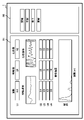
- FIG. 3 is a diagram showing an example of a screen showing measurement results displayed on the information terminal 2.
- FIG. 8 is a diagram showing another example of a screen showing measurement results displayed on the information terminal 2.
- FIG. 1 is a diagram showing a configuration of a biological condition measuring device 1;
- FIG. 2 is a diagram for explaining a transmission range of a transmitter 11 and a reception range of a receiver 12;
- FIG. 10 is a diagram for explaining the operation of the measurement unit 153;
- FIG. 10 is a diagram for explaining the operation of a specifying unit 154;
- FIG. 11 is a diagram for explaining a process of tracking the biological condition of the subject U by the specifying unit 154.
- FIG. 4 is a flow chart showing the flow of processing in the biological condition measuring device 1.
- FIG. 4 is a flow chart showing the flow of processing in the biological condition measuring device 1.
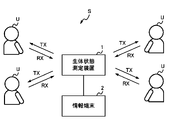
- FIG. 1 is a diagram showing an outline of a biological condition measuring system S.
- the biological condition measuring system S is a system for measuring a person's biological condition.
- the biological state is the heart rate, the respiration rate, or the movement of a part of the human body, and is represented by, for example, the number of changes in the heart rate, respiration rate, or movement per unit time.
- the biological condition measuring system S includes a biological condition measuring device 1 and an information terminal 2.
- the biological condition measuring device 1 can measure the biological condition of a plurality of persons (subject U in FIG. 1) within the reach of radio waves emitted by the biological condition measuring device 1 .
- the information terminal 2 is a terminal for displaying the results measured by the biological state measuring device 1 and controlling the biological state measuring device 1, and is, for example, a computer, a tablet, or a smartphone.
- the biological condition measuring device 1 transmits radio waves with frequencies in the millimeter wave band or higher in a plurality of directions as transmission signals, and receives reflection signals generated by the reflection of the transmitted radio waves from surrounding objects.
- the biological condition measuring apparatus 1 identifies the distance to the object that reflected the transmission signal based on the propagation time from transmission of the transmission signal to reception of the reflection signal.
- the human body includes tissues that easily reflect radio waves and tissues that do not easily reflect radio waves, and the biological condition measuring device 1 identifies the movement of the tissues by identifying the distance to the tissues that tend to reflect radio waves. be able to.
- the biological condition measuring apparatus 1 measures the heart rate by specifying the motion of the heart, and measures the respiration rate by specifying the motion of the pleura, for example.
- the biological condition measuring device 1 transmits a chirp signal whose frequency changes over time as a transmission signal.
- the biological state measuring device 1 transforms the reflected signal into a frequency domain by Fourier transforming it, and identifies the frequency contained in the reflected signal, thereby obtaining the frequency It is possible to measure the propagation time from the transmission of the signal to the reception with high accuracy.
- FIG. 2 is a diagram showing an example of a screen showing measurement results displayed on the information terminal 2. As shown in FIG. The screen shown in FIG. 2 includes a measurement result display area R1 and an operation area R2.
- the region R1 also shows a diagram showing the relationship between the distance to the person to be measured U and the intensity of the received reflected signal.
- buttons for accepting operations for starting, interrupting, and ending measurement are displayed.
- the "update” button in the area R2 is a button for updating the measurement result displayed in the area R1 to the latest measurement result.
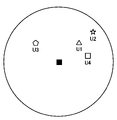
- FIG. 3 is a diagram showing another example of a screen showing measurement results displayed on the information terminal 2.
- FIG. FIG. 3 is a diagram showing the positions of a plurality of subjects U whose biological conditions have been measured.
- the black squares in FIG. 3 indicate the positions of the biological condition measuring device 1, and the other white figures indicate the positions of a plurality of subjects U who have reflected the transmitted signals.
- the biological condition measuring apparatus 1 may include the image shown in FIG. 3 in the screen shown in FIG. 2, and displays the image shown in FIG. 3 on the information terminal 2 when a predetermined operation is performed on the screen shown in FIG. You may let
- FIG. 4 is a diagram showing the configuration of the biological condition measuring device 1.
- the biological condition measuring device 1 has a transmitting section 11 , a receiving section 12 , an external connection section 13 , a storage section 14 and a control section 15 .
- Control unit 15 includes operation reception unit 151 , radio wave control unit 152 , measurement unit 153 , identification unit 154 , and output unit 155 .
- the transmission unit 11 transmits a transmission signal in a frequency band equal to or higher than the millimeter wave band at predetermined time intervals.
- the transmitter 11 transmits a chirp signal with a period of 12.5 milliseconds, for example.
- the transmission unit 11 has a signal generation circuit that generates a chirp signal and an antenna that transmits the transmission signal as radio waves.
- the biological condition measuring device 1 may have a plurality of transmitters 11 that transmit transmission signals to different ranges at different timings.
- the transmission unit 11 transmits the transmission signal at time intervals less than half the preset minimum cycle of changes in the biological condition. For example, if the maximum heart rate is assumed to be 150 beats/minute, the minimum heart rate variation period is 0.4 seconds. Therefore, the transmission unit 11 transmits transmission signals at time intervals of less than 0.2 seconds. When the transmission unit 11 transmits the transmission signal at such time intervals, the biological condition measuring device 1 detects the body part of the subject U based on the reflected signals received by the reception unit 12 at the time intervals. It becomes possible to specify the change state.
- the length of the transmission signal transmitted by the transmission unit 11 is arbitrary, but it is preferably sufficiently shorter than the time interval for transmitting the transmission signal, for example within 2 milliseconds.
- the length of the transmission signal transmitted by the transmitters 11 is determined based on the number of transmitters 11 . Specifically, the length of the transmission signal is less than the time obtained by dividing the time interval for transmitting the transmission signal by the number of transmission units 11 . By setting the length of the transmission signal in this manner, the plurality of transmission units 11 can transmit the transmission signal at different timings.
- the receiving unit 12 receives a plurality of reflected signals generated by reflection of the transmission signal at a plurality of subjects U.
- the receiver 12 has a plurality of receivers 12 that receive reflected signals arriving from different ranges.
- the receiving unit 12 inputs the received reflected signal to the measuring unit 153 .
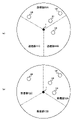
- FIG. 5 is a diagram for explaining the transmission range of the transmission section 11 and the reception range of the reception section 12.
- FIG. FIG. 5(a) shows a range in which each transmitter 11 transmits a transmission signal and a plurality of subjects when the biological condition measuring apparatus 1 has transmitters 11A, 11B, and 11C. The position of U is shown schematically.
- FIG. 5(b) shows the range in which the respective receivers 12 receive reflected signals and the positions of a plurality of subjects U when the biological condition measuring apparatus 1 has the receivers 12A, 12B, and 12C. and are schematically shown.
- the transmission range of each transmitter 11 is a fan shape of ⁇ 60 degrees (120 degrees), and the reception range of each receiver 12 is a fan shape of ⁇ 60 degrees (120 degrees).
- the transmitter 11 transmits a transmission signal to a predetermined range in the vertical direction, and the receiver 12 receives reflected signals arriving from the predetermined range in the vertical direction.
- the predetermined range is, for example, ⁇ 15 degrees (30 degrees) with respect to the horizontal direction.
- the transmission range of the transmission section 11 and the reception range of the reception section 12 do not completely match.
- the biological condition measuring apparatus 1 detects that the subject U exists in a range where the transmission range of the transmission section 11 that transmitted the transmission signal overlaps with the reception range of the reception section 12 that received the reflected signal based on the transmission signal. Since it can be specified, if the transmission range and the reception range do not completely match, the number of ranges where the transmission range and the reception range overlap increases. growing.
- the external connection unit 13 has a communication interface for transmitting and receiving data to and from the information terminal 2.
- the external connection unit 13 has, for example, a USB interface.
- the external connection unit 13 receives operation data input from the information terminal 2 and inputs the received data to the operation reception unit 151 .
- the external connection unit 13 also transmits data indicating the measurement results output by the output unit 155 to the information terminal 2 .
- the storage unit 14 has storage media such as ROM (Read Only Memory) and RAM (Random Access Memory).
- the storage unit 14 stores programs executed by the control unit 15 .
- the storage unit 14 also stores the reflected signal received by the receiving unit 12 and the measurement result generated by the control unit 15 analyzing the reflected signal.
- the control unit 15 has, for example, a CPU (Central Processing Unit).
- the control unit 15 functions as an operation reception unit 151 , a radio wave control unit 152 , a measurement unit 153 , a specification unit 154 and an output unit 155 by executing programs stored in the storage unit 14 .
- a CPU Central Processing Unit
- the operation reception unit 151 receives operation data input from the information terminal 2 via the external connection unit 13, thereby accepting operations by the user.
- the operation reception unit 151 receives, for example, an operation to start measurement, an operation to interrupt measurement, an operation to end measurement, or an operation to update the measurement result that is input in region R2 shown in FIG.
- the operation accepting unit 151 may accept an operation for setting a target range (hereinafter sometimes referred to as "specific target range") for which the specifying unit 154 specifies the biological condition.
- the operation accepting unit 151 accepts the setting of the distance range to the person to be measured U whose biological condition is to be specified.
- the operation receiving unit 151 may receive a setting of a target range for specifying the biological state, for example, from a range of 0 degrees to 360 degrees with reference to a predetermined side (for example, the front direction) of the biological state measuring device 1 .
- the operation accepting unit 151 accepts setting of numerical values indicating angles such as "0 degrees to 90 degrees” and "270 degrees to 90 degrees".
- the operation reception unit 151 causes the information terminal 2 to display a circular image as shown in FIG. may be accepted.
- the radio wave control unit 152 controls the transmission unit 11 and the reception unit 12.
- the radio wave control unit 152 controls, for example, the timing of causing the transmission unit 11 to transmit a transmission signal. Further, the radio wave control unit 152 controls the range in which the transmission unit 11 transmits the transmission signal and the range in which the reception unit 12 receives the reflected signal.
- the radio wave control unit 152 causes the plurality of transmission units 11 to transmit a transmission signal to one or more transmission units 11 corresponding to the specific target range accepted by the operation reception unit 151 among the plurality of transmission units 11. Control. Further, the radio wave control unit 152 controls the plurality of reception units 12 so that one or more reception units 12 corresponding to the specific target range accepted by the operation reception unit 151 among the plurality of reception units 12 receive the reflected signal. do. In this manner, the radio wave control unit 152 causes the transmission unit 11 corresponding to the specific target range to transmit a transmission signal, and causes the reception unit 12 corresponding to the specific target range to receive the reflected signal, so that the subject U is absent. Measurement accuracy is improved because it is less susceptible to unwanted reflected signals coming from the range.
- the measuring unit 153 performs digital signal processing on the reflected signal received by the receiving unit 12 to identify the distance from the biological condition measuring device 1 to the subject U and the direction of the subject U with respect to the biological state measuring device 1. In order to do so, a plurality of propagation times are measured from when the transmitting section 11 transmits the transmission signal until the receiving section 12 receives a plurality of reflected signals.
- the measurement unit 153 measures the propagation time from when the transmitter 11 transmits the transmission signal until the plurality of receivers 12 receive the reflected signals. Measure every
- the measurement unit 153 may measure the frequency of the chirp signal included in the transmission signal or the phase of the transmission signal as the propagation time. Since the frequency of the chirp signal or the phase of the transmission signal is equivalent to the propagation time, even when the measuring unit 153 measures the frequency of the chirp signal or the phase of the transmission signal, it can be regarded as measuring the propagation time. .
- the measurement section 153 measures the propagation time from when each of the plurality of transmitters 11 transmits a transmission signal to when the receiver 12 receives a reflected signal. Measure every 11.
- the measurement unit 153 stores the propagation time data indicating the measured propagation time in the storage unit 14 in association with each transmission unit 11 .
- the measurement unit 153 measures the propagation time from when the transmitter 11 transmits the transmission signal until the plurality of receivers 12 receive the reflected signals. Measure every The measuring unit 153 stores the propagation time data indicating the measured propagation time in the storage unit 14 in association with each receiving unit 12 .
- the measurement section 153 causes the plurality of receivers 12 to receive reflected signals after each of the transmitters 11 transmits a transmission signal.
- the propagation time up to the transmission is measured for each combination of the transmitter 11 and the receiver 12 .
- the measurement unit 153 causes the storage unit 14 to store the propagation time data indicating the measured propagation time in association with the combination of the transmission unit 11 and the reception unit 12 .
- the measurement unit 153 determines the distance between the biological condition measuring device 1 and the subject U, the direction of the subject U with respect to the biological state measuring device 1, and the movement speed of the subject U. Identify three elements.
- the measurement unit 153 identifies the distance between the biological condition measuring device 1 and the subject U based on the propagation time.
- the measurement unit 153 identifies the direction of the subject U based on the combination of the transmission unit 11 that transmitted the transmission signal and the reception unit 12 that received the reflected signal.
- the measurement unit 153 identifies the moving speed of the person U based on the amount of change in the propagation time and the amount of change in the direction of the person U to be measured.
- the measurement unit 153 may specify the moving speed of the person U by calculating the angular frequency based on the magnitude of the phase change of the reflected signal based on the chirp signal transmitted at regular time intervals. .
- the measuring unit 153 identifies, in the frequency domain, the frequency component included in the chirp signal that constitutes the reflected signal, and determines the time at which the transmission unit 11 transmitted the frequency component and the frequency component included in the reflected signal. The difference from the time when the receiving unit 12 receives the frequency component is specified as the propagation time. In order to improve the measurement accuracy, the measurement unit 153 identifies the propagation times for a plurality of frequency components included in the transmission signal, and calculates a statistical value (e.g., average value or median value) of the identified plurality of propagation times.
- the propagation time may be measured by
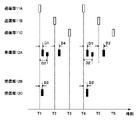
- FIG. 6 is a diagram for explaining the operation of the measurement unit 153.
- FIG. White rectangles in FIG. 6 indicate transmission signals transmitted by the transmitter 11
- black rectangles indicate reflected signals received by the receiver 12 .
- the transmitter 11A, the transmitter 11B, and the transmitter 11C sequentially transmit transmission signals at times T1, T2, and T3, and then the transmitter 11A, the transmitter 11B, and the transmitter 11C Transmission signals are sequentially transmitted at times T4, T5, and T6.
- the cycle in which the transmission unit 11 transmits the transmission signal is longer than (the time length of the transmission signal + the time during which the reflected signal may be received) ⁇ (the number of transmission units 11). is set.
- the measurement unit 153 measures the time from when the transmission unit 11A, the transmission unit 11B, and the transmission unit 11C each transmits a transmission signal to when a reflected signal is received.
- the measurement unit 153 measures that the reception unit 12A has received the reflected signal after the time D1 has elapsed since the transmission unit 11A transmitted the transmission signal at time T1.
- the reflected signal is a reflected signal generated by reflecting the transmission signal transmitted by the transmitter 11A from the subject U1.
- the measurement unit 153 also measures that the reception unit 12A has received the reflected signal even after the time D2 has elapsed since the transmission unit 11A transmitted the transmission signal.
- the reflected signal is a reflected signal generated by reflecting the transmission signal transmitted by the transmitter 11A from the subject U2.
- the measurement unit 153 measures that the reception unit 12C has received the reflected signal even after the time D3 has elapsed since the transmission unit 11A transmitted the transmission signal.
- the reflected signal is a reflected signal generated by reflecting the transmission signal transmitted by the transmission section 11A from the subject U3.
- the measurement unit 153 measures that the reception unit 12A has received the reflected signal after the time D4 has elapsed since the transmission unit 11B transmitted the transmission signal.
- the reflected signal is a reflected signal generated by reflecting the transmission signal transmitted by the transmitter 11B from the subject U4.
- the measurement unit 153 repeats the same processing after time T4. As shown in FIG. 6, the propagation time from transmission of the transmission signal by the transmission unit 11 to reception of the reflected signal by the reception unit 12 changes from D1' to D4', which are different from D1 to D4. This is due to the change in the distance between the parts of subjects U1 to U4 that reflected the transmission signal and the biological condition measuring apparatus 1 due to the movement of the parts.
- the measuring unit 153 may further measure the level of the reflected signal received by the receiving unit 12, and store the measured level of the reflected signal in the storage unit 14 together with the propagation time. Since the amount of signal attenuation differs depending on the distance between the biological condition measuring device 1 and the subject U, as shown in FIG. 6, the longer the propagation time, the lower the level of the reflected signal. When the level of the reflected signal with a long propagation time is higher than the level of the reflected signal with a short propagation time, the measurement unit 153 determines that the reflected signal may contain noise, and determines that the reflected signal may contain noise. The propagation time may not be stored in the storage unit 14 .
- the identifying unit 154 identifies the biological condition of each of the plurality of subjects U based on the propagation times measured by the measuring unit 153 .
- the identifying unit 154 identifies the biological conditions of a plurality of subjects U within a range where the plurality of transmitters 11 transmit transmission signals.
- the biological condition measuring device 1 has a plurality of receivers 12
- the identifying unit 154 identifies the biological conditions of a plurality of subjects within a range where the plurality of receivers 12 receive reflected signals.
- the identifying unit 154 determines a plurality of The biological conditions of a plurality of subjects in each of a plurality of ranges determined by a combination of a range in which the transmitting section 11 transmits a transmission signal and a range in which a plurality of receiving sections 12 receive reflected signals are specified.
- the identification unit 154 In order to identify the biological conditions of a plurality of subjects U, the identification unit 154 first determines the following in each of the biological condition measuring device 1 and the plurality of subjects U based on the change in the propagation time measured by the measurement unit 153. By specifying the change in the distance from the part that reflected the transmitted signal, a waveform representing the movement of the heart or a waveform representing the movement of the pleura is created. The identification unit 154 identifies the biological condition such as heart rate or respiration rate per unit time by identifying the cycles of these waveforms.
- the receiving section 12 receives a plurality of reflected signals based on one transmission signal.
- the identifying unit 154 performs the following processing to identify the propagation times corresponding to each of the plurality of subjects U.
- the specifying unit 154 converts the propagation time data indicating a plurality of propagation times measured by the measuring unit 153 into a plurality of time points composed of a plurality of propagation time data indicating a propagation time varying within a time range equal to or less than the first threshold.
- the biological condition of each of the plurality of subjects U is identified based on the change in the propagation time indicated by each of the plurality of time-series data for each time interval.
- the first threshold is assumed to be larger than the maximum amount of change in propagation time due to movement of an organ of one person U to be measured, and as a difference in propagation time from reflected signals from other persons U to be measured. is less than the minimum
- the identifying unit 154 stores the identified biological condition in the storage unit 14 in association with the person U to be measured.
- the maximum value of the amount of change in the propagation time due to the movement of the organ of the subject U is the maximum amount (for example, 5 cm) assumed as the amount of displacement of the organ when the subject U is stationary.
- the difference in propagation time from the reflected signal from another subject U corresponds to a distance difference of, for example, 50 cm. That is, the first threshold is the time required for the radio wave to propagate any distance between 5 cm and less than 50 cm.
- the first threshold is the difference in propagation time between a reflected signal with a delay time of D1 from time T1 and a reflected signal with a delay time of D1′ from time T4 after a predetermined time interval from time T1. is less than.
- the measurement unit 153 determines that these reflected signals are reflected signals corresponding to the same person U to be measured.
- FIG. 6 shows a case where the difference in propagation time between the reflected signal with a delay time of D1 from time T1 and the reflected signal with a delay time of D2' from time T4 is greater than or equal to the first threshold. .
- the measurement unit 153 determines that these reflected signals are reflected signals corresponding to different subjects U, respectively.
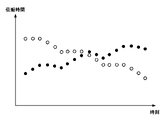
- FIG. 7 is a diagram for explaining the operation of the specifying unit 154.
- FIG. The horizontal axis of FIG. 7 is the time, and the vertical axis is the propagation time measured by the measurement unit 153 at each time.
- the black circles in FIG. 7 are the propagation times of the reflected signals corresponding to the subject U1, and the white circles are the propagation times of the reflected signals corresponding to the subject U2.
- the fluctuation width within one period of the plurality of propagation times indicated by black circles is ⁇ t1
- the fluctuation width within one period of the plurality of propagation times indicated by white circles is ⁇ t2, which are less than the first threshold.
- the minimum value ⁇ T of the difference between the propagation times indicated by black circles and the propagation time indicated by white circles is greater than or equal to the first threshold.
- the identifying unit 154 classifies the plurality of propagation time data into first time-series data corresponding to the plurality of propagation times indicated by black circles and second time-series data corresponding to the plurality of propagation times indicated by white circles. .
- the specifying unit 154 specifies the biological condition of the subject U1 based on the first time-series data, and specifies the biological condition of the subject U2 based on the second time-series data. With the specifying unit 154 operating in this manner, even when the receiving unit 12 receives a plurality of reflected signals based on the transmission signal transmitted by one transmitting unit 11, the specifying unit 154 can detect a plurality of measured signals.
- the biological condition of each person U can be specified.
- the identifying unit 154 may track the biological conditions of the moving subjects U based on the length of the propagation time.
- the specifying unit 154 selects time-series data composed of a plurality of pieces of propagation time data indicating the propagation time that fluctuates within a time range equal to or smaller than a second threshold that is larger than the first threshold within the cycle in which the propagation time fluctuates.
- the biological condition of the person U is identified, and the identified biological condition is associated with the subject U and stored in the storage unit 14 .
- the second threshold is greater than the maximum value of the amount of change in propagation time within a predetermined time period (for example, within one cycle in which the propagation time fluctuates) due to the movement of one subject U, and A value smaller than the difference in propagation time from the reflected signal from U.
- FIG. 8 is a diagram for explaining the process of tracking the biological condition of the subject U by the specifying unit 154.
- FIG. 8 As in FIG. 7, the black circles in FIG. 8 are the propagation times of the reflected signals corresponding to the subject U1, and the white circles are the propagation times of the reflected signals corresponding to the subject U2.
- subject U1 and subject U2 are moving, and the propagation time changes over time. Specifically, the subject U1 moves away from the biological state measuring device 1 over time, and the subject U2 moves closer to the biological state measuring device 1 over time. .
- the identifying unit 154 selects a plurality of pieces of propagation time data indicating a propagation time whose fluctuation range is equal to or less than the second threshold for each period of fluctuation of the propagation time, from among the plurality of pieces of propagation time data, thereby obtaining the measurement subject shown in black.
- First time-series data corresponding to U1 and second time-series data corresponding to subject U2 shown in white are specified.
- the identifying unit 154 determines each Propagation time data corresponding to the subject U may be identified. Specifically, the specifying unit 154 assumes that the propagation time data for which it is unknown which subject U corresponds to is the propagation time data of one of the subjects U, and includes the propagation time data. Identify features of periodic waveforms. If the identified feature matches the feature of the past period, the identifying unit 154 determines that the assumption is correct, and if they do not match, the identifying unit 154 determines that the assumption is incorrect, and Specify to correspond to another subject U.
- the identifying unit 154 may identify the biological condition corresponding to each of a plurality of parts of the person U to be measured.
- the identification unit 154 propagates a plurality of reflected signals generated by reflection of the transmission signal at a plurality of sites, such as the movement of the heart, the carotid artery, the pleura, or the head of the subject U. Identify parts based on time.
- the specifying unit 154 determines, based on the range including the propagation time measured by the measuring unit 153, a plurality of reflected signals generated by reflecting a single transmission signal transmitted by the transmitting unit 11 at a plurality of parts of the subject U.
- a plurality of biological states corresponding to a plurality of parts are specified by classifying the body parts according to the classification.
- a plurality of biological conditions of the subject U can be identified by the identification unit 154 operating in this manner.
- the identifying unit 154 may identify the positions of a plurality of subjects U. Specifically, the specifying unit 154 determines the range in which the receiving unit 12 that has received the reflected signal receives the reflected signal, the range in which the transmitting unit 11 that has transmitted the transmission signal that causes the reflected signal transmits the transmission signal, and the propagation range. Based on the distance to the subject U corresponding to time and the position of the subject U who emitted the reflected signal, the position is specified.
- the transmission signal transmitted by the transmitter 11A is reflected by the subject U1, the subject U2, and the subject U3, and the transmission signal transmitted by the transmitter 11B is reflected by the subject U1, the subject U2, and the subject U3.
- Reflected signals reflected by the subject U1, subject U2, and subject U4 are received by the receiving section 12A, and reflected signals generated by being reflected by the subject U3 are received by the receiving section 12C. be done.
- the specifying unit 154 determines that the person to be measured U1 and the person to be measured U2 who reflected the transmission signal are within the transmission range of the transmitting unit 11A. It specifies that the user is in an area where the reception range of the receiver 12A overlaps. Further, when the receiving unit 12C receives a reflected signal based on the transmission signal transmitted by the transmitting unit 11A, the specifying unit 154 determines that the subject U3 who reflected the transmitted signal is within the transmission range of the transmitting unit 11A and the receiving unit 12C. identify that you are in an area where the reception range of
- the identifying unit 154 further identifies the distance between the biological condition measuring device 1 and the subject U based on the size of the propagation time.
- the specifying unit 154 identifies the positions of the plurality of subjects U with reference to the biological state measuring device 1 based on the area where the subject U exists and the distance from the biological state measuring device 1 to the subject U. can be specified.
- the output unit 155 outputs the information indicating the position of the subject U specified by the specifying unit 154 in association with the biological condition. Specifically, the output unit 155 causes the information terminal 2 to display the screen showing the biological condition shown in FIG. 2 and the screen showing the position of the subject U shown in FIG. Output or send to an external device via a communication line.
- the output unit 155 selects the biological condition that corresponds to the plurality of subjects U identified by the identifying unit 154, and the biological condition measuring apparatus 1 is most sensitive to the propagation time.
- the biological condition corresponding to the person to be measured U identified as being close is output with priority over the biological condition corresponding to other persons to be measured.
- the output unit 155 causes the information terminal 2 to display the biological condition in order from the subject U closest to the biological condition measuring apparatus 1, or displays only the biological condition of the subject U closest to the biological condition measuring apparatus 1. Display it on the terminal 2.
- FIG. 9 is a flow chart showing the flow of processing in the biological condition measuring device 1. As shown in FIG. The flowchart shown in FIG. 9 starts when the user of the biological condition measuring device 1 performs an operation to start measurement.
- the radio wave control unit 152 selects the transmission unit 11 to transmit the transmission signal from the plurality of transmission units 11 based on the time (S11). In the example shown in FIG. 6, the radio wave control unit 152 selects the transmission unit 11A at time T1. The radio wave control unit 152 causes the selected transmission unit 11 to transmit a transmission signal (S12).
- the receiving unit 12 receives a reflected signal based on the transmission signal (S13).
- the measurement unit 153 calculates the propagation time required from transmission of the transmission signal to reception of the reflected signal by the reception unit 12 (S14).
- the measurement unit 153 causes the storage unit 14 to store the propagation time data in association with the combination of the transmission unit 11 that transmitted the transmission signal and the reception unit 12 that received the reflected signal (S15).
- the radio wave control unit 152 determines whether or not the next transmission timing (for example, time T2) has come (S16). When the radio wave control unit 152 determines that the next transmission timing has not come (NO in S16), the radio wave control unit 152 does not cause the transmission unit 11 to transmit the transmission signal, and the processing from S13 to S16 is repeated.
- the specifying unit 154 detects the biological condition after a predetermined time has passed since the transmission unit 11 started transmitting the transmission signal. It is determined whether or not it is time to specify (S17).
- the predetermined time is the time required for the identification unit 154 to store the necessary number of propagation time data to identify the biological condition.
- the predetermined time is longer than one cycle of the biological state, and is, for example, 30 seconds or longer.
- the radio wave control unit 152 selects the next transmitting unit 11 (S11), and the processes from S11 to S17 are repeated. If the identifying unit 154 determines that the predetermined time has passed (YES in S17), the identifying unit 154 identifies the biological condition based on the propagation time data stored in the storage unit 14 (S18). The output unit 155 outputs the biological condition specified by the specifying unit 154 (S19). The biological condition measuring apparatus 1 repeats the processes from S11 to S20 until the operation accepting unit 151 accepts the end operation (YES in S20).
- the biological state measuring device 1 identifies the biological states of a plurality of subjects U. , may be realized by another information processing device (for example, a computer on the cloud). That is, the biological condition measuring apparatus 1 and another information processing apparatus may operate in cooperation to function as a biological condition measuring system.
- another information processing device for example, a computer on the cloud. That is, the biological condition measuring apparatus 1 and another information processing apparatus may operate in cooperation to function as a biological condition measuring system.
- the biological condition measuring device 1 sequentially transmits the received reflected signals to an external computer.
- the external computer executes at least part of the functions of the measurement unit 153 , the identification unit 154 or the output unit 155 .
- the external computer classifies the reflected signals of each of the plurality of subjects U, specifies the biological condition based on the propagation time, and transmits the specified result to the biological condition measuring apparatus 1 .
- the external computer may transmit the specified result to the information terminal 2 .
- the external computer receives reflected signals from the plurality of biological condition measuring devices 1, and determines whether the plurality of subjects U correspond to the reflected signals received by the plurality of biological condition measuring devices 1.
- a biological condition may be specified. Such a configuration is suitable when there are many subjects U in multiple rooms.
- the measurement unit 153 measures a plurality of propagation times from when the transmission unit 11 transmits a transmission signal to when the reception unit 12 receives a plurality of reflected signals. Then, the identifying unit 154 classifies the plurality of pieces of propagation time data indicating the plurality of propagation times into a plurality of pieces of time-series data composed of the plurality of pieces of propagation time data indicating the propagation time varying within a time range equal to or less than the first threshold. Then, the biological condition of each of the plurality of subjects U is specified based on the mode of change in propagation time indicated by each of the plurality of time-series data. By configuring the biological condition measuring device 1 in this way, the biological condition measuring device 1 can measure the biological condition such as heart rate or respiration rate even when there are a plurality of people in an area to which radio waves are transmitted. be able to.
- the biological condition measuring apparatus 1 also has a plurality of transmitters 11 that transmit transmission signals to different ranges at different timings, and a plurality of receivers 12 that receive reflected signals arriving from different ranges. Based on the propagation time measured by the measurement unit 153 for each combination of the transmission unit 11 and the reception unit 12, the identification unit 154 determines the range in which the transmission signals are transmitted by the plurality of transmission units 11 and the reflection range of the transmission signals in the plurality of reception units 12. The biological conditions of a plurality of subjects U who are in each of a plurality of ranges determined by a combination of signal receiving ranges are identified. By configuring the biological state measuring device 1 in this way, even when a plurality of subjects U are equidistant from the biological state measuring device 1, the biological state measuring device 1 can The biological condition of the person U can be specified.
Landscapes
- Health & Medical Sciences (AREA)
- Life Sciences & Earth Sciences (AREA)
- Engineering & Computer Science (AREA)
- Physics & Mathematics (AREA)
- Medical Informatics (AREA)
- Animal Behavior & Ethology (AREA)
- Pathology (AREA)
- Veterinary Medicine (AREA)
- Biomedical Technology (AREA)
- Heart & Thoracic Surgery (AREA)
- Public Health (AREA)
- Molecular Biology (AREA)
- Surgery (AREA)
- Biophysics (AREA)
- General Health & Medical Sciences (AREA)
- Remote Sensing (AREA)
- Radar, Positioning & Navigation (AREA)
- Physiology (AREA)
- Pulmonology (AREA)
- Radiology & Medical Imaging (AREA)
- Nuclear Medicine, Radiotherapy & Molecular Imaging (AREA)
- Computer Networks & Wireless Communication (AREA)
- General Physics & Mathematics (AREA)
- Cardiology (AREA)
- Artificial Intelligence (AREA)
- Oral & Maxillofacial Surgery (AREA)
- Dentistry (AREA)
- Mathematical Physics (AREA)
- Evolutionary Computation (AREA)
- Fuzzy Systems (AREA)
- Computer Vision & Pattern Recognition (AREA)
- Signal Processing (AREA)
- Psychiatry (AREA)
- Electromagnetism (AREA)
- Measurement Of The Respiration, Hearing Ability, Form, And Blood Characteristics Of Living Organisms (AREA)
- Measuring And Recording Apparatus For Diagnosis (AREA)
- Measuring Pulse, Heart Rate, Blood Pressure Or Blood Flow (AREA)
Priority Applications (4)
| Application Number | Priority Date | Filing Date | Title |
|---|---|---|---|
| CN202280031985.7A CN117241731A (zh) | 2021-05-07 | 2022-04-25 | 生命体状态测量装置、生命体状态测量方法、程序以及生命体状态测量系统 |
| KR1020237040754A KR20230175307A (ko) | 2021-05-07 | 2022-04-25 | 생체상태 측정장치, 생체상태 측정방법, 프로그램 및 생체상태 측정시스템 |
| EP22798891.2A EP4324390A4 (en) | 2021-05-07 | 2022-04-25 | DEVICE FOR MEASURING BIOLOGICAL STATES, METHOD FOR MEASURING BIOLOGICAL STATES, PROGRAM AND SYSTEM FOR MEASURING BIOLOGICAL STATES |
| US18/498,039 US20240057884A1 (en) | 2021-05-07 | 2023-10-31 | Biological condition measurement apparatus, biological condition measurement method and biological condition measurement system |
Applications Claiming Priority (2)
| Application Number | Priority Date | Filing Date | Title |
|---|---|---|---|
| JP2021078982A JP7373754B2 (ja) | 2021-05-07 | 2021-05-07 | 生体状態測定装置、生体状態測定方法、プログラム及び生体状態測定システム |
| JP2021-078982 | 2021-05-07 |
Related Child Applications (1)
| Application Number | Title | Priority Date | Filing Date |
|---|---|---|---|
| US18/498,039 Continuation US20240057884A1 (en) | 2021-05-07 | 2023-10-31 | Biological condition measurement apparatus, biological condition measurement method and biological condition measurement system |
Publications (1)
| Publication Number | Publication Date |
|---|---|
| WO2022234785A1 true WO2022234785A1 (ja) | 2022-11-10 |
Family
ID=83932182
Family Applications (1)
| Application Number | Title | Priority Date | Filing Date |
|---|---|---|---|
| PCT/JP2022/018744 Ceased WO2022234785A1 (ja) | 2021-05-07 | 2022-04-25 | 生体状態測定装置、生体状態測定方法、プログラム及び生体状態測定システム |
Country Status (6)
| Country | Link |
|---|---|
| US (1) | US20240057884A1 (https=) |
| EP (1) | EP4324390A4 (https=) |
| JP (2) | JP7373754B2 (https=) |
| KR (1) | KR20230175307A (https=) |
| CN (1) | CN117241731A (https=) |
| WO (1) | WO2022234785A1 (https=) |
Citations (6)
| Publication number | Priority date | Publication date | Assignee | Title |
|---|---|---|---|---|
| JP2013242237A (ja) * | 2012-05-21 | 2013-12-05 | Keio Gijuku | 行動検出システム |
| JP2016214876A (ja) | 2015-05-22 | 2016-12-22 | パナソニック株式会社 | 心拍測定装置、心拍測定方法、及び記録媒体 |
| JP2016540960A (ja) * | 2013-10-09 | 2016-12-28 | マサチューセッツ インスティテュート オブ テクノロジー | 体の無線反射によるモーショントラッキング |
| JP2017161368A (ja) * | 2016-03-09 | 2017-09-14 | パナソニックIpマネジメント株式会社 | 検知装置 |
| JP2021027993A (ja) * | 2019-08-12 | 2021-02-25 | 昇雷科技股▲ふん▼有限公司Sil Radar Technology Inc. | 生体画像の生理信号マッチング方法及び生理信号マッチングシステム |
| US20210080557A1 (en) * | 2019-09-13 | 2021-03-18 | Infineon Technologies Ag | Human Target Tracking System and Method |
Family Cites Families (6)
| Publication number | Priority date | Publication date | Assignee | Title |
|---|---|---|---|---|
| JP5861178B1 (ja) * | 2015-02-25 | 2016-02-16 | 株式会社Cq−Sネット | 生体情報の検知装置及びその利用方法 |
| US11448745B2 (en) * | 2018-06-22 | 2022-09-20 | Asahi Kasei Microdevices Corporation | Sensor device and system, and biometric sensing method and system |
| TWI712392B (zh) * | 2019-02-27 | 2020-12-11 | 和碩聯合科技股份有限公司 | 多目標生命徵象偵測系統及方法 |
| WO2021257898A1 (en) * | 2020-06-18 | 2021-12-23 | Circadia Technologies Ltd. | Systems, apparatus and methods for acquisition, storage, and analysis of health and environmental data |
| EP3967215A1 (en) * | 2020-09-15 | 2022-03-16 | Alunos AG | Measurement device and method for assessing vital data of a human or animal subject |
| EP4224452A4 (en) * | 2020-09-29 | 2024-03-06 | Sony Semiconductor Solutions Corporation | INFORMATION PROCESSING SYSTEM AND INFORMATION PROCESSING METHOD |
-
2021
- 2021-05-07 JP JP2021078982A patent/JP7373754B2/ja active Active
-
2022
- 2022-04-25 KR KR1020237040754A patent/KR20230175307A/ko active Pending
- 2022-04-25 EP EP22798891.2A patent/EP4324390A4/en active Pending
- 2022-04-25 WO PCT/JP2022/018744 patent/WO2022234785A1/ja not_active Ceased
- 2022-04-25 CN CN202280031985.7A patent/CN117241731A/zh active Pending
-
2023
- 2023-10-12 JP JP2023176446A patent/JP7677660B2/ja active Active
- 2023-10-31 US US18/498,039 patent/US20240057884A1/en active Pending
Patent Citations (6)
| Publication number | Priority date | Publication date | Assignee | Title |
|---|---|---|---|---|
| JP2013242237A (ja) * | 2012-05-21 | 2013-12-05 | Keio Gijuku | 行動検出システム |
| JP2016540960A (ja) * | 2013-10-09 | 2016-12-28 | マサチューセッツ インスティテュート オブ テクノロジー | 体の無線反射によるモーショントラッキング |
| JP2016214876A (ja) | 2015-05-22 | 2016-12-22 | パナソニック株式会社 | 心拍測定装置、心拍測定方法、及び記録媒体 |
| JP2017161368A (ja) * | 2016-03-09 | 2017-09-14 | パナソニックIpマネジメント株式会社 | 検知装置 |
| JP2021027993A (ja) * | 2019-08-12 | 2021-02-25 | 昇雷科技股▲ふん▼有限公司Sil Radar Technology Inc. | 生体画像の生理信号マッチング方法及び生理信号マッチングシステム |
| US20210080557A1 (en) * | 2019-09-13 | 2021-03-18 | Infineon Technologies Ag | Human Target Tracking System and Method |
Non-Patent Citations (1)
| Title |
|---|
| See also references of EP4324390A4 |
Also Published As
| Publication number | Publication date |
|---|---|
| JP2022172781A (ja) | 2022-11-17 |
| JP2023175994A (ja) | 2023-12-12 |
| US20240057884A1 (en) | 2024-02-22 |
| JP7373754B2 (ja) | 2023-11-06 |
| JP7677660B2 (ja) | 2025-05-15 |
| KR20230175307A (ko) | 2023-12-29 |
| CN117241731A (zh) | 2023-12-15 |
| EP4324390A1 (en) | 2024-02-21 |
| EP4324390A4 (en) | 2024-08-07 |
Similar Documents
| Publication | Publication Date | Title |
|---|---|---|
| US12055656B2 (en) | Detecting a frame-of-reference change in a smart-device-based radar system | |
| US12158991B2 (en) | Smart-device-based radar system performing gesture recognition using a space time neural network | |
| US11172838B2 (en) | Sensing body information apparatus for volume and blood flow via light reflectance | |
| US11841455B1 (en) | Calibrating radar systems for movement detection | |
| KR20140069664A (ko) | 초음파 프로브 장치 및 그의 제어 방법 | |
| US20250275686A1 (en) | Smart home device using a single radar transmission mode for activity recognition of active users and vital sign monitoring of inactive users | |
| CN113080919A (zh) | 心率检测方法、装置、设备及计算机可读存储介质 | |
| WO2022234785A1 (ja) | 生体状態測定装置、生体状態測定方法、プログラム及び生体状態測定システム | |
| US20150216500A1 (en) | Ultrasonic measurement apparatus and ultrasonic measurement method | |
| JP7327868B1 (ja) | 生体状態測定装置、生体状態測定方法、プログラム及び生体状態測定システム | |
| US12318248B2 (en) | Ultrasound diagnosis apparatus and diagnosis method | |
| CN110604553B (zh) | 非接触式生命体征检测方法、检测装置和电子设备 | |
| US20240156438A1 (en) | Viscoelasticity measurement method and ultrasonic imaging system | |
| WO2024038629A1 (ja) | 生体状態測定装置、生体状態測定方法、プログラム及び生体状態測定システム | |
| JP2016070701A (ja) | 信号処理装置、検出装置、およびプログラム | |
| JP5023206B2 (ja) | 水中探知装置 | |
| KR20250080408A (ko) | 미세 움직임에 대한 모니터링을 수행하는 방법 및 디바이스 | |
| EP2336804A2 (en) | Ultrasound system and method for providing doppler sound | |
| CN120918635A (zh) | 宠物生命体征的检测方法、检测设备及检测系统 | |
| JP2024157218A (ja) | 計測システム、制御装置、及び計測装置 | |
| JP2006220468A (ja) | 水中探知装置および水中探知方法 | |
| WO2023234919A1 (en) | Radar-based blood pressure measurement | |
| CN116840844A (zh) | 一种终端设备及目标探测方法 | |
| KR20150084565A (ko) | 스마트 장치, 프로브 장치, 그에 따른 스마트 장치 제어 방법, 및 그에 다른 프로브 장치 제어 방법, 및 그를 기록한 기록 기록 매체 | |
| KR20160126387A (ko) | 전자 장치 및 전자 장치의 hrm 센서 보정 방법 |
Legal Events
| Date | Code | Title | Description |
|---|---|---|---|
| 121 | Ep: the epo has been informed by wipo that ep was designated in this application |
Ref document number: 22798891 Country of ref document: EP Kind code of ref document: A1 |
|
| WWE | Wipo information: entry into national phase |
Ref document number: 202280031985.7 Country of ref document: CN |
|
| WWE | Wipo information: entry into national phase |
Ref document number: 2022798891 Country of ref document: EP |
|
| ENP | Entry into the national phase |
Ref document number: 2022798891 Country of ref document: EP Effective date: 20231113 |
|
| ENP | Entry into the national phase |
Ref document number: 20237040754 Country of ref document: KR Kind code of ref document: A |
|
| WWE | Wipo information: entry into national phase |
Ref document number: 1020237040754 Country of ref document: KR |
|
| NENP | Non-entry into the national phase |
Ref country code: DE |