WO2022224423A1 - 車載用露光制御装置及び露光制御方法 - Google Patents
車載用露光制御装置及び露光制御方法 Download PDFInfo
- Publication number
- WO2022224423A1 WO2022224423A1 PCT/JP2021/016404 JP2021016404W WO2022224423A1 WO 2022224423 A1 WO2022224423 A1 WO 2022224423A1 JP 2021016404 W JP2021016404 W JP 2021016404W WO 2022224423 A1 WO2022224423 A1 WO 2022224423A1
- Authority
- WO
- WIPO (PCT)
- Prior art keywords
- mask
- face
- passenger
- exposure control
- detection unit
- Prior art date
- Legal status (The legal status is an assumption and is not a legal conclusion. Google has not performed a legal analysis and makes no representation as to the accuracy of the status listed.)
- Ceased
Links
Images




Classifications
-
- H—ELECTRICITY
- H04—ELECTRIC COMMUNICATION TECHNIQUE
- H04N—PICTORIAL COMMUNICATION, e.g. TELEVISION
- H04N23/00—Cameras or camera modules comprising electronic image sensors; Control thereof
- H04N23/60—Control of cameras or camera modules
- H04N23/61—Control of cameras or camera modules based on recognised objects
- H04N23/611—Control of cameras or camera modules based on recognised objects where the recognised objects include parts of the human body
-
- H—ELECTRICITY
- H04—ELECTRIC COMMUNICATION TECHNIQUE
- H04N—PICTORIAL COMMUNICATION, e.g. TELEVISION
- H04N23/00—Cameras or camera modules comprising electronic image sensors; Control thereof
- H04N23/60—Control of cameras or camera modules
-
- H—ELECTRICITY
- H04—ELECTRIC COMMUNICATION TECHNIQUE
- H04N—PICTORIAL COMMUNICATION, e.g. TELEVISION
- H04N23/00—Cameras or camera modules comprising electronic image sensors; Control thereof
- H04N23/70—Circuitry for compensating brightness variation in the scene
-
- H—ELECTRICITY
- H04—ELECTRIC COMMUNICATION TECHNIQUE
- H04N—PICTORIAL COMMUNICATION, e.g. TELEVISION
- H04N23/00—Cameras or camera modules comprising electronic image sensors; Control thereof
- H04N23/70—Circuitry for compensating brightness variation in the scene
- H04N23/71—Circuitry for evaluating the brightness variation
-
- H—ELECTRICITY
- H04—ELECTRIC COMMUNICATION TECHNIQUE
- H04N—PICTORIAL COMMUNICATION, e.g. TELEVISION
- H04N23/00—Cameras or camera modules comprising electronic image sensors; Control thereof
- H04N23/70—Circuitry for compensating brightness variation in the scene
- H04N23/73—Circuitry for compensating brightness variation in the scene by influencing the exposure time
-
- H—ELECTRICITY
- H04—ELECTRIC COMMUNICATION TECHNIQUE
- H04N—PICTORIAL COMMUNICATION, e.g. TELEVISION
- H04N23/00—Cameras or camera modules comprising electronic image sensors; Control thereof
- H04N23/70—Circuitry for compensating brightness variation in the scene
- H04N23/76—Circuitry for compensating brightness variation in the scene by influencing the image signals
Definitions
- the present disclosure relates to an in-vehicle exposure control device and an exposure control method.
- an in-vehicle exposure control device that controls the exposure of a captured image of a driver's face when it is determined that the driver is wearing a mask on the captured image.
- An exposure control unit that controls the exposure of a captured image provided by the in-vehicle exposure control device controls, for example, a predetermined region vertically and downwardly below the horizontal edge extracted at the edge of the mask (that is, the mask is present).
- a predetermined region vertically and downwardly below the horizontal edge extracted at the edge of the mask (that is, the mask is present).
- Passengers including the driver, may wear not only masks but also various other accessories (such as sunglasses). Also, the color of the mask is not limited to white, and various other colors may be worn. However, Patent Document 1 does not specifically disclose a method for appropriately controlling exposure even when accessories other than masks or masks other than white are attached.
- the present disclosure has been made to solve the above-described problems, and provides an in-vehicle exposure control apparatus and exposure control capable of appropriately controlling exposure corresponding to various accessories worn by a passenger. Aim to get a method.
- An in-vehicle exposure control apparatus includes an imaging unit that acquires a captured image of a passenger that is output from an imaging device that captures an image of a passenger in a vehicle; A face detection unit for detecting face information of the passenger from an image; a face parts detection unit for detecting face parts from the face information detected by the face detection unit; and face parts detected by the face parts detection unit. and a face part detection accuracy detection unit that detects the detection accuracy of the facial parts detected by the face parts detection accuracy detection unit, and the face parts for which the detection accuracy of the facial parts detected by the facial parts detection accuracy detection unit is equal to or higher than a predetermined detection accuracy are selected as exposure control target face parts.
- an exposure control target face part determination unit that outputs a determination result; a brightness detection unit that detects the average brightness of the exposure control target face part; and an exposure controller for controlling exposure.
- an exposure control method includes steps of acquiring a captured image of the passenger output from an imaging device that captures an image of the passenger boarding the vehicle; detecting a face part from the face information; detecting a detection accuracy of the face part; The steps of determining the facial parts, detecting the average luminance of the facial parts subject to exposure control, and controlling the exposure so that the average luminance approaches the target luminance are provided.
- a vehicle-mounted exposure control apparatus and exposure control method determine whether or not a mask is worn using a passenger's face information, and adjust the average brightness detected from the determination result to be close to a predetermined target brightness. Since the exposure is controlled, there is an effect that the exposure can be appropriately controlled even when the passenger wears the accessory and covers the facial parts.
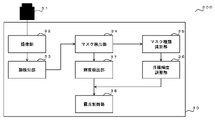
- FIG. 1 is a schematic diagram of a DMS 100 to which a vehicle-mounted exposure control device 10 of Embodiment 1 is applied;
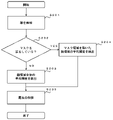
- FIG. 4 is a flowchart of an exposure control method according to Embodiment 1;
- FIG. 10 is a diagram showing an example of face parts for exposure control in step S104;
- FIG. 10 is a diagram showing an example of face parts for exposure control in step S104;
- FIG. 10 is a diagram showing an example of face parts for exposure control in step S104;
- FIG. 10 is a diagram showing an example of face parts for exposure control in step S104;
- FIG. FIG. 10 is a diagram showing an example of face parts for exposure control in step S104;
- FIG. FIG. 10 is a diagram showing an example of face parts for exposure control in step S104;
- FIG. 11 is a schematic diagram of a DMS 200 to which an in-vehicle exposure control device 20 of Embodiment 2 is applied; 9 is a flowchart of an exposure control method according to Embodiment 2; FIG. 10 is a diagram showing the range of each area detected in steps S203 and S204; FIG. 11 is a schematic diagram of a DMS 300 to which an in-vehicle exposure control device 30 of Embodiment 3 is applied; 10 is a flowchart of an exposure control method according to Embodiment 3;
- FIG. 1 is a schematic diagram of a DMS (Driver Monitoring System) 100 to which a vehicle-mounted exposure control apparatus 10 according to Embodiment 1 is applied.
- the DMS 100 is mounted on a vehicle and performs various monitoring processes for passengers including the driver on board the vehicle.
- the monitoring process of the passenger of the DMS 100 includes, for example, determination of the passenger's condition, personal authentication of the passenger, and the like.
- the DMS 100 includes an imaging device 1 and an in-vehicle exposure control device 10 connected to the imaging device 1 via a network.
- the imaging device 1 is a camera that captures an image of a passenger and outputs the captured image to the in-vehicle exposure control device 10 .
- the in-vehicle exposure control device 10 performs exposure control of the captured image output from the imaging device 1 .
- the in-vehicle exposure control device 10 includes an imaging unit 2 , a face detection unit 3 , a face parts detection unit 4 , a face parts detection accuracy detection unit 5 , an exposure control target face parts determination unit 6 , and a luminance detection unit 7 . , and an exposure control unit 8 .
- the imaging unit 2 acquires the captured image output from the imaging device 1 .
- the imaging unit 2 then outputs the captured image to the face detection unit 3 .
- the face detection unit 3 uses the captured image output from the imaging unit 2 to detect the passenger's face information. Then, the face detection section 3 outputs the detection result of detecting the face information to the face part detection section 4 .
- the face part detection unit 4 uses the detection results output from the face detection unit 3 to detect face parts (eg, eyes, nose, mouth, etc.) that are characteristic points of face information necessary for monitoring processing. Then, the face part detection section 4 outputs the detection result of detecting the face part to the face part detection accuracy detection section 5 .
- face parts eg, eyes, nose, mouth, etc.
- the face part detection accuracy detection unit 5 uses the detection result output from the face part detection unit 4 to detect the detection accuracy that indicates the accuracy of the face part detection result. Then, the face part detection accuracy detection unit 5 outputs the detection result of the detection accuracy to the exposure control target face part determination unit 6 .
- the exposure control target face part determination unit 6 uses the detection result output from the face part detection accuracy detection unit 5 to determine whether the detection accuracy has reached a predetermined first detection accuracy. A facial part that has reached one detection accuracy is selected as an exposure control target facial part whose exposure is to be controlled. Then, the exposure control target facial part determination unit 6 outputs the result to the brightness detection unit 7 .
- the first detection accuracy does not reach the second detection accuracy required for the monitoring process, but it is possible to reach the second detection accuracy for facial parts by controlling the exposure. It is the possible detection accuracy.
- the brightness detection unit 7 uses the result output from the exposure control target facial part determination unit 6 to detect the average brightness of the exposure control target facial part.
- the luminance detection unit 7 then outputs the detection result of the average luminance to the exposure control unit 8 .
- the exposure control unit 8 uses the detection result detected by the luminance detection unit 7 to control exposure so that the average luminance approaches a predetermined target luminance.
- the target luminance is predetermined as luminance with which facial parts can be detected with high detection accuracy, and is luminance at which the detection accuracy of facial parts is equal to or higher than the second detection accuracy required for monitoring processing. is set to
- FIG. 2 is a flow chart of the exposure control method of the first embodiment.
- the exposure control method according to the first embodiment includes a step of acquiring a captured image of the passenger, which is output from the imaging device 1 that captures the passenger riding in the vehicle, when the passenger is wearing the accessory. a step S101 for detecting facial information of the passenger from the captured image; a step S102 for detecting facial parts from the facial information; a step S103 for detecting the detection accuracy of the facial parts; A step S104 of determining a face part having a detection accuracy equal to or higher than a predetermined detection accuracy as an exposure control target face part; A step S106 for controlling the is provided.
- step S101 of detecting the face information of the passenger from the captured image the captured image output by the step of outputting the captured image of the passenger output from the imaging device for capturing the image of the passenger on board the vehicle. is used to detect the face information of the passenger.
- step S102 of detecting facial parts from facial information facial parts are detected using the passenger's facial information detected in step S101.
- step S103 of detecting the detection accuracy of the face part the detection accuracy indicating the accuracy of the detection result of the face part is detected using the face part detected in step S102.
- the detection accuracy is detected, for example, by calculating based on the rate at which the position of the face part matches the position of the face part stored in advance.
- step S104 a face part whose detection accuracy is equal to or higher than a predetermined detection accuracy is determined to be an exposure control target face part. It is then determined whether or not the first detection accuracy has been reached, and the facial part that has reached the first detection accuracy is selected as an exposure control target facial part whose exposure is to be controlled.
- FIG. 3 to 6 are diagrams showing examples of facial parts to be subjected to exposure control in step S104.
- the face parts that have reached the first detection accuracy are indicated by square frames, and the face parts that have not reached the first detection accuracy (defective part B) are indicated by solid square frames. It is shown enclosed.
- FIG. 3 shows a case where the passenger's right eye is shielded by an eyepatch or the like. In this case, the unshielded left eye and mouth are determined as the exposure control target face part A, and the shielded right eye is determined as the missing part B.
- FIG. FIG. 4 shows a case where the passenger's eyes are shielded by sunglasses or the like with low transmittance.
- the unshielded mouth is determined to be the exposure control target face part A, and since the transmittance of the sunglasses that shield the eyes is low, it is not possible to detect the eyes through the sunglasses. Both eyes are determined to be missing parts B.
- FIG. 5 shows a case where the eyes of the passenger are shielded by sunglasses or the like with high transmittance and the mouth is shielded by a mask or the like. In this case, since the sunglasses that shield the eyes have a high transmittance, it is possible to detect the eyes through the sunglasses, so the detection accuracy of the detected eyes has reached the first detection accuracy. is determined as the exposure control target part A, and the blocked mouth is determined as the defective part B.
- FIG. 6 shows a case where the passenger's right eye is covered with an eyepatch or the like and the mouth is covered with a mask or the like.
- the unshielded left eye is determined as the exposure control target face part A
- the shielded right eye and mouth are determined as the missing part B.
- step S105 for detecting the average brightness of the exposure control target facial parts the average brightness of the exposure control target facial parts determined in step S104 is detected.
- step S106 for controlling exposure so that the average brightness reaches the target brightness if the average brightness of the exposure control target facial part detected in step S105 does not reach the predetermined target brightness, the average brightness is reduced to the target brightness. Exposure is controlled by adjusting the exposure time and gain so as to approach the target brightness.
- the detection accuracy of the face part required for the monitoring process is increased by controlling the exposure. It is determined whether or not the first detection accuracy, which is a detection accuracy capable of reaching the second detection accuracy, has been reached, and the face part that has reached the first detection accuracy is set as the face part subject to exposure control.
- the average brightness of the face part subject to exposure control is detected, and the exposure is controlled so that the average brightness approaches the target brightness.
- exposure can be appropriately controlled even when the occupant is wearing various accessories including a mask, and the monitoring process can be smoothed and accurate.
- FIG. 5 exposure can be appropriately controlled even when a mask and sunglasses are worn at the same time.
- the in-vehicle exposure control apparatus 10 and the exposure control method of Embodiment 1 detect facial parts using facial information of a passenger, and the average brightness of the facial parts reaching a predetermined detection accuracy is Since the exposure is controlled so as to approach the target brightness, the exposure can be appropriately controlled even when the facial parts are blocked by the accessories worn by the passenger.
- FIG. 7 is a schematic diagram of a DMS 200 to which the in-vehicle exposure control device 20 of Embodiment 2 is applied. As shown in FIG. 7, although it is different from the first embodiment in that a mask detection unit 24 is provided, the rest except for the face parts detection unit 4, the face parts detection accuracy detection unit 5, and the exposure control target face parts determination unit 6. is the same as that of the first embodiment.
- the mask detection unit 24 compares the face information output from the face detection unit 23 with pre-stored face information, and detects whether or not a mask is worn. Then, the mask detection section 24 outputs the detection result to the luminance detection section 25 .
- the luminance detection unit 25 detects the average luminance of the area E of the face area C excluding the mask area D, and detects the average luminance of the area E without the mask. , the average brightness of the face region C is detected. The luminance detection unit 25 then outputs the detection result of the average luminance to the exposure control unit 26 .
- the exposure control unit 26 uses the detection result output from the brightness detection unit 25 to control exposure so that the average brightness approaches the target brightness.
- FIG. 8 is a flow chart of the exposure control method of the second embodiment.
- An exposure control method according to Embodiment 2 includes the step of acquiring a captured image of a passenger in a vehicle output from an imaging device that captures an image of the passenger while the passenger is wearing an accessory.
- a step S201 of detecting face information of the passenger from the captured image a step S202 of detecting whether or not the passenger is wearing a mask from the face information, and if it is detected that the mask is worn, the face information has step S204 of detecting the average brightness of the area of the face area excluding the mask area covered by the mask (step S203), and detecting the average brightness of the face area C when it is detected that the mask is not worn;
- a step S205 is provided to control exposure so that the average luminance approaches the target luminance.
- the captured image output by the step of outputting the captured image of the passenger output from the imaging device that captures the image of the passenger on board the vehicle. is used to detect the face information of the passenger.
- step S202 for detecting whether or not the passenger is wearing a mask from the face information the face information detected in step S201 is compared with pre-stored face information to detect whether or not the passenger is wearing a mask.
- the pre-stored face information is, for example, face information when the passenger is not wearing a mask or face information when the passenger is wearing a mask.
- the mask worn by the passenger which is stored in advance in the face information, may be a white mask including a relatively light color such as yellow or light blue other than white, or a black mask such as navy blue or brown. , and various colors such as black masks, including relatively dark ones.
- step S202 If it is detected in step S202 that a mask is worn, the process proceeds to step S203 for detecting the average brightness of the face area of the face information, excluding the mask area blocked by the mask.
- step S203 the average luminance of the area E of the face area C excluding the mask area D is detected.
- step S202 If it is detected in step S202 that no mask is worn, the process proceeds to step S204 for detecting the average brightness of the face region C. In step S204, the average brightness of the face area C is detected.
- FIG. 9 is a diagram showing the range of each area detected in steps S203 and S204.
- a facial area C is an area of facial information of the passenger, and is a range indicated by a dotted line frame.
- the mask area D is the area of the face area C that is shielded by the mask, and the area within the solid line frame is the hatched area.
- an area E is an area of the face area C excluding the mask area D, and is a range indicated by a solid-line frame.
- step S205 which controls exposure so that the average luminance approaches the target luminance
- the exposure time is adjusted so that the average luminance approaches the target luminance. and control the exposure by adjusting the gain.
- the detected facial information of the passenger is compared with the pre-stored facial information.
- the area where the average brightness is detected is changed, and the exposure is controlled so that the average brightness of the area approaches the target brightness.
- the in-vehicle exposure control apparatus 20 and the exposure control method according to the second embodiment detect whether or not the mask is worn by using the face information of the occupant, and determine the area for detecting the average luminance based on whether or not the mask is worn.
- the exposure is controlled so that the average brightness of the relevant area approaches the target brightness, so even if the face parts are blocked by the mask worn by the passenger, the exposure can be controlled appropriately. It works.
- the face information detected in step S201 is compared with pre-stored face information. can do.
- FIG. 10 is a schematic diagram of a DMS 300 to which the in-vehicle exposure control device 30 of Embodiment 3 is applied. As shown in FIG. 10, it differs from the second embodiment in that a mask type identifying section 35 and a target luminance adjusting section 36 are provided, but other configurations are the same as those of the second embodiment.
- the mask detection unit 34 compares the face information output from the face detection unit 33 with pre-stored face information, and detects whether or not a mask is worn. Then, the mask detection section 34 outputs the detection result to the luminance detection section 37 . Further, when the mask detection unit 34 detects that the mask is attached, the detection result is output to the mask type identification unit 35 .
- the mask type identification unit 35 identifies the type of mask using the mask wearing detection result output from the mask detection unit 34 . Then, the mask type identifying section 35 outputs the identification result to the target luminance adjusting section 36 .
- the target brightness adjustment unit 36 uses the identification result output from the mask type identification unit 35 to adjust the target brightness according to the identified mask. Then, the target brightness adjustment section 36 outputs the adjusted target brightness to the exposure control section 38 .
- the exposure control unit 38 uses the detection result output from the brightness detection unit 37 to control exposure so that the average brightness approaches the target brightness. However, when the target brightness is adjusted by the target brightness adjustment unit 36, the exposure is controlled so that the average brightness approaches the adjusted target brightness output from the target brightness adjustment unit 36.
- FIG. 11 is a flow chart of the third embodiment.
- An exposure control method according to Embodiment 3 includes the step of obtaining a captured image of a passenger in a vehicle output from an imaging device that captures an image of the passenger while the passenger is wearing an accessory.
- a step S301 of detecting facial information of the passenger from the captured image a step S302 of detecting whether or not the passenger is wearing a mask from the facial information, and if it is detected that the mask is not worn, the facial information
- a step S303 of detecting the average luminance of the face area of the a step S307 of controlling the exposure so that the average luminance approaches the target luminance, and a step S307 of identifying the type of the mask if it is detected that the mask is attached.
- step S304 if the mask type is identified as a white mask, the target brightness is adjusted higher than when no mask is attached (step S305), and if the mask type is identified as a black mask. includes a step S306 of adjusting the target brightness to be lower than without the mask.
- the type of mask is identified in step S304 for identifying the type of mask.
- the method of identifying the type of mask is, for example, a method of detecting the color of the mask from the reflectance of the mask.
- a mask with a reflectance above a certain value can be classified as a white mask, and a mask with a reflectance below a certain value can be classified as a black mask.
- White masks include, in addition to white, relatively light colors such as yellow and light blue.
- the black mask includes not only black but also relatively dark colors such as navy blue and brown.
- the mask type may be identified based on a comparison between the detected mask information and pre-stored multiple types of mask information.
- step S305 the target luminance is adjusted higher than when no mask is attached.
- the white mask is attached, the brightness of the white mask is detected to be higher than that of the other face areas. Therefore, in step S305, the target brightness is adjusted to be higher than in the case of no mask.
- step S306 the target luminance is adjusted to be lower than when no mask is attached.
- the black mask is detected to be lower than the other facial areas, so in step S306, the target luminance is adjusted to be lower than when there is no mask.
- step 307 which controls exposure so that the average luminance approaches the target luminance
- the exposure time and gain are adjusted so that the average luminance approaches the target luminance. You control the exposure by adjusting the . However, if the target brightness has been adjusted in step S305 or step S306, exposure is controlled so that the average brightness approaches the target brightness adjusted in steps S305 and S306.
- the exposure control method of Embodiment 3 the type of mask worn by the passenger is identified, the target brightness is adjusted according to the type, and the exposure is controlled based on the target brightness. Therefore, the exposure can be appropriately controlled regardless of the type of mask, and the monitoring process can be performed smoothly and with high accuracy.
- the in-vehicle exposure control apparatus and exposure control method of Embodiment 3 in addition to the effects of Embodiment 2, identify the type of the detected mask and set the target luminance according to the identified type. is adjusted and the exposure is controlled based on the target luminance, it is possible not only to accurately determine whether or not the passenger is wearing a mask, but also to appropriately control the exposure according to the type of mask. Therefore, it is possible to appropriately control the exposure even when the passenger wears the accessory and covers the facial parts.
Landscapes
- Engineering & Computer Science (AREA)
- Multimedia (AREA)
- Signal Processing (AREA)
- Studio Devices (AREA)
- Fittings On The Vehicle Exterior For Carrying Loads, And Devices For Holding Or Mounting Articles (AREA)
- Exposure Control For Cameras (AREA)
Priority Applications (3)
| Application Number | Priority Date | Filing Date | Title |
|---|---|---|---|
| JP2023515986A JP7625073B2 (ja) | 2021-04-23 | 2021-04-23 | 車載用露光制御装置及び露光制御方法 |
| US18/279,513 US12477233B2 (en) | 2021-04-23 | 2021-04-23 | In-vehicle exposure control device and exposure control method |
| PCT/JP2021/016404 WO2022224423A1 (ja) | 2021-04-23 | 2021-04-23 | 車載用露光制御装置及び露光制御方法 |
Applications Claiming Priority (1)
| Application Number | Priority Date | Filing Date | Title |
|---|---|---|---|
| PCT/JP2021/016404 WO2022224423A1 (ja) | 2021-04-23 | 2021-04-23 | 車載用露光制御装置及び露光制御方法 |
Publications (1)
| Publication Number | Publication Date |
|---|---|
| WO2022224423A1 true WO2022224423A1 (ja) | 2022-10-27 |
Family
ID=83722115
Family Applications (1)
| Application Number | Title | Priority Date | Filing Date |
|---|---|---|---|
| PCT/JP2021/016404 Ceased WO2022224423A1 (ja) | 2021-04-23 | 2021-04-23 | 車載用露光制御装置及び露光制御方法 |
Country Status (3)
| Country | Link |
|---|---|
| US (1) | US12477233B2 (https=) |
| JP (1) | JP7625073B2 (https=) |
| WO (1) | WO2022224423A1 (https=) |
Cited By (1)
| Publication number | Priority date | Publication date | Assignee | Title |
|---|---|---|---|---|
| CN117294929A (zh) * | 2023-10-11 | 2023-12-26 | 润芯微科技(江苏)有限公司 | 一种基于车内多模态识别技术的智能拍照方法及系统 |
Families Citing this family (1)
| Publication number | Priority date | Publication date | Assignee | Title |
|---|---|---|---|---|
| JP7333883B2 (ja) * | 2021-04-06 | 2023-08-25 | 三菱電機株式会社 | 覚醒努力動作推定装置および覚醒努力動作推定方法 |
Citations (6)
| Publication number | Priority date | Publication date | Assignee | Title |
|---|---|---|---|---|
| WO2010100842A1 (ja) * | 2009-03-02 | 2010-09-10 | パナソニック株式会社 | 撮像装置、運転者監視装置、顔部測距方法およびプログラム |
| JP2011130116A (ja) * | 2009-12-16 | 2011-06-30 | Canon Inc | 画像処理装置及び画像処理方法 |
| US20180239977A1 (en) * | 2017-02-17 | 2018-08-23 | Motorola Mobility Llc | Face detection with temperature and distance validation |
| WO2019102619A1 (ja) * | 2017-11-27 | 2019-05-31 | 三菱電機株式会社 | 表情認識装置 |
| WO2020179174A1 (ja) * | 2019-03-05 | 2020-09-10 | 株式会社Jvcケンウッド | 映像処理装置、映像処理方法および映像処理プログラム |
| WO2021024470A1 (ja) * | 2019-08-08 | 2021-02-11 | オムロン株式会社 | モニタリング装置 |
Family Cites Families (14)
| Publication number | Priority date | Publication date | Assignee | Title |
|---|---|---|---|---|
| JP4103495B2 (ja) * | 2002-08-21 | 2008-06-18 | 日産自動車株式会社 | 顔の特徴量検出装置 |
| JP4356733B2 (ja) * | 2006-11-09 | 2009-11-04 | アイシン精機株式会社 | 車載用画像処理装置とその制御方法 |
| JP4523629B2 (ja) * | 2007-10-17 | 2010-08-11 | 三菱電機株式会社 | 撮像装置 |
| JP4979756B2 (ja) | 2009-12-02 | 2012-07-18 | 日立オムロンターミナルソリューションズ株式会社 | 反射画像読取ユニット |
| JP5761074B2 (ja) * | 2012-02-24 | 2015-08-12 | 株式会社デンソー | 撮像制御装置及びプログラム |
| JP5795979B2 (ja) | 2012-03-15 | 2015-10-14 | 株式会社東芝 | 人物画像処理装置、及び人物画像処理方法 |
| JP6015048B2 (ja) | 2012-03-22 | 2016-10-26 | セイコーエプソン株式会社 | 画像処理装置 |
| JP2015031743A (ja) * | 2013-07-31 | 2015-02-16 | キヤノン株式会社 | 露出制御装置、その制御方法、および制御プログラム、並びに撮像装置 |
| JP2016189135A (ja) | 2015-03-30 | 2016-11-04 | パイオニア株式会社 | 認識装置、認識方法及び認識プログラム |
| JP6558387B2 (ja) * | 2017-03-14 | 2019-08-14 | オムロン株式会社 | 画像解析装置、画像解析方法、及び画像解析プログラム |
| FR3091114B1 (fr) * | 2018-12-19 | 2021-06-11 | Valeo Comfort & Driving Assistance | dispositif de capture d’images et système de surveillance d’un conducteur associé |
| JP2021033163A (ja) * | 2019-08-28 | 2021-03-01 | キヤノン株式会社 | 撮像装置及びその制御方法 |
| CN111523473B (zh) * | 2020-04-23 | 2023-09-26 | 北京百度网讯科技有限公司 | 口罩佩戴识别方法、装置、设备和可读存储介质 |
| JP7657567B2 (ja) * | 2020-10-27 | 2025-04-07 | キヤノン株式会社 | 撮像装置およびその制御方法、プログラム |
-
2021
- 2021-04-23 US US18/279,513 patent/US12477233B2/en active Active
- 2021-04-23 JP JP2023515986A patent/JP7625073B2/ja active Active
- 2021-04-23 WO PCT/JP2021/016404 patent/WO2022224423A1/ja not_active Ceased
Patent Citations (6)
| Publication number | Priority date | Publication date | Assignee | Title |
|---|---|---|---|---|
| WO2010100842A1 (ja) * | 2009-03-02 | 2010-09-10 | パナソニック株式会社 | 撮像装置、運転者監視装置、顔部測距方法およびプログラム |
| JP2011130116A (ja) * | 2009-12-16 | 2011-06-30 | Canon Inc | 画像処理装置及び画像処理方法 |
| US20180239977A1 (en) * | 2017-02-17 | 2018-08-23 | Motorola Mobility Llc | Face detection with temperature and distance validation |
| WO2019102619A1 (ja) * | 2017-11-27 | 2019-05-31 | 三菱電機株式会社 | 表情認識装置 |
| WO2020179174A1 (ja) * | 2019-03-05 | 2020-09-10 | 株式会社Jvcケンウッド | 映像処理装置、映像処理方法および映像処理プログラム |
| WO2021024470A1 (ja) * | 2019-08-08 | 2021-02-11 | オムロン株式会社 | モニタリング装置 |
Cited By (2)
| Publication number | Priority date | Publication date | Assignee | Title |
|---|---|---|---|---|
| CN117294929A (zh) * | 2023-10-11 | 2023-12-26 | 润芯微科技(江苏)有限公司 | 一种基于车内多模态识别技术的智能拍照方法及系统 |
| CN117294929B (zh) * | 2023-10-11 | 2024-04-16 | 润芯微科技(江苏)有限公司 | 一种基于车内多模态识别技术的智能拍照方法及系统 |
Also Published As
| Publication number | Publication date |
|---|---|
| US12477233B2 (en) | 2025-11-18 |
| JP7625073B2 (ja) | 2025-01-31 |
| US20240305894A1 (en) | 2024-09-12 |
| JPWO2022224423A1 (https=) | 2022-10-27 |
Similar Documents
| Publication | Publication Date | Title |
|---|---|---|
| KR101747603B1 (ko) | 컬러 나이트 비전 시스템 및 그 동작 방법 | |
| JP6029954B2 (ja) | 撮像装置 | |
| CN102113321B (zh) | 目标对象物位置确定装置 | |
| EP2471691A1 (en) | Obstacle detection device, obstacle detection system provided therewith, and obstacle detection method | |
| EP2670147A2 (en) | Abnormality diagnosis device and method, imager including the abnormality diagnosis device, mobile vehicle control system and mobile vehicle | |
| EP0915328A3 (en) | Tire configuration judging device and tire classifying method using the same | |
| CN114746727B (zh) | 图像处理装置、图像处理方法以及存储介质 | |
| JP2008226194A (ja) | 瞳色補正装置およびプログラム | |
| WO2022224423A1 (ja) | 車載用露光制御装置及び露光制御方法 | |
| CN115211098A (zh) | 图像处理装置、图像处理方法和程序 | |
| KR101821481B1 (ko) | Hud 시스템의 색상 및 휘도 조절장치와 그 방법 | |
| US20090310859A1 (en) | Automatic color balance control method | |
| US20190289185A1 (en) | Occupant monitoring apparatus | |
| JPWO2022224423A5 (https=) | ||
| CN112153304B (zh) | 曝光调整方法和系统、驾驶员监控系统、高级驾驶辅助系统 | |
| US8310546B2 (en) | Image processing apparatus adapted to recognize object in acquired image | |
| JP5206190B2 (ja) | ドライバー監視装置 | |
| TWI630818B (zh) | Dynamic image feature enhancement method and system | |
| JP7212251B2 (ja) | 眼の開閉検出装置、乗員監視装置 | |
| CN108259819A (zh) | 动态影像特征加强方法与系统 | |
| JP2017203674A (ja) | 変化度合い導出装置、変化度合い導出方法及びプログラム | |
| US10582102B2 (en) | Imaging apparatus, on-vehicle camera, and image processing method | |
| JP2010049491A (ja) | 運転状態監視装置 | |
| WO2021024470A1 (ja) | モニタリング装置 | |
| KR20190064419A (ko) | 카메라에 의해 얻어진 디지털 비디오에서 색 번짐의 효과를 검출 및 감소하기 위한 방법, 장치 및 시스템 |
Legal Events
| Date | Code | Title | Description |
|---|---|---|---|
| 121 | Ep: the epo has been informed by wipo that ep was designated in this application |
Ref document number: 21937915 Country of ref document: EP Kind code of ref document: A1 |
|
| ENP | Entry into the national phase |
Ref document number: 2023515986 Country of ref document: JP Kind code of ref document: A |
|
| WWE | Wipo information: entry into national phase |
Ref document number: 18279513 Country of ref document: US |
|
| NENP | Non-entry into the national phase |
Ref country code: DE |
|
| 122 | Ep: pct application non-entry in european phase |
Ref document number: 21937915 Country of ref document: EP Kind code of ref document: A1 |
|
| WWG | Wipo information: grant in national office |
Ref document number: 18279513 Country of ref document: US |