WO2022219933A1 - 情報処理装置、及び、情報処理方法 - Google Patents
情報処理装置、及び、情報処理方法 Download PDFInfo
- Publication number
- WO2022219933A1 WO2022219933A1 PCT/JP2022/007315 JP2022007315W WO2022219933A1 WO 2022219933 A1 WO2022219933 A1 WO 2022219933A1 JP 2022007315 W JP2022007315 W JP 2022007315W WO 2022219933 A1 WO2022219933 A1 WO 2022219933A1
- Authority
- WO
- WIPO (PCT)
- Prior art keywords
- face
- person
- gate
- area
- face authentication
- Prior art date
- Legal status (The legal status is an assumption and is not a legal conclusion. Google has not performed a legal analysis and makes no representation as to the accuracy of the status listed.)
- Ceased
Links
Images



Classifications
-
- G—PHYSICS
- G06—COMPUTING OR CALCULATING; COUNTING
- G06V—IMAGE OR VIDEO RECOGNITION OR UNDERSTANDING
- G06V40/00—Recognition of biometric, human-related or animal-related patterns in image or video data
- G06V40/10—Human or animal bodies, e.g. vehicle occupants or pedestrians; Body parts, e.g. hands
- G06V40/16—Human faces, e.g. facial parts, sketches or expressions
- G06V40/172—Classification, e.g. identification
-
- G—PHYSICS
- G06—COMPUTING OR CALCULATING; COUNTING
- G06T—IMAGE DATA PROCESSING OR GENERATION, IN GENERAL
- G06T1/00—General purpose image data processing
-
- G—PHYSICS
- G06—COMPUTING OR CALCULATING; COUNTING
- G06T—IMAGE DATA PROCESSING OR GENERATION, IN GENERAL
- G06T7/00—Image analysis
- G06T7/20—Analysis of motion
-
- G—PHYSICS
- G06—COMPUTING OR CALCULATING; COUNTING
- G06V—IMAGE OR VIDEO RECOGNITION OR UNDERSTANDING
- G06V20/00—Scenes; Scene-specific elements
- G06V20/50—Context or environment of the image
- G06V20/52—Surveillance or monitoring of activities, e.g. for recognising suspicious objects
-
- G—PHYSICS
- G06—COMPUTING OR CALCULATING; COUNTING
- G06V—IMAGE OR VIDEO RECOGNITION OR UNDERSTANDING
- G06V40/00—Recognition of biometric, human-related or animal-related patterns in image or video data
- G06V40/10—Human or animal bodies, e.g. vehicle occupants or pedestrians; Body parts, e.g. hands
- G06V40/16—Human faces, e.g. facial parts, sketches or expressions
- G06V40/168—Feature extraction; Face representation
-
- G—PHYSICS
- G07—CHECKING-DEVICES
- G07B—TICKET-ISSUING APPARATUS; FARE-REGISTERING APPARATUS; FRANKING APPARATUS
- G07B15/00—Arrangements or apparatus for collecting fares, tolls or entrance fees at one or more control points
-
- G—PHYSICS
- G07—CHECKING-DEVICES
- G07C—TIME OR ATTENDANCE REGISTERS; REGISTERING OR INDICATING THE WORKING OF MACHINES; GENERATING RANDOM NUMBERS; VOTING OR LOTTERY APPARATUS; ARRANGEMENTS, SYSTEMS OR APPARATUS FOR CHECKING NOT PROVIDED FOR ELSEWHERE
- G07C9/00—Individual registration on entry or exit
-
- G—PHYSICS
- G07—CHECKING-DEVICES
- G07C—TIME OR ATTENDANCE REGISTERS; REGISTERING OR INDICATING THE WORKING OF MACHINES; GENERATING RANDOM NUMBERS; VOTING OR LOTTERY APPARATUS; ARRANGEMENTS, SYSTEMS OR APPARATUS FOR CHECKING NOT PROVIDED FOR ELSEWHERE
- G07C9/00—Individual registration on entry or exit
- G07C9/10—Movable barriers with registering means
-
- G—PHYSICS
- G07—CHECKING-DEVICES
- G07C—TIME OR ATTENDANCE REGISTERS; REGISTERING OR INDICATING THE WORKING OF MACHINES; GENERATING RANDOM NUMBERS; VOTING OR LOTTERY APPARATUS; ARRANGEMENTS, SYSTEMS OR APPARATUS FOR CHECKING NOT PROVIDED FOR ELSEWHERE
- G07C9/00—Individual registration on entry or exit
- G07C9/30—Individual registration on entry or exit not involving the use of a pass
- G07C9/32—Individual registration on entry or exit not involving the use of a pass in combination with an identity check
- G07C9/37—Individual registration on entry or exit not involving the use of a pass in combination with an identity check using biometric data, e.g. fingerprints, iris scans or voice recognition
-
- G—PHYSICS
- G06—COMPUTING OR CALCULATING; COUNTING
- G06T—IMAGE DATA PROCESSING OR GENERATION, IN GENERAL
- G06T2207/00—Indexing scheme for image analysis or image enhancement
- G06T2207/30—Subject of image; Context of image processing
- G06T2207/30196—Human being; Person
- G06T2207/30201—Face
-
- G—PHYSICS
- G06—COMPUTING OR CALCULATING; COUNTING
- G06T—IMAGE DATA PROCESSING OR GENERATION, IN GENERAL
- G06T2207/00—Indexing scheme for image analysis or image enhancement
- G06T2207/30—Subject of image; Context of image processing
- G06T2207/30232—Surveillance
Definitions
- the present disclosure relates to an information processing device and an information processing method.
- Patent Document 1 when a person obtains permission to pass through a gate using a wireless card and enters the gate from the entrance of the gate, it is determined whether or not the person has passed through the gate (or returned to the entrance of the gate). An apparatus is described for tracking wireless cards based on changes in location of wireless cards.
- a non-limiting embodiment of the present disclosure contributes to providing an information processing apparatus and an information processing method that achieves passage management of an object (for example, a person) through a gate with a simple configuration.
- An information processing apparatus includes an acquisition unit that acquires an image including a face image area, which is a photograph of a person entering a gate from a direction toward the entrance from the exit of the gate; defined between the defined first area and the exit of the gate for the person who has successfully performed a first face authentication process based on a first face image area in a first image captured in the defined first area; a processing unit that executes a second face authentication process based on a second face image area in a second image captured in the second area, and the second face authentication process performs the first face authentication process and an output unit that outputs that the person has passed through the gate when it is determined that the person who has successfully completed the step and the person included in the second image are the same person.
- an information processing apparatus obtains an image of a person entering from an entrance of a gate, and when the person enters a first area, performing a first face authentication process based on the image information of the first area of the face of the person, and when the person is permitted to pass through the gate in the first face authentication process; and a second area of the person's face in a second image acquired after the first image when the person enters a second area between the first area and the exit of the gate;
- a second face authentication process is executed based on the image information, and the second face authentication process determines that the person who succeeded in the first face authentication process and the person included in the second image are the same person. If it is determined that the person is a person, it outputs that the person has passed through the gate.
- a non-limiting embodiment of the present disclosure can realize passage management of an object (for example, a person) to a gate with a simple configuration.
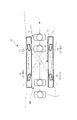
- FIG. 4 is a diagram showing an example of a gate according to one embodiment;
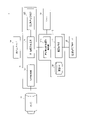
- 1 is a block diagram showing a configuration example of a passage management system according to an embodiment;
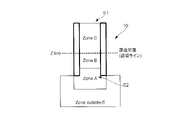
- FIG. A diagram showing an example of zones defined for gates A diagram showing an example of zones defined for gates Flowchart showing an overview of the flow of two-step face authentication processing Flowchart showing a first example of the flow of two-step face authentication processing Flowchart showing a second example of the flow of two-step face authentication processing
- an authentication process to authenticate a person trying to transit (which may include, for example, a process of determining that the person is unauthenticated) and a tracking system to record the history of that person's movement. processing is performed. These processes are desirably performed early in order to secure time to perform processes that restrict the movement of people, such as recording the passage of people or opening/closing processes of gate doors.
- a camera is installed above the person and the gate (for example, on the ceiling), the camera on the ceiling photographs the person and the gate, and by analyzing the photographed image, the photographed person can be tracked. be considered.
- the installation location of the camera may be restricted depending on the structure or environment of the installation location.
- the installation cost will increase. Therefore, it may be difficult to introduce a passage control system using a camera installed on the ceiling.
- the gate it is conceivable to provide the gate with an arch-shaped or pole-shaped support extending above the gate, and install the camera on the support. Since the size in the height direction is larger than that of the gate without it, the installation location of the gate may be restricted. In terms of design, it may not be preferable to provide the gate with a supporting portion.
- an image captured by a camera used for face authentication processing of a person trying to pass through the gate is used to perform tracking processing for tracking the person trying to pass through the gate, thereby performing authentication processing and tracking processing. and carry out transit control processing.
- the camera used for the authentication process is also used for the tracking process, there is no need to separately provide a device for the tracking process (for example, a camera on the ceiling or the like). Therefore, it is possible to suppress an increase in introduction cost of passage management.
- equipment such as a dedicated camera is provided for tracking processing, restrictions on the installation location are eased, so the degree of freedom of the installation location is improved and the introduction of the transit management system is facilitated.
- FIG. 1 is a diagram showing an example of a gate 10 according to this embodiment.
- FIG. 1 is a view of the gate 10 viewed from above, exemplifying how a person h enters through an entrance E1 of the gate 10 and exits through an entrance E2 of the gate 10.
- FIG. A person may enter the gate 10 shown in FIG. 1 through the entrance E2 and exit through the entrance E1.
- the gate 10 allows people to pass in both directions.
- the gate 10 has, for example, side walls V facing each other, and a passage L is formed between the side walls V to guide a person passing through the gate 10 .
- cameras 11 are provided at two positions closer to the entrances E1 and E2 than the central portion of the side wall V, for example.
- a total of four cameras 11 (11-R1, 11-R2, 11-L1, 11-L2) are provided for the two side walls V. As shown in FIG.
- the cameras 11-R1 and 11-L1 are installed, for example, on the side wall V at a position closer to the entrance E2 than the central part of the gate 10, and photograph a person entering from the entrance E1 of the gate 10 and passing through the entrance E2. Used.
- the cameras 11-R2 and 11-L2 are installed, for example, on the side wall V at a position closer to the entrance E1 than the central portion of the gate 10, and capture the image of a person entering from the entrance E2 of the gate 10 and passing through the entrance E1. Used for shooting.
- the camera 11-R1 is installed at a position where a person entering from the entrance E1 can be photographed from the right front of the person.
- the camera 11-L1 is installed, for example, at a position where a person entering from the entrance E1 can be photographed from the front left of the person.
- the camera 11-R2 is installed, for example, at a position where it is possible to photograph a person entering from the entrance E2, which is opposite to the entrance E1, from the right front of the person.
- the camera 11-L2 is installed, for example, at a position where it is possible to photograph a person entering from the entrance E2 opposite to the entrance E1 from the left front of the person.
- a person who enters the gate 10 through the entrance E1 and passes through the entrance E2 can see, for example, two cameras 11-R1 and 11-, which are installed at positions separated from each other across the passage L on the upper side of the two side walls V. Images are captured from two directions (for example, left and right directions) by L1.
- a person who passes through the gate 10 in the opposite direction that is, a person who enters the gate 10 from the entrance E2 and then passes through the entrance E1, is placed at positions separated from each other across the passage L, for example, at the top of the two side walls V. Images are taken from two directions (for example, left and right directions) by the two installed cameras 11-R2 and 11-L2.
- FIG. 1 is a configuration example in which a person can enter from both the entrance E1 and the entrance E2 of the gate 10, the present disclosure is not limited to this.
- the gate 10 may be configured such that a person can enter from one entrance (for example, entrance E1) and cannot enter from the other entrance (for example, entrance E2). If the gate 10 does not allow entry of a person through the entrance E2, the cameras 11-R2 and 11-L2 may not be provided. If the gate 10 does not allow entry of a person through the entrance E1, the cameras 11-R1 and 11-L1 may not be provided.
- FIG. 1 shows an example in which a person entering through the entrance of the gate 10 is photographed from two directions by the two cameras 11, but the present disclosure is not limited to this.
- a person entering through the entrance of the gate 10 may be photographed by one camera 11 from one direction (the direction from the exit to the entrance of the gate 10).
- one of the images photographed by the two cameras 11 is selected, and authentication processing and tracking processing are performed based on the selected image. may be performed.
- a person who enters the gate 10 corresponds to a person who is subject to processing including face authentication processing.
- a person to be processed is referred to as a "subject".
- the gate 10 in FIG. 1 is an example, and the present disclosure is not limited to this.
- the gate 10 may be provided with five or more cameras 11 or three or less cameras 11 . By changing the photographing direction and/or angle of the camera 11, a person's face can be photographed in a wider range.
- the plurality of cameras 11 may not be identical to each other.
- the plurality of cameras 11 may be configured to capture images with mutually different resolutions, angles of view, and image qualities.
- the installation position and/or shooting direction of the camera 11 may be fixed or adjustable.
- FIG. 2A is a diagram showing an example of a conceptual configuration of a transit management system according to this embodiment.
- FIG. 2B is a block diagram showing a configuration example of the passage management system according to this embodiment.
- a passage management system 1 according to the present embodiment is a system that manages the passage of people through gates 10 (for example, entrance gates, ticket gates, etc.) installed at entrances and exits of facilities such as airports, stations, and event venues. .
- gates 10 for example, entrance gates, ticket gates, etc.
- entrance/exit management of facility users is executed by face authentication.
- face authentication is used to determine whether the user is authorized to enter the facility.
- users exit the facility through a gate which user exits the facility is determined by face recognition.
- face authentication may be regarded as a concept included in "matching using a face image”.
- the passage management system 1 includes, for example, the gate 10 illustrated in FIG. and a passage history management server 15 .
- the number of gates 10 may be one or plural.
- Gates 10 are installed in facilities such as airports, train stations, and event venues. A user who is permitted to use the facility passes through the gate 10 when entering and/or exiting the facility. Also, the gate 10 is controlled so as to block the passage of persons who are not permitted to enter the facility.
- the camera 11 is provided, for example, on the side wall V of the gate 10, as shown in FIG.
- the camera 11 photographs a photographing range including a person passing through the gate 10 and the face of the person when the person is about to pass through the gate 10 .
- the photographing range of the camera 11 is a range in which the front face of a person can be photographed.
- the face authentication function unit 12 performs face authentication processing on the image.
- the face authentication function unit 12 performs at least two stages of face authentication processing.
- the face authentication function unit 12 has a camera control unit 121, a first face matching processing unit 122, and a second face matching processing unit 123.
- the first face matching processing unit 122 performs the first stage of face authentication processing
- the second face matching processing unit 123 performs the second and subsequent stages of face authentication processing.
- the camera control unit 121 controls the shooting timing of the camera 11, for example.
- the camera 11 shoots at a speed of about 5 fps (frame per second) under the control of the camera control section 121 .
- the right camera 11 and the left camera 11 may be controlled by the camera control unit 121, for example, to shoot at the same time or with a difference in shooting timing within an allowable range.
- the right camera 11 and the left camera 11 may be controlled by the camera control unit 121, for example, to perform shooting asynchronously and at independent shooting timings.
- the camera control unit 121 detects a face frame from an image captured by the camera 11, for example.
- the method of detecting the face frame is not particularly limited.
- a method of detecting a frame (face frame) surrounding a face region by detecting a boundary between the region and a region outside the face may be employed.
- the camera control unit 121 transmits information about the detected face frame (face frame information) and a photographed image to the first face matching processing unit 122 and/or the second face matching processing unit. 123.
- the camera control unit 121 determines the output destination to be either the first face matching processing unit 122 or the second face matching processing unit 123 according to the positional relationship between the gate 10 and the person.
- face frame may refer to a frame surrounding a face area, or may refer to a face area surrounded by a frame.
- the first face matching processing unit 122 cuts out the face area included in the image based on the face frame information, and notifies the face authentication server 14 of a face authentication request including information on the cut out face area.
- the face area information may be, for example, an image of the face area or information indicating feature points extracted from the image of the face area.
- a face image registered in the face authentication server 14 may be described as a registered face image.
- a registered face image may be associated with information that can uniquely identify or specify a person, such as an ID (Identification) of a registered person.
- the registered face image may be, for example, information indicating feature points extracted from the image.
- the face authentication server 14 determines whether the face of the same person as the face in the face region included in the face authentication request is included in the registered face image. Determine whether or not (verify). The face authentication server 14 notifies the first face matching processing unit 122 of the face matching result including the determination result, for example.
- the face matching result includes, for example, information indicating whether or not the face of the same person as the face in the face area is included in the registered face image (for example, a flag indicating "OK" or "NG");
- information for example, ID of the person associated with the registered face image may be included.
- Verification is, for example, comparing the registered face image with the face image of the person passing through the gate 10 to determine whether the registered face image registered in advance matches the face image of the person passing through the gate 10. Alternatively, it is determined whether or not the face image registered in advance and the face image of the person passing through the gate 10 are of the same person.
- authentication means for example, verifying that a person whose face image matches a pre-registered face image is the person himself/herself (in other words, that the person is permitted to pass through the gate 10). , gate 10).
- the matching process is a process of comparing feature points of registered face images that have been registered in advance with feature points extracted from the detected face area to identify the face in the image data.
- a technique using machine learning may be used.
- the matching process may be performed in the face authentication server 14, for example, but may also be performed in another device such as the gate 10, or may be distributed by a plurality of devices. .
- the first face matching processing unit 122 outputs, for example, information including the matching processing result to the second face matching processing unit 123 and passage management function unit 13 .
- the result of the matching process may include, for example, information about the registered face image and a matching score indicating the degree of matching of the face images obtained by the matching process.
- the information output from the first face matching processing unit 122 includes, for example, face frame detection information, the shooting time of the face camera image that detected the face frame, and the face area cut out by the first face matching processing unit 122. information may be included.
- the output destination of the first face matching processing unit 122 is not limited to the second face matching processing unit 123 and the passage management function unit 13.
- the first face matching processing unit 122 may transmit information including the matching process result to a display device that presents image information to a person who is about to pass through the gate 10, and/or an audio output device that presents audio information to the person. Output to the device.
- the second face matching processing unit 123 cuts out the face area included in the image based on the face frame information, and performs face matching using information on the cut out face area.
- the second face verification processing unit 123 collates the information of the face region cut out by the second face verification processing unit 123 with the information of the face region cut out by the first face verification processing unit 122 to obtain the second face. It may be determined whether or not the person corresponding to the face region cut out by the matching processing unit 123 is the same as the person corresponding to the face region cut out by the first face matching processing unit 122 .
- the second face matching processing unit 123 compares the information of the face region cut out by the second face matching processing unit 123 with the information about the registered face image included in the matching processing result, and the second face matching processing unit 123 It may be determined whether or not the person corresponding to the cut-out face region is the same as the person corresponding to the registered face image included in the matching processing result.
- the second face matching processing unit 123 outputs information including the determination result as to whether or not the persons corresponding to the two face regions are the same to the passage management function unit 13.
- the output destination of the second face matching processing unit 123 is not limited to the passage management function unit 13 .
- the second face matching processing unit 123 can display information including the determination result as a display device that presents image information to a person who is about to pass through the gate 10, and/or an audio output device that presents audio information to the person.
- the passage management function unit 13 manages the passage of persons located around the gate 10 based on information output from the face authentication function unit 12, for example.
- a person positioned around the gate 10 includes, for example, a person passing through the gate 10 , a person trying to pass through the gate 10 , and a person passing by the gate 10 .
- the person trying to pass through the gate 10 is not limited to a person who is permitted to pass through the gate 10 (for example, a person whose face image has been registered in the face authentication server 14). It may be a person who is not registered with the authentication server 14 but who tries to pass.
- a person passing through the gate 10 is, for example, a person who is not going to pass through the gate 10 but is passing through the photographing range of the camera 11, or who is not going to pass through the gate 10 but is within the photographing range. It is a person who is entering into Also, the state of a person may be, for example, a state related to the movement of the person, such as whether the person is moving or stationary, and the direction of movement when the person is moving.
- the passage management function unit 13 has, for example, a passage management state transition processing unit 131, a history management unit 132, and a history database (DB) 133.
- the passage management state transition processing unit 131 transmits to the gate 10 control information regarding control of the gate 10 when a person permitted to pass through the gate 10 passes through in the person passage management processing. Also, the passage management state transition processing unit 131 transmits to the gate 10 control information regarding control of the gate 10 when, for example, a person who is not permitted to pass through the gate 10 tries to pass through.
- the history management unit 132 stores and manages, for example, information indicating the history of a person who has passed through the gate 10 (passage history information).
- the history management unit 132 also stores the passage history information in the history DB 133 and transmits the passage history information to the passage history management server 15, for example.
- the history management unit 132 may manage local passage history information for each station (or one ticket gate).
- the passage history management server 15 stores and manages information (passage history information) indicating the history of a person who has passed through the gate 10, for example.
- the passage history management server 15 may manage passage history information of multiple gates 10 .
- the passage history information of the gates 10 provided at each of the multiple entrances may be collected and managed by the passage history management server 15 .
- the passage history information of each of the gates 10 installed at the ticket gates of a plurality of stations may be collected and managed by the passage history management server 15 .
- the transit management function unit 13 may output, for example, information on transit management (transit management information) to a display device (not shown).
- Passage management information may include information output from the face authentication function unit 12, for example.
- the display device may display, for example, the state of a person (for example, the person's face recognition result and movement direction).
- the display device may display an image and superimpose the detected face frame on the image.
- the display device may superimpose information about the person (for example, the person's ID) obtained by face authentication on the image and display the image.
- the face authentication function unit 12 described above may operate synchronously or asynchronously with the passage management function unit 13.
- the face authentication function unit 12 may operate when the camera control unit 121 detects a face frame.
- the face authentication function unit 12 may include an output unit that outputs that the person to be determined has passed through the gate 10 when it is determined that the persons corresponding to the two face regions are the same.
- the information output from the output unit includes control information regarding control of the gate 10 when a person who is permitted to pass through the gate 10 passes through, for example, a gate when a person who is not permitted to pass through the gate 10 10 controls may be included.
- the configurations of the face authentication function unit 12 and the passage management function unit 13 described above may each have the form of one information processing device (for example, a server device), or the two may form one information processing device. may be included in
- the face authentication function unit 12 may have the form of one information processing device
- the passage management function unit 13 may be included in one information processing device.
- the face authentication function unit 12 and/or the passage management function unit 13 having the form of an information processing device may be included in the gate 10 .
- the information processing apparatus described above may include a processor, a memory, and an input/output interface used to transmit various types of information.
- a processor is a computing device such as a CPU (Central Processing Unit) or a GPU (Graphics Processing Unit).
- the memory is a storage device implemented using RAM (Random Access Memory), ROM (Read Only Memory), or the like.
- the processor, memory, and input/output interface are connected to a bus and exchange various information via the bus.
- the processor for example, reads programs and data stored in the ROM onto the RAM and executes processing, thereby realizing the functions of the configuration included in the information processing apparatus.
- the timing of face authentication processing may be determined according to where the person is in the zone defined around the gate 10 .
- An example of the zones defined in the gate 10 will be described below.
- 3A and 3B are diagrams showing examples of zones defined for the gate 10.
- FIG. FIGS. 3A and 3B show examples of multiple zones when the gate 10 is viewed from above.
- 3A and 3B show an example in which the side wall V of the gate 10 forming the passage L extends along the vertical direction of the paper surface.
- the upstream side along a specific approach direction corresponds to the entrance
- the downstream side corresponds to the exit.
- FIG. 3A shows an example of a zone defined when a person enters from the entrance E2 at a gate 10 that allows a person to enter from both the entrances E1 and E2.
- FIG. 3B shows an example of a zone defined when a person enters through the entrance E1.
- the passage management function defines, for example, the entrance E1 as the "north side" and the entrance E2 as the "south side.”
- references to north and south do not limit the placement of the gates 10 along a geographic north-south direction.
- references to north and south do not limit the placement of the gates 10 along a geographic north-south direction.
- the passage L of the gate 10 is located along a direction different from the north-south direction, or even if the passage includes a curved line, one may be defined as the "north side” and the other as the “south side.” .
- FIG. 3A shows an example of a zone defined when a person enters from the entrance E2.
- "Zone outside-S" (south zone outside area), "Zone A” (zone A), “Zone B” (zone B), and "Zone C” (zone C) Defined.
- FIG. 3B shows an example of a zone defined when a person enters from the entrance E1.
- "Zone outside-N" noden zone outside area
- "Zone A” zone A
- "Zone B” zone B
- "Zone C” zone C
- the boundary between the south outside zone area and zone A may be called, for example, the "face authentication start line".
- Face authentication start line is used, for example, to determine whether or not to start face authentication processing (face matching processing) in the first face matching processing unit 122. For example, when a person crosses the "face authentication start line" and enters the gate 10, the face authentication process is started. For example, the first face matching processing unit 122 issues a face authentication request from the face frame information, links the matching result (face authentication ID) and person detection information, and starts tracking the person. Note that the "face authentication start line” may be referred to as "A line”.
- the "face authentication start line” may be provided outside the gate 10 (for example, upstream along the route of the gate 10). Also, the “face authentication start line” is not limited to one line segment, and may have a plurality of line segments such as a U-shape, for example. Note that the shape having a plurality of line segments is not limited to a shape corresponding to a part of the sides of a rectangle such as a U-shape, and may be a shape corresponding to a part of the sides of another polygonal shape. may Alternatively, the "face authentication start line” may have an arc or a shape in which straight lines and curved lines are mixed.
- face authentication start line has a plurality of line segments and/or arcs
- face authentication processing can be started.
- zone A The boundary between zone A and zone B may be called, for example, the "door closing limit line".
- the "door closing limit line” indicates, for example, the position where the exit side gate door can be closed in time in response to the door closing instruction by the time the person passes the exit side gate door position.
- the “door closing limit line” is, for example, the maximum speed assumed as the speed at which a person passes through the gate 10 (for example, 6 km / h, hereinafter referred to as “maximum passable speed”), and the speed until the gate door is physically closed. is determined in consideration of the time (for example, 0.5 seconds) required for For example, the "door closing limit line” is the distance equivalent to "maximum passage speed" x "time required to physically close the gate” from the physical position of the gate ("gate door position"). , is set to the front.
- closed door limit line may also be referred to as "unauthorized intrusion detection line” or "B line”.
- Zone B The boundary between Zone B and Zone C may be referred to as the "exit line".
- the “exit line” indicates, for example, the position where it is determined that the person has exited the gate 10.
- the "exit line” may be provided outside the gate 10, for example, like the "face authentication start line” described above.
- the "exit line” is not limited to one line segment, and may have a plurality of line segments such as a U-shape. Alternatively, the “exit line” may have an arc. Note that the "exit line” may also be called, for example, the "Z line”.
- gate door position may be just a passing point. may be different from or may be the same.
- the "gate door position" and the “exit line” may be set to be the same.
- the "exit line” may correspond to the "charging line”.
- a person who enters the gate 10 crosses the charging line (for example, when entering from zone B to zone C), the person is charged. In other words, when the person has not crossed the charging line (for example, when the person has not entered zone C), the person is not charged.
- the charging line it is possible to avoid the error of charging a person who has entered the gate 10 but turned back before crossing the charging line.
- the "charging line” corresponds to the "Z line" ("exit line"), but for example, the “charging line” may correspond to the "B line”.
- the face authentication function unit 12 in the present embodiment executes the first-stage face authentication process when a person enters zone A described above, and when a person enters zone B from zone A, A second stage of face authentication processing is executed.
- a second stage of face authentication processing is executed.
- FIG. 4 is a flowchart showing an outline of the flow of two-step face authentication processing.
- the flow shown in FIG. 4 may be started, for example, each time a passerby approaches.
- the face authentication processing unit 12 detects that the passerby has approached the gate 10 and entered the first authentication area (for example, zone A) (S101).
- the first authentication area is not limited to zone A shown in FIGS. 3A and 3B.
- the first authentication area may be an area on the upstream side of the charging line of the gate 10, for example, an area in which a face frame of a size that enables face authentication processing can be obtained in a captured image.
- Whether or not the passerby has entered the first authentication area may be determined, for example, by a sensor (for example, a photoelectric sensor) provided at the gate 10 .
- the face authentication function unit 12 executes the first face authentication process on the passerby who has entered the first authentication area (S102). For example, the face authentication function unit 12 transmits to the face authentication server 14 a face authentication request including information regarding the face frame in the image captured by the camera 11 .
- the face authentication server 14 determines whether or not there is a passerby among the registrants, for example, based on the information on the face frame. As a result of the determination, if there is a passerby among the registrants, the face authentication server 14 transmits information indicating the relevant registrant to the face authentication function unit 12, for example. On the other hand, if there is no passerby among the registrants, the face authentication server 14 transmits information indicating the result of the determination to the face authentication function unit 12 .
- the face authentication function unit 12 determines whether authentication is successful as a result of the first face authentication process (S103).
- the face authentication function unit 12 executes the process of S102 again.
- the case where the authentication fails is, for example, the case where the passerby is not included in the registrants held in the face authentication server 14 .
- the fact that the passerby is not included among the registrants held by the face authentication server 14 may be treated as a person not permitted to pass through the gate 10 .
- the case where authentication fails is when the passerby is included in the registrants, but the passerby and the registrant are erroneously determined to be not the same person in the face authentication process. may be
- the system waits until it detects that the passerby has entered the second authentication area (zone B) (S104).
- the second authentication area is not limited to zone B shown in FIGS. 3A and 3B.
- the second authentication area may be the area beyond the charging line provided at the gate 10 .
- the face authentication processing unit 12 detects that the passerby has entered the second authentication area (S105). Whether or not the passerby has entered the second authentication area may be determined by a sensor such as, for example, a photoelectric sensor.
- the face authentication function unit 12 executes the second face authentication process on the passerby who has entered the second authentication area (S106). For example, instead of requesting the face authentication server 14 to perform the second face authentication processing, the face authentication function unit 12 performs the second face authentication processing locally by the gate 10 itself (or the face authentication function unit 12 itself). can be executed.
- the face authentication function unit 12 determines whether authentication has succeeded as a result of the second face authentication process (S107).
- the face authentication function unit 12 determines, for example, that the passerby cannot pass through (S109). In this case, processing for closing the door of the gate 10 (door closing processing) is executed. Note that if the authentication fails (NO in S107), the first face authentication processing similar to S103 may be performed again (re-authentication or re-collation) before determining that the passerby is not passable. . In this case, as in S103, the face authentication function unit 12 transmits a face authentication request to the face authentication server 14, but the information included in the face authentication request is information about the face frame in the image in S107. It's okay. Then, the flow shown in FIG. 4 ends.
- the face authentication function unit 12 determines that the passerby may be permitted to pass through the gate 10 (S108). In response to this determination, the face authentication function unit 12 may instruct the gate 10 to open a door that restricts passage through the gate 10, for example. Then, the flow shown in FIG. 4 ends.
- the information obtained from the face authentication server in the first stage of face authentication processing is registered in the local face authentication engine, and the registered information is used in the second and subsequent stages of face authentication processing.
- the face matching result including information on the facial feature amount of the candidate is received. Then, the information of the facial features of the candidate is registered in the local face recognition engine. In face recognition processing after information is registered in the local face recognition engine, the degree of matching, which indicates whether the passerby and the candidate are the same person, is checked based on the captured image of the passerby and the registered information. do. Note that, in the multiple local authentication method, the information of the candidate's face feature amount does not necessarily have to be included in the face matching result.
- the face authentication function unit 12 may receive the information on the feature amount of the candidate's face as information separate from the face matching result, or may receive the information at a timing different from the face matching result.
- the face authentication function unit 12 receives the feature amount of the face of the candidate corresponding to the registrant. Possibly, the data structure and/or timing of the information received is not limited.
- the face authentication processing is performed multiple times, so it is possible to improve the legitimacy that the passerby is a person permitted to pass through the gate 10.
- the face authentication server 14 since the second and subsequent stages of face authentication processing are performed using the feature amount registered in the face authentication server 14, the face authentication server 14 is also used for the second and subsequent stages of face authentication processing. It is performed with the same accuracy as the conventional face recognition process. Therefore, it is possible to more reliably confirm that the passerby is a person permitted to pass through the gate 10 .
- passerby information included in the image used in the first face recognition process is registered in the local face recognition engine, and the registered information is used in the second and subsequent stages of face recognition processing. .
- a passerby's face is registered with the local face authentication engine.
- the registration of the face of a passerby corresponds to extracting the area of the passerby's face from an image of the passerby and registering the information of the image of the extracted area (that is, the face image).
- it may correspond to registering the feature amount obtained from the extracted face image.
- face recognition processing after information is registered in the local face recognition engine, face matching (1:1 face matching) is performed between the captured image of the passerby and the registered face image, and the photographed passerby and the Confirm that the registered passer-by is the same person.
- the passerby is allowed to pass. do.
- a passerby who has been successfully authenticated as a person permitted to pass through the gate 10 in the first face authentication process enters the gate 10 and passes through in the authentication process of the second and subsequent stages. Passage through the gate 10 can be guaranteed because what has been done can be tracked.
- the most recent environment for example, lighting, sunlight
- the difference between the face image registered in the face authentication server 14 and the latest face image may be affected by shadows in the vicinity of the gate 10 and changes over time. Even if there is a gap between the two, passage management can be performed appropriately.
- the passerby information included in the image used in the first face recognition process is registered in the local face recognition engine. , the registered information is used.
- face authentication processing from the second stage onwards is not executed in real time.
- the second and subsequent stages of face authentication processing are collectively executed at a specific timing.
- the specific timing may be a time period (for example, at night) when there are few people passing through the gate 10, or timing such as the end of the month.
- the example of the two-step authentication method is not limited to the above example. Also, in the above example, the second and subsequent stages of authentication are performed by the local face authentication engine instead of sending a face authentication request to the face authentication server 14, but the present disclosure is not limited to this. . For example, even in the second step, a face authentication request may be sent to the face authentication server, and the face authentication server 14 may determine whether or not there is a candidate who is the same as the passerby.
- FIG. 4 shows an example in which a photoelectric sensor detects that a passerby has entered a specific area at the timing of performing authentication in the two-step authentication method, but the present disclosure is not limited to this.
- the camera 11 photographs a person entering through the entrance of the gate 10 from the direction from the exit of the gate 10 toward the entrance. Therefore, the face frame of the person present in the area for performing the first stage face authentication (for example, zone A in FIG. 3A) is present in the area for performing the second stage face authentication (for example, zone B in FIG. 3A).
- Timing for performing authentication based on the size of the face frame instead of the photoelectric sensor by using the fact that the size of the face frame is different between the area in which the first stage of face authentication is performed and the area in which the second stage of face authentication is performed. may be specified.
- An example of two-step face authentication processing based on the size of the face frame will be described below.
- FIG. 5 is a flowchart showing a first example of the flow of two-step face authentication processing.
- the flow shown in FIG. 5 may be started, for example, each time a passerby approaches.
- the face authentication function unit 12 acquires an image and detects a face frame (S201).
- the face authentication function unit 12 determines whether or not the size of the face frame is greater than or equal to a predetermined first threshold (S202).
- a predetermined first threshold S202
- the size of the face frame and the first threshold to be compared with the size of the face frame may be defined by the area of the image area, or by the length in the vertical direction or the length in the horizontal direction of the face frame. good too.
- the first threshold may be defined, for example, based on the lower limit or upper limit of the size of the face frame used in the face authentication process in S203, which will be described later.
- the face authentication function unit 12 executes the process of S201.
- the face authentication function unit 12 executes the first face authentication process for the detected face frame (S203).
- a face authentication request is sent to the face authentication server 14, and the face authentication server 14 determines whether or not there is a candidate who is the same person as the passerby among the registrants.
- the face authentication function unit 12 determines whether or not the authentication has succeeded (S204). Failure or success of authentication may be the same as S104 in FIG.
- the face authentication function unit 12 executes the process of S201.
- the face authentication function unit 12 acquires the image at the next timing and detects the face frame (S205).
- the face authentication function unit 12 determines whether or not a timeout has occurred (S206). For example, in the process of S206, a timer is started at the timing when the authentication is successful in the first face authentication process in S203, and if the time indicated by the timer is equal to or longer than a predetermined time, it is determined that timeout has occurred.
- the time indicated by the timer is the time from the timing of successful authentication in the first face authentication processing in S203 to the timing of executing the determination in S206.
- the predetermined time may be an upper limit time allowed for a passerby who has successfully authenticated to pass through the gate 10 in the first face authentication process.
- the face authentication function unit 12 determines whether or not the size of the face frame is equal to or greater than a second predetermined threshold (S207).
- the second threshold is greater than the first threshold.
- the second threshold may be the lower limit size or the upper limit size of the face frame used in the face authentication process in S208, which will be described later.
- the second threshold may be defined by the size of the face frame of an image of a person who has an average face size and has reached the billing line.
- the second threshold may be defined by a value obtained by multiplying the size of the face frame to be processed in S203 by a factor larger than one.
- the face authentication function unit 12 executes the process of S205.
- the face authentication function unit 12 performs 1:1 face authentication processing, which is the second face authentication processing, on the face frame detected in S205. (S208).
- the information of the candidate's face feature amount acquired in S203 and the information of the passerby's face frame detected in S205 are collated, and the candidate and It is determined whether or not the passerby is the same person.
- the information of the face frame for which the first face authentication processing was executed in S203 is collated with the information of the passerby's face frame detected in S205. , to determine whether the candidate and the passer-by are the same person.
- the face authentication function unit 12 determines whether or not the authentication has succeeded (S209).
- the face authentication function unit 12 treats the passerby as impermissible (S211). In this case, processing for closing the door of the gate 10 (door closing processing) is executed. Note that if the authentication fails (NO in S209), the first face authentication processing similar to S203 may be performed again (re-authentication or re-collation) before treating the passer-by as unpassable. In this case, as in S203, the face authentication function unit 12 transmits a face authentication request to the face authentication server 14, but the face authentication request includes information about the face frame in the image in S208. good. Then the flow ends.
- the case where the authentication fails may be, for example, the case where the information of the candidate identified by the first face authentication process in S203 does not match the information of the image of the passerby.
- a case where the information does not match may be, for example, a case where the score obtained by face authentication processing is lower than a threshold for determining that the person is the same person.
- the case where the information of the identified candidate and the information of the image of the passerby do not match is when the identified candidate and the passerby included in the image are not the same person (for example, , if they are replaced in the middle).
- the identified candidate and the information of the image of the passerby do not match the identified candidate and the passerby included in the image are the same person. Instead, it may be the case where it is erroneously determined that the identified candidate and the passerby included in the image are not the same person.
- the face authentication function unit 12 may determine that the passerby is permitted to pass through the gate 10 (S210). In response to this determination, the face authentication function unit 12 may, for example, output to the gate 10 an instruction to open the door that restricts passage through the gate 10 . Then the flow ends.
- FIG. 5 shows an example in which the second-stage face authentication processing is locally executed
- face authentication may be requested to the face authentication server 14 in the second stage of face authentication processing.
- the function of performing face authentication can be omitted from the gate 10, so the configuration of the gate 10 can be simplified.
- FIG. 6 is a flowchart showing a second example of the flow of two-step face authentication processing.
- the flow shown in FIG. 6 may be started, for example, each time a passerby approaches.
- the same reference numerals are assigned to the same processes as those shown in FIG. 5, and the description thereof is omitted. 6, S208 in FIG. 5 is replaced with S301.
- the face authentication function unit 12 executes the second face authentication process for the face frame detected at S205 (S301).
- the face authentication function unit 12 transmits a face authentication request to the face authentication server 14 .
- the face authentication request includes, for example, information on the face frame detected in S205.
- the face authentication server 14 may determine whether or not there is a candidate who is the same person as the passerby among the registrants.
- the face authentication server 14 may simply perform processing using the result of matching executed based on the face authentication request in S203. For example, the information of the registrants narrowed down by the results of matching executed based on the face authentication request in S203 may be matched with the face frame information included in the newly received face authentication request.
- the first face authentication process is executed based on the face frame in the image of the person present in the first authentication area
- the second face authentication process is executed based on the face frame in the image of the person present in the second authentication area between the first authentication area and the exit of the gate.
- the two-step face authentication processing executed by this configuration can realize passage management of an object (for example, a person) to the gate with a simple configuration.
- the present disclosure is not limited to this, and three or more steps of face authentication processing may be performed.
- face frame detection and face authentication processing are performed on each image captured after performing the first stage of face authentication processing. may be tracked.
- the second and subsequent stages of face authentication processing may be executed locally.
- the movement of the person can be tracked sequentially, and whether or not the person has passed through the gate 10 can be accurately determined. For example, in a configuration in which the person is followed, when the sensor provided at the exit of the gate 10 (or the billing line of the gate 10) detects the passage of the person, the face authentication process is stopped and the tracking is terminated. You can
- the processing may be simplified in the second-stage face authentication processing.
- the number of facial features used in the second-stage face authentication process may be smaller than the number of facial features used in the first-stage face authentication process.
- the feature amount of each part of the face is used in the first-stage face authentication process
- the feature amount of the face's eyes is used in the second-stage face authentication process
- the feature amount of parts other than the eyes is used. should not be used.
- the processing load associated with comparison of feature amounts can be reduced, and the processing speed of the second stage is improved.
- the threshold may be adjusted according to the stage of the face authentication process.
- the threshold used in the second stage face authentication process may be smaller than the threshold used in the first stage face authentication process.
- the present disclosure is not limited to this.
- the closing process may not be performed depending on the installation status of the gate 10 and/or the congestion status.
- the installation status of the gate 10 For example, in the case of a gate provided at a railway station, a large number of people pass through the gate. In such a case, rather than detecting a person illegally passing through the gate, it is better not to close the gate so as not to stop the flow of people.
- the person enters the first area and/or the second area depending on whether or not the size of the face frame is greater than or equal to the first threshold and/or the second threshold.
- a rate of change in the size of the face frame obtained based on the size of the face frame may be used to determine whether the person has entered the first area and/or the second area.
- the rate of change in the size of the face frame represents the rate of change in the size of the face frame in the image over time (or movement of the person).
- the rate of change in the size of the face frame at time t is the size of the face frame obtained at time t and the size of the face frame obtained one time (or a plurality of time before) before time t. and the size of the face frame of the same person.
- the rate of change in the size of the face frame increases as the face approaches the camera, so the rate of change in the size of the face frame changes according to the distance between the person and the camera.
- the rate of change in the size of the face frame indicates the rate of change (or the amount of change), it is less likely to be affected by differences in face size for each person.
- the rate of change in the size of the face frame is equal to or greater than a predetermined threshold, it is possible to absorb the difference in the face size of each person while allowing the face to approach (for example, in which area the person is). entered) can be determined.
- whether or not a person has entered the first area and/or the second area is determined using information on the face frame, but the present invention is not limited to this. Whether the person has entered the first area and/or the second area may be determined based on the distance between the facial parts. In general, the closer the face is to the camera, the greater the distance between facial parts in the captured image. The proximity of the face can be determined by determining whether the distance is equal to or greater than a predetermined threshold. Examples of facial parts include facial organs such as the eyes, nose, mouth, and ears, but features other than general organs such as blemishes, moles, and wrinkles may also be used as facial parts. .
- the size of the facial parts in the captured image may be used. This is because, like the size of the face frame, the size of the parts of the face also increases as the face gets closer to the camera. Also, instead of the distance between parts, the rate of change in size of facial parts may be used. This is because, like the rate of change in the size of the face frame, the rate of change in the size of facial parts also increases as the face approaches the camera.
- the above-described methods may be used in combination, may be used selectively, or the same method may be used all the time. may be
- the success or failure of each of the first-stage face authentication processing and the second-stage face authentication processing may be output by voice and/or image.
- different sounds and/or images may be output depending on whether the first stage face authentication process is successful or not, and whether the second stage and subsequent stage face authentication processes are successful or not.
- a gate installed at a railway station that manages the entry and exit of railway users into and out of the station premises
- charges are not charged when entering the station premises, but when exiting. Therefore, when a railroad user passes through a gate to enter a station, face authentication processing may be simplified. For example, if the authentication of a user entering the venue fails, the information of the image that failed authentication is recorded, and when the user exits, the location where the user entered is specified using the information of the image recorded at the time of entry. , billing may be performed retroactively.
- the present disclosure is not limited to this.
- the present disclosure may be applied to a case where there is no side wall of the passageway and a regulation portion (for example, a door) that regulates the passage of a person.
- the present disclosure may be applied as long as it is a moving route from a certain zone to another zone where a person is permitted to enter according to authentication processing.
- a camera that captures the face of a person passing through the movement route may be installed, for example, on a support or the like provided on the movement route.
- an authentication target is a person
- the present disclosure is not limited to this.
- it may be applied to moving objects such as animals and vehicles.
- an example of performing face authentication has been described in the present embodiment, the present disclosure is not limited to this.
- the present disclosure may be applied to authentication using an ID card indicating that the person has the right to pass through the gate, and other authentication methods such as biometric authentication.
- face authentication and other authentication methods may be used together. Even if passage is not permitted in face authentication according to the disclosure of the above-described embodiment, passage may be exceptionally permitted if ID card information is input.
- the camera 11 is not limited to the example provided on the side wall V of the gate 10 .
- camera 11 may be attached to a support provided on gate 10 .
- the support may be, for example, a pole extending vertically from the gate 10 or an arch-shaped member provided to cover the side wall of the gate 10 .
- the door is used as means for restricting passage through the gate 10, but other means may be used to directly or indirectly restrict passage. For example, by sounding an alarm or turning on a warning light, a person attempting to pass through the gate 10 may be notified that passage through the gate 10 is restricted. Also, by sending a notification to a terminal or the like owned by an employee near the gate 10, the employee may restrict passage.
- whether or not to perform control to block passage or the means to restrict passage may be switched. For example, in an environment where blocking or restricting the passage of people may reduce safety, such as when a large number of people enter and leave, the passage through the gate 10 is not blocked, and information indicating that there has been unauthorized passage is displayed. It may be recorded. In this case, the face image of the person who passed through illegally or the result of face authentication may be recorded in association with the information indicating the illegal passage. As a result, it becomes possible to track down a person who has illegally passed through and to claim compensation for the right of way.
- the passage management system 1 manages both entrances to and exits from facilities such as airports, train stations, and event venues. , one of entering or exiting the facility may be controlled, and the other may not be controlled.
- the present disclosure can be realized by software, hardware, or software linked to hardware.
- Each functional block used in the description of the above embodiments is partially or wholly realized as an LSI, which is an integrated circuit, and each process described in the above embodiments is partially or wholly implemented as It may be controlled by one LSI or a combination of LSIs.
- An LSI may be composed of individual chips, or may be composed of one chip so as to include some or all of the functional blocks.
- the LSI may have data inputs and outputs.
- LSIs are also called ICs, system LSIs, super LSIs, and ultra LSIs depending on the degree of integration.
- the method of circuit integration is not limited to LSI, and may be realized with a dedicated circuit, a general-purpose processor, or a dedicated processor. Further, an FPGA (Field Programmable Gate Array) that can be programmed after the LSI is manufactured, or a reconfigurable processor that can reconfigure the connections and settings of the circuit cells inside the LSI may be used.
- FPGA Field Programmable Gate Array
- reconfigurable processor that can reconfigure the connections and settings of the circuit cells inside the LSI may be used.
- the present disclosure may be implemented as digital or analog processing.
- a communication device may include a radio transceiver and processing/control circuitry.
- a wireless transceiver may include a receiver section and a transmitter section, or functions thereof.
- a wireless transceiver (transmitter, receiver) may include an RF (Radio Frequency) module and one or more antennas.
- RF modules may include amplifiers, RF modulators/demodulators, or the like.
- Non-limiting examples of communication devices include telephones (mobile phones, smart phones, etc.), tablets, personal computers (PCs) (laptops, desktops, notebooks, etc.), cameras (digital still/video cameras, etc.).
- digital players digital audio/video players, etc.
- wearable devices wearable cameras, smartwatches, tracking devices, etc.
- game consoles digital book readers
- telehealth and telemedicine (remote health care/medicine prescription) devices vehicles or mobile vehicles with communication capabilities (automobiles, planes, ships, etc.), and combinations of the various devices described above.
- Communication equipment is not limited to portable or movable equipment, but any type of equipment, device or system that is non-portable or fixed, e.g. smart home devices (household appliances, lighting equipment, smart meters or measuring instruments, control panels, etc.), vending machines, and any other "Things" that can exist on the IoT (Internet of Things) network.
- smart home devices household appliances, lighting equipment, smart meters or measuring instruments, control panels, etc.
- vending machines and any other "Things” that can exist on the IoT (Internet of Things) network.
- CPS Chip Physical Systems
- IoT Internet of Things
- an edge server located in physical space and a cloud server located in cyber space are connected via a network, and processing is performed by processors installed in both servers. Distributed processing is possible.
- each processing data generated in the edge server or cloud server is preferably generated on a standardized platform.
- various sensor groups and IoT application software can be used. Efficiency can be achieved when constructing a system that includes.
- Communication includes data communication by cellular system, wireless LAN system, communication satellite system, etc., as well as data communication by a combination of these.
- Communication apparatus also includes devices such as controllers and sensors that are connected or coupled to communication devices that perform the communication functions described in this disclosure. Examples include controllers and sensors that generate control and data signals used by communication devices to perform the communication functions of the communication apparatus.
- Communication equipment also includes infrastructure equipment, such as base stations, access points, and any other equipment, device, or system that communicates with or controls the various equipment, not limited to those listed above. .
- An embodiment of the present disclosure is suitable for face authentication systems.
- passage management system 10 gate 11 camera 12 face authentication function unit 121 camera control unit 122 first face verification processing unit 123 second face verification processing unit 13 passage management function unit 131 passage management state transition processing unit 132 history management unit 133 history DB 14 face authentication server 15 passage history management server
Landscapes
- Engineering & Computer Science (AREA)
- General Physics & Mathematics (AREA)
- Physics & Mathematics (AREA)
- Theoretical Computer Science (AREA)
- Multimedia (AREA)
- Health & Medical Sciences (AREA)
- Oral & Maxillofacial Surgery (AREA)
- Human Computer Interaction (AREA)
- General Health & Medical Sciences (AREA)
- Computer Vision & Pattern Recognition (AREA)
- Business, Economics & Management (AREA)
- Finance (AREA)
- Time Recorders, Dirve Recorders, Access Control (AREA)
- Devices For Checking Fares Or Tickets At Control Points (AREA)
- Image Analysis (AREA)
- Image Input (AREA)
Priority Applications (1)
| Application Number | Priority Date | Filing Date | Title |
|---|---|---|---|
| US18/286,723 US20240193988A1 (en) | 2021-04-16 | 2022-02-22 | Information processing device and information processing method |
Applications Claiming Priority (2)
| Application Number | Priority Date | Filing Date | Title |
|---|---|---|---|
| JP2021069724A JP7249555B2 (ja) | 2021-04-16 | 2021-04-16 | 情報処理装置、及び、情報処理方法 |
| JP2021-069724 | 2021-04-16 |
Publications (1)
| Publication Number | Publication Date |
|---|---|
| WO2022219933A1 true WO2022219933A1 (ja) | 2022-10-20 |
Family
ID=83639581
Family Applications (1)
| Application Number | Title | Priority Date | Filing Date |
|---|---|---|---|
| PCT/JP2022/007315 Ceased WO2022219933A1 (ja) | 2021-04-16 | 2022-02-22 | 情報処理装置、及び、情報処理方法 |
Country Status (3)
| Country | Link |
|---|---|
| US (1) | US20240193988A1 (https=) |
| JP (3) | JP7249555B2 (https=) |
| WO (1) | WO2022219933A1 (https=) |
Cited By (2)
| Publication number | Priority date | Publication date | Assignee | Title |
|---|---|---|---|---|
| JP7445906B1 (ja) | 2022-12-02 | 2024-03-08 | パナソニックIpマネジメント株式会社 | 設置支援装置、設置支援方法、及び、設置支援プログラム |
| WO2025224788A1 (ja) * | 2024-04-22 | 2025-10-30 | 日本電気株式会社 | 情報処理装置、情報処理方法、及び記録媒体 |
Families Citing this family (3)
| Publication number | Priority date | Publication date | Assignee | Title |
|---|---|---|---|---|
| EP4693173A4 (en) | 2023-03-24 | 2026-04-22 | Nec Corp | INFORMATION PROCESSING SYSTEM, INFORMATION PROCESS AND RECORDING MEDIUM |
| WO2025158677A1 (ja) * | 2024-01-26 | 2025-07-31 | 日本電気株式会社 | 撮影ユニット、情報処理装置、通行管理システム、情報処理方法及び記録媒体 |
| JP7727930B1 (ja) | 2024-02-20 | 2025-08-22 | パナソニックIpマネジメント株式会社 | 顔認証ゲートシステム、制御装置、制御方法、及び、プログラム |
Citations (2)
| Publication number | Priority date | Publication date | Assignee | Title |
|---|---|---|---|---|
| JP2015001790A (ja) * | 2013-06-14 | 2015-01-05 | セコム株式会社 | 顔認証システム |
| JP2020057191A (ja) * | 2018-10-02 | 2020-04-09 | 日本電気株式会社 | 情報処理装置、情報処理システム、情報処理方法及びプログラム |
Family Cites Families (11)
| Publication number | Priority date | Publication date | Assignee | Title |
|---|---|---|---|---|
| JP4615272B2 (ja) * | 2003-09-29 | 2011-01-19 | 富士フイルム株式会社 | 認証システム、プログラム、及び建築物 |
| US8699760B2 (en) * | 2008-09-16 | 2014-04-15 | Canon Kabushiki Kaisha | Image processing apparatus, image processing method, and program |
| EP3118810A4 (en) * | 2014-03-14 | 2017-11-08 | Kabushiki Kaisha Toshiba | Information processing method and information processing system |
| JP6828817B2 (ja) * | 2017-06-05 | 2021-02-10 | 日本電気株式会社 | 顔認証システム、顔認証方法、生体認証システム、生体認証方法及び記録媒体 |
| US10664688B2 (en) * | 2017-09-20 | 2020-05-26 | Google Llc | Systems and methods of detecting and responding to a visitor to a smart home environment |
| JP6525072B1 (ja) * | 2018-01-12 | 2019-06-05 | 日本電気株式会社 | 顔認証装置 |
| JP6607266B2 (ja) * | 2018-01-12 | 2019-11-20 | 日本電気株式会社 | 顔認証装置 |
| US11222233B2 (en) * | 2018-09-26 | 2022-01-11 | Samsung Electronics Co., Ltd. | Method and apparatus for multi-category image recognition |
| JP2020205001A (ja) | 2019-06-19 | 2020-12-24 | パナソニックIpマネジメント株式会社 | 入場者管理システムおよび入場者管理方法 |
| US12087118B2 (en) * | 2020-03-18 | 2024-09-10 | Nec Corporation | Gate device, authentication system, gate control method, and storage medium |
| WO2021256099A1 (ja) * | 2020-06-17 | 2021-12-23 | 日本電気株式会社 | 顔認証方法 |
-
2021
- 2021-04-16 JP JP2021069724A patent/JP7249555B2/ja active Active
-
2022
- 2022-02-22 US US18/286,723 patent/US20240193988A1/en active Pending
- 2022-02-22 WO PCT/JP2022/007315 patent/WO2022219933A1/ja not_active Ceased
-
2023
- 2023-03-07 JP JP2023034809A patent/JP7678532B2/ja active Active
-
2025
- 2025-04-23 JP JP2025071491A patent/JP2025108715A/ja active Pending
Patent Citations (2)
| Publication number | Priority date | Publication date | Assignee | Title |
|---|---|---|---|---|
| JP2015001790A (ja) * | 2013-06-14 | 2015-01-05 | セコム株式会社 | 顔認証システム |
| JP2020057191A (ja) * | 2018-10-02 | 2020-04-09 | 日本電気株式会社 | 情報処理装置、情報処理システム、情報処理方法及びプログラム |
Cited By (4)
| Publication number | Priority date | Publication date | Assignee | Title |
|---|---|---|---|---|
| JP7445906B1 (ja) | 2022-12-02 | 2024-03-08 | パナソニックIpマネジメント株式会社 | 設置支援装置、設置支援方法、及び、設置支援プログラム |
| WO2024116515A1 (ja) * | 2022-12-02 | 2024-06-06 | パナソニックIpマネジメント株式会社 | 設置支援装置、設置支援方法、及び、設置支援プログラム |
| JP2024080508A (ja) * | 2022-12-02 | 2024-06-13 | パナソニックIpマネジメント株式会社 | 設置支援装置、設置支援方法、及び、設置支援プログラム |
| WO2025224788A1 (ja) * | 2024-04-22 | 2025-10-30 | 日本電気株式会社 | 情報処理装置、情報処理方法、及び記録媒体 |
Also Published As
| Publication number | Publication date |
|---|---|
| JP2025108715A (ja) | 2025-07-23 |
| JP2022164310A (ja) | 2022-10-27 |
| US20240193988A1 (en) | 2024-06-13 |
| JP2023075227A (ja) | 2023-05-30 |
| JP7249555B2 (ja) | 2023-03-31 |
| JP7678532B2 (ja) | 2025-05-16 |
Similar Documents
| Publication | Publication Date | Title |
|---|---|---|
| JP7249555B2 (ja) | 情報処理装置、及び、情報処理方法 | |
| JP7108938B2 (ja) | 情報処理装置、情報処理システム、及び、通過管理方法 | |
| JP7578161B2 (ja) | ゲート装置、認証システム、ゲート装置の制御方法及びプログラム | |
| JP7122543B1 (ja) | 情報処理装置、情報処理システム、及び、推定方法 | |
| JP7649966B2 (ja) | 照合装置、照合システム、及び、照合方法 | |
| JP7218837B2 (ja) | ゲート装置、認証システム、ゲート装置の制御方法及びプログラム | |
| US12230065B2 (en) | Gate apparatus, gate system, and gate control method | |
| JP7632532B2 (ja) | ゲート装置、ゲート装置の制御方法及びプログラム | |
| JP2024056872A (ja) | 滞在管理装置、滞在管理方法、及びプログラム | |
| JP7766276B2 (ja) | 情報処理装置、顔認証システム、及び、情報処理方法 | |
| WO2021186576A1 (ja) | ゲートシステム、ゲート装置、その画像処理方法、およびプログラム、ならびに、ゲート装置の配置方法 | |
| US20220351559A1 (en) | Gate apparatus, control method, and program | |
| JP7641531B1 (ja) | 通過許可判定システム、及び、通過許可判定方法 | |
| WO2023176167A1 (ja) | 登録装置、登録方法及びプログラム | |
| KR102538649B1 (ko) | 탑승자 인증 기반 주차관리 방법 및 장치 | |
| JP2024079342A (ja) | 顔認証支援装置、システム、方法及びプログラム | |
| JP2025185899A (ja) | 情報処理装置、及び、情報処理方法 | |
| JP2025136195A (ja) | サーバ装置、サーバ装置の制御方法及びプログラム | |
| JP2007193558A (ja) | 入退管理支援システム | |
| JP2024104627A (ja) | 情報処理システム、情報処理方法、及びプログラム | |
| WO2025004468A1 (ja) | 情報処理装置、認証システム、情報処理方法、及び、プログラム | |
| JP2025143242A (ja) | 通過許可判定システム、通過許可判定方法、及び、プログラム |
Legal Events
| Date | Code | Title | Description |
|---|---|---|---|
| 121 | Ep: the epo has been informed by wipo that ep was designated in this application |
Ref document number: 22787861 Country of ref document: EP Kind code of ref document: A1 |
|
| WWE | Wipo information: entry into national phase |
Ref document number: 18286723 Country of ref document: US |
|
| NENP | Non-entry into the national phase |
Ref country code: DE |
|
| WWE | Wipo information: entry into national phase |
Ref document number: 11202307801Q Country of ref document: SG |
|
| 122 | Ep: pct application non-entry in european phase |
Ref document number: 22787861 Country of ref document: EP Kind code of ref document: A1 |