WO2022208611A1 - 表面水素量解析方法及び表面水素量解析装置並びに表面水素量解析プログラム - Google Patents
表面水素量解析方法及び表面水素量解析装置並びに表面水素量解析プログラム Download PDFInfo
- Publication number
- WO2022208611A1 WO2022208611A1 PCT/JP2021/013294 JP2021013294W WO2022208611A1 WO 2022208611 A1 WO2022208611 A1 WO 2022208611A1 JP 2021013294 W JP2021013294 W JP 2021013294W WO 2022208611 A1 WO2022208611 A1 WO 2022208611A1
- Authority
- WO
- WIPO (PCT)
- Prior art keywords
- hydrogen
- steel material
- hydrogen content
- function
- parameter
- Prior art date
- Legal status (The legal status is an assumption and is not a legal conclusion. Google has not performed a legal analysis and makes no representation as to the accuracy of the status listed.)
- Ceased
Links
Images




Classifications
-
- G—PHYSICS
- G01—MEASURING; TESTING
- G01N—INVESTIGATING OR ANALYSING MATERIALS BY DETERMINING THEIR CHEMICAL OR PHYSICAL PROPERTIES
- G01N17/00—Investigating resistance of materials to the weather, to corrosion, or to light
- G01N17/02—Electrochemical measuring systems for weathering, corrosion or corrosion-protection measurement
-
- G—PHYSICS
- G01—MEASURING; TESTING
- G01N—INVESTIGATING OR ANALYSING MATERIALS BY DETERMINING THEIR CHEMICAL OR PHYSICAL PROPERTIES
- G01N27/00—Investigating or analysing materials by the use of electric, electrochemical, or magnetic means
- G01N27/26—Investigating or analysing materials by the use of electric, electrochemical, or magnetic means by investigating electrochemical variables; by using electrolysis or electrophoresis
-
- G—PHYSICS
- G01—MEASURING; TESTING
- G01N—INVESTIGATING OR ANALYSING MATERIALS BY DETERMINING THEIR CHEMICAL OR PHYSICAL PROPERTIES
- G01N27/00—Investigating or analysing materials by the use of electric, electrochemical, or magnetic means
- G01N27/26—Investigating or analysing materials by the use of electric, electrochemical, or magnetic means by investigating electrochemical variables; by using electrolysis or electrophoresis
- G01N27/416—Systems
-
- G—PHYSICS
- G01—MEASURING; TESTING
- G01N—INVESTIGATING OR ANALYSING MATERIALS BY DETERMINING THEIR CHEMICAL OR PHYSICAL PROPERTIES
- G01N33/00—Investigating or analysing materials by specific methods not covered by groups G01N1/00 - G01N31/00
- G01N33/20—Metals
Definitions
- the present invention relates to a surface hydrogen content analysis method, a surface hydrogen content analysis device, and a surface hydrogen content analysis program.
- Non-Patent Document 1 is known as a method for measuring the amount of hydrogen that penetrates steel.
- Non-Patent Document 1 discloses measuring the surface hydrogen content of a steel material with one surface of a flat plate-shaped steel material as a hydrogen permeation surface and the other surface as a hydrogen detection surface. Specifically, in Non-Patent Document 1, the hydrogen permeation surface is brought into contact with a corrosive environment, the current generated on the hydrogen detection surface is detected, and the current value is substituted into a predetermined equation to determine the surface hydrogen content of the steel material. calculate.
- Non-Patent Document 1 Under the condition that the amount of surface hydrogen on the hydrogen permeation surface of the steel material is constant, hydrogen permeation inside the steel material is in a steady state and the current on the hydrogen detection surface converges to a constant value. , measure the surface hydrogen content of steel. Therefore, there is a problem that the amount of surface hydrogen that changes with the passage of time after the steel material is placed in the corrosive environment cannot be calculated.
- the present invention has been made in view of the above circumstances, and its object is to provide a surface hydrogen content analysis method and a surface hydrogen content analysis that can analyze changes in the surface hydrogen content of steel materials over time.
- An object of the present invention is to provide an apparatus and a program for analyzing the amount of surface hydrogen.
- a surface hydrogen content analysis method includes the steps of obtaining a measured value of a hydrogen permeation current by a hydrogen permeation test using a steel material, and using a parameter represented by a vector to determine the surface hydrogen content of the steel material. setting a hydrogen content function representing a time change, and using the hydrogen content function to set boundary conditions in the steel; simulating diffusion of hydrogen inside the steel based on the boundary conditions; obtaining a calculated current; calculating an error function between the measured and calculated hydrogen permeation current; and adjusting the parameters such that the error function is reduced.
- a surface hydrogen content analysis device includes a boundary condition setting unit that sets boundary conditions of a steel material using parameters represented by vectors, and diffusion of hydrogen inside the steel material based on the boundary conditions.
- One aspect of the present invention is a surface hydrogen content analysis program that causes a computer to function as the surface hydrogen content analysis device.
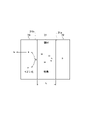
- FIG. 1 is an explanatory diagram showing the principle of permeation of hydrogen inside a steel material.
- FIG. 2 is a block diagram showing the configuration of the surface hydrogen content analyzer according to this embodiment.
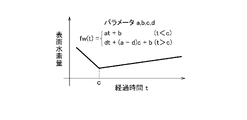
- FIG. 3 is a graph showing the function fw(t) set using the parameter w expressed as a vector.
- FIG. 4 is a graph showing changes over time in measured and calculated values of hydrogen permeation current.
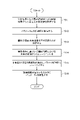
- FIG. 5 is a flow chart showing the processing procedure of the surface hydrogen content analyzer according to this embodiment.
- FIG. 6 is a graph showing the relationship between the elapsed time and the current density of the current generated on the hydrogen detection surface.
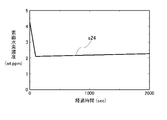
- FIG. 7 is a graph showing the relationship between elapsed time and surface hydrogen concentration.
- FIG. 8 is a block diagram showing the hardware configuration of this embodiment.
- FIG. 1 is an explanatory diagram showing the principle of permeation of hydrogen inside a steel material.
- FIG. 1 shows a cross section of the steel material 31 and its surrounding environment.
- One surface (right side in the drawing) of the steel material 31 is defined as a hydrogen entry surface 31a, and the other surface (left side in the drawing) is defined as a hydrogen detection surface 31b.
- the hydrogen entry surface 31a is in contact with the corrosive environment 32.
- the corrosive environment 32 is, for example, an environment exposed to the open air.
- the hydrogen detection surface 31b is immersed in, for example, a NaOH aqueous solution 33 (sodium hydroxide aqueous solution).
- the hydrogen that has entered the interior of the steel material 31 diffuses within the steel material 31, and part of it reaches the hydrogen detection surface 31b on the opposite side. Hydrogen reaching the hydrogen detection surface 31b is released into the NaOH aqueous solution 33 from the hydrogen detection surface 31b. Since the hydrogen released into the NaOH aqueous solution 33 is ionized, current flows through the NaOH aqueous solution 33 . This current is referred to as hydrogen permeation current "iH".
- the amount of hydrogen that has penetrated into the steel material 31 can be expressed by the one-dimensional diffusion equation shown in formula (1) below.
- D indicates the hydrogen diffusion coefficient
- the amount of hydrogen C(0,L) on the hydrogen detection surface 31b is set to "0”.
- n indicates the number of reaction electrons, and F indicates the Faraday constant.
- n, F, D, and L shown in the formula (2) are known values, if the measured value of the hydrogen permeation current iH and the elapsed time t are substituted into the formula (2), It is possible to calculate the surface hydrogen amount C(t,0) of the steel material 31 to be used.
- FIG. 2 is a block diagram showing the configuration of a surface hydrogen content analysis device 100 that analyzes the surface hydrogen content of the steel material 31 by adopting the surface hydrogen content analysis method according to this embodiment.
- the surface hydrogen content analysis device 100 includes a parameter adjustment unit 11, a boundary condition setting unit 12, a simulator 13, and a comparison unit 14.
- the parameter adjustment unit 11 acquires the parameter w represented by a vector from an external input.
- the parameter adjustment unit 11 also sets the acquired parameter w as an initial value, and adjusts the parameter w to an optimum numerical value. Specifically, based on the error function (details will be described later) output from the comparison unit 14, the parameter w is adjusted so that the error function between the measured value and the calculated value of the surface hydrogen content is minimized.
- the error function (details will be described later) output from the comparison unit 14.
- the parameter w is adjusted so that the error function between the measured value and the calculated value of the surface hydrogen content is minimized.
- an example of adjusting the parameter w so as to minimize the error function will be described as an example, but even if the error is not minimized, the effects of this embodiment can be achieved if the error is reduced.
- the boundary condition setting unit 12 sets the boundary conditions of the steel material 31 using the parameter w set by the parameter adjustment unit 11.
- the surface hydrogen content C(t,0) which is the hydrogen content on the hydrogen permeated surface 31a of the steel material 31, is set to a function fw(t) (hydrogen content function) expressed using the parameter w.
- the function fw(t) can be represented by the following equation (3) using four variables a, b, c, and d.
- FIG. 3 is a graph showing the function fw(t) represented by the above equation (3), where the horizontal axis indicates the elapsed time t and the vertical axis indicates the amount of surface hydrogen.
- the function fw(t) shown in equation (3) is an example, and can be set to any function.
- the number of variables should be two or more.
- the function fw(t) may be set using five variables a, b, c, d, and e.
- the boundary condition setting unit 12 also sets C(t,0) and C(0,L) to the following equations (4) and (5) as boundary conditions when simulating the hydrogen permeation test of the steel material 31. .
- C(t,0) fw(t) (4)
- C(0,L) 0 (5)
- the simulator 13 performs a simulation based on the boundary conditions shown in the formulas (4) and (5) above, and acquires the calculated value of the hydrogen permeation current iH generated on the hydrogen detection surface 31b of the steel material 31.
- the simulator 13 shows, for example, the diffusion of hydrogen in the steel material 31 by a one-dimensional diffusion equation, and further calculates the hydrogen distribution in the steel material 31 using a finite difference method or the like.
- the simulator 13 calculates the hydrogen permeation current iH in the steel material 31 using Fick's second law or the like based on the calculated hydrogen distribution. That is, the simulator 13 acquires the calculated value of the hydrogen permeation current iH.
- the comparison unit 14 acquires the measured value of the hydrogen permeation current iH generated on the hydrogen detection surface 31b of the steel material 31 from the results of the hydrogen permeation test described with reference to FIG.
- the comparison unit 14 also compares the measured and calculated values of the hydrogen permeation current iH, and calculates an error function indicating the difference between the respective numerical values. For example, as shown in FIG. 4, when the calculated value s11 and the measured value s12 of the hydrogen permeation current iH are obtained, the difference between them is calculated as an error function.
- the comparison unit 14 also feeds back the calculated error function to the parameter adjustment unit 11 .
- the parameter adjusting unit 11 adjusts the parameter w for the error function fed back so that the error function is minimized by employing a technique such as Powell's method.
- the parameter adjustment unit 11 also outputs the parameter w that minimizes the error function (hereinafter referred to as "optimization parameter w'").
- FIG. 5 is a flow chart showing the processing procedure of the surface hydrogen content analyzer 100 according to this embodiment.
- step S11 the surface hydrogen content analyzer 100 acquires the hydrogen permeation current iH from the test results of the hydrogen permeation test using the steel material 31. Specifically, as shown in FIG. 1, the current flowing through the hydrogen detection surface 31b of the steel material 31 is detected, and this current is obtained as the measured value of the hydrogen permeation current iH. This measured value is input to the comparison section 14 .
- step S12 the parameter adjustment unit 11 acquires the initial value of the parameter w set by the operator.
- step S13 the boundary condition setting unit 12 sets the function fw(t) indicating the surface hydrogen content of the steel material 31 based on the parameter w set by the parameter adjustment unit 11.
- the function fw(t) is, for example, the function represented by the formula (3) mentioned above.
- step S ⁇ b>14 the simulator 13 simulates the diffusion of hydrogen inside the steel material 31 based on the boundary conditions set by the boundary condition setting unit 12 using, for example, a one-dimensional diffusion equation.
- step S15 the comparison unit 14 calculates an error function between the calculated value of the hydrogen permeation current iH obtained by the above simulation and the above-described measured value of the hydrogen permeation current iH.
- the comparison unit 14 feeds back the calculated error function to the parameter adjustment unit 11 .
- step S16 the parameter adjusting unit 11 adjusts the parameter w using, for example, Powell's method so that the error function fed back from the comparing unit 14 is minimized.
- the values of the variables a, b, c, and d of the initially set parameter w are appropriately changed to minimize the error function.
- the parameter adjuster 11 outputs the minimized parameter w as an optimized parameter w'.
- the optimization parameter w' By obtaining the optimization parameter w', the relationship between the hydrogen permeation current iH and the surface hydrogen content C(t,0) can be obtained, and the surface hydrogen content that changes with time can be quantitatively evaluated. can do.
- FIG. 6 is a graph showing hydrogen permeation test data when hydrogen is electrochemically penetrated into the hydrogen permeated surface 31a of the steel material 31 under an ammonium thiocyanate aqueous solution.
- the steel material 31 used in the test is a system in which the surface of the steel material 31 is not subjected to treatment such as polishing, and the surface of the steel material 31 changes moment by moment, and the amount of surface hydrogen fluctuates.
- the horizontal axis indicates the elapsed time t after the start of hydrogen penetration
- the vertical axis indicates the current density of the hydrogen permeation current iH flowing through the hydrogen detection surface 31b of the steel material 31.
- the curve s21 shown in FIG. 6 shows the theoretical value of the hydrogen permeation current
- the curve s22 shows the hydrogen permeation current value calculated by adopting the method of the present embodiment
- the curve s23 assumes that the amount of hydrogen on the hydrogen permeation surface 31a is constant. Calculated hydrogen permeation current values are shown.
- a curve s24 shown in FIG. 7 is a graph showing changes in the surface hydrogen concentration with respect to the elapsed time t. As shown by the curve s24, the surface hydrogen concentration of the steel material 31 changes over time. By adopting the analysis method of the present embodiment, changes in surface hydrogen content over time can be evaluated with high accuracy.
- the method for detecting the amount of surface hydrogen includes the step of obtaining the measured value of the hydrogen permeation current by the hydrogen permeation test using the steel material 31, and using the parameter w represented by the vector, the steel material a step of setting a hydrogen content function fw(t) representing a time change of the surface hydrogen content of the steel 31, and using this hydrogen content function to set boundary conditions in the steel material 31; and obtaining a calculated value of the hydrogen permeation current; calculating an error function between the measured value and the calculated value of the hydrogen permeation current; and adjusting the parameter w so that the error function is reduced. It has a step and a.
- the change in the surface hydrogen content of the steel material 31, that is, the change in the boundary conditions is expressed as a function (hydrogen content function) including the parameter w represented by a vector, and under the boundary conditions, the inside of the steel material 31
- a calculated value of the hydrogen permeation current iH is calculated by simulating hydrogen diffusion into .
- the calculated value is compared with the measured value obtained by conducting the hydrogen permeation test, and the parameter w is changed so as to minimize or reduce the error function.
- the surface hydrogen content C(t,0) that changes with elapsed time is defined as the hydrogen content function fw(t), and the hydrogen content C(0,L) on the hydrogen detection surface 31b is is set to "0" to adjust so that the parameter w is reduced, so it is possible to set the parameter w with high precision.
- the diffusion of hydrogen inside the steel material 31 is represented by a one-dimensional diffusion equation
- the hydrogen distribution inside the steel material 31 is calculated based on the one-dimensional diffusion equation
- Fick's second law is calculated from this hydrogen distribution. Since the hydrogen permeation current is calculated using this, it is possible to calculate the hydrogen permeation current with high accuracy.
- the parameter w is adjusted so as to minimize the error function using the Powell method, so it is possible to set the parameter w with high accuracy.
- the surface hydrogen content analysis device 100 of the present embodiment described above includes, for example, a CPU (Central Processing Unit, processor) 901, a memory 902, and a storage 903 (HDD: Hard Disk Drive, SSD: Solid State Drive), a communication device 904, an input device 905, and an output device 906, a general-purpose computer system can be used.
- Memory 902 and storage 903 are storage devices.
- CPU 901 executes a predetermined program loaded on memory 902 to realize each function of surface hydrogen content analyzer 100 .
- the surface hydrogen content analyzer 100 may be implemented by one computer, or may be implemented by a plurality of computers. Moreover, the surface hydrogen content analyzer 100 may be a virtual machine implemented on a computer.
- the program for the surface hydrogen content analyzer 100 can also be stored in computer-readable recording media such as HDD, SSD, USB (Universal Serial Bus) memory, CD (Compact Disc), DVD (Digital Versatile Disc). , can also be distributed over a network.
- computer-readable recording media such as HDD, SSD, USB (Universal Serial Bus) memory, CD (Compact Disc), DVD (Digital Versatile Disc).
Landscapes
- Life Sciences & Earth Sciences (AREA)
- Health & Medical Sciences (AREA)
- Chemical & Material Sciences (AREA)
- General Health & Medical Sciences (AREA)
- Physics & Mathematics (AREA)
- Analytical Chemistry (AREA)
- Biochemistry (AREA)
- General Physics & Mathematics (AREA)
- Immunology (AREA)
- Pathology (AREA)
- Chemical Kinetics & Catalysis (AREA)
- Electrochemistry (AREA)
- Molecular Biology (AREA)
- Medicinal Chemistry (AREA)
- Ecology (AREA)
- Environmental & Geological Engineering (AREA)
- Environmental Sciences (AREA)
- Biodiversity & Conservation Biology (AREA)
- Food Science & Technology (AREA)
- Engineering & Computer Science (AREA)
- Investigating And Analyzing Materials By Characteristic Methods (AREA)
- Testing Resistance To Weather, Investigating Materials By Mechanical Methods (AREA)
Priority Applications (2)
| Application Number | Priority Date | Filing Date | Title |
|---|---|---|---|
| JP2023509924A JP7510100B2 (ja) | 2021-03-29 | 2021-03-29 | 表面水素量解析方法及び表面水素量解析装置並びに表面水素量解析プログラム |
| PCT/JP2021/013294 WO2022208611A1 (ja) | 2021-03-29 | 2021-03-29 | 表面水素量解析方法及び表面水素量解析装置並びに表面水素量解析プログラム |
Applications Claiming Priority (1)
| Application Number | Priority Date | Filing Date | Title |
|---|---|---|---|
| PCT/JP2021/013294 WO2022208611A1 (ja) | 2021-03-29 | 2021-03-29 | 表面水素量解析方法及び表面水素量解析装置並びに表面水素量解析プログラム |
Publications (1)
| Publication Number | Publication Date |
|---|---|
| WO2022208611A1 true WO2022208611A1 (ja) | 2022-10-06 |
Family
ID=83455737
Family Applications (1)
| Application Number | Title | Priority Date | Filing Date |
|---|---|---|---|
| PCT/JP2021/013294 Ceased WO2022208611A1 (ja) | 2021-03-29 | 2021-03-29 | 表面水素量解析方法及び表面水素量解析装置並びに表面水素量解析プログラム |
Country Status (2)
| Country | Link |
|---|---|
| JP (1) | JP7510100B2 (https=) |
| WO (1) | WO2022208611A1 (https=) |
Cited By (1)
| Publication number | Priority date | Publication date | Assignee | Title |
|---|---|---|---|---|
| JP7556629B1 (ja) | 2023-08-29 | 2024-09-26 | 天津大学 | パイプライン鋼等価湿潤硫化水素環境水素チャージモデルの構築方法及びその使用 |
Citations (5)
| Publication number | Priority date | Publication date | Assignee | Title |
|---|---|---|---|---|
| JP2015031554A (ja) * | 2013-08-01 | 2015-02-16 | 日本電信電話株式会社 | 水素侵入電位予測方法 |
| JP2017207302A (ja) * | 2016-05-16 | 2017-11-24 | Jfeスチール株式会社 | 侵入水素量測定方法および侵入水素量測定装置 |
| JP2018115942A (ja) * | 2017-01-18 | 2018-07-26 | 株式会社豊田中央研究所 | 侵入水素評価方法、侵入水素評価システムおよび侵入水素評価用セル |
| JP2020517963A (ja) * | 2017-04-28 | 2020-06-18 | サウジ アラビアン オイル カンパニー | 水素拡散係数の非破壊測定のための装置および方法 |
| JP2021043076A (ja) * | 2019-09-11 | 2021-03-18 | 株式会社神戸製鋼所 | 水素透過試験装置 |
-
2021
- 2021-03-29 JP JP2023509924A patent/JP7510100B2/ja active Active
- 2021-03-29 WO PCT/JP2021/013294 patent/WO2022208611A1/ja not_active Ceased
Patent Citations (5)
| Publication number | Priority date | Publication date | Assignee | Title |
|---|---|---|---|---|
| JP2015031554A (ja) * | 2013-08-01 | 2015-02-16 | 日本電信電話株式会社 | 水素侵入電位予測方法 |
| JP2017207302A (ja) * | 2016-05-16 | 2017-11-24 | Jfeスチール株式会社 | 侵入水素量測定方法および侵入水素量測定装置 |
| JP2018115942A (ja) * | 2017-01-18 | 2018-07-26 | 株式会社豊田中央研究所 | 侵入水素評価方法、侵入水素評価システムおよび侵入水素評価用セル |
| JP2020517963A (ja) * | 2017-04-28 | 2020-06-18 | サウジ アラビアン オイル カンパニー | 水素拡散係数の非破壊測定のための装置および方法 |
| JP2021043076A (ja) * | 2019-09-11 | 2021-03-18 | 株式会社神戸製鋼所 | 水素透過試験装置 |
Non-Patent Citations (3)
| Title |
|---|
| SAWAMURA, MITSURU: "Intrusion amount of hydrogen and hydrogen-induced cracking in various sour environments", THE IRON AND STEEL INSTITUTE OF JAPAN OJIMA AKIRA, REPORT OF THE ISIJ MEETING, vol. 24, pages 671 - 674 * |
| TADA, EIJI: "Development of monitoring techniques of hydrogen absorption into steel in atmospheric corrosion environments", THE IRON AND STEEL INSTITUTE OF JAPAN OJIMA AKIRA, REPORT OF THE ISIJ MEETING, vol. 25, 30 November 2011 (2011-11-30), pages 509, XP009540360 * |
| TSURU, TOORU: "Electrochemical Measurements for Hydrogen Entry and Permeation of Steel", ZAIRYO-TO-KANKYO, vol. 63, 30 November 2013 (2013-11-30), JP , pages 3 - 9, XP009540359, ISSN: 0917-0480 * |
Cited By (2)
| Publication number | Priority date | Publication date | Assignee | Title |
|---|---|---|---|---|
| JP7556629B1 (ja) | 2023-08-29 | 2024-09-26 | 天津大学 | パイプライン鋼等価湿潤硫化水素環境水素チャージモデルの構築方法及びその使用 |
| JP2025036118A (ja) * | 2023-08-29 | 2025-03-14 | 天津大学 | パイプライン鋼等価湿潤硫化水素環境水素チャージモデルの構築方法及びその使用 |
Also Published As
| Publication number | Publication date |
|---|---|
| JP7510100B2 (ja) | 2024-07-03 |
| JPWO2022208611A1 (https=) | 2022-10-06 |
Similar Documents
| Publication | Publication Date | Title |
|---|---|---|
| Zhang et al. | Assessing uncertainty in operational modal analysis incorporating multiple setups using a Bayesian approach | |
| CN111751199B (zh) | 基于eifs分布的疲劳寿命预测方法 | |
| JP6077042B2 (ja) | 切欠き係数推定方法、切欠き係数推定システム及び切欠き係数推定装置 | |
| WO2018183153A1 (en) | Systems and methods for real time measurement of surface curvature and thermal expansion of small samples | |
| JP7510100B2 (ja) | 表面水素量解析方法及び表面水素量解析装置並びに表面水素量解析プログラム | |
| US10846605B2 (en) | Detecting a transient error in a body fluid sample | |
| CN104036834A (zh) | 一种次临界系统次临界度的测量方法 | |
| CN120579903A (zh) | 一种混凝土浇筑过程的监测方法和系统 | |
| Pilch | Sources of measurement uncertainty in determination of the directional diffusion coefficient value | |
| CN104216000A (zh) | 一种用于中子Soller准直器发散角测试方法 | |
| CN103575618A (zh) | 一种铸坯中心疏松定量化的测量方法 | |
| CN110515752A (zh) | 一种磁盘设备寿命预测方法及装置 | |
| CN111854929B (zh) | 一种评定特高压主设备声功率级不确定度的方法及系统 | |
| Allahdadian et al. | Investigation on the sensitivity of subspace based damage detection technique to damage and noise levels | |
| Chentsova et al. | Estimation of Uncertainty in Charpy Pendulum Impact Test Using the Reference Material | |
| JP7234040B2 (ja) | 酸素濃度計測システムおよび酸素濃度計測方法 | |
| Wallace et al. | Sour service pit growth predictions of carbon steel using extreme value statistics | |
| Ha et al. | Assessment of the adequacy of gauge repeatability and reproducibility study using a Monte Carlo simulation | |
| Goh et al. | Estimating the uncertainty on measurements of single cell PEMFC performance | |
| Kim et al. | Uncertainty estimation of the ADCP velocity measurements from the moving vessel method,(I) development of the framework | |
| KR20230163353A (ko) | 적외선 분광법 분석을 사용하여 모노머 생산, 저장및 취급에서 생성된 원치 않는 폴리머 부산물의 모니터링 및 제어 | |
| Allahdadian et al. | Subspace based damage detection technique: investigation on the effect of number of samples | |
| Mareze et al. | Statistical dispersion of effective acoustic parameters and airflow resistivity of porous absorbers using the two-thickness method in an impedance tube | |
| Zhangfeng et al. | Study on Influencing Factors of Location Deviation of Sound Transmission Path in Anechoic Chamber Calibration | |
| Batko et al. | Verification of the calculation assumptions applied to solutions of the acoustic measurements uncertainty |
Legal Events
| Date | Code | Title | Description |
|---|---|---|---|
| 121 | Ep: the epo has been informed by wipo that ep was designated in this application |
Ref document number: 21934785 Country of ref document: EP Kind code of ref document: A1 |
|
| WWE | Wipo information: entry into national phase |
Ref document number: 2023509924 Country of ref document: JP |
|
| NENP | Non-entry into the national phase |
Ref country code: DE |
|
| 122 | Ep: pct application non-entry in european phase |
Ref document number: 21934785 Country of ref document: EP Kind code of ref document: A1 |