WO2022196475A1 - 調査計画生成装置、調査計画生成方法及びプログラム - Google Patents
調査計画生成装置、調査計画生成方法及びプログラム Download PDFInfo
- Publication number
- WO2022196475A1 WO2022196475A1 PCT/JP2022/010194 JP2022010194W WO2022196475A1 WO 2022196475 A1 WO2022196475 A1 WO 2022196475A1 JP 2022010194 W JP2022010194 W JP 2022010194W WO 2022196475 A1 WO2022196475 A1 WO 2022196475A1
- Authority
- WO
- WIPO (PCT)
- Prior art keywords
- survey
- plan
- investigation
- productivity
- generation device
- Prior art date
- Legal status (The legal status is an assumption and is not a legal conclusion. Google has not performed a legal analysis and makes no representation as to the accuracy of the status listed.)
- Ceased
Links
Images






Classifications
-
- G—PHYSICS
- G06—COMPUTING OR CALCULATING; COUNTING
- G06Q—INFORMATION AND COMMUNICATION TECHNOLOGY [ICT] SPECIALLY ADAPTED FOR ADMINISTRATIVE, COMMERCIAL, FINANCIAL, MANAGERIAL OR SUPERVISORY PURPOSES; SYSTEMS OR METHODS SPECIALLY ADAPTED FOR ADMINISTRATIVE, COMMERCIAL, FINANCIAL, MANAGERIAL OR SUPERVISORY PURPOSES, NOT OTHERWISE PROVIDED FOR
- G06Q10/00—Administration; Management
- G06Q10/06—Resources, workflows, human or project management; Enterprise or organisation planning; Enterprise or organisation modelling
- G06Q10/063—Operations research, analysis or management
- G06Q10/0639—Performance analysis of employees; Performance analysis of enterprise or organisation operations
- G06Q10/06398—Performance of employee with respect to a job function
-
- G—PHYSICS
- G01—MEASURING; TESTING
- G01C—MEASURING DISTANCES, LEVELS OR BEARINGS; SURVEYING; NAVIGATION; GYROSCOPIC INSTRUMENTS; PHOTOGRAMMETRY OR VIDEOGRAMMETRY
- G01C15/00—Surveying instruments or accessories not provided for in groups G01C1/00 - G01C13/00
-
- G—PHYSICS
- G06—COMPUTING OR CALCULATING; COUNTING
- G06Q—INFORMATION AND COMMUNICATION TECHNOLOGY [ICT] SPECIALLY ADAPTED FOR ADMINISTRATIVE, COMMERCIAL, FINANCIAL, MANAGERIAL OR SUPERVISORY PURPOSES; SYSTEMS OR METHODS SPECIALLY ADAPTED FOR ADMINISTRATIVE, COMMERCIAL, FINANCIAL, MANAGERIAL OR SUPERVISORY PURPOSES, NOT OTHERWISE PROVIDED FOR
- G06Q50/00—Information and communication technology [ICT] specially adapted for implementation of business processes of specific business sectors, e.g. utilities or tourism
- G06Q50/10—Services
- G06Q50/16—Real estate
-
- G—PHYSICS
- G06—COMPUTING OR CALCULATING; COUNTING
- G06Q—INFORMATION AND COMMUNICATION TECHNOLOGY [ICT] SPECIALLY ADAPTED FOR ADMINISTRATIVE, COMMERCIAL, FINANCIAL, MANAGERIAL OR SUPERVISORY PURPOSES; SYSTEMS OR METHODS SPECIALLY ADAPTED FOR ADMINISTRATIVE, COMMERCIAL, FINANCIAL, MANAGERIAL OR SUPERVISORY PURPOSES, NOT OTHERWISE PROVIDED FOR
- G06Q50/00—Information and communication technology [ICT] specially adapted for implementation of business processes of specific business sectors, e.g. utilities or tourism
- G06Q50/10—Services
- G06Q50/26—Government or public services
Definitions
- the present invention relates to a survey plan generation device, a survey plan generation method and a program, and more particularly to a technique for generating survey plans for surveying multiple buildings by multiple surveyors.
- Patent Literature 1 discloses a water leakage investigation planning device that makes a water leakage investigation plan for a plurality of areas into which a water pipe network is divided.
- Patent Literature 2 discloses a staff allocation planning device that formulates a plurality of worker allocation plans for each process carried out in a distribution center.
- the local government will conduct a damage certification survey to certify the extent of damage to the damaged house.
- the local government prepares an overall survey plan in advance, and estimates the expected completion date, required personnel, survey schedule for each area, etc.
- the number of houses to be surveyed will be in the tens of thousands, and various conditions exist depending on the damage situation when formulating a survey plan. Examples of conditions include the target date of completion, the number of personnel that can be procured, the inventory of necessary equipment, the difficulty of surveying the house (differences between wooden and non-wooden buildings, etc.), and the area that requires priority survey. It is difficult to manually prepare a survey plan for tens of thousands of houses while taking these conditions into consideration, and there is a problem that it leads to a delay in survey implementation and a decrease in survey efficiency.
- the survey plan will differ depending on the productivity of the surveyor or the survey team formed by allocating multiple surveyors.
- the apparatuses described in Patent Documents 1 and 2 have a problem that productivity is not taken into consideration.
- the present invention has been made in view of such circumstances, and aims to provide a survey plan generation device, a survey plan generation method, and a program that automatically generate survey plans according to the productivity of investigators.
- a survey plan generation device for achieving the above object is a survey plan generation device for generating a survey plan for surveying a plurality of buildings by a plurality of surveyors, comprising at least one processor and at least one and at least one memory storing instructions for causing a processor to execute, the at least one processor being a condition to be met by the research plan to meet the productivity of the plurality of investigators, or the plurality of investigators respectively.
- At least one processor generates a plurality of research plan candidates, displays summary information of the generated plurality of research plan candidates on a display, and selects a research plan candidate to be adopted as a research plan from among the displayed plurality of research plan candidates. Preferably, user selection is accepted. This allows the user to select a desired research plan candidate from a plurality of research plan candidates.
- the summary information of the investigation plan candidates include at least one indicator of the total number of investigation days and the number of personnel forecast for each fixed period. This allows the user to select a desired research plan candidate based on at least one index of the total number of research days and the number of personnel forecast for each fixed period.
- the at least one processor generates multiple research plan candidates along multiple optimization criteria. This allows the user to select an investigation plan candidate that meets a desired optimization criterion from among multiple investigation plan candidates.
- the survey includes multiple building damage surveys, and the optimization criteria are at least one of the following: areas with more building damage are prioritized, areas with less building damage are prioritized, the shortest number of days, and the minimum number of personnel. preferably include one. This makes it possible to select survey plan candidates that conform to appropriate optimization criteria for building damage surveys.
- the survey plan preferably includes at least one of the following: survey schedule, daily list of buildings to be surveyed, and assignment information of surveyors or survey teams. Thereby, an appropriate survey plan can be generated.
- At least one processor displays an investigation itinerary for each investigator or investigation team of the investigation plan on the display and accepts editing of the displayed investigation itinerary by the user. This allows the user to generate an optimal research plan.
- At least one processor preferably accepts editing of the survey schedule by a drag-and-drop operation using a pointing device. This allows the user to edit the survey schedule with a simple operation.
- the conditions preferably include at least one of the target number of days, number of equipment, and priority areas. This makes it possible to generate a survey plan that satisfies at least one of the target number of days, the number of equipment, and the priority areas.
- the investigation includes investigation of damage to multiple buildings, and the at least one processor generates an investigation plan based on at least one of the building information and the damage information for each area. This makes it possible to generate an appropriate survey plan for surveying building damage.
- the at least one processor generates a survey plan using a shortest path algorithm of at least one of bin-packing and Dijkstra. Thereby, an appropriate survey plan can be generated.
- At least one processor preferably causes the display to display the generated survey plan and a map of an area containing a plurality of buildings. Thereby, the generated investigation plan can be presented appropriately.
- One aspect of the survey plan generation method for achieving the above object is a survey plan generation method for generating a survey plan for surveying a plurality of buildings by a plurality of surveyors, the conditions to be satisfied by the survey plan are , the productivity of a plurality of investigators, or the productivity of a plurality of research teams organized by assigning a plurality of investigators to each other; and generating a survey plan based on the acquired conditions.
- a survey plan generation method comprising: a recalculation step of recalculating the productivity or the productivity of a plurality of survey teams; and a survey plan updating step of updating the survey plan based on the recalculated productivity. According to this aspect, it is possible to automatically generate an investigation plan according to the productivity of the investigator or the like.
- One aspect of the program for achieving the above object is a program for causing a computer to execute the above investigation plan generation method.
- a computer-readable non-transitory storage medium in which this program is recorded may also be included in this embodiment. According to this aspect, it is possible to automatically generate an investigation plan according to the productivity of the investigator or the like.
- FIG. 1 is a schematic diagram of a disaster information processing system.
- FIG. 2 is a functional block diagram of the survey plan generation device.
- FIG. 3 is a flow chart showing each process of the investigation plan generation method according to the first embodiment by the investigation plan generation device.
- FIG. 4 is a process diagram of each step of the survey plan generation method.
- FIG. 5 is an example of an input screen displayed on the display.
- FIG. 6 is an example of a plan candidate selection screen displayed on the display.
- FIG. 7 is an example of an edit screen displayed on the display.
- FIG. 8 is a diagram showing an example of changing the assigned area of a certain team and the assigned area of another team.
- FIG. 9 is a diagram showing an example of changing the assigned area of a certain team and the assigned area of another team.
- FIG. 1 is a schematic diagram of a disaster information processing system.
- FIG. 2 is a functional block diagram of the survey plan generation device.
- FIG. 3 is a flow chart showing each process of the investigation plan generation method
- FIG. 10 is an example of an edit screen on which a survey plan and a map are simultaneously displayed on the display.
- FIG. 11 is another example of an edit screen on which a survey plan and a map are simultaneously displayed on the display.
- FIG. 12 is an example of a display screen on which a Done button is displayed.
- FIG. 13 is a flow chart showing each step of the investigation plan generation method according to the second embodiment by the investigation plan generation device.
- FIG. 14 is a flow chart showing each process of the investigation plan generation method according to the second embodiment by the investigation plan generation device.
- FIG. 15 is a flow chart showing each process of the investigation plan generation method according to the second embodiment by the investigation plan generation device.
- FIG. 16 is a flow chart showing each process of the investigation plan generation method according to the second embodiment by the investigation plan generation device.
- FIG. 17 is a process diagram showing a survey plan generation method according to the third embodiment by the survey plan generation device.
- FIG. 18 is a diagram for explaining the generation of research plan candidates.
- Buildings refer to dwellings such as “single-family homes” and “multi-family housing,” but may also include general buildings such as "stores,” “offices,” and “factories.” In the following, buildings are referred to as "houses” without distinguishing between types.
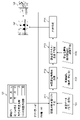
- FIG. 1 is a block diagram of a survey plan generation device 10 according to this embodiment.
- the survey plan generation device 10 is realized by at least one computer.
- survey plan generator 10 includes processor 12 , memory 14 , communication interface 16 , input interface 18 and display 20 .
- the processor 12 executes instructions stored in memory 14 .
- the hardware structure of the processor 12 is various processors as follows.
- Various processors include a CPU (Central Processing Unit), which is a general-purpose processor that executes software (programs) and acts as various functional units, a GPU (Graphics Processing Unit), which is a processor specialized for image processing, A circuit specially designed to execute specific processing such as PLD (Programmable Logic Device), which is a processor whose circuit configuration can be changed after manufacturing such as FPGA (Field Programmable Gate Array), ASIC (Application Specific Integrated Circuit), etc. Also included are dedicated electrical circuits, which are processors with configuration, and the like.
- One processing unit may be composed of one of these various processors, or two or more processors of the same or different type (for example, a plurality of FPGAs, a combination of CPU and FPGA, or a combination of CPU and GPU).
- a plurality of functional units may be configured by one processor.
- a single processor is configured by combining one or more CPUs and software.
- a processor acts as a plurality of functional units.
- SoC System On Chip
- various functional units are configured using one or more of the above various processors as a hardware structure.
- the hardware structure of these various processors is, more specifically, an electrical circuit that combines circuit elements such as semiconductor elements.
- the memory 14 stores instructions for the processor 12 to execute.
- the memory 14 includes RAM (Random Access Memory) and ROM (Read Only Memory) (not shown).
- the processor 12 uses the RAM as a work area, executes software using various programs and parameters including a survey plan generation program stored in the ROM, and uses the parameters stored in the ROM etc. to perform the survey.
- Various processes of the plan generation device 10 are executed.
- the communication interface 16 controls wired and wireless communication.
- the survey plan generation device 10 is connected to a communication network such as the Internet via a communication interface 16 so as to be able to transmit and receive data.
- the input interface 18 is an input device for the user to input various information and desired instructions to the survey plan generation device 10 .
- the input interface 18 includes a pointing device such as a mouse and an input device such as a keyboard.
- the display 20 is a display device for allowing the user to view information such as the generated survey plan.
- the display 20 displays screens required for operations on the input interface 18 and functions as a part that implements a GUI (Graphical User Interface).
- GUI Graphic User Interface
- a touch panel display in which the input interface 18 and the display 20 are integrated may be applied.
- FIG. 2 is a functional block diagram of the survey plan generation device 10.
- the survey plan generation device 10 includes a plan condition input reception unit 22, a damage information acquisition unit 24, a house information acquisition unit 26, an automatic plan generation unit 28, a plan candidate display unit 30, A plan candidate selection receiving unit 32 , a map information acquiring unit 34 , a plan editing means display unit 36 , and a plan editing operation receiving unit 38 are provided.
- Each function of these investigation plan generation apparatus 10 is implemented by the processor 12 .
- the plan condition input reception unit 22 receives input of plan conditions that the generated survey plan should satisfy.
- the planning conditions include an assumed productivity (number of investigations per day) of each of the multiple investigators or an assumed productivity of each of the multiple research teams.
- a research team is a group consisting of one or more investigators each assigned a plurality of investigators, and is the smallest unit group for conducting an investigation.
- Plan conditions may include factors that affect the schedule of the survey plan, such as target days, number of pieces of equipment, and priority areas.
- the damage information acquisition unit 24 acquires the damage information of the area that includes the target house of the damage certification survey.
- the damage information acquisition unit 24 may acquire damage information via the communication interface 16 or may acquire damage information via the input interface 18 .
- the damage information acquisition unit 24 may acquire the damage information stored in the memory 14 .
- the house information acquisition unit 26 acquires house information (an example of "building information") that is information about the house subject to the damage certification survey.
- the house information acquisition unit 26 may acquire house information via the communication interface 16 or may acquire house information via the input interface 18 .
- the house information acquisition unit 26 may acquire house information stored in the memory 14 .
- House information includes information for distinguishing between wooden and non-wooden structures.
- a wooden structure is a structure that uses wood for the main part in terms of structural strength.
- non-wooden structures refer to structures other than wooden structures, including reinforced concrete structures, steel structures, and the like.
- the plan automatic generation unit 28 based on the plan conditions received by the plan condition input reception unit 22, the damage information acquired by the damage information acquisition unit 24, and the house information acquired by the house information acquisition unit 26, Generate multiple candidate survey plans according to optimization criteria.
- the optimization criteria include at least one of areas with the most damage first, areas with the least damage first, the shortest number of days, and the least number of personnel. Areas with large damage and areas with small damage refer to areas with relatively large damage and areas with relatively small damage within the survey area, and relatively large and small damage. Judgment of is based on the number of damaged houses in the area.
- the generated survey plan candidates each include a survey schedule, a daily survey target house list (an example of a "survey target building list"), and assignment information for each survey team.
- a shortest path algorithm of bin-packing and/or Dijkstra may be used to generate the survey plan candidates.
- the plan candidate display unit 30 causes the display 20 to display summary information for each of the multiple investigation plan candidates generated by the automatic plan generation unit 28 .
- the summary information of the investigation plan candidate includes at least one index of the total number of investigation days and the personnel forecast for each fixed period.
- the plan candidate selection acceptance unit 32 accepts selection of any one of the plurality of investigation plan candidates.
- the plan candidate selection reception unit 32 receives the selected research plan candidate as a research plan to be adopted.
- the map information acquisition unit 34 acquires map information of the area containing the target house of the damage certification survey.
- the map information acquisition unit 34 may acquire map information via the communication interface 16 or may acquire map information via the input interface 18 .
- the map information acquisition unit 34 may acquire map information stored in the memory 14 .
- the plan editing means display unit 36 displays the survey plan received by the plan candidate selection receiving unit 32 on the display 20 in an editable manner.
- the plan editing means display unit 36 causes the display 20 to display an investigation schedule for each investigator or each investigation team of the investigation plan.
- the plan editing means display unit 36 may display the map information acquired by the map information acquisition unit 34 on the display 20 .
- the plan editing operation reception unit 38 receives an editing operation by the input interface 18 of the survey plan displayed on the display 20 by the plan editing means display unit 36 .
- the plan editing operation reception unit 38 receives editing of the investigation itinerary displayed on the display 20 by the plan editing means display unit 36 by a drag-and-drop operation using a pointing device (not shown). .
- FIG. 3 is a flow chart showing each process of the survey plan generation method according to the first embodiment by the survey plan generation device 10.
- FIG. 4 is a process diagram of each step of the survey plan generation method.
- the survey plan generation method is implemented by processor 12 executing a survey plan generation program stored in memory 14 .
- the survey plan generation program may be provided by a computer-readable non-transitory storage medium.
- the survey plan generation device 10 may read the survey plan generation program from the non-temporary storage medium and store it in the memory 14 .
- step S1 an example of a "condition acquisition step”
- the plan condition input reception unit 22 receives input of plan conditions to be satisfied by the generated investigation plan (process P1).
- FIG. 5 is an example of an input screen displayed on the display 20. As shown in FIG. FIG. 5 shows an example in which a target date and equipment are input as planning conditions.
- the target date includes the survey start date and the target completion date.
- the required number of days is determined. In the example shown in FIG. 5, the survey start date is November 4, 2020, and the target completion date is December 4, 2020, so the required number of days is 30 days.
- the plan automatic generation unit 28 generates a survey plan so that the input survey start date and target completion date can be accommodated as much as possible.
- Equipment is the number of equipment required for the survey, here it is the number of survey application terminals.
- the number of equipment affects the upper limit of the number of survey teams and limits the number of areas that can be surveyed.
- step S2 the damage information acquisition unit 24 acquires damage information including the degree of damage, address, etc. of the target area of the damage certification survey (process P2).
- the damage information is, for example, the detection results of damaged houses obtained by inputting high-altitude images taken using drones etc. into the damage judgment AI (Artificial Intelligence), and the results of automatic judgment of the degree of damage.
- the damage information may be manually input damaged building information when finding damaged houses by patrols by local government officials immediately after the disaster.
- the damage information may be information obtained by automatically capturing the intermediate results of the damage assessment investigation.
- step S3 the house information acquisition unit 26 acquires house information targeted for the damage certification survey (process P3).
- step S4 an example of a “survey plan generation process”
- the plan automatic generation unit 28 generates information on the plan conditions received by the plan condition input reception unit 22, damage information acquired by the damage information acquisition unit 24, and house information. Based on the survey target house information acquired by the acquisition unit 26, a plurality of survey plan candidates are generated for each optimization criterion that is a trade-off (process P4).
- the plan automatic generation unit 28 generates three types of survey plans: a survey plan when prioritizing areas with large damage, a survey plan when prioritizing areas with minor damage, and a survey plan when minimizing the number of survey days. It is assumed that an investigation plan candidate has been generated.
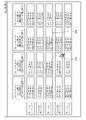
- FIG. 4 shows an example of a survey plan candidate 100.
- the survey plan candidate 100 includes a survey schedule, a list of houses to be surveyed for each day, and assignment information for each survey team.
- the assignment information for each survey team includes information on the area assigned to the survey team or the information on the house assigned to the survey team.
- team T1 has 10 cases (10 houses) on AB 1-chome on November 1, 13 cases on AB 2-chome on November 2, 9 cases on AB 3-chome on November 3, is assigned.
- the plan candidate display unit 30 causes the display 20 to display summary information of each of the multiple investigation plan candidates generated by the automatic plan generation unit 28 in a selectable manner.
- the summary information of the displayed plan candidates is expressed as a set of indices for comparing the plan candidates, such as the total number of survey days, weekly staff forecast, and the like.
- FIG. 6 is an example of a plan candidate selection screen displayed on the display 20 by the plan candidate display unit 30.
- FIG. 6 the first plan candidate 104, the second plan candidate 106, and the third plan candidate 108 are selectably displayed on the plan candidate selection screen.
- the first plan candidate 104 is a survey plan generated by prioritizing areas with severe damage.
- a second plan candidate 106 is a survey plan generated by prioritizing areas with less damage.
- a third plan candidate 108 is a survey plan generated by minimizing the number of survey days.
- the plan candidate selection screen includes indicators for judging the quality of each plan candidate as summary information for each plan candidate.
- required survey days information 110 weekly survey progress prediction information 112
- weekly required number of surveyors (survey team number) prediction information 114 and survey area order information 116 are displayed. It is
- the required investigation days information 110 includes the planned investigation start date, the planned investigation completion date, and the required number of days from the start of the investigation to the completion of the investigation.
- the weekly survey progress prediction information 112 includes a line graph indicating the number of surveys per day and the remaining number of surveys when the survey is conducted according to the survey plan. The number of surveys per day is the total number of surveys divided by the required number of days.
- the weekly number of investigators (number of investigation teams) forecast information 114 includes the total number of investigation teams and a bar graph showing the number of investigation teams per week.
- the plan candidate selection receiving unit 32 receives the selection of any one of the plurality of research plan candidates.
- the user selects one desired research plan candidate from the plurality of research plan candidates through the input interface 18 .
- the plan candidate selection reception unit 32 receives the first plan candidate 104 as a research plan to be adopted.
- step S7 the plan editing means display unit 36 displays the survey plan received by the plan candidate selection receiving unit 32 on the display 20 in an editable manner.
- FIG. 7 is an example of an edit screen displayed on the display 20. As shown in FIG. Here, a research itinerary is displayed that includes the assigned regions for each week of team T1, team T2, team T3, team T4, and team T5.
- step S8 the plan editing operation receiving unit 38 receives an editing operation by the input interface 18 of the survey plan displayed on the display 20 by the plan editing means display unit 36. This allows the user to make manual edits to the research plan.
- FIGS. 8 and 9 are diagrams showing an example of changing (swapping) the assigned area for the third week of team T3 and the assigned area for the second week of team T4 on the edit screen shown in FIG.
- FIG. 8 shows that the cell 118 indicating the allocated area of the team T3 for the third week is dragged and moved by a pointing device (not shown).
- FIG. 9 shows a state in which the cell 118 is dropped onto the position of the cell 120 indicating the assigned area for the second week of the team T4. As shown in FIG. 9, when the cell 118 is dropped onto the position of the cell 120, the cell 118 is placed where the cell 120 was, and at the same time, the cell 120 is moved and placed where the cell 118 was. That is, the assigned area for the third week of team T3 and the assigned area for the second week of team T4 are exchanged.
- the plan editing means display unit 36 can display the map acquired by the map information acquisition unit 34 on the display 20 together with the survey plan.
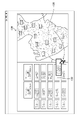
- FIG. 10 is an example of an edit screen on which a survey plan and a map are displayed on the display 20 at the same time.
- the user can display a map of an area related to the research plan by selecting a cell of the research plan with a pointing device (not shown).
- a map 124 is displayed as a result of the user's selection operation of a cell 122 indicating the assigned area of the team T1 for the first week.
- Map 124 is a map including the area displayed in cell 122, and the area indicated by cell 122 is highlighted.
- FIG. 11 is another example of an editing screen in which a survey plan and a map are displayed on the display 20 at the same time.
- a survey plan In the generated survey plan, all areas that need to be surveyed are assigned to some survey team, but the user can manually cancel the assignment later.
- an example of reassigning an unallocated region 126 that has been deallocated by the user will be described.
- the user can assign the desired area to the research team and schedule indicated by the cell by dragging and dropping the desired area on the map 128 to the position of the desired cell using a pointing device (not shown).
- the unassigned region 126 is edited into the assigned region for the second week of the survey of team T4 by performing a drag-and-drop operation on the second week cell 130 of team T4. .
- the display 20 displays a completion button 132 for ending the editing operation of the survey plan.
- FIG. 12 is an example of an edit screen of the display 20 on which the Done button 132 is displayed.
- the survey plan generation device 10 it is possible to automatically generate a survey plan according to plan conditions.
- a plurality of investigation plan candidates are generated according to a plurality of optimization criteria, and summary information of the plurality of investigation plan candidates is displayed in a selectable manner.
- a research plan candidate with desired optimization criteria can be selected from among the candidates.
- the selected survey plan can be edited, so the user can obtain the optimum survey plan.
- FIG. 13 corresponds to terminal C1 in FIG. 14
- terminal C2 in FIG. 13 corresponds to terminal C2 in FIG. 14
- terminal C2 in FIG. 16 terminal C3 in FIG. 13 corresponds to terminal C3 in FIG.
- Terminal C4 is connected to terminal C4 in FIG. 16
- terminal C5 in FIG. 15 is connected to terminal C5 in FIG.
- Data D1 to D10 in FIGS. 13 to 16 are data to be input to the survey plan generation device 10.
- the survey plan generation device 10 acquires data D5 and D7-D9 from the memory 14 and acquires data D1-D4, D6 and D10 via the communication interface 16 or the input interface 18.
- FIG. Data D11 to D25 are data generated by the survey plan generation device 10.
- steps S11 to S13 shown in FIG. 13 is the processing of calculating the total investigation workload of the damage certification investigation.
- the processor 12 creates a first survey target house list (data D11) based on the house list (data D1), the house tax register (data D2), and the basic resident register (data D3). Generate.
- the house list includes information on the location of the house, the address, and whether it is wooden or non-wooden.
- the position of the house includes latitude and longitude information of the house.
- the house tax ledger contains information on the list of houses on which house tax is paid.
- the basic resident register includes information on a list of houses in which people have lived.
- the first survey target house list also includes information on the address of each house and whether it is wooden or non-wooden. Of all the houses in the municipality where damage assessment surveys are conducted, the surveyed houses exclude those that have not paid the building tax and those that are not listed in the Basic Resident Register.
- step S12 the processor 12 calculates the number of walls of each house based on the first list of surveyed houses (data D11) and the outer shape of each house (data D4).
- a survey target house list (data D12) is generated.
- the second survey target house list includes information on the address of each house, the distinction between wooden and non-wooden houses, and the number of walls.
- each house is, for example, house outer shape data (two-dimensional polygon data) published by the Geospatial Information Authority of Japan.
- the 2D polygon data that make up the perimeter (walls) of a house has a "closed" vertex configuration, and the last element in the vertex list for a house always contains the same value as the first element in the list. .
- the vertex list of two-dimensional polygon data has 5 elements (0,0), (1,0), (1,1), (0,1), and (0,0), and the line becomes configured to close. Therefore, the number of wall surfaces of the house is obtained by subtracting 1 from the number of vertices of the two-dimensional polygon data.
- walls with a distance of 1 meter or less between vertices that make up the walls are excluded.
- step S13 the processor 12 calculates the total amount of investigation work (data D13) based on the second list of houses to be investigated (data D12).
- the processor 12 calculates the total survey work volume for wooden constructions and non-wooden constructions respectively.
- the total amount of investigation work includes information on the number of walls of wooden houses and the number of walls of non-wooden houses.
- the processor 12 performs the processing of steps S14 to S16 in parallel with the processing of steps S11 to S13.
- the processing of steps S14 to S16 is processing for calculating the amount of work that can be investigated per day by the investigation team of the own agency based on the productivity of the investigation team of the own agency.
- the investigation team of the local agency refers to an investigation team organized by investigators belonging to the local government that conducts the damage assessment investigation.
- the processor 12 generates a first survey team list (data D14) based on the survey team profile list (data D5).
- the survey team profile list includes information such as a flag indicating whether or not a non-wooden house can be surveyed for each surveyor of each survey team of the agency, and the surveyor ID (Identification).
- the first survey team list (data D14) includes information on the presence or absence of non-wooden survey capabilities for each survey team. If any one of the investigators forming the investigation team is an expert capable of investigating non-wooden structures, the investigation team has the ability to investigate non-wooden structures.
- step S15 an example of a “condition acquisition step”
- the processor 12 collects the first survey team list (data D14), the survey performance log (data D6), and the productivity target value for the first day (data D7 ), the productivity of each research team is calculated, and a second research team list (data D15) is generated.
- the survey result log is the actual number of surveys per day for each survey team. For example, the average of the actual values of the number of wall surfaces surveyed over the past three days can be used. If no survey performance log exists, the user-entered productivity goals for the first day of the survey team are used as default values.
- the processor 12 calculates the productivity for each survey team for each wooden and non-wooden construction.
- the second survey team list includes information on the presence or absence of non-wooden survey capabilities and daily productivity for each survey team.
- step S16 the processor 12 calculates the amount of work that can be investigated per day for each investigation team based on the second list of investigation teams (data D15), and calculates the amount of work that can be investigated per day (data D16). Generate. The processor 12 calculates the amount of work that can be surveyed per day for each survey team, both for wooden and non-wooden constructions.
- the daily investigable work volume (data D16) includes the total productivity of each investigative team per day.
- steps S17 to S19 shown in FIG. 14 is processing for calculating the amount of work that can be investigated in a day by the support team that conducts investigations that cannot be handled by the investigation team of the own agency.
- the support team refers to a team formed by investigators other than the investigators of the local government, and is formed, for example, by investigators dispatched in response to requests for support from other local governments.
- step S17 the processor 12 determines the total amount of investigation work (data D13), the investigation team's possible investigation work amount per day (data D16), and the support team's second Based on the daily productivity target value (data D8) and target completion date (data D9), the number of wooden support teams and the number of non-wooden support teams are calculated, and a wooden support team list (data D17) and a non-wooden support team list (data D18).
- the number of wooden cheering teams is calculated by Equation 3 below.
- Number of wooden support teams (Total number of wooden wall surfaces - (number of wooden wall surfaces that can be investigated by the agency's research team in one day x target number of days)) / (productivity target value for the second day x target) number of days) ... (Formula 3)
- the number of non-wooden support teams is calculated by Equation 4 below.
- Number of non-wooden support teams (Total number of non-wooden walls - (number of non-wooden walls that can be investigated by the agency's research team per day x target number of days)) / (productivity target for the second day) value ⁇ target number of days) ... (Formula 4)
- the support team's survey results log may be used instead of the productivity target value for the second day.
- the target number of days is the number of days from the survey start date to the target completion date.
- step S18 the processor 12 calculates the amount of work that can be investigated by the wooden construction support team per day based on the wooden construction support team list (data D17), to generate
- the first daily researchable workload (data D19) includes information on the number of wooden wall surfaces.
- step S19 the processor 12 calculates the amount of work that can be investigated per day by the non-wooden support team based on the non-wooden support team list (data D18), and Quantity (data D20) is generated.
- the second daily surveyable work volume (data D20) includes information on the number of non-wooden wall surfaces.
- steps S20 to S22 shown in FIG. 15 is processing for sorting survey target houses according to survey priority.
- the processor 12 calculates the survey priority based on the second survey target house list (data D12) and the address list of completely destroyed houses (data D10), A third survey target house list (data D21) is generated.
- the third survey target house list includes information on the address of the completely destroyed house, the distinction between wooden and non-wooden houses, and the number of walls.
- the priority is given to the "ratio of completely destroyed houses” in the chome to which the house belongs. That is, the investigation priority in this case can be expressed by Equation 5 below.
- the investigation priority indicates that the higher the chome value, the higher the priority.
- (survey priority) (number of completely destroyed houses in a chome) / (total number of houses in a chome) (Formula 5)
- the number of completely destroyed houses in a chome can be extracted from the address list of completely destroyed houses in the damage information acquired by the damage information acquisition unit 24.
- step S21 the processor 12 sorts the survey target houses in order of survey priority based on the third survey target house list (data D21) to generate a sorted survey target house list (data D22).
- the processor 12 sorts the third survey target house list in descending order of the survey priority of the houses, and further sorts the houses in the same chome in order of block number. By sorting in this way, houses that are close to each other will be assigned to the same survey team by later processing, and the efficiency of the survey can be improved.
- steps S22 to S23 shown in FIG. 16 is the processing of assigning the survey target house to the survey team or the support team.
- the investigation team there is no particular distinction between the investigation team and the support team of the own agency, and they are simply referred to as the investigation team.
- step S22 the processor 12 determines the amount of work that can be investigated for one day (data D16), the amount of work that can be investigated for the first day (data D19), and the amount of work that can be investigated for the second day. Based on the amount of work that can be investigated (data D20) and the sorted list of surveyed houses (data D22), one day's worth of surveyed houses is obtained, and one day's worth of house list (data D23) is generated. .
- the house list for one day (data D23) includes information for distinguishing between wooden and non-wooden houses.
- step S23 the processor 12 allocates houses to each survey team based on the house list for one day (data D23), and generates a survey plan for one day (data D24).
- the survey plan for one day (data D24) includes information on house allocation for each survey team.
- processor 12 assigns premises to each survey team by a bin-packing algorithm. For non-timbered houses, the processor 12 assigns only those survey teams that are capable of surveying non-timbered houses.
- the processor 12 preferentially assigns wooden houses to survey teams that cannot survey non-wooden houses, and assigns unassigned wooden houses to survey teams that can survey non-wooden houses.
- the processor 12 repeats the processing of steps S22 and S23 until the last house listed in the sorted survey target house list (data D22) is assigned to one of the survey teams, and the survey plan up to the completion date ( Data D25) is generated.
- the survey plan until the completion date (data D25) includes information on house allocation for each survey team until the completion date.
- the survey plan generation device 10 it is possible to automatically generate a survey plan according to the productivity of the surveyor or survey team.
- the investigation plan generation device 10 generates a plurality of investigations based on the investigation results of a plurality of investigators for a certain period of time or the investigation results of a plurality of investigation teams for a certain period of time in the investigation performed based on the generated investigation plan. (an example of a “recalculation process”), and update the research plan based on the recalculated productivity (an example of a “research plan update process”). may Although it is difficult to manually update such a survey plan, the survey plan generation device 10 can automatically generate an updated survey plan.
- the survey plan generation device 10 acquires the survey results for one day (an example of a certain period) as a survey result log (data D6), recalculates the productivity per day for each survey team, Survey plans can be updated based on the recalculated productivity.
- the recalculation of the productivity may take into account the productivity that has been used so far, or may be performed from the actual results for one day that have been input without considering the productivity so far.
- the investigation does not proceed as planned, it is preferable to distinguish whether it is a problem of the ability of the investigator of the investigation team or an external factor other than the ability. For example, if there is an external factor affecting the entire research team, such as bad weather that prevents the research, it may not be reflected in the recalculation of productivity. In addition, even if there is a special external factor in a specific research team, it is possible to have it not affect the estimation of productivity by inputting that effect along with the research results.
- the survey plan may be updated every half day instead of every day by recalculating productivity.
- an investigation plan for one day and updating the investigation plan for the remaining half day (afternoon) based on the investigation results for half a day (morning) (an example of investigation results for a certain period)
- more detailed productivity can be achieved.
- the investigation plan generation device 10 When updating the investigation plan, it is preferable that the investigation plan generation device 10 newly generate a plurality of investigation plan candidates in accordance with a plurality of optimization criteria and display them again in a selectable manner. This is because, in the event of a large-scale disaster, what should be given top priority may change due to changes in demand from residents, changes in resources that can be provided by the government, etc., and the optimization criteria may change accordingly.
- the survey plan generation device 10 may generate the survey plan in accordance with the previously selected optimization criteria.
- the investigation plan generation device 10 may reorganize the investigators of each investigation team.
- FIG. 17 is a process diagram showing a survey plan generation method according to the third embodiment by the survey plan generation device 10.
- an application layer 140 and a PM (Process Mining) layer 142 are shown separately.
- the application layer 140 is a program that controls the user interface that displays the reception of input from the user and the generated survey plan information.
- the PM layer 142 is an algorithm unit that generates a survey plan based on data input from the application layer 140 and data stored in a database or the like.
- the processor 12 causes the display 20 to display the condition input form G1.
- the condition input form G1 is a screen for allowing the user to input a target start date, a target completion date, the number of investigators in the agency, and the target number of investigations per day.
- the processor 12 When the input in the condition input form G1 is completed, the processor 12 generates a survey target house list based on the house data (data D31) in the PM layer 142 (process P11).
- the house data includes information on house position and address.
- House attributes include information on the structure of the house and the number of walls.
- the processor 12 also sets investigator skills and productivity based on the investigator attributes (data D33) (process P13).
- the investigator attributes include information on each investigator's expert attributes and years of experience.
- Expert attributes include the presence or absence of expert knowledge on architecture.
- the processor 12 generates research plan candidates (process P14).
- the processor 12 causes the display 20 to display a plan summary display G2 that is a summary of the plurality of survey plan candidates generated in the application layer 140 .
- the processor 12 When one research plan is selected by the user in the plan summary display G2, the processor 12 causes the display 20 to display a plan editor G3 for editing the selected research plan.
- FIG. 18 is a diagram for explaining the generation of research plan candidates in process P14. Here, an example using skill-based bin packing is described.
- one rectangle indicates one investigator.
- Investigators listed as “non-wooden” are specialists who can investigate non-wooden structures, and those listed as “wooden” are general investigators who can only investigate wooden structures. .
- a U-shaped box indicates one research team.
- Solid lined boxes represent expert research teams, and dashed lined boxes represent lay research teams.
- teams T1, T2, . . . , TN are made up of self-inspectors, and the other investigation teams are made up of sponsored investigators.
- Team T1 consists of four non-wooden investigators and is an expert investigation team.
- Team T2 consists of two non-wooden investigators and one wooden investigator, and is an expert investigation team.
- Team TN on the other hand, consists of four wooden construction inspectors and is a general survey team.
- Each research team has variable productivity and is assigned a number of investigations according to their productivity. Also, surveys are assigned to each survey team such that the total number of surveys assigned to all survey teams equals the target number of surveys per day.
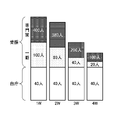
- FIG. 19 is a diagram showing part of the plan summary display G2.
- the number of investigators for each week is displayed by distinguishing between the investigators of the own agency and the investigators receiving support.
- expert investigators and general investigators are displayed separately. For example, in the first week, there are 40 self-employed investigators, 400 expert investigators among the investigators receiving support, and 100 general investigators among the investigators receiving support. I understand.
- Survey plan generation device 12
- Processor 14
- Memory 16
- Communication interface 18
- Display 20
- Plan condition input reception unit 24
- Damage information acquisition unit 26
- House information acquisition unit 28
- Automatic plan generation unit 30
- Plan candidate display unit 32
- Plan candidate selection reception unit 34
- Map information acquisition unit 36
- Plan editing means display unit 38
- Plan editing operation reception unit 100
- Research plan candidate 104
- First plan candidate 106
- Second plan candidate 108
- Third plan candidate 110
- Required survey days information 112
- Survey progress forecast information 114
- Required number of investigators (survey team number) forecast information 116
- Order information 118... Cell 120... Cell 122... Cell 124... Map 126...
Landscapes
- Business, Economics & Management (AREA)
- Human Resources & Organizations (AREA)
- Engineering & Computer Science (AREA)
- Economics (AREA)
- Strategic Management (AREA)
- Tourism & Hospitality (AREA)
- General Physics & Mathematics (AREA)
- Development Economics (AREA)
- Physics & Mathematics (AREA)
- Educational Administration (AREA)
- Entrepreneurship & Innovation (AREA)
- Theoretical Computer Science (AREA)
- Marketing (AREA)
- General Business, Economics & Management (AREA)
- Quality & Reliability (AREA)
- Operations Research (AREA)
- Game Theory and Decision Science (AREA)
- General Health & Medical Sciences (AREA)
- Primary Health Care (AREA)
- Health & Medical Sciences (AREA)
- Radar, Positioning & Navigation (AREA)
- Remote Sensing (AREA)
- Management, Administration, Business Operations System, And Electronic Commerce (AREA)
Priority Applications (3)
| Application Number | Priority Date | Filing Date | Title |
|---|---|---|---|
| JP2023507014A JP7751630B2 (ja) | 2021-03-19 | 2022-03-09 | 調査計画生成装置、調査計画生成方法及びプログラム |
| US18/469,216 US20240005257A1 (en) | 2021-03-19 | 2023-09-18 | Survey plan generation apparatus, survey plan generation method, and program |
| JP2025160051A JP2025175192A (ja) | 2021-03-19 | 2025-09-26 | 調査計画生成装置、調査計画生成方法及びプログラム |
Applications Claiming Priority (2)
| Application Number | Priority Date | Filing Date | Title |
|---|---|---|---|
| JP2021-046367 | 2021-03-19 | ||
| JP2021046367 | 2021-03-19 |
Related Child Applications (1)
| Application Number | Title | Priority Date | Filing Date |
|---|---|---|---|
| US18/469,216 Continuation US20240005257A1 (en) | 2021-03-19 | 2023-09-18 | Survey plan generation apparatus, survey plan generation method, and program |
Publications (1)
| Publication Number | Publication Date |
|---|---|
| WO2022196475A1 true WO2022196475A1 (ja) | 2022-09-22 |
Family
ID=83320535
Family Applications (1)
| Application Number | Title | Priority Date | Filing Date |
|---|---|---|---|
| PCT/JP2022/010194 Ceased WO2022196475A1 (ja) | 2021-03-19 | 2022-03-09 | 調査計画生成装置、調査計画生成方法及びプログラム |
Country Status (3)
| Country | Link |
|---|---|
| US (1) | US20240005257A1 (https=) |
| JP (2) | JP7751630B2 (https=) |
| WO (1) | WO2022196475A1 (https=) |
Cited By (1)
| Publication number | Priority date | Publication date | Assignee | Title |
|---|---|---|---|---|
| WO2025234501A1 (ja) * | 2024-05-07 | 2025-11-13 | パナソニックIpマネジメント株式会社 | 作業計画管理方法 |
Citations (4)
| Publication number | Priority date | Publication date | Assignee | Title |
|---|---|---|---|---|
| JP2004110557A (ja) * | 2002-09-19 | 2004-04-08 | Nec Corp | 被害調査システム及び災害調査方法 |
| JP2014211766A (ja) * | 2013-04-18 | 2014-11-13 | 三菱化学エンジニアリング株式会社 | 要員管理システム、及び要員管理方法 |
| US20160125342A1 (en) * | 2014-11-03 | 2016-05-05 | Hand Held Products, Inc. | Directing an inspector through an inspection |
| JP2017062656A (ja) * | 2015-09-25 | 2017-03-30 | 株式会社日立製作所 | 計画管理システム及び計画管理方法 |
Family Cites Families (15)
| Publication number | Priority date | Publication date | Assignee | Title |
|---|---|---|---|---|
| WO2011013227A1 (ja) | 2009-07-30 | 2011-02-03 | 株式会社日立製作所 | 人員配置システム及びサーバ |
| US8312040B2 (en) * | 2009-11-27 | 2012-11-13 | Nyman Douglas J | System and method for accessing potential damage to infrastructure items after natural events |
| WO2011087204A2 (en) * | 2010-01-12 | 2011-07-21 | Lg Electronics Inc. | Digital signage apparatus and method using the same |
| CA2752955A1 (en) * | 2010-09-22 | 2012-03-22 | Delia Welty | Data-processing system and method |
| US20140164039A1 (en) * | 2012-12-10 | 2014-06-12 | General Electric Company | System and method for inspection of structures |
| JP5847986B2 (ja) * | 2013-08-09 | 2016-01-27 | 株式会社ゼスト | 業務割当装置及び業務割当プログラム |
| US20150339619A1 (en) * | 2014-05-23 | 2015-11-26 | Mckinsey & Company, Inc. | Automatically updating work schedules |
| EP2953070A1 (en) * | 2014-06-05 | 2015-12-09 | ABB Technology AG | Improving workforce optimization by improved provision of job performance plan |
| US20170091885A1 (en) * | 2014-10-15 | 2017-03-30 | UScope Technologies, Inc. | Systems and Methods for Improved Property Inspection Management |
| US10977734B1 (en) * | 2015-05-29 | 2021-04-13 | State Farm Mutual Automobile Insurance Company | Method and system for collaborative inspection of insured properties |
| EP3355259A4 (en) * | 2015-09-24 | 2018-08-01 | Fujifilm Corporation | Repair plan devising assistance system, method, and program |
| JP6472894B2 (ja) * | 2015-09-25 | 2019-02-20 | 富士フイルム株式会社 | メンテナンス計画立案支援システム、方法およびプログラム |
| US20170330282A1 (en) * | 2016-05-10 | 2017-11-16 | NSP Technologies, LLC | Roof Monitoring Tools And Methods Of Use |
| JP7629021B2 (ja) * | 2020-09-23 | 2025-02-12 | 富士フイルム株式会社 | 被害判定情報システム、サーバ装置およびプログラム |
| US20220391784A1 (en) * | 2021-06-06 | 2022-12-08 | International Business Machines Corporation | Computer automated multi-objective scheduling advisor |
-
2022
- 2022-03-09 JP JP2023507014A patent/JP7751630B2/ja active Active
- 2022-03-09 WO PCT/JP2022/010194 patent/WO2022196475A1/ja not_active Ceased
-
2023
- 2023-09-18 US US18/469,216 patent/US20240005257A1/en active Pending
-
2025
- 2025-09-26 JP JP2025160051A patent/JP2025175192A/ja active Pending
Patent Citations (4)
| Publication number | Priority date | Publication date | Assignee | Title |
|---|---|---|---|---|
| JP2004110557A (ja) * | 2002-09-19 | 2004-04-08 | Nec Corp | 被害調査システム及び災害調査方法 |
| JP2014211766A (ja) * | 2013-04-18 | 2014-11-13 | 三菱化学エンジニアリング株式会社 | 要員管理システム、及び要員管理方法 |
| US20160125342A1 (en) * | 2014-11-03 | 2016-05-05 | Hand Held Products, Inc. | Directing an inspector through an inspection |
| JP2017062656A (ja) * | 2015-09-25 | 2017-03-30 | 株式会社日立製作所 | 計画管理システム及び計画管理方法 |
Cited By (1)
| Publication number | Priority date | Publication date | Assignee | Title |
|---|---|---|---|---|
| WO2025234501A1 (ja) * | 2024-05-07 | 2025-11-13 | パナソニックIpマネジメント株式会社 | 作業計画管理方法 |
Also Published As
| Publication number | Publication date |
|---|---|
| US20240005257A1 (en) | 2024-01-04 |
| JPWO2022196475A1 (https=) | 2022-09-22 |
| JP2025175192A (ja) | 2025-11-28 |
| JP7751630B2 (ja) | 2025-10-08 |
Similar Documents
| Publication | Publication Date | Title |
|---|---|---|
| Elbeltagi et al. | Integrated visualized time control system for repetitive construction projects | |
| US20080183483A1 (en) | Office management solution | |
| US20050171790A1 (en) | Construction project management system and method | |
| Akinradewo et al. | Key requirements for effective implementation of building information modelling for maintenance management | |
| JP2025175192A (ja) | 調査計画生成装置、調査計画生成方法及びプログラム | |
| Poshdar et al. | A multi-objective probabilistic-based method to determine optimum allocation of time buffer in construction schedules | |
| US20150242782A1 (en) | Interactive Planning Method And Tool | |
| Korb et al. | Agent-based simulation of general contractor–subcontractor interactions in a multiproject environment | |
| JP2019159351A (ja) | 不動産事業計画支援装置、プログラム、及び、方法 | |
| Rehman et al. | Data-driven integration framework for four-dimensional building information modeling simulation in modular construction: A case study approach | |
| JP2019008501A (ja) | 生産管理システムおよび生産管理方法 | |
| Gear | A review of some recent developments in portfolio modelling in applied research and development | |
| Rathnayake et al. | Measuring activity-level construction productivity | |
| US20170004437A1 (en) | Systems, apparatus and methods for generating and displaying a schedule impact map | |
| US10121111B2 (en) | Coordinating contending resources | |
| US20190353494A1 (en) | Route recommendation system for field service technicians | |
| Salhab et al. | Patterns, 4D Simulations, and Artificial Intelligence–Driven Insights: Redefining Construction Workspace Management | |
| JP2011210162A (ja) | 施工計画作成装置およびプログラム | |
| Chaker et al. | Multi-objective personnel scheduling problem with multiple qualification and client’s satisfaction: real case | |
| Herdyana et al. | The impacts of 5D-Building Information Modeling on construction's Time and cost performance | |
| CHAI et al. | Integration of augmented reality in building information modeling: Applicability and practicality | |
| JP2002288403A (ja) | プロジェクト管理システム、プロジェクト管理方法、及びプロジェクト管理プログラム | |
| JP2000194755A (ja) | 職場間作業者融通システム | |
| Franchi et al. | Indicator Engineering on a Cloud-Edge GIS Platform Assisting Post-Seismic Reconstruction and Rehabilitation | |
| JP7805603B2 (ja) | タスクオーダー処理システム |
Legal Events
| Date | Code | Title | Description |
|---|---|---|---|
| 121 | Ep: the epo has been informed by wipo that ep was designated in this application |
Ref document number: 22771227 Country of ref document: EP Kind code of ref document: A1 |
|
| WWE | Wipo information: entry into national phase |
Ref document number: 2023507014 Country of ref document: JP |
|
| NENP | Non-entry into the national phase |
Ref country code: DE |
|
| 122 | Ep: pct application non-entry in european phase |
Ref document number: 22771227 Country of ref document: EP Kind code of ref document: A1 |